Scarlet Bee Balm and Bottlebrush Grass in Treman Park

Discover scarlet bee balm and eastern bottlebrush grass along Robert H. Treman’s South Rim Trail, where native plants reveal Finger Lakes ecology, history, and culture.

In July, the South Rim Trail of Robert H. Treman State the gorge gathers coolness, a refuge on sultry Finger Lakes summer afternoons. Beneath hemlocks and northern hardwoods, the air seems older, quieter, touched by water moving somewhere below. The trail passes between the intimacy of Enfield Glen and, higher up the gorge, the larger wandering course of the Finger Lakes Trail draws me away from ordinary measures of distance and urgency. In such a place, attention gradually changes. The forest ceases to be a green background and becomes a society of distinct lives.
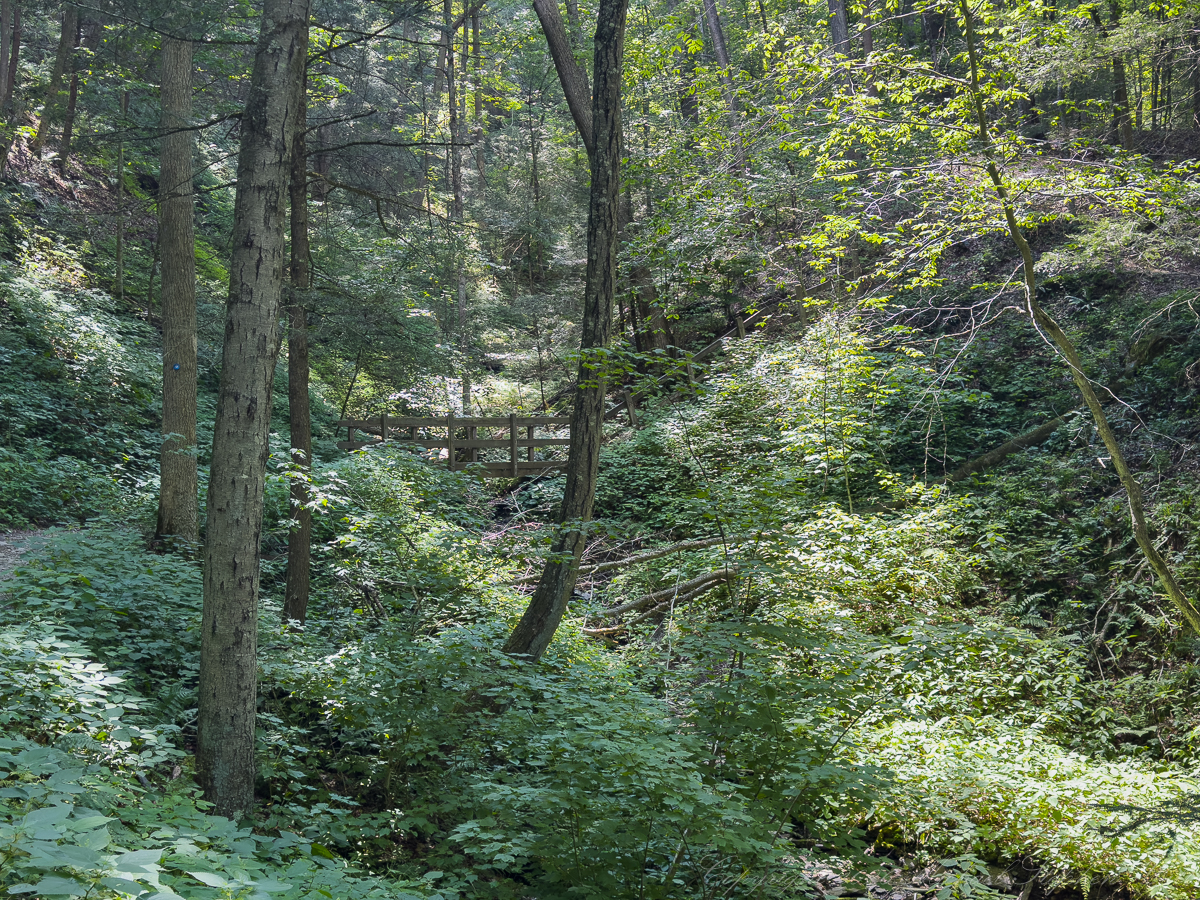
A footbridge on the South Rim trail crosses a feeder stream to Enfield Creek.

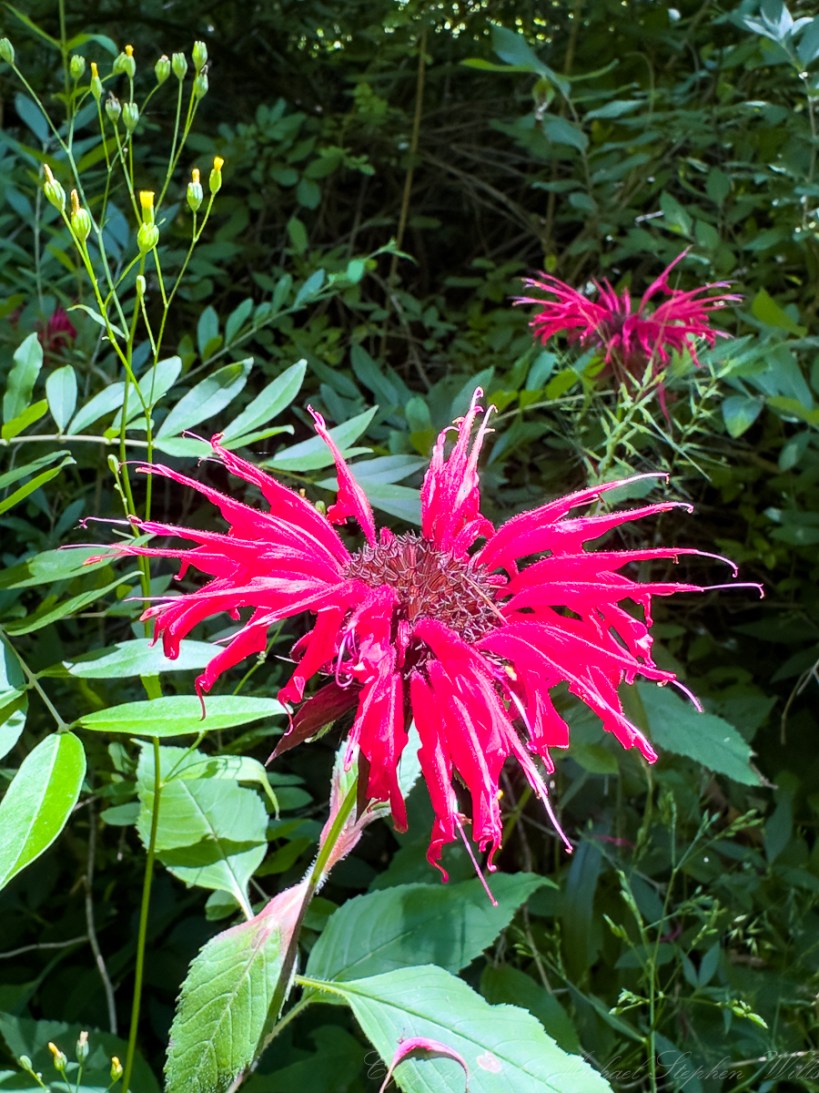
It was in this receptive state that I encountered colonies of scarlet bee balm on either side of the Finger Lakes Trail. The crimson flower heads rising above the surrounding vegetation like scattered signal fires. The color seemed almost impossible in the woodland light—not delicate or retiring, but exuberant. Each blossom rewarded a closer look, resolving into a wild arrangement of slender red tubes, curling lips, dark centers, and leaflike bracts. Here a native plant announces itself with an exotic richness.
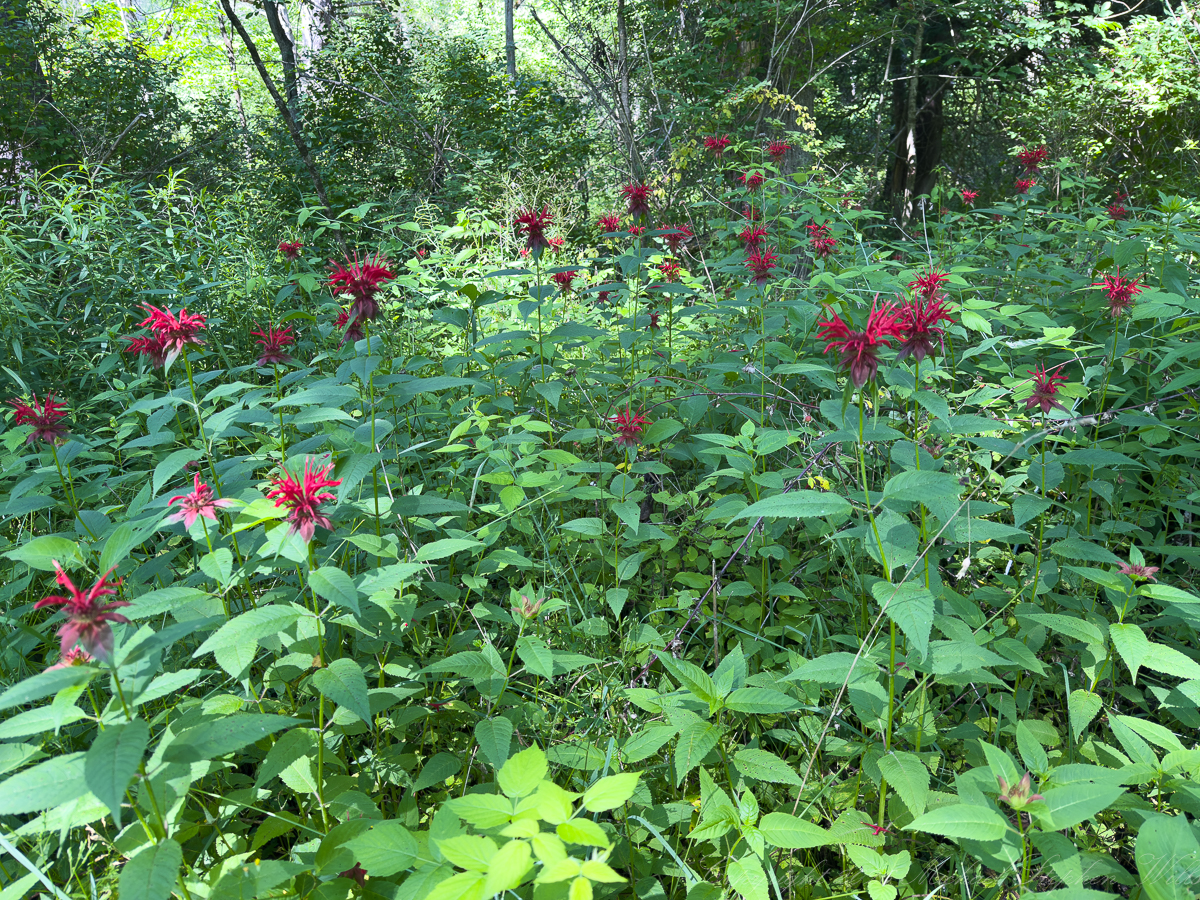
Scarlett Bee Balm bloomed throughout well watered flatlands of the park and surroundings.

Scarlet bee balm, Monarda didyma, is an herbaceous perennial in the mint family, Lamiaceae. It is native to eastern North America and especially at home in moist woods, stream margins, thickets, and bottomlands. Its square stems, opposite serrated leaves, and aromatic oils disclose its kinship with other mints. Beneath the soil, spreading rhizomes enable it to form colonies. What appears from a distance to be one shaggy flower is actually a crowded head of many narrow, two-lipped flowers, each offering its own small entrance to nectar.
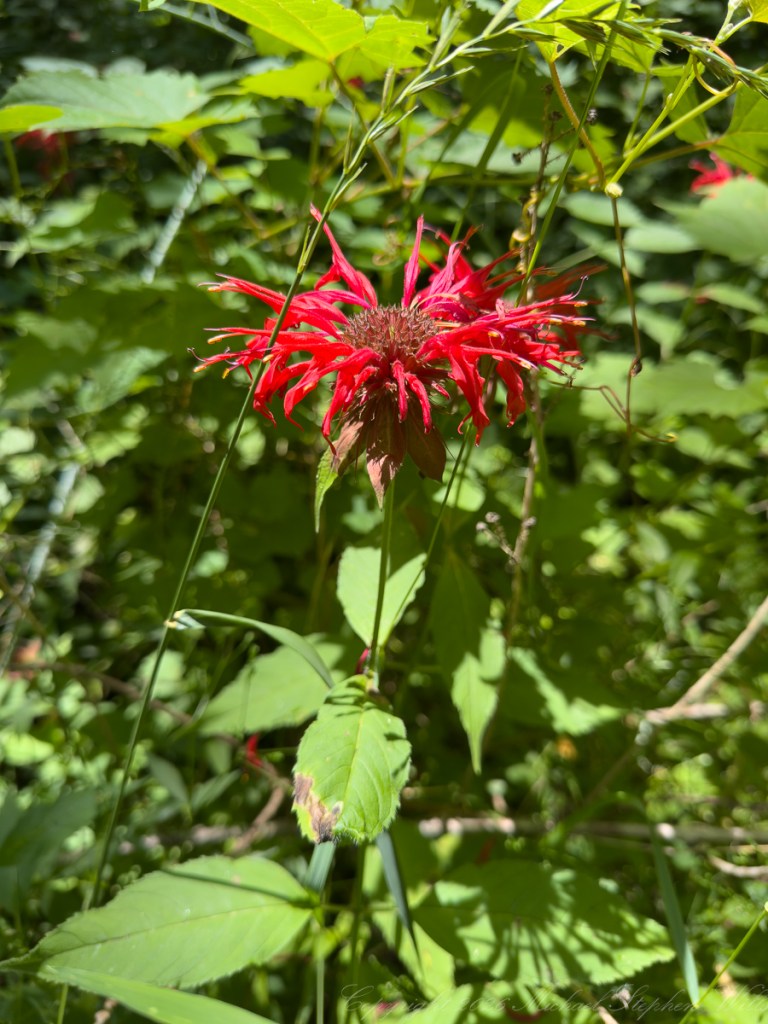
Scarlet Bee Balm rewards a close inspection

The scarlet tubes are beautifully suited to the ruby-throated hummingbird. A bird hovering before the flower reaches into the corolla with its long bill and carries pollen away on its head, becoming for a moment part of the plant’s reproductive life. Bumblebees, butterflies, and moths also visit. Members of the genus support several specialized native bees, while the dead hollow stems can provide nesting places for stem-nesting species. Even after flowering, therefore, bee balm continues to participate in the forest community. Its importance is not exhausted by its beauty.
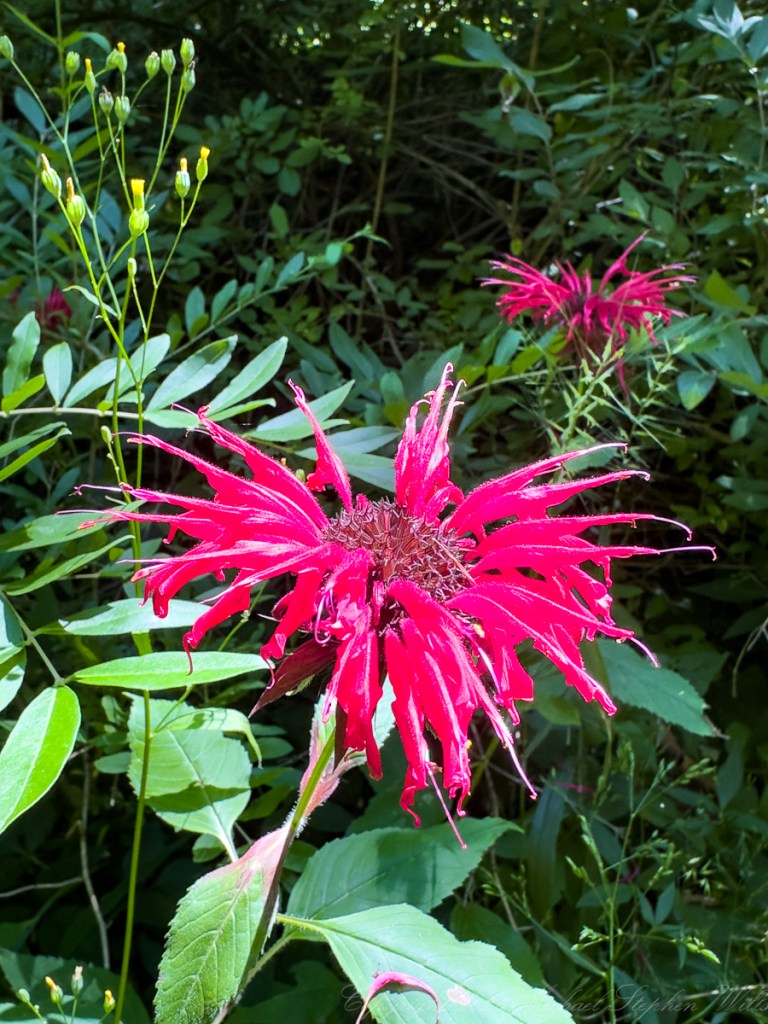
Nipplewort growing among Scarlet Bee Balm

Humans have also entered into a long relationship with Monarda didyma. One of its common names, Oswego tea, remembers its use by the Oswego people of New York, who prepared the aromatic leaves as a beverage. Indigenous communities employed bee balm in varied medicinal traditions, and later settlers adopted it for teas and household remedies. Its leaves and edible flowers have been used to flavor jellies, soups, stews, and fruit dishes. Thymol, a component associated with Monarda oils, has found use in commercial antiseptic preparations. These histories deepen the encounter. The plant is a bearer of ecological and cultural memory, current posibilities. It is best to check with local regulations as foraging and collecting is regulated in New York Park lands.

Eastern bottlebrush grass offers a quieter kind of revelation. A native, cool-season perennial of the grass family, Poaceae, Elymus hystrix inhabits deciduous woods and shaded edges across much of eastern and central North America. Its specific name, hystrix, means “hedgehog,” an affectionate description of the long, radiating awns that give each seed head its bristling form. In the photograph, those awns catch the light so finely that the plant seems drawn with green wire against the luminous forest. Unlike bee balm, it does not advertise to hummingbirds or bees. Its flowers are wind-pollinated, their pale anthers releasing pollen into the moving air.
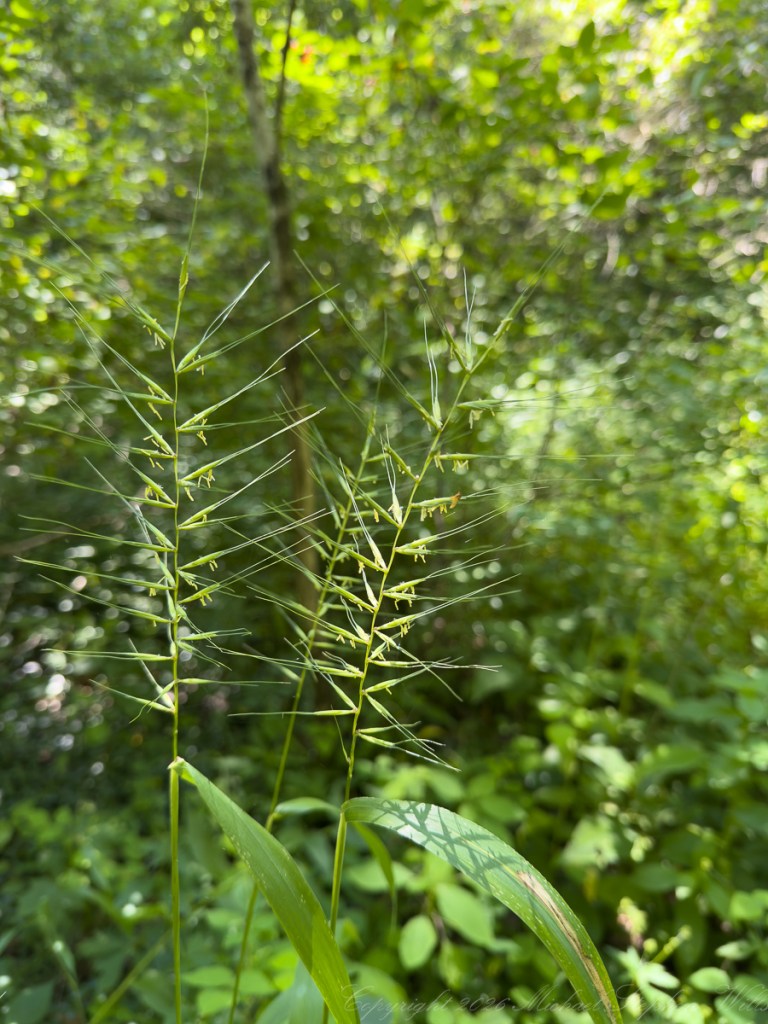
Bottlebruxh Grass catching afternoon dappled forest light

Where bee balm calls to birds and insects with color and nectar, bottlebrush grass entrusts its pollen to the wind. Its flowering is easily overlooked because grasses seldom conform to our habitual idea of a flower. There are no bright petals, no perfume meant to attract an animal visitor. Pale anthers emerge, air moves through the open spikelets, and pollen passes invisibly from plant to plant. Its apparent simplicity is the refinement of a different evolutionary strategy.

Bottlebrush grass sustains other lives in less conspicuous ways. Its foliage feeds the caterpillars of the northern pearly-eye butterfly and several moth species. Birds and white-footed mice eat its seeds, while grazing animals browse the tender young leaves. Its fibrous roots help hold woodland soil, and its tolerance of shade allows it to flourish beneath a leafy canopy where many grasses cannot. Cornell Botanic Gardens also records a Haudenosaunee practice involving a preparation of its leaves and reed-grass rootstocks in treating corn seed before planting—another meeting of botanical and cultural knowledge.

Today Elymus hystrix is increasingly welcomed into native woodland gardens, naturalized plantings, and erosion-control areas. Its seed heads bring movement and texture to shaded landscapes and can be used in floral arrangements. Monarda didyma, meanwhile, has become a familiar inhabitant of pollinator gardens and rain gardens. Cultivated thoughtfully, both plants allow a human landscape to recover some of the relationships present in a functioning woodland: roots securing soil, insects finding food, birds gathering seed, and seasons being permitted to complete themselves.

Encountered together, the two plants seemed to embody complementary ways of belonging. Scarlet bee balm was ardor made visible—bright, aromatic, and alive with invitation. Eastern bottlebrush was reticence and patience, revealing its elegance only to a lingering eye. One reached outward through color; the other surrendered itself to wind.

The afternoon’s discoveries thus offered two ways of being visible. Monarda didyma flared outward—scarlet, aromatic, thronged with visitors. Elymus hystrix waited for a shaft of light and an attentive eye. Between them lay the shaded South Rim Trail, the bridge, the climbing path, and the patient green world through which they conduct their separate lives. To walk there was to learn again that beauty is relationship: roots holding soil, wind carrying pollen, a hummingbird entering a red corolla, a mouse gathering seed, and a hiker pausing long enough for the forest to become particular.
Click me to visit Michael Stephen Wills Online Finger Lakes Gallery.

Enter your email to receive notification of future postings. I will not sell or share your email address.

Among the Trout Lilies in Sapsucker Woods

On April 22, 2025, a wanderer discovers a trout lily, representing nature’s cycles, patience, and the interconnectedness of life through blooming, pollination, and nutrient cycling.

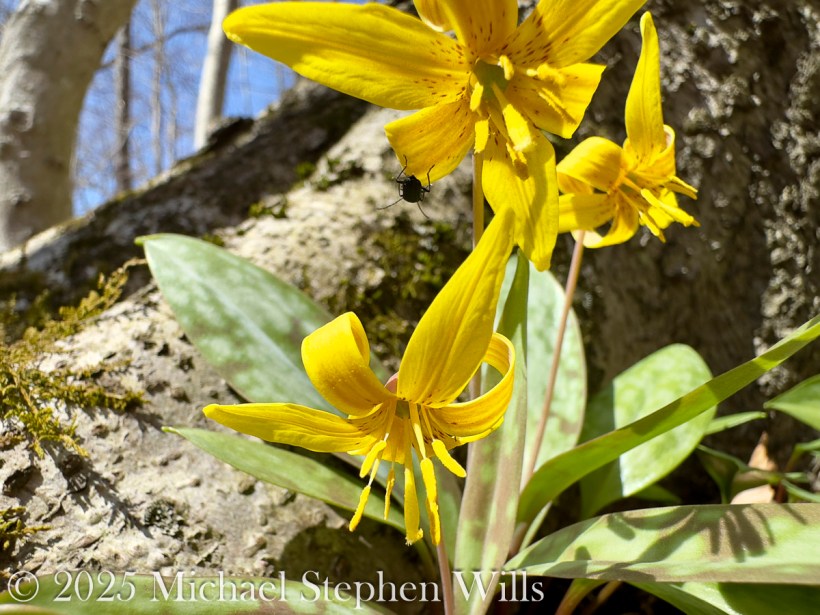
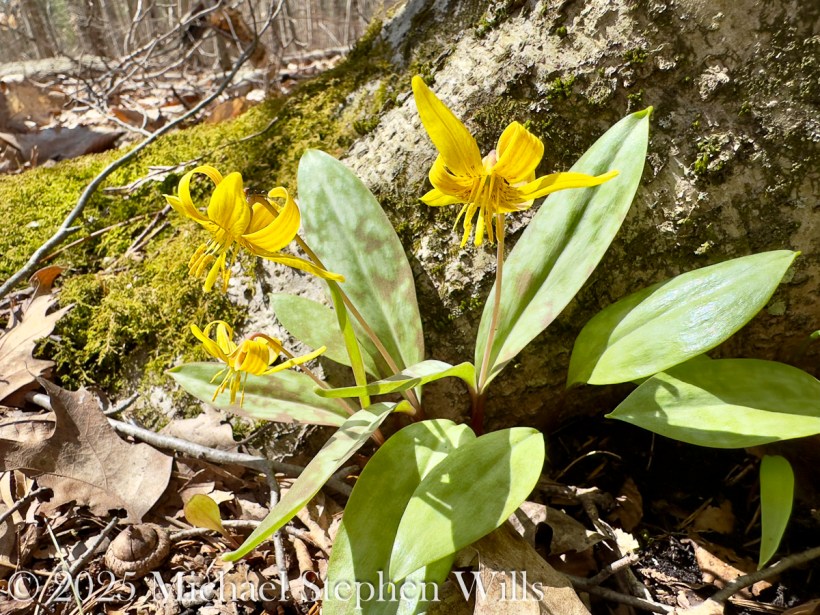
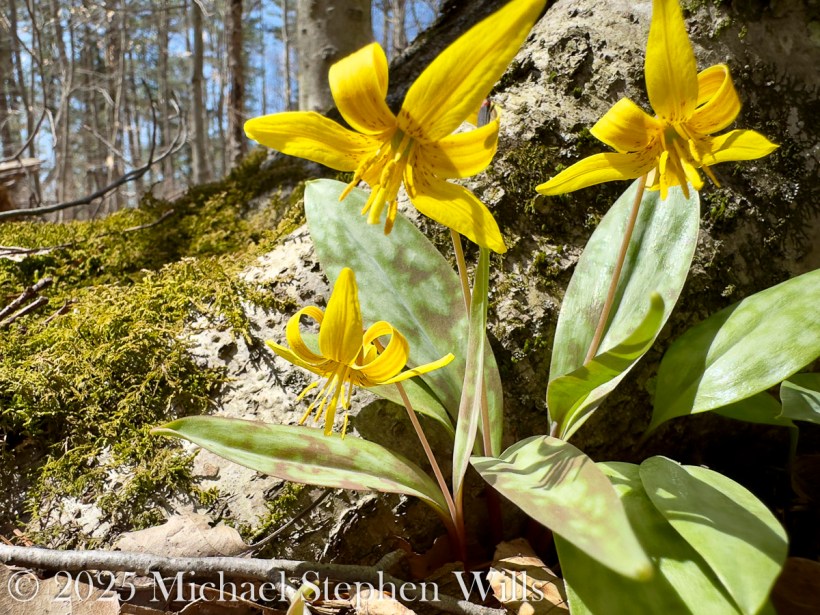
On the bright afternoon of April 22, 2025, I wander slowly through Sapsucker Woods, last year’s oak leaves soft underfoot and the smell of damp earth in the air. The trees stand bare, and somewhere a woodpecker drums as I search the ground for any sign of spring. A flash of gold catches my eye at the mossy base of a tree. Kneeling down, I find among the leaf litter a small wildflower glowing yellow.  It is a trout lily – Erythronium americanum – a solitary, nodding bloom on a slender stem. Six delicate petals flare backward, golden with a few reddish freckles near the throat; long stamens dangle beneath. Two lance-shaped leaves hug the ground, green marbled with burgundy-brown. Their mottled pattern looks like a brook trout’s flank. This flower is known by many names: “trout lily” for its fish-like leaves, “dogtooth violet” for its pointed white bulb 1, and “adder’s tongue” for its tongue-shaped leaf tip.

Its formal name, Erythronium americanum, comes from the Greek for “red”2—odd for a yellow bloom until one remembers the purple dogtooth violets of Europe. Americanum simply marks it as native here. I soon realize these trout lilies are not alone – dozens of dappled leaves carpet the damp earth around me. Most show no blossom at all, only a single freckled leaf standing alone. Only the older plants with two leaves manage to lift a yellow flower. In fact, they often form extensive colonies on the forest floor. I’ve learned a trout lily may wait seven years to bloom its first time3. Seasons of patience pass unseen underground, and then one spring it earns the chance to unfurl a golden star. That slow, patient rhythm of growth fills me with wonder.

A tiny black bee—or maybe a fly—lands on the trout lily’s bloom, drawn by its promise of pollen. It disappears into the flower’s downturned bell, brushing against the dusting of pollen inside. In early spring, few other blossoms are open, so this little lily is a lifeline for hungry pollinators4. There is even a solitary “trout lily bee” that times its life to these flowers5. Flower and insect share an ancient pact: the lily feeds the visitor, and the visitor carries the lily’s pollen onward to another bloom.

Within a week, the trout lily’s golden star will wither. By the time the canopy closes overhead, the flower will have curled into a green seedpod that splits open by early summer, releasing its seeds6. Each seed carries a tiny parcel of food irresistible to ants7. Ants haul the seeds to their nest, eat the morsel, and abandon the seed in their tunnels—unwittingly planting the next generation. The name for this circular ecological dance is myrmecochory. Over time, the colony inches across the forest floor, guided by these tiny gardeners. During its short life above ground, this little lily helps the forest. Its roots soak up nutrients from the damp soil, keeping them from washing away in spring rains8. When the plant dies back, those nutrients return to the earth as the leaves decay, nourishing other life. In this way, a patch of trout lilies forms a quiet bridge between seasons—capturing nutrients in spring and returning them by summer’s end. I touch one cool leaf, feeling connected to this cycle.

I rise and take a final look at the little yellow lily. Its brief bloom reminds me that life’s most beautiful moments are fleeting yet return each year. This blossom will vanish in a few days, a blink of the season, but it will come back next spring as faithful as hope. In its patience and generosity, I sense kinship. Like the trout lily, we too have long periods of waiting and rare moments of blooming. We also rely on small kindnesses to help us thrive—like a friend in hard times or a community that carries our dreams to fertile ground. And we are part of a larger cycle, giving and receiving, leaving something of ourselves to nurture the future. As I continue down the trail, I carry the image of that humble flower with me—a gentle assurance that even the smallest life can leave a lasting impression, and that hope will always return with the spring.

Enter your email to receive notification of future postings. I will not sell or share your email address.

Footnotes

  1. wildadirondacks.org Trout lily’s common names: “Trout lily” refers to the trout-like mottling on its leaves, while “dogtooth violet” refers to the tooth-like shape of its underground bulb (despite not being a true violet). It is also sometimes called “adder’s tongue.” ↩
  2. en.wikipedia.org The genus name Erythronium comes from the Greek erythros, meaning “red,” originally referring to the red-purple flowers of the European dogtooth violet (Erythronium dens-canis). The species name americanum denotes that it is native to America. ↩
  3. peacevalleynaturecenter.org Trout lilies often grow in large colonies and most individuals in a colony are non-flowering. A plant typically needs about seven years of growth before it produces its first bloom. ↩
  4. peacevalleynaturecenter.org Spring ephemeral wildflowers like the trout lily provide crucial early nectar and pollen for pollinators (bees, flies, butterflies) emerging in early spring. ↩
  5. appalachianforestnha.org The trout lily miner bee (Andrena erythronii) is a solitary bee whose life cycle is closely tied to the trout lily; it forages primarily on trout lily flowers, making it a specialist pollinator of this species. ↩
  6. wildadirondacks.org After pollination, trout lily flowers are replaced by seed capsules that ripen and split open to release the seeds in late spring. ↩
  7. atozflowers.com Erythronium americanum seeds have a small fleshy appendage called an elaiosome, which attracts ants. The ants carry the seeds to their nests, aiding in dispersal in exchange for the food reward, a mutualism known as myrmecochory. ↩
  8. pubmed.ncbi.nlm.nih.gov By growing and taking up nutrients during the brief spring season, trout lily plants help retain important nutrients (like potassium and nitrogen) in the ecosystem. When the plants die back and decay, those nutrients return to the soil, contributing to the forest’s nutrient cycle. ↩