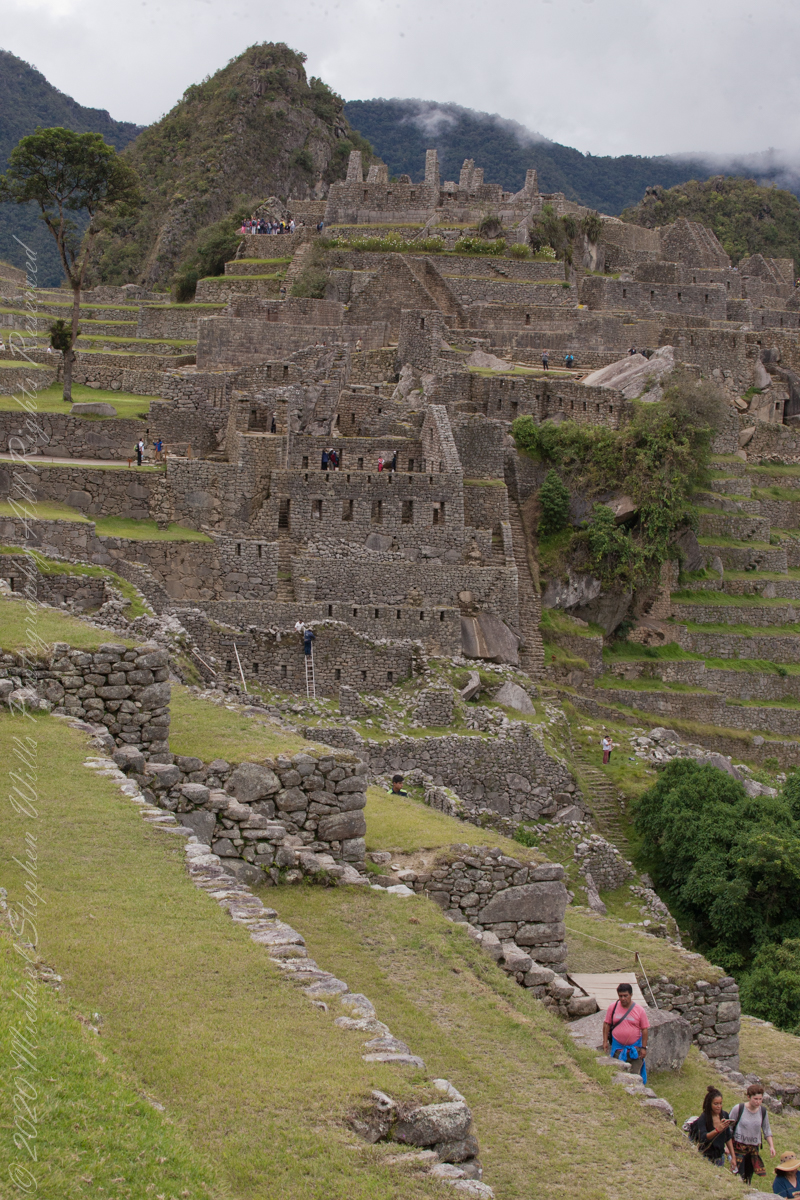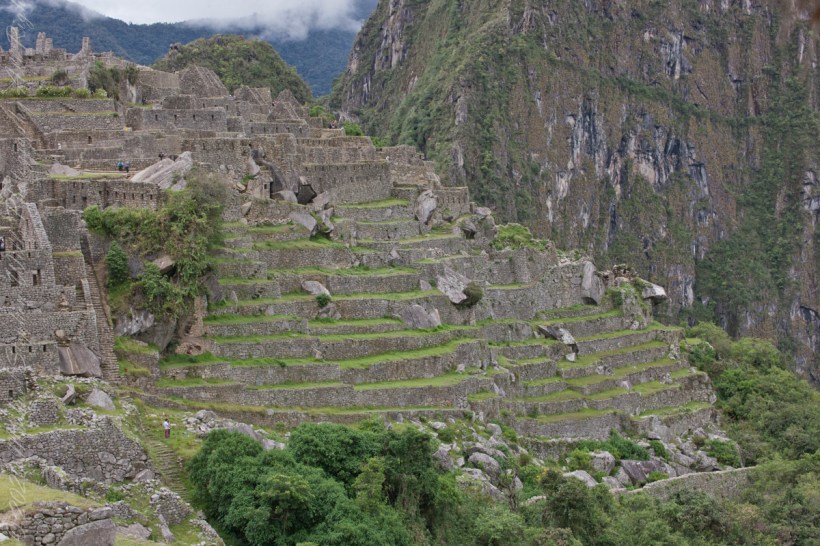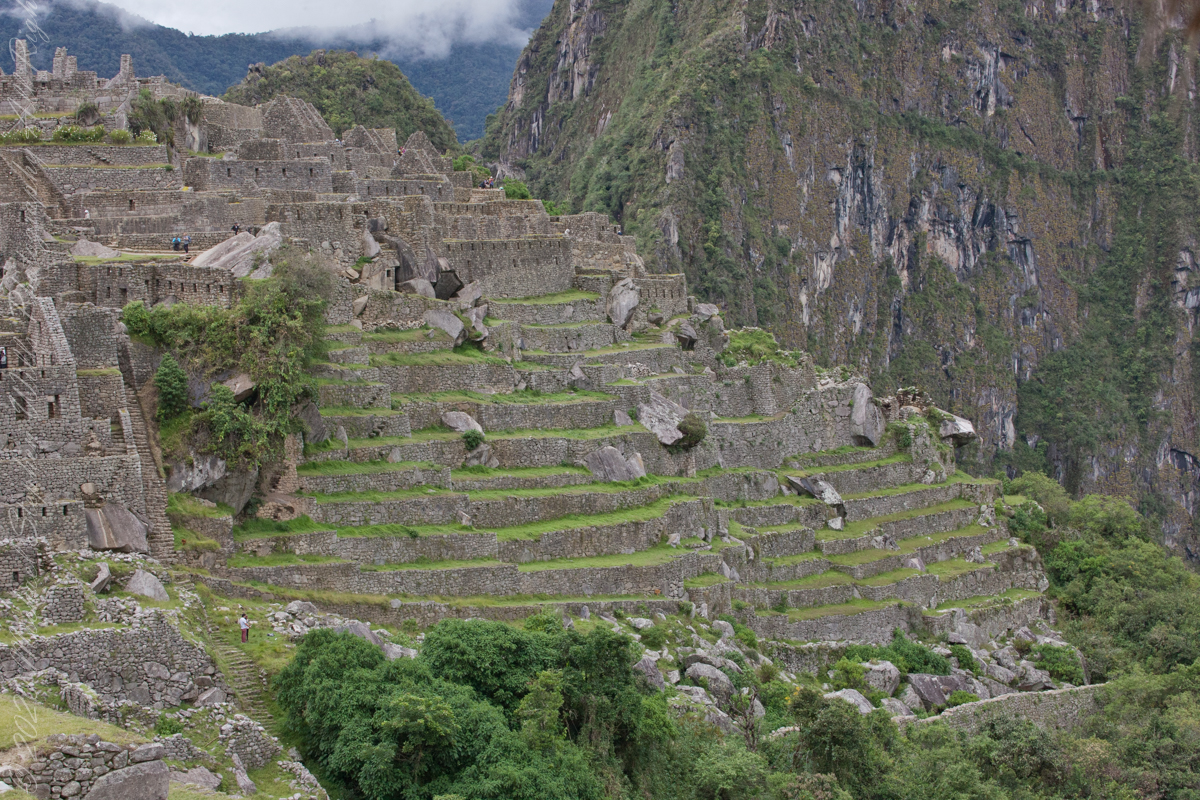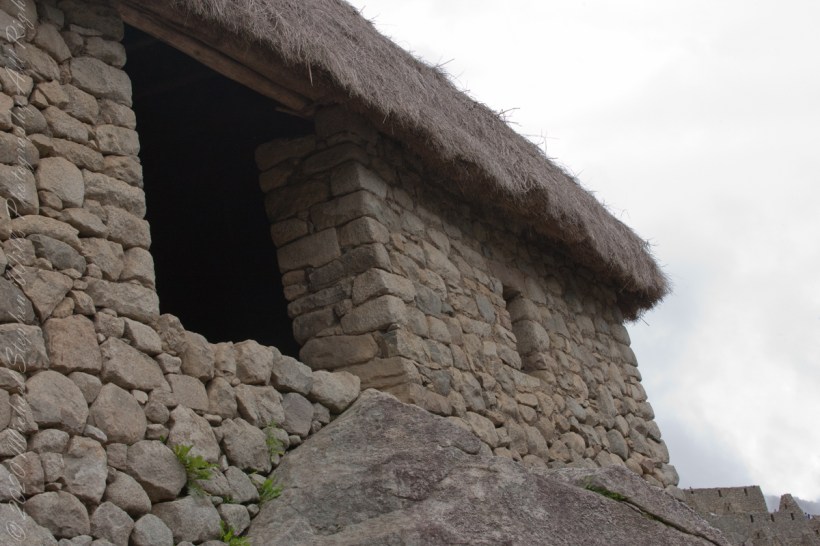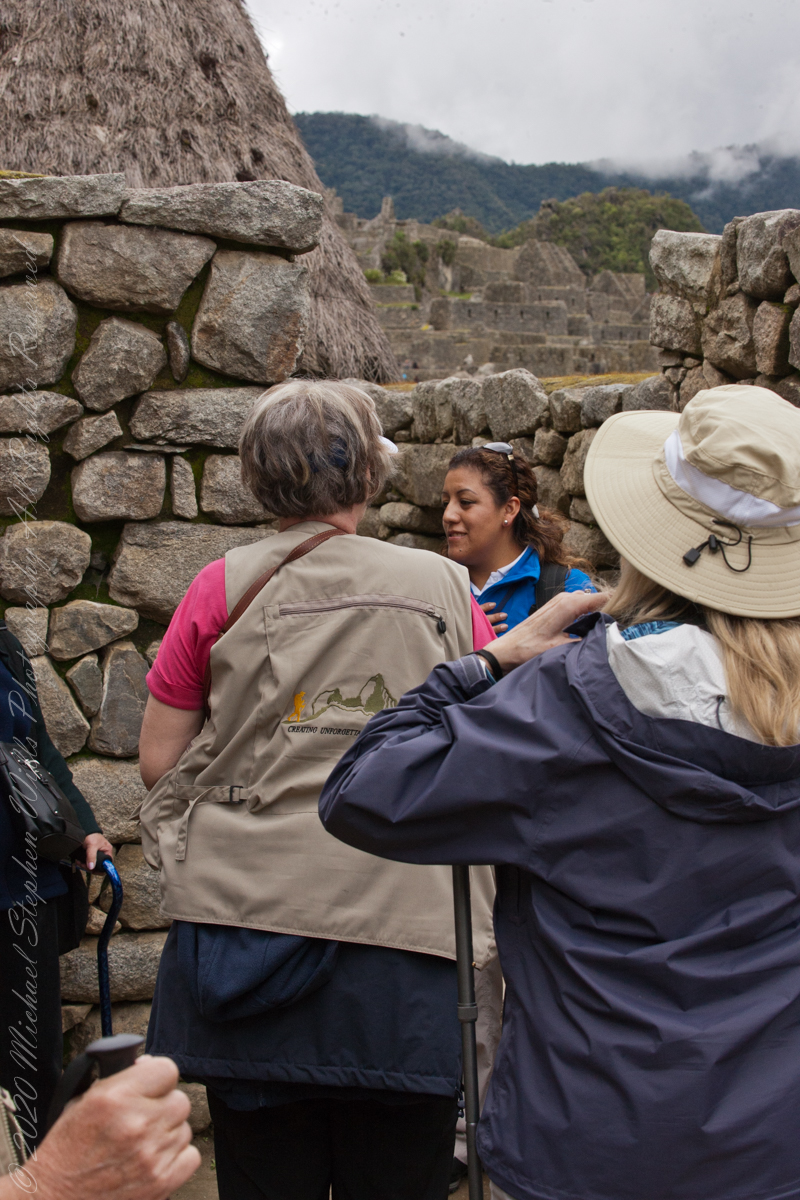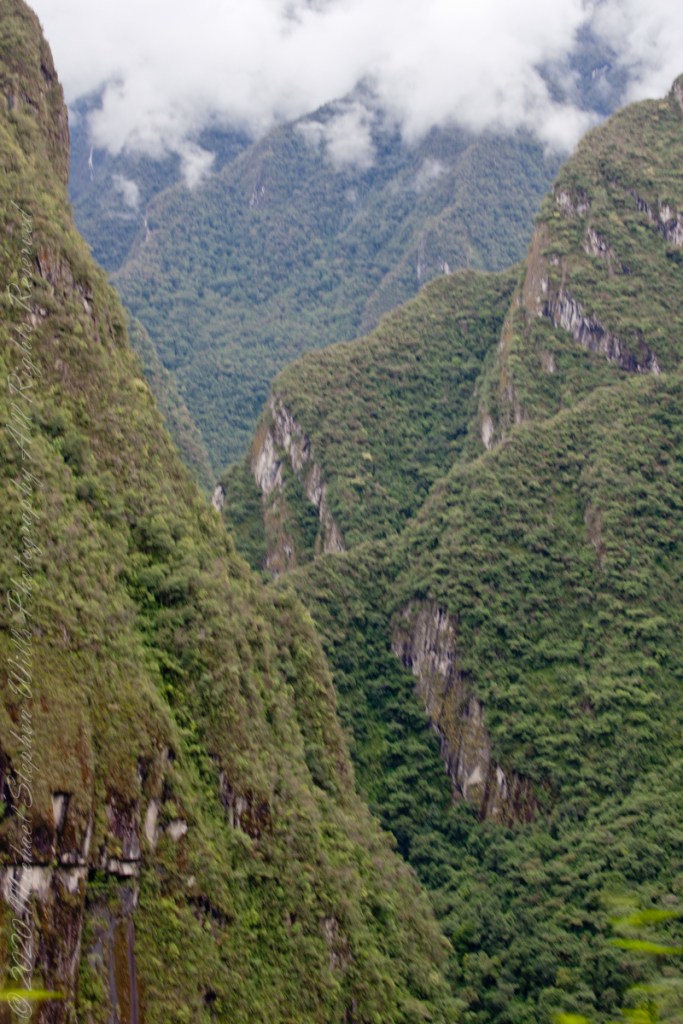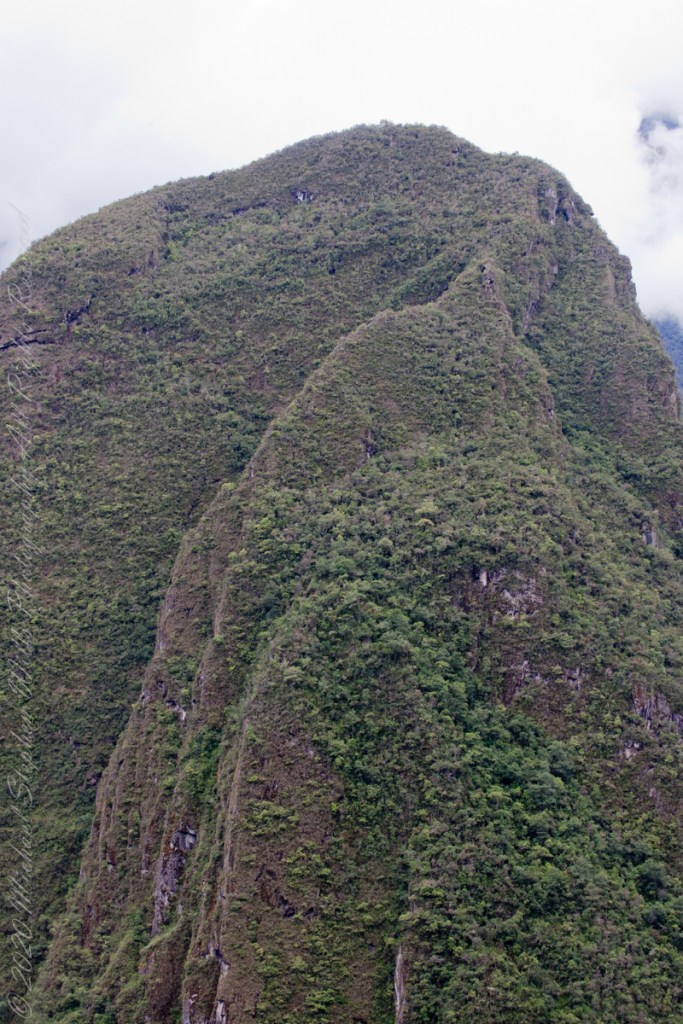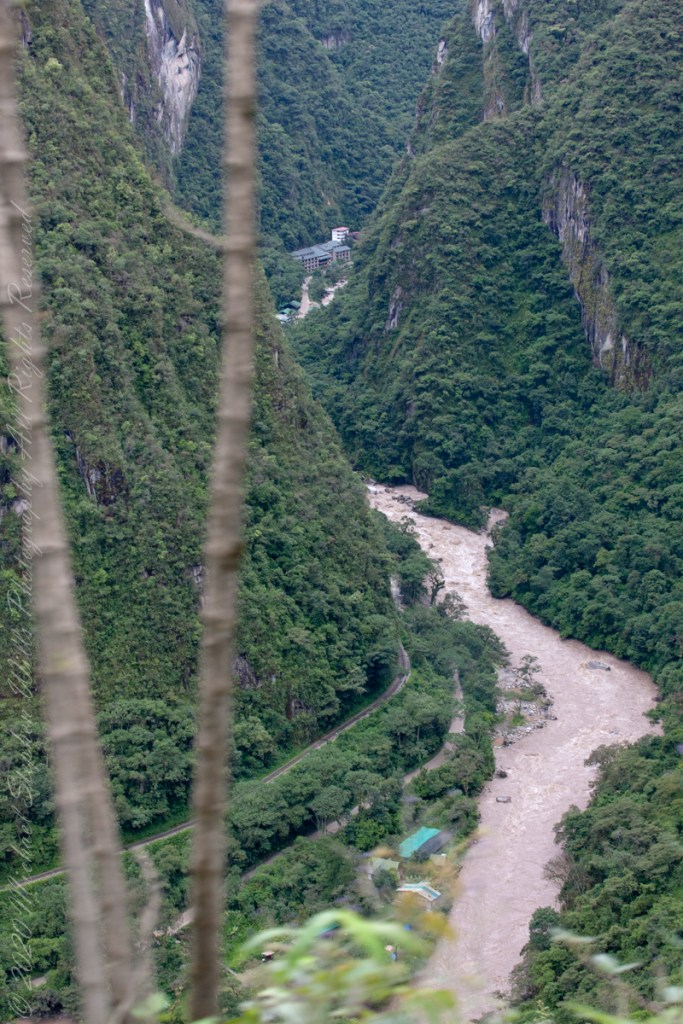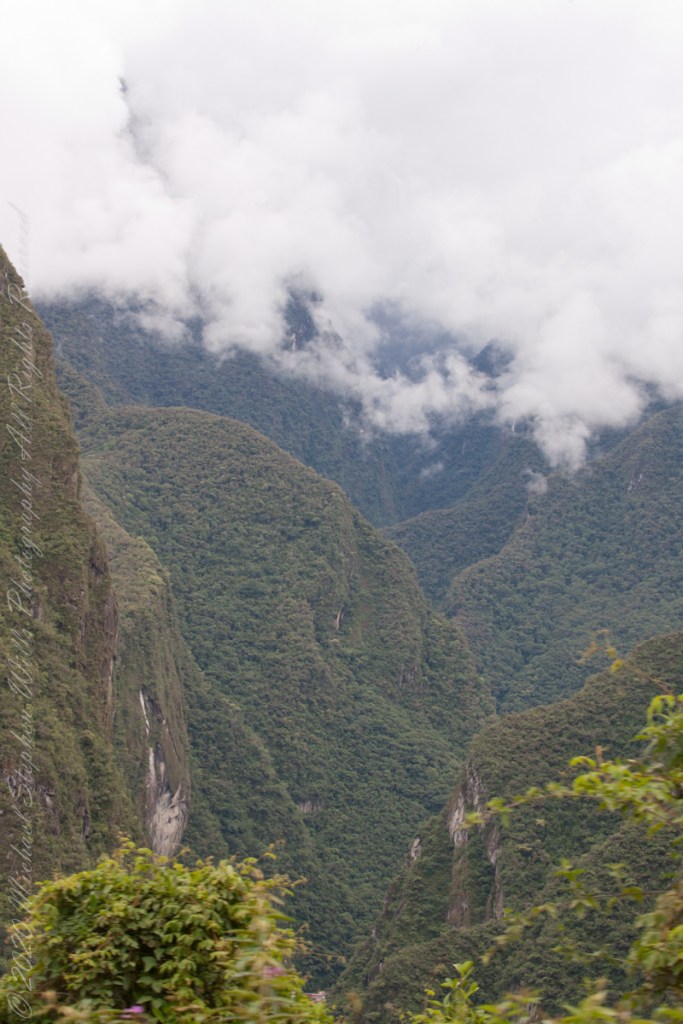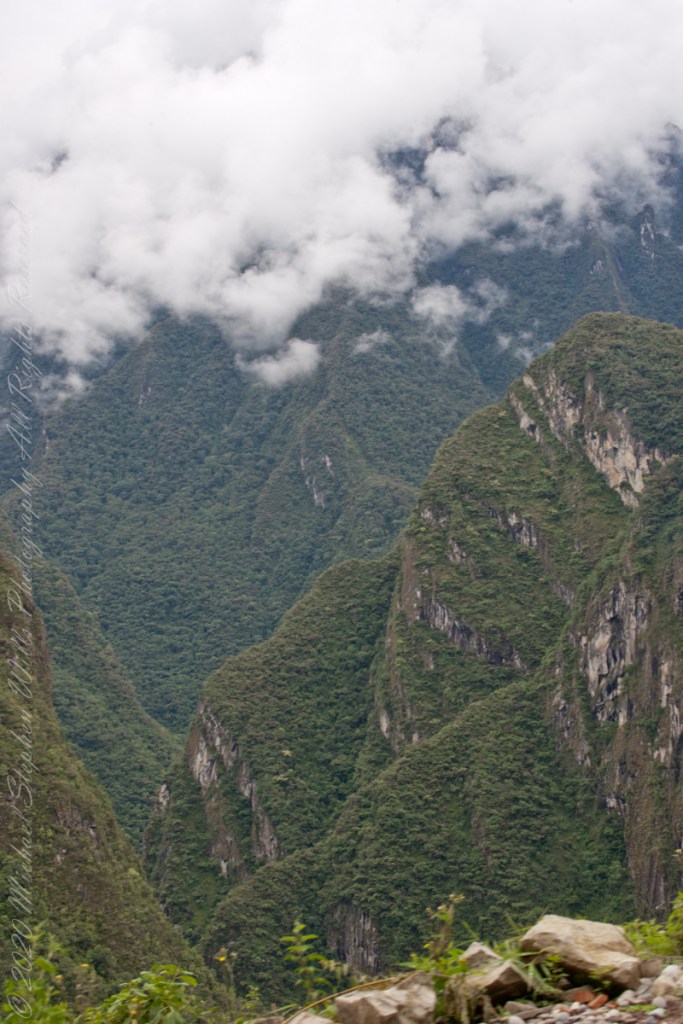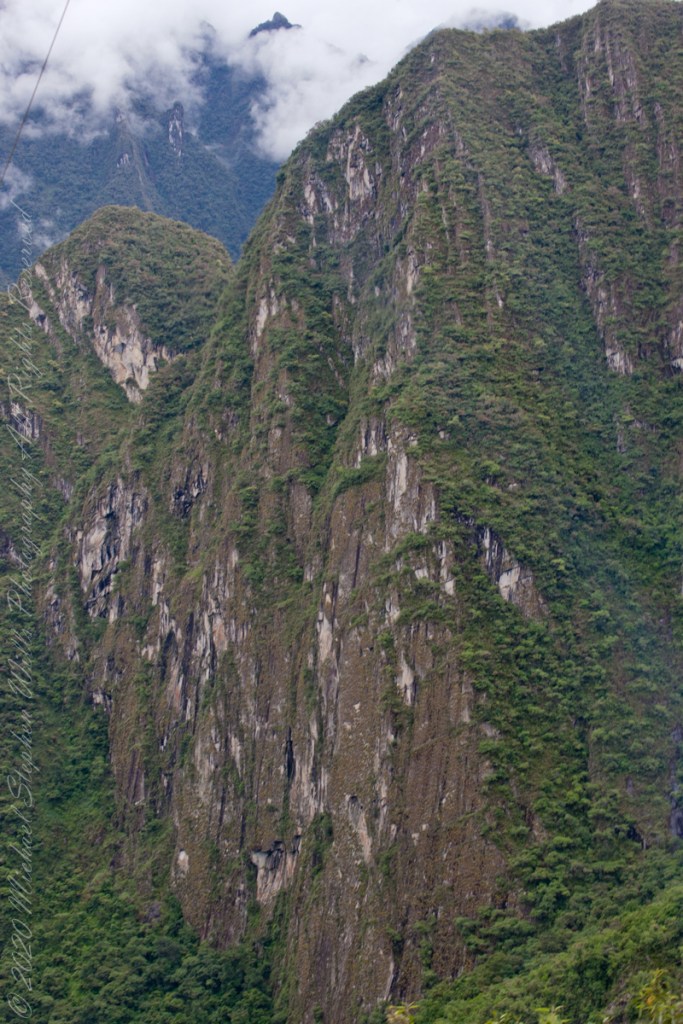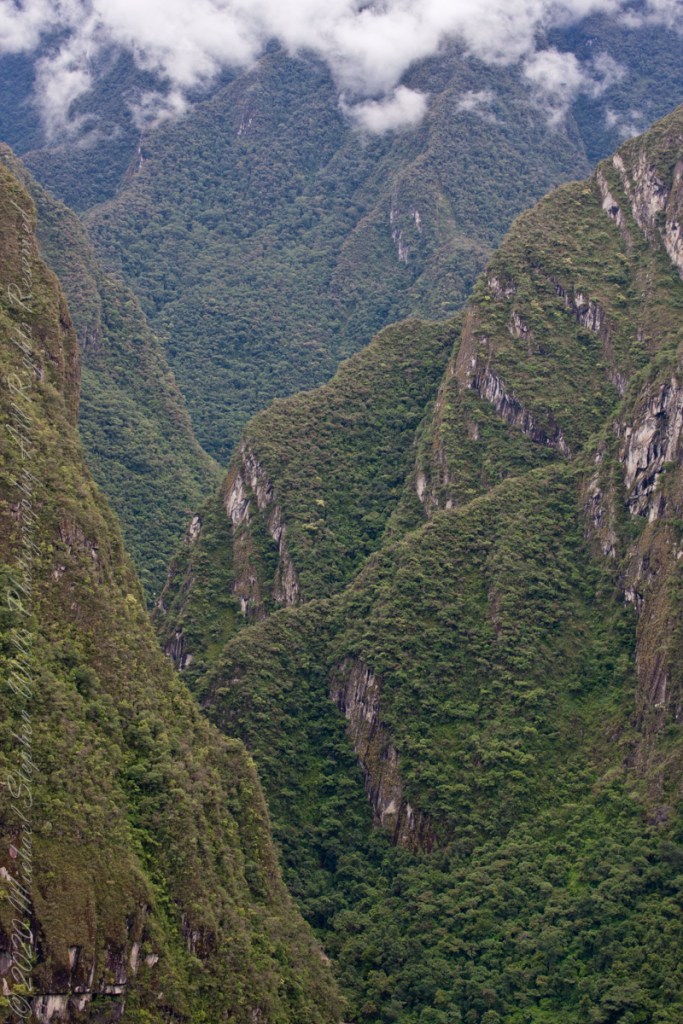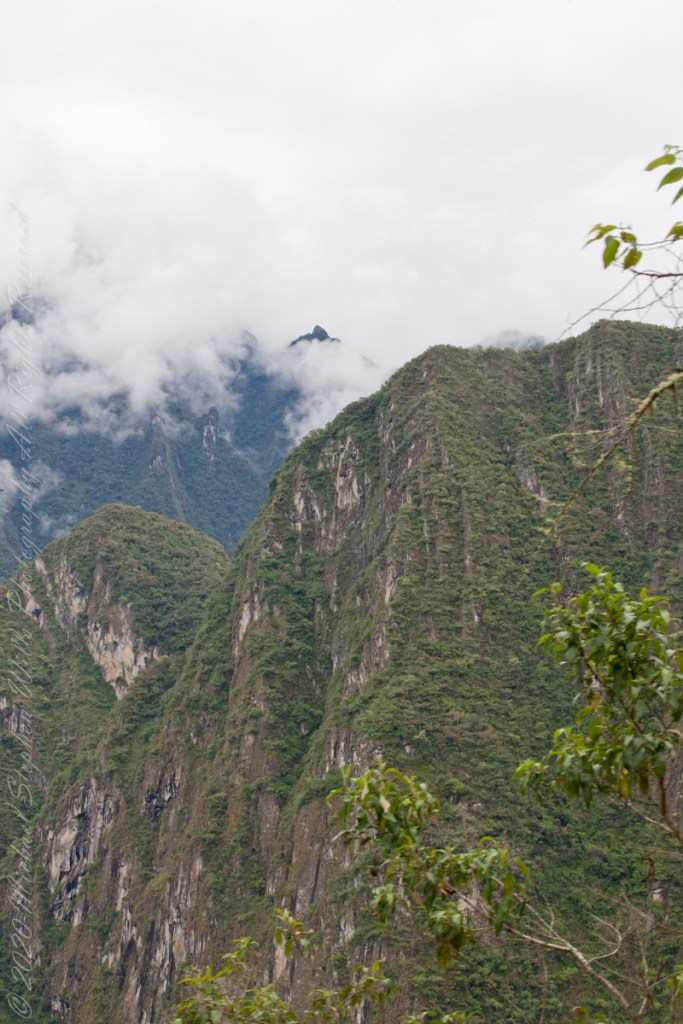
The wall with six rectangular windows is part of the “Prison Group”, a labyrinthine complex of cells, niches and passageways, positioned both under and above the ground. A portion of agricultural terraces is to the right and foreground. Look closely to see a group of tourists in the “Industrial Zone” district.
Copyright 2023 Michael Stephen Wills All Rights Reserved
These agricultural terraces, built in the 15th century, were still in limited use by local farmers when Bingham arrived in the early 20th century. These terraces were a work of considerable engineering, built to ensure good drainage and soil fertility while also protecting the mountain itself from erosion and landslides. Modern soil studies reveal the major crops were corn and potatoes. These terraces are below the districts named “Industrial Zone” and “Factory Houses.” A cliff of Huayna Picchu is in the background.
Copyright 2023 Michael Stephen Wills All Rights Reserved
We enter Machu Picchu Sanctuary from the trail leading from Intipunku (the Sun Gate), which nowadays is the finish of the classic 4 days Inca Trail hike. There is also an entrance from the west from Vilcabamba.
The Guardhouse also known as the Caretakers Hut was a thatched roofed building constructed from crude stones and featured 3 walls and one open long side. The Guardhouse was a building used by soldiers who guarded two main entrances to Machu Picchu.
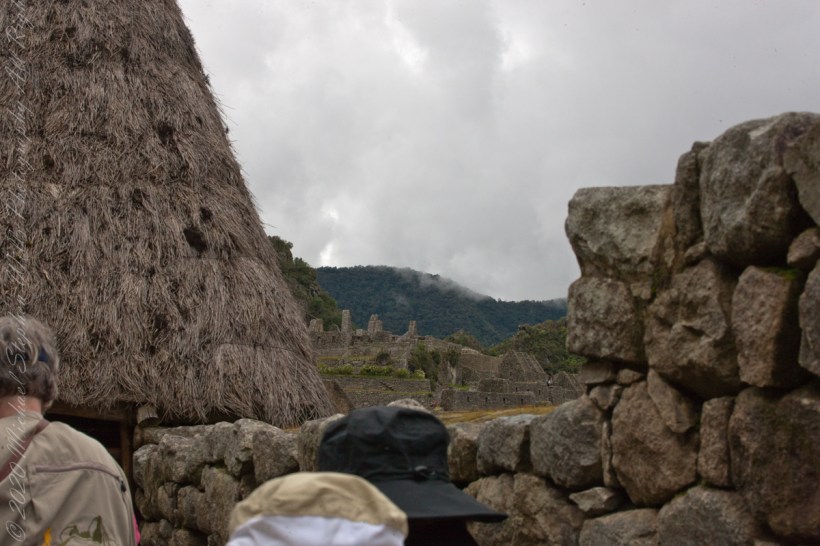
Below the Guardhouse are three thatch-roofed stone huts, the entrance trail passed beneath the lowest, shown here. A cliff of Huayna Picchu forms the background.
The Guardhouse is one of the first attractions on the upper tourist circuit around Machu Picchu. From its commanding high position in the south of the citadel, it is one of the best places for panoramic views of Machu Picchu, Huayna Picchu and surrounding mountains. On the stretcher descending the steps below the Caretaker’s Hut is a woman who collapsed during the tour. In attendance is her family and medical personnel.
Touring the site requires some stamina and care, there are many steep stone stairs to negotiate at approximate 8,000-foot altitude.
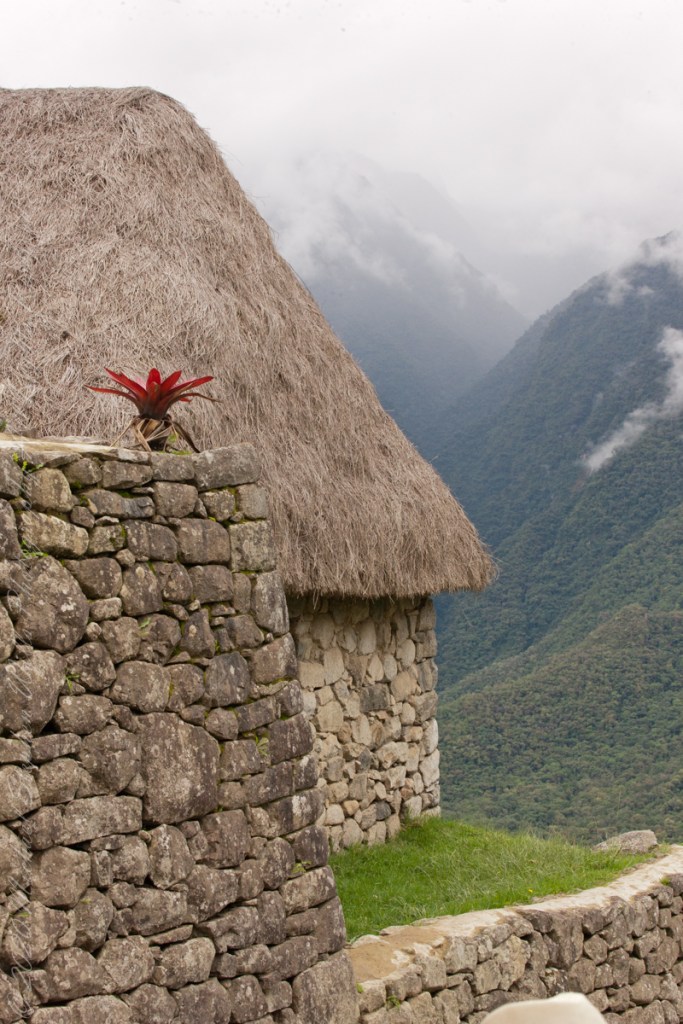
This is another view of the lowest stone hut with Urubamba River valley in background. We visited during rainy season and were well equipped with raincoats and umbrellas. By way of orientation, the red bromeliad in in the first photograph.
Copyright 2023 Michael Stephen Wills All Rights Reserved
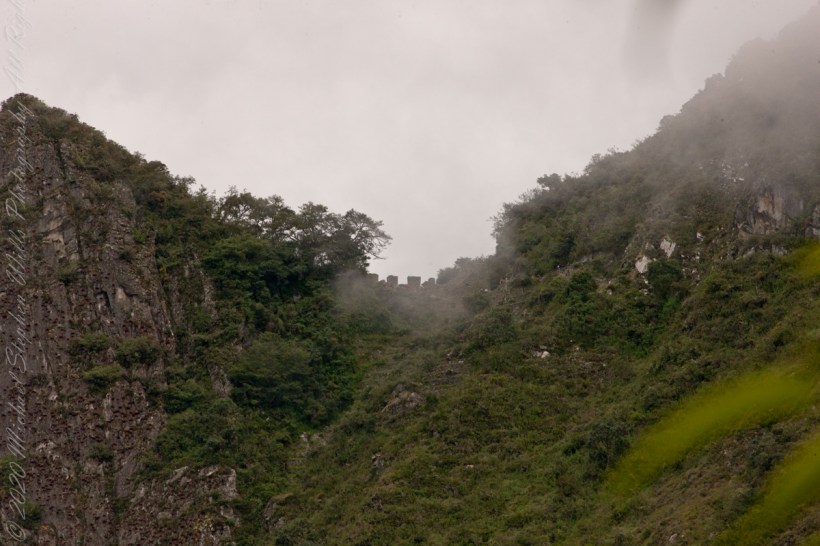
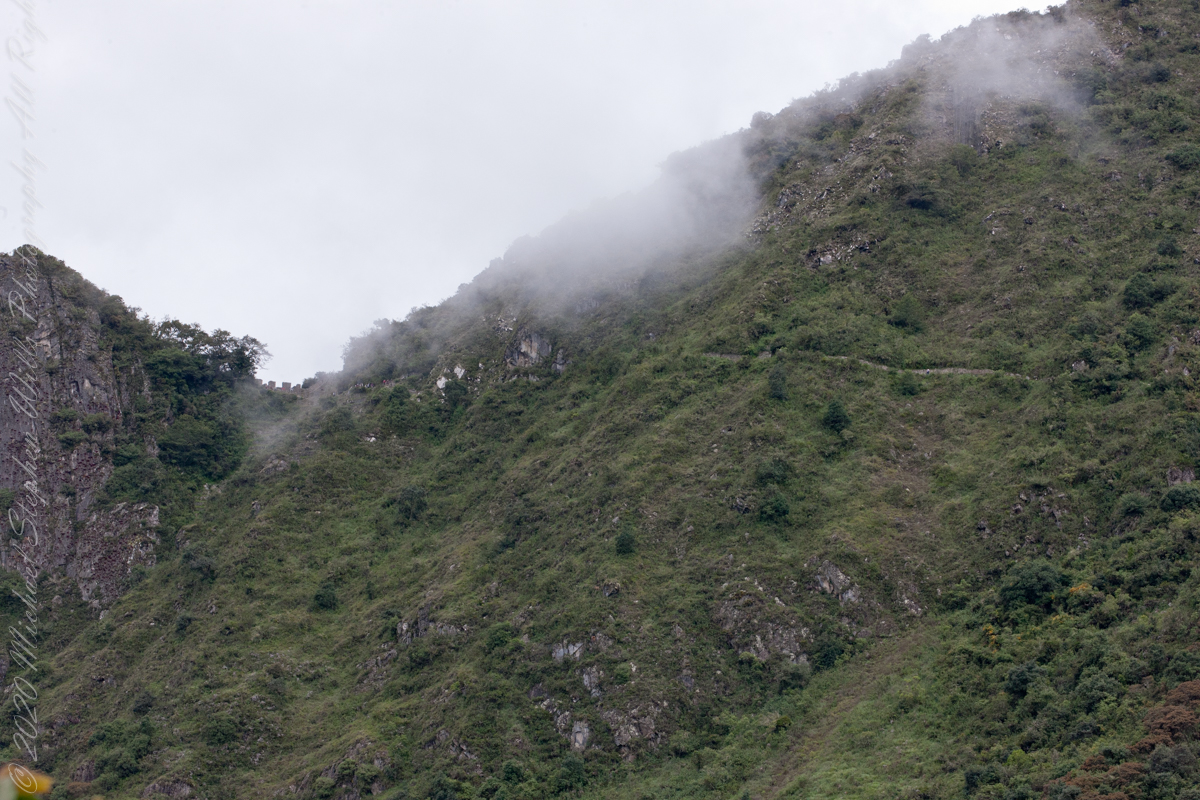
This was as close as we came to the Sun Gate, an important viewpoint in the Inca citadel. As Machu Picchu was originally designed and built, the Sun Gate was one of the main entrances to the citadel.
“It was also considered at that time as a strategic point to protect the magical Inca citadel. It is one of the most incredible archaeological constructions of the archaeological complex. This usually connects directly with the Inca citadel of Machu Picchu. Its location makes historians think that the entrance to Machu Picchu was restricted and guarded by the military at that time, making it accessible only to visitors from the Imperial Inca Elite.“
“The Sun Gate in Machu Picchu is an ancient archaeological complex located on the outskirts of the Machu Picchu map. The actual name is Inti Punku and Its name means Sun Gate in the native Quechua language. It was dedicated to the worship of the Sun God or “Inti”. The sun illuminates the door during the winter solstice, giving all who visit the place a wonderful view. The construction is made up of a few walls, doors, windows, and terraces, all made of rustic stone. To get there, the Incas built a series of terraces, stairs, and many other minor buildings. The Sun Gate in Machu Picchu is located at a height of about 2745 meters above sea level. It is about 300 meters higher than where Machu Picchu is located. Being able to see the Inca citadel from Inti Punku is one of the best things to do in Machu Picchu.“
Copyright 2023 Michael Stephen Wills All Rights Reserved
In 1911 American historian and explorer Hiram Bingham traveled the region looking for the old Inca capital. On July 24, 1911 Bingham, led to Machu Picchu by a villager, Melchor Arteaga, crossed the Urubamba river on a rickety wood bridge. Bingham found the name Agustín Lizárraga and the date 1902 written in charcoal on one of the walls. Though Bingham was not the first to visit the ruins, he was considered the scientific discoverer who brought Machu Picchu to international attention.
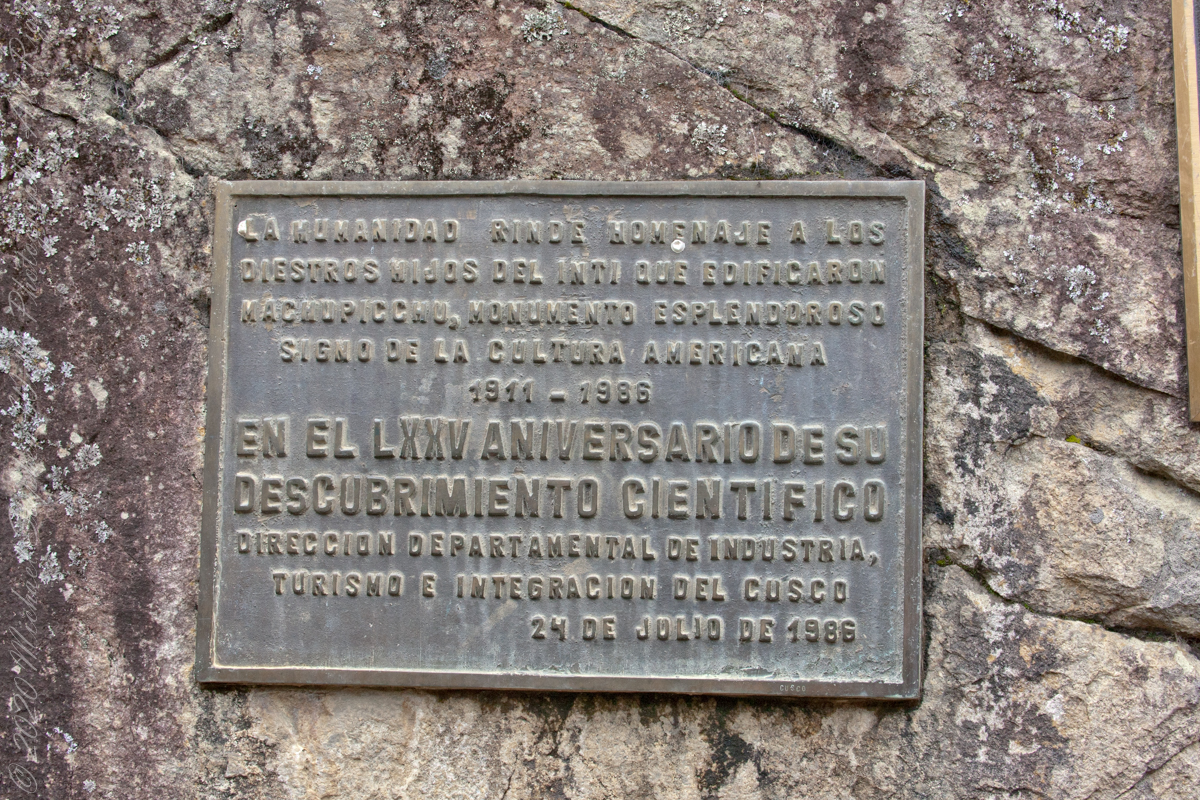
“Humanidad Rinde Homenaje a diestros hijos del inti que edificaron MachuPicchu, monumento esplendoroso sign o de la cultura americacana 1911 – 1986 En el LXXV Aniversario Descubrimiento Cientifico Direccion Departmental de Industria, turismo e integracion del Cusco 24 de Julio de 1986” Translation “Humanity pays tribute to skilled sons of the Inca who built Machu Picchu, splendid monument sign or of American culture 1911 – 1986 In the LXXV Anniversary Scientific Discovery Departmental Directorate of Industry, Tourism and Integration of Cusco July 24, 1986”
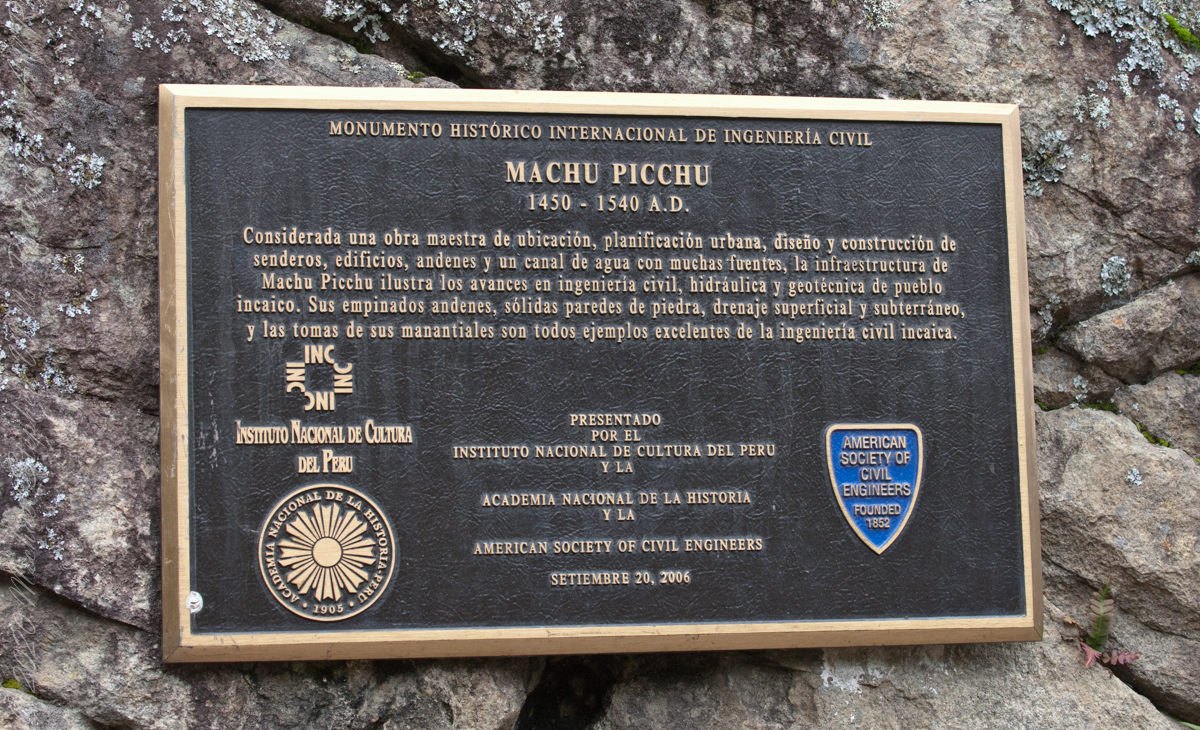
“Considerada una obra maestra de ubicacion, planificacion urbana, diseno y construccion de senderos, edificios, andenes y un canal de agua con muchas fuentes, la infraestructura de Machu Picchu ilustra las avances en ingenieria civil, hidraulica y geotecnica de pueble incaico. Sus empinados andenes, solidas paredes de piedra, drenaje superficial y subterraneo, y las tomas de sus manantiales son todos ejemplos excelentes de la ingenieria civil incaica.” Translation “Considered a masterpiece of location, urban planning, design and construction of trails, buildings, platforms and a water channel with many fountains, the infrastructure of Machu Picchu illustrates the advances in civil, hydraulic and geotechnical engineering of Inca village. Its steep platforms, solid stone walls, surface and underground drainage, and intakes of its springs are all excellent examples of Inca civil engineering. September 20, 2006.”
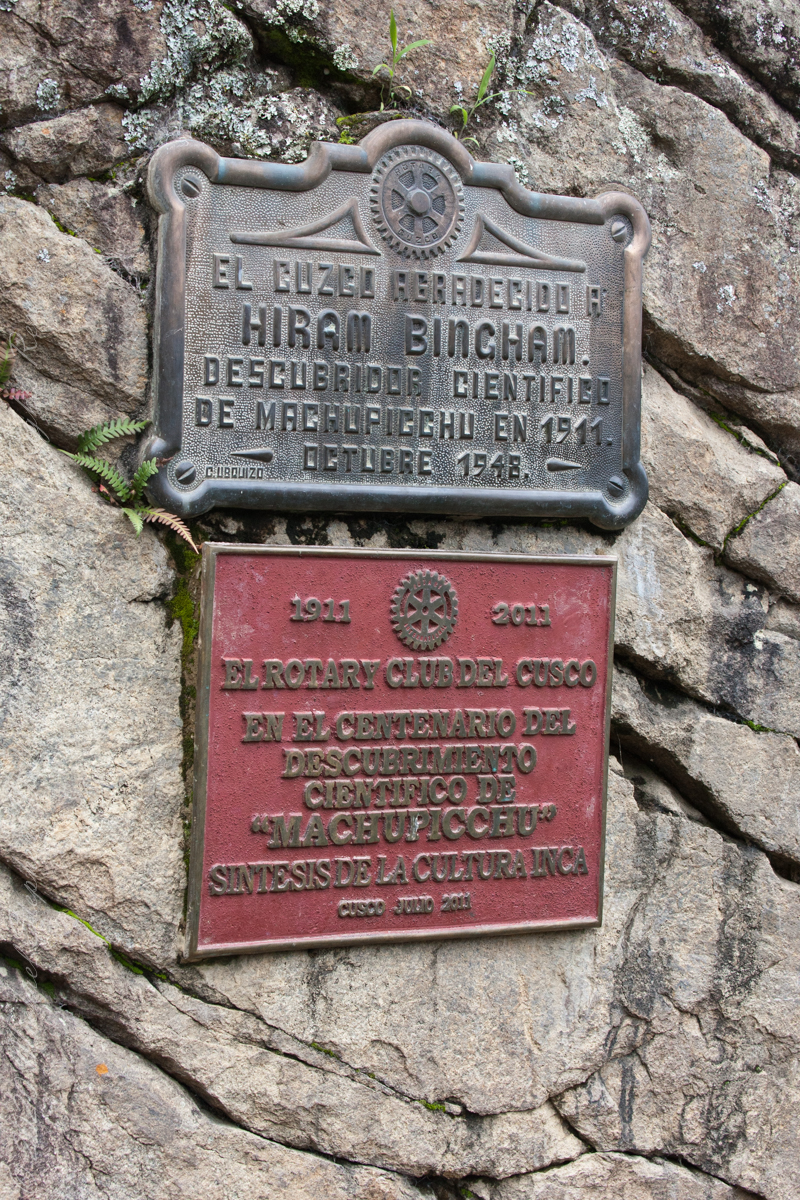
Top: El Cuzco Agradecido a Hiram Bingham Descubridor Cientifico de MachuPicchu en 1911. October 1948 (made by C Ubquizo) Translation (The City of ) Cuzco (is) Grateful to Hiram Bingham Scientific Discoverer of Machu Picchu in 1911. October 1948 Bottom: 1911 2011 El Rotary Club del Cusco En el Centenario del Descubrimiento Cientifico co “AMachuPicchu” Sintesis de la Culture Inca Cusco Julio 2011 Translation: The Rotary Club of Cusco In the Centenary of the Scientific Discovery of “MachuPicchu” Synthesis of the Inca Culture Cusco July 2011.
Credits:
“Machu Picchu” Wikipedia
Translations Spanish are from Google Translate (with my editing).
Copyright 2023 Michael Stephen Wills All Rights Reserved
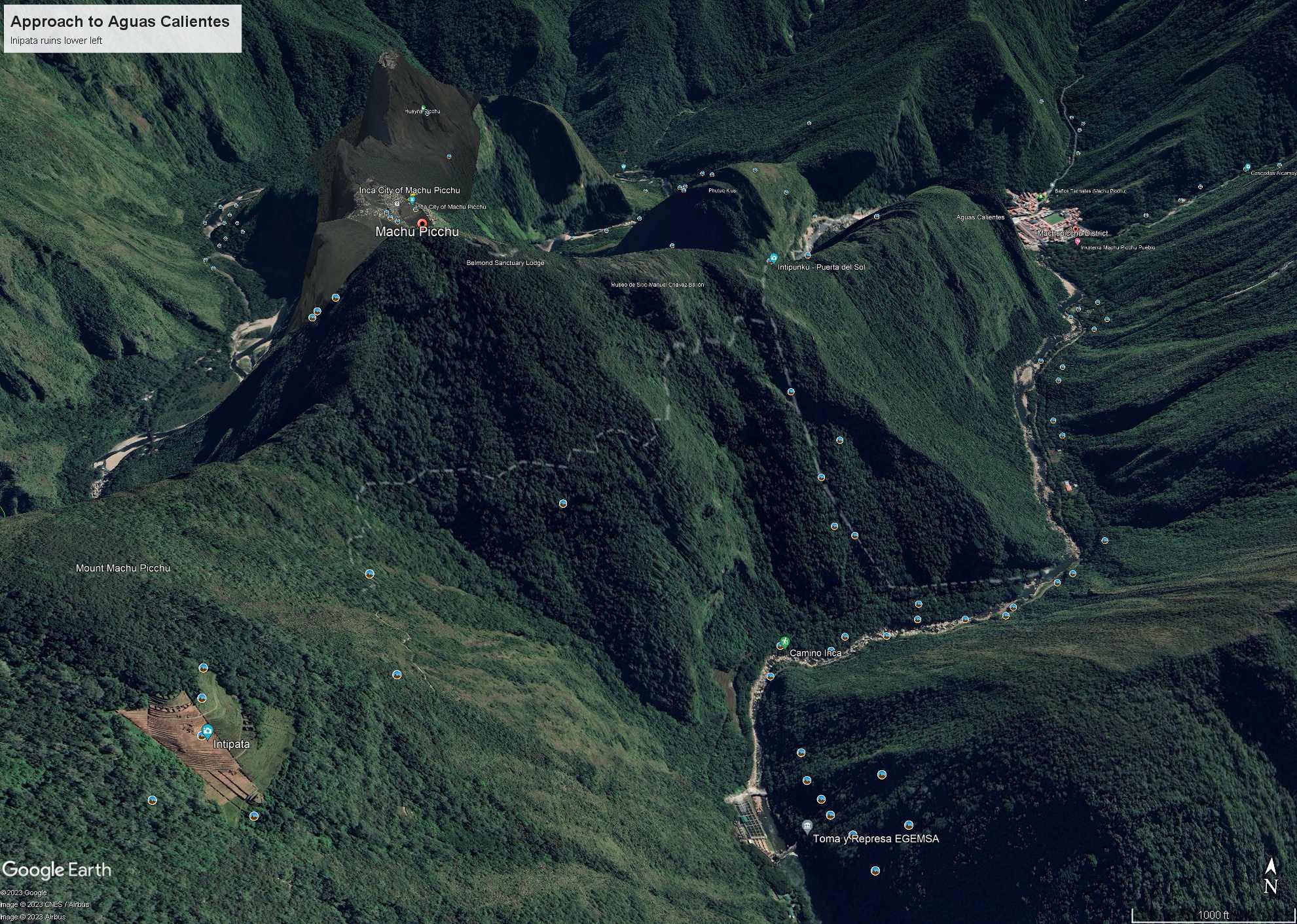
Intipata is an Inca archaeological site in Peru, two kilometers south of Machu Picchu, the eponymous peak of the archaeological site it dominates, to the north.
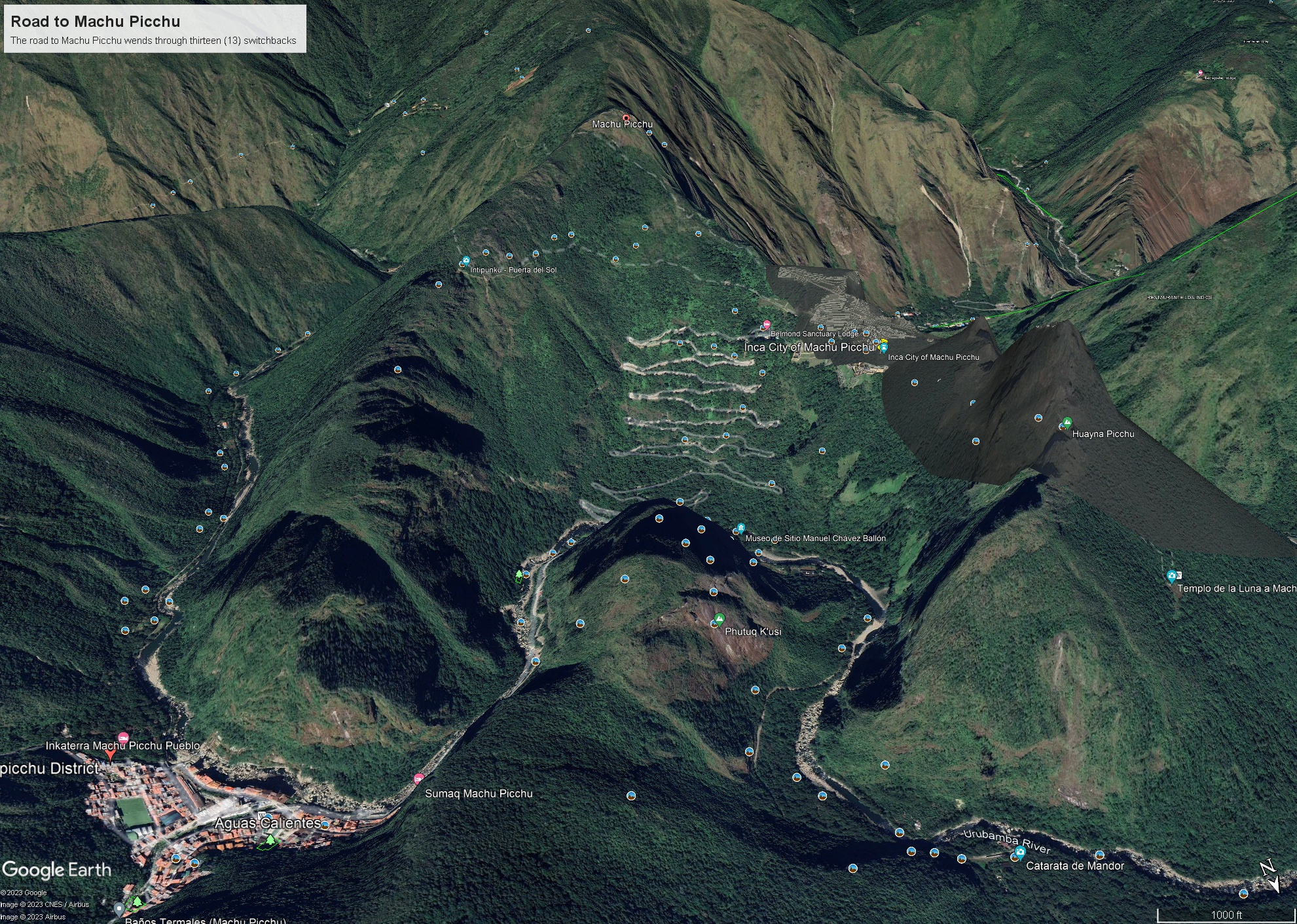
GoogleEarth: The approach to Aguas Calientes with Intipata Ruins at lower left
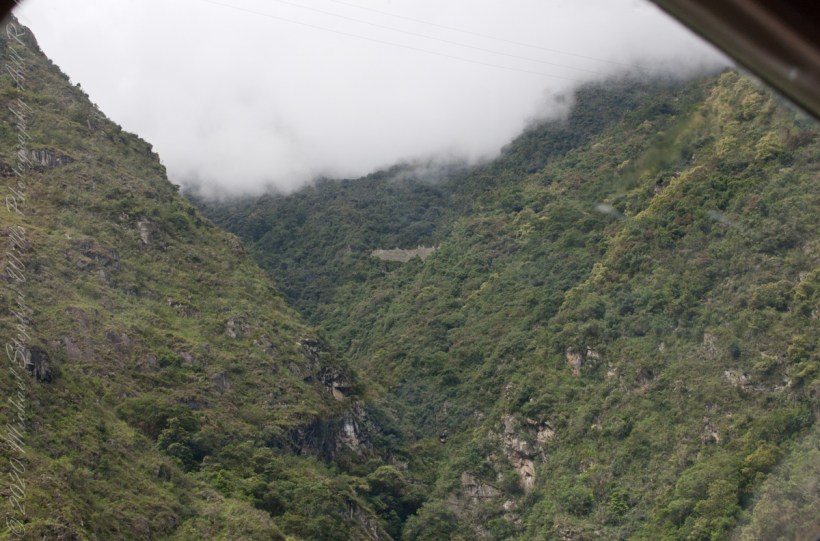
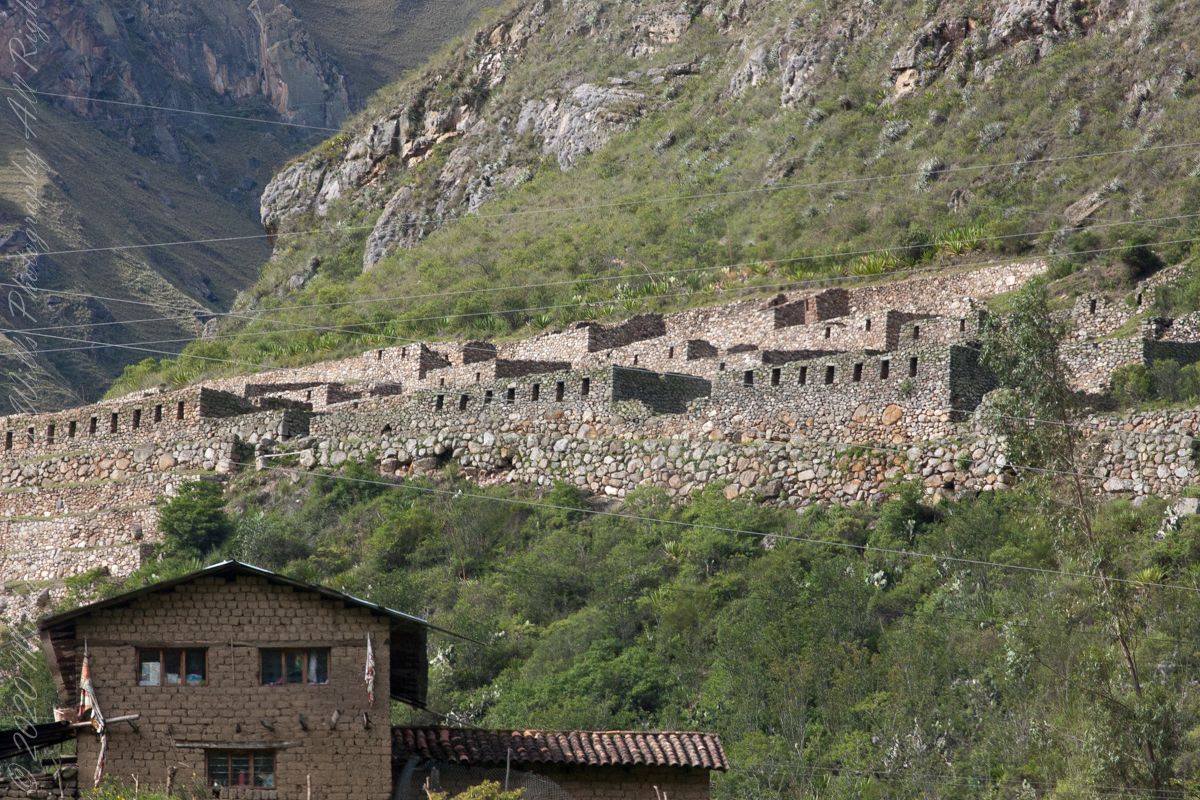
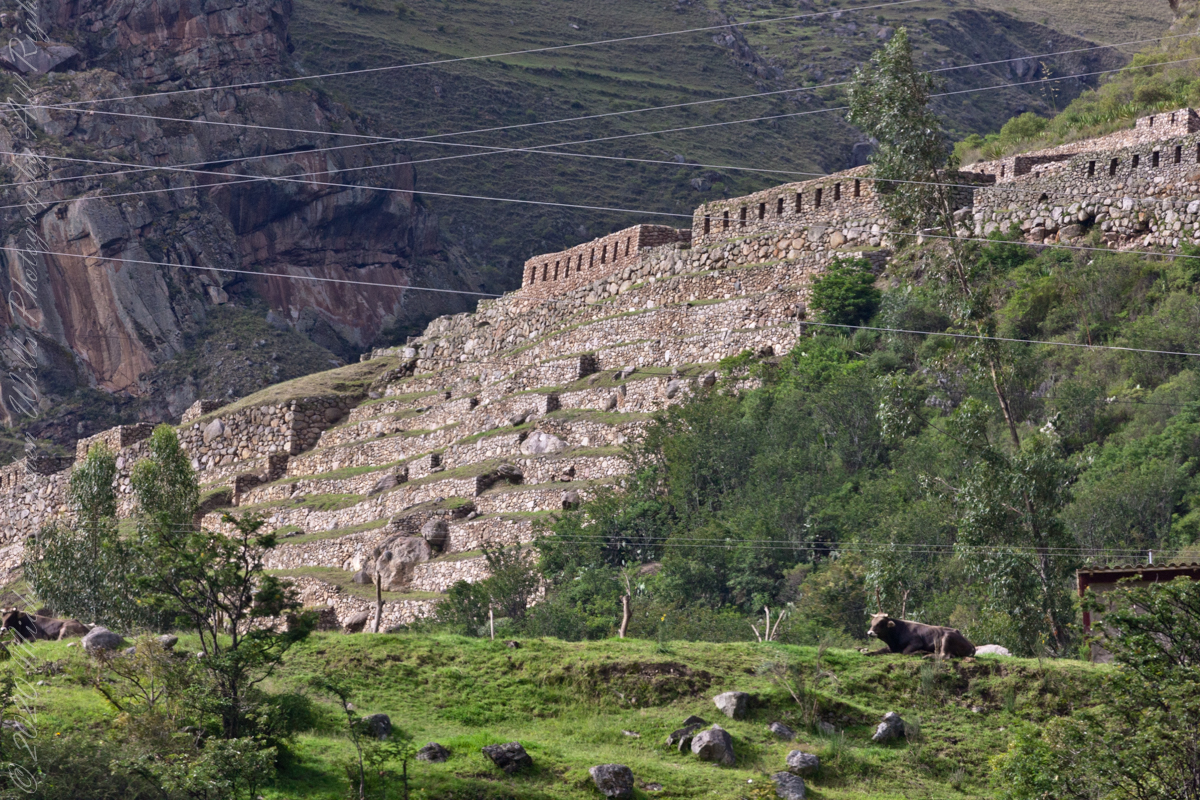
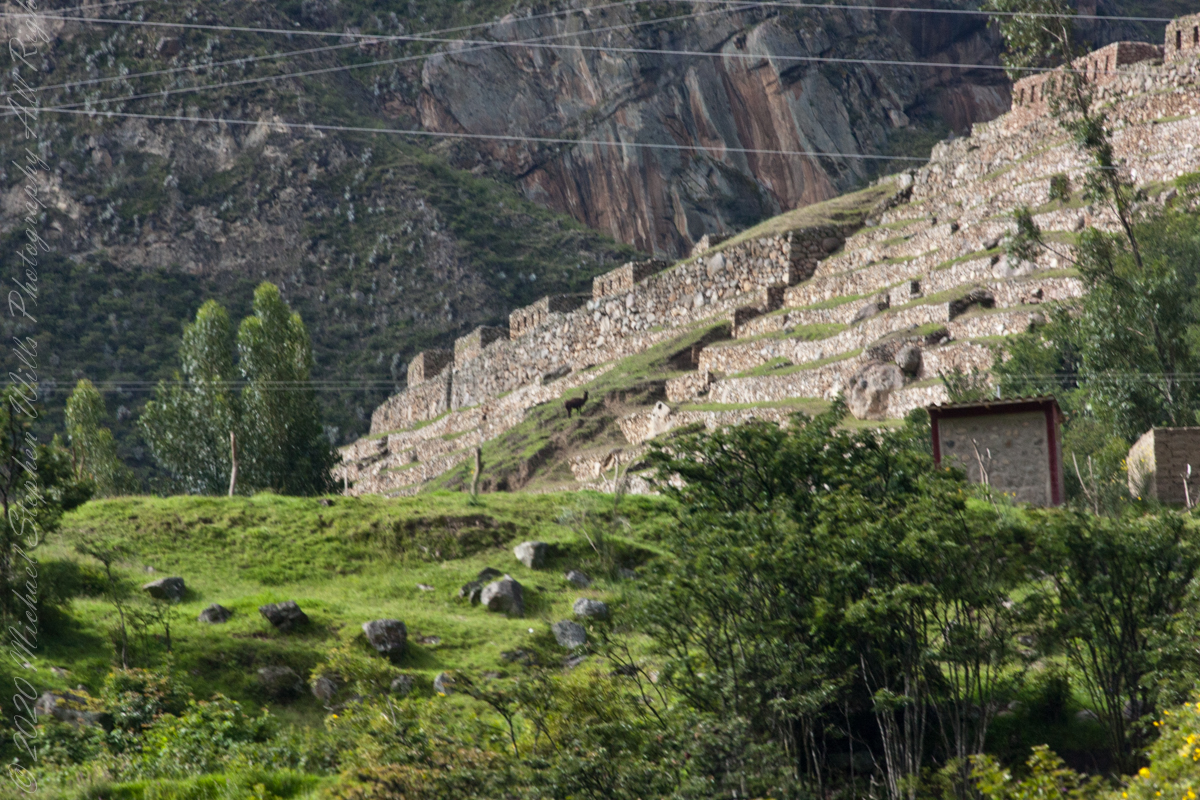
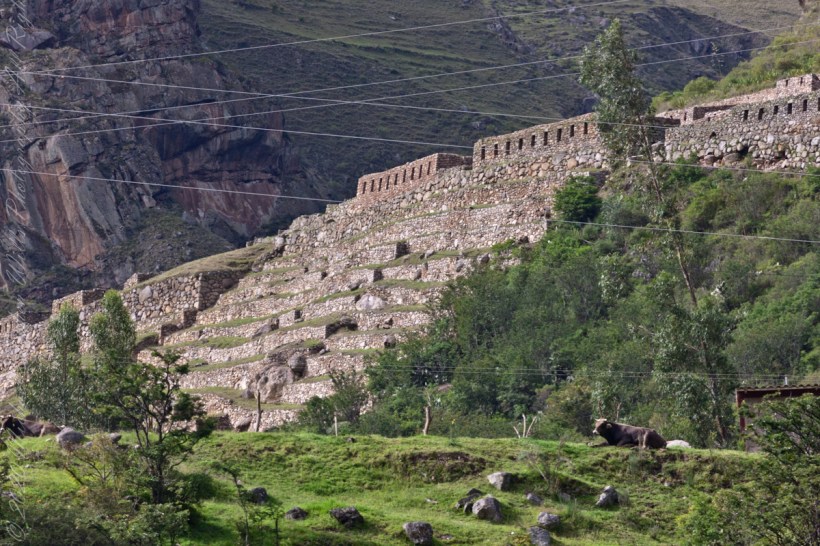
After passing Toronto Ruins, the train rounded a curve into the Amazonian rainforest. It was, frankly, boring, oppressive to proceed with greenery on either side blocking even the Sacred Valley walls rising on either side of the tracks. Thank goodness for the large roof viewing windows. I captured this photograph of the Intipata ruins on Machu Picchu peak by looking backwards through the roof window.
“Intipata is an Inca archaeological site in Peru, two kilometers south of Machu Picchu, the eponymous peak of the archaeological site it dominates, to the north. It seems to be, at the current stage of research, a set of agricultural terraces, without the presence of habitat nearby.”
“Similar to many Incan archaeological sites, Intipata shows great evidence of having canals to water crips. These canals are distributed among each of the levels of stairs in the Intipata ruins. These stairs or terraces are quite large and would have accommodated many different kinds of crops on different levels. Each level might have been specific to a certain plant. These ruins were mostly used for the domestication of wild plant species.”
“When you visit Intipata you will be able to see over 150 types of edible plants along the way. Among the plants, the Inca domesticated would be the common potato. There are also quite a few aromatic plants and flowers in this region, so if you are into botany, this section should be quite entertaining. Among some of the local flowers, you will see over 200 types of orchids along this stretch of the Inca trail, some can only be found right in this part of the cloud forest.”
“The purpose of the multi-leveled Intipata ruins was also to avoid the natural erosion of the mountain since this area was also used for religious ceremonies.”
“The Incas tried to use as much land as effectively as possible in their crop growing ventures. The ever-increasing Incan empire needed food and this was the best way to secure it. The Inca conquered new tribes very often and instead of killing them would offer to have them join their empire. Intipata is located near the Inca Trail in Machu Picchu. Intipata is formed on two parts, Inti meaning the manifestation of the sun in Inca mythology, and pata which means in Quechua “high”, the “ledge”, the “platform”, the “place” or “square”, the “terrace” or “staircase”, so that the name means more.“
“Intipata is formed on two parts, Inti meaning the manifestation of the sun in Inca mythology, and pata which means in Quechua “high”, the “ledge”, the “platform”, the “place” or “square”, the “terrace” or “staircase”, so that the name means more or less “the terraces of Inti”.“
Copyright 2023 Michael Stephen Wills All Rights Reserved
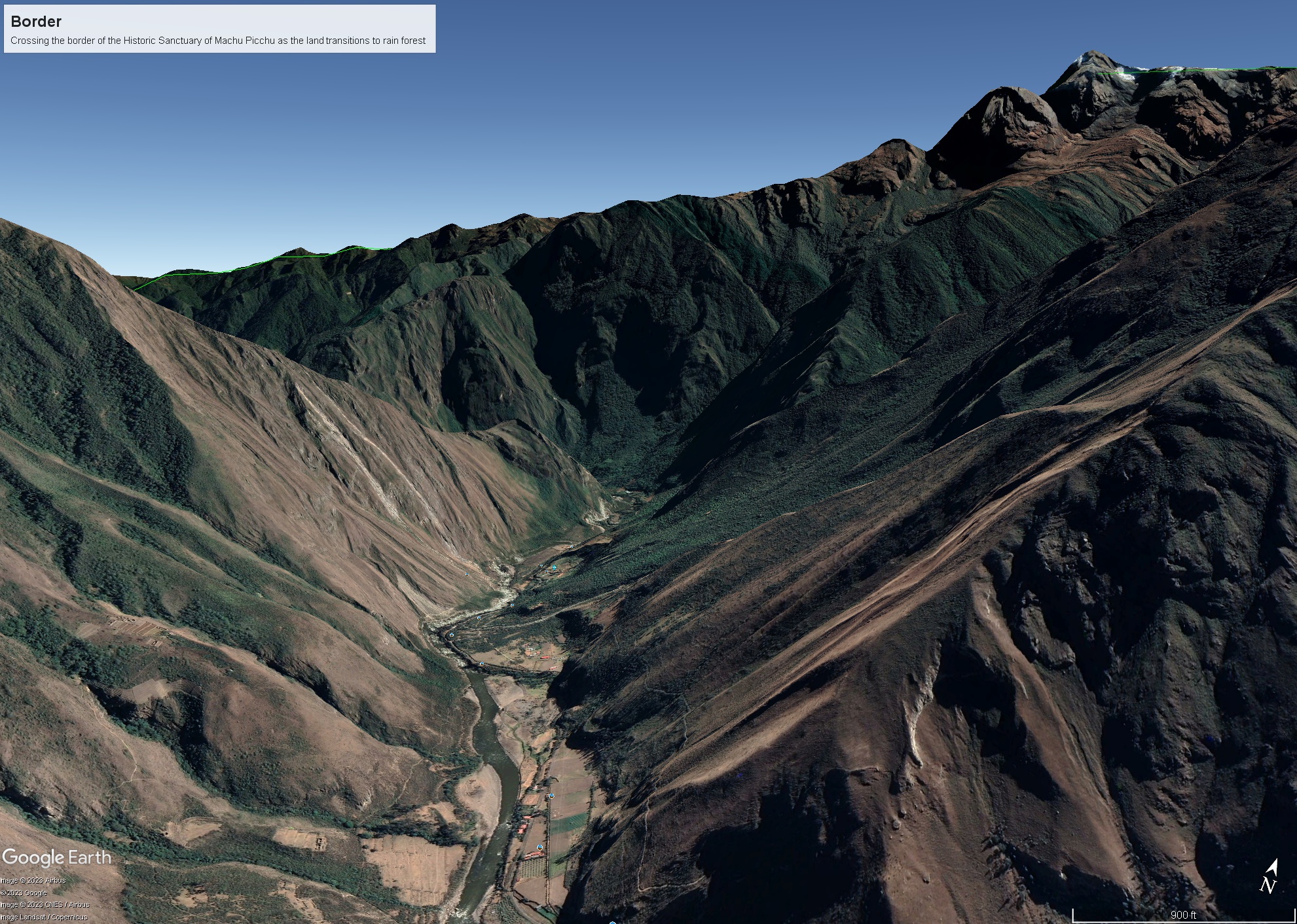
As we crossed the border of the Historic Sanctuary of Machu Picchu the valley walls rose steeply on either side, the land transitioning to rain forest.
Google Earth We approach the border of the Historic Sanctuary of Machu Picchu
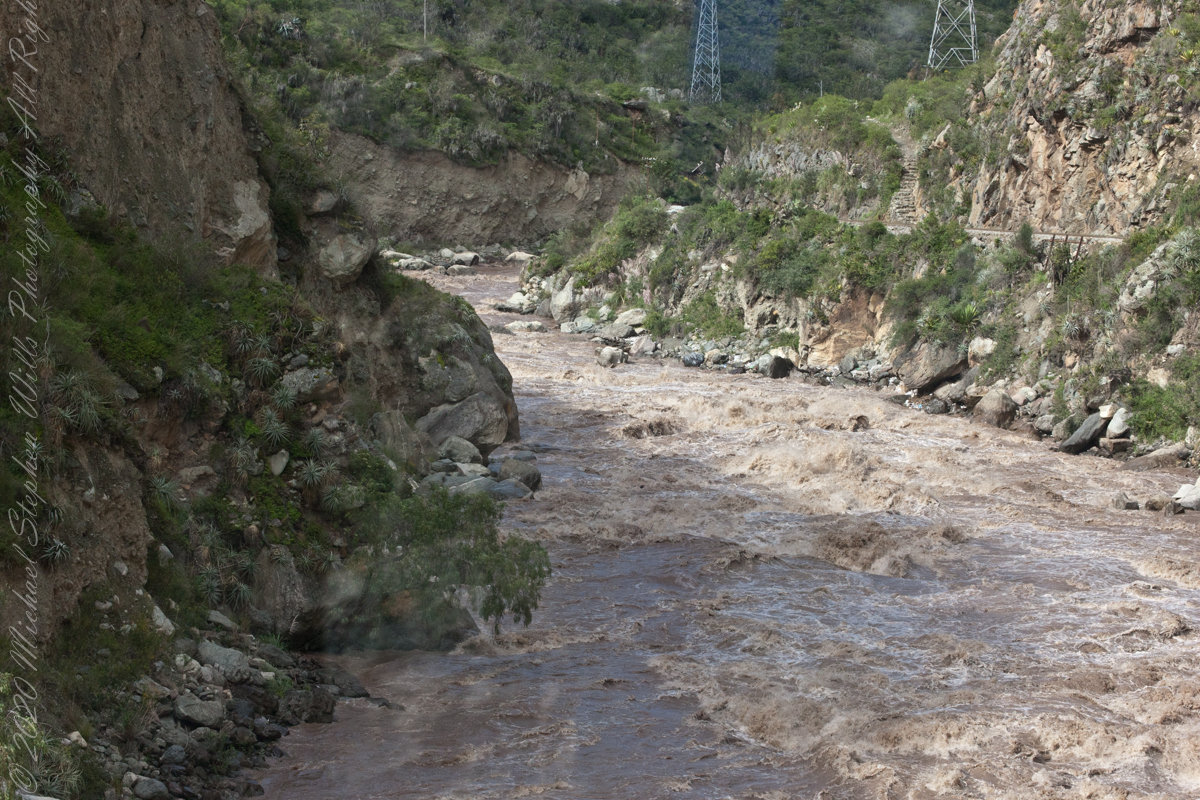
We entered a short tunnel through a mountain ridge, providing us this close view of the Urubamba River.
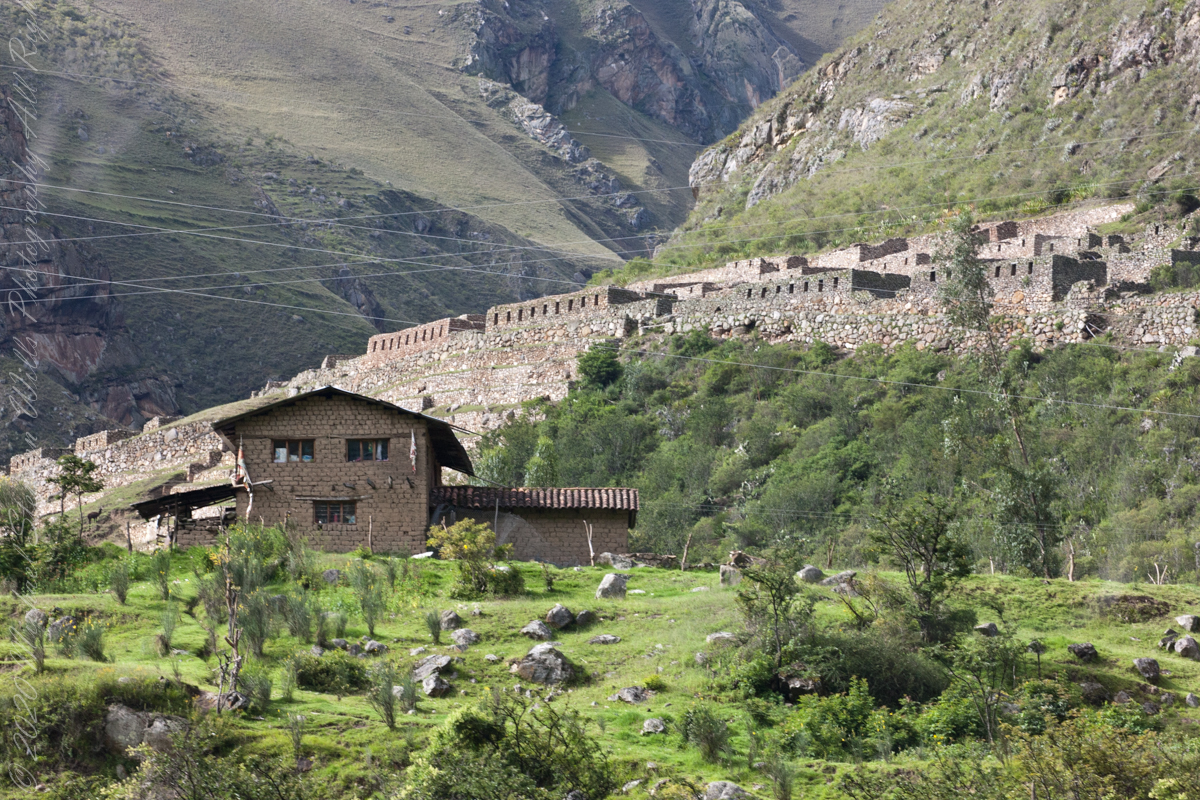
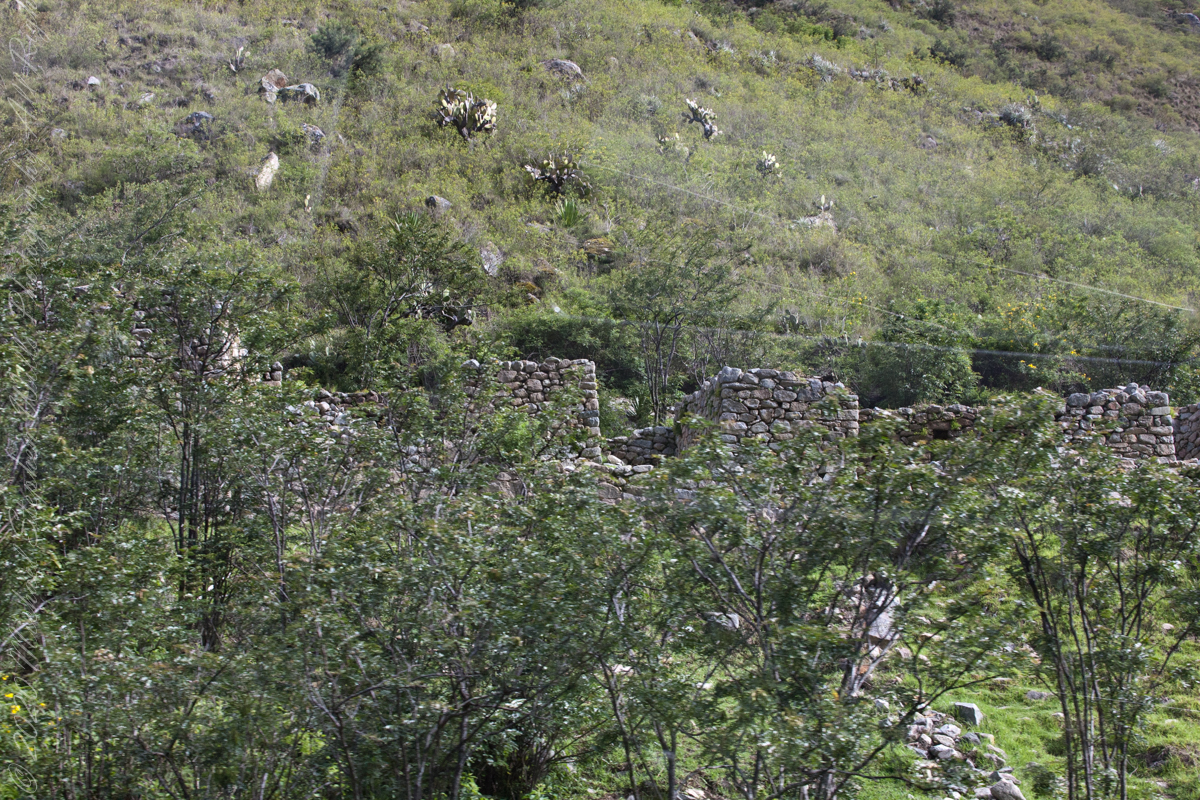
Next we came upon the Toronto Ruins.
The Toronto complex includes seven (7) archaeological groups and is in front of the Q’ente Complex, separated only by the Urubamba River, possibly they were independent chiefdoms with a strong economic bond.
The seven (7) archaeological groups are Torontoy: The local farmers call it Inkaperqa or Inca raqay, alluding to what they see. In this place we can find a main doorway, several groups of enclosures, patios or free areas separating the buildings, vestiges of a liturgical bath and a central enclosure with a lithic piece of more than 40 angles that joins other twenty-eight pieces with exact interlocking in the joints.
Salapunku: means hall door in the Inca language, because what is most obvious is a wide door that is on a platform that runs as a street in front of the wall. Behind the door we find cyclopean platforms and plains with remains of stairways, interior roads and remains of aqueducts. Qhanabamba translates to pampa where the grass “qhana” grows. It is at the height of Km. 85 of the railroad line. We can find a series of one-story buildings and a two-story building which is the largest. Wayrajpunku: meaning windy door (alluding to a windy place). In this group we find remains of buildings and a partially standing enclosure, there are vestiges of aqueducts, paths and overcrowding of canted stones that were part of constructions.
Pincha Unuyuj: Here were made the best hydraulic works of the zone, the crystalline waters that descend, appear channeled by wide lithic channels; also we find from the bank of the river a succession of parallel platforms, a road that leads to an adoratory carved in the rock insitu, ascending some houses and an observation tower. Qoriwayrachina It means gold winnowing. We can find the following: A huge staircase with more than one meter wide, semicircular ramparts, platforms as retaining walls and a vertical slope worked that is on the turbulent waters of the river.
Retamayuj, having a broom, in this group we can find long platforms with semi-cyclopean walls, tombs that are desecrated at the base of the mountain and others intact. In 2008 A team from Peru’s National Institute of Culture (INC) working on the ruins of Torontoy in the Historic Sanctuary of Machu Picchu, discovered the tomb of an Inca with full funerary regalia. The gender and age of the tomb’s owner has not yet been determined but found with the body were a number of decorated ceramics and two pins.
Copyright 2023 Michael Stephen Wills All Rights Reserved