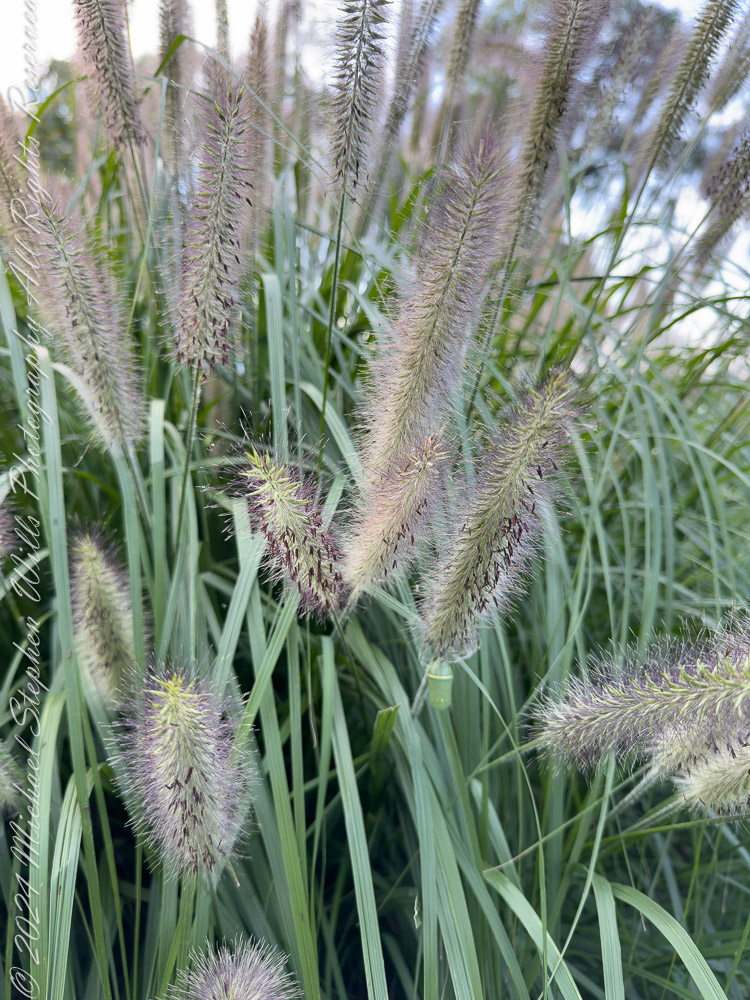
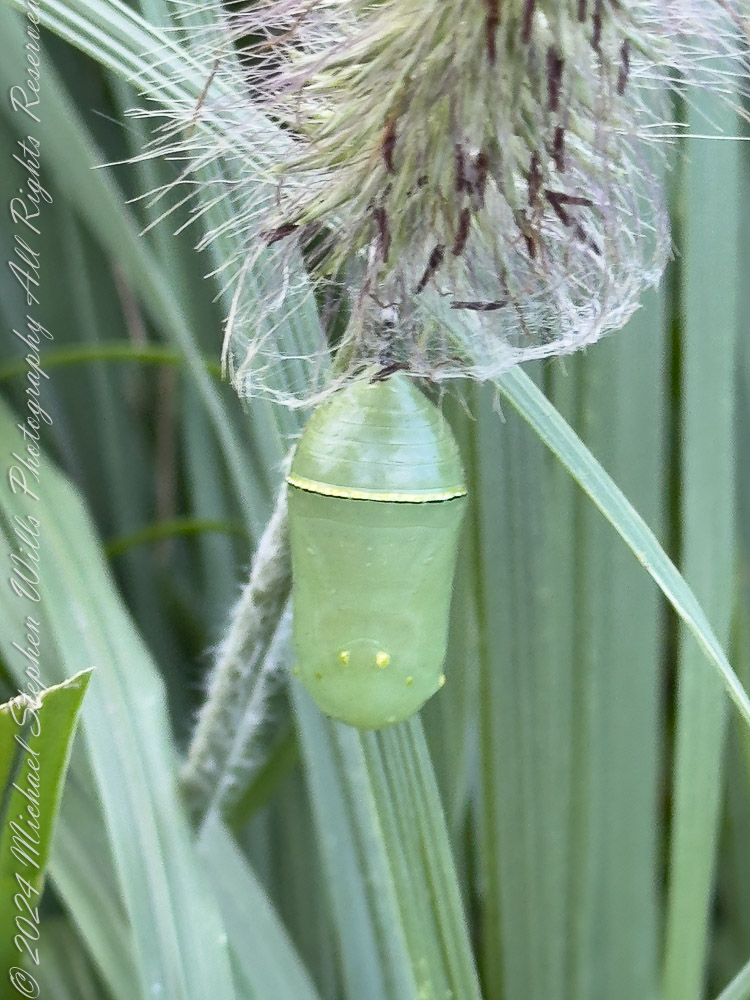
On a warm September afternoon, 2024, Pam and I passed a planting of shimmering grasses along the Cayuga Lake shore, the tips of their feathery plumes swaying in a gentle breeze. Amidst the verdant tapestry, my eyes caught a flash of delicate green—a Monarch chrysalis, hanging like a precious jewel beneath one of the seed heads. It was an unexpected encounter, a moment of grace that felt almost otherworldly. The chrysalis, pale jade with gold accents, looked like something born of magic rather than biology. For a moment, time paused.
The only Monarch chrysalis we found in 2024, notable for the absence of caterpillars around our home. Tompkins Park, Ithaca, New York, Finger Lakes Region
I knelt carefully, mindful not to disturb the fragile life suspended before me. As I leaned in closer, I marveled at the perfection of its design. The intricate gold dots along its casing seemed impossibly precise, as though a divine hand had painted them there. Yet, this chrysalis was also a paradox: it was a shield of stillness, promising the coming transformation of a creature known for motion and migration.
The significance of this discovery didn’t escape me. Just two years ago, the International Union for Conservation of Nature officially classified the Monarch butterfly as “endangered.” Habitat destruction, pesticide use, and climate change have decimated their numbers. Monarchs, once so plentiful they seemed a seasonal certainty, now teeter on the edge of disappearance. To find this chrysalis was to witness a quiet rebellion against those odds, a solitary emblem of resilience in a world fraught with loss.
I thought of their epic journey—a migration that spans thousands of miles, linking Canada to the forests of central Mexico. For generations, these butterflies have followed ancestral paths with unerring precision, defying every obstacle in their way. How can something so small carry the weight of such immense journeys? And how, in a world that seems to grow harsher each year, do they still persist?
This chrysalis, tucked in the grasses of Stewart Park, felt like an answer to those questions. It was a reminder of the resilience of life, the determination of nature to continue despite all that works against it. And yet, it also felt like a fragile promise. The Monarch’s survival is no longer assured; its future, like the butterfly within this chrysalis, hangs by a thread.
As I rose and continued our walk, I carried the image of the chrysalis with me, letting its quiet beauty settle in my mind. I thought of the interconnectedness of all things: the milkweed plants that sustain Monarch caterpillars, the winds that guide their migrations, and the people whose choices shape the landscapes they traverse. Stewardship is not just a responsibility; it is a privilege—an opportunity to ensure that these miraculous creatures continue to grace our skies.
By the time I left the park, the sun had sunk toward the west, its light no longer graced the grasses. I looked back one last time, hoping that this chrysalis would complete its transformation safely. In its stillness, I saw not just hope, but a call to action. The Monarch’s story is not just about survival; it’s about the courage to evolve and adapt, even when the odds seem insurmountable. And perhaps, in witnessing this moment of metamorphosis, we too are reminded of our capacity to change—to become better stewards of the world we share.
Enter your email to receive notification of future postings. I will not sell or share your email address.
Copyright 2025 All Rights Reserved Michael Stephen Wills
After 25 years of visiting Cocoa Beach, a discovery of coquina clams transformed my appreciation for the ecosystem, revealing its beauty, complexity, and intrinsic connections to life.
For nearly two and a half decades, I’ve strolled the sands of Cocoa Beach—since my first visit in March 2001—comforted by the rhythmic Atlantic waves and the familiar stretch of shoreline. I thought I knew this beach intimately; from the way the sunrise paints the water orange to the feel of wet sand under my feet. Yet it wasn’t until a clear morning in February 2025 that I recognized one of its tiniest treasures: the coquina clam. In the past, I might have walked past countless little shells and the tiny siphons and feet in the sand without a second glance. Now, with newfound awareness, I realize an entire world had been bustling at my toes all along.
February 2025: Discovering the Coquina Clams
Early one February morning, as the high tide receded, I noticed something magical happening at the water’s edge. Tiny coquina clams—each no larger than a fingernail—were emerging from the sand only to swiftly burrow down again between each wave.
These living coquina clams were found in the receeding high tide on a February 2025 morning on Cocoa Beach, Brevard County, Florida
Their small wedge-shaped shells, in colors of pastel pinks, purples, yellows, and whites, peeked out for a moment and then vanished, synchronized with the pulse of the ocean. It was as if the beach itself had come alive with confetti-like jewels, re-positioning themselves with every ebb and flow. I stood entranced, wondering how I’d missed this subtle dance for so many years. That morning marked the beginning of my quest to learn about these little clams that had been hiding in plain sight.
Life Beneath the Sand
Once my eyes were opened, I began observing and researching the coquina clams’ hidden world. I learned that each delicate clam is a filter feeder, siphoning in microscopic phytoplankton, algae, and organic particles from the surf. This constant filtering not only feeds the clam but also helps clean and clarify the coastal waters by removing excess nutrients. Coquinas live a fast-paced, transient life by necessity: they typically survive 1–2 years in the wild and can endure a mere few days without the ocean’s moving water.
No wonder they race to burrow when the waves recede—staying submerged is a matter of life and death, as they rely on the surf for both food and oxygen. In their brief lifespan, they continually ride the tides, migrate in swarms up and down the beach, and rebury themselves between each wave to avoid being swept away.
I found it astonishing that such small creatures possess the agility and tenacity to “surf” the waves and dig themselves back into wet sand within seconds, a graceful routine I had unknowingly witnessed that February morning.
Beyond their daily habits, coquina clams also undergo a remarkable life cycle beneath the sand. They spawn in the warmer months, releasing gametes into the water for external fertilization. The resulting larvae drift as plankton for a time before settling into the sand and metamorphosing into tiny clams. With no parental care to guide them these young coquinas must immediately fend for themselves in the surf zone. Perhaps it’s this independent, perilous beginning that drives them to cluster in large colonies—while they aren’t social in a communicative sense, hundreds of coquinas often live side by side in favorable spots, turning patches of wet sand into vibrant mosaics of color and life.
Walking the beach now, I recognize these patches: slightly raised, pebbly areas that, when a wave washes over, suddenly bristle with tiny siphons and feet as the clams feed and reposition. It’s humbling to realize that under each footstep, an entire hidden ecosystem of coquinas might be thriving.
Shells on the Shore: Beauty and Predation
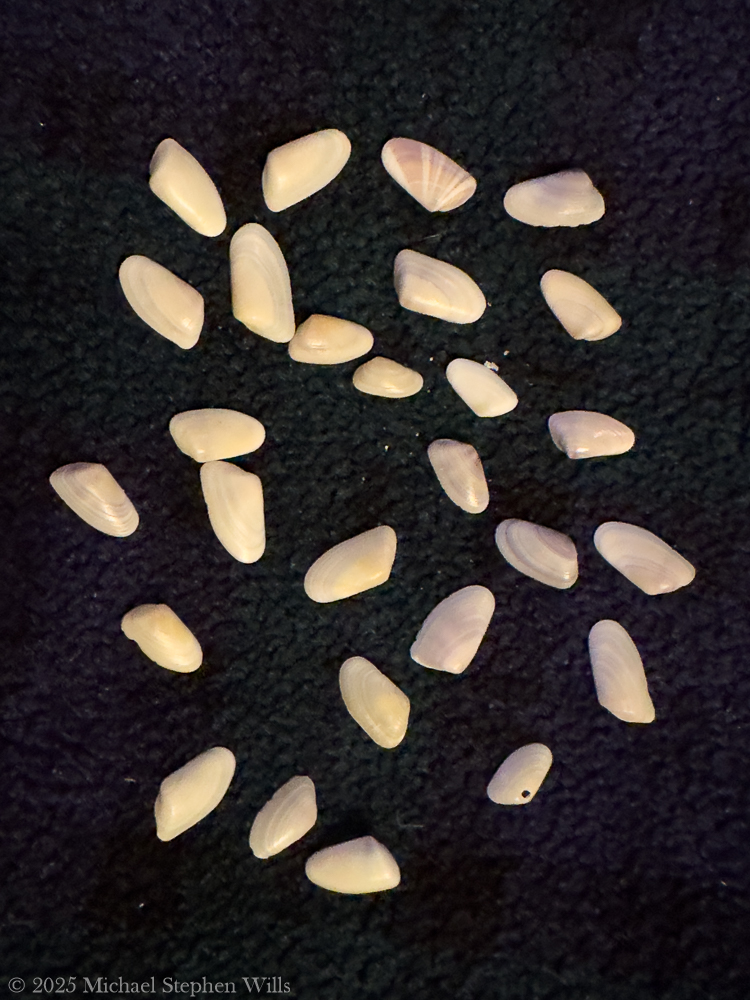
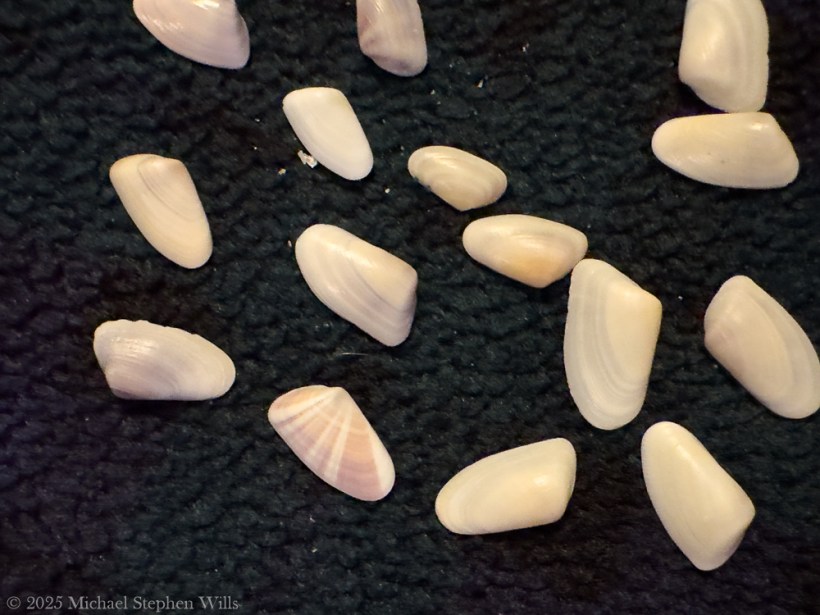
With my new awareness, even the empty shells strewn along the high tide line told a story. I began to collect some of the colorful coquina shells scattered on the sand, marveling at their variety—no two looked exactly alike. Some were solid orange or yellow, others striped with purple and white, each as delicate as a butterfly wing. Many of these shells were intact, evidence of clams that had lived out their short lives or perhaps fallen prey to gentle endings. Others, however, bore mysterious perfectly round holes on their surfaces. At first glance, I thought a tiny drill had punched through them, and in a way, I was right. Those small holes are the signature of predatory snails that haunt the sands: creatures like moon snails (also known as shark’s-eye snails) and whelks that prey on coquinas by literally boring into their shells. These sand-dwelling snails wrap themselves around a clam and use a tongue-like organ called a radula—akin to a miniature saw—to drill a neat hole through the coquina’s shell, aided by acidic secretions to soften the calcium carbonate. Once the hole is complete, the snail devours the clam from within, leaving behind an empty, perforated shell as a grim calling card of the food chain in action.
Seeing those tiny “murder holes,” as beachcombers jokingly call them, on coquina shells transformed my perspective on the shell collections I had casually admired for years. Each shell in my hand represented a life that had been an integral part of the beach ecosystem. Some had been snatched by shorebirds or fish the instant they were exposed by the retreating tide, becoming breakfast for a sanderling or a pompano. Others, as the holes revealed, had been victims of an even stealthier predator under the sand. It struck me that every fragment and hollowed shell on the beach is evidence of a relationship—predator and prey, life and death intertwined on the shore. Instead of seeing a random assortment of pretty shells, I now saw a record of the beach’s vibrant food web written in calcium carbonate. The realization filled me with both wonder and respect: this sunny tourist beach holds quiet tales of survival as dramatic as any wilderness, if one knows where to look.
The Coquina’s Ecological Role
As I dug deeper (both into the sand and the literature), I discovered that coquina clams are far more than a footnote in the beach ecosystem—they are a keystone of coastal ecology. By filtering plankton and detritus from the surf, countless coquinas collectively act as tiny water purifiers, helping maintain water quality along the shore. Their presence in large numbers indicates a beach’s health; in fact, abundant coquina populations signal that the beach environment is robust and unspoiled. A stretch of sand teeming with coquina clams suggests natural, shifting sands and minimal human interference, as these clams thrive best where coastal processes remain undisturbed. In this way, coquinas are like a barometer for the shoreline: if I continue to find them at Cocoa Beach, it means the beach is still alive and supporting complex life.
Coquina clams also form a critical link in the food chain. Numerous shorebirds rely on them as a food source—those flocks of little sandpipers and plovers skittering at the water’s edge have, all along, been feasting on coquinas right under my nose. Fish that patrol the surf, like the Florida pompano and various kinds of drum (whiting), gulp them up as the waves churn the sand.
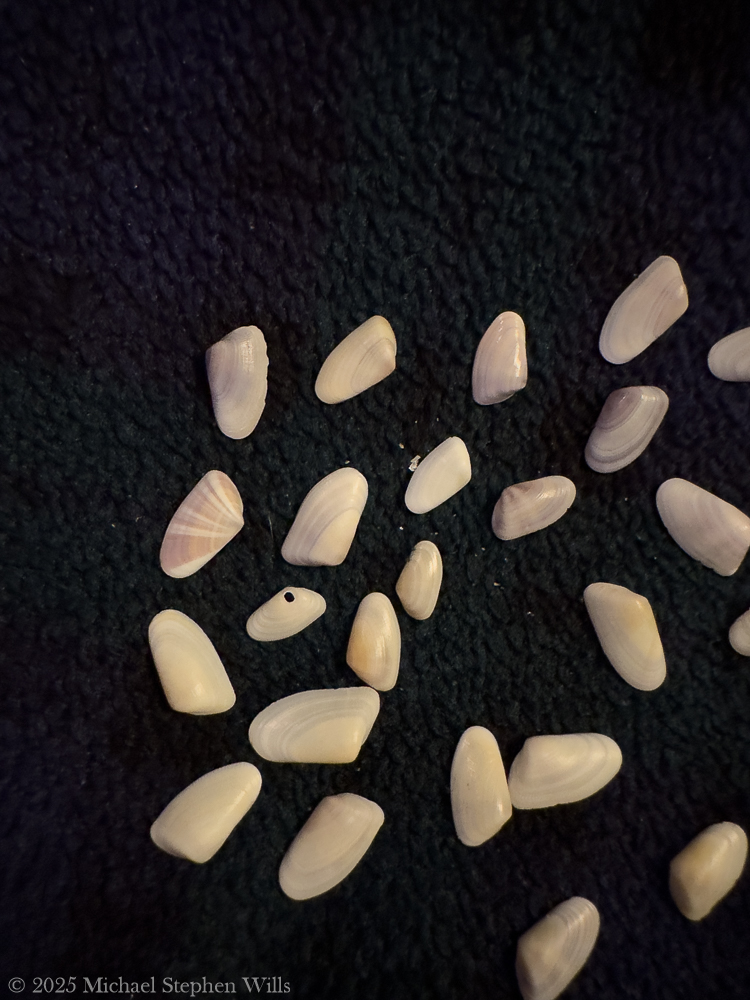
These coquina clam shells were found February 2025 on Cocoa Beach, Brevard County, Florida
Even ghost crabs and other scavengers benefit, feeding on clams that wash ashore. And of course, the predatory snails under the sand have a specialized taste for them. It’s a reminder that even a creature only an inch long can be a cornerstone of an entire food web, sustaining animals up the chain from mollusks to birds to fish. Standing on the beach now, I often pause and watch the frenetic chase of the shorebirds in the surf, aware that without the coquina clams beneath the foam, that familiar coastal ballet could cease to exist.
Humanity and the Coquina: Intertwined Histories
It’s not only animals that have interacted with coquina clams—we humans have a longstanding relationship with them as well. Historically, Floridians made use of coquinas as a food source. Local folklore and old recipes describe coquina broth and chowder, a delicate soup made by briefly boiling these tiny clams to extract their flavor.
Because each clam is so small, you’d need hundreds to make a pot of soup, so it’s not a common dish today except perhaps as a novelty. Still, the idea that the sands I walk on could literally be cooked into a chowder is a charming and earthy connection between food and place. Early indigenous peoples and European settlers alike would have recognized coquinas as an edible bounty in times when every bit of protein counted.
For best experience, click on “Watch on YouTube”
Humans have also found value in the shells of coquinas beyond admiring their beauty. Over time, vast deposits of coquina shells on ancient beaches hardened into a soft limestone rock called coquina stone (the term “coquina” itself comes from the Spanish for “shellfish” or “cockle,” reflecting its composition).
In a fascinating twist of fate, this sedimentary rock—essentially millions of fused clam shells—became a building material. Here in Florida, coquina stone was quarried and used to construct some of our oldest structures. The historic fortifications in St. Augustine, like Fort Matanzas and Castillo de San Marcos, were built from coquina stone, their walls made resilient by a matrix of coquina clam shells.
I find it poetic that the same little clams I only just learned to appreciate have literally been the building blocks of human shelters that have stood for centuries. Even today, crushed coquina shells are used in landscaping and as decorative ground cover—perhaps you’ve seen driveways or garden paths that gleam with fragments of pink and purple shells.
Our lives overlap with the coquina in subtle ways: from the architecture of coastal Florida to the aesthetics of our beach towns.
Modern conservationists note another connection: by protecting natural beach dynamics, we also protect coquina populations, which in turn supports the whole ecosystem. This means being mindful about coastal development, beach renourishment projects, and even how many shells tourists collect. I’ve become more aware that picking up a few pretty coquina shells as souvenirs is fine, but we must leave plenty behind for the beach to recycle and for other creatures to use. For example shorebirds glean minerals from them. The humble coquina clam has given me a new appreciation for how intimately tied human activity is to the smallest inhabitants of the shore.
Reflections: Wonder in the Little Things
My journeys to Cocoa Beach were enhanced: what began as a casual observation in 2025 has blossomed into a profound shift in the way I experience the beach. I feel as if I’ve been given new eyes—now I notice the glint of tiny shells in the sand and know there’s life (or a story of life) attached to each one. The joy of discovery I felt upon noticing the coquina clams has reignited a childlike curiosity in me. It’s astounding that after decades of visits, there was still a secret to uncover on those familiar shores. This realization makes me wonder: What else have I been missing? It’s a reminder that nature has layers upon layers of wonder, even in places we think we know intimately. Sometimes it just takes a shift in perspective, a bit of knowledge, or a quiet moment of attention to peel back the veil.
In reflecting on the coquina clams of Cocoa Beach, I’ve learned not only about a specific species and its role in the world, but also about myself and the value of lifelong learning. These clams, in their smallness and ubiquity, taught me to slow down and appreciate the intricate tapestry of life at my feet. Now, each time I visit the beach, I smile seeing the waves bring in that rush of foam and sand, knowing a hidden troupe of coquinas is hard at work filtering water, dodging predators, and holding up the very balance of the shore. I often kneel down now, running my fingers gently through the wet sand to feel them retreat, and I silently thank them — for cleaning the water, for feeding the birds and fish, for building historic forts (unbeknownst to themselves), and for showing me that wonder can be found in the smallest of places. Cocoa Beach, through the lens of the coquina clam, feels like a brand new world I’ve been lucky enough to discover, even after all these years
I look forward to other hidden marvels awaiting discovery on my next visit.
References
Abbott, R. T. (1974). American Seashells: The Marine Mollusca of the Atlantic and Pacific Coasts of North America. Van Nostrand Reinhold Company.
Andrews, J. (1994). Shells and Shores of Texas. University of Texas Press.
Brusca, R. C., & Brusca, G. J. (2003). Invertebrates (2nd ed.). Sinauer Associates.
Denny, M., & Gaines, S. (2000). Encyclopedia of Tidepools and Rocky Shores. University of California Press.
Futch, C. R., & Burger, J. (1976). The ecology of coquina clams (Donax variabilis) in the southeastern United States. Marine Biology Journal, 34(2), 157-168.
Leal, J. H. (2002). Seashells of Southern Florida: Living Marine Mollusks of the Florida Keys and Adjacent Regions. Smithsonian Institution Press.
Mikkelsen, P. M., & Bieler, R. (2008). Seashells of Southern Florida: Marine Bivalves, The Bivalvia. Princeton University Press.
Morton, B. (1988). Particulate Matter Processing in Bivalves: An Overview. Journal of Marine Ecology, 19(3), 103-123.
Ruppert, E. E., Fox, R. S., & Barnes, R. D. (2004). Invertebrate Zoology: A Functional Evolutionary Approach (7th ed.). Cengage Learning.
Stanley, S. M. (1970). Relation of shell form to life habits of the Bivalvia. Geological Society of America Memoir, 125, 1-296.
Voss, G. L. (1980). Seashells of the Gulf and Atlantic Coasts. Houghton Mifflin Harcourt.
Wells, H. W., & Gray, I. E. (1960). Habitat selection and the distribution of the coquina clam (Donax variabilis). Ecological Monographs, 30(1), 55-77.
Enter your email to receive notification of future postings. I will not sell or share your email address.
Copyright 2024 All Rights Reserved Michael Stephen Wills
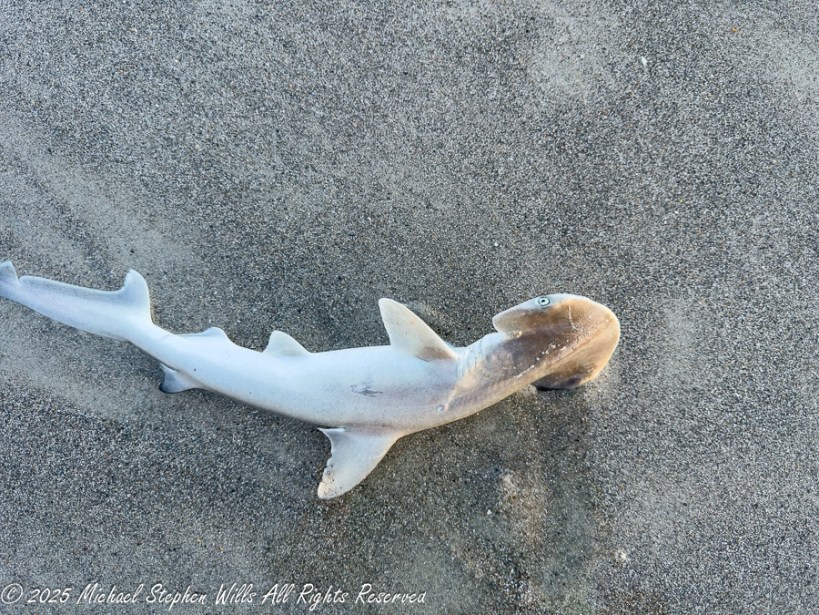
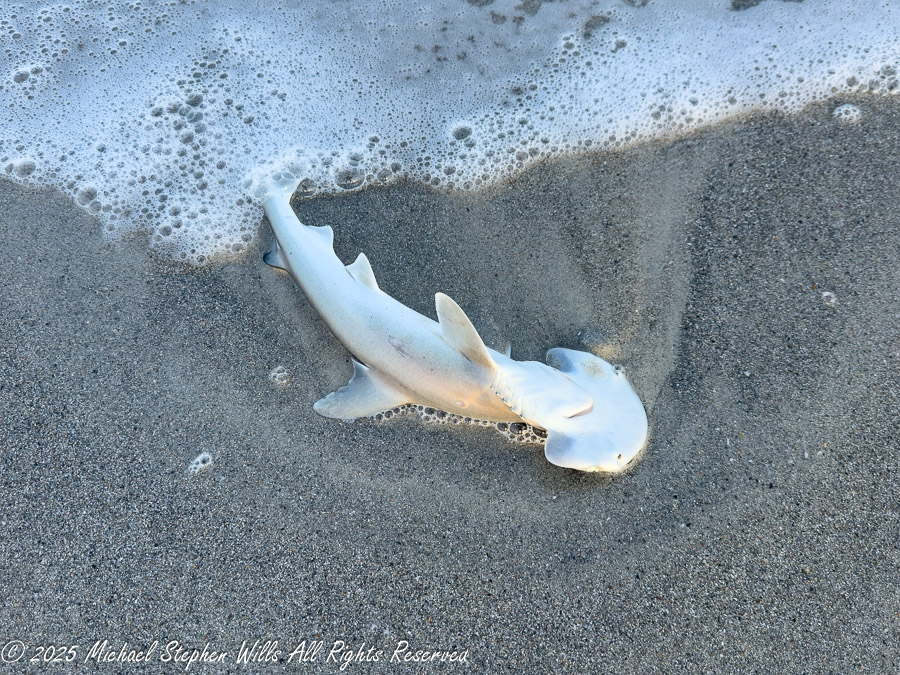
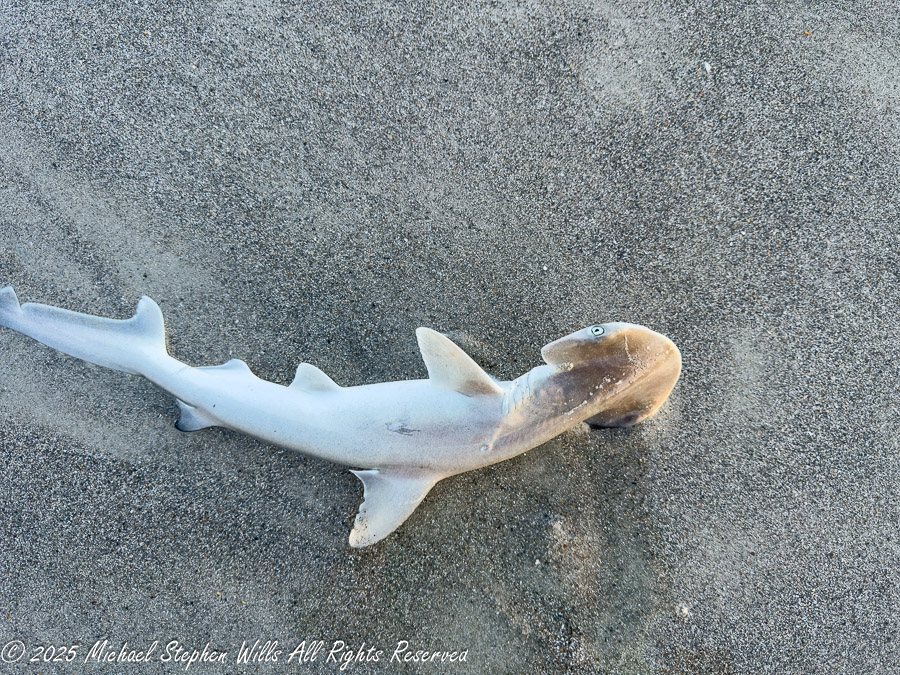
The evening ebb tide had left behind more than just a fresh line of seaweed and broken shells. As I walked along Cocoa Beach, the cool sand beneath my feet, a small shape caught my eye near the water’s edge. At first, it looked like detritus tossed ashore by the restless ocean. But as I stepped closer, I saw the unmistakable outline of a shark—its pale, twitching body lay on the damp sand.
Stopping to bend and examine it, my breath caught as I recognized its flattened, shovel-shaped head. This was a bonnethead shark (Sphyrna tiburo), one of the smallest members of the hammerhead family. Its eyes, positioned far apart on either side of its head, stared blankly at the sky. A thin film of seawater still clung to its sleek, streamlined body, reflecting the golden light of the rising sun.
Its scientific name, Sphyrna tiburo, reveals much about its nature and form. Sphyrna comes from the Greek σφῦρα (sphyra), meaning “hammer,” a fitting reference to the distinct shape shared by all hammerhead sharks. The species name, tiburo, is thought to have originated from an indigenous or Spanish term for small sharks found in the Caribbean and Gulf of Mexico. Together, these words encapsulate the bonnethead’s identity—a hammer-shaped predator of the shallow seas, yet one that stands apart from its larger, more formidable relatives.
Named for its distinctive cephalofoil—the flattened, bonnet-like shape of its head—Sphyrna tiburo plays an essential role in maintaining the balance of marine ecosystems. As a mid-level predator, it helps regulate populations of crabs, shrimp, and small fish, preventing any one species from overpopulating and disrupting the delicate food web. Unlike most sharks, the bonnethead is also partially omnivorous, consuming seagrass along with its usual diet of crustaceans and mollusks. This unique feeding behavior contributes to the health of seagrass beds, which serve as crucial habitats for many marine creatures.
Bonnetheads are harmless to humans, known for their non-aggressive nature and their surprising diet—unlike most sharks, they eat not just crustaceans and fish, but seagrass as well. Gentle foragers of the shallows, they are common in Florida’s coastal waters, where they glide just beneath the surface, their unique head shape helping them detect prey buried beneath the sand.
But this one would swim no more. It was too late. Whether it had fallen victim to a fisherman’s discarded catch, an injury, or something unseen—disease, pollution, or fluctuating ocean temperatures—it was impossible to tell. All I knew was that this creature, so perfectly adapted to the rhythms of the sea, had been cast ashore by forces beyond its control.
A wave surged forward, washing over the shark’s still body, as if the ocean itself fruitlessly nudged it to life. The rising tide swirled, lifting the bonnethead and carrying it back into its world.
As I stood watching the tide pull it away, I felt a strange mix of sorrow and reverence. The sea is full of life, but it also takes life in its endless cycle. The bonnethead had played its part in that vast, unknowable story.
And now, it was gone.
Enter your email to receive notification of future postings. I will not sell or share your email address.
Copyright 2025 All Rights Reserved Michael Stephen Wills
Step into the enchanting world of the VanRiper Conservation Area during a total solar eclipse. Witness nature’s grand spectacle, where daylight fades into an ethereal twilight, and the cosmos whispers secrets to those who listen.
Standing within the serenity of the VanRiper Conservation Area, we had the rare privilege to witness a celestial marvel—the total solar eclipse. The coordinates, 42°43’8.62″N 76°45’30.41″W, marked not a unique vantage point on the southern edge of the total eclipse zone. Here, the total eclipse enveloped the sky for an awe-inspiring 50 seconds, a fleeting yet unforgettable spectacle that we were fortunate enough to experience.
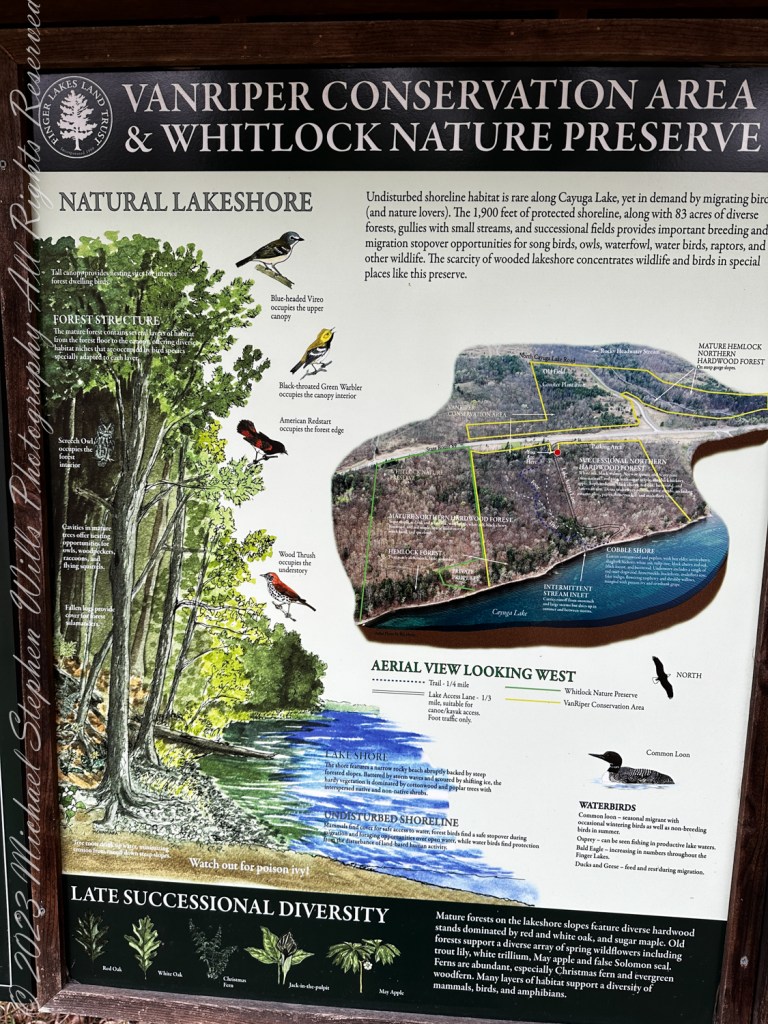
The VanRiper Conservation Area served as a magnificent backdrop to this astronomical event. Known for its diverse habitats, including wetlands, forests, and meadows, the area is a haven for wildlife and a sanctuary for those who seek solace in nature; a place where the sky seems vast, unobstructed by the trappings of urban life, offering a clear canvas for the eclipse to paint its momentary magic.
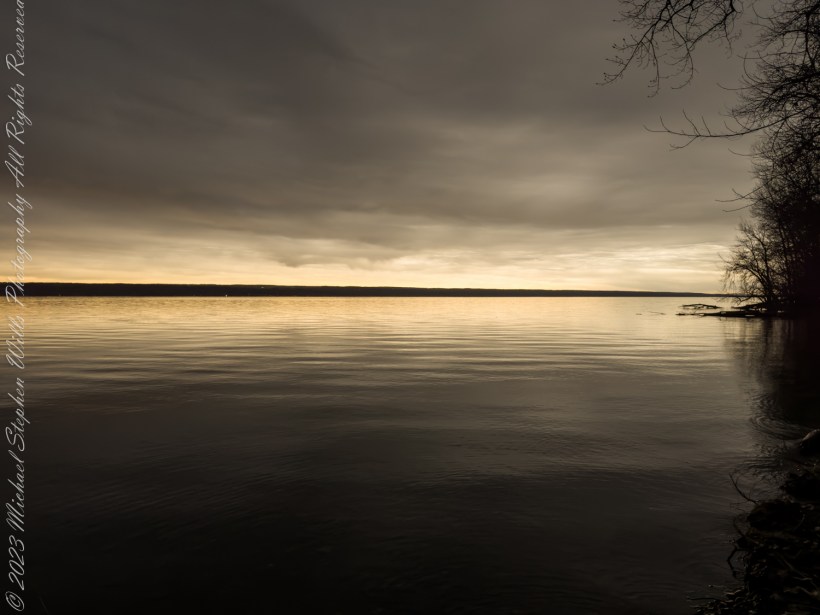
13:38:07, 39 minutes 41 seconds before the moon’s edge touched the sun. From the shoreline of VanRipen Conservation Area, Town of Romulus, Seneca County, Finger Lakes Region, New York State
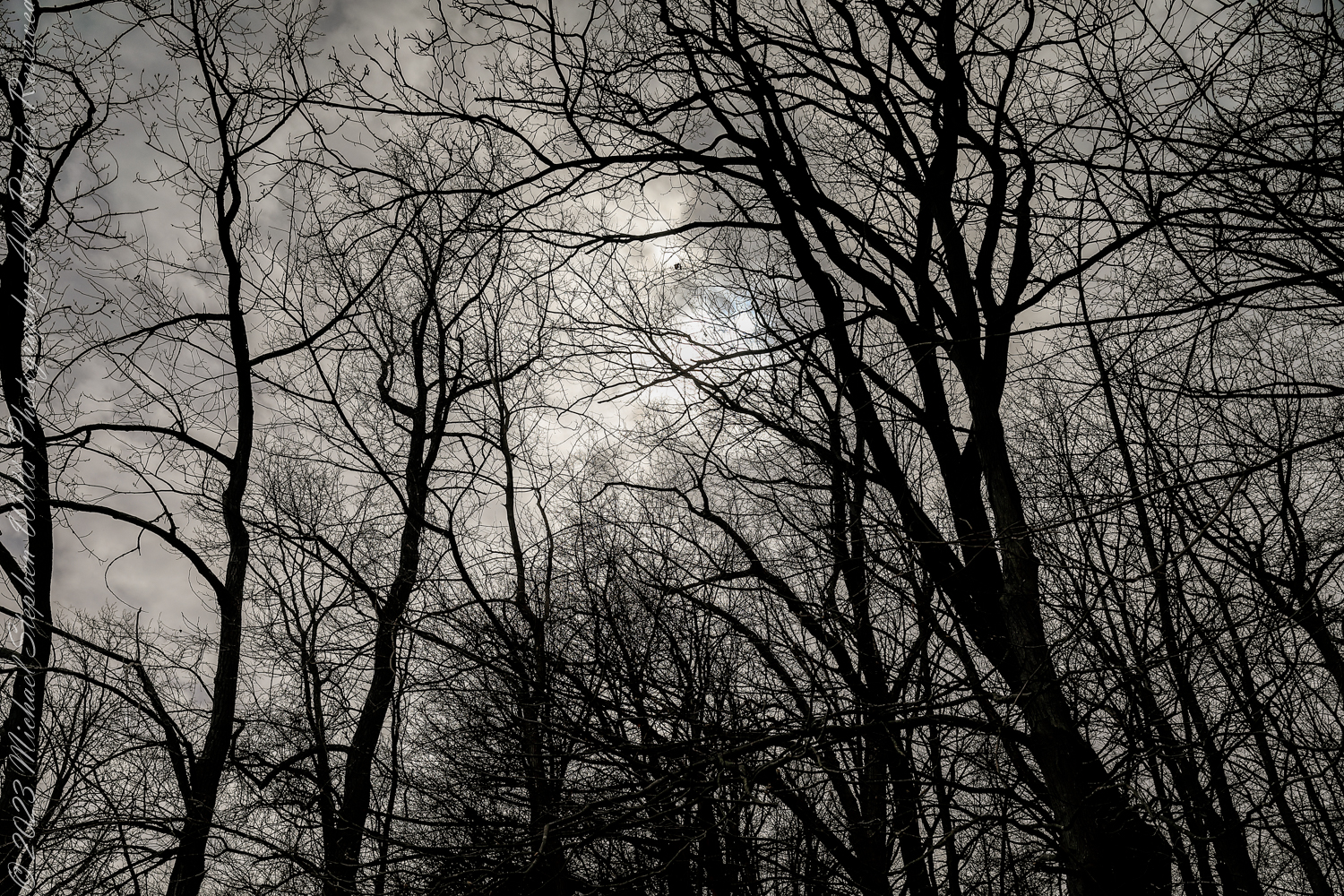
As the time for the eclipse approached, a thick blanket of clouds enveloped the sky, obscuring our view of the sun entirely. This unexpected veil not only robbed us of the celestial spectacle but also intensified the darkness, casting a deeper shadow over the landscape and amplifying the surreal, twilight ambiance.
As the moon began its slow sweep over the sun, an eerie twilight descended upon the conservation area. The temperature dropped noticeably, a testament to the sun’s masked radiance. The birds, momentarily confused by the sudden dusk, fell silent, heightening the surreal atmosphere. This was the moment I had been waiting for, the total eclipse, where day momentarily turns to night, and the ordinary becomes extraordinary.
15:21:37, 56 seconds to totality. From the shoreline of VanRipen Conservation Area, Town of Romulus, Seneca County, Finger Lakes Region, New York State
Positioned on the southern edge of the total eclipse zone, I observed a fascinating phenomenon: the southern side of the horizon retained a brighter hue compared to the north, which veiled itself in deeper shades of twilight. This luminous gradient painted across the sky was a direct consequence of our location’s proximity to the eclipse’s path of totality.
In this captivating 4-minute YouTube video, you’re whisked away to the shores of Cayuga Lake, beneath a cloudy sky, on the day of the Total Eclipse, April 8, 2024 viewed from the VanRiper Conservation Area Cayuga Lake Shoreline in the town of Romulus, Seneca County of the Finger Lakes of New York State. As the moon dances across the sun at 5 times normal speed you witness the gradual darkening of the lake. On the opposite shore, the town of Aurora lights wink with the total eclipse of the sun. In normal time Loons herald the Sun’s return with a bright and eerie serenade, a natural symphony celebrating light’s triumph over darkness. Join us on this remarkable journey, where day turns to night and back again, all within the embrace of the Finger Lakes Region.
The totality lasted for a mere 50 seconds, when time seemed to stand still, yet it was a period rich with emotion and wonder. To witness the total eclipse was to see the universe align in a rare spectacle of shadow and light, a reminder of our place in the cosmos.
Reflecting on the experience, the VanRiper Conservation Area was a portal to a deeper understanding and appreciation of the natural world. Its untouched Cayuga Lake shoreline provided a setting for observing the eclipse with a reminder of the beauty and fragility of our planet.
As the eclipse passed and daylight returned the silence was filled with Loon calls, a celebration of life and the return of light. The solar eclipse was a convergence of time, place, and celestial mechanics, offering a spectacle for the eyes, a moment of introspection about our existence in this vast universe: a reminder of the ephemeral nature of life and the enduring awe of the cosmos. In the heart of the conservation area, I stood at the crossroads of science, nature, and spirituality, left to reflect on the dance of shadows and light.
Copyright 2024 Michael Stephen Wills All Rights Reserved
Walk with me through a narrative as translucent as the Moon Jellyfish itself, revealing the hidden connections between us and the vast ocean’s enigmatic creatures.
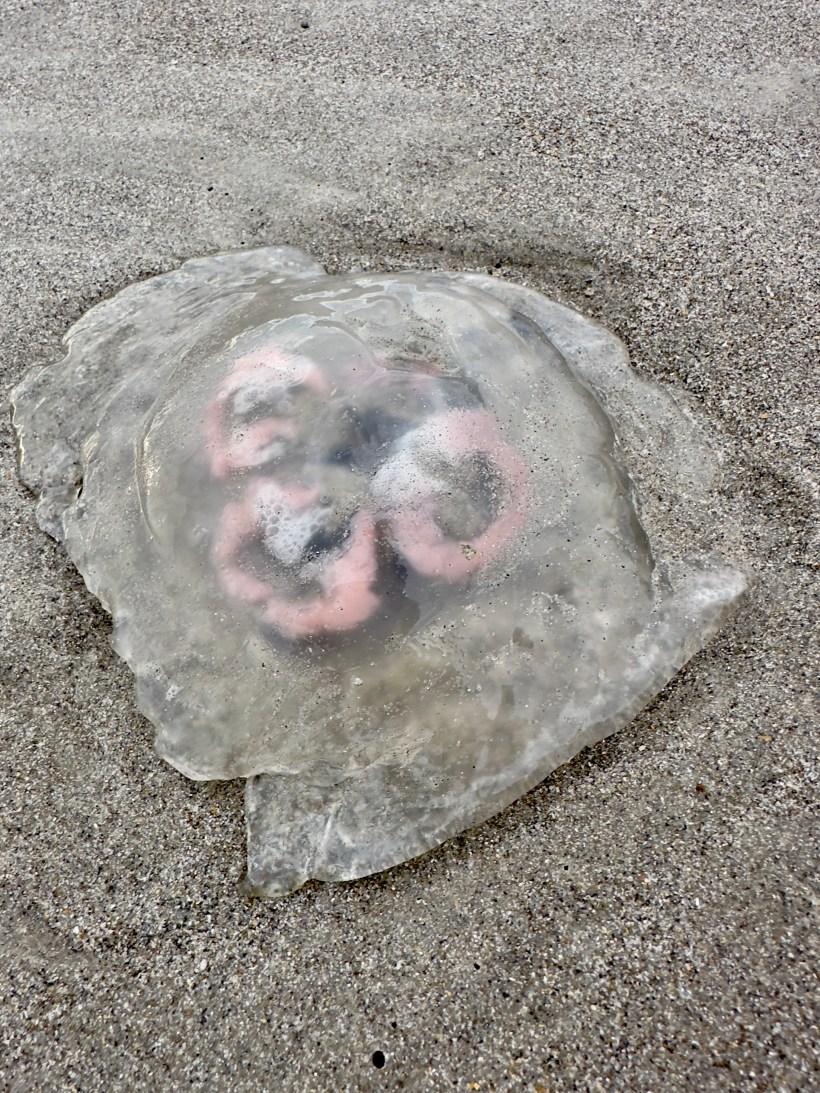
It was a cool January morning, and the southern winds were brisk as they tousled my sparse hair. I had made my way along Cocoa Beach, a place I often find solace in the rhythmic dance of the waves. Today, however, the ocean had a different story to tell. As I walked along the shore, my gaze fell upon a peculiar sight—a translucent, almost ethereal creature lay motionless on the sand. It was a Moon Jellyfish, or as scientists call it, Aurelia aurita.
The gelatinous being had been cast out by the unforgiving sea, its pinkish hue a stark contrast against the dull sands. This wasn’t an uncommon sight, as these creatures often end up on beaches due to wind patterns and water currents. But there was something about this particular Moon Jellyfish that captivated me. Perhaps it was the way it shimmered in the morning light, or how it seemed so peaceful, so out of place, yet exactly where it was meant to be.
Ecological Significance
I knew that the Moon Jellyfish played a crucial role in the marine ecosystem. These cnidarians are not just beautiful drifters; they are a vital part of the ocean’s food web. Small fish and other marine organisms often find shelter among the Moon Jellyfish’s tentacles, escaping predators and finding nourishment in the plankton caught by their host. In turn, the Moon Jellyfish themselves are prey to a variety of larger species, including sea turtles and certain birds.
Seeing the jellyfish on the shore, I contemplated the fragility of this balance. A change in wind direction, a shift in temperature, or human interference could easily disrupt this delicate ecological dance. It was a stark reminder of the interconnectedness of life and the responsibility we hold in preserving these intricate relationships.
Biological Wonders
The biology of the Moon Jellyfish is as fascinating as its role in the ecosystem. They are composed mainly of water, with a body that includes a bell-shaped top called the medusa, and short tentacles that hang below. These tentacles contain stinging cells known as cnidocytes, which they use to capture their prey—mainly tiny plankton.
As I observed the jellyfish before me, I couldn’t help but marvel at its simplicity and complexity. The Moon Jellyfish has a basic nervous system and lacks a traditional brain, heart, and blood. Yet, it thrives in the vast and challenging environment of the ocean. Its lifecycle, too, is a wonder, beginning as a polyp anchored to the seafloor, then transforming into the free-floating medusa I saw on the beach.
A Reflection on Nature and Humanity
The Moon Jellyfish’s unexpected presence on Cocoa Beach prompted a deeper reflection on nature’s course and our place within it. This creature, which had drifted with the currents and tides, led me to ponder the currents of our own lives. How often do we find ourselves washed ashore by the winds of change, feeling out of place, yet precisely where we’re meant to be?
In that moment, I understood that we, too, are like the Moon Jellyfish in many ways—adaptable, resilient, and part of a larger whole. We float through life, sometimes at the mercy of forces beyond our control, yet we possess the innate ability to navigate our environment and survive.
As I left the beach that day, the image of the Moon Jellyfish imprinted in my mind, I felt a newfound respect for these delicate yet durable denizens of the deep. The Moon Jellyfish, washed up by a southern wind onto Cocoa Beach, served as a silent teacher, reminding me of the beauty and fragility of life, the importance of our ecosystems, and the subtle threads that connect us all.
Copyright 2024 Michael Stephen Wills All Rights Reserved


 Michael Stephen Wills Photography