Stargazing Winter’s Crab: Watching the 2019 Total Lunar Eclipse Near Cancer’s Beehive Cluster

Join me as a full moon slips into Earth’s shadow, turning copper beside Cancer’s Beehive—science, illusion, and wonder entwined in a winter night.

Colored lights of our skies are lifelong triggers for the imagination. On any moonless, crystal night—far from the town-glow—three thousand or so stars and the wandering planets scatter across the dark. We read them instinctively, stitching patterns the way our ancestors did, turning a brilliant chaos into stories. Along the ecliptic, twelve of those patterns became the constellations, a starry calendar by which careful observers told the seasons. When Cancer, the Crab rides high, winter has the northern hemisphere in its grip
Click Photograph for my OnLine Galleries
Click photograph for my OnLine Galleries. Clicking the other photographs in this post will yield a larger image.

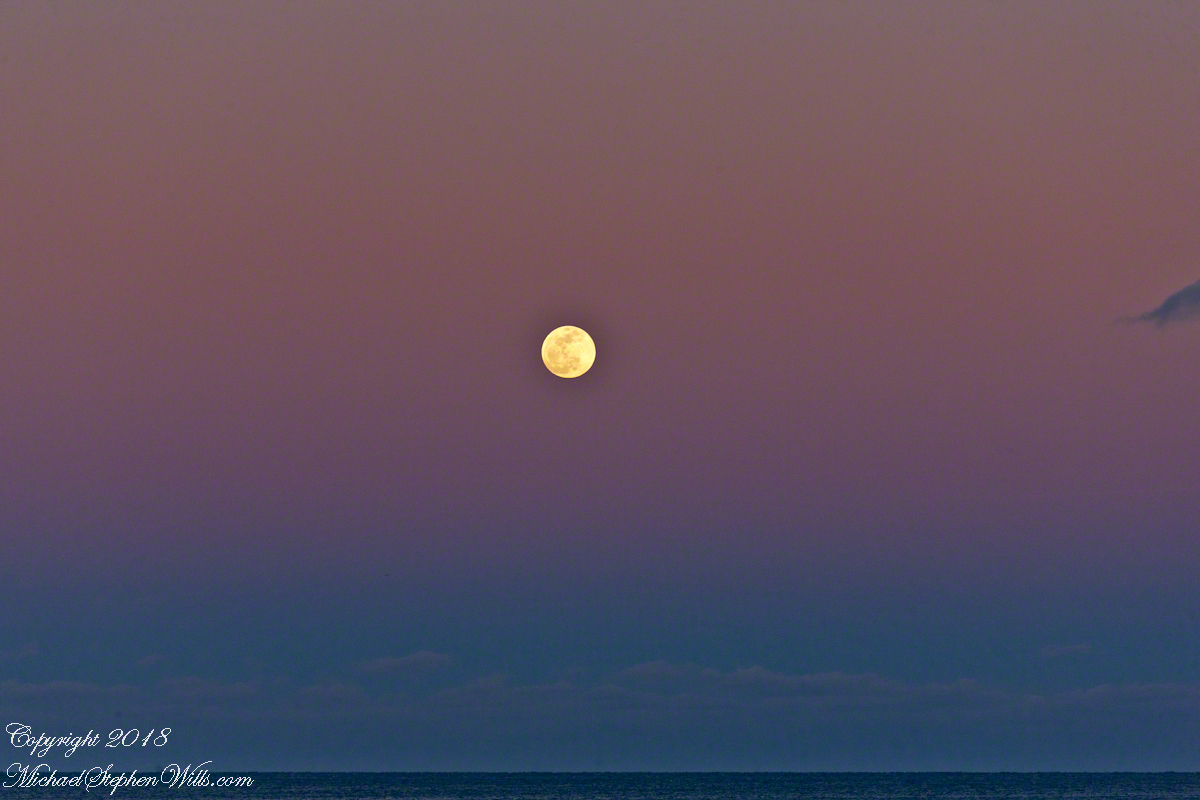
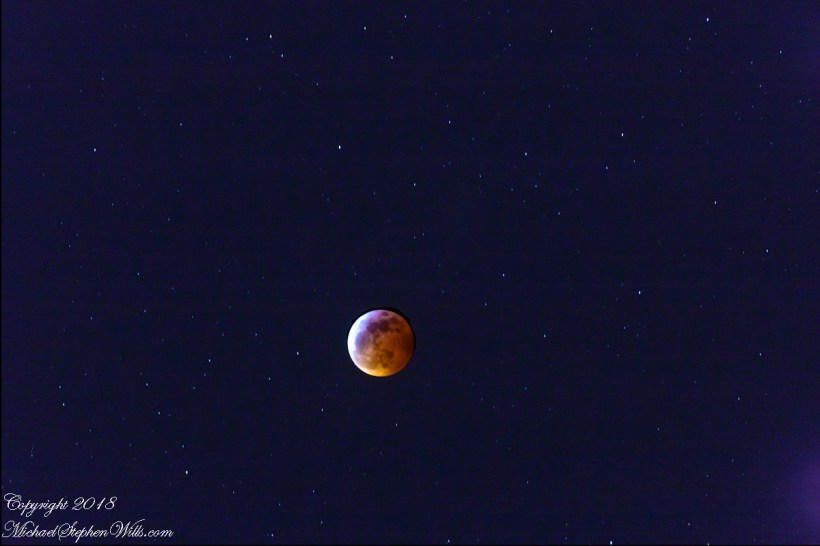
On the night of January 20–21, 2019, a full moon climbed from the horizon and slid into Earth’s shadow, transforming a familiar face into a copper coin. As it rose, that low-horizon “larger” moon—an illusion born of context—felt close enough to pocket. Hours later, the moon darkened to a dull copper color and appeared to float amid Cancer’s dim stars.

I set up a Canon DSLR on a tripod with a 24mm f/1.4 lens, pushed the ISO to 3200, and shortened the exposure to 1.3 seconds—a compromise between freezing star points and preserving the feel of the sky. The moon, of course, was overexposed in that wide frame; later, I overlaid a correctly exposed moon (from a telephoto shot later in the night) at its true apparent size to match the scene as the eye saw it. Is it the most “technical” astrophotograph of the eclipse? No. But it is faithful to the moment I witnessed and good enough to carry the story forward.

The Moon on the Crab’s back

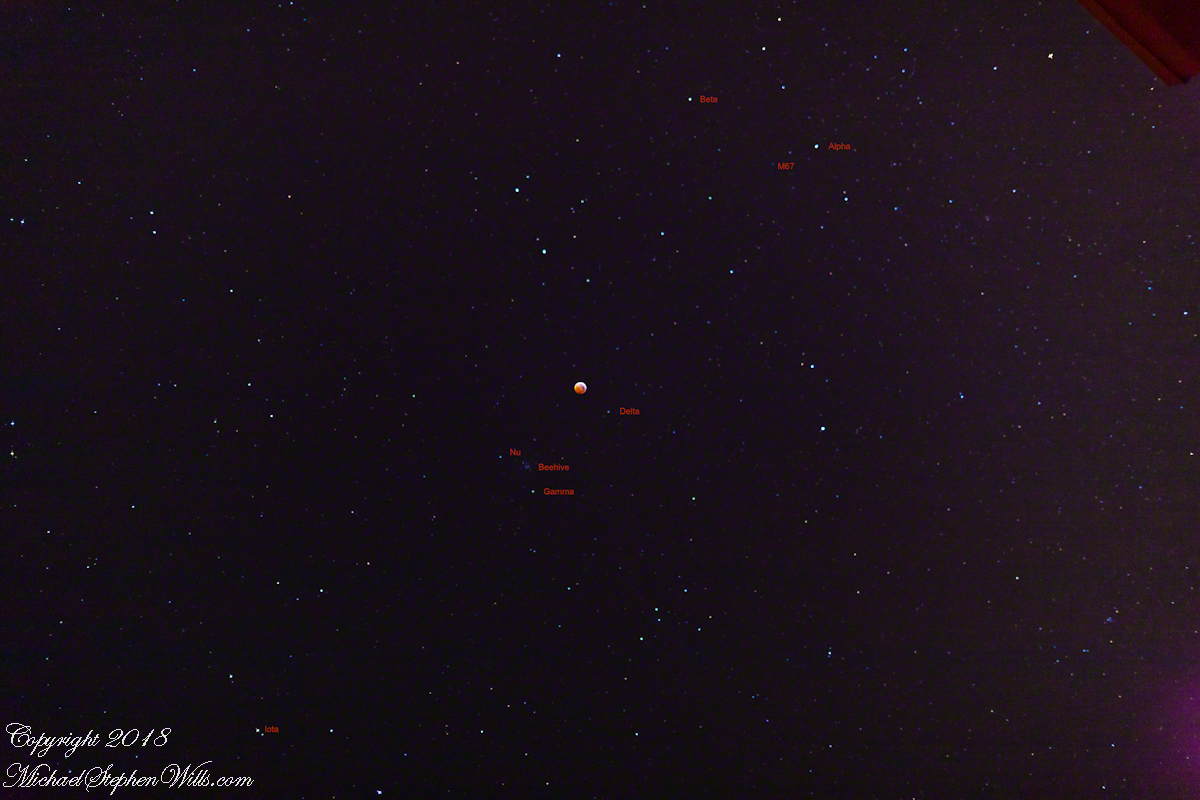
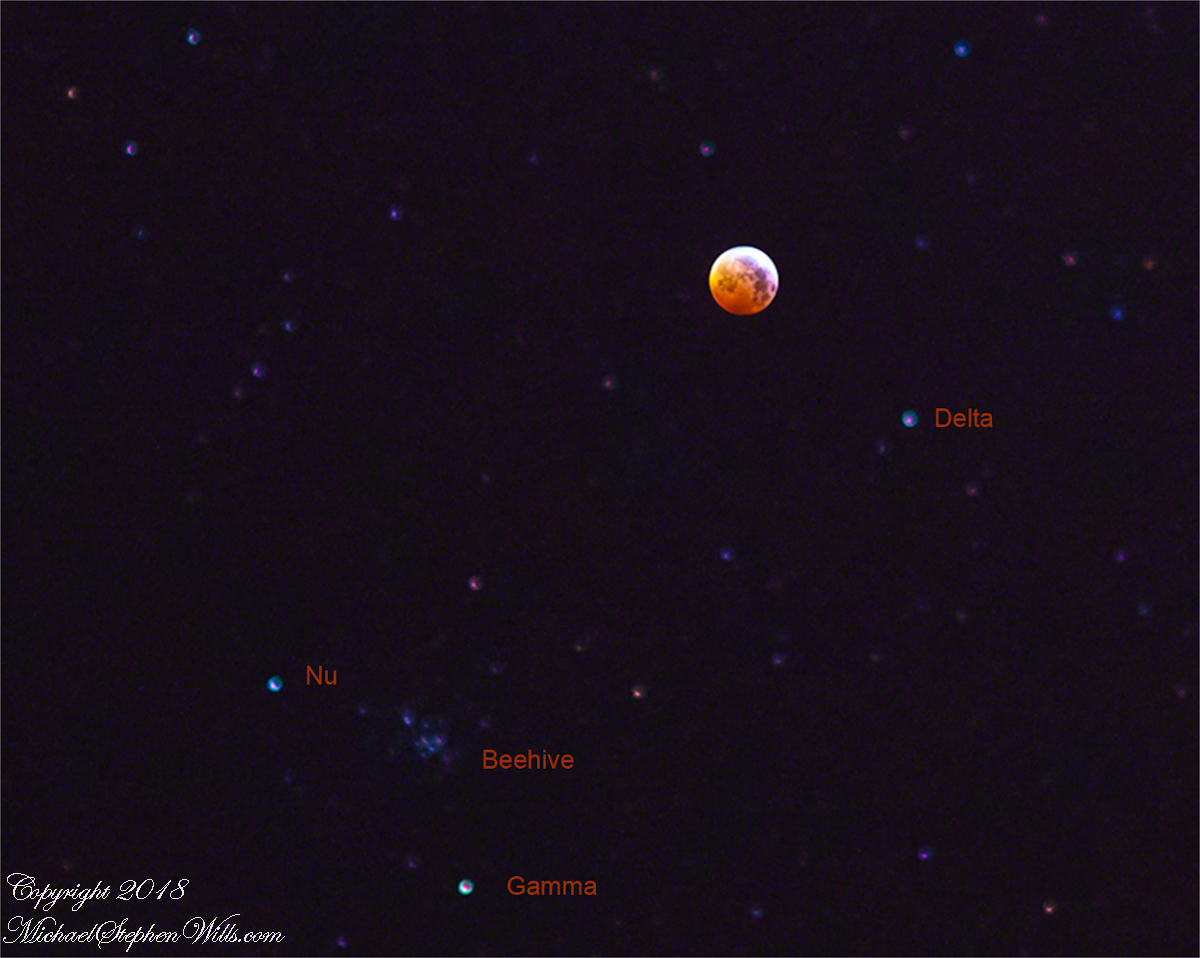
Cancer is never an easy connect-the-dots. Its stars are modest, more suggestion than signature. Look just to the side of the moon’s position that night and you come to Delta Cancri, the orange giant nicknamed the Southern Donkey. Draw a mental line down and slightly right to the faint pair Nu and Gamma Cancri—white stars that only masquerade as twins. They are not physically bound, merely near each other by line of sight: Nu about 390 light-years away, Gamma at 181. Scatter in Alpha and Beta off the Crab’s back and the outline becomes more plausible, the way a minimal sketch becomes a creature once the eye knows what to look for.

The Beehive

Between Nu and Gamma, edged closer to the moon, lies the real prize: the Beehive Cluster—also known as Praesepe or M44. Even with modest binoculars, Praesepe explodes into a field of delicate sparks, a thousand stars loosely wrapped into a hive. Galileo famously turned his early telescope on this cloud and teased forty separate points from the mist; modern optics reveal a populous neighborhood of stellar siblings in shades from ice-blue to ember-red. It is one of those sights that converts a casual sky-gazer into a repeat offender.

Click for more information about this view
Click photograph for a higher resolution version
Total Lunar Eclipse and Surrounding Sky with labels for primary element of the Cancer constellation

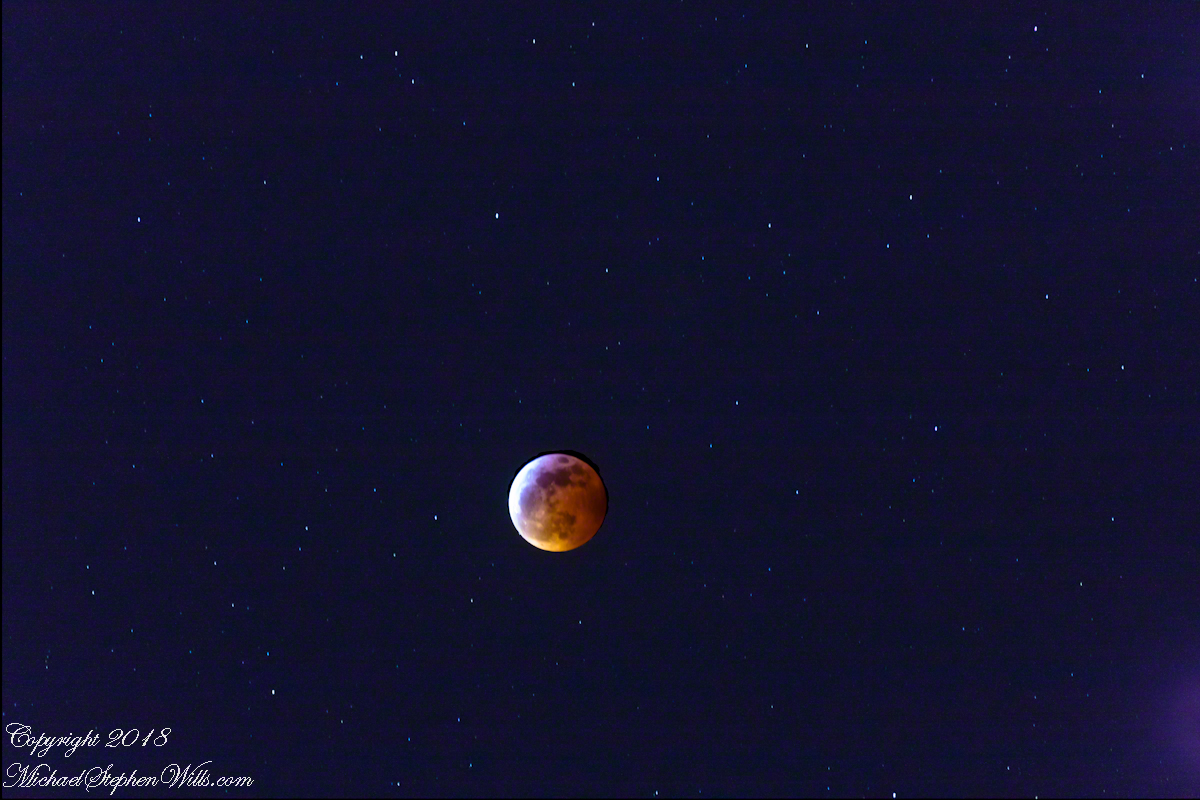
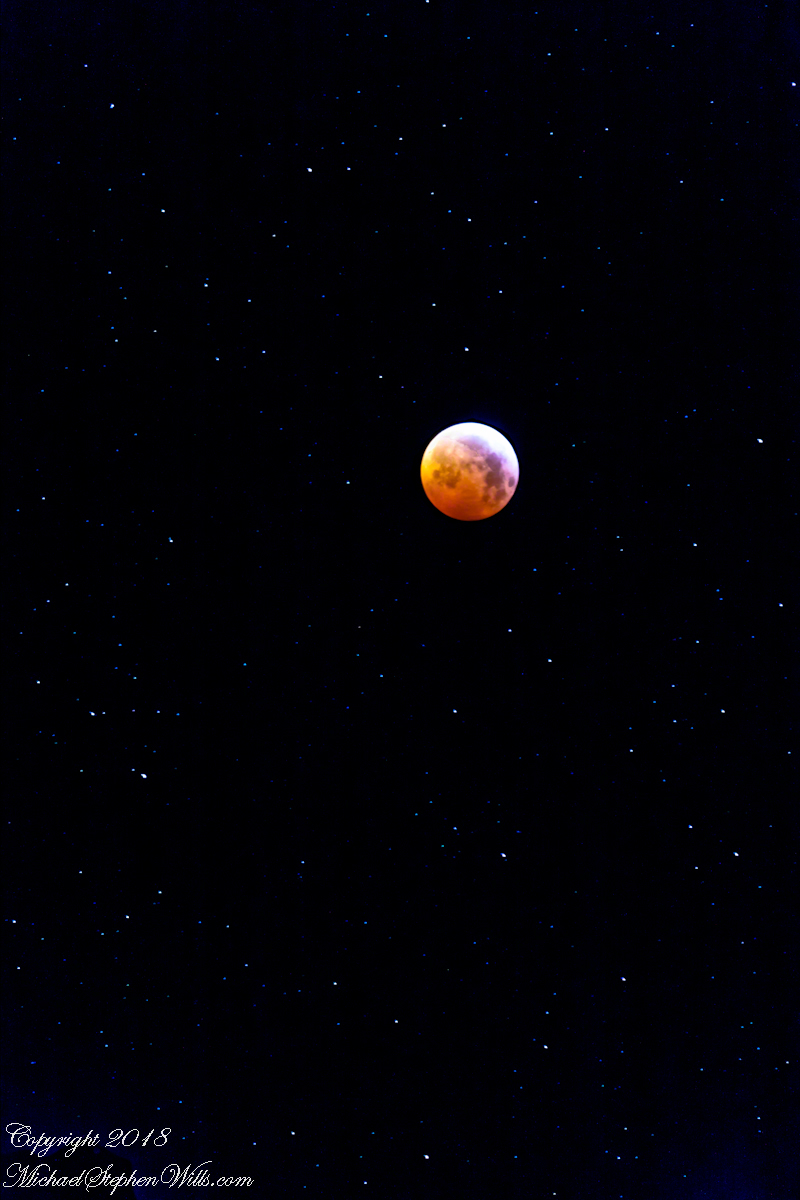
Later in the night I lifted the telephoto—70–300mm at 300mm, ISO 3200, 3.2 seconds—and let the moon fill more of the frame. At totality, the light thinned to a clay-jar red as Earth’s atmosphere bent sunlight around the planet and into its shadow. The effect is both simple and profound: every sunset on Earth happening at once, projected onto the moon’s face. Craters and maria softened into relief, and the globe stopped being a flat disk and became a round, ancient body again. Even without Delta, Gamma, Nu, and the Beehive in that tighter field, the sense of placement remained; I knew the Crab’s back was there in the dark, and that the moon had joined it—just for an hour—as a guest at the manger.
Click photograph for a higher resolution image
“Beehive” with Total Lunar Eclipse with labels for primary elements of Cancer Constellation

The Total Eclipse

What I love most about an eclipse is its pace. Nothing is impatient: the bite appears, the light drains, the color warms, and the world around you changes temperament. As the bright glare wanes, neighborhood sounds recalibrate—the hush between footfalls, the small click of a door, even the steadying breath you didn’t know you were holding. A total lunar eclipse is an astronomy lesson that behaves like a poem; it teaches by arranging time and light until awe and understanding meet.
Click photograph for larger image

And then, quietly, it returns what it borrowed. A thin wedge of white blooms at one edge, a rehearsal for dawn. Copper gives way to pearl, and the old moon looks new again, just higher and smaller against the deepening night. Cancer recedes into suggestion; Praesepe goes back to being a faint cloud to the unaided eye. The camera is packed away, the tripod shoulders its own shadow, and you keep the best exposure of the night where it can’t be corrupted: in memory.
Click photograph for larger image

If you have binoculars, mark Cancer on a winter chart and step outside when the sky is clear. Find Delta, sweep toward the dim pair of Nu and Gamma, and then rest your gaze on that hazy patch between them. Bring a friend into the circle and let the cluster resolve, star by star, into something alive with depth. It will not be the last time you look for it. And if you’re lucky enough, as we were that January, the moon will pass nearby, reminding you that even the most familiar companion can be made strange and beautiful by the turn of a shadow.

The sky is a storybook, yes—but also an instrument. Nights like this tune both.

Enter your email to receive notification of future postings. I will not sell or share your email address.

Blood Moon Reflections: Science, Illusion, and Shared Awe Under the Lunar Eclipse

We gather on the balcony as a total lunar eclipse turns the moon to copper—science, illusion, and shared wonder braid a night of luminous change.

Moonrise

On certain evenings we gather on our Cocoa Beach, Florida east-facing beach-side balcony simply to watch the day undo itself—sunset staining the western sky while, behind us, something quieter begins. On Sunday, January 20, 2019, the quiet had a name: a total lunar eclipse. I’d checked the online charts earlier—moonrise time, azimuth, the patient geometry of the heavens laid out in numbers—and set our chairs faced the anticipated spectacle.

Click photograph for my Online Gallery


The light went a little pewter, as it does when the sun slides offstage and the world inhales. Out on the water a cruise ship shouldered south, a floating city of windows that, under ordinary sunsets, catch fire pane by pane. I looked up too late for the blaze and felt that small pang one gets for the thing almost seen. Still, the ship kept gliding, a bright punctuation mark traveling our skyline.

Click photograph for my Online Gallery

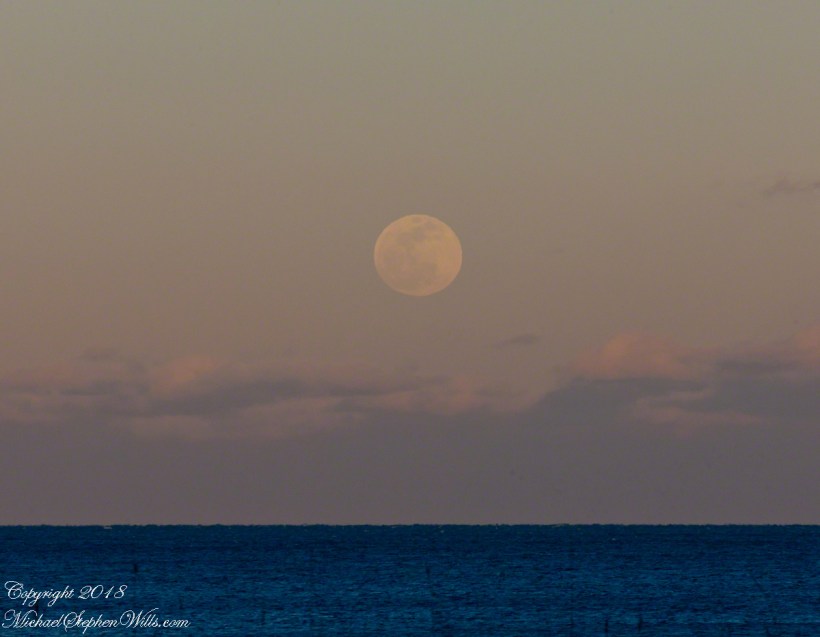
Then the moon appeared—first as a bruise-colored coin pressed against a bank of cloud, then as itself, pale and whole, rising as if pulled on a cord. Photographs can play a trick here: place a ship under a full moon and, with the right lens, the vessel swells to improbable grandeur while the moon looks like a modest ornament. Our eyes know better. The ship is huge but near; the moon is unimaginably larger, only far. Distance humbles everything.

It’s a fine parlor truth that every lunar eclipse requires a full moon. There’s a steadiness in that—that the earth, playing the rare importance of middle child, can only cast its shadow when the moon has come fully into its own. The reverse, of course, is not guaranteed. Most full moons rise and go about their business, silvering roofs and quieting dogs, without ever tasting the earth’s shadow. Tonight would be different.

Click photograph for my Online Gallery

The Riddle of Size

Before the darkness advanced, the old riddle of size made its entrance. Low on the horizon, the moon seemed suddenly intimate, big enough to pocket the ship and still have room for the lighthouse. We call it an illusion, but the word hardly captures the tenderness of it: how the mind, seeing that round face near our familiar trees and eaves, feels the moon to be part of our belongings. Angular diameter stays stubbornly constant; affection does not. The experiment is easy enough—choose a pebble that covers the low moon at arm’s length, then try again when the moon is high. The same pebble hides it perfectly. What changes is not the moon, but the story our senses tell.

Click photograph for my Online Gallery

Clouds raveled and the disk lifted, gathering brightness. As the earth’s umbra slid across that worn, luminous stone, the color shifted from pearl to rust, then to the old red of clay amphorae. People love the names—Super, Wolf, Blood—as if the moon had stepped onto a carnival midway. I prefer the quieter facts: sun, earth, moon aligned; light refracted through air; the planet itself briefly confessed in velvet shadow. It felt less like spectacle than like a family resemblance revealed by candlelight.

Eclipse

Much later, around us, the little neighborhood chorus noticed. A conversation stalled mid-sentence; the unspooled hush you hear at a concert just before the bow draws its first note came and settled on the patio. Even the ocean seemed to restrain itself, waves taking smaller breaths. The cruise ship had long since slid behind the curvature of our seeing.

We kept watching. A lunar eclipse is an exercise in patience: everything happens slowly enough to be felt, quickly enough to refuse boredom. Shadows are honest about their edges. When the moon wore its deepest copper, I thought of ancient nights and imaginations unlit by anything but fire, how dependable cycles must have seemed like messages and how—standing there, spine pricked by a familiar old awe—I could not entirely disagree. It was not fear, but kinship: the sense that we are included in the machinery, not merely spectators.

Click photograph for my Online Gallery

When the light returned, it did so from one margin, like dawn rehearsed on a smaller stage. The coin brightened by degrees, and the old face we know reappeared—craters and mares soft as thumbprints. The illusion of size faded as the moon climbed, and the experiment with the pebble proved itself yet again. Even so, I felt the tug of that earlier enchantment, the way a child misses a dream just after waking. The mind keeps two ledgers: one for what is measured, one for what is felt. Tonight both were full.

Eventually we retired. Chairs nested. Doors clicked. In the kitchen, glasses chimed in the sink. But the moon kept on, white and durable, its borrowed light restored. Somewhere out there the ship’s passengers drifted to their cabins, stories in their pockets about the night the world itself cast a shadow, and how the ocean looked briefly like copper under a patient star.

Later, when I wrote down the times and the few facts I could trust to memory, I realized the real record was not the measurements but the company: our leaning back, the shared breath, the soft astonishment that comes when something vast moves at a human pace. The eclipse ended; the evening did not. That, too, felt like a kind of alignment—ours with one another, our small chairs with a very large sky.

Enter your email to receive notification of future postings. I will not sell or share your email address.

Near and Far — the last day of 2023

Discover a heartfelt story woven from the sands of Cocoa Beach on New Year’s Eve, where shells and stars intertwine, inviting you to ponder the delicate dance of near and far.

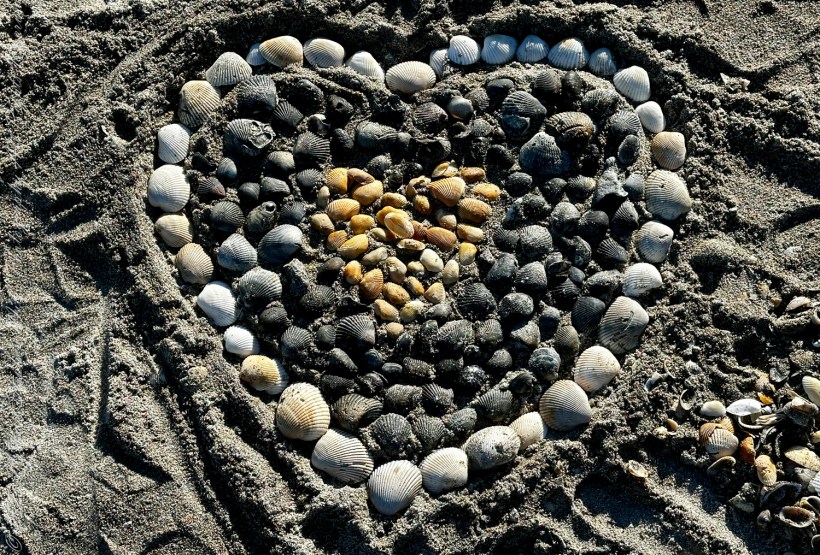
On the last day of 2023, as the sun began its descent on Cocoa Beach, I found myself tracing the contours of a heart laid out in Ark Clam shells. Each shell, with its ridges and grooves, felt like a chronicle of the ocean’s whispers. This artful mosaic, set against the granular canvas of the beach, was a testament to the playful hands of time and tide. I marveled at the intention behind it, the human desire to create and connect, to leave a mark, however fleeting, on the vastness of nature.

I found this beach heart while walking on Cocoa Beach on the last day of 2023. It is composed of the various shade of Ark Shells. Ark clam is the common name for a family of small to large-sized saltwater clams or marine bivalve molluscs in the family Arcidae. These are the most common shells found there.

The shells were cool and firm under my fingertips, each one a unique piece of the year’s mosaic. Some were a pristine white, while others bore the earthy tones of the sea’s floor. I pondered the journeys they had taken, tumbling in the ocean’s embrace before resting here, on the threshold of a new year. The act of arranging them into a symbol of love felt like an ode to the past year’s collective joys and sorrows, an offering to the unknown adventures of the year to come.

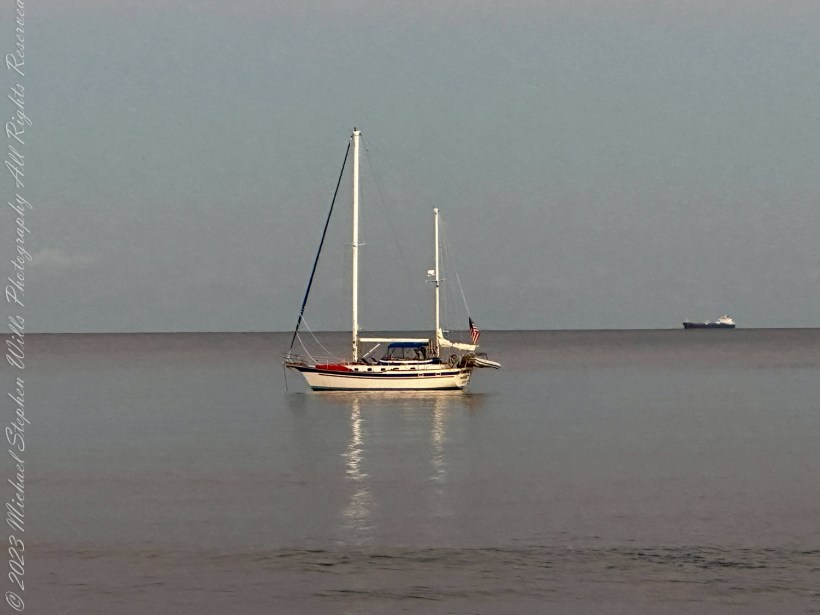
As the day waned, my gaze shifted from the shells to where the water met the sky. There, a sailboat floated serenely, a silent sentinel between two worlds. It was a picture of solitude, a single vessel on the brink of the infinite sea, beneath the expanding dome of the heavens. On the horizon, the silhouette of a cargo ship whispered stories of distant lands and the ceaseless pulse of commerce and exploration that defined our modern era.

On New Years Eve 2023 this sailboad moored off North 1st Street, Cocoa Beach, Brevard County, Space Coast, Florida.

The beach was quiet, the sounds of the day giving way to the evening’s peaceful lull. The sailboat’s stillness was a stark contrast to the perpetual motion of the cargo ship, each representing different paths on the water’s vast canvas. One was an emblem of leisure and simplicity, the other of industry and complexity. Both near and far, they were the day’s quiet companions, their stories part of the fabric of the Space Coast.

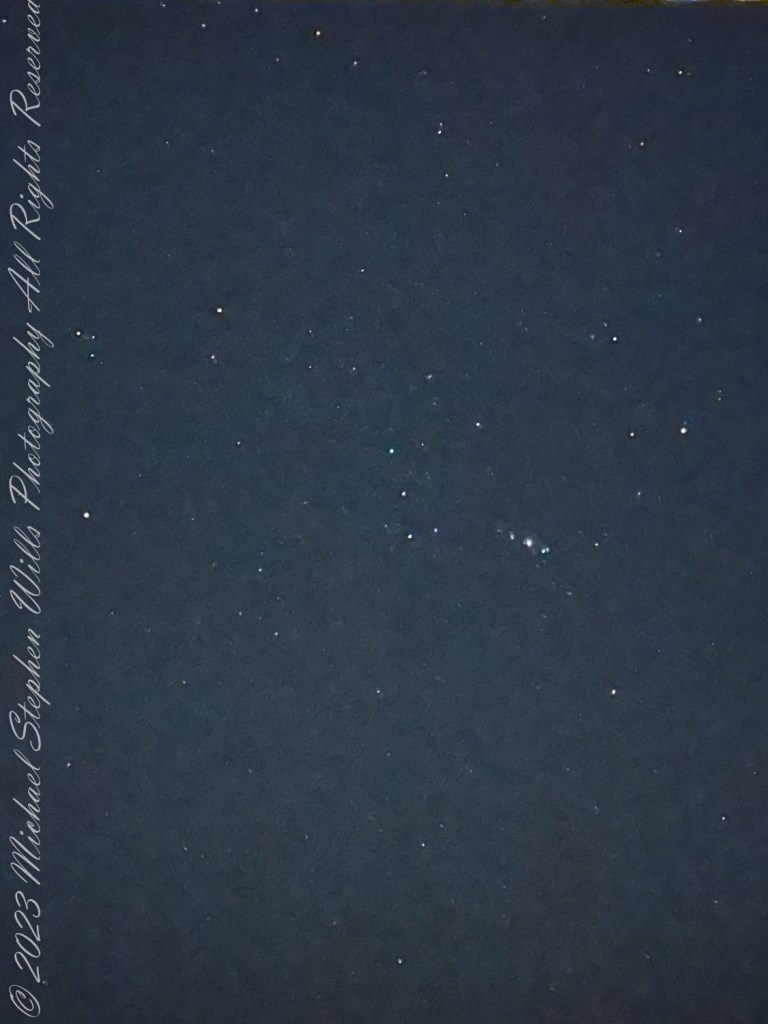
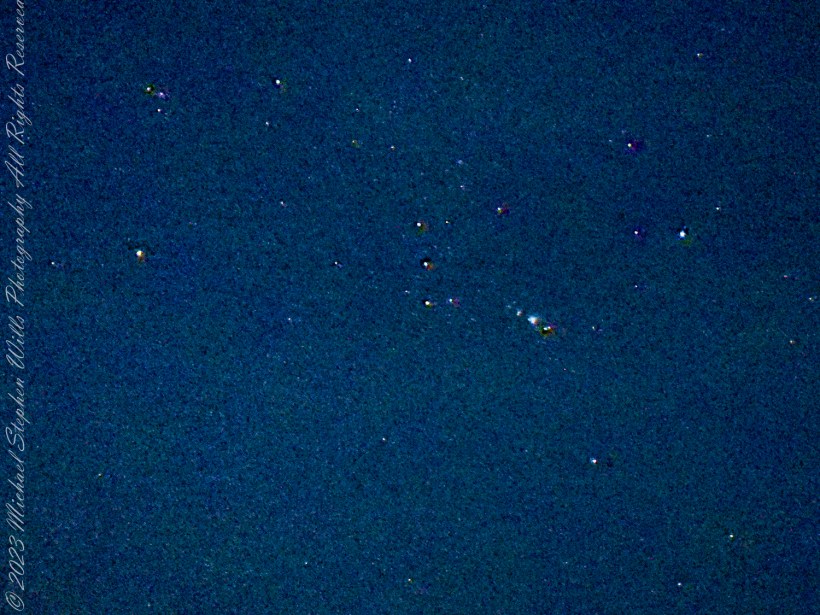
As twilight deepened into night, the stars began to emerge, one by one, until the sky was a tapestry of celestial wonder. With my iPhone 14 Pro Max, I captured this cosmic dance, the constellation of stars that had been the silent witnesses to Earth’s revolutions. The constellations, those mythic shapes that have long sparked human imagination, seemed to hold the secrets of what had been and what was to come. They were distant suns, their light traveling unfathomable distances to reach me, to reach us, as we stood on the brink of a new beginning.

Orion

I couldn’t help but feel a connection to the stars, a kinship with their ancient light. They reminded me that we, too, are part of this grand cosmic design, our lives stitched into the universe’s expansive quilt. On the beach, with the shells at my feet and the stars overhead, I was caught in the delicate balance of near and far—the tangible reality of the shells I could touch and the distant glow of starlight from ages past.

Orion, the belt and sword in center.

As the year ticked closer to its end, I stood between the intimate artistry of the shell heart and the boundless majesty of the star-filled sky, a lone observer of time’s relentless march. The Space Coast, with its unique blend of earthly beauty and human aspiration, was the perfect stage for this reflection. Here, on Cocoa Beach, I embraced the last moments of 2023, ready to welcome the new year, with its promise of continuance and change, its constant dance of near and far.

Copyright 2024 Michael Stephen Wills All Rights Reserved