Broken

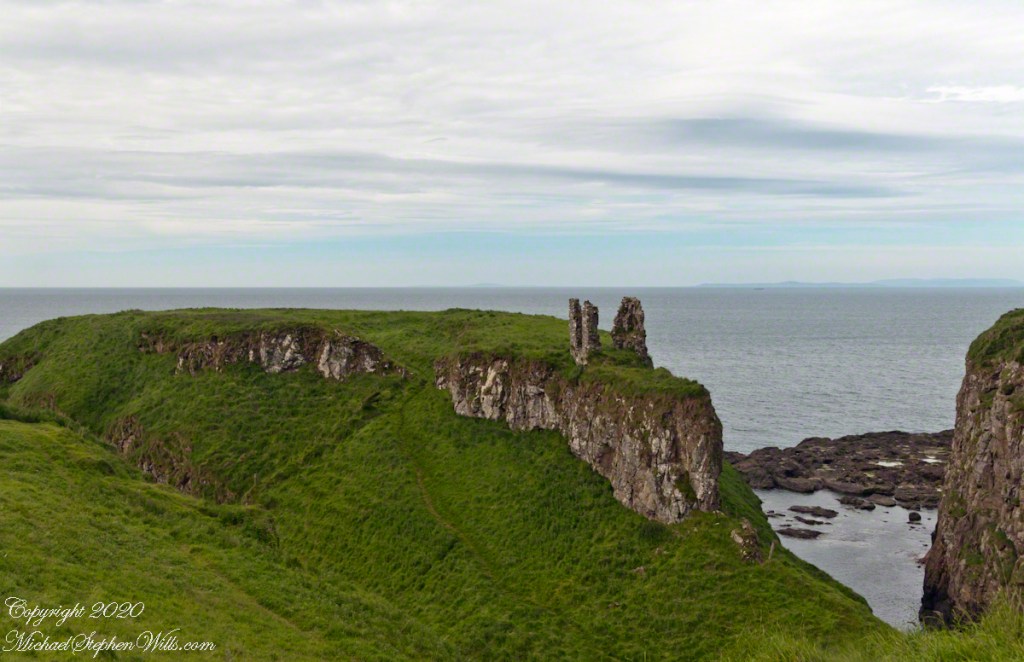
Enormous and Personal Scale

Volcanism formed much Ireland landscape and can be credited with a huge tourist attraction near Bushmills, Northern Ireland, UK (Click me for another post of volcanic Irish landscape). The opening of the mid-Atlantic rift and movement of continents dwarfs the origin story of a roadway built by giants to connect Ireland to Scotland.

Click photograph for a larger view. To do this from WordPress Reader, you need to first click the title of this post to open a new page.
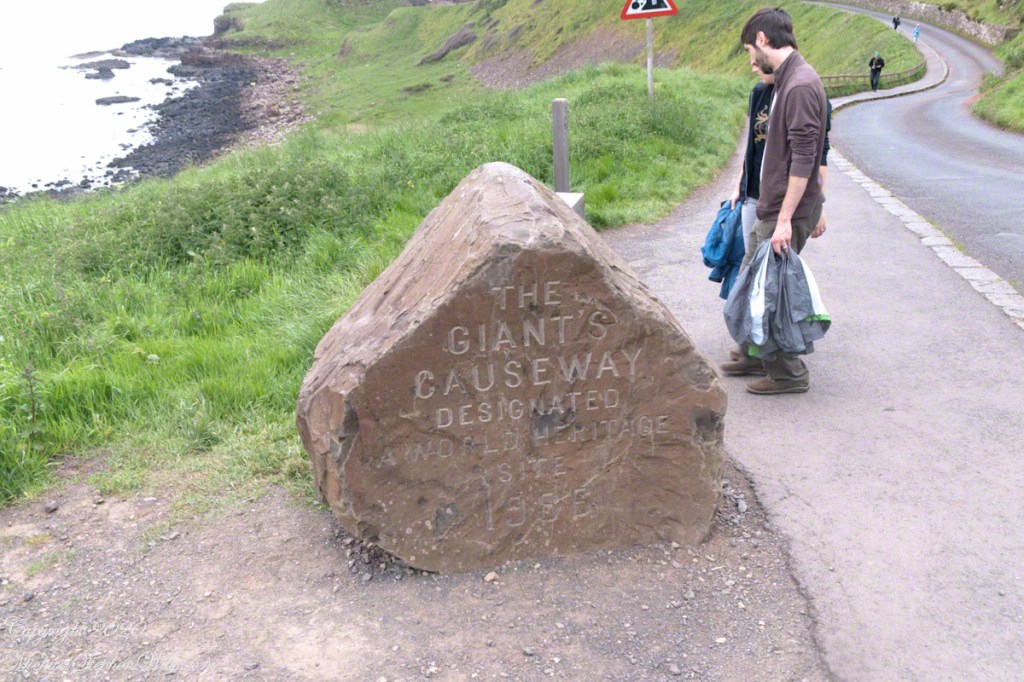
On a prosaic scale, the granite curbs stones proved my undoing. On the walk out of the Causeway, in the falling light of dusk composing a shot, eye to the viewfinder, I fell off the curb. The camera fell, breaking the mount on both the flash and camera. To this day, I need to hold the flash in wireless mode when using the Sony.
Copyright 2020 All Rights Reserved Michael Stephen Wills

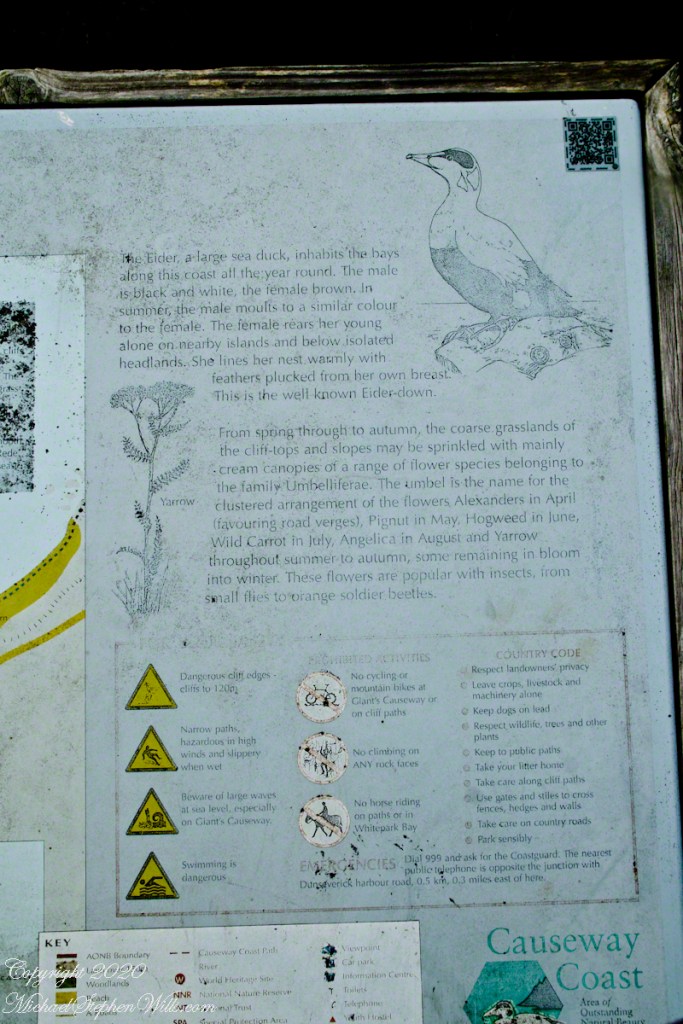
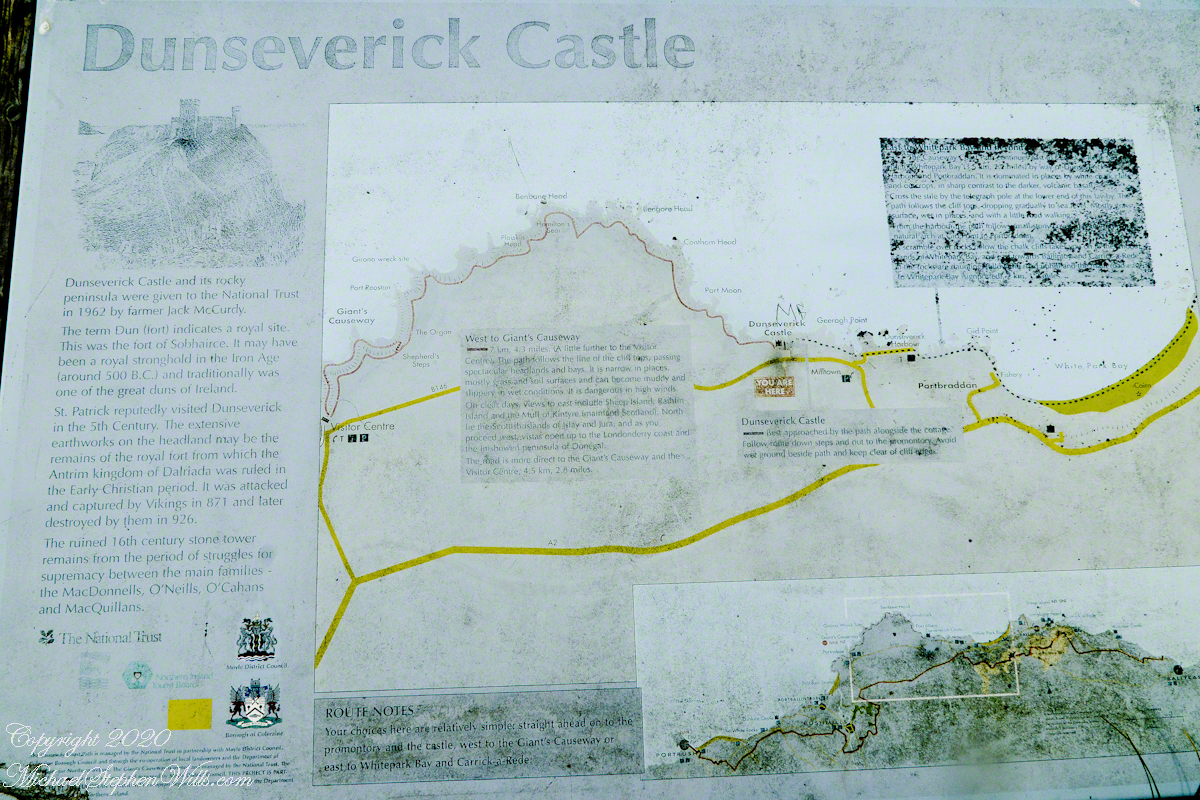
Dunseverick Castle Ruin, roadside info

Pride of History on display

On Causeway Road there is a turnoff an information placard for Dunseverick Castle near a cottage. This is the left side of the placard with the historical context. The right side is natural history of the area.

Click photograph for a larger view. To do this from WordPress Reader, you need to first click the title of this post to open a new page.

Click me for the first post of this series.

Reference: Wikipedia “Dunseverick Castle.”

Copyright 2020 All Rights Reserved Michael Stephen Wills

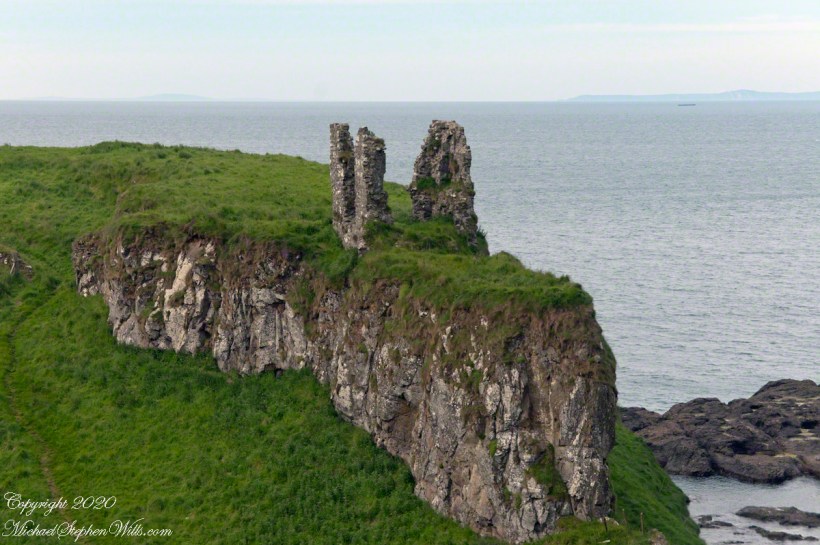
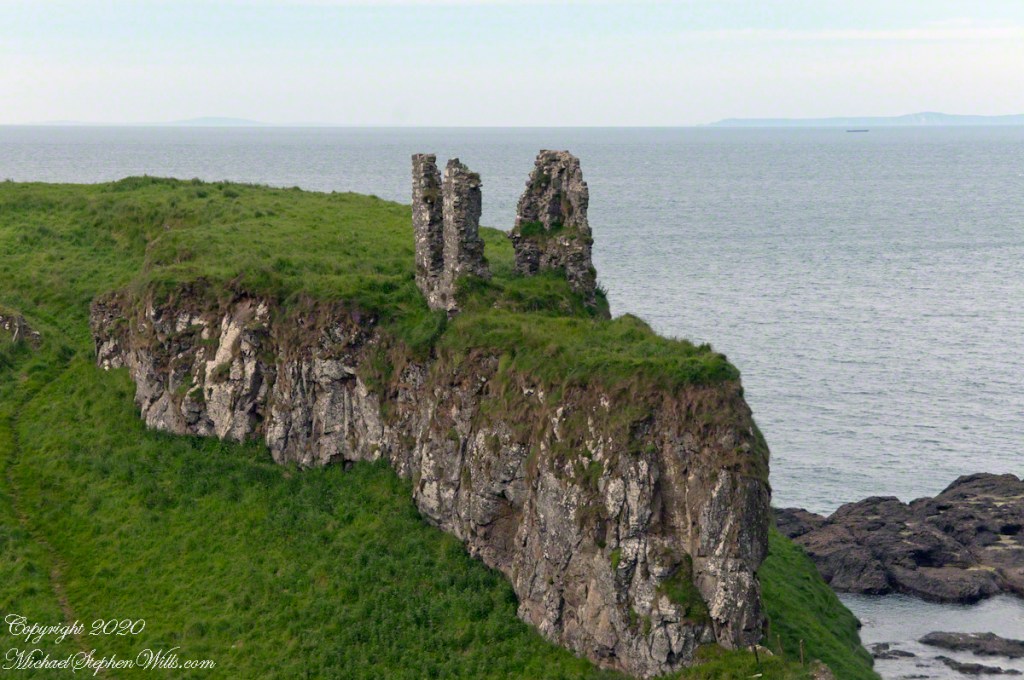
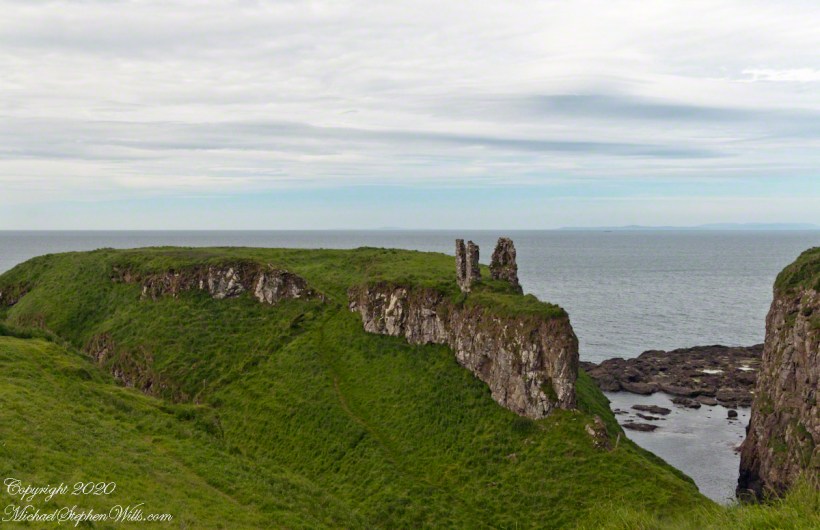
Dunseverick Castle Ruin, closer

Recollections of Saint Patrick

Slight pangs of regret recalled in my first Dunseverick Castle post are recalled this morning on remembering the long Slige Midluachra (aka “High King’s Road”) of which Dunseverick Castle was the terminus, beginning from the Hill of Tara. Walk the High King’s Road, “why not?.”

Here we can see the two partial wall, remains of a gate house, destroyed in the 17th century. I can imagine making the climb up the foot path, examine the earthworks from before the Viking invasions, middle of the first millennium A.D. Recall a visit by Saint Patrick, trodding the path from his Easter fire on the Hill of Slane.

Click photograph for a larger view. To do this from WordPress Reader, you need to first click the title of this post to open a new page.

Explore my photography on Shutterstock for use with your blogs

Reference: Wikipedia “Dunseverick Castle.”

Copyright 2020 All Rights Reserved Michael Stephen Wills

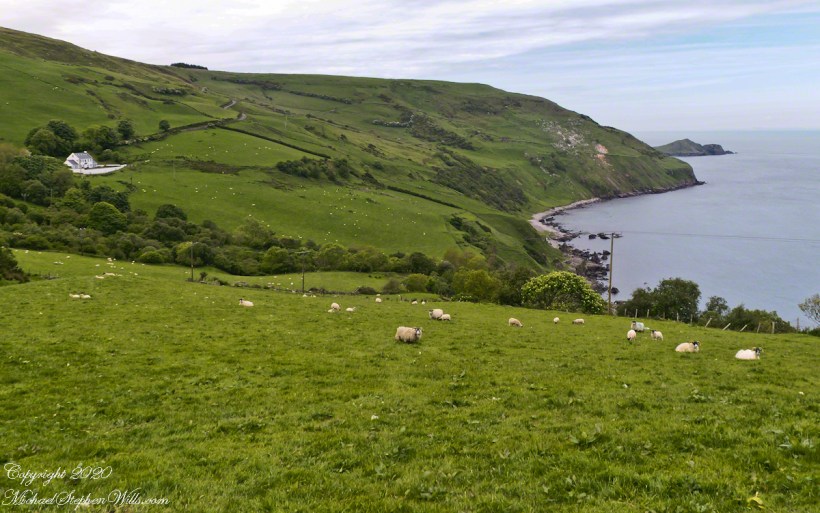
Torr Head Photos

My latest photos accepted into Getty IStock

Click me to view the latest batch of photos accepted into Getty….these are from Torr Head..

Copyright 2020 All Rights Reserved Michael Stephen Wills

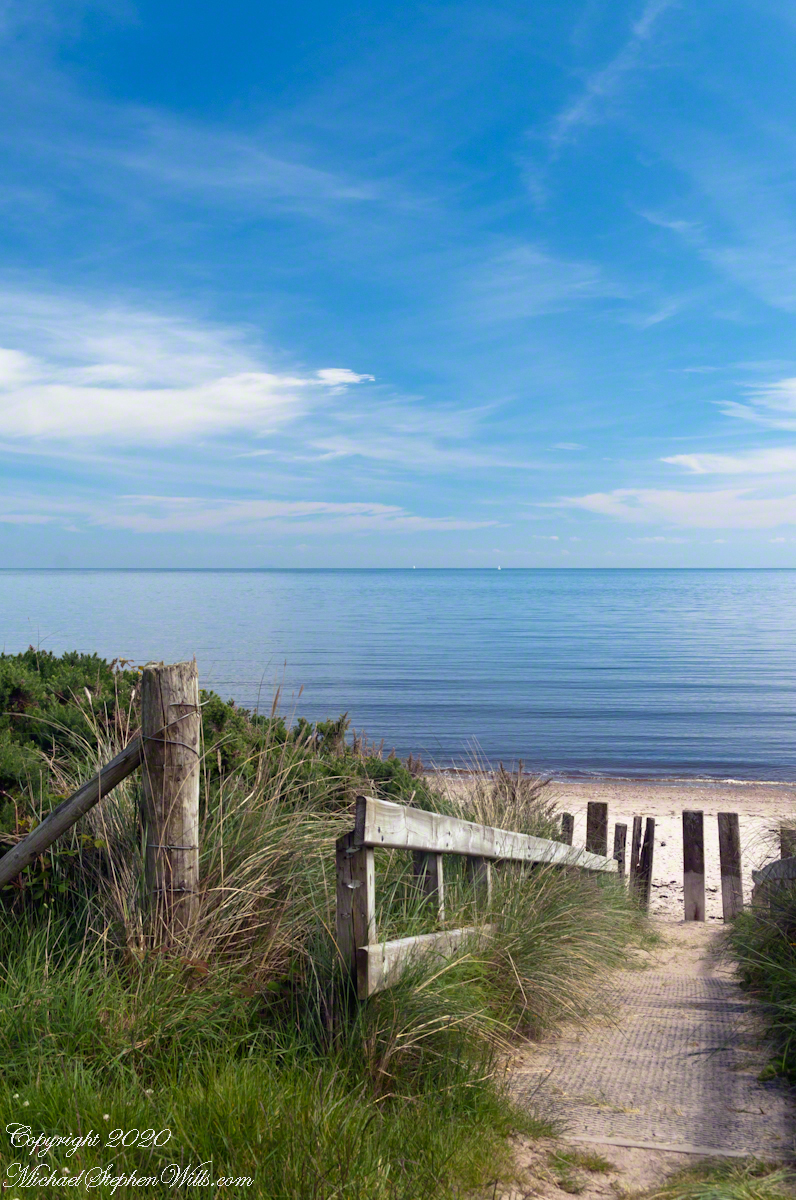
Cushendun Published

Photography accepted this week by Getty

Click me to visit Getty, my recently accepted Cushendun photography.

Copyright 2020 All Rights Reserved Michael Stephen Wills

Beauty and Infection

Cutting Trees to Fight Disease in Glenariff Forest Park

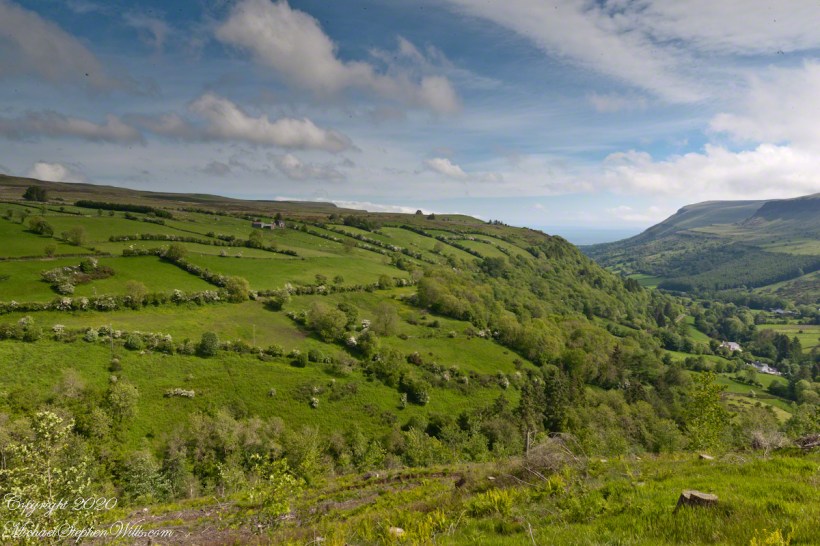
White Hawthorne tree blooms grace hedgerows of the rural hillside facing Glenariff Forest Park. The other white is grazing sheep. The North Channel of the Irish Sea is visible at the foot of the glen, with the shore of Scotland just visible.

Foreground are the stumps of mature trees cut by the forest service to control the oomycete plant pathogen Phytophthora ramorum. We visited June 2014, the year before, October 2013, the Belfast Telegraph reported “Northern Ireland is close to the point where it will be impossible to eradicate a virulent disease from the forests where it has taken hold.” Glenariff Forest part was one of those forests and the tree stumps are victims of that struggle.

Click photograph for a larger view. To do this from WordPress Reader, you need to first click the title of this post to open a new page.

Here is a link to this photograph on Getty.

Copyright 2020 All Rights Reserved Michael Stephen Wills

Getting My Work Out There

A Blessed Easter to Everyone

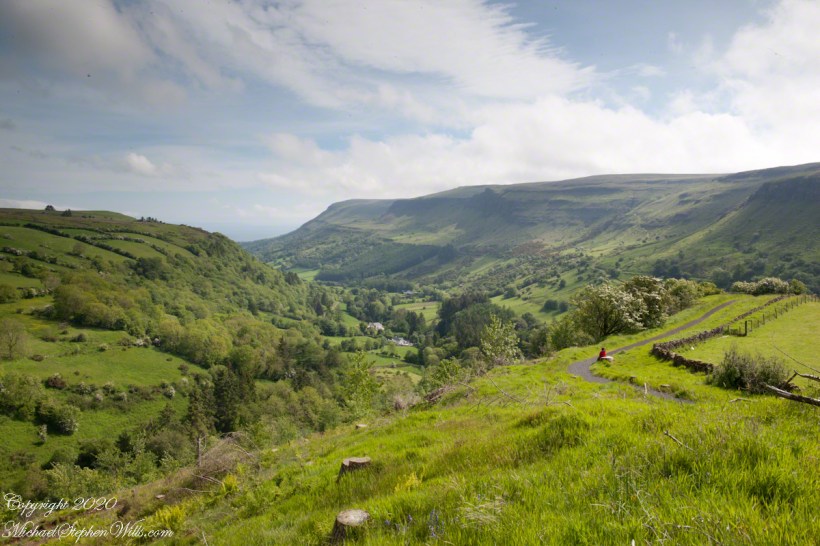
Comparing this view with the first of this series, first glance, with the camera held steady on a Manfrotto studio tripod, it is identical but from the play of light and cloud. My model Pam walked a few feet to sit in quiet contemplation of the beautiful surroundings.

To produce stock photography I research the details of the image, to write an informative caption. For example, in the post “Another Glenariff View” my identification of the Rowan was from a two volume atlas, paging through page after page.

Click photograph for a larger view. To do this from WordPress Reader, you need to first click the title of this post to open a new page.

Here is a link to my Glenariff photographs on Getty.

Copyright 2020 All Rights Reserved Michael Stephen Wills

Glenariff Green

a closer look

Walking around the park trails with a handheld Sony Alpha 700 dslr, a Sony DT 18-200mm variable lens mounted. Sorry to say, I was selective and have only these three photographs to supplement the grand views of the previous two posts. Click me for the first post of this series.

These are from the upper portion of the Red Trail, we did not wander far from the car park. Such a funny term for a parking lot, a park for cars. The cafe offers pick me ups and we indulged.

Click photograph for a larger view. To do this from WordPress Reader, you need to first click the title of this post to open a new page.

Here is a link my Glenariff photograph on Getty.

Copyright 2020 All Rights Reserved Michael Stephen Wills

Another Glenariff View

…with a flowering bush.

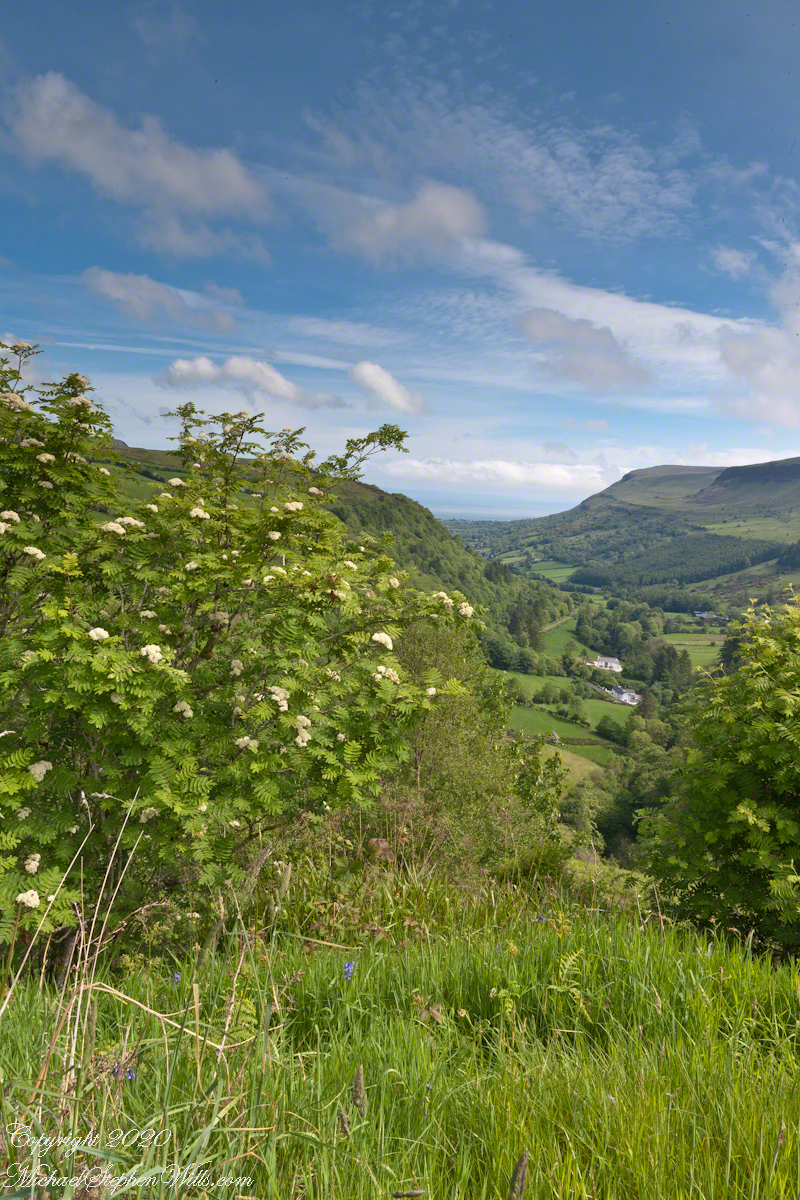
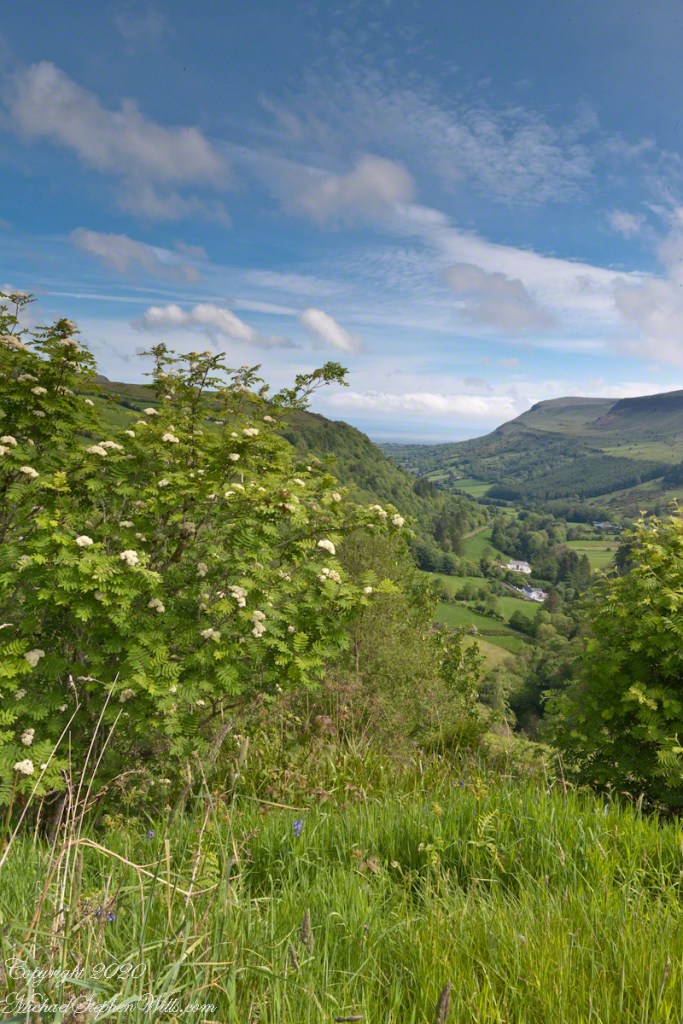
After photographing the broad expands of a wide Glenariff valley, moving the tripod on that same eminence, here is a near and far view.

The foreground white flowering bush of pinnate leaves is Rowan (Sorbus in the family Rosaceae subfamily Maloideae). In Irish it is crann caorthainn, a plant considered sacred in ancient times by both Celts and Vikings. The fruit is made into preserves, jellies. The pinnate leaves are similar to Ash, the reason it is also known as Mountain Ash, Rowan is not botanically related to Ash.

The Canon lens EF 24mm f/1.4L II USM was mounted on the Canon EOS-1Ds Mark III camera. The graduated neutral density filter was perfect for the setting. Notice, between the hills in the distance, is a patch of the Northern Channel (of the Irish Sea), and just visible the Scottish Coast, a tilted horizon uncorrected.

Click photograph for a larger view. To do this from WordPress Reader, you need to first click the title of this post to open a new page.

Here is a link to this photograph on Getty.

Copyright 2020 All Rights Reserved Michael Stephen Wills

Going backward….

….to Glenariff

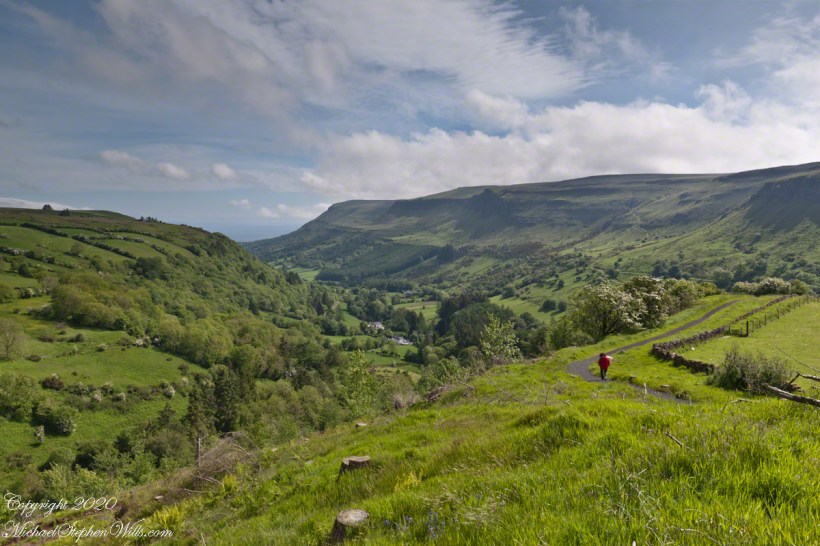
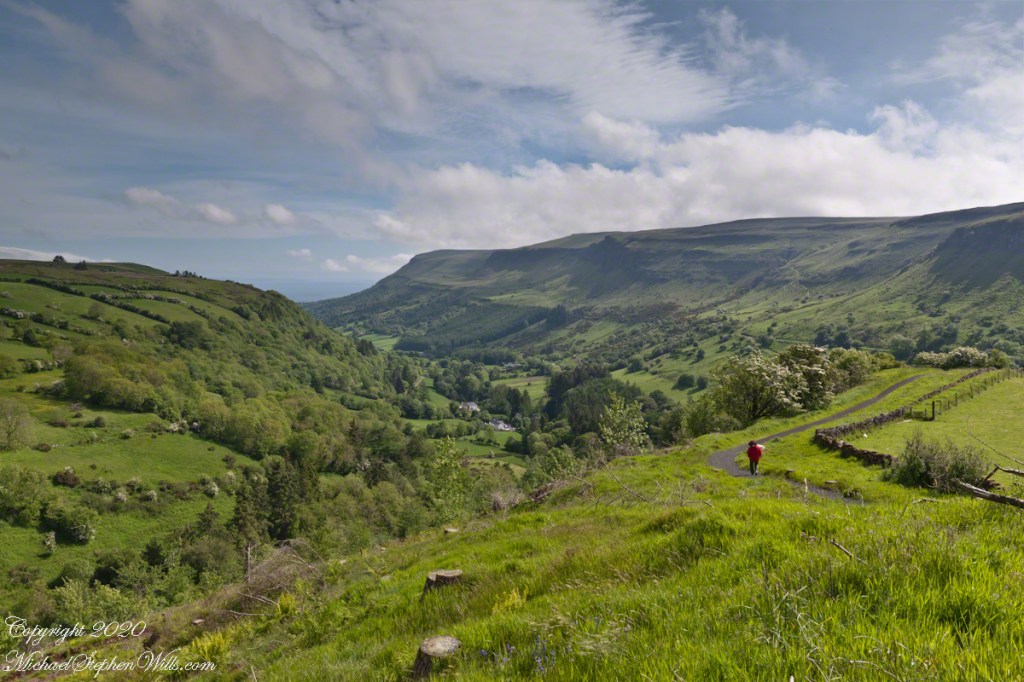
Here is the first stop on our tour of the Antrim Glens and coast, Glenariff Forest Park. These blogs have gone backward from Torr Head towards the started our day with breakfast in Coleraine, proceeding south along the plain to the head of Glenariff. The name, in Irish Gleann Airimh, means “Glen of arable land.” The Glenariff River flows from the height of Tievebulliagh, a 1,300 foot mountain, to form the broad valley of Glenariff. Arable, means tillable, and the land is tillable because the valley is wide.

This is one of my most popular photographs, it is from that day. I set up the tripod on an eminence overlooking the glen and a park path. Pam, in her red raincoat, headed down. The Canon lens EF 24mm f/1.4L II USM was mounted on the Canon EOS-1Ds Mark III camera. The graduated neutral density filter was perfect for the setting.

Click photograph for a larger view. To do this from WordPress Reader, you need to first click the title of this post to open a new page.

Here is a link to this photograph on Getty.

Copyright 2020 All Rights Reserved Michael Stephen Wills