A Ride to Reavis Ranch

Some history and exploration

….continued from the chapter “Desert Luxuries”

After hitching the saddled buckskin, named “Nugget,” and lightly packed pinto to trees beside the trail, The Searcher climbed up to my camp for a visit. I started water for tea and soon we were chatting. Right from the start The Searcher asked for privacy. Devoted to searching the Superstitions for the gold of the “Lost Dutchman Mine,” he organized his expeditions from a staging point near Phoenix and spent nearly sixty days each year in the wilderness. Part of his preparation was a desert survival course provided by the Reavis Mountain School, conducted by Peter Bigfoot.

An Invitation from The Searcher

The Searcher described a place near Pine Creek, he called it “Circlestone,” a large, almost perfect circle of precisely fitted stone walls, on the slopes of Mound Mountain above the headwaters of Pine Creek. My sister, Diane, and I found Circlestone on backpack expeditions March and November 2006. WThe site exceeded our expectations, the walls appeared less built than patiently persuaded from the mountain itself.

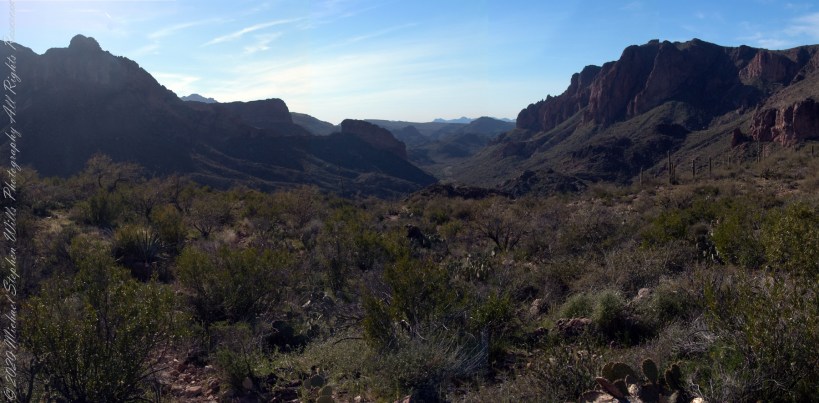
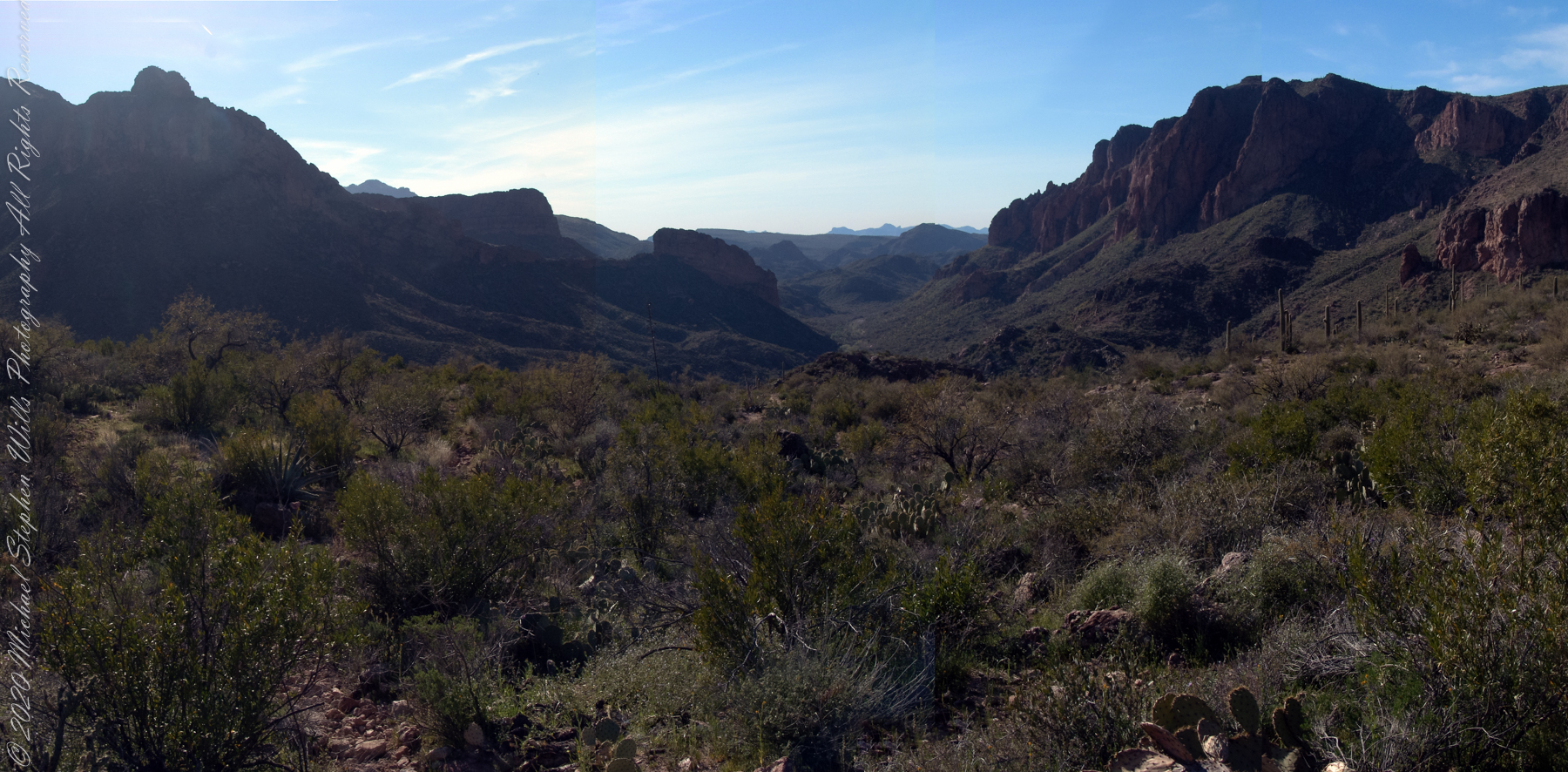
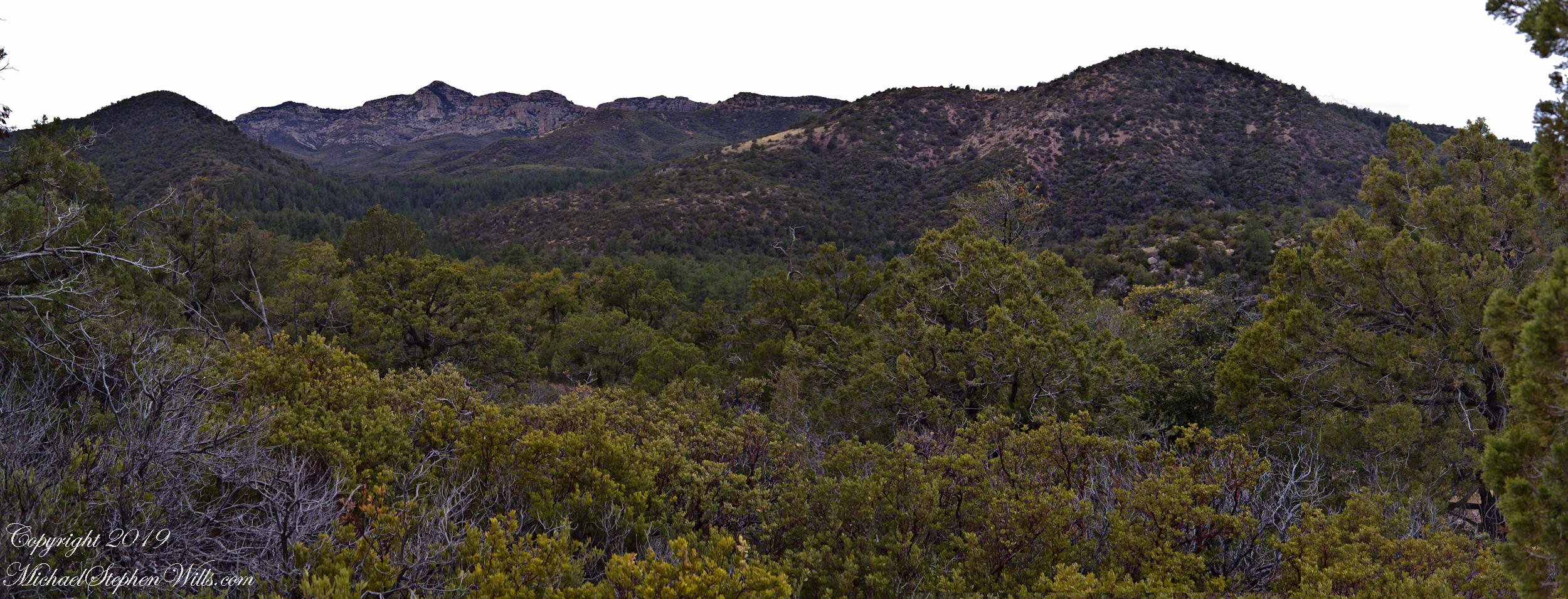
Here is a panorama from March 2006, southwest from the forests of juniper and pinion on the slopes of Mound Mountain.. The southern tip of Reavis Valley is to the right, from there Arizona Trail lead to White Mountain in the distance. It was taken on a later trip, in November of 2006 when my sister, Diane, and I visited Circlestone.

Click any photograph for a larger image.
The Searcher also told of Elisha Marcus Reavis, who settled the Valley west of Pine Creek in 1874. At one point, a band of Apaches planned to kill Reavis, but were respectful of his reputation as a rifle shot. They were waiting him out across from the his dugout, when Reavis stripped naked and, with wild hair and a flaming red beard, charged their camp, knives in both hands. The Apaches rode off, wary of his insane behavior, and never bothered him again.

We talked about my prospects and plans when The Searcher offered to take me to the Reavis Valley the next day, on horseback. There is a large apple orchard there and, this being April, we’d be treated to masses of apple blossoms. The day after Reavis Ranch, I could pack out with him down the Arizona Trail, past the Reavis Mountain School, over Campaign Creek and drive back to the Lost Dutchman Park. I readily agreed.

To Reavis Ranch on Horseback

The following morning rose slowly from colorless darkness, accompanied by thin birdsong and the whitening glow of high clouds. When the Searcher arrived around 8 am he was leading the pinto, introduced as Colorado, equipped with a western saddle instead of a pack. As an absolute novice trail rider, I rode while The Searcher held Colorado’s lead rope. The reins were wrapped around the saddle horn, leaving me to hang on and enjoy the view and the swishing tail of Nugget, the buckskin.
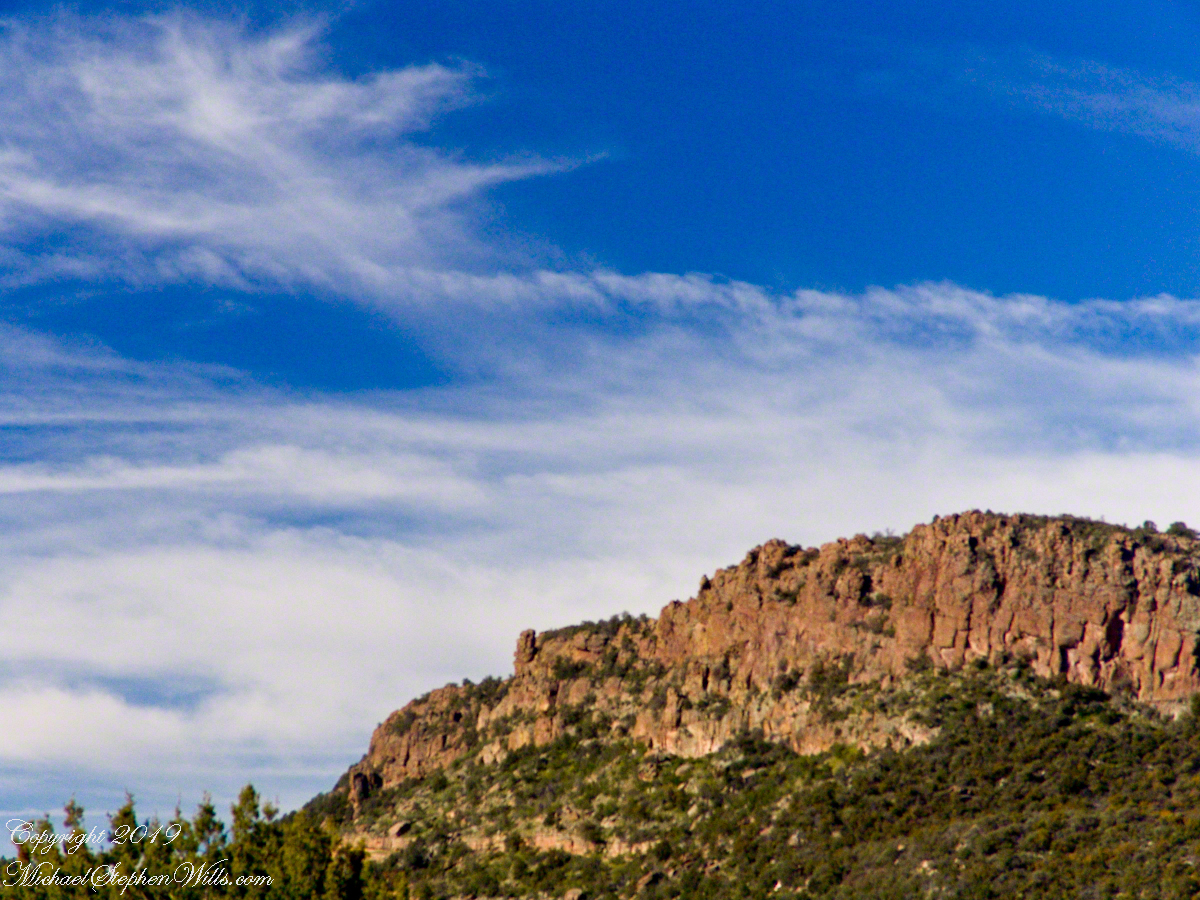
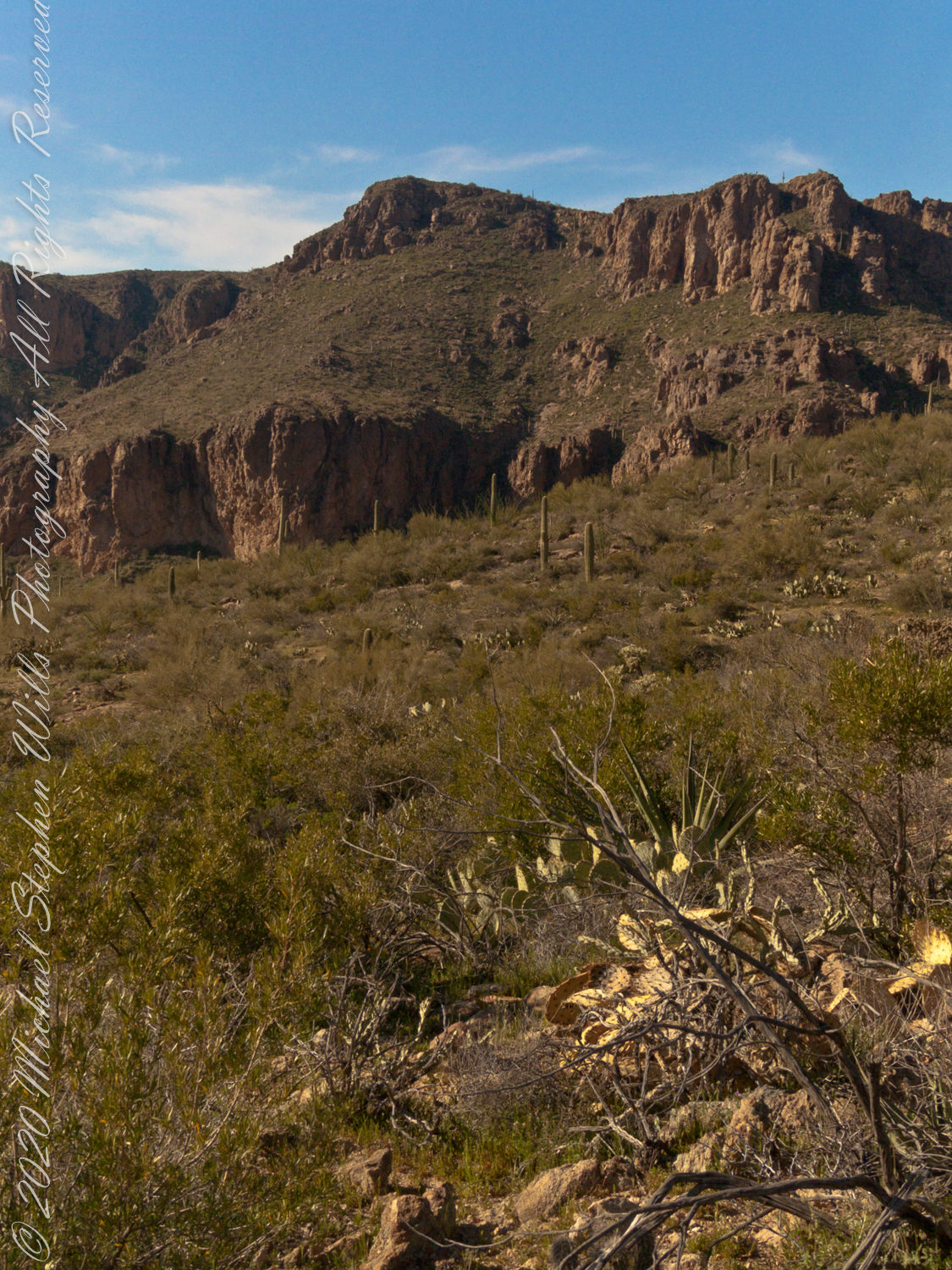
The 2.5 mile trail to Reavis from Pine Creek is typical of the eastern Superstitions, minimally improved, dramatically uneven, littered with boulders polished smooth by decades of hooves, floodwater, and erosion. From Pine Creek there’s a climb of a 631 feet to a 5,278 foot elevation, where the trail meanders beneath a dramatic red cliff with a view of the pinyon/juniper forests on the slopes of Mound Mountain. As he picked our way, The Searcher pointed out the sights. “Circlestone is somewhere over there, a ring of stones overgrown with Alligator Juniper.” I could do little more than observe; photography was entirely out of the question. The trail twisted around the mountain like a dry stream remembering water.

A cliff along the trail to Reavis Ranch offered the ledges and shadowed cover preferred by cougars. In daylight it posed little danger to mounted riders, and attacks against horses were rare. In all our years in Arizona, neither of us had seen more than the tip of a tail slipping behind brush.

This had been a lush April after a wet winter, and small game was plentiful. Only a sick cat would have been desperate enough to stalk horses. The darker possibility—a cougar infected with rabies after encountering a diseased animal at a water source—was a thought neither of us lingered on for long.

Eventually, the path descended steeply to Reavis Creek, the valley floor and intersected with the Reavis Ranch trail. Heading south the Reavis Ranch trail passes the site of a long abandoned ranch. What remained of the adobe and stone ranch house stood on a level bench overlooking what had once been the corral and a broad open meadow.
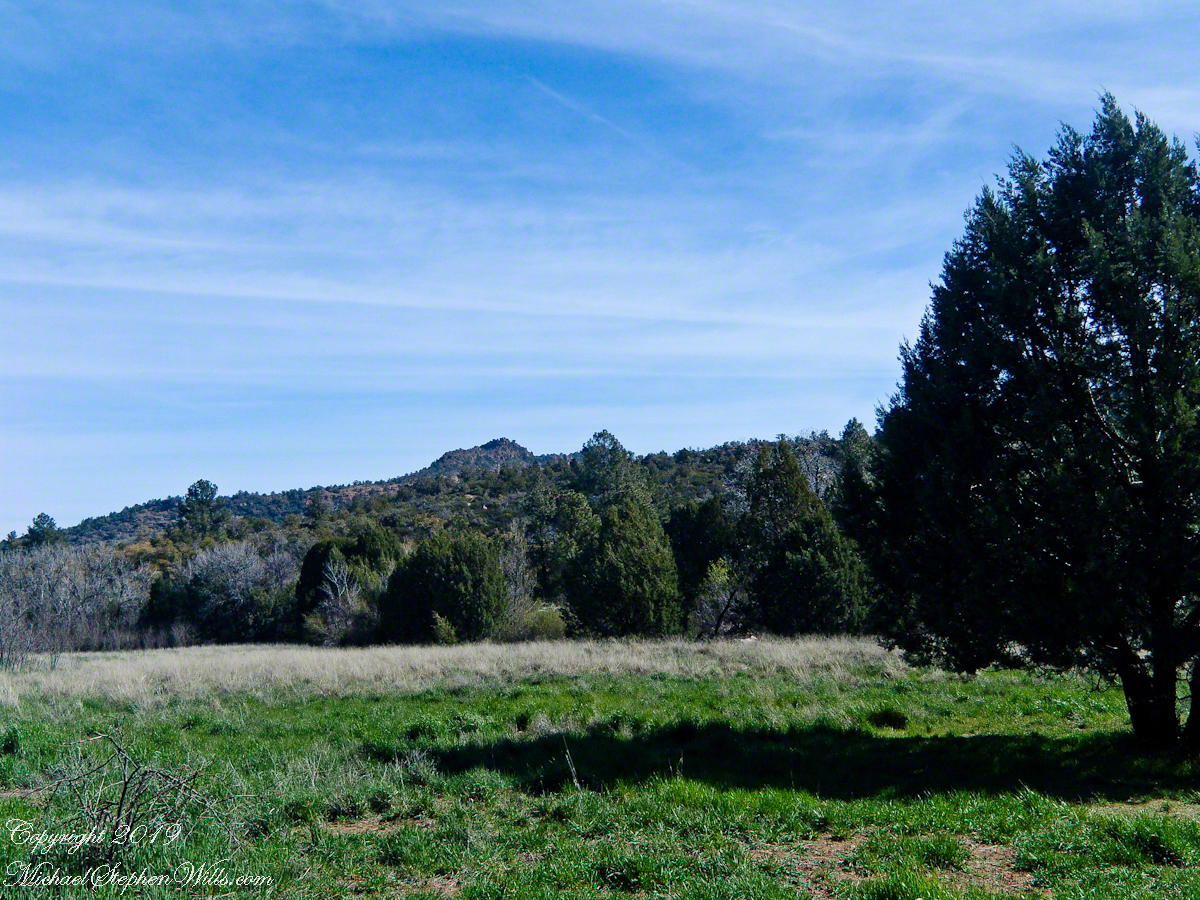
Open field at near the juncture of the trail from Pine Creek with the Reavis Ranch trail.

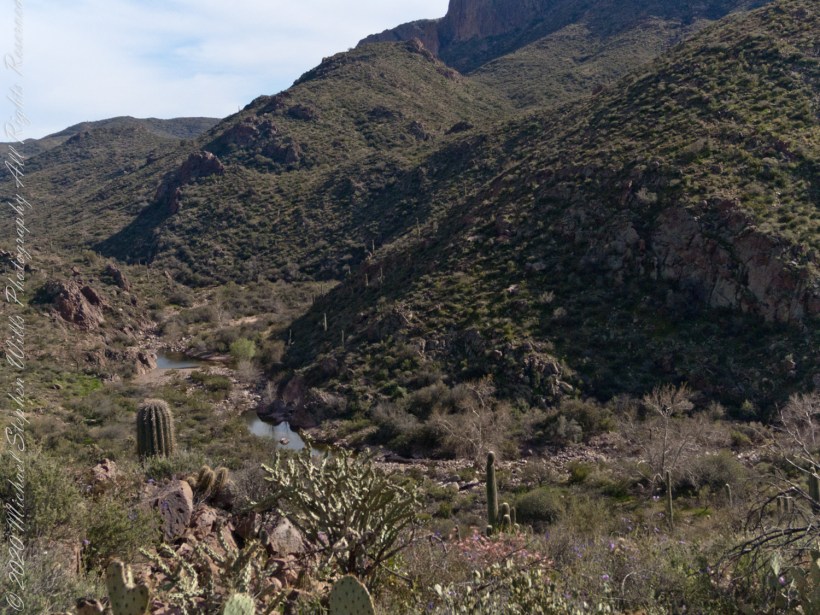
Apple trees in bloom sween from the former site of the ranch house. There used to be a pond near this spot. With a little imagination, the trail from Pine Creek can be seen on the far ridge.

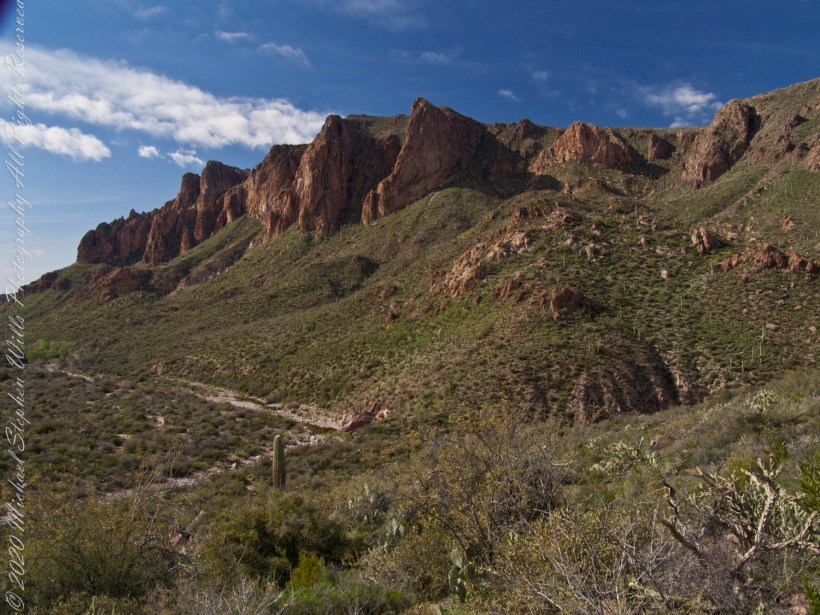
Reavis Ranch Trail, foreground, traverses the valley length north to south. The Arizona Trail from Pine Creek following below the red rock cliffs in the distance.

The US Forest Service razed the building after it “burned to the ground” Thanksgiving 1991. I would not call what is left “a foundation,” it is a platform where the house stood. In the photograph, the surviving tiles still suggest the modest warmth of a lived-in home. I’ve seen old photographs of the structure with a large pond to the left of this view, a door and simple porch face east and the pond used to hold irrigation water. The leveled ruin possessed the melancholy geometry of abandoned human hope.
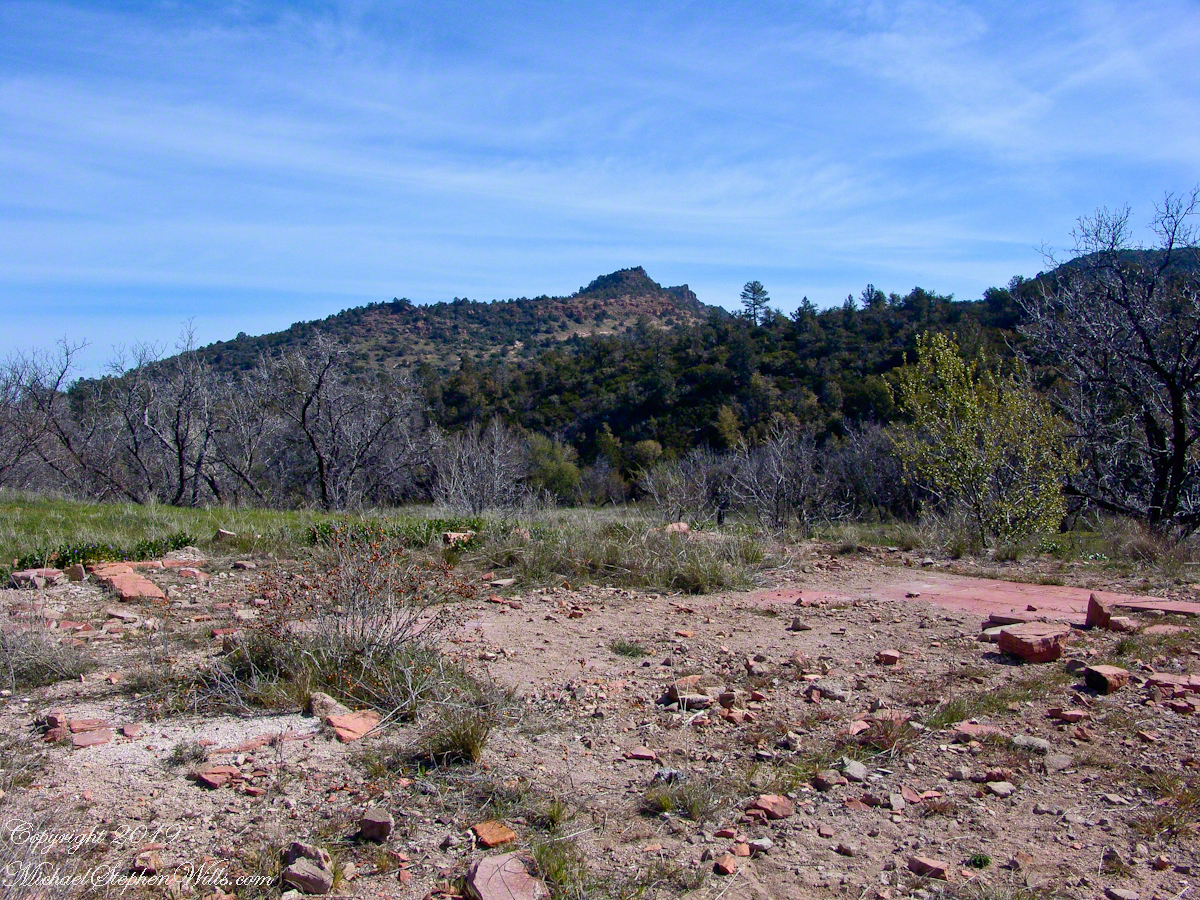
Turning from the ruin, another structure came into view. Built into the western slope above the valley floor was a hexagonal adobe foundation overlooking the remains of the ranch house across the trail.

My interpretation rests partly on the surrounding terrain. South of the structure runs the shallow trace of an excavated canal, suggesting that water from upper Reavis Creek—or one of its tributaries—was diverted into a catchment basin before being stored or directed toward irrigation.

Whatever its exact purpose, the site commands sweeping views of the central valley and is a beautiful place to watch evening settle over the orchard.
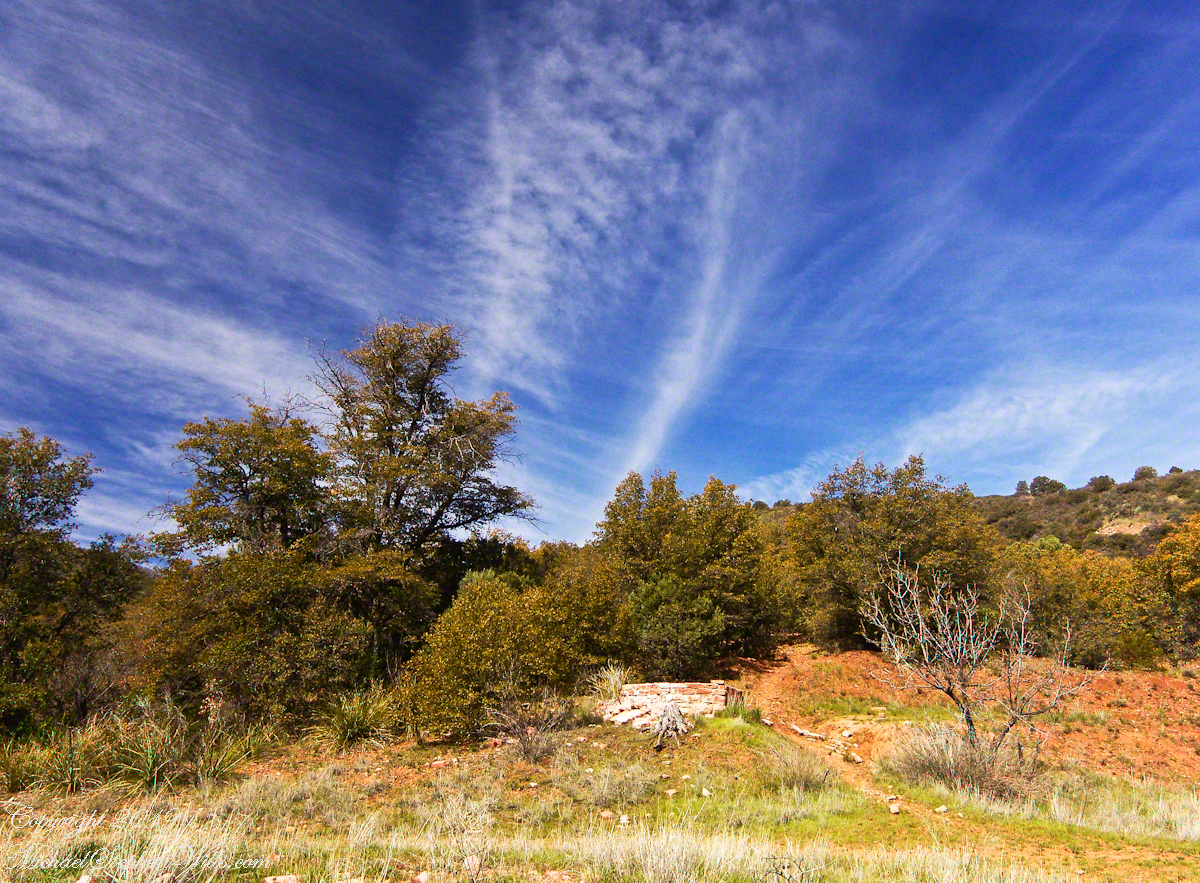
Turning from the ruin, another structure came into view. Built into the western slope above the valley floor was a hexagonal adobe foundation overlooking the remains of the ranch house across the trail.

The Searcher led me to a place a few hundred yards south, in a narrowing of the valley, where he let Colorado and Nugget roam free. The horses appreciated the level, open spaces and I enjoyed the Ponderosa pines on the west valley slope. We sat on the smooth trunks of fallen trees, 4 feet in diameter, near Reavis Creek.

Colorado took this opportunity to bolt, headed south. We took off after him into and through a thicket of locust trees where The Searcher cornered Colorado to regain control. “He was abused by a previous owner and can be difficult at times” was how The Searcher put it.

We were close to the end of Reavis Valley where Reavis Creek originates from the drainage of White Mountain, to the west.
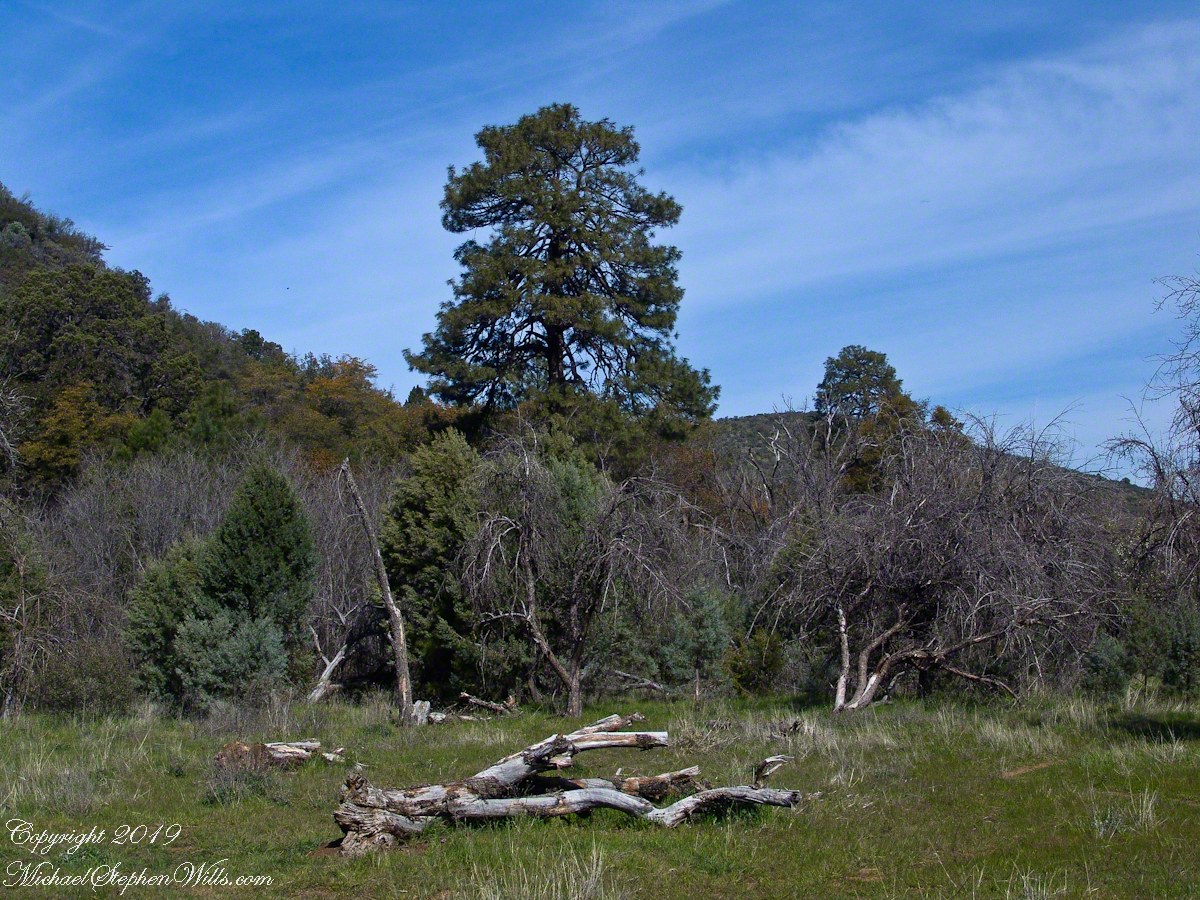
We headed north here, back to the ranch house site, to the lush new grass of the apple orchard.
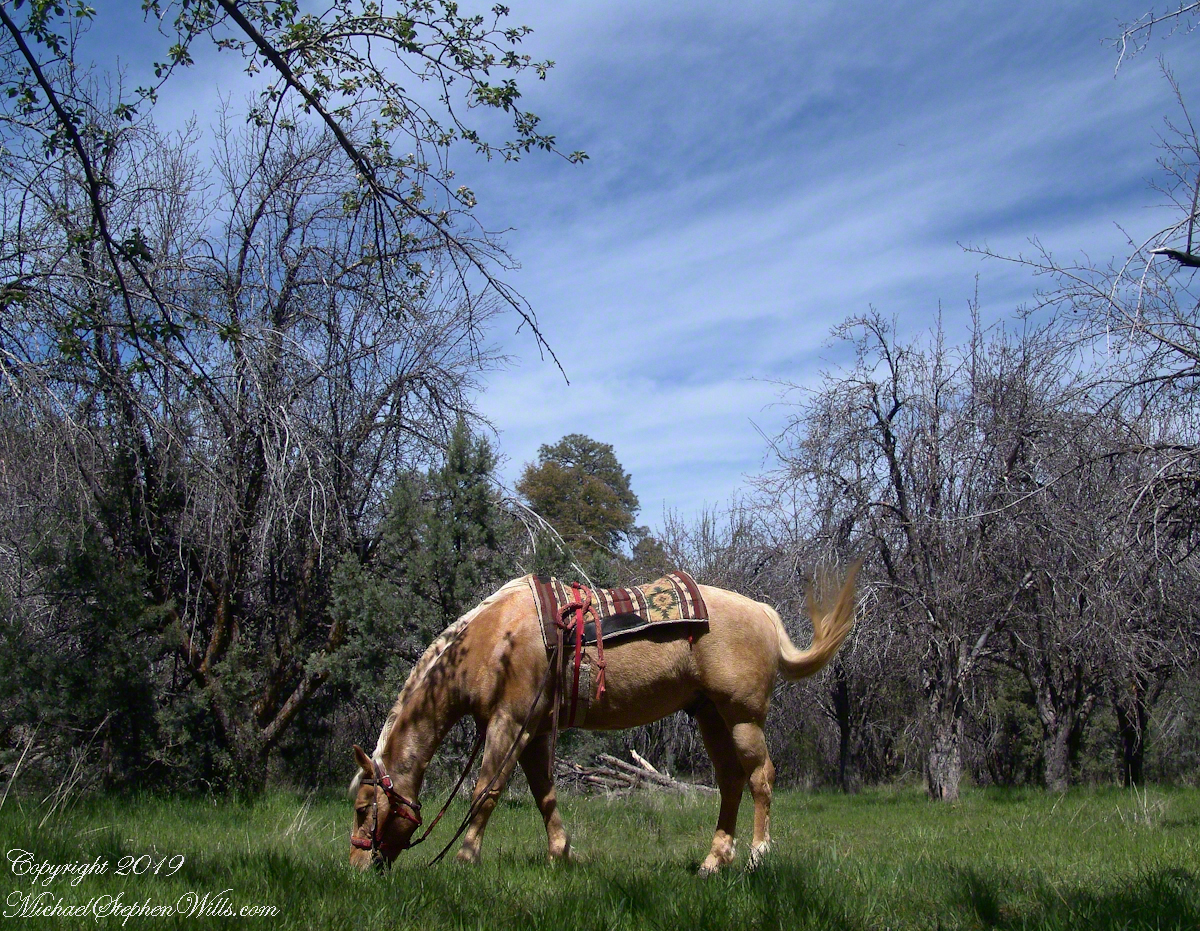
Nugget in Horse Heaven

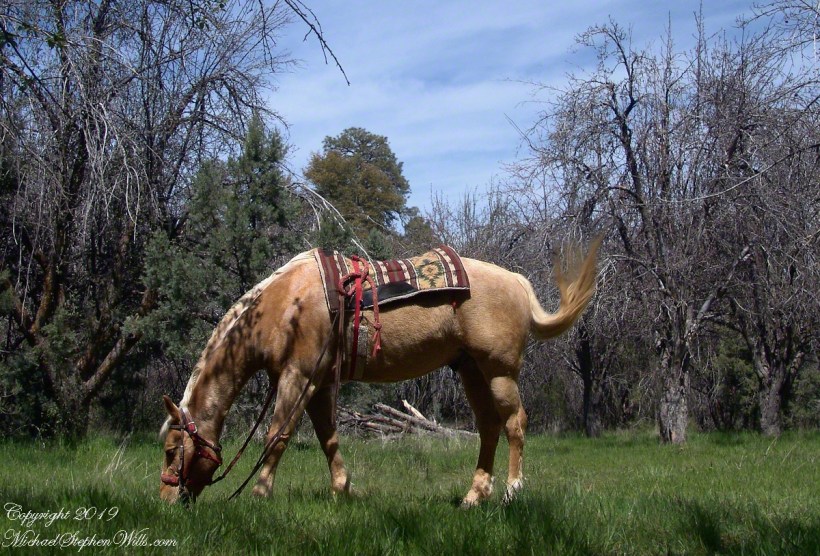
Nugget grazed, tethered with plenty of slack, with the calm assurance of an animal that knew it had arrived in horse heaven. This photograph of the pair shows their personalities, Colorado edgy, Nugget content to feast while the grass is available. The orchard grass rolled in waves around their legs like green water beneath anchored boats.
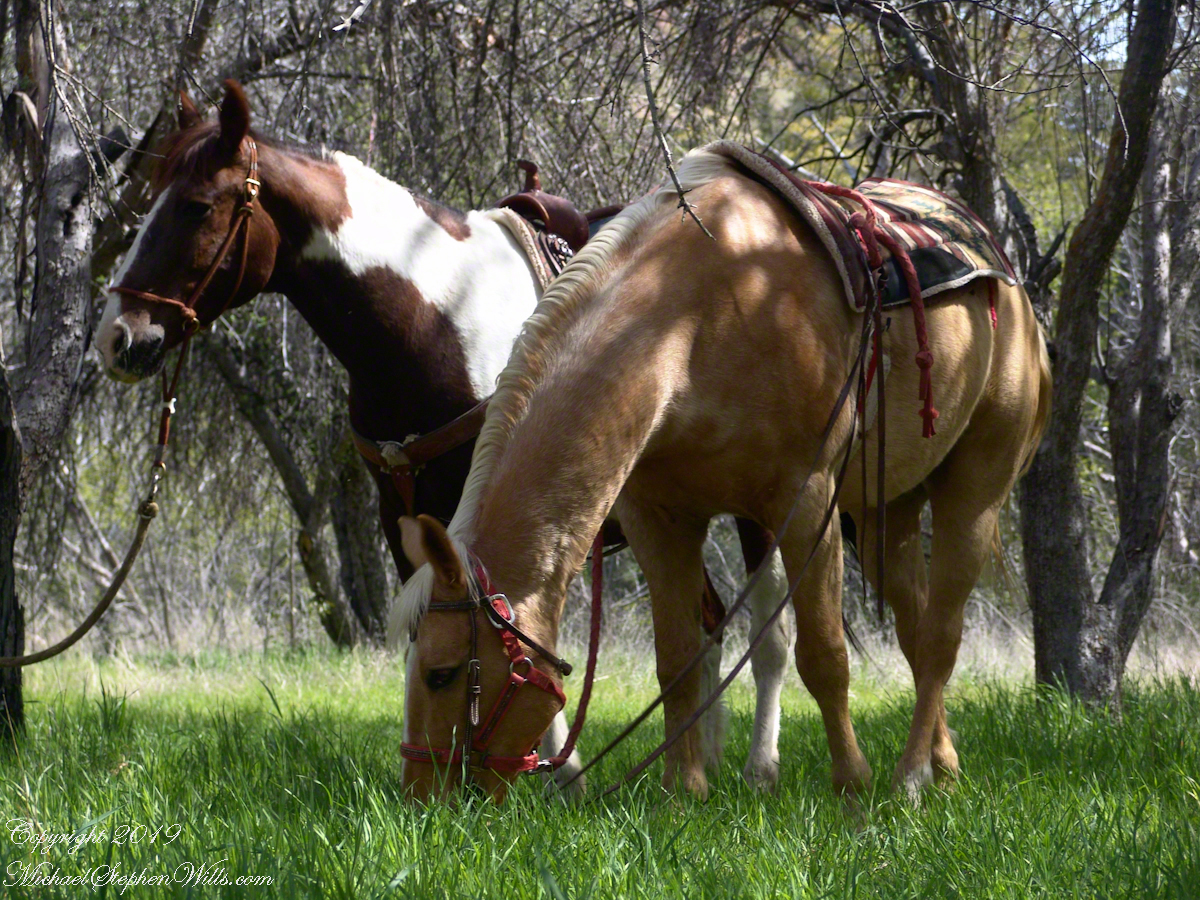
Colorado on the alert while Nugget grazes, typical of their personalities.

Click me for the next post for photographs and more history of this Apple Orchard in the Superstition Wilderness.

Click me to visit Michael Stephen Wills Online Arizona Gallery.

Copyright 2026 All Rights Reserved Michael Stephen Wills

World at our Feet

On Peter’s Mesa

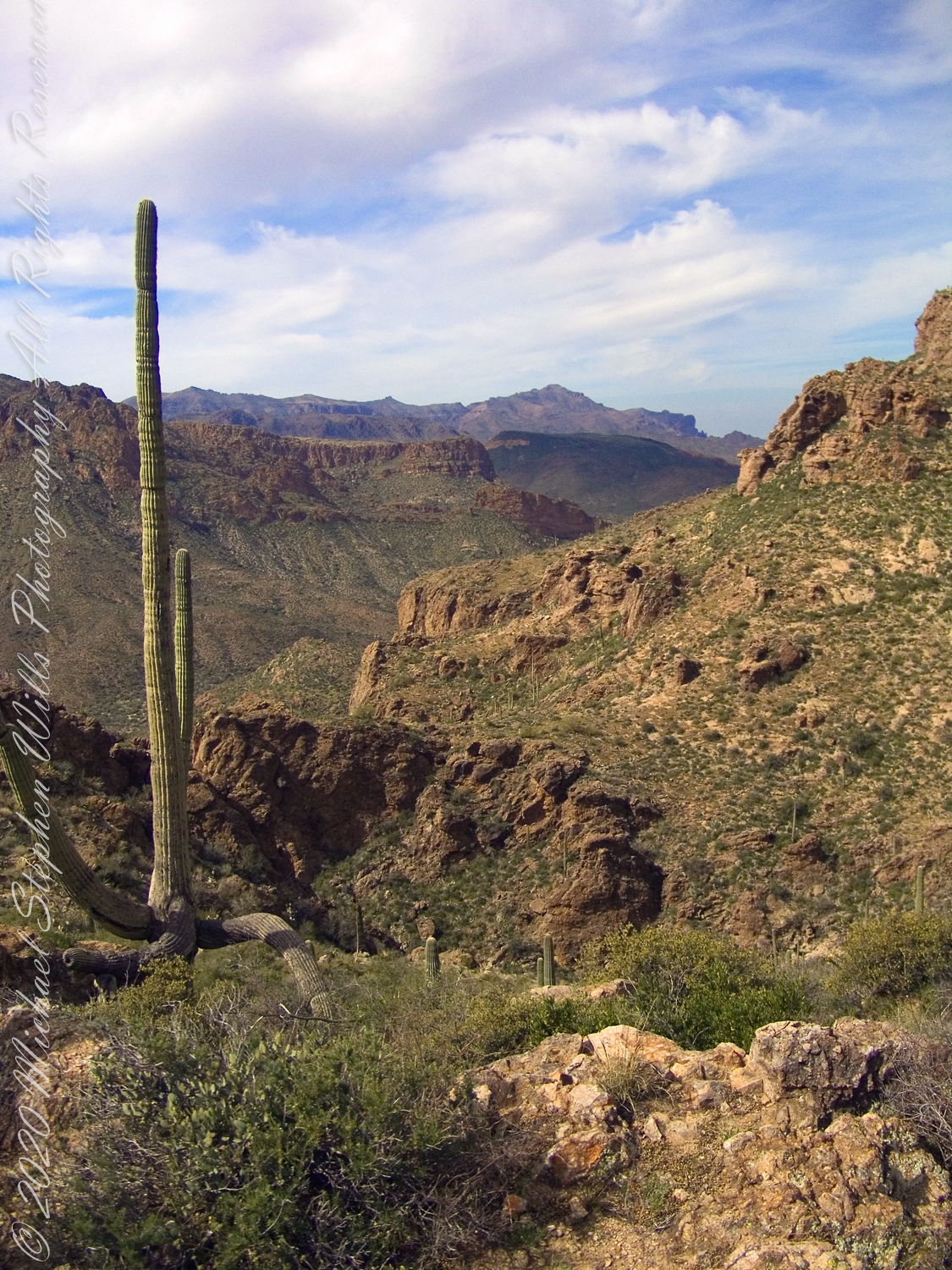
View North / Northwest from Peter’s Mesa. At our feet is a mature Saguaro Cactus towering over Charlebois Canyon, to the right Black Mountain. Bluff Spring Mountain, middle distance, then Black Top Mesa. Flatiron Peak, of the famed Superstition Mountain, is in distance. Photographed from Peter’s Trail on a March afternoon 2008. Superstition Wilderness, Tonto National Forest, Arizona

Bluff Spring Mountain, middle distance, then Black Top Mesa. Flatiron Peak, of the famed Superstition Mountain, is in distance. Photographed from Peter’s Trail on a March afternoon 2008. Superstition Wilderness, Tonto National Forest, Arizona

Click Me for the first post of this series, “Bluff Spring Mountain.

Copyright 2022 Michael Stephen Wills All Rights Reserved

Morning / Evening

Can you see the Needle’s Eye?

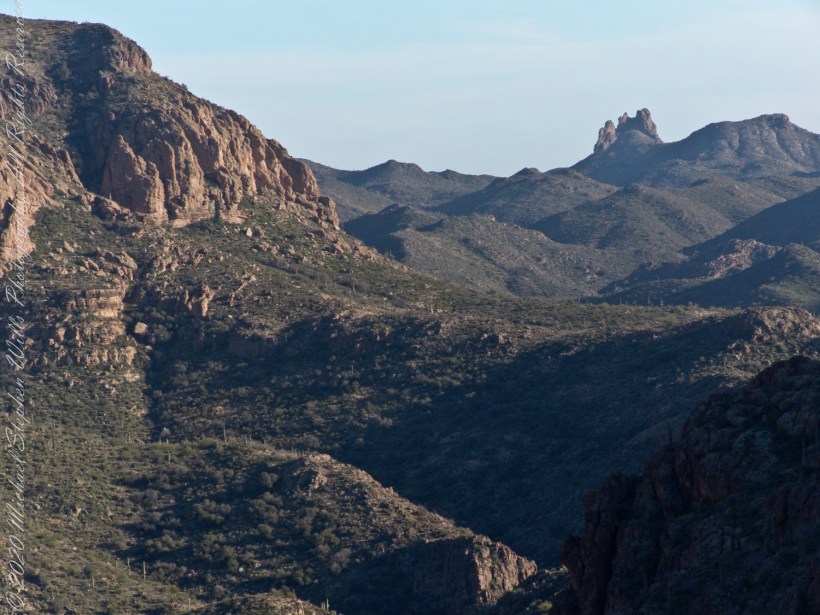
The eye of Miner’s Needle is clear in both these South / Southeast views from Peter’s Mesa looking across the Music Canyon.

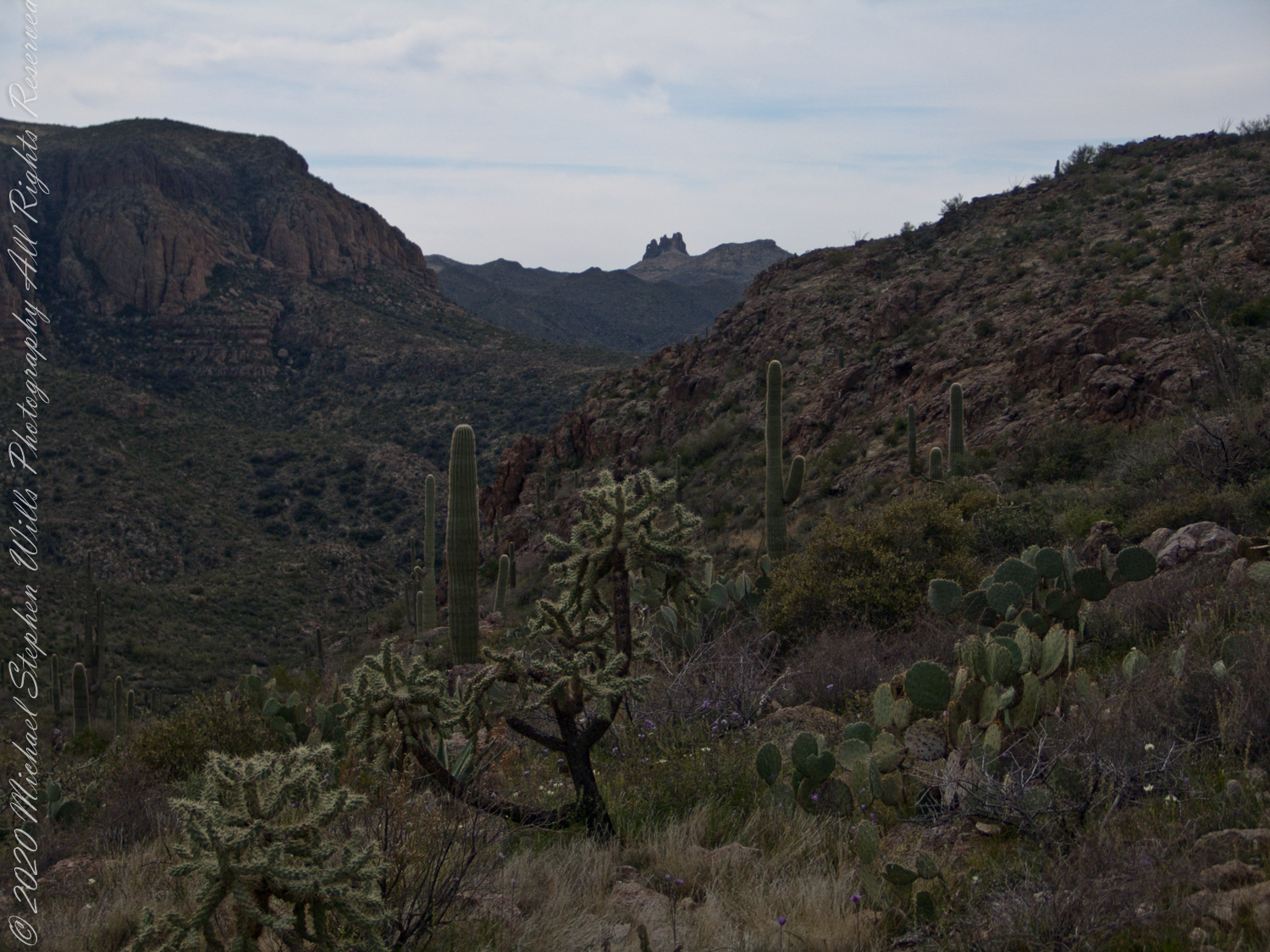
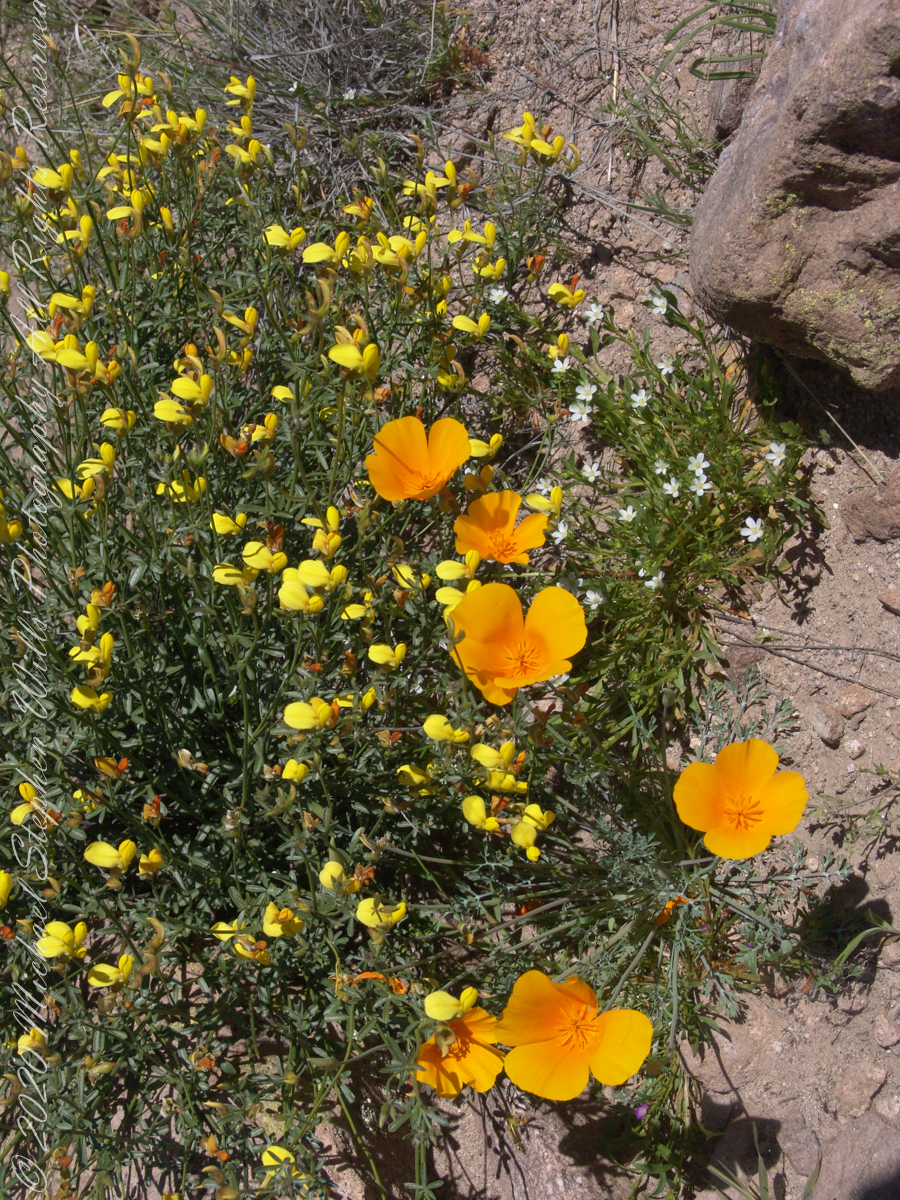
Many wildflowers, sprinkled like stars through the foreground of the morning photograph with Prickly Pear, Cholla and Saguaro cactus. Beware of “Jumping Cholla”, named for its seeming ability to attack passers-by. Another name, “Hanging Chain Cholla”, is more appropriate. Each chain with many hooked barbs is lightly attached to the branch, ready to snag a ride from unwary hikers.

Light rakes across the landscape in the evening photograph, taken from another vantage point on Peter’s Mesa. Miner’s Needle is four (4) miles away “as the crow flies,” i.e., line of sight distance.

Click Me for the first post of this series, “Black Mountain.

Copyright 2022 Michael Stephen Wills All Rights Reserved

Panoramic

Superstition Glory

View North / Northwest from Peter’s Trail looking back the way we came. Black Mountain on right, Bluff Spring Mountain left with LaBarge Canyon running to the Red Hills center. On a March afternoon 2008.

Click Me for the first post of this series, “Black Mountain.

Copyright 2022 Michael Stephen Wills All Rights Reserved

Hear the Music

Roasted Yucca

Here we are climbing Peters Trail to the eponymous mesa and facing East to Music Mountain. Scattered in the brush are desiccated and live Prickly Pear cactus. Poles of young saguaro cactus like randomly placed telephone poles poke up around the lower slopes.

The first published record of Music Mountain is by Ray C. Howland of Mesa Arizona who sent a letter to “Everybody’s Magazine” that appeared in a feature called “Everybody’s Meeting Place: Where writers, readers and the editor gather for informal discussion,” May 1928, Volume 58, Issue 5, page 173. I reproduce Howland’s letter here with minor editing:

“I am in the deserts and mountains of Arizona most of the time. I go into town once each month for mail and provisions. I meet many things as I ramble around, many strange things, things that are beyond my ability to comprehend. One particular was in my mind as I read your printed thought in the back of Everybody’s. Far in the Superstition Mountains of Arizona, in the deepest, most rugged canyon, there are three caves halfway up a great yellow bluff. In these caves are mud dwellings. There are not the cliff-dwelling as found in other parts of Arizona.

The mud walls of these dwellings were made by people with very small hands. The handprints of these ancient masons remain as though they were made yesterday. Just below these caves a beautiful pool of crystal-clear water lies between grassy banks. Tall ghostlike sycamores grow there in great numbers.
I have camped many times beneath those sycamores. It is a beautiful spot. Such a difference between there and the hot desert that lies fifteen miles to the south.! As one lies there, just at twilight, begins the most wonderful music one could imagine. I have never heard music that could compare to it, vague, elusive at times, then again of greater volume. It is my opinion that no living being could record it.

The music is, I believe, beyond description. It seems to take you out of your moral self and transport you back ages and ages, almost to the beginning of things. For the time being one feels as though he were in another world.
I have often tried to solve this little private mystery. I can’t explain it. I can’t even describe it intelligently.

You will probably say as you read this that is is the wind among the pinnacles, caves, trees, etc. that make this wonder phenomenon. It cannot be, for usually there is no breeze in the mountains at twilight. It is still as a tomb except for that music. Besides when the breeze is blowing at any other hours of the day there is no sound.”

Here is a copy of that issue for you to see for yourselves.

In my photographs the bluffs described by Howland are seen clearly in the distance. During our expedition we were never able to visit the caves, though Dave described the location, caves, and dwellings. On Peter’s Mesa are remains of pits where Apaches and Yavapais gathered hearts of agave to roast. We visited a small cave in the side of Peter’s Mesa showing signs of high heat and possibly used for roasting agave.

Click Me for the first post of this series, “Black Mountain.

Copyright 2022 Michael Stephen Wills All Rights Reserved

From Music Canyon

Down South

Dutchman Trail follows the outflow of two springs along the canyon floor: Music Canyon and LaBarge springs. Here we are climbing Peters Trail to the eponymous mesa and facing south / Southeast, looking down on Dutchman Trail.

This is rough country below Bluff Spring Mountain. Stag Horn Cholla cactus is lower right with Prickly Pear cactus scattered in the brush. Poles of young saguaro cactus are scattered around the lower slopes.

Click Me for the first post of this series, “Bluff Spring Mountain.

Copyright 2022 Michael Stephen Wills All Rights Reserved

Black Mountain

Million Dollar View

After a respite among the cool spring waters, we headed up Peters Trail for the top of Peter’s mesa where, for all we knew, there was no water.

In this photograph I face northwest, looking down on Dutchman Trail. The peak, upper center left, is Black Mountain. The cleft of Charlebois Canyon is lower middle right. Stag Horn Cholla cactus is lower right with Prickly Pear cactus scattered in the brush. Poles of young saguaro cactus are scattered around the lower slopes. Look carefully and you can make out the pooled water of our rest stop.

Copyright 2022 Michael Stephen Wills All Rights Reserved

Around the Mountain

The beetling cliffs of Bluff Spring Mountain

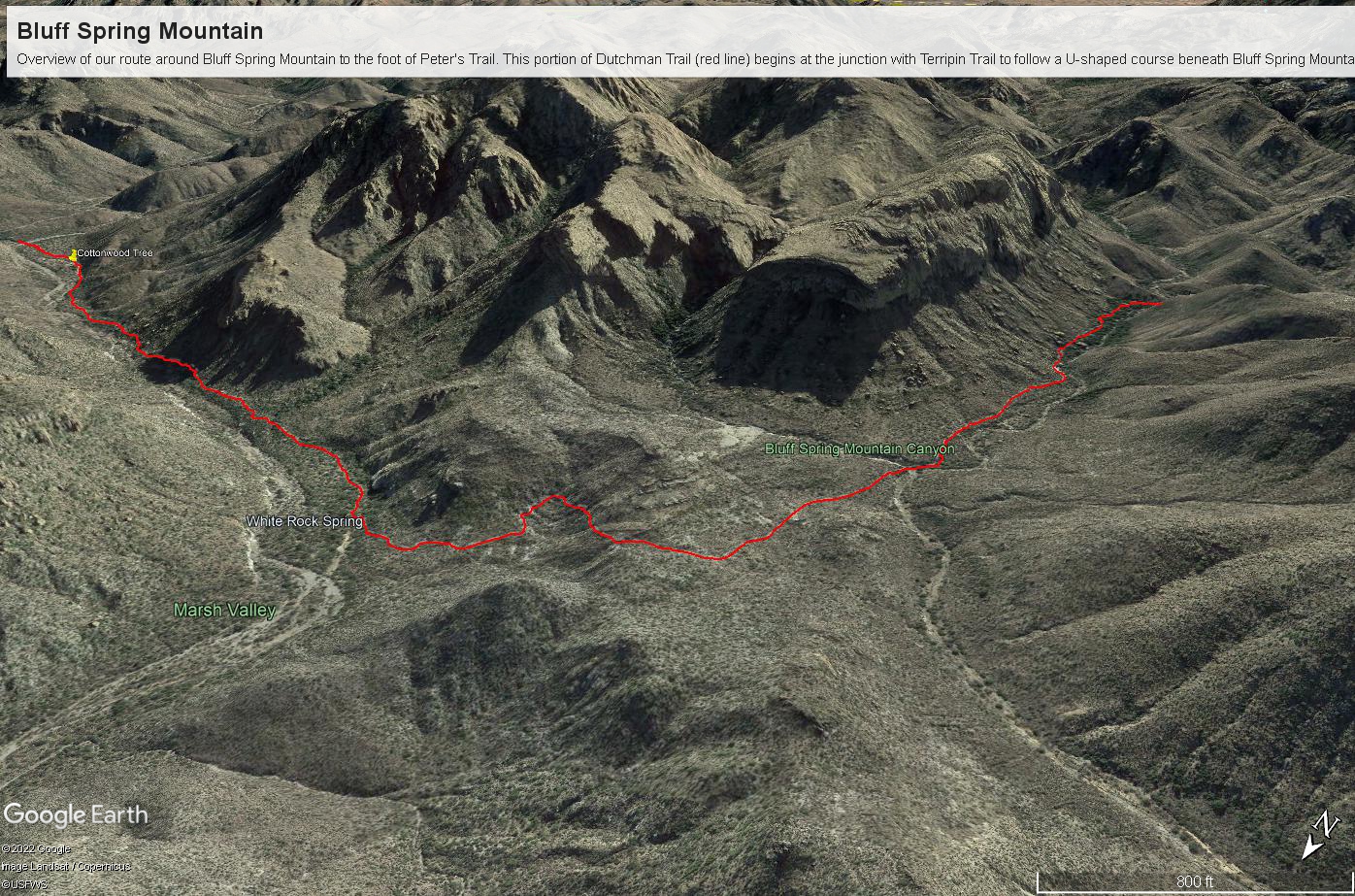
Here is a recap of the last few Superstition Wilderness posts. The expedition route, in red, starts on the right where Dutchman and Terrapin trails meet. The total distance is 2.6 miles. Photograph timestamps tell me about 2 hours passed — 1.3 miles per hour in this rough country.

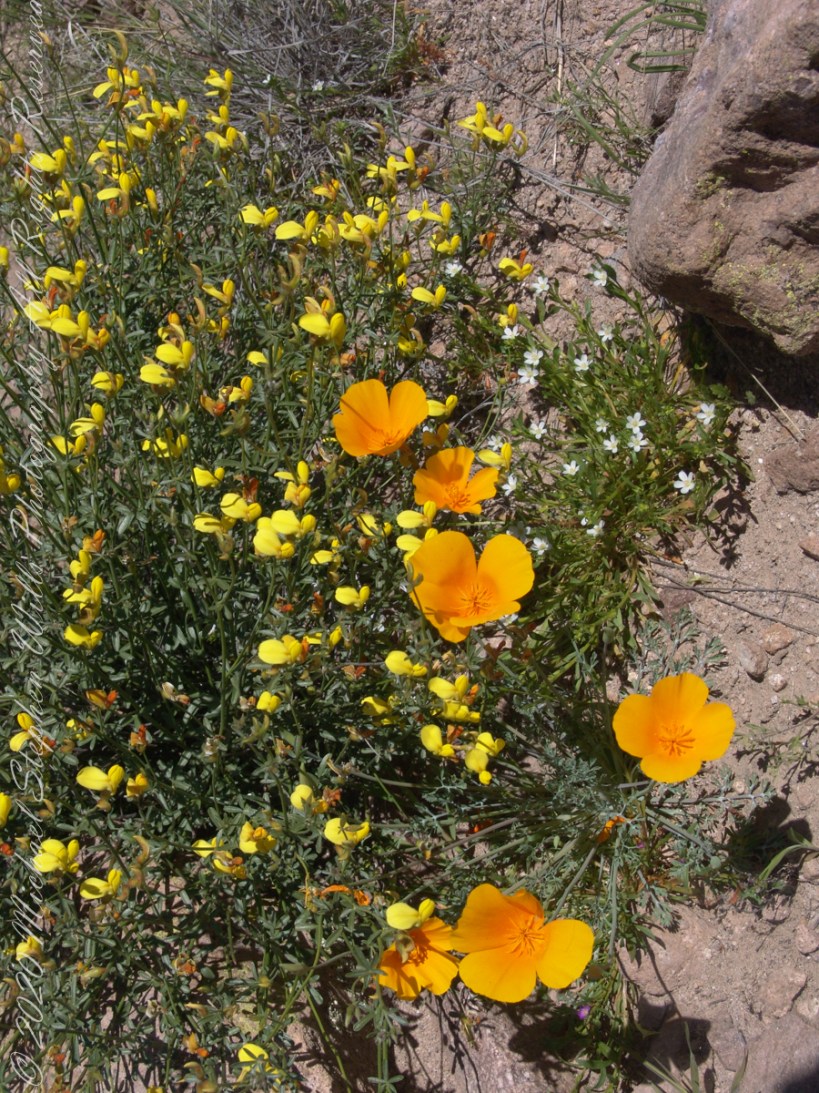
I came upon the wildflowers of “Desert Color” a few minutes after starting.

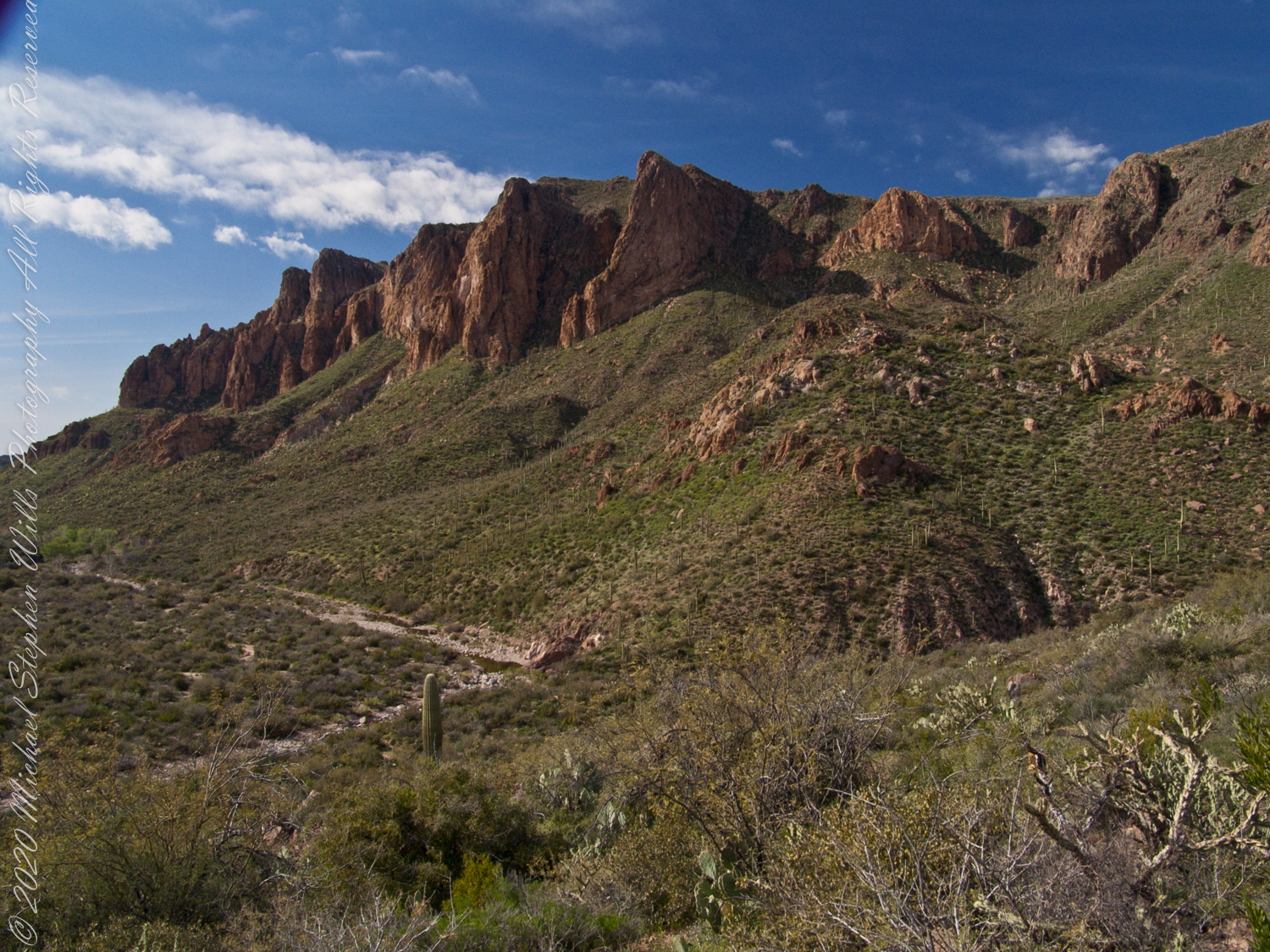
“Ominous Splendor” photograph was taken just before Bluff Spring Mountain Canyon (green text).

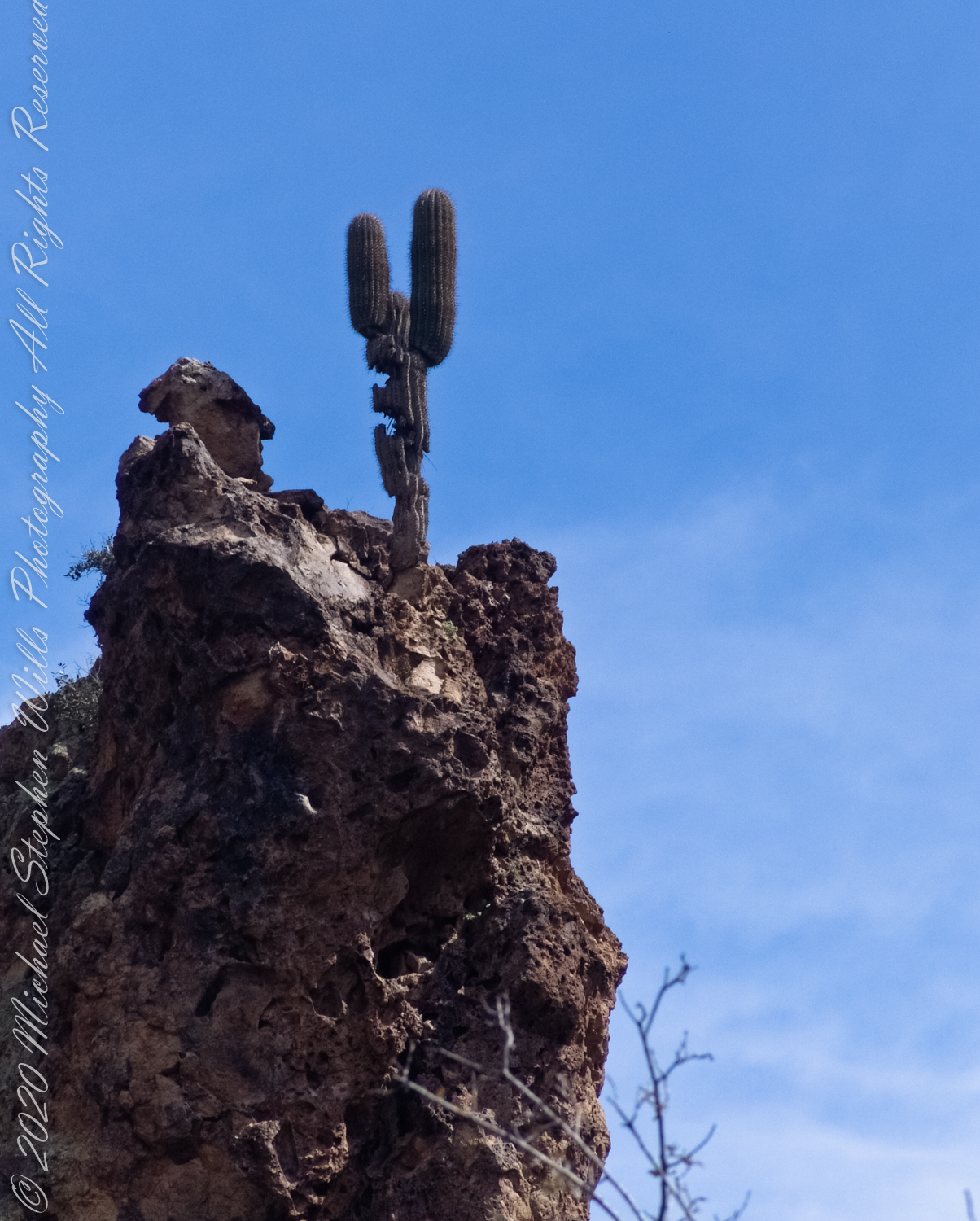
“Marked Saguaro” was encountered a few minutes before the Cottonwood tree of “Riparian,” marked with a pushpin.

“Spring Flow” is the endpoint on left.

Here is a gallery of photographs from this portion of our expedition.

Copyright 2022 Michael Stephen Wills All Rights Reserved

Spring Flow

Rest Before A Climb

The expedition party rested where Dutchman Trail intersected the creek, full of flow from Charlebois Canyon, Music Canyon and LaBarge springs. We filled the water reservoirs in preparation for the climb up to the night’s camping spot on Peter’s Mesa, a 1,300 foot climb over 1.2 miles.

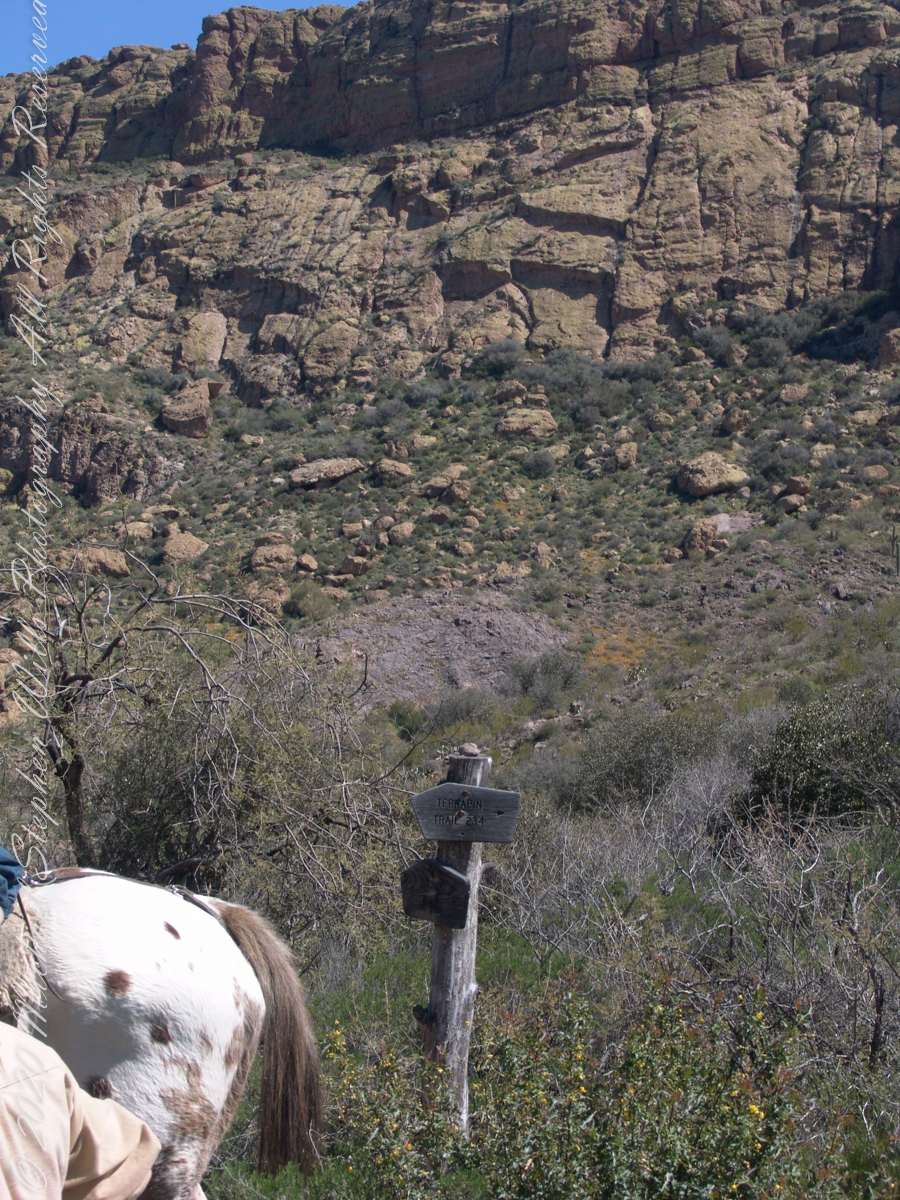
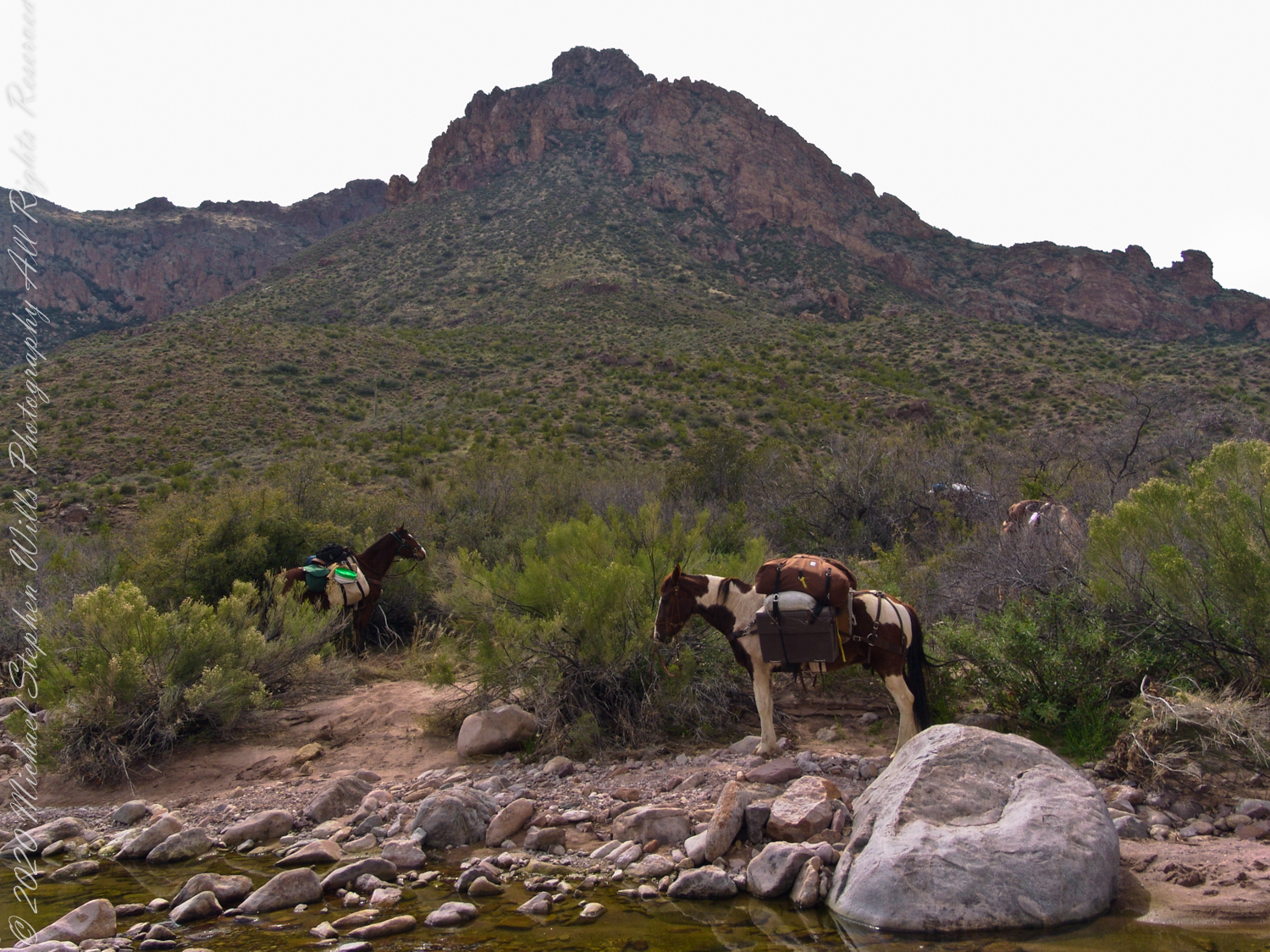
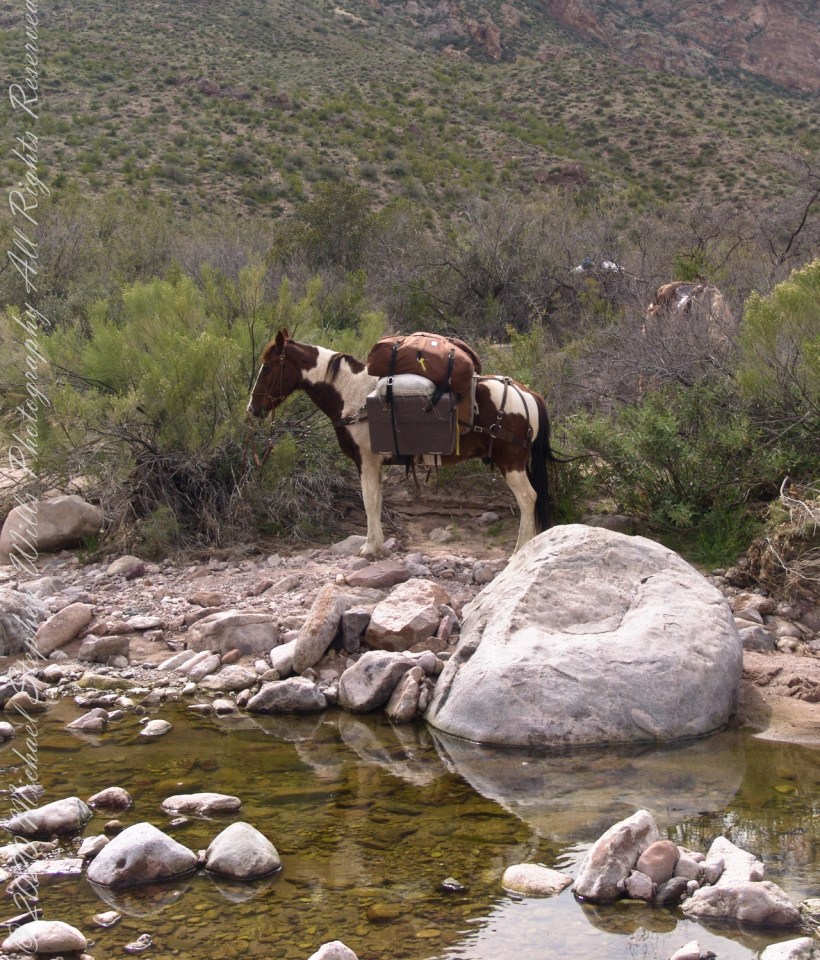
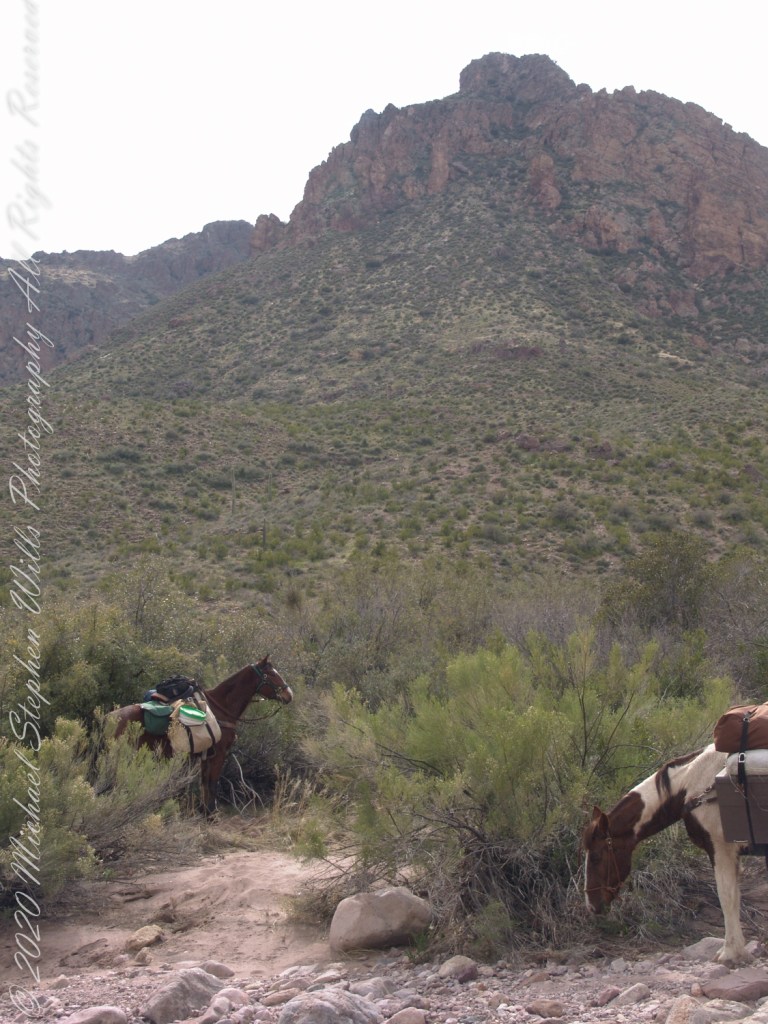
Behind Colorado and “Ed’s Horse” (don’t recall the name) is Bluff Spring Mountain.

Click Me for the first post in this series, “Bluff Spring Mountain.”

Copyright 2022 Michael Stephen Wills All Rights Reserved

Riperian

Blessings of Water

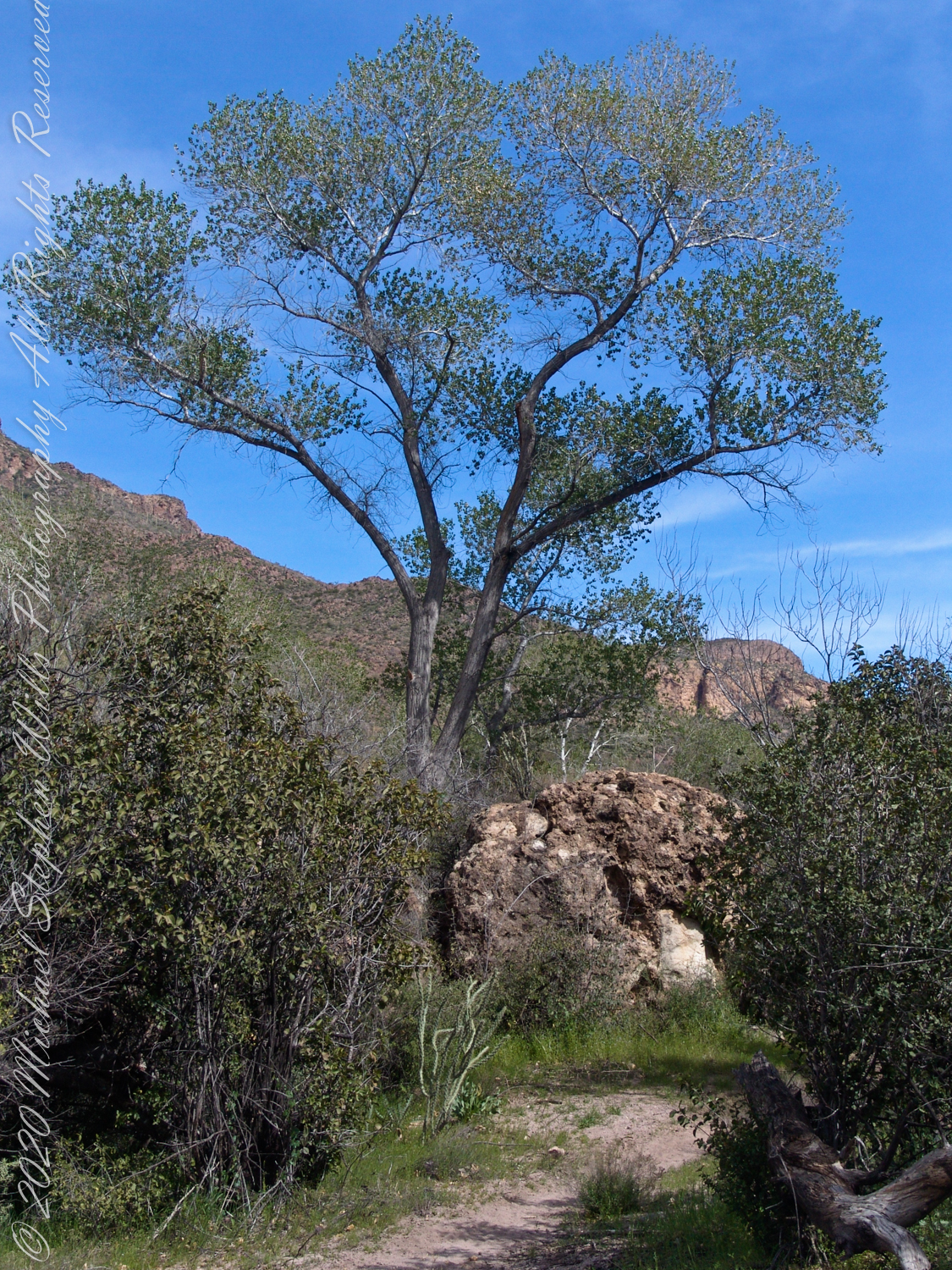
A view to west on Dutchman Trail between Bluff Spring Mountain and Peter’s Mesa. The creek flowing from Charlebois, Music Mountain and LaBarge springs nourishes this Fremont’s Cottonwood (Populus fremontii) and other riparian flora. The tree is flanked by volcanic rock from an ancient eruption.

Click Me for the next Superstition Wilderness post, “Spring Flow.”

Copyright 2022 Michael Stephen Wills All Rights Reserved