Glacial Echoes: Dryden Lake Park’s Mirror-Calm Morning in Upstate New York

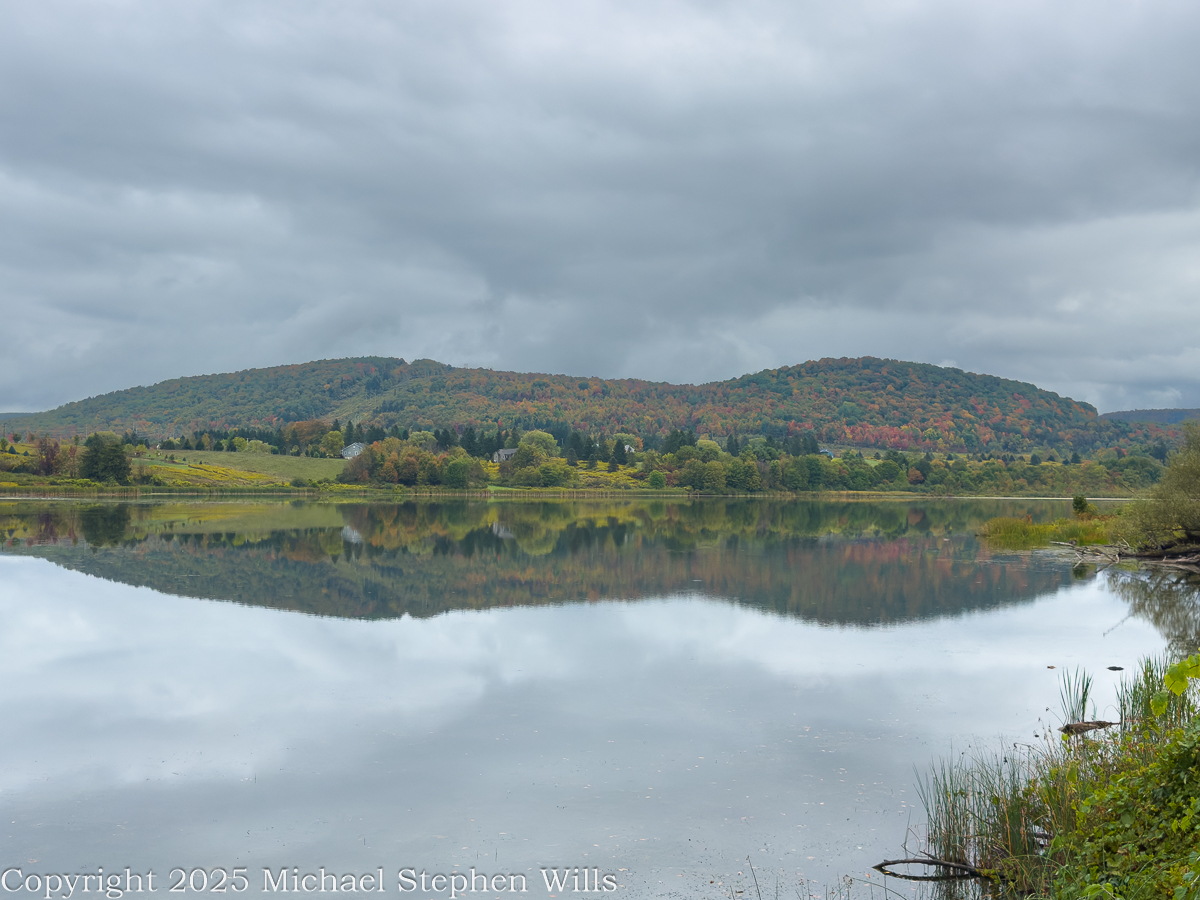
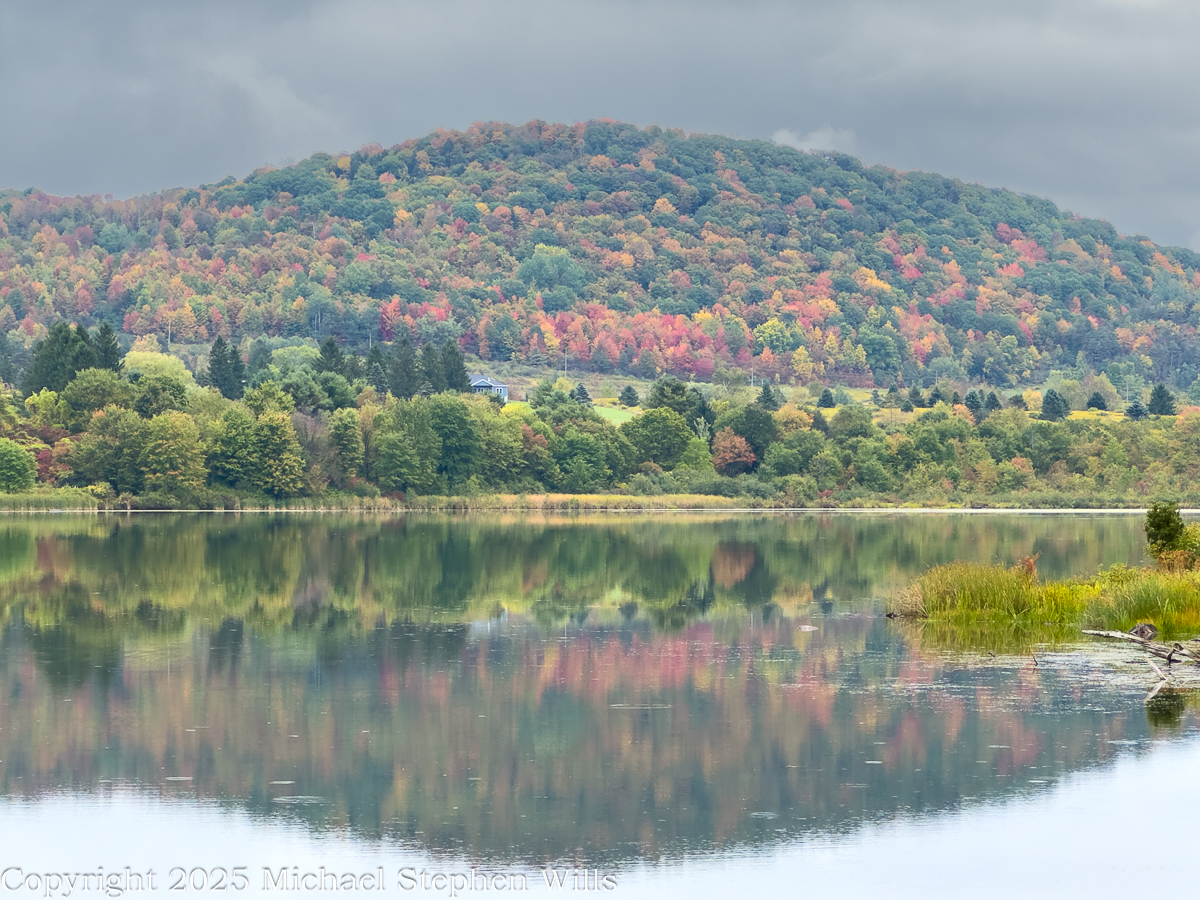
Morning clouds hang over Dryden Lake as hills kindle first color; reflections hold breath while a lone walker reads the valley’s glacial and human-written past.

He came to the water before the people woke, the road a still ribbon of cold tar snaking beneath the low hills. Mattocks of cloud hung over the valley and the lake took in the sky like a mirror dropped yet not broken. The trees were beginning to color. A patient fire working from within the leaves. He parked where the grass ran down to the shore and stood a long while without moving. Birds made small sounds in the reeds. Somewhere a single truck labored up the grade and was gone. The surface held the hills with a steadiness the hills themselves could not keep. He thought how the quiet of a place can be the loudest thing it owns.

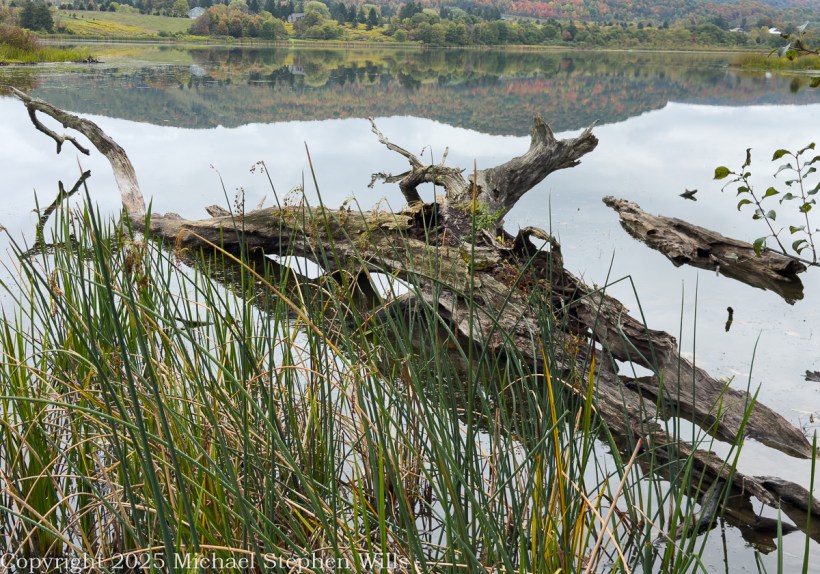
He went along the margin along the damp sedges where old drift lay silvered and light as bones. A drowned trunk angled from the shallows. The lake was old in the way of things made by ice and time. A kettle in the outwash of the last glacier, some men said, a bowl left when the buried ice eased away. He pictured the ice receding into the valley heads, the meltwaters choked with gravel, a hand larger than memory scribing the floor of this country. The earth never told it plain but the lay of it was witness enough. Across later centuries men cribbed a dam across the outlet and drew the water to a shape that pleased them and served their work.

A trail ran the length of the water on the old rail bed. The ties were long gone and the iron and cinders buried under years of leaf fall and gravel. He had walked it as a boy beside his father and now he walked it alone. Benches stood at half-mile intervals like waystations in a country of small pilgrimages. The signs told what once was here and what remains. They had renamed the path for a townman who argued it into being after the railroad had passed from the world and the right-of-way grew up with sumac and rumor. It was an easy trail and he carried nothing. His hands hung at his sides as if the day might place something in them when it was ready.

In another era the lake was a workshop. Men whipsawed timber in the wet air and fed small mills with the grove’s dark boards. Winter flowed over the flats, and they built icehouses and set the blocks within like blue stone, an industry that died when cold could be called from a switch. The hills have learned to forget the noise of it, though on certain mornings the fog takes a shape and you could believe rising from the ponded sawdust and the lading of sleds. He thought of the labor of those gone hands and of how work is a scripture every place keeps in its own tongue.

Before any of that, the ground here was a summer camp. People came with the season and went with it, laying their fires in the lee of the knoll and taking fish where the cattails thin. He could feel them in the open places, not as ghosts but as the first understanding the land ever had of itself. The words used for them now are museum words, yet the wind still crosses the water as it did and empties the same smell of iron and leaf into the lungs of whoever stands to breathe.

The town took its name from a poet long dead, a scholar’s choosing in the years after the war for independence when this tract of country was parceled out to soldiers of that same war. Virgil lay to the east as if they were shelving Latin across a map. The creek that bears that name threads the villages and finds Fall Creek at Freeville, and the combined waters go their own slow way toward Cayuga where the glacial hand scooped deeper yet. He said these names under his breath and they tasted of chalk and river stone.

A kingfisher rattled across the cove. The fish rose in rings that spread and vanished like time seen from above. Out on the water an old man pushed a skiff with an electric motor that hummed like a trapped bee, for the lake allows no gas engines now. The wildlife area ran around the shore in a ragged collar of field and wetland and alder, near two hundred acres under the state’s keeping, and the lake itself a little over a hundred. He watched the man aim for the lily line and thought how rules arise from the wish that a thing endure, though nothing does. Still we make the rules and we keep them as if the earth were listening.

Wind came down the slope with a smell of rain. He turned back and the hills lay again in the water, entire, and for a moment he could not tell which world had claim to the other. He thought of the rails pulled up and the mills gone to weeds and of the icehouses fallen into their own shadows and he thought of the people before all that and of the long winter pressing its thumb into the land and lifting it away. He thought of his father walking the rail bed beside him a lifetime ago and saying nothing. There are places where the past crowds close and will not be argued with. He stood until the first drops dimpled the surface and the reflection shattered and reformed. A train no longer runs here. The only sound was the soft percussion of rain on water and the slow turning of the earth beneath both. He put his hand to the damp trunk of a fallen tree and felt the grain and the coolness and the old patient labor of rot. Then he went up from the reeds, his pockets full of acorns, and out to the road where his truck waited and the day, austere and sufficient, came along with him.

References

Geological History and Glacial Formation of the Finger Lakes

Jim Schug Trail

The Dryden Lake area in the 19th century

Indian Campsite on west side of Dryden Lake

Dryden New York (wikipedia)

Dryden Lake (New York State DEC)

Geohydrology, Water Quality, and Simulation of Groundwater Flow in the Stratified-Drift Aquifer System in Virgil Creek and Dryden Lake Valleys, Town of Dryden, Tompkins County, New York

Enter your email to receive notification of future postings. I will not sell or share your email address.

A Visit from Rose-Breasted Grosbeaks

On a serene May morning, a small flock of Rose-breasted Grosbeaks graced the author’s yard, showcasing their vibrant plumage and bringing beauty to the tranquil scene of nature.


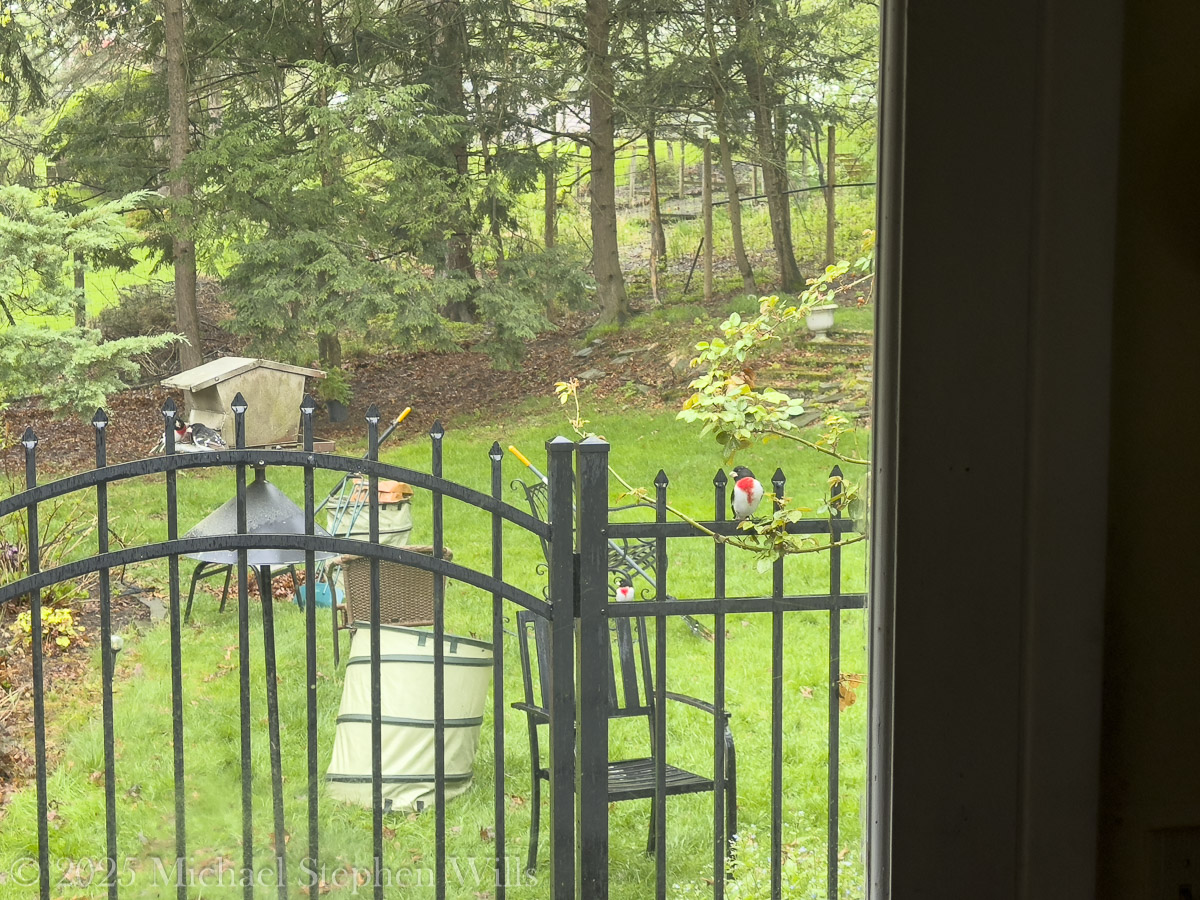
It was a gentle May morning, the kind that seems to hush even the wind, as though nature were holding its breath for something wonderful. Through the kitchen window, just past the black iron gate entwined with the fresh green of climbing rose, I spotted them—feathered heralds of spring’s deepening promise—perched like jeweled notes on a musical staff.


The Rose-breasted Grosbeaks had arrived.

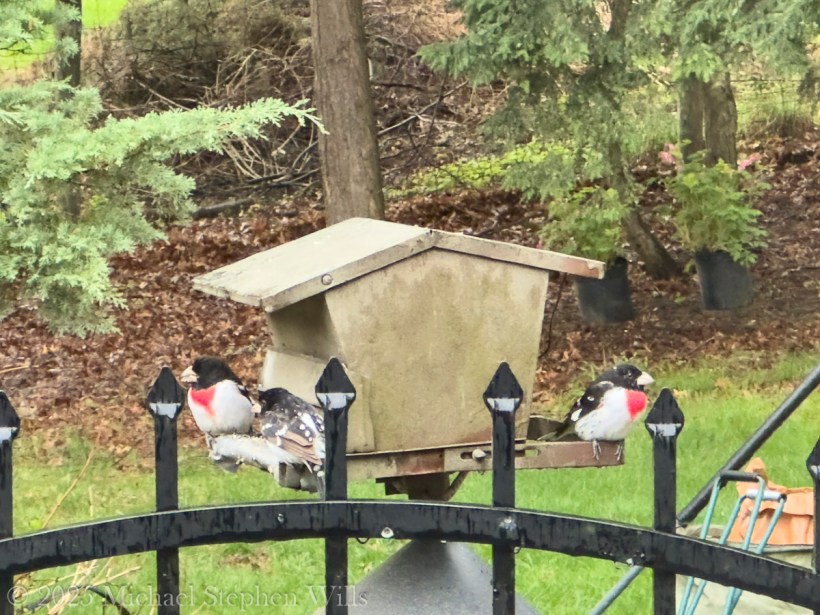
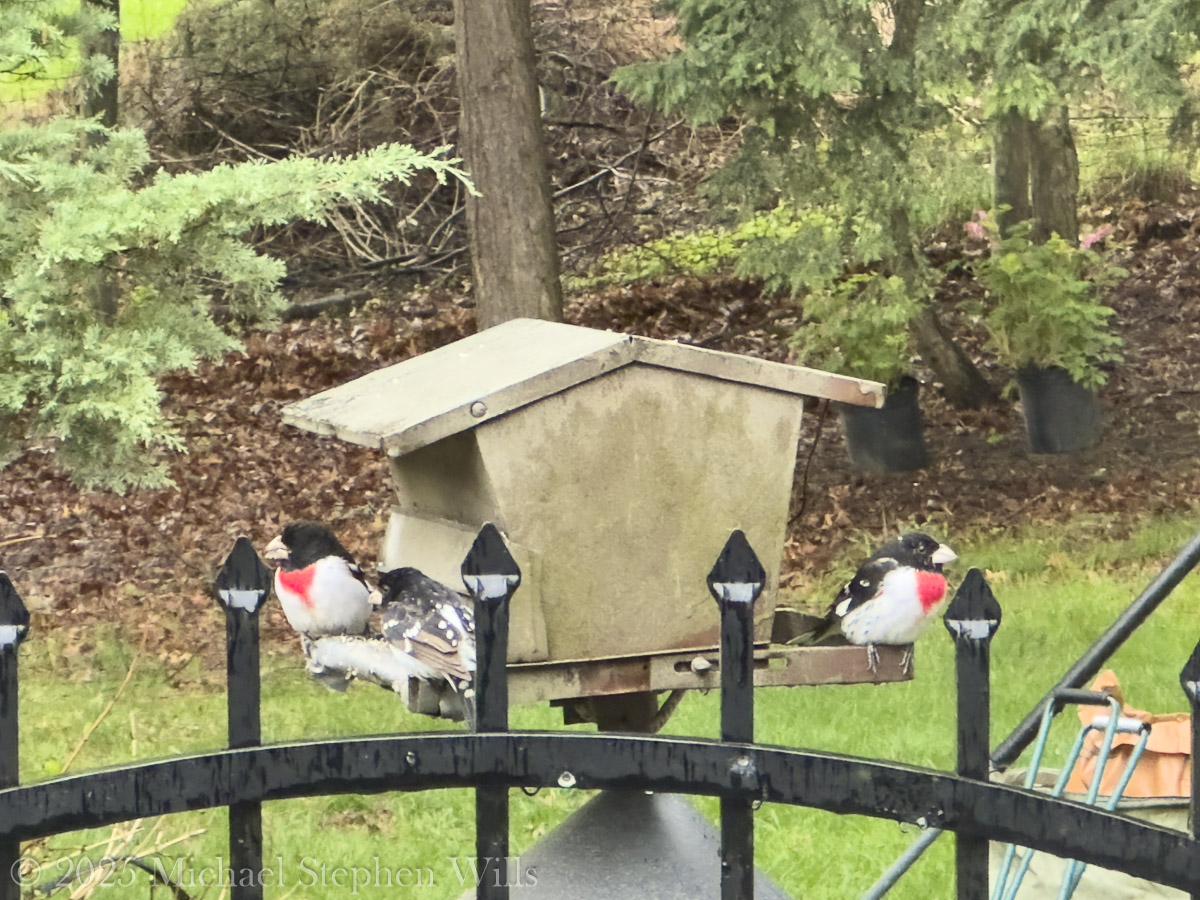
May 3, 2025 Four Male Rose Brested Grosbeaks visited our backyard bird feeder during spring cleanup.


Not one or two, but a small flock, draped in raindrops, feathered in contrast and charm. They gathered around our backyard feeder like guests invited to a familiar table. At 5:56 a.m., the camera captured the first image: two males on the feeder and one each on fence and chair, a bold bib of crimson splashed across snowy chests, huddled against the gray of the feeder, their plumage brilliant even in the diffused dawn light. I couldn’t help but smile. This was a scene of quiet splendor, a symphony for the eyes and soul.


The males, unmistakable in their attire, wore tuxedos of black and white, with the defining rose-red marking on the breast that gives the species its common name. Their scientific name, Pheucticus ludovicianus, is less poetic but equally telling. “Pheucticus” comes from the Greek pheuktikos, meaning “shy” or “avoiding,” reflecting their reclusive habits in forested nesting grounds. “Ludovicianus” refers to Louisiana, an early French colonial name for a vast region including their breeding range—a nod to their North American roots.


At 5:58 a.m., the lens captured more details: a male with slightly mottled wing feathers, suggesting he was a younger bird, still dressing up in adult finery. The trio clung to the feeder’s edge, their heavy, conical beaks—perfect for cracking seeds—clearly visible. That oversized bill gives them the name “grosbeak,” from the French gros bec, literally “large beak.” Functional beauty, you might say.

May 3, 2025 Three of the Four Male Rose Brested Grosbeaks visited our backyard bird feeder during spring cleanup.


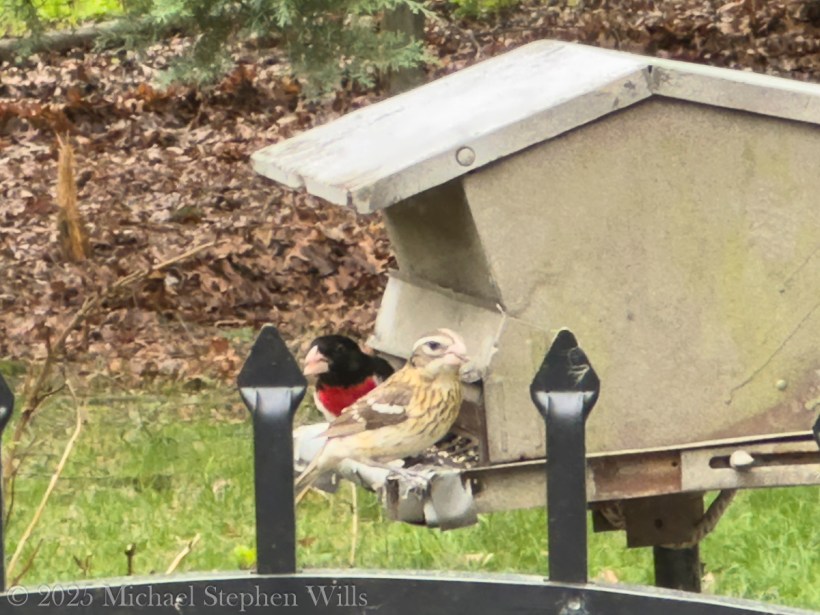
Then, at 6:08 a.m., came the contrast—the female. Subtly adorned in warm browns, with creamy streaks and a wash of yellow near the wings, she perched beside her flamboyant mate, as if to say: elegance need not shout. The two birds looked momentarily toward each other, and I was struck by their balance—his flair and her grace. Her eyebrow stripe, called a supercilium, lent her a composed, alert expression. While the male might catch the eye, the female commands attention in her own, quieter way.

May 3, 2025 Male and Female Rose Breasted Grosbeaks visited our backyard bird feeder during spring cleanup.


Rose-breasted Grosbeaks are migratory, long-distance travelers who winter in Central and South America and return each spring to North America’s deciduous and mixed woodlands to breed. Here in upstate New York, our yard is a brief rest stop on their northward journey—or, if I’m lucky, a summer home. They often nest in dense foliage, and their song, a melodic, whistled warble—like a robin who’s taken voice lessons—is often the first clue to their presence.


This morning, no song was needed. Their silent presence was enough.


Watching them, I felt time slow, the kind of moment when the ordinary yard becomes cathedral. Watching them, I felt time slow, the kind of moment when the ordinary yard becomes cathedral. The wet fence and chair under the feeder, even the crumpled leaf bag—everything was blessed by the company of these birds. Rain softened the world, and the birds brought color to its hush.


Later that day, reviewing the photos with metadata timestamps from my iPhone—each image like a verse in a poem—I marveled at what I had witnessed. These weren’t just birds. They were stories in flight, living punctuation marks in the sentence of my morning.


Nature gives us these moments, brief as birdsong and just as sweet. You only have to be still, and ready to receive them.

Enter your email to receive notification of future postings. I will not sell or share your email address.

References

  1. Pheucticus ludovicianus (Rose-breasted Grosbeak). Cornell Lab of Ornithology – All About Birds.
  2. Jobling, James A. The Helm Dictionary of Scientific Bird Names. London: Christopher Helm, 2010.
  3. Merriam-Webster Dictionary: Etymology of “Grosbeak.”
  4. iPhone 14 Pro Max image metadata (May 3, 2025; 5:56 a.m. to 6:08 a.m.; Ithaca, NY).

Tuxedos on Tour: Three Majestic Mergansers

Join the escapade as you witness three majestic Mergansers, donning nature’s finest tuxedos, in a graceful ballet on the springtime stage of Cayuga Lake.

As you gaze upon these three fine feathered fellows, all members of the exclusive Common Merganser men’s club, they seem to glide upon the watery stage of Cayuga Lake with all the confidence of Broadway stars on opening night. They are the aquatic equivalent of a sharply dressed barbershop quartet, minus one, in their matching tuxedos, ready to sing the springtime serenade of their species.

The chap at the forefront is Captain Black-Crest, sporting a glossy noggin that shimmers with an inner light, undoubtedly the envy of every duck on the pond. He’s streamlined and debonair, with a white body that’s as crisp as the first snowfall and a dark back that’s as sleek as a shadow in moonlight. If ducks had monocles and top hats, he’d be first in line.

In the middle, there’s Sir Dapper-Diver, a mirror image of his companion, with a neck as white as the driven snow and a dignified black back that gleams like polished onyx in the dappled sunlight. He’s the quiet achiever of the group, poised and ready to make the plunge into the depths below, proving that style need not be sacrificed for substance.

And to the right, meet Admiral Feather-Finesse. His poise on the water suggests a mastery of the waves, a commander of the current. He carries his elegant attire with an air of grace that only comes with a natural pedigree. In synchronized perfection, he and his brethren form a regatta of refinement, a display of nature’s own black-tie affair.

These are male Common Merganser (Mergus merganser) in breeding plumage, characterized the body white with a variable salmon-pink tinge, the head black with an iridescent green gloss, the rump and tail grey, and the wings largely white on the inner half, black on the outer half. Like the other mergansers, these piscivorous ducks have serrated edges to their bills to help them grip their prey, so they are often known as “sawbills”. In addition to fish, they take a wide range of other aquatic prey, such as molluscs, crustaceans, worms, insect larvae, and amphibians; more rarely, small mammals and birds may be taken. As in other birds with the character, the salmon-pink tinge shown variably by males is probably diet-related, obtained from the carotenoid pigments present in some crustaceans and fish. When not diving for food, they are usually seen swimming on the water surface, or resting on rocks in midstream or hidden among riverbank vegetation, or (in winter) on the edge of floating ice.

Together, these three Common Mergansers (Mergus merganser) in their prime are a trifecta of elegance, a testament to the timeless beauty found in nature’s simplicity. They paddle forth with purpose, their matching plumage a striking contrast to the rippling blues and grays of the water, a parade of poise and plumage that delights the observant eye.

So, dear reader, as you observe this photo, take a moment to appreciate the charming uniformity and the subtle quirks that make each bird, despite their shared wardrobe, uniquely magnificent. It’s a snapshot of life at its most graceful, a picture worth far more than a mere thousand words.

Copyright 2024 Michael Stephen Wills All Rights Reserved