A sun-worn dragonfly rests at journey’s end, its amber wings whispering of distant winds, silent skies, and the untold grace of nature’s farthest travelers.
I found it trapped in the surface tension of standing water, motionless, its wings curled and clouded with the memory of flight. A dragonfly—worn, delicate, yet still resolute in form—lay before me like a token of the warm midsummer air that had lifted it through the fields and over the waters. July in Ithaca brings with it such winged travelers, borne on breezes scented with milkweed and bee balm, and this one, though grounded now, seemed still to carry the echo of great distances.
The dragonfly is not of the brooding sort; it lives neither in shadows nor secret places. It claims the sky as its own, ranging wide and far with a grace born of ceaseless motion. This particular specimen, its body some two inches in length and its wings veined like the bare branches of winter trees, bore the telltale marks of the Wandering Glider—Pantala flavescens. Each wing was tipped with a black bar, as though the artist who made it had laid down a final, definitive stroke to balance the creature in the air. Near the base, a wash of amber yellow glowed softly, like the last light of evening behind thin clouds.
There is something unquiet about the dragonfly. It does not hover long nor does it dawdle. It darts, it glides, it shimmers in and out of sight. It is a creature of action and of space. The glider, especially, seems to belong not to any one stream or meadow, but to the wind itself. Naturalists tell us this species is among the most traveled of all insects, crossing oceans, riding monsoons, appearing in lands where no memory of its departure remains. What must it see? What sunrises shimmer from its compound eyes, what shorelines flash beneath its outstretched wings?
In the dragonfly’s manner, I find no sign of labor, only the silent art of survival. It patrols its airspace like a hawk, yet it bears no menace, only the precise and relentless hunger of a born predator. With each dart and glide it performs a service to the air—clearing it of gnats and mosquitoes, feeding itself without waste. Nature, in her economy, grants no idle beauty, and the dragonfly is both elegant and essential.
As I gazed at the delicate carcass, I thought of the old philosophy that linked the soul’s journey to the flight of birds. But here, perhaps, is a more fitting image: this dragonfly, which lives but a brief summer, yet might travel farther in its span than many creatures do in a lifetime. We are apt to call it “wandering,” as though it lacked aim or anchor. But I think it follows a thread of purpose invisible to us—something stitched into the weave of wind and weather, of season and sun.
It had come far, and its journey was complete. My wife provided an empty saffron spice box to preserve and display it—for the grandchildren to marvel over.
Enter your email to receive notification of future postings. I will not sell or share your email address.
Copyright 2025 All Rights Reserved Michael Stephen Wills
In the hush of the forest, Jack-in-the-Pulpit speaks—not with sound, but with form and patience, reminding us that some sermons rise quietly from the earth.
You could walk past it a hundred times and never notice. There, beneath the low canopy of midsummer, where light is sifted through green, Arisaema triphyllum stands with the discretion of a shadow. Jack-in-the-Pulpit, they call it—a name as strange and gentle as the plant itself. But neither common name nor scientific binomial quite captures the feeling that you are being addressed when you encounter one.
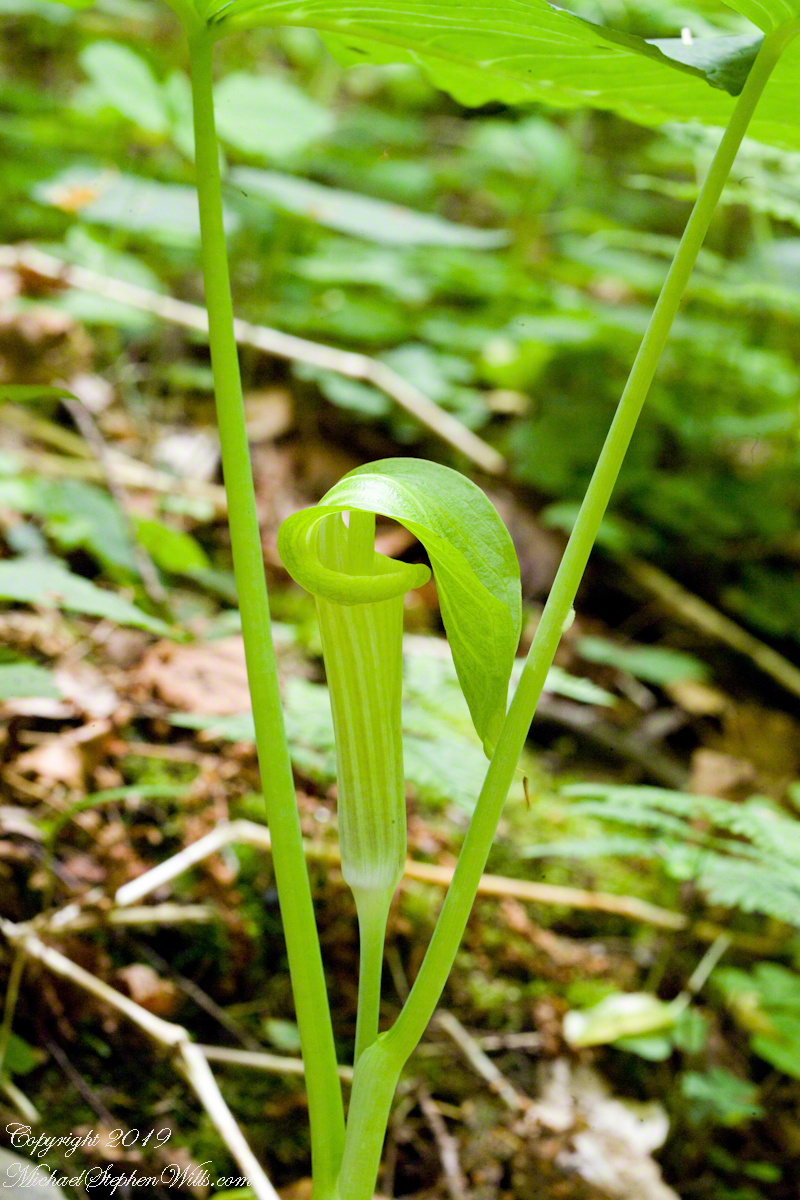
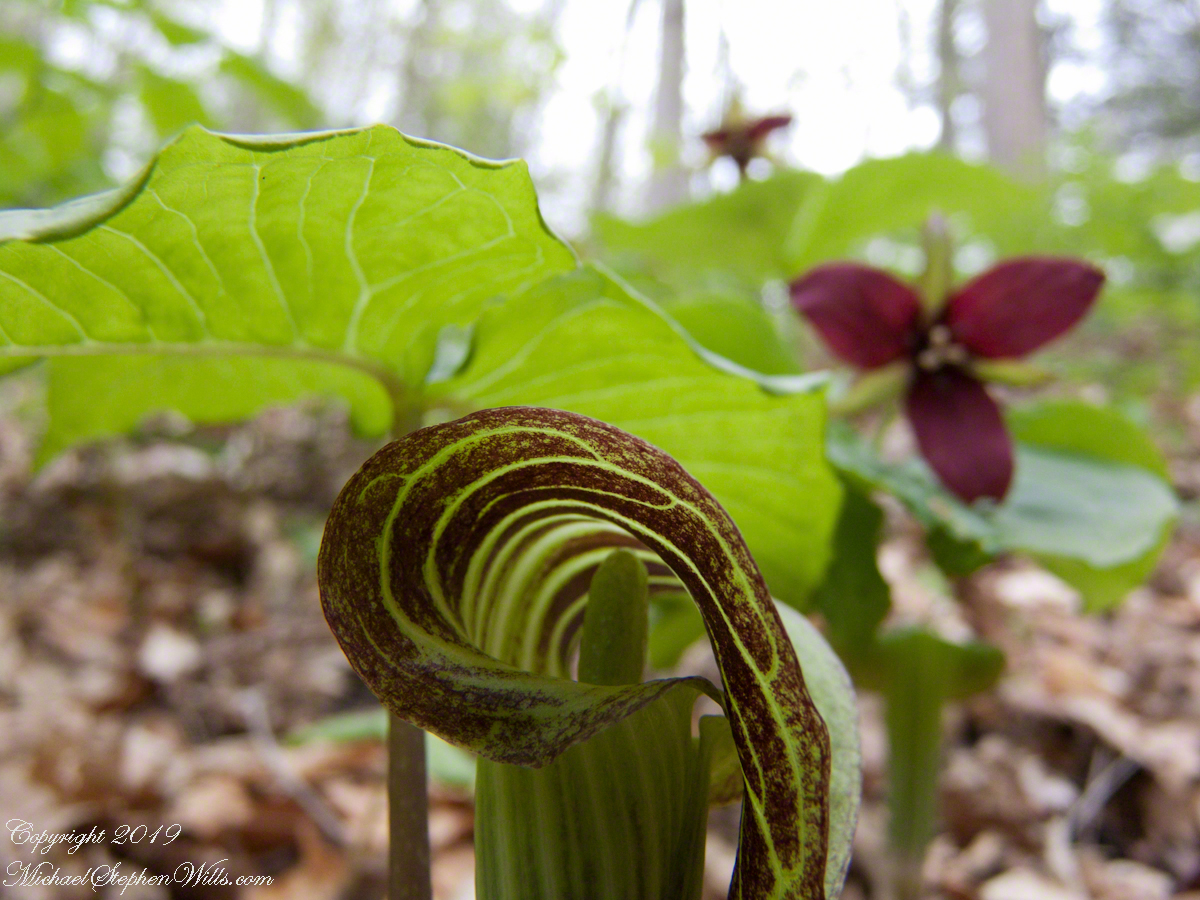
A young Jack-in-the-pulpit under its leaf canopy along the gorge trail of Filmore Glen.A mature Jack-in-the=pulpit flower with purple trillium, Fillmore Glen.
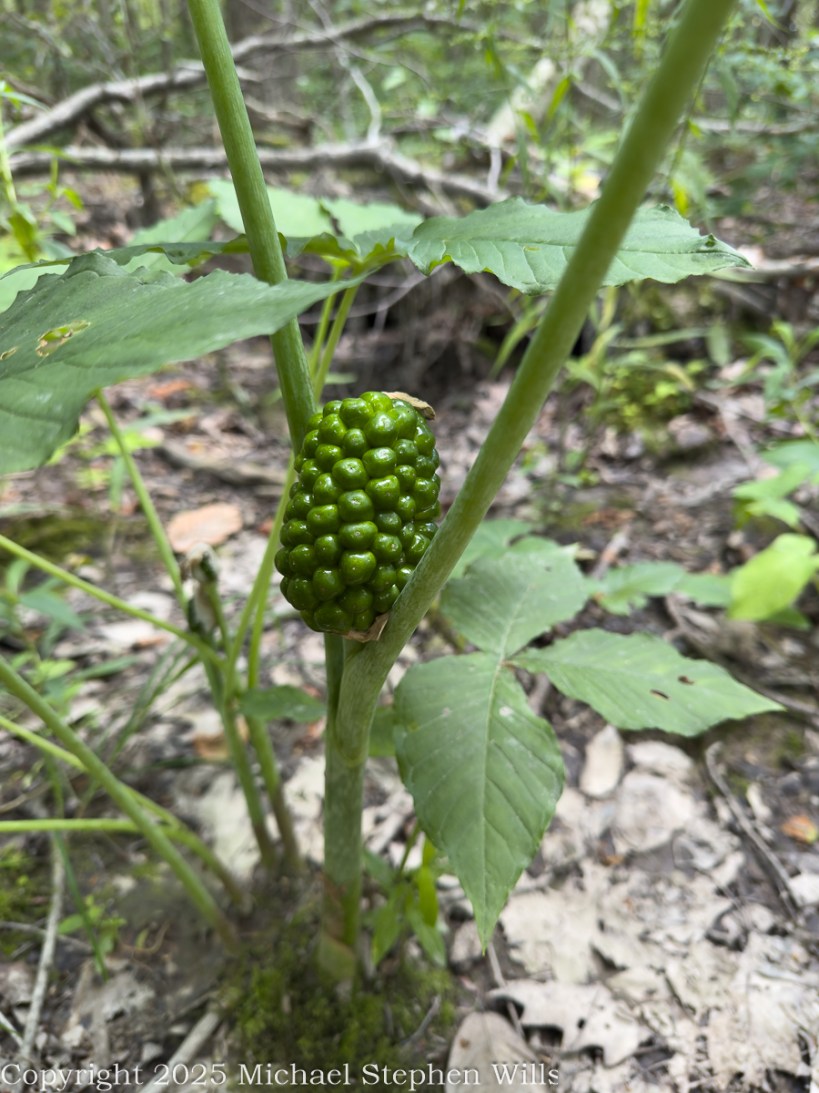
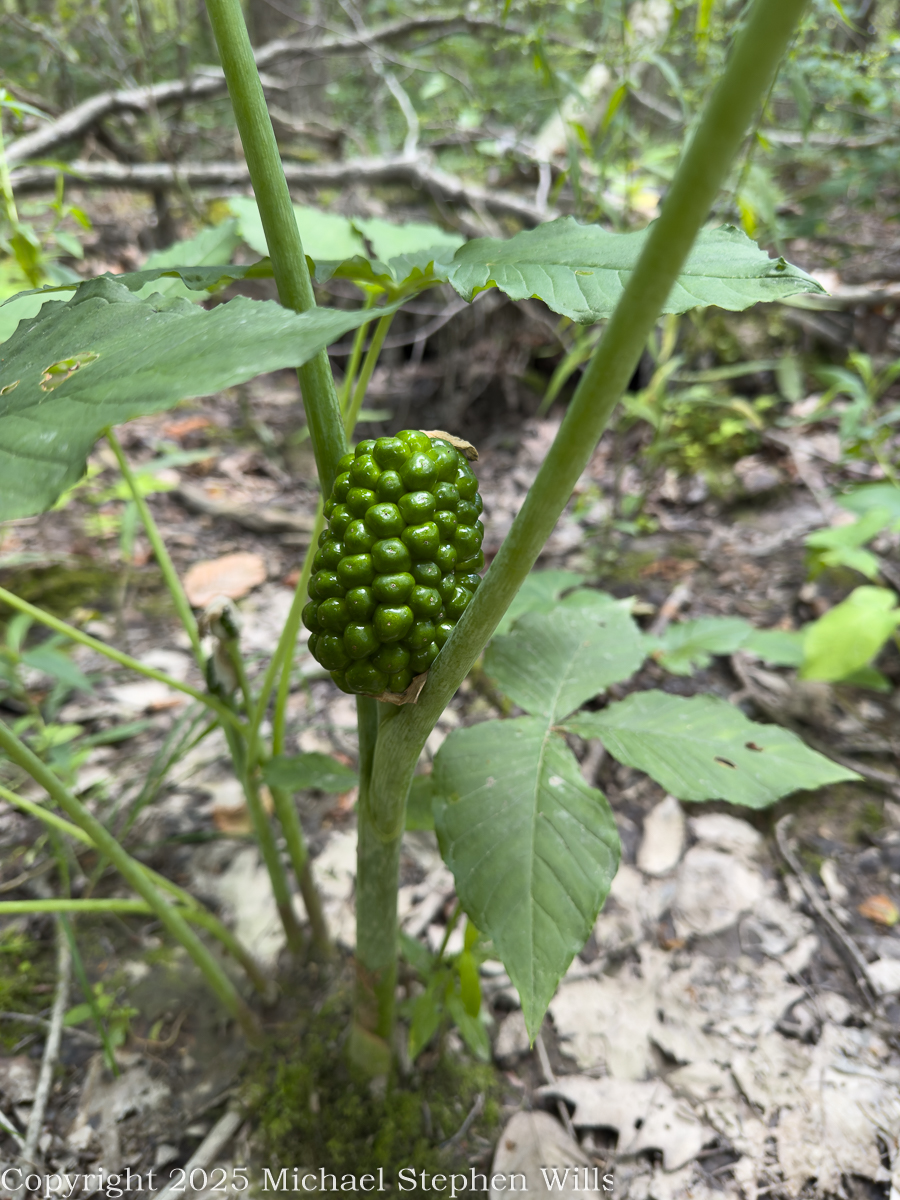
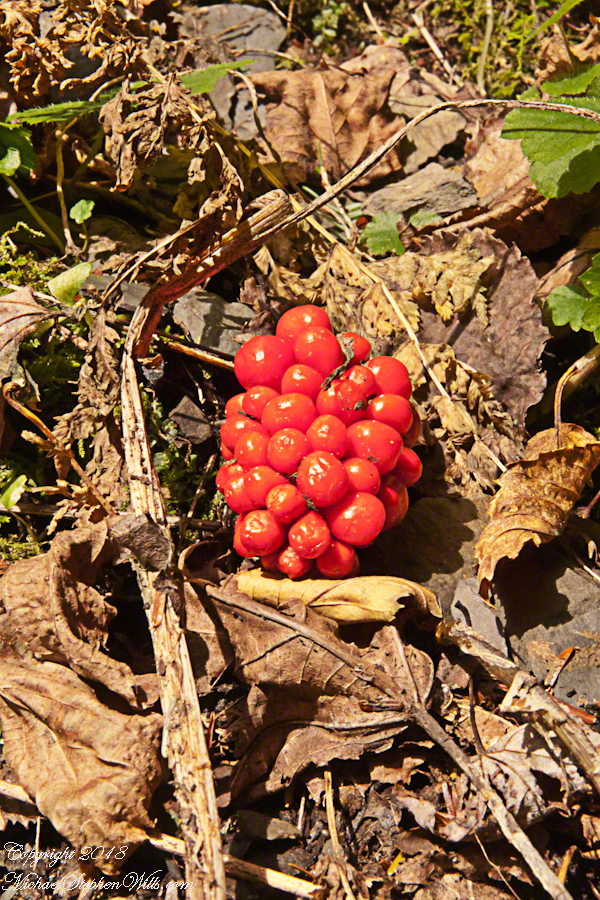
Earlier in the year, it raised a hooded spathe above the forest floor, curving protectively over a pale central spadix—the “Jack.” It looked like a figure delivering a sermon to the moss and littered leaves. Now, that sermon has passed, and the speaker has fallen silent. What remains is a column of tight green berries, glinting softly in the dappled light. They are not yet ripe, but the promise is there. In time, they will glow red like embers in the undergrowth.
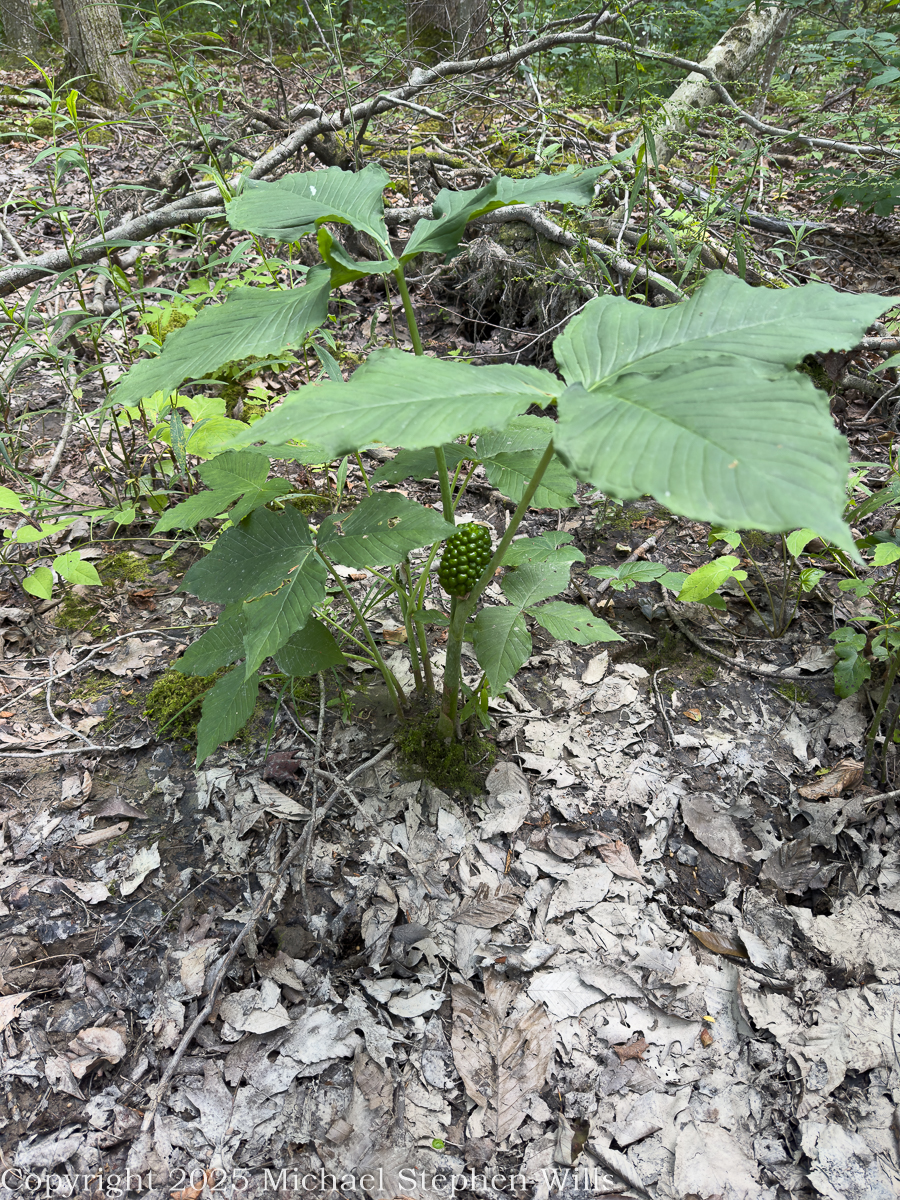
Summertime, Sapsucker Woods. I might use a colloquialism and call this plant a “Jill”….and the real twist? Jack might’ve started out giving sermons but give them a good season and a strong root system, and Jack becomes Jill. It’s sequential hermaphroditism at its finest—Mother Nature’s version of career flexibility.
There is something ancient about this plant, as if it remembers a forest before our footsteps came. Its roots delve deep, not just into the soil, but into time. A corm, nestled beneath the leaf mold, waits out the harsh seasons, unseen but enduring. It is not a showy plant. It is a plant that trusts quiet. That survives on patience.
A closer look at the unripe berries.
The forest is full of these secret lives—beings that do not shout to be known. Jack-in-the-Pulpit speaks softly, in a dialect of leaf and shade and seasonal return. It is a plant you find when you have slowed down enough to belong again to the forest’s rhythm, when you’ve traded the voice in your head for the breath of leaf litter underfoot.
From Fillmore Glen
Some would call it just another spring ephemeral, a curiosity among many. But to walk away from it without feeling a kind of reverence would be to miss the point. It is not there to impress. It is there to remind.
That not all things are revealed at once. That sermons come in many forms. And that in the hush of the forest, something is always speaking—if only we remember how to listen.
Enter your email to receive notification of future postings. I will not sell or share your email address.
Copyright 2025 All Rights Reserved Michael Stephen Wills
Monument Valley, or Tsé Biiʼ Ndzisgaii, embodies a profound connection between the Diné people and the land, contrasting imposed names with cultural significance and sacred narratives.
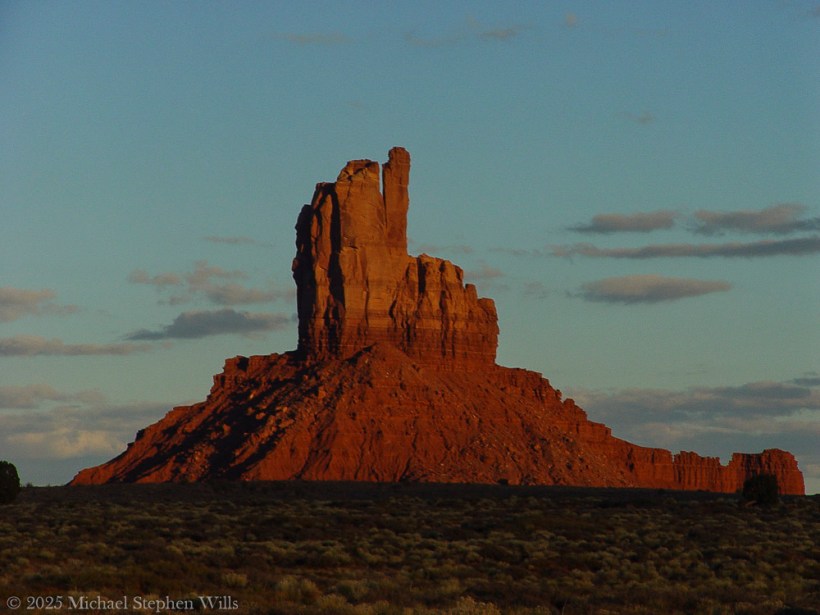
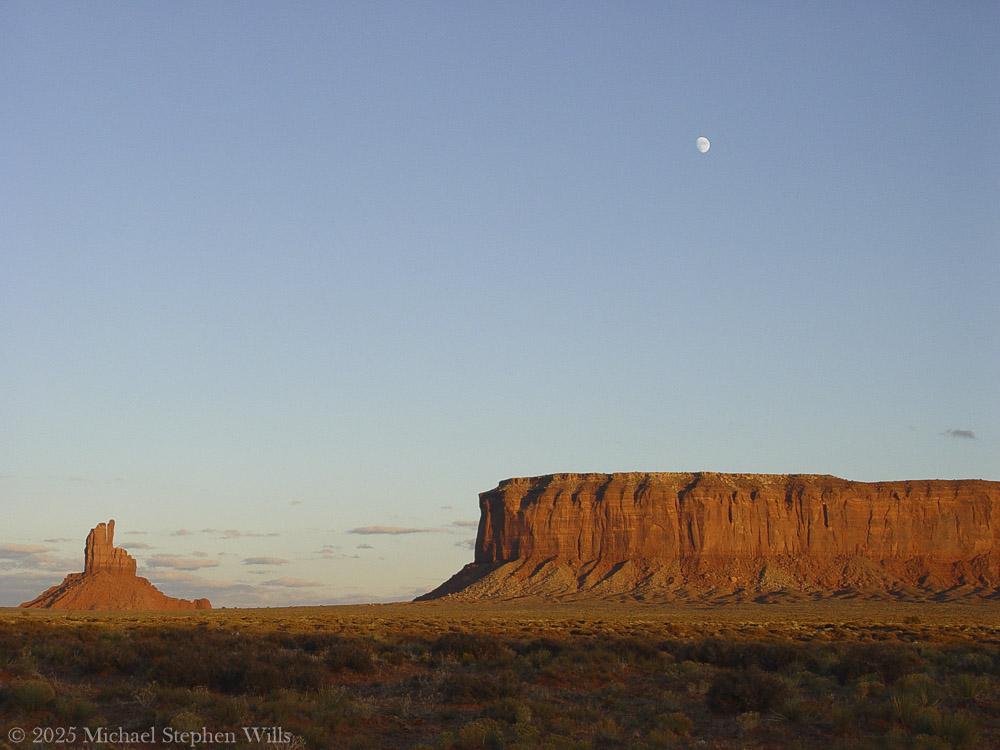
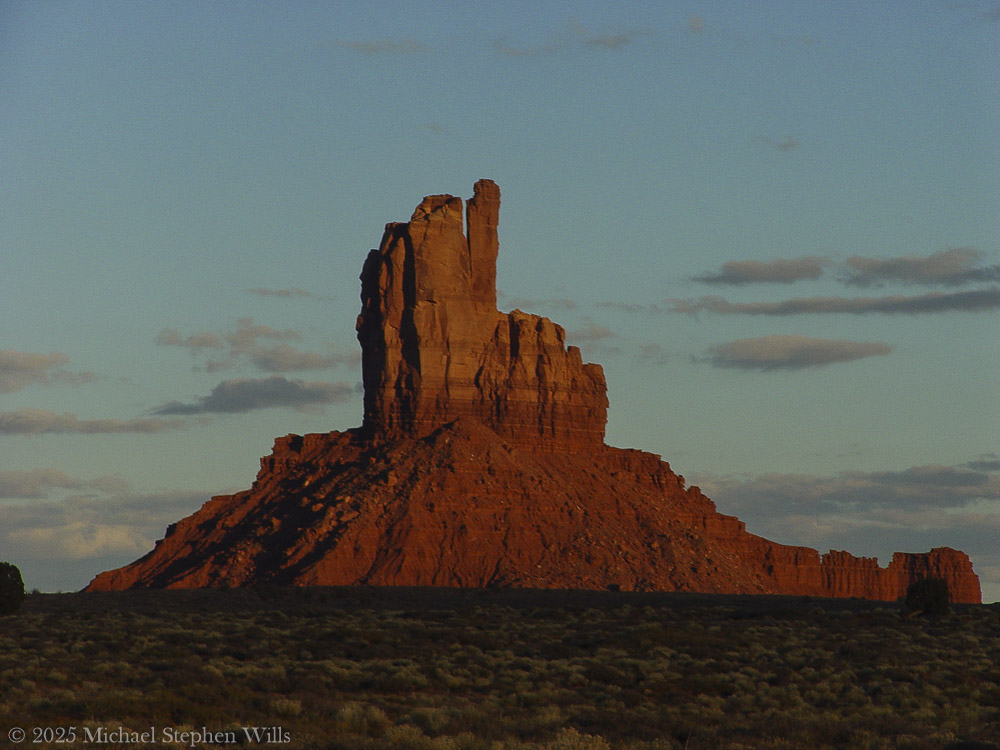
In the golden hush of this November sunset, Monument Valley stretches before us – an endless desert plain punctuated by towering red rock sentinels. The sky is vast and translucent blue, as a pale three-quarter moon rises silently above a solitary spire of sandstone. That spire is known on maps as Big Indian, a stone pillar glowing russet in the low sun. It stands apart from the mesas, its silhouette uncanny against the evening sky. In this serene moment, the land feels alive with presence. And the name “Big Indian” lingers in the air, raising quiet questions about what we call this place – and what it truly is.
From a distance, the spire does suggest a figure: tourists are told to squint, tilt their heads, and “see” the profile of a Native face gazing outward. One can imagine the first person to name it must’ve been a bored prospector, half-delirious from the heat after a lunch of canned beans, declaring: “I swear that rock looks like Uncle Joe in a feathered headdress.” And so the name stuck – a geological Rorschach test gone slightly colonial.
These whimsical titles – Totem Pole, Stagecoach, Big Indian – come not from the land, but from a long habit of outsiders labeling what they didn’t fully understand. “Big Indian” is particularly layered. The term “Indian” itself was born from Columbus’s navigational misfire, mistaking the Caribbean for Asia and its people for “Indios.” The Diné, the people who have lived here for centuries, never called themselves that. So this towering formation now bears the echo of a 15th-century directional blunder —like a name tag on the Sphinx that reads “Buckeye” because someone once thought Egypt was in Ohio. It’s a reminder: names given in haste can cling for centuries, even when they miss the mark entirely.
But beyond the names imposed by mapmakers, the spire simply is, in all its silent grandeur. In Diné lands, this valley has a different name: Tsé Biiʼ Ndzisgaii, often translated as Valley of the Rocks. In the Navajo tongue the name literally evokes “rock within white streaks around” – referring to the light bands of sediment that ring the red buttes. Those pale streaks wrap the spire like faded paint, remnants of ancient layers of earth. Here the Diné language whispers a description born of the land itself, unlike the English names that often project an outsider’s story. Tsé Biiʼ Ndzisgaii speaks to the truth of the place: stone and light, strata and shadow. As the sun lowers, you can actually see those whitish bands catching the last glow, encircling the butte like old memory. The Diné name honors what the eye sees – the layered geology – rather than imposing an unrelated label. This spire and its neighbors were not built by human hands, though their sheer stature can feel like architecture of the gods. Millions of years of natural artistry shaped Monument Valley.
Long before any person walked here, this land was a low basin collecting sediments. Layer upon layer of sand and silt hardened into rock, and a slow uplift in the earth heaved the basin into a plateau. Wind and water became patient sculptors over the last 50 million years, carving the plateau and peeling away the softer material. What remains today are the skeletal monuments of that erosion: buttes, mesas, and spires rising up to a thousand feet above the desert floor. Each is made of stratified stone – the broader bases of red shale and sandstone, and a cap of harder rock that resists the elements. Big Indian’s sturdy pedestal and slender crest tell this story of layered resilience. In the red-orange rock, oxides of iron tint the cliffs a deep rust, while streaks of black manganese oxide – “desert varnish” – trace down their sides like natural paint. Time and the elements have sculpted a masterpiece here.
Standing at its foot, one needs imagine the immeasurable ages of sun and storm that chiseled this lone tower from the earth. And yet, facts of geology alone fail to capture the spirit one feels in Tsé Biiʼ Ndzisgaii. The Diné know that spirit well – this valley is sacred to the Navajo Nation. To them, these colossal rocks are alive with meaning. The people have lived and wandered among these mesas for centuries, blessing the land with their stories and prayers.
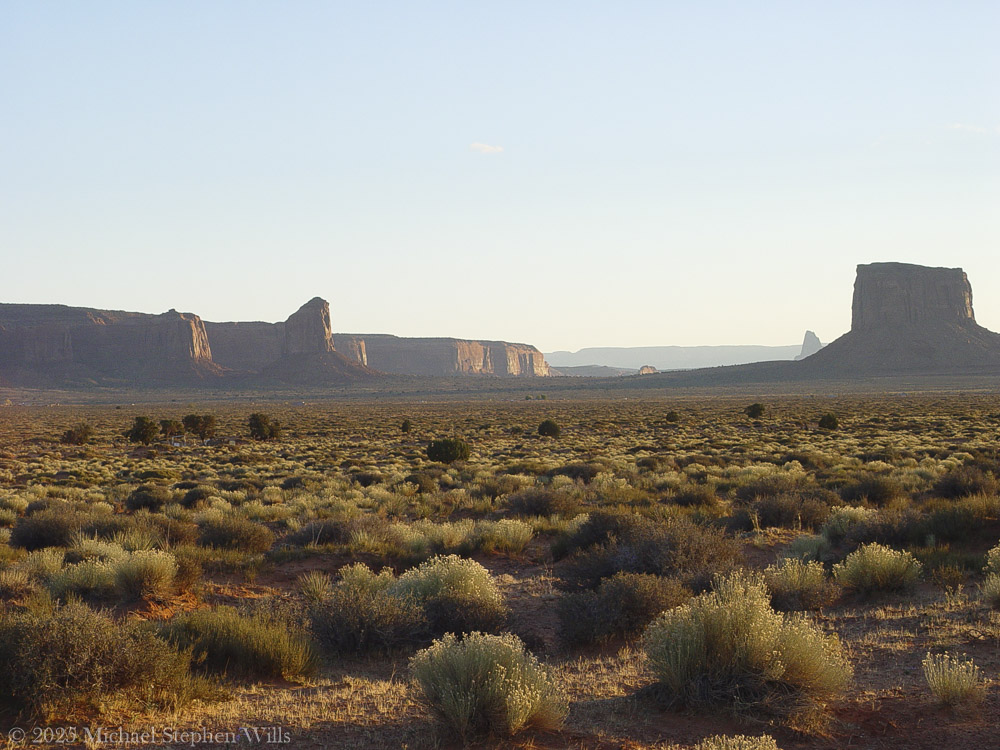
In Navajo cosmology, the landscape itself is imbued with life and purpose. The buttes are often seen as ancestors, guardians, or holy figures watching over the People. For example, the famous twin buttes called the Mittens are said to be a pair of spiritual beings – one male, one female – forever facing each other across the valley, protecting and balancing the land. Another hulking mesa, Sentinel Mesa, is known as a “door post” of the valley, a guardian at the entrance, paired with another butte as the opposite door post. The valley, in the Diné way of seeing, resembles a great hogan, a home blessed by the gods: the mesas at its threshold are like the posts of a doorway, and a butte called The Hub is imagined as the central fire hearth of this immense home.
In this way, the Diné landscape is a living, storied environment. Even the spindly formations carry sacred narrative. Seven miles southeast from Big Indian stand slender pinnacles known to the Navajo as Yei Bi Chei, named for the masked spiritual dancers who emerge on the last night of a winter healing ceremony.
Each dawn, as the first light breaks over the mesas, it’s said the Navajo families come out of their hogans to greet the sun with prayers – their doorways always face the east to receive blessings of the day. In the same way, the great stone hogan of Monument Valley opens eastward, with its door-post buttes and its eternal fireplace. In Diné worldview, earth and sky are intertwined with their lives; they speak of Mother Earth from whom they emerged and to whom they owe care. Here in Monument Valley, it is possible to feel that harmony – the sense that every column of rock, every whispering juniper shrub, every beam of sunlight and moonrise is part of a whole living tapestry.
We watch as the moon climbs higher above the Big Indian spire, its silvery light softening the rock’s hard edges. This place has known many names and will outlast many more. The Paiute people who roamed here before called it “Valley Amid the Rocks” and wove myths of gods and giants into its features. Later came the labels of explorers and filmmakers: Monument Valley, a monumental canvas for Western legends. And of course, the simplistic tag Big Indian for this lone rock – a name that says more about those who coined it than about the land itself.
Names, in the end, are stories we tell about the world. The colonial names imposed here are like brief echoes across the ages, while the Diné stories run deep as the red earth. The Diné prefer to call themselves Diné – meaning “the People”– and they call this land by names that describe its true character. I imagine that to the People, this spire might be thought of not as an “Indian” at all, but perhaps as a sentinel or an old friend standing watch. Its Diné name, if it has one, would likely emerge from its form or its role in a story, spoken with reverence.
As dusk turns to twilight, an immense peace settles. The monolith before me is no longer just Big Indian on a map; it is an ancient entity shaped by time and honored by generations. In the silence, we can almost hear the land speaking in the old language – telling of how it was born from oceans and sand, how it saw the first people wander through, how it endures through centuries of memory. The rock shares with us a moment beyond names: just the whisper of wind, the glow of moon, and a feeling of connection and wonder. This is Monument Valley, Tsé Biiʼ Ndzisgaii, in all its truth. In this contemplative dusk, I bow to the tower of stone, misnamed yet never truly defined by that misnomer. It remains what it has always been – a creation of earth and spirit, a witness to history, a source of humble awe. Tuning to leave, I softly speak a word of thanks – Ahéheeʼ – grateful to have listened, if only briefly, to the sacred voice of the valley.
Bibliography
Encyclopædia Britannica – Tribal Nomenclature: American Indian, Native American, and First Nation britannica.com (origin of the term “Indian” as a colonial misnomer)
Navajo Nation Parks & Recreation – Monument Valley (Tsé Bii’ Ndzisgaii) navajonationparks.orgnavajonationparks.org (official site detailing Monument Valley’s geology and formation)
Robert S. McPherson – Monument Valley.Utah History Encyclopediauen.orguen.org (history, geology, and indigenous lore of Monument Valley)
Aztec Navajo County – Monument Valley PDF Guide aztecnm.comaztecnm.com (descriptions of formations, including Navajo perspectives on their meanings and names)
Navajo Word of the Day – Tsé Biiʼ Ndzisgaii navajowotd.com (explanation of the Navajo name for Monument Valley, meaning “white streaks in the rocks”)
Enter your email to receive notification of future postings. I will not sell or share your email address.
Copyright 2025 All Rights Reserved Michael Stephen Wills
I had a haunting experience at Cocoa Beach, witnessing a rare fogbow—a ghostly arc formed by fine mist—evoking emotions and reflections on nature’s beauty.
The fog haunted Cocoa Beach for days, softening the edges of the afternoon. I had been walking along Cocoa Beach, feeling the cool ocean breeze on my face, when I noticed a change in the light. It was a little after four, the sun drifting lower in the western sky, its warmth fading into a hazy glow. The air smelled of salt and mist, and waves lapped gently at the shore, their rhythm unbroken by the deepening fog.
And then I saw it.
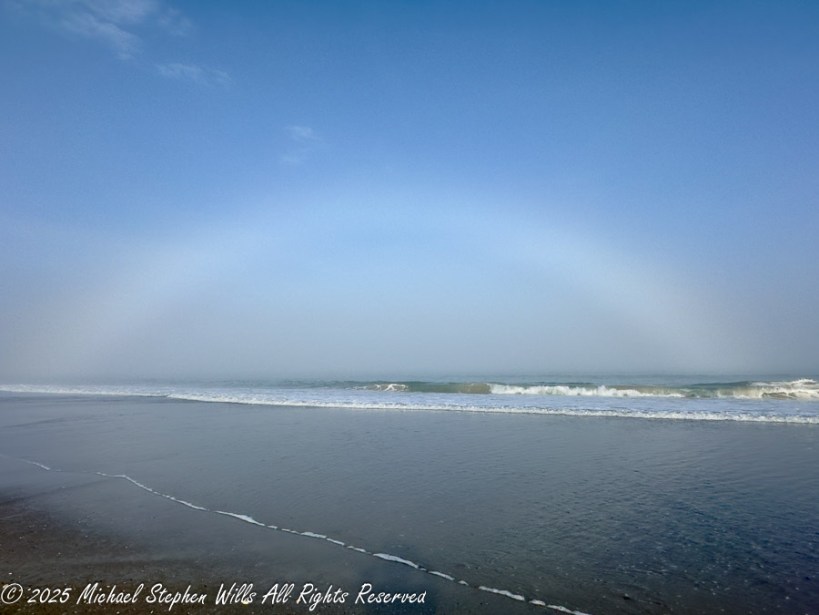
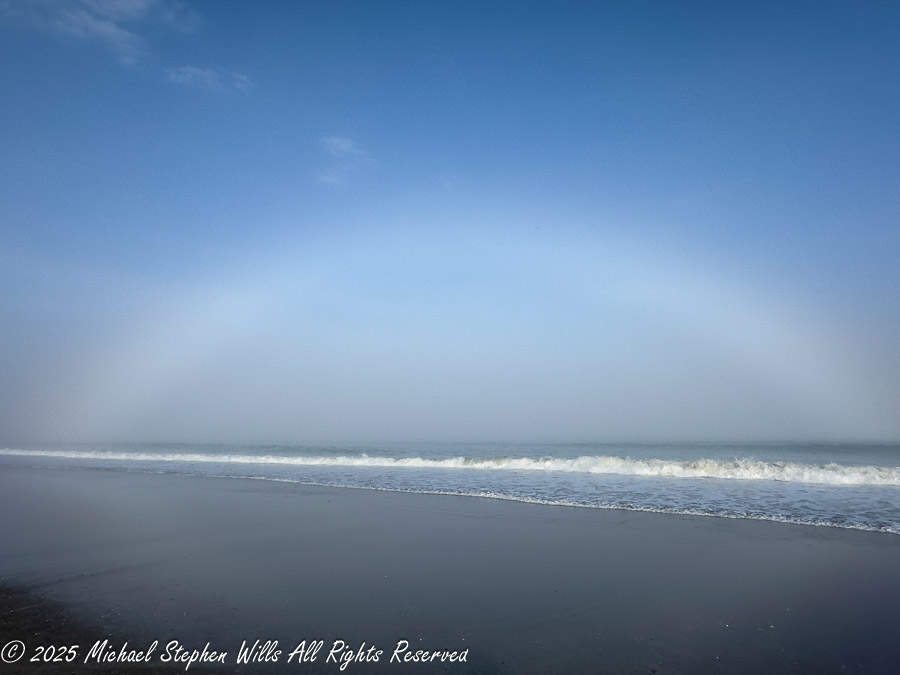
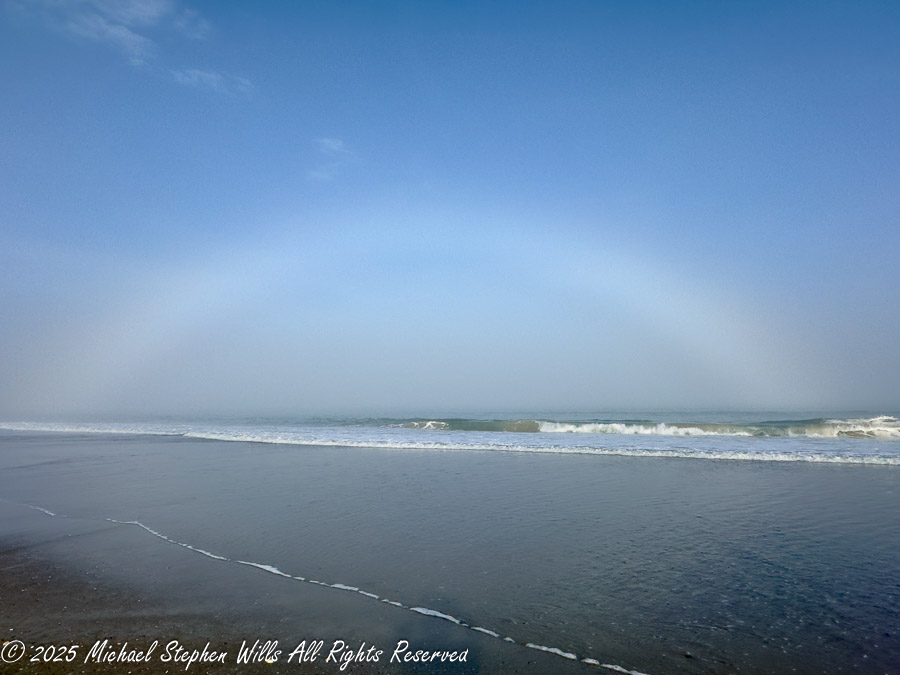
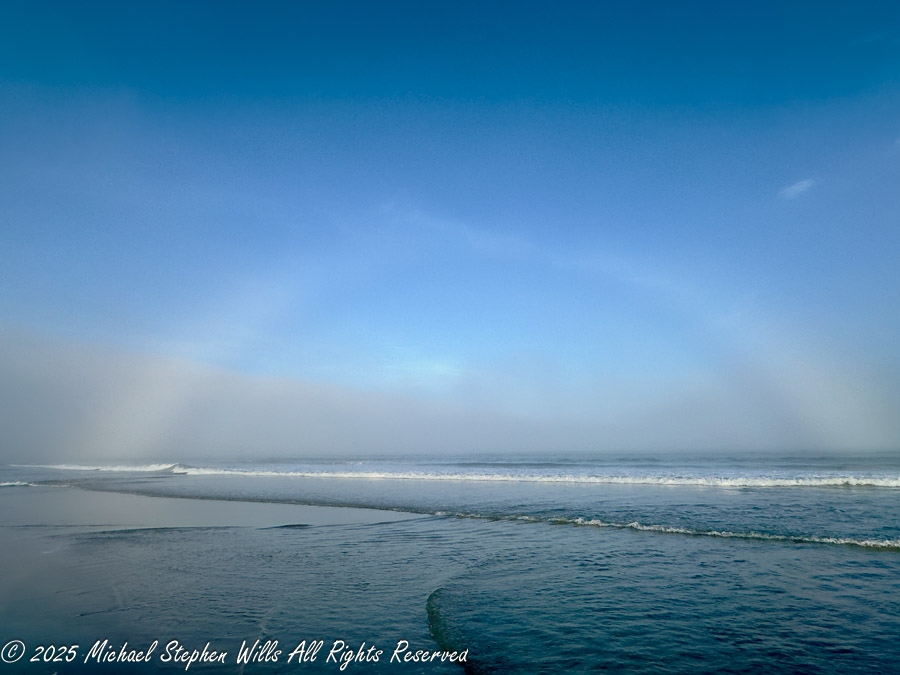
A pale arc stretched across the horizon, a ghost of a rainbow bending above the waves. At first, I wondered if my eyes were playing tricks on me—where were the usual bright bands of red, orange, and violet? But no, the arc was real, a fogbow, forming where sunlight met the fine sea mist. Unlike the rainbows that appear after summer storms, this one was almost entirely white, as if the ocean had conjured it from air and silence.
Sailors once whispered of such things—a white rainbow at sea, a sign of hidden land or wandering souls. Some believed it to be a bridge between realms, a fleeting passage where the living and the lost might momentarily brush against one another. Others saw it as an omen, a spectral warning of treacherous fog ahead. I wondered what the mariners of old might have thought, standing at the bow of a ship, watching a pale arc rise from the mist, its edges dissolving like breath against glass.
I stood still, watching, as the science of the moment unfolded before me. Unlike traditional rainbows, which form when light bends through large raindrops, fogbows are born from infinitesimally smaller droplets, often less than 0.1 millimeters in diameter. Their size diffuses the light, scattering it so finely that the colors blend together into a spectral whisper rather than a vibrant shout. The physics of it fascinated me—this was diffraction in action, nature bending light in a way that rendered it nearly colorless.
The effect was surreal. The fogbow arched over the breaking waves like something out of a dream, a halo of sea and sky, momentary yet timeless. It seemed to pulse in the shifting mist, visible one moment, fading the next, as if deciding whether to reveal itself fully or slip back into the fog’s embrace.
For several minutes, I just stood there, taking it in. The world felt different inside that mist, quieter, more reflective. The fog dampened the usual sounds of the beach—the calls of shorebirds, the laughter of distant walkers—leaving only the hush of the waves and the distant hum of the ocean’s breath.
I knew that fogbows were rare, requiring just the right balance of thin fog, moisture, and a low-angled sun. I was lucky to be in the right place at the right time, a witness to something subtle yet profound.
And just as silently as it had appeared, the fogbow began to dissolve. The mist thickened, swallowing its arc, the sky shifting back to its usual muted gray. But the memory of it lingered—a white rainbow over the sea, ephemeral and elusive, like a secret the ocean had briefly chosen to share.
Enter your email to receive notification of future postings. I will not sell or share your email address.
Copyright 2024 All Rights Reserved Michael Stephen Wills



 Michael Stephen Wills Photography