Sandwiched In

Eight Photographs of Five Flowers

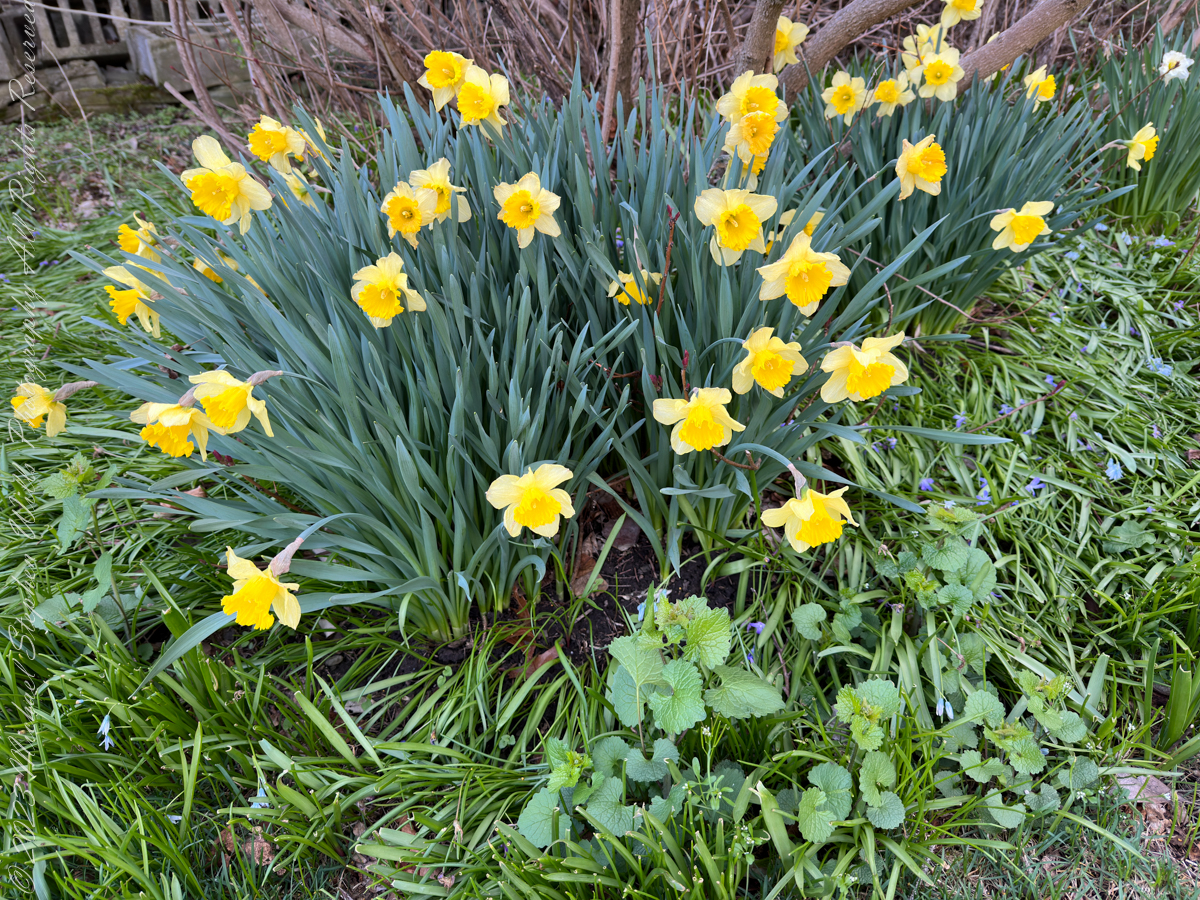
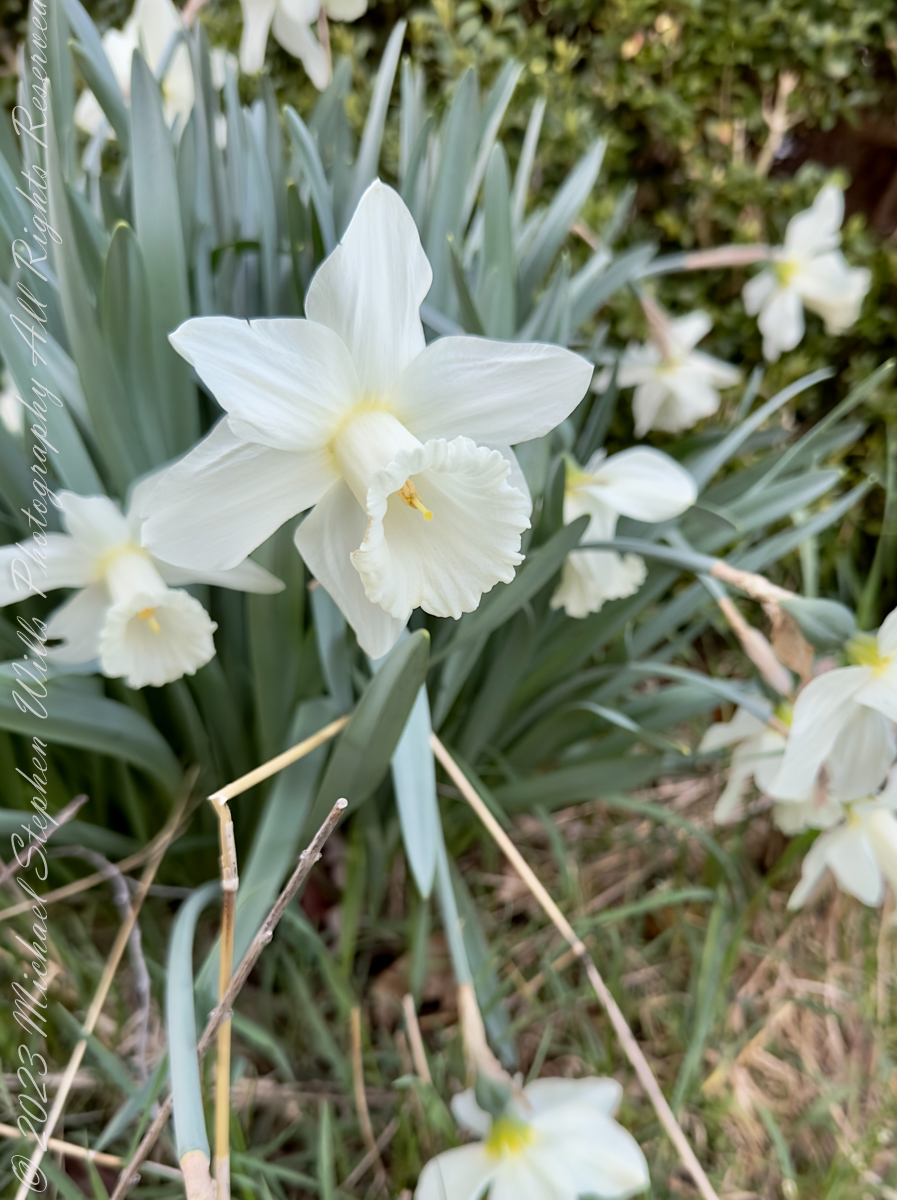
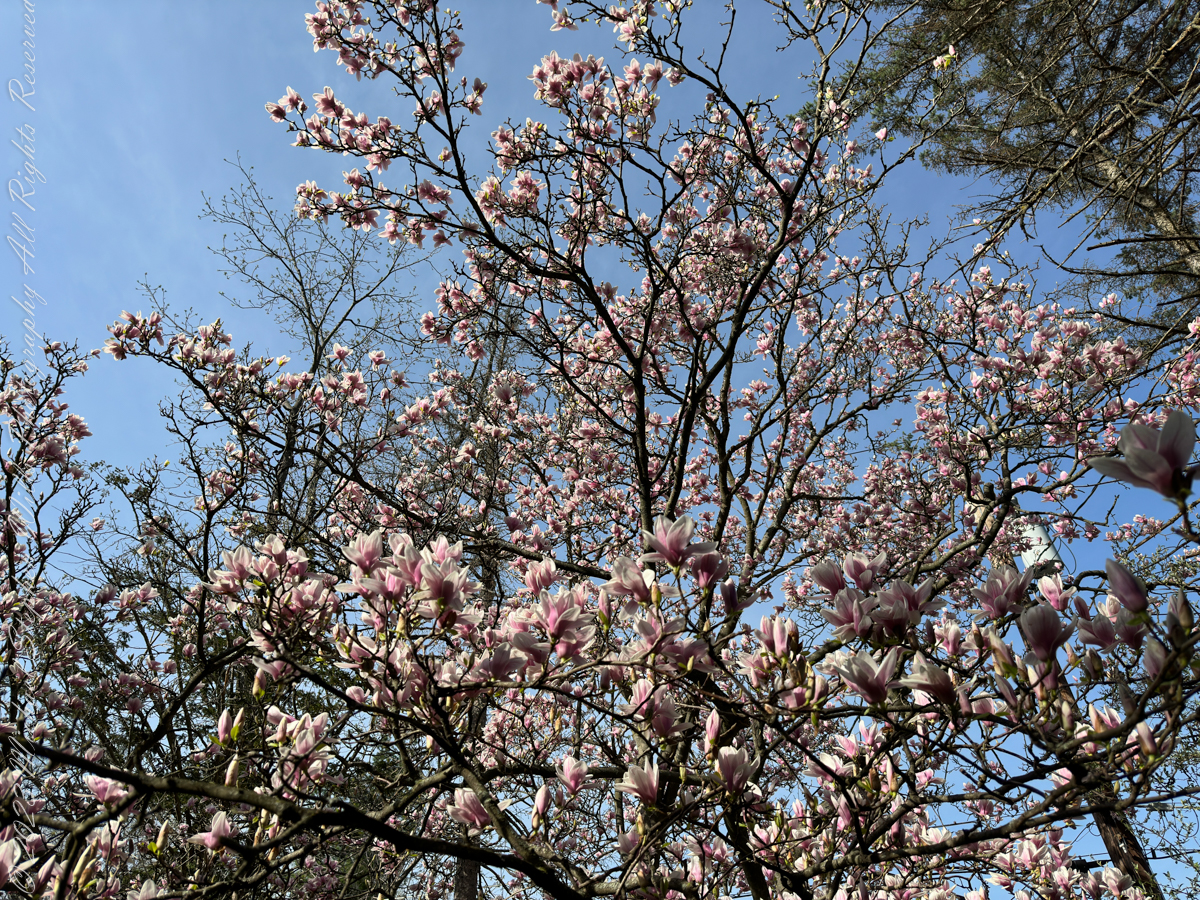
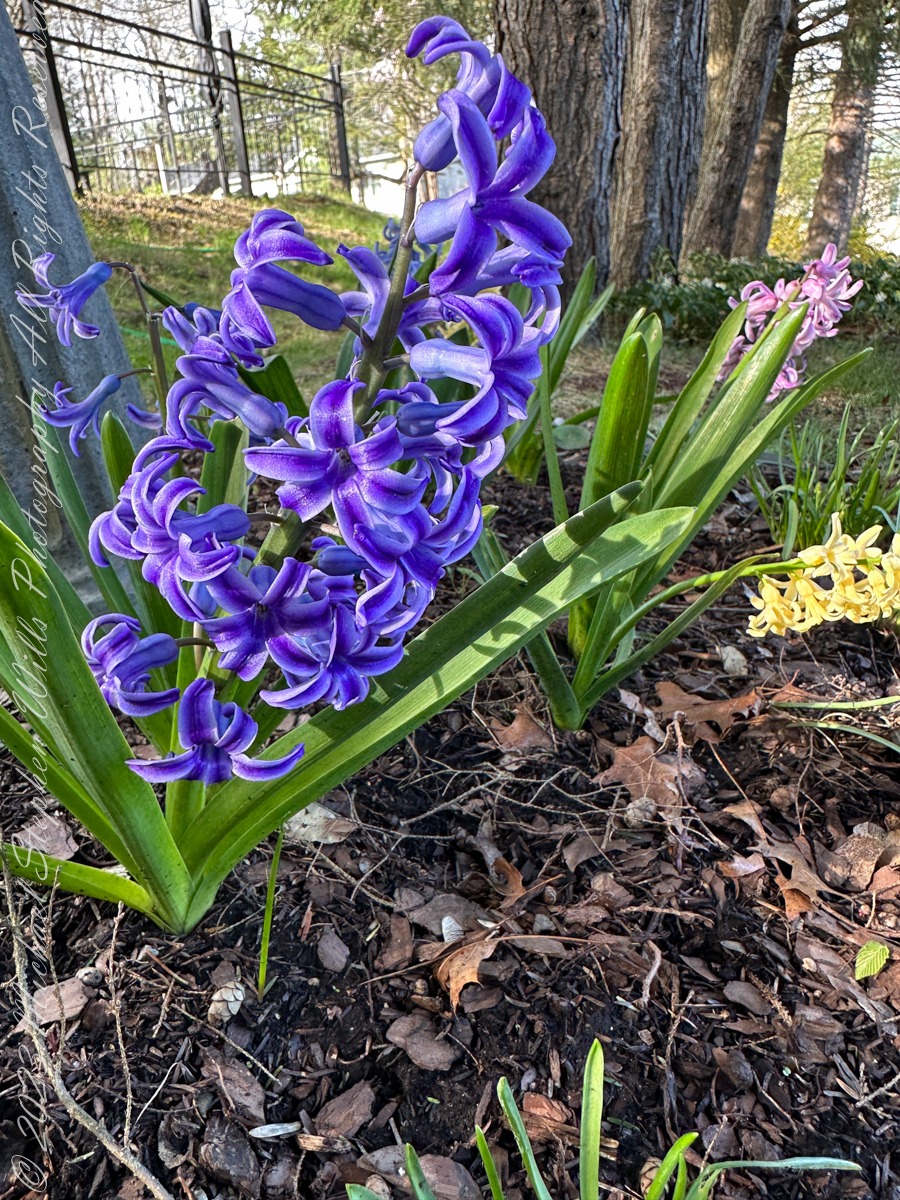
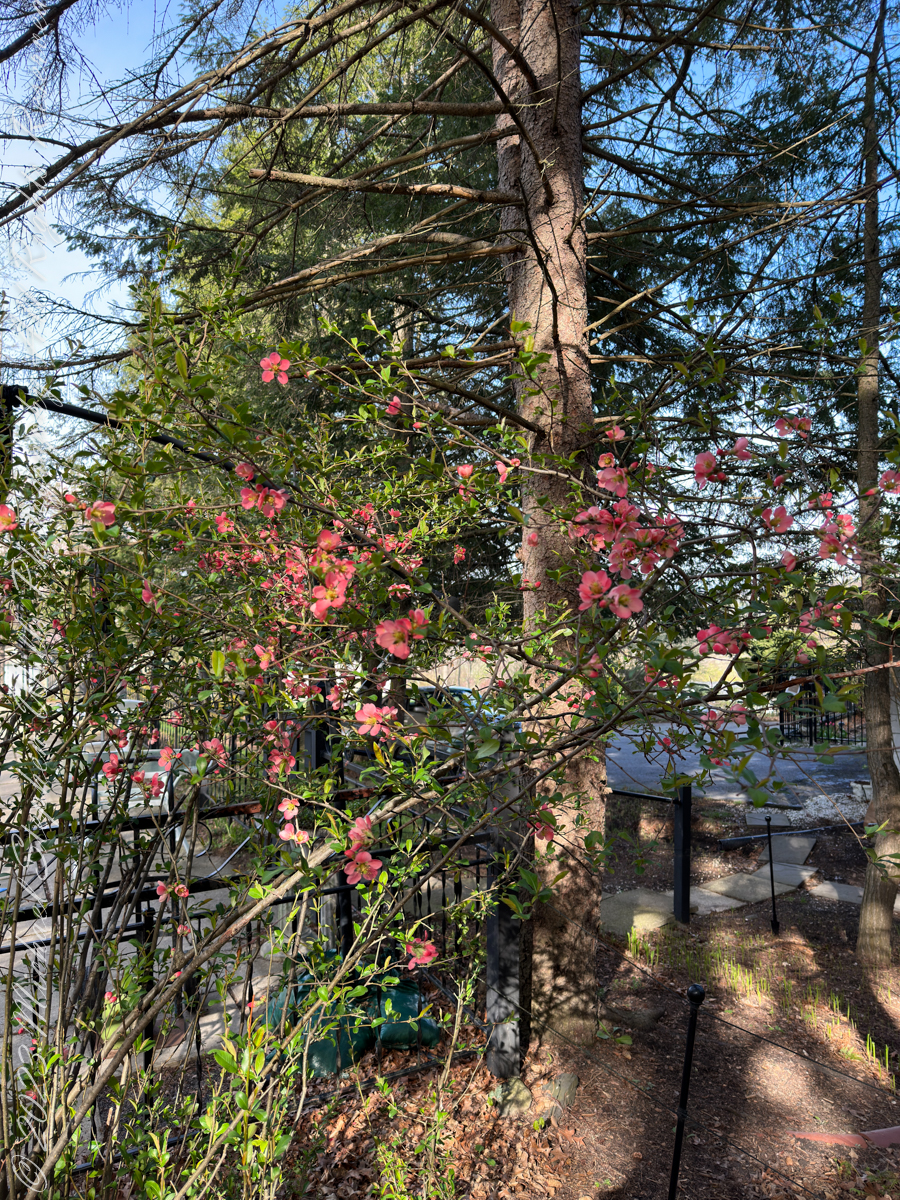
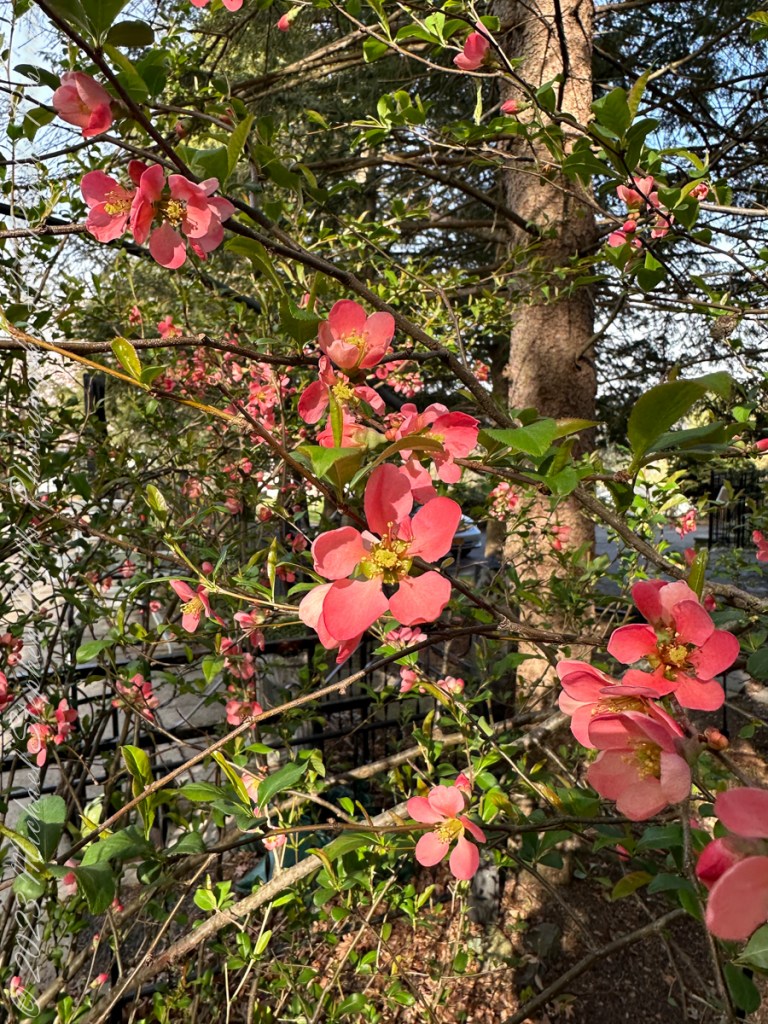
After spreading 15,000 square feet of crabcrass/fertilizer and before attending a frigid first baseball game of a grandson, I capture eight photographs of five different flowers from our home.

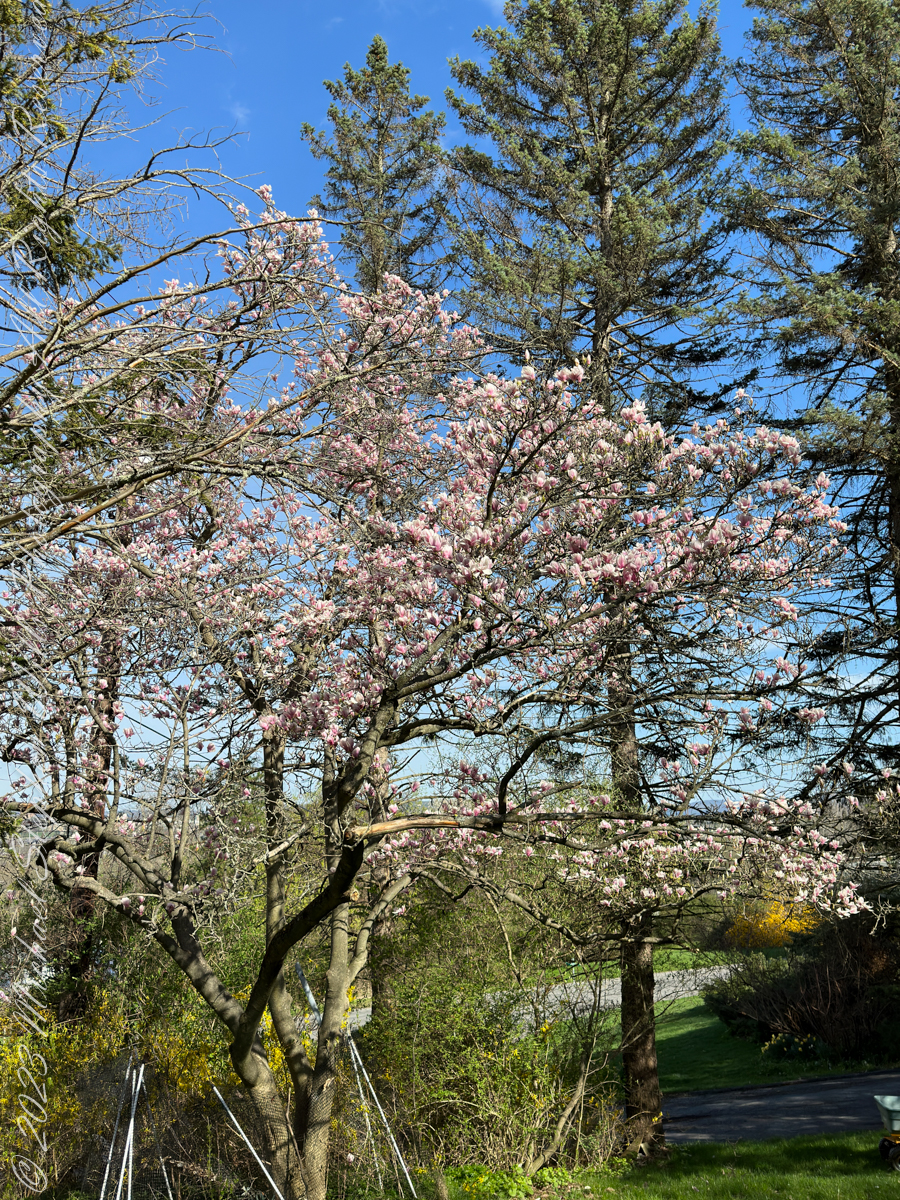
More about the Magnolia, from Wikipedia: The name Magnolia first appeared in 1703 in the Genera of Charles Plumier (1646–1704), for a flowering tree from the island of Martinique (talauma). It was named after the French botanist Pierre Magnol.

More about the Hydrangea, from Wikipedia: Hydrangea is derived from Greek and means ‘water vessel’ (from ὕδωρ húdōr “water” + ἄγγος ángos or αγγεῖον angeîon “vessel”), in reference to the shape of its seed capsules.

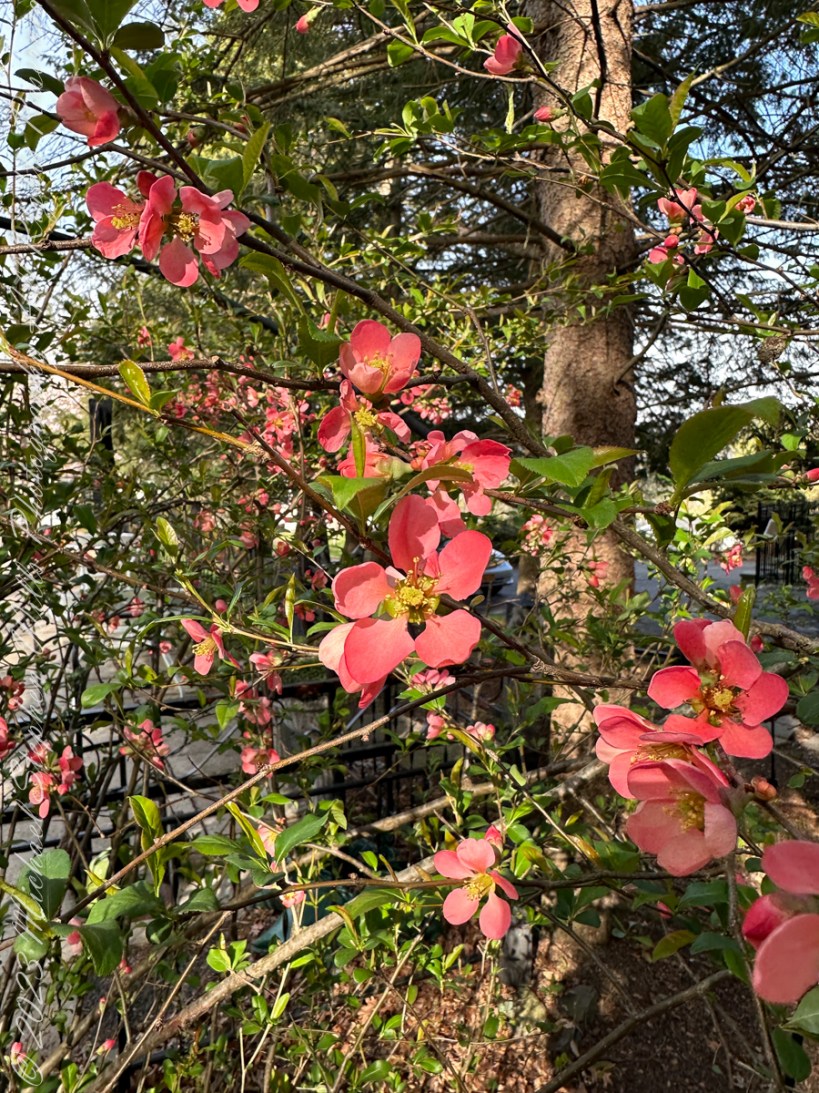
More about these Quince, from Wikipedia: Although all quince species have flowers, gardeners in the West often refer to these species as “flowering quince”, since Chaenomeles are grown ornamentally for their flowers, not for their fruits.

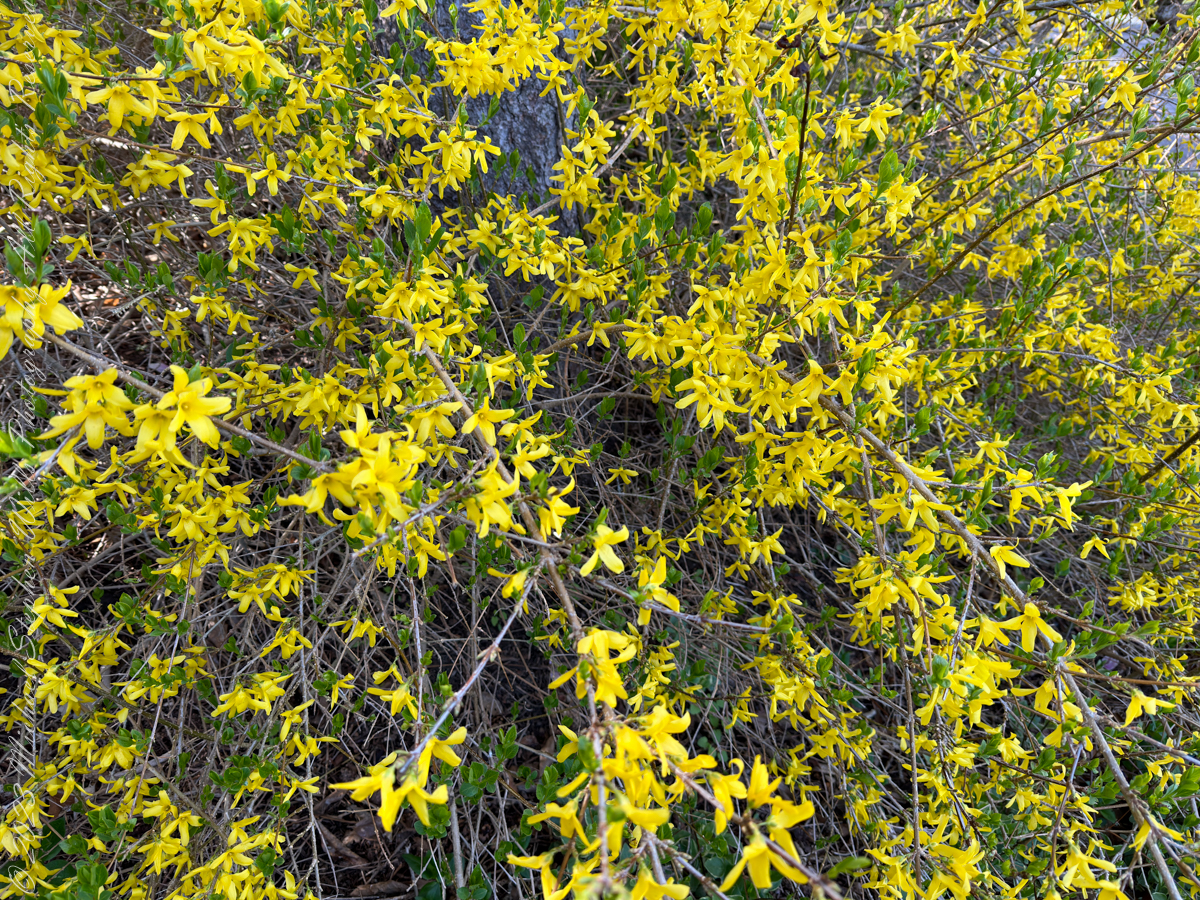
More about Forsythia, from Wikipedia: The genus is named after William Forsyth (1737–1804), a Scottish botanist who was a royal head gardener and a founding member of the Royal Horticultural Society.

More about Forsythia, from Wikipedia: Narcissus is a genus of predominantly spring flowering perennial plants of the amaryllis family, Amaryllidaceae. Various common names including daffodil, narcissus, and jonquil are used to describe all or some members of the genus. Narcissus has conspicuous flowers with six petal-like tepals surmounted by a cup- or trumpet-shaped corona. The flowers are generally white and yellow (also orange or pink in garden varieties), with either uniform or contrasting colored tepals and corona.

Copyright 2023 Michael Stephen Wills All Rights Reserved

Long Island Sakura (Cherry Blossoms)

Clouds of Blossoms

A Japanese flowering cherry tree in bloom on an early May day. Called a Shirofugen (Secientific name: Prunue serrulata, of the Rosaceae family this is the species planted around National Tidal Basin, Washington D.C. and around which the National Cherry Blossom Festival is celebrated commemorating the 1912 gift of Prunus serrulata Japanese cherry trees from Tokyo to the city of Washington.

The tree over Pam is called a Shirofugen (Scientific name: Prunus serrulata, of the Rosaceae family) and is one species planted around National Tidal Basin, Washington D.C. Shirofugen blossoms are described “Flowers double, deep pink at first, fading to pale pink.”


Click any photograph for my Getty portfolio.Pam with a Shirofugen Flowering Cherry in bloom – CLICK ME for my Getty Portfolio.
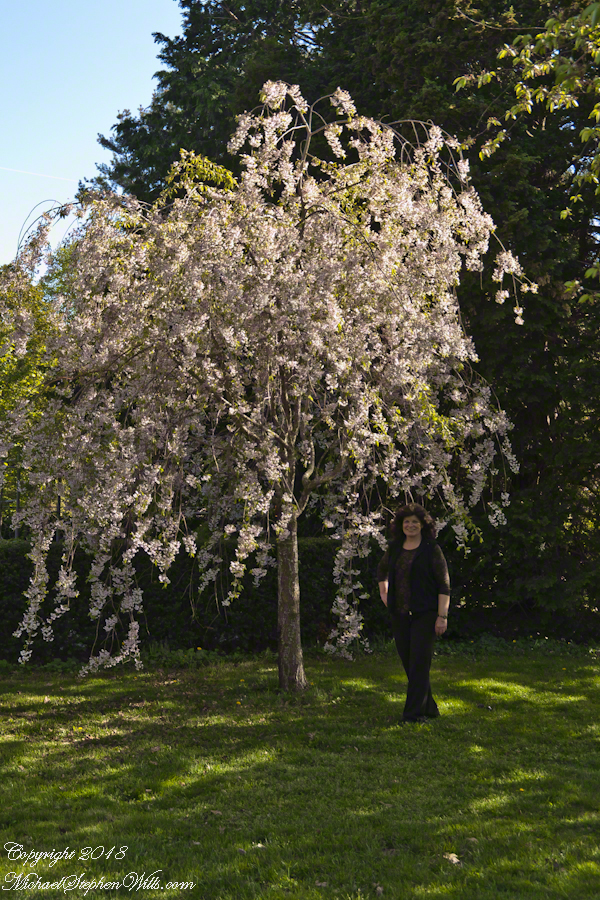
In Japan, since the 8th century, “Hanami” is the centuries-old practice of picnicking under a blooming sakura or ume tree. Here in the United States, the National Cherry Blossom Festival is celebrated commemorating the 1912 gift of Prunus serrulata Japanese cherry trees from Tokyo to the city of Washington.

Traditionally cherry blossoms remind the Japanese of clouds, the blooms come out en mass, the tree changes shape with the breeze.  Viewing sakura brings to mind thoughts of the transience of existence, the fragility and transience of the exquisite blooms leads one to appreciate the moment.  The following photograph of Pam was taken a month before my Mother’s sudden decline and passing in 2013.  We’d travel to Long Island several times a year to visit her, then take in familiar sights.

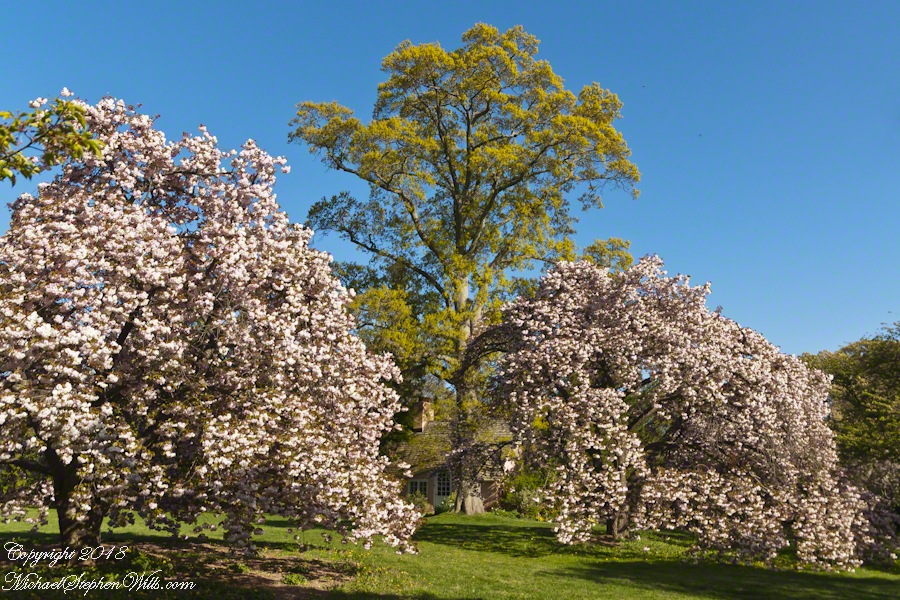
Growing up, our family visited the Planting Fields, a state park, several times in the spring and summer. As an adult with a growing family in Glen Cove, right around the corner, the Planting Fields were a welcome outing and visited several time times a year. The following photograph, taken that same May 2013 day, was a favorite park scene.

The two flowering cherry trees in the foreground are a type of Japanese sakura called Yoshino, one the most popular flowering cherries in temperate climates worldwide. All Yoshinos are clones from a single grafting and propagated throughout the world. The scientific name outlines the cross breeding of this variety, Prunus X Yeaoensis. Behind the cherries is an Oak tree, new leaves a bright green, and a pink child’s playhouse cottage.

A changing scene of the park is the now frequent visits by wedding parties and photographers, groups of Asian people, the bride and groom posing under the clouds of blossoms. By frequent I mean a steady stream, one after the other, when the blossoms are full.

Click any photograph for my Getty portfolio.Playhouse with Flowering Cherry and Oak trees – CLICK ME for my Getty Portfolio.
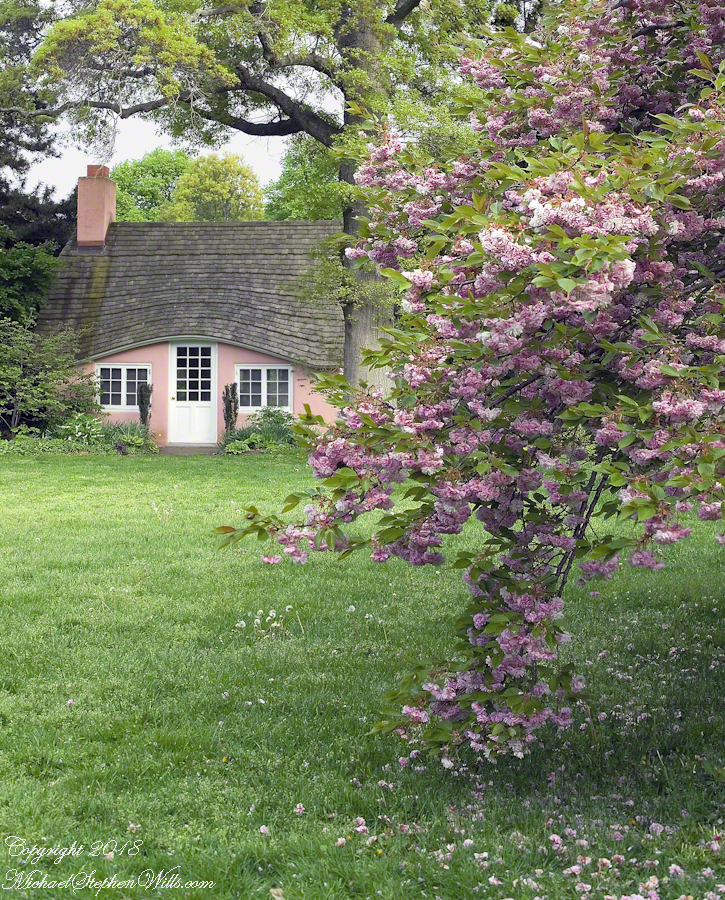
In 2007 I spent hours framing and capturing the following photograph on a Saturday, the day before Mother’s Day, during a visit to my Mother, who was widowed December, 1995. I used an inexpensive tripod, a Kodak DCS Pro slr/c camera body with the Canon 50mm f 1.4 USM lens, a UV filter and lots of time. There were no interruptions that day, at 5:30 pm I had the area to myself.

This child’s garden playhouse, framed by an ancient oak, pink Japanese cherry blossoms and gracious lawn was awarded a Photographic Society of American, Pictorial Print Division, Print of the Month award, published in the society magazine for that month.

Click any photograph for my Getty portfolio.Playhouse – CLICK ME for my Getty Portfolio.
Please browse my reasonably priced stock photography.  License a photograph, download and use it for your website or blog.  Click this link to browse all my Getty IStock Photography offerings.

Or click this link to purchase a print of “Playhouse” with optional custom framing from my Fine Art Gallery.

Copyright 2023 Michael Stephen Wills All Rights Reserved
Pam Wills at Loughcrew, County Meath, Ireland

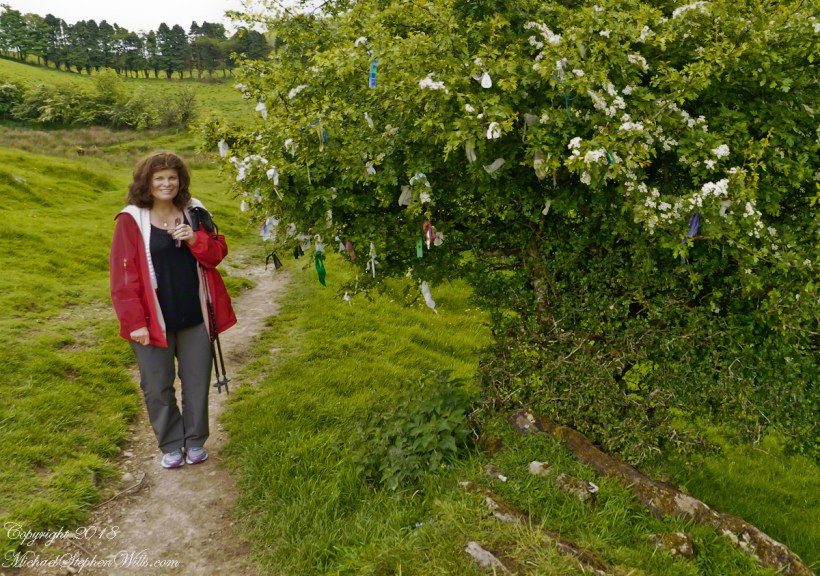
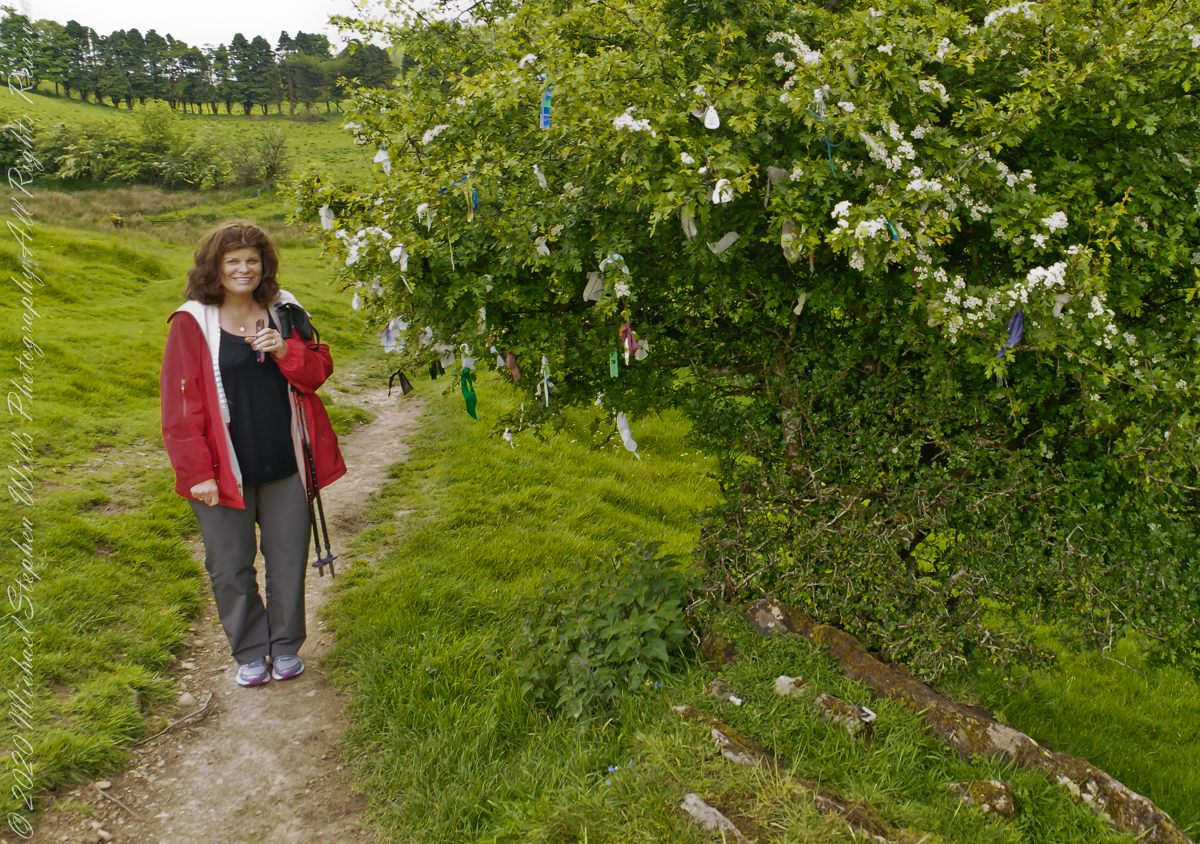
Pam and I were lucky enough to plan our tour of Ireland for May and June when the Hawthorne trees are in bloom.  Named sceach gheal in Gaelic, the white clusters of blossoms symbolize hope.  Hawthorns are plentiful throughout the island.  The Irish revere the tree and associate each Hawthorn with the Little People.  There are roads in Ireland that curve around a Hawthorn tree because the local people convinced the engineers to do so, to save the tree.

This specimen, covered with offerings (to the Little People?), is on the trail to Loughcrew.  Even with her knee trouble, Pam made it to the top of the Hag’s Mountain to visit Cairn T of the Loughcrew Passage tombs.

The steep path to Loughcrew passes a hawthorn covered with flowers and may offerings.

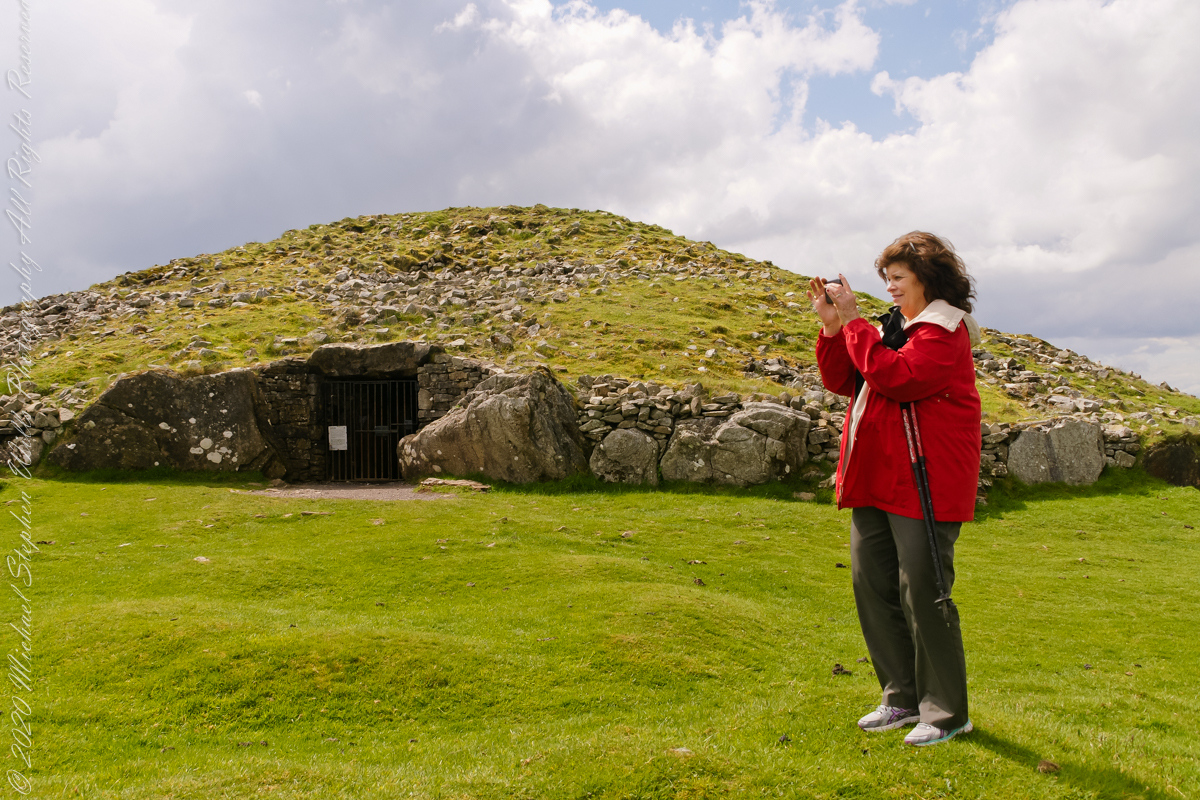
Pam loves to capture images and returned from Ireland with a large collection.  Most of the photos of me at work are by Pam.  Here Pam is capturing the summit view of Hag’s Mountain with the Cairn T entrance gate in the background.  Lucky for us, a fellow visitor made the trip to Loughcrew Gardens and picked up the  gate key from the café.  In a later post I will share my work from inside this passage tomb.

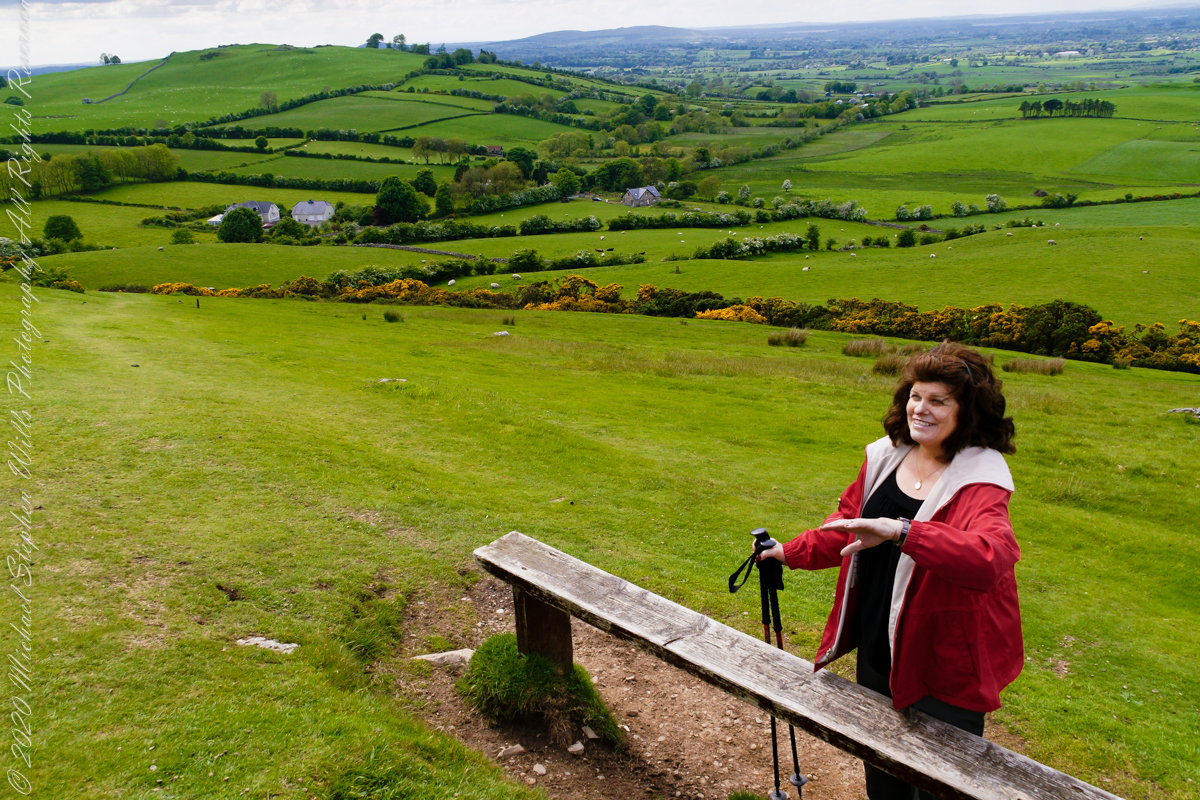
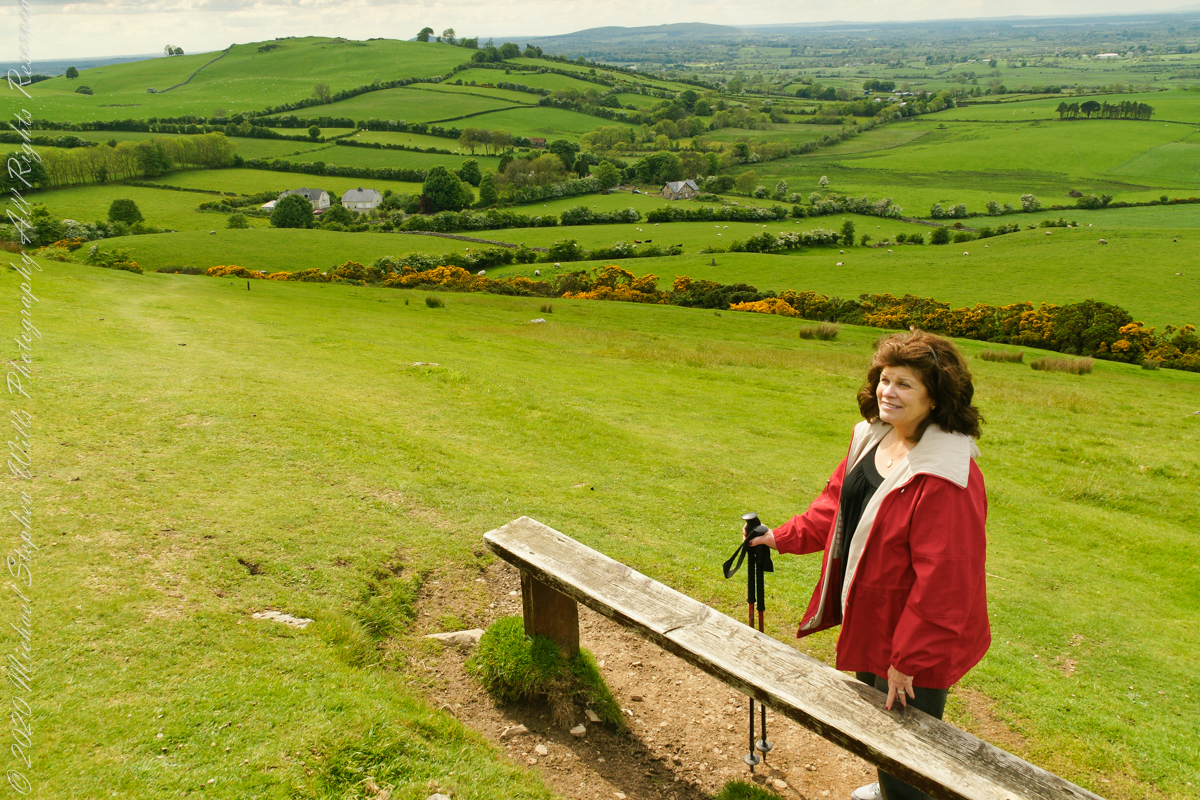
Pam makes friends wherever we go.  She started down the mountain before me to take it easy on her knees.  When I caught up, Pam and a young Irish family were deep in conversation.  I took the opportunity to capture Pam with that gorgeous view to the northwest, Irish countryside with Lake of the Branches in the far distance.

Copyright 2023 Michael Stephen Wills All Rights Reserved
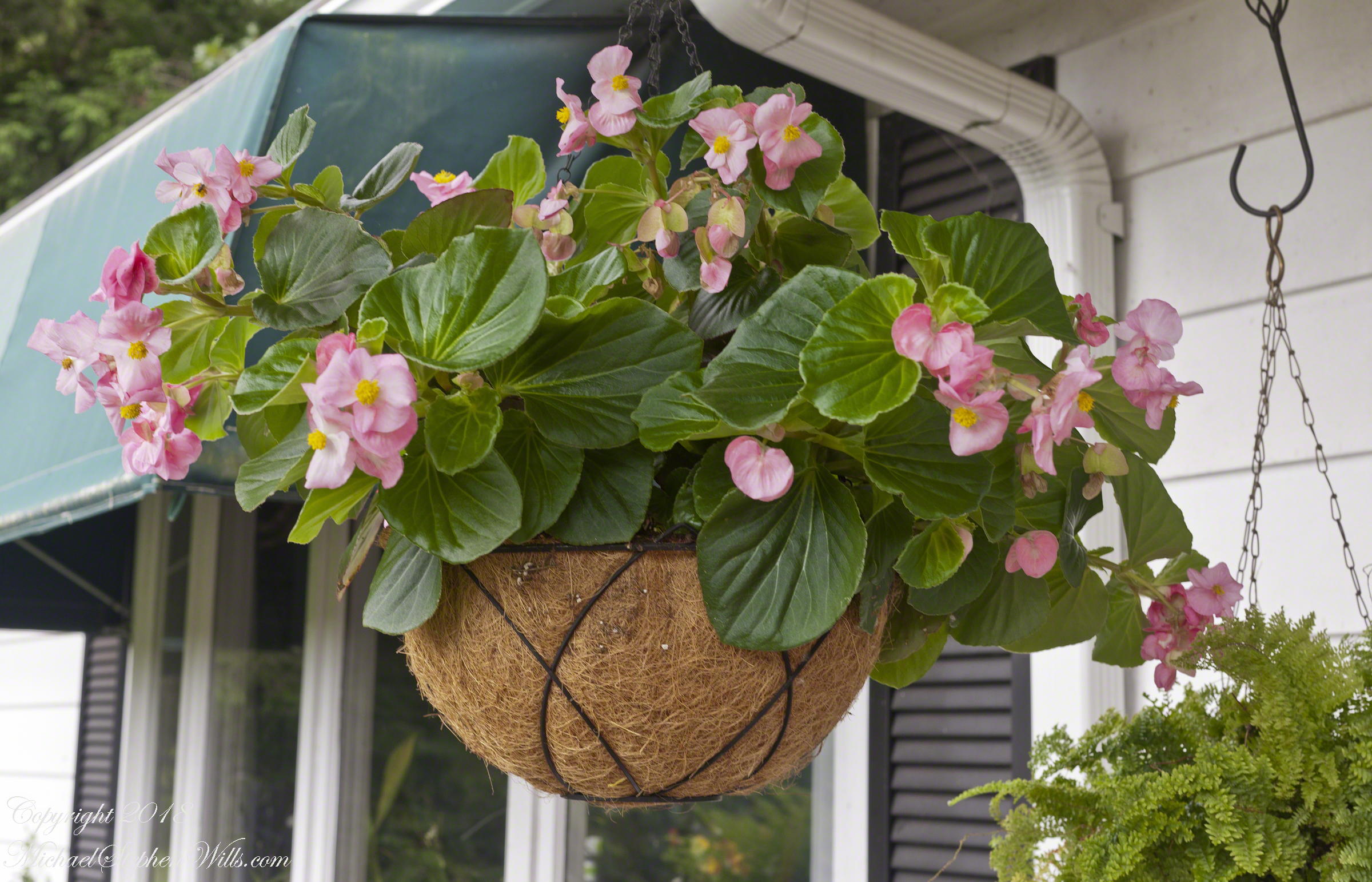
Pam’s Begonia Basket

small, unloved, on clearance

Once a year when Pam’s gardens are at a summer peak, I venture out to capture her work in early morning light. For this image I used a handheld Canon EOS 1Ds Mark III SLR with the Canon lens EF 50mm f 1.2L USM. This is the fifth post of this series.

Click photograph for a larger view.

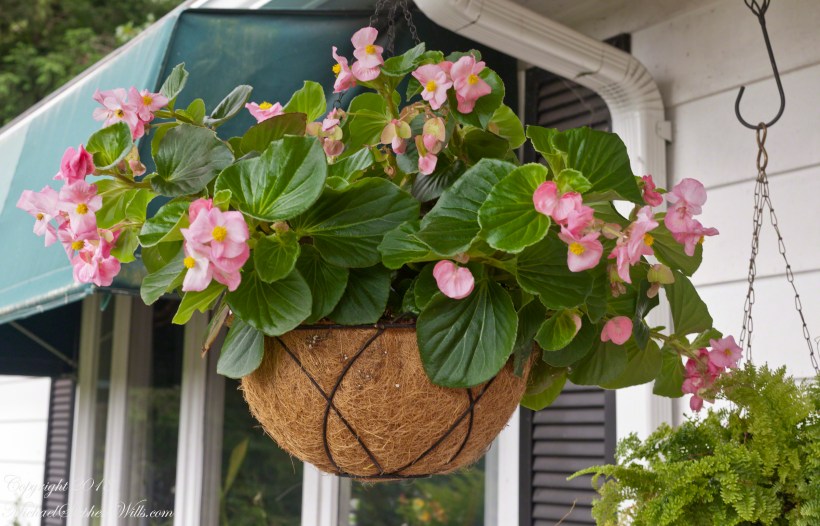
Pam’s gorgeous Begonia Grandis hanging baskets had a humble beginning. Not quite born in a log cabin, our local Aldi was the beginning where Pam saw sad little $3.00 potted begonia’s, on clearance, that needed a home. Cherished through the late frosts of May, carefully watered, placed in the perfect light, it was no accident these are so……perfect.

One strange fact, I have not witnessed a single honey bee harvesting these blooms.

I used three Canon lenses in the course of these five posts. This lens is a portrait lens. I used a large format image for this post, enjoy!!

Copyright 2022 Michael Stephen Wills All Rights Reserved
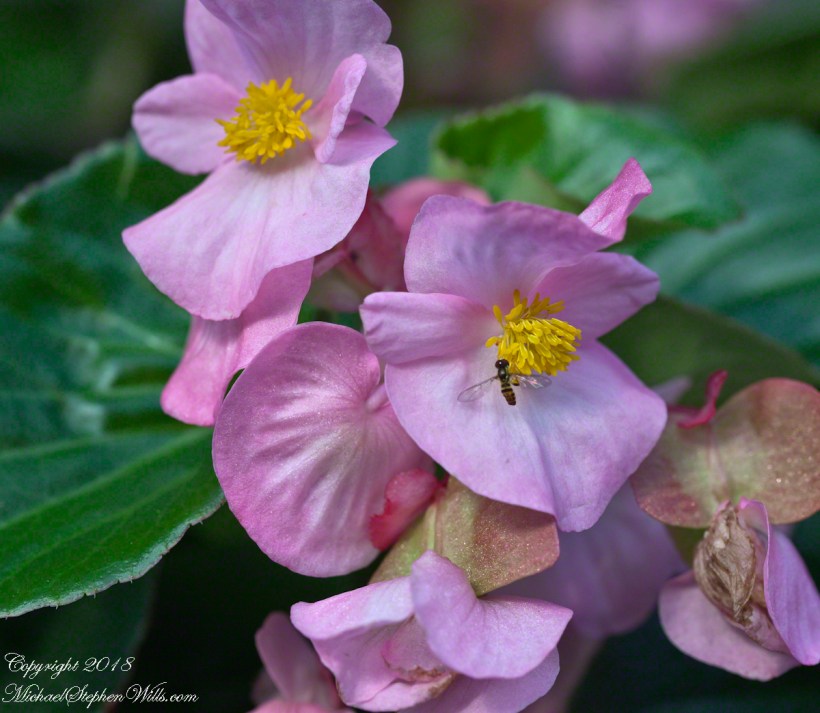
Iridescence and Impostors

“Here I Am”

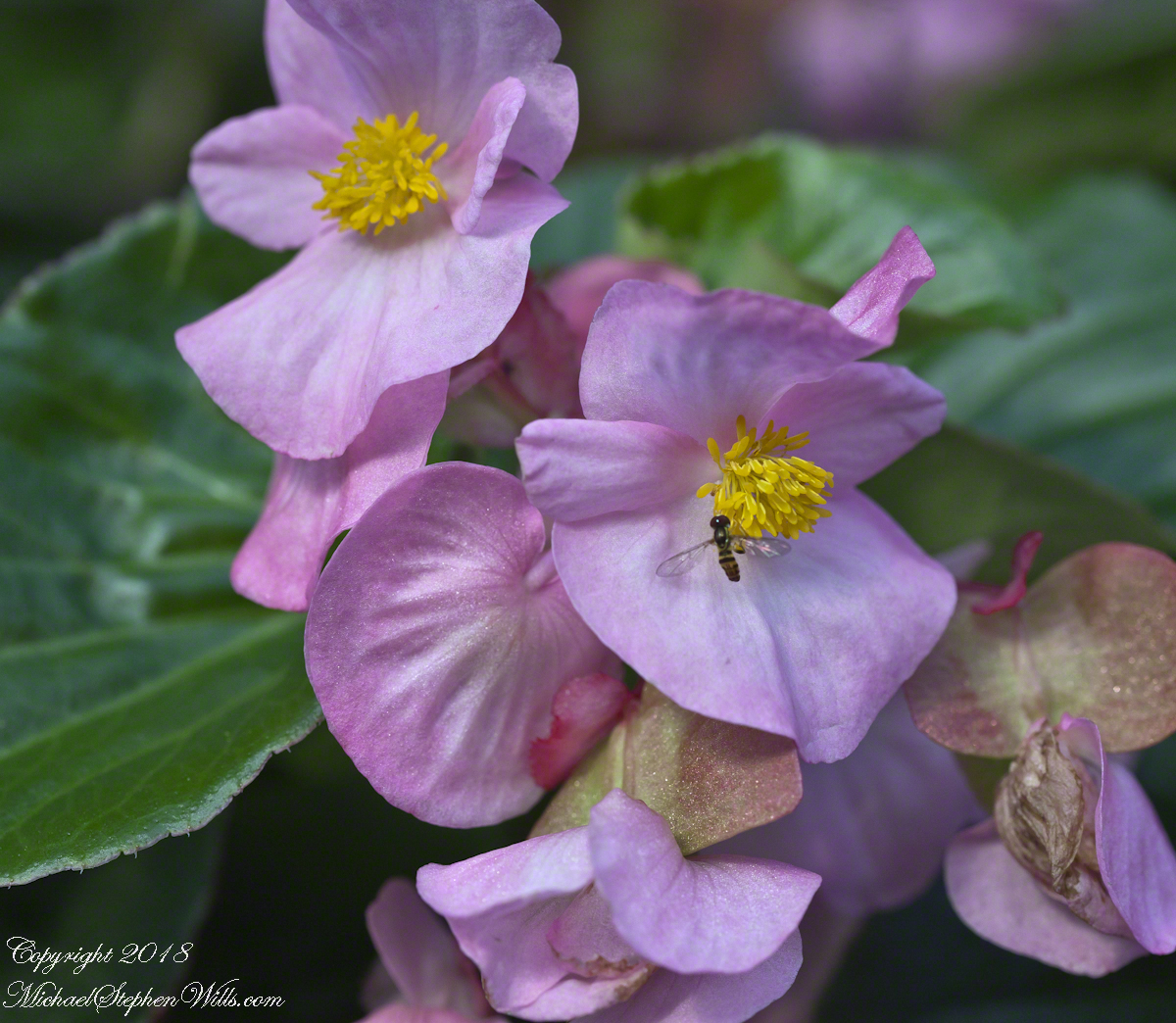
Once a year when Pam’s gardens are at a summer peak, I venture out to capture her work in early morning light. For this fourth image of the begonia series, I used the same handheld Canon EOS 1Ds Mark III SLR but with the Canon lens EF 100 mm f 2.8L IS USM variable lens.

Click photograph for a larger view.

Tiny Mirrors

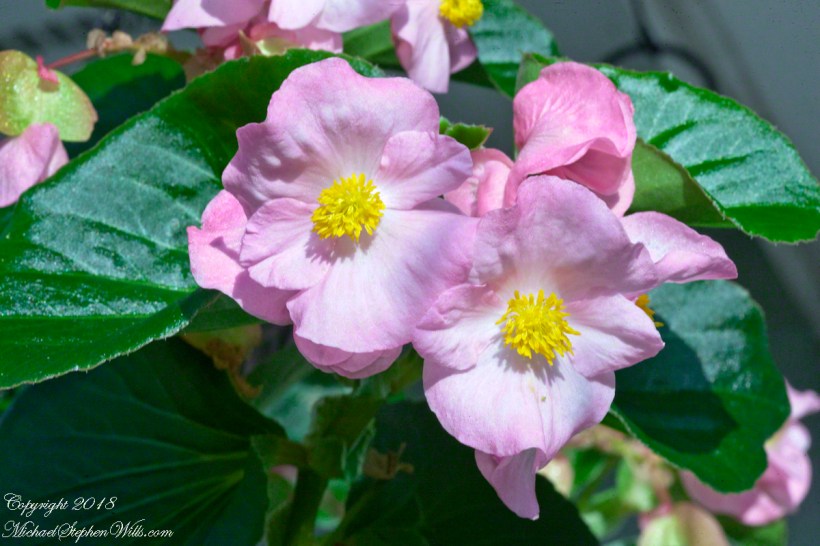
Begonia flowers have no petals. The colorful structures surrounding the male and female parts are the structure in many flowers, such as roses, that lay beneath the flower petals and are green are called the sepal. These are the cover protecting the flower as a bud and, when open, can provide support. In begonias it is the entire flower and it glows.

The angle of morning light in today’s macro captures the reflections of thousands of tiny mirrors in the flowers, more noticeable in the darker undersides. Also present is a subtle iridescence, a shiny surface imparting, in this begonia, slight color changes. These are signals to the pollinators, “Here I am — this is delicious.” Also, in low light tropical environments iridescence can enhance light gathering of leaves.

Hoverfly

Woodland sunbeams are special places where I first noticed hoverflies, they have a behavior of staying motionless, beating wings a blur, in sunlight making its way to the forest floor. It was only after the fact, in the virtual darkroom of Lightroom, I noticed the tiny creature in today’s photograph.

On a quick look, it appears to be a yellow jacket, a type of wasp. Look closely and you will see the eyes are on the top of the head and touch in places. The wings stand perpendicular to the thorax, wasp wings fold along the thorax and abdomen and there are differences in the veining of the wings. The identify of this creature is a beneficial fly, a hoverfly, genus Episyrphus. The shiny black shield on the upper thorax suggests to me this is a Episyrphus viridaureus.

This fly is beneficial to humans in two ways. One we observe in the photograph, as flower pollination. It is one of the few flies with mandibles capable of crushing pollen grains and, in the course of feeding, some pollen clings to the fly to be transported flower to flower. The second benefit is less obvious. The larval form is a predator of aphids. After feeding, it transforms into a resting state, called diapause and survives the winter this way.

Human beings suppose the benefit of looking like a wasp is protection against predators who fear being stung, increasing survival of the individual.

The lens is designed for macro work and is a fixed focus, it can capture small details without needed to be close to the subject. I decided to crop the image down to emphasize the hoverfly. It was in writing this post I noticed the sepal iridescence.

Copyright 2022 Michael Stephen Wills All Rights Reserved
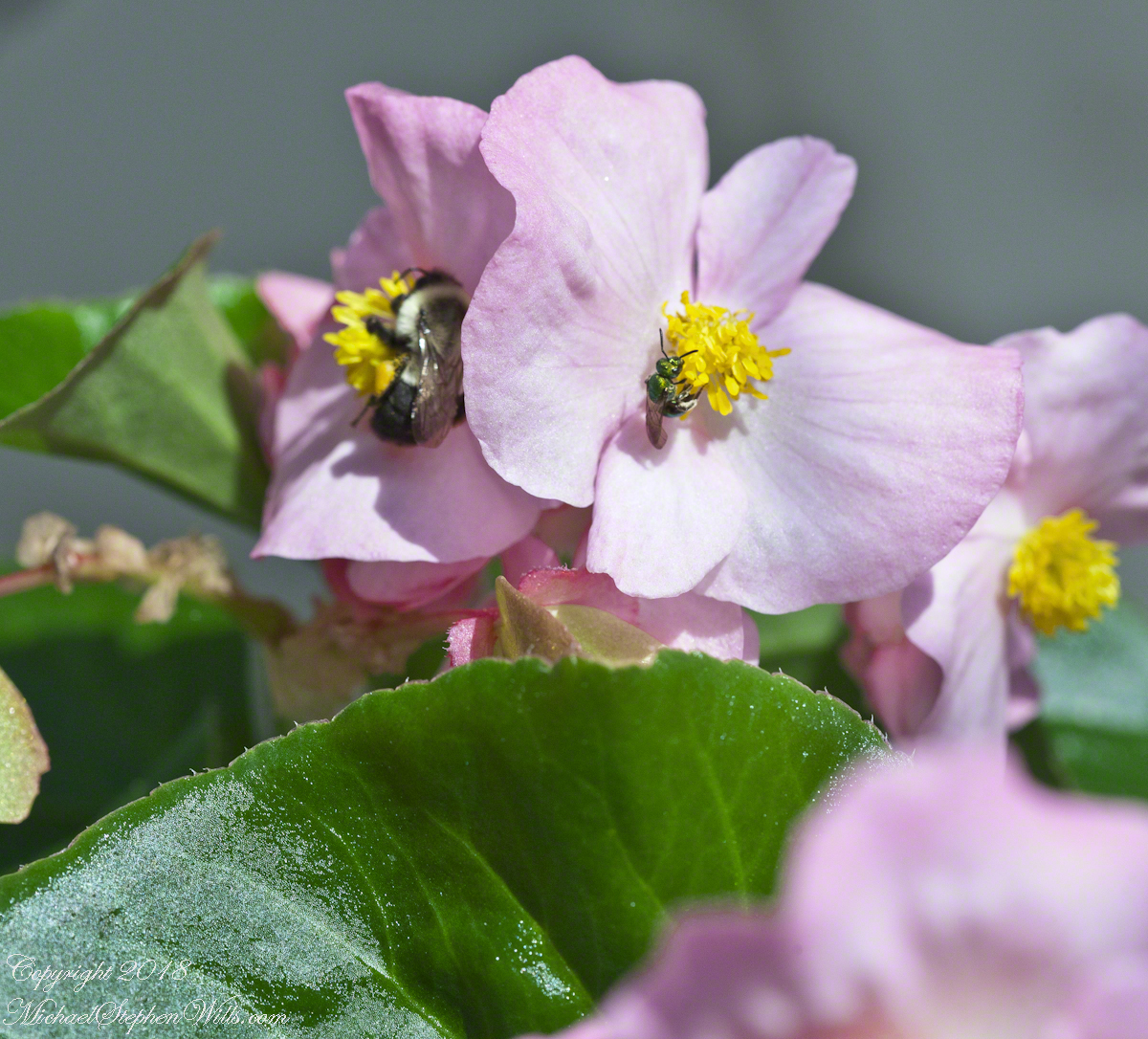
Begonia Flowers and a Sweat Bee

shiny, bright green tiny bee

Once a year when Pam’s gardens are at a summer peak I venture out to capture her work in early morning light. For this third image of the begonia series I used the same handheld Canon EOS 1Ds Mark III SLR but with the Canon lens EF 100 mm f 2.8L IS USM variable lens. Click me for the first post, “Begonia Grandis.”

Click photograph for a larger view.

Sweat Bee!!

The bee on the right, in sharp focus, was a puzzle to me. I am familiar with it, they are very common around here, and striking with a bright green shiny thorax. For this post I decided to identify it.

After thirty minutes of poking around I found a list of New York Wild bees on the Cornell CALS (College of Agriculture and Life Sciences) site. It is in the form of an excel spreadsheet and very helpful. There are over 400 species listed. Using the “filter” feature I found the six families and, for each, did a web search. I am 98% sure this bee is in the family Halictidae, known as “sweat bees,” being attracted to the salt of perspiration they use for nutrition.

Next I looked as the first name in the species designation within the family Halictidae. Tjhis is the genus. There were not many, in a few minutes singling out Agapostemon, known as the “metallic green sweat bee.” I did not find it necessary to hone in on the exact species as members of the genus Agapostemon have defining characteristics.

There are four species listed on the Cornell CALS spreadsheet, all are ground nesting and solitary. Sweat bees are useful as crop pollinators. In Texas they can replace honeybees for pollination of cotton.

Agapostemon sericeus
Agapostemon splendens
Agapostemon texanus
Agapostemon virescens

The lens is designed for macro work and is a fixed focus, it can capture small details without needed to be close to the subject. I decided to crop the image down to emphasize the bees. The sharper focus is on the sweat bee

Copyright 2022 Michael Stephen Wills All Rights Reserved
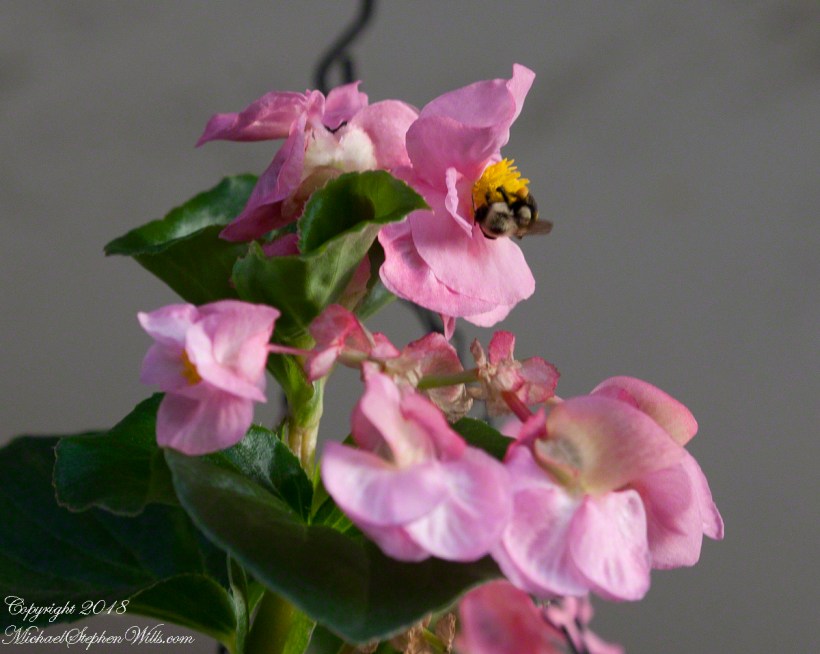
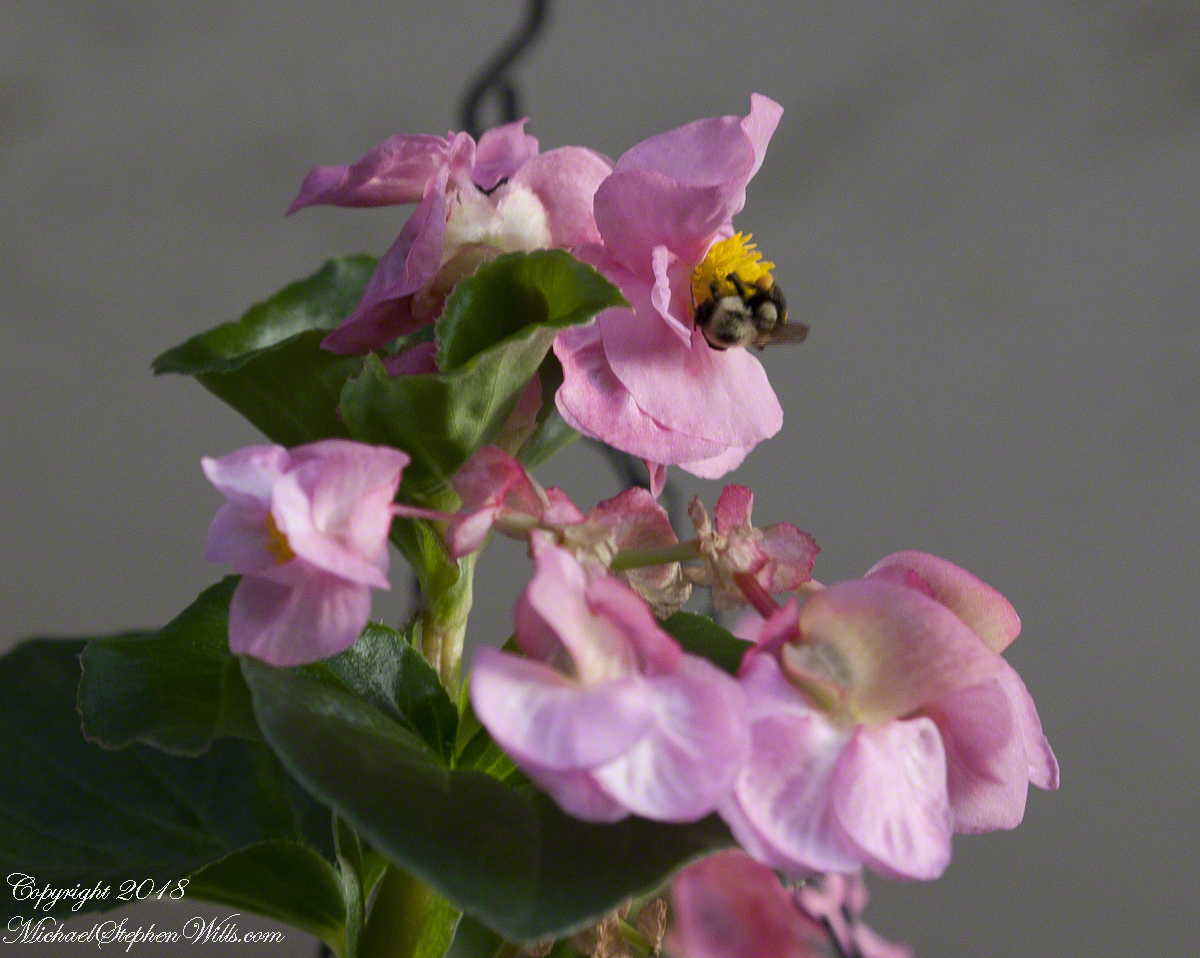
Bumblebees and Begonia Flowers

early morning light

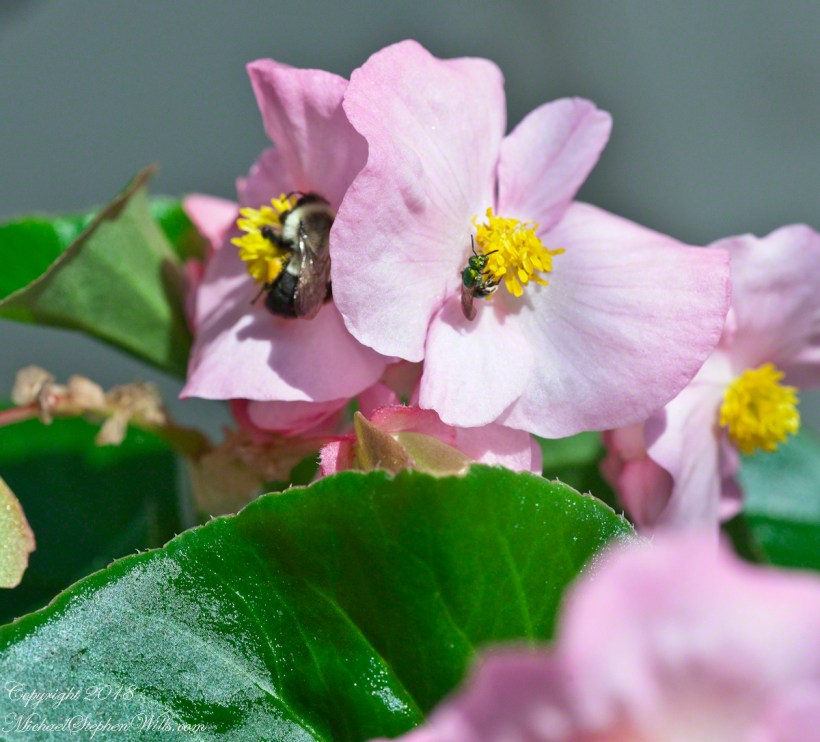
Once a year when Pam’s gardens are at a summer peak, I venture out to capture her work in early morning light. For this second image of the begonia, I used the same handheld Canon EOS 1Ds Mark III SLR but with the Canon lens EF 70-300 f 4-5.6L ISM variable lens.

Click photograph for a larger view.

Bumblebees numbers will tell you if local mouse populations are under control. Mice will invade bumblebee burrows to eat the eggs and young. If the bees are plentiful, it means more are escaping mouse predation and only because mouse numbers are low.

This morning, bees of all kinds filled the begonia flowers. Bumblebees were amusing to watch enthusiastically roll around the many stamen of the male flowers, gathering as much pollen as possible.

The lens focal length is set to 84 mm to capture the entire plant, on reviewing the proofs I decided to crop the image down to emphasize the bee.

Copyright 2022 Michael Stephen Wills All Rights Reserved
Begonia Grandis

Macro!!

Once a year when Pam’s gardens are at a summer peak I venture out to capture her work in early morning light. For this image I used a handheld Canon EOS 1Ds Mark III SLR with the Canon lens EF 100 f 2.8L Macro. This is the first post of this series. Click me for “Water Lily Flower with hornet,” from my photography gallery.

Click photograph for a larger view.

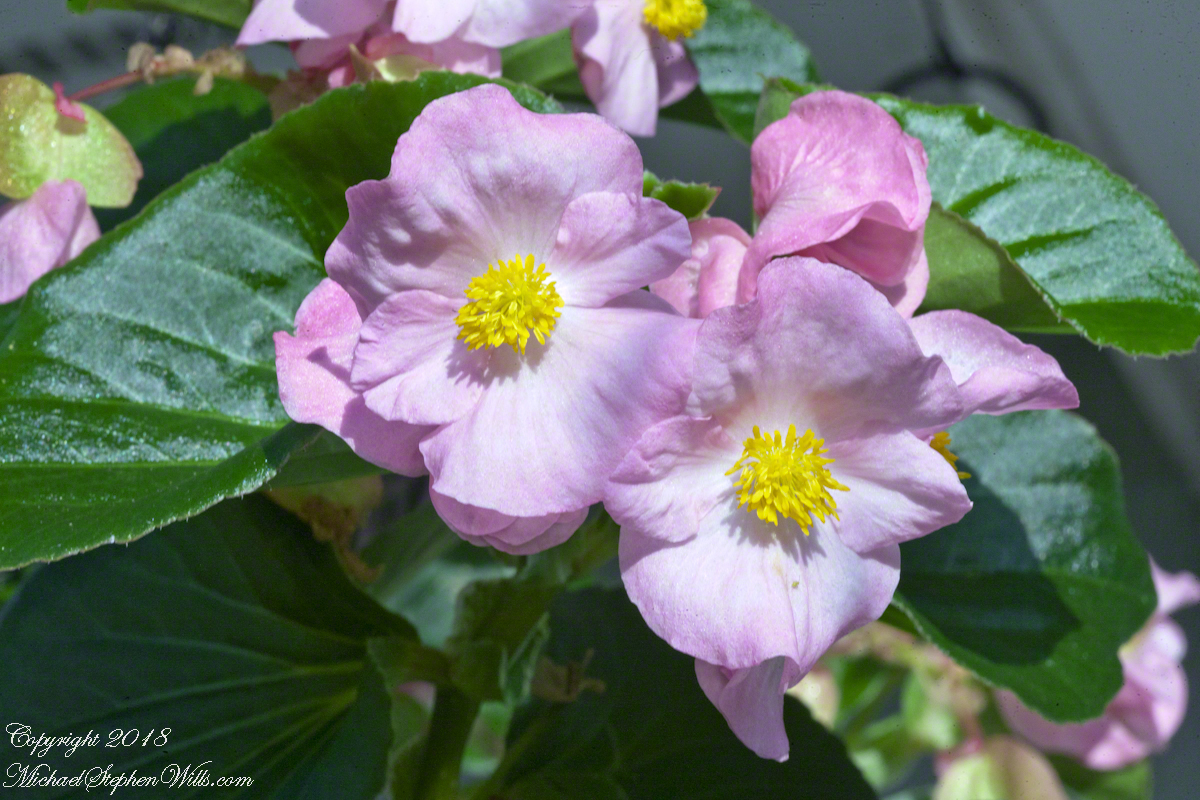
Begonia is a large genus of flowering plants, sub-tropical and tropical natives, adapted her to a hanging basket put out after the last frost, the end of May, Memorial Day, in these parts. The flowers are monoecious, both male and female unisex flowers bloom on a single plant.

Pictured are double male flowers composed entirely of stamens. This plant has a sour flavor enjoyed in parts of its range. Over consumption will produce ill effects as the tissues are high in oxalic acid, a poison to humans.

Here, the leaves and flowers glow in the gentle light of early morning.

Copyright 2022 Michael Stephen Wills All Rights Reserved
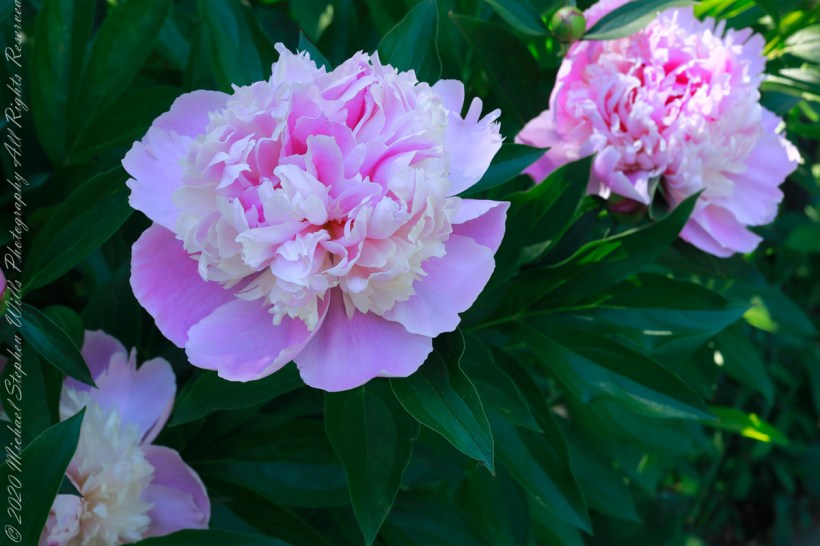
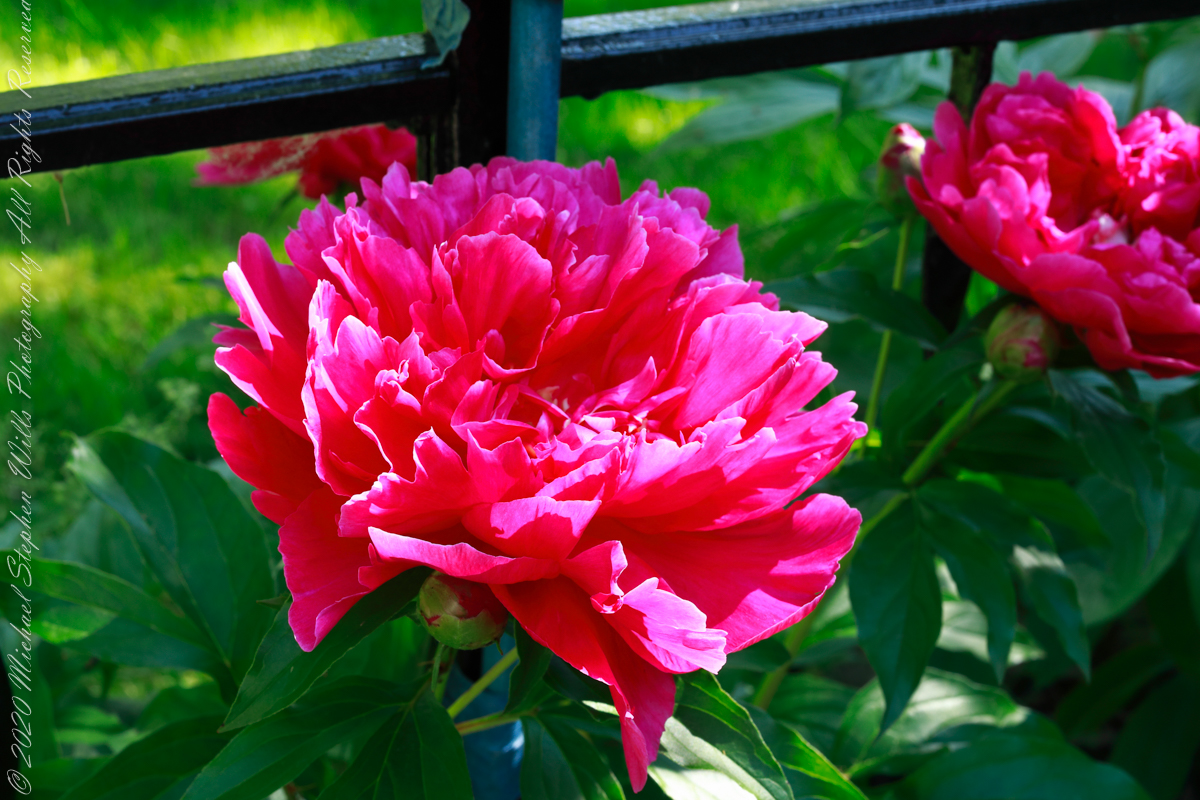
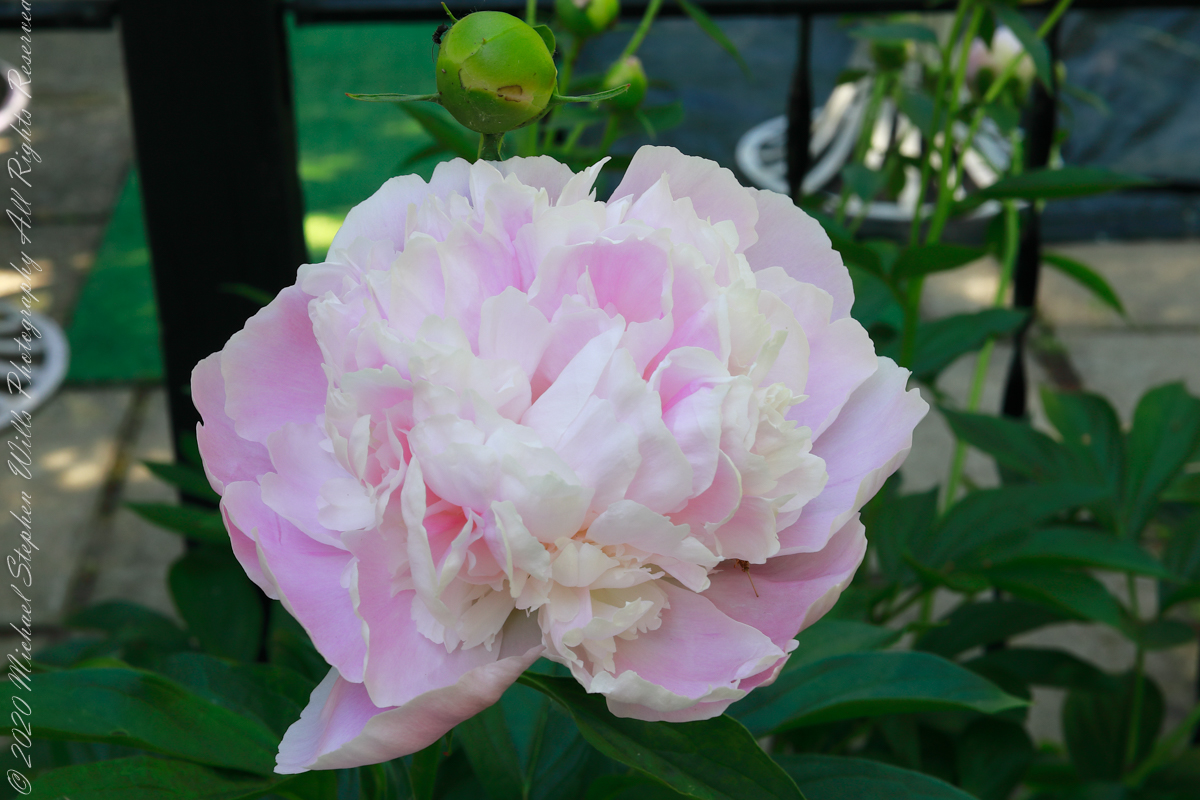
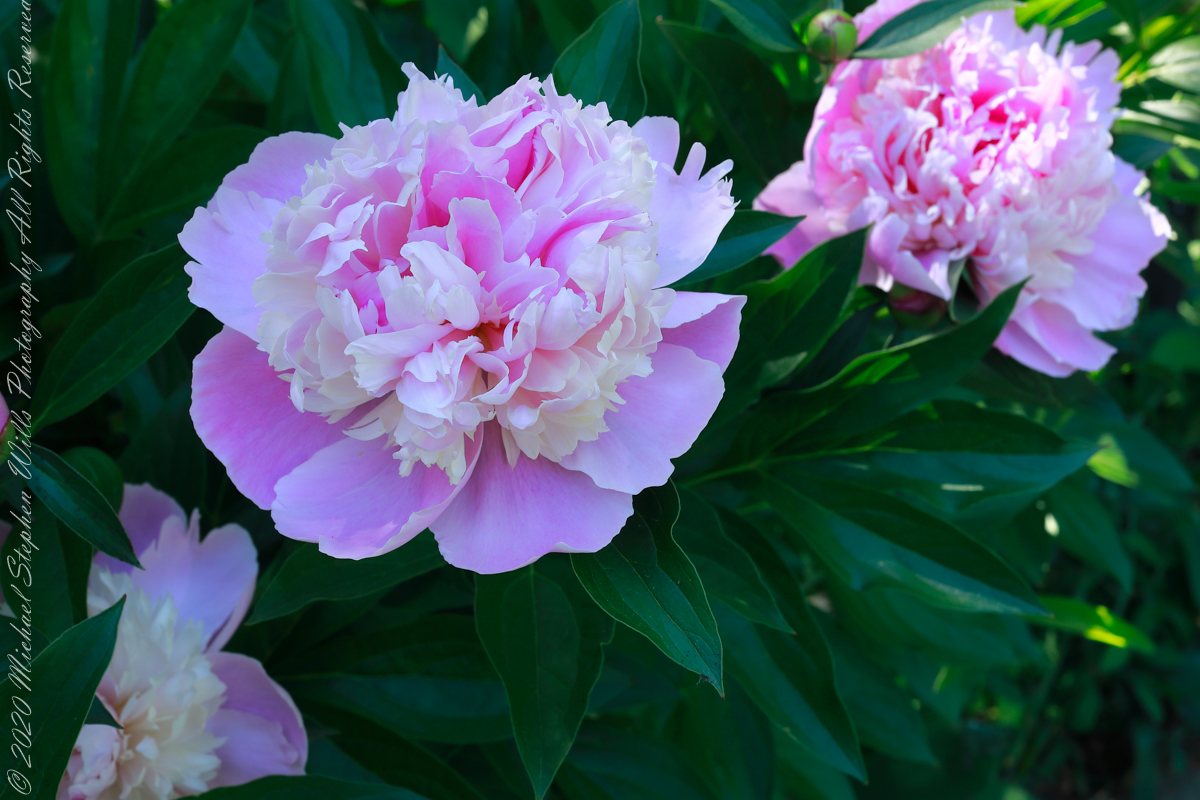
Herbaceous Peony 50 mm

Tree Peony

Peony species (scientific name Paeonia lactiflora) with plants that die back in cold weather to regrow each spring from a tuberous root are called “herbaceous,” from the latin word for grassy. The stems and branches remain soft and pliable, some stiff enough to hold the large, showy flowers. The first varieties introduced to Europe and named 1753 were white, “lactiflora” mean milk-white flower.

Reviewing my photography in preparation for this post I discovered not a single one for herbaceous peony, such was my interest in the woody varieties my in-laws planted around the property. Fortunately, they did not neglect the herbaceous varieties featured here.

These photographs were taken with a Canon EOS 5D Mark IV dslr and the Canon EF 50mm f/1.2L USM lens with a “BeFree” Manfrotto tripod with ball head. f-stop was tamped down to the maximum, f16 for this lens. Exposures were taken when the intermittent morning breeze abated.

Click any photograph for a larger view to open in new browser tab.

Paeonia lactiflora, in the family Paeoniaceae, contains around 30 species in Europe, across Asia and in western North America growing wild in scrub and woods, often in rocky places or on cliffs. Most species in Eastern Europe, others in the Caucasus, central Asia, the Himalayas, and Japan, mainly on limestone, and a species in dry parts of California.

Peonies have long been cultivated for their spectactular flowers as well as for their medicinal preoperties, particularily in China

Reference:  “The Botanical Garden” by Phillips and Rix, Volume I (2002, Firefly Books, Buffalo, New York and Willowdale, Ontario

Copyright 2022 All Rights Reserved Michael Stephen Wills
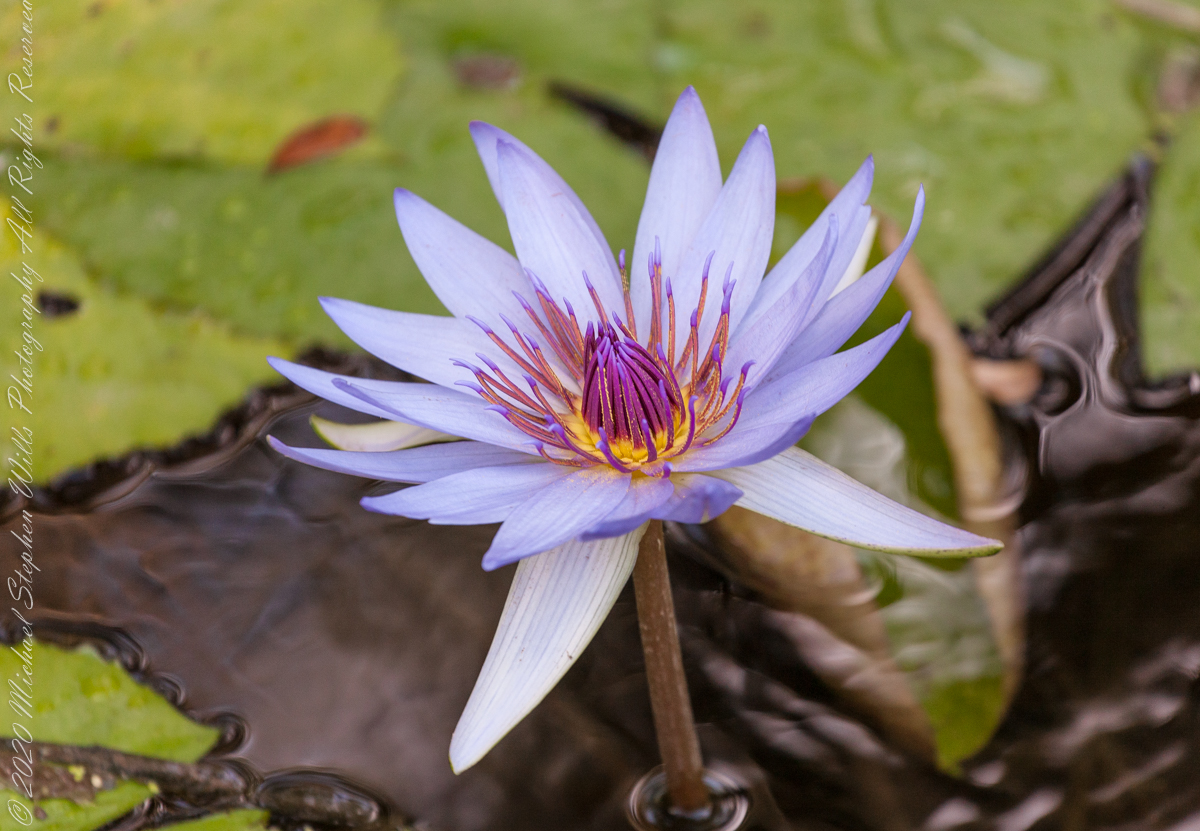
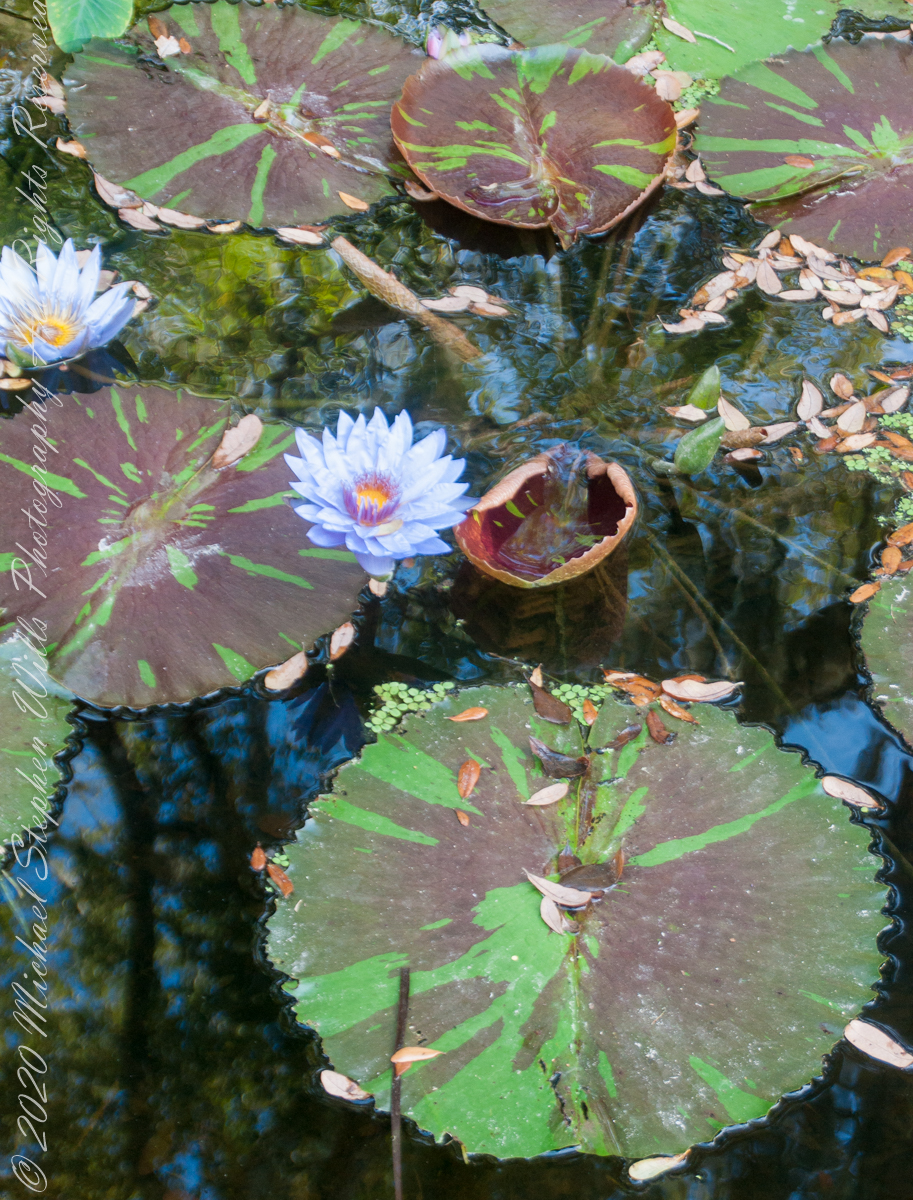
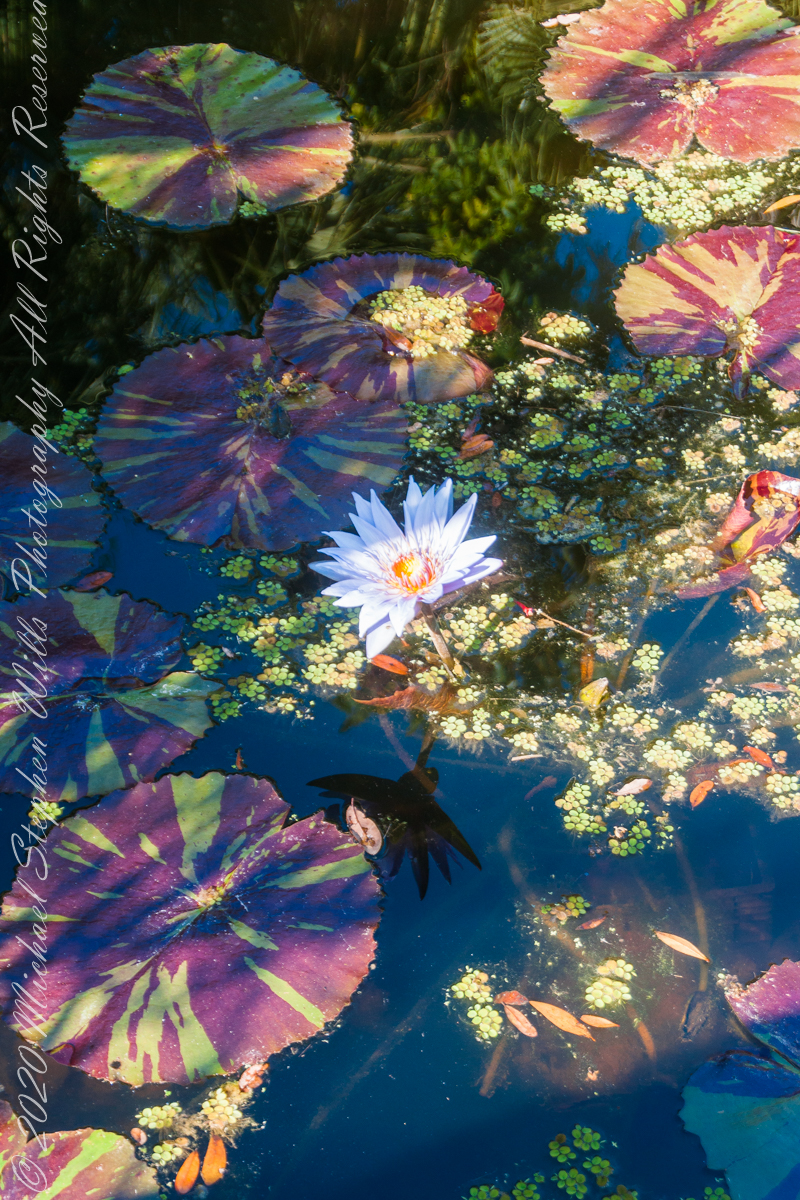
The Waterlily Genus Nymphaea

Congrats to all fathers and grandfathers, Happy Fathers Day

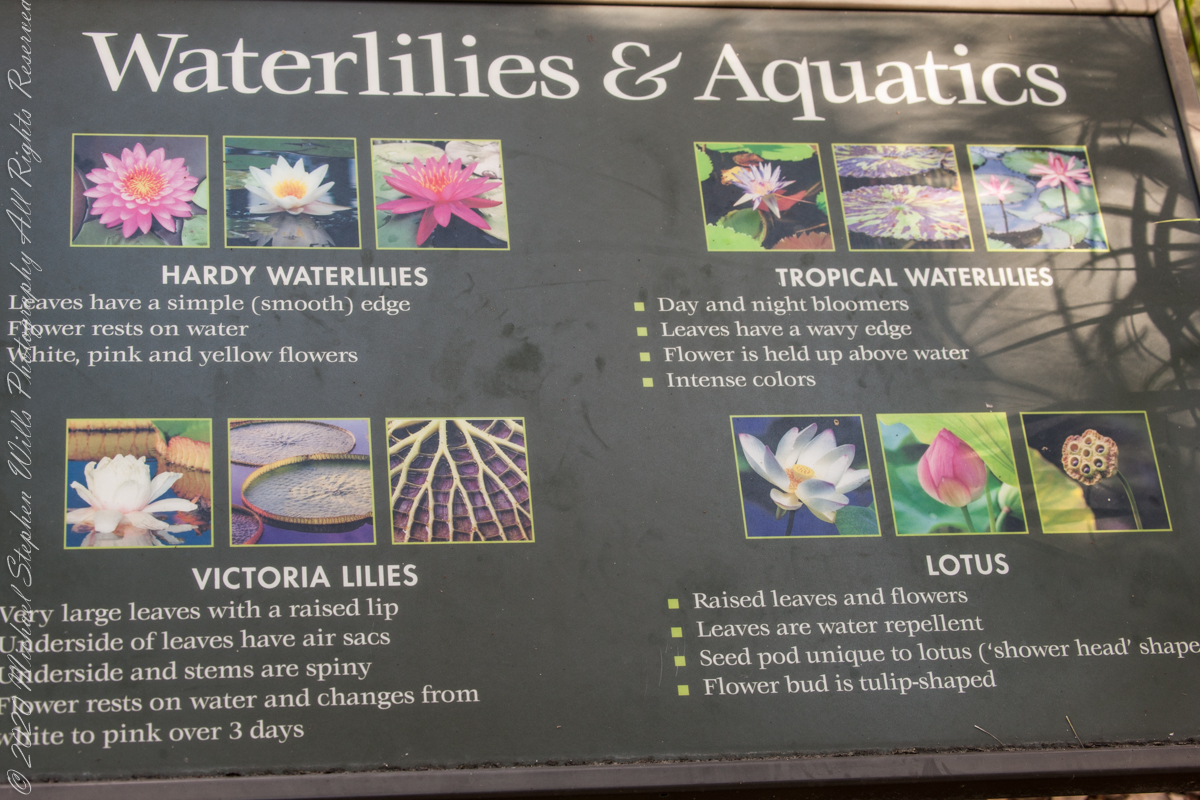
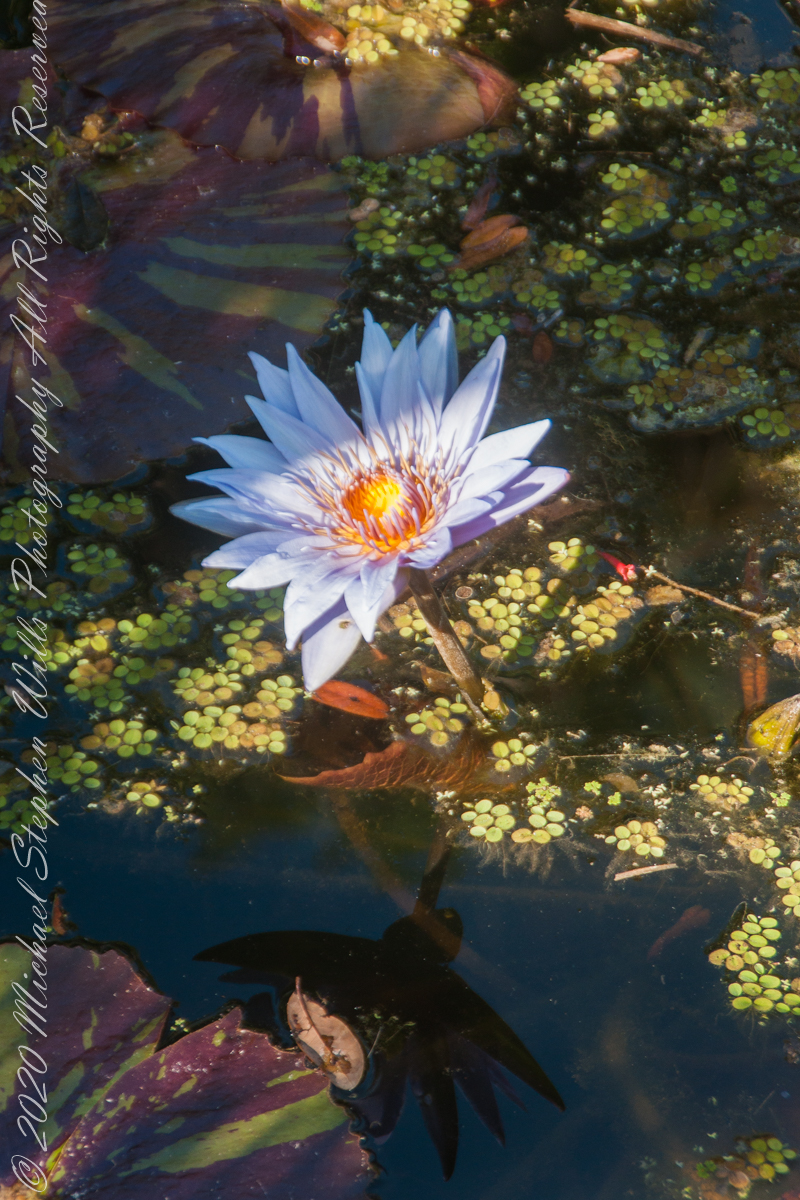
The McKee informative placard divides the Genus Nymphaea into “Hardy” and “Tropical” waterlilies. “Hardy” being plants native to temperate climates, such as New York State. I do not have photos of these from McKee. Nor are there examples of Lotus.

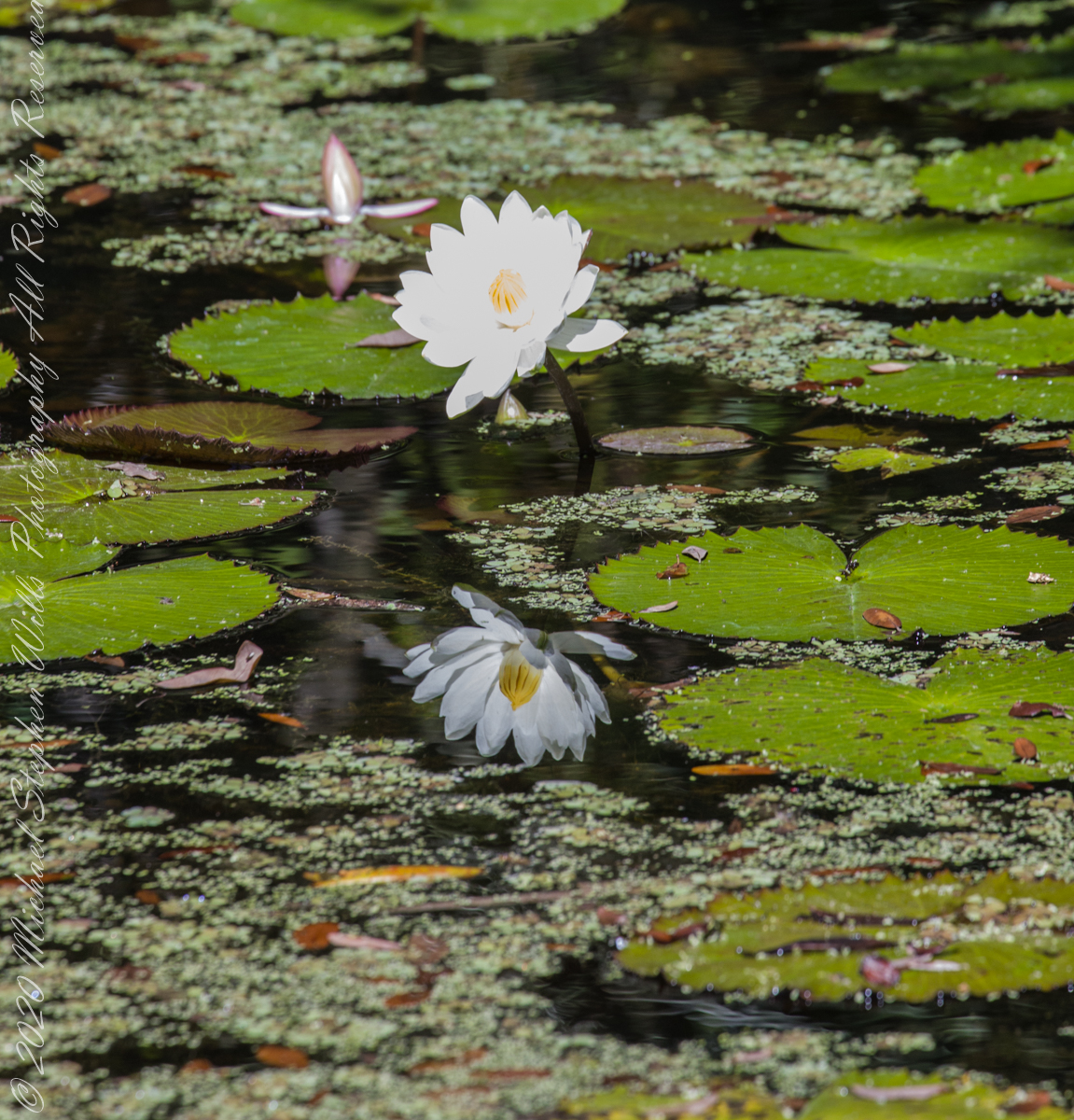
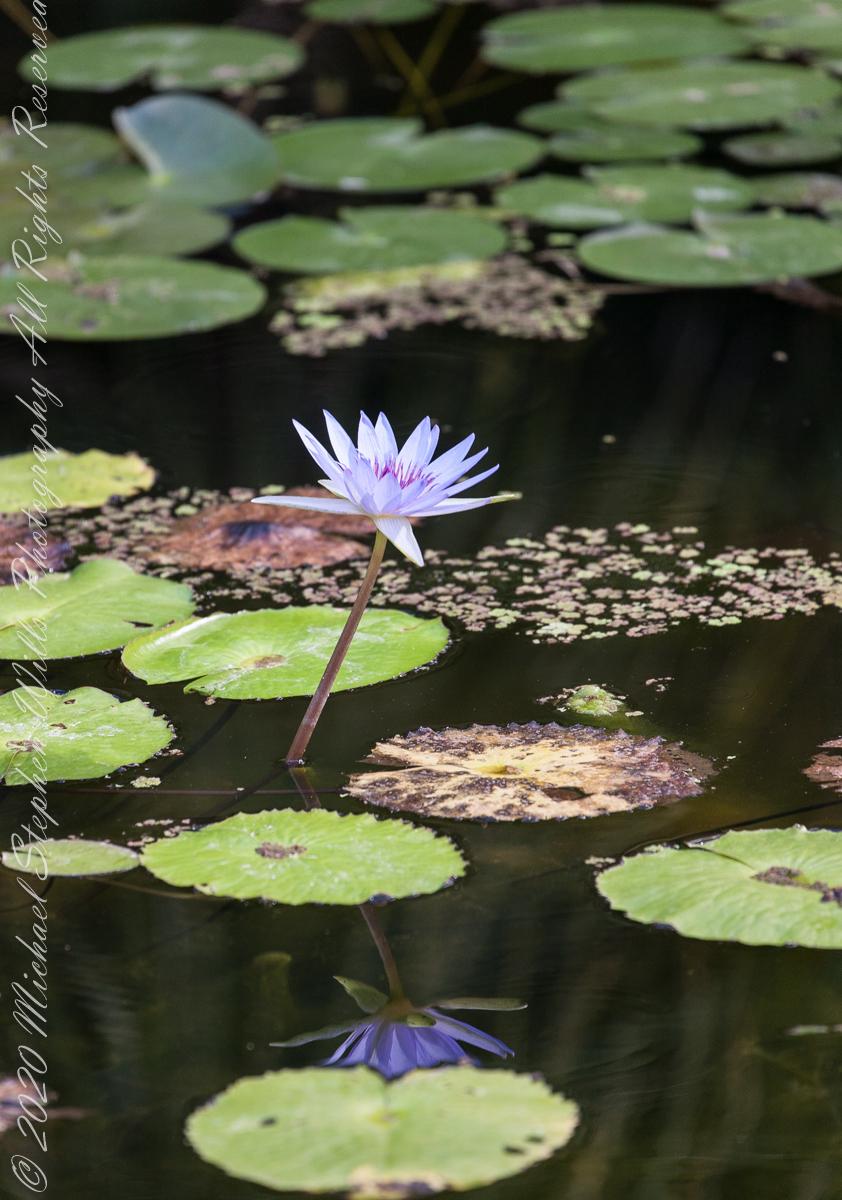
What I have is an abundance of the “tropical” varieties.

The family Nymphaeaceae, of which the genus Nymphaea is a part, is thought to be the most basic of all the Angiosperms. A minute flower of the Nymphaea type was found in early Cretaceous deposits in Portugal, dating early waterlilies to at least 115-125 million years ago.

Angiosperm,” the word referring to all flowering plants, is composed to two greek words angio-. meaning enclosed, and -sperm, meaning seed. “DNA studies indicate the Nymphaeaceae separated from the rest of the angiosperm family tree…..before the separation of the monocots and dicots.” – see reference.
Click me for wonderful sculpture at McKee Gardens

Reference: The Botanical Garden, Volume II, by Roger Phillips and Martyn Rix, Firefly Books, pp 382-383

Copyright 2022 Michael Stephen Wills All Rights Reserved