New Neighbors

Manufactured Home Installed Next Door, September 2017

When Pam and I made Westwood Knoll our home in 2011, to the north, across the street, was an empty wooded lot that has since been subdivided into three of the last home sites in Ithaca. This summer, the corner lot was razed of all its trees, the lovely mature cherry, sycamore, ash, maple reduced to stumps to be cut up and carted away. There was a positive in that the lot was overgrown and unsightly, but every spring the upper reaches were masses of blooms and young green leaves.

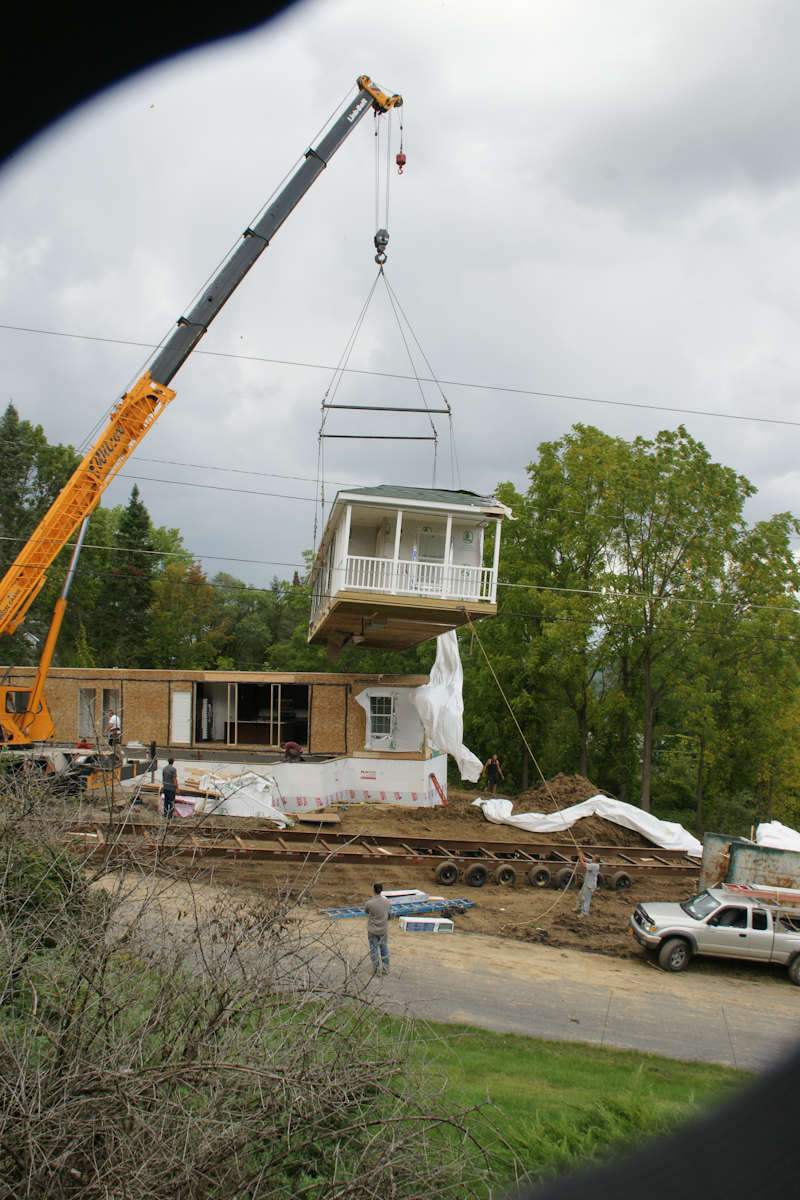
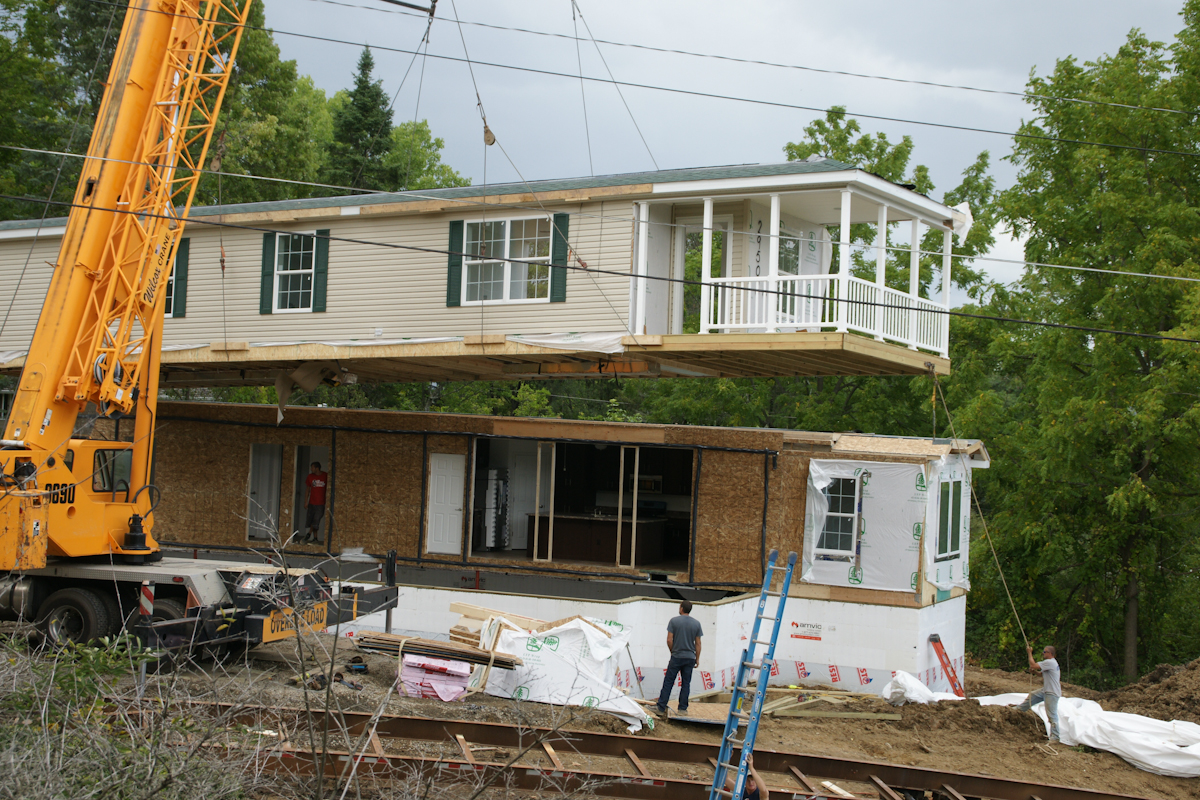
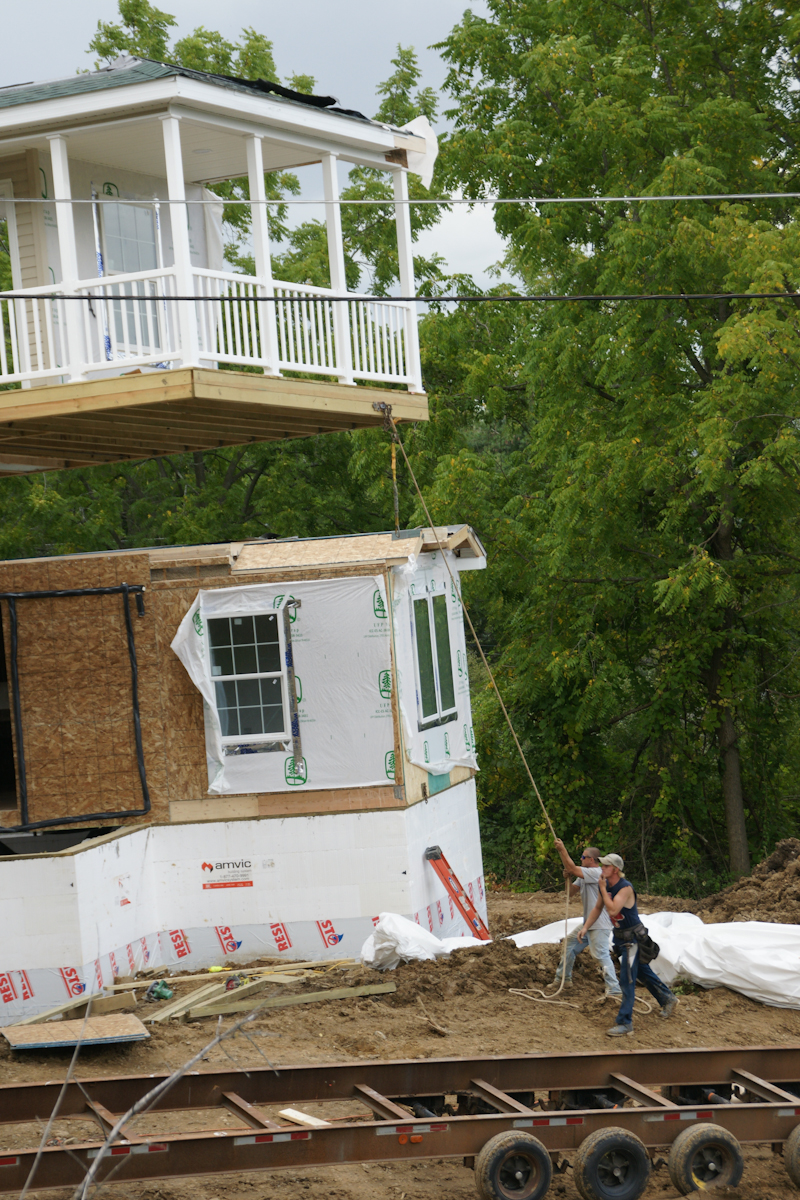
In a heavy rain on September 5th, 2017 the two parts, call them “modules”, were delivered, and then sat until September 7th to be assembled in one day. The process itself was interesting to witness and, while being otherwise occupied, I came out now and then to document the progress.

Here are my photographs. What do you think? Please leave comments.

The Foundation
The foundation installation took a week to construct. It started with, literally, blocks of styrofoam held together with plastic and assembled by hand, like a child’s block set. There is an 8 inch gap in between filled with concrete. There was NO rebar used. bolts were inserted for attaching the modules.
How Module Two  was Hauled
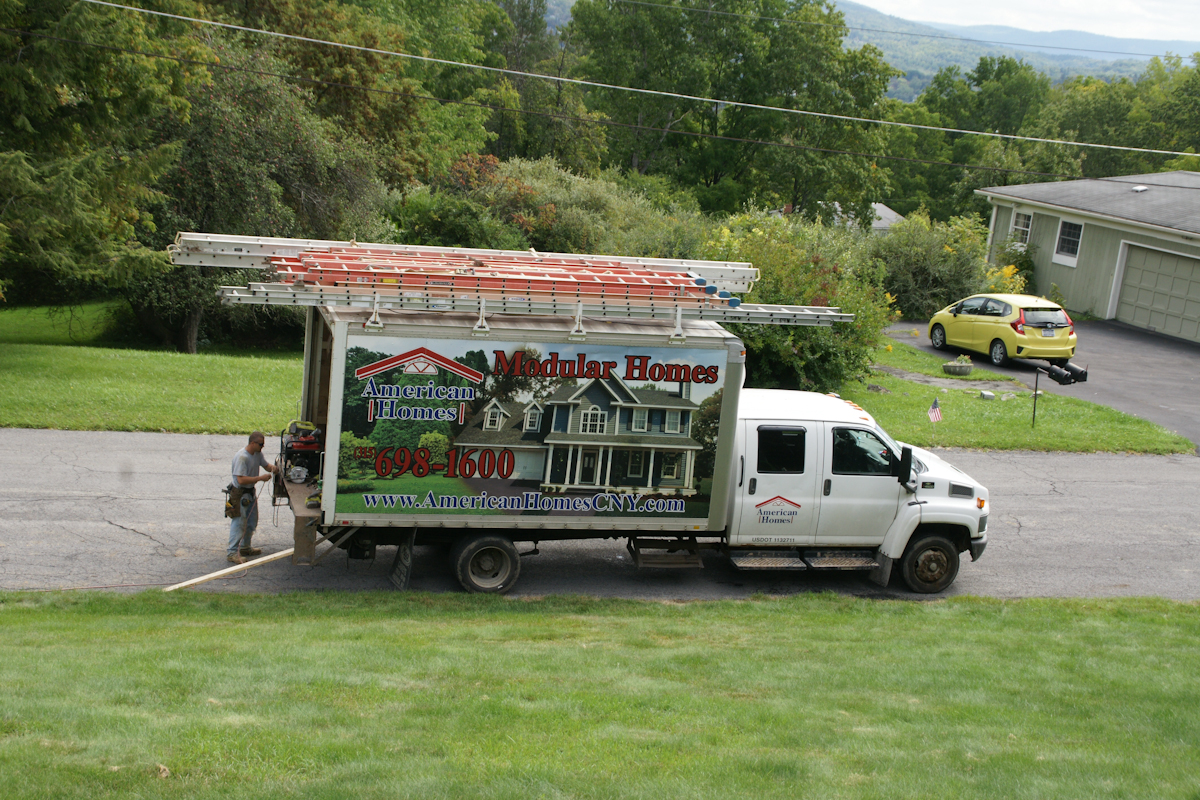
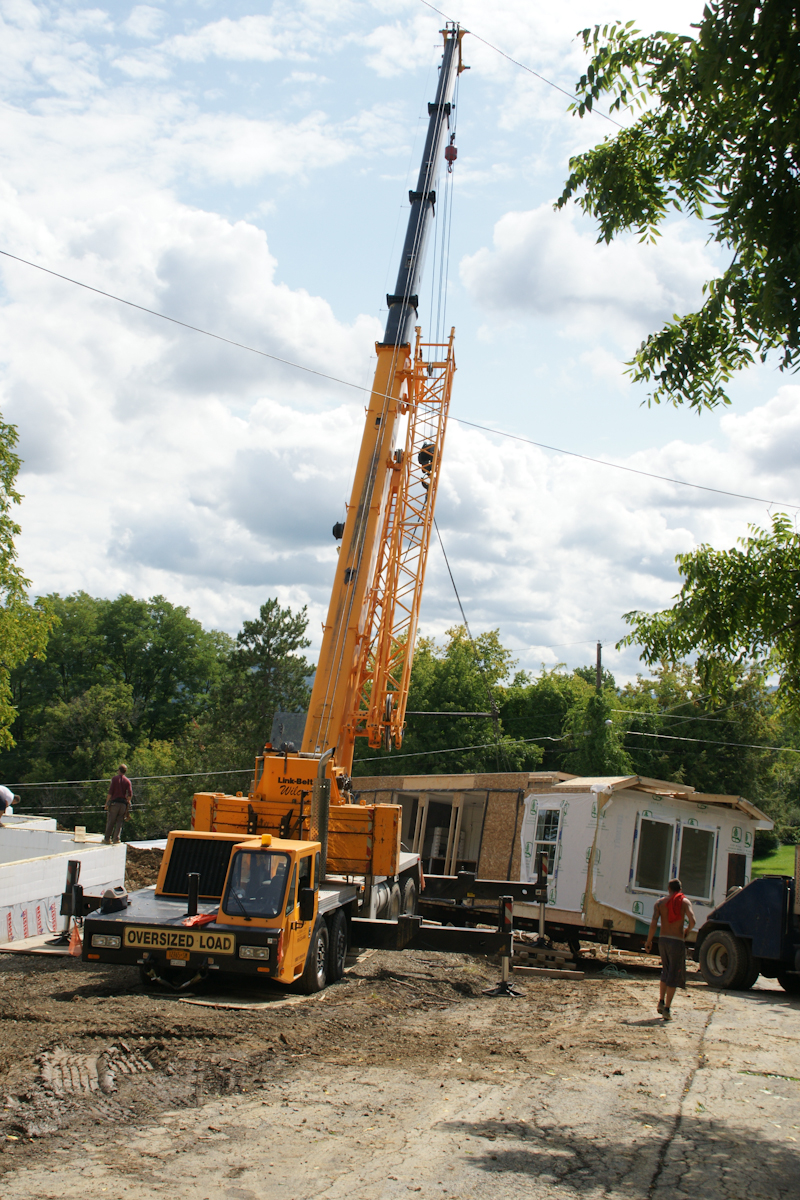
Module Two was delivered on wheels and moved into position by this semi.
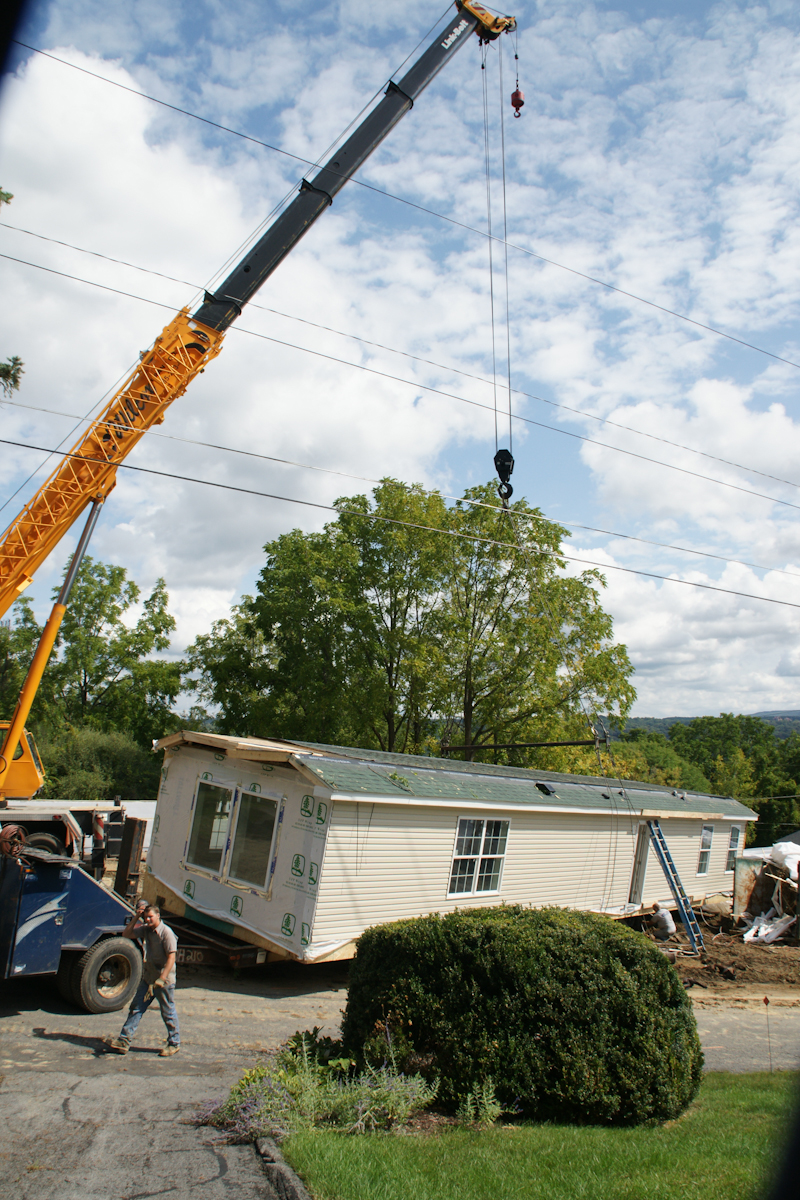
Module Two, the house next door
Module Two will eventually face the opposite direction. That will be the rear door. This is our swimming pool, I use garden hoses to siphon excess rainwater.
Construction Worker??
Most of the workers were dressed like this, casually, no protection for feet or head. We were concerned with this. No one was injured this day, as far as we know.
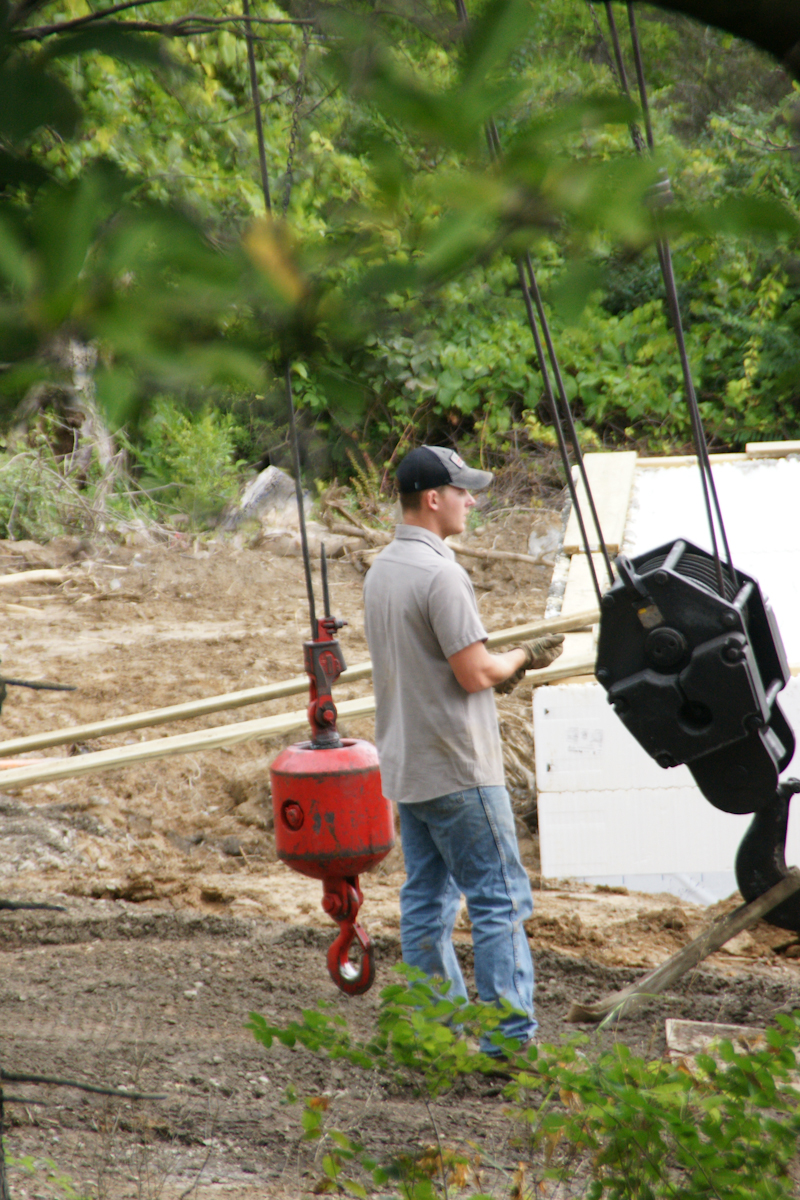
Another Construction Worker
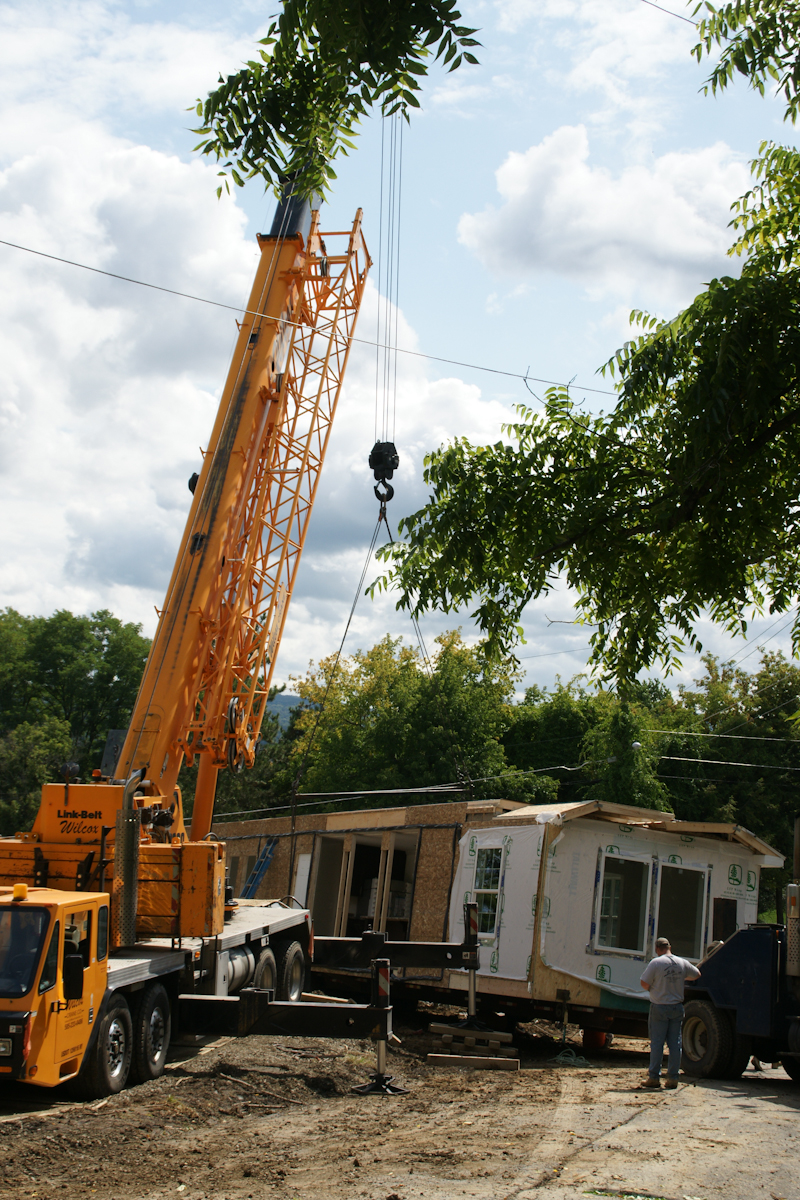
The worker is standing on a board on which the crane wheels will rest.
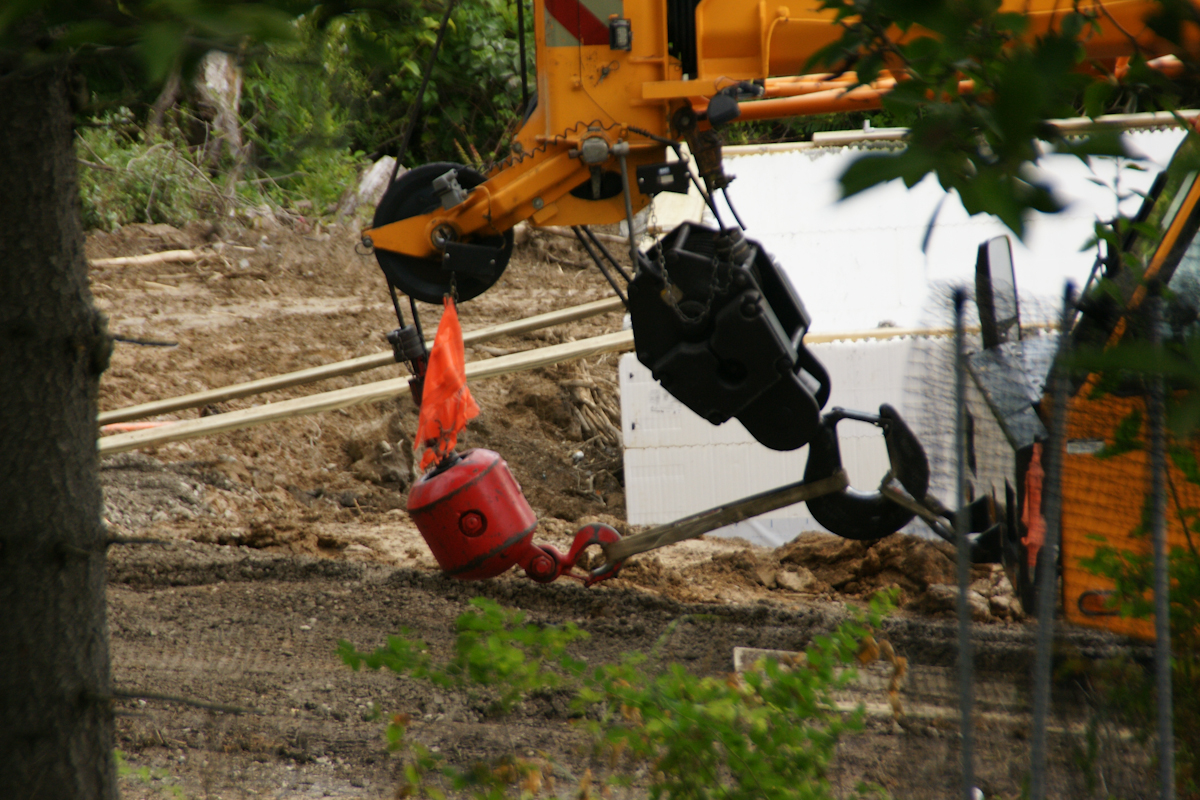
Crane Boom End and Hooks
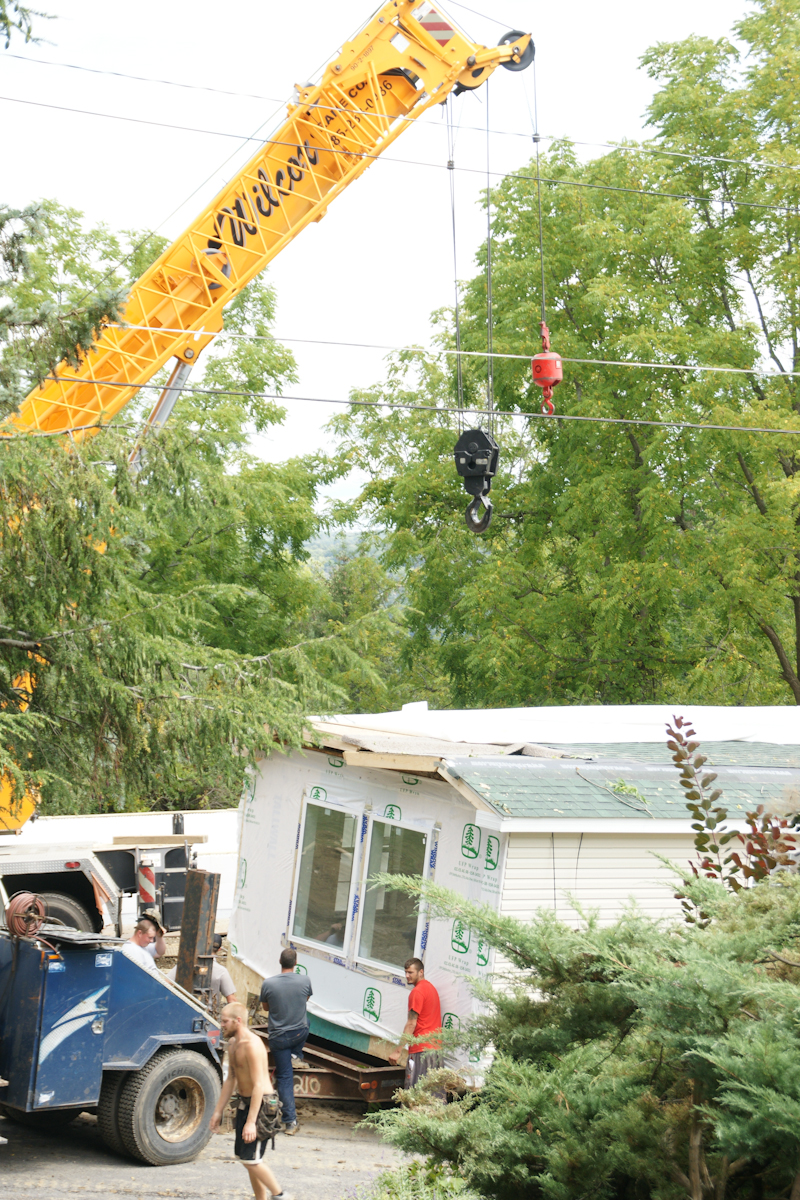
Crane Boom End with hooks in transport configuration. These are attached to the modules for positioning over and lowering onto the foundation.
A supervisor
This fellow arrived to take pictures from that smart phone.
Tracked Loader
A versatile tracked loader used throughout the foundation construction and module installation.
Worker and Hooks
A worker prepares the hooks for use. No head protection was a concern to us.
Support Blocks
Yellow blocks of metal used to support the crane.. A railing of Module One is above the truck, to left.
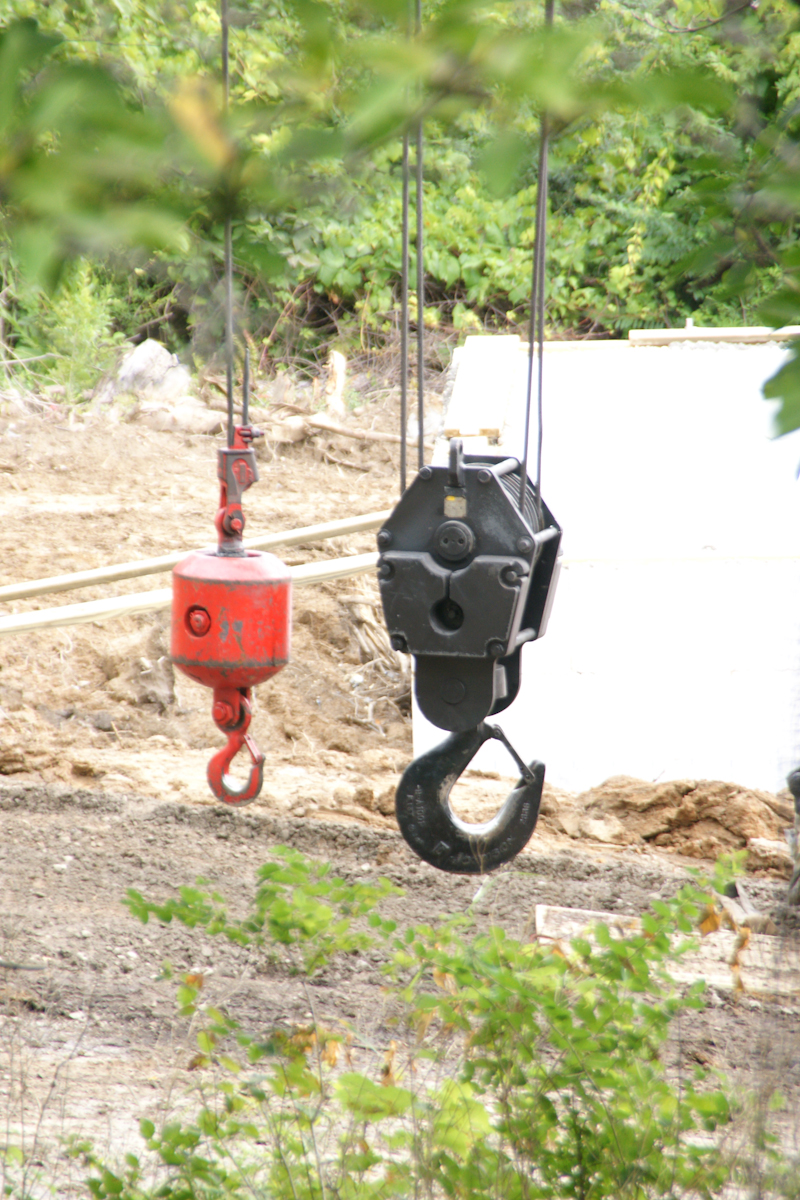
Hooks Prepared for Use
The red hook is ready.
Hooks ready to go.
The hooks hang free, ready to use.
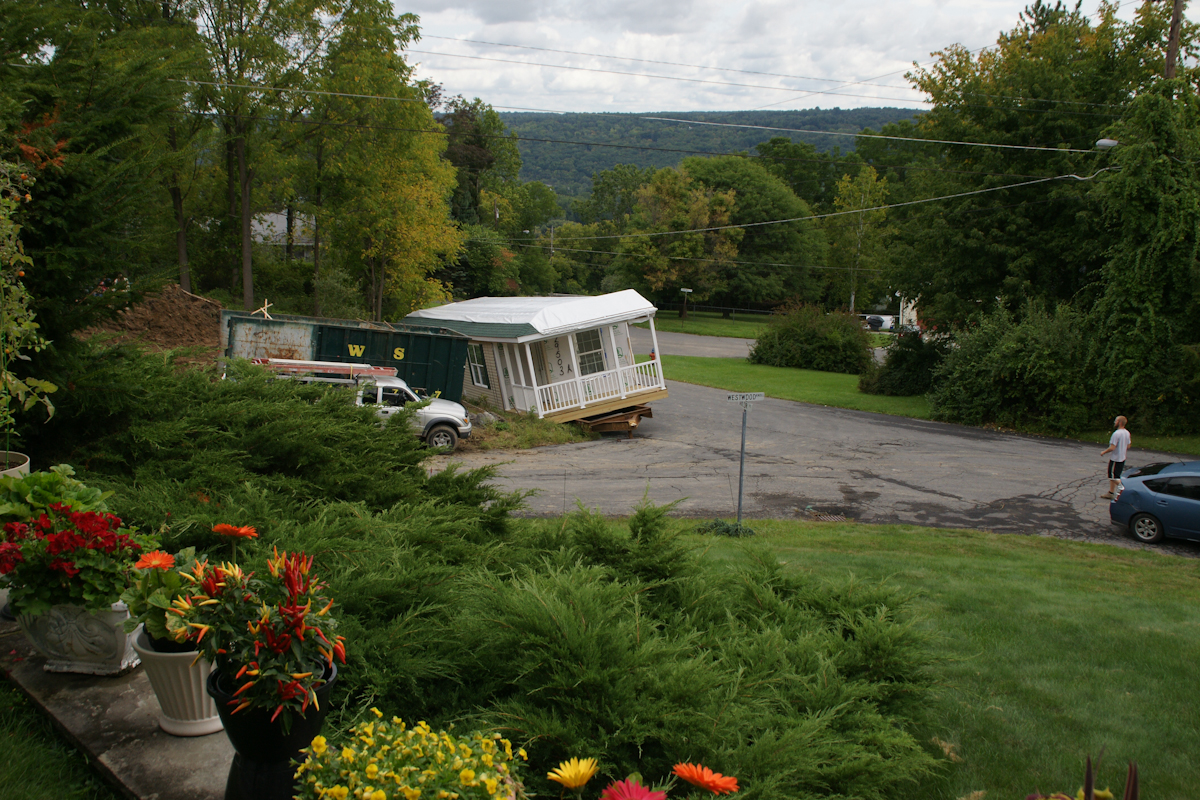
Module One
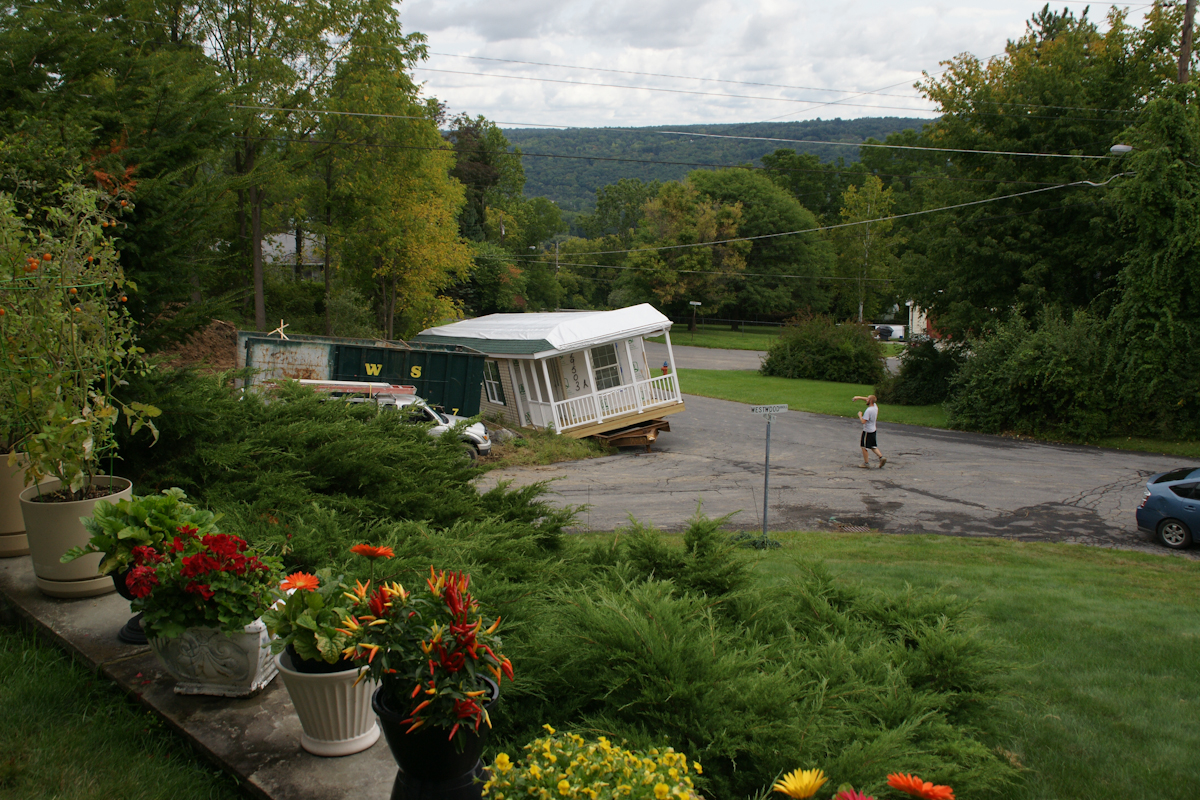
This is where Module One was dumped on the side of the road on September 5th, two days before installation.
Module One and Construction Worker
We are looking here over the edge of our patio and landscaped yard to the site of module one, pre-installation, a worker approaching.
Module Two
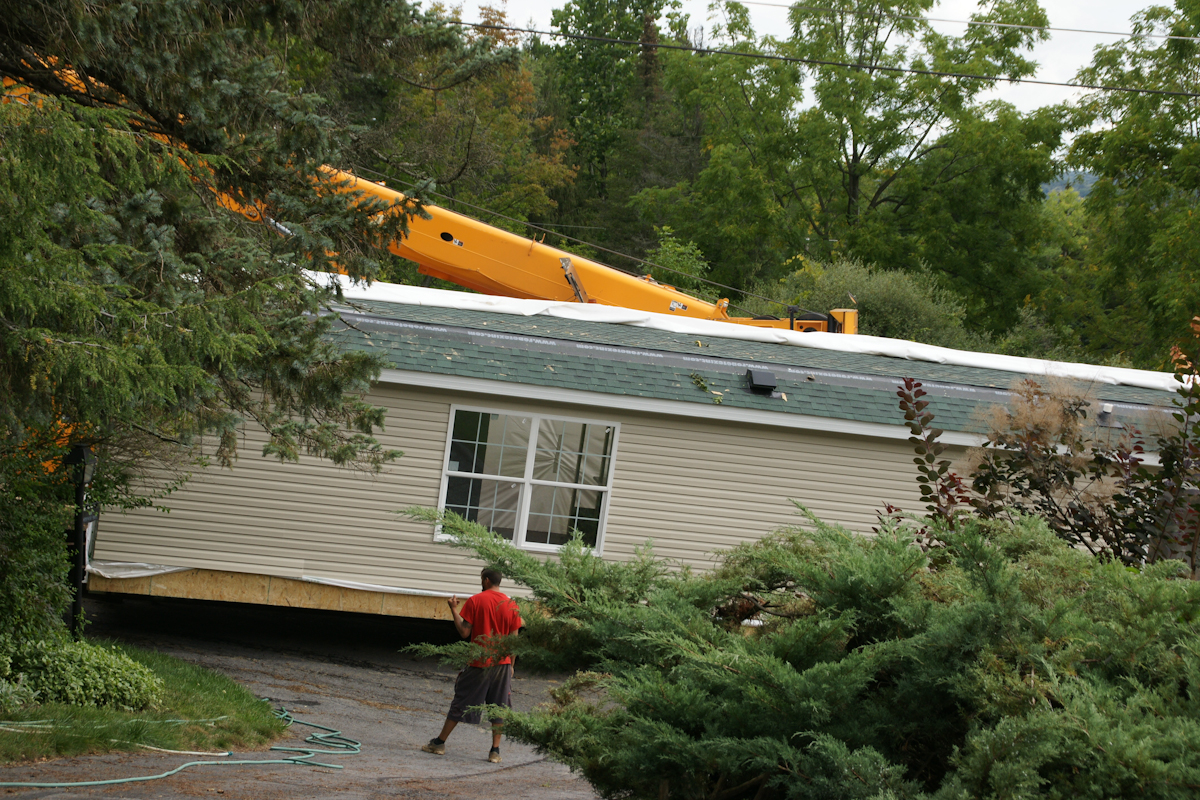
The first step was to extricate module two from the mud and haul it up the street. A construction worker foreground, the boom of crane beyond.
Positioning Module Two
The semi backed Module Two into position, the crane boom and hooks loom.
The Company Responsible
The workers were considerate of our lawn. There was minimal damage. The modules installed this day looks nothing like this image.
Module Two Attached and Ready
From here Module Two will be lifted onto the foundation.
Workers Prepare Foundation.
Workers prepare foundation to receive Module Two while the unit is readied.
Module Two Lifted.
I see only the black hook is in use.
Another View of Module Two
Another View of Module Two with worker. That is the bottom of our driveway.
Module One with Construction Materials
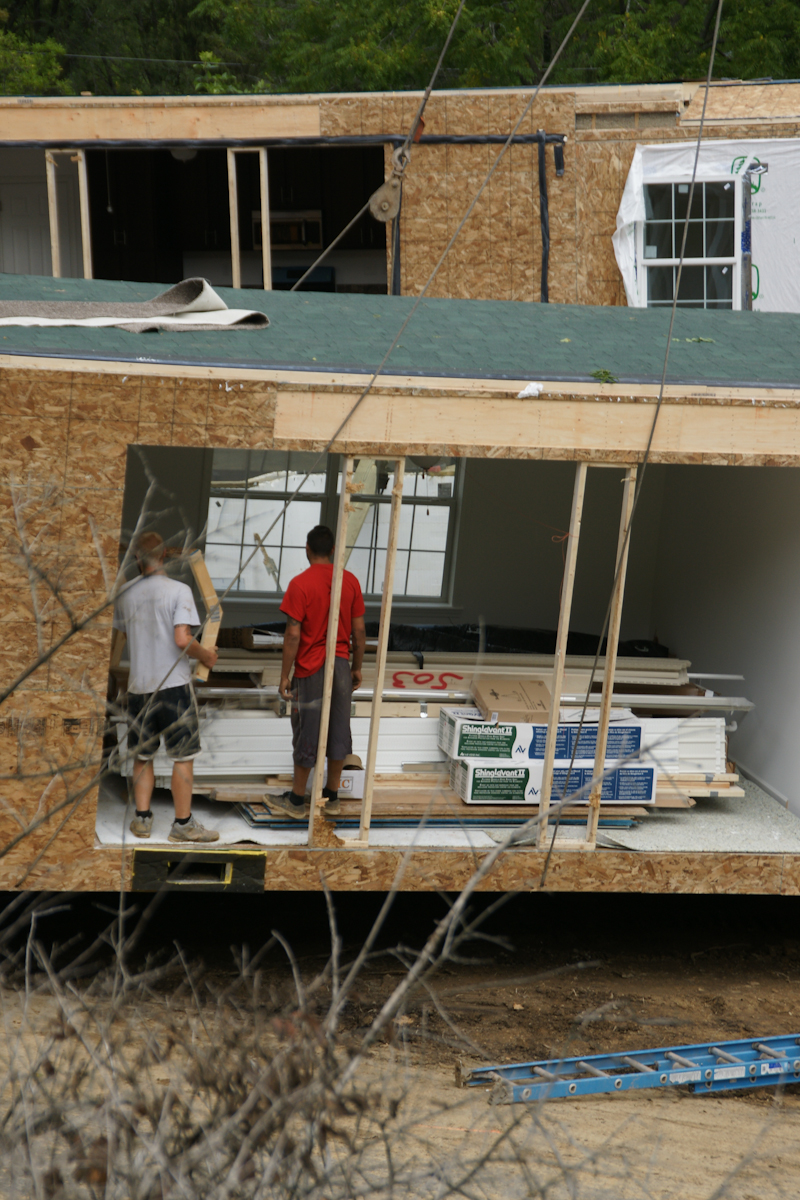
Module One was delivered with construction materials inside.
Module One with Carrier and workers.
The porch and entry door of Module One with worker and rope. The worker needs to negotiate the carrier.
Pulling Module One Around
A 180 degree turn orients Module One to Module Two. The porch overhangs the foundation.

Positioning module one over foundation.

Worker Stands in Module Two
A worker observes from the interior of Module Two. Here is a closer view of the wire harness.

Final positioning of the module to form a whole structure.

Finished.
The roof panels are here lifted to a peak. The shingles and such in place for installation. These are the materials delivered inside Module One.

Update: since this post was first published September 2017 the original owners moved to the southern USA after selling the property at an inflated price to a young Cornell professor.

Copyright 2021 Michael Stephen Wills All Rights Reserved

Smoke Tree, late June

Three species of the genus Cotinus, commonly called “Smoke Tree,”in the family Anacardiaceae exist in North America, Europe and Asia. Ours is more like a shrub with numerous, long branches. Flowers with profuse filaments in clusters resembling whiffs of smoke. Here we see the flower filaments, interspersed with small drupes, each containing a single seed.

The post header, and these photographs were made from the Canon EOS 5D Mark IV, Canon Lens EF 50mm f/1.2L USM stabilized with a Manfrotto 468ZMZ tripod with hydrostatic head. Late afternoons, evenings the tree is shaded by a hemlock hedge (line of trees running north/south) this is the shade here. This Canonn dslr excels in color rendition. The flower masses are a burgundy wine color, the leaves have a purple tinge. I do not directly fertilize, as the plant is said to do best with unfertile soil though the surrounding cedars do get fertilizer stakes.

Eight AM a following morning I followed up with a handheld session using a Sony DSLR-Alpha700, Sony Lens DT 18-200 mm F3.5-6.5. Took these two shots with a lower ISO and tweaked the images in Lightroom, reducing the exposure. The flower smoky effect is well captured, the color in bright sunlight is not as wine-like as in shade.

By the time I proceeded to macros, a morning breeze kicked up, handled by upping the ISO to 3200 for a faster shutter speed to stop the movement. The bright sun helped with this.

Fertilized flowers develop into fruit stalks with radiating filaments, the yellow dots are the drupes (fleshy bodies surrounding a single seed). Fresh leaves are purple, turning to dark green with age. The leaves are as unusual as the flowers: aromatic, simple and round on long stalks. Autumn, the leaves turn a stunning bright red-orange, a scarlet shade. In winter some stalks die off, new growth appears from the roots in spring.

References

“The Botanical Garden Vol 1 Trees and Shrubs”, Roger Phillips and Martyn Rix, Firefly Books, Buffalo NY, 2000, p 361

Wikipedia, “Smoke Tree”

Copyright 2021 Michael Stephen Wills All Rights Reserved

Woody Peony 100 mm

Macro series

See my May Woody Peony postings for background on this peony variety.

These photographs were taken with a Canon EOS 5D Mark IV dslr and the Canon EF 100mm f/2.8 Macro USM lens stabilized with the Manfrotto BeFree Carbon Fiber tripod with ball head.

The morning breezes of May caused me to “up” ISO to 1600 for a faster shutter speed at higher f-stop.

Taking full advantage of the macro lens, the higher ISO helped to maintain sharper focus on the highlighted feature, in this case the stamens.

A gallery of macros with various settings and aspects of the bloom.

Copyright 2021 All Rights Reserved Michael Stephen Wills

Woody Peony Reader Query

“It is difficult / to get the news from poems / yet men die miserably every day / for lack / of what is found there.” Asphodel that Greeny Flower WC Williams

Here is a Sunny Sunday reader assignment. Which handling of this woody peony blossom do you prefer? Please leave your preferences in the comments section with details of your reasoning. Thank you!!

These photographs were taken with a Canon EOS 5D Mark IV dslr, new for me as of 2020, and the Canon EF 50 mm f/1.2L USM lens stabilized with the Manfrotto BeFree Carbon Fiber tripod with ball head. This setup allowed me to fiddle with camera settings, here you see a variation in the width of the shutter diaphragm opening, or F-stop. The smaller the opening (higher F-stop) less light is let through to the image sensor, longer exposure time (allowing the subject to move, as in the morning breeze) offset by greater depth of field, more of which provides sharp focus as the subject elements are further from the lens.

In this first photograph, the F-stop is moderately high. The entire blossom and plant are in focus, the background moderately blurred though still recognizable.

For the second photograph F-stop is low, opening up the shutter diaphragm, allowing more light in for a faster shutter release, less time for the morning breeze to rise up and ruin the shot. The beautiful background blurring, bokeh, is a feature of this 50 mm lens. At the same time, at F/4.0 the shutter diaphragm is not wide open. The blossom is entirely in focus, many plant leaves and the other blossom, to left, are out of focus. This places emphasis on the primary subject of the photograph while providing a feel for the surroundings.

Here are the same photographs, click on one to open a gallery for you to flip back and forth to compare.

Copyright 2021 All Rights Reserved Michael Stephen Wills

Woody Peony, Yellow Still Life 50 mm

Yellow for this last day of May 2021

This yellow woody (also called tree) peony blooms later than our red varieties. The first set of three were photographed May 26, 2021 have unopened buds. Yet, these are early compared to those photographed June 6, 2019 used in the last still life.

These first photographs were taken with a Canon EOS 5D Mark IV dslr, new for me as of 2020, fitted with a 600EX-RT Speedlite (flash) and the Canon EF 70-300 mm (variable) f/4-5.6L USM lens stabilized with the Manfrotto BeFree Carbon Fiber tripod with ball head.

Our Itoh yellow tree peony has flowers on stalks too slender to hold the heavy blooms upright. The flowers open hidden among thick leaves. Here they are a still life of cut blossoms and leaves. The cultivars of Paeonia, the mouton, or hua wang, king of flowers, are ofe of the classic ornamental genera of China. By the 11th and 12th centuries the center off cultivation was in Sichuan, and there yellow-flowered varieties appeared.

Crossbreeding of yellow-flowered P. delavayi with traditional double-flowered P. suffruticosa cultivars by Victor Lemoine in Nancy, France has led to the introduction of the color yellow into the cultivated double-flowered tree-peonies. These hybrids are known as the Paeonia × lemoinei group. In 1948 horticultulturist Toichi Itoh from Tokyo used pollen from ‘Alice Harding’ to fertilize the herbaceous P. lactiflora ‘Katoden’, which resulted in a new category of peonies, the Itoh or intersectional cultivars. These are herbaceous, have leaves like tree peonies, with many large flowers from late spring to early autumn, and good peony wilt resistance. I am guessing our Yellow Wooden Peony is a type of this hybrid because the long stems are more herbaceous than woody, the heavy flowers droop so the best form to capture them is the still life.

Compare the above two exposures to appreciate the effect of the f-stop and excellent bokeh of the Canon “L” lens.

This still life from the 2019 bloom was taken with a Canon EOS-1Ds Mark III dslr and the Canon EF 50 mm f/1.2L USM lens used above. Stabilization provided by a Manfrotto 3036 (studio) tripod with the 468MG hydrostatic ball head. That room is bright from large, east-facing windows. Late afternoon light is soaked up by the black velvet backdrop leaving the lemon yellow leaves to shine.

Copyright 2021 All Rights Reserved Michael Stephen Wills

References
Wikipedia “Paeonia × suffruticosa
Roger Philips and Martyn Rix, “The Botanical Garden, Vol 1, Trees and Shrubs” p 133

Woody Peony 50 mm

An Early Spring for 2021

Spring 2021, though cold, is early. As I write this the peony blooms presented here, photographed May 20, 2021 are seeding, the gorgeous purple magenta petals strewn beneath the woody stems. In my last posting, from Memorial Day 2019, the plant is in full bloom the end of May.

These photographs were taken with a Canon EOS 5D Mark IV dslr, new for me as of 2020, and the Canon EF 50 mm f/1.2L USM lens stabilized with the Manfrotto BeFree Carbon Fiber tripod with ball head. Color results from the Canon dslr are impressive, the first time the unique purple magenta is accurately represented here. I found a slight under exposure captured the plum – fine burgundy wine nature of this Japanese cultivar, “Shimadaijin,” planted in the 1970’s or 1980’s.

Here is the last unopened bud of this season, enclosed by a calyx of 5 green sepals with reddish highlights . In the wild, woody (also called tree) peonies favored cliffs and scrub of western and central China, eastern Himalayas (southeastern Tibet).

The bud is toward the back, slightly out of focus, of this overview. The woody stems hold the profusion of large flowers each one erect. “Tree” is a misnomer as this plant is a shrub growing mid-thigh high. One of the classic ornamental genera of China, known there as moutan or hua wang “King of Flowers.”

Cultivation in China began in Chekiang in the early 4th century AD. By the early Tang period (circa 700 AD) hundreds of varieties were grown.

Copyright 2021 All Rights Reserved Michael Stephen Wills

References
Wikipedia “Magenta” color
Roger Philips and Martyn Rix, “The Botanical Garden, Vol 1, Trees and Shrubs” p 133

Dennis-Newton House National Historic Place

first photographs for a recent National Registry of Historic Places listing

Wiki Loves Monuments 2017 is a contest that closed September 30, 2017.

Click for Wiki Loves Monuments 2017 contest

The National Register of Historic Place # 16000590, the Dennis-Newton House of Ithaca, New York is a recent listing, dated September 6, 2016.  In researching potential for the Wiki contest, I discovered this place was absent a photograph.  Seizing the opportunity, I grabbed these photographs the same session as the suppressed Ithaca Pottery Site, published in my blog in April.

The location was a revelation, around the corner and a few blocks down from our son and daughter-in-law’s house where they are raising three (of our 12) grandchildren, across the street from where the children take swim lessons.  Parking in downtown Ithaca is incredibly coveted and I was not motivated to shoot during the golden hour where cars would, maybe, not be parked out front and the light perfect for the west-facing façade.
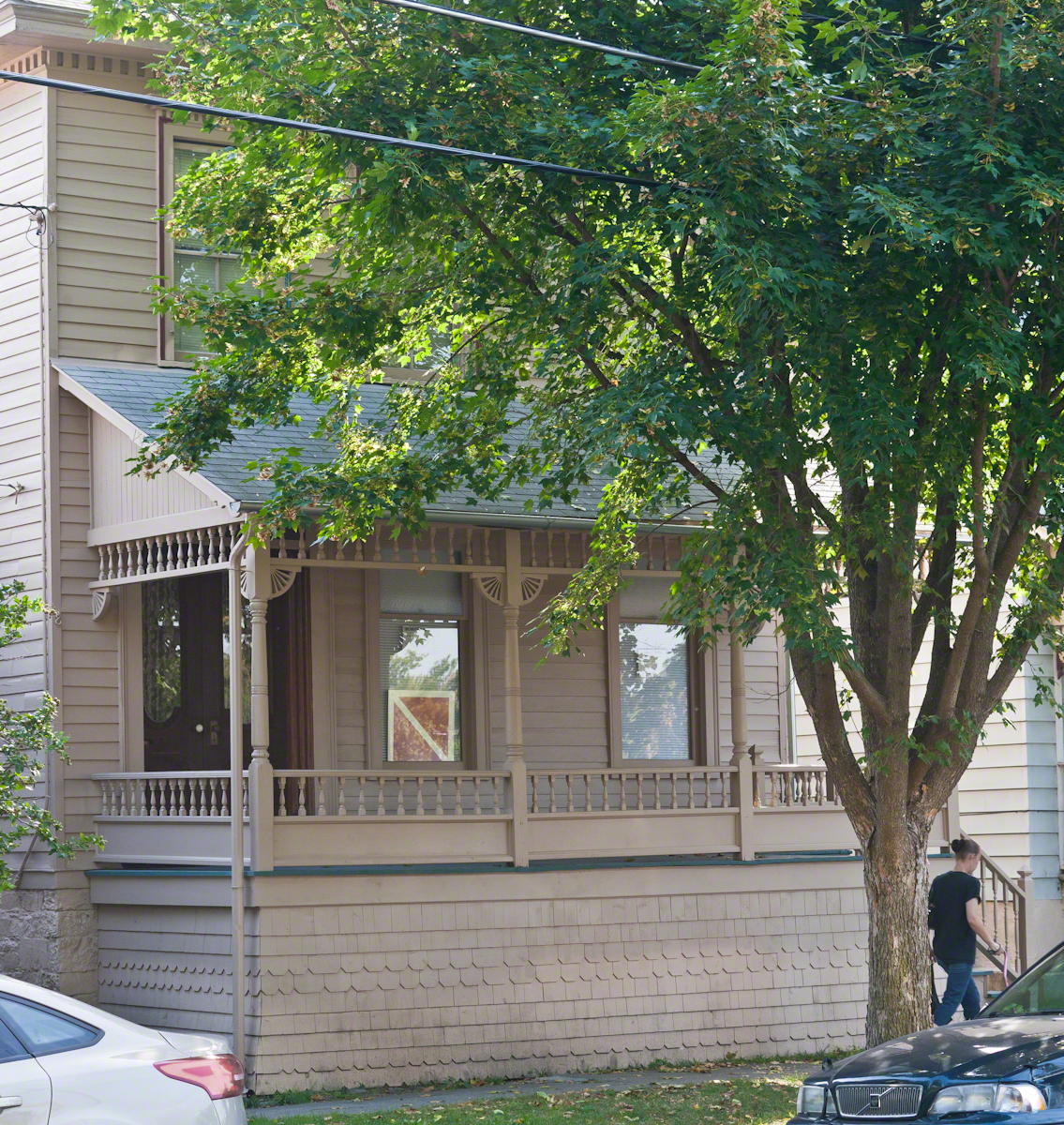
Dennis-Newton House Street Frontage

Click this link for my On Line gallery, “Finger Lakes Memories.”

Above is the street frontage of 421 N. Albany Street, Ithaca, New York, a home privately owned.  The house is as originally constructed and considered the birthplace of Cornell’s Alpha Phi Alpha, the first Greek letter, African-American collegiate fraternity established from this location in 1907.

Named for the original owner, Norman Dennis who built it around 1870 and a later owner, Edward Newton, who is directly connected with the early years of Alpha Phi Alpha; the house was recently renovated with a building permit still posted in the porch window, partially obstructed by glare.

The frontage view is partially obstructed by a Black Maple (Acer nigrum) and provides shade from the afternoon sun.
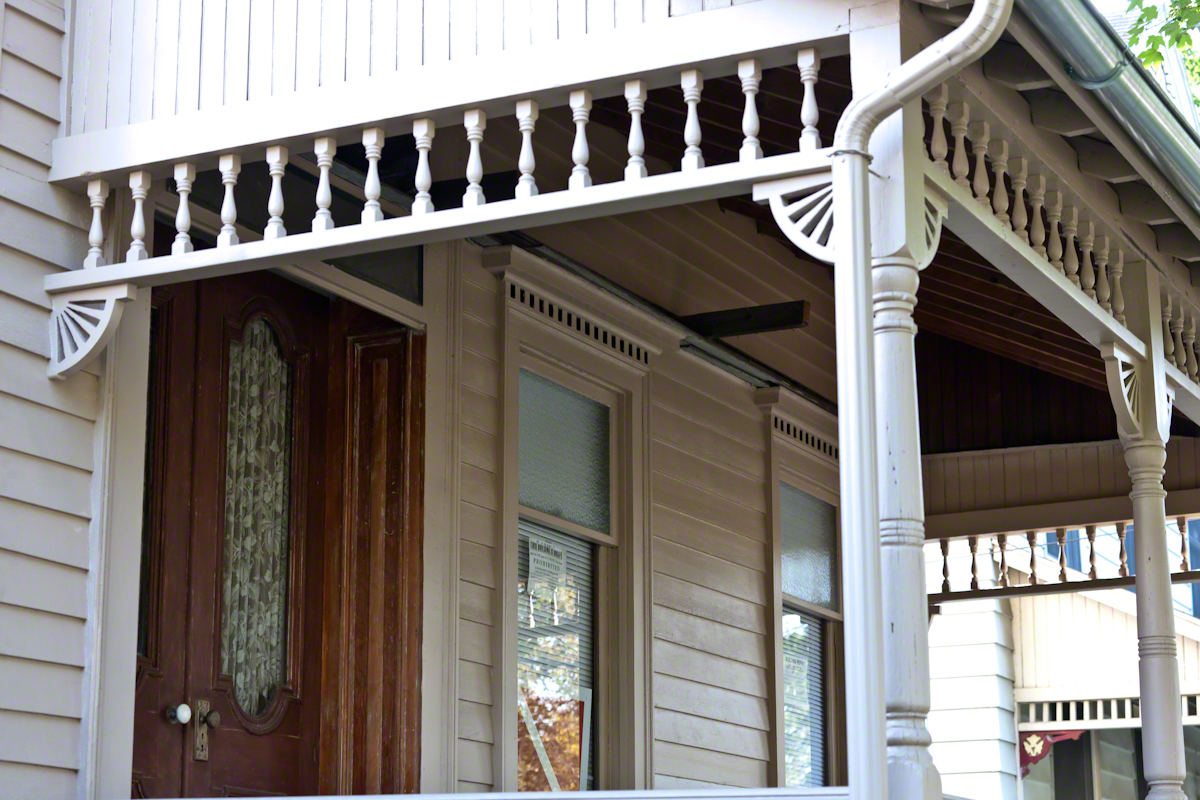
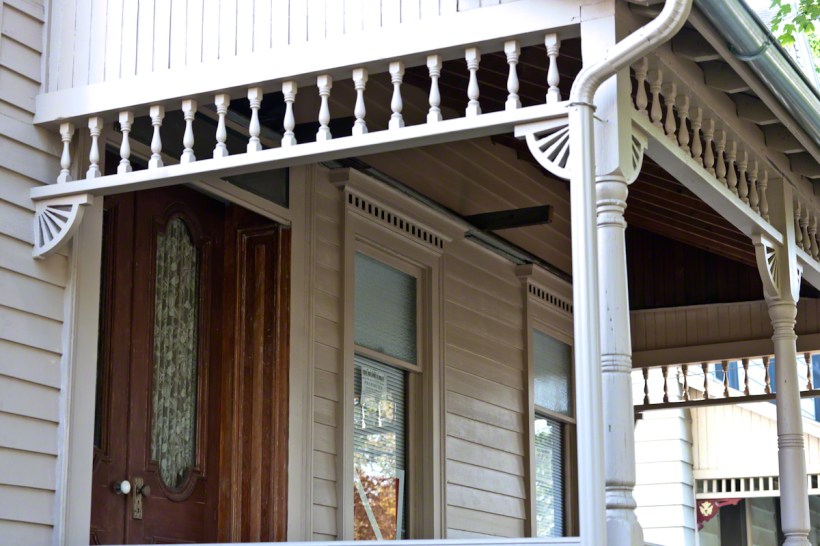
Dennis-Newton House Door, Porch

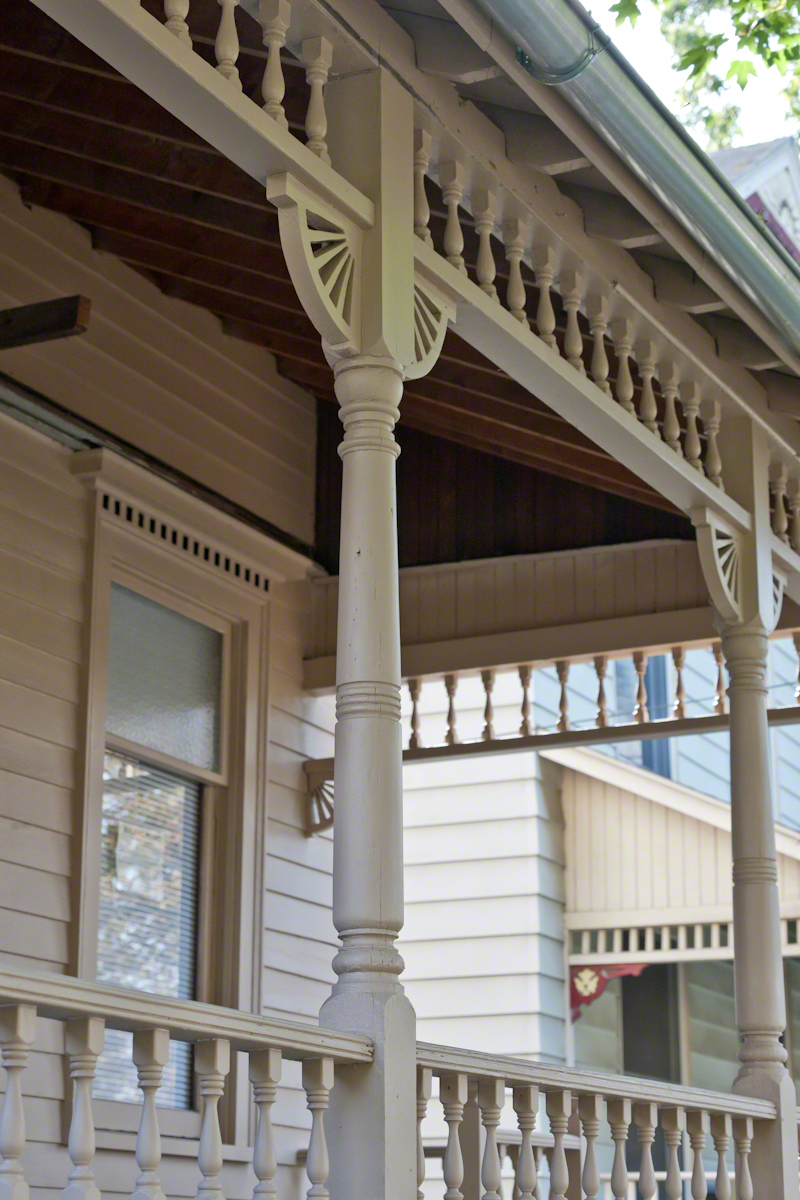
To compensate for the time of day, the tree and parked cars I captured interesting details of the front porch.  The time was day was perfect for photographing these and, in the golden hour, will be unevenly illuminated.  Note the elegant door glass panels, solid wood door and trim with original porcelain and metal door knobs and lock.  Porch trim includes decorative brackets, spandrels, posts.
Dennis-Newton House Porch, Window

Click this link for my On Line gallery, “Finger Lakes Memories.”

Here is a different angle on the porch trim to include the porch’s fancy balusters and rails.  The decorative head on the window is wonderful. The private owner recently renovated the property, there is a building permit still posted in the window.

Much of the information for this blog came from this web page.

In preparation for shooting, I mounted the Canon EF 70-300mm f/4-5.6L IS USM lens on the Canon EOS-1Ds Mark II body.  The frontage and second porch shots were at 70mm, 1/200 second, ISO 1,000, f/7.1.   The middle shot, of the door, was 1/250 second at f/5.0.

Copyright 2021 Michael Stephen Wills All Rights Reserved

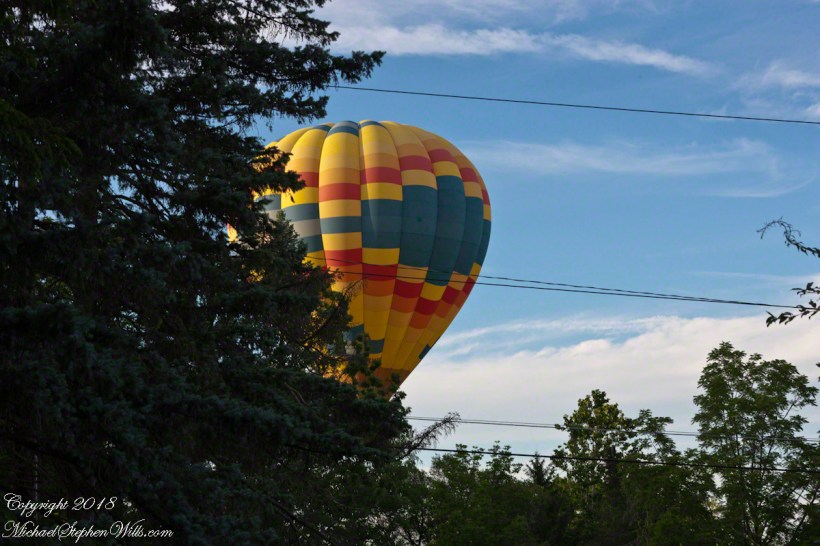
First Balloon Sighting

Always surprising and a wonder

Pam and I enjoyed the local hot air balloon for the first time in 2021 floating directly in front of our home, along the valley formed by hills on the east and west, headed north toward Cayuga Lake and descending steadily, looked to have landed close by. I heard the “whoosh, whoosh” of the gas burner first and distinct from a jet landing at Tompkins County airport. Always a thrill to see one up close.

Copyright 2021 Michael Stephen Wills All Rights Reserved

Dawson’s Magnolia?

A 2021 Blessing

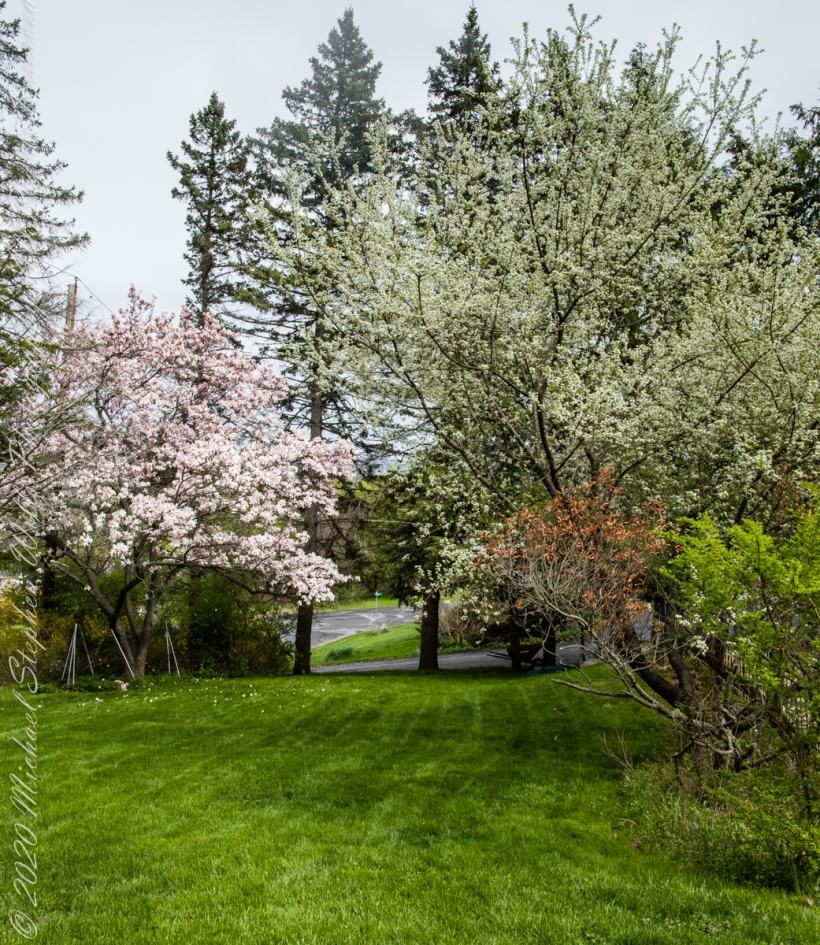
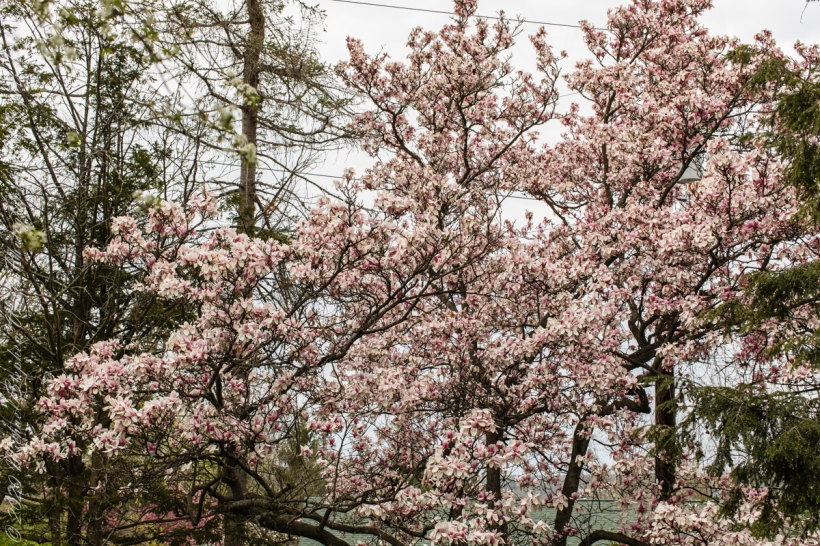
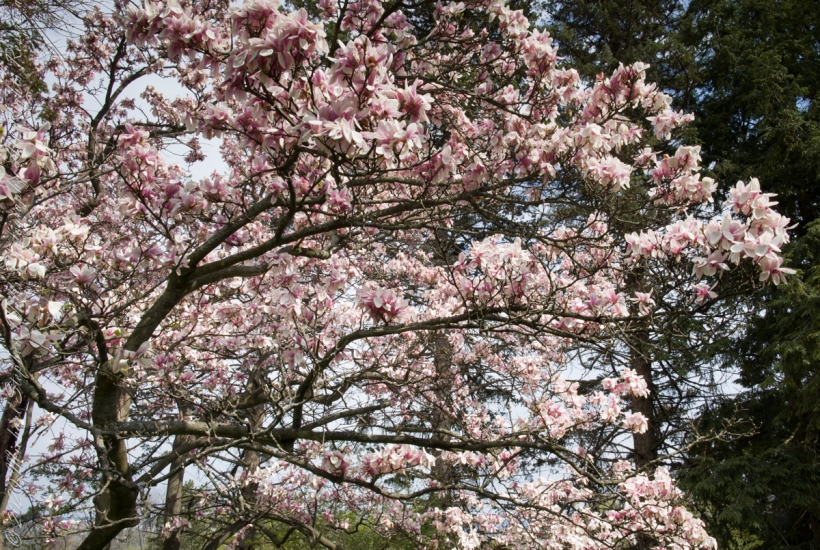
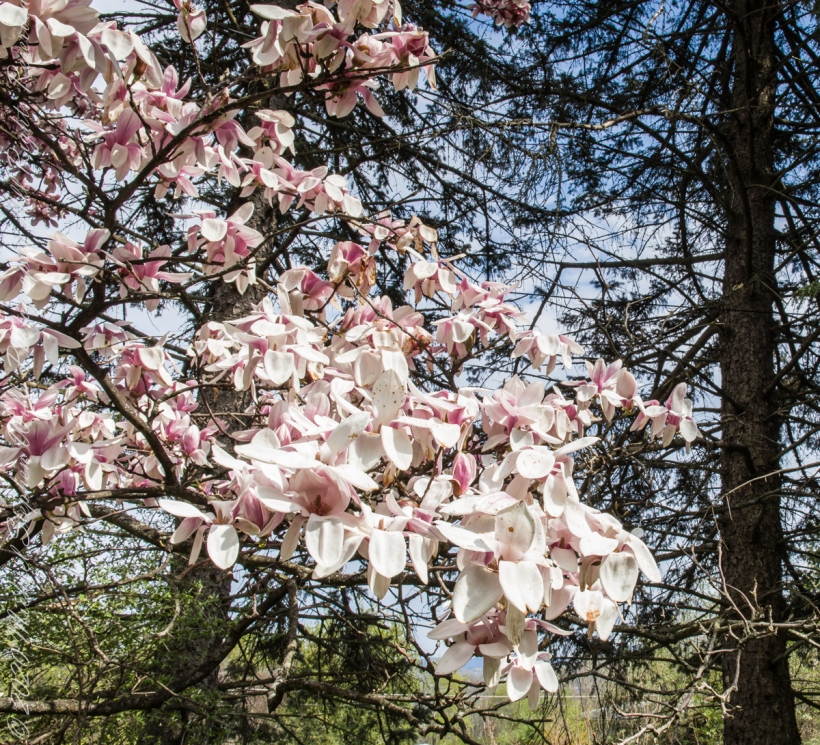
The Magnolia genus has been around for eons, come characteristics are protective from beetles as they existed before bees and relied upon beetles for fertilization. Our’s may be the species Magnolia dawsoniana (Dawson’s Magnolia), it shares many of the published characteristics: among them tolerance to our hardiness zone 5, flower color and shape, tree growth pattern.

This was an exceptional year for blooms. starting late April, lasting into May. The fence around trunks is for protection against bucks (male deer), from rubbing their horns in autumn.

For most of these 2021 photographs I used the lens Canon 24 mm f/1.4L II USM, the one captioned 50 mm I used Canon 50mm f/1.2L USM. The Canon EOS 5D Mark IV dslr with the Manfrotto Studio tripod with hydrostatic ball head for all.

The last great year was 2018……

For these 2018 photographs the Canon 24 mm and Canon EF 100mm f/2.8L “Macro” lenses with Canon’s EOS-1Ds Mark III dslr.

Copyright 2021 All Rights Reserved Michael Stephen Wills

Ithaca Pottery National Historic Place

finding a suppressed location

Wiki Loves Monuments was a contest that closed September, 2017.

Click for Wiki Loves Monuments 2017 contest

The National Register of Historic Places, online, lists the Ithaca Pottery Site(# 79001635) as “address restricted”.   There is no photograph published for the site either on the register or Wikipedia.  Here is an opportunity and a mystery.  Where is the suppressed location of this historic place?  There is the opportunity of completing the record by capturing a photograph.

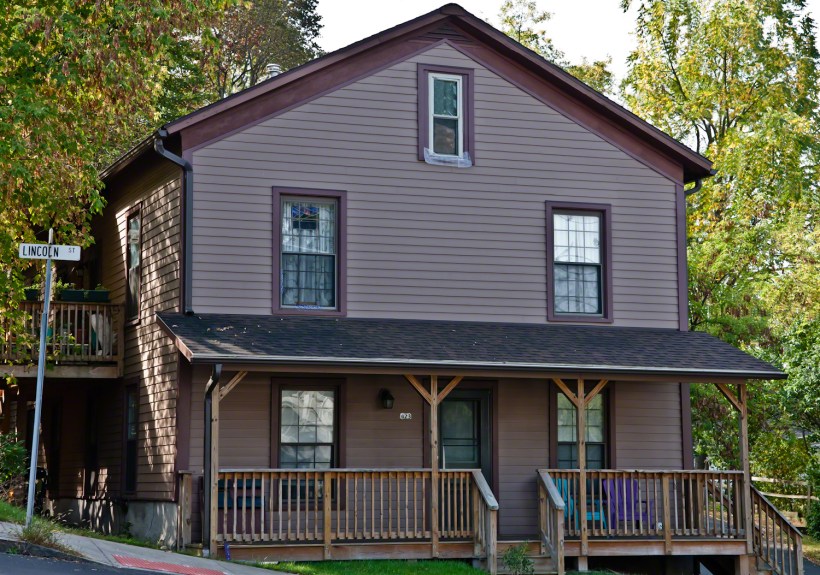
There is another online reference listing the site as 423 E. Lincoln Street.  The site is “I Love the Finger Lakes”,

I researched the physical location of the site and found it to be in a historically industrial area of Ithaca, close to Ithaca Falls.  The correspondence I found online named Ezra Cornell as the owner when the pottery concern was active.  He donated the land for Cornell University and the location is consistent with his ownership.  There is a large wooded lot behind the building.

Last week I visited the address and guess the best light was the morning, returned yesterday to acquire the photograph.  There was a knoll across Lake Street that gave this view.  There are conflicting elements in this photograph:  the far hills are beautiful, the pole with wires very difficult to remove.  Also, the address is not visible.

Ithaca Pottery from the Knoll
Click link for my fine art gallery.

The street passing left to right is Lake Street.  Crossing lake street I took several shots, negotiating the light traffic to eventually stand in Lake Street for this shot.

Ithaca Pottery from Lake Street

In preparation for shooting, I mounted the Canon EF 70-300mm f/4-5.6L IS USM lens on the Canon EOS-1Ds Mark II body.  This shot was at 70mm, 1/200 second, ISO 1,000, f/7.1.   I hated the power lines and could not avoid them from any acceptable angle.

The only solution was to spend hours in Photoshop to achieve the result in the header.

Copyright 2021 Michael Stephen Wills All Rights Reserved