Amidst spruce needles, a Gray Catbird’s mew captivated me; a hidden minstrel whose dulcet mimicry and secretive charm turned my backyard in Ithaca into an amphitheater of nature’s most intricate symphonies.
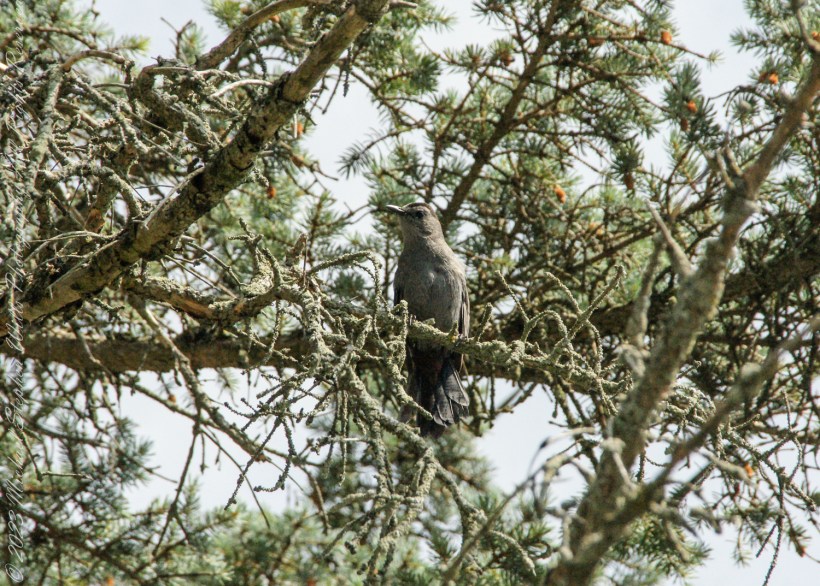
In my backyard, amidst the spruce trees that seem to touch the sky, I had a unique encounter with a little gray bird known as the Dumetella carolinensis, or more commonly, the Gray Catbird. I learned that “Dumetella” comes from the Latin word for “thorny thicket”, hinting at its penchant for skulking in dense underbrush, often hidden from sight. Its species name, “carolinensis”, pays homage to the Carolinas, though this bird has certainly made a comfortable home here too.
This particular visitor had a call reminiscent of a cat’s mew, a curious sound that first drew my attention. As I peeked through the window, I noticed it wasn’t just imitating felines; it was a veritable mimic, echoing the songs of other birds, even copying the croaks of tree frogs, and sometimes the mechanical noises of our own making. Its syrinx, a true marvel of nature, allows it to produce two sounds simultaneously – an impressive feat for such a small creature.
Unlike the showy northern mockingbird or the brown thrasher, which repeat their musical phrases several times, this Gray Catbird preferred to sing each of its phrases just once. Its song was a bit raspier, less melodic but still captivating in its own right.
It’s interesting that the Gray Catbird often chooses to remain hidden when it sings, favoring the inner sanctuary of bushes or trees like the spruce in my yard, a natural stage set by verdant leaves and branches. And while I watched, it seemed content in its concealment, a master of melody cloaked in foliage.
As I observed it, I recalled reading that the Gray Catbird’s diet is as varied as its repertoire of sounds. Fruits and berries make up about half of its diet. This little bird has quite the palate, enjoying a smorgasbord that includes mealworms, earthworms, beetles, and other insects, not to mention the bounty of summer offerings such as ants, beetles, grasshoppers, caterpillars, moths, and a selection of berries from holly, cherry, elderberry, poison ivy, bay, and blackberries.
I made a mental note of the date, captured in the metadata of the photograph I snapped: 2021, from my home in Ithaca. A simple image, yet it encapsulated a serene moment of connection with a creature so adept at concealment and mimicry, a moment I would treasure. The Gray Catbird, with its unique song and dietary habits, has become a beloved part of my backyard symphony.
Reference: wikipedia, Gray Catbird.
Copyright 2024 Michael Stephen Wills All Rights Reserved
If you ever feel like you’re struggling with independence, just remember these creatures who start life with the ultimate “figure it out yourself” kit.
Introducing the “Self-Service Buffet” of the animal kingdom, where the motto is “Hatch, Birth, Good Luck!” These creatures don’t stick around for cuddles or parenting classes:
Sea Turtles – The Ultimate Sand Sprinters: These little guys burst from their eggs and make a mad dash for the ocean, dodging seagulls and crabs. It’s like the world’s most stressful obstacle course, where the prize is simply survival.
Salmon – Swimmers on a Solo Mission: After hatching, young salmon are on their own, navigating the perilous waters without a GPS or even a pep talk. They’ve got more instinct in their little fins than most of us have in our entire body!
Praying Mantises – The Loner Ninjas: These insects hatch ready to rumble, with no parental guidance on how to be the ultimate predator. It’s a tough world where your siblings might just see you as their first meal. Talk about family drama!
Kangaroo Rats – Desert Hoppers Inc.: Born in the harsh desert, these tiny rodents are all about the solo journey from the get-go. No room service or guided tours here; just a lot of hopping and hoping.
Octopuses – The Brainy Solitaires: Octopus moms are the epitome of “do it yourself,” laying their eggs and then, well, signing off. The babies hatch fully equipped with all the smarts and skills they need, making them the envy of every overbooked parent.
Komodo Dragons – The Scaly Independents: These formidable lizards hatch ready to take on the world, with a fierce look in their eye that says, “I didn’t choose the dragon life, the dragon life chose me.”
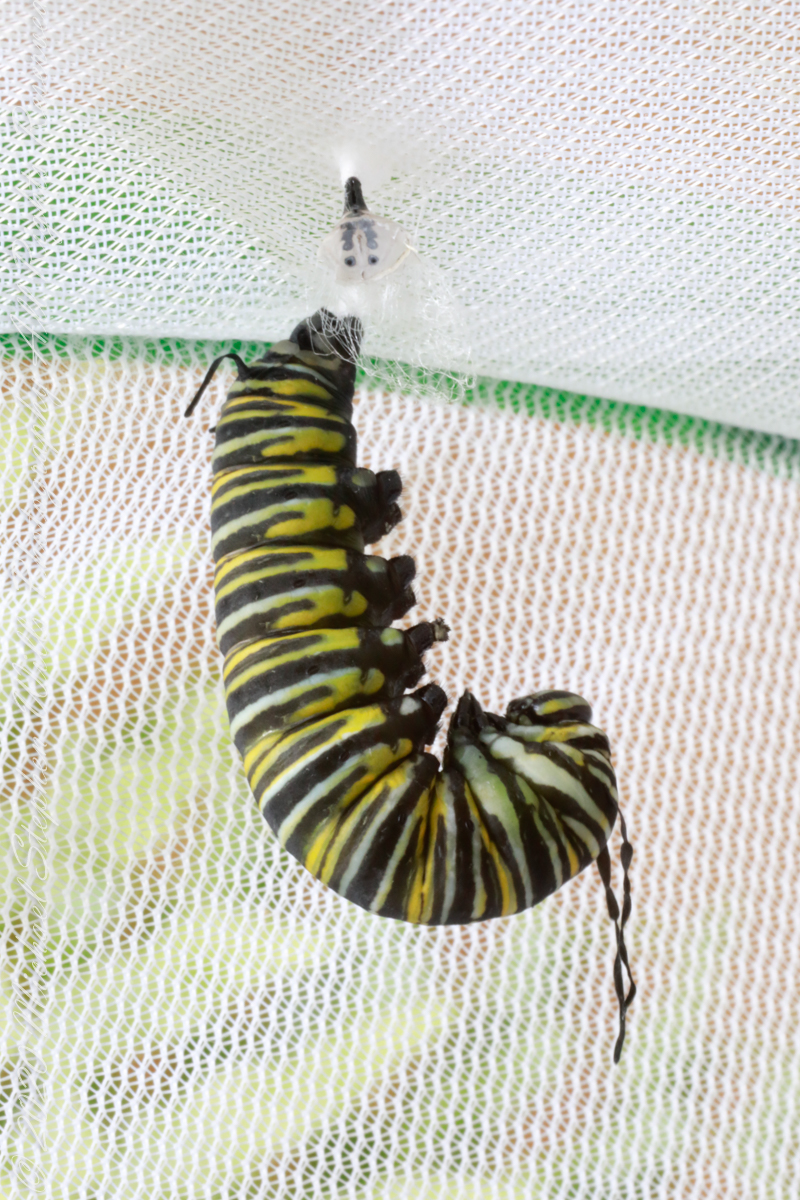
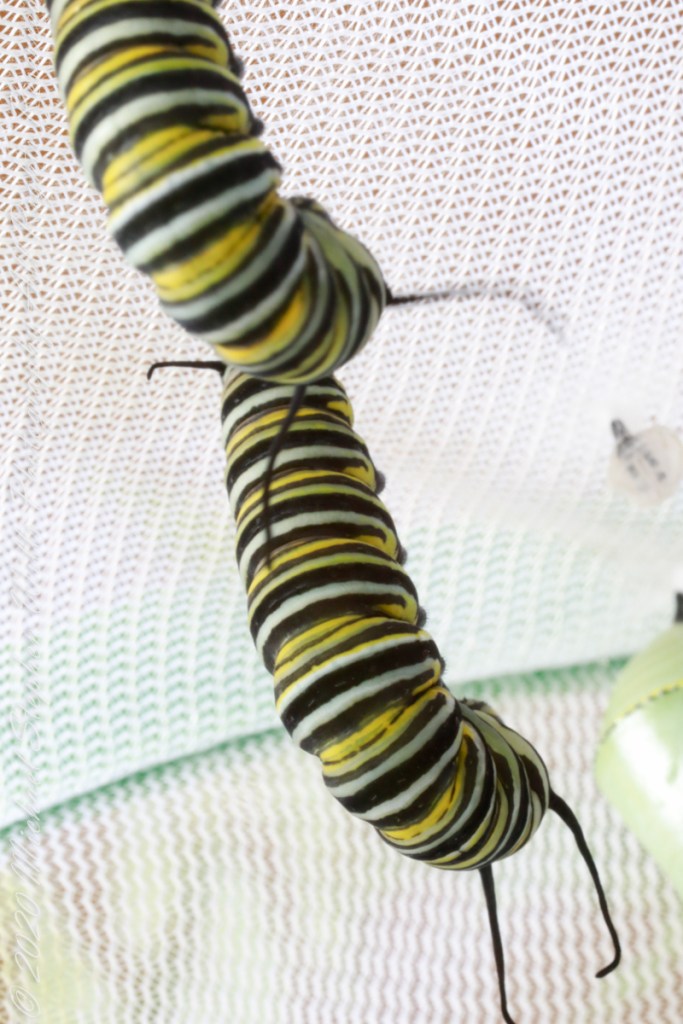
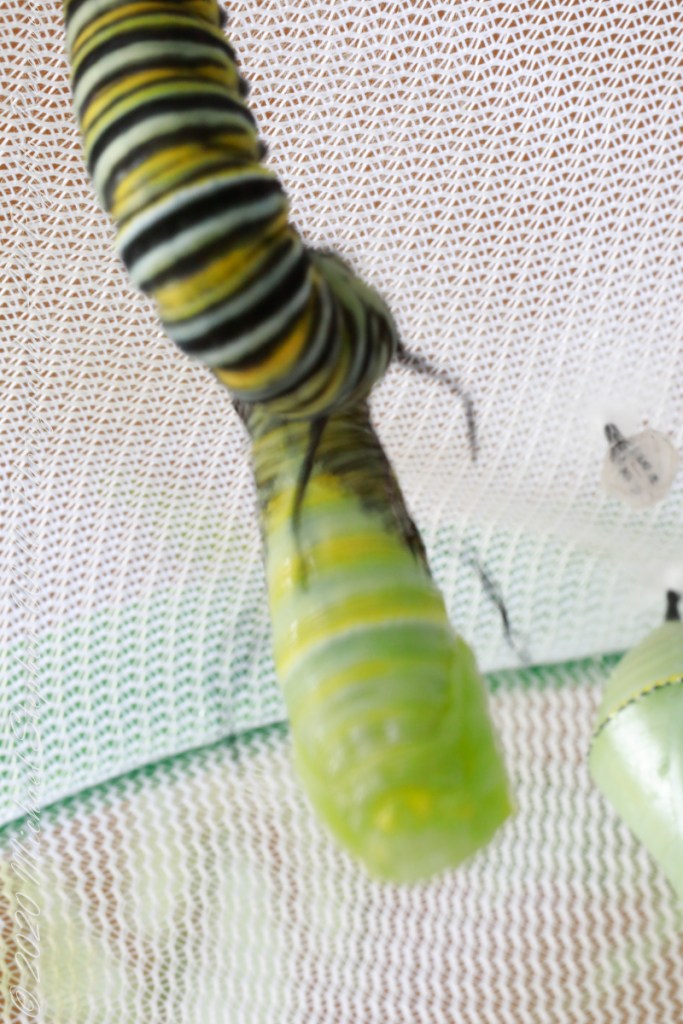
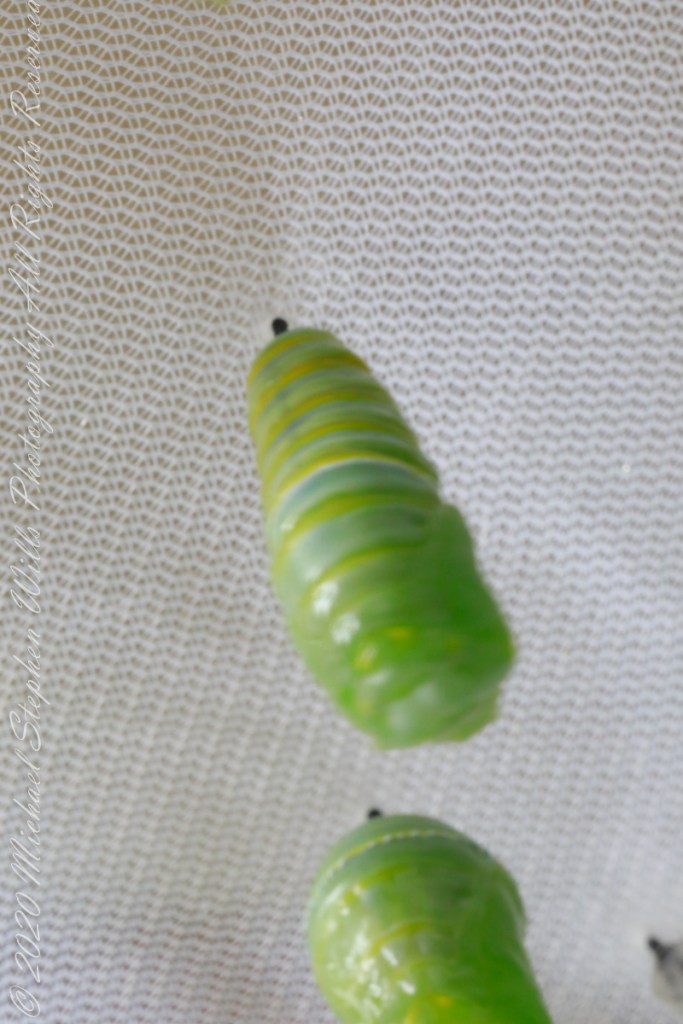
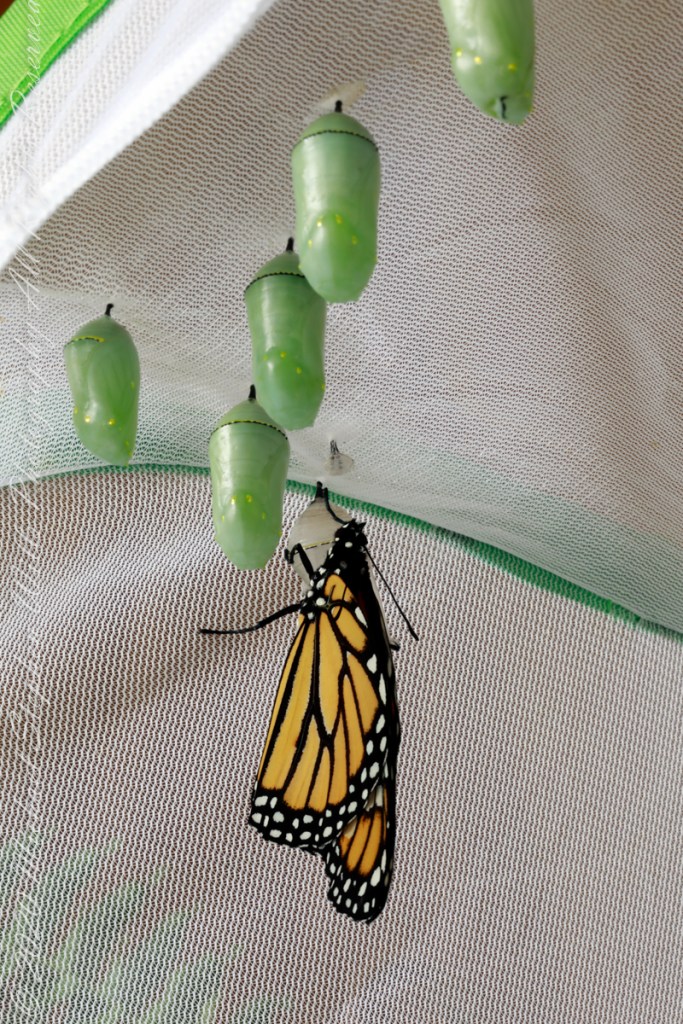
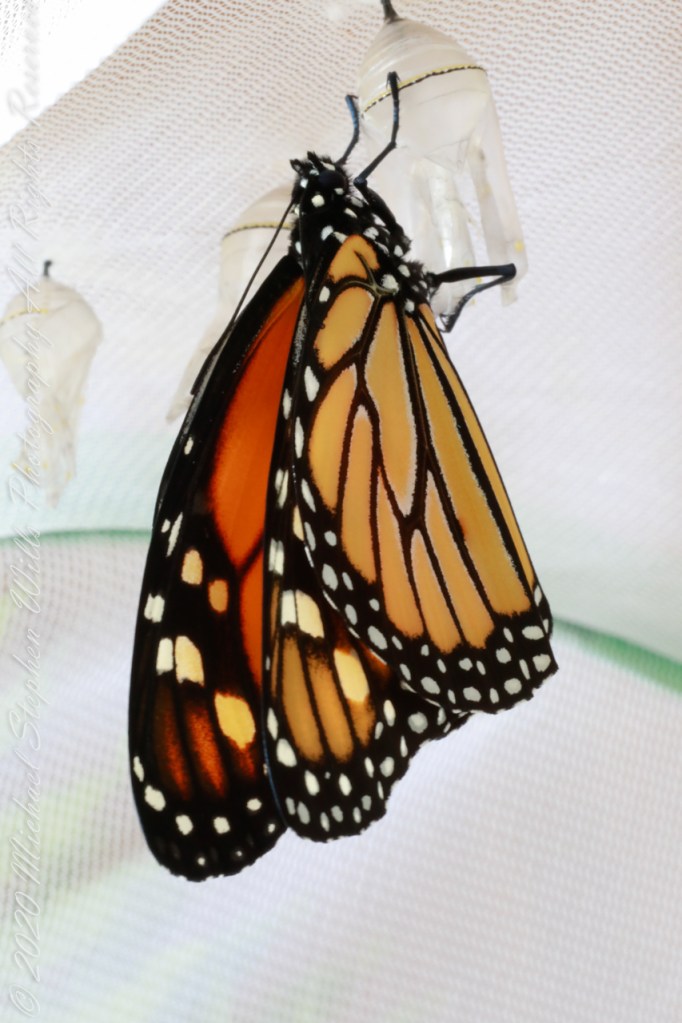
Butterflies – The Winged Wanderers: From caterpillar to chrysalis, and then to butterfly, these creatures do it all on their own. If butterflies had social media, their status would perpetually be “Just transformed. Who dis?”
A Monarch butterfly freshly emerged from the chrysalis after expanding its crumpled wings.
So, if you ever feel like you’re struggling with independence, just remember these creatures who start life with the ultimate “figure it out yourself” kit. They might just inspire you to tackle your own obstacles – though hopefully, with fewer predators involved.
Copyright 2024 Michael Stephen Wills All Rights Reserved
Imagine yourself floating in the vast cargo bay of the Space Shuttle Atlantis, surrounded by the essentials of space exploration. Here, in this dynamic space, the dreams of astronauts and scientists converge, where each mission reshapes our understanding of the universe. Curious? Discover more inside.
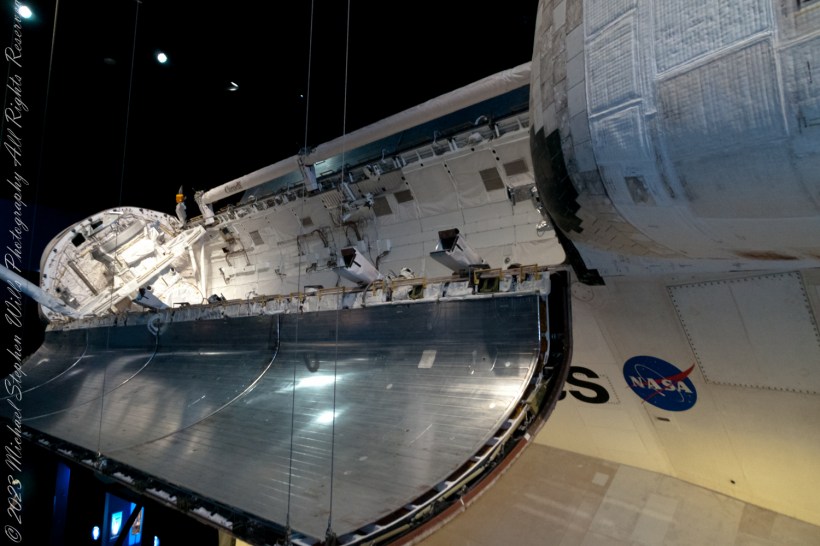
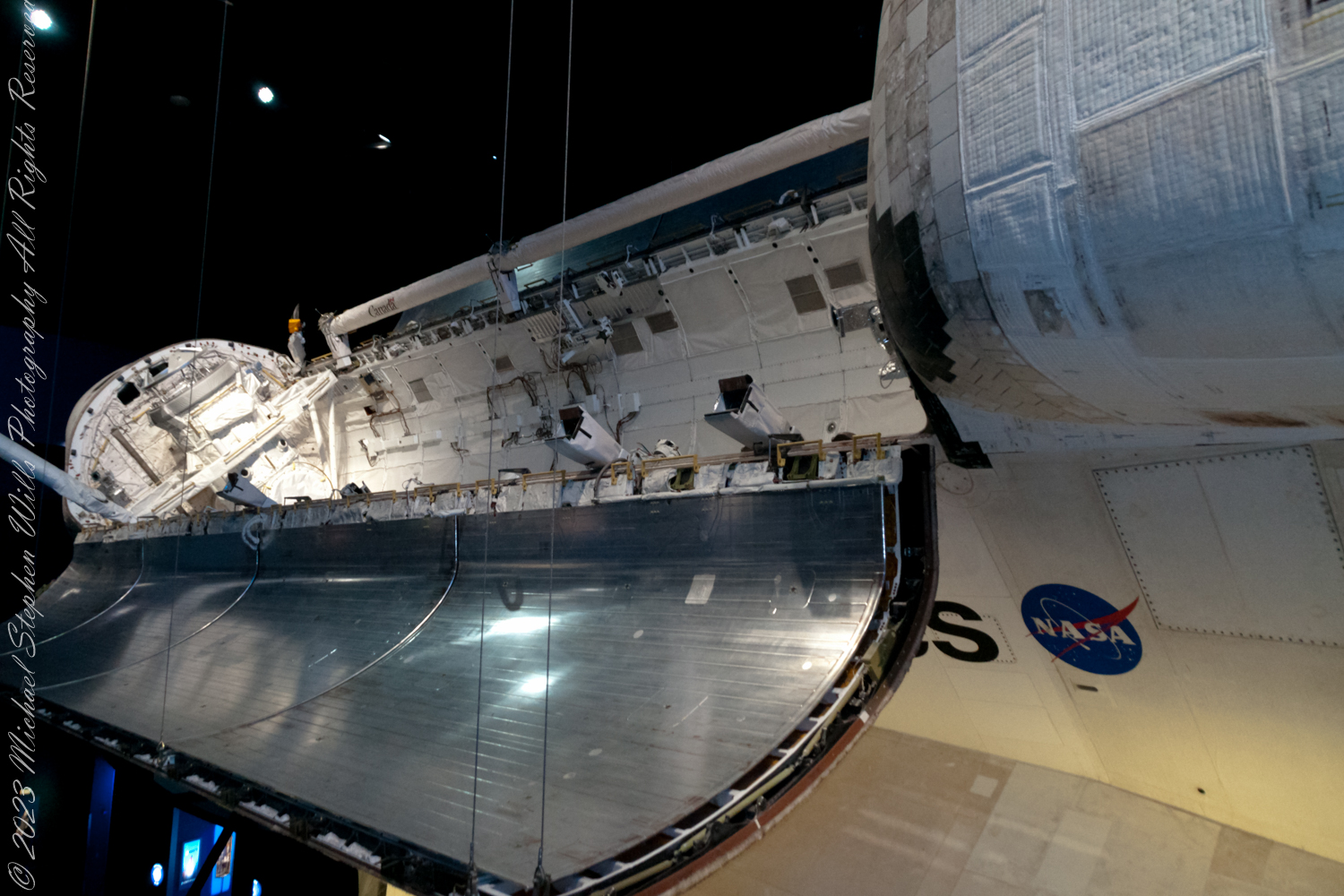
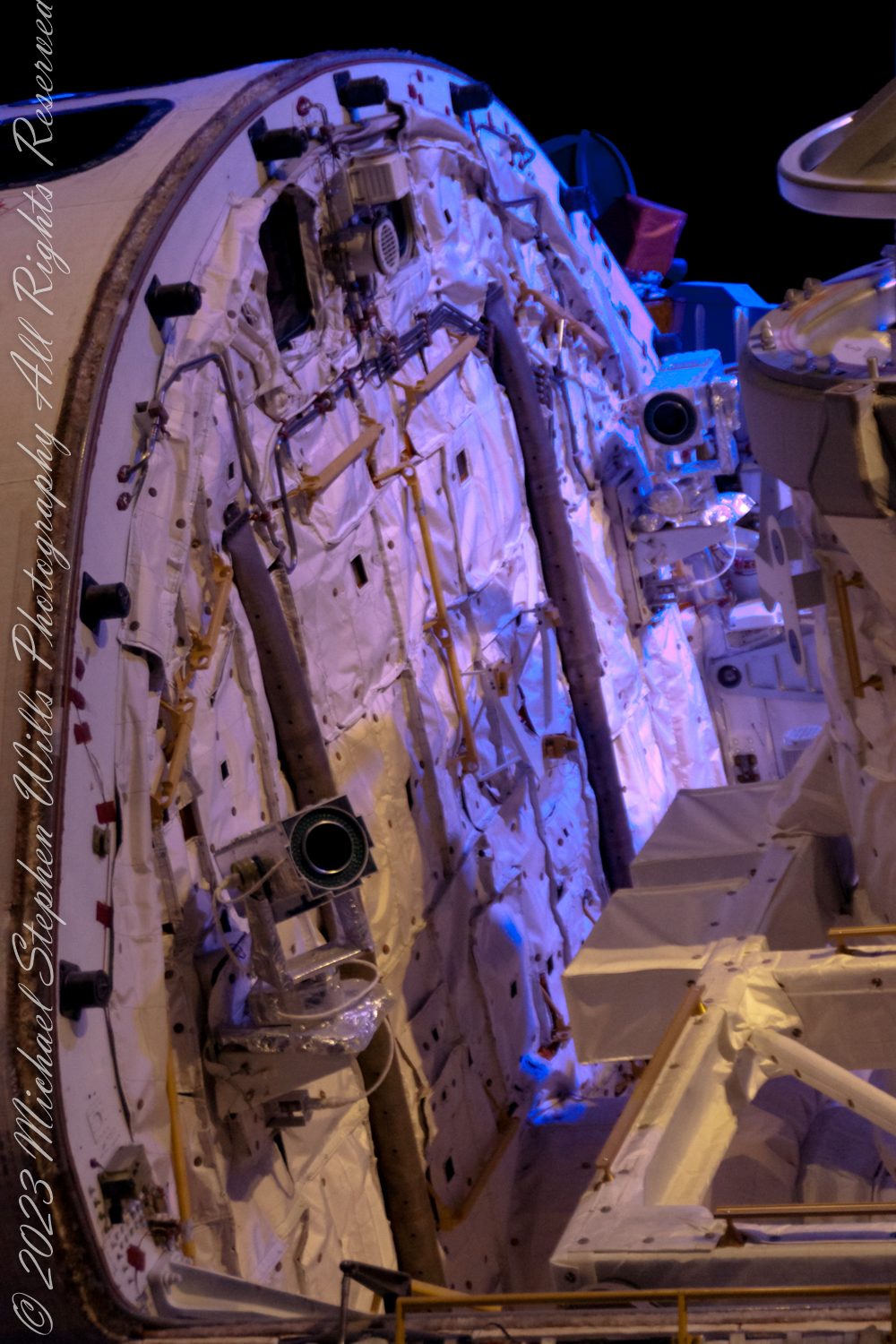
The cargo bay of the Space Shuttle Atlantis was an extensive, empty compartment located at the shuttle’s aft end, acting as the main storage area for mission payloads. A significant portion of the cargo was housed within a sizable cylindrical module named Raffaello, which contained a year’s supply of necessities—food, clothing, water, replacement parts, and scientific gear.
The dimensions of the payload area were roughly 4.6 meters (15 feet) in width and 18 meters (60 feet) in length. This spacious area enabled the shuttle to transport a diverse array of payloads, ranging from satellites to complex scientific experiments.
Exploring the Cargo Bay
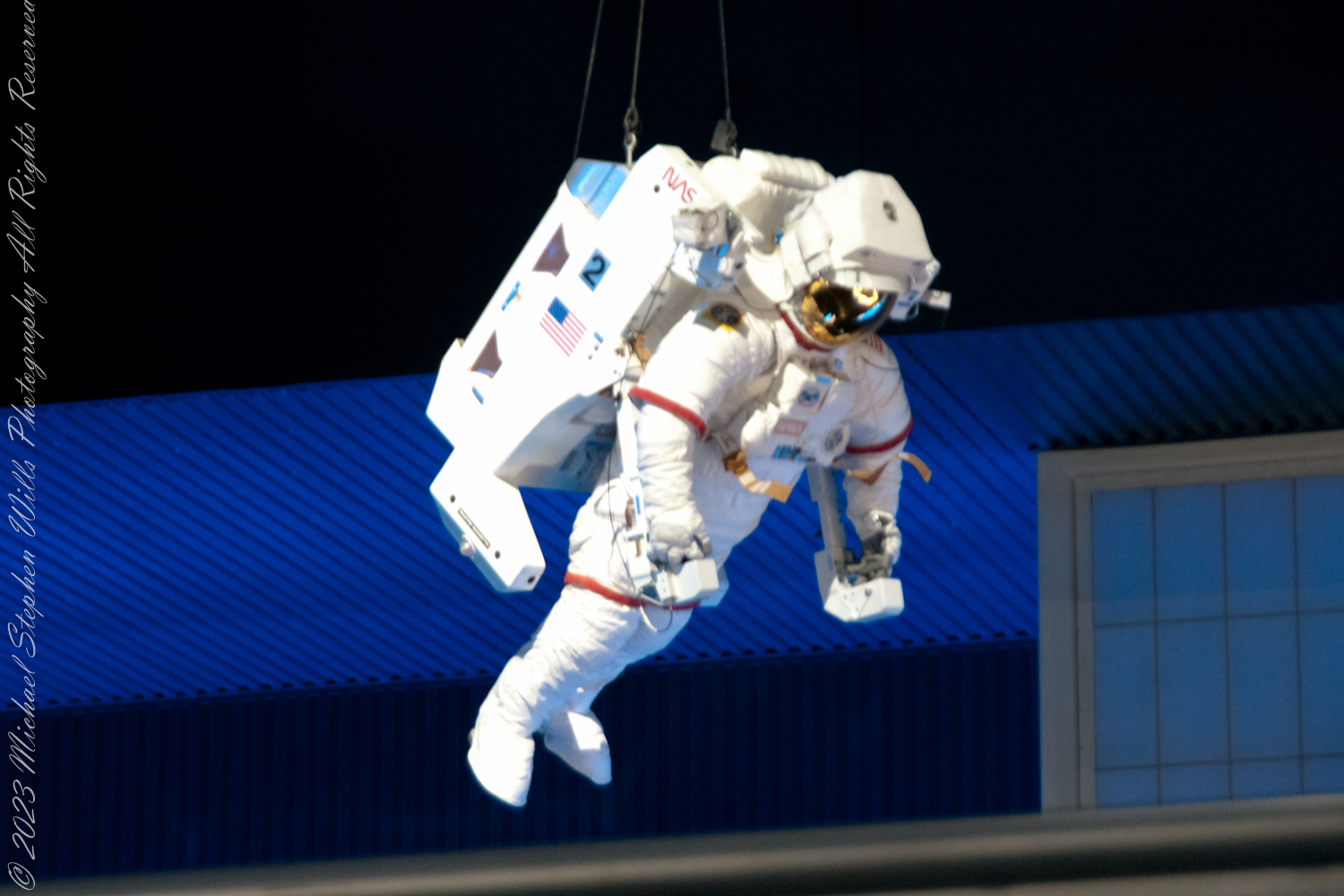
Envision yourself drifting through the cargo bay of Atlantis, encircled by a maze of wires, equipment, and neatly arranged payloads. Astronauts, tethered securely and clad in their voluminous space suits, would navigate this area, ensuring the payloads were fastened correctly for either launch or retrieval operations.
The cargo bay’s configuration was highly adaptable, tailored to meet the specific needs of each mission. It played a pivotal role in the deployment of satellites, execution of repairs, or the transportation of scientific apparatus, adapting its setup as necessary.
The Hubble Servicing Mission
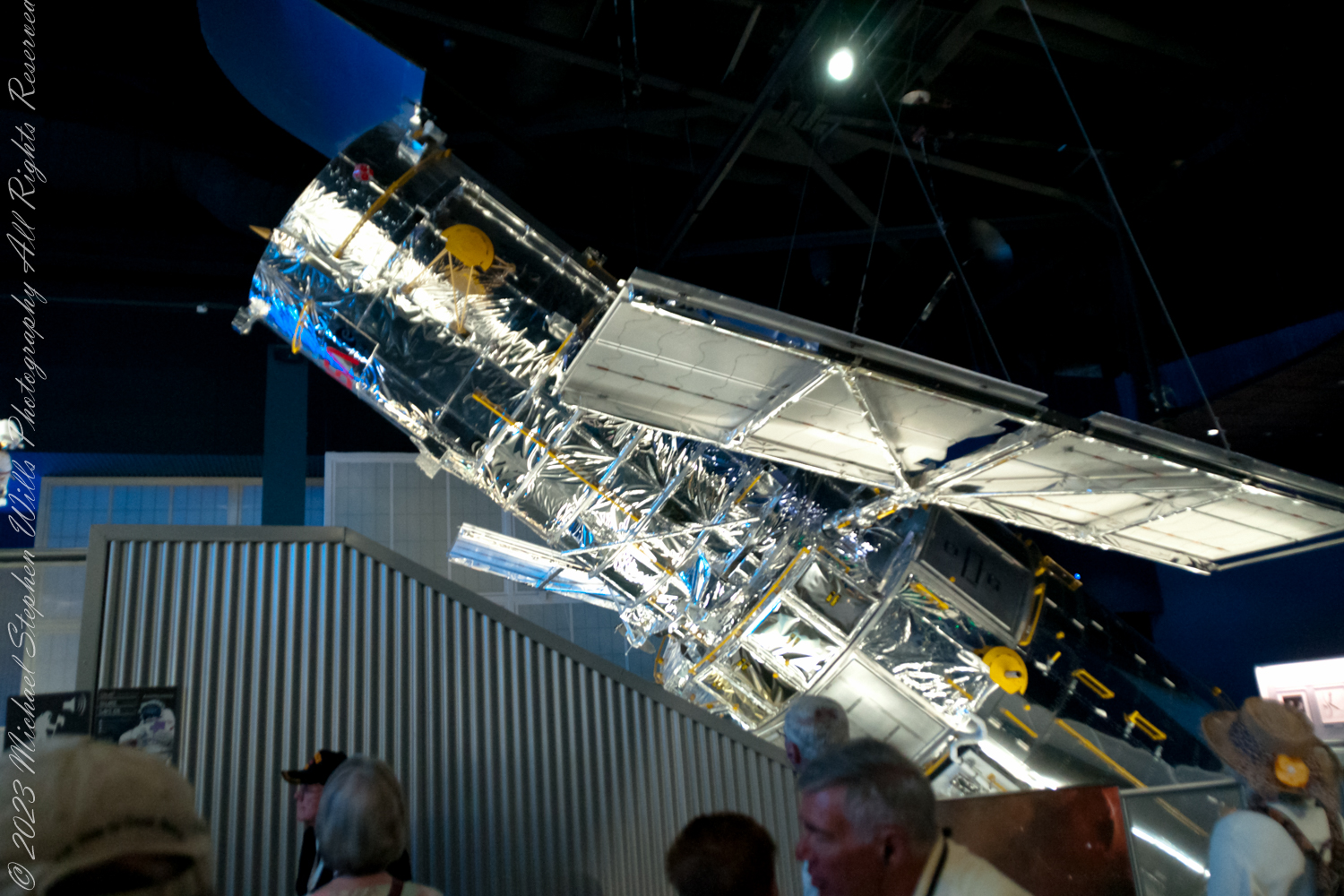
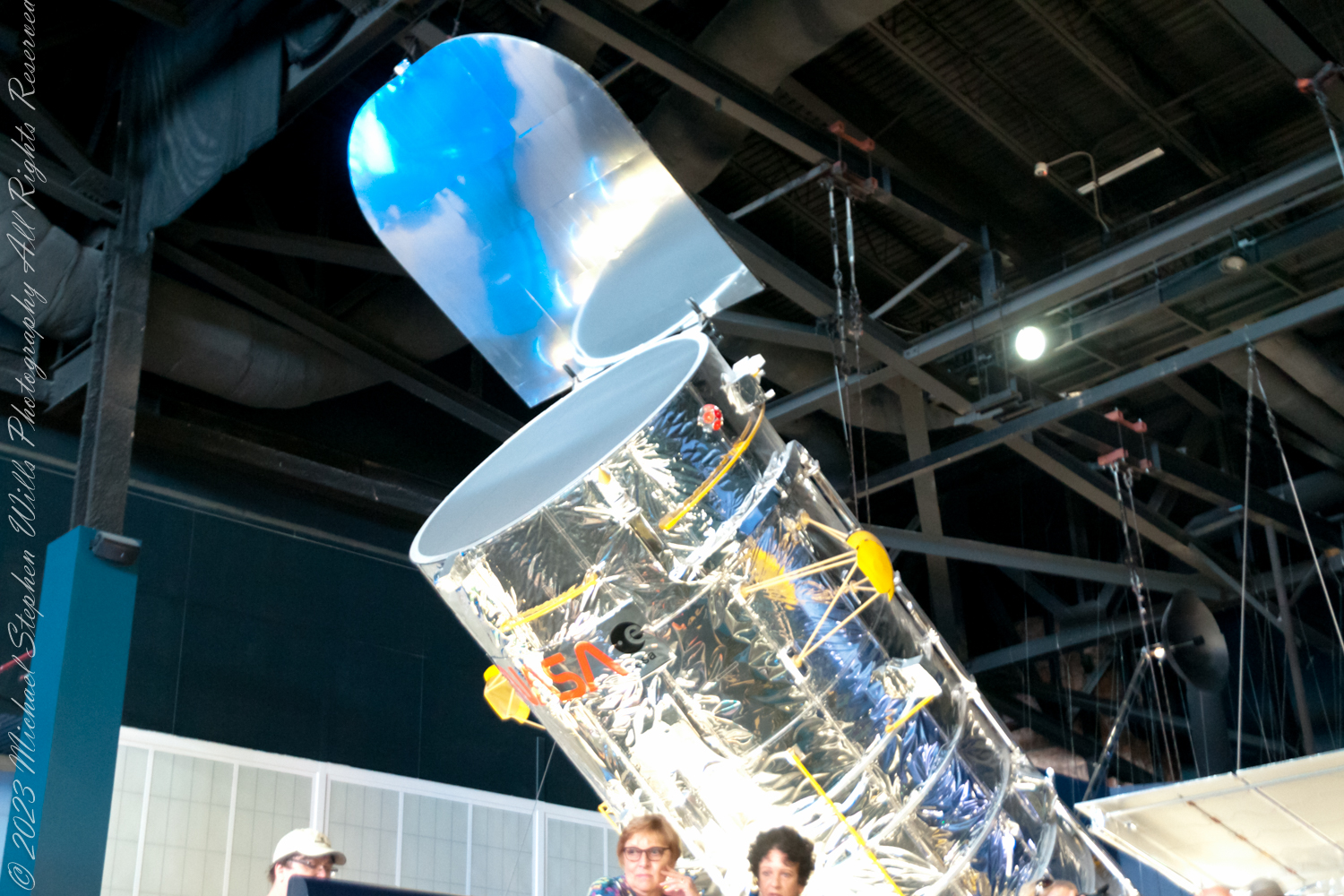
One of the most notable missions involving Atlantis was the Hubble Space Telescope Servicing Mission 4 (SM4). For this mission, Atlantis was loaded with essential items for the Hubble, including new instruments, batteries, and gyroscopes, all carefully organized within the cargo bay for safe transport to and into orbit.
Legacy
The cargo bay of Atlantis bore witness to a myriad of significant events: the release of satellites, the construction of the International Space Station, and numerous scientific investigations. Its design and flexibility were instrumental to the Space Shuttle program’s achievements.
Copyright 2024 Michael Stephen Wills All Rights Reserved
Step beyond Earth’s bounds and glimpse the astounding intricacies of the Space Shuttle’s journey. Discover the engineering marvels that propelled humanity into orbit and back, navigating the cosmos with precision. Unveil the secrets of the stars now.
The Space Shuttle, officially known as the Space Transportation System (STS), was an iconic spacecraft operated by NASA from 1981 to 2011. It consisted of an orbiter with wings for landing like an airplane, external fuel tanks, and solid rocket boosters. With its multiple missions ranging from satellite deployment to the construction of the International Space Station, the Space Shuttle was a symbol of human ingenuity in space exploration. Central to the Shuttle’s success was its navigational system, which combined state-of-the-art technology of its time with human expertise.
The navigation of the Space Shuttle was a complex orchestration involving both internal and external elements designed to work in the harsh environment of space. The photographs attached illustrate some of the external navigational elements.
External Navigational Elements
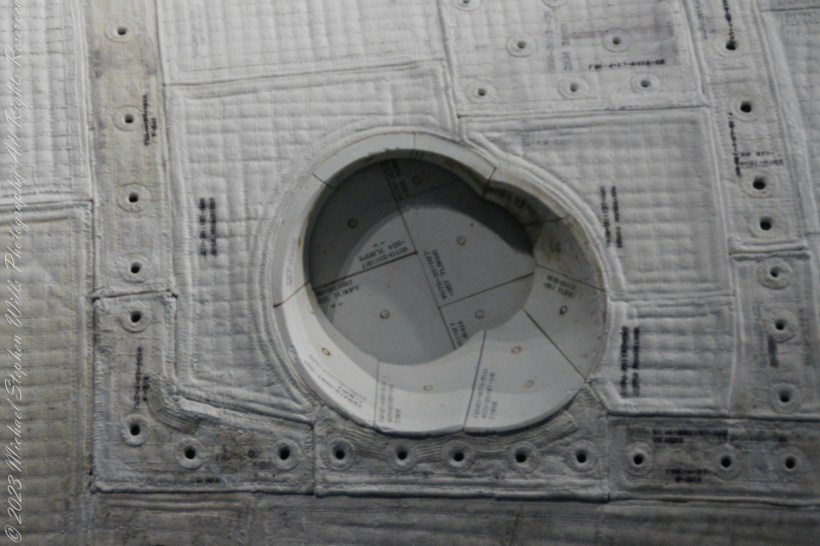
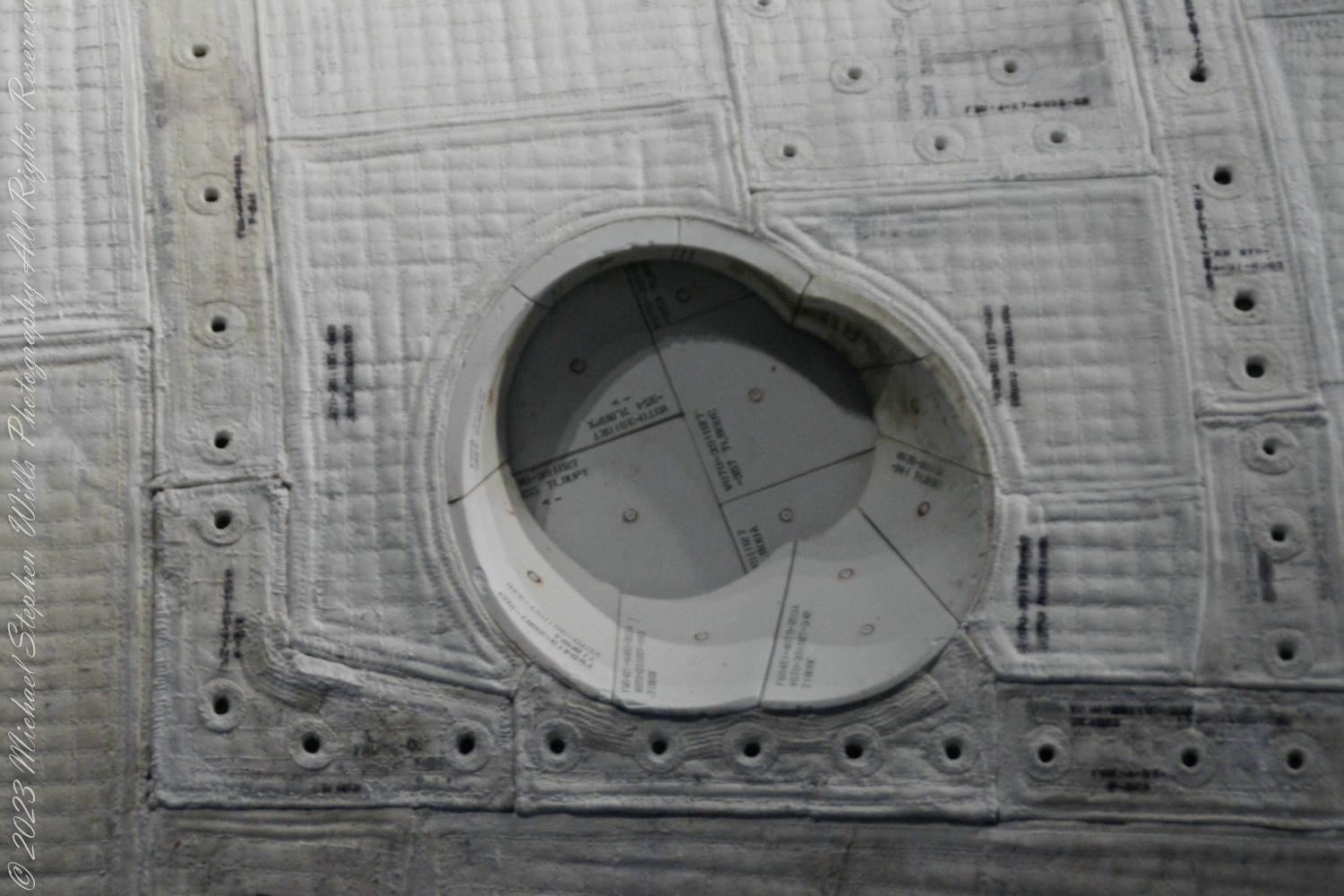
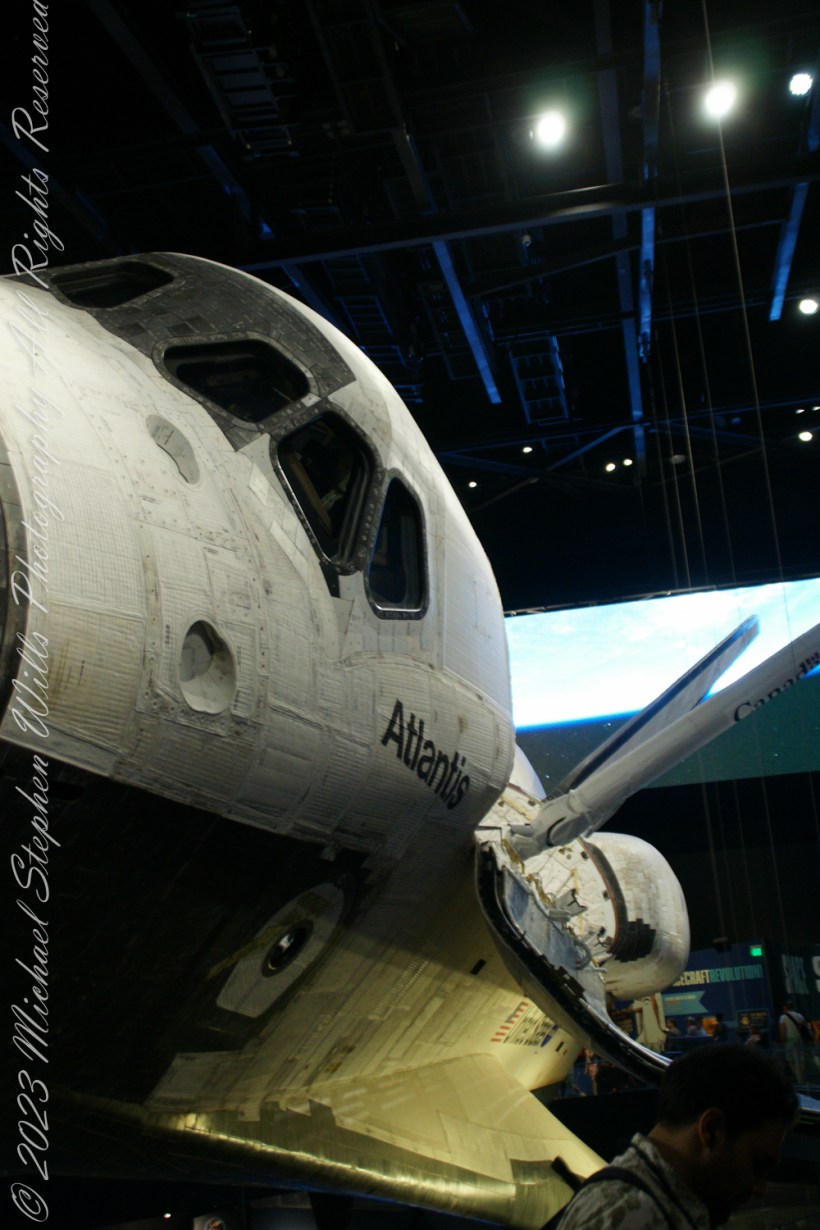
The external surface of the Space Shuttle, as seen in the following images, was covered with thousands of thermal protection system tiles. These tiles were crucial not only for protecting the Shuttle from the extreme temperatures experienced during re-entry into Earth’s atmosphere but also housed the critical sensors for navigation.
Reaction Control System (RCS)
One of the key external navigational features was the Reaction Control System (RCS), seen as clusters of small circular ports below the cockpit windows. The RCS was composed of small thrusters that could fire in short bursts to adjust the Shuttle’s orientation or speed in space. This system was vital during the maneuvers in orbit, such as satellite deployment, docking with the International Space Station, and repositioning for re-entry into Earth’s atmosphere.
Internal Navigational Elements
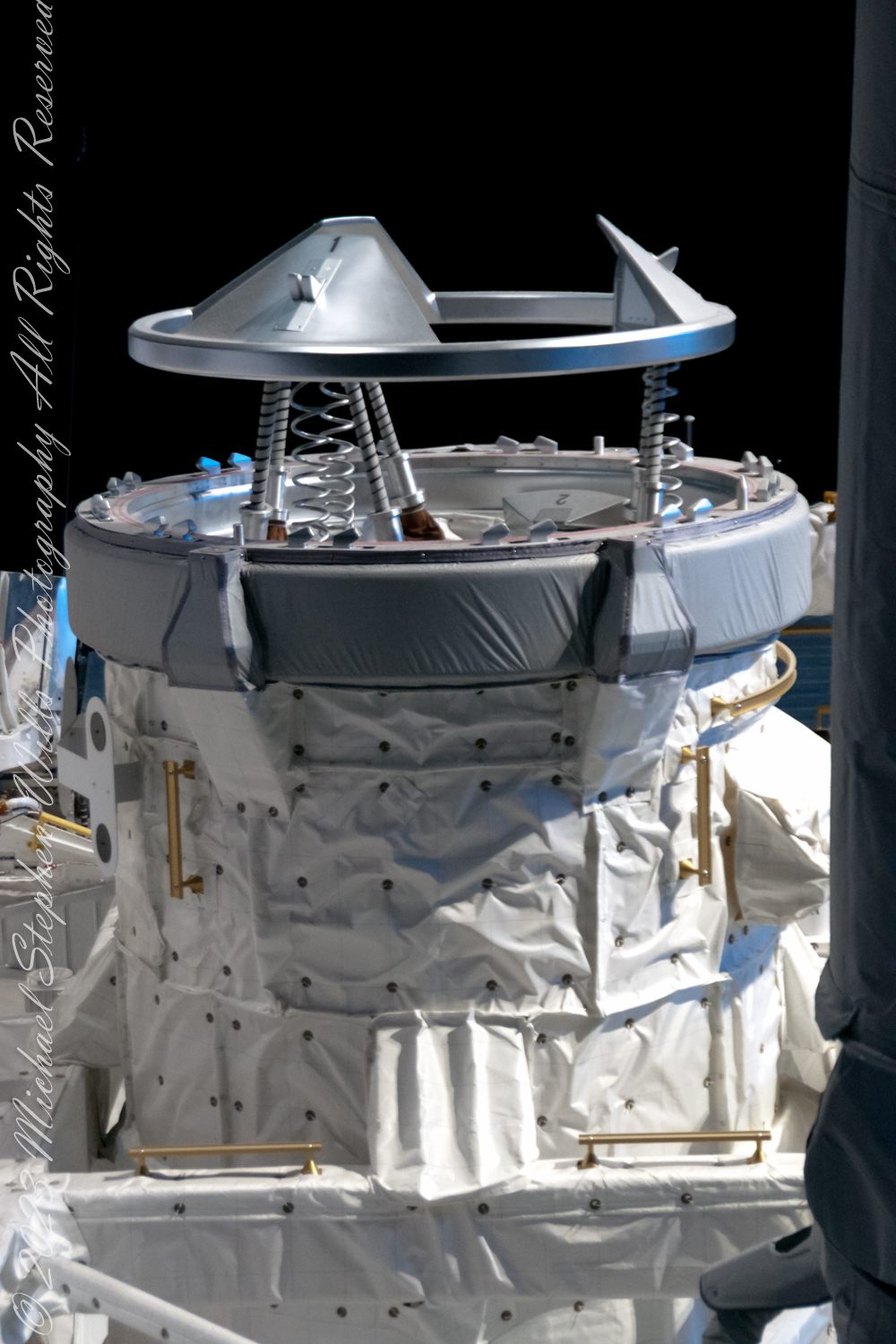
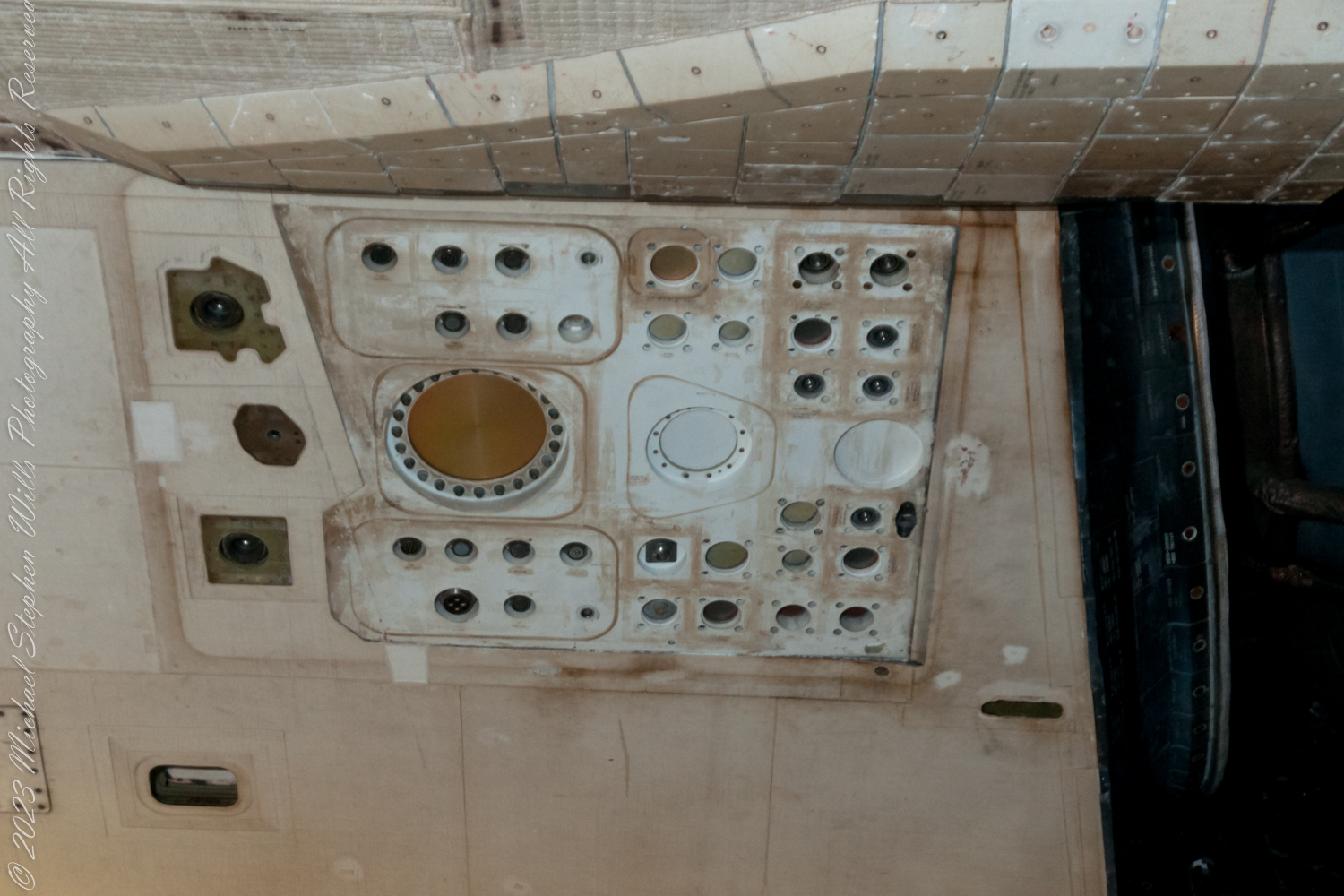
Internally, the Space Shuttle featured a complex avionics system. The following image depicts part of the orbiter’s internal structure with an array of docking mechanisms and sensor housings. The round port, surrounded by a ring of bolts, is likely an interface for the Orbiter Docking System, used for rendezvous and docking with the International Space Station.
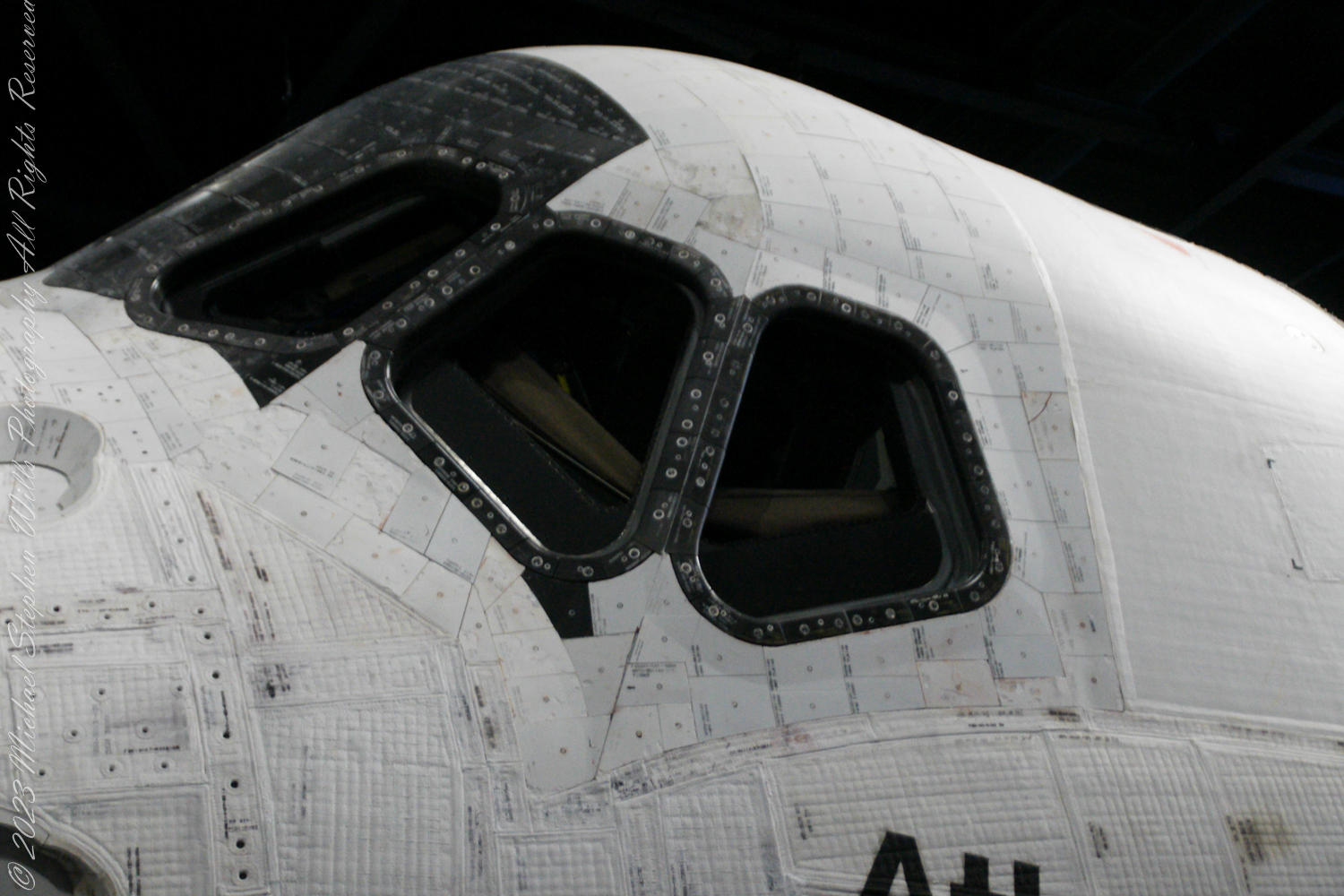
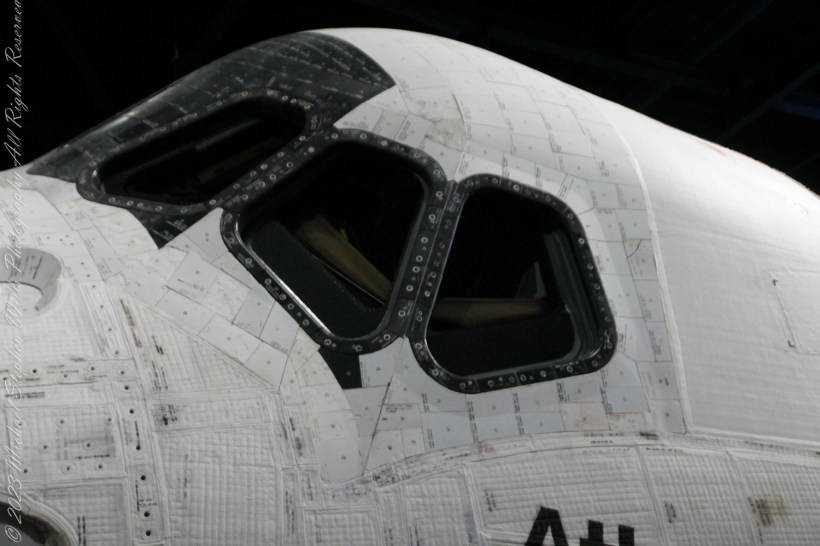
The following image shows a close-up of one of the orbiter’s windows, surrounded by reinforced panels. Each window was crucial for manual navigation, allowing astronauts to visually confirm their orientation and position relative to celestial objects and the Earth. The windows were also essential during landing, which was conducted manually by the Shuttle’s commander.
Navigational Avionics
The Shuttle’s navigation was supported by an avionics system that included inertial measurement units (IMUs), star trackers, and various other sensors. IMUs tracked the Shuttle’s position by measuring its velocity and direction, while star trackers used sightings of known star patterns to calibrate the Shuttle’s orientation in the vastness of space.
The navigational computers onboard processed data from these systems to maintain the trajectory and manage the Shuttle’s multiple systems. The computers were capable of autonomous operation, although astronauts were trained to take over manually if necessary.
Ground Support and Telemetry
In addition to onboard systems, navigation relied heavily on ground-based tracking and data relay satellites. The Shuttle communicated with NASA’s Mission Control Center, which monitored its position and trajectory, providing updates and corrections as needed. Telemetry data sent back to Earth included velocity, altitude, and engine performance metrics, which were crucial for ensuring the Shuttle’s safe passage in and out of orbit.
In Summary
The Space Shuttle’s navigational capabilities were a testament to the integration of technology and human skill. From the RCS ports on its tiled exterior to the sophisticated avionics inside, every component played a critical role in the Shuttle’s missions. This harmonious blend of internal mechanisms and external sensors, complemented by vigilant ground support, enabled the Space Shuttle to navigate the cosmos and return safely home, mission after mission.
Copyright 2024 Michael Stephen Wills All Rights Reserved
Peer through the Space Shuttle’s windows, marvels of human ingenuity that withstood the cosmos’s extremes. Experience the awe of Earth’s view from orbit and the intense blaze of re-entry, all behind the clarity of fused silica glass. Dive into the fusion of science and exploration—read the full voyage of these extraordinary panes.
The windows of the Space Shuttle represent a pinnacle of engineering and material science, intricately designed to withstand the harsh realities of space travel while providing astronauts with a vital connection to the outside universe. The journey of these windows, from concept to creation and through their performance in the harsh environment of space, is a testament to human ingenuity and the relentless pursuit of exploration.
At the heart of the Space Shuttle’s windows is fused silica glass, a material selected for its exceptional properties, including high thermal resistance, strength, and optical clarity. This choice was crucial, as the windows had to endure rapid temperature shifts from the cold vacuum of space to the searing heat of re-entry, which could exceed 1,650 degrees Celsius (3,000 degrees Fahrenheit). Corning Incorporated, known for its innovative glass solutions, was responsible for manufacturing this fused silica, utilizing a high-purity synthesis process that ensured the material could withstand the extreme conditions of space without degrading.
The design and assembly process of the Shuttle’s windows was a feat of engineering. Each window was carefully framed and installed to maintain the spacecraft’s integrity and internal pressure in the vacuum of space. This involved a complex sealing mechanism that had to be both robust and fail-safe, ensuring the safety of the crew and the success of the mission. The installation process was rigorous, involving a series of tests that simulated the harsh conditions of space to validate the windows’ performance. These tests were crucial to identifying and rectifying any potential issues that could compromise the mission or the astronauts’ safety.
In space, the Shuttle’s windows faced numerous challenges, from the threat of micrometeoroid impacts to the intense radiation of the sun. Despite these hazards, the windows performed admirably, a testament to their design and the materials used. One notable instance of their resilience was observed during the STS-61 mission, where despite micrometeoroid impacts, the windows’ integrity remained intact, ensuring the crew’s safety and mission success.
The windows also played a critical role during the Shuttle’s re-entry into Earth’s atmosphere, a phase of the mission that subjected the spacecraft to extreme heat. The windows’ ability to withstand this heat while providing the crew with a clear view for navigation was vital for a safe landing. This was achieved through the use of multiple glass layers and protective coatings, which insulated the interior from the re-entry heat.
Beyond their technical specifications and performance, the Space Shuttle’s windows served a more profound purpose. They provided astronauts with a visual connection to the Earth and space, offering perspectives that few humans have experienced. These views not only aided scientific observation and mission operations but also offered moments of unparalleled beauty, inspiring both astronauts and people on Earth.
The legacy of the Space Shuttle’s windows extends beyond their technical achievements, embodying the spirit of exploration and the human quest for knowledge. They were not merely components of a spacecraft but windows to the universe, enabling us to look beyond our planet and dream of the possibilities that lie in the vast expanse of space. Through their resilience, clarity, and performance, the Space Shuttle’s windows stand as a symbol of human ingenuity, a small but significant part of our journey to the stars.
Copyright 2024 Michael Stephen Wills All Rights Reserved
Discover an insider’s voyage to the heart of NASA’s launch operations with us as we relive the awe-inspiring Kennedy Space Center Tour, where every corner whispers tales of cosmic ventures and human courage.
Late winter 2017 my wife Pam and I embarked on an extraordinary adventure that would etch an indelible mark on our memories. On March 2nd, we had the unique privilege of experiencing the Kennedy Space Center through the eyes of a NASA Launch Director. This wasn’t just any tour; it was a journey through the heart of space exploration, a narrative brought to life by someone who had been at the helm of launching dreams into the cosmos.
The Kennedy Space Center, a beacon of human achievement on Florida’s coastline, stood before us, brimming with stories of courage, innovation, and the relentless pursuit of the unknown. As we stepped onto the grounds, we were not just visitors but participants in a legacy stretching back to the earliest days of space travel. The “NASA Launch Director Tour” promised an inside look at the complexities and triumphs of space missions, a perspective few ever witness.
This series of blog posts is an attempt to capture the essence of that day, to share the insights, emotions, and awe-inspiring moments we experienced. From the thunderous silence of the launch pads to the intimate stories of missions past, each post will explore a different facet of our journey. Join us as we relive an unforgettable exploration of human ingenuity and the boundless reaches of space, all through the lens of a day that brought the stars within reach.
Gathering and Introductions
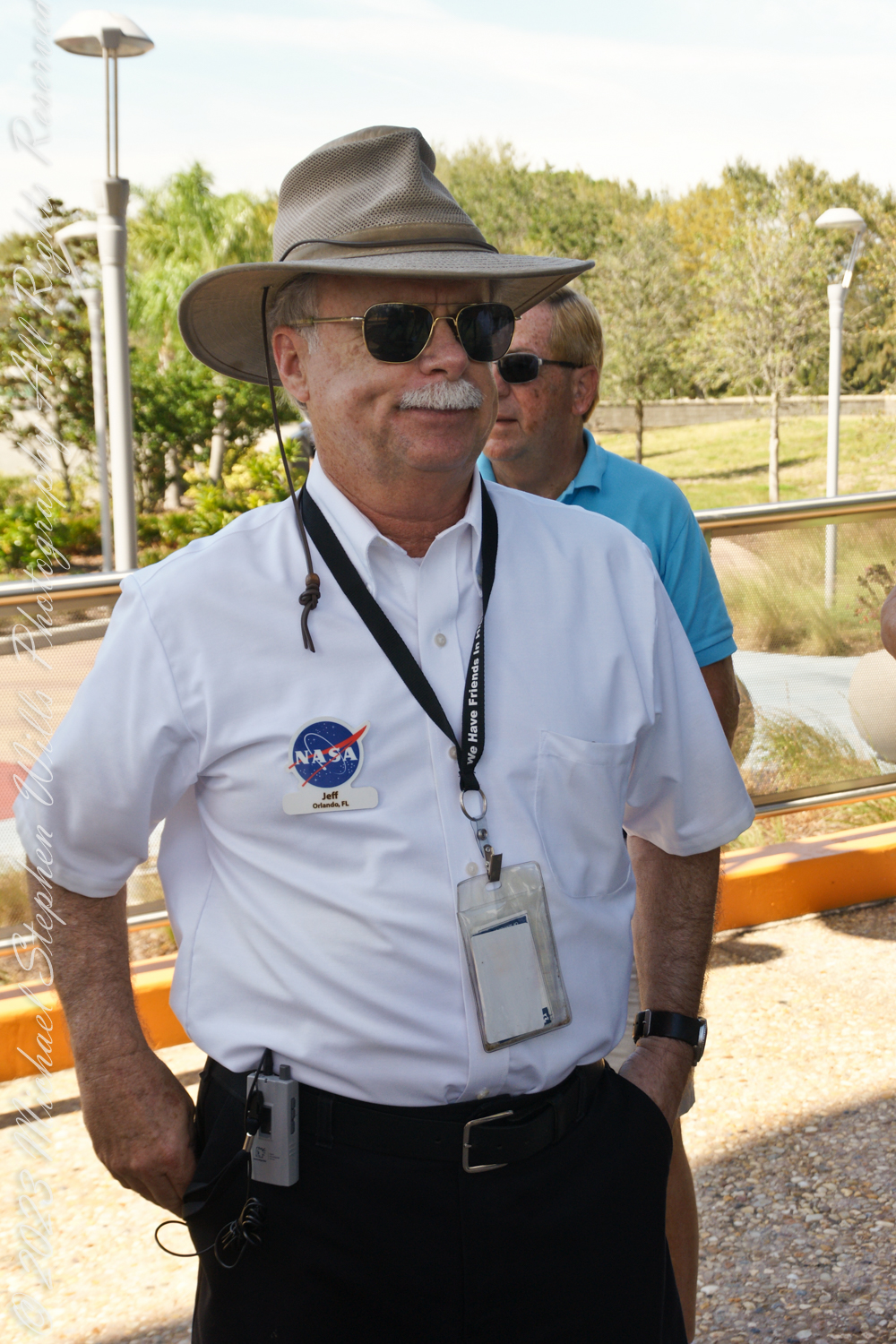
On the negative side, we enjoyed the expertise of “Jeff” who stood in for the retired Launch Director who was “out sick.” On the positive side, our very expensive fee for the tour was refunded. Jeff was everything we could expect from the tour — he had extensive and detailed insider knowledge of NASA and the launch facilities.
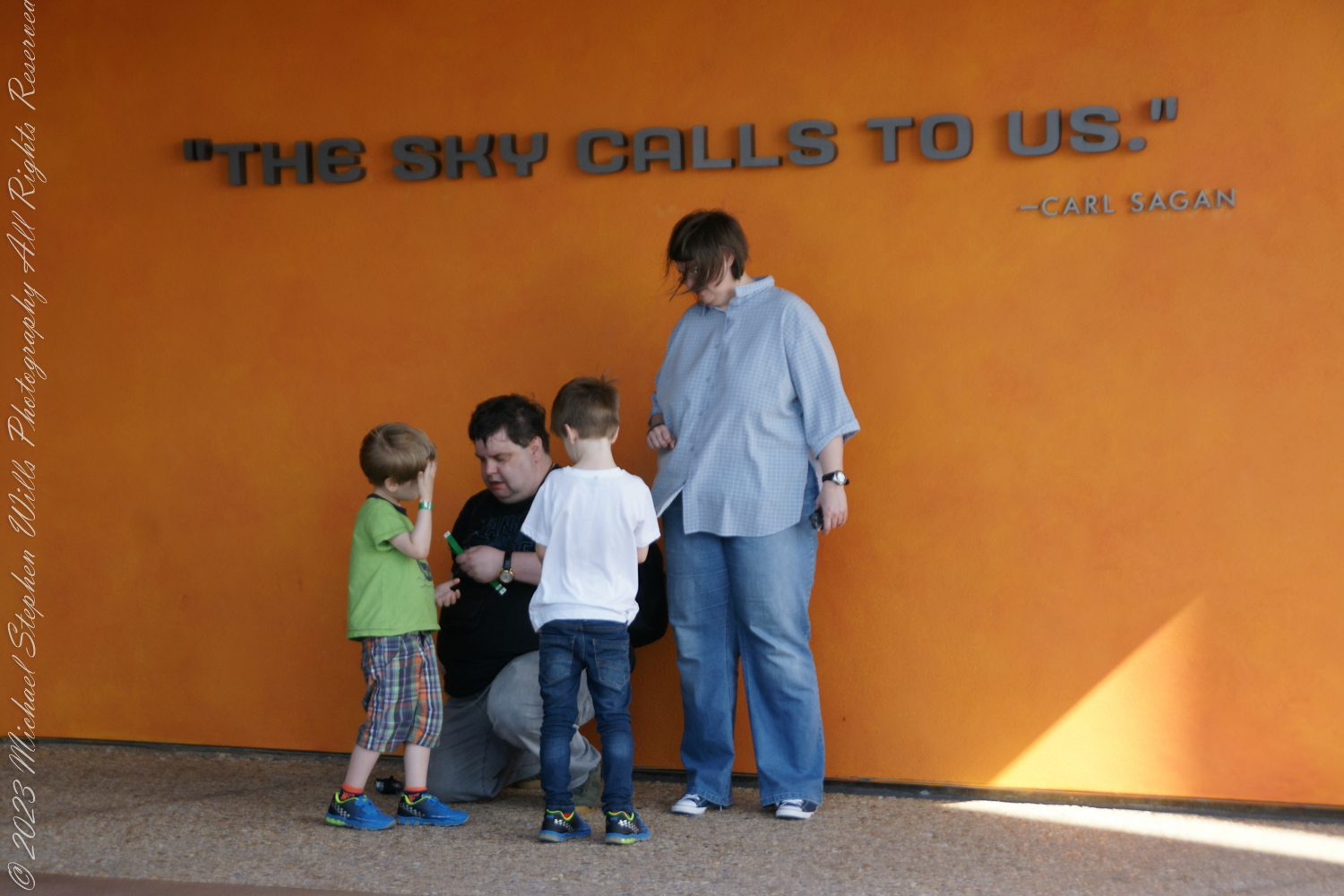
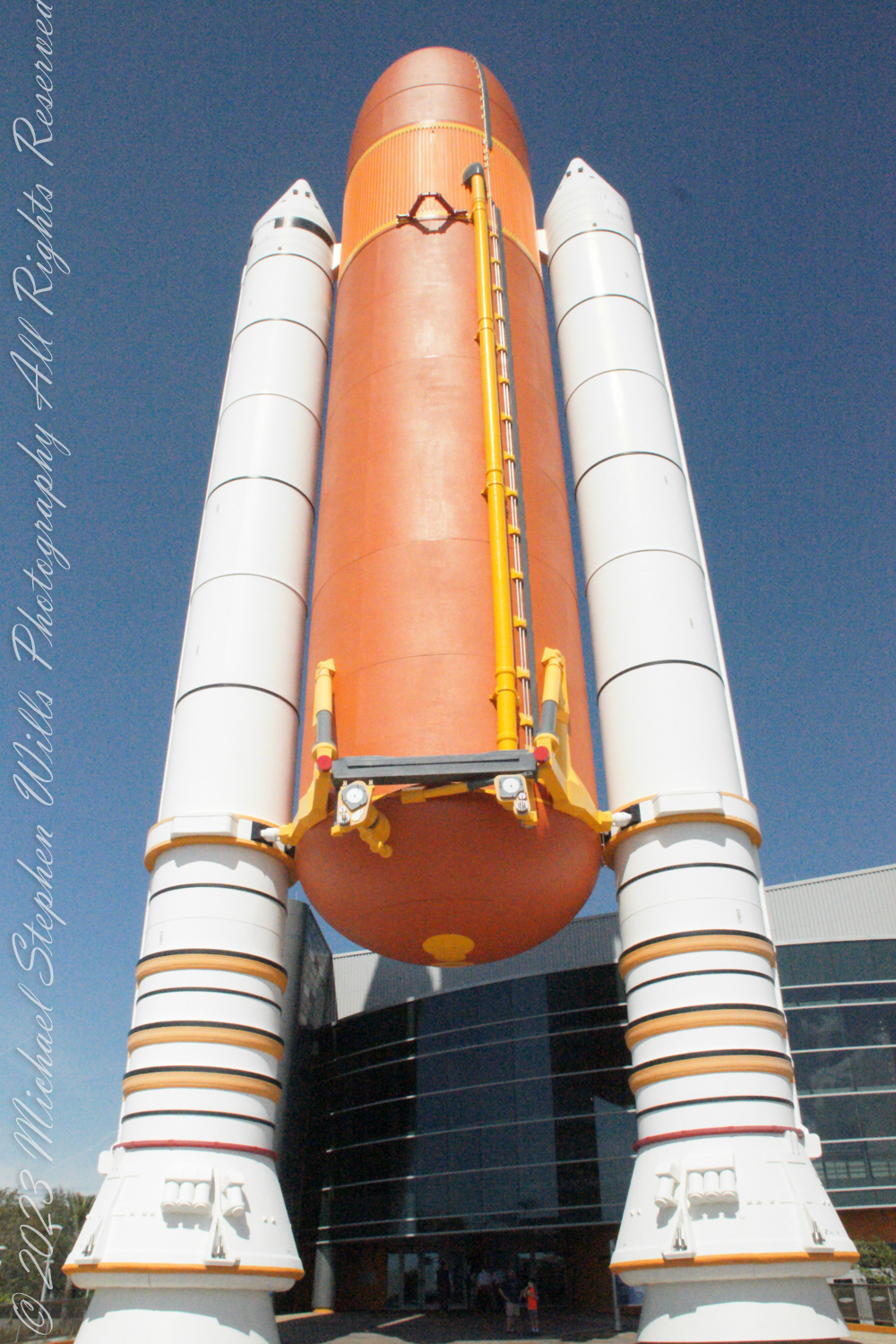
Jeff, our substitute guide Shuttle Booster and Fuel Tank, standing belowCarl Sagan QuoteCarl Sagan Quote and familyShuttle Booster and Fuel Tank, an typical adult human would parbely reach the first orange “O” ring
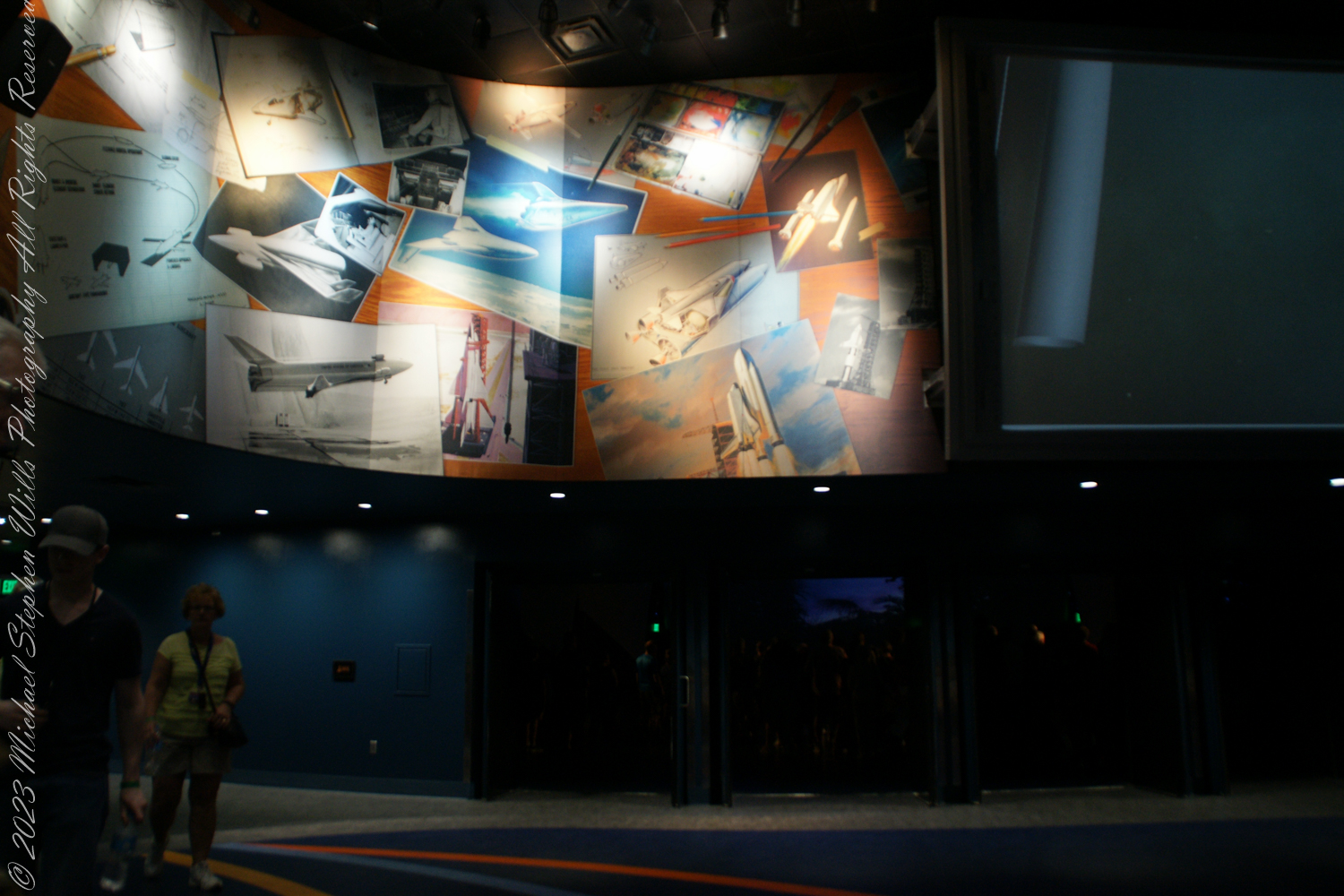
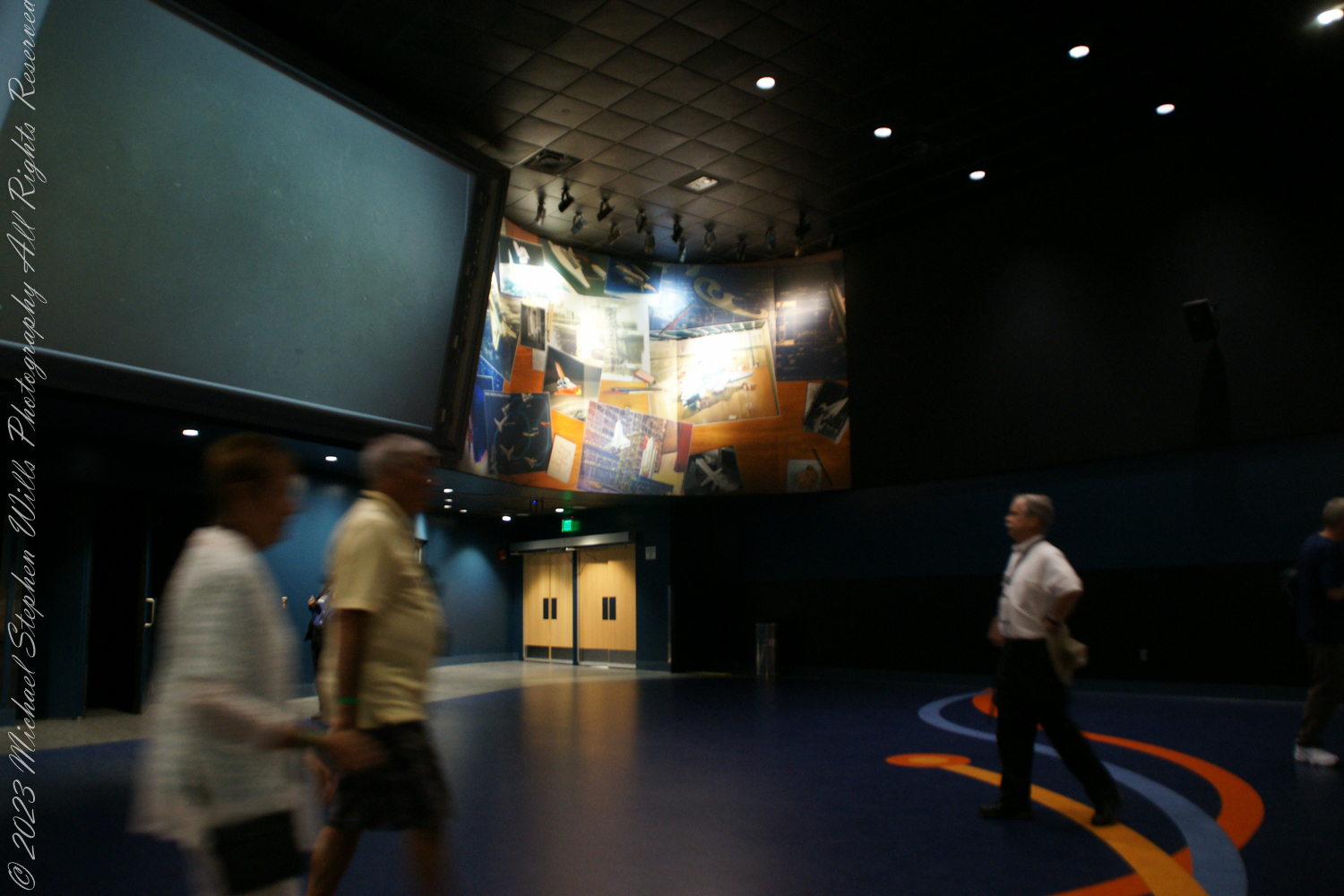
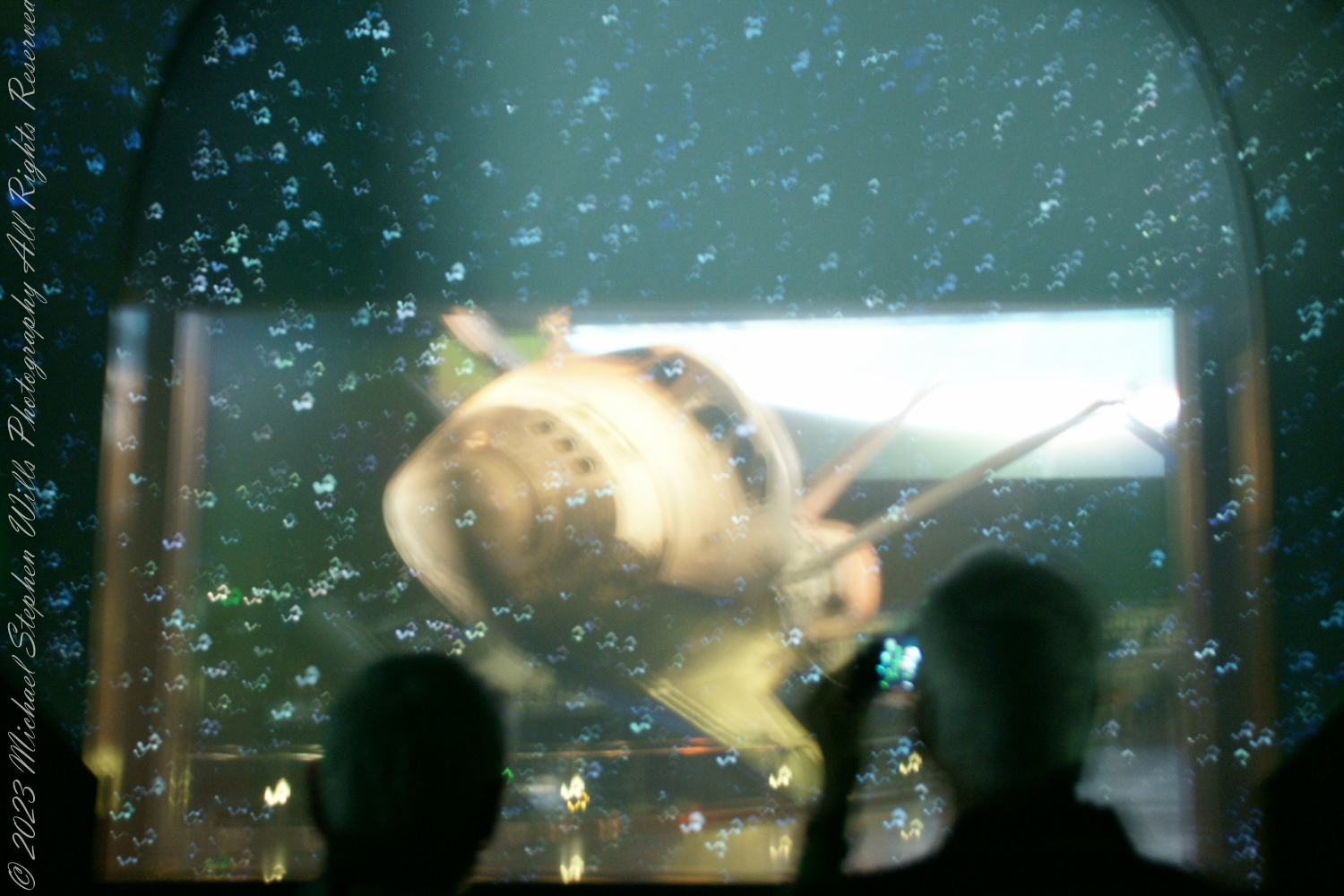
We gathered in a media room, an antechamber to the Space Shuttle Atlantis.
Entry to the Atlantis and the
Space Shuttle Atlantis lifted off on its maiden voyage STS-51-J on October 3, 1985. This was the second shuttle mission that was a dedicated Department of Defense mission. It flew one other mission, STS-61-B (the second shuttle night launch) before the Challenger disaster temporarily grounded the shuttle fleet in 1986. Among the five Space Shuttles flown into space, Atlantis conducted a subsequent mission in the shortest time after the previous mission (turnaround time) when it launched in November 1985 on STS-61-B, only 50 days after its previous mission, STS-51-J in October 1985. Atlantis was then used for ten flights from 1988 to 1992. Two of these, both flown in 1989, deployed the planetary probes Magellan to Venus (on STS-30) and Galileo to Jupiter (on STS-34). With STS-30 Atlantis became the first Space Shuttle to launch an interplanetary probe.
The orbiter’s aluminum structure could not withstand temperatures over 175 °C (347 °F) without structural failure. Aerodynamic heating during reentry would push the temperature well above this level in areas, so an effective insulator was needed.
The Thermal protection system (TPS) covered essentially the entire orbiter surface, and consisted of seven different materials in varying locations based on amount of required heat protection:
–Reinforced carbon–carbon (RCC), used in the nose cap, the chin area between the nose cap and nose landing gear doors, the arrowhead aft of the nose landing gear door, and the wing leading edges. Used where reentry temperature exceeded 1,260 °C (2,300 °F).
Reinforced carbon–carbon (RCC) of the nose cap and “chin area”
–High-temperature reusable surface insulation (HRSI) tiles, used on the orbiter underside. Made of coated LI-900 silica ceramics. Used where reentry temperature was below 1,260 °C. –Fibrous refractory composite insulation (FRCI) tiles, used to provide improved strength, durability, resistance to coating cracking and weight reduction. Some HRSI tiles were replaced by this type. –Flexible Insulation Blankets (FIB), a quilted, flexible blanket-like surface insulation. Used where reentry temperature was below 649 °C (1,200 °F).
–Low-temperature Reusable Surface Insulation (LRSI) tiles, formerly used on the upper fuselage, but were mostly replaced by FIB. Used in temperature ranges roughly similar to FIB. –Toughened unipiece fibrous insulation (TUFI) tiles, a stronger, tougher tile which came into use in 1996. Used in high and low temperature areas. –Felt reusable surface insulation (FRSI). White Nomex felt blankets on the upper payload bay doors, portions of the mid fuselage and aft fuselage sides, portions of the upper wing surface and a portion of the OMS/RCS pods. Used where temperatures stayed below 371 °C (700 °F). Each type of TPS had specific heat protection, impact resistance, and weight characteristics, which determined the locations where it was used and the amount used.
The shuttle TPS had three key characteristics that distinguished it from the TPS used on previous spacecraft:
Reusable Previous spacecraft generally used ablative heat shields which burned off during reentry and so could not be reused. This insulation was robust and reliable, and the single-use nature was appropriate for a single-use vehicle. By contrast, the reusable shuttle required a reusable thermal protection system. Lightweight Previous ablative heat shields were very heavy. For example, the ablative heat shield on the Apollo Command Module comprised about 15% of the vehicle weight. The winged shuttle had much more surface area than previous spacecraft, so a lightweight TPS was crucial. Fragile The only known technology in the early 1970s with the required thermal and weight characteristics was also so fragile, due to the very low density, that one could easily crush a TPS tile by hand.
Reinforced carbon–carbon (RCC) of the nose cap, close-up
The Space Shuttle thermal protection system (TPS) is the barrier that protected the Space Shuttle Orbiter during the searing 1,650 °C (3,000 °F) heat of atmospheric reentry. A secondary goal was to protect from the heat and cold of space while in orbit.
During the launch of STS-27 in 1988, a piece of insulation shed from the right solid rocket booster struck the underside of the vehicle, severely damaging over 700 tiles and removing one tile altogether. The crew were instructed to use the remote manipulator system to survey the condition of the underside of the right wing, ultimately finding substantial tile damage. Due to the classified nature of the mission, the only images transferred to the mission control center were encrypted and of extremely poor quality. Mission control personnel deemed the damage to be “lights and shadows” and instructed the crew to proceed with the mission as usual, infuriating many of the crew. Upon landing, Atlantis became the single-most-damaged shuttle to successfully land. The survival of the crew is attributed to a steel L band antenna plate which was positioned directly under the missing tile. A similar situation would eventually lead to the loss of the shuttle Columbia in 2003, albeit on the more critical reinforced carbon-carbon.
References: extensive sections of the following Wikipedia articles were quoted, "Space Shuttle thermal protection system," "Space Shuttle Atlantis."
Copyright 2024 Michael Stephen Wills All Rights Reserved
As my wife, Pam, and I entered the breezy expanse of the Merritt Island National Wildlife Refuge, the world seemed to slow down, allowing us to savor every moment of my journey along Blackpoint Drive. The sky, a sprawling canvas of muted greys, reflected in the wind ruffled waters, enhancing the tranquility of this haven.
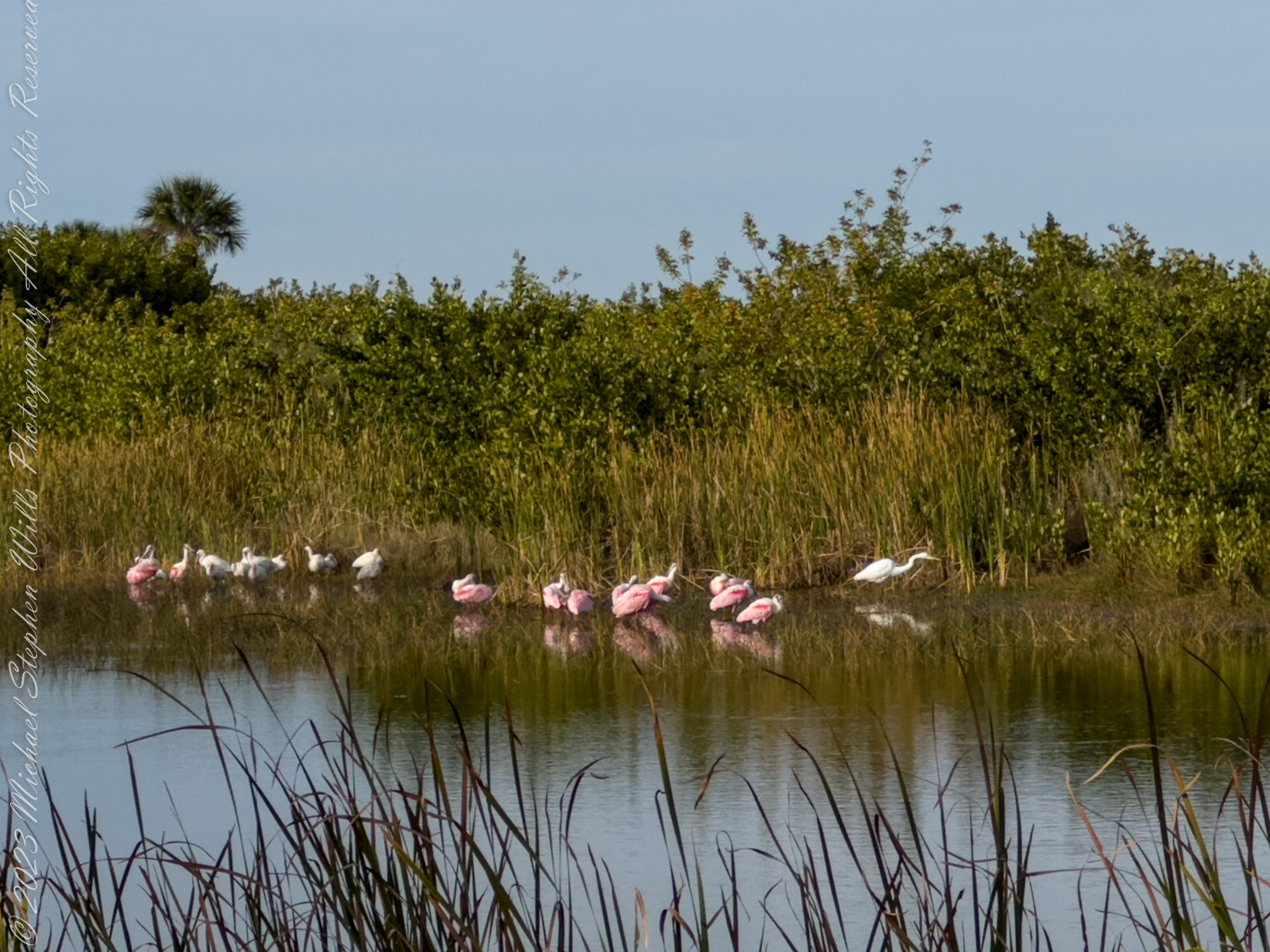
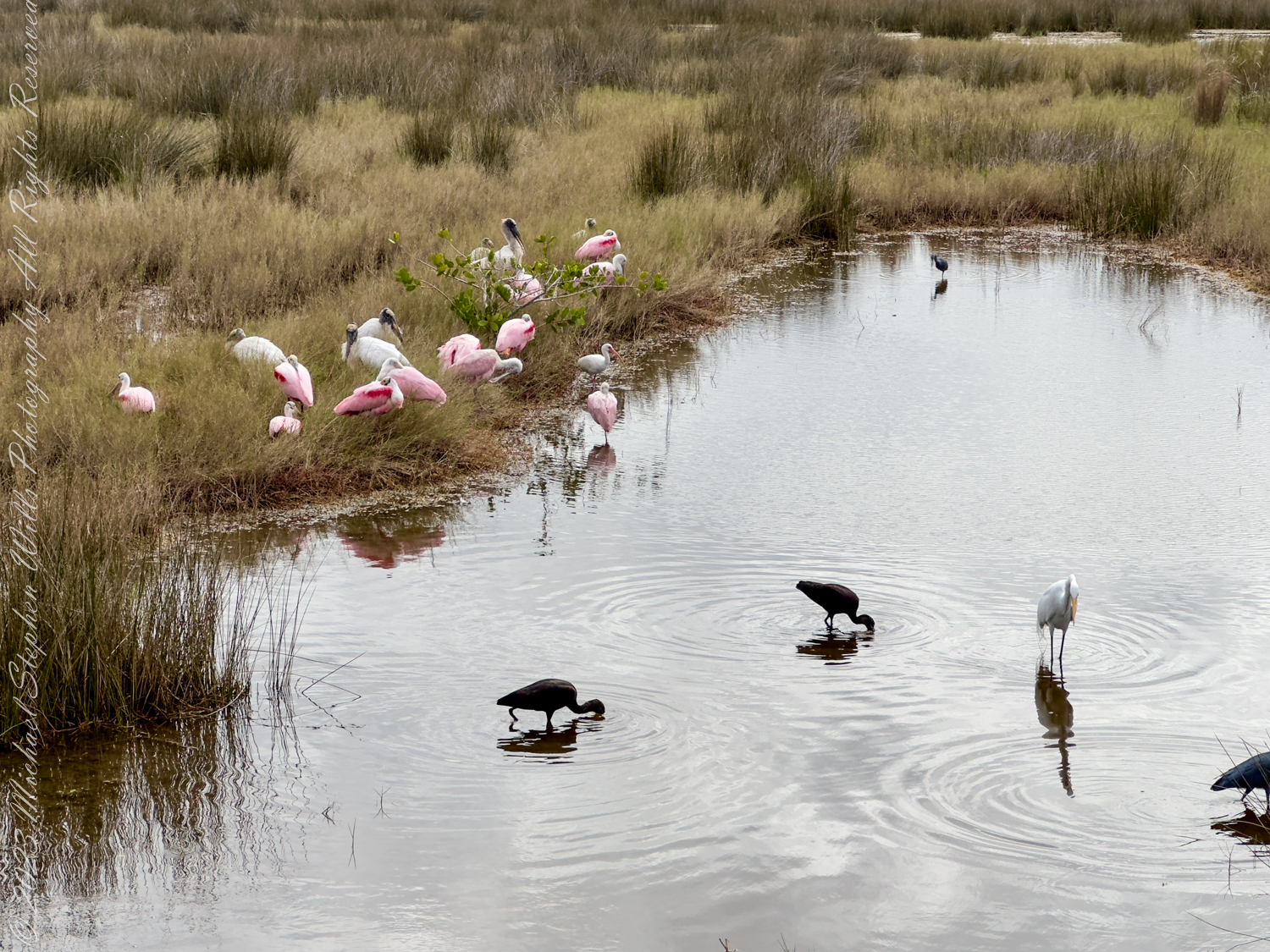
Our first encounter was with the elegant Roseate Spoonbills (Platalea ajaja), their vibrant pink feathers a stark contrast against the earthy tones of the marsh. They waded with purpose, their spoon-shaped bills sifting through the water, a dance of survival that was both methodical and beautiful.
In the company of the spoonbills were the stoic Great Egrets (Ardea alba), statuesque in their white plumage. They stood motionless, like sentinels guarding the water’s edge, only to strike with lightning speed when prey ventured too close.
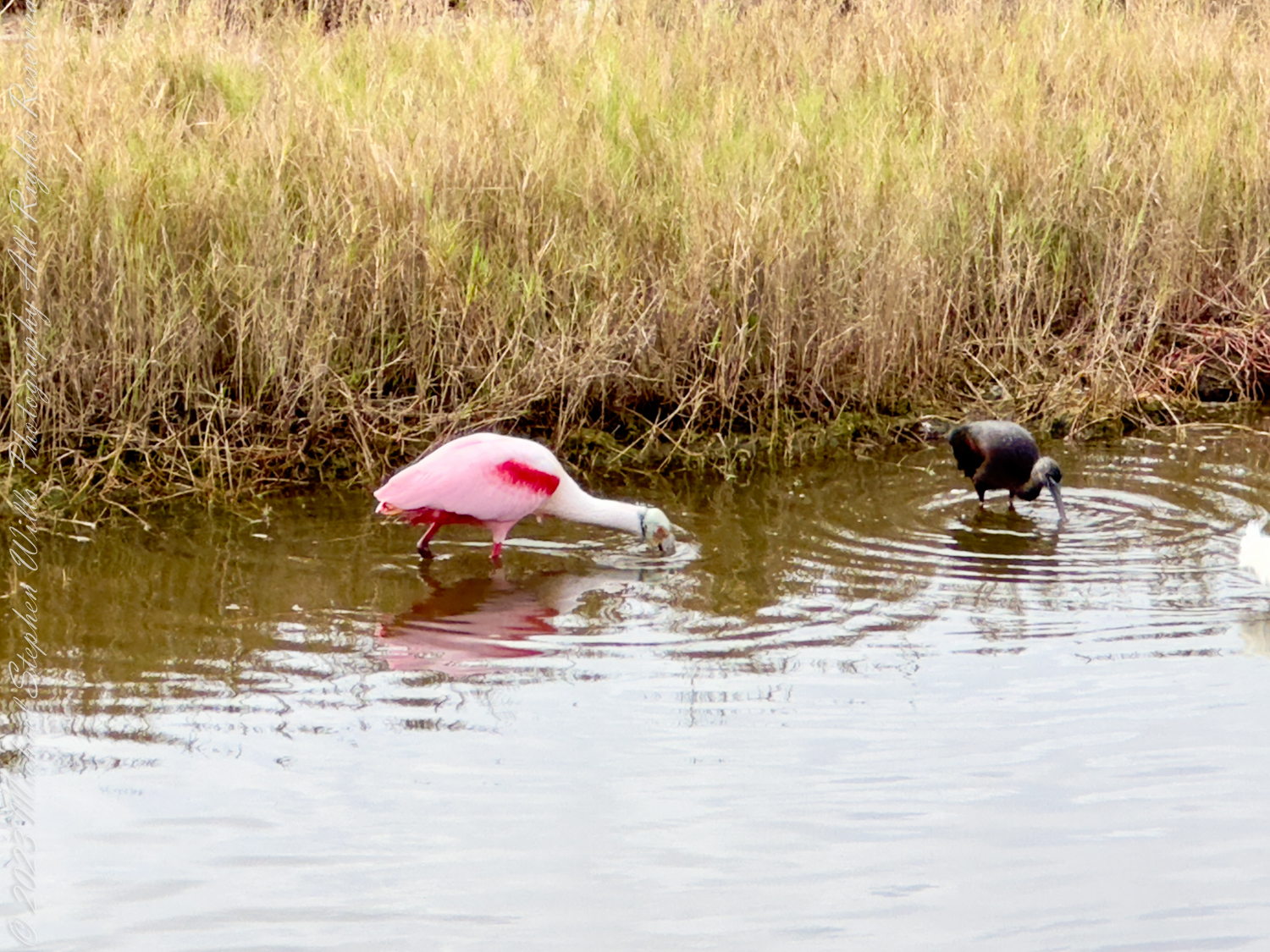
We watched as the Glossy Ibises (Plegadis falcinellus) dipped their curved bills into the water, each movement a study of precision, their dark feathers glistening with an iridescent sheen when caught by the light.
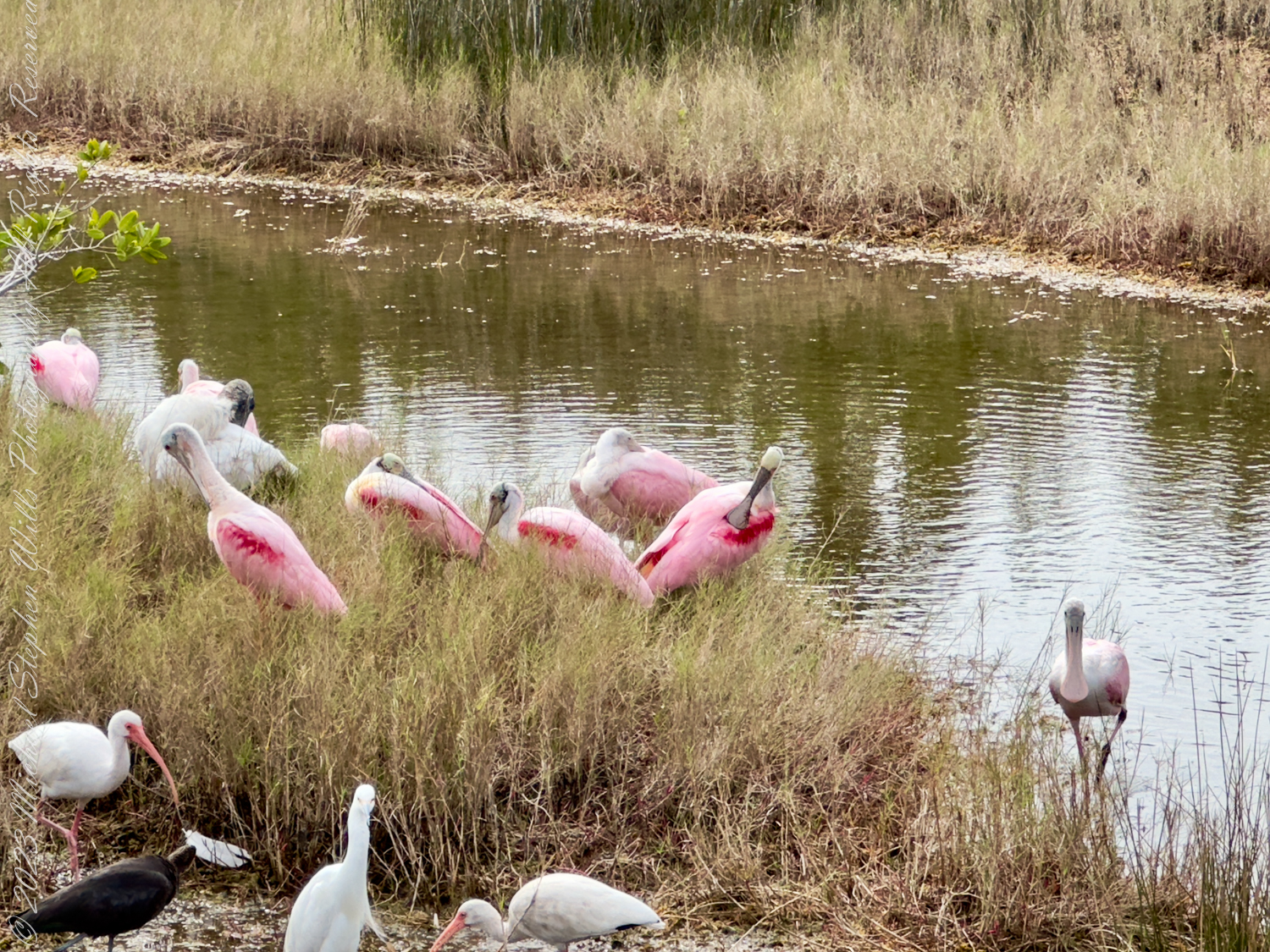
Amongst these avian aristocrats, the unassuming American White Ibises (Eudocimus albus) went about their business. Their red beaks probed the shallows, unperturbed by the presence of their more colorful neighbors or by my watchful eyes.
As we ventured further, the landscape shifted, the water opening up to reveal a gathering of Spoonbills and White Ibises, a community united by the need to feed and the safety of numbers. The occasional flap of wings and contented calls created a symphony that celebrated life in these wetlands.
Isolation took on a new meaning when I spotted a solitary Roseate Spoonbill, its reflection a perfect mirror image on the water’s surface. It was a moment of quiet introspection, the bird and I alone in our thoughts.
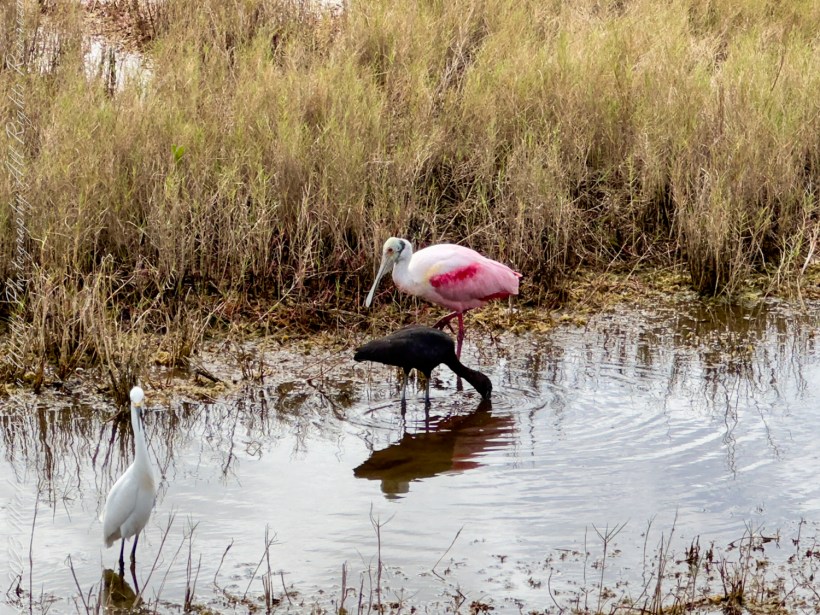
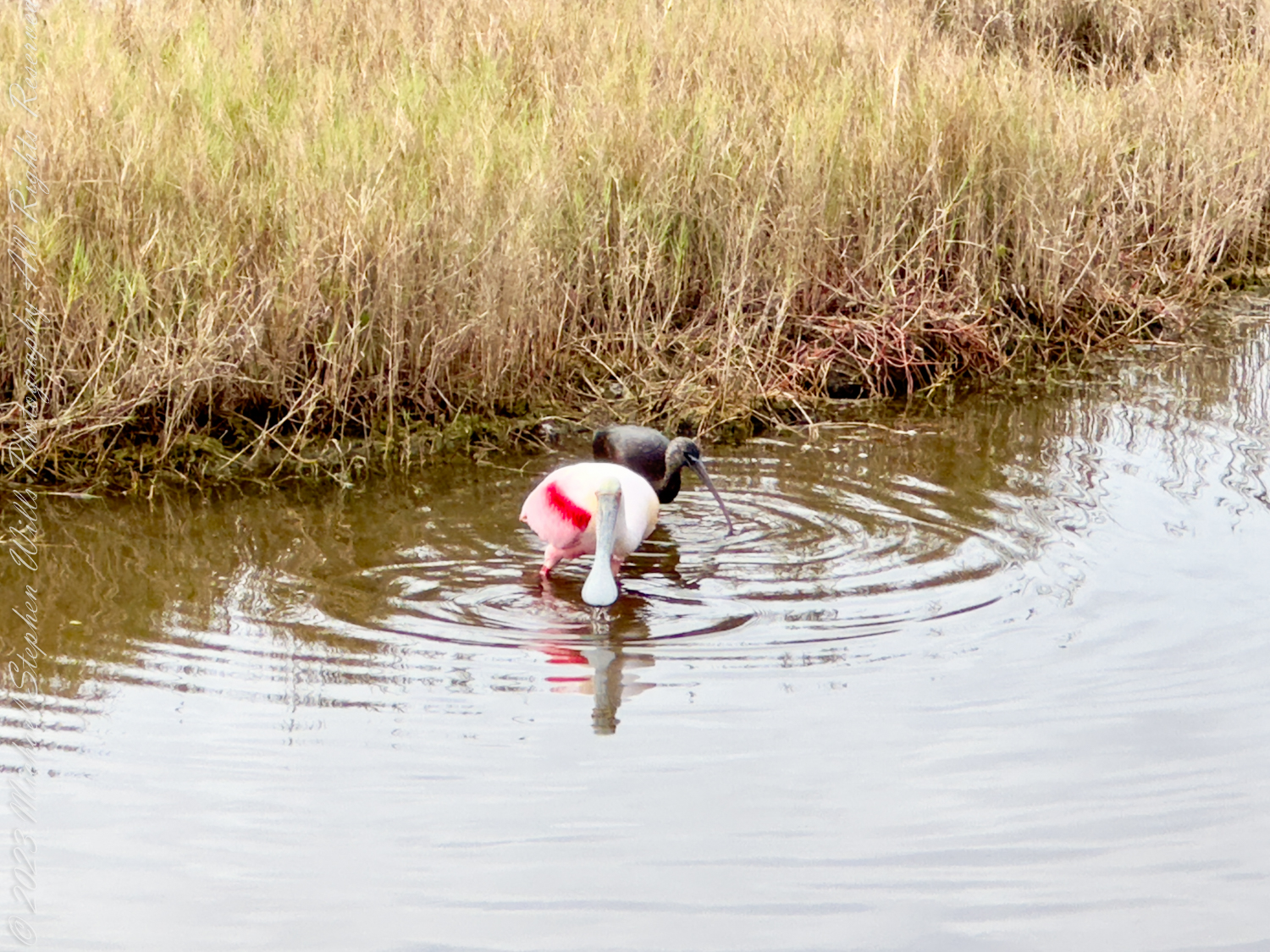
Another scene captured my attention as a single spoonbill foraged alongside a Glossy Ibis. The two species, different in appearance and yet similar in their quest for sustenance, shared the space in harmonious coexistence.
Further along, the vista opened up, and we were greeted by a panoramic view of spoonbills dotted along the distant shoreline, the greenery forming a lush backdrop to their pink hues. The expanse of the refuge unfolded before me, a reminder of the vastness and the wild beauty that had drawn us here.
On another stretch, the spoonbills perched in the green embrace of the mangroves, their pink feathers a burst of color among the leaves. It was a scene of natural artistry, the birds blending yet standing out against their verdant stage.
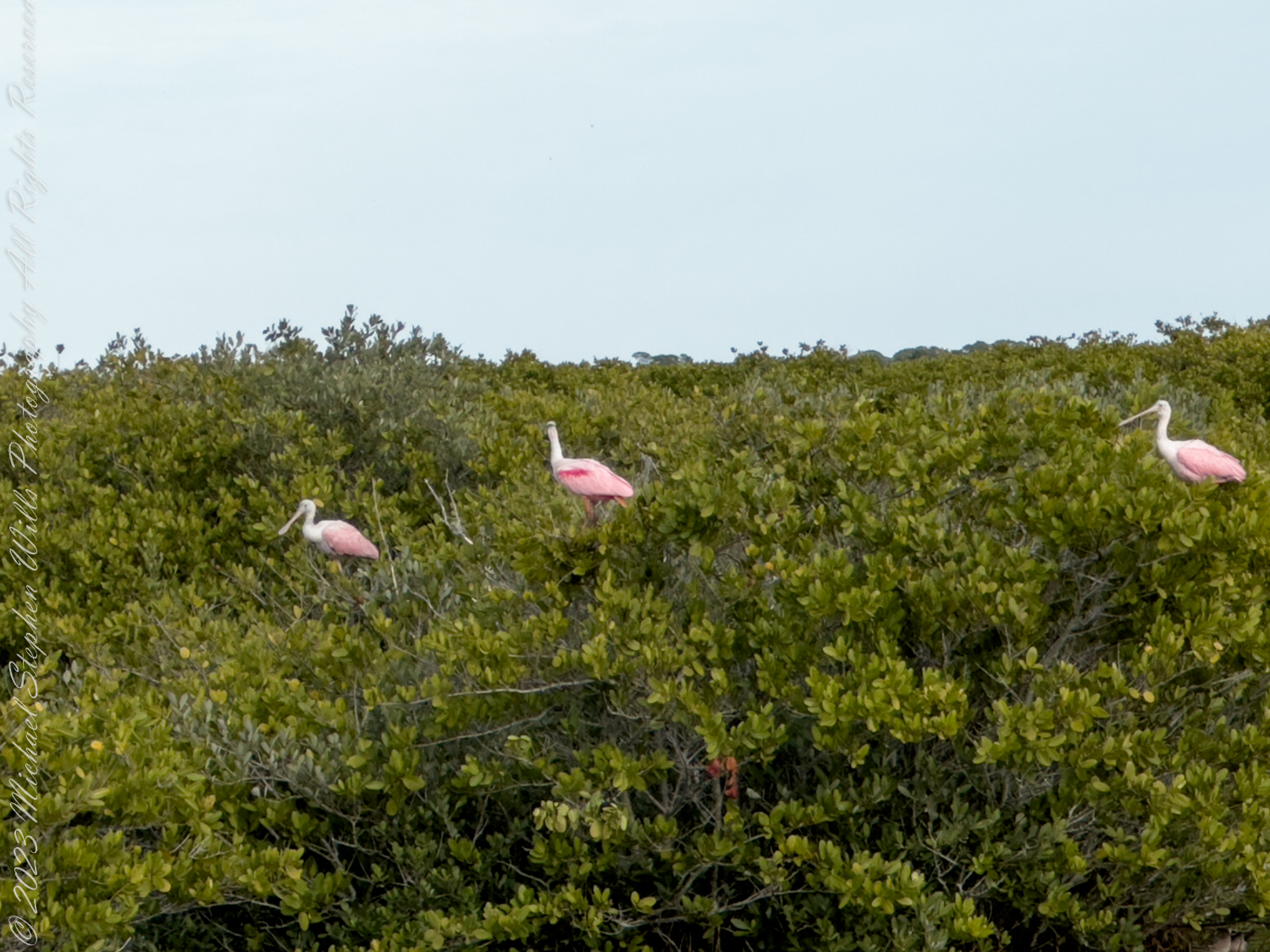
In the final leg of our journey, I found spoonbills perched high in the shrubbery, a testament to the refuge’s diversity. Even in the dense foliage, life thrived, and these birds, usually seen wading, now adorned the treetops like living ornaments.
This drive along Blackpoint was more than a mere observation; it was a passage through a world where time held little sway, and nature was the sole architect. Each bird, each ripple on the water, and each whisper of the grass told a story of existence, resilience, and the intricate web of life. Here, in this secluded corner of the world, we found a connection to the earth and its inhabitants that would stay with us long after.
Copyright 2024 Michael Stephen Wills All Rights Reserved
On the winding Blackpoint Wildlife Drive, Pam and I were spellbound by a ballet of Roseate Spoonbills and Wood Storks, a wild canvas coming alive, revealing the magic bestowed by our cherished Senior Passport
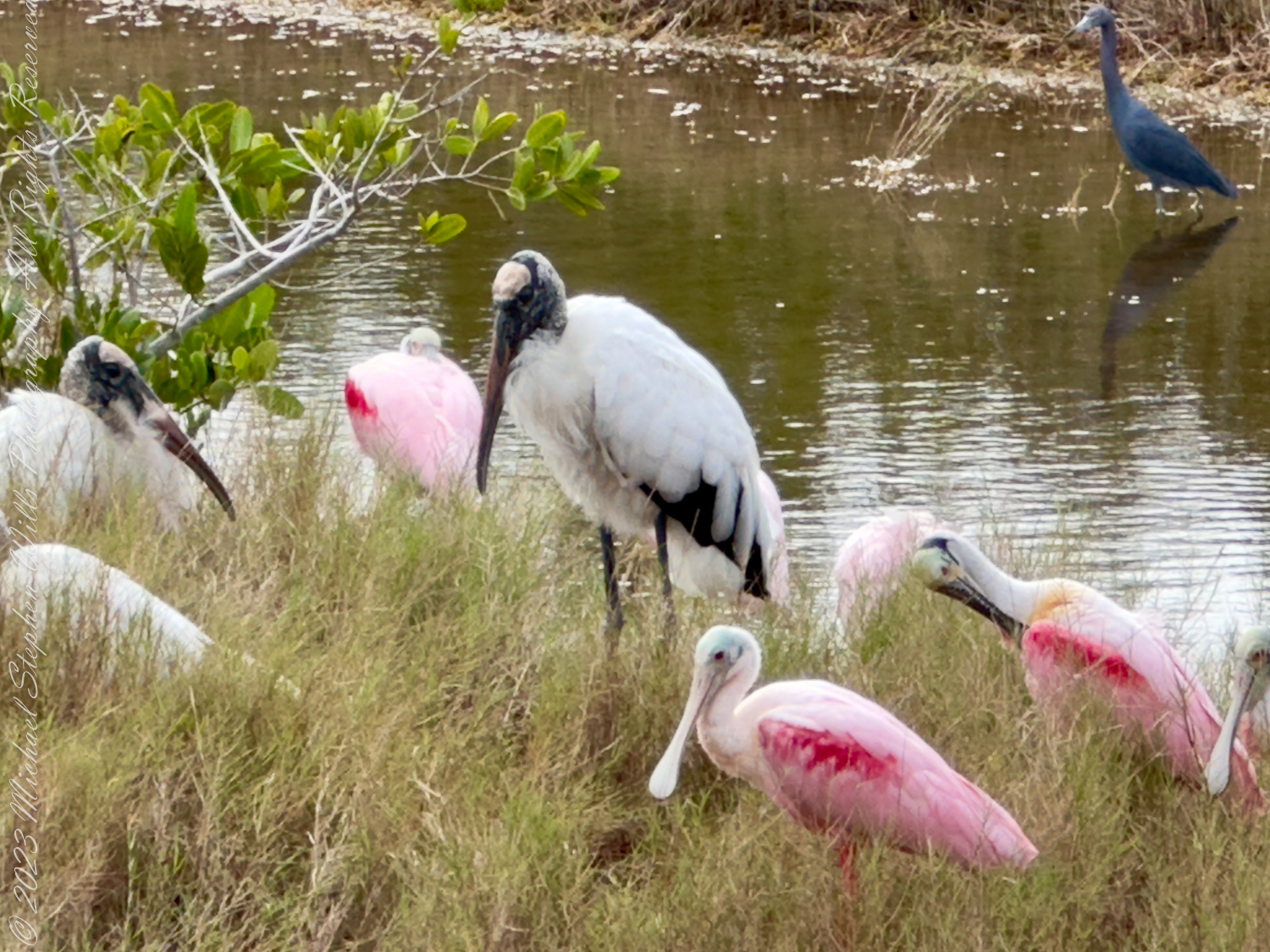
As Pam and I embarked on our journey along the Blackpoint Wildlife Drive we found ourselves privy to an otherworldly marshland assembly. Our eyes were drawn to the stately Wood Storks, or Mycteria americana, standing with a poise that belied their somewhat awkward appearance. Their towering figures were hunched in contemplation, their bald heads surveying the waters for a potential feast.
Beside them Roseate Spoonbills (Platalea ajaja) painted the landscape with strokes of vivid pink. Their spoon-shaped bills, an evolutionary masterpiece, skimmed the shallow waters. It was a delightful contrast, the elegant pink plumage among the grasses, like a splash of paint on a raw canvas.
Companion to these gentle giants, the diminutive Tricolored Heron, Egretta tricolor, stalked the shallows. Its slender form was a study in grace, and the blue-gray feathers shimmered with a hint of lavender as it moved with stealthy precision, a silent hunter amidst the reeds.
The discovery felt like stumbling upon a secret meeting, a council of the feathered kind, where each bird played its role in the delicate balance of the ecosystem. Pam and I shared a look of awe, our whispered words lost in the gentle rustling of the wind. There was a sense of unity, of different species coexisting in harmony, and we were the transient witnesses to their world.
Our journey within Merritt Island National Wildlife Refuge was not just a passage through land but through time. Each turn of the drive revealed another chapter of this living story, and our hearts raced with the excitement of what we might find next. The National Park Service Senior Passport, which we clutched like a treasure map, granted us the privilege to explore this bounty of nature. It was more than a pass; it was a key to worlds unseen and adventures untold.
As senior citizens, this passport to nature’s sanctuaries was a reminder that wonderment has no age. It afforded us the freedom to explore, to learn, and to lose ourselves in the beauty of our nation’s natural heritage. Each stamp in our passport was not just a mark of where we had been, but a memory etched into our lives, a story waiting to be told.
This drive, with Pam by my side, was more than birdwatching. We communicated with nature, laying testament to the beauty that lay in the simple things, the everyday miracles of life that often go unnoticed. We left the Blackpoint Wildlife Drive with a renewed sense of purpose and a reminder of our place in this vast, interconnected web of life.
We returned home with our spirits lifted and our minds filled with the colors of the birds—the Wood Storks, the Roseate Spoonbills, the Tricolored Heron—and the many unnamed creatures that had crossed our paths. It was a mosaic of life, each creature a piece that completed this intricate puzzle of existence. Our encounter with this unusual congregation was a gift, a moment of pure, unadulterated joy, a chapter in our ongoing adventure, one we would recount with smiles and a sparkle in our eyes for years to come.
Copyright 2024 Michael Stephen Wills All Rights Reserved
Discover the charm of Cocoa Beach’s enchanted sunset where Olaf, the endearing snowman from “Frozen,” joins athletes in a celebration of imagination and sport on Florida’s magical Space Coast.
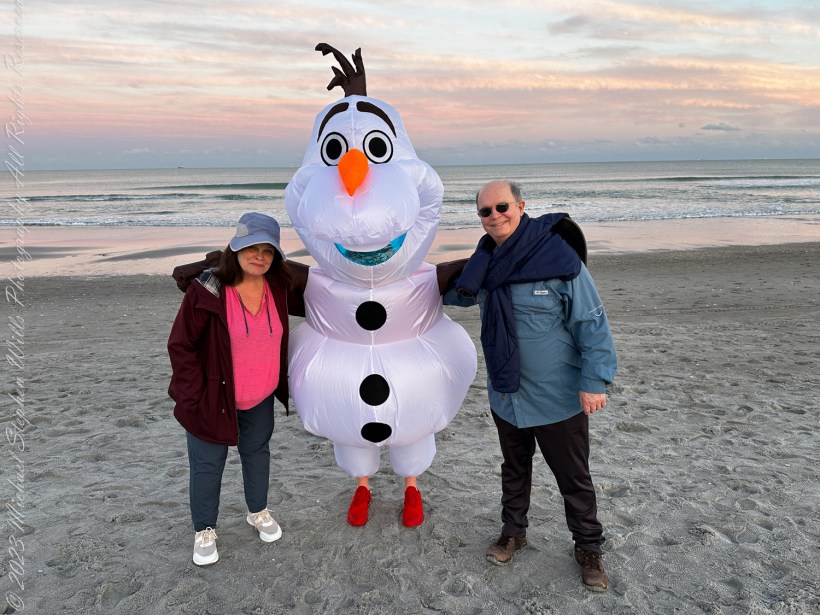
Olaf, with his carrot nose and coal-button smile, is the epitome of the whimsy and innocence that fills the hearts of those who dare to dream. He’s the spark of childlike wonder that persists even as the day gives way to night. As the sun dips below the horizon at Cocoa Beach, the playful contrast of a snowman who loves warm hugs stands out against the backdrop of Florida’s Space Coast—a place known for its rocket launches as much as its sun-soaked shores. It’s here, on this stretch of sand, that imagination and reality dance in the twilight, blurring the lines between a tale from the silver screen and the tangible joy of a beach evening.
The presence of Olaf in this coastal setting is an unexpected delight, akin to the wonder of snowflakes in summer. He is more than a snowman; he is the manifestation of Elsa’s magic, a symbol of enduring friendship and the embodiment of the happiness that comes from simply being alive. His creation, a whimsical result of Elsa’s ice powers, speaks to the capacity we all have for creation and transformation. The Olaf suit, worn by a young athlete, represents not just a beloved character, but a beacon of joy and the power of sportsmanship that enlivens the USSSA National All State Championship.
Don DeDonatis, CEO of USSSA, speaks of the excitement of hosting a tournament that is a “celebration of talented softball players from around the country.” Indeed, it’s a parallel to the celebration of life that Olaf represents—where each athlete, like each snow crystal, is unique and contributes to the beauty of the whole. The tournament at the Space Coast Complex in Viera, Florida, is a tribute to the hard work and dreams of young athletes, much like the dream that brought Olaf to life.
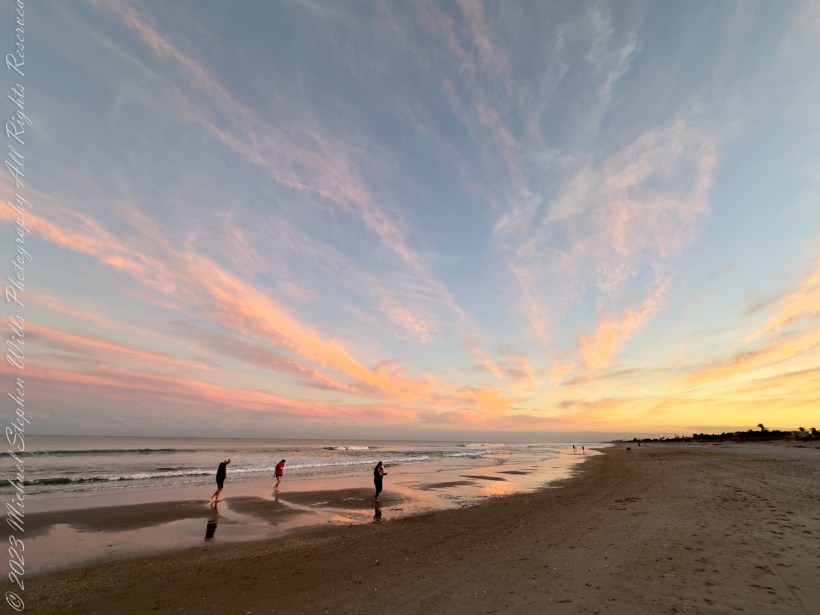
The sunset photograph of Cocoa Beach, snapped in December 2023, is not just a capture of a moment in time, but a timeless reminder of the enchantments that life offers. The beach becomes a stage where each footprint tells a story, and each wave sings a song. It’s a place where memories are made, where the spirit of characters like Olaf can leap out of their fictional realms and into our world, if only for an evening.
Brevard County’s Space Coast is a junction where the vastness of space meets the intimacy of earth, where shuttles launch into the cosmos while children build sandcastles, and where a snowman can stand on a beach without melting, embraced by the warmth of the setting sun rather than the chill of winter. It’s a testament to the human spirit’s boundless creativity and our ability to find joy in the juxtaposition of opposites.
This enchanted evening is a tapestry woven from the threads of fantasy and reality, sport and art, the cosmos and the coastline. It’s where the horizon kisses the sea, where the sky becomes a canvas for the sun’s parting masterpiece, and where Olaf, our friend from “Frozen,” reminds us that magic is not just in the realm of fairytales but all around us, in every grain of sand, in every sunset, and in every heart that believes in the wonder of one enchanted evening.
Copyright 2024 Michael Stephen Wills All Rights Reserved
Explore Cape Canaveral National Seashore and Kennedy Space Center with us, where pristine beaches meet the legacy of human space exploration, and feel the awe of standing where history was made.
A Journey Through Time and Space: Our Visit to Cape Canaveral National Seashore and Kennedy Space Center
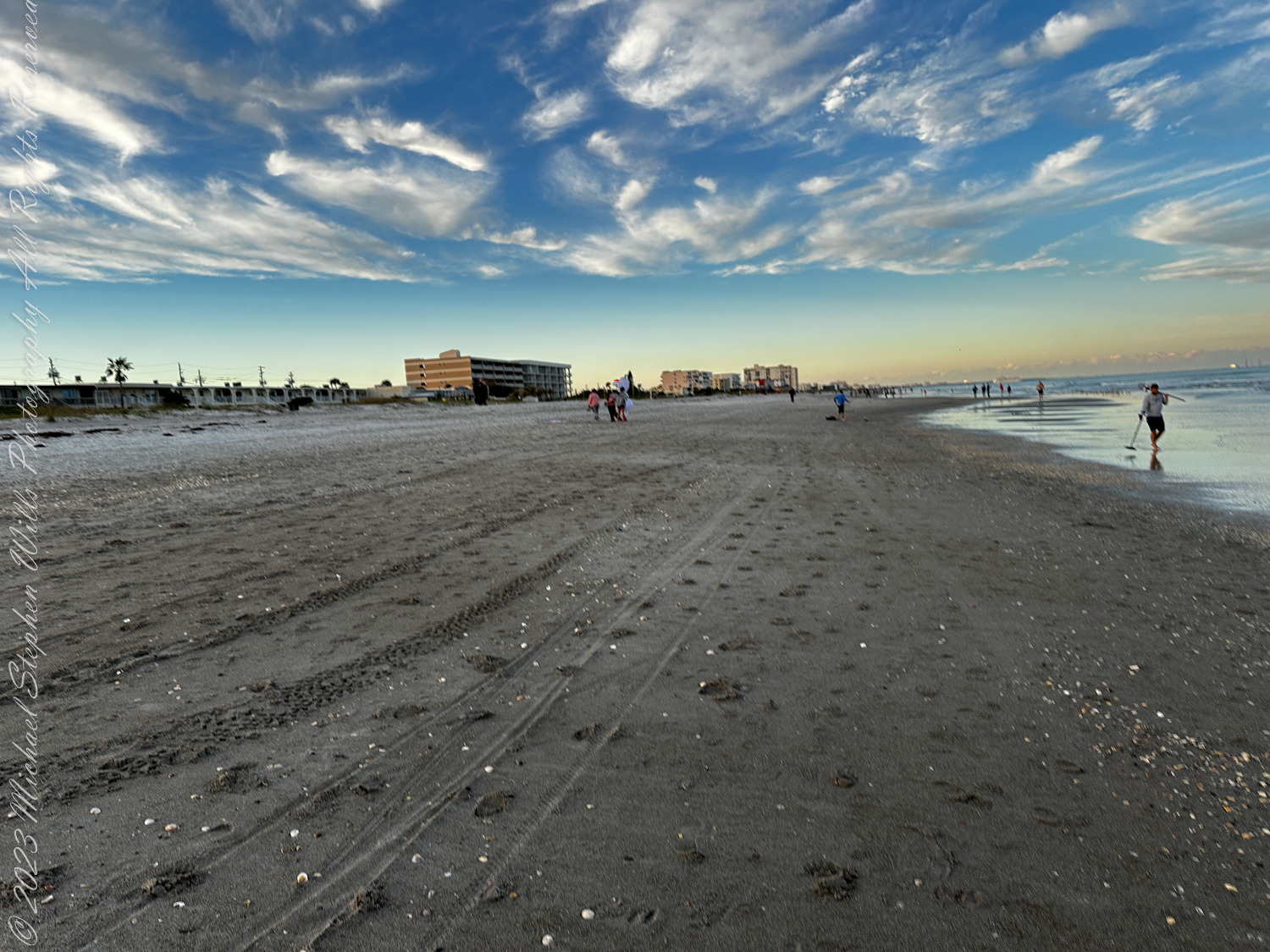
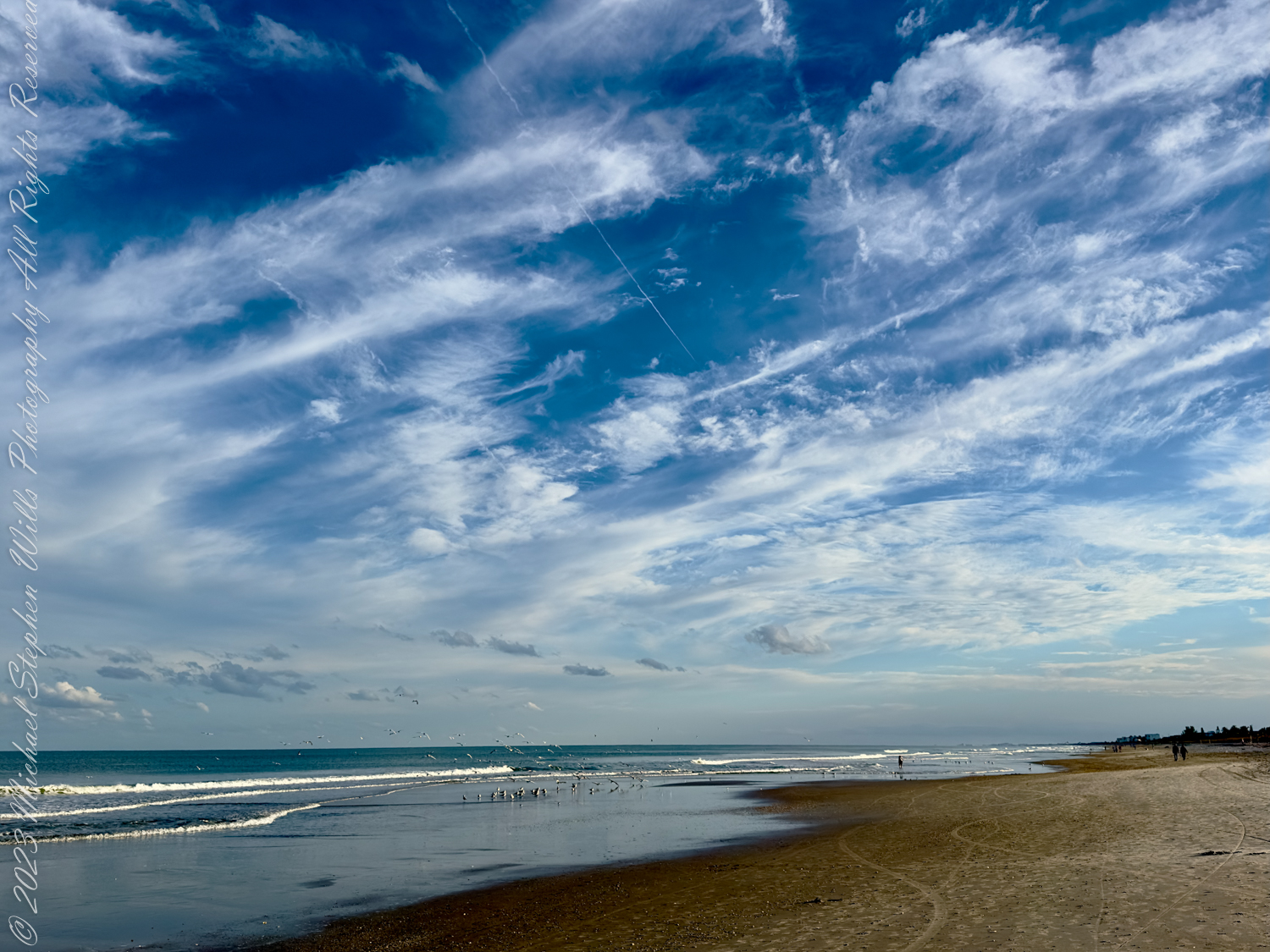
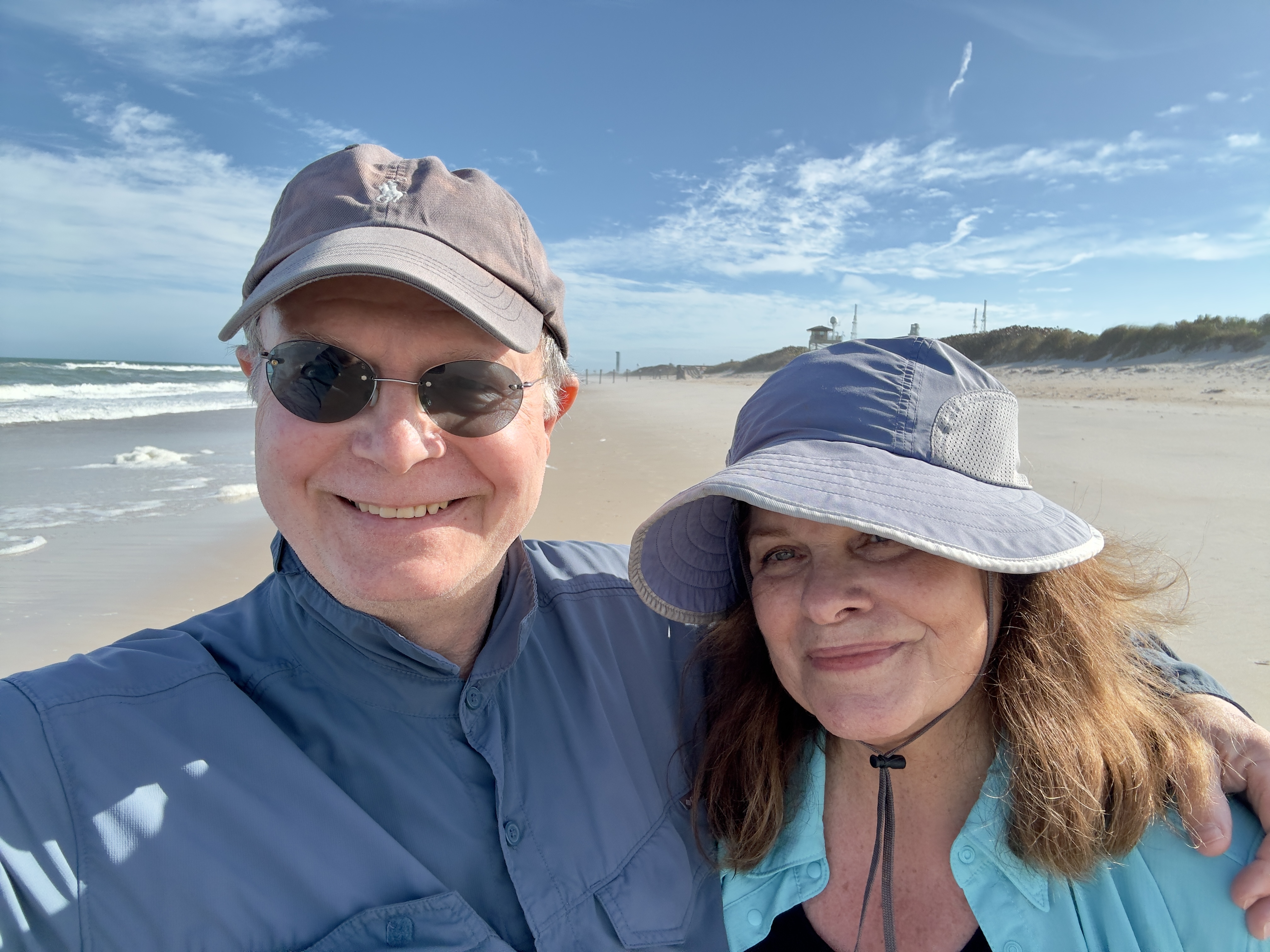
As we arrived at the pristine shores of Playalinda Beach within the Canaveral National Seashore, the gentle whisper of waves against the shoreline beckoned us. The sun kissed the horizon, casting a warm glow across the 24 miles of untouched, protected coastline that lay before us. Here, on the east coast of Florida, where crystal-blue waters embrace the shell-laden sands, we found ourselves at the intersection of natural beauty and human achievement.
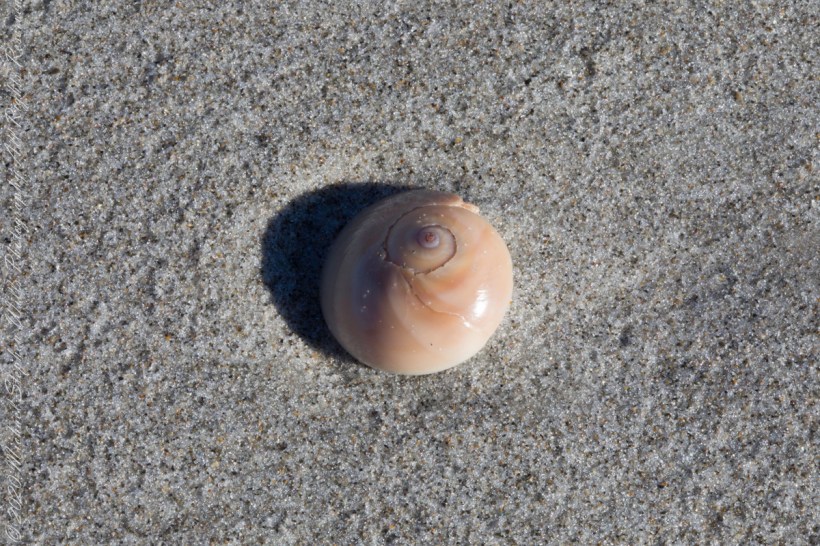
Shell of the Moon Snail (Naticidae) found in the surf wash.
The Serenity of Playalinda
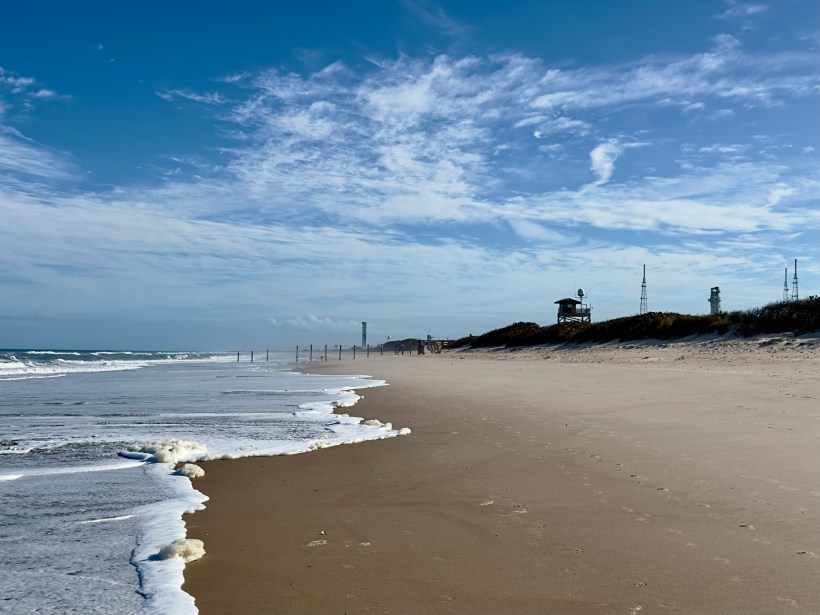
We strode along the boardwalk, passing through dunes adorned with sea oats, to find our spot upon the soft sands of Playalinda. The beach, known for its tranquility and the chance to observe a vibrant array of wildlife, offered us a moment of peace. With no distractions—no concessions, no showers, just nature—we were able to disconnect from the world and reconnect with the earth. From our vantage point, the Merritt Island Wildlife Refuge across the water was a haven for migrating birds, dolphins, and, with some luck and the right season, sea turtles nest on the beach itself.
Witness to History: The Apollo 11 Legacy
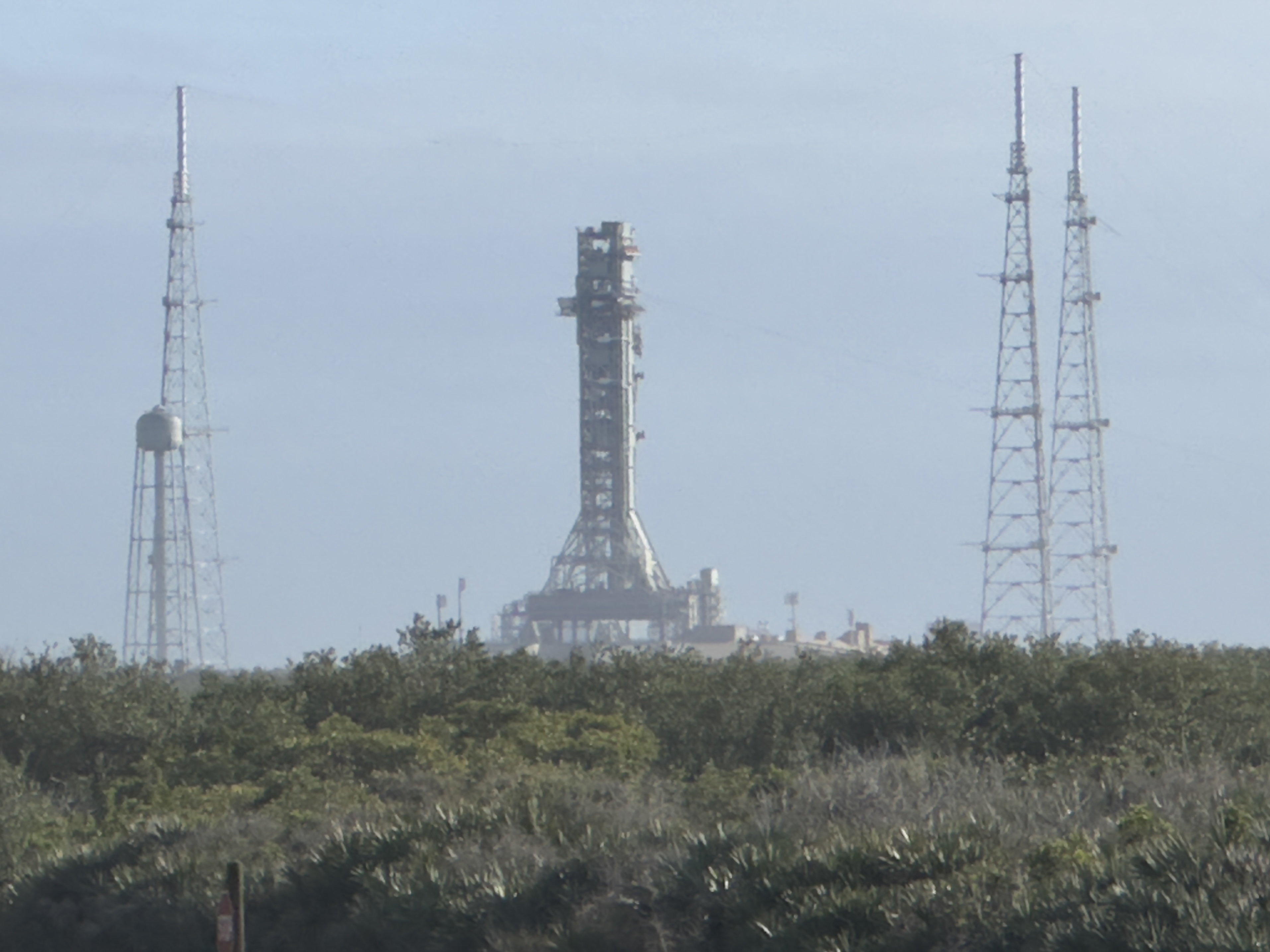
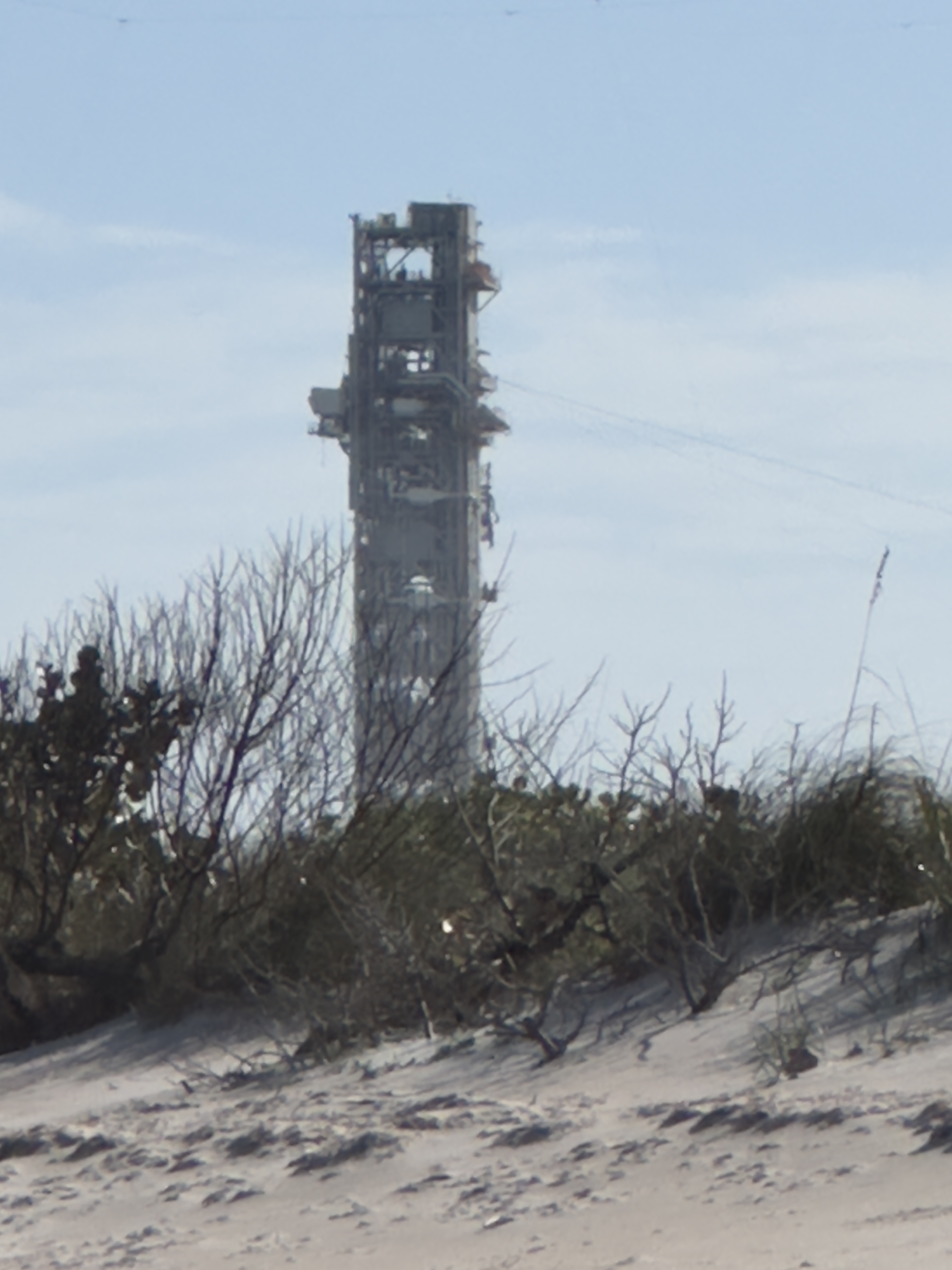
But it wasn’t just the natural allure that drew us here. Playalinda holds a unique position, offering an unobstructed view of the historic launch pads of Kennedy Space Center, where Apollo 11 began its monumental journey to the Moon. As we walked south towards the fence bordering the Space Center, the anticipation built within us. Here, we were tracing the footsteps of giants, those brave astronauts who dared to venture into the unknown.
The Vistas of Exploration
Each step brought us closer to the site where humanity took one of its most significant leaps. Gazing upon the launch complex from the fence, we were reminded of the powerful forces harnessed to break the bonds of gravity. Imagining the roar of the engines, the earth-shaking vibrations, and the fiery ascent of the Saturn V rocket, we felt a deep connection to the past and a sense of awe for the pioneering spirit that propelled us into a new era of exploration.
Reflections Amidst the Dunes
As we wandered back along the beach, the foam of the ocean’s edge lapping at our feet, we reflected on the duality of our surroundings. Here, in this place of quiet solitude, we also stood at the forefront of human innovation and ambition. The juxtaposition of the peaceful beach with the technological marvels just a stone’s throw away was not lost on us.
Our journey to the Cape Canaveral National Seashore and the Kennedy Space Center fence was more than just a visit to a beach or a historic site; it was a pilgrimage to a place where dreams materialize and reach for the stars. It was here that we came to understand the full spectrum of emotions that accompany great achievements—the hope, the fear, the triumph.
Conclusion
Our visit to the Cape Canaveral National Seashore and the Kennedy Space Center was an experience that will linger in our memories for years to come. It was a reminder of what we can achieve when we are united by a common goal, and it filled us with pride and optimism for the future. As we looked back one last time, the setting sun seemed to whisper a promise of the wonders yet to come, both here on the shores of Playalinda and in the vast expanse of space that awaits us.
Copyright 2024 Michael Stephen Wills All Rights Reserved











 Michael Stephen Wills Photography