A Visit to Salado Ruins

Happy April First “this post is no joke”

About 700 years ago, when the expansion of the Mongol empire was under way, on the other side of the planet people discovered a series of caves, formed in tuff, with a favorable location in a south facing cliff near water.  Tuff, a rock formed from volcanic ash, is hard, brittle and soluble in water.  From these properties this series of caves formed.  The southern exposure provided excellent climate control for people, like those we now call the Salado, who understood how to exploit the location.

They constructed from local materials (mud, plants and rock) rooms in the upper cave just far enough inside to be warmed by the winter sun and protected during the summer when the sun’s sky-path was higher.  Who knows how long the Salado lived in what must have been this paradise or why they left. 

Click me for an Arizona Gallery of Fine Art prints by Michael Stephen Wills
Rogers Canyon

In March 2006, after returning from a nine-day backpack trip to the remote eastern Superstition Wilderness I used a four-wheel vehicle to reach the Roger’s Trough trailhead for a day trip to this site in Roger’s Canyon.  The advantage of Roger’s Trough is the high elevation that leaves “just” about 1,100 feet of climbing (2,200 total) for the day.  As it happens, it is downhill to the ruins though there is plenty of ups and downs plus scrambling over rocks.

I started late morning and a returning party met me on the way out and warned against leaving packs unattended.  It seems they were victimized by pack rats.  My timing was lucky and I had the site to myself.

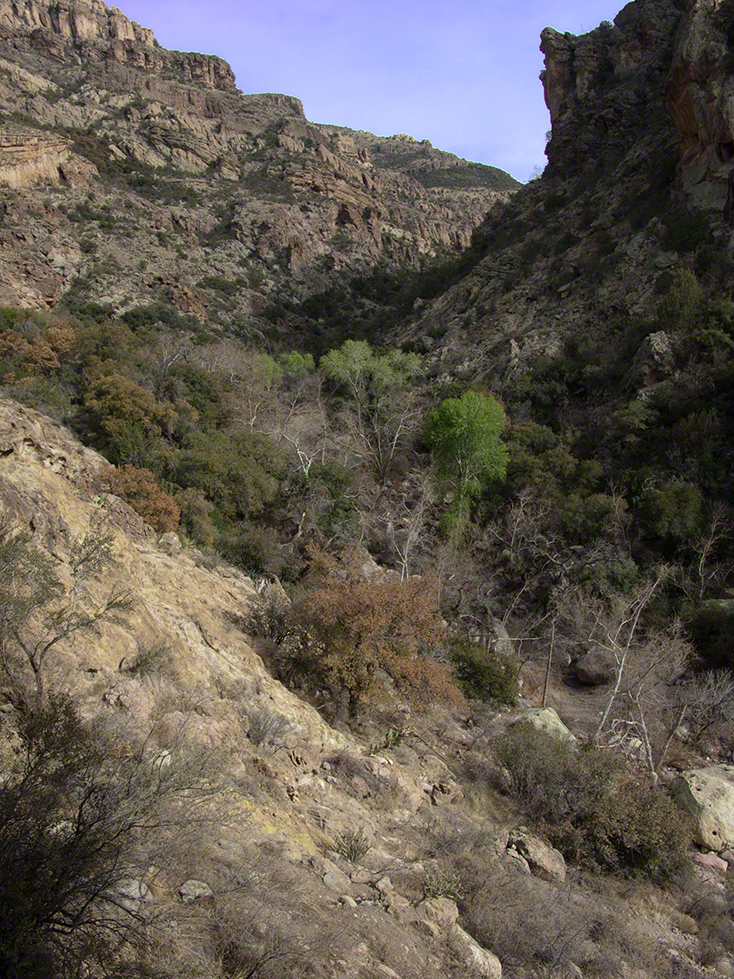
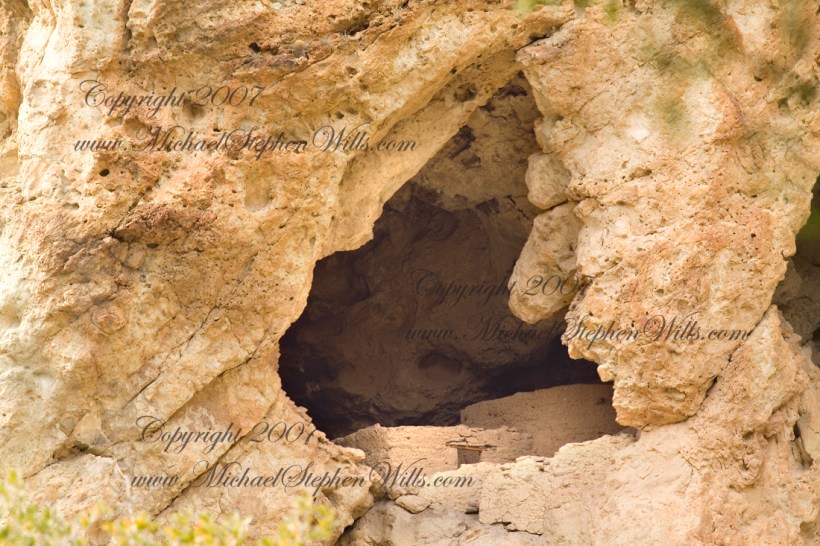
First (refer to the “Roger Canyon” photograph,  above) I climbed the cliff opposite from the ruins to set up a tripod an telephoto lens to shoot through the trees to capture the main building inside that very interesting looking tuff (see below).  That central column (to the right) divides the cave opening and there are views from inside, up and across the canyon.  In season, the cliffs are occupied by nesting birds and, higher up, there are fascinating caves in locations too high and steep to reach without the proper equipment.

As it is, climbing into the upper cave requires an exposed rock scramble.  By “exposed” I mean the climber is exposed to falling.  That is an intact wooden lintel of the visible structure opening and the larger structure, to the right, has curved walls.
Salado Cave Ruin

I then explored in and around the site.  The location of a lower cave made it useful for storage, it was walled off and the sturdy structure still stands today.  By the way, I inverted this view for artistic purposes.

Lower Storage Room

A lower cave is opened and accessible.  Looking out, I felt the original inhabitants were with me and then a raven started calling over and over and over.

Lower Cave

I was so fascinated by the possibilities of the site that time got away from me until this incessant cawing of a raven made me notice the lengthening cliff shadows.  Here is a view (see below) of my way home, back up Rogers Canyon.  My last shot before packing up.  It took just over two hours to get out, at a steady pace.  It was twilight as I approached the Rogers Trough trail head.

By the way, my posting before this one (“Finding Circlestone”) includes a shot of White Mountain.  In that view, these ruins are on the other side of White Mountain.

View up Rogers Canyon from the Ruins

Copyright 2023 Michael Stephen Wills All Rights Reserved

Finding Circlestone

Ancient Ruins

The Searcher’s Tale

Click me for an Arizona Gallery of Fine Art prints by Michael Stephen Wills

I first learned about Circlestone from stories The Searcher told during my first backpack into the eastern Superstition Mountains, on the Tule trail, April 2005.  I described this in “Riding from Pine Creek to the Reavis Valley” where the Searcher described a stone circle, overgrown with Alligator Juniper, on the slopes of Mound Mountain.  He pointed south toward a peak and foothills that rose from the valley floor and said, “follow the fire trail east from the southern Reavis Ranch valley.”  There were strange happenings associated with Circlestone (as he called it) and he’d never taken the time to go there.  “There is a book full of stories.”  I eventually sought out Circlestone on the web and in books, but after I found it on my own using only the Searcher’s directions and advice from friends met on the way.

Sunset from Castle Dome

Backpacking with my sister

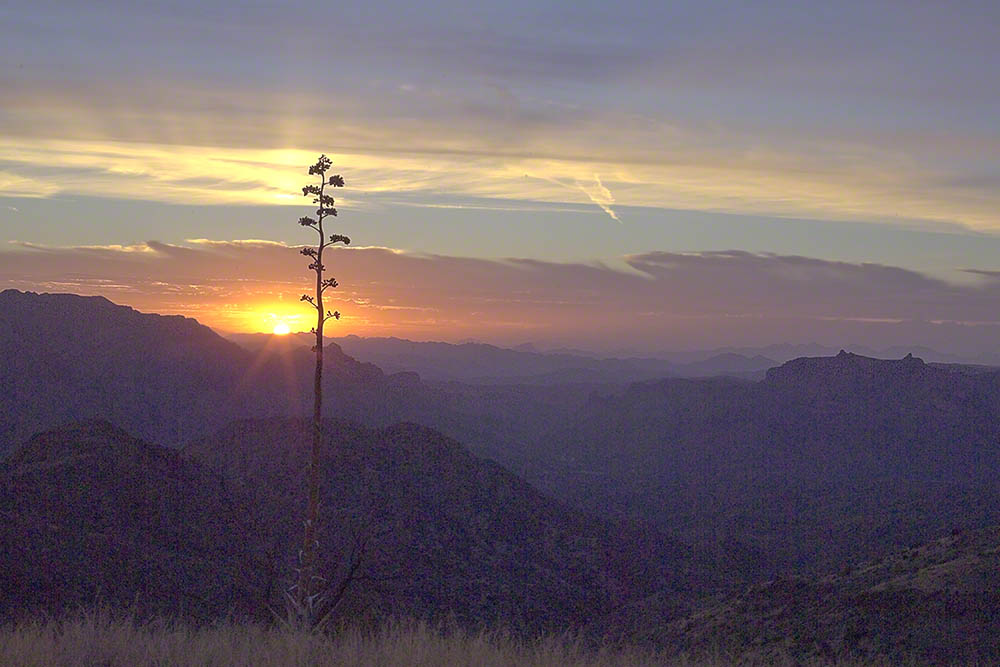
In 2006 I explored Circlestone twice along with my sister, Diane, who accompanied me.  First for nine days early March 2006 using the Reavis Ranch trail from the north and the second for five days in November 2006, coming us the same trail from the south.  Our first trip was Diane’s first “real” backpack adventure and we took it slow with a camp at Castle Dome where there are flat areas and exceptional views.  Above, is the sunset from our second night (I camped the first night next to the car…we took it very, very sloooowwww).

Four Peaks Sunrise

Castle Dome

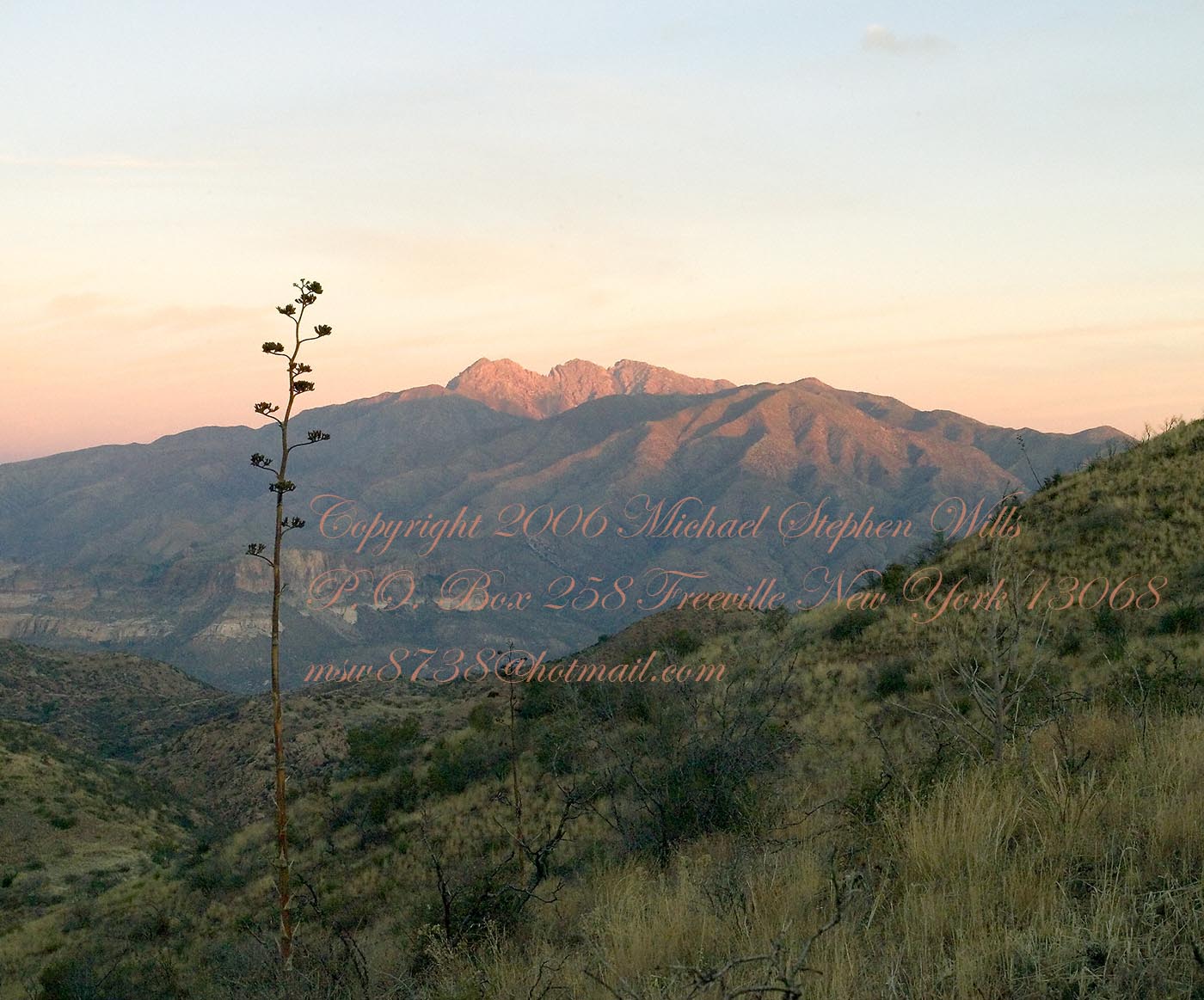
Then, there was morning of our third day.  Here is the Four Peaks Wilderness in the first rays of dawn.  These are green, rolling foothills of grass, low shrubs and a few juniper.  If you know where to look, there’s an unmarked trail to Reavis Falls (the highest waterfall in Arizona).  I found the trail and visited the falls on a later trip.

Castle Dome Sunrise

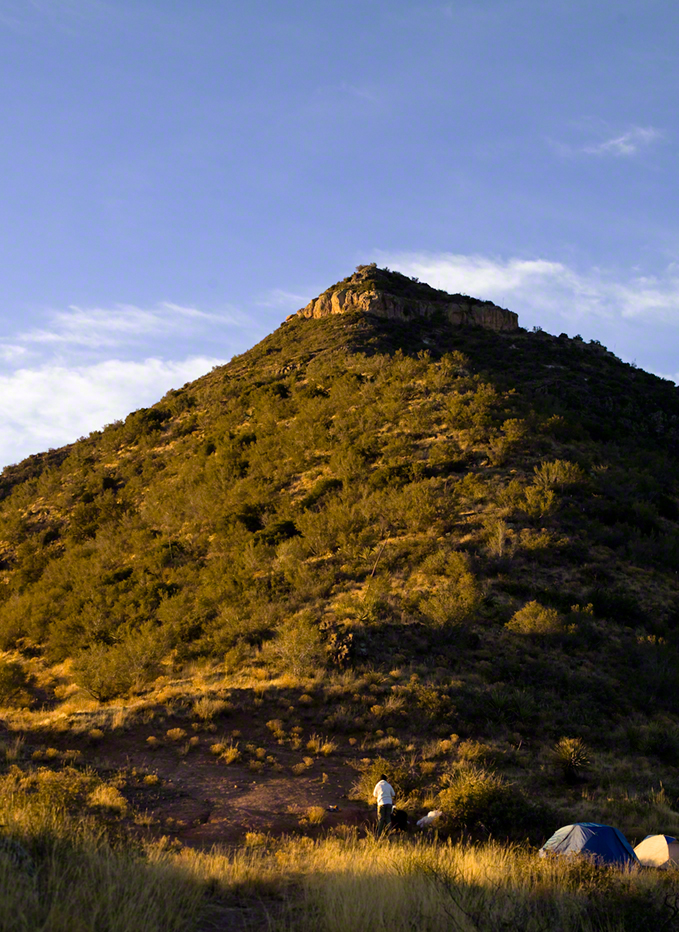
After enjoying the Four Peaks, you turn around and see Castle Dome in the morning light, as in this photograph.  Remember the same of the “dome”, because it is visible from the ultimate view from Circlestone.

Reavis Valley and White Mountain from the trail to Circlestone

The Trail to Circlestone

Our camp was in the Reavis Valley, one of the first sites along the creek coming from the north.  There were fantastic rock formations across the creek.  Not far from there, the land falls away into steepness and then Reavis Falls.   The Searcher told me about going that way, once.  There is no trail down to the falls overlook and deep canyon carved by the water.

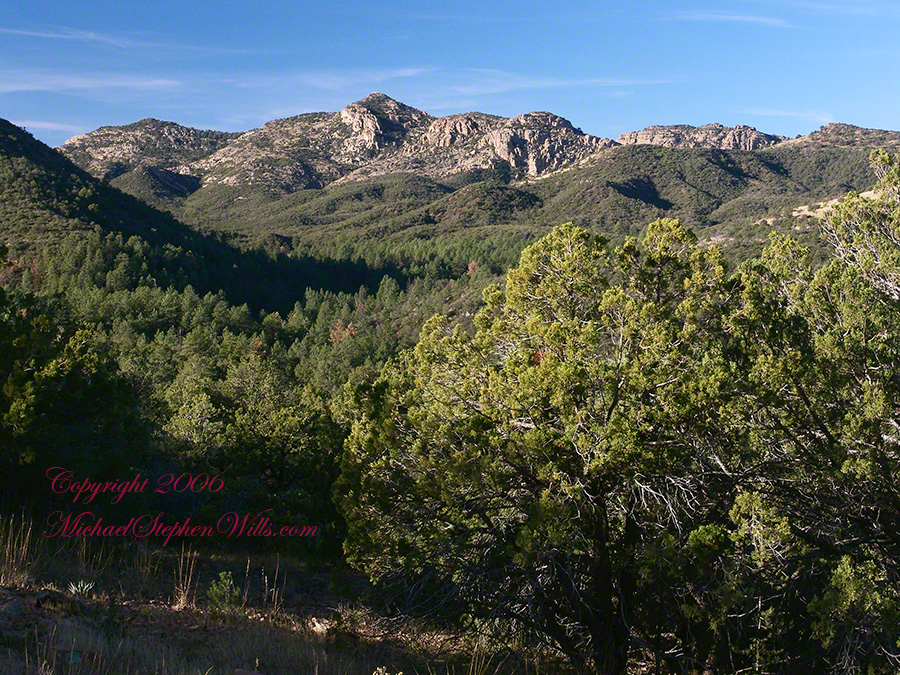
This photograph, above, is from a lovely forest of pinyon trees that grow along the trail to Circlestone (described by the Searcher as rising from the southern Reavis Valley).  You can see the valley, just to the right, and a longer and steeper valley that rises from it up to White Mountain.  That way is the southern legs of Reavis Trail.  I have a movie clip from this same spot of the pinyons moving in the breeze and may post it at a later time.

All of the trail to Circlestone is a climb.  You pass over “Whiskey Spring”, named for a still kept there in the 1800’s and over a steep defile gouged from the rock.  The trail is well marked and I am told that, sometimes, there is no cairn marking the trail to Circlestone.  If you are desperate to get there, look-up some excellent hiking directions available on the web.  I have even found the circle on GoogleEarth, since I know where to look.  If you like a challenge and the adventure,  go from the directions the Searcher gave me.

Four Peaks from Circlestone

From the fire line trail, the unmarked branch to Circlestone climbs steeply and follows a ridge through Alligator juniper, punctuated by stalks of century plant, to a broad way that rises to Circlestone as though to a monument overgrown by the same juniper.

My Circlestone Mystery

There was an unusual experience on our first trip, on this portion of the trail.  We were winding through the Juniper and, as it happened, Diane fell behind.  After awhile I missed her and waited and, after a minute, went back to look for her.  I found Diane sobbing uncontrollably, deep in grief over our father who passed away eleven years before.  We talked about it until she felt better.  She said it was as though a door opened and she could feel out father.  What makes this exceptional is Diane is not given to anything like this and I ascribe her deep grief to the nature of the site.  It is a mystery to this day.

At Circlestone, that first trip, we explored and experienced the site.  You cannot see the entire wall at any point and need to wander through and over it, being careful not to disturb anything.  Here and there, in the outer wall, are openings like the one in this photograph.

Site-Hole in the Circlestone Wall

At Circlestone

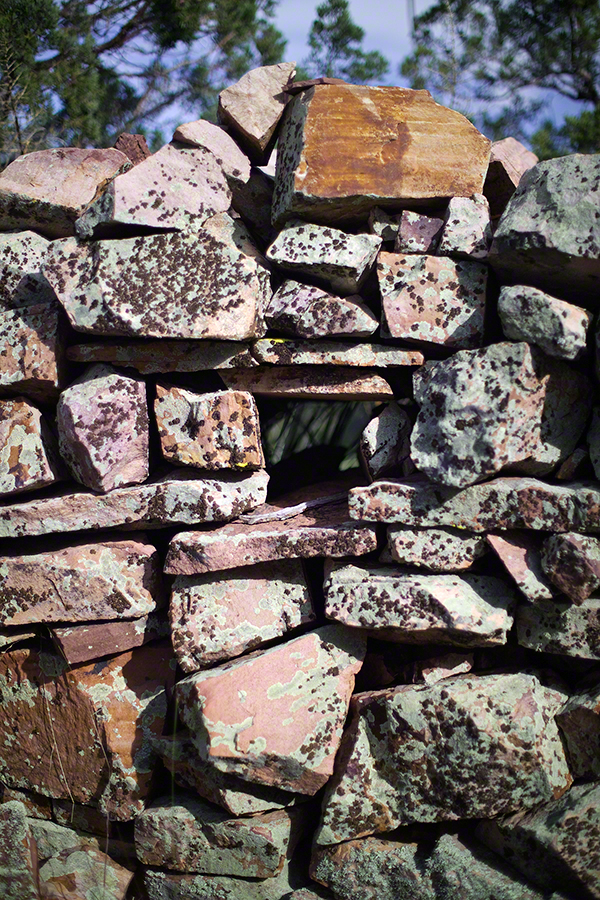
I call it a site hole because, on your knees, it is possible to look through and see the distant view through the trees.  As you can see, the stones are a striking red color with green lichen growing thick.

On the second trip in November, knowing the way and having great weather, I brought my cameras to capture the exceptional views, one of which is above.  I’d dearly love to come back to camp just below the ruin and do some work in the evening and morning light.  For now, I can enjoy those views from Castle Dome.

Three Horsemen and Castle Dome

Can you see the dome in the middle distance.  I did a portrait of three horsemen who road up to Circlestone in November.  We came to know them pretty well, that afternoon and the following morning down in the valley.

Three Horsemen

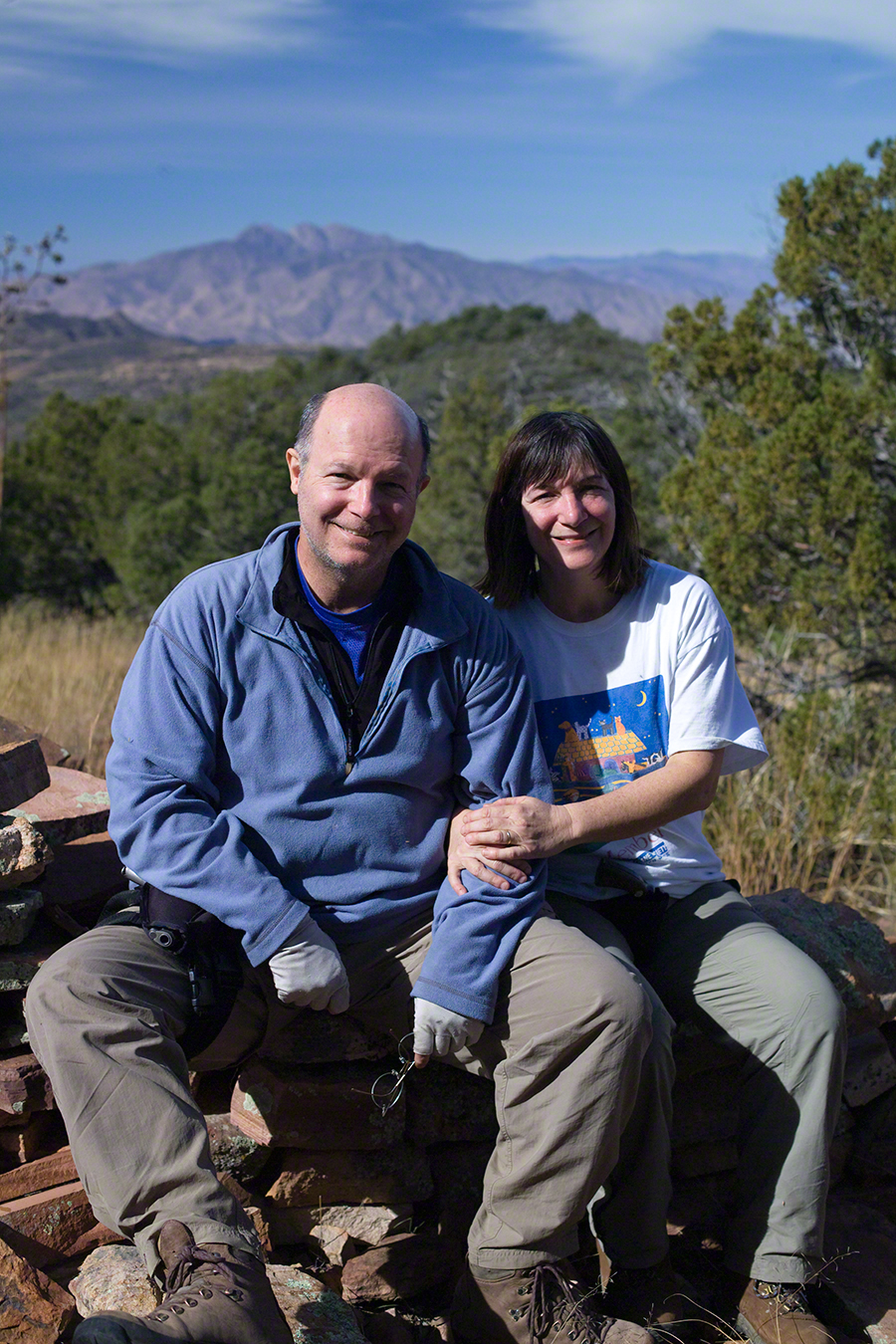
I carted up a tripod, so you can see Diane and I in the same spot.

Mike and Diane at Circlestone
Copyright 2023 Michael Stephen Wills, All Rights Reserved