“Great Blue Herons at Cocoa Beach: A Space Coast Morning on the Atlantic

Along the luminous seam of surf and sand, a heron reads the tide’s slow grammar, patience embodied, until water yields a silver secret and morning becomes ceremony.

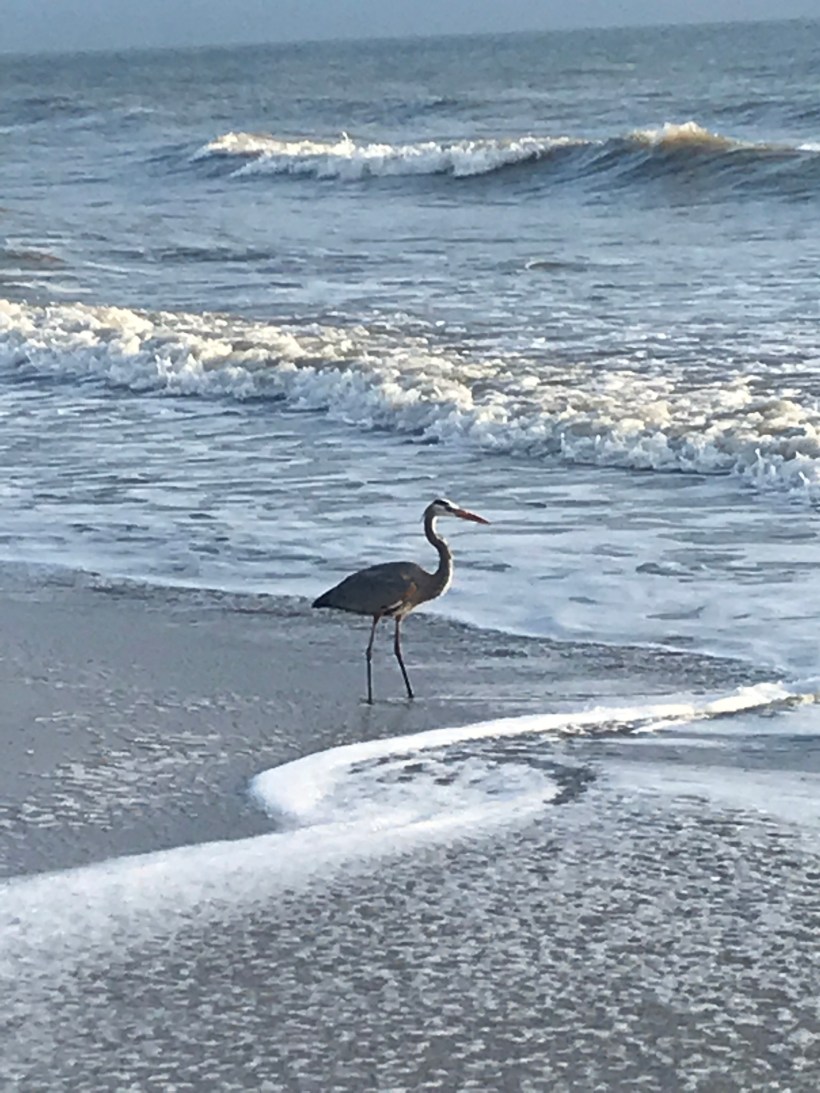
We walk the long seam where the Atlantic writes its restless script, and our beachcombing becomes a study in attention. The shore’s edge—where foam loosens shells from sand and the wind arranges salt on the tongue—draws other walkers too: grey herons, patient and arrow-straight, patrolling the surf line as if reading a language older than tides. They halt us without trying. We stand, quieted, while they work the boundary between water and land, between hunger and satisfaction.
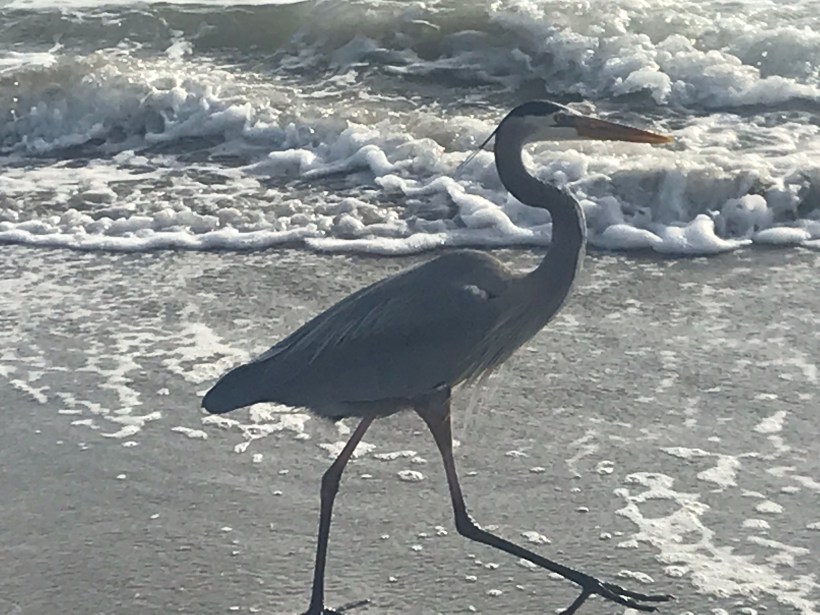
I pack an iPhone sometimes for beachcombing as a lightweight alternative to SLRs. This post features iPhone photographs.

Along this narrow world of sand and surf, herons keep two distinct manners. Some linger near anglers, learning the thrift of handouts and the craft of appearing inevitable. Others refuse that bargain and hunt on their own, staking the wash with a slowness that is not delay but method. These independent operators move along the ocean’s margin: high enough to let the breakers fold ahead of them, low enough that their long legs stir the small lives hidden in the cross-hatching currents. To follow one with the eye is to adopt a different clock. Sandpipers skitter and dash; the heron lengthens time.
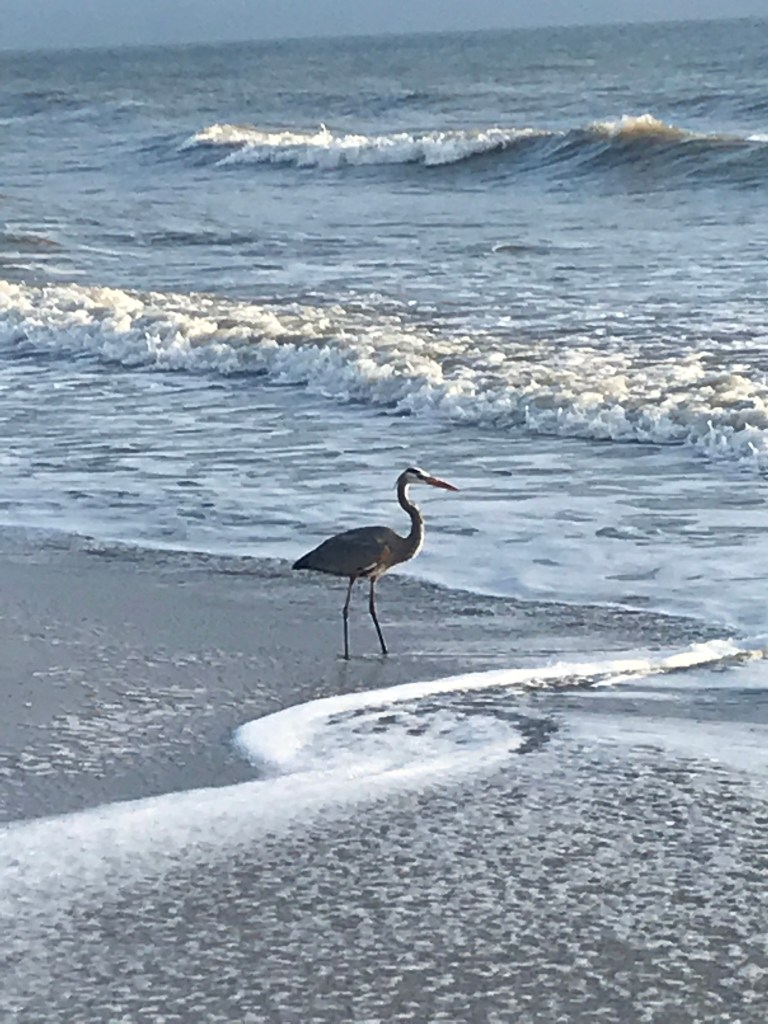
A perfect place to stalk the surf

At first the bird seems merely spellbound by light on water. Then a shift: a narrow cant of the head, the smallest realignment of the eye to the glare. The neck—serpentine and stored with intention—uncoils quick as a strike, and the bill cleaves the surface. The world either yields or it doesn’t. Often it doesn’t. When it does, the beak lifts an impossibly large, glinting fish, as if the ocean had lent out a secret.
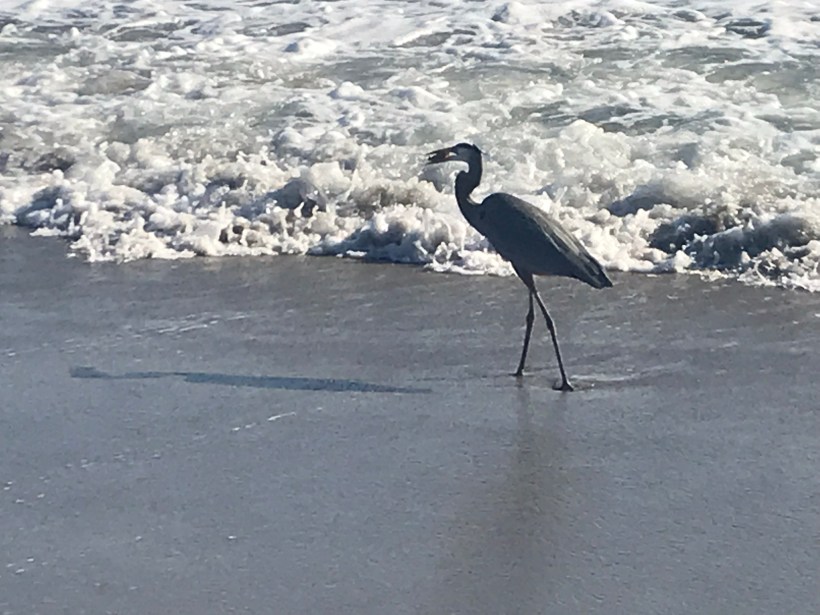
Success!!

What follows is ceremony. The heron stands and calibrates, turning the silver length with almost invisible nods until head and prize agree. A sharp jerk aligns the fish with beak and gullet; the upper throat swells, accepting the whole, unchewed. Two more pulses and the catch is a memory traveling inward. It is an astonishment every time, not because we do not understand what is happening but because we do, and still it exceeds us.

We carry a smart phone on these morning circuits, a slim stand-in for heavier glass, enough to witness without intruding. Backlit by the early sun, the herons are cut from bronze and shadow, working the luminous edge while the day composes itself behind them. In the afternoons we meet fewer of the solitary hunters when the strand belongs more to the opportunists near the thinning knots of anglers. Why the shift, we cannot say. The ocean has its schedule; so, it seems, do its readers.

If we keep our distance, we are permitted to watch. Cross a line we don’t perceive and the bird will rise all at once, the long body unfolding, the voice a rasping scold torn from the throat of reed beds and marsh dawns; but, grant it enough space, and the heron returns us to the lesson it keeps teaching: that patience is a kind of movement; that the boundary of things is where change is clearest; that the most astonishing acts require the courage to do very little, very well, for a long time.

We come to linger where the waves erase our tracks, apprenticed to that slow grammar, trying to learn the tide’s careful verbs before the light turns and the day becomes something else—a different text, the same shore, the heron already a thin signature against the horizon.
Enter your email to receive notification of future postings. I will not sell or share your email address.

A Visit from Rose-Breasted Grosbeaks

On a serene May morning, a small flock of Rose-breasted Grosbeaks graced the author’s yard, showcasing their vibrant plumage and bringing beauty to the tranquil scene of nature.


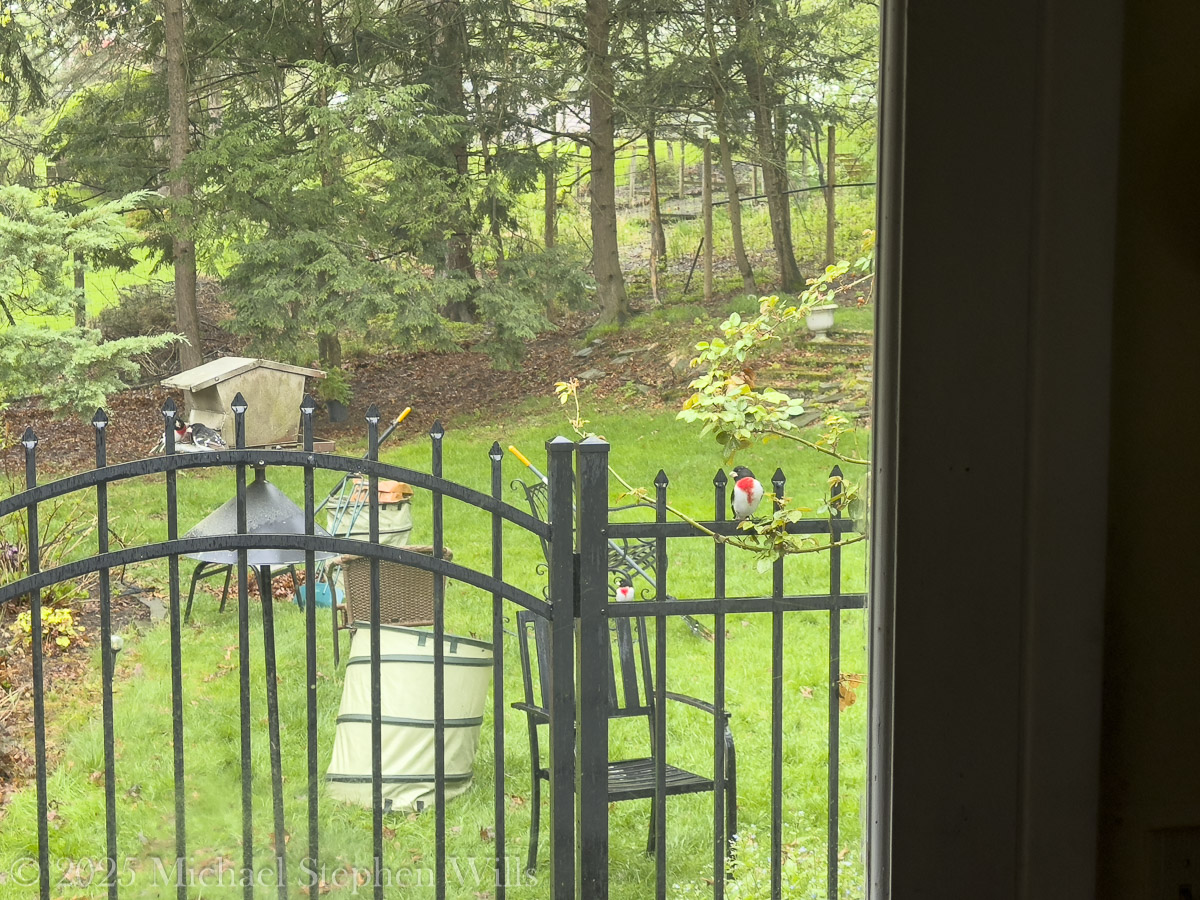
It was a gentle May morning, the kind that seems to hush even the wind, as though nature were holding its breath for something wonderful. Through the kitchen window, just past the black iron gate entwined with the fresh green of climbing rose, I spotted them—feathered heralds of spring’s deepening promise—perched like jeweled notes on a musical staff.


The Rose-breasted Grosbeaks had arrived.

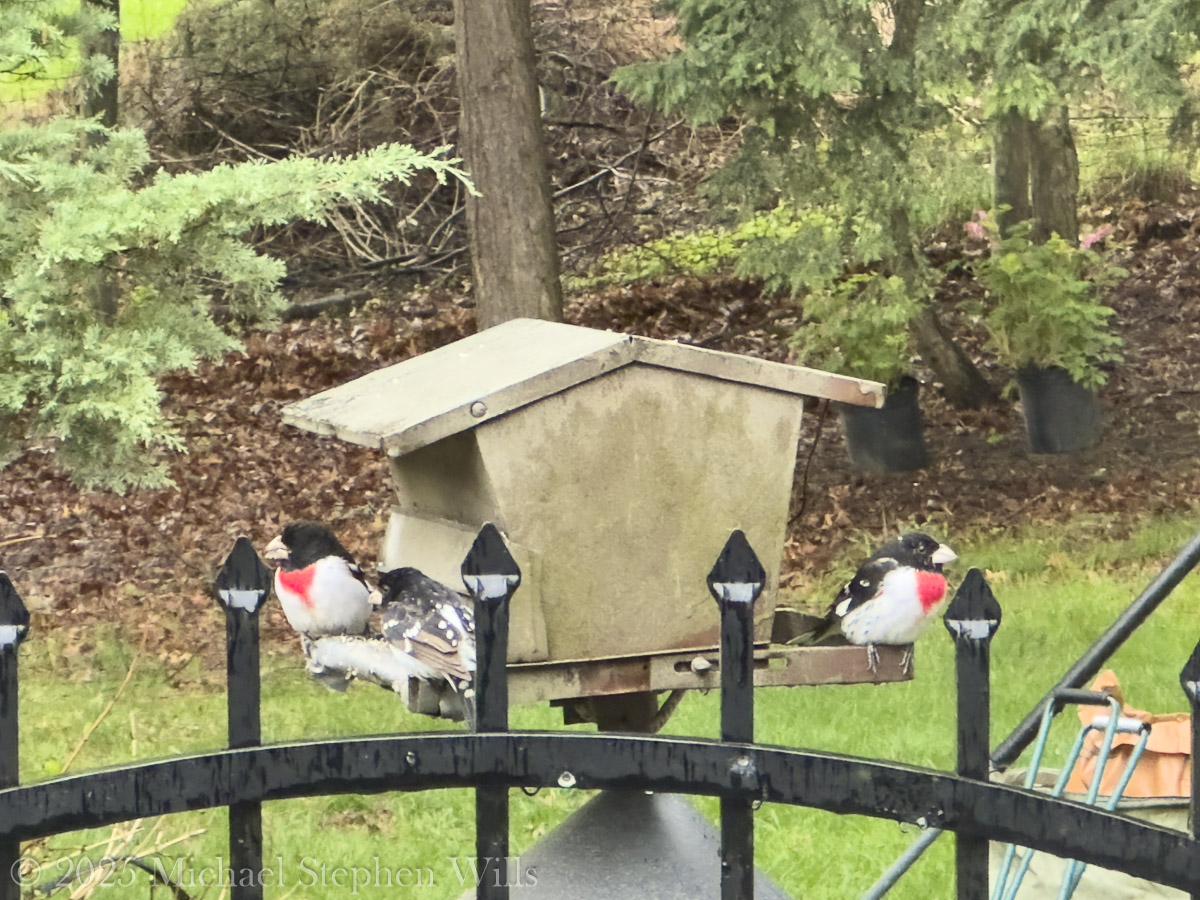
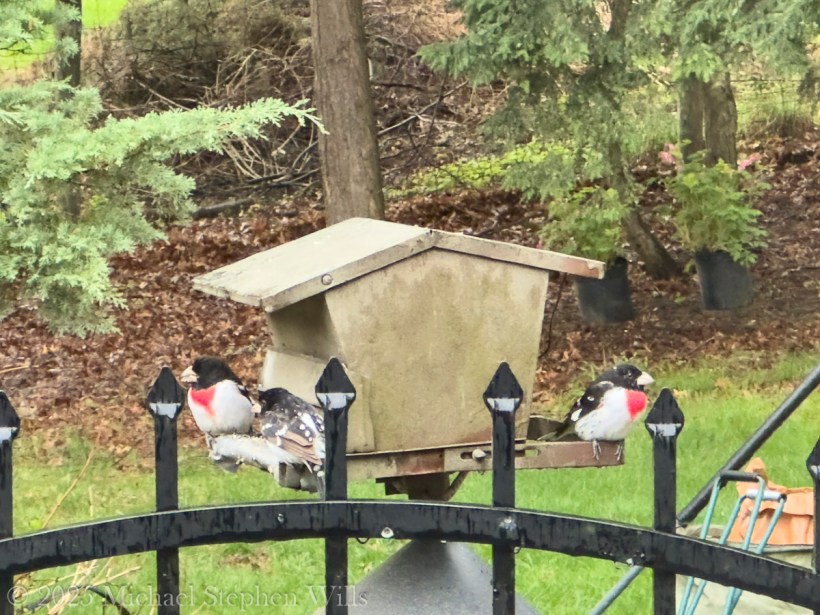
May 3, 2025 Four Male Rose Brested Grosbeaks visited our backyard bird feeder during spring cleanup.


Not one or two, but a small flock, draped in raindrops, feathered in contrast and charm. They gathered around our backyard feeder like guests invited to a familiar table. At 5:56 a.m., the camera captured the first image: two males on the feeder and one each on fence and chair, a bold bib of crimson splashed across snowy chests, huddled against the gray of the feeder, their plumage brilliant even in the diffused dawn light. I couldn’t help but smile. This was a scene of quiet splendor, a symphony for the eyes and soul.


The males, unmistakable in their attire, wore tuxedos of black and white, with the defining rose-red marking on the breast that gives the species its common name. Their scientific name, Pheucticus ludovicianus, is less poetic but equally telling. “Pheucticus” comes from the Greek pheuktikos, meaning “shy” or “avoiding,” reflecting their reclusive habits in forested nesting grounds. “Ludovicianus” refers to Louisiana, an early French colonial name for a vast region including their breeding range—a nod to their North American roots.


At 5:58 a.m., the lens captured more details: a male with slightly mottled wing feathers, suggesting he was a younger bird, still dressing up in adult finery. The trio clung to the feeder’s edge, their heavy, conical beaks—perfect for cracking seeds—clearly visible. That oversized bill gives them the name “grosbeak,” from the French gros bec, literally “large beak.” Functional beauty, you might say.

May 3, 2025 Three of the Four Male Rose Brested Grosbeaks visited our backyard bird feeder during spring cleanup.


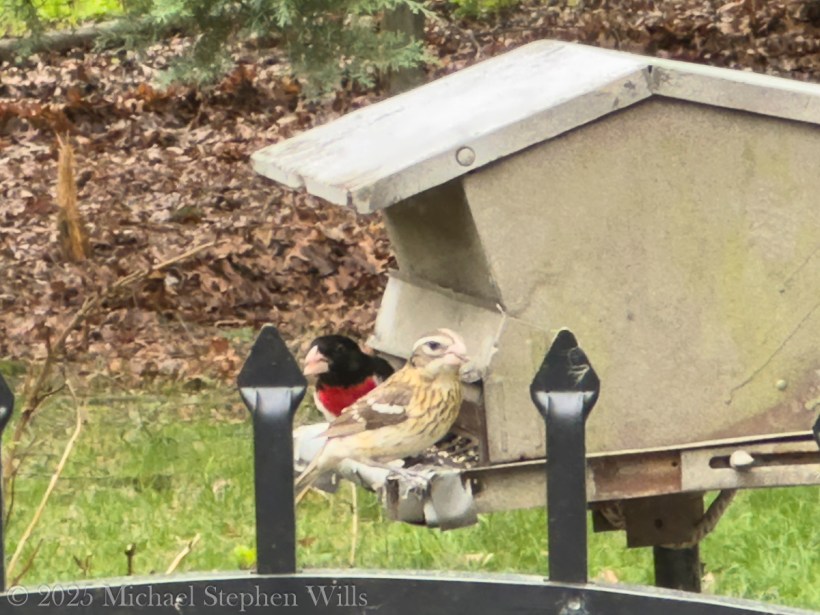
Then, at 6:08 a.m., came the contrast—the female. Subtly adorned in warm browns, with creamy streaks and a wash of yellow near the wings, she perched beside her flamboyant mate, as if to say: elegance need not shout. The two birds looked momentarily toward each other, and I was struck by their balance—his flair and her grace. Her eyebrow stripe, called a supercilium, lent her a composed, alert expression. While the male might catch the eye, the female commands attention in her own, quieter way.

May 3, 2025 Male and Female Rose Breasted Grosbeaks visited our backyard bird feeder during spring cleanup.


Rose-breasted Grosbeaks are migratory, long-distance travelers who winter in Central and South America and return each spring to North America’s deciduous and mixed woodlands to breed. Here in upstate New York, our yard is a brief rest stop on their northward journey—or, if I’m lucky, a summer home. They often nest in dense foliage, and their song, a melodic, whistled warble—like a robin who’s taken voice lessons—is often the first clue to their presence.


This morning, no song was needed. Their silent presence was enough.


Watching them, I felt time slow, the kind of moment when the ordinary yard becomes cathedral. Watching them, I felt time slow, the kind of moment when the ordinary yard becomes cathedral. The wet fence and chair under the feeder, even the crumpled leaf bag—everything was blessed by the company of these birds. Rain softened the world, and the birds brought color to its hush.


Later that day, reviewing the photos with metadata timestamps from my iPhone—each image like a verse in a poem—I marveled at what I had witnessed. These weren’t just birds. They were stories in flight, living punctuation marks in the sentence of my morning.


Nature gives us these moments, brief as birdsong and just as sweet. You only have to be still, and ready to receive them.

Enter your email to receive notification of future postings. I will not sell or share your email address.

References

  1. Pheucticus ludovicianus (Rose-breasted Grosbeak). Cornell Lab of Ornithology – All About Birds.
  2. Jobling, James A. The Helm Dictionary of Scientific Bird Names. London: Christopher Helm, 2010.
  3. Merriam-Webster Dictionary: Etymology of “Grosbeak.”
  4. iPhone 14 Pro Max image metadata (May 3, 2025; 5:56 a.m. to 6:08 a.m.; Ithaca, NY).

Hoverflies: Nature’s Mimicry Experts

Hoverflies, harmless pollinators often mistaken for bees, possess distinctive features and mimicry patterns that aid in their survival.

A hoverfly buzzing with cheer,
Lands softly, no sting to fear.
With wings all a-glitter,
It’s no wasp, just a critter,
Whose mimicry tricks year to year.

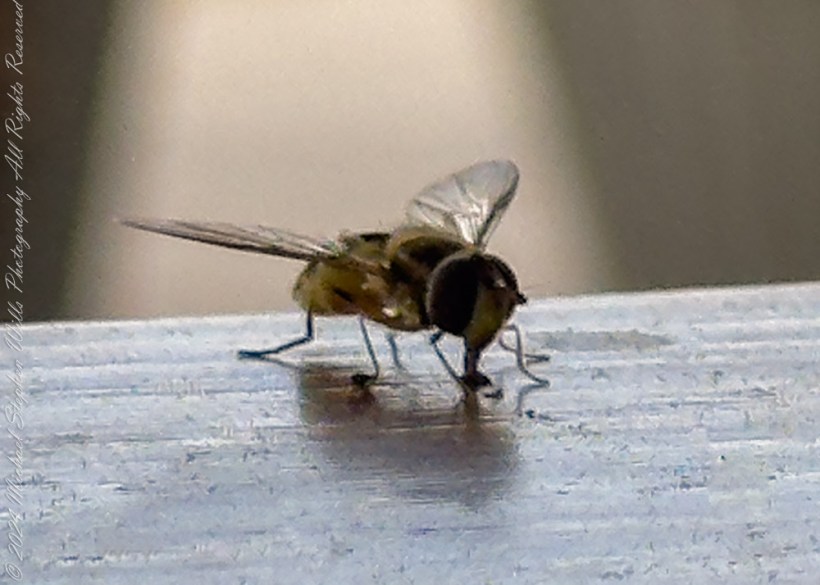
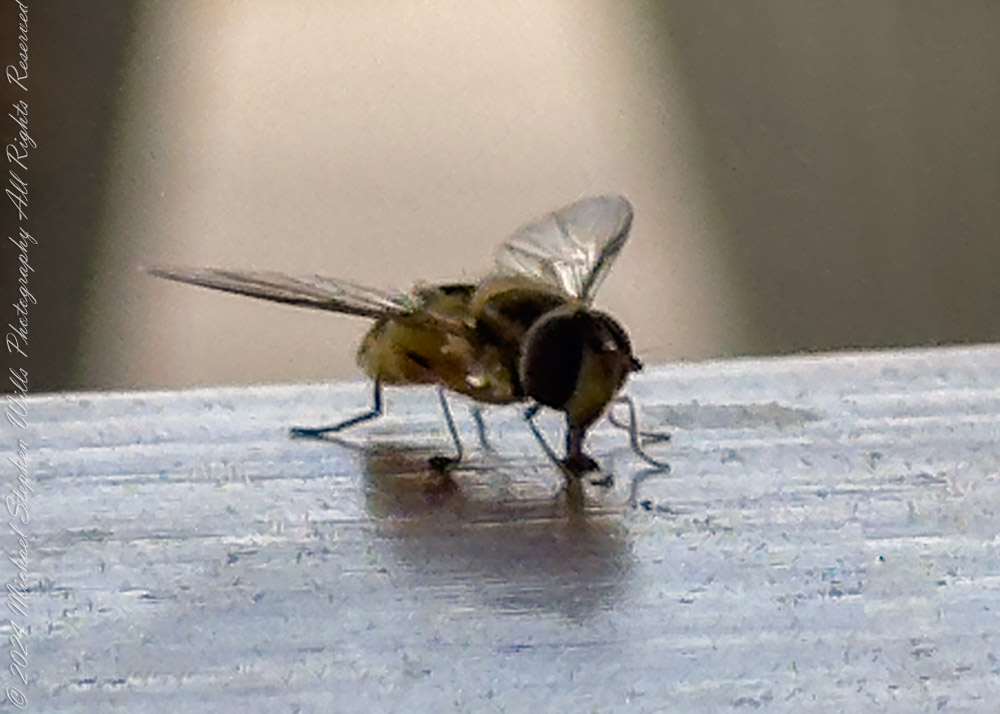
The photo shows the hoverfly on a smooth surface, possibly resting or feeding. Hoverflies are abundant in the fall as they are drawn to late-blooming flowers for nectar and pollen.

A hoverfly stopped for a snack,
On a table, just taking a crack.
It posed for a shot,
Not moving a lot,
Then flew off to plan its next act.

A hoverfly thought it was sly,
As it zipped ‘round, too quick for the eye.
“Are you a bee?” folks said,
With confusion widespread,
“Just a poser!” it said with a sigh.

Some useful facts about this relatively harmless visitor

This insect is a Hoverfly (family Syrphidae). Hoverflies are often mistaken for bees or wasps due to their yellow and black striped body, but they are harmless and lack the ability to sting. They are beneficial pollinators and are common in gardens, meadows, and near flowers.

Some key identifying features include:

Large compound eyes that meet at the top of the head in males.


Two clear wings (unlike bees/wasps, which have four wings).


A short, stubby antennae.


Mimicry coloration (yellow and black stripes) that helps them avoid predators.


Nesting Chronicles: The Life of A Cayuga Lake Osprey

Imagine you’re soaring with ospreys over Cayuga’s shimmering waters, preparing the nest, embracing the ritual of spring—a majestic cycle of life awaits you.

As the first warm breezes of early spring ruffle the chilled waters at the south end of Cayuga Lake, anticipation rises in me. I am a female Osprey, returning alone from far to the south along the old sky-roads. We do not migrate as a pair; my mate often reaches the nest ahead of me to reclaim the site and begin repairs. Still, this is the place we claim again, season after season.

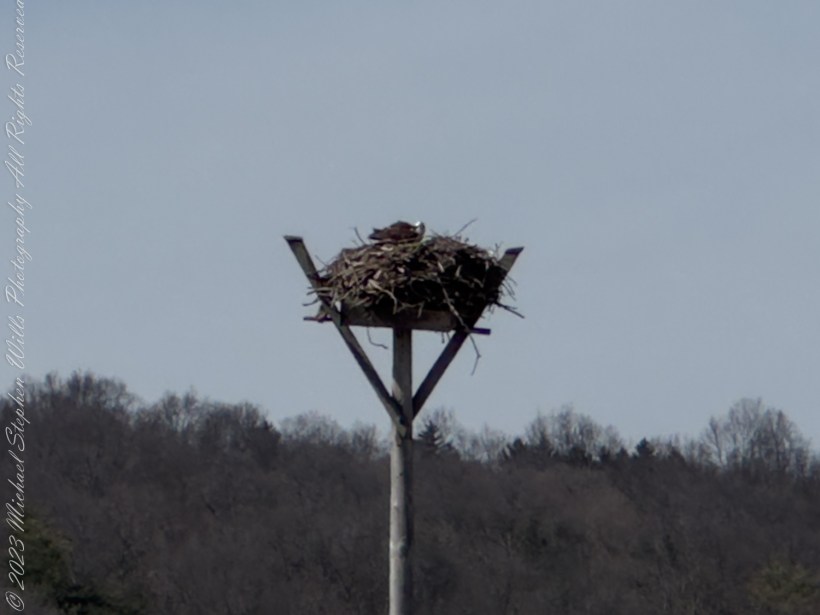
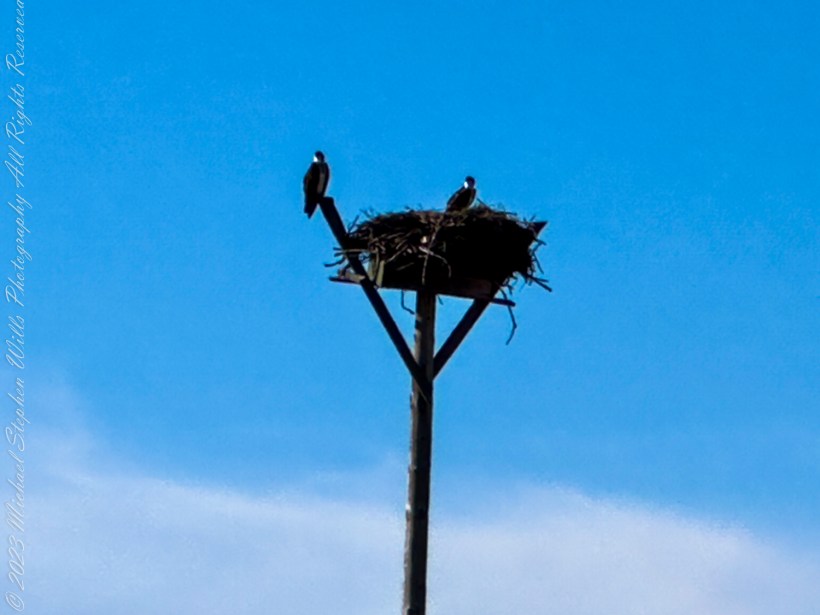
Two Osprey perched on the nest near the Birding Trail of Cass Park. Cayuga Lake in the distance.

On arrival I wheel high above the shoreline, searching for the platform we left to winter. There it stands—the tall sentinel above the lake. He is there, too, calling once as he lifts, and the rim already shows the first fresh sticks of the year. Against the bright sky the nest looks rough-hewn, yet every branch lies to a purpose.

Two Osprey perched on the nest near the Birding Trail of Cass Park.

As I settled onto the platform, tthe familiar tilt of the timbers and the dry rattle of last year’s sticks steady me. I meticulously inspected our creation, the repository of our hopes and future lineage. My mate and I ferry fresh twigs and weeds, wedging them into the rim and lacing the walls tight against the spring winds.

In due time, beneath the sheltering rim, I laid a small clutch of mottled eggs—the culmination of our bond, the promise of continuity. Through the weeks that follow I keep them warm and dry, turning them with my beak and settling the heat of my breast upon them. My mate does the heavy work of provision—fish after fish to the rail—and stands guard, calling when intruders drift close. Now and then he eases onto the eggs while I feed, but the watching and warming are chiefly mine.

Two Osprey perched on the nest near the Birding Trail of Cass Park.

The world around us burgeoned with life. The lake’s surface now rippled with the activity of fish – a bounty for our growing family. Days turned into weeks, and our vigilance was rewarded as the first cracks appeared in the eggs. The chicks emerged, delicate yet voracious, their mouths agape for the nourishment we unceasingly provide.

Click Me for another Osprey Post

Thank you Candace E. Cornell of the Cayuga Lake Osprey Network for your helpful advice.

For further information: —–Poole, Alan F. ; 2019, “Ospreys: The Revival of a Global Raptor”; Johns Hopkins University Press —Mackrill, Tim; 2024; “The Osprey”; Bloomsbury Publishing

Enter your email to receive notification of future postings. I will not sell or share your email address.

Avian Exploration

Join us in the tranquility of Merritt Island National Wildlife Refuge as we observed avian life, reflecting on nature’s beauty and resilience.

As my wife, Pam, and I entered the breezy expanse of the Merritt Island National Wildlife Refuge, the world seemed to slow down, allowing us to savor every moment of my journey along Blackpoint Drive. The sky, a sprawling canvas of muted greys, reflected in the wind ruffled waters, enhancing the tranquility of this haven.

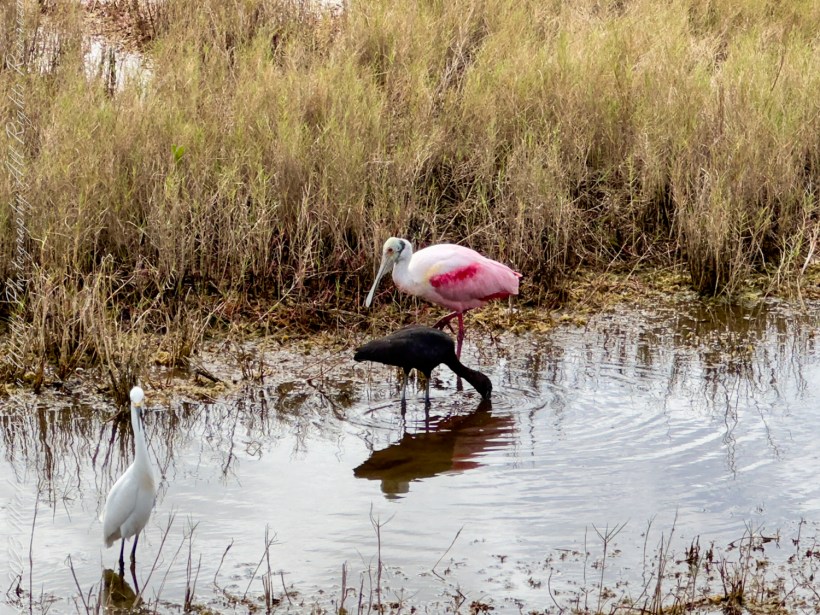
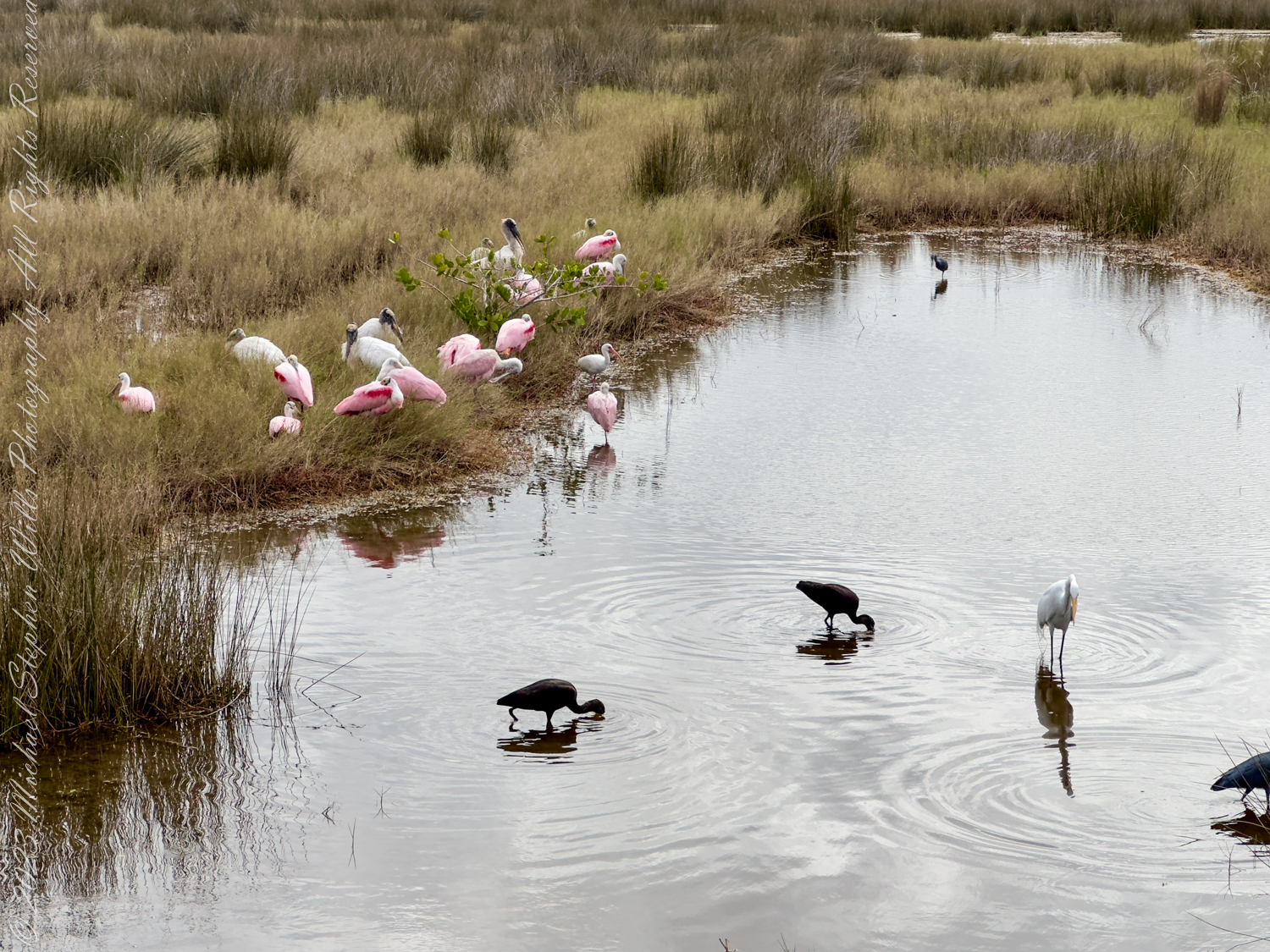
Our first encounter was with the elegant Roseate Spoonbills (Platalea ajaja), their vibrant pink feathers a stark contrast against the earthy tones of the marsh. They waded with purpose, their spoon-shaped bills sifting through the water, a dance of survival that was both methodical and beautiful.

In the company of the spoonbills were the stoic Great Egrets (Ardea alba), statuesque in their white plumage. They stood motionless, like sentinels guarding the water’s edge, only to strike with lightning speed when prey ventured too close.

We watched as the Glossy Ibises (Plegadis falcinellus) dipped their curved bills into the water, each movement a study of precision, their dark feathers glistening with an iridescent sheen when caught by the light.

Amongst these avian aristocrats, the unassuming American White Ibises (Eudocimus albus) went about their business. Their red beaks probed the shallows, unperturbed by the presence of their more colorful neighbors or by my watchful eyes.

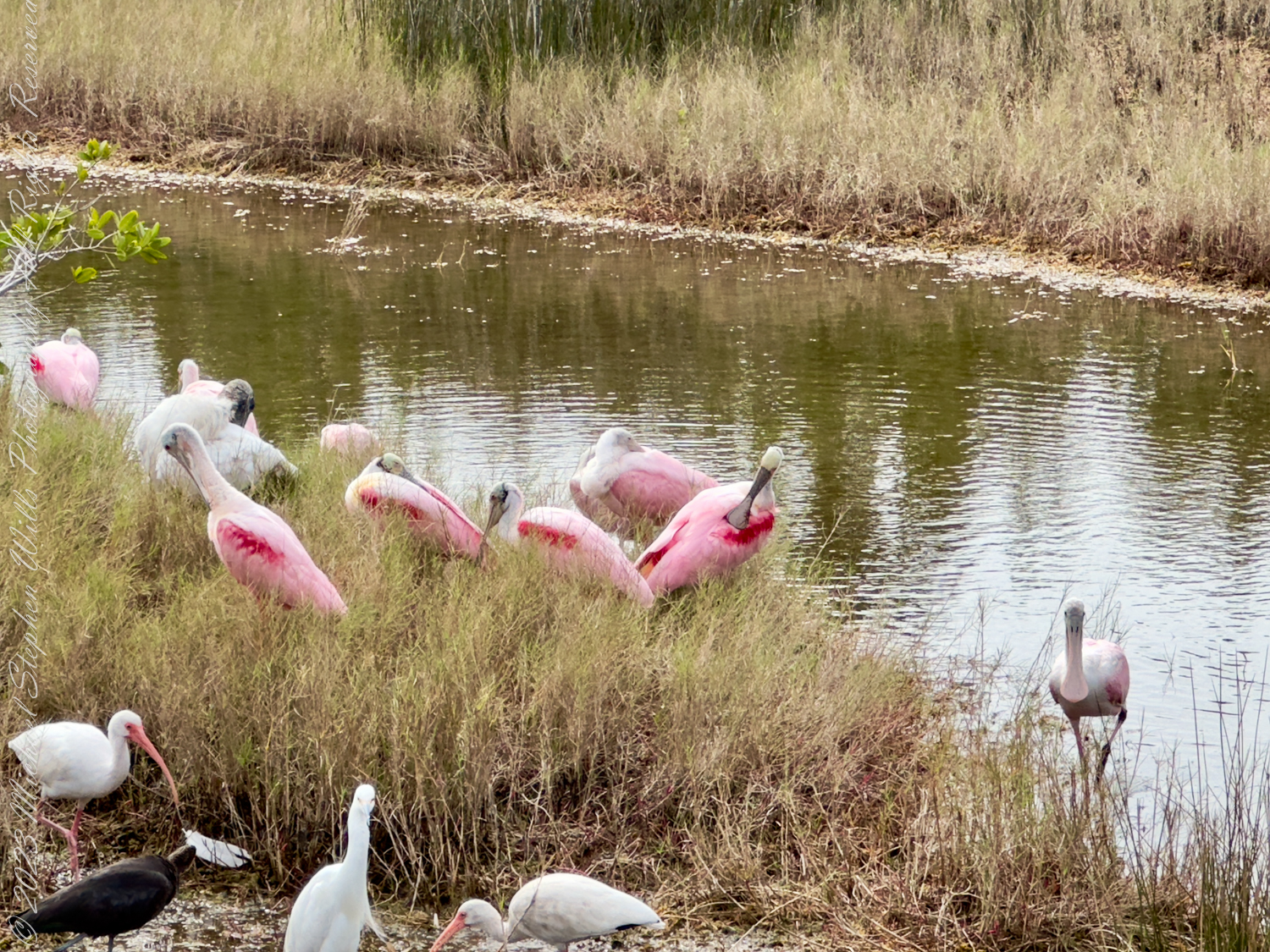
As we ventured further, the landscape shifted, the water opening up to reveal a gathering of Spoonbills and White Ibises, a community united by the need to feed and the safety of numbers. The occasional flap of wings and contented calls created a symphony that celebrated life in these wetlands.

Isolation took on a new meaning when I spotted a solitary Roseate Spoonbill, its reflection a perfect mirror image on the water’s surface. It was a moment of quiet introspection, the bird and I alone in our thoughts.

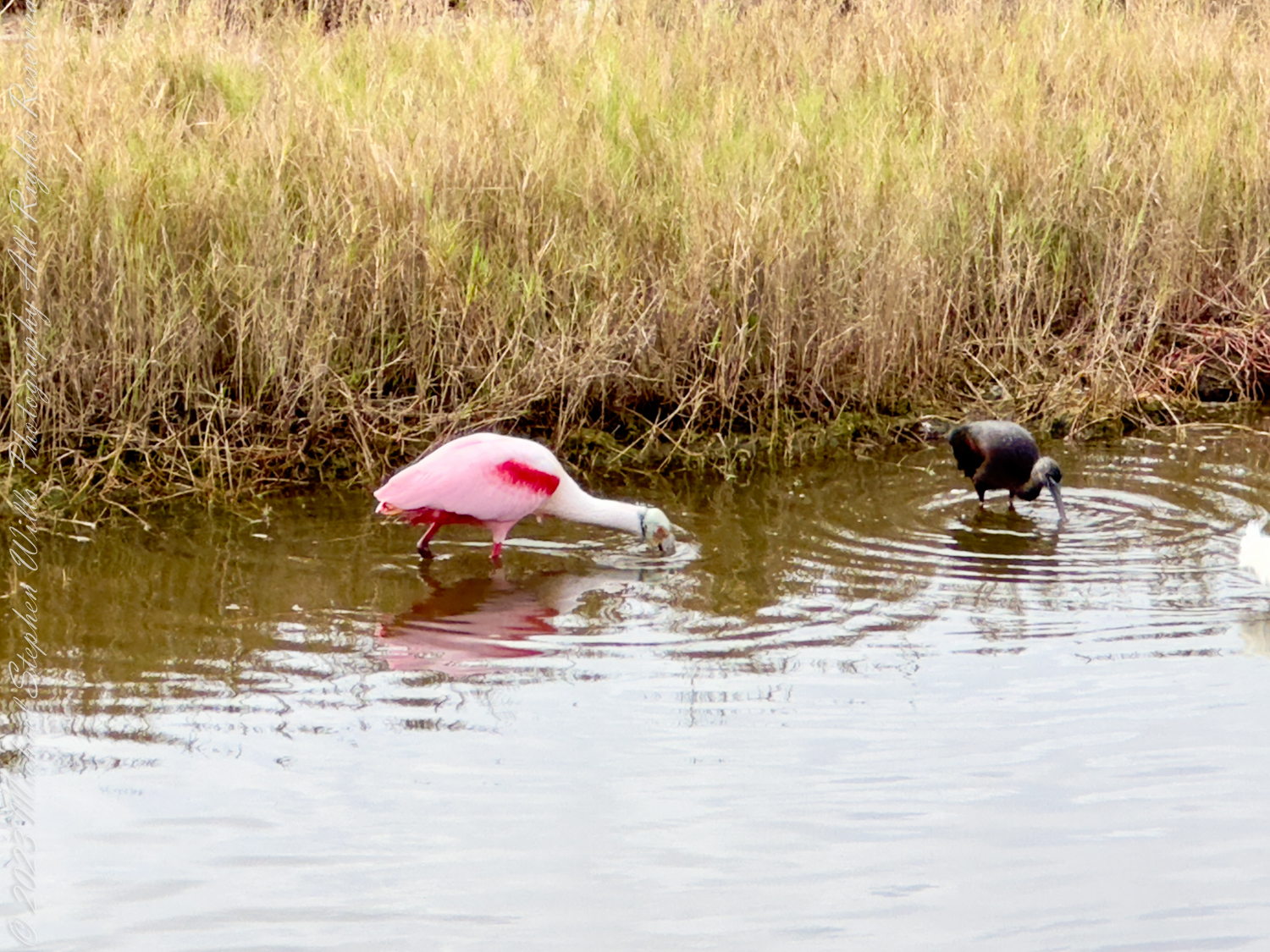
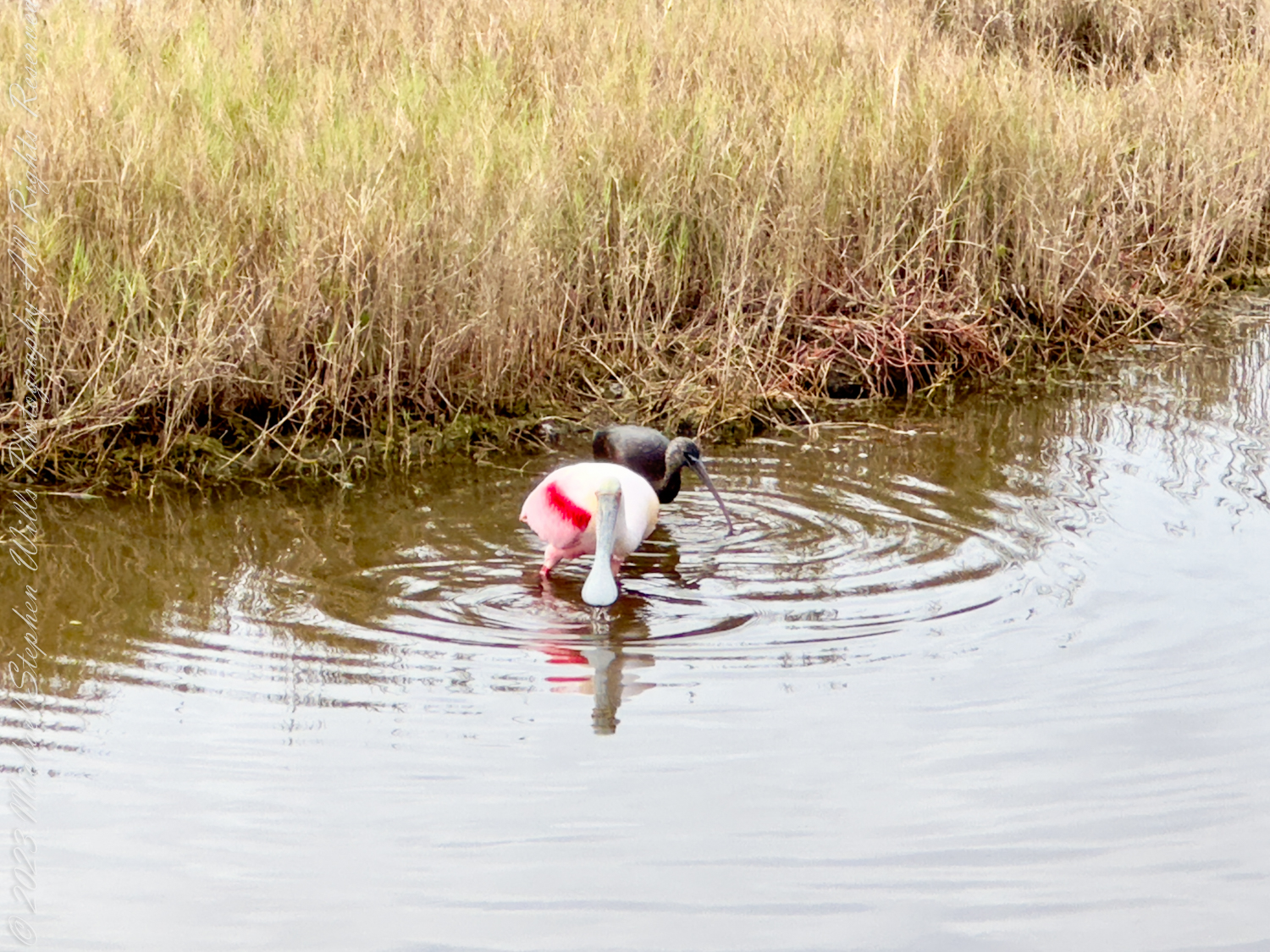
Another scene captured my attention as a single spoonbill foraged alongside a Glossy Ibis. The two species, different in appearance and yet similar in their quest for sustenance, shared the space in harmonious coexistence.

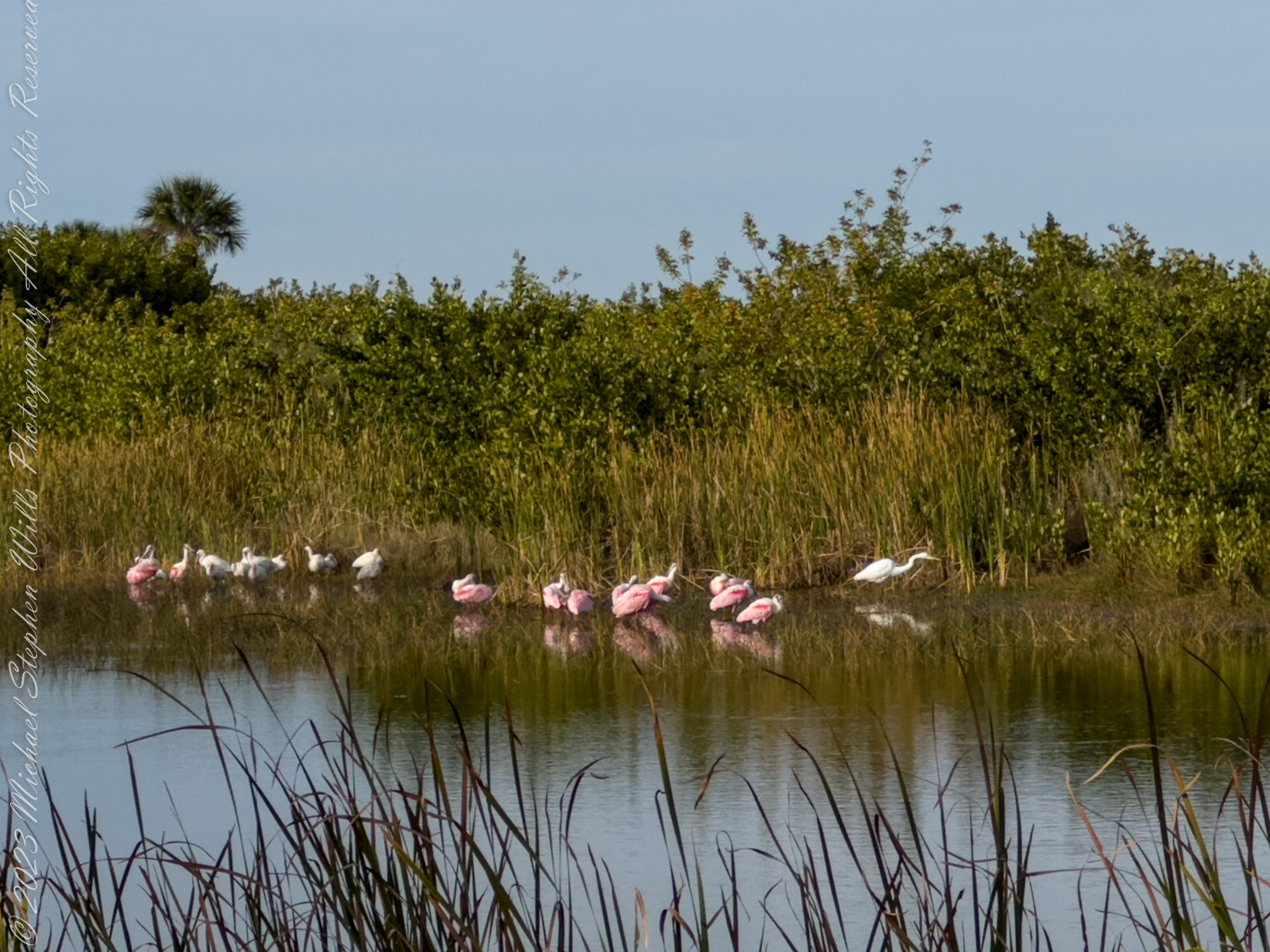
Further along, the vista opened up, and we were greeted by a panoramic view of spoonbills dotted along the distant shoreline, the greenery forming a lush backdrop to their pink hues. The expanse of the refuge unfolded before me, a reminder of the vastness and the wild beauty that had drawn us here.

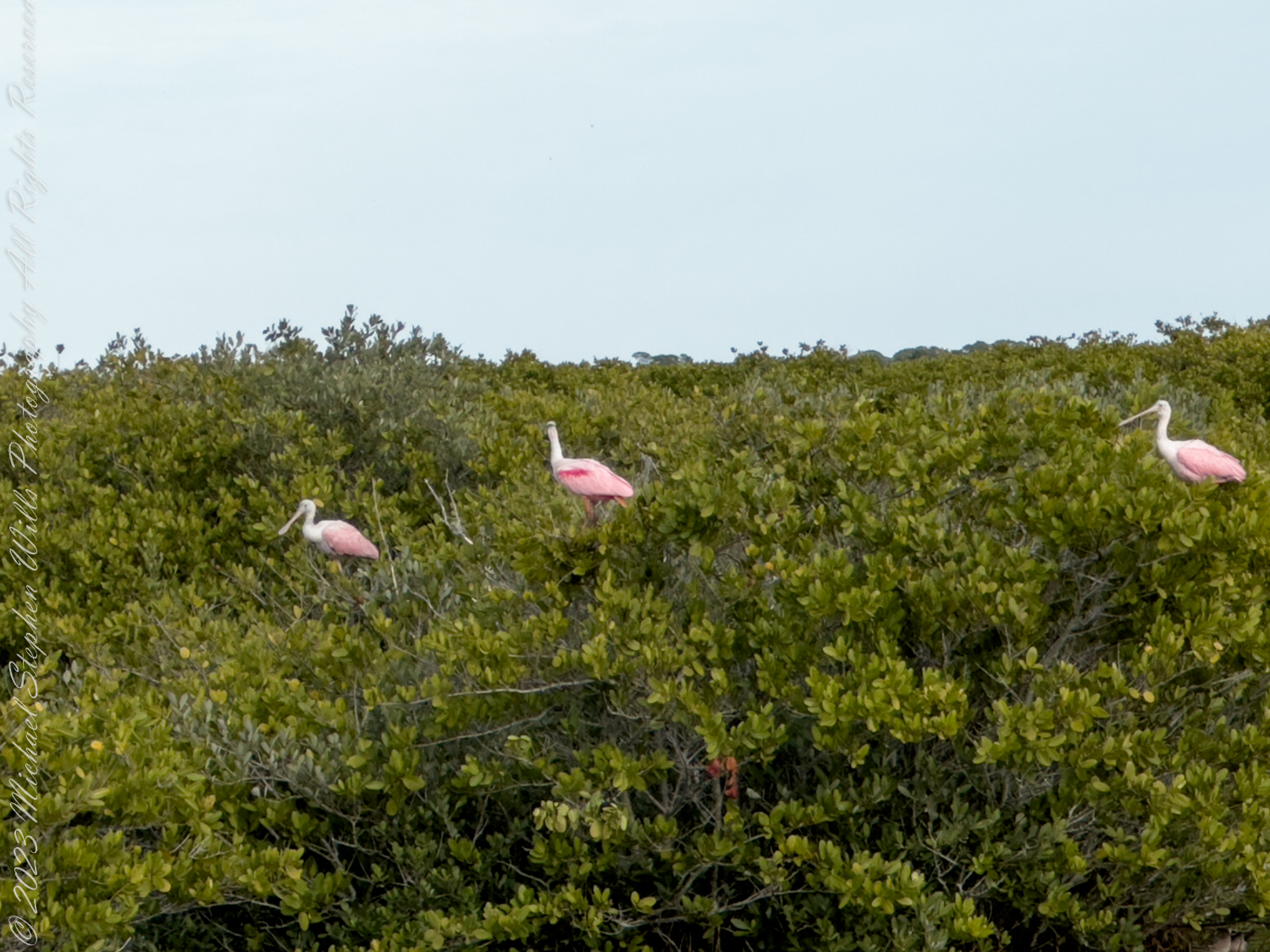
On another stretch, the spoonbills perched in the green embrace of the mangroves, their pink feathers a burst of color among the leaves. It was a scene of natural artistry, the birds blending yet standing out against their verdant stage.

In the final leg of our journey, I found spoonbills perched high in the shrubbery, a testament to the refuge’s diversity. Even in the dense foliage, life thrived, and these birds, usually seen wading, now adorned the treetops like living ornaments.

This drive along Blackpoint was more than a mere observation; it was a passage through a world where time held little sway, and nature was the sole architect. Each bird, each ripple on the water, and each whisper of the grass told a story of existence, resilience, and the intricate web of life. Here, in this secluded corner of the world, we found a connection to the earth and its inhabitants that would stay with us long after.

Copyright 2024 Michael Stephen Wills All Rights Reserved

Otherworldly Assembly?

On the winding Blackpoint Wildlife Drive, Pam and I were spellbound by a ballet of Roseate Spoonbills and Wood Storks, a wild canvas coming alive, revealing the magic bestowed by our cherished Senior Passport

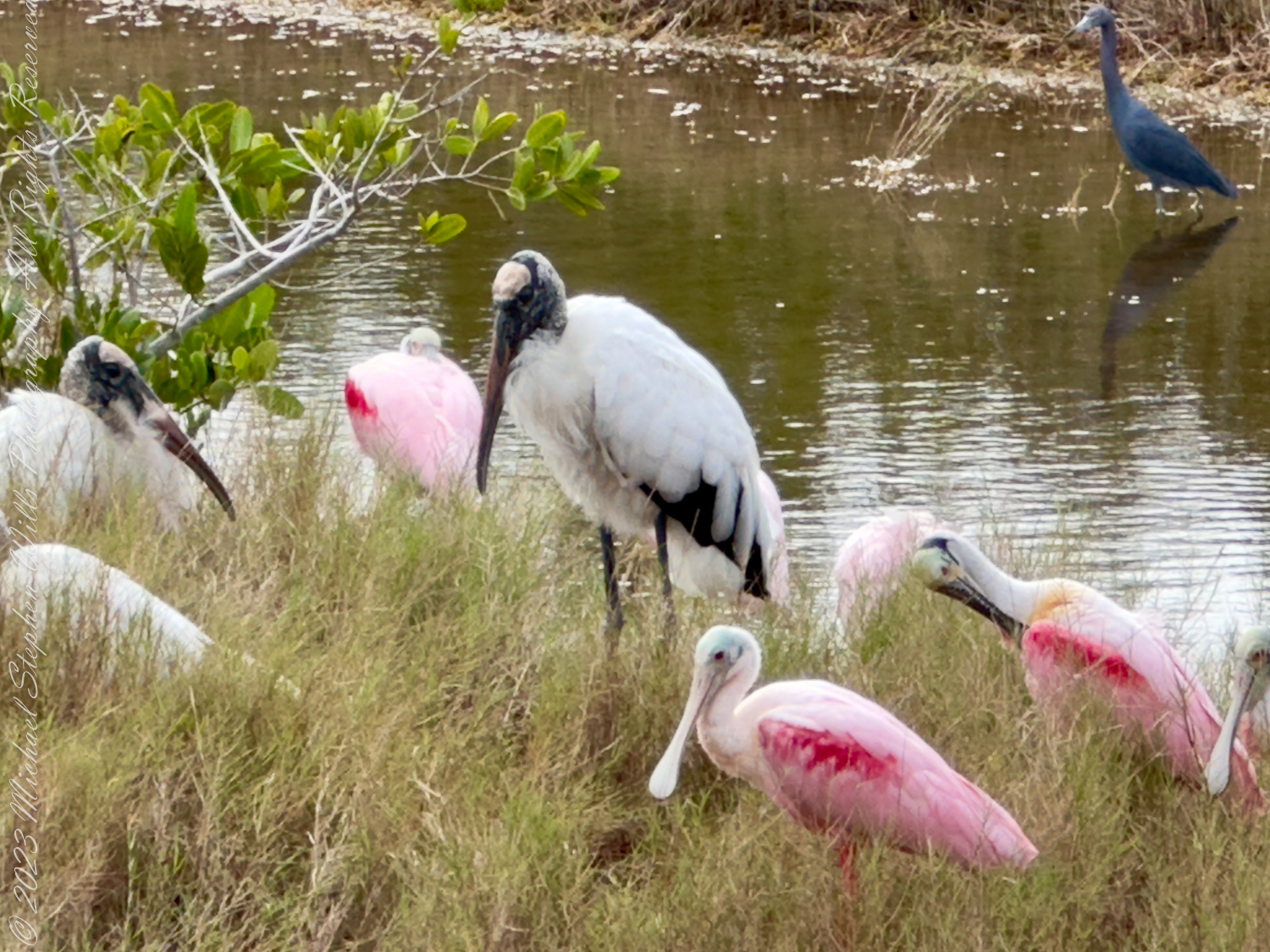
As Pam and I embarked on our journey along the Blackpoint Wildlife Drive we found ourselves privy to an otherworldly marshland assembly. Our eyes were drawn to the stately Wood Storks, or Mycteria americana, standing with a poise that belied their somewhat awkward appearance. Their towering figures were hunched in contemplation, their bald heads surveying the waters for a potential feast.

Beside them Roseate Spoonbills (Platalea ajaja) painted the landscape with strokes of vivid pink. Their spoon-shaped bills, an evolutionary masterpiece, skimmed the shallow waters. It was a delightful contrast, the elegant pink plumage among the grasses, like a splash of paint on a raw canvas.

Companion to these gentle giants, the diminutive Tricolored Heron, Egretta tricolor, stalked the shallows. Its slender form was a study in grace, and the blue-gray feathers shimmered with a hint of lavender as it moved with stealthy precision, a silent hunter amidst the reeds.

The discovery felt like stumbling upon a secret meeting, a council of the feathered kind, where each bird played its role in the delicate balance of the ecosystem. Pam and I shared a look of awe, our whispered words lost in the gentle rustling of the wind. There was a sense of unity, of different species coexisting in harmony, and we were the transient witnesses to their world.

Our journey within Merritt Island National Wildlife Refuge was not just a passage through land but through time. Each turn of the drive revealed another chapter of this living story, and our hearts raced with the excitement of what we might find next. The National Park Service Senior Passport, which we clutched like a treasure map, granted us the privilege to explore this bounty of nature. It was more than a pass; it was a key to worlds unseen and adventures untold.

As senior citizens, this passport to nature’s sanctuaries was a reminder that wonderment has no age. It afforded us the freedom to explore, to learn, and to lose ourselves in the beauty of our nation’s natural heritage. Each stamp in our passport was not just a mark of where we had been, but a memory etched into our lives, a story waiting to be told.

This drive, with Pam by my side, was more than birdwatching. We communicated with nature, laying testament to the beauty that lay in the simple things, the everyday miracles of life that often go unnoticed. We left the Blackpoint Wildlife Drive with a renewed sense of purpose and a reminder of our place in this vast, interconnected web of life.

We returned home with our spirits lifted and our minds filled with the colors of the birds—the Wood Storks, the Roseate Spoonbills, the Tricolored Heron—and the many unnamed creatures that had crossed our paths. It was a mosaic of life, each creature a piece that completed this intricate puzzle of existence. Our encounter with this unusual congregation was a gift, a moment of pure, unadulterated joy, a chapter in our ongoing adventure, one we would recount with smiles and a sparkle in our eyes for years to come.

Copyright 2024 Michael Stephen Wills All Rights Reserved

Two Laughing Gulls of Cocoa Beach: A Dance of Adaptation and Survival

Discover the captivating world of Laughing Gulls, the jesters of Cocoa Beach’s shores. Dive into their lives, exploring the dance of courtship, the adaptability in their diet, and their vital role in the coastal symphony.

The Coastal Sentinels

On the shores of Cocoa Beach, where the Atlantic’s waves gently knead the sands of Brevard County, Laughing Gulls (Leucophaeus atricilla) enact their daily ballet of survival and adaptation. In the span of mere minutes, the shifting light of Florida’s coastal theater presents two scenes, each with the same protagonist yet donned in starkly different costumes.

The Many Faces of Adaptation

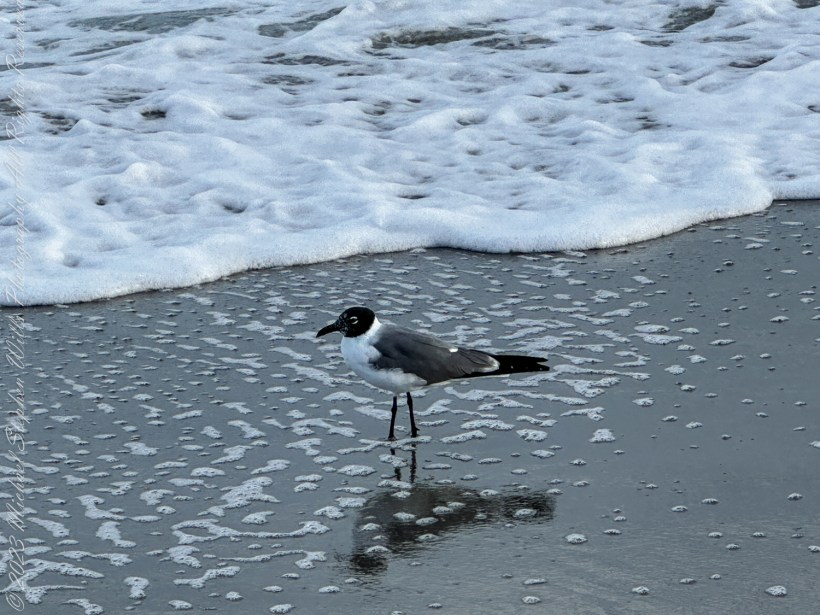
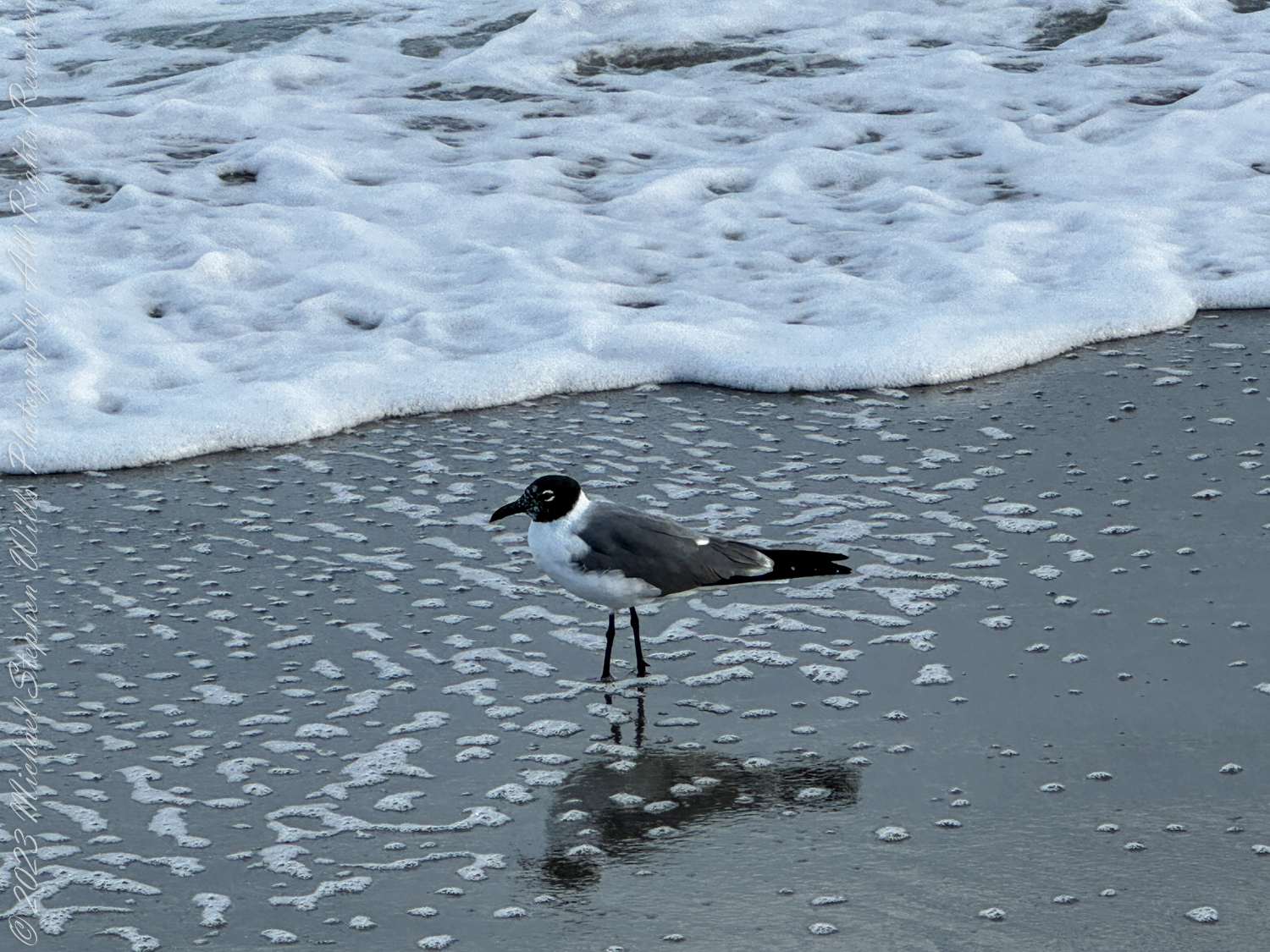
The first gull, captured against the frothy lace of the incoming tide, is the epitome of the breeding plumage: a sleek, black hood that starkly contrasts its pearl-grey wings. This attire is not merely for allure but speaks of its readiness to engage in the rituals of courtship and the responsibilities of rearing the next generation. This black hood, a seasonal crown, fades as the duties of breeding wane, revealing the less conspicuous garb of the non-breeding season—a mottled grey head atop the same sturdy body, ready to blend into the off-season’s landscape.

Laughing Gull with breeding plumage

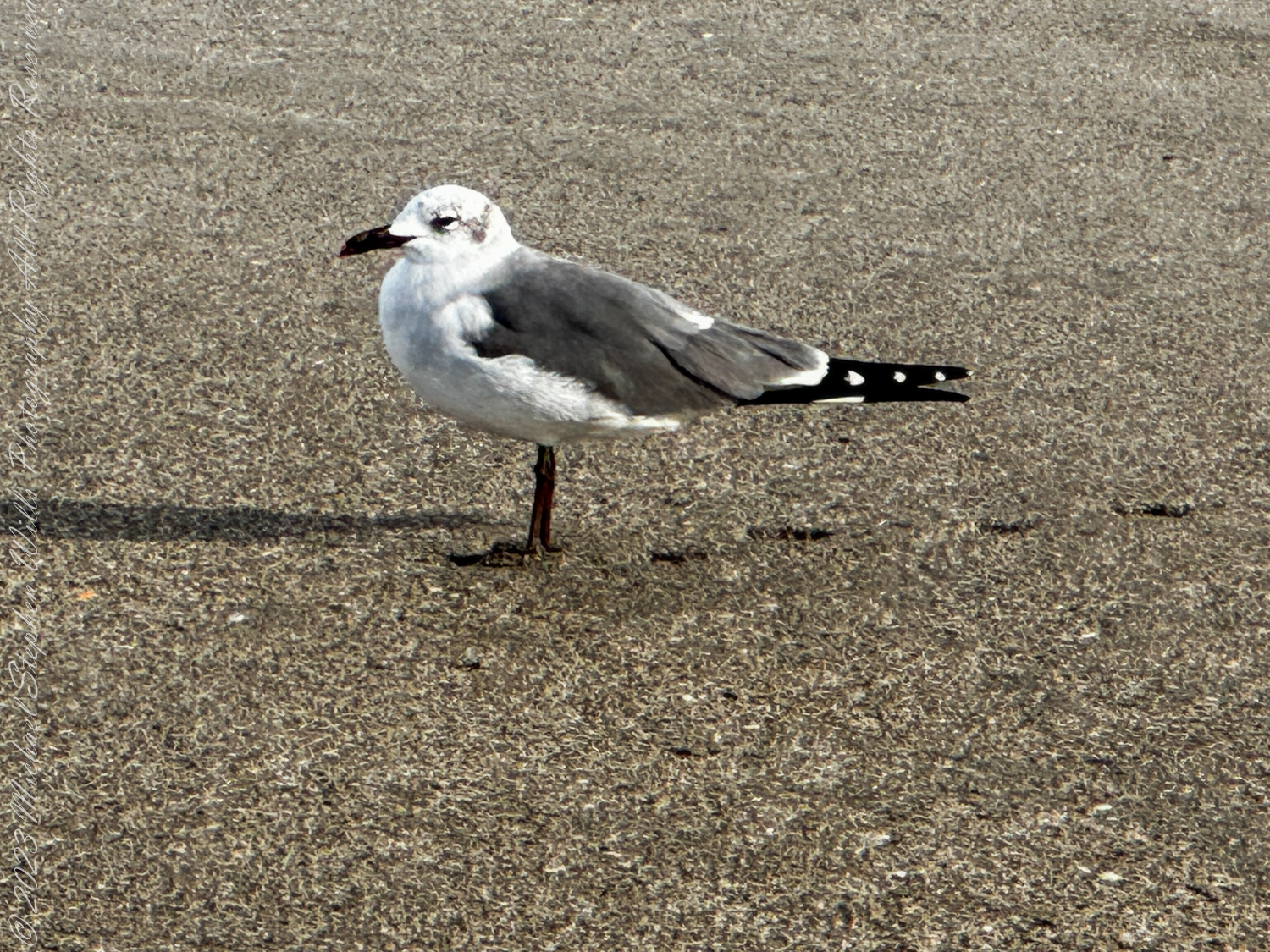
Laughing Gull, nonbreeding plumage

Minutes Of Separation

The mere minutes that separate the two photographs are but a whisper in the grand dialogue of evolutionary time. Yet, they offer a glimpse into the ever-present duality of the Laughing Gull’s life. In one, the gull stands resolute, black-headed and bold against the soft chaos of the sea’s edge. In the other, its head appears dusted with the wisdom of age, a visual softening that speaks to the less confrontational time of year.

Here are some observations to make sense of this disparity:

Overlap of Molting Periods: Laughing Gulls do not all breed at the same time; some individuals may start molting into or out of breeding plumage earlier or later than others. This can result in birds with different plumage being seen together.

Varied Maturity: Younger gulls or those not yet of breeding age may not have developed the breeding plumage, while adults in the same flock may display full breeding colors.

Breeding Colonies: Gulls often nest in colonies where birds in different stages of the breeding cycle can be observed together, including those that may have lost mates or failed to breed and therefore did not develop breeding plumage.

Health or Nutritional Status: Sometimes a bird’s plumage can be affected by its health or nutritional status. A gull in poor health might not molt into breeding plumage as expected.

Geographic and Climatic Factors: Local environmental conditions can influence the timing of molting. Birds in the same location can experience different environmental cues that might affect their molt.

Non-breeding Visitors: During the breeding season, some non-breeding birds may still be present and intermingle with breeding birds, either because they are passing through the area or they are non-breeding residents.

Extended Breeding Season: In areas with a long breeding season, such as in subtropical and tropical regions, the breeding and non-breeding plumages can be seen at the same time due to the extended period over which breeding can occur.

Masters of the Coastal Realm

The Laughing Gulls are more than just residents of the coast; they are its caretakers and witnesses. Their laughing calls are synonymous with the ocean’s breath, a soundscape that harmonizes with the rhythmic crashing of waves. These birds thrive in the intertidal zone, a challenging environment where land and sea engage in a perpetual tussle. Here, they must be opportunistic, agile, and resourceful, for the beach offers both a cornucopia of food and the threat of unpredictability.

The Ebb and Flow of Existence

The life of a Laughing Gull is intimately tied to the ebb and flow of the tides. Their diet is a testament to their adaptability, comprising anything the sea yields—fish, crustaceans, and even the unfortunate insects that stray too close to the brine. They are pirates of the shore, unafraid to snatch a meal from another bird or scavenge the remains of human activity.

Reflections on Change and Constancy

Laughing Gulls are the embodiment of the sea’s narrative around us—a story of change and constancy. Their lives are a testament to the tumultuous history of the ocean, and their presence is a thread that connects us to the vast, blue mystery. They remind us that, while the sea’s moods are many and its faces ever-changing, it remains a central force in the narrative of life on Earth.

In the Face of Tomorrow

In the space between these two images, we find a profound lesson on the nature of time and the resilience of life. The Laughing Gulls of Cocoa Beach, with their shifting plumage and timeless cries, are messengers of the past, envoys of the present, and harbingers of the future. As we contemplate their existence, we are reminded of our own place within the natural world—a world that requires our understanding and protection, lest the laughter of these gulls fades into the silent archives of history.

The Laughing Gulls of Cocoa Beach continue their dance, unfazed by the human gaze, their lives a fluid adaptation to the sea’s caprices. And as the sun marches across the sky, casting the story of these gulls into relief against the shifting sands, we are privileged to observe, to learn, and to cherish the Atlantic Ocean’s enduring tale.

Copyright 2024 Michael Stephen Wills All Rights Reserved

Life of an Osprey: From Nest to Sky

Read about this osprey’s journey, from a hatchling to a fledgling soaring over Cayuga Lake.

Continue reading “Life of an Osprey: From Nest to Sky”