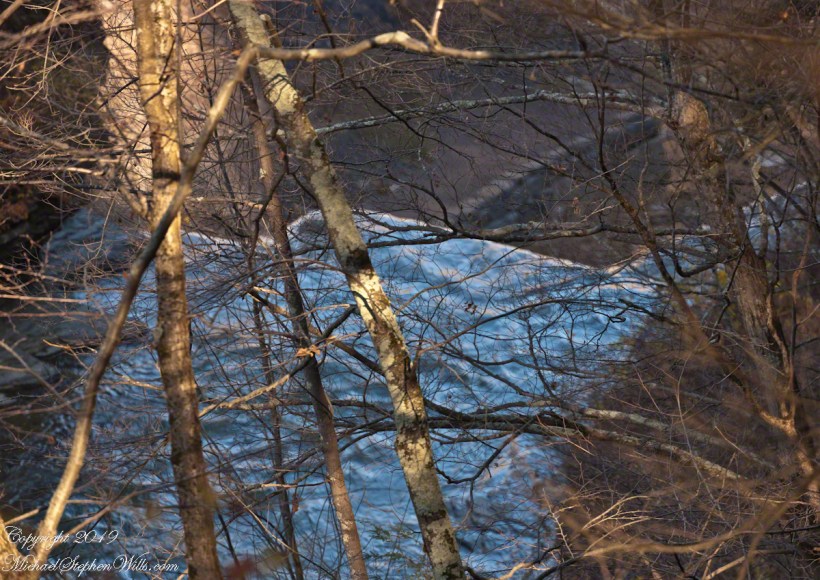
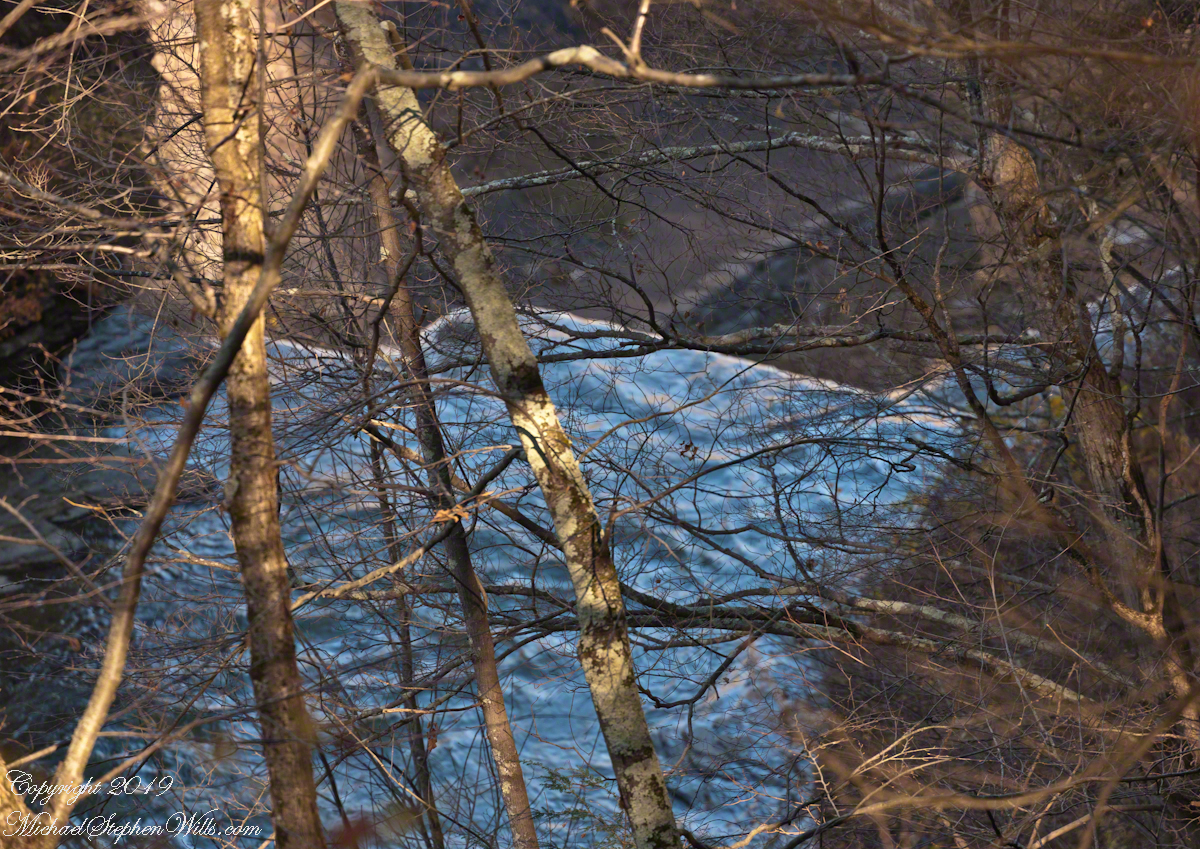
After leaf fall abrupt emptiness of Taughannock Falls is visible from the south rim. Beyond, you can just make out the enormous carved limestone slabs that protect visitors from the constant infall from the gorge walls allowing them to approach the falls.
Click photograph for a larger view. To do this from WordPress Reader, you need to first click the title of this post to open a new page.
The Brink
Copyright 2019 All Rights Reserved Michael Stephen Wills
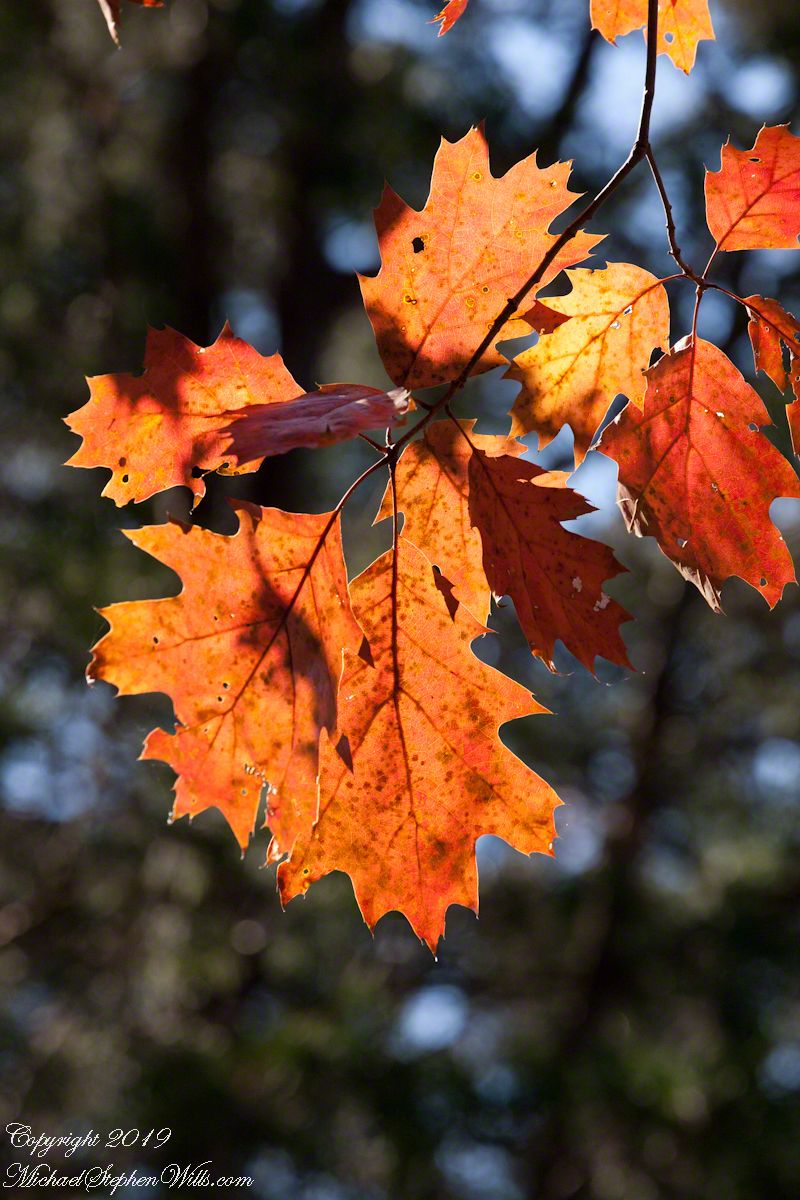
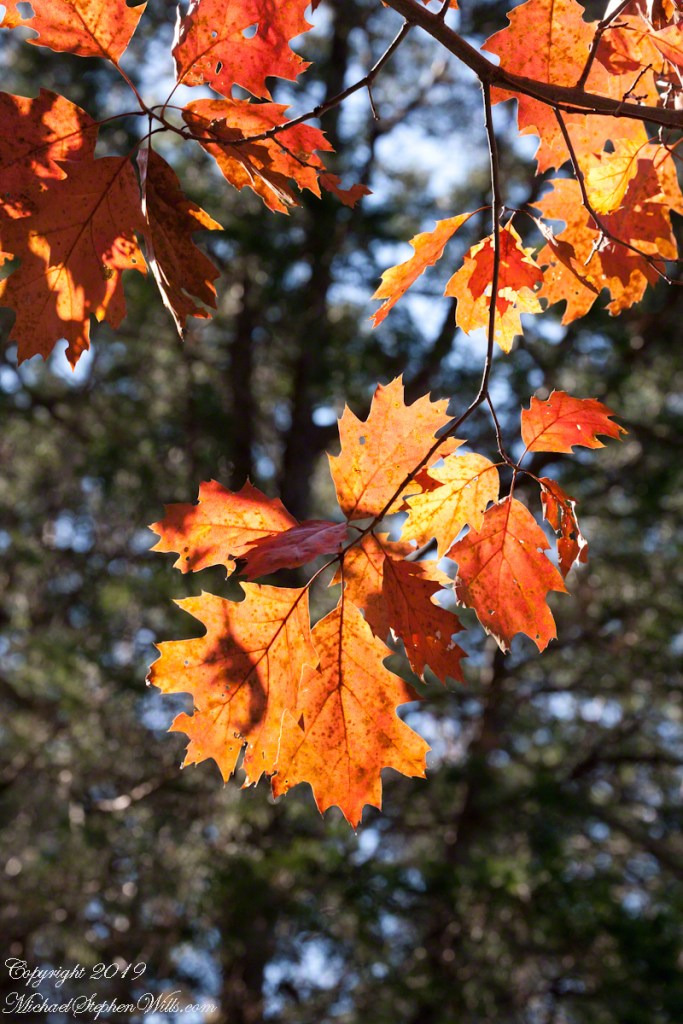
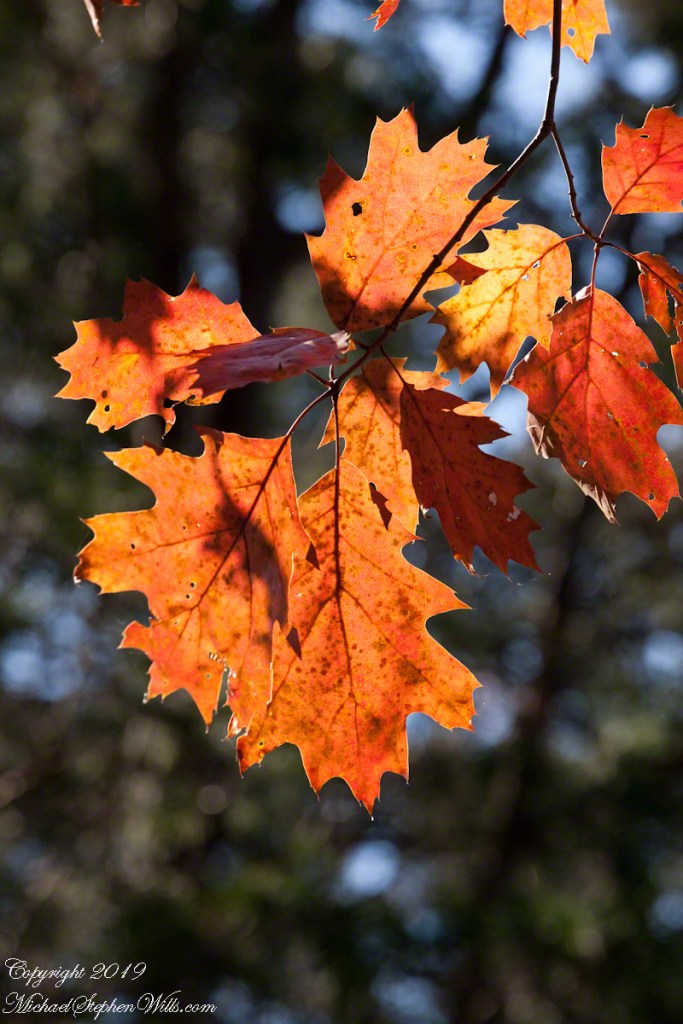
The oak holds tight to leaves, sometimes until spring when new growth pushes last year’s off. Here is a cluster on a bright November afternoon hanging above the South Rim trail of Taughannock Falls Park of the New York State Finger Lakes Region.
Backlit Autumn Oak Leaves
Autumn Oak Leaves, detail
Copyright 2021 All Rights Reserved Michael Stephen Wills
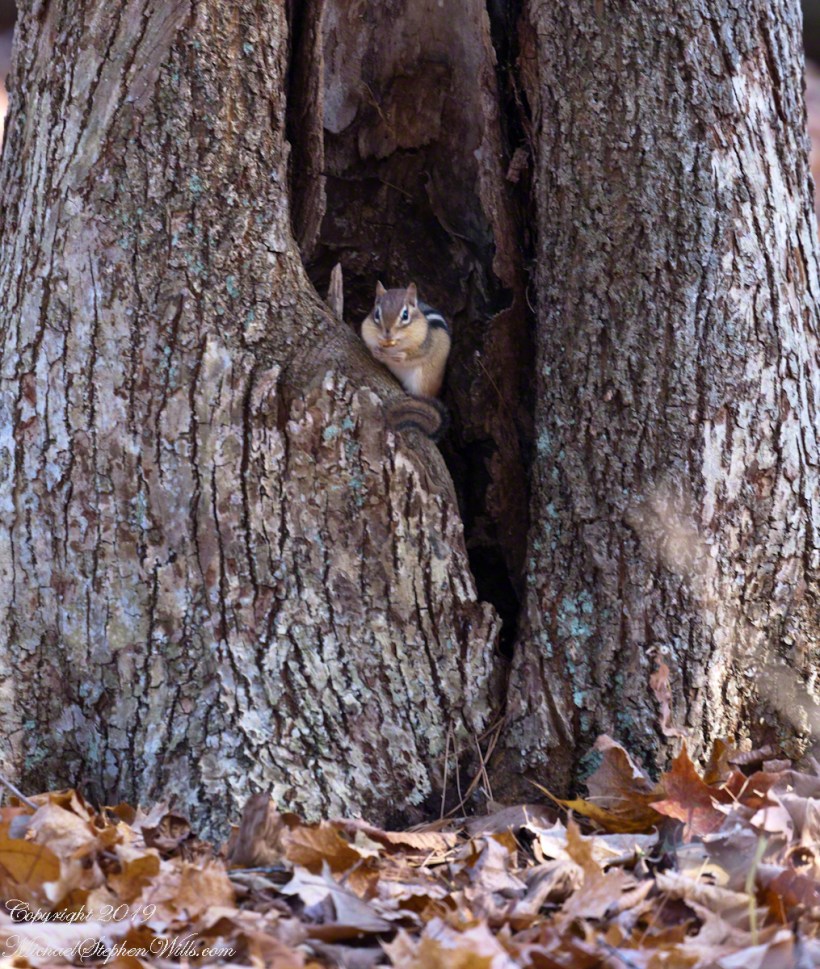
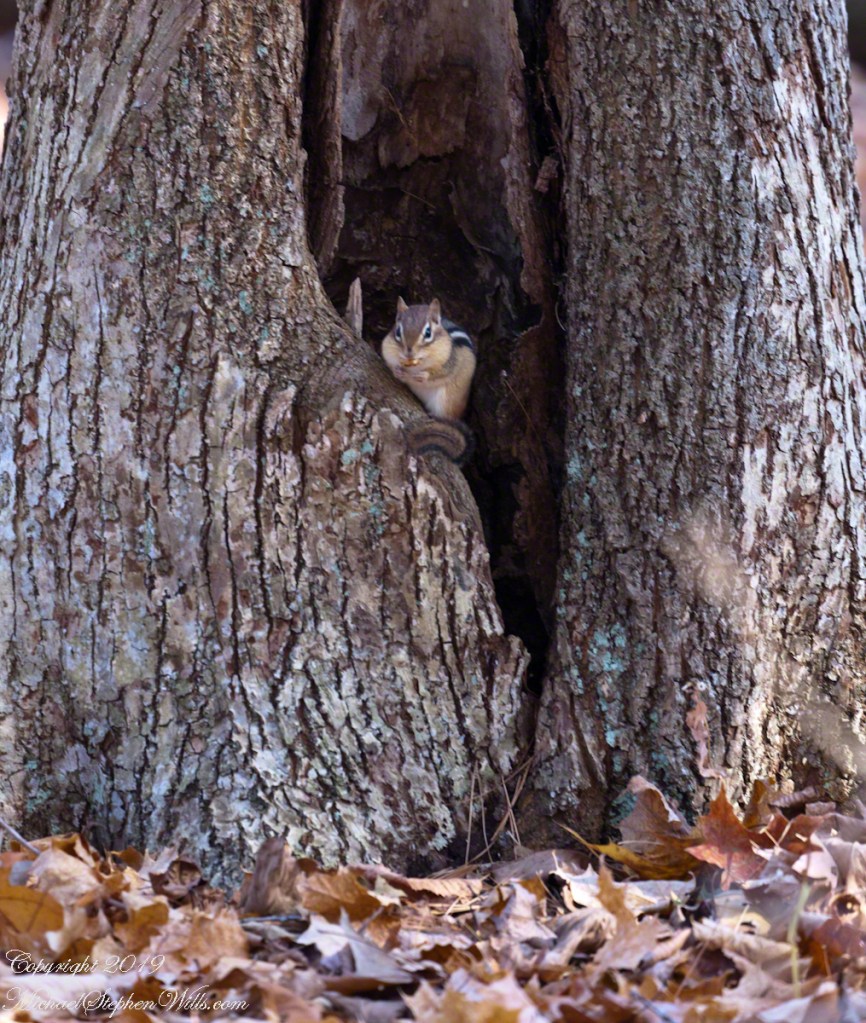
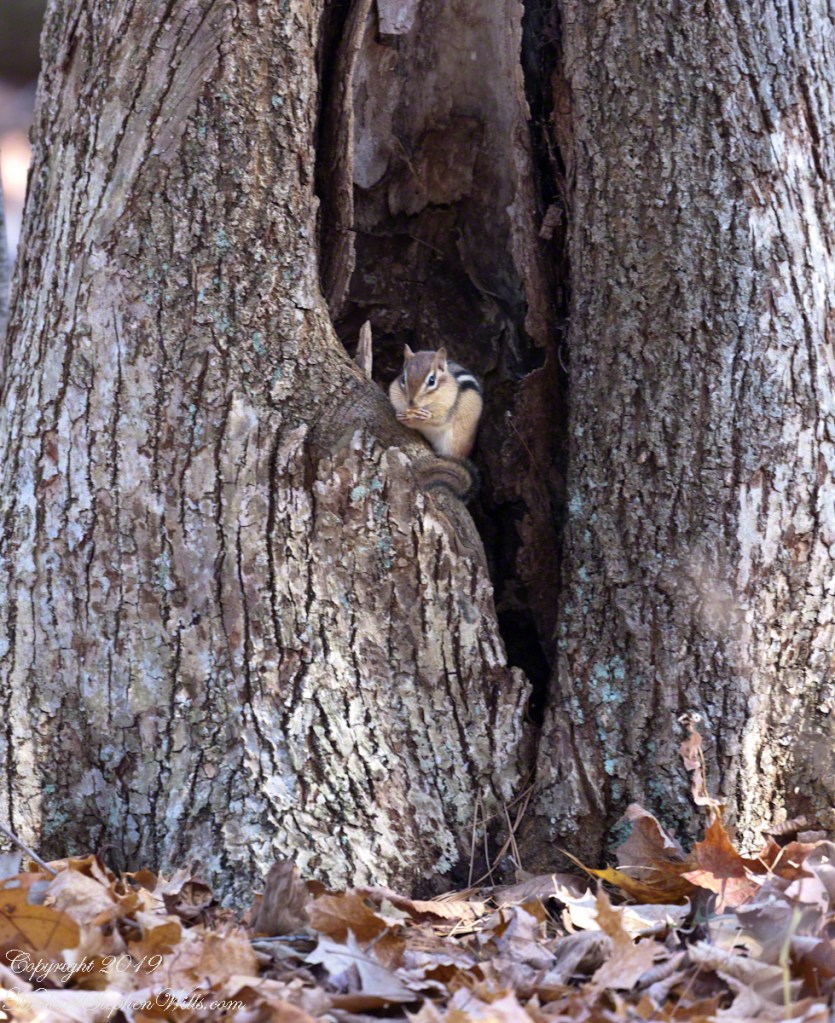
Perched on its doorstep, an Eastern Chipmunk gorges on an ample supply of acorns. These small rodents are omnivores. Here are two shots, each with an acorn in hand and full cheek pouches.
Wary Chipmunk with acorn
Chipmunk eating acorn
Copyright 2021 All Rights Reserved Michael Stephen Wills
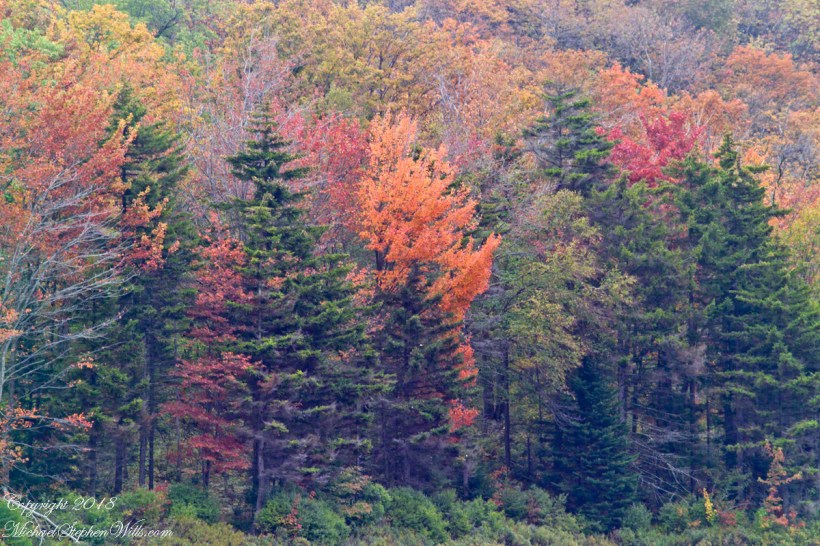
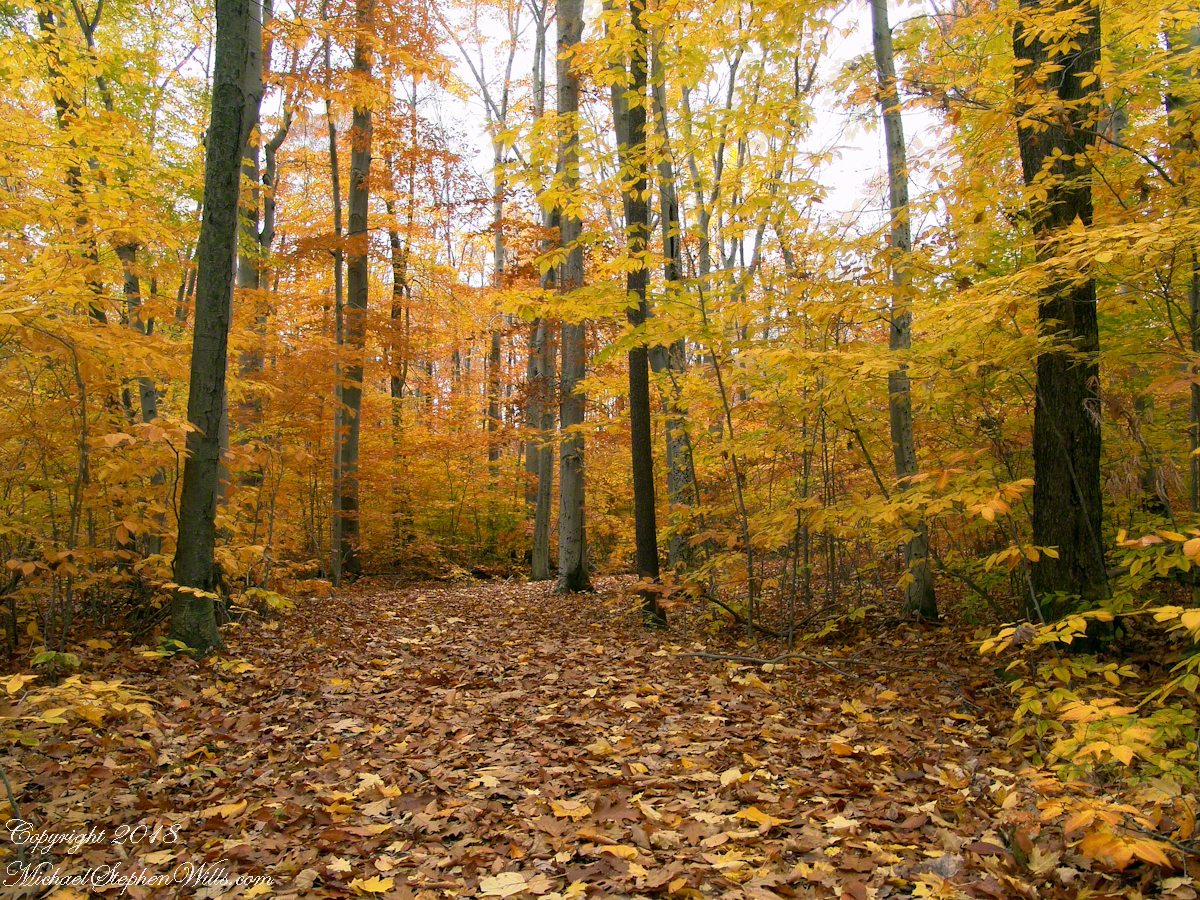
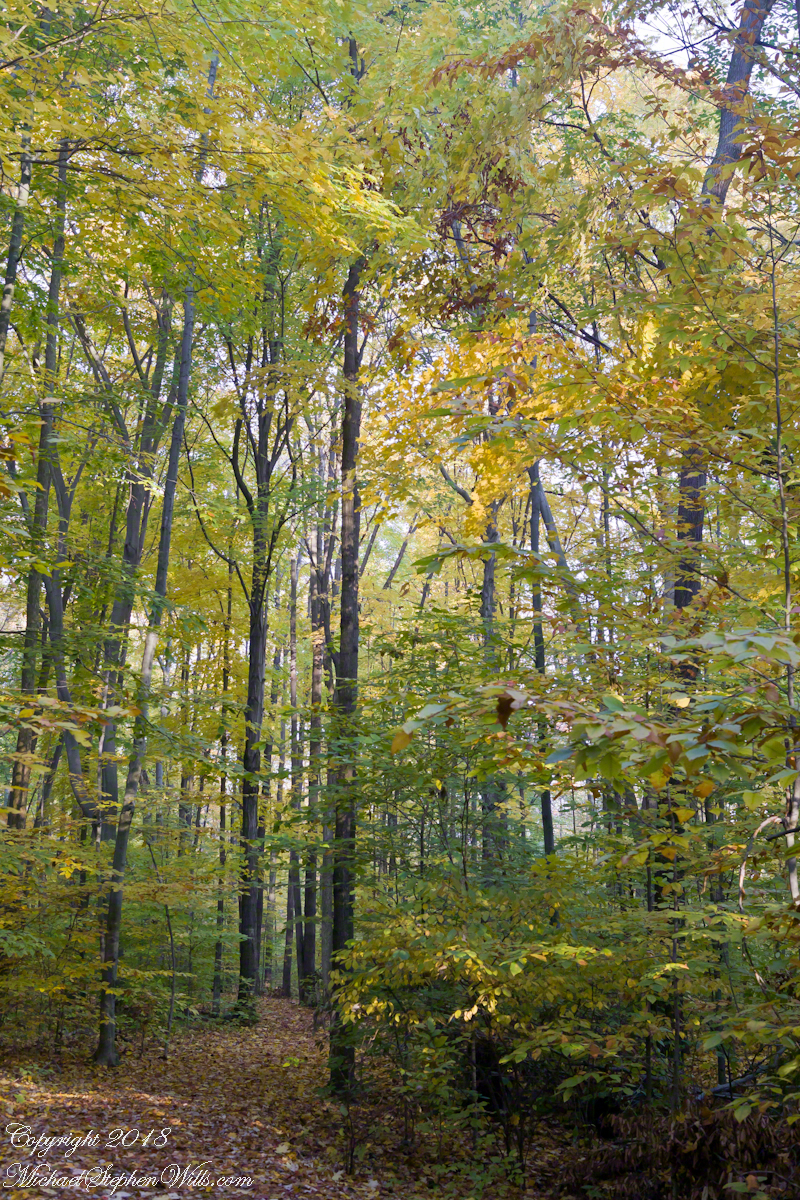
On Halloween morning 2004 I set out with a camera upgrade purchased spring of that year, a Sony “Cyber Shot, DSC-F828” with an inexpensive tripod. My photograph “Autumn Stroll in Sapsucker Woods”, the feature photograph and below, achieved prizes with the Photographic Society of American and a few sales of self-produced prints. It was an early success.
Click any photograph to visit my Online Gallery “Finger Lakes Memories.”
It is available on my Finger Lakes Memories online gallery where I provide recommendations for sizing, the best print medium with ideas for frame and matt.
The fall of 2005 I invested in a Kodak DCS Pro dslr-c and a Canon EF 50mm f/1.4 USM lens. October 30, 2005, one day short of the 2004 Halloween shoot, found me driving down Fall Creek Road on a mission of revisiting Sapsucker Woods to possibly improve upon my offerings.
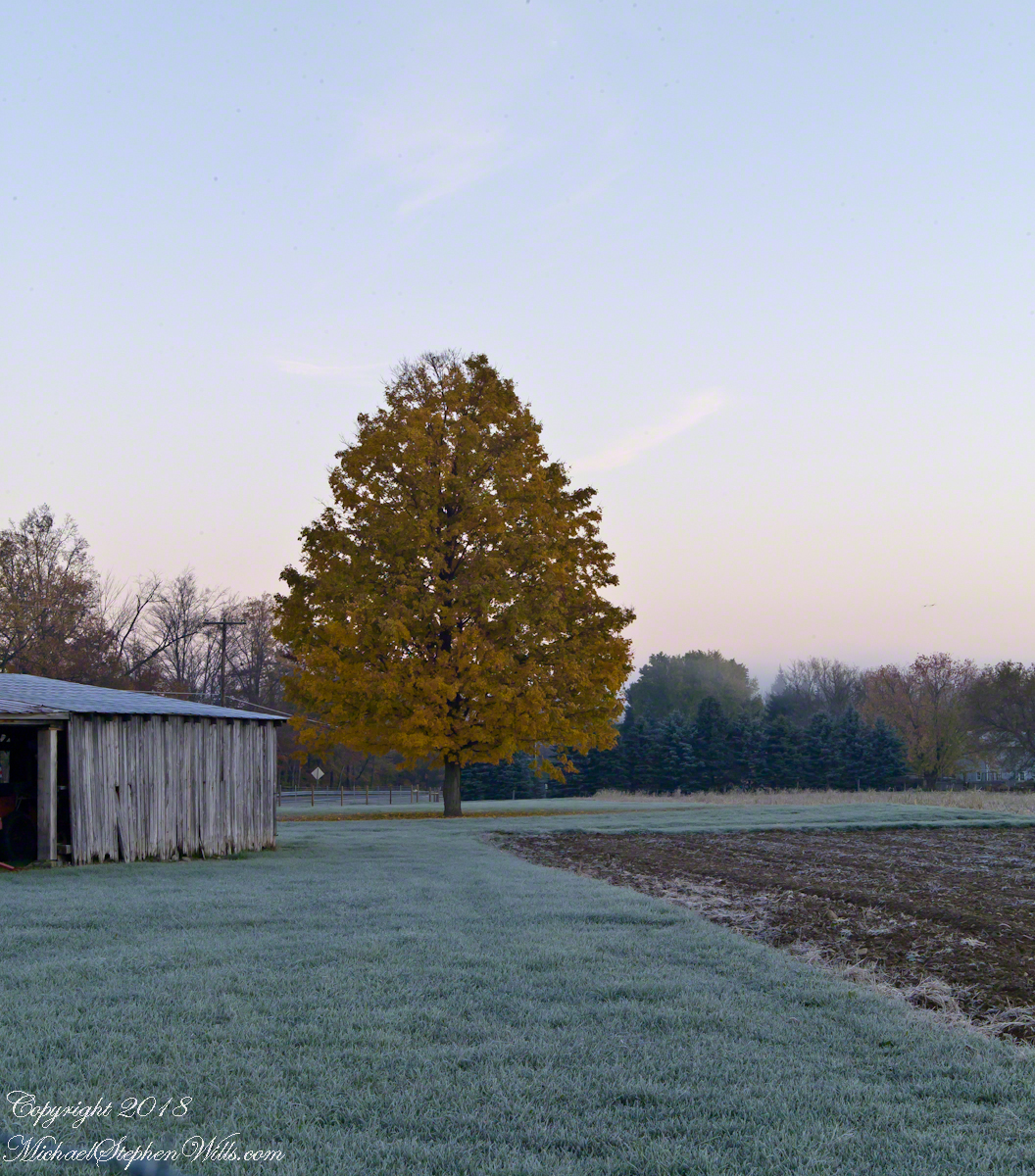
Over the years, travelling Fall Creek Road on my daily commute, I admired this well formed maple next to a farm field. At 6:45 am the sun was about this rise, the frost limned grass not yet burned off. This tree turned a bright yellow, here a green-yellow and dull. The form of the tree is perfect. I was never able to catch this at the right moment, it is still there and maybe I can time it this year during a pick-up of my grandson. If I do, my intention is to climb the fence and use the 24 mm lens to capture the tree and shed with less sky (unless there are some dramatic clouds). That day, I needed to make time for Sapsucker woods.
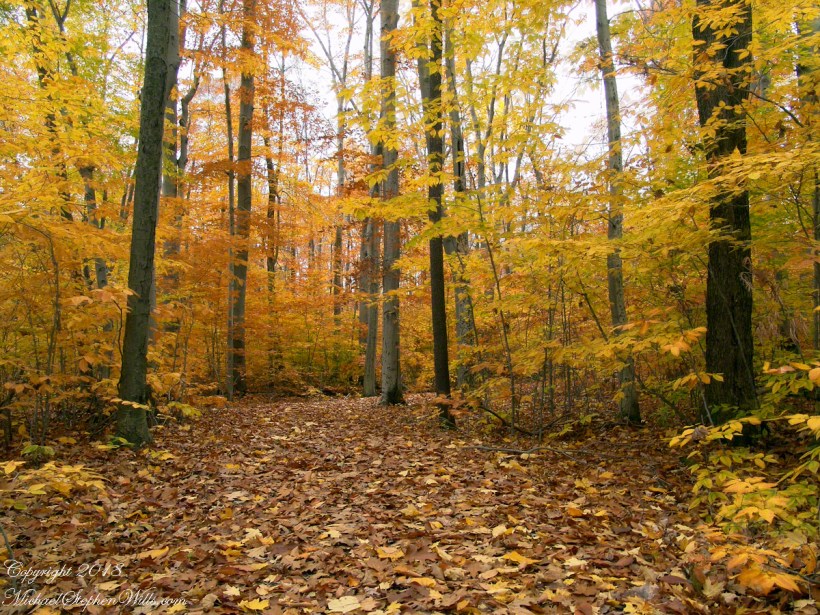
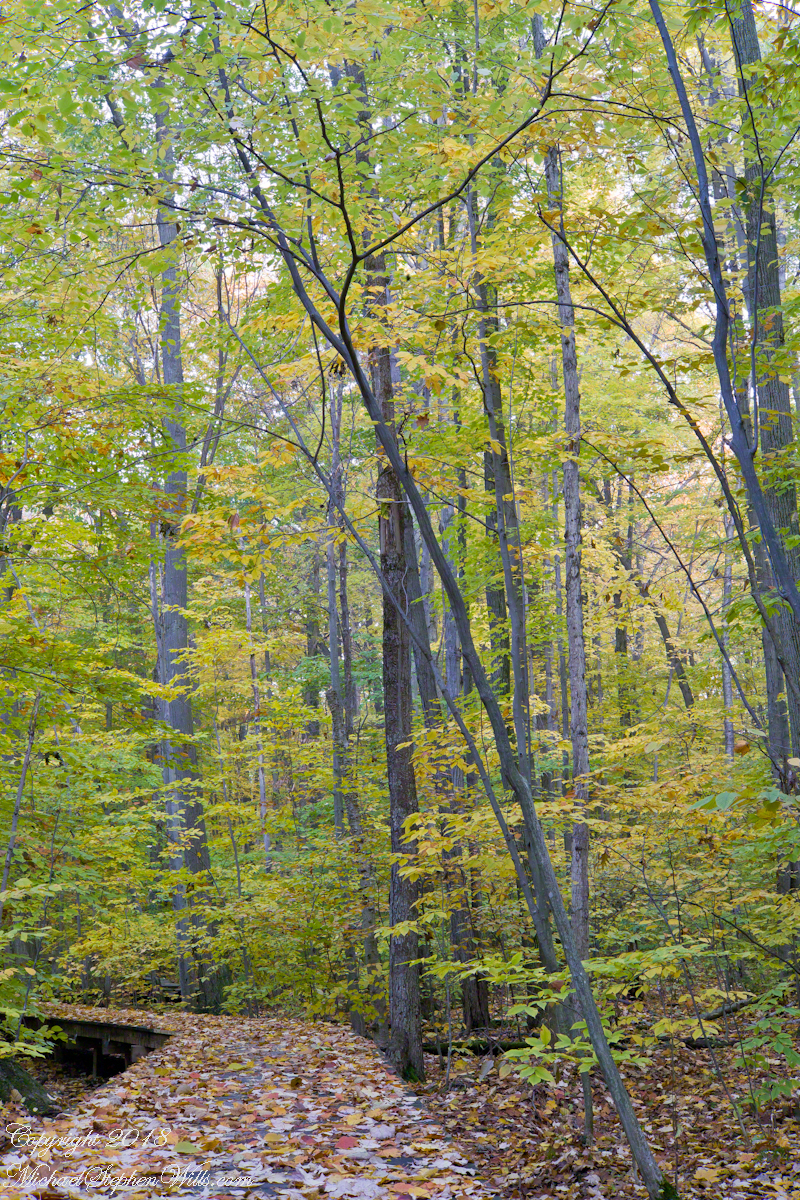
On site, thirty minutes later, as the leaves of the Fall Creek Road maple predicted, Sapsucker Woods foliage is behind last year’s by a week or so. In “Autumn Stroll in Sapsucker Woods” the over story leaves have fallen and the understory is at peak. Here, I believe the overstory is gone, the understory leaves are yellow-green.
I carefully choose the sites and this one is a risen walk of boards. In the nine years since, the walk as deteriorated and this scene will be different, possibly.
This is a match for the 2004 photograph as far as the camera position. What I enjoy from the 2004 version, aside from the foliage, are the details of the fallen leaves taking up the foreground, a carpet filling the field to lead the eye up through the trees, path fading from view to the right.
This effect is not possible on the boardwalk, above. With the fixed focus 50 mm lens it might be possible with effort. Today, the 24 mm is my first choice to capture this effect.
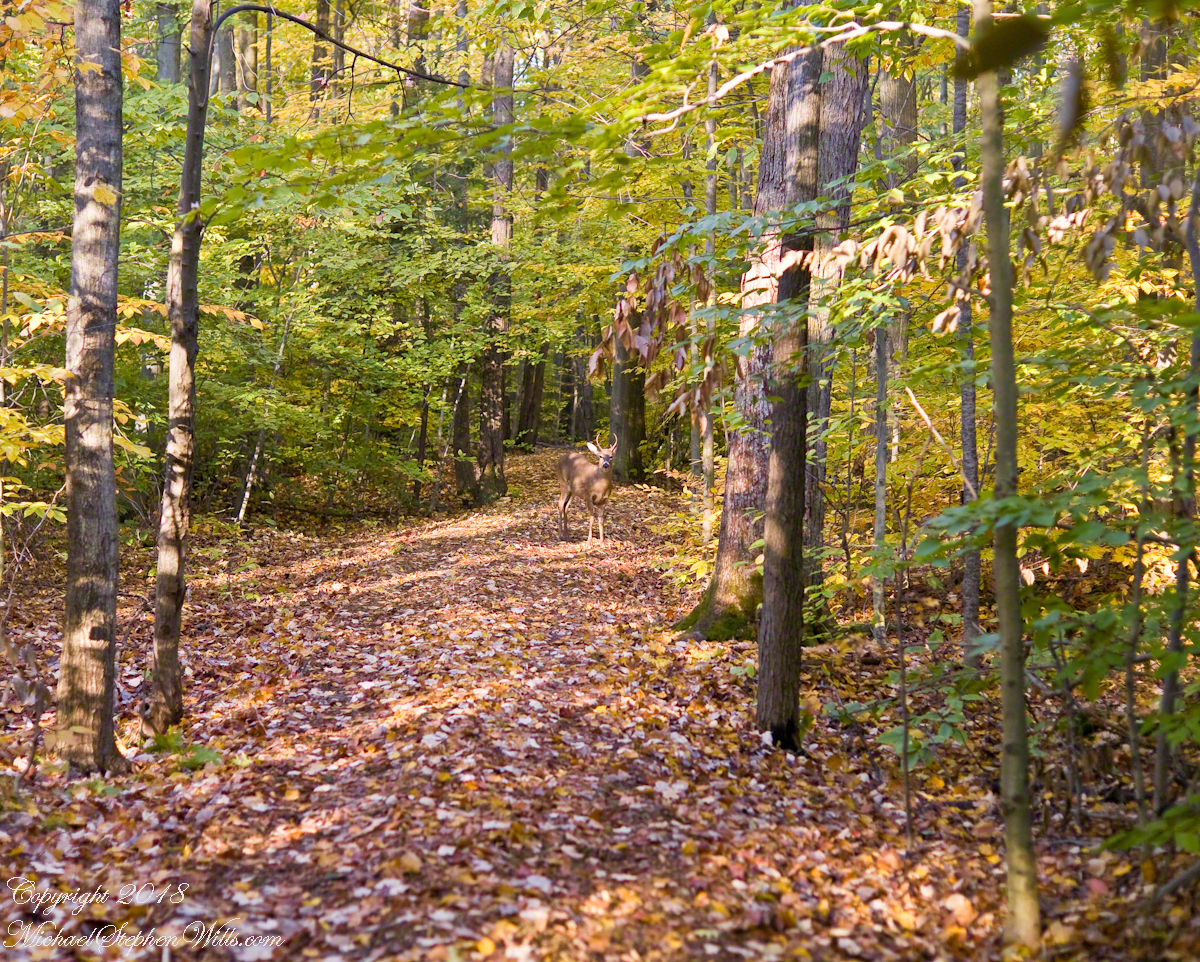
Here we can see the leaf carpet is possible, if the f-stop is higher to allow a crisp focus. In this scene it is f2 because I happened upon a buck in a daze. He was just standing there as I headed back to the car. I did not risk changing out lenses to the telephoto, so I moved forward slowly.
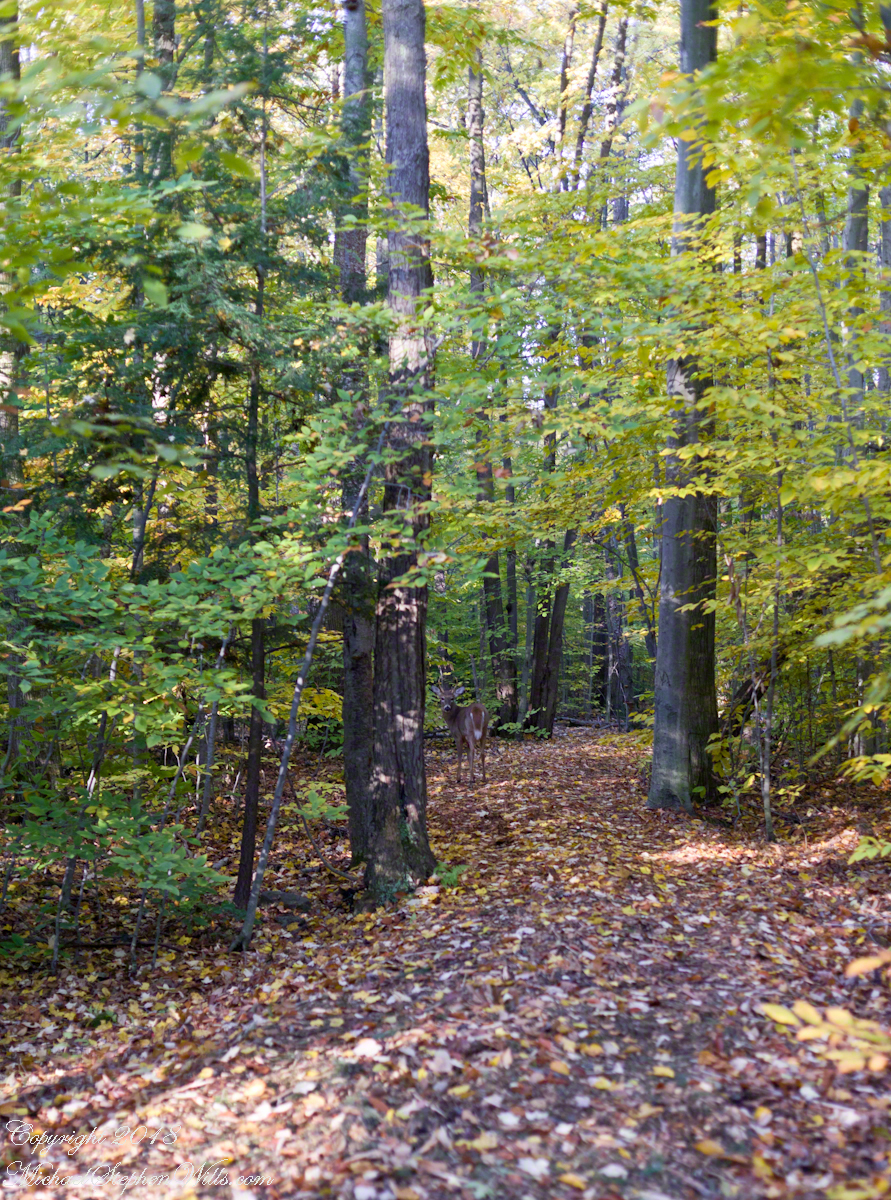
The best I did was this rear view as he looked backward. Lack of flexibility is a draw back of a fixed-focus lens.
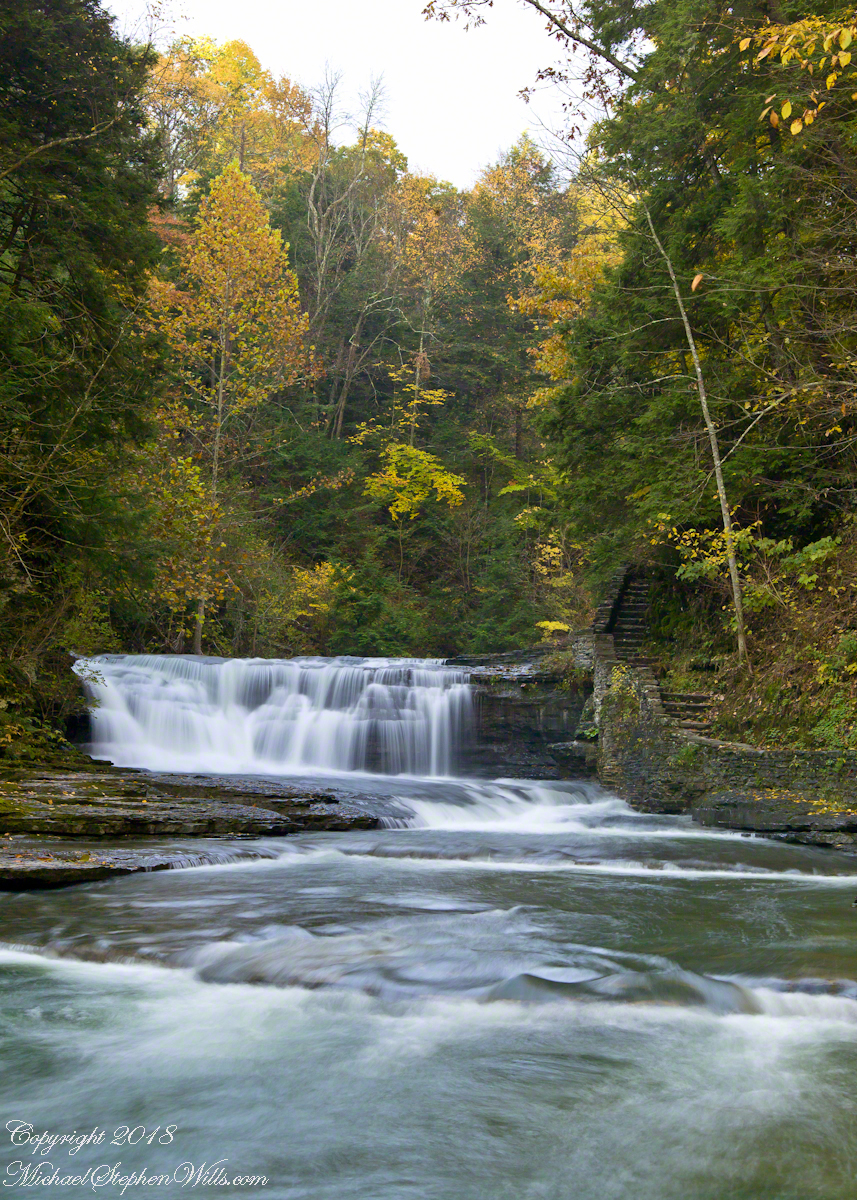
In 2004 my day concluded with Robert Treman State Park. In 2005 the 50 mm fixed focus with a ND filter and tripod was in its element. The sun is higher and overcast, one background tree is a peak foliage. The moderate water flow and stair complete the effect. This was my best work of that day. I need to get this up on the “Finger Lakes Memories” gallery.
Other postings of interest. Click the link to go there.
Capturing photographs and videos on the fly using an Iphone, we visited Fillmore Glen State Park, Moravia, New York with our granddaughter, Nia. This is the third post of this series. Click me for the first post in this series.
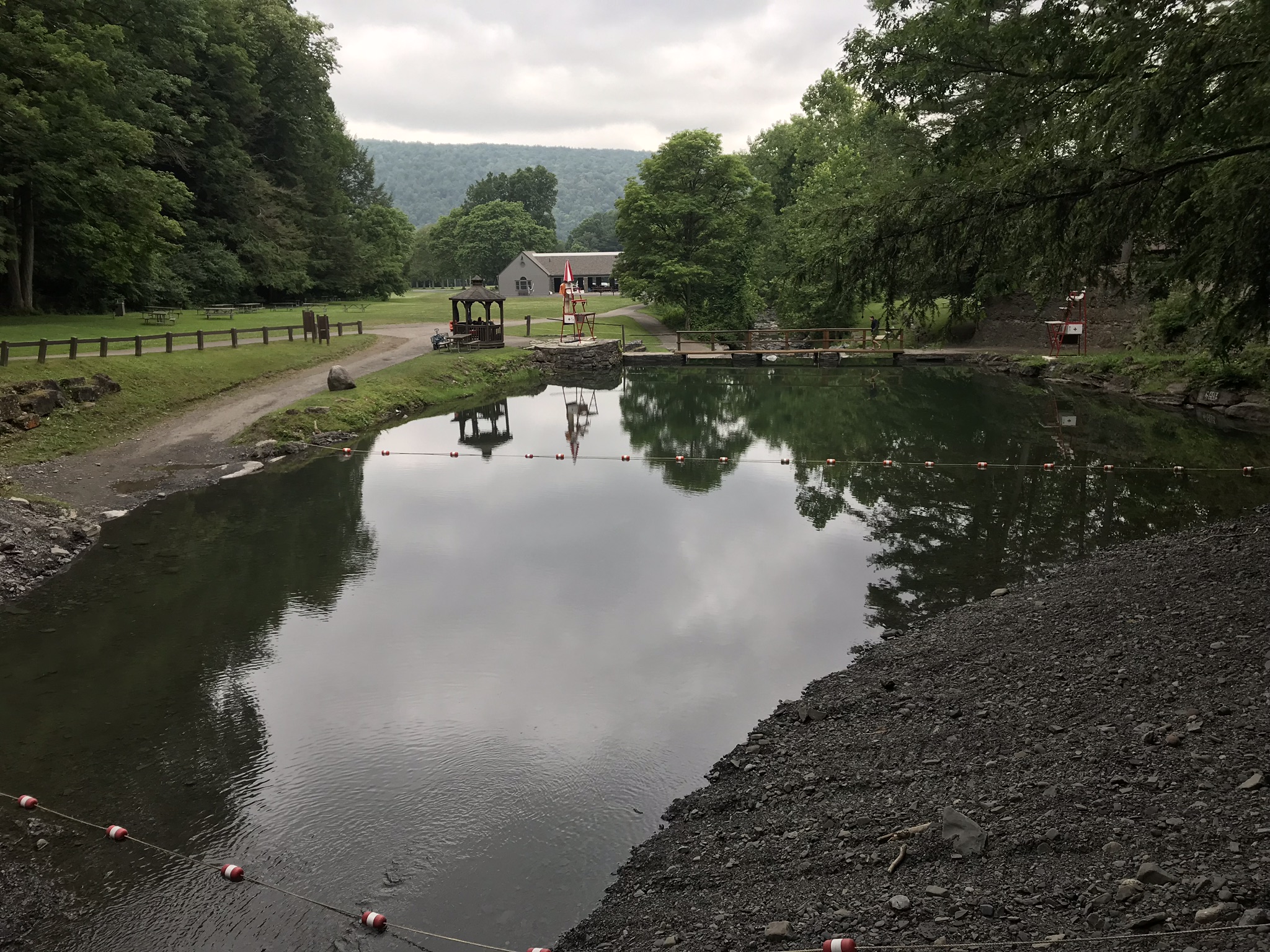
Emerging from the blind canyon of Cowsheds Waterfall, we are faced with this gorgeous pool fed by Dry Creek (yes, that is the name). Formed by a dam, the water is deep and very cold.
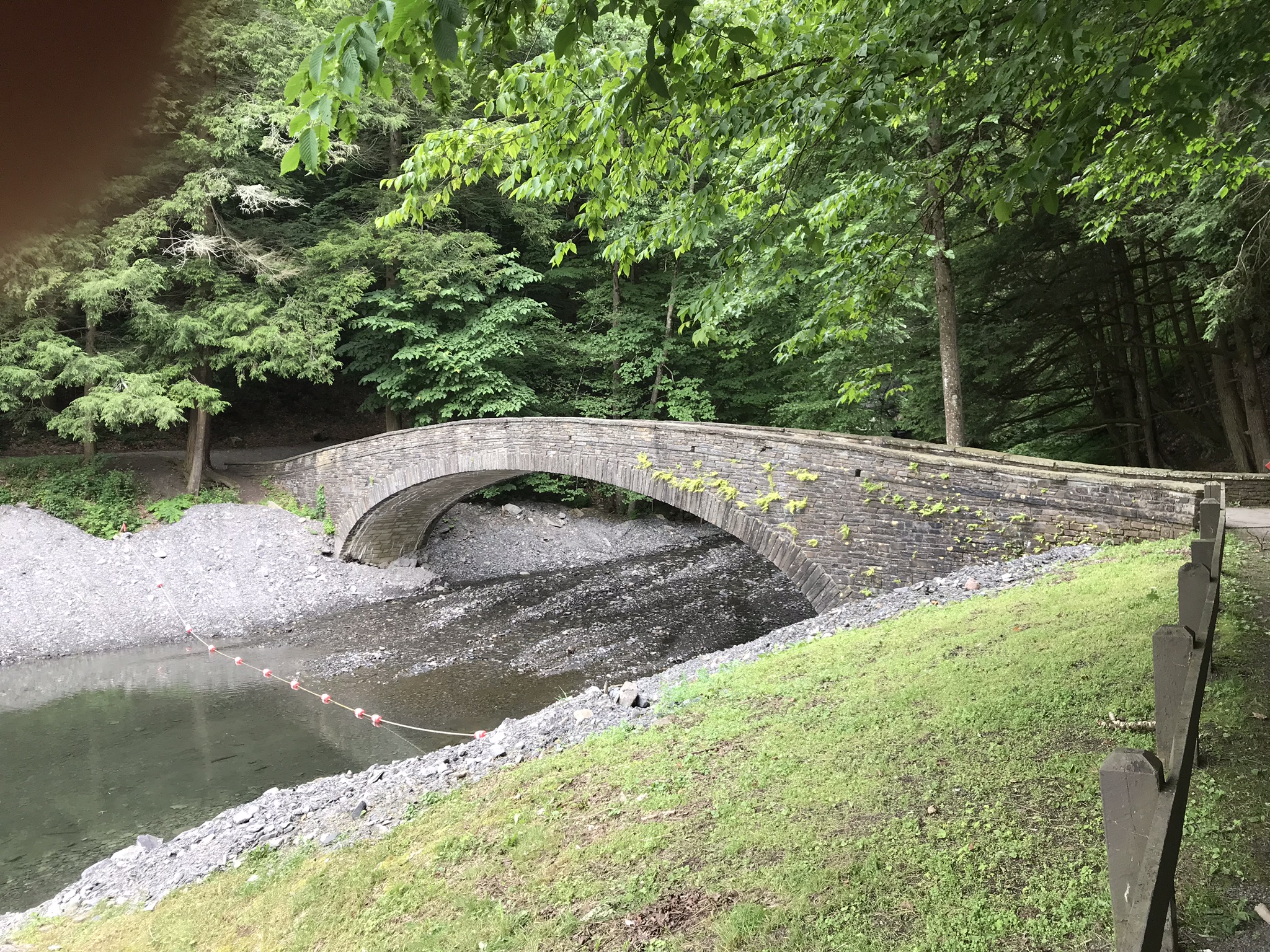
We were standing on this footbridge for the above photograph. The trail to Cowsheds is on the far side of Dry Creek and to the right.
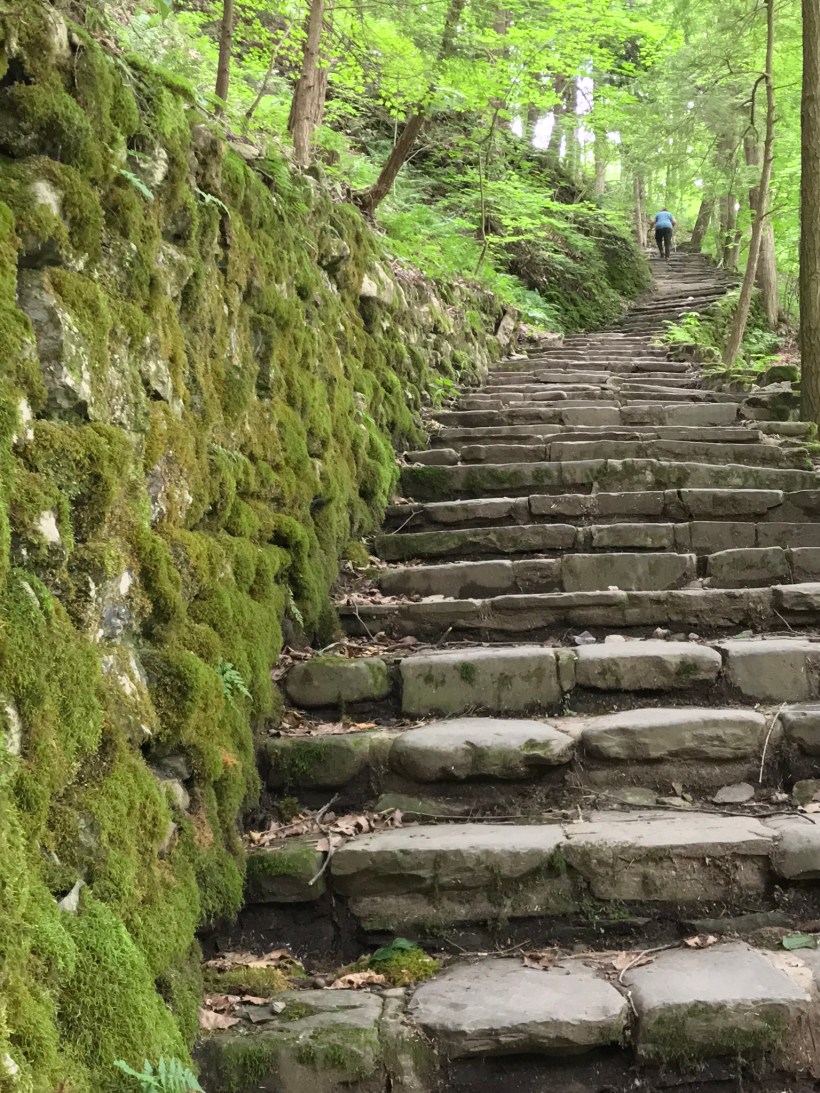
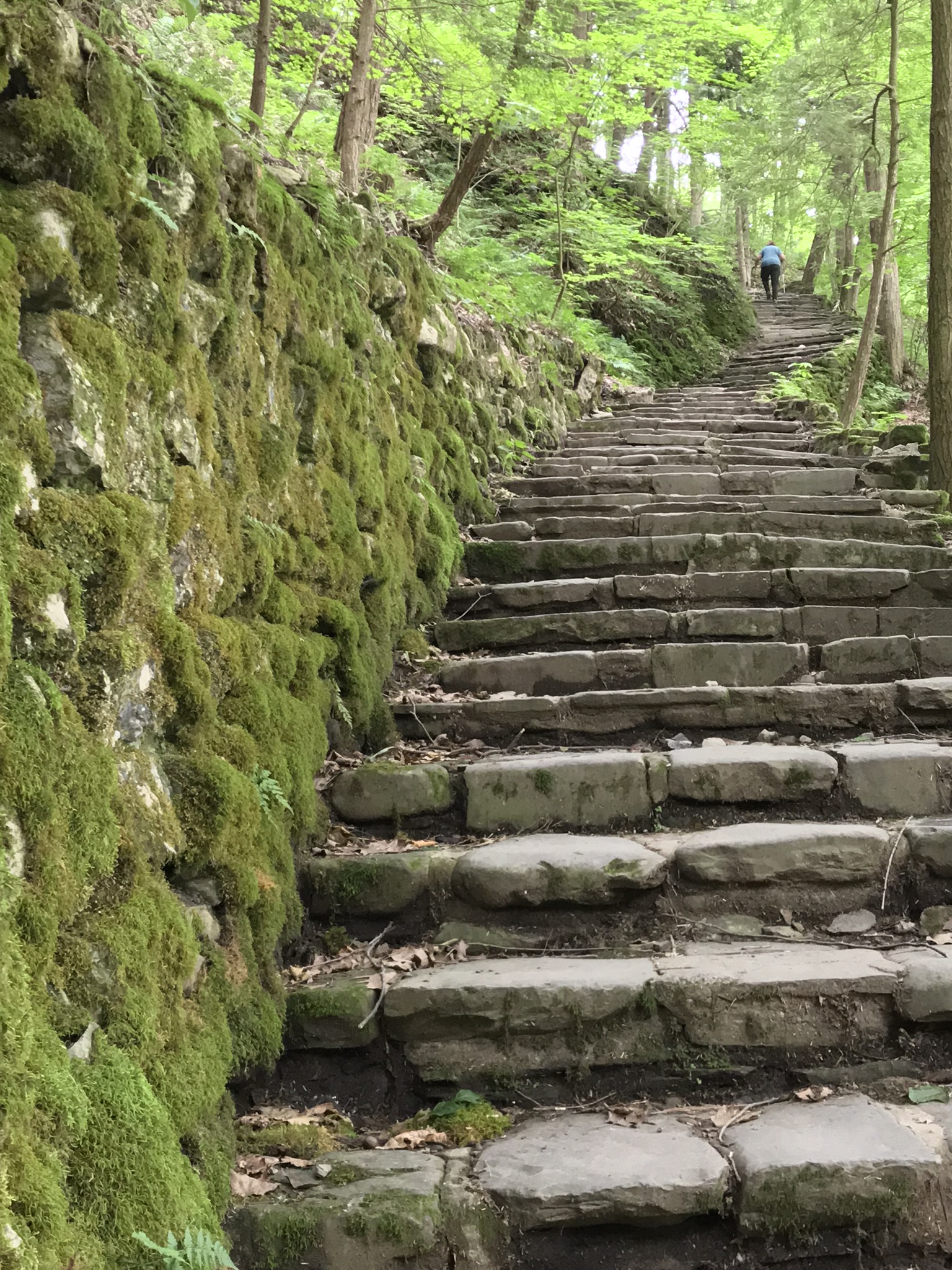
We have yet to count these steps, don’t know why. The limestone blocks were quarried locally from the same stone of the creek bed. The gorge trail begins at the top.
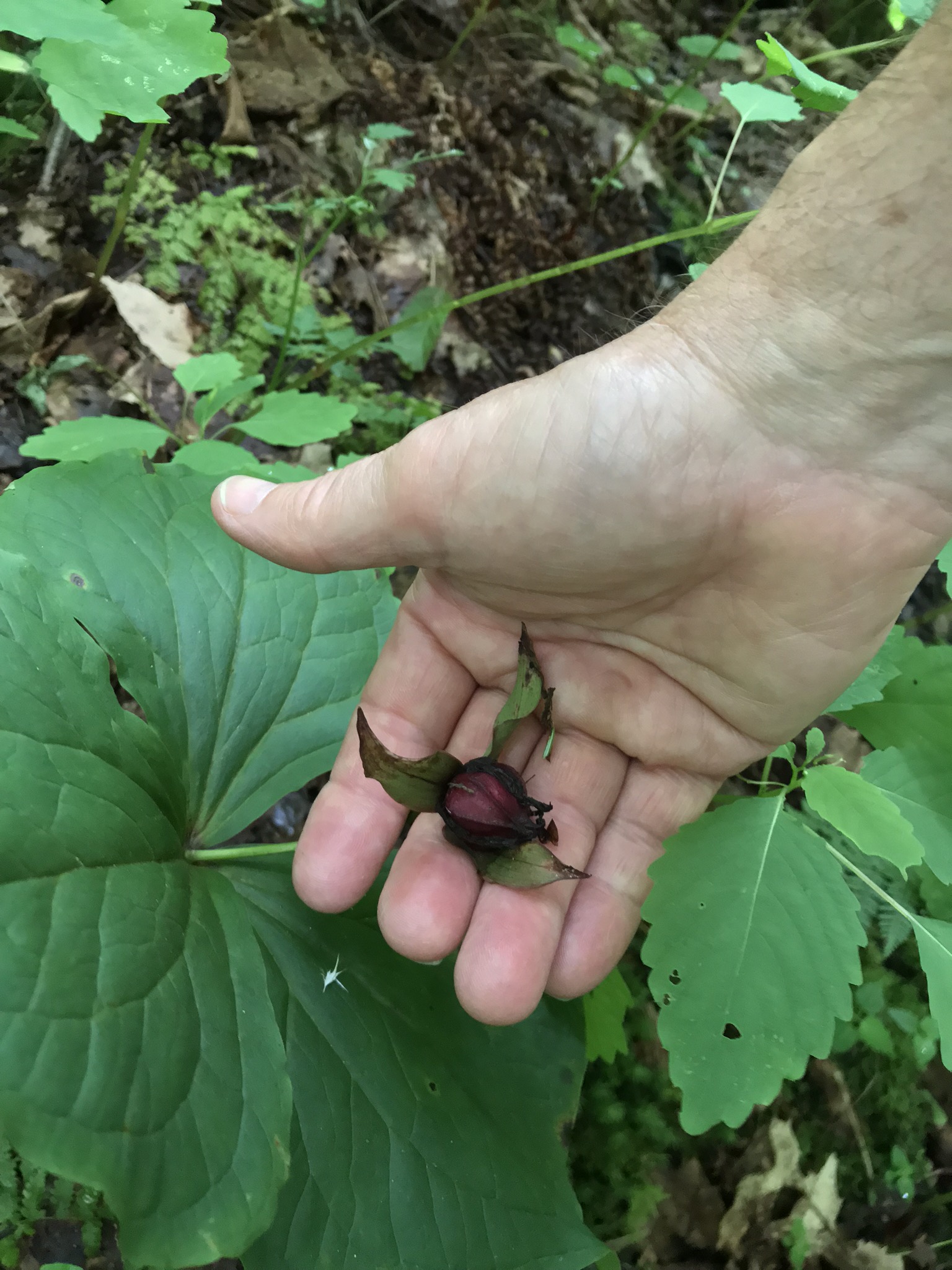
Trillium Seed Capsule
This is a Purple Trillium, I believe, formal name Trillium erectum. It is a large specimen judging form the width of the bracts, leaf like structures at the based of the flower stalk. When fertilized, the ovaries form this seed capsule containing up to 16 seeds, each with lipid with a high content of oleic acid. During summer, the capsule opens, seeds disperse. Ants encounter the seed elaiosome, the oleic acid content triggers “corpse carrying behavior.” The ants carry the seeds into their nests, consume the lipids leaving the seeds. After a year dormancy the seeds sprout and the additional depth in the ant nest provides a good start.
Trillium are a favorite food of deer, unfortunately. Some seeds are spread this way, passing through the digestive tract and out in fecal waste. I use the color of the seed capsule to identify it was Purple Trillium. In my experience the white variety (Trillium grandiflorum, and others) has a light colored seed capsule.
Copyright 2021 Michael Stephen Wills All Rights Reserved
Capturing photographs and videos on the fly, we visited Fillmore Glen State Park, Moravia, New York with our granddaughter, Nia. This is Pam and my favorite park for the lack of crowds, variety of wildflowers and dramatic views.
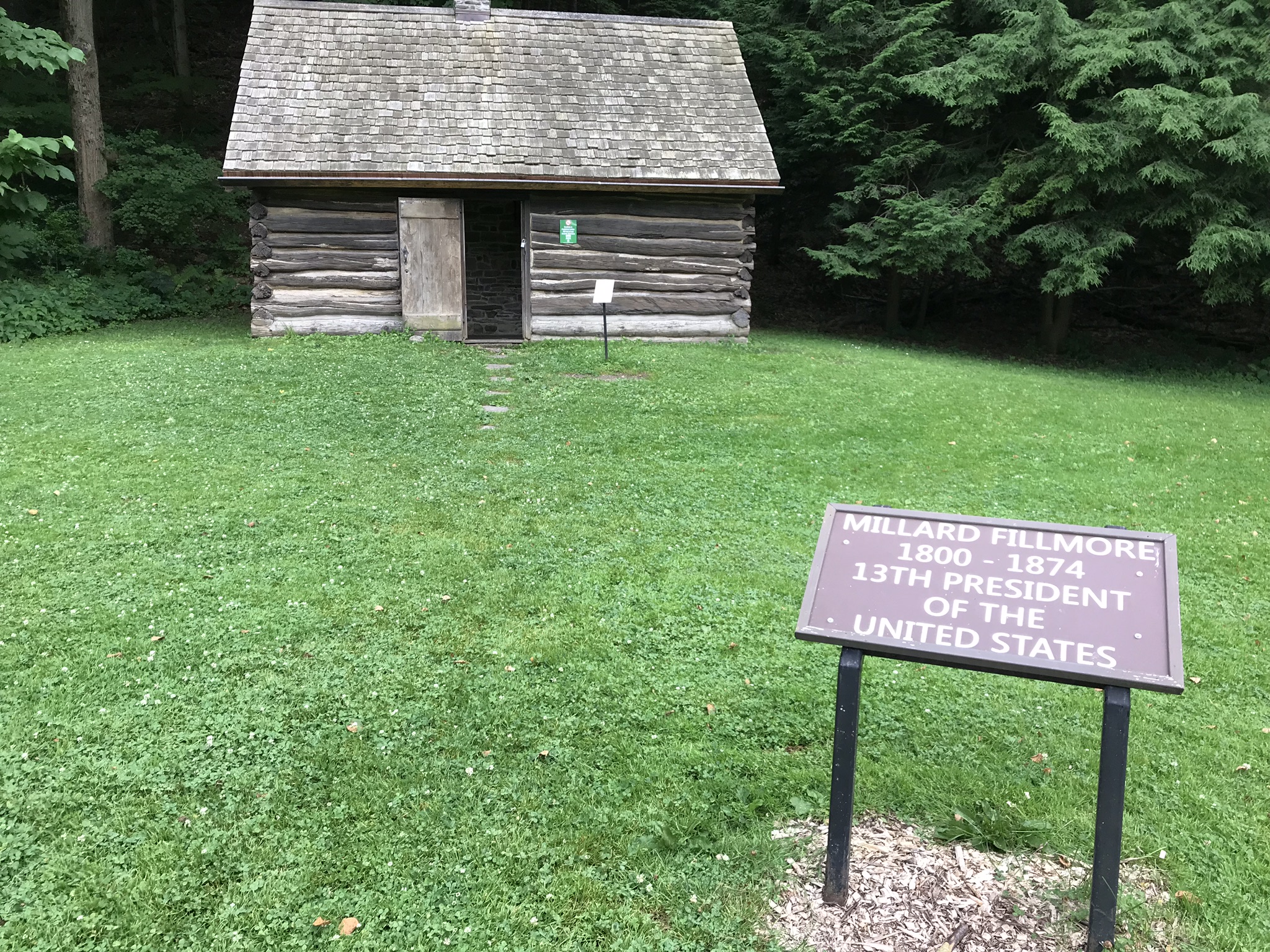
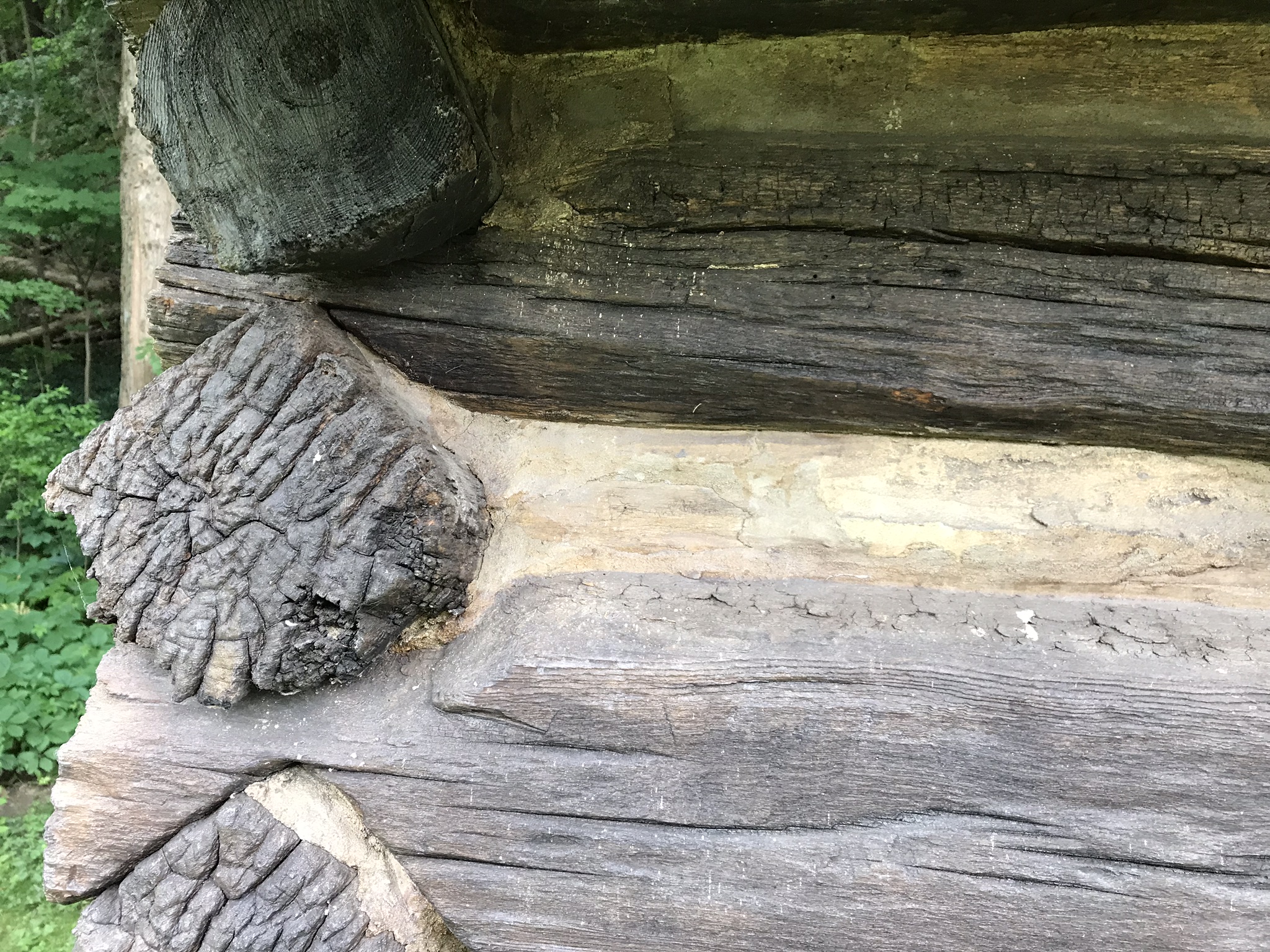
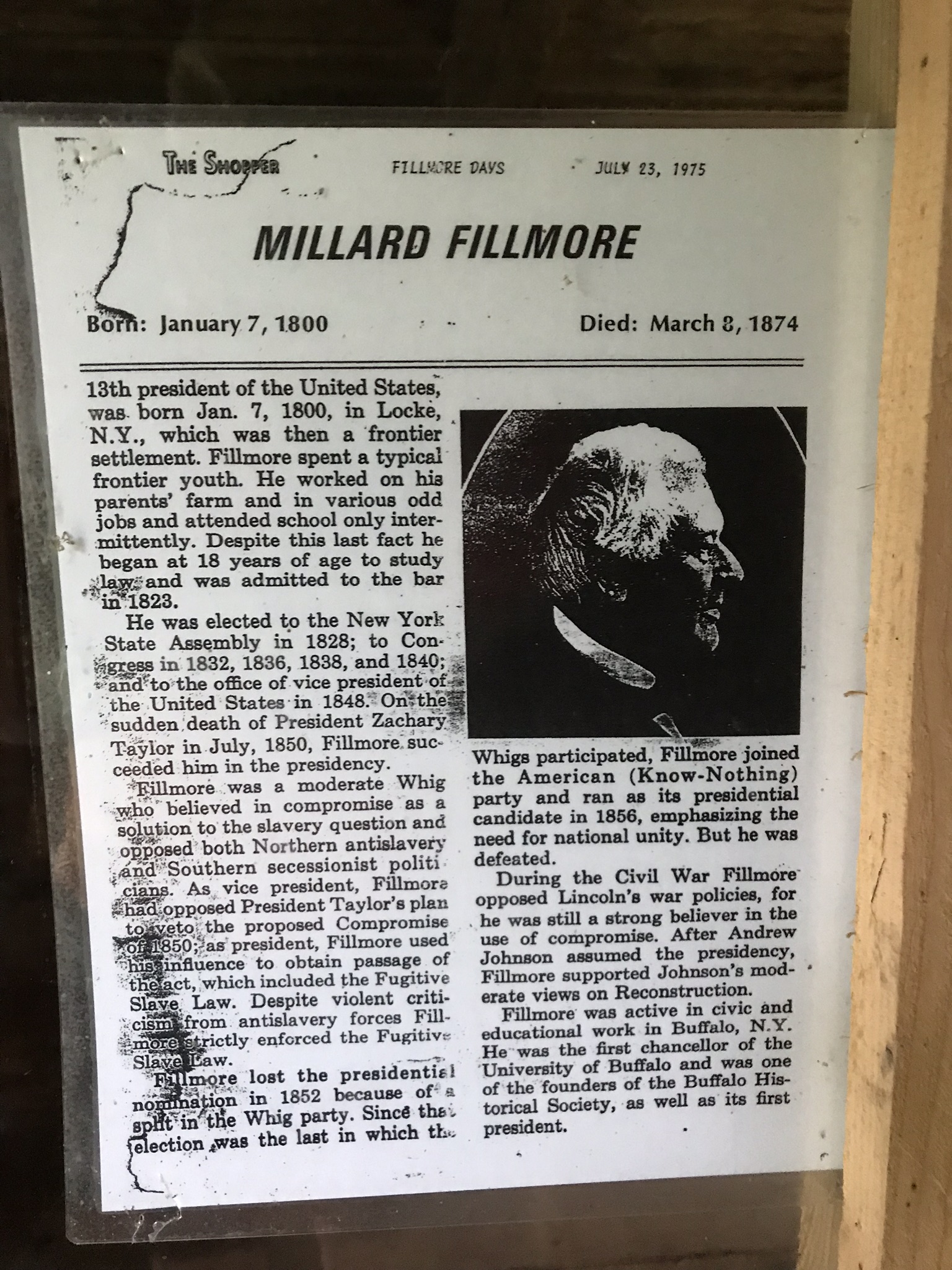
A the bottom of Gorge Trail, near the creek fed swimming pool, is a cabin moved to the park from a few miles away to commemorate an American President’s birthplace. Milllard Fillmore was born on the peneplain above the gorge of Dry Creek in a place called Locke, five miles from the modern park entrance. His birth cabin was destroyed in 1852, the land is dedicated to his memory with a monument. This cabin of a type identical was disassembled and reconstructed on this spot in 1965 by the Millard Fillmore Memorial Association.
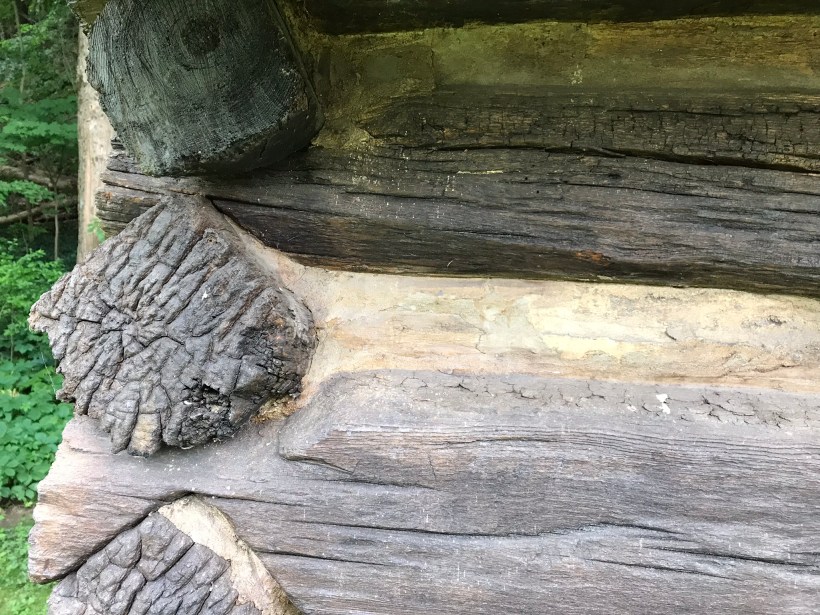
The 480 square foot (20 by 24 feet) original (the rebuild is a bit smaller) had a central fireplace and and will chinked logs, a ceiling of simple planks.
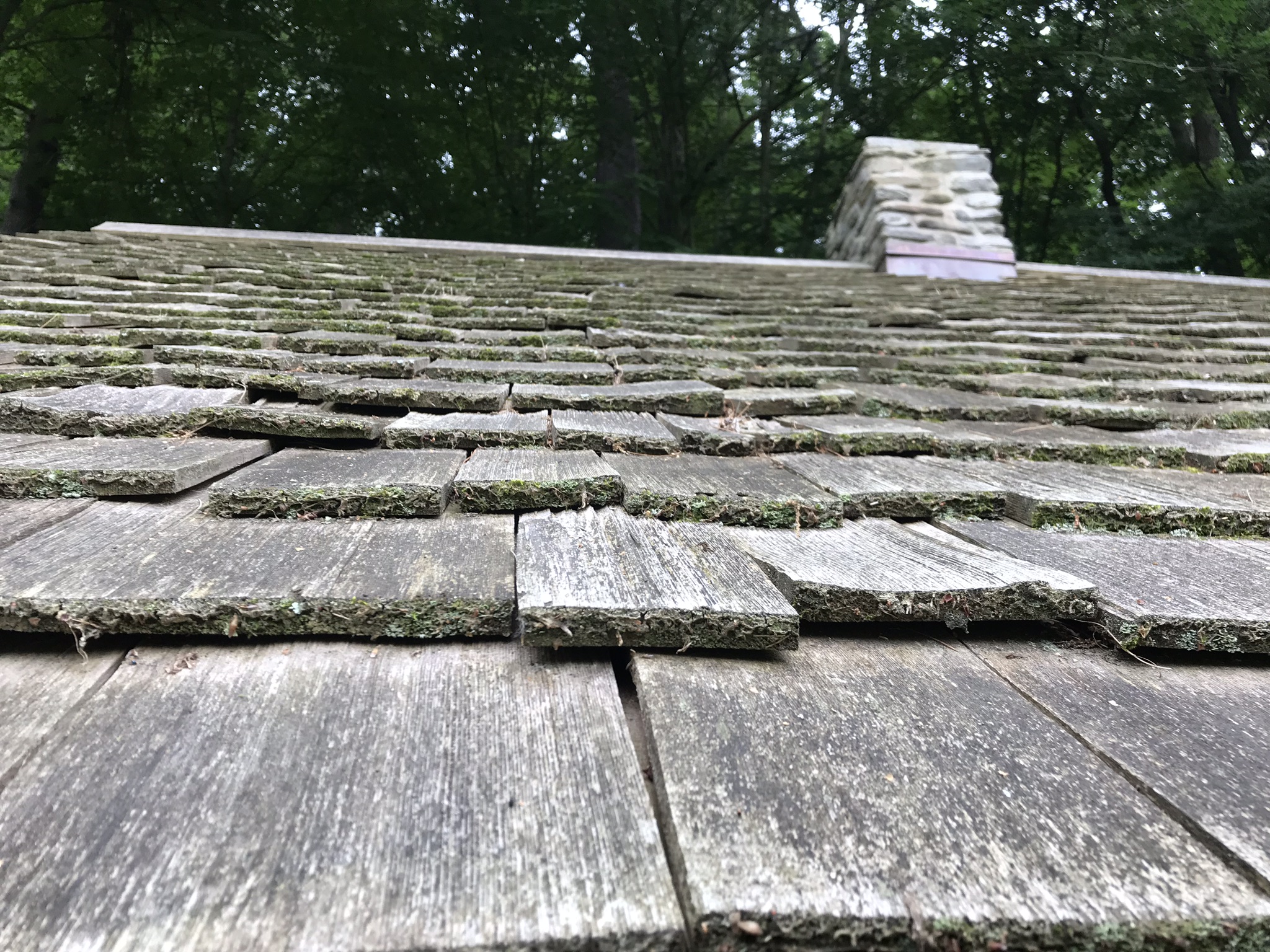
The cedar shingles were hand made, as were the nails.
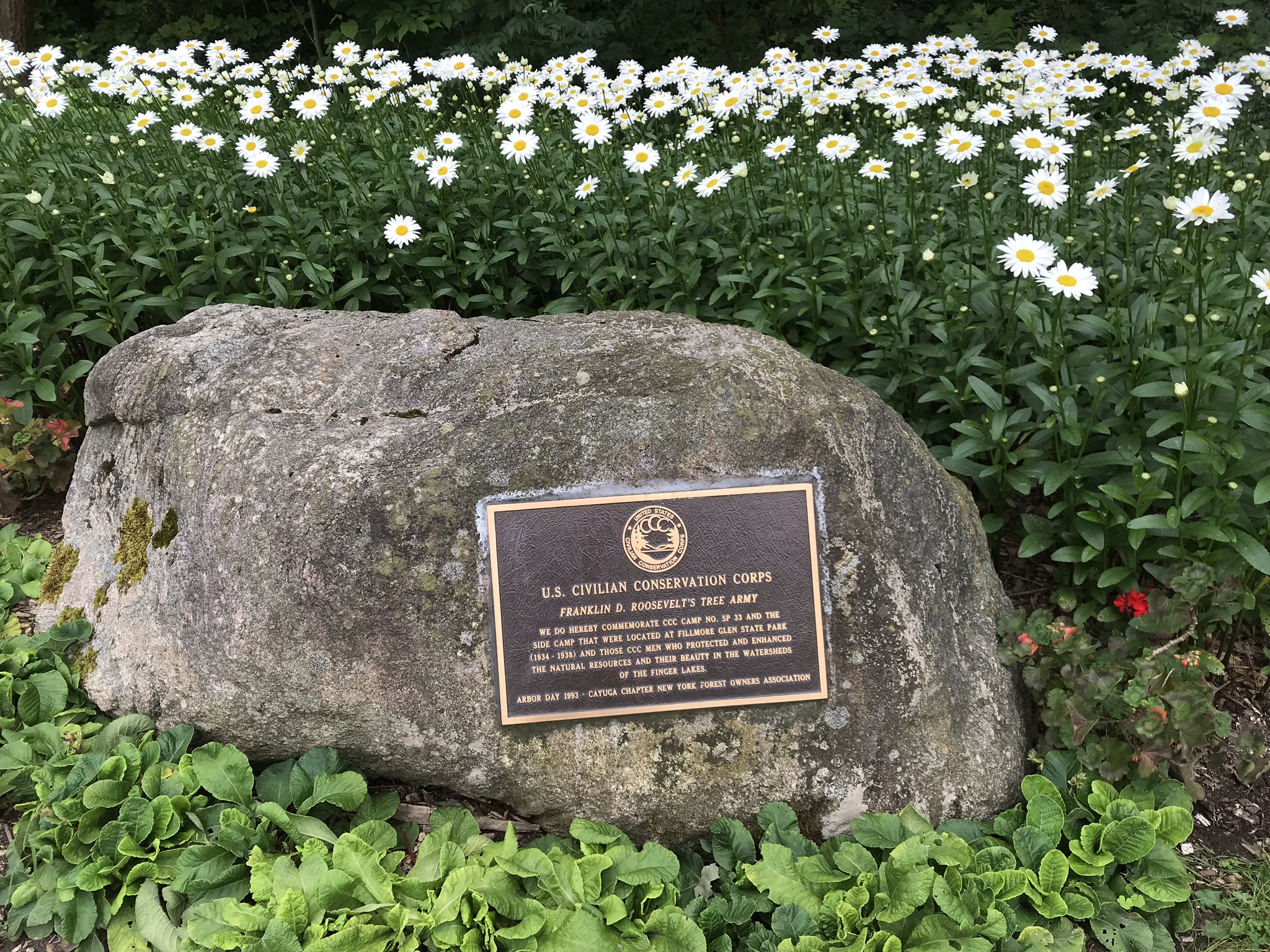
More information on a display inside the cabin.A few feet away is a memorial to Franklin D. Roosevelt’s Civilian Conservation Corps. We can thank them for building much of the park infrastructure we depend upon today.
Copyright 2021 Michael Stephen Wills All Rights Reserved.
Capturing photographs and videos on the fly, we visited Fillmore Glen State Park, Moravia, New York with our granddaughter, Nia. This is Pam and my favorite park for the lack of crowds, variety of wildflowers and dramatic views.
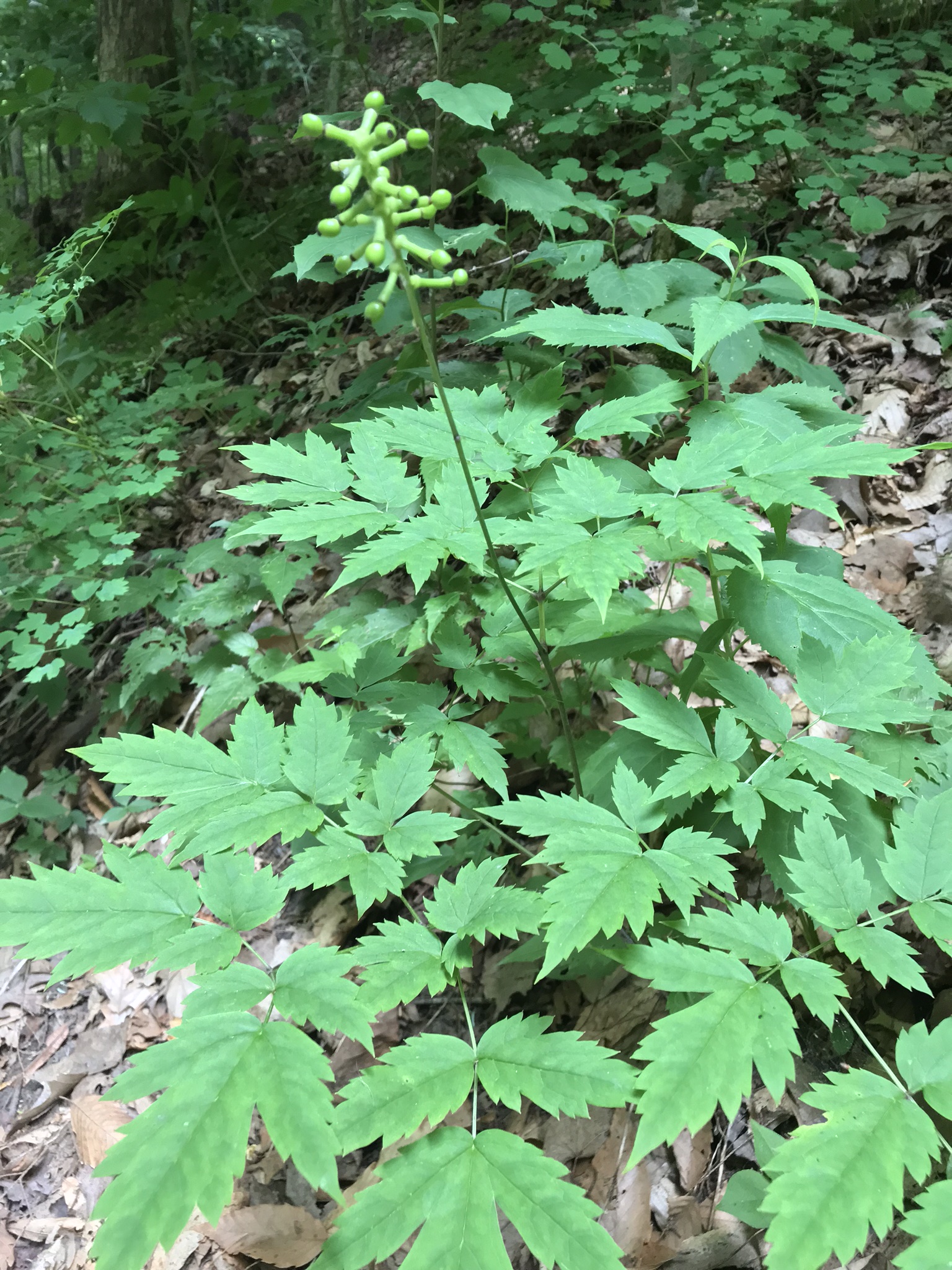
Growing near Cowsheds Waterfall, at the foot of Gorge Trail, was this strange fruiting wildflower so like a modular space station. It is Baneberry. There are white and red forms. This is white Baneberry (Actaea pachypoda). These terminal round nodes resolve into white balls with black dots, like dolls eyes. The cylindrical connectors (as in space station) turn bright red. Red Baneberry (Actaea rubra) has bright red berries. The flower is a fluffy white mass that gives no hint of the seed form.
All parts of both forms are highly poisonous, the bane of Baneberry. The berries are deadly. Ingestion of as few as two berries by children will cause death from cardiac arrest. Six for an adult.
Click any photograph for a larger view.
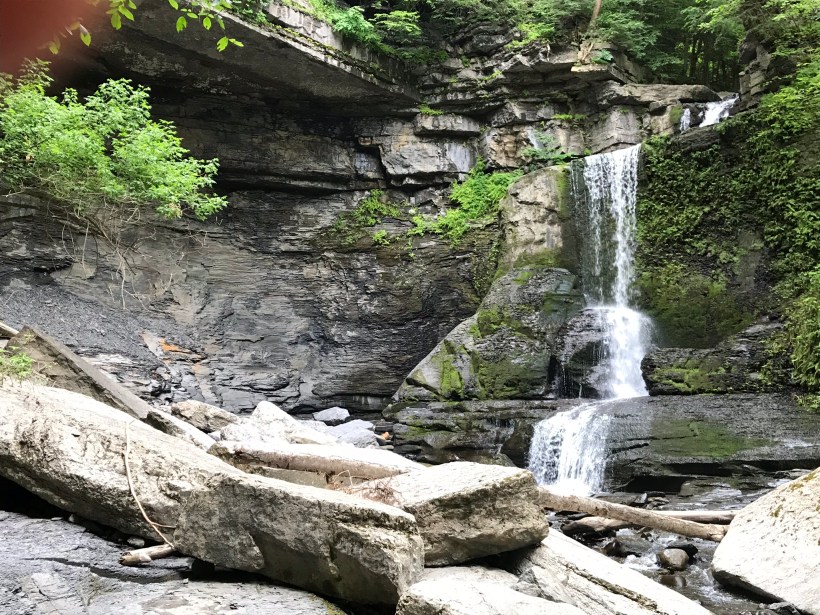
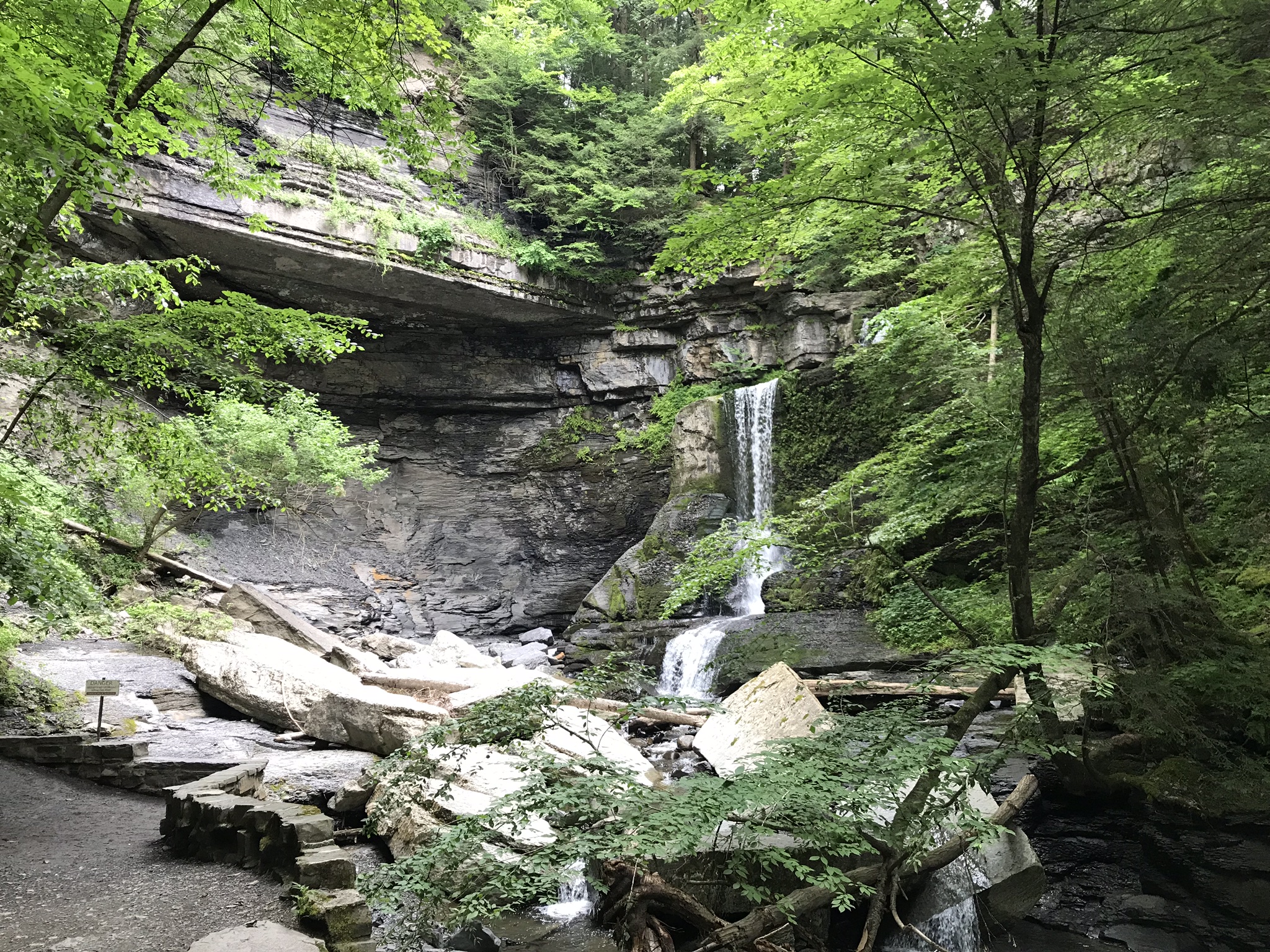
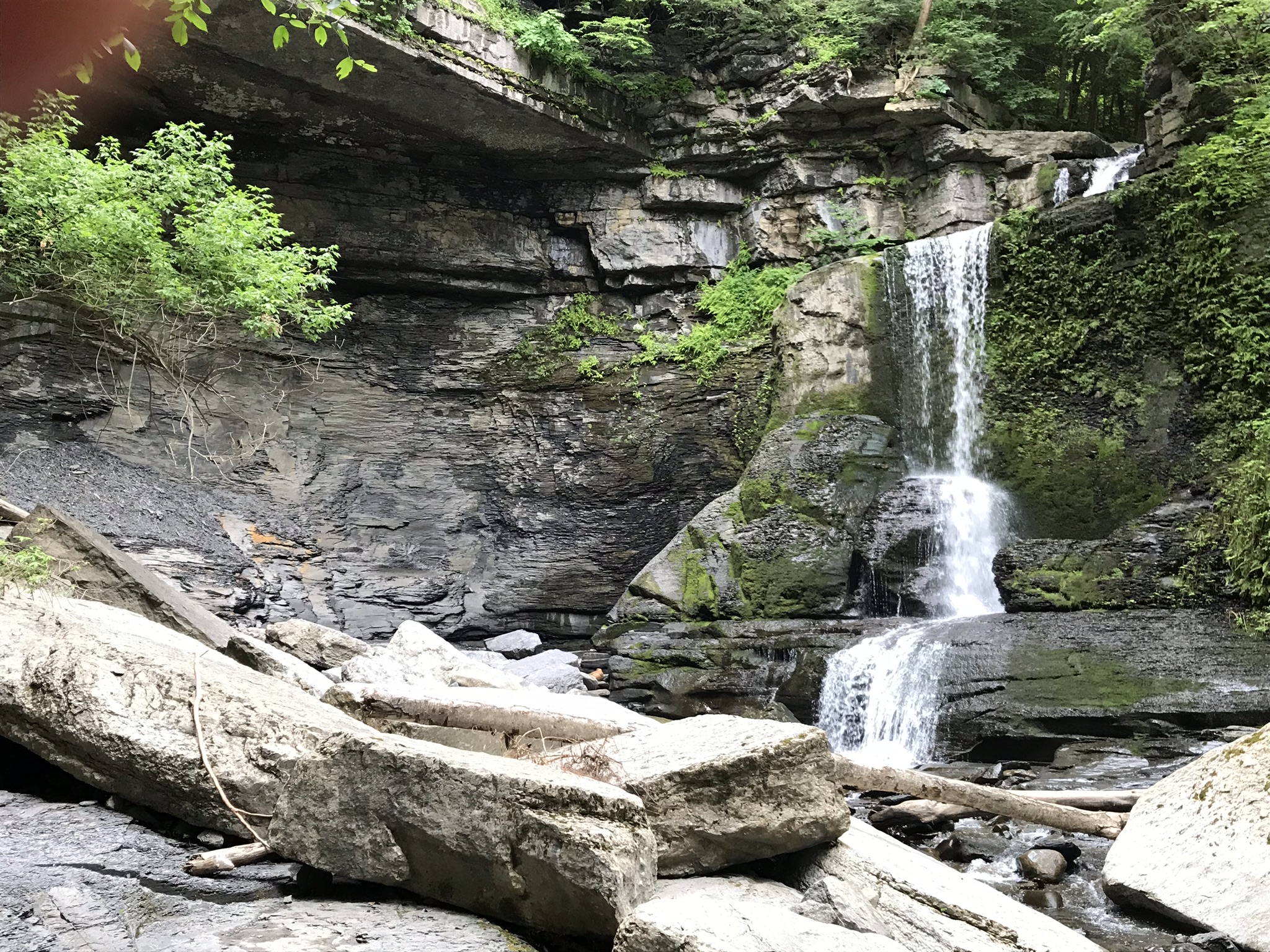
Cowsheds Waterfall is littered with enormous limestone blocks, remnants of a shelf. The rock under the limestone, a soft shale, is worn away first by running water forming a room (or Cowshed) under the limestone. Eventually, the limstone falls into the creek. The waterfall is at the end of a blind canyon with a sign at a trail end warning visitors to go no further. Careless visitors to Finger Lakes Gorges are killed, on occasion, by falling rock when they loiter beneath cliffs.
Travelling light, using IPhone captures during a 4.6 mile walk on the Gorge and North and South Rim Trails of Taughannock Falls New York State Park, Finger Lakes Region near Ithaca, New York. A few waterfalls and sights along the way. Distance is from the “Health” app on my phone.
A “Rim Trail” follows the edge of the gorge. The “Gorge Trail” is within the gorge, along side the creek and ends at the 200+ foot waterfall.
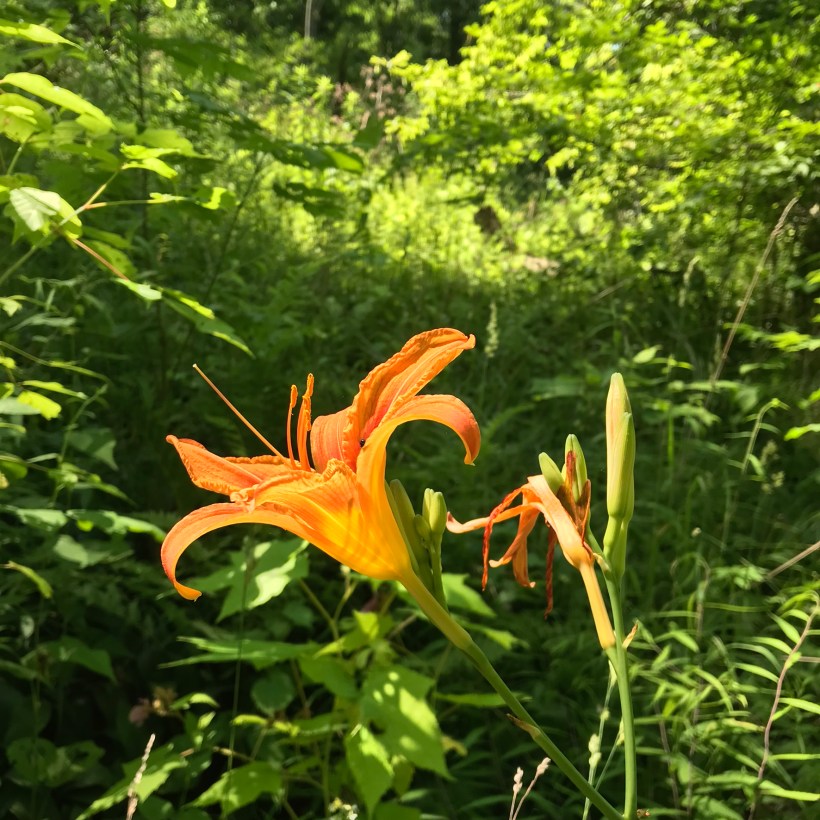
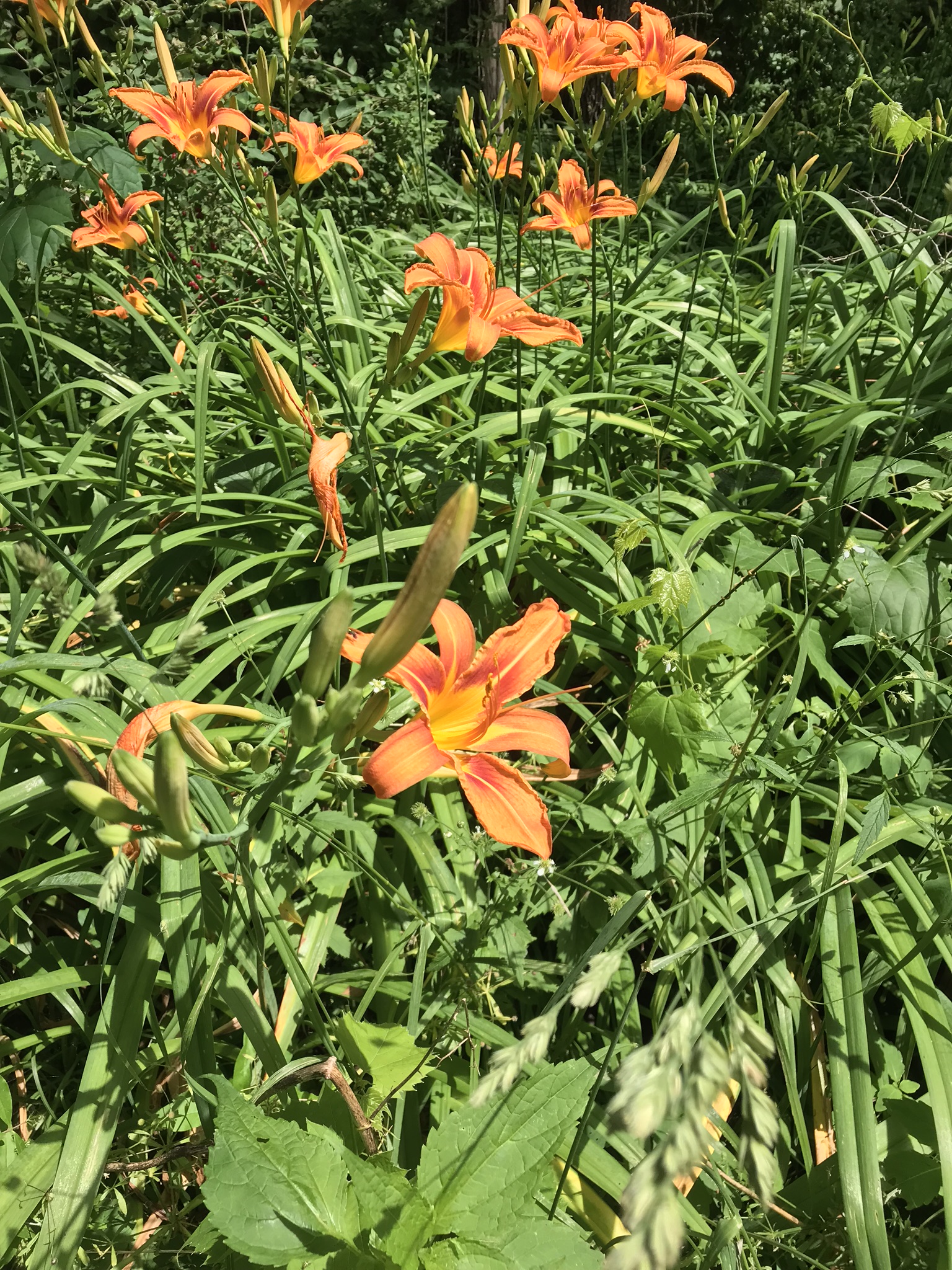
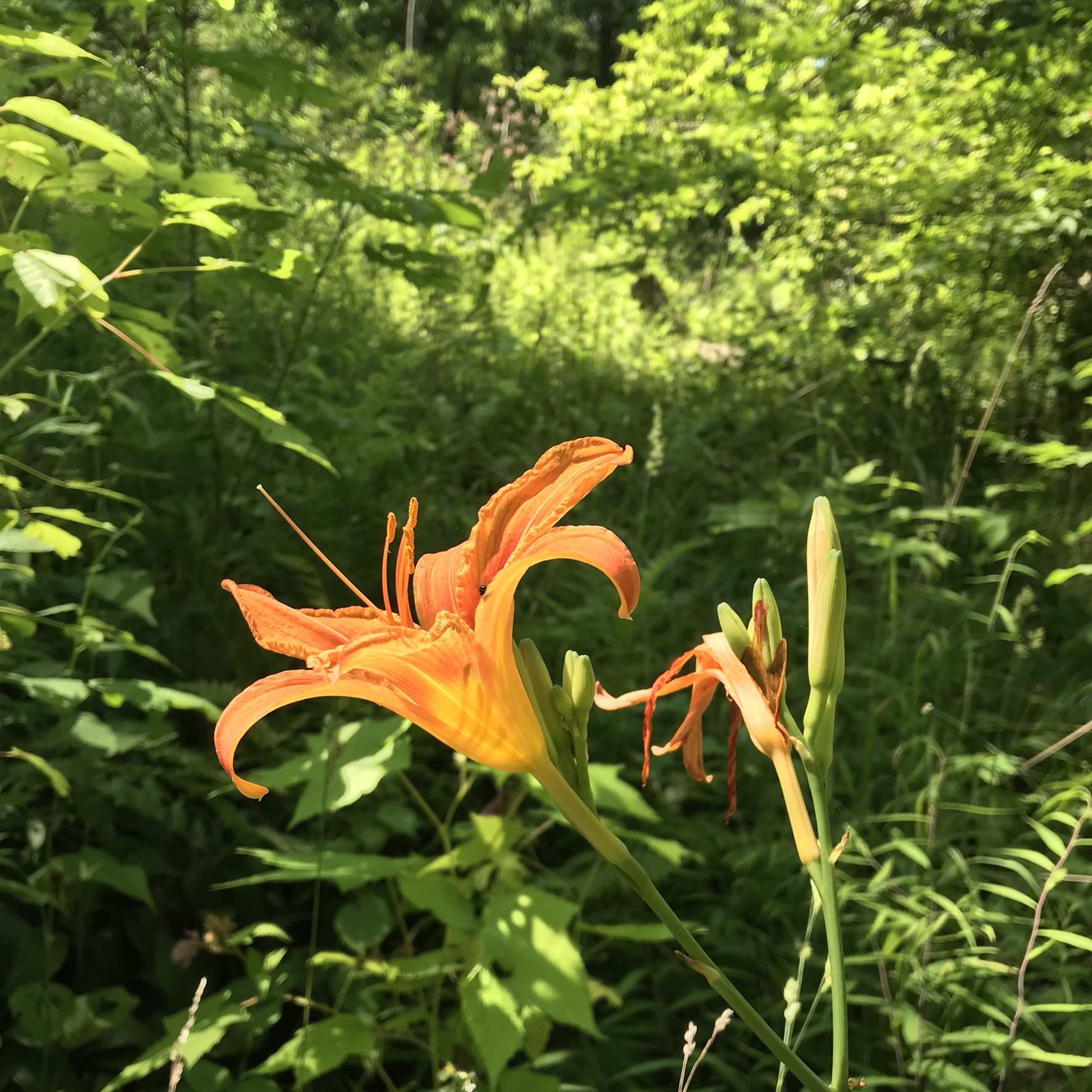
This was the day Tiger Lilies bloomed along the roads the entire 13 miles. This stand was at the beginning of the South Rim trail.
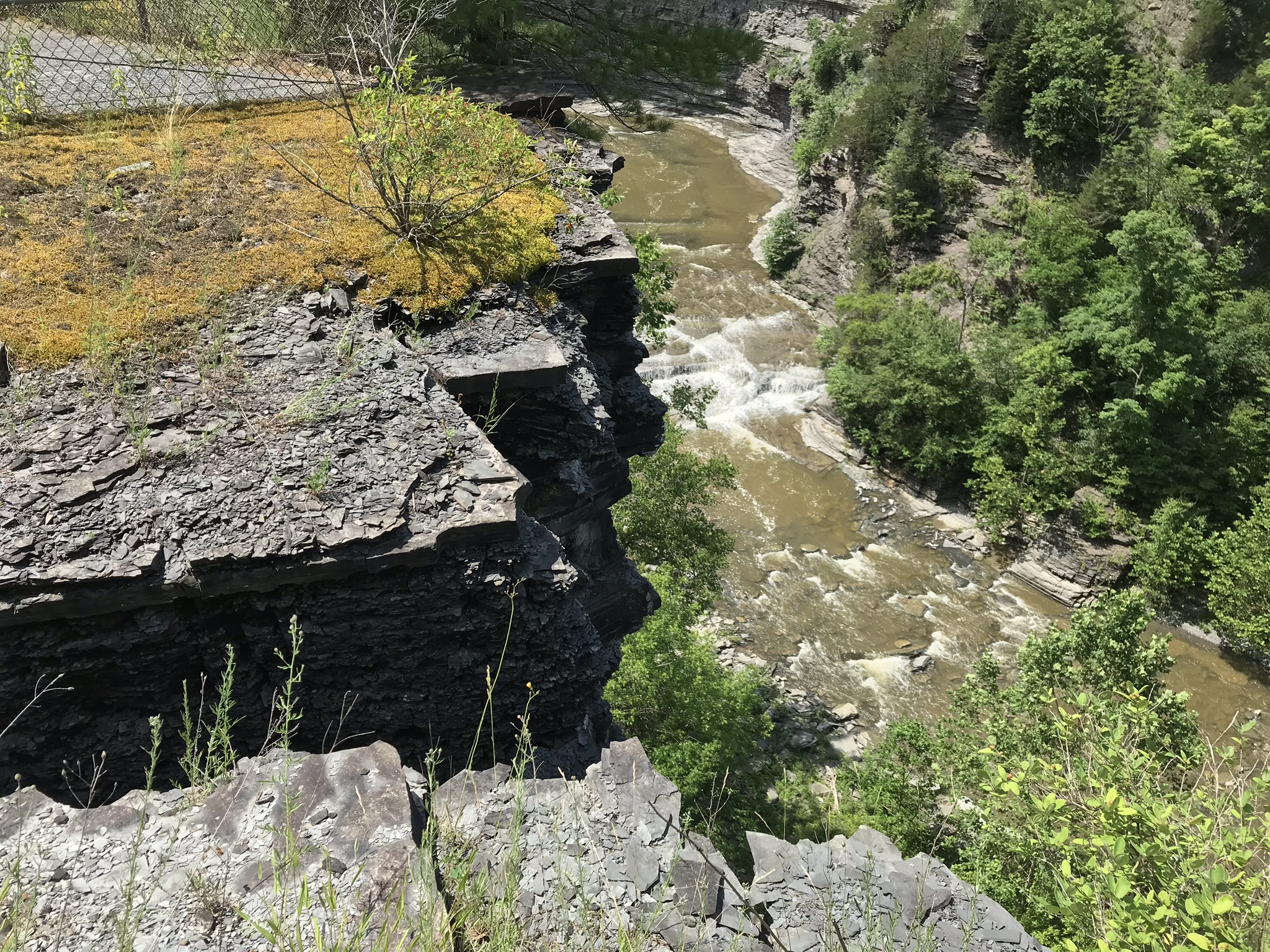
A few steps farther the trail opens up to the expanse of the gorge above the waterfall, a place to contemplate the age of these rock gazing into the open space. There is no access to the bottom of the gorge here.
On days like this, the experience carries me away, enjoying the moments and forgetting the phone in my pocket. When I come to, it is the bottom of the South Rim trail at the entrance to the Gorge Trail and the hordes walking to the falls on a Sunday afternoon. This waterfall welcomes everyone at the beginning.
The vantages I choose usually exclude the crowds, here is a video of the observation platform beneath the 215 foot Taughannock Falls. Any closer and the camera lens is covered with mist. Feels great on this hot day.
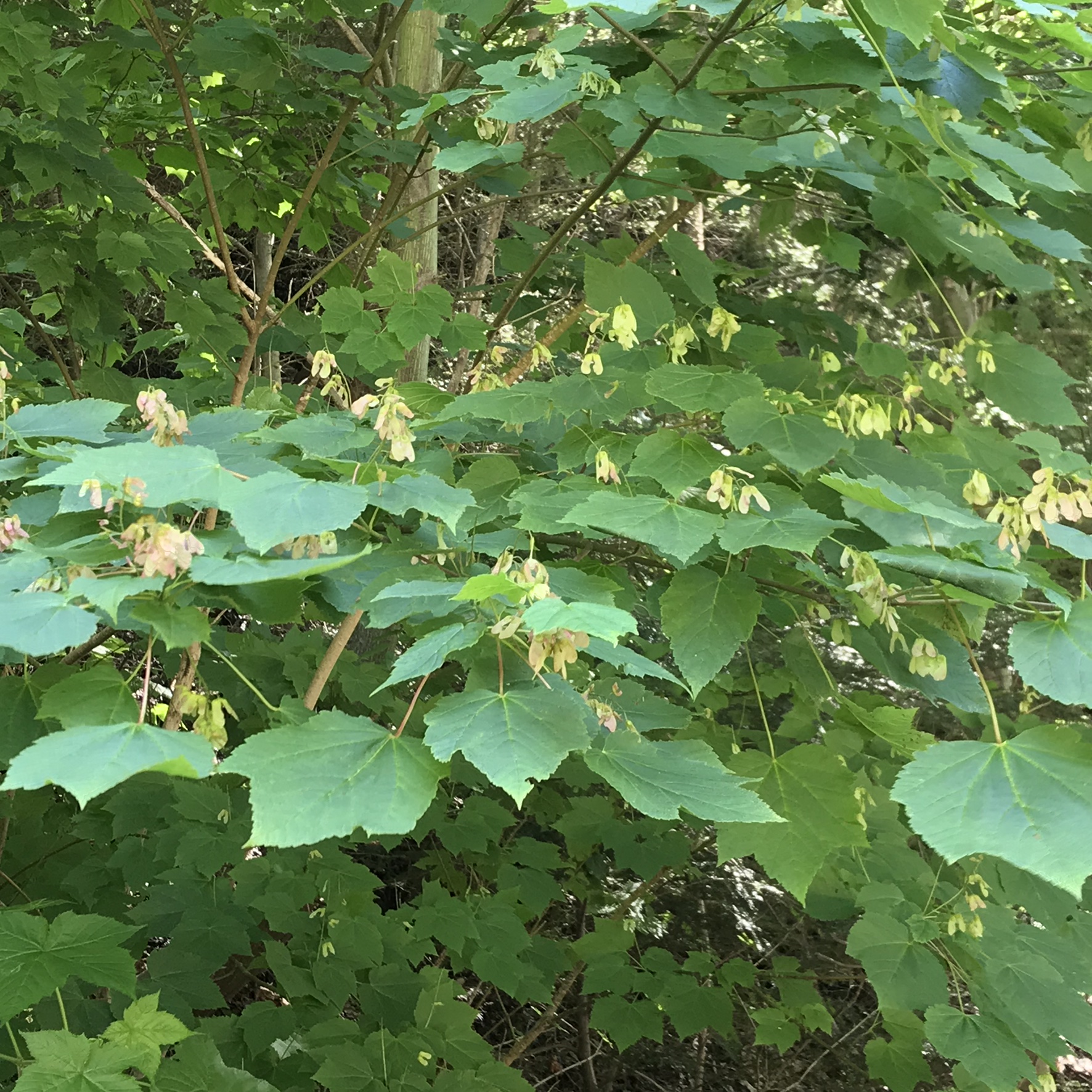
I capture this tree growing along the Gorge Trail for later identification. It has fruits similar to a maple tree. Called samaras and also known as helicopters, maple keys, whirlybirds, and polynoses these must distinguish this tree as a member of the genus Acer though the leaf shape gives me doubts. Here the gorge changes direction almost 90 degrees from, generally, north/south to east/west. There is plenty of sunlight here and the tree has taken root in the talus of the cliff face.
I researched it and discovered the scientific name is Acer pensylvanicum and more commonly known as Moosewood. There is a “famous” restaurant in Ithaca, named Moosewood, so now I know there is indeed a tree growing locally by that name. The restaurant is near the commons of Ithaca and is 100% vegetarian. The last time Pam and I at there we were packed like sardines, like some collective, and we’ve never been back. The food is good and the basis of their fame is a cookbook by the same name.
Backlit lilies found on the climb up the North Rim trail.
Travelling light, using IPhone captures during a 5.7 mile walk on the Gorge and South Rim Trails of Robert H. Treman New York State Park, Finger Lakes Region near Ithaca, New York. A few waterfalls and sights along the way. Distance is from the “Health” app on my phone.
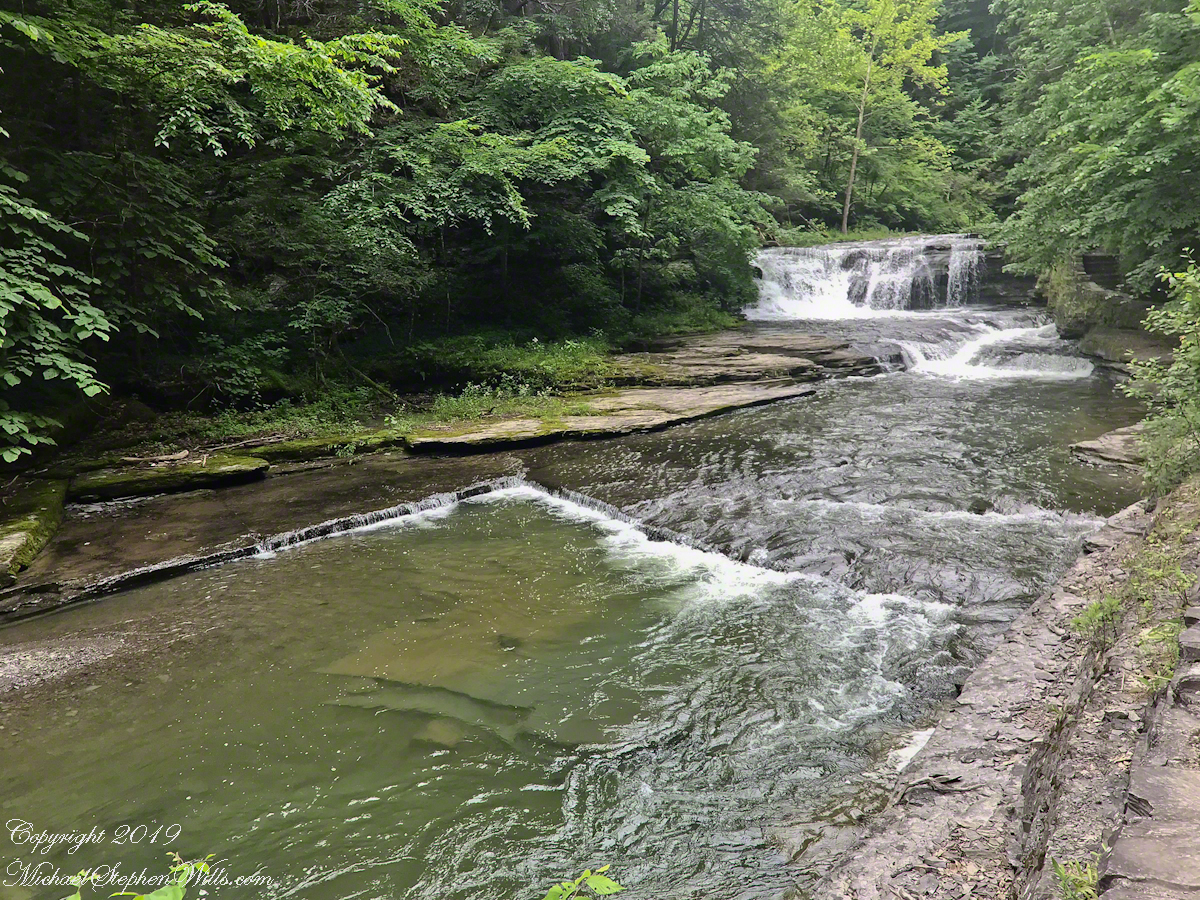
One of many waterfalls along the Gorge TrailLooking back to the above waterfallEnchanted Trail
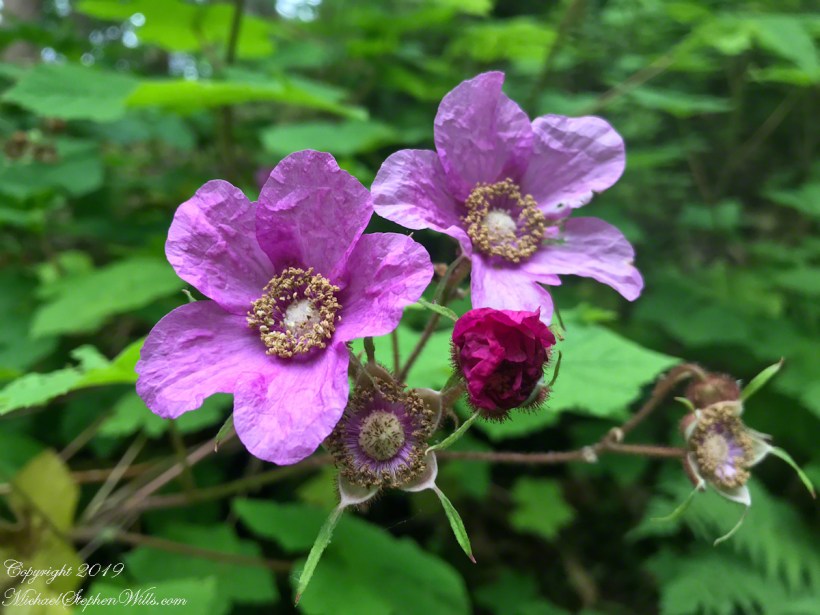
Birdsong and enchanted placeBayberry?The power of flowing water (flood stage)


 Michael Stephen Wills Photography