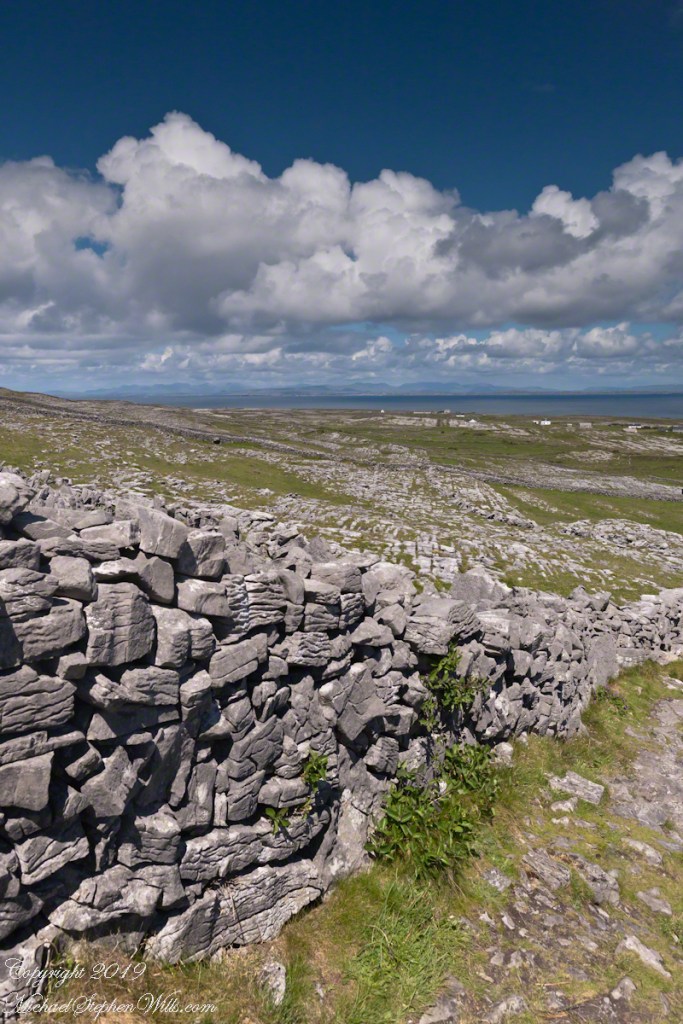
Modern stonework borders the 1/2 mile path to the inner Dún Aonghasa walls, keeping tourists off delicate plants, maintaining the integrity of this ancient site.
The view north, northwest over the walled path to Dun Aonghasa (Dun Aengus) looking across karst landscape, walled fields, farms, the North Atlantic Ocean, coast of Connemara and the 12 Bens (12 Pins) mountains. Aran Islands, County Galway, Ireland.
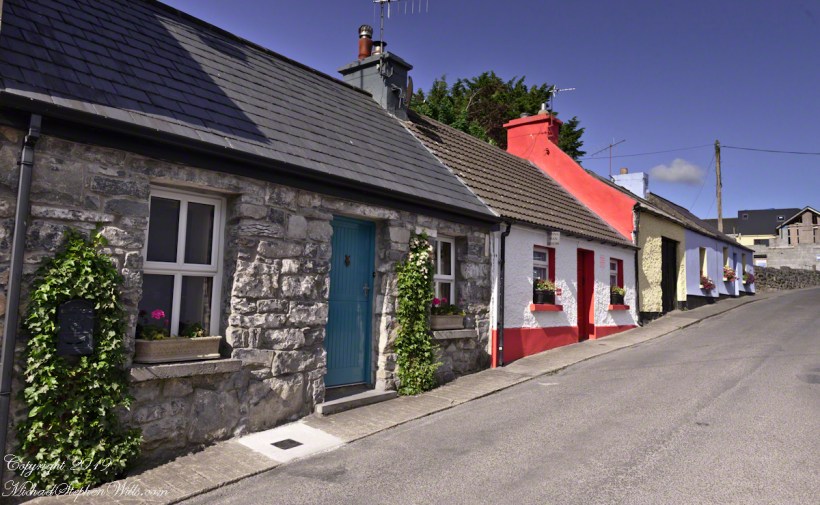
In Cong Village, County Mayo, Ireland, the Dying Man House on Riverview Street from “The Quiet Man” attracts visitors who share behind-the-scenes facts. The village remains quaint despite commercialization, with visitors enjoying film locations and historic buildings.
Cong Village, County Mayo Ireland. A scene from “The Quiet Man” has a man, on hearing a fist fight underway, jump from his death bed to run from this house on Riverview Street. This is the view heading east with the Cong River behind.
Dying Man House on Riverview Street is a popular photograph on my Facebook Photography page, to this day visitors leave comments with occasionally inside information about “The Quiet Man.” Here are some examples:
Edward James Soul The dying man in the film was actually, John Ford’s (the director) brother in real life. And the actor who played the young priest was, in real life, Maureen O’ Hara’s brother. The movie is definitely a classic.
Diane Benson Morrow And 2 other brothers were in the film. The older priest and the man who met John Wayne at the railway station at the beginning of the movie were brothers.
Edward James Soul,you are in the right church but the wrong pew. The older priest was Ward Bond. The man who met John Wayne was Barry Fitzgerald. In real life he was the brother to Arthur Shields, the actor who played the Protestant Minister, ” Rev. Playfare”. If you look at the two, you can see the family resemblance.
Edward James Soul, also remember the scene at the lnishfree race, where there were children sitting on a railing next to Maureen O’Hara? They were John Waynes children.
Pauline Ryan Grew up and around the village of Cong lovely wee place its swarming with visitors most of the time but it’s nice and quiet for a few months of winter. It’s getting very commercialized but thank God there is very little room for it to grow.
John Feeley The guided tour of Cong includes the tourists playing a scene from the movie. I got to play the part of Barry Fitzgerald. I had one line…”Where’s me pint?” Type-casting?
Jackie Smith Just watched that movie this weekend.
Greg Thompson Will never forget our singing tour guide and the most glorious artisan shop ever there in Cong…….
Ethel Beth Gallagher That was John Ford’s brother. He’s the man who referred to Seaneen as “tall man” in the Pub and got the coat thrown over his head.
Kolokea Kakiki I didn’t realize that film was made in 1950! I watched it in the 70’s and loved it!
Diane Eiden Been there, it was great to see after watching the movie all my life. I believe Maureen O’ Hara grew up close to Cong, and spent her final years there.
Marnie Rosé This is on my bucket list of places I want to go and I only live up north .. my favorite movie 🎥 ❤️
Robin Axler Kupfer We really enjoyed our visit to Cong. Got some great poses of my husband and me on the Stone Bridge. Enjoyed seeing where they filmed the race on the beach….charming town.
MichaelStephenWills Photography If you walk by the Abbey over the River Cong and forest path, you will recognize another shot from the film where Mary Kate and Sean walked along the river. 2
Ann McNamara Visited Cong a few MONTHS ago.Love taking photographs- so between Cong,the grounds of Ashford Castle,Ashford Lodge and Ballinahinch castle I was in 7th heaven.Lots of wonderful photos to use for my calligraphy + card making class in the Library over Halloween- if I can arrange it!!!!
Julie Dance I bet it is, my family are from co Clare, a little place called Kilkee, and I visit Killarney a lot got friends there.
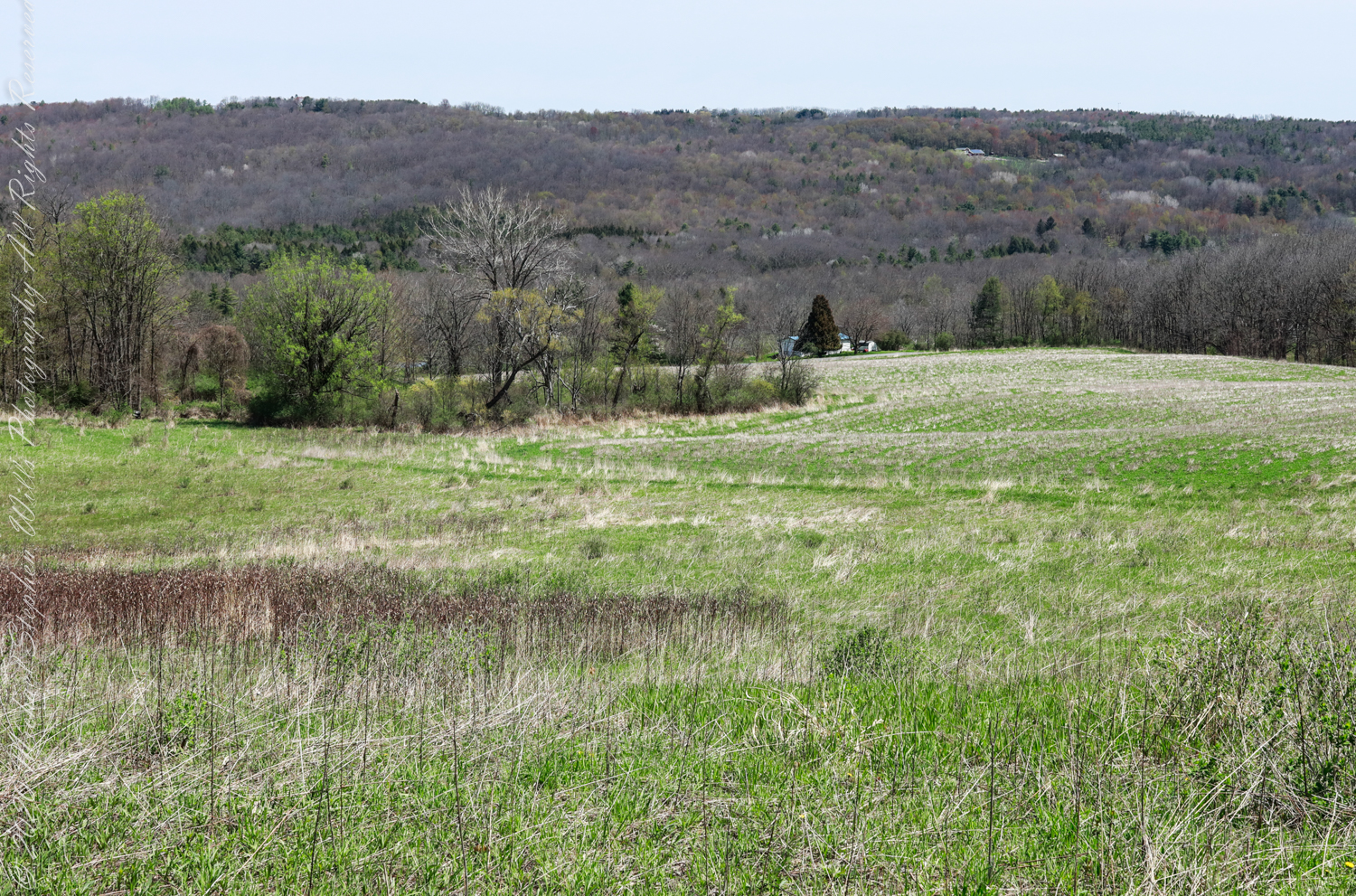
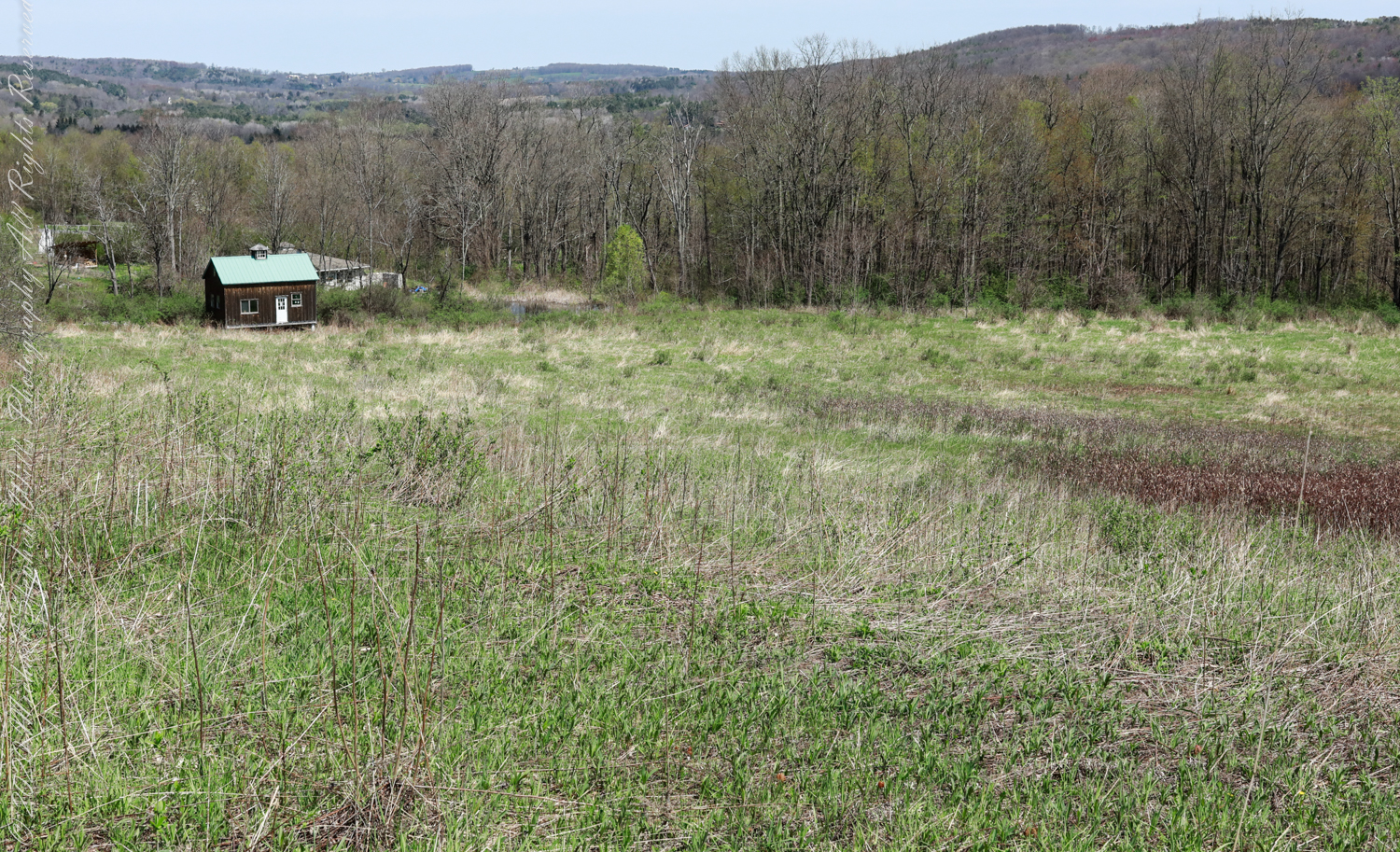
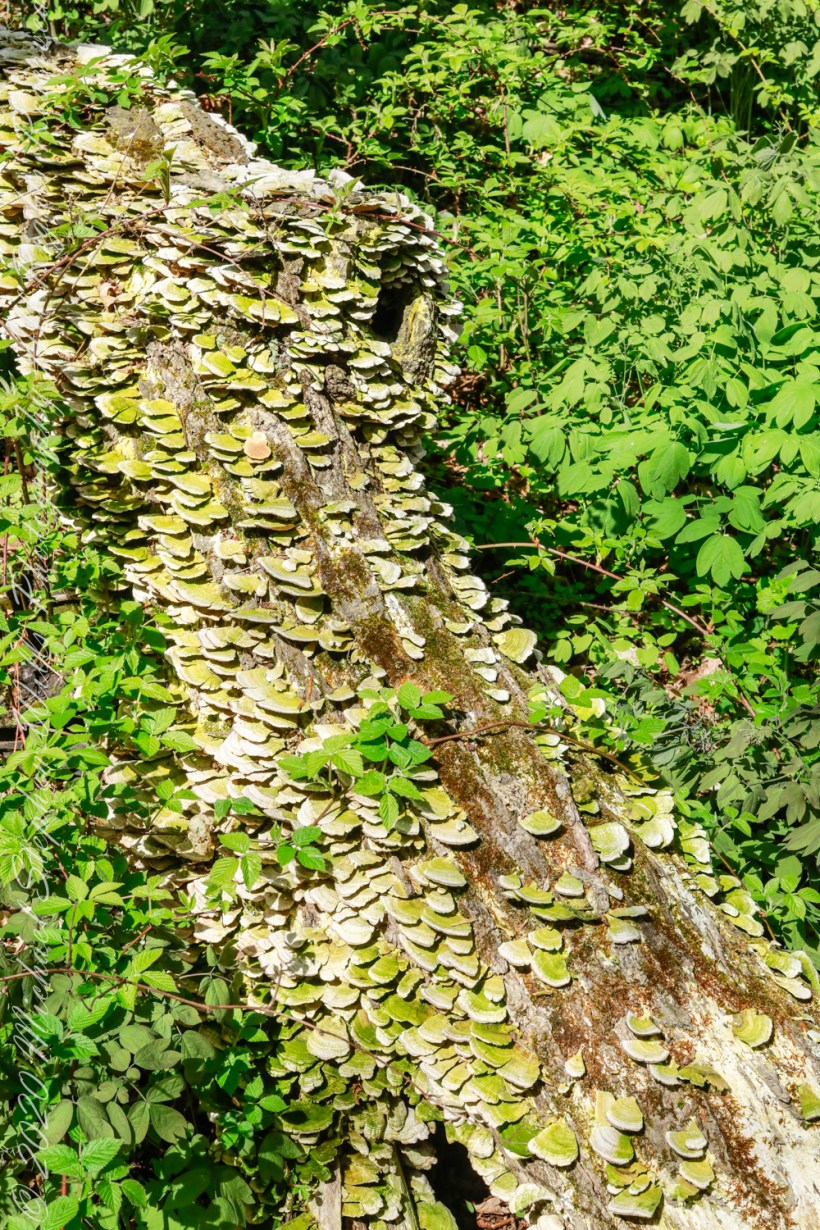
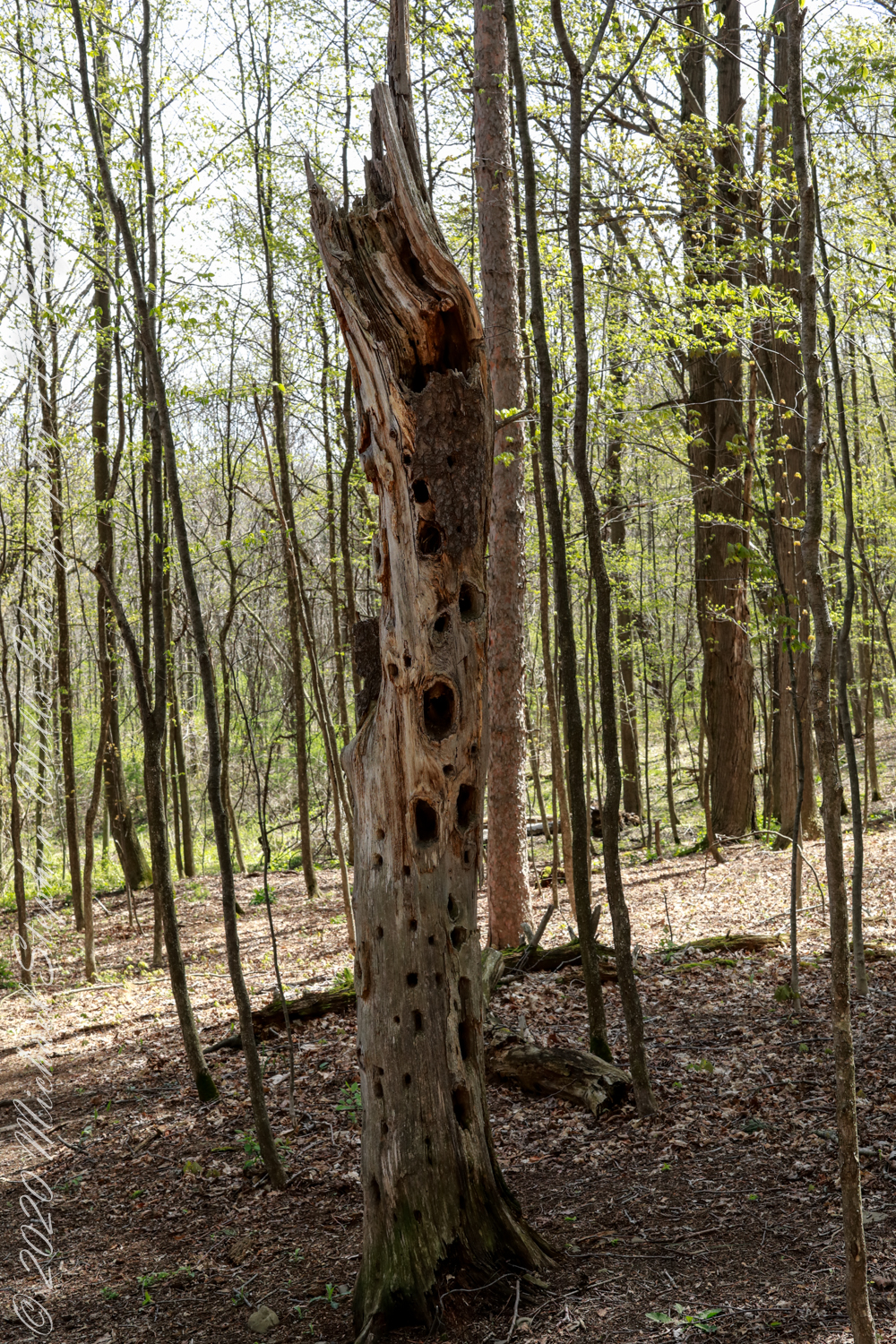
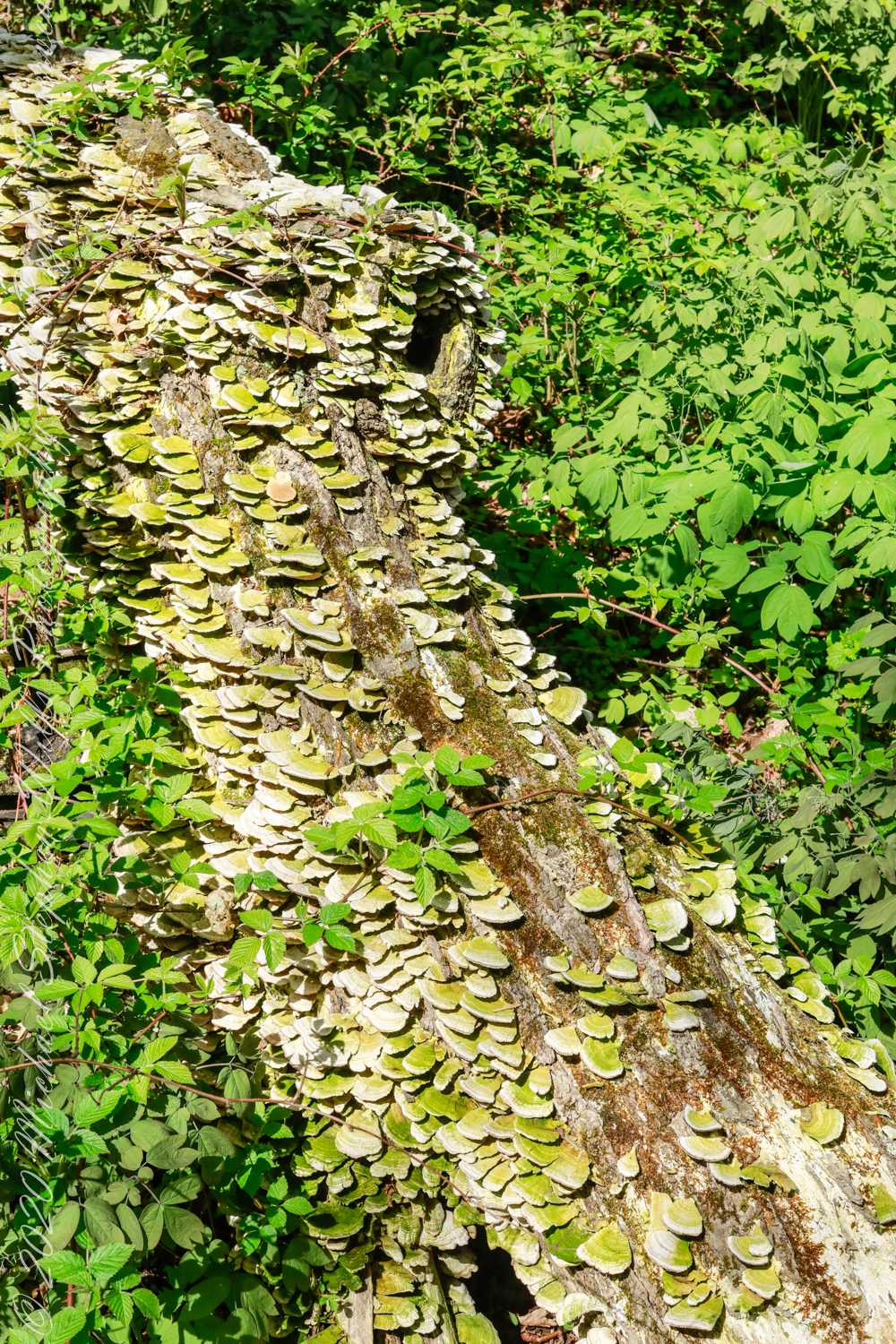
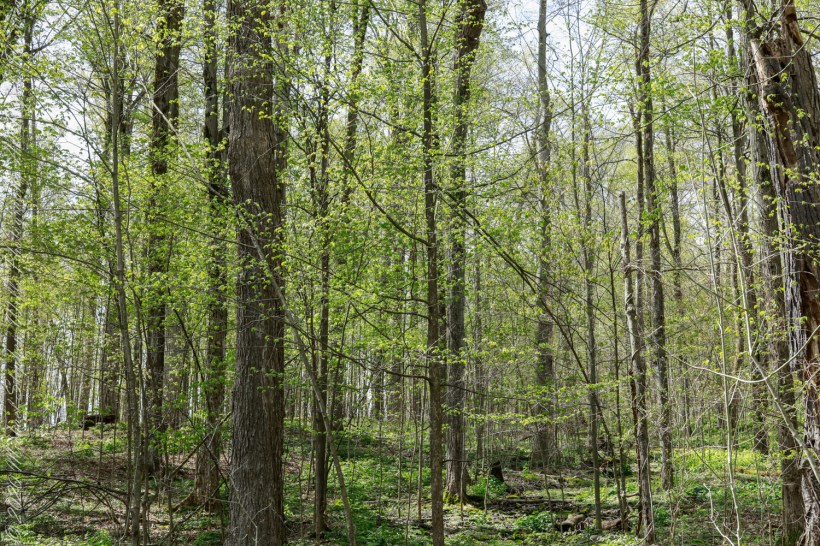
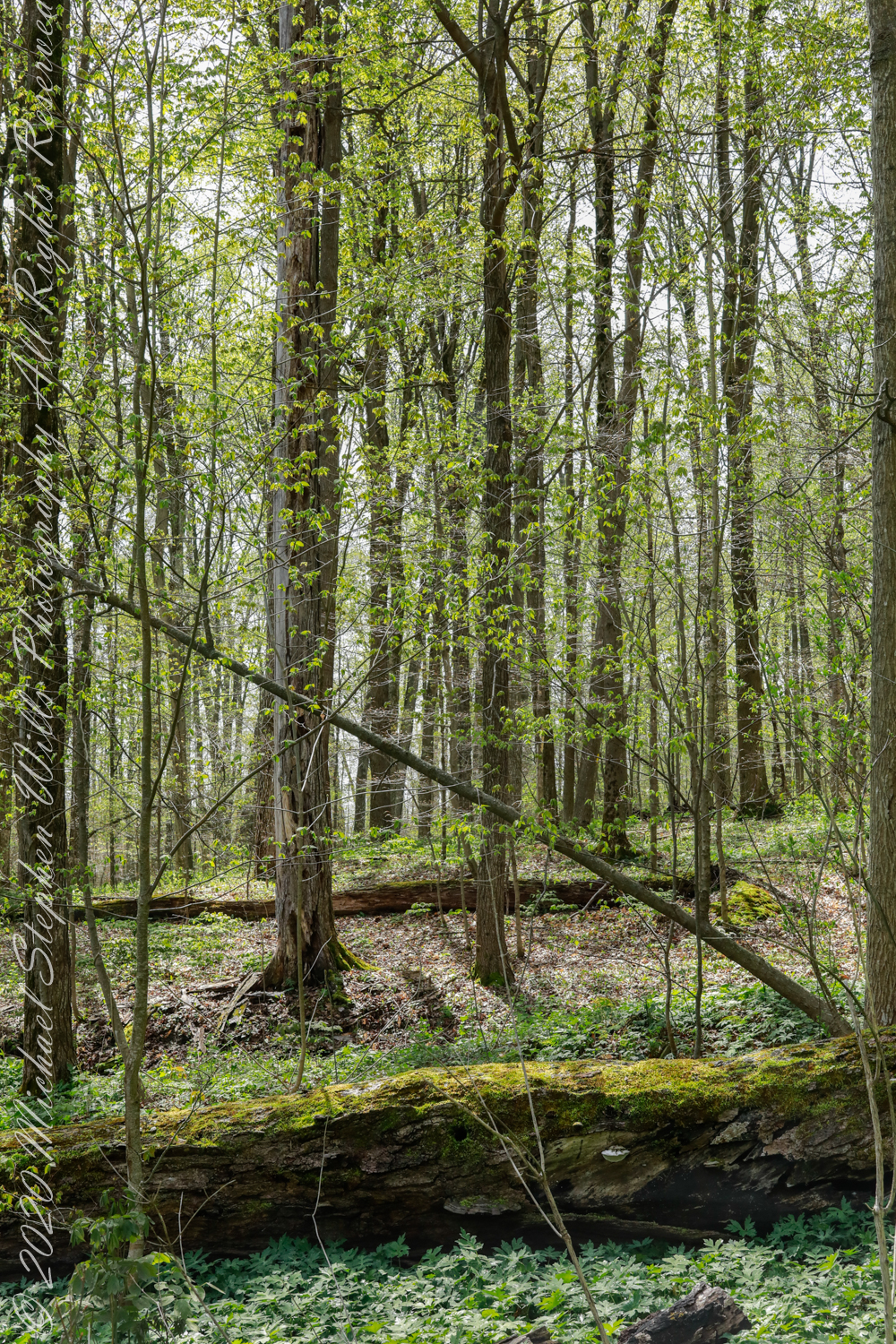
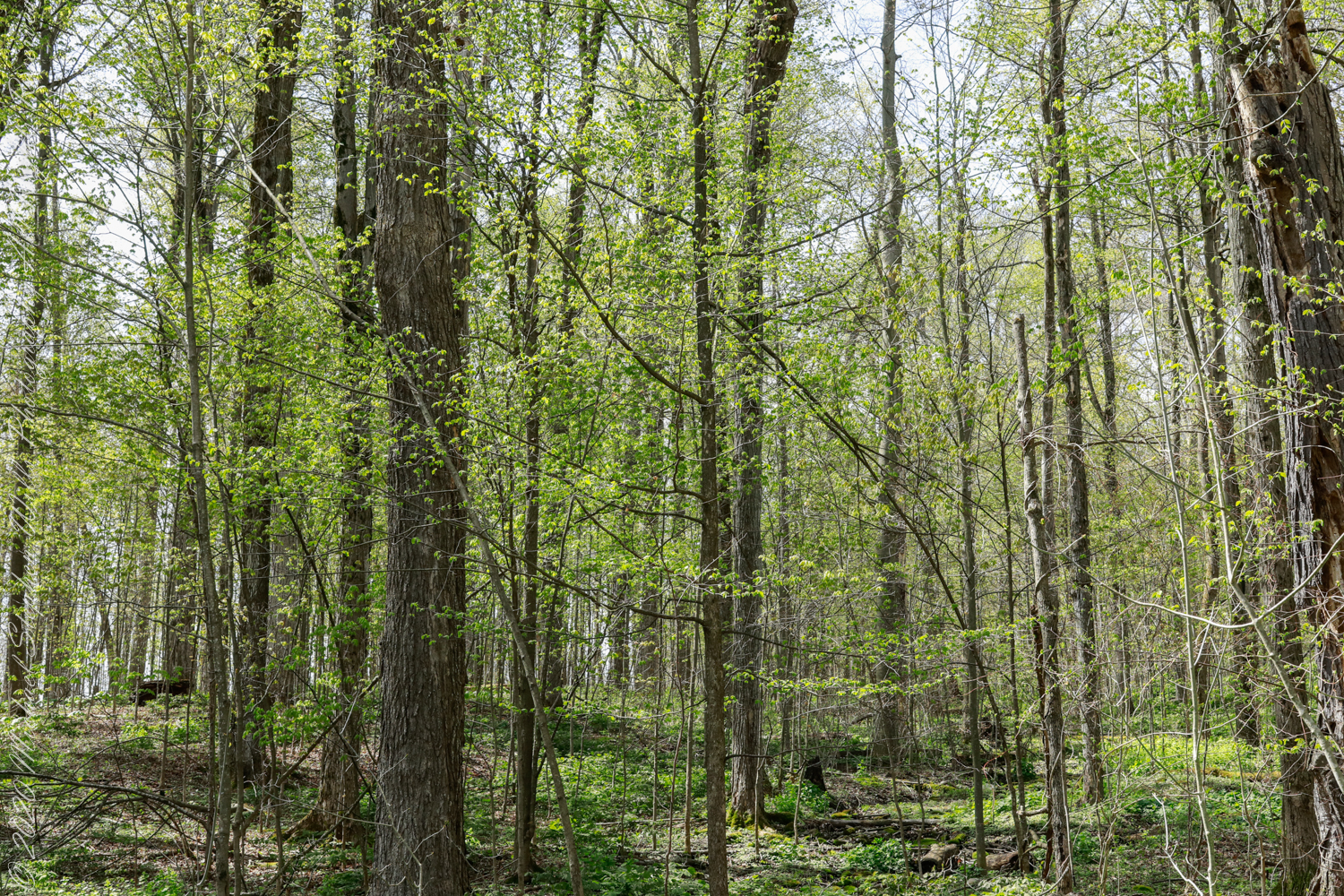
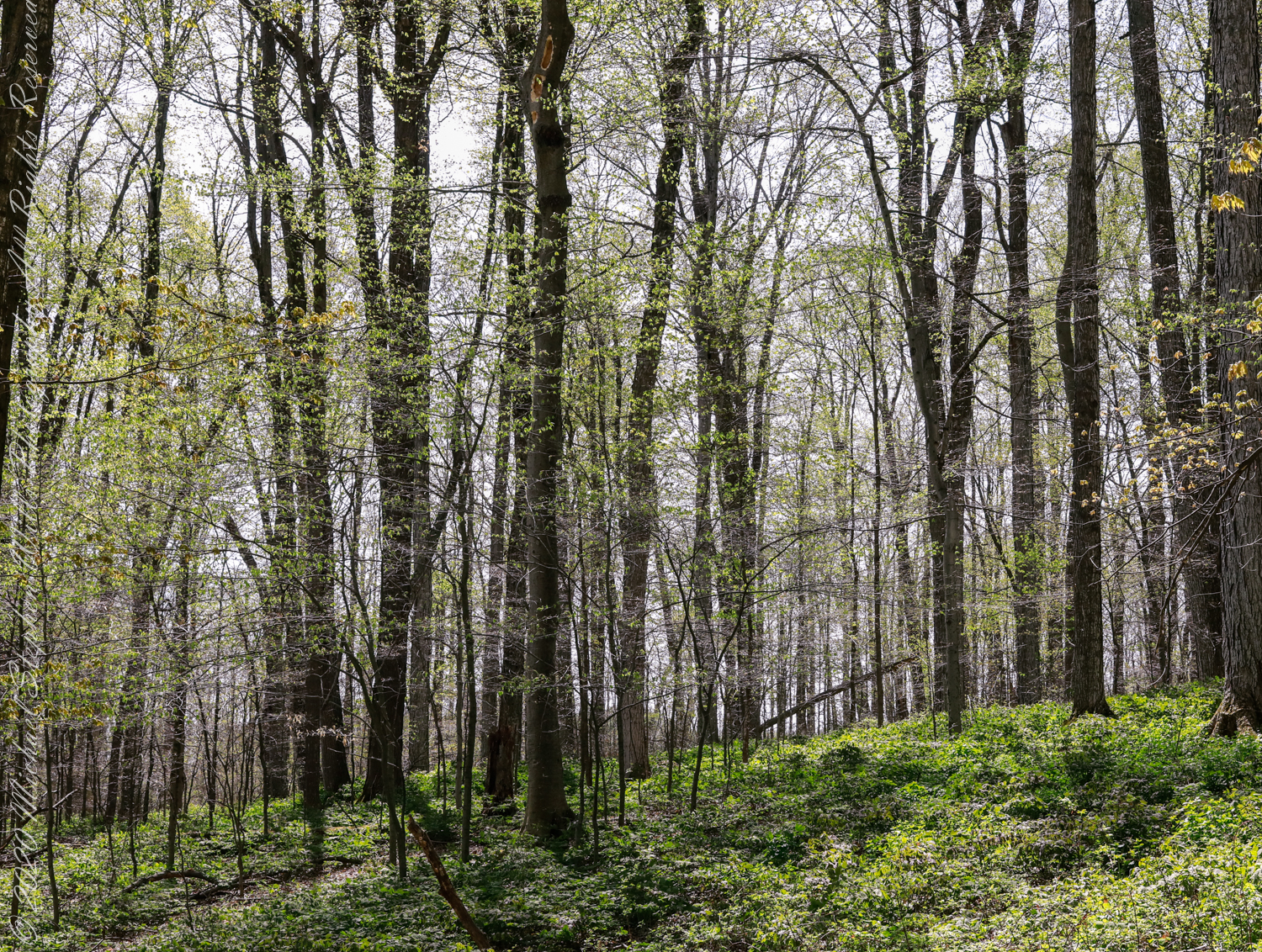
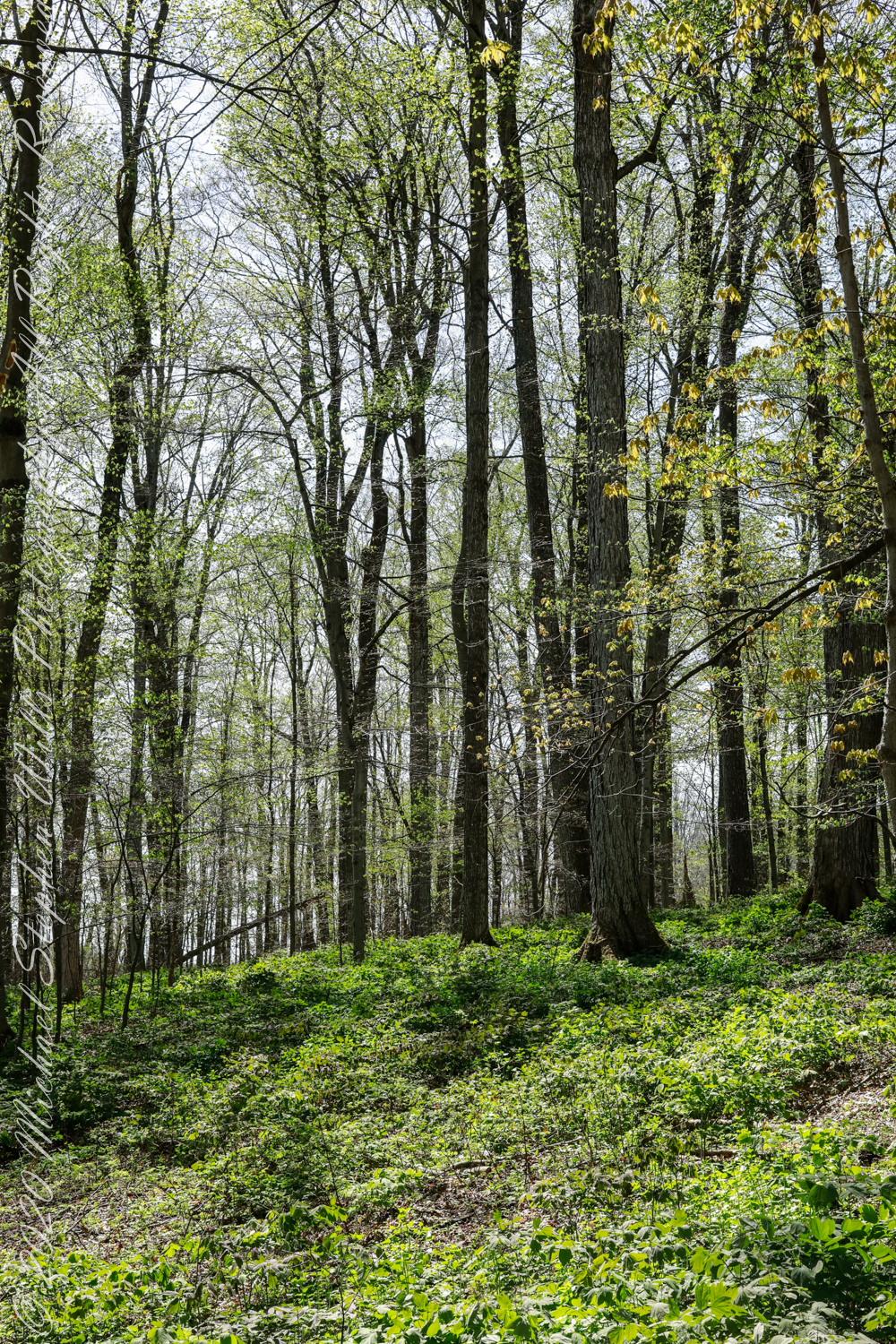
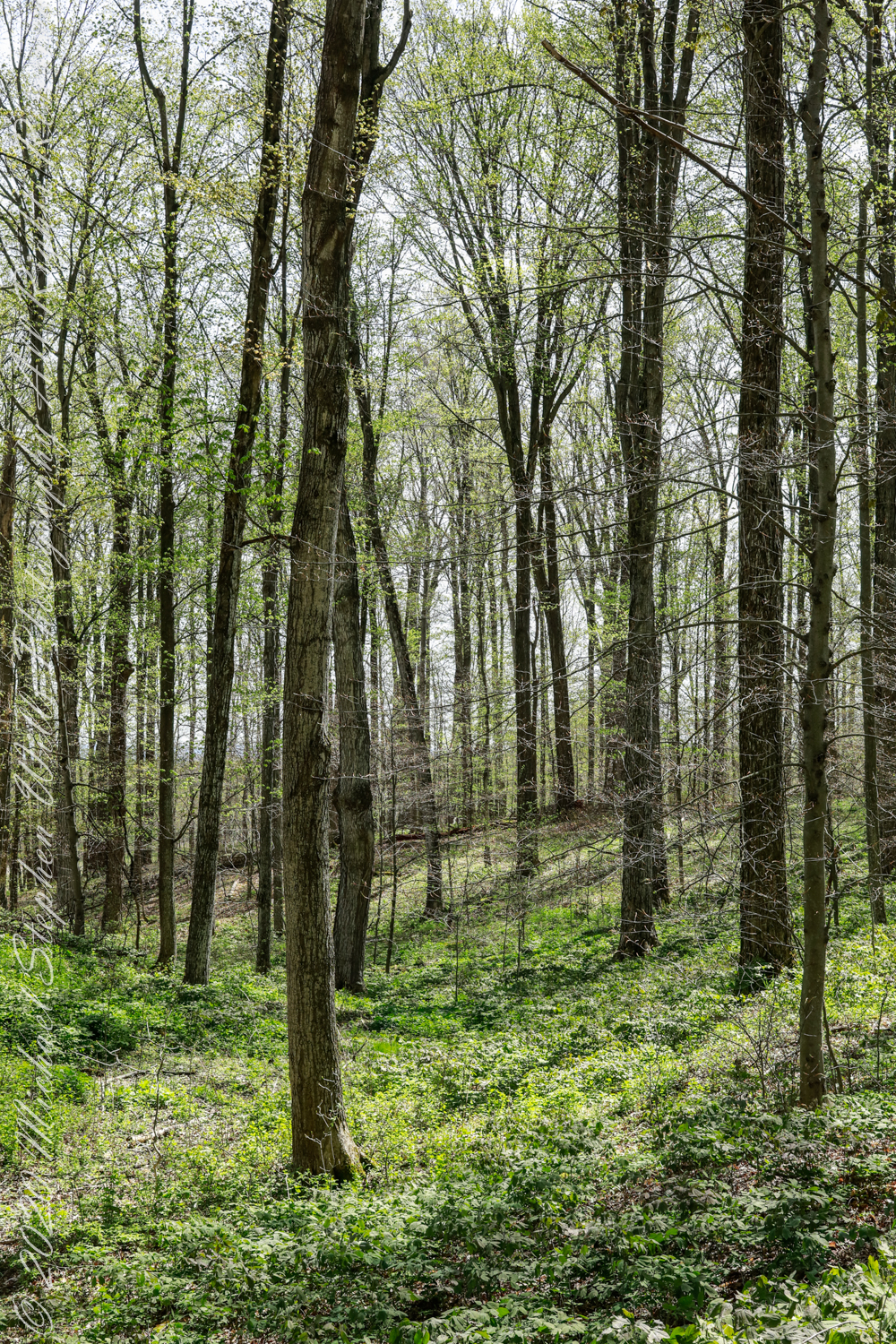
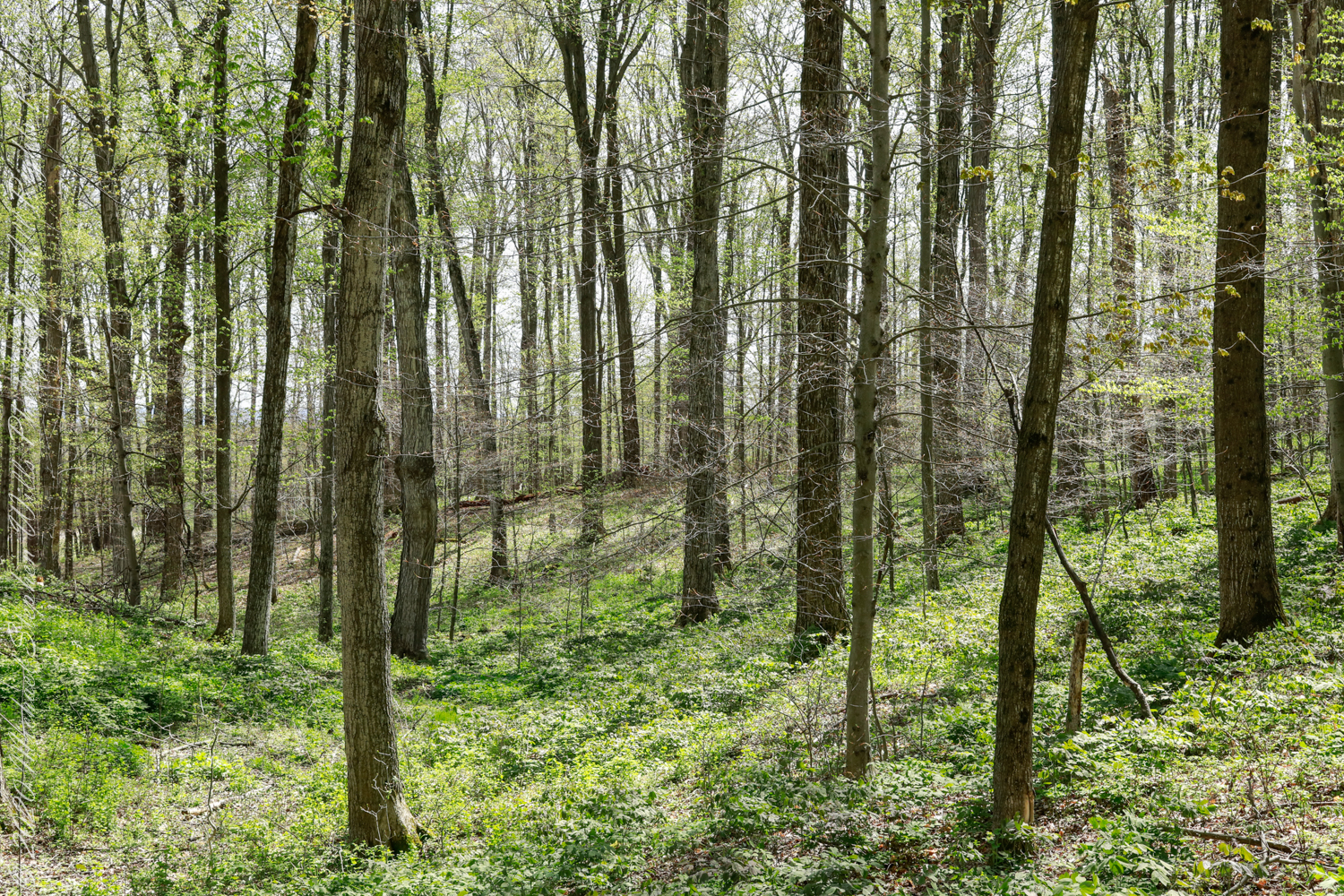
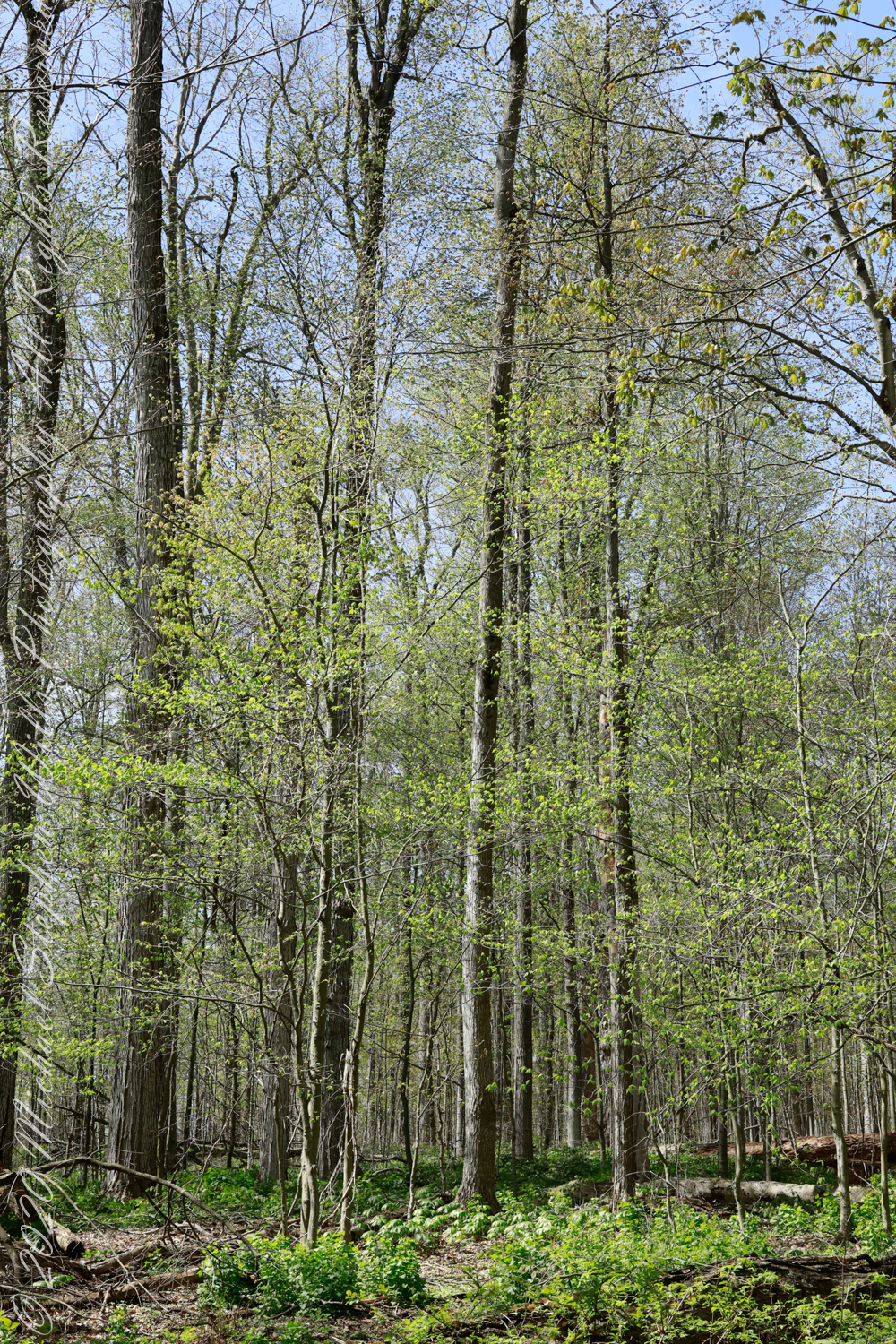
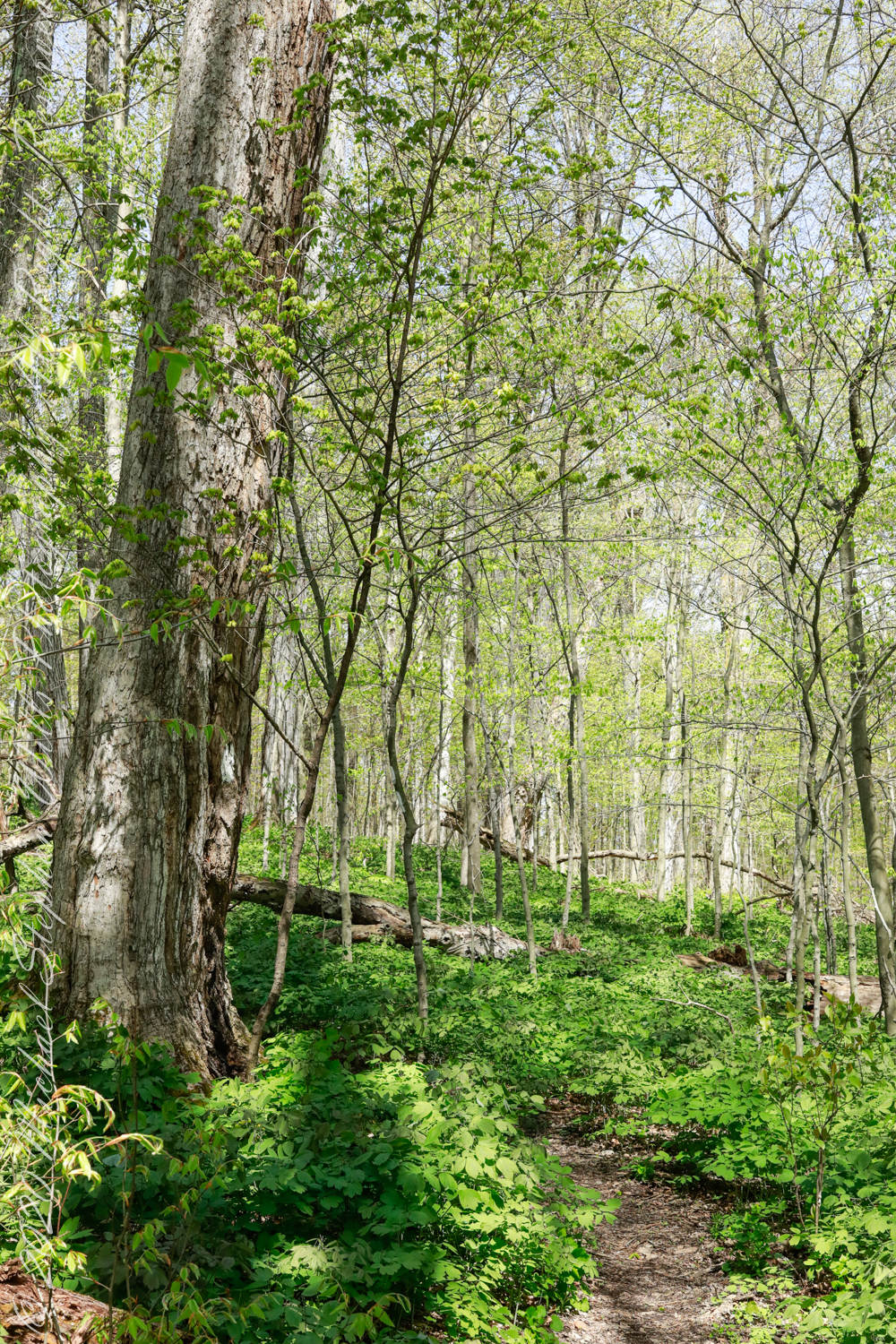
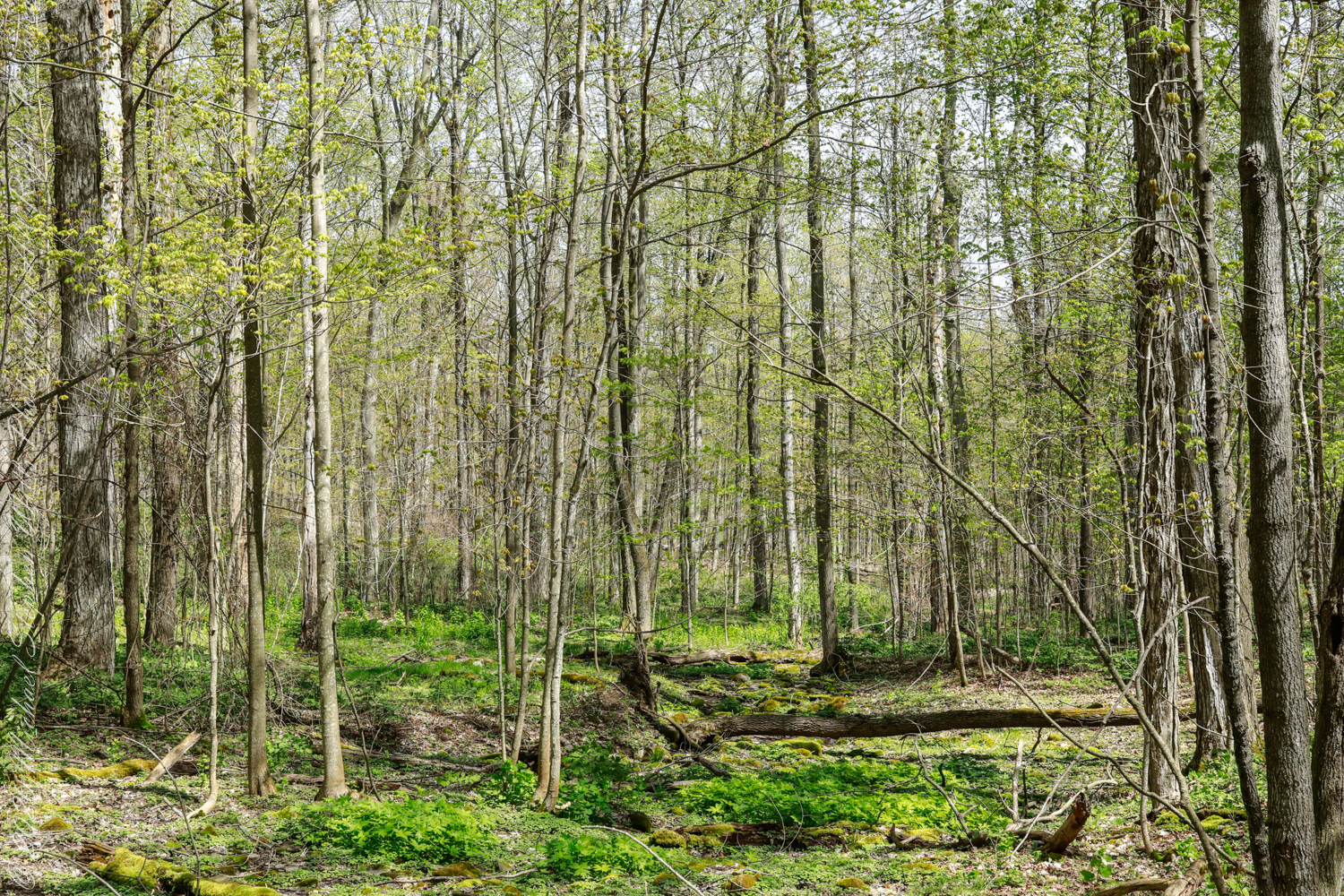
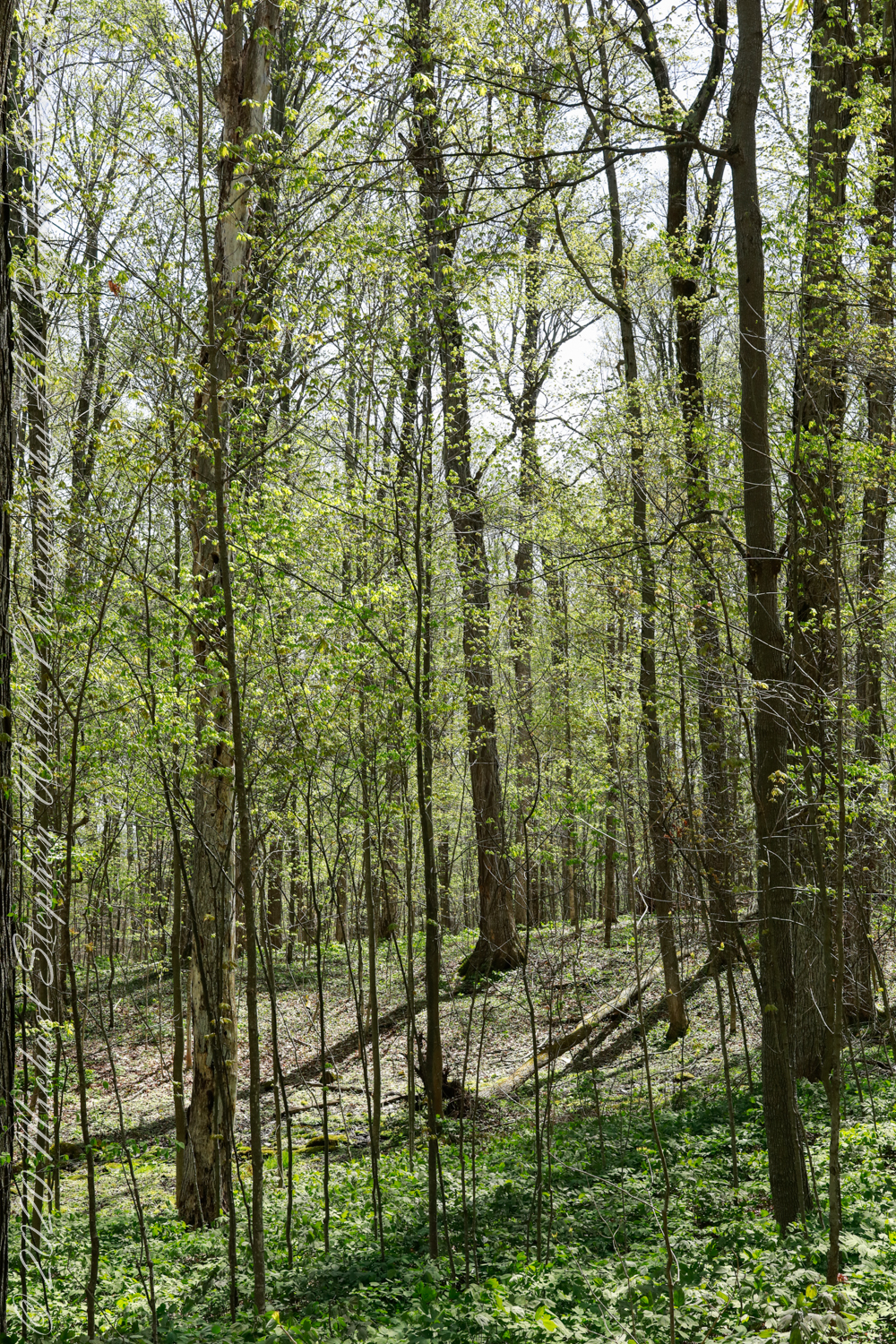
I found these snags surrounded and, at a distance, hidden by the burgeoning Brock-Harvey forest preserve here in the Finger Lakes.
As with burgeon (see yesterday’s blog post), the word “snag” has a long history from a forested northern region of the planet, though it hales from Scandinavian languages rather than Old English and Old German. As a noun “snag” is something with a point and a body long enough to cause inconvenience, the point catching on anything handy. As a verb “snag” is to become inconvenienced by a projecting body.
In forestry, a snag is any trunk of a dead tree. Commonly, a tree top breaks off leaving a jagged point which possibly can become an inconvenience. For birds, an upright dead tree is a blessing, perfect for homemaking.
Standing Snag with Nest Holes
Fallen, the snag is still a snag and also a home first for fungus. When the work of the fungus is done, the resulting mound is perfect for growing new trees.
There is a word to describe the first growth of spring, rare in a way as having grown within the English/French languages without roots from either Greek or Latin, wholly suitable to a forest people. The first growth of spring so impressive it has words of its own: burgeon.
Both as a noun, burgeon the bud itself, and a verb; to burgeon, as in to burst forth. Burgeoning: the process of the act itself.
June 2018 I shed a 53 year old habit of working for a living for new habits in retirement. Instead of waking at 5 am to work for someone else, my routine became to wake at 5 am for personal projects. From June into September 2018 my morning time was spent researching and documenting family history, also known as genealogy: my own and Pam’s.
It was fitting Pam and I spent the last days of that year (June 2018 through May 2019) harvesting our newly acquired knowledge on the ground, a 3 hour drive from our home, to the site of Pam’s earliest ancestor in the New World, at that time Colonial America. Our visit will be book-ended by another this September to Burlington, New Jersey, on the eastern short of the Delaware river, founded by my earliest ancestor, also in Colonial America and 4 hours from our present day home.
A river setting is a link between our ancestors and the two rivers associated in a number of ways. In driving to Athens, New York, a village on the west bank of the Hudson River 31 miles from the state capital, Albany. Our route from Ithaca to Athens included route 23 that passes through the Catskill Mountain, Delaware County, village of Stamford. The headwaters of the west branch of the Delaware River passes through Stamford.
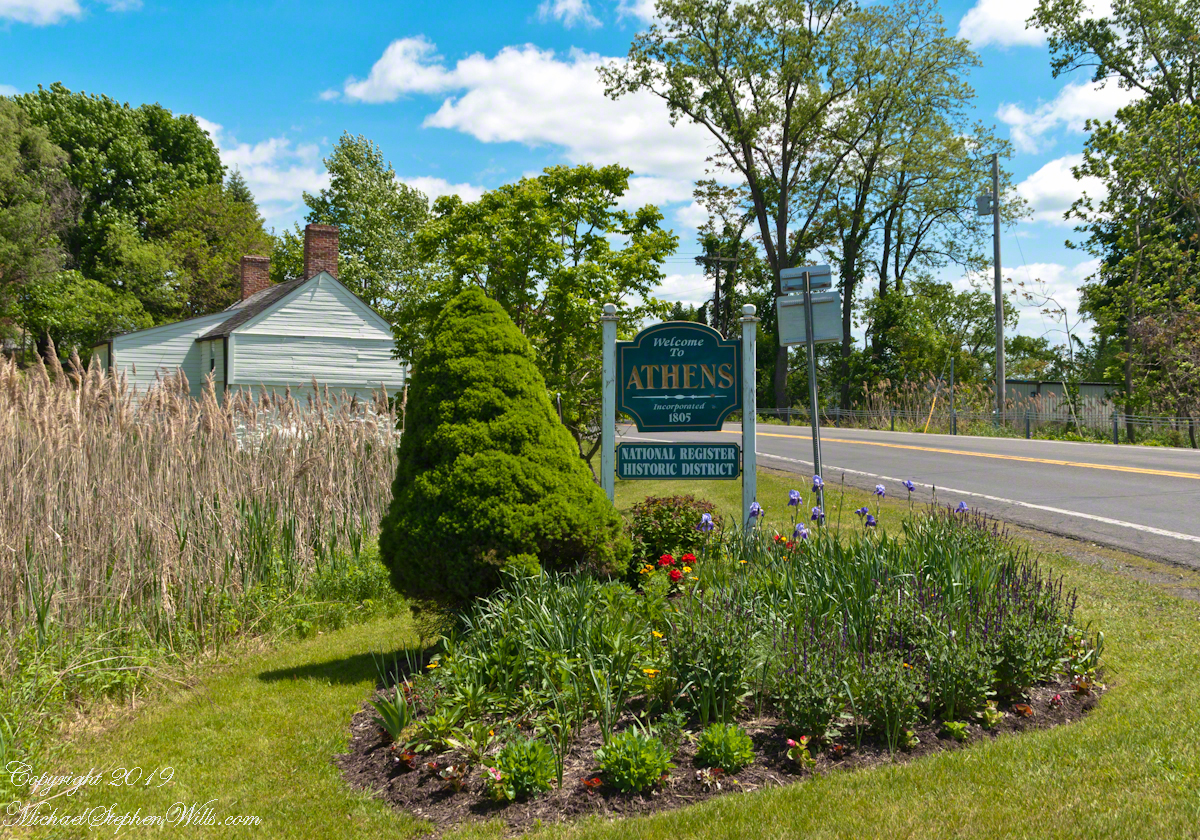
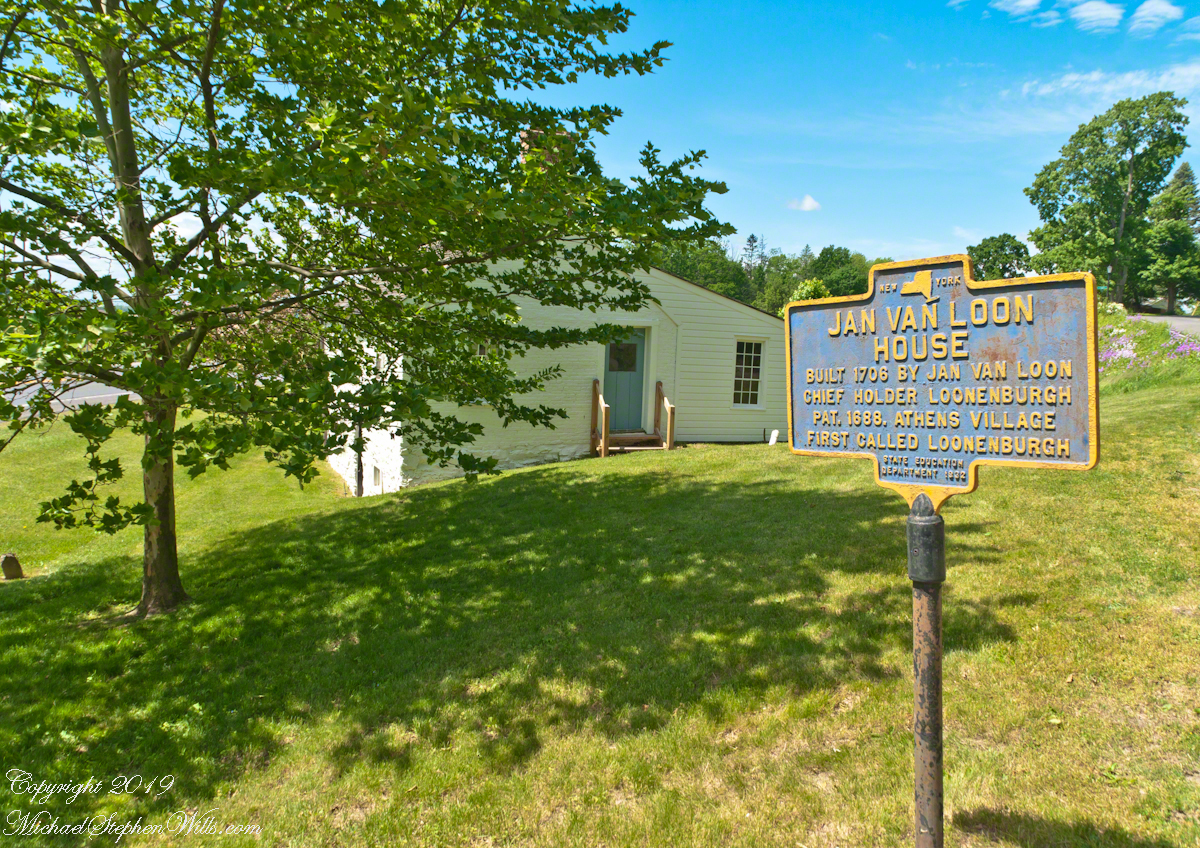
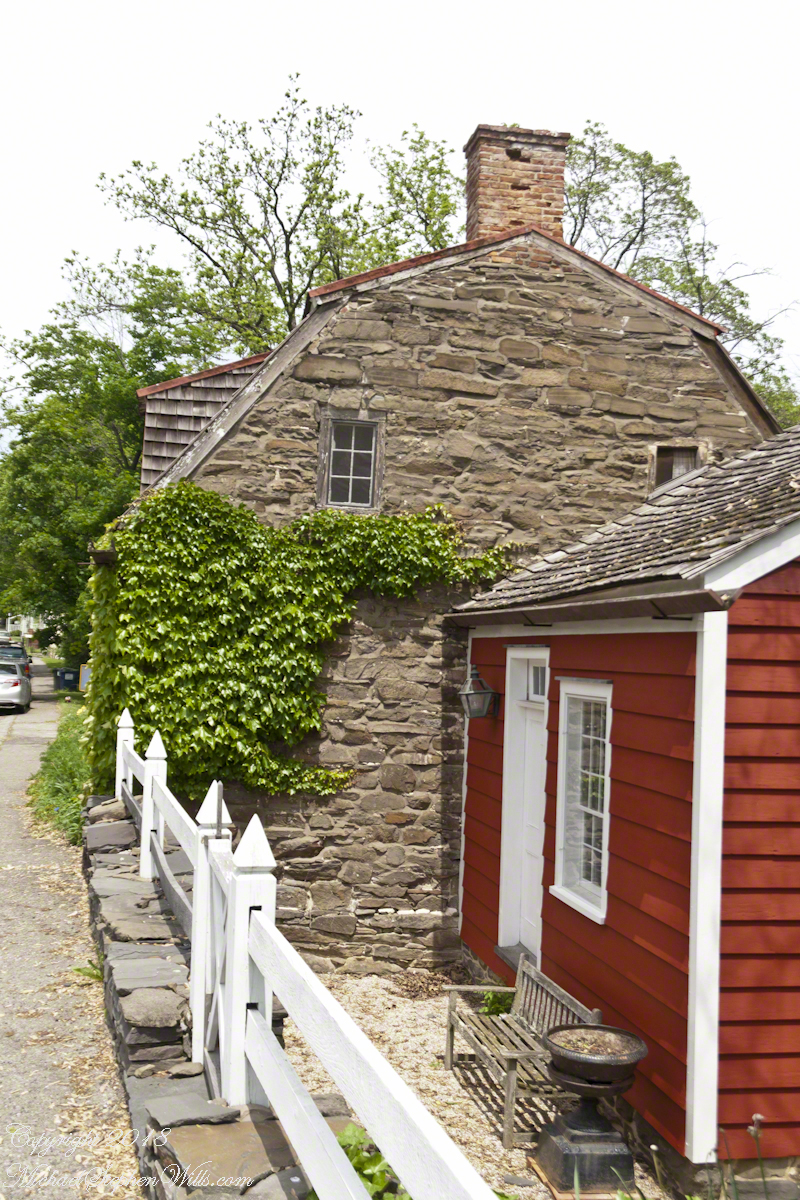
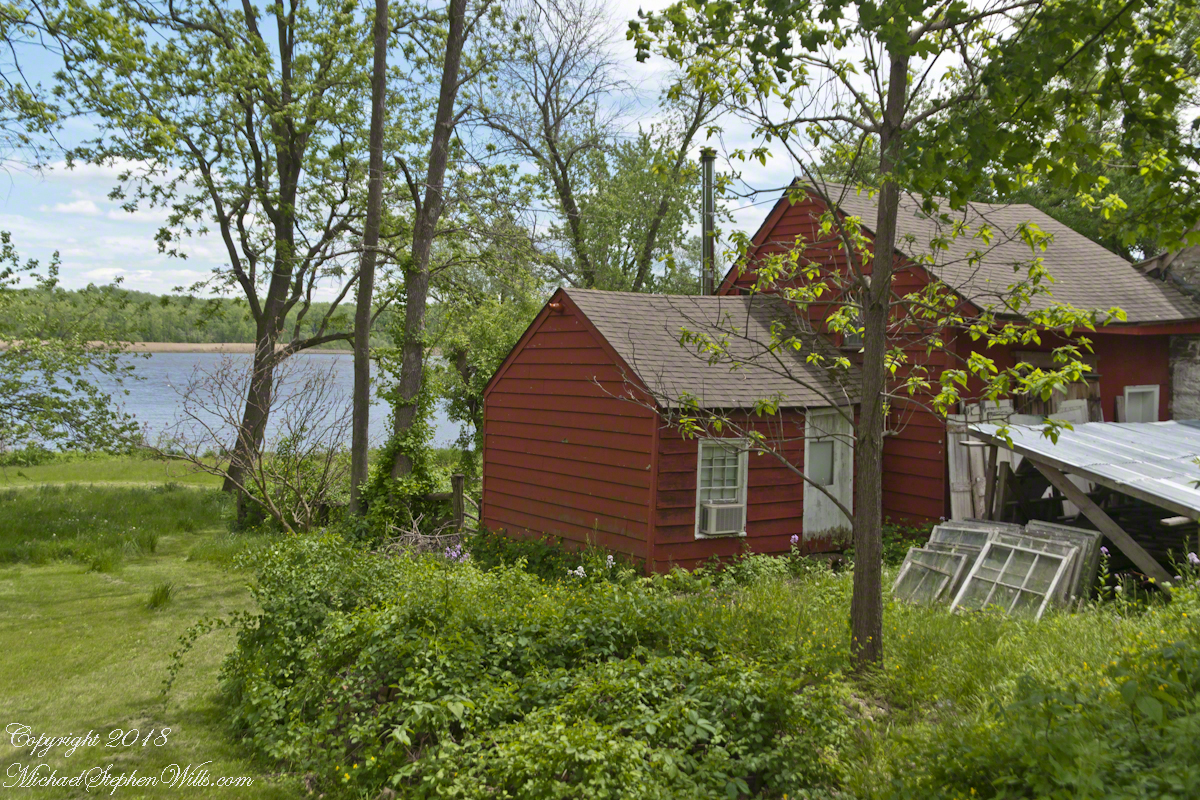
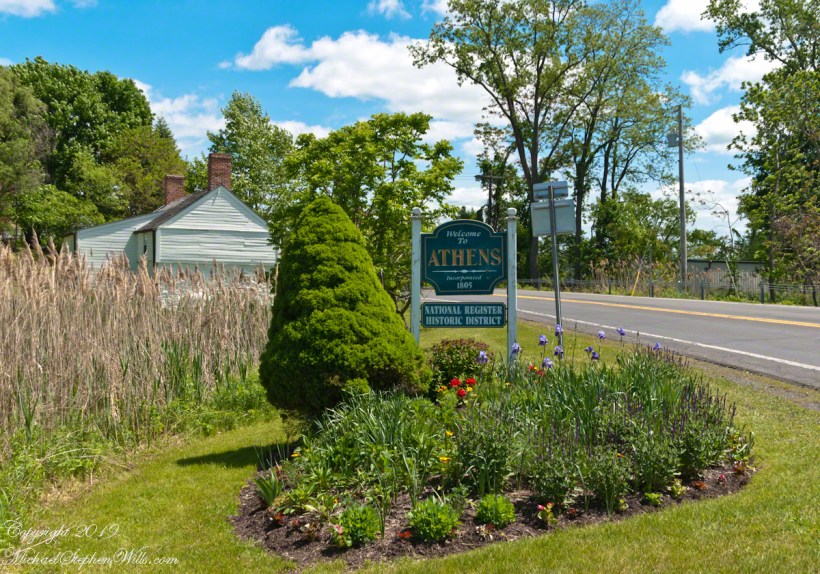
Founded as Loonenberg, named after the first settler Jan Van Loon. Today, Athens is a lovely destination, a historic village on the Hudson River. The rear of the Jan Van Loon house is in the background.
Henry Hudson and the crew of the Half Moon were the first recorded Europeans to visit both the Delaware and Hudson rivers. The Half Moon dropped anchor in Delaware Bay late August, 1609. They reached the estuary of the Hudson (then called the North or the Mauritius). The goal of Hudson was a route to China. Luring him up was the flow and width of the river, Hudson suspected this land was a island, behind which lay the route to the Orient. He navigated up the river for ten days, passing the future site of Athens.
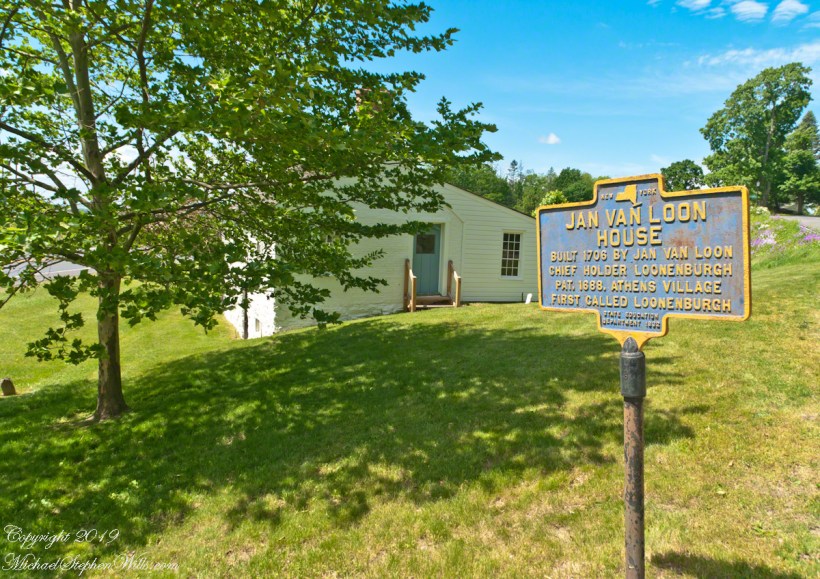
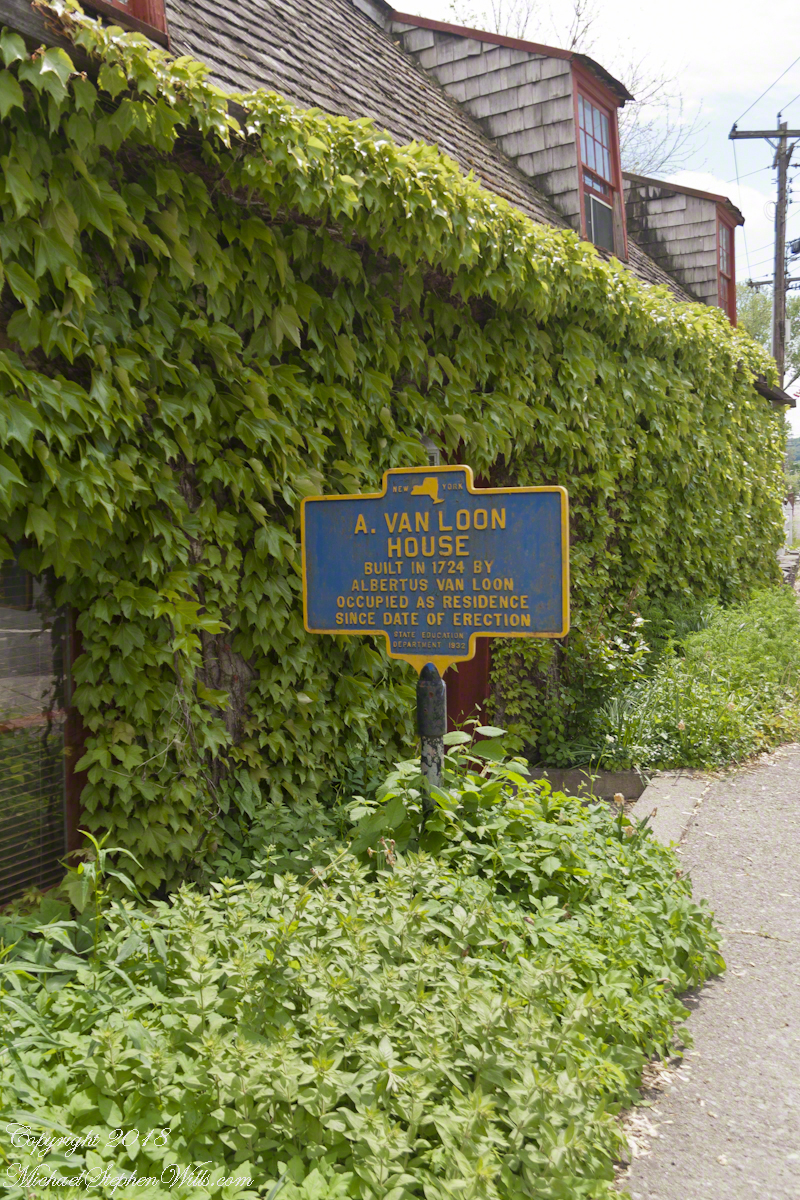
Historical signage with house. One wall remains of the original house, this is a loving restoration on the original site.
Beaver!!
Hudson was in the employ of the Dutch East India Company and it was the Dutch who laid claim to the length of the Hudson for the purpose of trade. In summary, when Swedish/Finnish colonists on the Delaware proved successful in shipping huge numbers of beaver pelts and tobacco the Dutch took control of the Delaware under force of arms in the interest of controlling this trade.
The Dutch, AKA the Dutch East/West India Companies, had little interest in establishing colonies. Instead huge areas of land, “patents”, were granted to individuals with the underlying goal of providing a flow of shippable goods. It remained as such for many years, until 1664 when England, under the king Charles II, took control of New Amsterdam and, by extension, trade flowing on the Hudson River.
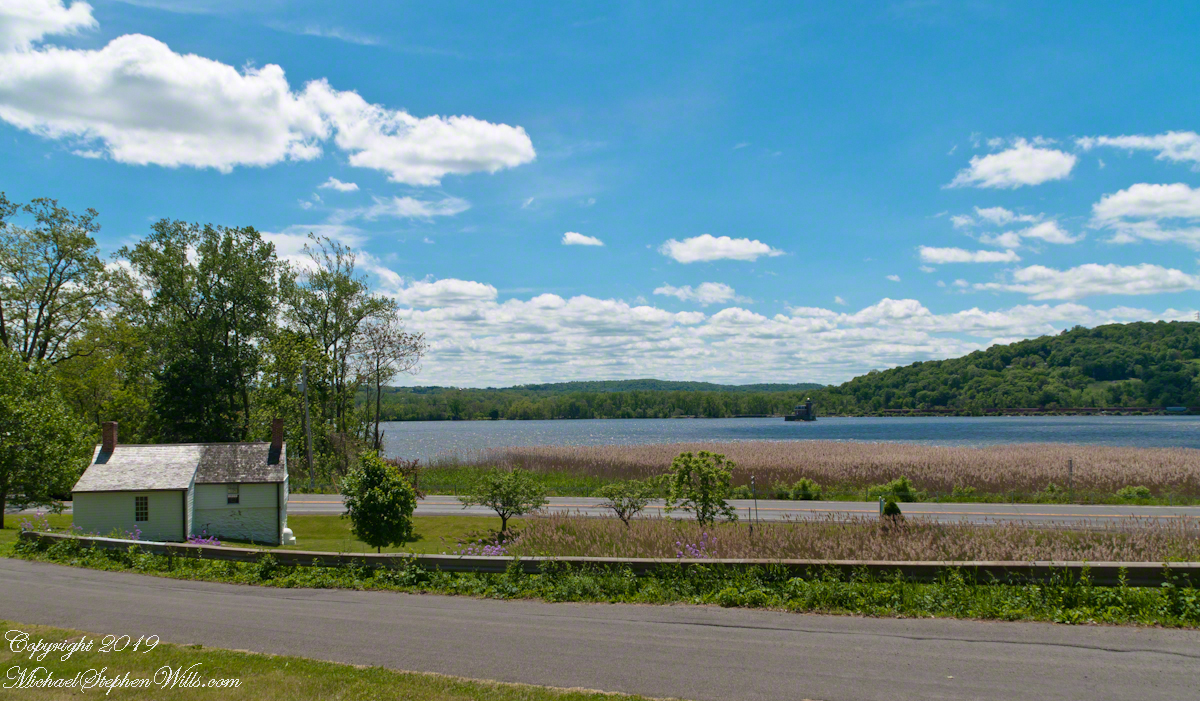
Overview of the Jan Van Loon House, 39 South Washington Street, Athens New York from the Athens Veterans Memorial Park with view of the Hudson River and the lighthouse. Phlox are in bloom!!
“Stayed for the Corn“
Jan Van Loon (pronounced Van Loan) comes into the picture with a 1676 marriage to Maria in New Amsterdam. When Jan acquired a major interest in the 1688 Loonenburg patent the land was just opening to European settlers and their tenancy was less than secure. Threatened by incursions of Native Americans and animosities between the French and English. They had eight children who reached adulthood, the house of one of them, Albertus, is one of the oldest continually inhabited residences in New York State.
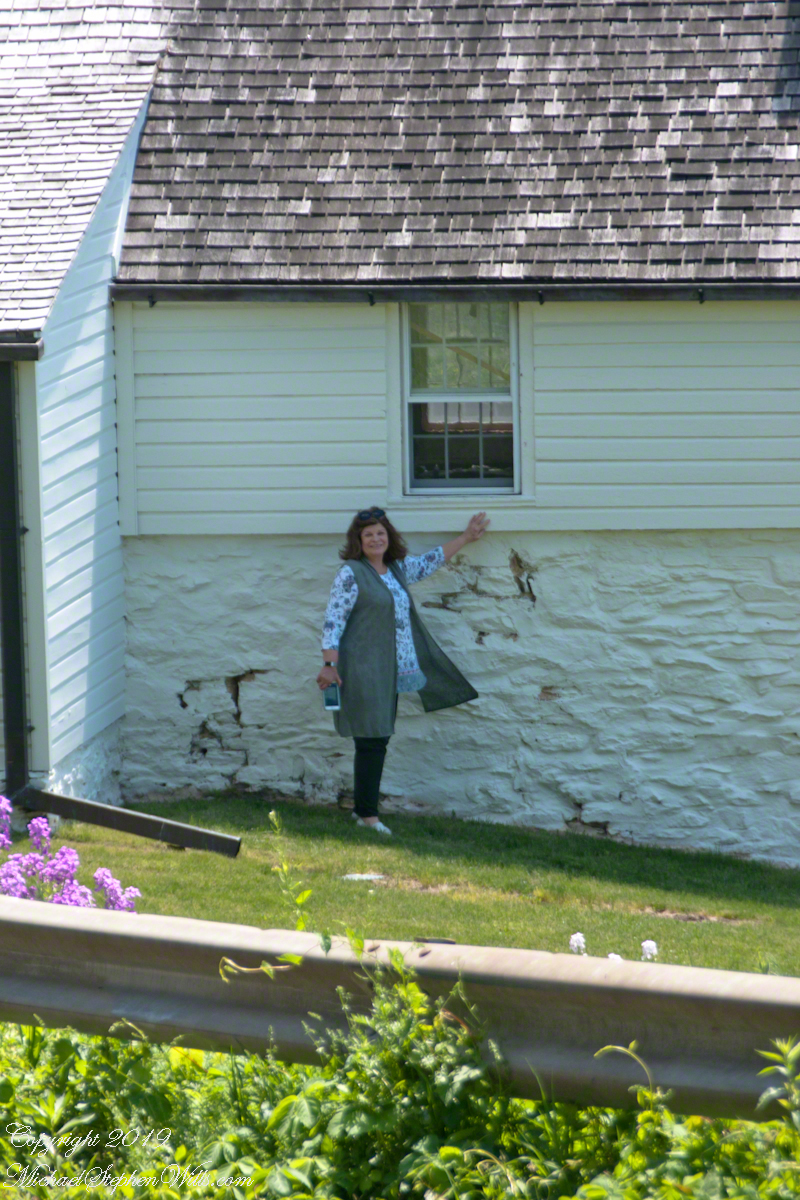
Athens, New York is the present day name of this town on the Hudson River first settled by Pam’s ancestor in the 17th Century. Pam is pointing to the modern window restoration (aluminum double-hung), the roof is cedar shingle (I believe).
Tradition has it Jan Van Loon acquired the land through a payment of 50 beaver pelts and provided services as a blacksmith, though that had to be after a number of years of residence, since he was a first settler. Pam and I are learning more about those early years, but we know Jan and Maria’s interest in the land was not trade. It was to live peacefully and prosper which they, somehow, did to the benefit of all the people around them.
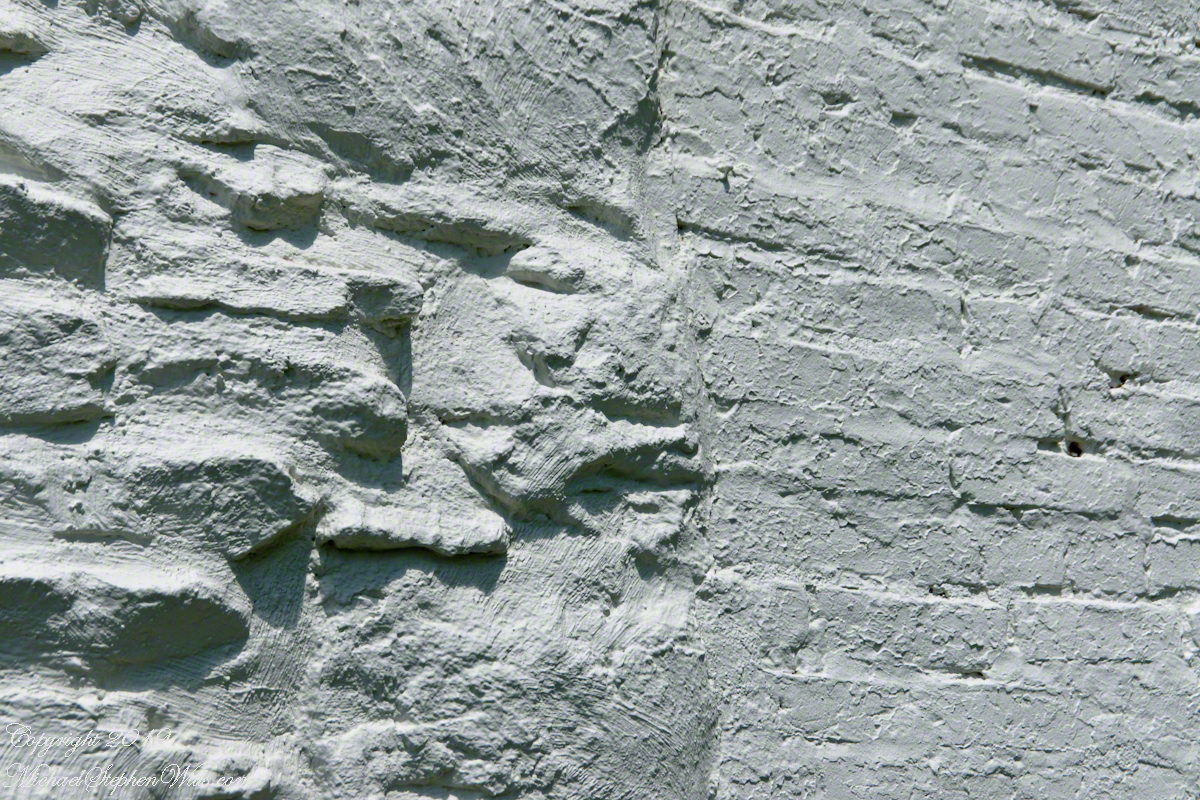
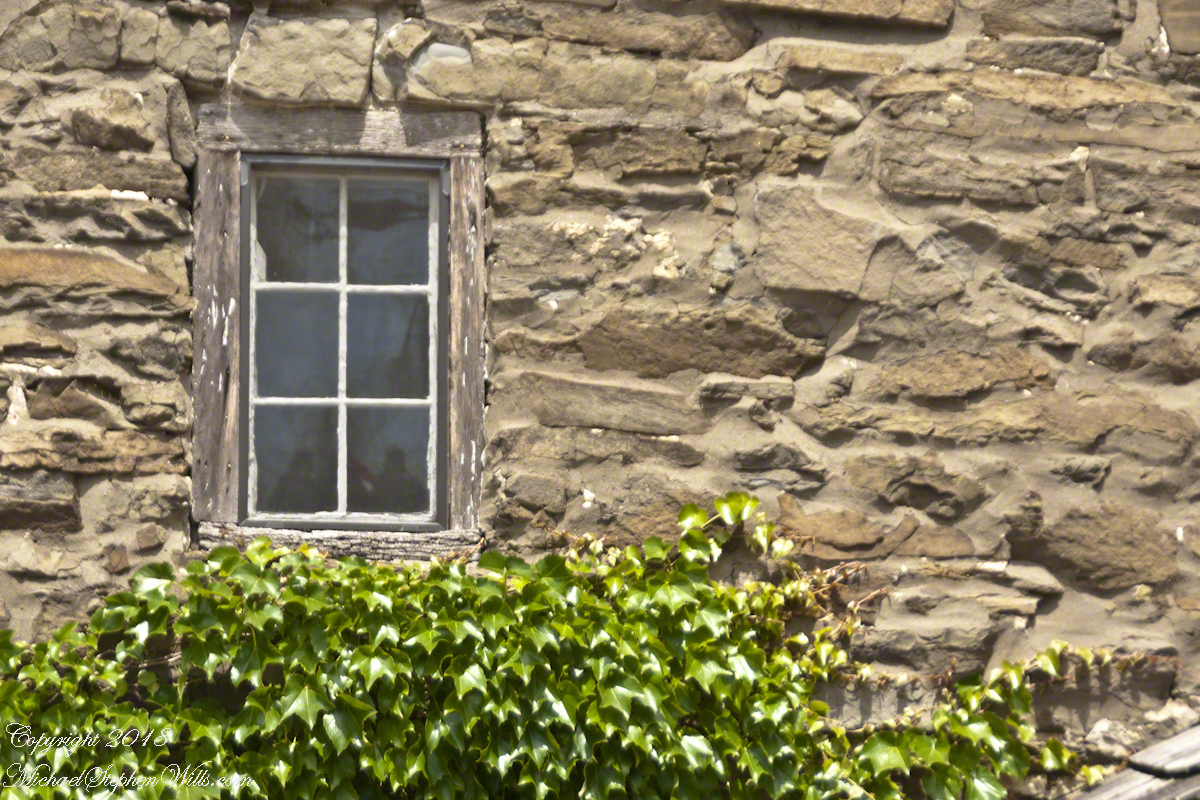
Detail of the modern restoration of the east foundation wall, Jan Van Loon house, Athens, New York, at the juncture of the field stone/brick joint. The front of the house is to the right.
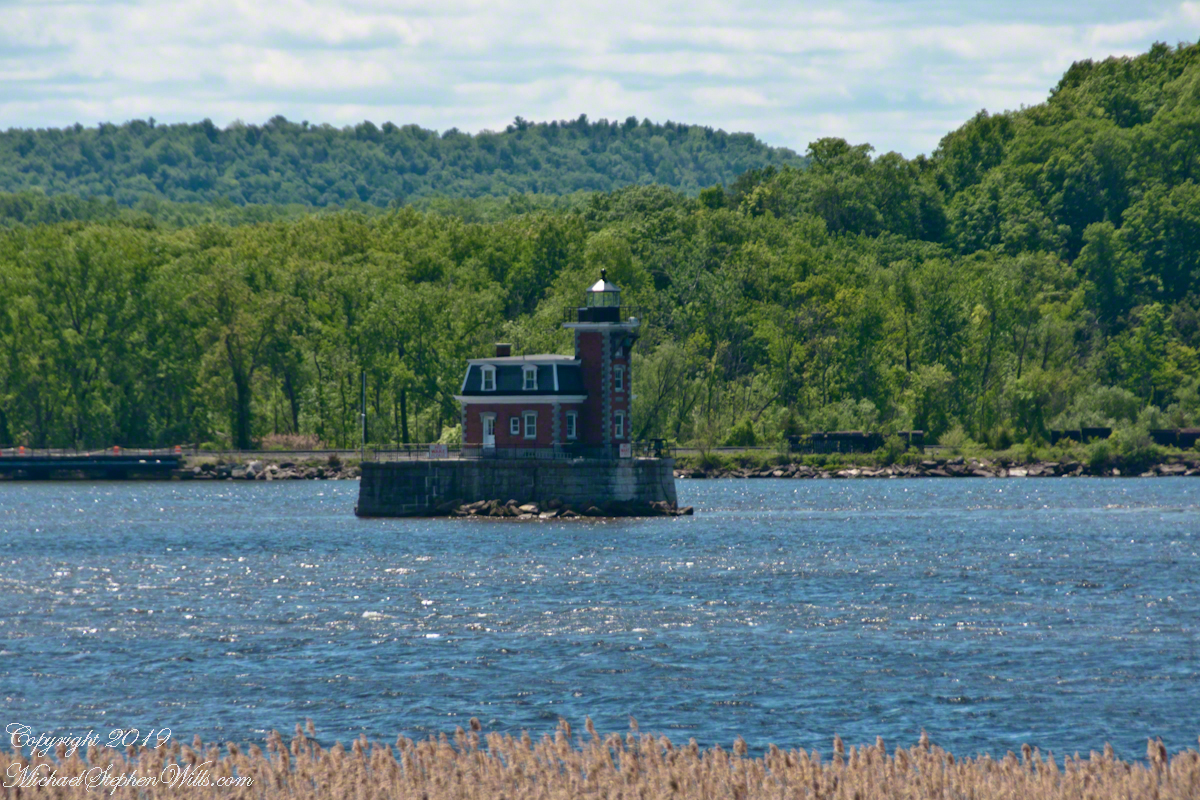
The lighthouse as viewed from the Jan Van Loon House site. Build 1874, the lighthouse was not part of the environment of Jan and Maria Van Loon.
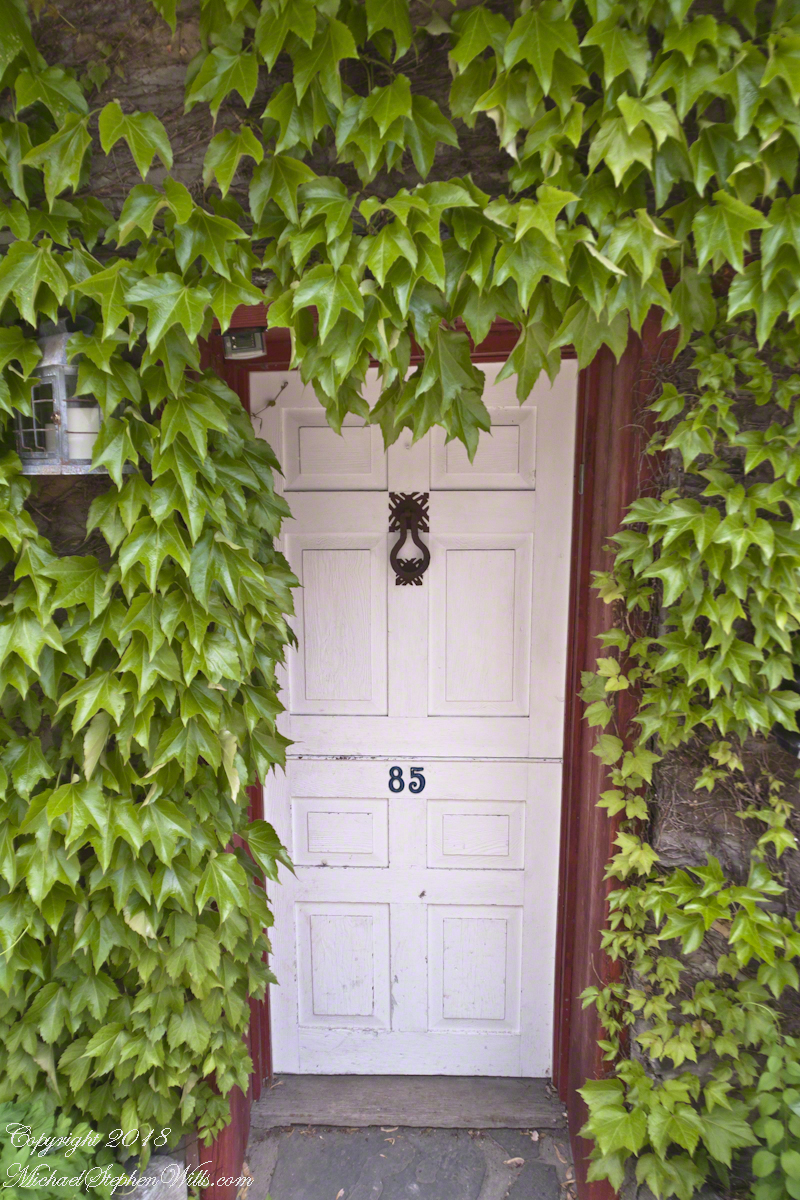
Home for 295 years, one way to describe the Albertus Van Loon house, 85 North Washington street, Athens, New York. Built before there was a George Washington or Athens New York. The river flowing by was named North River when this door first opened. The Delaware was South River.
Click any photograph for a larger version
Listed today on Zillow with a increasing value and, incredibly, “built 1725.”
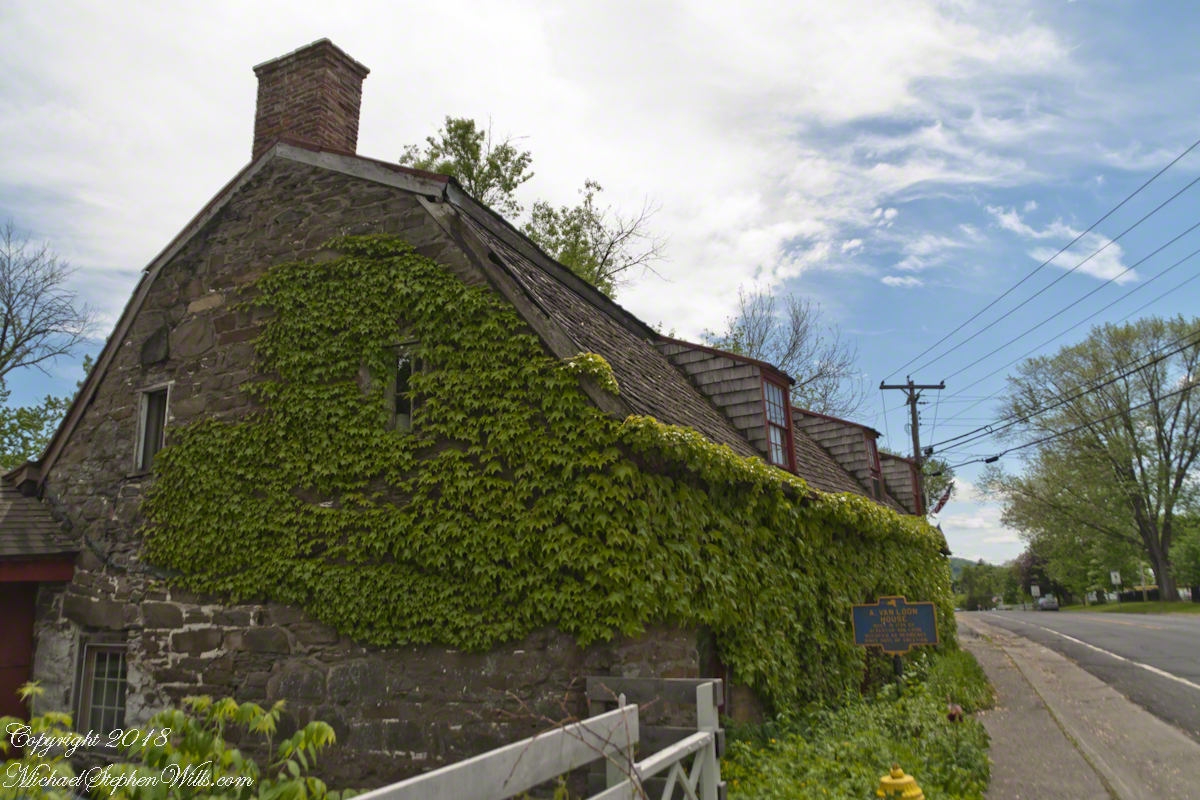
Well cared for…..
…..solid masonry walls with timber additions.
Right on the Hudson River.
Details
Albertus is a Great+ Uncle for Pam. She felt the connection to this place, marveled at the well build masonry and solid windows, absolutely loved the ivy. 85 North Washington was our last stop.
Spiraea bushes in full bloom flanked the Riverside Park along Water Street.
Click any photograph for a larger version
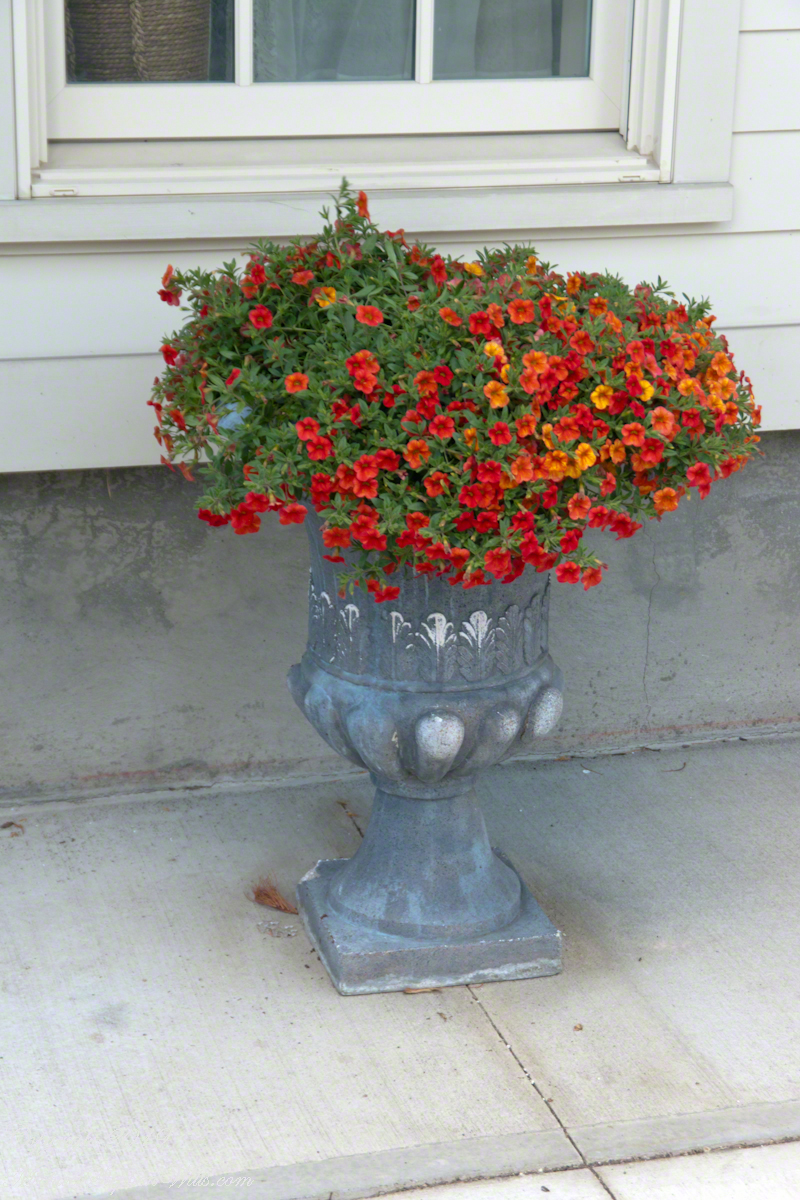
Well cared for…..
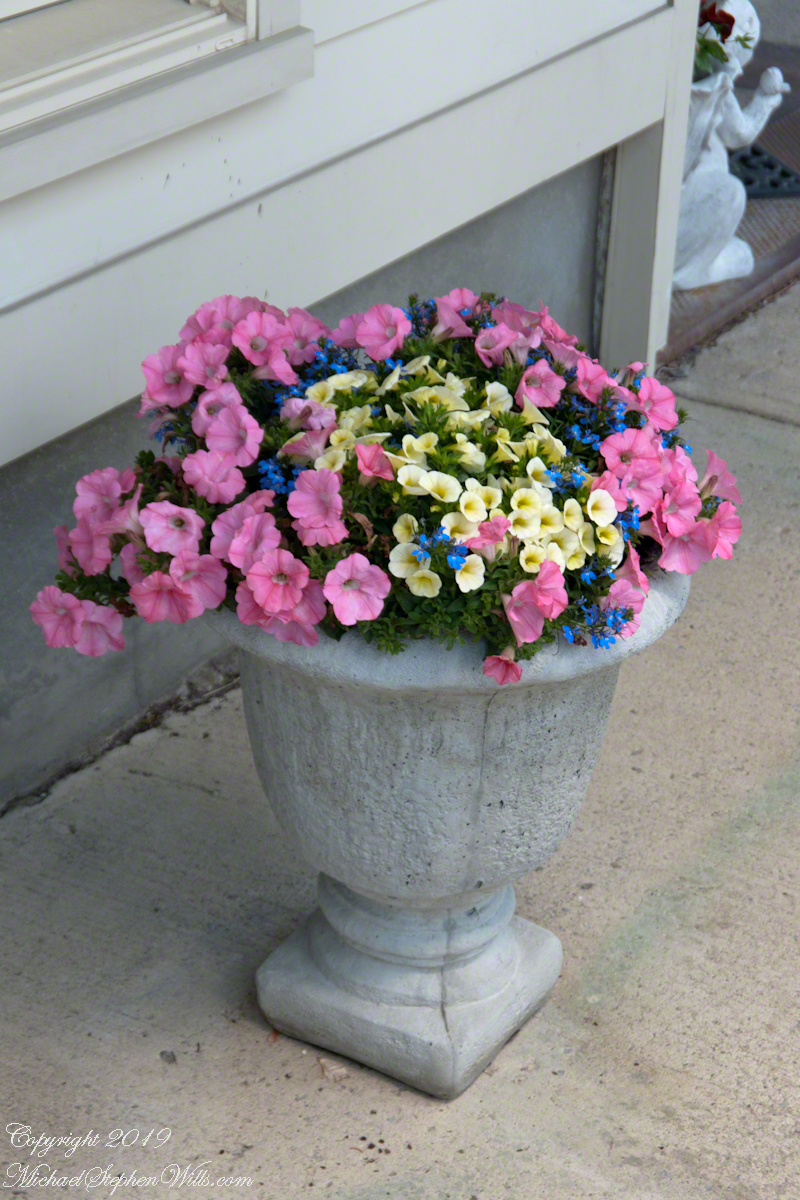
…..as are the urns across the street.
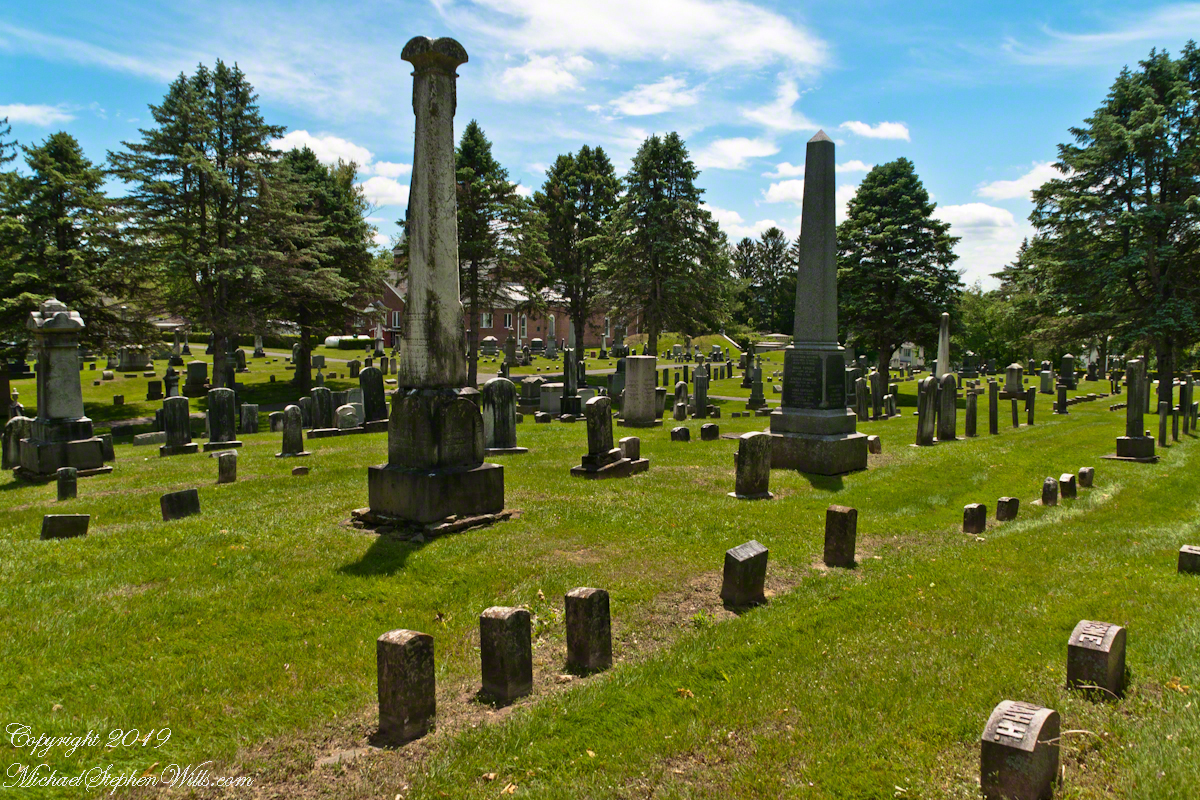
Athens Country Cemetery
Our daughter-in-law and her Mom were a source of post-trip information. “Yan Van Loan” is how Jan Van Loon’s name is pronounced in Dutch, they kindly informed us.
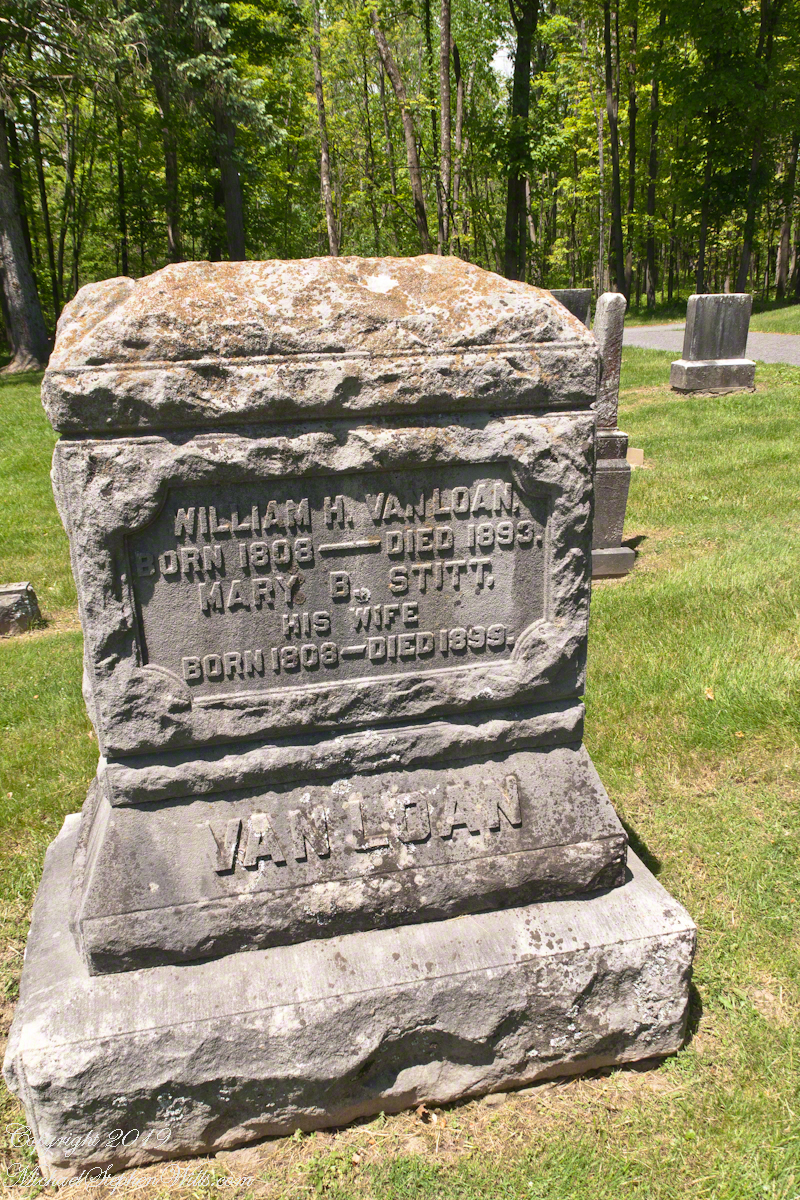
Passage of political control from Dutch to English was decades old when Jan Van Loon acquired his land on the river. By the 19th century the name was anglicized (turned English) on the headstones, spelled as it was pronounced in English. In the 18th century Pam’s ancestors had moved west and south to what became Plymouth, Pennsylvania (Luzerne County). This was before the coal fields, in the 18th century agriculture was the primary industry. Pam’s branch of the Van Loons retained the Dutch spelling and anglicized the pronunciation, as “Van Loon” is pronounced in the English language.
The very old burials were marked with headstones of locally quarried slate, as was common in upstate New York. You can see slate headstones in this video of a Pioneer Cemetery near our home in Ithaca, New York.
In Athens the oldest stones were in the same condition, the lettering and decoration erased by the elements even when the stones are still standing. Some kind people researched the burials and erected a modern, white marble memorial stone with the names and dates of the ancestors named in the records. Jan Van Loon, Maria his wife, or any of Pam’s direct ancestors were not among them.
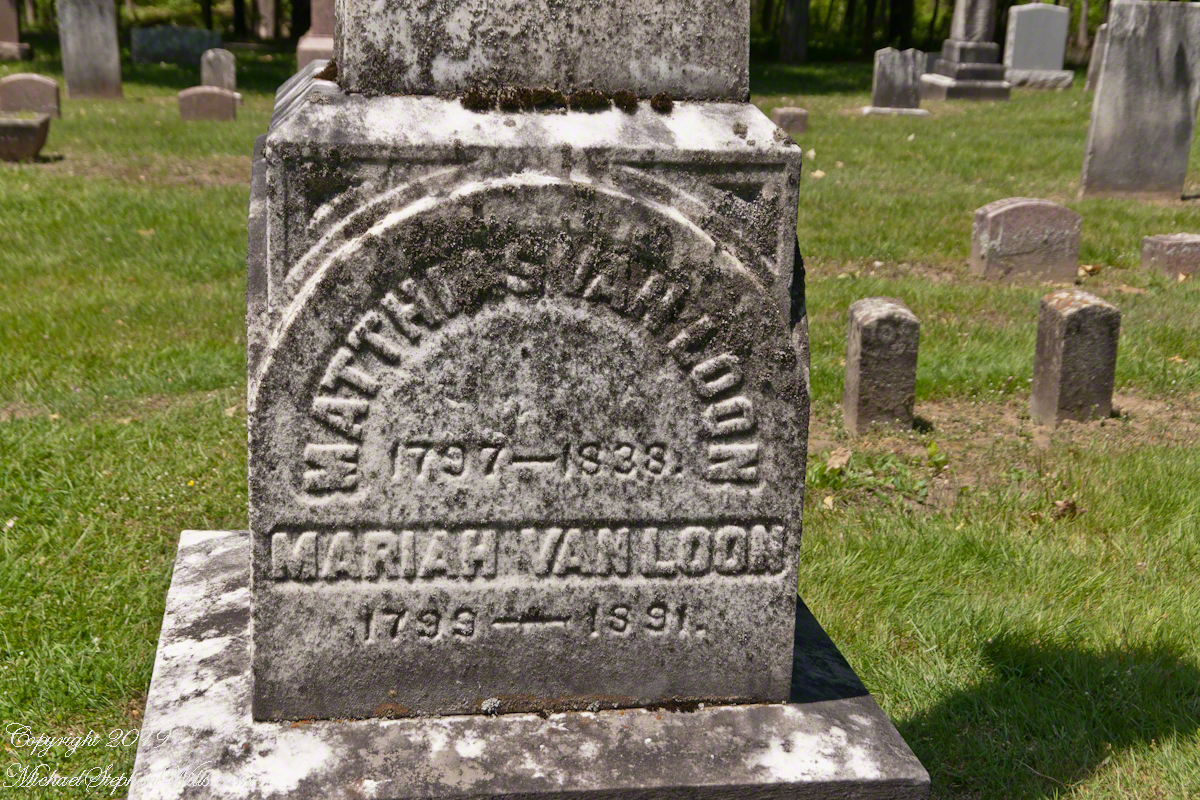
The Matthias Van Loon of this memorial obelisk was a descendant who remained in what became Athens, New York. The following two photographs are of the base and an overview. Matthias Van Loon’s is on the right.
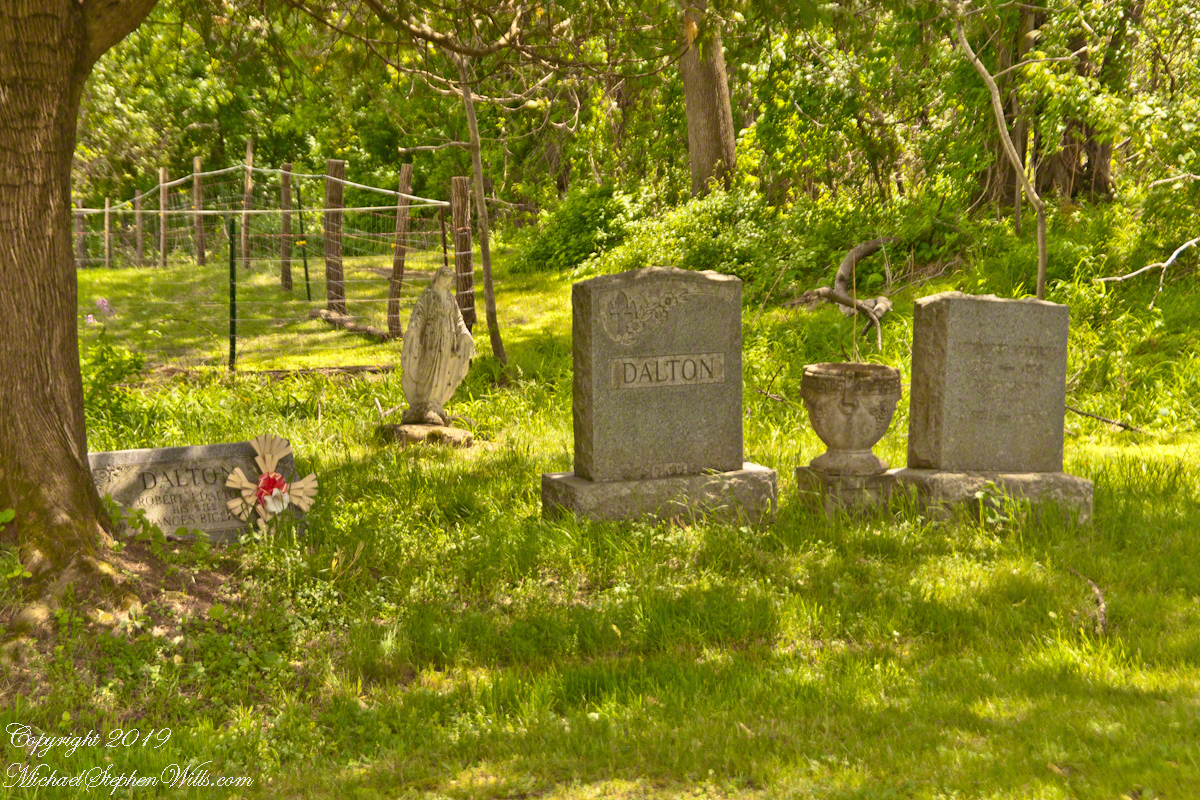
This Catholic burial is on the very edge of the site, as though pushed off to the side. That is the yard of a private home in the background. I started this post with flowers because there was little evidence of familial devotions on these burials of previous centuries.
Pam eventually caught up to report a breakthrough contact made through casual street interactions. She talked to random strangers on 2nd Street hoping to learn more about her ancestor, Jan Van Loon. The breakthrough was a name and phone number of a woman, the daughter of a new acquaintance, and a tip about an old cemetery.
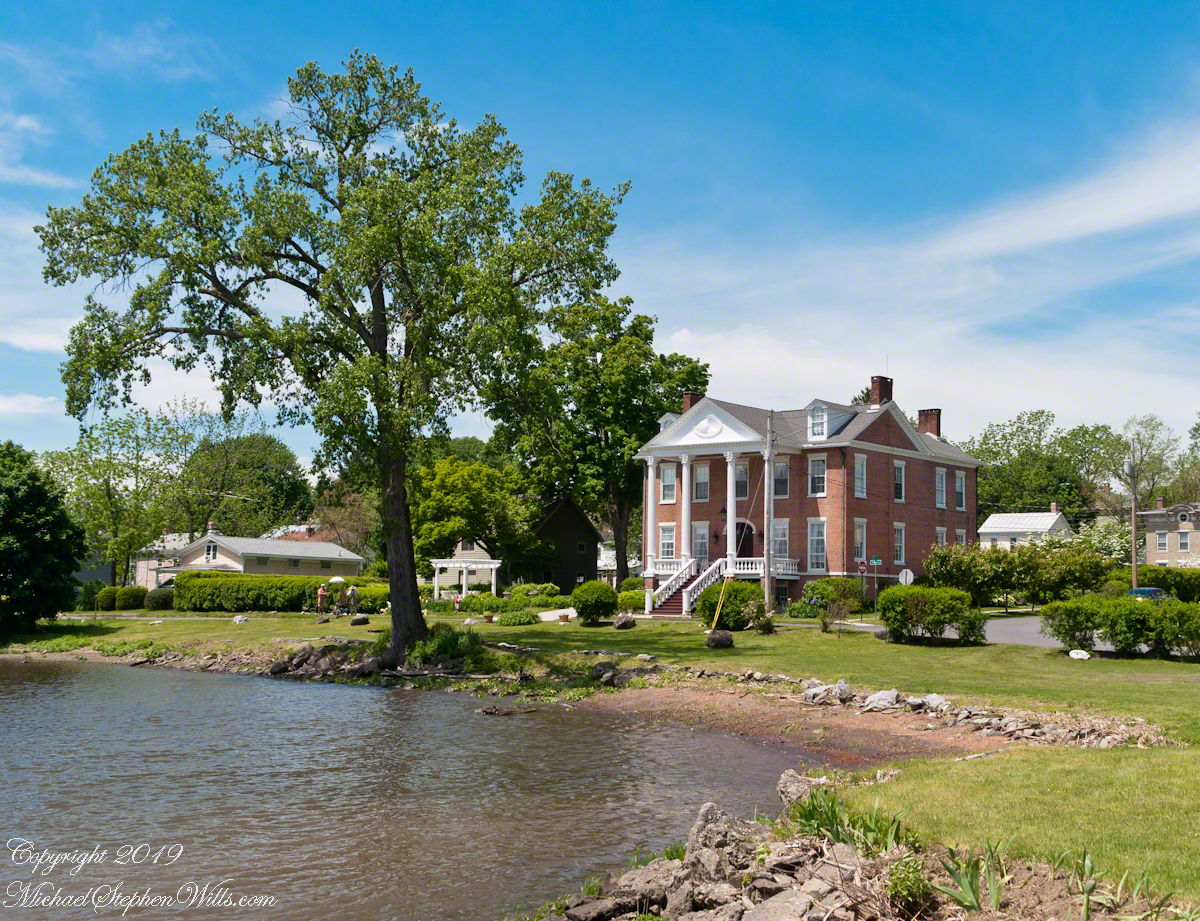
Two people are visible in this first photograph, taken from the south end of Athen’s Riverside Park. Look to the left of the large tree where a artist, under the small white umbrella, is painting while in conversation with a second person. Pam struck up a conversation……
Click any photograph for a larger version
“For Sale: 1825 Federal Home on the Hudson River”
The artist had an easel and a painting in progress, the subjects were yellow irises, part of a formal garden on the grounds of the mansion. We first took it to be a museum or public building of some sort, but were mistaken. It is a home. In the course of a conversation that touched upon Henry Hudson’s 1608 journey up the river (they knew nothing of Jan Van Loon, or of deeper local history in general), and the work of the second man who was the owner of the mansion. Here is more about the place from the Zillow listing. There was no “for sale” sign in evidence.
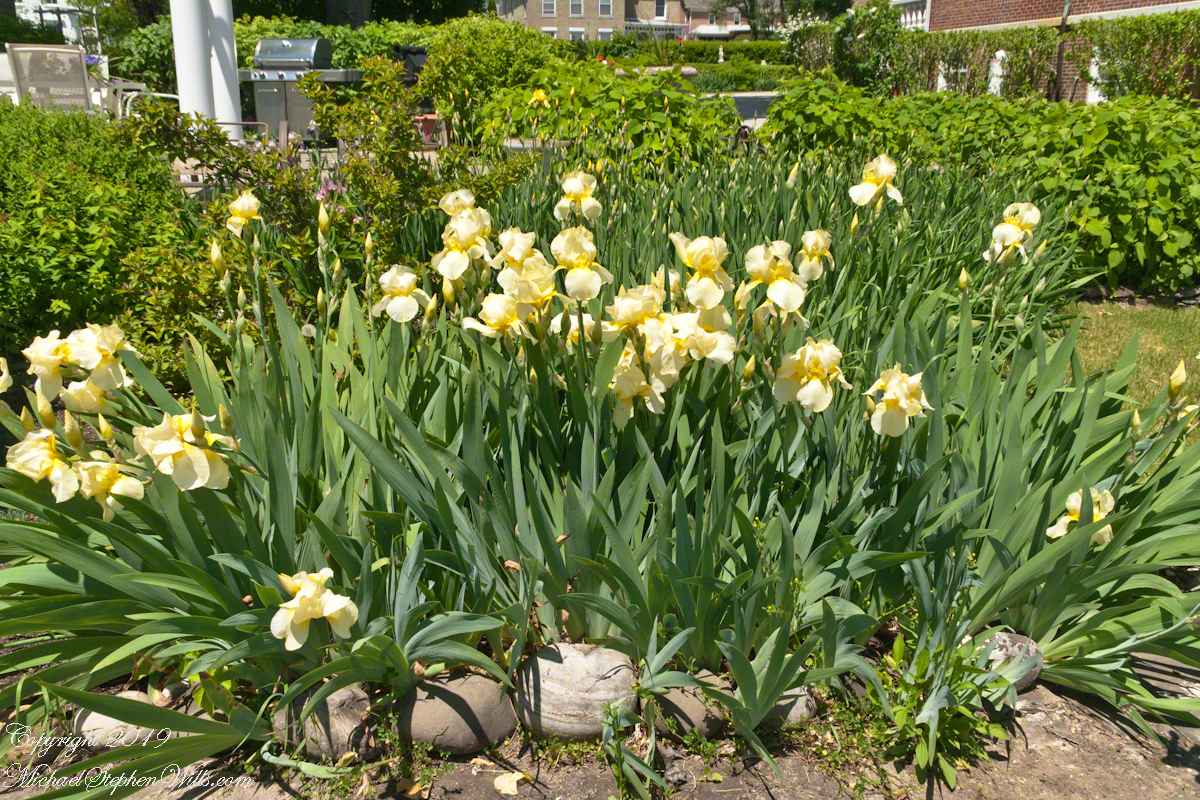
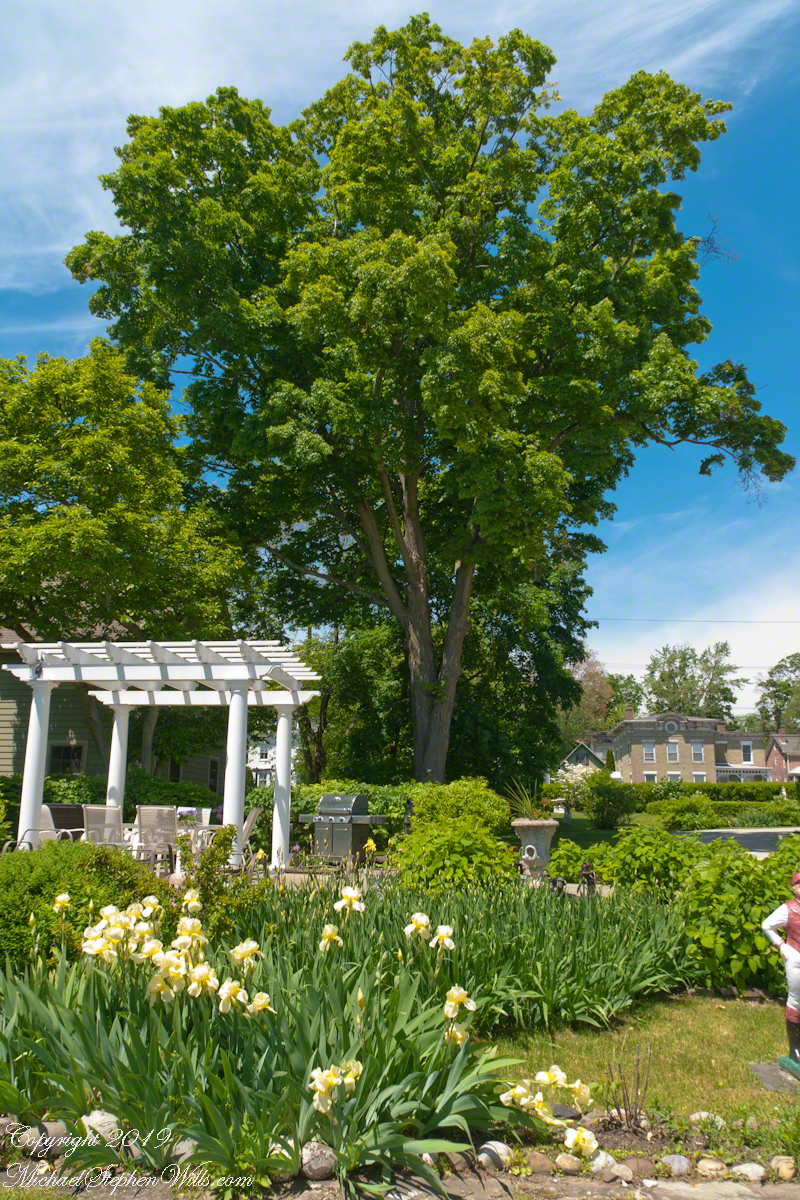
From the portion of the 12 South Water Street garden on the road. We chatted with the house owners and an artist as he painted these yellow iris blooms.
The Zillow Listing…WOW
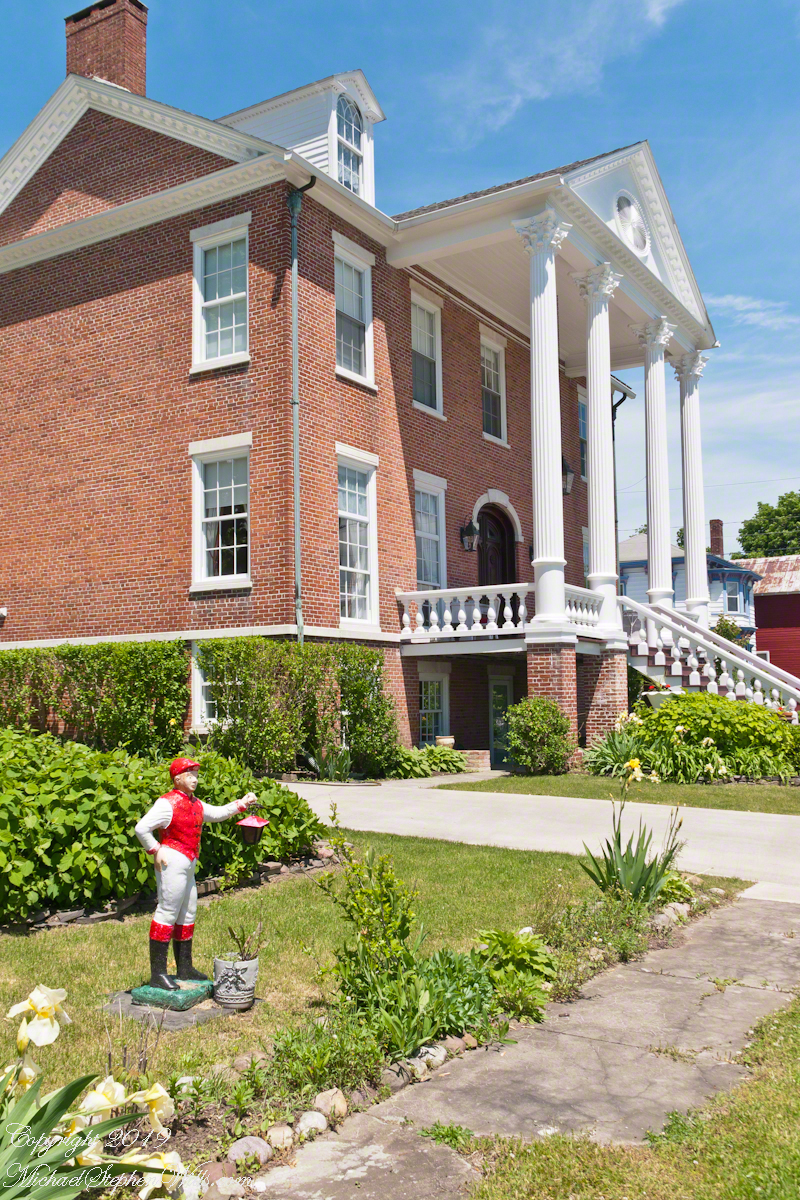
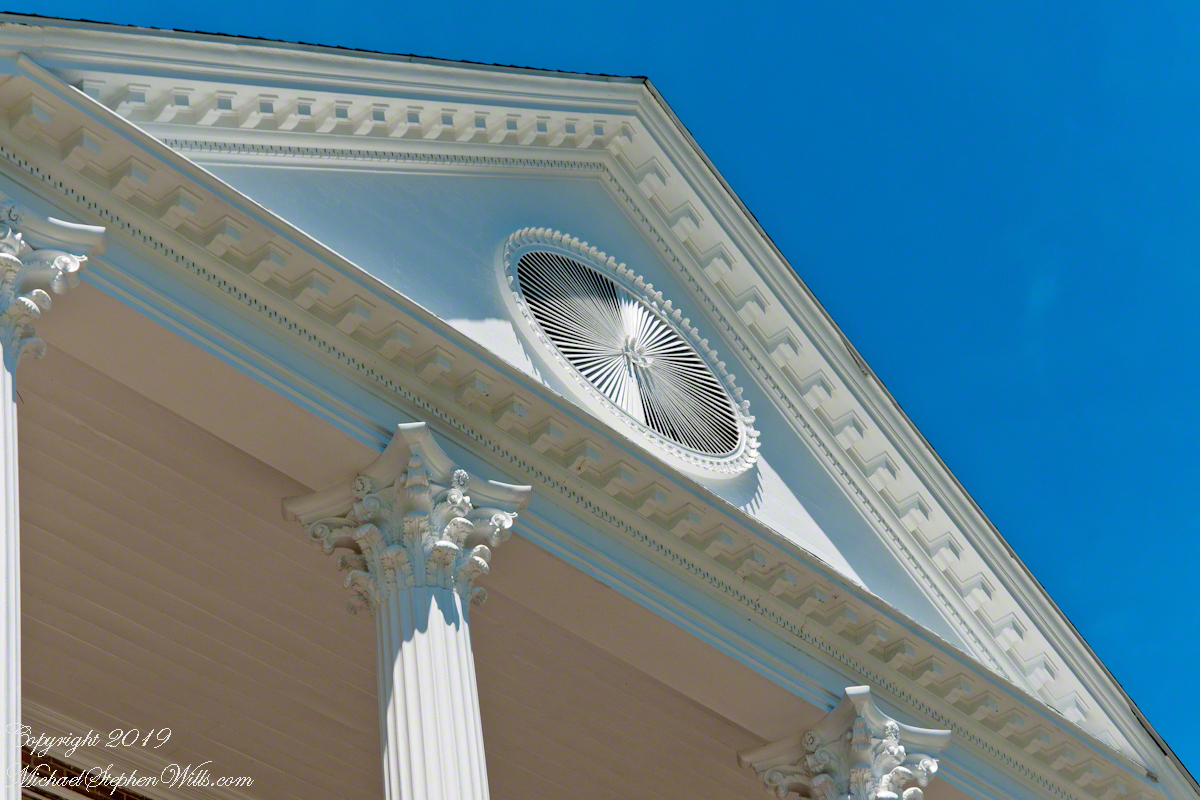
” A freshly renovated home and grounds on the Hudson River, at 12 South Water Street, Athens, New York. Barely visible, to the left of the tree, is an artist, painting large yellow irises while chatting with the owner of the property. Here is what the listing on Zillow has to say, “This majestic 1825 Federal home on the banks of the Hudson River was designed by architect Barnabas Waterman for shipping entrepreneur Anthony Rutgers Livingston. Steeped in history, the house has undergone an extensive – yet sensitive – restoration. Enter into a grand hallway with Double Parlors to the right and a formal DR on the left. Original Federal flourishes abound with acanthus leaf capitals and entablatures, Corinthian columns, and intact mantels and molding. The high ceilings and tall windows provide extraordinary elegance, light and comfort. A thoughtful kitchen renovation and 1/2 Bath for 21st century convenience. Upstairs is a Full Bath and four spacious and airy Bedrooms, the Master with ensuite bath. The walk – out lower level features a family room with fireplace, a full bath and the original kitchen with hearth and beehive oven. A stroll past the box-wood garden leads to a 3-bay Garage with Studio and 1/2 Bath above, perfect for artist, home office or guests. Convenient to Thruway, Catskill, Hudson. 2- hrs NY.”
Formal Garden
Restored Hudson River Mansion
Barely a half mile apart, a great distance separates the homestead of Jan Van Loon and the 12 South Water Street former mansion of a shipping magnate including 125 years and the American Revolution.
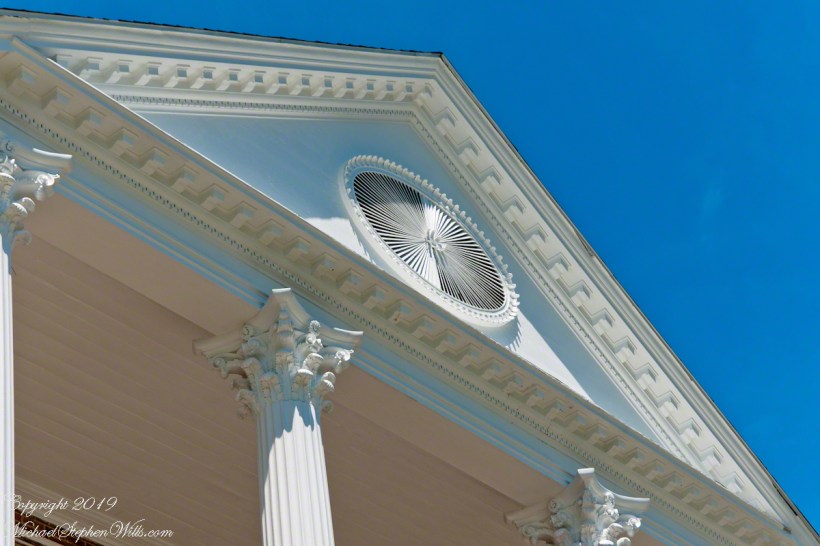
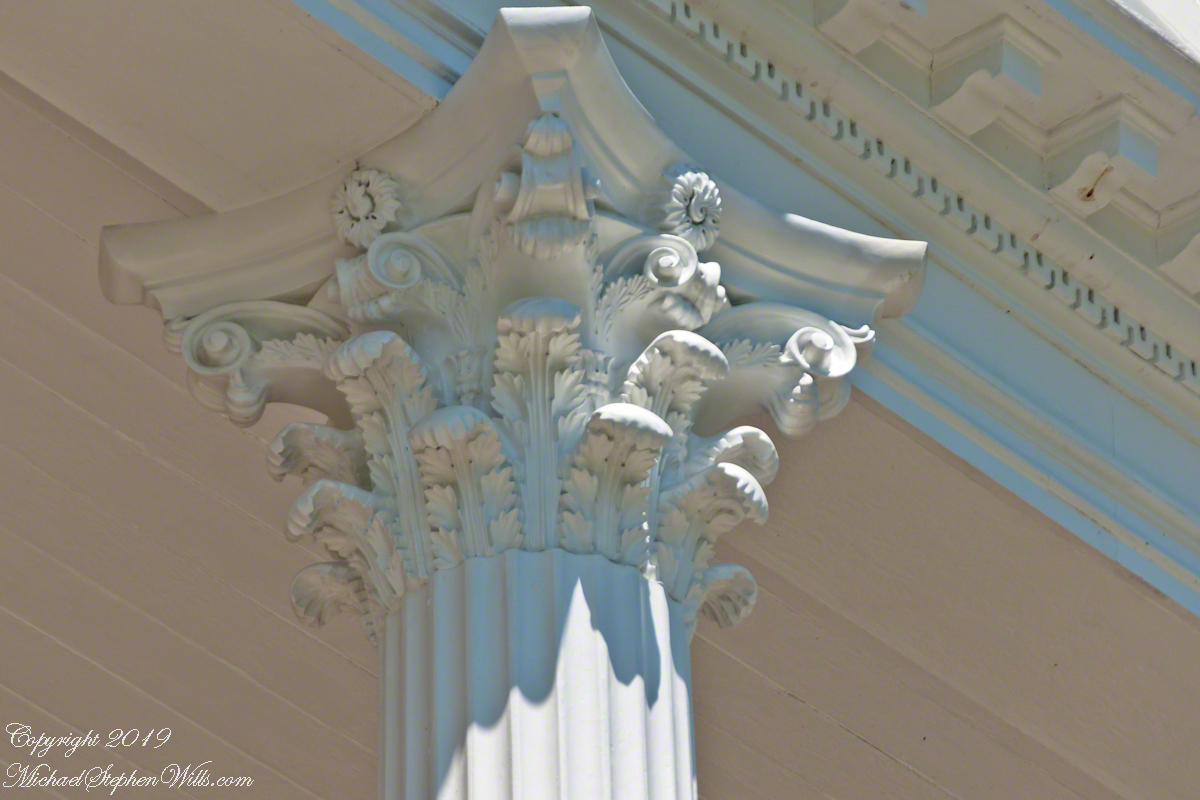
Stylized Acanthus Leaves grace these Corinthian Capitals
Memorial Day Weekend 2019 Pam and I visited Athens, first settled in the 17th Century by an ancestor through her maternal grandmother. Click me for more about the Van Loons. Jan Van Loon is 10 generations removed from Pam and her siblings and is one of 1024 (512 pairs) of ancestors. Whatever became of the other 1022 people (and all those in between) Pam was there with me that day to enjoy the experience of walking around town and talking about Jan Van Loon’s connection to herself.
Click any photograph for a larger version
Founded as Loonenberg, named after the first settler Jan Van Loon. today,Athens is a lovely destination, a historic village on the Hudson River.
We stopped for a very enjoyable latte at Bonfiglio and Bread on 2nd street. As we ambled south on 2nd street Pam spotted someone to talk to and I proceeded with the goal of the Hudson River, visible at the bottom of the street.
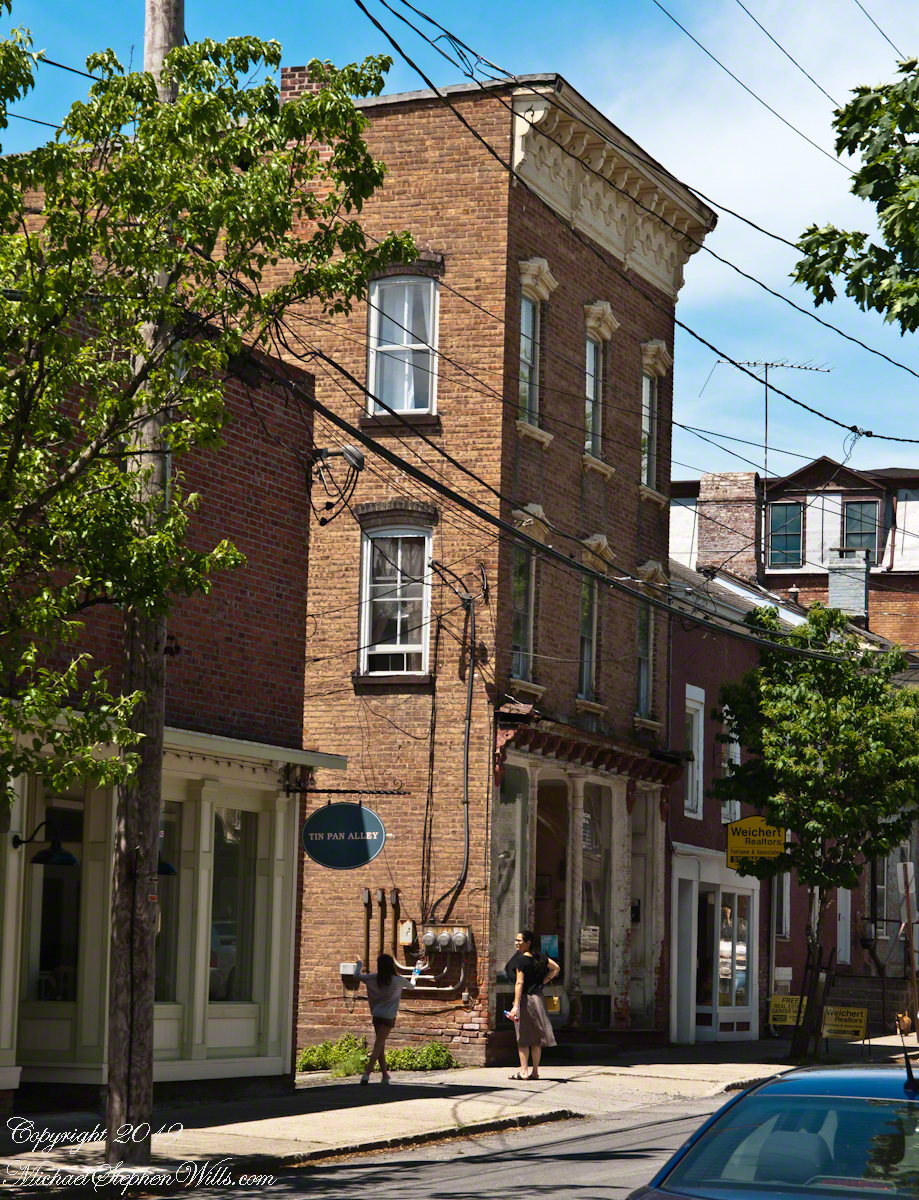
I noticed this architectural specimen and turned to capture this side in a good light and was lucky to capture a young co-admirer of its style with whom I assume is her Mother. Athens, developed as a “National Register Historic Site,” is a charming place to stroll and admire.
Southeast view on 2nd Street between Water and Washington streets. Athens, New York
Hudson Riverfront
Yesterday I did a Red Cross blood donation at an elementary school on Hudson Street here in Ithaca. Henry Hudson, the first European to sail up the river that now bears his name, is memorialized this way across New York State so much so it is unusual to find the “Riverfront Park” named as such.
The city of Hudson, in Columbia County directly across the river named its park “Henry Hudson Riverfront Park.”
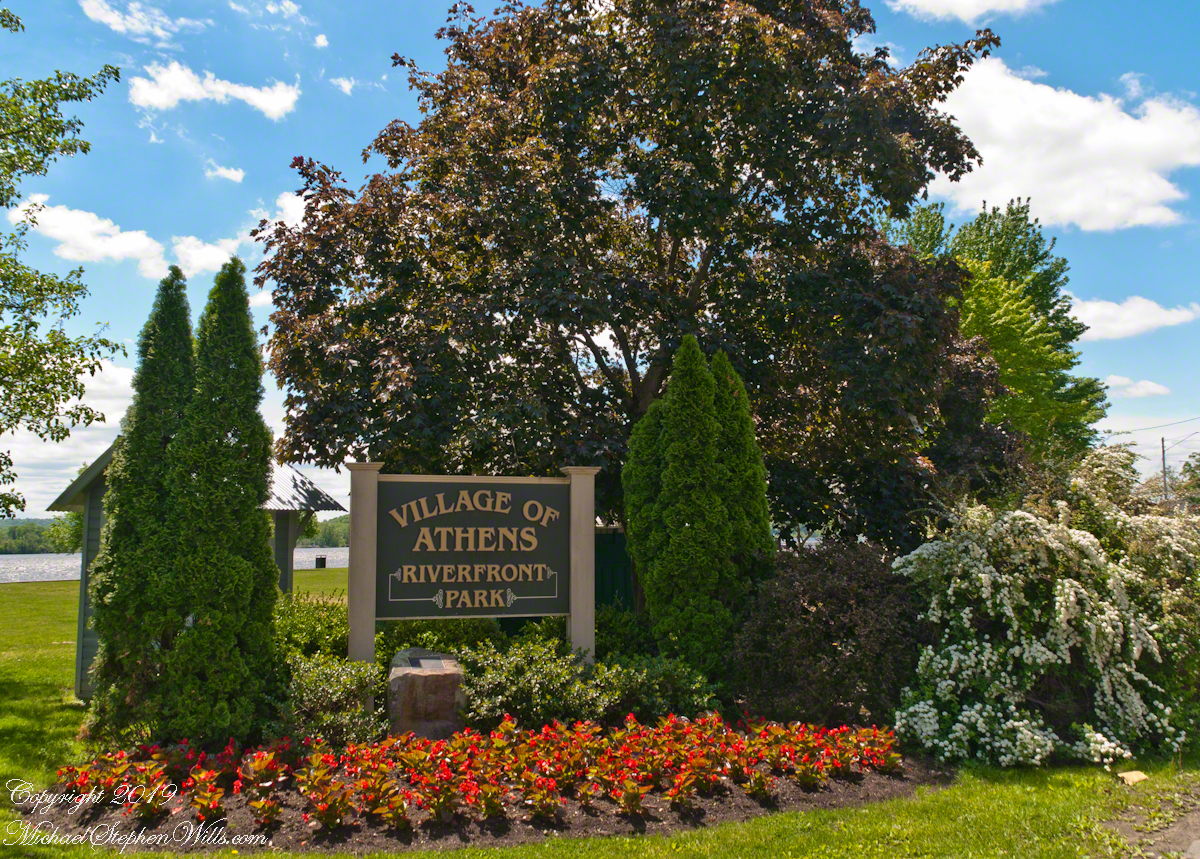
Looking east toward the entrance of the Riverfront Park, Athens, New York. Found at the east end of 2nd Street.
“Peace and Quiet“
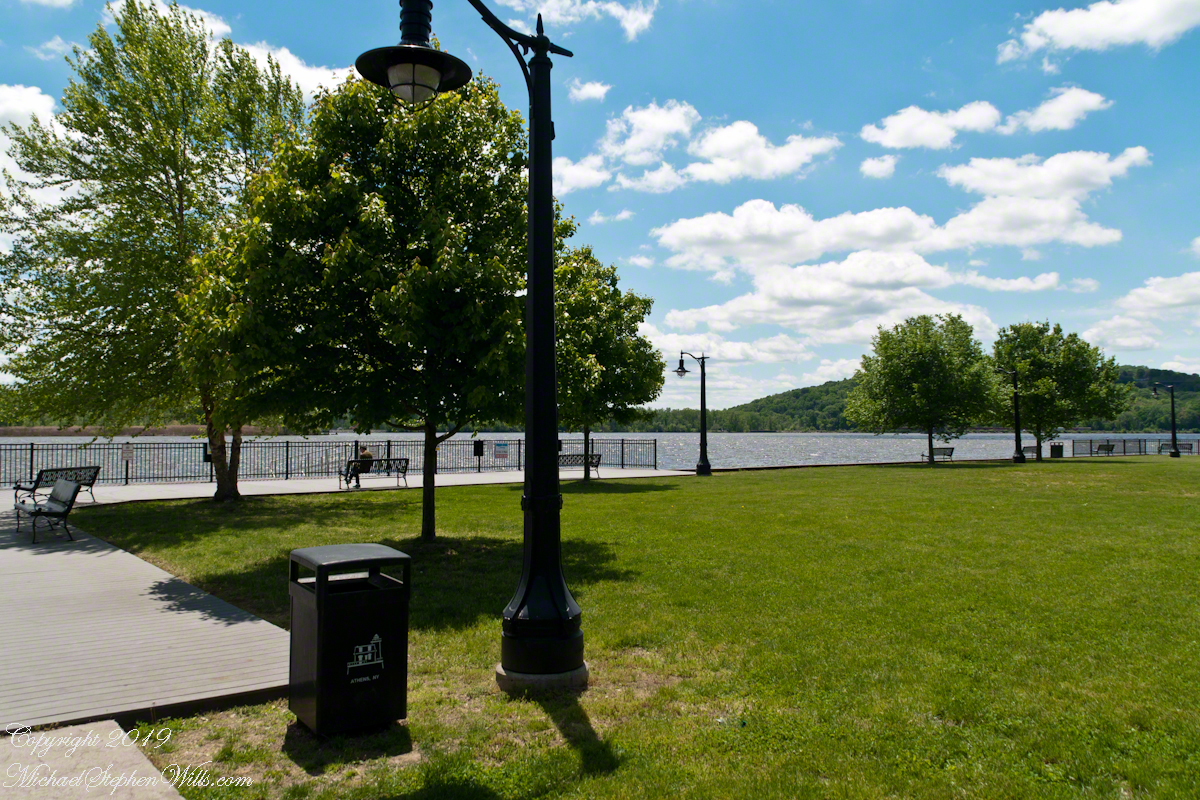
The Athens Park is a gathering place for the village with a large swath of grass, a short boardwalk, benches and generous shade trees along with river…….
The photograph captions will speak for themselves for the rest of today’s post. Enjoy!!
A sole reader enjoys the solitude and view across the Hudson. A large mid-stream island, Middle Ground Flats, provides a swath of green instead of a view of the city Hudson.
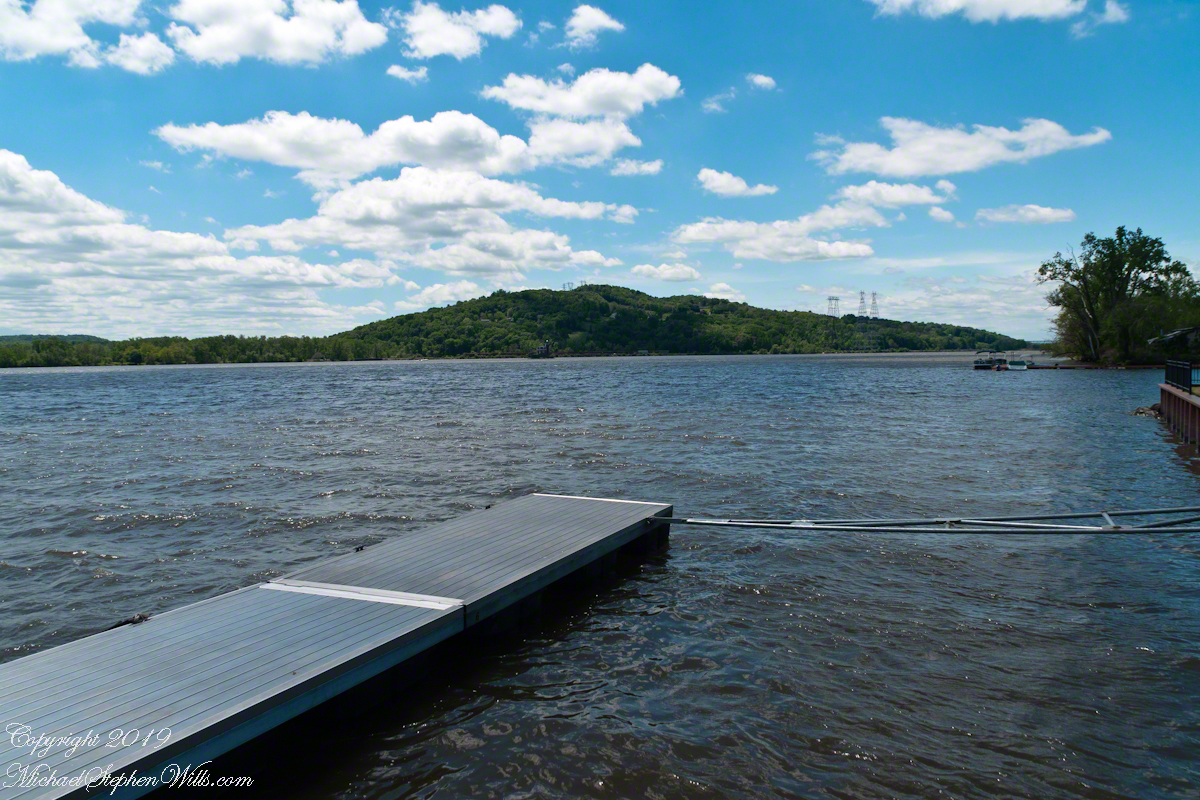
…and a dock.
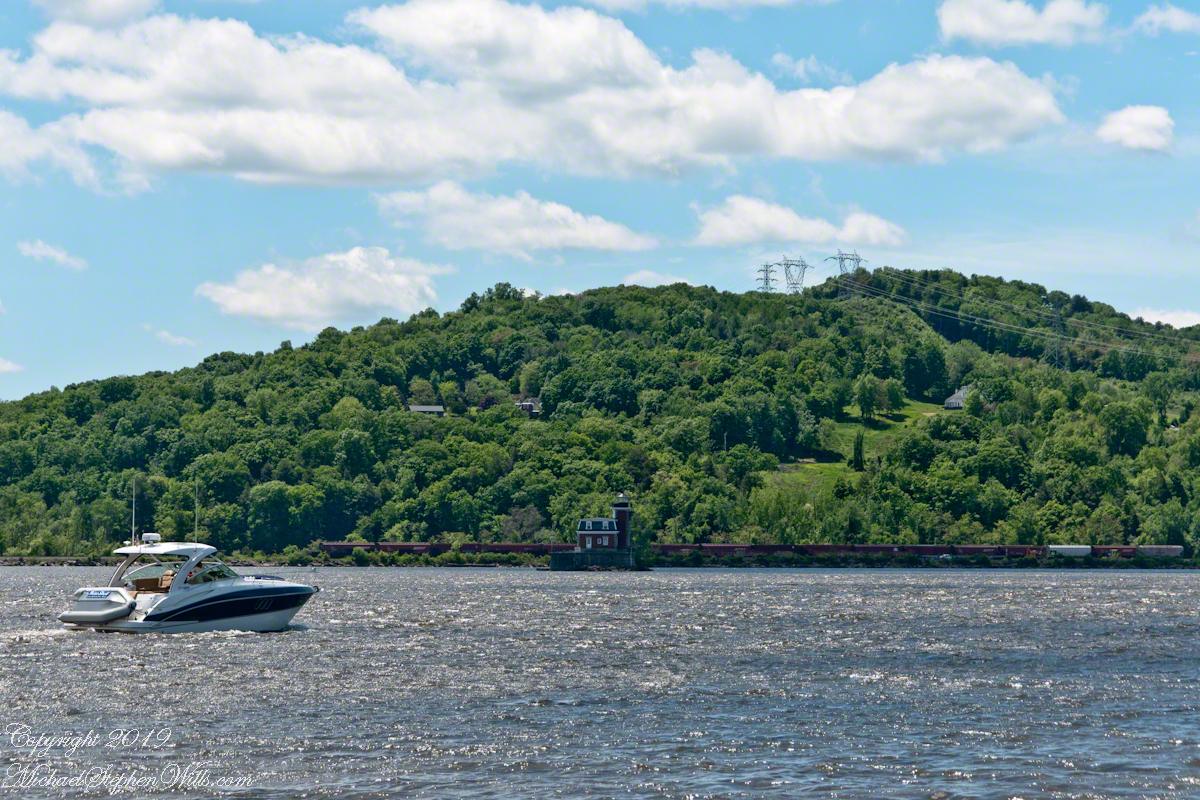
The map shows a dotted line between this dock in the Athens Riverside Park and the Henry Hudson Riverside park of the city of Hudson. Barely visible in front of the wooded hills is the Hudson-Athens lighthouse.A pleasure craft motoring south on the Hudson River passes in front of the Hudson-Athens Lighthouse. On the eastern shore is a line of freight cars. Amtrack uses this line for service between New York City, Albany and beyond. We have enjoyed this Hudson River view from the train and highly recommend that trip.Built 1874, the Hudson-Athens lighthouse guides traffics around the island named “Middle Ground Flats.”