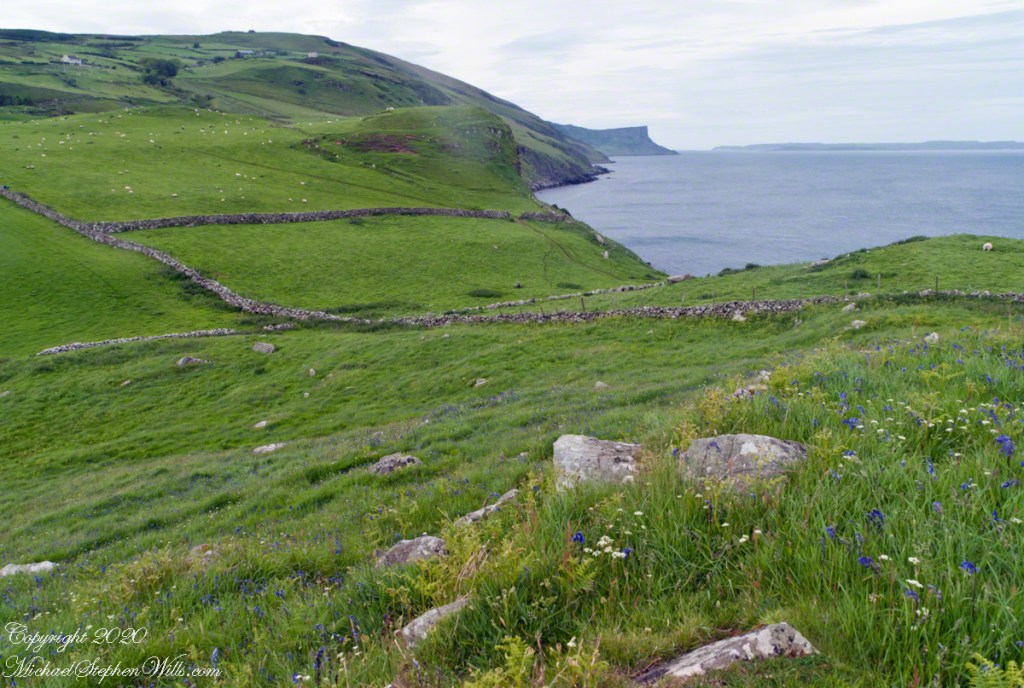
Standing on Torr Head the sights, every direction, overwhelmed the senses. With the camera I was able to capture views even today are coming into my understanding.
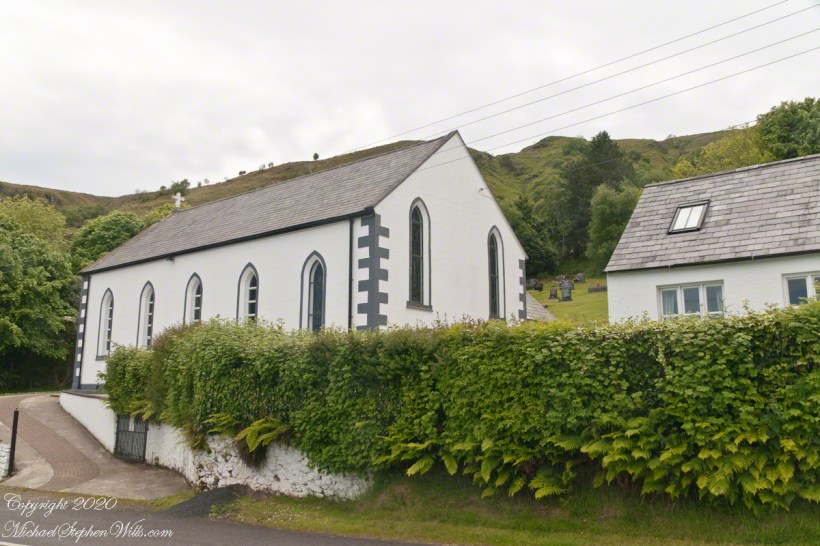
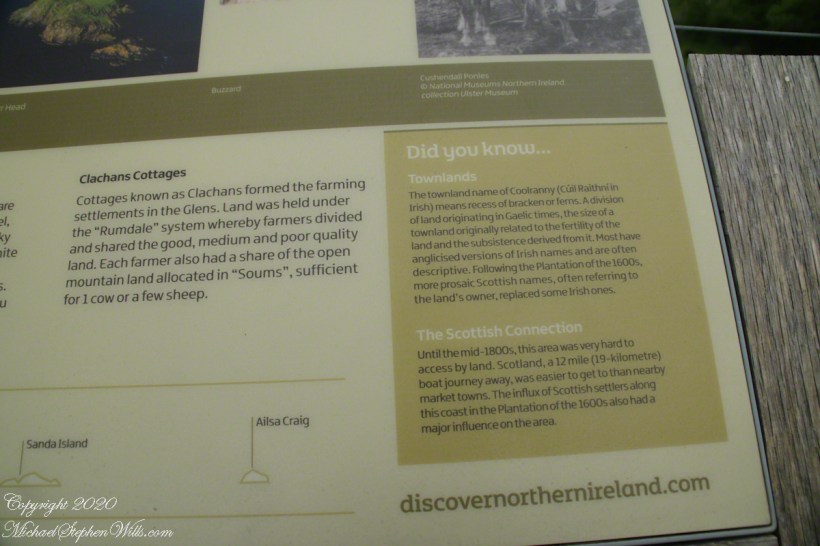
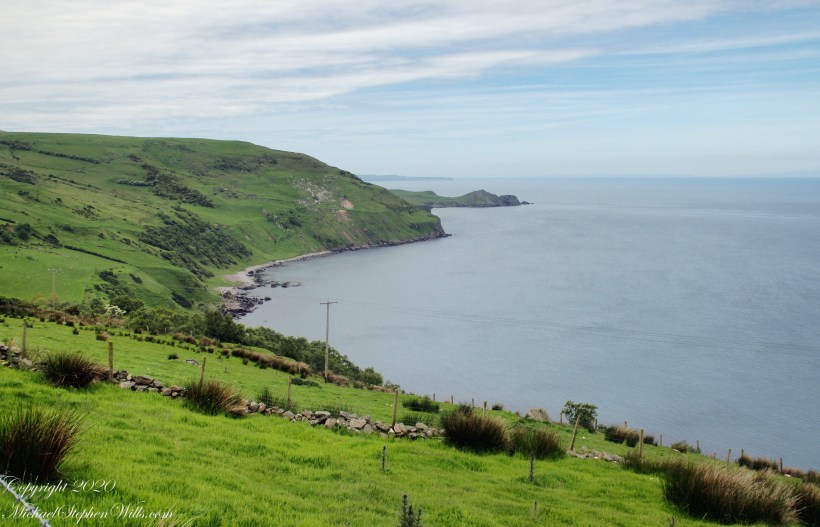
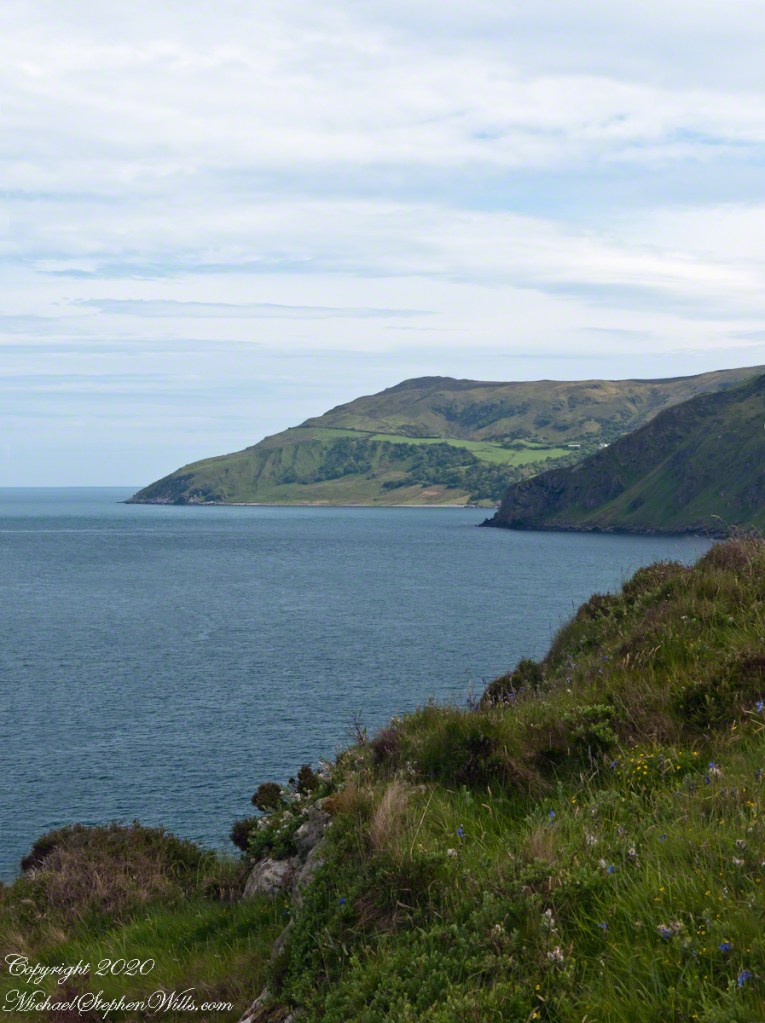
Tor in Irish is a steep rocky height. Likewise, Corr means odd, uneven, rounder, convex, curved, peaked, projecting, smooth. Combined, Torcorr is the townland where we stopped on the Torr Road, halted by our wonder at this sight. This photograph looks toward the vantage from which the previous photograph was taken, Torr head.
Looking toward Torr Head from Torcorr Townload, across Loughan Bay
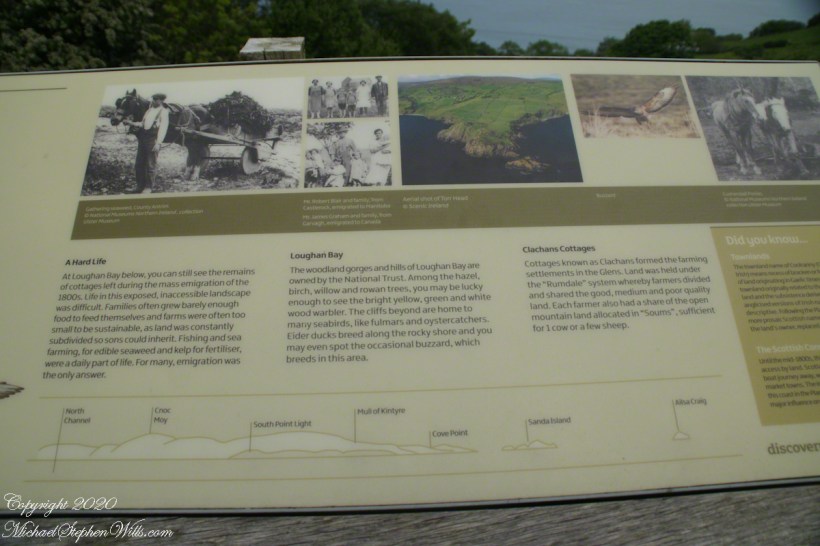
In the distance, Torr Head projects into North Channel, the closest land to Scotland. Following the coast, the unnamed point in front of Torr Head is home to numerous sea birds such as Fulmars (family Procellariidae) nad Oystercatchers (family Haematopodiadae). Along the rock beaches next Eider Ducks (genus Somateria). You might see the Common Buzzard (species Buto buteo).
A third technique to solve a tilted horizon, first described this post, is the counterpoint to the second technique and a variation of the first technique. Instead of building out, this solution is to crop the blank space also removing a portion of the image.
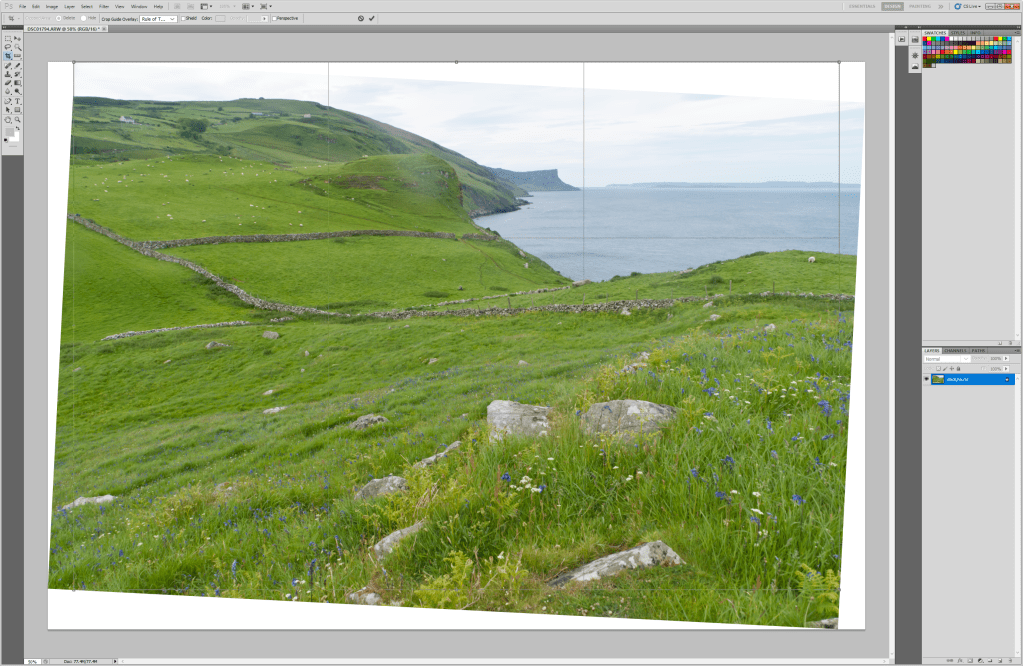
Here is a Photoshop screen capture from just before the crop is executed. The grid of fine lines is the Crop tool. For example, on the upper right corner a portion of Rathlin Island, the water, a slice of land are removed along with the blank portion.
Note from the Photoshop screen capture, the blank space along the upper margin is NOT removed. To do so will ruin the composition, the top of the hill on the upper left would be removed. Instead, I used the second technique to copy the sky over the blank portion left after cropping.
Click photograph for a larger view. To do this from WordPress Reader, you need to first click the title of this post to open a new page.
The second solution post describes how copying content onto the blank space can cause duplication of image features. In the above example, I need to perfect the image, modifying the clouds OR perfect the copy process to avoid the duplication.
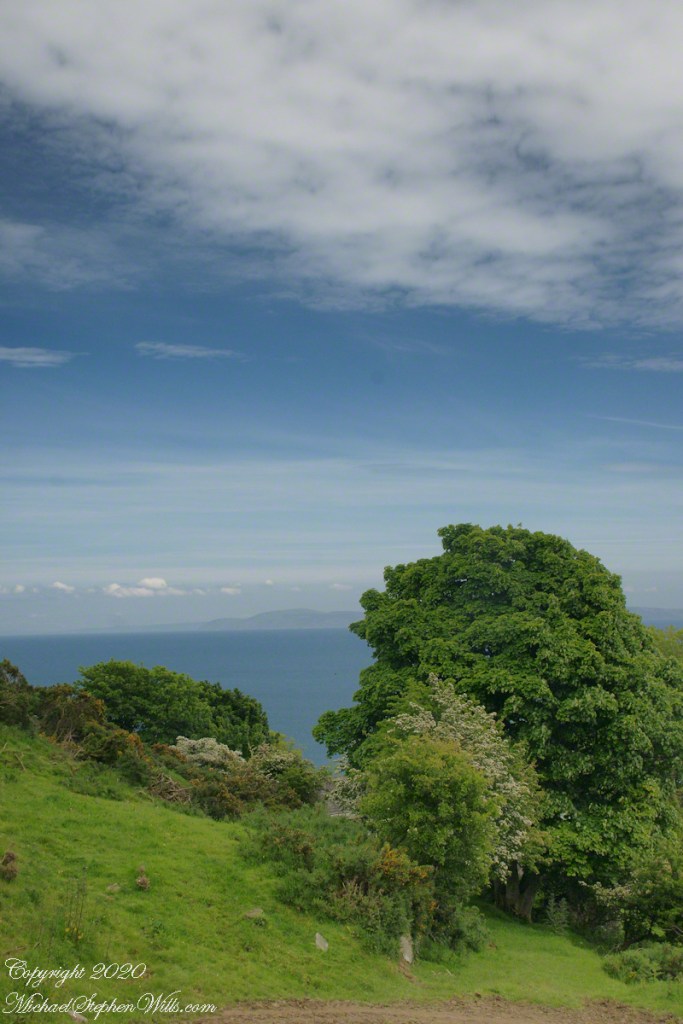
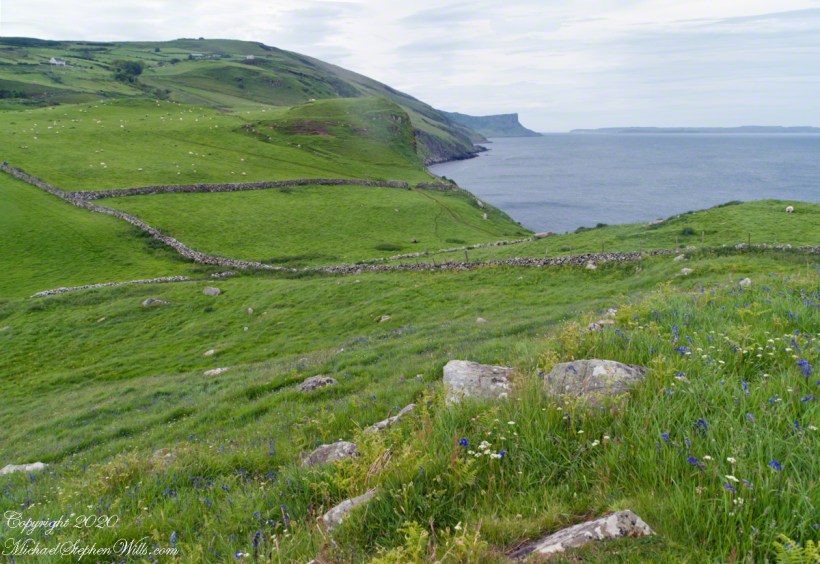
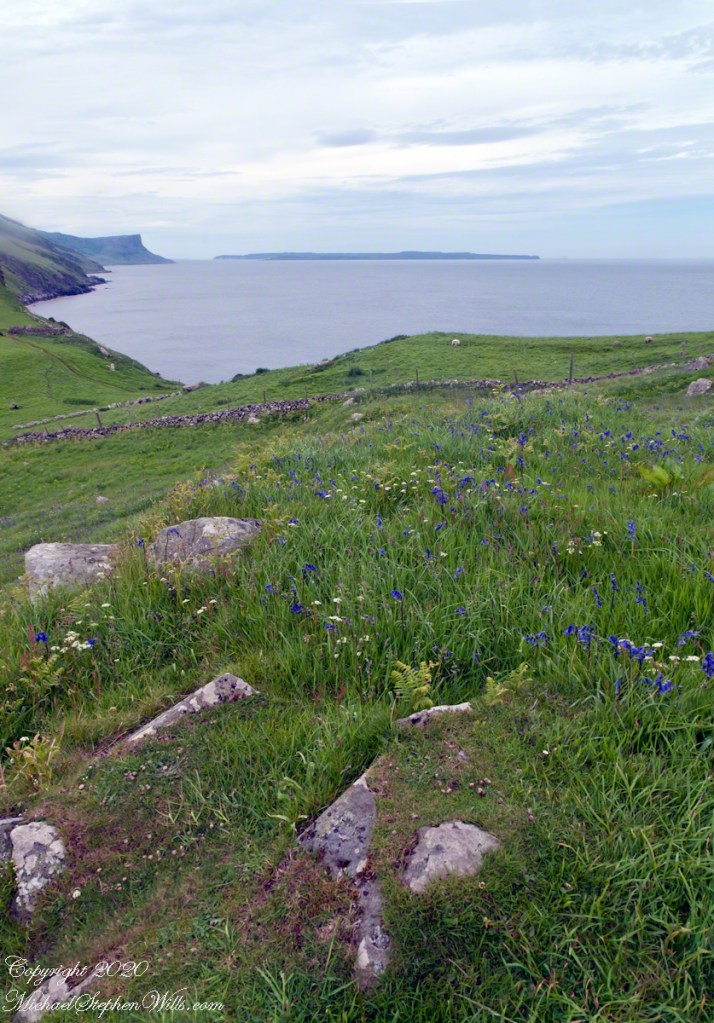
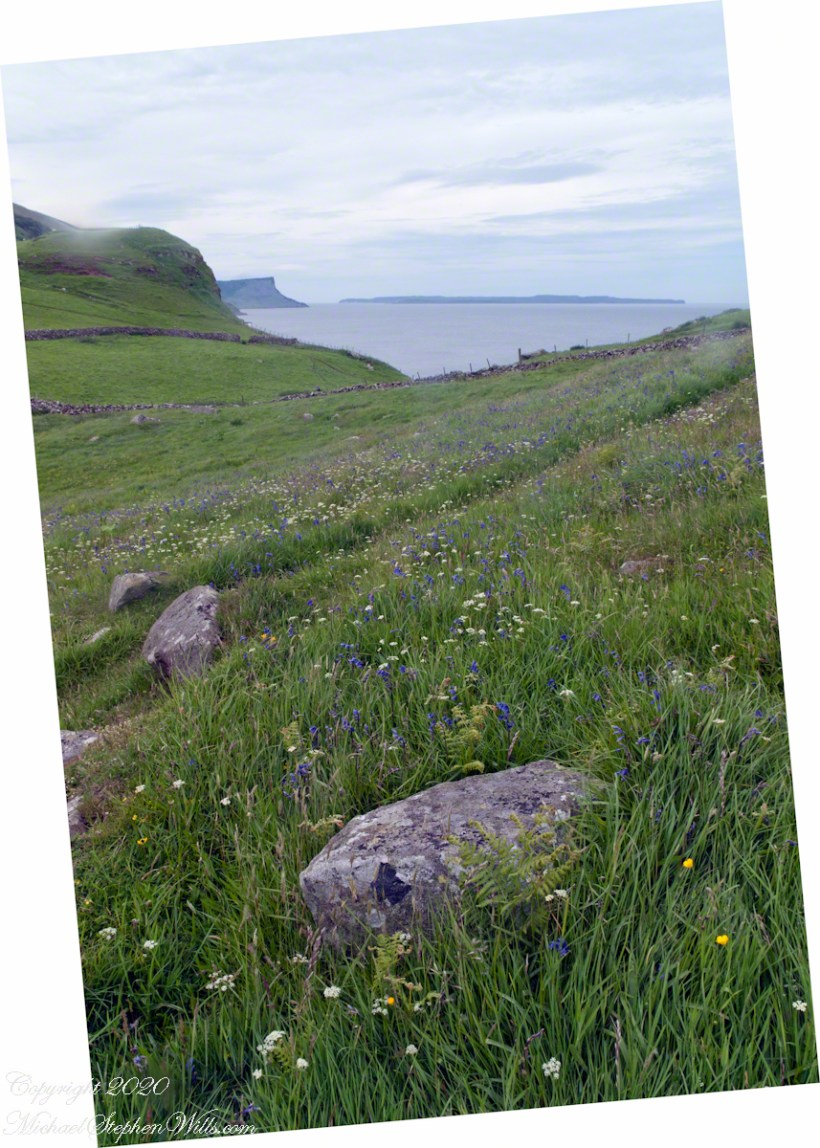
The end result is a view of wildflower meadow, foreground, coastal sheep pastures running up the high hill. Named Greenanmore, the hill is a site notable for a neolithic passage tomb. The distant land across the North Channel water is Rathelin Island.
Here is a slideshow of the corrected images of this series. To visit from WordPress Reader, you need to first click the title of this post to open a new page.
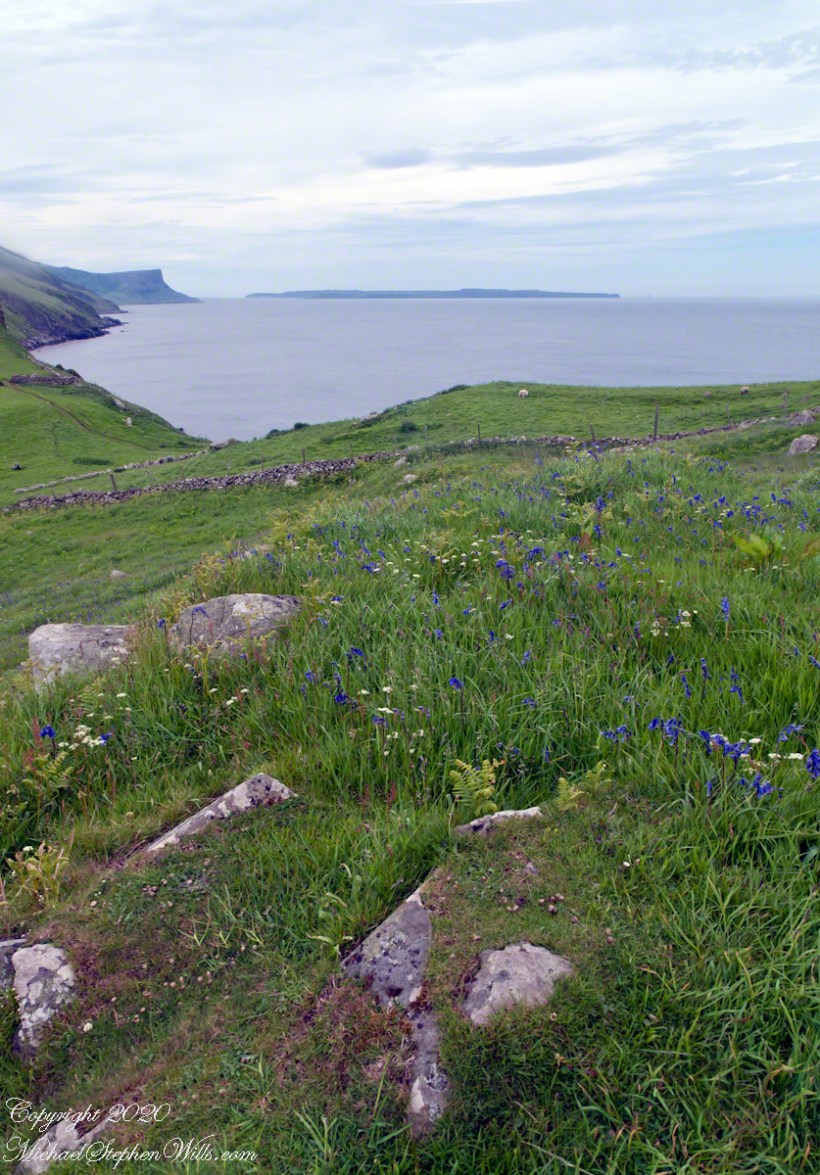
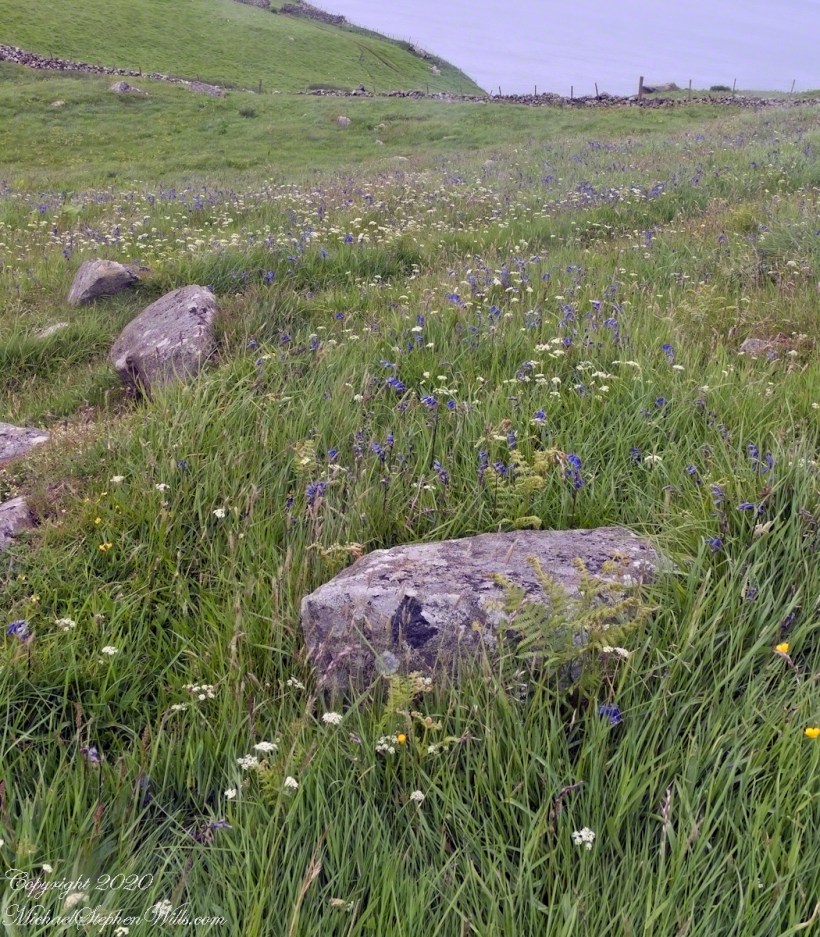
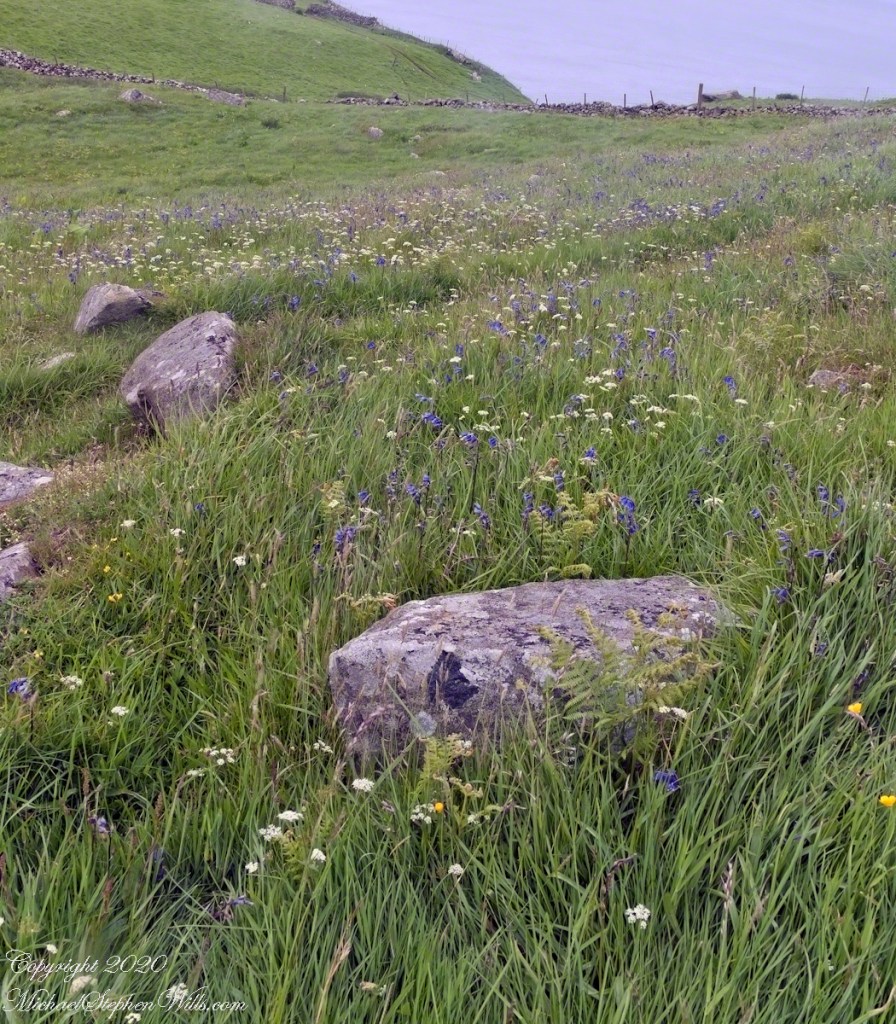
I worked around the crooked horizon, cropping to the wildflower meadow.
Another solution to the crooked horizon is to level, crop, and build out the lost portions, as I did here. Very time consuming….better to keep the horizon level in the camera, difficult for me to remember.
Taking in a wildflower meadow, foreground, coaster sheep pastures. The high hill, midground, is Greenanmore, a site notable for a neolithic passage tomb. The distant land across the North Channel water is Rathelin Island.
Copyright 2020 All Rights Reserved Michael Stephen Wills
Click photograph for a larger view. To do this from WordPress Reader, you need to first click the title of this post to open a new page.
Another solution to the crooked horizon is to level, crop, and build out the lost portions, as I did here. Very time consuming….better to keep the horizon level in the camera, difficult for me to remember.
Here is the second approach to correction of the tilted horizon problem that was first described this post.
A time intensive technique is, after straightening the image, to build out the blank sections. Here is an image after straightening. Corrected image size increases with degree of tilt, measured by the degrees of correction with the area of size increase being blank. It is this blank space that is filled by this technique.
The technique is to open a copy of the image, leaving the original unchanged, then, with Photoshop Lasso tool, select a portion to copy to clipboard, then to the blank space. A great deal of time is consumed by the trail-and-error approach required.
The sky was the simplest, the cliffs most difficult. The grass and flowers were not a difficult as they first appear. I varied feathering with sky the highest (30 pixels), grass and flowers at 10 pixels. Another general maxim is to run the lasso line through pixels the most similar to each other. After pasting use the Move tool to place the new layer.
A common effect to avoid is duplication of image elements. For example, after copying there are duplicates of flowers. This can be corrected through use of the Erase tool to reveal original image elements under the copied layer.
The cliffs on the upper left were impossible to correct. I solved this corner by running the Lasso line through the sky, water and grass. As a result the space between Rathlin and the “mainland” is wider.
Here is a slideshow a straightened, uncorrected and straighted, corrected images. To visit from WordPress Reader, you need to first click the title of this post to open a new page.
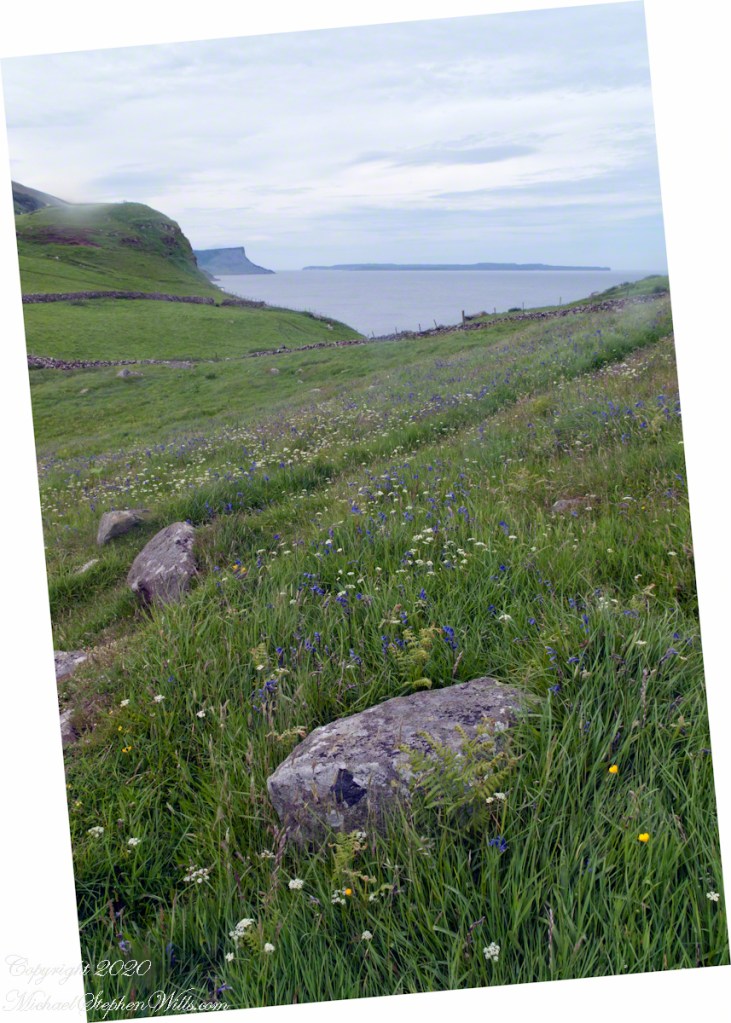
Taking in the foreground, I neglected to maintain a level horizon. Leveling the image results in too much cropping. View from Torr Head, north.
Another solution to the crooked horizon is to level, crop, and build out the lost portions, as I did here. Very time consuming….better to keep the horizon level in the camera, difficult for me to remember.
Copyright 2020 All Rights Reserved Michael Stephen Wills
In Photoshop, make a copy of the file and crop out reference to the crooked horizon. In this case, my focus is the wild flower meadow. The raw image was large enough leave enough pixels for a usable image.
Here is a slideshow a straightened, uncorrected and straighted, corrected images. To visit from WordPress Reader, you need to first click the title of this post to open a new page.
Taking in the foreground, I neglected to maintain a level horizon. Leveling the image results in too much cropping. View from Torr Head, north.
I worked around the crooked horizon, cropping to the wildflower meadow.
Copyright 2020 All Rights Reserved Michael Stephen Wills
Click photograph for a larger view. To do this from WordPress Reader, you need to first click the title of this post to open a new page.
For this photograph using a handheld Sony Alpha 700 dslr, taking in the foreground wildflower meadow, I neglected to maintain a level horizon.
Leveling the image results in too much cropping of this view from Torr Head, north. The best approach is to level the camera. When using the handheld technique, I found many lenses have guides in the view finder the horizon can be lined up against. This technique is useful for a tripod mount. Later camera models have a feature that displays a level, handy for use with a tripod. For the handheld technique, these cameras provide a viewfinder leveling grid.
The next few days I will explore some solutions to the problem of corrected for a crooked horizon.
Copyright 2020 All Rights Reserved Michael Stephen Wills
Betelgeuse, AKA “Alpha Orionis”, was the first star disk, other than our Sun, measured. One hundred years ago the apparent size of Betelgeuse was then as now 0.003% of the sun. I bring this up because this “red” star at the end of its life cycle, is in the news, being now 40% of its brightness last year.
Betelgeuse is so far away this dimming is 700 year old news, the time it takes for light span the distance. News of our sun is more recent, sunlight informs us of the Sun’s surface from 8.33 minutes ago. Sunlight bursts from clouds to the camera in an instant of a second. In comparison my reactions to capture it are glacial. Sixteen seconds passed since the images of Series 6, time for three exposures at a slowed pace now the sun breaks free from the clouds.
Twelve minutes, fifty four seconds elapsed from the first images of this series. Seventy nine exposures taken with 16 selected moments, these last without the sand mirror.
Click photograph for larger image. To do this from WordPress Reader, you need to first click the title of this post to open a new page.
Exposure: 1/400 sec at f / 4.5, Focal Length: 24 mm, ISO 100
A Willet feeds in the new day. This is a species sandpipers, a cousin of the Sanderling of yesterday’s post.
Exposure: 1/400 sec at f / 5/0, Focal Length: 24 mm, ISO 100
All sixteen Sunrise Texture moments are presented below.. Suggestion, for this series in a larger format, open a separate browser tab for each post. At series end you will then have eight (including the very first post a few weeks ago) landscapes to compare.
Exposure: 1/6 sec at f / 22, Focal Length: 24 mm, ISO 125
Exposure: 1/250 sec at f / 4.0, Focal Length: 24 mm, ISO 125
Exposure: 1/250 sec at f / 4.0, Focal Length: 24 mm, ISO 125
Exposure: 1/10 sec at f / 22, Focal Length: 24 mm, ISO 125
Exposure: 1/250 sec at f / 4.0, Focal Length: 24 mm, ISO 125
Exposure: 1/320 sec at f / 4.5, Focal Length: 24 mm, ISO 125
Exposure: 1/400 sec at f / 5.0, Focal Length: 24 mm, ISO 250
Exposure: 1/15 sec at f / 22, Focal Length: 24 mm, ISO 250
Exposure: 1/400 sec at f / 5.0, Focal Length: 24 mm, ISO 250
Exposure: 1/400 sec at f / 5.0, Focal Length: 24 mm, ISO 250
Exposure: 1/400 sec at f / 5.0, Focal Length: 24 mm, ISO 250
Exposure: 1/500 sec at f / 5.6, Focal Length: 24 mm, ISO250
A sanderling is a species of sandpiper. Exposure: 1/320 sec at f / 4.5, Focal Length: 24 mm, ISO 100
Exposure: 1/8 sec at f / 22, Focal Length: 24 mm, ISO 50
Exposure: 1/400 sec at f / 4.5, Focal Length: 24 mm, ISO 100
Two minutes pass from Series 5, and not because I have stopped snapping. My routine is to insert a (automated) sequential number into each filename. Using this it is possible to calculate the number of exposures in a series. Since Series 5, 16 were snapped before the first I could use in Series 6. Ten exposures between the first and last of Series 6, during which a minute, twenty eight seconds elapsed..
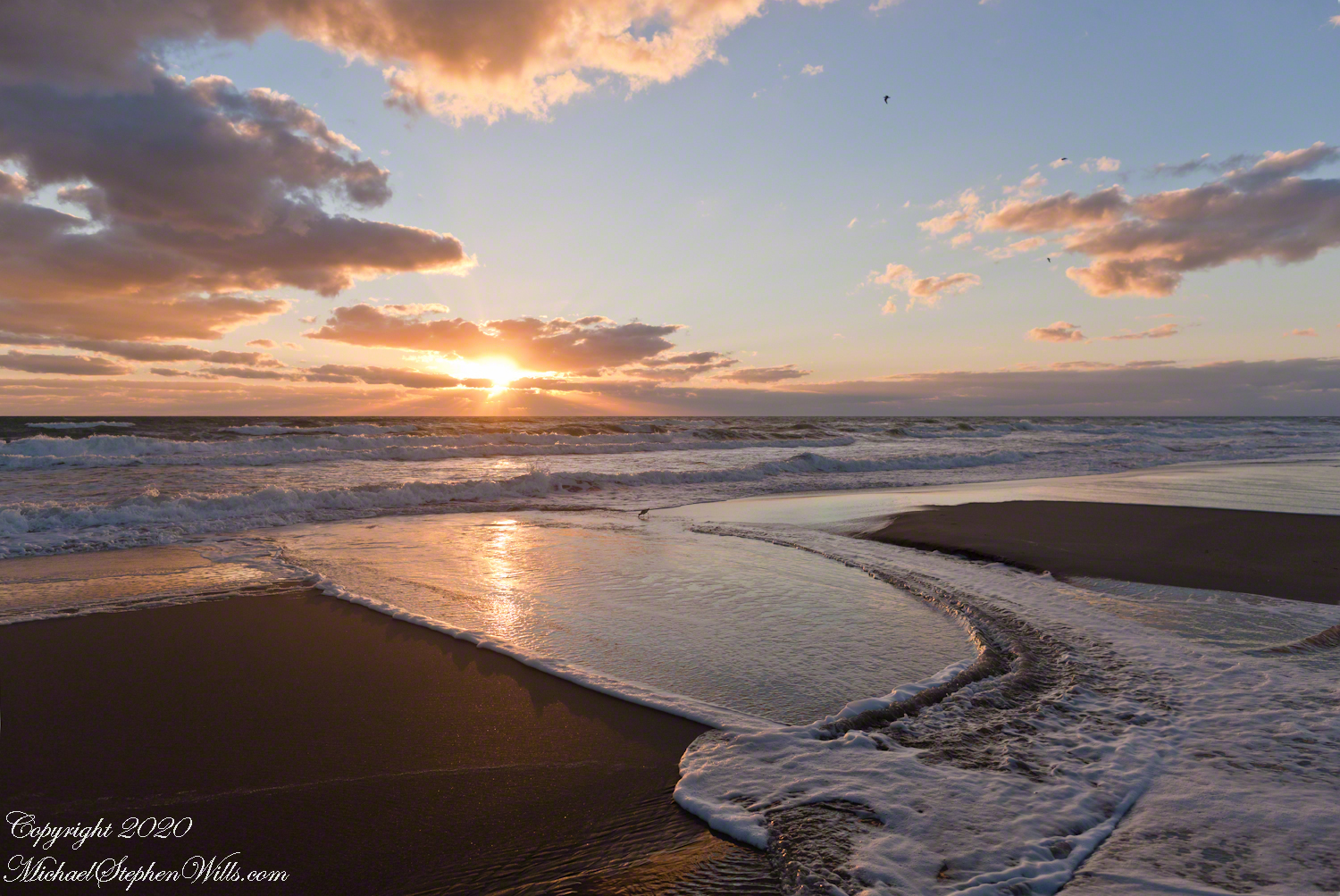
The sun disk is above the horizon, bursting from clouds.
Ten minutes, eighteen seconds elapsed from the first images of this series. Seventy one exposures taken with 14 selected moments of shining sand mirror, a strong curving return flow.
The small bird feeding, of the first image, is a Sanderling, one of the smallest species of Sandpipers.
Click photograph for larger image. To do this from WordPress Reader, you need to first click the title of this post to open a new page.
Exposure: 1/320 sec at f / 4.5, Focal Length: 24 mm, ISO 100
In this second image, the mirror is erased as sand absorbs surf. I needed to show the developing sun burst.
Exposure: 1/8 sec at f / 22, Focal Length: 24 mm, ISO 50
A slide show of these images. This set compares short exposure with open aperture (f 4.5) to a much longer exposure driven by a narrow aperture (f 22) and the lowest film sensitivity of the camera (ISO 50). Suggestion, for this series in a larger format, open a separate browser tab for each post. At series end you will then have eight (including the very first post a few weeks ago) landscapes to compare.
Exposure: 1/320 sec at f / 4.5, Focal Length: 24 mm, ISO 100
Exposure: 1/8 sec at f / 22, Focal Length: 24 mm, ISO 50
Click photograph for larger image. To do this from WordPress Reader, you need to first click the title of this post to open a new page.
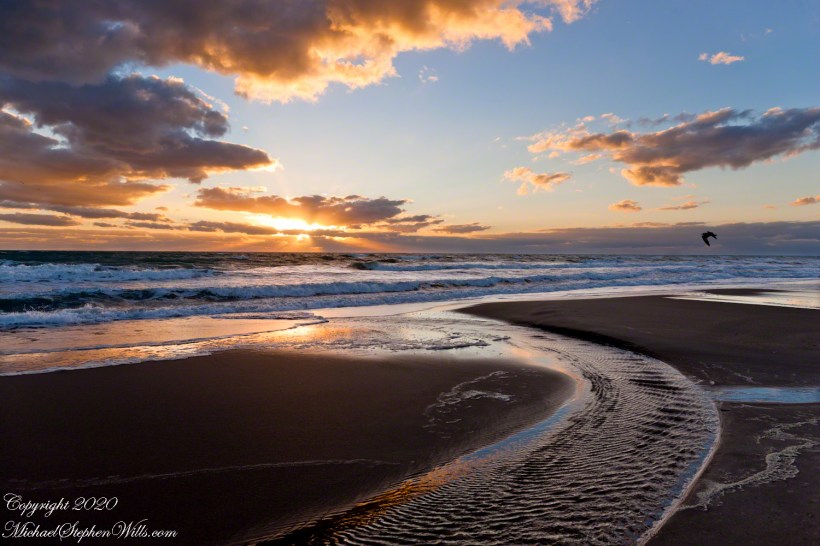
Exposure: 1/400 sec at f / 5.0, Focal Length: 24 mm, ISO 250
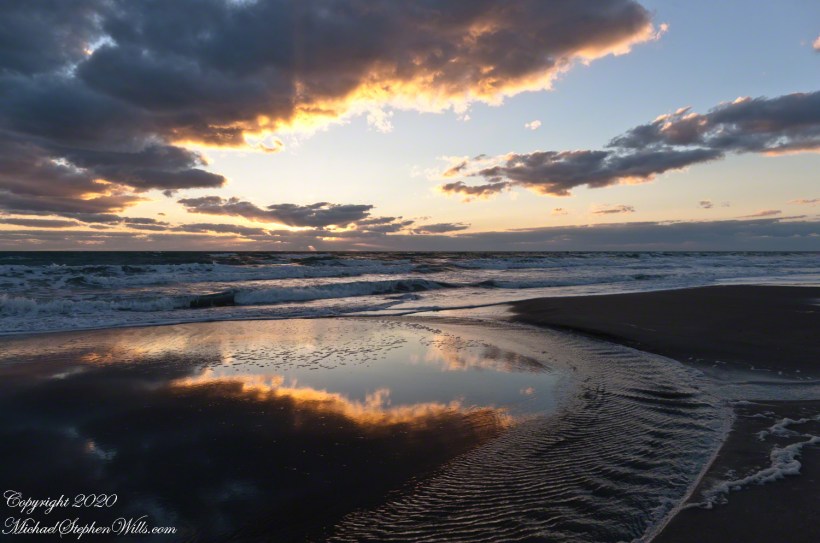
I selected moments of shining sand mirror, a strong curving return flow with a continuing mark of a southeast wind of seventeen miles per hour, with bursts above twenty. Wind, waves, even the rounded particles of sand all created from the energy of the celestial body I am waiting to appear.
Exposure: 1/500 sec at f / 5.6, Focal Length: 24 mm, ISO250
A slide show of these images. Suggestion, for this series in a larger format, open a separate browser tab for each post. At series end you will then have eight (including the very first post a few weeks ago) landscapes to compare.
Exposure: 1/400 sec at f / 5.0, Focal Length: 24 mm, ISO 250
Exposure: 1/500 sec at f / 5.6, Focal Length: 24 mm, ISO250
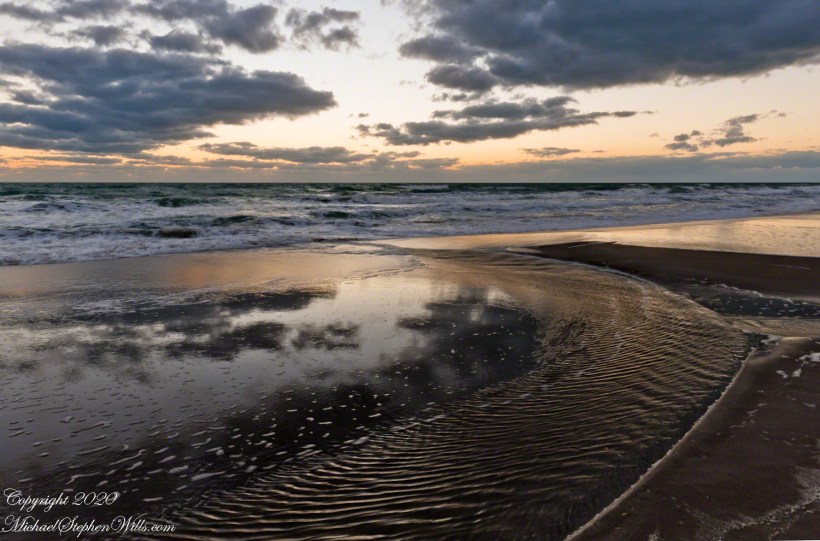
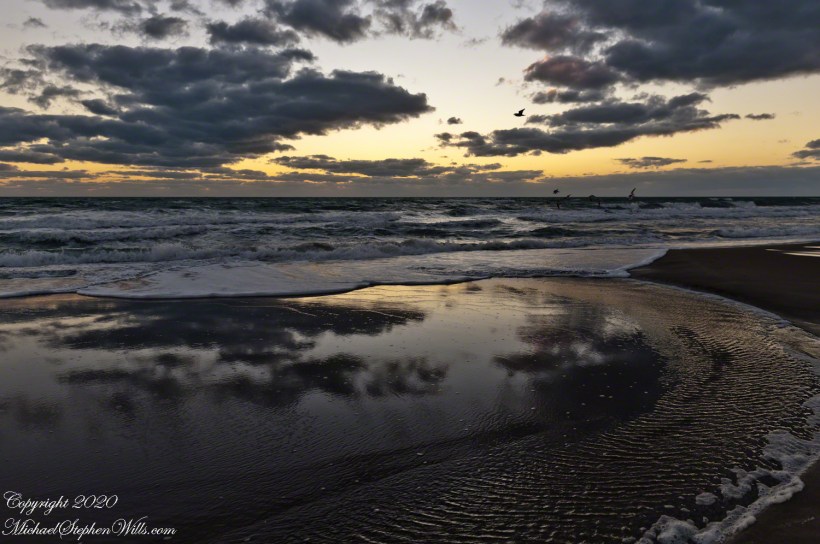
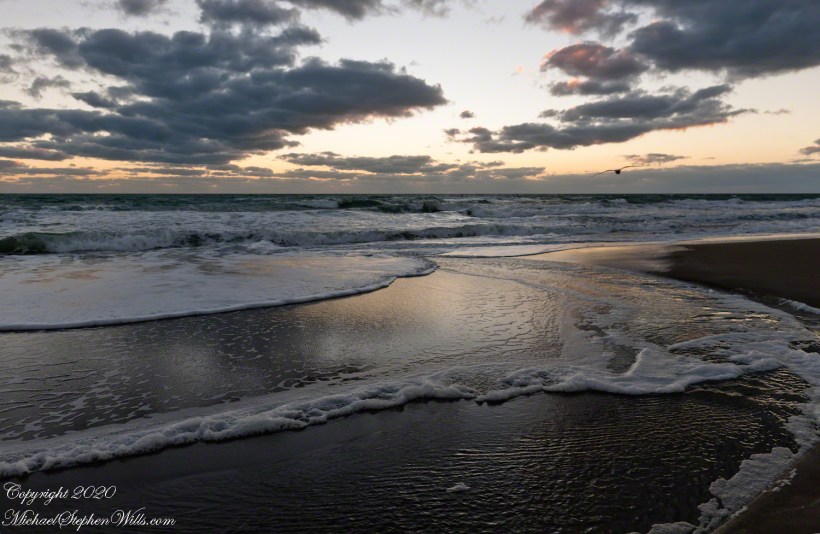
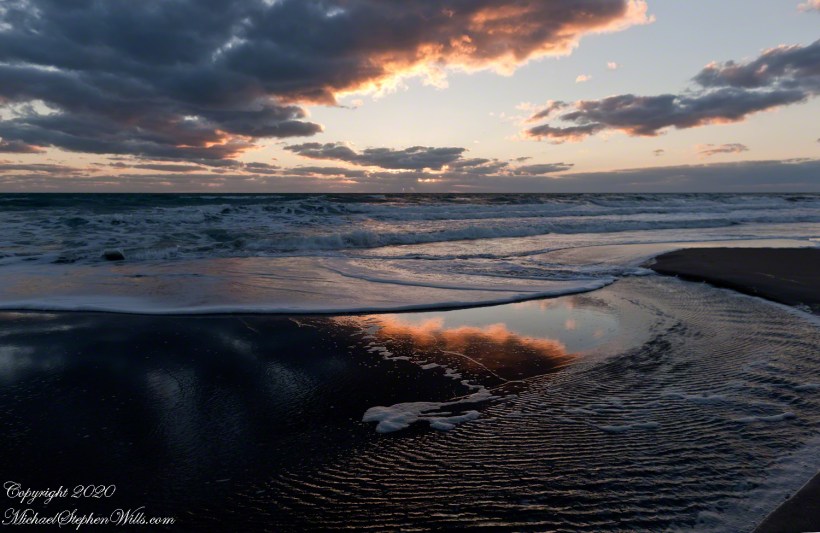
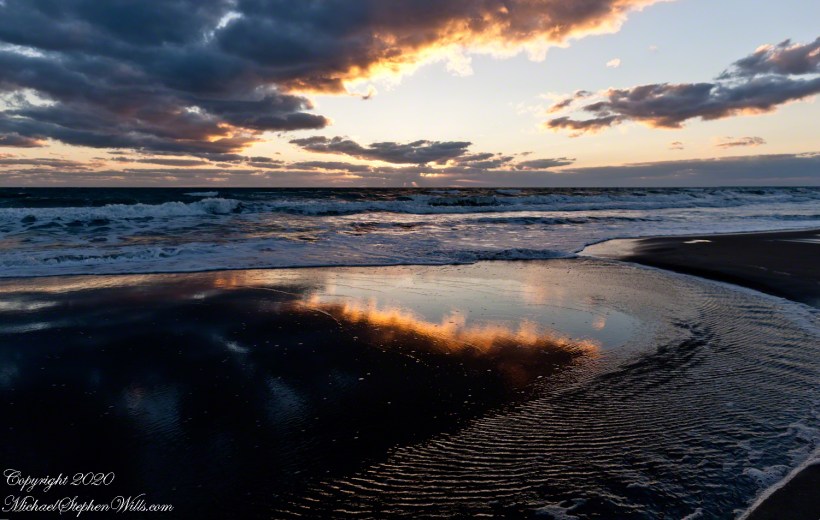
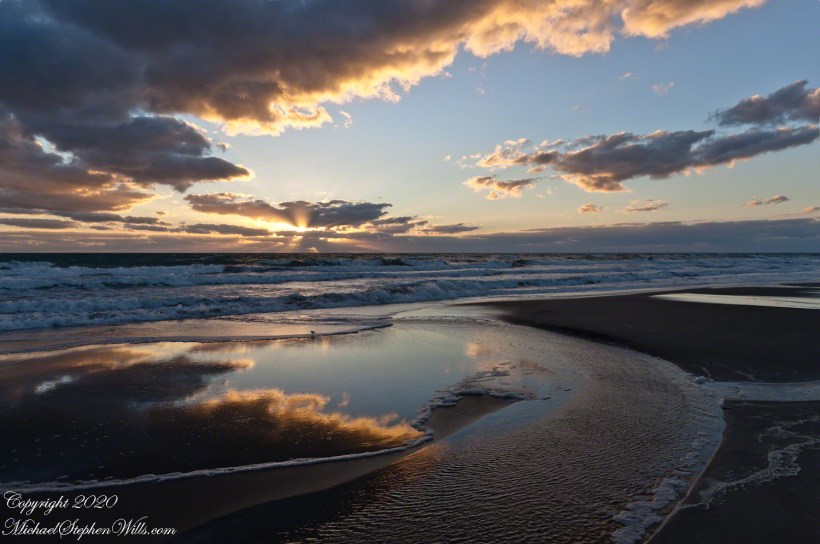
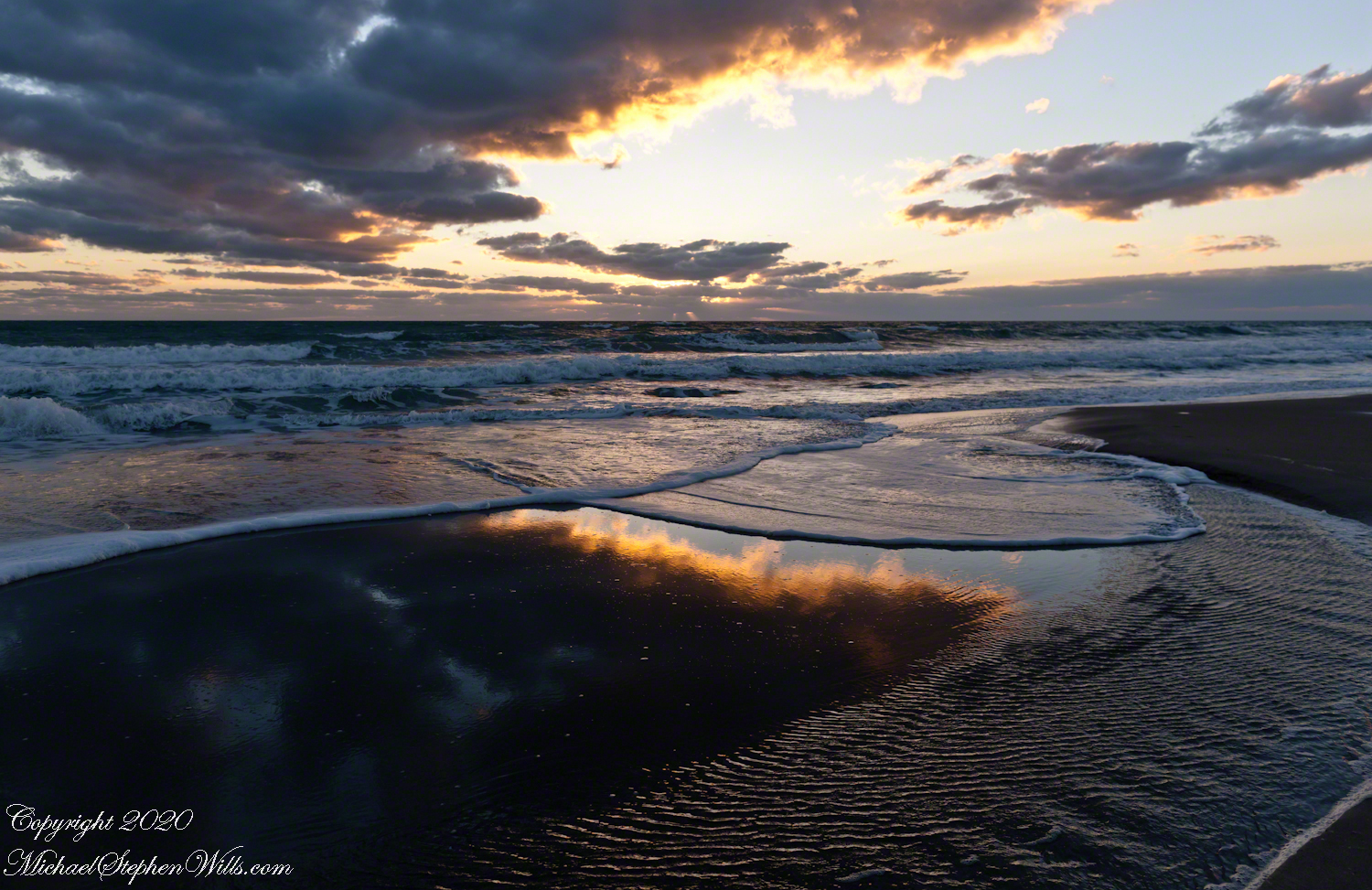
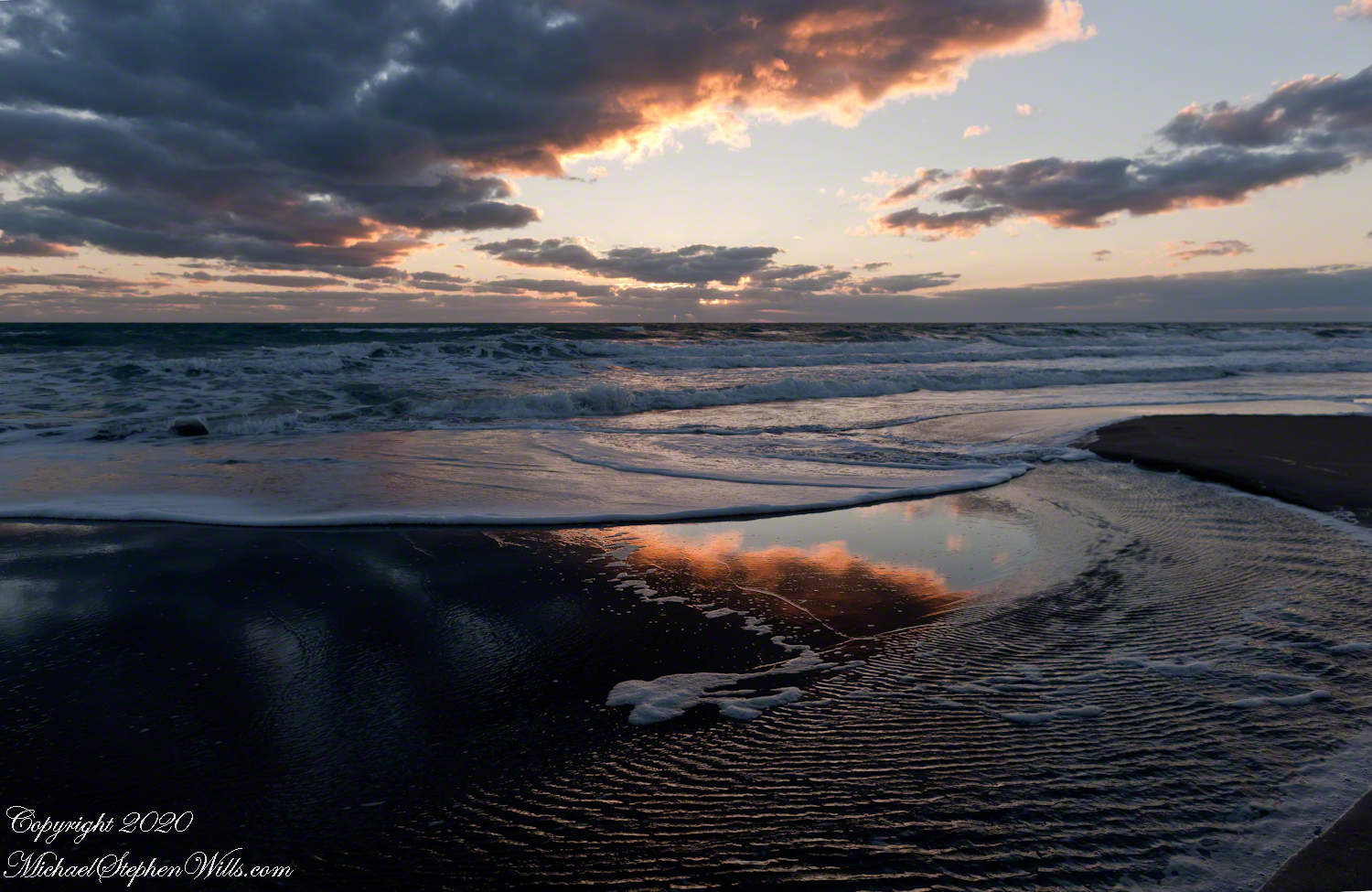
Thirty three seconds pass from Series 3, the high clouds shine less bright, the sun disk now blocked by those clouds on the horizon, the rising sun brings darkness yet a first hint of sunburst.
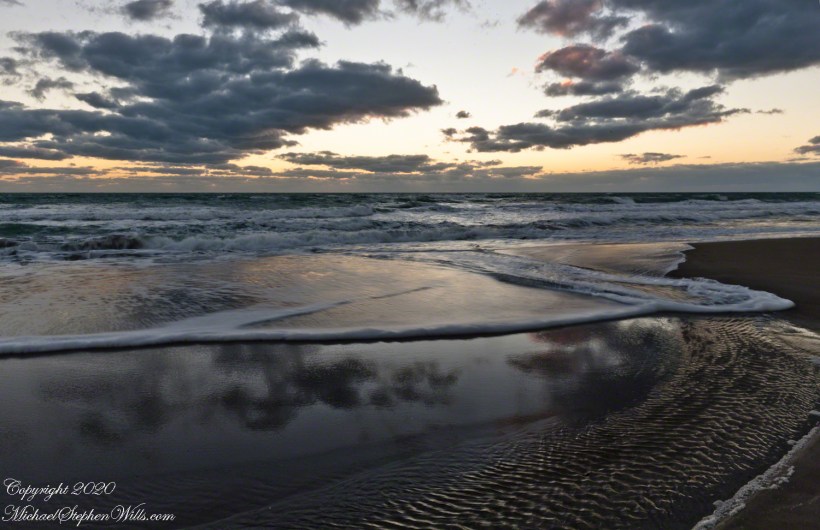
Seemingly, the first image foam-wave swath will erase the mirror.
Click photograph for larger image. To do this from WordPress Reader, you need to first click the title of this post to open a new page.
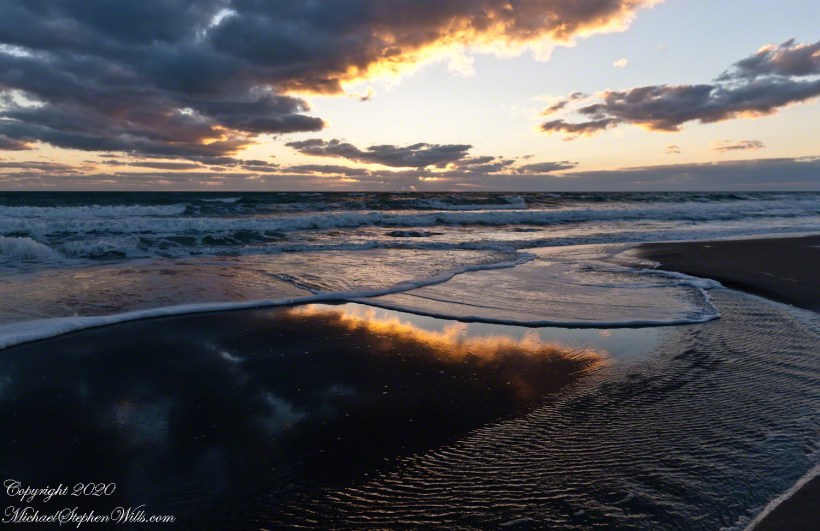
Exposure: 1/400 sec at f / 5.0, Focal Length: 24 mm, ISO 250
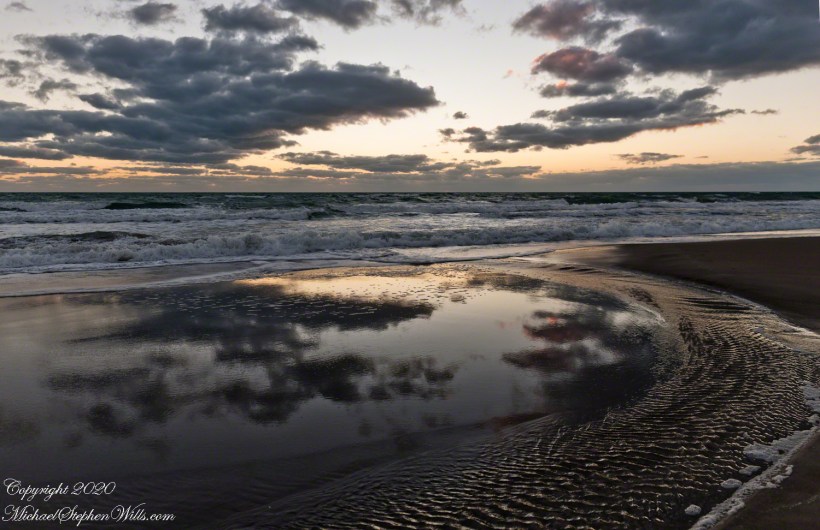
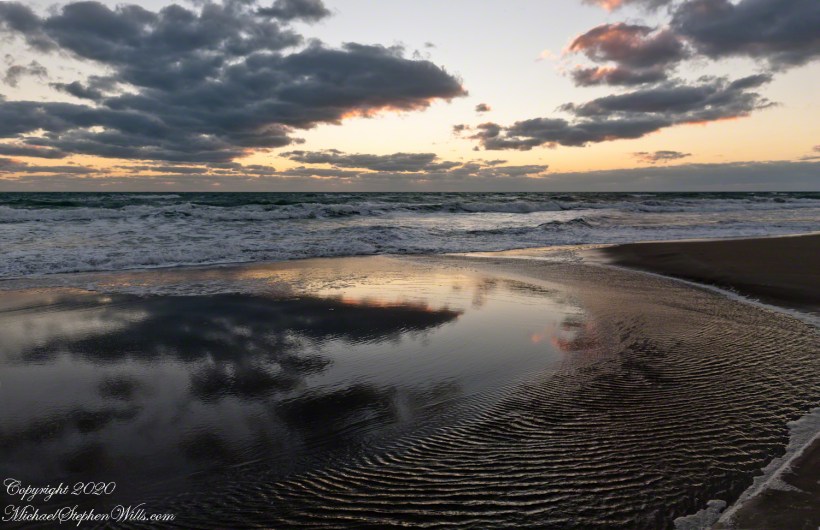
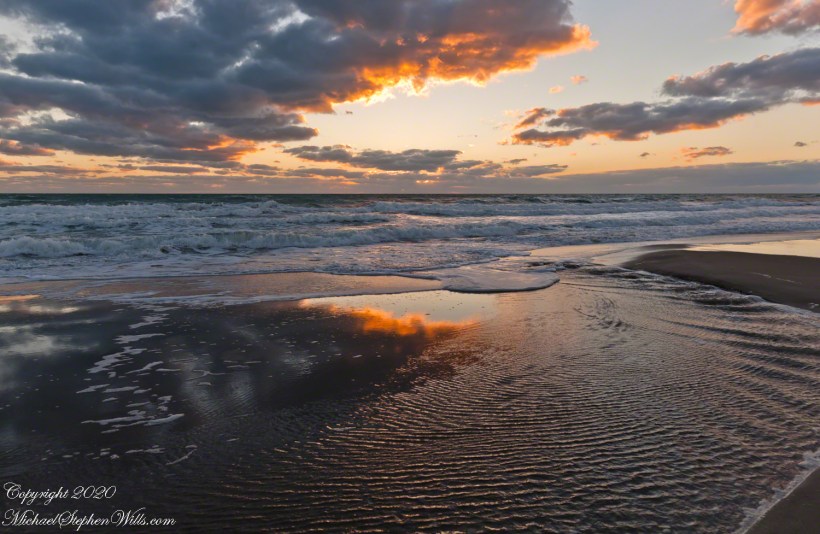
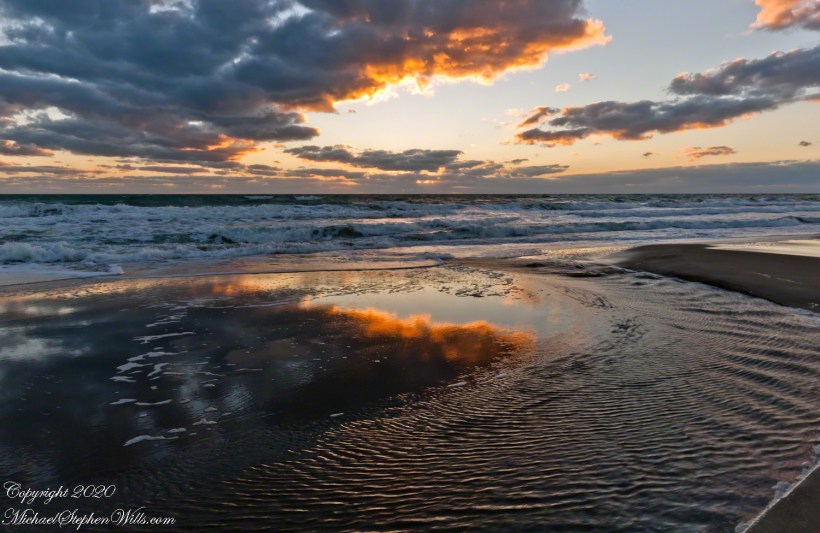
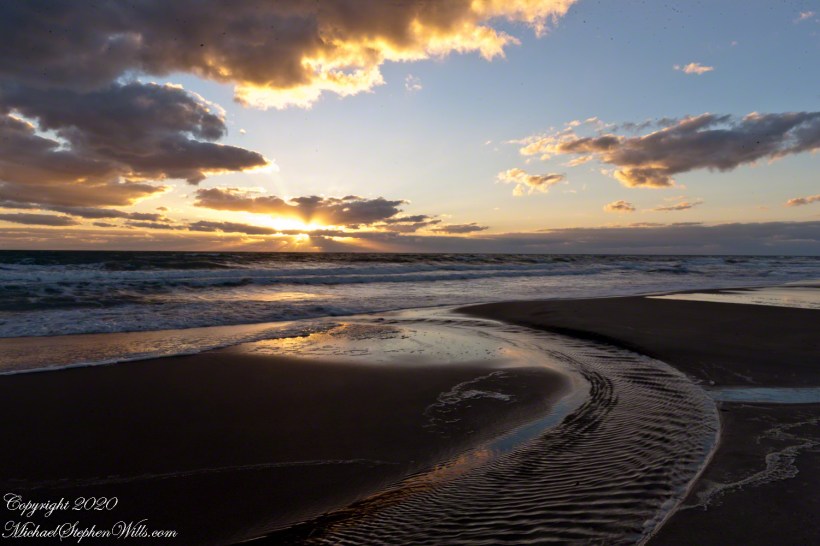
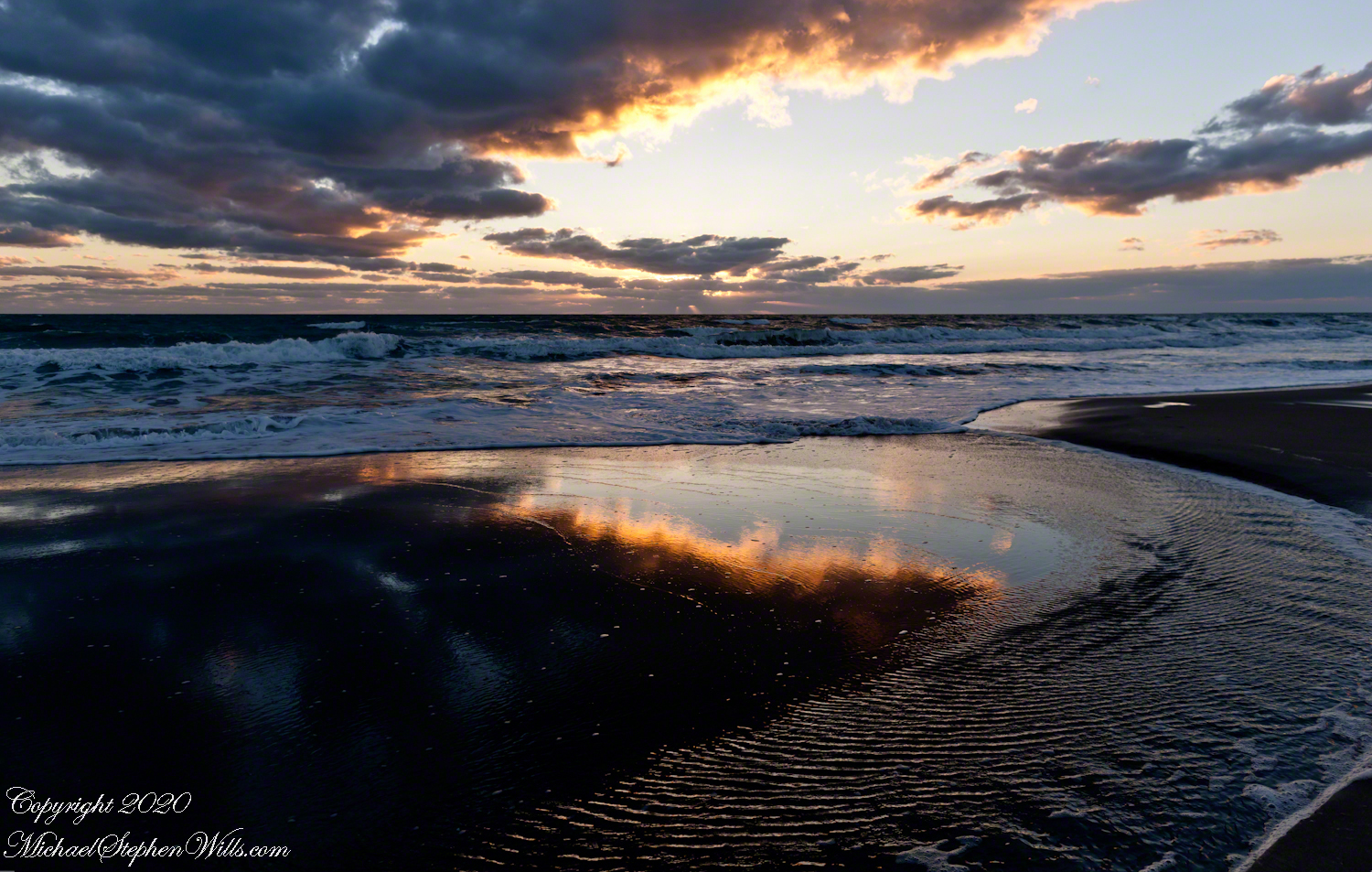
Fifty seconds later, instead of erasure the new water brings clarity.
A slide show of these images. Suggestion, for this series in a larger format, open a separate browser tab for each post. At series end you will then have eight (including the very first post a few weeks ago) landscapes to compare.

 Michael Stephen Wills Photography