Step into the ancient world of Neolithic monuments and discover the astounding astronomical knowledge of our ancestors. Explore the Newgrange Lightbox in Ireland and similar marvels across Europe, revealing a deep connection between ancient peoples and the cosmos. Join me in unveiling these architectural wonders.
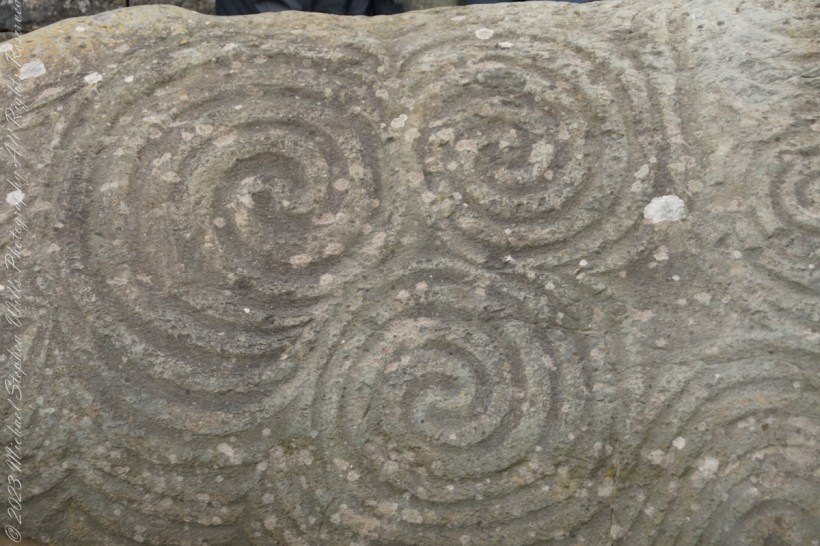
Discover the mysteries of the Newgrange monument’s Entrance Stone, a showcase of exquisite Neolithic rock art. Explore spirals, lozenges, and geometric designs that define European megalithic art and delve into their potential meanings and cultural significance. Join me in uncovering the secrets of this ancient Irish wonder.
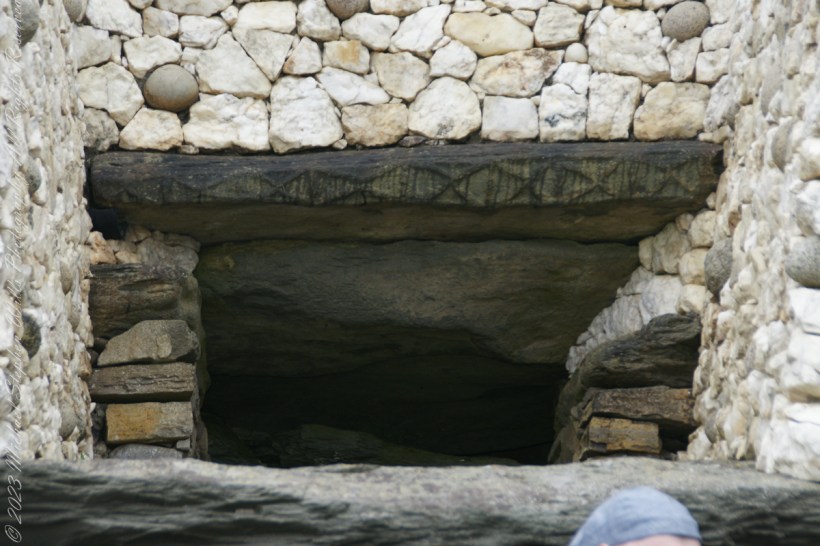
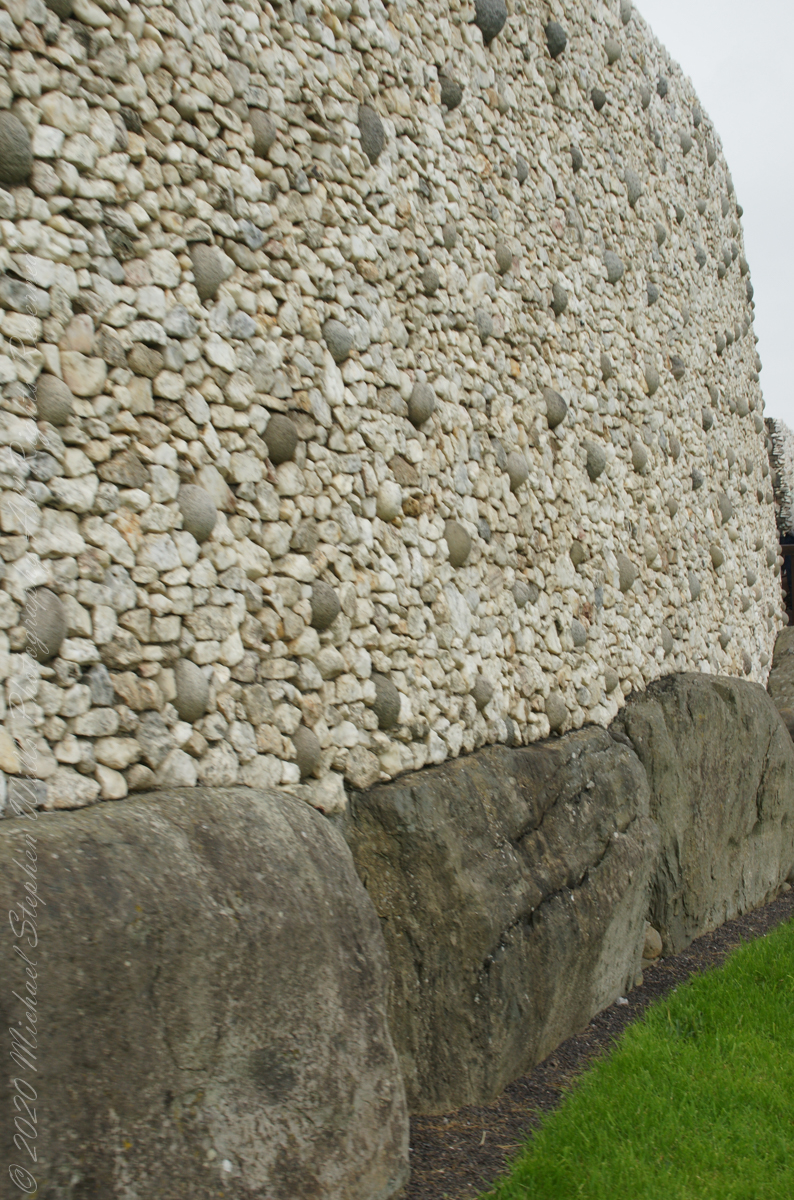
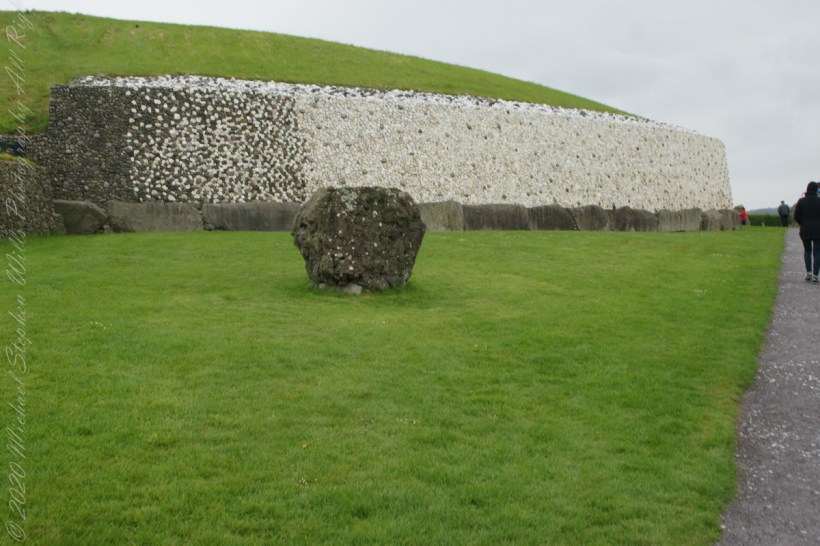
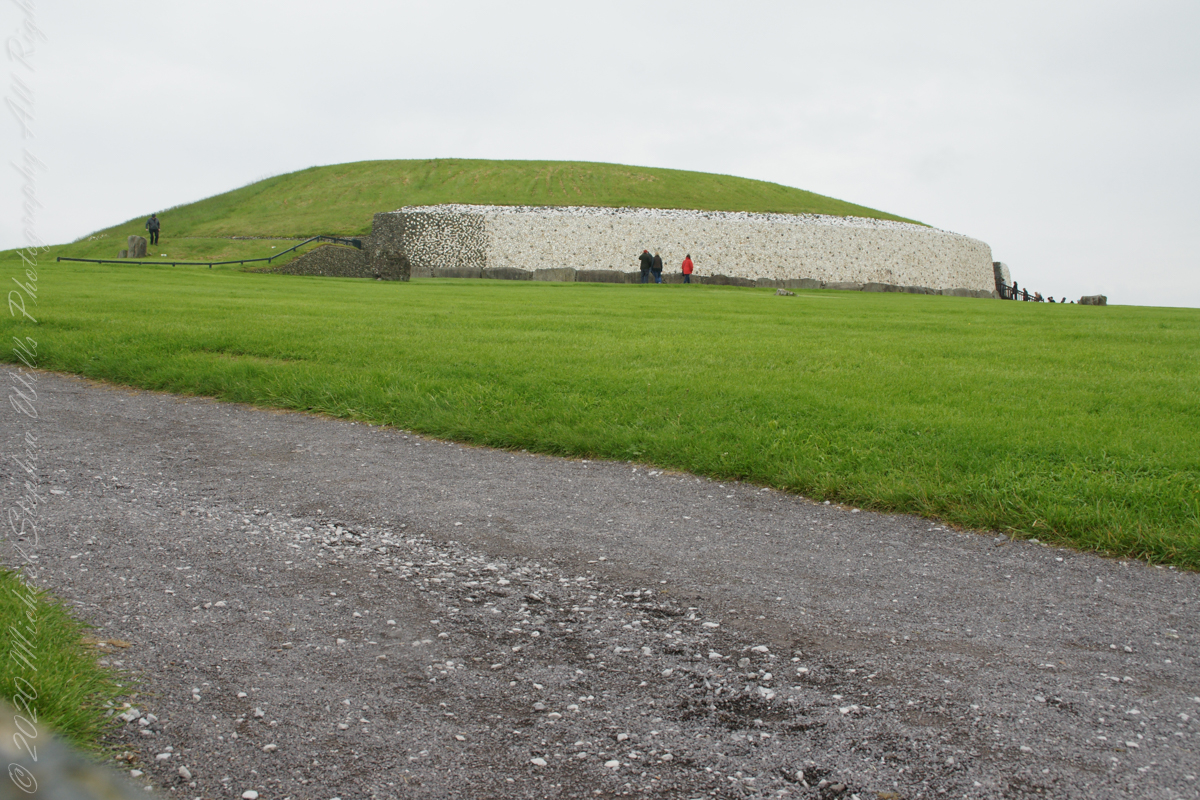
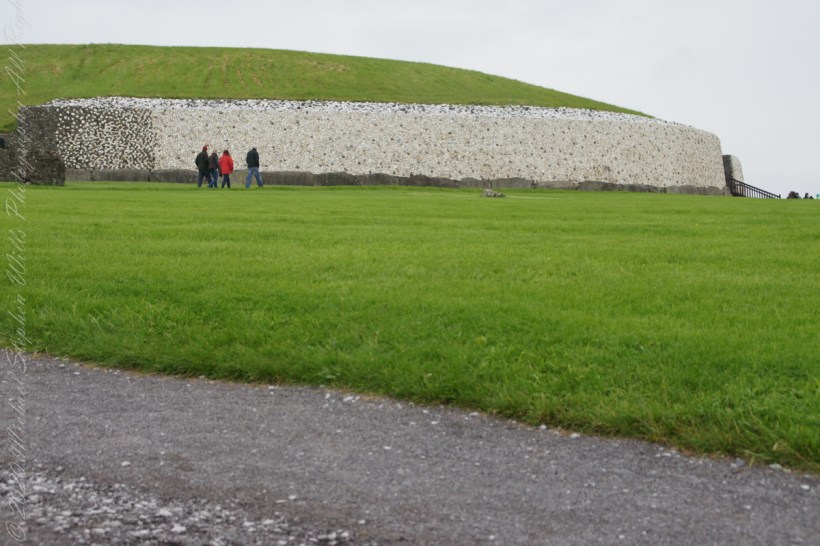
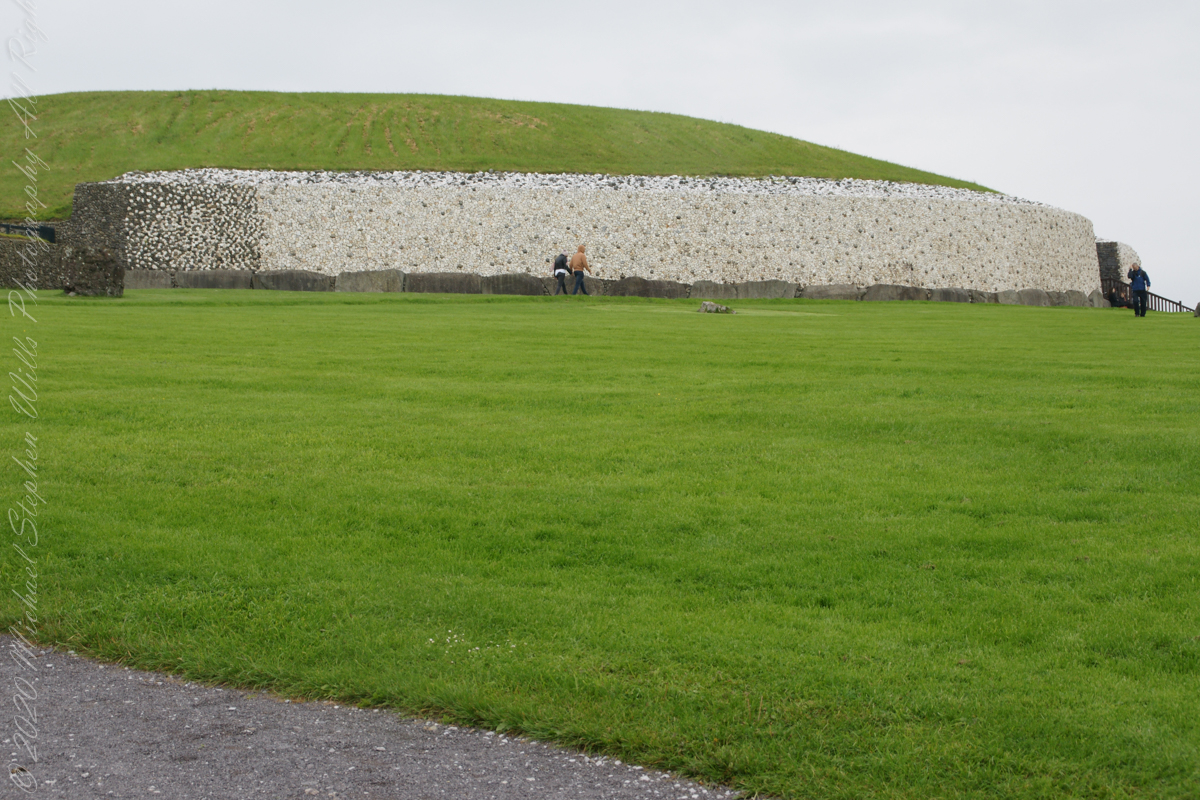
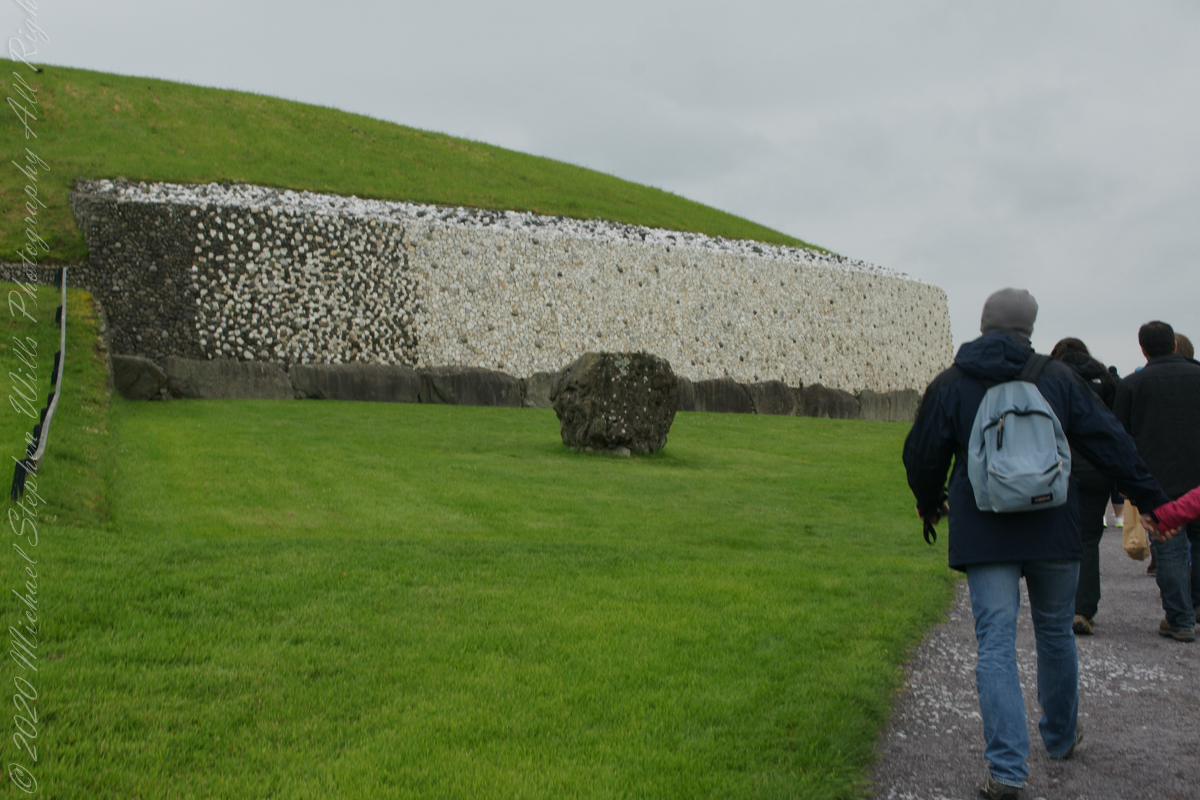
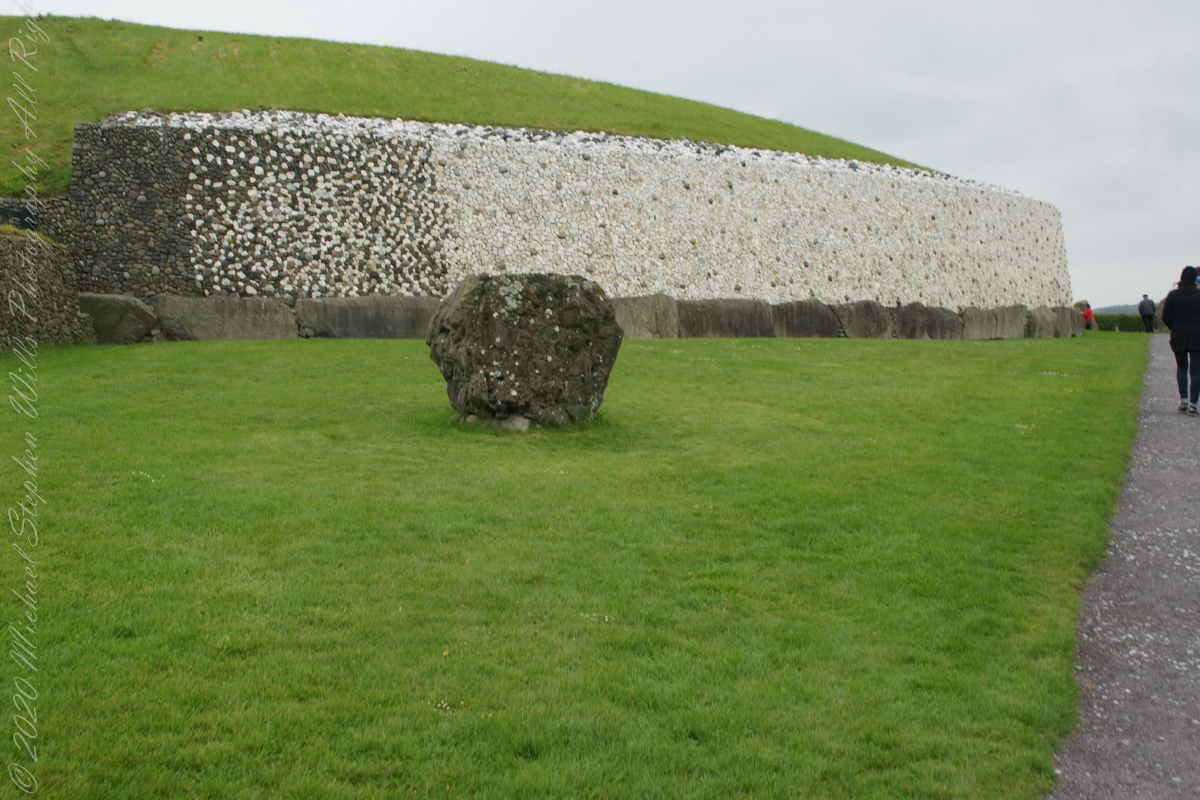
The Newgrange façade and entrance of today is a creation from the large quantity of small stones unearthed and conserved during excavation given form by a steel-reinforced concrete retention wall.
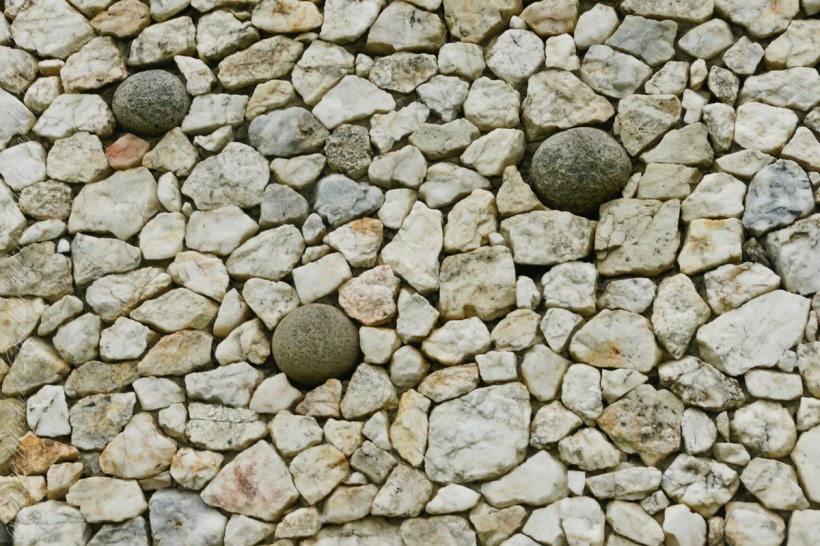
The brilliant white quartz cobblestones were collected from the Wicklow Mountains, 31 miles to the south. Our guide called them “sunstones” for the way they reflect sunlight. In the following photograph is white quartz, the same excavated 1967-1975 from the Newgrange site and incorporated into the facade, I collected from “Miners Way” along R756 (above Glendalough).
You can also see in these photographs dark rounded granodiorite cobbles from the Mourne Mountains, 31 miles to the north. Dark gabbro cobbles from the Cooley Mountains and banded siltstone from the shore at Carlingford Lough both locations on the Cooley Peninsula where my mother’s family still has farms.
The stones may have been transported to Newgrange by sea and up the River Boyne by fastening them to the underside of boats at low tide. None of the structural slabs were quarried, for they show signs of having been weathered naturally, so they must have been collected and then transported, largely uphill, to the Newgrange site. The granite basins found inside the chambers also came from the Mournes.
Geological analysis indicates that the thousands of pebbles that make up the cairn, which together would have weighed about 200,000 tons, came from the nearby river terraces of the Boyne. There is a large pond in this area that is believed to be the site quarried for the pebbles by the builders of Newgrange.
Facade and Kerbstones
Most of the 547 slabs that make up the inner passage, chambers, and the outer kerbstones are greywacke. Some or all of them may have been brought from sites either 3 miles away or from the rocky beach at Clogherhead, County Louth, about 12 miles to the northeast.
Michael Joseph “Brian” O’Kelly was selected to undertake the direction of the excavation of Newgrange during a 1961 meeting of “those who had a professional interest in the monument” organized by PJ Hartnett, the archaeological officer with Bord Fáilte Eireann (Irish Tourist Board) and a former pupil of Professor O’Kelly’s. Excavation commenced in 1962 and continued every summer for a four-month season up to and including 1975.
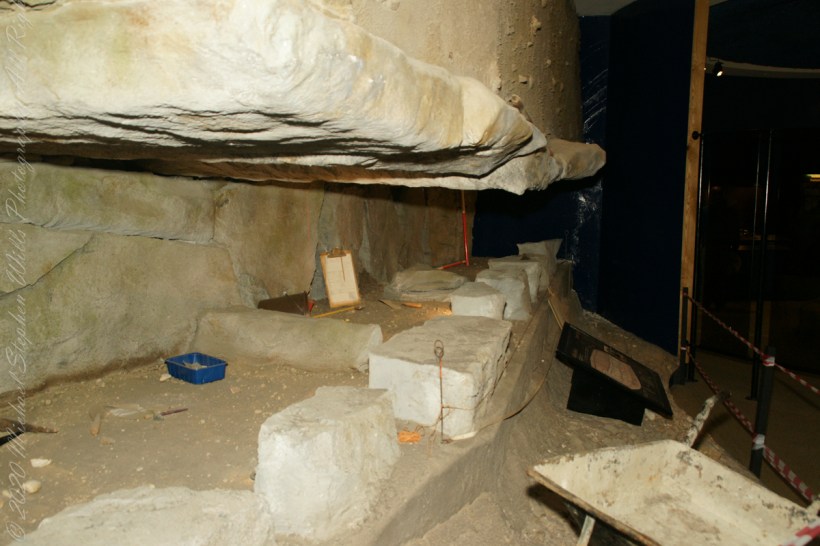
The aim of the excavation was to discover as much as possible about the archaeological and historical context of Newgrange and the people who built it and to discover what its original finished appearance was so as to direct a reconstruction, conservation and restoration of the structure to its former condition and appearance.
The last year of excavation was 1975, Michael J. wrote “We determined in 1975 that that should be our last season of excavation at Newgrange. We had investigated approximately one third of the structure and we had discovered much about it that was new, both in its structure and in its ornament, while radiocarbon had pushed its date back by 1,000 years……”
“…We felt that the other two thirds should be left for a future excavator, who, working with new knowledge and perhaps with better methods and new scientific approaches, should have large areas untouched by us in which to test, check and re-evaluate our findings.” From The Restoration of Newgrange by Michael J.O’Kelly. Antiquity LIII, 1979.
“Between the bright sky and the long glittering silver ribbon of the Boyne the land looks black and featureless. Great flocks of starlings are flying across the sky from their nighttime roosts to their daytime feeding places. The effect is very dramatic as the direct light of the sun brightens and casts a glow of light all over the chamber. I can even see parts of the roof and a reflected light shines right back into the back of the end chamber.” The recorded words of Prof O’Kelly spoken in the tomb of Newgrange on the 21st December 1969.
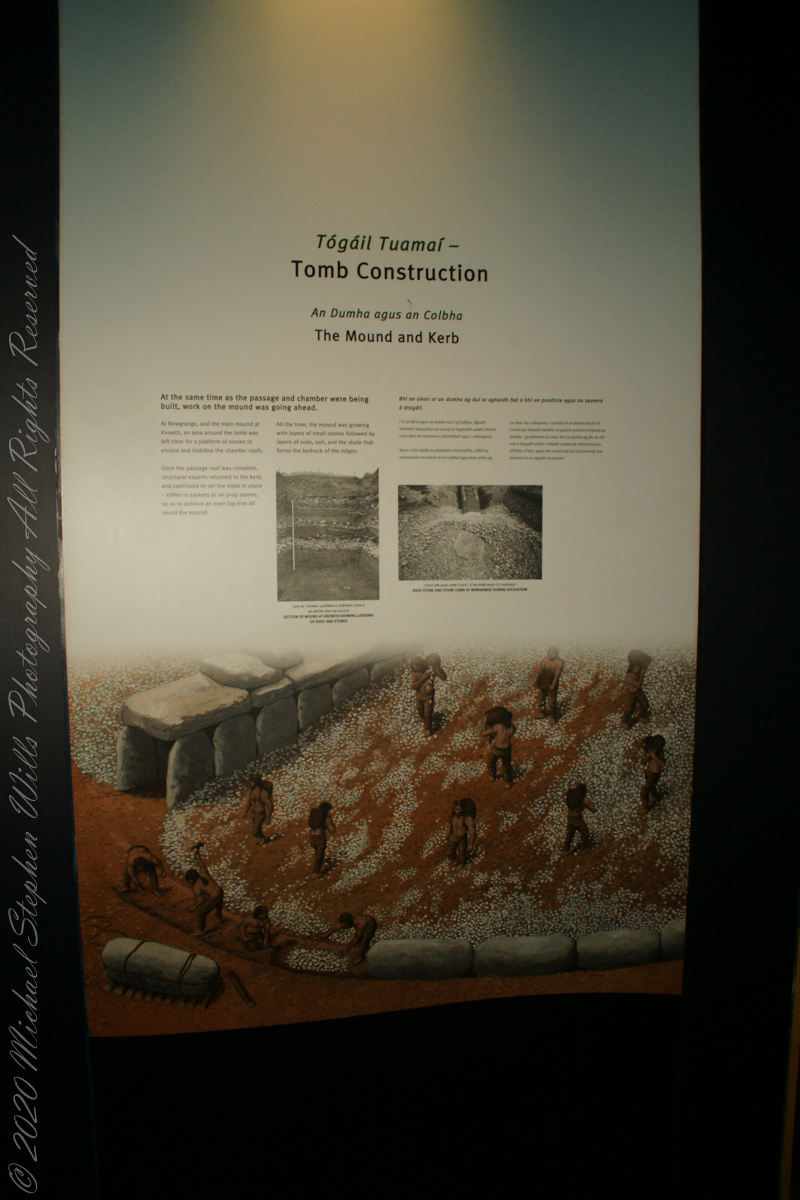
At the same time as the passage and chamber were being built, work on the mound was going ahead.
Brú na Bóinne Visitor Center, Dunleek Lower, County Meath, Republic of Ireland
At Newgrange, and the main mound at Knowth, an area around the tomb was left clear for a platform of stones to encase and stabilize the chamber roofs.
Brú na Bóinne Visitor Center, Dunleek Lower, County Meath, Republic of Ireland
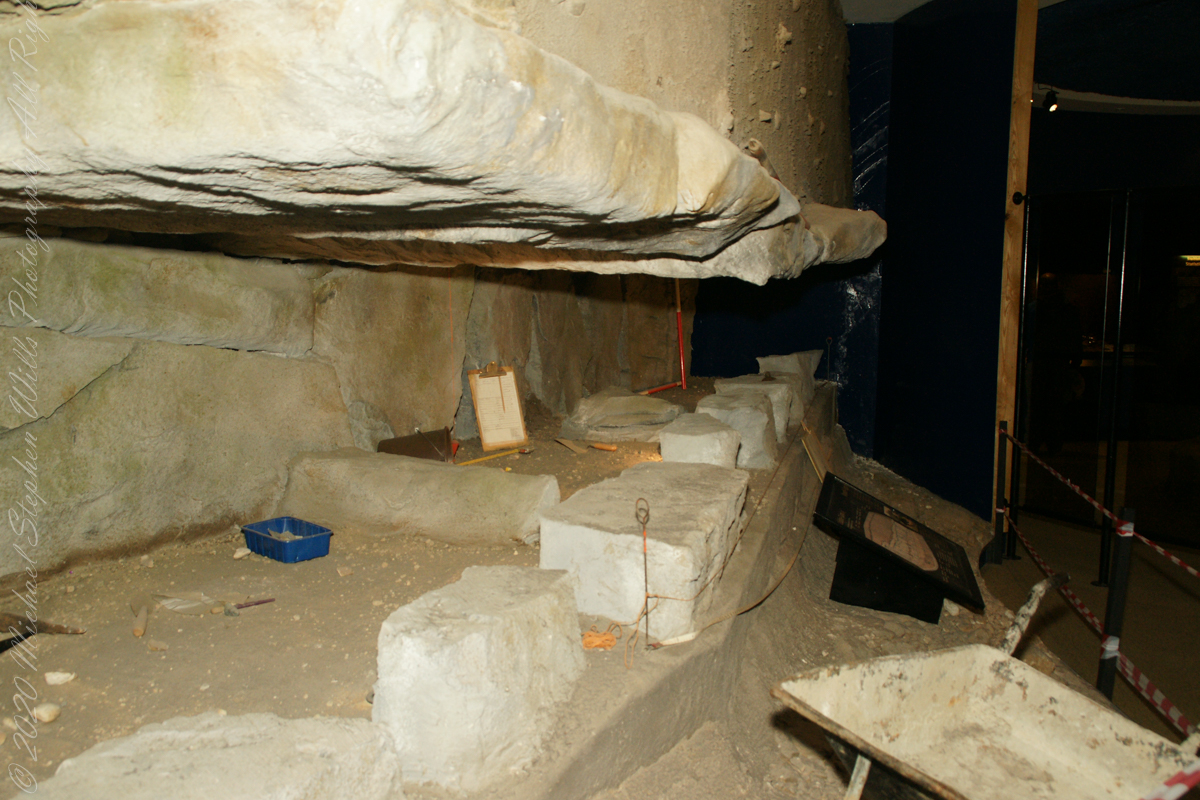
Once the passage roof was complete, structural experts returned to the kerb and continued to set the slabs in place — either in sockets or on prop stones, so as to achieve an even top-line all-round the mound.
Here are two of the ten monarchs we release this year. In under three minutes this video shows a monarch caterpillar transforming into a chrysalis, emerging two weeks later as a butterfly. Music “Emotional Underscores Vol. 3” by Yuri Sazonoff (SOCAN) “Can You Guess” and “Blessing”
“Migrating monarchs soar at heights of up to 1,200 feet. As sunlight hits those wings, it heats them up, but unevenly. Black areas get hotter, while white areas stay cooler. The scientists believe that when these forces are alternated, as they are with a monarch’s white spots set against black bands on the wings’ edges, it seems to create micro-vortices of air that reduce drag—making flight more efficient.”
“Monarchs begin leaving the northern US and Canada in mid-August. They usually fly for 4-6 hours during the day, coming down from the skies to feed in the afternoon and then find roosting sites for the night. Monarchs cannot fly unless their flight muscles reach 55ºF. On a sunny day, these muscles in their thorax can warm to above air temperature when they bask (the black scales on their bodies help absorb heat), so they can actually fly if it is 50ºF and sunny. But on a cloudy day, they generally don’t fly if it is below 60ºF.“
“Migrating monarchs use a combination of powered flight and gliding flight, maximizing gliding flight to conserve energy and reduce wear and tear on flight muscles. Monarchs can glide forward 3-4 feet for every foot they drop in altitude. If they have favorable tail or quartering winds, monarchs can flap their wings once every 20-30 feet and maintain altitude. Monarchs are so light that they can easily be lifted by the rising air. But they are not weightless. In order to stay in the air, they must move forward while also staying within the thermal. They do this by moving in a circle. The rising air in the thermal carries them upward, and their overall movement ends up being an upward spiral. Monarchs spiral upwards in the thermal until they reach the limit/top of the thermal (where the rising air has cooled to the same temperature as the air around it). At that point, the monarch glides forward in a S/SW direction with the aid of the wind. It glides until it finds another thermal and rides that column of rising air upwards again.”
Reference: text in italics and quotes is from one of two online articles. “The monarch butterfly’s spots may be its superpower” National Geographic, June 2023 and “Fall Migration – How do they do it?” by Candy Sarikonda, September 2014.
Copyright 2023 Michael Stephen Wills All Rights Reserved
We let our first monarch butterfly rest overnight, until noon of the following day.
Pam did better with tracking the monarch’s flight, so I used video. Thanks Pam!
I delay butterfly release when:
the forecasted high temp is below 65° F (18° C) or 60° F (16° C) if sunny and calm. When no other option exists, 50-59° F and sunny is borderline acceptable.
the forecast calls for rain. A light rain is not a problem for butterflies with day-old dry wings, but it’s not a good release option for first-day newborns.
the butterfly emerges too late in the day. I keep it overnight if the butterfly cannot get 3 hours warming of flight muscles in the sun.
there are storms in the forecast. I wait when there are less than four (4) hours of good weather projected. When extreme weather (like a hurricane) is forecast within twenty four (24) hours, I keep the butterfly safe until the storm passes. Twenty four (24) or more hours should provide ample time to find shelter from the storm.
I am not sure about a release. Keeping a butterfly overnight is acceptable. In fact, a butterfly’s wings are stronger on day two (2), providing better capability to escape predators. A butterfly can easily hang from the mesh cage roof overnight. I do not worry about feeding a butterfly unless a second night of shelter is necessary.
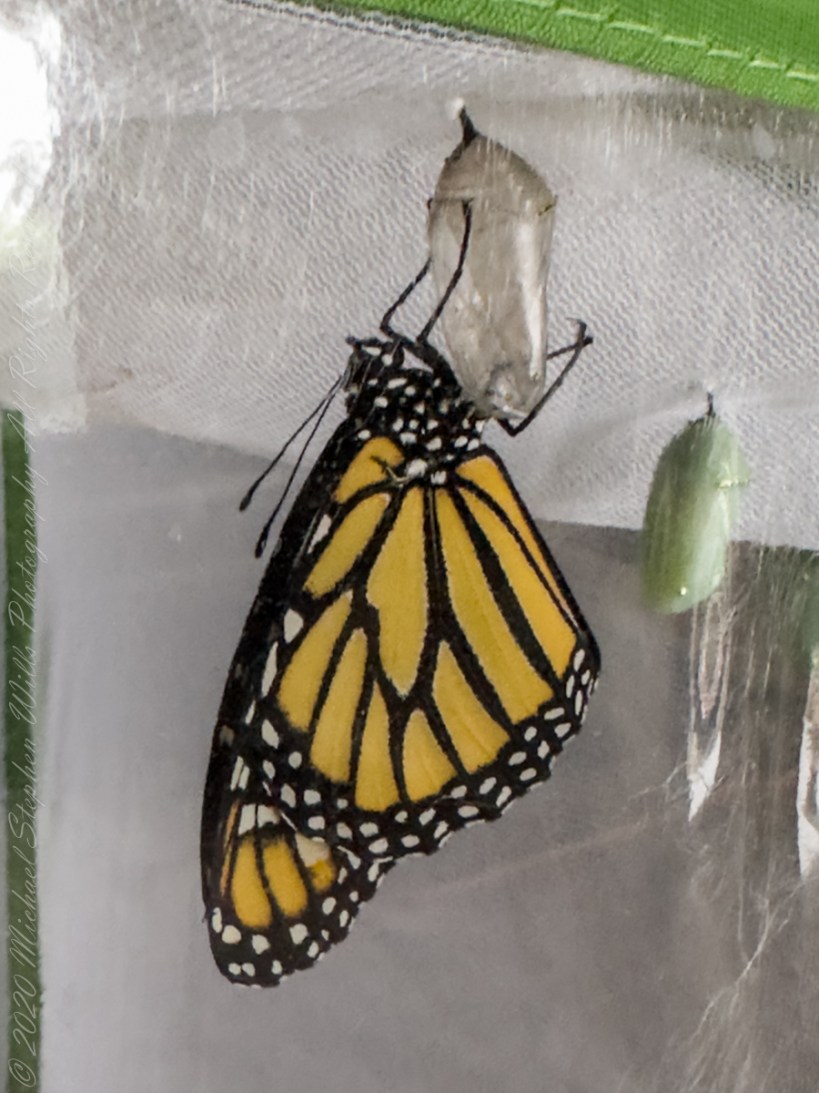
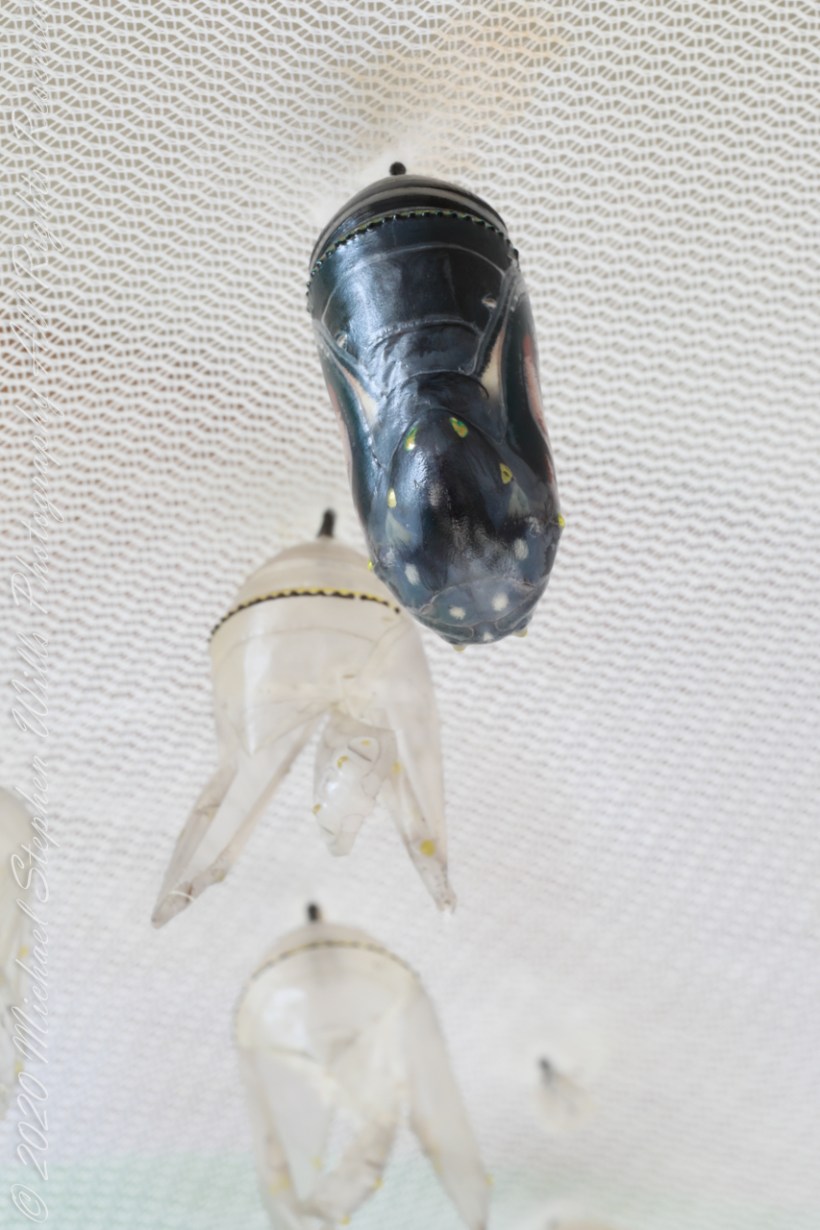
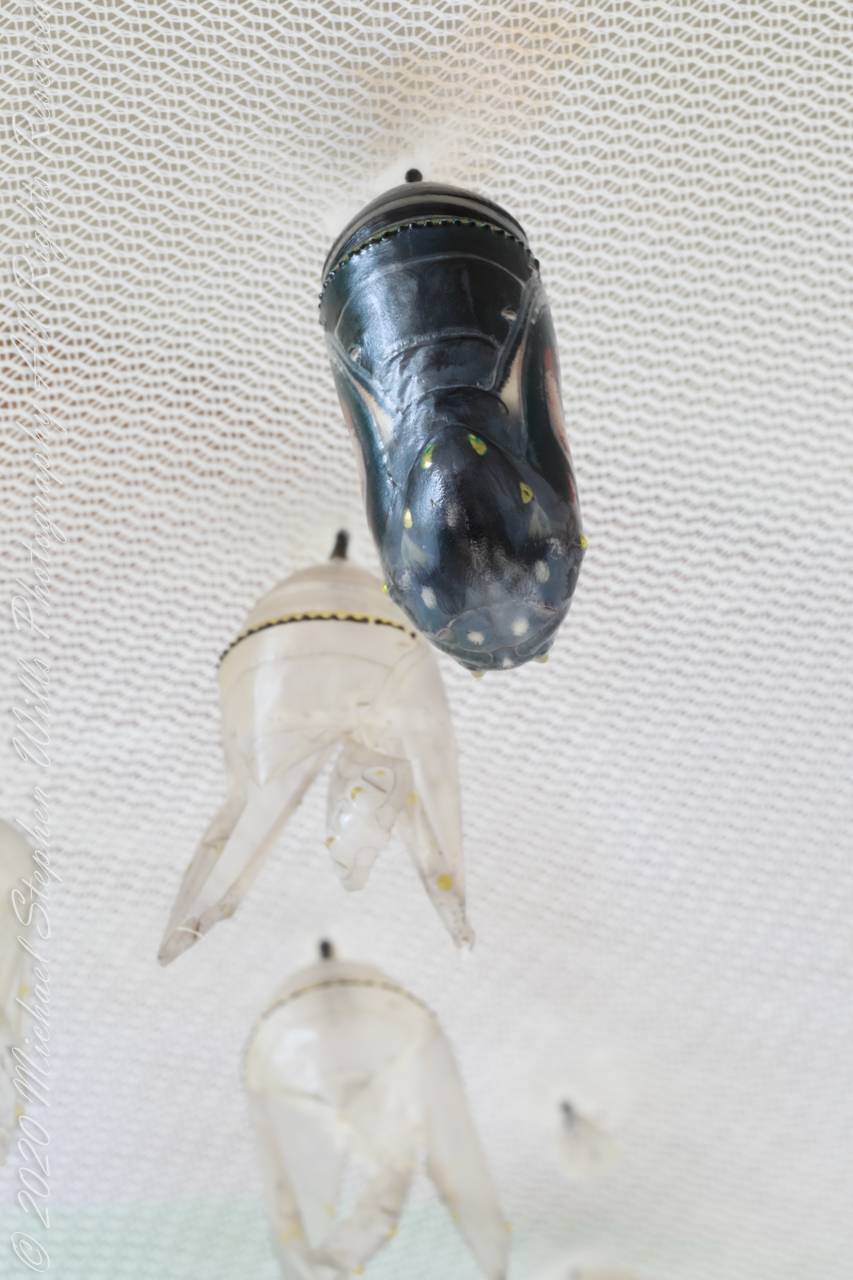
As the moment of emergence approaches, the skin of a Monarch chrysalis becomes translucent to reveal the butterfly compressed into that small space.
Copyright 2023 Michael Stephen Wills All Rights Reserved
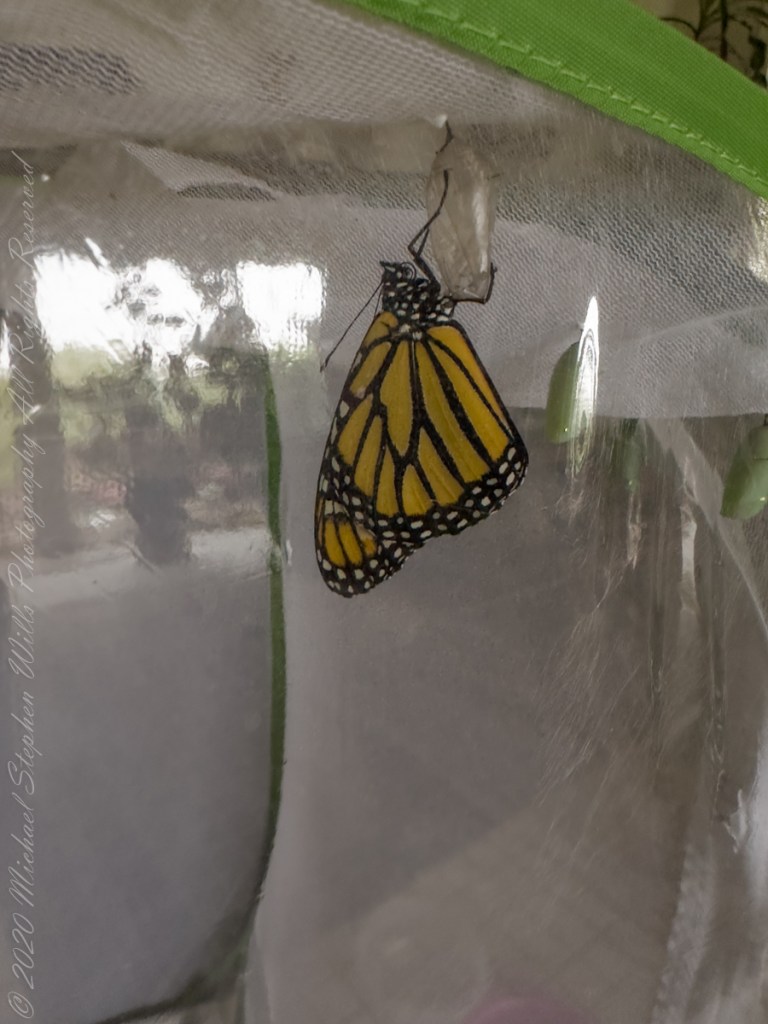
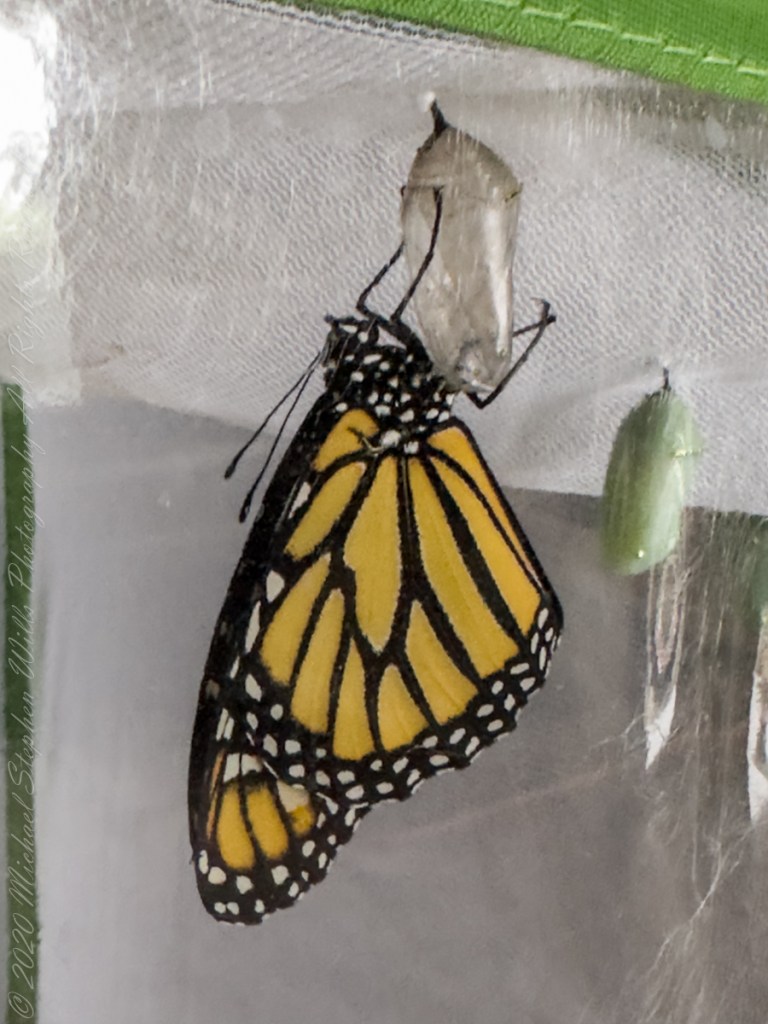
Our grandchildren spent the day with us, the last week of their summer before school begins. This July I had improved on my Monarch collection from 2022, when 9 butterflies were released, by two (2) caterpillars for a total of eleven (11) raised over several weeks to the chrysalis stage. When leaving to pick up the children for an outing one chrysalis skin had turned clear, a sign the enclosed butterfly is close to emerging. We returned from an outing for lunch to find this chrysalis unopened, so we checked now and then for progress. Four hours later, just as their Mom arrived for them, the grandchildren and everyone witnessed this event. What luck!!
“Migrating monarchs soar at heights of up to 1,200 feet. As sunlight hits those wings, it heats them up, but unevenly. Black areas get hotter, while white areas stay cooler. The scientists believe that when these forces are alternated, as they are with a monarch’s white spots set against black bands on the wings’ edges, it seems to create micro-vortices of air that reduce drag—making flight more efficient.”
“Monarchs begin leaving the northern US and Canada in mid-August. They usually fly for 4-6 hours during the day, coming down from the skies to feed in the afternoon and then find roosting sites for the night. Monarchs cannot fly unless their flight muscles reach 55ºF. On a sunny day, these muscles in their thorax can warm to above air temperature when they bask (the black scales on their bodies help absorb heat), so they can actually fly if it is 50ºF and sunny. But on a cloudy day, they generally don’t fly if it is below 60ºF.“
“Migrating monarchs use a combination of powered flight and gliding flight, maximizing gliding flight to conserve energy and reduce wear and tear on flight muscles. Monarchs can glide forward 3-4 feet for every foot they drop in altitude. If they have favorable tail or quartering winds, monarchs can flap their wings once every 20-30 feet and maintain altitude. Monarchs are so light that they can easily be lifted by the rising air. But they are not weightless. In order to stay in the air, they must move forward while also staying within the thermal. They do this by moving in a circle. The rising air in the thermal carries them upward, and their overall movement ends up being an upward spiral. Monarchs spiral upwards in the thermal until they reach the limit/top of the thermal (where the rising air has cooled to the same temperature as the air around it). At that point, the monarch glides forward in a S/SW direction with the aid of the wind. It glides until it finds another thermal and rides that column of rising air upwards again.”
This video includes an interview with Michael Wills about raising Monarch butterflies and this stage of the lifecycle. Video by Pam Wills using an IPhone 8
Reference: text in italics and quotes is from one of two online articles. “The monarch butterfly’s spots may be its superpower” National Geographic, June 2023 and “Fall Migration – How do they do it?” by Candy Sarikonda, September 2014.
Copyright 2023 Michael Stephen Wills All Rights Reserved
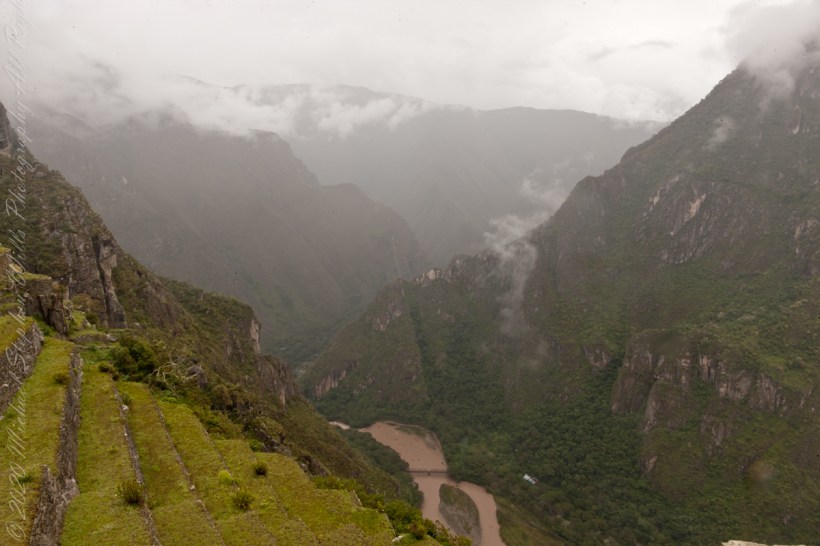
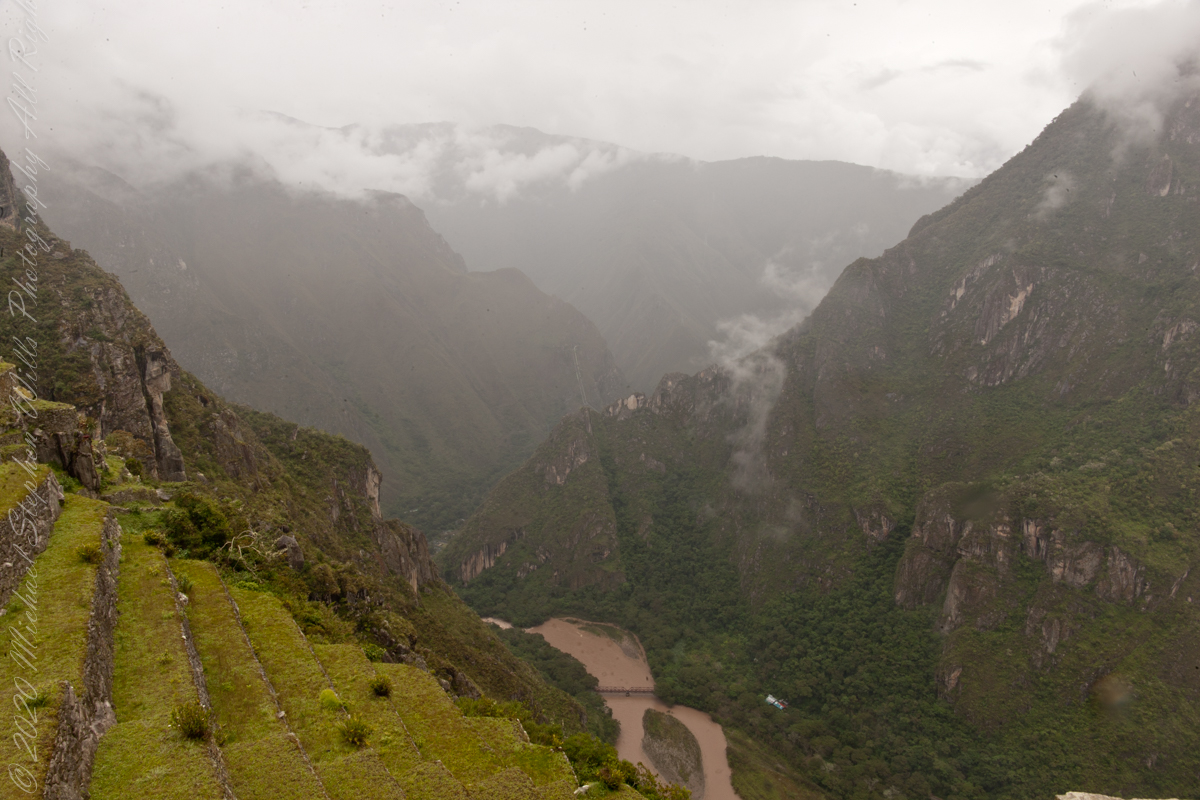
I set up a Manfrotto BeFree tripod with the Canon EOS 1DS Mark III mounted with the Canon EF 70-300 f/4-5.6 L IS USM lens to capture our experience while entering Machu Picchu.
The eastern shoulder of Huayna Picchu is left and the Urubamba river curves around it. Leading the eye to the distance is an uninhabited andean valley covered in rain forest.
Copyright 2023 Michael Stephen Wills All Rights Reserved




 Michael Stephen Wills Photography