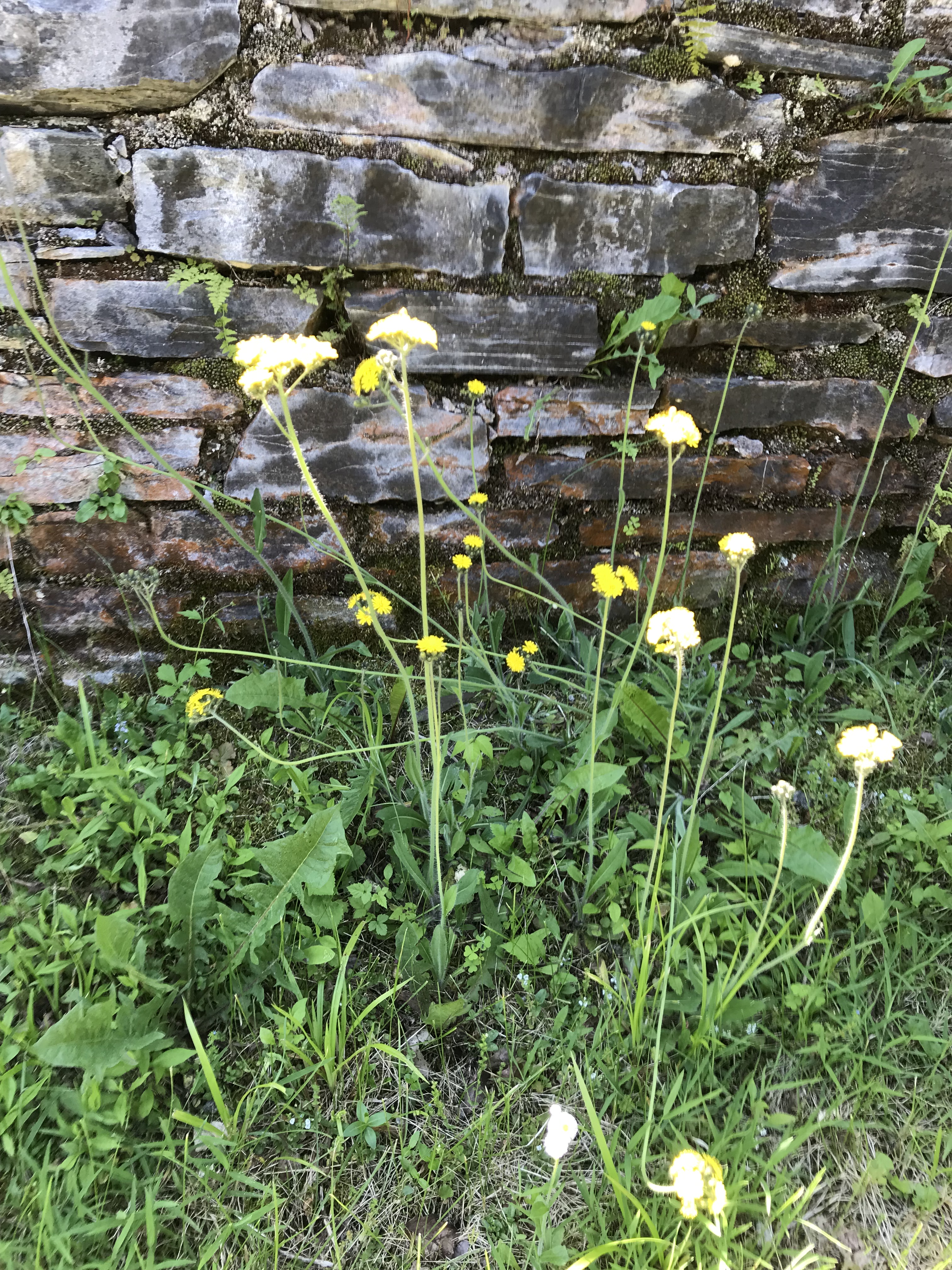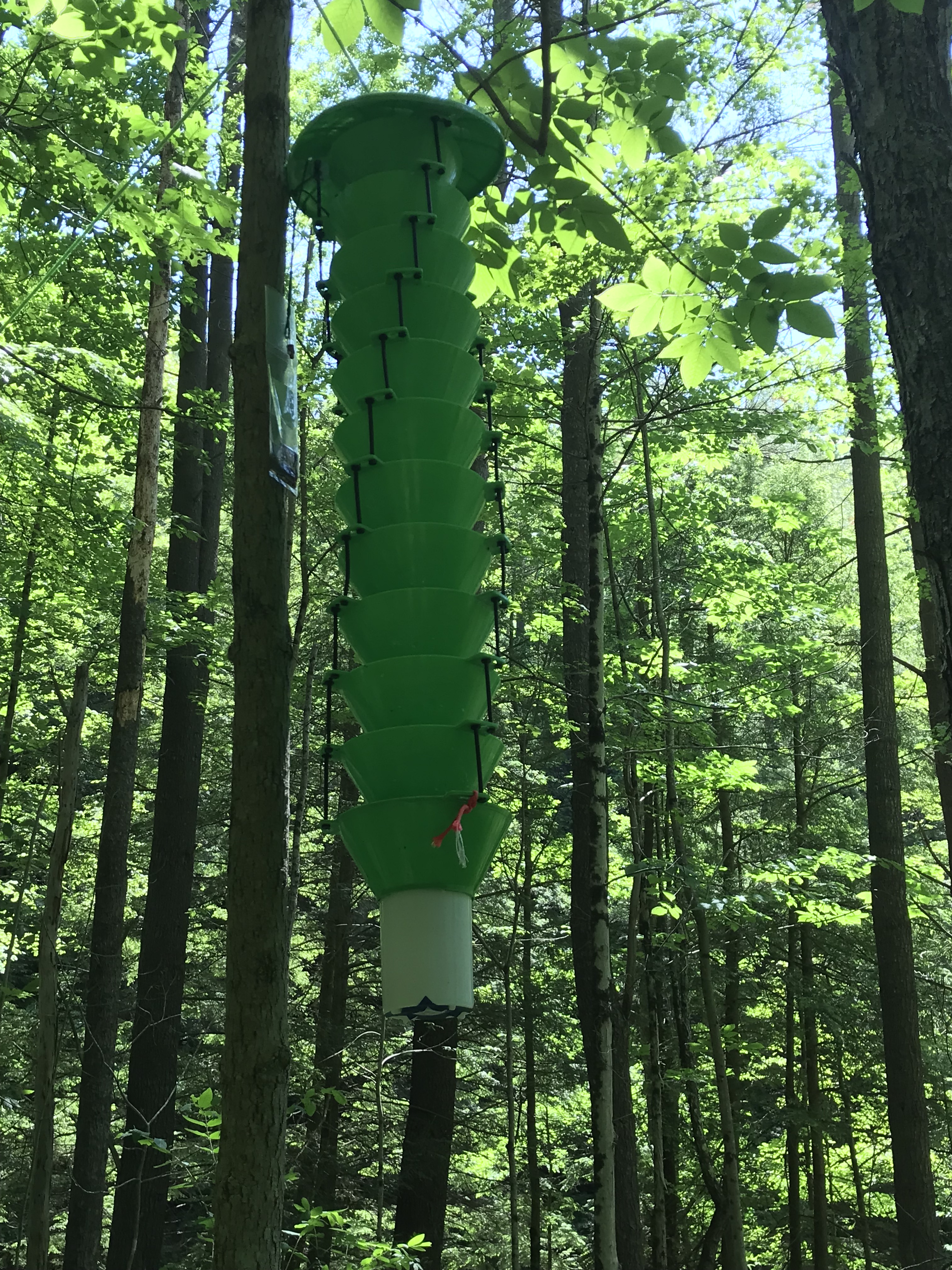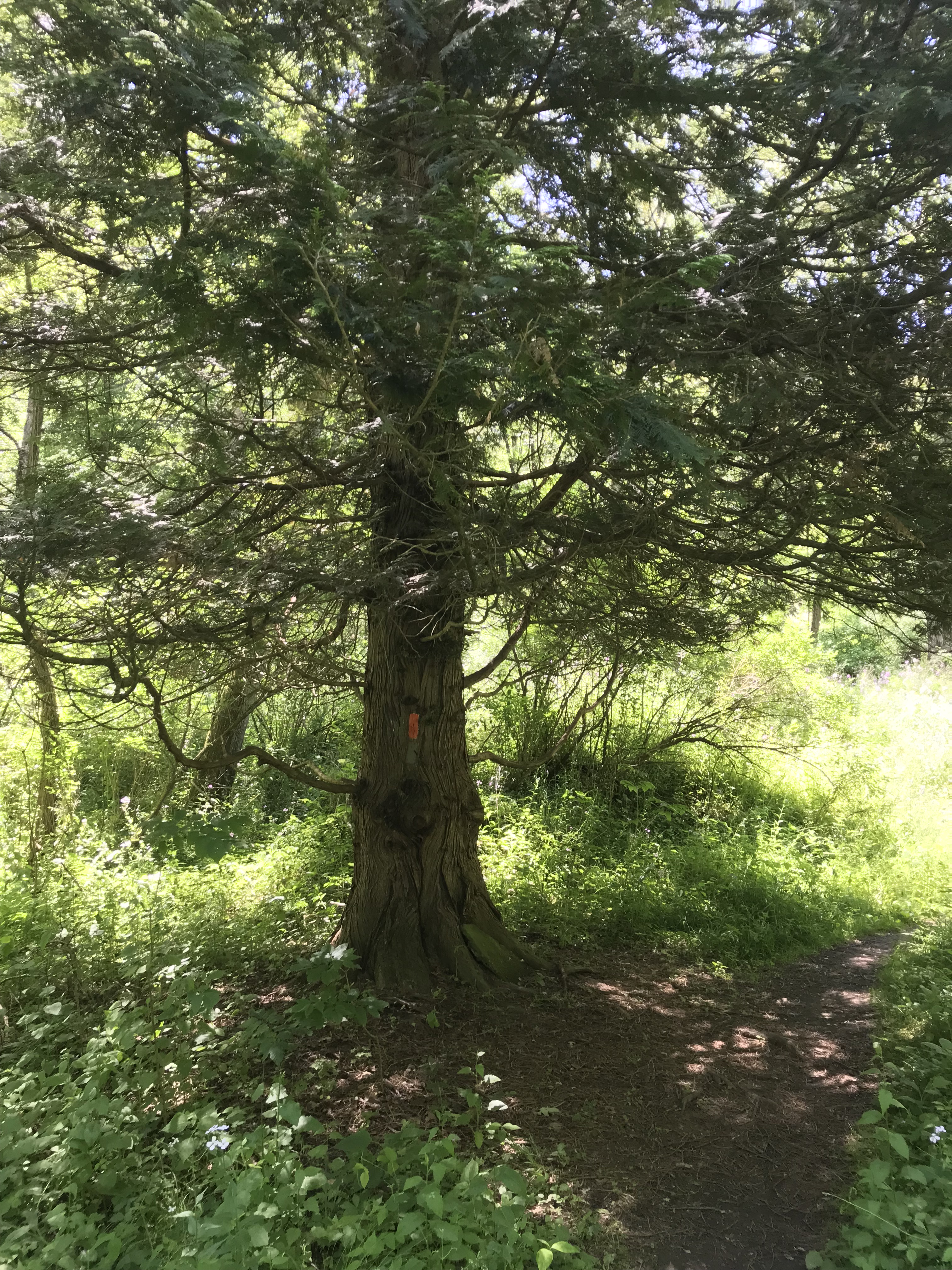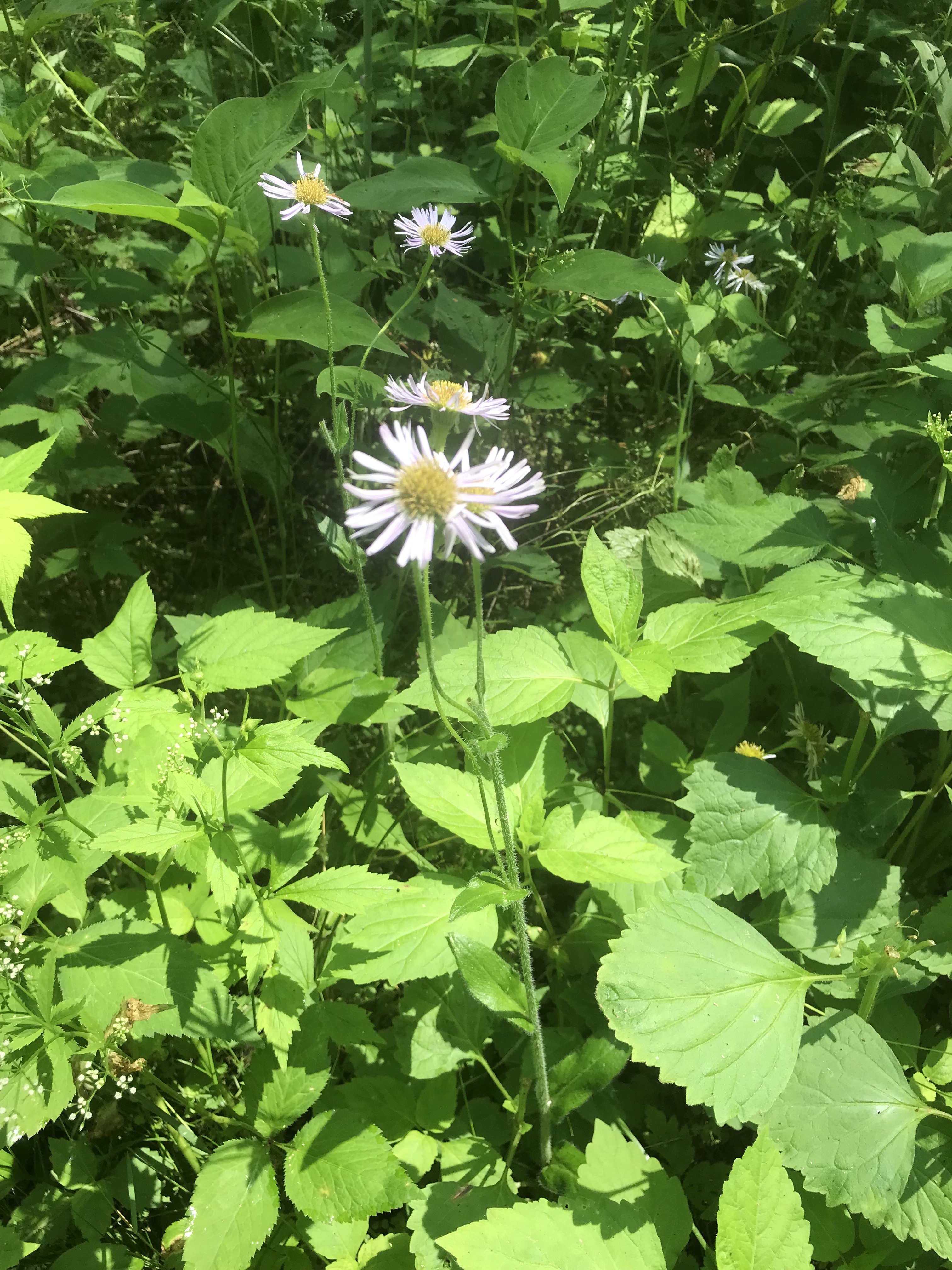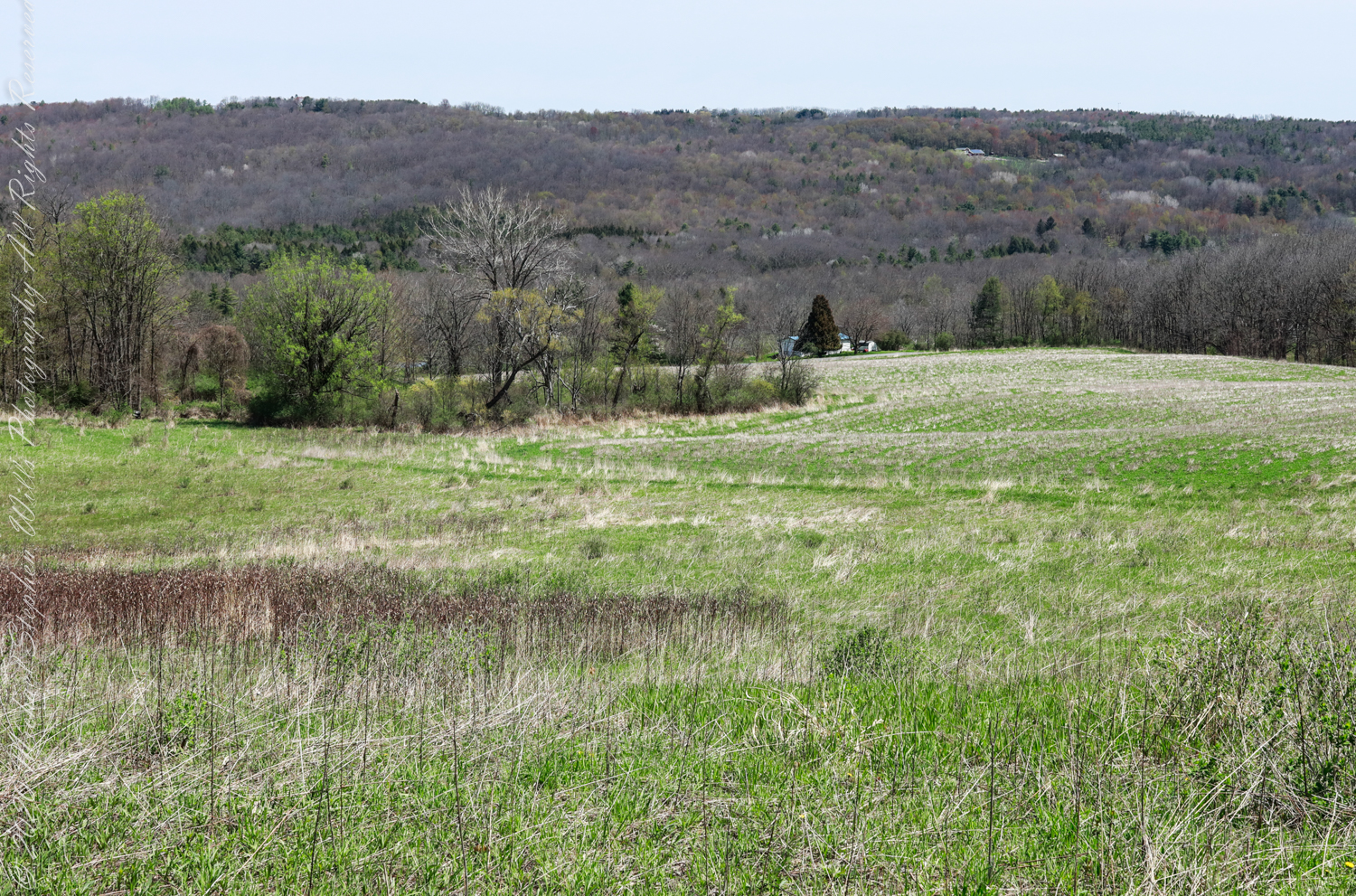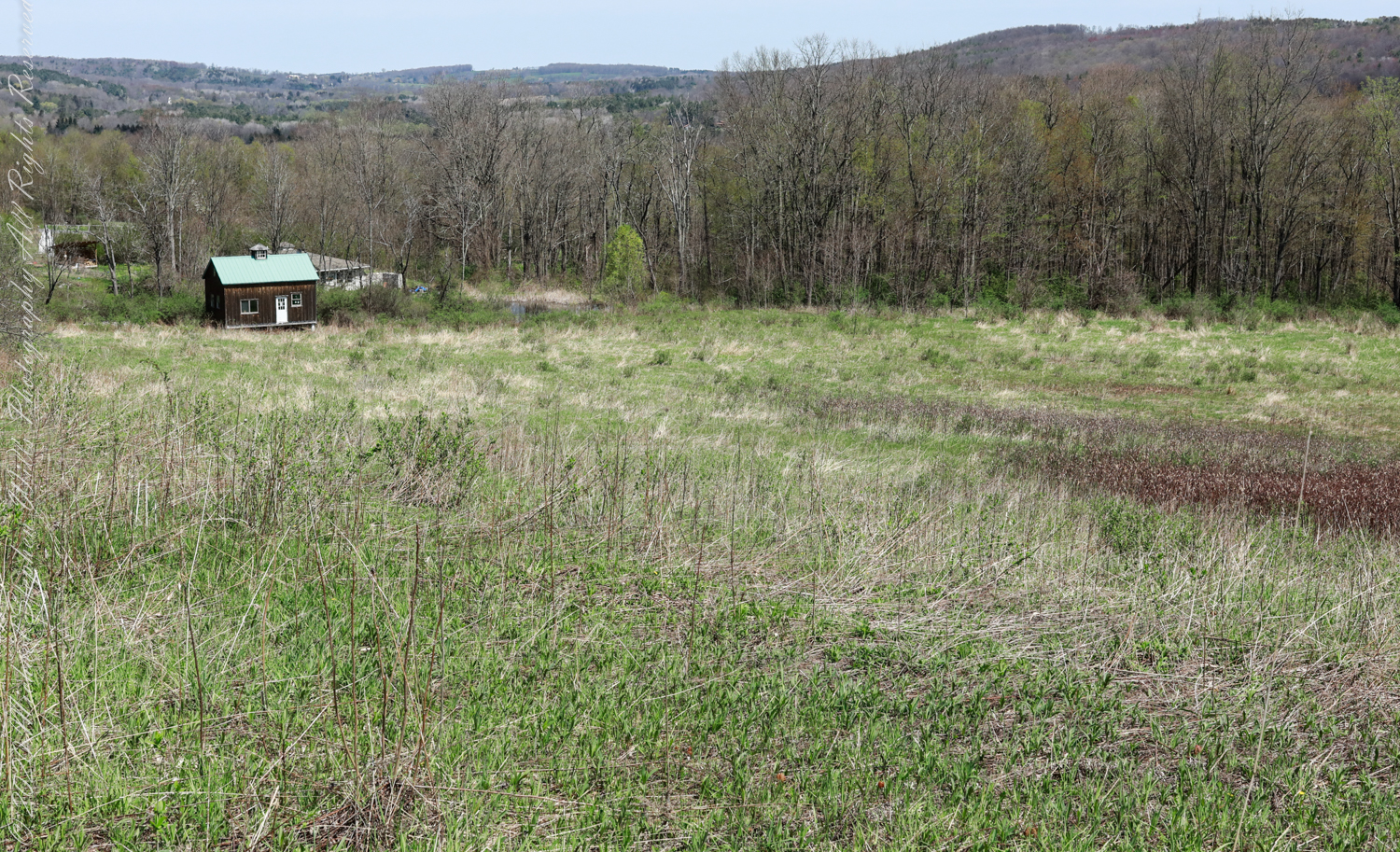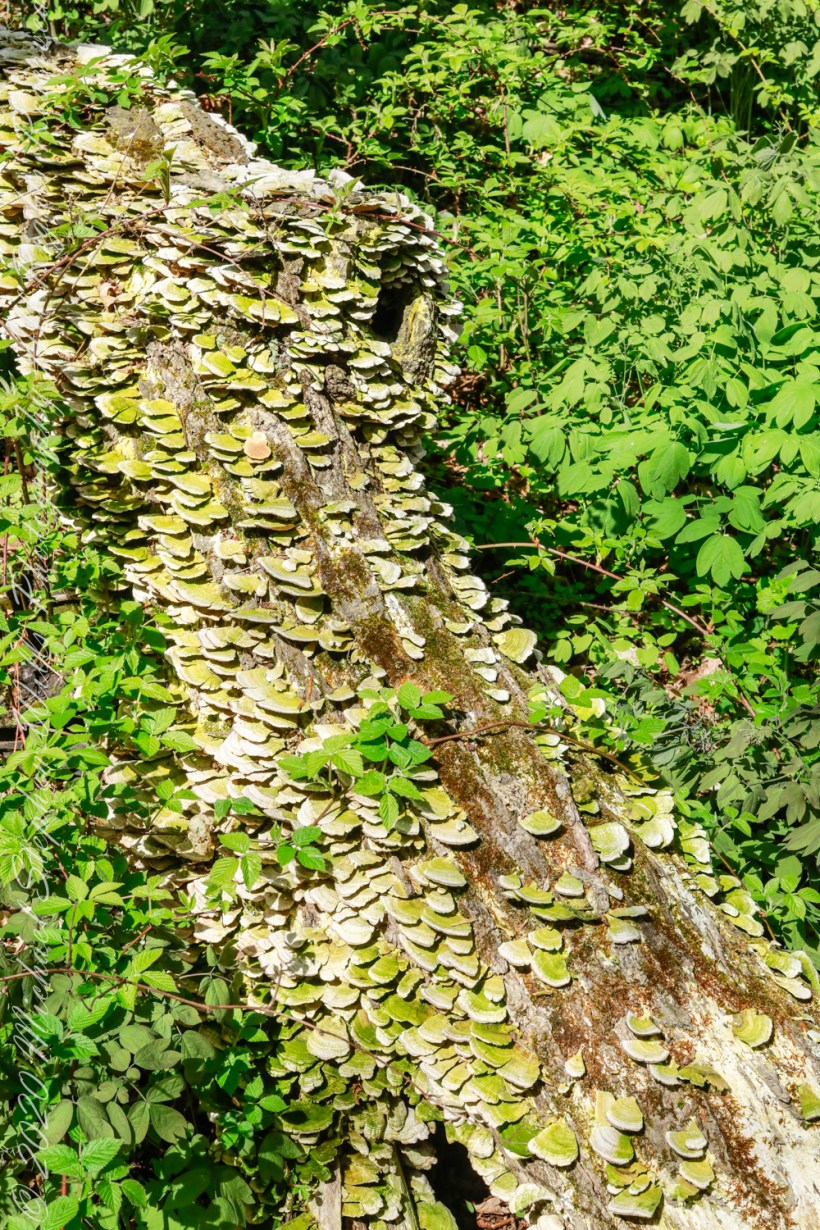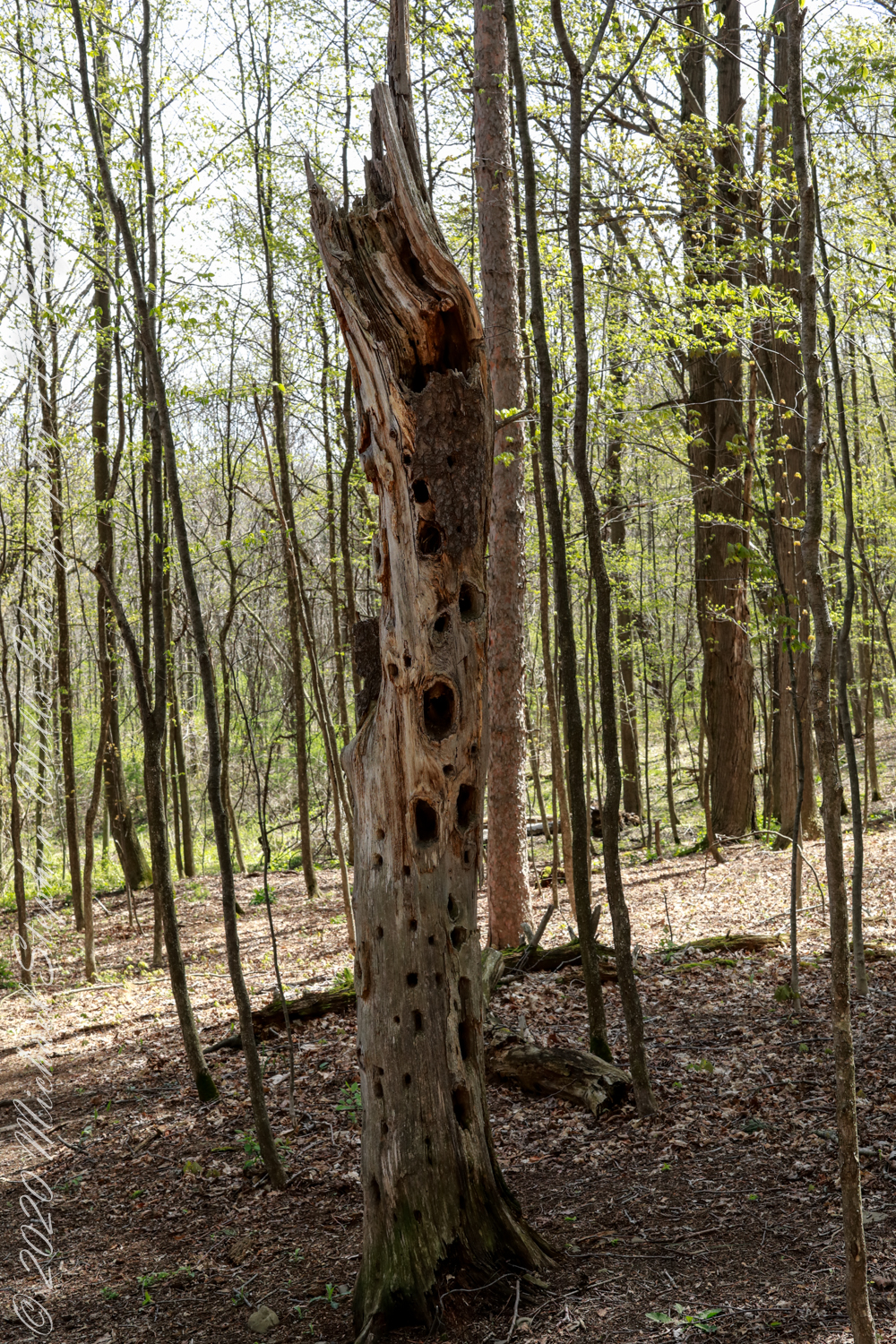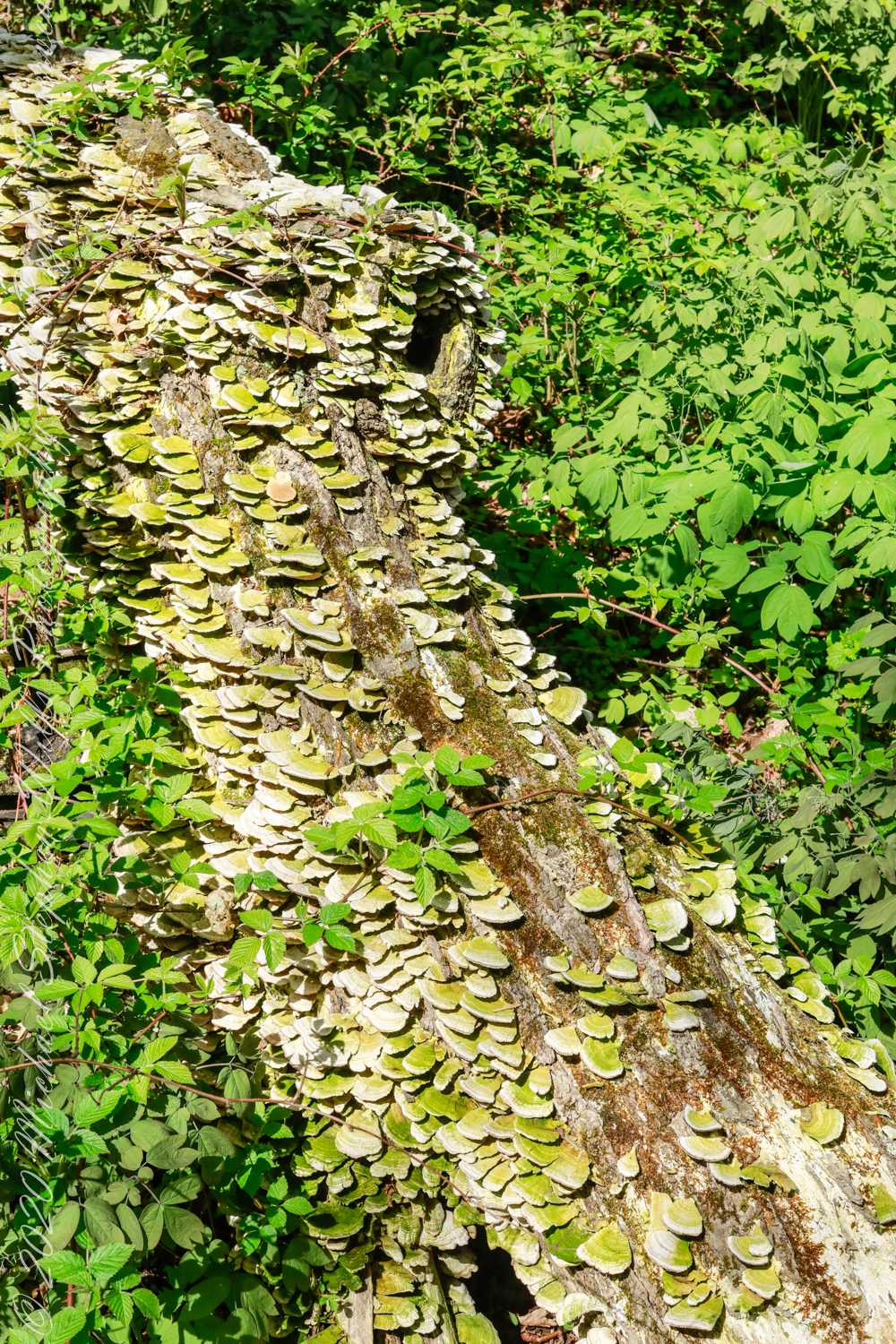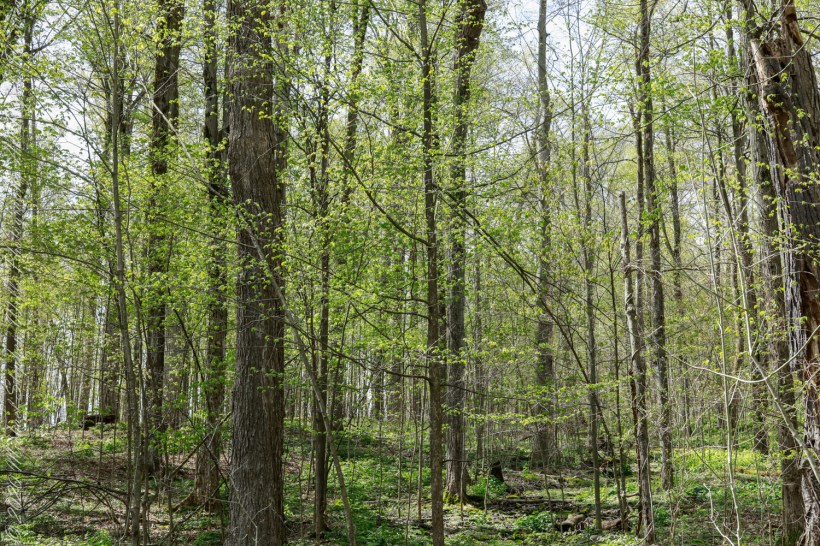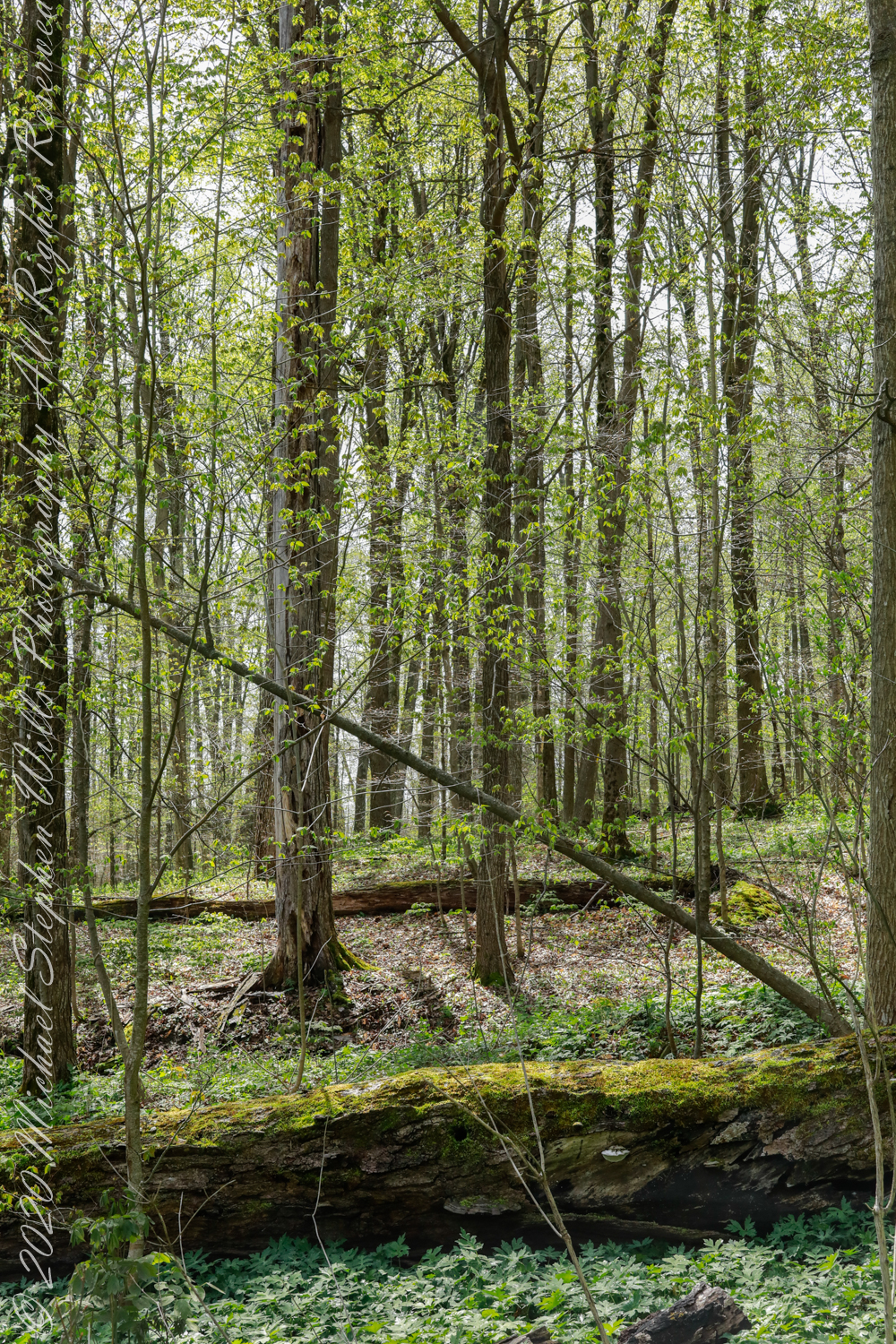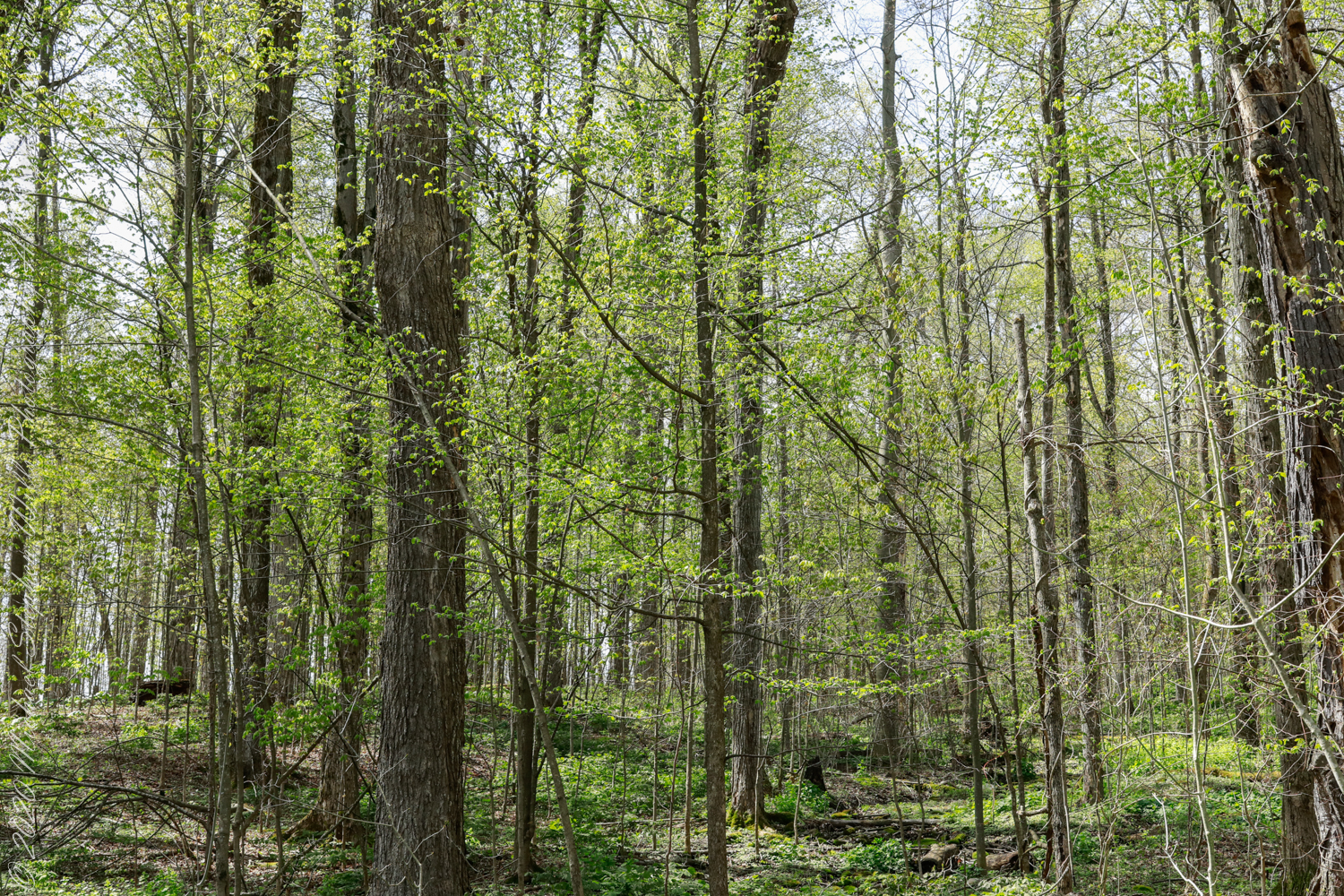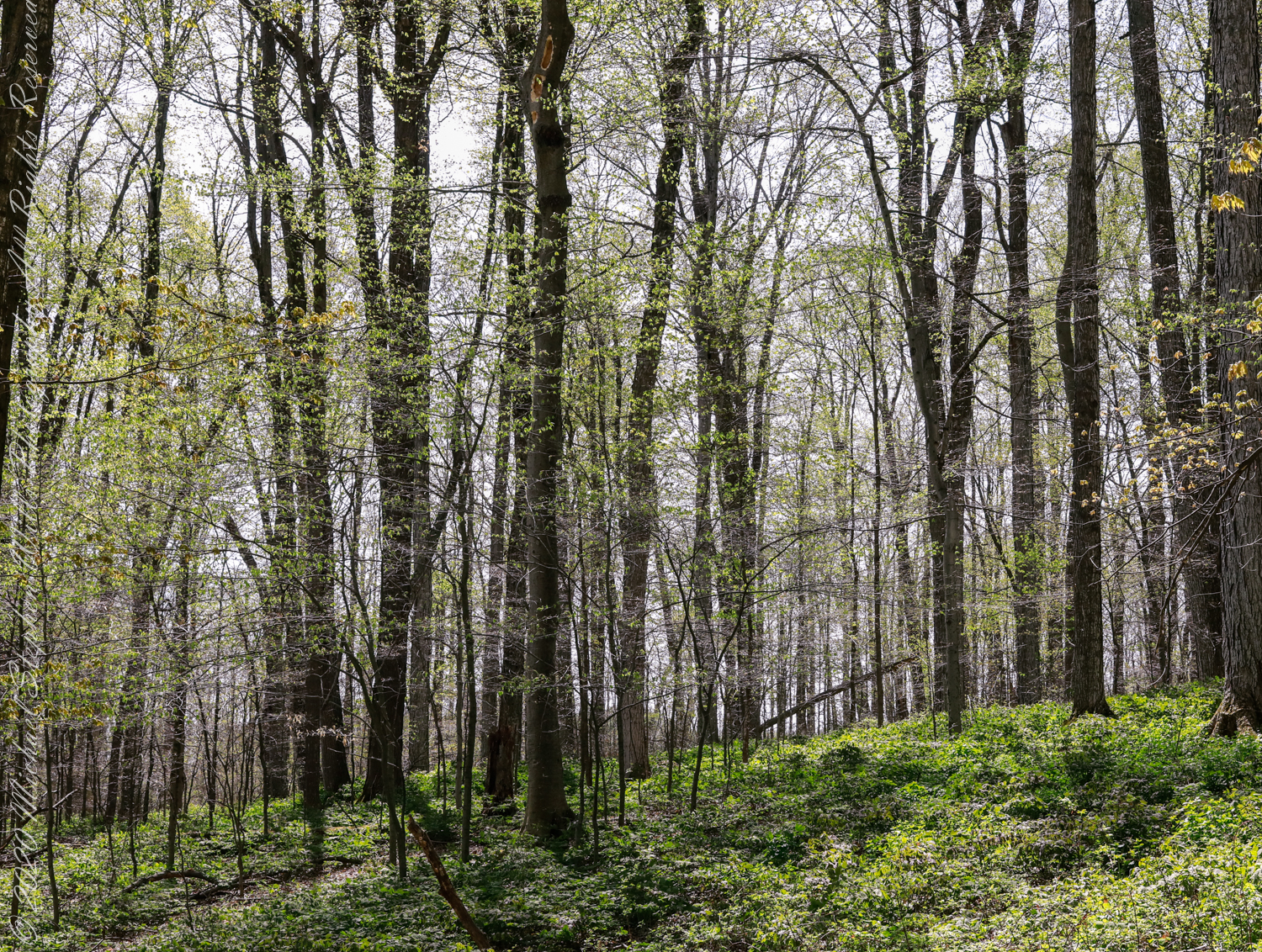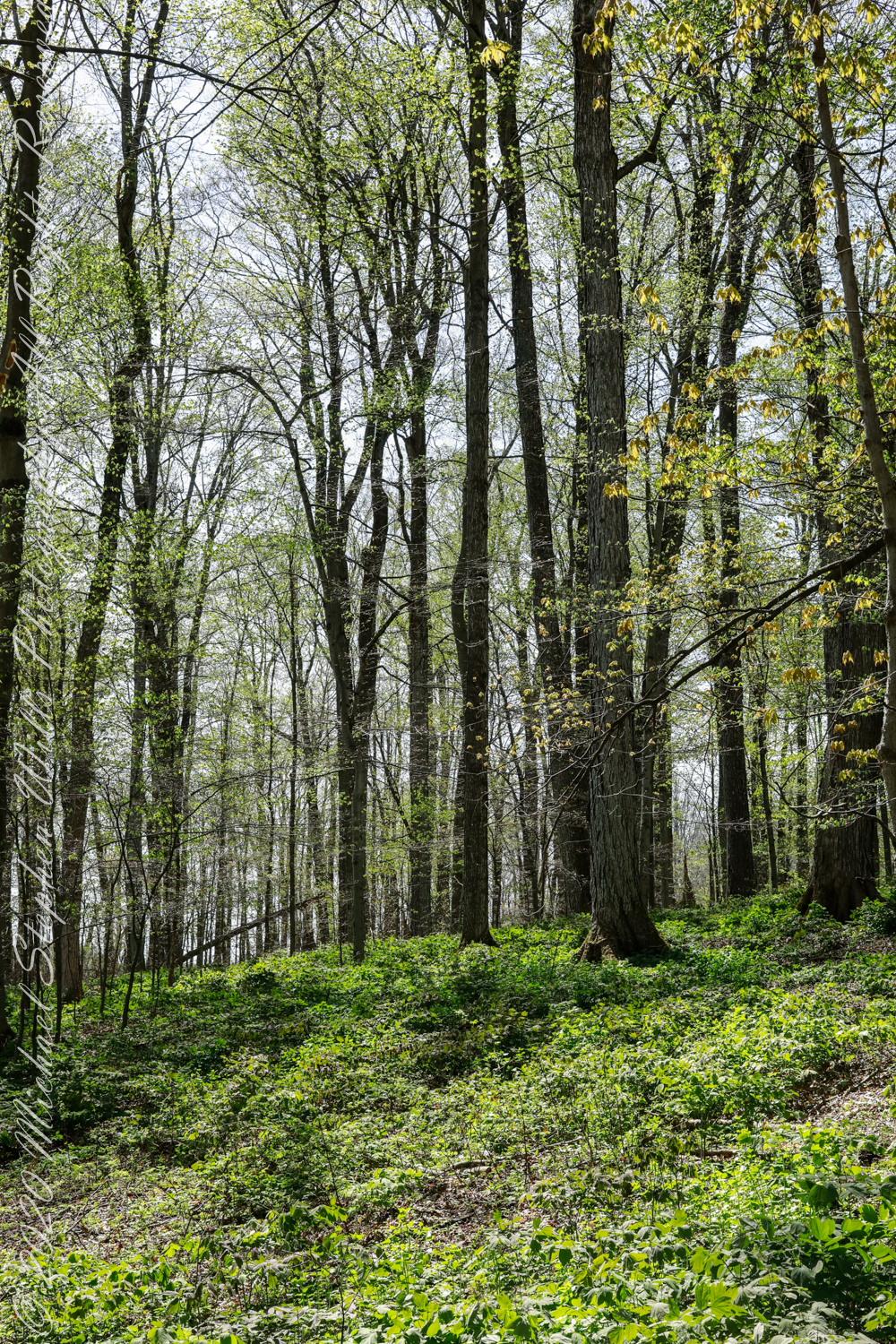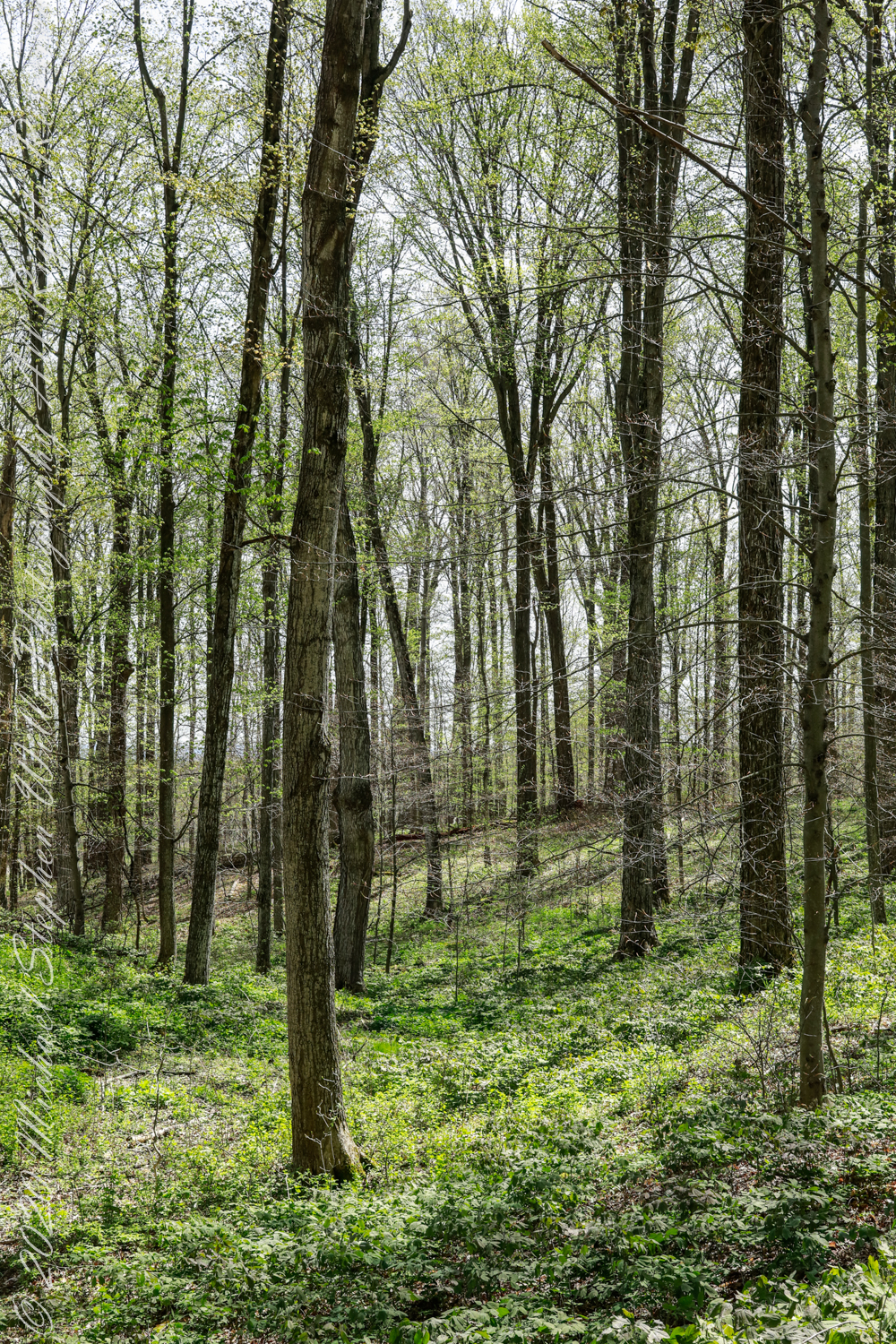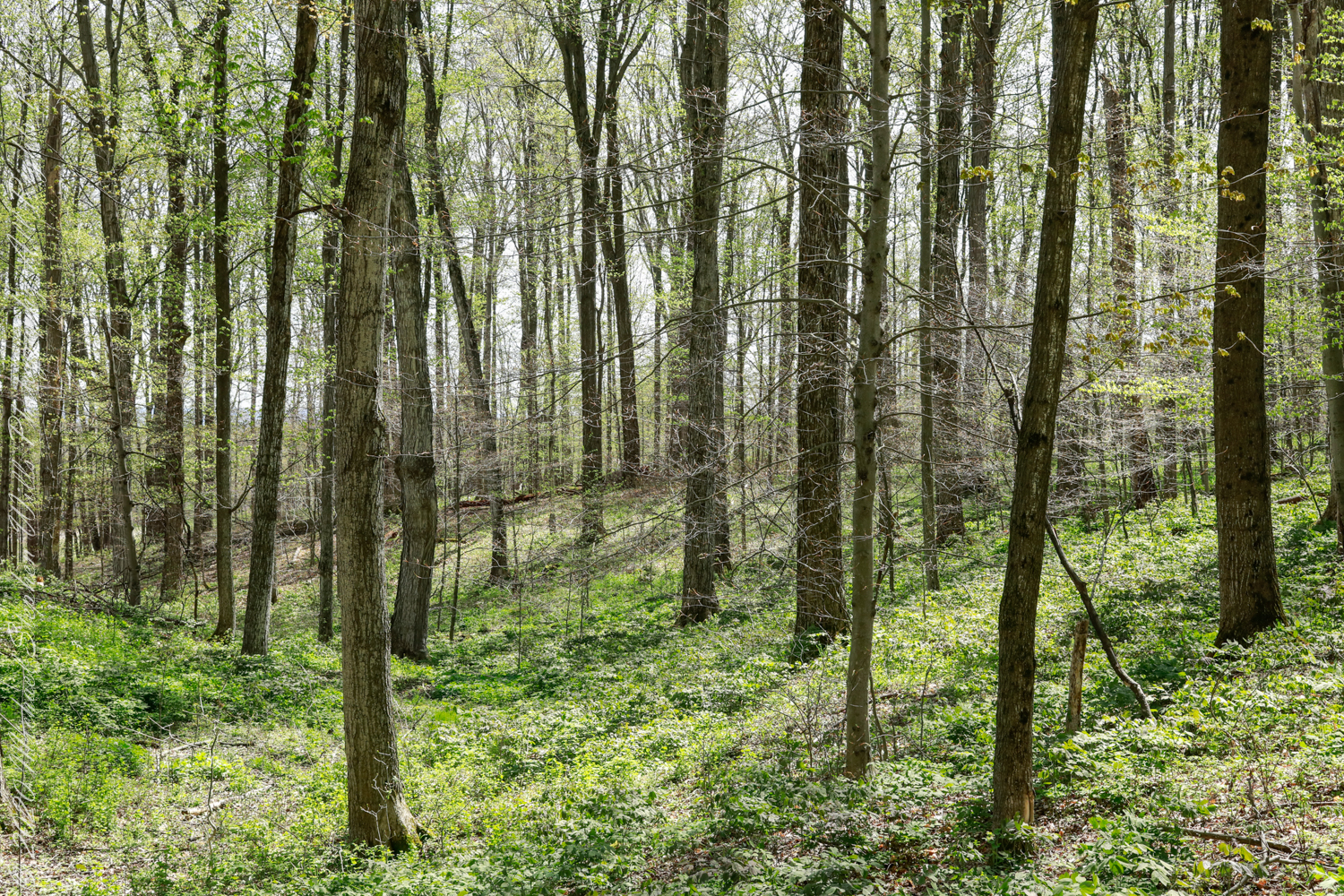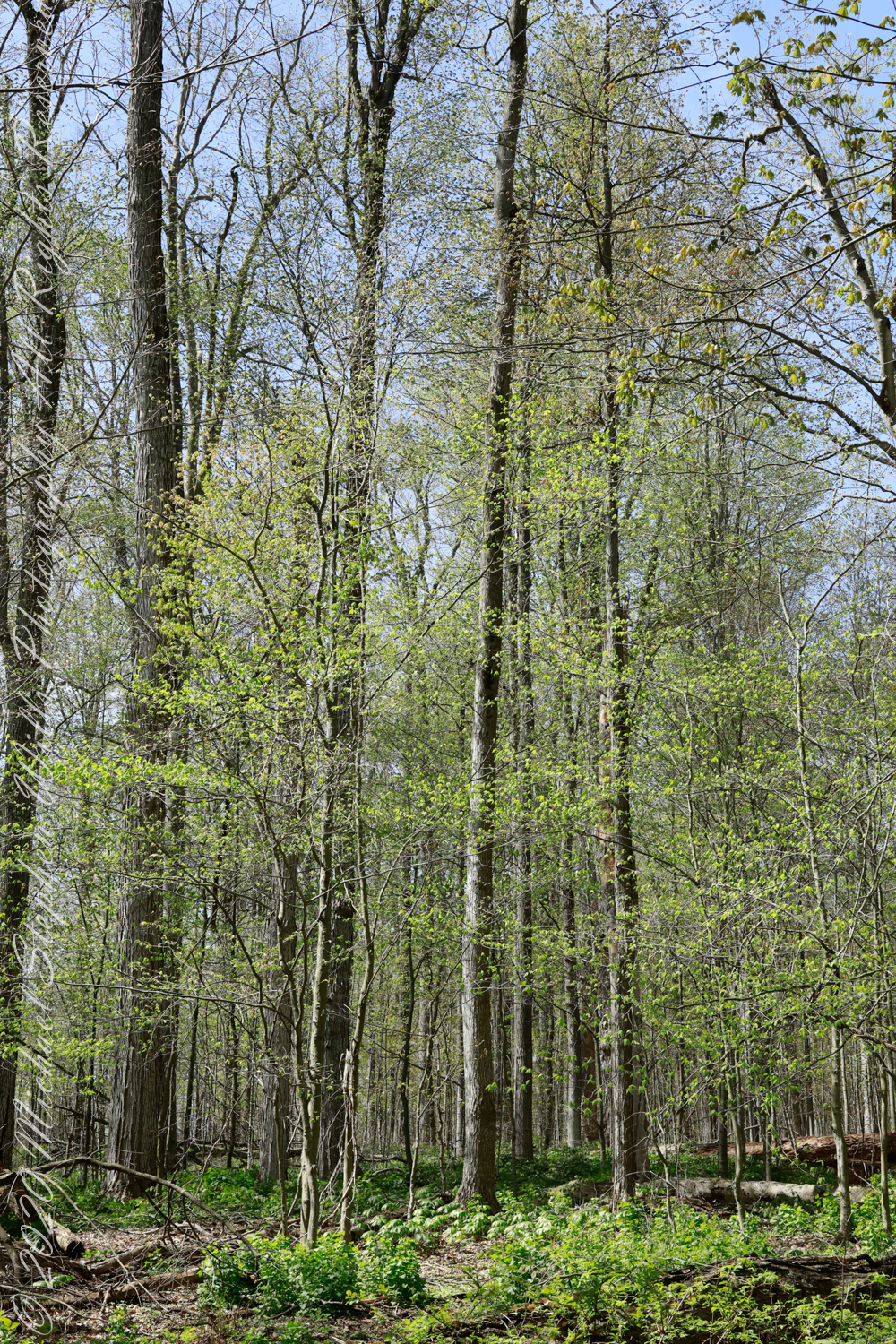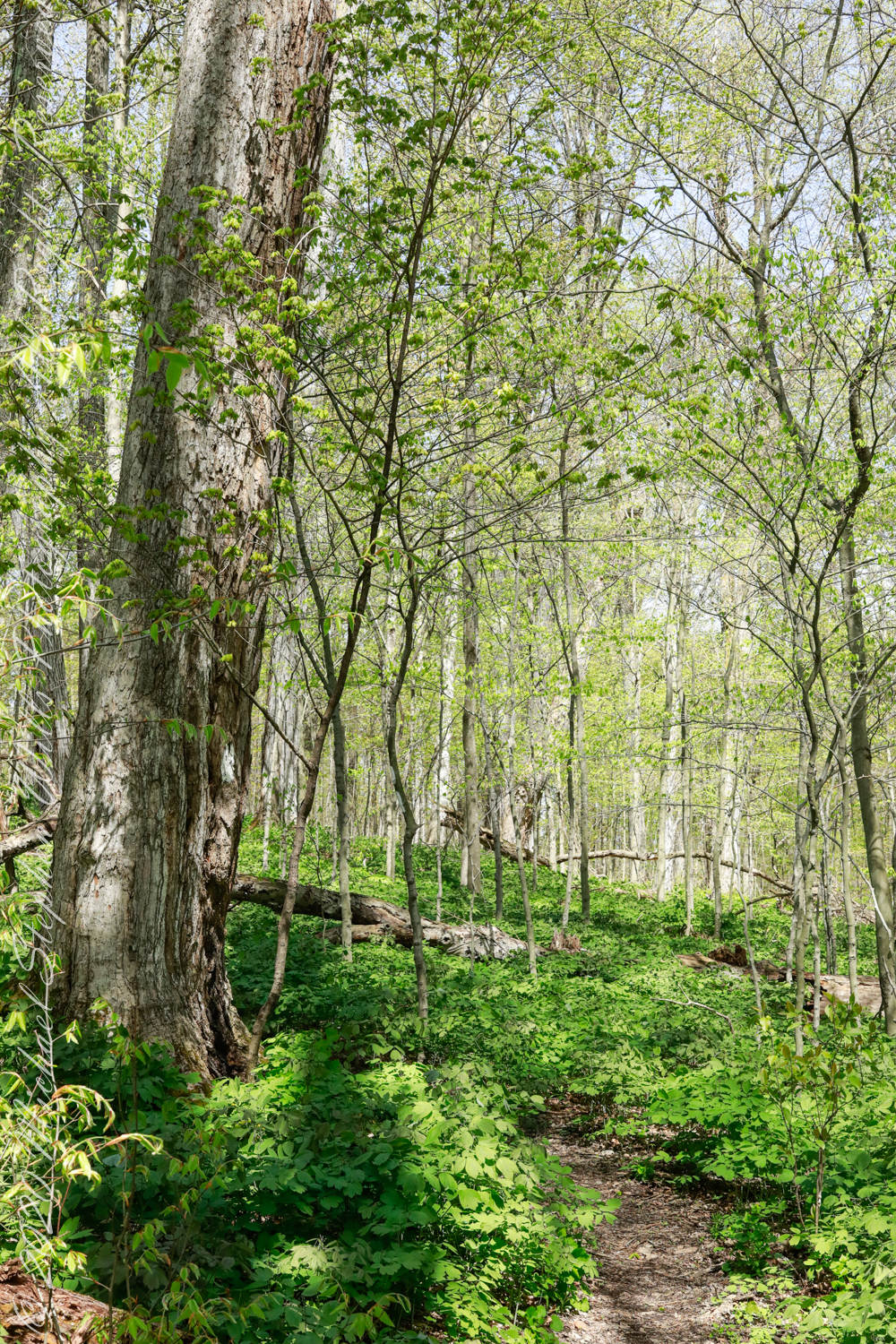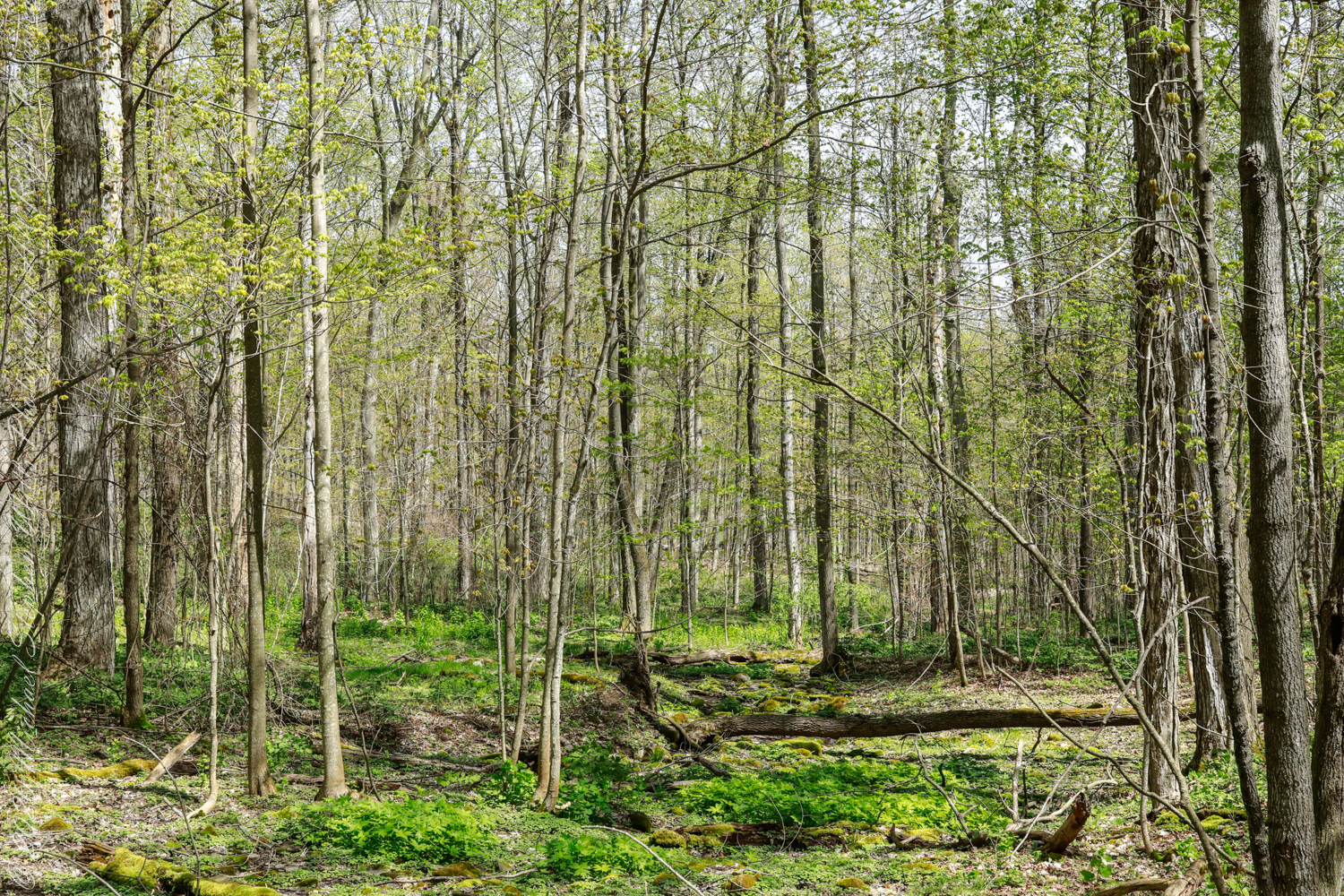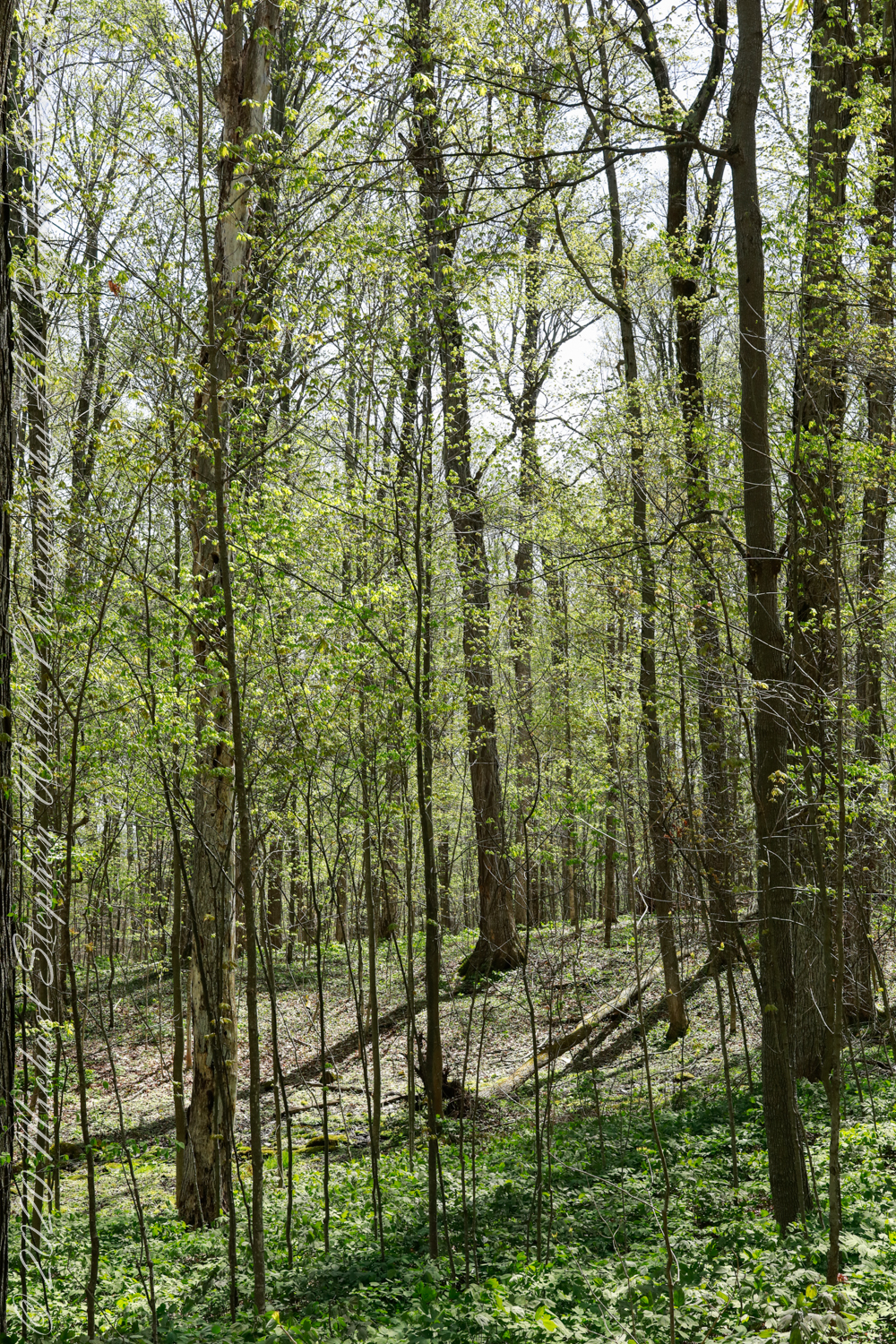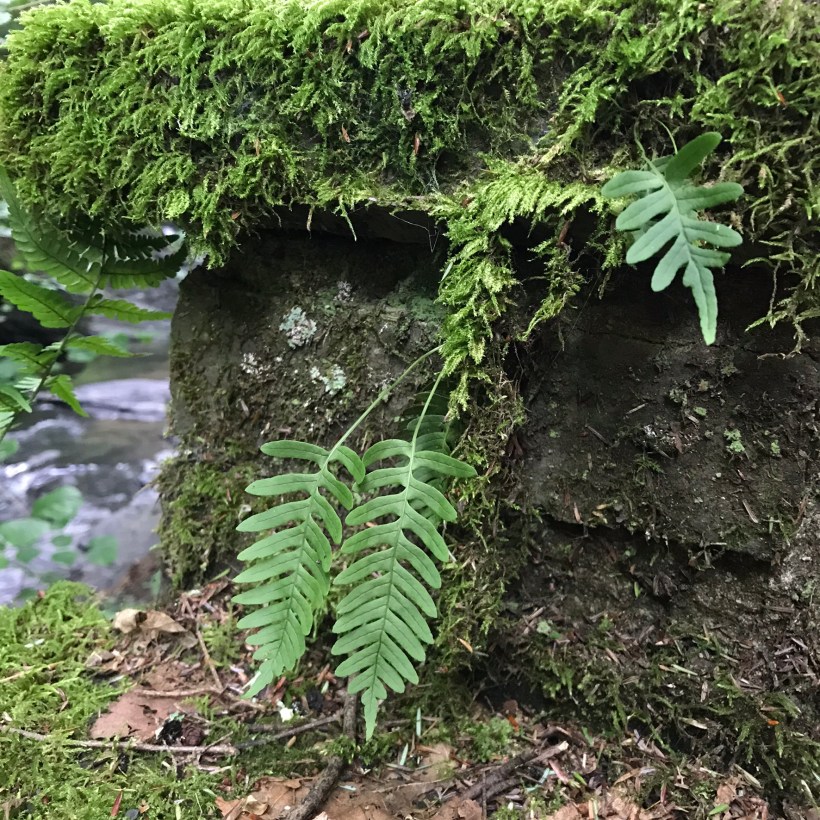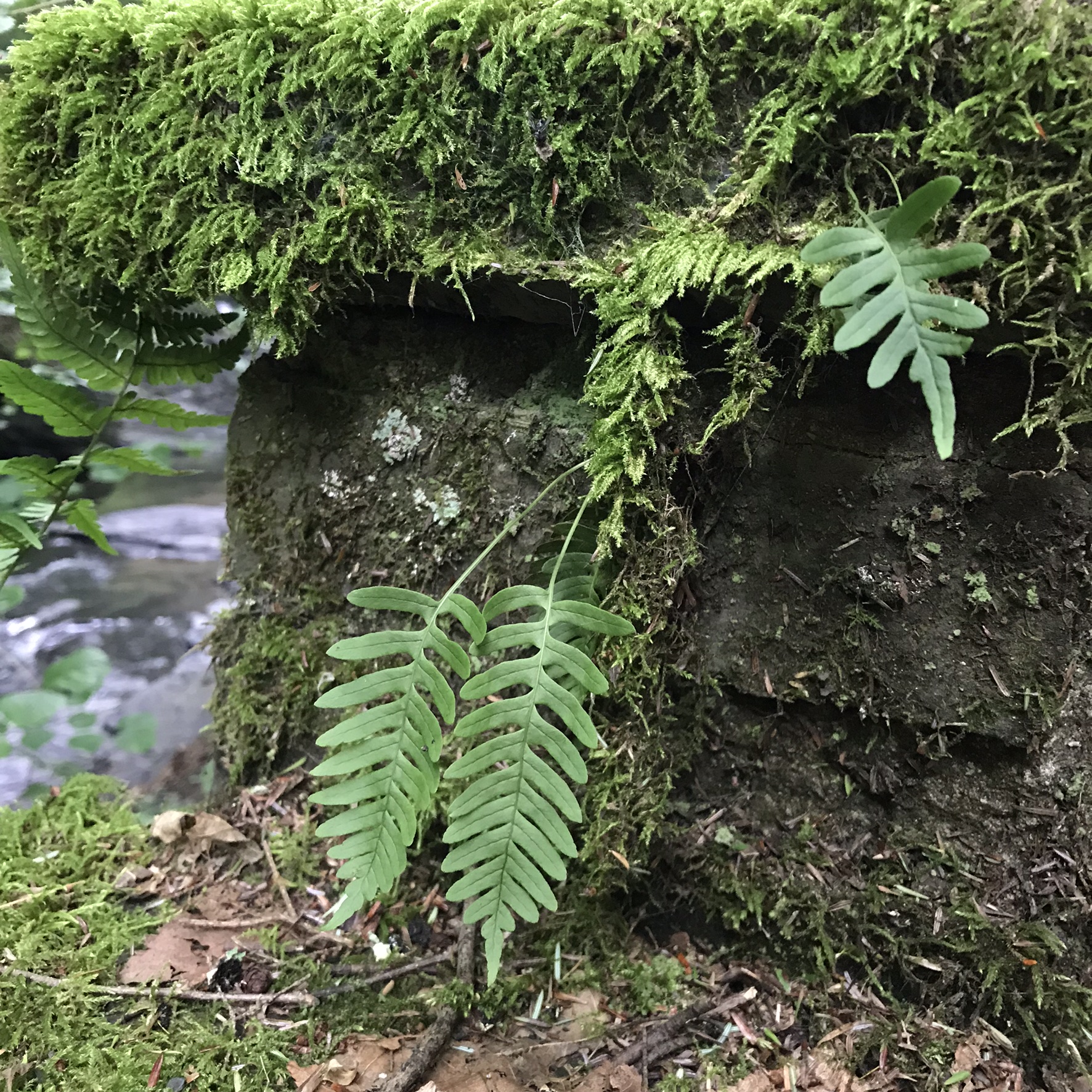
I found these snags surrounded and, at a distance, hidden by the burgeoning Brock-Harvey forest preserve here in the Finger Lakes.
As with burgeon (see yesterday’s blog post), the word “snag” has a long history from a forested northern region of the planet, though it hales from Scandinavian languages rather than Old English and Old German. As a noun “snag” is something with a point and a body long enough to cause inconvenience, the point catching on anything handy. As a verb “snag” is to become inconvenienced by a projecting body.
In forestry, a snag is any trunk of a dead tree. Commonly, a tree top breaks off leaving a jagged point which possibly can become an inconvenience. For birds, an upright dead tree is a blessing, perfect for homemaking.
Standing Snag with Nest Holes
Fallen, the snag is still a snag and also a home first for fungus. When the work of the fungus is done, the resulting mound is perfect for growing new trees.
There is a word to describe the first growth of spring, rare in a way as having grown within the English/French languages without roots from either Greek or Latin, wholly suitable to a forest people. The first growth of spring so impressive it has words of its own: burgeon.
Both as a noun, burgeon the bud itself, and a verb; to burgeon, as in to burst forth. Burgeoning: the process of the act itself.
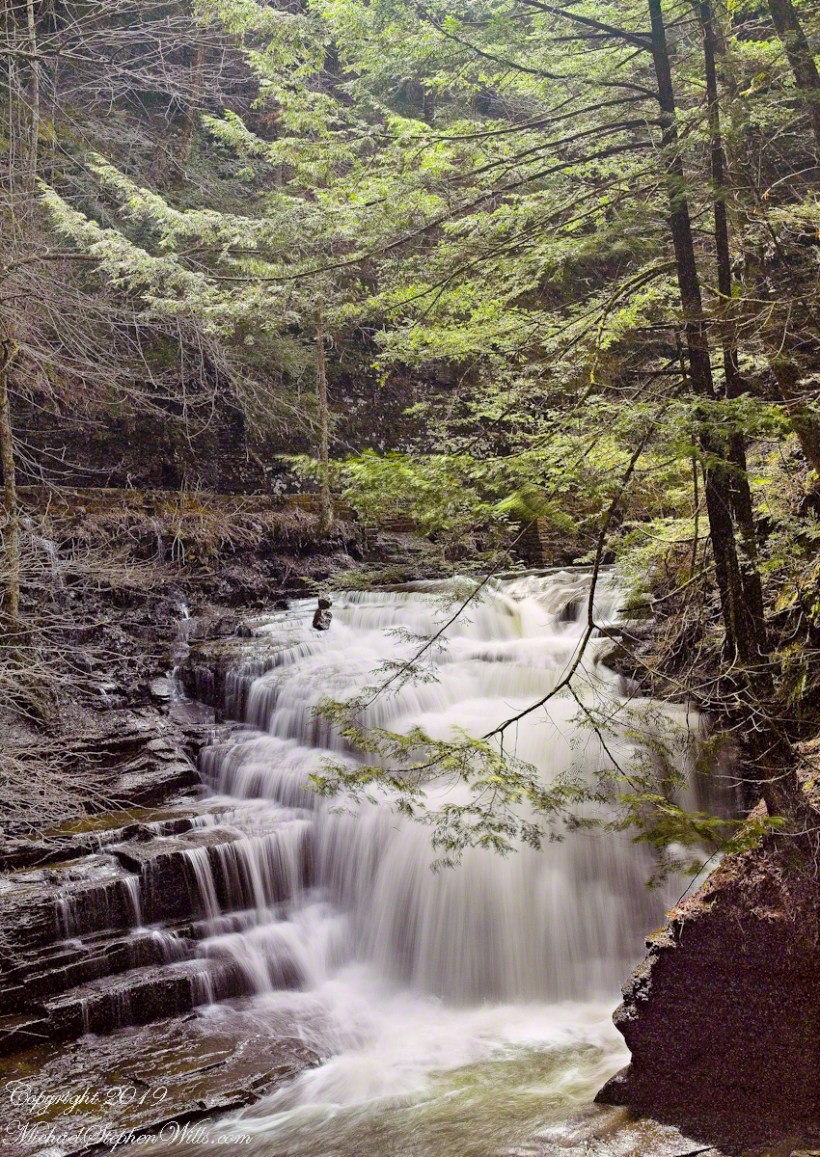
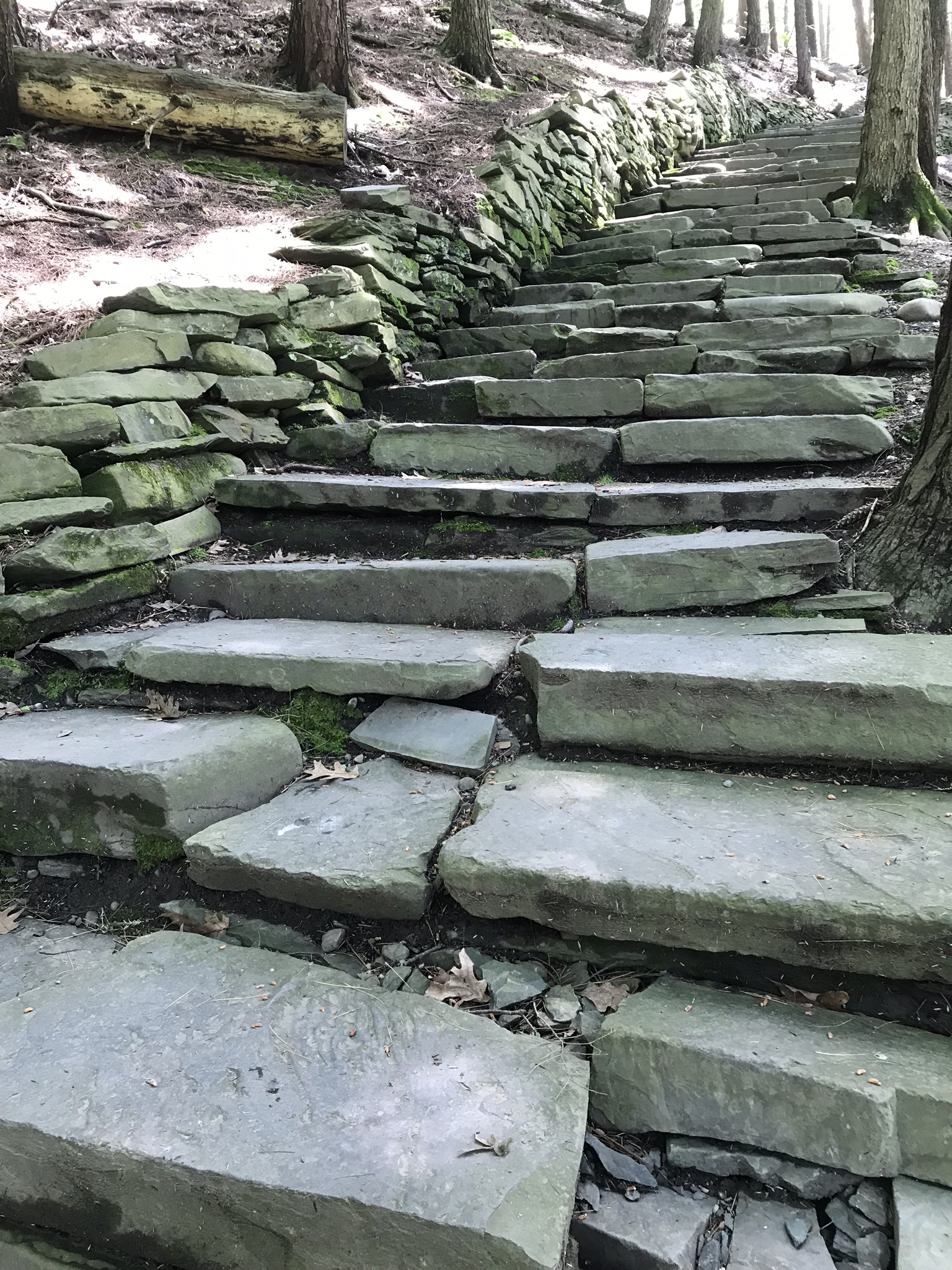
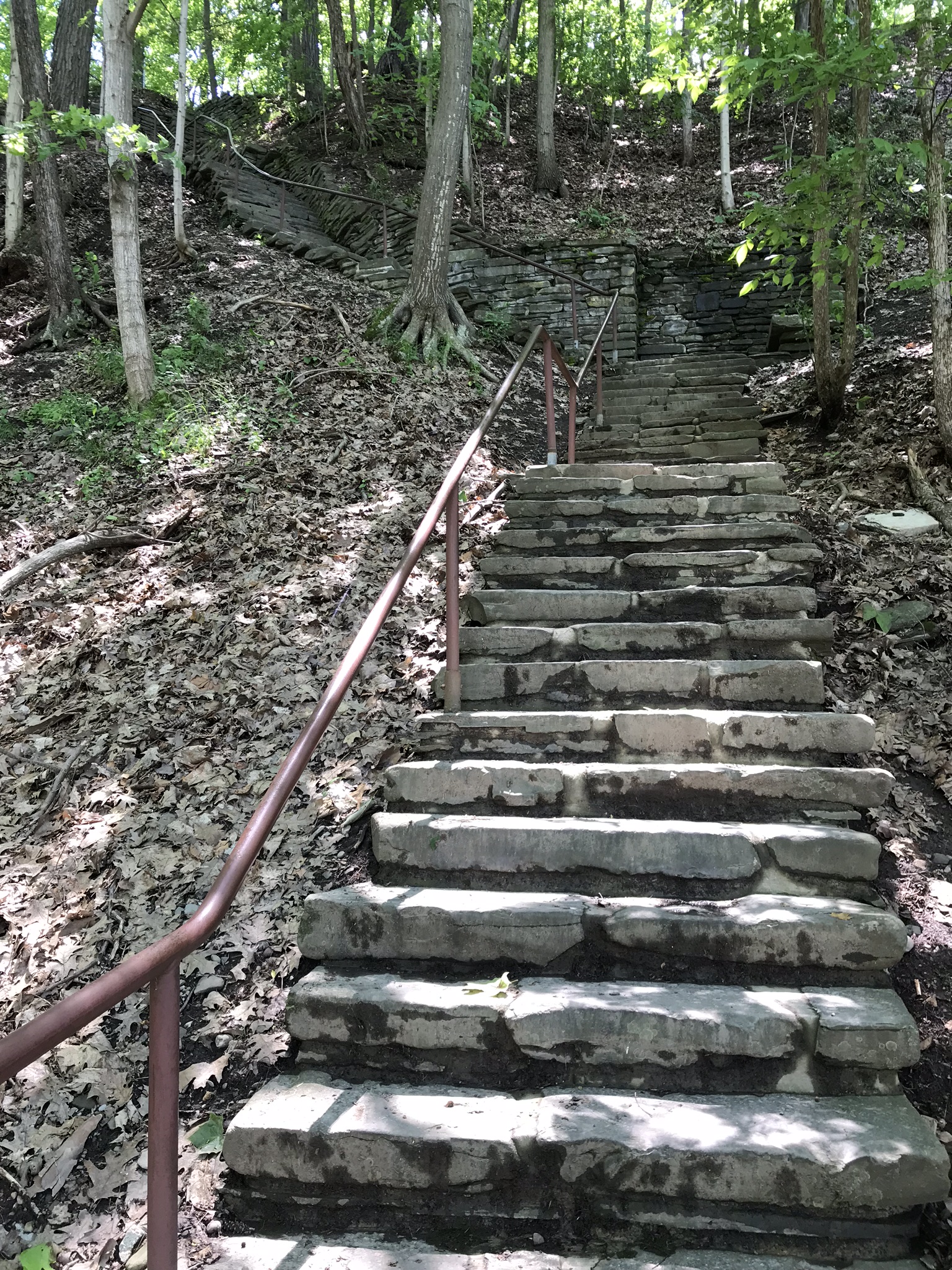
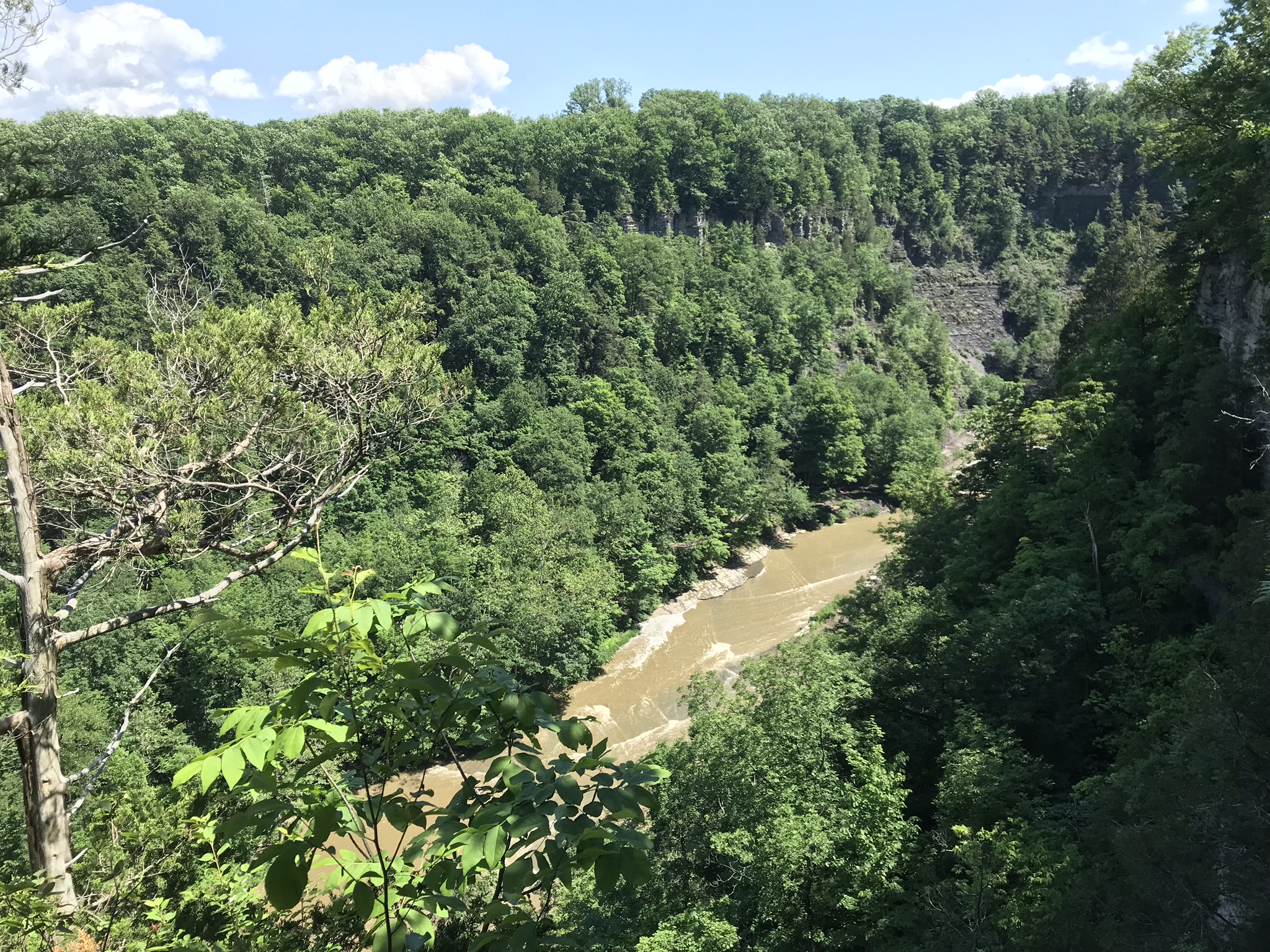
Capturing photographs and videos on the fly using an Iphone, we visited Fillmore Glen State Park, Moravia, New York with our granddaughter, Nia. This is the seventh post of this series. Click me for another springtime post.
Click any photograph for a larger view.
Growing up on Long Island provided limited exposure to the great variety of animal and plant life on planet earth. I remember Canesteo, a town just off the western edge of the Finger Lakes in Steuben County, after moving there in the 1980’s, had a marvelous abundance of different plants in the lawn. It was a welcoming feeling to notice this before the term “monoculture” was circulated.
These days the exuberant variety of ferns and mosses in the Finger Lakes are still alien in the sense noticing the small differences between species is still beyond me; or, rather, I have yet to know well all the later arrivals on the scene, the flowering plants and these command my attention.
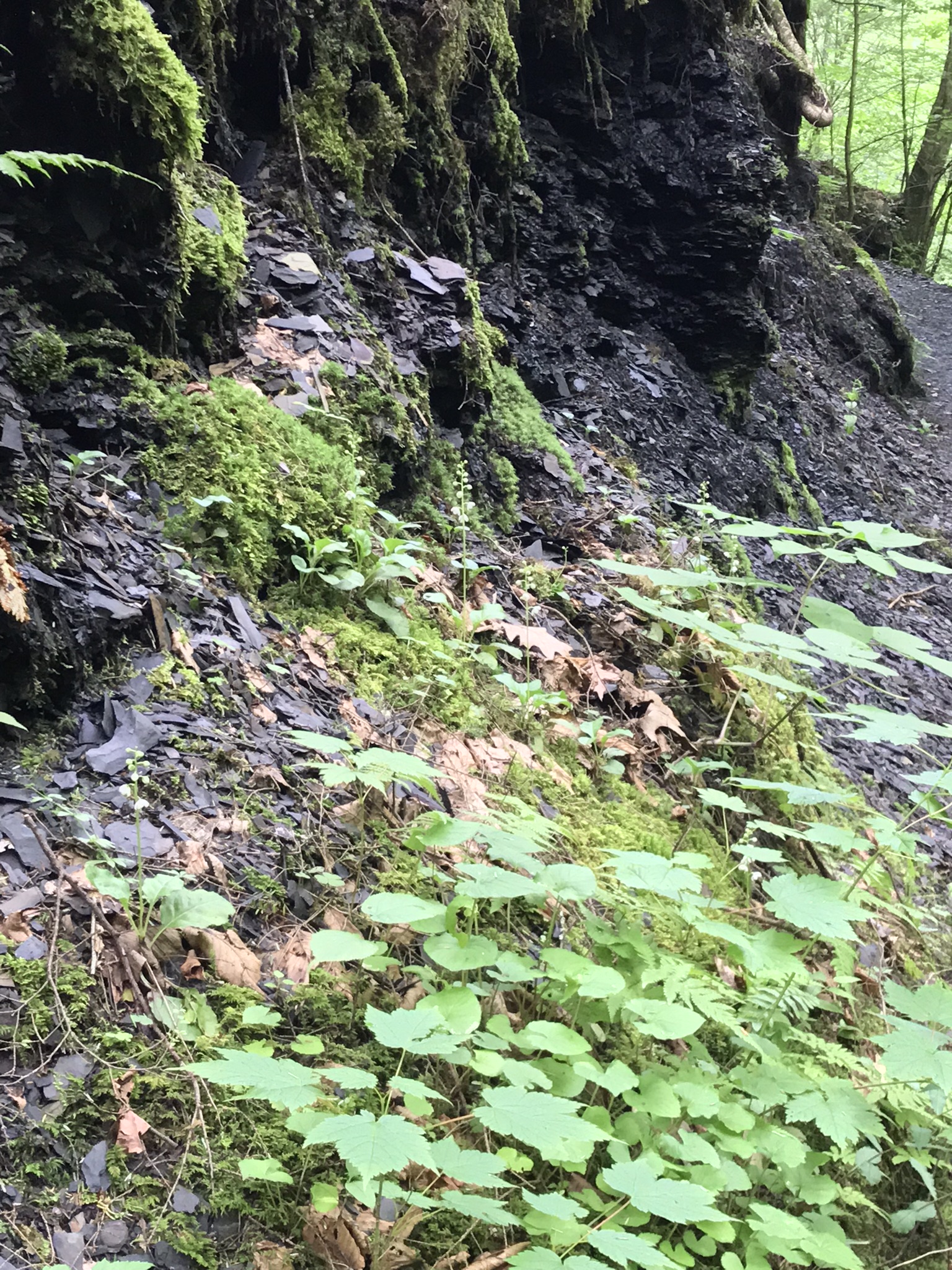
Close by the Sorrell of my post “Glen Shadows” is this inconspicuous flower, common name Shinleaf, seen here growing in spite of the the wet rip rap of shale at the base of the glen wall on the footpath. Much of the characterization of this plant is from the inconspicuous basal leaves from which the raceme of flowers springs.
Evergreen Pears
Moss and Shinleaf are associated in these groupings, I could conclude the moss provided a place for the tiny seeds of the plant to lodge and take root. The plant is a perennial and stays green throughout the winter, leading to another conclusion: there is a substance in the leaf cells that resists freezing. The latin meaning of the (scientific name) genus Pyrola means “Pear”, the shape of the leaf.
Look closely at the flowers to see the small flowers, the style extending beyond the petals like a bell clapper.
The common name, Shinleaf, is from England where the plant is credited with providing relief for minor injury. I am unclear on the grouping of this plant as a wintergreen. Shinleaf might be included as a wintergreen, and possibly attributed with healing properties, because “wintergreen” in the past was a synonym for “evergreen.”
There are species of wintergreens, in a different family, with leaves containing methyl salicilate that metabolizes (changed in our bodies) to a substance related to aspirin and more potent. I am reconsidering my identification of “cranberry” in the previous post “Red” to be a type of wintergreen high in methyl salicilate and growth close to the Shinleaf.
This abundance of life variety must be cherished and preserved, it can be a source of survival for the human species.
Copyright 2022 Michael Stephen Wills All Rights Reserved
Ancient legends speak of the River Lethe, crossed by departing souls. The waters of the Lethe wash away memory, allowing for spiritual rebirth, reincarnation, a return to the world in new form.
This memory implant represents a bridge over the Lethe.
For those chosen to cross over to the new land in return for
their treasure, lives and selves.
Description
This virtual monoculture glade from the long time of forests,
a place of happy gatherings, of families, plentiful food and water.
These sycamores grew over centuries, through thousands of days, wider than 10 people,
white with age as the outer covering, called bark, falls away.
forked, trunks
climbing to the sky.
Copyright 2022 Michael Stephen Wills All Rights Reserved
On September 14, 2013, the Bock-Harvey Forest Preserve was dedicated protecting 48 acrea of open meadow, transitional meadow, mixed hardwood forest, a special environmental protection zone and the Finger Lakes Trail. Brock-Harvey Forest Preserve, and all land as far as the eye can see from there, was part of the Military Tract of Central New York, 28 townships given classical Greek and Roman names, each township 100 lots of 600 acres each, approved by the U.S. Congress 1799. Here, the township was Ulysses, encompassing the southern end of Cayuga Lake and surrounding lands. Thus, the city of Ithaca and Hector Street winding up from the valley passing below our home.
Sign on Rockwell RoadResting Place in forestGreat Information
This land and several other military tracts were purchased by Samuel Harvey. He then gave he lands to his sons including this farm to Silas Harvey, the great-great-great-great grandfather of Megan Barber who led the dedication ceremony of the forest preserve. Megan’s great-grandmother Martha Harvey married Fred Bock and lived on this land used for dairy farming for over 150 years.
forested uplandvernal poolsnagfull of bird holes
The preserve exceeded my expectations for great upland views.
above the lean-topapartment houselean to made from tamarack logs with excellent fire pitsolar powered charging stationdocument box / mouse houseselfie
View from Shelter across the valley of Enfield Creek, the same that flows over Lucifer Falls of Treman State Park
The Finger Lakes are formed by a series of inclined planes spread across central New York State.
Here we look northwest across the land between Cayuga and Seneca lakes, all forests and farm land. Seneca Lake is not visible,15 miles distant, and the Finger Lakes National Forest in between.
The only town is Hector, New York, population 4,854 in the 2,000 census. The foreground are sere grasses, a field of beef cattle and pond.
Click photograph for a larger view. To do this from WordPress Reader, you need to first click the title of this post to open a new page.
Unharvested apples on the ground and branches of this apple orchard off Black Oak Road on the slopes of Connecticut Hill, Newfield in the Finger Lakes of New York.
Click photograph for a larger view. To do this from WordPress Reader, you need to first click the title of this post to open a new page.
Unharvested apples on the ground and branches of this apple orchard off Black Oak Road on the slopes of Connecticut Hill, Newfield in the Finger Lakes of New York.
Click photograph for a larger view. To do this from WordPress Reader, you need to first click the title of this post to open a new page.
Black Oak Road approaches Connecticut Hill from the north. At this point a long view to west opens up that include Cayuta Lake and the distant highlands of Seneca Lake.
Click photograph for a larger view. To do this from WordPress Reader, you need to first click the title of this post to open a new page.
Here we have a vista of Bostwick Road descent off West hill into the Enfield valley and, then, in the distance, up Harvey Hill. Late autumn foliage graces the scene.
Click photograph for a larger view. To do this from WordPress Reader, you need to first click the title of this post to open a new page.