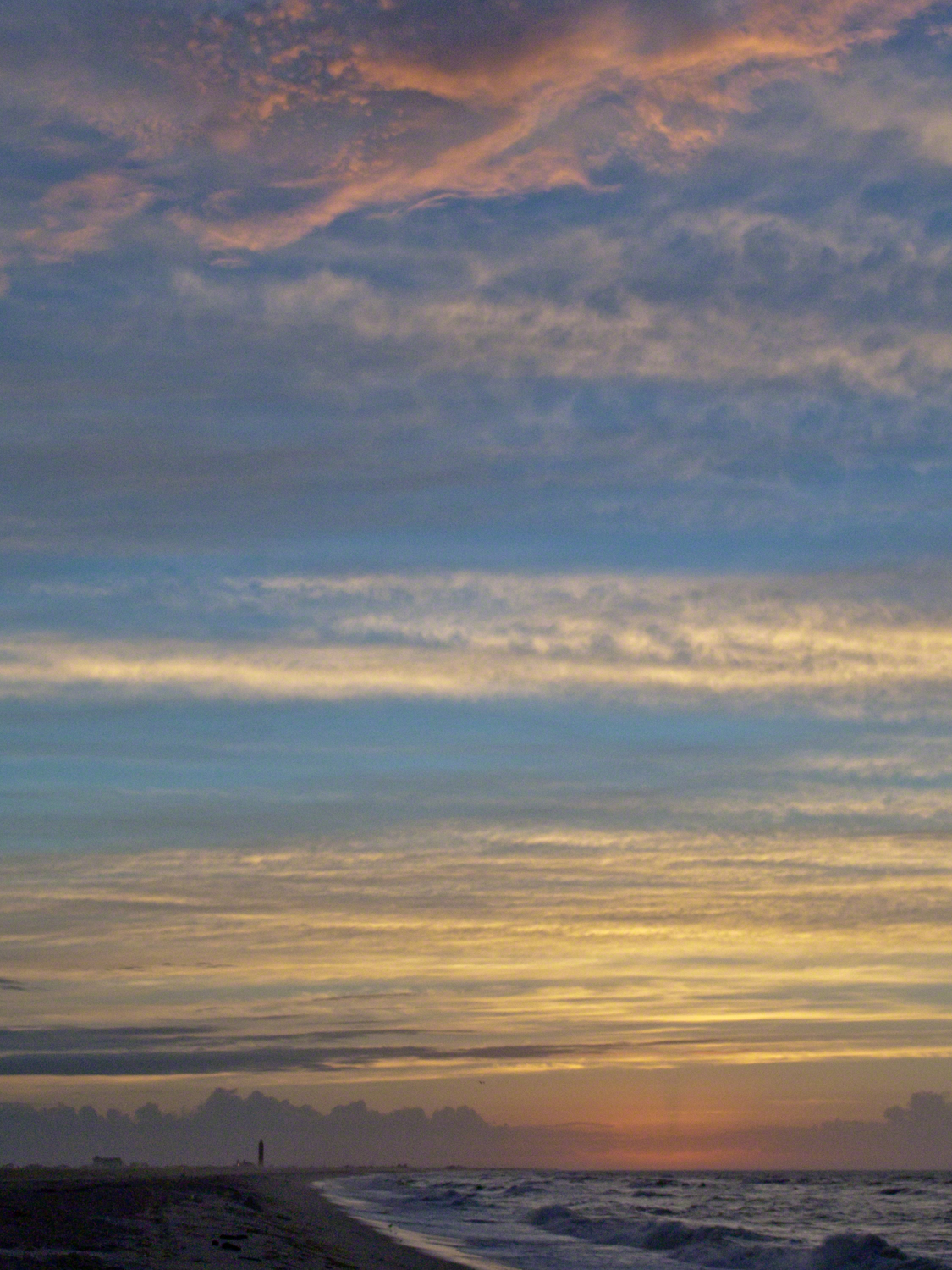
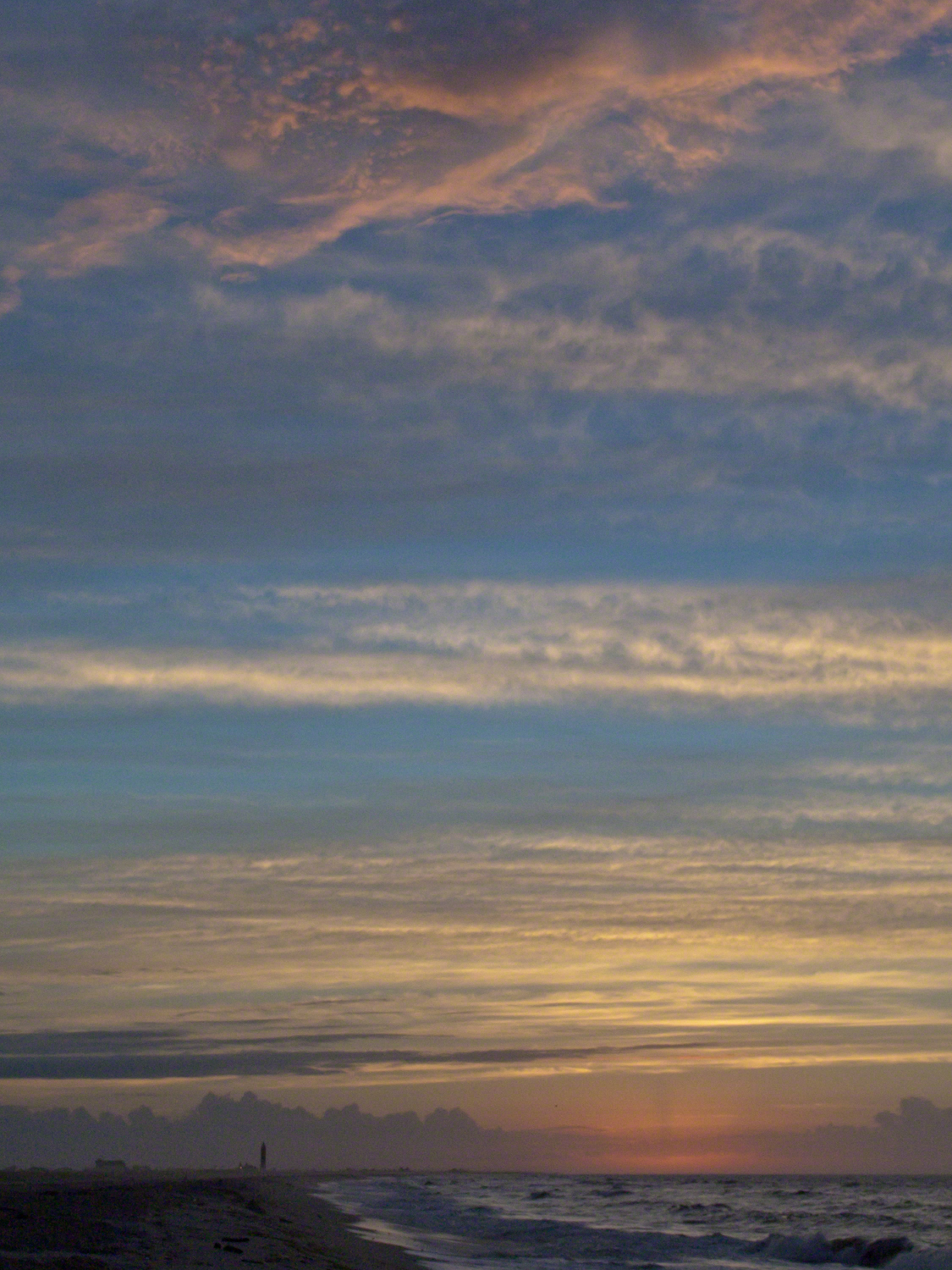
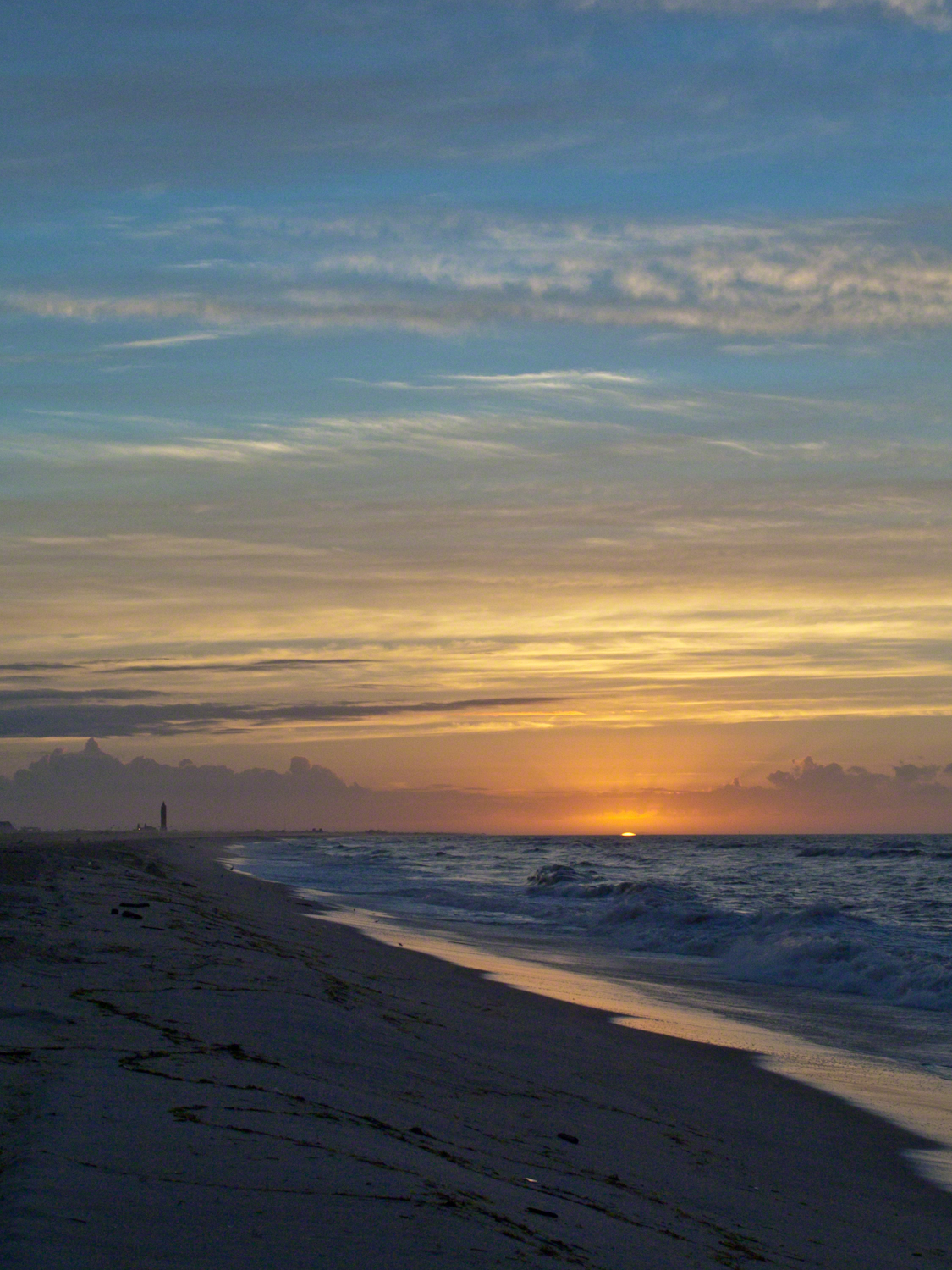
Hurricane Katrina approached the Gulf Coast and New Orleans as the sun rose on the West End of Jones Beach on Long Island, August 28, 2005. This amazing sunrise was an element of the unusual atmospheric effects that are evidence of the power of this storm.
The featured image (heading this blog) is my print, “Katrina Sunrise”. This work is enjoyed by hundreds of my clients. Use the link, below, to acquire your own. Custom framing is available.
The following images are the rough drafts taken in the early morning hours. The beach was literally deserted as I mounted the camera and framed the view for this series. Many image captions include the file time stamp, for example 6:07:13 is 6 am and 7 minutes 13 seconds.
6:07:13 First image of the set. Below the horizon the sun lights the upper atmosphere.6:07:34 As the sun approaches the horizon the lower clouds catch light. My Camera was a Sony DSC-F828 tripod mounted with a polarizing filter.6:07:56 I panned slightly to the east. ISO was set to 64 throughout.6:08:16 Gradual brightening. The lens is 7.1 – 51.0 mm f/2.0-2.8.6:08:38 All levels are brighter. It seems those low clouds will block the horizon. That was not the case. The variable focal length is 15.6 mm.6:09:05 It is happening!!!! Exposure was set to automatic on a f stop of 8.0. It was 1/3 second for this image.6:14:34 The view is panned west. That is the Robert Moses water tower of Jones Beach State Park looking like a rocket ready to blast off.6:15:15 Will those low clouds block the sun? Looks promising.6:16:11 Clouds on the upper margin catching the sun. Horizon brightening….. Exposure 1/20 second.6:14:39 This will be a disappointment if that sun does not show. Exposure 1/25 second.6:18:27 Almost there….1/15 second exposure….6:19:07 Quick framing adjustment to bring the lighting of shore margin into the composition. The final version was created from two images captured seconds after this.As the sun rose a rainbow formed in the western sky.
One early morning, just after dawn, Cocoa Beach, Florida, I had a revelation. My wife and I walk the beach four or more miles each day we are lucky enough to be in Florida for the winter. Yes, we are “snow birds” who flee the snows of New York for a few weeks, now and then.
We love to catch the sunrise together, have breakfast, pull together a lunch for a long walk. We catch the passing beach scenery, find a place to enjoy our meal, and return late afternoon.
The Black Skimmer (Scientific Name: Rynchops niger) literally stands out from the gulls. The individuals gather together in a large group. If there is a wind, most group members face into it. They are aloof and dignified, unlike the gulls who grift for food, obnoxious and bothersome if you make the mistake of throwing a gull a morsel.
Black Skimmers are just as large a gulls. Slender, tern-like, black and white bodies. Recognize a Black Skimmer from the colorful red of the base of the bill. Click me for more of my Florida offerings.
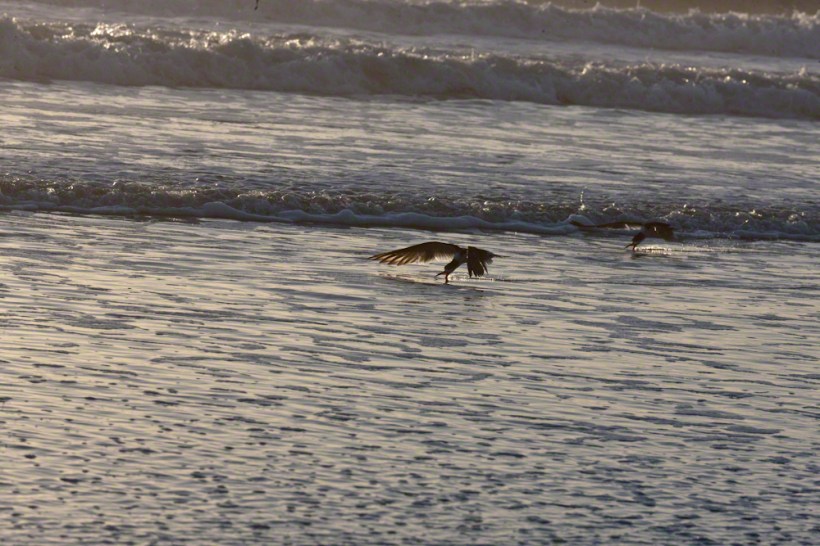
My early morning revelation was how the Black Skimmer feeds, flying just above the surf, the lower mandible extended to fish by feel. Unless you beach walk early mornings, you will be most familiar with the habit of grouping together, facing into the wind. I captured this individual, a member of a larger group, just after sunrise, on Cocoa Beach. It was just me and the Skimmers.
Their feeding is successful enough to allow them to longue on the beach most of the day. I have only seen them feed early mornings. Here is another part of their feeding behavior. They feed as a group in long sweeping lengths. At the end, they turn as a group and head the other way. Here are three Black Skimmers in a turn.
One morning, after our sunrise view, I pulled together my photography kit for this successful photo shoot. Enjoy!!
Enter your email to receive notification of future postings. I will not sell or share your email address.
Copyright 2025 All Rights Reserved Michael Stephen Wills
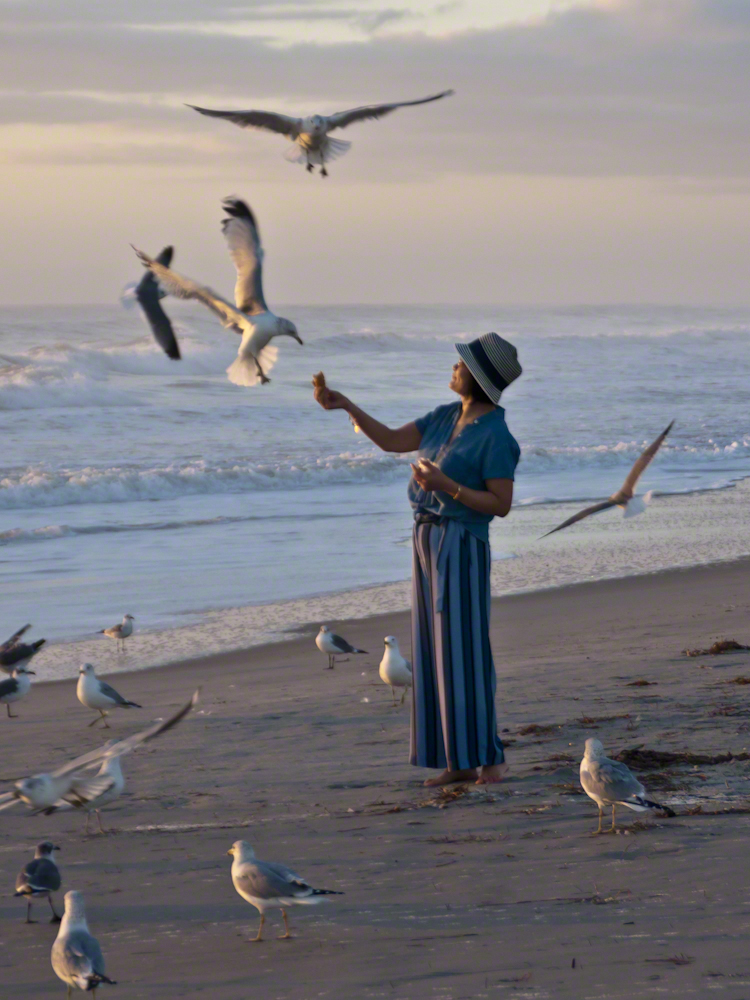
Gulls, an omnipresent element of any beach stroll. Pestiferous, abounding and incessant the gull is simple to deal with. Keep any and all foodstuffs under wraps.
Conversely, for those who adore a crowd of raucous opportunists simply pull out the food and offer it to the air. There is more about this photograph at this post, “Lady Feeding Gulls, Cocoa Beach Dawn.”
Click any photograph for a larger view.
Beach Walking
Pam and I developed a habit of hanging out in Florida during Finger Lakes Winters when the gorges are closed for safety and even walking the streets is perilous, stray black ice encounters abound. We trade icy falls for beach walks.
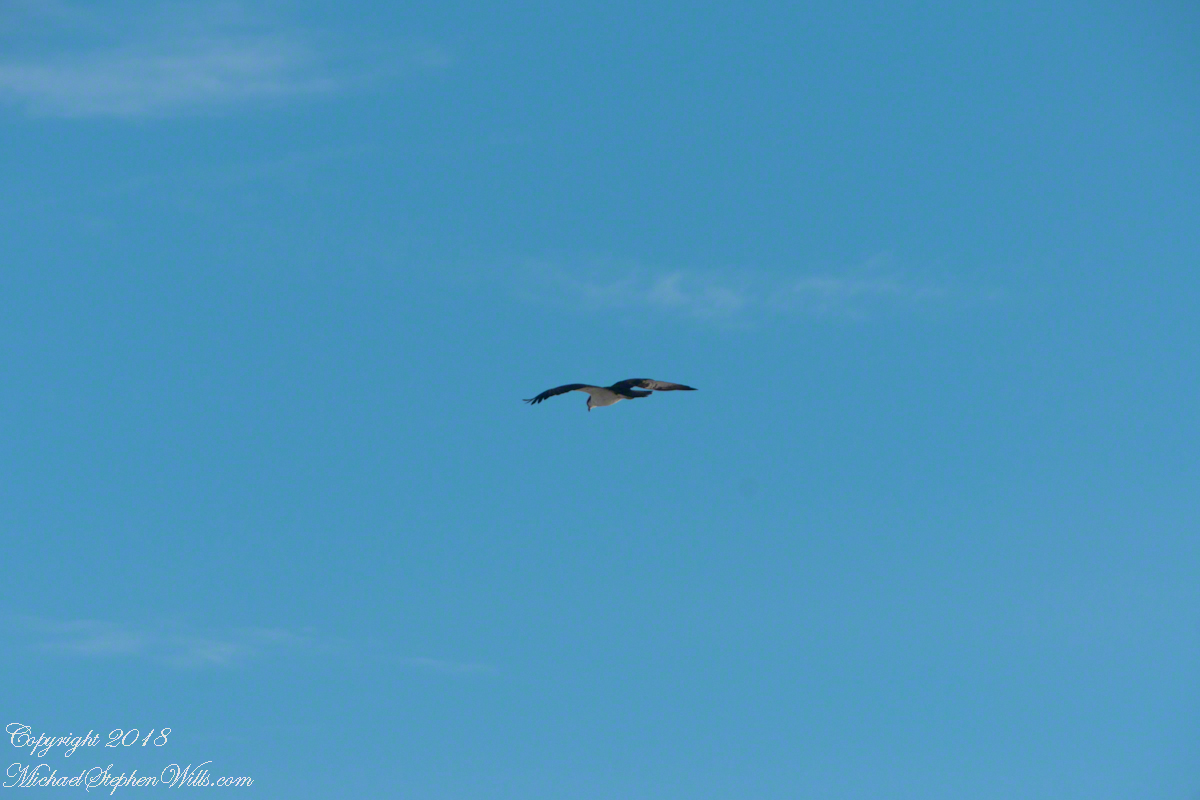
It is natural to become inured to the flight of gulls along the shore. For all my carting along the Sony Alpha 700 with a variable lens ( 18 – 200 mm) there is not a single photograph of a gull in flight. Yet, I have my eye on them until my blindness was lifted by a peculiar individual. It seemed to be a white gull, yet it had a watchful eye.
Gliding shoreline parallel with head down, how could I have mistaken it for a gull?
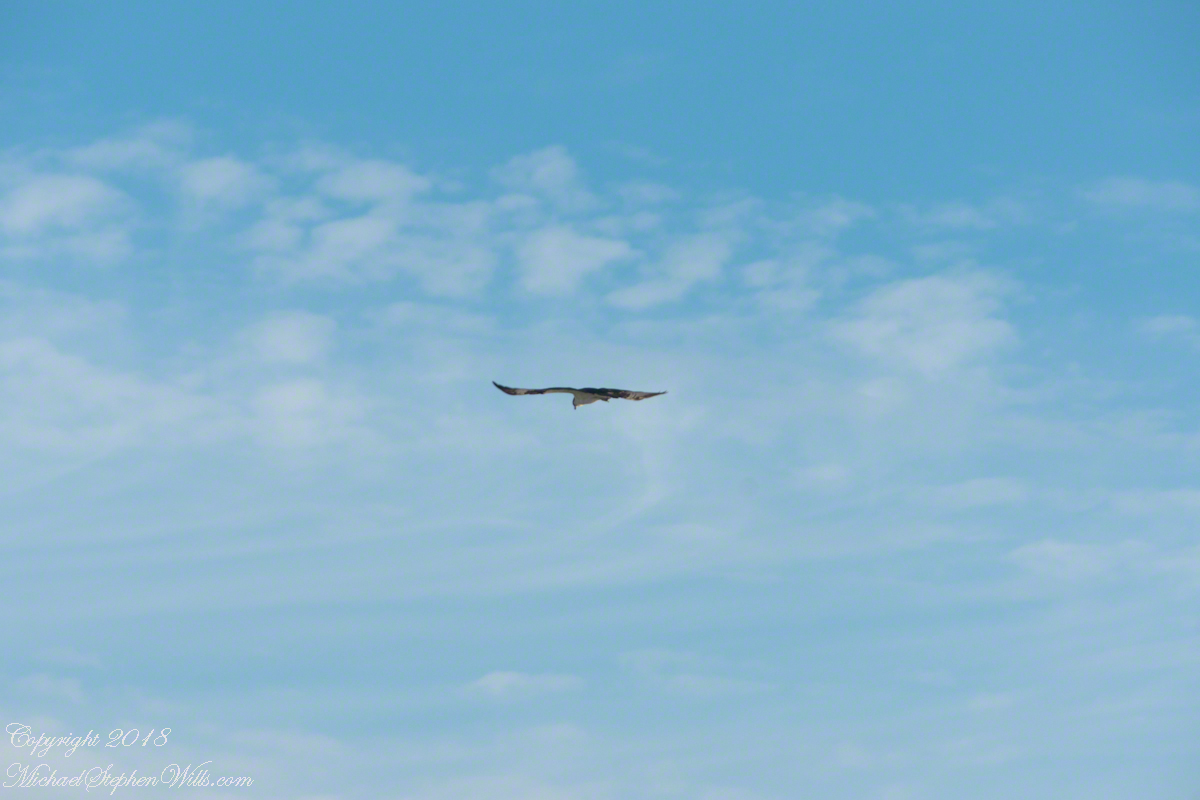
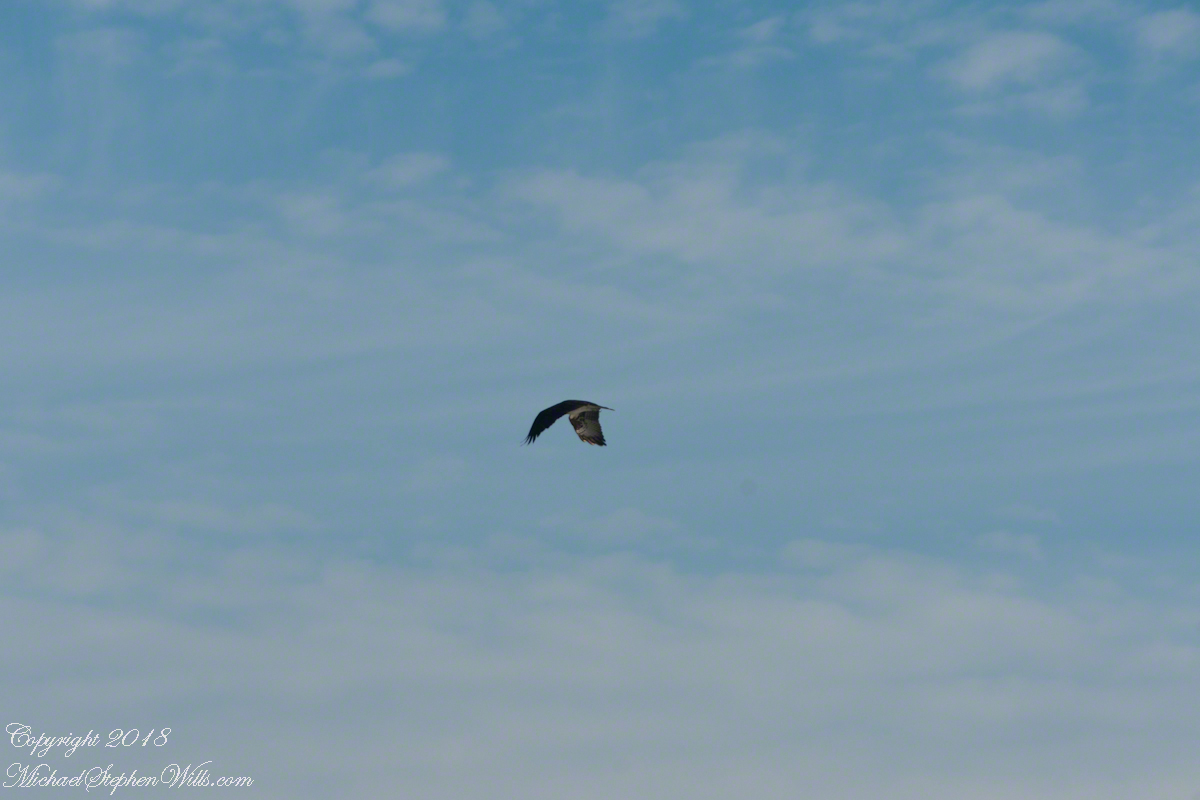
Osprey occupy an environmental niche along 700,000+ shoreline miles worldwide as a single species Pandion haliaetus. A unique bird with its own family, Pandionidae, and genus, Pandion, some experts recognize sub-species in geographic regions. Ours is the Western Osprey.
The following photograph is of a wing shape very different from the gull.
Osprey Stalking Behavior
IPhone 8 always in my pocket, I captured this clip of an Osprey stalking fish in the Atlantic Ocean surf. You will have a better viewing experience by clicking on the title of the embedded YouTube, then click on the Full Screen icon at the lower right.
Enter your email to receive notification of future postings. I will not sell or share your email address.
Copyright 2025 All Rights Reserved Michael Stephen Wills
Today, enjoy two videos of shorebirds taking flight at once. Starlings can flock and swarm in clouds of birds, called murmuration. My videos of a shorebird colony taking fright, at something unknown as the beach was empty, are from my IPhone 7.
This is a still image, high resolution, similar to the view of the second video. A repeat from yesterday.
Click photograph for larger image. To do this from WordPress Reader, you need to first click the title of this post to open a new page.
With a tripod it is simpler to achieve a level horizon….
Canon EOS-1Ds Mark III
December 3, 2014 President Obama warned of the coming pandemic and passed along plans and a team to the incoming Trump administration. By December 2019, the pandemic unleashed in China, Trump gutted this capability and, while Pam and I were planning out January 10th Walt Disney World trip, hid the truth from United States Citizens.
We were keeping an eye on China, by January 10th the Chinese communist government was lying, “there is no human-to-human” transmission they told the WHO (World Health Organization). Knowing the truth, our plans for that day would be different.
One week before January 10, the dawning of the day photographed here, “the CDC Director Robert Redfield was notified by a counterpart in China that a “mysterious respiratory illness was spreading in Wuhan [China]”. Redfield notified HHS Secretary Alex Azar shortly thereafter, who shared his report with the National Security Council (NSC). According to The Washington Post, warnings about the virus were included in the President’s Daily Brief in early January, an indicator of the emphasis placed on the virus by the intelligence community.” December( and maybe October/November), 2019 through January, 2020: COVID-19 was spreading across the USA as visitors from Wuhan disembarked from planes.
The following images compare IPhone 7 to a dslr mounted on a tripod.
Click photograph for larger image. To do this from WordPress Reader, you need to first click the title of this post to open a new page.
IPhone 7
With a tripod it is simpler to achieve a level horizon….
Canon EOS-1Ds Mark III
I heard the word “shroomed” (as a verb) used in Episode 1, Season 6, of Bosch. As in “the Federal Government treats us like mushooms”: grown in excrement and kept in the dark.
One day after my “Sunrise Texture” series as the sun rose on Cocoa Beach I was waiting with the same photographic kit. It was perfect weather for a visit to Walt Disney World, planned for that day: unsettled.
This image couple demonstrates the effect of long / short exposure without using filters. I changed the ISO and F-stop to achieve these effects.
Click photograph for larger image. To do this from WordPress Reader, you need to first click the title of this post to open a new page.
ISO 50 F/32
With a tripod it is simpler to achieve a level horizon….
ISO 500 f/6.3
I turned around to observe the colonies of shore birds…..
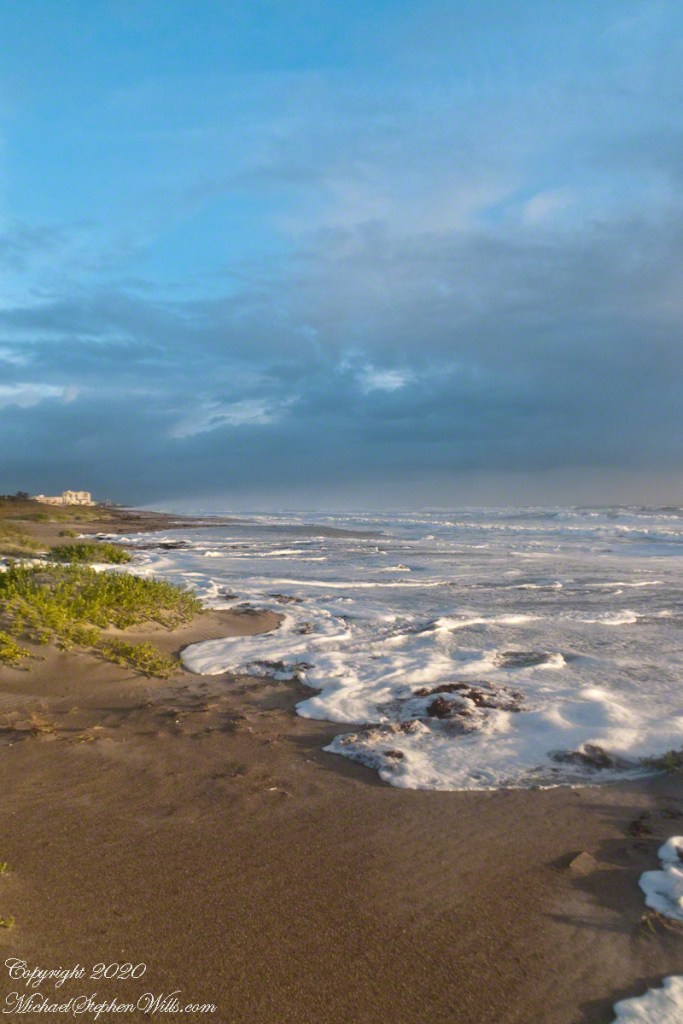
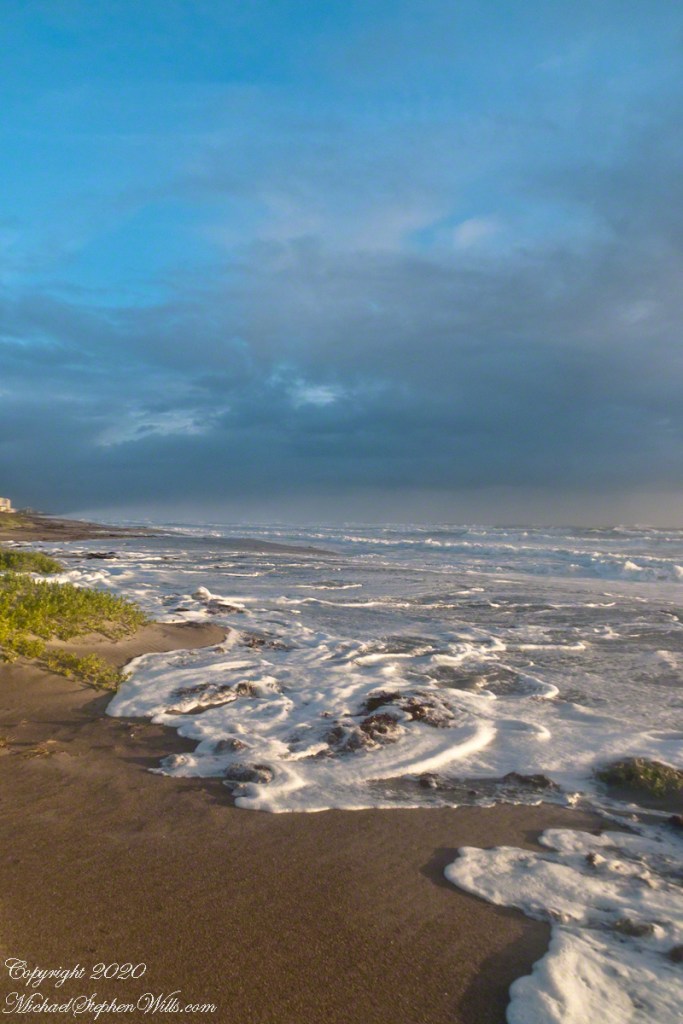
Morning walks through January 2020 were solitary events, more so on stormy morning such as this, January 23rd. Even the dog walkers stayed home. The surf surged to the dunes. Click me for my posting, “Rough Surf.”
Click photograph for a larger view. To do this from WordPress Reader, you need to first click the title of this post to open a new page.
The sun broke through between clouds to rake with light the beach scurf and wind scud. In the distance, a steady west gale blows surf onto itself as a white curtain.
Click photograph for a larger view. To do this from WordPress Reader, you need to first click the title of this post to open a new page.
Click photograph for a larger view. You will open a gallery to flip back and for between images.
Copyright 2020 All Right Reserved Michael Stephen Wills Photography
At dawn I walked on the beach from North 1st street to South 8th Street Cocoa Beach. Tide was at peak of high, the surf still high from gale winds. Click me for yesterday’s posting, “Rough Surf.”
In the first video, set the effect of a strong west wind pushing surf spray back onto itself, the ocean brightly lit across dunes. I was standing on a boardwalk access from South 8th Street.
Squalls returned, forcing me to hide the DSLR (digital single-lens reflex camera) under my waterproof shell. Then, the squall broken once again, releasing sunlight for this double rainbow.
Betelgeuse, AKA “Alpha Orionis”, was the first star disk, other than our Sun, measured. One hundred years ago the apparent size of Betelgeuse was then as now 0.003% of the sun. I bring this up because this “red” star at the end of its life cycle, is in the news, being now 40% of its brightness last year.
Betelgeuse is so far away this dimming is 700 year old news, the time it takes for light span the distance. News of our sun is more recent, sunlight informs us of the Sun’s surface from 8.33 minutes ago. Sunlight bursts from clouds to the camera in an instant of a second. In comparison my reactions to capture it are glacial. Sixteen seconds passed since the images of Series 6, time for three exposures at a slowed pace now the sun breaks free from the clouds.
Twelve minutes, fifty four seconds elapsed from the first images of this series. Seventy nine exposures taken with 16 selected moments, these last without the sand mirror.
Click photograph for larger image. To do this from WordPress Reader, you need to first click the title of this post to open a new page.
Exposure: 1/400 sec at f / 4.5, Focal Length: 24 mm, ISO 100
A Willet feeds in the new day. This is a species sandpipers, a cousin of the Sanderling of yesterday’s post.
Exposure: 1/400 sec at f / 5/0, Focal Length: 24 mm, ISO 100
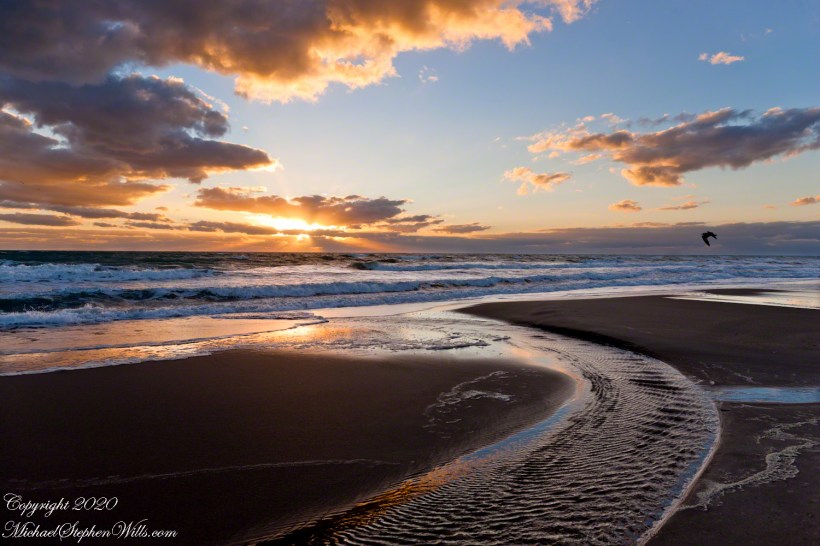
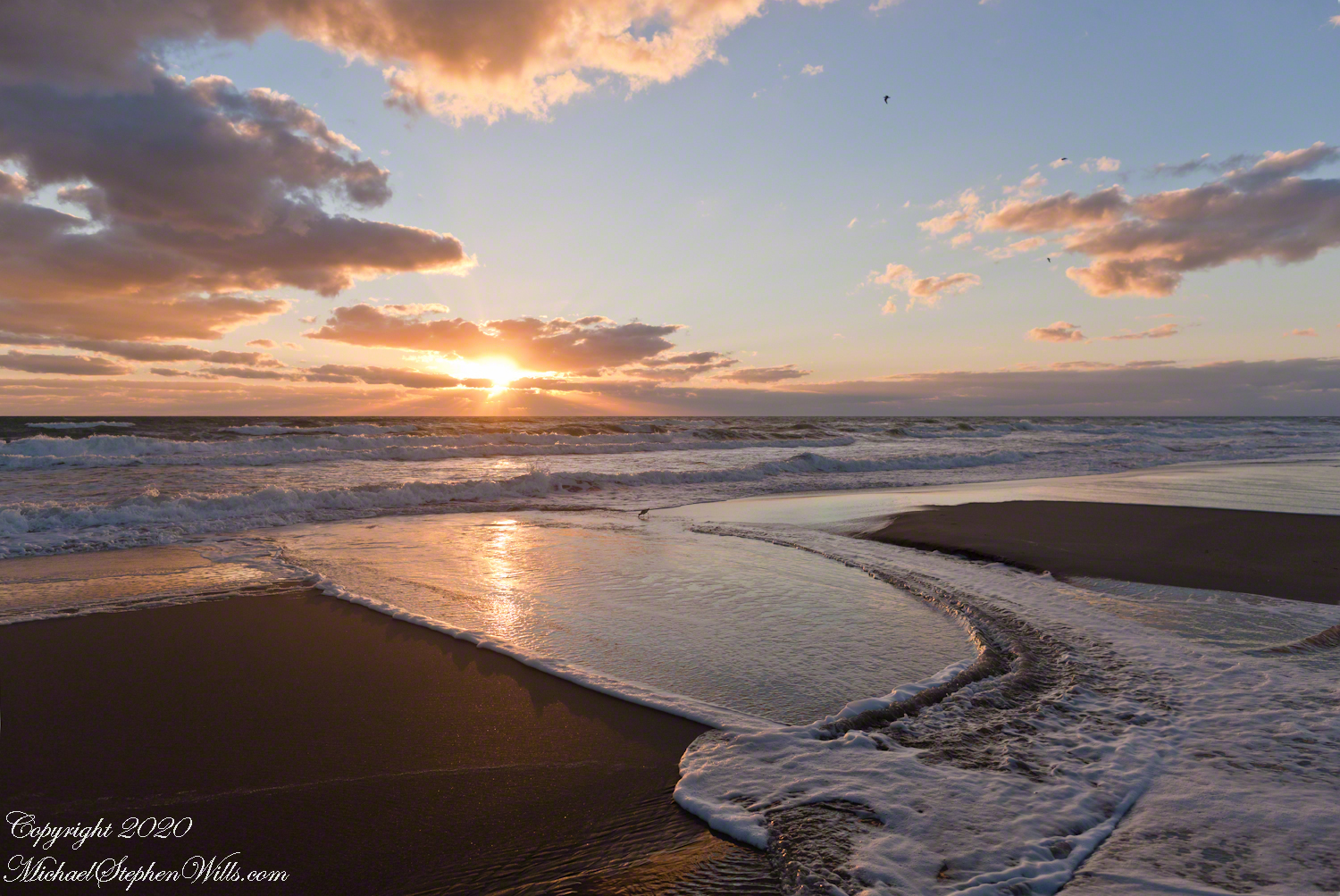
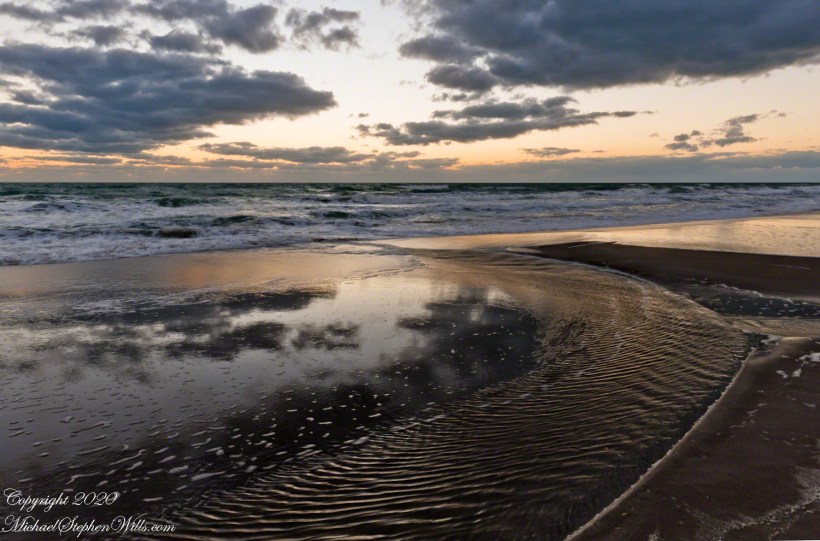
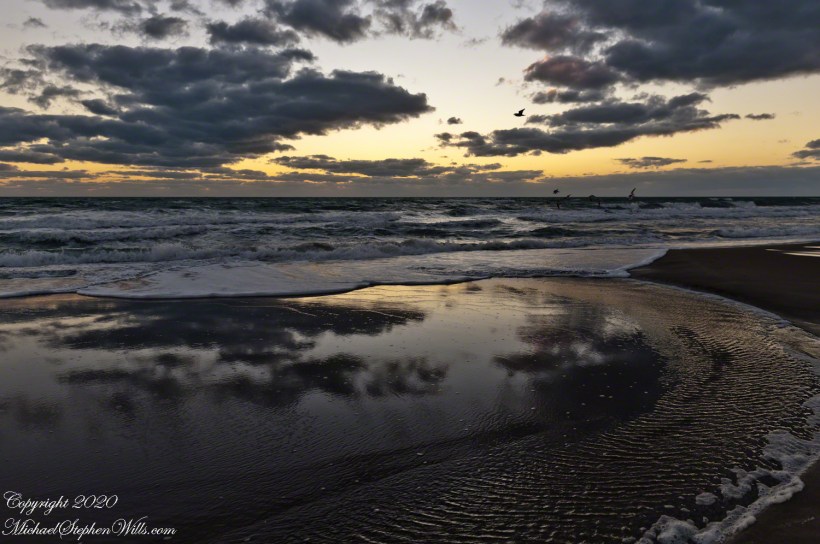
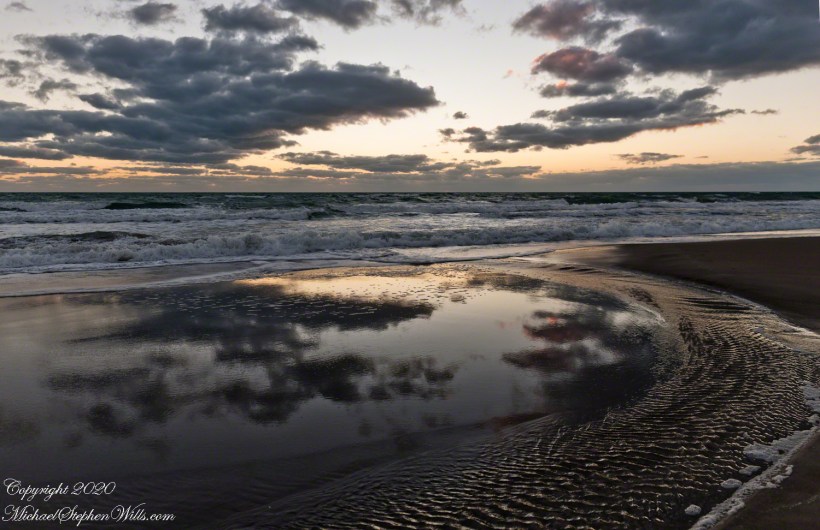
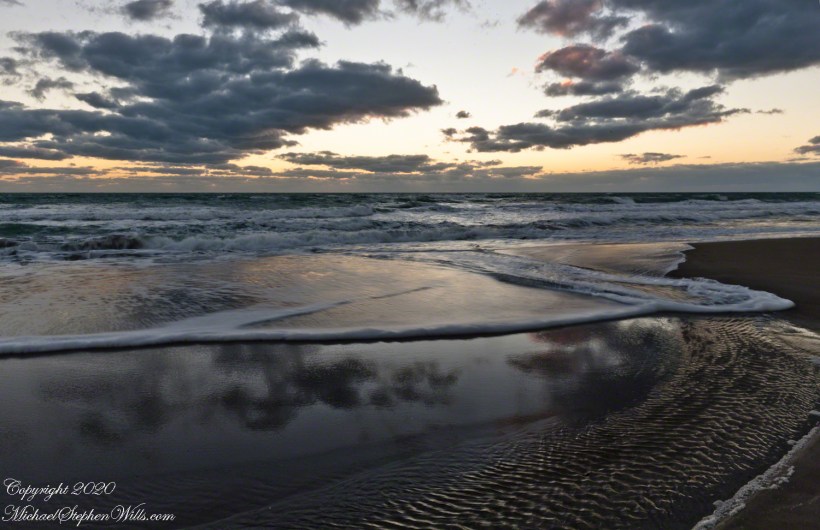
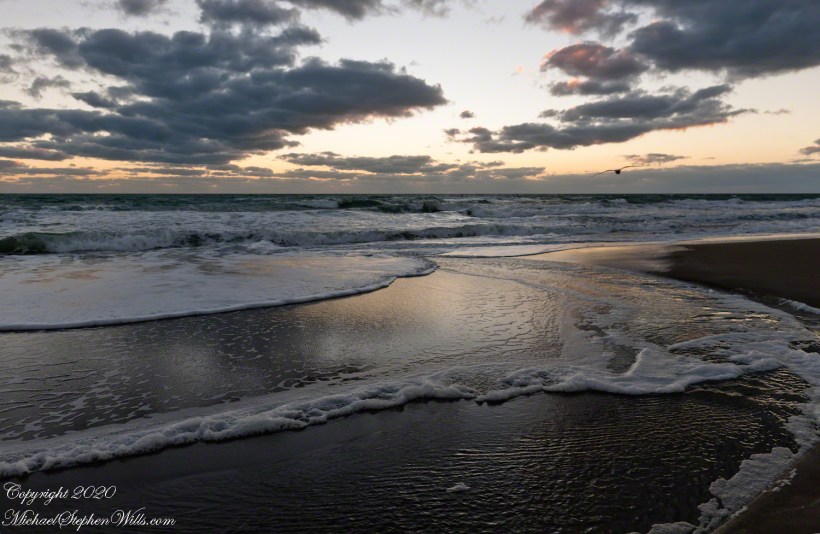
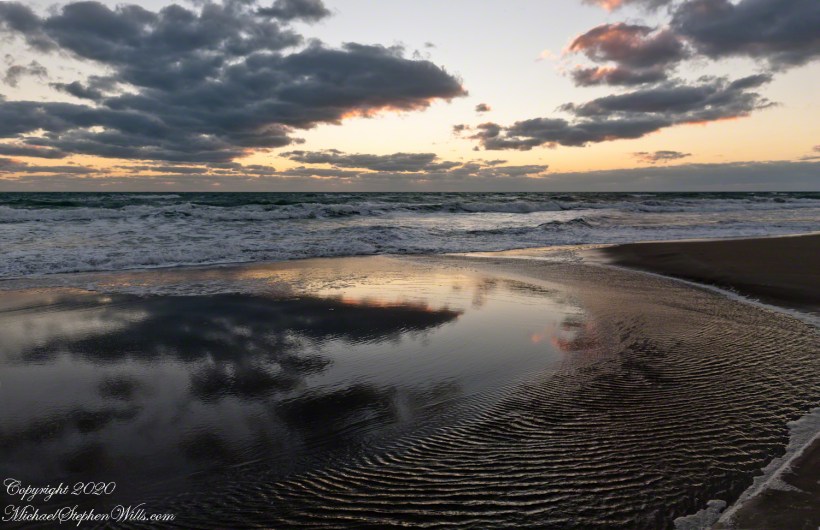
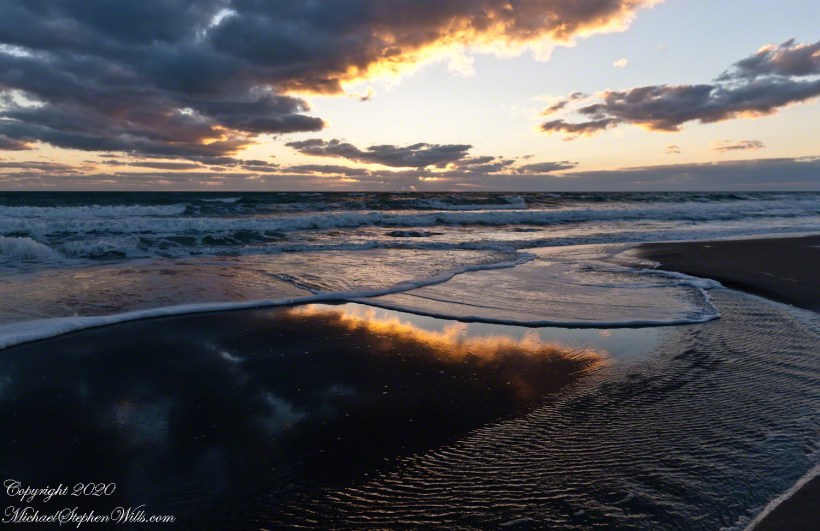
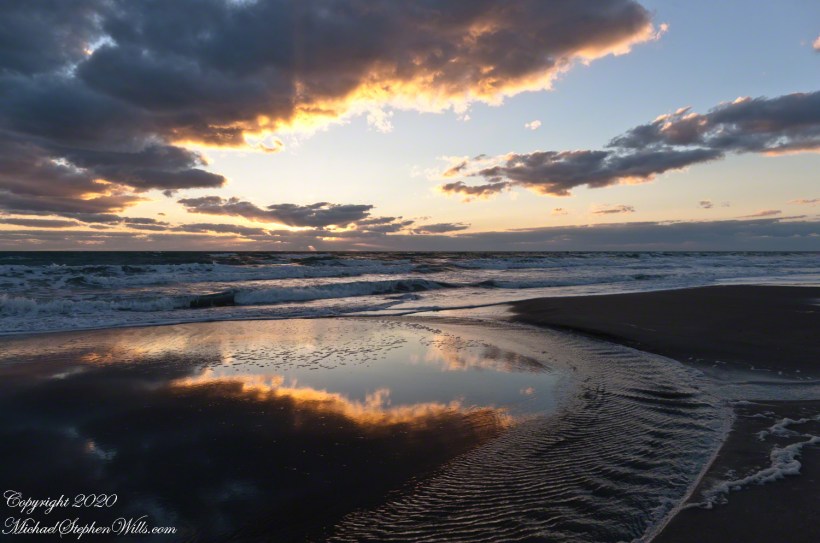
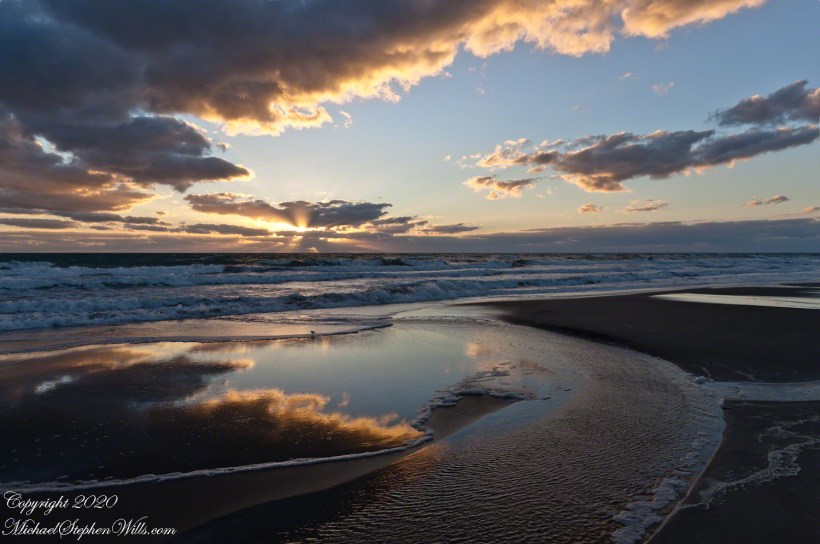
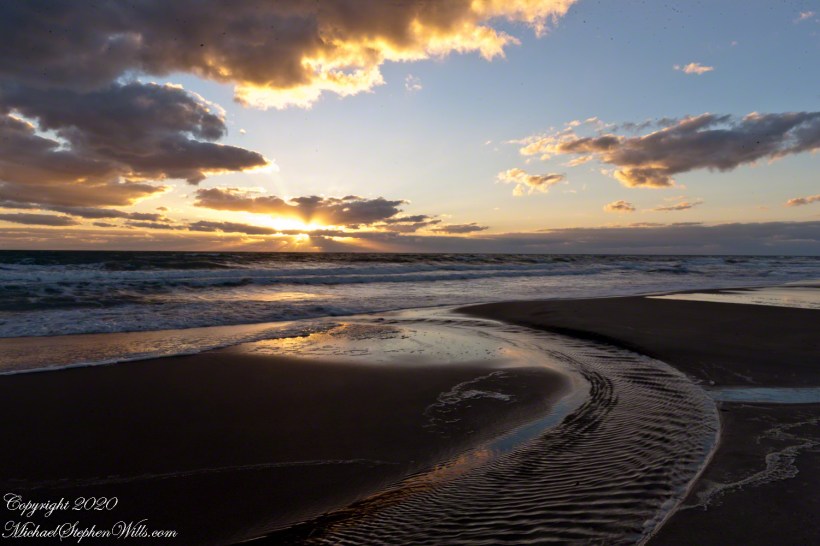
All sixteen Sunrise Texture moments are presented below.. Suggestion, for this series in a larger format, open a separate browser tab for each post. At series end you will then have eight (including the very first post a few weeks ago) landscapes to compare.
Exposure: 1/6 sec at f / 22, Focal Length: 24 mm, ISO 125
Exposure: 1/250 sec at f / 4.0, Focal Length: 24 mm, ISO 125
Exposure: 1/250 sec at f / 4.0, Focal Length: 24 mm, ISO 125
Exposure: 1/10 sec at f / 22, Focal Length: 24 mm, ISO 125
Exposure: 1/250 sec at f / 4.0, Focal Length: 24 mm, ISO 125
Exposure: 1/320 sec at f / 4.5, Focal Length: 24 mm, ISO 125
Exposure: 1/400 sec at f / 5.0, Focal Length: 24 mm, ISO 250
Exposure: 1/15 sec at f / 22, Focal Length: 24 mm, ISO 250
Exposure: 1/400 sec at f / 5.0, Focal Length: 24 mm, ISO 250
Exposure: 1/400 sec at f / 5.0, Focal Length: 24 mm, ISO 250
Exposure: 1/400 sec at f / 5.0, Focal Length: 24 mm, ISO 250
Exposure: 1/500 sec at f / 5.6, Focal Length: 24 mm, ISO250
A sanderling is a species of sandpiper. Exposure: 1/320 sec at f / 4.5, Focal Length: 24 mm, ISO 100
Exposure: 1/8 sec at f / 22, Focal Length: 24 mm, ISO 50
Exposure: 1/400 sec at f / 4.5, Focal Length: 24 mm, ISO 100
Two minutes pass from Series 5, and not because I have stopped snapping. My routine is to insert a (automated) sequential number into each filename. Using this it is possible to calculate the number of exposures in a series. Since Series 5, 16 were snapped before the first I could use in Series 6. Ten exposures between the first and last of Series 6, during which a minute, twenty eight seconds elapsed..
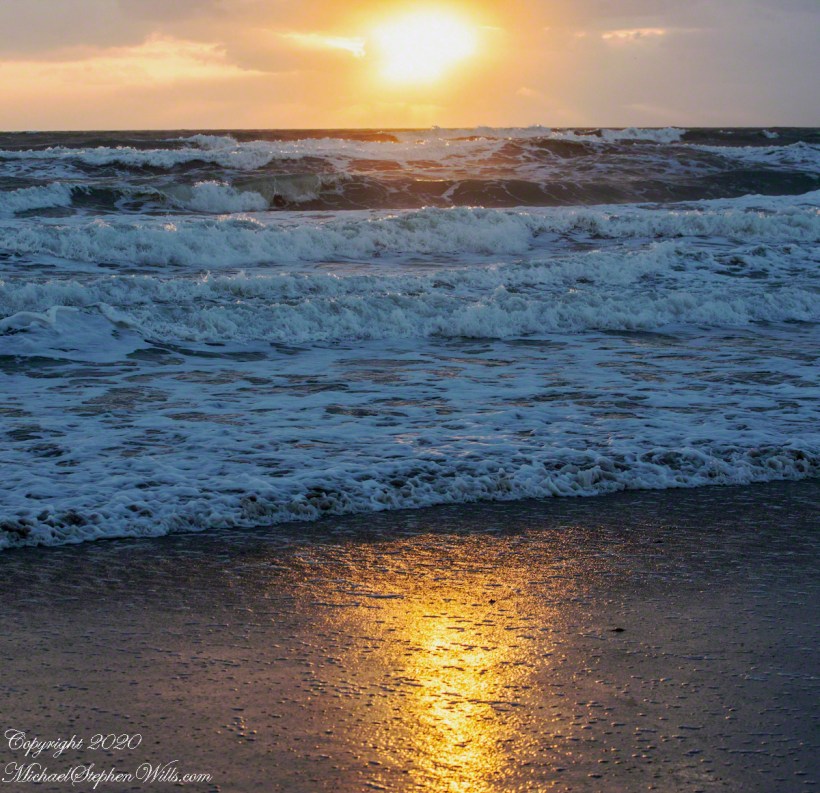
The sun disk is above the horizon, bursting from clouds.
Ten minutes, eighteen seconds elapsed from the first images of this series. Seventy one exposures taken with 14 selected moments of shining sand mirror, a strong curving return flow.
The small bird feeding, of the first image, is a Sanderling, one of the smallest species of Sandpipers.
Click photograph for larger image. To do this from WordPress Reader, you need to first click the title of this post to open a new page.
Exposure: 1/320 sec at f / 4.5, Focal Length: 24 mm, ISO 100
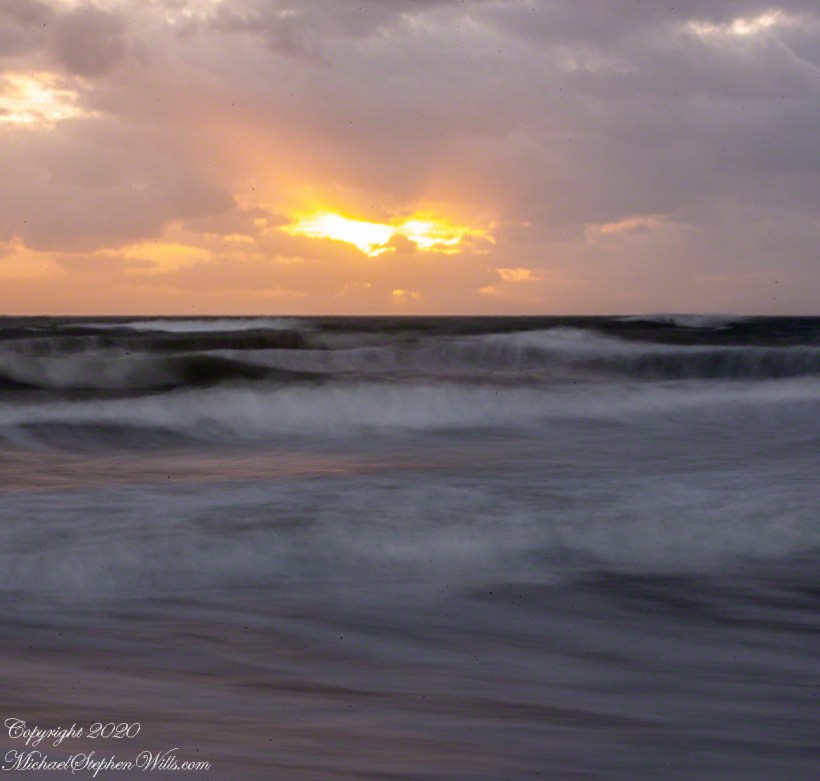
In this second image, the mirror is erased as sand absorbs surf. I needed to show the developing sun burst.
Exposure: 1/8 sec at f / 22, Focal Length: 24 mm, ISO 50
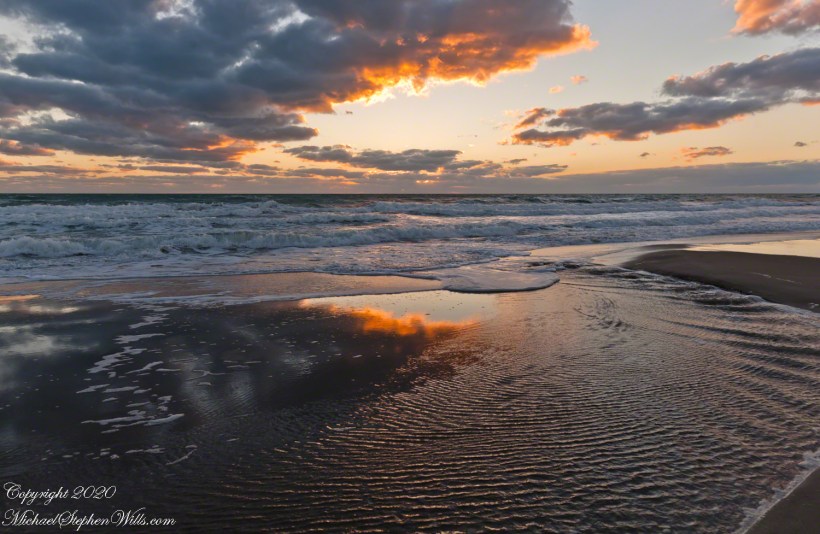
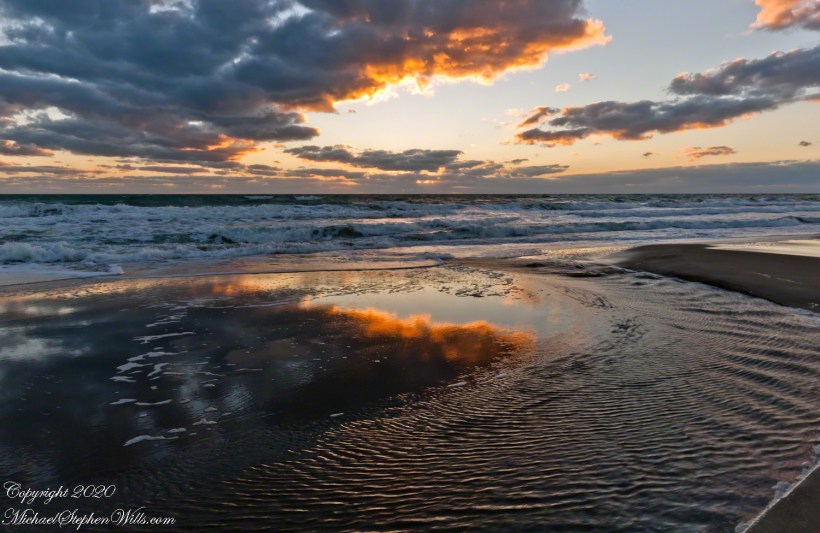
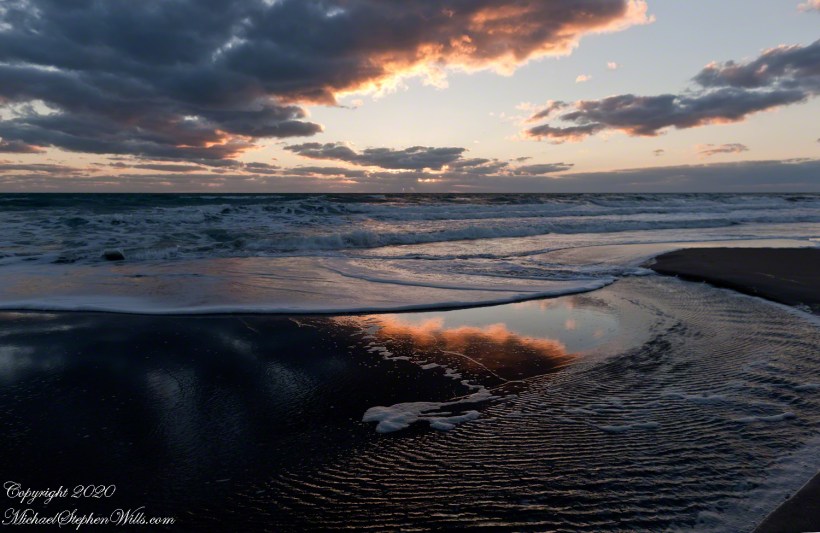
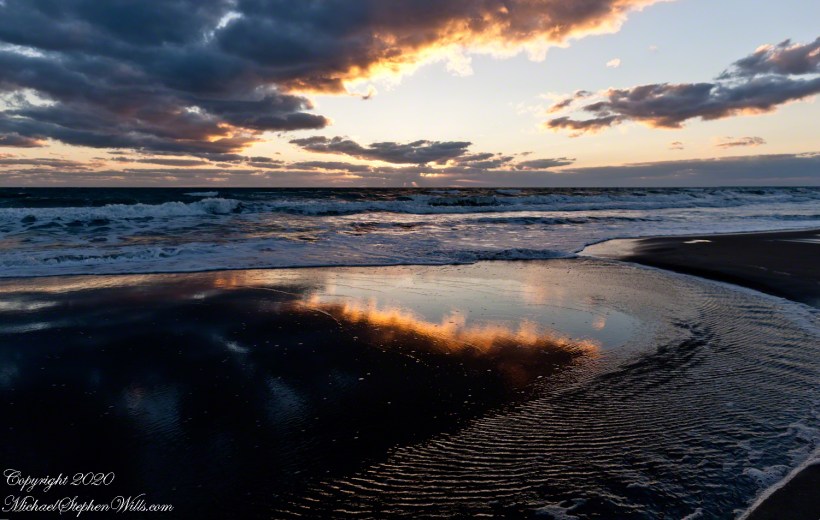
A slide show of these images. This set compares short exposure with open aperture (f 4.5) to a much longer exposure driven by a narrow aperture (f 22) and the lowest film sensitivity of the camera (ISO 50). Suggestion, for this series in a larger format, open a separate browser tab for each post. At series end you will then have eight (including the very first post a few weeks ago) landscapes to compare.
Exposure: 1/320 sec at f / 4.5, Focal Length: 24 mm, ISO 100
Exposure: 1/8 sec at f / 22, Focal Length: 24 mm, ISO 50







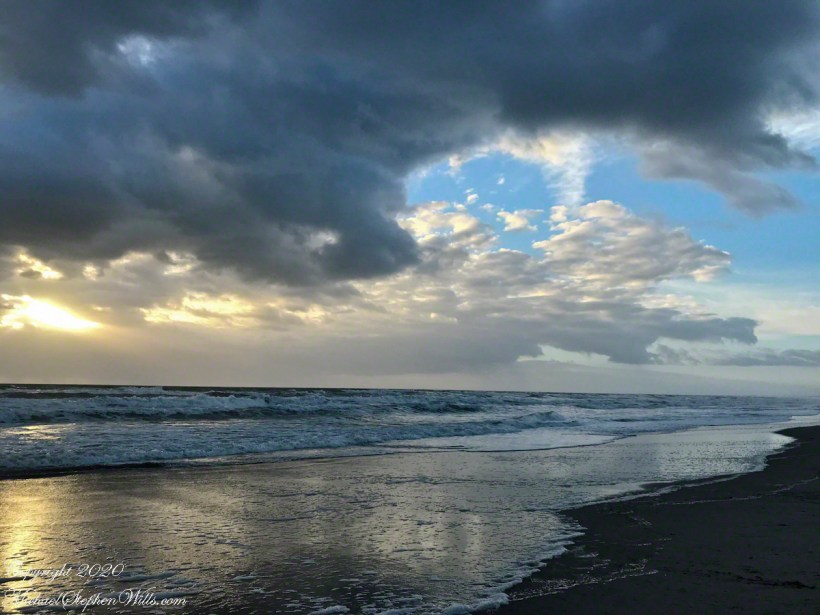
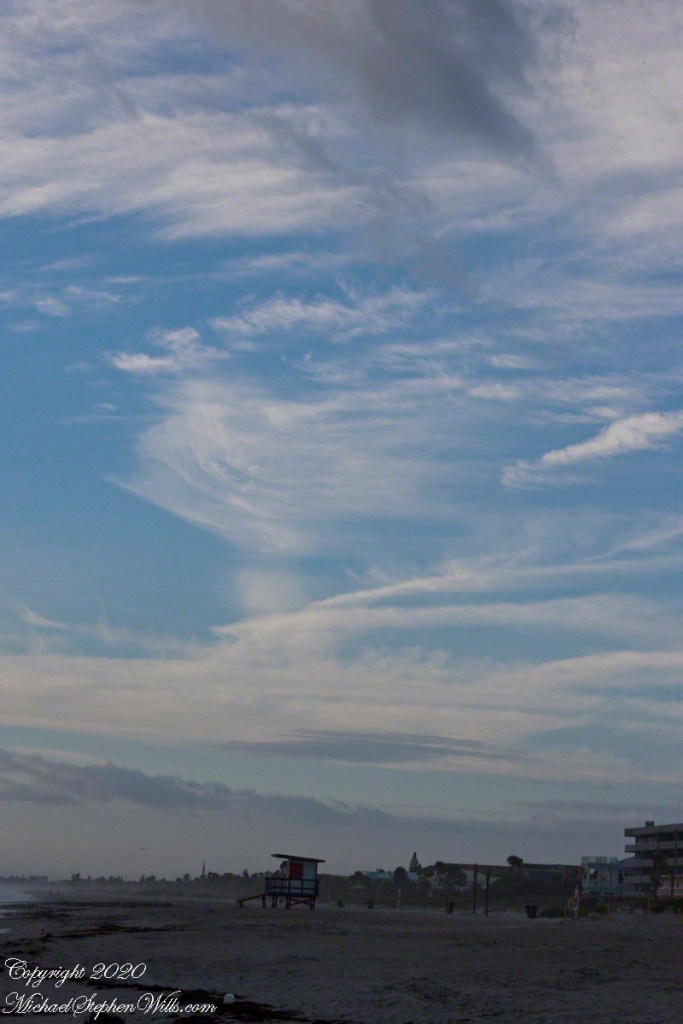
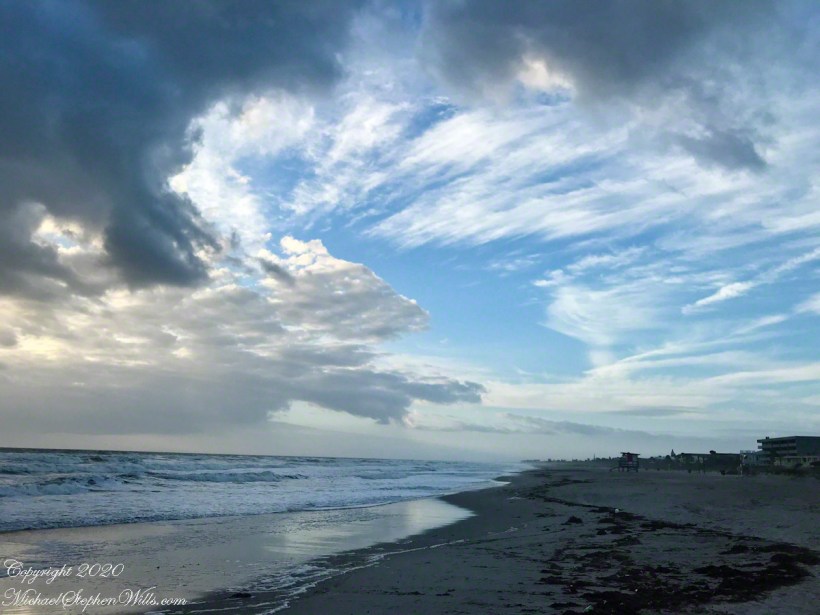
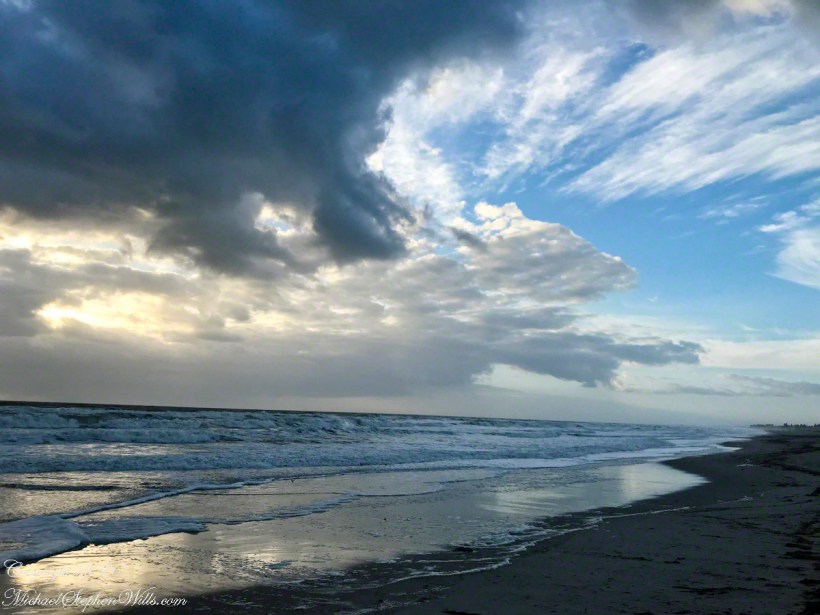


 Michael Stephen Wills Photography