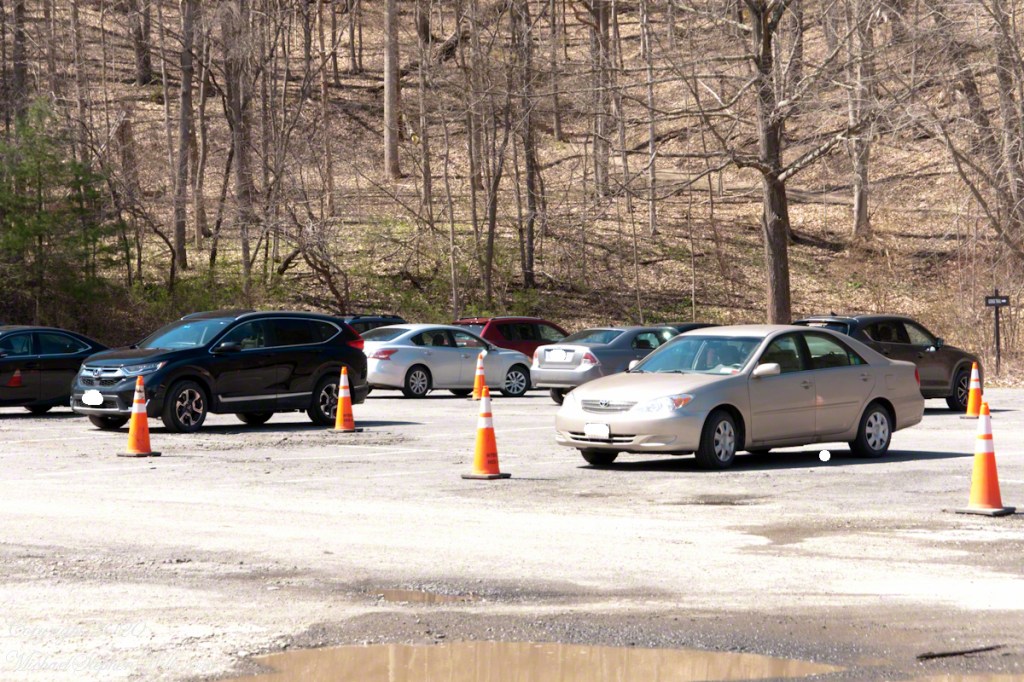
Parks were open during Govenor Cuomo’s “New York State on PAUSE.” Still, as a member of the at-risk group I was reluctant to visit, unsure of how crowded it will be. On a Monday afternoon, bright with sun, I drove over to Robert H. Treman lower park to check out the situation.
Click photograph for a larger view. To do this from WordPress Reader, you need to first click the title of this post to open a new page.
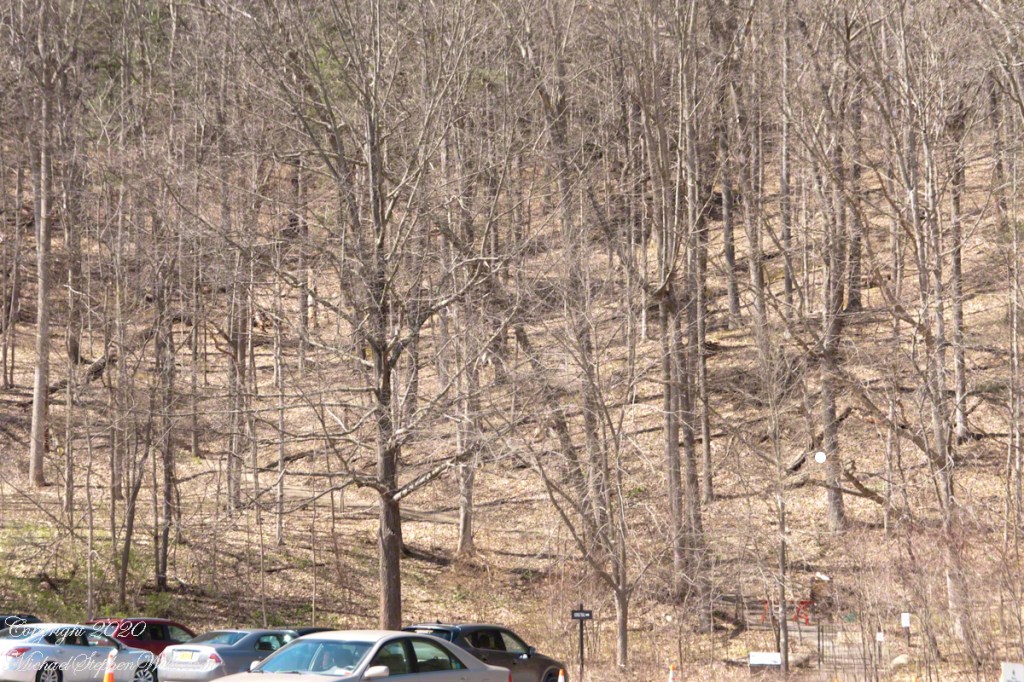
Social Separation ParkingGorge Trail is Closed for the winterParking Lot
I carried the Sony in hand and packed in a Canon with macro lens and a Manfrotto travel tripod.
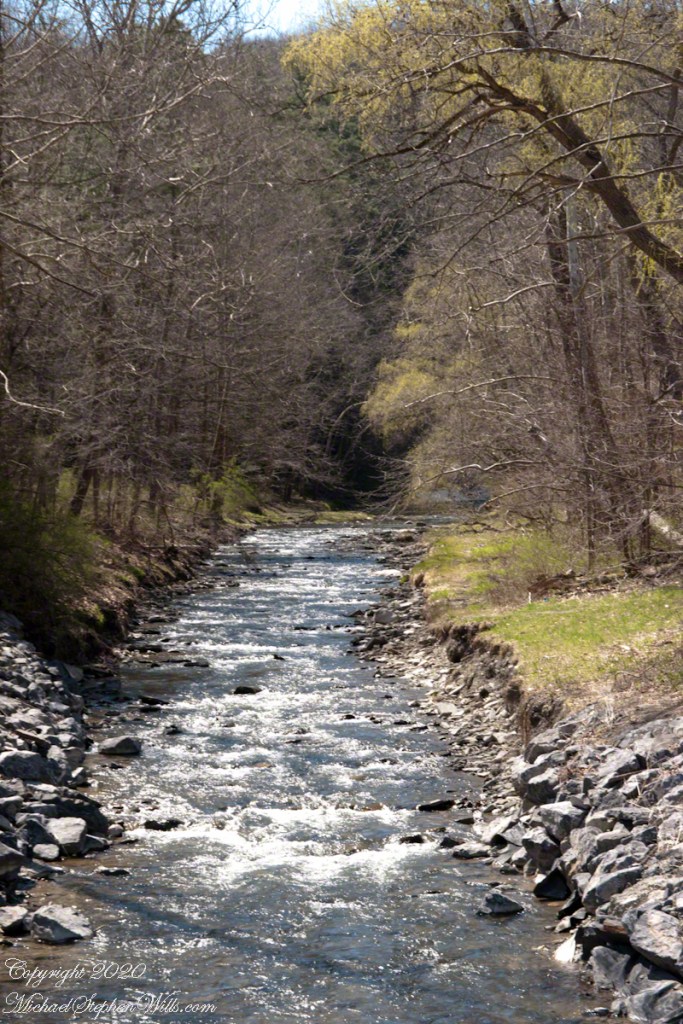
Enfield Creek from park bridge
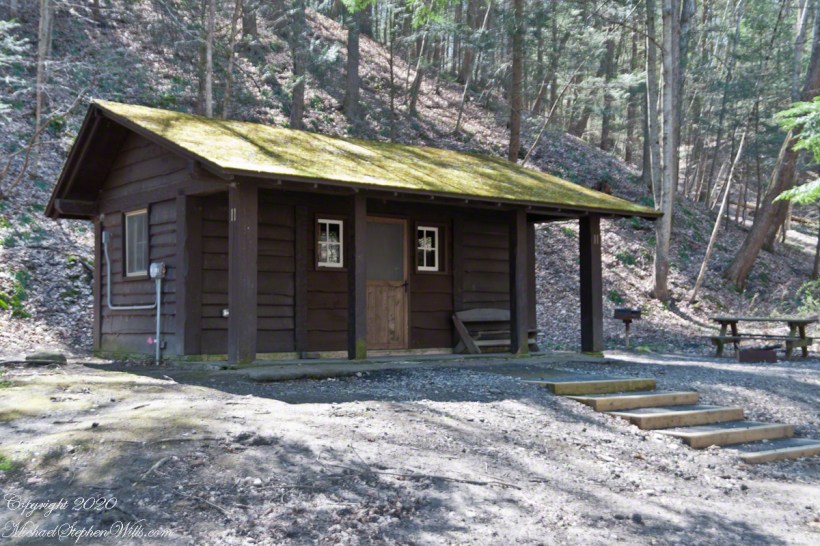
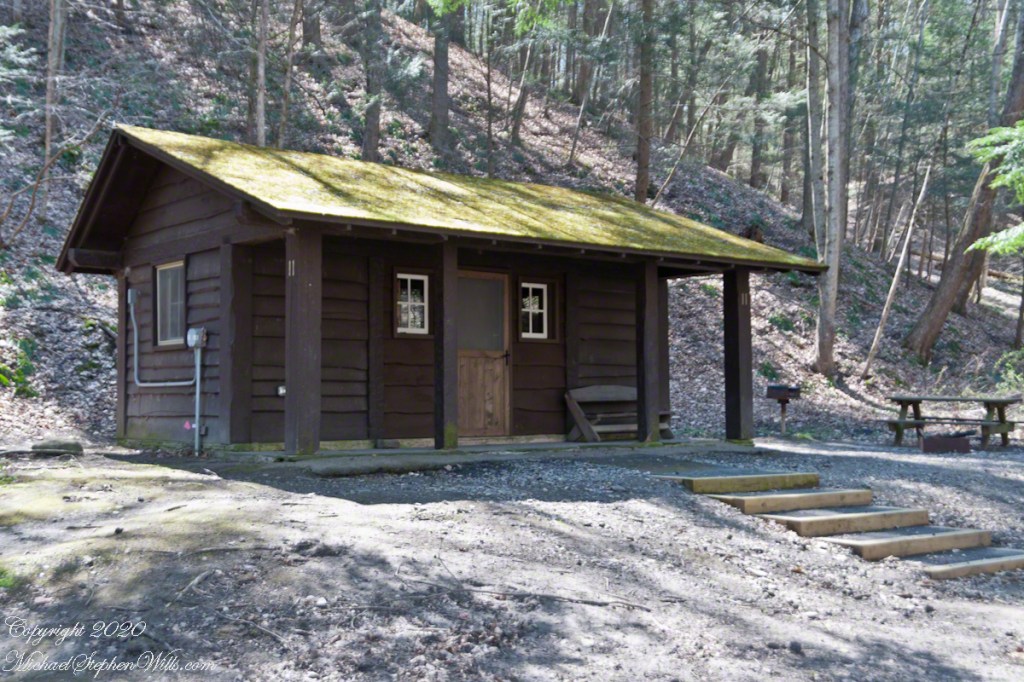
The path to a trail that climbs up the south side of Enfield Glen crosses Enfield Creek via a bridge, wends through cabins……
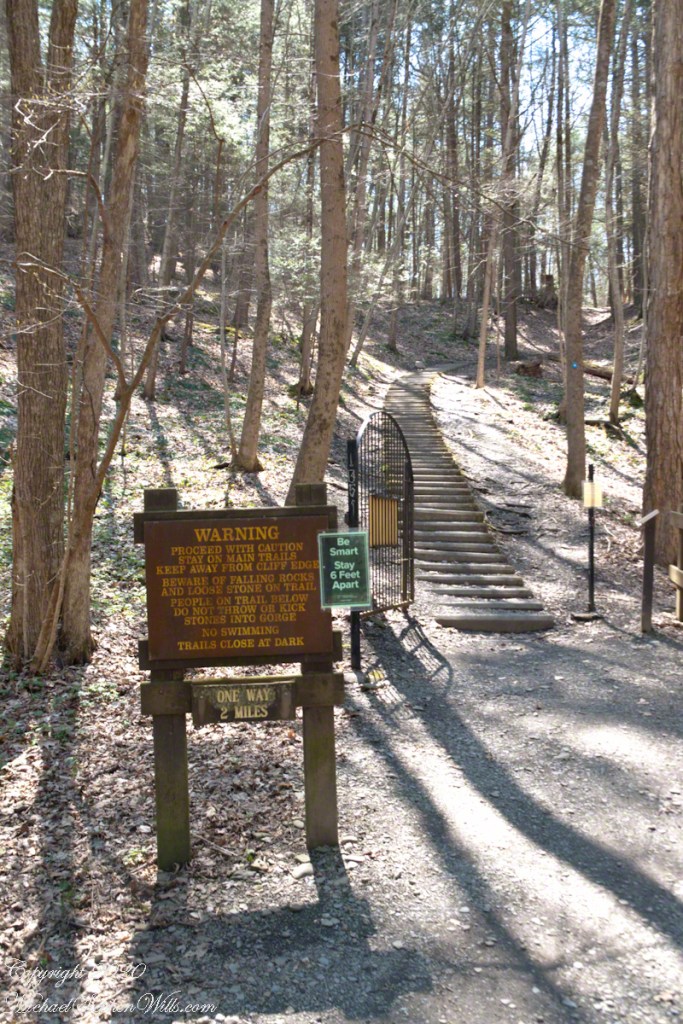
…..then heads up stairs that can seem to be forever. The green sign with white letters is new. This the South Rim Trail avoids the cliffs that make the Gorge trail so dangerous November through May.
Copyright 2024 All Rights Reserved Michael Stephen Wills
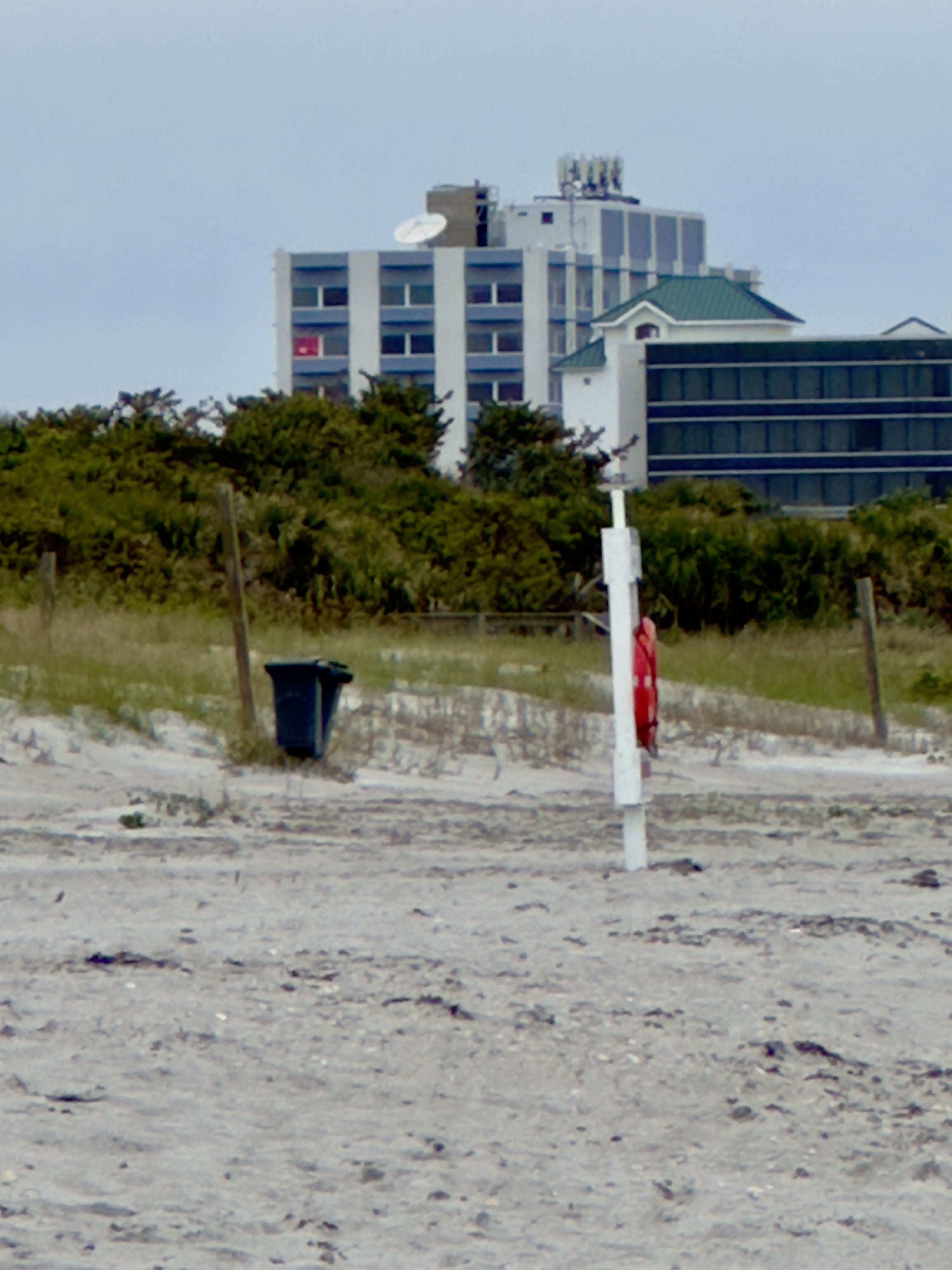
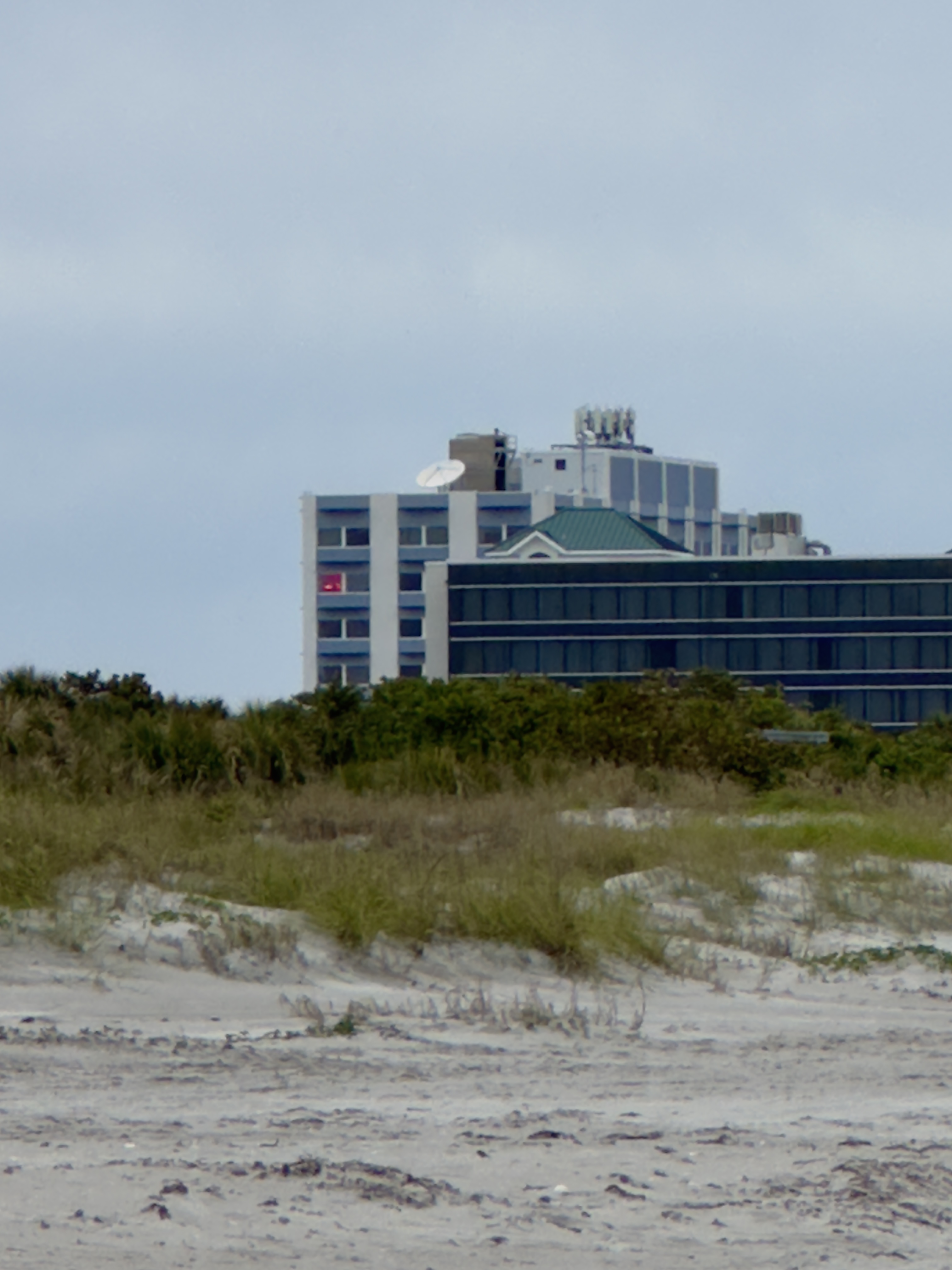
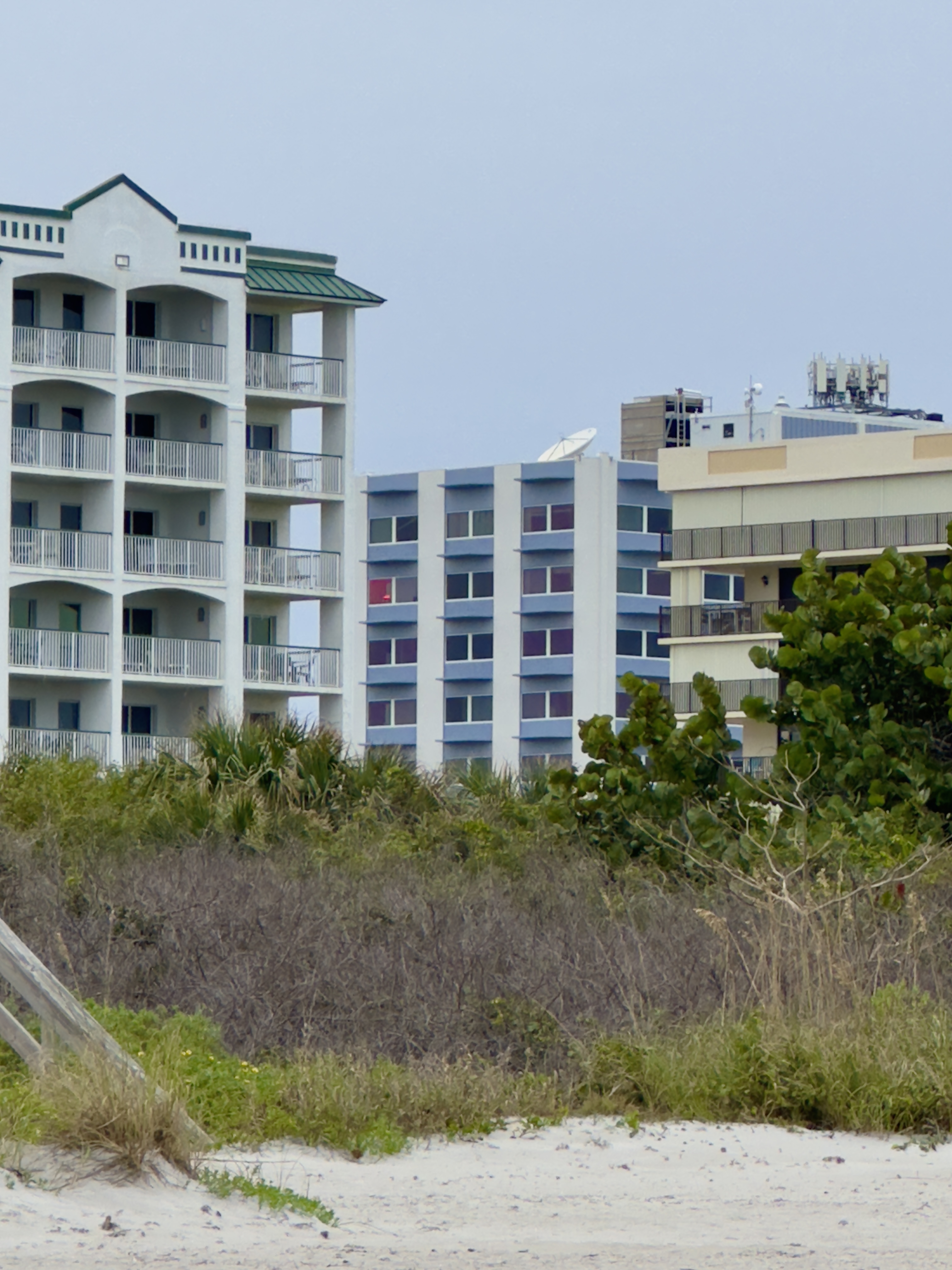
Dive into a fictional adventure in Cocoa Beach, where a mysterious red light sparks curiosity. Join Emma and Alex as they unravel the surprising truth behind a crimson glow.
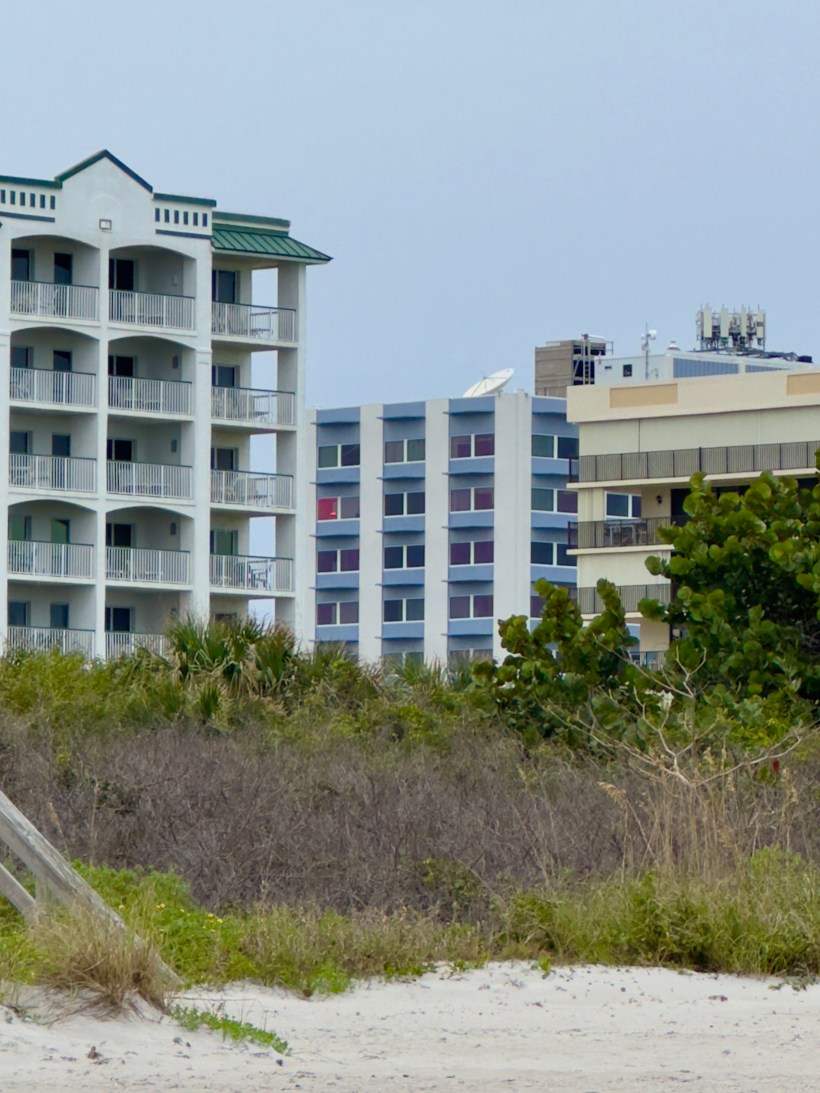
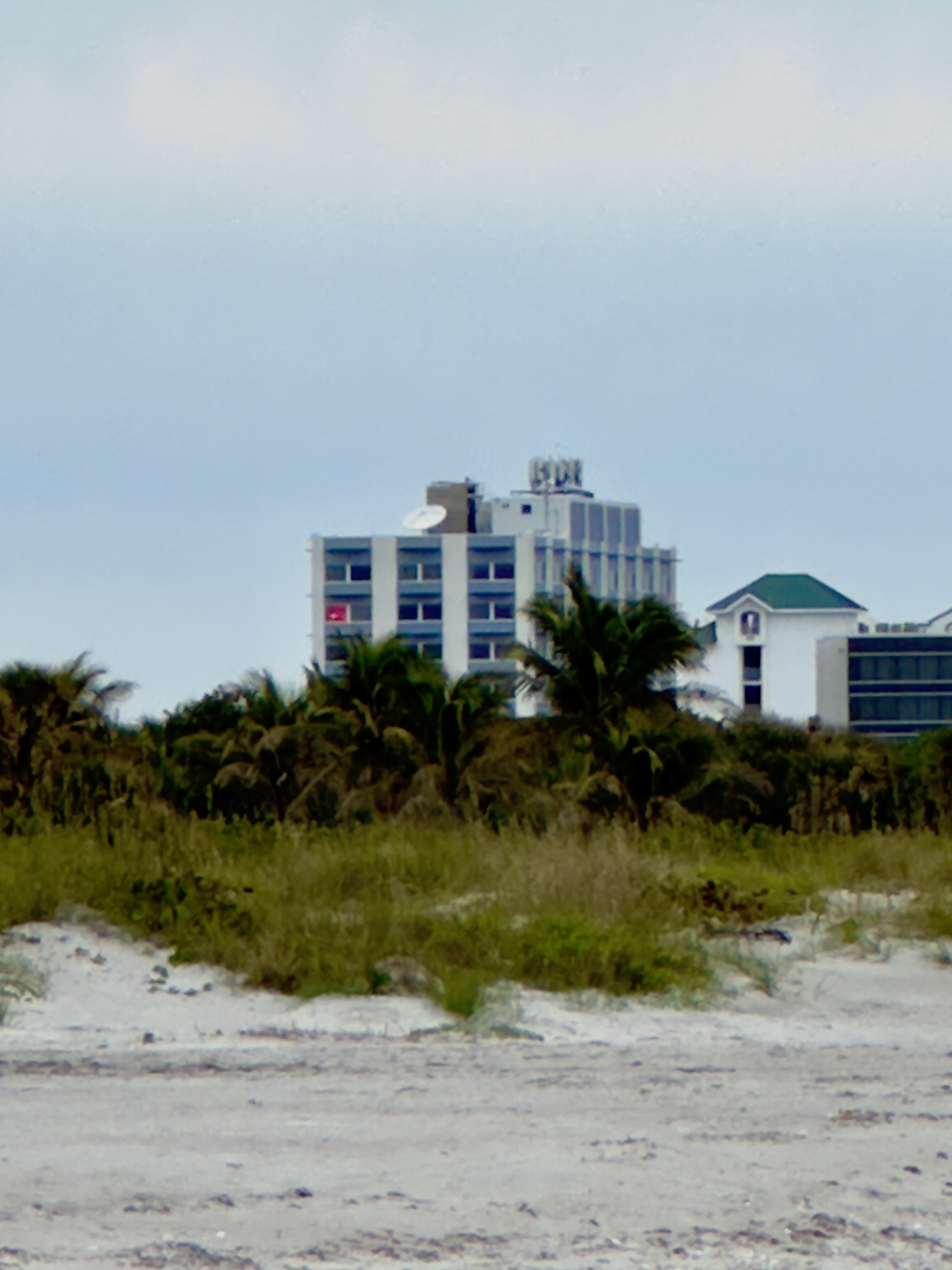
I’ve always been captivated by the unusual, so when I first saw that mysterious red light beaming from the ninth floor of the Cape Royal Office Condominium in Cocoa Beach, I was instantly hooked. The theories around town were wild—some said it was a secret alien signal, others whispered about hidden, illicit activities.
I knew I needed help to investigate, and who better than Emma, the local journalist with a knack for uncovering the truth? I approached her with my theory, and her eyes lit up with curiosity. “Alex, this sounds like a story worth exploring. Let’s see what’s really going on with that red light,” she said enthusiastically.
Disguised as potential clients, we managed to get access to the ninth floor. The anticipation was palpable as we walked through the doors of Howe Photonics, only to find a busy office, not the den of intrigue we’d imagined.
“Hi, I’m Gary Howe,” the managing director greeted us with a knowing smile. “I assume you’re here about the red light?”
I exchanged a look with Emma. “Yes, we are,” she said. “There’s been a lot of speculation in town about it.”
Gary chuckled. “Well, let me clear things up. We specialize in red light therapy systems. The light you’ve seen is from our custom-made LEDs used for therapeutic purposes. They’ve been approved by the FDA.”
I was stunned. “So, it’s not a signal to aliens or anything like that?” I asked, half-joking.
“No, Alex, nothing as exciting as that,” Gary replied with a smile.
Emma and I learned more about the therapy and its benefits from Gary and his son, Howard. I couldn’t help but feel a sense of wonder at the science behind it all. Emma, always the professional, asked insightful questions, capturing every detail.
Gary then offered us a chance to try the therapy. As I relaxed under the soothing red light, I felt a wave of calmness and rejuvenation. “This is incredible, Emma. It’s so different from what we imagined.”
Returning to Cocoa Beach, we were eager to share our findings. Emma penned a detailed article for the local paper, while I created a documentary featuring interviews with the Howes and locals like Judith Brinkly, who had seen remarkable results from the therapy.
The story of the red light shifted from mystery to a source of health and wellness. The once-feared glow now drew people in, eager to experience the benefits for themselves. The mysterious red light, previously the subject of wild rumors, became a celebrated part of our community.
Reflecting on our adventure, I’m grateful for Emma’s support and insight. “You know, Emma, we really changed the narrative here. It’s amazing what a little curiosity and investigation can do.”
Emma smiled. “Absolutely, Alex. We turned fear into understanding and appreciation. That’s the power of seeking the truth.”
The red light of the Cape Royal Office Condominium, once a symbol of mystery and intrigue, now stood as a beacon of hope and healing. Emma and I had uncovered not just a story, but a testament to the power of curiosity and the pursuit of truth.
Note: the persons named in this story are fictional characters. The building and the nature of the red light is real.
Copyright 2024 Michael Stephen Wills All Rights Reserved
Among the 7,000 year old remains found in Windover Bog was the skeleton of a boy crippled from spina bifida who had to be carried around and treated for the 16 years of his life.
I was born into a world that danced around me, a world I could only witness but never fully join. My legs, unlike those of the other children in our tribe, refused to carry me. I spent my days close to our hut, watching the life of our village unfold from my corner, shaded by the leafy arms of the great trees.
My mother was my bridge to the world. She carried me to the edge of the waters, where I would watch my friends play, their laughter a melody I cherished. She showed me the way the water held stories, the way the reeds whispered in the wind. She taught me to weave, my fingers nimble and quick, making up for my still legs.
As I grew, I found my place among my people. I became a keeper of stories, a weaver of tales, just as I wove reeds into baskets. My voice became my movement, my words a dance.
Then, illness found me. It crept into our hut, a shadow that no fire could dispel. My mother’s eyes, always so full of warmth, grew clouded with fear. She fought for me, her hands constantly working – crushing herbs, whispering prayers.
I saw her struggle; saw the toll it took. I wanted to ease her burden, tell her it would be alright, but my voice had begun to fail me. All I could do was squeeze her hand, a silent message of love and gratitude.
As my breaths grew shallower, I watched her. She was my world, her face the last thing I saw as I drifted away, her lullabies carrying me to a place of peace.
I am his mother, heartbroken and weary. My son, my joy, lies motionless, his chest barely rising. I had always carried him, but now, there’s a journey I cannot make with him.
I remember his laughter, bright and clear, despite his bound body. His spirit had wings, even if his legs did not. He was the light of our tribe, a storyteller, a dreamer.
When he leaves me, my heart shatters. The tribe gathers, offering comfort, but the void he leaves is too vast. We prepare him for his final journey, wrapping his body, laying beside him his favorite weaving tools, the small toys he cherished.
We take him to the bog, our sacred place. Gently, we lay him in the water, his final cradle. The waters close over him, holding him in an eternal embrace.
Years pass, but his memory remains, alive in the stories I tell by the fire.
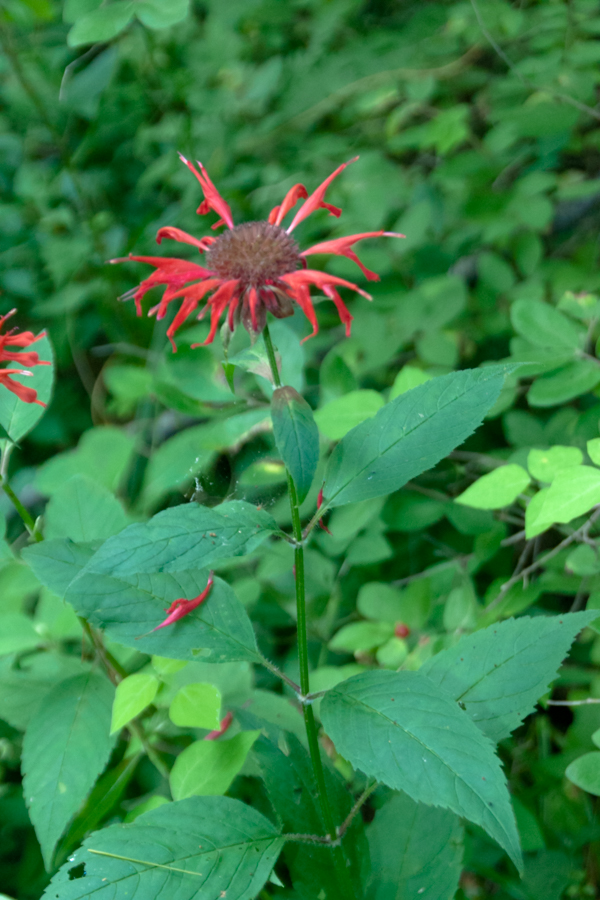
Monarda didyma is also known as crimson beebalm, scarlet beebalm, scarlet monarda, Eau-de-Cologne plant, Oswego tea, or bergamot. A wildflower native to the Finger Lakes, Crimson beebalm is extensively grown as an ornamental plant, both within and outside its native range; it is naturalized further west in the United States and also in parts of Europe and Asia.
It grows best in full sun, but tolerates light shade and thrives in any moist, but well-drained soil. As suggested by membership in the Lamiaceae (mint) family, Beebalm, as an aromatic herb, has a long history of use as a medicinal plant by many Native Americans, including the Blackfoot. The Blackfoot people recognized this plant’s strong antiseptic action and used poultices of the plant for skin infections and minor wounds.
An herbal tea made from the plant was also used to treat mouth and throat infections caused by dental caries and gingivitis. Beebalm is a natural source of the antiseptic thymol, the primary active ingredient in modern commercial mouthwash formulas. The Winnebago used an herbal tea made from beebalm as a general stimulant. It was also used as a carminative herb by Native Americans to treat excessive flatulence. As a matter of local interest, Iroquois of Oswego, New York, made the leaves into a tea, giving the plant one of its common names.
It is 9:30 am on a July morning Robert H. Treman Park, Ithaca, Tompkins County, Ithaca, New York,
References
Wikipedia, “Monarda didyma”
“The Botanical Garden, Vol II” Roger Phillips and Martyn Rix, Firefly Books, 2002. Page 284
Copyright 2023 All Rights Reserved Michael Stephen Wills
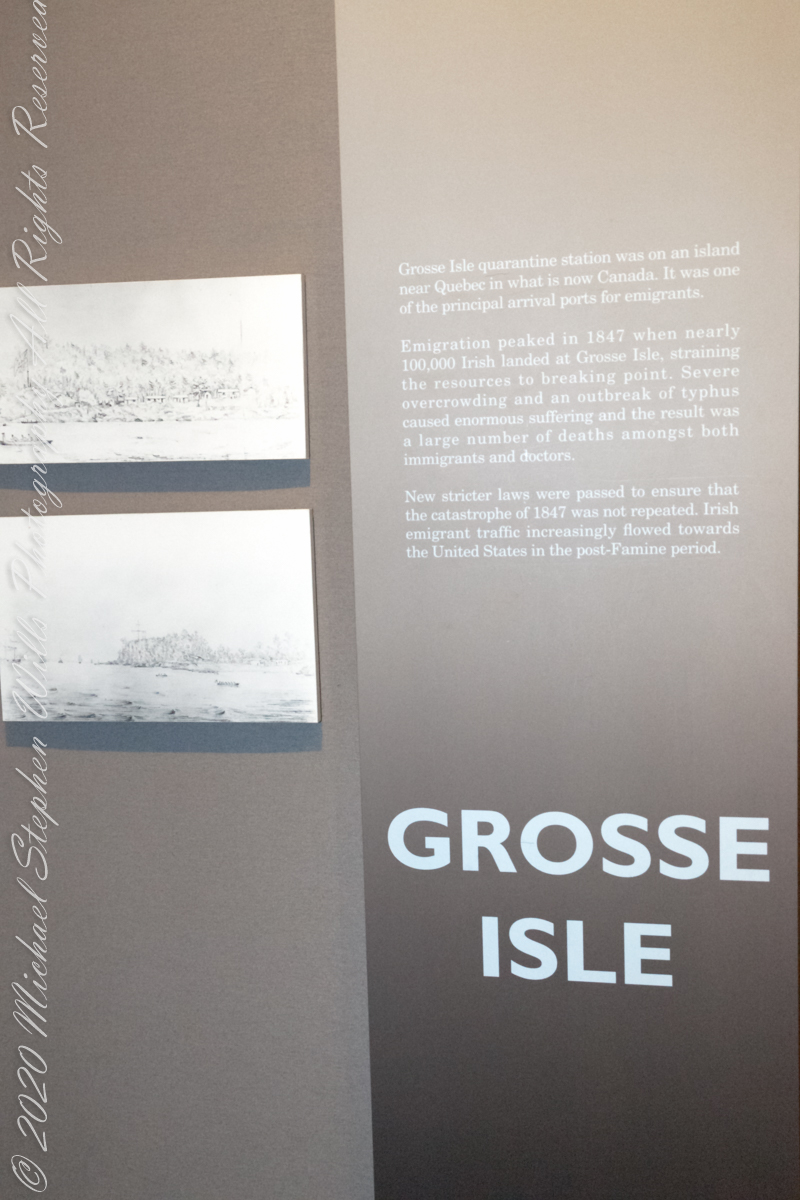
“Grosse Isle quarantine station was on an island near Quebec in what is now Canada. It was one of the principal arrival ports for emigrants.
Emigration peaked in 1847 when nearly 100,000 Irish landed at Grosse Isle, straining the resources to breaking poinit. Severe overcrowding and an outbreak of typhus caused enormous suffering the the result was a large number of deaths amongst both immigrants and doctors.
New stricter laws were passed to encure that the catastrophe of 1847 was not repeated. Irish emigrant traffic increasingly flowed towards the United State inthe post-Famine period”. From the exhibit (below), Cobh Heritage Center.
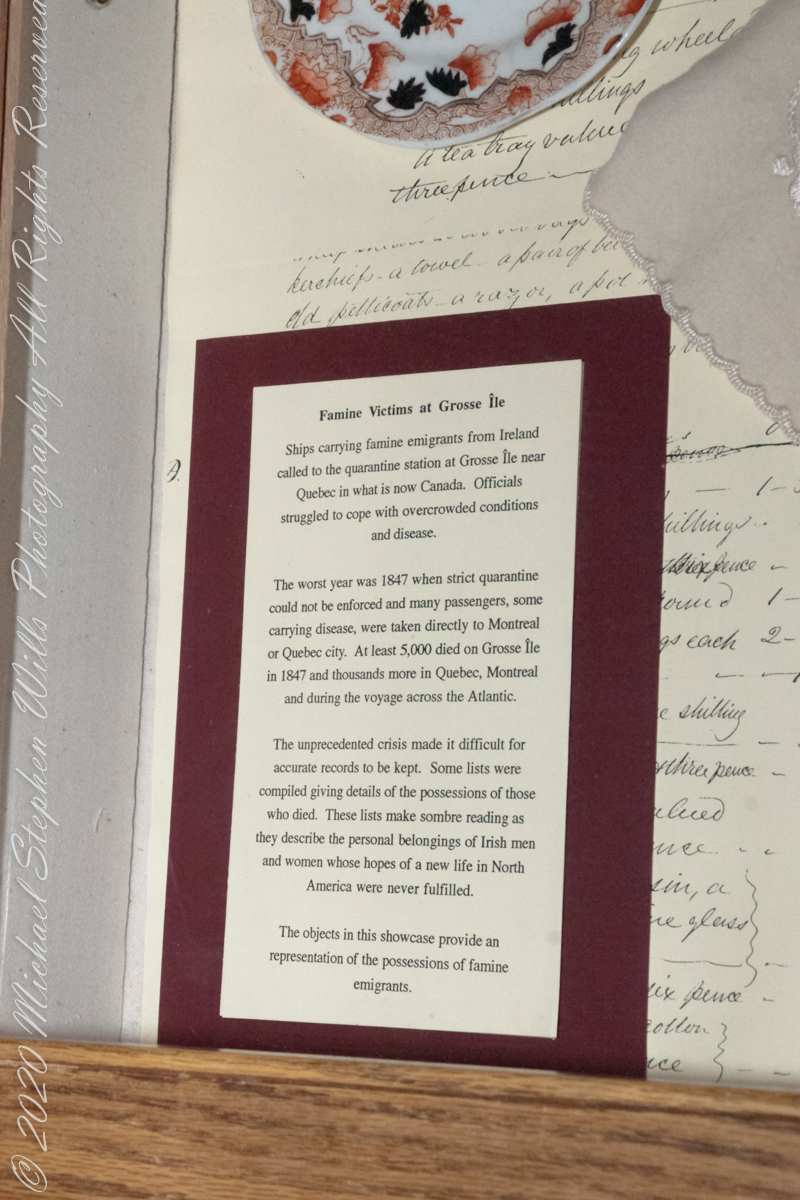
In that horrible year of 1847, strict quarantine could not be enforced and many passengers, some carrying disease, were taken directly to Montreal or Quebec city. At least 5,000 died on Grosse Isle in 1847 and thousands more in Quebec, Montreal and during the voyage across the Atlantic.
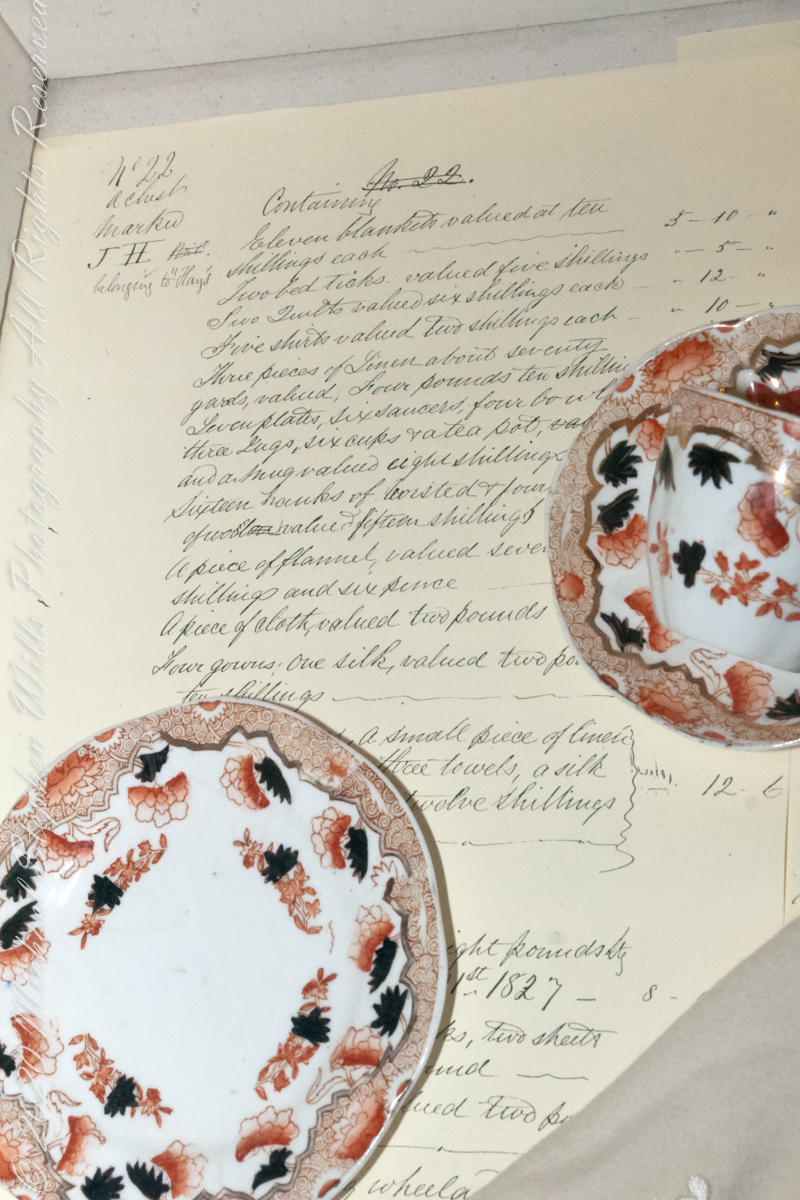
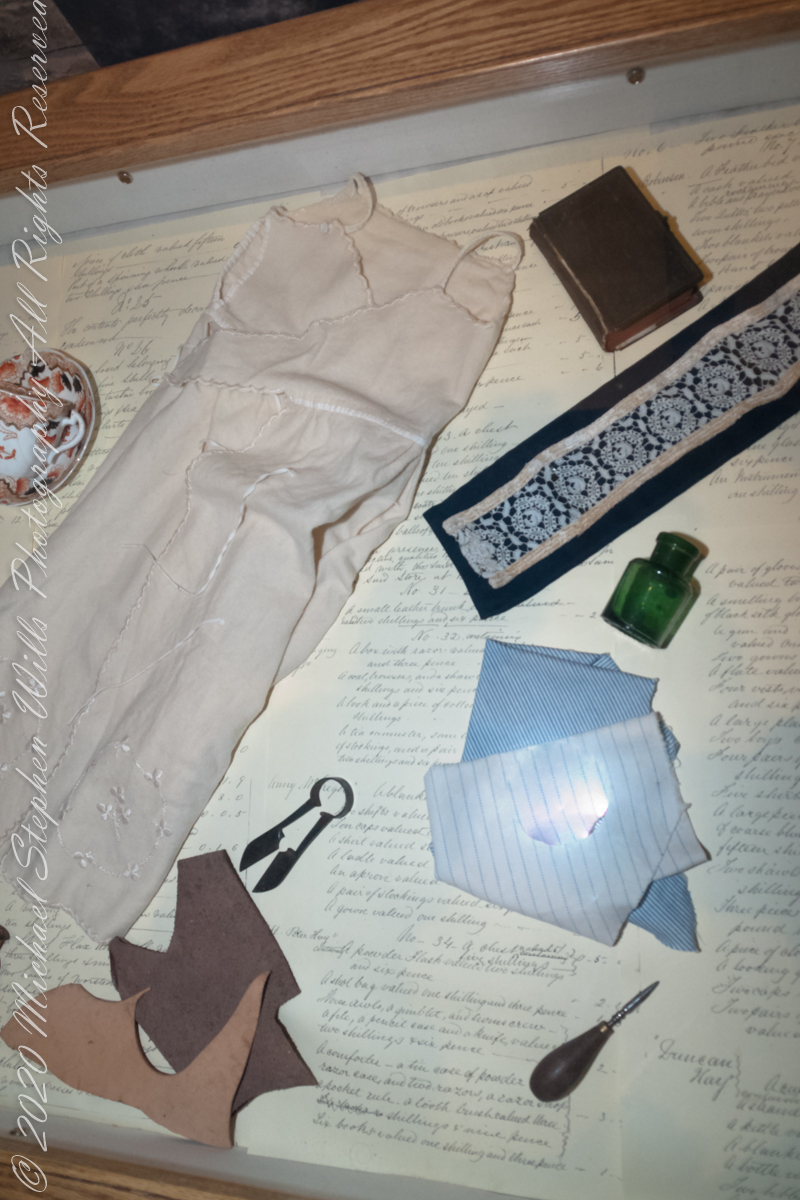
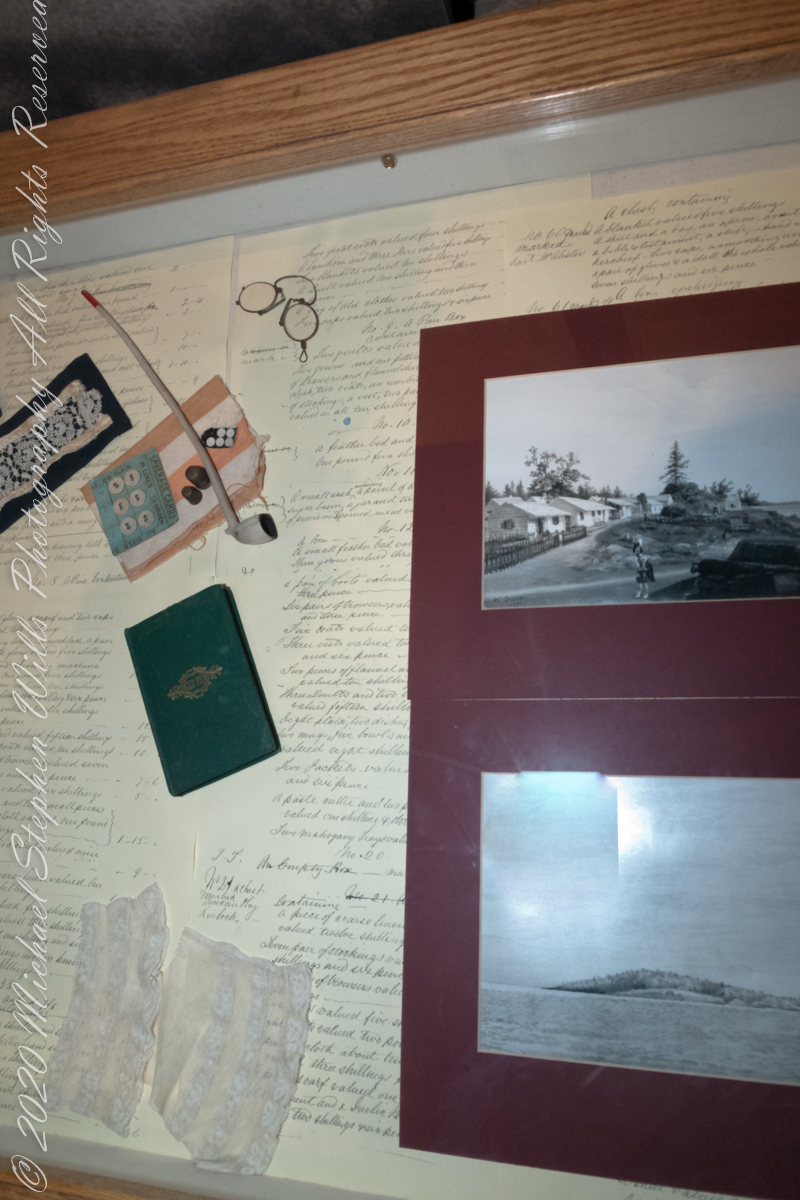
The unprecedented crisis made it difficult for accurate records to be kept. Some lists were compiled giving details of the possessions of those who died. These lists make sombre reading as they describe the personal belongings of Irish men and women whose hopes of a new life in North America were never fulfilled.
The objects in this showcase provide an representation of the possessions of famine emigrants. From the exhibit (below), Cobh Heritage Center.
Posessions of Irish famine victims arriving at Grosse Ile near Quebec. 1847
Copyright 2021 Michael Stephen Wills All Rights Reserved
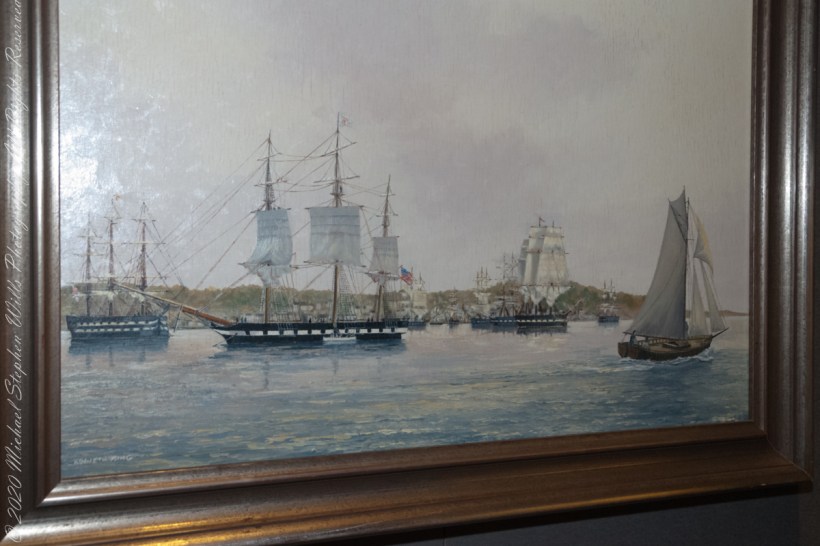
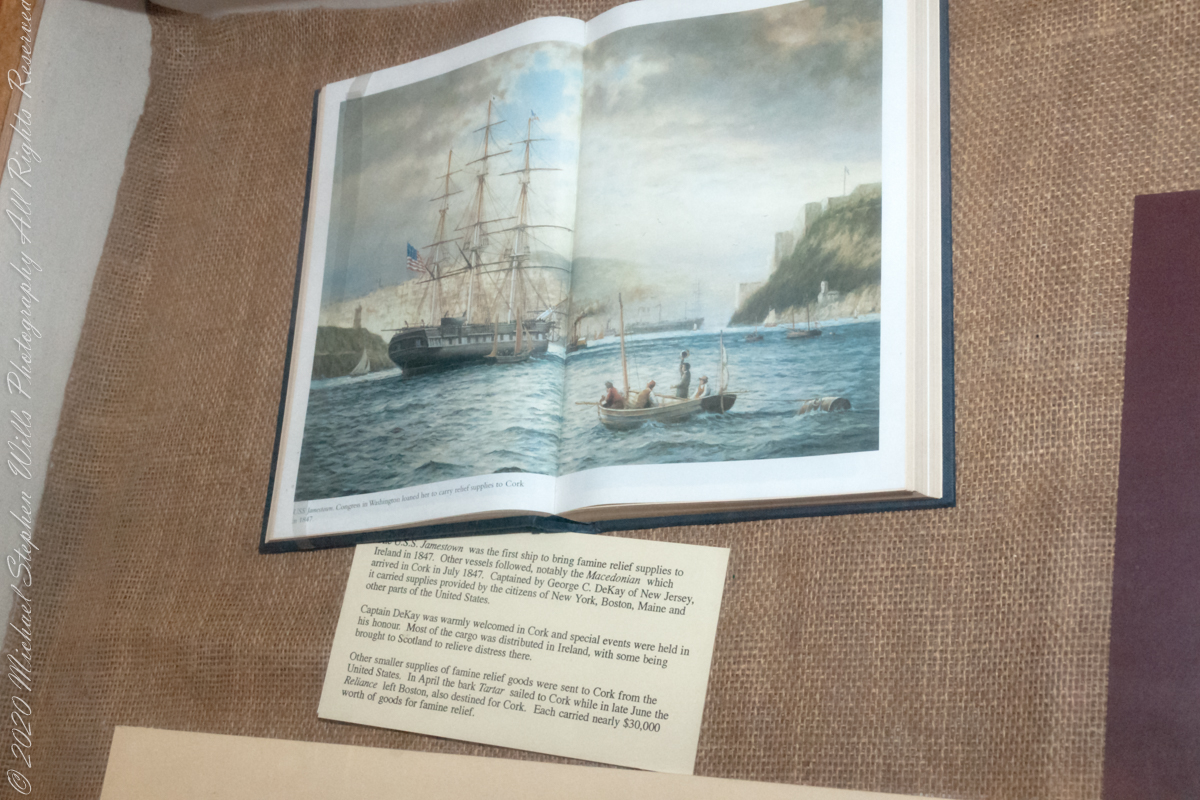
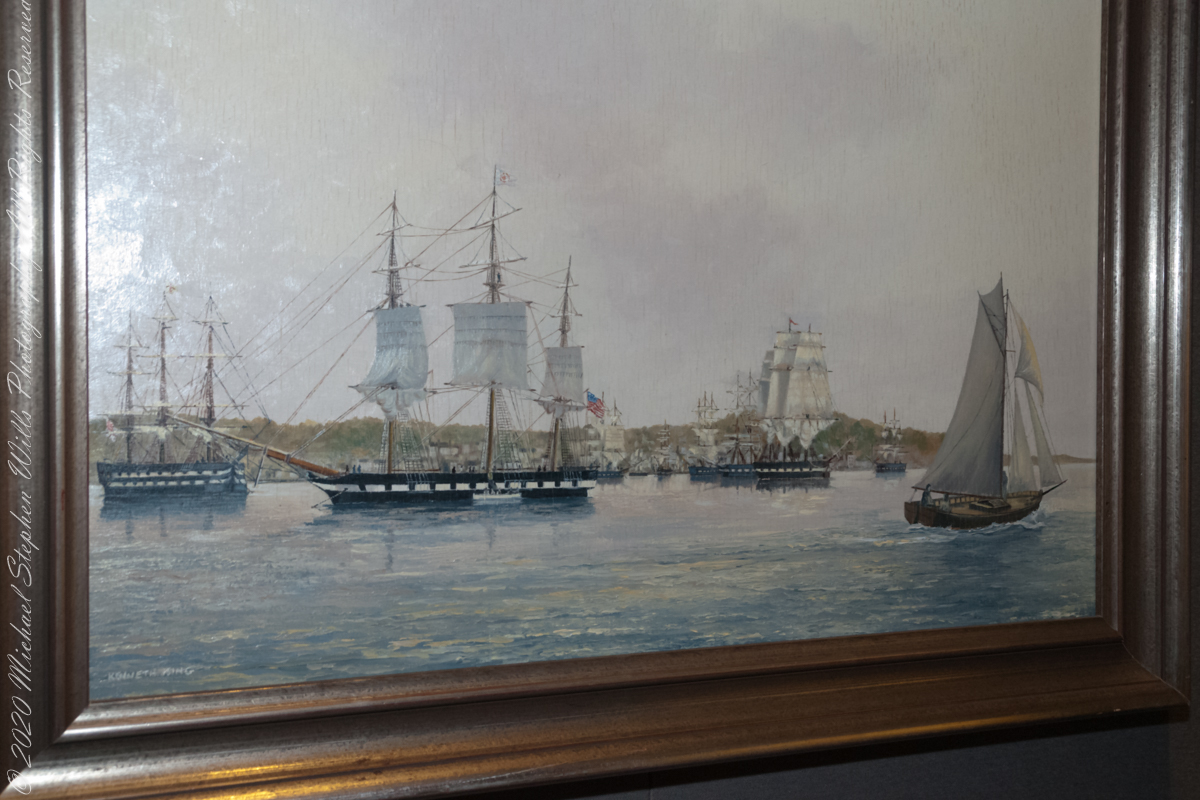
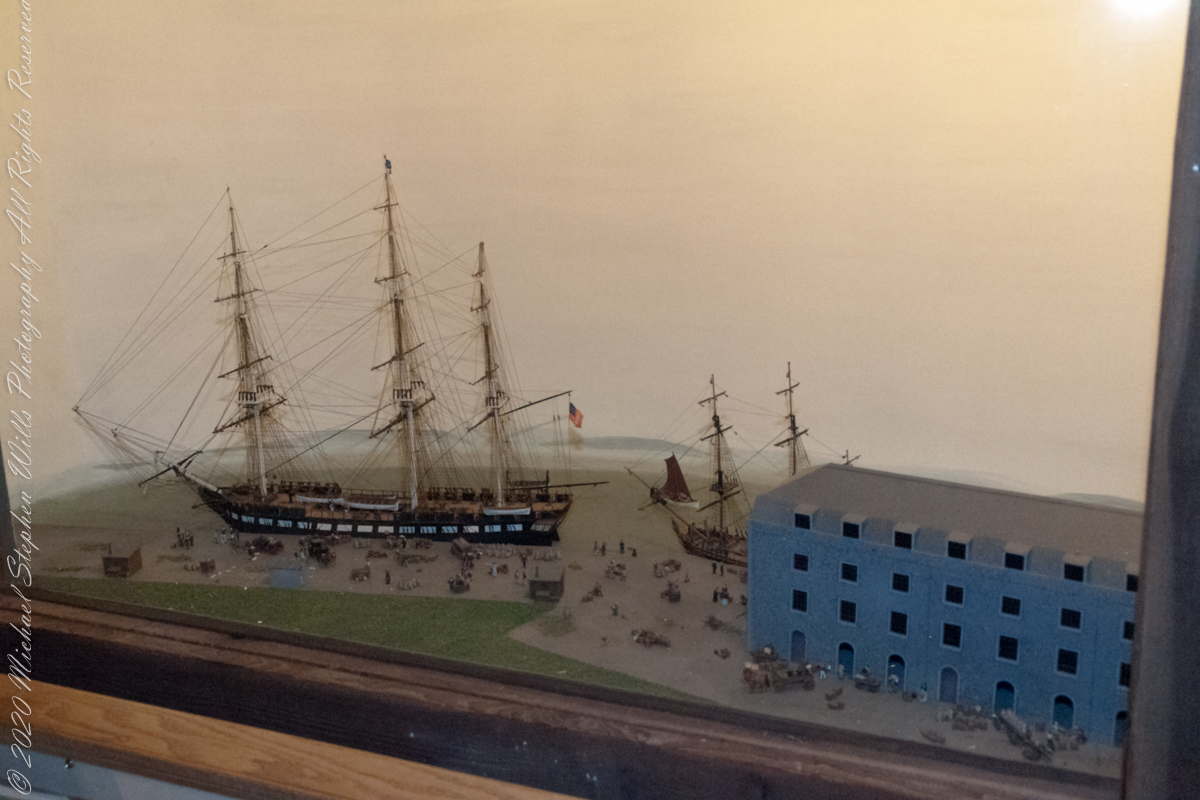
“The U.S.S Jamestown was the first ship to bring famine relief supplies to Ireland in 1847. Other vessels followed, notably the Macedonian which arrived in Cork July 1847. Captained by George C. DeKay of New Jersey, it carried supplies provided by the citizens of New York, Boston, Main and other parts of the United States. Captain DeKay was warmly welcomed in Cord and special events were held in his honor. Most of the cargo was distributed in Ireland, with some being brought to Scotland to relieve distress there. Other smaller supplies of famine relief goods were sent to Cork from the United States. In April the bark Tartar sailed to Cork with in late June the Reliance left Boston, also destined for Cork. Each carried nearly $30,000 worth of goods for famine relief. From the exhibit (below), Cobh Heritage Center.
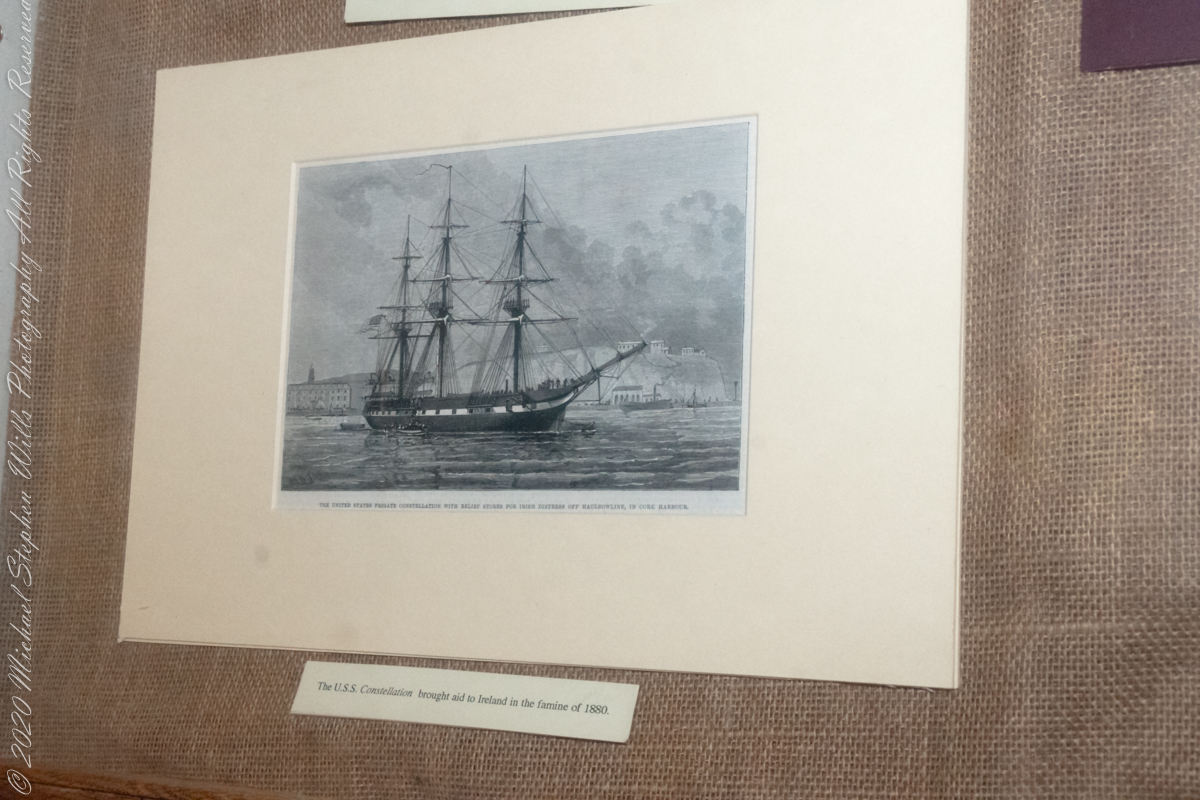
United States frigate Constellation with relief stores for Irish distress off Haulbownline in Cork Harbor.
Copyright 2021 Michael Stephen Wills All Rights Reserved
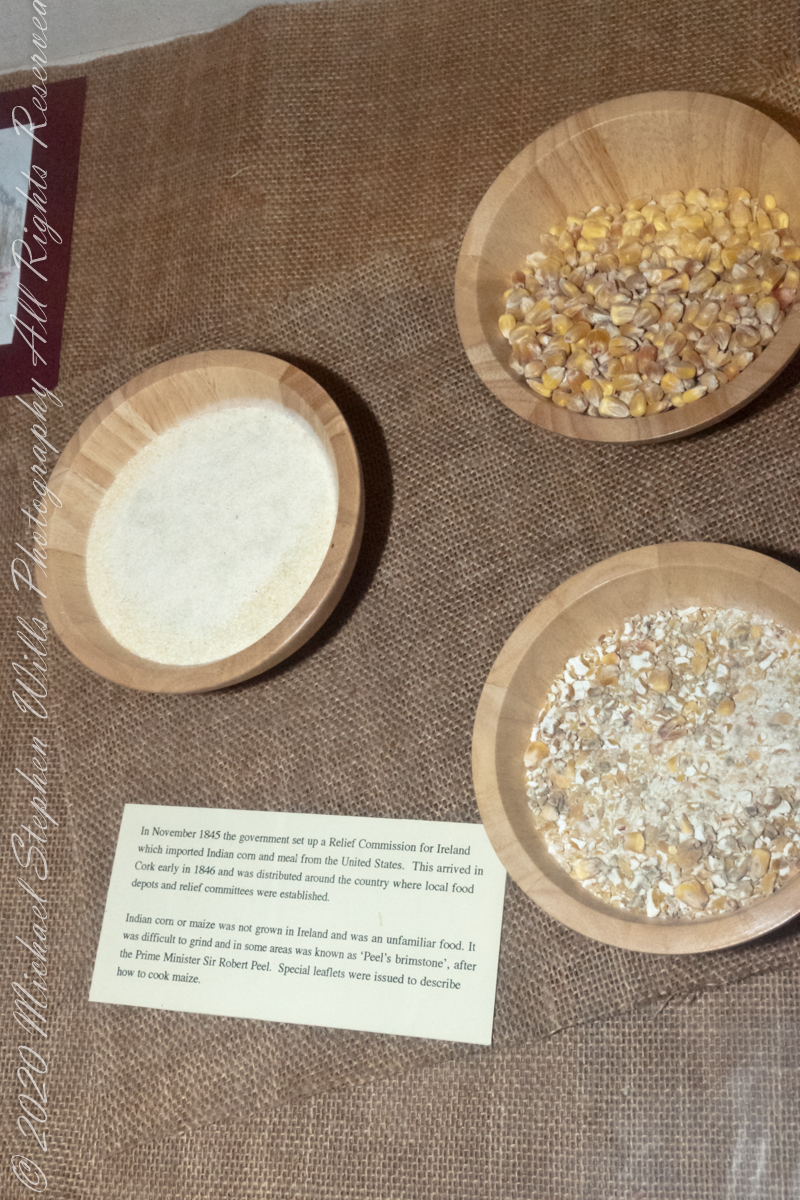
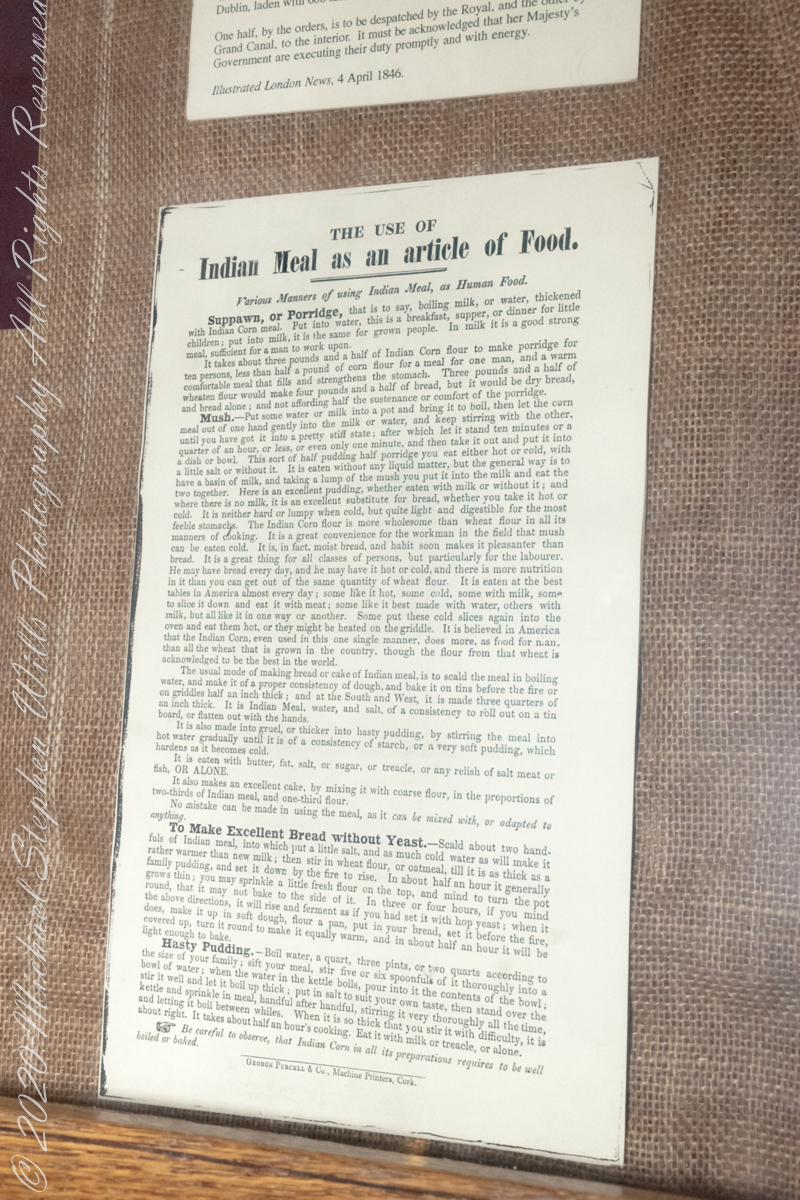
“In November 1845 the British government set up a Relief Commission for Ireland which imported Indian corn and meal from the United States. This arrived in Cork early in 1846 and was distributed around the country where local food depots and relief committees were established. Indian corn (maize) was not grown in Ireland and was an unfamiliar food. It was difficult to grind and in some areas was known as “Peel’s brimstone,” after the Prime Minister Sir Robert Peel. Special leaflets were issued to describe how to cook maize.” From the exhibit (below), Cobh Heritage Center.
Instructions for how to cook maize. In the west of Ireland many people spoke Irish.
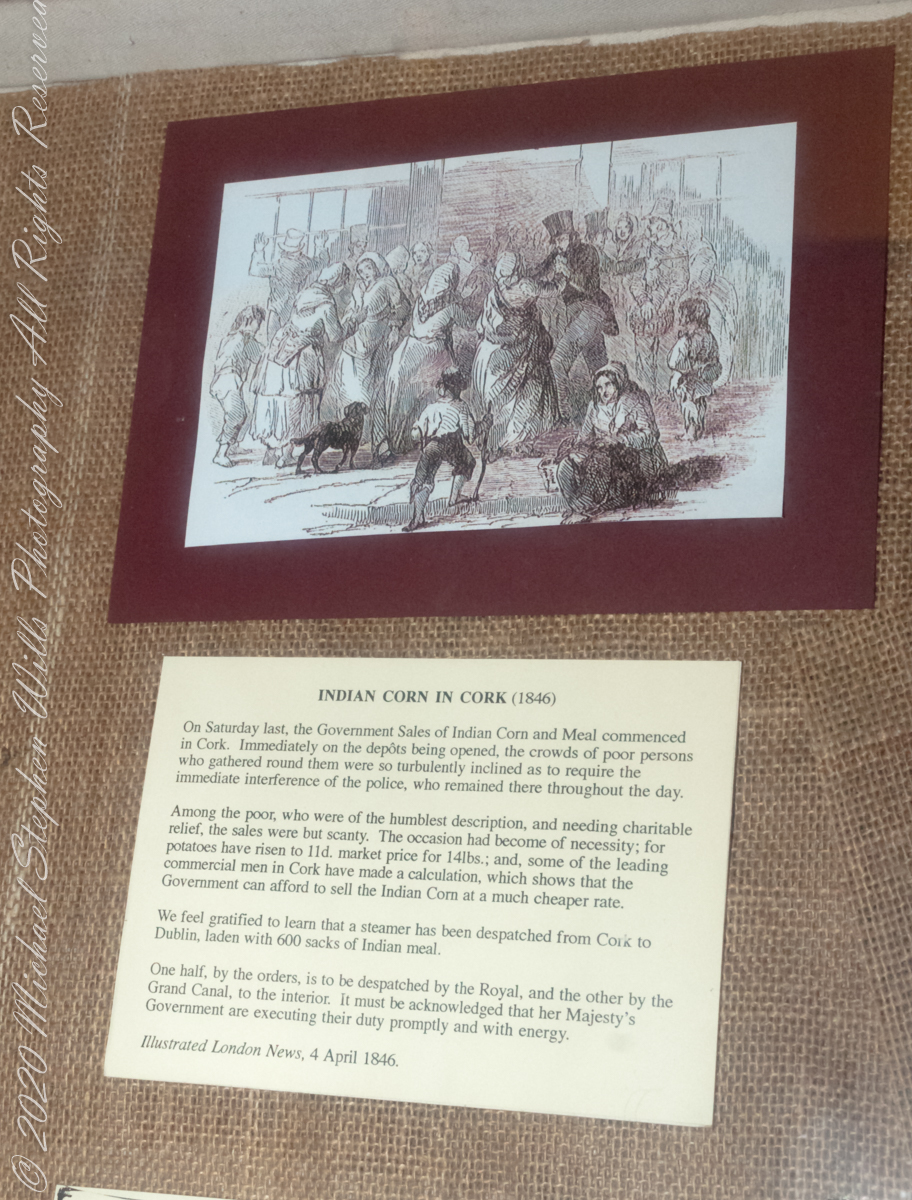
“On Saturday last, the Government Sales of Indian Corn commenced in Cork. Immediately on the depoys being opened, the crowds of poor persons who gathered round them were so turbulently inclined as to require the immediate interference of the police, who remained throughout the day.
Among the poor, who were of the humblest description, and needing charitable relief, the sales were but scanty. The occasion had become of necessity; for potatoes had risen to 11d. the market price for 14 pounds; and, some of the leading commercial men in Cork have made a calculation, which show that the Government can afford to sell the Indian Corn at a much cheaper rate.
We feel gratified to learn that a steamer has been dispatched from Cork to Dublin, laden with 600 sacks of Indian meal.
One half, by the orders, is to be dispatched by the Royal, and the other by the Grand Canal, to the interior. It must be acknowledged that her Majesty’s Government are executing their dury promptly and with energy. from the Illustrated London News, April 4, 1846″. ~ from the exhibit, Cobh Heritage Center.
Copyright 2021 Michael Stephen Wills All Rights Reserved
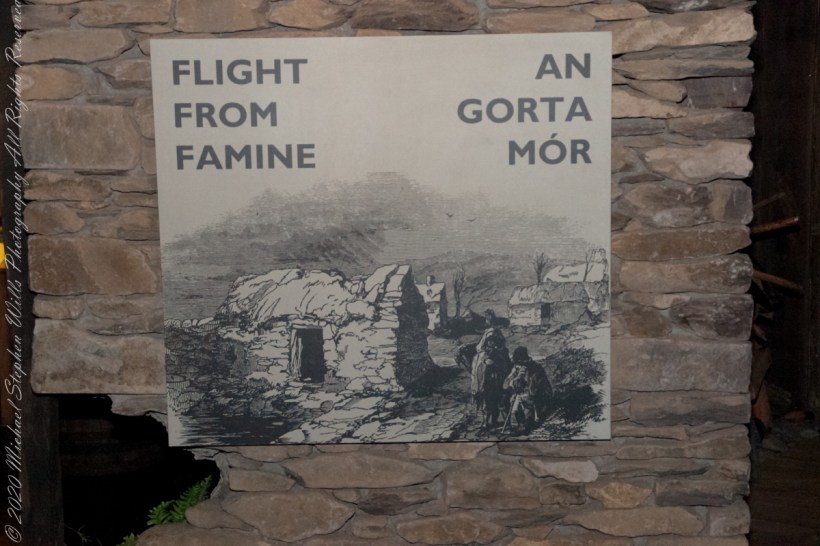
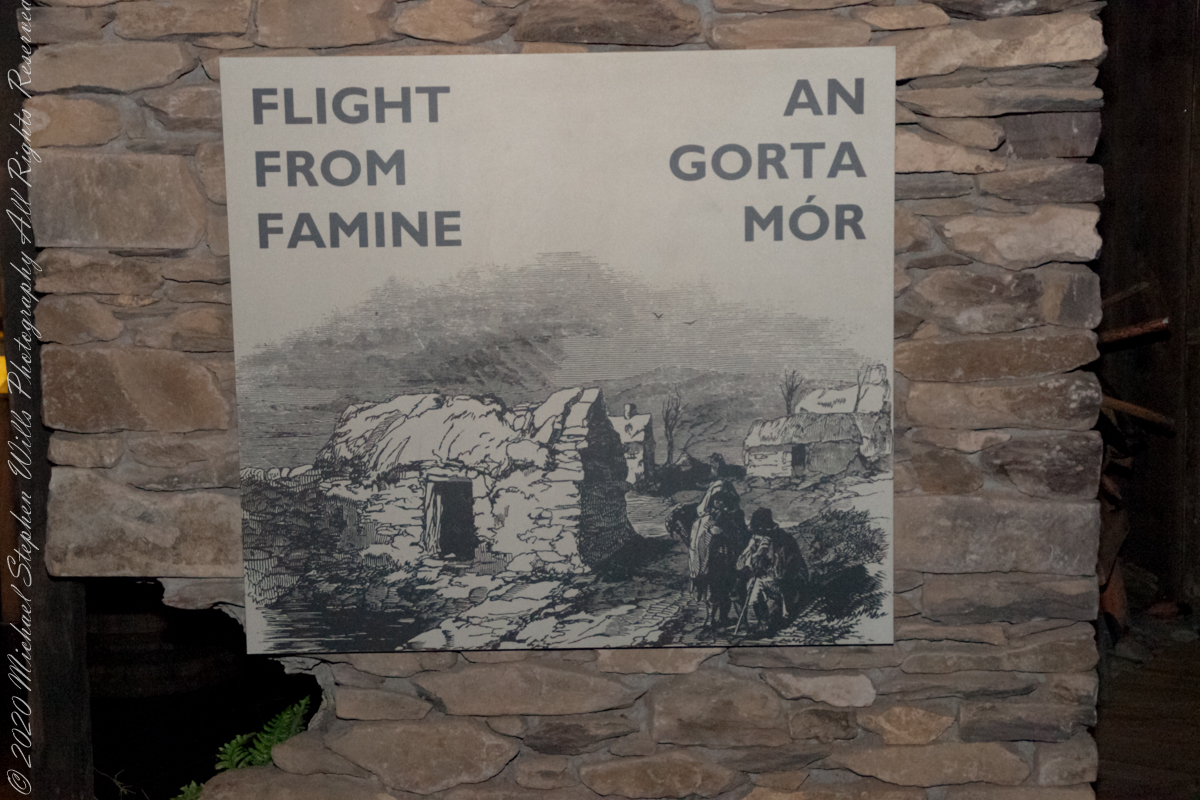
The Great Famine had profound social, cultural, and political impacts on Ireland and its relationship with Britain. It led to a significant decline in the Irish population due to death and mass emigration and is remembered as one of the darkest periods in Irish history. The event also left deep scars on the collective memory of the Irish people and played a role in the growth of Irish nationalism and the push for Irish independence in the following decades
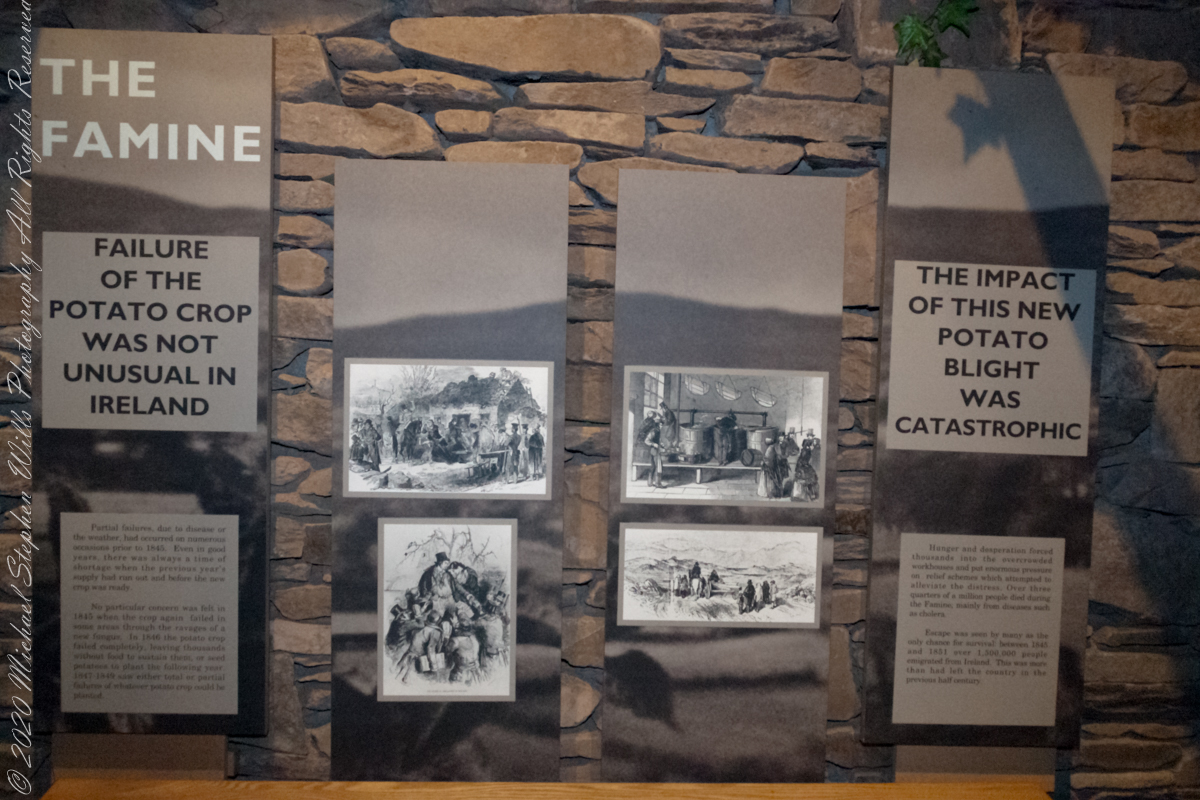
“Partial failures, due to disease or the weather, had occurred on numerous occasions prior to 1845. Even in good years, there was always a time of shortage when the previous year’s supply had run out and before the new crop was ready.”
Cobh Heritage Center
“No particular concern was felt in 1845 when the crop again failed in some areas through the ravages of a new fungus. In 1846 the potato crop failed completely, leaving thousands without food to sustain them, or seed potatoes to plant the following year. 1847 – 1849 saw either total or partial failures of whatever potato crop could be planted.”
“Hunger and desperation forced thousands into the overcrowded workhouses and put enormous pressure on relief schemes which attempted to alleviate the distress. Over three quarters of a million people died during the Famine, mainly from diseases such as cholera. Escape was seen by many as the only change for survival: between 1845 and 1851 over 1.5 million people emigrated from Ireland. This was more than had left the country in the previous half century.”
Cobh Heritage Center
The Great Famine of Ireland, often referred to as the “Irish Potato Famine,” occurred between 1845 and 1852, with the most acute suffering taking place between 1847 and 1849. The causes of this devastating period in Irish history are multifaceted and debated among historians, but the following are generally acknowledged as the primary factors:
Potato Blight (Phytophthora infestans): The immediate cause of the famine was a potato disease known as late blight. The potato was a staple crop in Ireland, and for many poor Irish, it was the primary source of nutrition. The blight destroyed the potato crop year after year, leading to widespread hunger.
Over-reliance on a Single Variety of Potato: The Irish mainly grew a type of potato called the “Lumper,” which was particularly susceptible to the blight. This lack of genetic diversity made the entire crop more vulnerable to disease.
Land Ownership and Tenancy: Most of the land in Ireland was owned by a small number of landlords, many of whom were absentee, living in England. The Irish Catholic majority often worked as tenant farmers, living on small plots of land and paying rent to these landlords. The land was subdivided among heirs, leading to plots becoming increasingly smaller and less productive over generations.
British Colonial Policies: The relationship between Ireland and Britain played a significant role in exacerbating the famine’s effects. Some British policies and economic theories at the time discouraged intervention. For instance:
Corn Laws: These tariffs protected British grain producers from cheaper foreign competition, making grain more expensive and less accessible for the starving Irish.
Economic Beliefs: The prevailing laissez-faire economic philosophy of the time held that markets should be allowed to self-regulate without government intervention.
Exports: Even as the famine raged, Ireland continued to export food (like grain, meat, and dairy) to Britain, which was a source of controversy. Many felt these exports should have been halted or reduced to feed the starving Irish population. Inadequate Relief Efforts: While the British government did undertake some relief measures, such as opening public works projects and distributing maize (known as “peel’s brimstone”), these efforts were often insufficient, mismanaged, or too late. The public works projects sometimes did not lead to meaningful infrastructure improvements and instead focused on tasks like building roads that led nowhere.
Social and Cultural Factors: Discrimination against the Irish Catholics by the Protestant English elite, language barriers (many Irish spoke only Gaelic), and distrust between the local population and English officials further complicated relief efforts.
The Great Famine had profound social, cultural, and political impacts on Ireland and its relationship with Britain. It led to a significant decline in the Irish population due to death and mass emigration and is remembered as one of the darkest periods in Irish history. The event also left deep scars on the collective memory of the Irish people and played a role in the growth of Irish nationalism and the push for Irish independence in the following decades.
Reference: text in quotes is from “The Famine” poster. Cobh Heritage Center, May 2014.
Copyright 2023 Michael Stephen Wills All Rights Reserved
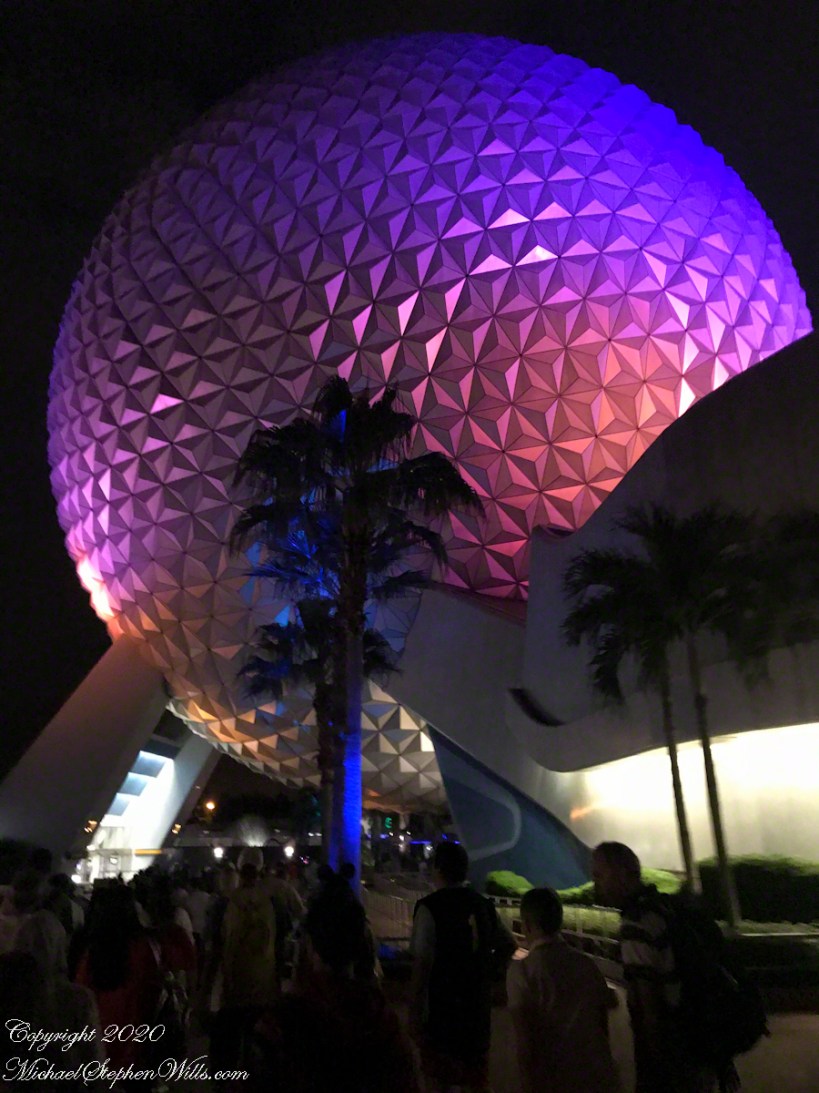
Our last “FastPass” was for the EPCOT Forever fireworks and special effects spectacular. COVID-19 rendered the “forever” to be futile pretension, though during our wait Pam struck up a conversation with a couple who returned year after years to EPCOT, people who miss it and look forward to reopening.
We found the “FastPass” venue lacking, as there were many structures in the line of sight, as you can see from the IPhone 7 videos in this post. In retrospect, the area in front of the Canada Pavilion was open and might be a better location — when Epcot reopens, you’d need to get their early to grab a space.
“Dodge the bullet” is rather too active for our EPCOT experience as we did nothing to social distance, cover our faces and, even, attended a sit down restaurant. “Dumb luck” is a better characterization, but it makes a poor chapter heading.
As our time in Florida passed more information leaked from China, posted by their citizens on-line. I recalled the chaotic scenes from the hospital, frightened people screaming in packing halls. Seeking to protect ourselves during the flight home, we sought out N95 masks and all medical masks were sold out. We found packs of N95 masks marketed for auto body work, in Walmart. Wore them on the 2 hour flight home as the only “wierdos” wearing masks as several fellow passengers coughed uncontrollably.
Copyright 2020 All Rights Reserved Michael Stephen Wills
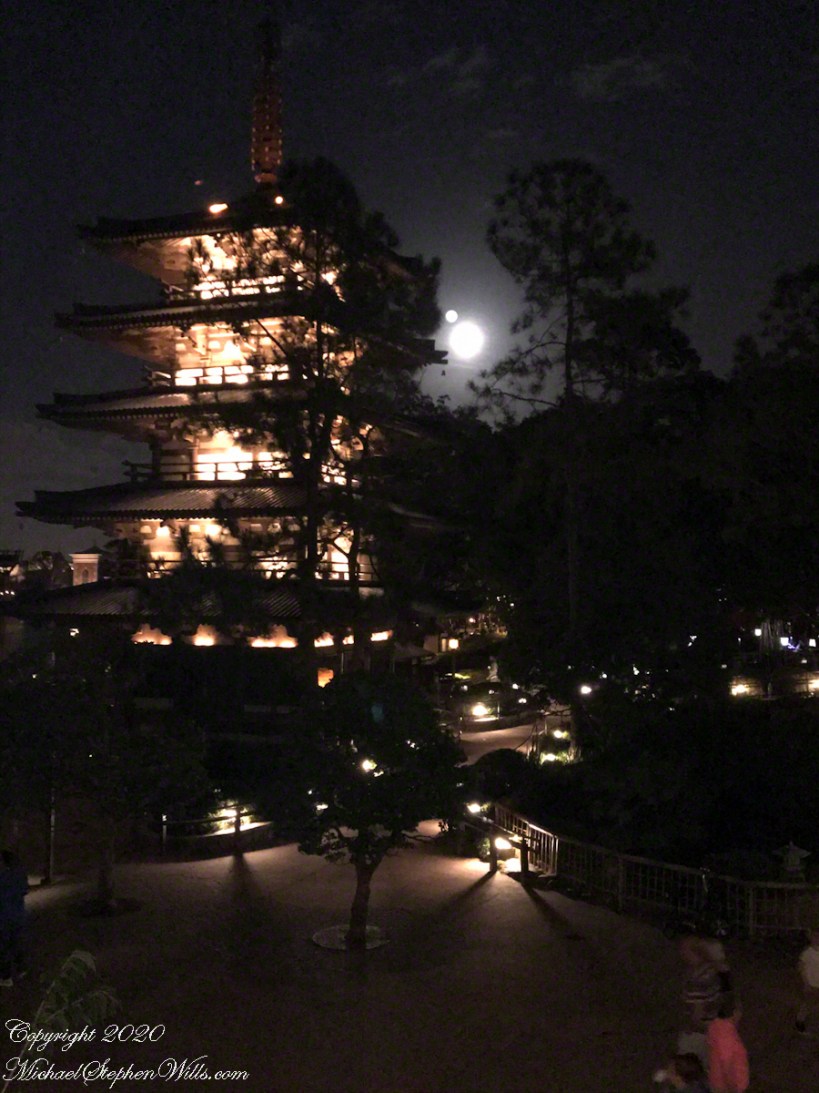
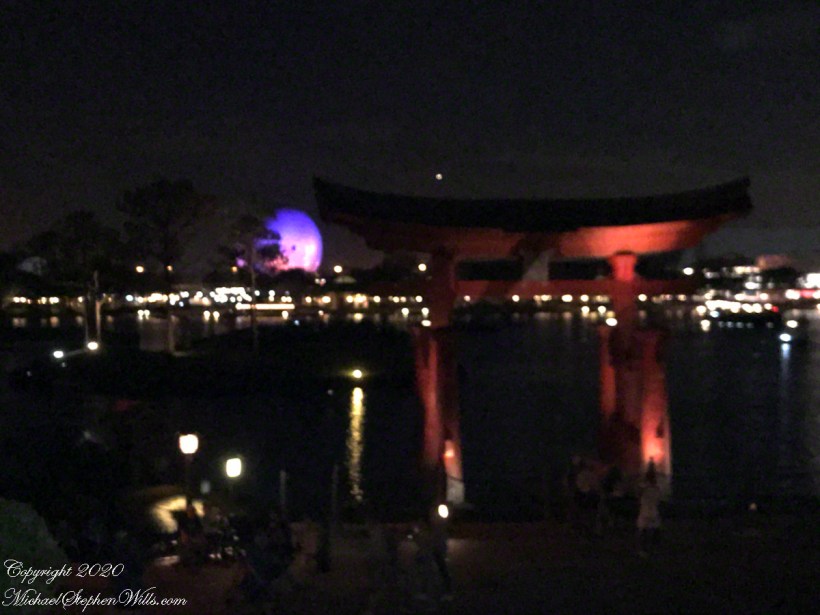
Epcot is a different experience at night, in many ways an enhancement, a gathering of glamour, smoothing of edges.
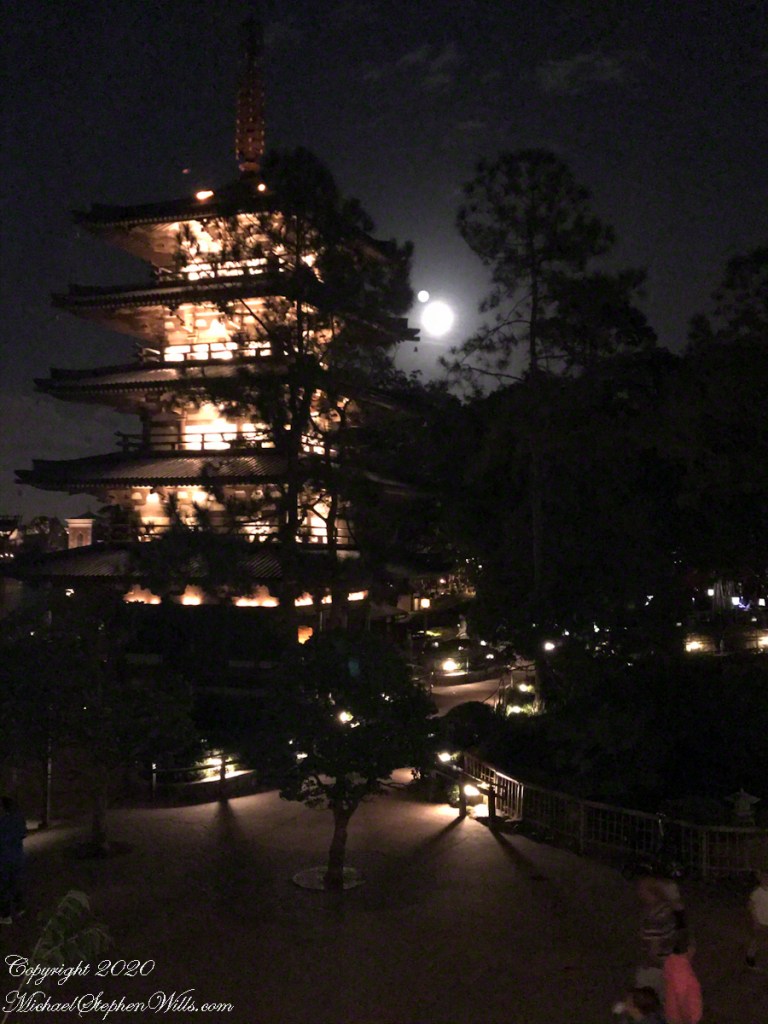
These few photographs and one video of the Japan Pavilion exemplify this effect. We were blessed with a full moon.
Click photograph for larger image. To do this from WordPress Reader, you need to first click the title of this post to open a new page.
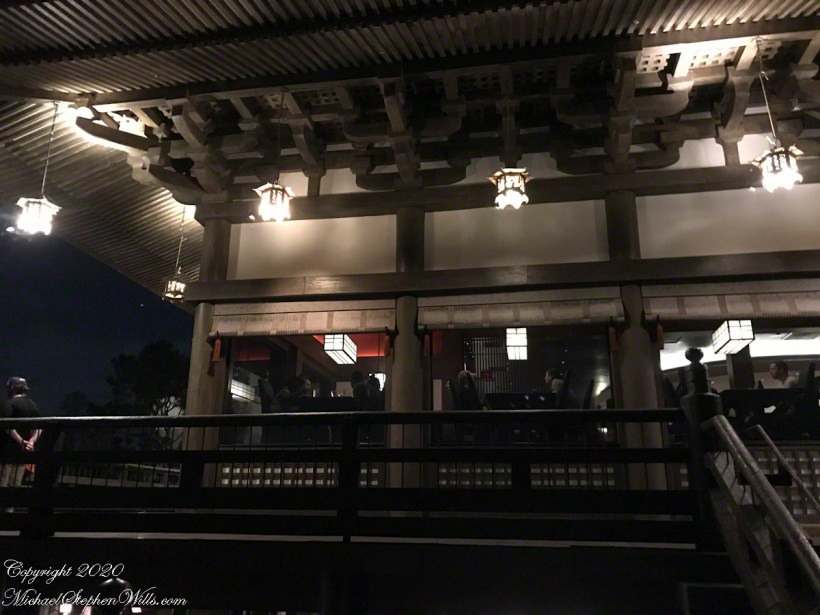
Exterior of the Tokyo Dining restaurant
Tokyo Dining is a traditional sushi restaurant featuring served by native Japanese. Our service was efficient and attentive from a premium seat acquired through our on-line reservation through a smart phone Disney app. Traffic is immense. I can only think of the research from China that demonstrated transmission of COVID-19 to nine diners by one infected person. We learned in April 2020 a high percentage of infections are non-symptomatic.
Blue Roof Pagoda with Full Moon
After dinner Pam and I enjoyed views from the spacious terrace. All photos for this post are from that time. Many of our family gifts from the trip were from the large and well stocked Mitsukoshi Department Store. It is the only remaining branch of the company in North America.




 Michael Stephen Wills Photography