Solid Doubles

2023, baseball, Cass Park, double, fall, hits, Ithaca, Little League, New York State, RBI, Tompkins County

Our grandson’s work on baseball skills is paying off. Here he slugs one to right field where it bounces on the fence for a solid double. He had two doubles that game, driving in a couple of runs, scoring off one himself. Good work!!

“Carl Stotz, a resident of Williamsport, Pennsylvania, founded Little League Baseball in 1939. He began experimenting with his idea in the summer of 1938 when he gathered his nephews, Jimmy and Major Gehron, and their neighborhood friends. They tried different field dimensions over the course of the summer and played several informal games. The following summer, they felt that they were ready to establish what later became Little League Baseball. The first league in Williamsport had just three teams, each sponsored by a different business. The first teams, Jumbo Pretzel, Lycoming Dairy, and Lundy Lumber, were managed by Stotz and brothers George and Bert Bebble. The men, joined by their wives and another couple, formed the first-ever Little League board of directors.”

“The first league game took place on June 6, 1939 when Lundy Lumber defeated Lycoming Dairy, 23–8. Lycoming Dairy became the champions of the first half of the season and then defeated Lundy Lumber, the second-half champions, in a best-of-three championship series. The following year, a second league was formed in Williamsport, and from there Little League Baseball grew to become an international organization of nearly 200,000 teams in every U.S. state and in more than 80 countries.”

“From 1951 through 1973, Little League was restricted to boys only. In 1974, Little League rules were revised to allow participation by girls in the baseball program following the result of a lawsuit filed by the National Organization for Women on behalf of Maria Pepe. According to the Little League Baseball and Softball participation statistics following the 2008 season, there were nearly 2.6 million boys and girls in Little League Baseball worldwide. Of these, approximately 400,000 are registered in softball leagues (including both boys and girls). Starting in 2022, For tournament purposes, Little League Baseball is divided into 20 geographic regions: ten national and ten international. Each summer, Little League operates seven World Series tournaments at various locations throughout the U.S. (Little League softball and Junior, Senior, and Big League baseball and softball).”

Reference: text in italics and quotes is from the Wikipedia, “Little League.”

Copyright 2023 Michael Stephen Wills All Rights Reserved.

Farewell to the Monarchs for 2023

Monarch from caterpillar to chrysalis to butterfly

Here are two of the ten monarchs we release this year. In under three minutes this video shows a monarch caterpillar transforming into a chrysalis, emerging two weeks later as a butterfly. Music “Emotional Underscores Vol. 3” by Yuri Sazonoff (SOCAN) “Can You Guess” and “Blessing”

“Migrating monarchs soar at heights of up to 1,200 feet. As sunlight hits those wings, it heats them up, but unevenly. Black areas get hotter, while white areas stay cooler. The scientists believe that when these forces are alternated, as they are with a monarch’s white spots set against black bands on the wings’ edges, it seems to create micro-vortices of air that reduce drag—making flight more efficient.”

“Monarchs begin leaving the northern US and Canada in mid-August. They usually fly for 4-6 hours during the day, coming down from the skies to feed in the afternoon and then find roosting sites for the night.  Monarchs cannot fly unless their flight muscles reach 55ºF. On a sunny day, these muscles in their thorax can warm to above air temperature when they bask (the black scales on their bodies help absorb heat), so they can actually fly if it is 50ºF and sunny. But on a cloudy day, they generally don’t fly if it is below 60ºF.“

“Migrating monarchs use a combination of powered flight and gliding flight, maximizing gliding flight to conserve energy and reduce wear and tear on flight muscles.  Monarchs can glide forward 3-4 feet for every foot they drop in altitude.  If they have favorable tail or quartering winds, monarchs can flap their wings once every 20-30 feet and maintain altitude. Monarchs are so light that they can easily be lifted by the rising air. But they are not weightless. In order to stay in the air, they must move forward while also staying within the thermal. They do this by moving in a circle. The rising air in the thermal carries them upward, and their overall movement ends up being an upward spiral. Monarchs spiral upwards in the thermal until they reach the limit/top of the thermal (where the rising air has cooled to the same temperature as the air around it). At that point, the monarch glides forward in a S/SW direction with the aid of the wind. It glides until it finds another thermal and rides that column of rising air upwards again.”

Reference: text in italics and quotes is from one of two online articles. “The monarch butterfly’s spots may be its superpower” National Geographic, June 2023 and “Fall Migration – How do they do it?” by Candy Sarikonda, September 2014.

Copyright 2023 Michael Stephen Wills All Rights Reserved

A Stunning Find

After living here since 1986 I discovered this Cayuga Heights park on a warm early September day, 2023.

Looking across Cayuga Lake, not visible in the valley, to West Hill.

Plaque inscription: “Here may you too find the love of beauty, goodness, truth. This was the wish of Jane and Jared Newman when they presented Sunset Park to the village of Cayuga Heights in January of 1938.”

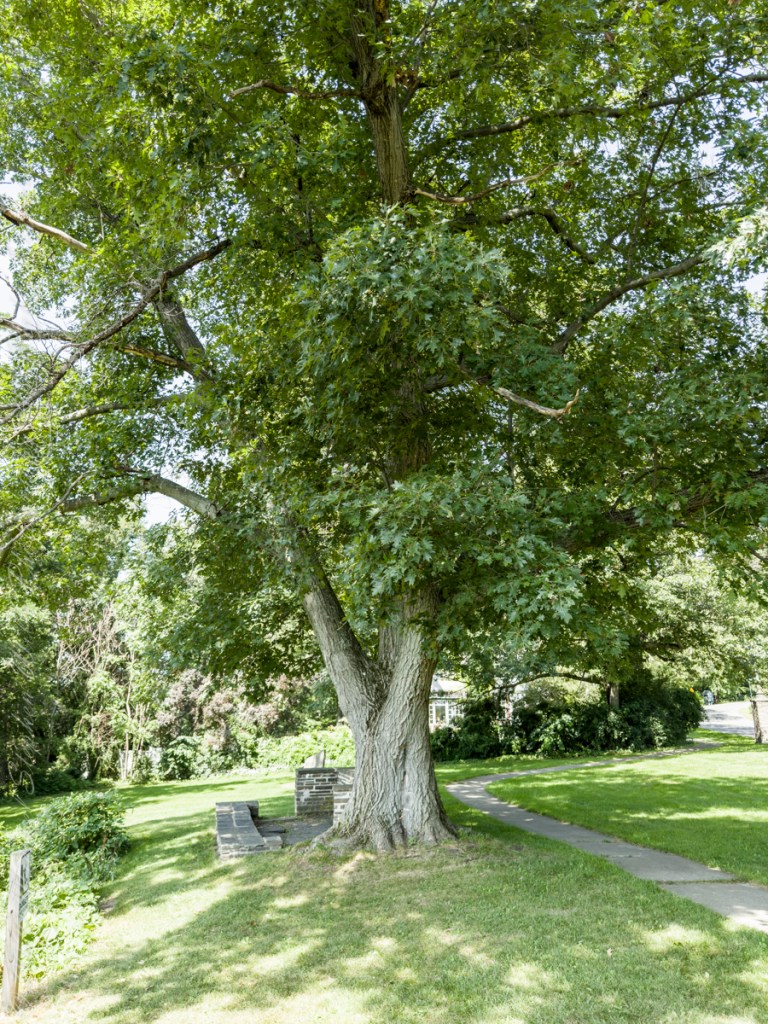
Rest on a limestone bench beneath a mature oak tree.

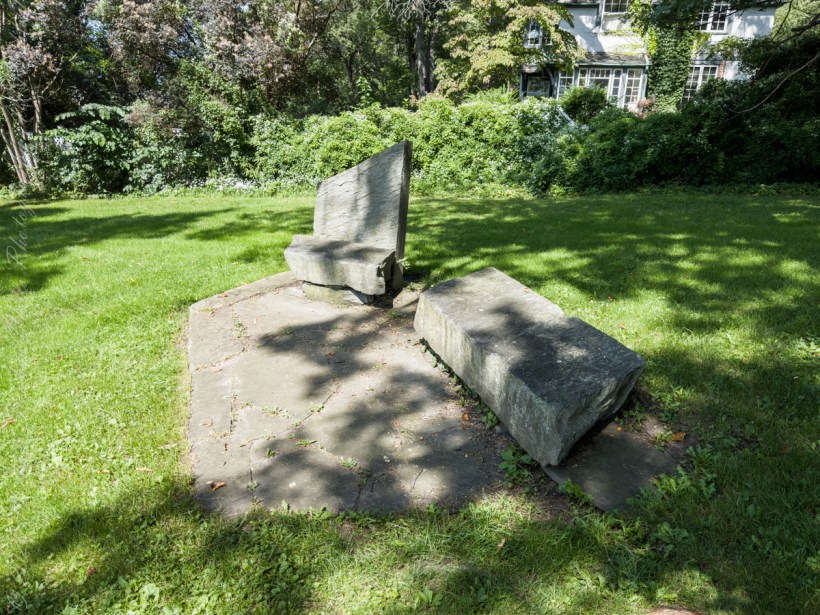
Limestone benches

View across Ithaca towards West Hill and, in the far distance, Connecticut Hill.

Copyright 2023 Michael Stephen Wills All Rights Reserved

Edible

nonmigratory?

Thursday last, grandsons Sam and Rory and I visited Sapsucker Woods, enjoying a late summer morning from a wooden observation platform over this watery swamp. “Look, hot dogs!!”

“Typha is a genus of about 30 species of monocotyledonous flowering plants in the family Typhaceae. These plants have a variety of common names, in British English as bulrush or reedmace, in American English as reed, cattail, or punks, in Australia as cumbungi or bulrush, in Canada as bulrush or cattail, and in New Zealand as reed, cattail, bulrush or raupo.”
“Many parts of the Typha plant are edible to humans. Before the plant flowers, the tender inside of the shoots can be squeezed out and eaten raw or cooked. The starchy rhizomes are nutritious with a protein content comparable to that of maize or rice. They can be processed into a flour with 266 kcal per 100 grams, and are most often harvested from late autumn to early spring. They are fibrous, and the starch must be scraped or sucked from the tough fibers. Baby shoots emerging from the rhizomes, which are sometimes subterranean, can be picked and eaten raw. Also underground is a carbohydrate lump which can be peeled and eaten raw or cooked like a potato. The plant is one championed by survival experts because various parts can be eaten throughout the year. Plants growing in polluted water can accumulate lead and pesticide residues in their rhizomes, and these should not be eaten.”
“The rind of young stems can be peeled off, and the tender white heart inside can be eaten raw or boiled and eaten like asparagus. This food has been popular among the Cossacks in Russia, and has been called “Cossack asparagus”. The leaf bases can be eaten raw or cooked, especially in late spring when they are young and tender. In early summer the sheath can be removed from the developing green flower spike, which can then be boiled and eaten like corn on the cob. In mid-summer when the male flowers are mature, the pollen can be collected and used as a flour supplement or thickener.”
Click me for another Sapsucker Woods posting.

Reference: text in italics and quotes is from the Wikipedia, “Typha.”

Copyright 2023 Michael Stephen Wills All Rights Reserved.

Fragrant

Native Americans used it as a herbal remedy for a variety of ailments.

Thursday last, grandsons Sam and Rory and I visited Sapsucker Woods, enjoying a late summer morning we clambered onto a wooden platform over a watery swamp.

Look closely for flowers and buds of the White Water Lily native to New York State. 

Although the young leaves of White Water-lily reportedly can be boiled and served as a vegetable, the main human use of this plant appears to have been medicinal. Native Americans used it as a herbal remedy for a variety of ailments, including colds, tuberculosis, bronchial complaints, toothaches, and mouth sores.

The many names for this plant: American White Waterlily, American White Water-lily, Fragrant Water-lily, Fragrant White Water Lily, Fragrant White Water-lily, Sweet Water-lily, Sweet-scented Water Lily, Sweet-scented White Waterlily, Tompkins County, Water, Water Lily, Waterlily, White Water Lily, White Waterlily, White Water-lily (Nymphaea odorata ssp. odorata)

Click me for another Sapsucker Woods posting.

Copyright 2023 Michael Stephen Wills All Rights Reserved.

Scarlet

nonmigratory?

Thursday last, grandsons Sam and Rory and I visited Sapsucker Woods, enjoying a late summer morning we came upon many scarlet beauties.

Cardinal Flower (Lobelia cardinalis) is also known as Bog Sage, Cardinal Flower, Cornell Lab of Ornithology, Finger Lake Region, Hog’s Physic, Indian Pink, Red Bay, Sapsucker Woods, Scarlet Lobelia, Slinkweed, Water Gladiole.

Click me for another Sapsucker Woods posting.

Copyright 2023 Michael Stephen Wills All Rights Reserved.

First Release of 2023

Advice for releasing your monarch butterfly

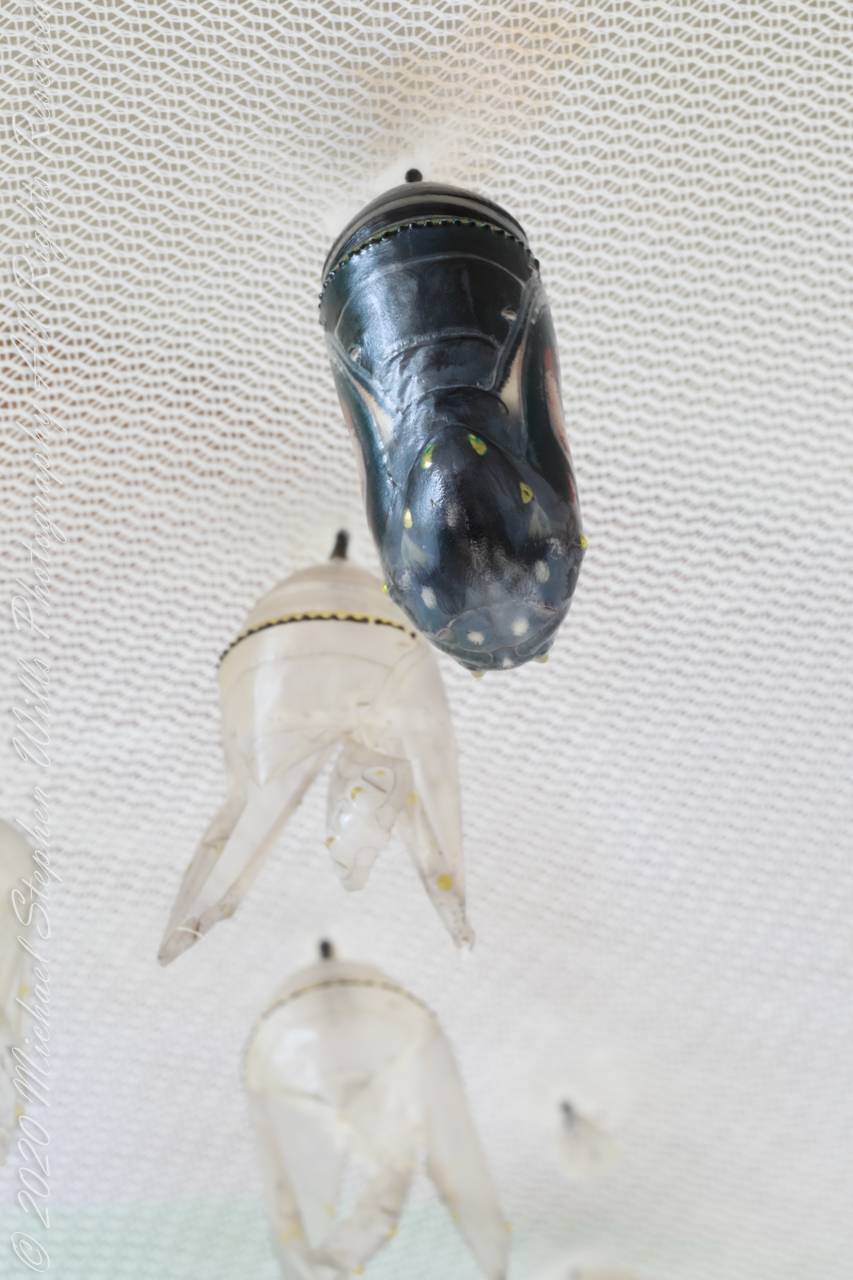
We let our first monarch butterfly rest overnight, until noon of the following day.

Pam did better with tracking the monarch’s flight, so I used video. Thanks Pam!

I delay butterfly release when:

  • the forecasted high temp is below 65° F (18° C) or 60° F (16° C) if sunny and calm.  When no other option exists, 50-59° F and sunny is borderline acceptable.
  • the forecast calls for rain.  A light rain is not a problem for butterflies with day-old dry wings, but it’s not a good release option for first-day newborns.
  • the butterfly emerges too late in the day.  I keep it overnight if the butterfly cannot get 3 hours warming of flight muscles in the sun.
  • there are storms in the forecast.  I wait when there are less than four (4) hours of good weather projected.  When extreme weather (like a hurricane) is forecast within twenty four (24) hours, I keep the butterfly safe until the storm passes.  Twenty four (24) or more hours should provide ample time to find shelter from the storm.
  • I am not sure about a release.  Keeping a butterfly overnight is acceptable. In fact, a butterfly’s wings are stronger on day two (2), providing better capability to escape predators.  A butterfly can easily hang from the mesh cage roof overnight. I do not worry about feeding a butterfly unless a second night of shelter is necessary.

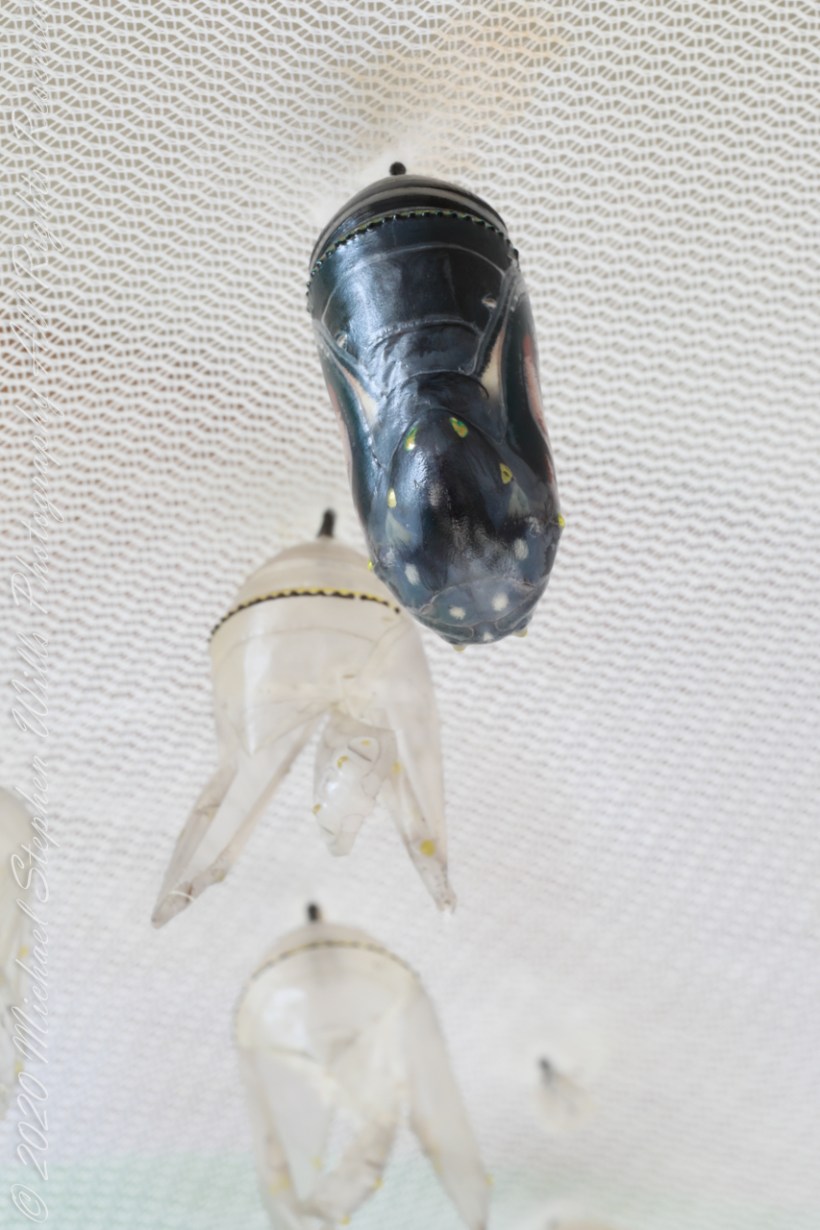
As the moment of emergence approaches, the skin of a Monarch chrysalis becomes translucent to reveal the butterfly compressed into that small space.
Copyright 2023 Michael Stephen Wills All Rights Reserved

First Emergence of 2023

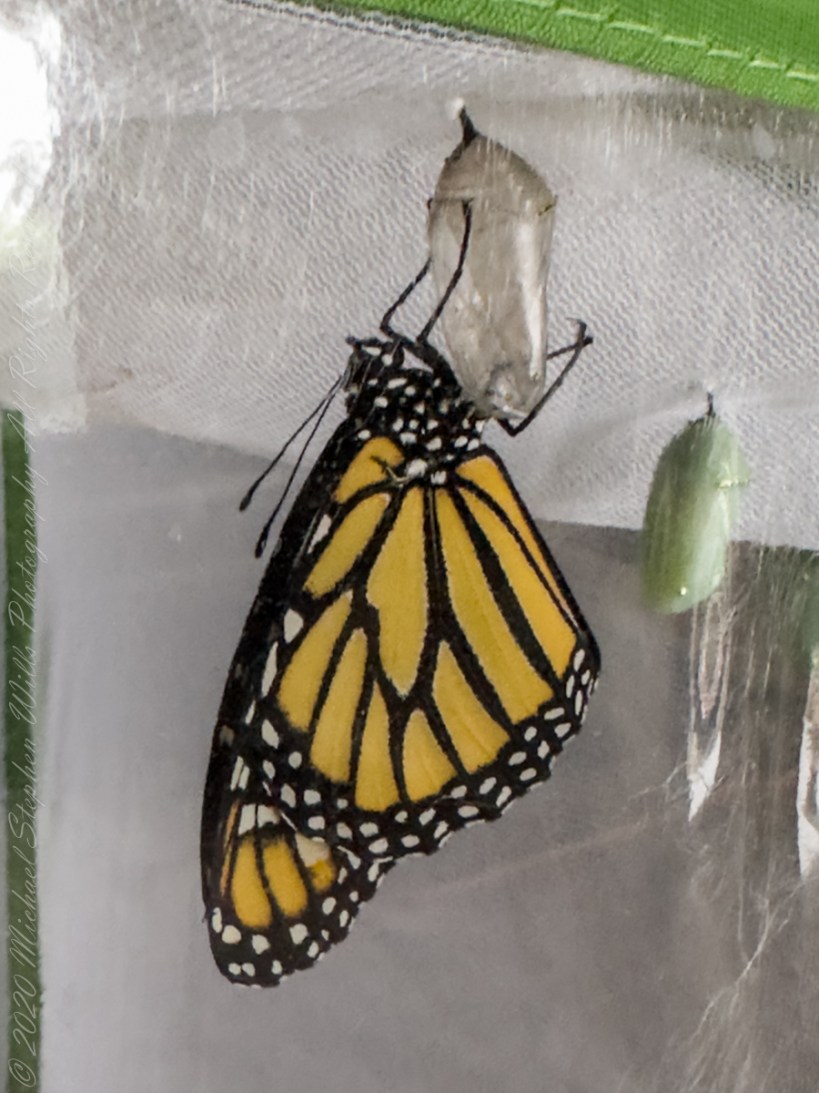
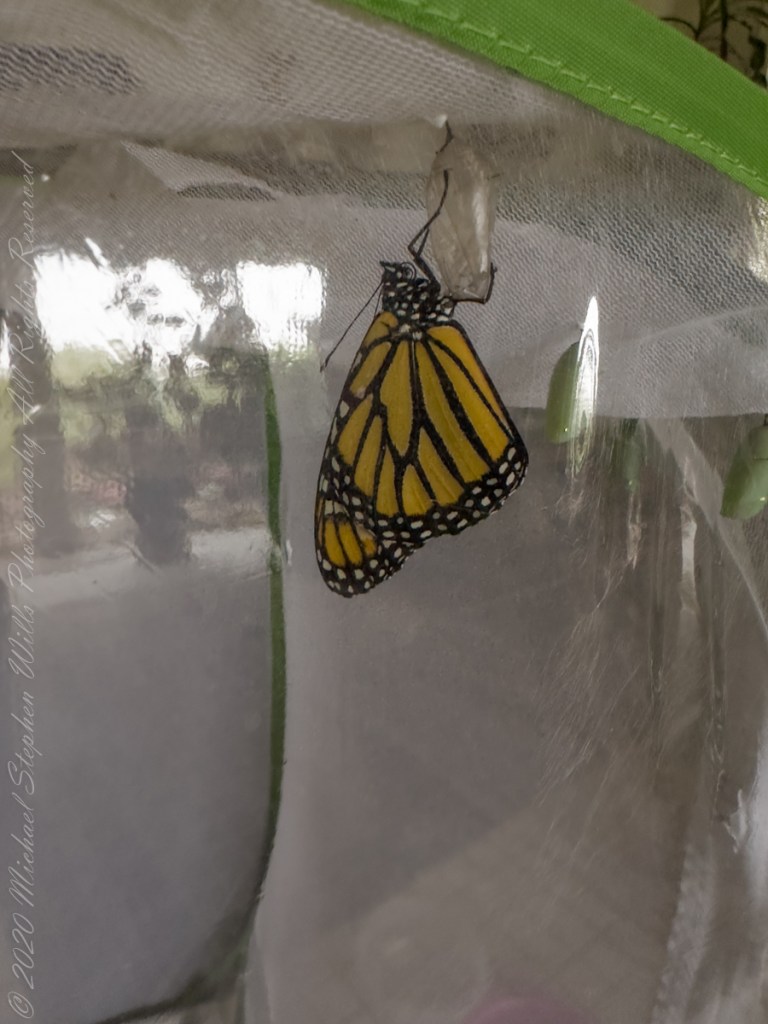
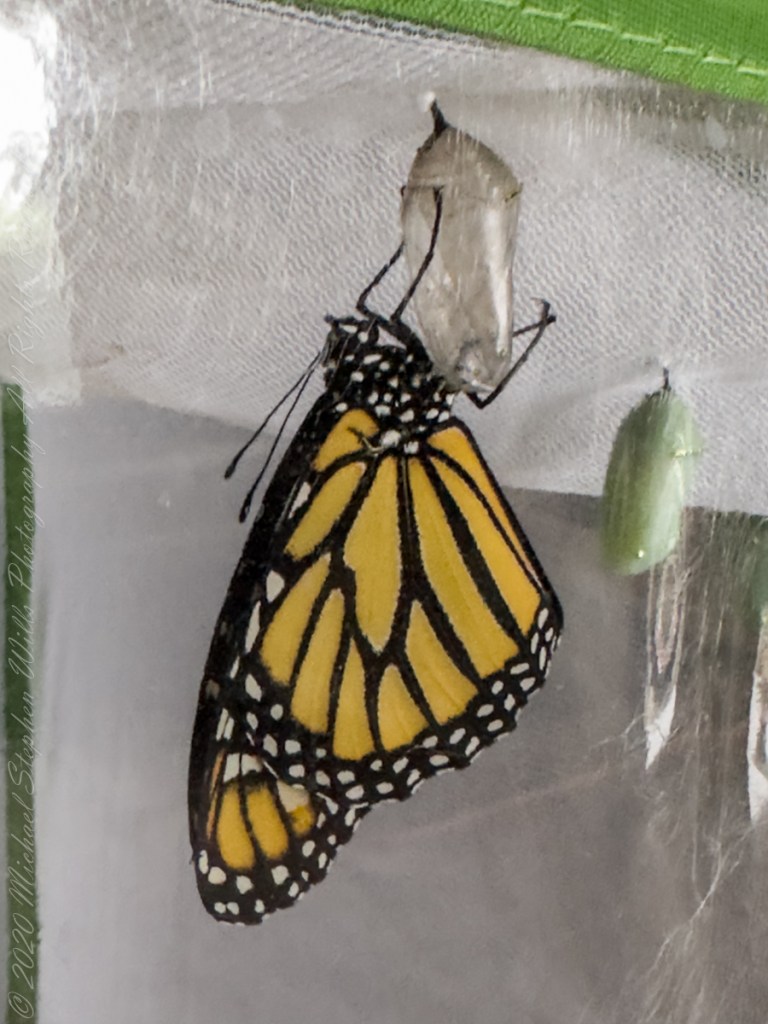
Monarch butterfly and chrysalis

Our grandchildren spent the day with us, the last week of their summer before school begins. This July I had improved on my Monarch collection from 2022, when 9 butterflies were released, by two (2) caterpillars for a total of eleven (11) raised over several weeks to the chrysalis stage. When leaving to pick up the children for an outing one chrysalis skin had turned clear, a sign the enclosed butterfly is close to emerging. We returned from an outing for lunch to find this chrysalis unopened, so we checked now and then for progress. Four hours later, just as their Mom arrived for them, the grandchildren and everyone witnessed this event. What luck!!

“Migrating monarchs soar at heights of up to 1,200 feet. As sunlight hits those wings, it heats them up, but unevenly. Black areas get hotter, while white areas stay cooler. The scientists believe that when these forces are alternated, as they are with a monarch’s white spots set against black bands on the wings’ edges, it seems to create micro-vortices of air that reduce drag—making flight more efficient.”

“Monarchs begin leaving the northern US and Canada in mid-August. They usually fly for 4-6 hours during the day, coming down from the skies to feed in the afternoon and then find roosting sites for the night.  Monarchs cannot fly unless their flight muscles reach 55ºF. On a sunny day, these muscles in their thorax can warm to above air temperature when they bask (the black scales on their bodies help absorb heat), so they can actually fly if it is 50ºF and sunny. But on a cloudy day, they generally don’t fly if it is below 60ºF.“

“Migrating monarchs use a combination of powered flight and gliding flight, maximizing gliding flight to conserve energy and reduce wear and tear on flight muscles.  Monarchs can glide forward 3-4 feet for every foot they drop in altitude.  If they have favorable tail or quartering winds, monarchs can flap their wings once every 20-30 feet and maintain altitude. Monarchs are so light that they can easily be lifted by the rising air. But they are not weightless. In order to stay in the air, they must move forward while also staying within the thermal. They do this by moving in a circle. The rising air in the thermal carries them upward, and their overall movement ends up being an upward spiral. Monarchs spiral upwards in the thermal until they reach the limit/top of the thermal (where the rising air has cooled to the same temperature as the air around it). At that point, the monarch glides forward in a S/SW direction with the aid of the wind. It glides until it finds another thermal and rides that column of rising air upwards again.”

This video includes an interview with Michael Wills about raising Monarch butterflies and this stage of the lifecycle. Video by Pam Wills using an IPhone 8

Reference: text in italics and quotes is from one of two online articles. “The monarch butterfly’s spots may be its superpower” National Geographic, June 2023 and “Fall Migration – How do they do it?” by Candy Sarikonda, September 2014.

Copyright 2023 Michael Stephen Wills All Rights Reserved

View from the Quarry

Views while entering Machu Picchu

Click Me for my Online Gallery

I set up a Manfrotto BeFree tripod with the Canon EOS 1DS Mark III mounted with the Canon EF 70-300 f/4-5.6 L IS USM lens to capture our experience while entering Machu Picchu.

The eastern shoulder of Huayna Picchu is left and the Urubamba river curves around it. Leading the eye to the distance is an uninhabited andean valley covered in rain forest.

Copyright 2023 Michael Stephen Wills All Rights Reserved

Quarry on the Machu Picchu Ridge

The site itself may have been intentionally built on fault lines to afford better drainage and a ready supply of fractured stone.

Click Me for my Online Gallery

“The central buildings of the Machu Picchu Sanctuary use the classical Inca architectural style of polished dry-stone walls of regular shape. The Incas were masters of this technique, called ashlar, in which blocks of stone are cut to fit together tightly without mortar.”

The site itself may have been intentionally built on fault lines to afford better drainage and a ready supply of fractured stone. ‘Machu Picchu clearly shows us that the Incan civilization was an empire of fractured rocks’.

Inca quarried the rock for Machu Picchu from the mountain ridge itself.

“The section of the mountain where Machu Picchu was built provided various challenges that the Incas solved with local materials. One issue was the seismic activity due to two fault lines. It made mortar and similar building methods nearly useless. Instead, the Inca mined stones from the quarry at the site, lined them up and shaped them to fit together perfectly, stabilizing the structures. Inca walls have many stabilizing features: doors and windows are trapezoidal, narrowing from bottom to top; corners usually are rounded; inside corners often incline slightly into the rooms, and outside corners were often tied together by “L”-shaped blocks; walls are offset slightly from row to row rather than rising straight from bottom to top.”

Main Temple survived multiple earthquakes

“Heavy rainfall required terraces and stone chips to drain rainwater and prevent mudslides, landslides, erosion, and flooding. Terraces were layered with stone chips, sand, dirt, and topsoil, to absorb water and prevent it from running down the mountain. Similar layering protected the large city center from flooding. Multiple canals and reserves throughout the city provided water that could be supplied to the terraces for irrigation and to prevent erosion and flooding.”

Agricultural Terraces

“The Incas never used wheels in a practical way, although their use in toys shows that they knew the principle. The use of wheels in engineering may have been limited due to the lack of strong draft animals, combined with steep terrain and dense vegetation. The approach to moving and placing the enormous stones remains uncertain, probably involving hundreds of men to push the stones up inclines. A few stones have knobs that could have been used to lever them into position; the knobs were generally sanded away, with a few overlooked.”

Reference: text in italics and quotes is from the Wikipedia “Machu Picchu”, web page.

Copyright 2023 Michael Stephen Wills All Rights Reserved