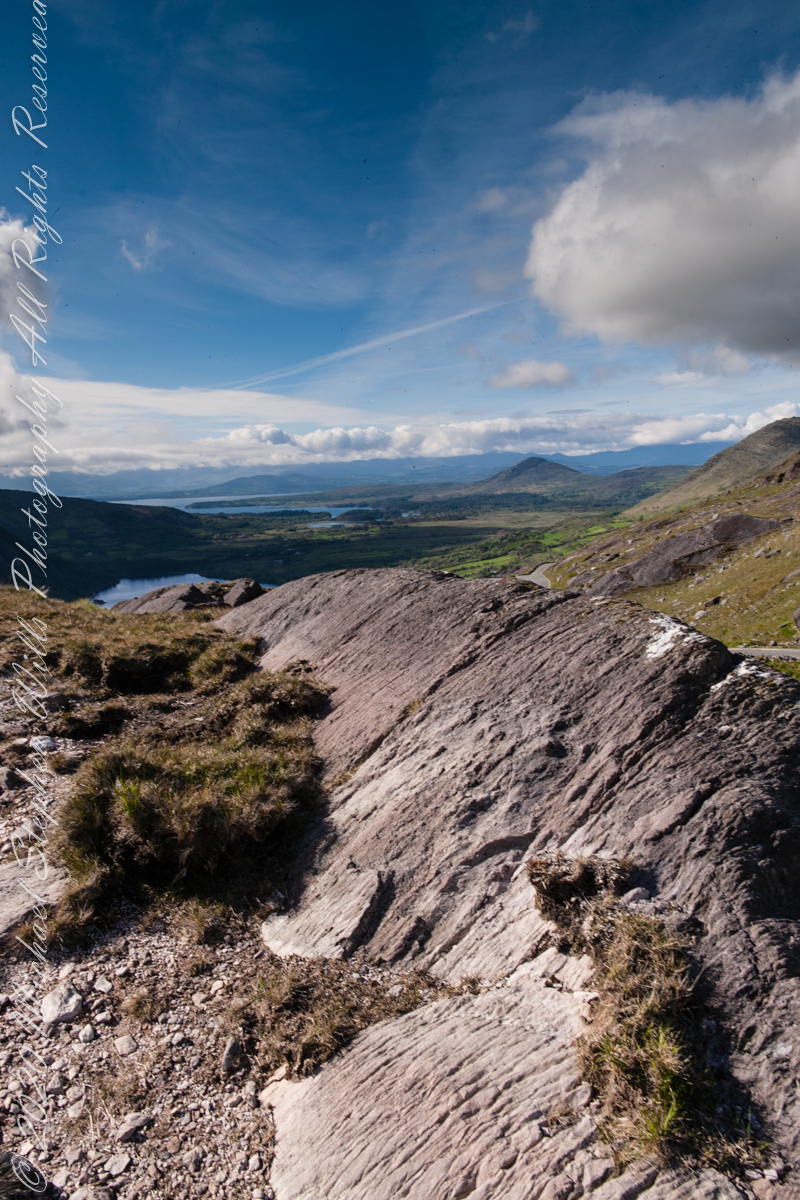
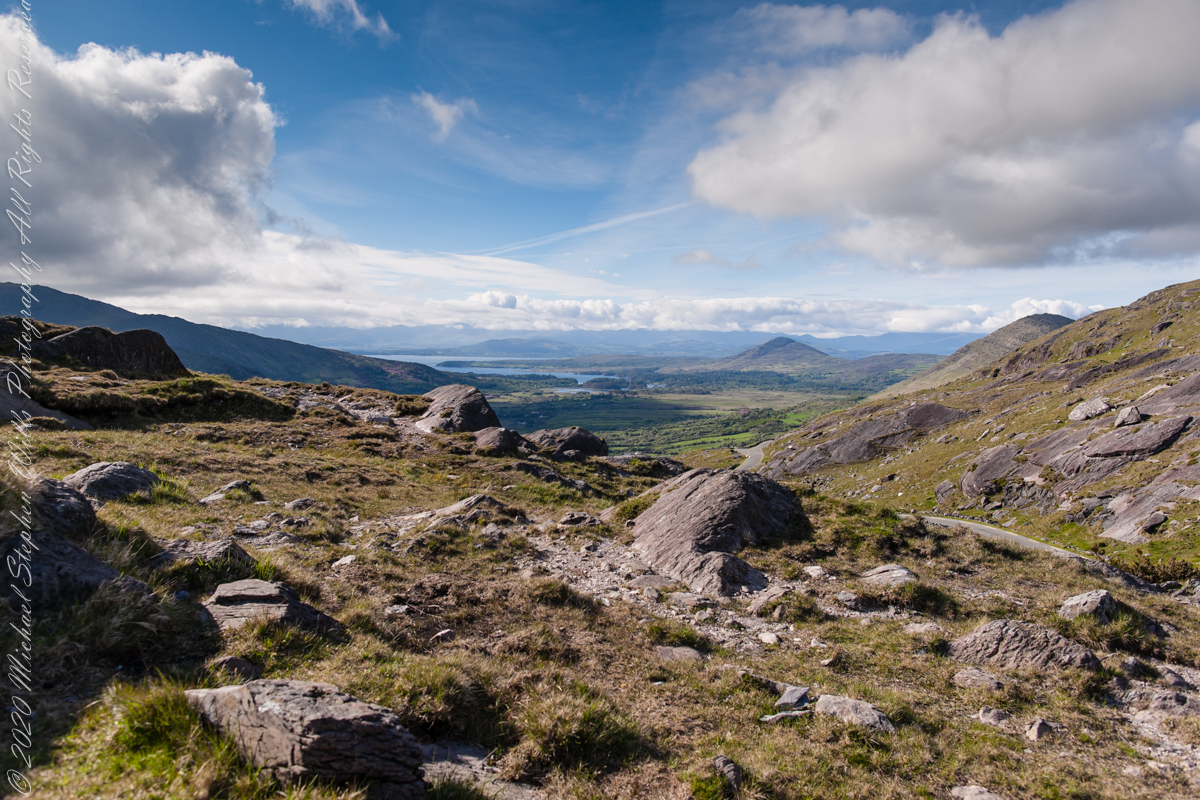
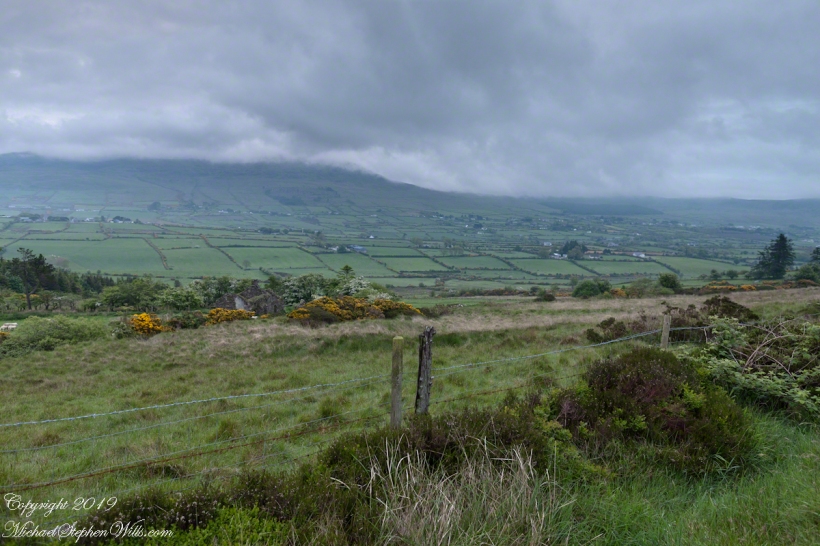
You might say Number five of seven from the Kerry County side near the top of Healy Pass, R574 is the same as number four and not be far from correct. Indeed, while Number 5 is very different from View One, taken nearby, it differs from Number 4 in an improved orientation of the horizon.
The Mark III Canon dslr used here does not have a leveling guide, or if it does I was unaware. I perfected the orientation through several exposures, of which Number Five was one. Each photograph from this series provides a bit of information about the sight. Start with Number One and progress through each to obtain a full exposition.
Beara Peninsula, Coolcreen townland, County Kerry, Republic of Ireland.
You can easily view a higher resolution versions by clicking on the photograph to open a browser tab.
Click photograph for a larger version.
Copyright 2021 Michael Stephen Wills All Rights Reserved
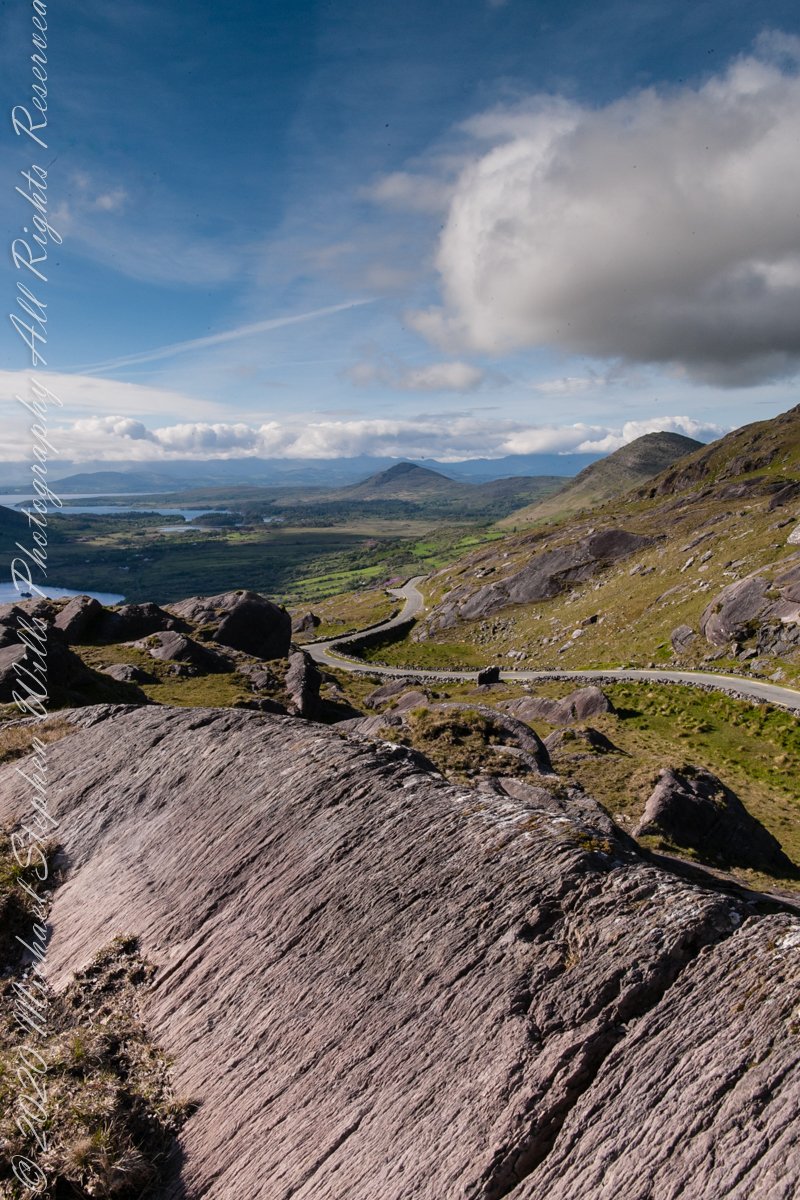
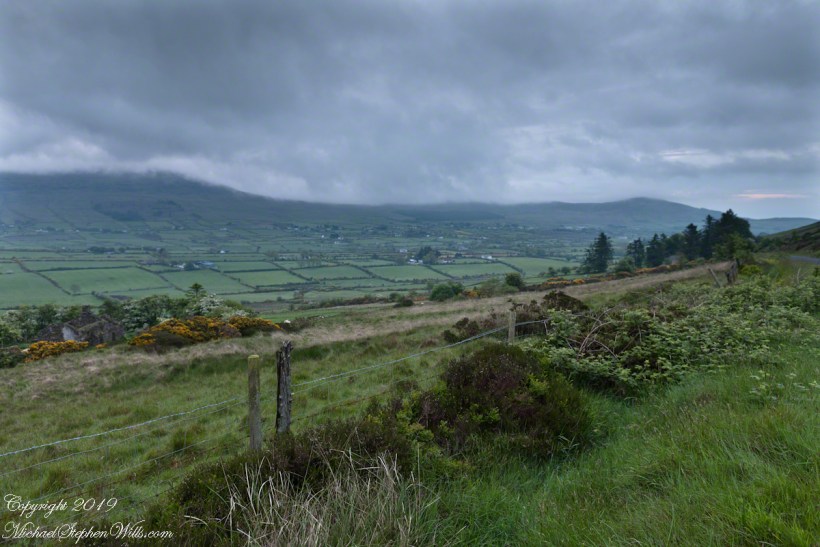
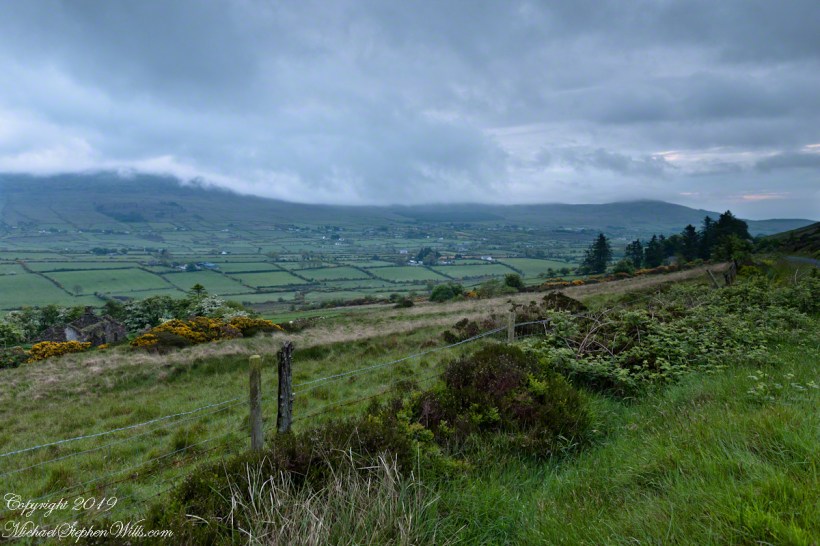
Number four of seven from the Kerry County side near the top of Healy Pass, R574. With a Canon 24 mm, wide angle, lens mounted on the Canon 5D Mark IV dslr, all on a sturdy Manfrotto studio tripod and hydrostatic ball head, I moved the rig forward, as can be seen by comparing the four photographs shared so far in this series. Your can see the foreground “reef” boulder of today’s photograph in the previous three views.
As I moved forward the ground dropped away and the view opens up. The near water is Glenmore Lake, discussed in yesterday’s view, the far waters are rivers and the Atlantic, as discussed in the first view. The road is Healy Pass, R574, in this direction headed toward Lauragh.
Beara Peninsula, Coolcreen townland, County Kerry, Republic of Ireland.
You can easily view a higher resolution versions by clicking on the photograph to open a browser tab.
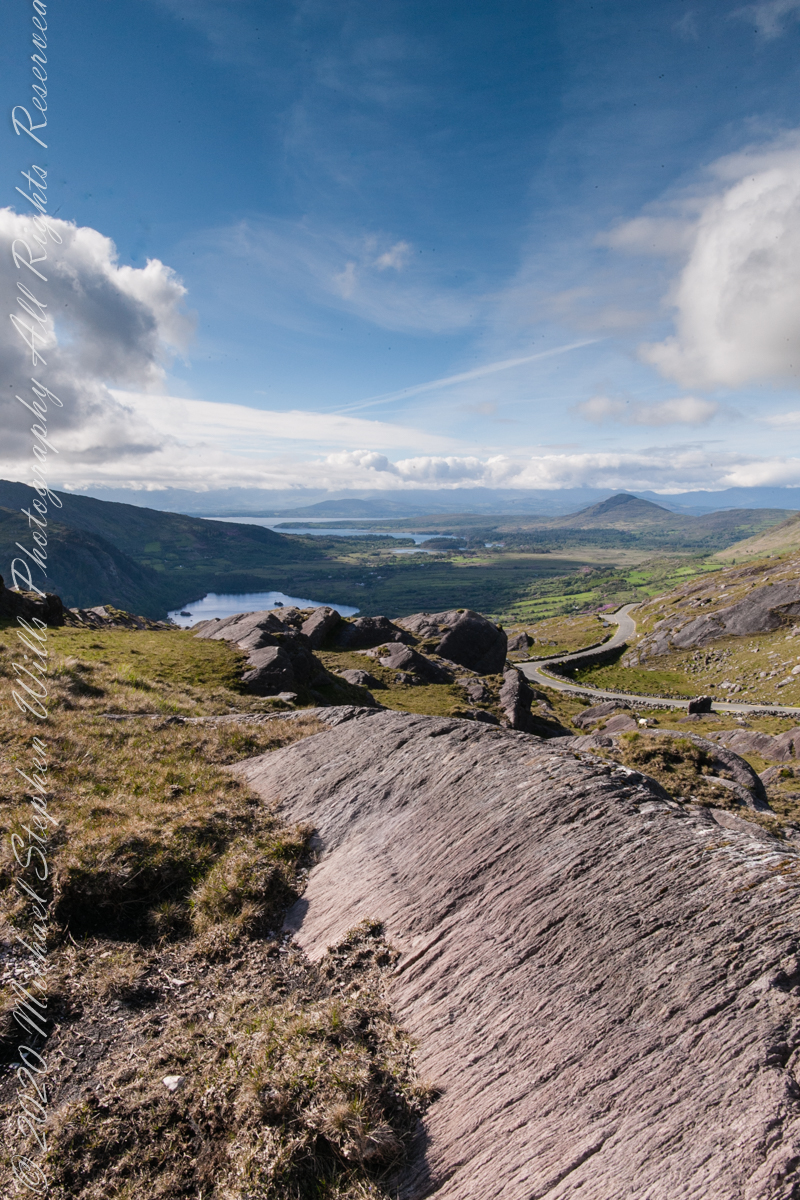
Number three of seven from the Kerry County side near the top of Healy Pass, R574. Coolcreen townland is in the foreground of this photograph, the aspect turned 90 degrees to portrait mode, compared to View One..
For the first time, though not the last, in this series we glimpse a lake. Like many of the Irish place names, Glenmore Lake has a connection to the Irish Language name, Loch an Ghleanna Mhóir. Roughly translated the name means Large Lake of the Glen. The names in use today, in English, are derived from the sounds of the Irish. It happens the Irish Ghleanna sounds link Glen (or in another version, Glan, roughly the same).
Beara Peninsula, Coolcreen townland, County Kerry, Republic of Ireland. To learn more of the distant waters, read One and Two of this series (links are above).
You can easily view a higher resolution versions by clicking on the photograph to open a browser tab.
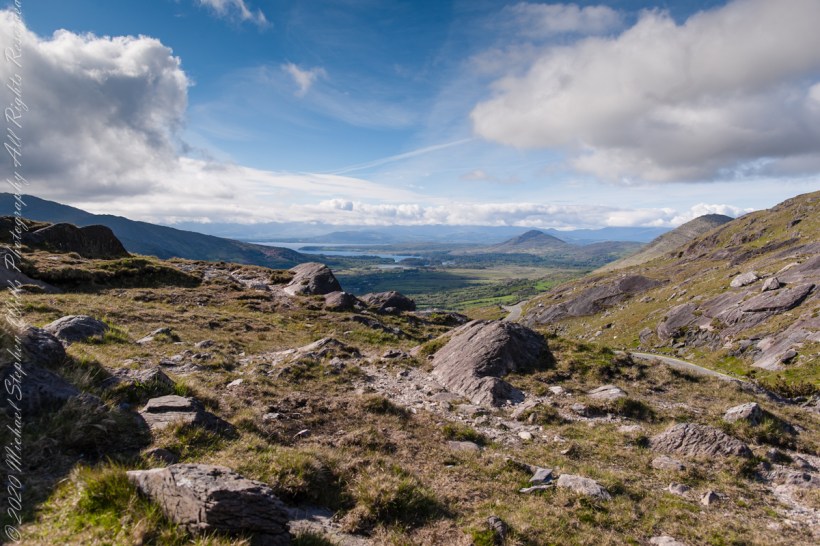
Number one of seven from the Kerry County side near the top of Healy Pass. Visible in the distance from this point on R574, Healy Pass, are the Rivers Drunminboyr, Glanstrasna flowing into a sheltered inlet of the Atlantic Ocean. Beara Peninsula, Coolcreen townland, County Kerry, Republic of Ireland.
You can easily view a higher resolution versions by clicking on the photograph to open a browser tab.
My dear wife Pam is the heart of Christmas in our home. Over the years we have collected a treasure of ornaments and knick-knacks she crafts into displays around our one. Pam completed the project well in advance of our grandchild holiday visits, before card writing and gift wrapping.
My contribution is a photographic time capsule. Here is some of my artistic output from this work.
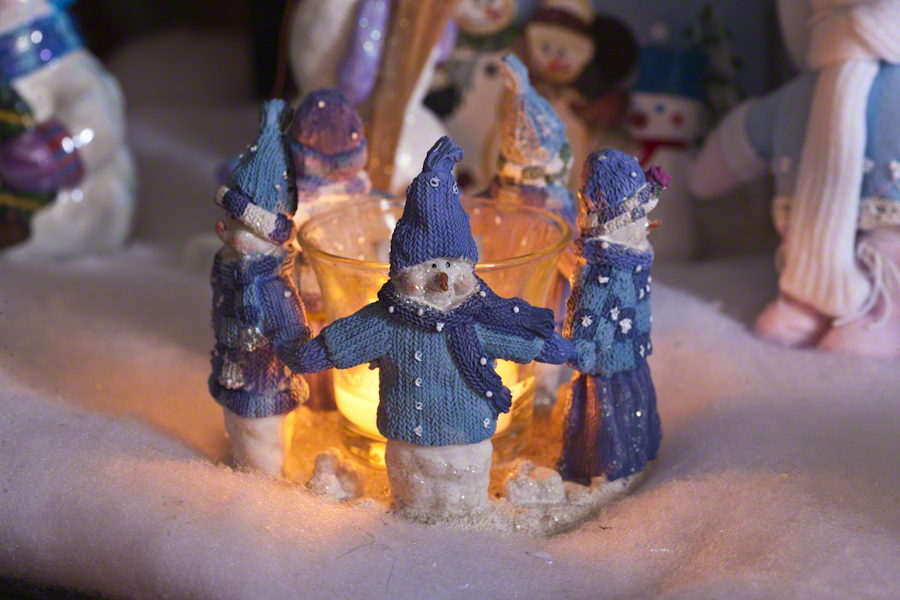
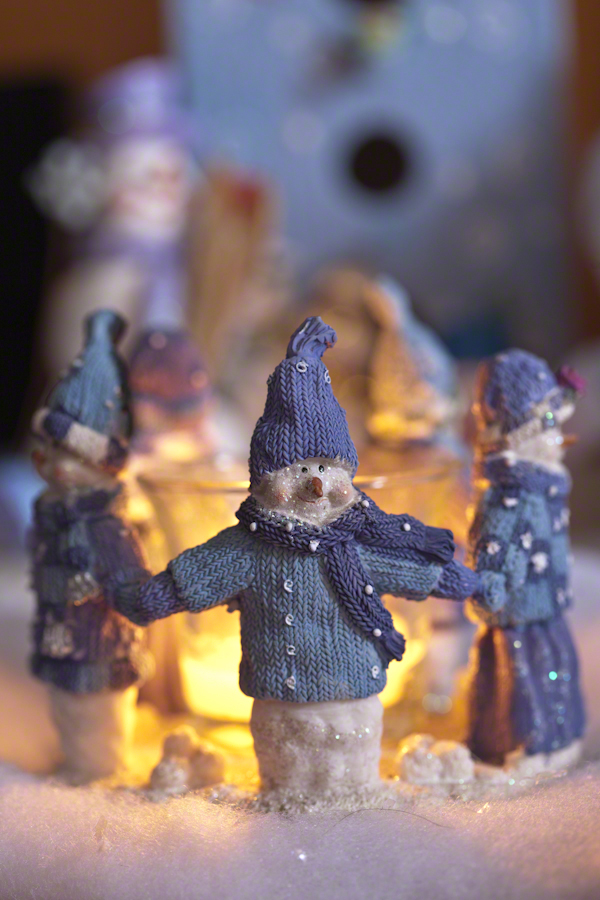
This grouping of five cozy snowmen (three males, two females) are warmly dressed in knit sweaters and stocking caps; the women with long skirts. The five hold hands in a ring, rising from a common platform. We place a cup and devotional candle in the center.
The tiny group evokes community, harmony, amity. I captured them with a Canon EOS 1Ds Mark III dslr, a fixed Canon EF 100mm f/2.8L macro lens mounted on a Manfrotto studio tripod and hydrostatic ball head. Fixed lenses provide the sharpest macros. The mounting allowed precise framing and use of the widest aperture and a low ISO. The light sources were sunlight from a large north facing bay window, a Canon Speedlite 600Ex-Rt and the candle. When used, the flash was angled in various ways toward the ceiling.
I start with a tight shot, maximum aperture. A single figure is in clear focus, the remaining gradually lost in the bokeh. The flash was used. I can almost see then circling around the candle in a winter wind.
Here the candle is lighted, aperture narrow to f8 using only the candle and ambient light (no flash). The group is visible within surrounding figures. I backed away and the viewpoint is higher.
The candle light enhances the perception of community.
Viewpoint is closer, still only the candle and ambient light. Aperture widened to 3.5. I must remove the hair in lightroom.
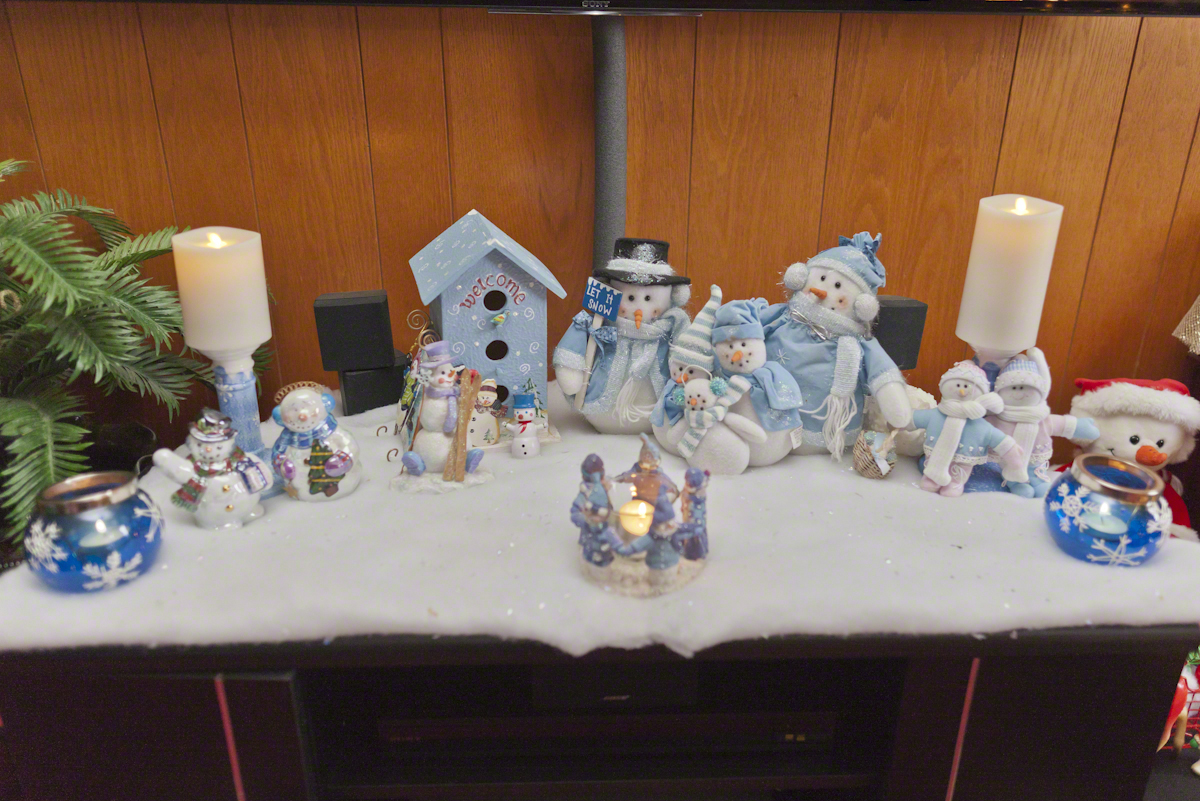
I backed off, aperture at the max with only the candle and ambient light. The figures are placed in a tableau with other snowmen and a structure, a birdhouse.
For this overview I swapped in a Canon 24mm f/1.4L II USM with a flash, aperture f2.2.
Christmas 2017 snowman display laid out in our den on top of the entertainment cabinet.
Copyright 2020 Michael Stephen Wills All Rights Reserved
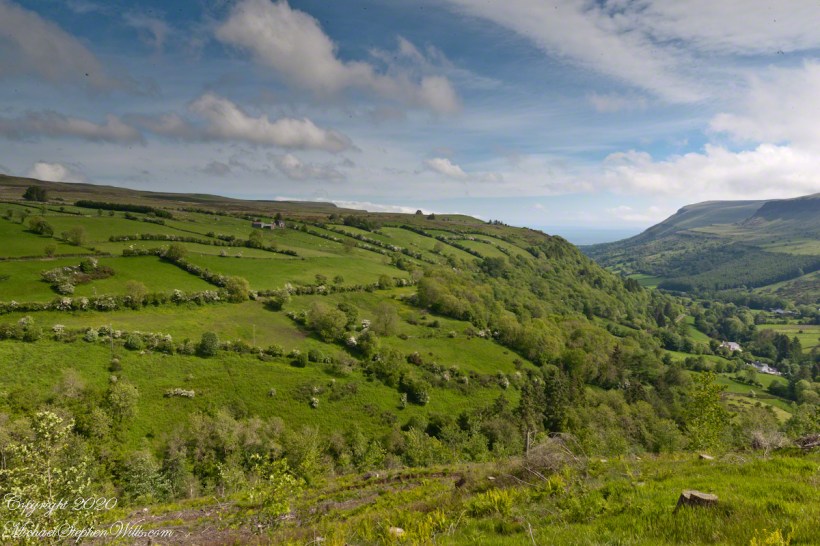
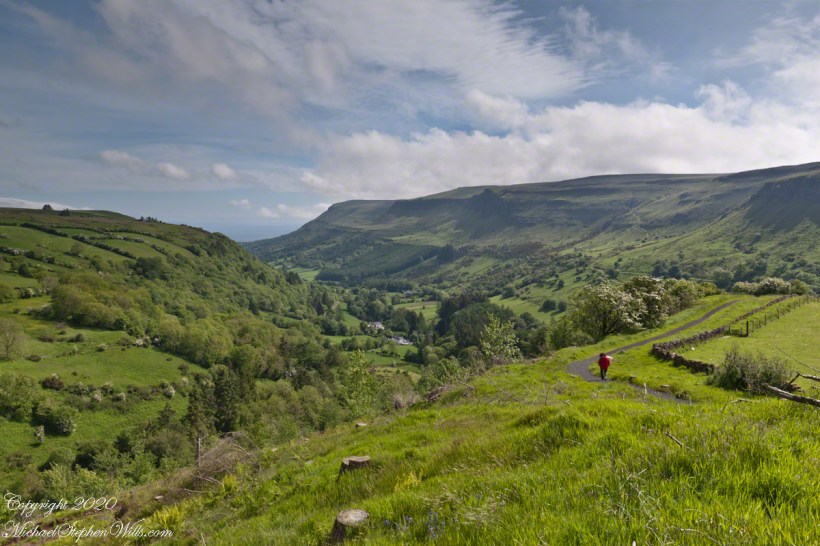
White Hawthorne tree blooms grace hedgerows of the rural hillside facing Glenariff Forest Park. The other white is grazing sheep. The North Channel of the Irish Sea is visible at the foot of the glen, with the shore of Scotland just visible.
Foreground are the stumps of mature trees cut by the forest service to control the oomycete plant pathogen Phytophthora ramorum. We visited June 2014, the year before, October 2013, the Belfast Telegraph reported “Northern Ireland is close to the point where it will be impossible to eradicate a virulent disease from the forests where it has taken hold.” Glenariff Forest part was one of those forests and the tree stumps are victims of that struggle.
Click photograph for a larger view. To do this from WordPress Reader, you need to first click the title of this post to open a new page.
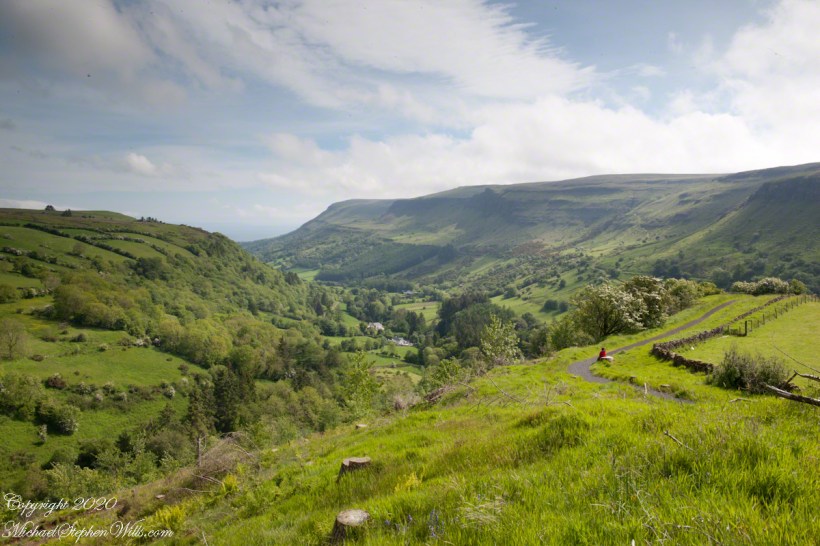
Comparing this view with the first of this series, first glance, with the camera held steady on a Manfrotto studio tripod, it is identical but from the play of light and cloud. My model Pam walked a few feet to sit in quiet contemplation of the beautiful surroundings.
To produce stock photography I research the details of the image, to write an informative caption. For example, in the post “Another Glenariff View” my identification of the Rowan was from a two volume atlas, paging through page after page.
Click photograph for a larger view. To do this from WordPress Reader, you need to first click the title of this post to open a new page.
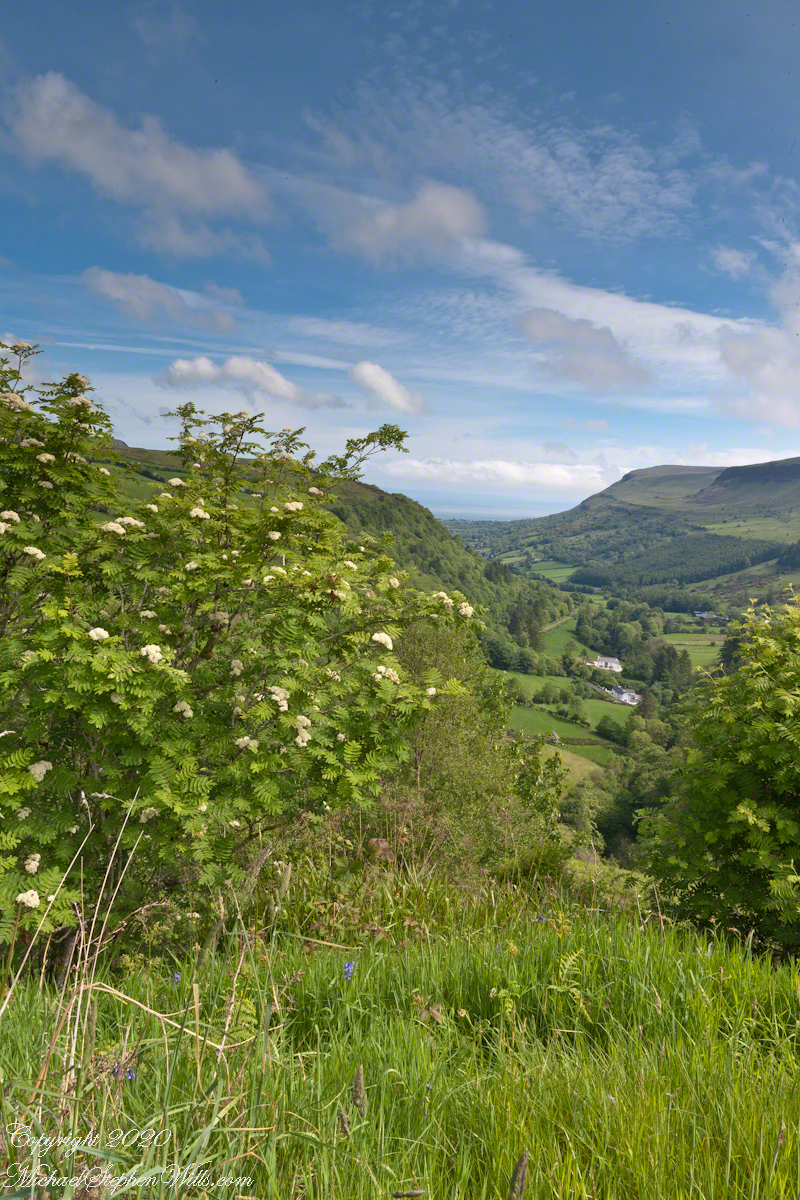
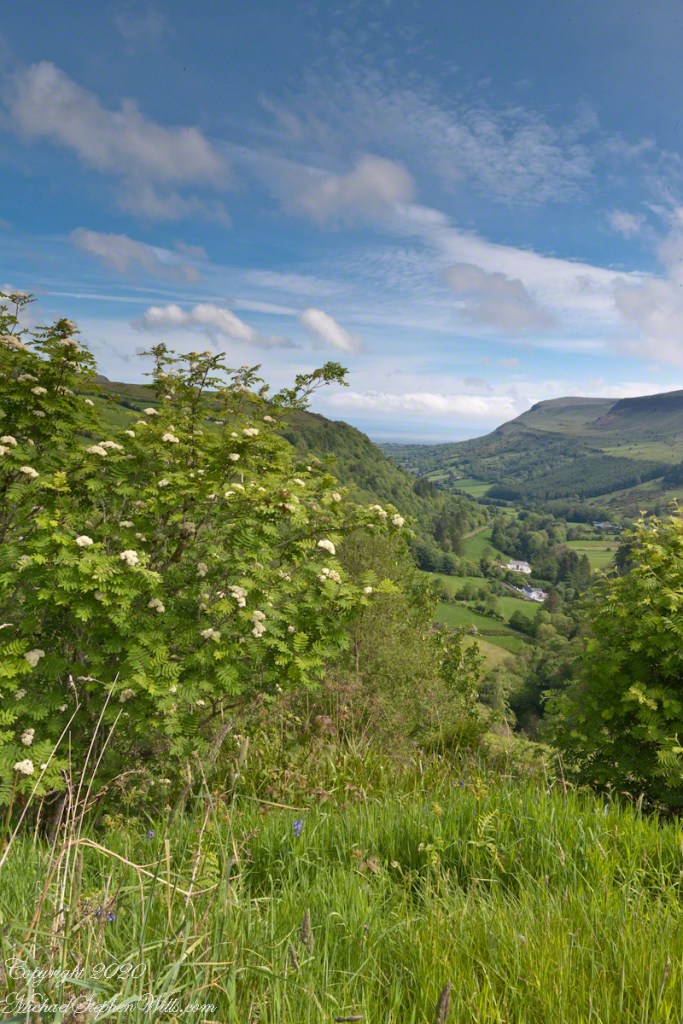
After photographing the broad expands of a wide Glenariff valley, moving the tripod on that same eminence, here is a near and far view.
The foreground white flowering bush of pinnate leaves is Rowan (Sorbus in the family Rosaceae subfamily Maloideae). In Irish it is crann caorthainn, a plant considered sacred in ancient times by both Celts and Vikings. The fruit is made into preserves, jellies. The pinnate leaves are similar to Ash, the reason it is also known as Mountain Ash, Rowan is not botanically related to Ash.
The Canon lens EF 24mm f/1.4L II USM was mounted on the Canon EOS-1Ds Mark III camera. The graduated neutral density filter was perfect for the setting. Notice, between the hills in the distance, is a patch of the Northern Channel (of the Irish Sea), and just visible the Scottish Coast, a tilted horizon uncorrected.
Click photograph for a larger view. To do this from WordPress Reader, you need to first click the title of this post to open a new page.
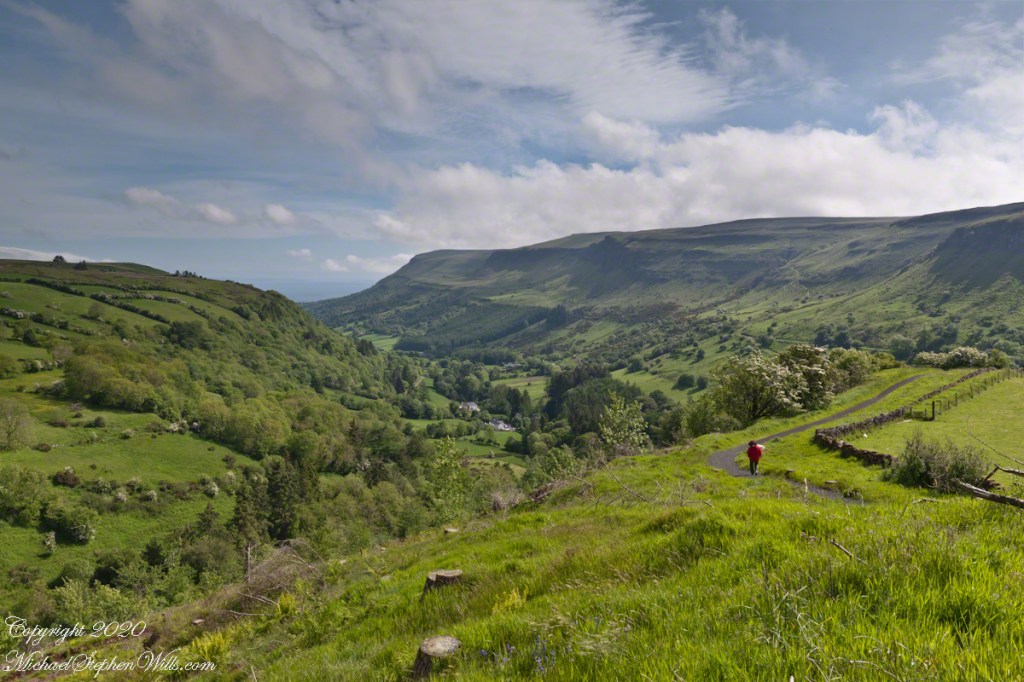
Here is the first stop on our tour of the Antrim Glens and coast, Glenariff Forest Park. These blogs have gone backward from Torr Head towards the started our day with breakfast in Coleraine, proceeding south along the plain to the head of Glenariff. The name, in Irish Gleann Airimh, means “Glen of arable land.” The Glenariff River flows from the height of Tievebulliagh, a 1,300 foot mountain, to form the broad valley of Glenariff. Arable, means tillable, and the land is tillable because the valley is wide.
This is one of my most popular photographs, it is from that day. I set up the tripod on an eminence overlooking the glen and a park path. Pam, in her red raincoat, headed down. The Canon lens EF 24mm f/1.4L II USM was mounted on the Canon EOS-1Ds Mark III camera. The graduated neutral density filter was perfect for the setting.
Click photograph for a larger view. To do this from WordPress Reader, you need to first click the title of this post to open a new page.






 Michael Stephen Wills Photography