Beauty and Struggle: Flowering Rush in Stewart Park

Crossing the footbridge in Stewart Park, I encountered the graceful yet invasive Flowering Rush. Its delicate beauty hides a deeper story about nature’s resilience, human impact, and the fragile balance of our ecosystems.

While crossing the suspension footbridge over Fall Creek in Stewart Park, there’s a sense of stepping into a world that’s more peaceful and attuned to nature. The bridge is familiar to me—a steady, quiet companion—but each visit feels new, as though the park has secrets it only reveals in small whispers. In this photograph the green steel beams rise like sentinels, standing tall against the backdrop of shifting autumn colors. Below, the water reflects the vibrant reds, golds, and greens of the trees, creating an illusion of depth that draws me in.
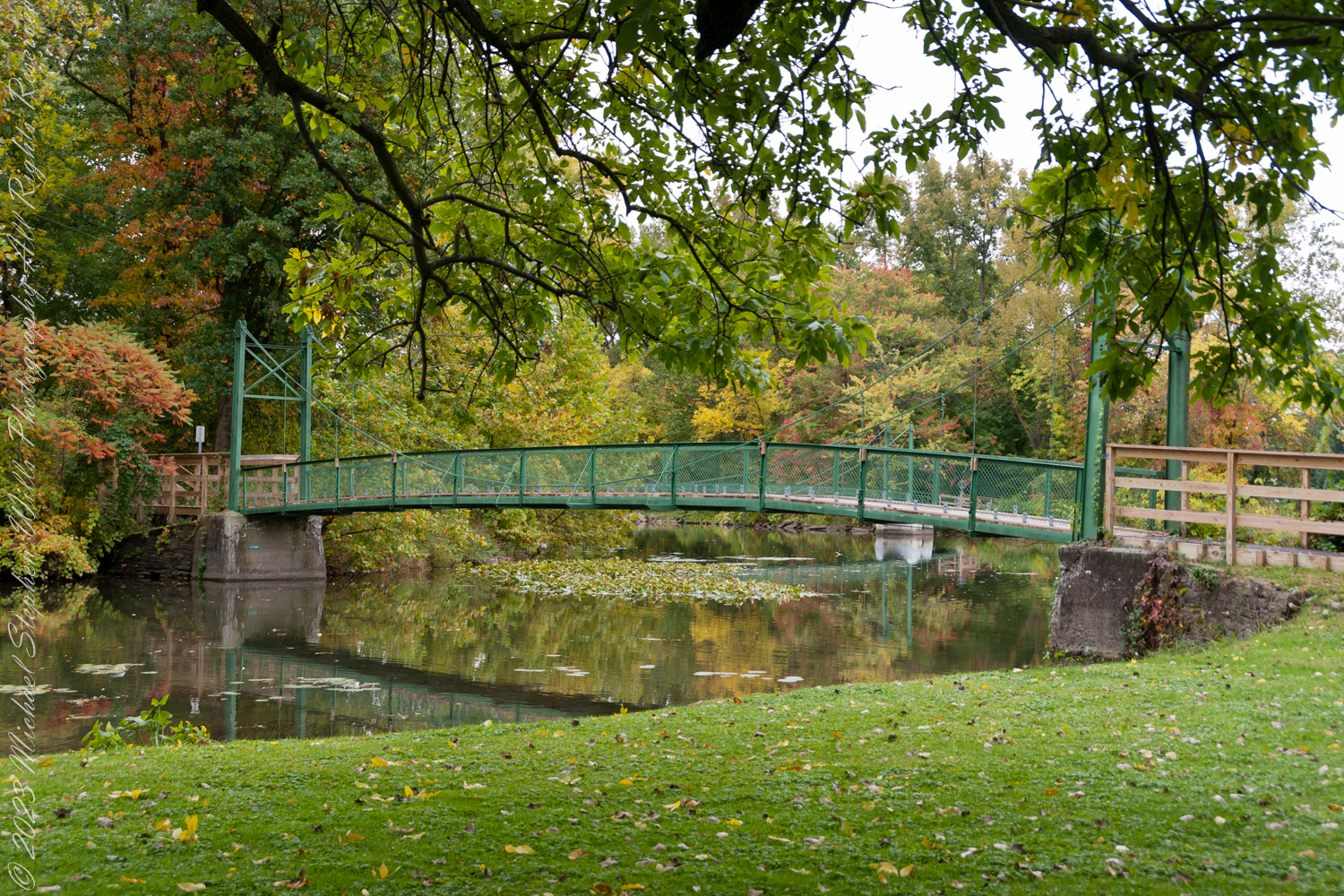
Footbridge to the Fuertes Bird Sanctuary, Stewart Park, Ithaca, New York, October 2012

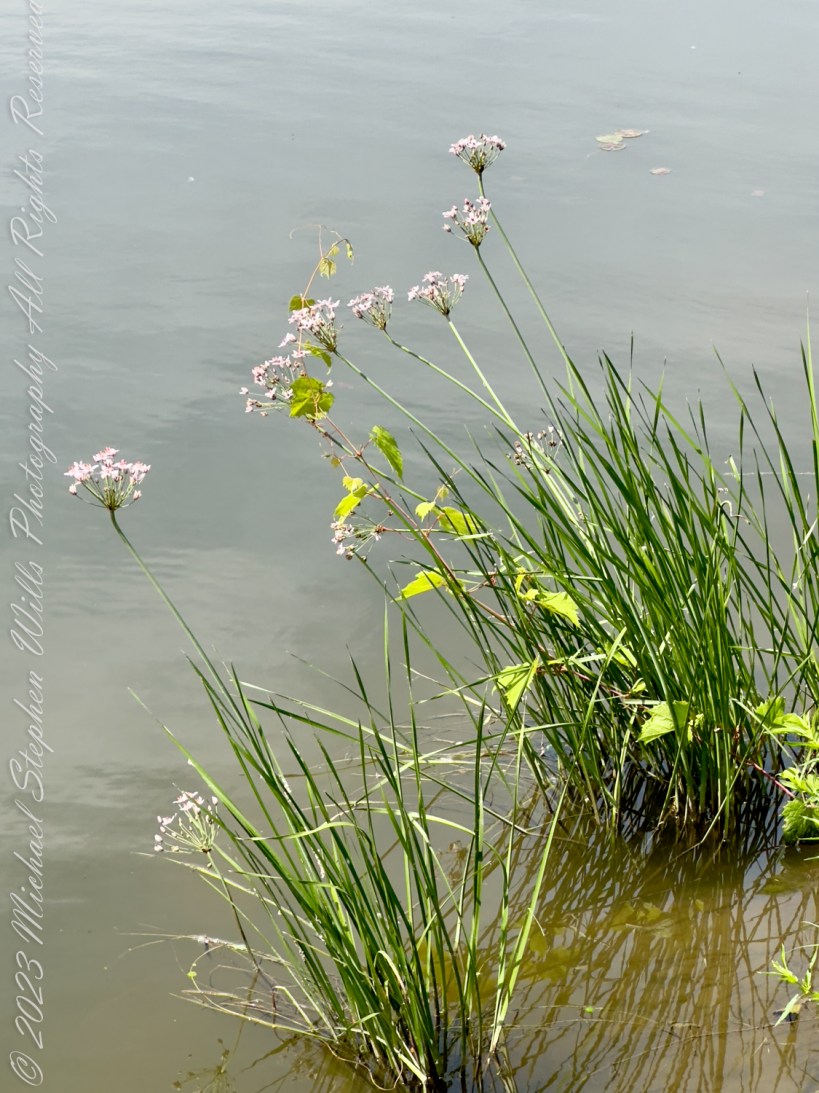
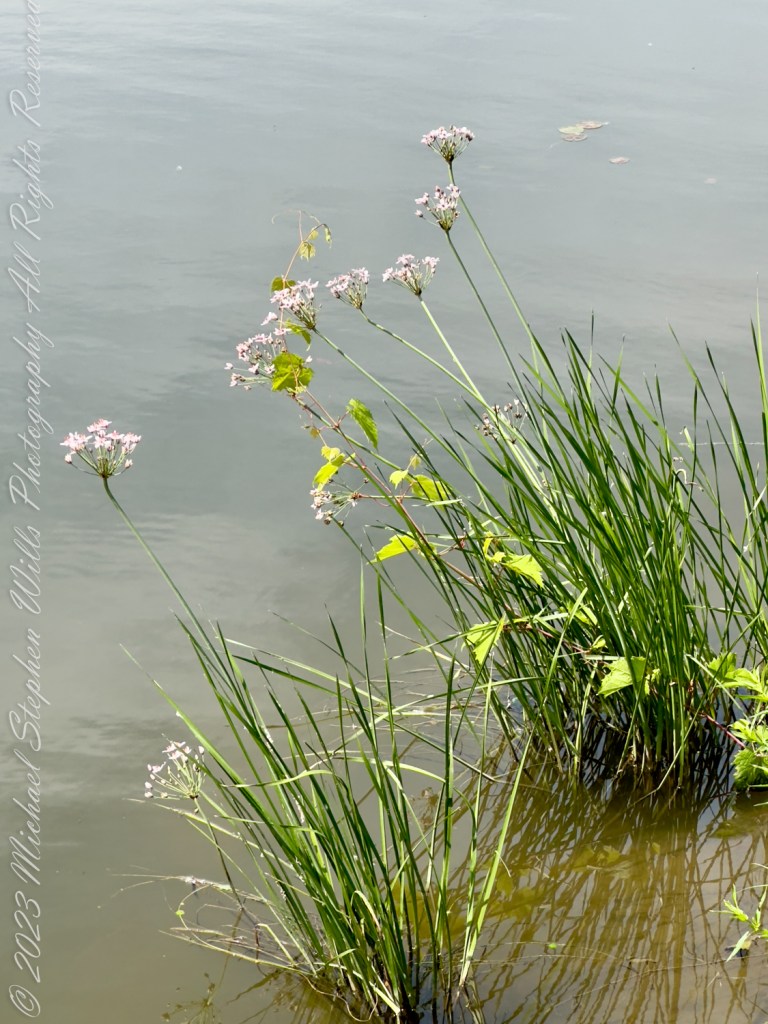
This past summer I stopped midway across, leaned against the railing, just listening. The creek moved slowly, like time itself decided to pause here for a while. That’s when I saw them: delicate pink blooms rising up from the water’s edge, their petals small and star-shaped, catching the light as they sway in the gentle breeze. There’s something striking about these plants—graceful, elegant, almost otherworldly in their simplicity. They reach up, as though trying to escape the confines of the water and the muddy banks.

My subsequent research revealed these to be Flowering Rush, or Butomus umbellatus. I often see them now, their soft pinks and slender leaves creating a quiet beauty that’s hard to ignore. They’re beautiful, but I have come to know they don’t belong here. This is one of those moments in nature that gives me pause—a reminder that not everything lovely is innocent.
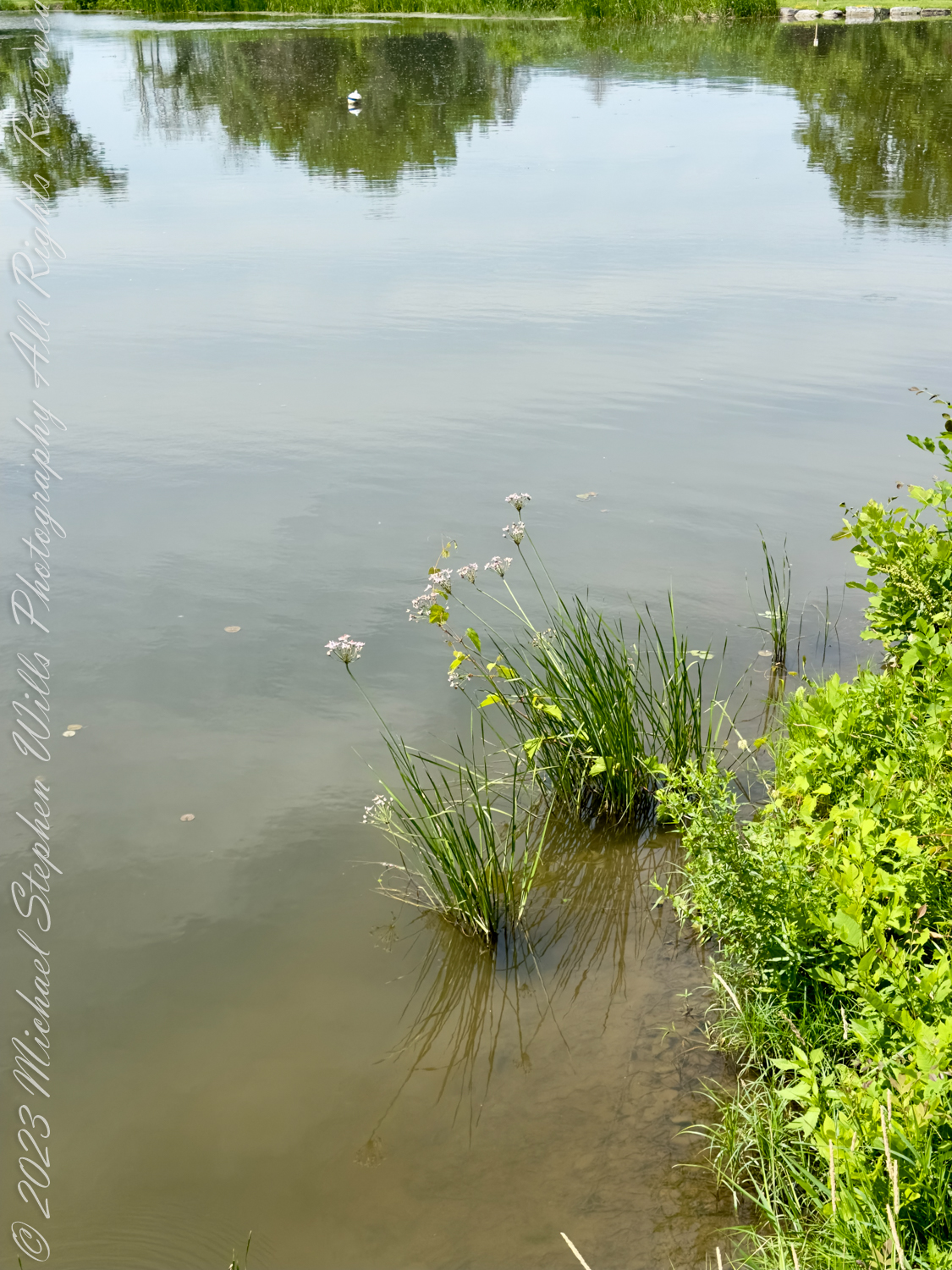
Flowering Rush Growing in Fall Creek, Stewart Park, June 2024

Flowering Rush, a European import from centuries ago, was not meant to take root here. Brought to North America for ornamental ponds, its allure quickly became its danger. It spread, silently, like a secret carried on the wind, slowly overtaking the native species that have long called these waters home. And yet, standing here now, I cannot help but admire its tenacity, its quiet determination to thrive. Nature, in all its forms, has this incredible will to survive, even if that survival sometimes comes at a cost.

My mind drifts to the plant’s history. In its native lands Flowering Rush, or Grass Rush, was useful—its roots, though bitter, were harvested for food, and its fibrous stems woven into mats and ropes. How interesting that something as delicate as this has a rugged, practical side. This contradiction makes perfect sense when I think of the plant’s journey across continents, carried over oceans by human hands and curiosity. We are responsible for its presence here, and now, like so many other invasive species, it’s become a fixture of this landscape.

I think about the dual nature of this invasion. Flowering Rush is beautiful—there is no denying that. Its soft, pink flowers contrast sharply with the darker tones of the water and the dense green of the grasses that surround it. But its beauty masks a quiet destruction. It chokes out the native plants that once thrived here, altering the ecosystem in ways we cannot always see. I wonder what fish and aquatic life struggles beneath the surface, their food sources slowly disappearing. What birds find fewer insects and fewer safe places to nest?
And yet, is this plant a villain? Flowering rush is doing what it was meant to do—grow, spread, survive. That is what everything in nature does, after all. It does not have malice or intent; it just is. It is humans who have changed the balance, who introduced this species to a place where it didn’t belong, setting off a chain reaction we’re still trying to fully understand.

Today, as I walk across the bridge, heading toward the Fuertes Bird Sanctuary, path ahead invites quiet reflection, the chirping of birds and the rustle of leaves providing a peaceful soundtrack. But the Flowering Rush lingers in my mind. It reminds me of how interconnected everything is, how one small action—a plant brought from a distant land—can ripple out and affect entire ecosystems. It’s a lesson in responsibility for those willing to listen.

As I step into the sanctuary, the air feels lighter, filled with the sound of birds that dart between the trees. I think of the delicate balance of life here, and how easily it can be disrupted by the presence of something foreign, something invasive. Yet, there is a strange comfort in knowing that nature, for all its fragility, has its own resilience.

The Flowering Rush, with its roots deep in the muddy banks of Fall Creek, is a testament to that resilience. It may not belong here, but it has found a way to adapt, to make this place its home. And in that, I find both a warning and a kind of hope—hope that we, too, can learn to live more thoughtfully, more in tune with the world around us, before we upset the balance any further.

For now, though, I simply walk, grateful for the beauty around me, even if it comes with complications. Each step takes me deeper into this world, and I am reminded once again of the profound connection we have to the land, the water, the plants, and the creatures that share this space.

Copyright 2024 Michael Stephen Wills All Rights Reserved
To receive email notification of new blog posts enter your email and click the subscribe button.

I will not share or sell your email address.

Reeds of Resilience: A Tale of Growth and Survival

Discover the hidden world of Phragmites australis, the common reed: a story of resilience, beauty, and ecological significance, told through the eyes of the wetlands.

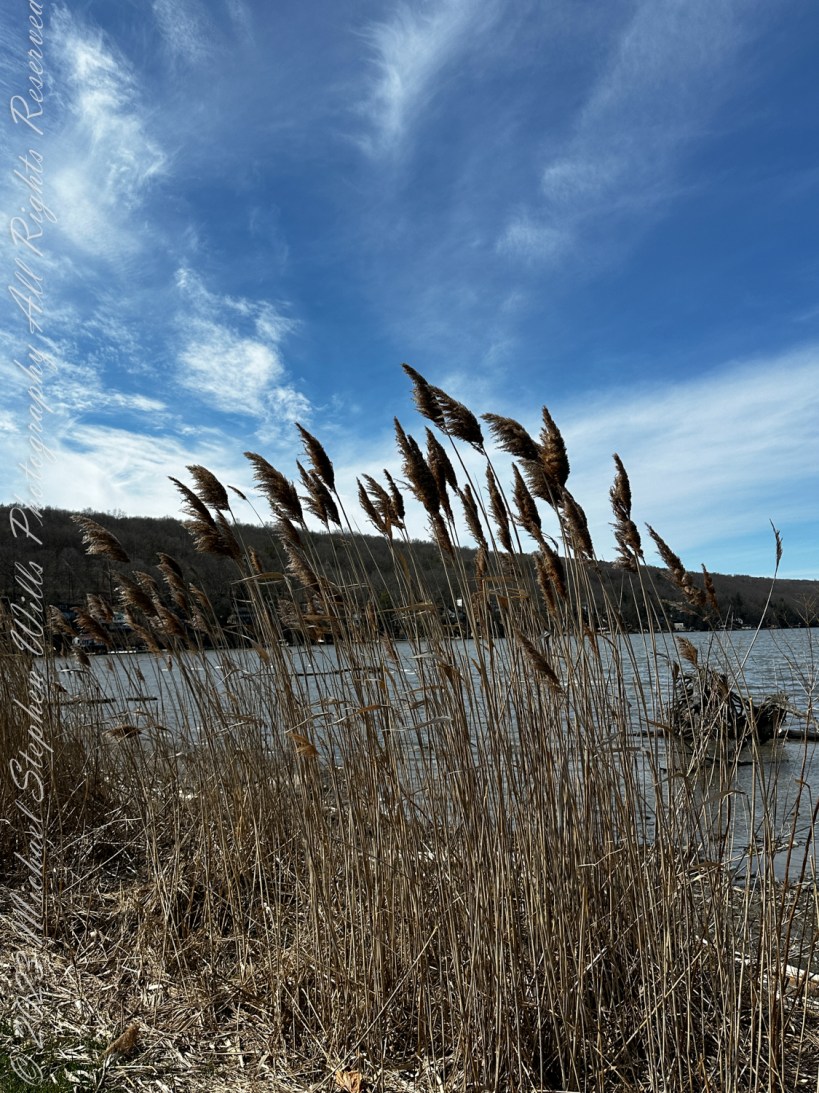
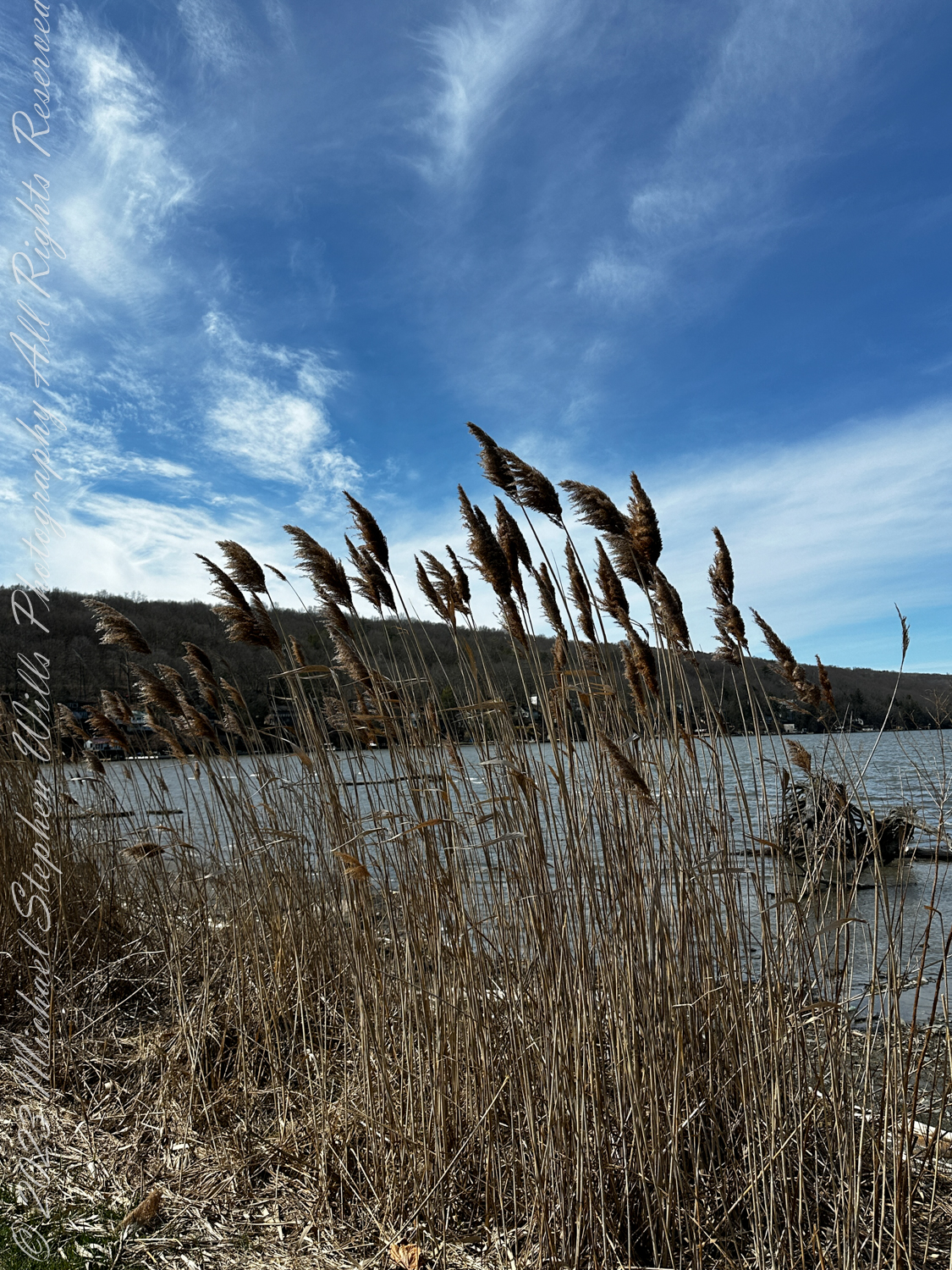
On the southern shore of Cayuga Lake, where waters mirror the ever-changing sky, I found this common reed, Phragmites australis, a plant of unassuming grace yet profound influence. This tale unfolds at the broad boarders of earth and water, a refuge and kingdom to countless beings.

Phragmites australis, a reed both simple and complex, begins its journey as a whisper in the mud. From the soft, fertile earth, it bursts forth into the world, a slender shoot reaching for the heavens. Its growth is steady and assured, fueled by the sun’s embrace and the water’s caress. In time, it stands tall, a sentinel in a sea of green, its feathery plumes, called panicles, wafted by the breeze.

This reed, you see, is a cornerstone of its ecosystem, a master architect, shaping its environment, crafting homes and havens for creatures great and small, in keeping with the genus name “Phragmites.” The Greek word “phragma” translates to “fence” or “hedge”, derived from the verb “phrassein”, meaning “to enclose.” Within that realm tiny creatures find refuge. From dragonflies and damselflies to grasshoppers and beetles are found by careful, patient observers. Insects play essential roles in pollination and nutrient cycling. Birds use the dense vegetation for shelter and foraging, you might find red-winged blackbirds, marsh wrens, and rails among the stems. Frogs, toads, and salamanders find refuge in reedy marshes. They lay their eggs in the waterlogged areas, and their tadpoles thrive amidst the reed stems. Phragmites australis is a giver of life, a source of sustenance and protection for many.

Yet, the tale of Phragmites is also one of struggle and resilience. In lands far from its native soil, it is often seen as an invader, a usurper of territories, spreading with a zeal that can overwhelm native flora and alter habitats. Its spread, unchecked, can lead to monocultures, diminishing biodiversity. But in its essence, Phragmites does not seek conquest but survival, thriving in spaces both gentle and harsh, adapting with an elegance that commands admiration.

As seasons turn, the reed undergoes a transformation, its green turning to gold, then to the brown of the earth from which it sprang. But even in decay, it nurtures life, its fallen stalks a shelter for the small and the silent, its seeds a promise of renewal. And when spring whispers anew, Phragmites rises once more, a cycle unbroken, a circle complete.

In the tale of Phragmites australis, we find a narrative of life itself—growth and decay, beauty and conflict, resilience and adaptation. This common reed, standing tall among the waters of the world, is a testament to the enduring power of nature, a reminder of the intricate tapestries of life that flourish in the quiet corners of our planet.

Click Me for another posting on the Common Reed.

Copyright 2024 Michael Stephen Wills All Rights Reserved

Avian Exploration

Join us in the tranquility of Merritt Island National Wildlife Refuge as we observed avian life, reflecting on nature’s beauty and resilience.

As my wife, Pam, and I entered the breezy expanse of the Merritt Island National Wildlife Refuge, the world seemed to slow down, allowing us to savor every moment of my journey along Blackpoint Drive. The sky, a sprawling canvas of muted greys, reflected in the wind ruffled waters, enhancing the tranquility of this haven.

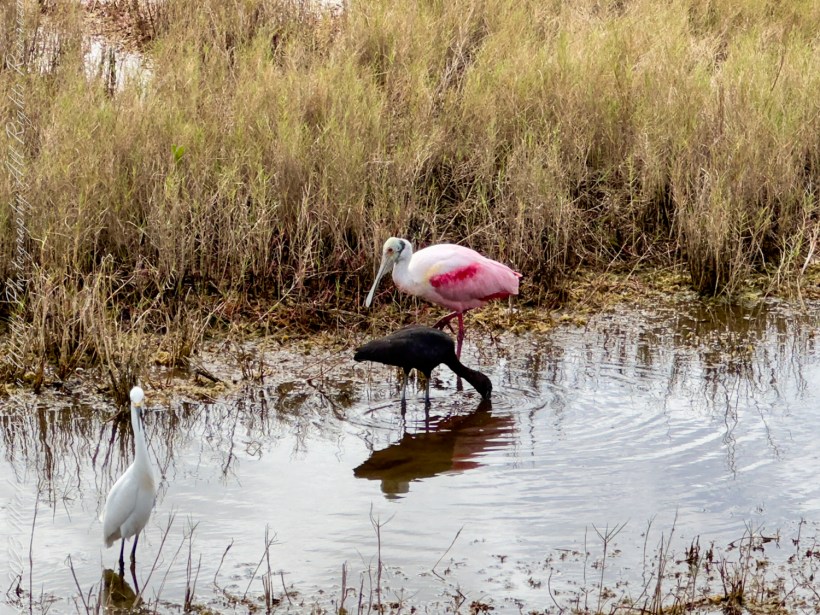
Our first encounter was with the elegant Roseate Spoonbills (Platalea ajaja), their vibrant pink feathers a stark contrast against the earthy tones of the marsh. They waded with purpose, their spoon-shaped bills sifting through the water, a dance of survival that was both methodical and beautiful.

In the company of the spoonbills were the stoic Great Egrets (Ardea alba), statuesque in their white plumage. They stood motionless, like sentinels guarding the water’s edge, only to strike with lightning speed when prey ventured too close.

We watched as the Glossy Ibises (Plegadis falcinellus) dipped their curved bills into the water, each movement a study of precision, their dark feathers glistening with an iridescent sheen when caught by the light.

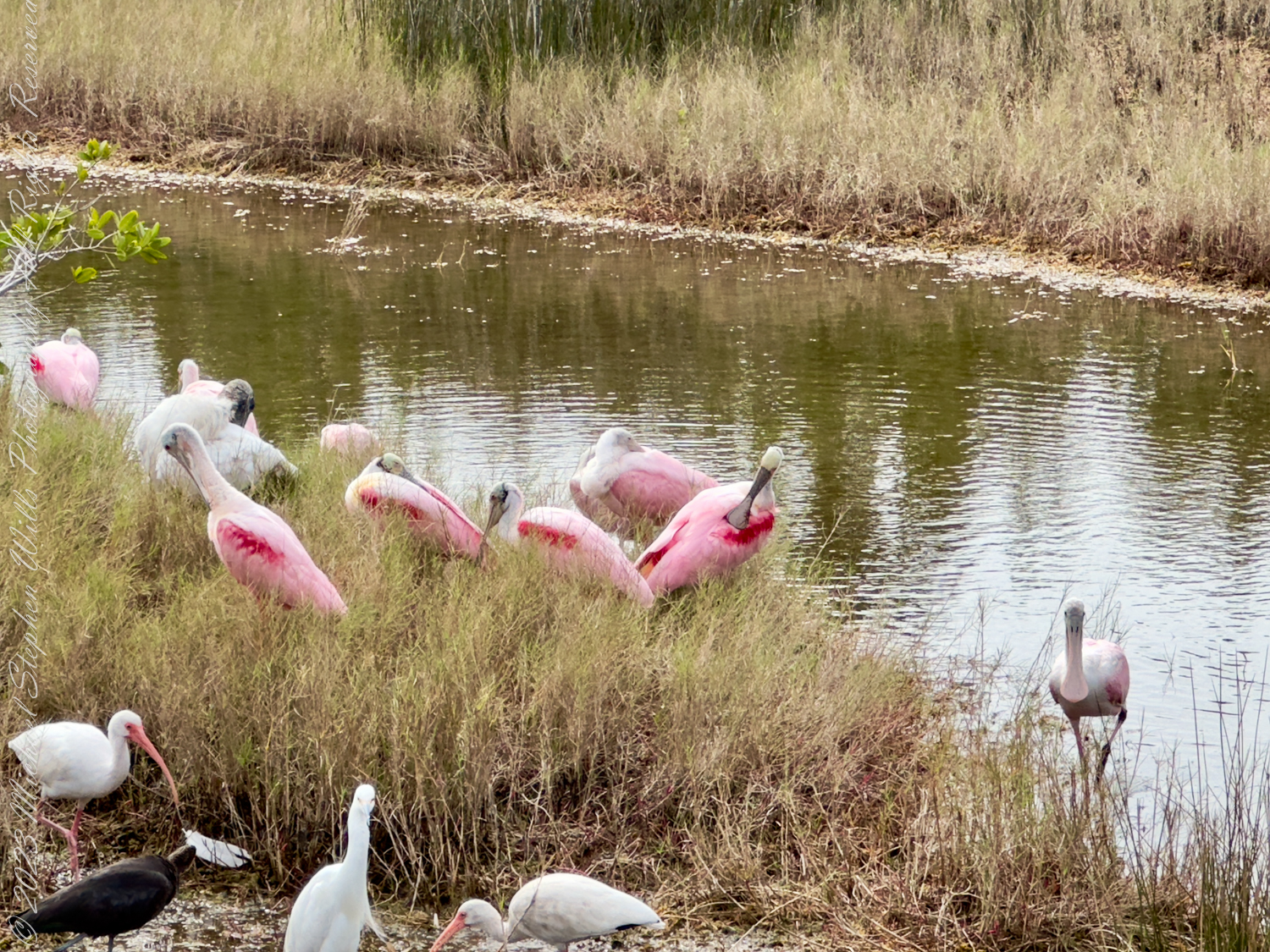
Amongst these avian aristocrats, the unassuming American White Ibises (Eudocimus albus) went about their business. Their red beaks probed the shallows, unperturbed by the presence of their more colorful neighbors or by my watchful eyes.

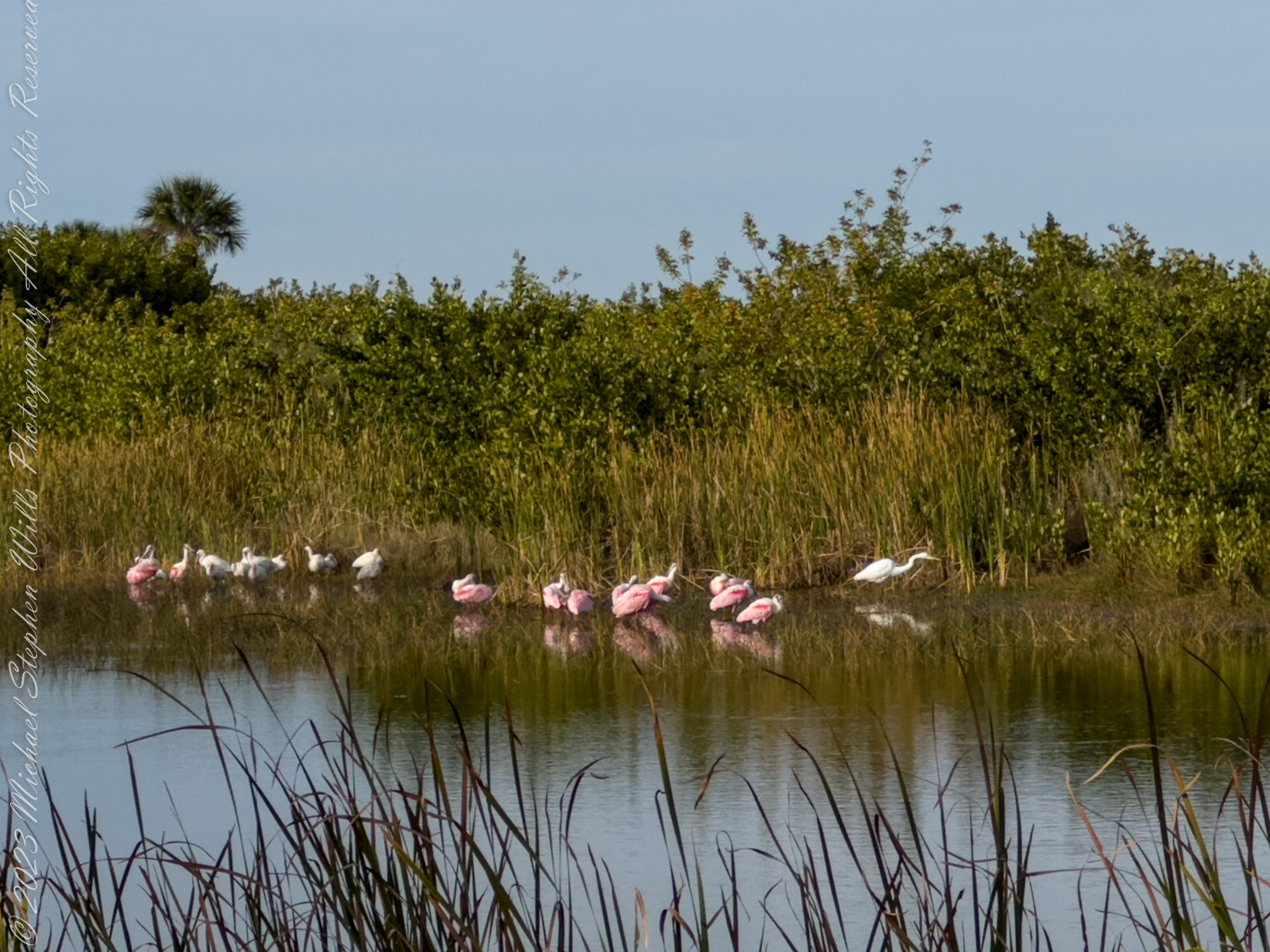
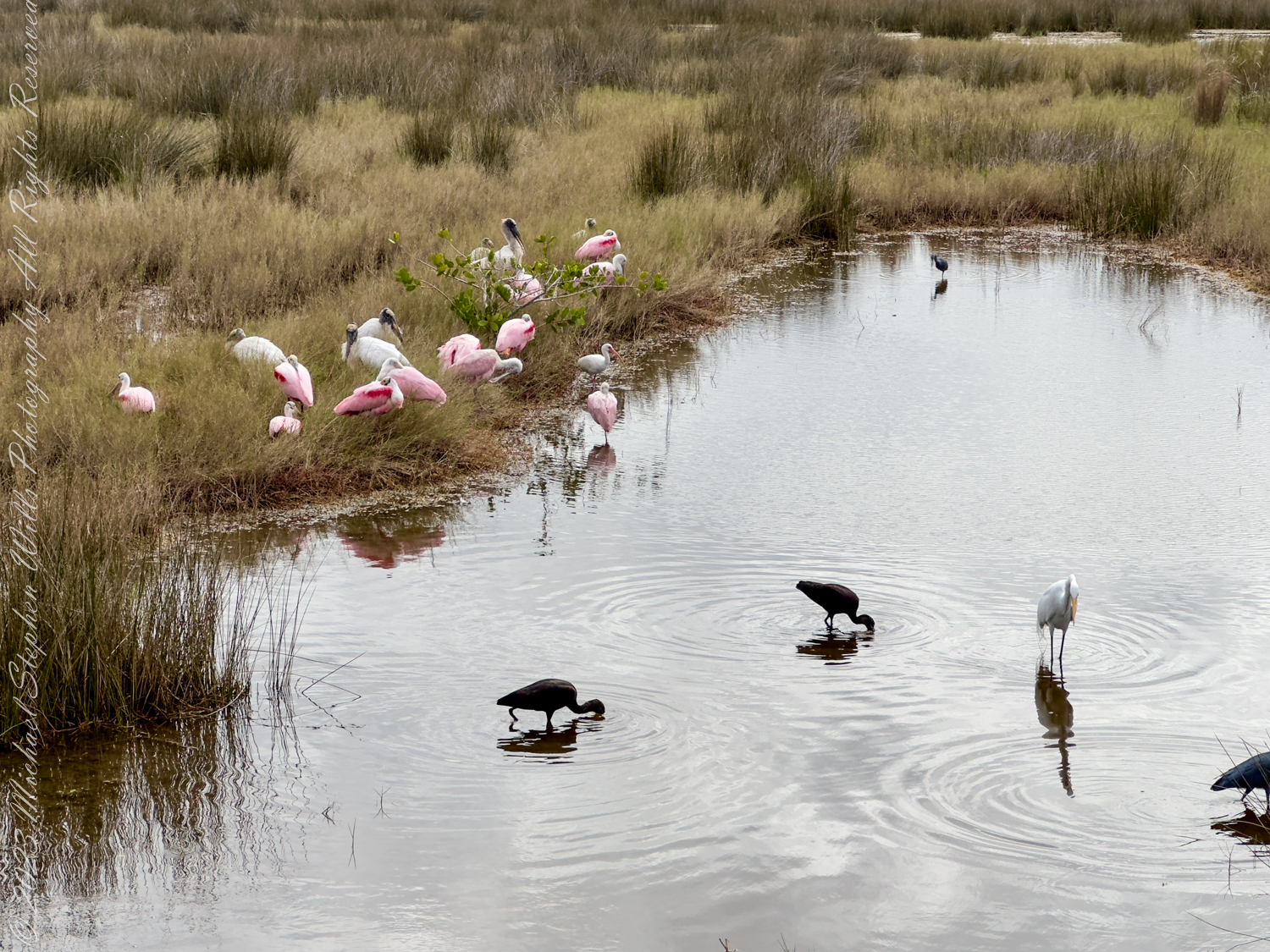
As we ventured further, the landscape shifted, the water opening up to reveal a gathering of Spoonbills and White Ibises, a community united by the need to feed and the safety of numbers. The occasional flap of wings and contented calls created a symphony that celebrated life in these wetlands.

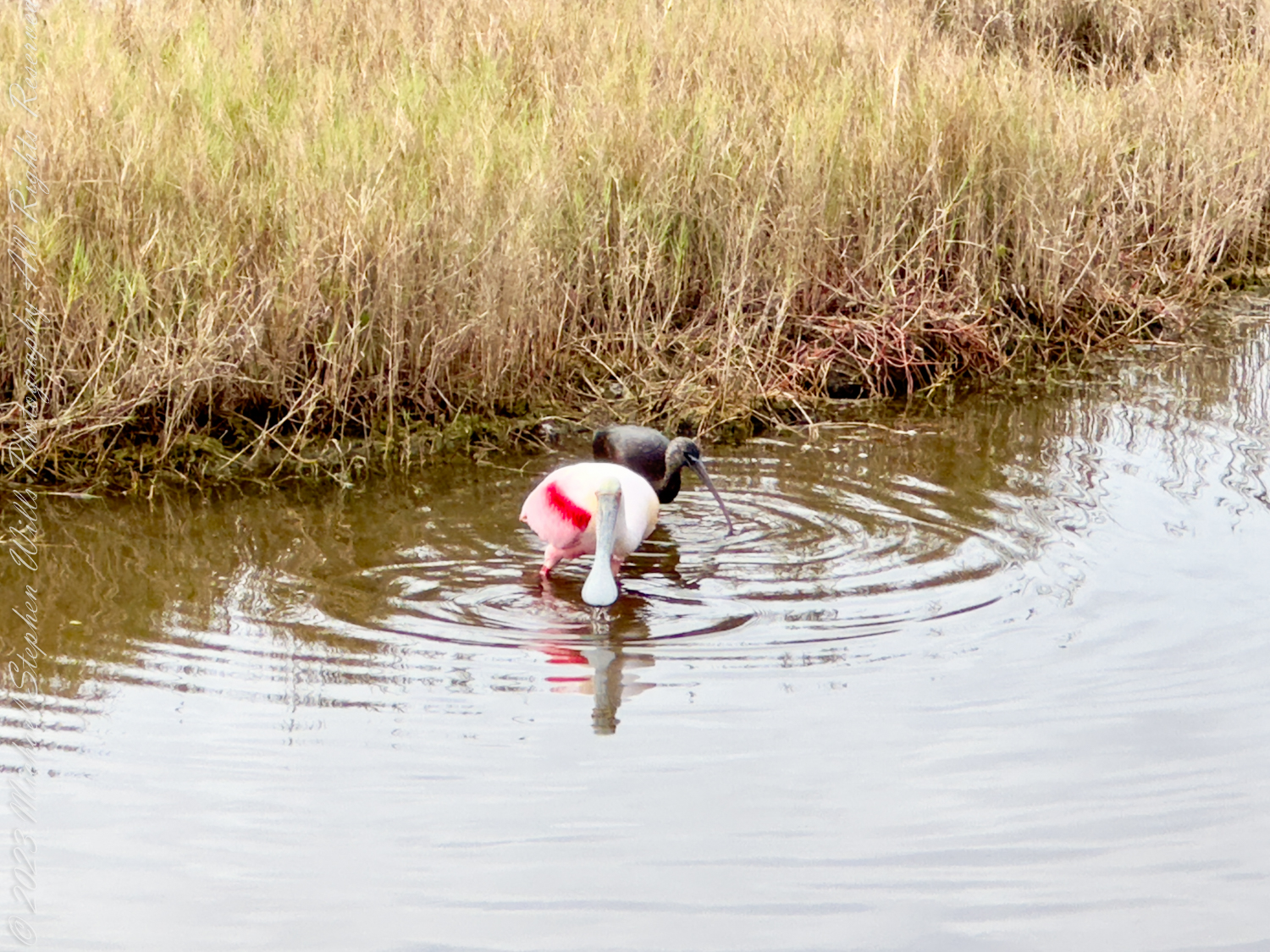
Isolation took on a new meaning when I spotted a solitary Roseate Spoonbill, its reflection a perfect mirror image on the water’s surface. It was a moment of quiet introspection, the bird and I alone in our thoughts.

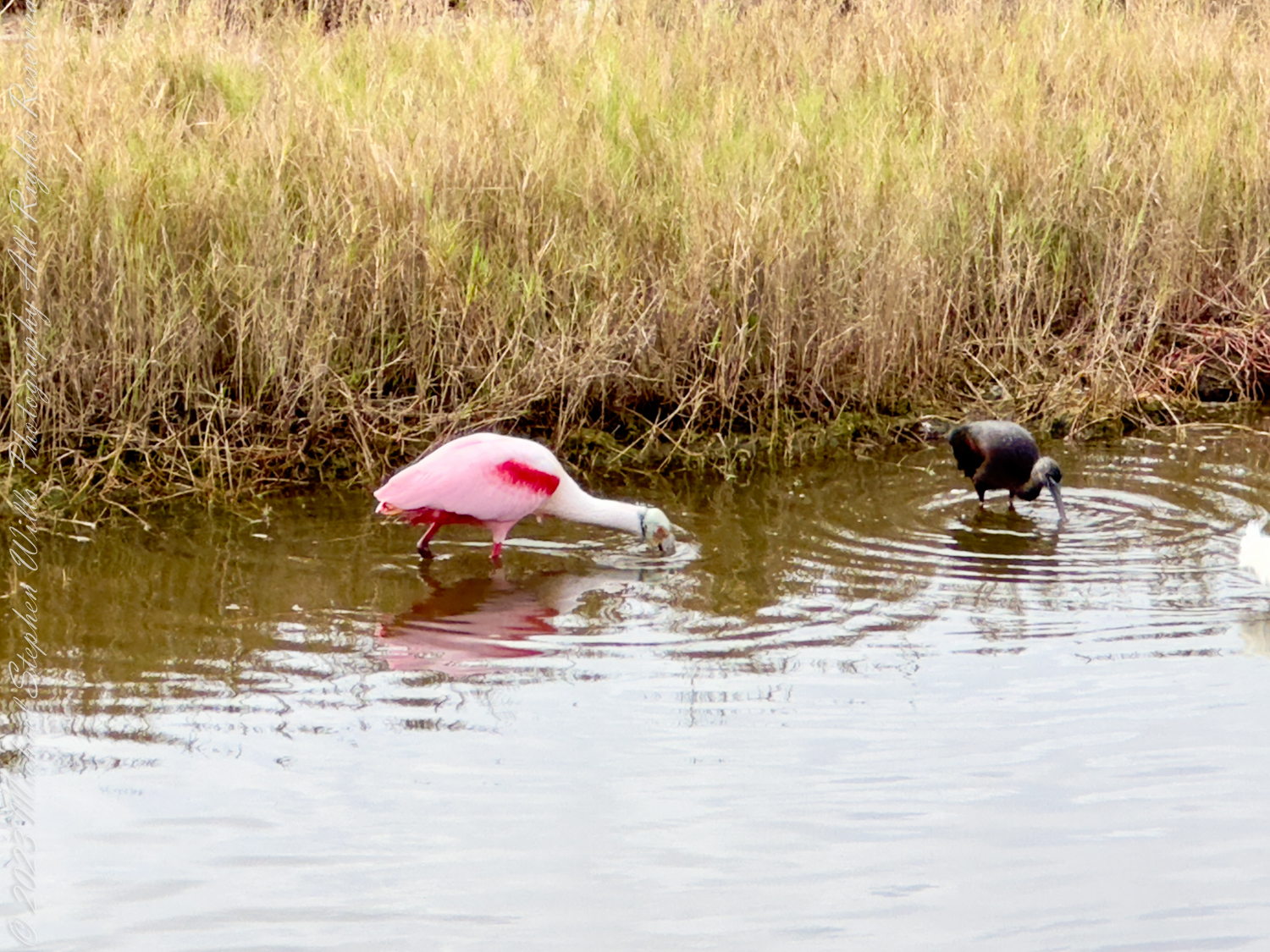
Another scene captured my attention as a single spoonbill foraged alongside a Glossy Ibis. The two species, different in appearance and yet similar in their quest for sustenance, shared the space in harmonious coexistence.

Further along, the vista opened up, and we were greeted by a panoramic view of spoonbills dotted along the distant shoreline, the greenery forming a lush backdrop to their pink hues. The expanse of the refuge unfolded before me, a reminder of the vastness and the wild beauty that had drawn us here.

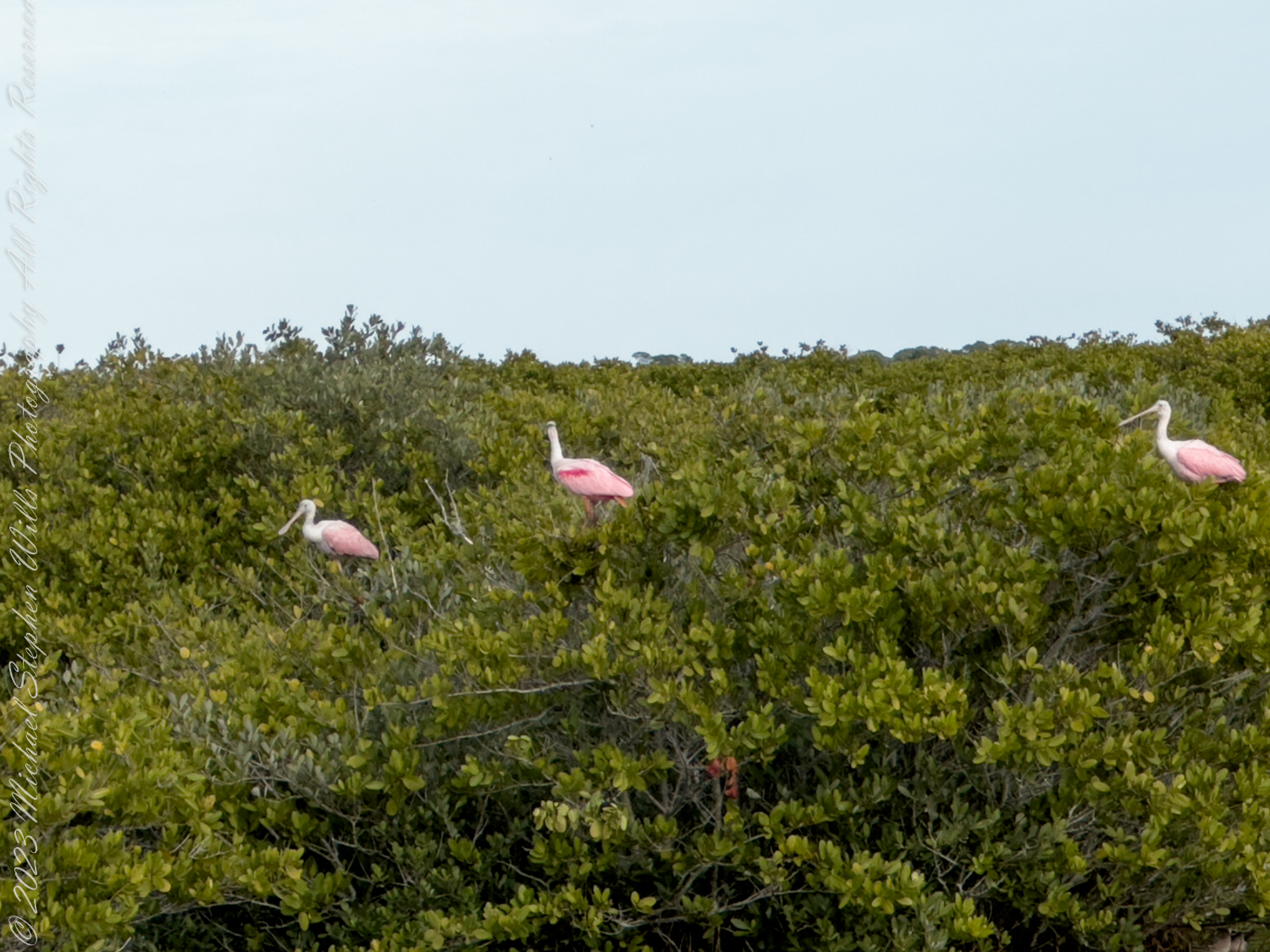
On another stretch, the spoonbills perched in the green embrace of the mangroves, their pink feathers a burst of color among the leaves. It was a scene of natural artistry, the birds blending yet standing out against their verdant stage.

In the final leg of our journey, I found spoonbills perched high in the shrubbery, a testament to the refuge’s diversity. Even in the dense foliage, life thrived, and these birds, usually seen wading, now adorned the treetops like living ornaments.

This drive along Blackpoint was more than a mere observation; it was a passage through a world where time held little sway, and nature was the sole architect. Each bird, each ripple on the water, and each whisper of the grass told a story of existence, resilience, and the intricate web of life. Here, in this secluded corner of the world, we found a connection to the earth and its inhabitants that would stay with us long after.

Copyright 2024 Michael Stephen Wills All Rights Reserved
Thayer Preserve: Autumn Still Life 2

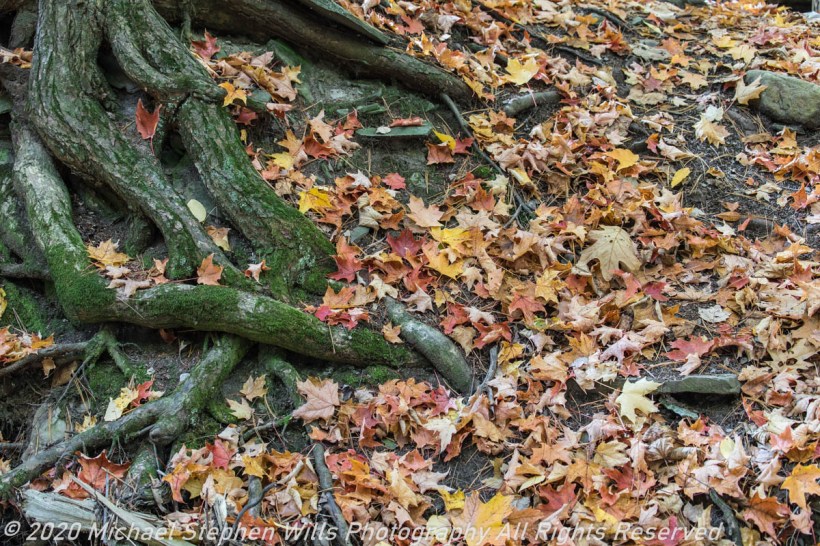
Hemlock Roots

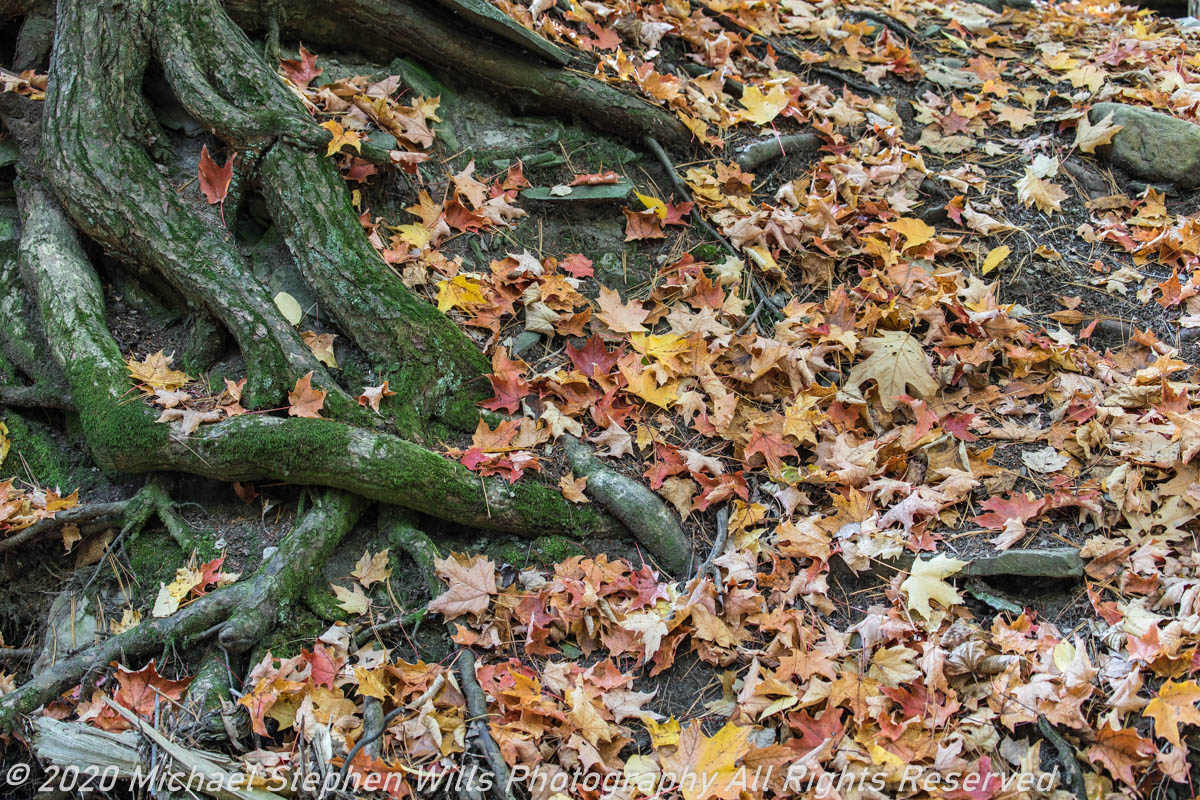
Maple leaves and hemlock roots share an environment yet play distinct roles in the ecosystem. Maple leaves, broad and vibrant, capture sunlight. This process fuels their growth and contributes to the air we breathe. Each fall, these leaves turn yellow and brown, signaling a natural change. They fall, joining the forest floor. Here, they decompose, becoming part of the soil. This enriches the earth, supporting new plant life.

Hemlock roots anchor these mighty trees. Reaching deep into the soil, drawing up water and nutrients. These roots also stabilize soil, preventing erosion and are a network, unseen but vital, connecting the tree to its environment.

Click photograph for larger view. Use combination keys to enlarge/reduce: Ctrl+ (Control / Plus) and Ctrl- (Control / Minus)

These natural processes have parallels in human generations. Like the leaves, each generation has its time in the sun. People grow, contribute to their world, and then make way for the next. The knowledge and experiences they leave behind enrich the lives of those who follow, much like fallen leaves nourish the soil.

Similarly, the hemlock roots parallel the foundational elements of human society. Traditions, cultures, and values are passed down, anchoring each new generation. They provide stability and nourishment, helping to guide growth and development.

Over time, just as the forest evolves through the cycles of leaves falling and roots growing, human societies change. Each generation builds upon the last, growing in the richness left behind. This ongoing cycle speaks to the resilience and interconnectedness of life, whether in a forest or in human communities.

In both nature and human experience, there is a rhythm of growth, contribution, and renewal. The falling of maple leaves, and the steadfastness of hemlock roots illustrate this beautifully, reminding us of the continuity and change inherent in all living systems.

Click Me to view my photographs on Getty.

Copyright 2023 Michael Stephen Wills All Rights Reserved http://www.MichaelStephenWills.com