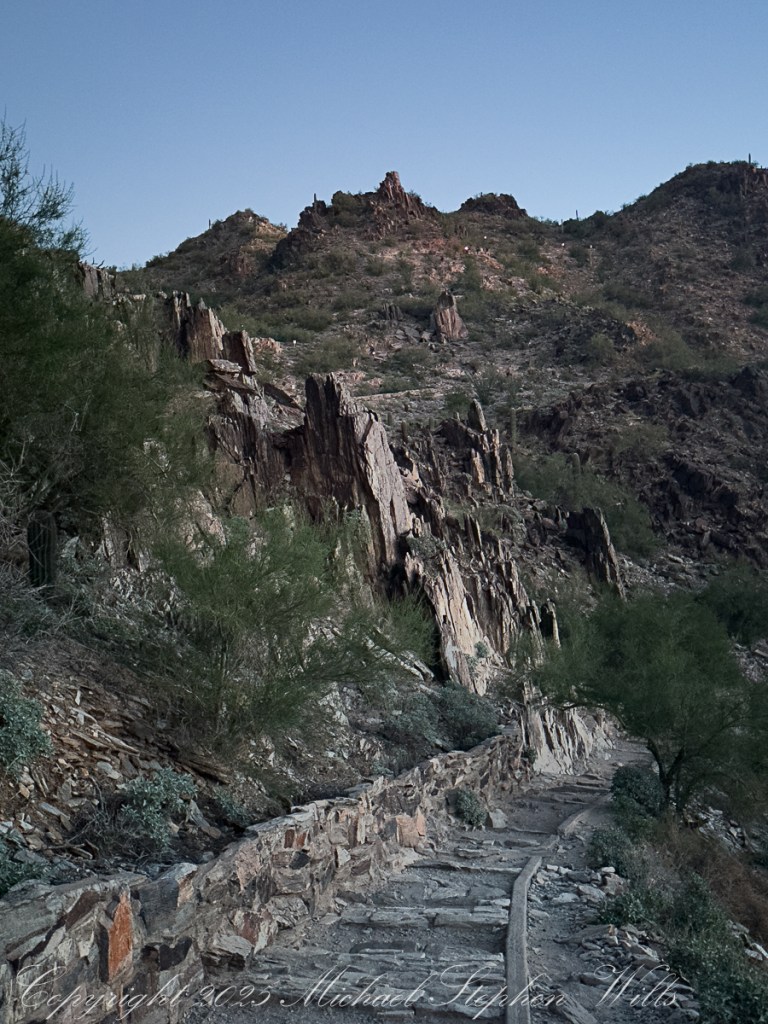
In the cool predawn, strangers from every background climb a stone stairway above Phoenix, trading city lights for desert silence as sunrise spills gold across Piestewa Peak.
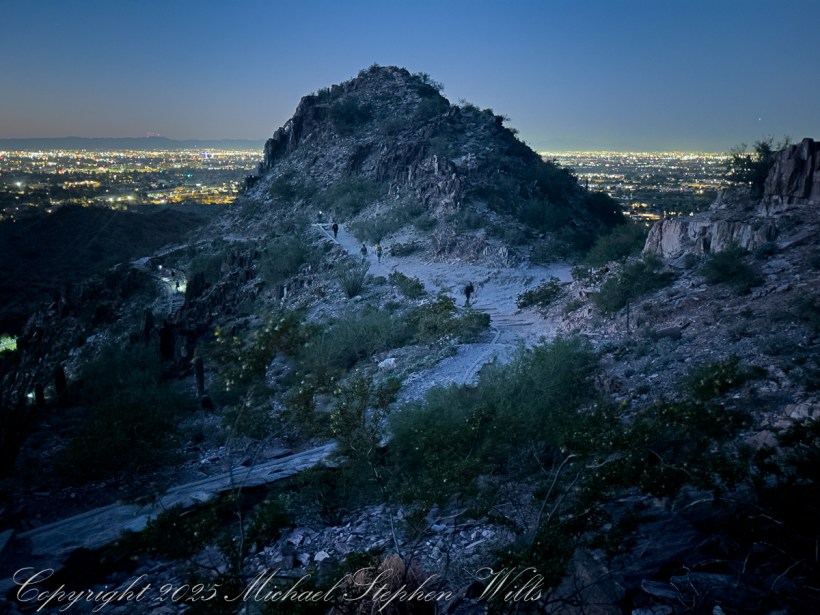
Arriving at 5 am there is a line of trucks and cars and Piestewa Peak parking almost full when I grab a spot in the predawn darkness. The desert air has that deep, merciful coolness it offers before sunrise, edged with the long-remembered scent of creosote. Car doors close with soft thuds, headlamps blink on, and a loose procession of strangers begins to funnel toward the trailhead like pilgrims, even now white and red headlamps sprinkle the upper slopes.
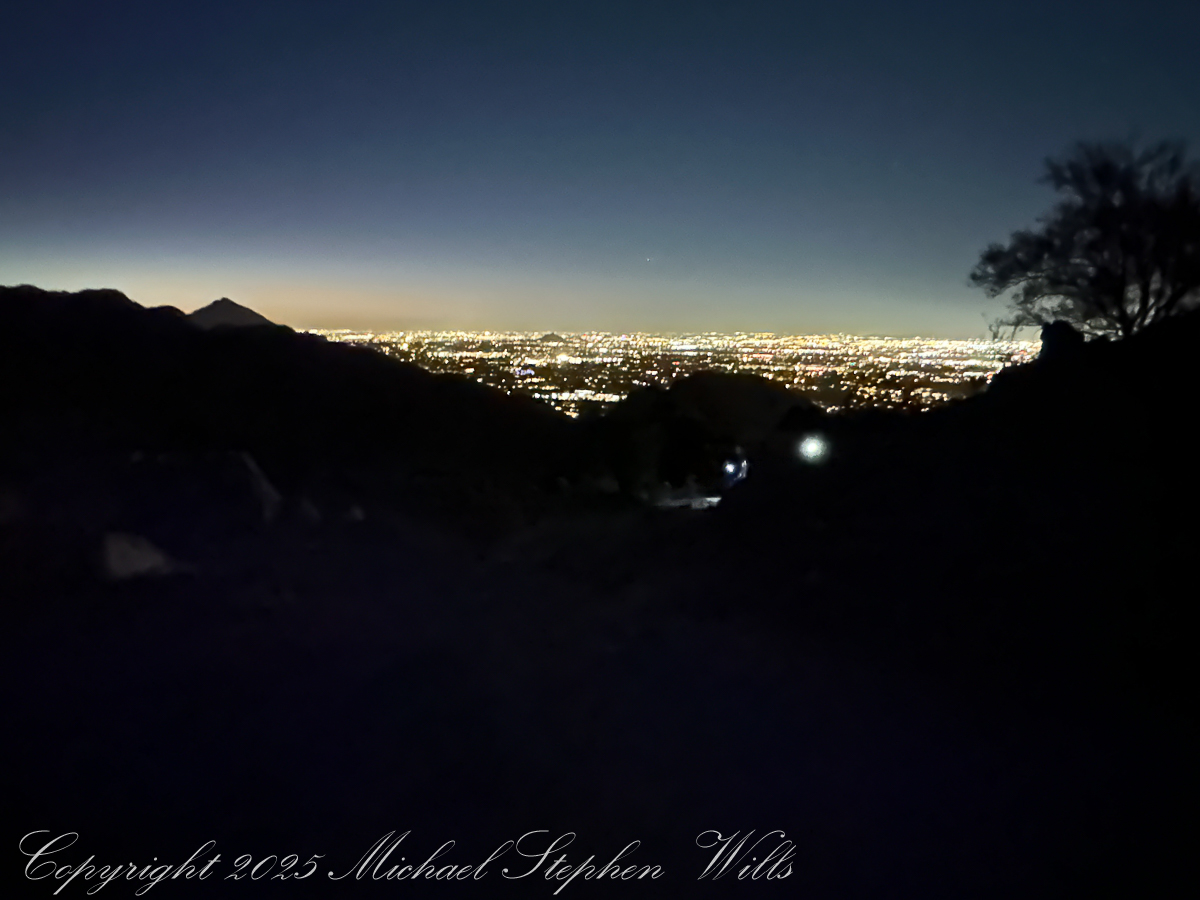
At first the climb exists only in a narrow cone of light, my lamp illuminates the scant gravel, uneven steps, and each scuff of boot or shoe sounds loud in the hush. Somewhere below, the city hums, but here the conversation is mostly breath and the occasional murmur of greeting as we fall into the rhythm of the climb.
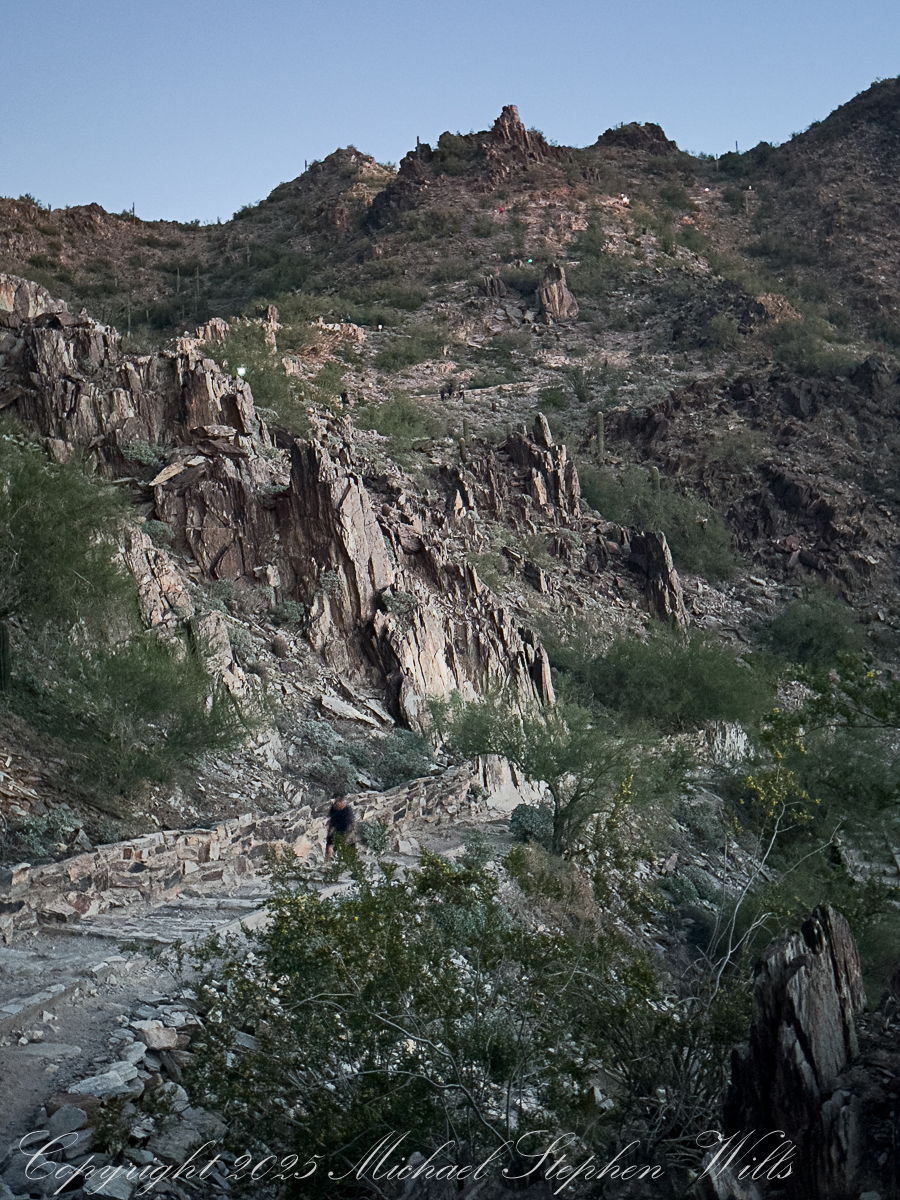
My beam catches a young couple just ahead, their hands knotted together. They speak Spanish, laughing quietly as they miss a step and bump shoulders. Behind me an older man in a Veterans cap leans heavily on trekking poles, his companion—maybe daughter, maybe friend—matching her shorter stride to his with patient care. A group of women in bright leggings and braided hair moves past us in a burst of energy, their languages overlapping—English, maybe Vietnamese, something I cannot place—like the weaving of a rug. A man passes me, a drum on his back. Piestewa draws them all, before dawn, to this rib of stone in the center of the Phoenix basin.
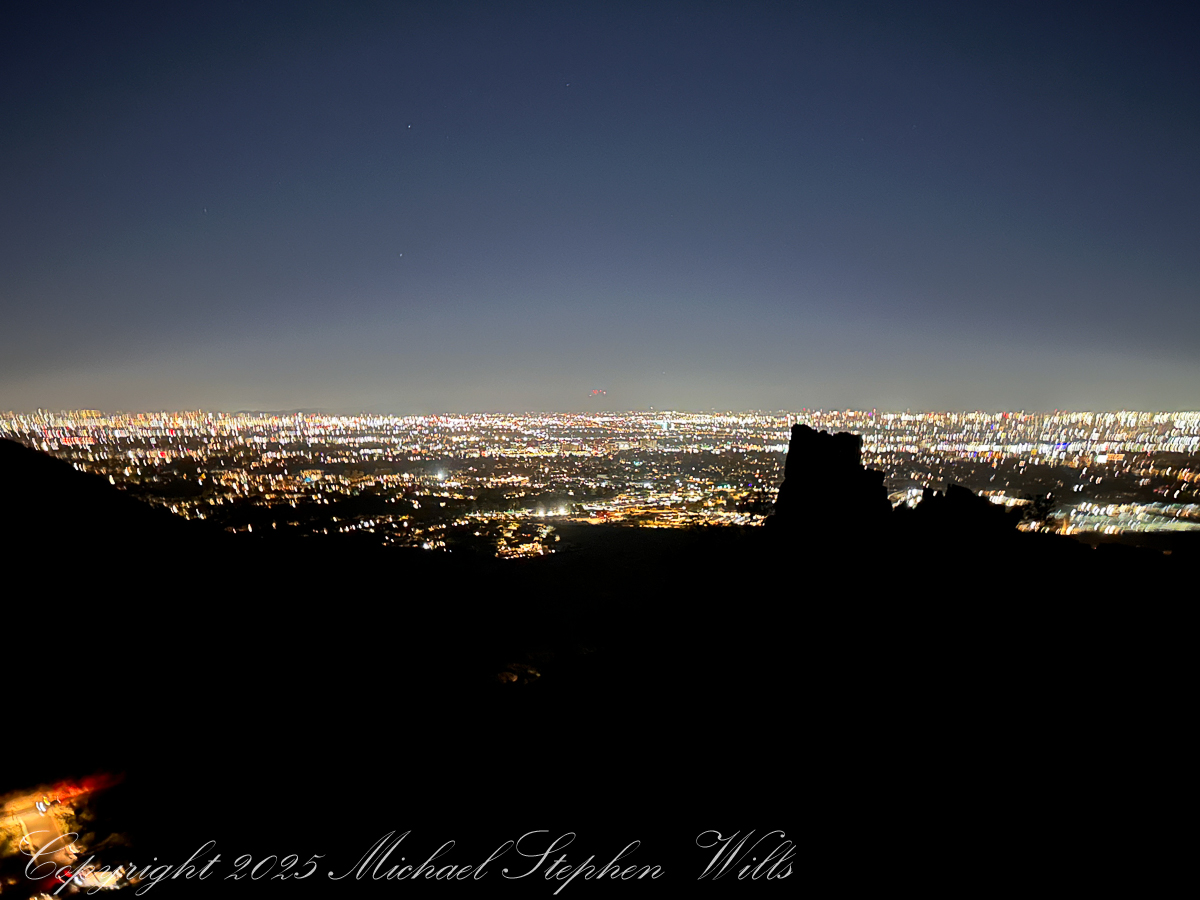
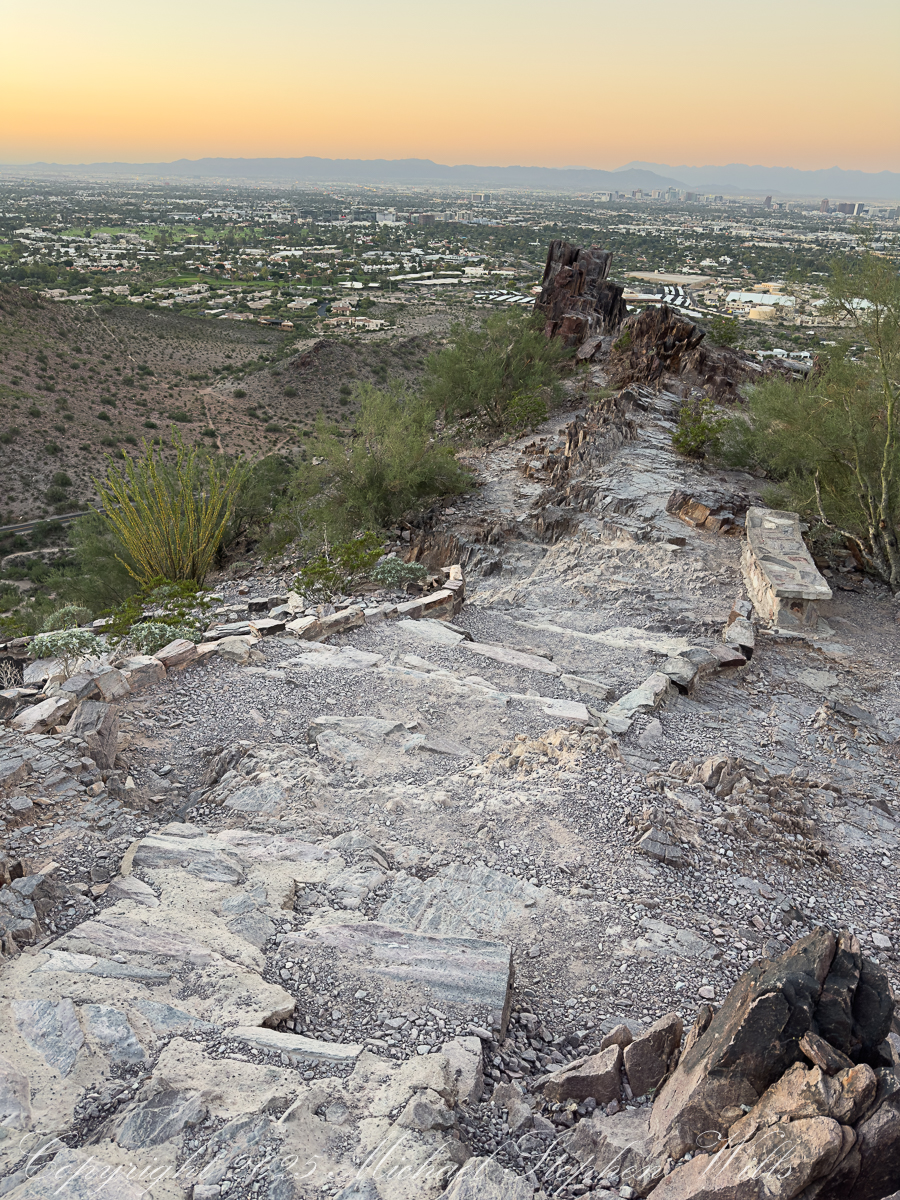
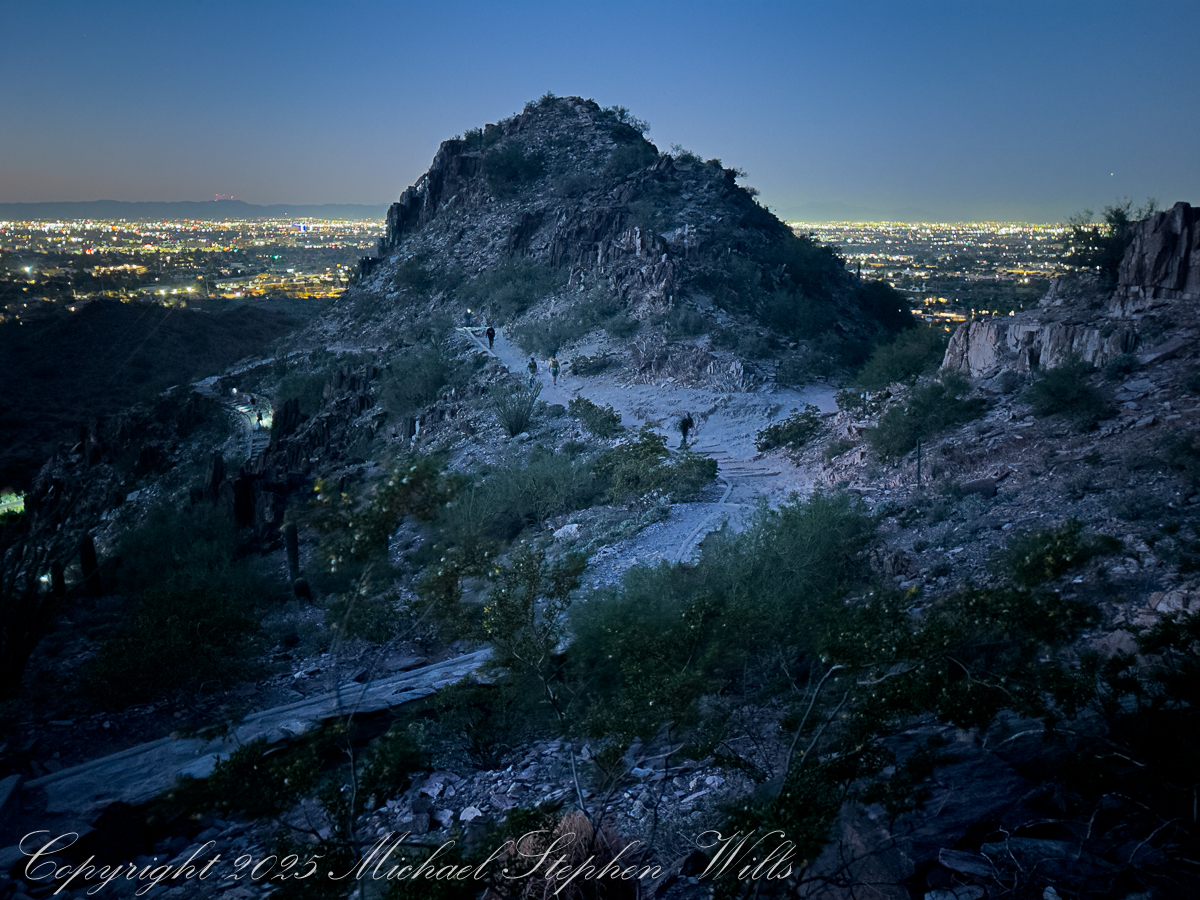
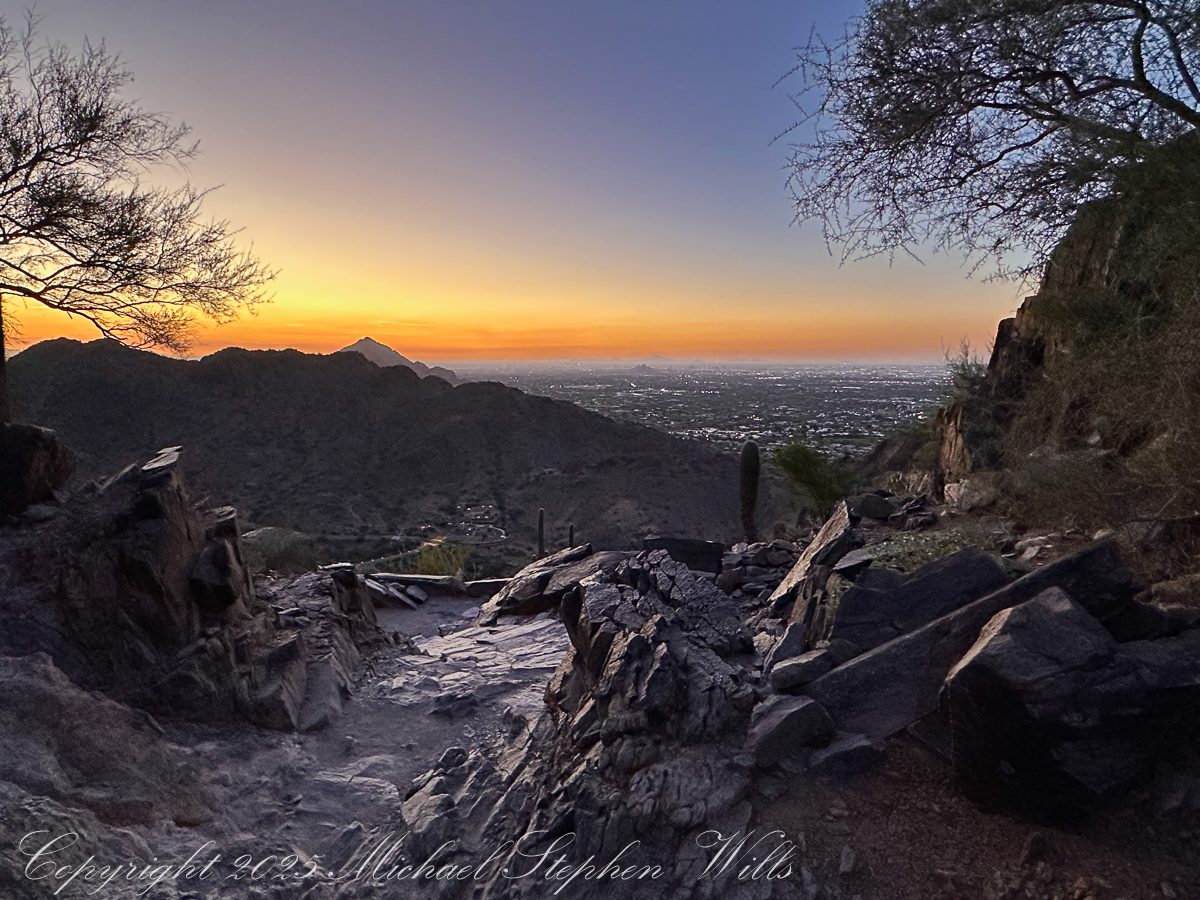
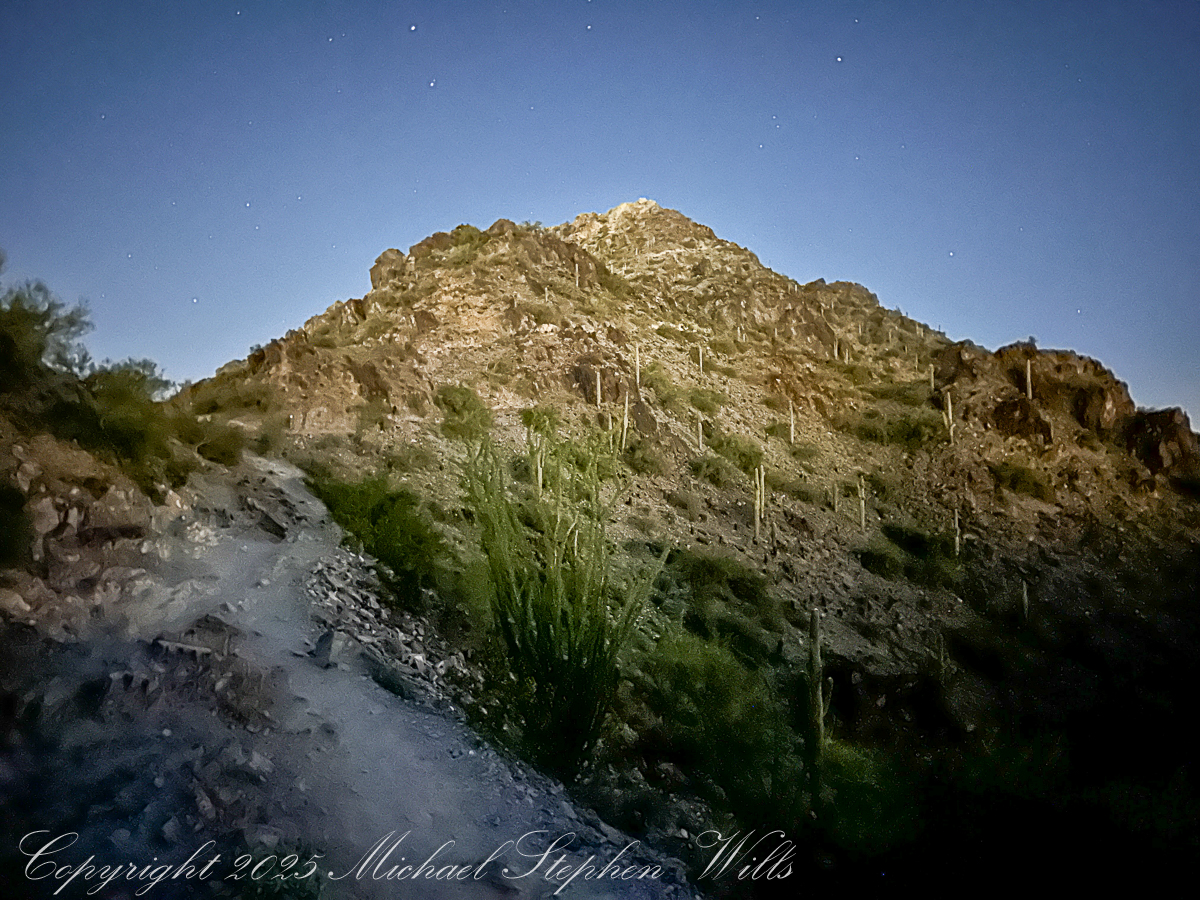
As I stop to rest myself and turn off my headlamp, ahead the trail tilts steeper the steps fade to rock, irregular and unforgiving: a stairway carved from ancient volcanic bones. With my dark adaptation, surfaces reflect star and city light, leading the eye down the ridge toward the dark quilt of neighborhoods below. Later, captured in the photograph, those steps will twist away like a stone dragon’s spine, the city waking beyond in soft pastels. Now they are simply work for legs and lungs.
The desert plants materialize around us as shapes before they acquire color. Saguaros stand like sentinels along the slopes; their arms lifted in silhouette. Ocotillo rise as witchy bundles of sticks, each spine leafed out from October rains the leaves catching a little light. On a small plateau a family has paused; the father adjusts a tiny headlamp on his son, no more than six, who is insisting, with fierce determination, that he can carry his own water. “Almost there, campeón,” his father says, and the child straightens like a soldier.
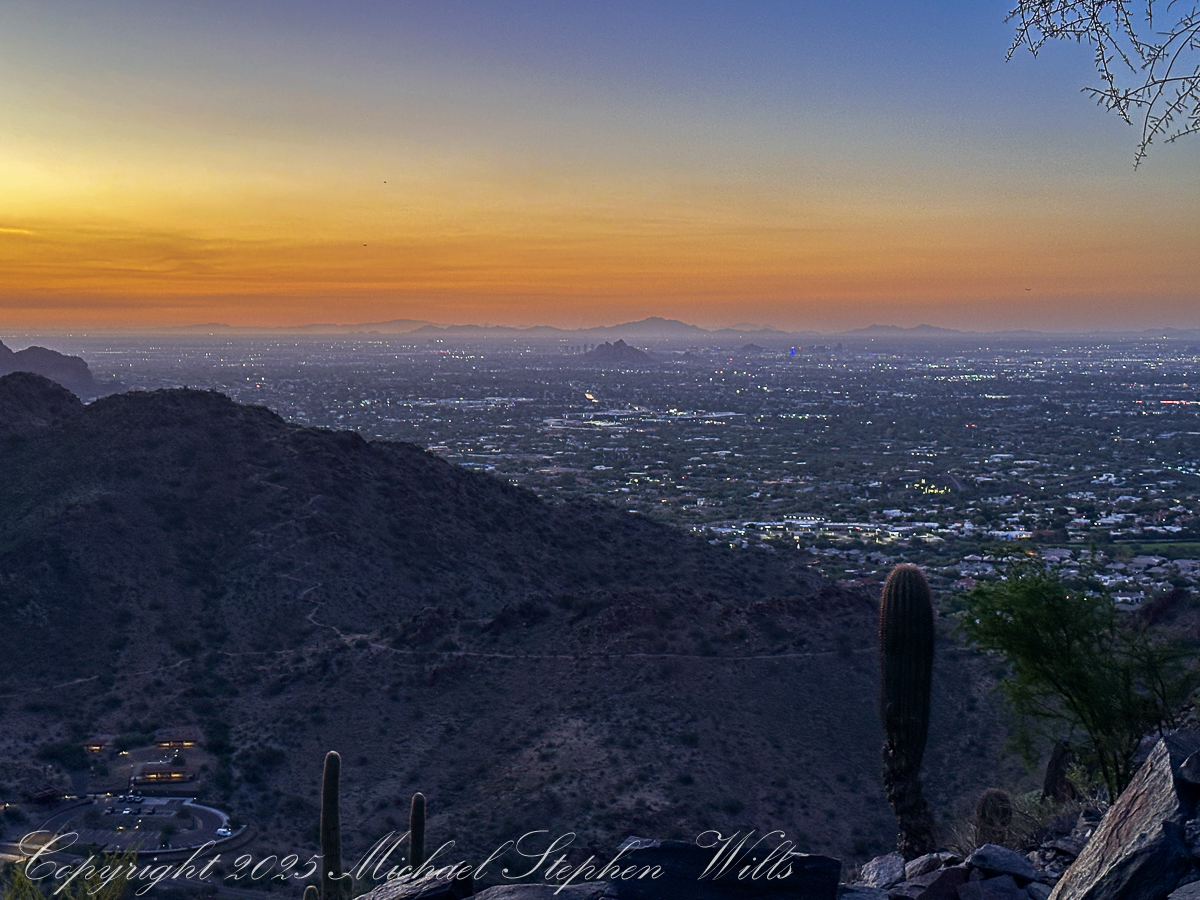
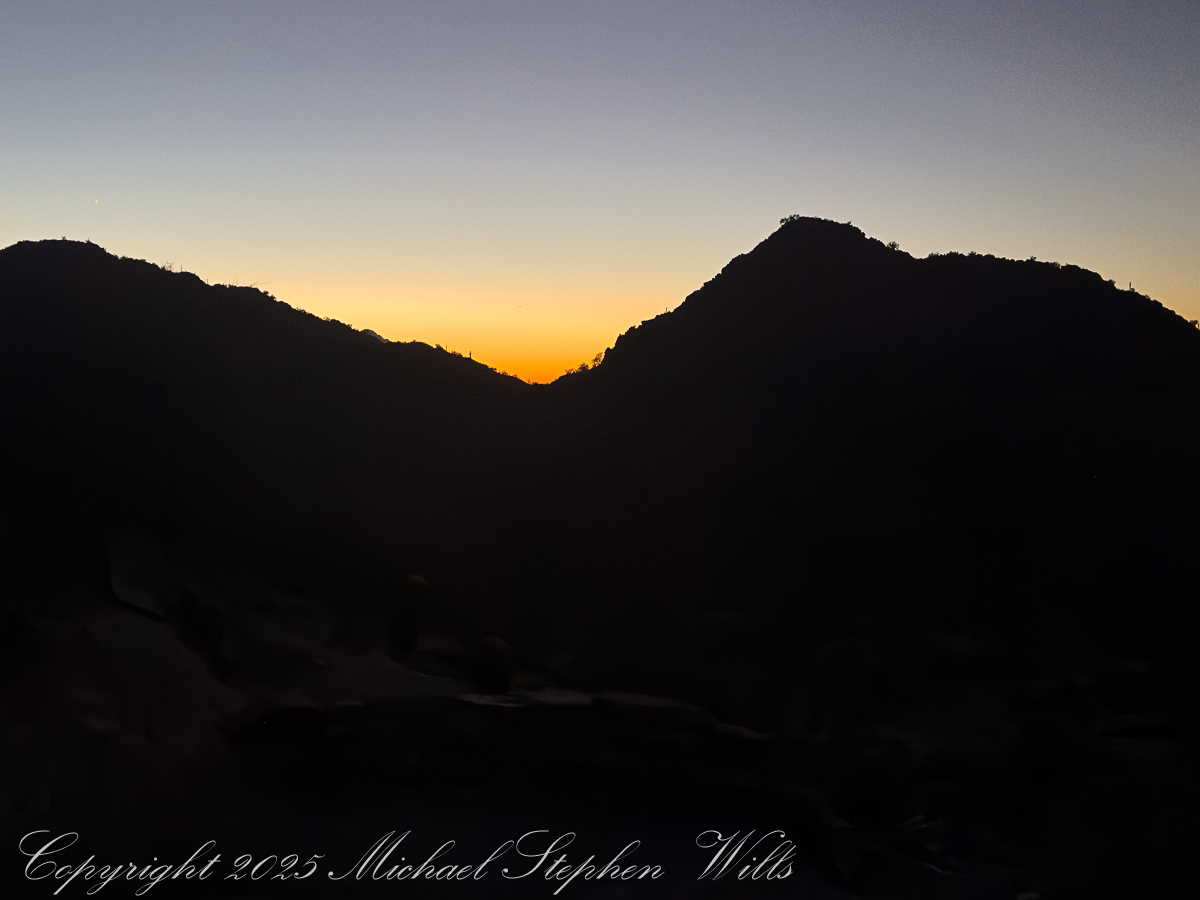
The dark begins to soften at the edges. Over the eastern horizon a thin band of orange appears, a delicate seam between night and day. In one direction, the city stretches out in a glittering net of streetlights, the squares of parking lots and subdivisions catching the last of the darkness. In the other, the mountains are still black cutouts, their profiles sharp as paper against a gradually brightening sky. One of my images will hold that moment: the jagged ridge of Piestewa in shadow, the valley below already spangled with light, a single towering saguaro rooted at the cliff’s edge like a punctuation mark.
November 2025 while visiting Pam’s family in Phoenix
Higher up, the trail narrows and the rock turns rougher. We fall into single file, strangers linked by a line of effort. A runner comes flying down, feet barely touching stone, breath steady and controlled. “On your left,” he calls, and we part for him like water. A woman with a hijab tucked neatly under her ball cap leans against the retaining wall, stretching a calf muscle, her friend counting in accented English: “Ten more seconds, you can do it.” Near one bend a hiker pauses to press a hand against the rock face, whispering a quiet prayer in a language I do not recognize. It is a small, intimate moment, gone almost before I register it.
The last push to the saddle is steep, the steps uneven, the sky now a cascade of colors—copper, rose, faint lavender melting into a high dome of blue. The silhouettes of distant ranges sharpen: the Estrellas?, the Superstitions?, low ridges whose names I do not know. On the horizon, the first thin line of sun breaks free, setting fire to the edges of clouds. In another photograph, framed by dark rock and desert trees, that sunrise becomes a golden portal at the end of a shadowed corridor of stone.
We reach a broad ledge just shy of the summit as the light finally spills over us. People are already gathered there: a trio of college students taking selfies, a pair of retirees sharing thermos coffee, a solitary man sitting cross-legged with eyes closed, face open to the warmth. The city below is suddenly transformed. The carpet of lights dims, replaced by the clear geometry of streets and rooftops, golf courses and parking lots, all laid out like a model at our feet. The mountains that hem the basin—once anonymous shapes—now reveal their ridges and ravines in sharp relief.
For a few minutes conversation dies away. Everyone seems to feel the same thing: that fragile instant when the sun clears the horizon and the desert shifts from silver-blue to gold. The rocks around us, sharp and broken in the photographs, glow honey-colored. Saguaros catch light on their spines, each thorn a tiny ember. Even the dusty air seems to shimmer.
Down below, a new wave of hikers starts up the trail, latecomers walking into full daylight. We, the predawn climbers, share a small, quiet complicity. We have seen the city from the backside of night, watched the day arrive from a perch of jagged stone. Piestewa Peak has turned us, for an hour or two, into a single, breathing organism: many hearts, one climb, all of us stitched together by the steep path and the slow unveiling of the sun.
Enter your email to receive notification of future postings. I will not sell or share your email address.
Copyright 2025 All Rights Reserved Michael Stephen Wills
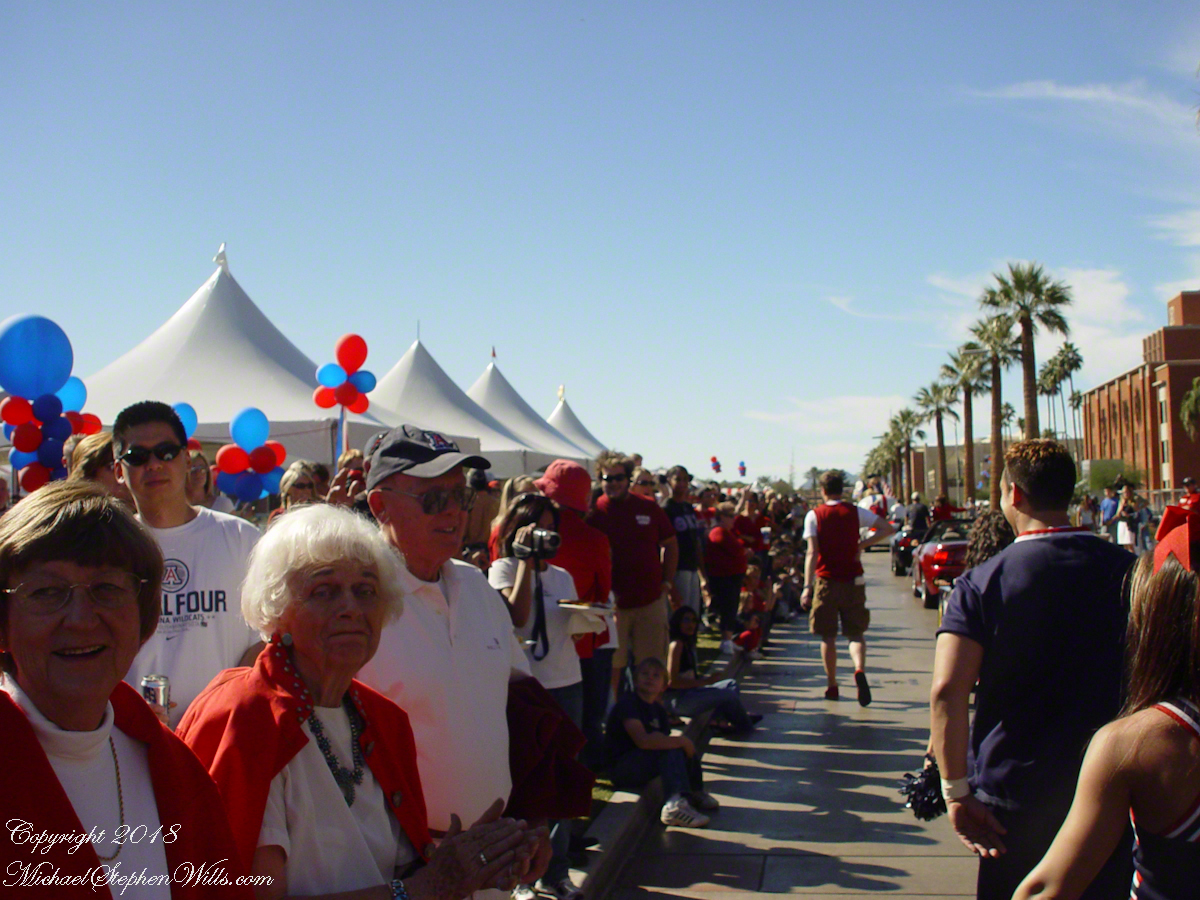
In November 2003, at fifty and traveling Arizona with my son Sean, I returned to the University of Arizona for my first Homecoming since graduating in 1975. I’d made the freshman cheerleading squad my first year in Tucson, and when the alumni invitation arrived, I couldn’t resist.
At the cheer alumni reception on November 7, the room felt instantly familiar—handshakes, stories, and a current squad packed with scholars as well as athletes. I mentioned to advisor Phoebe Chalk that I hoped to photograph the parade. “The squad already had photographers”, she said, so I planned to work from the sidelines.
I came prepared the next day with a Sony Cybershot F828. It was “Sony’s flagship prosumer digital camera” at the time. It worked well that day, the variable lens was especially helpful.
At the staging site, I solved access with a simple ask. I approached UA President Peter Likins, explained I wanted to photograph the cheerleaders, and he nodded, made a quick call, and waved me on. The team recognized me from the evening before, and I fell in step with them at the head of the procession
As we passed the Flandrau Science Center and crossed Cherry Avenue, a stunt group set quickly: bases J. Justin VandenBerg, Ricardo Abud (captain), and Robert Scoby with flyer Taylor Hendrickson. They launched her high for a full flip and clean catch. I caught the moment of collective focus—an image I call Mind.
We progressed until the stunt group reset. This time I framed the instant of takeoff—limbs aligned like clockwork—I call this image Aerialists.
The next flyer to launch was Kristen Ortega, here standing on the shoulders of her partner.
In front of the review stand, flyer Kristen Ortega rose into a poised extension and flight returned safely to the same three pairs of hands. Grace is the image title.
The rest of the parade streamed past in a blur of alumni, bands, and banners. Afterward, a squad member took a picture of me with the team—two eras in one frame. The cheers change; the spirit doesn’t.
Monument Valley, or Tsé Biiʼ Ndzisgaii, embodies a profound connection between the Diné people and the land, contrasting imposed names with cultural significance and sacred narratives.
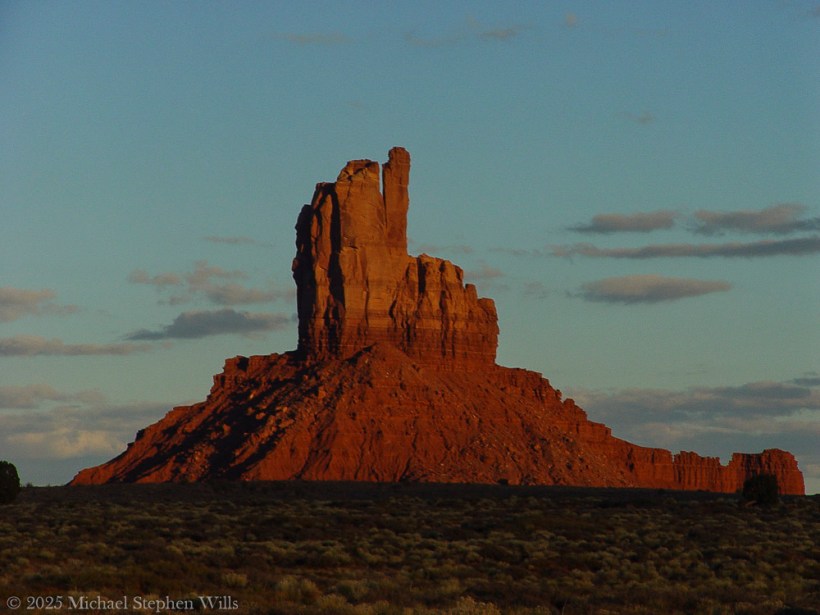
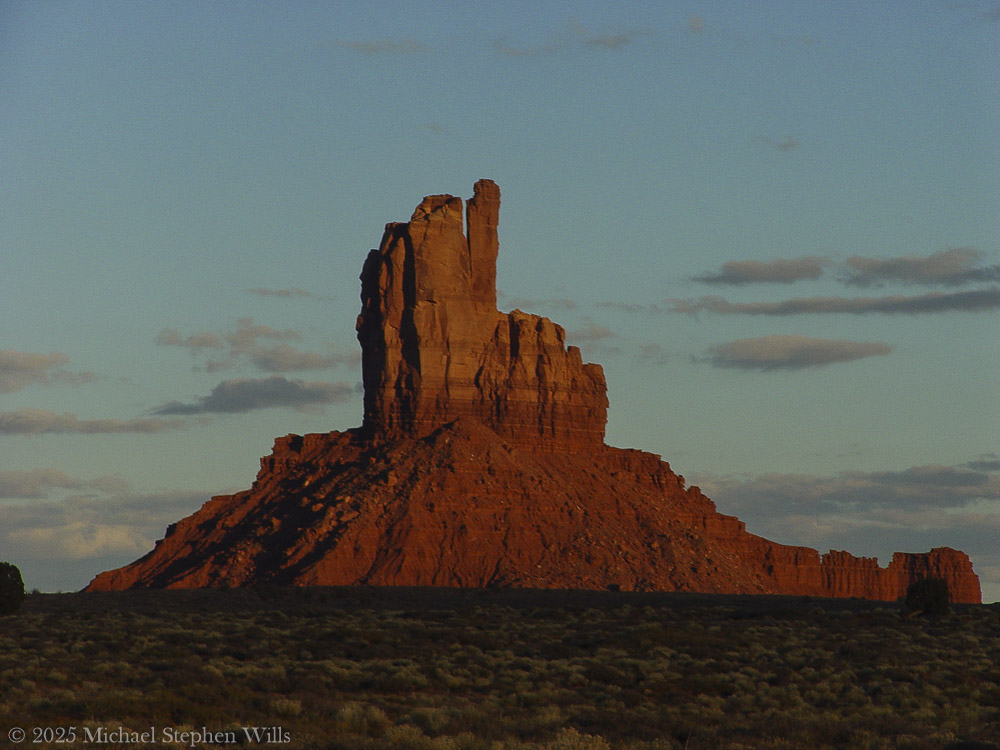
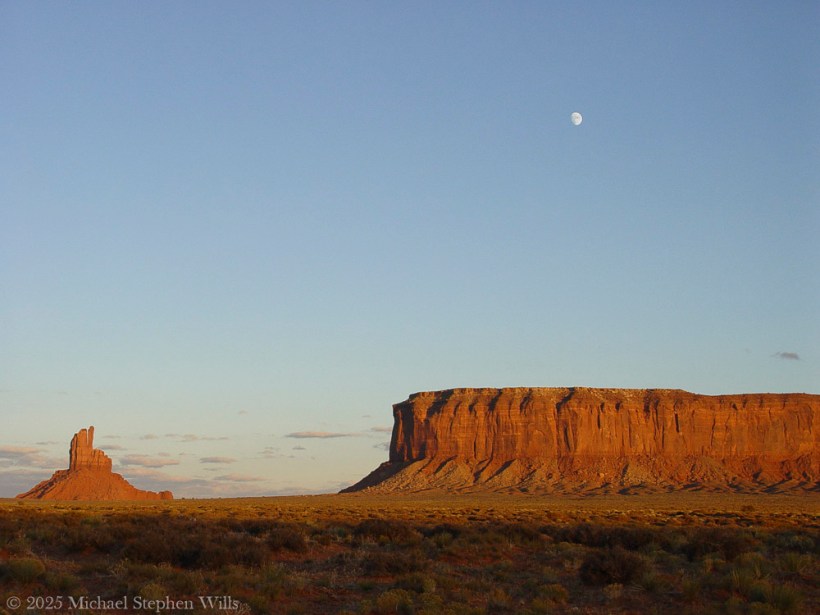
In the golden hush of this November sunset, Monument Valley stretches before us – an endless desert plain punctuated by towering red rock sentinels. The sky is vast and translucent blue, as a pale three-quarter moon rises silently above a solitary spire of sandstone. That spire is known on maps as Big Indian, a stone pillar glowing russet in the low sun. It stands apart from the mesas, its silhouette uncanny against the evening sky. In this serene moment, the land feels alive with presence. And the name “Big Indian” lingers in the air, raising quiet questions about what we call this place – and what it truly is.
From a distance, the spire does suggest a figure: tourists are told to squint, tilt their heads, and “see” the profile of a Native face gazing outward. One can imagine the first person to name it must’ve been a bored prospector, half-delirious from the heat after a lunch of canned beans, declaring: “I swear that rock looks like Uncle Joe in a feathered headdress.” And so the name stuck – a geological Rorschach test gone slightly colonial.
These whimsical titles – Totem Pole, Stagecoach, Big Indian – come not from the land, but from a long habit of outsiders labeling what they didn’t fully understand. “Big Indian” is particularly layered. The term “Indian” itself was born from Columbus’s navigational misfire, mistaking the Caribbean for Asia and its people for “Indios.” The Diné, the people who have lived here for centuries, never called themselves that. So this towering formation now bears the echo of a 15th-century directional blunder —like a name tag on the Sphinx that reads “Buckeye” because someone once thought Egypt was in Ohio. It’s a reminder: names given in haste can cling for centuries, even when they miss the mark entirely.
But beyond the names imposed by mapmakers, the spire simply is, in all its silent grandeur. In Diné lands, this valley has a different name: Tsé Biiʼ Ndzisgaii, often translated as Valley of the Rocks. In the Navajo tongue the name literally evokes “rock within white streaks around” – referring to the light bands of sediment that ring the red buttes. Those pale streaks wrap the spire like faded paint, remnants of ancient layers of earth. Here the Diné language whispers a description born of the land itself, unlike the English names that often project an outsider’s story. Tsé Biiʼ Ndzisgaii speaks to the truth of the place: stone and light, strata and shadow. As the sun lowers, you can actually see those whitish bands catching the last glow, encircling the butte like old memory. The Diné name honors what the eye sees – the layered geology – rather than imposing an unrelated label. This spire and its neighbors were not built by human hands, though their sheer stature can feel like architecture of the gods. Millions of years of natural artistry shaped Monument Valley.
Long before any person walked here, this land was a low basin collecting sediments. Layer upon layer of sand and silt hardened into rock, and a slow uplift in the earth heaved the basin into a plateau. Wind and water became patient sculptors over the last 50 million years, carving the plateau and peeling away the softer material. What remains today are the skeletal monuments of that erosion: buttes, mesas, and spires rising up to a thousand feet above the desert floor. Each is made of stratified stone – the broader bases of red shale and sandstone, and a cap of harder rock that resists the elements. Big Indian’s sturdy pedestal and slender crest tell this story of layered resilience. In the red-orange rock, oxides of iron tint the cliffs a deep rust, while streaks of black manganese oxide – “desert varnish” – trace down their sides like natural paint. Time and the elements have sculpted a masterpiece here.
Standing at its foot, one needs imagine the immeasurable ages of sun and storm that chiseled this lone tower from the earth. And yet, facts of geology alone fail to capture the spirit one feels in Tsé Biiʼ Ndzisgaii. The Diné know that spirit well – this valley is sacred to the Navajo Nation. To them, these colossal rocks are alive with meaning. The people have lived and wandered among these mesas for centuries, blessing the land with their stories and prayers.
In Navajo cosmology, the landscape itself is imbued with life and purpose. The buttes are often seen as ancestors, guardians, or holy figures watching over the People. For example, the famous twin buttes called the Mittens are said to be a pair of spiritual beings – one male, one female – forever facing each other across the valley, protecting and balancing the land. Another hulking mesa, Sentinel Mesa, is known as a “door post” of the valley, a guardian at the entrance, paired with another butte as the opposite door post. The valley, in the Diné way of seeing, resembles a great hogan, a home blessed by the gods: the mesas at its threshold are like the posts of a doorway, and a butte called The Hub is imagined as the central fire hearth of this immense home.
In this way, the Diné landscape is a living, storied environment. Even the spindly formations carry sacred narrative. Seven miles southeast from Big Indian stand slender pinnacles known to the Navajo as Yei Bi Chei, named for the masked spiritual dancers who emerge on the last night of a winter healing ceremony.
Each dawn, as the first light breaks over the mesas, it’s said the Navajo families come out of their hogans to greet the sun with prayers – their doorways always face the east to receive blessings of the day. In the same way, the great stone hogan of Monument Valley opens eastward, with its door-post buttes and its eternal fireplace. In Diné worldview, earth and sky are intertwined with their lives; they speak of Mother Earth from whom they emerged and to whom they owe care. Here in Monument Valley, it is possible to feel that harmony – the sense that every column of rock, every whispering juniper shrub, every beam of sunlight and moonrise is part of a whole living tapestry.
We watch as the moon climbs higher above the Big Indian spire, its silvery light softening the rock’s hard edges. This place has known many names and will outlast many more. The Paiute people who roamed here before called it “Valley Amid the Rocks” and wove myths of gods and giants into its features. Later came the labels of explorers and filmmakers: Monument Valley, a monumental canvas for Western legends. And of course, the simplistic tag Big Indian for this lone rock – a name that says more about those who coined it than about the land itself.
Names, in the end, are stories we tell about the world. The colonial names imposed here are like brief echoes across the ages, while the Diné stories run deep as the red earth. The Diné prefer to call themselves Diné – meaning “the People”– and they call this land by names that describe its true character. I imagine that to the People, this spire might be thought of not as an “Indian” at all, but perhaps as a sentinel or an old friend standing watch. Its Diné name, if it has one, would likely emerge from its form or its role in a story, spoken with reverence.
As dusk turns to twilight, an immense peace settles. The monolith before me is no longer just Big Indian on a map; it is an ancient entity shaped by time and honored by generations. In the silence, we can almost hear the land speaking in the old language – telling of how it was born from oceans and sand, how it saw the first people wander through, how it endures through centuries of memory. The rock shares with us a moment beyond names: just the whisper of wind, the glow of moon, and a feeling of connection and wonder. This is Monument Valley, Tsé Biiʼ Ndzisgaii, in all its truth. In this contemplative dusk, I bow to the tower of stone, misnamed yet never truly defined by that misnomer. It remains what it has always been – a creation of earth and spirit, a witness to history, a source of humble awe. Tuning to leave, I softly speak a word of thanks – Ahéheeʼ – grateful to have listened, if only briefly, to the sacred voice of the valley.
Bibliography
Encyclopædia Britannica – Tribal Nomenclature: American Indian, Native American, and First Nation britannica.com (origin of the term “Indian” as a colonial misnomer)
Navajo Nation Parks & Recreation – Monument Valley (Tsé Bii’ Ndzisgaii) navajonationparks.orgnavajonationparks.org (official site detailing Monument Valley’s geology and formation)
Robert S. McPherson – Monument Valley.Utah History Encyclopediauen.orguen.org (history, geology, and indigenous lore of Monument Valley)
Aztec Navajo County – Monument Valley PDF Guide aztecnm.comaztecnm.com (descriptions of formations, including Navajo perspectives on their meanings and names)
Navajo Word of the Day – Tsé Biiʼ Ndzisgaii navajowotd.com (explanation of the Navajo name for Monument Valley, meaning “white streaks in the rocks”)
Enter your email to receive notification of future postings. I will not sell or share your email address.
Copyright 2025 All Rights Reserved Michael Stephen Wills
Two men experience the breathtaking beauty and vastness of Monument Valley, reflecting on nature’s timelessness while feeling small against the grandeur of the landscape at dusk.
They drove on through the late November light with the road falling away toward the valley. In the west the sun hung low, a copper disk above the red land. The two men squinted through the windshield. Before them, Monument Valley unveiled itself in towering silhouettes and stone ramparts where the world opened to an ancient scene held in amber light. A long black ribbon of highway led onward, straight and true, toward those looming buttes etched against the sky. The older man eased the truck to the shoulder and killed the engine. In the newfound quiet, they sat as the wind ticked against the cooling hood. Ahead, the valley’s monuments stood waiting in the orange glow of sundown.
“Hell of a sight,” the driver said softly.
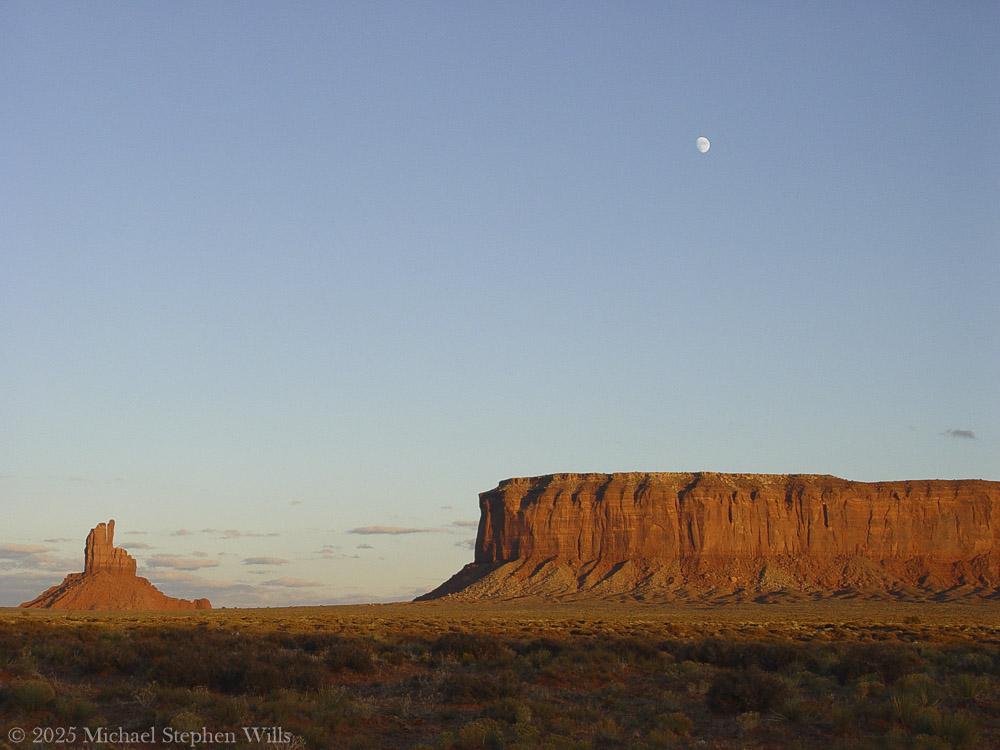
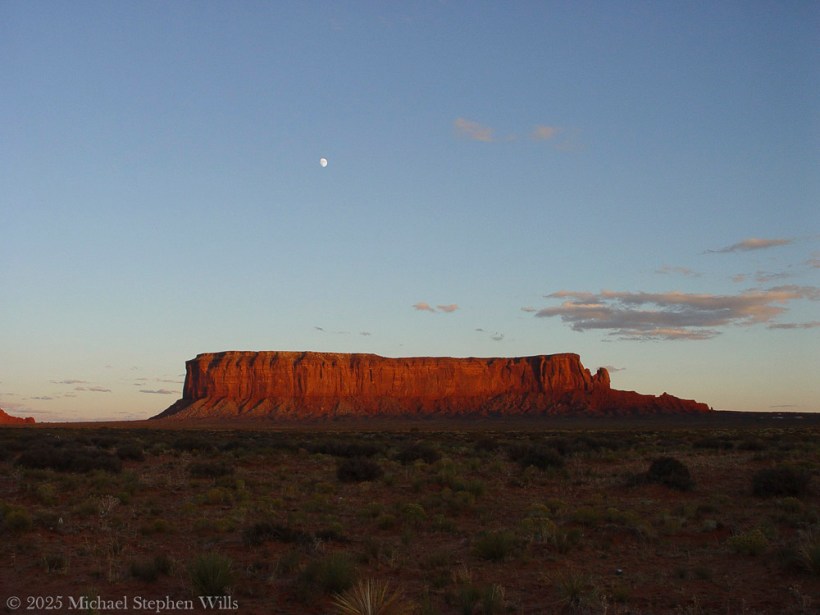
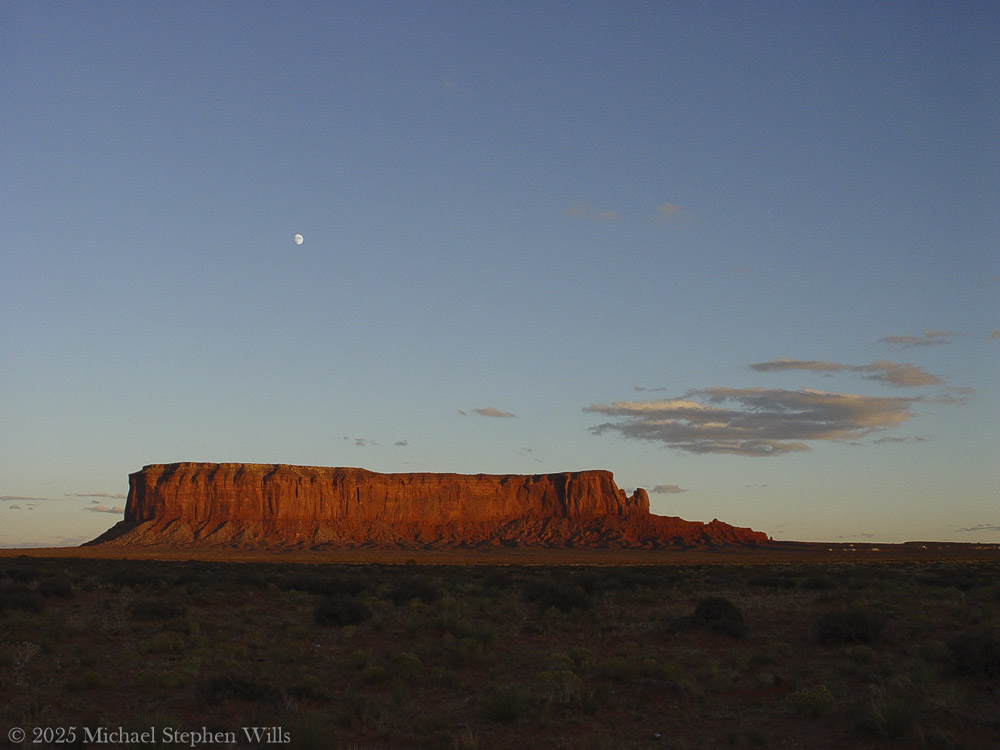
Sentinel Mesa and a slice of Big Indian peak to the left. A risen moon above all.As the day progressed here is Big Indian to the left, a portion of Sentinel Mesa with the risen moon above all
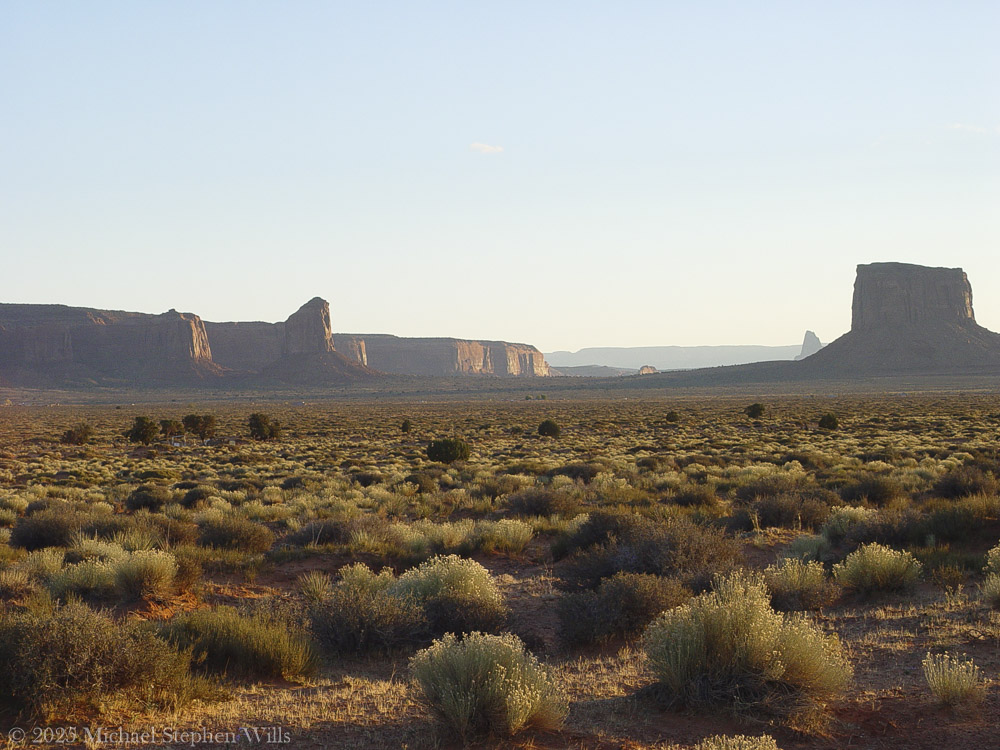
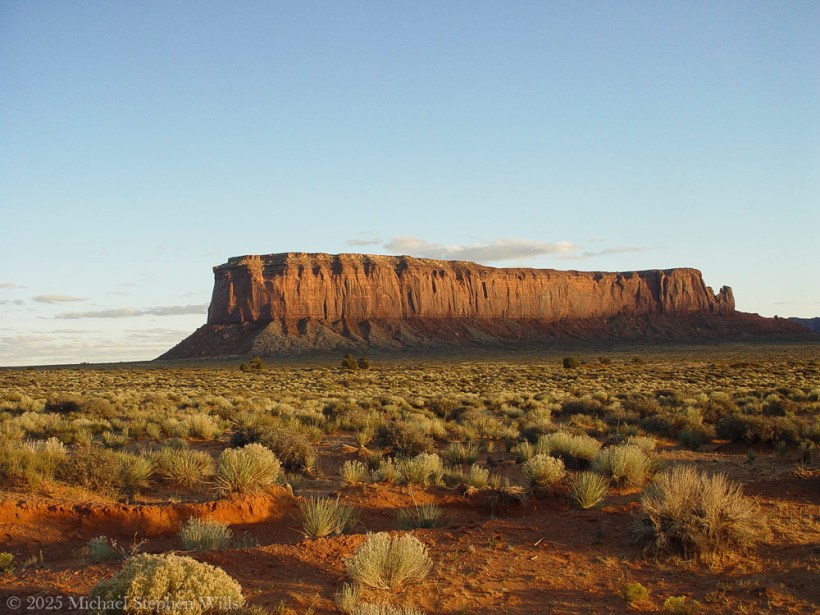
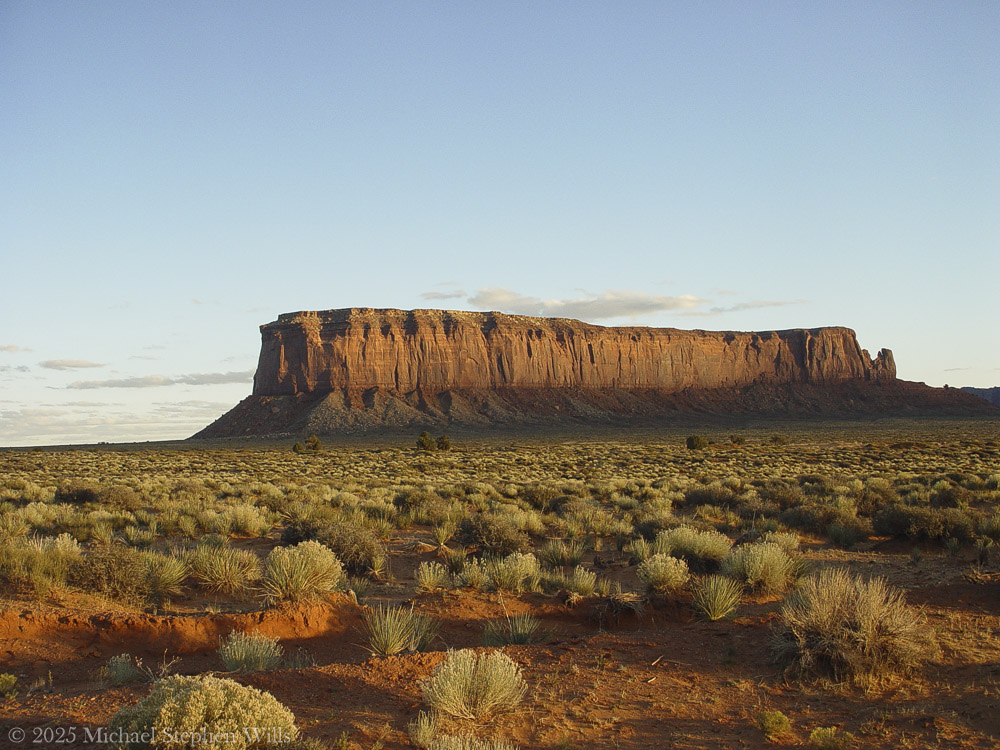
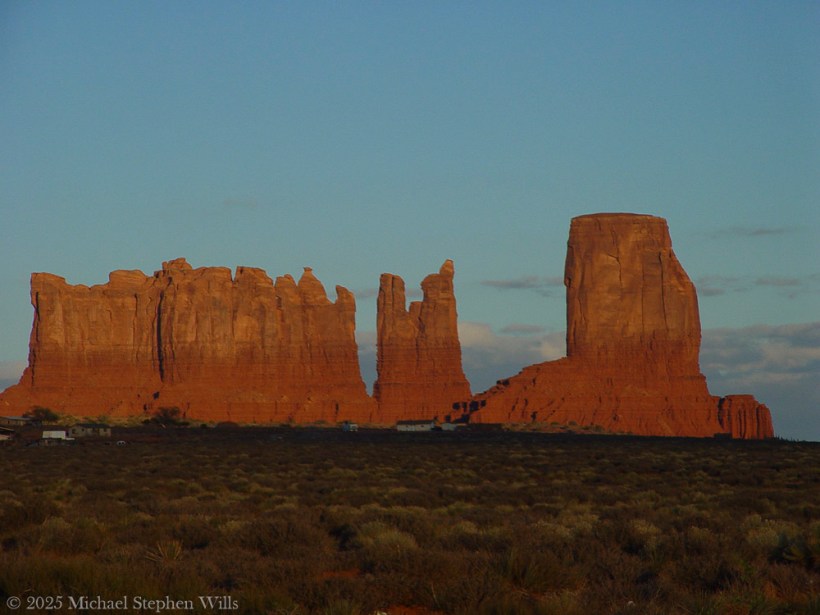
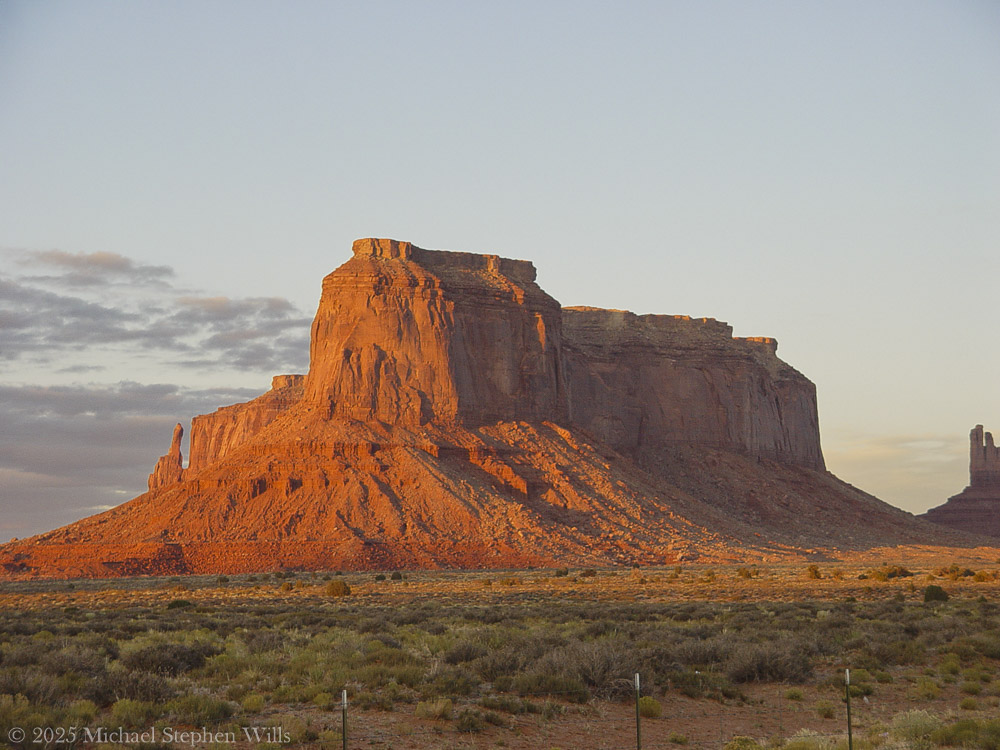
To the east, Sentinel Mesa rose broad and dark, its flat summit catching the last aureate light. The mesa loomed like a great natural battlement guarding the valley’s entrance. Aside, a solitary pinnacle known as the Big Indian stood in muted vermilion hues. In profile it did resemble a weathered face—a monumental visage gazing eternally south over the sacred lands. Farther south, Mitchell Butte jutted upward, its sheer walls burnished red-gold on one side where the sunlight still lingered. A mile or so southeast, the land climbed again to the massive bulk of Mitchell Mesa, now mostly in shadow. The sun was dropping behind it, outlining that mesa’s far rim in a halo of pale fire. Near to Mitchell Butte, a tall slender Gray Whiskers Butte rose like a lonely watchman. Its pinnacle was streaked with dusk, the stone fading from blood-red at its base to a somber gray at its crown. One of the men pointed toward it silently, and the other simply watched, understanding the unspoken thought: how small they were below these giants of rock.
Mitchell Butte, Grey Wiskers Butte and Mitchell Butte
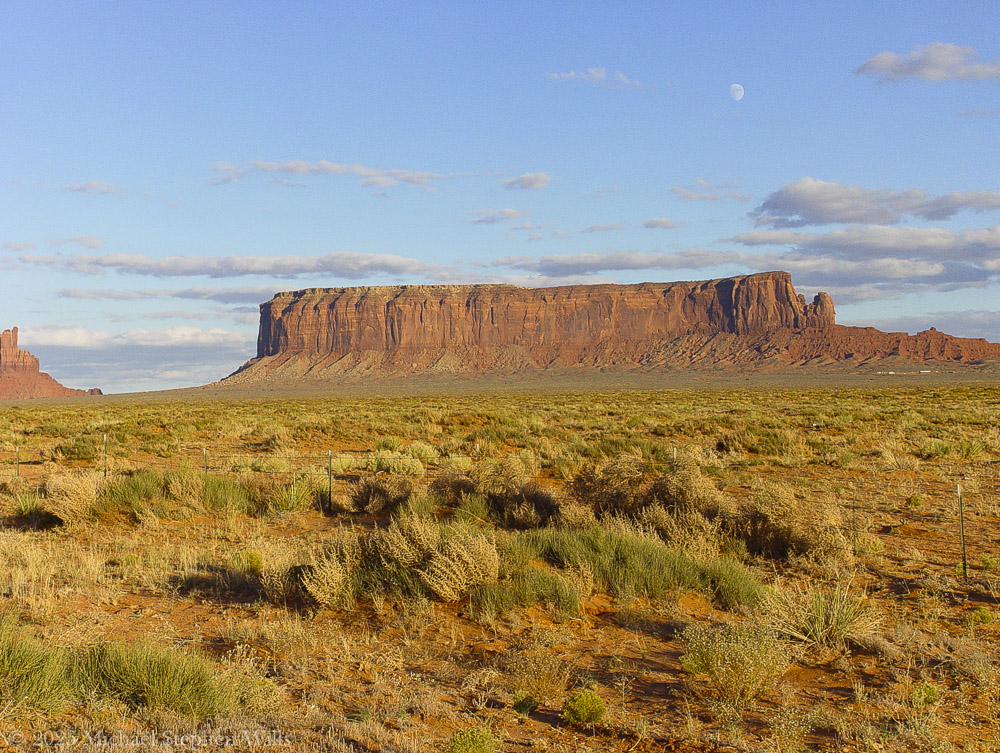
High above Sentinel Mesa, the evening swan of this desert had already appeared — a waxing moon, nearly full and ghostly white. It floated just over the mesa’s dark crown as twilight gathered, like an omen or a blessing. The sky behind the landforms had begun to take on the deep indigo of coming night. In the east, opposite the dying sun, the heavens were lavender and faintly banded with pink. The moon climbed in silence, gaining strength as the sun bled out in a final flare of vermilion along the horizon. In that half-light the mesas and buttes became blackened shapes, cut from the twilight itself, their identities merging with the land’s dusk. November’s chill crept in with the dark. The younger man drew his jacket closed. Neither of them had thought to speak for minutes now. They simply wandered a few yards from the truck, eyes turned outward and upward, silhouettes of their own against the dimming day.
Sentinel Mesa with risen moon
His companion nodded. He opened the door and stepped out. “Never seen anything like it,” the younger man said. His voice was reverent, almost a whisper. The driver climbed out too, boots crunching on red grit. They walked a few paces from the road, drawn forward as if on a tide. The evening air was cool and carried a dry, dusty scent tinged with sage. In the far distance, the monuments cast long blue shadows over the valley floor. The travelers stood for a long moment without speaking, each alone with the scale of it.
The land was vast and inscrutable. In the silence it felt holy. It was easy to believe no one else in the world existed at this hour — only these two and the ancient valley spread before them. The wind came from the west in a long sigh, carrying the dust of the desert. It whispered through dry bunches of brush at their feet and stirred a lonely tumbleweed across the cracked earth. The younger man removed his hat and ran a hand through his hair as if to assure himself this was real. The older man stood with thumbs hooked in his belt, head tilted back to drink in the view. His face was lined and still, the dying light painting one side in gentle umber. If either man harbored any burdens or regrets from the road behind, the land seemed to dwarf those worries into nothing. They felt themselves small as insects on an endless painted floor.
After a time, the driver cleared his throat. “We’ll lose the light soon,” he said. His voice was low. He seemed unwilling to break the spell with anything louder.
The younger man nodded again but did not take his eyes off the valley. “Just a few more minutes,” he replied.
“All right.” The driver smiled thinly and pulled out a cigarette. He struck a match and cupped it against the breeze, the brief flame reflecting in his narrowing eyes. In the glow of the match the canyons of his face showed for an instant, then vanished into shadow again. He drew in and exhaled a plume of smoke that the wind instantly seized and unraveled. Sentinel Mesa crouched out there like a great shadow, crowned now by a silver moon that grew brighter by the minute. The older man followed that mesa’s outline with his eyes, tracing the crenellated cliffs and the slope of rubble at its base. “They named that one right,” he said, mostly to himself.
“What’s that?” the other asked softly.
“Sentinel. Standing guard.” The driver gestured with the glowing tip of his cigarette. “Feels like it’s been watching this place forever.”
Sentinel Mesa standing guard with the red desert floor and fauna in the last light of sunset
The young man considered the hulking form of the mesa. In the twilight it did have the aspect of a watchtower keeping vigil over the valley. “It probably has,” he said. “Long before we ever came.”
On the road behind them a faint glint of chrome from the hood caught a stray moonbeam.
The younger man broke the long quiet. “You ever been down here before?”
The older man nodded. “A time or two.”
“You see all this then?”
A chuckle from the older man, low in his throat. “Not quite like this. First time I come through here I didn’t see a damn thing.”
The younger man looked over, puzzled. “What do you mean?”
“Well,” the old man said, “I’d been driving since Durango, and I’d run out of good sense somewhere near Shiprock. Rolled in with the rain. Thought I’d catch a nap and wake up to a postcard.”
He paused, lighting another cigarette, letting the flame flicker in the cooling breeze.
“Only I parked across from a big ridge in the moonless dead wet dark, didn’t think much of it. Woke up next morning to what I thought was the edge of a landfill. Just a big wall of brown rock. Figured I took a wrong turn and ended up behind a gas station.”
The young man laughed. “You’re kidding.”
“Nope. Got out, stretched, cursed the road and the view and the whole damn state. Got out to take a leak, figured I’d head on. And just as I’m zippering up, I look to the right—and there it is.”
He waved his hand toward the black outline of Mitchell Mesa, vast and solemn in the moonlight.
“The whole valley,” he said. “Caught me sideways. I parked blind to all of it. Missed the whole show.”
He shook his head, the cigarette ember glowing orange.
“Spent the next half hour cussing myself out. Sat there red-faced with a thermos of cold coffee like a man at the symphony who showed up deaf and late.”
The younger man laughed, full-throated now. “You mean to tell me you slept in Monument Valley and thought you were behind a gas station?”
The old man shrugged. “In my defense, it was cloudy.”
They both laughed then, the sound rolling out over the scrub and rocks and into the vastness.
He walked a little farther from the road, and the older man paced beside him. Ground crunching underfoot, fine dust kicking up around their boots. They ascended a slight rise where the terrain leveled off in a broad expanse leading toward the valley proper. Beneath their feet the earth was soft and powdery—red earth, lit now by the dim purple of dusk and the growing lunar light. The younger man scuffed the toe of his boot in it, and a little crimson cloud rose and drifted away. By daylight this soil was a vivid rust-red, the color of dried blood. It was as if the ground itself had a memory of violence or sorrow, but the truth of that color was simpler and older: the iron in the earth, left behind by ancient oceans, oxidizing over eons in the sun and airen.wikipedia.org. The land bled red because the very minerals of its making had rusted in the long passage of time. In places the valley floor was cracked clay, in others loose sand, all part of the same great story of stone turned to dust.
The two men walked out a bit further into the open, where scattered plants clung to life in the hardpan. There were low shrubs of sagebrush exuding a faint herbal scent, and clumps of purple sage with gray-green leaves, their summer blooms long spent. Here and there jutted the spiky forms of yucca, bayonet-tipped leaves fanning out from the base of each plant. Most everything that grew here hugged the ground and wore the dusty colors of the soil. In the failing light, the sage and grass tuft looked almost colorless, pale as ash. Only when lightning storms rolled through would the desert briefly bloom green; in these dry weeks of autumn the vegetation lay dormant, patient. A scraggly juniper tree crouched in a shallow gully nearby, twisted by wind and drought, its bark bleached where it faced the sun. These were the survivors of an unforgiving climate – rabbitbrush, snakeweed, hardy shrubs that lived on almost nothing. The young man knelt and pinched a bit of sage between his fingers, releasing its sharp fragrance. This smell, to him, was the perfume of the desert itself.
In the sand at the base of the sagebrush, he noticed a faint track. He brushed aside some dust to reveal the imprint of tiny claws: the delicate spoor of a lizard that had passed earlier when the ground was warm. It wound off between the rocks and vanished. Other tracks crisscrossed subtly in the dirt – a jackrabbit’s long-toed prints, nearly indistinguishable amid scuffs, and the delicate imprints of some small bird that had hopped about pecking for seeds. Life was here, though it was seldom seen. A red-tailed hawk wheeled silently high above, cutting black circles into the dim sky. Perhaps it was hunting one last time before full dark. The younger man stood again and looked out over the valley with new wonder, realizing that countless creatures lived and moved in this terrain largely unseen. In the daytime heat they sheltered in burrows and shadow. At dusk they came forth. He imagined a coyote trotting through a distant wash on soft paws, nose to the ground; a mule deer picking its way among these rocks somewhere beyond sight; a mountain lion watching from high up on a ledge as it had watched all afternoon. This desert did not easily give up its secrets, but they were there.
The older man stepped out onto a broad flat of rock and ground his cigarette butt under his heel. In the silence his companion could hear the scrape of boot leather on stone. The rock was part of an exposed slab that had broken off from a greater outcrop. It sloped gently down into the valley and was strewn with fine gravel from its own slow decay. The driver pressed his bootsole into a brittle crust of the rock’s surface, and it crumbled with a dry sound. These monoliths around them were not as immutable as they looked. Wind and rain had been gnawing at them for ages uncounted. Every thunderstorm that swept these flats cut new gullies in the shale, undercutting the bases of the cliffs. Every hot summer day the rock expanded, and every cold night it contracted, fissures growing by imperceptible degrees. Water trickled into cracks and ice pried them wider in winter. In time, great slabs would calve off with a roar and a billow of red dust, adding another heap of boulders to the talus at a butte’s feet. The valley was strewn with such piles like fallen ramparts. Erosion was the master sculptor here, patient and inexorable, chewing away the softer rock beneath and leaving the harder stone standing in great towers and tablelands. Each butte, each spire, had endured unthinkable ages to remain in this moment as a seemingly permanent fixture—and yet they too were slowly disappearing grain by grain. In a thousand years the difference might be subtle; in a million, perhaps these forms would be gone entirely, ground down to the flatness of the surrounding plain. The land was alive in geological time, though to human eyes it appeared frozen in a grand and silent repose.
They wandered farther, and now the truck was a small shape behind them on the roadside pullout. Neither man minded. The road was empty; no other vehicle had come along for a while, and only a lone set of headlights glimmered many miles away, moving slowly, probably a rancher or a late tourist heading home. The two travelers were alone with the land and sky. Overhead, the first stars were coming out in earnest, timid specks appearing in the dome of night. The moon was higher now and bright enough to cast shadows. The tall profile of Big Indian was cut into the moonlit sky, unmistakable and solemn, and on the valley floor the leaning spire of Gray Whiskers stood lit on one side by the cold glow. Away to the east, the open desert beyond the valley was falling into darkness, a great stretch of unknown country into which the highway disappeared. And still the west flared with afterlight — a band of deep red on the horizon, fading to gold, then greenish and up into the endless blue-black. It was a sky that seemed too vast for the world.
The younger man found a boulder at the edge of the flat and sat down. He removed his hat and set it beside him. The stone felt cool now under his legs. The heat of the day had fled so quickly that the air itself seemed to crackle with cold. He drew a deep breath and let it out. The land gave back only silence. A great and ageless solitude reigned here, the kind that makes its home in deserts and high places where man has no authority. He could feel it pressing in, not unkindly. It was the solitude of a world largely unchanged long before humans and likely long after. Under that eternal sky and the gaze of those stony sentinels, their own lives felt momentarily trivial. Yet the feeling was not bitterness or despair. Rather, it was humbling and strangely reassuring, as if all the griefs and triumphs that had ever marked a human life were nothing next to the calm presence of these rocks. The earth endured. The earth would always endure. Time and wind would wear down even mountains, but until then these mesas would keep witness over the days and nights, the storms and still mornings, the generations of men who came wandering through seeking something larger than themselves.
The older man walked over and eased himself down on the same boulder. He groaned softly as he sat, rubbing one knee. They both looked out over the emerging night. For a long while, neither spoke. Far in the distance, a coyote yipped — a brief, high sound, then silence again. The younger man smiled in the dark.
“The cold is coming fast,” the older man said after a time.
“Yeah. It does that quick out here.” He picked up his hat and dusted it off, though no dust truly could be kept off in this country. Dust was the true sovereign of the valley — red dust that coated boots and clothes, that hung in the air at midday, that settled on skin like a fine powder. It would ride back with them in their vehicle no matter how well they shook their coats. It had a way of clinging on, a reminder of where one had been.
“You ready?” with a tilt of his head back toward the truck.
The younger man took one last sweeping look over Monument Valley. The forms of Sentinel Mesa and its neighbors were nearly indistinguishable from the dark of the sky now, save where the moonlight etched a line or two along a cliff. The valley floor was lost in shadow. In the east, a few scattered clouds caught a faint silver luminescence from the risen moon. The beauty of the scene was stark and almost aching — a kind of beautiful emptiness that a man carries away inside him, knowing he has witnessed something that can never properly be told. He opened his mouth as if to speak, but no words came. Instead, he simply nodded and got to his feet. They began walking back toward the truck, side by side.
Behind them, the desert night continued its slow unfurling. One by one, stars pierced the darkness. The moon climbed higher on its silent arc. The great stone silhouettes stood unchanged, as they had through countless nights. In a few hours the dawn would come and paint them in rose and gold once more. But for now the valley slumbered under the pale glow of the moon. As the two men reached their vehicle and the engine turned over, its headlights flaring to life, they took one last look across the plains of Monument Valley. Then the truck pulled back onto the highway and receded down the lonesome ribbon of asphalt, two red taillights diminishing and finally vanishing into the boundless Navajo night. The land remained as it was, vast and indifferent to their departure. Sentinel Mesa and Mitchell Mesa stood like opposing pillars at the great gateway of the valley, keeping their eternal watch. The wind sighed over the road and across the sleeping rocks. The footprints the men had left were already beginning to blur with settling dust. Above, the indifferent stars traveled their courses. And the red earth of the desert stretched away in all directions—ancient, patient, and still, beneath the enduring sky.
Enter your email to receive notification of future postings. I will not sell or share your email address.
Copyright 2025 All Rights Reserved Michael Stephen Wills
Here is a journey to Brigham’s Tomb in Monument Valley, reflecting on the land’s timelessness, silent presence, and the profound connection between the observer and natural formations.
He did not come seeking answers, nor was he lost. The road had summoned him—as it had summoned others before him—and he followed its arc with the steadiness of one who does not hurry time. The sun was descending behind him, slow and inevitable, casting long golden blades across the plateau. That was how it wanted to be seen, and he did not interfere.
He had come this way before in dreams, further south where the great stone mittens reached into the sky. There, the land had risen in clarity, each formation distinct in its declaration. But now the evening had deepened, and the land changed its tongue. It spoke more slowly. With greater weight. And he listened.
The air was thin with silence. Even the wind moved differently here—more cautious, more reverent. And then the shapes came into view. Not suddenly, but as if they had always been there and were only now permitting themselves to be noticed.
Here stood Brigham’s Tomb.
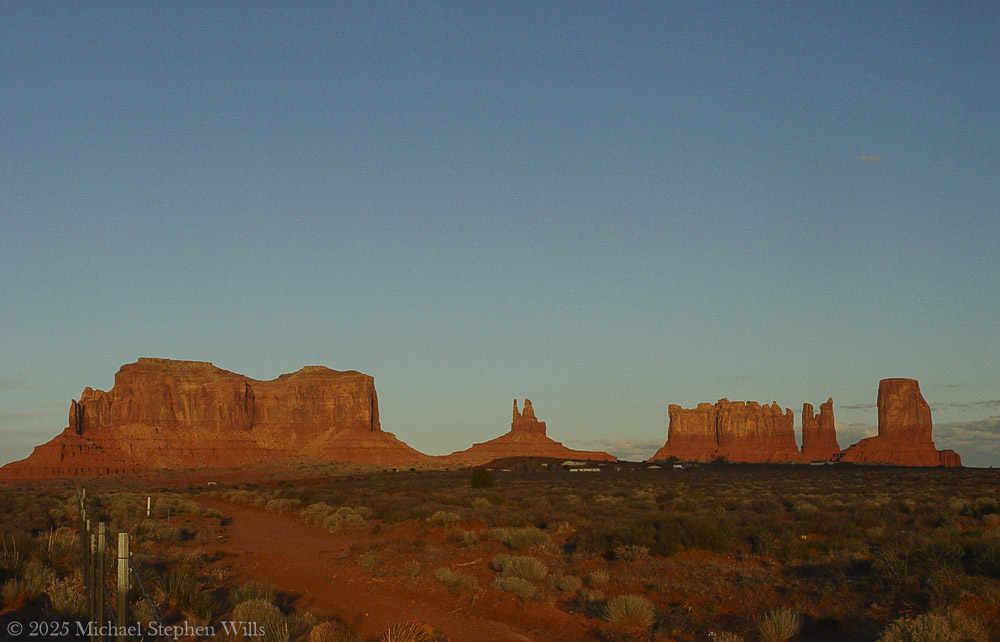
On the way to Monument Valley Tribal Park as the sunset for this view on Sullivan Road (Route 163). Navajo County, Arizona. Brigham’s Tomb. On the way to Monument Valley Tribal Park as the sunset for this view on Sullivan Road (Route 163). Navajo County, Arizona. Brighams Tomb is situated six miles (9.7 km) northeast of Oljato–Monument Valley, Utah, on Navajo Nation land. It is an iconic landform of Monument Valley and can be seen from Highway 163. Precipitation runoff from this landform’s slopes drains into the San Juan River drainage basin. Topographic relief is significant as the summit rises 1,000 feet (305 meters) above the surrounding terrain in 0.25 mile (0.4 km). The mountain’s name refers to Brigham Young, the first governor of the Utah Territory. This landform’s toponym was officially adopted/revised in 1988 by the United States Board on Geographic Names after having been officially named “Saddleback” from 1964 through 1987. Some older maps will still show the Saddleback name.
Geology
Brighams Tomb is composed of three principal strata. The bottom layer is slope-forming Organ Rock Shale, the next stratum is cliff-forming De Chelly Sandstone, and the upper layer is Moenkopi Formation capped by Shinarump Conglomerate. The rock ranges in age from Permian at the bottom to Late Triassic at the top. The buttes and mesas of Monument Valley are the result of the Organ Rock Shale being more easily eroded than the overlaying sandstone..
It rose alone, square and solemn, its flanks pressed by the last warmth of the day. The light traced every fracture, every line of sediment like the spine of something ancient and vast. It had no vanity. Its strength was in endurance, in the simplicity of mass. The world had spun uncounted times around this throne of stone, and still it stood—unmoved, unwitnessed except by sky and the slow-growing desert at its feet.
He paused there—not because he was uncertain, but because the monument required it. Some things must be received in silence.
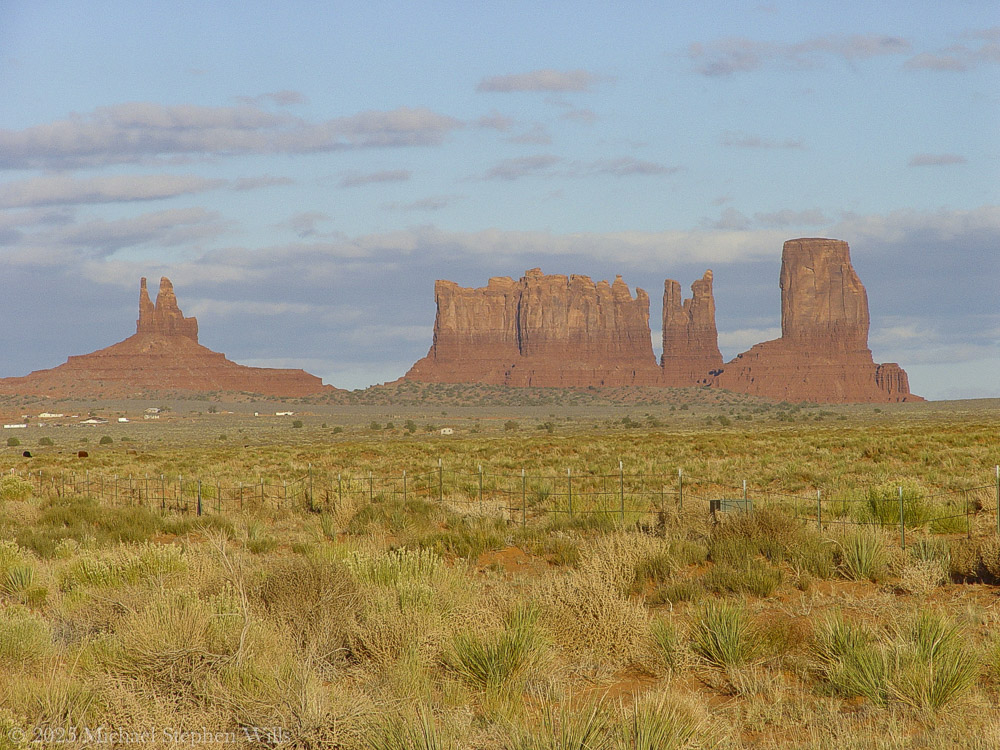
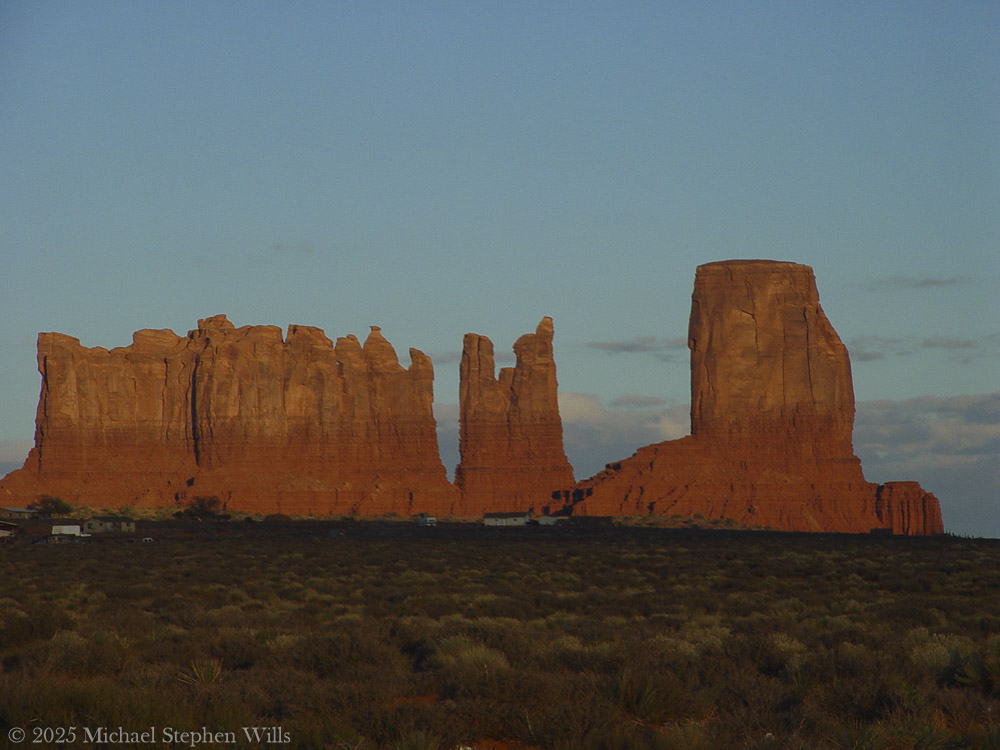
Their topographic relief is significant: Stagecoach rises 900 feet (274 meters) above the surrounding terrain in 0.35 mile (0.56 km), while King-on-his-Throne rises 565 feet (172 meters) in 0.2 mile (0.32 km). Each butte’s toponym has been officially adopted by the United States Board on Geographic Names—Stagecoach is named for its resemblance to a stagecoach, and King-on-his-Throne is said to resemble a monarch surveying his domain. Stagecoach’s first summit ascent was made in 1995 by John Middendorf, Carl Tobin, and Dan Langmade; King-on-his-Throne’s first was in 1967 by Fred Beckey, Marlene Dalluge, Joe Brown, and Don Liska.
To the southeast, past a stretch of ochre earth and sagebrush, rose two more forms. The King on His Throne, upright and proud, shaped as if he had emerged from the stone itself to bear witness. An artifact of erosion, also a sovereign presence—crowned in shadow and wind. There was no question of who he was. His seat was eternal, and no rider passed without first meeting his gaze.
Beside him stood The Stagecoach. Its resemblance to the name was almost too perfect, as if the form had stepped from the myth fully formed. But he knew better. It had not become a stagecoach. The coach had become it. The names were backwards, as names often are. The land had come first. All else was echo.
The giants stood together across the basin, their red-gold skin kindled in the last light. Their arrangement was no accident. One rose alone. Two more aside, bound by rhythm but not repetition. Together they formed a sequence—pause, proclamation, passage.
He walked the trail slowly, camera at his side but silent for a long while. There were things beyond framing. This was not a scene to be taken. It was a truth to be approached.
At the edge of the frame—a photograph not yet taken, but inevitable—the fence stretched taut across the scrub. Old wood. Rusted wire. Man’s line scratched against the land’s permanence. It held nothing. It said nothing. But it was there, and so he acknowledged it, as one acknowledges a child’s drawing pinned beside a mural.
Overhead, the sky was deepening into steel. But the earth still burned, even gently. The buttes and mesas were not dimmed by dusk. They only leaned inward, as if the heat of the day had carried them toward some great remembering.
He had seen many monuments in his life, but these were not monuments in the human sense. These were not built. They were born. They had no need for marble or inscription. Their gospel was in their silence, their liturgy the erosion of time itself.
He stood long, unmoving.
Not lost. Not searching. Just witnessing.
As the light slipped and the forms began to release their edges to shadow, he turned once—not away, but forward. The road still called. And the giants behind him did not diminish. They merely remained, as they always had, and always would.
Waiting.
Enter your email to receive notification of future postings. I will not sell or share your email address.
Copyright 2025 All Rights Reserved Michael Stephen Wills
San Xavier del Bac in the Sonoran desert embodies a fusion of indigenous and Spanish symbolism, showcasing devotion through art and imagery that evokes faith, beauty, and spiritual connection.
In the Sonoran Desert near Tucson, Arizona, San Xavier del Bac rises like a vision out of time. Within its adobe walls and domed ceilings lie layers of symbolism—an indigenous inheritance and Spanish colonial fervor merged into a singular living devotion. The photographs presented here, saturated with morning light, guide us through a meditative journey into this mission’s spiritual and aesthetic soul.
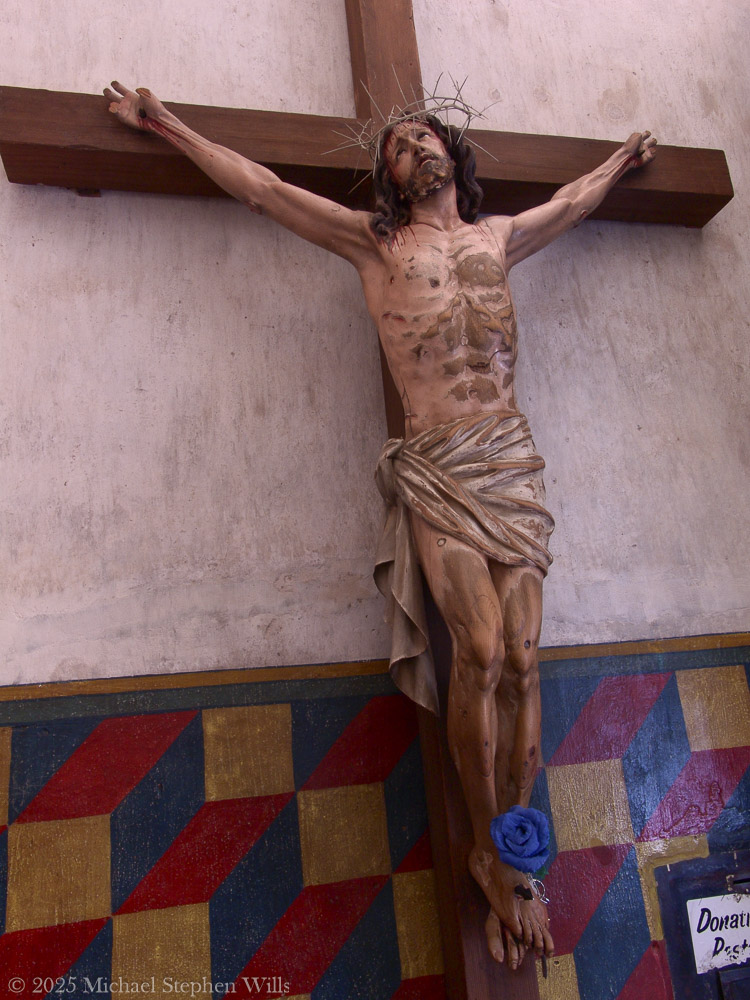
The crucifix dominates the first image—the depiction of Christ crucified, emaciated, bruised, crowned with thorns. His suffering is not abstract but visceral, carved in every wound and strained muscle. This figure of Christ, so brutally human, is draped in a tattered loincloth, a humble covering amid divine sacrifice. At his feet rests an offering: a blue artificial flower, incongruent in its brightness yet perfectly placed, a modern votive that expresses both reverence and continuity. It reminds us that humble devotion endures.
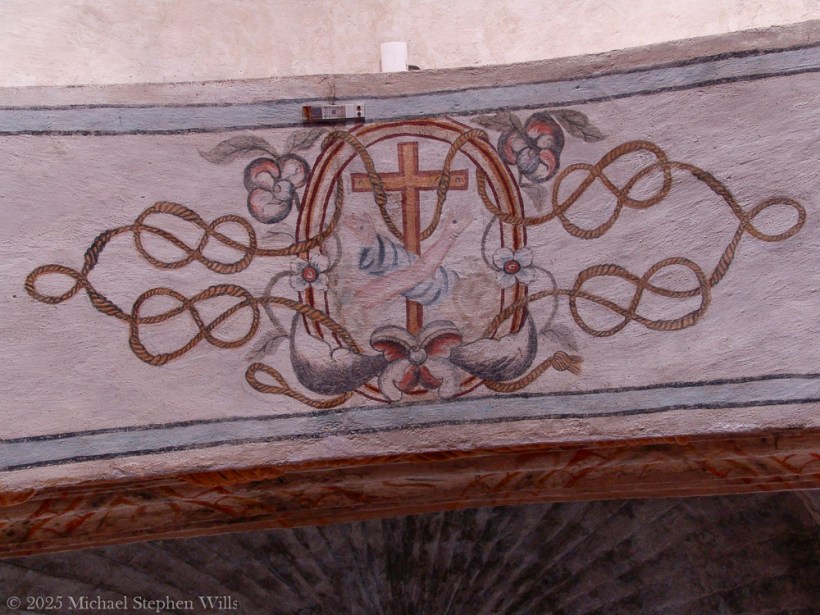
The fresco, with its cross flanked by stylized doves and roses, extends the Passion’s symbolism into sacred geometry. Doves—universal emblems of peace and the Holy Spirit—face one another in symmetrical grace, drawing the eye into the cross they flank. The single length of curling, intertwined golden ropes bind all elements in unity, perhaps reflecting divine infinity. The floral elements speak to rebirth and resurrection, a soft counterpoint to the harshness of the Crucifixion. Here, pain and peace coexist in a visual hymn.
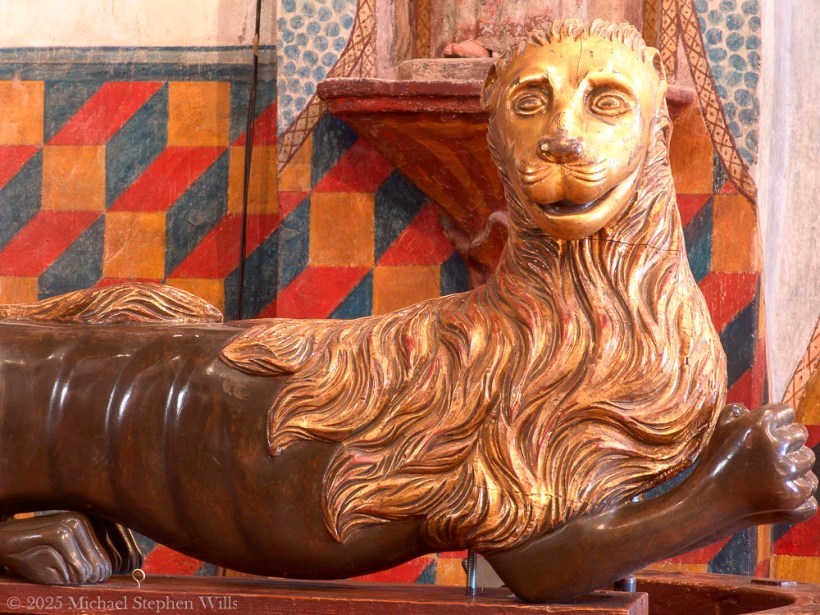
The lion sculpture, oddly cheerful in its golden face, seems at first a puzzle. Yet within Christian iconography, the lion often represents Saint Mark, the Evangelist, or the power and vigilance of God. This lion, rendered with stylized curls and a strong, reclining pose, guards the sanctuary. Its gilded mane mirrors the opulence of heaven, even in this humble desert mission. The lion’s curious gaze invites us to move past fear, toward the mysteries within.
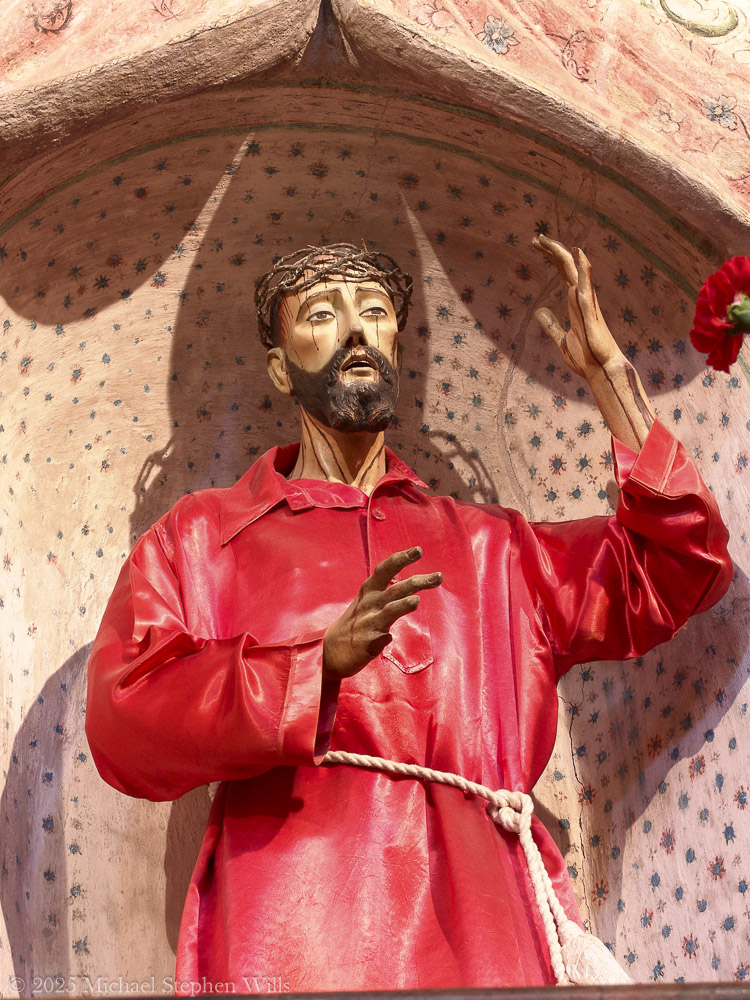
We then meet a robed figure in red—another portrayal of Christ, this time during the Passion, perhaps as the Ecce Homo (“Behold the Man”). His upraised hands and expressive face embody pathos and divine forbearance. The red robe evokes both martyrdom and kingship. He does not plead; he offers. The backdrop is simple but speckled with blue floral motifs, creating a visual bridge to the Virgin’s image nearby.
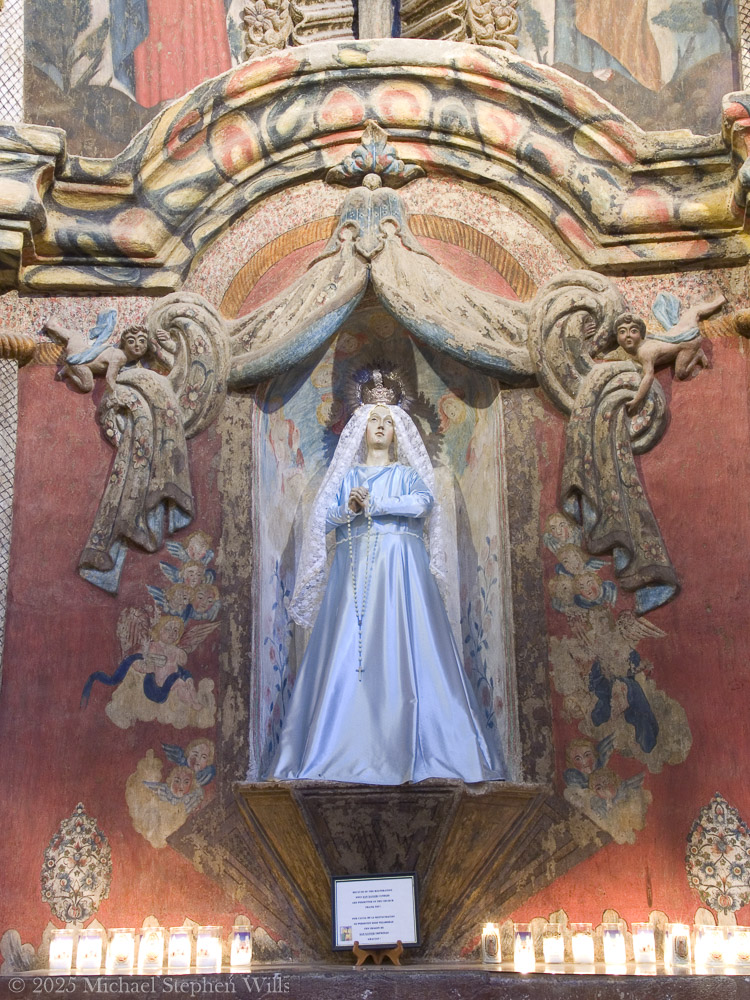
The Virgin Mary appears in blue and white—colors of purity, serenity, and devotion. She stands among votive candles and gazes gently ahead, hands joined in prayer. Her dress flows around her, anchored by a rosary that loops downward like an anchor to the earth. Angels and cherubs flank her in painted stucco, echoing heaven’s embrace. This is not the triumphal Mary of high cathedrals but a deeply human one, a mother, accessible and protective. The candles flickering below affirm that faith is alive here, not simply preserved.
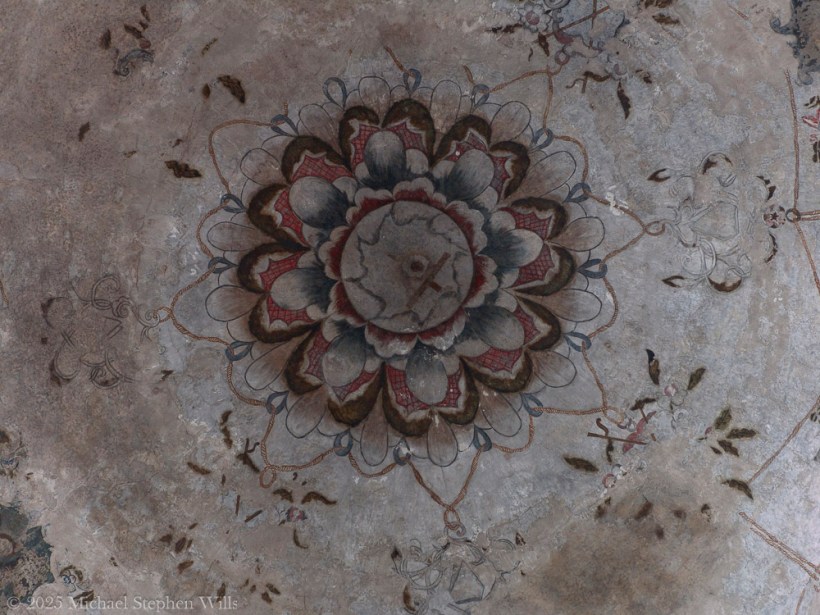
A ceiling medallion next draws us into a more abstract vision. A floral rosette centers on the cross and tools of Christ’s Passion—the nails, spear, and ladder arranged in contemplative symmetry. These instruments of torture are enclosed in beauty, as if the heavens themselves have sanctified the suffering. It is a paradox of faith, this transformation of pain into purpose, death into eternal life.
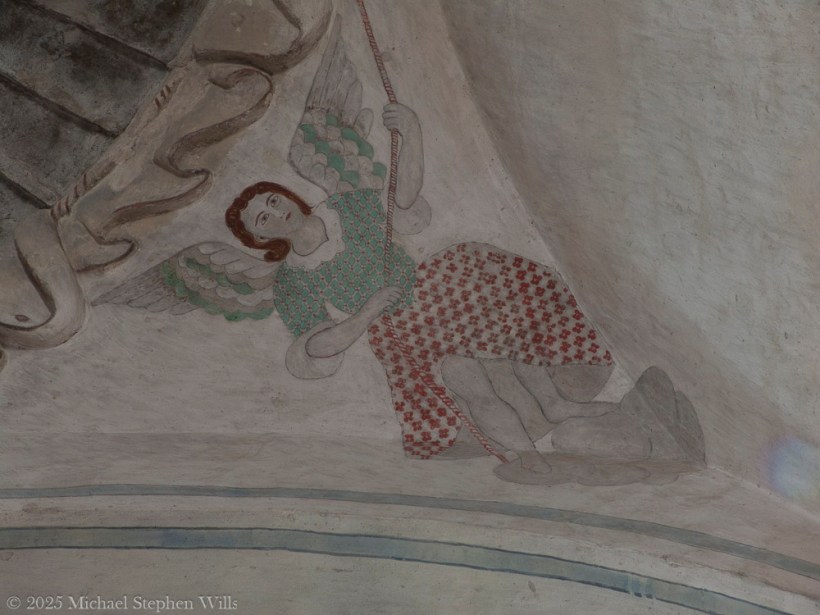
And in the arch’s corner, an angel descends—painted simply, yet with care. The figure pulls at a rope, perhaps to ring a bell or lift a curtain, a symbolic act of revelation or invitation. With wings green and soft, a skirt patterned in red flowers, suggesting femininity, grounding the divine in local textile tradition. The angel bridges the earthly with the divine, echoing the mission’s purpose: to guide and accompany.
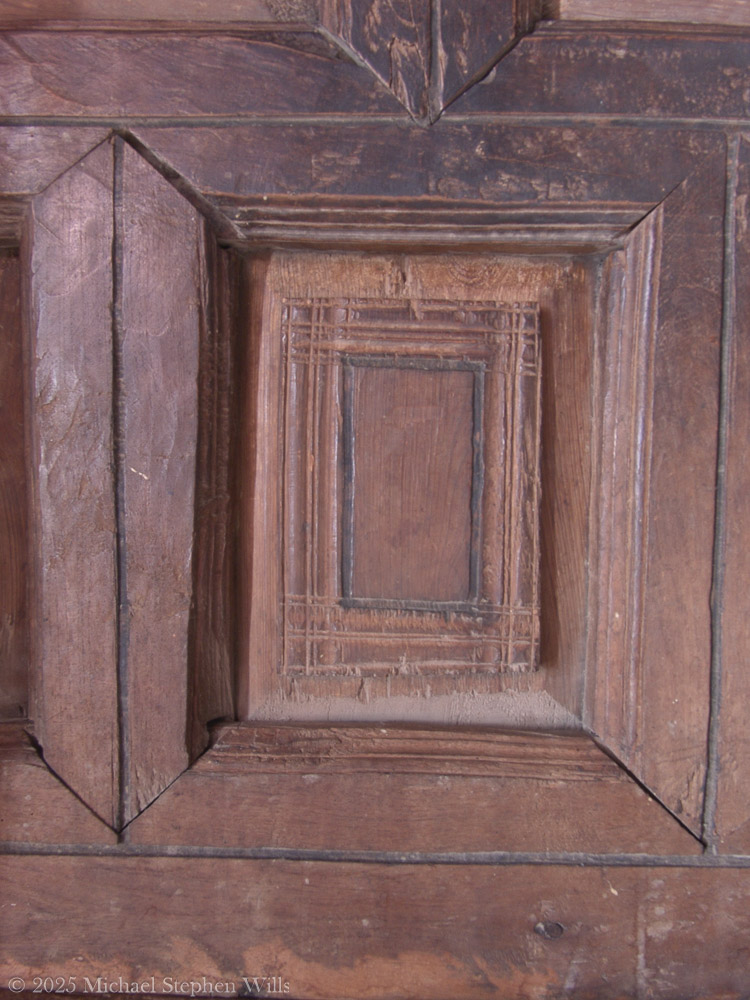
Finally, a carved wood panel—plain, aged, and sacred in its wear. The texture of centuries rests in its grain, the indentations of faithful hands passing by. This is the tactile memory of San Xavier: not only what is seen, but what has been touched, prayed over, believed.
Taken together, these images form a tapestry of devotion, colonial artistry, indigenous fusion, and enduring reverence. San Xavier del Bac is a place where symbols still speak, where color and form do more than please the eye—they lift the spirit. In this space, belief is remembered to be continually reborn.
Enter your email to receive notification of future postings. I will not sell or share your email address.
Copyright 2025 All Rights Reserved Michael Stephen Wills
A father and son journey to Eagle Mesa, experiencing its beauty and silence, reflecting on its history and significance within Navajo culture as the day fades.
They came north out of Chinle with the day already leaning west and the sun fallen low into the drag of horizon dust and the road ran flat and empty past rust hills and mesquite country until, turning into the sun at Mexican Water, after a long hour, at last they pulled into Kayenta where the streets lay quiet under the heavy sun and the windows of the store fronts cast their amber light out across the sand drifting across sidewalks and the wind stirred only faintly and then was still.
They left their bags in the room and turned north again without speaking. The son drove. A man, his father, sat quiet beside him and the sun slid low through the windshield and the sky was pale and cloudless and wide beyond reckoning.
The land began to rise and the road bent and climbed and fell again and then it came into view. Not slowly. Not like a curtain rising. It was simply there.
A shape in the far desert.
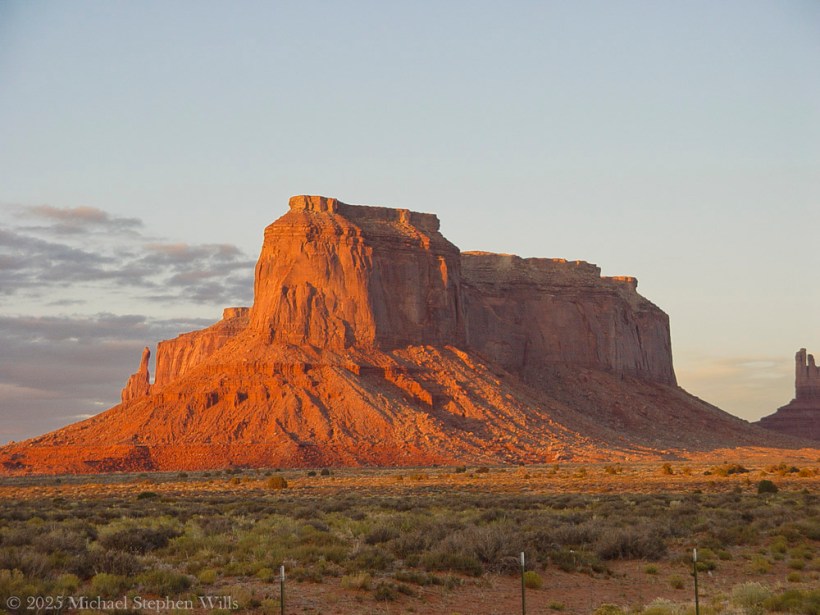
Like a ship that had grounded in a sea long vanished. A sheer mesa the color of blood and ochre and fire where the last of the day spilled westward and caught the rock face and made it burn.
He told the son to pull off. They stopped the car and got out and the sound of the engine fell away, the desert made no sound at all.
The man stood in the road and turned slowly. Eagle Mesa lay before him and the land stretched off in every direction and the fenceposts ran on into silence and the sky seemed to rest upon the buttes as if tired.
There were names for these places. Old names. Navajo names that spoke of eagles roosting and trees once there and water that came and went and did not come again. The mesa they called Wide Rock. The place where spirits go. He did not know the words but he knew the feeling.
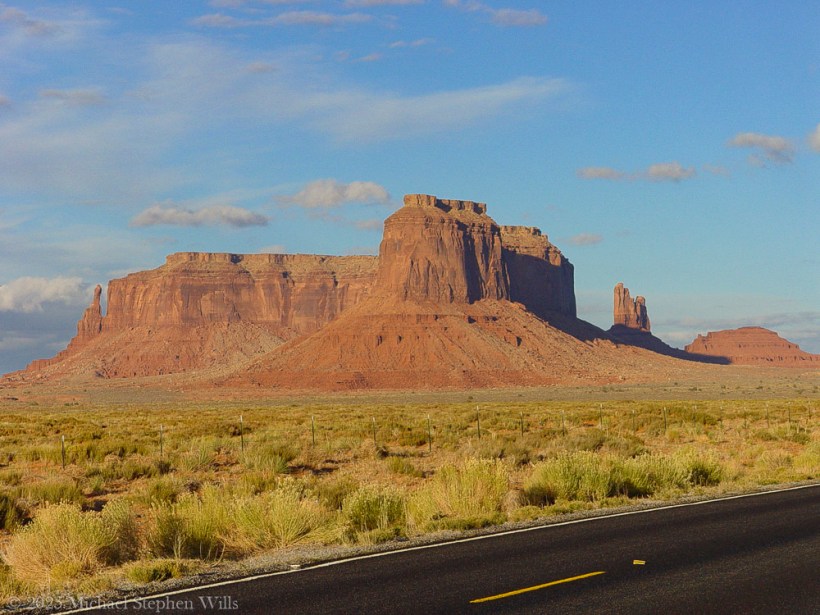
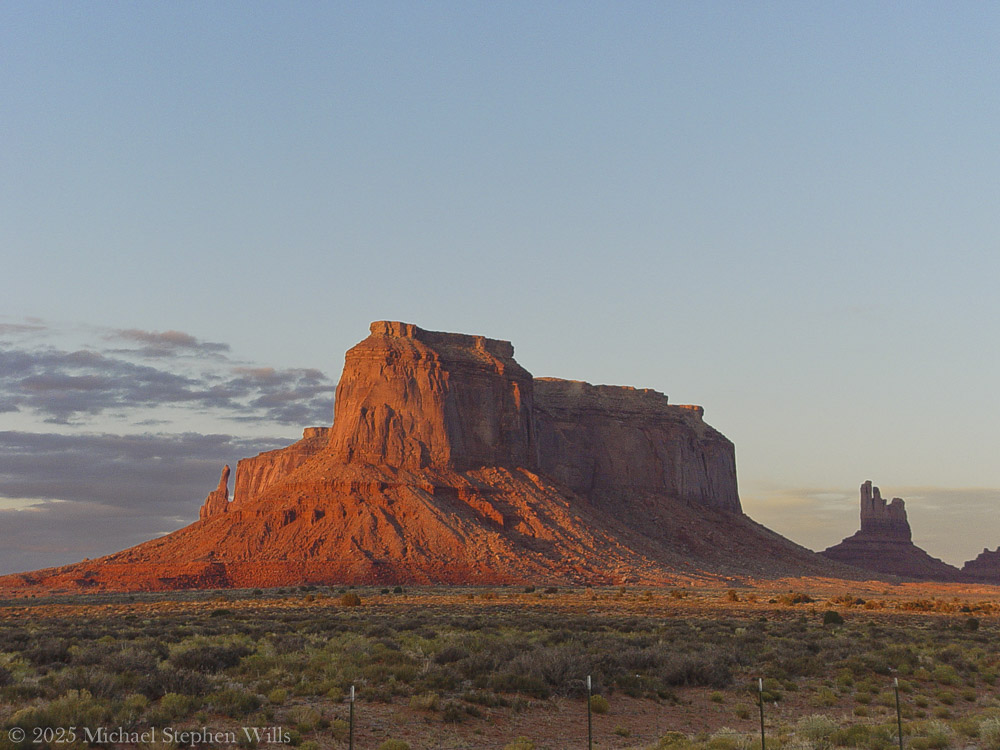
On the way to Monument Valley Tribal Park as the sunset for this view on Sullivan Road (Route 163). Navajo County, Arizona. Eagle Mesa is situated 4.5 miles (7.2 km) northeast of Oljato–Monument Valley, Utah, on Navajo Nation land. It is an iconic landform of Monument Valley and can be seen from Highway 163.Precipitation runoff from this mesa’s slopes drains to Mitchell Butte Wash and Train Rock Wash which are both part of the San Juan River drainage basin. Topographic relief is significant as the summit rises 1,100 feet (335 meters) above surrounding terrain in 0.6 mile (1 km). The nearest higher neighbor is Brighams Tomb, 2.05 miles (3.30 km) to the east. This landform’s toponym has been officially adopted by the United States Board on Geographic Names. Navajo names for the mesa are “Wide Rock”, “Where the Eagles Roost”, “Water Basket Sits”, and “Trees Hanging from Surrounding Belt” because there were once numerous trees here. In Navajo mythology, Eagle Mesa is a place where spirits of the deceased may go. Eagle Rock Spire is a 300-ft tower on the northern tip of the mesa which requires class 5.9 climbing skill to reach the summit.Navajo names for this spire which resembles a perched eagle include “Eagle Alongside Mesa”, “Big Finger is Pointed”, and Tsé Łichii Dahazkani (Elevated Red Rock Sitting Up). The first ascent of the spire was made on April 23, 1970, by Fred Beckey and Eric Bjornstad.
Geology
Eagle Mesa is a mesa composed of three principal strata. The bottom layer is Organ Rock Shale, the next stratum is cliff-forming De Chelly Sandstone, and the upper layer is Moenkopi Formation capped by Shinarump Conglomerate. The rock ranges in age from Permian at the bottom to Late Triassic at the top. The buttes and mesas of Monument Valley are the result of the Organ Rock Shale being more easily eroded than the overlaying sandstone.
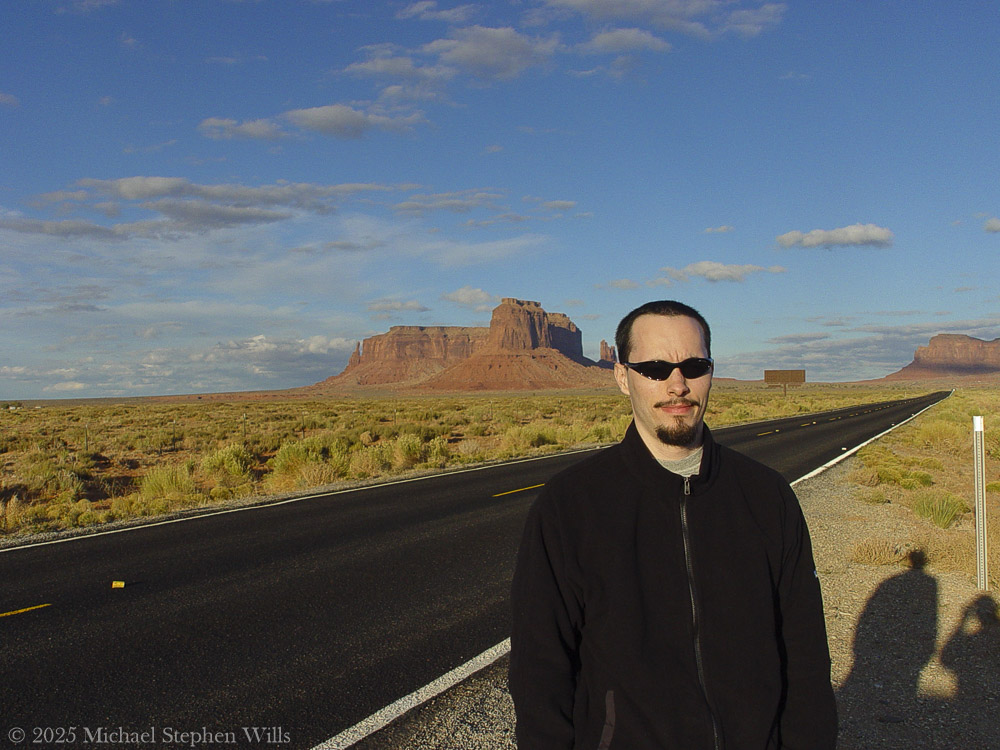
The son came and stood beside him and did not speak. The man lifted the camera and took a photograph and then another. The road behind them shimmered with the last heat of day. He took another picture his son, dressed in black, his arms at rest and the red mesa rising behind him and the shadows of their bodies cast long across the gravel and the shoulder of the road.
On the way to Monument Valley Tribal Park as the sunset for this view on Sullivan Road (Route 163). Behind Sean are the landforms Eagle Mesa and behind it Setting Hen, Bringham’s Tomb, to the right. Navajo County, Arizona
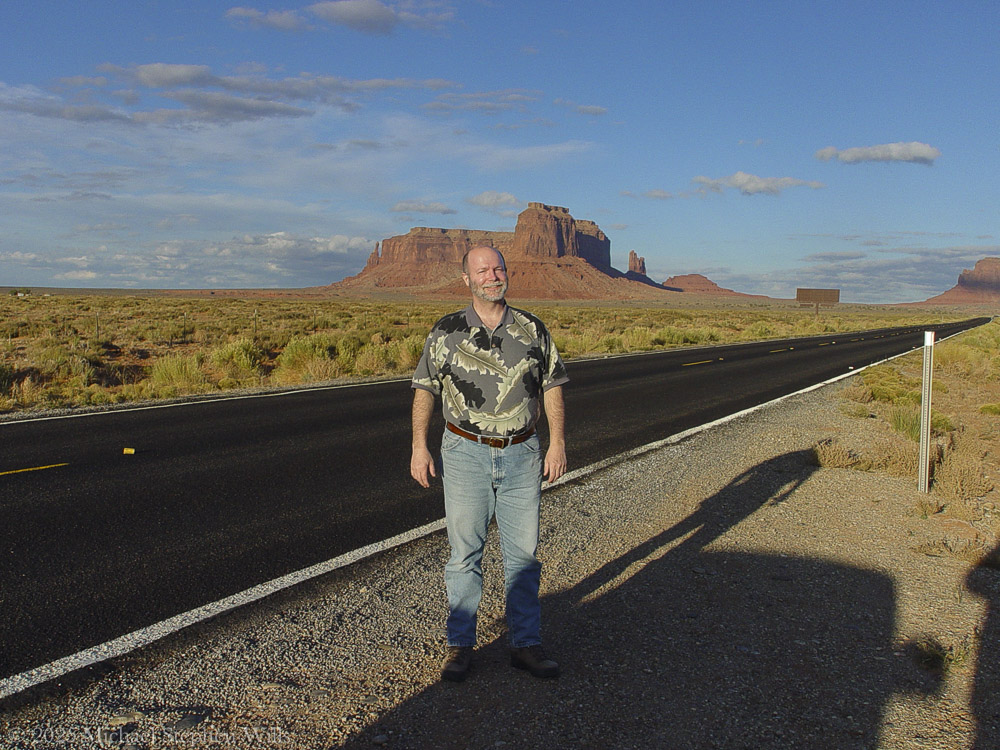
They took turns with the camera. The son caught him midstride and smiling lit by sunlight, the land stretching out all around. A man small in a world not made for men.
There was no sound but the click of the shutter and the dry whisper of wind among the sage.
On the way to Monument Valley Tribal Park as the sunset for this view on Sullivan Road (Route 163). Behind Mike are the landforms Eagle Mesa and behind it Setting Hen, Bringham’s Tomb to the right. Navajo County, Arizona
Later he would read that the rock was born of Organ Shale and De Chelly Sandstone and Moenkopi topped with Shinarump. He would know the spire they saw was first climbed by men named Beckey and Bjornstad and that it was called Tsé Łichii Dahazkani by those who’d named it before it ever had another name. He would know the mesa rose eleven hundred feet in less than a mile and that its runoff fed washes that fed rivers that fed nothing now.
But then he only stood and watched and knew it for what it was.
Not a monument to anything but time.
A stillness like prayer. A place that waits.
They lingered until the sun went and the sky turned iron blue and the shadows of the rock reached out across the valley floor and touched them where they stood. Then they climbed back in the car and drove south again and the road unwound behind them black and a single star above and the silence of the place held on inside them long after the valley was gone.
Enter your email to receive notification of future postings. I will not sell or share your email address.
Copyright 2025 All Rights Reserved Michael Stephen Wills
San Xavier del Bac, known as the “White Dove of the Desert,” embodies rich history and spirituality, blending Indigenous and Spanish influences, while remaining a vibrant community centerpiece today.
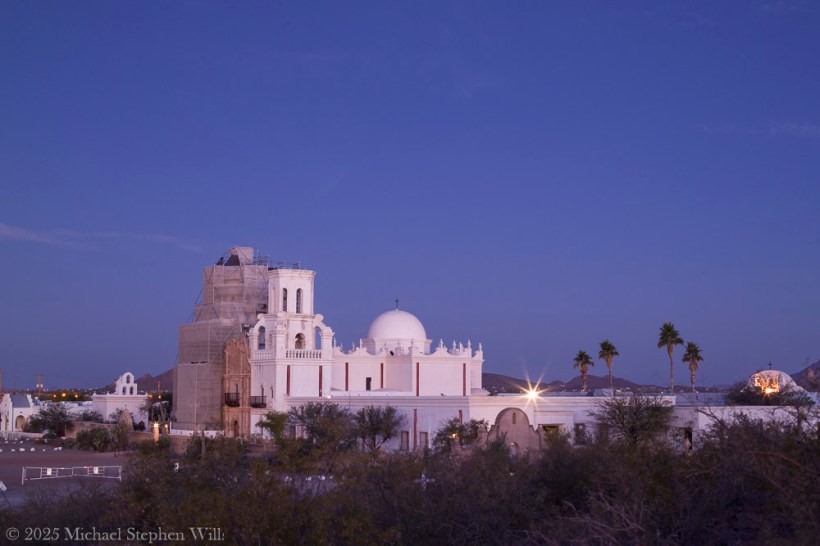
I remember how the rising sun washes the mission’s white adobe walls in soft gold. Mission San Xavier del Bac stands about 10 miles south of downtown Tucson, on the San Xavier Indian Reservation of the Tohono O’odham Nation.
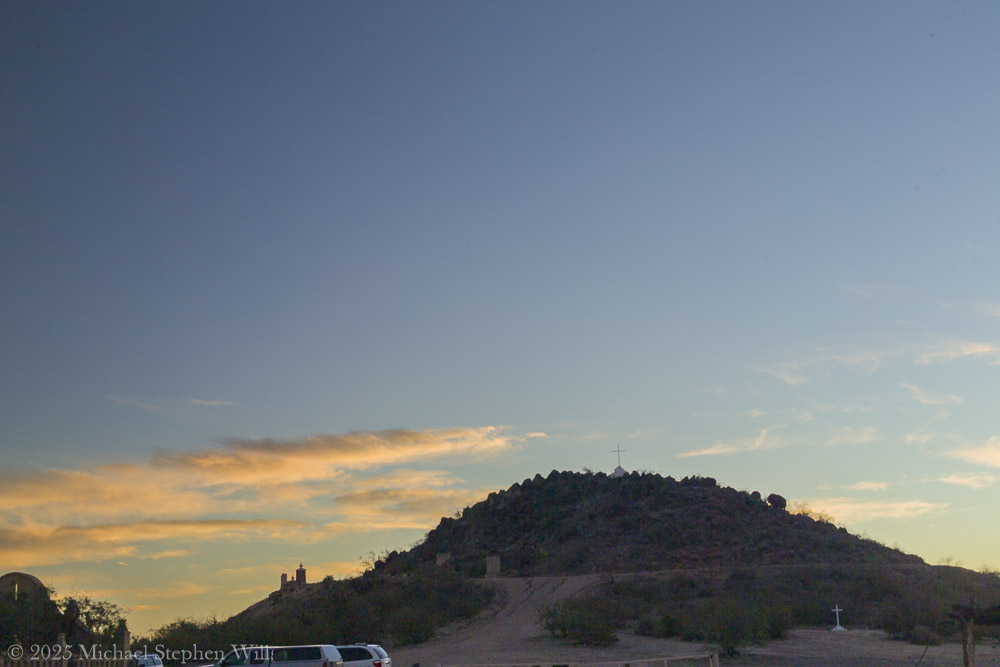
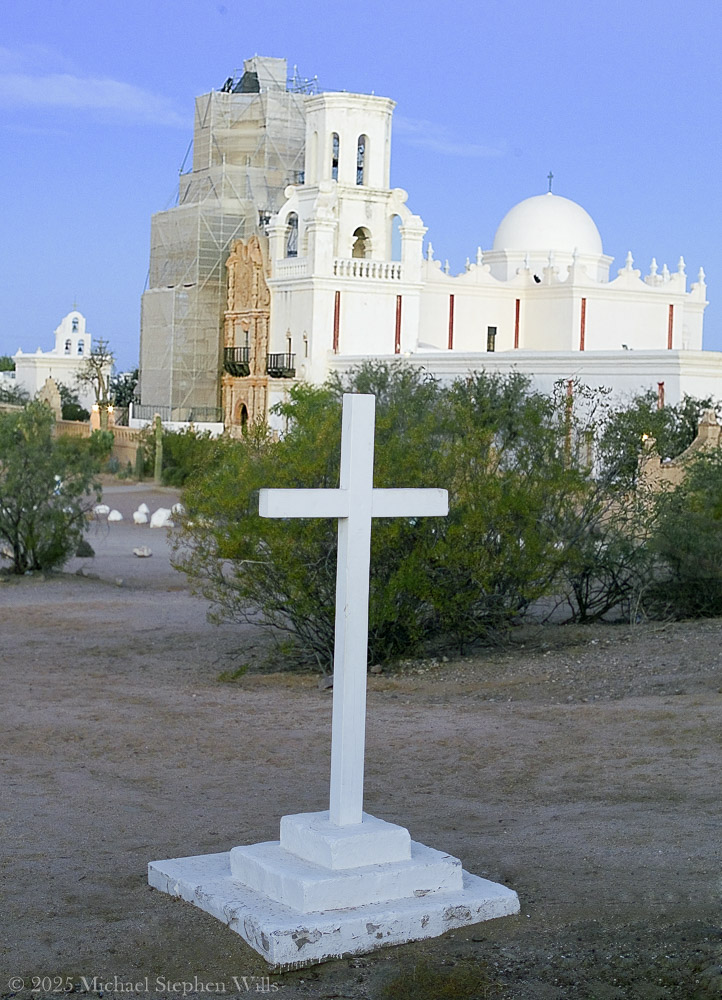
Before sunrise, I climb Grotto Hill, just east of the mission. A well-worn path and a few stone steps lead upward, passing stations of the cross and a humble grotto shrine nestled in the slope. As I ascend, the soft golden light gathers. Ocotillo stems and saguaros dot the hillside, their long shadows stretching over the desert floor. Reaching the top, I find a lone white cross planted firmly into the rocky soil. The cross is simple, yet it holds a quiet gravity – a silent witness to the prayers and hopes of those who have come here. I stand beside it to catch my breath. Below me spreads the mission complex, glowing white and rose in the gathering dawn. From this height, the scene is breathtaking: the desert expands in every direction, painted in brushstrokes of copper, violet, and gold. The distant Tucson mountains catch the first light. There is a profound peace up here. It’s easy to imagine Father Kino himself climbing a similar hill, surveying this “Water Place” and dreaming of a mission that would stand the test of time.
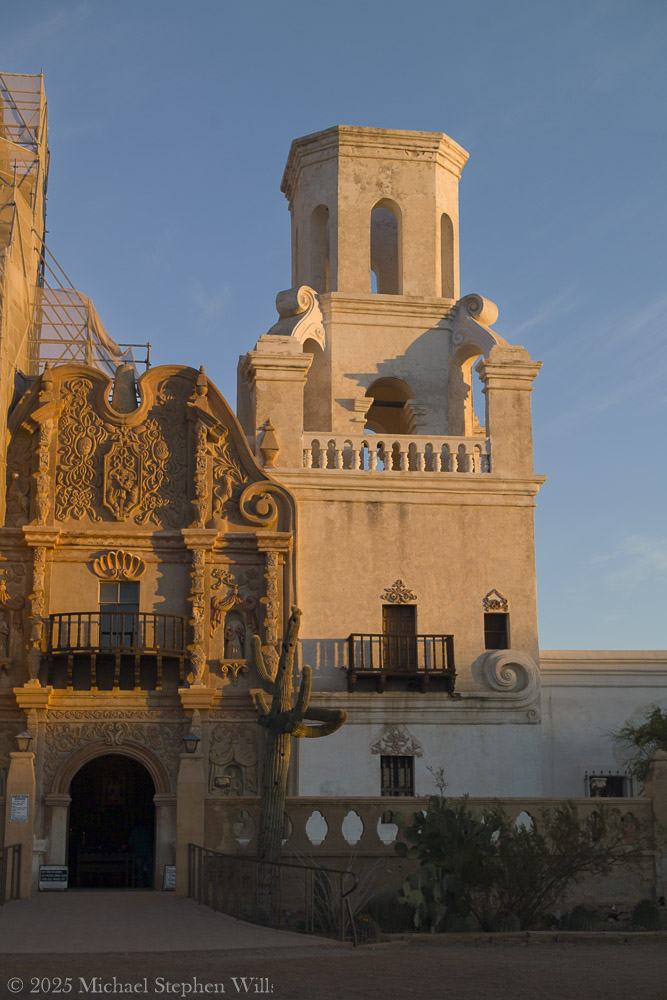
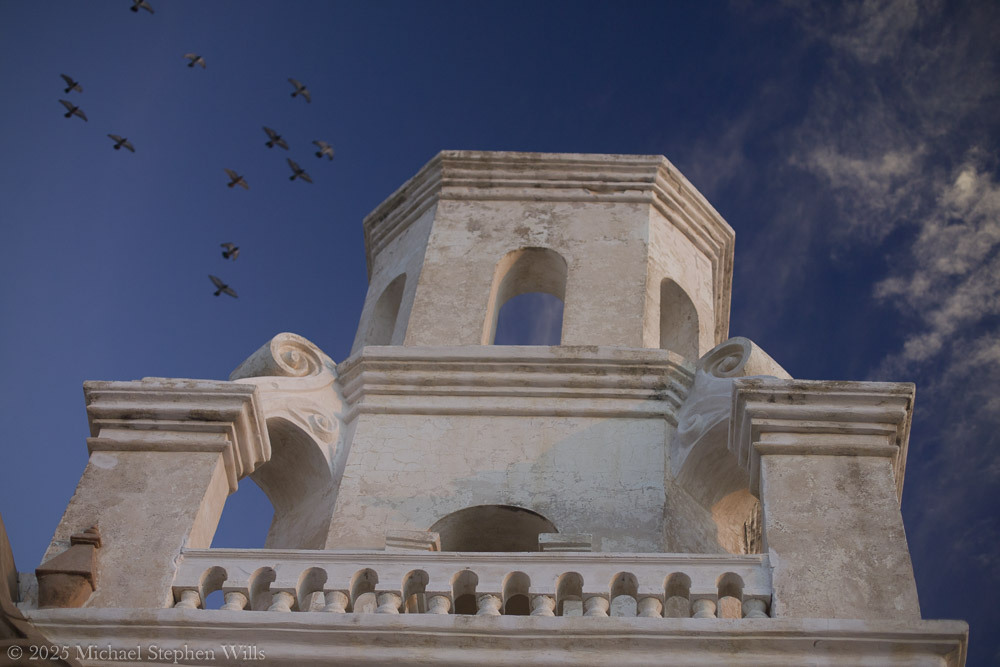
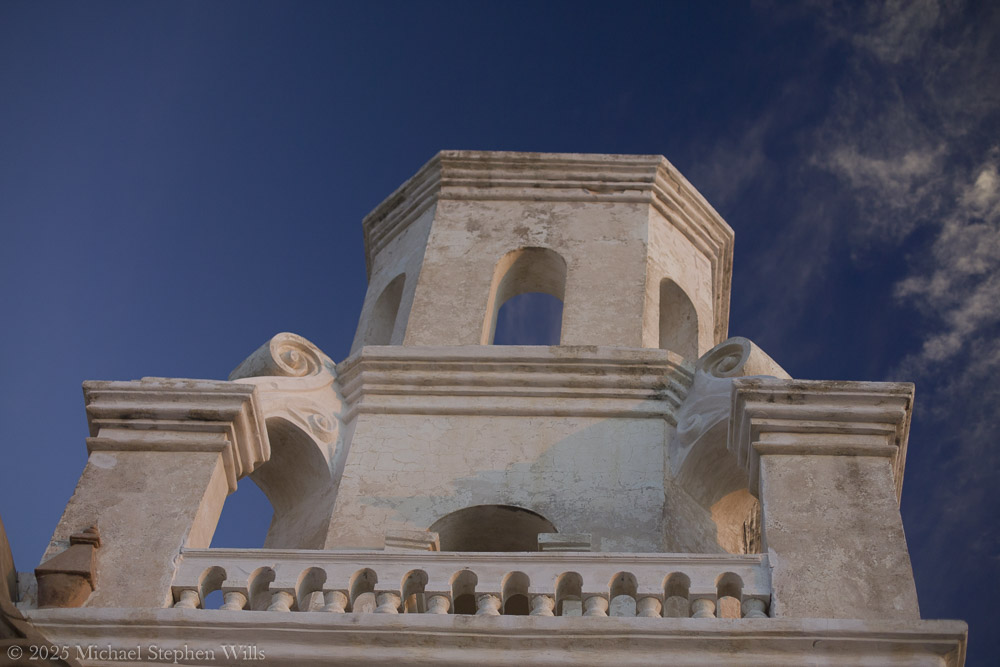
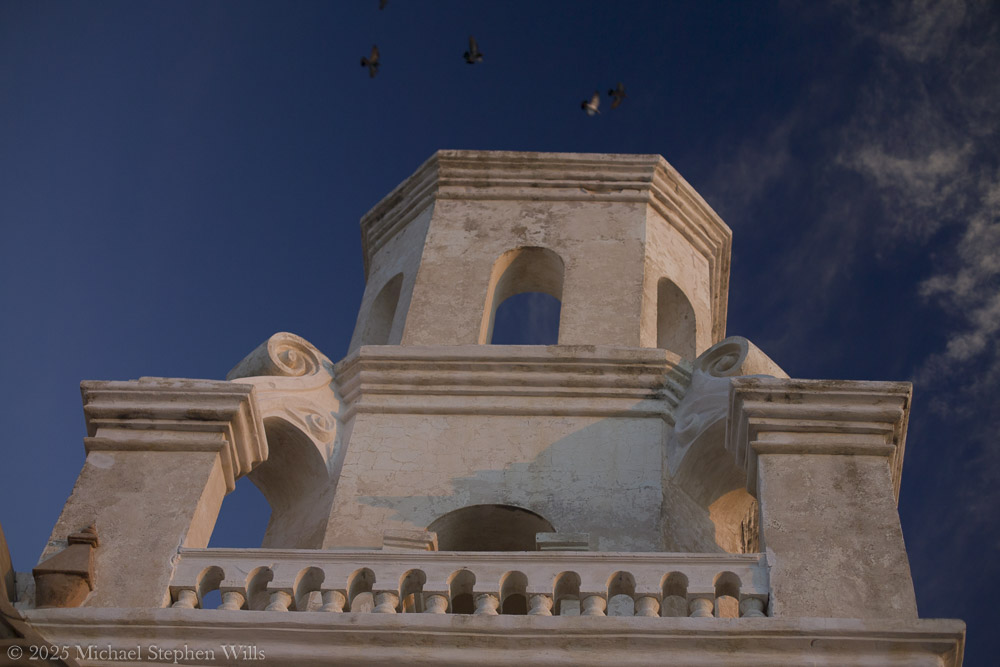
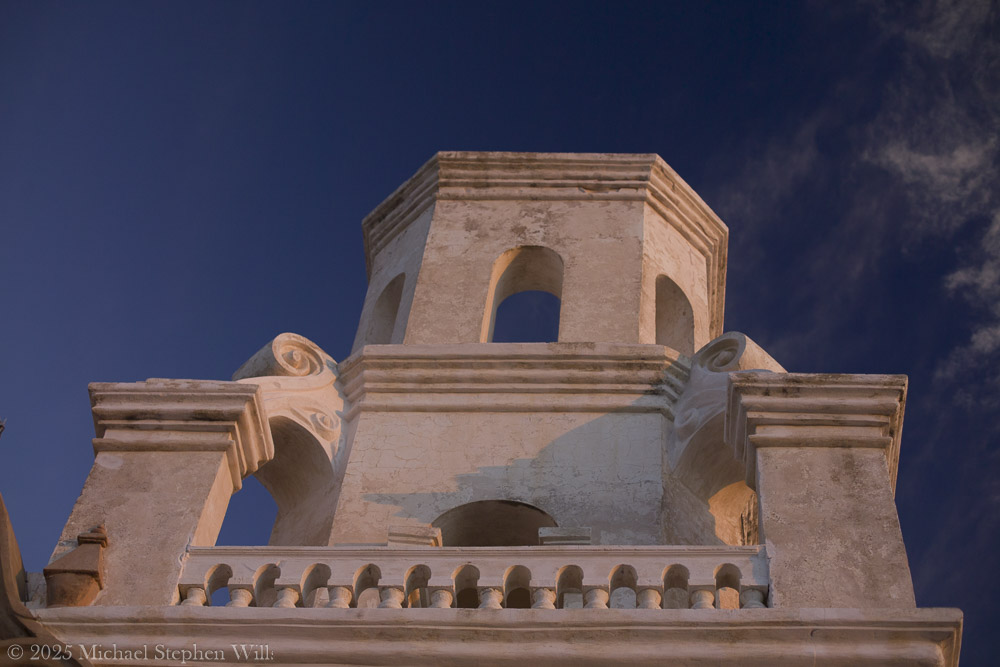
Often called the “White Dove of the Desert”the church gleams against the wide Sonoran sky, its twin bell towers and central dome radiant in the glow. In this moment, the 18th-century mission seems to hover between earth and heaven – a bright vision in the desert, tethered by history and faith.
I walk toward the old mission, feeling the crunch of desert sand beneath my feet and brushing past creosote bushes and prickly pear cacti. There is a hush here, broken only by a gentle breeze and the distant coo of a dove – as if nature itself respects the sanctity of this place. In my mind I rell that this mission was first founded in 1692 by the Jesuit missionary Father Eusebio Kino, who encountered the O’odham community living at this oasis they called Wa:k, meaning “Water Place”
The springs have long since gone dry, but the name lives on, a reminder that this now-arid land once nurtured life-giving water. The church before me isn’t the original Kino saw, but the one begun in 1783 under Spanish Franciscan friars who raised these walls with the help of O’odham artisans. I marvel that I am standing before a structure over two centuries old – the oldest European-built structure in Arizona– yet still alive with spirit.
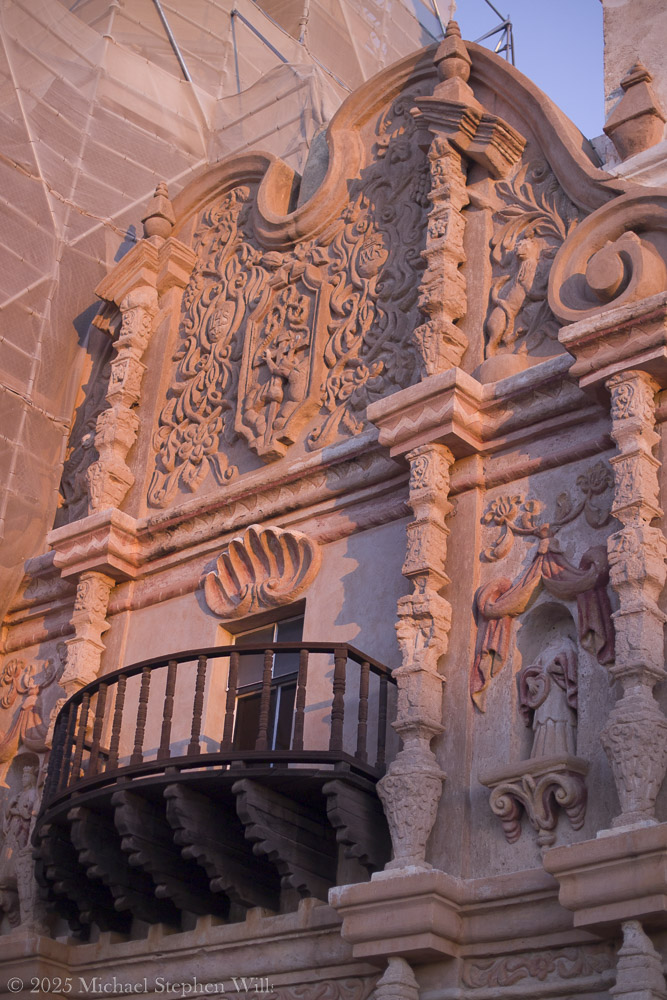
Stepping into the courtyard, I tilt my head back to absorb the facade’s details. The ornate Baroque façade is a symphony of carved plaster and painted relief, an exuberant blend of Moorish, Spanish, and Indigenous influences. Faded yet still vivid, saints and angels watch from their niches on the church front. Every arch and cornice is edged in shadow and dawn light, revealing craftsmanship considered one of the finest examples of Mexican Baroque architecture in the United States
The front entrance is flanked by intricate scrolls and whimsical carvings – floral motifs, seashell patterns, and statuary wearing serene expressions. I gently run my fingers along the weathered wooden doors, feeling the grain that generations of hands have touched. Through a crack in the door, I catch a glimpse of the dim interior: candles flicker on the altar and the air carries a hint of melted wax and sweet incense. Thesanctuary seems to exude centuries of devotion. Even outside, I sense a whisper of ancient prayers in the silence.
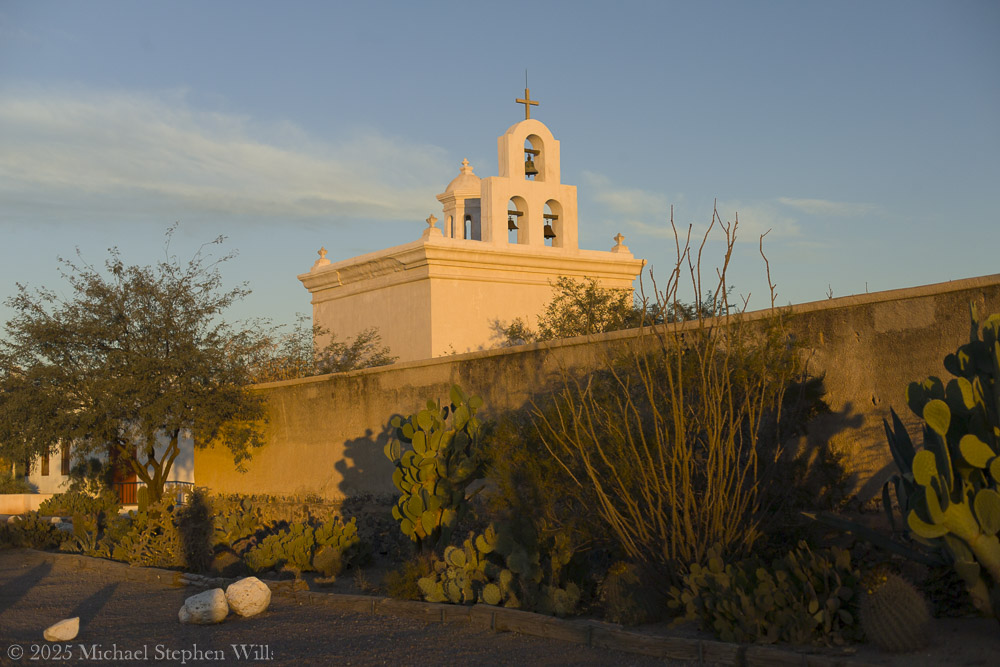
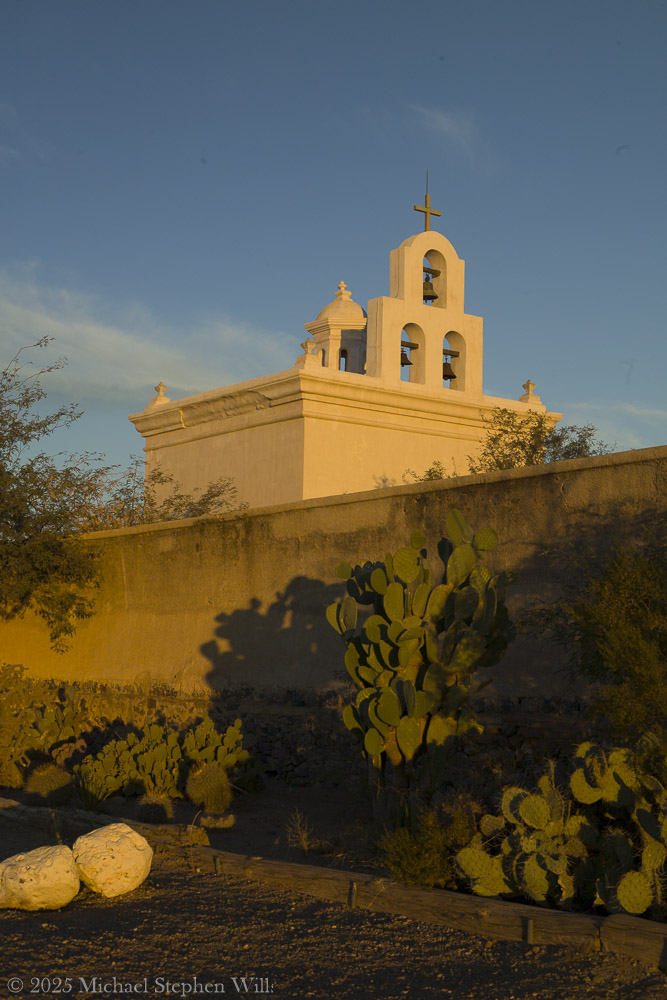
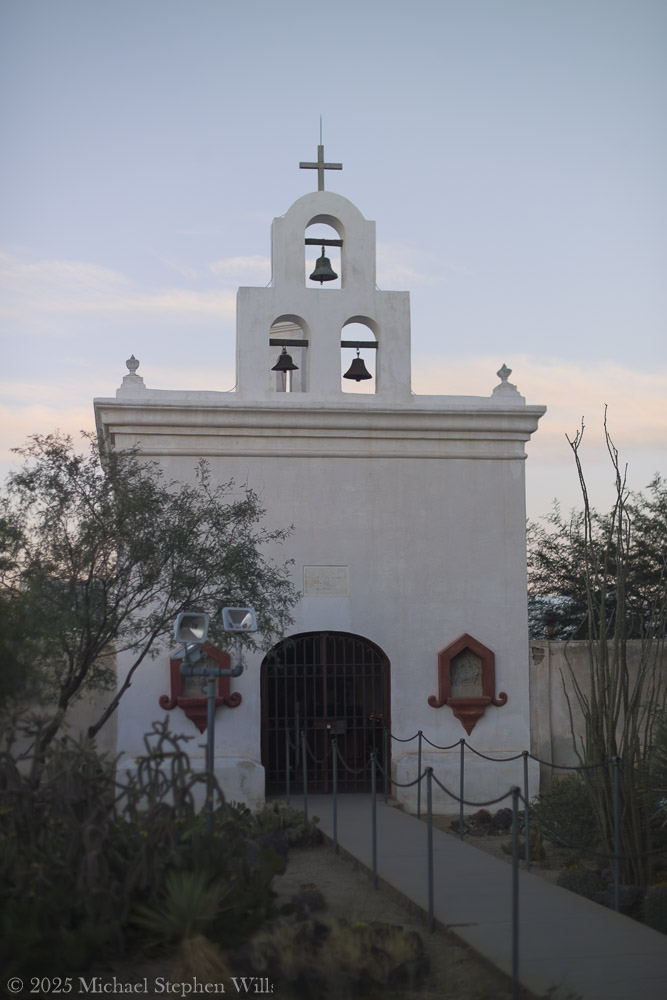
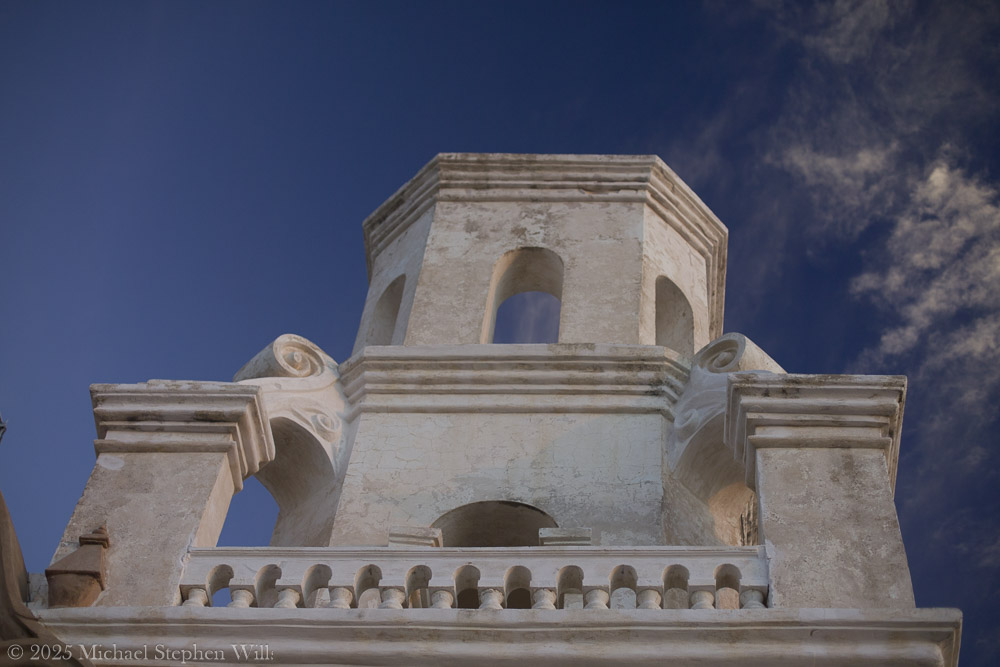
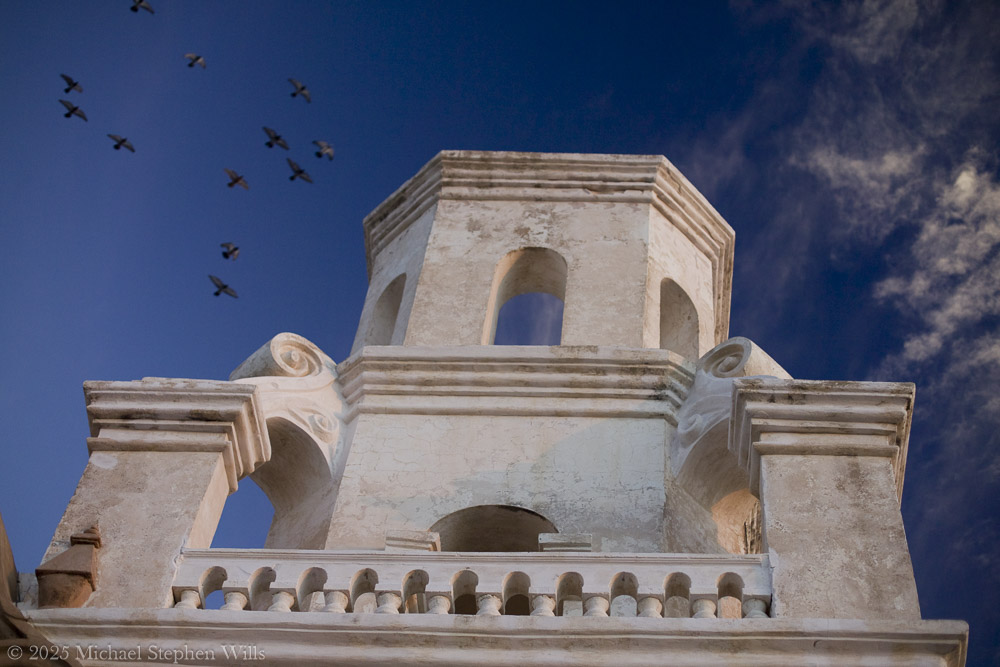
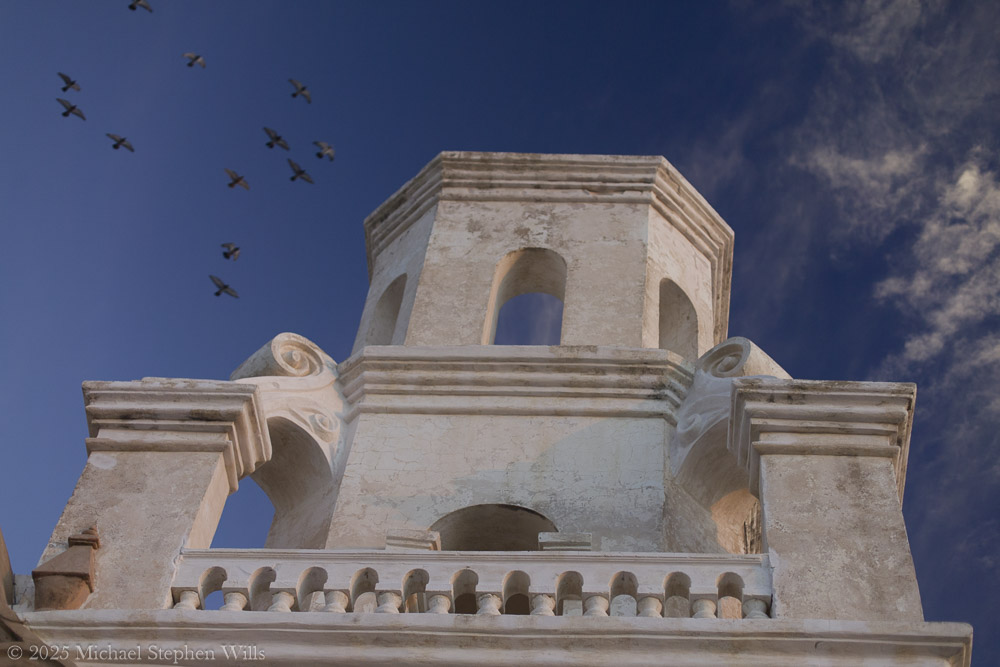
The Bell Tower in dawn light
As the day progresses, the world feels alive again. A pair of children laugh and chase each other across the dusty plaza, their voices echoing off the thick adobe walls. Nearby, the aroma of fresh frybread lingers – evidence of Tohono O’odham vendors who often set up stands by the church, selling frybread “popovers” and Indian tacos to visitors. This mingling of old and new, sacred and every day, makes the mission feel utterly genuine, the heart of a living community. I see an elderly O’odham woman in a shawl kneel at a side shrine, lips moving in quiet prayer, and I realize that for the Tohono O’odham, this mission is more than a historic landmark. It is a living spiritual home that continues to anchor their community. Indeed, the church is still an active parish that serves the local O’odham families, with regular Masses and gatherings held within its walls
The sense of continuity is palpable – the faith that built this place in the 18th century endures unwaveringly today.
Standing in front of San Xavier del Bac, I feel a personal connection that is hard to put into words. The centuries-old mission glows fresh in morning light. I close my eyes and sense the presence of all who have been here before – the O’odham villagers, the Spanish padres, the countless pilgrims and visitors. In the stillness, time blurs. Past and present mingle in the desert air. When I finally turn to leave, my heart is quiet, uplifted by the encounter. In this sacred and remote place, I have touched a living history and felt the embrace of a peace that transcends centuries. I carry that gentle peace with me into the day, grateful for the memories of light, silence, and the enduring soul of San Xavier del Bac.
Bibliography
Wikipedia. “Mission San Xavier del Bac.” (2025).
National Park Service. “San Xavier del Bac Mission.” (2021).
Patronato San Xavier. “History of the Mission – Timeline.” (2025).
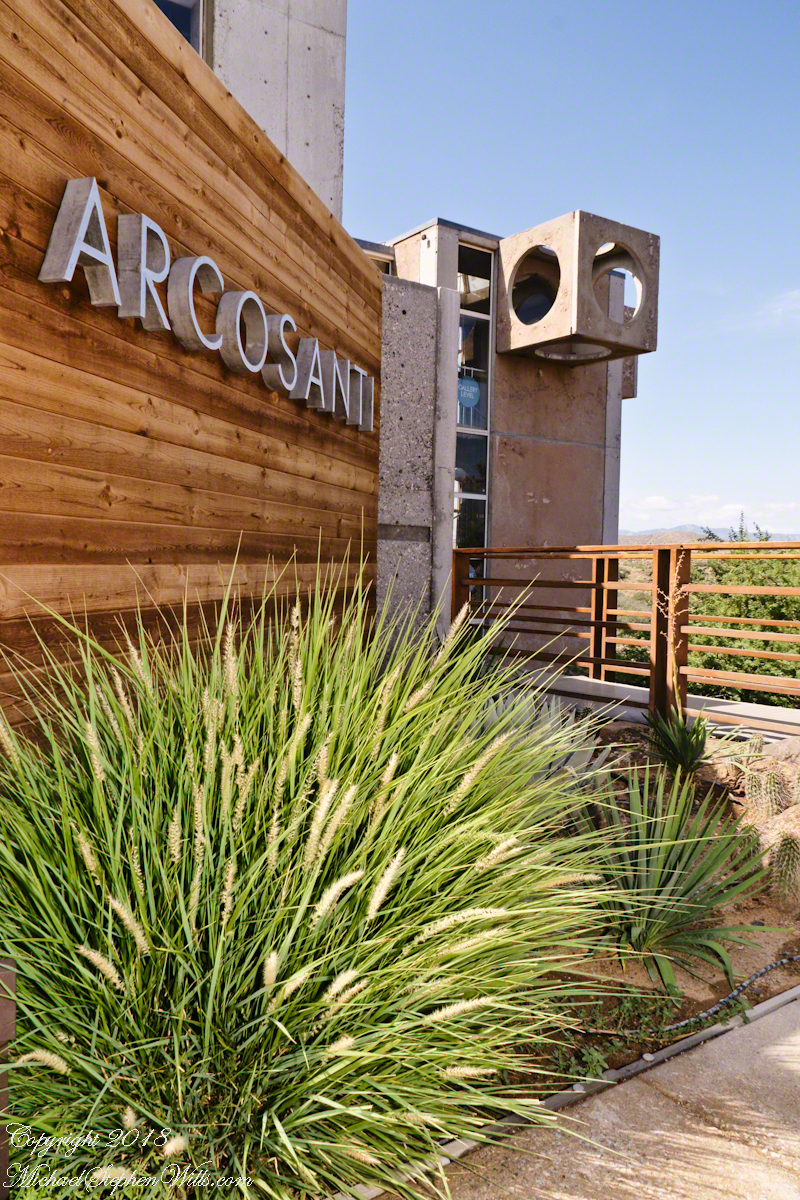
Arcosanti, envisioned by Paolo Soleri, exemplifies sustainable urban living but faces challenges in realization, scalability, and contemporary relevance.
Arcosanti, the brainchild of architect Paolo Soleri, was conceived as an experimental laboratory for urban design and ecological principles—a built embodiment of his vision of Arcology (a fusion of “architecture” and “ecology”). Over fifty years since its groundbreaking in 1970, Arcosanti remains a significant cultural and architectural artifact. However, the meaning and relevance of both Arcosanti and Arcology in today’s context invite critical examination.
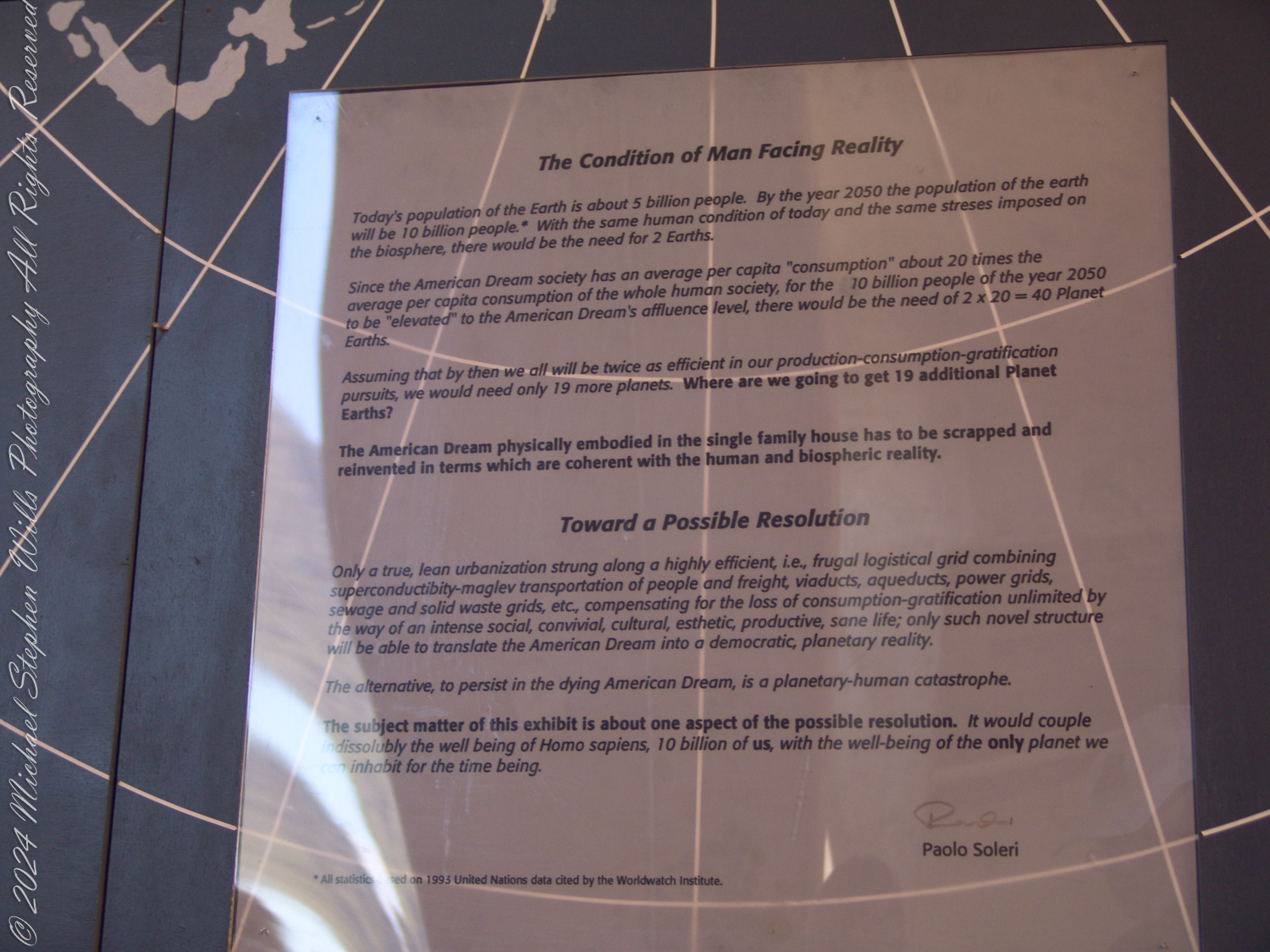
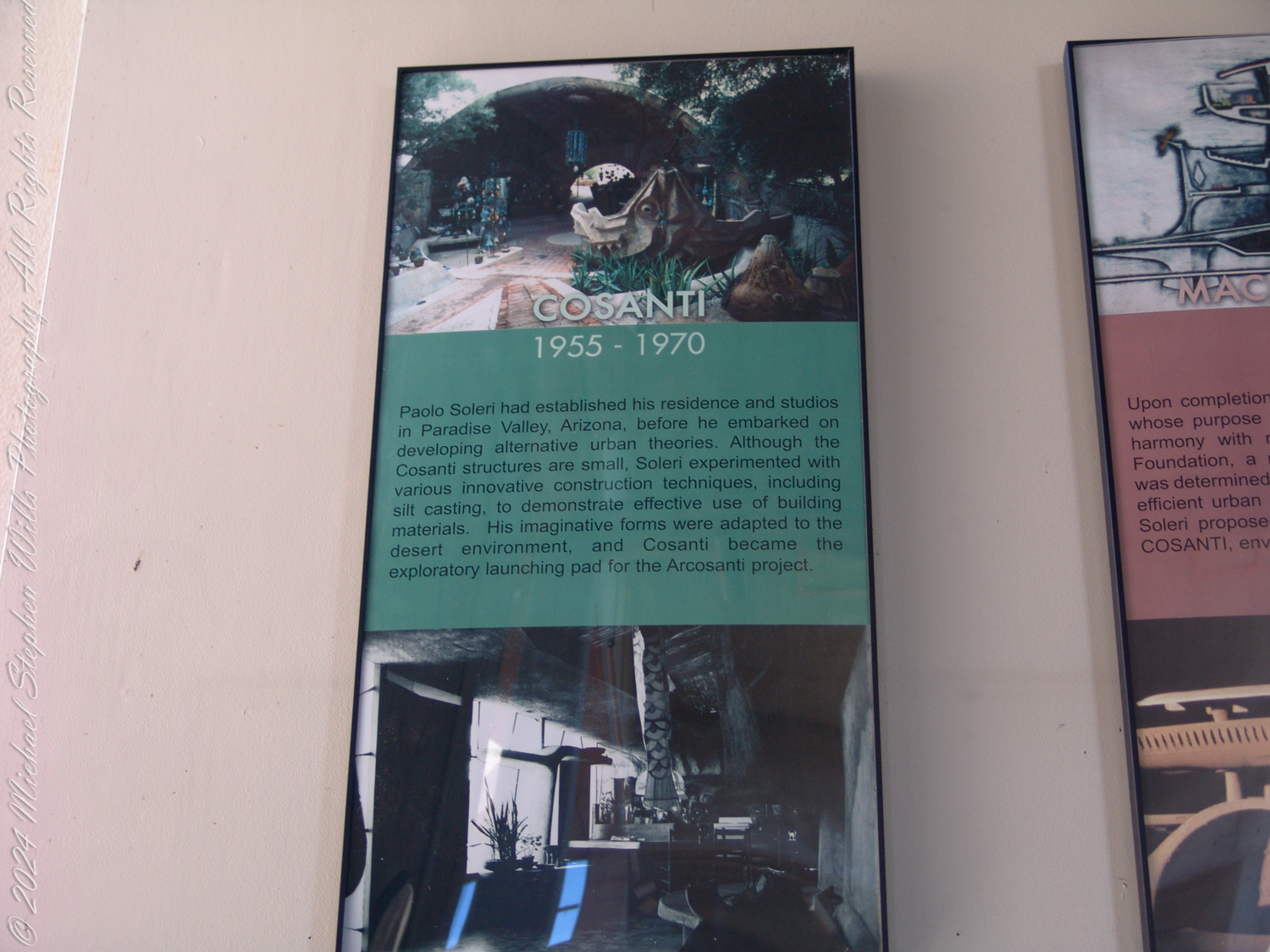
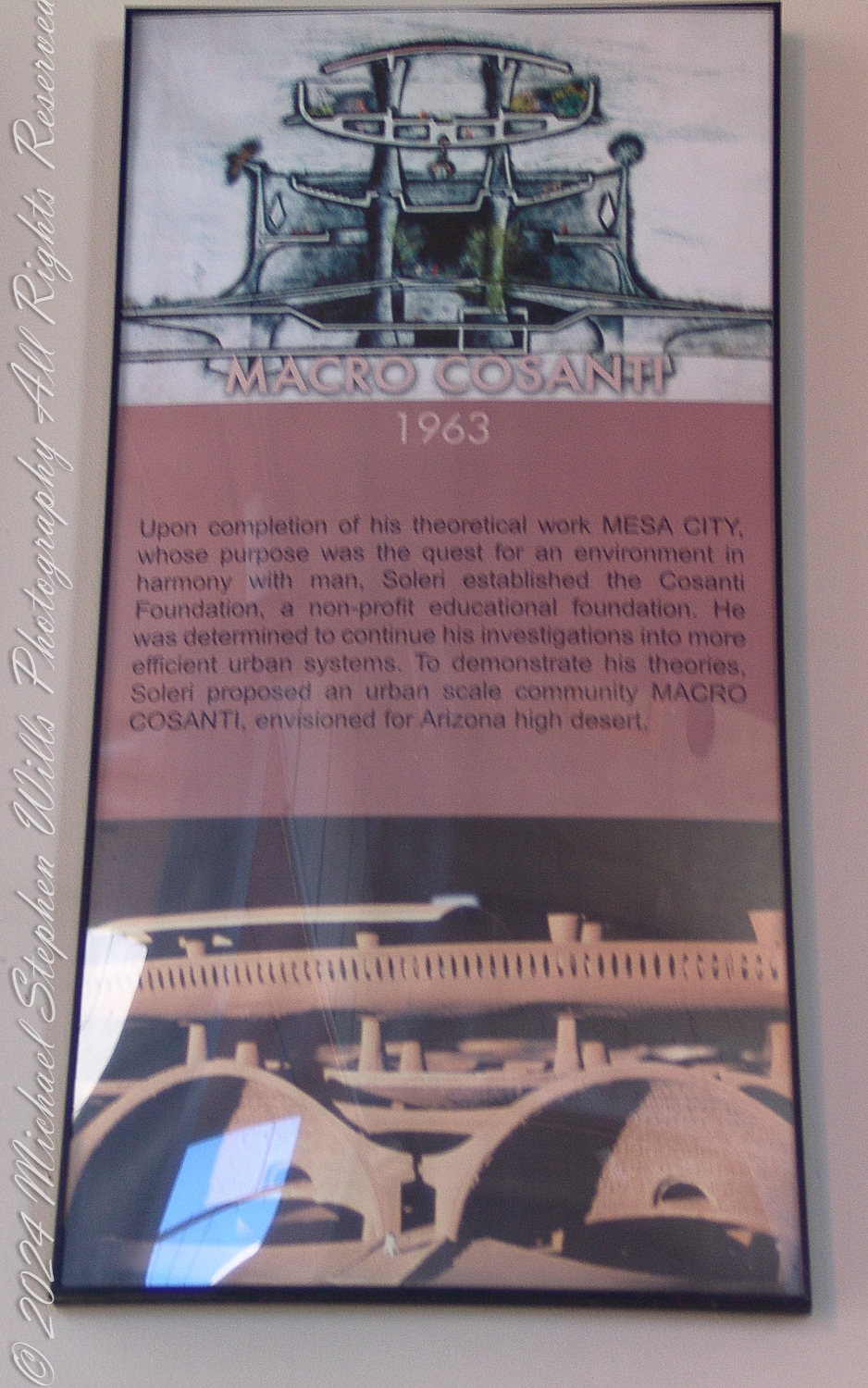
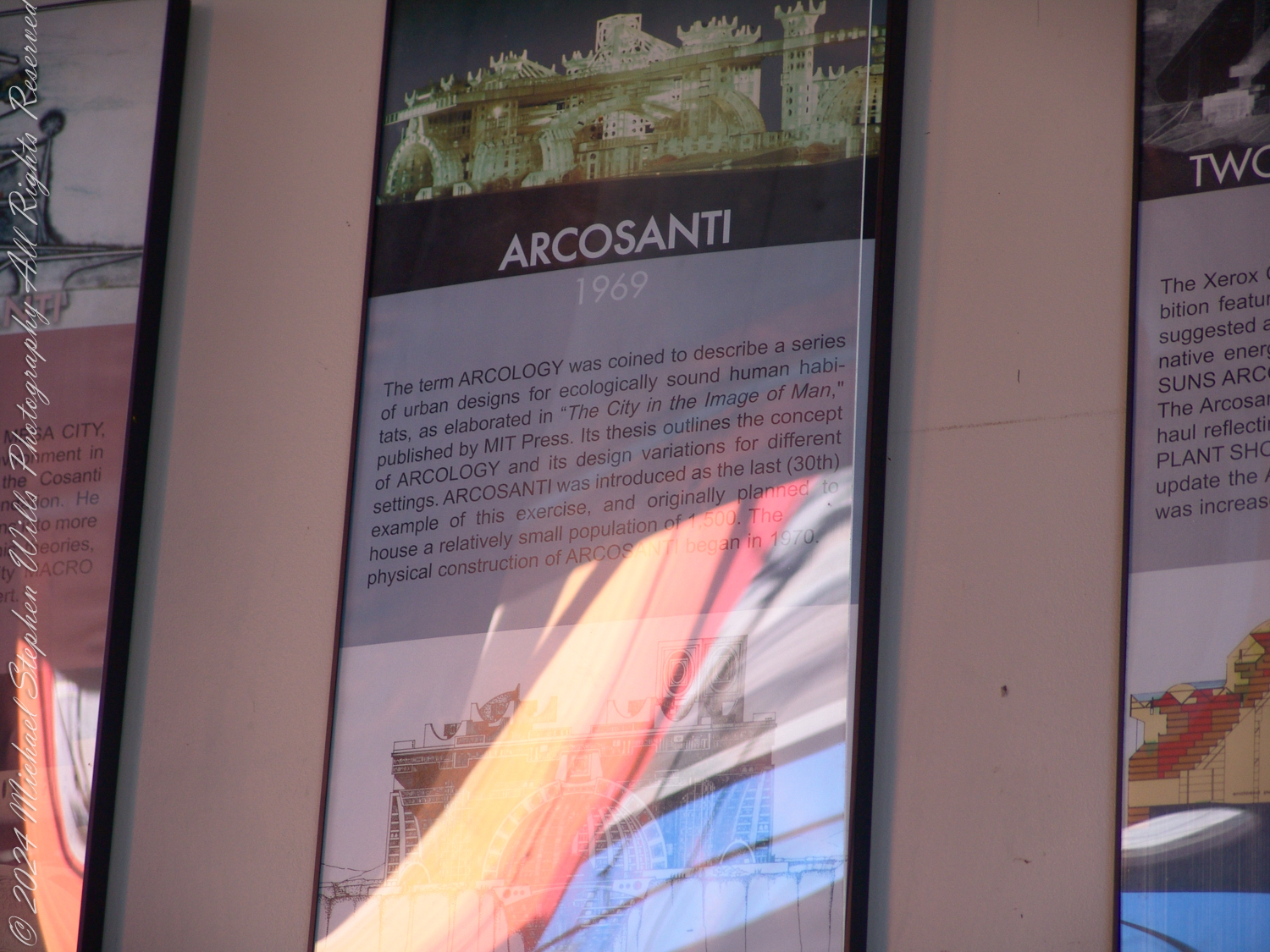
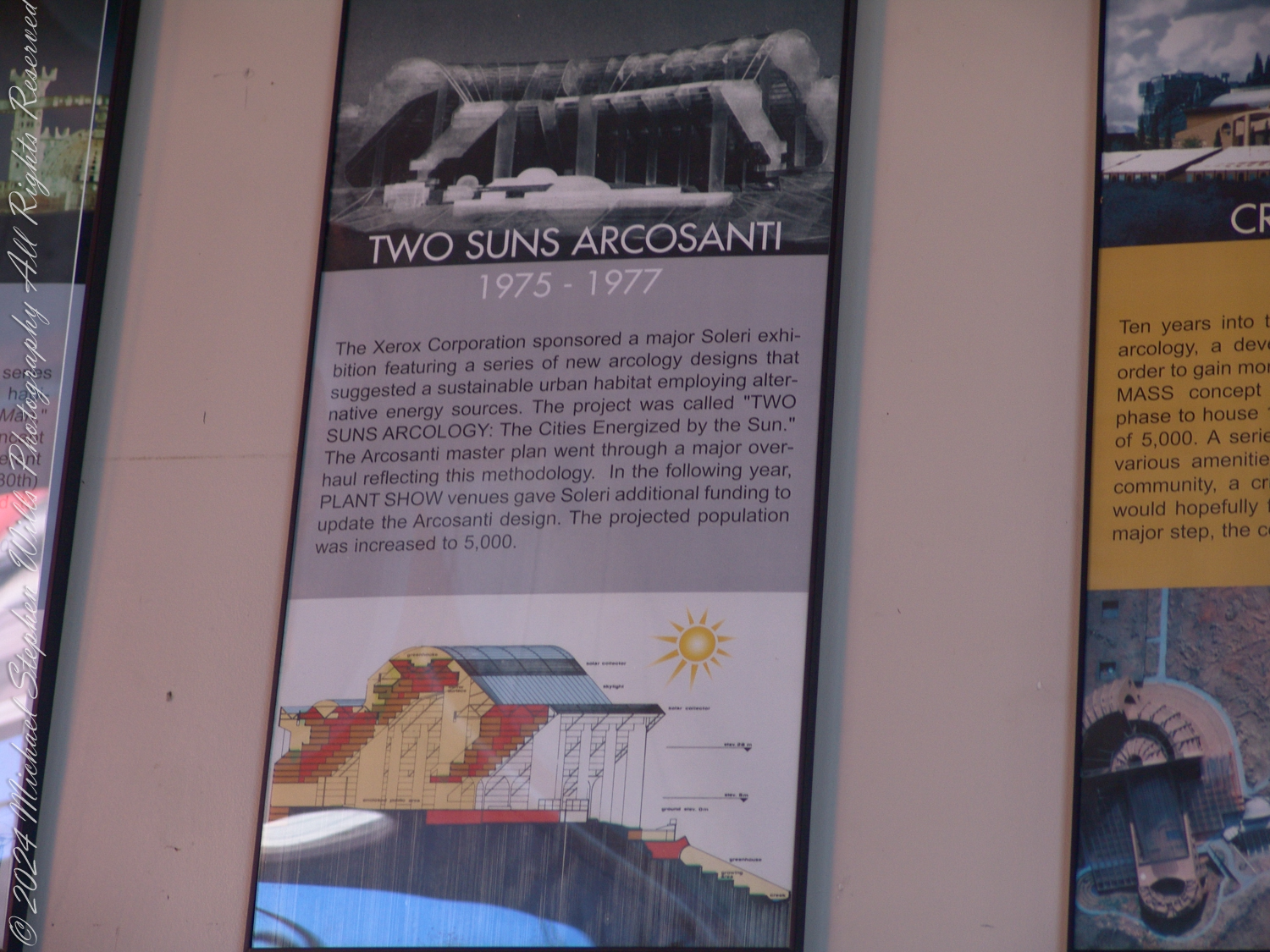
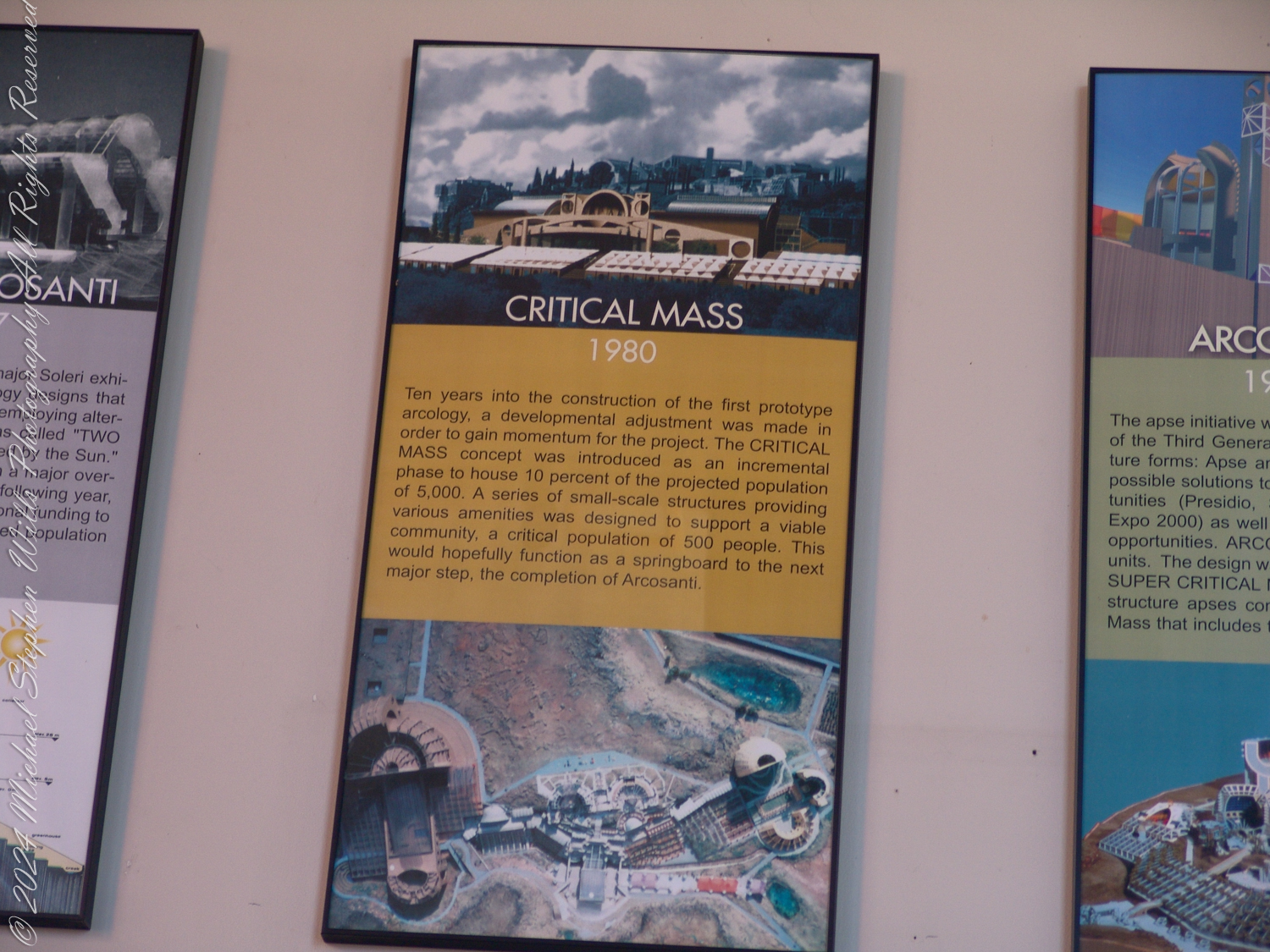
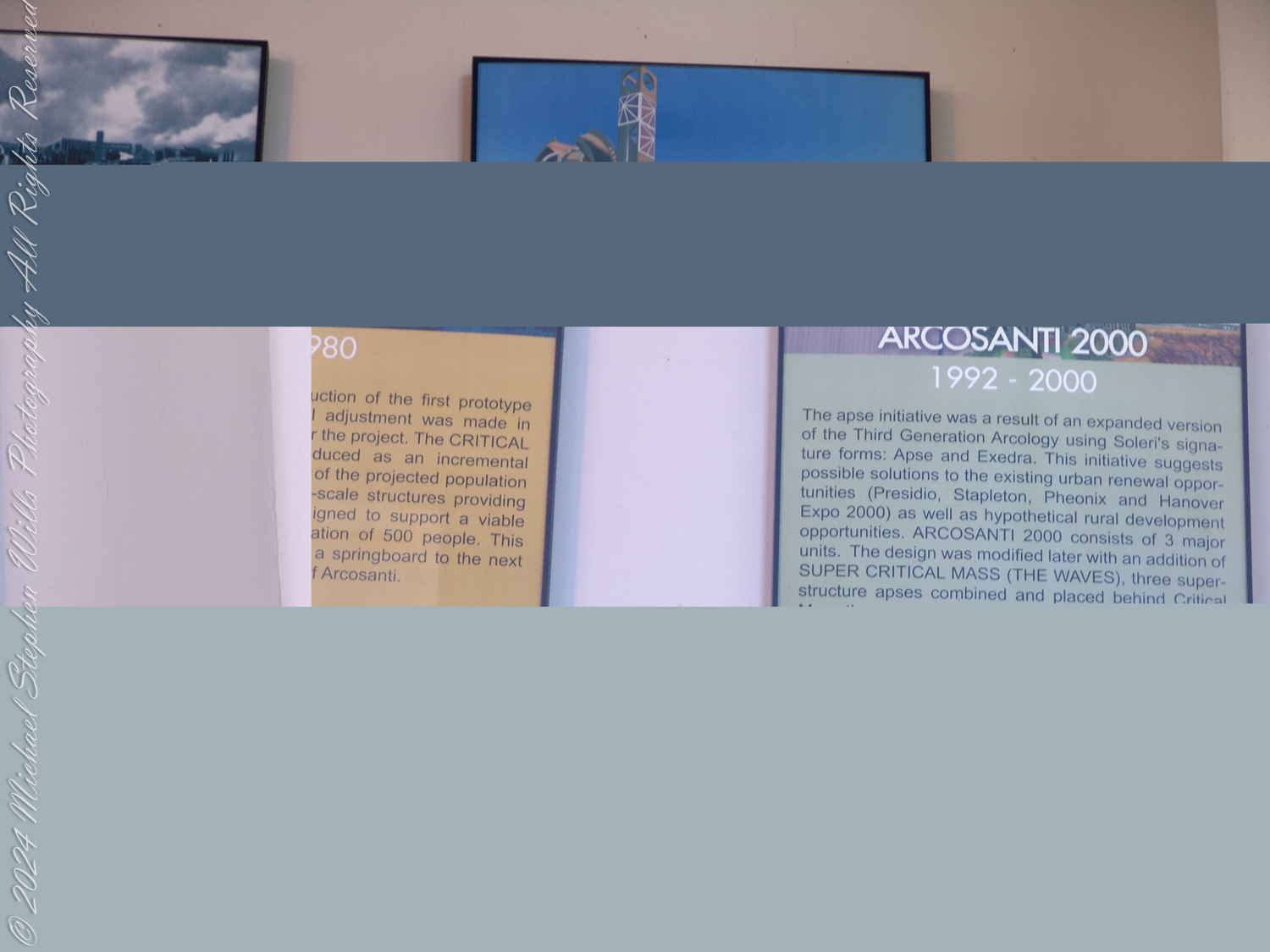
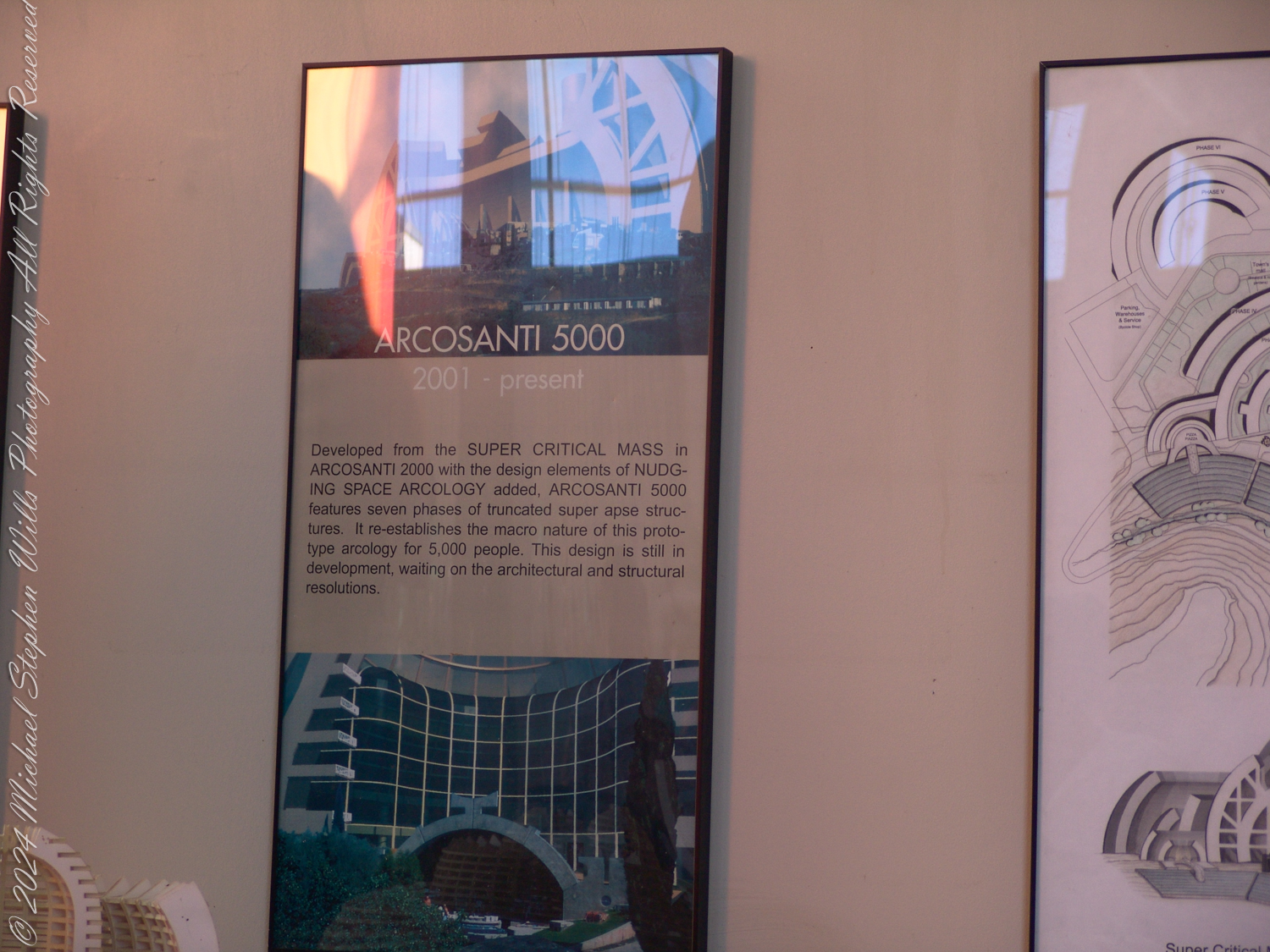
The accompanying photographs are a presentation of the history of Arcology from Arcosanti signage
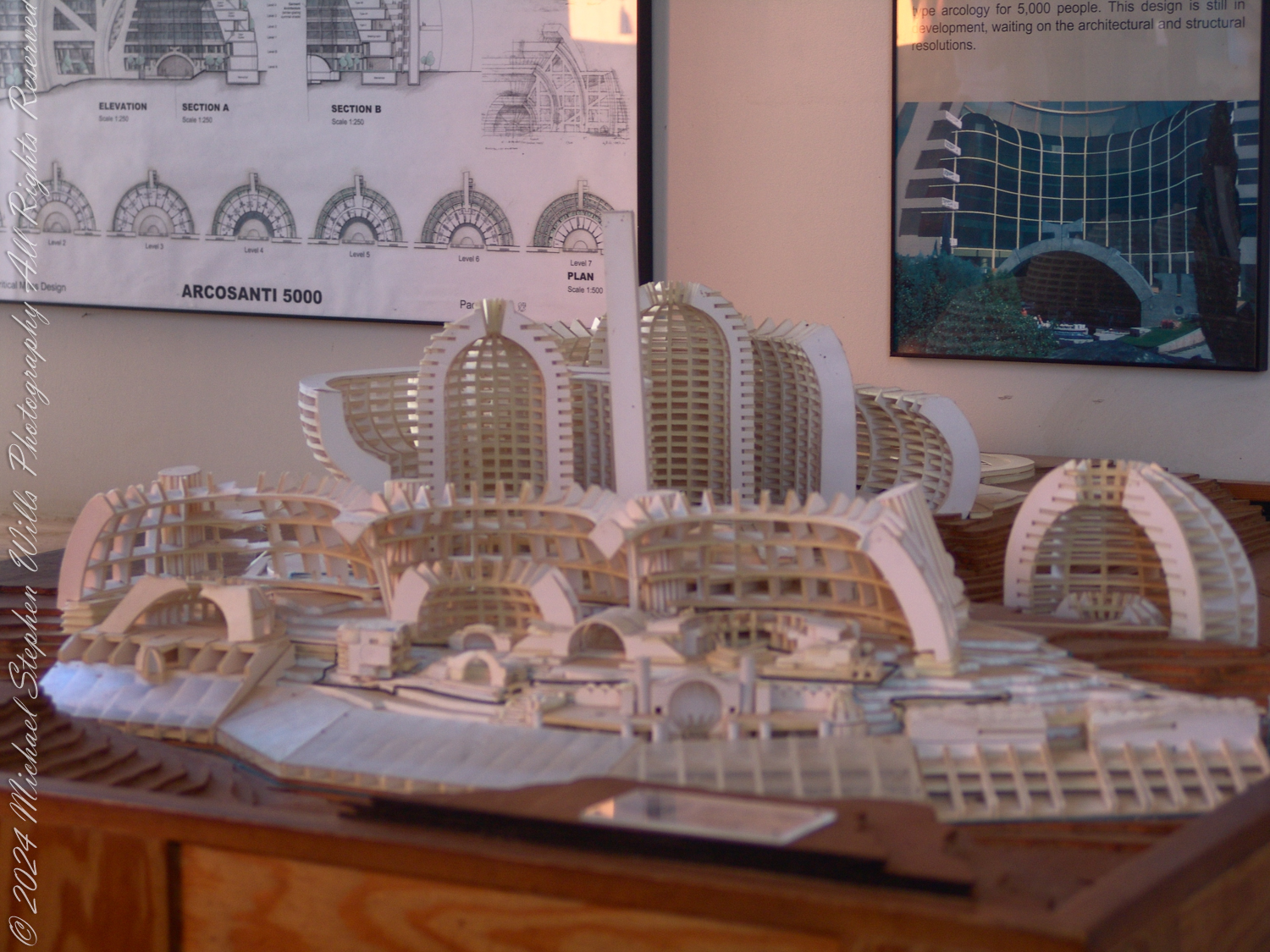
Arcosanti 5000 — Soleri’s Ultimate Vision
Historical Context and the Vision of Arcology
Soleri’s concept of Arcology emerged during the mid-20th century, an era of increasing environmental awareness, urban sprawl, and population growth. His vision was radical: compact, self-sustaining urban environments that minimized ecological impact while fostering human interaction and creativity. Arcology sought to challenge the sprawling, resource-intensive models of urban development that dominate the modern world.
Today’s population of the Earth is about 5 billion people. By the year 2050 the population of the Earth will be 10 billion people.* With the same human condition of today and the same stresses imposed on the biosphere, there would be the need for 2 Earths.
Since the American Dream society has an average per capita “consumption” about 20 times the average per capita consumption of the whole human society, for the 10 billion people of the year 2050 to be “elevated” to the American Dream’s affluence level, there would be the need of 2 x 20 = 40 Planet Earths.
Assuming that by then we all will be twice as efficient in our production-consumption-gratification pursuits, we would need only 19 more planets. Where are we going to get 19 additional Planet Earths?
The American Dream physically embodied in the single-family house has to be scrapped and reinvented in terms which are coherent with the human and biospheric reality.
Toward a Possible Resolution
Only a true, lean urbanization strung along a highly efficient, i.e., frugal logistical grid combining superconductivity-maglev transportation of people and freight, viaducts, aqueducts, power grids, sewage and solid waste grids, etc., compensating for the loss of consumption-gratification unlimited by the way of an intense social, convivial, natural, esthetic, productive, sane life; only such novel structure will be able to translate the American Dream into a democratic, planetary reality.
The alternative, to persist in the dying American Dream, is a planetary-human catastrophe.
The subject matter of this exhibit is about one aspect of the possible resolution. It would couple indissolubly the well-being of Homo sapiens, 10 billion of us, with the well-being of the only planet we can inhabit for the time being.
All statistics based on 1993 United Nations data cited by the Worldwatch Institute.
(signed) Paolo Soleri
Arcosanti was intended to be a prototype—a proof of concept for dense urban living within a minimal environmental footprint. Its design embraced verticality, integration with natural surroundings, and multi-use spaces to reduce resource consumption. Soleri’s philosophy rejected wasteful consumerism and emphasized communal living, self-sufficiency, and harmony with nature.
Arcosanti as a Realization of Arcology
While Soleri’s ideas were visionary, Arcosanti itself never fully realized its original ambitions. Planned to house 5,000 people, it currently accommodates fewer than 100 residents. This gap between aspiration and reality reflects several challenges:
Paolo Soleri had established his residence and studios in Paradise Valley, Arizona, before he embarked on developing alternative urban theories. Although the Cosanti structures are small, Soleri experimented with various innovative construction techniques, including silt casting, to demonstrate effective use of building materials. His imaginative forms were adapted to the desert environment, and Cosanti became the exploratory launching pad for the Arcosanti project.
Scale and Funding: Building a sustainable community of this scale required vast financial and organizational resources. Arcosanti, largely constructed through volunteer labor and workshops, lacked the momentum to expand at the pace Soleri envisioned.
Upon completion of his theoretical work MESA CITY, whose purpose was the quest for an environment in harmony with man, Soleri established the Cosanti Foundation, a non-profit educational foundation. He was determined to continue his investigations into more efficient urban systems. To demonstrate his theories, Soleri proposed an urban-scale community MACRO COSANTI, envisioned for Arizona high desert.
Cultural Shifts: The communal living and austerity championed by Soleri contrast sharply with the consumer-driven values of contemporary society. The rise of globalized capitalism, suburban expansion, and digital individualism has made the communal ethos less appealing to many.
The term ARCOLOGY was coined to describe a series of urban designs for ecologically sound human habitats, as elaborated in “The City in the Image of Man,” published by MIT Press. This thesis outlines the concept of ARCOLOGY and its design variations for different settings. ARCOSANTI was introduced as the last (30th) example of this exercise, and originally planned to house a relatively small population of 500. The physical construction of ARCOSANTI began in 1970.
Technological Advances: Soleri’s designs were innovative for their time, but modern advancements in sustainable technology—such as solar power, green building materials, and decentralized energy systems—have surpassed some of his ideas. Today, sustainable urbanism focuses on retrofitting existing cities rather than building entirely new ones.
The Relevance of Arcology Today
Despite its limitations, Arcology remains profoundly relevant in the face of 21st-century challenges such as climate change, resource scarcity, and urban overpopulation. Soleri’s principles offer a framework to address these crises, particularly through:
The Xerox Corporation sponsored a major Soleri exhibition featuring a series of new arcology designs that suggested a sustainable urban habitat employing alternative energy sources. The project was called “TWO SUNS ARCOLOGY: The Cities Energized by the Sun.” The Arcosanti master plan went through a major overhaul reflecting this methodology. In the following year, PLANT SHOW venues gave Soleri additional funding to update the Arcosanti design. The projected population was increased to 5,000.
Compact Urbanism: Cities worldwide are grappling with the environmental toll of urban sprawl. Arcology’s emphasis on vertical, compact cities with reduced land usage aligns with the modern push for urban densification.
Ten years into the construction of the first prototype arcology, a developmental adjustment was made in order to gain momentum for the project. The CRITICAL MASS concept was introduced as an incremental phase to house 10 percent of the projected population of 5,000. A series of small-scale structures providing various amenities was designed to support a viable community, a critical population of 500 people. This would hopefully function as a springboard to the next major step, the completion of Arcosanti.
Mixed-Use and Communal Spaces: The COVID-19 pandemic underscored the importance of walkable, mixed-use neighborhoods and shared green spaces. Arcology’s model of integrated living and working spaces anticipates these needs.
Sustainability and Circular Systems: Soleri’s focus on minimizing waste and resource use aligns with today’s circular economy principles. Arcology’s ideas resonate with efforts to design cities as closed-loop systems that reuse resources.
The apse initiative was a result of an expanded version of the Third Generation Arcology using Soleri’s signature forms: Apse and Exedra. This initiative suggests possible solutions to the existing urban renewal opportunities (Presidio, Stapleton, Phoenix, and Hanover Expo 2000) as well as hypothetical rural development opportunities. ARCOSANTI 2000 consists of 3 major units. The design was modified later with an addition of SUPER CRITICAL MASS (THE WAVES), three superstructure apses combined and placed behind Critical …
A Philosophical Challenge: Beyond practical urban design, Arcology challenges us to rethink our relationship with the planet and with each other. It invites a fundamental shift from individualistic consumption to collective stewardship.
Critique of Arcosanti Today
Arcosanti, while iconic, serves more as a symbol than a fully functioning example of Arcology. Its limited population and incomplete development highlight key shortcomings:
Lack of Scalability: Arcosanti has not demonstrated how Arcology principles can scale to meet the needs of modern cities with millions of inhabitants.
ARCOSANTI 5000
2001 – present
Developed from the SUPER CRITICAL MASS in ARCOSANTI 2000 with the design elements of NUDGING SPACE ARCOLOGY added, ARCOSANTI 5000 features seven phases of truncated superapse structures. It re-establishes the macro nature of this prototype arcology for 5,000 people. This design is still in development, waiting on the architectural and structural resolutions.
Dependence on External Systems: Despite its aspirations for self-sufficiency, Arcosanti relies on external power grids, supply chains, and tourism, which limits its autonomy.
Cultural Niche: Arcosanti appeals primarily to a niche audience of artists, architects, and environmentalists, making it less accessible or appealing to broader populations.
However, these critiques do not negate its value as a learning tool. Arcosanti’s enduring presence serves as a physical and philosophical case study for those seeking alternatives to conventional urbanism.
A Way Forward?
The future of Arcology lies not in building new Arcosanti-like prototypes but in applying its principles to existing cities and communities. Initiatives such as urban vertical farming, passive solar building design, and car-free city centers echo Soleri’s vision in modern contexts.
Additionally, Arcosanti itself could pivot toward becoming a research hub for sustainable practices, a cultural landmark, or a retreat for those seeking inspiration in Soleri’s ideas. By focusing on education and experimentation, it could remain relevant in contemporary discussions about urbanism and ecology.
Conclusion
Arcosanti and Arcology are more than relics of a bygone architectural movement—they are reminders of humanity’s potential to live in balance with nature. While the practical implementation of Arcology faces significant hurdles, its core philosophy continues to inspire efforts to create more sustainable and harmonious urban environments. In a world increasingly shaped by environmental urgency, Soleri’s vision holds lessons we cannot afford to ignore.
Enter your email to receive notification of future postings. I will not sell or share your email address.
Copyright 2024 All Rights Reserved Michael Stephen Wills
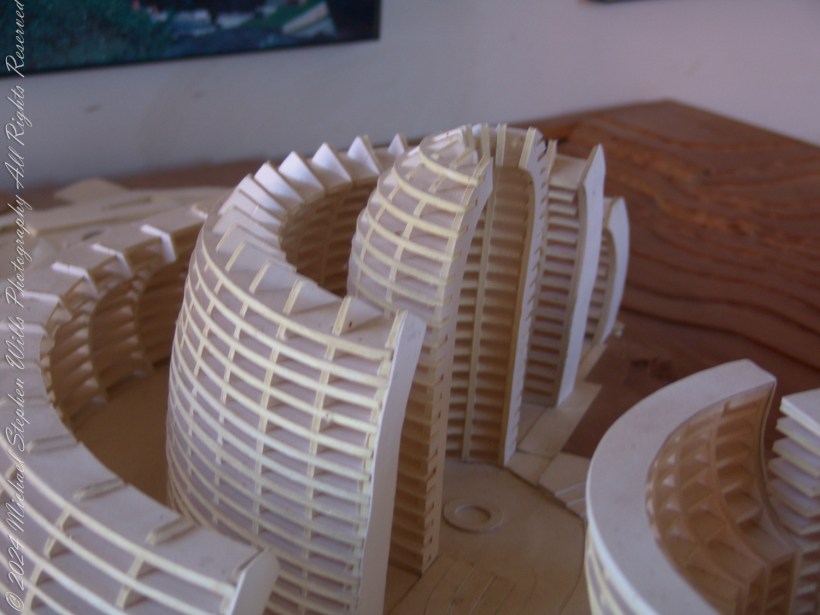
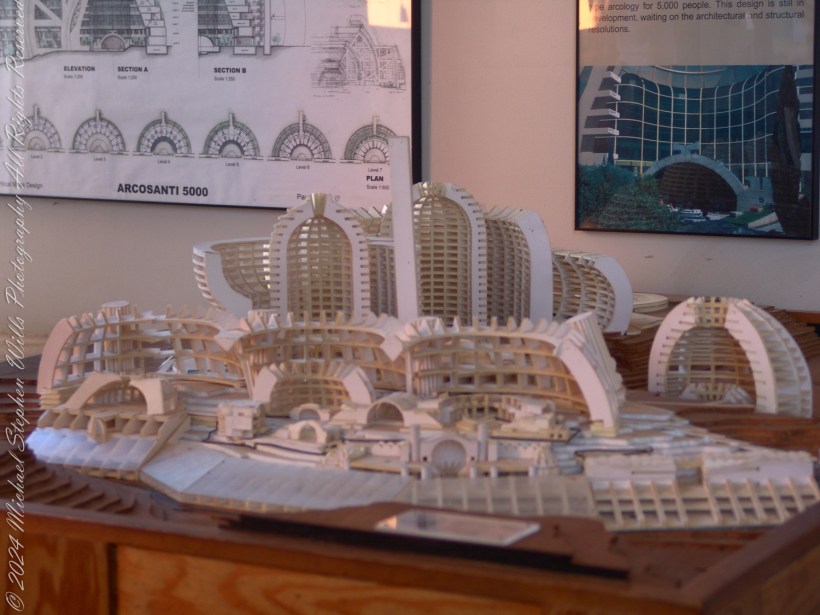
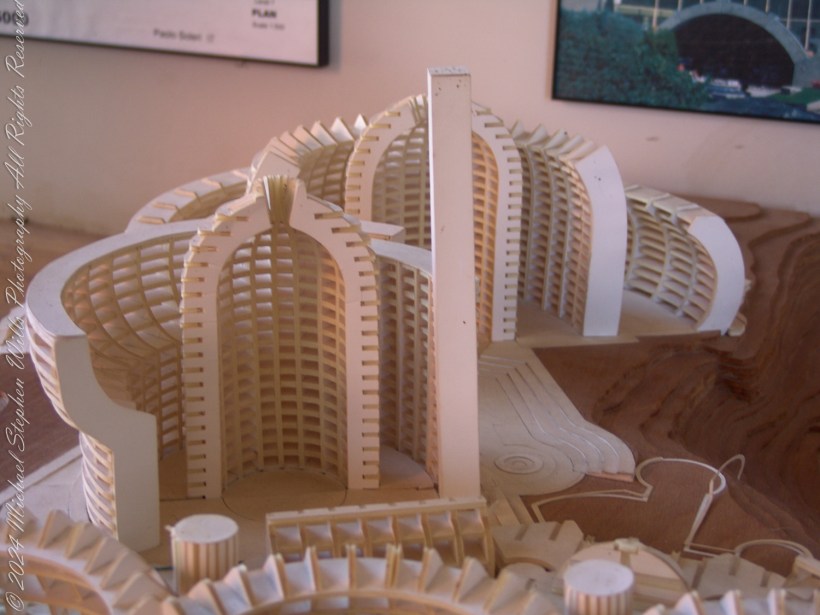
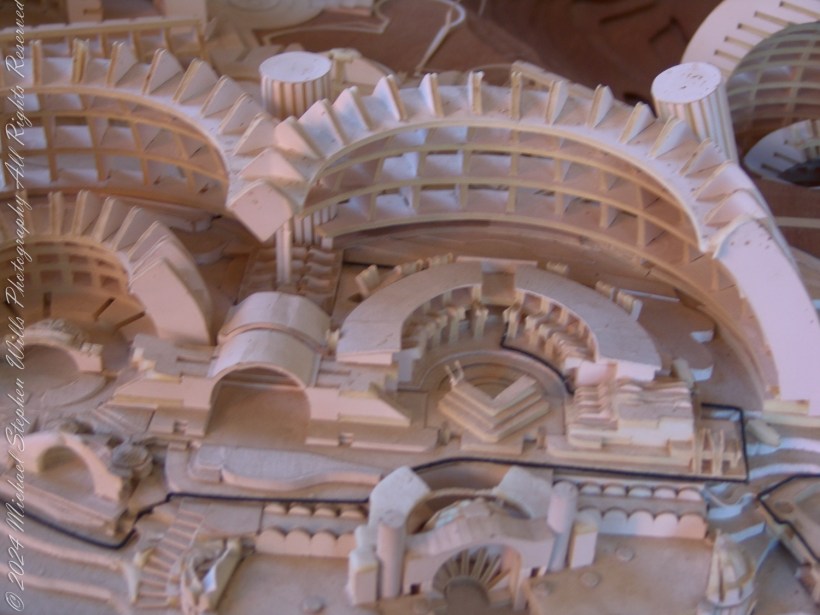
The desert air was sharp, dry, and oddly invigorating as I stepped into the gallery at Arcosanti, Arizona. The year was 2005, and I had long dreamed of visiting this experimental micro-city—a fusion of architecture and ecology conceived by Paolo Soleri. Amidst the array of sketches, photographs, and miniature prototypes stood the centerpiece of my curiosity: the sprawling, intricate scale model of “Arcosanti 5000.” It was as though the future had been condensed into a tangible artifact, whispering promises of an alternative way of living.
The model was perched on a wooden table, surrounded by blueprints and diagrams. Its sweeping curves and layered structures evoked the natural patterns of a canyon or the unfurling petals of a desert flower. I leaned in, drawn to its labyrinthine details: the arches that seemed to embrace the air itself, the layered grids suggesting terraces and communal spaces, and the towering central spire—a striking focal point that anchored the design. The model was an architectural plan, a vision made tactile, a conversation between the human spirit and the earth it inhabits.
As I circled the table, I tried to imagine life within these walls. Here was the apse architecture that Soleri had championed—a structural form both futuristic and deeply rooted in the land. Its curves seemed to reject the cold rigidity of modern urbanity, embracing instead a harmonious fluidity. What would it feel like to wake up in one of these units, to look out through those sweeping arches and see the desert alive with light and shadow?
The plaque nearby described this design as part of a “Super Critical Mass” initiative, envisioned for a population of 5,000. The model represented an evolution from earlier prototypes, incorporating what Soleri called “nudging spaces”—areas designed to encourage spontaneous human interaction. I thought of my own neighborhood back home, how it felt fractured and isolated by its grids of asphalt and fenced-off yards. Could this model offer a blueprint for healing that divide?
I moved closer, tracing the pathways with my eyes. The tiny staircases, the shaded atriums, the terraced gardens—they spoke of a life integrated with nature, of a city that tread lightly upon its environment. The thought was thrilling, but also sobering. The challenges of realizing such a vision in the sprawling chaos of modern development loomed large in my mind. Could humanity ever truly embrace such radical simplicity?
In that moment, the gallery was silent except for the soft click of my camera. I wanted to capture not just the model, but the feeling it evoked—the delicate balance of hope and humility. The metadata on the image files would later remind me of the precise day and hour I stood there, absorbing this vision of what might be. But no timestamp could fully capture the spark it ignited—a sense that, even in a world burdened by consumption and waste, there remained a path forward, winding like a desert trail through arches of light and shadow.
Enter your email to receive notification of future postings. I will not sell or share your email address.
Copyright 2024 All Rights Reserved Michael Stephen Wills









 Michael Stephen Wills Photography