Lighthouse and Rockets

from Roman Numerals to Rockets

Here is the third in a series of photographs centered on the early history of space flight on Cape Canaveral mostly taken during a tour organized by the Cape Canaveral Lighthouse Foundation. Google the foundation for details of future tours. Here we start with Roman Numerals and end with Rocket Research.

Inscribed Roman Numerals

We were lucky to be on this tour, for a period of time the Air Force closed off the Lighthouse. The Lighthouse Foundation obtained permission to start this tour in 2016 (this was January 2018) and I happened to discover it while poking around in preparation for the SpaceX “Falcon Heavy” launch in early February 2018.

As Pam and I climbed, each floor docent (volunteer guide) was so helpful with information and hospitality. At the last floor, the stairway to the upper floors was roped off. Top levels were closed, Cape Canaveral Lighthouse is operational. Here is a photograph of the closed off staircase. There is a roman numeral “6” (VI) inscribed in the staircase column. This is the numbering system described in the first post, “Cape Canaveral Lighthouse,” by which the entire 151-foot lighthouse can be disassembled/reassembled as was done in the 19th century.
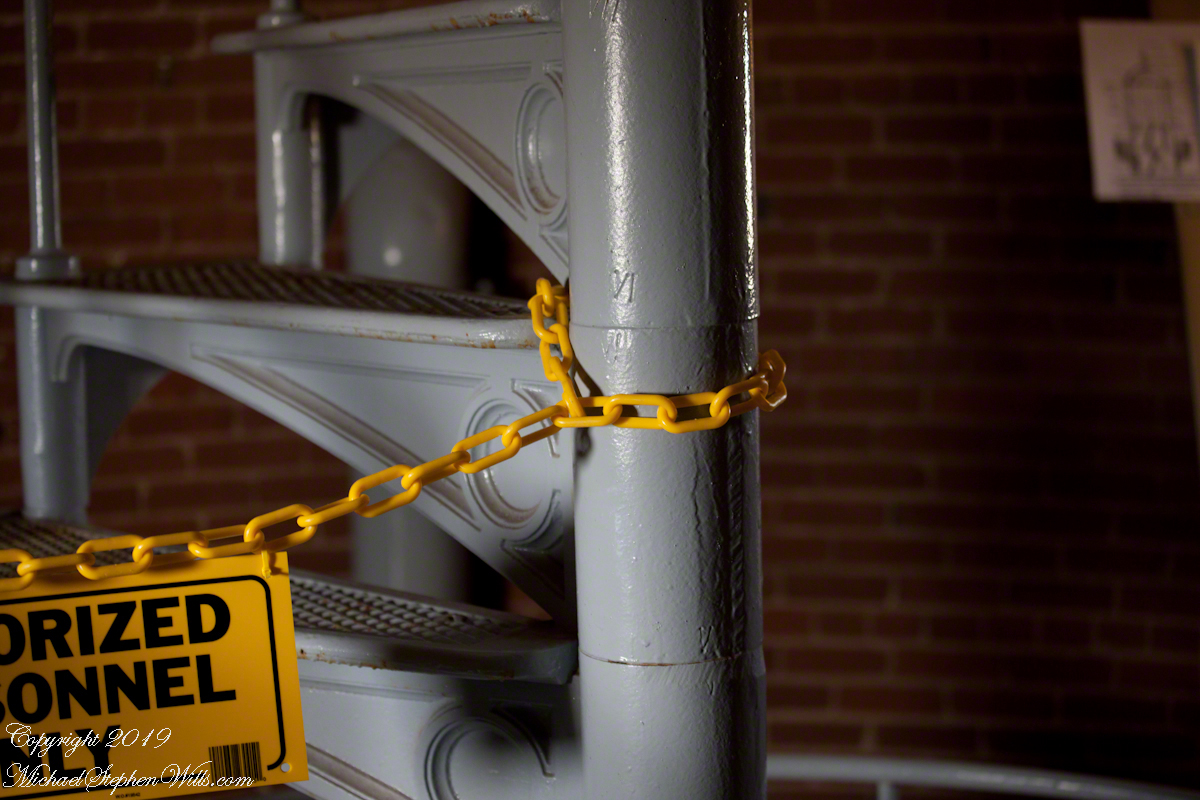
Stairway to Upper Floors

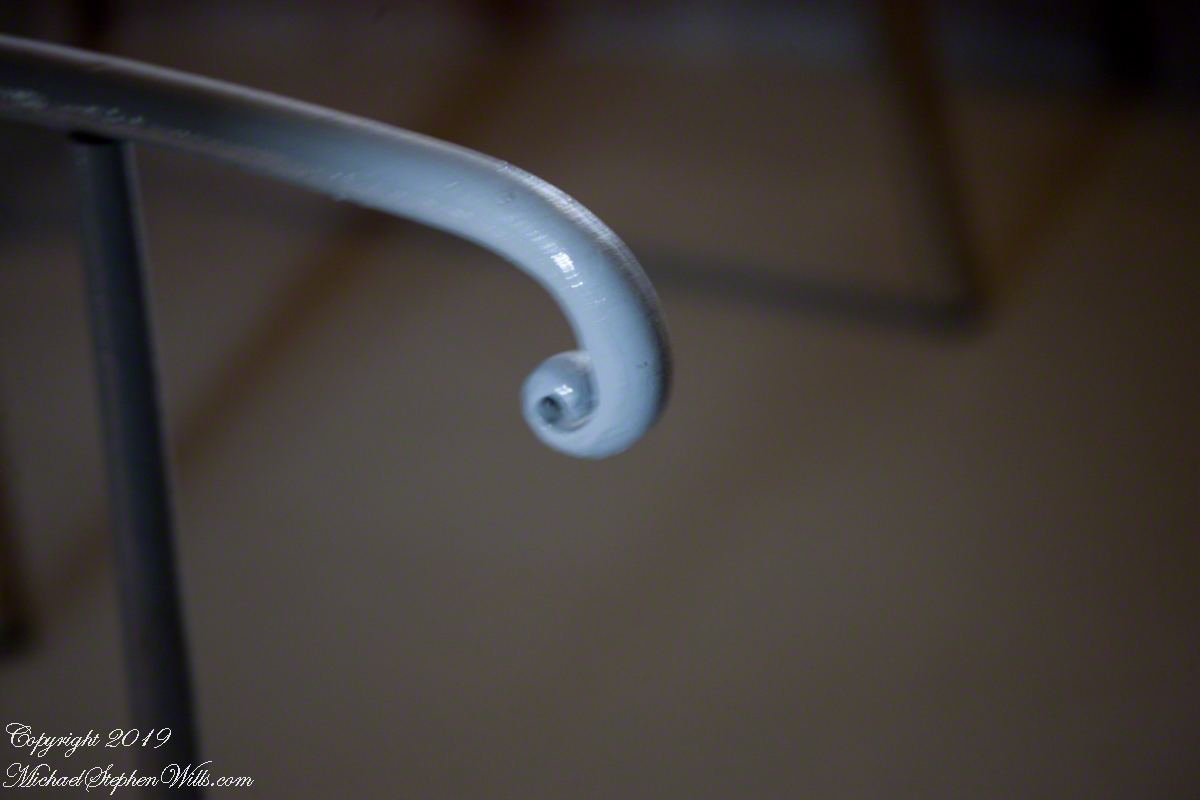
The fine finish of the handrail termination for the stairs to upper floors is an example of 19th century attention to detail.
Macro of numeral inscription on a lower floor stairway column.
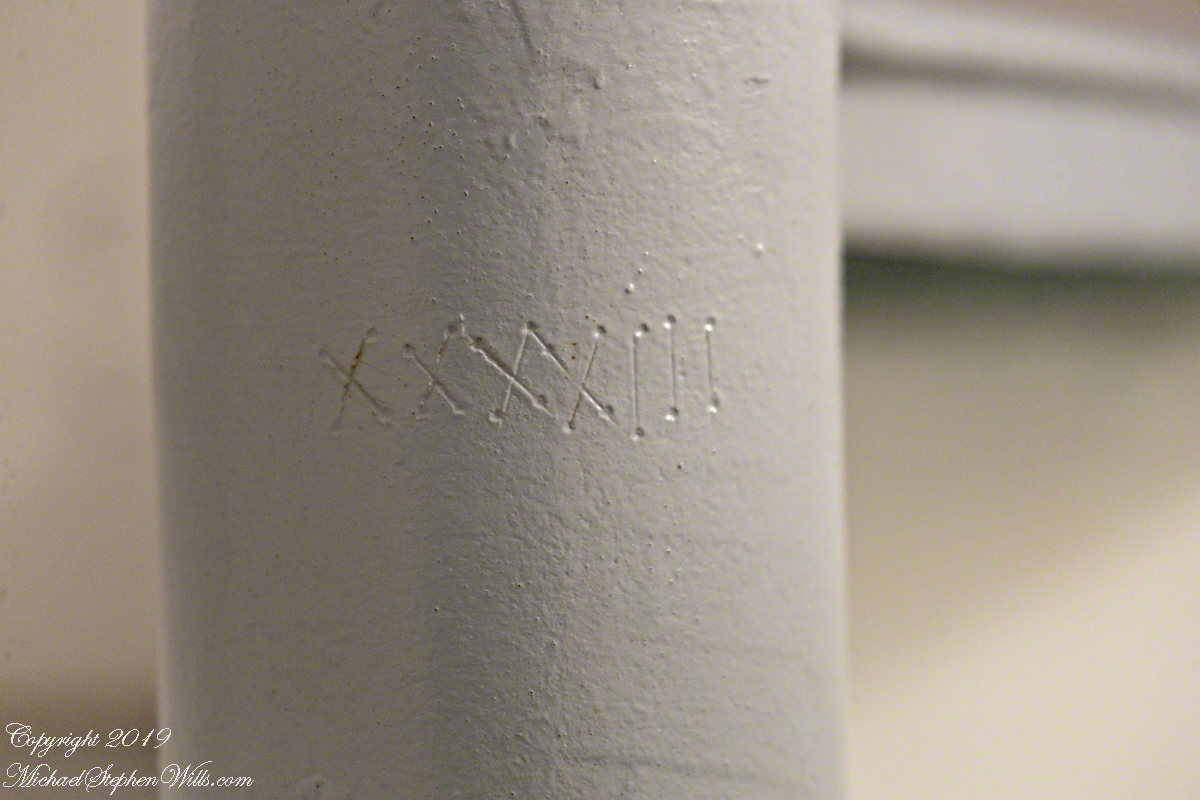
Roman Numeral 43 on staircase column of lower floor

View of Space History from the Portals

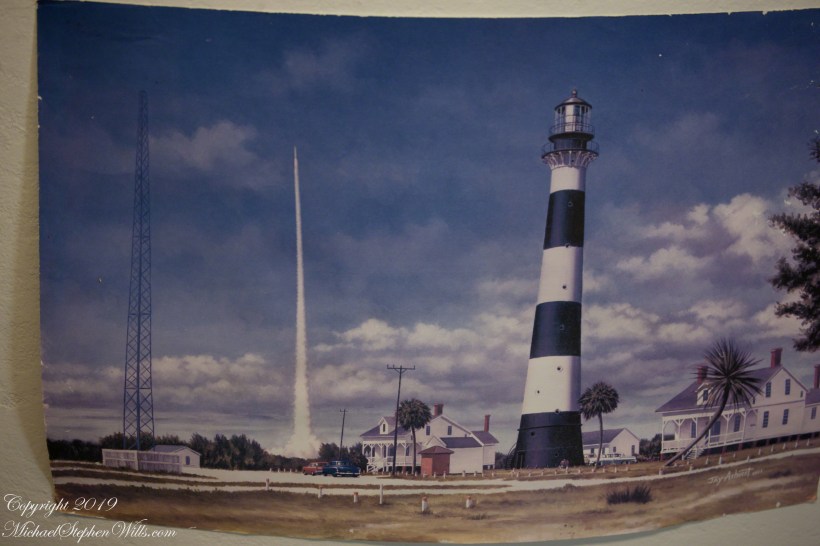
The lower staircase support column was much wider with space for illustrations and displays. Here is a reproduction of a watercolor of the lighthouse from the earliest days of rocketry on the cape. The lighthouse keeper, assistant and their families lived alongside the tower. The housing was later razed. The Lighthouse Foundation is raising money to build reproductions of the housing.
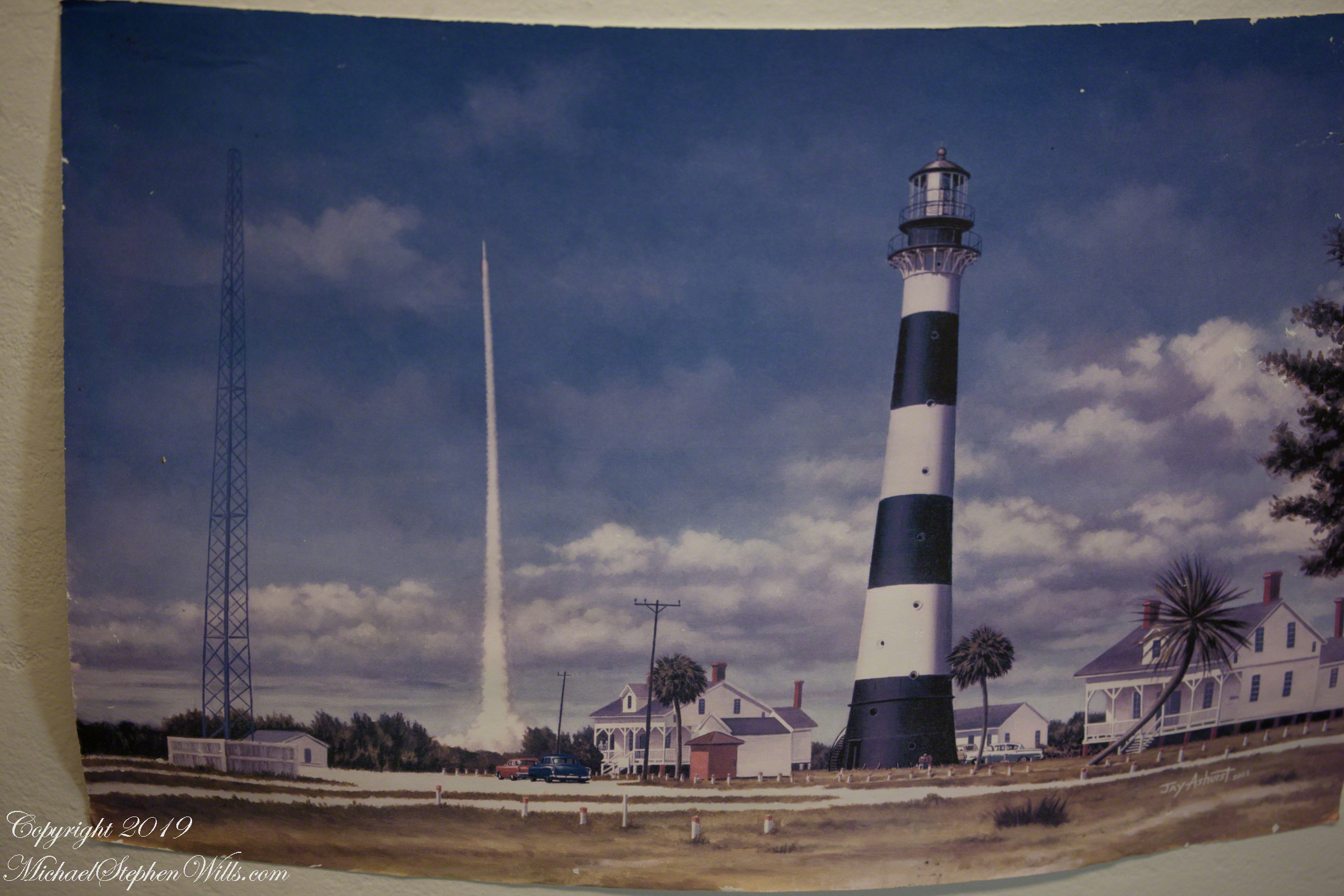
I put my copyright on the photograph to control copying. The copyright does NOT refer to the artwork.

The painting is an accurate representation of the tower. The dark spots are the windows, or portals, captured in my last post, “Lighthouse Details.” Every portal offered a view of historical or current rocketry. In the following photograph, beyond the outbuilding, is a blockhouse, protection for the early rocket scientists, now abandoned. The structure services launch complex 21 and 22. More in a later post.
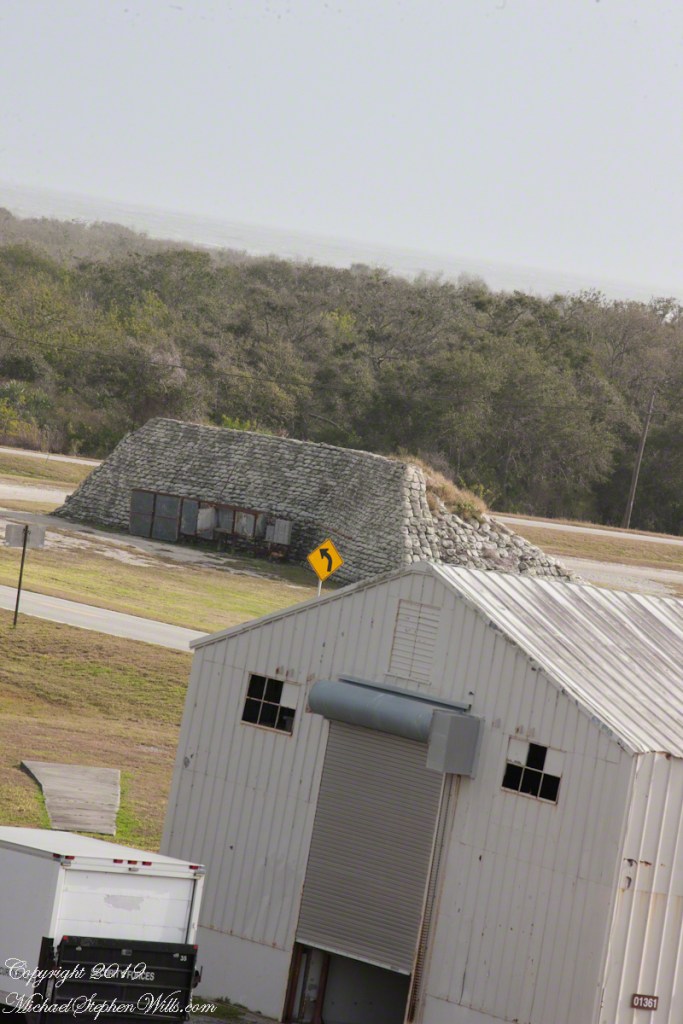
Wreckage with Recollections of Werner von Braun

Depending on your viewpoint, the landscape around the tower is either littered with or graced by relics such as the wreckage in the following photograph.
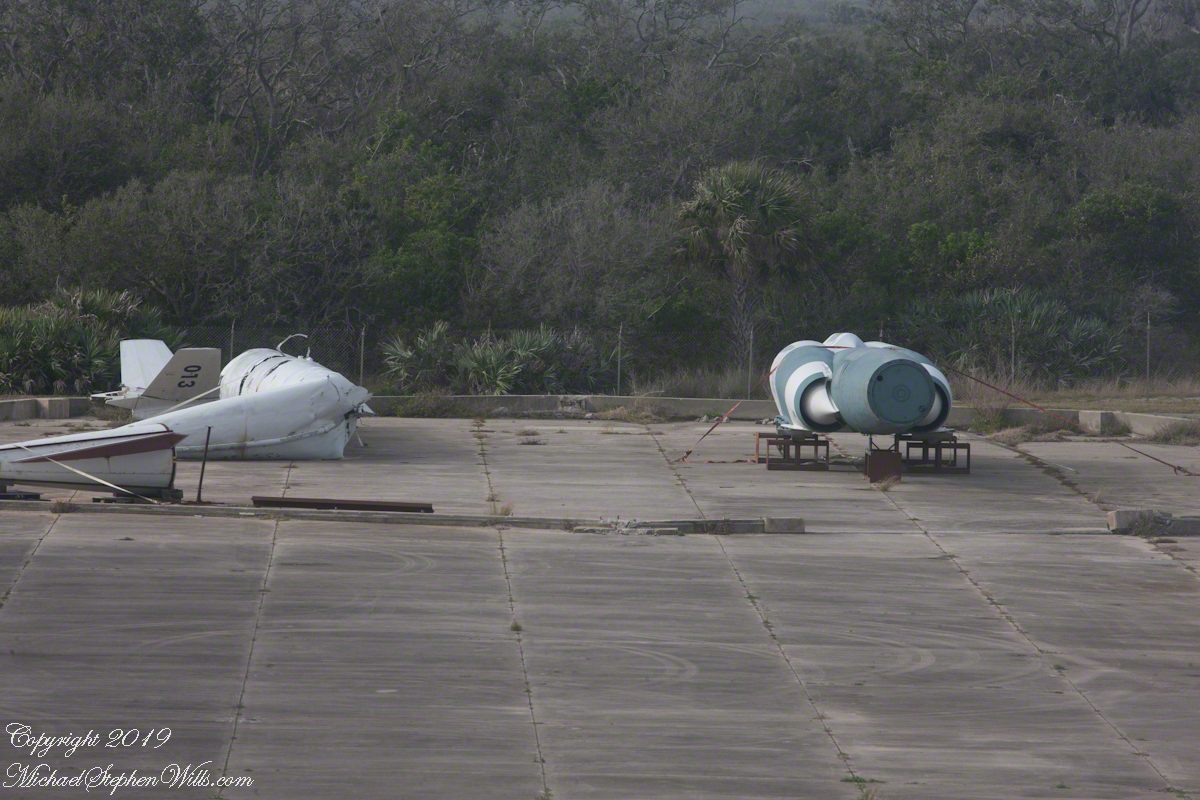
As we stood on the exterior staircase, looking toward the building in the following photograph, the docent told a story of Werner von Braun, how he loved to smoke cigarettes and watch rocket tests from the top of the lighthouse. After some spectacular failures, for reasons of personal safety he was excluded from the tower. His office during the development of the Minute Man and Persing missiles was in this building.
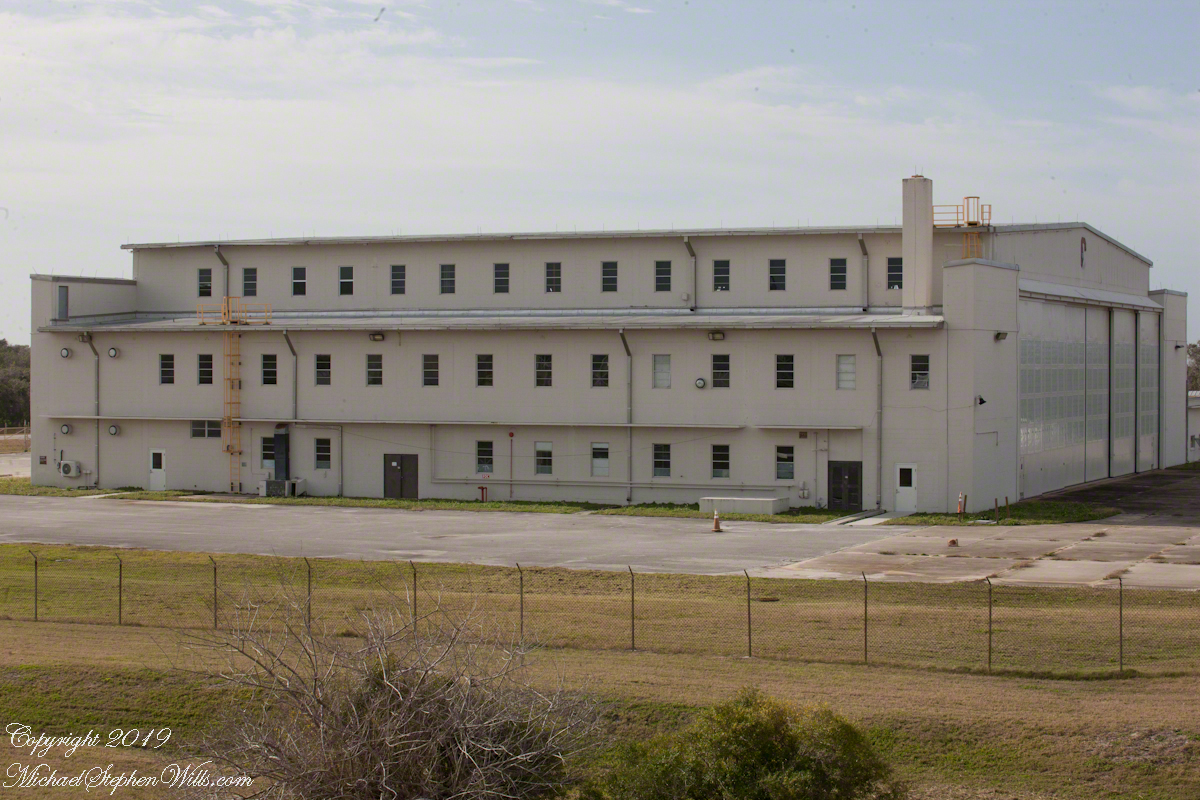
Building next to the lighthouse where Werner VonBraun had an office during the early days of USA rocket research.

This view overlooks the former sites of Minute Man and Persing rocket development. Beyond the launch towers is Port Cape Canaveral, visible to the right are large cruise ships.
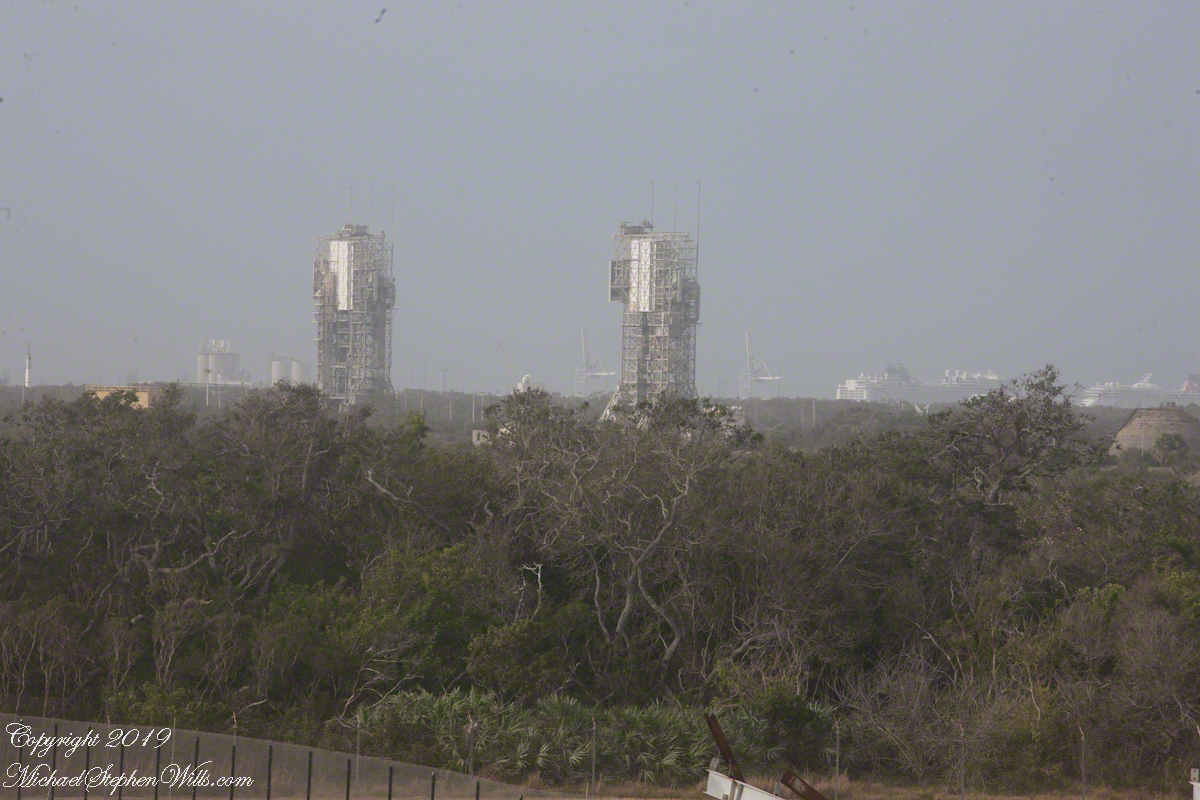
Viewed from the Cape Canaveral lighthouse, the port i is in the distance with cruise ships.

Looking from portals facing northeast is this view across ICBM road and its many launch sites. We will visit these in a future post.
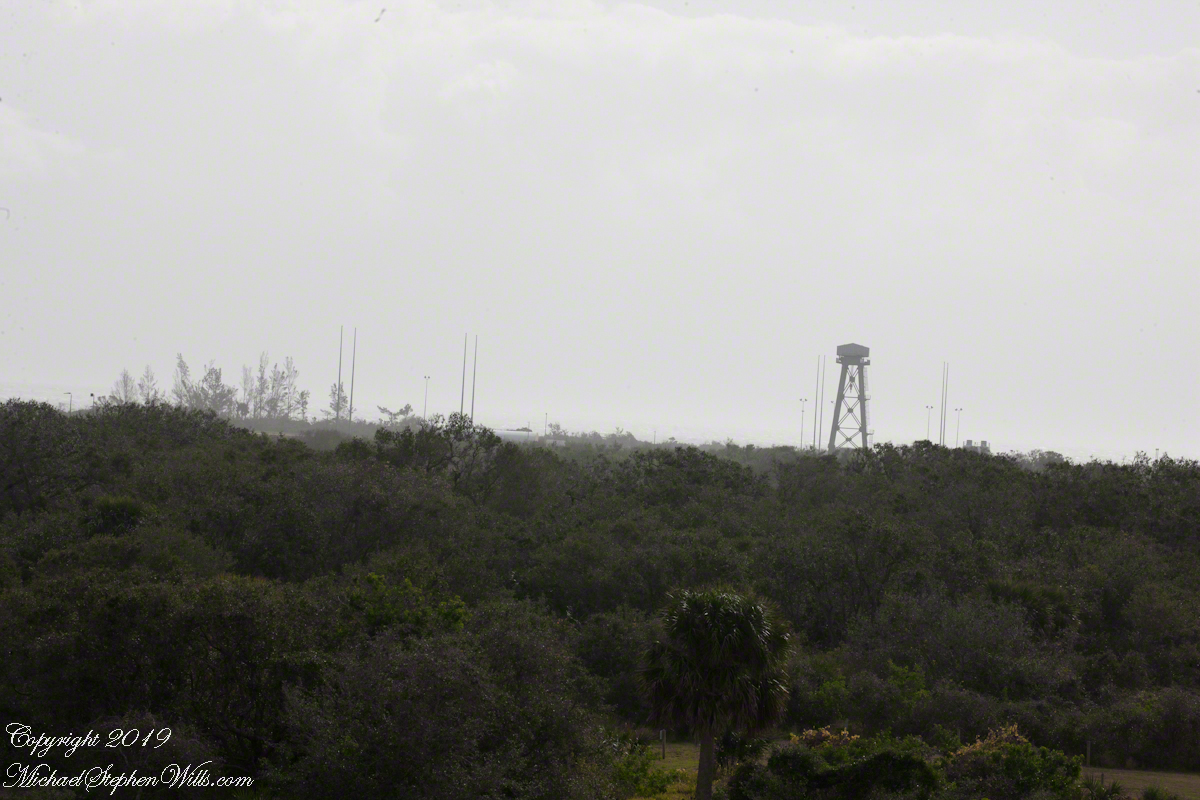
Viewed from the Cape Canaveral lighthouse, these are active launch sites.
ClickMe for the first post in this series, “Cape Canaveral Lighthouse.”

Copyright 2024 Michael Stephen Wills All Rights Reserved.

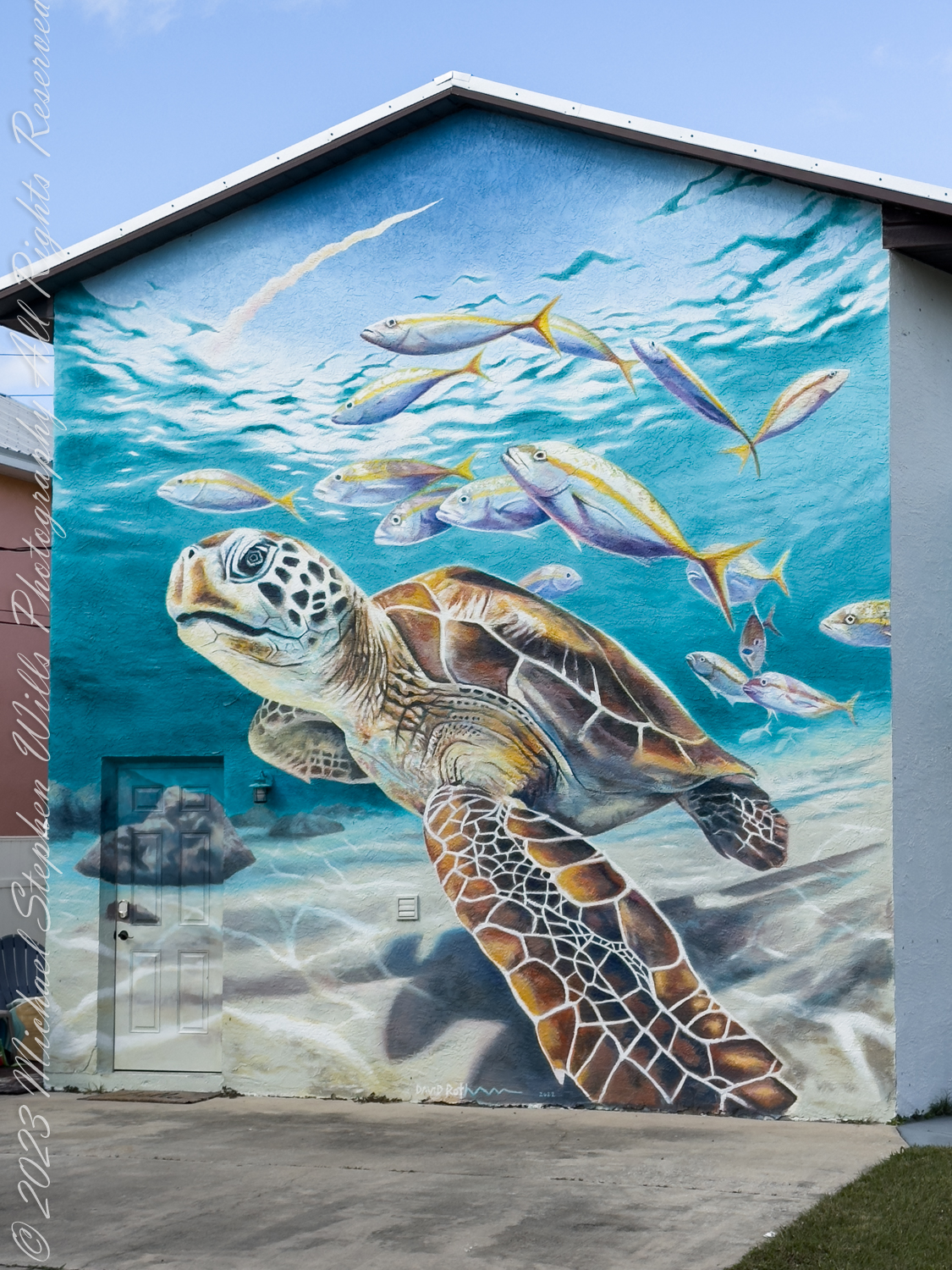
Sea Turtle Portrait

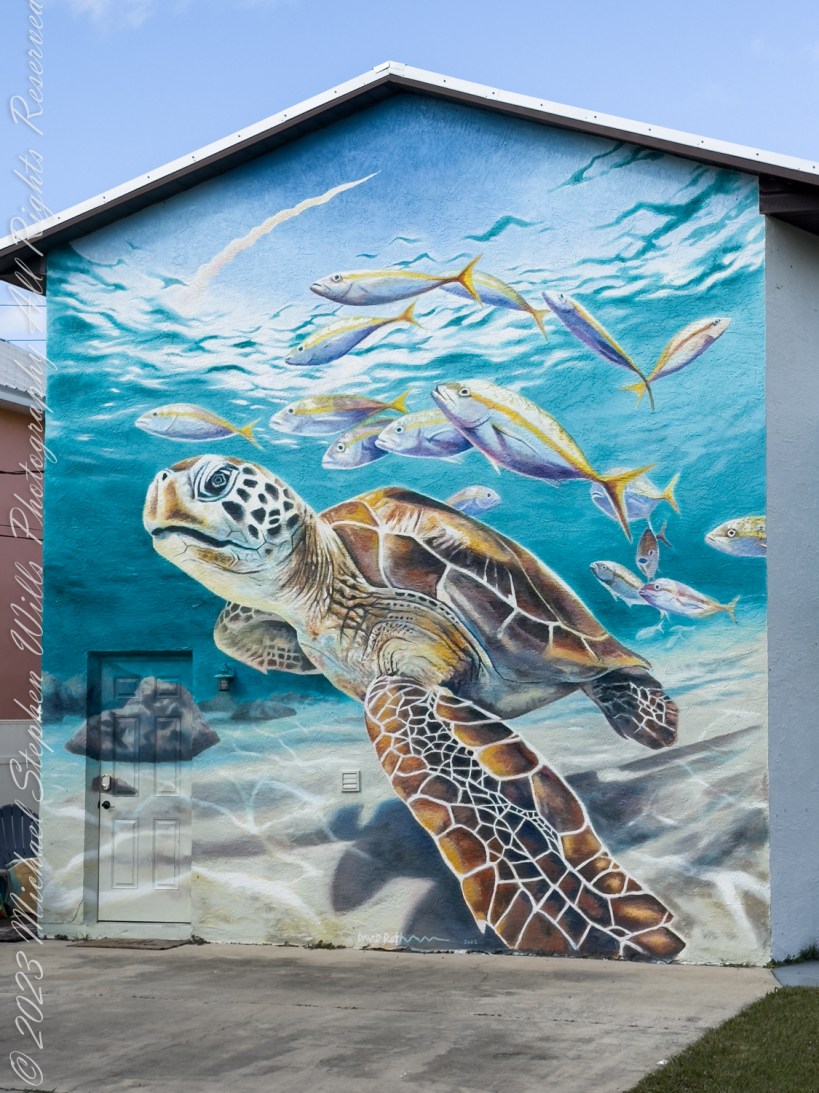
Portrait of a Sea Turtle with fish, sea floor and a rocket launch. 541 Washington Ave, Cape Canaveral, FL 32920 Near Cheri Down Park, Brevard County, Florida

Portrait of a Sea Turtle with fish, sea floor and a rocket launch. 541 Washington Ave, Cape Canaveral, FL 32920 Near Cheri Down Park, Brevard County, Florida

Along the bottom margin is the artist’s signature, “David Roth 2022.”

Copyright 2024 Michael Stephen Wills All Rights Reserved

Luminous Tension

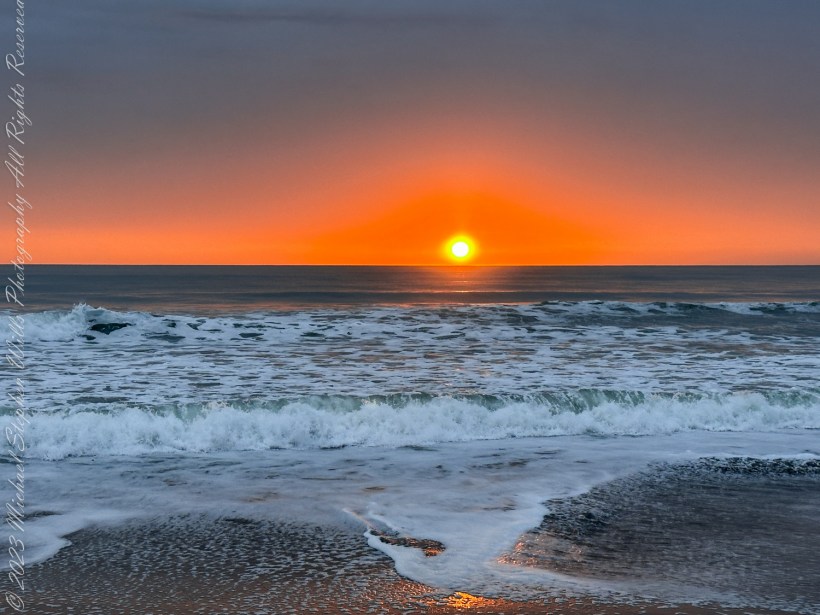
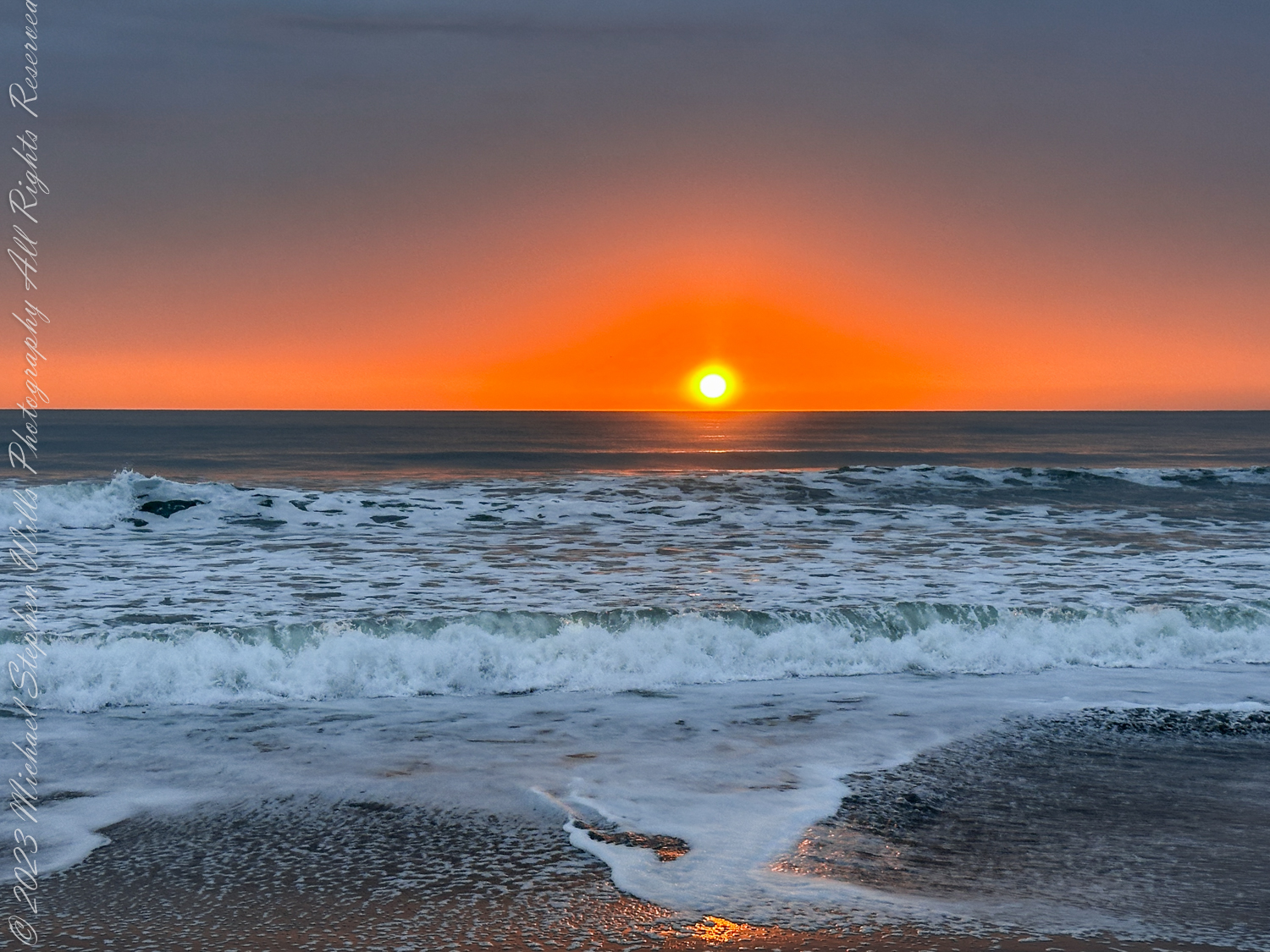
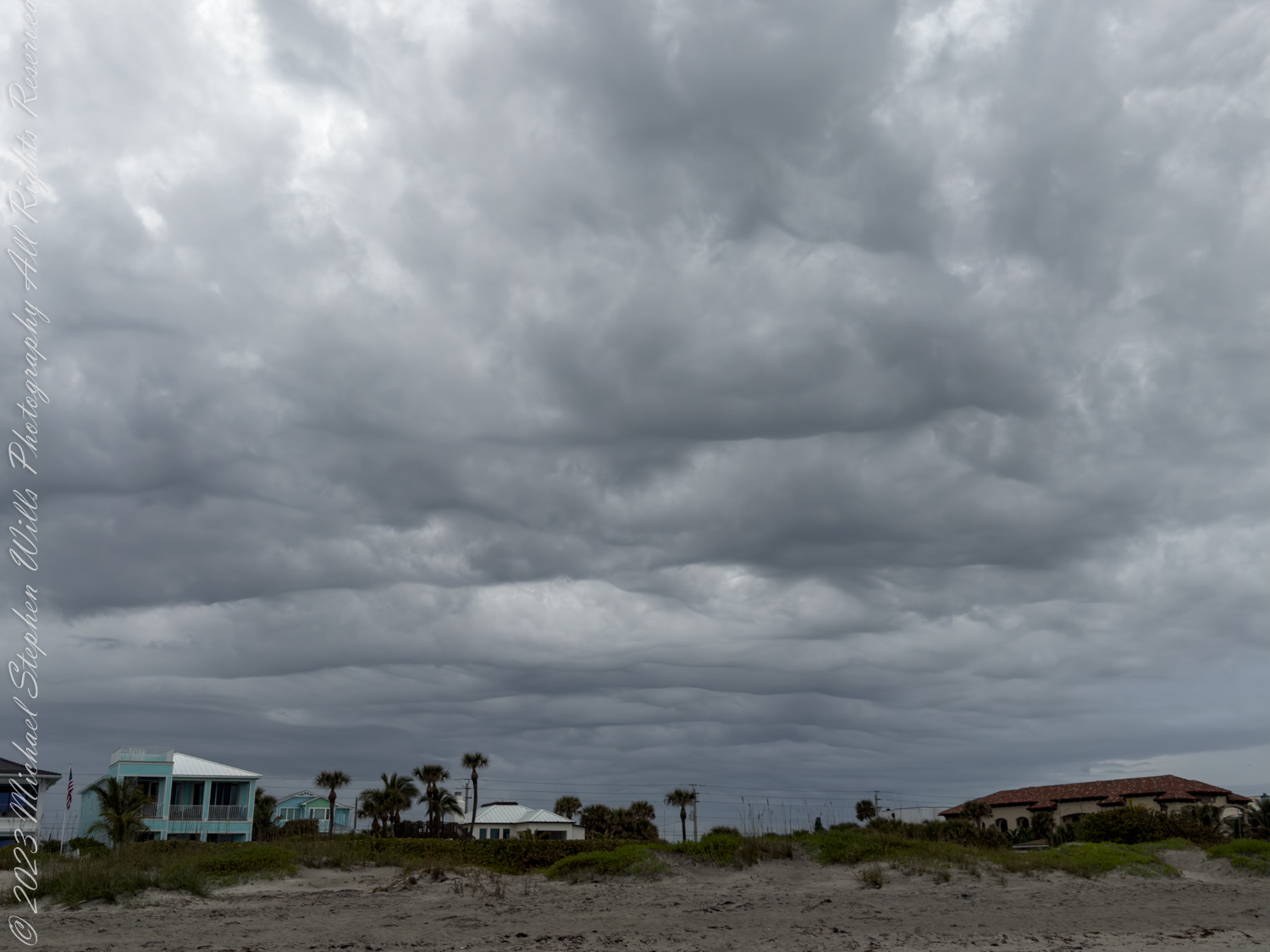
Beneath the brooding storm clouds moving with silent intent, I stood, the air electric with the storm’s approach. Yet, turning east, the Sun’s Eye winked at the horizon, igniting the sky in defiance—a fleeting warmth against the impending tempest’s chill.

Amidst the sprawling canvas of Cocoa Beach, a beachcomber such as I stands witness to the theater of the skies, a stage upon which the sun and storm perform their eternal dance. The dawn of this particular February morning brought with it a spectacle of dual realms, a chiaroscuro of the celestial drama that unfolds in minutes and lingers in the heart.

To the east, ‘the Sun’s Eye’—a fierce, glowing orb—peered over the horizon, its gaze cutting through the cool morning mist. The sea, a mirror of the skies, blushed with the hues of a blooming peach, its waves whispering secrets as they lapped the shore. Each frothy crest reflected the sun’s burgeoning fire, a symphony of light that sang of the world’s awakening. It was a moment of birth and beginning, the kindling of a day where the potential hung ripe as the citrus in the Floridian groves.

This radiance, however, was but a half of the morning’s tale. As I turned, facing west, the sky told a different story. Here, the heavens grew heavy with brooding storm clouds, a tumultuous sea of gray above the green. These undulating specters crept forward, a procession of ashen waves threatening to swallow the day’s young light. The air, charged with the tension of an impending tempest, hummed with the promise of nature’s fury.

Twenty-one minutes—a mere breath in the lifespan of the cosmos—was all it took for the scenery to shift, the mood to transform. To the east, the promise of warmth and the whisper of daylight’s caress; to the west, the cold omen of a storm’s embrace. This juxtaposition, this confrontation of fire and shadow, was a testament to the Earth’s ephemeral beauty.

In the presence of such a display, I—a mere beachcomber—was a sentinel between two worlds. The sunrise spoke to me of hope, of the unyielding rhythm of time that brings renewal each day. Its golden fingers painted the world in a palette of possibility, a reminder that each dawn brings its own story, its own song to be sung.

The approaching storm, in contrast, murmured of respect for the forces beyond our grasp, the humbling power that nature wields with indifferent grace. Its darkening clouds, layered like the furrowed brows of ancient gods, were a canvas of the world’s raw strength, its capacity for change, for washing the old away with a torrent.

Here, on this stretch of sand, the universe seemed to converge—a meeting point of opposing forces, a confluence of light and darkness, creation and destruction. In the face of such majesty, I found a profound tranquility, a sense of my place in the grand tapestry. For what are we but observers, participants in the grand design, bearing witness to the moments when the world reveals its contrasting character?

This morning’s display was a parable of life itself, written in the language of the skies. The Sun’s Eye, ever-watchful, ever-prescient, promised the comfort of the familiar, the steady passage of time marked by the constancy of its rise and fall. The storm, brooding and unpredictable, was a reminder of life’s uncertainty, the inevitability of change and the beauty found within it.

As the light grew and the darkness encroached, I stood at the crossroads of day and night, life and experience. With the sand beneath my feet and the salt air filling my lungs, I embraced the duality of existence, knowing well that each sunrise heralds not just the day, but the inescapable storm that follows. In Cocoa Beach, on the Space Coast, the universe had unfolded its dual nature before me, an eternal beachcomber, in the span of a single, breathtaking morning.

Copyright 2024 Michael Stephen Wills All Rights Reserved

Two Laughing Gulls of Cocoa Beach: A Dance of Adaptation and Survival

Discover the captivating world of Laughing Gulls, the jesters of Cocoa Beach’s shores. Dive into their lives, exploring the dance of courtship, the adaptability in their diet, and their vital role in the coastal symphony.

The Coastal Sentinels

On the shores of Cocoa Beach, where the Atlantic’s waves gently knead the sands of Brevard County, Laughing Gulls (Leucophaeus atricilla) enact their daily ballet of survival and adaptation. In the span of mere minutes, the shifting light of Florida’s coastal theater presents two scenes, each with the same protagonist yet donned in starkly different costumes.

The Many Faces of Adaptation

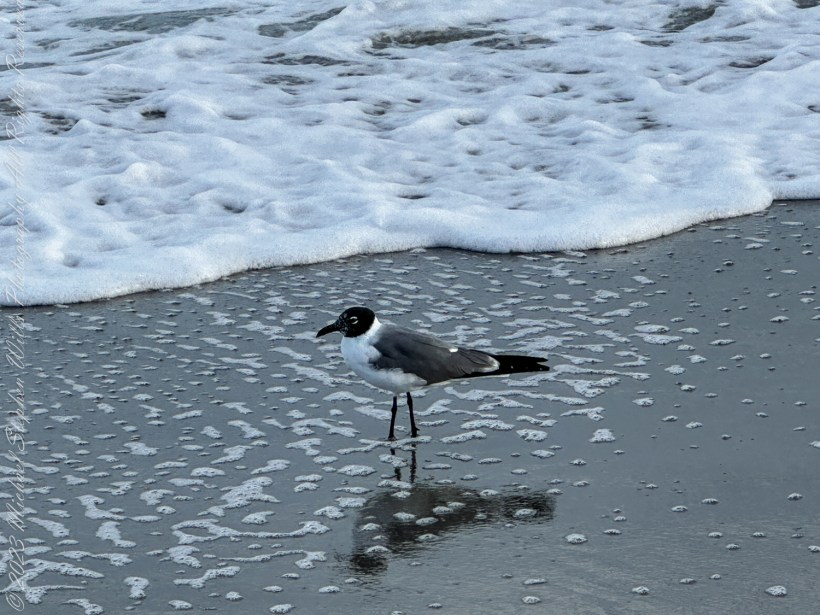
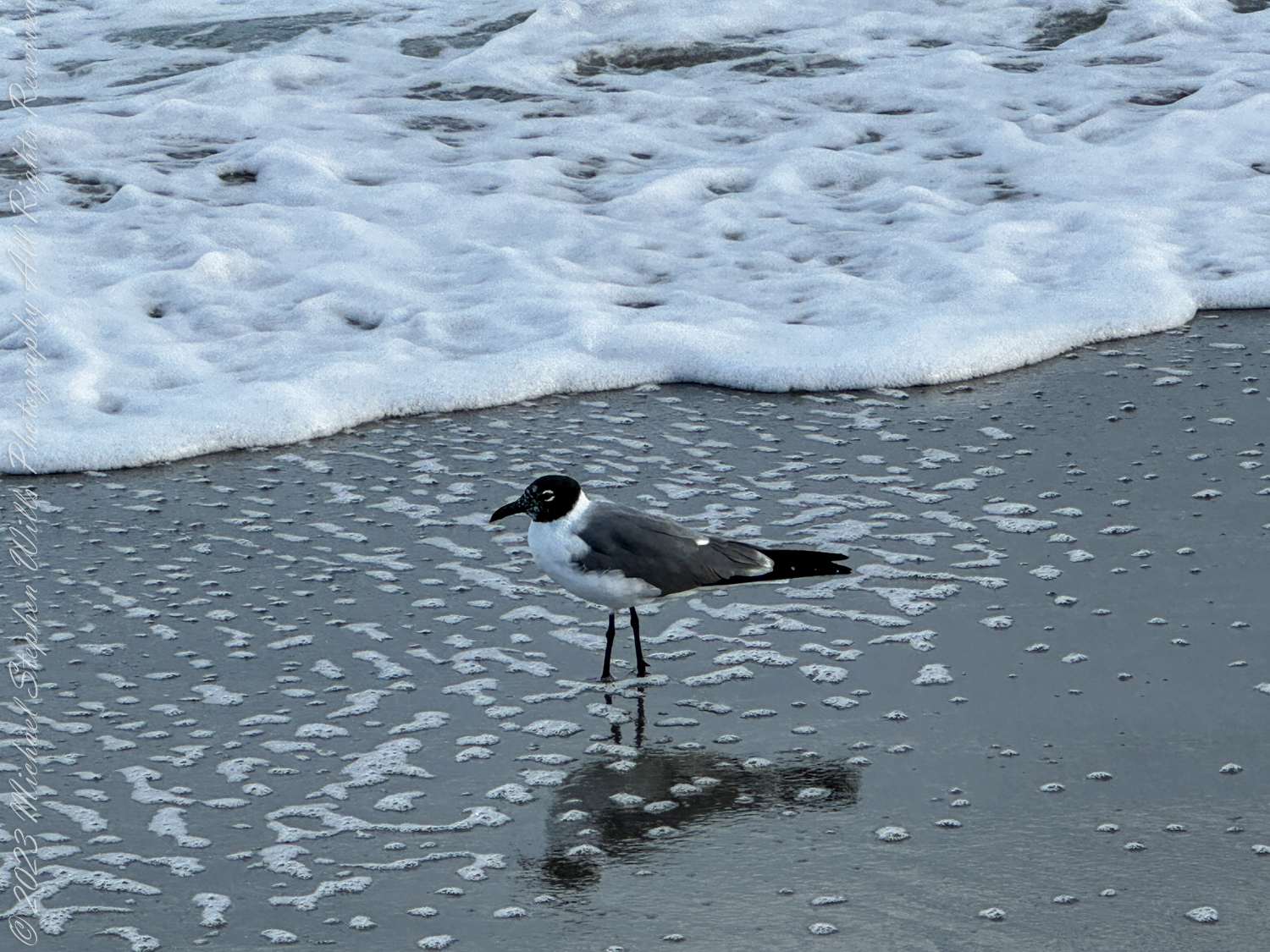
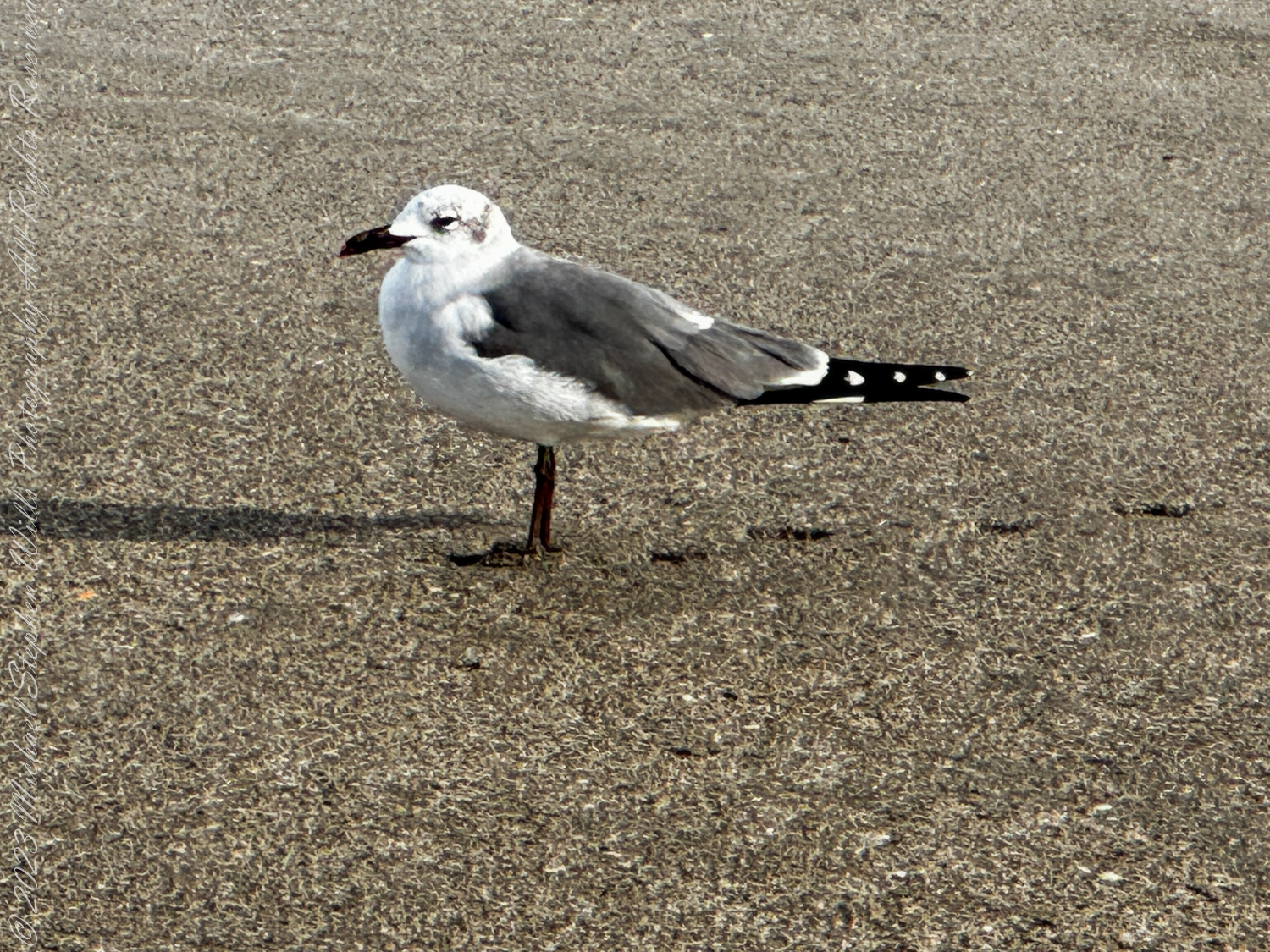
The first gull, captured against the frothy lace of the incoming tide, is the epitome of the breeding plumage: a sleek, black hood that starkly contrasts its pearl-grey wings. This attire is not merely for allure but speaks of its readiness to engage in the rituals of courtship and the responsibilities of rearing the next generation. This black hood, a seasonal crown, fades as the duties of breeding wane, revealing the less conspicuous garb of the non-breeding season—a mottled grey head atop the same sturdy body, ready to blend into the off-season’s landscape.

Laughing Gull with breeding plumage

Laughing Gull, nonbreeding plumage

Minutes Of Separation

The mere minutes that separate the two photographs are but a whisper in the grand dialogue of evolutionary time. Yet, they offer a glimpse into the ever-present duality of the Laughing Gull’s life. In one, the gull stands resolute, black-headed and bold against the soft chaos of the sea’s edge. In the other, its head appears dusted with the wisdom of age, a visual softening that speaks to the less confrontational time of year.

Here are some observations to make sense of this disparity:

Overlap of Molting Periods: Laughing Gulls do not all breed at the same time; some individuals may start molting into or out of breeding plumage earlier or later than others. This can result in birds with different plumage being seen together.

Varied Maturity: Younger gulls or those not yet of breeding age may not have developed the breeding plumage, while adults in the same flock may display full breeding colors.

Breeding Colonies: Gulls often nest in colonies where birds in different stages of the breeding cycle can be observed together, including those that may have lost mates or failed to breed and therefore did not develop breeding plumage.

Health or Nutritional Status: Sometimes a bird’s plumage can be affected by its health or nutritional status. A gull in poor health might not molt into breeding plumage as expected.

Geographic and Climatic Factors: Local environmental conditions can influence the timing of molting. Birds in the same location can experience different environmental cues that might affect their molt.

Non-breeding Visitors: During the breeding season, some non-breeding birds may still be present and intermingle with breeding birds, either because they are passing through the area or they are non-breeding residents.

Extended Breeding Season: In areas with a long breeding season, such as in subtropical and tropical regions, the breeding and non-breeding plumages can be seen at the same time due to the extended period over which breeding can occur.

Masters of the Coastal Realm

The Laughing Gulls are more than just residents of the coast; they are its caretakers and witnesses. Their laughing calls are synonymous with the ocean’s breath, a soundscape that harmonizes with the rhythmic crashing of waves. These birds thrive in the intertidal zone, a challenging environment where land and sea engage in a perpetual tussle. Here, they must be opportunistic, agile, and resourceful, for the beach offers both a cornucopia of food and the threat of unpredictability.

The Ebb and Flow of Existence

The life of a Laughing Gull is intimately tied to the ebb and flow of the tides. Their diet is a testament to their adaptability, comprising anything the sea yields—fish, crustaceans, and even the unfortunate insects that stray too close to the brine. They are pirates of the shore, unafraid to snatch a meal from another bird or scavenge the remains of human activity.

Reflections on Change and Constancy

Laughing Gulls are the embodiment of the sea’s narrative around us—a story of change and constancy. Their lives are a testament to the tumultuous history of the ocean, and their presence is a thread that connects us to the vast, blue mystery. They remind us that, while the sea’s moods are many and its faces ever-changing, it remains a central force in the narrative of life on Earth.

In the Face of Tomorrow

In the space between these two images, we find a profound lesson on the nature of time and the resilience of life. The Laughing Gulls of Cocoa Beach, with their shifting plumage and timeless cries, are messengers of the past, envoys of the present, and harbingers of the future. As we contemplate their existence, we are reminded of our own place within the natural world—a world that requires our understanding and protection, lest the laughter of these gulls fades into the silent archives of history.

The Laughing Gulls of Cocoa Beach continue their dance, unfazed by the human gaze, their lives a fluid adaptation to the sea’s caprices. And as the sun marches across the sky, casting the story of these gulls into relief against the shifting sands, we are privileged to observe, to learn, and to cherish the Atlantic Ocean’s enduring tale.

Copyright 2024 Michael Stephen Wills All Rights Reserved

Near and Far — the last day of 2023

Discover a heartfelt story woven from the sands of Cocoa Beach on New Year’s Eve, where shells and stars intertwine, inviting you to ponder the delicate dance of near and far.

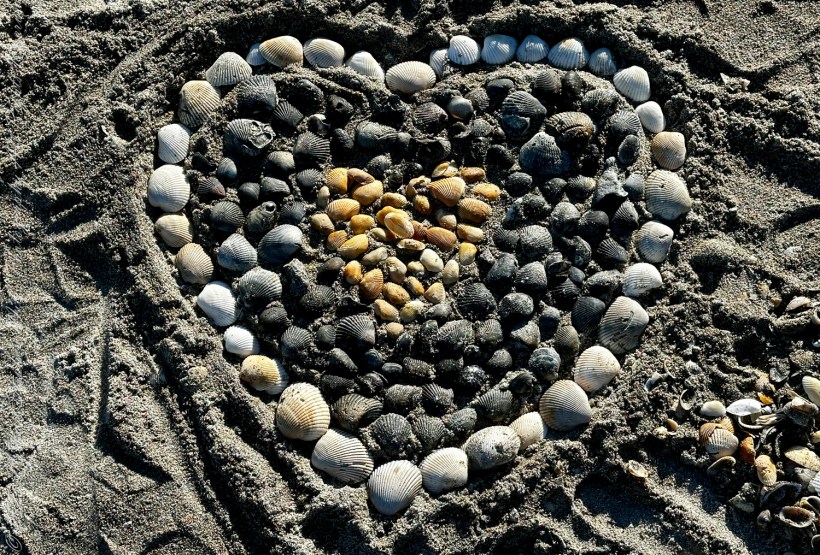
On the last day of 2023, as the sun began its descent on Cocoa Beach, I found myself tracing the contours of a heart laid out in Ark Clam shells. Each shell, with its ridges and grooves, felt like a chronicle of the ocean’s whispers. This artful mosaic, set against the granular canvas of the beach, was a testament to the playful hands of time and tide. I marveled at the intention behind it, the human desire to create and connect, to leave a mark, however fleeting, on the vastness of nature.

I found this beach heart while walking on Cocoa Beach on the last day of 2023. It is composed of the various shade of Ark Shells. Ark clam is the common name for a family of small to large-sized saltwater clams or marine bivalve molluscs in the family Arcidae. These are the most common shells found there.

The shells were cool and firm under my fingertips, each one a unique piece of the year’s mosaic. Some were a pristine white, while others bore the earthy tones of the sea’s floor. I pondered the journeys they had taken, tumbling in the ocean’s embrace before resting here, on the threshold of a new year. The act of arranging them into a symbol of love felt like an ode to the past year’s collective joys and sorrows, an offering to the unknown adventures of the year to come.

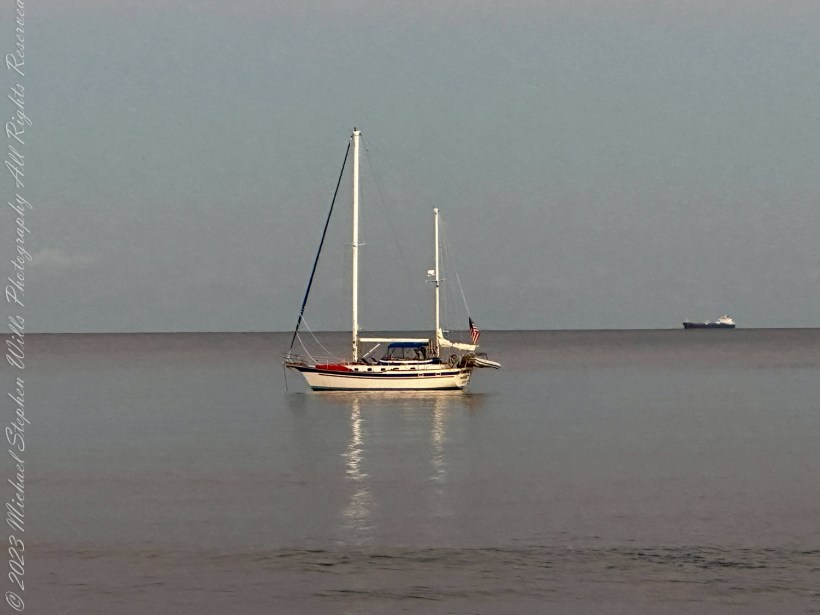
As the day waned, my gaze shifted from the shells to where the water met the sky. There, a sailboat floated serenely, a silent sentinel between two worlds. It was a picture of solitude, a single vessel on the brink of the infinite sea, beneath the expanding dome of the heavens. On the horizon, the silhouette of a cargo ship whispered stories of distant lands and the ceaseless pulse of commerce and exploration that defined our modern era.

On New Years Eve 2023 this sailboad moored off North 1st Street, Cocoa Beach, Brevard County, Space Coast, Florida.

The beach was quiet, the sounds of the day giving way to the evening’s peaceful lull. The sailboat’s stillness was a stark contrast to the perpetual motion of the cargo ship, each representing different paths on the water’s vast canvas. One was an emblem of leisure and simplicity, the other of industry and complexity. Both near and far, they were the day’s quiet companions, their stories part of the fabric of the Space Coast.

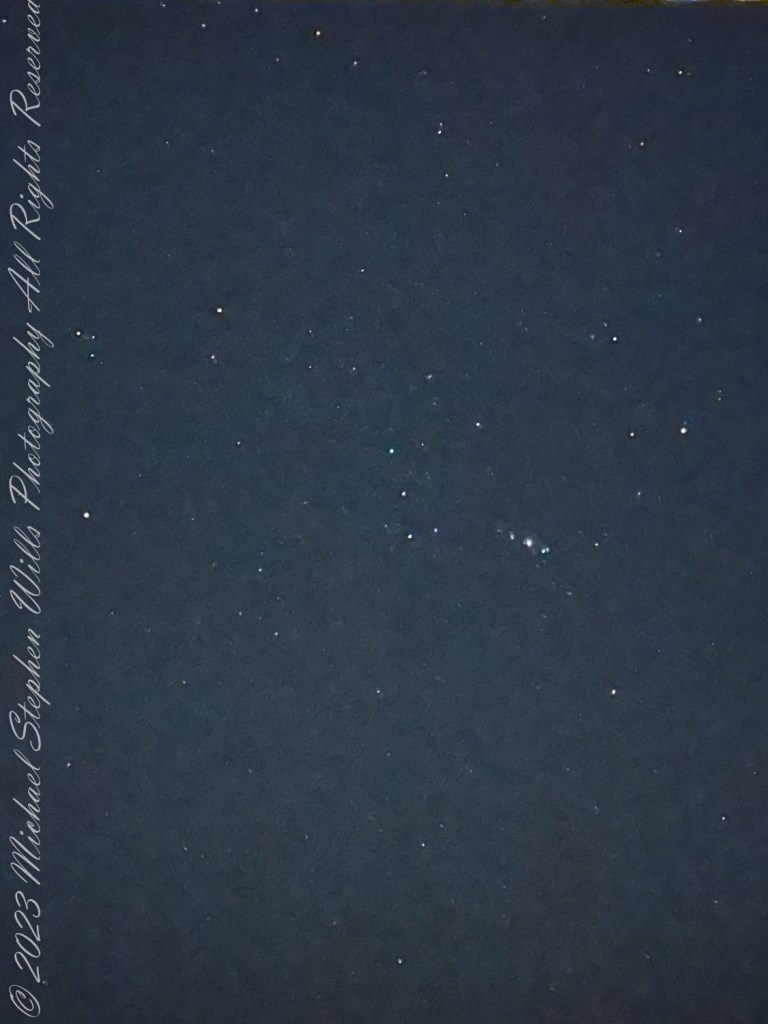
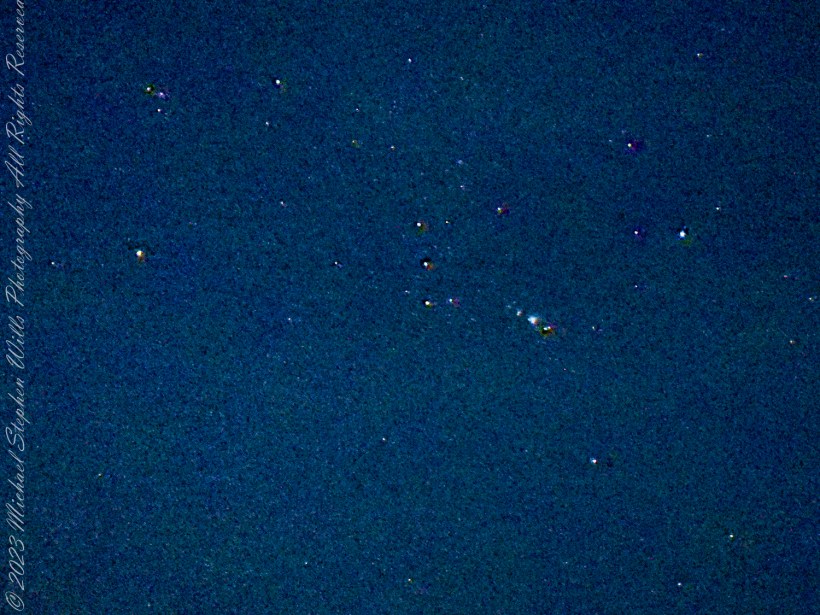
As twilight deepened into night, the stars began to emerge, one by one, until the sky was a tapestry of celestial wonder. With my iPhone 14 Pro Max, I captured this cosmic dance, the constellation of stars that had been the silent witnesses to Earth’s revolutions. The constellations, those mythic shapes that have long sparked human imagination, seemed to hold the secrets of what had been and what was to come. They were distant suns, their light traveling unfathomable distances to reach me, to reach us, as we stood on the brink of a new beginning.

Orion

I couldn’t help but feel a connection to the stars, a kinship with their ancient light. They reminded me that we, too, are part of this grand cosmic design, our lives stitched into the universe’s expansive quilt. On the beach, with the shells at my feet and the stars overhead, I was caught in the delicate balance of near and far—the tangible reality of the shells I could touch and the distant glow of starlight from ages past.

Orion, the belt and sword in center.

As the year ticked closer to its end, I stood between the intimate artistry of the shell heart and the boundless majesty of the star-filled sky, a lone observer of time’s relentless march. The Space Coast, with its unique blend of earthly beauty and human aspiration, was the perfect stage for this reflection. Here, on Cocoa Beach, I embraced the last moments of 2023, ready to welcome the new year, with its promise of continuance and change, its constant dance of near and far.

Copyright 2024 Michael Stephen Wills All Rights Reserved

“Some Enchanted Evening” Riff

Discover the charm of Cocoa Beach’s enchanted sunset where Olaf, the endearing snowman from “Frozen,” joins athletes in a celebration of imagination and sport on Florida’s magical Space Coast.

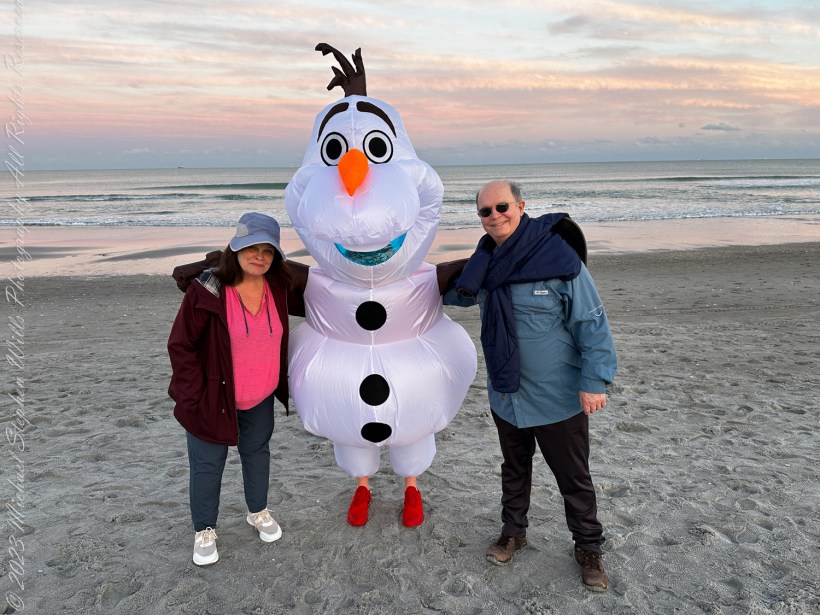
Olaf, with his carrot nose and coal-button smile, is the epitome of the whimsy and innocence that fills the hearts of those who dare to dream. He’s the spark of childlike wonder that persists even as the day gives way to night. As the sun dips below the horizon at Cocoa Beach, the playful contrast of a snowman who loves warm hugs stands out against the backdrop of Florida’s Space Coast—a place known for its rocket launches as much as its sun-soaked shores. It’s here, on this stretch of sand, that imagination and reality dance in the twilight, blurring the lines between a tale from the silver screen and the tangible joy of a beach evening.

The presence of Olaf in this coastal setting is an unexpected delight, akin to the wonder of snowflakes in summer. He is more than a snowman; he is the manifestation of Elsa’s magic, a symbol of enduring friendship and the embodiment of the happiness that comes from simply being alive. His creation, a whimsical result of Elsa’s ice powers, speaks to the capacity we all have for creation and transformation. The Olaf suit, worn by a young athlete, represents not just a beloved character, but a beacon of joy and the power of sportsmanship that enlivens the USSSA National All State Championship.

Don DeDonatis, CEO of USSSA, speaks of the excitement of hosting a tournament that is a “celebration of talented softball players from around the country.” Indeed, it’s a parallel to the celebration of life that Olaf represents—where each athlete, like each snow crystal, is unique and contributes to the beauty of the whole. The tournament at the Space Coast Complex in Viera, Florida, is a tribute to the hard work and dreams of young athletes, much like the dream that brought Olaf to life.

The sunset photograph of Cocoa Beach, snapped in December 2023, is not just a capture of a moment in time, but a timeless reminder of the enchantments that life offers. The beach becomes a stage where each footprint tells a story, and each wave sings a song. It’s a place where memories are made, where the spirit of characters like Olaf can leap out of their fictional realms and into our world, if only for an evening.

Brevard County’s Space Coast is a junction where the vastness of space meets the intimacy of earth, where shuttles launch into the cosmos while children build sandcastles, and where a snowman can stand on a beach without melting, embraced by the warmth of the setting sun rather than the chill of winter. It’s a testament to the human spirit’s boundless creativity and our ability to find joy in the juxtaposition of opposites.

This enchanted evening is a tapestry woven from the threads of fantasy and reality, sport and art, the cosmos and the coastline. It’s where the horizon kisses the sea, where the sky becomes a canvas for the sun’s parting masterpiece, and where Olaf, our friend from “Frozen,” reminds us that magic is not just in the realm of fairytales but all around us, in every grain of sand, in every sunset, and in every heart that believes in the wonder of one enchanted evening.

Copyright 2024 Michael Stephen Wills All Rights Reserved

Tides of Discovery: A Hawser’s Journey to Cocoa Beach

Discover the mysterious journey of an ocean-worn hawser on Cocoa Beach. Join me in unraveling its sea-tossed tales and the profound messages the tides bring to our shores.

A Serendipitous Morning


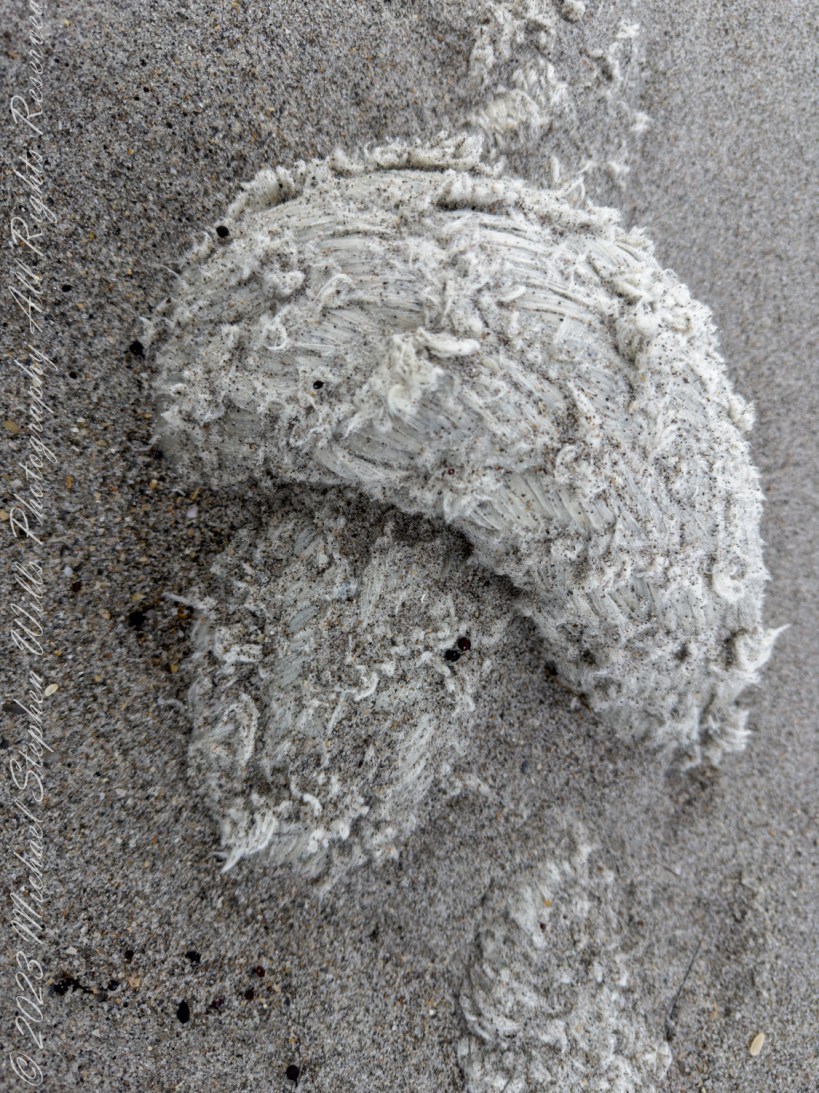
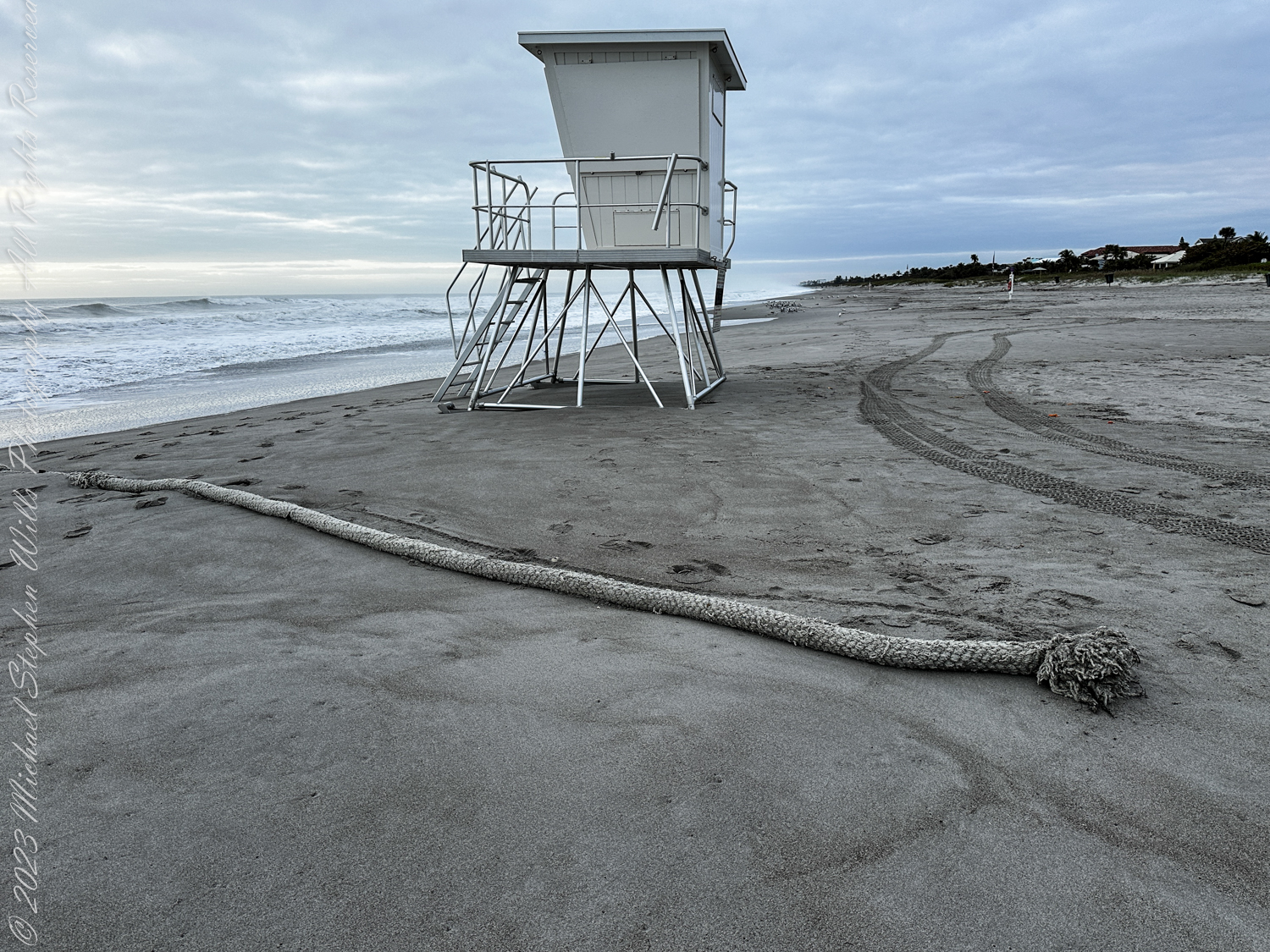
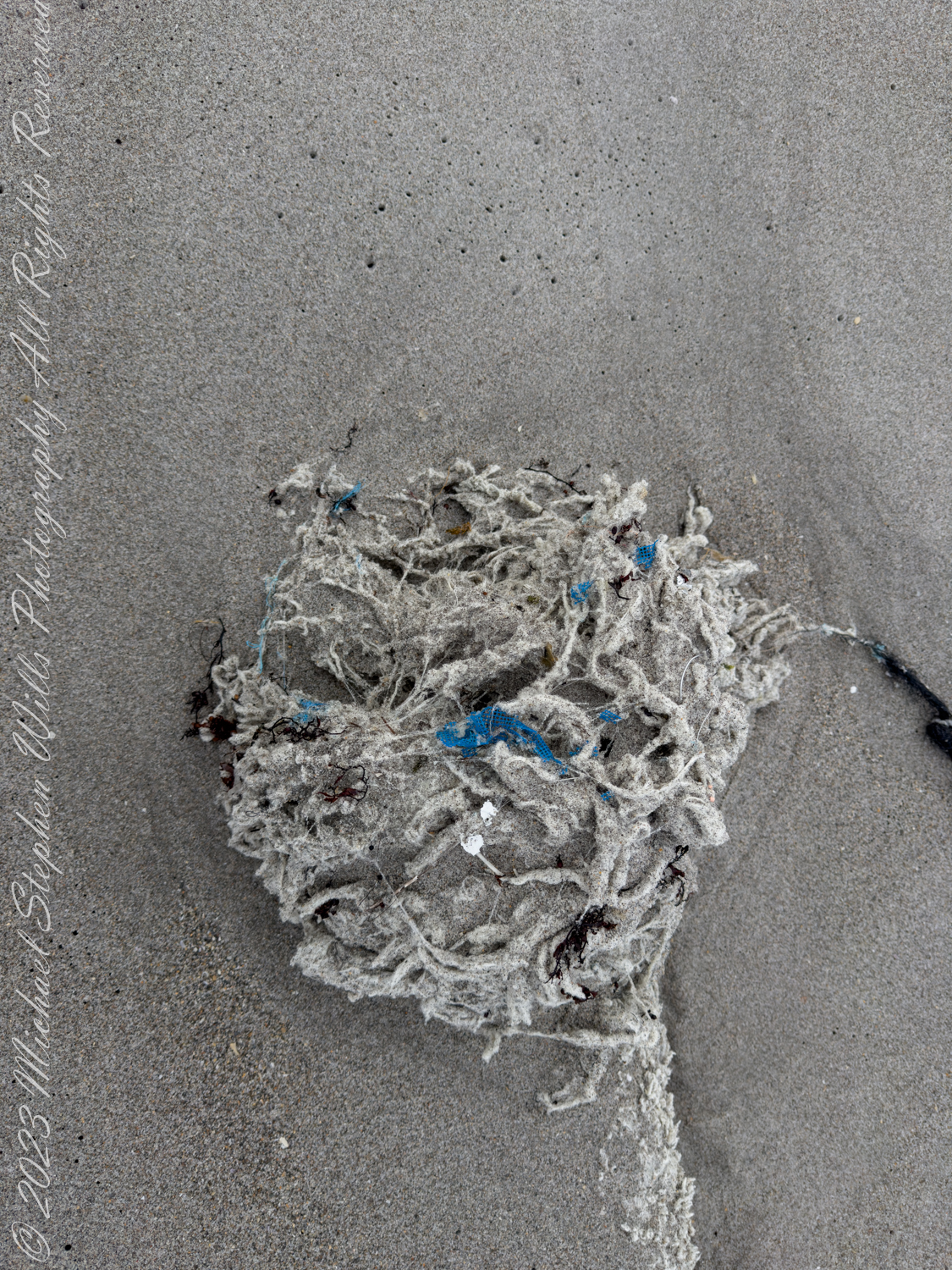
As I strolled along the familiar expanse of Cocoa Beach, a silver mist hung over the horizon, blurring the line where the Atlantic whispered to the skies. My footsteps, a quiet percussion against the hush of dawn, were the only sound until the waves added their chorus. I was here to greet the sunrise, a ritual that never failed to ground me, but today, the ocean had laid out a surprise – a hawser, heavy and worn, beached like a leviathan of the deep.

Cocoa Beach, Brevard County, Florida on the Space Coast

The Relic of the Sea


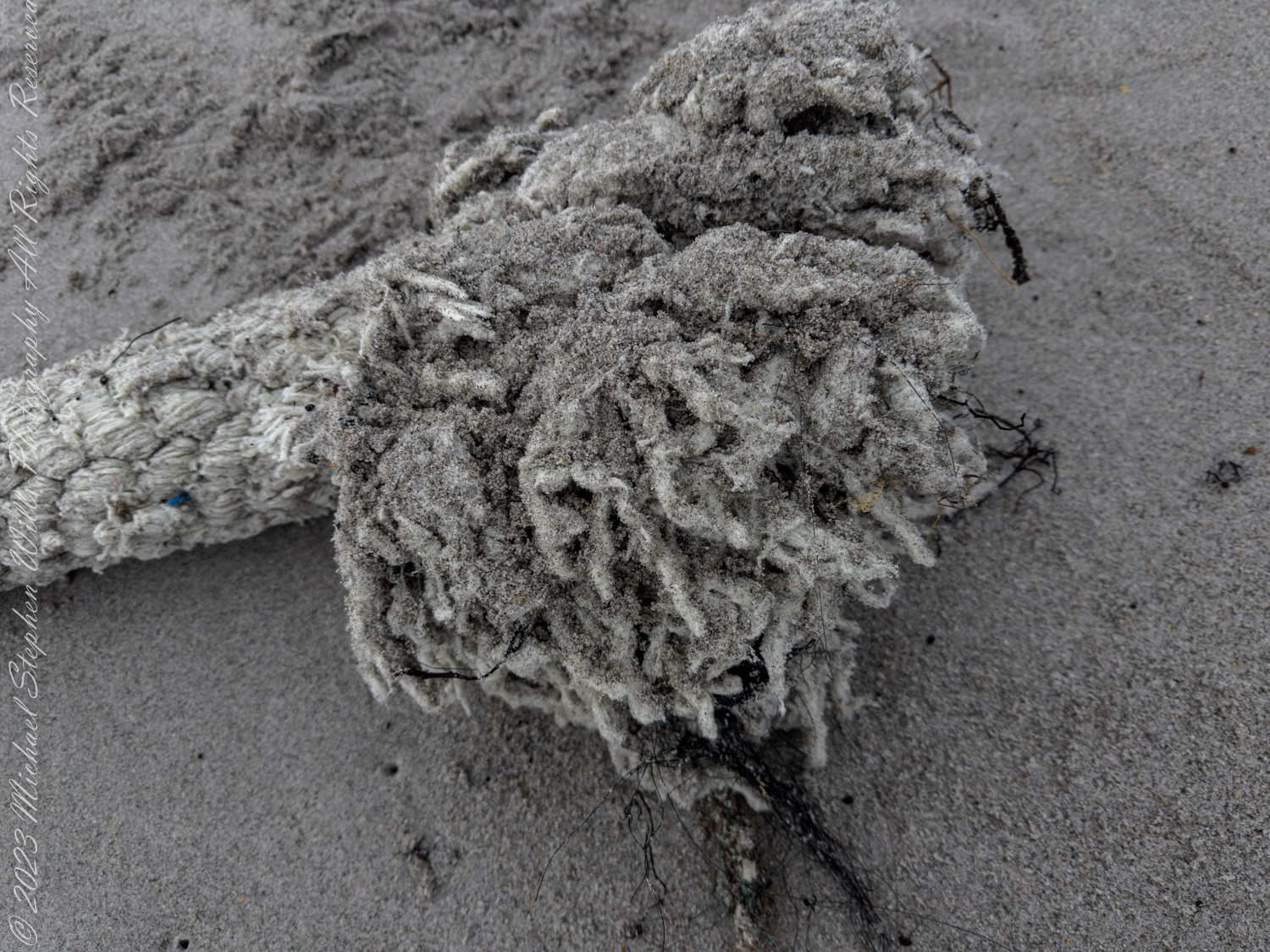
There it lay, a colossal rope, its many fibers frayed and clinging to sand, a testament to its battle with the ocean’s might. This hawser, a lifeline once to vessels that dared to navigate treacherous waters, was now at the mercy of the tides that once heeded its command. I approached, curious, reverence growing within me for this unexpected relic of human endeavor.

The High Tide’s Offering


The hawser’s journey to my path was a story written in the ebb and flow of the tides. The high tide, under the pull of the moon’s invisible hands, had surged with purpose, pushing this massive rope to the shore as its offering. High tides are nature’s way of reaching out, touching the land, and sometimes, they bring gifts from the depths, each with a tale to tell.

A Tapestry of Experiences


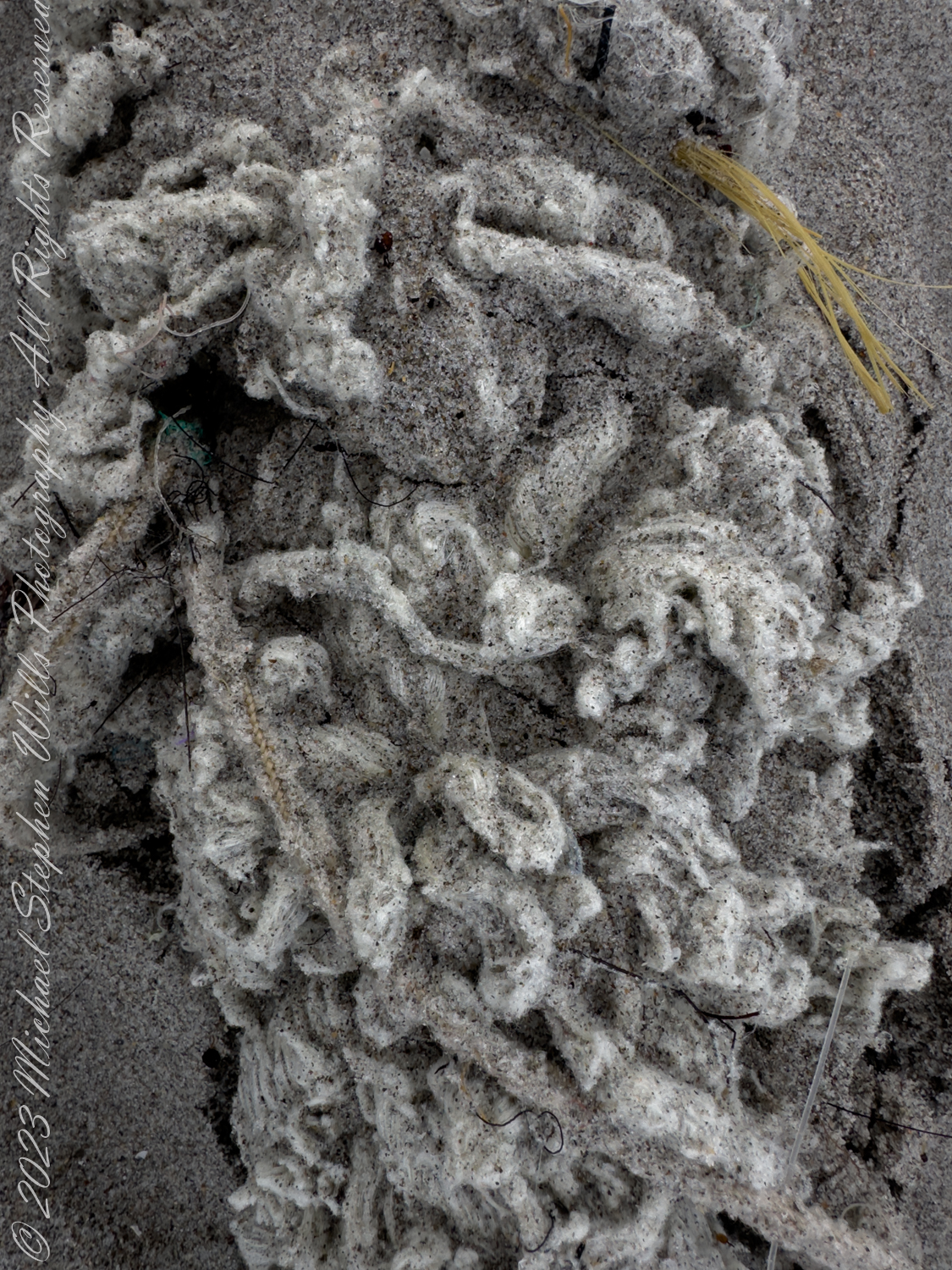
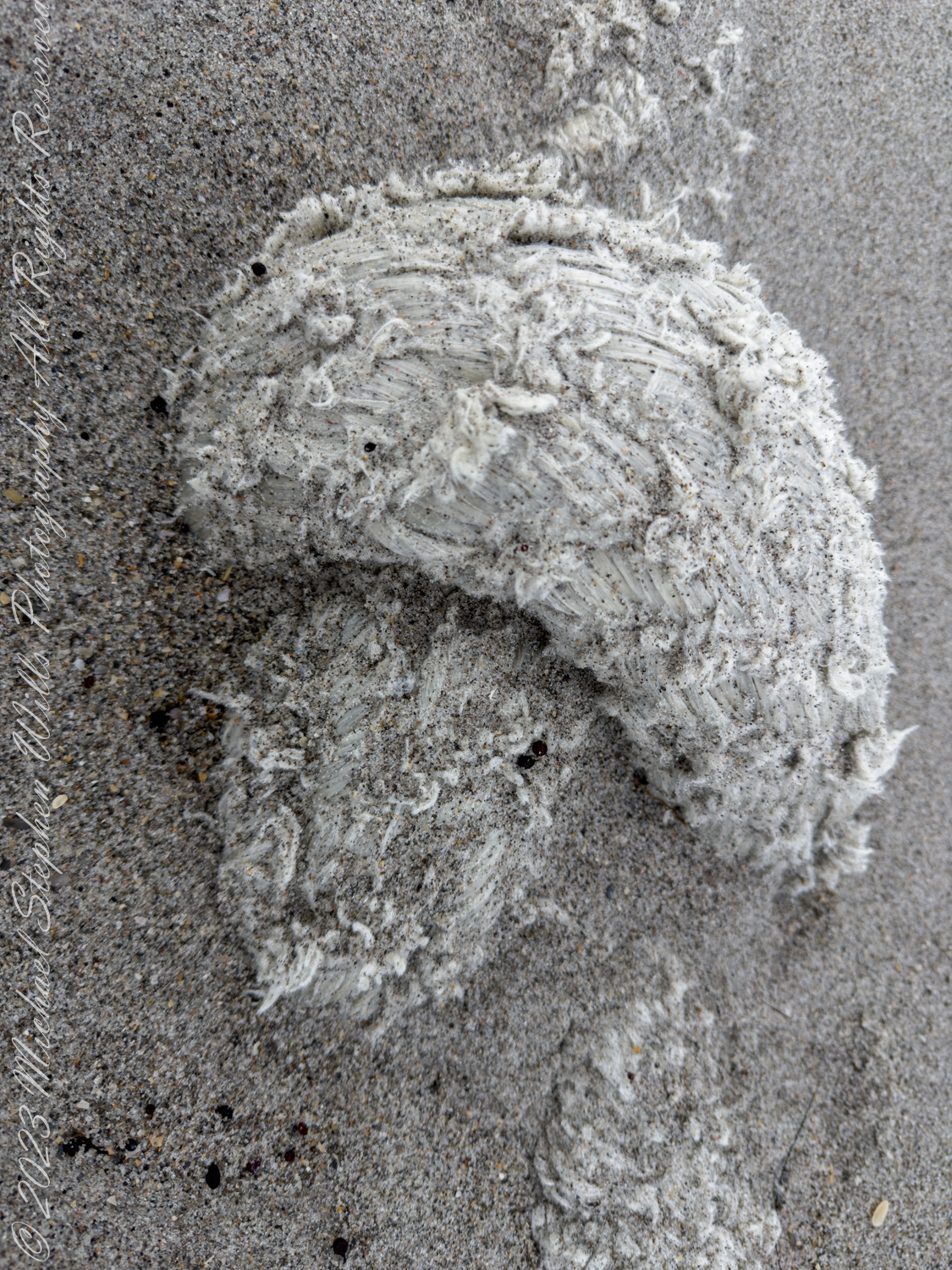
Touching the hawser, I felt connected to the lives it must have touched, the storms it weathered, and the unspoken histories it held. Each thread was a narrative, a voyage, a storm survived. The macro images of the hawser’s frayed ends resembled the intricate work of a natural tapestry – artful, chaotic, yet purposeful. It was a mosaic of experience, and now, it was a part of Cocoa Beach’s landscape.

The Dance of Man and Nature


The hawser at the foot of the lifeguard station stood as a symbol of humanity’s interaction with the mighty sea. We build structures, craft vessels, and forge hawsers, asserting our presence. Yet, the tides remind us of our place within the grand tapestry of nature. Tides dance around our creations, sometimes reclaiming them, other times presenting them back to us, reshaped, redefined.

Reflecting on the Tides


As I sat by the hawser, the sun broke free from the horizon, casting golden hues over the beach. The tide was retreating, pulling back into the ocean’s embrace, leaving behind patterns on the sand, and the hawser – a silent sentinel of the shore. It was a moment of reflection on the power of the tides, the constant cycle of giving and taking, and the marks they leave upon both the earth and our lives.

Conclusion: The Tides of Life


The tides had brought the hawser to Cocoa Beach, and with it, a moment of connection to the vastness of the sea and the shared journeys of all who traverse it. As I walked away, the hawser remained – a fixture until the tide would rise again, perhaps to claim it back or offer another token of the ocean’s depths. The power of the tides is a powerful metaphor for life’s ebb and flow, each wave a new beginning, each retreat a chance to reflect on the imprints left behind.

Copyright 2024 Michael Stephen Wills All Rights Reserved

Crystalline Secrets: The Art and Science of Whelk Shell Formation

As you stroll along the beach, the beauty of whelk shells captures your attention. Ever wondered how these intricate structures form? Dive into the secrets of their creation, from cosmic origins to mollusk mastery. Discover the fascinating world within their shells

Exploring the Formation of Whelk Shells


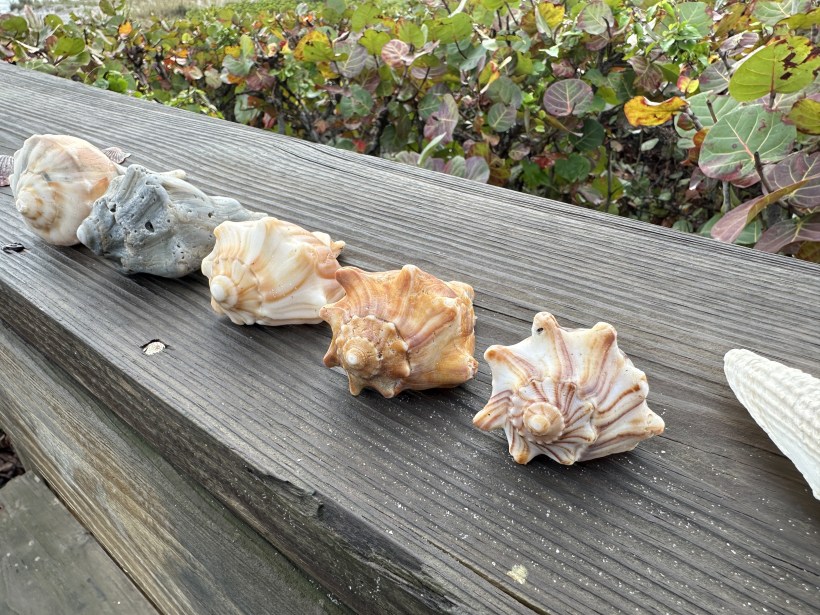
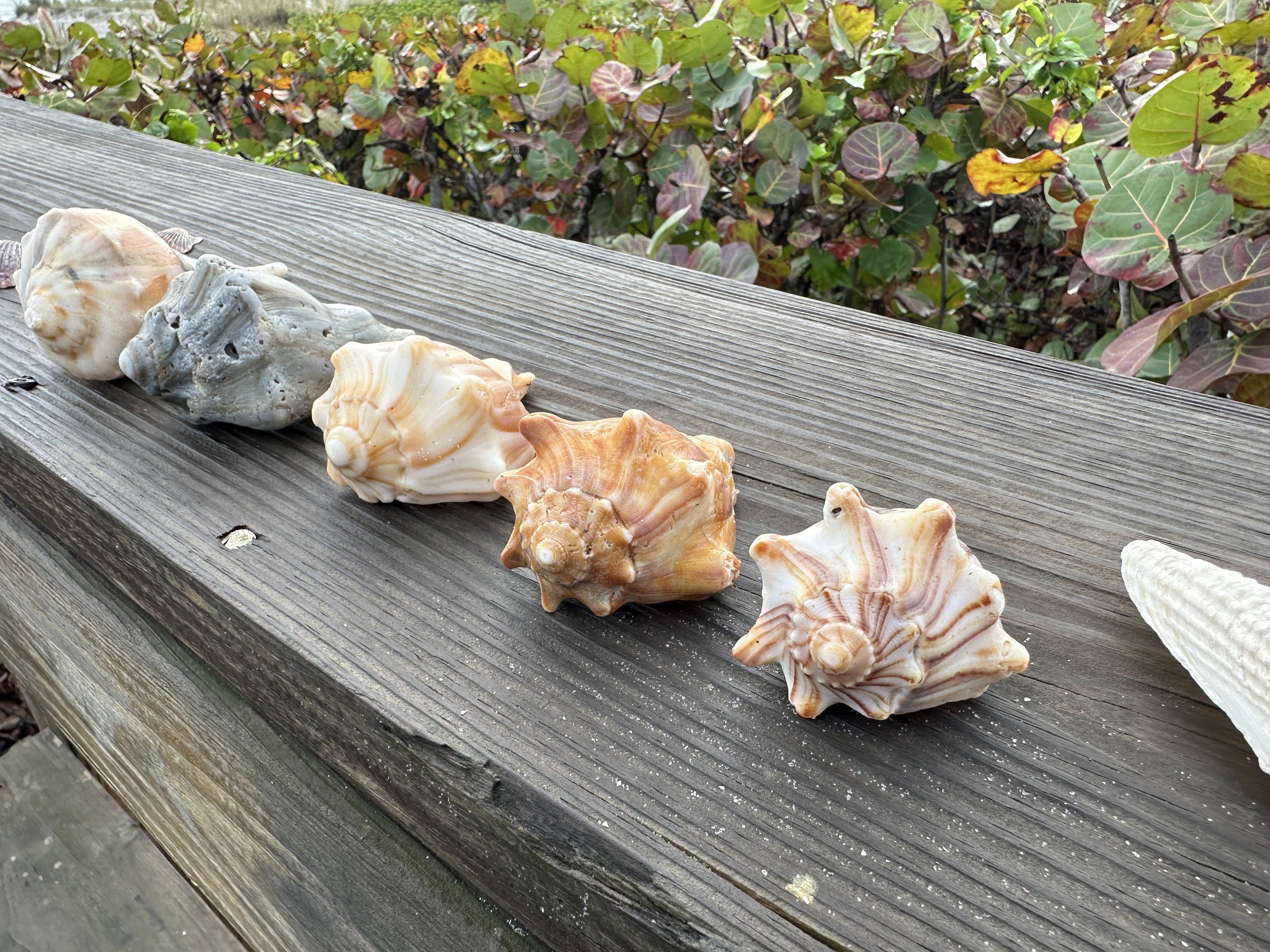
As I wander along the coast, the variety of seashells scattered across the beach fascinates me, particularly the whelk shells with their intricate designs and robust structure. This marvel of nature prompts me to delve into the science behind the formation of these shells, which are not just homes for the marine creatures but also a testament to the extraordinary processes that take place both within the organisms and across the cosmos.

The Architect: The Mantle of the Whelk


The journey of a whelk shell begins within the mollusk itself, specifically with an organ called the mantle. This organ is a marvel of biological engineering, responsible for laying down the calcium that forms the shell’s backbone. It secretes a matrix, a kind of biological scaffolding composed of proteins and polysaccharides, and then directs the deposition of calcium carbonate within this matrix to create the hard shell. The mantle’s work is meticulous, ensuring the shell’s growth and repair throughout the whelk’s lifetime.

The Building Blocks: Calcium, Carbon, and Oxygen


So why do the elements calcium, carbon, and oxygen play such a crucial role in shell formation? It’s a question of availability and suitability. These elements are abundant in the marine environment—calcium dissolved in seawater, carbon, and oxygen from both water and air. Their chemical properties allow the formation of calcium carbonate, a stable compound that can adopt various forms like calcite and aragonite, offering structural diversity for shells. Calcium carbonate’s moderate solubility enables mollusks to control shell formation precisely, and its biocompatibility ensures the process is safe for the living organism. Above all, the resulting crystalline structure provides immense strength and rigidity, a natural armor against predators and environmental challenges.

The Role of Calcium Carbonate


Calcium carbonate (CaCO₃) is not just a building block for shells; it’s a common substance that shapes our world. Found in rocks as calcite and aragonite, it forms limestone, the basis of pearls, and even the eggshells we encounter daily. This compound is an active player in both industrial applications and biological functions, serving as an agricultural amendment, a component in cement, and even a dietary supplement for humans.

The Mollusk’s Craft: Extracting from the Environment


Whelks are not alchemists; they do not create calcium carbonate from thin air. Instead, they are master extractors, pulling calcium and carbonate ions from their surroundings and depositing them as calcium carbonate to form their shells. The mantle is at the heart of this process, secreting proteins and enzymes to facilitate ion extraction from the water. The precise regulation of ion concentrations and pH ensures the calcium carbonate crystallizes in the desired form, perfectly tailored for the whelk’s protection.

Star-born Elements: The Cosmic Connection


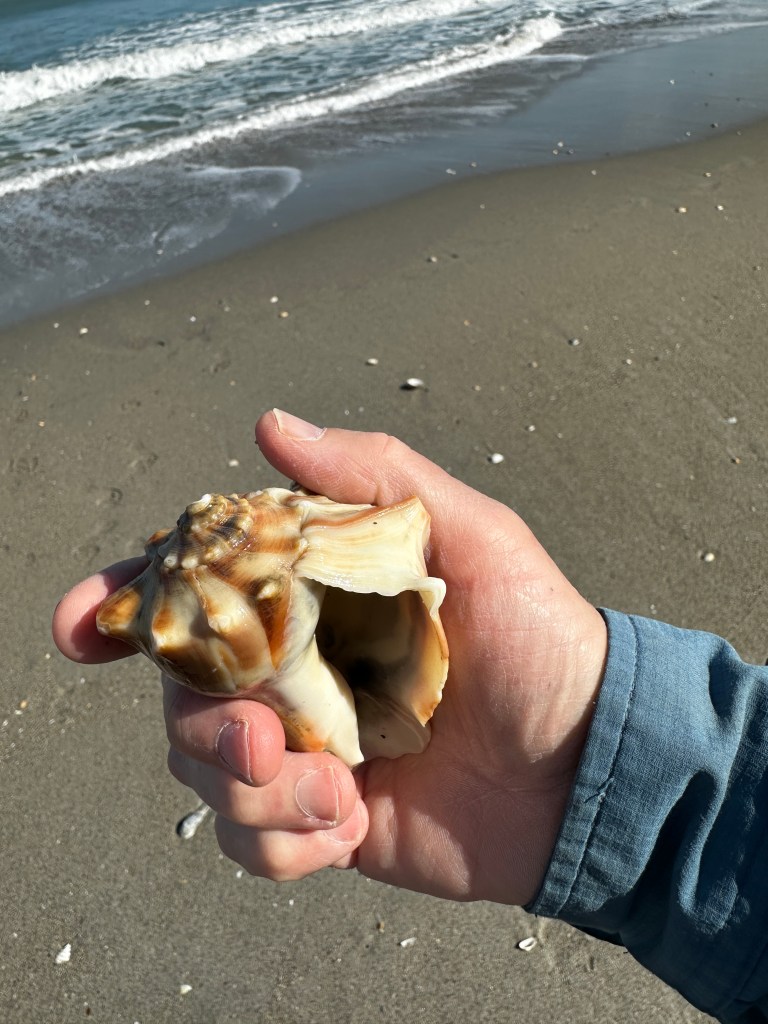
It’s astounding to think that the elements composing whelk shells are not just earthly but cosmic in origin. The calcium (atomic number 20), carbon (atomic number 6), and oxygen (atomic number 8) that are so critical to these marine structures owe their abundance to the stars. The life cycles of stars, from their hydrogen (atomic number 1) and helium (atomic number 2) fueled births to the explosive supernovae and neutron star collisions that mark their deaths, generate and scatter these elements throughout the universe. These star-born materials eventually coalesced to form our solar system and Earth, providing the necessary ingredients for geological and biological phenomena, including the formation of the whelk shells I hold in my hand.

As I reflect on the shells before me, I am reminded of the interconnectedness of all things—from the inner workings of a tiny mollusk to the vast and violent furnaces of stars. These shells are not just remnants of life; they are cosmic artifacts, a reminder of our connection to the universe and the extraordinary processes that shape our existence.

Copyright 2024 Michael Stephen Wills All Rights Reserved

A Beachcomber’s Musings on Floridian Dune Ecology

Discover the resilient beauty of Florida’s dune sunflowers through the eyes of a beachcomber. Uncover the secrets of Helianthus debilis, a symbol of hope thriving where sea meets sand. Join the coastal dance of life.

Encounter with Helianthus debilis


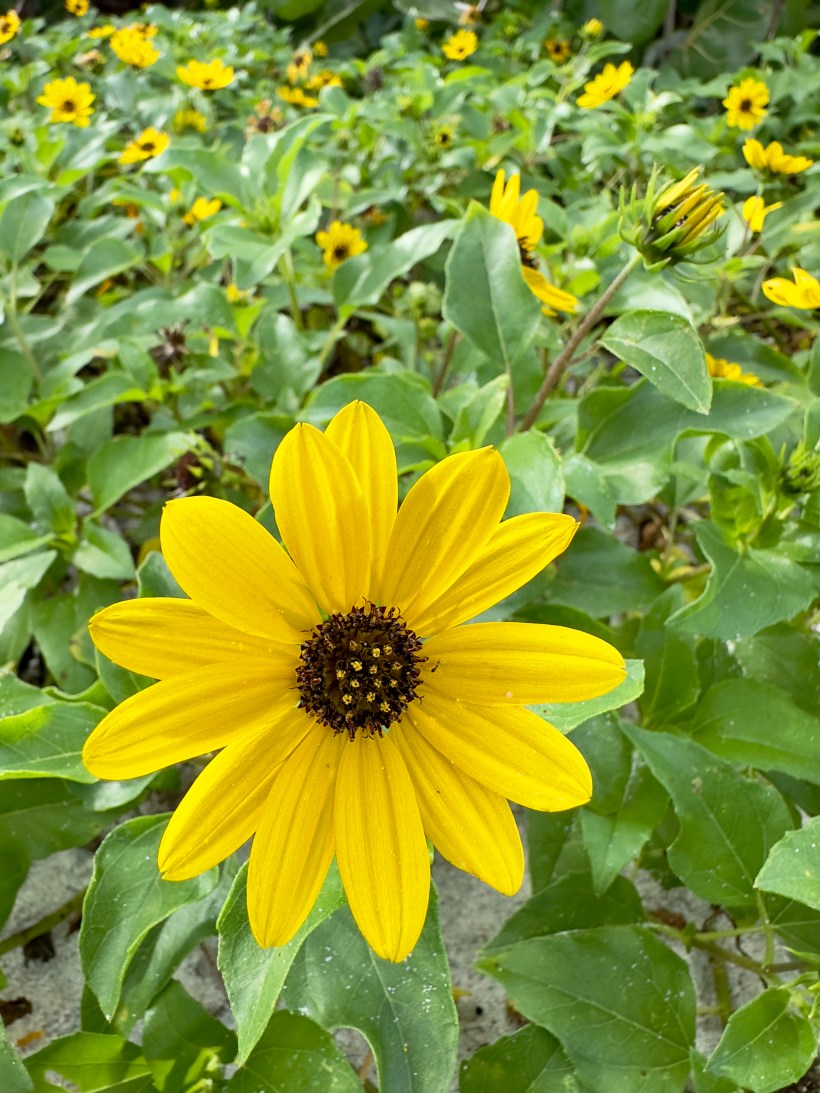
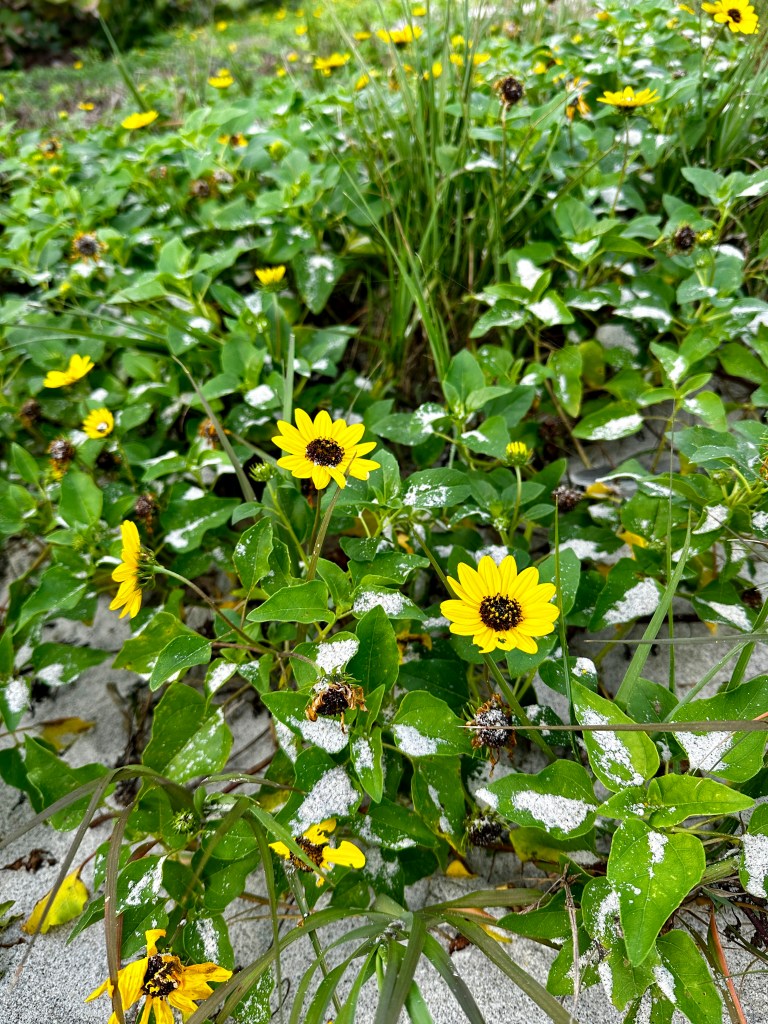
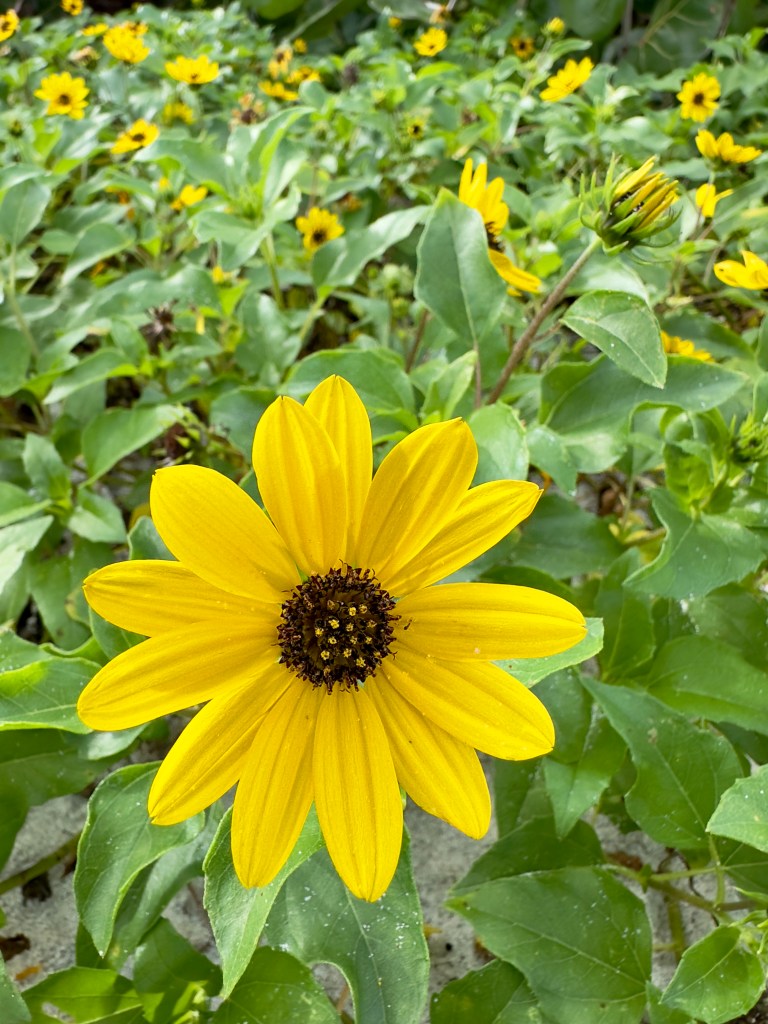
Strolling along the beachfront of Patrick Space Force Base, Florida, my gaze is captivated by a cluster of dune sunflowers, or Helianthus debilis. These hardy perennials are native to the coastal sand dunes of the southeastern United States and have made a home amidst the sandy grains where few dare to take root.

The Sunflower’s Domain


Helianthus debilis, distinguished by its large, yellow ray florets and dark center disks, thrives in this challenging environment. The dunes provide a unique ecosystem, where the sunflowers can withstand high salinity, shifting sands, and the full force of the sun’s rays. Their deep root systems anchor the sandy soil, helping to prevent erosion and maintain the integrity of the dune landscape.

Adaptation and Survival


The dune sunflower’s adaptation to its coastal environment is a marvel of nature. Its silvery-green leaves are covered with tiny hairs, reflecting sunlight and conserving moisture. The flowers bloom throughout the year, ensuring a constant presence of color along the dunes. Their hardiness is a testament to the sunflower’s evolutionary success in a habitat where freshwater is scarce and the soil is nutrient-poor.

A Native’s Role in the Ecosystem


As a native species, the dune sunflower plays a crucial role in the coastal ecosystem. It serves as a food source for local wildlife, including insects and birds, and its presence helps stabilize dune formations. The ecological value of Helianthus debilis extends beyond its beauty, as it contributes to the biodiversity and resilience of the coastal dunes.

The Dynamics of Dune Life


The life of a dune sunflower is inextricably linked to the ebb and flow of the coastal environment. Each plant is a microhabitat, supporting a range of organisms from the larvae of the dune butterfly to the burrowing beetles that find refuge in the sand. The interaction between the sunflowers and these creatures creates a dynamic web of life, each species depending on the others for survival.

Reflections on Resilience


The dune sunflower’s ability to flourish in such an austere environment is a profound reminder of the resilience of nature. As I observe the sunflowers, I am struck by their tenacity, their willingness to face the elements head-on. They are a beacon of life in a place where existence is a daily challenge, and their perseverance is a lesson in the art of endurance.

Conclusion: A Testament to Nature’s Ingenuity


As the sun begins to set, casting a warm glow over the dunes, I take a final look at the Helianthus debilis. Their scientific wonders and ecological im portance leave a lasting impression. They are not just flowers; they are a testament to nature’s ingenuity, an embodiment of the delicate balance between life and the environment. These dune sunflowers are a symbol of hope, a reminder that in the face of adversity, life finds a way to not just survive, but to thrive.

Copyright 2024 Michael Stephen Wills All Rights Reserved

The Impermanence of Human Constructs and the Forces of Nature

Discover the fleeting artistry of sand castles and the mighty forces of tides sculpted by the moon’s dance. Explore the impermanent intersection of human endeavor and nature’s rhythm.

Introduction


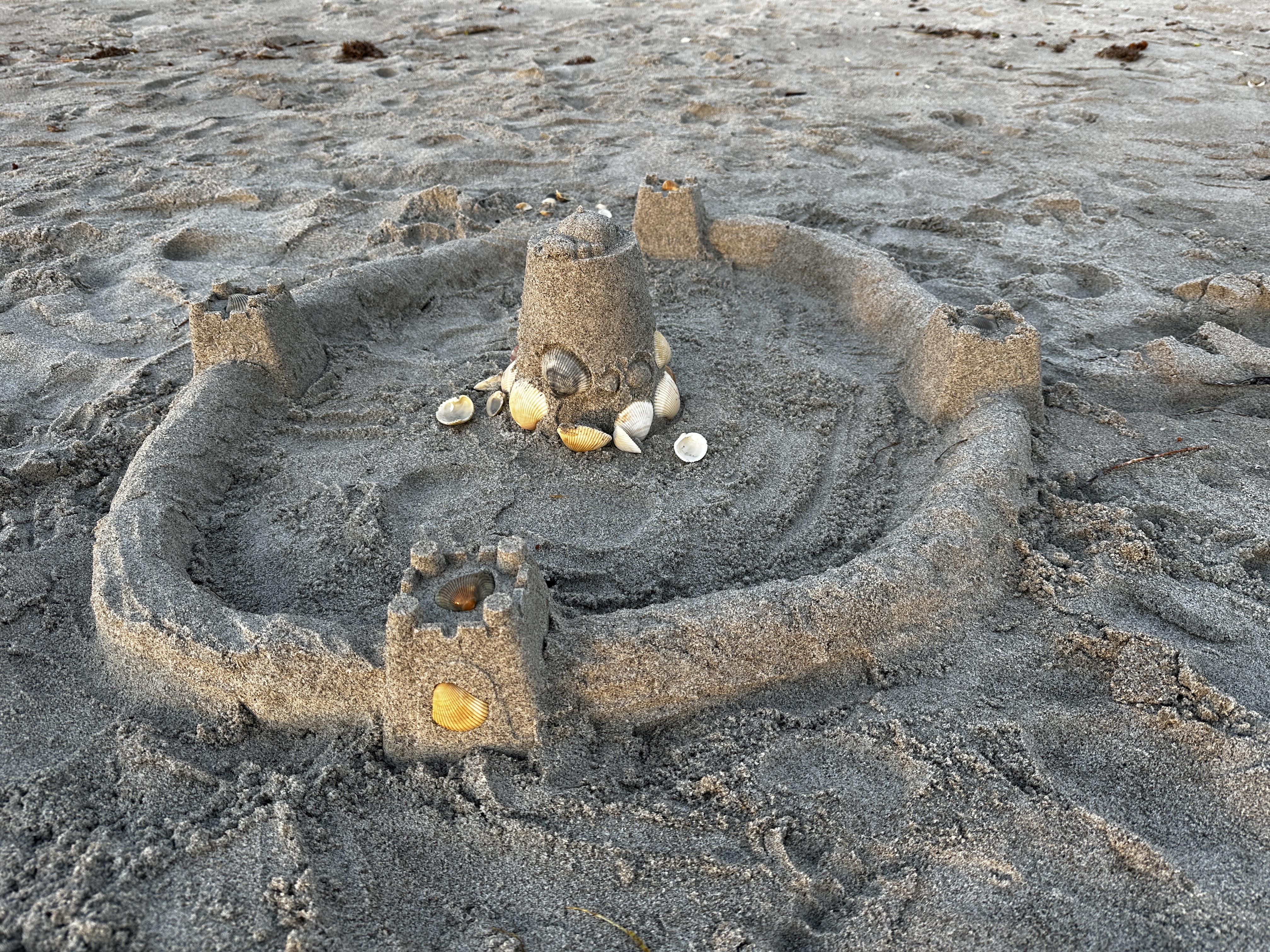
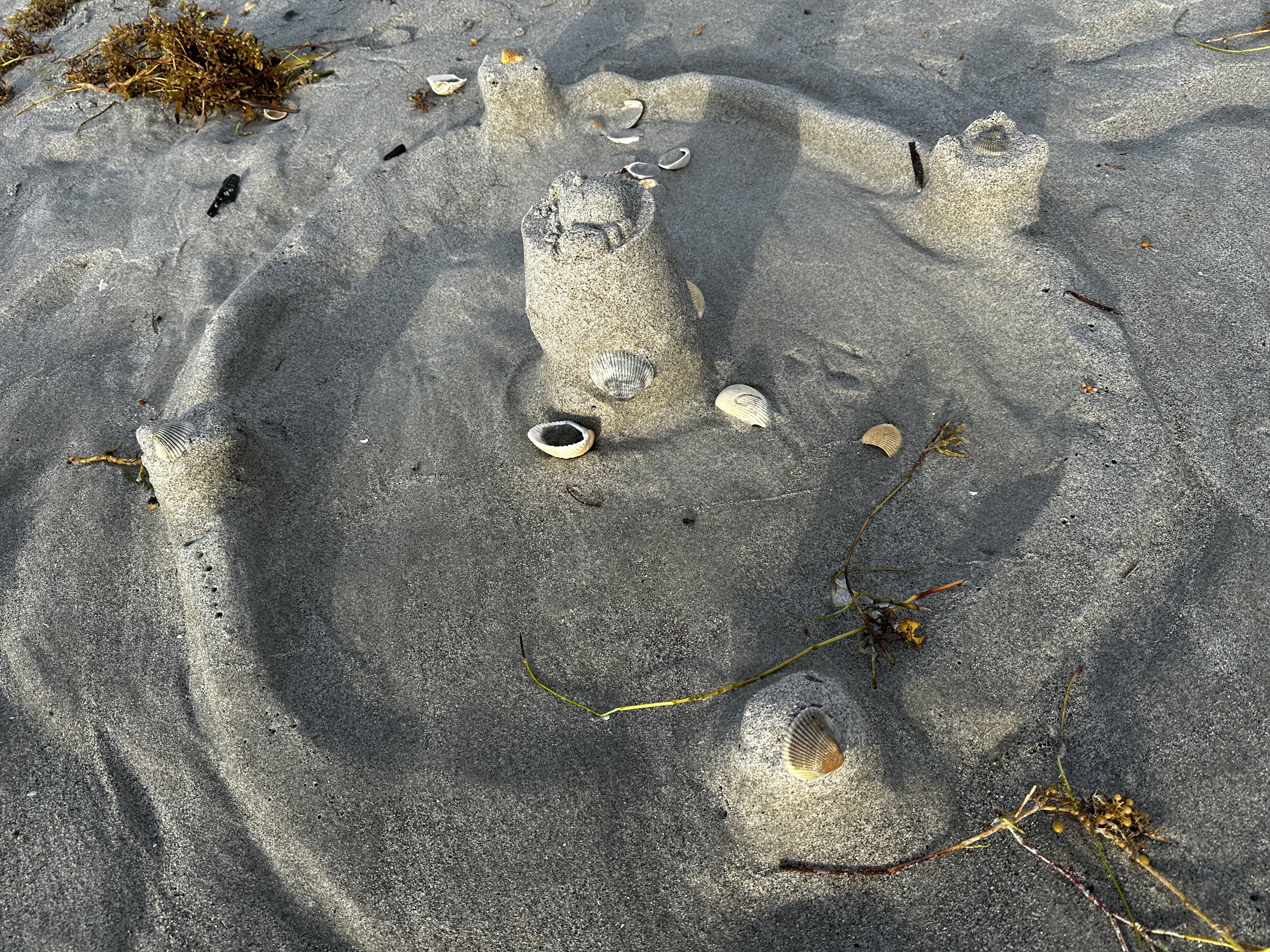
The photographs of a sand castle at Cocoa Beach, Florida, present a clear depiction of the transitory nature of human-made structures in the face of natural forces. This discourse will explore the before and after states of a sand castle through high tide, examining the interplay between human endeavors, the tides influenced by the moon’s phases, and the inevitable passage of time.

The Sand Castle: A Testament to Human Creativity


The initial photograph captures a sand castle in its pristine condition, with detailed turrets, walls, and the decorative placement of shells. This creation is a testament to human creativity, ingenuity, and the desire to imprint our presence on the natural world. Sand castles, often built by children or families, represent the joy of craftsmanship and temporary beauty.

Tides and the Moon: Celestial Influence on Earth’s Waters


Tides are long-period waves that move through the oceans in response to the gravitational pull exerted by the moon and sun. The gravitational forces of these celestial bodies generate tidal forces, which cause Earth—and its water—to bulge out on the side closest to the moon and the side directly opposite. This bulging of water results in high tides.

The moon’s phases, from new moon to full moon and back, play a crucial role in the magnitude of tides. During the full moon and new moon—times known as spring tides—the sun, moon, and Earth form a line, resulting in the combined gravitational pull of the moon and sun, causing higher than average tides. In contrast, during the first and third quarters of the moon, or neap tides, the sun and moon are at right angles to each other, which moderates the tidal effect.

The High Tide: Reclaiming and Reshaping


The second photograph shows the aftermath of a high tide on the sand castle. The rising water has eroded the structure, diminishing its form and washing away its distinct features. The tide does not discriminate in its impact; it is a natural, cyclic event that reshapes coastlines and affects human and ecological systems alike. The high tide symbolizes nature’s reclaiming of human-made imprints, demonstrating the impermanence of our works against the relentless forces of nature.

Passing Time: The Ultimate Sculptor


Time is the ultimate sculptor, working incessantly through agents like wind, water, and biological processes. The eroded sand castle in the second photograph is a reminder of the ephemeral nature of all things. The structures we build, no matter how strong or well-designed, are subject to decay and dissolution over time. The sand castle’s fleeting existence underscores the concept that time, coupled with natural forces, will eventually return human creations back to their elemental forms.

Conclusion


The before and after states of the sand castle serve as a poignant illustration of the dialogue between human endeavors and the immutable forces of nature. While the tides, governed by the moon’s gravitational pull, are predictable, their effects are a constant reminder of the transient nature of human constructs in the grand scheme of time and nature’s cycles. As we appreciate the beauty of temporary creations like sand castles, we also learn to respect the power of the natural world and the passage of time that shapes our existence.