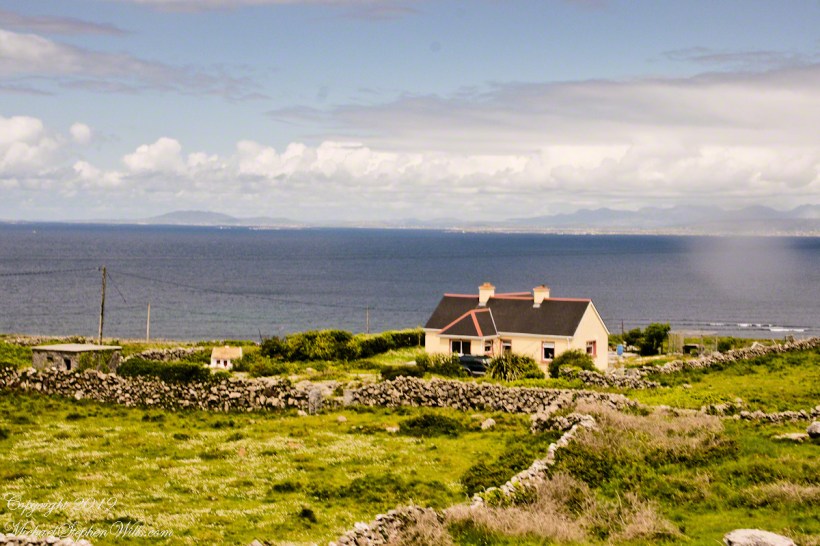
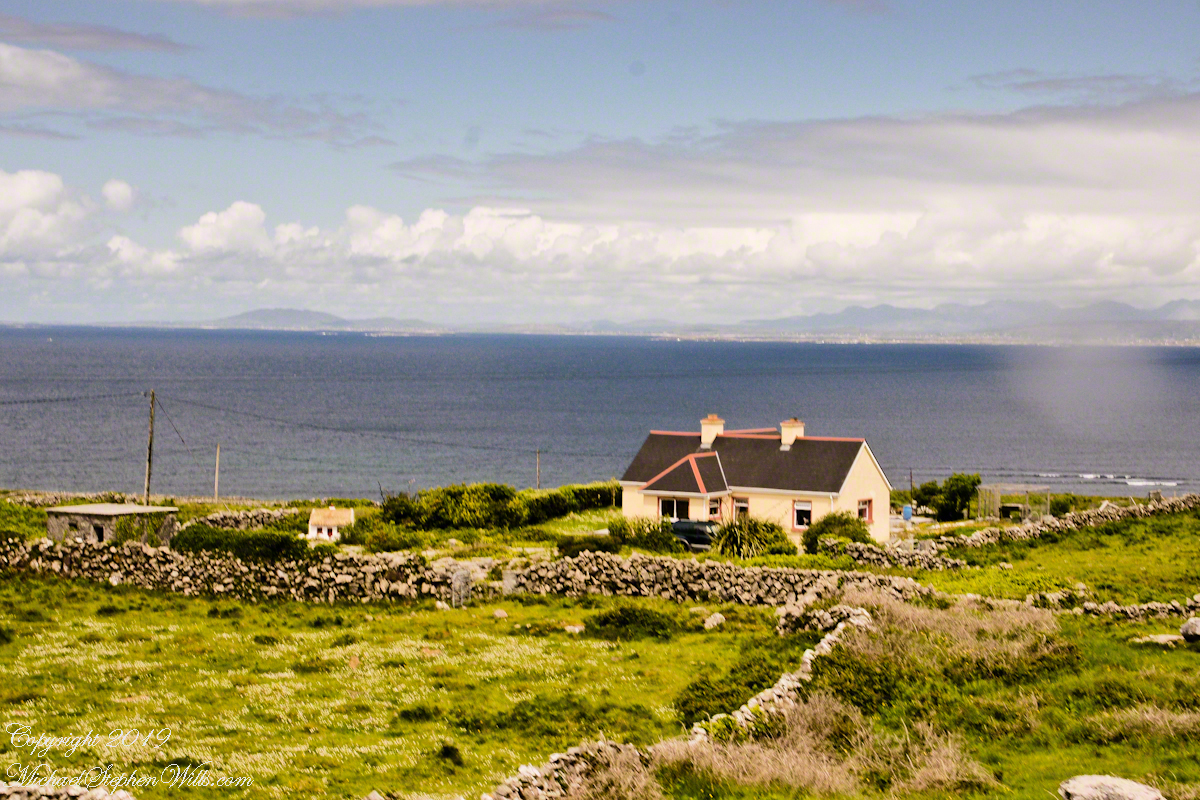
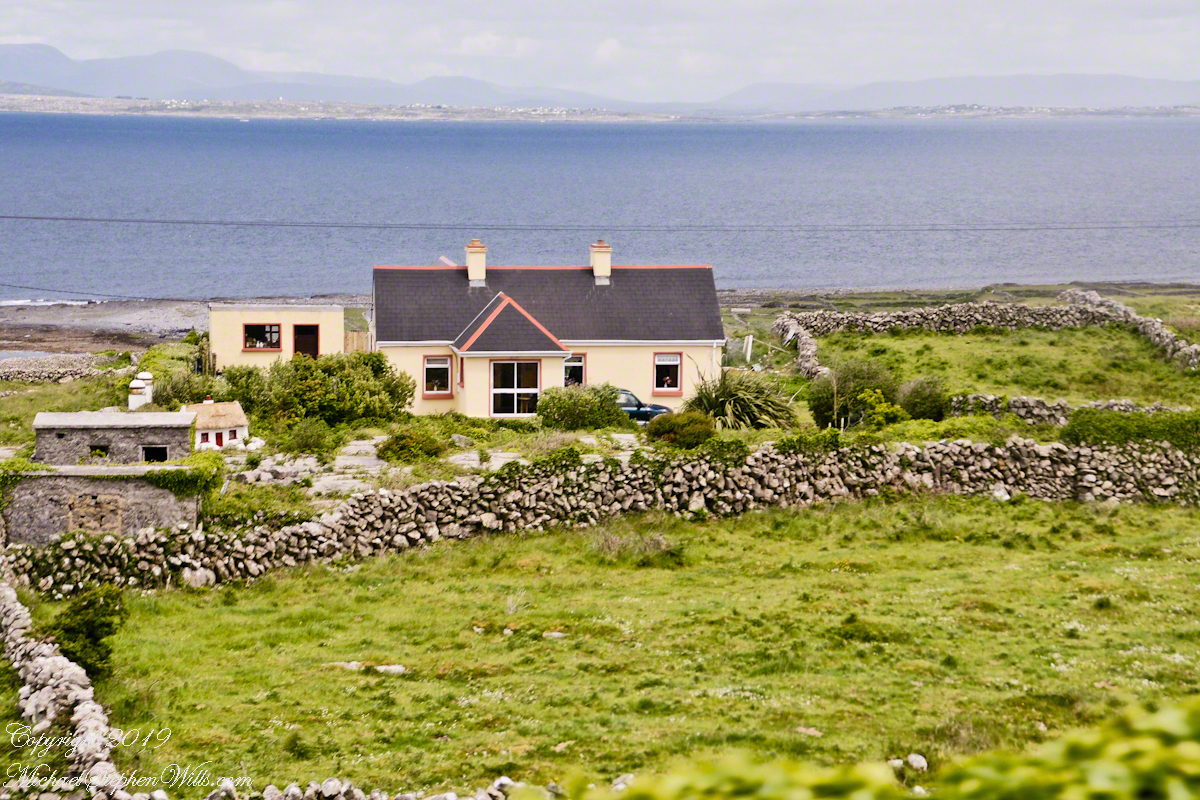
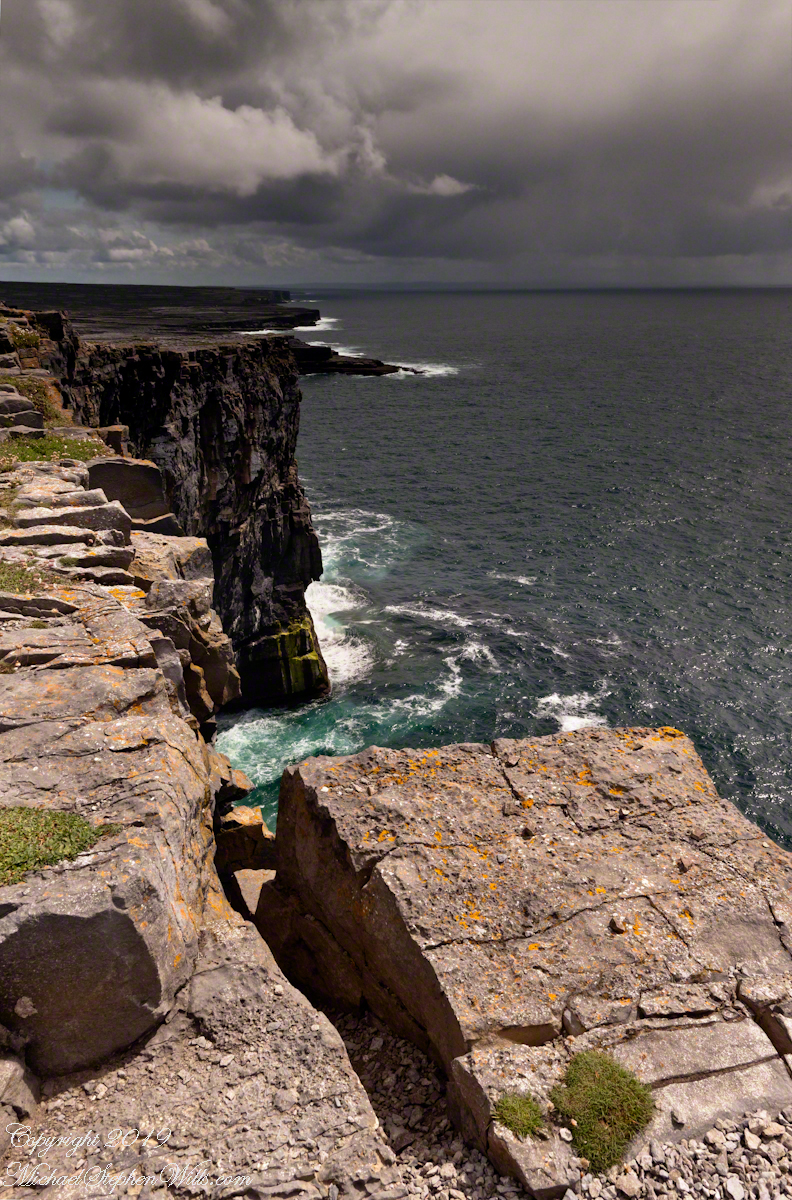
From the commanding location of Dun Aonghasa, looking northeast across Inishmore island, we can understand why the ancient builders chose this location.
We also see the transition from exposed limestone to the fields built literally from the ground up (see my post “The How of Soil”). For a closer view of island houses see my posts “Settled In” and “Cottage Road Cottage.”
In a previous post, “Inner Ring, at last” we passed over the entrance to the inner enclosure.
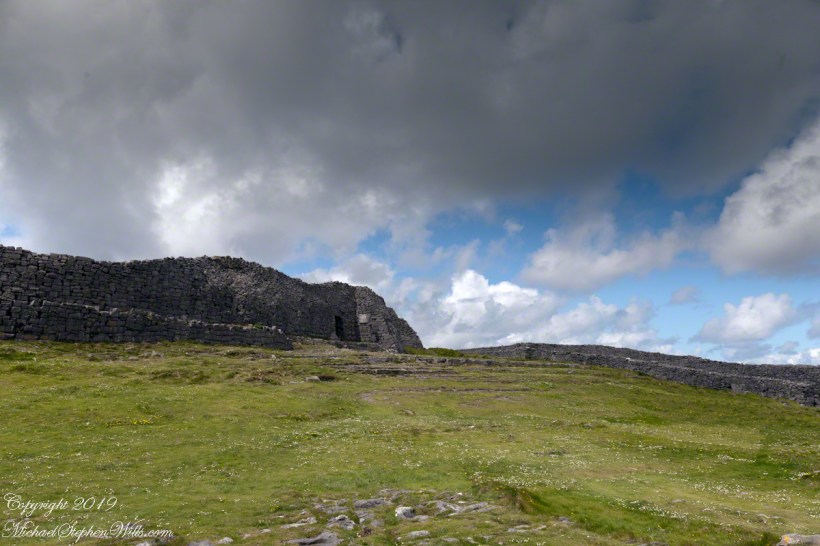
A long path through fields, karst landscapes and outer walls leads to this entrance to the inner ring of Dun Aonghasa (Dun Aengus) of Inishmore, Aran Islands, County Galway, Ireland. The image composition is as a dramatic landscape with the surrounding walls and the cloudscape of an approaching storm.
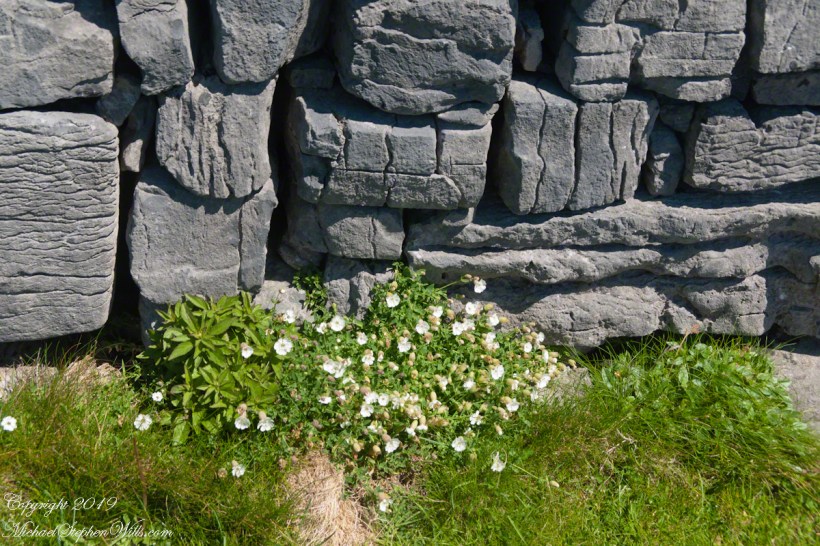
My previous post, “Inner Ring, at last”, lowered the horizon. Here, we study the base of the inner wall.
A detail of the interior wall of Dun Aonghasa (Dun Aengus) in springtime. White flowers of Sea Campion (Scientific Name: Silene uniflora) (Irish Name: Coireán mara) set against the ancient dry stone wall. Inishmore, Aran Islands, County Galway, Ireland.
We found Sea Campion throughout the west Ireland coast.
Detail of Dun Aonghasa Dry Stone Wall with White Flowers of Sea
Wishing a blessed All Saints Day (November 1st) for all my readers.
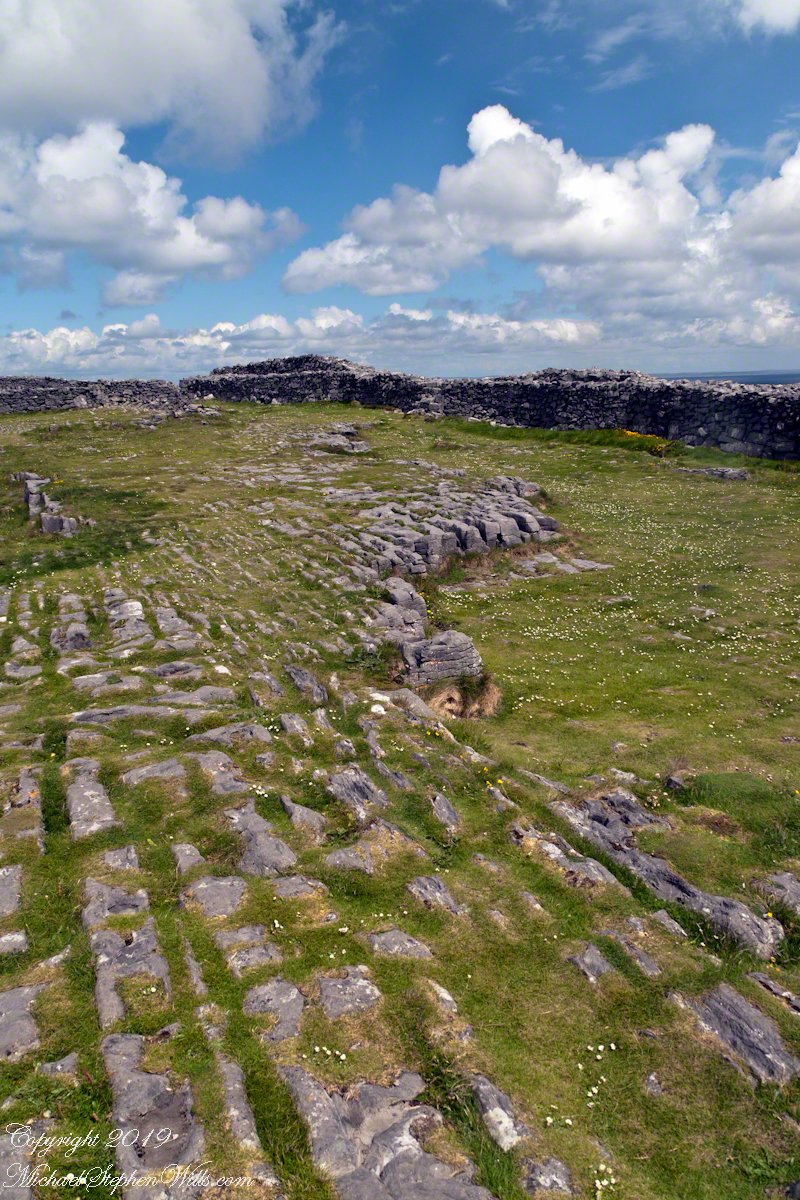
A view to the northwest from within Dun Aonghasa in springtime. The interior a karst formation (see my post, ” Galway Bay View from Dún Aonghasa”), the grikes filled with grass and a sprinkling of white and yellow flowers, a cloudscape rising over the walls. Inishmore, Aran Islands, County Galway, Ireland.
Karst Landscape with Interior Walls of Dun Aonghasa
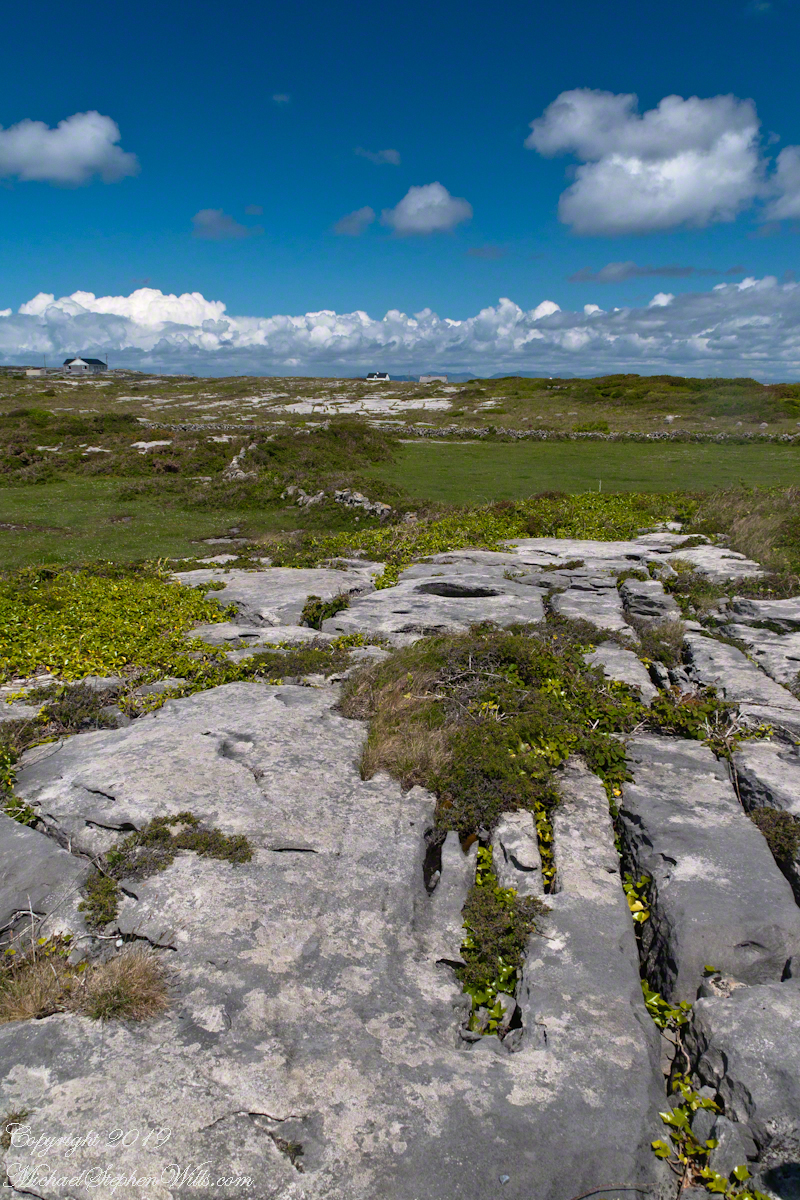
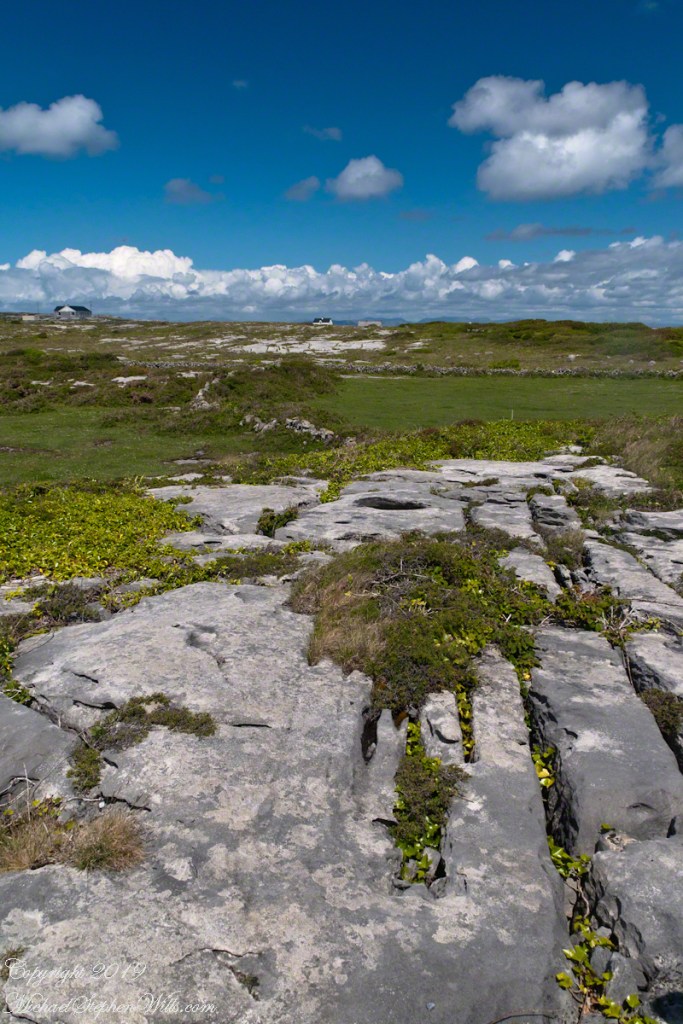
The exposed limestone of the Aran Islands here transitions to a fertile field of grass, husbanded by generations of islanders. Photograph was taken from the path on Inishmore leading up to Dun Aonghasa.
The Aran Islands are an extension of The Burren of Ireland’s Counties Claire and Galway. The word burren is from the Irish Boireann, meaning “great rock.” The glaciers that covered Ireland, retreating about 10,000 years ago, scraped down to the bedrock, exposing wide areas of limestone and dropping, here and there, large rocks. When people came along the foreign nature of the large rocks was recognized, all the more obvious for lying on the horizontally bedded, exposed limestone. We call the foreign rocks erratics. The underlying scoured rock is a pavement for a resemblance to a cobbled roadway.
The incised line, filled with grass and wildflowers, in the following photograph is called a gryke. The body of stone between the grykes are clints. Sometimes, the grykes are cross hatched and the clints resemble cobblestones or flat paving stones.
The view is northeast toward the 12 Bens of Connemara. Inishmore, Aran Islands, County Galway, Ireland
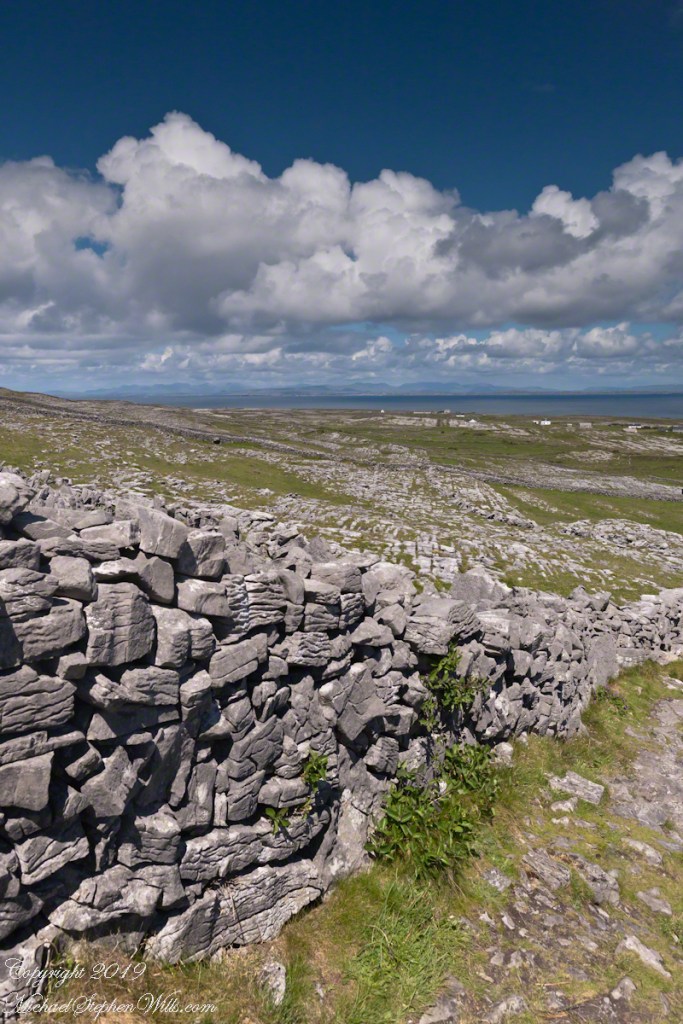
Modern stonework borders the 1/2 mile path to the inner Dún Aonghasa walls, keeping tourists off delicate plants, maintaining the integrity of this ancient site.
The view north, northwest over the walled path to Dun Aonghasa (Dun Aengus) looking across karst landscape, walled fields, farms, the North Atlantic Ocean, coast of Connemara and the 12 Bens (12 Pins) mountains. Aran Islands, County Galway, Ireland.
I found these snags surrounded and, at a distance, hidden by the burgeoning Brock-Harvey forest preserve here in the Finger Lakes.
As with burgeon (see yesterday’s blog post), the word “snag” has a long history from a forested northern region of the planet, though it hales from Scandinavian languages rather than Old English and Old German. As a noun “snag” is something with a point and a body long enough to cause inconvenience, the point catching on anything handy. As a verb “snag” is to become inconvenienced by a projecting body.
In forestry, a snag is any trunk of a dead tree. Commonly, a tree top breaks off leaving a jagged point which possibly can become an inconvenience. For birds, an upright dead tree is a blessing, perfect for homemaking.
Standing Snag with Nest Holes
Fallen, the snag is still a snag and also a home first for fungus. When the work of the fungus is done, the resulting mound is perfect for growing new trees.