Two Laughing Gulls of Cocoa Beach: A Dance of Adaptation and Survival

Discover the captivating world of Laughing Gulls, the jesters of Cocoa Beach’s shores. Dive into their lives, exploring the dance of courtship, the adaptability in their diet, and their vital role in the coastal symphony.

The Coastal Sentinels

On the shores of Cocoa Beach, where the Atlantic’s waves gently knead the sands of Brevard County, Laughing Gulls (Leucophaeus atricilla) enact their daily ballet of survival and adaptation. In the span of mere minutes, the shifting light of Florida’s coastal theater presents two scenes, each with the same protagonist yet donned in starkly different costumes.

The Many Faces of Adaptation

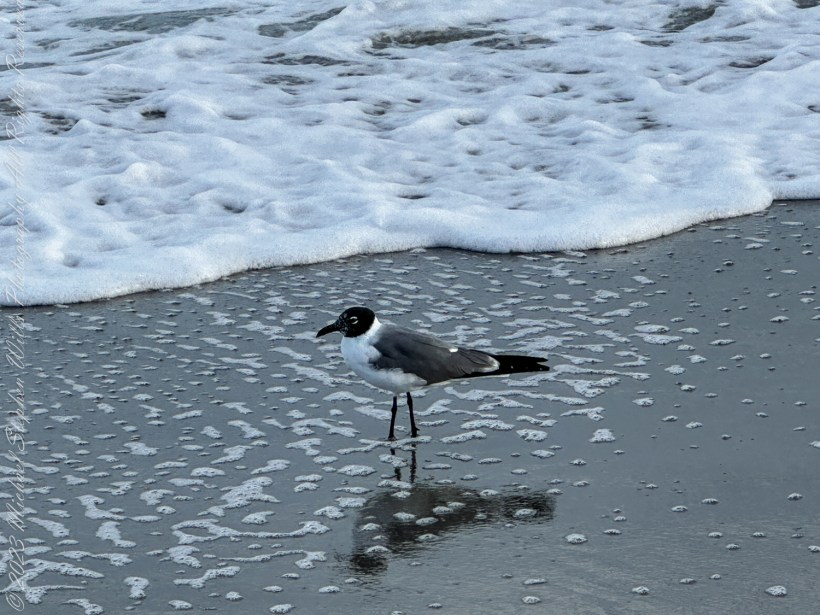
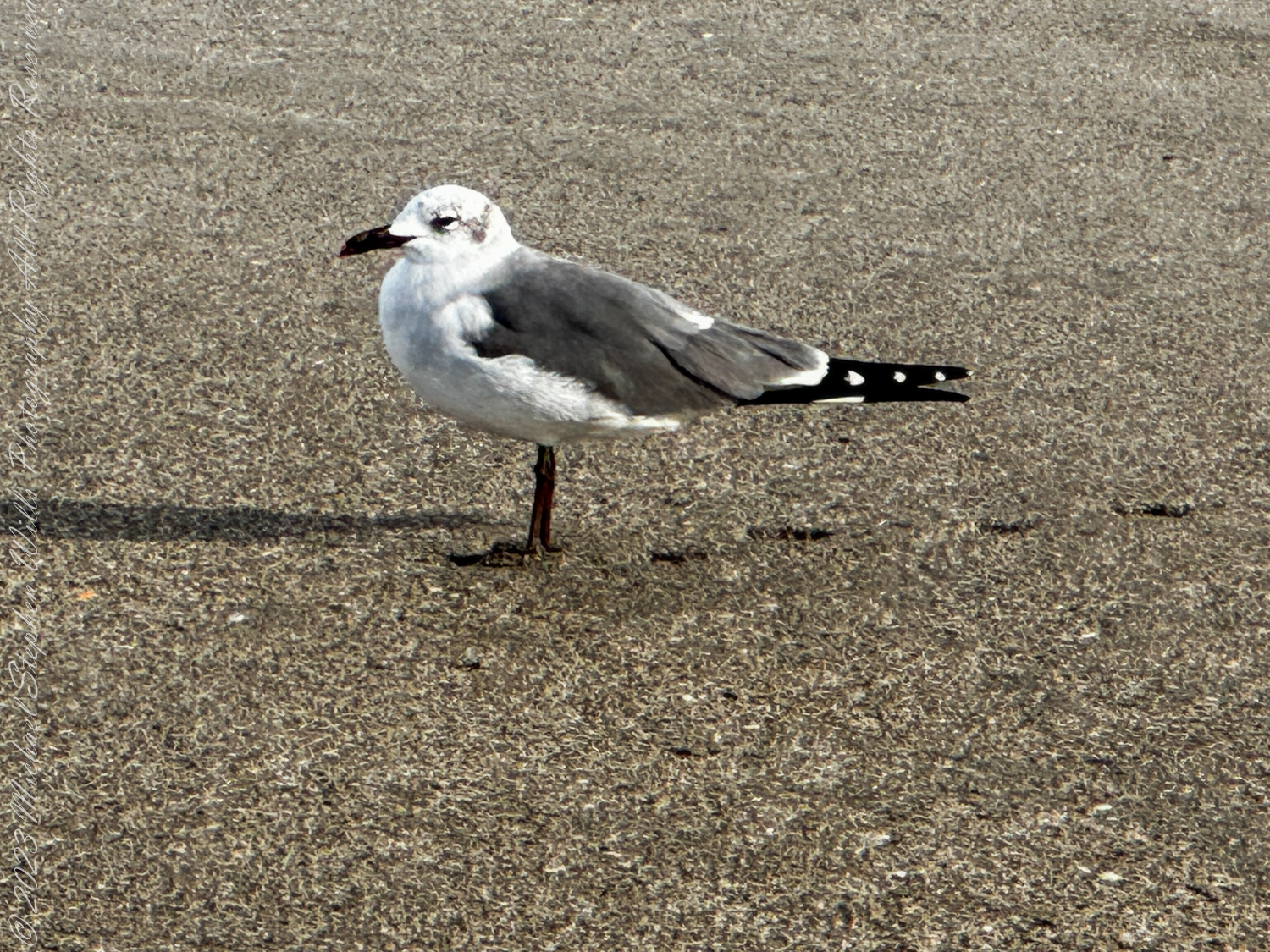
The first gull, captured against the frothy lace of the incoming tide, is the epitome of the breeding plumage: a sleek, black hood that starkly contrasts its pearl-grey wings. This attire is not merely for allure but speaks of its readiness to engage in the rituals of courtship and the responsibilities of rearing the next generation. This black hood, a seasonal crown, fades as the duties of breeding wane, revealing the less conspicuous garb of the non-breeding season—a mottled grey head atop the same sturdy body, ready to blend into the off-season’s landscape.
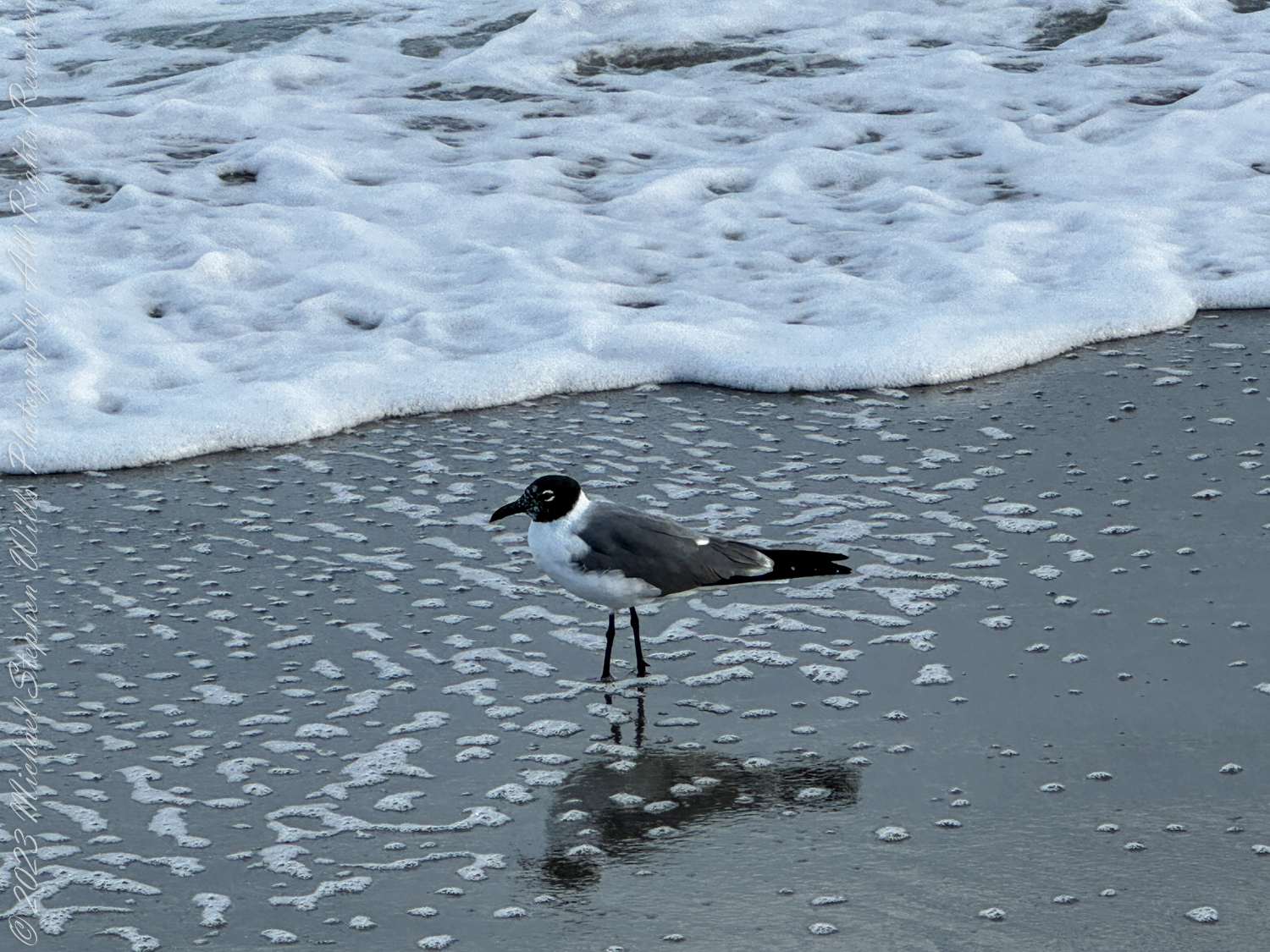
Laughing Gull with breeding plumage

Laughing Gull, nonbreeding plumage

Minutes Of Separation

The mere minutes that separate the two photographs are but a whisper in the grand dialogue of evolutionary time. Yet, they offer a glimpse into the ever-present duality of the Laughing Gull’s life. In one, the gull stands resolute, black-headed and bold against the soft chaos of the sea’s edge. In the other, its head appears dusted with the wisdom of age, a visual softening that speaks to the less confrontational time of year.

Here are some observations to make sense of this disparity:

Overlap of Molting Periods: Laughing Gulls do not all breed at the same time; some individuals may start molting into or out of breeding plumage earlier or later than others. This can result in birds with different plumage being seen together.

Varied Maturity: Younger gulls or those not yet of breeding age may not have developed the breeding plumage, while adults in the same flock may display full breeding colors.

Breeding Colonies: Gulls often nest in colonies where birds in different stages of the breeding cycle can be observed together, including those that may have lost mates or failed to breed and therefore did not develop breeding plumage.

Health or Nutritional Status: Sometimes a bird’s plumage can be affected by its health or nutritional status. A gull in poor health might not molt into breeding plumage as expected.

Geographic and Climatic Factors: Local environmental conditions can influence the timing of molting. Birds in the same location can experience different environmental cues that might affect their molt.

Non-breeding Visitors: During the breeding season, some non-breeding birds may still be present and intermingle with breeding birds, either because they are passing through the area or they are non-breeding residents.

Extended Breeding Season: In areas with a long breeding season, such as in subtropical and tropical regions, the breeding and non-breeding plumages can be seen at the same time due to the extended period over which breeding can occur.

Masters of the Coastal Realm

The Laughing Gulls are more than just residents of the coast; they are its caretakers and witnesses. Their laughing calls are synonymous with the ocean’s breath, a soundscape that harmonizes with the rhythmic crashing of waves. These birds thrive in the intertidal zone, a challenging environment where land and sea engage in a perpetual tussle. Here, they must be opportunistic, agile, and resourceful, for the beach offers both a cornucopia of food and the threat of unpredictability.

The Ebb and Flow of Existence

The life of a Laughing Gull is intimately tied to the ebb and flow of the tides. Their diet is a testament to their adaptability, comprising anything the sea yields—fish, crustaceans, and even the unfortunate insects that stray too close to the brine. They are pirates of the shore, unafraid to snatch a meal from another bird or scavenge the remains of human activity.

Reflections on Change and Constancy

Laughing Gulls are the embodiment of the sea’s narrative around us—a story of change and constancy. Their lives are a testament to the tumultuous history of the ocean, and their presence is a thread that connects us to the vast, blue mystery. They remind us that, while the sea’s moods are many and its faces ever-changing, it remains a central force in the narrative of life on Earth.

In the Face of Tomorrow

In the space between these two images, we find a profound lesson on the nature of time and the resilience of life. The Laughing Gulls of Cocoa Beach, with their shifting plumage and timeless cries, are messengers of the past, envoys of the present, and harbingers of the future. As we contemplate their existence, we are reminded of our own place within the natural world—a world that requires our understanding and protection, lest the laughter of these gulls fades into the silent archives of history.

The Laughing Gulls of Cocoa Beach continue their dance, unfazed by the human gaze, their lives a fluid adaptation to the sea’s caprices. And as the sun marches across the sky, casting the story of these gulls into relief against the shifting sands, we are privileged to observe, to learn, and to cherish the Atlantic Ocean’s enduring tale.
Copyright 2024 Michael Stephen Wills All Rights Reserved

Near and Far — the last day of 2023

Discover a heartfelt story woven from the sands of Cocoa Beach on New Year’s Eve, where shells and stars intertwine, inviting you to ponder the delicate dance of near and far.

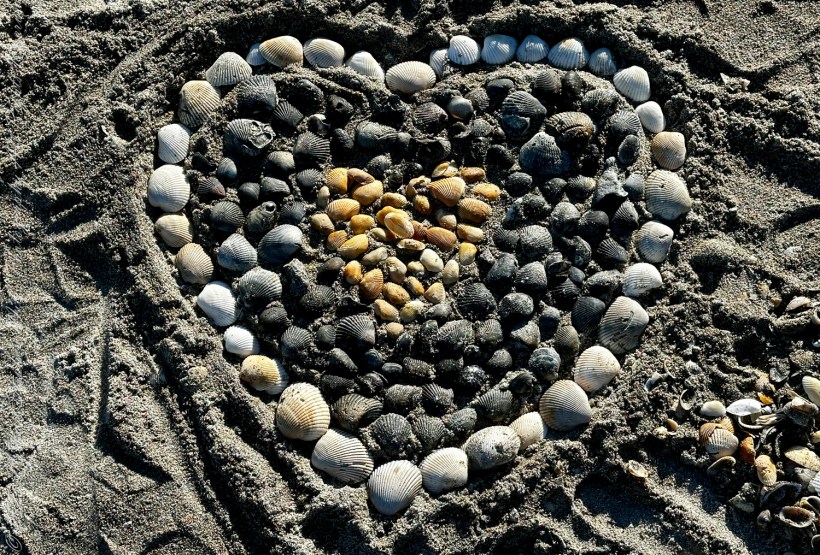
On the last day of 2023, as the sun began its descent on Cocoa Beach, I found myself tracing the contours of a heart laid out in Ark Clam shells. Each shell, with its ridges and grooves, felt like a chronicle of the ocean’s whispers. This artful mosaic, set against the granular canvas of the beach, was a testament to the playful hands of time and tide. I marveled at the intention behind it, the human desire to create and connect, to leave a mark, however fleeting, on the vastness of nature.

I found this beach heart while walking on Cocoa Beach on the last day of 2023. It is composed of the various shade of Ark Shells. Ark clam is the common name for a family of small to large-sized saltwater clams or marine bivalve molluscs in the family Arcidae. These are the most common shells found there.

The shells were cool and firm under my fingertips, each one a unique piece of the year’s mosaic. Some were a pristine white, while others bore the earthy tones of the sea’s floor. I pondered the journeys they had taken, tumbling in the ocean’s embrace before resting here, on the threshold of a new year. The act of arranging them into a symbol of love felt like an ode to the past year’s collective joys and sorrows, an offering to the unknown adventures of the year to come.

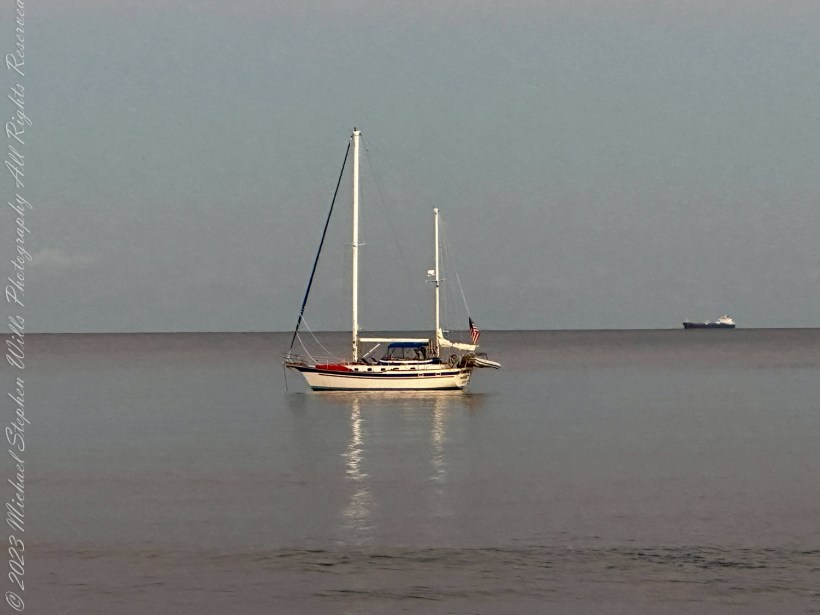
As the day waned, my gaze shifted from the shells to where the water met the sky. There, a sailboat floated serenely, a silent sentinel between two worlds. It was a picture of solitude, a single vessel on the brink of the infinite sea, beneath the expanding dome of the heavens. On the horizon, the silhouette of a cargo ship whispered stories of distant lands and the ceaseless pulse of commerce and exploration that defined our modern era.

On New Years Eve 2023 this sailboad moored off North 1st Street, Cocoa Beach, Brevard County, Space Coast, Florida.

The beach was quiet, the sounds of the day giving way to the evening’s peaceful lull. The sailboat’s stillness was a stark contrast to the perpetual motion of the cargo ship, each representing different paths on the water’s vast canvas. One was an emblem of leisure and simplicity, the other of industry and complexity. Both near and far, they were the day’s quiet companions, their stories part of the fabric of the Space Coast.

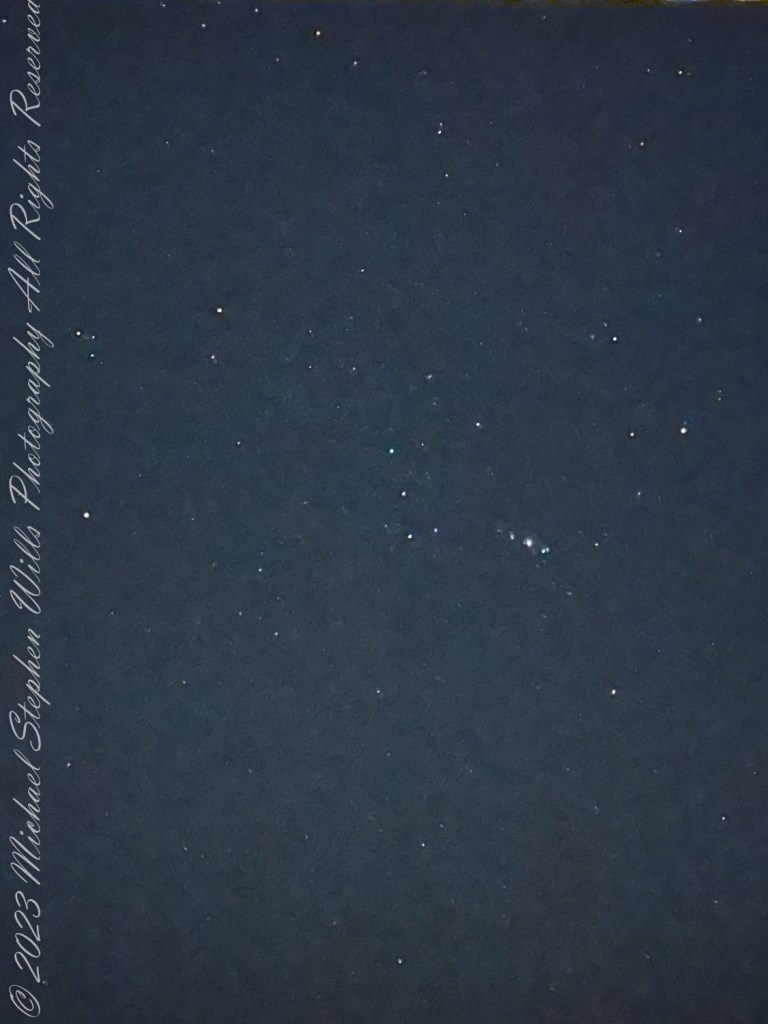
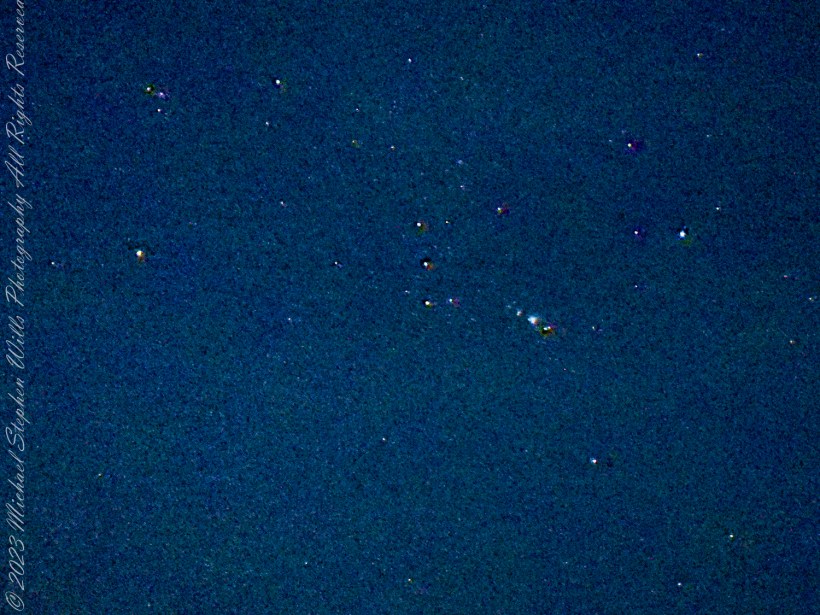
As twilight deepened into night, the stars began to emerge, one by one, until the sky was a tapestry of celestial wonder. With my iPhone 14 Pro Max, I captured this cosmic dance, the constellation of stars that had been the silent witnesses to Earth’s revolutions. The constellations, those mythic shapes that have long sparked human imagination, seemed to hold the secrets of what had been and what was to come. They were distant suns, their light traveling unfathomable distances to reach me, to reach us, as we stood on the brink of a new beginning.

Orion

I couldn’t help but feel a connection to the stars, a kinship with their ancient light. They reminded me that we, too, are part of this grand cosmic design, our lives stitched into the universe’s expansive quilt. On the beach, with the shells at my feet and the stars overhead, I was caught in the delicate balance of near and far—the tangible reality of the shells I could touch and the distant glow of starlight from ages past.

Orion, the belt and sword in center.

As the year ticked closer to its end, I stood between the intimate artistry of the shell heart and the boundless majesty of the star-filled sky, a lone observer of time’s relentless march. The Space Coast, with its unique blend of earthly beauty and human aspiration, was the perfect stage for this reflection. Here, on Cocoa Beach, I embraced the last moments of 2023, ready to welcome the new year, with its promise of continuance and change, its constant dance of near and far.

Copyright 2024 Michael Stephen Wills All Rights Reserved

A Complete Atrina rigida found on Cocoa Beach

Join me in reliving the enchanting evening on Cocoa Beach where my wife and I discovered a rare, intact Atrina rigida shell. Dive into the world of this fascinating bivalve through our story of ecological wonder and natural beauty.

Introduction


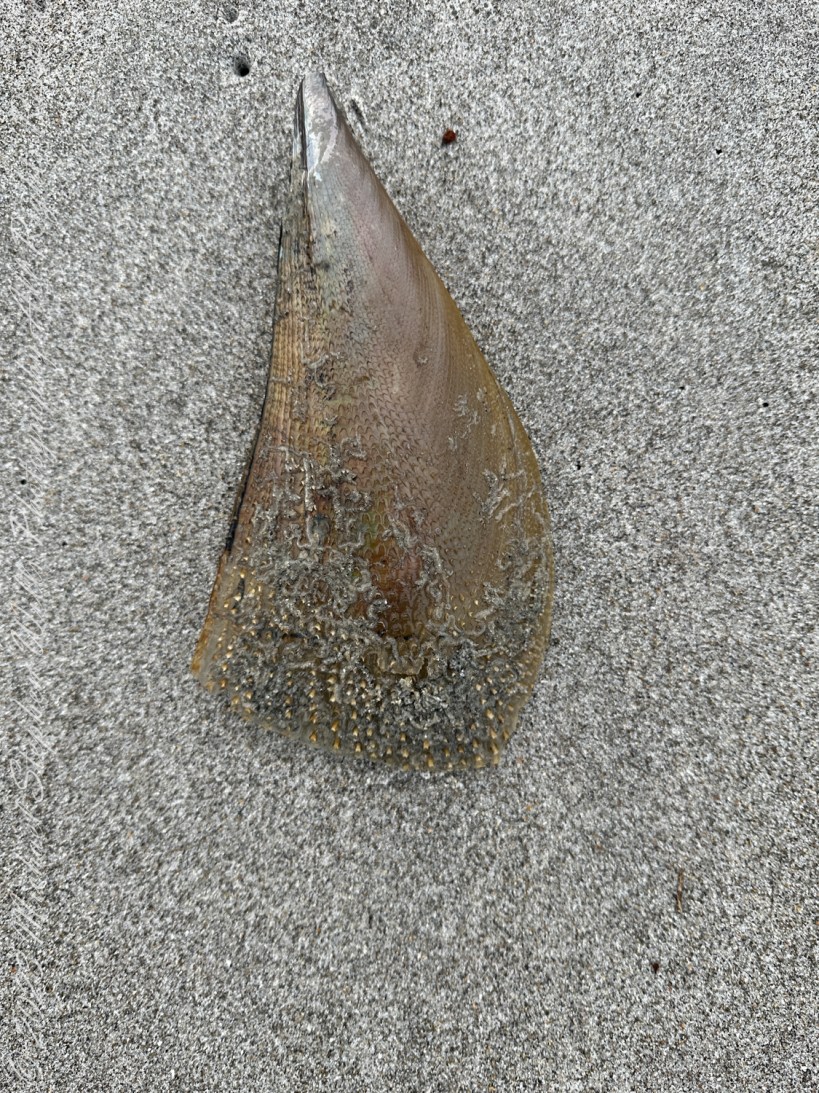
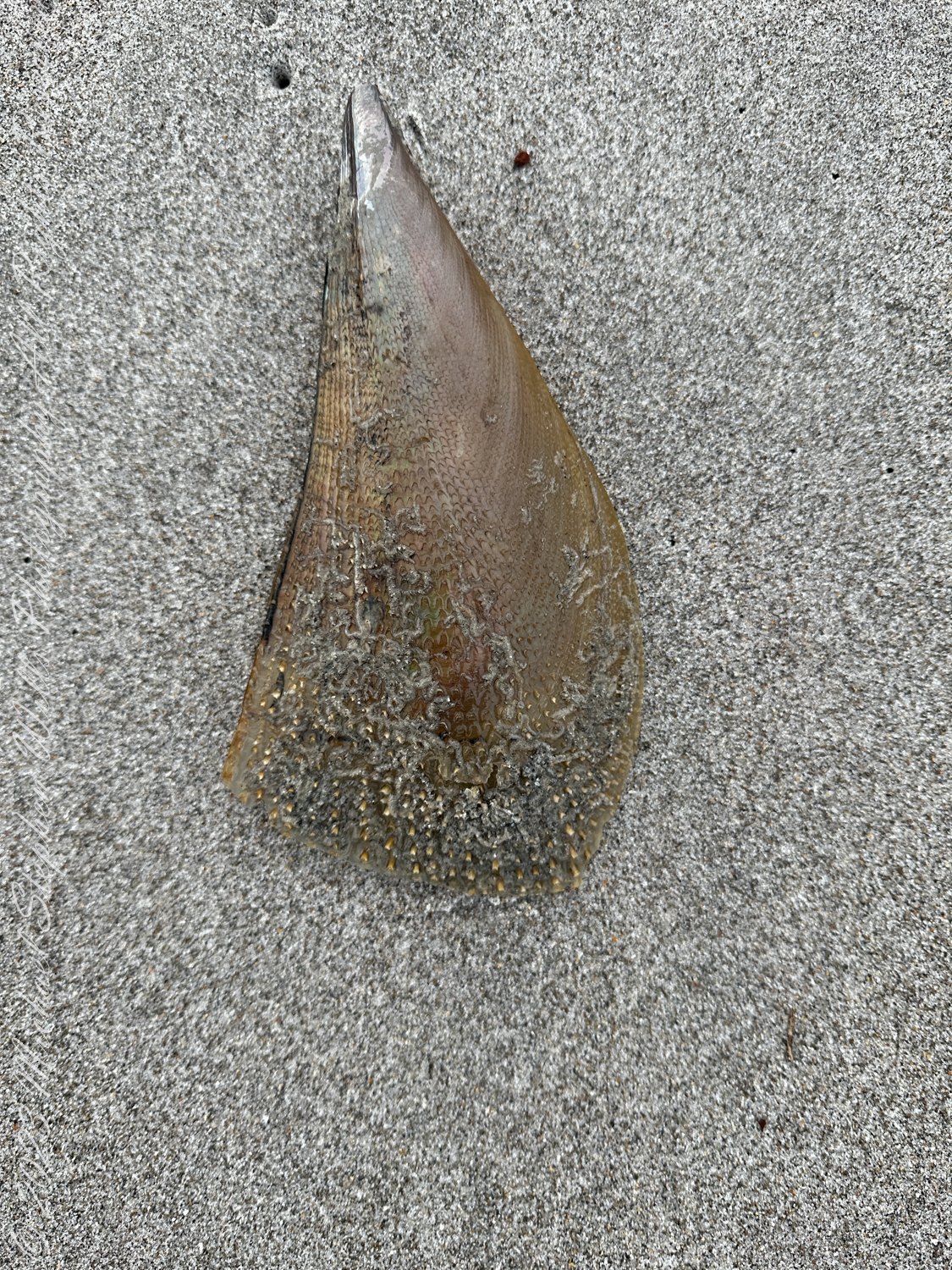
One evening, as the sun dipped below the horizon, my wife Pam and I walked along the Cocoa Beach shore. There, among the relics of the receding high tide, I found a complete shell, a rare occurrence where often only fragments are discovered. This intact specimen was a rigid pen shell, scientifically known as Atrina rigida, its 6-inch length and 4-inch width a testament to its resilience in the face of the ocean’s might.

A Rigid Pen Shell (Atrina rigida). These bivalves are found in sandy or muddy substrates in shallow waters and are characterized by their triangular shape and distinctive long, pointed end. This specimen is about 6 inches long, 4 inches wide.

Etymology and Common Name


The scientific name ‘Atrina rigida’ is steeped in Latin origins, with ‘atrium’ suggesting a ‘hall’ and ‘rigidus’ denoting ‘stiff.’ This nomenclature reflects the shell’s hardy structure, reminiscent of a grand hall’s architecture, standing firm against the elements. The common name “Pen Shell” draws from the shell’s elongated, pen-like appearance when it stands vertically in the sand, resembling antique writing quills used in centuries past.

Ecology and Habitat


The rigid pen mollusk burrows as it grows, but the wide posterior end of the shell always remains exposed so water from above the seafloor can be drawn through the inhalant chamber of the mantle cavity. Typical of bivalves, water is drawn over gills or ctenidium by the beating of cilia where oxygen from the water is absorbed. Suspended food and other water-borne nutrients also become trapped in mucus, which is then transported to the mouth, digested and expelled as feces. Unique gutter-like waste canals in the viscera of the inhalant chamber also help to keep gills and other organs clear from silt and other unwanted water-borne particles by expelling these as pseudofeces. Its anterior end is typically buried in fine substrate and attached by byssal threads, with its wider posterior gaping end extending just above the sea bottom surface to facilitate filter-feeding. Algae (e.g. Lobophora variegata) and invertebrates such as sponges and encrusting corals tend to grow on the exposed part of the shell and may camouflage it very well.” [1]

Rarity of a Whole Pen Shell


Typically, one finds only broken shards of these shells, the complete forms often victims to the ocean’s relentless energy or human activity. The intact shell I found lying atop the sand was therefore a unique and precious find, its wholeness mirroring the unbroken evening calm.

The Beauty of Nacre and Sea Silk


Look inside a rigid pen shell to find a hidden treasure: the nacre, or mother-of-pearl, lining the interior. This lustrous, iridescent layer is typically found on the inner surface, a stark contrast to the rough exterior. The nacre’s smooth, reflective quality has made pen shells a source of ornamentation throughout history, their beauty extracted from the depths to adorn human creations.

Sea silk is an extremely fine, rare, and valuable fabric that is made from the long silky filaments or byssus secreted by a gland in the foot of pen shells (in particular Pinna nobilis). The byssus is used by the clam to attach itself to the seabed.

Sea silk was produced in the Mediterranean region from the large marine bivalve mollusk Pinna nobilis until early in the 20th century. The animal, whose shell is sometimes almost a metre long, adheres itself pointed end down to rocks in the intertidal zone using a tuft of very strong thin fibres. These byssi or filaments (which can be six centimeters long) are spun and, when treated with lemon juice, turn a golden color, which never fades.

The cloth produced from these filaments can be woven even more finely than silk, and is extremely light and warm; it was said that a pair of women’s gloves made from the fabric could fit into half a walnut shell and a pair of stockings in a snuffbox. The cloth attracts clothes moths, the larvae of which will eat it.

Pinna nobilis is also sometimes gathered for its edible flesh and occasional pearls of fair quality.” [2]

Location and Personal Impact


Our discovery on Cocoa Beach, a location known for its diverse marine life, added to the sense of connection with the natural world. The shell’s journey to rest upon the sand, whole and unblemished, felt like a shared secret between the ocean and us, a fleeting glimpse into the life of a creature whose home is often hidden beneath the waves.

Conservation and Reflection


This encounter with a complete Atrina rigida emphasizes the importance of marine conservation and protecting such fragile ecosystems. It serves as a poignant reminder of our responsibility to the environment and the need for collective action to preserve the ocean’s myriad inhabitants.

Conclusion


Finding a whole rigid pen shell amidst our peaceful walk was an extraordinary event that transcended mere chance. It provided a moment of awe, an opportunity to marvel at the elegance of nature’s design, and a reminder of the delicate balance that exists within our planet’s ecosystems. This intact Atrina rigida from Cocoa Beach will forever symbolize the enduring beauty and complexity of the marine world.

References
  1. Wikipedia articles for “Atrina rigida,”
  2. and “Sea Silk.”

Copyright 2024 Michael Stephen Wills All Rights Reserved

Crystalline Secrets: The Art and Science of Whelk Shell Formation

As you stroll along the beach, the beauty of whelk shells captures your attention. Ever wondered how these intricate structures form? Dive into the secrets of their creation, from cosmic origins to mollusk mastery. Discover the fascinating world within their shells

Exploring the Formation of Whelk Shells


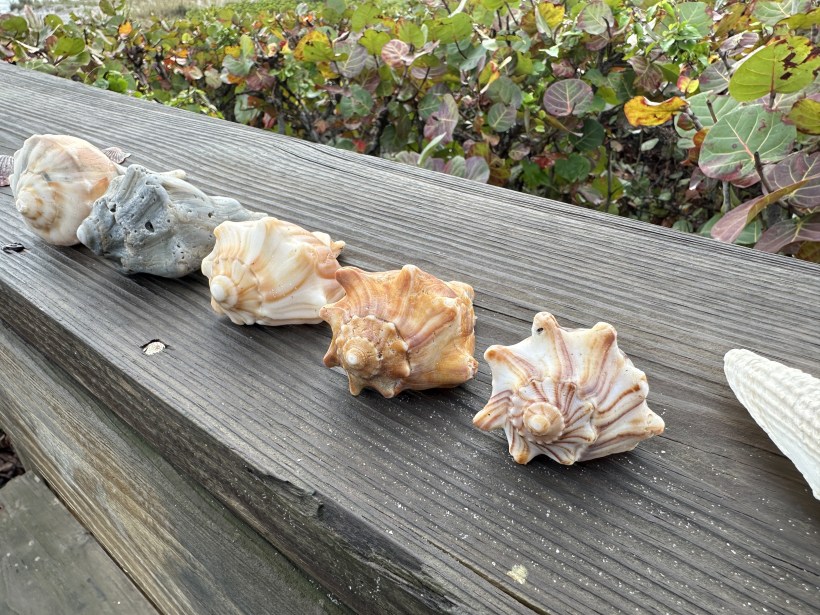
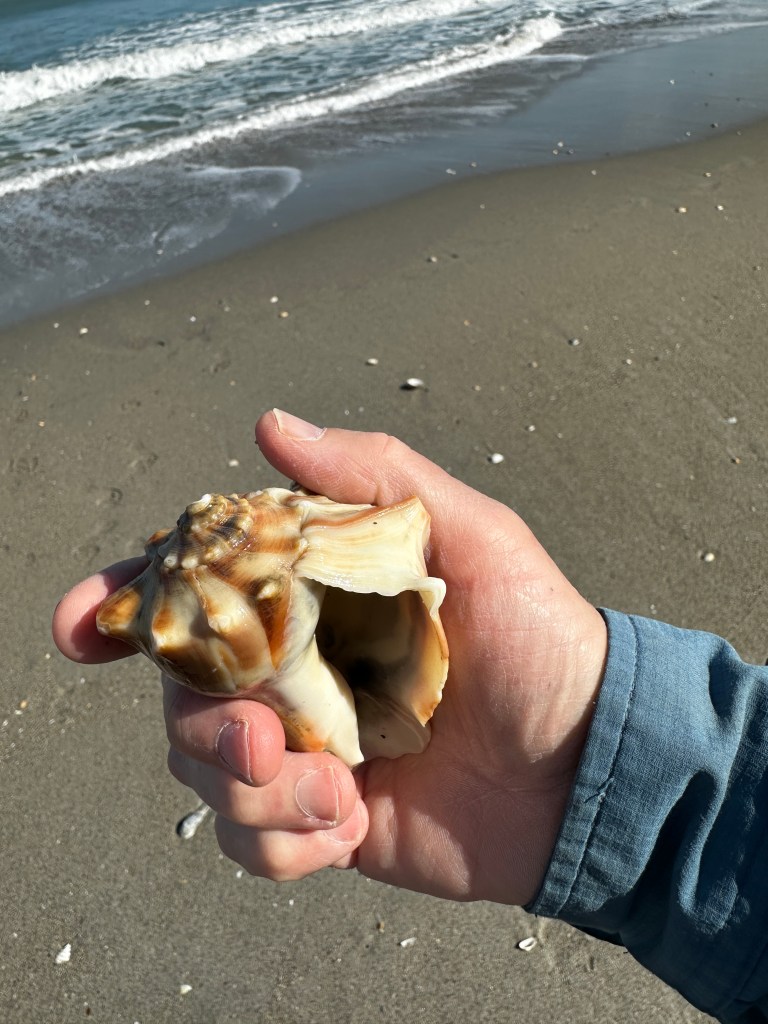
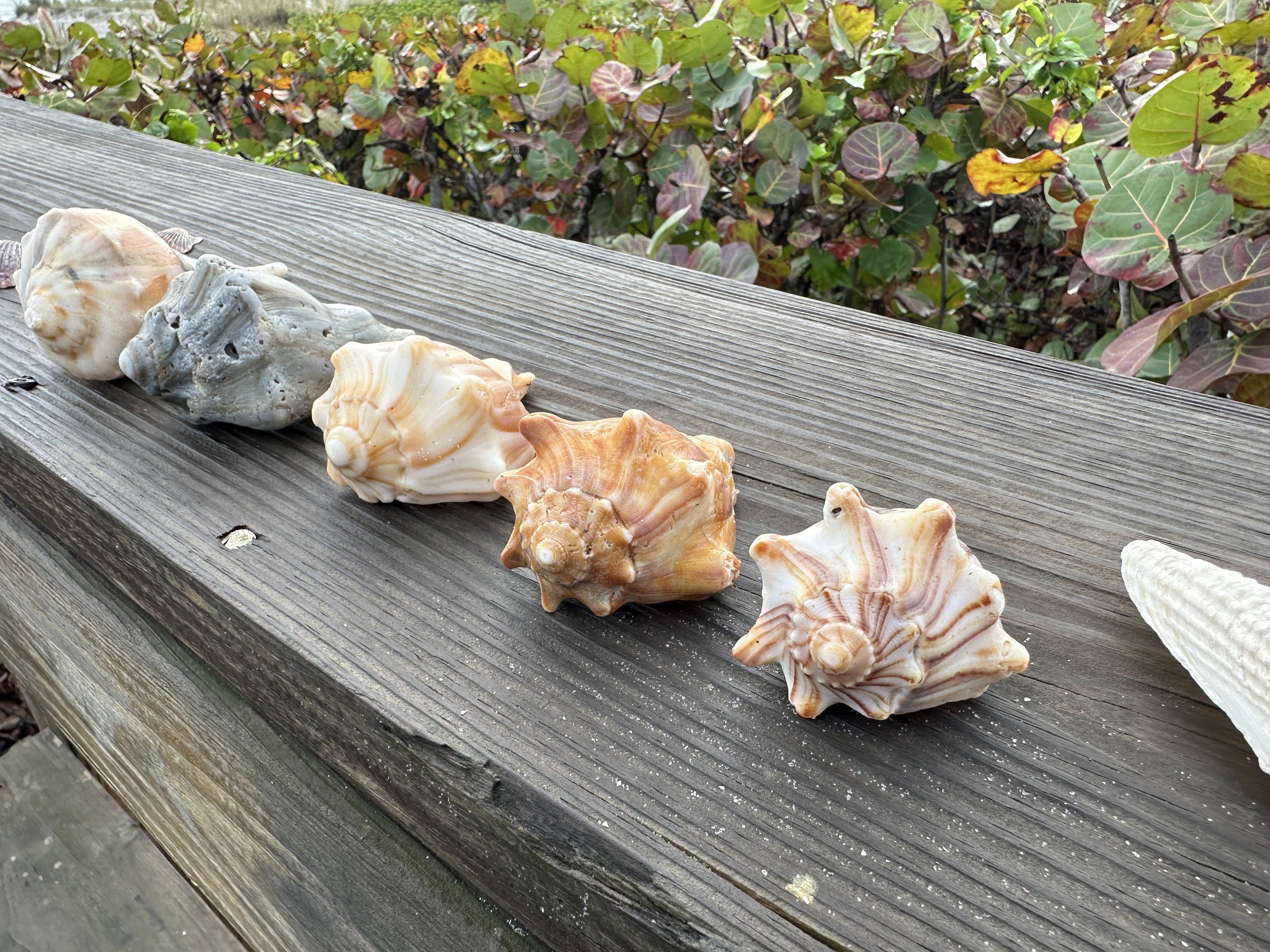
As I wander along the coast, the variety of seashells scattered across the beach fascinates me, particularly the whelk shells with their intricate designs and robust structure. This marvel of nature prompts me to delve into the science behind the formation of these shells, which are not just homes for the marine creatures but also a testament to the extraordinary processes that take place both within the organisms and across the cosmos.

The Architect: The Mantle of the Whelk


The journey of a whelk shell begins within the mollusk itself, specifically with an organ called the mantle. This organ is a marvel of biological engineering, responsible for laying down the calcium that forms the shell’s backbone. It secretes a matrix, a kind of biological scaffolding composed of proteins and polysaccharides, and then directs the deposition of calcium carbonate within this matrix to create the hard shell. The mantle’s work is meticulous, ensuring the shell’s growth and repair throughout the whelk’s lifetime.

The Building Blocks: Calcium, Carbon, and Oxygen


So why do the elements calcium, carbon, and oxygen play such a crucial role in shell formation? It’s a question of availability and suitability. These elements are abundant in the marine environment—calcium dissolved in seawater, carbon, and oxygen from both water and air. Their chemical properties allow the formation of calcium carbonate, a stable compound that can adopt various forms like calcite and aragonite, offering structural diversity for shells. Calcium carbonate’s moderate solubility enables mollusks to control shell formation precisely, and its biocompatibility ensures the process is safe for the living organism. Above all, the resulting crystalline structure provides immense strength and rigidity, a natural armor against predators and environmental challenges.

The Role of Calcium Carbonate


Calcium carbonate (CaCO₃) is not just a building block for shells; it’s a common substance that shapes our world. Found in rocks as calcite and aragonite, it forms limestone, the basis of pearls, and even the eggshells we encounter daily. This compound is an active player in both industrial applications and biological functions, serving as an agricultural amendment, a component in cement, and even a dietary supplement for humans.

The Mollusk’s Craft: Extracting from the Environment


Whelks are not alchemists; they do not create calcium carbonate from thin air. Instead, they are master extractors, pulling calcium and carbonate ions from their surroundings and depositing them as calcium carbonate to form their shells. The mantle is at the heart of this process, secreting proteins and enzymes to facilitate ion extraction from the water. The precise regulation of ion concentrations and pH ensures the calcium carbonate crystallizes in the desired form, perfectly tailored for the whelk’s protection.

Star-born Elements: The Cosmic Connection


It’s astounding to think that the elements composing whelk shells are not just earthly but cosmic in origin. The calcium (atomic number 20), carbon (atomic number 6), and oxygen (atomic number 8) that are so critical to these marine structures owe their abundance to the stars. The life cycles of stars, from their hydrogen (atomic number 1) and helium (atomic number 2) fueled births to the explosive supernovae and neutron star collisions that mark their deaths, generate and scatter these elements throughout the universe. These star-born materials eventually coalesced to form our solar system and Earth, providing the necessary ingredients for geological and biological phenomena, including the formation of the whelk shells I hold in my hand.

As I reflect on the shells before me, I am reminded of the interconnectedness of all things—from the inner workings of a tiny mollusk to the vast and violent furnaces of stars. These shells are not just remnants of life; they are cosmic artifacts, a reminder of our connection to the universe and the extraordinary processes that shape our existence.

Copyright 2024 Michael Stephen Wills All Rights Reserved

A Raft of Coots on Merritt Island

Discover the elegance of the American Coot through our journey at Merritt Island, where these unsung avians dance across the water, crafting nature’s own symphony of survival and grace.

First Glimpse

There we were, Pam and I, standing before the serene waters of the Merritt Island National Wildlife Refuge, when a cluster of American Coots (Fulica americana) caught our eyes. Locally known as mud hens, marsh hens, or pond ducks, these coots were anything but mundane. Their dark plumage blended with the ripples, while their ivory bills gleamed like beacons, leading our gaze across the liquid expanse.

The Coot’s Constellation

As a throng, they moved with purposeful grace, a constellation of birds, each a star in their own right. With lobed toes spread like aquatic fans, they paddled through the water, their movements an embodiment of nature’s ingenuity. These “poule d’eau,” as the French settlers once called them, displayed a mastery over their domain, both in water and on land.

Social Weave

A Raft of American Coots

The coots assembled not as a random flock but as a deliberate collective, a raft in both name and function. They maneuvered with a collective intelligence, each bird’s action rippling through the group, exemplifying the coots’ penchant for community. Their group dynamics, a blend of cooperation and competition, painted a picture of the delicate balance within ecosystems.

An Ecological Perspective

In the tapestry of the refuge’s ecology, the American Coot stitched its niche with precision. Whether known as “baldpate” or “crow duck,” these birds were critical to the habitat they frequented, acting as both consumers and contributors. They pruned the vegetation, controlling its growth, and served as prey, connecting the food web in a cycle that spanned generations.


The Taxonomic Twist: Coots vs. Ducks

As the coots continued their ballet on the water, I turned to Pam, ready to demystify the common misconception that coots and ducks are close relatives. “Though they share the wetland stage,” I began, “these two are cast in different roles by nature’s hand.”

Orders Apart

Coots are members of the order Gruiformes, which includes rails and cranes, characterized by their elongated bodies and short wings. Ducks, on the other hand, belong to the order Anseriformes, which also encompasses swans and geese, known for their broad, flat bills and webbed feet.

Distinct Lineages

This taxonomic separation marks a deep evolutionary divide. The Gruiformes, with their lobed toes and distinctive calls, represent a lineage adapted for a life traversing the marshy edges of the world. Anseriformes, with their specialized bills for filtering and dabbling, reveal a lineage fine-tuned for exploiting the aquatic resources more extensively.

The Cultural Mosaic

Despite their commonality, coots have etched a place in cultural folklore, often overshadowed by more colorful avian neighbors. Yet, their ubiquity across North American wetlands has made them a familiar sight, a symbol of the wild’s persistent pulse. To us, they were the embodiment of the unsung wilderness, a chapter in the storybook of natural history.

Embracing the Ensemble

As the day waned, the water transformed into a canvas of orange and purple hues, with the coots as its subjects. “Behold the marsh’s musicians,” I mused to Pam, “each note they play is a beat in the heart of the wild.” Our encounter with the American Coot—a bird of many names but one singular, remarkable essence—was a harmonious reminder of nature’s interconnected ballet.

Copyright 2024 Michael Stephen Wills All Rights Reserved

A Beachcomber’s Musings on Floridian Dune Ecology

Discover the resilient beauty of Florida’s dune sunflowers through the eyes of a beachcomber. Uncover the secrets of Helianthus debilis, a symbol of hope thriving where sea meets sand. Join the coastal dance of life.

Encounter with Helianthus debilis


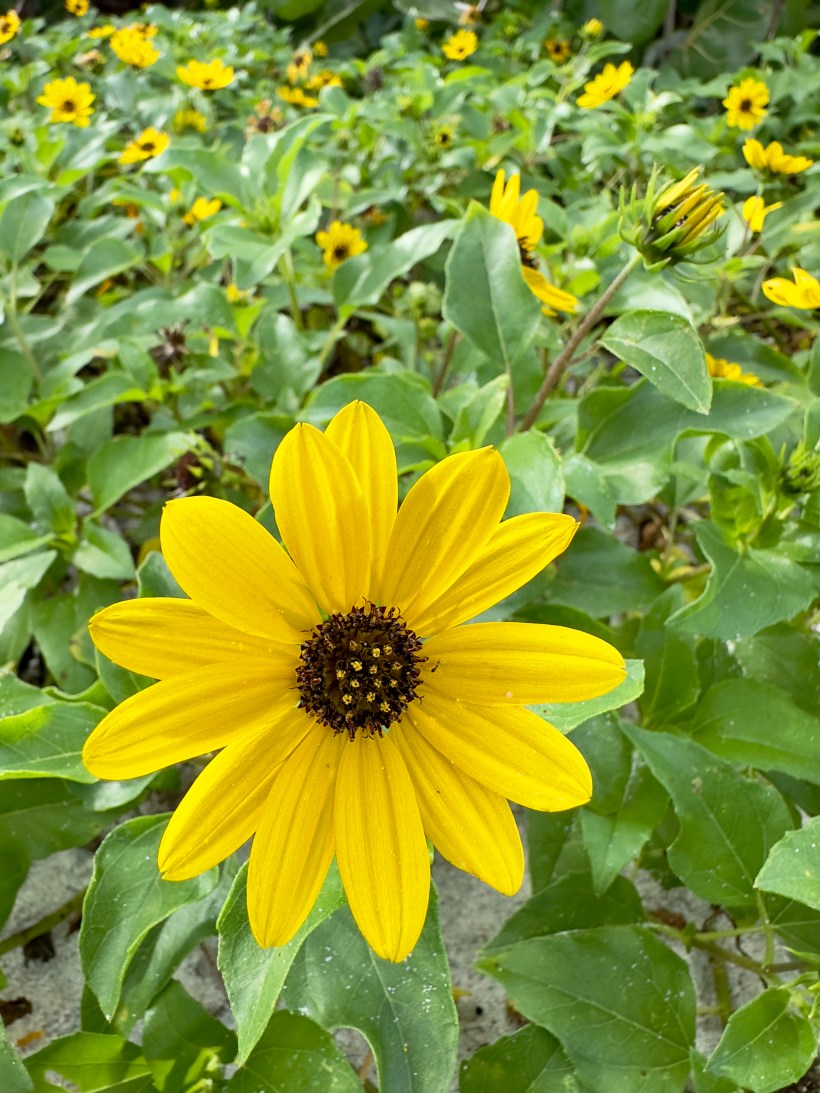
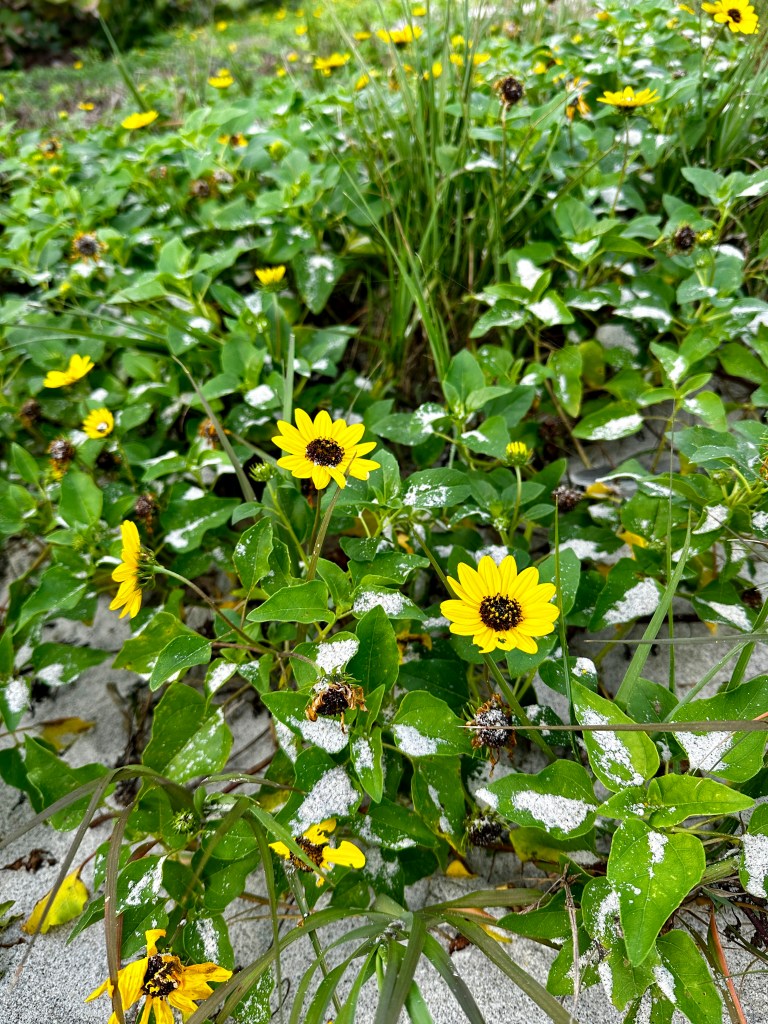
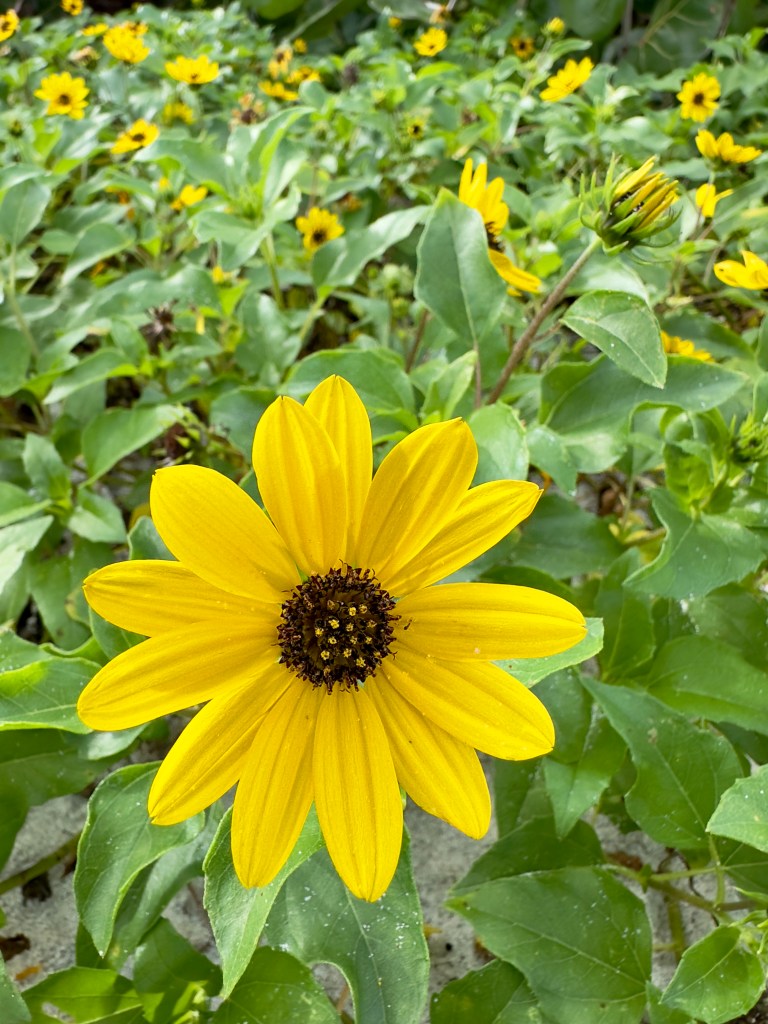
Strolling along the beachfront of Patrick Space Force Base, Florida, my gaze is captivated by a cluster of dune sunflowers, or Helianthus debilis. These hardy perennials are native to the coastal sand dunes of the southeastern United States and have made a home amidst the sandy grains where few dare to take root.

The Sunflower’s Domain


Helianthus debilis, distinguished by its large, yellow ray florets and dark center disks, thrives in this challenging environment. The dunes provide a unique ecosystem, where the sunflowers can withstand high salinity, shifting sands, and the full force of the sun’s rays. Their deep root systems anchor the sandy soil, helping to prevent erosion and maintain the integrity of the dune landscape.

Adaptation and Survival


The dune sunflower’s adaptation to its coastal environment is a marvel of nature. Its silvery-green leaves are covered with tiny hairs, reflecting sunlight and conserving moisture. The flowers bloom throughout the year, ensuring a constant presence of color along the dunes. Their hardiness is a testament to the sunflower’s evolutionary success in a habitat where freshwater is scarce and the soil is nutrient-poor.

A Native’s Role in the Ecosystem


As a native species, the dune sunflower plays a crucial role in the coastal ecosystem. It serves as a food source for local wildlife, including insects and birds, and its presence helps stabilize dune formations. The ecological value of Helianthus debilis extends beyond its beauty, as it contributes to the biodiversity and resilience of the coastal dunes.

The Dynamics of Dune Life


The life of a dune sunflower is inextricably linked to the ebb and flow of the coastal environment. Each plant is a microhabitat, supporting a range of organisms from the larvae of the dune butterfly to the burrowing beetles that find refuge in the sand. The interaction between the sunflowers and these creatures creates a dynamic web of life, each species depending on the others for survival.

Reflections on Resilience


The dune sunflower’s ability to flourish in such an austere environment is a profound reminder of the resilience of nature. As I observe the sunflowers, I am struck by their tenacity, their willingness to face the elements head-on. They are a beacon of life in a place where existence is a daily challenge, and their perseverance is a lesson in the art of endurance.

Conclusion: A Testament to Nature’s Ingenuity


As the sun begins to set, casting a warm glow over the dunes, I take a final look at the Helianthus debilis. Their scientific wonders and ecological im portance leave a lasting impression. They are not just flowers; they are a testament to nature’s ingenuity, an embodiment of the delicate balance between life and the environment. These dune sunflowers are a symbol of hope, a reminder that in the face of adversity, life finds a way to not just survive, but to thrive.

Copyright 2024 Michael Stephen Wills All Rights Reserved

Between Dunes and Discovery: Embracing History at Kennedy Space Center

Explore Cape Canaveral National Seashore and Kennedy Space Center with us, where pristine beaches meet the legacy of human space exploration, and feel the awe of standing where history was made.

A Journey Through Time and Space: Our Visit to Cape Canaveral National Seashore and Kennedy Space Center

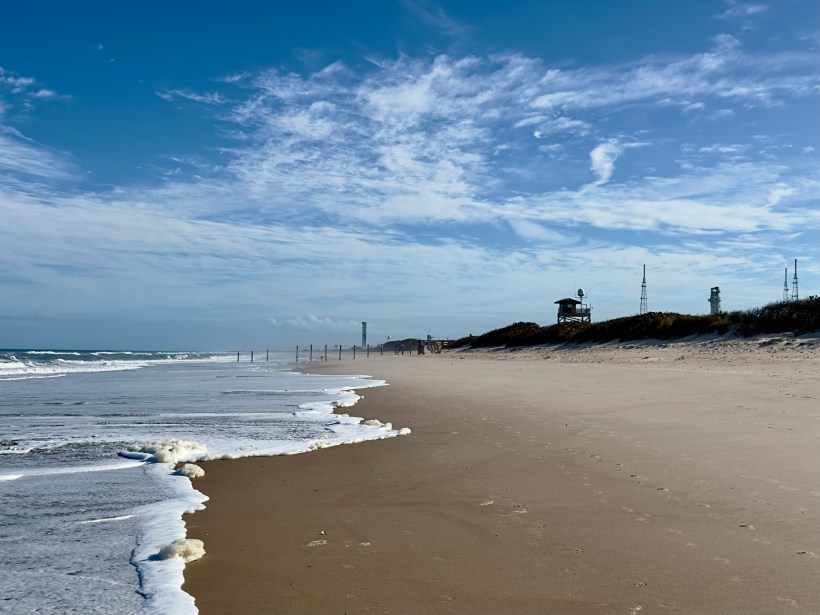
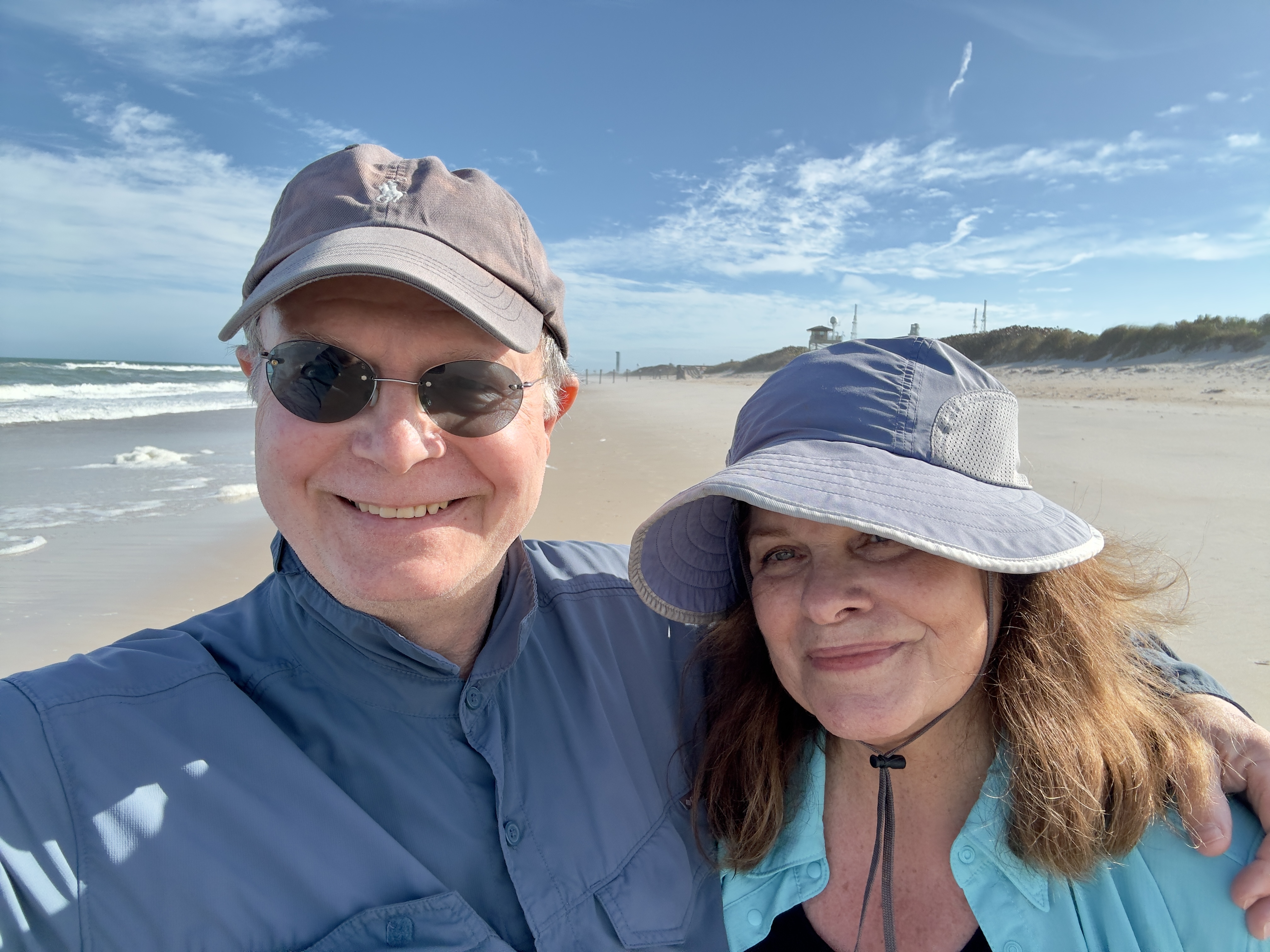
As we arrived at the pristine shores of Playalinda Beach within the Canaveral National Seashore, the gentle whisper of waves against the shoreline beckoned us. The sun kissed the horizon, casting a warm glow across the 24 miles of untouched, protected coastline that lay before us. Here, on the east coast of Florida, where crystal-blue waters embrace the shell-laden sands, we found ourselves at the intersection of natural beauty and human achievement.

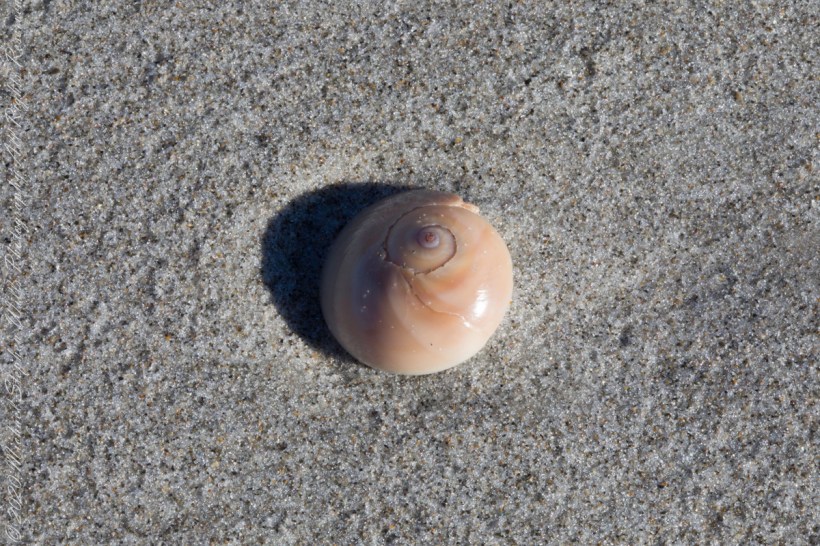
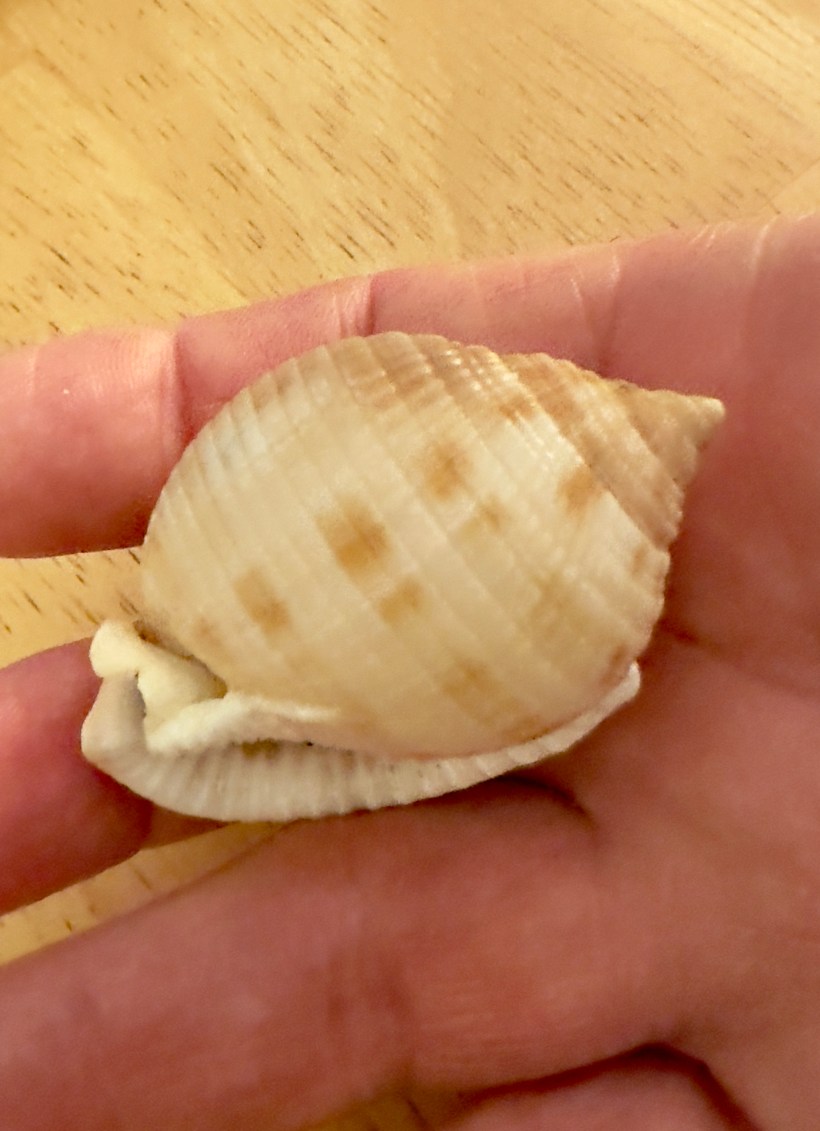
Shell of the Moon Snail (Naticidae) found in the surf wash.

The Serenity of Playalinda

We strode along the boardwalk, passing through dunes adorned with sea oats, to find our spot upon the soft sands of Playalinda. The beach, known for its tranquility and the chance to observe a vibrant array of wildlife, offered us a moment of peace. With no distractions—no concessions, no showers, just nature—we were able to disconnect from the world and reconnect with the earth. From our vantage point, the Merritt Island Wildlife Refuge across the water was a haven for migrating birds, dolphins, and, with some luck and the right season, sea turtles nest on the beach itself.

Witness to History: The Apollo 11 Legacy

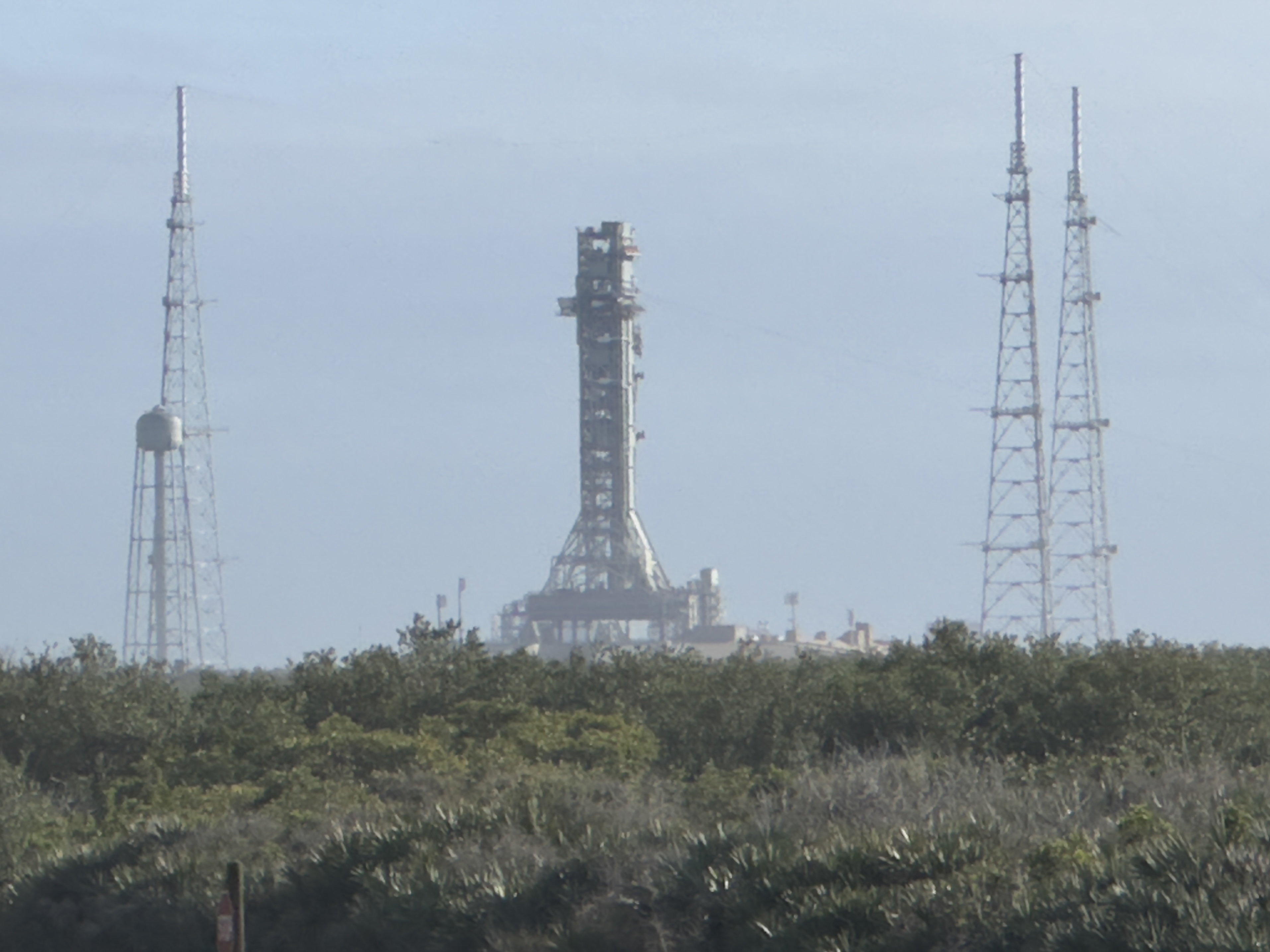
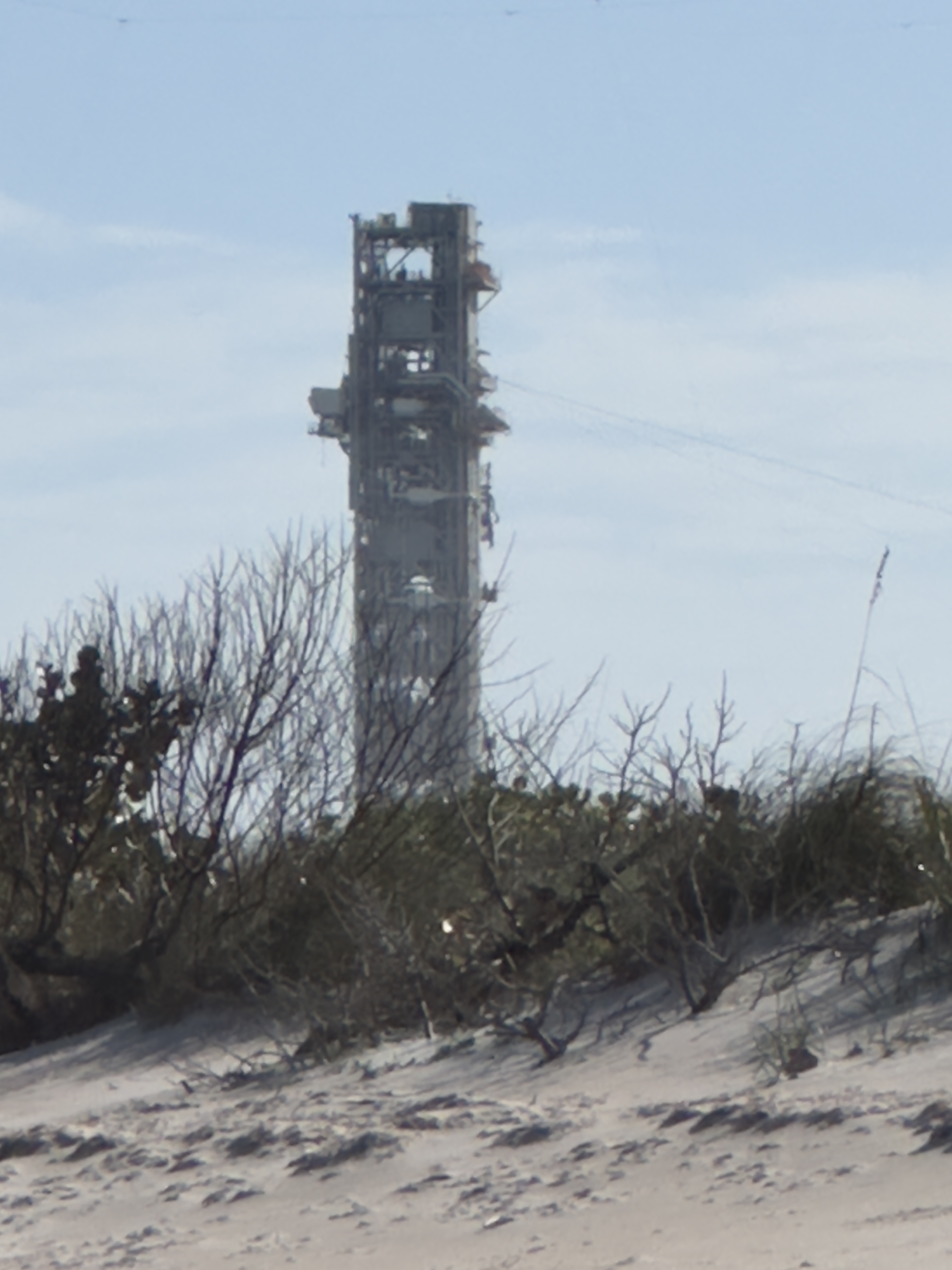
But it wasn’t just the natural allure that drew us here. Playalinda holds a unique position, offering an unobstructed view of the historic launch pads of Kennedy Space Center, where Apollo 11 began its monumental journey to the Moon. As we walked south towards the fence bordering the Space Center, the anticipation built within us. Here, we were tracing the footsteps of giants, those brave astronauts who dared to venture into the unknown.

The Vistas of Exploration

Each step brought us closer to the site where humanity took one of its most significant leaps. Gazing upon the launch complex from the fence, we were reminded of the powerful forces harnessed to break the bonds of gravity. Imagining the roar of the engines, the earth-shaking vibrations, and the fiery ascent of the Saturn V rocket, we felt a deep connection to the past and a sense of awe for the pioneering spirit that propelled us into a new era of exploration.

Reflections Amidst the Dunes

As we wandered back along the beach, the foam of the ocean’s edge lapping at our feet, we reflected on the duality of our surroundings. Here, in this place of quiet solitude, we also stood at the forefront of human innovation and ambition. The juxtaposition of the peaceful beach with the technological marvels just a stone’s throw away was not lost on us.

Our journey to the Cape Canaveral National Seashore and the Kennedy Space Center fence was more than just a visit to a beach or a historic site; it was a pilgrimage to a place where dreams materialize and reach for the stars. It was here that we came to understand the full spectrum of emotions that accompany great achievements—the hope, the fear, the triumph.

Conclusion

Our visit to the Cape Canaveral National Seashore and the Kennedy Space Center was an experience that will linger in our memories for years to come. It was a reminder of what we can achieve when we are united by a common goal, and it filled us with pride and optimism for the future. As we looked back one last time, the setting sun seemed to whisper a promise of the wonders yet to come, both here on the shores of Playalinda and in the vast expanse of space that awaits us.

Copyright 2024 Michael Stephen Wills All Rights Reserved

The Tam o’ Shanter of the Sea: A Scotch Bonnet’s Tale

Amidst the golden dawn at Cocoa Beach, a rare treasure emerged from the high tide’s embrace—a Scotch Bonnet shell. Discover its journey from the ocean’s depths to a beachcomber’s palm, and unravel the tales of marine life woven into its striking tartan pattern in this captivating story.

Dawn’s Gift: A Beachcomber’s Tale


As the first light of dawn stretched its golden fingers across the horizon, I made my way down the familiar path to Cocoa Beach. It was an early January morning, and the air was crisp, with a hint of salt carried on the gentle breeze. The tide was high, giving the beach an intimate feel, as if the ocean itself was reaching out to share its secrets.

I’ve always found beachcombing to be a meditative experience, but today’s stroll was particularly enchanting. The beach was deserted, save for the scuttling sandpipers searching for their breakfast. The rhythmic crash of the waves provided a soothing soundtrack to my thoughts. As I walked, my eyes scanned the shoreline, seeking treasures among the flotsam of the sea.

A Striped Treasure Unveiled


And then, I saw it—a distinctive shell caught between the ebb and flow of the waves. Its bold pattern and unique shape were unmistakable even from a distance. I quickened my pace, eager to claim my prize before the sea could reclaim it. As I picked it up, water cascading off its curved surface, I marveled at the beauty in my hand: a Scotch Bonnet shell, a rarity to behold, especially here in Florida.

The Allure of the Scotch Bonnet


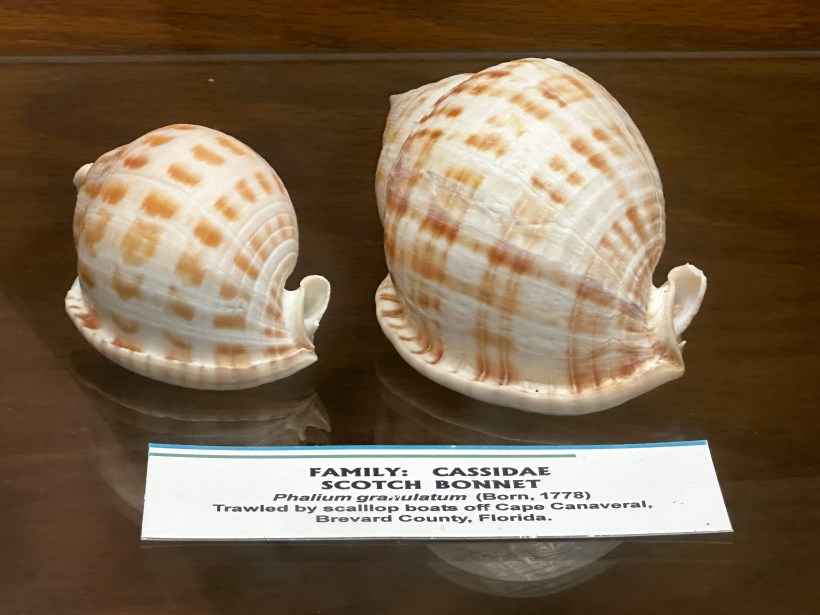
The Scotch Bonnet, named for its resemblance to the traditional Scottish tam o’ shanter hat, is a shell as fascinating as it is beautiful. Its scientific name, Phalium granulatum, speaks to the granulated texture that adorns its exterior. In my hand lay a symphony of creamy white and tan, with bold, brownish squares that resembled a carefully woven tartan. It was a mature specimen, its wide aperture and thickened outer lip suggesting it had lived a full life before arriving at my feet.

A Journey Through Nature’s Cycle


Fascinated by my find, I visited the Brevard County Museum of Natural History later that day. There, I learned that the Scotch Bonnet is more than just a pretty shell—it’s the former home of a gastropod, a creature that once crawled along the ocean floor of the Atlantic, from North Carolina to Brazil. These mollusks begin life as tiny larvae, floating in the currents until they grow large enough to settle on the seabed. They feast on sea stars, their radula—a toothy tongue—scraping their prey into digestible pieces.

The Scotch Bonnet’s predators are as varied as the ocean itself, from fish to other sea snails that prey upon the young or unsuspecting. Yet, the shell’s thick construction provides a sturdy defense, a fortress that serves its inhabitant well during its life.

Death Gives Life


The end of the Scotch Bonnet’s life cycle often provides a beginning for others. After death, the empty shell becomes a sought-after real estate for hermit crabs and a canvas for encrusting organisms like barnacles. It’s a reminder of the interconnectedness of the marine ecosystem, where even in death, life flourishes.

In the quiet of the museum, I reflected on the journey of the shell in my pocket. It was not just a Scotch Bonnet; it was a chronicle of survival, adaptation, and ecological significance. It was a legacy of the ocean’s depth and a symbol of life’s tenacity.

The Scotch Bonnet: A Symbol of Coastal Beauty


As I left the museum, I thought about the Scotch Bonnet’s significance to beachcombers and collectors. Its scarcity makes it a coveted find, a gem among shells. To hold one is to touch a piece of the ocean’s mystery, to connect with a world that is often beyond our reach.

That January morning on Cocoa Beach, the high tide had gifted me a treasure. But it wasn’t just the discovery of the Scotch Bonnet that was precious—it was the reminder that beauty and wonder can be found in the smallest of ocean’s offerings. Every shell has a story, a past woven into the fabric of the marine world. And as I pocketed my find, I carried with me not just a shell, but the echoes of an underwater tapestry, rich and alive, just waiting to be discovered.

Copyright 2024 Michael Stephen Wills All Rights Reserved

A January Encounter with a Moon Jellyfish

Walk with me through a narrative as translucent as the Moon Jellyfish itself, revealing the hidden connections between us and the vast ocean’s enigmatic creatures.

Initial Encounter


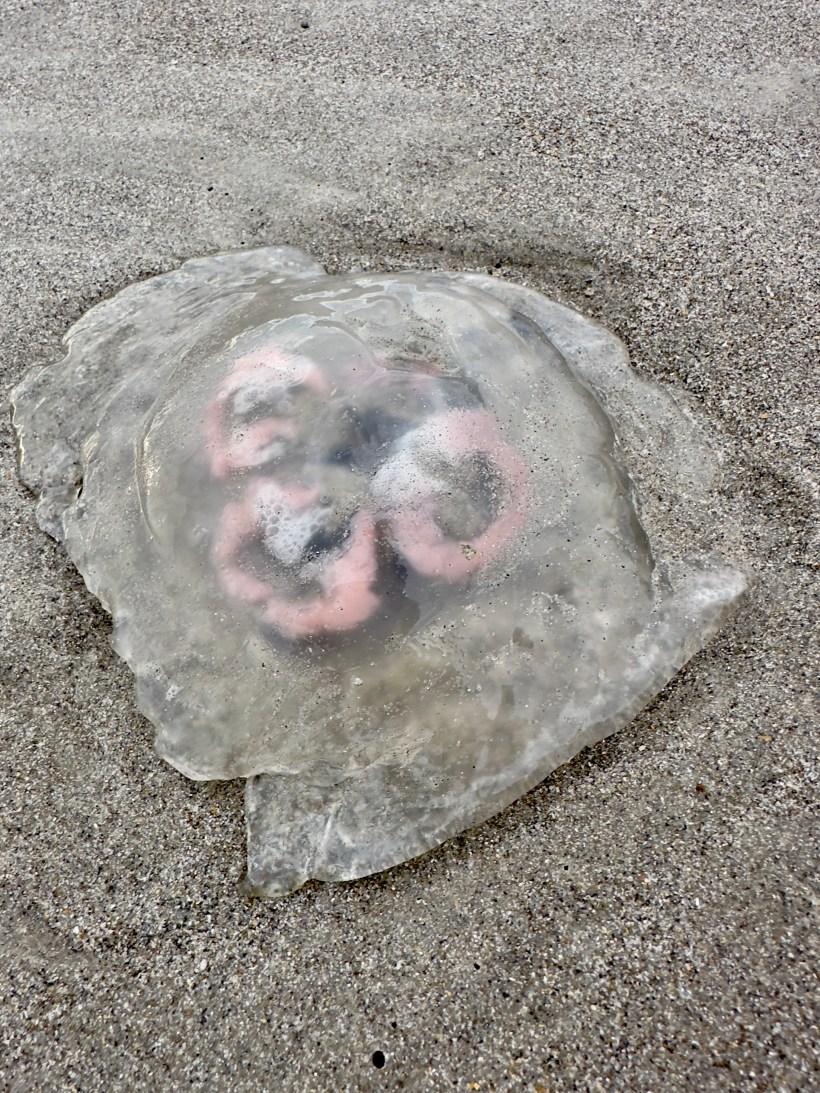
It was a cool January morning, and the southern winds were brisk as they tousled my sparse hair. I had made my way along Cocoa Beach, a place I often find solace in the rhythmic dance of the waves. Today, however, the ocean had a different story to tell. As I walked along the shore, my gaze fell upon a peculiar sight—a translucent, almost ethereal creature lay motionless on the sand. It was a Moon Jellyfish, or as scientists call it, Aurelia aurita.

The gelatinous being had been cast out by the unforgiving sea, its pinkish hue a stark contrast against the dull sands. This wasn’t an uncommon sight, as these creatures often end up on beaches due to wind patterns and water currents. But there was something about this particular Moon Jellyfish that captivated me. Perhaps it was the way it shimmered in the morning light, or how it seemed so peaceful, so out of place, yet exactly where it was meant to be.

Ecological Significance


I knew that the Moon Jellyfish played a crucial role in the marine ecosystem. These cnidarians are not just beautiful drifters; they are a vital part of the ocean’s food web. Small fish and other marine organisms often find shelter among the Moon Jellyfish’s tentacles, escaping predators and finding nourishment in the plankton caught by their host. In turn, the Moon Jellyfish themselves are prey to a variety of larger species, including sea turtles and certain birds.

Seeing the jellyfish on the shore, I contemplated the fragility of this balance. A change in wind direction, a shift in temperature, or human interference could easily disrupt this delicate ecological dance. It was a stark reminder of the interconnectedness of life and the responsibility we hold in preserving these intricate relationships.

Biological Wonders


The biology of the Moon Jellyfish is as fascinating as its role in the ecosystem. They are composed mainly of water, with a body that includes a bell-shaped top called the medusa, and short tentacles that hang below. These tentacles contain stinging cells known as cnidocytes, which they use to capture their prey—mainly tiny plankton.

As I observed the jellyfish before me, I couldn’t help but marvel at its simplicity and complexity. The Moon Jellyfish has a basic nervous system and lacks a traditional brain, heart, and blood. Yet, it thrives in the vast and challenging environment of the ocean. Its lifecycle, too, is a wonder, beginning as a polyp anchored to the seafloor, then transforming into the free-floating medusa I saw on the beach.

A Reflection on Nature and Humanity


The Moon Jellyfish’s unexpected presence on Cocoa Beach prompted a deeper reflection on nature’s course and our place within it. This creature, which had drifted with the currents and tides, led me to ponder the currents of our own lives. How often do we find ourselves washed ashore by the winds of change, feeling out of place, yet precisely where we’re meant to be?

In that moment, I understood that we, too, are like the Moon Jellyfish in many ways—adaptable, resilient, and part of a larger whole. We float through life, sometimes at the mercy of forces beyond our control, yet we possess the innate ability to navigate our environment and survive.

As I left the beach that day, the image of the Moon Jellyfish imprinted in my mind, I felt a newfound respect for these delicate yet durable denizens of the deep. The Moon Jellyfish, washed up by a southern wind onto Cocoa Beach, served as a silent teacher, reminding me of the beauty and fragility of life, the importance of our ecosystems, and the subtle threads that connect us all.

Copyright 2024 Michael Stephen Wills All Rights Reserved

Rincon Flame: The Southwestern Paintbrush’s Desert Dance

Step into the Rincon Wilderness with me, where the Southwestern Paintbrush blooms amidst the ancient stones.

Discovery in the Rincon Wilderness

In the embrace of the Rincon Mountains, east of Tucson’s hum, lies the Rincon Wilderness, a tapestry of desert life and geological marvels. These mountains, one of the “Sky Island” ranges cradling the Tucson valley, are less rugged than their siblings, the Santa Catalinas and the Santa Ritas, offering a gentler invitation to explore their secrets.

Happy Valley Saddle’s Floral Jewel

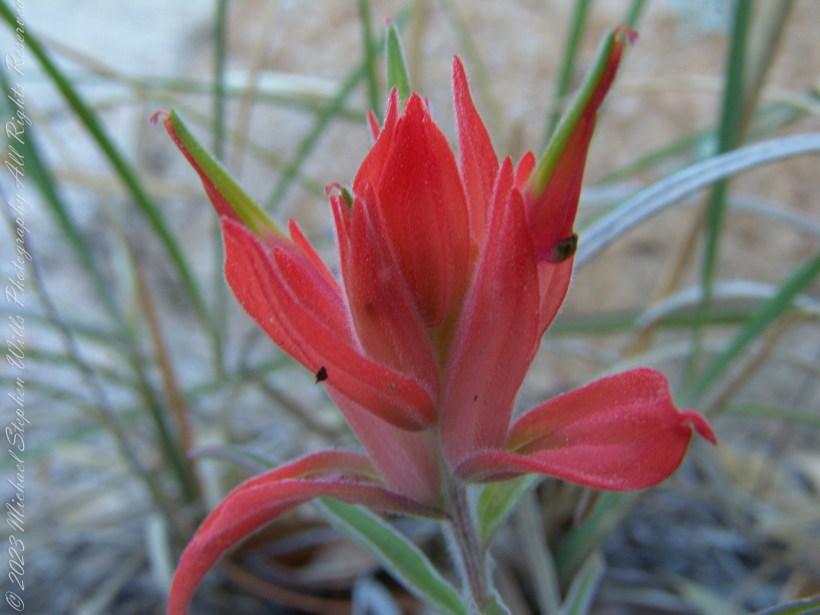
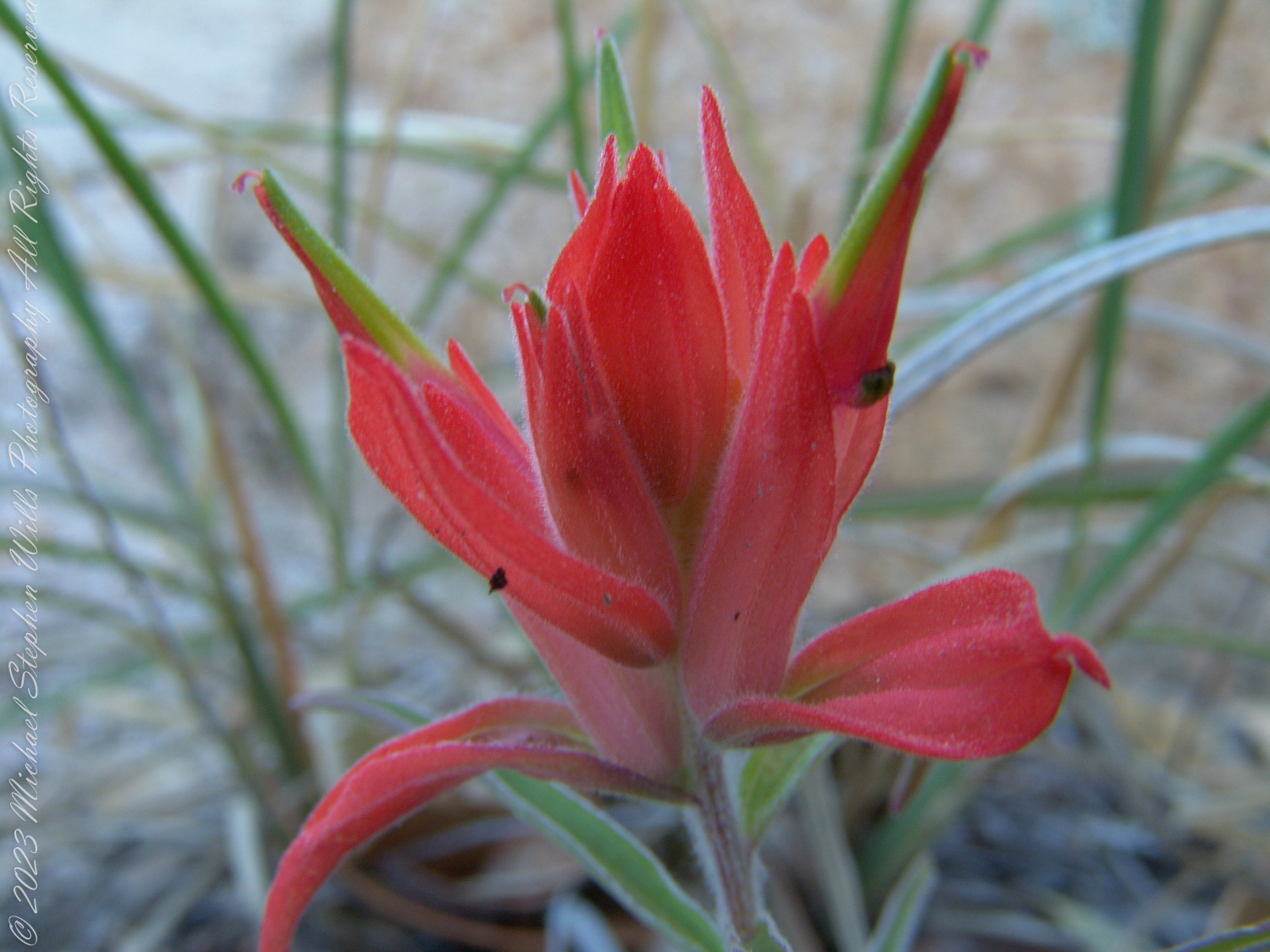
Amidst the rugged beauty of Happy Valley, a hidden corner in the quilt of the Rincon Wilderness, a singular red-orange glow caught my eye. There, among the lichen-encrusted boulders, stood the Southwestern Paintbrush, Castilleja integra, its flamboyant bracts a fiery contrast to the muted greens and grays of its surroundings.

Portrait of a Parasite

This herbaceous perennial, with its soft downy coat, is a paradox, both painting the desert with life and leeching it from others as a hemi-parasite. Its roots, entwined with those of other desert dwellers, tell a tale of survival that’s as old as the hills themselves.

The Brushstrokes of Evolution

Each leaf, narrow and dusted with hairs, speaks to the adaptive artistry of nature, designed to conserve precious moisture. The flowers, with their extended blooming season and generous nectar, court the hummingbirds who dance between the blooms, pollinators in this ancient symbiosis.

A Symbiotic Canvas

The Southwestern Paintbrush, with its colorful allure, draws more than just winged admirers. Its presence among the rocks is a reminder of the complex ecological web of the Rincon Wilderness, a part of Saguaro National Park’s rich mosaic

Click Me to visit the photographs of Michael Stephen Wills on Getty.

Copyright 2024 Michael Stephen Wills All Rights Reserved