Exploring Malloryville Preserve: A Hidden Glacial Wetland Gem in New York’s Finger Lakes

Explore the O.D. von Engeln Preserve at Malloryville, a hidden Finger Lakes wetland where glacial eskers, kettles, and springs reveal the deep story of ice and water.

In the heart of upstate New York, the Finger Lakes region stretches out like a handprint left by the last great ice sheets—long, narrow lakes aligned north to south, their steep-sided valleys feeding into a lattice of creeks, waterfalls, and wetlands. It is a landscape defined by water and time: glaciers grinding south, then melting back north some 12,000 years ago, carving deep troughs, piling up ridges of gravel and sand, and leaving behind a terrain that is anything but simple.

The O.D. von Engeln Preserve at Malloryville, near the small village of Freeville, is one of the quiet places where that story is written most clearly on the land. It doesn’t shout like Taughannock Falls or Ithaca’s famous gorges. Instead, it whispers—through the curves of its hills, the softness of its ground, the unexpected appearance of a spring at the base of a gravel ridge. Here, in a relatively compact area, you can see how ice and water worked together to shape the Finger Lakes region we know today.

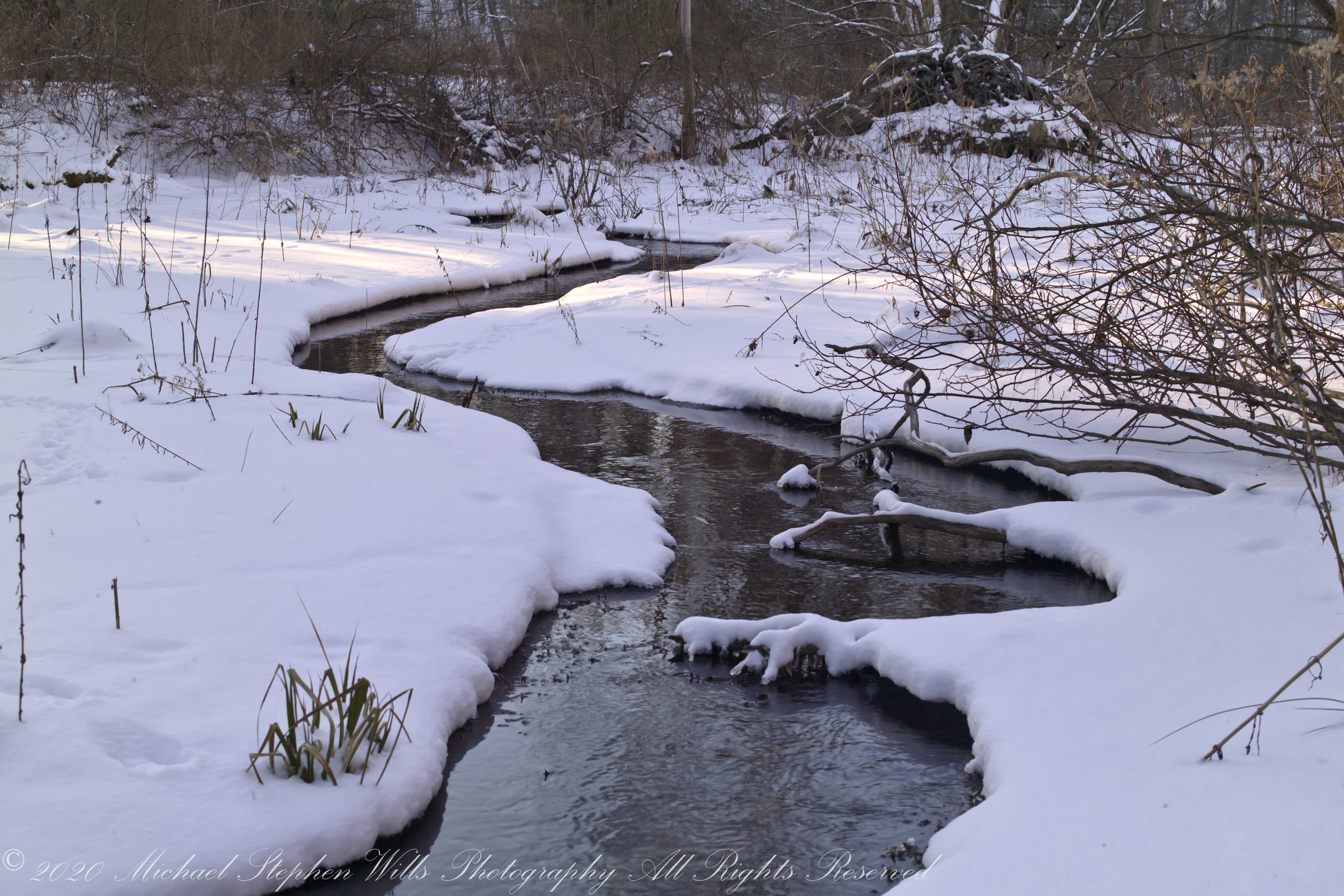
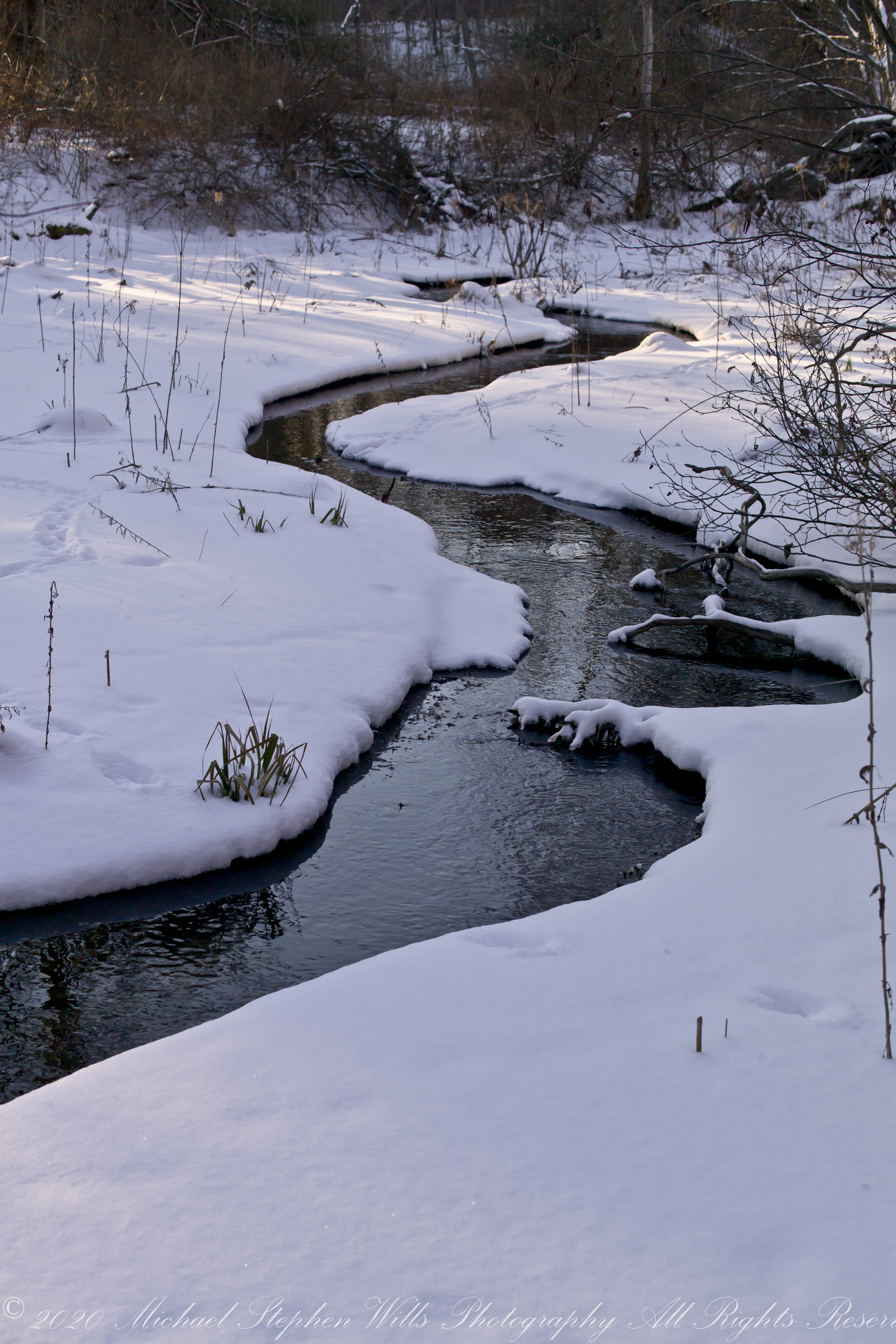
Overflow from a Kettle Pond threads through a meadow before feeding Fall Creek. The O.D.von Engeln Preserve at Malloryville.

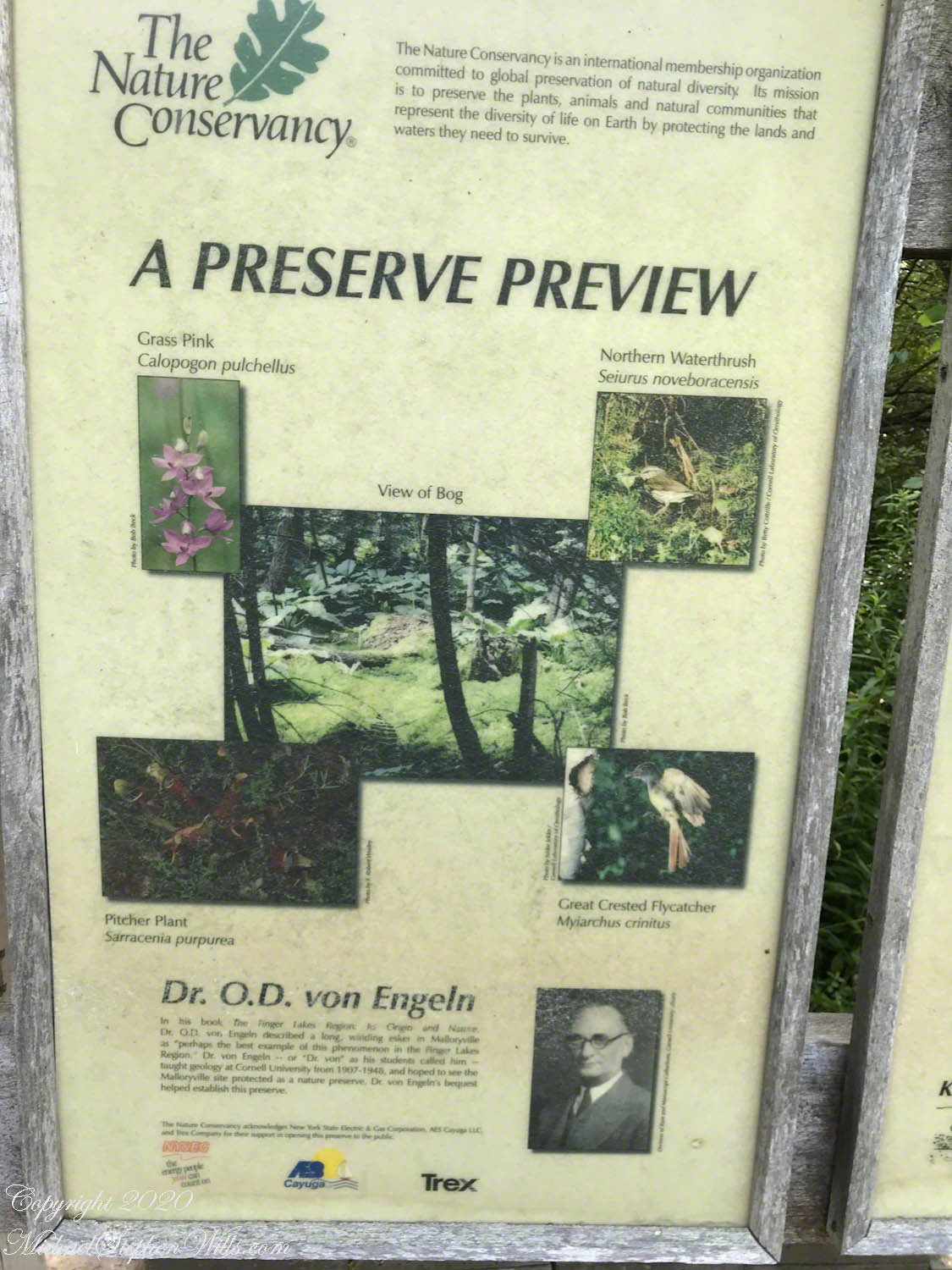
By the time the preserve officially opened in 1997, the name O.D. von Engeln was already familiar to anyone curious about local geology. His classic book on the Finger Lakes helped generations of readers understand that the scenery around them was not random, but the result of powerful, understandable processes. Reading von Engeln, the rolling hills and quiet valleys near Freeville become more than background—they become evidence: of buried ice, rushing meltwater, and the slow settling of sediments into the forms we walk on now.

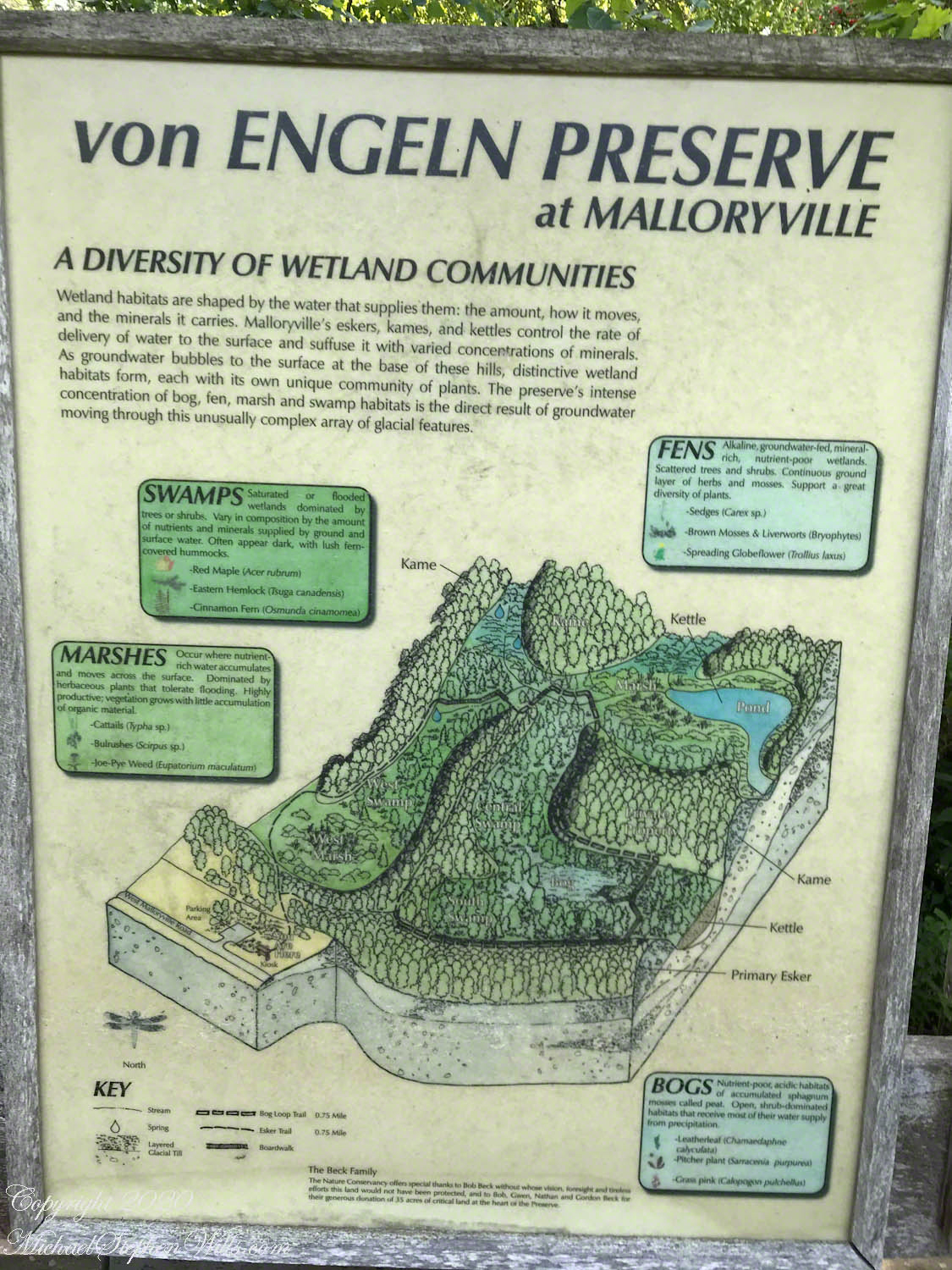
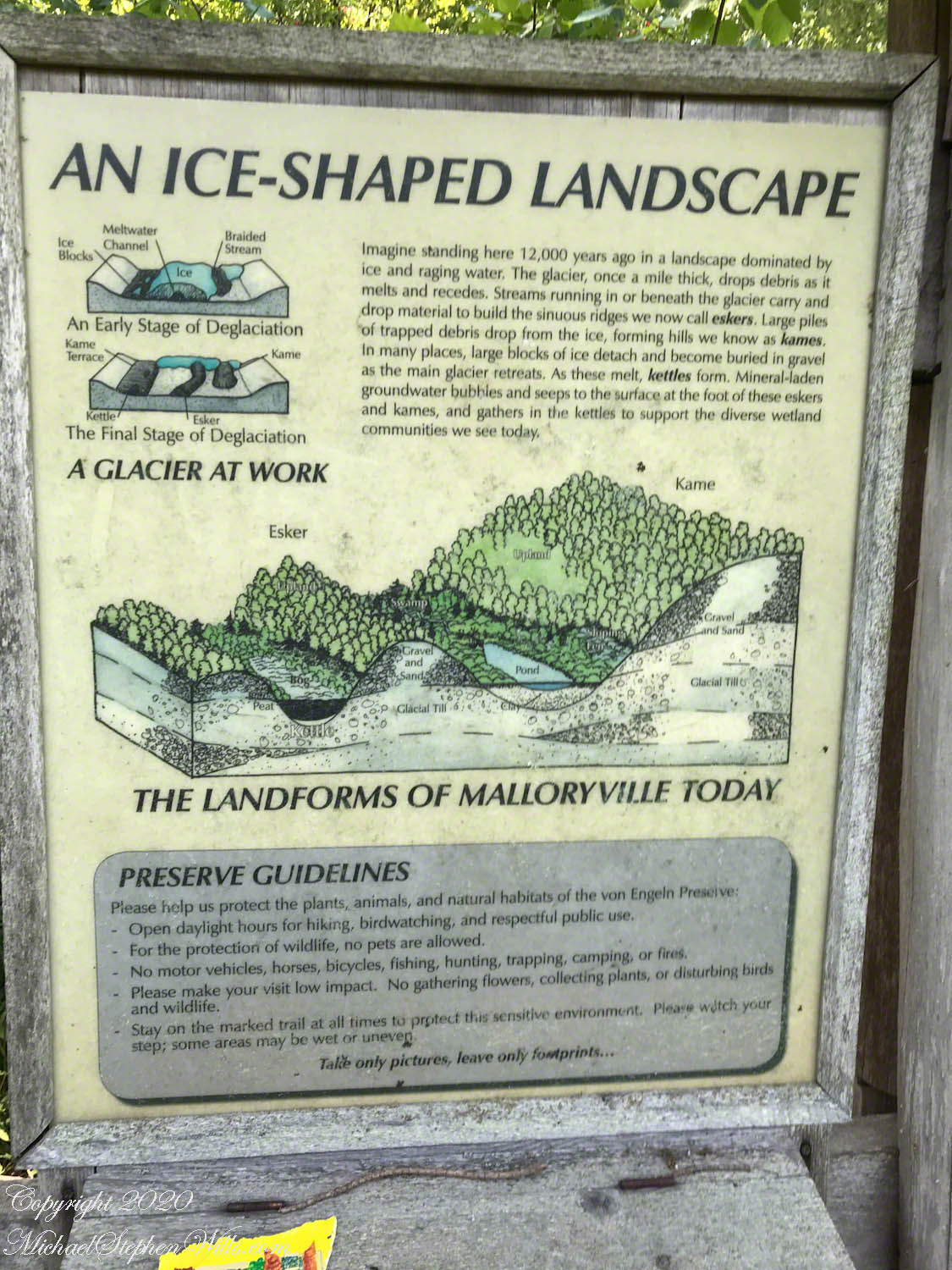
Malloryville is an outdoor classroom for that lesson. The preserve is built around a cluster of glacial landforms—eskers, kames, and kettles—that create a three-dimensional mosaic of ridges and hollows. Eskers, those long, winding gravel ridges left by rivers that once flowed inside the glacier, snake through the forest like frozen currents of stone. Kames—steep, irregular hills of sand and gravel—rise suddenly from the surrounding lowlands. Kettles, the depressions left behind when buried ice blocks melted away, now cradle wetlands and pools.

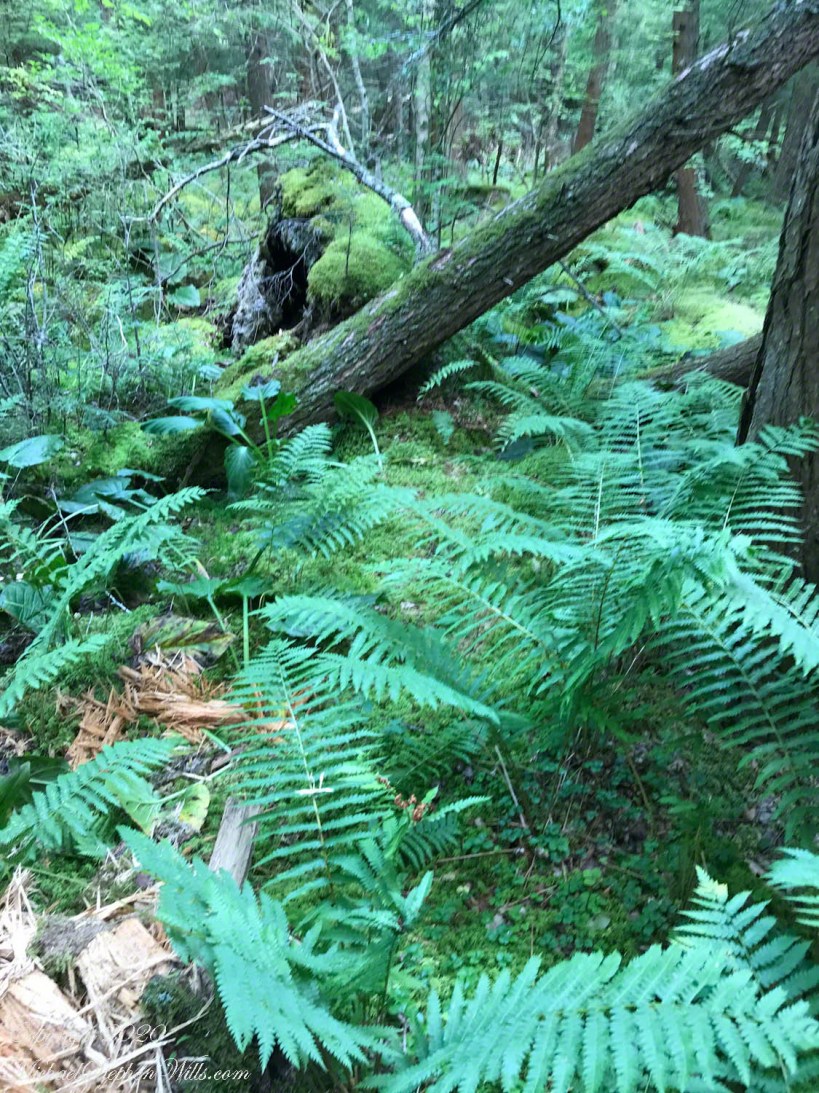
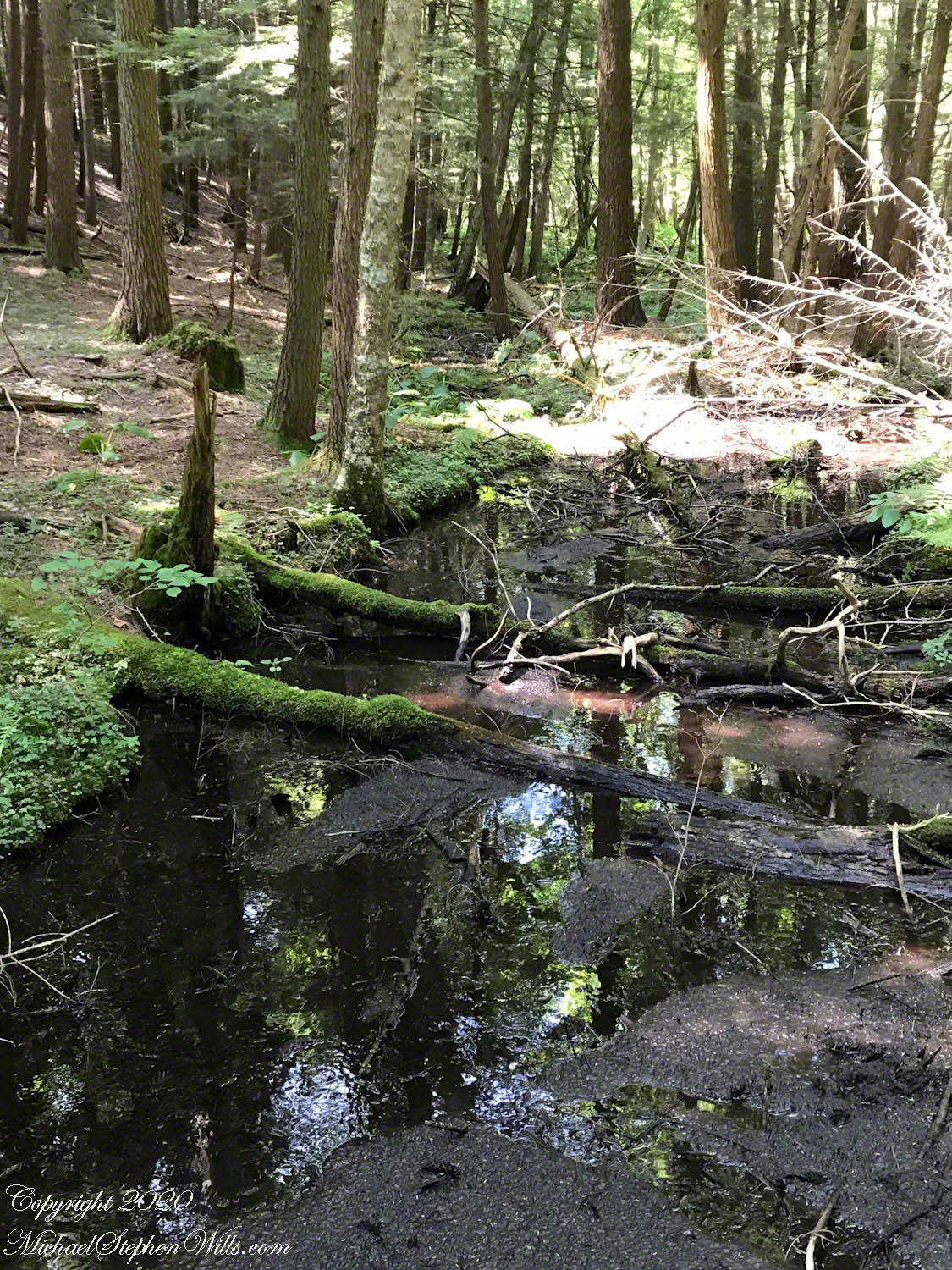
Beneath and between these features, groundwater is constantly on the move. It seeps through layers of sand and gravel, emerges as cold springs at the foot of slopes, and spreads out into swamps, fens, and marshes. In the Finger Lakes, water is always telling a story; at Malloryville, it’s simply easier to hear. Follow the trail and you move through a succession of wet worlds: a seep-fed fen with delicate mosses and sedges, a shrub swamp where skunk cabbage thrusts up in early spring, a cattail marsh that hums with birds and insects in summer.

For my family, the story of Malloryville began even before the preserve had a name. We lived nearby along Fall Creek, itself a thread in the larger fabric of the Cayuga Lake watershed. My son and I camped for the first time on top of an esker just beyond our front door, our tent perched on what I would later learn was the remnant of a stream that once tunneled through the base of a glacier. At the time, it was simply a magical narrow ridge in the woods. Only later, with von Engeln’s guidance and the preserve’s interpretive signs, did that ridge become a sentence in a much older, longer narrative.

That is one of the great gifts of the Finger Lakes: the chance to move from simple admiration—“this is beautiful”—to understanding—“this is how it came to be.” The steep slopes along Cayuga, Seneca, or Skaneateles; the drumlin fields near the north ends of the lakes; the hanging valleys and waterfalls; and the quiet wetlands of places like Malloryville are all chapters in the same glacial chronicle. Once you learn to read one place, you begin to read them all.

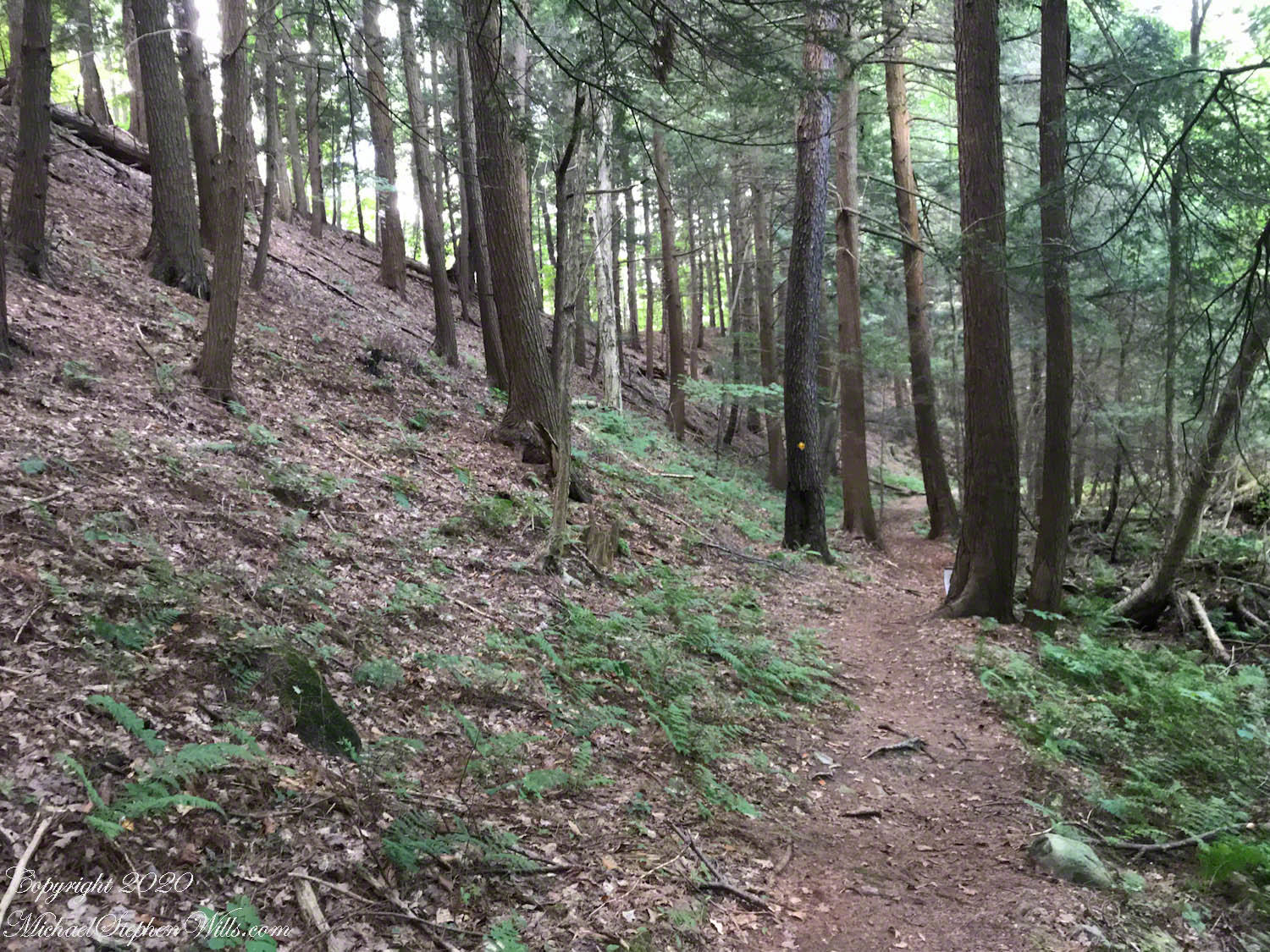
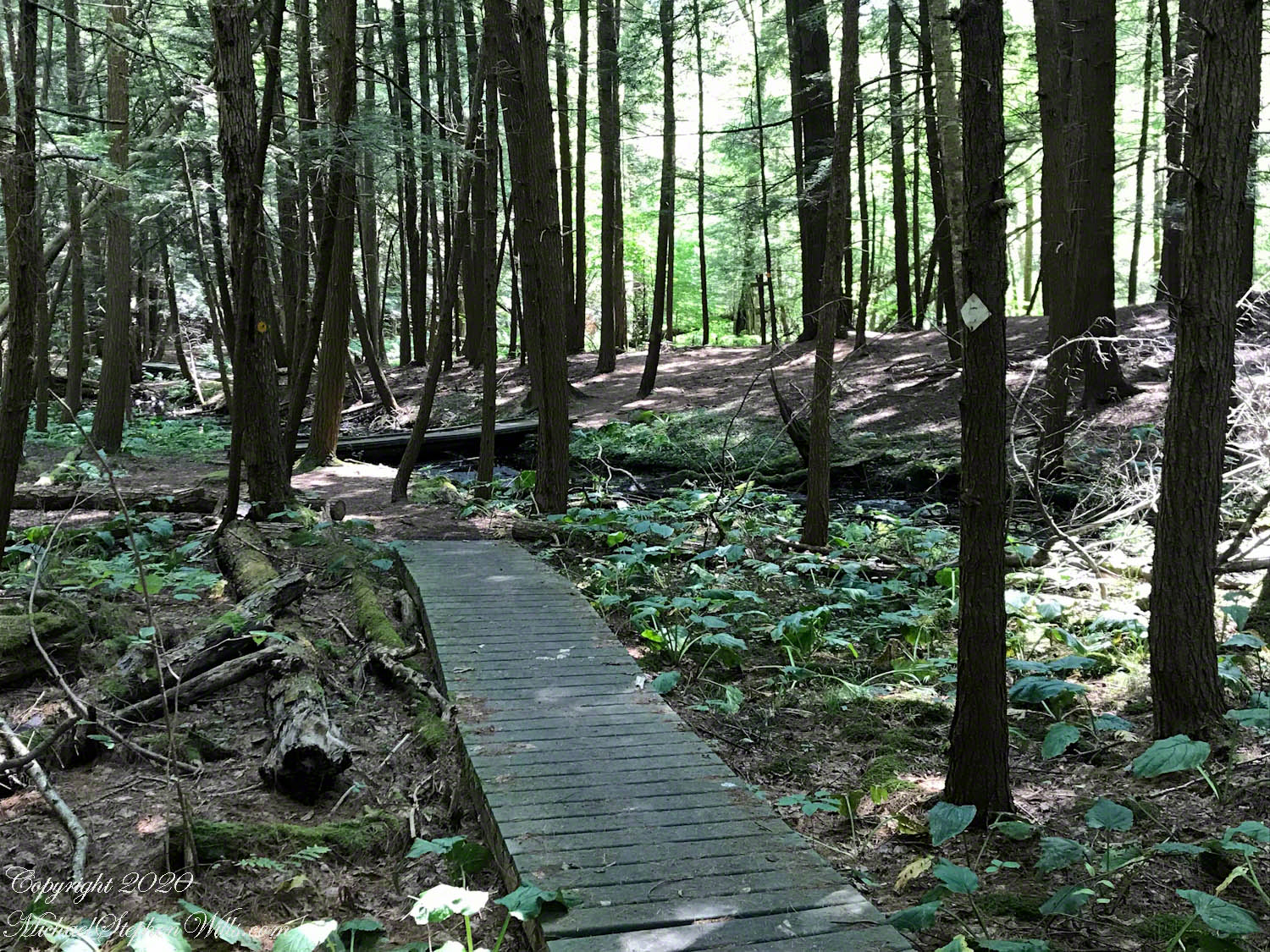
Walking into the O.D. von Engeln Preserve, you enter that story at a small, intimate scale. The parking area and trailhead give way quickly to a world where the ground feels different—sometimes firm and gravelly, sometimes soft and yielding underfoot. Wooden walkways and narrow paths thread through shady forest and open wetland. Each bend offers a subtle shift: a new plant community, a change in water clarity or flow, a small sign explaining what lies beneath your feet.

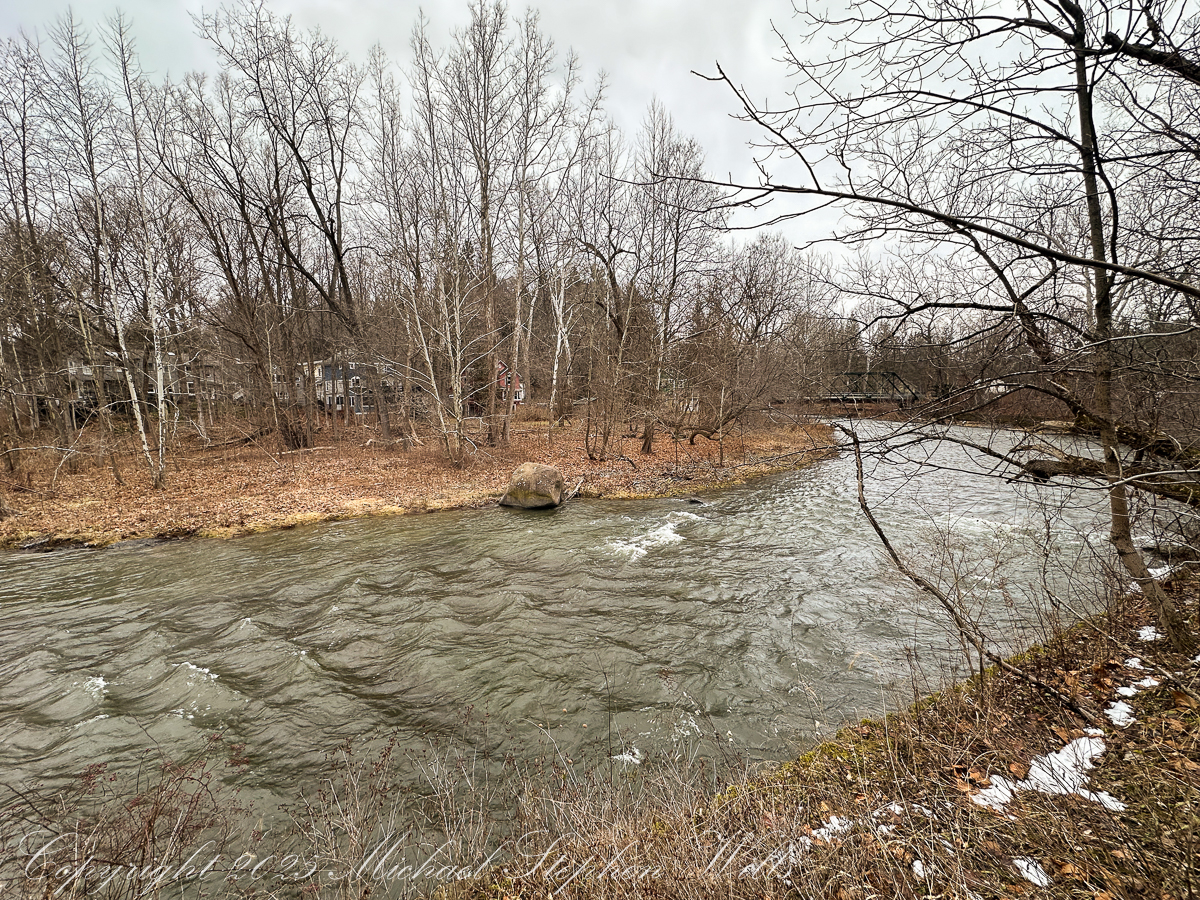
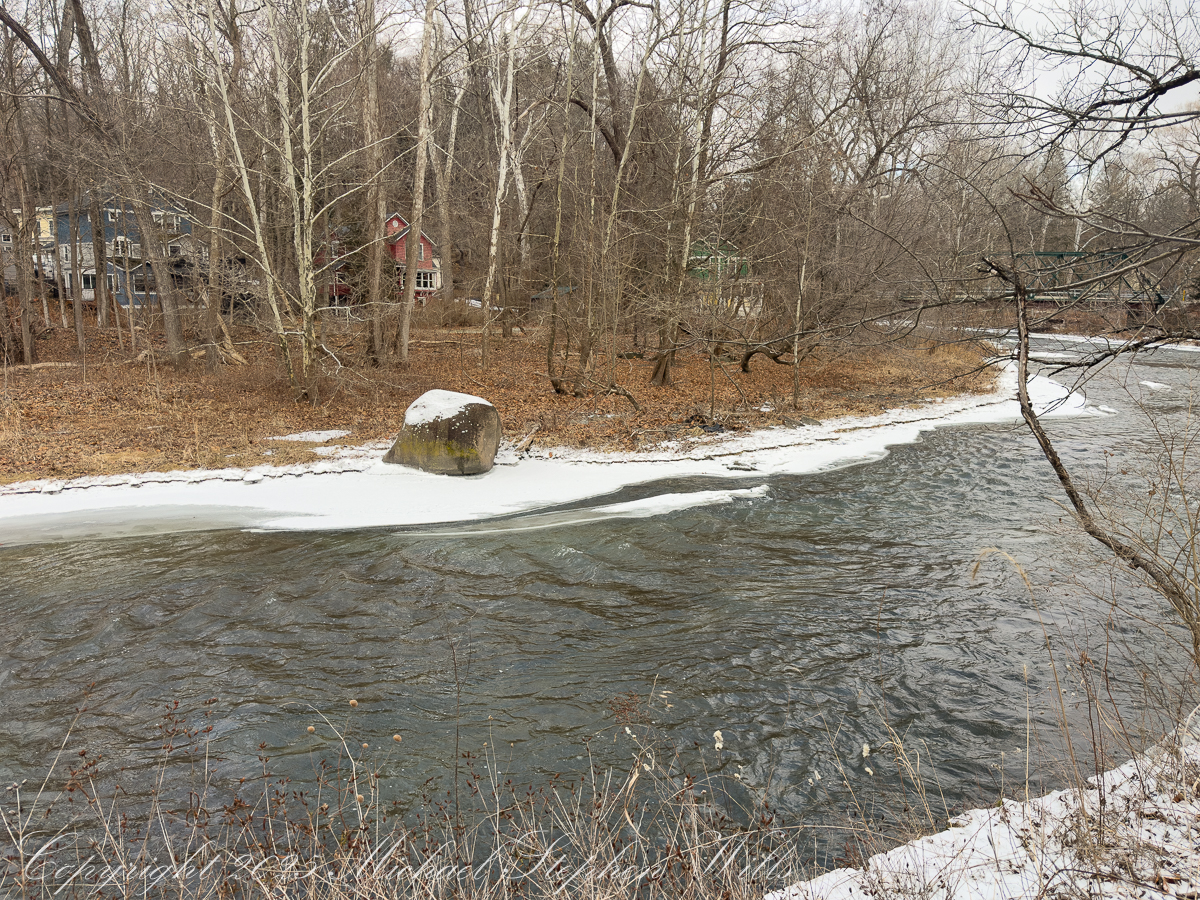
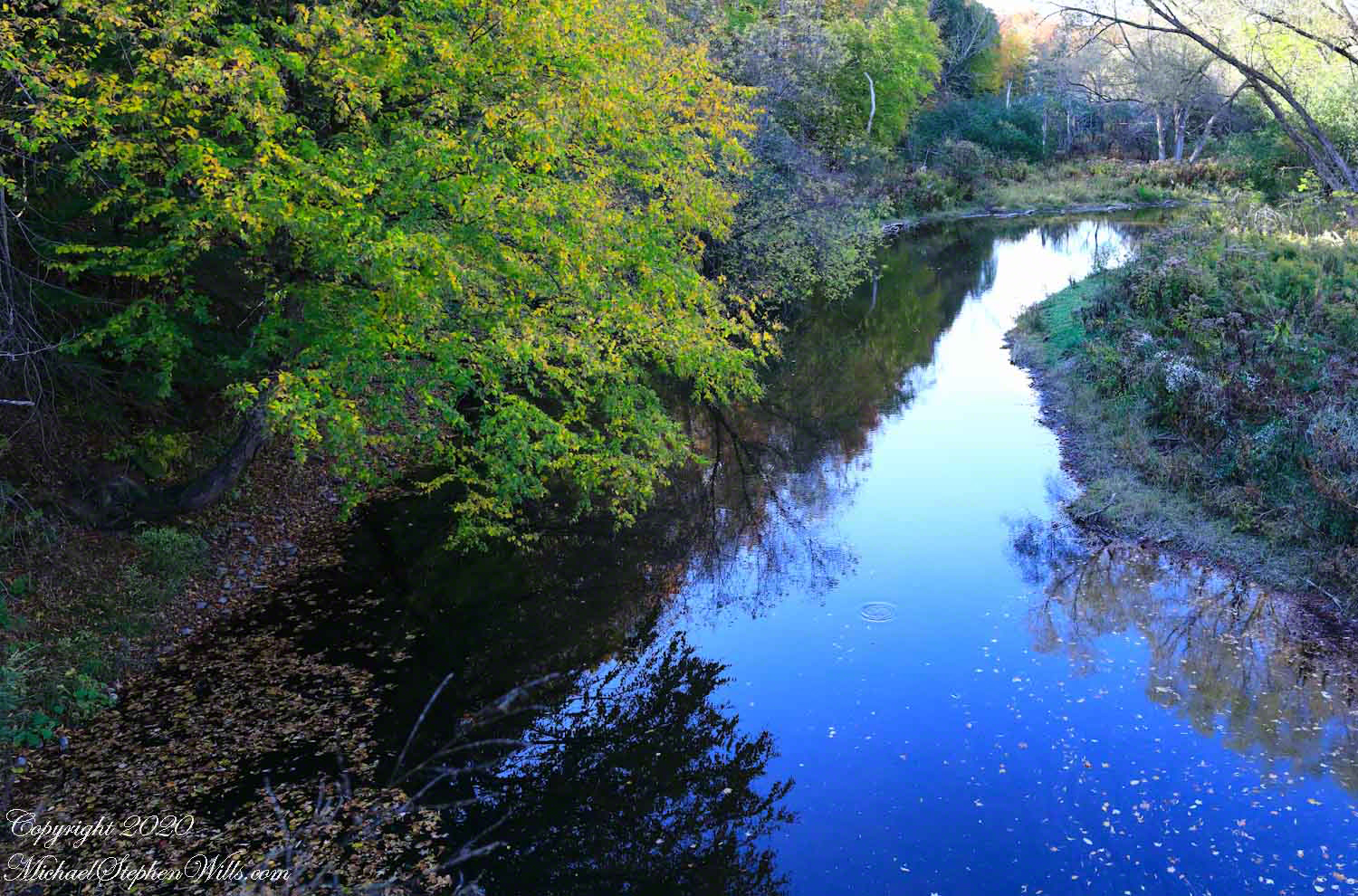
Fall Creek meanders through the esker fields of the Malloryville Preserve. Here is the view from an abandoned railroad bridge. The preserve is near Freeville in the Finger Lakes Region of New York State.

This is not grand scenery in the postcard sense; it is something quieter and deeper. Malloryville invites you to slow down and notice. To ask why a particular ridge is so narrow, why water emerges here but not there, why one hollow is filled with shrubs and another with moss and sedge. In learning those answers, you gain not only an appreciation for this modest preserve but also a richer understanding of the entire Finger Lakes region.

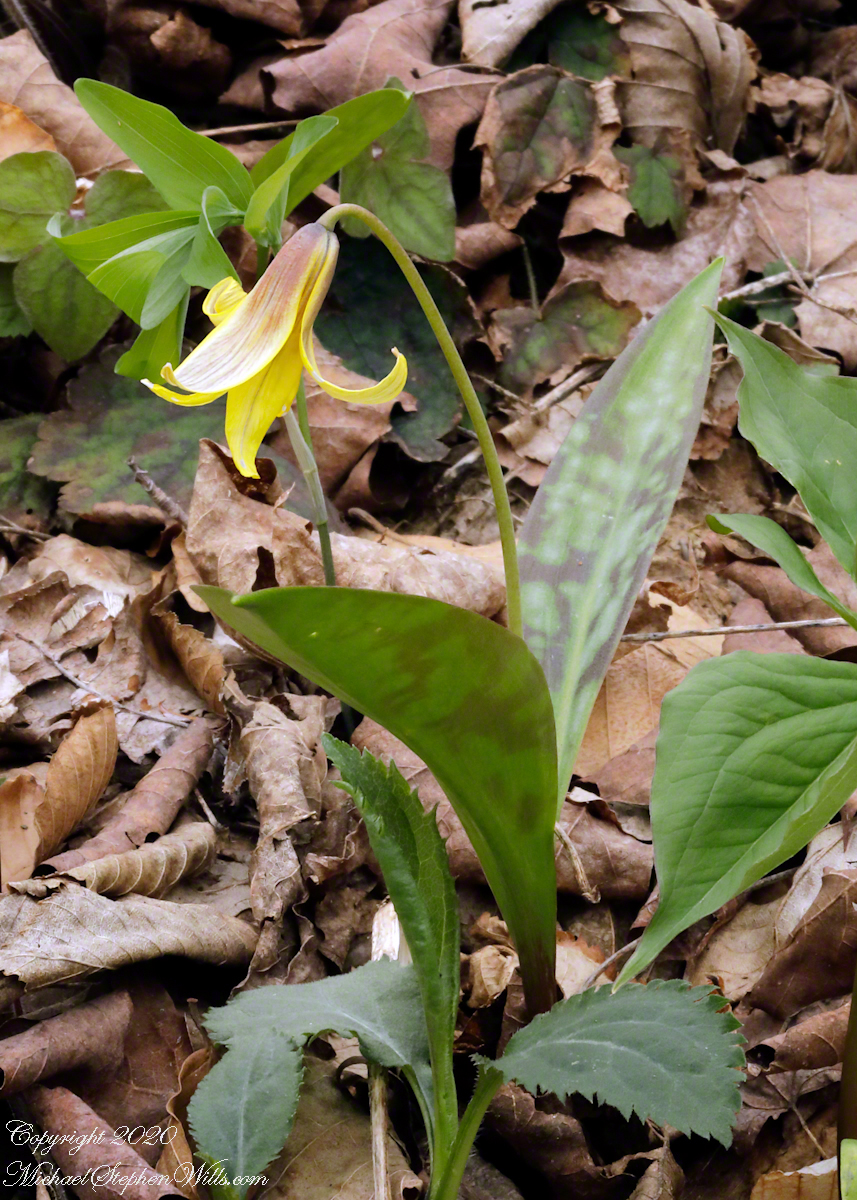
The Trout Lily (Erythronium americanum) is named for the mottled brown leaves resembling marking on trout.

In the end, the O.D. von Engeln Preserve at Malloryville is a lens—a way of seeing. Through it, the familiar landscapes of central New York—valleys, hills, streams, and lakes—come into sharper focus as the lasting work of ice and water. Stand on an esker, look across a kettle wetland, listen to the quiet trickle of a spring, and you are standing inside the very processes that shaped the Finger Lakes.

Enter your email to receive notification of future postings. I will not sell or share your email address.

On The Edge of Time Above Taughannock Gorge

Perched above Taughannock Gorge, a moss-covered ledge and cascading falls reveal ancient stories—where Devonian seas once flowed and time’s layers whisper through stone and water.

The morning sun had only just breached the rim of the gorge, sending long slants of golden light across the forest floor. Walking the South Rim Trail of Taughannock Falls State Park, I came upon a quiet, unassuming spot—just a few paces off the path—where the forest seemed to pause in reverence. What greeted me was a small marvel of persistence and time.

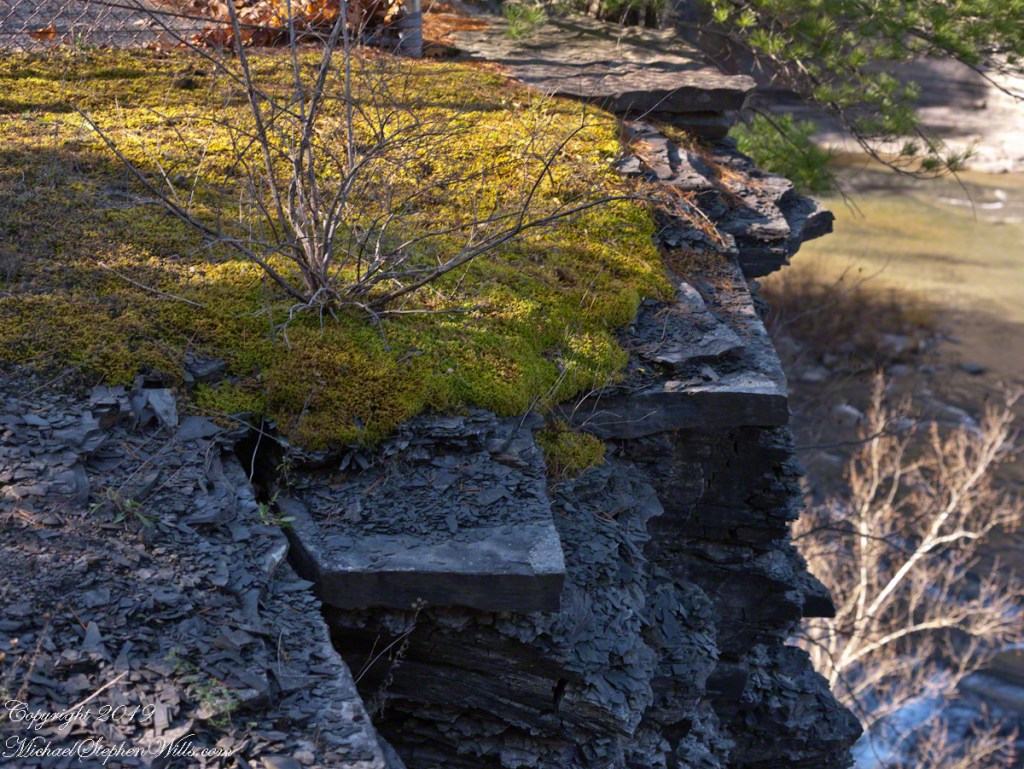
There, rooted precariously atop a slab of brittle shale, was a tenacious shrub rising from a bed of moss, its spindly frame etched in sharp contrast to the soft, green sprawl beneath it. The moss had taken hold on a shelf of rock cantilevered over the gorge like a green tongue of earth defying gravity. Cracks traced the shale’s surface like veins, silent records of the forces that shaped this place—heat, ice, pressure, time. Together, the moss and the bush formed an improbable community, surviving against odds, bound together by the thin soil cradled in stone.

This ledge, suspended over the abyss, seemed less a part of the earth than a question it asked—how much life can cling to the edge before the edge itself gives way?

Beneath this living fragment, the gorge dropped away. Layers upon layers of shale revealed themselves, stacked like a collapsed library of time. Here, the Devonian Period lies exposed to wind and rain, and to those willing to pause and wonder. Each stratum holds the fossil whisper of ancient seas, where trilobites scuttled and coral reefs once stood. This gorge was not carved quickly. It was not born of a moment, but of many—countless raindrops, millennia of ice melt, the slow, sure work of water over stone.

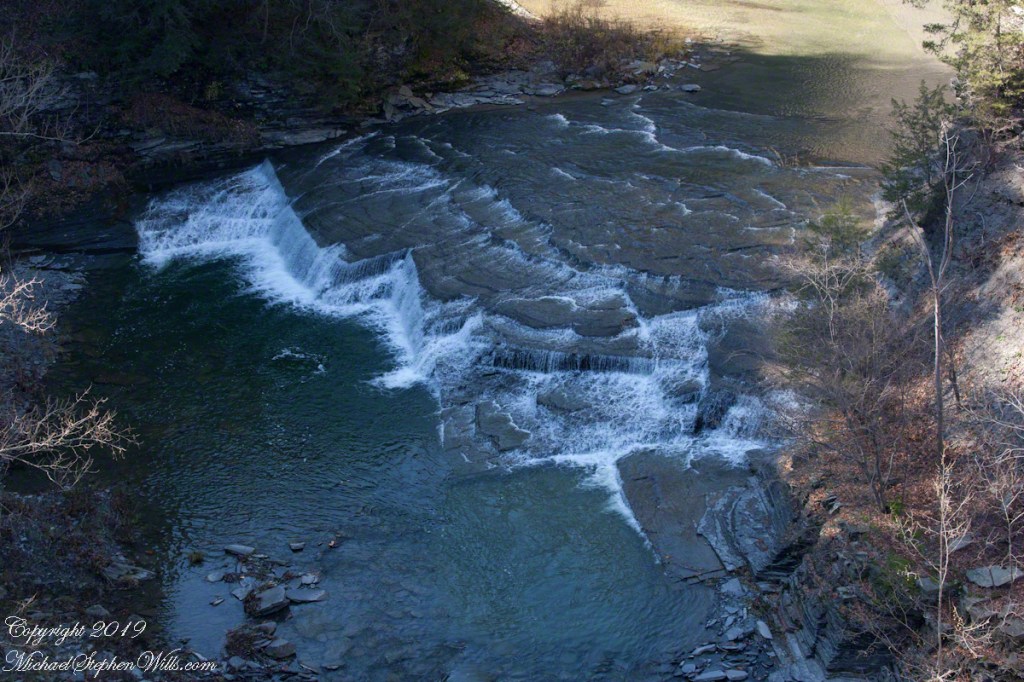
From this natural balcony, I looked out and down to the gorge floor where the creek shaped the land with an artist’s patient hand. The falls, seen from above, no longer thundered—they danced. Spread like the folds of a fan, water curled over smooth stone in steps of white silk. From here, the cascade looked deliberate, choreographed—an elemental performance halfway between gravity and grace.

How many times had this water flowed, reshaped, receded? How often had it carved these grooves, smoothed those ridges, erased the footprints of what came before? Looking at the exposed rock, one could trace the signature of ancient glaciers, feel the memory of long-gone floods. It was humbling—this intersection of change and continuity.

Above it all, the trees stood still. Pine and oak, rooted well back from the edge, offered a kind of sentinel presence. Their shadows stretched long and angled, tracing the contours of both earth and memory. For a moment, I let go of all thought and simply listened—to the murmur of wind through leaves, the faint rush of water far below, and the silence that presses in when the land itself seems to be remembering.

This spot—so easily missed by a hurried hiker—offered a parable of resilience and impermanence. The moss did not grow with certainty, nor the shrub reach with confidence. They survived on the edge because they adapted. They made do with less. They took root where others could not. There was no security in that place, only presence. Only the now.

And isn’t that a lesson worth carrying?

We so often seek stability, firm ground, a clear path. Yet, some of the most beautiful things live just beyond comfort—on ledges, in cracks, in the margins of the known. To pause here was to acknowledge that life thrives not only in sheltered valleys but also at the edge of what seems possible.

As I stepped back onto the trail and continued along the South Rim, the image of that mossy outcrop stayed with me. I carried it in my thoughts like a talisman—proof that even on the brink, life finds a way. And that from above, the most chaotic falls can appear as ordered motion, as a flow toward something larger.

Later, when the sun climbed higher and the light lost its slant, I would look back on this moment not as a spectacular highlight but as something more intimate: a quiet encounter with nature’s subtle artistry, its layered truths, and its enduring invitation to look closely, feel deeply, and walk softly.

For here, above the gorge, at the edge of earth and time, even a whisper leaves a mark.

Enter your email to receive notification of future postings. I will not sell or share your email address.