Ancient legends speak of the River Lethe, crossed by departing souls. The waters of the Lethe wash away memory, allowing for spiritual rebirth, reincarnation, a return to the world in new form.
This memory implant represents a bridge over the Lethe.
For those chosen to cross over to the new land in return for
their treasure, lives and selves.
Description
This virtual monoculture glade from the long time of forests,
a place of happy gatherings, of families, plentiful food and water.
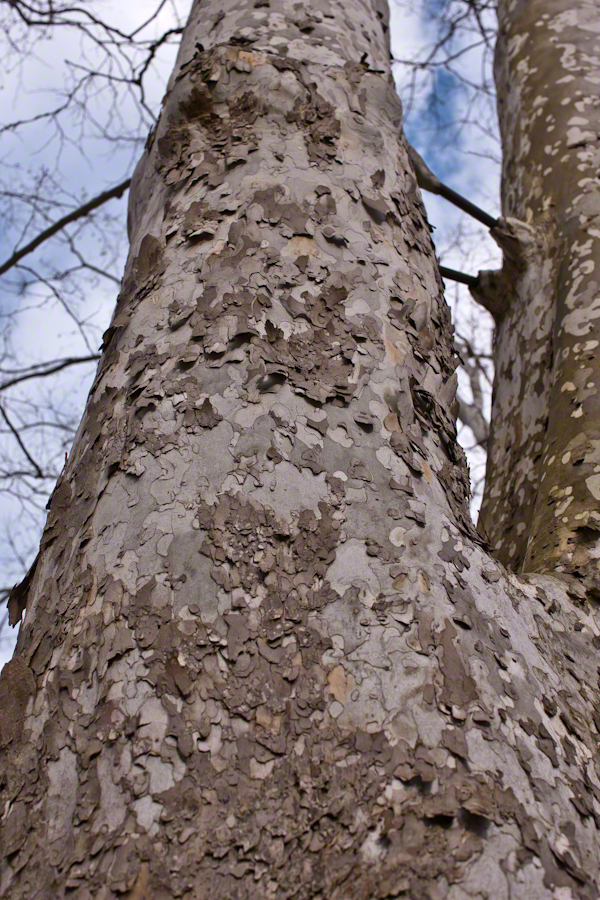
These sycamores grew over centuries, through thousands of days, wider than 10 people,
white with age as the outer covering, called bark, falls away.
forked, trunks
climbing to the sky.
Copyright 2022 Michael Stephen Wills All Rights Reserved
In follow-up to my last post my IStock photograph of Saint Patrick on the Hill of Tara was accepted and is available for viewing (click the link to go there).
Since July 2008 a sea generation tidal turban, “SeaGen”, produces electricity (1.2 MW) for between 18 and 20 hours a day while the tide is forced in and out of Strangeford Lough through the Narrows where the generator is installed. The first large scale commercial production of electricity from the tide, “SeaGen” is located between the Northern Ireland towns of Strangeford and Portaferry, the strength of the tides there were used by the earliest tidal mill known, the Nendrum Monastery mill dating 787 based on archeological excavation.
History records Patrick converted the island of Erin (Ireland) to Christianity in the Fifth Century AD as a return to his place of captivity and slavery.
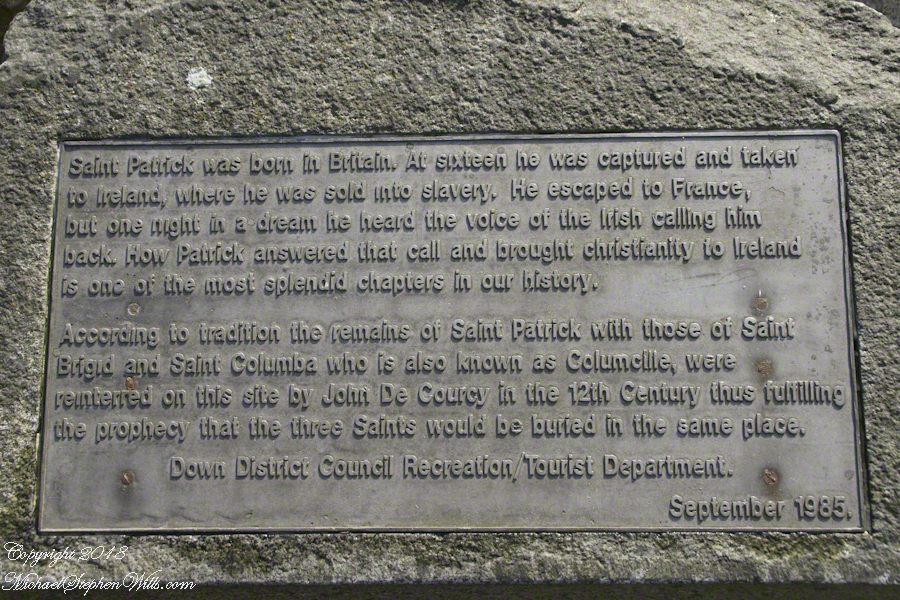
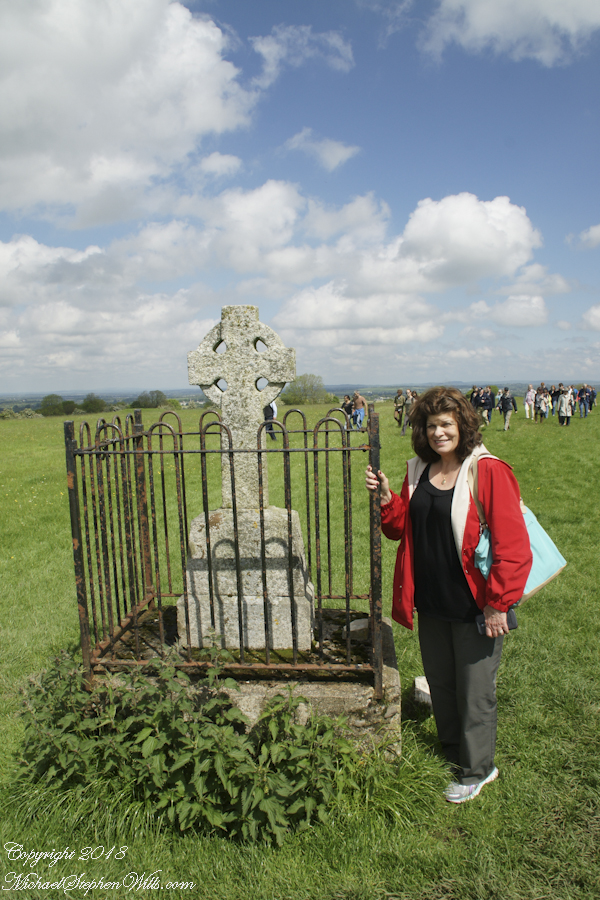
An informational plaque mounted on granite next to the grave of Saint Patrick.
There is a connection between “SeaGen” and the return of Patrick to Ireland. The first sanctuary dedicated by Patrick was at Saul, County Down not far from River Quoile that drains into Strangeford Lough. Historians identify Patrick’s first landing site, upon return, as Wicklow where he was forced to leave by the locals. Heading north in the boats of the time, the strong tide of Strangeford Narrows pulled them into the Lough and, from there, headed up the River Quoile to encounter the local chieftain, Díchu mac Trichim. Patrick’s first Irish convert to Christianity, the feast of Saint Dichu is April 29.
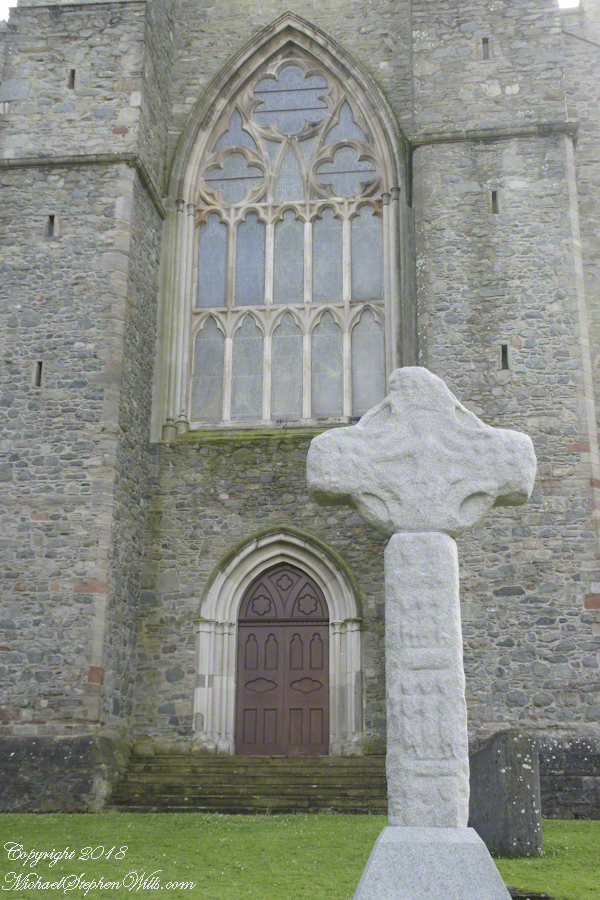
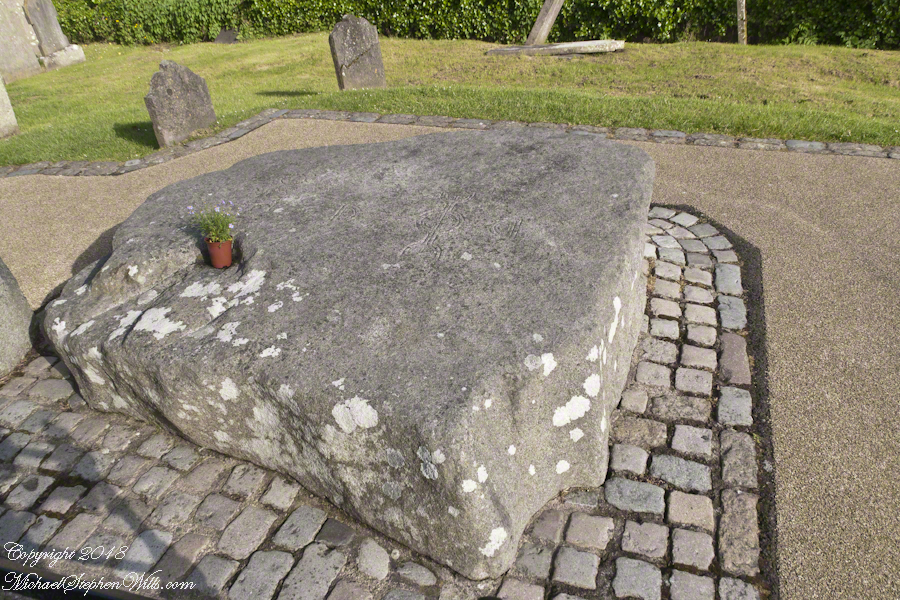
On June 7, 2014 Pam and I visited this area. Here are some photographs of the traditional burial place of Saint Patrick.
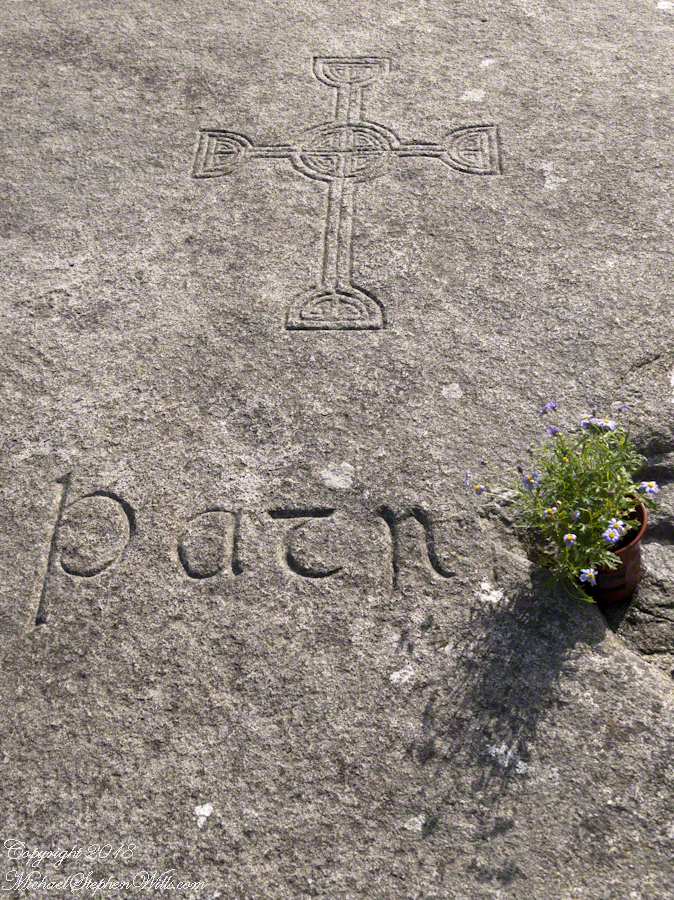
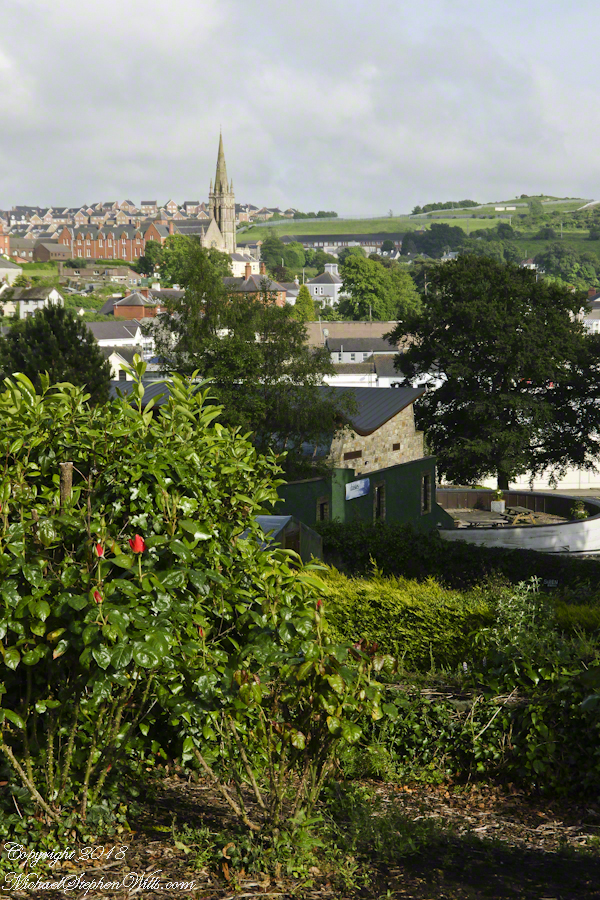
View of Downpatrick from the hill of the Cathedral Church of Holy Trinity (Down Cathedral)The High Cross of Downpatrick fronts Down Cathedral on a hill overlooking the town. The informational placard reads “The granite head and shaft date to about 900 AD and were once re-used as part of a Market Cross at the bottom of English Street. The pieces were found in various places in town, reassembled and presented to the Dean and Chapter of the Cathedral in 1897.”The placard text reads: “A large memorial stone of Mourne granite was place here in 1900 to mark the traditional burial-place of St. Patrick. The stone was quarried at Slieve-na-largie near Castlewellan, and it took 12 men 14 days to cut from the quarry.”Inscription on the upper surface of stone marking grave of Saint Patrick.
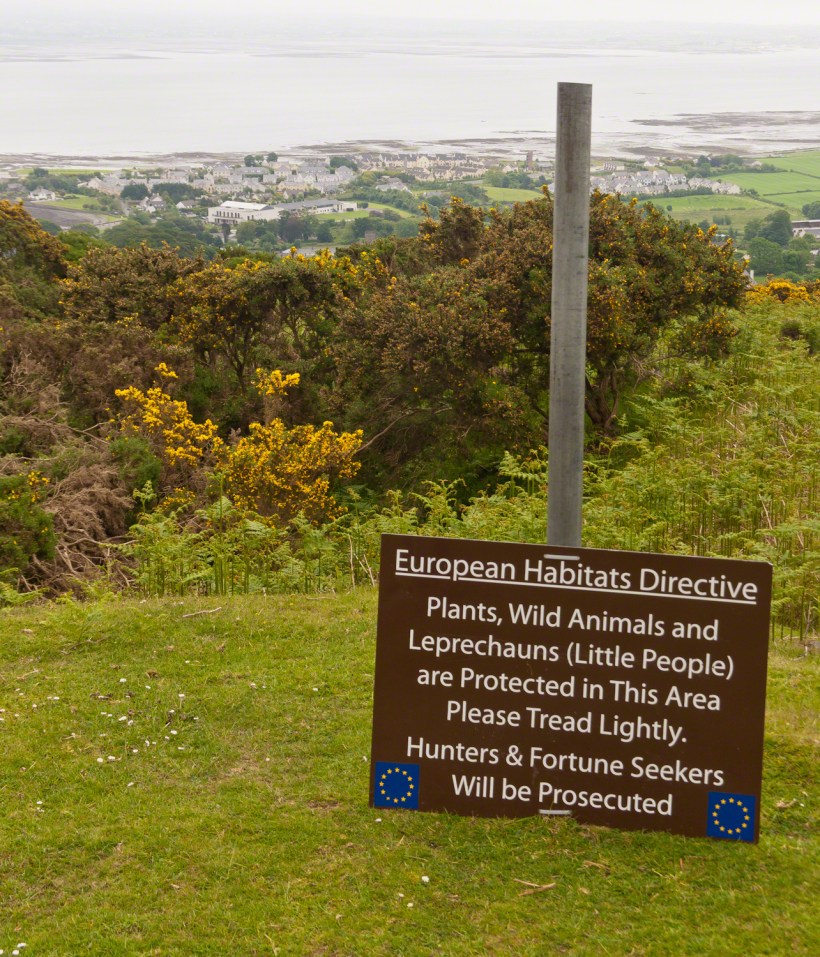
In a previous posting we hiked through the only European Union Leprechaun Preserve on Slieve Foy above Carlingford, County Louth, Ireland.
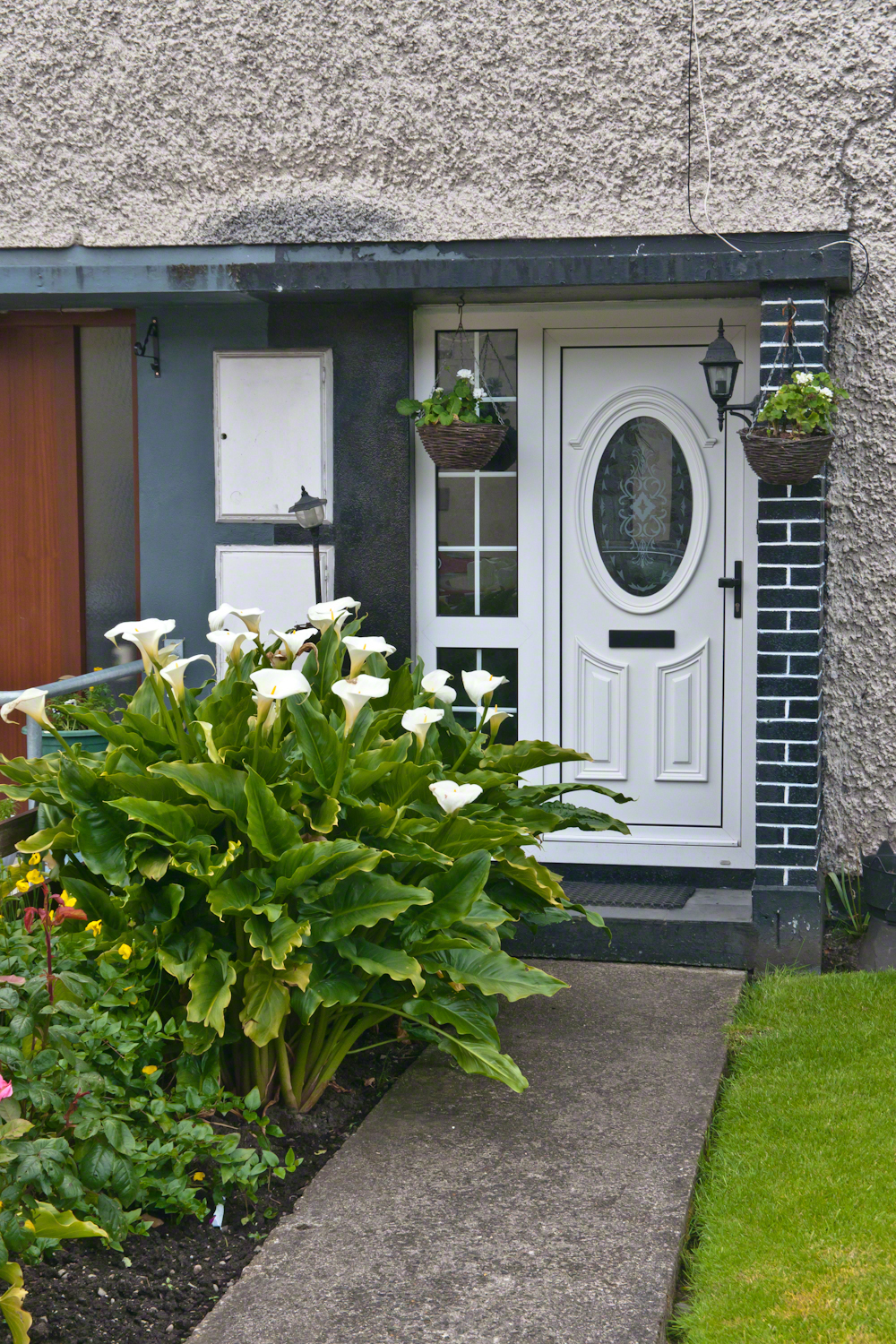
This home was lower on the mountain, on the way to town.
Caring touches to a well tended home entrance along the Tain Way, Carlingford, County Louth, Ireland.
You will not find Calla Lilies thriving in front yards here in Ithaca, New York (43 degrees north latitude) as they do in the Temperate Oceanic Climate of Ireland, pictured in Carlingford on a June day. At 54 degrees these Calla Lilies are growing at a latitude 800 miles north of Ithaca, in the middle of Quebec Province, Canada.
In spite of this, here in Ithaca we keep March 17th, Saint Patrick’s Day, warm. In the home of our three grandchildren (3, 4 and 6 years old) who live in Ithaca they celebrate by playing tricks on Leprechauns.
This year, we visited Saint Patrick’s Day eve and reviewed their bag of tricks with the Leprechaun in Chief, their Mom. In response, the Leprechauns leave them letters to make it clear the tricks did not work. On top of this, the children have big laughs on the tricks played in return. A favorite is finding their socks taped all over the mirror.
Mom pulled out a few of the Leprechaun letters and we read them for the children to great laughter as they remembered tricks of previous years. Afterwards, when alone with Mom, Pam and I recalled the tradition in Chicago, to color the river green (a well as green milkshakes, etc), and suggested to the Leprechaun in Chief to put green food color in the toilet. It was a winning idea.
The next morning Mom, on hearing the toilet flushed repeatedly, found her 4 year old daughter totally appalled. “The Leprechauns used our toilet (and did not flush). YUUUUKKKK.” She then ran upstairs hoping for a “clean” bathroom up there. Well, green milkshakes are off the menu.
Copyright 2022 Michael Stephen Wills All Rights Reserved.
Explore the Hill of Tara with us! Discover the rich history of Saint Patrick’s statue, the legendary bonfire, and stunning panoramic views of County Meath. Join our journey through Ireland’s ancient and mystical landscapes in our blog post.
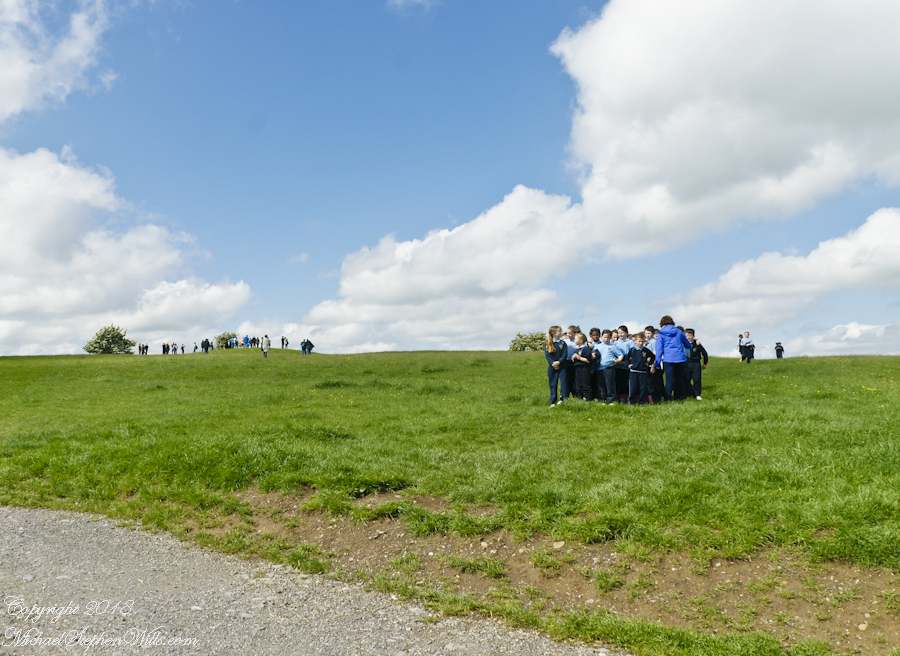
Arriving around noon on a Tuesday, Pam and I were greeted at the Hill of Tara by these children, headed to the school bus.
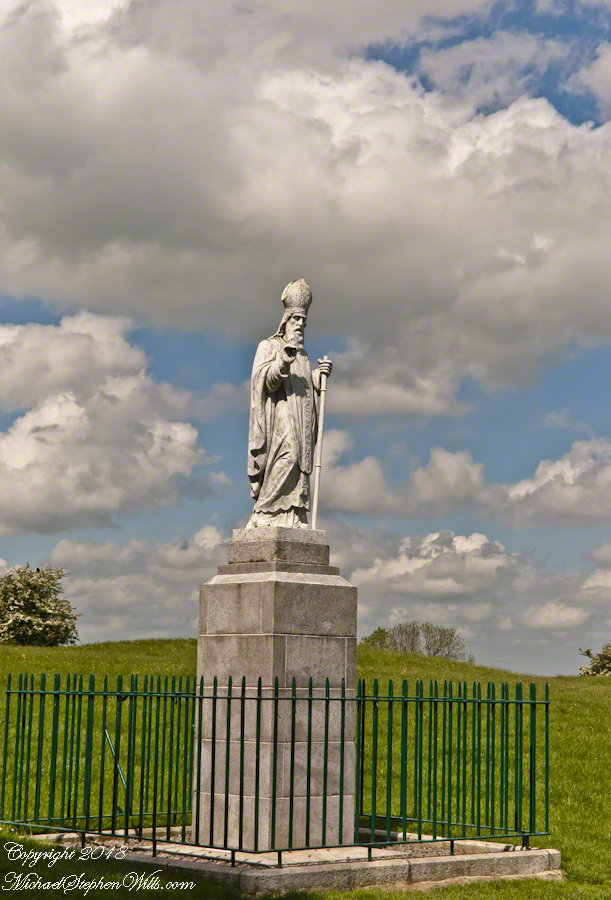
A statue of Saint Patrick fittingly welcomes visitors to the Hill of Tara, County Meath, Ireland. This statue of cast concrete was an existing statue donated by the Sisters of Charity, moved from an existing installation to the Hill of Tara in the year 2000 AD. The creator is anonymous, the is no plaque or other attribution on or around the statue. The original statue was erected on the summit of the Hill of Tara shortly after Catholic emancipation in 1829, commemorated the events of 433AD when St. Patrick lit a bonfire on the nearby hill of Slane on the eve of Easter Sunday. Slane was the second site we visited on our day of arrival, Saturday, May 24.
Lighting such a fire was contrary to the pagan laws of the time which dictated that the first fire lit that night be in Tara. Observing St. Patrick’s bonfire from afar, the chief druid of the ancient Gaelic capital predicted that if the flame were not extinguished that night, Christianity would never be extinguished in Ireland. The saint’s bonfire continued burning and the next morning, Easter Sunday, St. Patrick entered Tara to convert the king and his followers to Christianity.
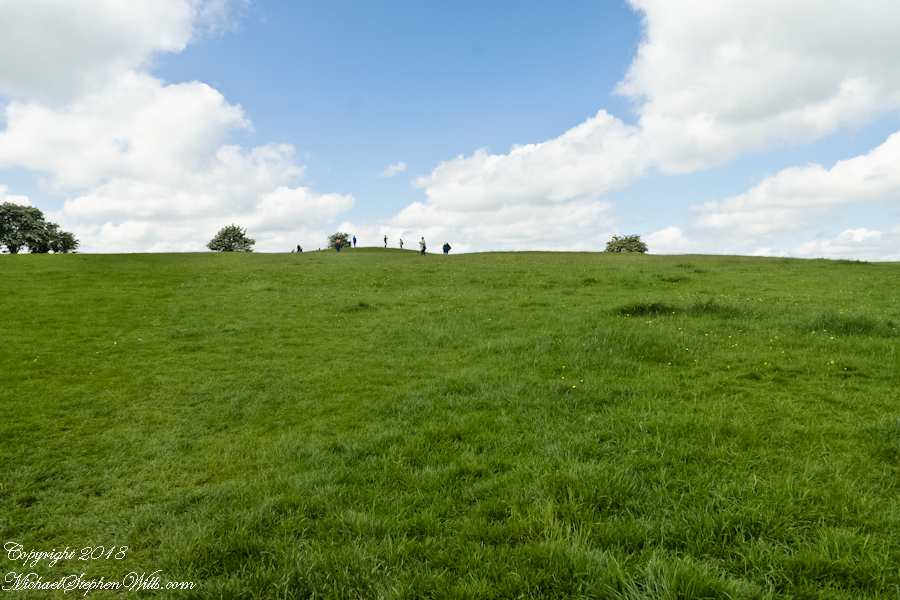
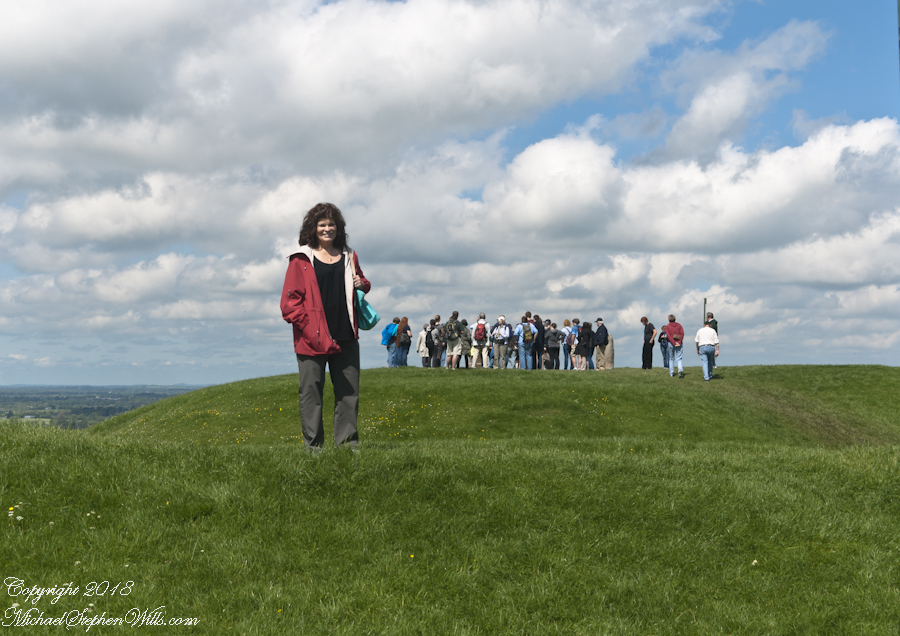
A series of mounds surmounts the hilltop, one is visible across the expanse of grass.
Climbing higher, the view opens.
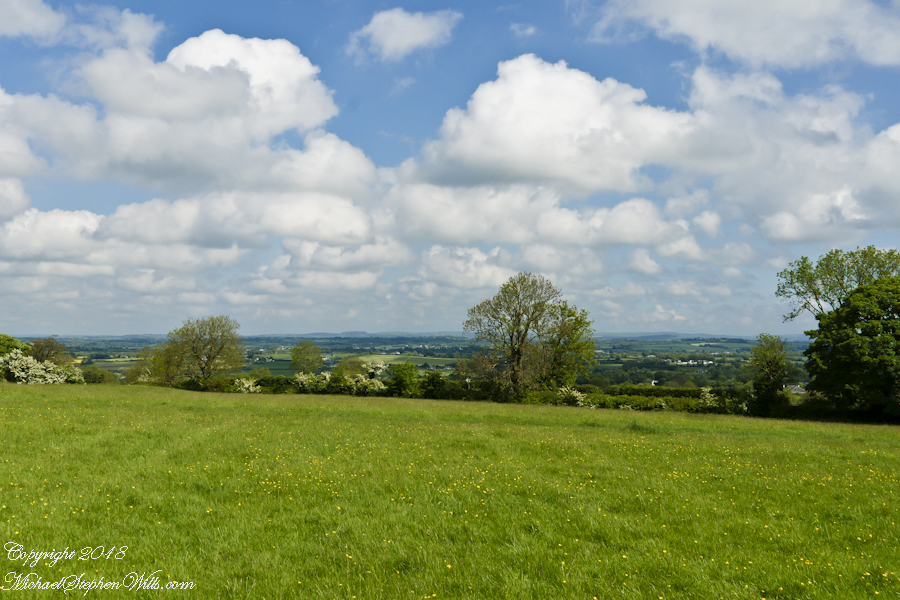
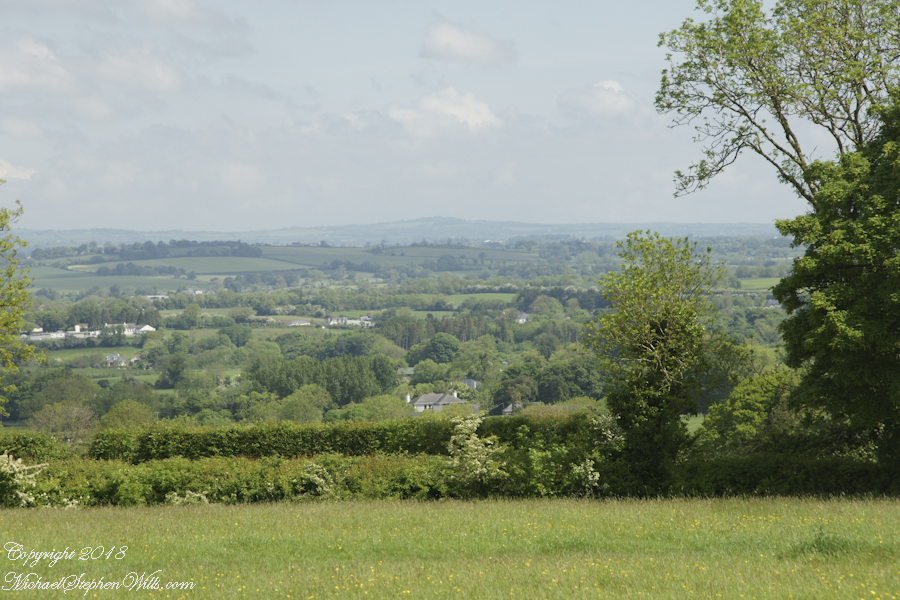
On the top, views from all cardinal directions, 360 degrees.
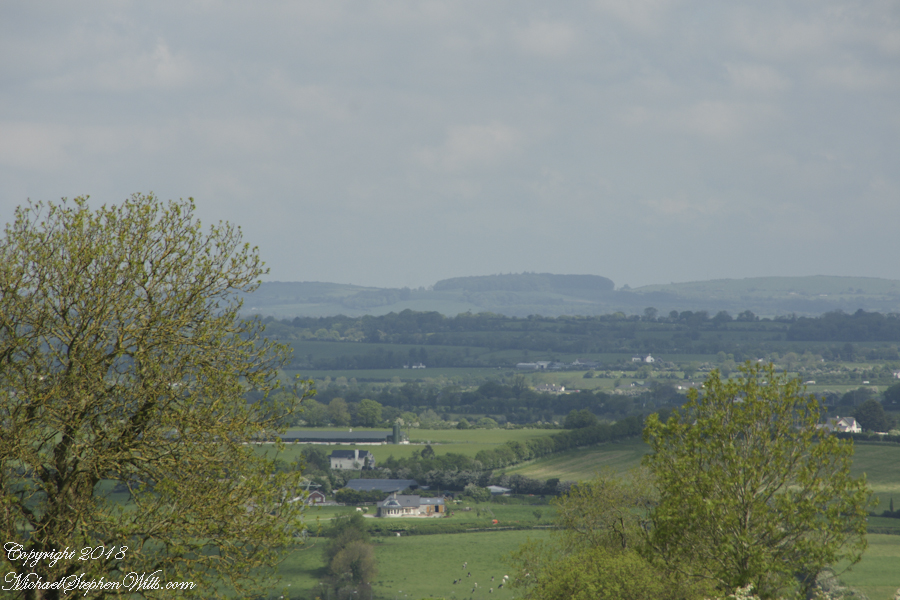
The Hill of Slane is visible in the east, the tall cathedral ruin though not visible in this view.
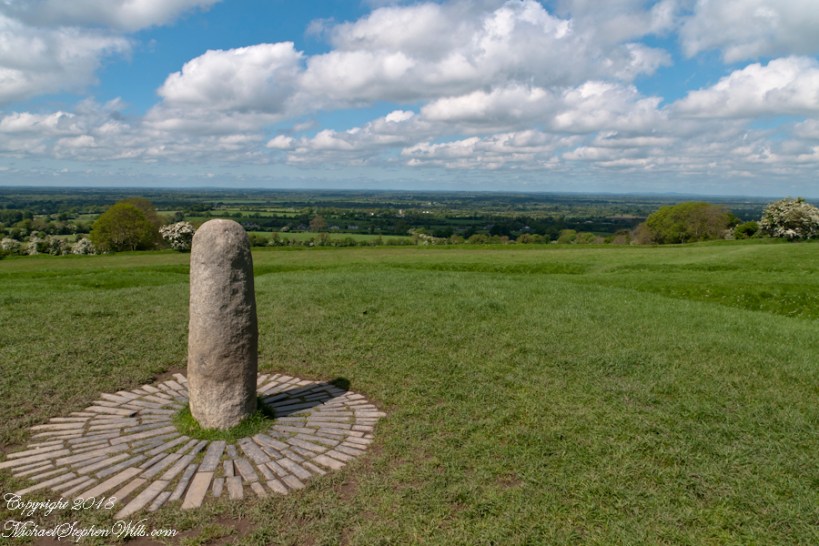
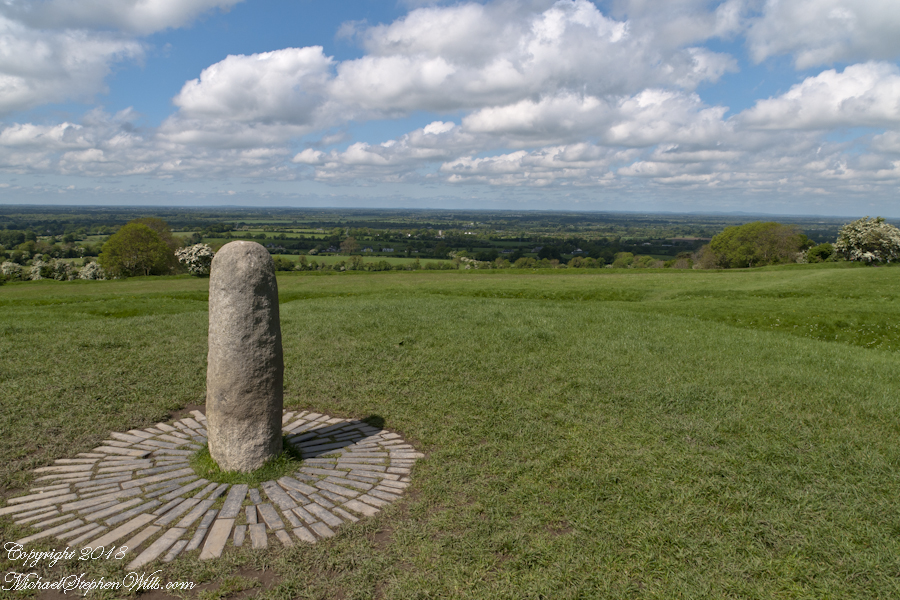
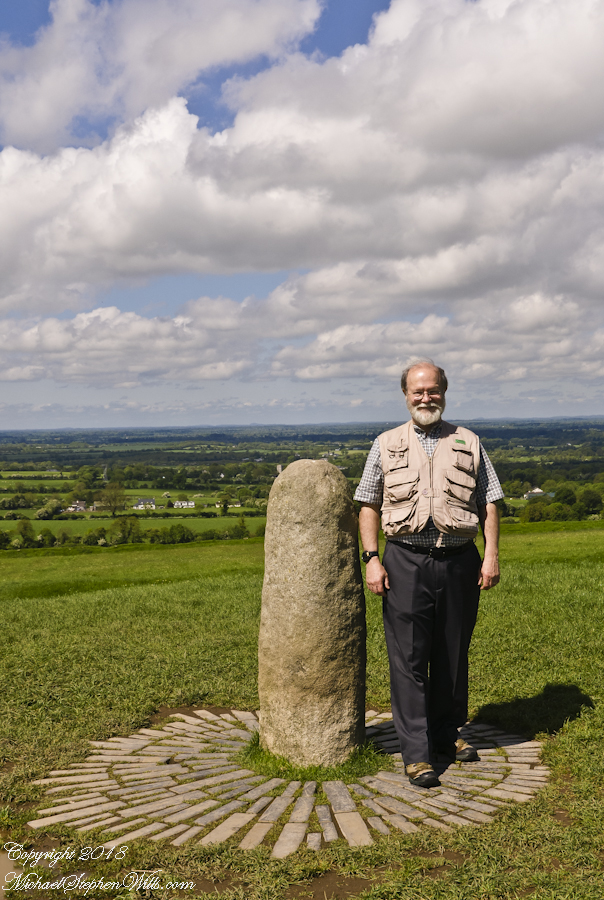
The first of the following panel is a view northwest from looking across County Meath with views of Counties Westmeath and Cavan. On the horizon, right, is Hag’s Mountain, (Irish: Sliabh na Caillí) , site of the Loughcrew Cairns. The standing stone is the “Stone of Destiny: (Irish: Lia Fáil), which served in coronation the coronation of the High Kings of Ireland. It stands on the Inauguration Mound (Irish: an Forrad) of Tara. This photograph was taken the morning of May 27, 2014 hours before the stone was vandalized, doused with green and red paint.
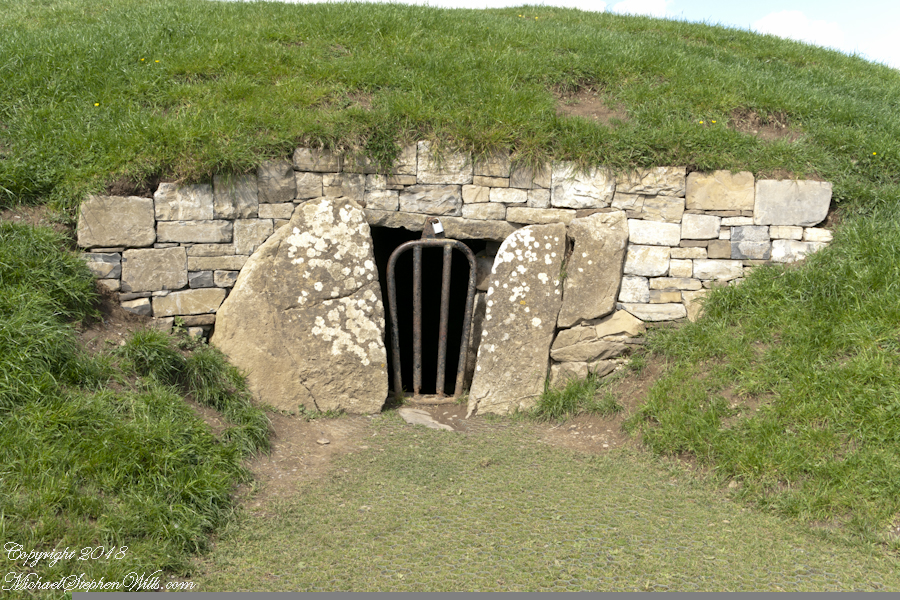
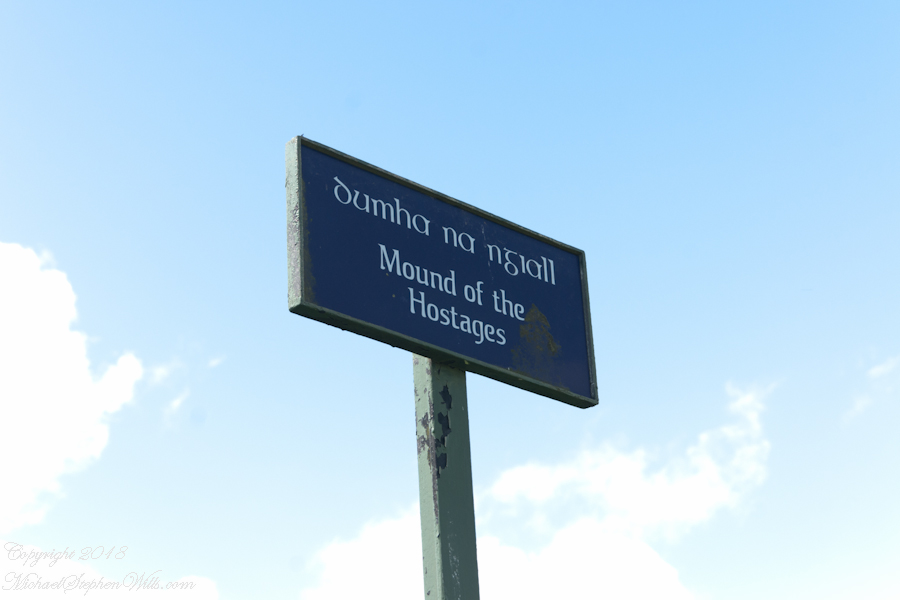
A bit to the east is the Mound of the Hostages, a passage tomb.
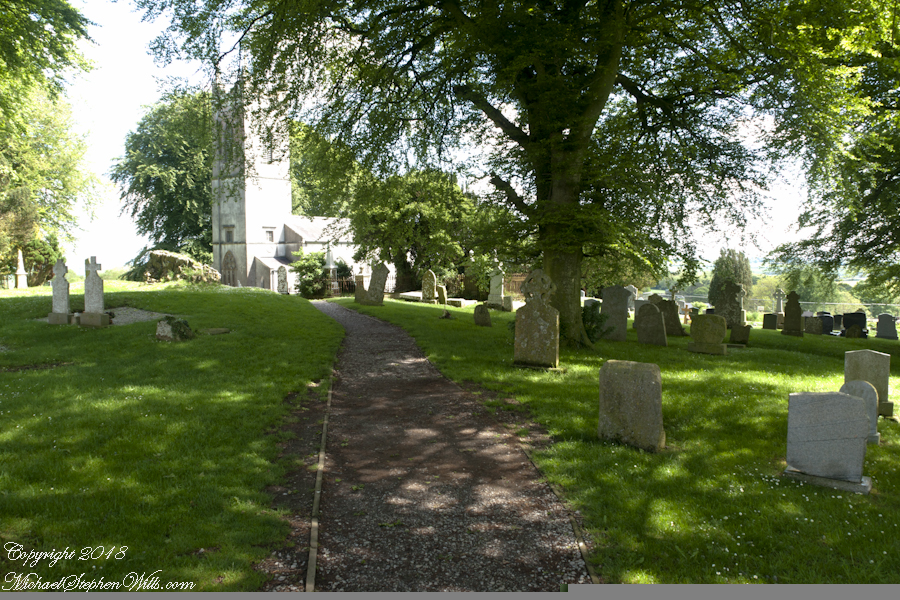
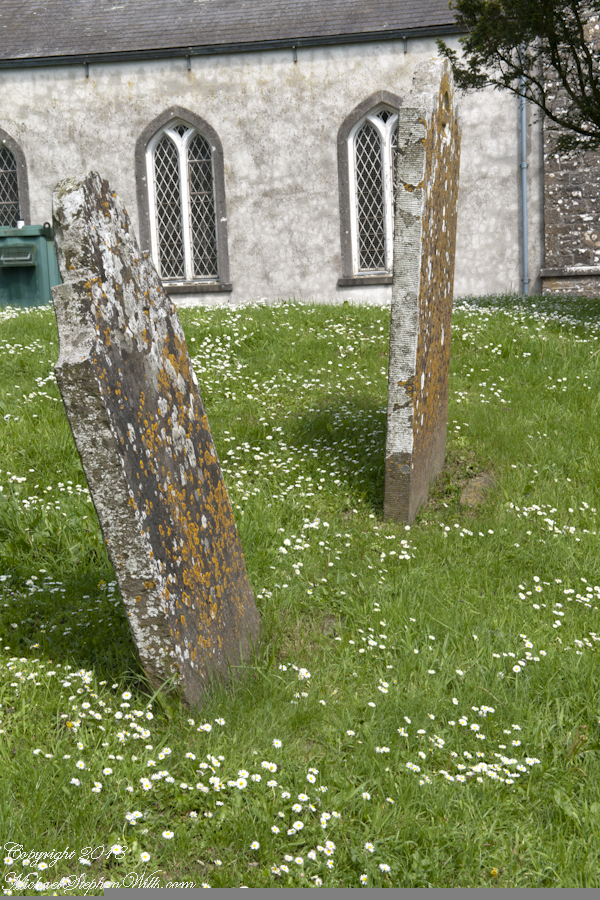
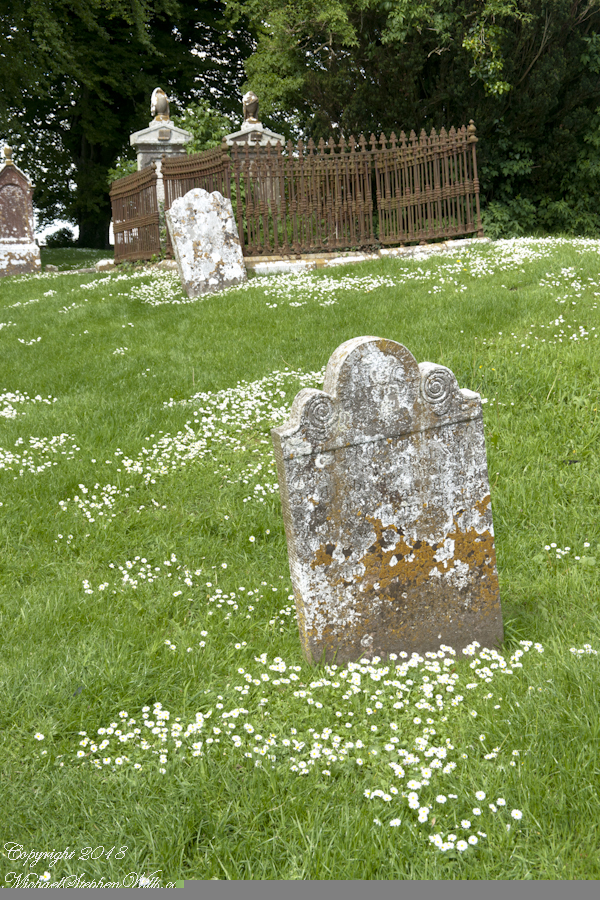
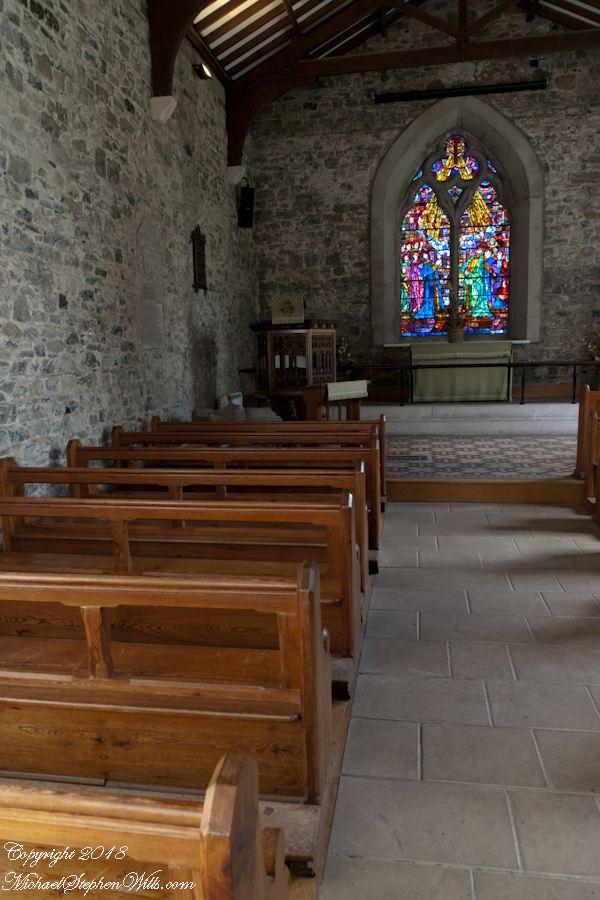
Walk into a glade, through the ancient graveyard to the visitors center in a deconsecrated church.
Browse my reasonably priced stock photography. This blog features three (3) photographs I published last week to Getty Istock and my Fine Art gallery.
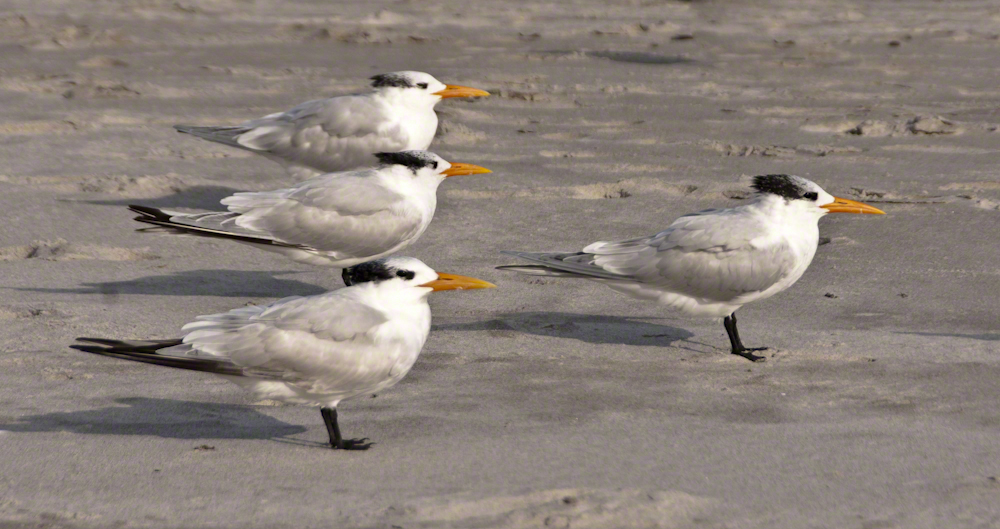
When Pam read my post “Black Skimmers Feeding” she asked, “Where is the photo of resting Skimmers?”
To answer her question, I looked through Cocoa Beach photographs and discovered I did NOT capture the Skimmers resting. Instead, here are a related species, the Royal Tern (scientific name: Thalasseus maximus), whose behavior is similar in that it exclusively feeds from the water. There was a wind that morning and these individuals face into it. These birds are, from a human point of view, well behaved, unlike the opportunistic gull.
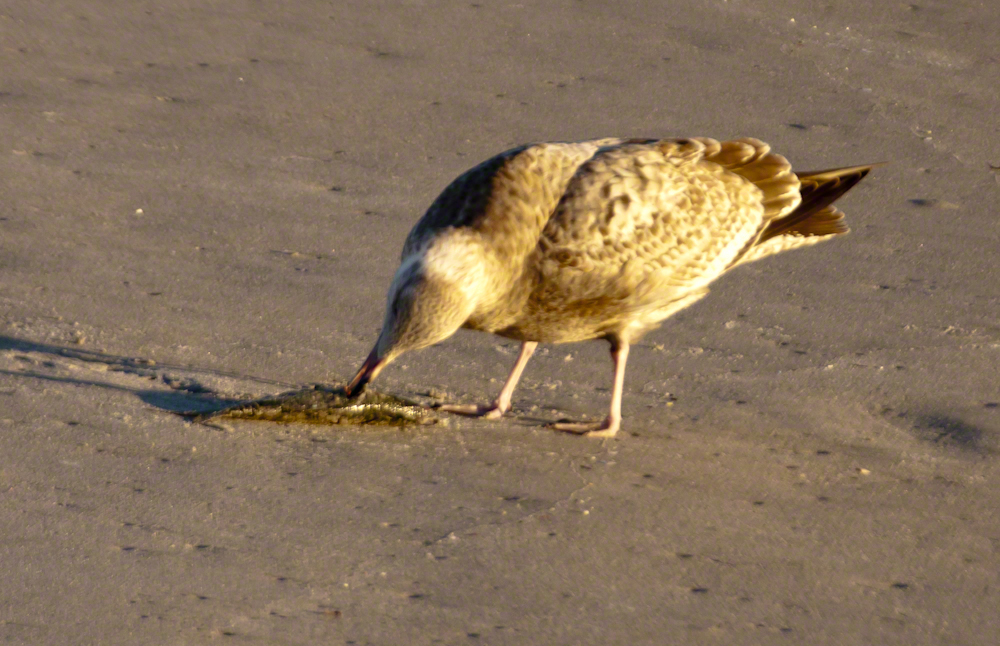
I searched around the web for identification of this gull without success.
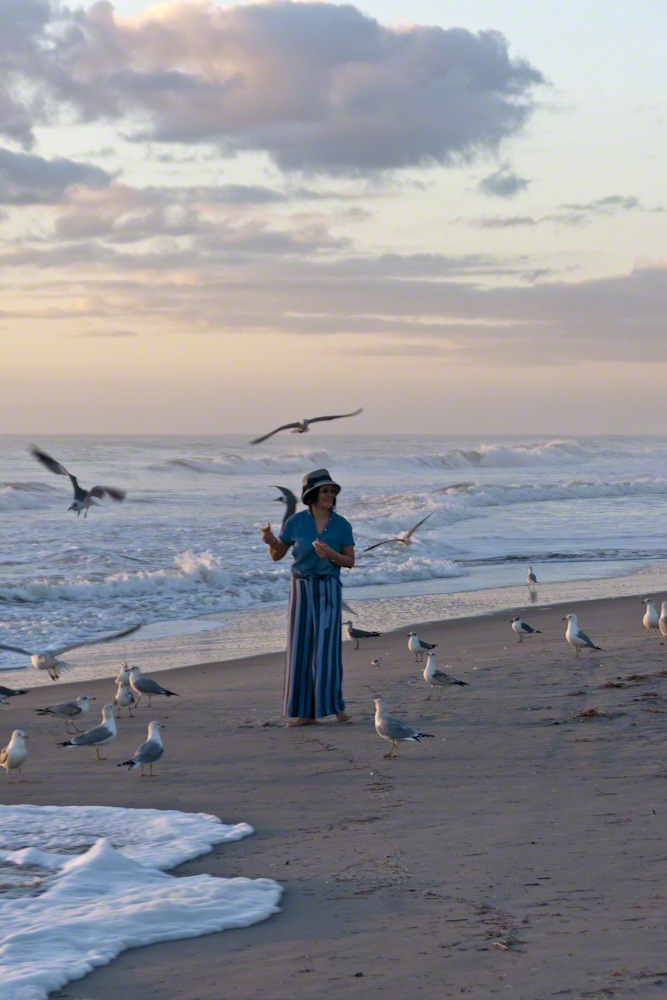
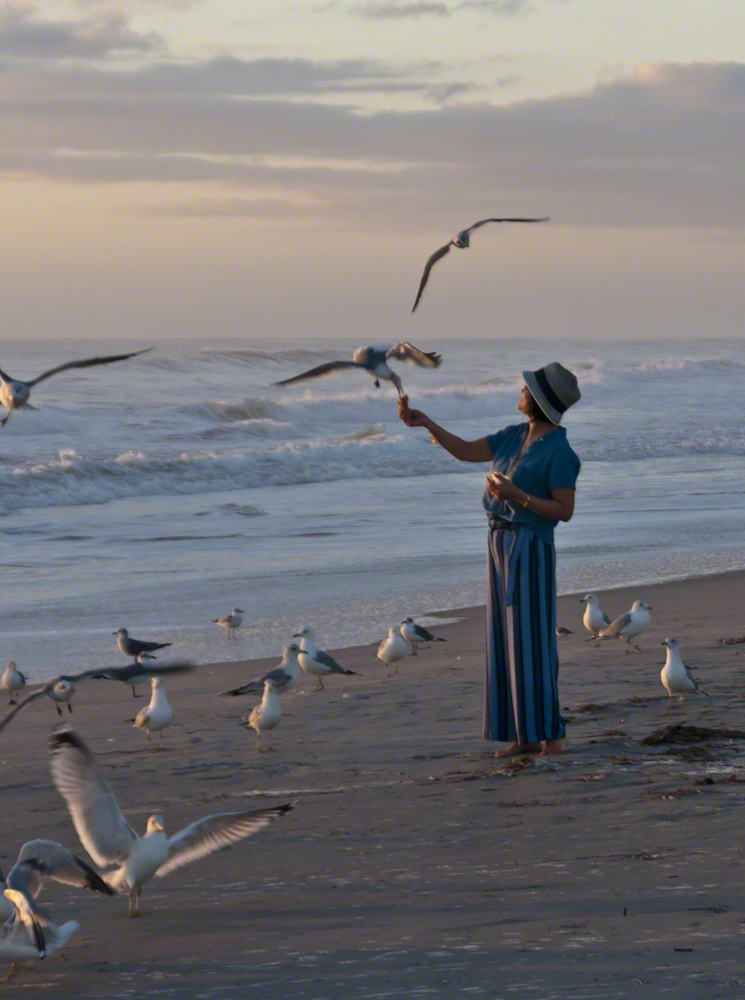
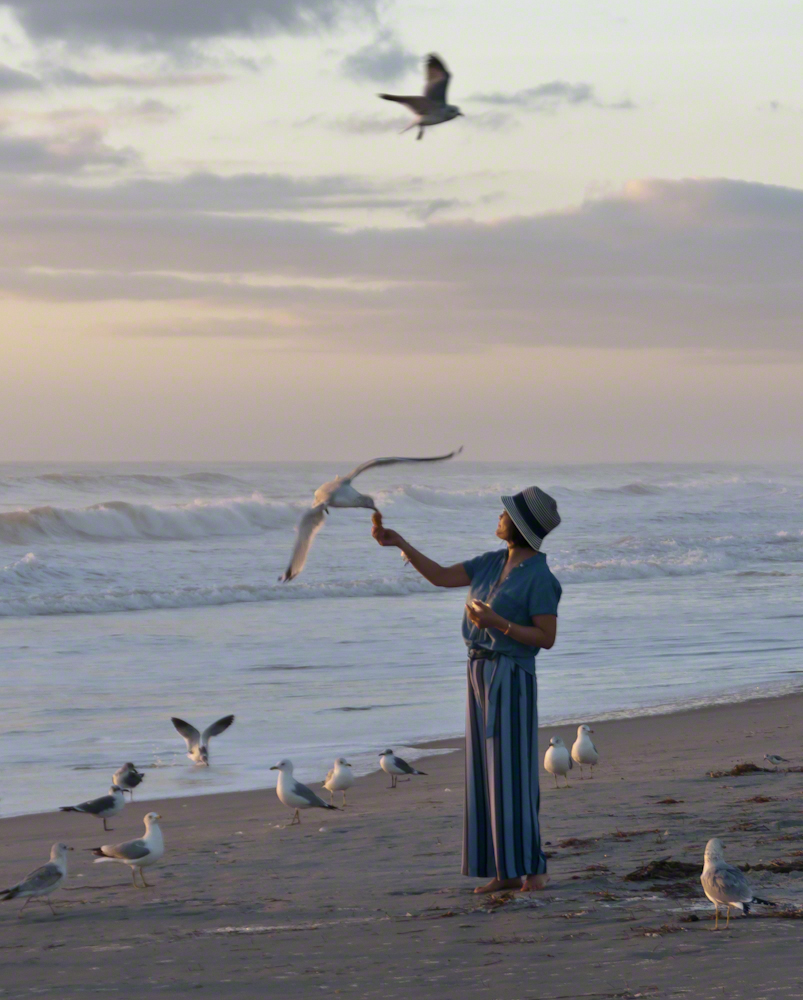
It dines on a dead fish washed up by the surf. In my previous posting I used the word “grifting” to describe gull behavior, again this is from the human point of view. Gulls are notorious for stealing food from unwary beach goers, brazening walking over to unguarded chips (any kind), for instance, grabbing them and flying off. If the chip stash is large, this sets off a nasty feeding frenzy when tens of gulls swoop in and grab.
Here is a series of photographs, demonstrating this behavior.
With grandchildren in the Miami Area and a sister in Daytona Beach, Florida was on my mind this morning and memories of this beautiful experience on Cocoa Beach came to mind. After an eventful day touring the NASA launch control center, Pam and I took an evening walk during the golden hour, me with camera in hand.
Full in expectation of catching the passing scene with lots of shot I set to full size jpeg mode using a Sony Alpha 700 dslr with a DT 18-200mm f3.5-6.3 lens. The light was exceptional, so I did not expect much post production work.
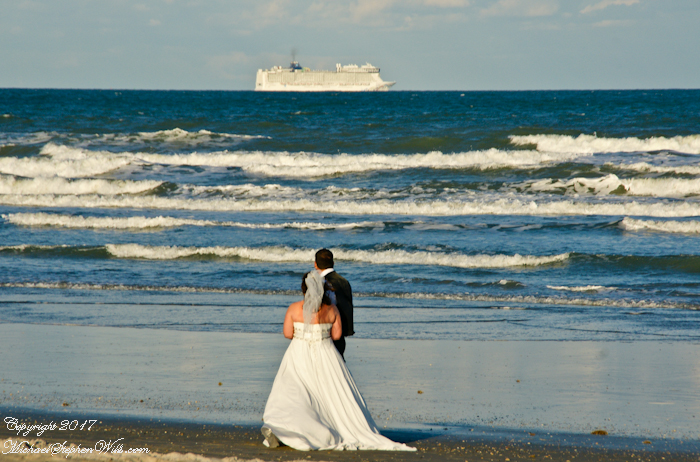
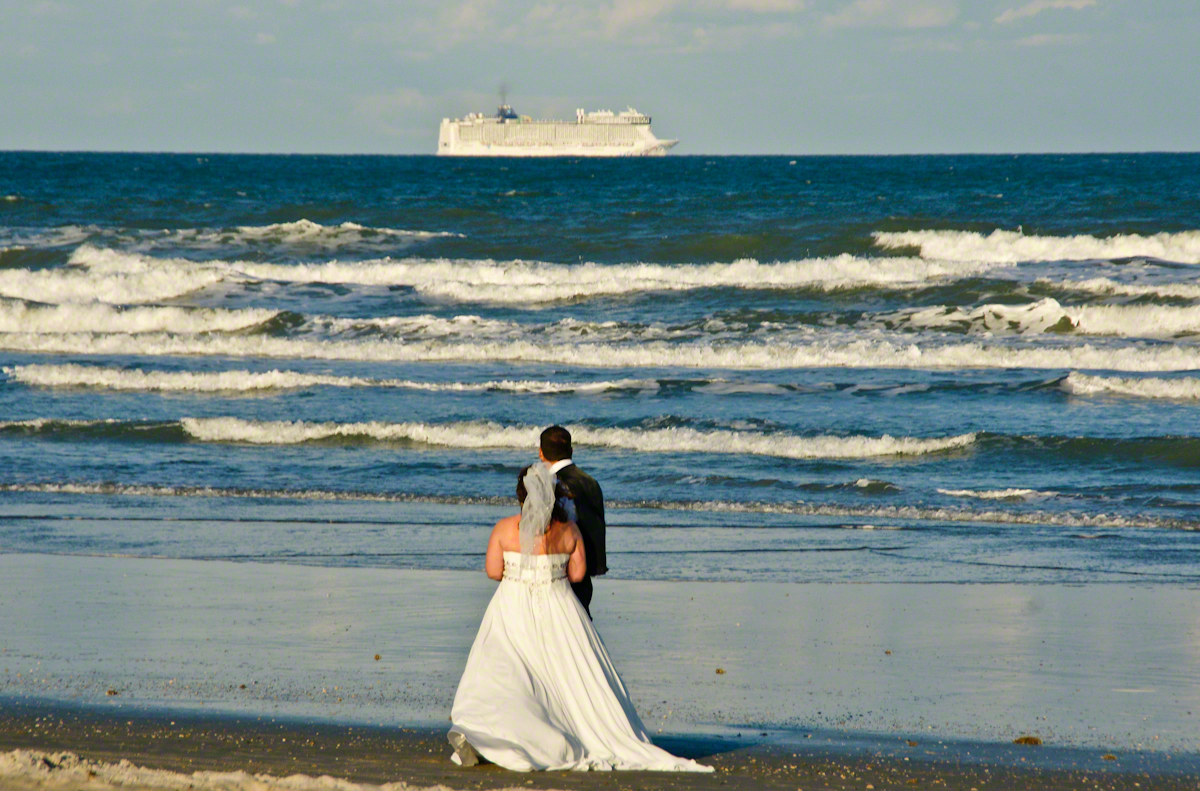
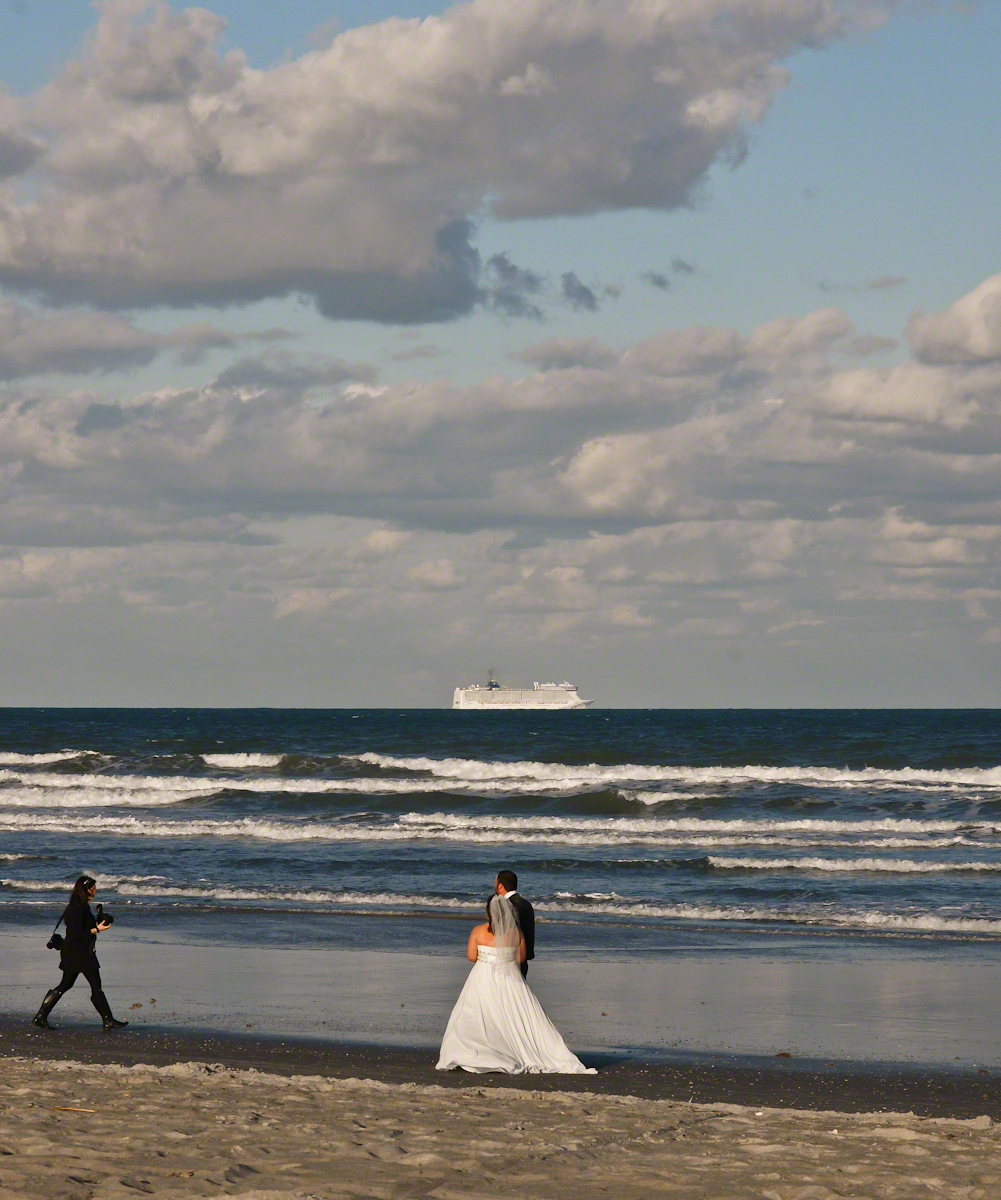
My first impression was of the line of cruise ships heading south from Port Canaveral, the starboard side lit perfectly behind human denizens of the Cocoa Beach shore, in full enjoyment mode. A synergy of the images struck me. I took a few experimental shots then, as we progressed down the beach front this unusual tableau came into view.
Newlyweds on Cocoa Beach give rapt attention to a distant cruise ship, it looks like an elegant child’s toy.
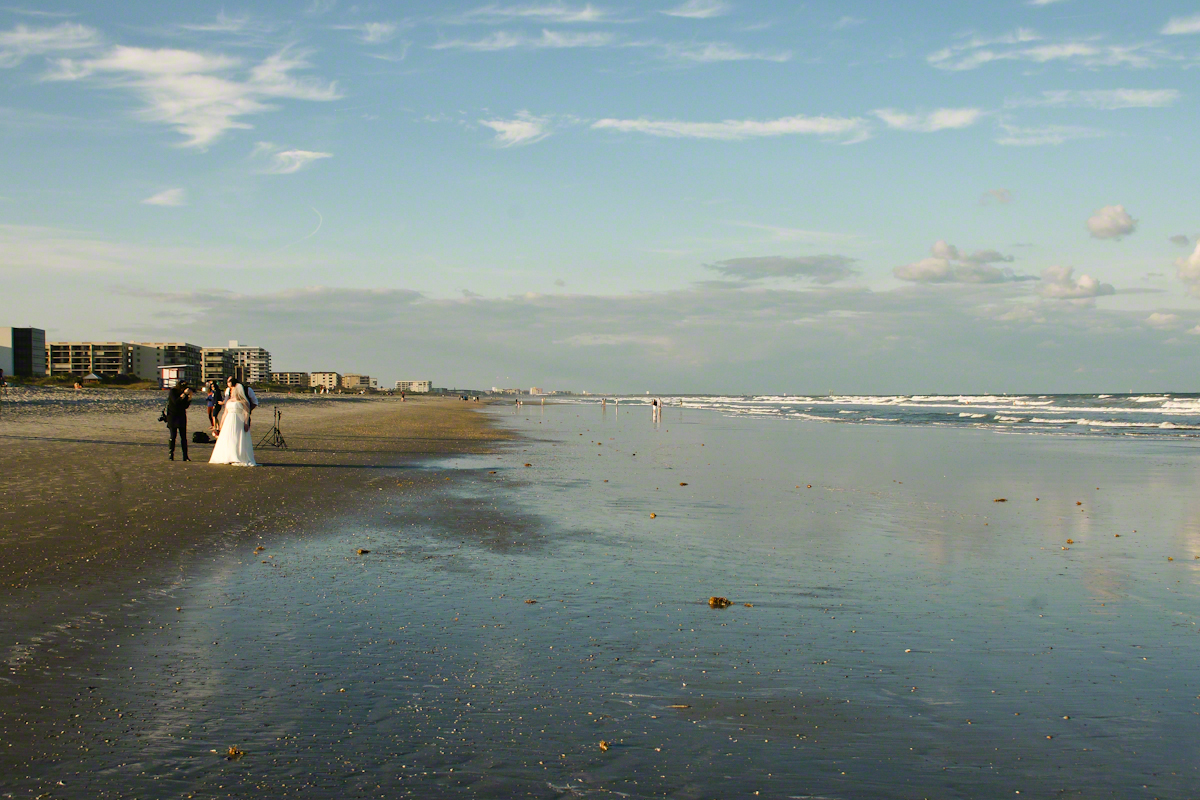
The session proceeded smoothly and professionally, it was a pleasure to watch. I felt no compunction for capturing these private moments on a public beach, the transcendence of the images reflect well on all participants.
Bride and groom pose while photographer composes the shot, her assistant behind.
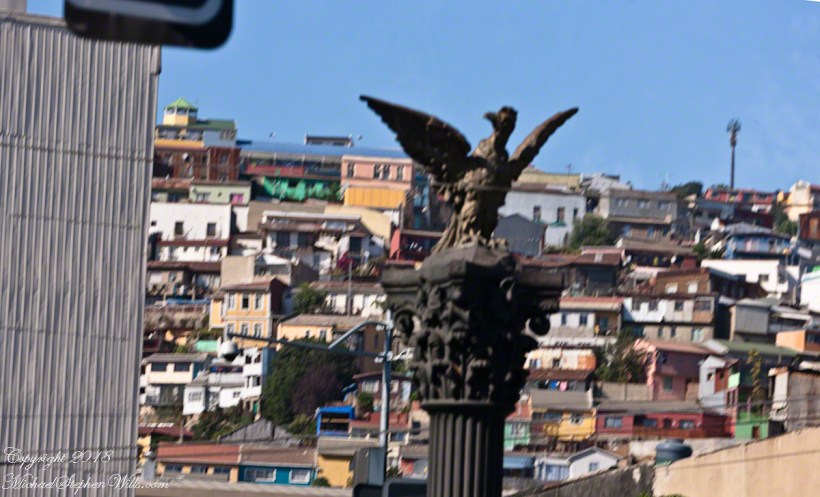
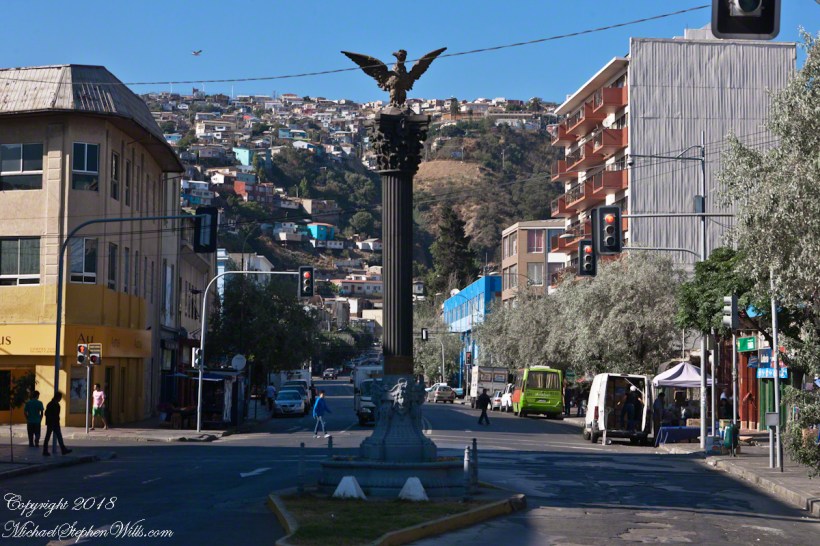
Trundled along within our bubble, the Mercedes tour bus proceeded up Avenue Montt when Ricardo pointed out this statue for ridicule. A depiction of the Chilean national bird, the Condor, porteños derisively call it “The Chicken,” and in truth the wingspan is undersized. From the vantage of the above photograph, the statue form does capture an impression of soaring among the hills of Valparaiso. Keep in mind, beyond those hills is Aconcagua, the highest mountain of the western hemisphere, home to Condors.
A reason for writing multiple Varparaiso “connection” posts is to better understand the jumbled impressions from that day. In a previous post I coined the term Varparasians for natives of the city. I found in researching this post the residents, as for Buenos Aires, call themselves porteños (people of the port). This cast iron statue speaks to the contributions of French immigrants to the city and nation.
Gift of the French Colony for the Centennial of Chile – Valparaíso, 1810 – 1910.
Here the view is south towards (what I believe is) Cerro Florida (Florida Hill). France Avenue continues, beyond the monument, following a steep and winding path up the hills, at the crest intersecting with German Avenue. Adjacent, on the right, is Park Italia where we’ll visit in part VI. Above a cast iron basin, at each corner of the commemorative column base is a female mask, above them a gold band inscribed (from the) “The French of Valparaiso” with 1810 – 1910 to denote the centennial. A condor with outspread wings surmounts the column.
The artist, Nicanor Plaza, born in Santiago, Chile was living in Florence, Italy at the time of this commission. He was a natural choice for the commission. Trained in Chile and Paris, Plaza taught for the Academy of Fine Arts of Santiago. It is of cast iron, produced by the French company Val Osne, an art foundry dating back to 1835. The owner, Jean Pierre Andre Victor, invented a cast iron ornamental technique originally used to produce street furniture.
From 1854 to 1895 immigration from France burgeoned, from a country total of 1,654 to 8,266. This cohort is credited with developing the vineyards of the Central Valley, still famous today. The Chilean president Augusto Pinochet descended on his father’s side from an 18th-century French Breton immigrant from Lamballe and his mother was a descendant from 17th century immigrants, partially Basque. Pinochet’s legacy can only be attributed to himself and the ruling Junta. What is of concern is (1) Pinochet was protected against prosecution throughout his life. (2) The same people who protected him still hold power. A case in point is the Esmeralda, still in service.
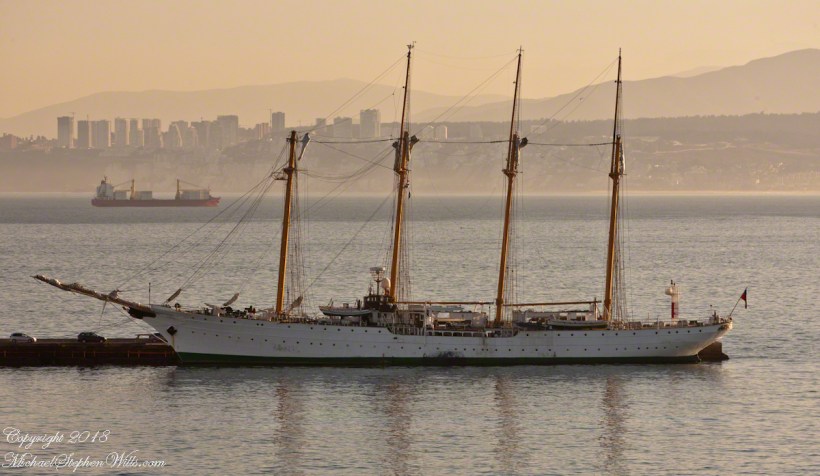
The Naval Training Vessel Esmeralda
I took this photograph at dawn from our stateroom balcony, it is the Esmeralda, a four-masted top sail schooner, from Spain, christened May 12, 1953. From 1973 to 1980 it was a floating torture chamber where up to 100 persons were subjected to hideous treatment by the Pinochet regime. Protests erupt wherever it docks in a foreign port yet it remains in service. A relatively small part of the puzzle, yet it serves as an unacknowledged monument to the failure of Chile’s ruling elite to come to terms with the recent past.
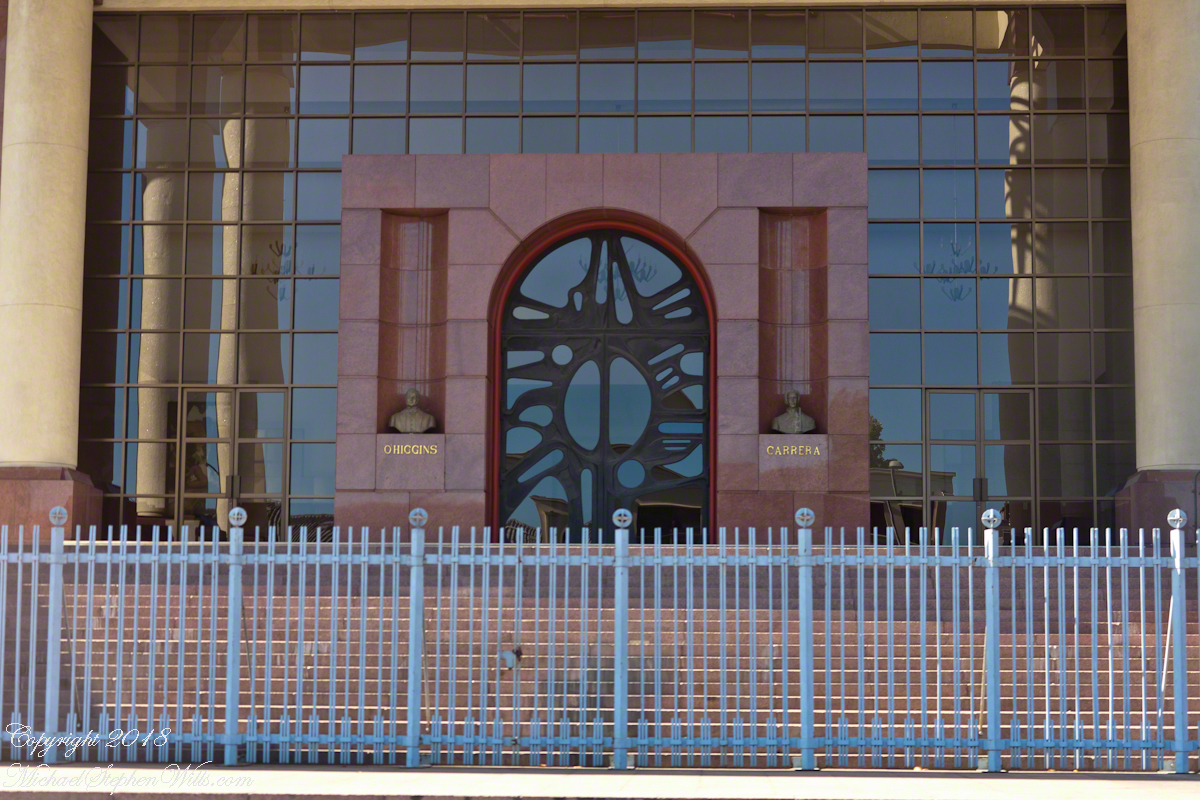
“Valparaiso Connections III” brought us to Pedro Montt Avenue and the building of this imposing façade, Congreso Nacional de Chile (National Congress of Chile). The very fact it is in Valparaiso is a recollection of the former National Congress, disbanded by the ruling Junta on September 13, 1973. During the final years the Pinochet dictatorship chose Valparaiso for the site of a new congress building. The former National Congress building still stands in Santiago, now housing the offices of both houses of congress.
I am fascinated the façade is shared by two founding fathers of Chile, Bernardo O’Higgins and José Miguel Carrera. O’Higgins father never married his mother (in other words, Bernardo was a bastard). Cared for by his mother’s privileged family, he used his mother’s family name until the death of his father. Carrera, was also born of privilege, the acknowledge son of his father who attended the best schools, well positioned to lead the movement for Chilean independence. Benefactors looked after O’Higgins, they sent the seventeen year old to Europe to finish his education.
Click either photograph to visit my Fine Art Gallery. Enjoy!!
In the chaos of war, in spite of ill-health and lack of military training, O’Higgins out performed Carrera as an officer through reckless bravery; surviving, he became an admired military leader through this example and ultimate victories. Carrera resented being overtaken (by a bastard), did not respect O’Higgins leadership and the two feuded. O’Higgins became the first head of the independent Chile while Carrera gathered a force. Exiled in Paraguay, Carrera marched across the intervening wastes battling indigenous forces. Eventually captured by those loyal to O’Higgins, Carrera suffered a mock trial and execution.
All five of Carrera’s legitimate offspring married and prospered, today his descendants number in the hundreds, being the majority of Chile’s ruling class. Today, the followers of Carrera (Carreristas) fight for his recognition against the O’Higginistas, who they despise. The balance is on display on the National Congress façade on Pedro Montt Avenue. The building is next to Plaza O’Higgins.
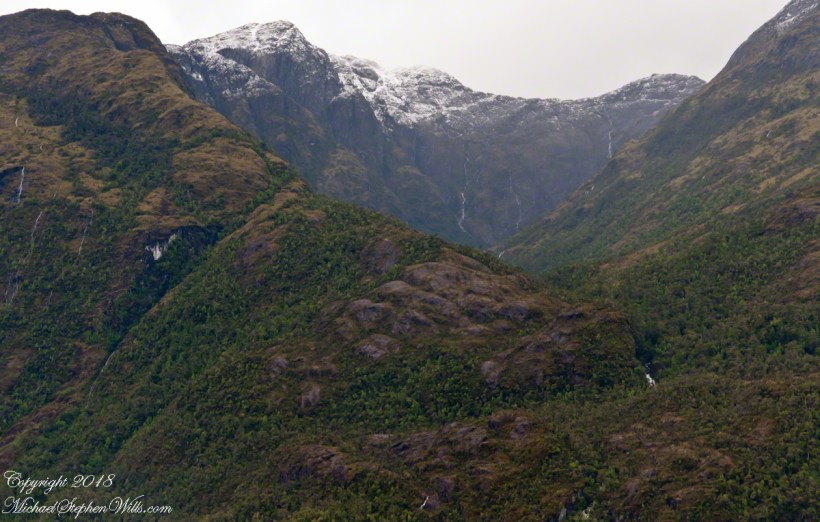
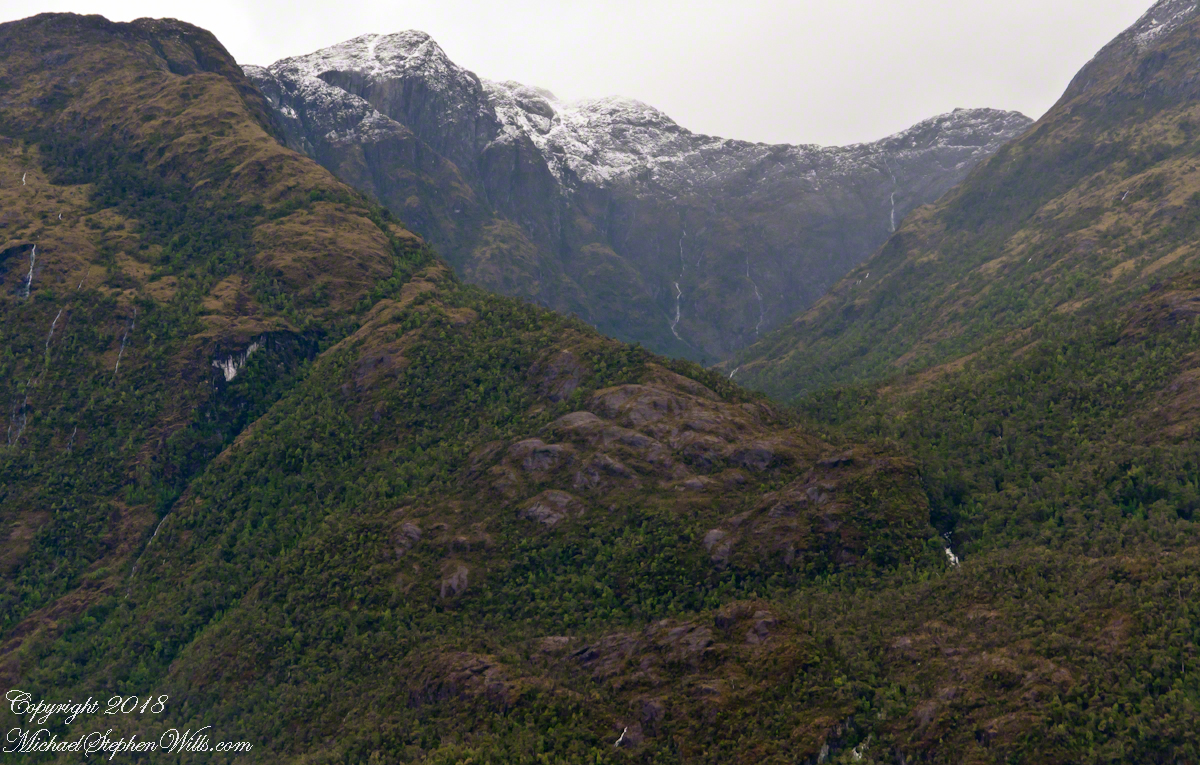
Measured by acreage, O’Higgins is far ahead of Carrera. The following photograph, from my posting “A Far Country VII: View of Tempanos Fjord” is from within Bernardo O’Higgins National Park, the largest protected land in Chile.
A large lake in Patagonia is named after General Carrera.
Copyright 2018 All Rights Reserved Michael Stephen Wills
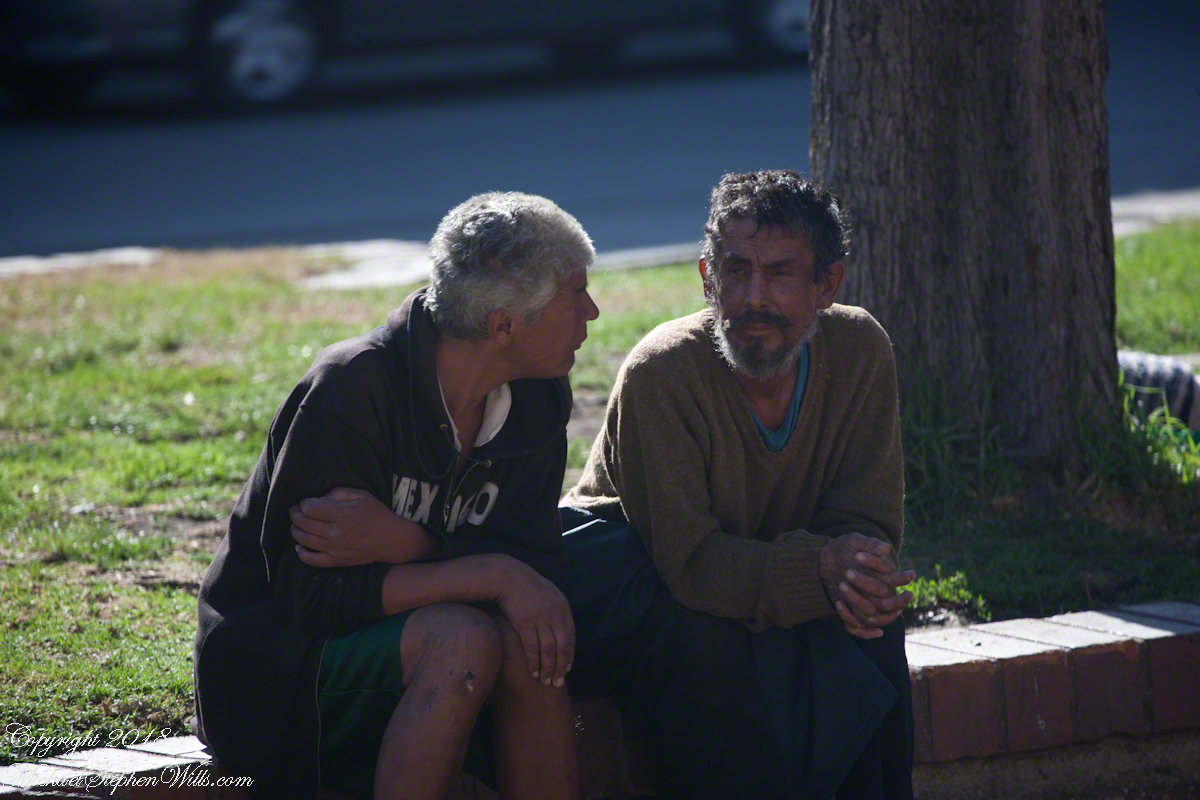
“Valparaiso Connections II” left us with these friendly Valparasians, if such a word can be used to describe residents of the city, chatting on Argentina Avenue.
It was Saturday, the happy occasion of the weekend street fair, kiosks sprouting like mushrooms, thinly attended this early morning.
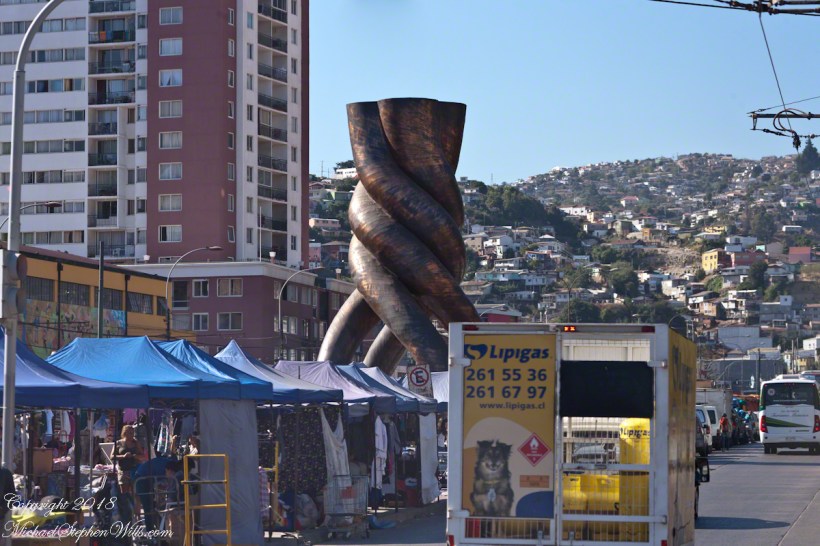
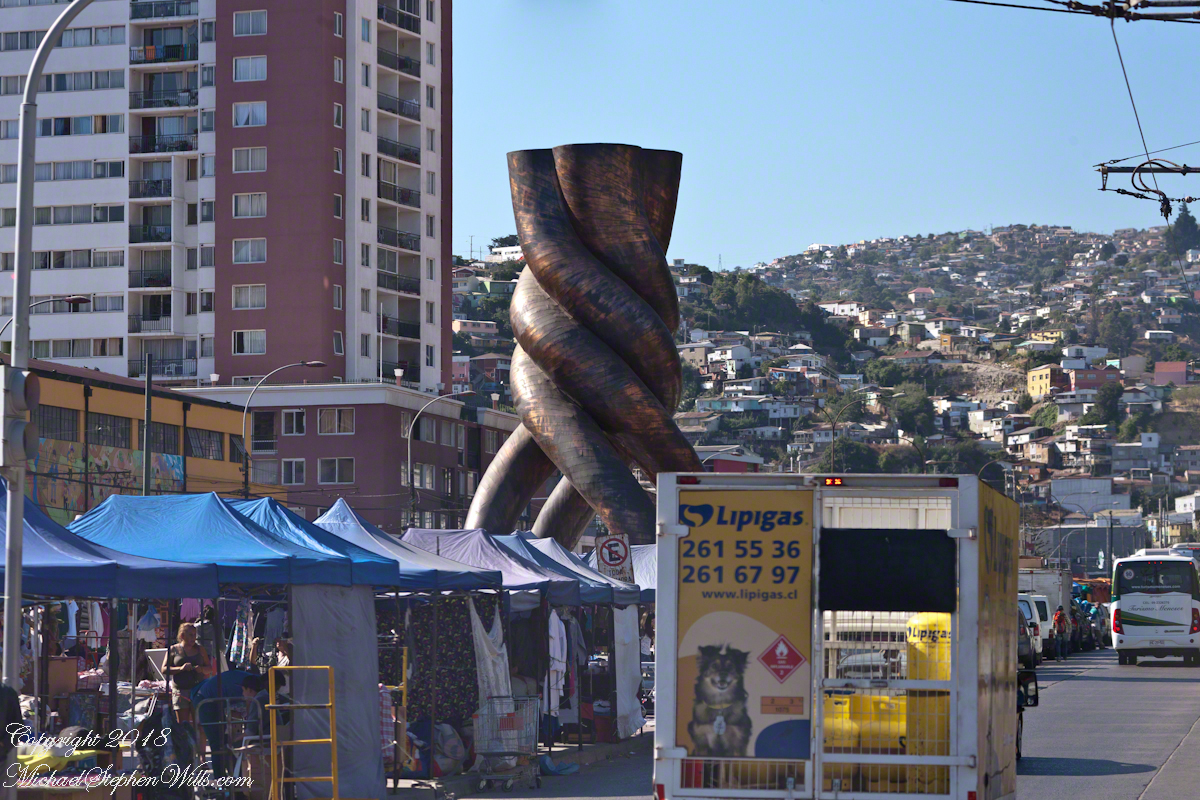
We did not pause to wander, instead turned up a street known as Pedro Montt, named for a Chilean president of the early 2oth century. Was we turned, monumental street sculpture, rising from the kiosks, caught my eye.
A creation of the great national artist Mario Irarrzabal, it invokes solidarity through the image of four thick copper cables twisted together to form one, the union that can happen to achieve bigger things. Opened in 1995, crafted of iron, wood and copper, after Pinochet passed power to a new democratic constitution and still held office as a Senator, protected from extradition, in the National Congress located just to the west of the monument.
The imagery works on multiple levels. Known as “Copper Cable Monument” or “Copper Column,” the monument also stands for Chilenización del cobre (Chileanization of copper), a movement began during the presidency of General Carlos Ibáñez del Campo. Concluded in the presidency of Salvador Allende, the takeover of foreign owned mines lead to the isolation of Chile and was a component of the support of the USA, via the CIA, for the Pinochet 1973 Chilean coup d’état. Pinochet retained state control of the mines in the face of strong popular support for the huge contribution to state coffers. To this day CODELCO (in English National Copper Corporation of Chile) operates as a corporate entity.
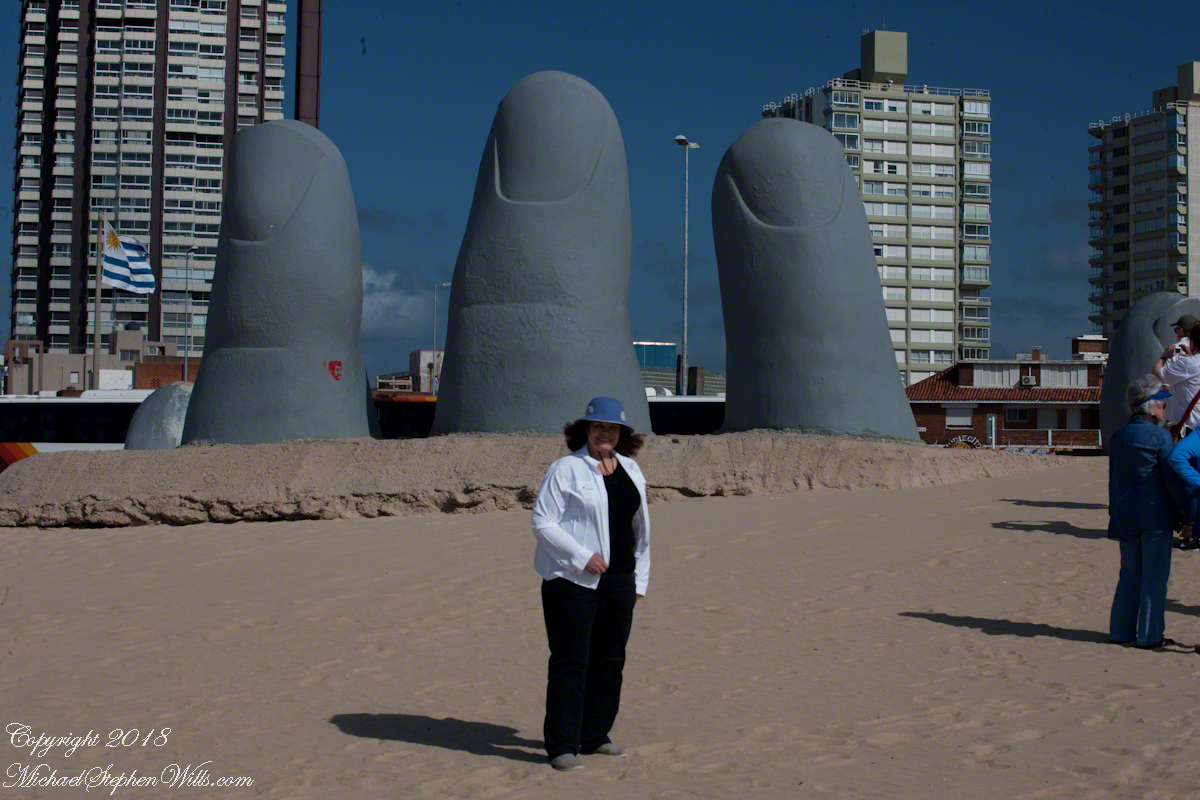
As with our guide, Ricardo (“Valparaiso Departure I”) and the companions at the start of today’s post, Irarrzabal was profoundly affected by the Pinochet dictatorship. Under its influence as well as the sculpture of Easter Island, the artist began work on monumental sculptures. Pam and I visited one on the other side of the South America “cone,” Punta del Este, Uruguay.
Built from Brava beach at the height of the dictatorship, 1982, of concrete, steel rebar, mesh covered with a corrosion resistant coating, the artist title it “Man Emerging to Life.” He was a young man at the time, the work built his reputation and he repeated the theme internationally as well as, in 1992, 1,181 miles away the “Hand of the Desert.” At that time while Chile was emerging from the Pinochet dictatorship the palm as well as fingers are visible. The “cone” of South American, Chile and Argentina, are encompassed by the left hand of the east, a right hand of the west.
Copyright 2022 All Rights Reserved Michael Stephen Wills
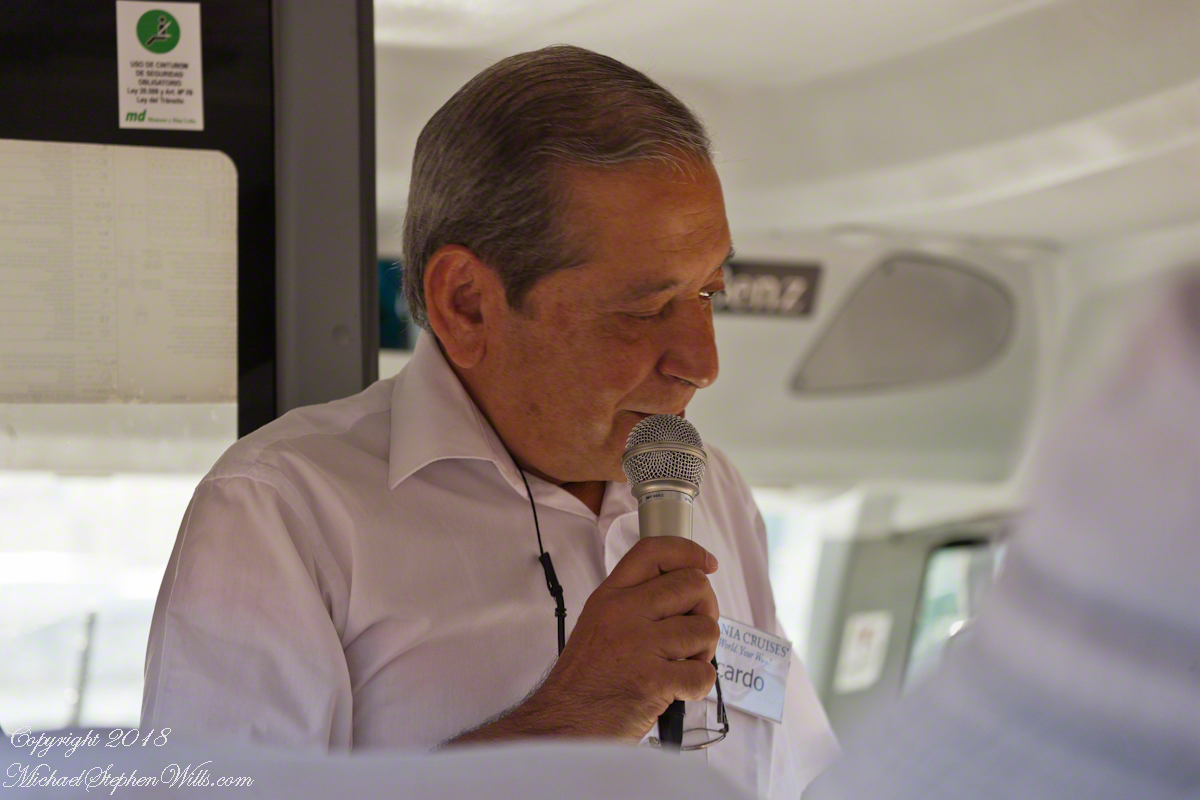
Ricaro’s name tag reads, “Oceania Cruises, your world, your way.” I began my two previous blogs with Ricardo, “Valparaiso Separation” and “Valparaiso Connections I.” There’s a lot to be said for the Oceania tours. Every one lead by a knowledgeable native of the host country, fluent in English, we became familiar, some more than others, with them personally, one non-representative example. As were progressed down the coast from Iquique to Cape Horn we met a cross section of Chileans. Unlike other countries, in Chile we met only unsmiling guards on the streets, no protest rallies.
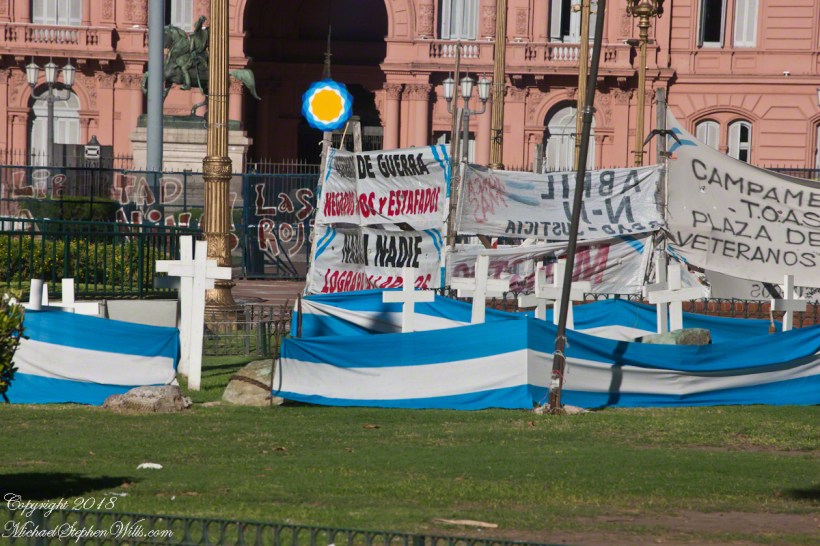
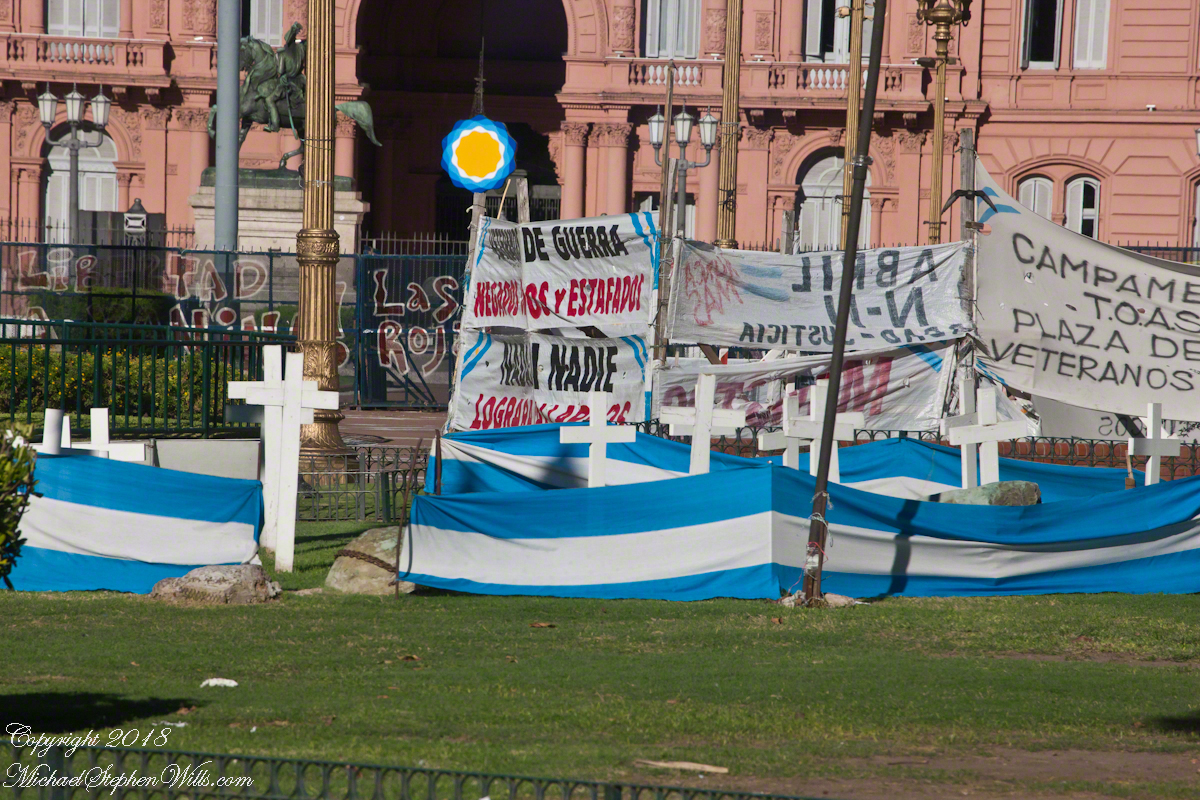
As the tour bus is about to turn down Varparaiso’s Argentina Avenue, here is a flash forward to an elaborate demonstration tableau in the Plaza de Mayo, the Casa Rosada as a backdrop, rose as in the color of bull’s blood used as pigment. The protest was in support for veterans and causalities of the ill considered 1982 Falklands War. We zoomed by the Parque De La Memoria, dedicated to the 30,000 people “disappeared” by the same military dictatorship of the Falklands War debacle.
Our entry to both Valparaiso and Buenos Aires was a cruise over the secret graves of thousands dropped, alive, into the ocean from military aircraft.
What is most chilling is the silence about this throughout our travels in Chile. No memorials, no protests, silence, only stone faced military guards.
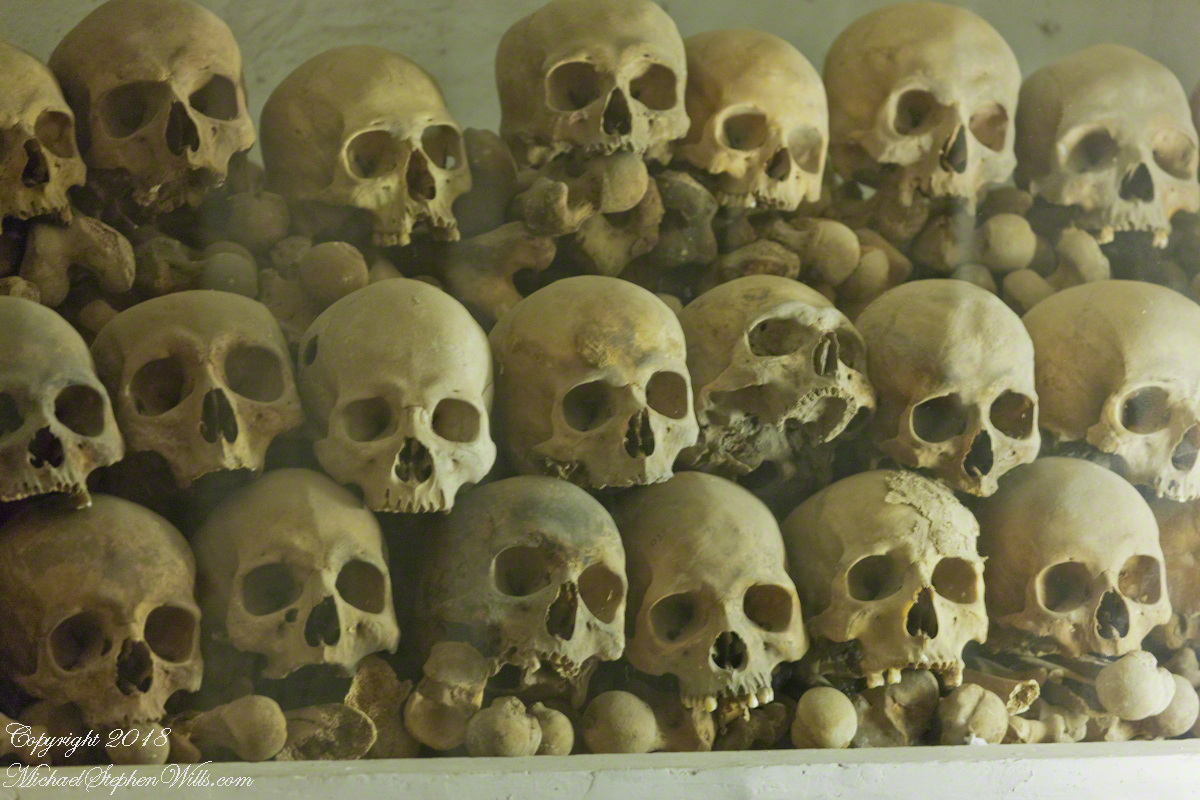
The following is from Basílica y Convento de San Francisco de Lima, beneath which are catacombs piled with disarticulated skeletons buried and cared for in the Catholic tradition .
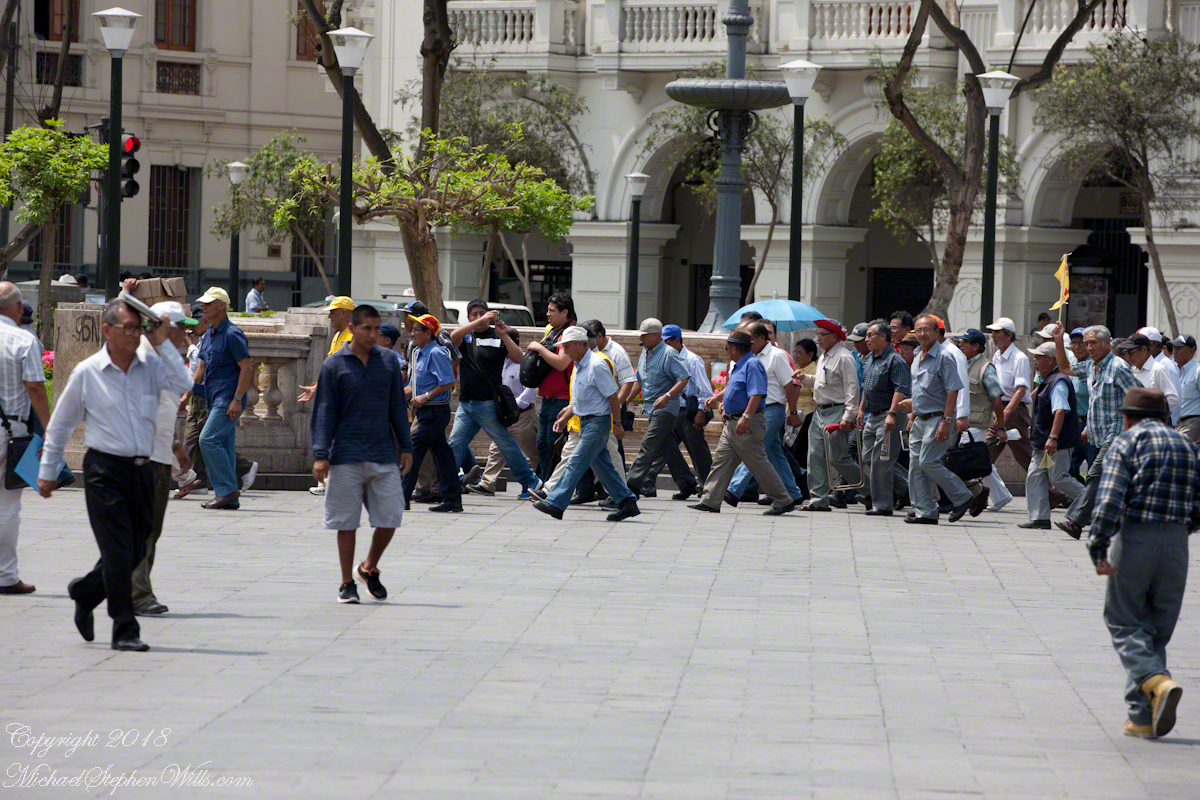
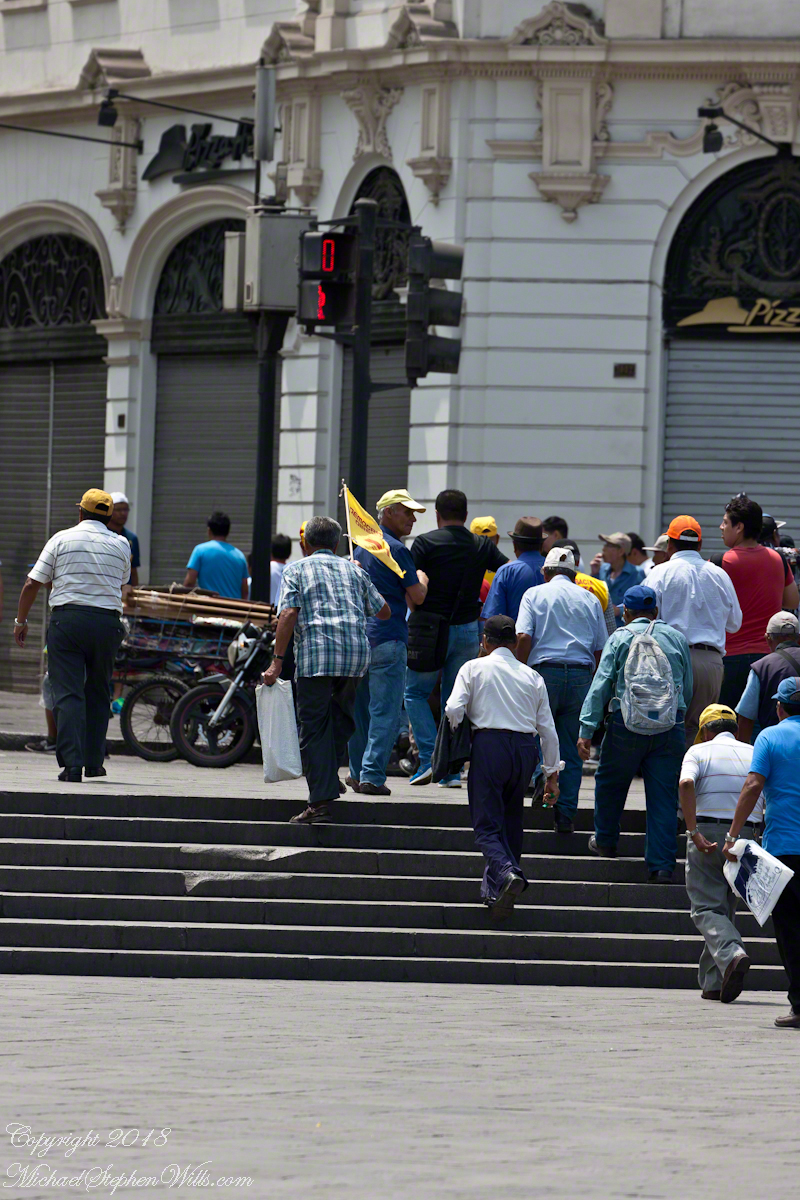
In Lima’s Plaza de Armas we witnessed this peaceful demonstration by pensioners protesting low payments. To be honest, around this time, in Chile, there were huge demonstrations, hundreds of thousands in Santiago, about the same issue.
The Lima crowd was peaceful.
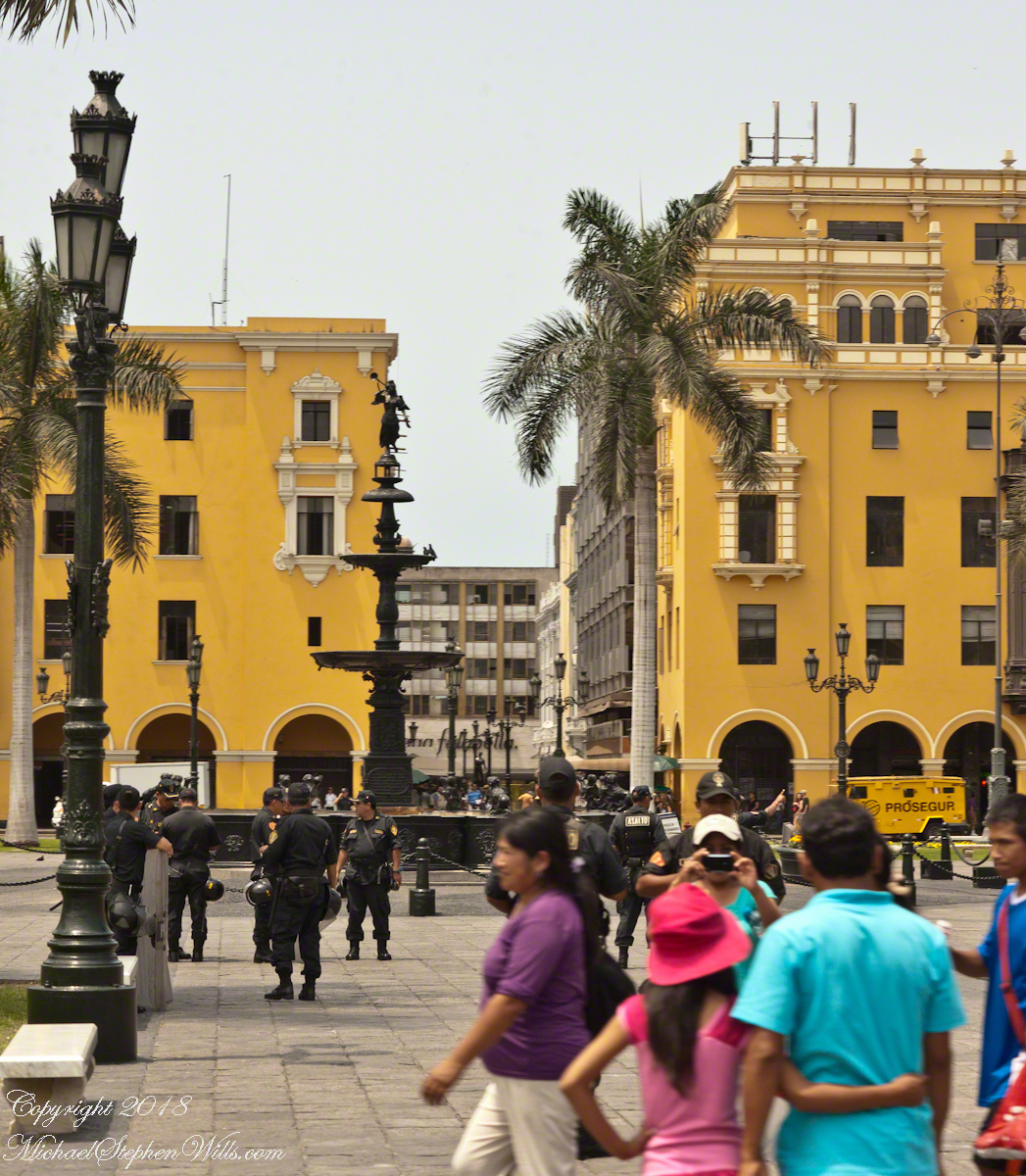
Watched by a heavy contingent of armed police supported by large “paddy wagons” to cart people away. The vehicle marked “Prodegur” (i.e., prosecution) was one of them. Given the history of government disappearances in the region, how brave the demonstrators must be.
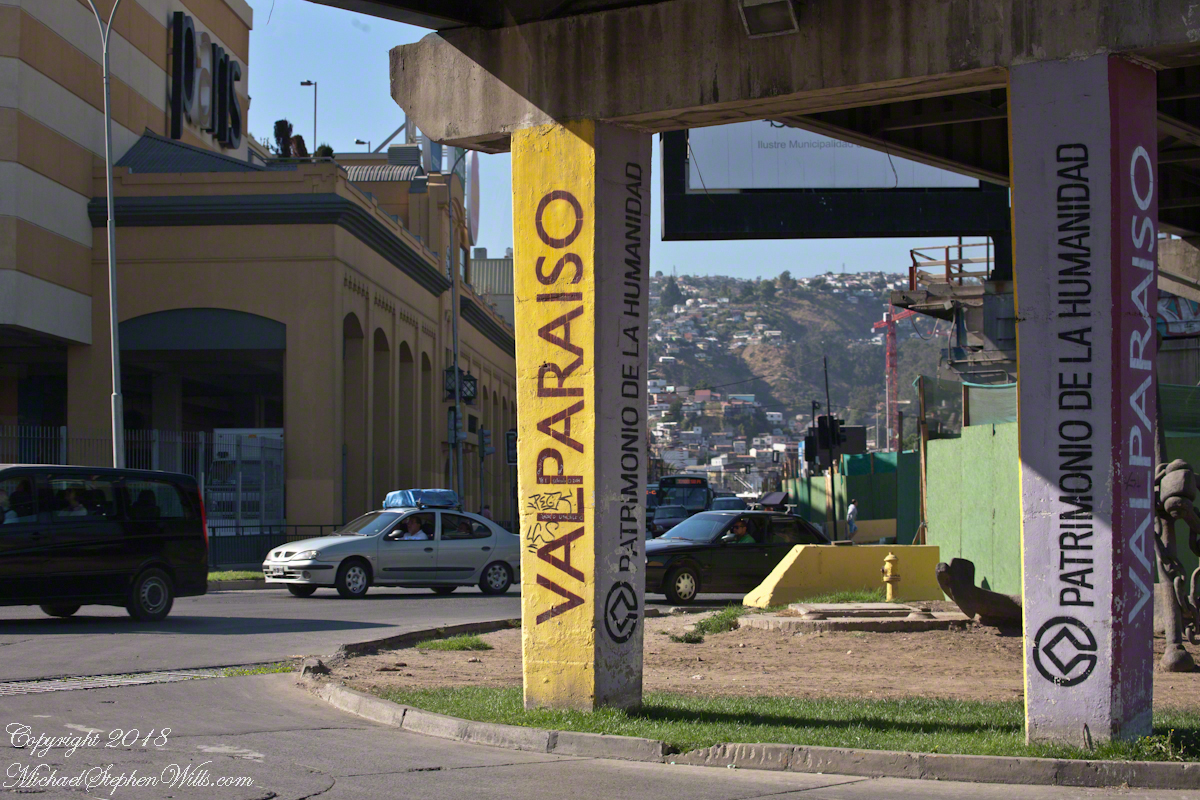
Our vehicle turns onto Argentina Avenue, passing under Spanish Avenue and these supports bruiting the “Patrimony of Humanity” status of Valparaiso.
Turning onto Argentina Avenue, the overpass support columns announce Valparaiso’s status as a World Heritage Site. It is the old city around the port which holds this designation.
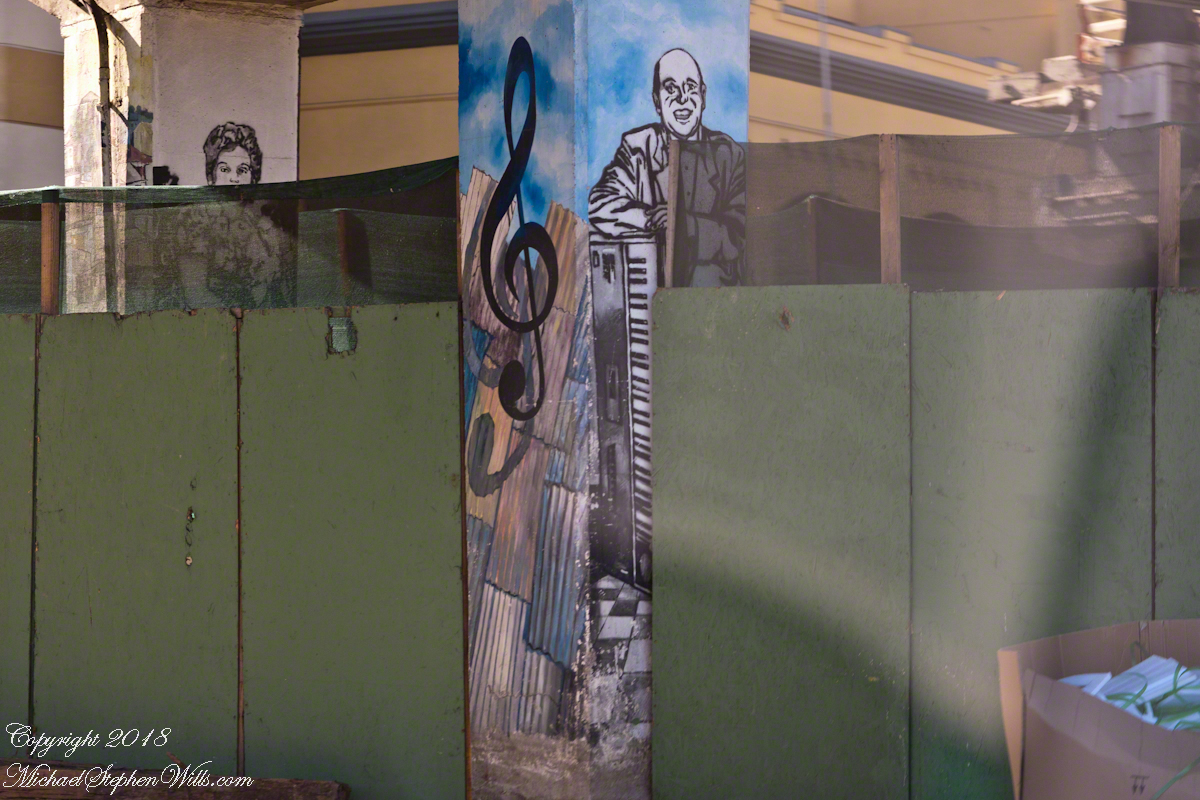
Other murals feature the zinc panels of the Old Town and cultural opportunities. I noticed the pictured flooring is identical that of Hotel Brighton, see “Our Fifteen Minutes of Fame on Conception Hill.”
I wonder how a man of a certain ago scrapes his knees, these appear to be homeless people.
Two men carry on conversation on Avenue Argentina, Valparaiso during the weekend Avenue Argentina street fair.
They gives us big smiles and waves when they spotted me / us. The people were open and friendly.
Copyright 2018 All Rights Reserved Michael Stephen Wills

 For those chosen to cross over to the new land in return for





 Michael Stephen Wills Photography