Thursday last, grandsons Sam and Rory and I visited Sapsucker Woods, enjoying a late summer morning. From the north side on Wilson Trail, these Canada geese landed on the pond.
In North America, nonmigratory Canada goose populations have been on the rise. The species is frequently found on golf courses, parking lots, and urban parks, which would have previously hosted only migratory geese on rare occasions.
Owing to its adaptability to human-altered areas, it has become one of the most common waterfowl species in North America. In many areas, nonmigratory Canada geese are now regarded as pests by humans.
They are suspected of being a cause of an increase in high fecal coliforms at beaches. An extended hunting season, deploying noise makers, and hazing by dogs have been used to disrupt suspect flocks.
A goal of conservationists has been to focus hunting on the nonmigratory populations (which tend to be larger and more of a nuisance) as opposed to migratory flocks showing natural behavior, which may be rarer.
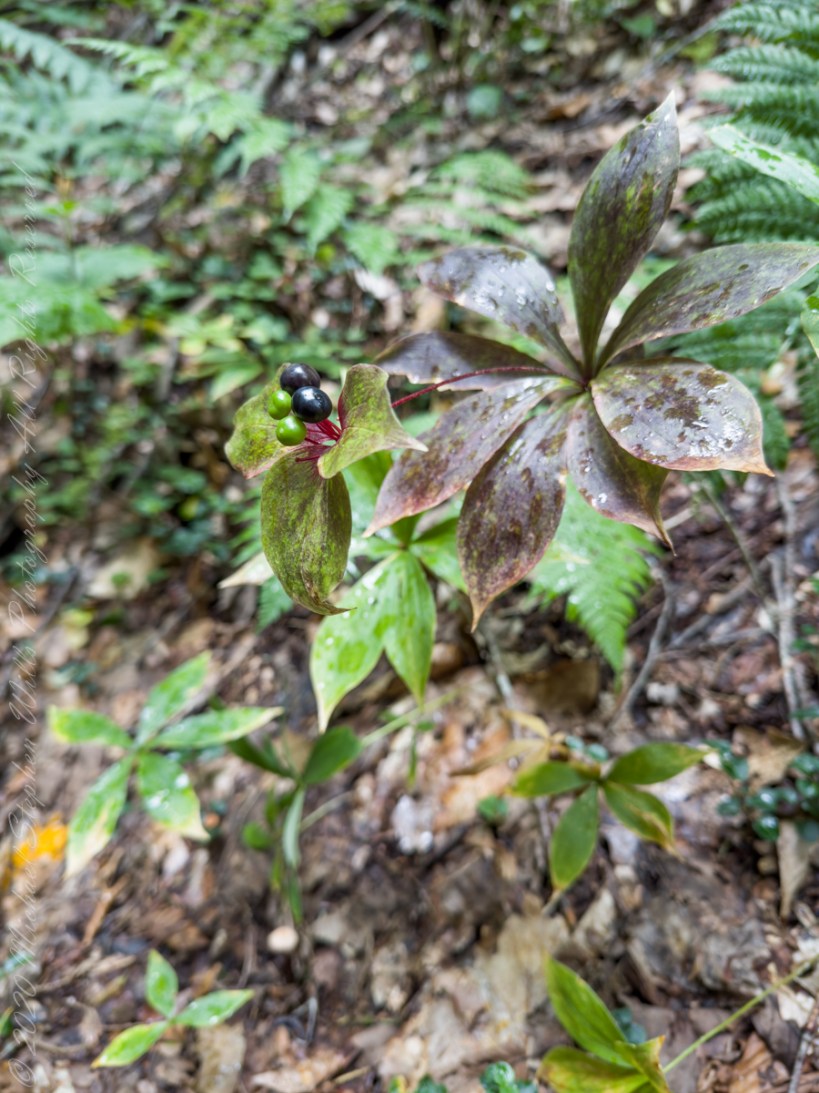
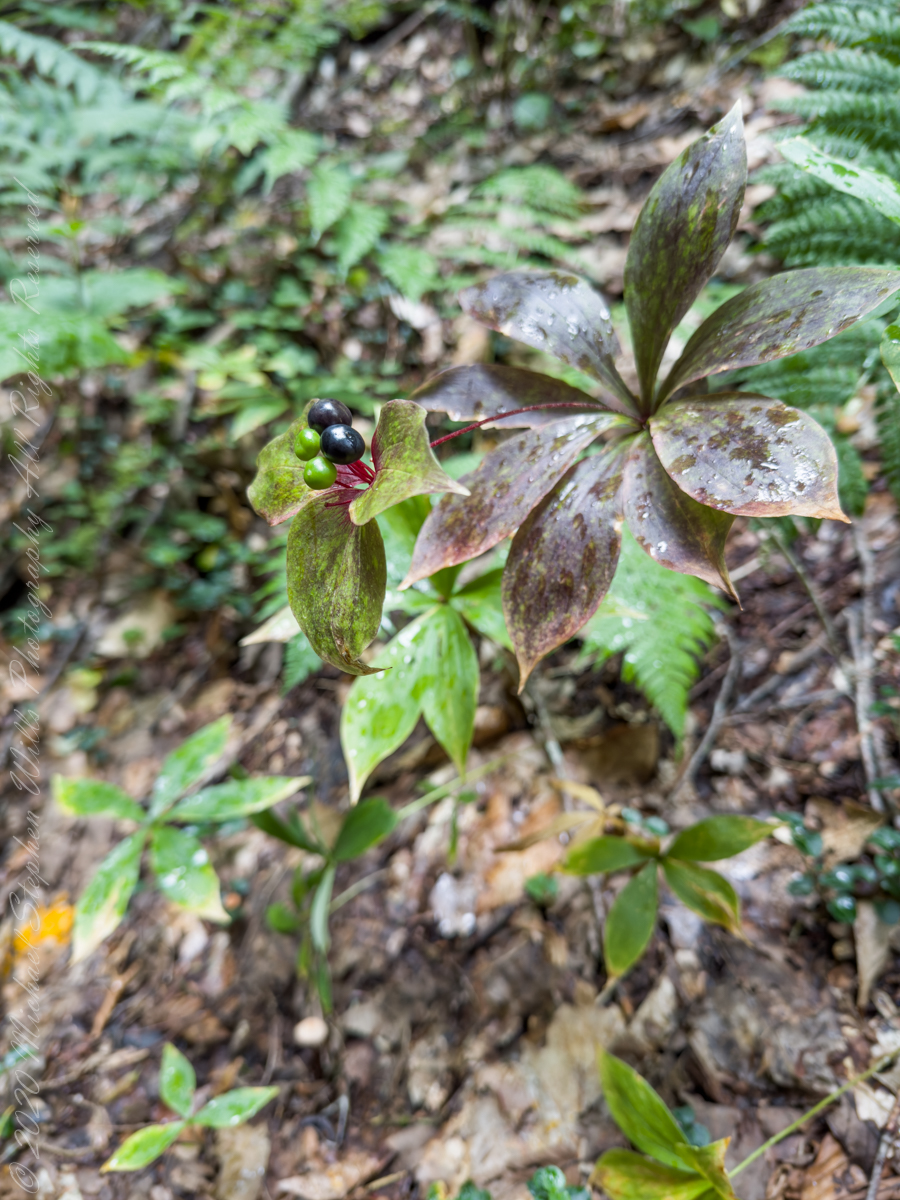
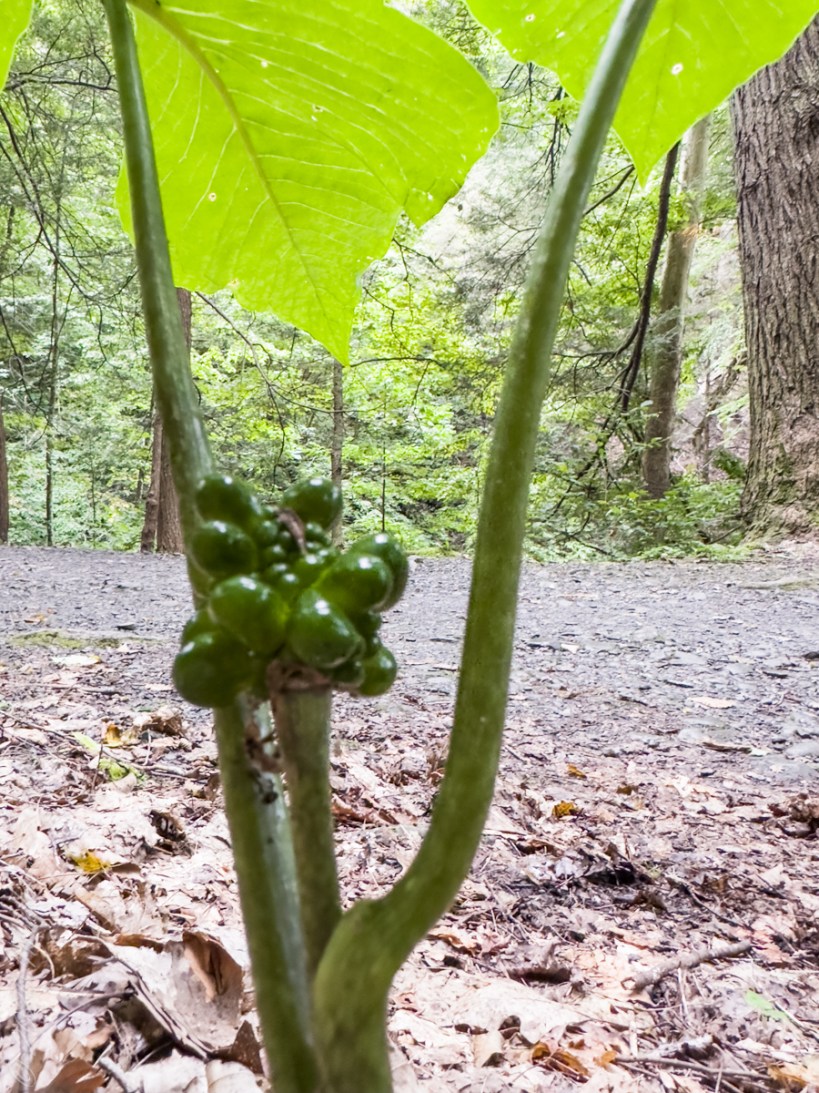
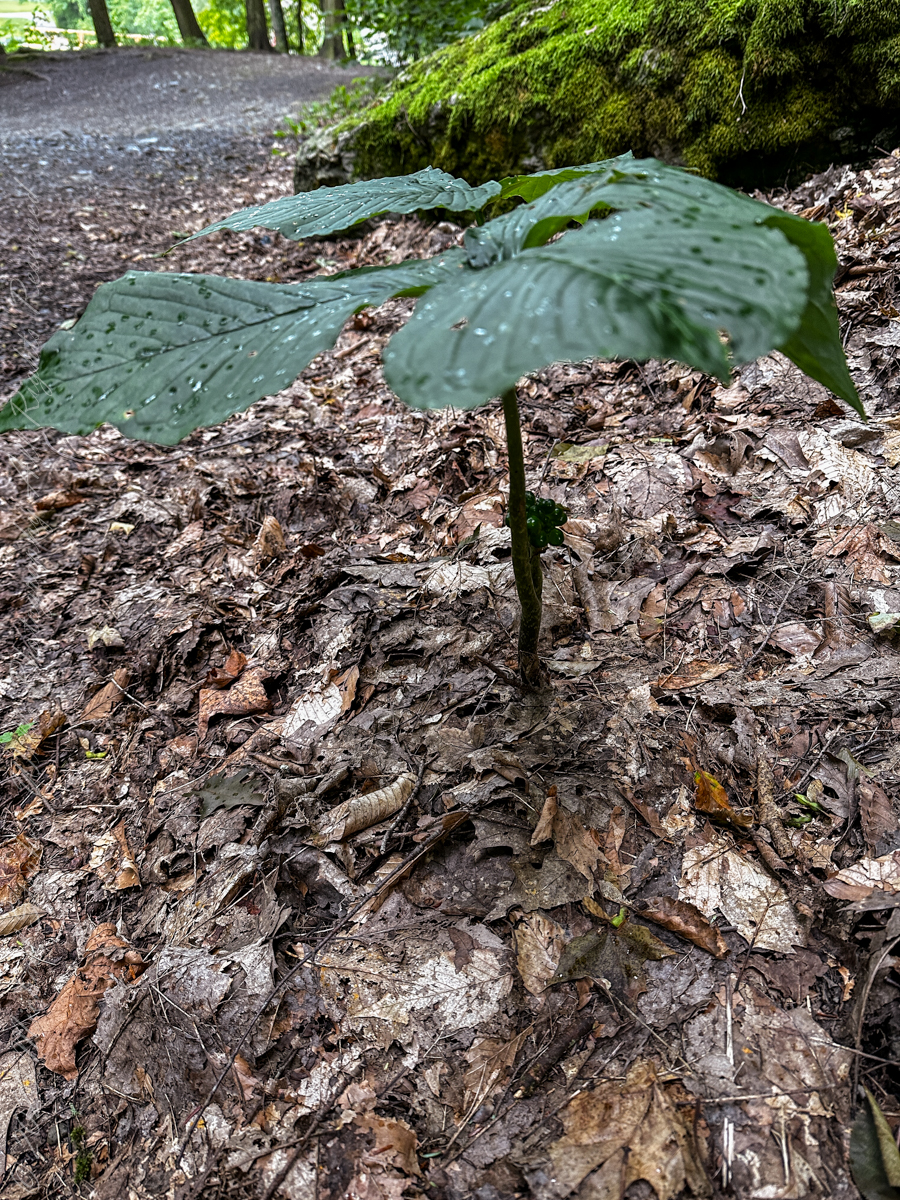
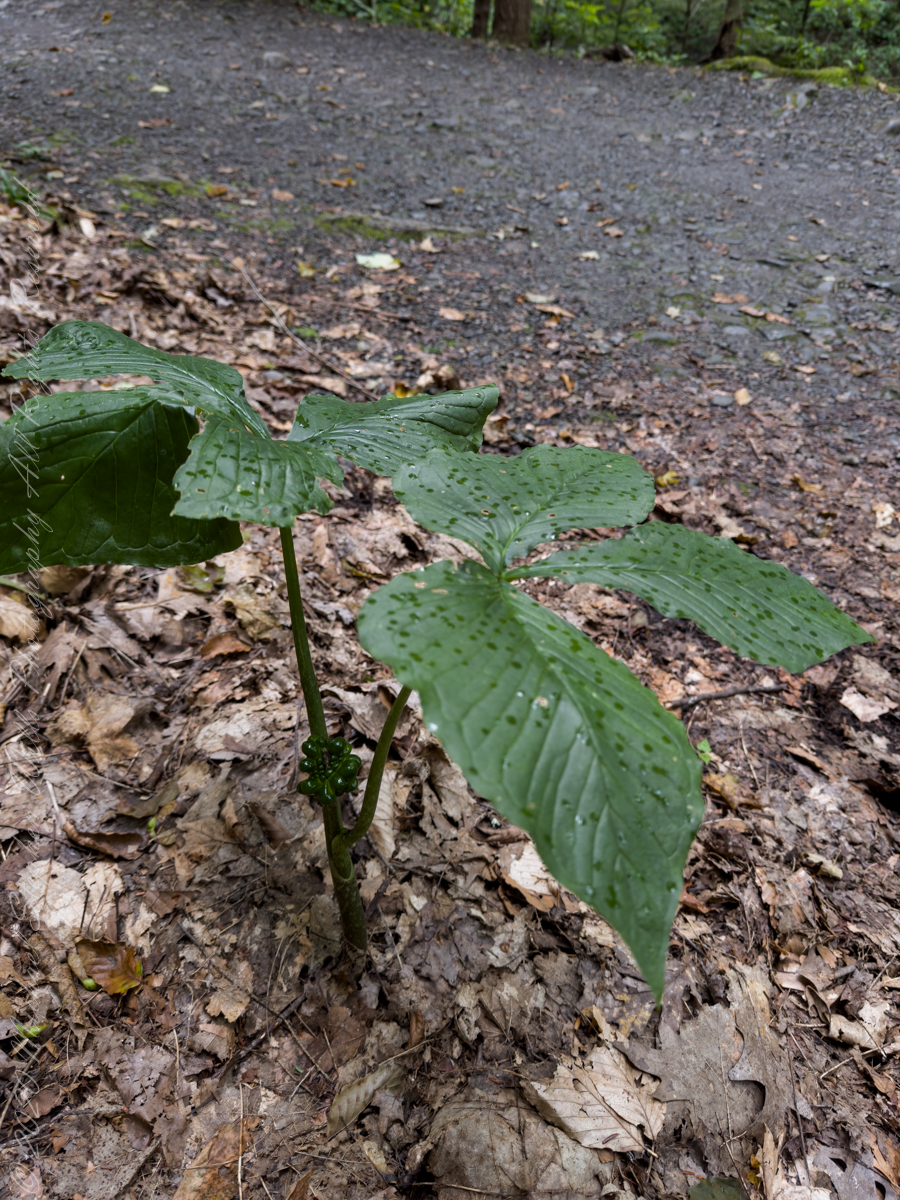
These dark blue berries at the end of a slender naked stalk that arises from the leaf joint at the top of the plant were encountered on a late August day in Fillmore Glen, Moravia, Cayuga County, New York State. Lysimachia borealis is a perennial wildflower commonly known as Starflower. After blooming in the spring, as a member of the primrose family these are some of the first flowers to appear, the fertilized flowers develop into this round purple fruit. To confuse identification, the plant is also known as Trientalis borealis.
“Lysimachia species are used as food plants by the larvae of some butterflies and moths, including the dot moth, grey pug, lime-speck pug, small angle shades, and v-pug.” Chipmunks eat these fruits as a minor portion of their diet.
“Bees of the genus Macropis are specialized to pollinate oil-producing Lysimachia plants. These bees use exclusively Lysimachia floral oils for building their nests and provisioning cells. Lysimachia floral-specific chemicals are strong attractors for Macropis nuda and Macropis fulvipes bees that are seldom found in other plant genera.”
Do not confuse this with another “starflower,” Borago officinalis, from which an oil is produced commercially.
Reference: text in italics and quotes is from the Wikipedia, “Lysimachia.”
Copyright 2023 Michael Stephen Wills All Rights Reserved
We let our first monarch butterfly rest overnight, until noon of the following day.
Pam did better with tracking the monarch’s flight, so I used video. Thanks Pam!
I delay butterfly release when:
the forecasted high temp is below 65° F (18° C) or 60° F (16° C) if sunny and calm. When no other option exists, 50-59° F and sunny is borderline acceptable.
the forecast calls for rain. A light rain is not a problem for butterflies with day-old dry wings, but it’s not a good release option for first-day newborns.
the butterfly emerges too late in the day. I keep it overnight if the butterfly cannot get 3 hours warming of flight muscles in the sun.
there are storms in the forecast. I wait when there are less than four (4) hours of good weather projected. When extreme weather (like a hurricane) is forecast within twenty four (24) hours, I keep the butterfly safe until the storm passes. Twenty four (24) or more hours should provide ample time to find shelter from the storm.
I am not sure about a release. Keeping a butterfly overnight is acceptable. In fact, a butterfly’s wings are stronger on day two (2), providing better capability to escape predators. A butterfly can easily hang from the mesh cage roof overnight. I do not worry about feeding a butterfly unless a second night of shelter is necessary.
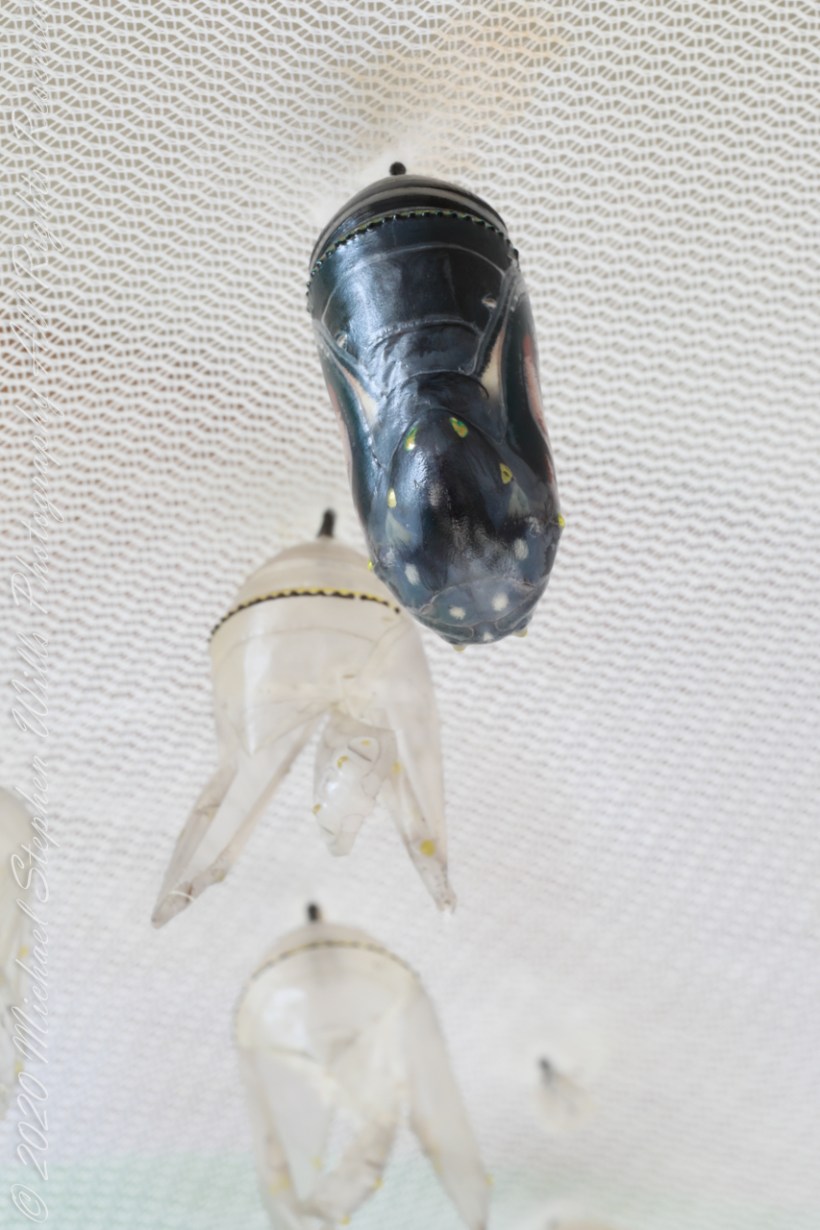
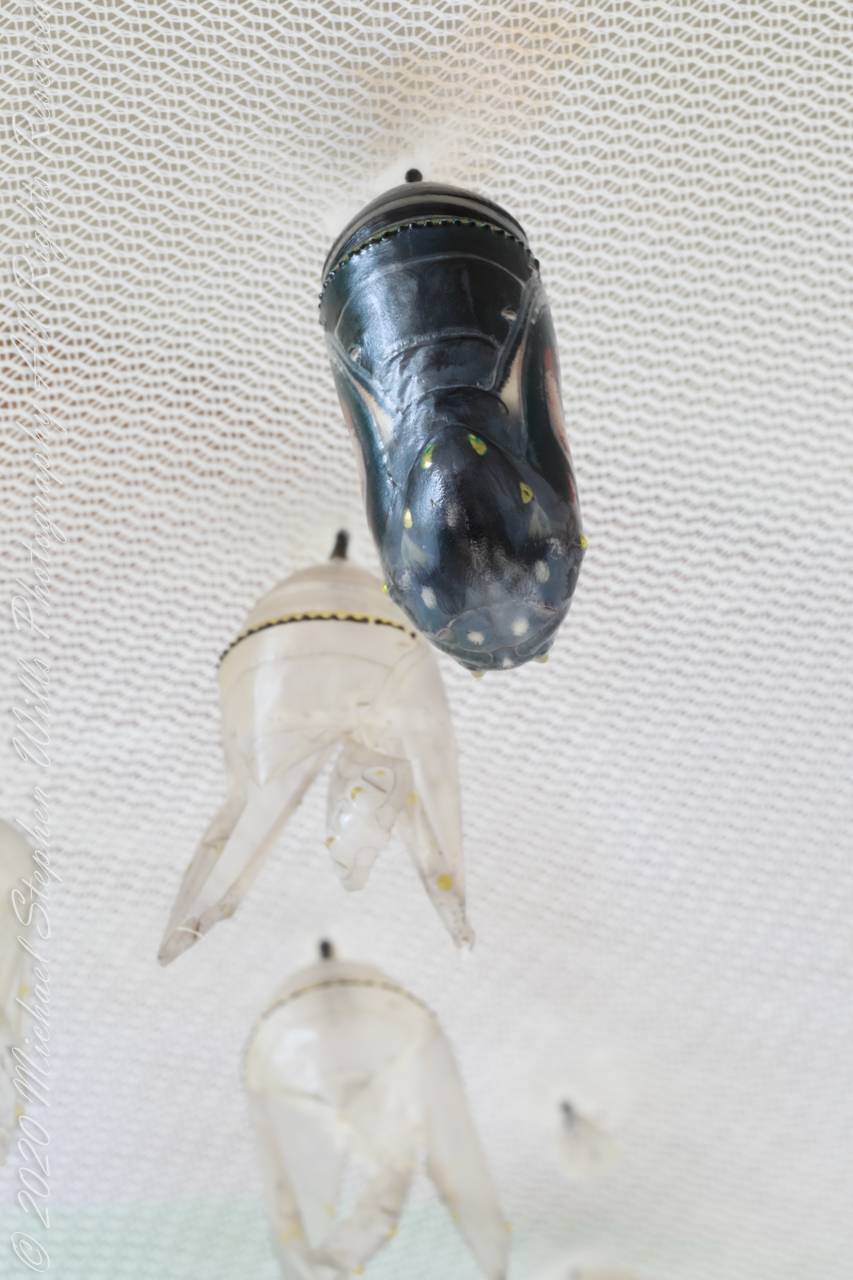
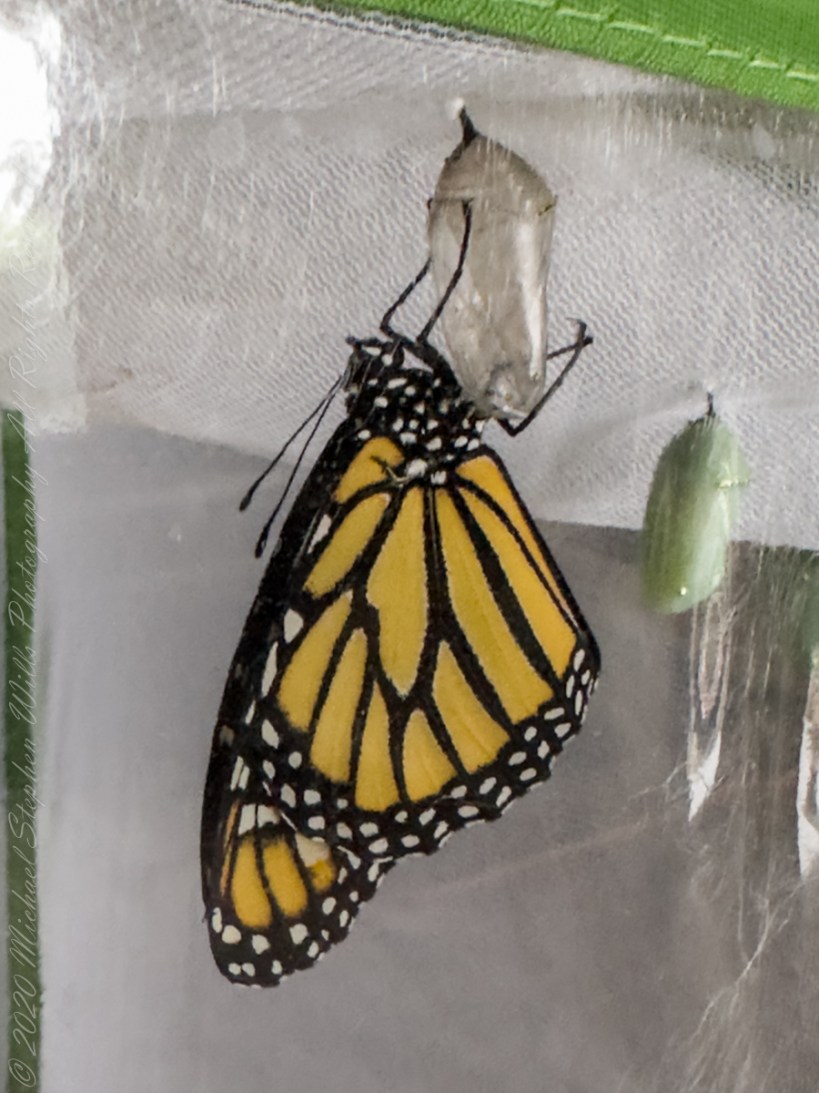
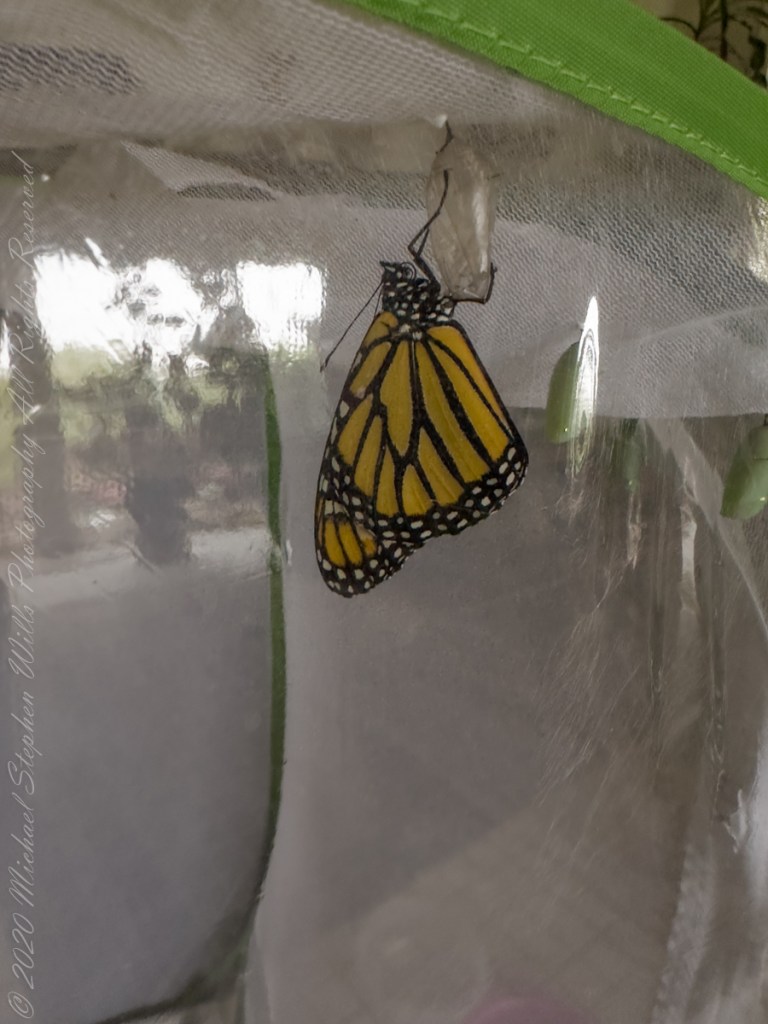
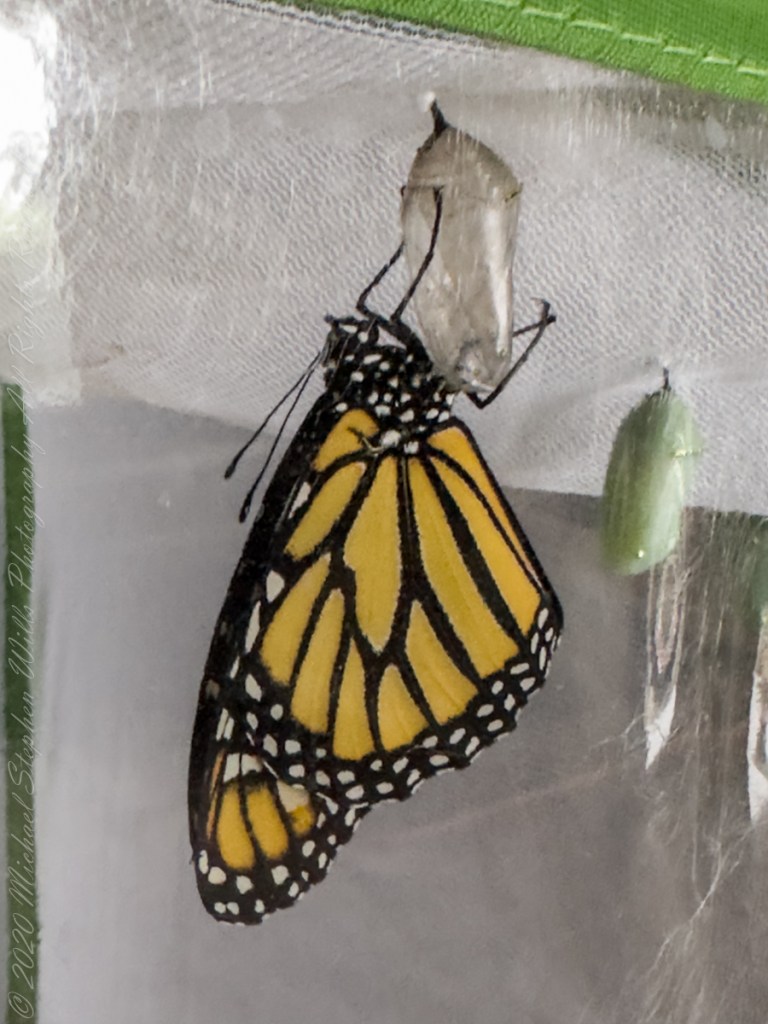
As the moment of emergence approaches, the skin of a Monarch chrysalis becomes translucent to reveal the butterfly compressed into that small space.
Copyright 2023 Michael Stephen Wills All Rights Reserved
“Arisaema triphyllum sensu lato is a herbaceous, perennial, flowering plant growing from a corm. It typically grows up to two feet tall, but populations in Georgia and Florida are known to reach almost twice that height. It has 1 or 2 leaves, each with three leaflets (triphyllum). Occasionally the lateral leaflets will be two-parted or lobed, giving the appearance of five leaflets per leaf. One species (A. quinatum) typically has five pseudo-leaflets per leaf.”
Those of you who know Georgia O’Keefe may be familiar with the form and coloring of Jack-in-the-pulpit from the series of six oil canvasses from 1930, her time in the east living near a spring. There is a spathe, the pulpit, strongly colored in dramatic vertical, flowing stripes, wrapped around a spandix, the “jack”, being a stem covered with male and female flowers.
Around the time my photography habit started in 2002 I was surprised by the jacks growing from the walls of Fillmore Glen, spying the distinctive forms flowing a bit above eye level under the three large leaves. Seeing them was like recognizing a friend in Halloween disguise, the exotic O’Keefe shapes in a known place.
“The small, inconspicuous flowers of Jack-in-the-pulpit are borne on a fleshy, spike-like inflorescence called a spadix (“Jack”), which is enclosed (or nearly enclosed) by a large, sometimes colorful bract called a spathe (“pulpit”). The flowers are clustered around the base of the spadix inside the spathe. A sterile spadix appendix protrudes from the mouth of the spathe tube. The appendix is covered by the leafy tip of the spathe, referred to as the spathe hood (or spathe lamina). The lip along the mouth of the spathe tube, used as a landing platform for winged insects, is called the spathe flange.”
“The inflorescence can be male (with male flowers only), bisexual (with both male and female flowers), or female (with female flowers only). In a small plant, most if not all of the flowers are male. As the plant matures and grows larger, the spadix produces female flowers as well as male flowers. The transition from male to female continues until eventually the plant produces female flowers only.[6] This is an example of dichogamy, a rare phenomenon in flowering plants. Due to this sex-change lifecycle, this species is sometimes called colloquially as Jack or Jill in the pulpit or Jill-in-the-pulpit.”
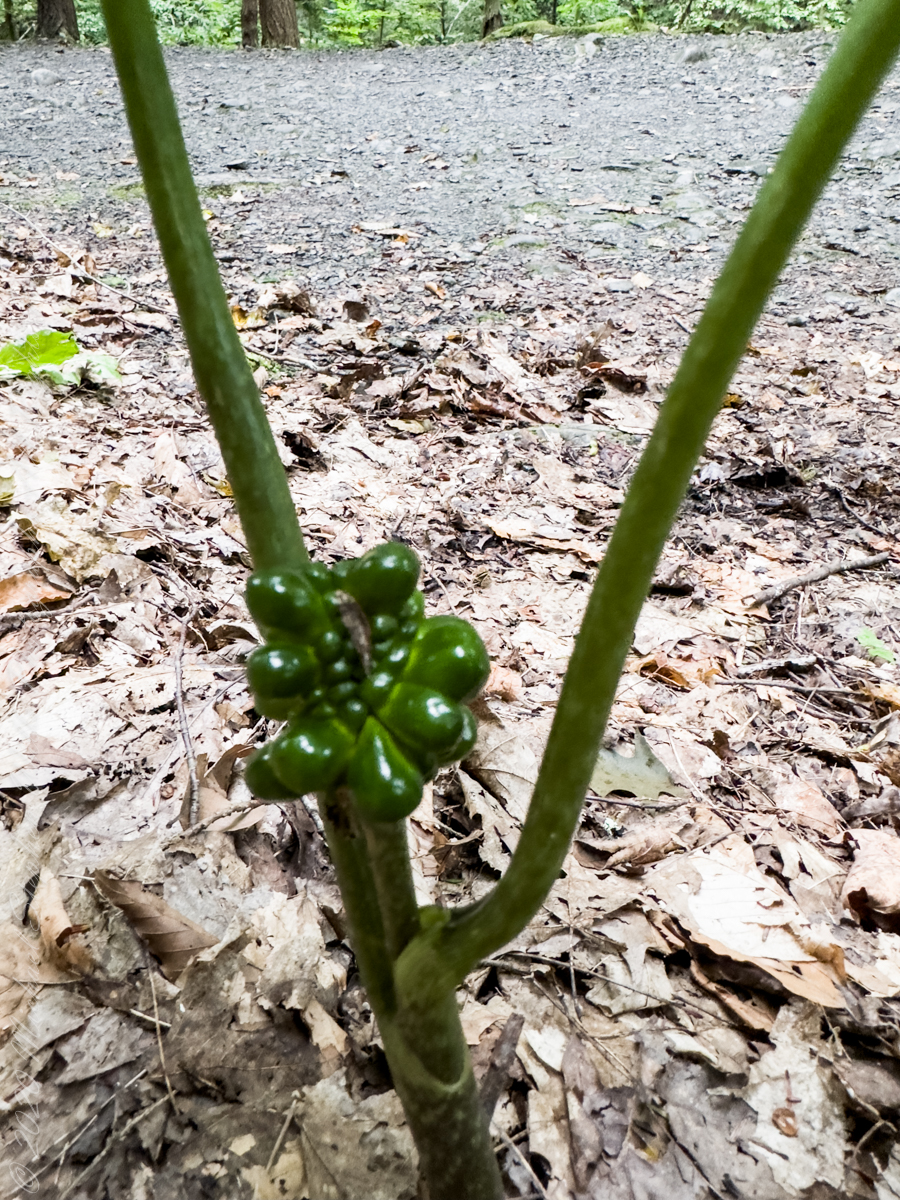
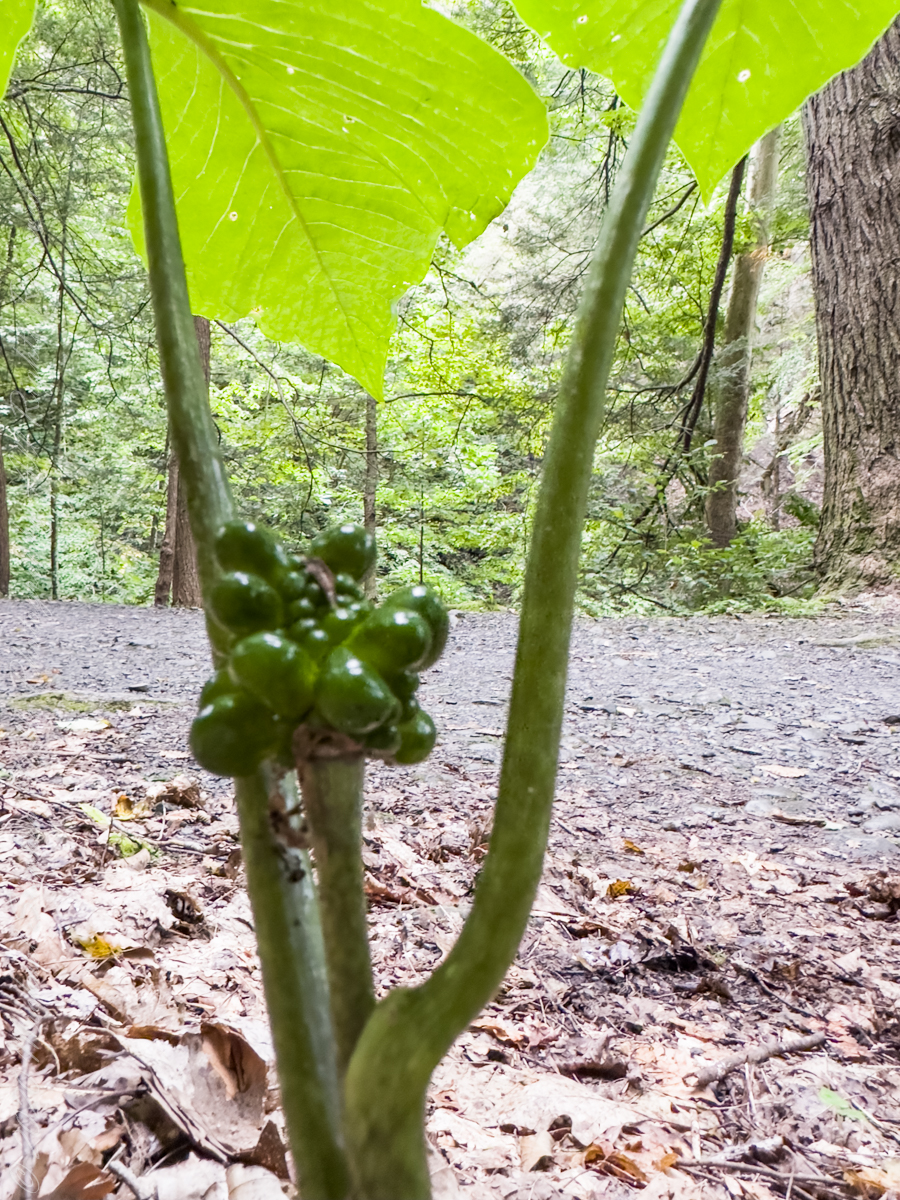
“The unripe fruits are smooth, shiny green berries (each 1 cm wide) clustered around the thickened spadix. Fruits ripen in the late summer and early fall, turning a conspicuous bright red color. Each berry typically produces 1–5 seeds, which are white to light tan in color, rounded, often with flattened edges and a short sharp point at the top. If the seeds are freed from the berry, they will germinate the next spring, producing seedlings each with a single rounded leaf. A seedling needs three or more years of growth before it becomes mature enough to flower.”
“The Arisaema triphyllum complex includes four closely-related species: Arisaema pusillum, Arisaema stewardsonii, Arisaema quinatum, and Arisaema triphyllum sensu stricto. A fifth species (Arisaema acuminatum) is sometimes included but its validity is controversial.”
Ecology
“Arisaema triphyllum sensu lato flowers from April to June.[citation needed] Arisaema triphyllum sensu stricto is the first to flower in the spring. In regions where the species are sympatric, Arisaema stewardsonii and Arisaema pusillum begin to flower 1–2 and 2–3 weeks later, respectively. Since an individual flowering period can last 1–3 weeks or more, it is not unusual to find all three species in flower at the same time. In the southeastern United States, Arisaema quinatum is reported to flower later than either A. pusillum or A. triphyllum s.s.”
“Arisaema triphyllum sensu lato is pollinated by fungus gnats, which it attracts by smell and are trapped by the flower. They manage to escape from a hole at the bottom of the male’s pulpit, but cannot do so when they fall inside a female pulpit, which do not have exit holes Thus the Jill-in-the-pulpit is a rare femme fatale in the plant world: luring the gnats in with scent, but ultimately killing the pollinators in a death trap.”
“Other insects are known to visit the flowers as well, such as gall gnats and beetles.[6] The plant is not self-pollinating since the male flowers on a specific plant have already matured and died before the female flowers of that same plant are mature. So the female flowers need to be pollinated by the male flowers of a different plant. This inhibits inbreeding and contributes to the health of the species.”
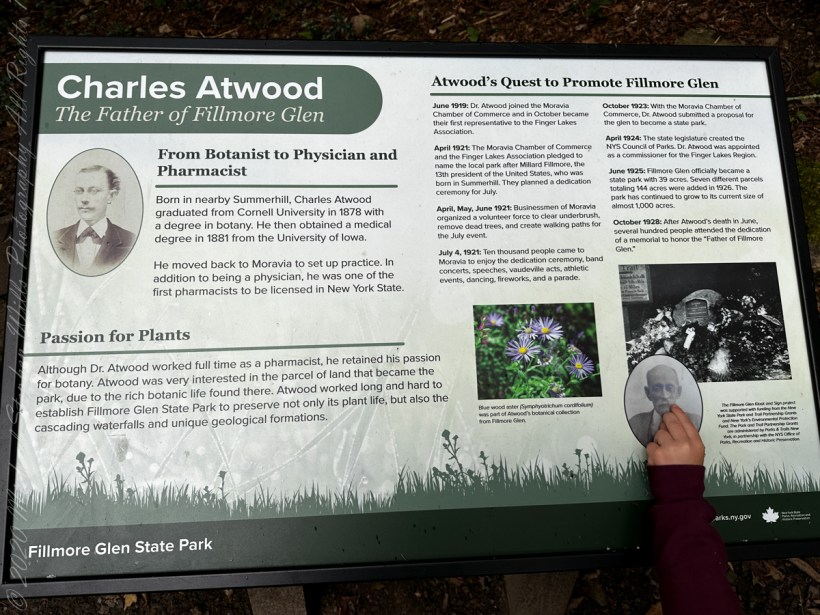
This year, 2023, an informational sign was installed next to the Charles Atwood memorial at the foot of the stone stairs leading to the Gorge Trail.
Charles Atwood The Father of Fillmore Glen
“From Botanist to Physician and Pharmacist: born in Summerhill, Cayuga Coun ty, New York State, Charles Atwood graduated from Cornell University in 1878 with a degree in Botany. He then obtained a medical degree in 1881 from the University of Iowa. He moved to Moravia, Cayuga County, to set up practice. In addition to being a physician, he was one of the first pharmacists to be licensed in New York State. A Passion for Plants. Although Dr. Atwood worked full time as a pharmacist, he retained his passion for botany. Atwood was very interested in the parcel of land that became Fillmore Glen Park, due to the rich botanic life found there. Atwood worked long and hard to establish Fillmore Glen State Park to preserve not only its plant life, but also the cascading waterfalls and unique geological formations.”
“Atwood’s Quest to Promote Fillmore Glen. June 1919: Dr. Atwood jointed the Moravia Chamber of Commerce and in October became the first representative to the Finger Lakes Association. April 1921: the Moravia Chanbmer of Commerce and the Finger Lakes Association pledged to name the local park after Millard Fillmore, the 13th president of the United States, who was born in Summerhill. They planned a dedication ceremony for July. April, May, June 1921: Businessmen of Moravia organized a volunteer force to clear underbrush, remove dead trees and create walking paths for the July event. July 4, 1921: Ten thousand people came to Moravia to enjoy the dedication ceremony, band concerts, speeches, vaudeville acts, athletic events, dancing, fireworks and a parade. October 1923: With the Moravia Chamber of Commerce, Dr. Atwood submitted a proposal for the glen to become a state park. April 1924: The state legislature created the New York State Council of Parks. Dr. Atwood was appointed a commissioner for the Finger Lakes Region. June 1925: Fillmore Glen officially became a state park with 39 acres. Seven different parcels totaling 144 acres were added in 1926. The park has continued to grow to its current size of almost 1,000 acres. October 1928: After Dr. Atwood’s death in June, several hundred people attended the dedication of a memorial to honor the ‘Father of Fillmore Glen.'”
Reference: text in italics and quotes is from the new Charles Atwood Sign.
Copyright 2023 Michael Stephen Wills All Rights Reserved
Our grandchildren spent the day with us, the last week of their summer before school begins. This July I had improved on my Monarch collection from 2022, when 9 butterflies were released, by two (2) caterpillars for a total of eleven (11) raised over several weeks to the chrysalis stage. When leaving to pick up the children for an outing one chrysalis skin had turned clear, a sign the enclosed butterfly is close to emerging. We returned from an outing for lunch to find this chrysalis unopened, so we checked now and then for progress. Four hours later, just as their Mom arrived for them, the grandchildren and everyone witnessed this event. What luck!!
“Migrating monarchs soar at heights of up to 1,200 feet. As sunlight hits those wings, it heats them up, but unevenly. Black areas get hotter, while white areas stay cooler. The scientists believe that when these forces are alternated, as they are with a monarch’s white spots set against black bands on the wings’ edges, it seems to create micro-vortices of air that reduce drag—making flight more efficient.”
“Monarchs begin leaving the northern US and Canada in mid-August. They usually fly for 4-6 hours during the day, coming down from the skies to feed in the afternoon and then find roosting sites for the night. Monarchs cannot fly unless their flight muscles reach 55ºF. On a sunny day, these muscles in their thorax can warm to above air temperature when they bask (the black scales on their bodies help absorb heat), so they can actually fly if it is 50ºF and sunny. But on a cloudy day, they generally don’t fly if it is below 60ºF.“
“Migrating monarchs use a combination of powered flight and gliding flight, maximizing gliding flight to conserve energy and reduce wear and tear on flight muscles. Monarchs can glide forward 3-4 feet for every foot they drop in altitude. If they have favorable tail or quartering winds, monarchs can flap their wings once every 20-30 feet and maintain altitude. Monarchs are so light that they can easily be lifted by the rising air. But they are not weightless. In order to stay in the air, they must move forward while also staying within the thermal. They do this by moving in a circle. The rising air in the thermal carries them upward, and their overall movement ends up being an upward spiral. Monarchs spiral upwards in the thermal until they reach the limit/top of the thermal (where the rising air has cooled to the same temperature as the air around it). At that point, the monarch glides forward in a S/SW direction with the aid of the wind. It glides until it finds another thermal and rides that column of rising air upwards again.”
This video includes an interview with Michael Wills about raising Monarch butterflies and this stage of the lifecycle. Video by Pam Wills using an IPhone 8
Reference: text in italics and quotes is from one of two online articles. “The monarch butterfly’s spots may be its superpower” National Geographic, June 2023 and “Fall Migration – How do they do it?” by Candy Sarikonda, September 2014.
Copyright 2023 Michael Stephen Wills All Rights Reserved
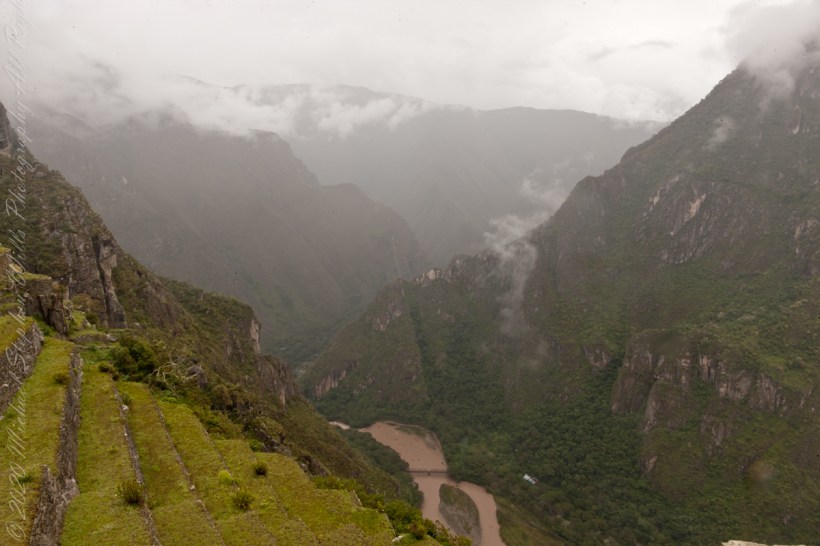
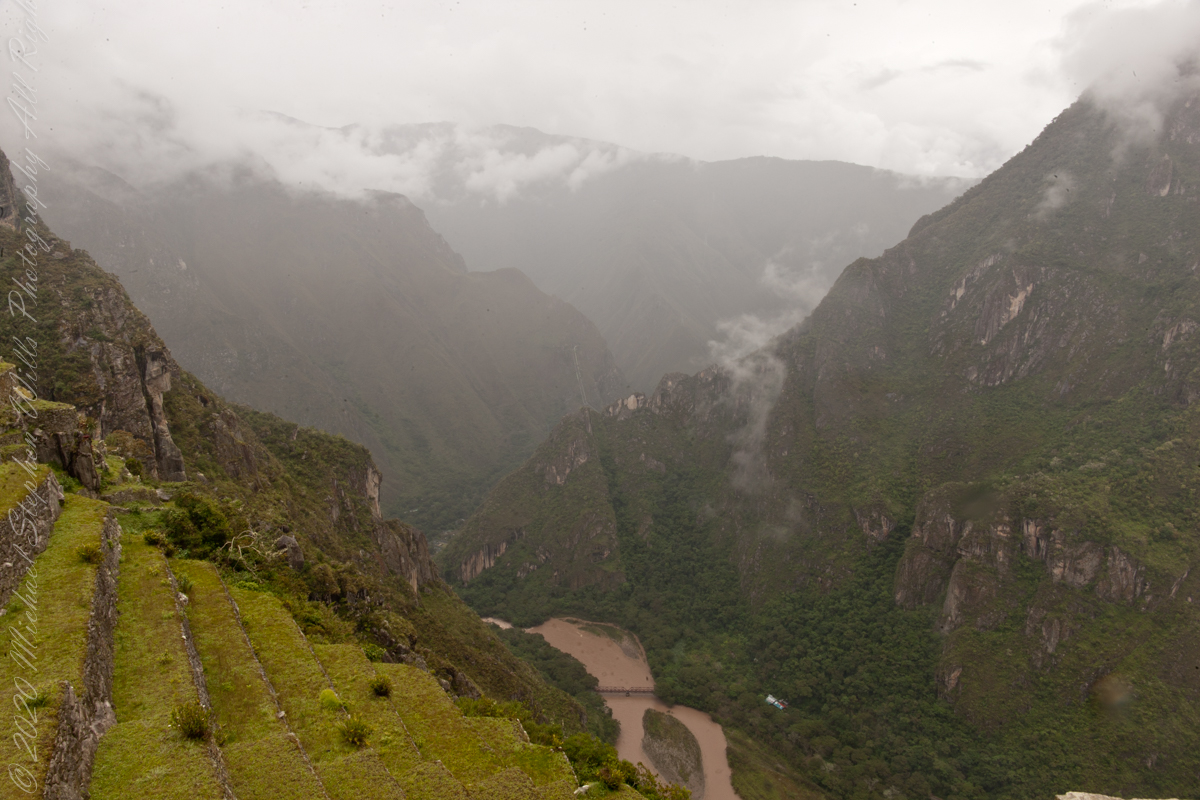
I set up a Manfrotto BeFree tripod with the Canon EOS 1DS Mark III mounted with the Canon EF 70-300 f/4-5.6 L IS USM lens to capture our experience while entering Machu Picchu.
The eastern shoulder of Huayna Picchu is left and the Urubamba river curves around it. Leading the eye to the distance is an uninhabited andean valley covered in rain forest.
Copyright 2023 Michael Stephen Wills All Rights Reserved
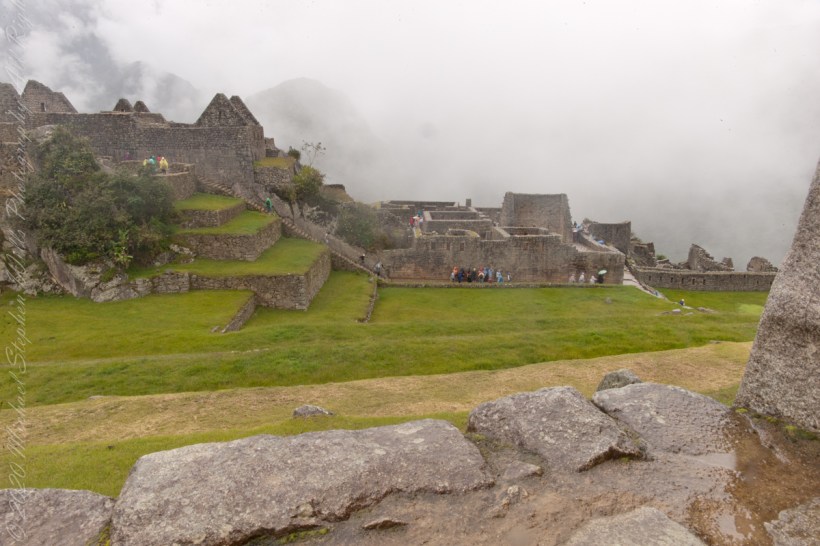
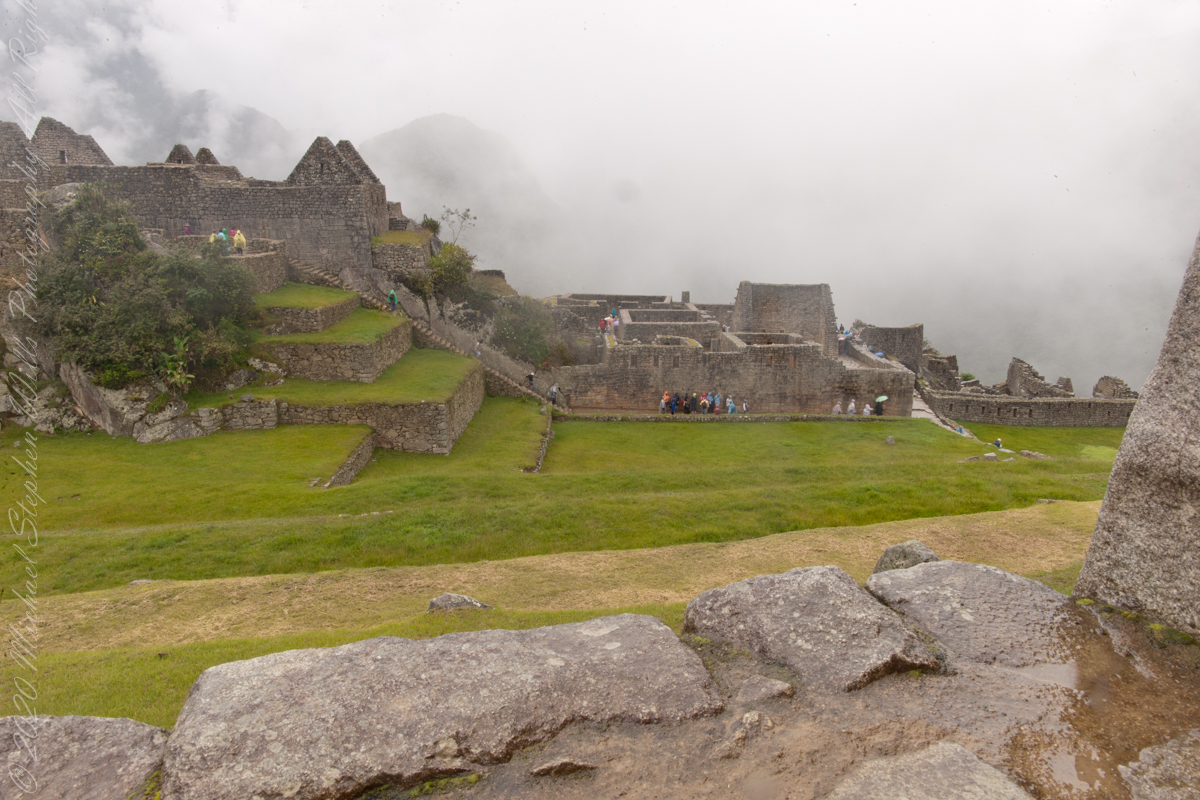
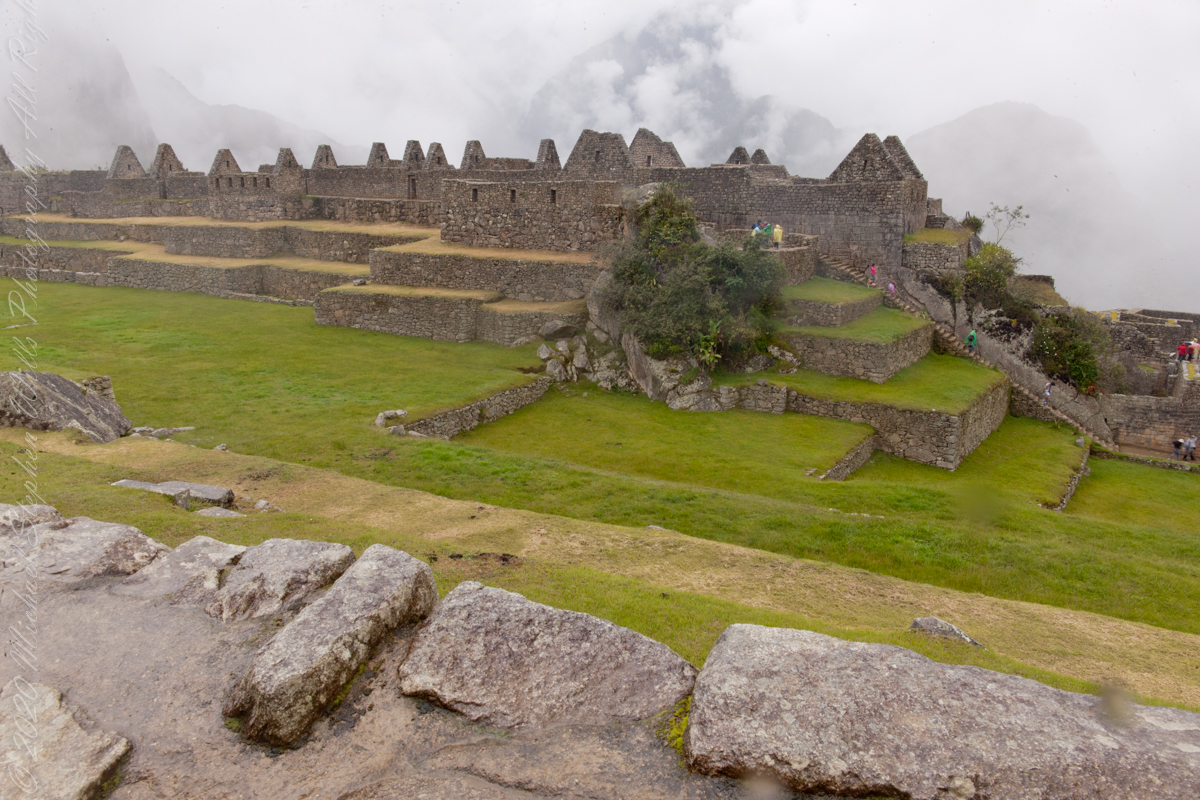
“The central buildings of the Machu Picchu Sanctuary use the classical Inca architectural style of polished dry-stone walls of regular shape. The Incas were masters of this technique, called ashlar, in which blocks of stone are cut to fit together tightly without mortar.”
The site itself may have been intentionally built on fault lines to afford better drainage and a ready supply of fractured stone. ‘Machu Picchu clearly shows us that the Incan civilization was an empire of fractured rocks’.
Inca quarried the rock for Machu Picchu from the mountain ridge itself.
“The section of the mountain where Machu Picchu was built provided various challenges that the Incas solved with local materials. One issue was the seismic activity due to two fault lines. It made mortar and similar building methods nearly useless. Instead, the Inca mined stones from the quarry at the site, lined them up and shaped them to fit together perfectly, stabilizing the structures. Inca walls have many stabilizing features: doors and windows are trapezoidal, narrowing from bottom to top; corners usually are rounded; inside corners often incline slightly into the rooms, and outside corners were often tied together by “L”-shaped blocks; walls are offset slightly from row to row rather than rising straight from bottom to top.”
Main Temple survived multiple earthquakes
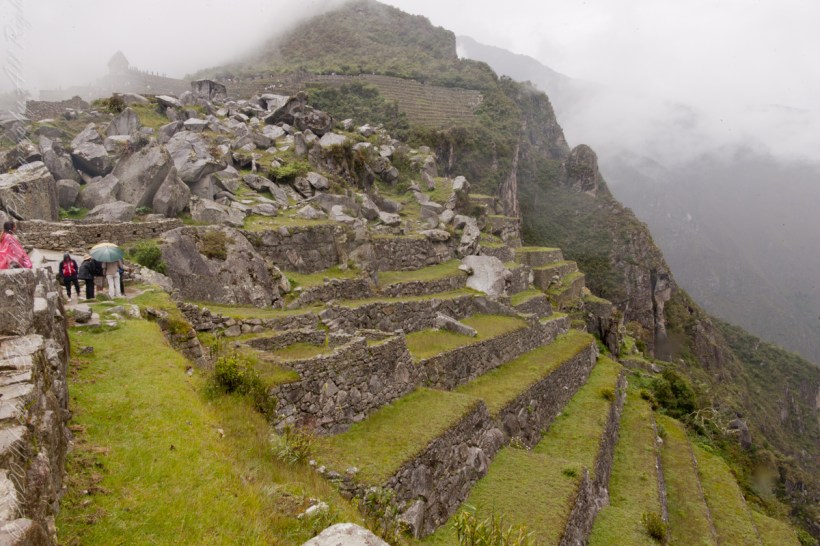
“Heavy rainfall required terraces and stone chips to drain rainwater and prevent mudslides, landslides, erosion, and flooding. Terraces were layered with stone chips, sand, dirt, and topsoil, to absorb water and prevent it from running down the mountain. Similar layering protected the large city center from flooding. Multiple canals and reserves throughout the city provided water that could be supplied to the terraces for irrigation and to prevent erosion and flooding.”
Agricultural Terraces
“The Incas never used wheels in a practical way, although their use in toys shows that they knew the principle. The use of wheels in engineering may have been limited due to the lack of strong draft animals, combined with steep terrain and dense vegetation. The approach to moving and placing the enormous stones remains uncertain, probably involving hundreds of men to push the stones up inclines. A few stones have knobs that could have been used to lever them into position; the knobs were generally sanded away, with a few overlooked.”
Reference: text in italics and quotes is from the Wikipedia “Machu Picchu”, web page.
Copyright 2023 Michael Stephen Wills All Rights Reserved
“For the Inca civilization, and especially during the time that the city of Machu Picchu was the most important place as Sanctuary of the Inca aristocratic class, the Congregation of its inhabitants in the numerous events, mostly rituals and celebrations worshipping sacred Inca gods, as it had a very important and momentous significance for the Incan society. All these celebrations ramifications in centers planned for the host to hundreds of citizens who saw the cult of their deities as well made. Also, this civilization granted a special attention details, to organization and structure of both class, of the city itself, so that the expert anthropologist community has been able to prove the existence of a straight relationship between the main square and the structuring of the Incan society.“
“Among the several locations which have shaped the division of the Citadel of Machu Picchu in their different urban areas and consequently in their different social classes, the Central Square or Main Plaza of Machu Picchu is the symbol of one of the most important for hosting the more far-reaching sacred celebrations of the Inca religion, due to its vast size are the ideal location to accommodate this type of mass religious and social ceremonies. The Central Square shows how the Incan society followed a strict, but at the same time, well-structured organization of the city in their different social classes; the anthropologist community states that this vast space was created to establish the spaces of the city limited the inhabitants depending on its status quo within Inca society.”
“After several studies by experts of the world community of anthropology, it has come to understand that the Main Plaza has played a very important role in the Inca society and the segregation of its social classes. This explains the reason for the existence of a physical axis to do distinction of several Inca social classes, which were separated one from the other not only different privileges of every social class, but also by the existence of the sub urban areas which host different individuals of the society. The main square makes this Division structural member of the urban section of the city of Machu Picchu differentiating the two sub urban sectors known as Hanan or high sector, which is home to buildings with greater religious significance for the city, and Hurin or low sector.”
“The areas around the Central Plaza of Machu Picchu are surrounded by a rocky structure that accommodates a series of terraces from where you can appreciate a great view of Huayna Picchu. Here is where is located the construction of three covers, which gives way to the Central or main square, complex of buildings typical of the Inca civilization called “kanchas”, which all have a symmetrical distribution in their facades and are in turn communicated with the other, which favored the life of society in the city to offer a space that housed both spaces end residential for labor purposes through different plugs and local. The massive yet refined architecture of Machu Picchu blends exceptionally well with the stunning natural environment, with which it is intricately linked. Numerous subsidiary centers, an extensive road and trail system, irrigation canals and agricultural terraces bear witness to longstanding, often on-going human use.”
“The rugged topography making some areas difficult to access has resulted in a mosaic of used areas and diverse natural habitats. The Eastern slopes of the tropical Andes with its enormous gradient from high altitude “Puna” grasslands and Polylepis thickets to montane cloud forests all the way down towards the tropical lowland forests are known to harbor a rich biodiversity and high endemism of global significance. Despite its small size the property contributes to conserving a very rich habitat and species diversity with remarkable endemic and relict flora and fauna.“
Reference: text in italics and quotes is from the UNESCO World Heritage and Google Earth, Machu Picchu, web pages.
Copyright 2023 Michael Stephen Wills All Rights Reserved





 Michael Stephen Wills Photography