At Cocoa Beach, sand castles succumb to time, showcasing beauty in decay, while desert monoliths endure. Both narratives reveal nature’s artistry through impermanence and transformation.
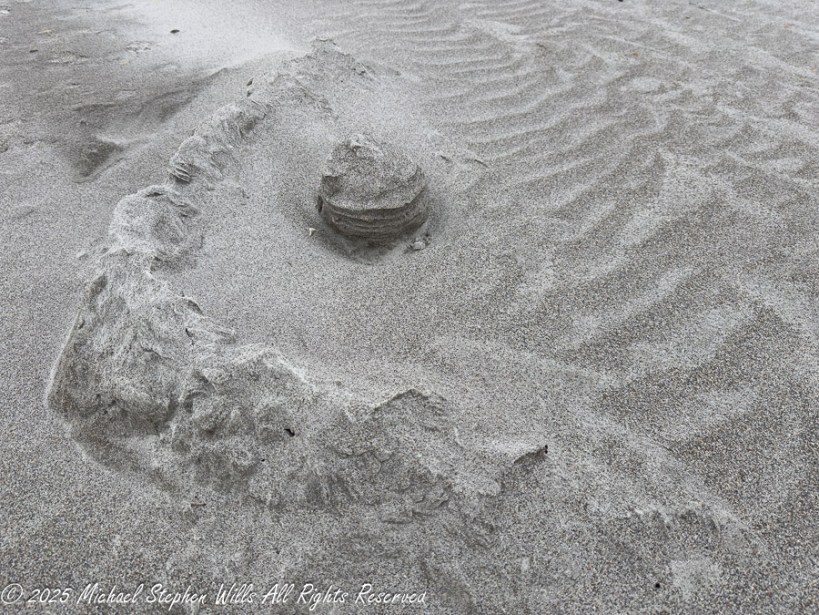
On the shores of Cocoa Beach, where the January winds dance freely, the once-proud towers of sand now stand humbled. What was sculpted by human hands—carefully packed and shaped with laughter—has become a relic of its former grandeur. The wind, with its gentle yet relentless touch, carves away at their edges, smoothing and softening their once-crisp lines. The castles, now mere echoes of their original form, hold a quiet dignity in their decay. Impermanence is their fate.
Cocoa Beach, Brevard County, Florida, Space Coast, January 2025
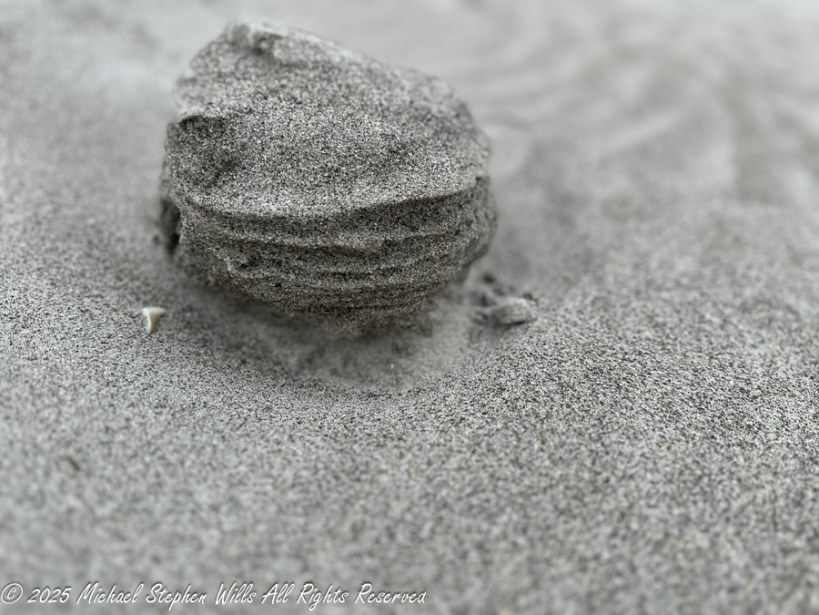
In the first photograph, the remnants of a sand fortress curve in a gentle arc, protecting a lone pillar—perhaps the last bastion of a crumbling empire. The textures of wind-blown ridges ripple across the sand like waves frozen in time, whispering of the invisible forces that shape the land. The delicate striations of the eroded peak, captured in close detail in the second image, reveal the layers of creation and destruction, each grain bearing witness to the ceaseless march of time.
Cocoa Beach, Brevard County, Florida, Space Coast, January 2025
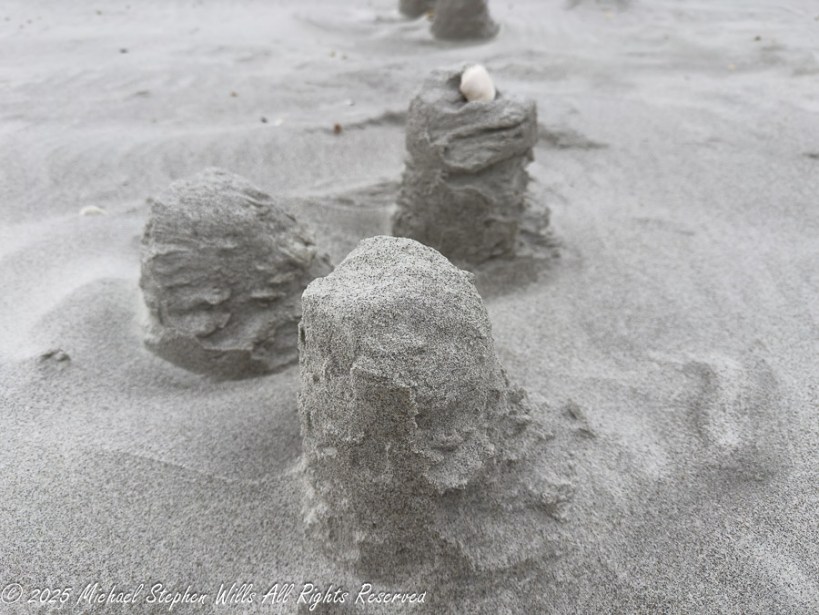
The third image brings a sense of companionship to this landscape of change. Like silent sentinels, the remaining sand pillars stand together, weathered but resolute. One wears a crown of a single shell—a reminder that even in the face of erosion, beauty persists. These fleeting structures, built in joy, now bow to nature’s artistry, embracing the inevitable with quiet grace.
Cocoa Beach, Brevard County, Florida, Space Coast, January 2025
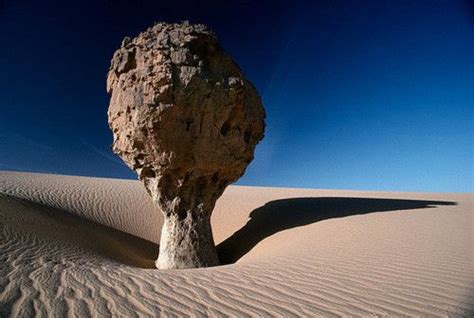
And yet, beyond the gentle shores of Cocoa Beach, in the vast and timeless expanse of the Sahara Desert, wind-carved monoliths stand as testament to the power of patience. The fourth photograph—an imposing formation shaped by millennia of desert winds—towers over the golden dunes, its shadow stretching far into the sands. Where the beach’s castles fall in a day, the desert’s sculptures endure for centuries, silent witnesses to the ebb and flow of time on a grander scale.
Wind carved geological formation, Sahara desert. Credit “scraped from the web”
But are they so different? Whether in the fleeting impermanence of Cocoa Beach or the enduring vastness of the Sahara, the hand of the wind shapes all things. Each formation tells the same story—of creation, of erosion, and of transformation. They whisper to us that beauty is not defined by permanence, but by the dance between time and the elements.
As the sun sets over the beach, casting long shadows across the sand, one cannot help but marvel at the artistry of nature. Whether lasting an afternoon or an age, the sculptures of wind and sand remind us that all things are in motion, and every grain, every ripple, every fleeting moment holds a story waiting to be told.
Enter your email to receive notification of future postings. I will not sell or share your email address.
Copyright 2025 All Rights Reserved Michael Stephen Wills
On a crisp October afternoon, October 3, 2024, Pam and I reveled in Upper Robert H. Treman State Park, a serene oasis nestled in Tompkins County. This visit was particularly special for us, a step in Pam’s recovery from her August hip replacement. I remember the sound of her hiking pole tapping the ground as we walked together, feeling grateful for her progress since surgery. The air was cool, and the leaves, turning gold and orange, whispered in the breeze, providing the perfect backdrop for our outing that day.
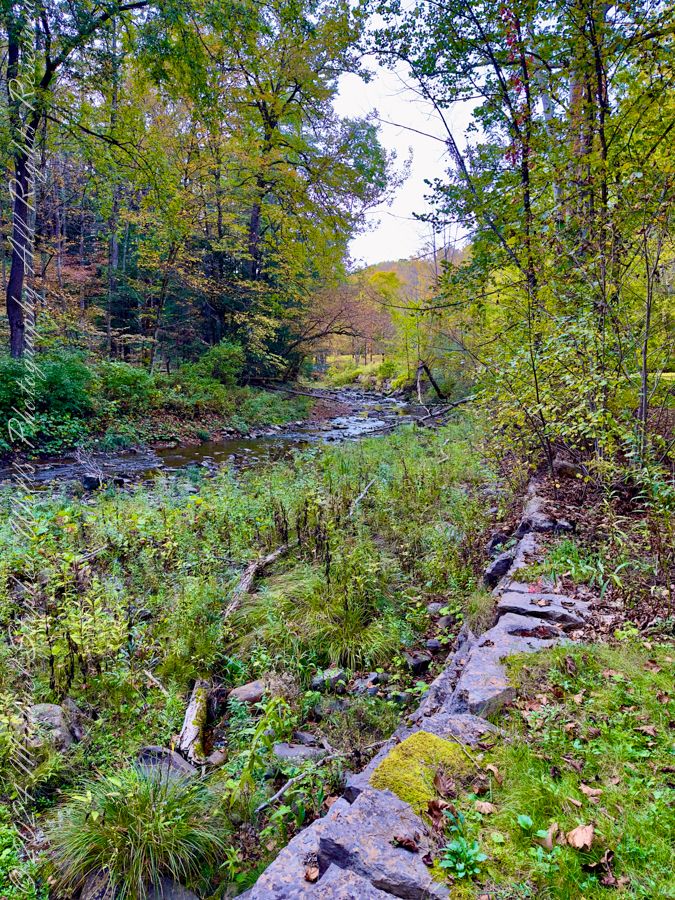
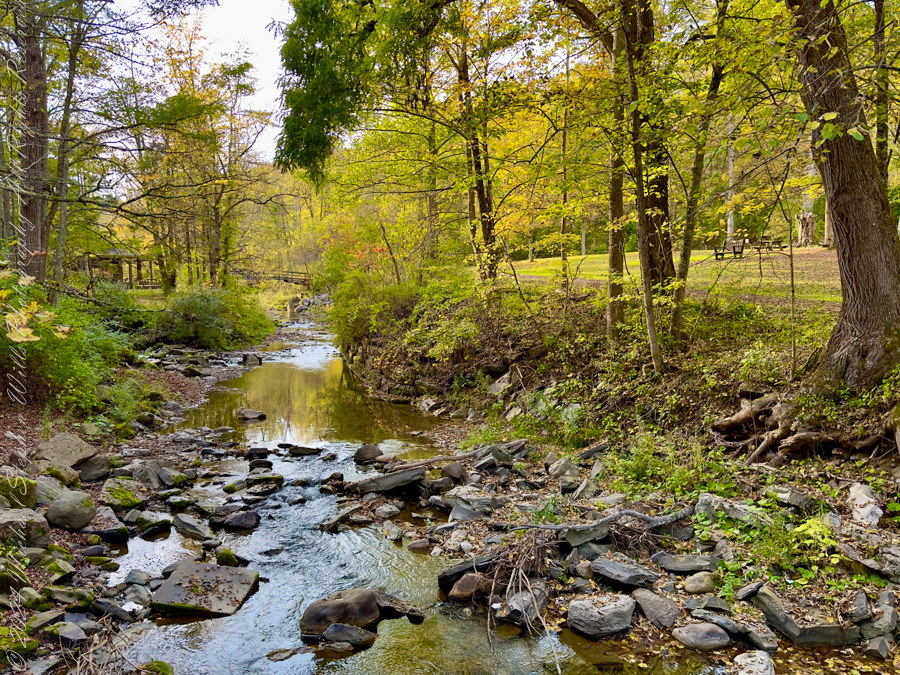
Our path followed the creek, the same creek that winds through the heart of the park, framed by layers of stone and lush vegetation. In one of the first photos I took that day, you can see the creek reflecting the soft autumn light, its bed dotted with rocks and fallen branches. The vibrant greens of the undergrowth juxtaposed with the golden leaves made the scene feel timeless, as though nature itself was participating in Pam’s recovery, offering healing in its quiet, enduring beauty.
The view upstream just before the creek enters The Gallery. Robert H. Treman State Park, Enfield, Tompkins County, Finger Lakes Region, New York State.
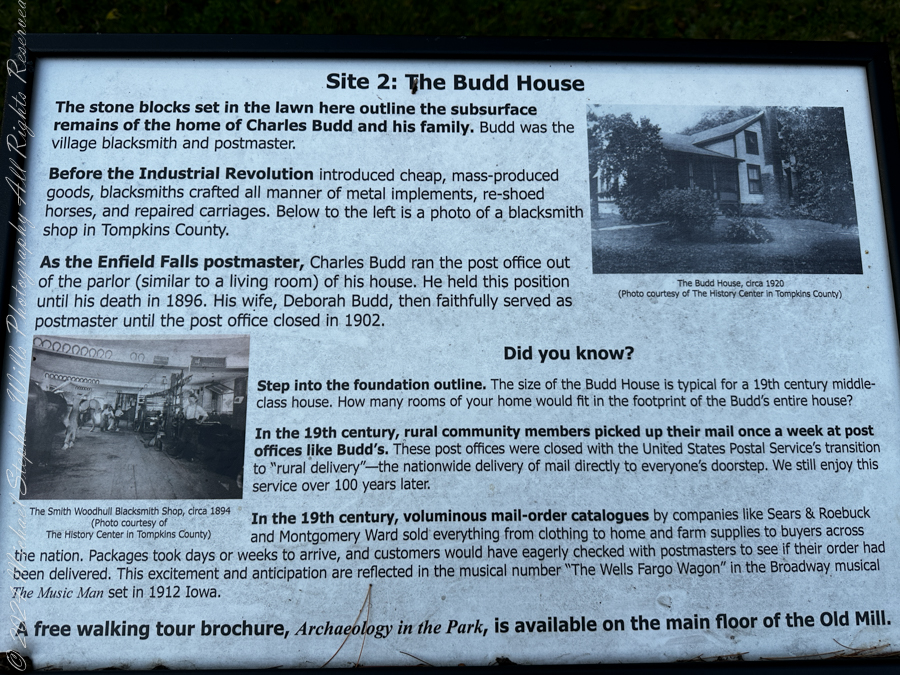
We paused to take in the quiet hum of life around us. There was a sense of history in the park that seemed to blend with our personal story. As we wandered deeper, we reached the foundation of the old Budd House, its stone blocks now barely a shadow of the past but still carrying echoes of life lived long ago. The placard described Charles Budd, a village blacksmith and postmaster, and his wife, Deborah, who continued to serve the community after his passing. Standing there, I reflected on how these stones, much like Pam’s journey, represented resilience and the passage of time.
Site 2: The Budd House
The stone blocks set in the lawn here outline the subsurface remains of the home of Charles Budd and his family. Budd was the village blacksmith and postmaster.
Before the Industrial Revolution introduced cheap, mass-produced goods, blacksmiths crafted all manner of metal implements, re-shoed horses, and repaired carriages. Below to the left is a photo of a blacksmith shop in Tompkins County.
As the Enfield Falls postmaster, Charles Budd ran the post office out of the parlor (similar to a living room) of his house. He held this position until his death in 1896. His wife, Deborah Budd, then faithfully served as postmaster until the post office closed in 1902.
Did you know?
Step into the foundation outline. The size of the Budd House is typical for a 19th century middle-class house. How many rooms of your home would fit in the footprint of the Budd’s entire house?
In the 19th century, rural community members picked up their mail once a week at post offices like Budd’s. These post offices were closed with the United States Postal Service’s transition to “rural delivery”—the nationwide delivery of mail directly to everyone’s doorstep. We still enjoy this service over 100 years later.
In the 19th century, voluminous mail-order catalogues by companies like Sears & Roebuck and Montgomery Ward sold everything from clothing to home and farm supplies to buyers across the nation. Packages took days or weeks to arrive, and customers would have eagerly checked with postmasters to see if their order had been delivered. This excitement and anticipation are reflected in the musical number “The Wells Fargo Wagon” in the Broadway musical The Music Man set in 1912 Iowa.
A free walking tour brochure, Archaeology in the Park, is available on the main floor of the Old Mill. Upper Treman. Robert H. Treman State Park, Enfield, Tompkins County, Finger Lakes Region, New York State.
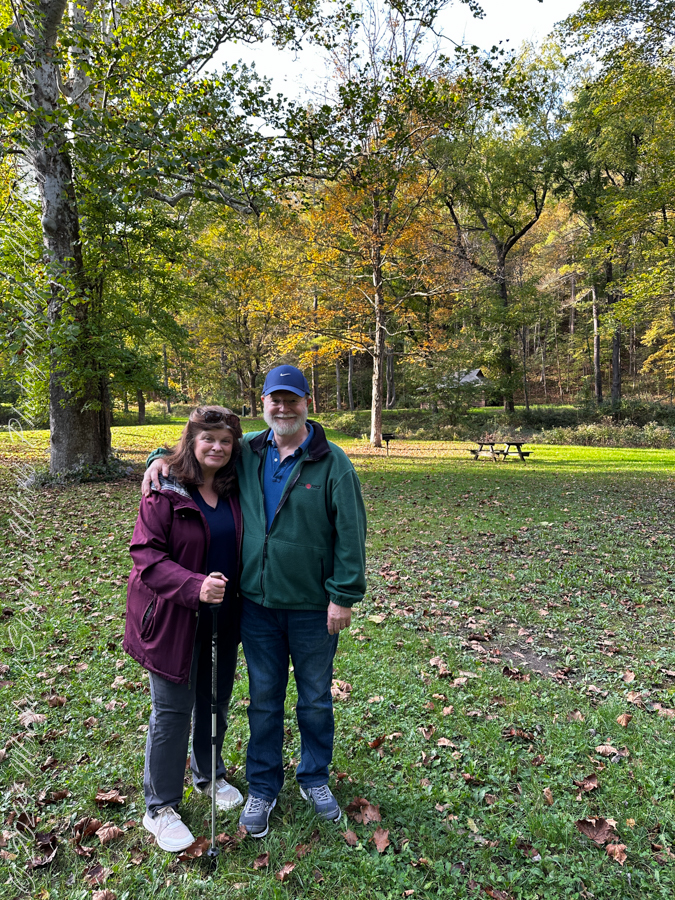
As we stood by the foundation, we met another couple. The woman shared her own story of recovery, a tale of resilience that resonated deeply with us. She had fallen and suffered a spinal injury, becoming paralyzed from the neck down, while traveling. Thanks to surgery and rehabilitation, she regained full mobility. There was a moment of understanding and connection between us. We offered to take a photo of them, and they returned the favor, capturing the two of us—Pam leaning lightly on her cane, smiling, surrounded by trees whose leaves were beginning to fall. That picture, one of my favorites from the day, symbolizes not just Pam’s strength but also the support and shared experiences that come with recovery.
We are taking a walk through upper Treman Park during Pam’s recovery from hip replacement. This was taken by a couple we met.
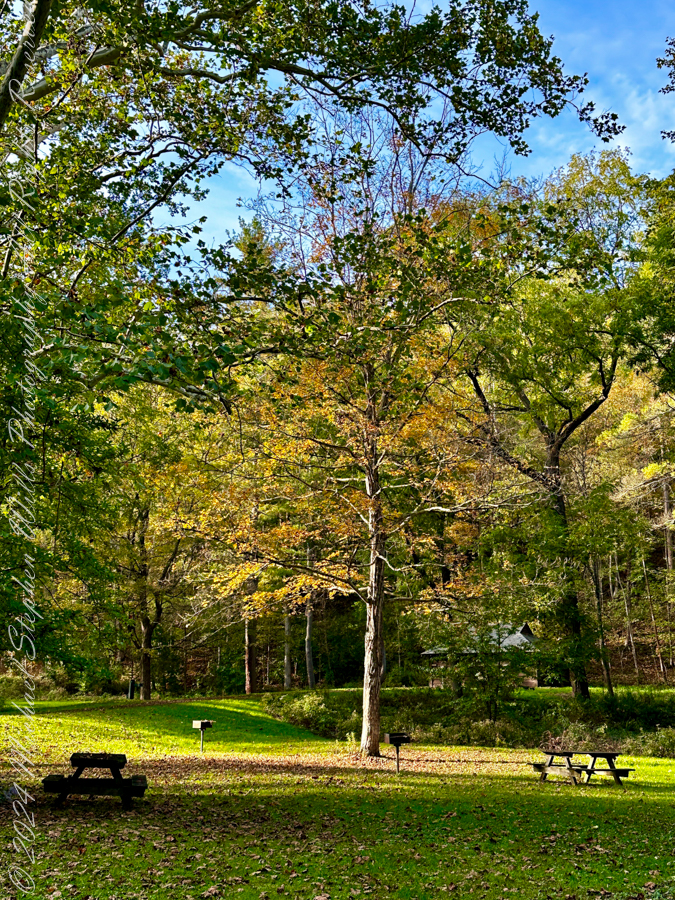
The park offered us a space for reflection and a sense of continuity. The trees, some towering over us with roots gripping the earth, had seen many seasons of change, and now they watched over us as we walked beneath them. In the clearing where picnic tables stood, we sat for a while, simply absorbing the moment. The afternoon light filtered through the branches, casting long shadows on the grass.
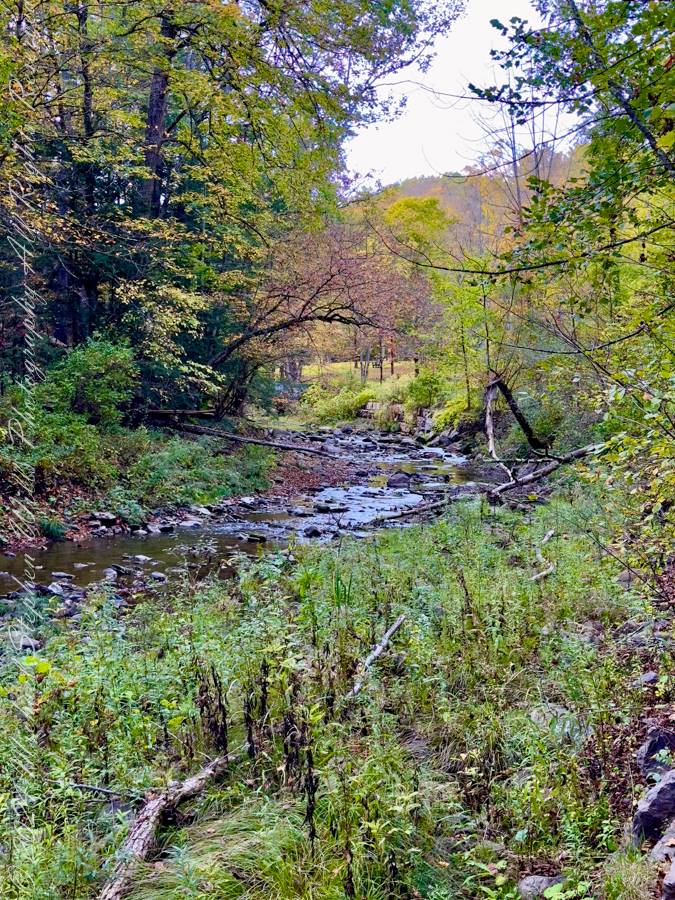
One of the final photos I took that day captures the creek from another angle. The water, calm and clear, reflects the yellow hues of the trees, while the rocks and roots along the bank seem frozen in time. It’s a peaceful image, one that reminds me of the quiet strength that Pam has shown throughout her recovery.
Here Fish Creek, a tributary of Enfield Creek joins the flow just below the pavilion of Upper Treman.
We left the park that day feeling both uplifted and grounded, the layers of history and personal resilience blending seamlessly into the natural landscape. Upper Robert H. Treman had become had become a part of Pam’s recovery story, a testament to the healing power of both nature and community.
Enter your email to receive notification of future postings. I will not sell or share your email address.
Copyright 2024 All Rights Reserved Michael Stephen Wills
Crossing the footbridge in Stewart Park, I encountered the graceful yet invasive Flowering Rush. Its delicate beauty hides a deeper story about nature’s resilience, human impact, and the fragile balance of our ecosystems.
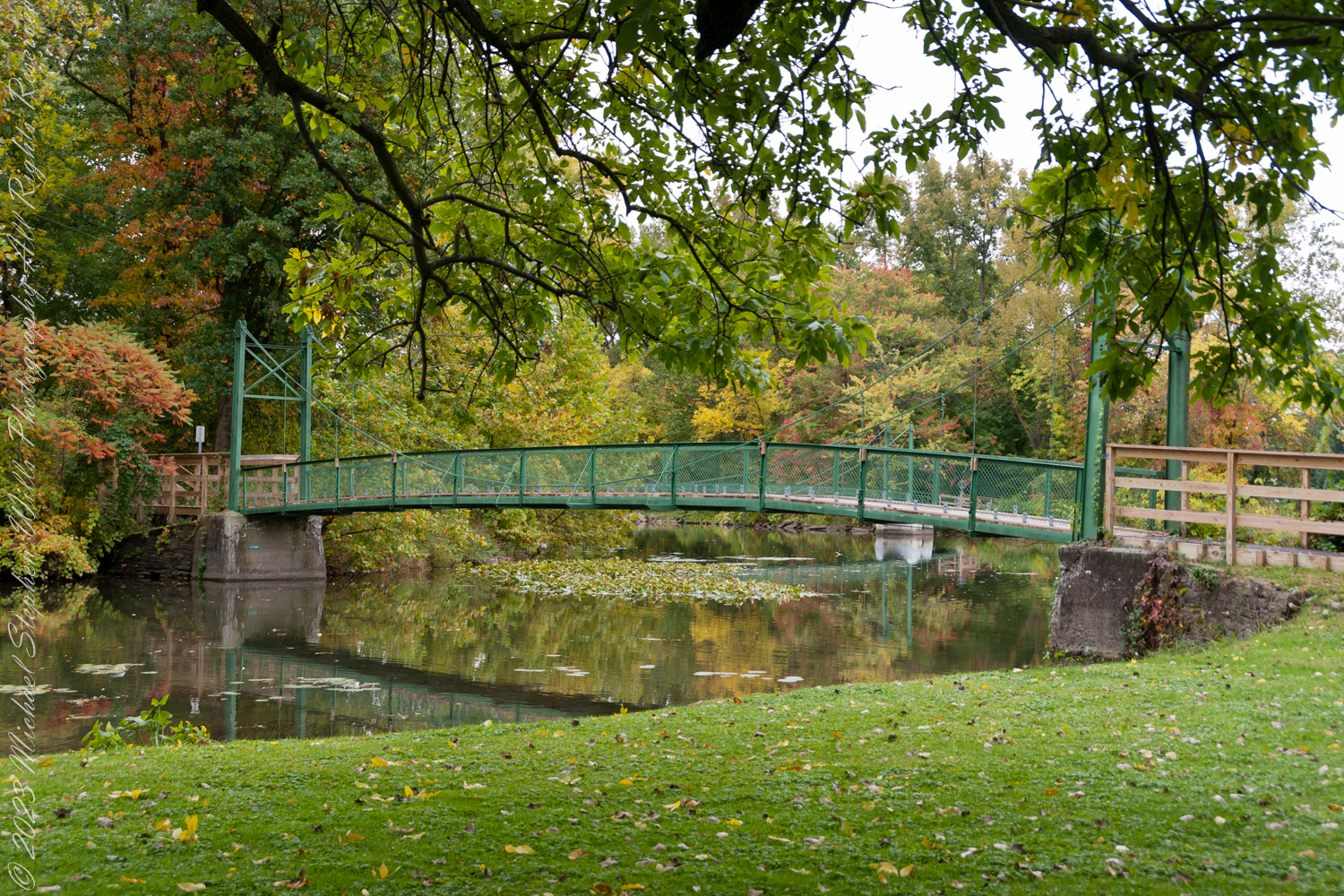
While crossing the suspension footbridge over Fall Creek in Stewart Park, there’s a sense of stepping into a world that’s more peaceful and attuned to nature. The bridge is familiar to me—a steady, quiet companion—but each visit feels new, as though the park has secrets it only reveals in small whispers. In this photograph the green steel beams rise like sentinels, standing tall against the backdrop of shifting autumn colors. Below, the water reflects the vibrant reds, golds, and greens of the trees, creating an illusion of depth that draws me in.
Footbridge to the Fuertes Bird Sanctuary, Stewart Park, Ithaca, New York, October 2012
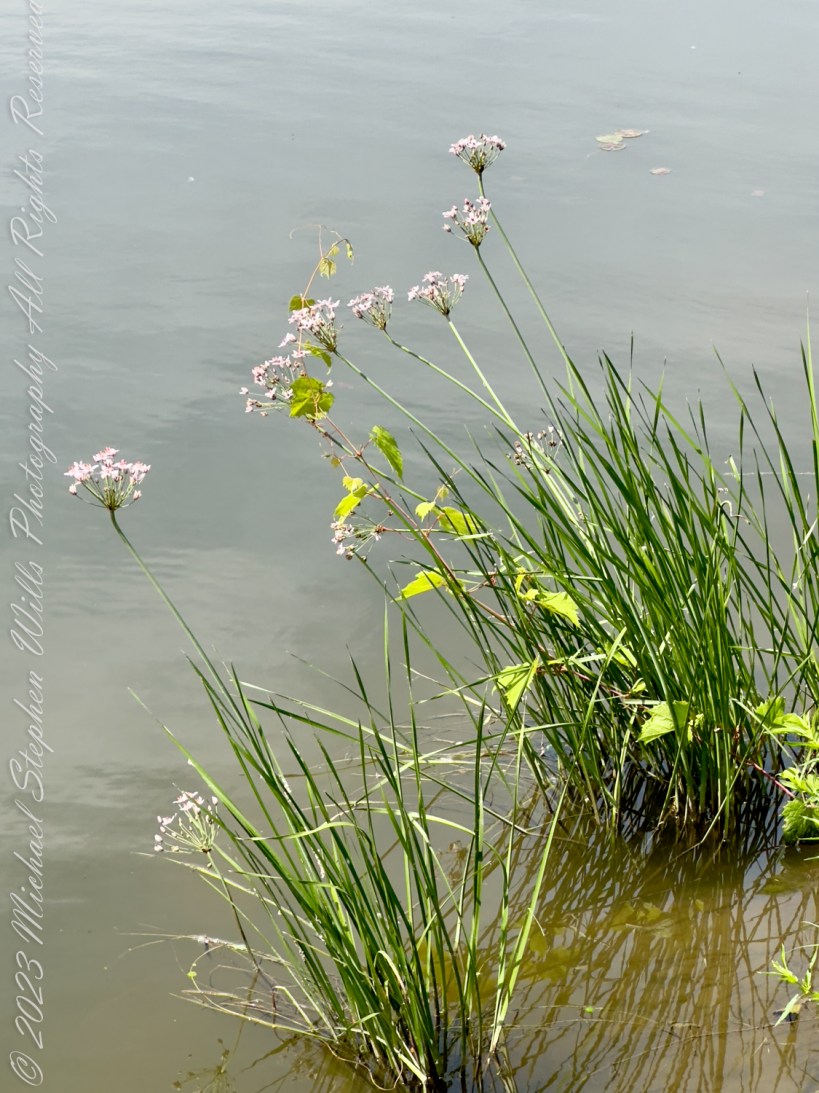
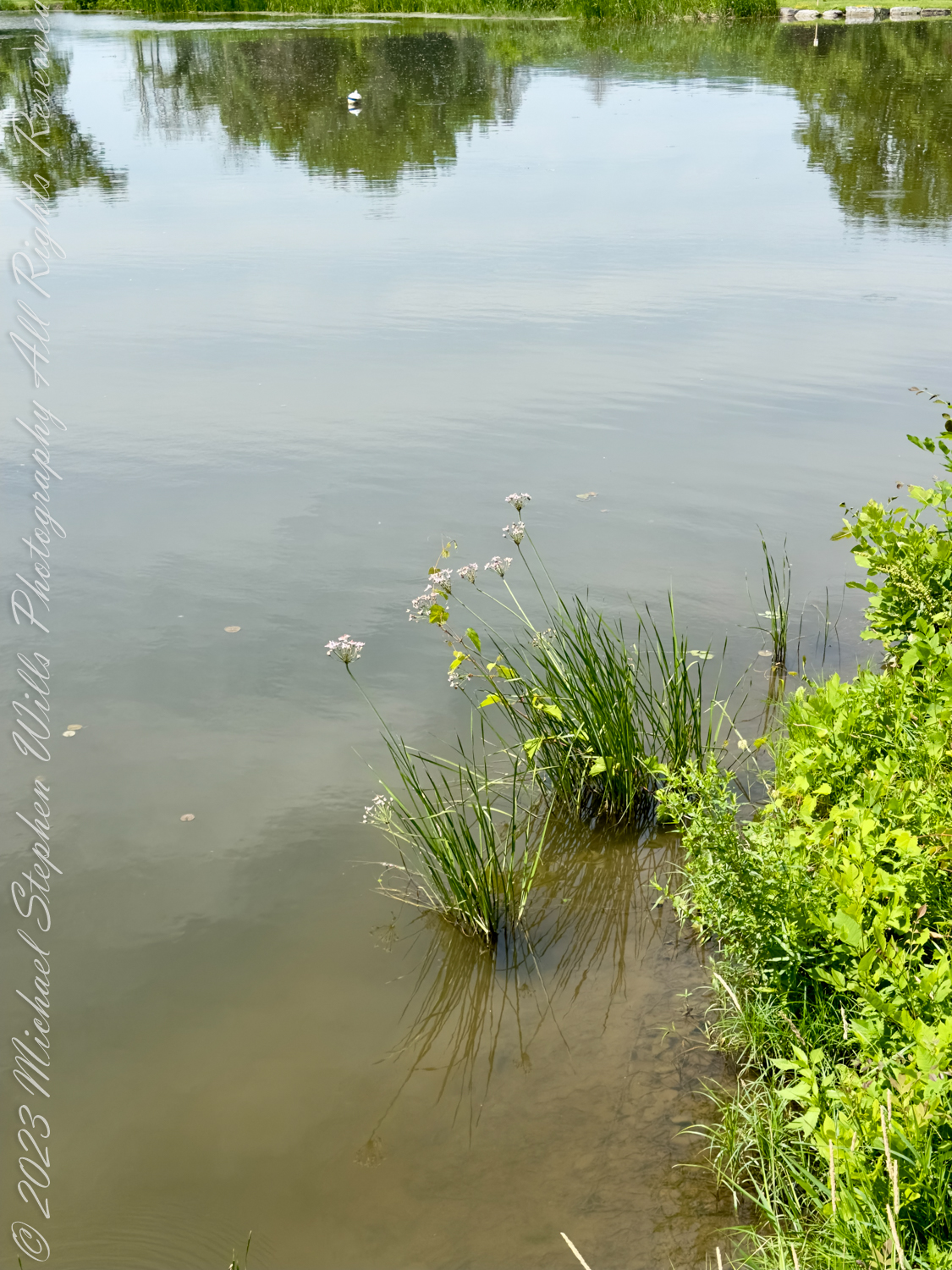
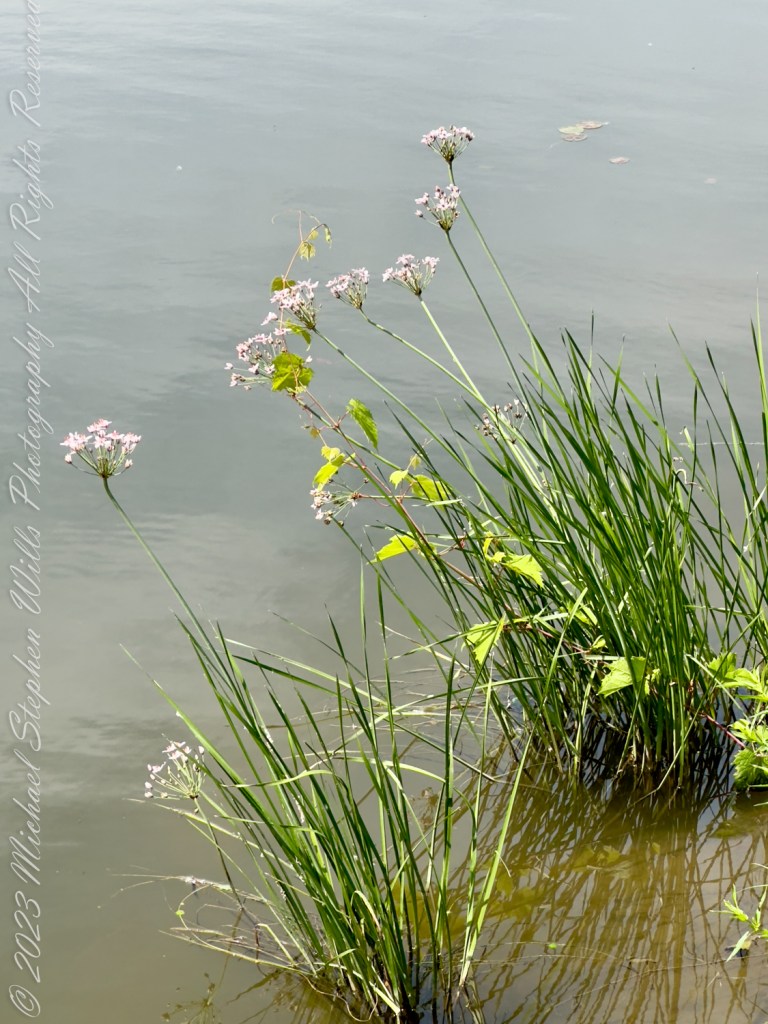
This past summer I stopped midway across, leaned against the railing, just listening. The creek moved slowly, like time itself decided to pause here for a while. That’s when I saw them: delicate pink blooms rising up from the water’s edge, their petals small and star-shaped, catching the light as they sway in the gentle breeze. There’s something striking about these plants—graceful, elegant, almost otherworldly in their simplicity. They reach up, as though trying to escape the confines of the water and the muddy banks.
My subsequent research revealed these to be Flowering Rush, or Butomus umbellatus. I often see them now, their soft pinks and slender leaves creating a quiet beauty that’s hard to ignore. They’re beautiful, but I have come to know they don’t belong here. This is one of those moments in nature that gives me pause—a reminder that not everything lovely is innocent.
Flowering Rush Growing in Fall Creek, Stewart Park, June 2024
Flowering Rush, a European import from centuries ago, was not meant to take root here. Brought to North America for ornamental ponds, its allure quickly became its danger. It spread, silently, like a secret carried on the wind, slowly overtaking the native species that have long called these waters home. And yet, standing here now, I cannot help but admire its tenacity, its quiet determination to thrive. Nature, in all its forms, has this incredible will to survive, even if that survival sometimes comes at a cost.
My mind drifts to the plant’s history. In its native lands Flowering Rush, or Grass Rush, was useful—its roots, though bitter, were harvested for food, and its fibrous stems woven into mats and ropes. How interesting that something as delicate as this has a rugged, practical side. This contradiction makes perfect sense when I think of the plant’s journey across continents, carried over oceans by human hands and curiosity. We are responsible for its presence here, and now, like so many other invasive species, it’s become a fixture of this landscape.
I think about the dual nature of this invasion. Flowering Rush is beautiful—there is no denying that. Its soft, pink flowers contrast sharply with the darker tones of the water and the dense green of the grasses that surround it. But its beauty masks a quiet destruction. It chokes out the native plants that once thrived here, altering the ecosystem in ways we cannot always see. I wonder what fish and aquatic life struggles beneath the surface, their food sources slowly disappearing. What birds find fewer insects and fewer safe places to nest?
And yet, is this plant a villain? Flowering rush is doing what it was meant to do—grow, spread, survive. That is what everything in nature does, after all. It does not have malice or intent; it just is. It is humans who have changed the balance, who introduced this species to a place where it didn’t belong, setting off a chain reaction we’re still trying to fully understand.
Today, as I walk across the bridge, heading toward the Fuertes Bird Sanctuary, path ahead invites quiet reflection, the chirping of birds and the rustle of leaves providing a peaceful soundtrack. But the Flowering Rush lingers in my mind. It reminds me of how interconnected everything is, how one small action—a plant brought from a distant land—can ripple out and affect entire ecosystems. It’s a lesson in responsibility for those willing to listen.
As I step into the sanctuary, the air feels lighter, filled with the sound of birds that dart between the trees. I think of the delicate balance of life here, and how easily it can be disrupted by the presence of something foreign, something invasive. Yet, there is a strange comfort in knowing that nature, for all its fragility, has its own resilience.
The Flowering Rush, with its roots deep in the muddy banks of Fall Creek, is a testament to that resilience. It may not belong here, but it has found a way to adapt, to make this place its home. And in that, I find both a warning and a kind of hope—hope that we, too, can learn to live more thoughtfully, more in tune with the world around us, before we upset the balance any further.
For now, though, I simply walk, grateful for the beauty around me, even if it comes with complications. Each step takes me deeper into this world, and I am reminded once again of the profound connection we have to the land, the water, the plants, and the creatures that share this space.
Copyright 2024 Michael Stephen Wills All Rights Reserved
To receive email notification of new blog posts enter your email and click the subscribe button.
Discover the enchanting hawkweed along Buttermilk Creek’s path. Explore its vibrant yellow blooms, unique reproduction, and rich folklore in our latest nature essay. Dive into the captivating world of this resilient wildflower!
Walking along the path that climbs from the lower park into the gorge of Buttermilk Creek, I am drawn to the vibrant splash of yellow that punctuates the verdant green and shale, limestone of the path. Here I encounter the humble yet striking hawkweed (Hieracium spp.). These yellow flowers, seemingly modest in their simplicity, invite me into a deeper contemplation of nature’s intricacies.
A Closer Look
The hawkweed’s leaves form a basal rosette, their slightly toothed edges and hairy surface distinguishing them from other woodland plants. The leaves are a deep green, the tiny hairs catching the sunlight, giving them a silvery sheen. From this rosette emerges an erect stem, slender and bristling with fine hairs, reaching upwards to support the flower heads. The stems stand tall, bearing clusters of small, dandelion-like flowers that open into a cheerful yellow bloom.
These Hawkweed grow profusely along the climb along Buttermilk Creek and into the gorge. Buttermilk Falls Park, Ithaca, Tompkins County, New York State. Finger Lakes Region
Each flower head consists of numerous tiny florets, collectively forming a radiant disc. The petals are intricately fringed, almost feathery, a delicate contrast to the sturdy stem that holds them aloft. This contrast is a reminder of the balance in nature—strength and fragility coexisting in harmony.
Relationship and Reproduction
Hawkweeds belong to the Asteraceae family, sharing familial ties with daisies and dandelions. Despite their visual similarity to dandelions, hawkweeds possess unique reproductive strategies. They are known for their ability to reproduce asexually through a process called apomixis. This means that the seeds produced by hawkweed are genetically identical to the parent plant. In a grouping of hawkweeds, what appears to be a diverse collection of individuals may, in fact, be clones of a single genetic ancestor.
This method of reproduction ensures the rapid spread and establishment of hawkweed populations, a survival strategy that has both fascinated and frustrated botanists and gardeners alike. While this cloning capability allows hawkweeds to thrive in various environments, it also poses a challenge for those trying to control their spread.
Etymology and Origins
The genus name “Hieracium” is derived from the Greek word “hierax,” meaning hawk. According to ancient lore, hawks were believed to consume the sap of this plant to sharpen their vision. This mythological connection to hawks underscores the plant’s perceived potency and its storied place in folklore.
Hawkweed is not native to the Finger Lakes region but was introduced from Europe. Despite its non-native status, it has adapted well to the local environment, often found in meadows, along roadsides, and within open woodlands. Its ability to colonize disturbed areas has enabled it to become a common sight across the landscape.
Historical Uses and Lore
Throughout history, hawkweed has been used for various medicinal purposes. Traditional herbalists valued it for its purported benefits in treating respiratory ailments, digestive issues, and skin conditions. The plant was often brewed into teas or concoctions believed to have diuretic and astringent properties. Some cultures also used hawkweed as a charm against evil spirits, further embedding it in the tapestry of folklore and superstition.
In medieval times, hawkweed was sometimes used in love potions and to enhance psychic abilities. Its association with hawks and keen vision lent itself to these mystical uses, as people sought to harness the plant’s reputed powers for their own needs.
A Contemplative Pause
As I stand on the path, surrounded by the quiet beauty of Buttermilk Creek, I reflect on the hawkweed before me. This unassuming plant, with its bright flowers and tenacious growth, embodies resilience and adaptability. It thrives in the cracks and crevices of the rocky soil, a testament to nature’s relentless drive to flourish even in the most challenging conditions.
The hawkweed’s ability to clone itself, creating vast networks of genetically identical plants, speaks to the interconnectedness of life. Each plant is a reflection of its predecessors, a living link in the chain of existence. This genetic continuity is a reminder of the ways in which life persists and propagates, ensuring survival through the ages.
I found this growing along the South Rim Trail of Taughannock Falls Park during a Fathers Day Walk, June 16, 2024.Picris hieracioides, or hawkweed oxtongue, is a species of flowering plant in the family Asteraceae. Invasive Species
Hawkweed Oxtongue is considered an invasive species in North America because it has the ability to outcompete native plants, reduce biodiversity, and alter ecosystems. The plant spreads rapidly and can form dense monocultures, making it difficult for other plants to grow. Additionally, Hawkweed Oxtongue produces a chemical that inhibits the growth of other plants, further contributing to its invasive nature.
Control and Management
The control and management of Hawkweed Oxtongue can be challenging. The plant has a deep taproot that makes it difficult to remove by hand, and it can regrow from small root fragments left in the soil. Herbicides can be effective in controlling the plant, but they can also harm other plants in the area. The best approach to managing Hawkweed Oxtongue is to prevent its spread by avoiding the movement of soil or plant material that may contain seeds or root fragments.
Uses
Despite its invasive nature, Hawkweed Oxtongue has some traditional medicinal uses. The plant contains compounds that have been used to treat digestive problems, skin conditions, and respiratory issues. However, the use of this plant for medicinal purposes is not recommended due to the potential for toxicity.
In conclusion, Hawkweed Oxtongue is an invasive species that has the potential to cause significant ecological damage. It is important to prevent the spread of this plant and to take measures to control its growth where it has already become established. While it has some traditional medicinal uses, the potential for toxicity means that it should not be used for this purpose. Text taken from http://www.wildflowerweb.co.uk/plant/2453/hawkweed-oxtongue
In the stillness of the gorge, I find a sense of peace and connection. The hawkweed, with its storied past and practical resilience, offers a lesson in simplicity and strength. It reminds me that beauty often lies in the small, overlooked details of the natural world, and that every plant, every flower, has a story worth discovering.
As I continue my journey along Buttermilk Creek, the hawkweed’s bright blooms remain a vivid memory, a symbol of the enduring spirit of nature.
Copyright 2024 Michael Stephen Wills All Rights Reserved


 Michael Stephen Wills Photography