On Being Thankful

A garden, migrating geese, an unexpected balloon and flowers opening after dark remind me that gratitude begins by noticing the extraordinary within ordinary life.

There are times when gratitude arrives not as a grand revelation but quietly, almost unnoticed. It can begin by looking out a window, walking through a garden, hearing the calls of birds overhead, or watching something unexpected drift across an otherwise familiar sky. My video is made of such moments. It is a collection of things close at hand, yet when gathered together and accompanied by music, they become something more: a reminder of how extraordinarily rich an ordinary life can be.

I have much to be thankful for.

I am thankful, first, for home, a place on Earth intimately known to me. The opening views of the garden convey that sense wonderfully. There are great white clusters of hydrangea against deep green foliage, scattered pink blossoms, lawn, trees and the familiar boundaries of a yard. None of it is monumental. That is exactly the point. These are not the Alps or some distant wilderness. They are the landscape of everyday life, made beautiful by familiarity, care and the changing seasons.

A garden teaches gratitude because nothing in it remains still. Flowers arrive, flourish and disappear. Leaves that emerge with the almost translucent green of spring deepen through summer and eventually blaze red before falling. Brilliant red foliage is particularly striking, it carries within it both beauty and departure. Autumn diminishes and completes summer.

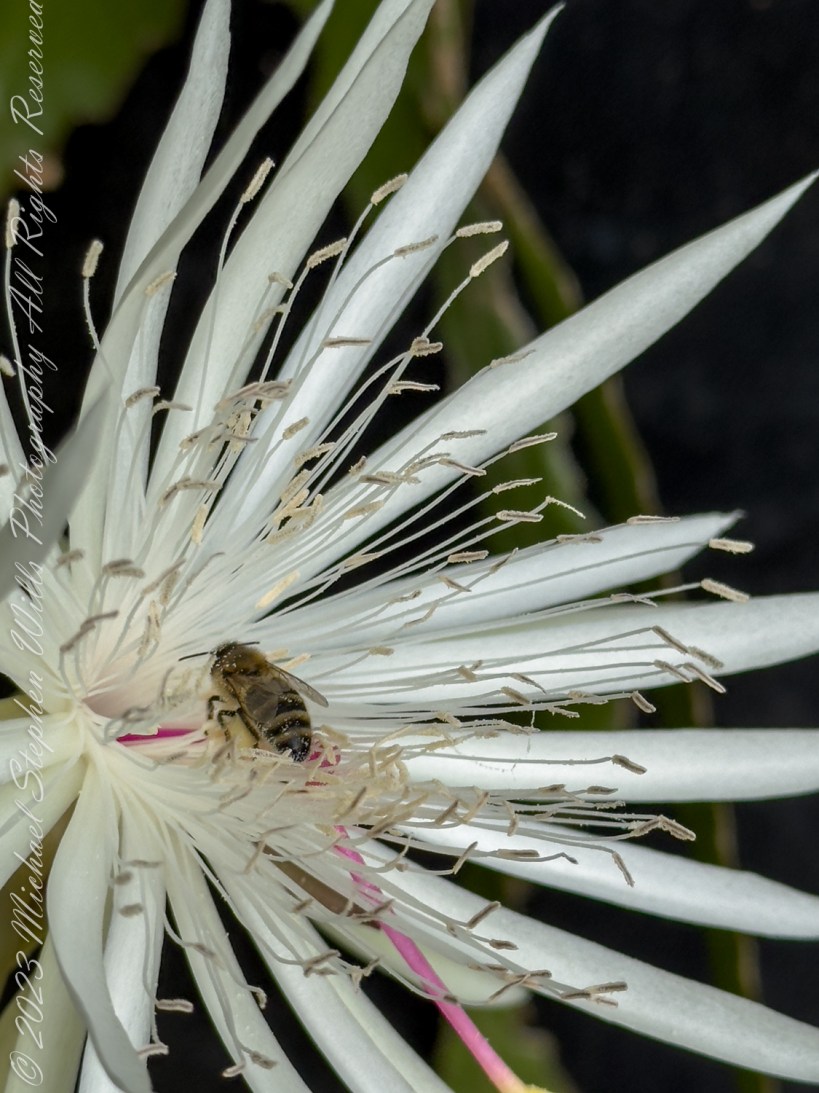
And then there are those remarkable white flowers opening in darkness—the extravagant, almost otherworldly blossoms of the night-blooming cactus. They seem fashioned from moonlight: long, narrow petals radiating from their centers, magnificent for such a brief interval. Their fleeting existence makes them more precious. To witness one requires being present at the right moment.

Perhaps that is true of much of life.

I am thankful that I have retained the impulse to notice.

There is a considerable difference between seeing something and noticing it. The world is filled with people who look at flowers, birds and skies every day without really seeing them. Curiosity changes that. It makes a flock of geese more than birds crossing the sky. they form their wavering lines beneath pale blue heavens shared with our moon. They are travelers following routes far older than our roads, houses or cities. Their passage reminds me that my home is part of a much larger landscape and that the seasons unfolding in my yard belong to rhythms extending across a continent.

I am thankful for the ability to look upward.

The balloon drifting above the neighborhood makes that thought almost literal. Suddenly an ordinary sky contains a great yellow, red and blue vessel, sometimes distant among the trees, sometimes passing wonderfully close overhead. We see the basket beneath it and the people aboard—human beings temporarily liberated from the ground, carried through the same air in which the geese travel.

There is something optimistic about a hot-air balloon. It accomplishes wonderfully nothing particularly urgent. It rises because people still want to know what the world looks like from somewhere else. Its presence in the video celebrates imagination, adventure and the persistence of wonder.

Yet gratitude also grows downward, into the earth.

The images of lush plants growing in raised beds and then harvested in abundance speak of another kind of wealth. Food does not simply appear. A seed becomes roots and leaves; sunlight is captured; water rises through stems; soil gives up minerals; human hands tend what is growing. Eventually the garden gives something back. To harvest food from plants one has watched develop is to participate, however modestly, in one of humanity’s oldest relationships with the living world.

I am thankful for that abundance—not abundance measured by possessions, but by experiences.

The sculpture of the young boy and girl quietly sharing a book adds a different note. Amid flowers, birds, harvests and skies is an image of companionship. Two figures sit close together, absorbed in the same story. It suggests affection, learning, intimacy and the pleasure of sharing something with another person. A life becomes immeasurably richer when its experiences are not ours alone.

That may be the deepest source of gratitude: the people with whom life has been shared. Family and friends give meaning to places and memories. A garden is more than plants when someone has walked through it with us. A meal is more than food when others sit at the table. A photograph becomes more valuable when it preserves something we want another person—or another generation—to see.

The music running through the video strengthens this sense of reflection. It does not demand attention so much as give the images emotional space. As the photographs succeed one another, the music turns observation into remembrance. The effect is almost like leafing through an album while realizing that the apparently unrelated pictures are chapters of the same story.

And perhaps that is why I find the video inspirational.

None of its subjects needs to be spectacular to matter. A flower opens. Geese cross the sky. Vegetables grow. Leaves turn red. Two children read together. A balloon unexpectedly floats over the neighborhood. Hydrangeas bloom beside a fence.

Meanwhile, time passes.

That last fact could make these images melancholy, but I do not think it does. Their transience is precisely what gives them value. Gratitude does not require pretending that beautiful things last forever. It comes from understanding that they do not—and loving them anyway.

I am thankful for the years behind me: for places visited, things learned, people loved, photographs made and memories accumulated. But I am equally thankful that the world still contains things capable of surprising me. There are still flowers I want to examine more closely, birds whose journeys I want to understand, stars I want to find through a telescope, landscapes I want to photograph, stories I want to tell, and mornings when I do not yet know what will appear outside my window.

That may be one of life’s greatest gifts: there is still something to look forward to.

The world does not owe us another summer, another migration overhead, another flower opening after dark, or another unexpected balloon sailing across a blue September sky. When such moments come, the proper response is not merely to record them.

It is to recognize them.

And to be thankful.
Click me to visit Michael Stephen Wills Online Finger Lakes Gallery.

Enter your email to receive notification of future postings. I will not sell or share your email address.

Nature’s Role in Recovery: October at Treman Park

Pam’s recovery from hip replacement unfolds in Upper Robert H. Treman State Park, intertwining personal resilience with nature’s healing beauty.

On a crisp October afternoon, October 3, 2024, Pam and I reveled in Upper Robert H. Treman State Park, a serene oasis nestled in Tompkins County. This visit was particularly special for us, a step in Pam’s recovery from her August hip replacement. I remember the sound of her hiking pole tapping the ground as we walked together, feeling grateful for her progress since surgery. The air was cool, and the leaves, turning gold and orange, whispered in the breeze, providing the perfect backdrop for our outing that day.

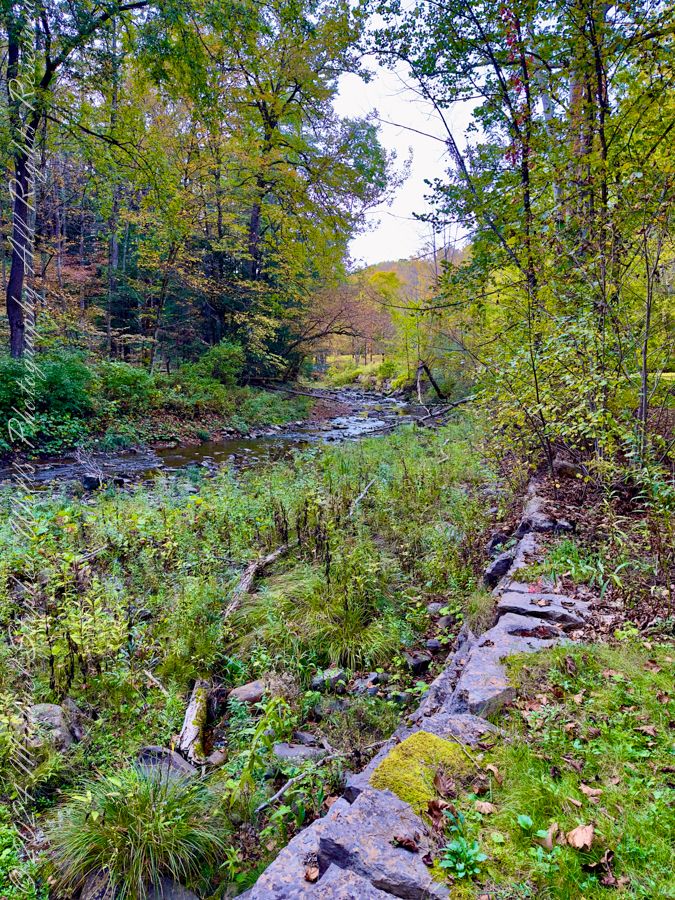
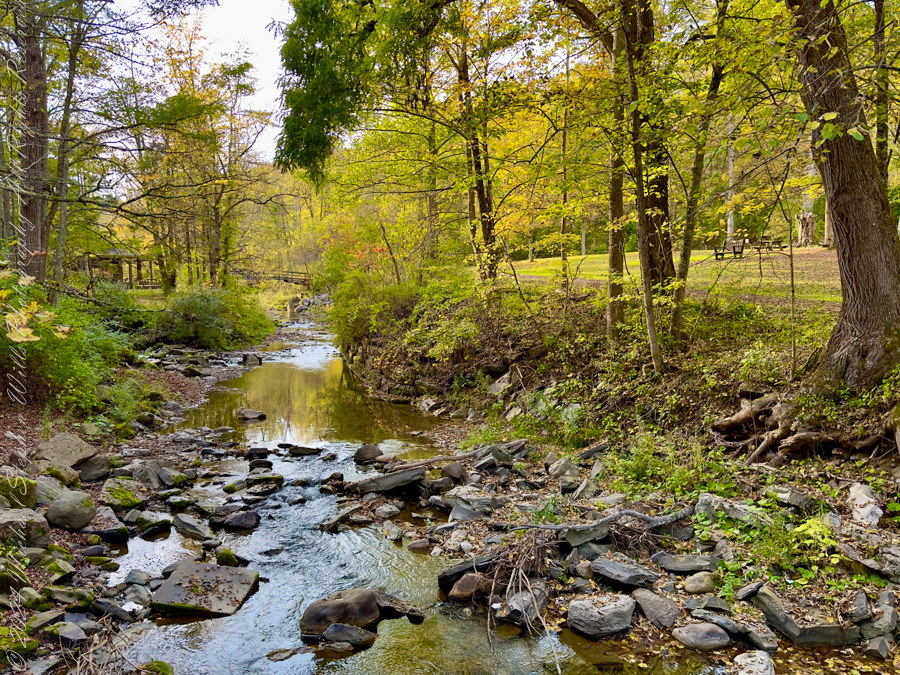
Our path followed the creek, the same creek that winds through the heart of the park, framed by layers of stone and lush vegetation. In one of the first photos I took that day, you can see the creek reflecting the soft autumn light, its bed dotted with rocks and fallen branches. The vibrant greens of the undergrowth juxtaposed with the golden leaves made the scene feel timeless, as though nature itself was participating in Pam’s recovery, offering healing in its quiet, enduring beauty.

The view upstream just before the creek enters The Gallery. Robert H. Treman State Park, Enfield, Tompkins County, Finger Lakes Region, New York State.

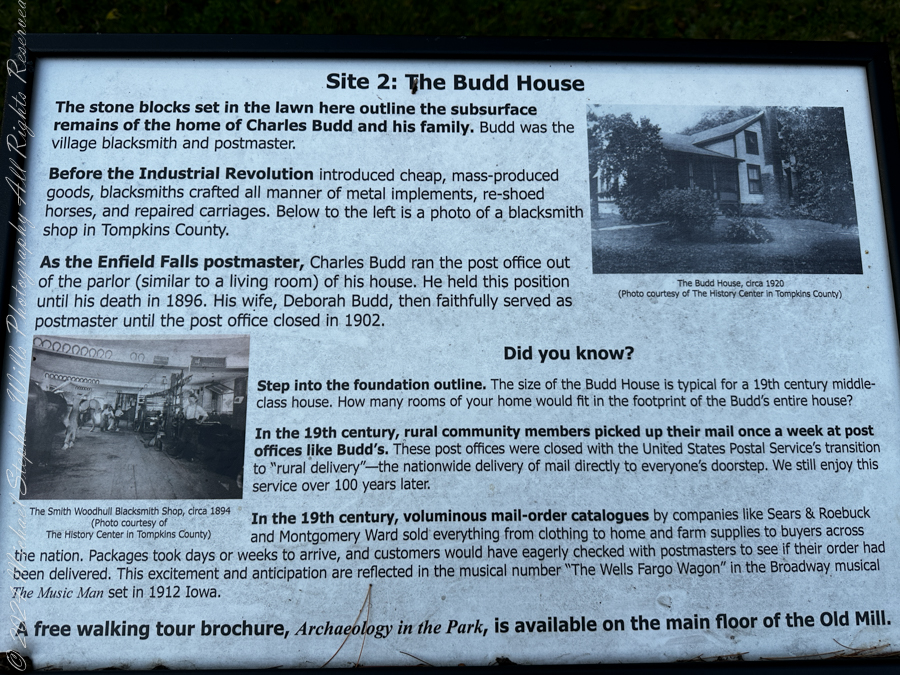
We paused to take in the quiet hum of life around us. There was a sense of history in the park that seemed to blend with our personal story. As we wandered deeper, we reached the foundation of the old Budd House, its stone blocks now barely a shadow of the past but still carrying echoes of life lived long ago. The placard described Charles Budd, a village blacksmith and postmaster, and his wife, Deborah, who continued to serve the community after his passing. Standing there, I reflected on how these stones, much like Pam’s journey, represented resilience and the passage of time.

Site 2: The Budd House The stone blocks set in the lawn here outline the subsurface remains of the home of Charles Budd and his family. Budd was the village blacksmith and postmaster. Before the Industrial Revolution introduced cheap, mass-produced goods, blacksmiths crafted all manner of metal implements, re-shoed horses, and repaired carriages. Below to the left is a photo of a blacksmith shop in Tompkins County. As the Enfield Falls postmaster, Charles Budd ran the post office out of the parlor (similar to a living room) of his house. He held this position until his death in 1896. His wife, Deborah Budd, then faithfully served as postmaster until the post office closed in 1902. Did you know? Step into the foundation outline. The size of the Budd House is typical for a 19th century middle-class house. How many rooms of your home would fit in the footprint of the Budd’s entire house? In the 19th century, rural community members picked up their mail once a week at post offices like Budd’s. These post offices were closed with the United States Postal Service’s transition to “rural delivery”—the nationwide delivery of mail directly to everyone’s doorstep. We still enjoy this service over 100 years later. In the 19th century, voluminous mail-order catalogues by companies like Sears & Roebuck and Montgomery Ward sold everything from clothing to home and farm supplies to buyers across the nation. Packages took days or weeks to arrive, and customers would have eagerly checked with postmasters to see if their order had been delivered. This excitement and anticipation are reflected in the musical number “The Wells Fargo Wagon” in the Broadway musical The Music Man set in 1912 Iowa. A free walking tour brochure, Archaeology in the Park, is available on the main floor of the Old Mill. Upper Treman. Robert H. Treman State Park, Enfield, Tompkins County, Finger Lakes Region, New York State.

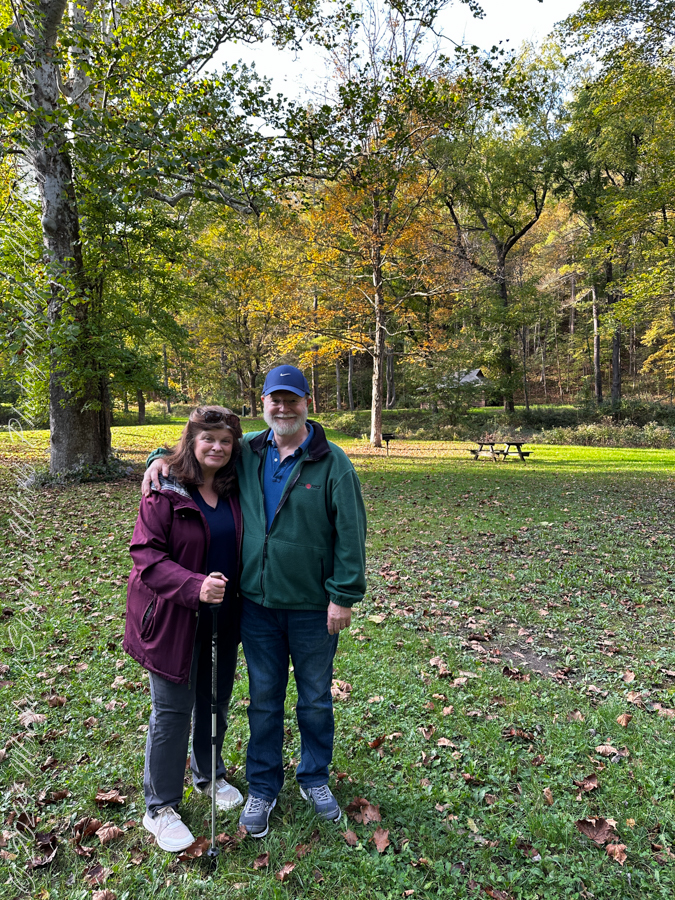
As we stood by the foundation, we met another couple. The woman shared her own story of recovery, a tale of resilience that resonated deeply with us. She had fallen and suffered a spinal injury, becoming paralyzed from the neck down, while traveling. Thanks to surgery and rehabilitation, she regained full mobility. There was a moment of understanding and connection between us. We offered to take a photo of them, and they returned the favor, capturing the two of us—Pam leaning lightly on her cane, smiling, surrounded by trees whose leaves were beginning to fall. That picture, one of my favorites from the day, symbolizes not just Pam’s strength but also the support and shared experiences that come with recovery.

We are taking a walk through upper Treman Park during Pam’s recovery from hip replacement. This was taken by a couple we met.

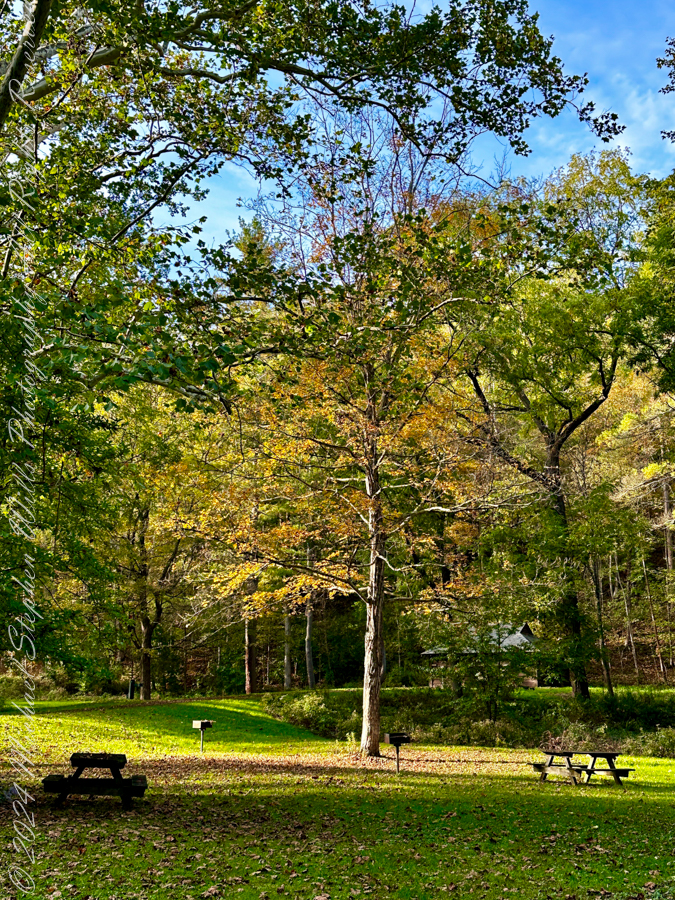
The park offered us a space for reflection and a sense of continuity. The trees, some towering over us with roots gripping the earth, had seen many seasons of change, and now they watched over us as we walked beneath them. In the clearing where picnic tables stood, we sat for a while, simply absorbing the moment. The afternoon light filtered through the branches, casting long shadows on the grass.

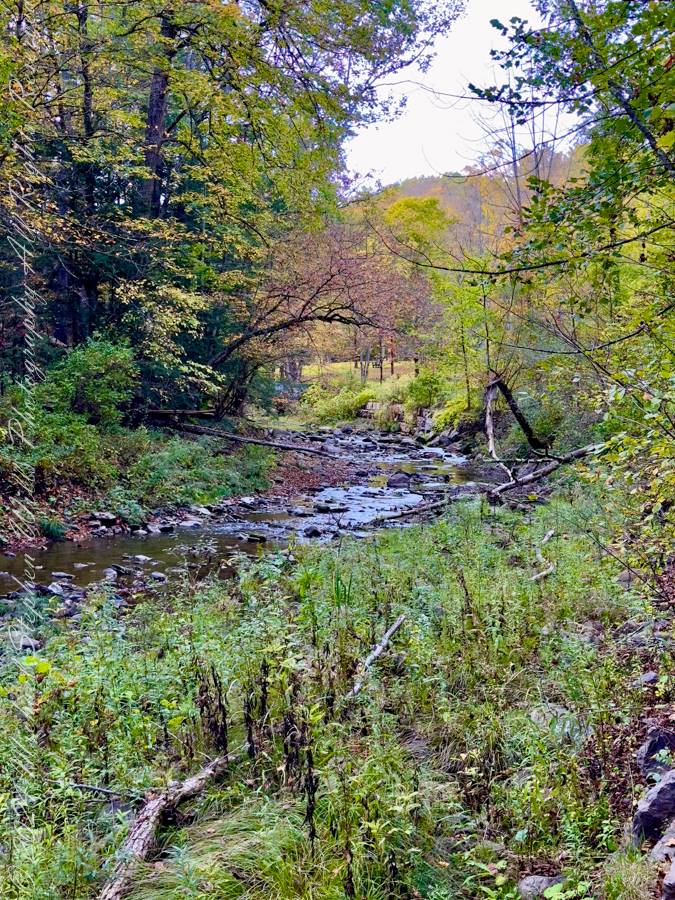
One of the final photos I took that day captures the creek from another angle. The water, calm and clear, reflects the yellow hues of the trees, while the rocks and roots along the bank seem frozen in time. It’s a peaceful image, one that reminds me of the quiet strength that Pam has shown throughout her recovery.

Here Fish Creek, a tributary of Enfield Creek joins the flow just below the pavilion of Upper Treman.

We left the park that day feeling both uplifted and grounded, the layers of history and personal resilience blending seamlessly into the natural landscape. Upper Robert H. Treman had become had become a part of Pam’s recovery story, a testament to the healing power of both nature and community.

Enter your email to receive notification of future postings. I will not sell or share your email address.

October Afternoon

The town of Ithaca evokes serene charm with its blend of history and modernity. Its community spirit is embodied in key symbols such as the local Fire Department and a public apple sculpture, a tribute to nature’s riches. Ithaca’s architectural prowess reflects generational craftsmanship, while the exuberance of local daisies exemplifies optimism. Encapsulating everyday beauty and shared experiences, Ithaca is more than a geographical location—it’s an ongoing narrative.

Continue reading “October Afternoon”