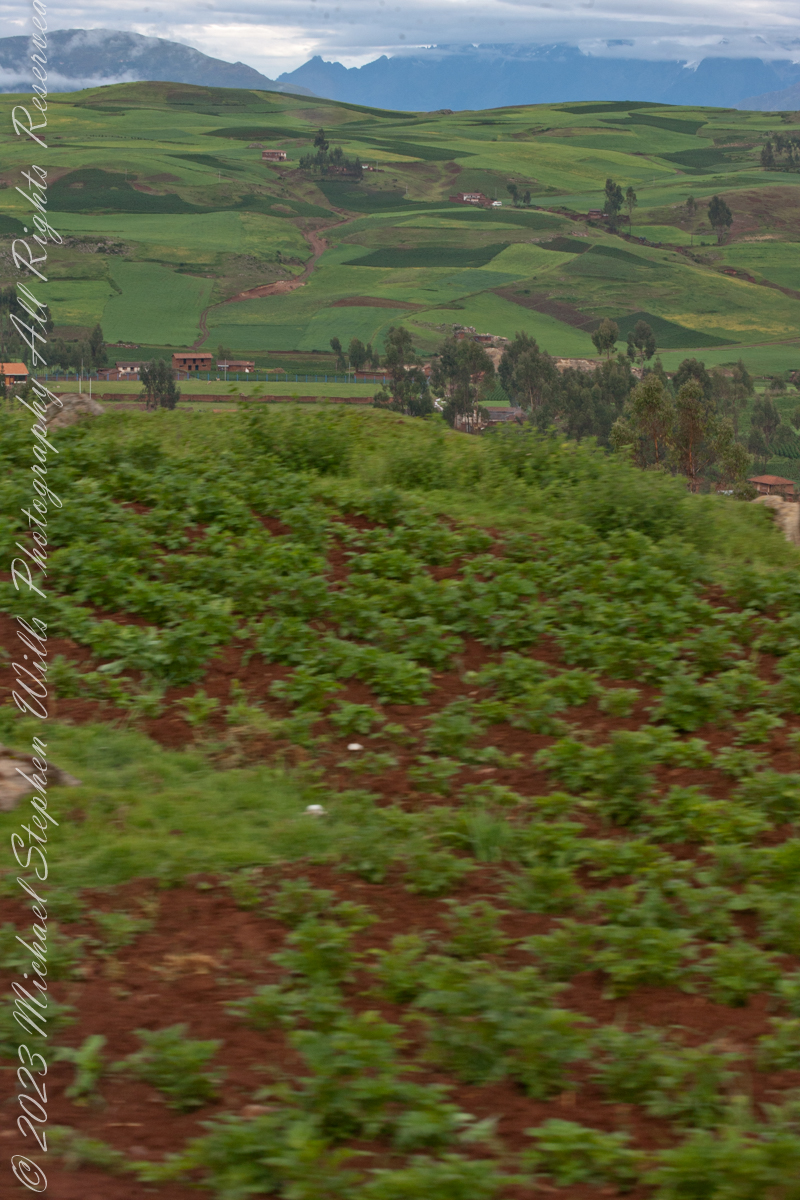
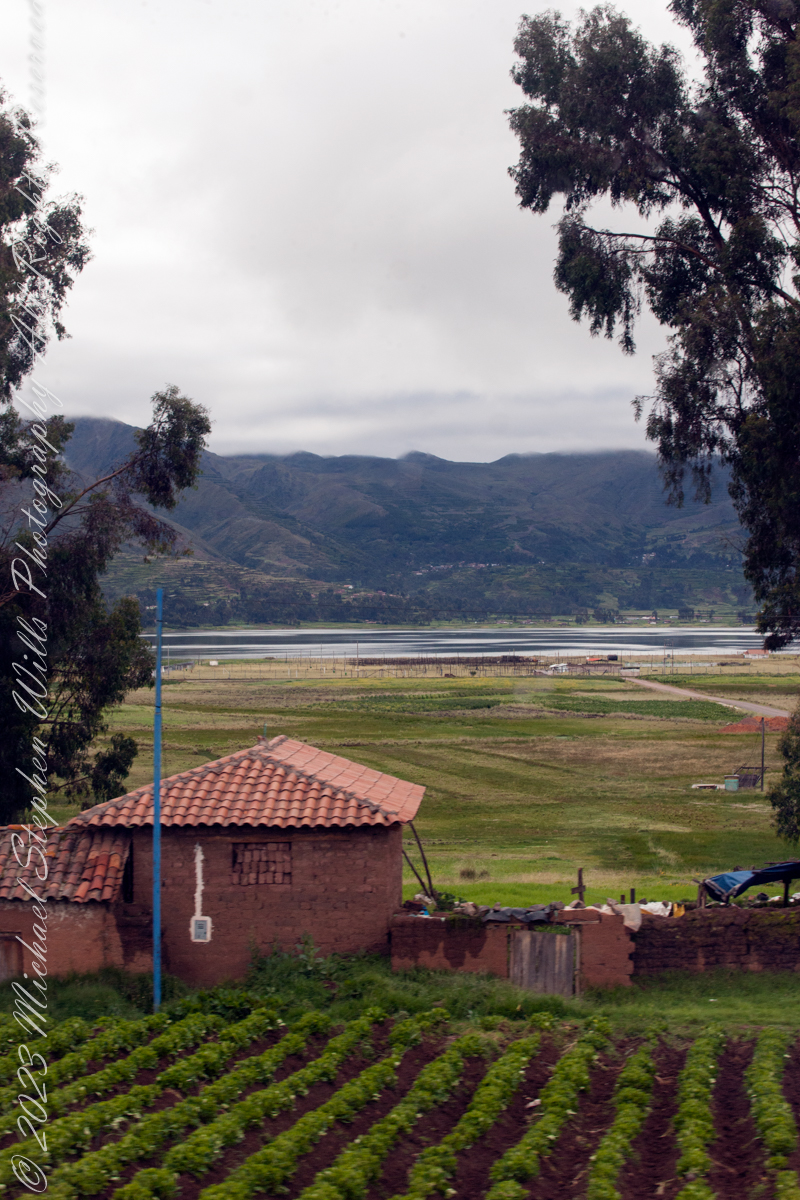
A few minutes past Chinchero the Avenue Mariscal Castilla bends dramatically to reveal this first view of the Sacred Valley of the Incas. The bend is the first of 14 switchbacks down to the river. The Andean peak Chicón is hidden in the clouds, at 18,140 feet is the 214th of the Andes.
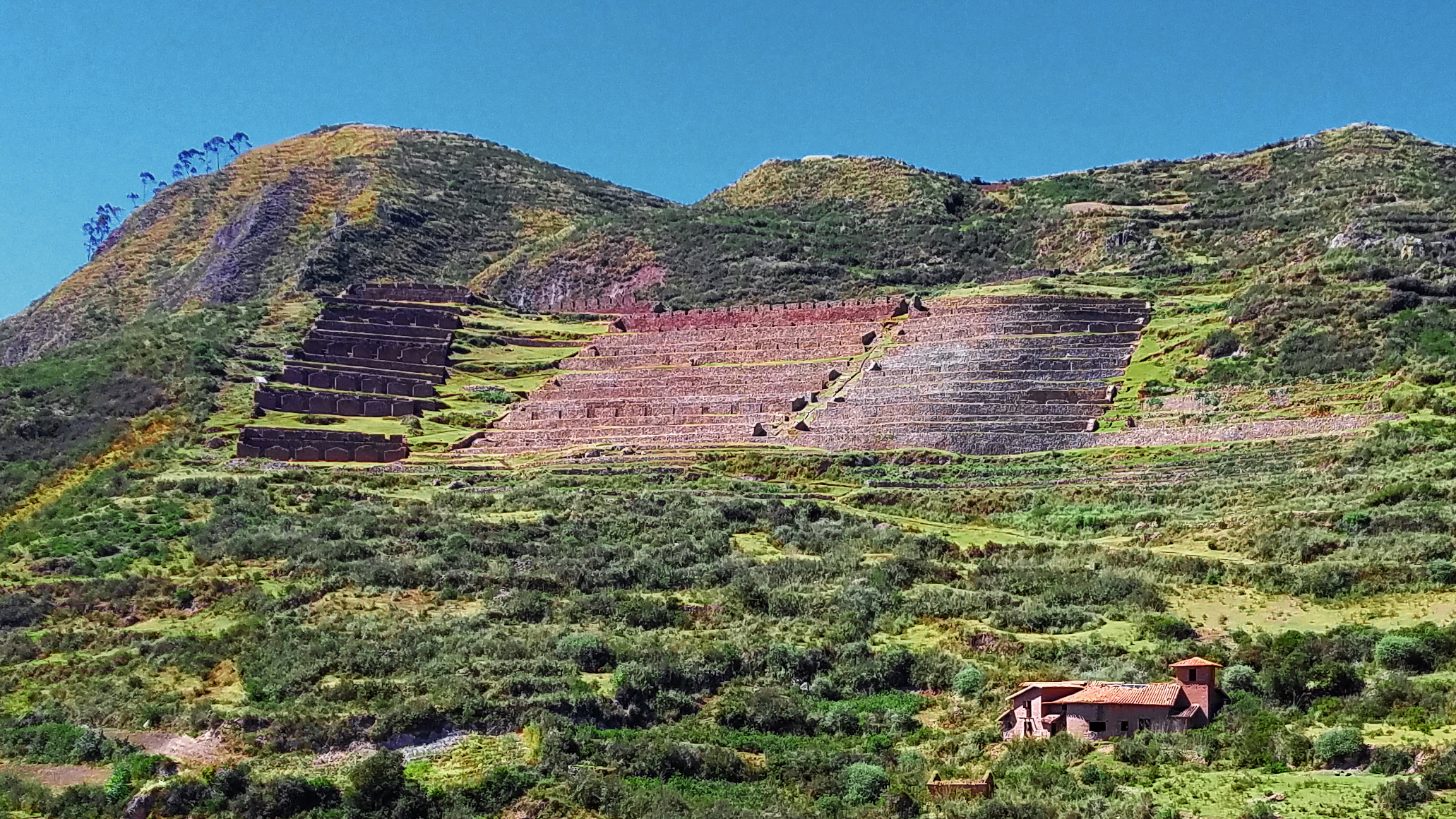
The Incas chose this location to build Machu Colca, Machuqolqa or Machu Qollqa (from Quechua machu old, old person, qullqa, qulqa deposit, storehouse). Today it is an archaeological site situated at 12,631 feet elevation, above the left bank of the Urubamba River and composed of 14 terraces and partial buildings.
On our travel to Urubamba we traversed Chinchero District is one of seven districts of the Urubamba Province in Peru of which this eponymous town is the largest. It is the location for the proposed Chinchero International Airport, which would serve travelers to the Cusco Region. The people that live in the district are mainly indigenous citizens of Quechua descent. Quechua is the language which the majority of the population (81.49%) learnt to speak in childhood, 17.95% of the residents started speaking using the Spanish language (2007 Peru Census). One of the highest peaks of the district is Hatun Luychu at approximately 4,400 m (14,400 ft). Other mountains in this district include: Ichhu Kancha, Kunka Kunka, K’usi Qaqa, Pata Kancha, Quri Qucha Punta, Quri Qucha Qaqa, Sinqa, Wallata Wachana, Wanakawri (Anta-Urubamba), Yuthu Pukyu.
Now and then I shot out the front window to capture road signs as orientation.
Puray comes from an ancient legend narrated by the settlers, where, the Sun god asked Manco Capac that his twin sons accompany him in his sunset and when the time came, they discovered that the son who walked farther had become the Huaypo (Huaypo) Lagoon (9 miles west) and the daughter in the Piuray (Puray) Lagoon.
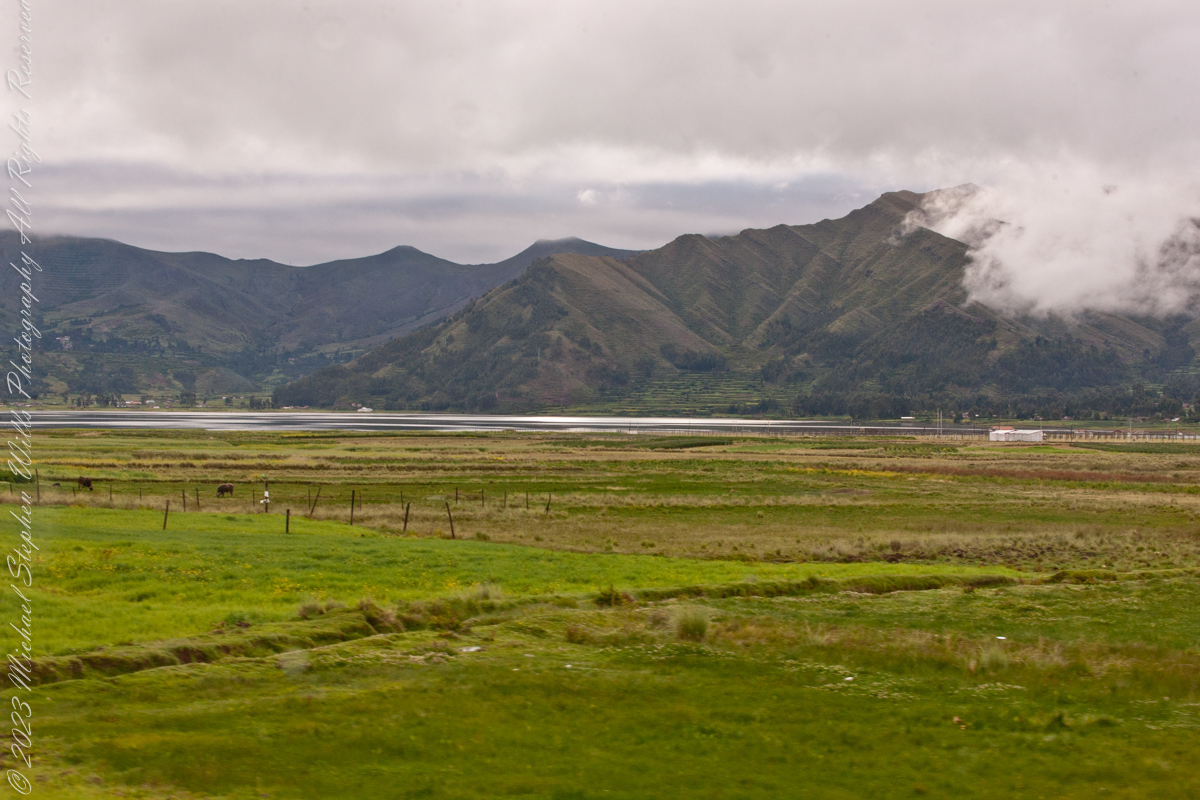
In this photograph, distant cattle graze against backdrop of the lagoon and andean foothills.
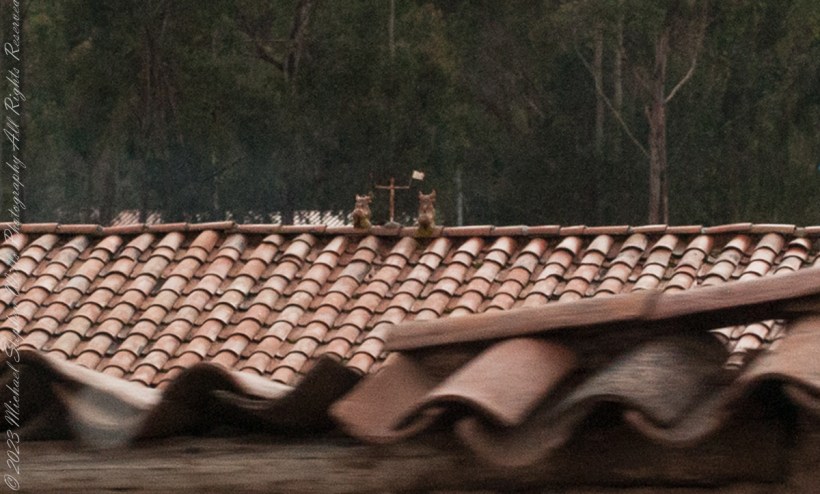
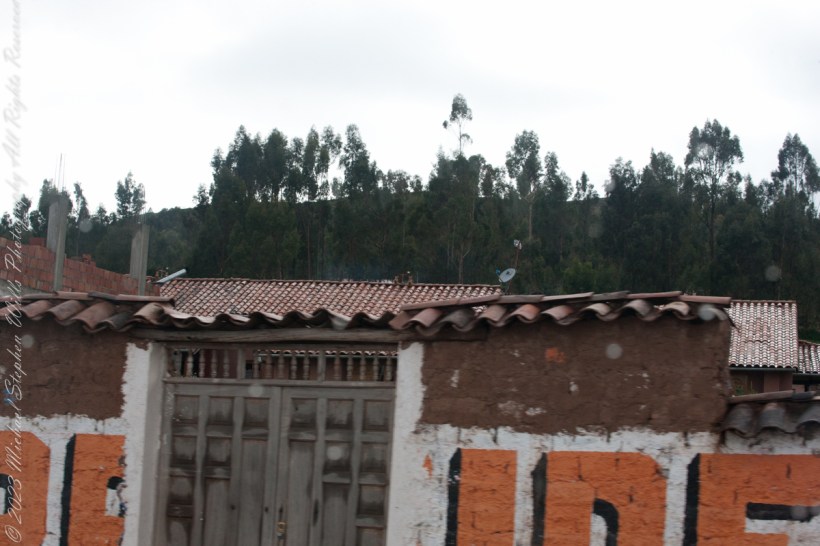
You can just make out the Bulls and Cross in the center of this photograph. A detail is provided, below. The words on the facade is a political statement – a presidential election was then underway.
A couple of ceramic Bulls stand on the middle of most rooftops in Cuzco where they stand as if on a hilltop looking out on the rolling, downward-sloping pastures of orange tiles. This powerful image is one of good fortune and protection for the house and the families that inhabit it.
This tradition comes from the time of the Incas. They relied on images of alpacas that they called illas. These alpacas had a hole in their loin where one could put alpaca fat and then bury them in the Earth to obtain protection for their agriculture as well as a good harvest. They also used illas to protect their flocks of alpacas and llamas, as well as to guarantee their reproduction. Illas in the form of houses were also used to protect buildings so that they would be safe and last.
Illas have been found Cusco. We can see them in the Cusco Museo Inca, the Inca Museum, of the National University of San Antonio Abad.
With the coming of the Spanish, the people of Cuzco made a change in the form of the illas. They added to the three mentioned above the bulls of Pucará. The name Pucará comes from the place where the bulls were first raised, on the broad grasslands of the altiplano, the high plateau, of Puno, as it approaches the pass of La Raya from which a highway drops to Cuzco. The area of Pucará is famous for its herds of cattle, sheep, and especially the native llamas and alpacas.
The high grasslands have always had symbolic importance for the people of Cuzco because from them came the herders of camelids (llamas and alpacas) as well as many of the freeze dried potatoes, the chuño and moraya, that were important food stocks.
From the also came, according to one of the two versions of the origin story of the Incas, the founding couple Manco Capac and Mama Ocllo. The story relates how they journeyed from Lake Titicaca which is in the center of those grasslands, and which was also the center of one of the most important Pre-Inca civilizations, that of Tiwanaku.
Pucará was an important site where the northern form of the Tiwanaku civilization developed. This may also play a role in the value people give to the toritos, or bulls, from Pucará.
This grassland and lake area is also important for a Pre-Inca set of stories about the hero Thunupa, who is also related to the lightning and is assimilated sometimes to the great god Viracocha and sometimes to Illapa the god of thunder and lightning. Pucará became an important center for the making of pottery which was widely distributed. Intriguingly a center of pottery making closer to Cuzco, Raqchi, is also associated with Thunupa, Viracocha, and Illapa. It was the site of the great temple to Viracocha built by the Incas.
As seen from Avenue del EjércitoIts near Chinchero, Peru. Lagoon waters lap the distant, terraced andean foothills, look closely to see fish drying racks on the near shore, 11,270 feet altitude. Here, water boils at 191 degrees Fahrenheit, not 212.
Puray comes from an ancient legend narrated by the settlers, where, the Sun god asked Manco Capac that his twin sons accompany him in his sunset and when the time came, they discovered that the son who walked farther had become the Huaypo (Huaypo) Lagoon (9 miles west) and the daughter in the Piuray (Puray) Lagoon.
In this photograph, distant cattle graze against backdrop of the lagoon and andean foothills.
Puray lagoon is located in the upper part of the Sacred Valley of the Incas, southeast of Chinchero and 19 miles northwest of Cusco. The Piuray (Puray) Lagoon is a source of water of surface origin. It is one of the most important sources of the city of Cusco, as it supplies 42% of drinking water in the city as well as the Sacred Valley of the Incas and other provinces of the region. It was the Incas who carried Piuray (Puray) Lagoon water to the imperial city (Cusco) through underground aqueducts. Quechua natural region, Peru
Copyright 2023 Michael Stephen Wills All Rights Reserved
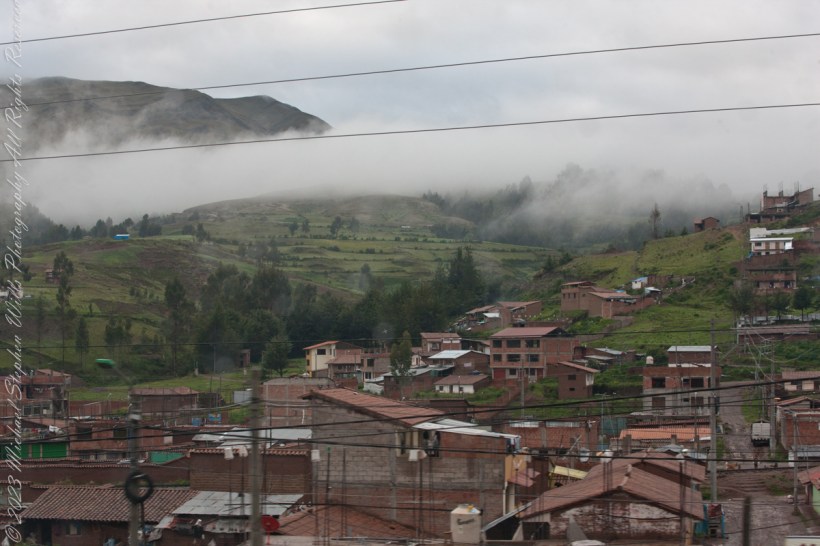
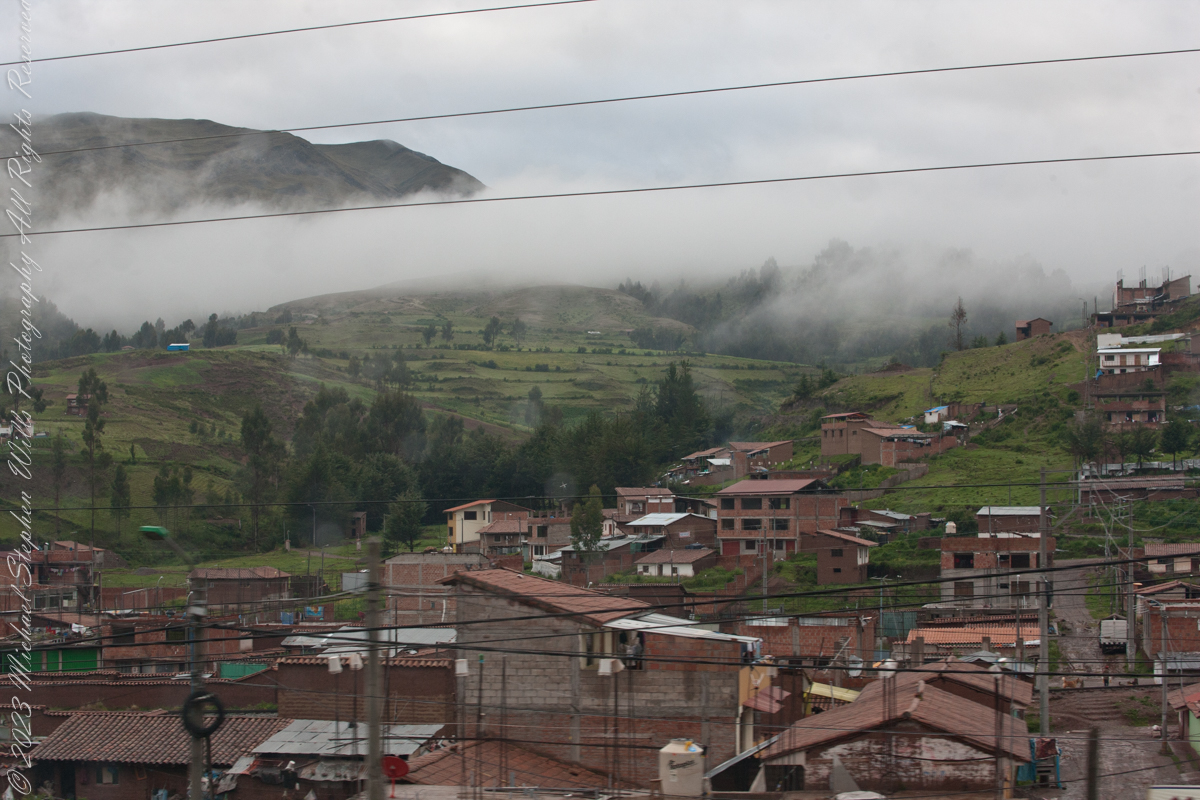
Here we are, passing the outskirts in the hills surrounding Cusco, Peru. Route 3S, going under various names. Highland Road (North) (Longitudinal de la Sierra Norte)Highway, climbs out of Cusco in broad switchbacks.
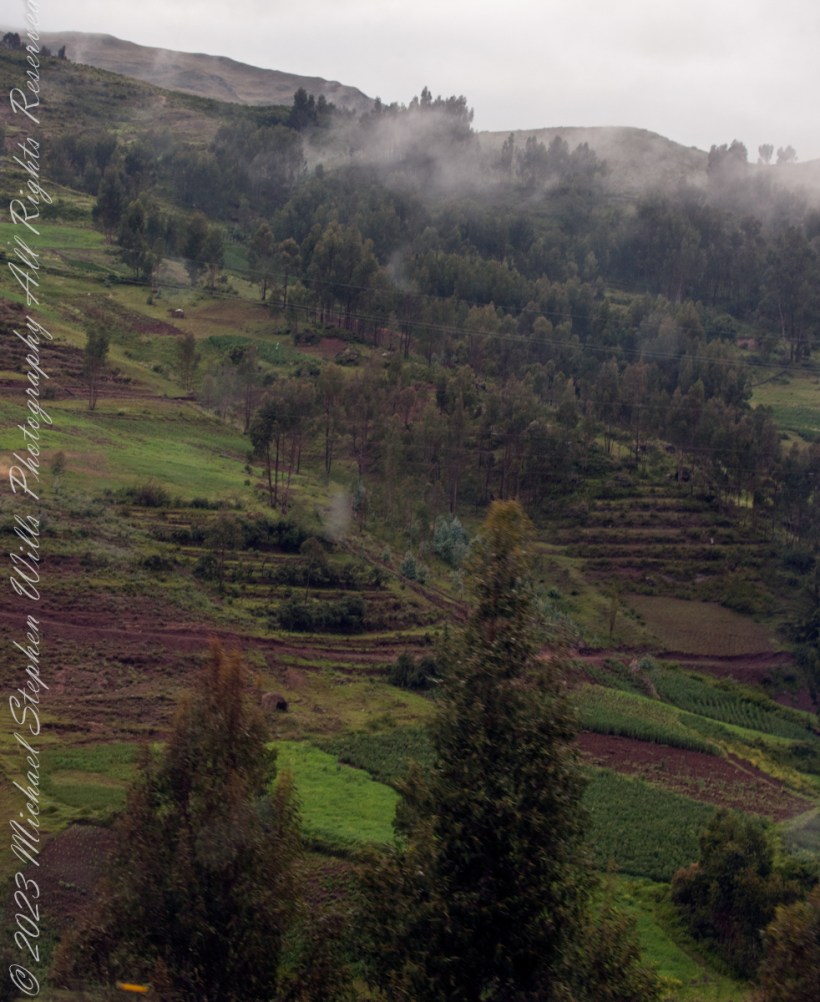
View of terraced fields from route 3S through the hills above Cusco, Peru. “In the South American Andes, farmers have used terraces, known as andenes, for over a thousand years to farm potatoes, maize, and other native crops.“
“Terraced farming was developed by the Wari culture and other peoples of the south-central Andes before 1000 AD, centuries before they were used by the Inca, who adopted them. The terraces were built to make the most efficient use of shallow soil and to enable irrigation of crops by allowing runoff to occur through the outlet. The Inca people built on these, developing a system of canals, aqueducts, and puquios to direct water through dry land and increase fertility levels and growth. These terraced farms are found wherever mountain villages have existed in the Andes. They provided the food necessary to support the populations of great Inca cities and religious centers such as Machu Picchu.“
Reference: “Terrace (earthworks)” Wikipedia
Copyright 2023 Michael Stephen Wills All Rights Reserved
In this post we start the day of my posting “Family Trek“, July 19, 2008, when, well before the sun rose at 6:23 am Mountain Daylight Time (the Navajo Reservation observes daylight savings, the rest of Arizona does not), Pam and I were at the Spider Rock Overlook.
Most visitors to the canyon make use of a system of roads and parking lots next to strategic views. There is the White House Overlook we visited our first day, July 18, to hike from the trailhead into the canyon. There are also, on the south side of the canyon:
Tsegi Overlook, taken from a Navajo word that translates directly to “between the rocks” and usually refers to a deep canyon with steep cliffs.
Junction Overlook above the point where Canyon Del Muerto (see my posting “Sun and Shade, Canyon Del Muerto”, and Canyon De Chelly intersect. There is an Anasazi ruin in the south-facing cliff across the canyon.
Sliding House Overlook, another Anasazi run across the canyon.
Face Rock Overlook, to view the eponymous formation.
Spider Rock Overlook, the most stunning rock formation.
Click any photograph for my Online gallery.
Looking east from the Spider Rock overlook, Canyon De Chelly.
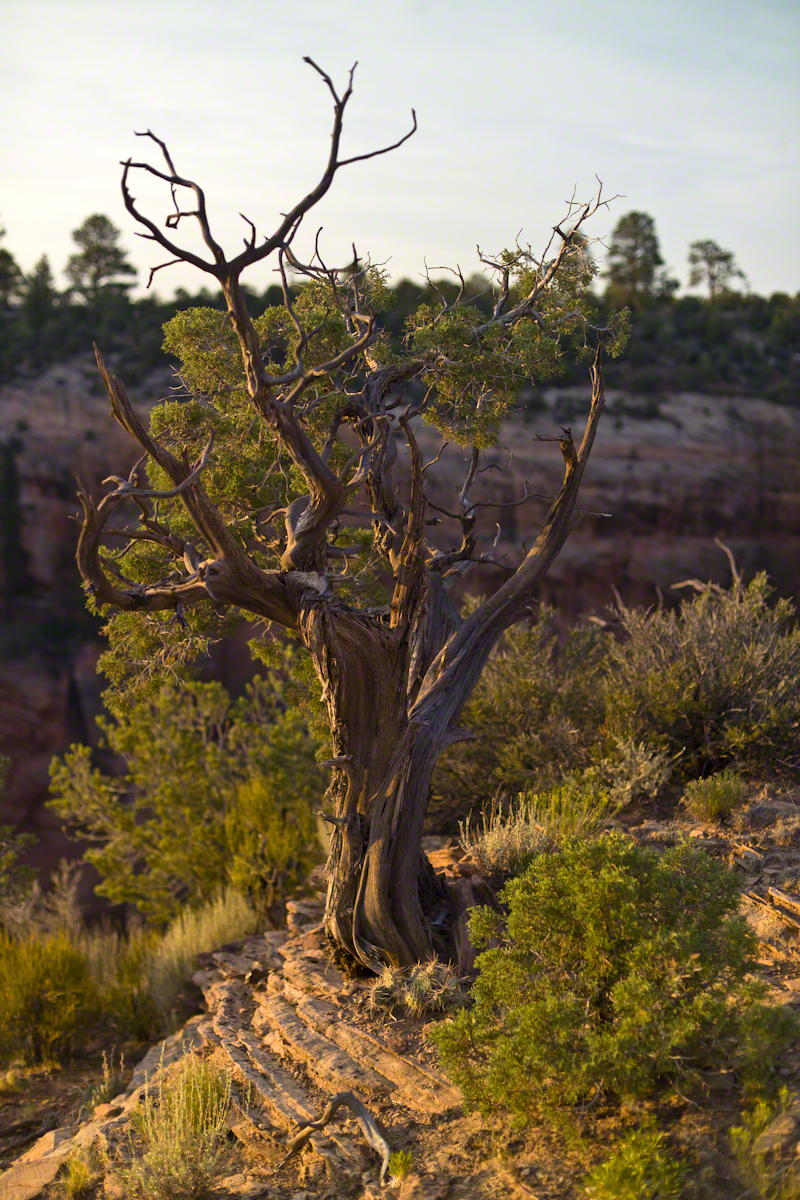
While getting ready I scoped out the location for interesting visual tropes. Utah Junipers are exceptionally hardy shrubs, stressed individual plants grow into compelling forms shaped by hardship. As the sun rose, this specimen emerged from the gloom and caught the first sun rays.
Click any photograph for my Online gallery.
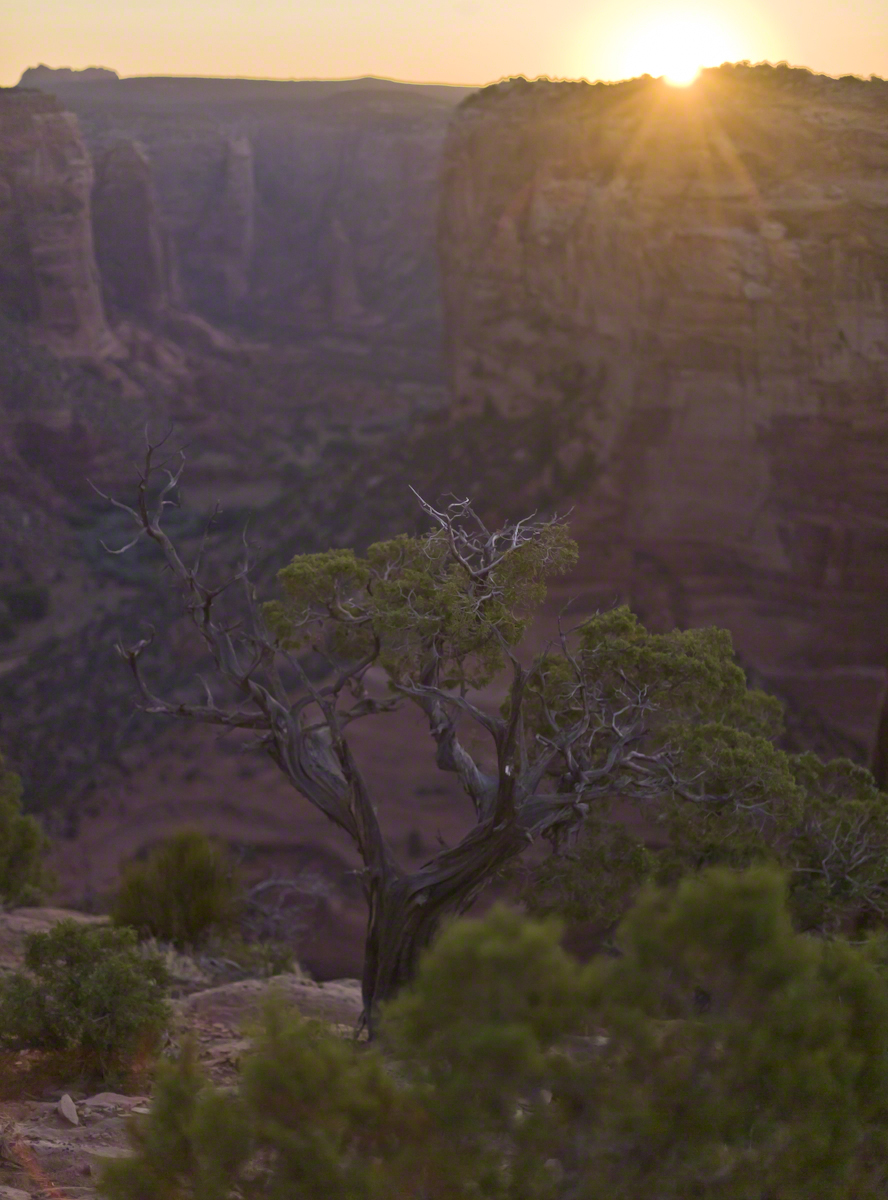
A distressed Utah Juniper on the edge of Canyon De Chelly overlooking Needle Rock a few moments after sunrise.
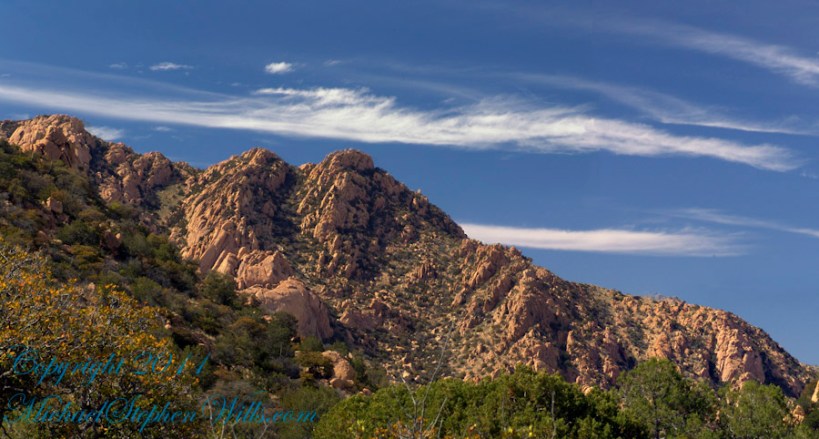
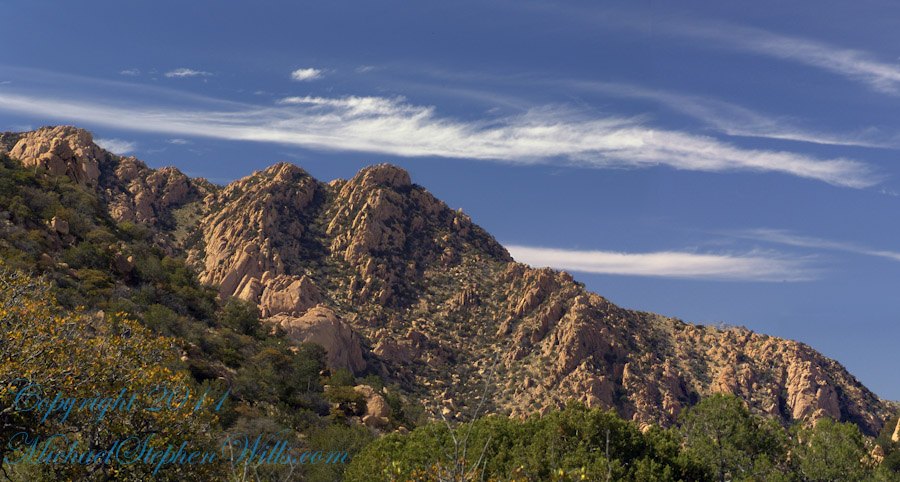
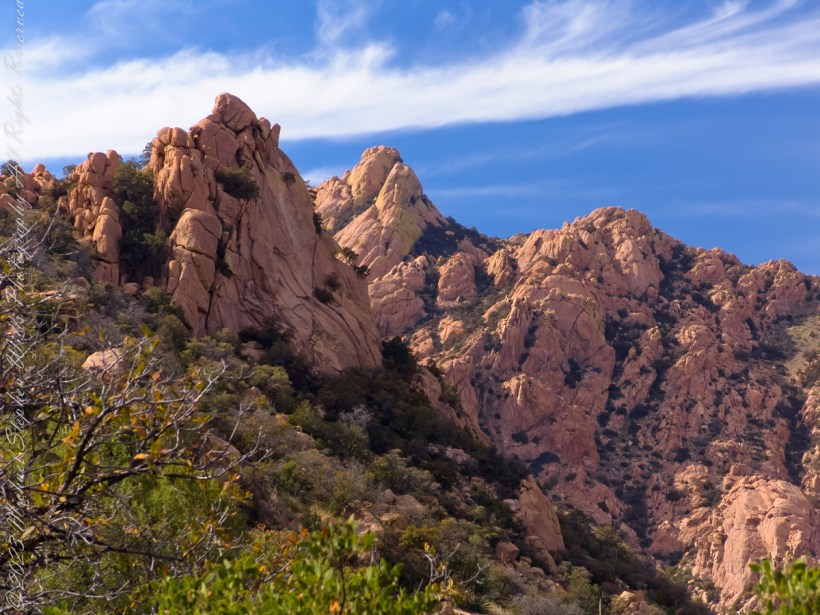
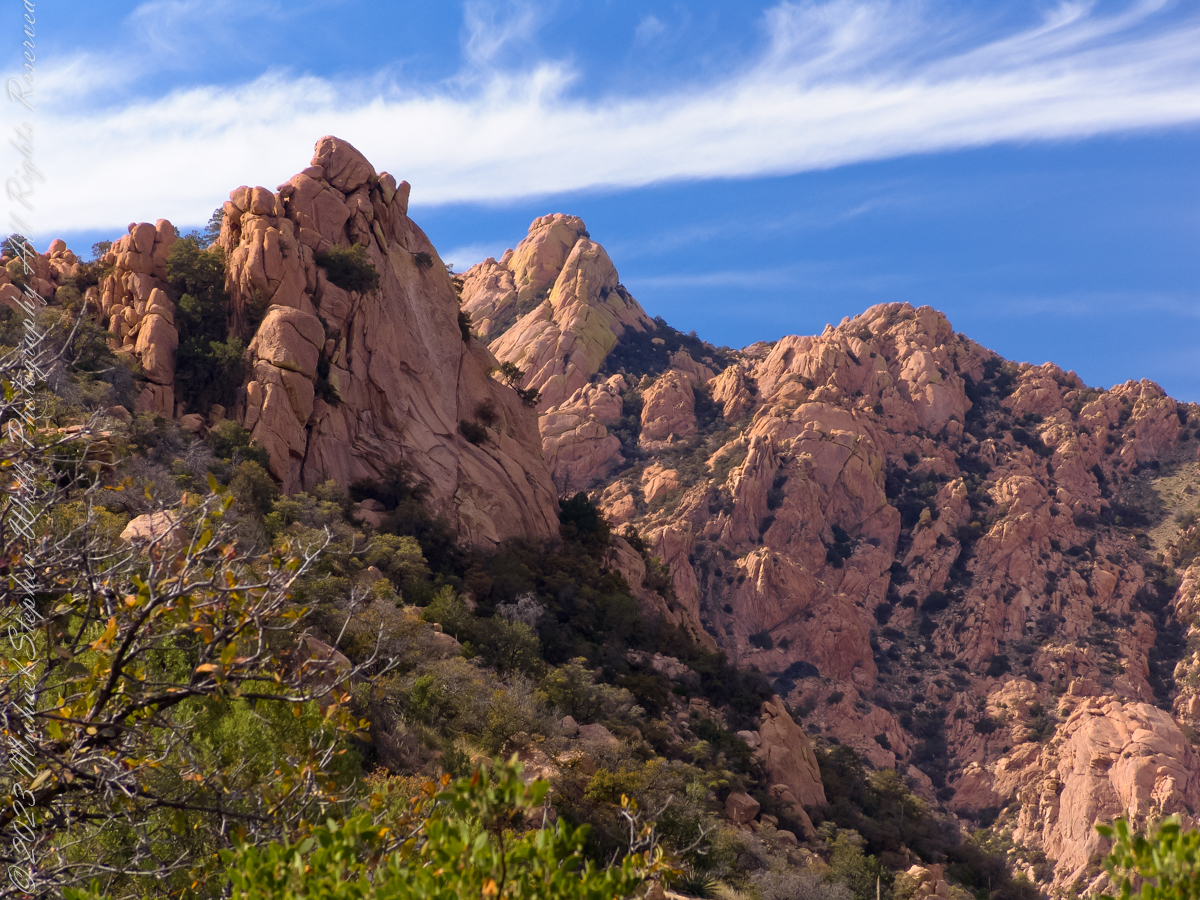
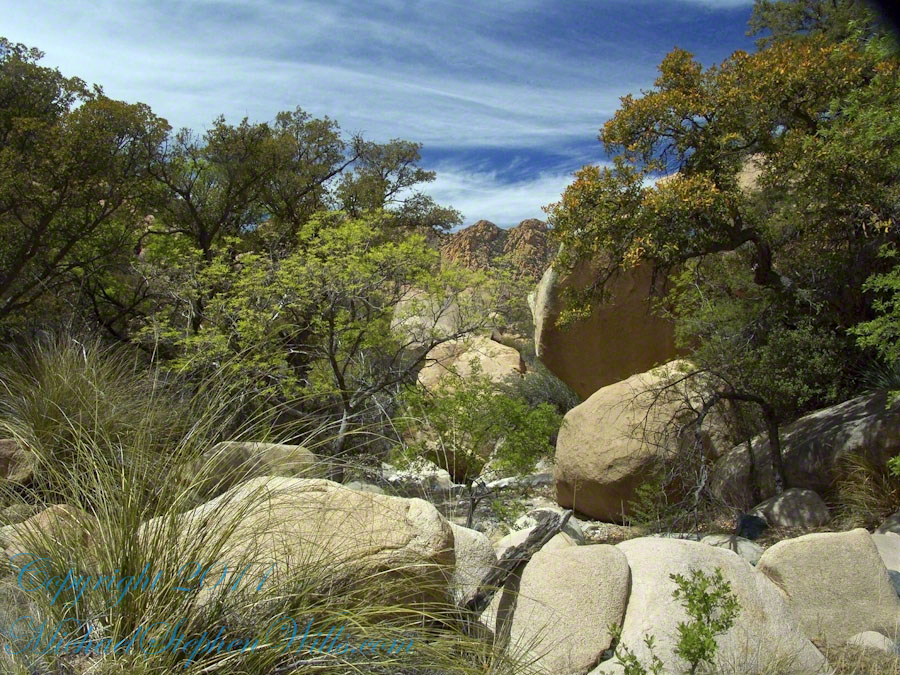
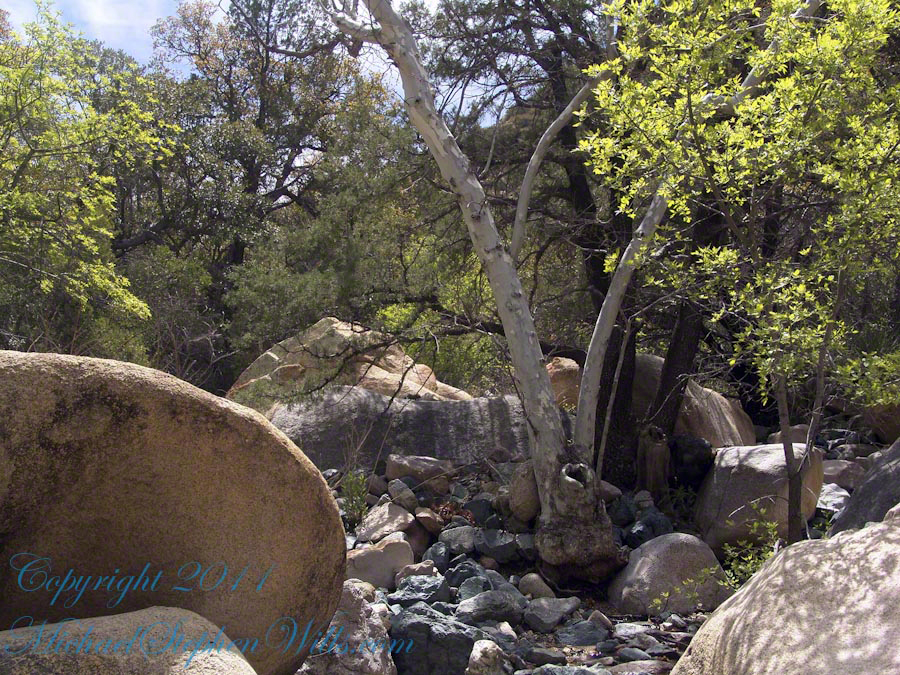
Dragoon Mountains of southeastern Arizona are named, not for the resemblance of this ridge to the back of a Dragon, but for a type of soldier trained for horseback riding and infantry. These were the U.S. troops sent to “pacify” the Chiricahua Apache homeland.
Understanding location lighting is a matter of experience and luck.
Cochise Stronghold campsites are on the eastern slope of the Dragoons, sheltering them from the late afternoon sun.
One this day in April I explored the trails until sunset and was lucky enough to be setup for the 14 minutes of that day when the light was absolutely perfect.
Copyright 2023 Michael Stephen Wills All Rights Reserved
Understanding location lighting is a matter of experience and luck.
Cochise Stronghold campsites are on the eastern slope of the Dragoons, sheltering them from the late afternoon sun.
One this day in April I explored the trails until sunset and was lucky enough to be setup for the 14 minutes of that day when the light was absolutely perfect.
“Dragoon Spires in Afternoon Light”
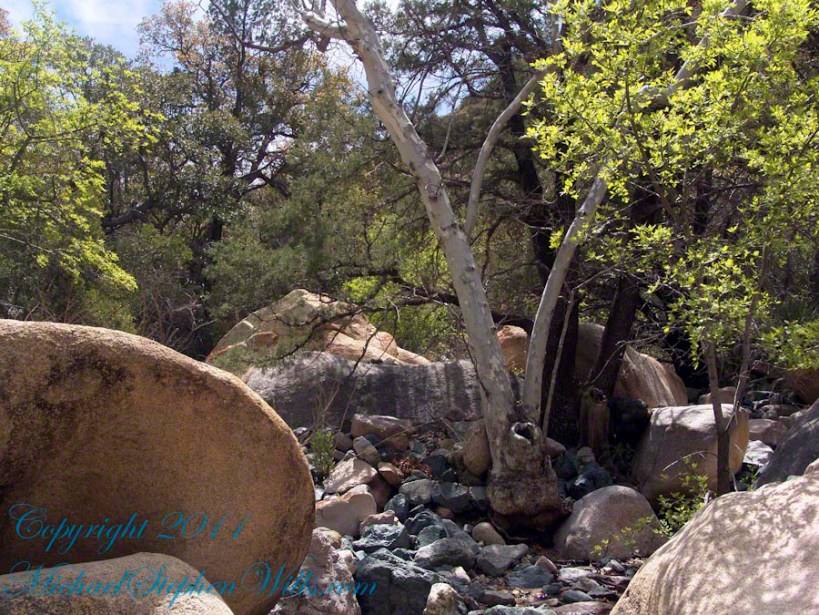
These photographs are from two days spent at Cochise Stronghold, a part of the U.S. Forest Service Coronado Forest managed by Arizona State Parks located off the Interstate 10 East of Tucson between Benson and Wilcox.
This rugged natural fortress was, for some 15 years, the home and base of operations for the famed Chiricahua Apache Chief, Cochise. Cochise and about 1,000 of his followers, of whom some 250 were warriors, located here.
Born in present-day Arizona, Cochise led the Chiricahua band of the Apache tribe during a period of violent social upheaval. In 1850, the United States took control over the territory that today comprises Arizona and New Mexico. Not hostile to the whites at first, he kept peace with the Anglo-Americans until 1861, when he became their implacable foe because of the blunder of a young U.S. Army officer, Lt. George Bascom. In that year, Cochise and several of his relatives had gone to an encampment of soldiers in order to deny the accusation that they had abducted a child from a ranch. The boy was later proved to have been kidnapped by another band of Apaches.
During the parley, Cochise and his followers were ordered held as hostages by Bascom, but Cochise managed to escape almost immediately by cutting a hole in a tent. Bascom later ordered the other Apache hostages hanged, and the embittered Cochise joined forces with Mangas Coloradas, his father-in-law, in a guerrilla struggle against the American army and settlers. The capture and murder of Mangas Coloradas in 1863 left Cochise as the Apache war chief. The U.S. Army captured him in 1871 and prepared to transfer the Chiricahua to a reservation hundreds of miles away, but he escaped again and renewed the resistance campaign. The following year after negotiating a new treaty with the help of Thomas Jeffords, the band was allowed to stay in their homeland.
Cochise is reputed to have been a master strategist and leader who was never conquered in battle. He died peacefully on the newly formed Chiricahua reservation in 1874. His son, Taza succeeded him as chief. Upon his death, he was secretly buried somewhere in or near his impregnable fortress. The exact location has never been revealed or determined.
The town of Cochise, Cochise County, the renowned geological feature known as Cochise’s Head in the Chiricahua Mountains, and the Stronghold are all named in tribute to him.
Copyright 2023 Michael Stephen Wills All Rights Reserved
These photographs are from two days spent at Cochise Stronghold, a part of the U.S. Forest Service Coronado Forest managed by Arizona State Parks located off the Interstate 10 East of Tucson between Benson and Wilcox.
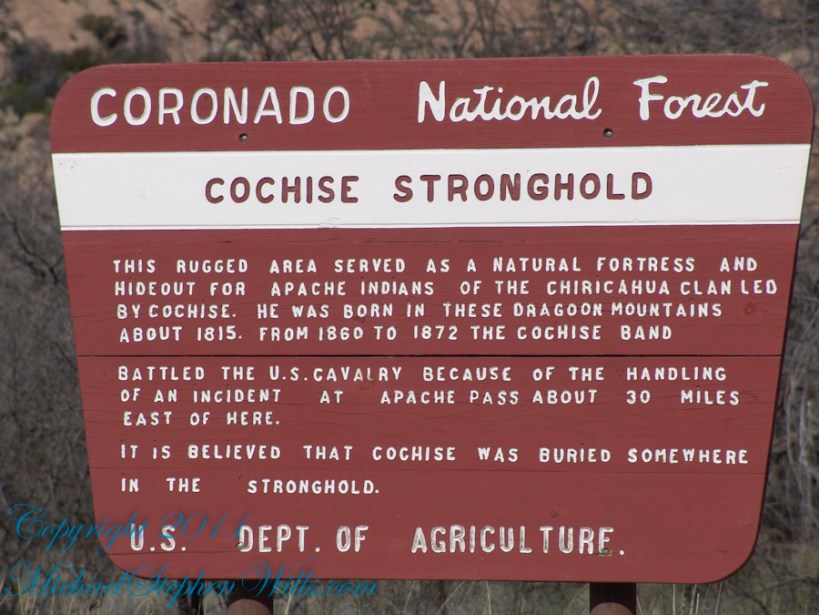
Here is the Cochise Stronghold information sign from the Douglas Ranger District of the Coronado National Forest.
The Dragoon Mountains are a low range that barely rises above the surrounding desert floor. Nevertheless, the granite boulders are spectacular and well worth visiting for the scenery alone. This mountain range is remote from cities or even any large towns, so visitation is light. Late fall, winter, and early spring are the best times to visit. Temperatures exceeding 100 degrees are common even in spring and fall. Cochise Stronghold Campground is closed in June, July, and August due to the often-extreme heat.
Safety First: Heat and low humidity are real hazards for people unfamiliar with desert climates. A person can loose up to 5 quarts of fluid a day and it is easy to become seriously dehydrated without realizing it, so drink plenty of fluids even if you do not feel very thirsty. Always carry extra water in your car. When going on a hike, even if a short one, take a day pack with water, snack foods, protective clothing, flashlight, first aid kit, compass, and map. To avoid sun in
Copyright 2023 Michael Stephen Wills All Rights Reserved
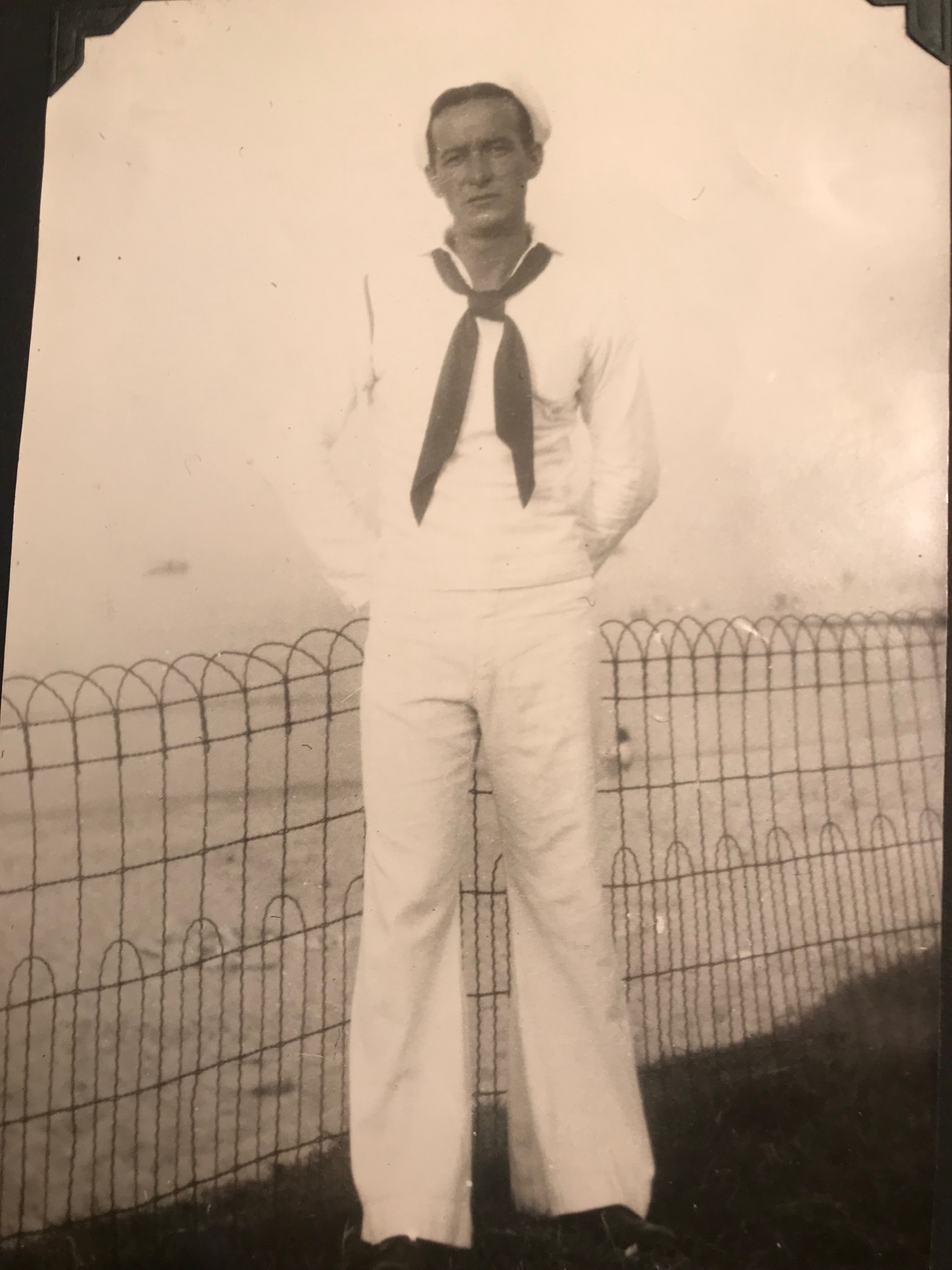
An excerpt from an interview by Diane Frances Wills of our father Thomas Francis Wills for a seventh-grade assignment about 1971. I did some editing to correct the date based on historical records and my father’s military records (Michael Stephen Wills).
Thomas enlisted for
the navy one day after his 24th birthday, September 25, 1939 and
served 6 years and a few weeks until October 7, 1945 having experienced the
Battle of the Atlantic (American Defense Medal) and liberation of the Philippines
(WWII Victory Medal, American Campaign Medal, Asiatic Pacific Theater, Philippine
Liberation Ribbon). Here is his
description of an incident from that time:
Thomas Francis Wills, Ocean View Beach, Virginia, 1940
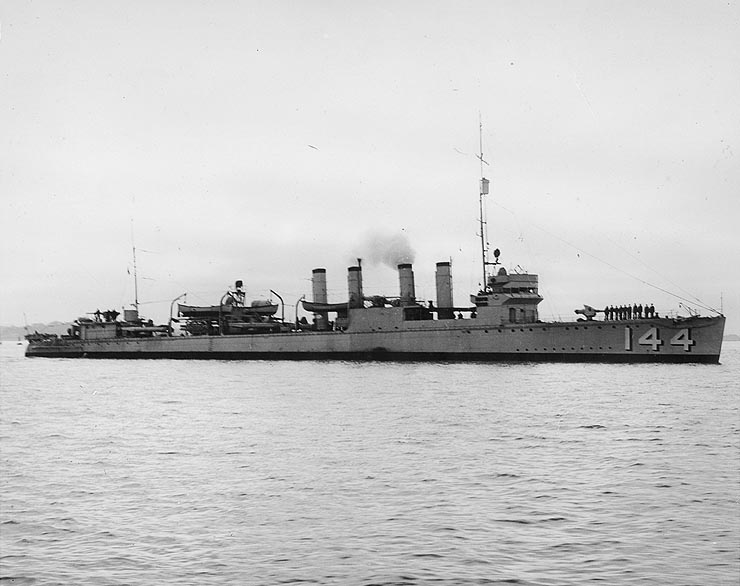
1 Year, 6 months after my enlistment in New York City, March 1941, on the USS Upshur two days out of Boston on its run to Reykjavik, Iceland delivering mail and supplies to the marines stationed to prevent the Germans from establishing a base. Steaming north we got word there was a gale blowing in our path. We all became apprehensive. I asked Bill Rogers, the radioman, about the approaching storm. “Say, Bill, I see by the weather report we’re heading info some rough weather. How long do you think it will last?”
“Yeah, according to the latest weather report it is a regular Northeaster and we can expect a couple days of rough winds and high waves, also very cold weather. We’ll have to secure everything topside so it won’t blow or be washed overboard. We can also expect very little in the way of normal meals except for maybe coffee and sandwiches.” On such a small ship the cooks can’t prepare meals in such weather.
USS Upshur, 1940, the ten-man crew, including Thomas Wills, is on the bow
As we approached the storm zone the sea got rough and the wind started blowing. Soon we were well into a horrible storm. The sky got dark and gloomy, full of dark bold clouds. The ocean rough, choppy and black. The rain started coming down sharp and harsh, cold and icy. The rain cut through your body like piercing arrows, it chilled your bones.
Sometimes I thought the ship was going to sink, the waves and the wind were so strong. The bow would go bluntly into the water. The ship listed sideways, seeming to almost rolling over. The waves carried our ship up, then go out from underneath sending us crashing down. This happened over and over, endlessly.
I was on duty in the radio shack and had to walk the whole length of the ship from my sleeping quarters. Many times, I almost went overboard, the wind was so strong. I could lay on my stomach but it did not help because I could still slide through the railings. I would freeze to death in five minutes in that water. I hope I never had to go through that again, seems like yesterday. All we had to wear was a sailor suit, not too warm. I’d just get all soaked.
My shipmates and I, a five-foot eight-inch boy of 25 with dark brown hair, had to be calm and keep doing our normal scheduled duties, because we learned you can’t get panicky or else you will put your whole ship out of order.
The storm went on until the end of night. I thought the storm would never end. It felt as if it lasted a week. At that time no other ships sailed with us, so there was no possibility of help. Nobody fell over the side or was drowned.
After that, a German U-Boat launched a torpedo at us and missed. We searched, tried to sink them without success.
Copyright 2023 All Rights Reserved Michael Stephen Wills
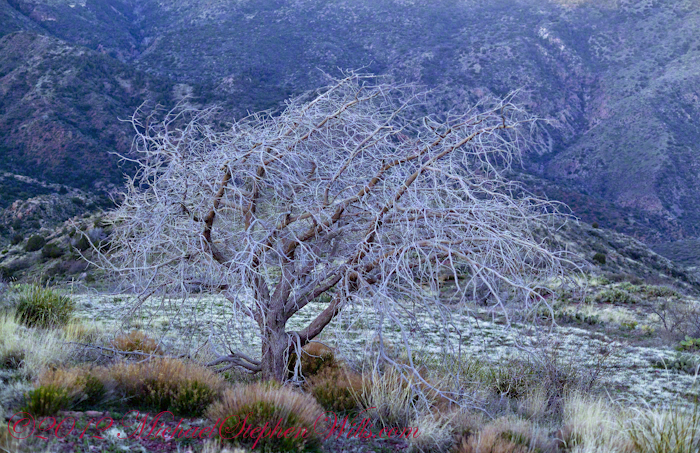
On my fourth morning, after I awoke to am immense silence, my first photography subject was the lone dry juniper you see below.
Then the dawn lit up the far mountains. You can view a larger image these mountains at dawn in my previous blog, “Superstition Wilderness Dawn.”
A Lone Dry Juniper
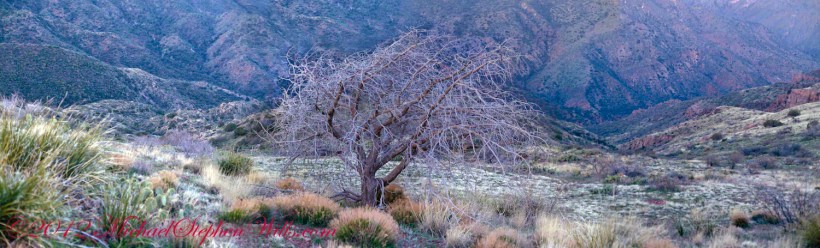
This is a photograph of that juniper tree, dryer than most, being dead. I take it to be a One-seed Juniper from the thick growth of branches and the strong rounded aspect of the crown. I captured this photograph from a tripod mount using a Kodak DCS slr/c with a Canon EF 50mm f/1.4 USM lens.
Looking into Reavis Creek Canyon from Lime Mountain
I used the tripod to bracket this shot on the left and right for the following panorama.
The Reavis Creek Canyon from Lime Mountain while still in shadow, morning
The Spirit of Elisha Reavis
From this vantage you can see my route into Reavis Creek Canyon and Reavis Falls taken on the first afternoon of the expedition. That first morning I loaded up 65 pounds of food, supplies and photography equipment and headed out from the Reavis Trailhead on the Reavis Ranch Trail. This was one of the trailed used by Elisha Reavis to ride a favorite burro and a string of 8 to 15 burros loaded with vegetables he sold to various communities throughout central Arizona. See my blogs “A Ride to Reavis Ranch” and “Apple Orchard in the Wilderness“for views of the paradise (as of the early 21st century) where Elisha Reavis, lived and prospered in the latter part of the 19th century where he lived his 70’s.
This his mountain valley, using a perennial creek, Reavis cultivated and irrigated about fifteen acres of land by himself with chickens, turkeys, hogs, burros, two horses and several dogs. The horses, teamed together, pulled a shear plow, disc and leveler. On April 9, 1896 Reavis was preparing of another trip to Mesa, to buy seed potatoes, and was found by a friend a month later on what is now the Reavis Ranch trail, to the south and west of his valley, near what is now called Grave Canyon were friends buried him.
Past the Dry Juniper and Down
102 years later, I headed up the Reavis Ranch Trail, over the ridge of Lime Mountain and past this dry juniper in the same spirit as Elisha Reavis if for a different purpose.


 Michael Stephen Wills Photography