The town of Ithaca evokes serene charm with its blend of history and modernity. Its community spirit is embodied in key symbols such as the local Fire Department and a public apple sculpture, a tribute to nature’s riches. Ithaca’s architectural prowess reflects generational craftsmanship, while the exuberance of local daisies exemplifies optimism. Encapsulating everyday beauty and shared experiences, Ithaca is more than a geographical location—it’s an ongoing narrative.
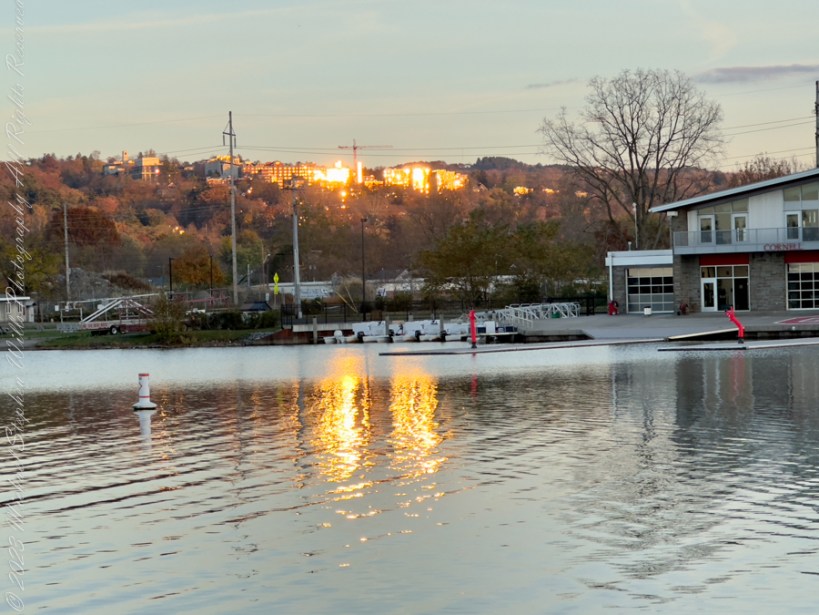
An evening at Cayuga Lake Inlet, home to the Cornell University Crew, is depicted as a serene haven for reflection. The Collyer Boathouse, vital to the local lore, sits across the inlet holding a rich history of crew camaraderie and competition.
As the sun dipped lower, casting its farewell in hues of amber and soft gold, Pam and I stood beside the serene Cayuga Lake Inlet, gazing westward. The stillness of the evening was a quiet symphony, punctuated only by the gentle lapping of water against the shore. It was November 5th, and the world seemed to hold its breath in the golden hour, that perfect moment minutes before the sun would bid its final adieu for the day.
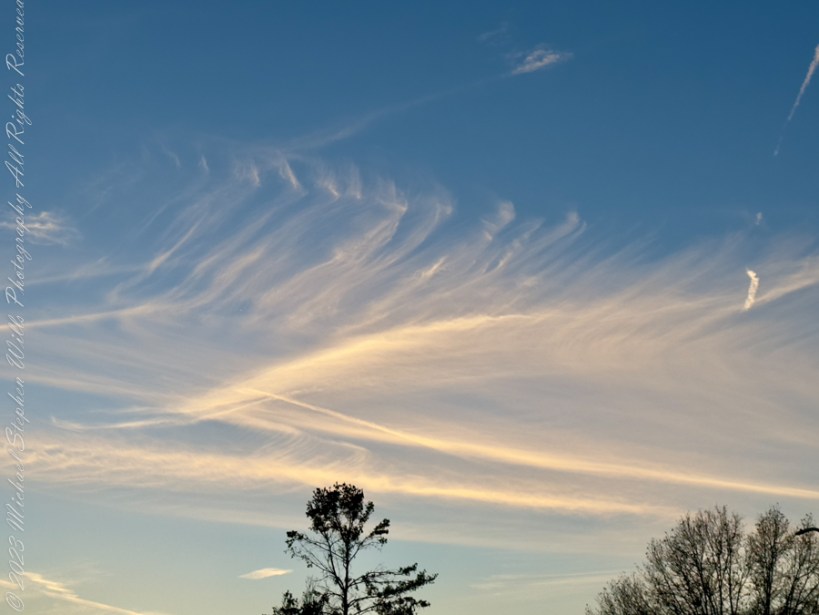
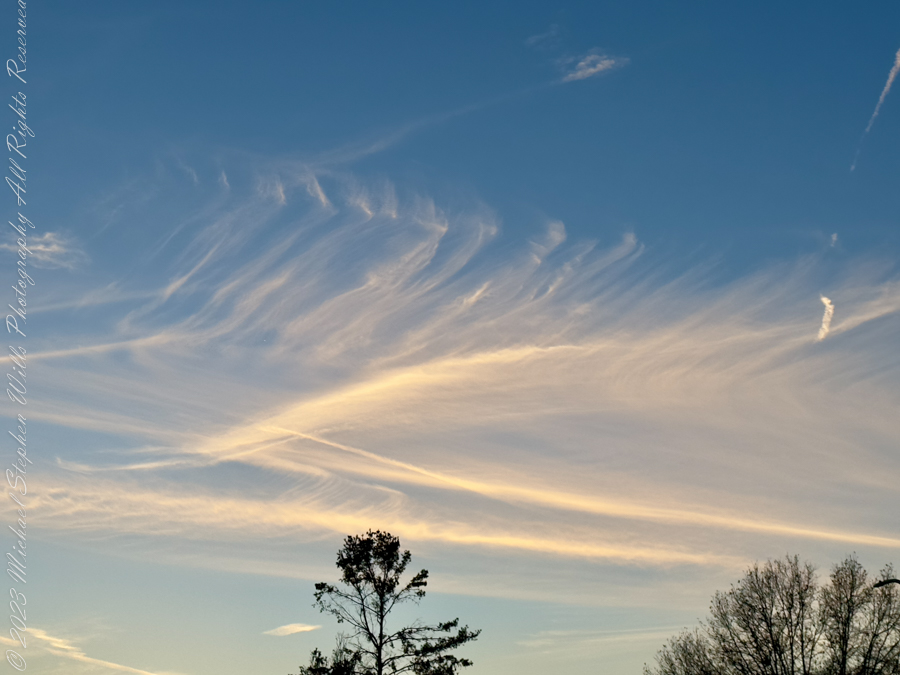
Above us, the sky was a canvas of nature’s delicate brushwork – the Cirrus fibratus. These high-altitude clouds, ethereal and wispy, stretched across the sky like strands of silken thread. The cirrus clouds, the feathery remnants of far-travelled storms, are the poets of the atmosphere, telling tales of weather yet to come. Their presence was both a testament to the day’s tranquility and a harbinger of change looming on the horizon.
Taken with the Apple IPhone 14 ProMax, raw format
Cloud Lore
Cirrus fibratus clouds, in their striated splendor, often signal the approach of a warm front and are associated with the shifts in weather patterns. As we stood there, the clouds seemed to be etching the sky with messages in a cryptic script, hints of the coming days. These clouds, so high in the sky, are formed from ice crystals, and their very existence speaks of the coldness of the upper atmosphere, as the days down here by the lake inlet lengthen towards the winter solstice.
The days of early November, with their crisp air and the promise of winter, bring a change in the light, a deepening of colors, and a certain clarity to the world. The skies seem grander, a vast dome of ever-changing artistry, and the Cirrus fibratus are our guides to the imminent transformation. They remind us that the earth is tilting away from the sun in our hemisphere, pulling us into the cooler seasons.
Eternal Change
These cirrus formations, while signaling the shifts in weather, also play with the light of the lengthening days. The sun’s rays, ever lower on the horizon, catch the ice crystals, creating a prism effect that can result in sundogs, those bright spots of light that occasionally grace the sky at solar dawn or dusk. They add a mystical quality to the already enchanted time of day.
As the twilight deepened, the Cirrus fibratus began to glow with the sun’s final touch, turning from white to shades of pink and fiery orange. This spectacle was a gentle reminder of the passage of time, the cycles of nature, and the endless dance between the earth and the sun. The clouds foretold of cooler weather, perhaps a sign that we should cherish these last vestiges of autumnal warmth.
As night began to embrace the sky, the clouds slowly faded from our sight, but the memory of their beauty and the secrets they carried lingered. They are not just ice and air; they are messengers, carrying the stories of the atmosphere from one part of the world to another, connecting us with the rhythms of the earth in their ceaseless journey.
Signs and Wonders
In the coming days, we would watch the sky, taking note of the cirrus and the subtle cues they offered. Would there be rain, a storm, or perhaps a clear day that belies the cold snap in the air? Only time would tell, but for now, we stood in silent appreciation of nature’s grace, feeling the profound connection to the world around us that only a sunset watched together can bring.
In the gentle embrace of the Finger Lakes region of New York State, the crisp post-Thanksgiving air is a mix of woodsmoke and the faint whisper of winter on the horizon. The earthy scent of fallen leaves, damp from the morning dew, begins to permeate the atmosphere, beckoning families outdoors to partake in the timeless ritual of leaf gathering.
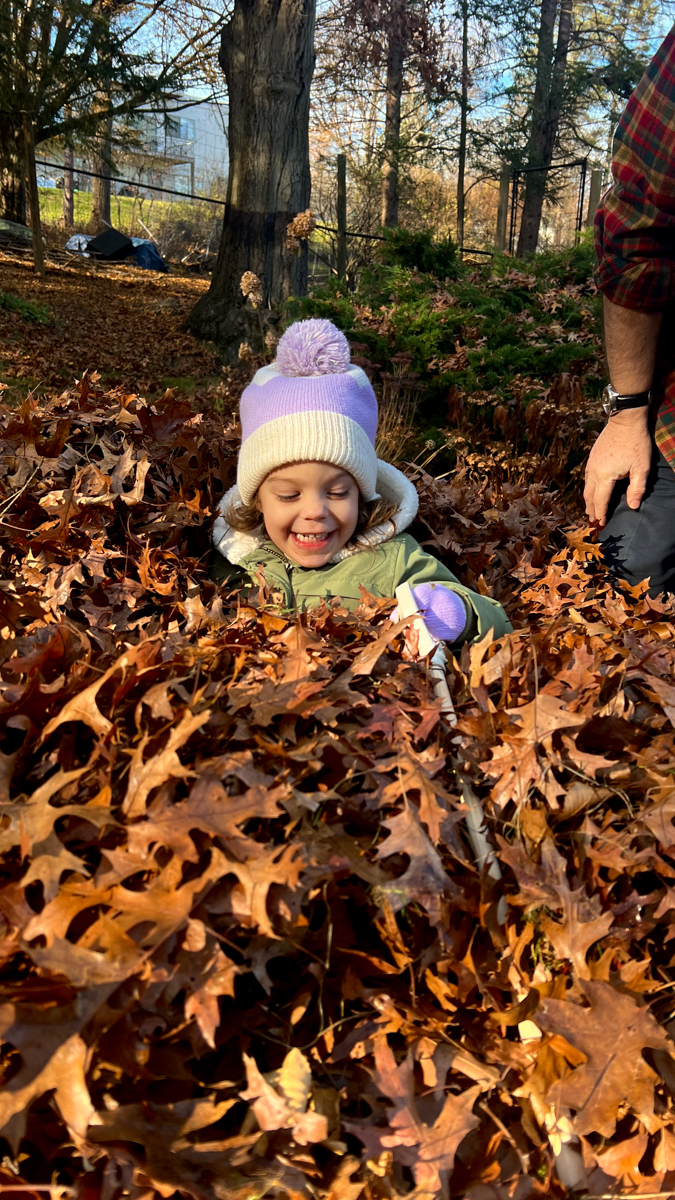
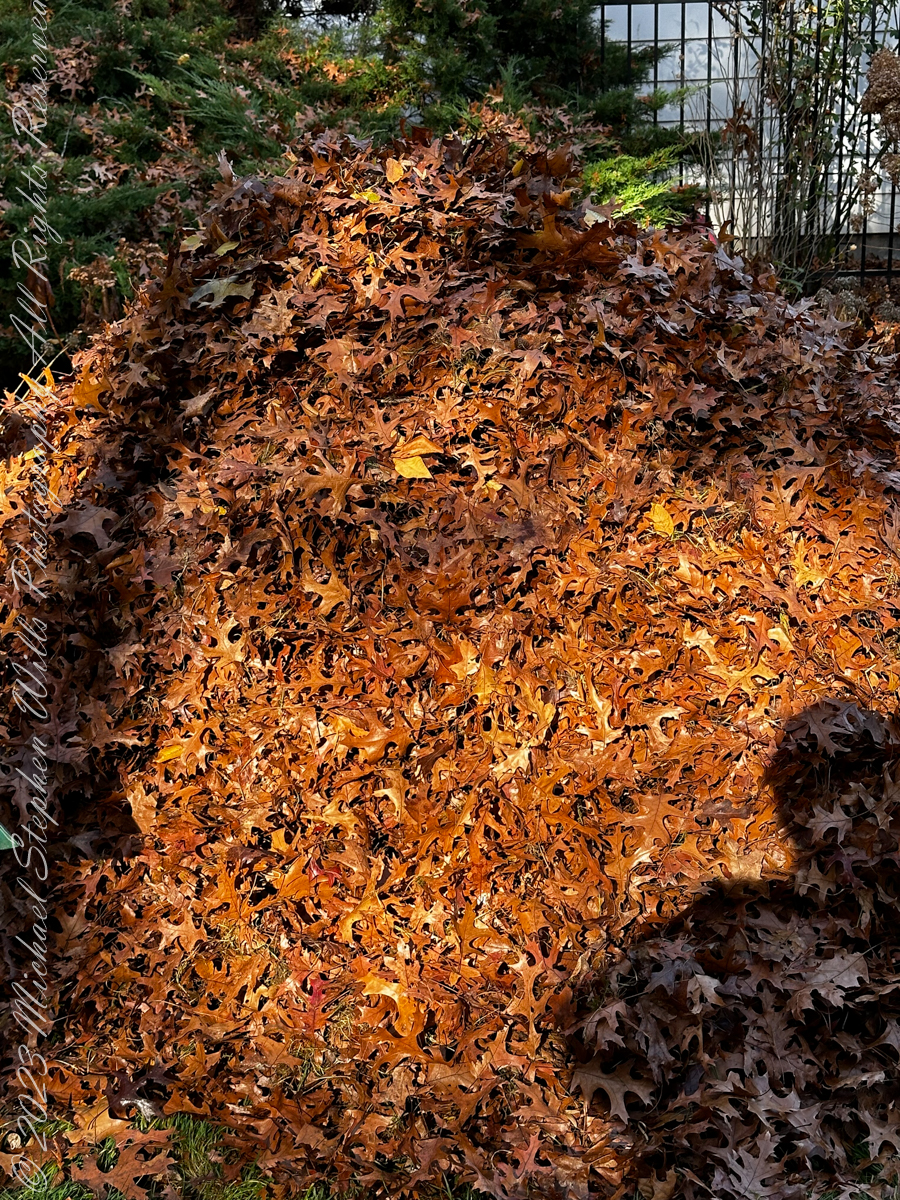
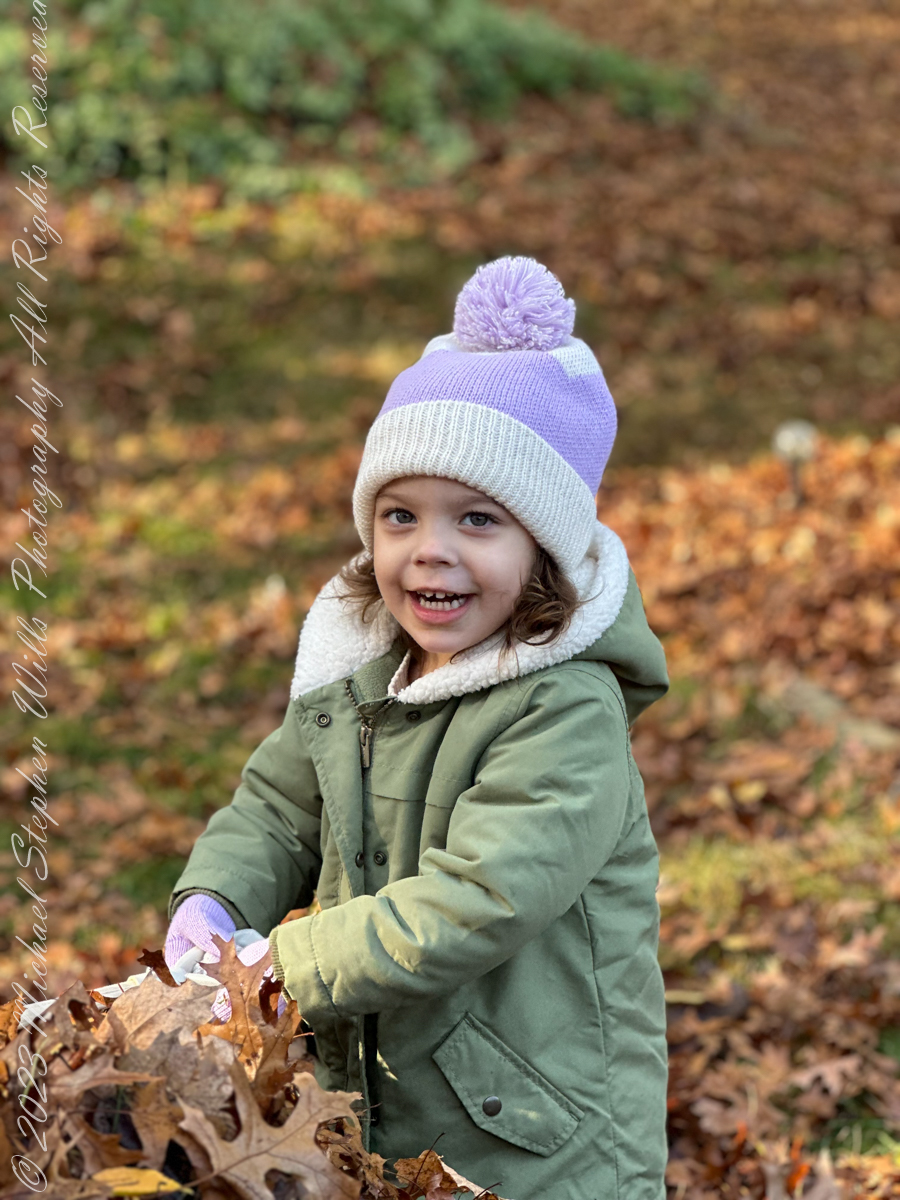
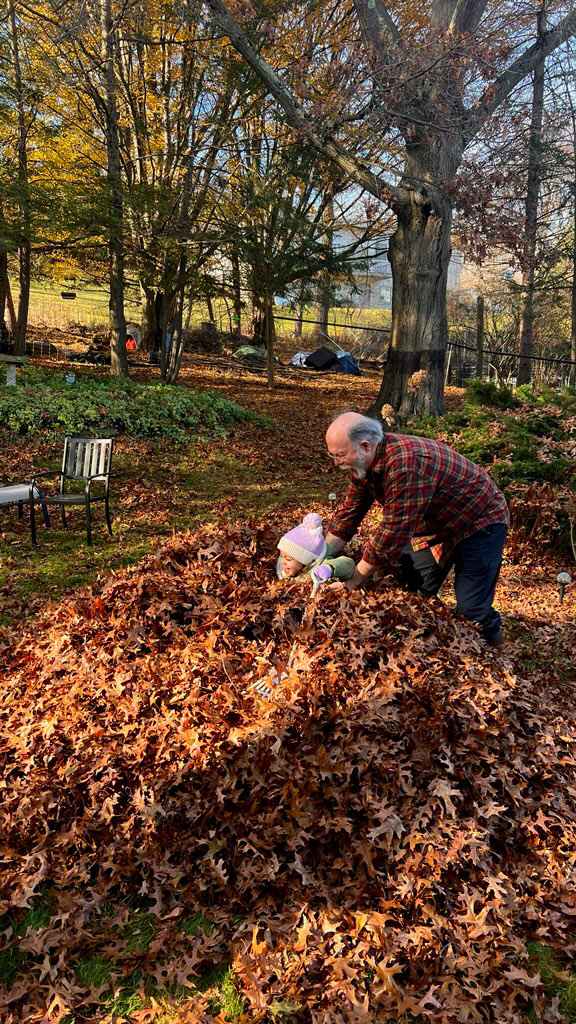
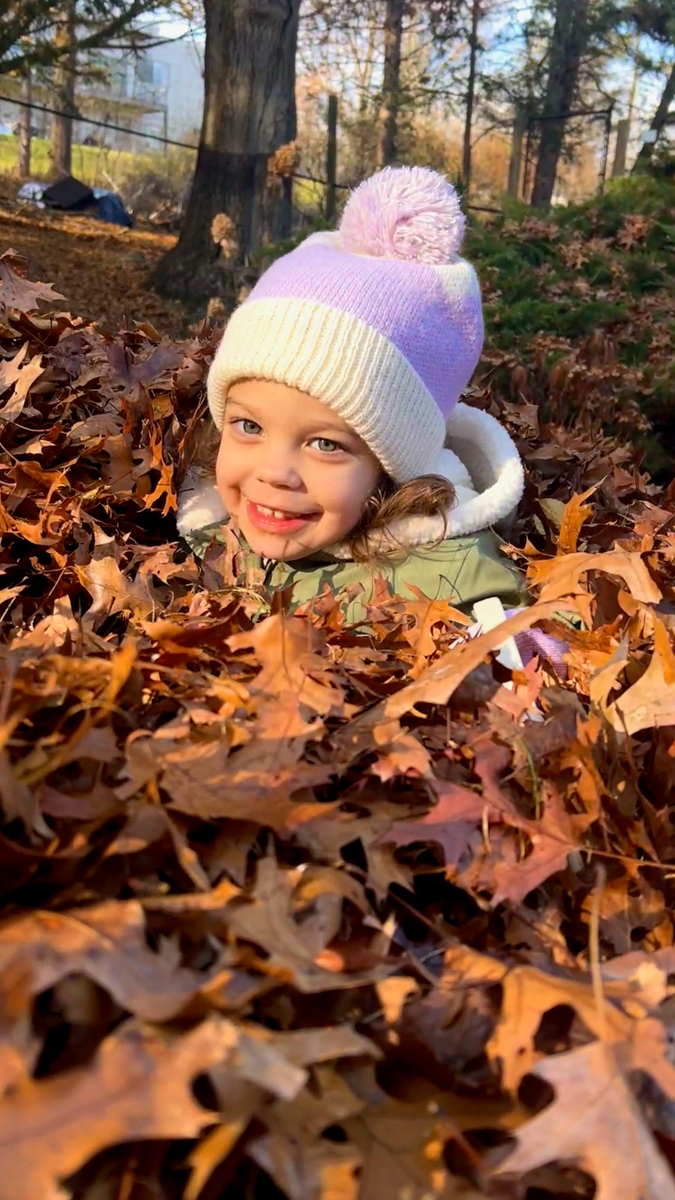
The landscape is a canvas of russet and gold, painted by the hands of autumn. In one of the many serene backyards, framed by the skeletal silhouettes of trees now slumbering after their fiery display, a mound of leaves becomes the center of joyous activity. Here, a child, bundled in the cozy layers necessary to fend off the chill, is immersed in the simple, yet profound act of play. The leaves, a tapestry of oaks and maples, become her castle, her sea, her world to explore.
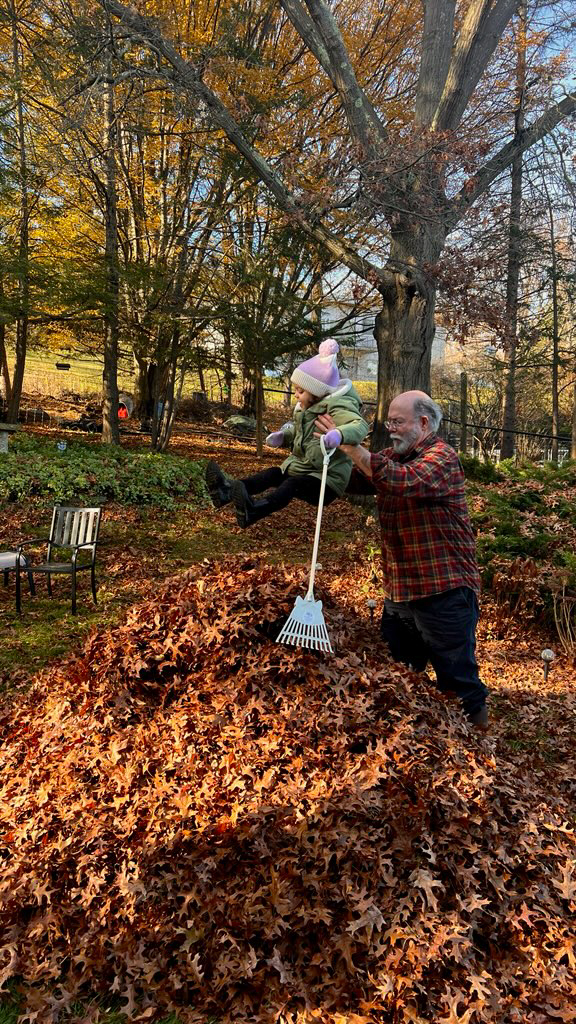
Her laughter rings clear, a melodic counterpoint to the rustling leaves as she is lifted high by loving hands only to descend into the crunchy embrace of her leafy playpen. A grandfather, his face etched with the smile lines of countless summers and autumns past, becomes the orchestrator of this joy. His flannel shirt, a patchwork of reds and greens, reflects the colors of the season, and his hands, weathered from years of tending to the earth and its cycles, now tenderly guide the child in her play.
The rake, usually a tool of labor, becomes a wand of magic, directing the leaves into heaps that rise and fall with each jump and dive. The child’s mittened hands grasp at the leaves, each one a different hue, a different shape, a different story. They fly up around her like a flock of birds taking flight, then settle back into their collective, creating a soft rustling symphony that speaks of the changing season.
The photographs of this gallery are by Soraya Leathers
As the sun begins to dip lower, casting elongated shadows across the yard, the child’s energy wanes. The vibrant activity gives way to tranquil moments of rest, with the child now lying still among the leaves, her eyes reflecting the vastness of the sky above, clear and blue, a window between the earthly and the infinite.
The day wanes, and the leaf-gathering winds down. A final tableau shows the child, now indoors, cocooned in the warmth of a blanket that mirrors the plaid of her grandfather’s shirt, the same colors now muted and soft. Her eyes are heavy with the weight of a day well spent, her dreams surely filled with the laughter and the leaves and the boundless love that turns even the simplest act into a treasure of memories.
This is the essence of leaf gathering in the Finger Lakes after Thanksgiving – not just the collection of what has fallen, but the gathering of family, of joy, and of moments that will be cherished and recalled long after the last leaf has been tucked into the earth’s winter bed. It’s a time when the harvest is not just of the land’s bounty but of the heart’s. Each leaf, a reminder that even as the world prepares to sleep beneath the snow, life is rich, full, and evergreen in the hearts of those who share it.
In a heartwarming YouTube video, Samuel Jack Wills and his grandmother Pam turn cake-making into an adventure in celebration of his Batman-themed birthday. The video captures endearing family traditions, from a talking doorbell to playful gift unwrapping, and culminates in the creation of a Bat-Signal adorned cake and joyous birthday song.
Grab your capes, click on our video, and be a part of our delightful celebration that’s sure to lift your spirits sky-high!
🎉 Get ready for an extraordinary adventure into the world of cake-making with our superstar, Samuel Jack Wills, and his magical sidekick, Grandma Pam! 🍰✨ It’s a special day just before Halloween, and the excitement is as palpable as the crisp autumn air. 🍂
🦇 In our latest heartwarming YouTube video, witness the grand entrance of our birthday hero, Sam, as he strides through the gate with his dad, Sean Wills, to a chorus of giggles and gasps, thanks to our quirky, talking doorbell that’s become an outrageous family tradition. 🎈
Join us in the celebration as Sam unwraps wonders from Grandma Pam and Grandpa Michael: from a thrilling Batman-themed birthday card that lights up the room with a Bat-Signal magnetic sticker, to a fleet of Gotham-inspired toys including an aircraft, the Batcave, and even miniature treasures like a suitcase brimming with play 100 dollar bills. 🏰💰
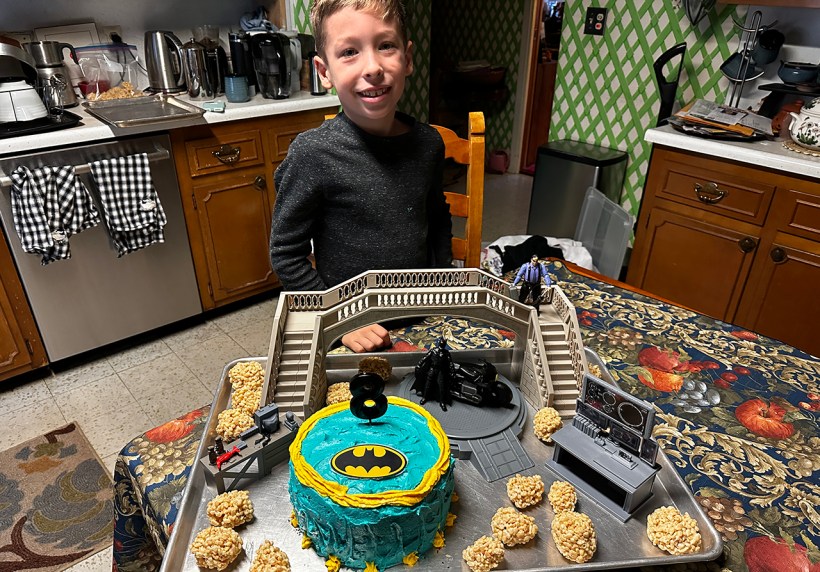
Sam and Grandma Pam put on their chef hats, discussing and designing a cake that’s not just a treat but a superhero saga! 🎂 With buttercream as smooth as velvet and chocolate layers that whisper ‘indulge’, they create a masterpiece adorned with blue and yellow frosting, featuring the iconic Bat-Signal.
And what’s a Batcave without boulders? Watch them skillfully make Rice Krispy treat boulders to scatter around their edible Batcave — a feast for the eyes as much as the taste buds. 🍫
The grand finale is a chorus of joy as Sam, surrounded by his loving family, basks in the glow of birthday candles and the warmth of the Birthday Song. 🎶 It’s a day where memories are made, laughter is shared, and love is multiplied.
So grab your capes, click on our video, and be a part of our delightful celebration that’s sure to lift your spirits sky-high! 🚀 Don’t forget to like, share, and subscribe for more family fun with the Wills clan! #SuperSamCakeAdventure 🥳👨🍳
Hartung–Boothroyd Observatory is a leading educational facility, aiding in the study of astrophysics, tracking asteroids, and fostering diverse academic collaborations.
Perched on Mount Pleasant in the town of Dryden, New York, the Hartung-Boothroyd Observatory (HBO) stands as a testament to the celestial curiosity that Cornell University has nurtured for decades. It is a gateway to the stars, a place where the heavens unfold in wondrous detail to the eyes of astrophiles and the lenses of powerful telescopes.
The observatory is home to a reflecting telescope, one of the largest in New York State dedicated to both education and research. This remarkable instrument, housed under a retractable dome, has provided students and researchers with direct experience in astronomical observations since its establishment in 1974.
HBO isn’t just an observatory; it is a bridge between the terrestrial and the cosmic. It represents an educational philosophy that values direct engagement with the subject of study. Undergraduates, graduates, and faculty members flock to the facility to engage in projects that range from studying variable stars and exoplanets to tracking asteroids. Here, theoretical astrophysics meets the tactile world, allowing for an integrated understanding of the universe’s complexities.
Are images are from a handheld Apple Iphone 14 ProMax, raw files edited on camera and then from Adobe Lightroom.
It is used mainly as a Cornell University (Ithaca, New York) teaching facility for upper-level astronomy classes. The observatory is named financial contributions of M. John Hartung ’08 (chemical industrialist and donor) and in honor of the labor of Samuel L. Boothroyd (founding professor and chairman of astronomy 1921–1942). The telescope construction began in the 1930s and the observatory was dedicated in 1974. It contains the James R. Houck 60 centimeter telescope and various instruments.
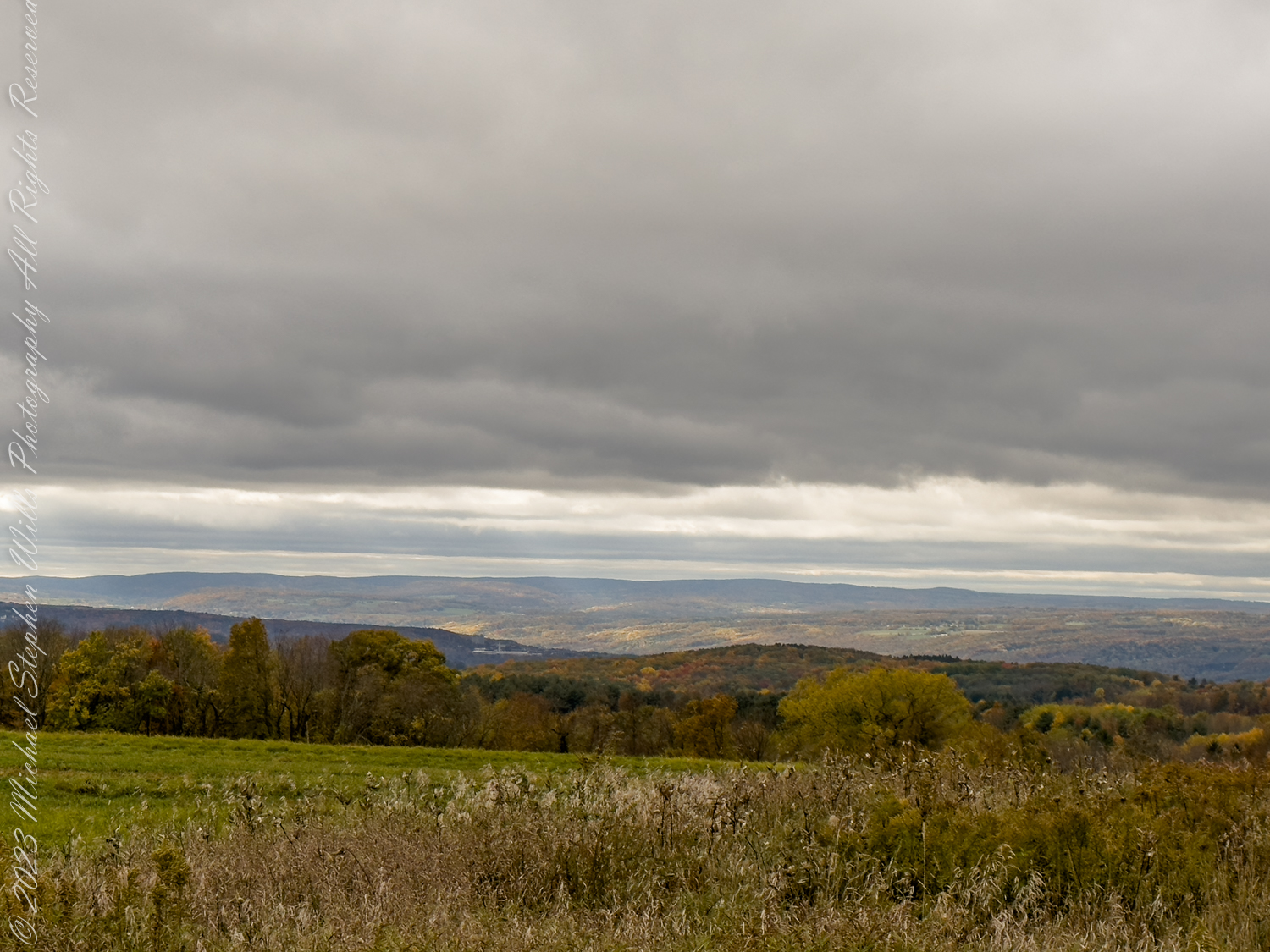
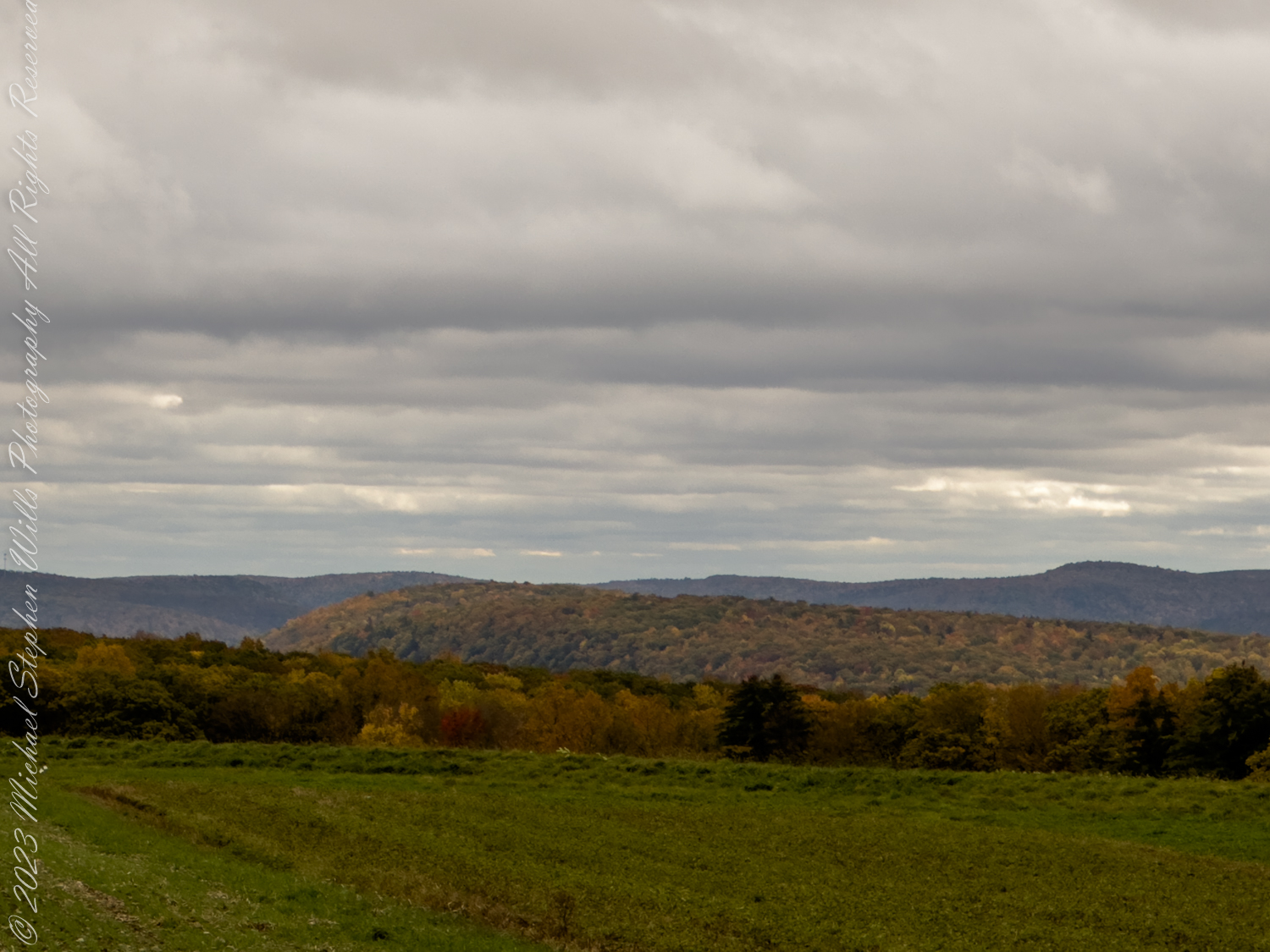
View east from Cornell University’s Hartung–Boothroyd Observatory
The James R. Houck telescope at HBO was a project initiated by its namesake in 1972, using optics and a lightweight tube which had been fabricated in the late 1930s by Samuel T. Boothroyd, Cornell’s first astronomer, and a mounting constructed by George Gull ’72 as his senior design thesis in Mechanical Engineering.
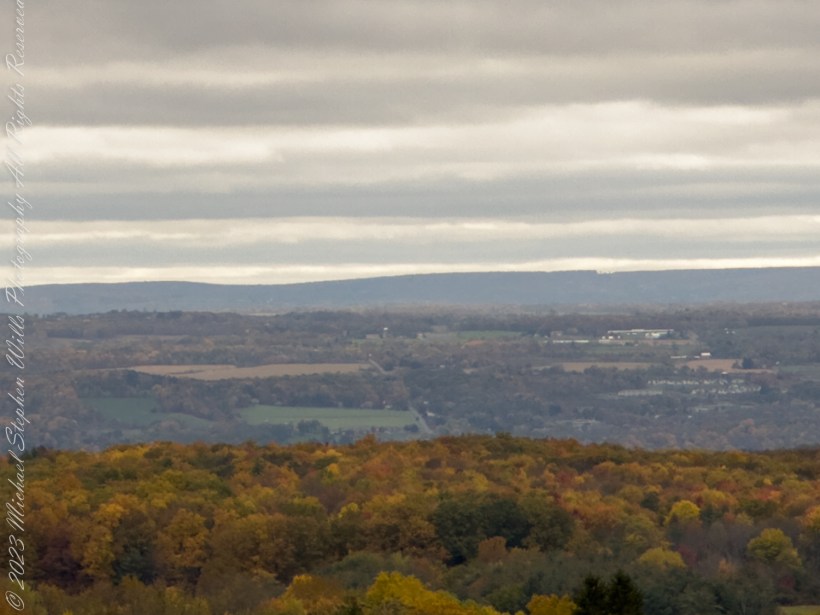
View southwest toward Ithaca College
The telescope, control electronics and instruments are largely the result of work done by undergraduates since 1970. It was manufactured by the students at the Tompkins, Tioga and Seneca BOCES and by Therm, Inc., with mirror coatings by Evaporated Metal Films corporation, all in Ithaca. The latter corporation was founded by members of Boothroyd’s scientific team, as he pioneered the use of evaporated metal coatings in astronomical optics. The telescope and observatory were dedicated in 1974.
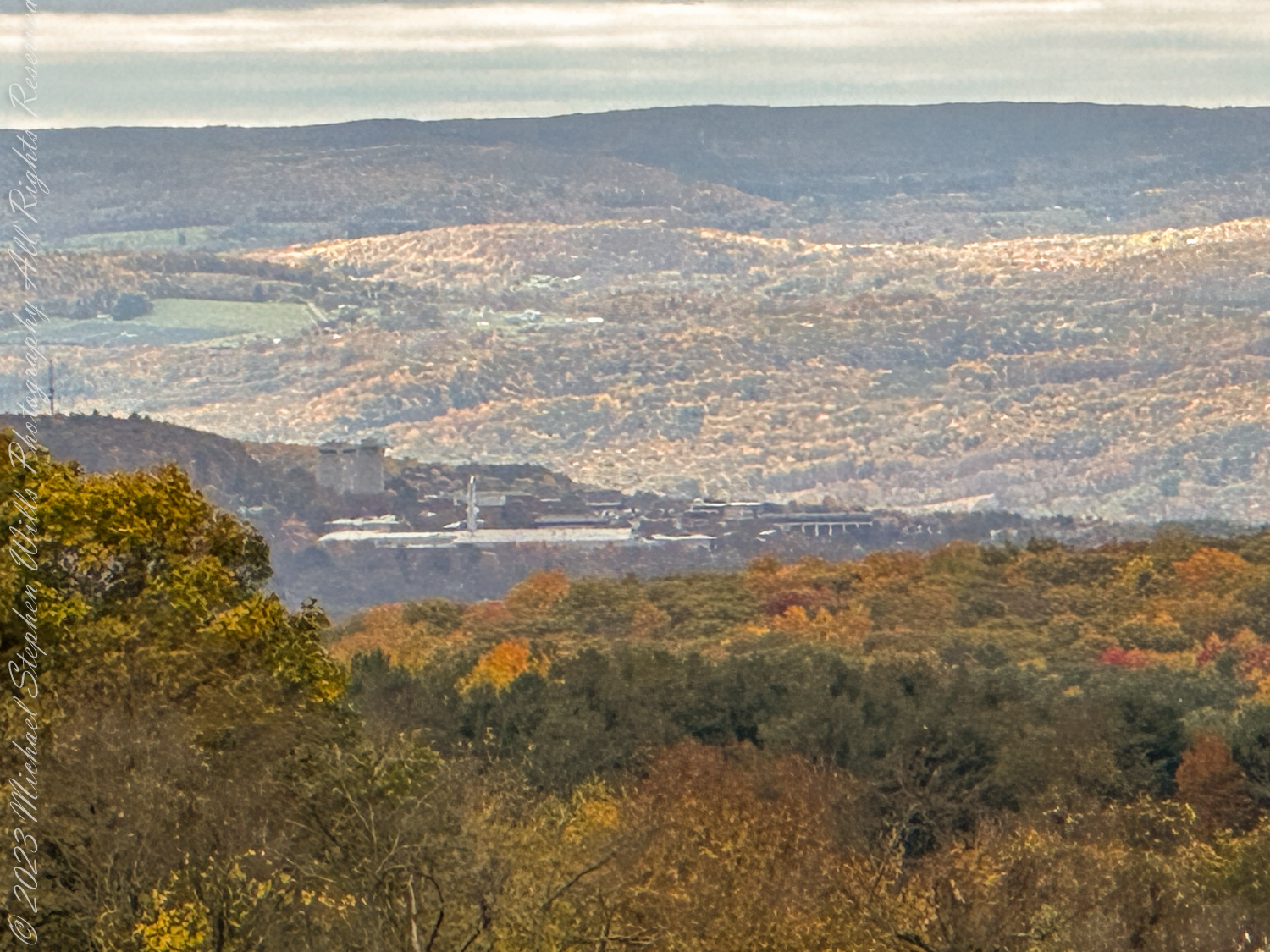
View southwest toward Ithaca College I zoomed in to see the residential towers.
The primary mirror is made of Pyrex from the Corning Glass Works and is in fact from a 1/8-scale test pour by the Corning company in preparation for the making of the 200″ Palomar mirror. It is 0.635 m (25 inches) in size, but the outer half inch is masked. The focal length of the mirror is 2.5m (100″) or f/4.
View southeast toward Hammond Hill
The Cassegrain design of the James R. Houck telescope is a combination of a primary concave mirror and a secondary convex mirror, often used in optical telescopes, the main characteristic being that the optical path folds back onto itself, relative to the optical system’s primary mirror entrance aperture. This design puts the focal point at a convenient location behind the primary mirror and the convex secondary adds a telephoto effect creating a much longer focal length in a mechanically short system.
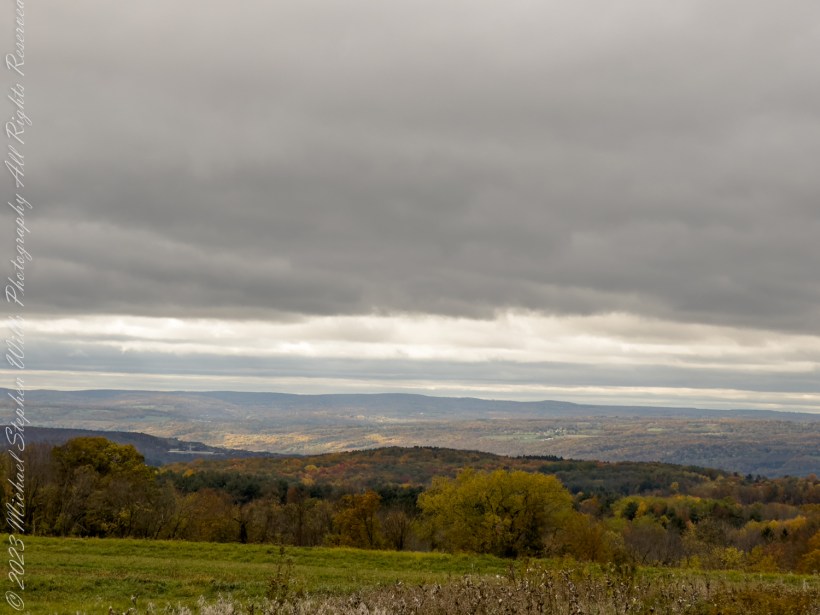
View south
The secondary is an 8″ mirror made of Cervit (a low thermal coefficient material). In combination with the primary, it yields a final f/13.5 beam to the nominal focus, which lies 18.5″ behind the primary mirror’s vertex. At nominal focus, the plate scale is about 24 arcsec/mm, with an effective focal length of 8.57 m.
View southwest toward Ithaca College
The telescope, control electronics and instruments are largely the result of work done by undergraduates since 1970. It was manufactured by the students at the Tompkins, Tioga and Seneca BOCES and by Therm, Inc., with mirror coatings by Evaporated Metal Films corporation, all in Ithaca. The latter corporation was founded by members of Boothroyd’s scientific team, as he pioneered the use of evaporated metal coatings in astronomical optics.
The dome itself, like all professional observatories, is unheated. The telescope and instrumentation can be controlled from a neighboring control room which is heated and offers standard amenities plus several computers for simultaneous data reduction.
The observatory was founded by James Houck and managed by him through 2006. The principal contact is Don Barry, who managed the facility from 2006-2015, and taught Experimental Astronomy using the facility.
“Graduates” of the HBO project are now senior engineers and technical managers as well as graduate students, research associates and faculty at major universities.
Moreover, the observatory is a beacon for interdisciplinary collaboration. It’s not uncommon to find astronomers working alongside computer scientists, engineers, and educators. This cross-pollination of ideas enhances the potential for innovation, fostering new techniques in data analysis, instrument design, and educational methods. The observatory’s role extends beyond its primary function; it is a hub of convergence for diverse academic disciplines, all under the umbrella of exploring the unknown.
HBO also contributes to the global astronomical community through its research. The data collected here feed into larger networks of observation and analysis, aiding in the collective endeavor of mapping and understanding the universe. Its strategic location in upstate New York, away from the light pollution of large urban centers, grants it relatively clear night skies, making it an invaluable resource for both optical astronomy and astrophotography.
In an era where space exploration has captured the public imagination like never before, observatories such as the Hartung-Boothroyd are more crucial than ever. They serve as terrestrial launchpads, propelling minds into the realm of scientific inquiry. Here, the vastness of space becomes approachable, the mechanics of the cosmos decipherable, and the mysteries of the universe a little less mysterious.
As the night falls and the stars emerge, the Hartung-Boothroyd Observatory continues its silent vigil over the heavens. It stands as a beacon of knowledge and discovery, an educational catalyst, and a gateway to the stars. For the students and astronomers who work from this dome on Mount Pleasant, HBO is more than an observatory—it is a vessel navigating the infinite ocean of the night sky, a journey that begins in the heart of Cornell University and extends to the edges of the observable universe.
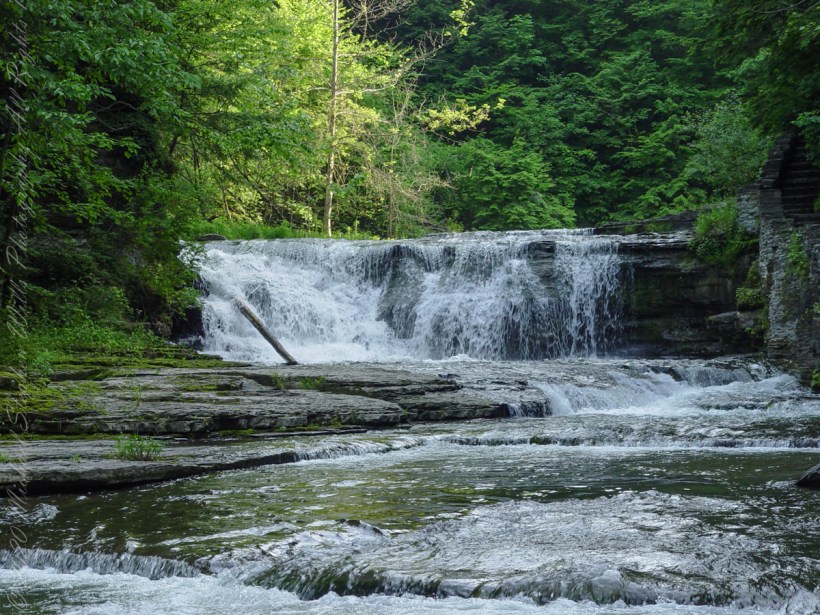
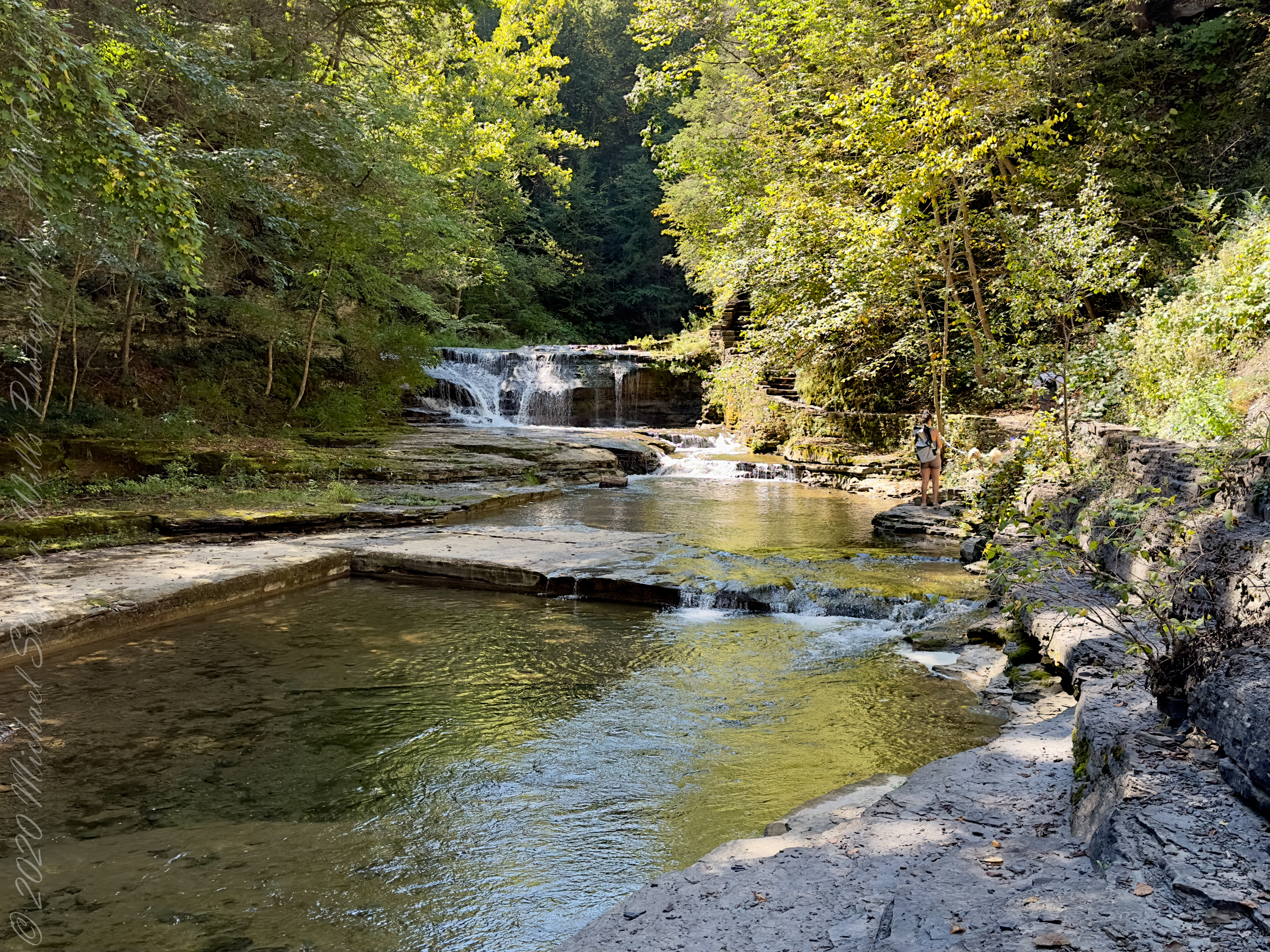
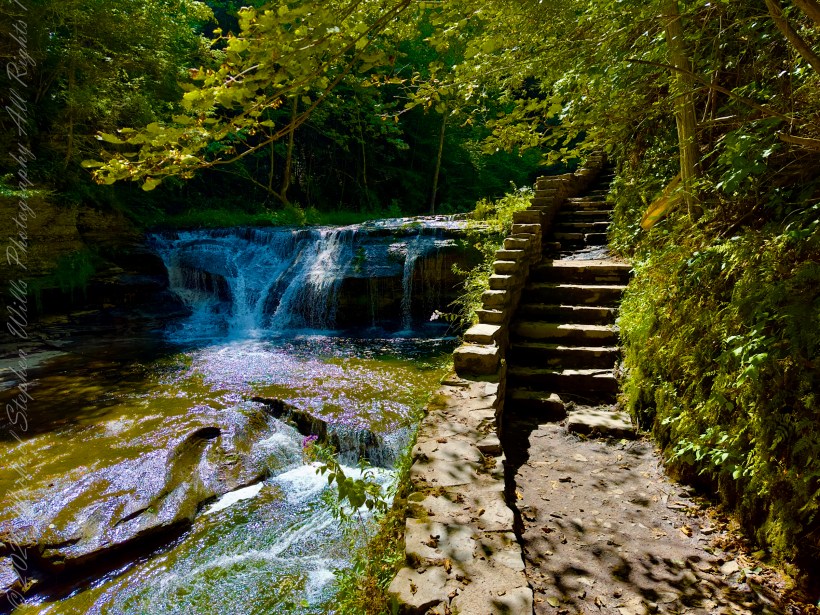
An unnamed waterfall along the Gorge Trail is memorable for the steps alongside.
I have captured it in all seasons from the beginning of my photography interest. Here it is at midday, early autumn, 2023, taken with the Apple Iphone 14 proMax. Bright sunlight ruins the shot.
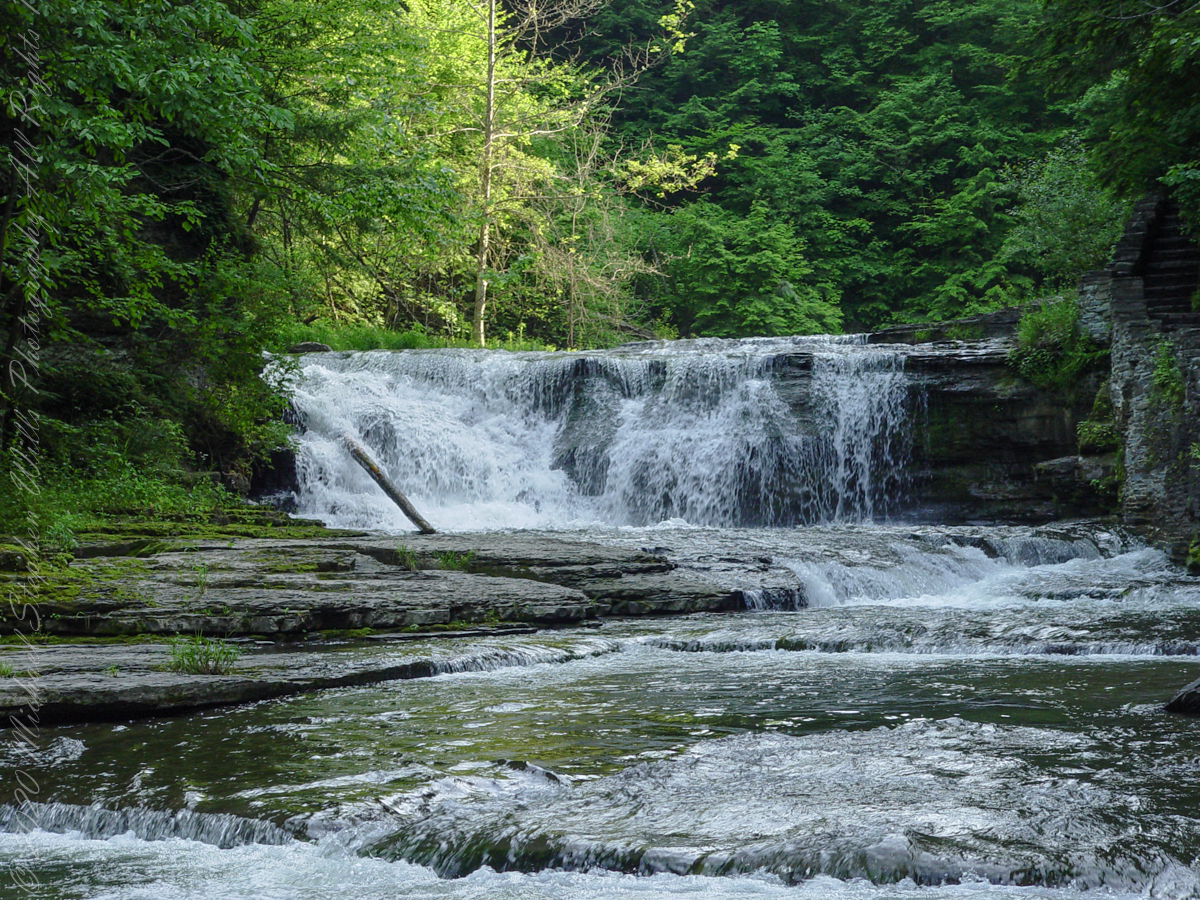
Here, evening, early summer 2003, the foreground shaded, late day sunlight on trees beyond. The Sony dsc F828 camera, on a tripod, was used.
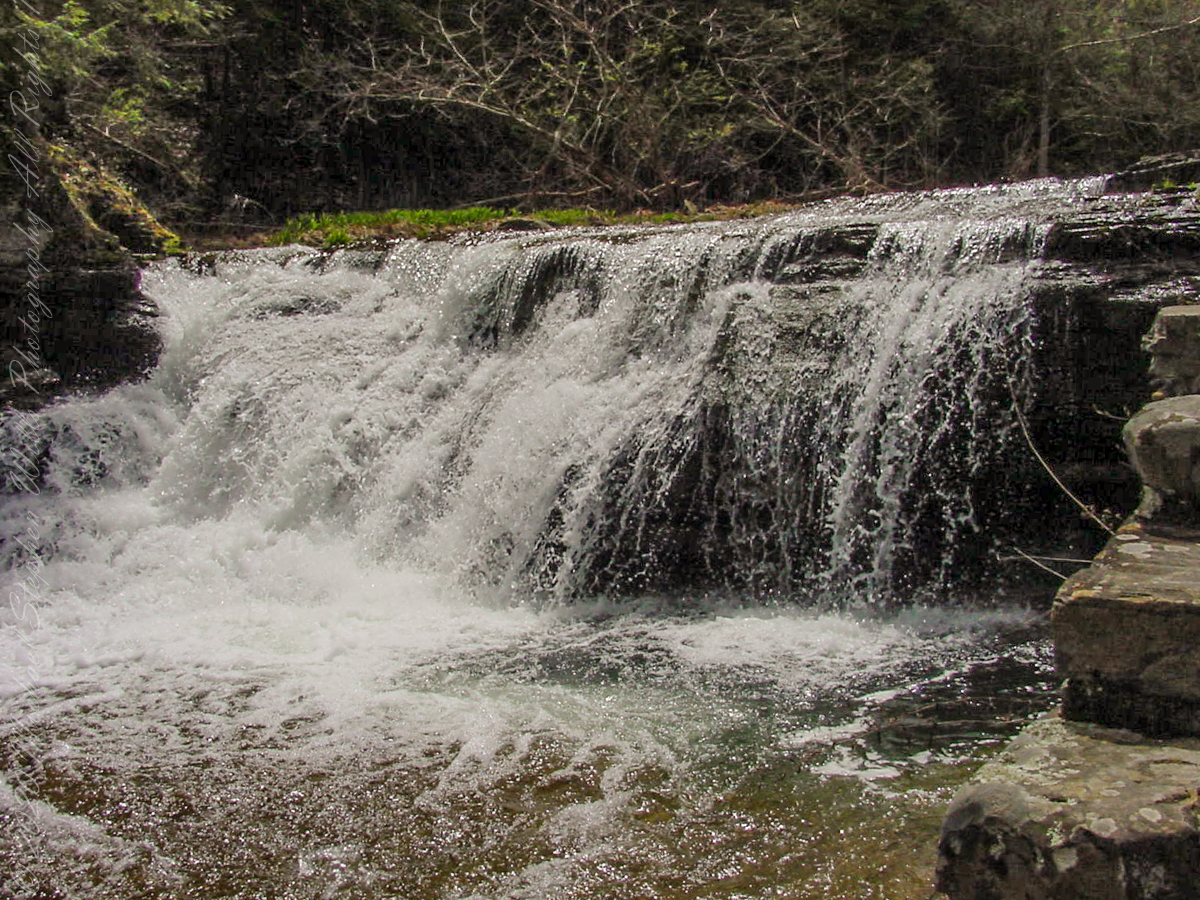
Here, bright sunlight at midday is handled by framing the brightly lit waterfall, April, 2002. A handheld Sony Mavica was used.
Daring visitors jump from the wall at right into a plunge pool, seen here as the quiet water at base of wall. It is a doubly dangerous activity as the force of water can hold a swimmer under indefinitely, missing the narrow pool results in striking the rocks. Robert H. Treman New York State Park, Tompkins County, Ithaca, New York.
“Plunge pools are formed by the natural force of falling water, such as at a waterfall or cascade; they also result from man-made structures such as some spillway designs. Plunge pools are often very deep, generally related to the height of fall, the volume of water, the resistance of the rock below the pool and other factors.[4] The impacting and swirling water, sometimes carrying rocks within it, abrades the riverbed into a basin, which often features rough and irregular sides. Plunge pools can remain long after the waterfall has ceased flow or the stream has been diverted. Several examples of former plunge pools exist at Dry Falls in the Channeled Scablands of eastern Washington. They can also be found underwater in areas that were formerly above sea level, for example Perth Canyon off the coast of Western Australia.”
“Plunge pools are fluvial features of erosion which occur in the youthful stage of river development, characterized by steeper gradients and faster water flows. Where softer or fractured rock has been eroded back to a knickpoint, water continues to bombard its base. Because this rock is often less resistant than overlying strata, the water from the higher elevation continues eroding downward until an equilibrium is achieved.”
Reference: text in italics and quotes is from the Wikipedia, “Plunge Pool.”
Copyright 2023 All Rights Reserved Michael Stephen Wills
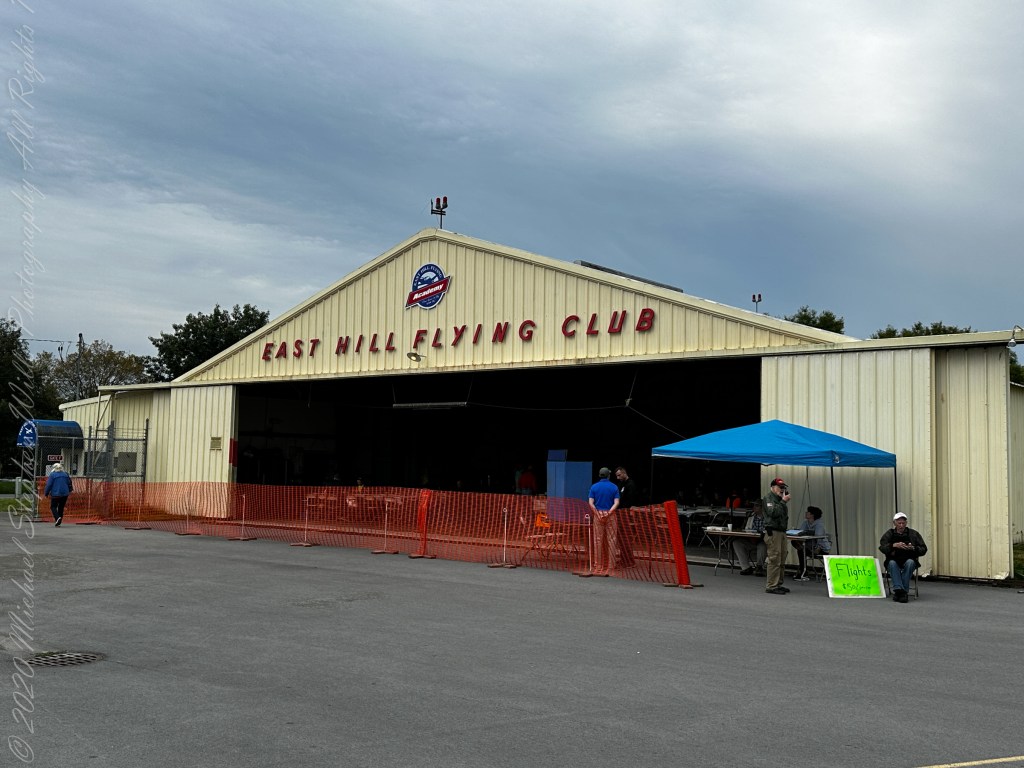
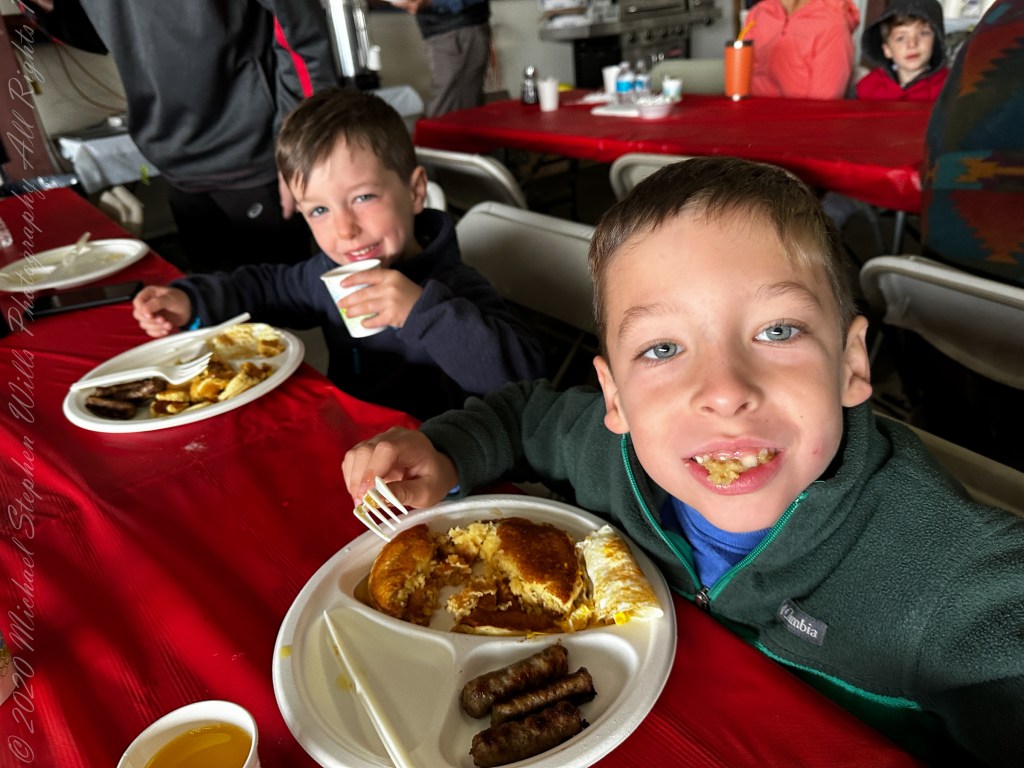
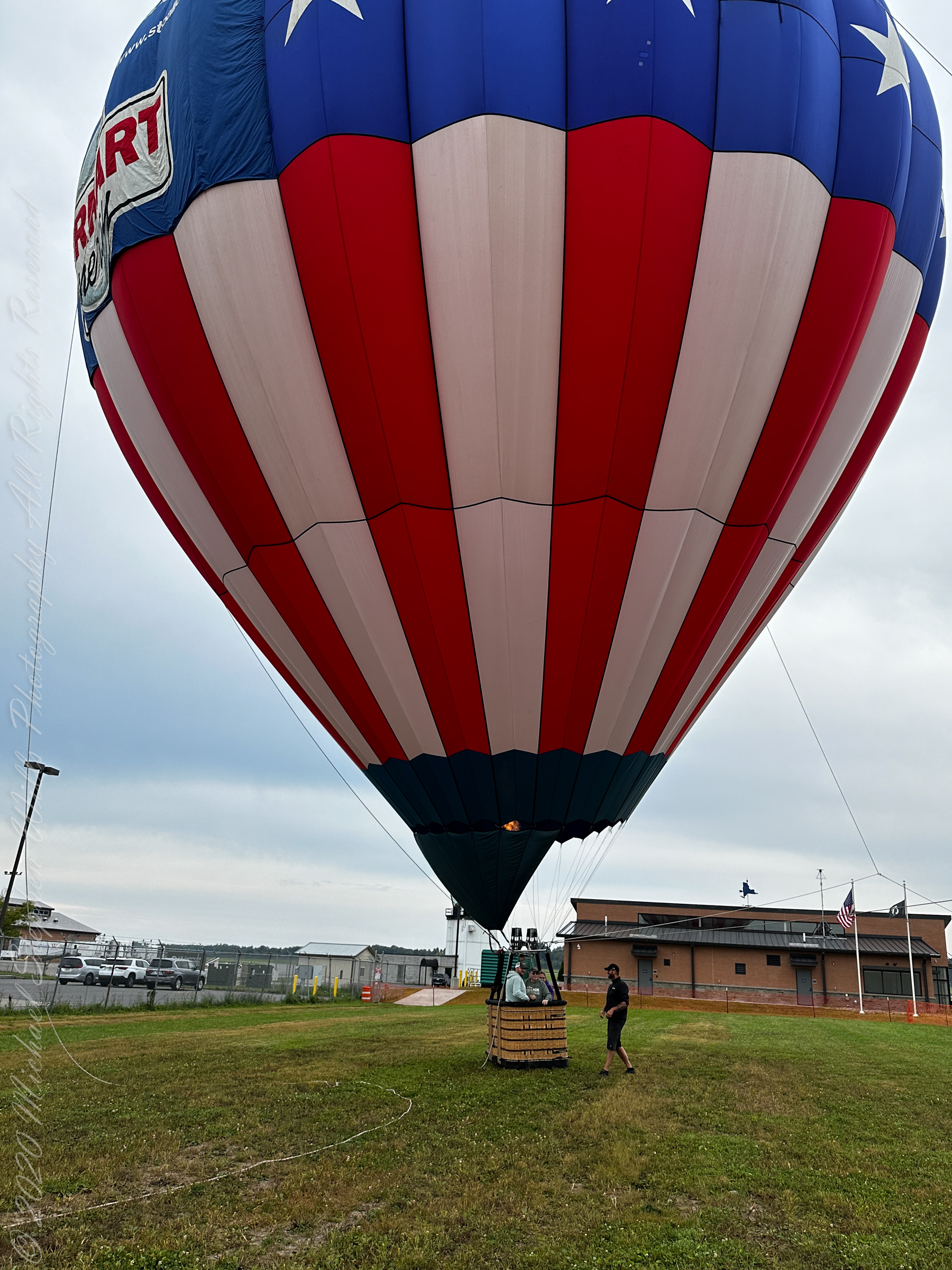
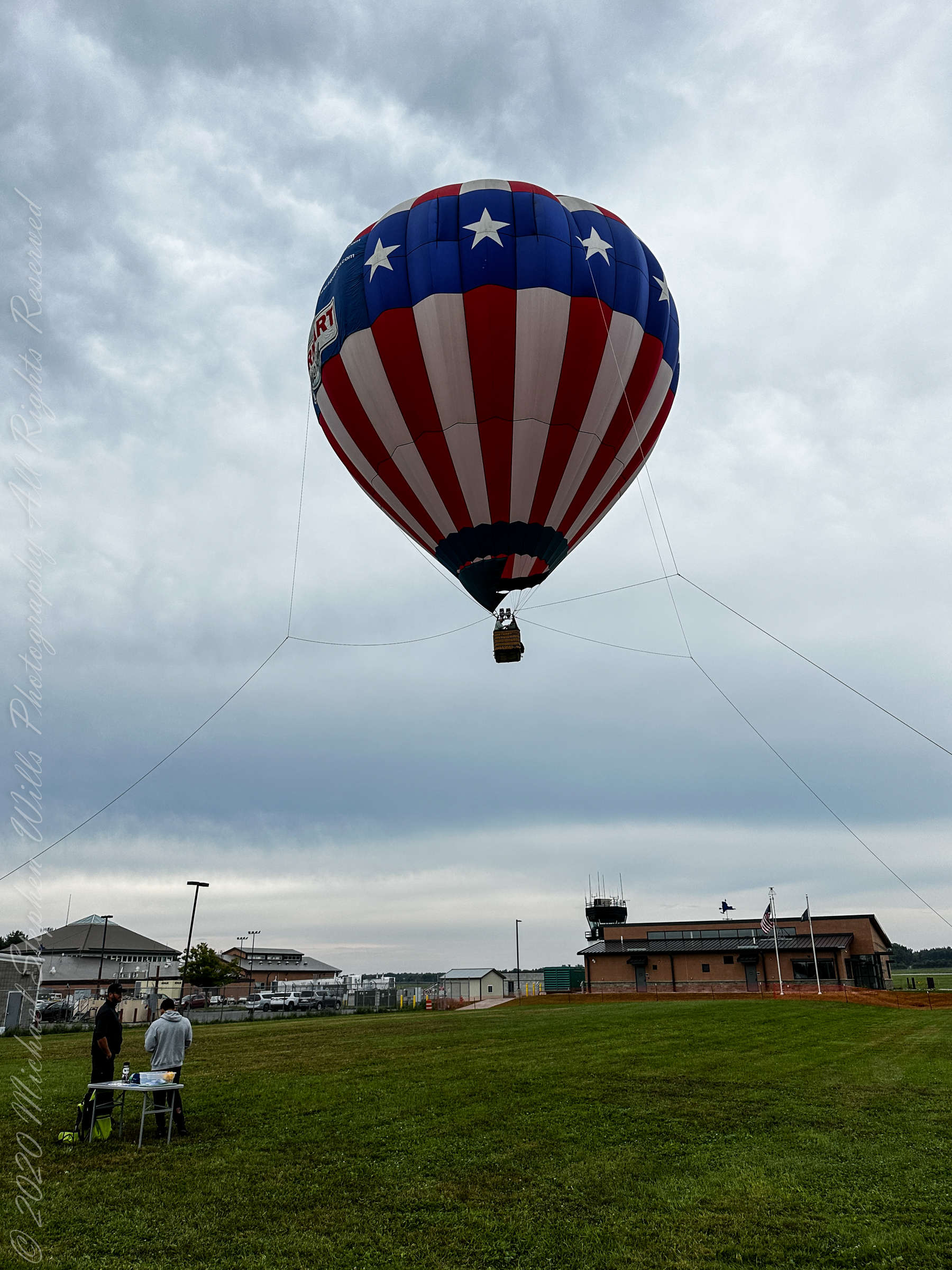
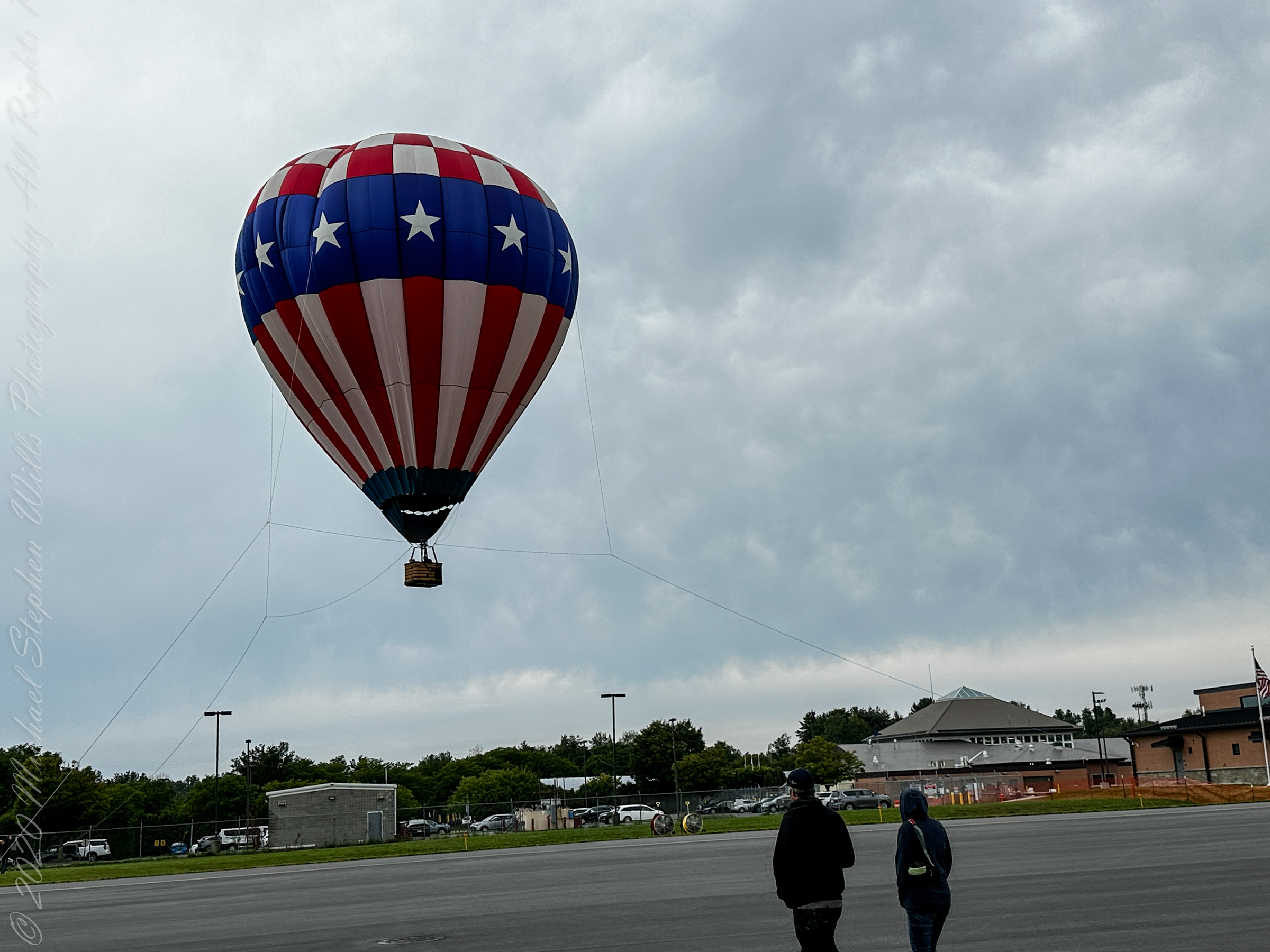
Airport Day was hosted by the East Hill Flying Club, the pancake breakfast was in the hangar.
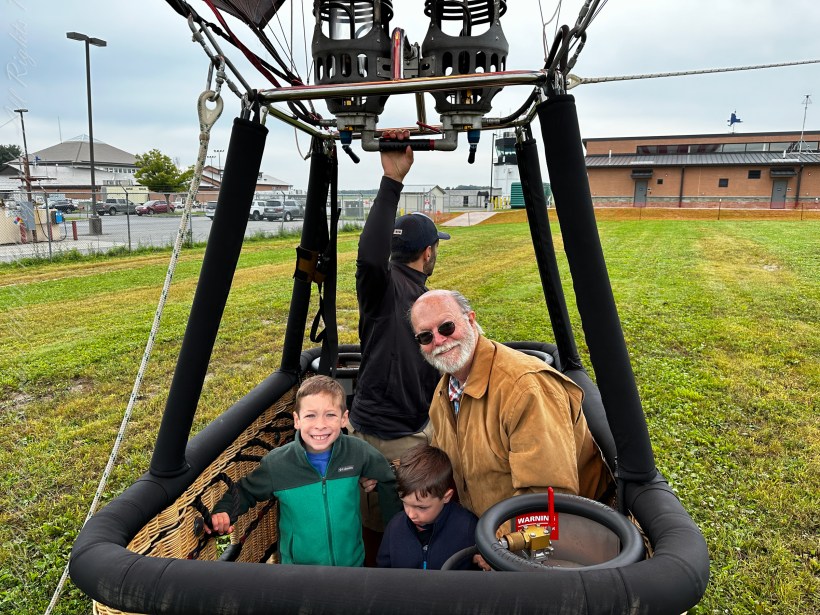
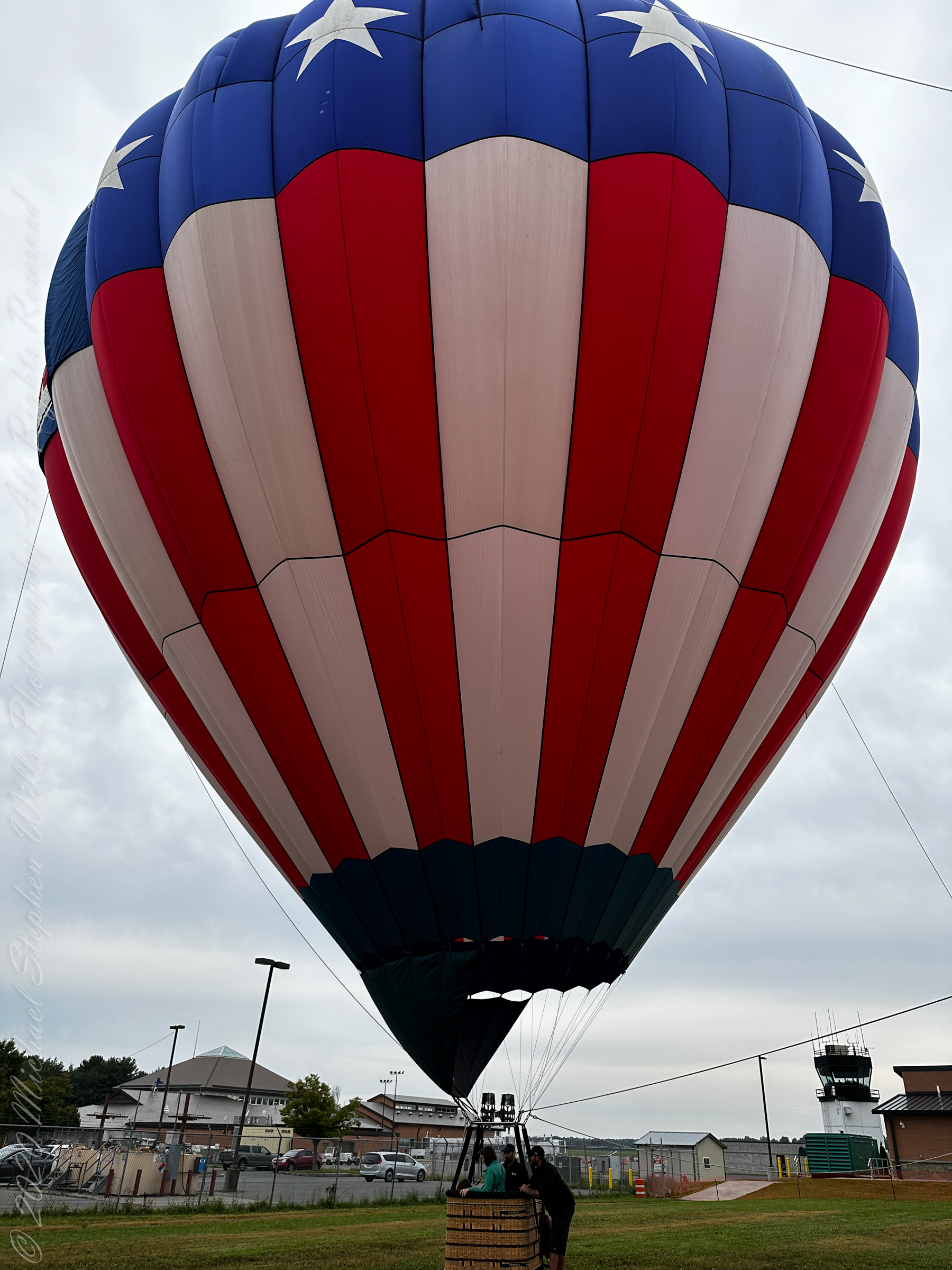
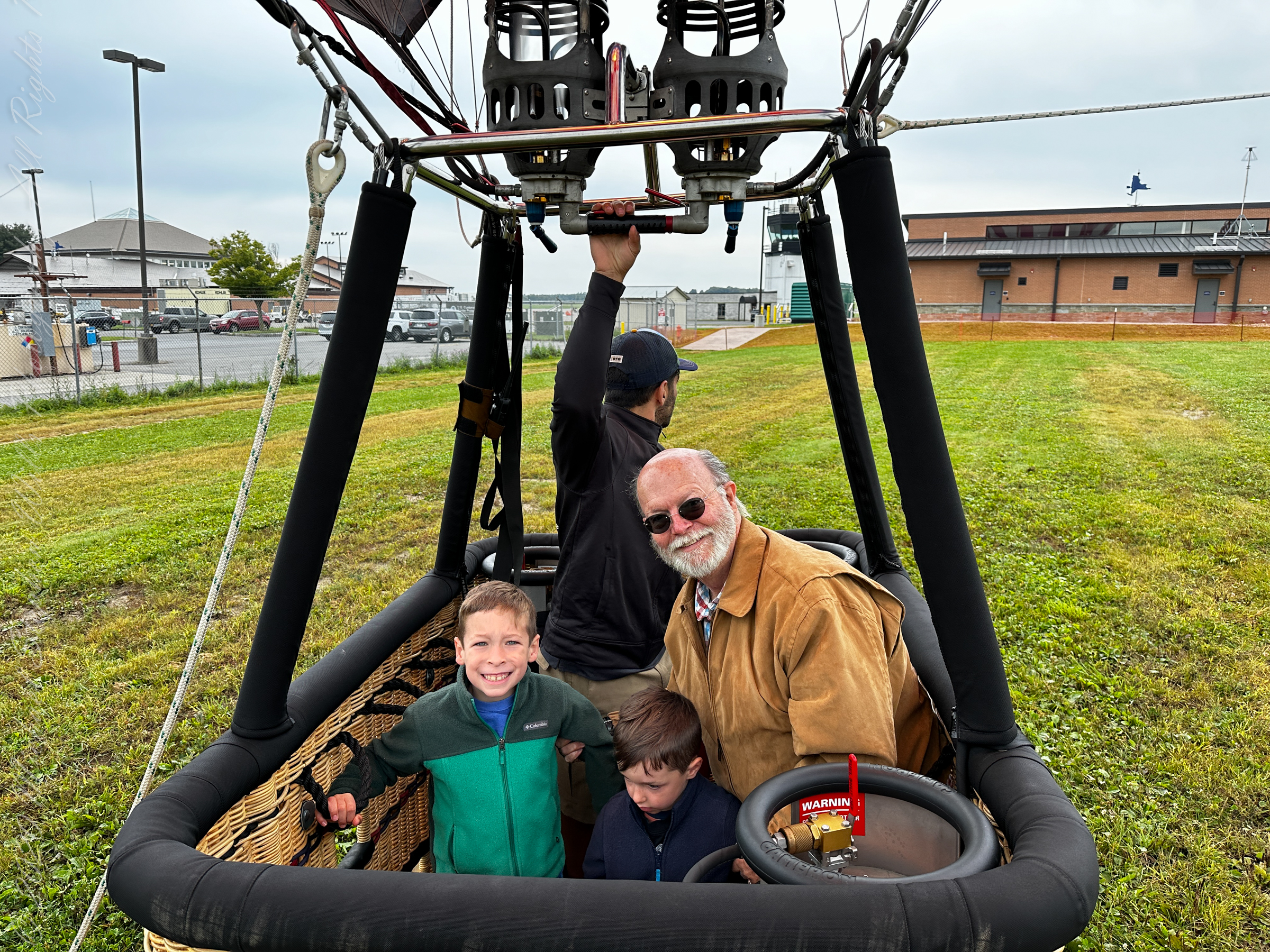
We learned why a hot air balloon cannot “pop.”
The propane burner announces the approach of every hot air baloon.
The operator kept careful watch over this landing helicopter, Sam was nervous anyway.
While we were aloft the New York State Police helicopter completed landing next to the U.S. Army Helicopter.
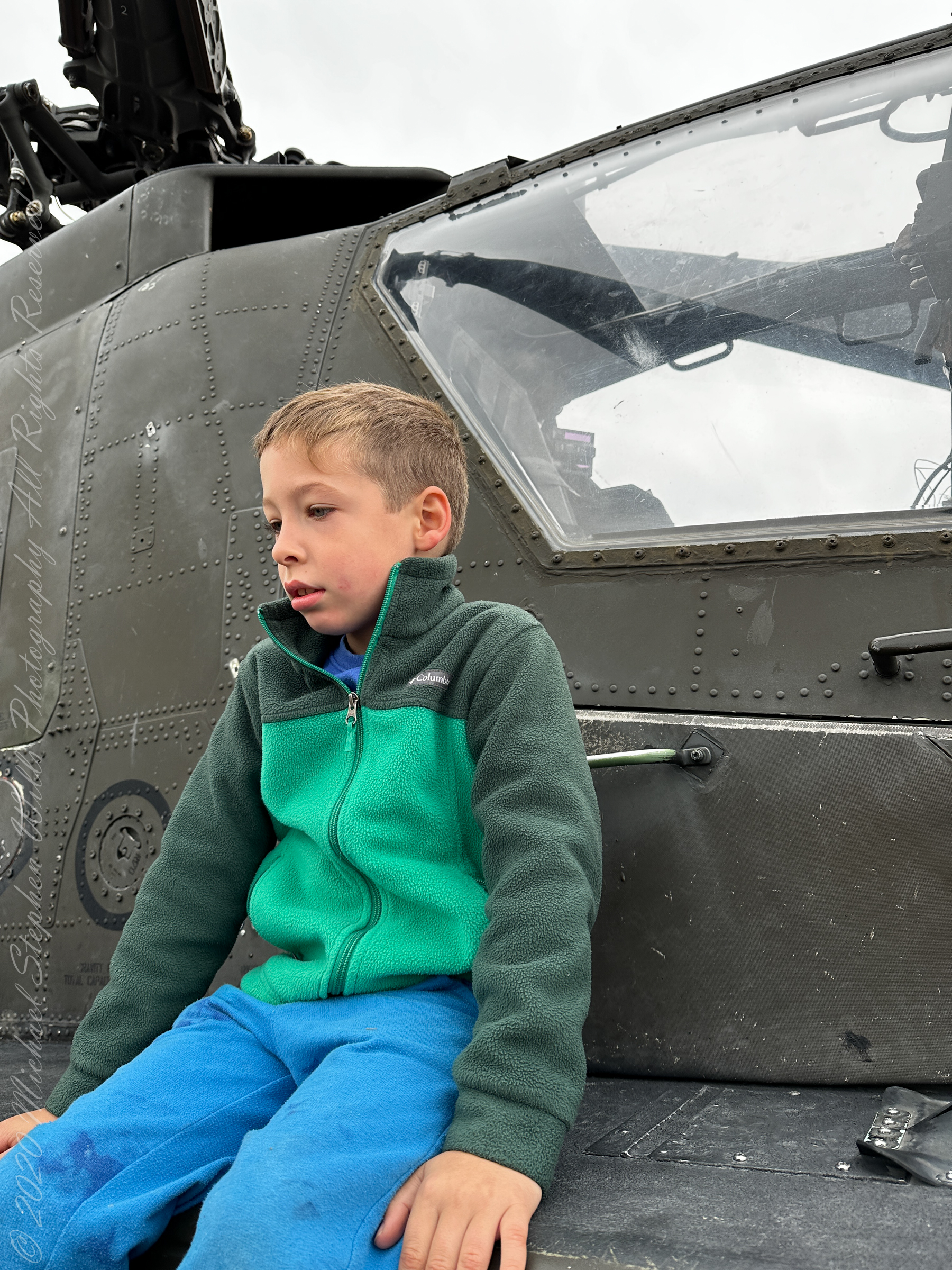
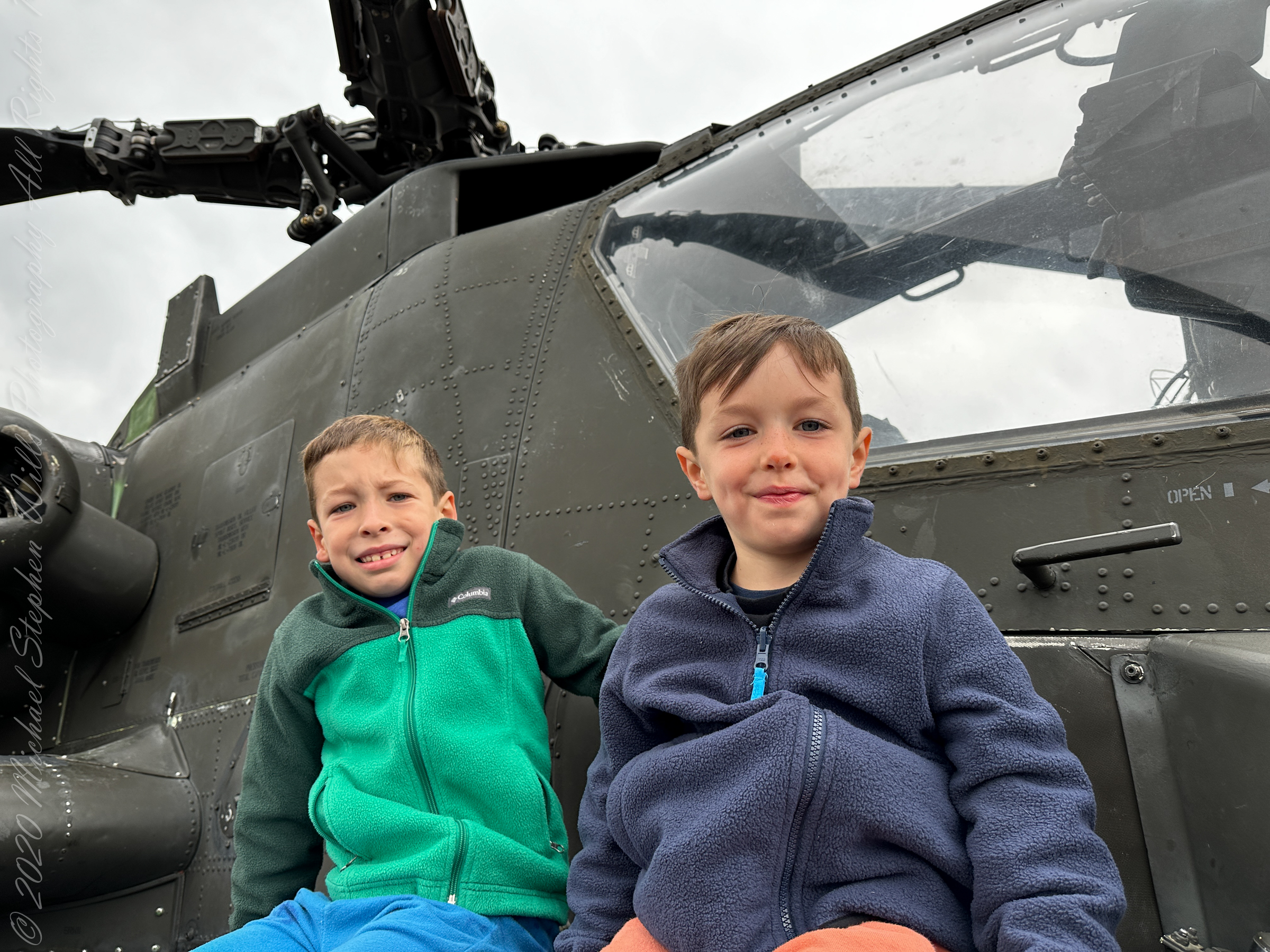
U.S. Army Helicopter — Sam was not a fan of the potential firepower, Rory was all in
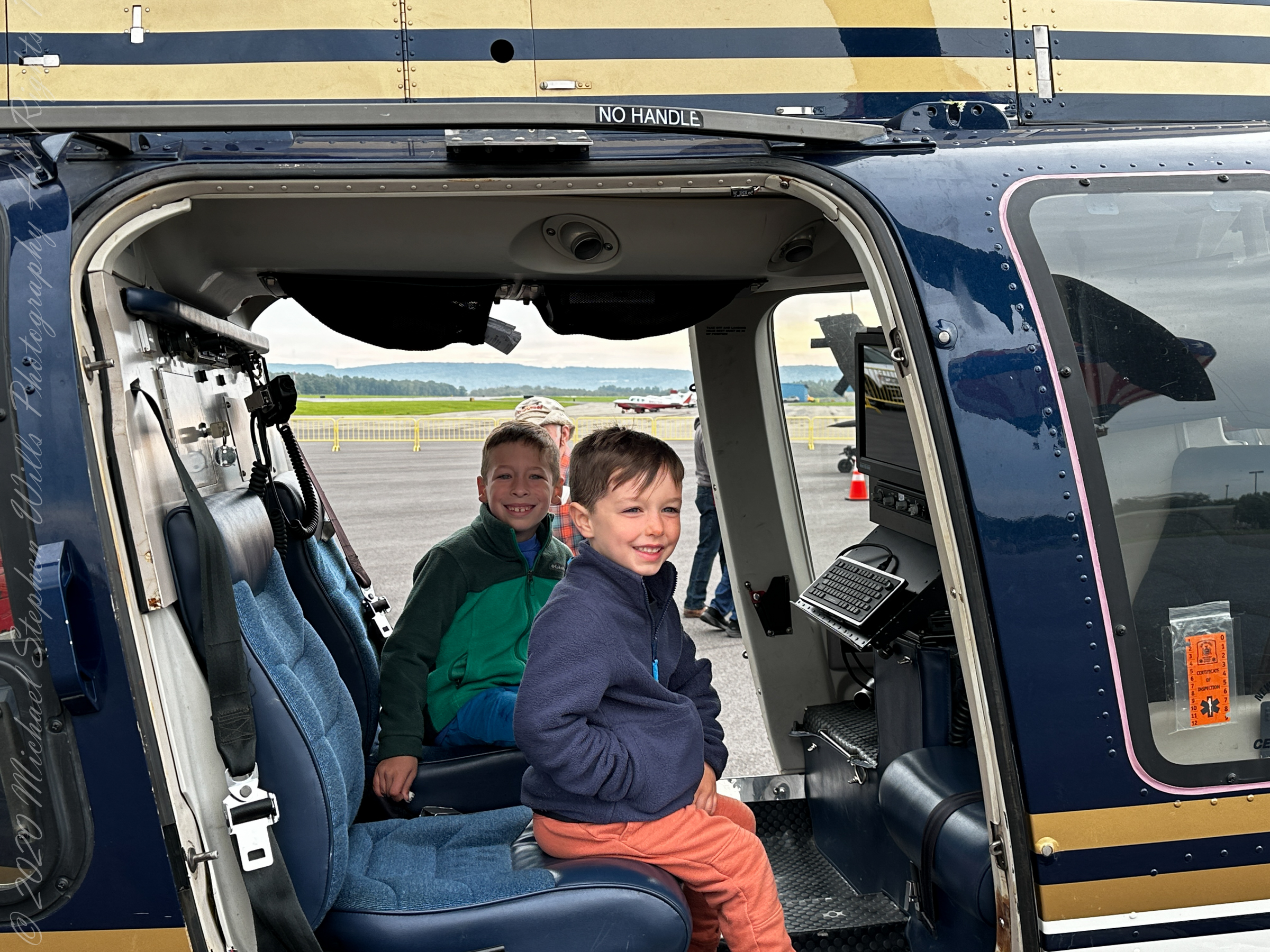
New York State Police Helicopter
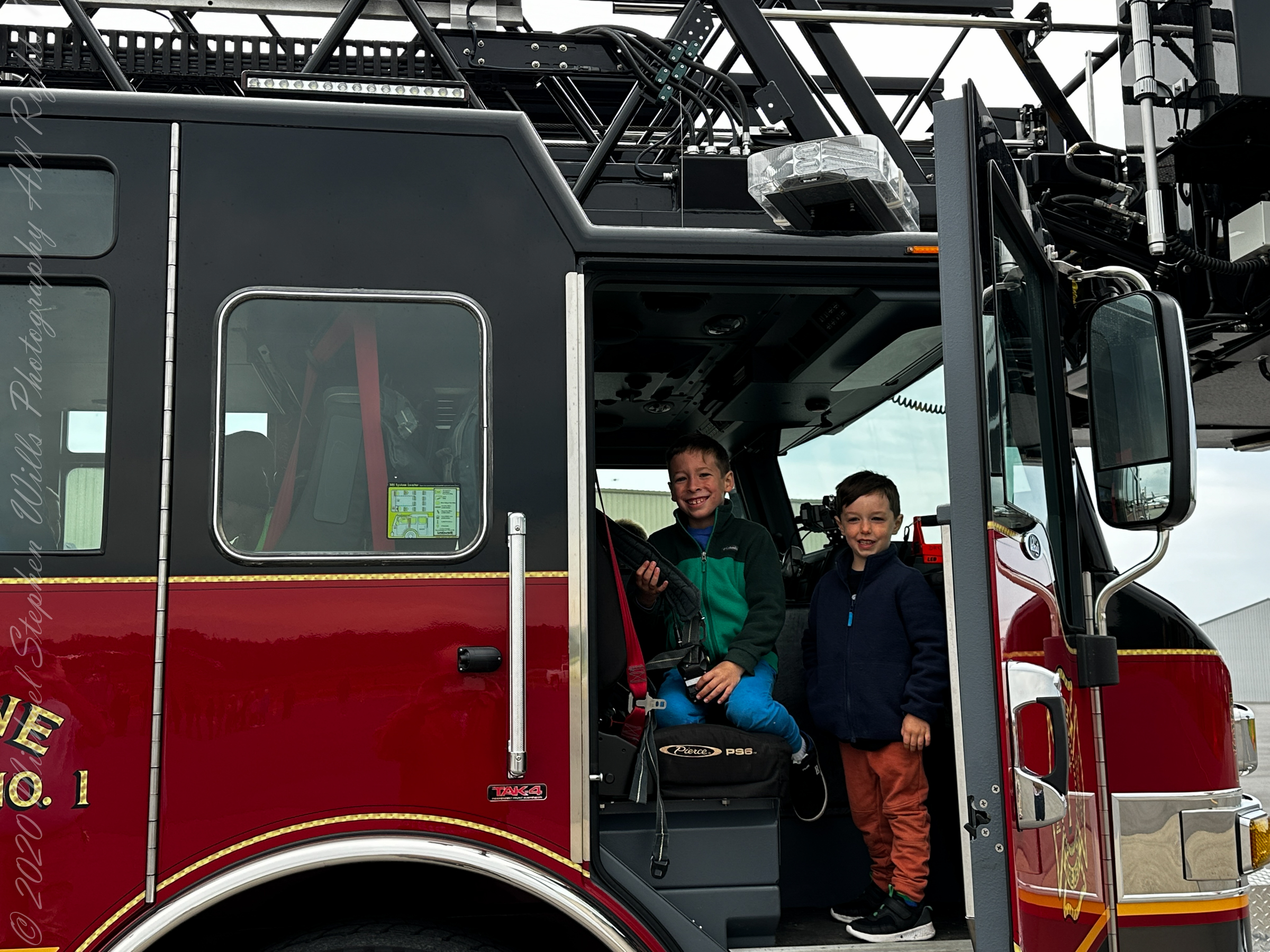
Dryden Volunteer Fire Department Firetruck
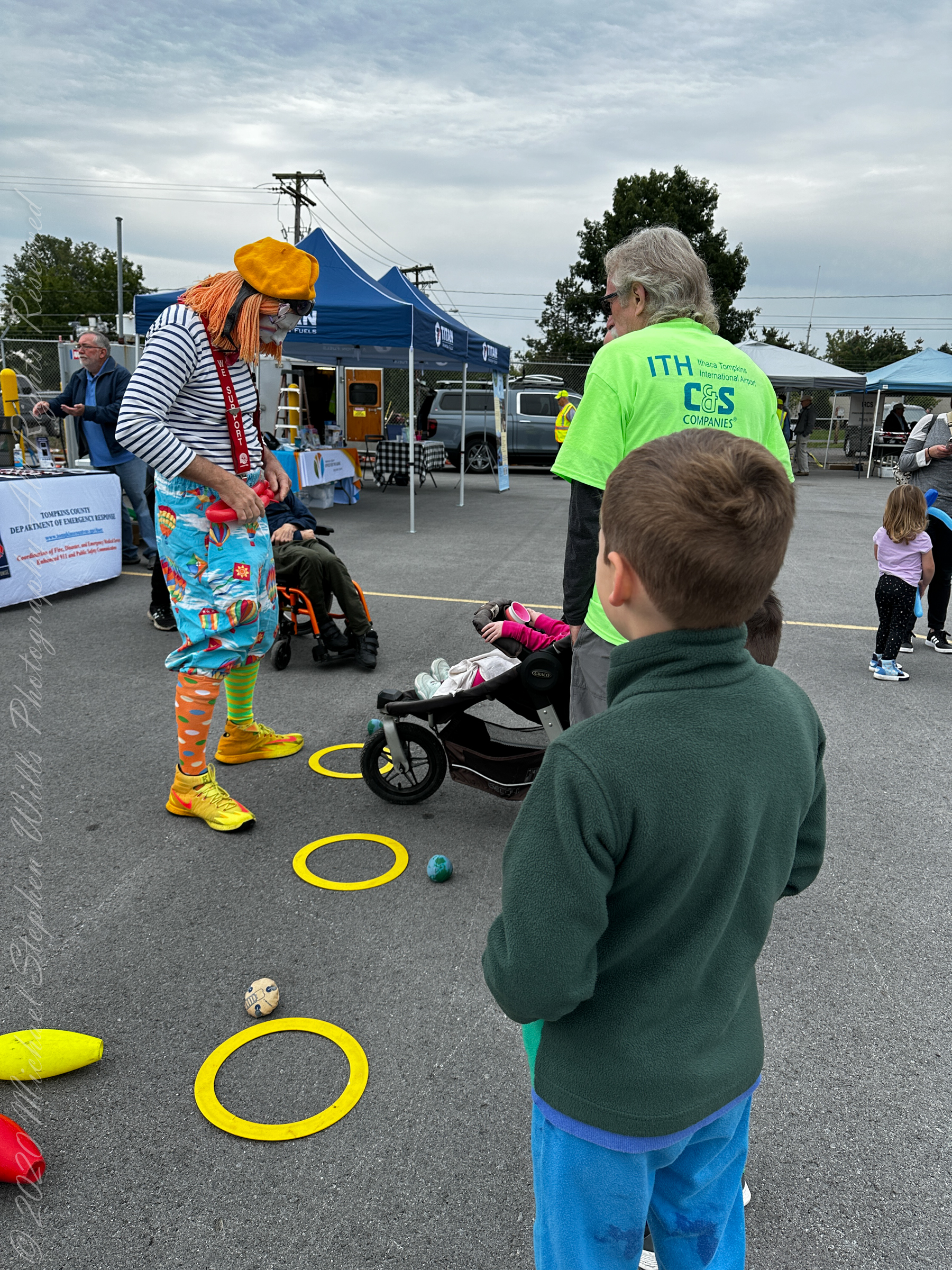
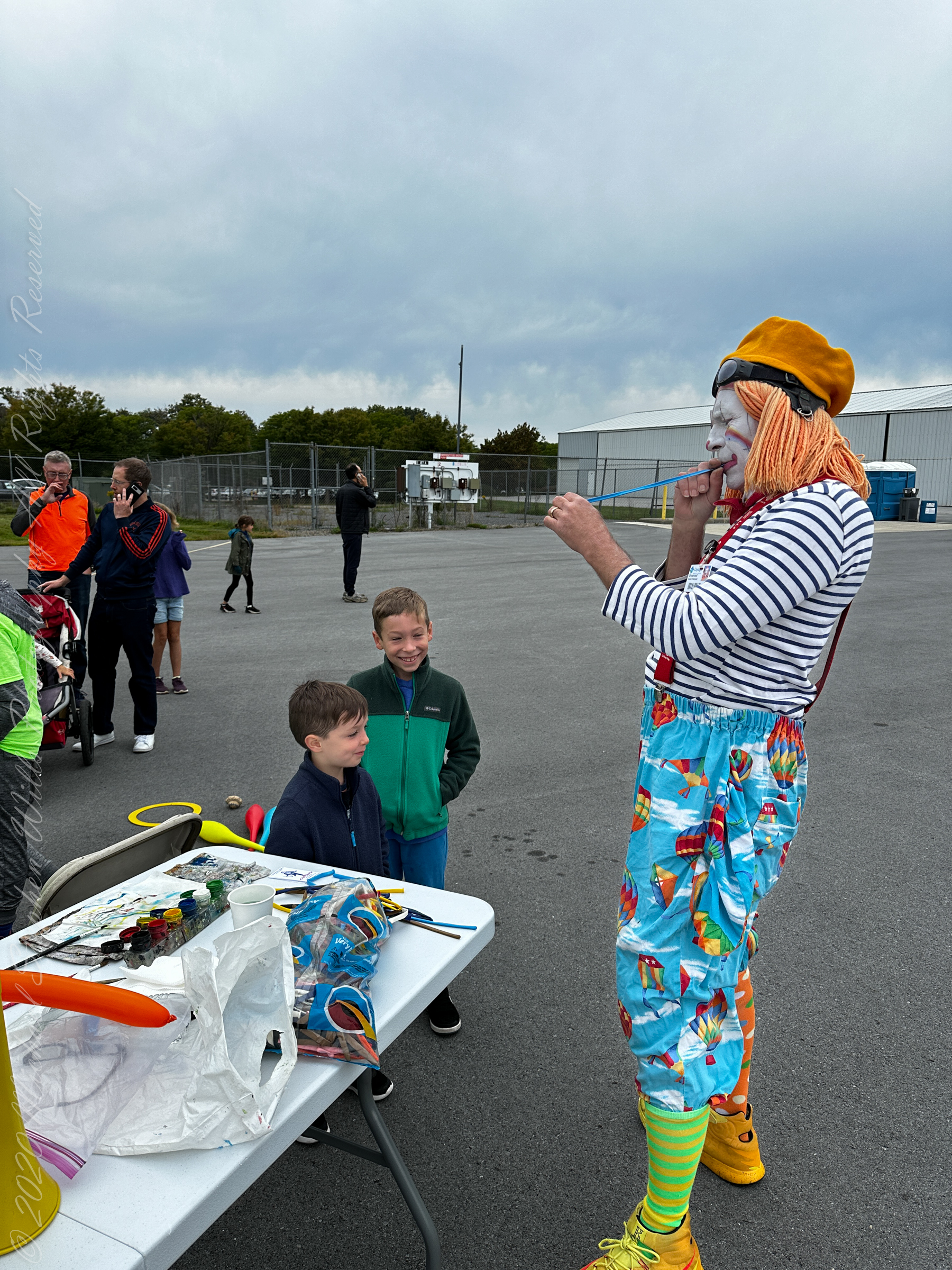
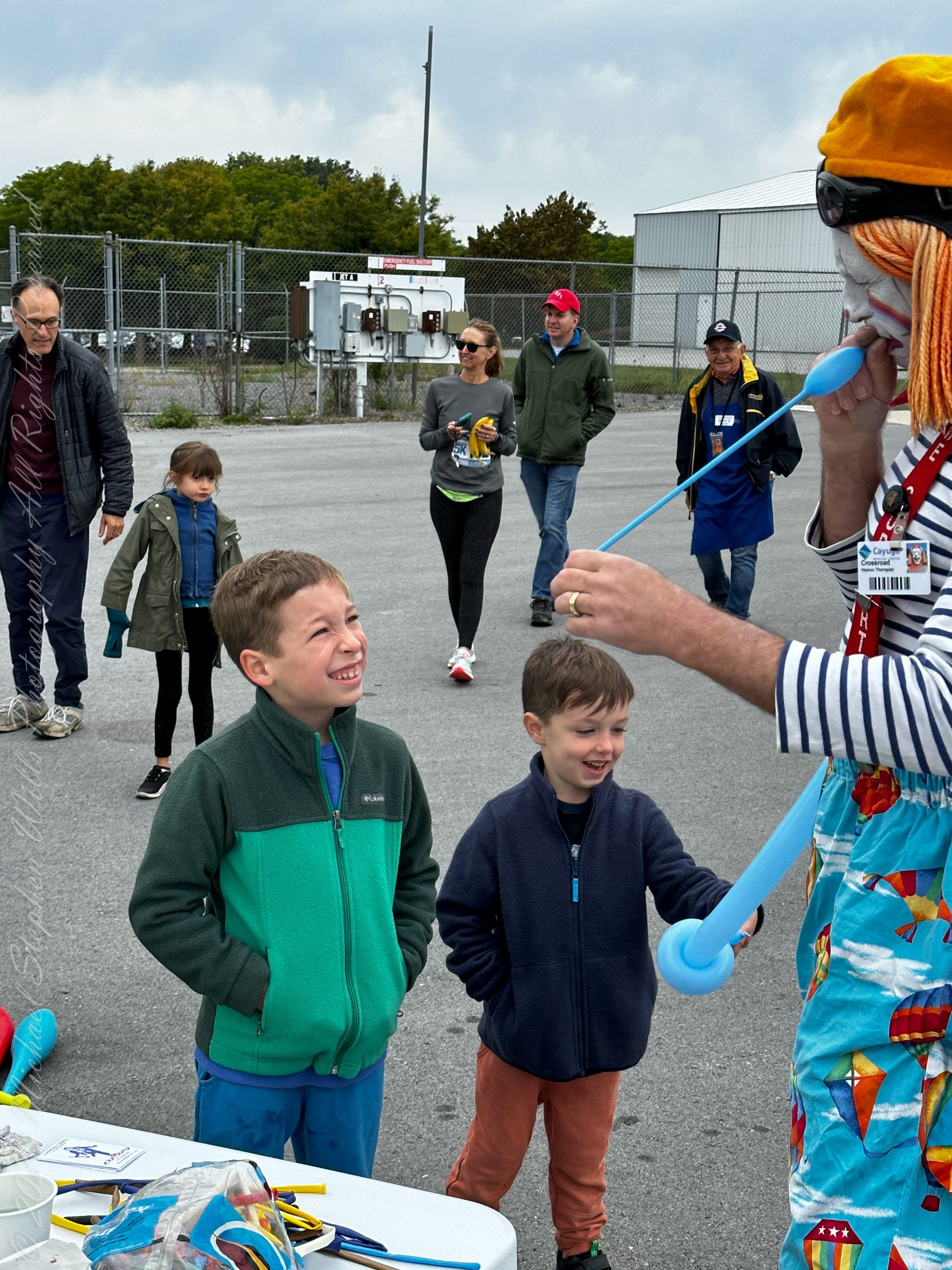
The Friendly Clown was excellent!!
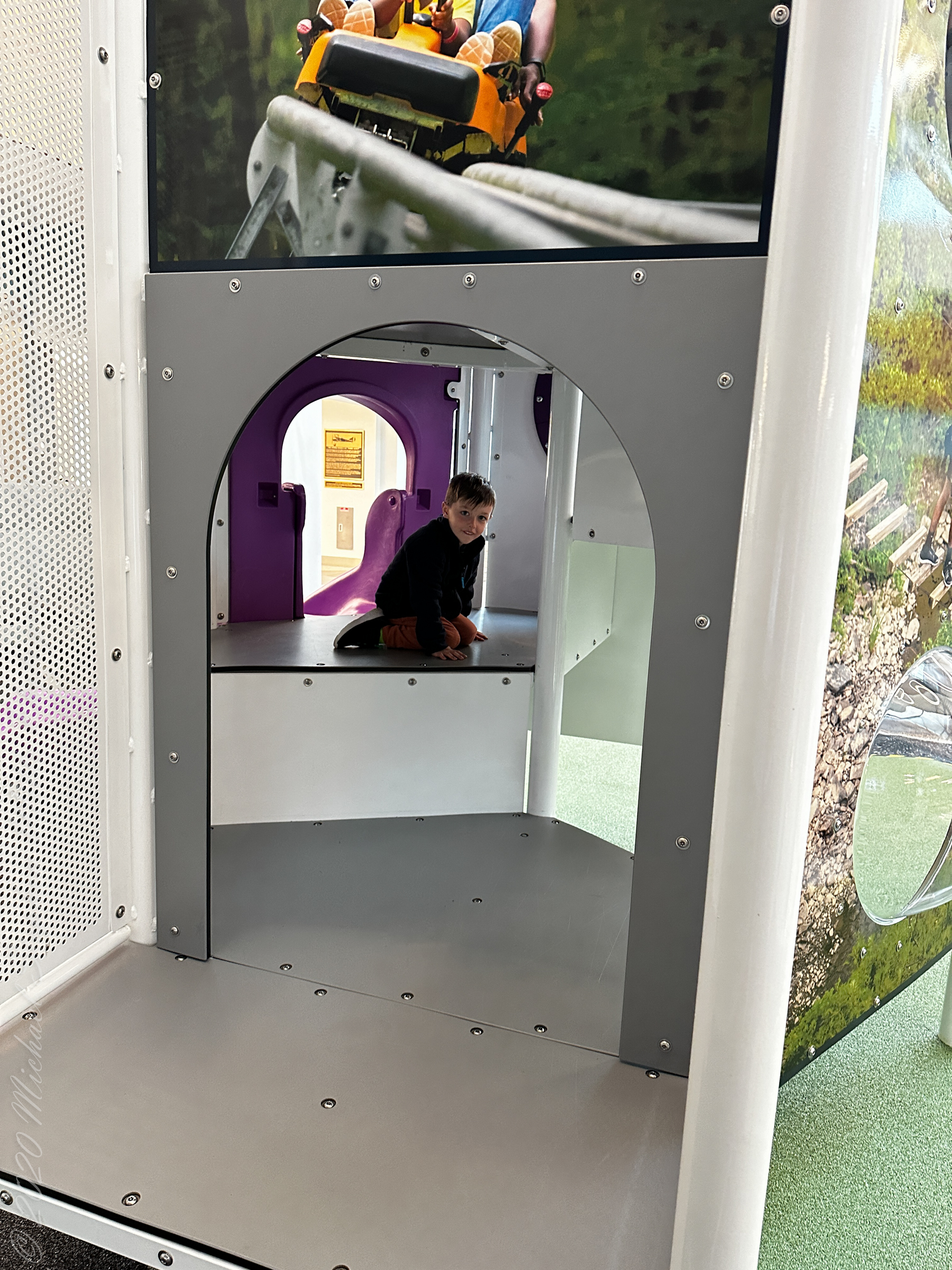
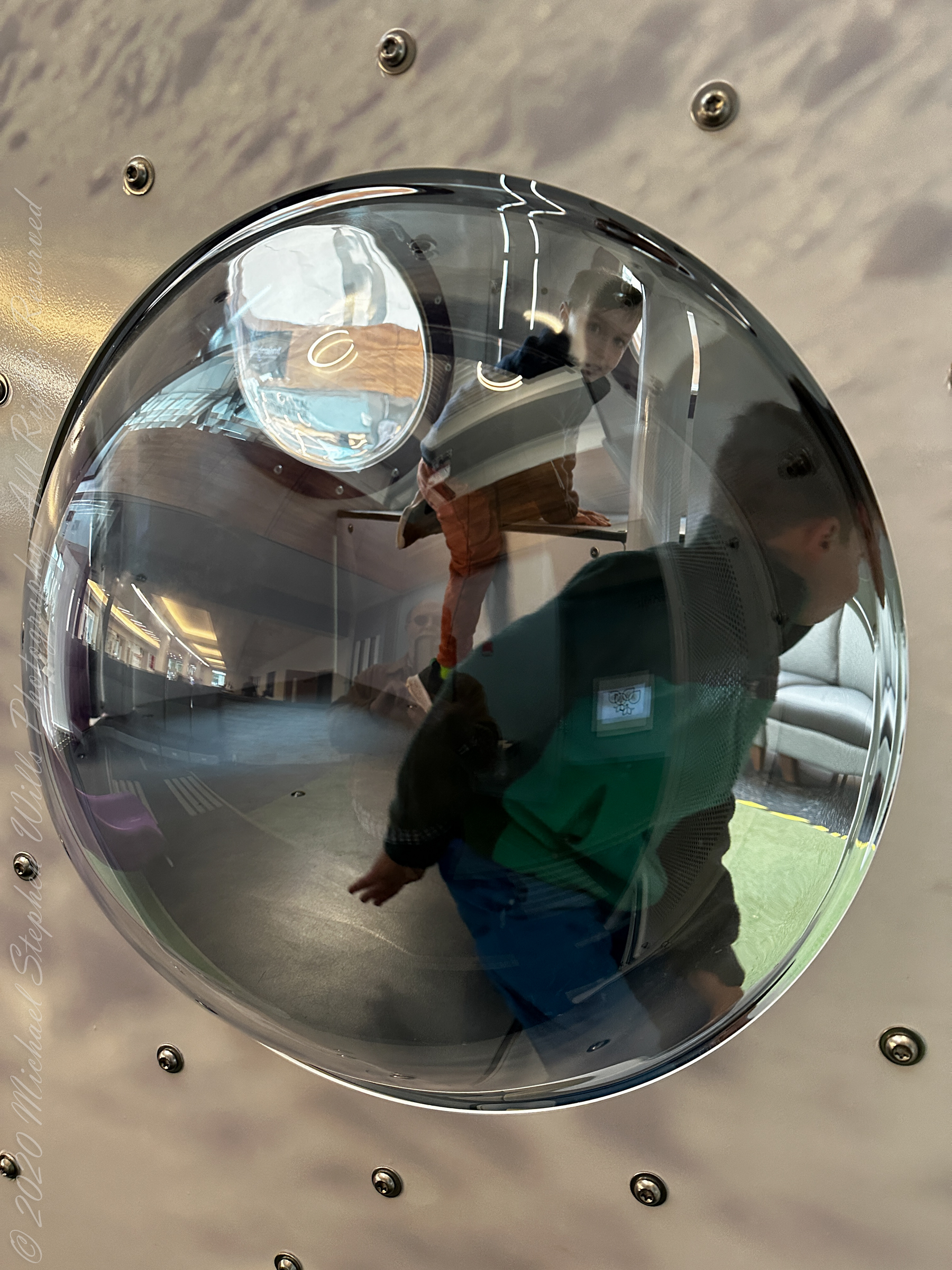
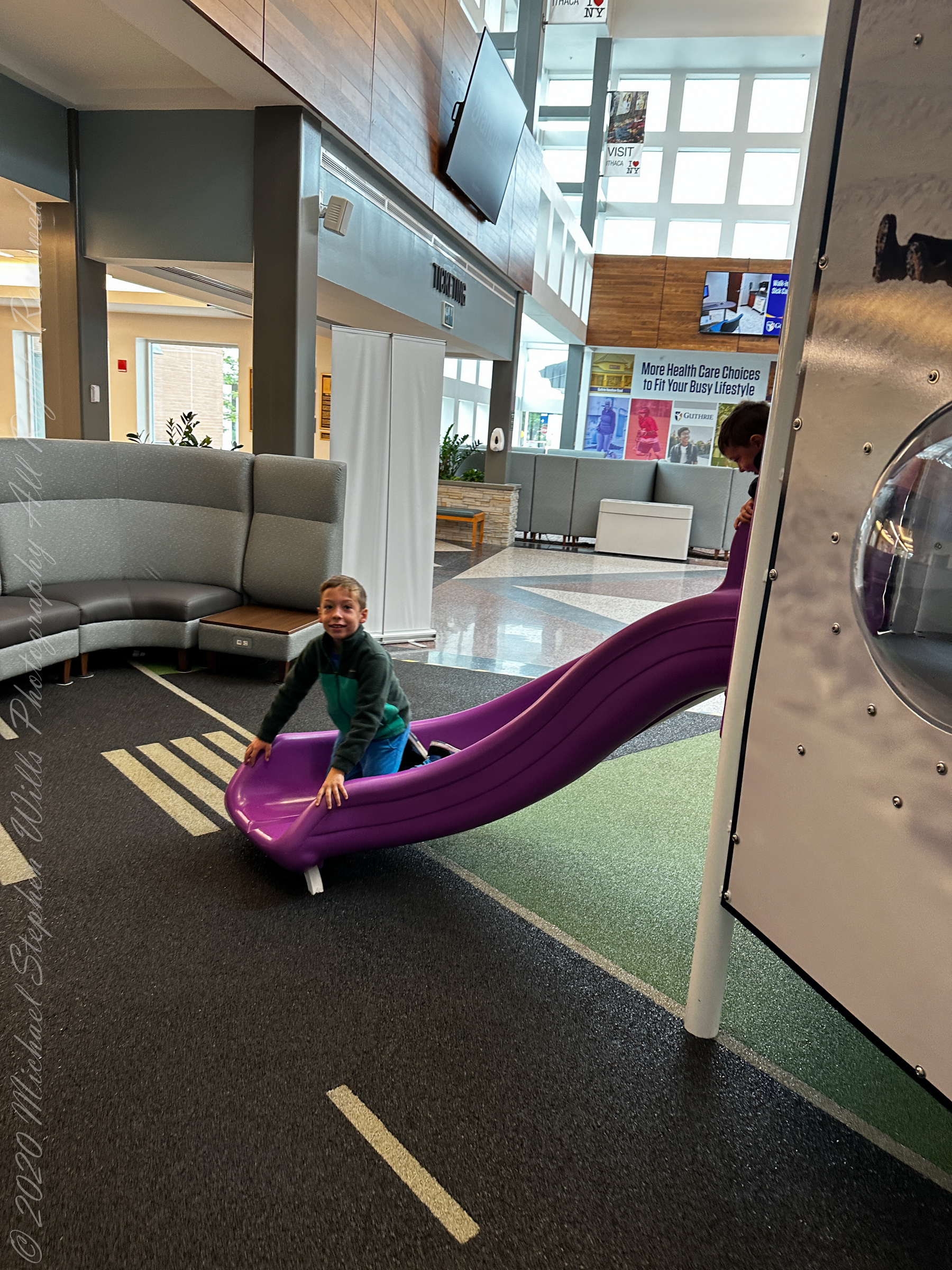
The Airport Terminal was not part of the day’s events, I took Sam and Rory there once, to visit the bathroom, and ever since they insist on visiting the play area
Copyright 2023 Michael Stephen Wills All Rights Reserved
Our grandson’s work on baseball skills is paying off. Here he slugs one to right field where it bounces on the fence for a solid double. He had two doubles that game, driving in a couple of runs, scoring off one himself. Good work!!
“Carl Stotz, a resident of Williamsport, Pennsylvania, founded Little League Baseball in 1939. He began experimenting with his idea in the summer of 1938 when he gathered his nephews, Jimmy and Major Gehron, and their neighborhood friends. They tried different field dimensions over the course of the summer and played several informal games. The following summer, they felt that they were ready to establish what later became Little League Baseball. The first league in Williamsport had just three teams, each sponsored by a different business. The first teams, Jumbo Pretzel, Lycoming Dairy, and Lundy Lumber, were managed by Stotz and brothers George and Bert Bebble. The men, joined by their wives and another couple, formed the first-ever Little League board of directors.”
“The first league game took place on June 6, 1939 when Lundy Lumber defeated Lycoming Dairy, 23–8. Lycoming Dairy became the champions of the first half of the season and then defeated Lundy Lumber, the second-half champions, in a best-of-three championship series. The following year, a second league was formed in Williamsport, and from there Little League Baseball grew to become an international organization of nearly 200,000 teams in every U.S. state and in more than 80 countries.”
“From 1951 through 1973, Little League was restricted to boys only. In 1974, Little League rules were revised to allow participation by girls in the baseball program following the result of a lawsuit filed by the National Organization for Women on behalf of Maria Pepe. According to the Little League Baseball and Softball participation statistics following the 2008 season, there were nearly 2.6 million boys and girls in Little League Baseball worldwide. Of these, approximately 400,000 are registered in softball leagues (including both boys and girls). Starting in 2022, For tournament purposes, Little League Baseball is divided into 20 geographic regions: ten national and ten international. Each summer, Little League operates seven World Series tournaments at various locations throughout the U.S. (Little League softball and Junior, Senior, and Big League baseball and softball).”
Reference: text in italics and quotes is from the Wikipedia, “Little League.”
Copyright 2023 Michael Stephen Wills All Rights Reserved.












 Michael Stephen Wills Photography