Discovering Coquina Clams at Cocoa Beach

After 25 years of visiting Cocoa Beach, a discovery of coquina clams transformed my appreciation for the ecosystem, revealing its beauty, complexity, and intrinsic connections to life.

A Familiar Shore, Newly Seen

For nearly two and a half decades, I’ve strolled the sands of Cocoa Beach—since my first visit in March 2001—comforted by the rhythmic Atlantic waves and the familiar stretch of shoreline. I thought I knew this beach intimately; from the way the sunrise paints the water orange to the feel of wet sand under my feet. Yet it wasn’t until a clear morning in February 2025 that I recognized one of its tiniest treasures: the coquina clam. In the past, I might have walked past countless little shells and the tiny siphons and feet in the sand without a second glance. Now, with newfound awareness, I realize an entire world had been bustling at my toes all along.

February 2025: Discovering the Coquina Clams

Early one February morning, as the high tide receded, I noticed something magical happening at the water’s edge. Tiny coquina clams—each no larger than a fingernail—were emerging from the sand only to swiftly burrow down again between each wave.​

These living coquina clams were found in the receeding high tide on a February 2025 morning on Cocoa Beach, Brevard County, Florida

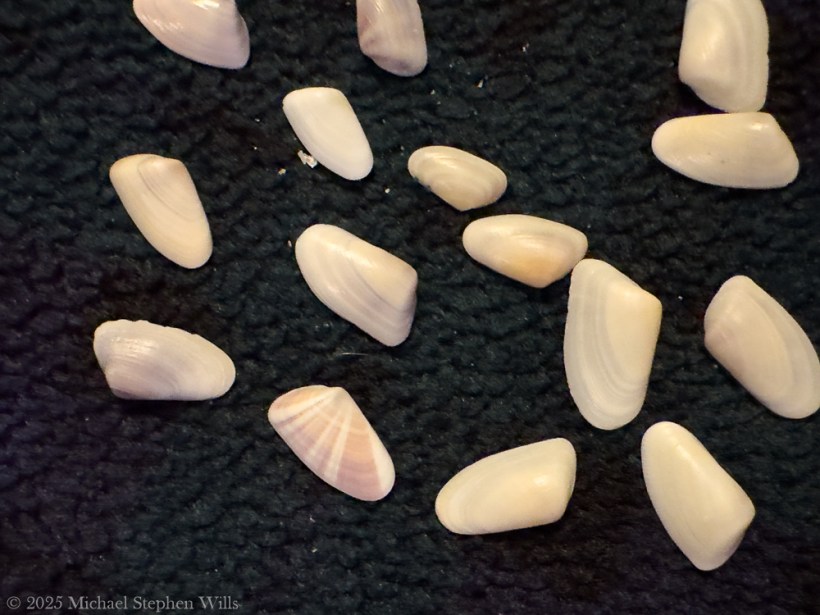
Their small wedge-shaped shells, in colors of pastel pinks, purples, yellows, and whites, peeked out for a moment and then vanished, synchronized with the pulse of the ocean. It was as if the beach itself had come alive with confetti-like jewels, re-positioning themselves with every ebb and flow. I stood entranced, wondering how I’d missed this subtle dance for so many years. That morning marked the beginning of my quest to learn about these little clams that had been hiding in plain sight.

Life Beneath the Sand

Once my eyes were opened, I began observing and researching the coquina clams’ hidden world. I learned that each delicate clam is a filter feeder, siphoning in microscopic phytoplankton, algae, and organic particles from the surf. This constant filtering not only feeds the clam but also helps clean and clarify the coastal waters by removing excess nutrients. Coquinas live a fast-paced, transient life by necessity: they typically survive 1–2 years in the wild and can endure a mere few days without the ocean’s moving water.​

No wonder they race to burrow when the waves recede—staying submerged is a matter of life and death, as they rely on the surf for both food and oxygen. In their brief lifespan, they continually ride the tides, migrate in swarms up and down the beach, and rebury themselves between each wave to avoid being swept away.

I found it astonishing that such small creatures possess the agility and tenacity to “surf” the waves and dig themselves back into wet sand within seconds, a graceful routine I had unknowingly witnessed that February morning.

Beyond their daily habits, coquina clams also undergo a remarkable life cycle beneath the sand. They spawn in the warmer months, releasing gametes into the water for external fertilization. The resulting larvae drift as plankton for a time before settling into the sand and metamorphosing into tiny clams. With no parental care to guide them these young coquinas must immediately fend for themselves in the surf zone. Perhaps it’s this independent, perilous beginning that drives them to cluster in large colonies—while they aren’t social in a communicative sense, hundreds of coquinas often live side by side in favorable spots, turning patches of wet sand into vibrant mosaics of color and life​.

Walking the beach now, I recognize these patches: slightly raised, pebbly areas that, when a wave washes over, suddenly bristle with tiny siphons and feet as the clams feed and reposition. It’s humbling to realize that under each footstep, an entire hidden ecosystem of coquinas might be thriving.

Shells on the Shore: Beauty and Predation

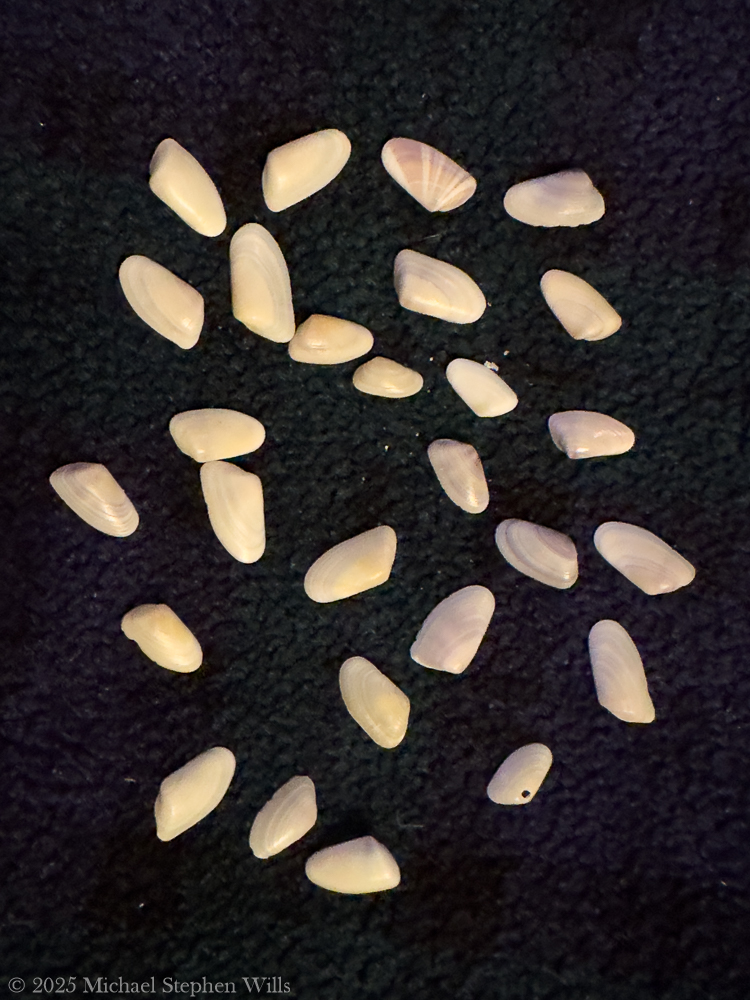
With my new awareness, even the empty shells strewn along the high tide line told a story. I began to collect some of the colorful coquina shells scattered on the sand, marveling at their variety—no two looked exactly alike. Some were solid orange or yellow, others striped with purple and white, each as delicate as a butterfly wing. Many of these shells were intact, evidence of clams that had lived out their short lives or perhaps fallen prey to gentle endings. Others, however, bore mysterious perfectly round holes on their surfaces. At first glance, I thought a tiny drill had punched through them, and in a way, I was right. Those small holes are the signature of predatory snails that haunt the sands: creatures like moon snails (also known as shark’s-eye snails) and whelks that prey on coquinas by literally boring into their shells. These sand-dwelling snails wrap themselves around a clam and use a tongue-like organ called a radula—akin to a miniature saw—to drill a neat hole through the coquina’s shell, aided by acidic secretions to soften the calcium carbonate. Once the hole is complete, the snail devours the clam from within, leaving behind an empty, perforated shell as a grim calling card of the food chain in action.
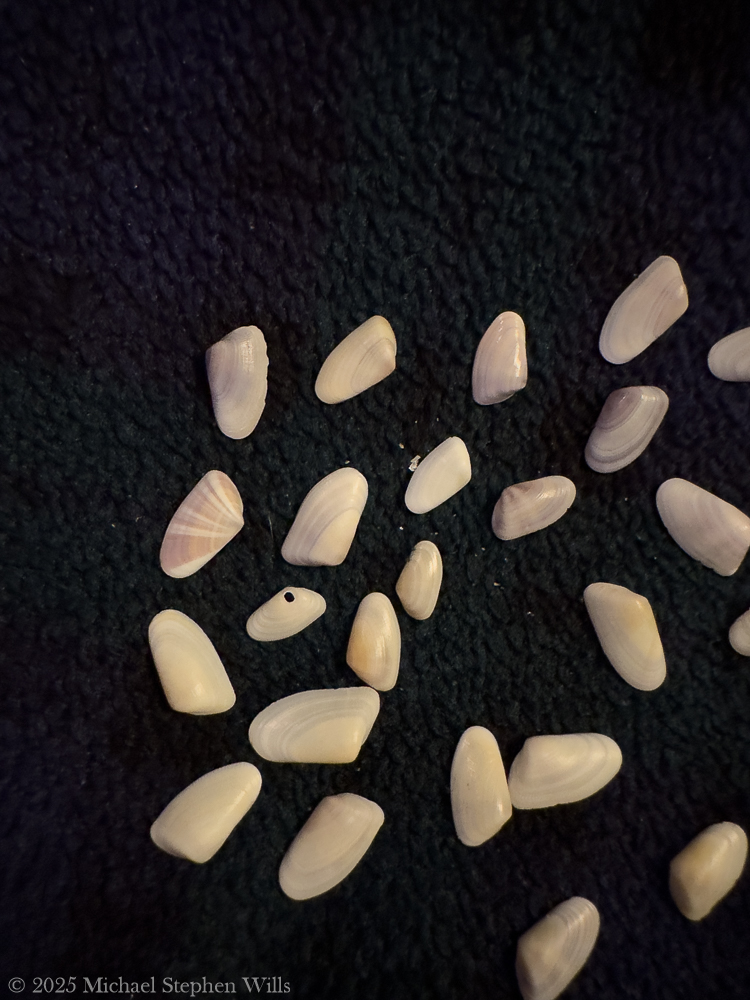
Seeing those tiny “murder holes,” as beachcombers jokingly call them, on coquina shells transformed my perspective on the shell collections I had casually admired for years. Each shell in my hand represented a life that had been an integral part of the beach ecosystem. Some had been snatched by shorebirds or fish the instant they were exposed by the retreating tide, becoming breakfast for a sanderling or a pompano. Others, as the holes revealed, had been victims of an even stealthier predator under the sand. It struck me that every fragment and hollowed shell on the beach is evidence of a relationship—predator and prey, life and death intertwined on the shore. Instead of seeing a random assortment of pretty shells, I now saw a record of the beach’s vibrant food web written in calcium carbonate. The realization filled me with both wonder and respect: this sunny tourist beach holds quiet tales of survival as dramatic as any wilderness, if one knows where to look.

The Coquina’s Ecological Role

As I dug deeper (both into the sand and the literature), I discovered that coquina clams are far more than a footnote in the beach ecosystem—they are a keystone of coastal ecology. By filtering plankton and detritus from the surf, countless coquinas collectively act as tiny water purifiers, helping maintain water quality along the shore. Their presence in large numbers indicates a beach’s health; in fact, abundant coquina populations signal that the beach environment is robust and unspoiled. A stretch of sand teeming with coquina clams suggests natural, shifting sands and minimal human interference, as these clams thrive best where coastal processes remain undisturbed. In this way, coquinas are like a barometer for the shoreline: if I continue to find them at Cocoa Beach, it means the beach is still alive and supporting complex life.

Coquina clams also form a critical link in the food chain. Numerous shorebirds rely on them as a food source—those flocks of little sandpipers and plovers skittering at the water’s edge have, all along, been feasting on coquinas right under my nose. Fish that patrol the surf, like the Florida pompano and various kinds of drum (whiting), gulp them up as the waves churn the sand​.

These coquina clam shells were found February 2025 on Cocoa Beach, Brevard County, Florida

Even ghost crabs and other scavengers benefit, feeding on clams that wash ashore. And of course, the predatory snails under the sand have a specialized taste for them. It’s a reminder that even a creature only an inch long can be a cornerstone of an entire food web, sustaining animals up the chain from mollusks to birds to fish. Standing on the beach now, I often pause and watch the frenetic chase of the shorebirds in the surf, aware that without the coquina clams beneath the foam, that familiar coastal ballet could cease to exist.

Humanity and the Coquina: Intertwined Histories

It’s not only animals that have interacted with coquina clams—we humans have a longstanding relationship with them as well. Historically, Floridians made use of coquinas as a food source. Local folklore and old recipes describe coquina broth and chowder, a delicate soup made by briefly boiling these tiny clams to extract their flavor.​

Because each clam is so small, you’d need hundreds to make a pot of soup, so it’s not a common dish today except perhaps as a novelty. Still, the idea that the sands I walk on could literally be cooked into a chowder is a charming and earthy connection between food and place. Early indigenous peoples and European settlers alike would have recognized coquinas as an edible bounty in times when every bit of protein counted.

For best experience, click on “Watch on YouTube”

Humans have also found value in the shells of coquinas beyond admiring their beauty. Over time, vast deposits of coquina shells on ancient beaches hardened into a soft limestone rock called coquina stone (the term “coquina” itself comes from the Spanish for “shellfish” or “cockle,” reflecting its composition)​.

In a fascinating twist of fate, this sedimentary rock—essentially millions of fused clam shells—became a building material. Here in Florida, coquina stone was quarried and used to construct some of our oldest structures. The historic fortifications in St. Augustine, like Fort Matanzas and Castillo de San Marcos, were built from coquina stone, their walls made resilient by a matrix of coquina clam shells​.

I find it poetic that the same little clams I only just learned to appreciate have literally been the building blocks of human shelters that have stood for centuries. Even today, crushed coquina shells are used in landscaping and as decorative ground cover—perhaps you’ve seen driveways or garden paths that gleam with fragments of pink and purple shells.​

Our lives overlap with the coquina in subtle ways: from the architecture of coastal Florida to the aesthetics of our beach towns.

Modern conservationists note another connection: by protecting natural beach dynamics, we also protect coquina populations, which in turn supports the whole ecosystem. This means being mindful about coastal development, beach renourishment projects, and even how many shells tourists collect. I’ve become more aware that picking up a few pretty coquina shells as souvenirs is fine, but we must leave plenty behind for the beach to recycle and for other creatures to use. For example shorebirds glean minerals from them. The humble coquina clam has given me a new appreciation for how intimately tied human activity is to the smallest inhabitants of the shore.
Reflections: Wonder in the Little Things

My journeys to Cocoa Beach were enhanced: what began as a casual observation in 2025 has blossomed into a profound shift in the way I experience the beach. I feel as if I’ve been given new eyes—now I notice the glint of tiny shells in the sand and know there’s life (or a story of life) attached to each one. The joy of discovery I felt upon noticing the coquina clams has reignited a childlike curiosity in me. It’s astounding that after decades of visits, there was still a secret to uncover on those familiar shores. This realization makes me wonder: What else have I been missing? It’s a reminder that nature has layers upon layers of wonder, even in places we think we know intimately. Sometimes it just takes a shift in perspective, a bit of knowledge, or a quiet moment of attention to peel back the veil.

In reflecting on the coquina clams of Cocoa Beach, I’ve learned not only about a specific species and its role in the world, but also about myself and the value of lifelong learning. These clams, in their smallness and ubiquity, taught me to slow down and appreciate the intricate tapestry of life at my feet. Now, each time I visit the beach, I smile seeing the waves bring in that rush of foam and sand, knowing a hidden troupe of coquinas is hard at work filtering water, dodging predators, and holding up the very balance of the shore. I often kneel down now, running my fingers gently through the wet sand to feel them retreat, and I silently thank them — for cleaning the water, for feeding the birds and fish, for building historic forts (unbeknownst to themselves), and for showing me that wonder can be found in the smallest of places. Cocoa Beach, through the lens of the coquina clam, feels like a brand new world I’ve been lucky enough to discover, even after all these years​

I look forward to other hidden marvels awaiting discovery on my next visit.

References


Abbott, R. T. (1974). American Seashells: The Marine Mollusca of the Atlantic and Pacific Coasts of North America. Van Nostrand Reinhold Company.

Andrews, J. (1994). Shells and Shores of Texas. University of Texas Press.

Brusca, R. C., & Brusca, G. J. (2003). Invertebrates (2nd ed.). Sinauer Associates.

Denny, M., & Gaines, S. (2000). Encyclopedia of Tidepools and Rocky Shores. University of California Press.

Futch, C. R., & Burger, J. (1976). The ecology of coquina clams (Donax variabilis) in the southeastern United States. Marine Biology Journal, 34(2), 157-168.

Leal, J. H. (2002). Seashells of Southern Florida: Living Marine Mollusks of the Florida Keys and Adjacent Regions. Smithsonian Institution Press.

Mikkelsen, P. M., & Bieler, R. (2008). Seashells of Southern Florida: Marine Bivalves, The Bivalvia. Princeton University Press.

Morton, B. (1988). Particulate Matter Processing in Bivalves: An Overview. Journal of Marine Ecology, 19(3), 103-123.

Ruppert, E. E., Fox, R. S., & Barnes, R. D. (2004). Invertebrate Zoology: A Functional Evolutionary Approach (7th ed.). Cengage Learning.

Stanley, S. M. (1970). Relation of shell form to life habits of the Bivalvia. Geological Society of America Memoir, 125, 1-296.

Voss, G. L. (1980). Seashells of the Gulf and Atlantic Coasts. Houghton Mifflin Harcourt.

Wells, H. W., & Gray, I. E. (1960). Habitat selection and the distribution of the coquina clam (Donax variabilis). Ecological Monographs, 30(1), 55-77.
Enter your email to receive notification of future postings. I will not sell or share your email address.
Discovering Fogbows: A Coastal Wonder

I had a haunting experience at Cocoa Beach, witnessing a rare fogbow—a ghostly arc formed by fine mist—evoking emotions and reflections on nature’s beauty.

The fog haunted Cocoa Beach for days, softening the edges of the afternoon. I had been walking along Cocoa Beach, feeling the cool ocean breeze on my face, when I noticed a change in the light. It was a little after four, the sun drifting lower in the western sky, its warmth fading into a hazy glow. The air smelled of salt and mist, and waves lapped gently at the shore, their rhythm unbroken by the deepening fog.

And then I saw it.

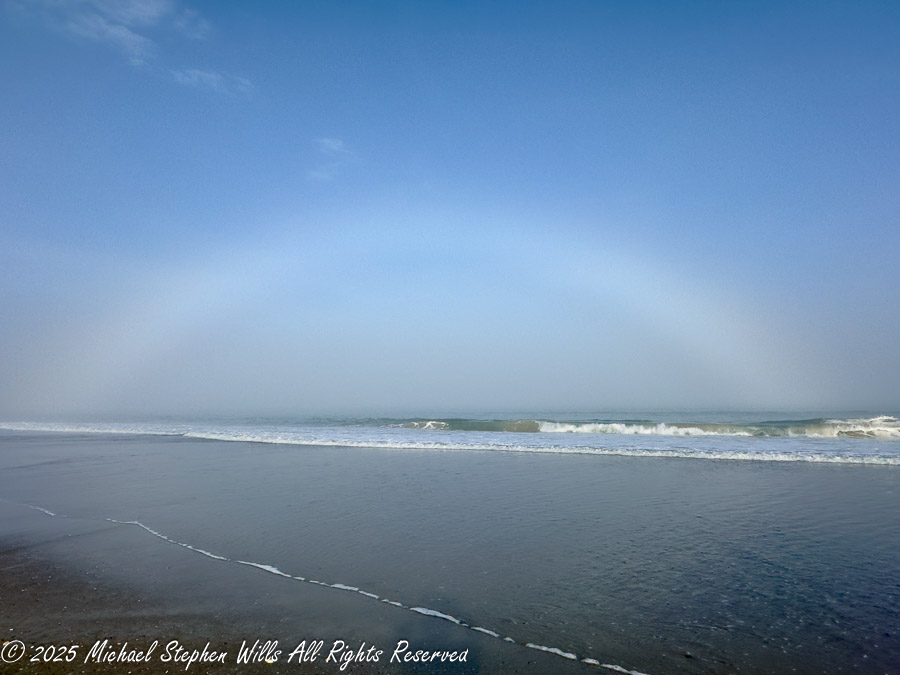
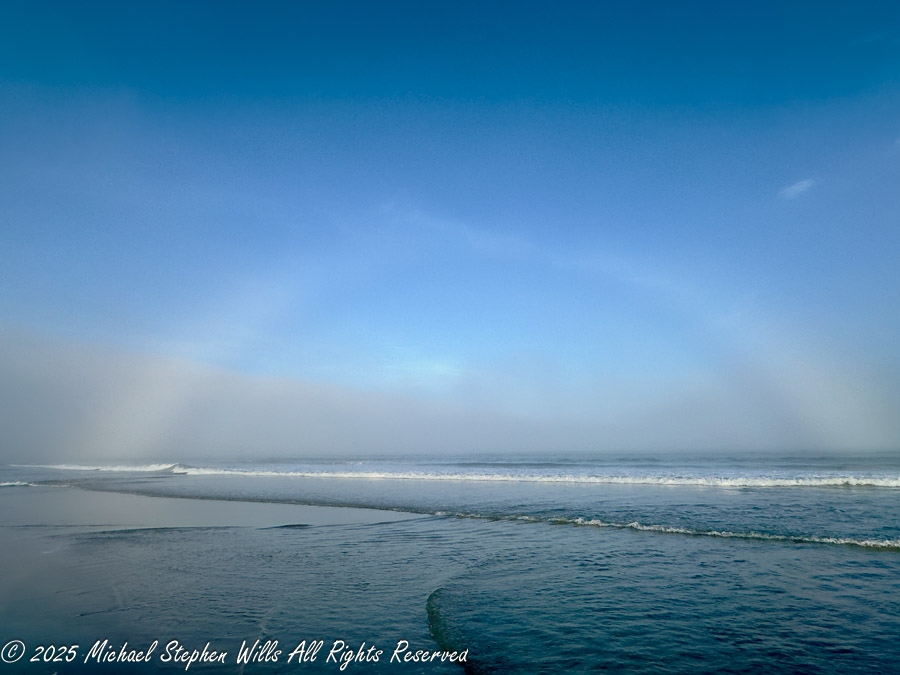
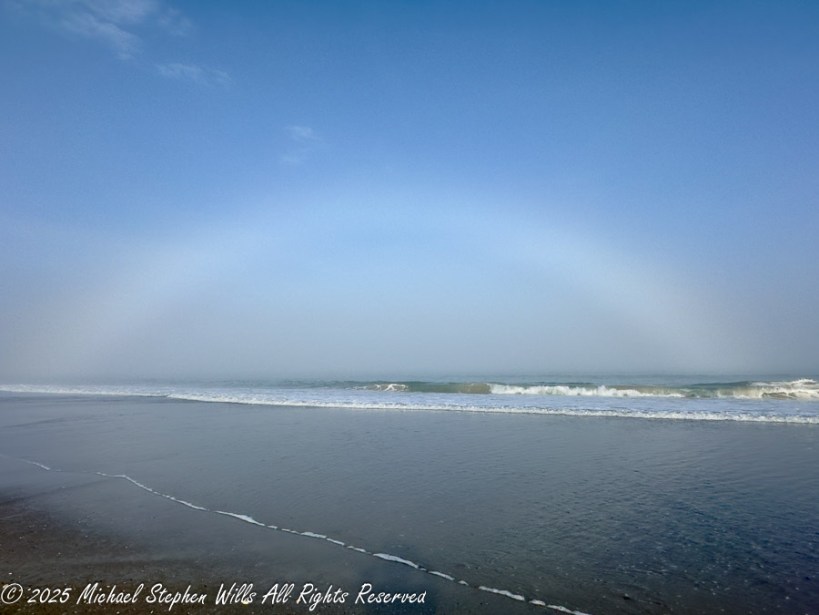
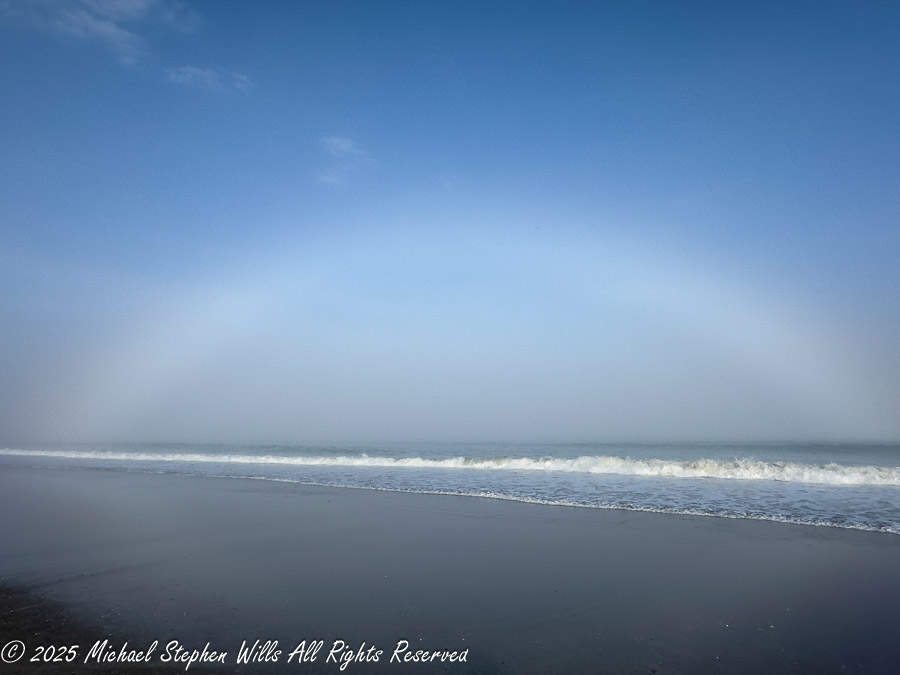
A pale arc stretched across the horizon, a ghost of a rainbow bending above the waves. At first, I wondered if my eyes were playing tricks on me—where were the usual bright bands of red, orange, and violet? But no, the arc was real, a fogbow, forming where sunlight met the fine sea mist. Unlike the rainbows that appear after summer storms, this one was almost entirely white, as if the ocean had conjured it from air and silence.

Sailors once whispered of such things—a white rainbow at sea, a sign of hidden land or wandering souls. Some believed it to be a bridge between realms, a fleeting passage where the living and the lost might momentarily brush against one another. Others saw it as an omen, a spectral warning of treacherous fog ahead. I wondered what the mariners of old might have thought, standing at the bow of a ship, watching a pale arc rise from the mist, its edges dissolving like breath against glass.

I stood still, watching, as the science of the moment unfolded before me. Unlike traditional rainbows, which form when light bends through large raindrops, fogbows are born from infinitesimally smaller droplets, often less than 0.1 millimeters in diameter. Their size diffuses the light, scattering it so finely that the colors blend together into a spectral whisper rather than a vibrant shout. The physics of it fascinated me—this was diffraction in action, nature bending light in a way that rendered it nearly colorless.

The effect was surreal. The fogbow arched over the breaking waves like something out of a dream, a halo of sea and sky, momentary yet timeless. It seemed to pulse in the shifting mist, visible one moment, fading the next, as if deciding whether to reveal itself fully or slip back into the fog’s embrace.

For several minutes, I just stood there, taking it in. The world felt different inside that mist, quieter, more reflective. The fog dampened the usual sounds of the beach—the calls of shorebirds, the laughter of distant walkers—leaving only the hush of the waves and the distant hum of the ocean’s breath.

I knew that fogbows were rare, requiring just the right balance of thin fog, moisture, and a low-angled sun. I was lucky to be in the right place at the right time, a witness to something subtle yet profound.

And just as silently as it had appeared, the fogbow began to dissolve. The mist thickened, swallowing its arc, the sky shifting back to its usual muted gray. But the memory of it lingered—a white rainbow over the sea, ephemeral and elusive, like a secret the ocean had briefly chosen to share.

Enter your email to receive notification of future postings. I will not sell or share your email address.

A Bonnethead’s Final Moments on Cocoa Beach

The narrator discovers a dying bonnethead shark on Cocoa Beach, reflecting on its ecological role and the cycle of life and death in the ocean.

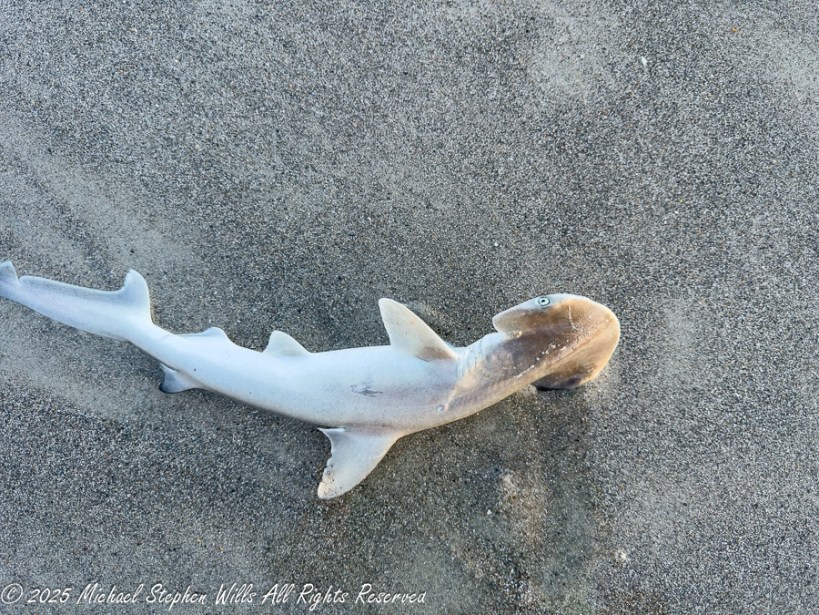
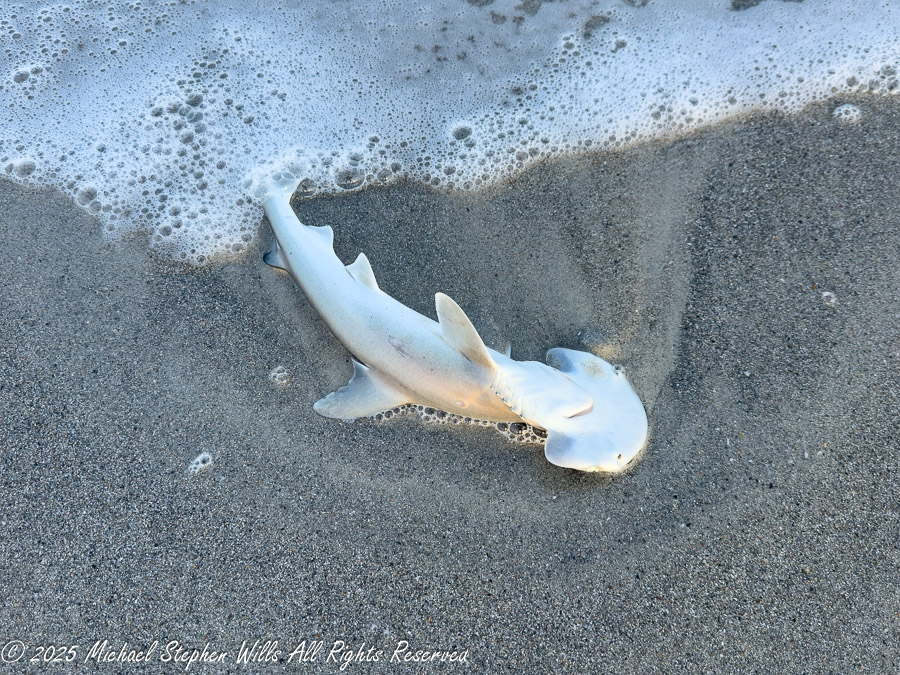
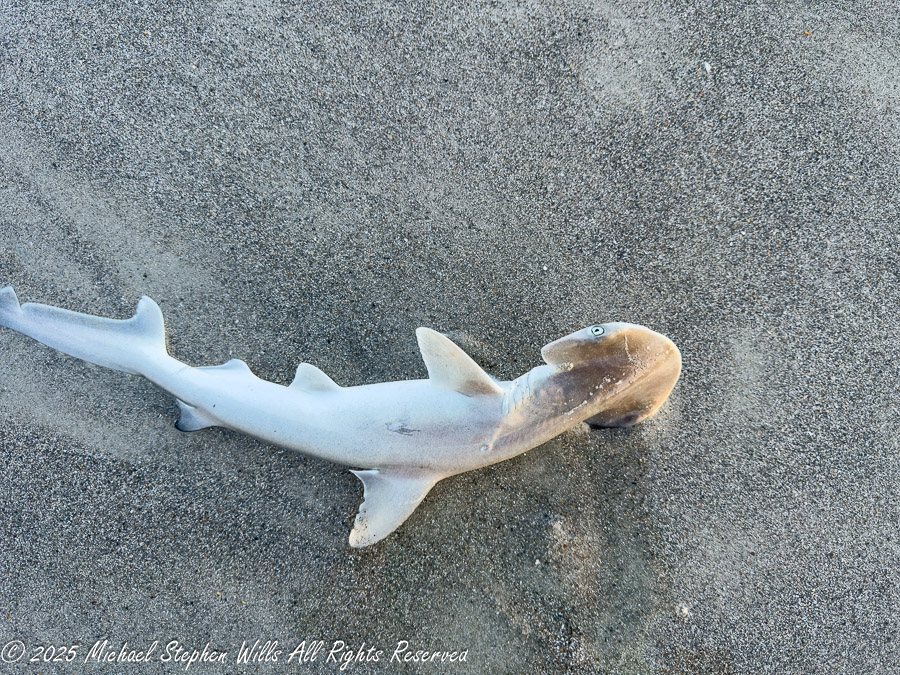
The evening ebb tide had left behind more than just a fresh line of seaweed and broken shells. As I walked along Cocoa Beach, the cool sand beneath my feet, a small shape caught my eye near the water’s edge. At first, it looked like detritus tossed ashore by the restless ocean. But as I stepped closer, I saw the unmistakable outline of a shark—its pale, twitching body lay on the damp sand.

Stopping to bend and examine it, my breath caught as I recognized its flattened, shovel-shaped head. This was a bonnethead shark (Sphyrna tiburo), one of the smallest members of the hammerhead family. Its eyes, positioned far apart on either side of its head, stared blankly at the sky. A thin film of seawater still clung to its sleek, streamlined body, reflecting the golden light of the rising sun.

Its scientific name, Sphyrna tiburo, reveals much about its nature and form. Sphyrna comes from the Greek σφῦρα (sphyra), meaning “hammer,” a fitting reference to the distinct shape shared by all hammerhead sharks. The species name, tiburo, is thought to have originated from an indigenous or Spanish term for small sharks found in the Caribbean and Gulf of Mexico. Together, these words encapsulate the bonnethead’s identity—a hammer-shaped predator of the shallow seas, yet one that stands apart from its larger, more formidable relatives.

Named for its distinctive cephalofoil—the flattened, bonnet-like shape of its head—Sphyrna tiburo plays an essential role in maintaining the balance of marine ecosystems. As a mid-level predator, it helps regulate populations of crabs, shrimp, and small fish, preventing any one species from overpopulating and disrupting the delicate food web. Unlike most sharks, the bonnethead is also partially omnivorous, consuming seagrass along with its usual diet of crustaceans and mollusks. This unique feeding behavior contributes to the health of seagrass beds, which serve as crucial habitats for many marine creatures.

Bonnetheads are harmless to humans, known for their non-aggressive nature and their surprising diet—unlike most sharks, they eat not just crustaceans and fish, but seagrass as well. Gentle foragers of the shallows, they are common in Florida’s coastal waters, where they glide just beneath the surface, their unique head shape helping them detect prey buried beneath the sand.

But this one would swim no more. It was too late. Whether it had fallen victim to a fisherman’s discarded catch, an injury, or something unseen—disease, pollution, or fluctuating ocean temperatures—it was impossible to tell. All I knew was that this creature, so perfectly adapted to the rhythms of the sea, had been cast ashore by forces beyond its control.

A wave surged forward, washing over the shark’s still body, as if the ocean itself fruitlessly nudged it to life. The rising tide swirled, lifting the bonnethead and carrying it back into its world.

As I stood watching the tide pull it away, I felt a strange mix of sorrow and reverence. The sea is full of life, but it also takes life in its endless cycle. The bonnethead had played its part in that vast, unknowable story.

And now, it was gone.

Enter your email to receive notification of future postings. I will not sell or share your email address.

Winter Serenity at Cocoa Beach

The wind carries the rhythm of the waves as clouds drift across the sky, their reflections shimmering on the sand. A lone feather lies half-buried, a quiet reminder of nature’s gentle yet untamed beauty. In the midst of winter’s rawness, there’s a peaceful stillness, inviting you to pause and take in the moment.


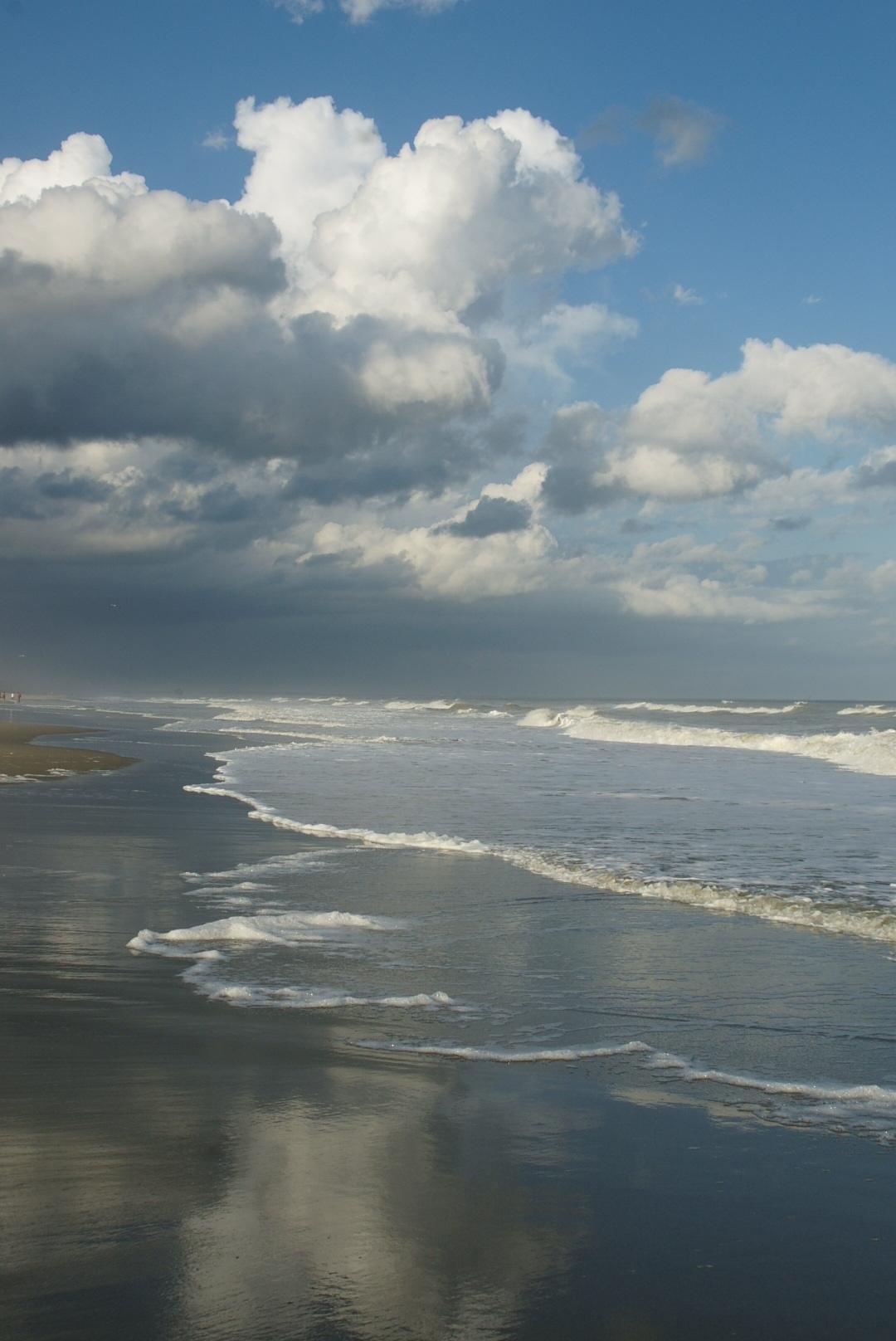
There’s a magic in the embrace of a winter afternoon at Cocoa Beach, where cold northern winds rush down, meeting the Atlantic’s gentle roar. A brush has stroked the heavens; a sky painted with clouds, each towering and shifting, soft yet mighty. With weight and grace, they hang in the sky; some laden with the promise of rain, others light and carefree, echoing the ever-changing rhythm of the sea below. As the sun dips, its rays break through, illuminating the clouds and casting reflections on the wet sand, where the ocean’s kisses linger before retreating back to the deep.

DSC05744Small

The wind tugs at my clothes, my hair, my thoughts. It whispers its secrets, telling stories of distant places, of journeys. With patterns chaotic yet somehow harmonized; waves, frothing and white, crash in sync with the wind’s song. They stretch their fingers onto the shore before retreating, playing an endless game of tag with the land. The sand, smooth and glistening, mirrors the clouds above, creating an ephemeral connection between earth and sky. Both are locked in a fleeting dance, destined to dissolve with the tide.

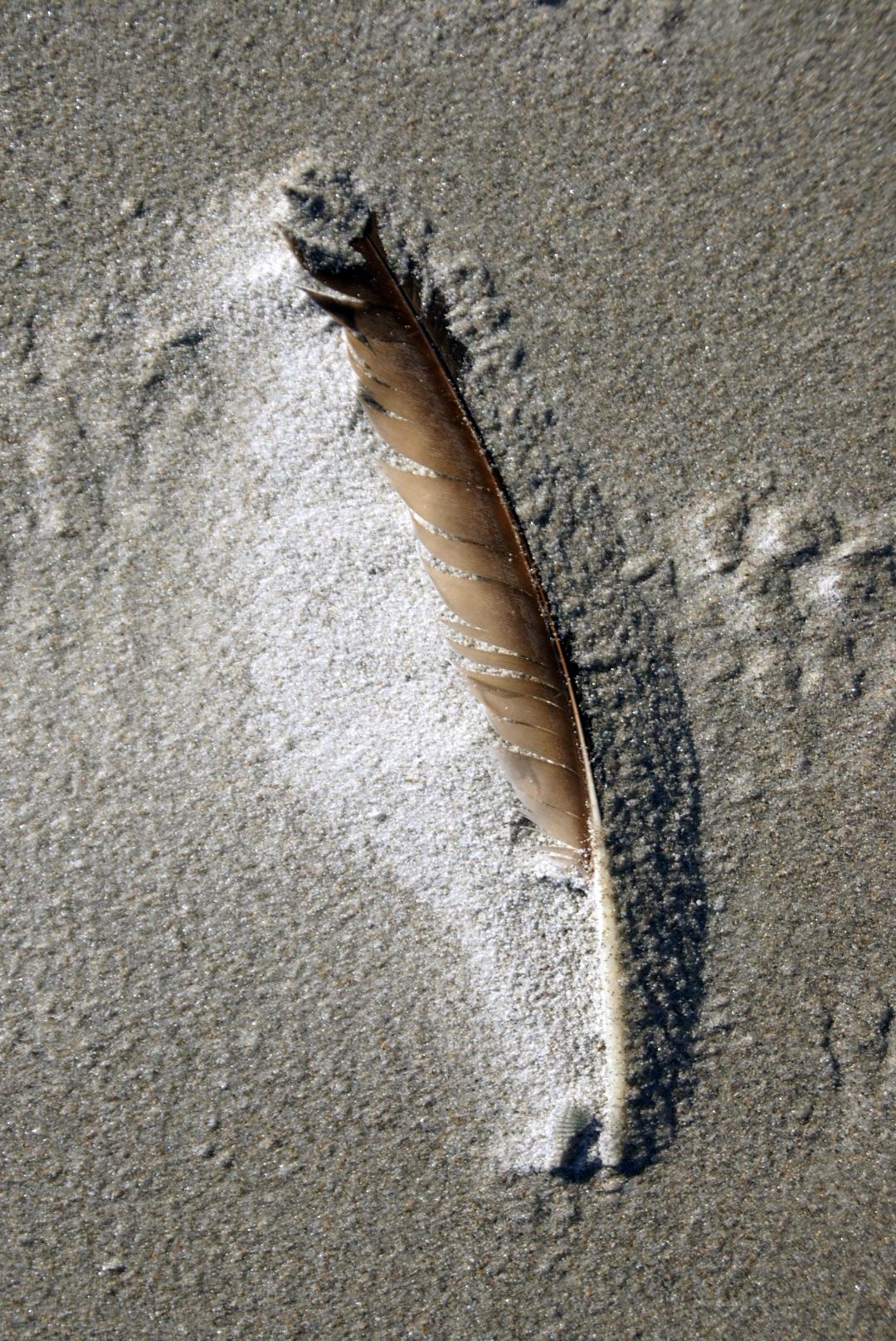
Amid the sound of wind and water, the sight of a lone feather caught my eye. Half-buried in the sand, its delicate barbs were still intact, though weathered by the elements. It was a remnant of life, a testament to the flight of some seabird now long gone. This feather, in its stillness, speaks volumes—of resilience, of the endless passage of time, of moments lost to the wind yet immortalized in the quiet present. Its grooves, like fine lines etched in sand, tell the story of its journey through the air, carried by forces unseen yet deeply felt.

DSC05792BeachFeathre

The feather, lying motionless yet deeply expressive, becomes a symbol of the paradoxes that fill this beach: the immensity of the ocean, infinite in its expanse, and the simplicity of a single object, caught and held for just a moment. The windswept beach feels vast, stretching endlessly before me, yet each step I take reveals intricate details, like the delicate curves and patterns of shells half-buried in the sand, or the ephemeral foam left behind by retreating waves. Each part of this landscape tells a story—the grand and the intimate, the eternal and the fleeting, all coexisting in perfect harmony.

Standing here, enveloped by the wind and the sea’s whispers, I am reminded of the power of nature to humble and uplift. It strips away the noise of everyday life, leaving only the raw, untamed elements that have been here long before us and will remain long after. There is something deeply spiritual about this place, this moment—where the only sounds are the natural rhythms of the world, unbroken by human intervention. The beach, with its vast openness, encourages introspection, a reflection not only on the external beauty but also on the inner landscapes of the mind.

The wind, relentless and free, stirs a sense of renewal in me. It is a force that clears the air, both literally and figuratively, sweeping away stagnant thoughts and opening space for new ones to emerge. The crispness of the cold air invigorates, reminding me that even in the depths of winter, life continues—whether in the ceaseless movement of the ocean or the endurance of the small feather resting in the sand. There is beauty in the starkness, in the way the beach in winter feels both desolate and alive, silent yet full of sound.

As I walk along the shore, I realize that this windy January afternoon on Cocoa Beach is an experience to feel deeply. The wind, the waves, the sky, the sand—all are part of a larger, connected whole, a living tapestry that, though ever-changing, remains constant in its presence. There is comfort in knowing that no matter how many times I return to this beach, it will always offer something new, yet familiar.

In the end, the beauty of this moment lies in its simplicity and grandeur, in the way it invites contemplation while remaining indifferent to whether or not we notice. The ocean will continue its dance with the shore, the wind will carry its stories, and the feather will eventually be swept away. But for now, in this moment, it is all here, waiting to be seen, felt, and cherished.

Click this link for my Fine Art Photography.

Copyright 2024 Michael Stephen Wills Photography All Rights Reserved.

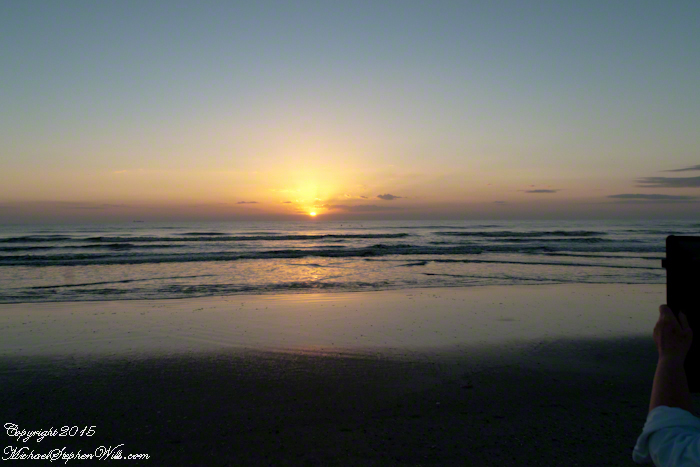
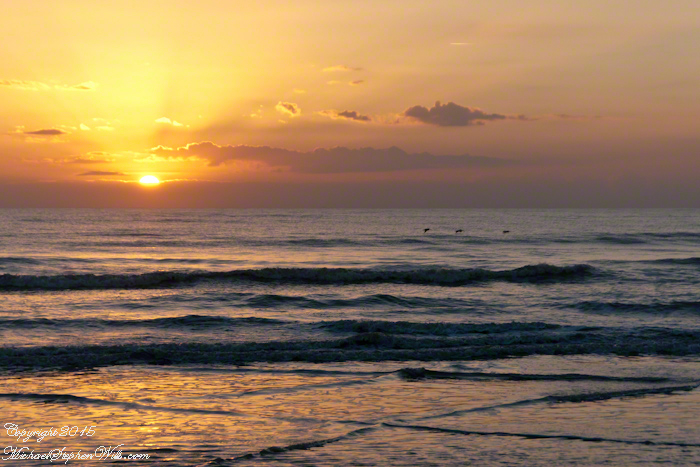
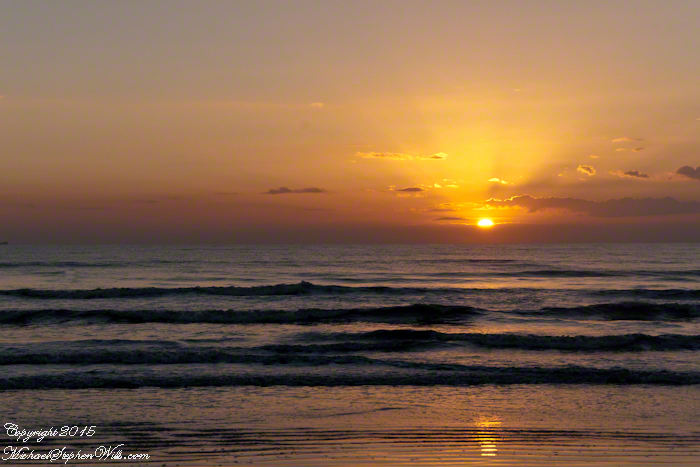
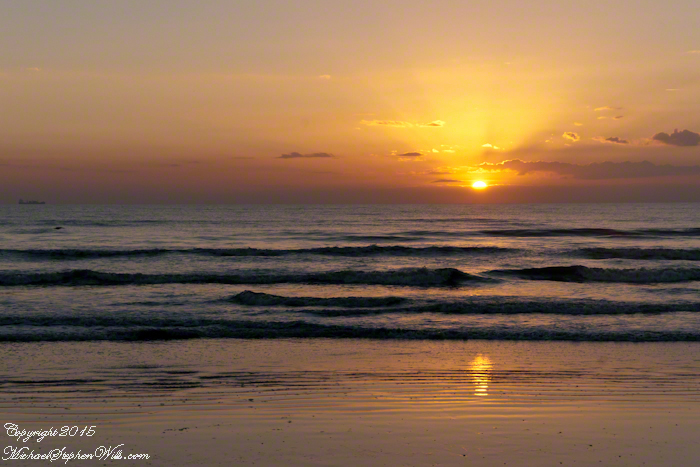
Sunrise at Cocoa Beach: A Symphony of Colors on the Space Coast

Experience the breathtaking sunrise at Cocoa Beach, where the sky and sea blend in a symphony of colors. Discover the tranquility and beauty that awaits as the day dawns on Florida’s stunning Space Coast.

Click this link for my Online gallery

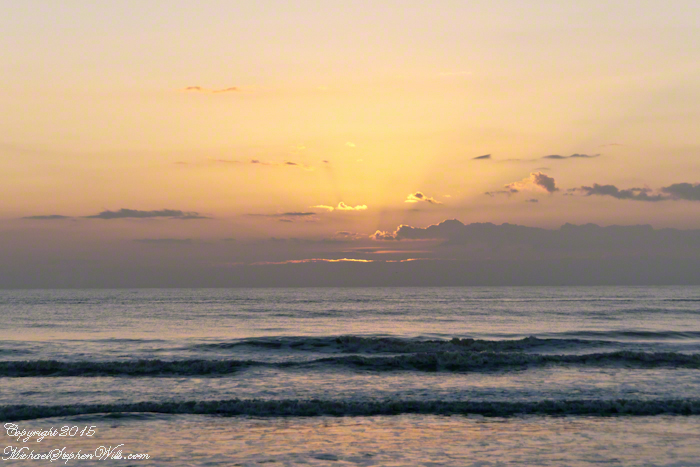
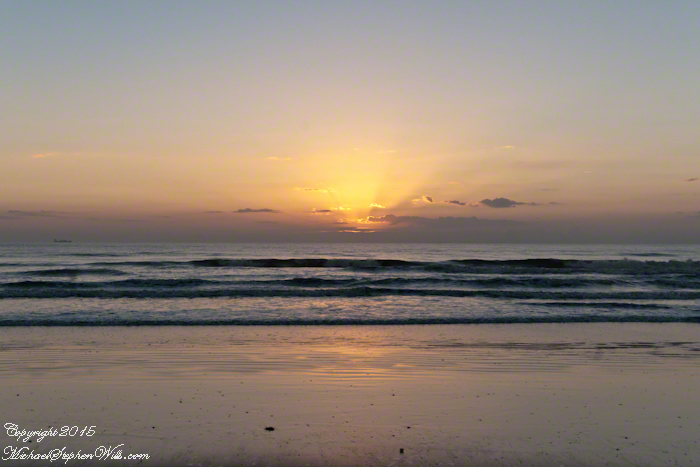
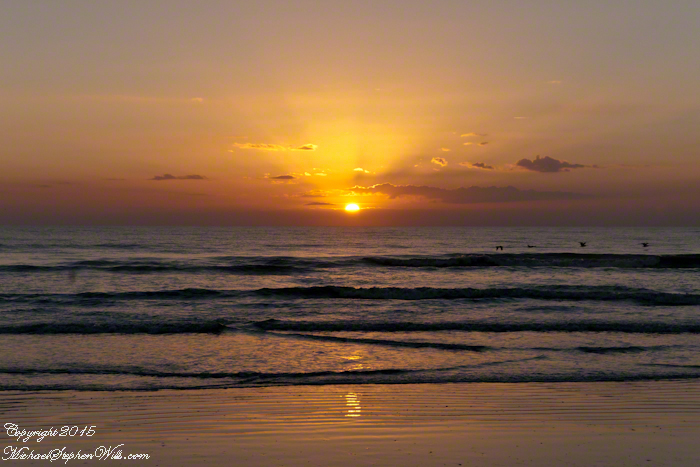
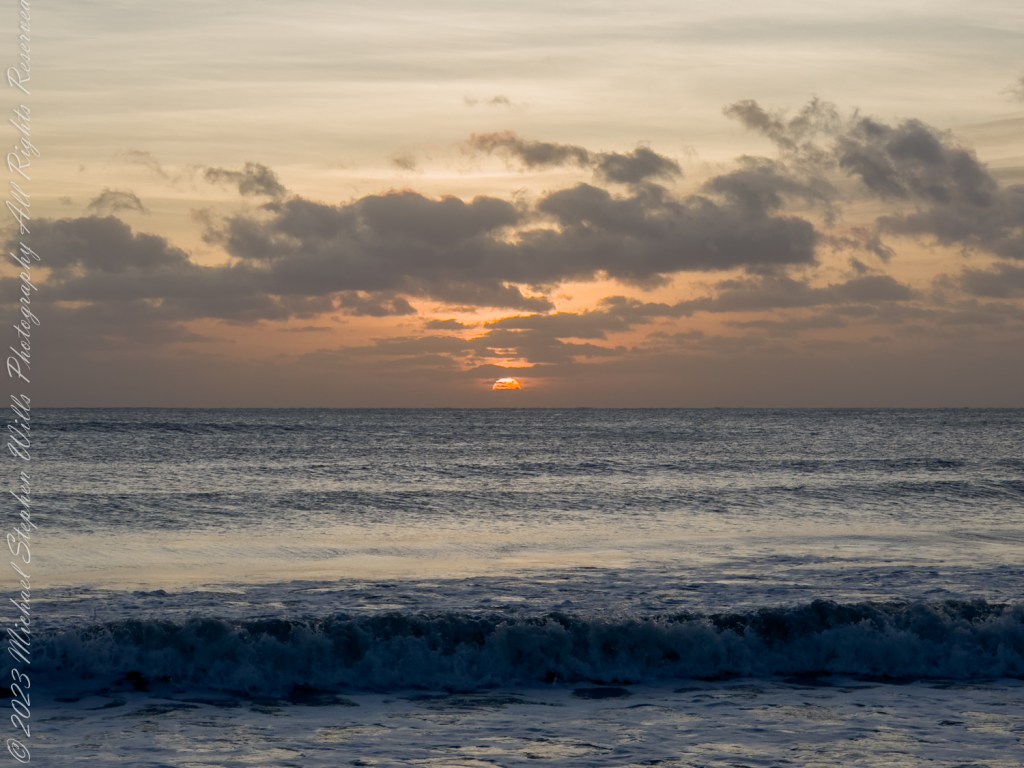
Cocoa Beach, nestled in Brevard County, Florida, is renowned for its pristine sandy shores and the rhythmic lullaby of the Atlantic Ocean. It’s a place where the day often begins with an awe-inspiring sunrise. On the Space Coast, the first light of day is a daily masterpiece, a silent symphony of colors that paints the sky and reflects off the water.

As dawn approaches, the eastern horizon begins to glow with a soft, pre-dawn light. This quiet time, when the world is still asleep, offers a unique tranquility. The beach, usually bustling with surfers, sunbathers, and families, is calm and serene. The sand, cool underfoot, stretches out like a vast canvas, waiting for the sun to begin its artwork.

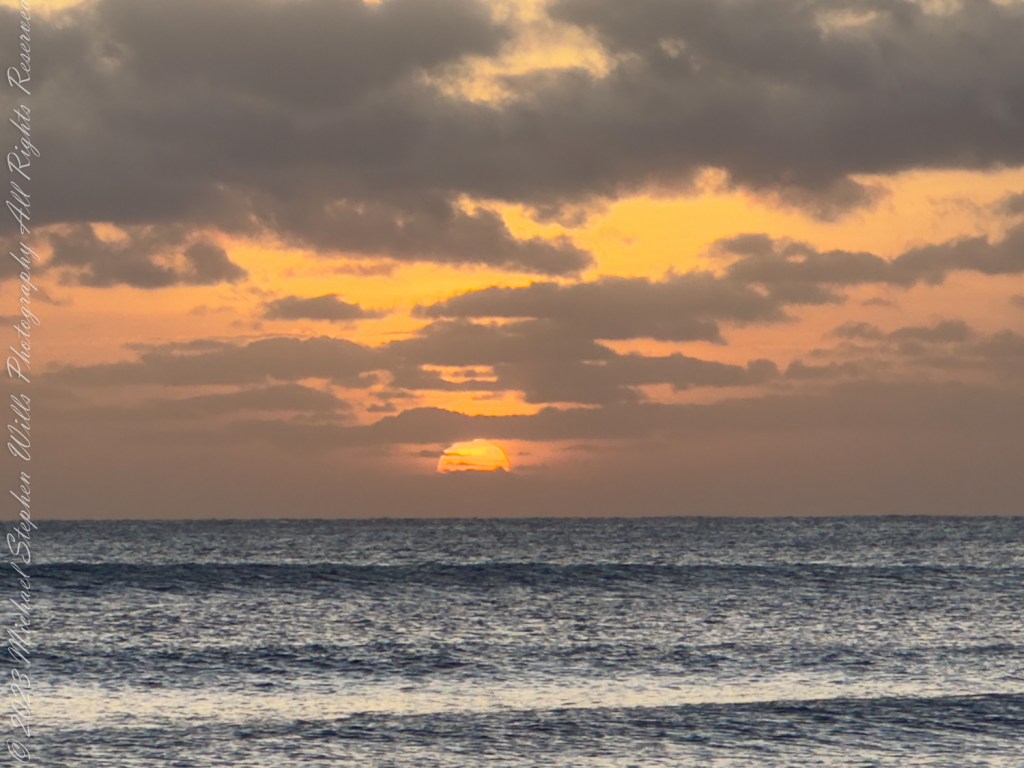
The first hues of sunrise start as a gentle blush, a hint of pink that softly caresses the sky. As the moments pass, this blush deepens into shades of orange and red, reminiscent of a painter’s palette. The ocean mirrors these colors, creating a breathtaking scene where sky and sea blend into one continuous expanse. It’s a moment that feels almost sacred, as if nature itself is preparing for a grand reveal.

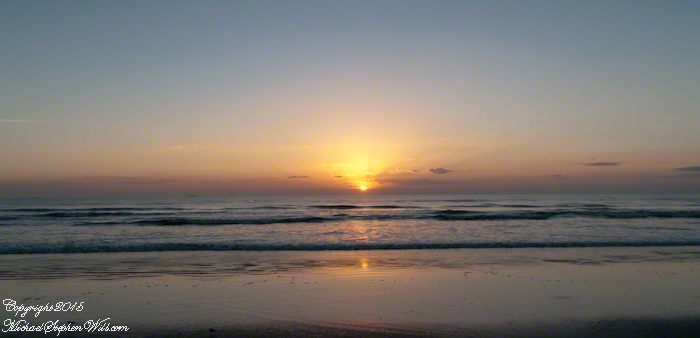
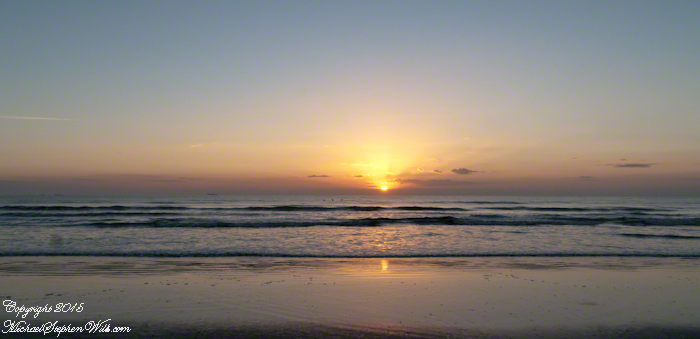
The sun finally peeks above the horizon, a fiery orb that illuminates the world in golden light. This is the crescendo of the sunrise, a moment that seems to hold the breath of the world. The rays of light stretch out across the water, casting a shimmering path that invites the eyes to follow. It’s a path that feels both real and ethereal, leading not just across the sea, but into a day full of possibilities.

As the sun rises higher, the colors in the sky shift and change. The deep reds and oranges give way to softer yellows and then to the clear, bright light of morning. The ocean, too, transforms, taking on a deeper blue as the sunlight penetrates its depths. The waves, which had been gentle ripples in the pre-dawn light, now dance and sparkle, as if celebrating the arrival of the new day.

For those fortunate enough to witness it, a sunrise at Cocoa Beach engages all the senses. The cool breeze carries the fresh scent of saltwater, a reminder of the ocean’s vastness and power. The sound of the waves, steady and rhythmic, provides a soothing background score, while the occasional cry of a seabird adds a touch of the wild to the scene.

Click on a photo for a closer look.

There is a sense of community among the early risers who gather to watch the sunrise. Strangers often share nods and smiles, united by the shared experience of witnessing something so beautiful and ephemeral. It’s a reminder that, no matter our differences, moments of natural beauty can bring people together, fostering a sense of connection and shared humanity.

Cocoa Beach, known for its proximity to the Kennedy Space Center and its surf culture, offers much more than meets the eye. The sunrise is a daily reminder of the simple yet profound beauty of nature, a beauty that exists beyond the man-made attractions and the hustle and bustle of everyday life. It’s a call to pause, reflect, and appreciate the world around us.

In a place where rockets soar into the sky, touching the very edge of space, the sunrise at Cocoa Beach brings us back to Earth, grounding us in the timeless rhythm of the natural world. It’s a moment of peace and renewal, a gift from the universe to start the day with a heart full of wonder and gratitude.

So, whether you’re a local or a visitor, taking the time to watch the sunrise at Cocoa Beach is an experience not to be missed. It’s a chance to witness the world waking up, to feel a part of something larger than oneself, and to start the day with a renewed sense of awe and possibility.

Copyright 2024 Michael Stephen Wills All Rights Reserved

Face-to-Face with Florida’s Ancient Predator

Discover the world of Florida’s ancient predators through the eyes of the formidable Smilodon fatalis. Step back in time to the Pleistocene epoch and explore the life, habits, and social bonds of the iconic sabertooth cat.

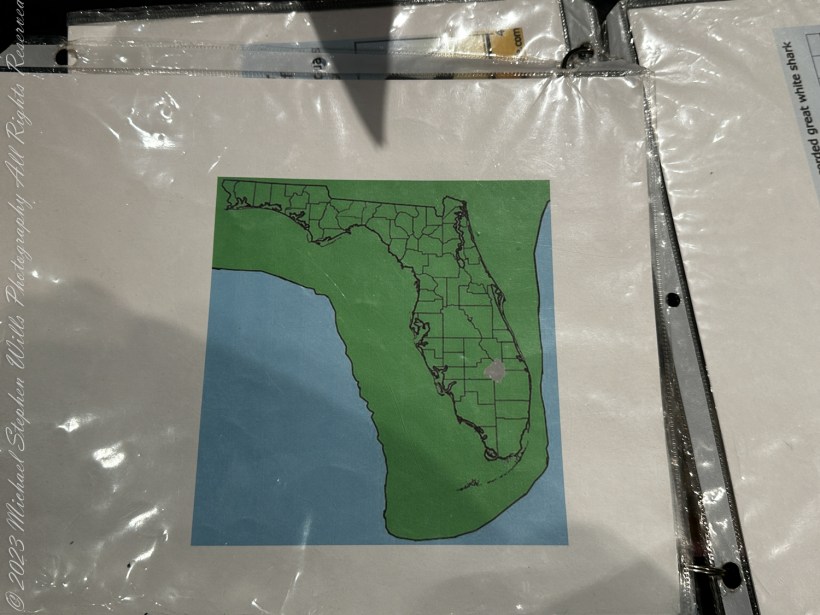
I examined an unusual map of Florida, the contours of its familiar modern shape overlaying a vast, green expanse. The state as we know it today is crisscrossed by highways and dotted with bustling cities, but this map transported me back in time to a very different era. During the Pleistocene epoch, Florida was a wilder, untamed land, teeming with life and dominated by creatures long extinct.

The representation of the land area of Florida state during Pleistocene epoch glaciation is the green shading with the current map of Florida within.

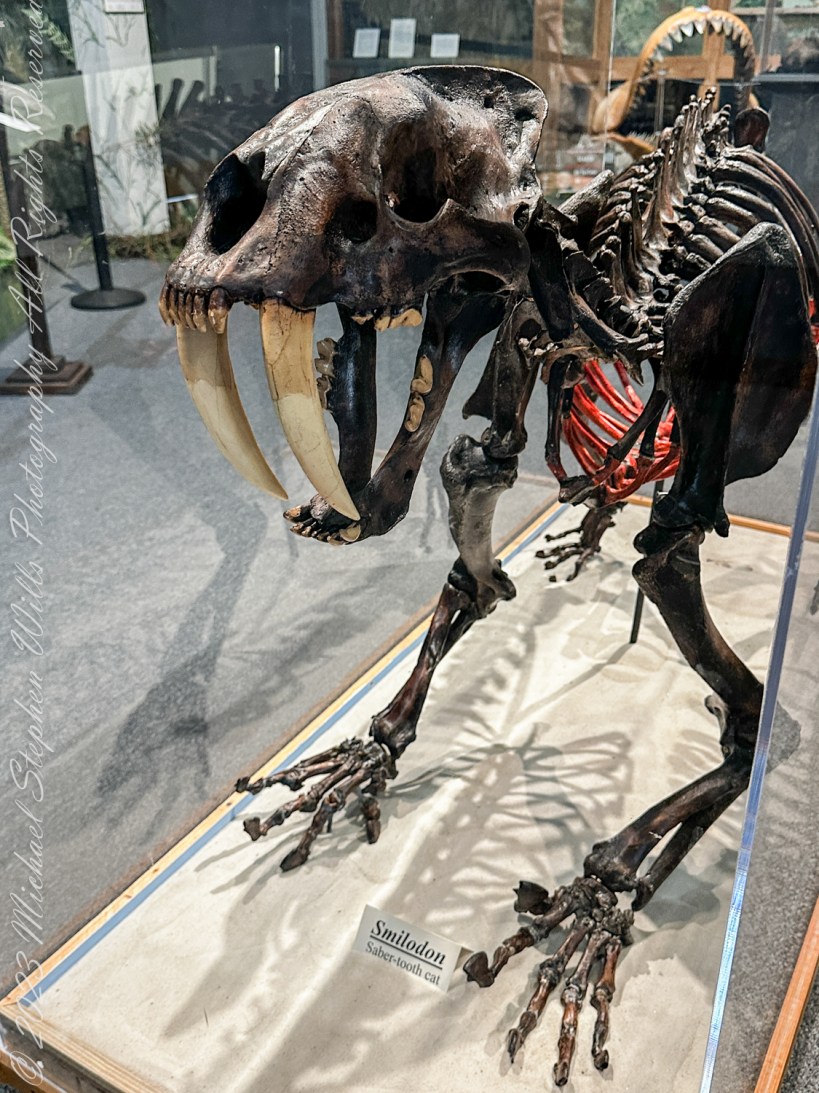
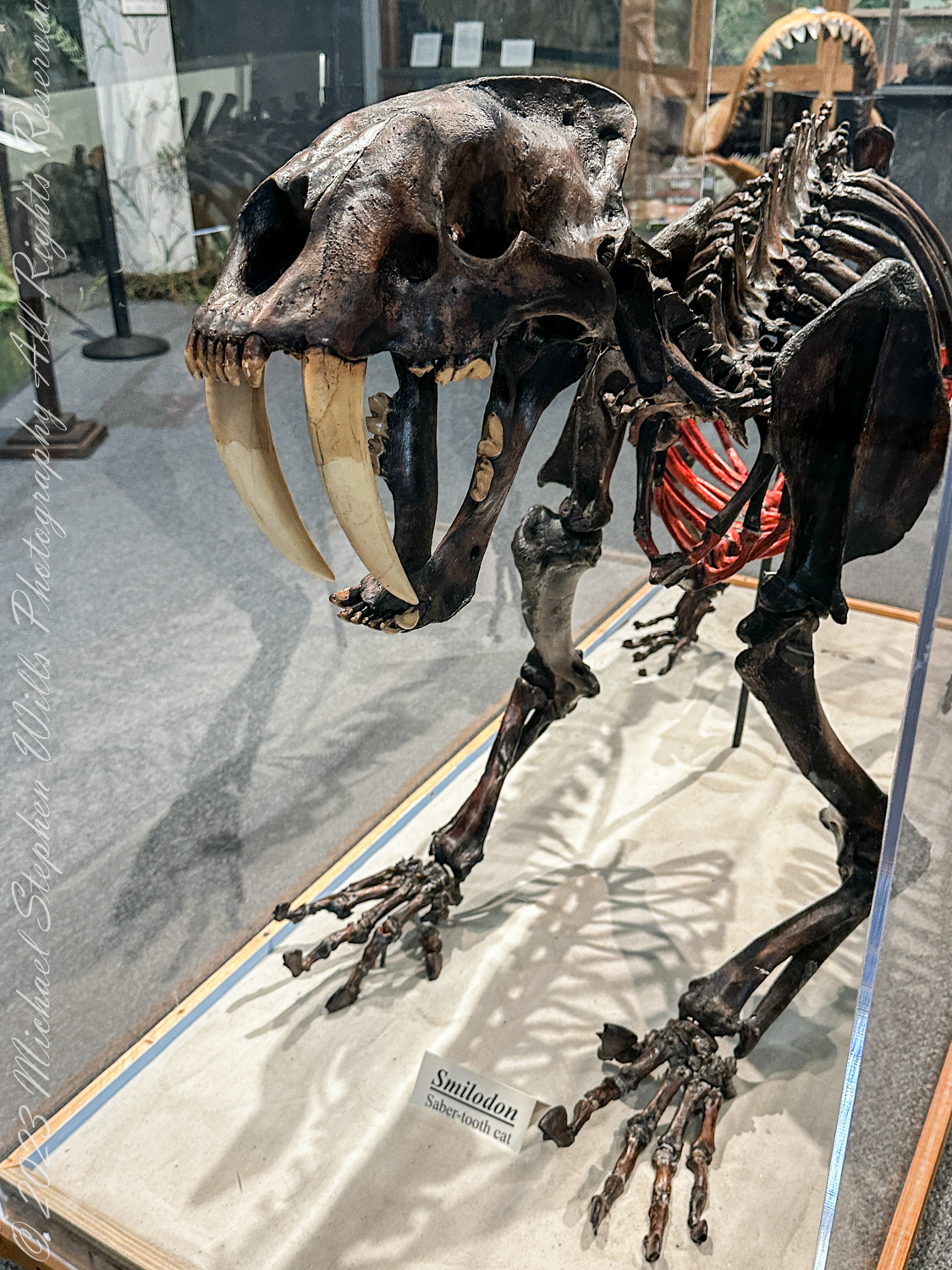
Exploring Brevard (county) Museum of History and Natural Science of Cocoa Florida, I moved to the next exhibit. The air hummed in my imagination with the whispers of an ancient world. A skeletal figure loomed within a glass case – the mighty Smilodon fatalis, the sabertooth cat. Its fearsome fangs curved downward, I imagined standing face-to-face with this apex predator, feeling both awe and a primal fear.

Florida, some 11,500 years ago, was a place of significant climatic shifts. The Pleistocene epoch was characterized by repeated glaciations; however, Florida itself remained unglaciated. The climate was cooler and drier than today, and sea levels were much lower, extending the coastline outward. This ancient Florida was a mosaic of grasslands, savannas, and woodlands. Giant sloths, mammoths, and mastodons roamed these lands, sharing the territory with the formidable Smilodon.

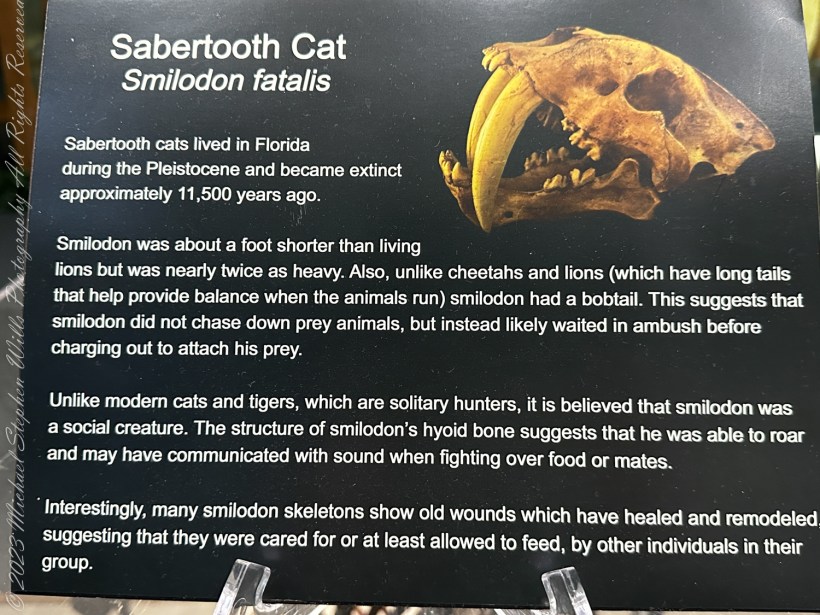
The attendant palque described Smilodon fatalis was about a foot shorter than modern lions but nearly twice as heavy. Its stocky build and powerful limbs suggested immense strength. Unlike the cheetahs and lions of today, Smilodon had a bobtail, indicating that it relied less on speed and more on ambush tactics. I could almost see it now: crouching low in the underbrush, muscles coiled, waiting for the perfect moment to spring upon its unsuspecting prey.

In the reconstructed display, the sabertooth cat’s lethal precision was evident. Its elongated canines were deadly tools designed to pierce and hold onto struggling prey. The lack of a long tail, which modern big cats use for balance during high-speed chases, suggested that Smilodon was an ambush predator. It would have hidden in the dense foliage, its mottled coat blending seamlessly with the shadows, until it launched a surprise attack.

Smilodon was not just a solitary hunter. Unlike modern cats and tigers, which often lead solitary lives, evidence suggests that Smilodon was a social creature. The plaque mentioned the structure of its hyoid bone, implying that it could roar, perhaps using vocalizations to communicate with other members of its group. I envisioned a family of Smilodon, working together to take down a mammoth or defend their territory from rivals. Their social bonds might have been strong, much like those of modern lions.

I was particularly struck by the evidence of healed wounds found on many Smilodon skeletons. These injuries had healed and remodeled over time, suggesting that these cats cared for each other. In a world where every day was a battle for survival, these acts of care and compassion spoke volumes about their social structure. Injured members were not left to fend for themselves but were likely allowed to feed off the kills of others and to be protected by their group until they recovered.

The exhibit painted a vivid picture of an ancient ecosystem. The Pleistocene flora of Florida was diverse, with vast grasslands interspersed with stands of pine and oak. The fauna was equally rich: herds of herbivores grazed the plains, while predators like Smilodon and dire wolves stalked them. This was a land of giants, where every creature had to be strong, fast, or cunning to survive.

As I stepped away from the exhibit, I felt a deep connection to this ancient world. The Smilodon fatalis was a predator and is a symbol of an era that shaped the natural history of our planet. Its bones told a story of survival, community, and the ever-changing dance of life and death.

In the quiet of the museum, surrounded by the echoes of the past, I was reminded of the fragility and resilience of life. The sabertooth cat, with its fearsome fangs and powerful build, was a testament to the incredible adaptability of life on Earth. Though it has long since vanished from our world, the spirit of Smilodon fatalis lives on in the bones it left behind and in the stories we tell about the ancient world it once ruled.

Copyright 2024 Michael Stephen Wills All Rights Reserved

Cocoa Beach Dawn

In January 2024, I captured the tranquil beauty of Cocoa Beach at dawn, embracing the fleeting moments of peace and natural wonders.

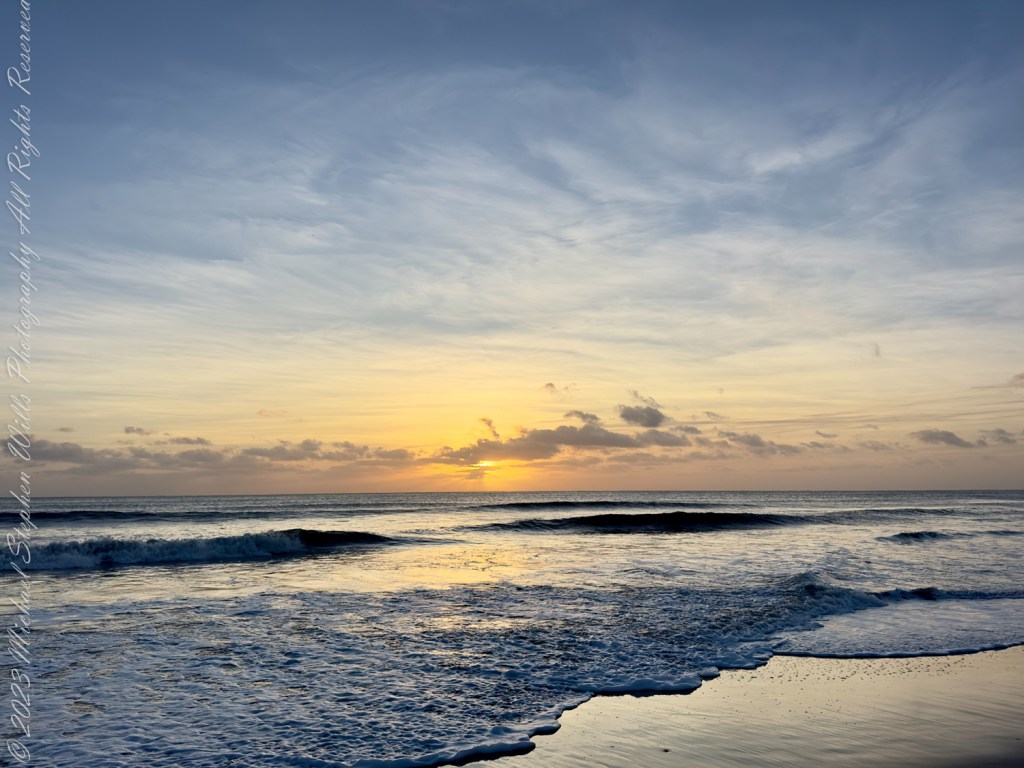
The first blush of morning caresses the horizon, the palette of colors unfurling across the sky like a softly whispered promise of the day ahead. The soft pinks and blues deepen, brushing the clouds with strokes of lavender and orange, as the sun peeks just above the watery edge of the world. Today, I find myself strolling along Cocoa Beach, capturing the tender moments of dawn breaking over this tranquil Florida beachscape in early January 2024.

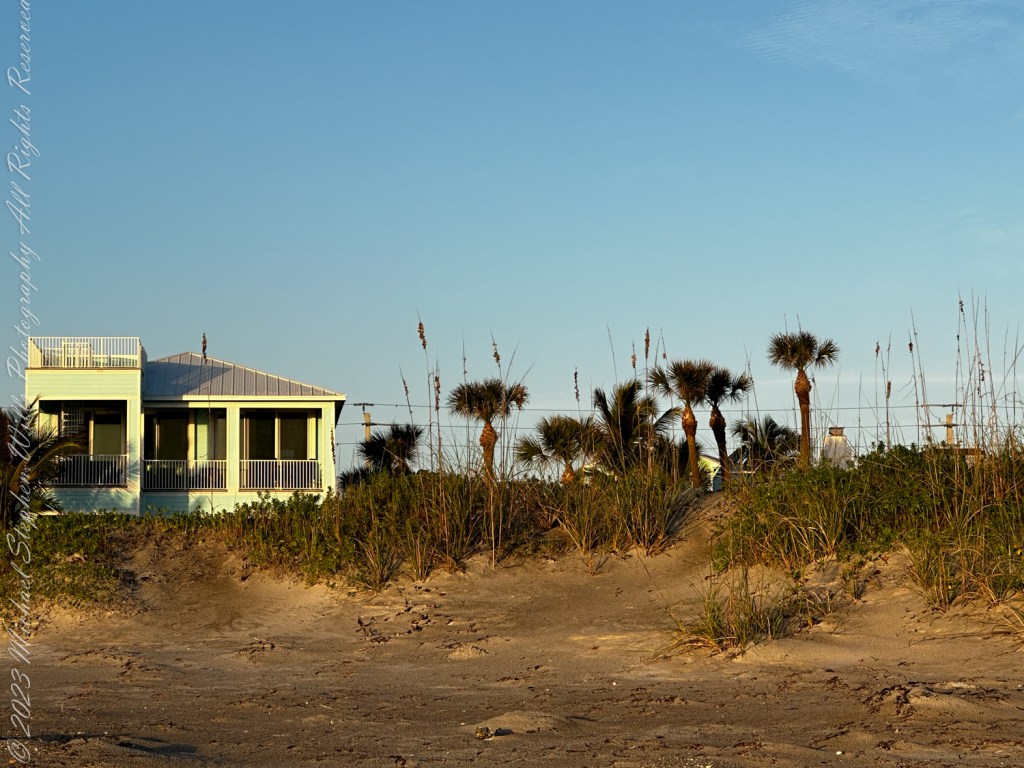
Each step I take along the sandy shores brings a new perspective, a new detail, revealed in the emerging light. To my right, a lone beach house sits nestled behind a veil of sea oats and palmettos, the sky behind it a canvas of warming hues. The house seems to slumber still, its windows reflecting the first golden rays of the sun. This dwelling, isolated and serene, hints at the countless summers of laughter and salty air, and the quiet winters of introspective solitude.

As the morning progresses, the sun asserts itself, climbing higher and burning off the last vestiges of night. I point my camera towards the ocean, capturing the waves as they roll in with rhythmic persistence. The sea is a creature of profound mystery in these early hours, its surface a moving mirror that catches the fire of the sunrise and dances with light. Each wave is a note in an aquatic symphony, played just for those who are awake to hear it.

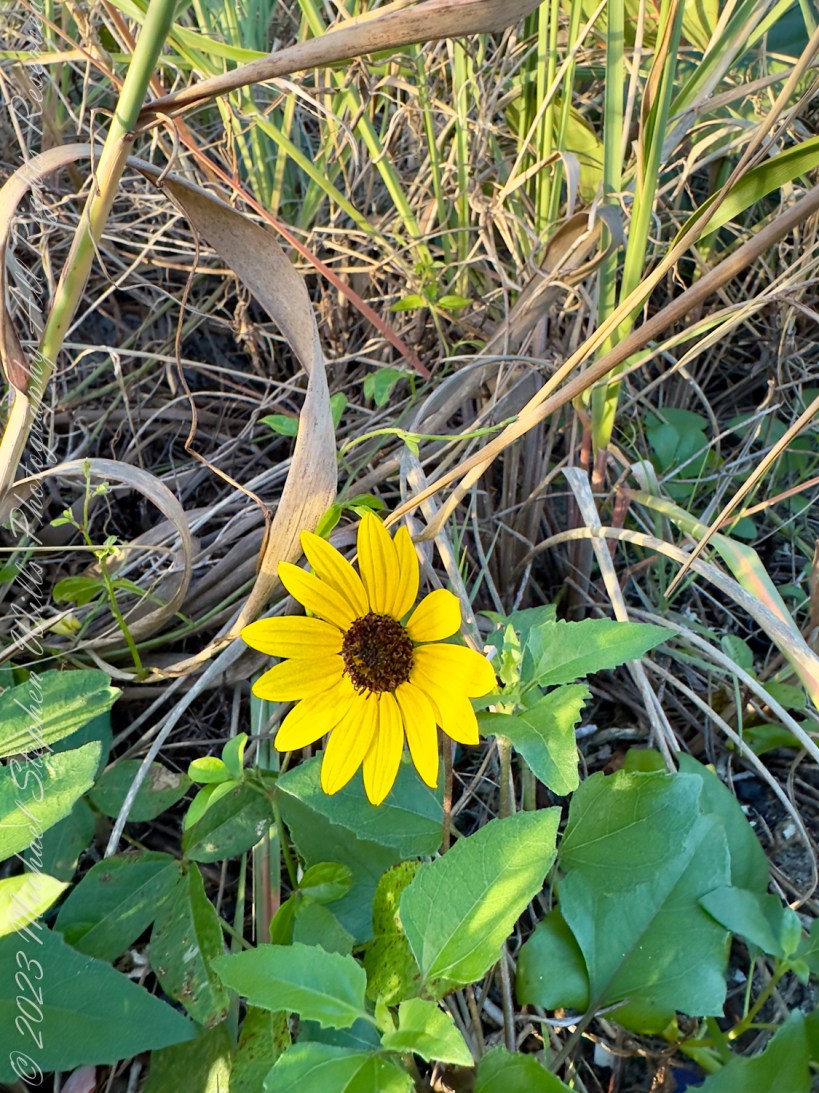
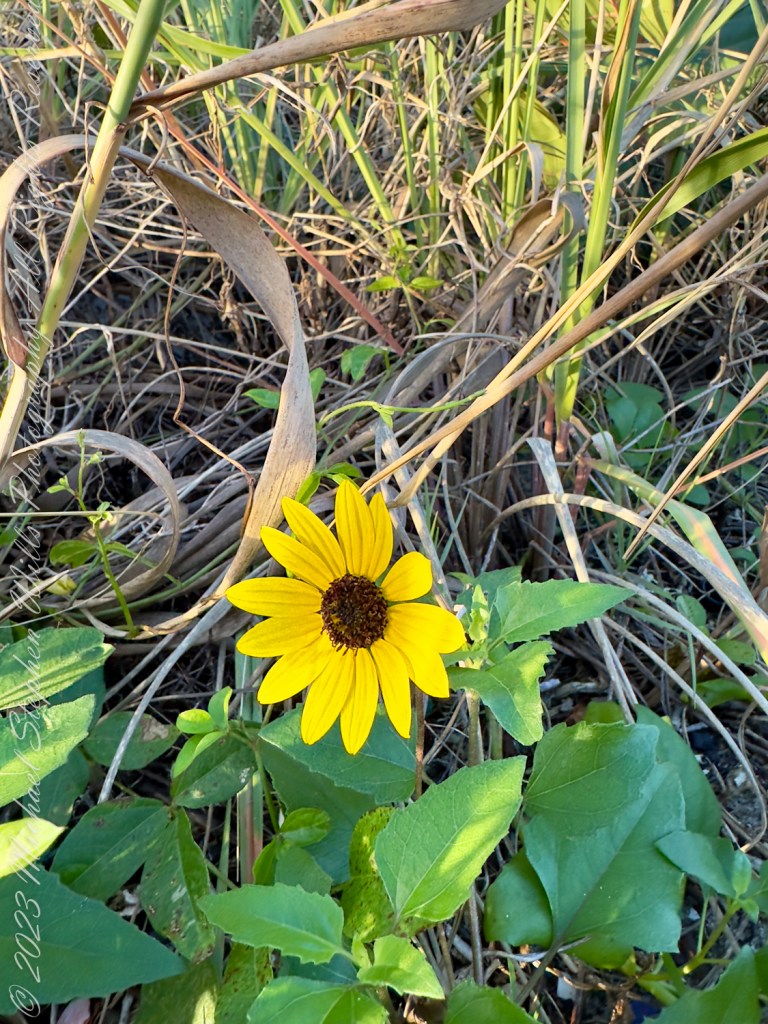
Turning my gaze down, I focus on the smaller, often overlooked inhabitants of the beach. A single flower, a stubborn and resilient dune sunflower, stands boldly above the sands. It’s an unexpected sight—this splash of vibrant yellow against the muted earth tones of the sandy beach. The flower turns its face towards the sun, basking in the glow, thriving in its own patch of the world. It’s a poignant reminder of the tenacity of life, of nature’s relentless pursuit of existence against the odds.

The beauty of Cocoa Beach at dawn is not just in its sweeping vistas or the dramatic play of light and shadow. It’s also in these small, intimate encounters: the texture of the sand, the whisper of the grass, the solitary bloom. Each element is a brushstroke in a larger picture, a note in a grander melody. As I walk, my feet leave temporary impressions on the wet sand, soon to be erased by the incoming tide. It feels symbolic, this transient mark-making, reflective of the fleeting nature of life and the enduring beauty of the world around us.

Cocoa Beach this morning is a place of peace and contemplation. As I capture these moments with my camera, I am also capturing them in my heart, storing them as a balm for busier, noisier days. The photographs will speak of quiet and calm, of the soft hush of dawn, and the gentle awakening of the earth. They will tell of a morning when the world seemed to pause, just for a moment, to revel in the simplicity and beauty of another beginning.

As the sun climbs higher, its light becomes too harsh for the soft magic of dawn photography. I pack up my camera, my heart full of the morning’s calm. The beach is waking up now, the first joggers and dog walkers appearing, their morning routines intersecting with the tail end of my photographic journey. I leave Cocoa Beach carrying the quiet joy of the morning, a joy found in the dance of light on water, in the solitude of a beach house, and in the vibrant defiance of a sunflower. Dawn here is not just a time, it’s an experience—a delicate, powerful reminder of the world’s wonders, witnessed at the edge of the day.

Copyright 2024 Michael Stephen Wills

Wind Riders: A Seven-Year Saga of Beach and Ocean Kiteboarders

Embark on a journey with kiteboarders who harness the wind and surf, mastering both beach and ocean. Witness the evolution of this thrilling sport over seven years, from the sandy shore to the open waves.

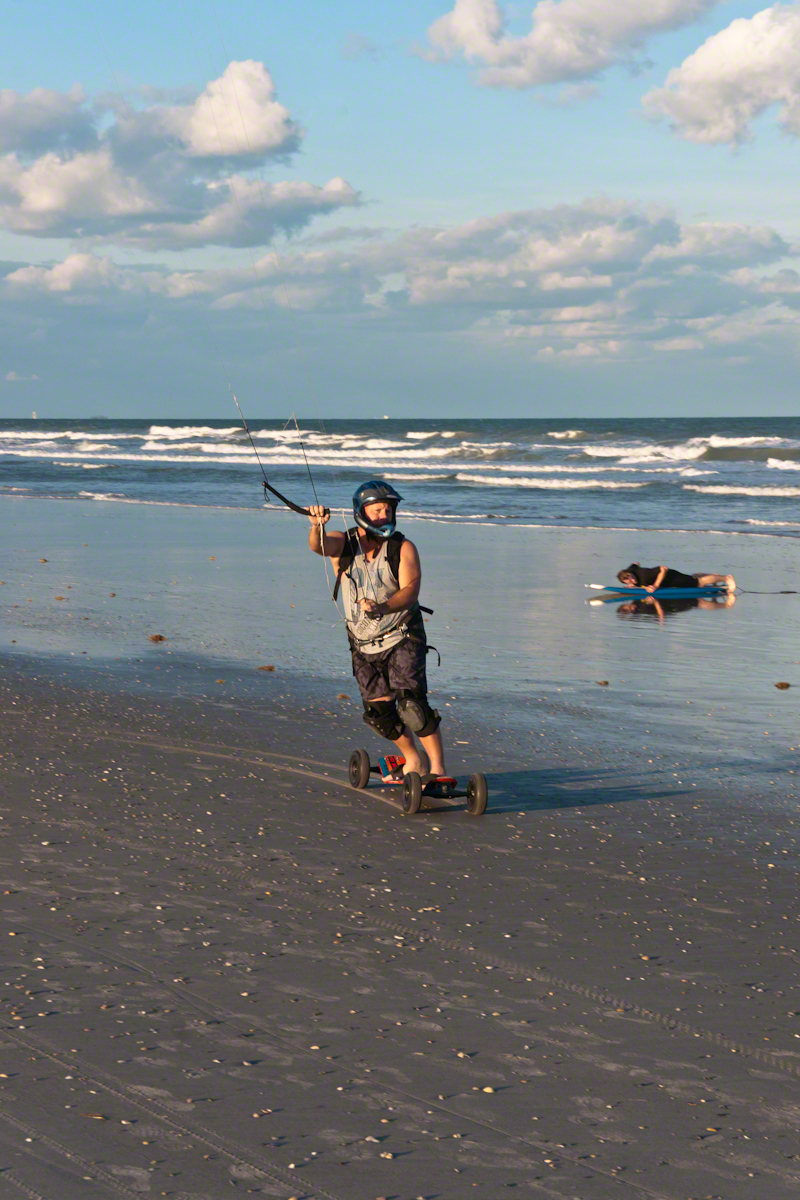
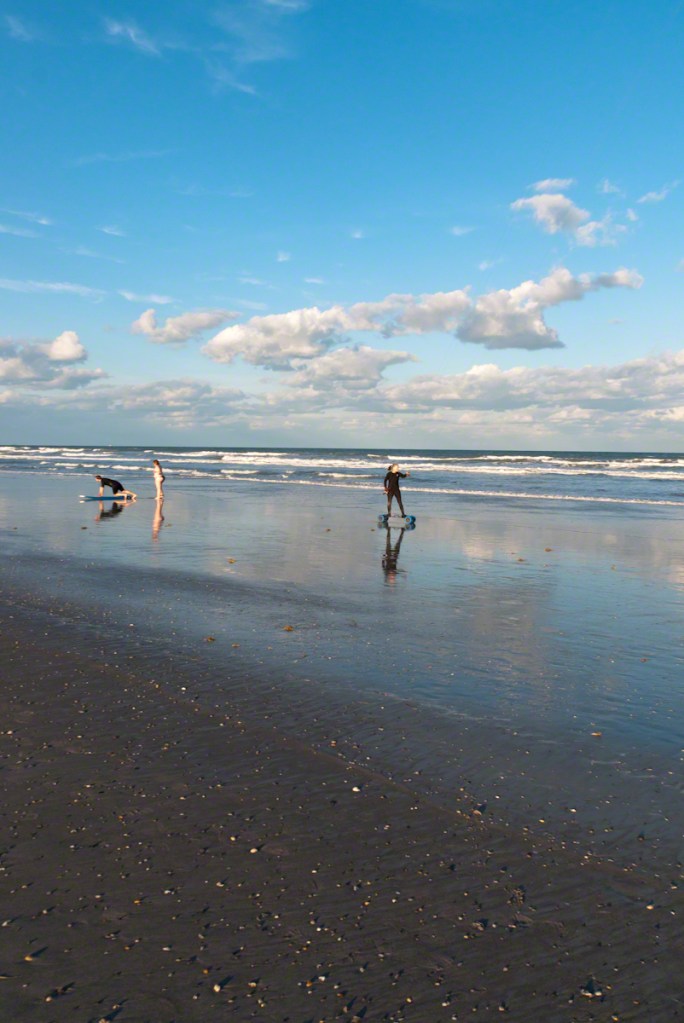
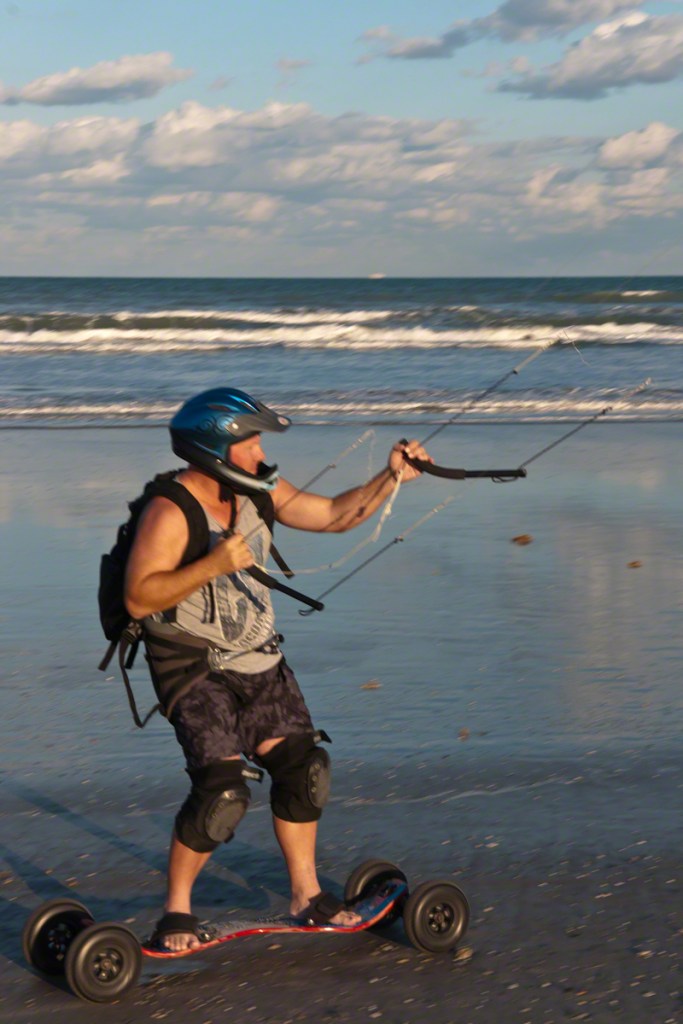
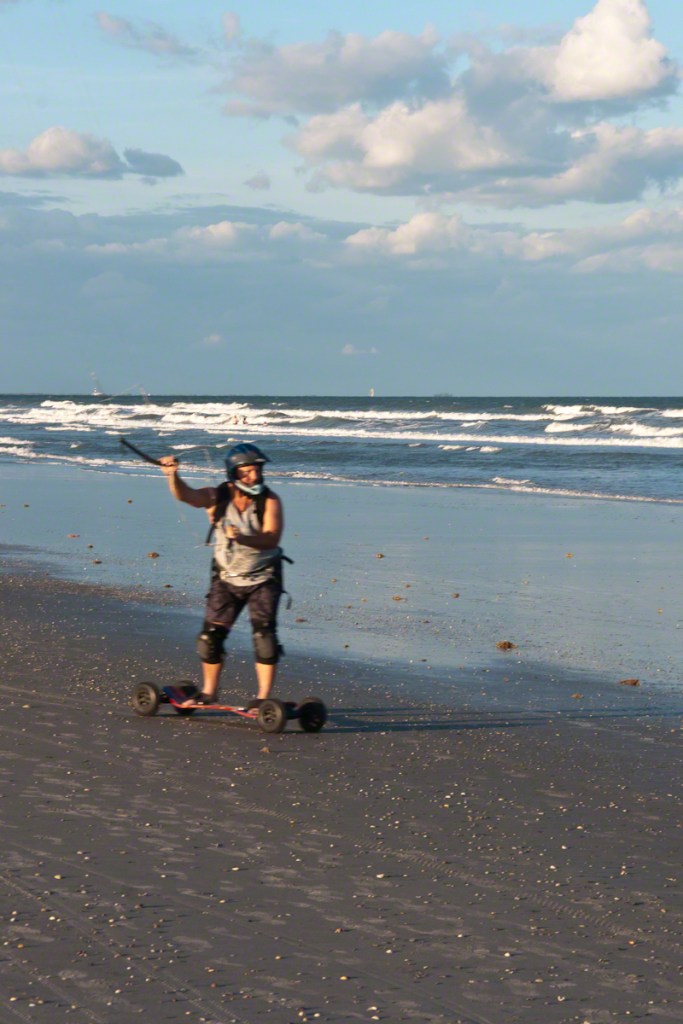
Cocoa Beach, with its rhythmic waves, is a destination that stirs a sense of adventure. Seven years ago, March 2017, as I strolled along its sandy shores, my attention was captured by a curious sight: several people gliding effortlessly across the beach, seemingly with the wind at their command. These weren’t your typical surfers or skateboarders—they were kiteboarders, harnessing the power of the wind with large kites that stretched high into the sky. I was transfixed by the sight of their wheels skimming along the wet sand, leaving tracks like an artist’s brushstroke on a canvas.

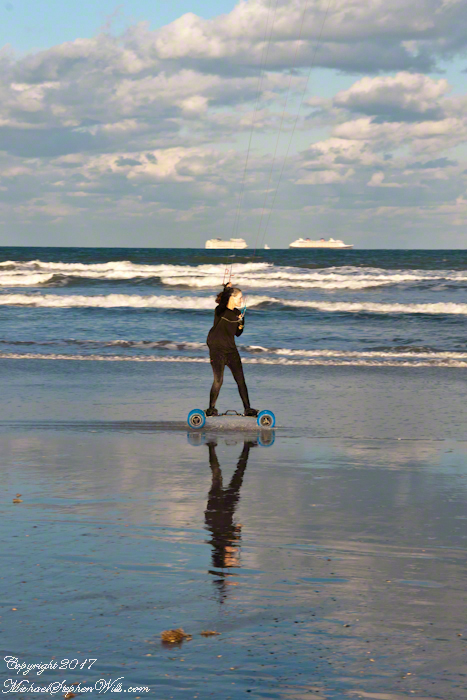
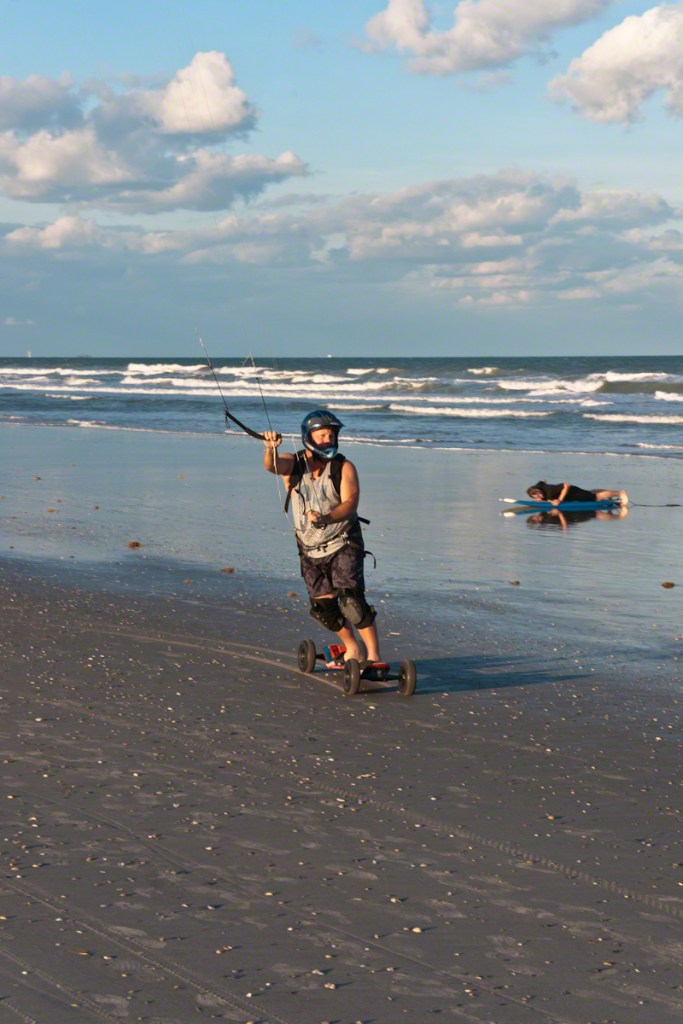
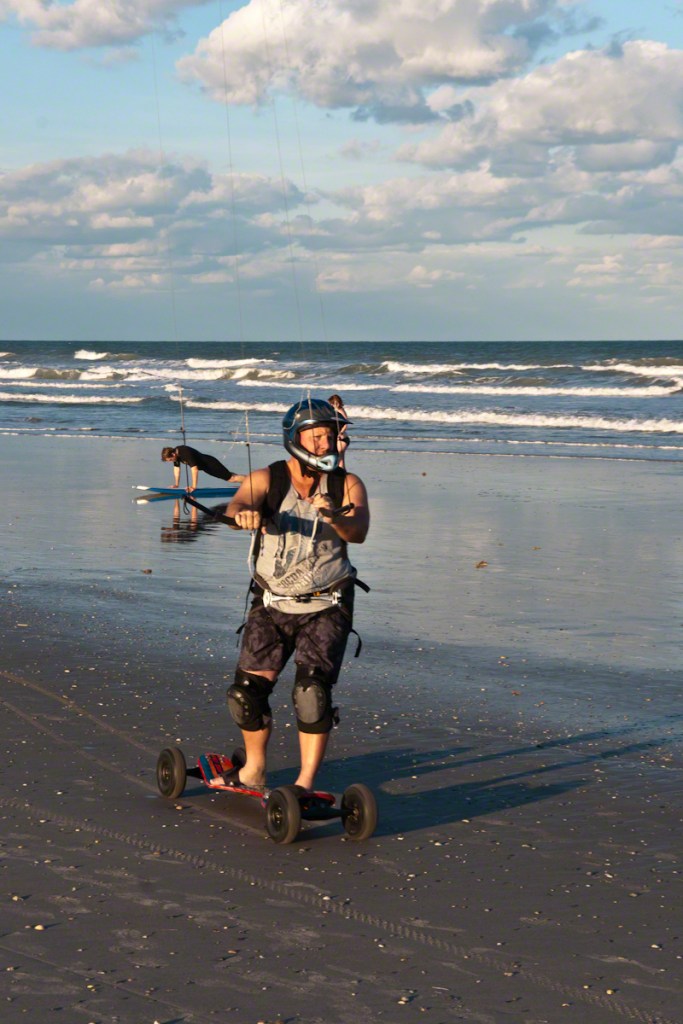
The beach was alive with energy. The wind, the driving force behind the kiteboarders, was gusty, rippling the surface of the ocean and creating perfect waves for surfers. But the kiteboarders were on a different mission. They had wheels attached to large boards, akin to skateboards but bulkier. They wore helmets and pads, visibly prepared for a sport that seemed to demand not just skill but a dose of courage.

One rider caught my eye, with his bright blue helmet and focused gaze. He adjusted the lines of his kite like a master puppeteer, maneuvering himself with precision as he glided along the shore. The kite seemed an extension of his own limbs, responding seamlessly to his every movement. It was exhilarating to watch, the kite’s taut lines tracing invisible patterns in the sky as he shifted his weight, steering the board with expertise. With each gust of wind, he picked up speed, racing along the shore with a grin that spoke of pure joy.

Not far from him, a second kiteboarder, a woman, was testing her skills. Her kite had a distinct red pattern, vibrant against the backdrop of the sky. She handled it with ease, her body swaying in rhythm with the kite’s movements. It was like a dance, where the wind was both partner and lead, guiding her across the beach in wide arcs. Occasionally, she would glance over at the other riders, sharing nods of camaraderie that suggested a tight-knit community.

The sight reminded me of the joy of childhood, of riding bicycles down a hill, the wind whipping through your hair, feeling like you could conquer anything. But this was a more refined thrill, one that demanded an intimate understanding of nature’s forces. The kiteboarders were more than just athletes; they were artists painting their own masterpieces against the sky.

In the distance, I noticed a third rider. He was still finding his rhythm, his movements a little less sure, but the determination on his face was unmistakable. He kept his focus on the kite, battling the wind to gain control. Even as he stumbled a few times, his spirit didn’t falter. Each time he fell, he would rise, dust off the sand, and try again. It was a scene of persistence that spoke to the spirit of the sport—a reminder that mastery is not achieved without effort.

The sun began to dip toward the horizon, casting long shadows on the sand. The wind grew cooler, and the kiteboarders began to pack up their equipment. I found myself lingering a little longer, reflecting on what I had just witnessed. Kiteboarding seemed to embody the spirit of Cocoa Beach itself—a blend of adventure, community, and a deep connection with nature.

Walking away, I couldn’t help but feel inspired by their spirit of adventure. The kiteboarders had painted a vivid picture of resilience, joy, and the thrill of chasing the wind. They were, in a way, explorers charting a path on the very edge of land and sea, powered by nothing but wind and will.

Seven years later, this past winter of 2024, there was a kicking wind powering a group of three kiteboarders tackling the waves offshore, embracing the ocean waves in a spectacular display of skill.

Their kites stretched high against a steely sky, creating vibrant contrasts with their colorful patterns. One kiteboarder had a kite adorned in shades of turquoise, like a burst of sunlight riding the wind. He maneuvered deftly on the waves, rising high on the crest of each swell before swooping down into the troughs. His movements were fluid, and he rode each wave with a mastery that suggested years of experience.

The second rider, with a vivid blue kite, showed off his own skill set, to ride the waves with finesse, carving arcs through the water, creating a wake of white foam. He seemed almost weightless, gliding effortlessly, catching air whenever he hit a particularly high crest.

The third kiteboarder was the most daring of the trio, his kite blending with the overcast skt. He launched himself off the waves, soaring high into the air before coming down with a splash. Each leap seemed to defy gravity, and he twisted and turned in mid-air like an acrobat, displaying a level of athleticism that left the onlookers on the beach in awe. The wind and waves provided the perfect playground for his tricks, and he used every bit of it to his advantage.

The three kiteboarders moved in sync, communicating through gestures and nods, sometimes even shouting encouragement to each other over the sound of the crashing waves. They pushed one another to reach greater heights, to attempt more daring moves, and to revel in the shared joy of their sport. It was as if they were performing a choreographed routine, set to the rhythm of the sea.

Onlookers gathered along the shore, drawn by the mesmerizing sight of these kiteboarders taking on the ocean waves. The kiteboarders, with their vivid kites and breathtaking maneuvers, were like seagulls riding the wind, an exhilarating reminder of the power of nature and the joy of embracing it.

As the day wore on, the kiteboarders continued to ride the waves, their energy seemingly endless. The sea and sky were their canvas, and they painted across it in broad, sweeping strokes. Watching them was a thrilling reminder of the freedom and adventure that the ocean brings.

Copyright 2024 Michael Stephen Wills All Rights Reserved

Close Encounters at Cocoa Beach

A shark’s fin slicing through the waves at Cocoa Beach reminds me of a life-changing encounter I had with the ocean’s wild inhabitants, transforming my relationship with the sea and its hidden mysteries.

During winter vacations to Cocoa Beach, Florida, I spent tiome relishing in the salty embrace of the Atlantic, and my love for the water extended beyond the ocean to poolside swims year-round. However, a few years ago, my carefree splashing in the waves took a drastic turn after an unexpected encounter with a creature lurking beneath the surface.

It was a warm, sunlit day, and the ocean seemed welcoming. I had just waded into waist-deep water when I felt it—a strong, unexpected bump against my side. I turned quickly, expecting to see a fellow swimmer, but there was no one nearby. My heart pounded as the realization dawned that I had been bumped by a large sea animal, most likely a shark. Although I didn’t see the creature clearly, the experience left an indelible mark on me.

From that day on, the ocean was no longer a place of carefree enjoyment. The once thrilling waves now seemed menacing. I found solace in swimming in pools, where the water was clear, and the risks were few. The ocean, with its unseen mysteries, became a distant memory.

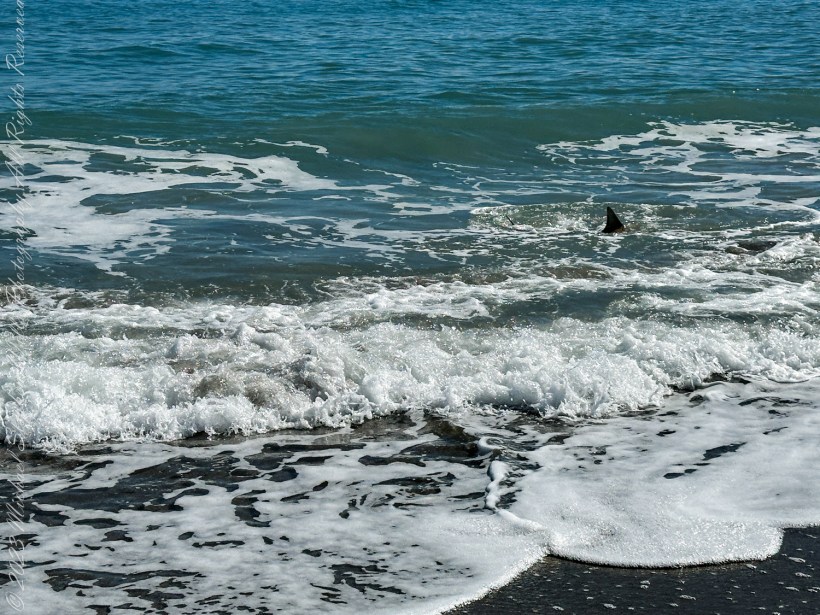
On January 30, 2024, I was back at Cocoa Beach, but this time I stood firmly on the shore. It was noon, and the sun shone brightly over the shimmering waters. As I scanned the horizon, my eyes fell on a telltale fin slicing through shoreside foam of breaking wavews. A shark was feeding just three feet from the shore. I watched in a mix of awe and trepidation as the creature moved with effortless grace through the surf.

Shark feeding a few feet from shore, Cocoa Beach, January 30, 2024 around noon.

As I stood there, capturing the moment, a woman approached me. She had observed my intent gaze and sensed my apprehension. She introduced herself and then began to share an unsettling story about her daughter. She told me that her daughter had been bitten by a shark on her foot the previous year while swimming off the same beach. The young girl was still recovering from the ordeal, both physically and emotionally.

Her story, coupled with my own experience, solidified my decision to stay out of the ocean. I understood that the beach was the shark’s domain, a place where humans are merely visitors. The encounter reminded me that even in our pursuit of leisure, we must respect the natural world and its unpredictable inhabitants.

These days, I content myself with the safety of pools, where I can swim without fear of what lies beneath. But I still cherish the ocean from a distance. I understand its beauty and power, and I respect the creatures that call it home. I may not wade into the waves anymore, but I will always hold a deep appreciation for the vast, enigmatic sea.

Copyright 2024 Michael Stephen Wills All Rights Reserved

Observations of Beach Erosion at Cocoa Beach, January 2024

Nature’s artistry unfolds on the shores of Cocoa Beach, where the ever-changing tides leave intricate patterns in the sand. This captivating display of erosion hints at a fragile coastline, urging us to act for its preservation.

Initial Observations

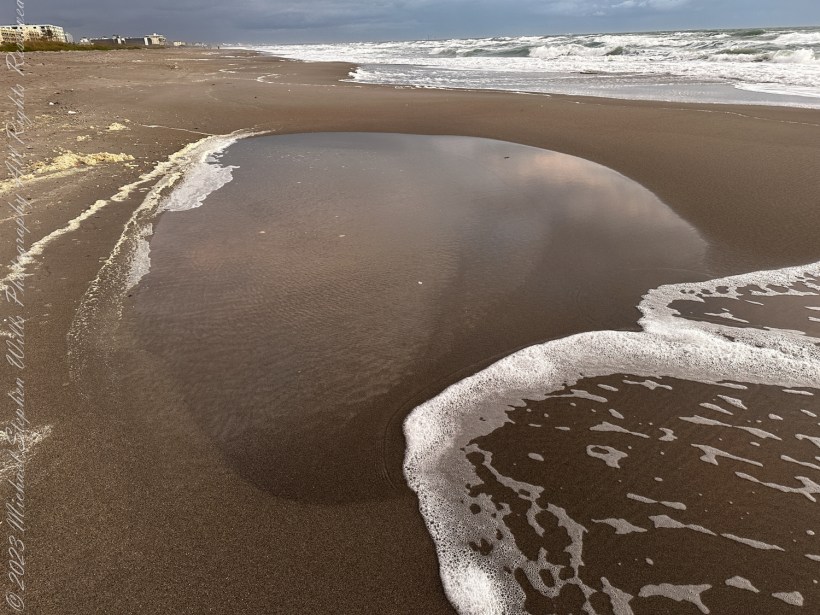
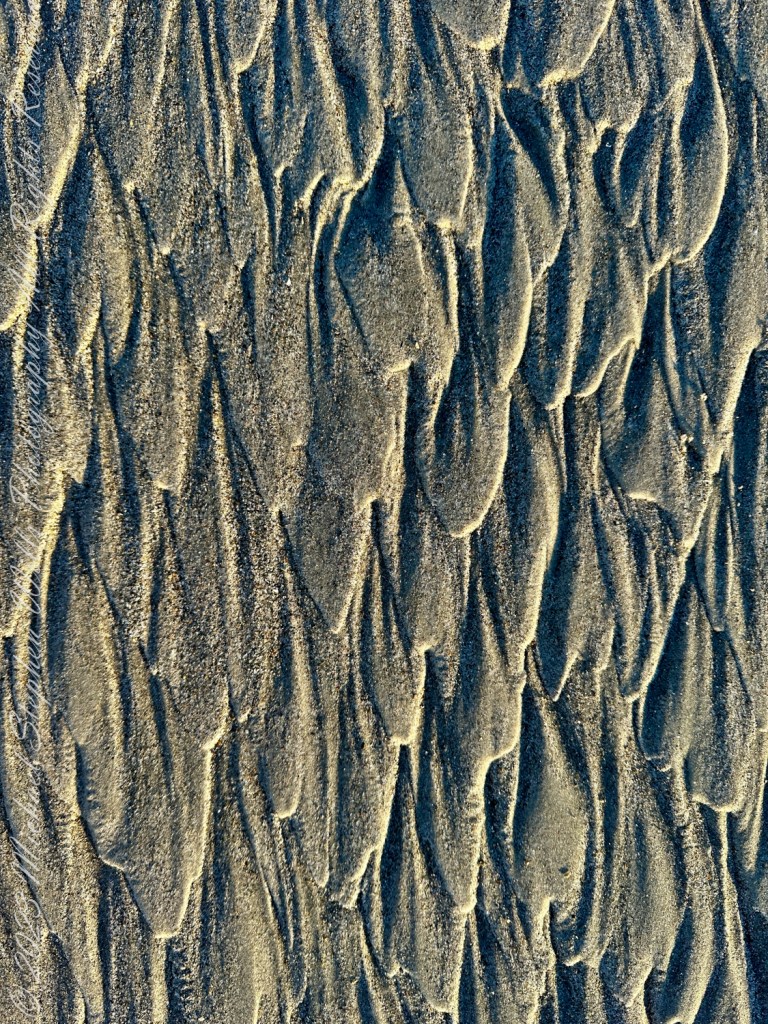
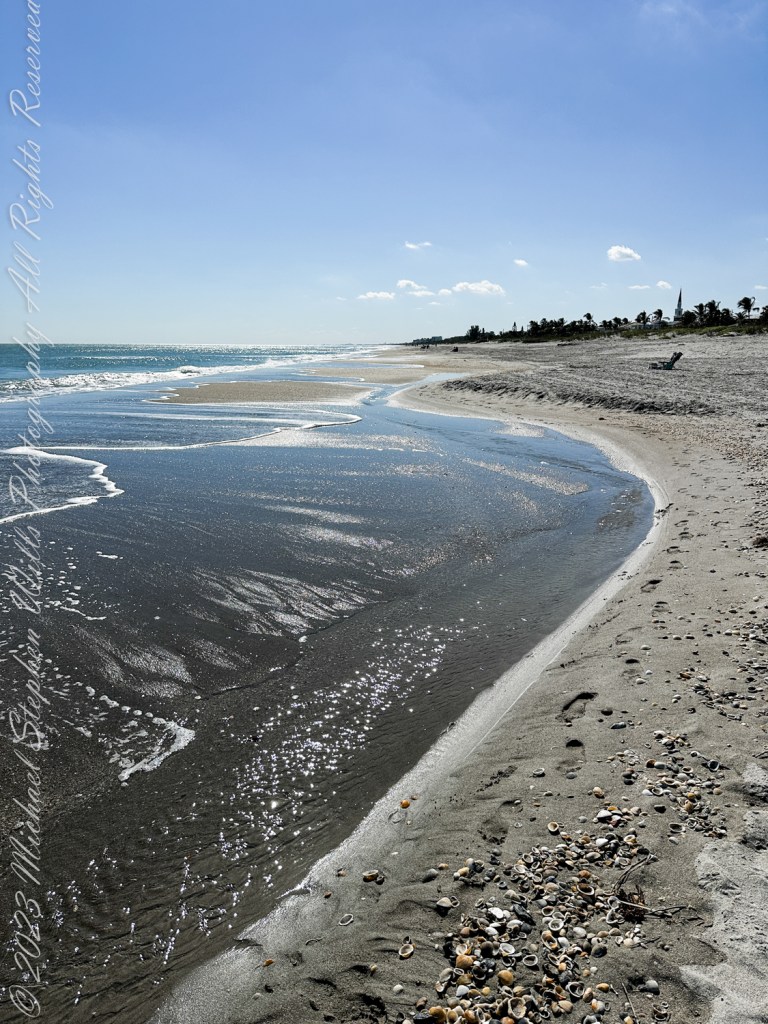
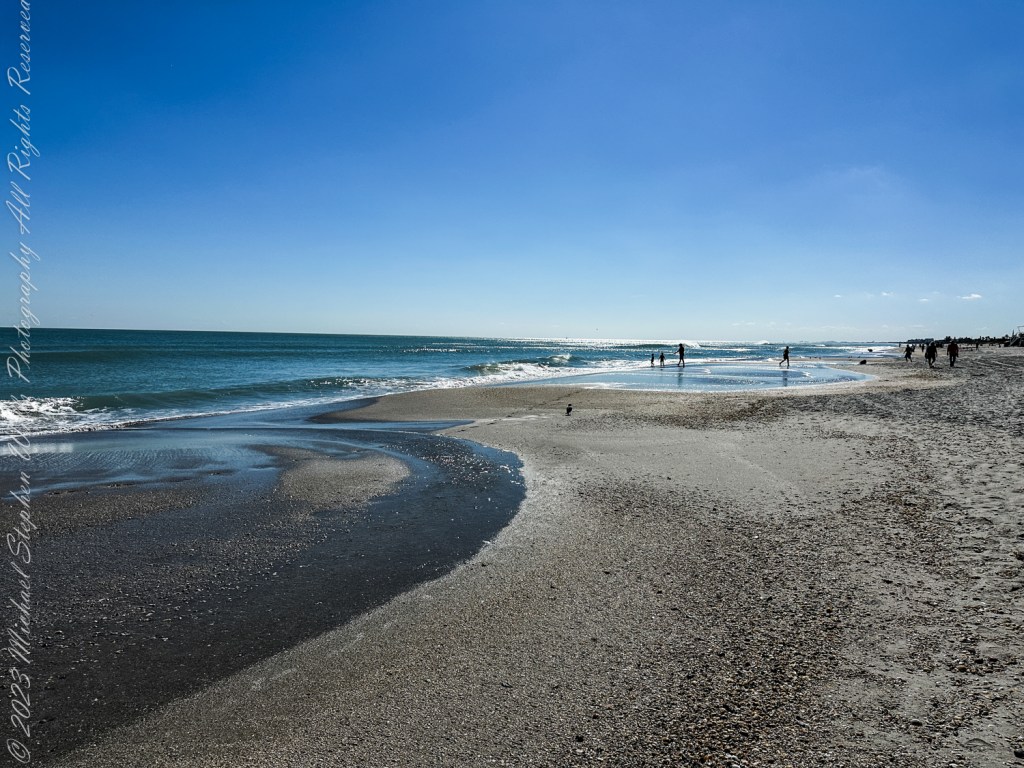
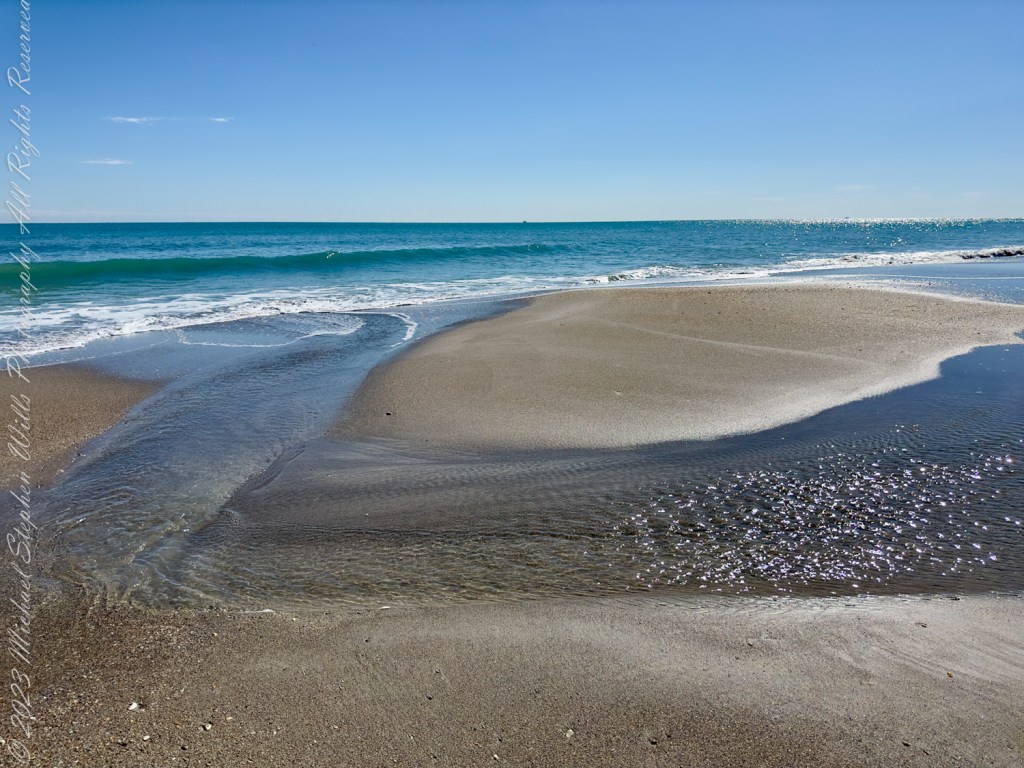
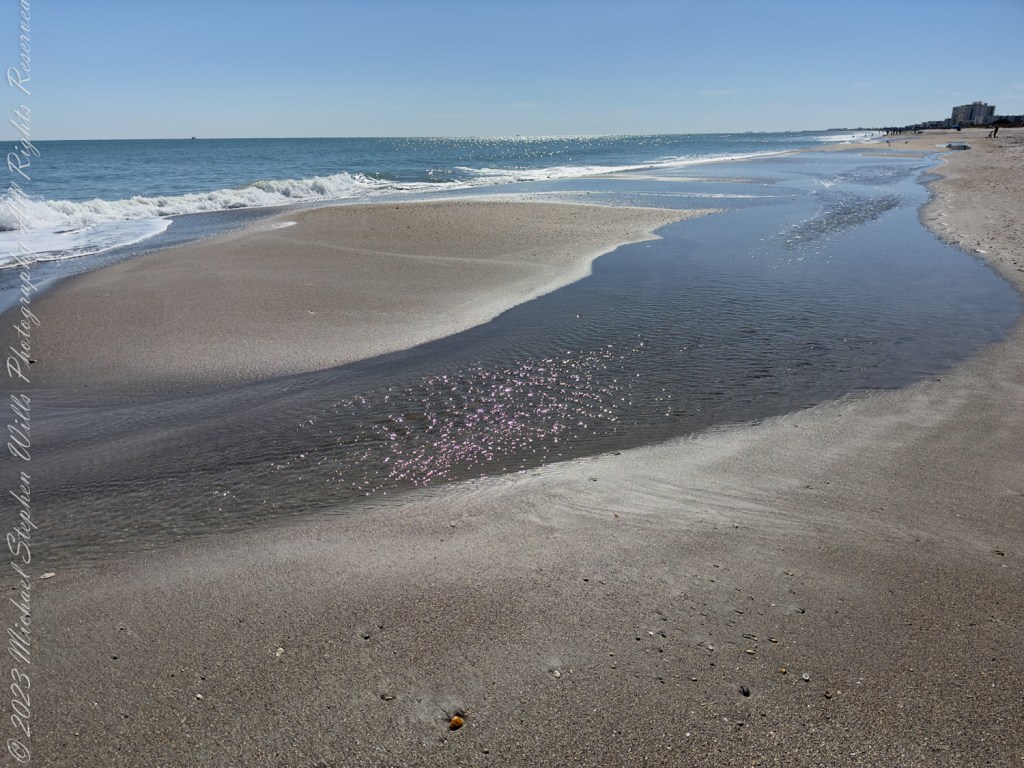
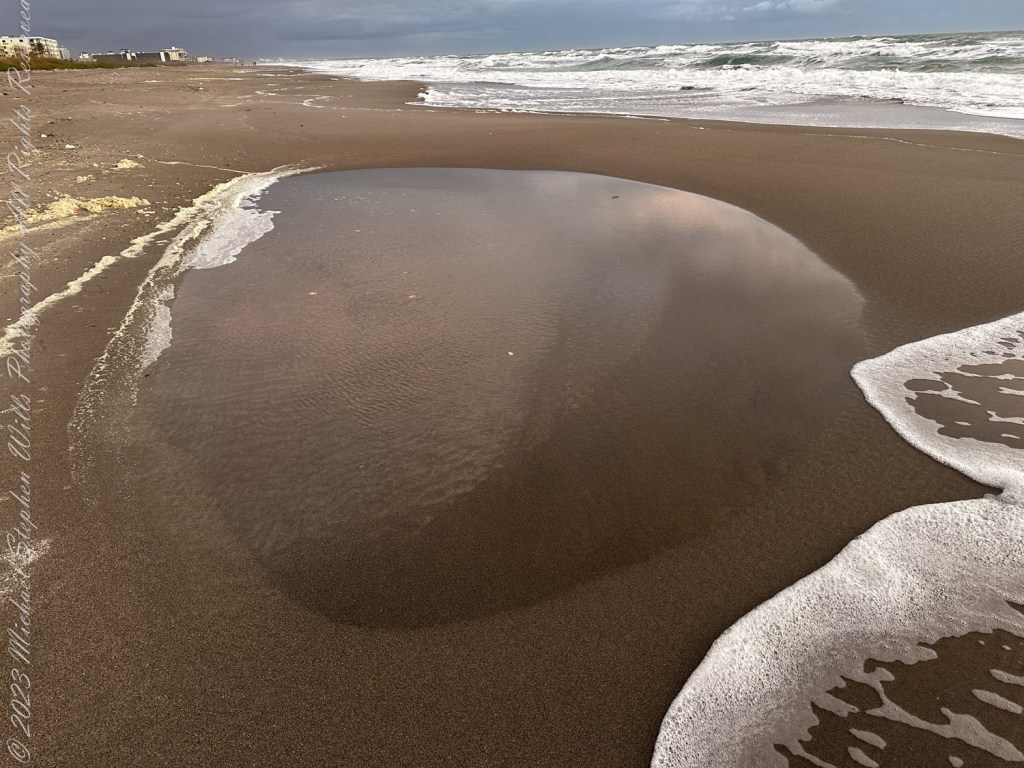
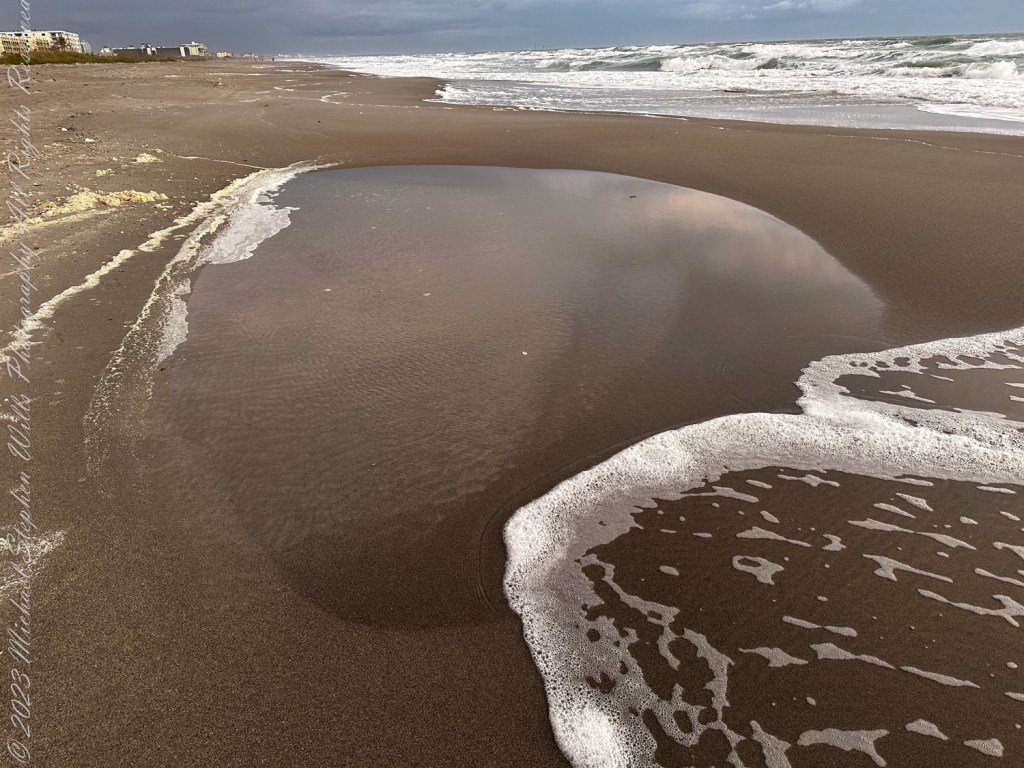
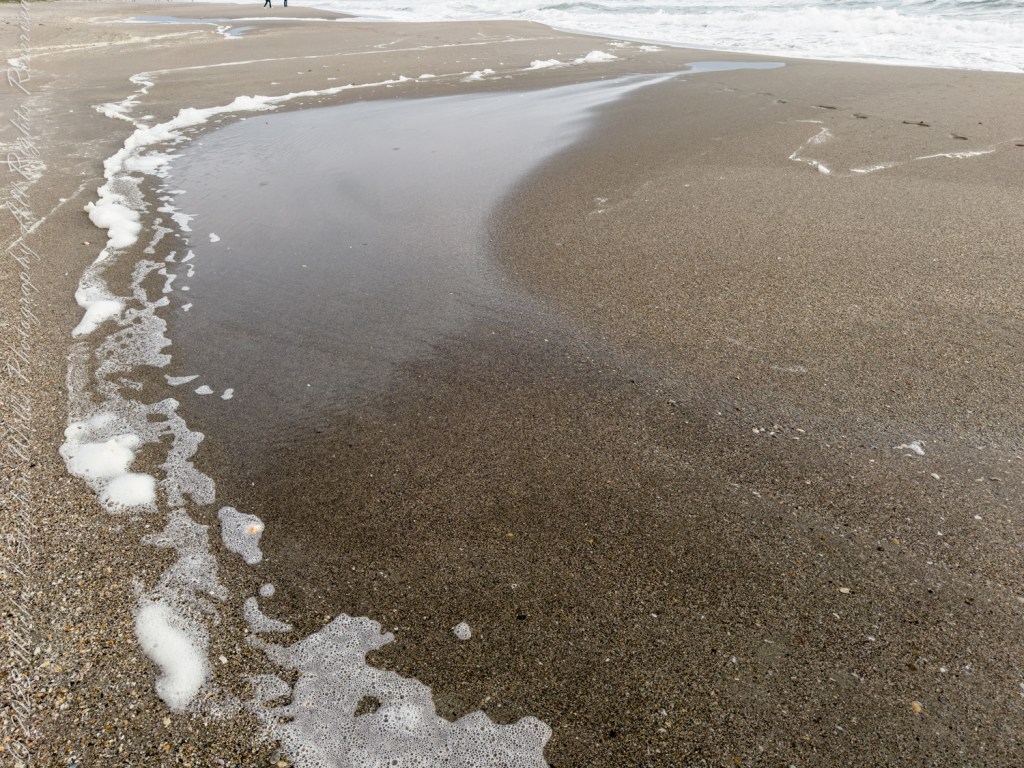
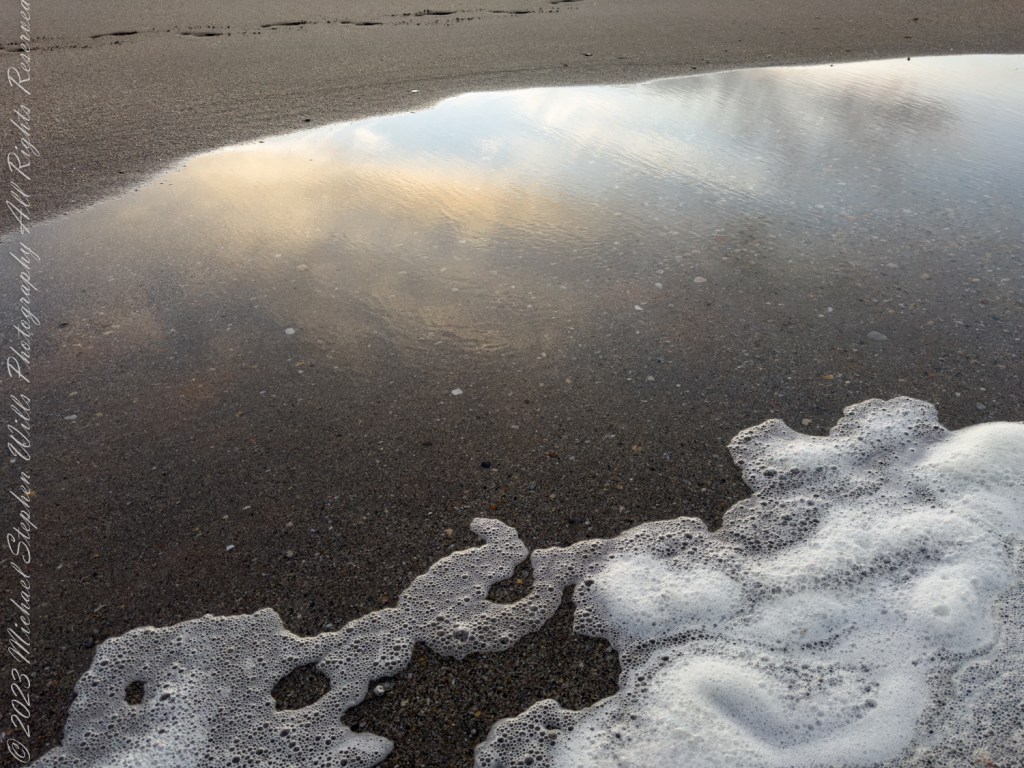
Standing on the sandy shore of Cocoa Beach in January 2024, I observe firsthand the effects of erosion along this stretch of Florida’s coastline. The scenes captured in my photographs show significant changes to the beach’s contours and composition. The shimmering foam, soft sand ripples, and exposed shells are testament to the relentless activity of the sea. Each wave carves away at the beach, leaving patterns in the sand that tell the story of erosion.

Erosion Patterns and Sea-Level Rise

The photographs vividly display the intricate, almost artistic designs formed by erosion. In one, the ripples in the sand reflect the movement of the water, indicating the direction and flow of the tides. The sea has steadily eaten away at the shoreline, pulling the sand away with each ebb and flow.

Studies show that Florida’s Atlantic coast is particularly susceptible to rising sea levels due to its low-lying nature. The Florida Climate Center notes that sea levels have been rising at an average rate of about 1 inch per decade, with projections estimating further acceleration. April 27, 2024 The Washington Post published, “Where Seas are Rising with Alarming Speed,” showing a map with Cape Canaveral / Cocoa Beach showing a 6 – 9 inch sea rise since 2010. This rise compounds the effects of erosion, causing beaches like Cocoa Beach to recede.

Impact on the Beach

I notice shelves of beach sand formerly above the tide now washed over by high tide. New channels forming, cutting across the sand with each tidal cycle. The erosion reveals underlying shell beds and deposits, hinting at the rapid loss of the finer, upper layers of sand. This accelerated erosion poses a significant risk to the stability of the coastal area.

The erosion is not just cosmetic. It impacts local ecosystems and property lines, potentially leading to habitat loss and increased vulnerability to storm surges. Coastal development also exacerbates the problem by interfering with natural sediment replenishment.

Reflections and Future Prospects

The view across the horizon, where the deep blue sea meets the sky, is a stark reminder of nature’s power and the urgent need for mitigation. As Florida’s beaches face the twin challenges of rising seas and intensifying storms, the communities here must find ways to adapt. Cocoa Beach is a vivid reminder of the coastal fragility and the importance of sustainable management practices.

From a personal perspective, seeing this change compels a deeper reflection on our relationship with nature. The beaches we walk on today may not be here for future generations unless we act decisively to combat climate change. Efforts to build resilience into coastal infrastructure and adopt environmentally friendly practices will play a critical role in preserving this natural beauty.

Conclusion

In summary, Cocoa Beach’s erosion is a direct consequence of rising sea levels and changing environmental conditions. The patterns etched in the sand speak of nature’s resilience and power, while also sounding an alarm about the future. As stewards of the coast, it is our responsibility to take meaningful actions that preserve these shores for generations to come.

References

“Florida’s Sea-Level Rise: The Science and the Solutions,” Florida Climate Center.

“Where seas are rising with alarming speed”, Washington Post, April 29, 2024.”

Copyright 2024 Michael Stephen Wills All Rights Reserved