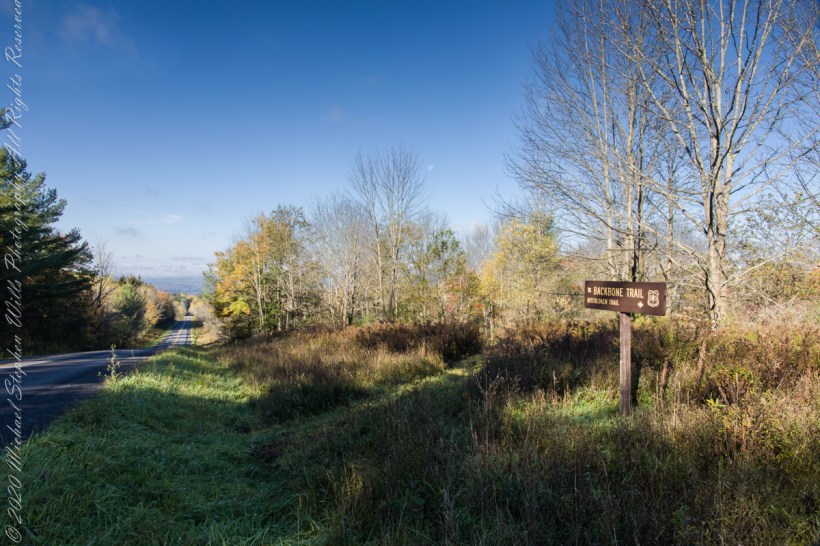
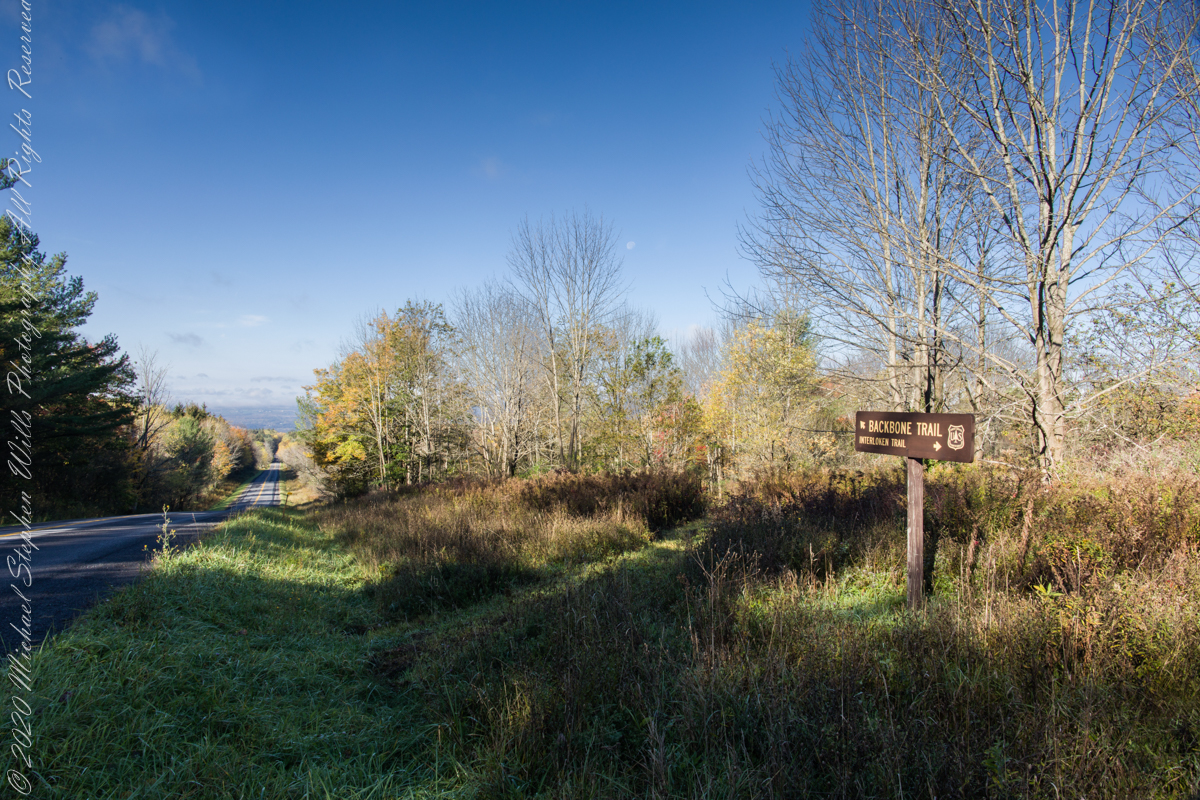
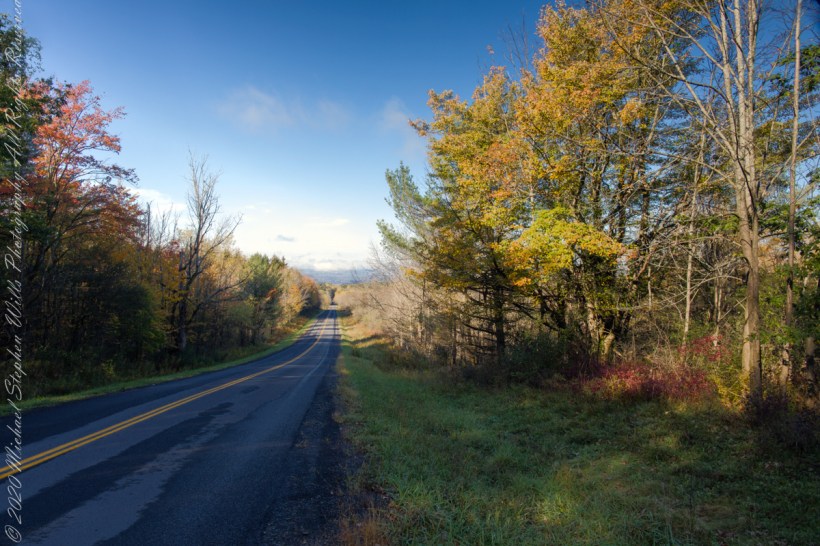
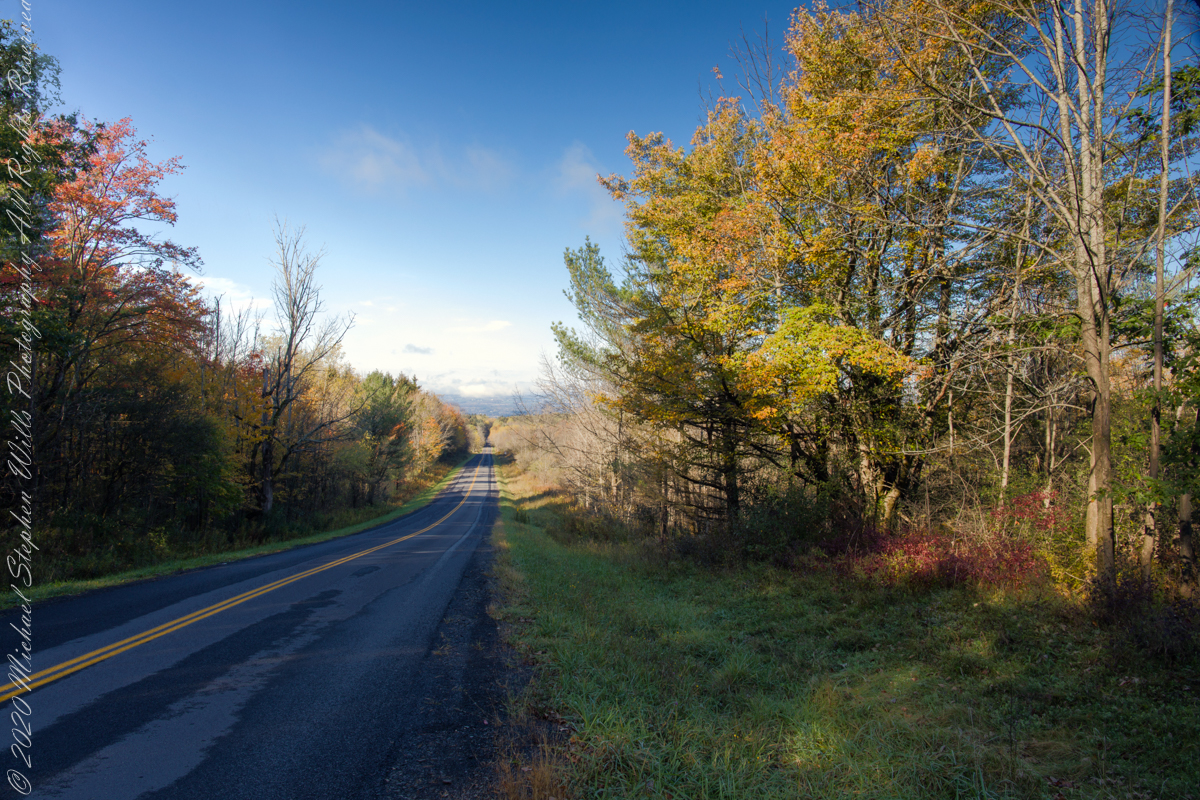
An open road, autumn morning, a hiking trail under a setting moon. Thirty miles of hiking trails thread these 16,212 acres. Some, like the Backbone trail, traverse farmland reverted to forest and meadow, popular for horseback riding.
Click photograph for a larger view. To do this from WordPress Reader, you need to first click the title of this post to open a new page.
The only National Forest in New York State, this land is visible as a ridge to the west of our home. Here we are on the west side, the ridge of Seneca Lake in the distance.
Click photograph for a larger view. To do this from WordPress Reader, you need to first click the title of this post to open a new page.
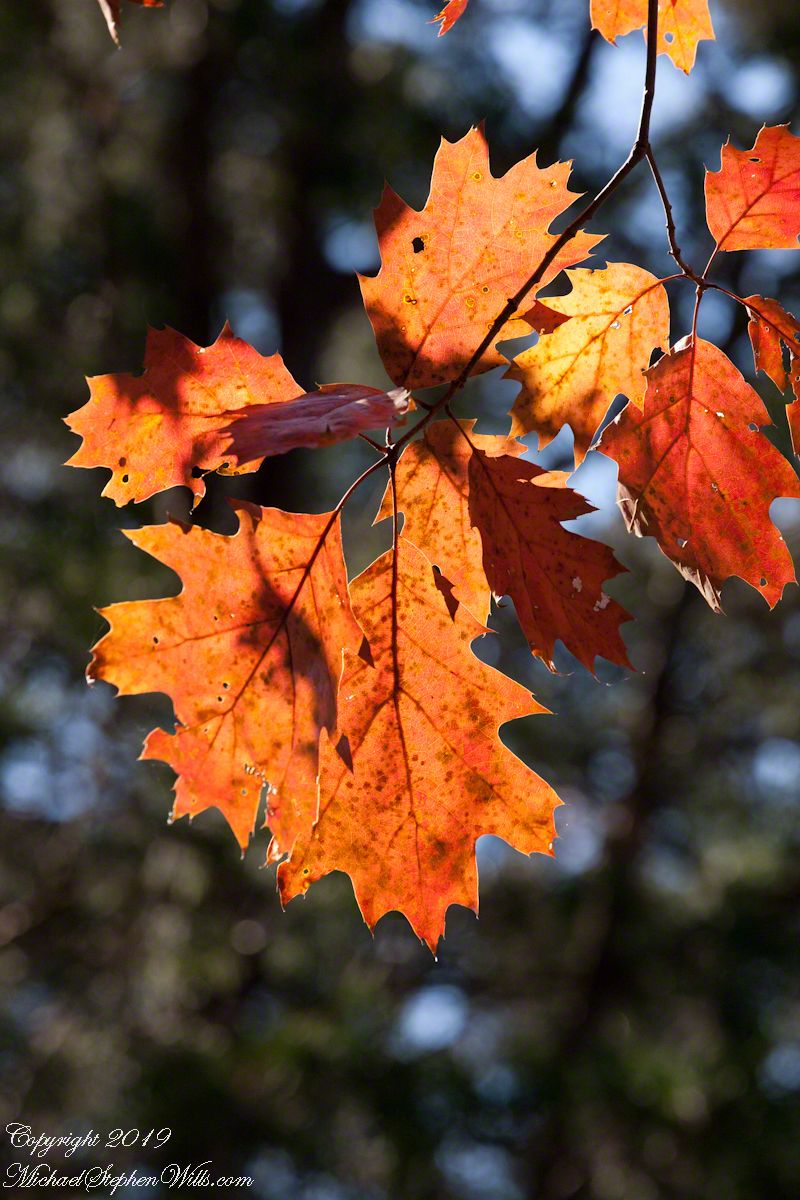
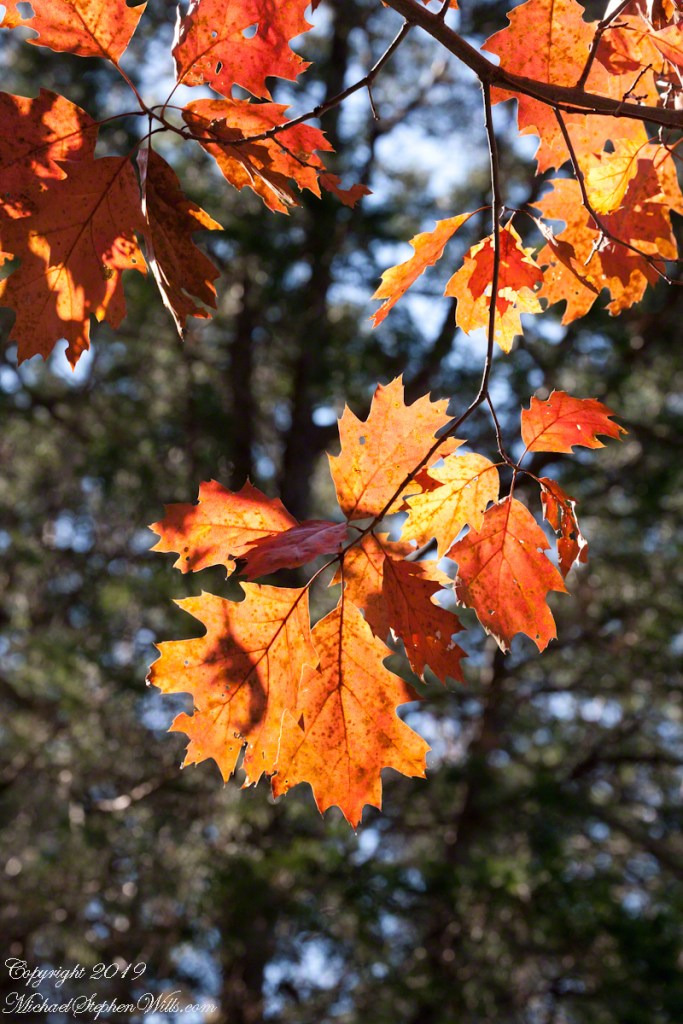
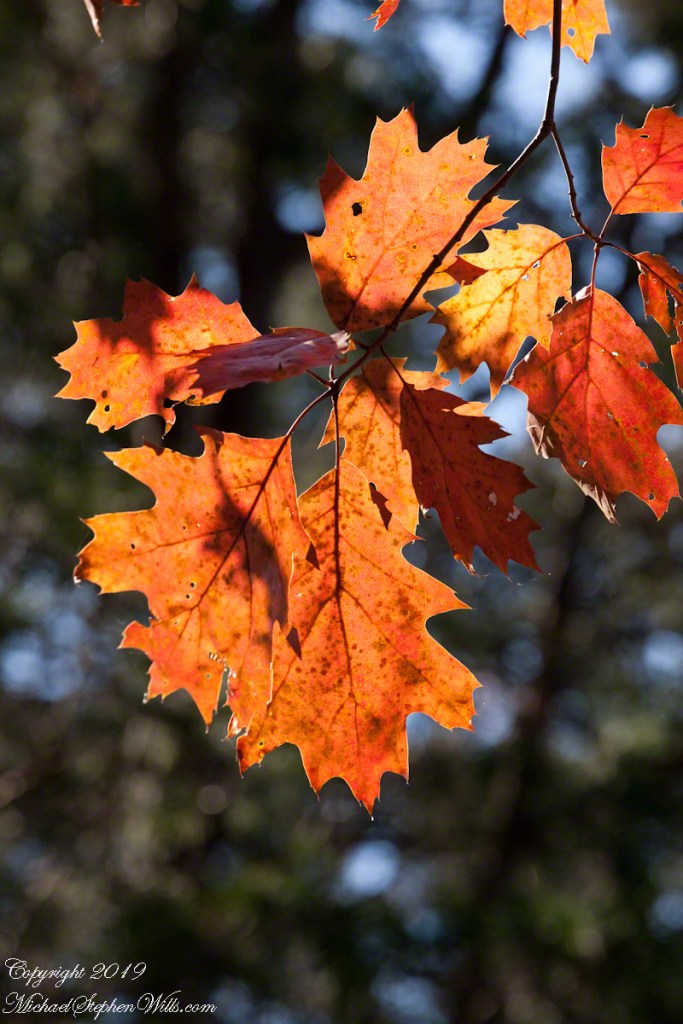
The oak holds tight to leaves, sometimes until spring when new growth pushes last year’s off. Here is a cluster on a bright November afternoon hanging above the South Rim trail of Taughannock Falls Park of the New York State Finger Lakes Region.
Backlit Autumn Oak Leaves
Autumn Oak Leaves, detail
Copyright 2021 All Rights Reserved Michael Stephen Wills
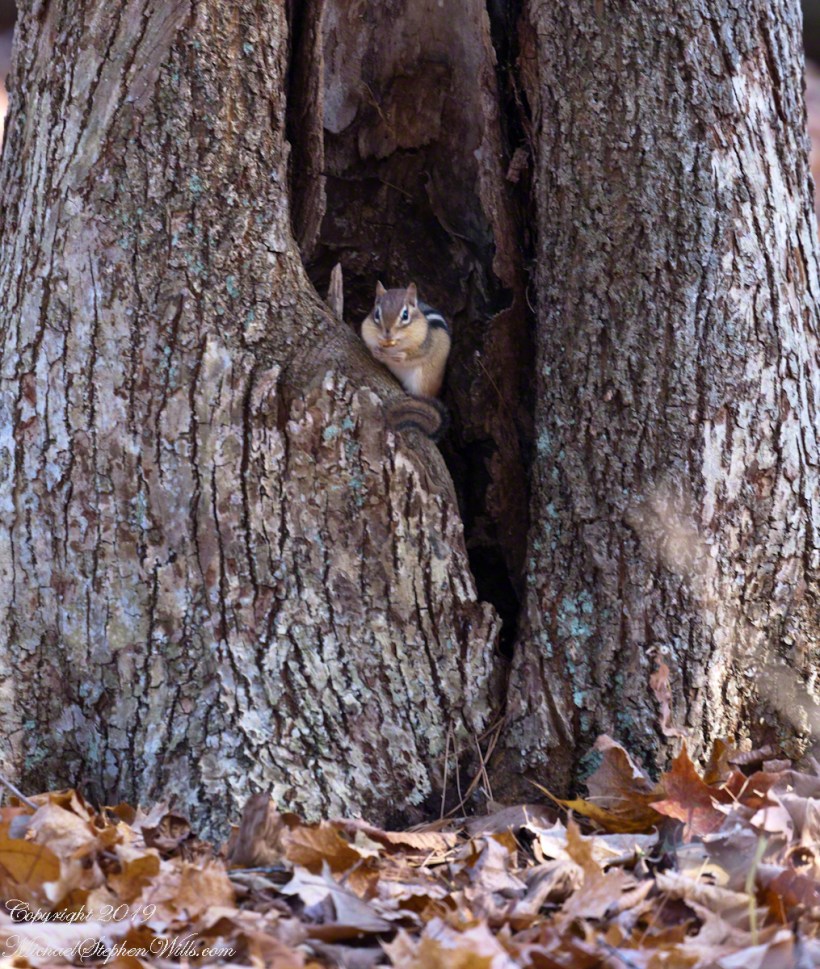
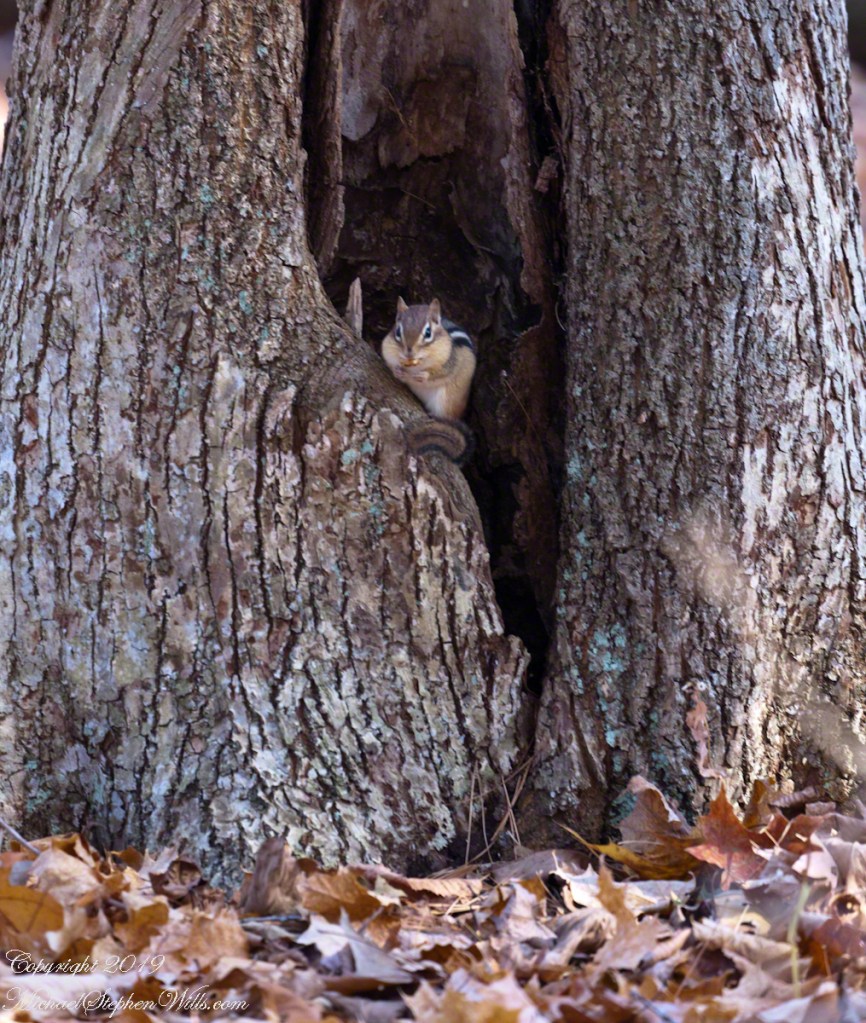
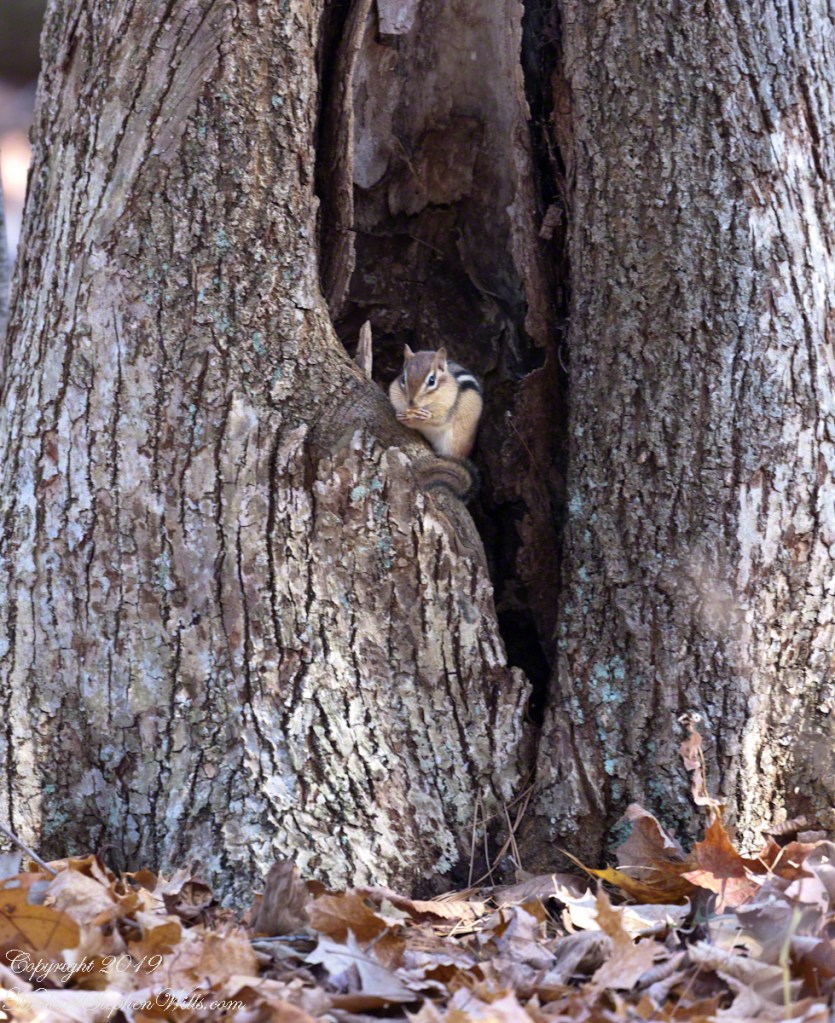
Perched on its doorstep, an Eastern Chipmunk gorges on an ample supply of acorns. These small rodents are omnivores. Here are two shots, each with an acorn in hand and full cheek pouches.
Wary Chipmunk with acorn
Chipmunk eating acorn
Copyright 2021 All Rights Reserved Michael Stephen Wills
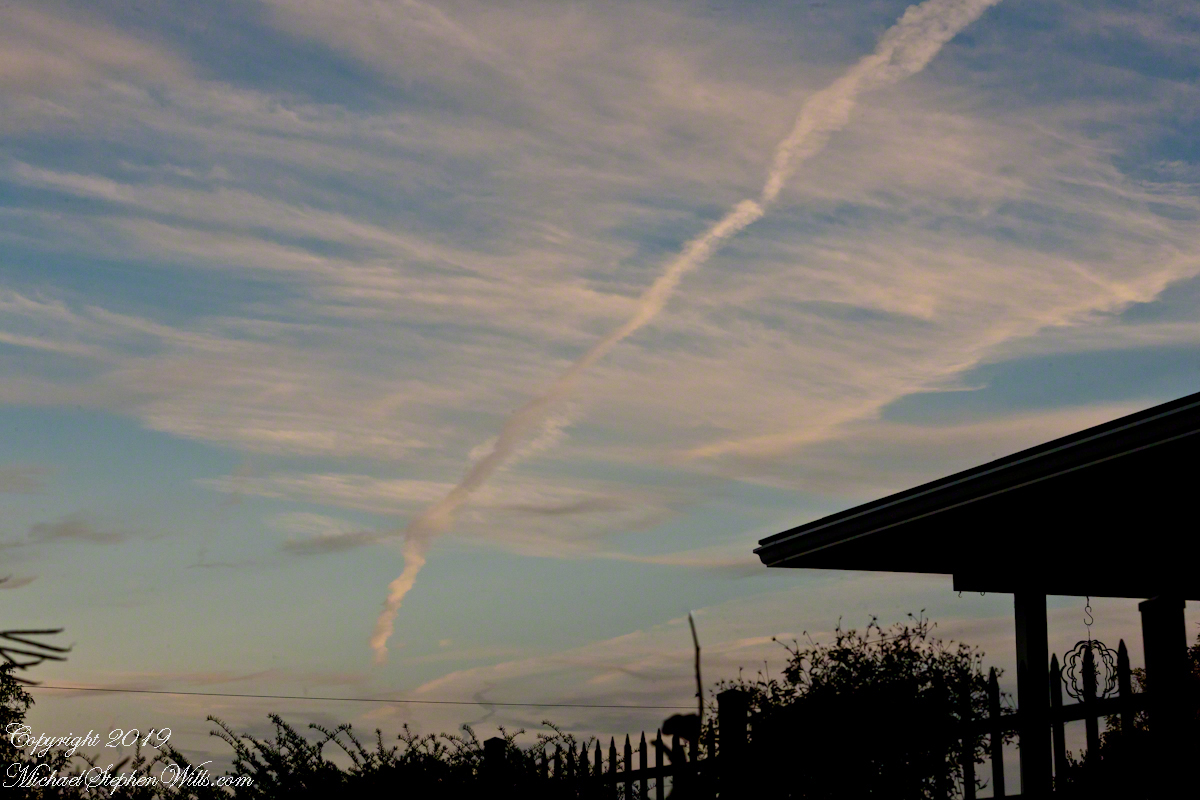
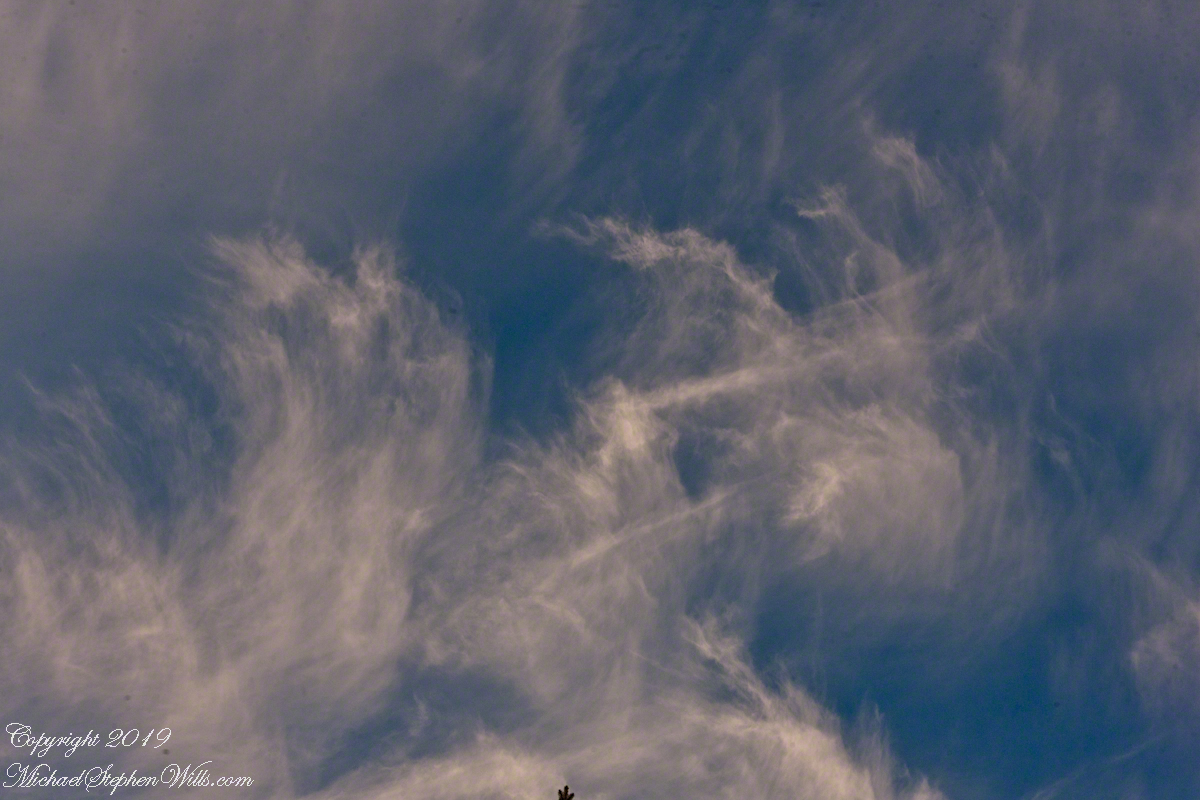
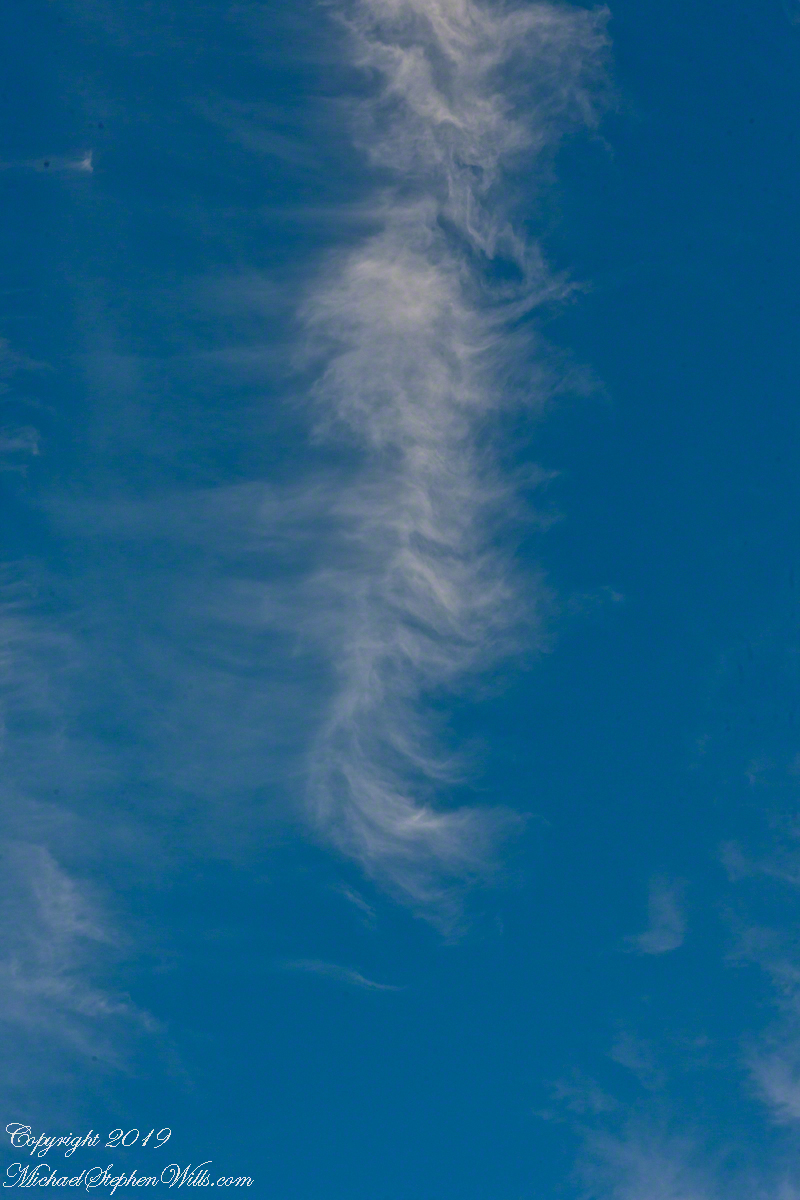
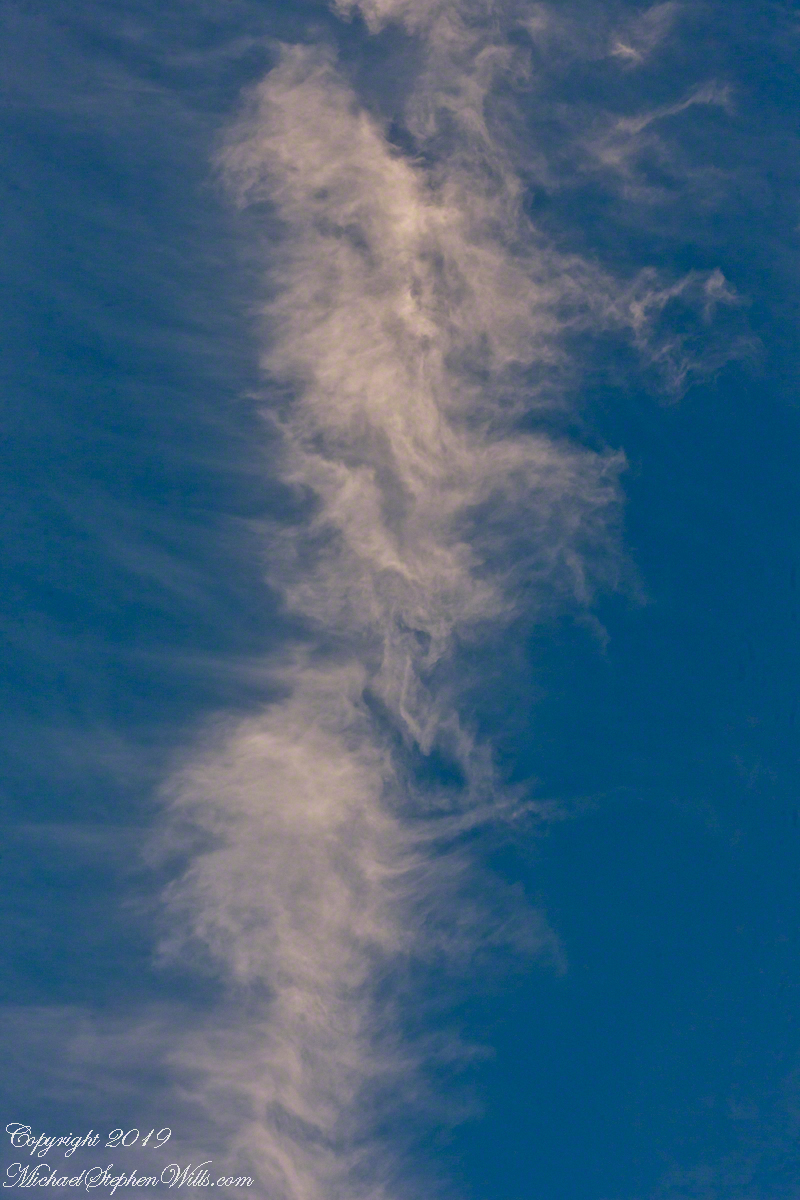
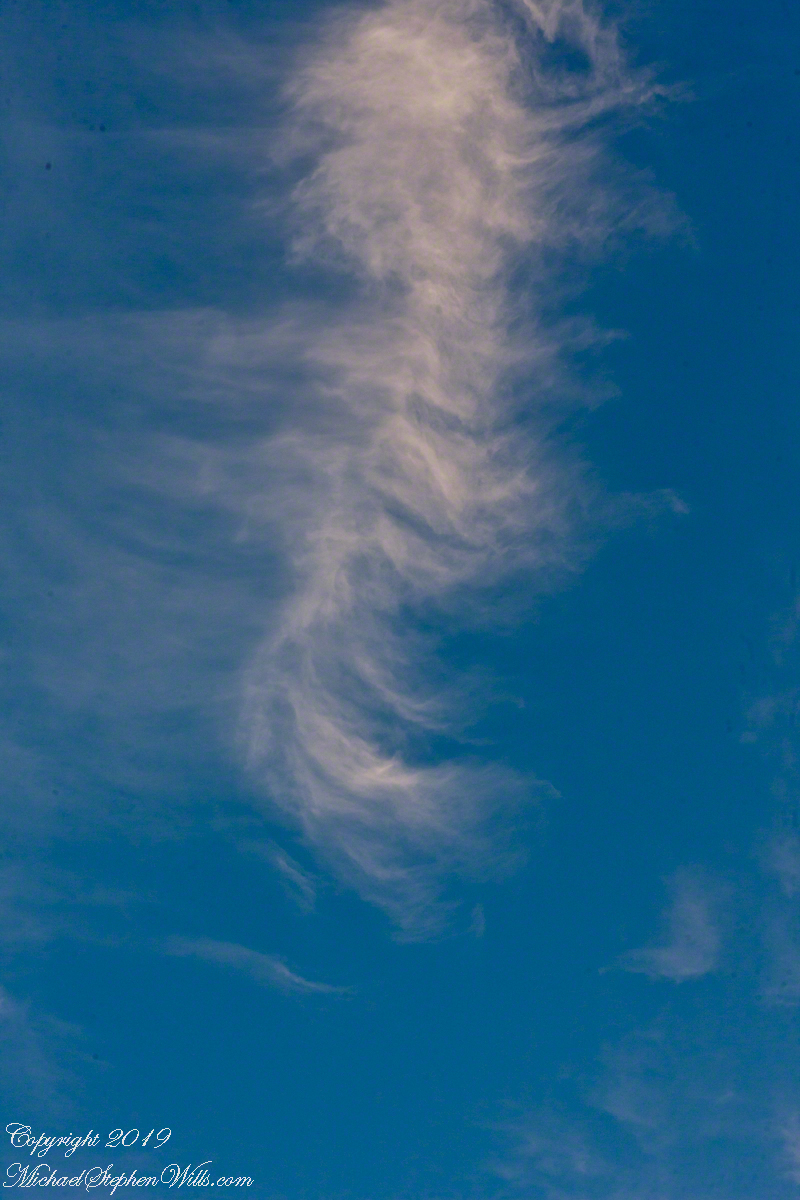
This evening cirrus clouds filled the sky at sunset. View the following photographs to understand how these forms are named from the Latin word for a ringlet, or curl, of hair. Formed above 16,500 feet, on this day the cirrus glow with the light of a sun low in the sky.
Here is a wide view from our driveway that includes a deteriorating con trail and possibly a mixture of other cloud types, I am no expert. I used a Canon “zoom” lens for flexibility in framing. To minimize exposure time for a crisp capture of the moving object, ISO was set to to 1,000 and the f-stop minimized.
Click any image for a larger views. Then, click again to return to post.
Post production I needed to spend time removing dust spots (neglected to clean the image sensor), some of the images still have those annoying spots.
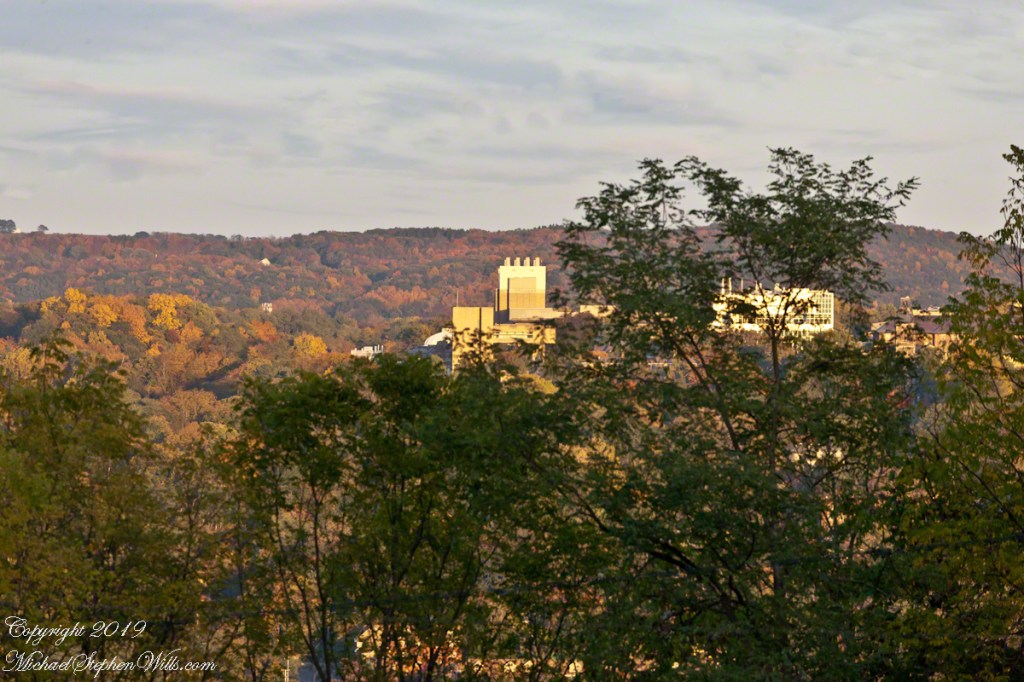
We enjoy looking west across the valley when the hills are glowing.
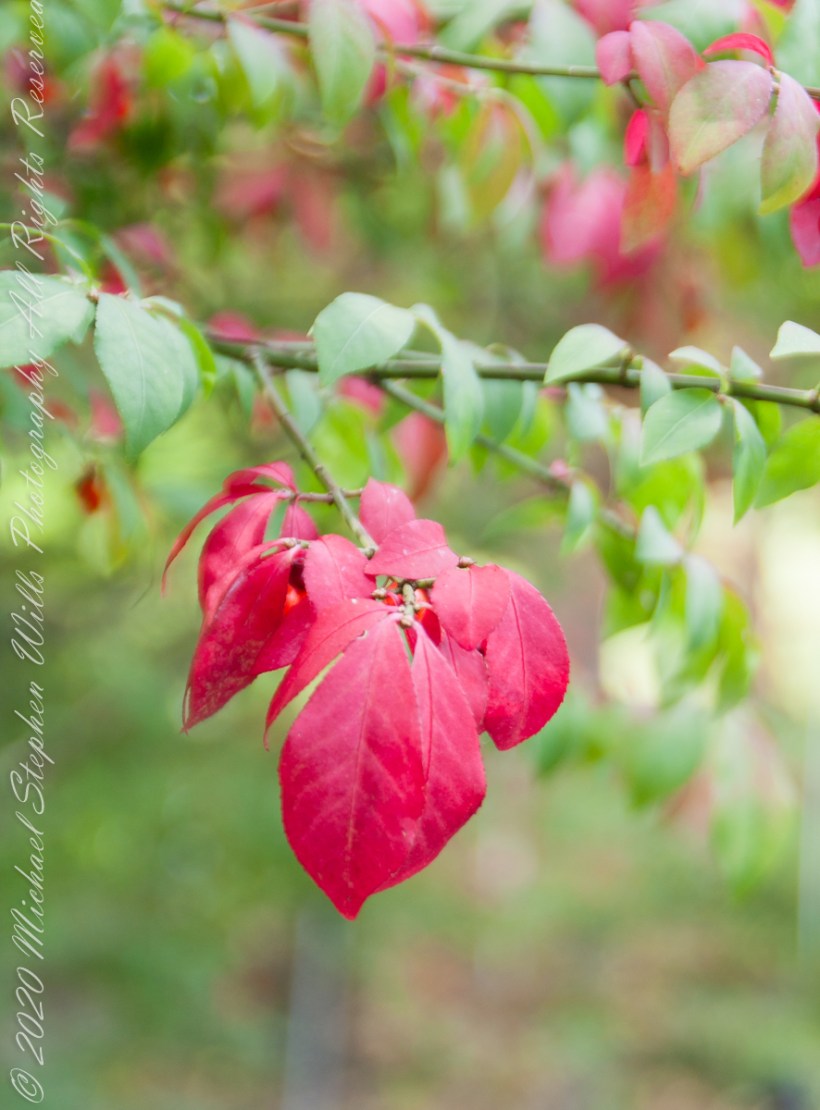
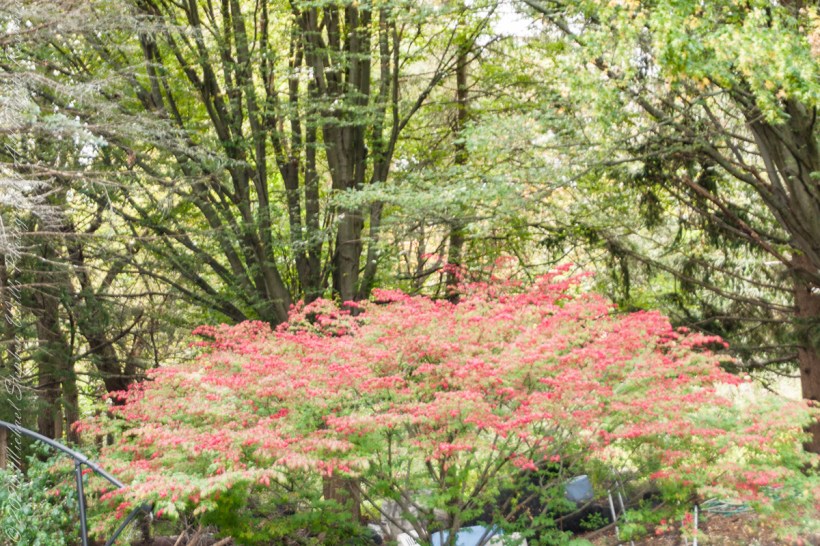
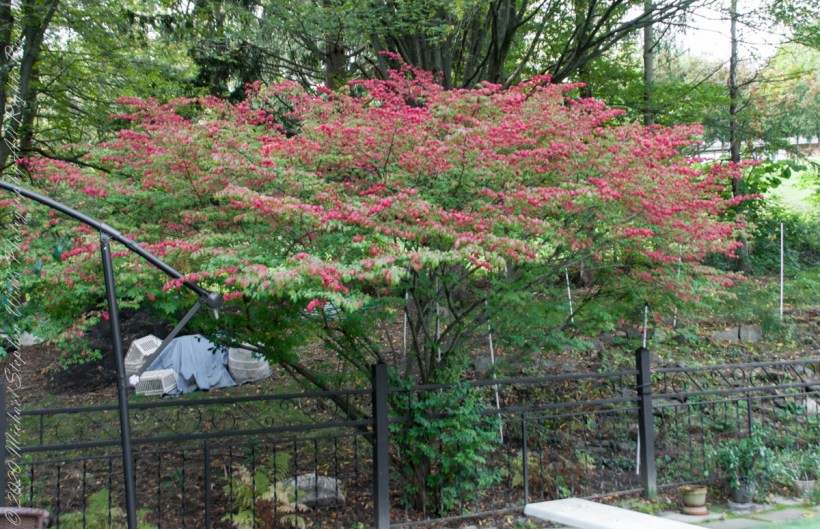
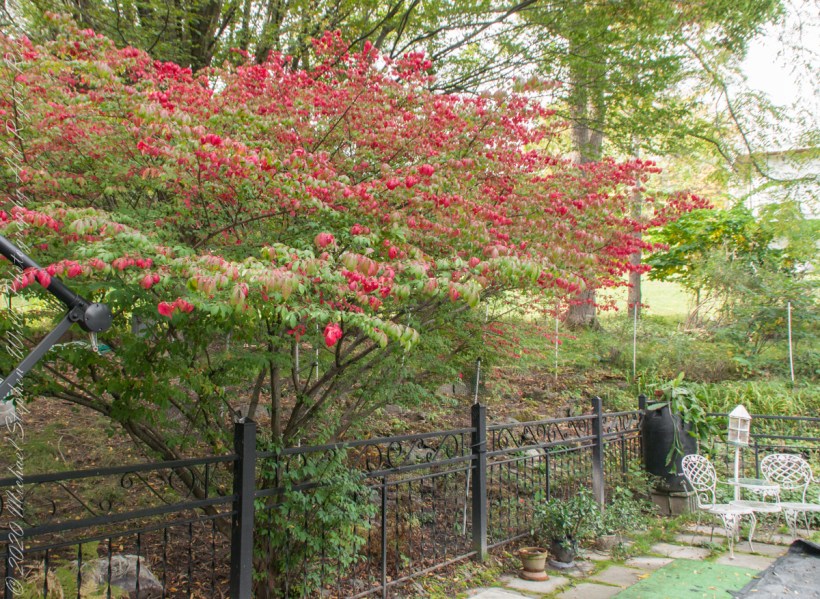
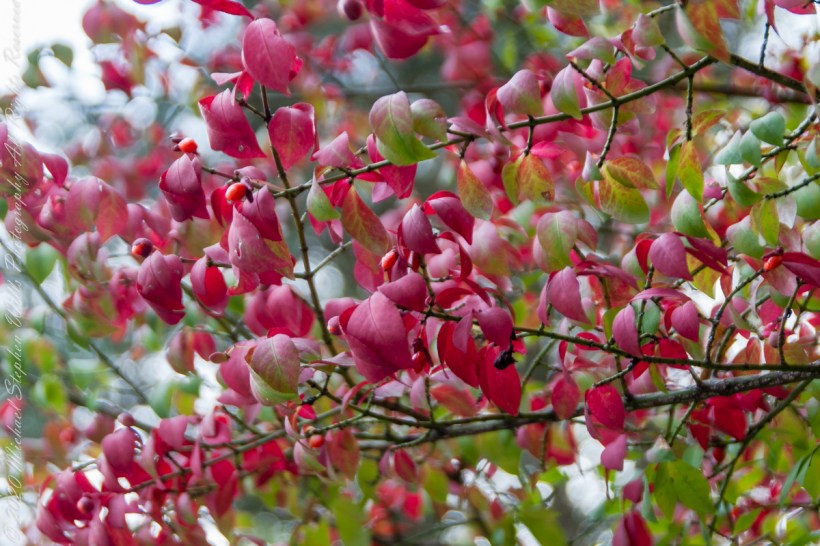
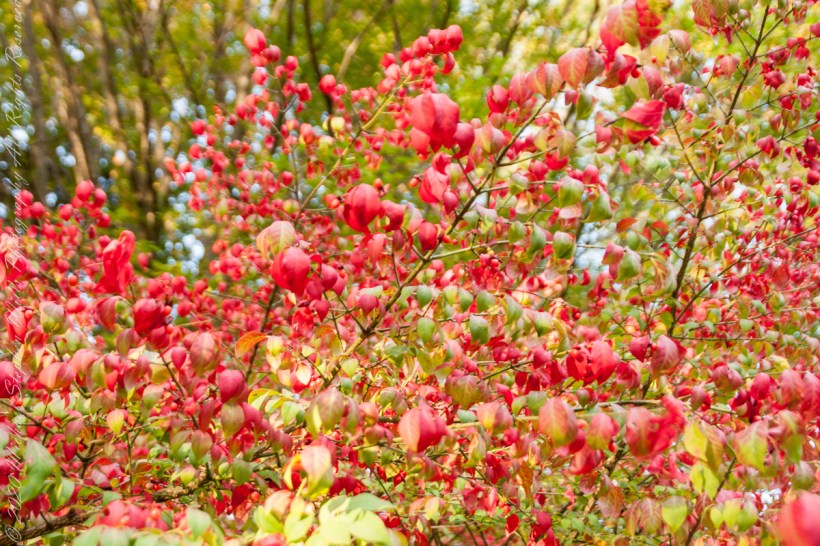
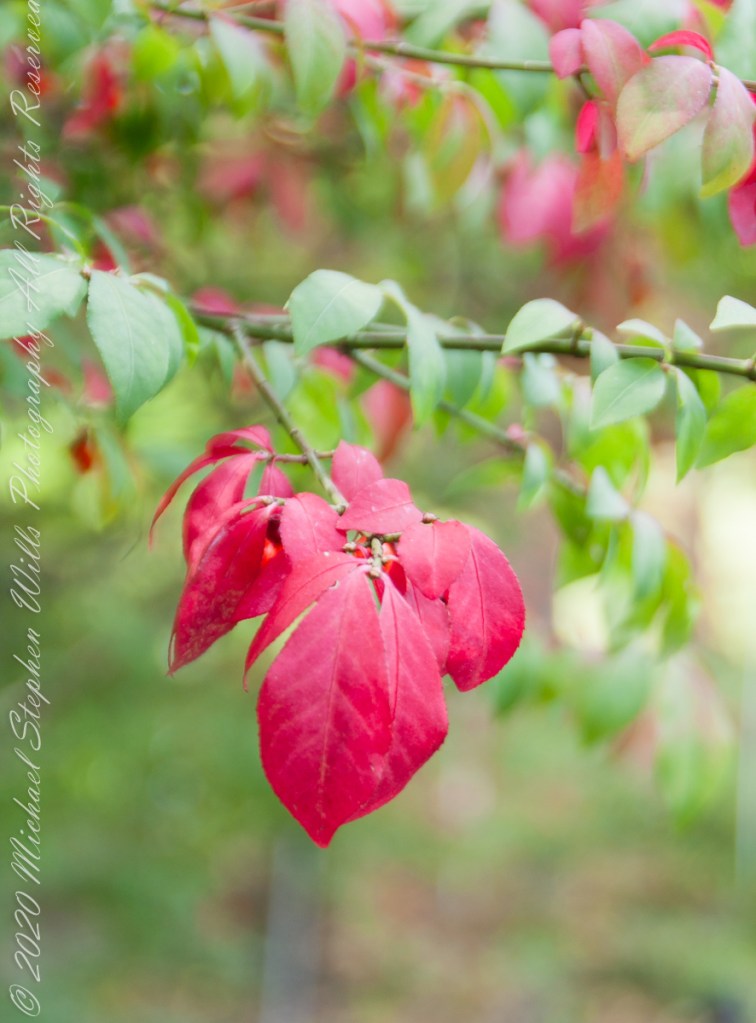
After we came home from the Underground Railroad excursion, with a camera and time on my hands, this Euonymus bush fringed with scarlet leaves caught my eye. Starting with a leaf here and there in September the flame-like color spreads until it takes on the character it is named for “Firebush.”
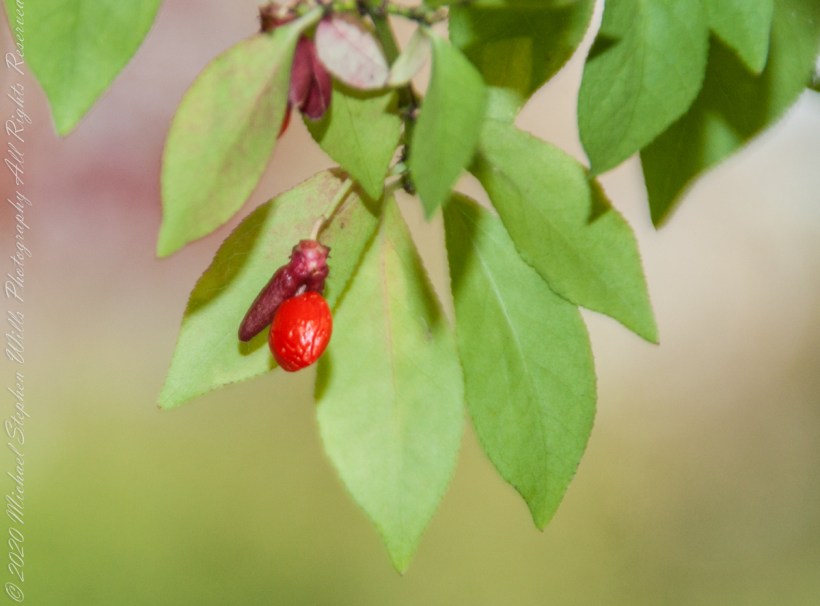
Springtime it is covered with tiny green flowers, each turns to a small, fleshy fruit encapsulating tiny seeds said to be loved by birds. As ours neglect the fruits, I’ve taken to collecting them to spread along the borders of our back property. Here and there some have sprouted around the bush, this year I marked a few to move this winter when the plant is dormant. I have high hopes for success of this project as the species is known as “invasive” in 21 states.
Click pic for larger view in a new browser tab. If you are in WordPress Reader, open the post to use this feature.
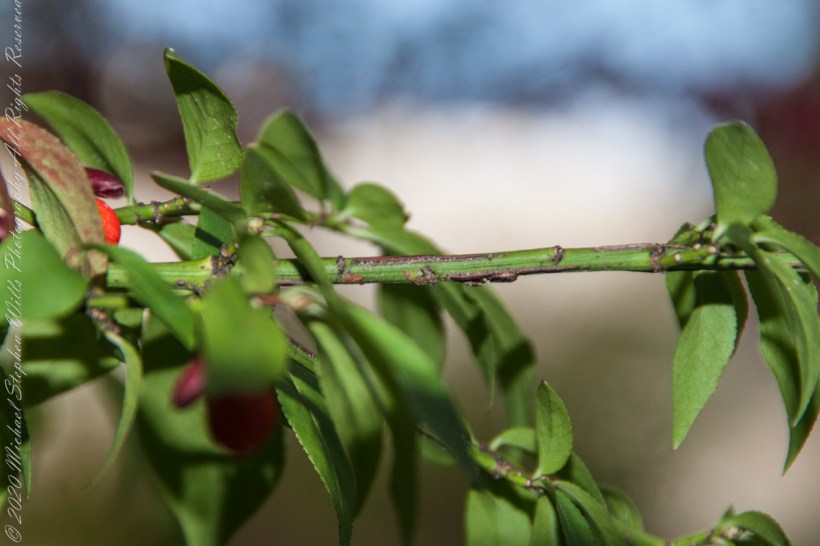
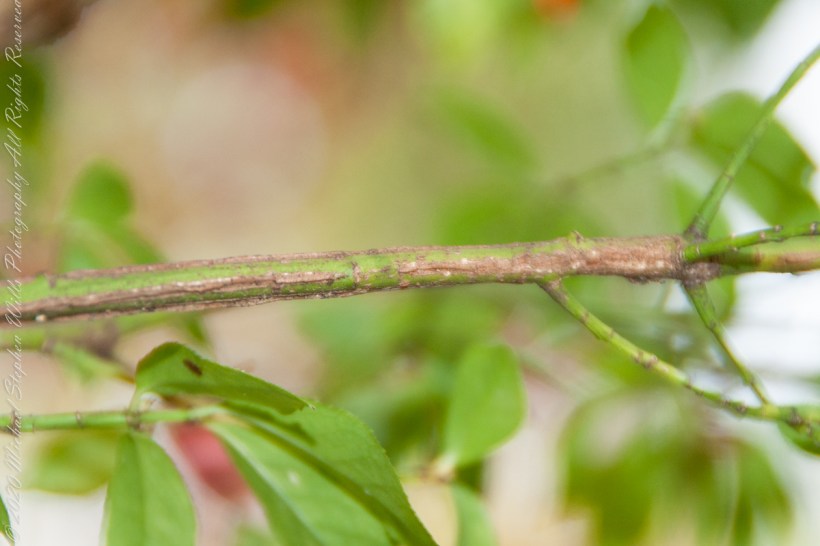
All parts of the plant are toxic, causing severe discomfort when eaten. The name “Spindle plant” was given it in England for the corky wings that grow long the length of stems, not so pronounced with our Euonymus species.
Here are macros of the flaming leaves and fleshy berry.
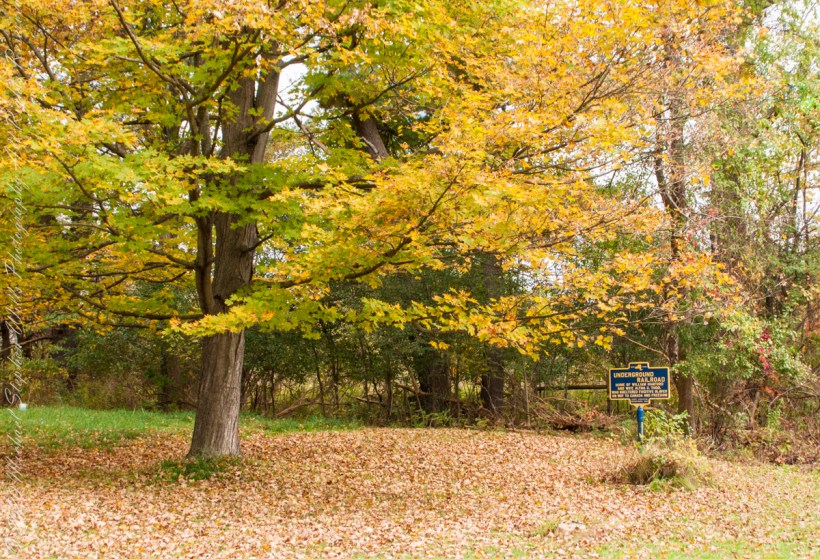
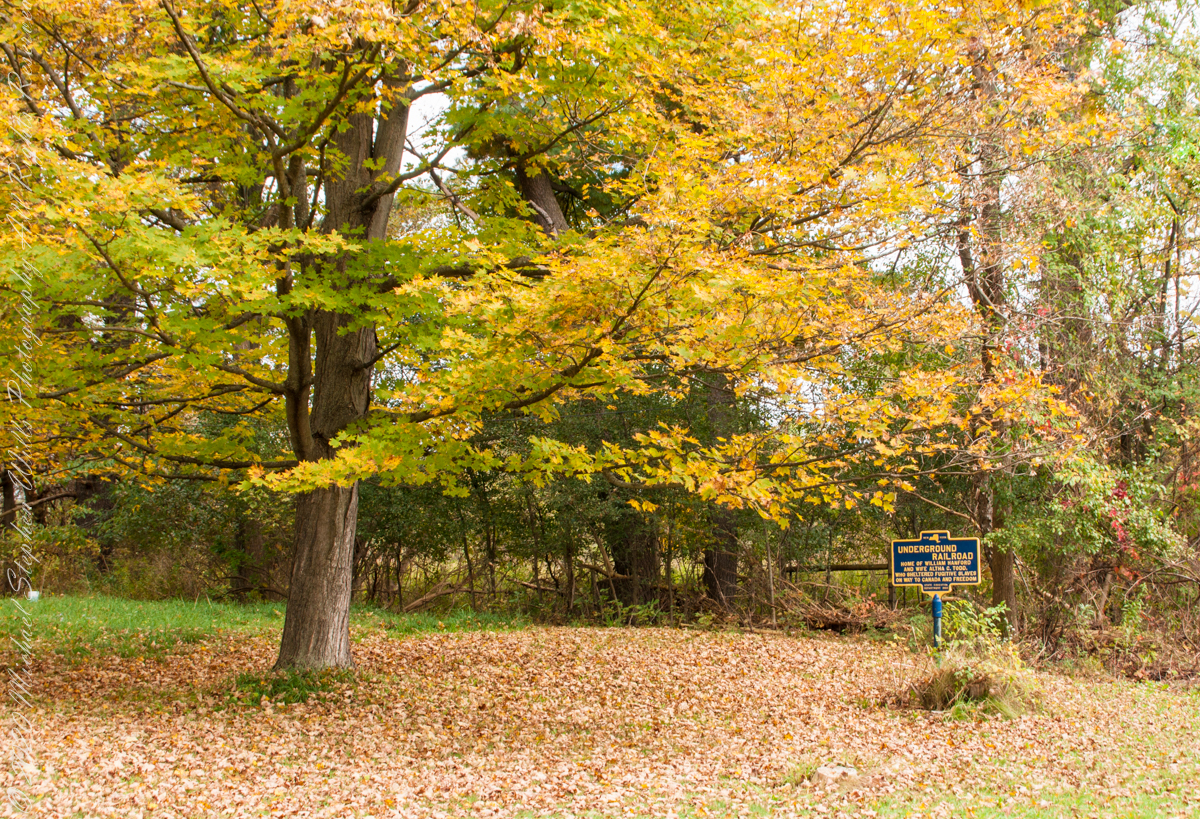
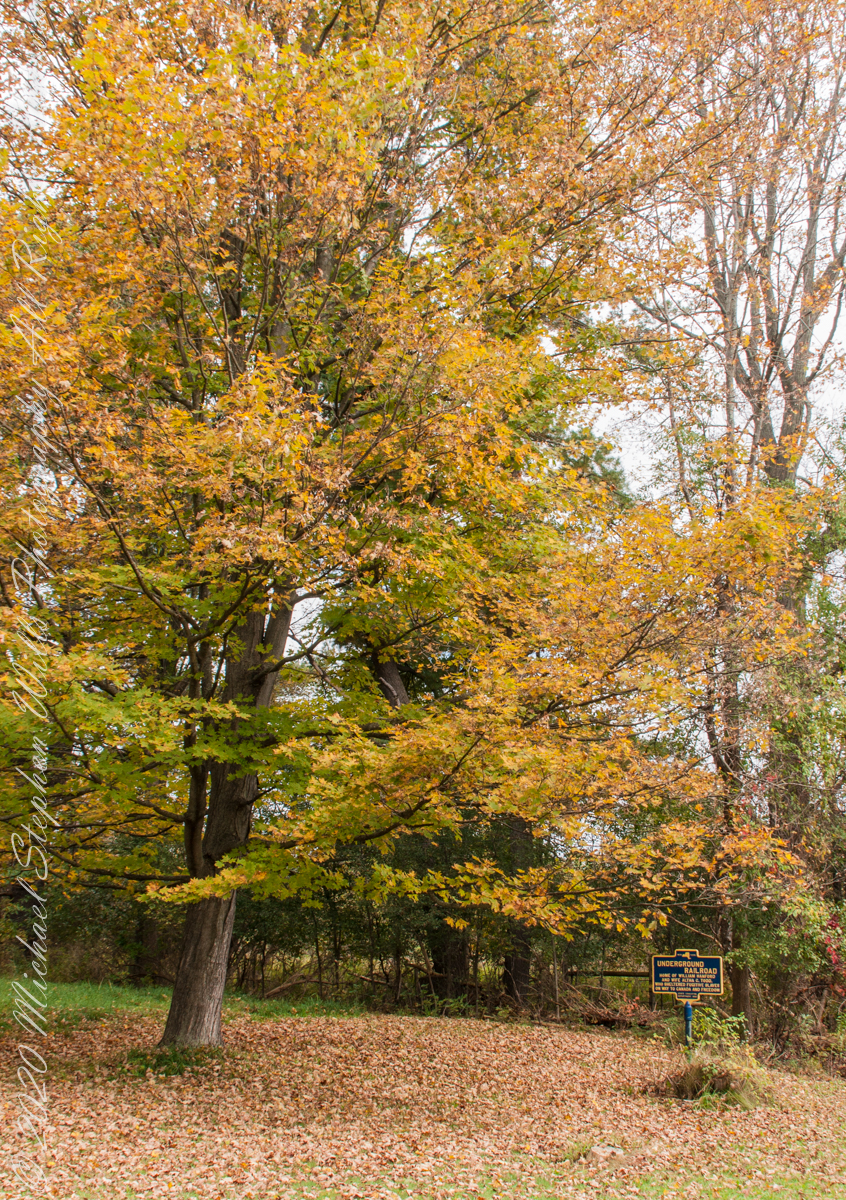
We have often travelled Lower Creek Road as an alternate route to visit my son and his family who live in Freeville, a village named for the activity of the Underground Railroad. After noticing this sign in passing for years, this week we stopped on a glorious autumn morning to capture it. I had packed the Sony Alpha 700 dslr for just such an opportunity.
Just off the road, under a maple tree in full autumn color (yellow), ground covered with fallen leaves (brown) on a fine early October morning, the sign reads, “New York, UNDERGROUND RAILROAD, HOME OF WILLIAM HANFORD AND WIFE ALTHA C. TODD, WHO SHELTERED FUGITIVE SLAVES ON THE WAY TO CANADA AND FREEDOM, STATE EDUCATION DEPARTMENT 1932”. These dark blue background, bright yellow letter signed are found throughout this region and much appreciated.
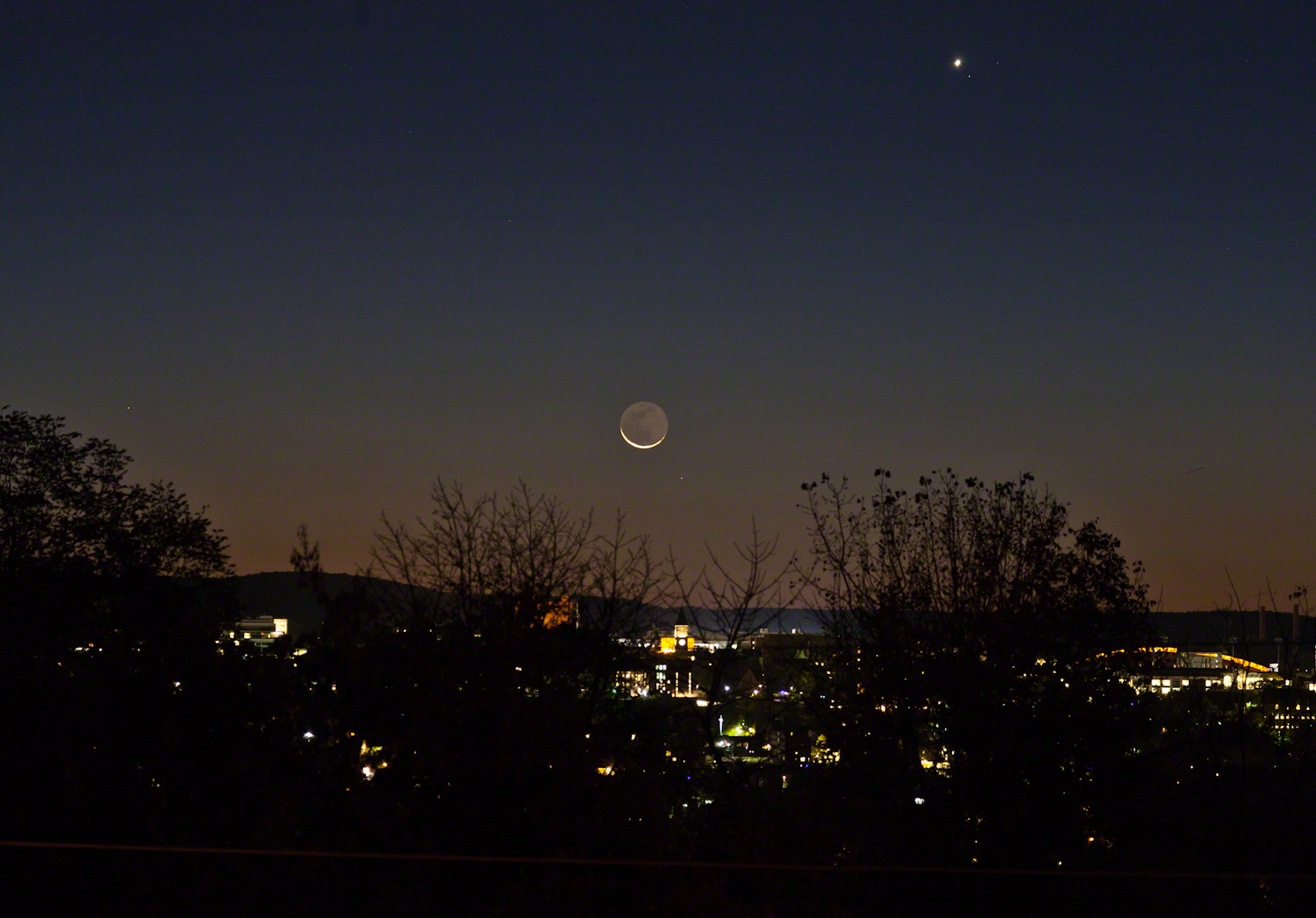
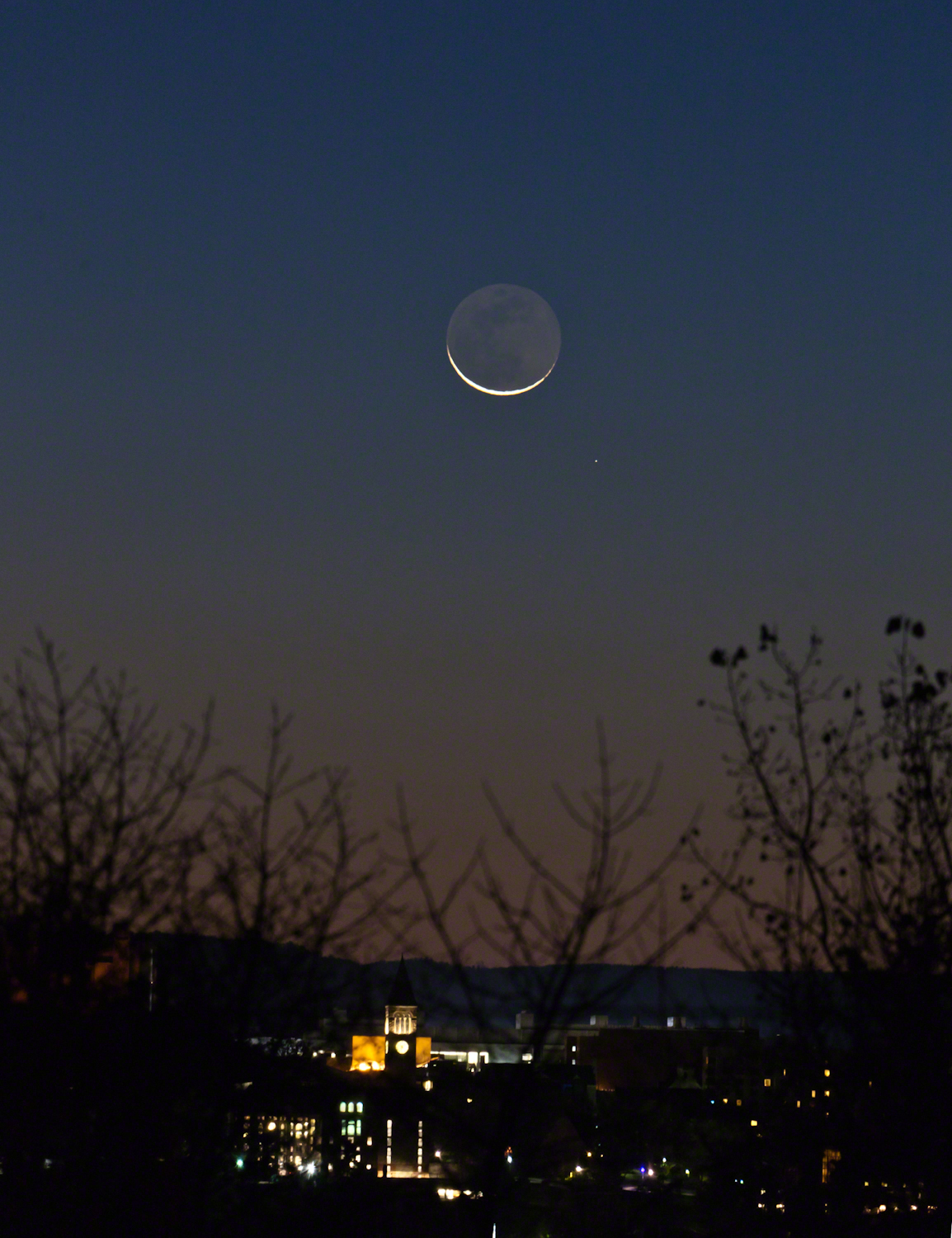
Here are two photographs taken about the same time, 6:30 am, October 18, 2017, companions to the photograph shared earlier this week.
The moon rises later each day, so these shots include a larger disk closer to Cornell University. Both components, the crescent and earth-glow, were dimmer this morning. In each photograph Jenny McGraw Tower is visible.
The star is Regulus, the brightest in the constellation Leo, close below the moon. I don’t know the star close to Venus.
Here the tower is slightly to the right of the crescent, the arch of Schoellkopf stadium further right. Among the trees on left, is the baleful red glow of Bradford Hall.
The tower is outlined by the lights of Uris library, presumably filled with early rising students.
The light of Regulus (“small king”), below and to the right, is a composite of four stars moving together through space. The position of Regulus on the path in the sky of the moon, planets and asteroids (called the ecliptic) leads to the occultation of the star by the disks of the moon and, less regularly, the planets and asteroids.
Copyright 2021 Michael Stephen Wills All Rights Reserved
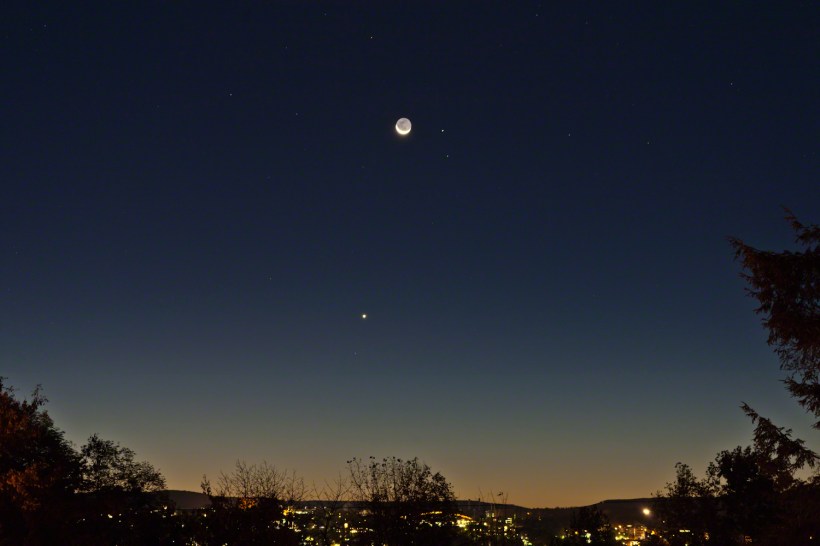
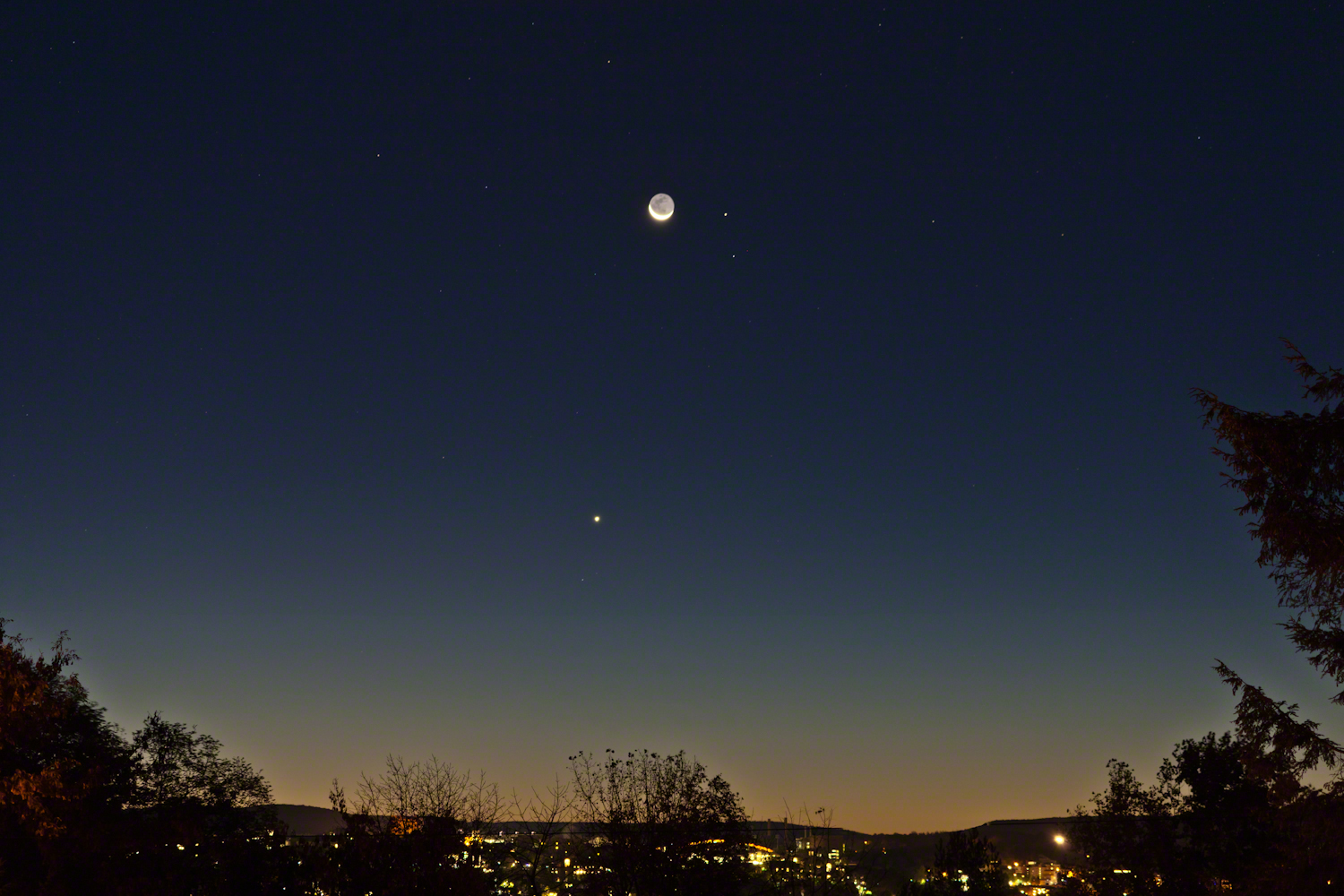
A thin crescent bowl filled with earthglow floating above the dawn attended by Venus, Mars, Virgo.
This was the view from Ithaca, New York at the start of dawn this morning of Tuesday, October 17, 2017. Mars is next to the moon, the stars of the constellation Virgo scattered around, Venus is the bright object below. We had a bright, clear sky not unusual for September and October.
In the city, an arch of Schoellkopf Stadium on the Cornell University campus. Cornell is on east hill. We live on west hill, across the valley. It is quiet on west hill, away from the students.
Earlier this week the crescent was in the constellation Leo where the bright limb occulted the bright star Regulus, to reappeared from behind the dark limb, a brilliant spectacle that happened after dawn for New York. It was cloudy, as usual, on October 14.
When I woke, the moon was shining through the trees, still full of just turning leaves. The crescent turned, cup like, above the horizon, to cradle the dark orb glowing from the reflected light of our earth. I did not recognize Mars, the disk was less red than usual. Research revealed the moon had two planets in seeming attendance. I also learned that, when the horns point right the moon is waning, moving toward a new, or un-illuminated, moon. When the phase moved from new it is also a crescent with horns pointing left.
This morning was a fortunate gift, I had never contemplated the moon in quite this form before.
Copyright 2021 Michael Stephen Wills All Rights Reserved
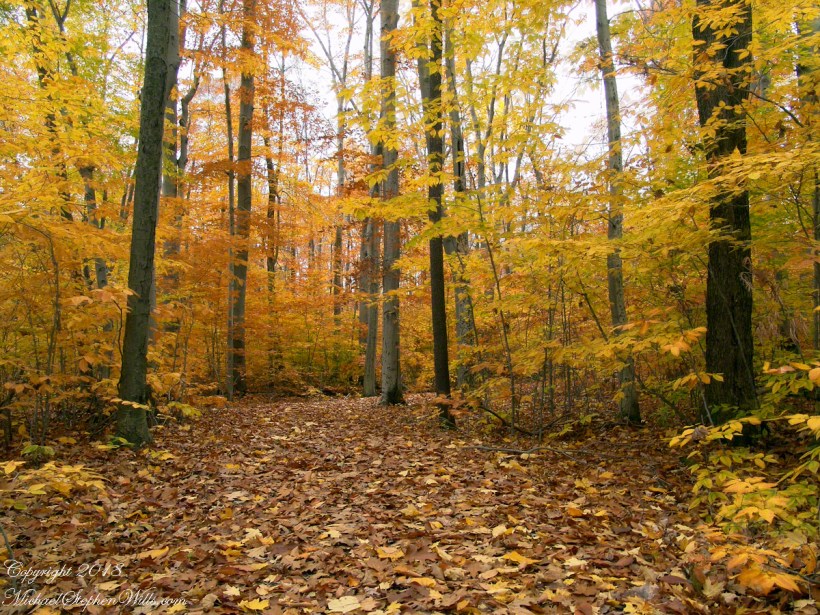
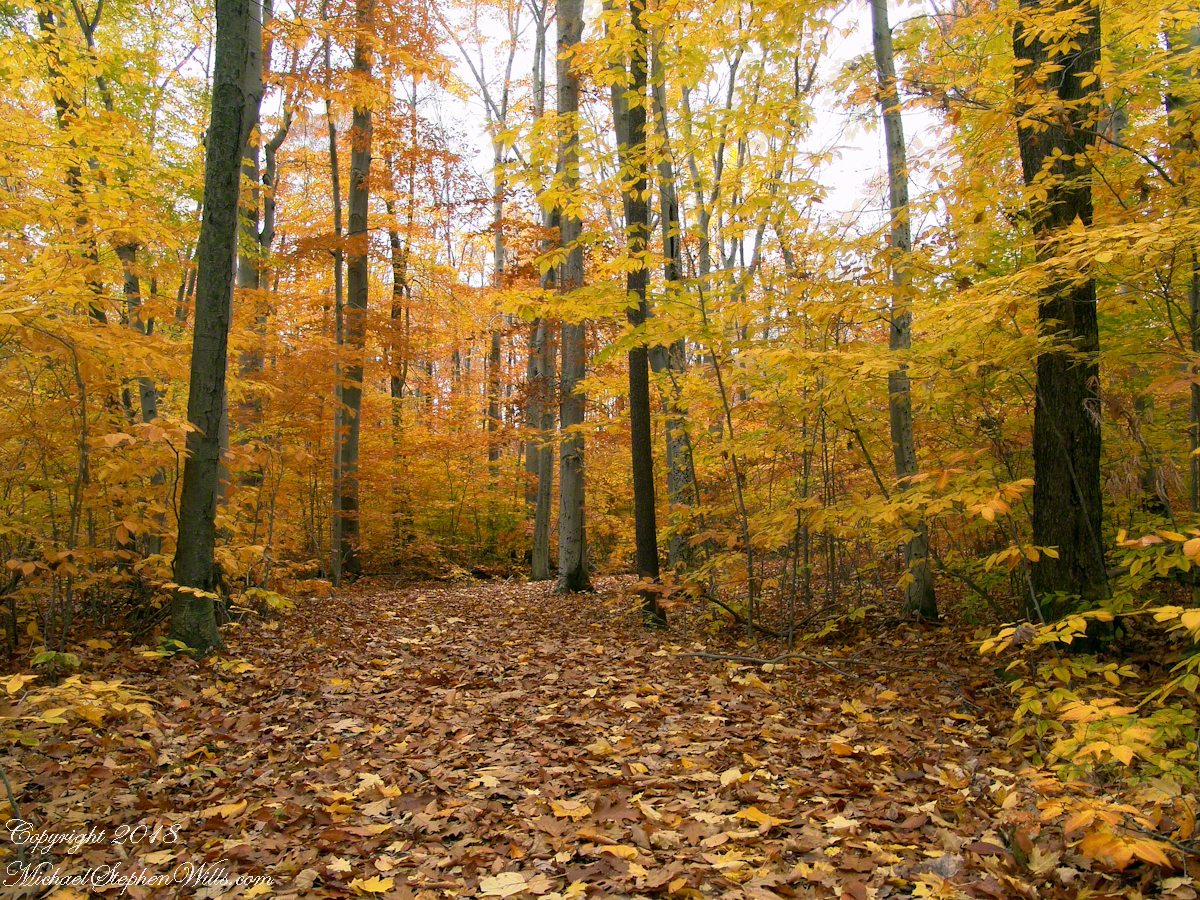
On Halloween morning 2004 I set out with a camera upgrade purchased spring of that year, a Sony “Cyber Shot, DSC-F828” with an inexpensive tripod. My photograph “Autumn Stroll in Sapsucker Woods”, the feature photograph and below, achieved prizes with the Photographic Society of American and a few sales of self-produced prints. It was an early success.
Click any photograph to visit my Online Gallery “Finger Lakes Memories.”
It is available on my Finger Lakes Memories online gallery where I provide recommendations for sizing, the best print medium with ideas for frame and matt.
The fall of 2005 I invested in a Kodak DCS Pro dslr-c and a Canon EF 50mm f/1.4 USM lens. October 30, 2005, one day short of the 2004 Halloween shoot, found me driving down Fall Creek Road on a mission of revisiting Sapsucker Woods to possibly improve upon my offerings.
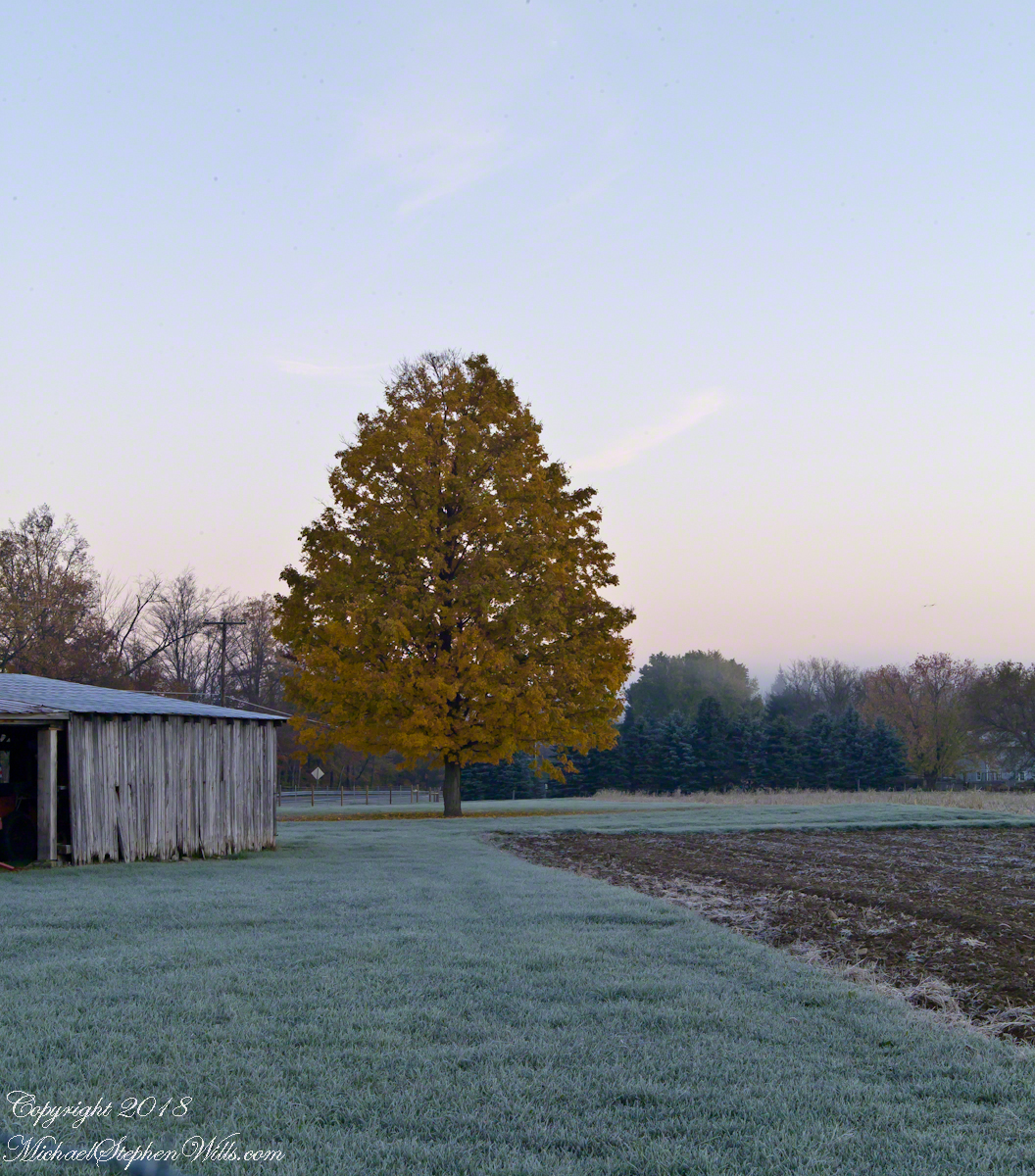
Over the years, travelling Fall Creek Road on my daily commute, I admired this well formed maple next to a farm field. At 6:45 am the sun was about this rise, the frost limned grass not yet burned off. This tree turned a bright yellow, here a green-yellow and dull. The form of the tree is perfect. I was never able to catch this at the right moment, it is still there and maybe I can time it this year during a pick-up of my grandson. If I do, my intention is to climb the fence and use the 24 mm lens to capture the tree and shed with less sky (unless there are some dramatic clouds). That day, I needed to make time for Sapsucker woods.
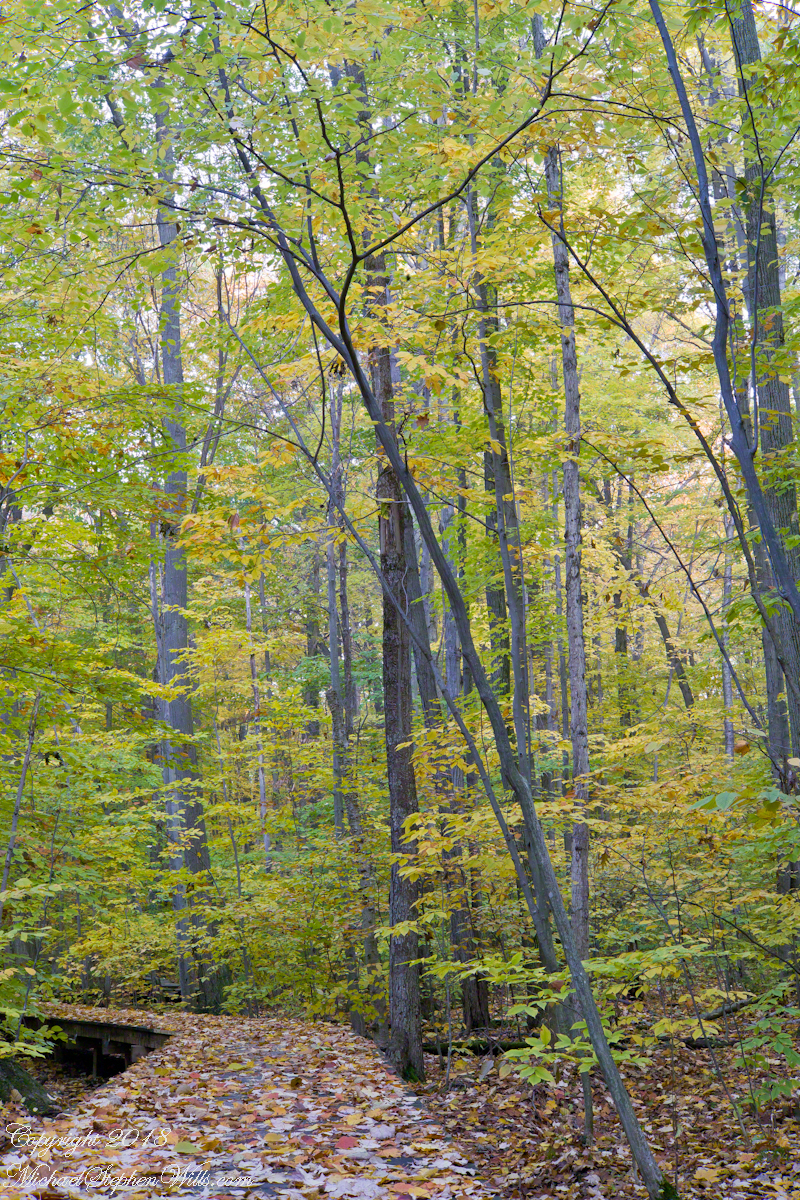
On site, thirty minutes later, as the leaves of the Fall Creek Road maple predicted, Sapsucker Woods foliage is behind last year’s by a week or so. In “Autumn Stroll in Sapsucker Woods” the over story leaves have fallen and the understory is at peak. Here, I believe the overstory is gone, the understory leaves are yellow-green.
I carefully choose the sites and this one is a risen walk of boards. In the nine years since, the walk as deteriorated and this scene will be different, possibly.
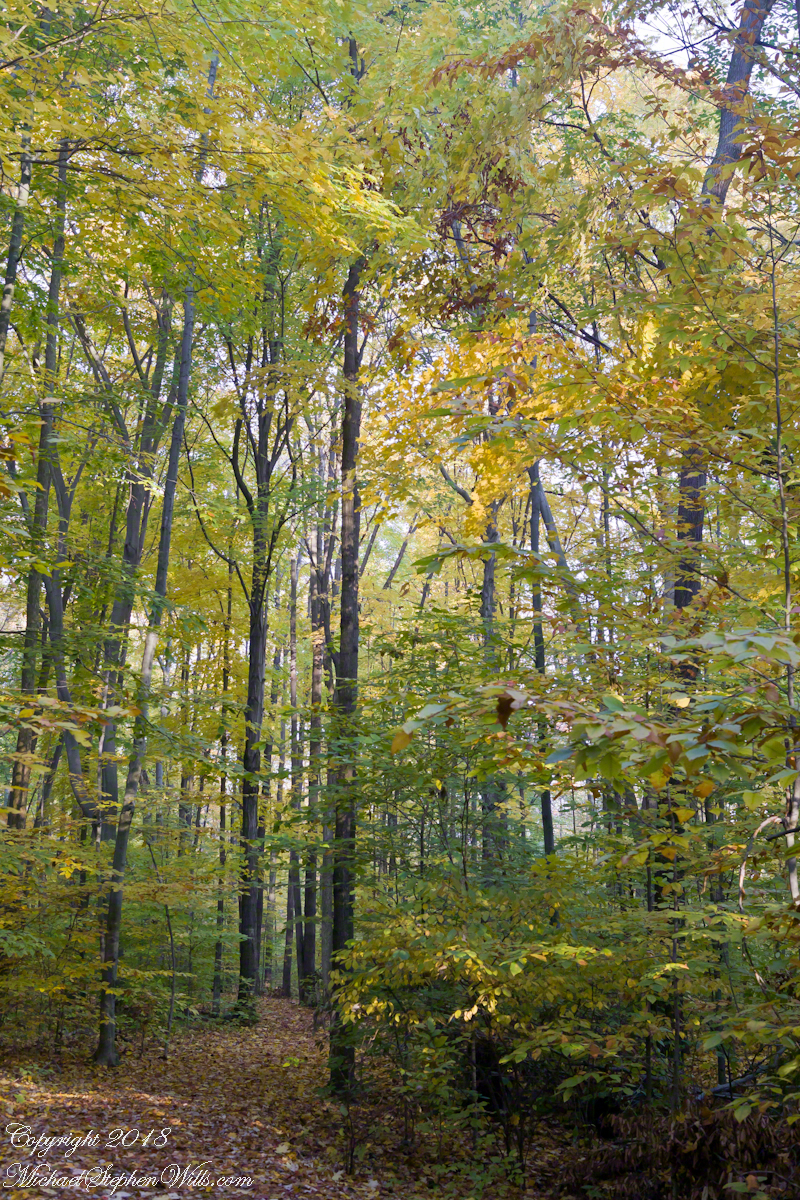
This is a match for the 2004 photograph as far as the camera position. What I enjoy from the 2004 version, aside from the foliage, are the details of the fallen leaves taking up the foreground, a carpet filling the field to lead the eye up through the trees, path fading from view to the right.
This effect is not possible on the boardwalk, above. With the fixed focus 50 mm lens it might be possible with effort. Today, the 24 mm is my first choice to capture this effect.
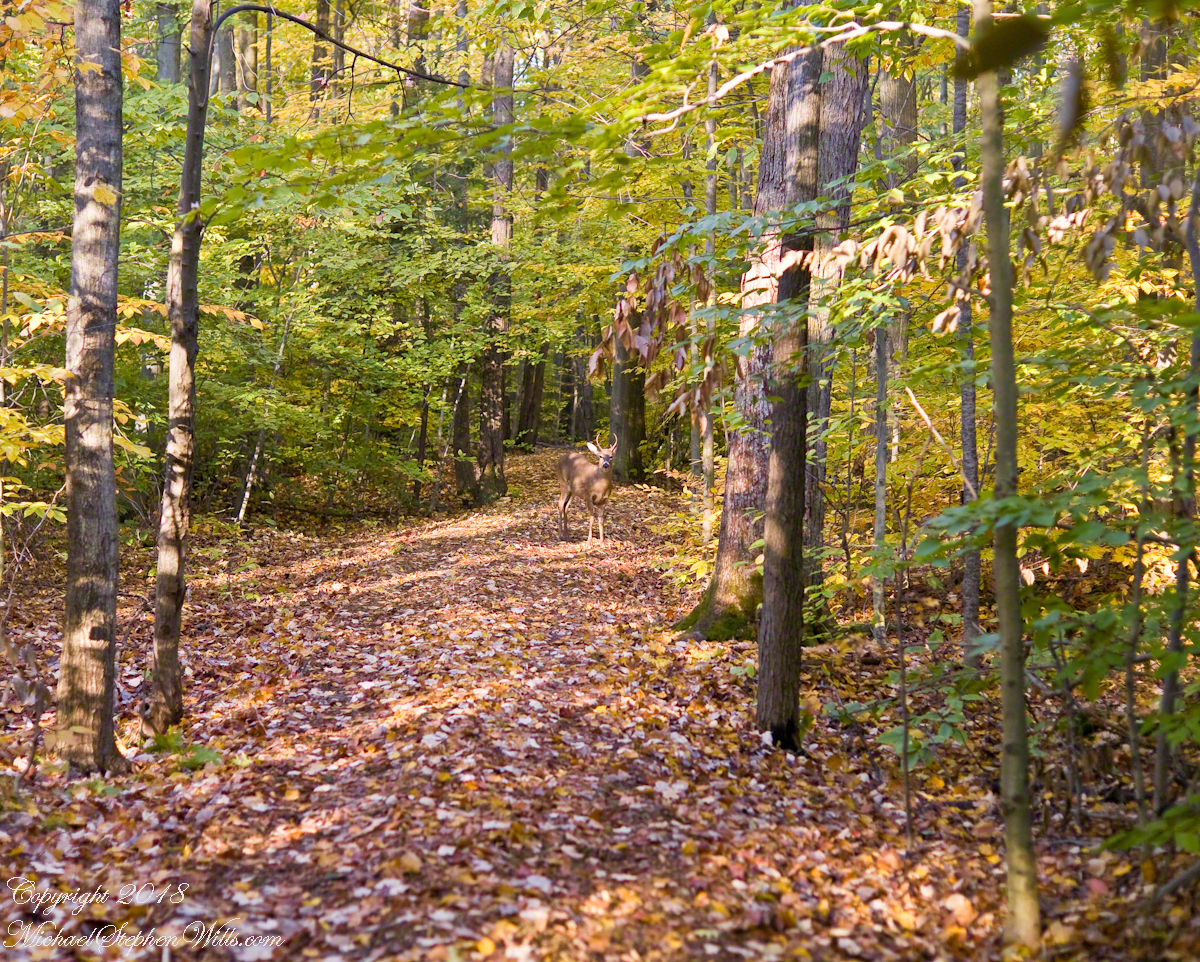
Here we can see the leaf carpet is possible, if the f-stop is higher to allow a crisp focus. In this scene it is f2 because I happened upon a buck in a daze. He was just standing there as I headed back to the car. I did not risk changing out lenses to the telephoto, so I moved forward slowly.
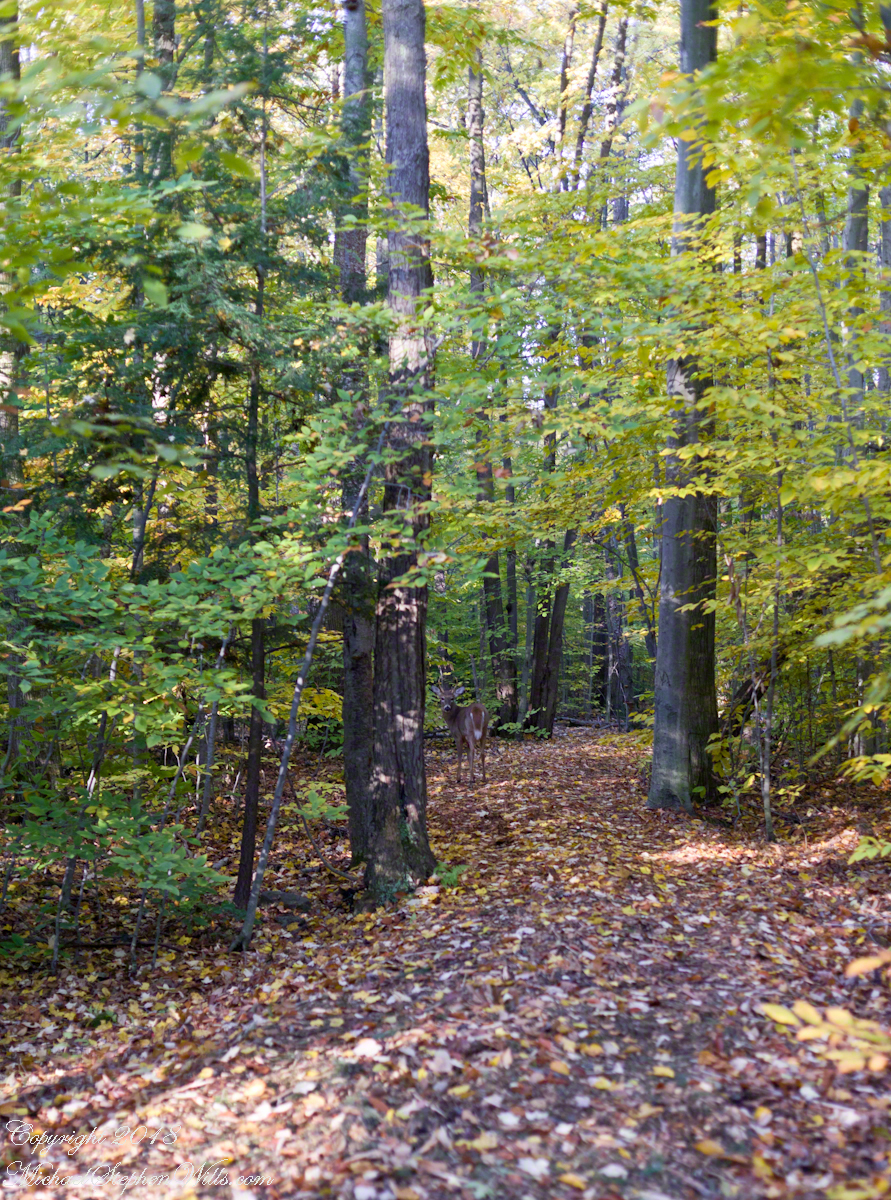
The best I did was this rear view as he looked backward. Lack of flexibility is a draw back of a fixed-focus lens.
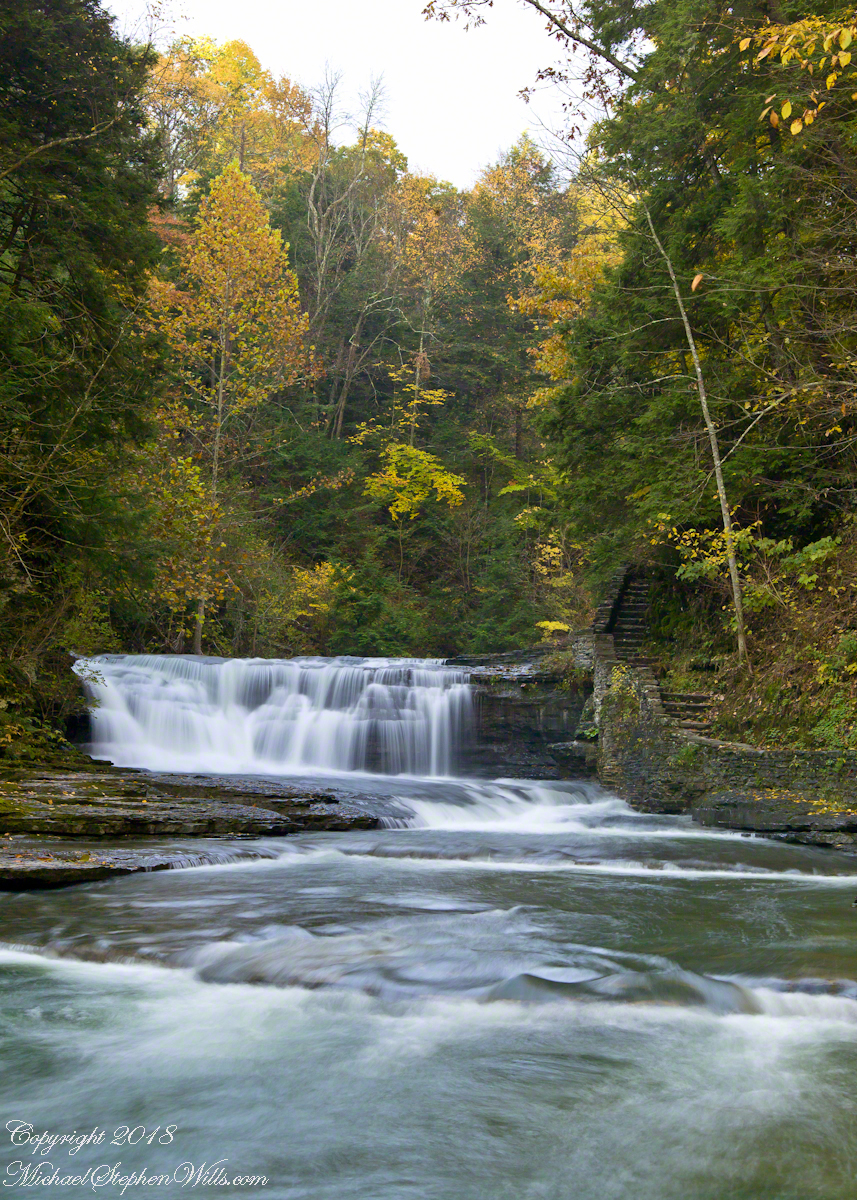
In 2004 my day concluded with Robert Treman State Park. In 2005 the 50 mm fixed focus with a ND filter and tripod was in its element. The sun is higher and overcast, one background tree is a peak foliage. The moderate water flow and stair complete the effect. This was my best work of that day. I need to get this up on the “Finger Lakes Memories” gallery.
Other postings of interest. Click the link to go there.





 Michael Stephen Wills Photography