This series of posts opens with the ascent to where the wildflowers grow.
Click photograph for a larger view. To do this from WordPress Reader, you need to first click the title of this post to open a new page.
Lower Falls
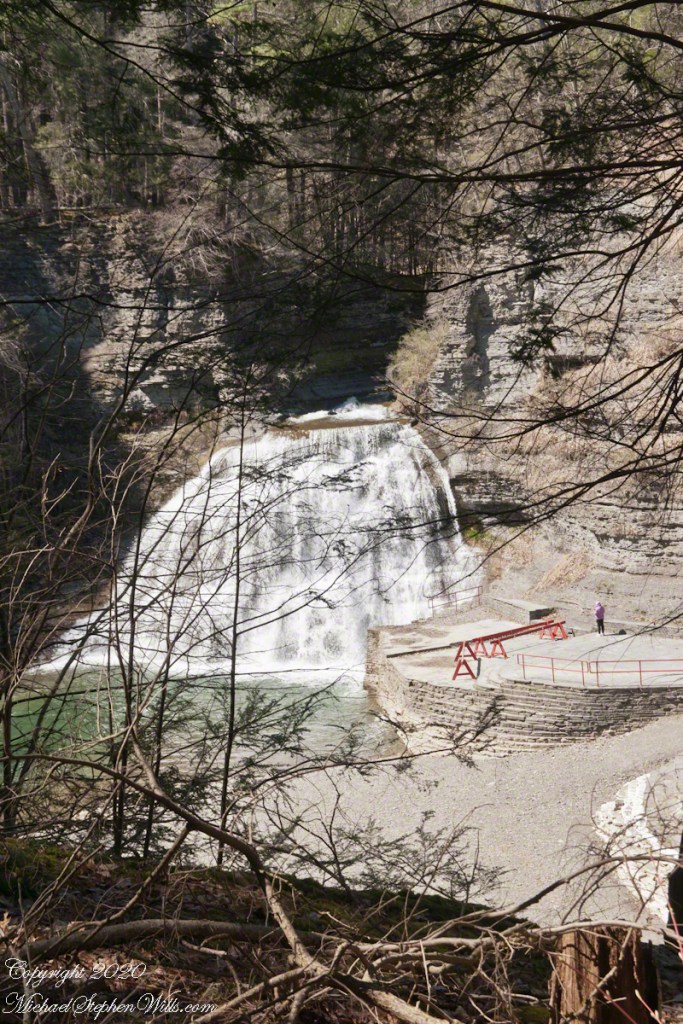
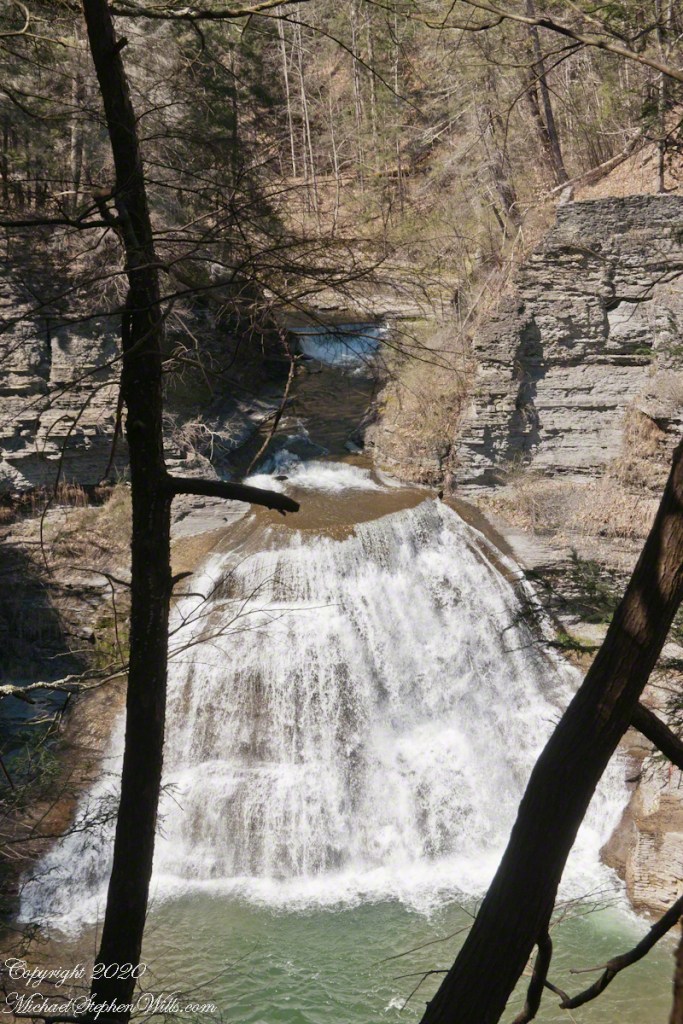
After just a taste of the climb to come, hikers are treated to an view of the Lower Falls of Enfield Creek. I call them the Wedding Cake. Summertime, a dam is erected, the water is deep enough to dive into the very cold creek water, lower than 70 degrees.
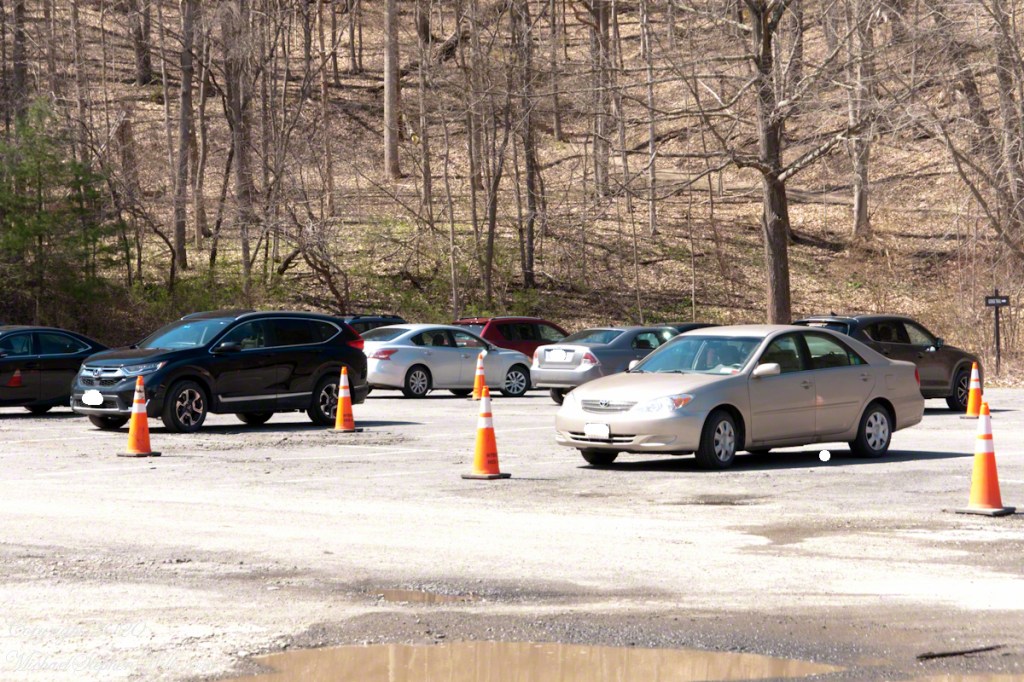
Parks were open during Govenor Cuomo’s “New York State on PAUSE.” Still, as a member of the at-risk group I was reluctant to visit, unsure of how crowded it will be. On a Monday afternoon, bright with sun, I drove over to Robert H. Treman lower park to check out the situation.
Click photograph for a larger view. To do this from WordPress Reader, you need to first click the title of this post to open a new page.
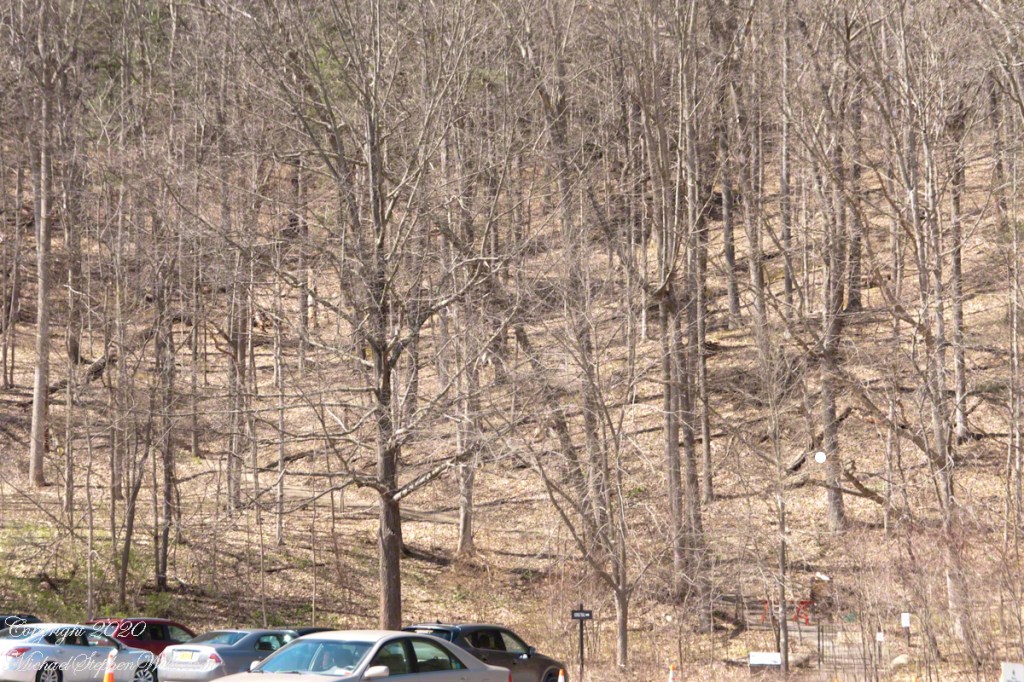
Social Separation ParkingGorge Trail is Closed for the winterParking Lot
I carried the Sony in hand and packed in a Canon with macro lens and a Manfrotto travel tripod.
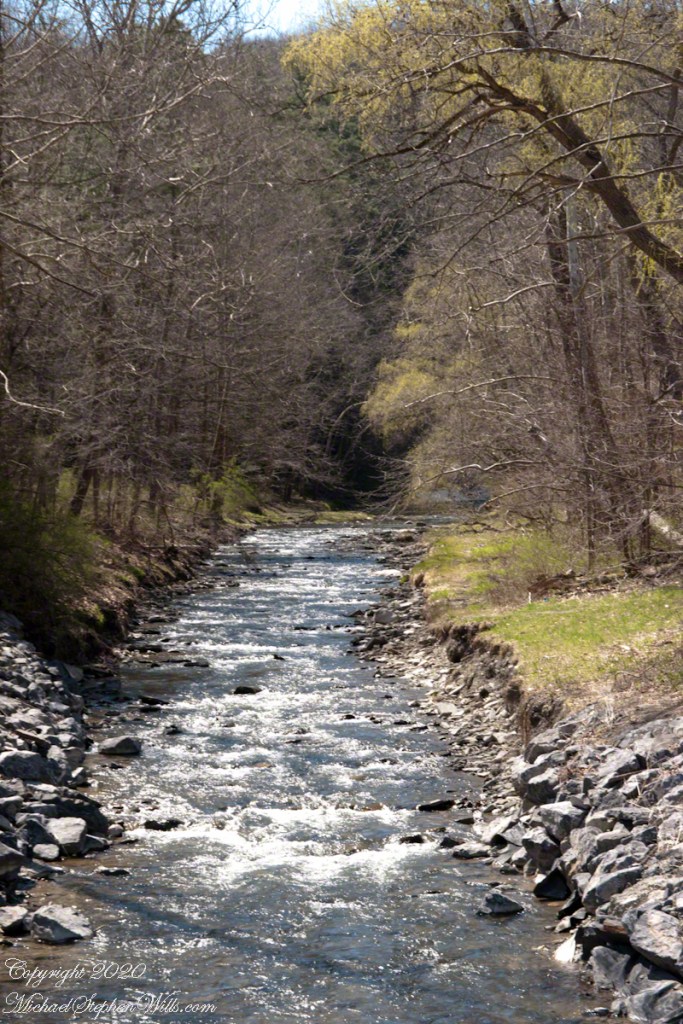
Enfield Creek from park bridge
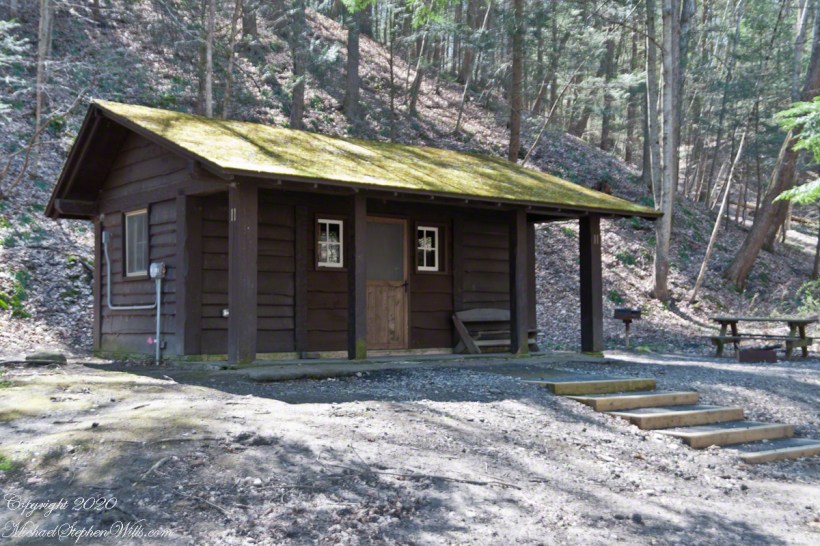
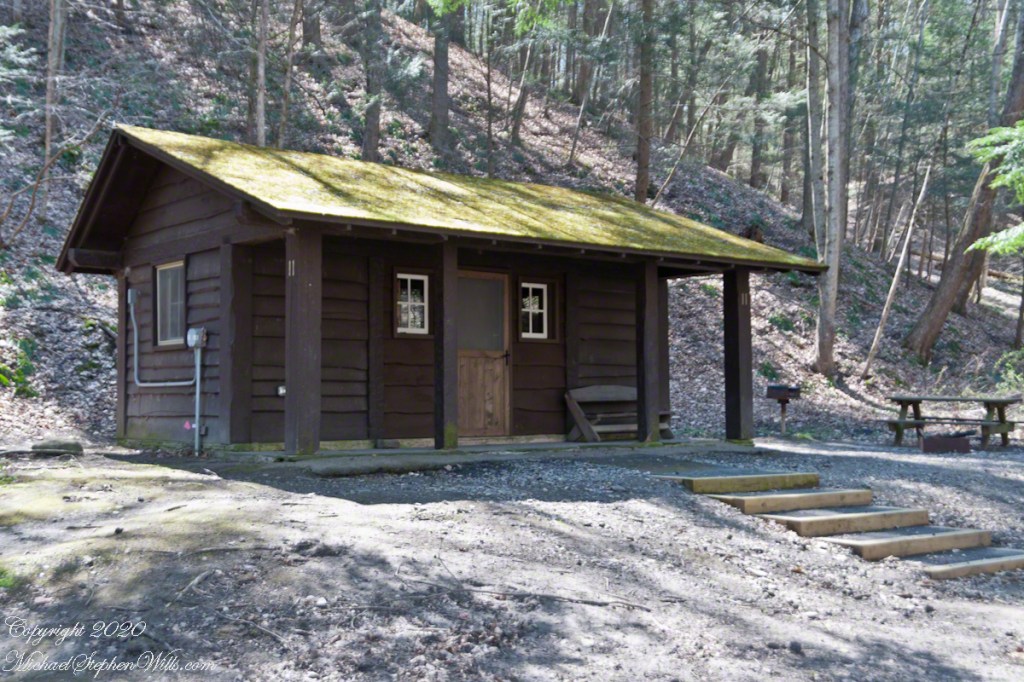
The path to a trail that climbs up the south side of Enfield Glen crosses Enfield Creek via a bridge, wends through cabins……
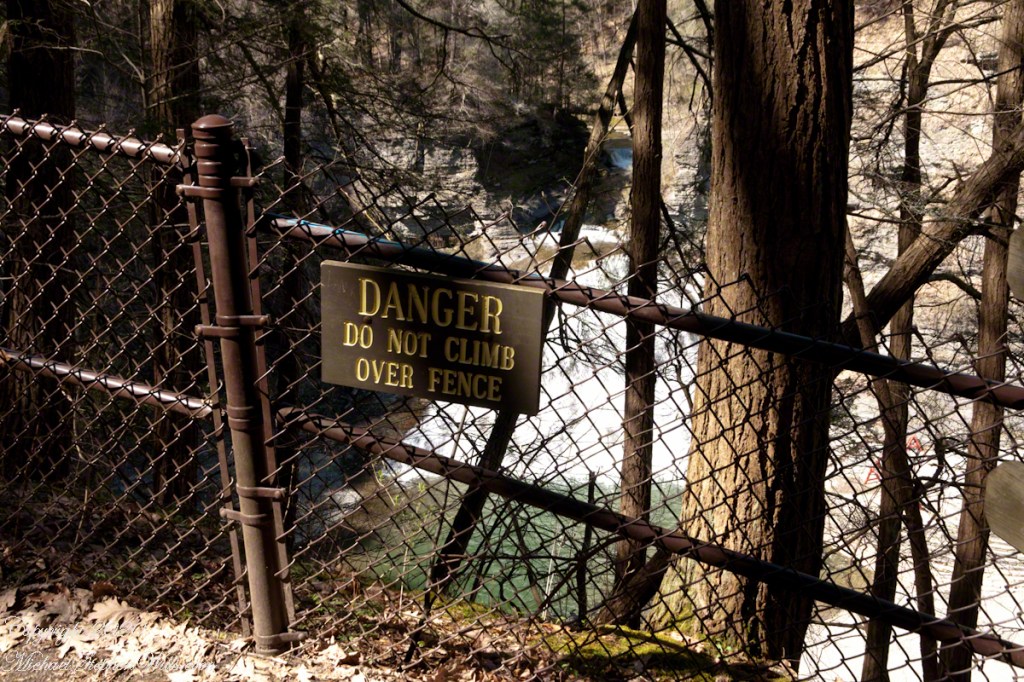
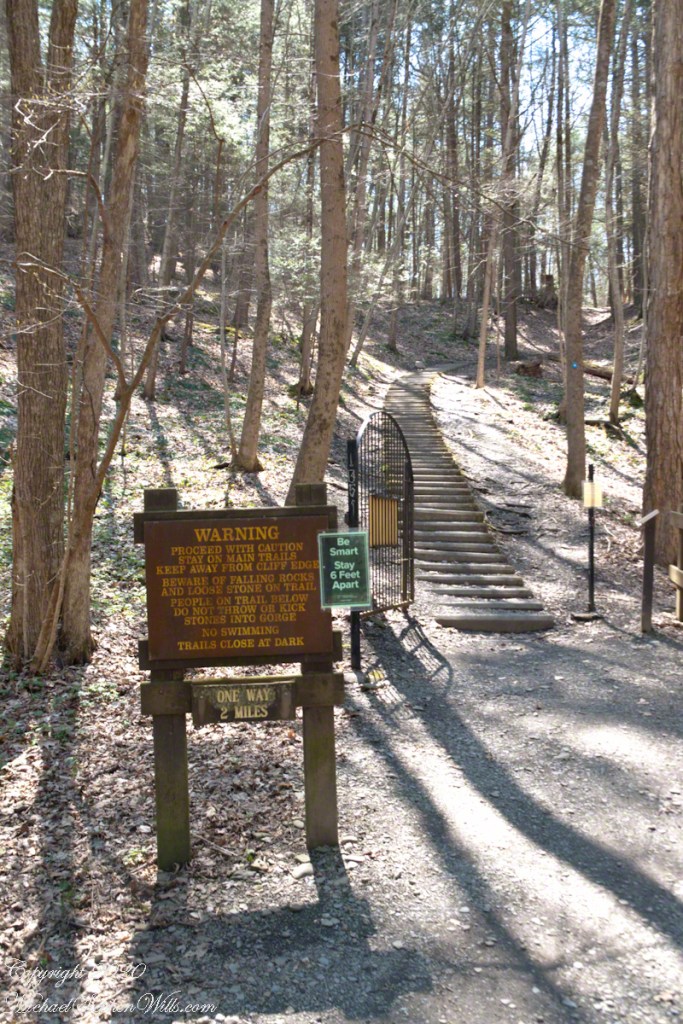
…..then heads up stairs that can seem to be forever. The green sign with white letters is new. This the South Rim Trail avoids the cliffs that make the Gorge trail so dangerous November through May.
Copyright 2024 All Rights Reserved Michael Stephen Wills
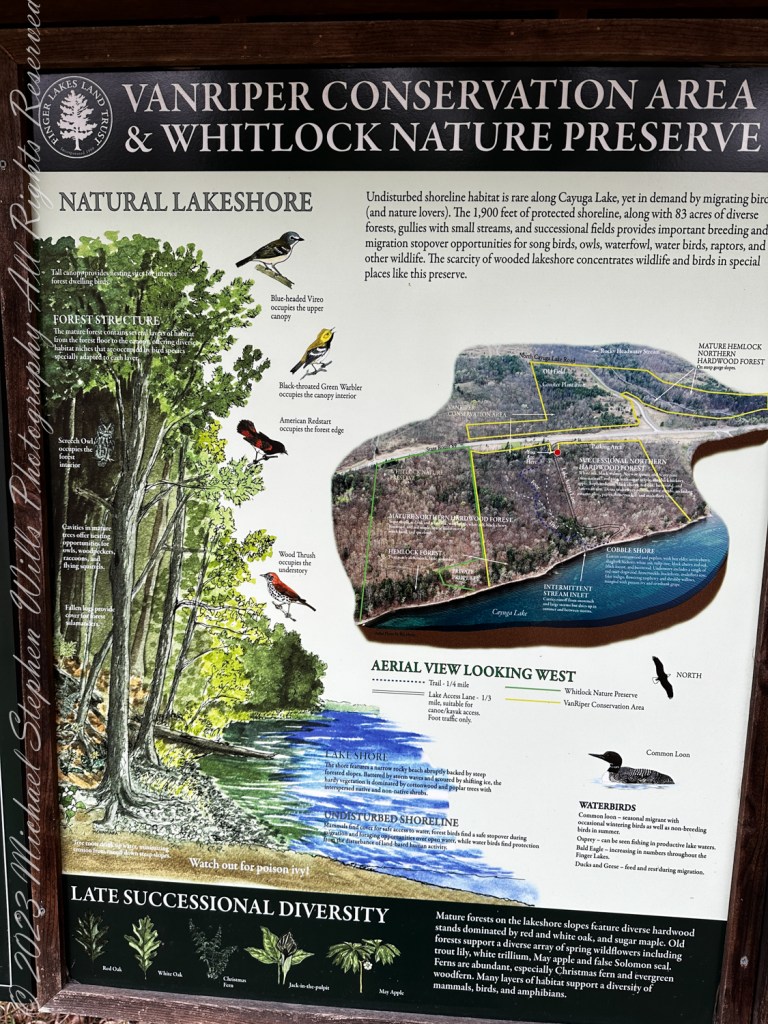
Step into the enchanting world of the VanRiper Conservation Area during a total solar eclipse. Witness nature’s grand spectacle, where daylight fades into an ethereal twilight, and the cosmos whispers secrets to those who listen.
Standing within the serenity of the VanRiper Conservation Area, we had the rare privilege to witness a celestial marvel—the total solar eclipse. The coordinates, 42°43’8.62″N 76°45’30.41″W, marked not a unique vantage point on the southern edge of the total eclipse zone. Here, the total eclipse enveloped the sky for an awe-inspiring 50 seconds, a fleeting yet unforgettable spectacle that we were fortunate enough to experience.
The VanRiper Conservation Area served as a magnificent backdrop to this astronomical event. Known for its diverse habitats, including wetlands, forests, and meadows, the area is a haven for wildlife and a sanctuary for those who seek solace in nature; a place where the sky seems vast, unobstructed by the trappings of urban life, offering a clear canvas for the eclipse to paint its momentary magic.
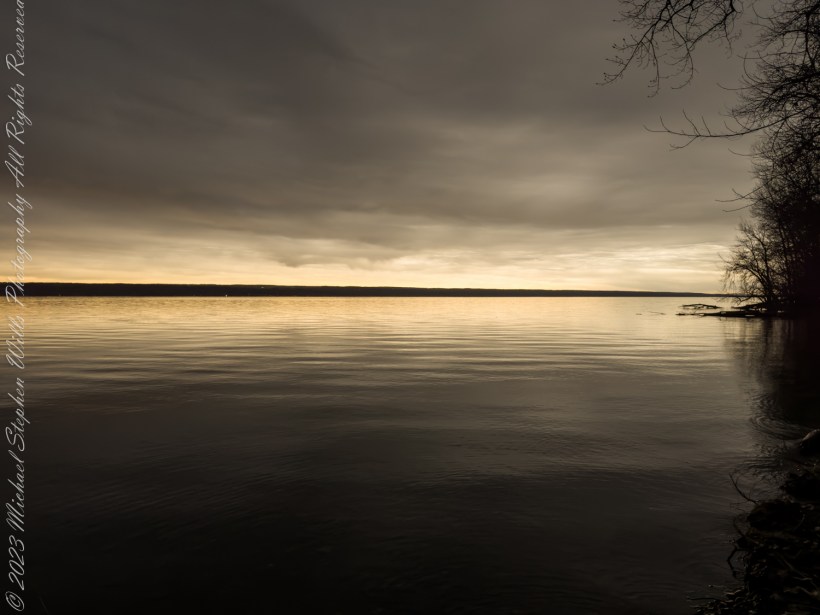
13:38:07, 39 minutes 41 seconds before the moon’s edge touched the sun. From the shoreline of VanRipen Conservation Area, Town of Romulus, Seneca County, Finger Lakes Region, New York State
As the time for the eclipse approached, a thick blanket of clouds enveloped the sky, obscuring our view of the sun entirely. This unexpected veil not only robbed us of the celestial spectacle but also intensified the darkness, casting a deeper shadow over the landscape and amplifying the surreal, twilight ambiance.
As the moon began its slow sweep over the sun, an eerie twilight descended upon the conservation area. The temperature dropped noticeably, a testament to the sun’s masked radiance. The birds, momentarily confused by the sudden dusk, fell silent, heightening the surreal atmosphere. This was the moment I had been waiting for, the total eclipse, where day momentarily turns to night, and the ordinary becomes extraordinary.
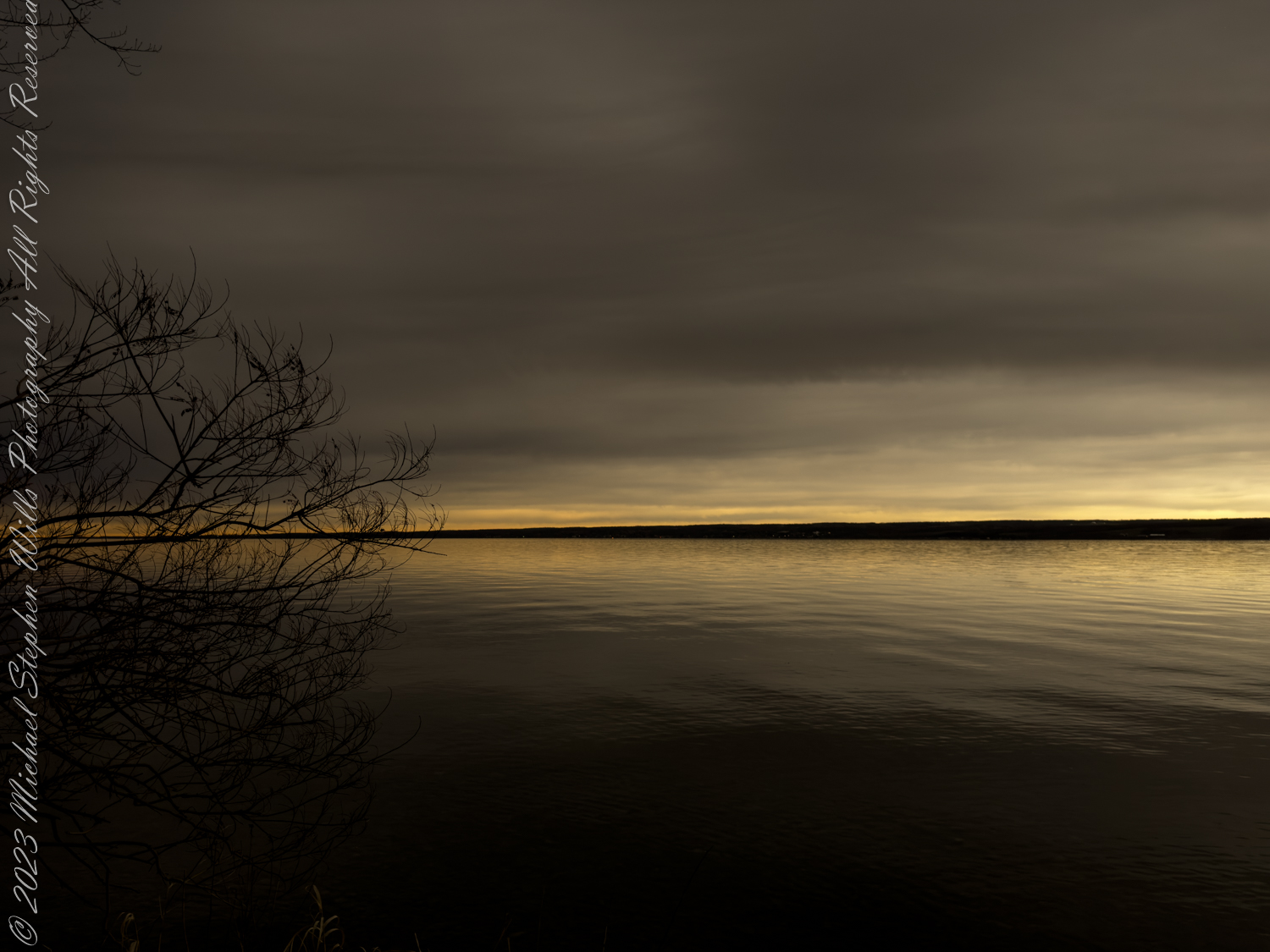
15:21:37, 56 seconds to totality. From the shoreline of VanRipen Conservation Area, Town of Romulus, Seneca County, Finger Lakes Region, New York State
Positioned on the southern edge of the total eclipse zone, I observed a fascinating phenomenon: the southern side of the horizon retained a brighter hue compared to the north, which veiled itself in deeper shades of twilight. This luminous gradient painted across the sky was a direct consequence of our location’s proximity to the eclipse’s path of totality.
In this captivating 4-minute YouTube video, you’re whisked away to the shores of Cayuga Lake, beneath a cloudy sky, on the day of the Total Eclipse, April 8, 2024 viewed from the VanRiper Conservation Area Cayuga Lake Shoreline in the town of Romulus, Seneca County of the Finger Lakes of New York State. As the moon dances across the sun at 5 times normal speed you witness the gradual darkening of the lake. On the opposite shore, the town of Aurora lights wink with the total eclipse of the sun. In normal time Loons herald the Sun’s return with a bright and eerie serenade, a natural symphony celebrating light’s triumph over darkness. Join us on this remarkable journey, where day turns to night and back again, all within the embrace of the Finger Lakes Region.
The totality lasted for a mere 50 seconds, when time seemed to stand still, yet it was a period rich with emotion and wonder. To witness the total eclipse was to see the universe align in a rare spectacle of shadow and light, a reminder of our place in the cosmos.
Reflecting on the experience, the VanRiper Conservation Area was a portal to a deeper understanding and appreciation of the natural world. Its untouched Cayuga Lake shoreline provided a setting for observing the eclipse with a reminder of the beauty and fragility of our planet.
As the eclipse passed and daylight returned the silence was filled with Loon calls, a celebration of life and the return of light. The solar eclipse was a convergence of time, place, and celestial mechanics, offering a spectacle for the eyes, a moment of introspection about our existence in this vast universe: a reminder of the ephemeral nature of life and the enduring awe of the cosmos. In the heart of the conservation area, I stood at the crossroads of science, nature, and spirituality, left to reflect on the dance of shadows and light.
Copyright 2024 Michael Stephen Wills All Rights Reserved
Discover the enchanting beauty of Steamboat Landing in Ithaca, New York. From the quiet winter majesty to the vibrant warmth of spring, this historical waterfront is a testament to the city’s rich past and evolving present.
Steamboat Landing in Ithaca, New York, is steeped in historical significance, serving as a testament to the city’s rich past and its evolving present. At the dawn of the 20th century, it was a bustling hub where steamboats carried passengers and freight, linking Ithaca to an ever-growing nation. These vessels were vital for the development of commerce, aiding travelers as they embarked and disembarked on their journeys that continued by stagecoach or later, by train.
In 1790, this spot marked the beginnings of commerce in the area, with the establishment of Ithaca’s first store. Over the years, Steamboat Landing has transformed from a pivotal commerce point to a recreational area, housing Ithaca’s Farmers Market—a vibrant hub that mirrors the liveliness of its heyday.
The Evolving Landscape
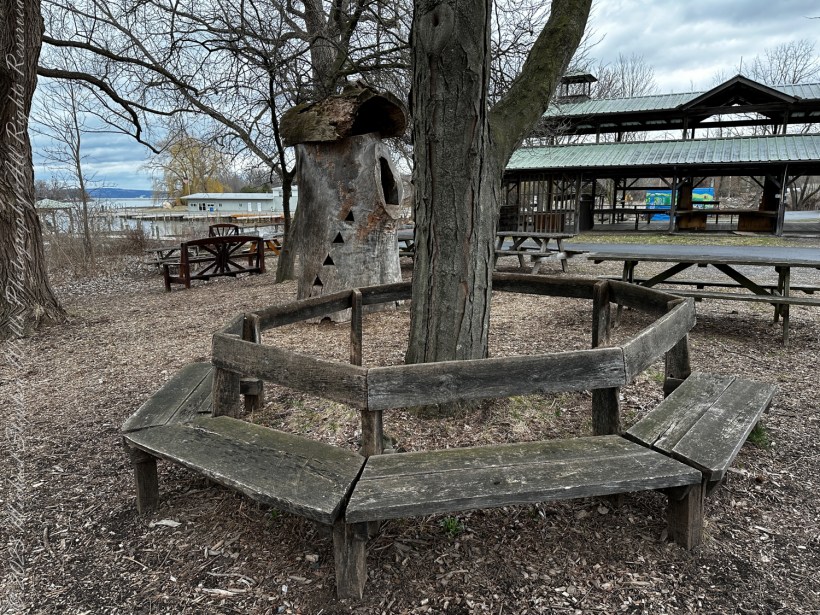
Today, Steamboat Landing is a place of gathering and serenity. My photographs showcase a tranquil setting moving through winter. In one scene, the rustic benches encircle a barren tree, standing as silent guardians of the land. It’s a still image, almost reminiscent of a painting, where the leafless trees stand vigil over the quiet benches.
A circular bench that has seen better days, a hollowed out tree trunk repurposed as a children’s playgound house, picnic benches and, in background, a portion of the Farmer’s Market pavilion, to the right is Johnson Boatyard, Cayuga Inlet and lake. This is the Steamboat Landing, historically the southern port on Cayuga Lake. Cayuga Waterfront Trail, Ithaca, Tompkins County, Finger Lakes Region, New York State.
Switching seasons, we see the docks adorned with festive wreaths, injecting life and celebration into the scenery. The bright red ribbons stand out against the crisp blue of the water and the sky, suggesting a community that embraces tradition and the joy of the moment.
Connection with Nature and Community
The pictures depict how the landing is woven into the natural tapestry of the area. It is a place where one can sit and watch the placid waters of Cayuga Lake or stroll along the docks, feeling the crisp air against their skin. The images of the clear skies, the open waters, and the flight of birds in the distance are a subtle reminder of nature’s continuous presence.
Steamboad Landing on the Cayuga Waterfront Trail, Farmers Market, Ithaca, Finger Lakes Region, New York State
The waterfront trail exemplifies the community’s efforts to merge history with modernity, providing a space where people can connect with the environment and each other. The docks, once a stage for industrial exchange, now serve as a peaceful retreat, hinting at the deep-seated human desire for connection—not only to each other but also to the very essence of the environment we inhabit.
Seasonal Beauty and Reflection
The change in seasons at Steamboat Landing brings a unique beauty, which the photographs showcase poignantly. From the barren coldness of winter to the lush warmth of spring, each season imbues the landing with a distinct character. The winter images reveal a quiet majesty, with the bare branches and gray skies reflecting the introspective nature of the season. The springtime shots, however, burst with promise and vitality, as greenery begins to cloak the landscape and the water shimmers under the strengthening sun.
Enduring Legacy and Future Prospects
Steamboat Landing’s legacy as a historical transport hub has set the stage for its future as a cherished community locale. The images and historical texts paint a picture of a place that has embraced its past while looking forward to a vibrant and inclusive future. It is a locale that pays homage to its roots through the Farmers Market and other community events, ensuring that the spirit of the old steamboats continues to thrive in the hearts of Ithacans.
In conclusion, Steamboat Landing is a geographic location and a chronicle of Ithaca’s journey through time. Through its transformation, it has become a place where history breathes, nature speaks, and the community finds its heartbeat. It stands as a beacon of heritage, recreation, and beauty—a corner of the world where past and present dance together in harmony.
Copyright 2024 Michael Stephen Wills All Rights Reserved
While beachcombing I witnessed an awe-inspiring moment where tranquility meets military prowess.
Discover the captivating blend of nature and technology in my latest post.
As I approached the placid stretch of sand known as Second Beach, adjacent to the Patrick Space Force Base, the Atlantic breeze carried a tang of salt that mixed with the distant, almost imperceptible hum of powerful engines. The sand, still cool beneath my feet, bore the imprints of morning walkers and the scuttle marks of sandpipers. It was a peaceful canvas, soon to be underscored by the might of aviation prowess.
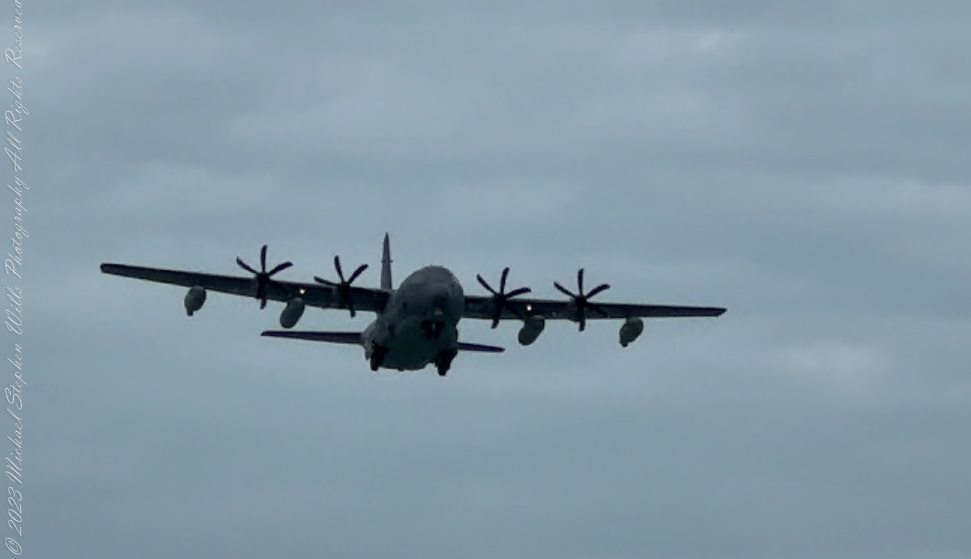
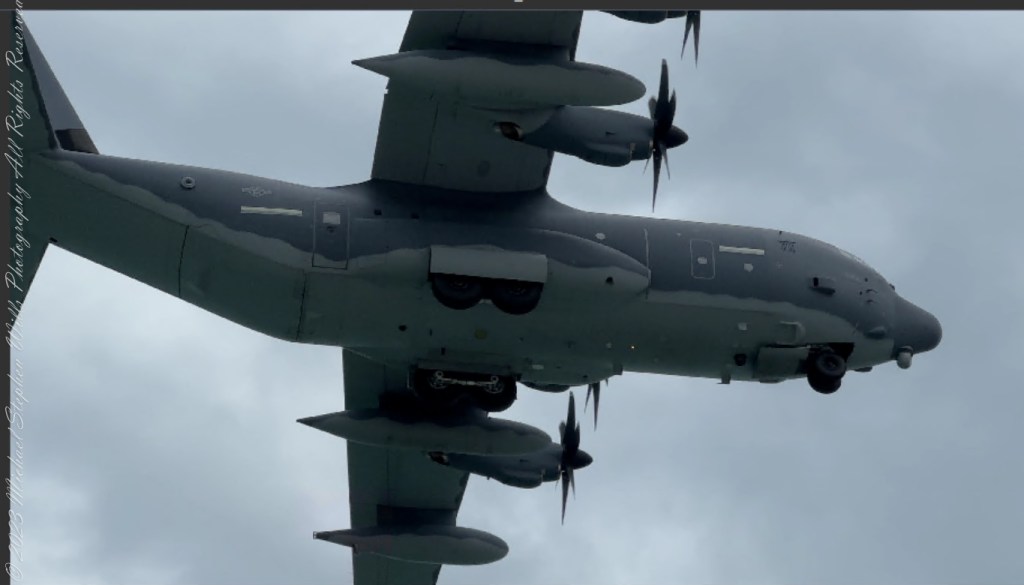
Having walked barely a tenth of a mile along the shoreline, the tranquil horizon was interrupted by the advancing silhouette of the Lockheed Martin C-130J Super Hercules. The Hercules, a titan of the skies, made its approach, its four Rolls-Royce AE 2100D3 turboprop engines altering the cadence of the ocean’s whispers. There’s a unique blend of awe and humility one feels in the presence of such human engineering, a craft capable of touching the farthest reaches of the globe, delivering hope or strategic might with equal prowess.
The Lockheed Martin C-130J Super Hercules is an extensive update of the C-130 Hercules, primarily involving new engines, avionics, and structural improvements. Here’s a more detailed look into the aircraft’s features and capabilities:
Engines and Performance:
The C-130J is powered by four Rolls-Royce AE 2100D3 turboprop engines, each driving a six-bladed composite propeller.
It’s capable of taking off from unprepared runways for expeditions, emergencies, or other complex missions.
Avionics and Systems:
The flight deck features modern avionics with heads-up displays (HUDs) for each pilot and advanced navigation systems.
It is equipped with a digital autopilot, improving performance and reducing crew workload.
Capacity and Versatility:
The C-130J can carry more than 40,000 pounds of cargo and has a range of about 2,000 nautical miles with a 35,000-pound payload.
It can accommodate a wide variety of cargo, including vehicles, pallets, and personnel or airdrop loads.
The aircraft is air-refuelable, extending its range for prolonged missions.
Design Improvements:
Enhanced structural design allowing for a greater lift and having a higher maximum takeoff weight than previous C-130 models.
The “J” model incorporates a longer fuselage than the original C-130H.
Operational Use:
The C-130J is used by the United States Air Force, the Marine Corps, and the Coast Guard, as well as numerous allied nations around the world.
Its roles include medevac, airborne assault, search and rescue, scientific research support, weather reconnaissance, aerial refueling, maritime patrol, and aerial firefighting.
Upgrade and Maintenance:
The C-130J has been continually updated with new technology and systems since its initial deployment to maintain its operational capabilities and extend its service life.
A robust maintenance and upgrade program supports global operations in varied and harsh environments, ensuring readiness and reliability.
With its combination of speed, range, and airlift
As the Hercules descended, its shadow enveloped my position, transient and thrilling. The aircraft’s formidability was evident in the robust structure and the propellers cutting through the air with surgical precision. The six-bladed composites, in harmonious rotation, seemed like the spokes of some celestial chariot, ushering the giants of the sky onto the earthly stage. Even as it neared the runway, the versatility of the Super Hercules was unmistakable; crafted for austere conditions, yet here it was, gliding over a picturesque landscape, a sentinel on a peaceful mission.
The Hercules passed overhead with a display of grace uncharacteristic of such a large aircraft, the whirring of its engines a testament to the ceaseless vigil it keeps across the skies. As it touched down, the craft transformed from a spectral giant back into a tangible instrument of air superiority and logistical support.
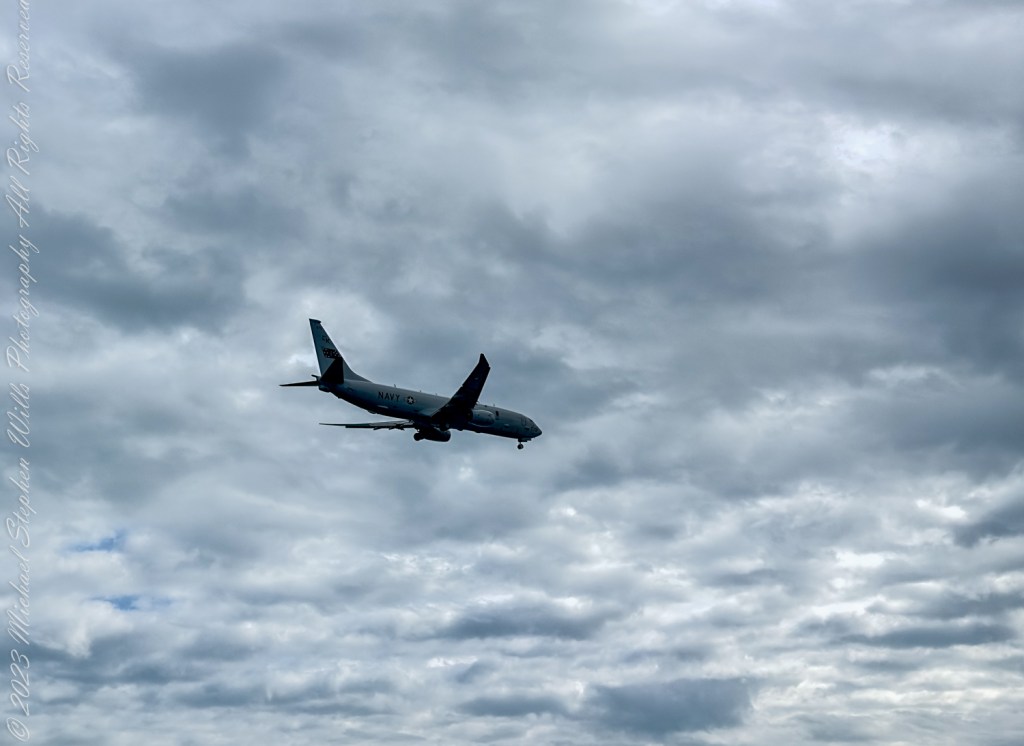
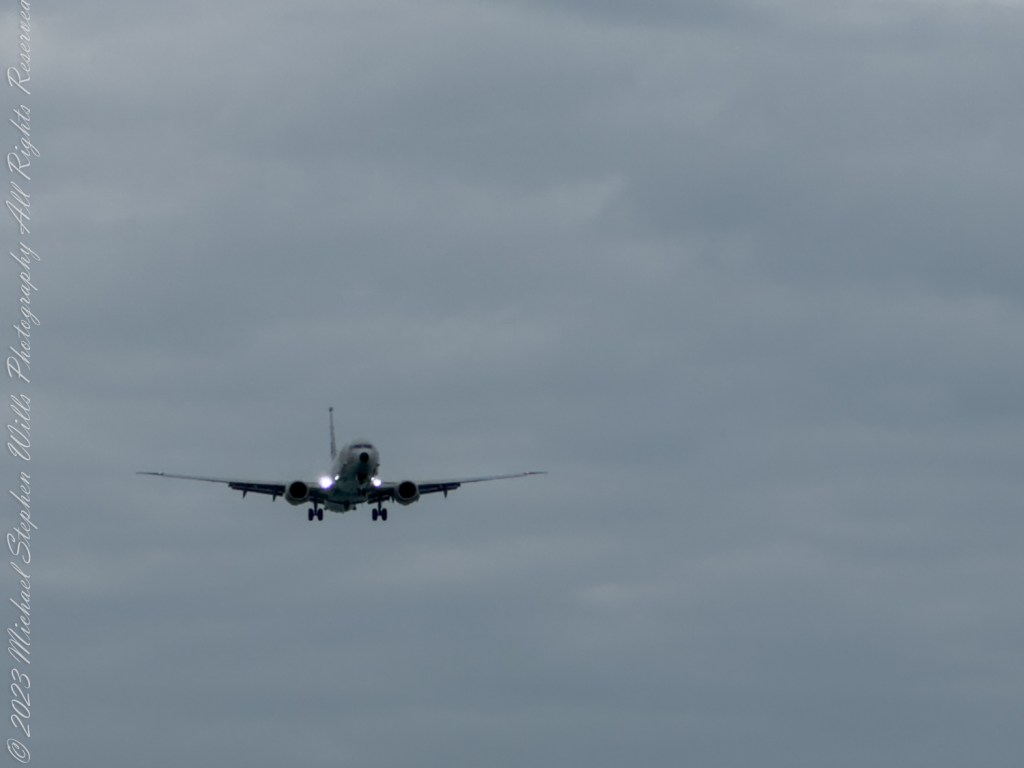
After an interlude of peaceful wave breaks another form caught my eye. The sleek, more modern contours of the Boeing P-8 Poseidon emerged from the azure, its twin engines a whisper of progression against the roar of the Hercules before it. This maritime patrol aircraft, with its lineage traced back to the reliable Boeing 737, represents the evolution of aerial surveillance and anti-submarine warfare.
As the P-8 Poseidon drew closer, descending with an elegant ease, its profile cut a striking contrast against the gray clouds above. Its advanced radar arrays, mounted under the wings and fuselage, hinted at the craft’s hidden eyes—eyes that watch over the ocean’s expanse with vigilance. There was an undeniable presence of precision and technological advancement that surrounded the Poseidon as it sailed through the air.
The Boeing P-8 Poseidon is a highly advanced, long-range, anti-submarine warfare (ASW), anti-surface warfare (ASuW), and intelligence, surveillance, and reconnaissance (ISR) aircraft. It’s a military derivative of the Boeing 737 Next-Generation airplane and is used primarily by the U.S. Navy.
Key features and capabilities include:
Advanced Sensors: The P-8 is equipped with a state-of-the-art sensor suite that allows it to track both surface ships and submarines. The aircraft carries a maritime radar, a high-definition electro-optic/infrared (EO/IR) camera, and an advanced magnetic anomaly detector (MAD) for submarine hunting.
Communication and Combat Systems: It features a secure and interoperable communication system that enables real-time data-sharing with other assets in the battle space. The P-8 has an advanced mission control system that helps gather and process surveillance data.
Armament: The P-8 can carry torpedoes, Harpoon anti-ship missiles, and other weapons. It has both internal and wing-mounted hardpoints for weapons storage and delivery.
Operational Range: The aircraft has an extended operational range, capable of long-duration missions and covering vast areas of ocean on a single sortie.
Survivability: Being a modern military aircraft, the P-8 includes defensive systems to protect against surface-to-air threats.
Versatility: While primarily designed for maritime patrol, the P-8 also supports a wide range of missions, including search and rescue, shipping protection, and electronic intelligence gathering.
It passed over with a smoothness that belied its tactical purpose, a guardian of the seas ensuring the unseen threats remained held at bay. It was an ethereal sight, the embodiment of modern warfare’s stealth and strategic intelligence. The Poseidon’s landing gear, deployed and ready, connected with the tarmac in a seamless dance of man, machine, and purpose.
Standing there, I felt enveloped in a narrative much larger than myself—a narrative of human ingenuity, the relentless pursuit of security, and the silent promise of guardianship from above. With the passing of these large warplanes, I was reminded of the thin line between serene shores and the turbulent skies, and the ever-vigilant watch kept by these titans of the sky.
Copyright 2024 Michael Stephen Wills All Rights Reserved
Discover the solemn beauty of Quaker Settlement Cemetery through my lens, where intricate slate headstones whisper tales of early settlers, intertwining family lore with the artistry of marble willows
Click photograph for a larger view. To do this from WordPress Reader, you need to first click the title of this post to open a new page.
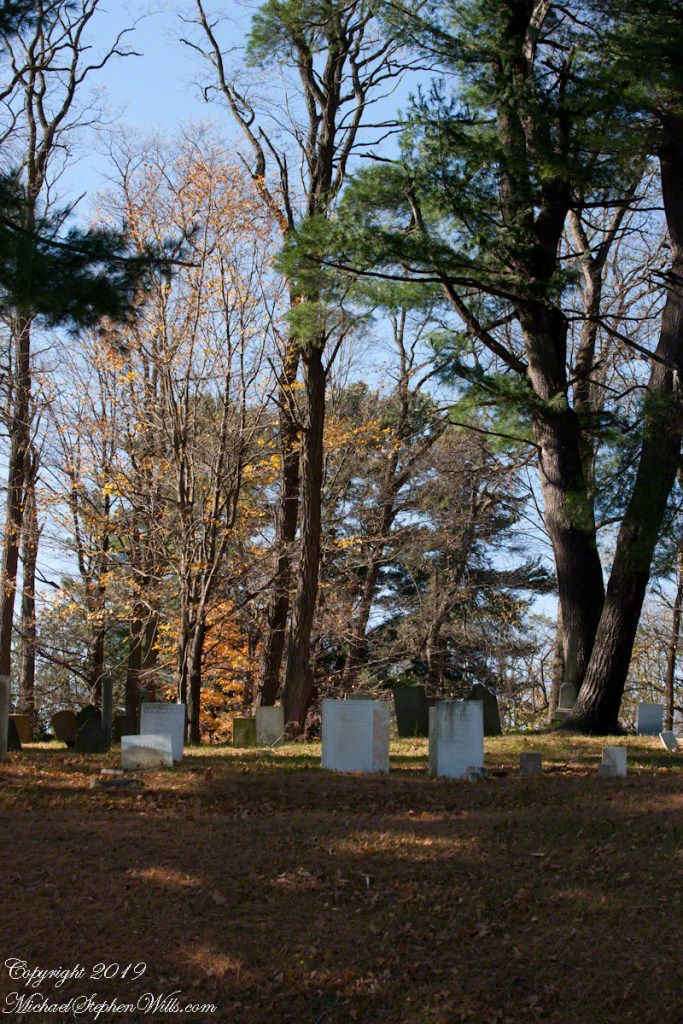
A view of the Quaker Settlement Cemetery, taken from Jacksonville Road, NYS Route 143, on an early November afternoon.
Located in the town of Ulysses, New York there is a Quaker Settlement church a few feet further west on Perry City Road. I have Quaker ancestors, so took the opportunity to peruse the family names. The stones were unusually beautiful and touching, mostly local slate, some with intricate carvings.
Here is a headstone for two young people of the same family name. The white marble carved in the form of a willow, from the flowing lines and, knowing how our willows green up springtime, it calls to mind the same youthful greening as appropriate for two young people who lived 22 and 15 years.
Analysis of the dates, given in the following capture, tells the story of an young woman, a baby born 5 months after her death and who followed his aunt 15 years later.
Catherine A. Mattison Born 1792/1793, Death March 13, 1815. Lived 22 years. John Mattison, Death December 2, 1831, Born August 15, 1815 (5 months after Catherine’s Death), Lived 15 years, 3 months and 18 days.
I have a great aunt who also died young with a headstone naming her mother and father. Here is the granite headstone of Mary R. Daughter of George & Margarett Wills Died Oct. 3, 1886 Aged 20 years. Saint Mary of Assumption Cemetery, Sweetwater, New Jersey. My grandfather James Edward Wills was 9 years old at his sister Mary’s passing. He must have attended her church service and internment, standing at this spot.
Copyright 2024 All Rights Reserved Michael Stephen Wills
As you glimpse the strewn buoys at Cayuga’s shore, consider the tales they hold—witnesses to history, guiding vessels through New York’s storied waters. Delve into their journey from the Erie Canal’s birth to today’s spring awakening.
As the crisp air of spring begins to soften and the last remnants of winter recede, you might find yourself drawn to the outdoors, eager to participate in the age-old tradition of spring cleaning. It is a time of renewal, of clearing away the old to make way for the new. In Ithaca, this period of rejuvenation extends beyond the confines of cluttered homes and into the expansive natural landscape, as shown in the photograph before you.
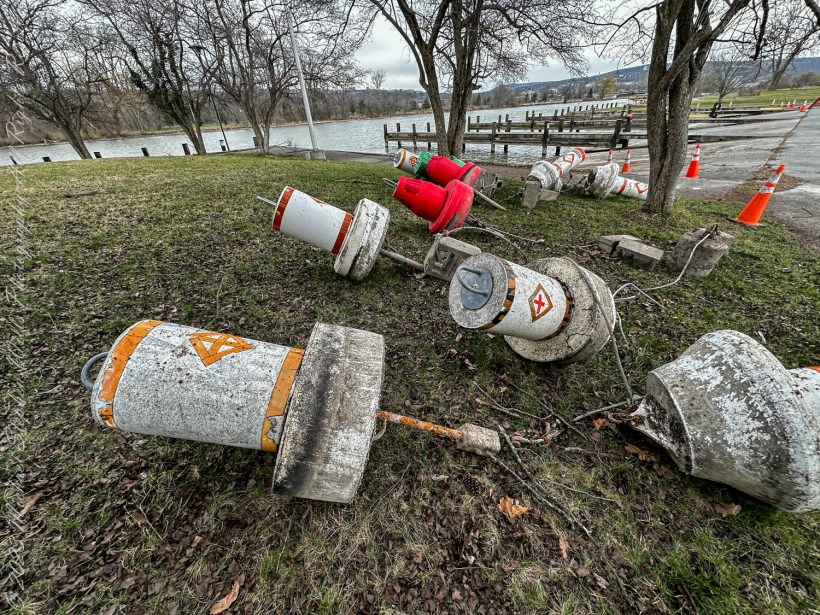
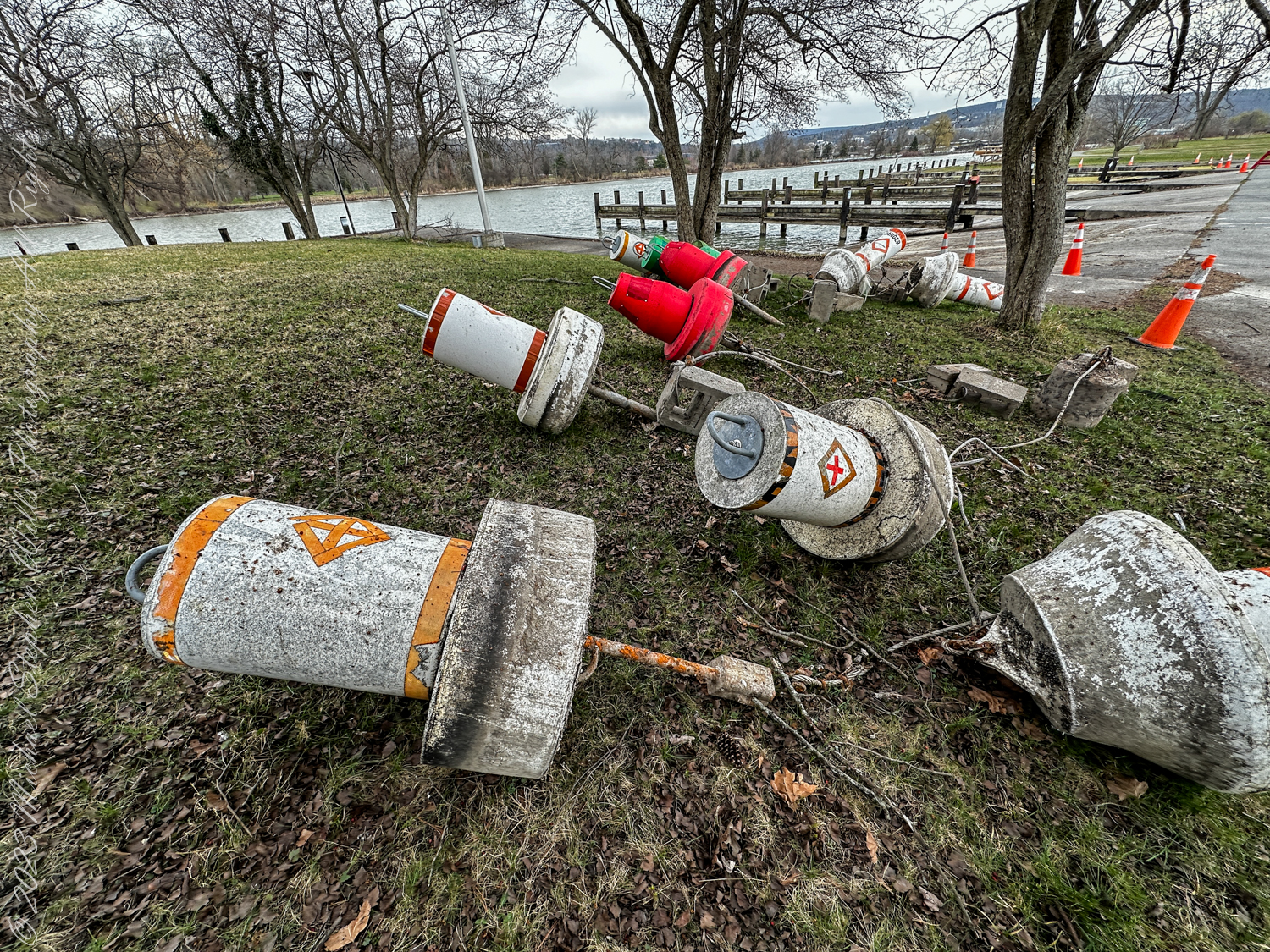
Spring cleaning and repair at the Alan H. Treman Marine Boat Park. Ithaca, New York, Tompkins County
Tidying the Shores
There, on the shores of Cayuga Lake, the scene is a stark contrast to the neat rows of daffodils you admired yesterday. Instead, navigation buoys, those steadfast guides of the waterways, lie upended and scattered – casualties of the winter’s harshness or perhaps the diligent work of park employees preparing for the upcoming boating season. These buoys, usually afloat, marking safe passage for vessels, are now being tended to, maintained, and readied. It is an essential process, akin to the annual spring clean, ensuring the safety and smooth sailing in the months to come.
Guardians of the Waterways
Let’s delve into the history these buoys are part of. You, as a curious observer, are witnessing a fragment of a narrative that stretches back over a century. These navigational buoys are descendants of the earliest markers that adorned the inland waters of New York State and the Erie Canal, of which Cayuga Lake is an integral part.
The Erie Canal and Cayuga’s Connection
The Erie Canal, an engineering marvel of the 19th century, opened in 1825, transforming New York and the entire Great Lakes region. It was the superhighway of its time, connecting the Atlantic Ocean to the Great Lakes, and thereby shaping the course of economic and social history in the United States. Cayuga Lake, connected to this system via the Cayuga-Seneca Canal, was part of this vast network of navigable waters.
Navigation Buoys: Beacons of Progress
As commerce flourished, so too did the need for reliable navigation. The buoys, then as now, served as critical signposts, ensuring that vessels could traverse these waterways safely. Imagine the countless boats that relied on these markers – from the large freighters carrying goods to the smaller craft bearing passengers – each buoy a sentinel ensuring their safe passage.
Modern Sentinels
Today, the navigation buoys on Cayuga Lake and other inland waters continue this legacy. They are the modern sentinels of the deep, equipped with the latest technology to guide the way. Just as the Erie Canal once heralded a new era of travel and trade, these buoys now symbolize the enduring importance of safe and efficient water transportation.
The Future of Inland Navigation
As you reflect upon the photograph, consider the ongoing narrative of these buoys and the waterways they mark. In a world increasingly concerned with sustainable modes of transportation, the historical importance of these channels resurfaces. The waterways that once fueled the expansion of a nation may once again play a pivotal role, this time in the quest for greener alternatives to overland routes.
Conclusion: A Cycle of Renewal
The upturned buoys in Cass Park, ready for their spring cleaning, are a microcosm of the cyclical nature of life and progress. They remind you that renewal is not just about beauty; it is also about preserving the functionality and safety that allow society to move forward. Just as the spring cleaning in your home ushers in a new season of clarity and freshness, the maintenance of these navigational aids renews the commitment to a legacy of safe passage – a promise made by the generations that have sailed these waters since the days of the Erie Canal.
You find yourself on the cusp of spring, the earth slowly awakens from its wintery slumber, and life begins to stir in the subtlest of forms. Imagine strolling through a park in Ithaca, the evidence of spring’s tender handiwork unfolding before your eyes. As you traverse this liminal space where the grey of winter meets the vibrant hues of spring, you are greeted by a cheerful brigade of daffodils, a sure harbinger of warmer days.
These daffodils are blooming along the Cayuga Waterfront Trail within Cass Park, Ithaca, Tompkins County, New York
Through the above image, it’s as though you are leaning in, your gaze just inches above the blooms. These daffodils are not merely flowers; they are the golden trumpets of spring, each one a burst of joy amidst the still-dormant earth. You can almost feel the softness of the petals, the coolness of the air, and the promise of renewal that each bud encapsulates. With their faces eager to bask in the strengthening sun, they seem to resonate with your own readiness for change, for the fresh possibilities that each new season brings.
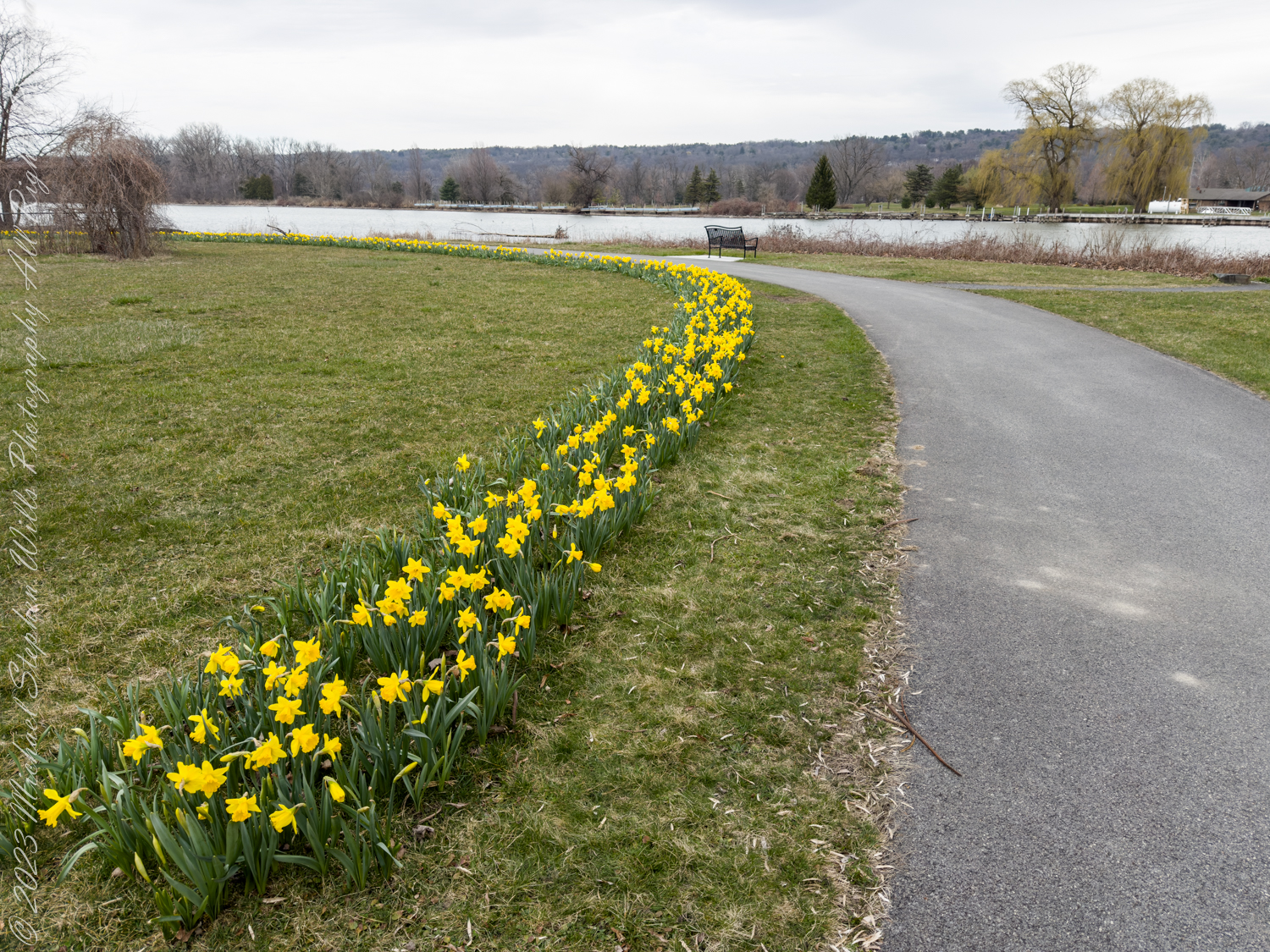
As you stand up and take a few steps back, the following image grants you a wider perspective. Here lies a path, winding gently alongside a burgeoning line of daffodils. They stand in unity, a vivid yellow line drawn against the canvas of awakening green. The bench in the distance is vacant, an invitation to sit and appreciate the tranquility of Cass Park, the expanse of water beyond serving as a mirror to the open sky. It’s a scene that calls for contemplation, urging you to appreciate the simplicity of the moment, the serenity of nature’s process.
These daffodils are blooming along the Cayuga Waterfront Trail within Cass Park. Here the trail has passed over Linderman Creek and we are looking toward the Cayuga Lake inlet. Ithaca, Tompkins County, New York
These photographs are more than visual delights; they’re sensory experiences. Can you hear the subtle sounds of the park? The distant call of birds returning home, the soft rustle of grass stirred by a gentle breeze, the hushed murmur of water lapping at the shore? Each sound is a note in the symphony of spring, played just for you.
The images you see are not frozen in time; they carry within them a narrative of life’s perseverance. The daffodils, with their bright faces and sturdy stems, have weathered the cold, the snow, and the frost. They emerge, not just as survivors of winter, but as its conquerors. Each flower is a testament to resilience, a living metaphor for the human spirit that you, too, possess.
This is the season of rejuvenation, where the old is shed, and the new embraced. With each day, the sun lingers a bit longer, casting its golden glow upon the earth. It’s the time to set aside the grayness of yesterday and look forward to the spectrum of tomorrow. The photographs are not just to be viewed; they are to be felt, to remind you that no winter lasts forever, no spring skips its turn.
As you walk away from this scene, you carry with you the warmth of the sun and the cheer of the daffodils. Let the images serve as a reminder of the perennial cycle of life, the undying hope, and the enduring beauty that awaits just outside your door. Feel encouraged to seek these moments, these fragments of beauty, in your everyday wanderings, and hold onto the message of the daffodils: after every winter, no matter how harsh, comes the gentle kiss of spring.
Copyright 2024 Michael Stephen Wills All Rights Reserved
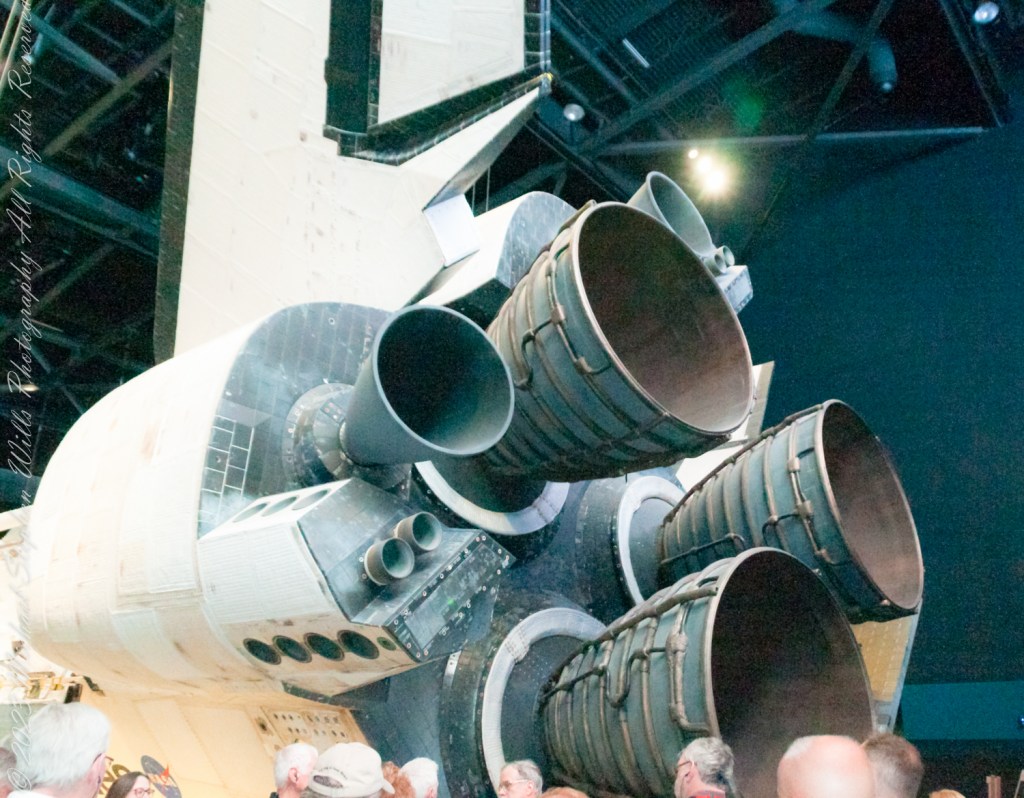
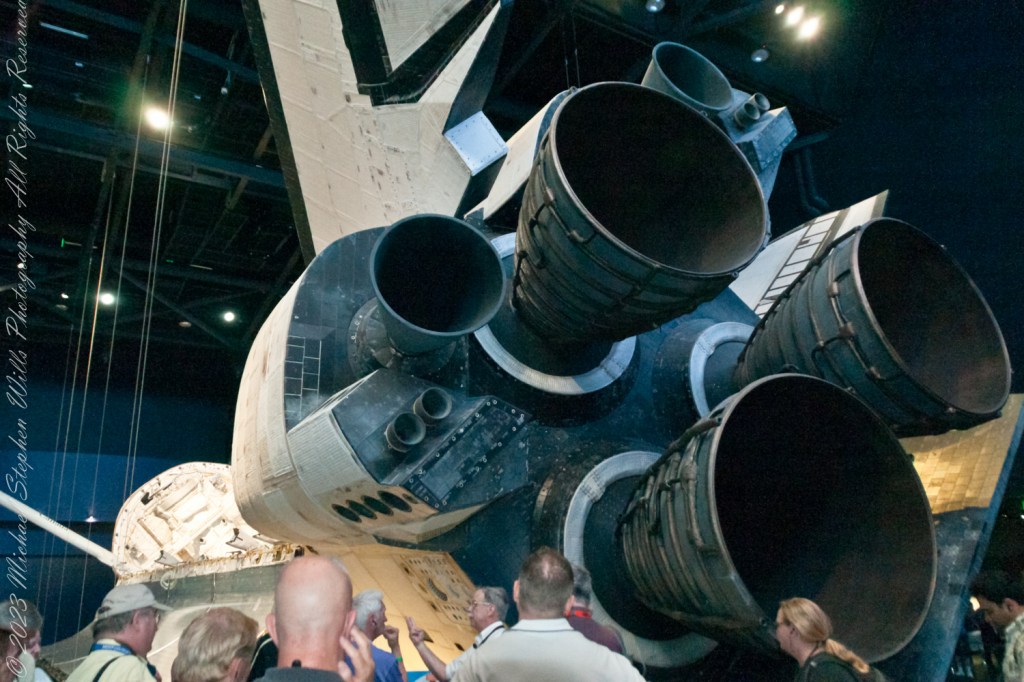
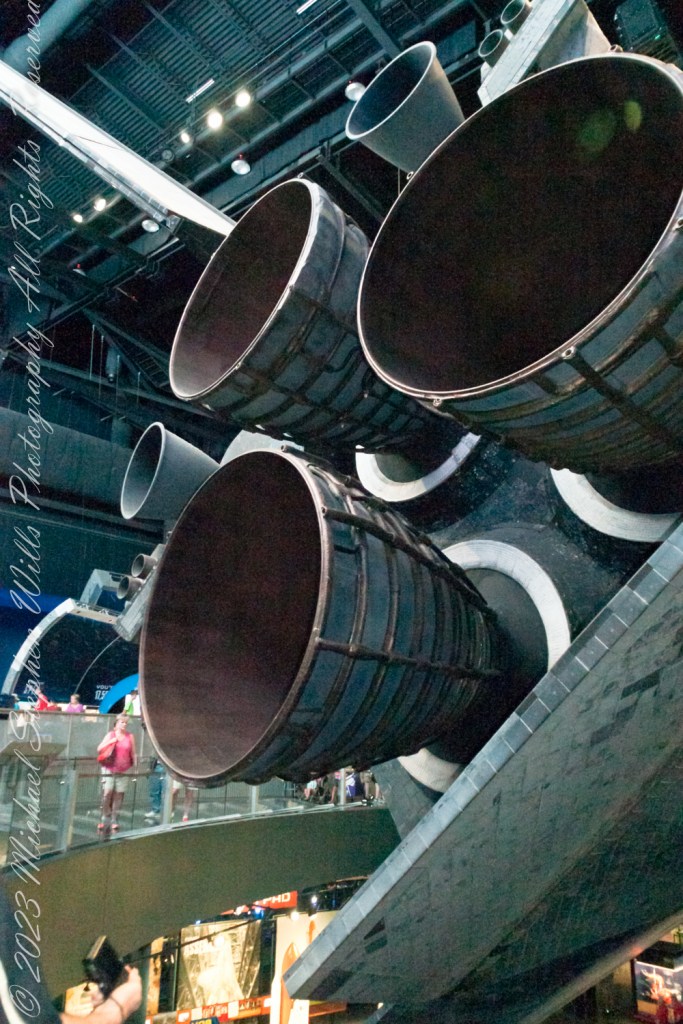
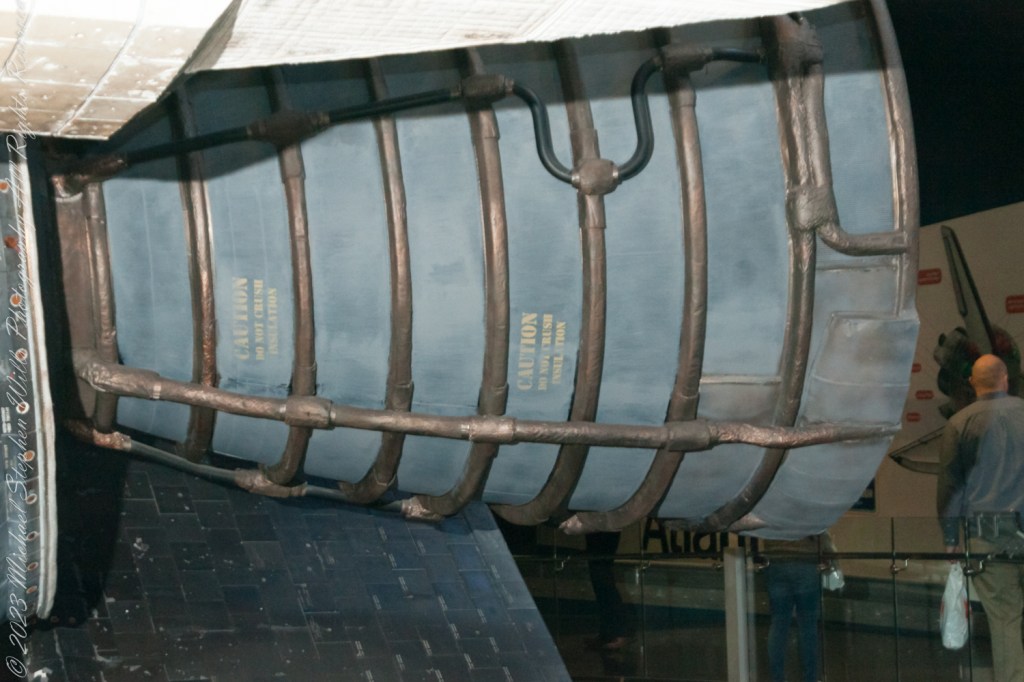
Step behind the scenes of space exploration with this dive into the awe-inspiring details of the Space Shuttle Atlantis, its thermal-protected wings to the onboard engines.
Imagine, if you will, stepping onto the grounds of NASA, where the air buzzes with the legacy of space exploration and the spirit of human achievement. It’s a place where dreams of the cosmos turn into reality. Our 2017 Launch Director tour not only brought us face-to-face with the marvels of space travel but allowed me to delve into the intricate details of one of NASA’s most iconic spacecraft: the Space Shuttle Atlantis. In this episode 6 of our adventure, we continue exploring the engineering marvel that is Atlantis, focusing on its wings, rear stabilizer, and onboard engines—elements critical to its legendary missions.
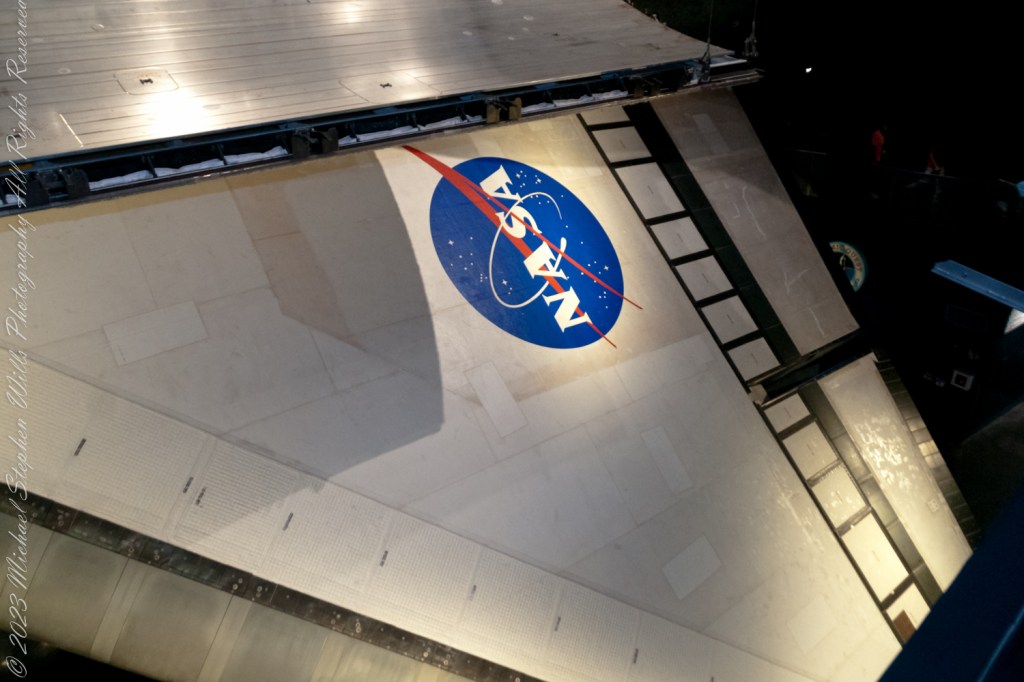
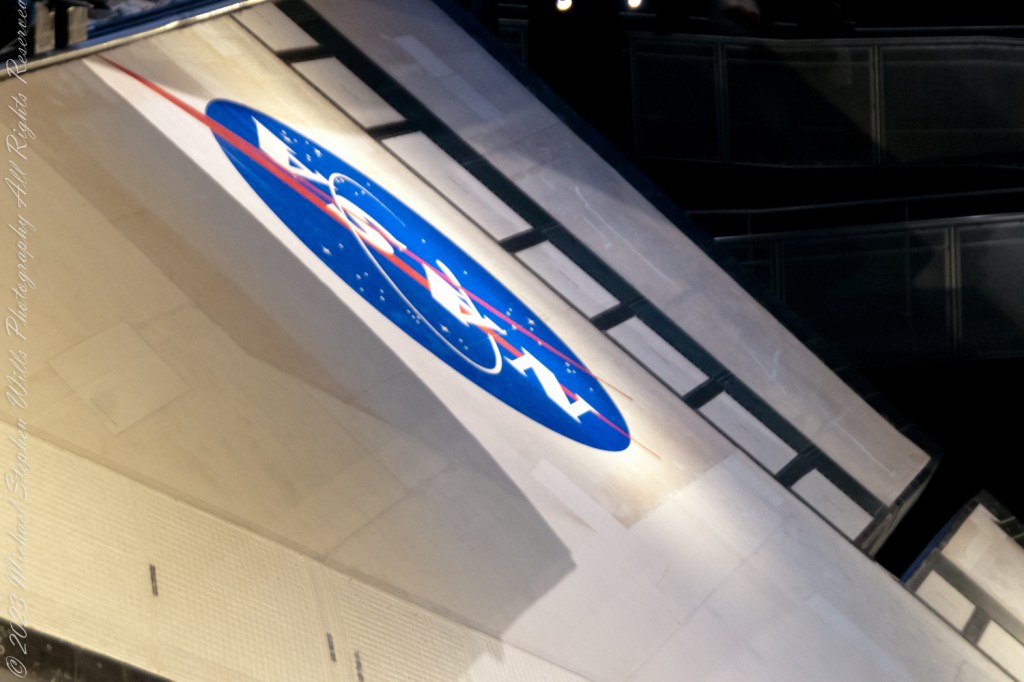
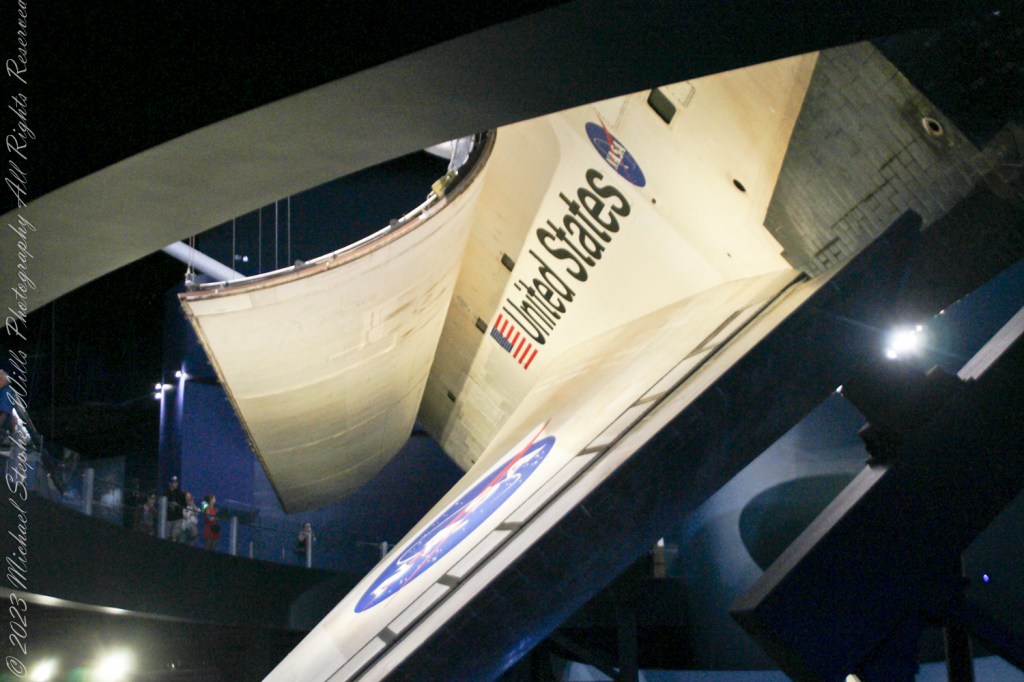
Atlantis delta shaped wings
The Space Shuttle Atlantis, a name synonymous with discovery and exploration, represents a pinnacle of human ingenuity. As you walk around the Atlantis exhibit, you can’t help but be awed by the shuttle’s design, particularly its wings. The wings of Atlantis, with a wingspan of about 78 feet, are not just structures of metal and composite materials; they are the shuttle’s lifeline during re-entry into Earth’s atmosphere. These delta-shaped wings are designed to withstand the scorching temperatures of re-entry, allowing Atlantis to glide back to Earth with grace and precision. The material covering the wings, known as the Thermal Protection System (TPS), consists of thousands of heat-resistant tiles and reinforced carbon-carbon panels, safeguarding the shuttle and its crew from temperatures exceeding 1,650 degrees Celsius.
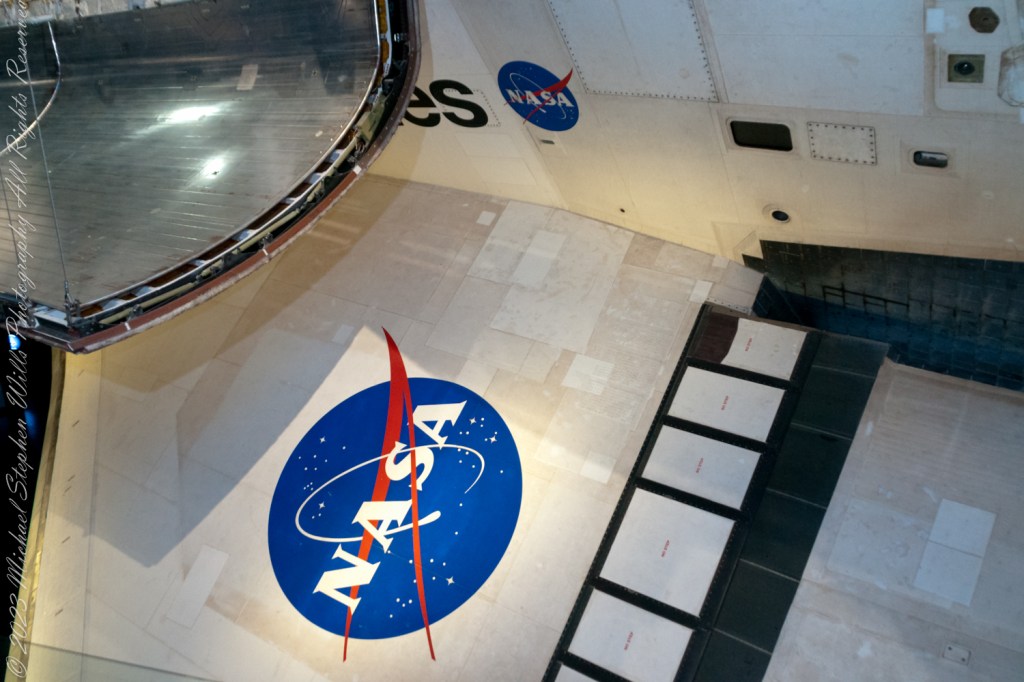
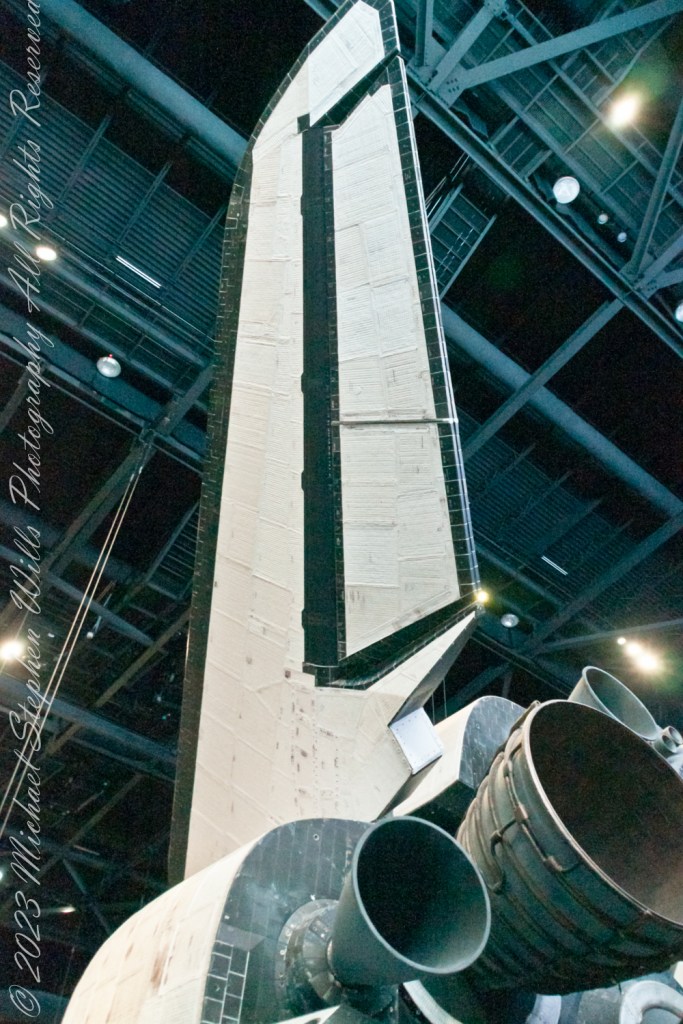
Atlantis Stabilizer
As your gaze shifts towards the rear of Atlantis, the vertical tail fin, or the rear stabilizer, commands attention. Standing about 17 feet tall, this stabilizer is more than just a rudder; it’s a critical component for maintaining the shuttle’s stability during the different phases of its mission. During the launch, it helps keep the shuttle on course as it ascends through the atmosphere. In space, it plays a minimal role, but upon re-entry, it becomes vital again, ensuring the shuttle remains stable and oriented correctly as it descends through the atmosphere, allowing for a safe landing.
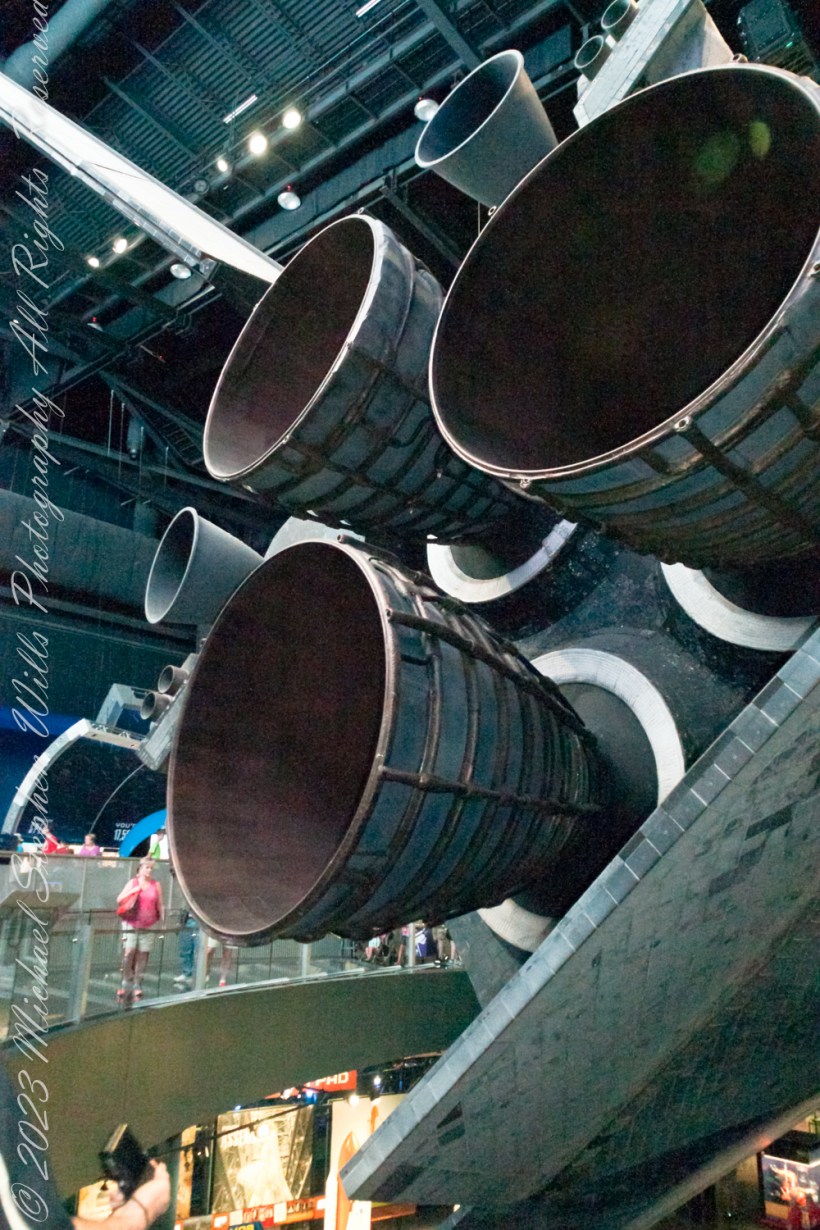
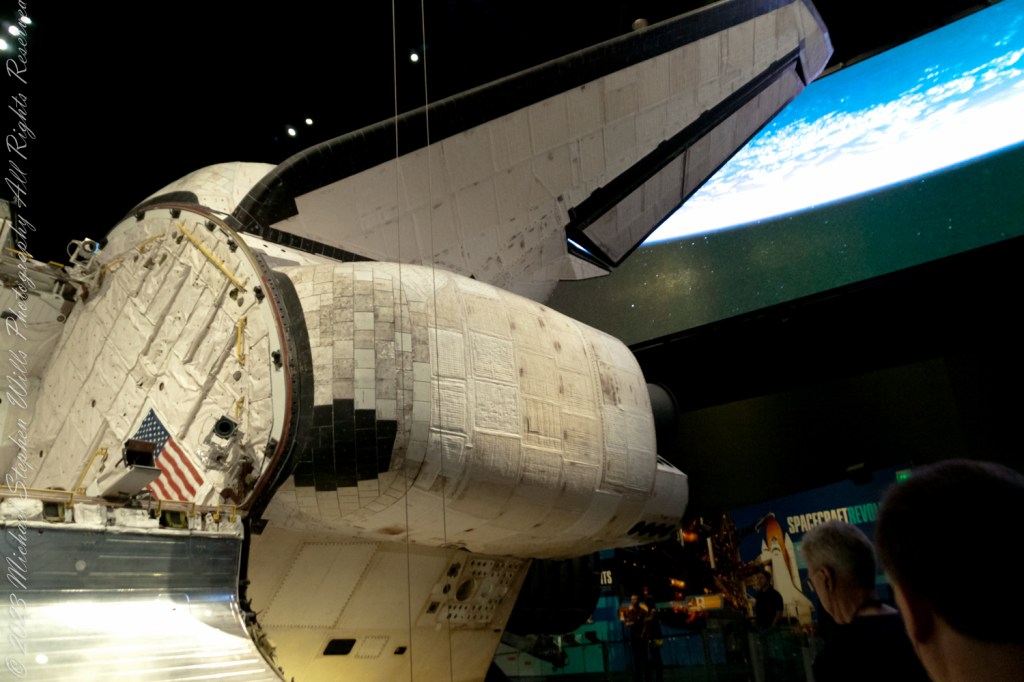
Atlantis Onboard Engines
In this exploration of Atlantis, after the wings and stabilizer, we encounter the heart of the shuttle’s propulsion system: its onboard engines. The Space Shuttle Main Engines (SSMEs), three in total, are marvels of engineering, capable of producing a combined thrust of over 1.2 million pounds. These liquid-fueled engines play a crucial role in propelling the shuttle from the launch pad into orbit. What’s fascinating is their ability to throttle up or down depending on the phase of the launch, providing the precise amount of power needed at any given moment. The engines are fed by the External Tank, the only part of the shuttle not reused, which carries the liquid hydrogen and liquid oxygen needed for combustion. Upon reaching orbit, the Orbital Maneuvering System (OMS) engines take over, allowing Atlantis to navigate the vacuum of space with finesse, adjusting its orbit and facilitating the meticulous maneuvers required for satellite deployment or docking with the International Space Station.
Walking away from the Atlantis exhibit, what stays with you is not just the sight of this magnificent spacecraft but an appreciation for the ingenuity and dedication that went into its design. Every wing, every tile on the stabilizer, and every roar from the engines tell a story of human curiosity, the drive to explore beyond our confines, and the relentless pursuit of knowledge. The Space Shuttle Atlantis is more than a machine; it’s a symbol of what humanity can achieve when we dare to dream big and work tirelessly towards those dreams. So, as you look up at the night sky, remember the wings that carried our dreams, the stabilizer that kept us on course, and the engines that propelled us into the unknown, reminding us that the final frontier is not so final after all.
Copyright 2024 Michael Stephen Wills All Rights Reserved
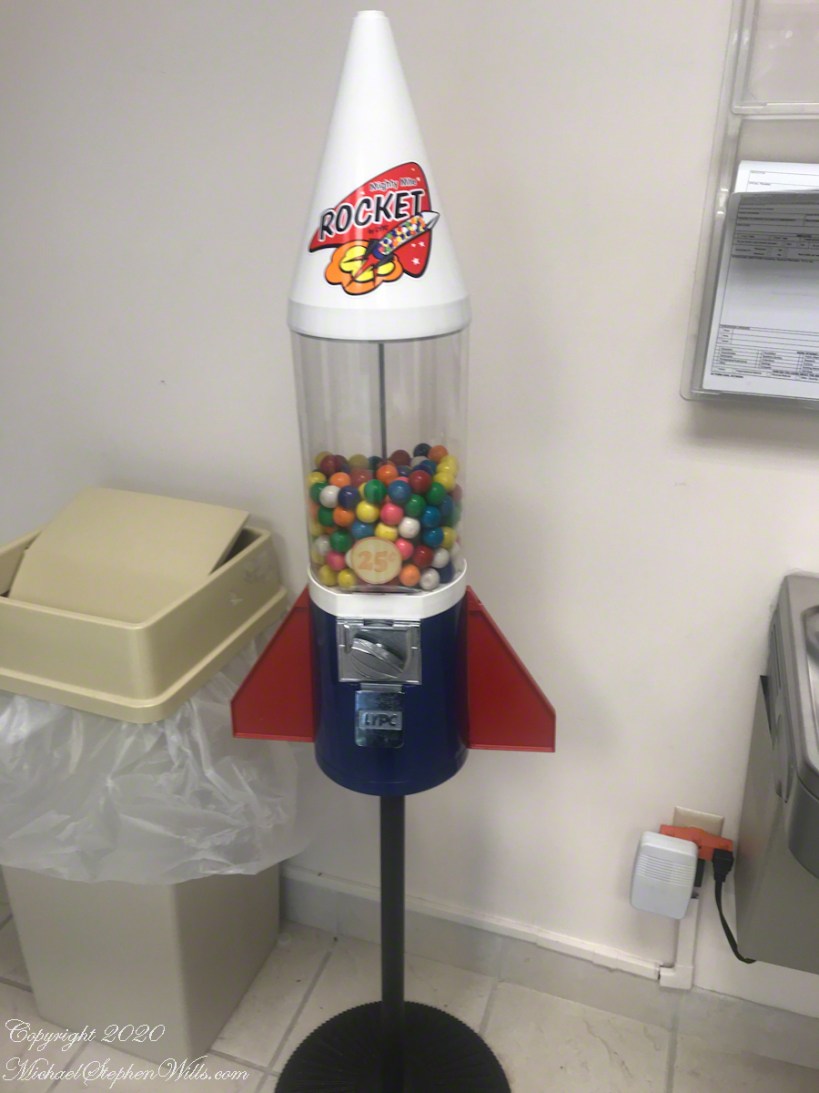
Waves built from onshore wind, fast, steady overnight, through the day from early morning until sunset. Pam and I adapted with a revisit to the Sands Space History Museum, Cape Canaveral just outside the Air Force Station. Click this link for a previous posting, “Cape Canaveral Lighthouse,” first of a series. This post header is a vintage gumball machine from the lobby.
By sunset the waves were roaring. Viewing from the safe distance of our condo porch we spied two surfers incredibly among the waves, taking rides. Waiting and attempting a ride. You can see for yourselves the two tiny dots of humanity, appearing and hidden among the waves. I spot them first and Pam does not believe me, I do not blame her. It is beyond my comprehension people are out there. I cannot recommend the quality of the video from my IPhone, our comments are humorous.
It is difficult, Pam is astounded when they come into view.
He rises briefly only to wipe out in this brief video.





















 Michael Stephen Wills Photography