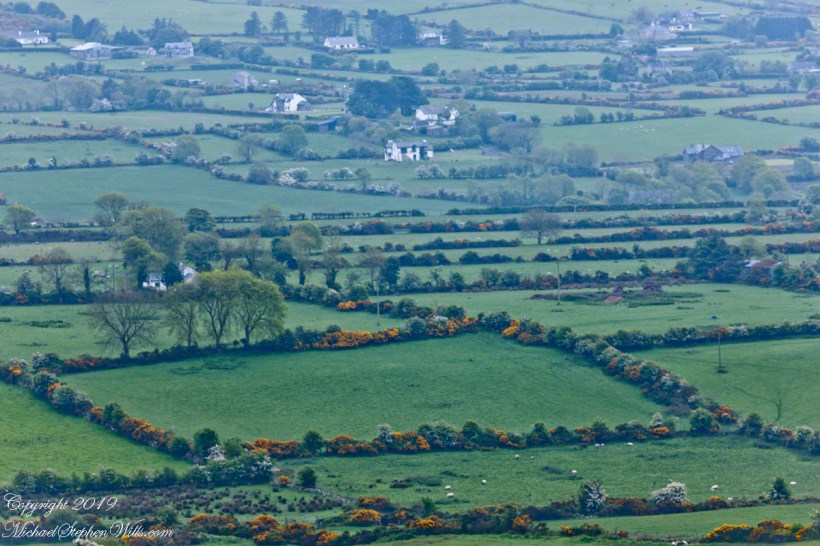
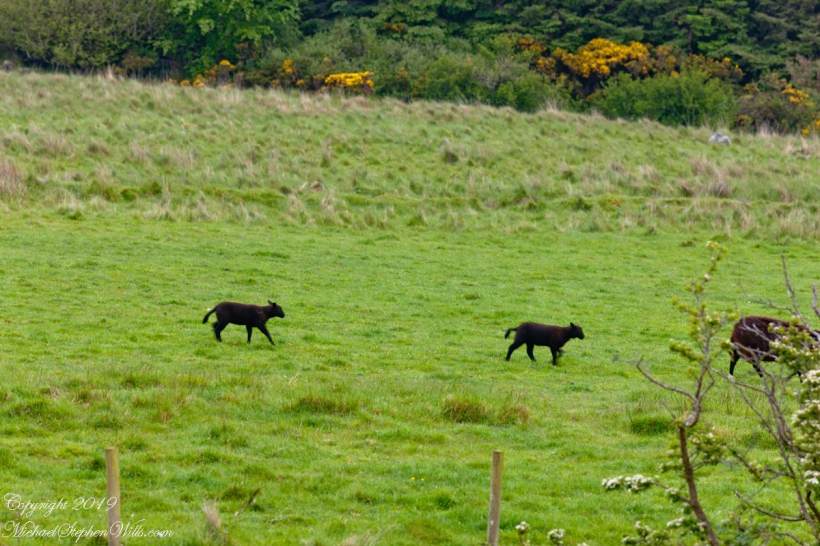
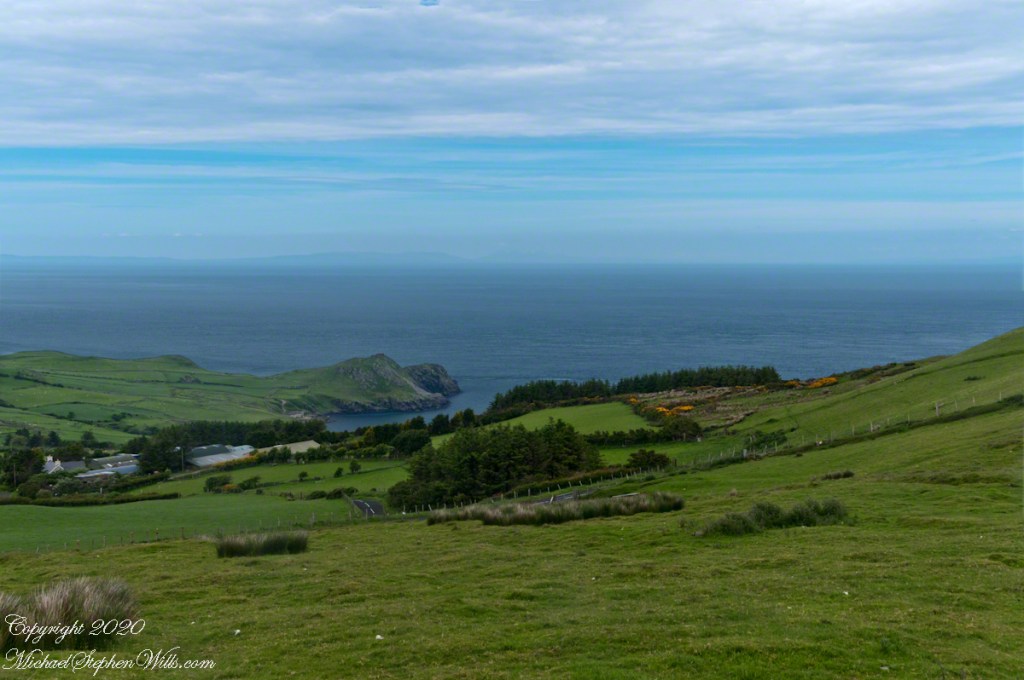
The road runs high on the shoulder of Slievenaglog peak, the 200 mm lens peers into the next townland over, Ballycoly (or Ballygoley), the valley floor broad, pastured.
Click photograph for a larger view. To do this from WordPress Reader, you need to first click the title of this post to open a new page.
Ballycoly Farmlands from Slievenaglogh
This is the seventh and last of a series using the Canon EF 200mm f/2.8L USM lens.
Here is a recap of recent posts with the 200 and 24 mm lens. Can you tell the difference?
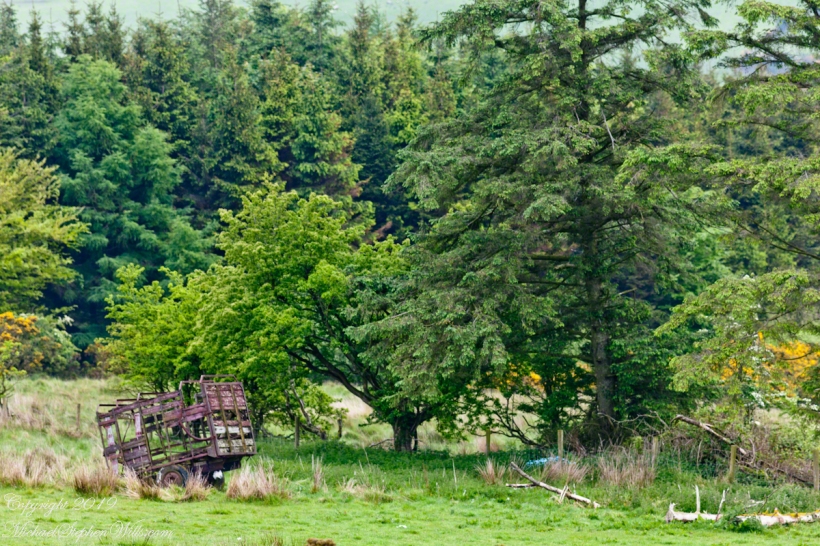
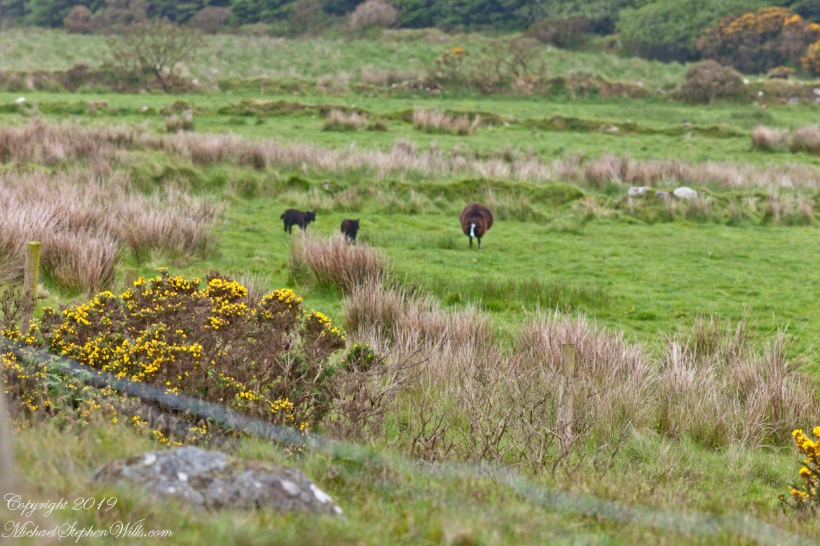
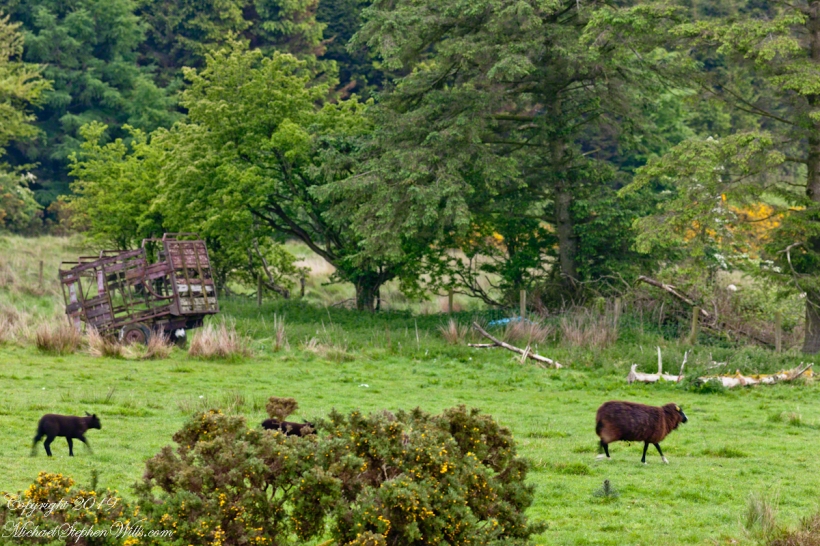
Quickly moving sheep pass the hay wagon on May morning, early. A great start to this week.
Click photograph for a larger view. To do this from WordPress Reader, you need to first click the title of this post to open a new page.
Ewe, Lambs with abandoned hay wagon.
This mountainside pasture is grazed by a flock of sheep alongside a long unused farm wagon. Slievenaglogh Townland, Cooley Peninsula, County Louth, Ireland.
This is the fifth of a series using the Canon EF 200mm f/2.8L USM lens.
Here is a recap of recent posts with the 200 and 24 mm lens. Can you tell the difference?
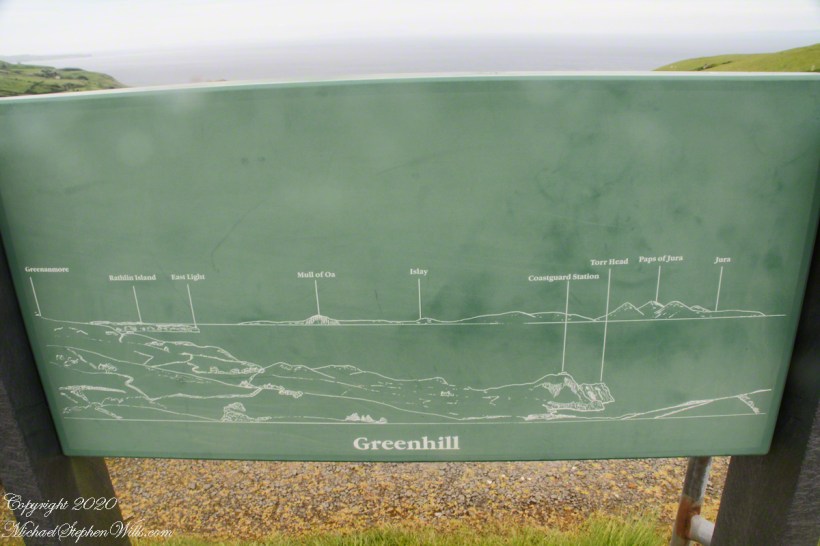
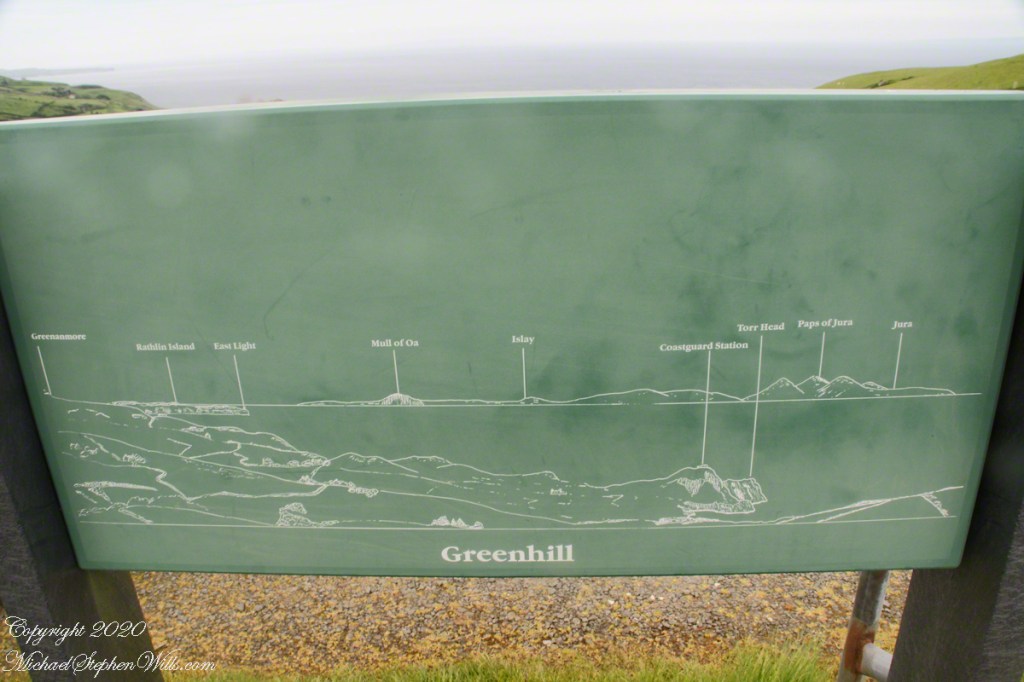
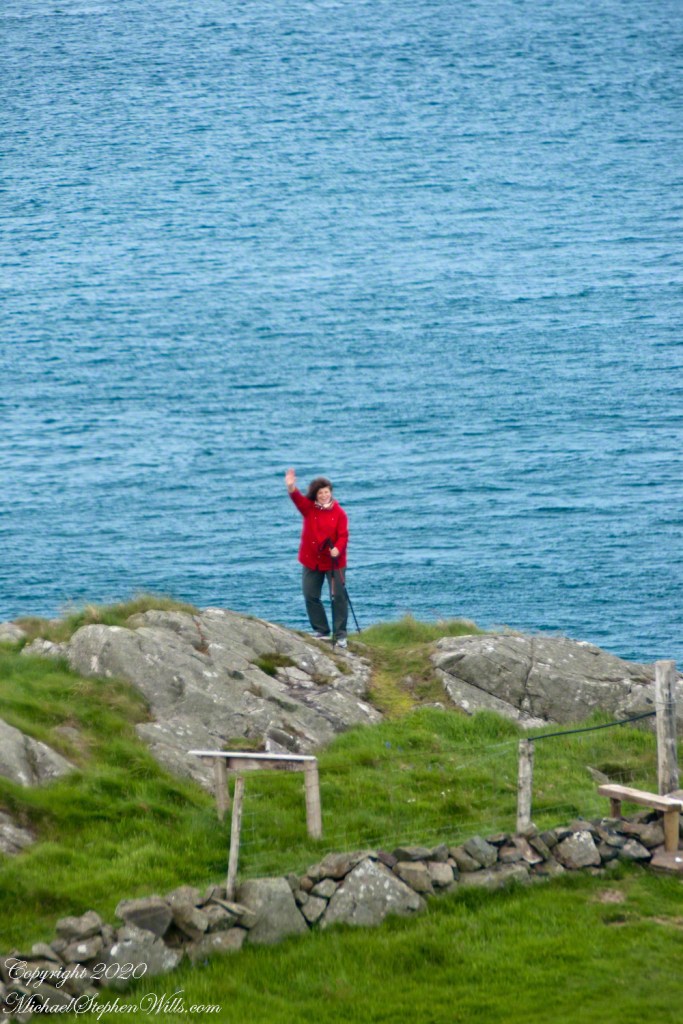
The view of the placard, to the north, starting left, Greenanmore is a height on Ireland, the site of a prehistoric passage tomb. Rathlin Island (with the East Light) is Ireland as well. Mull of Oa is on the Scottish island of Islay. A “mull” in Scotland is the same as a “head” or “point”. It turns out, the closest point of Scotland is the Mull of Kintyre, 12.4 miles across North Channel, is to the east. Islay is 27.4 miles north.
Click photographs for a larger view. To do this from WordPress Reader, you need to first click the title of this post to open a new page.
Pam was standing on the edge of the head, short for headland (“point” is another name for it). The Paps of Jura are part of the Isle of Jura, 40.7 miles distant.
Here is a gallery for easier flipping between photographs. To do this from WordPress Reader, you need to first click the title of this post to open a new page.
Copyright 2020 All Rights Reserved Michael Stephen Wills
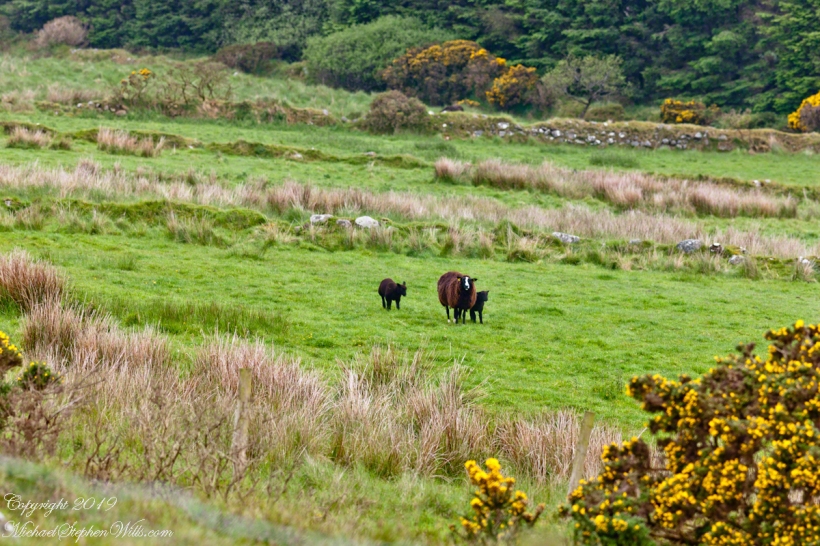
This breed may be a Balwen Welsh Mountain sheep, as it fits the description. When the ewe caught sight of me, she hightailed it for cover, the lambs followed.
Click photograph for a larger view. To do this from WordPress Reader, you need to first click the title of this post to open a new page.
Ewe and Lambs
The Balwen is bred for meat and that is the rule in this area, the lambs are sold.
The description is of a black color with a white blaze on the face, four white “socks” and white on the tail. This individual is missing a white tale, so might be a Shetland and even more so as the others of the herd are white (Shetlands are a variety of colors), Shetland is common and the other rare.
These are on the hillside of Slievenaglogh Townland, County Louth, Ireland.
This is the fourth of a series using the Canon EF 200mm f/2.8L USM lens.
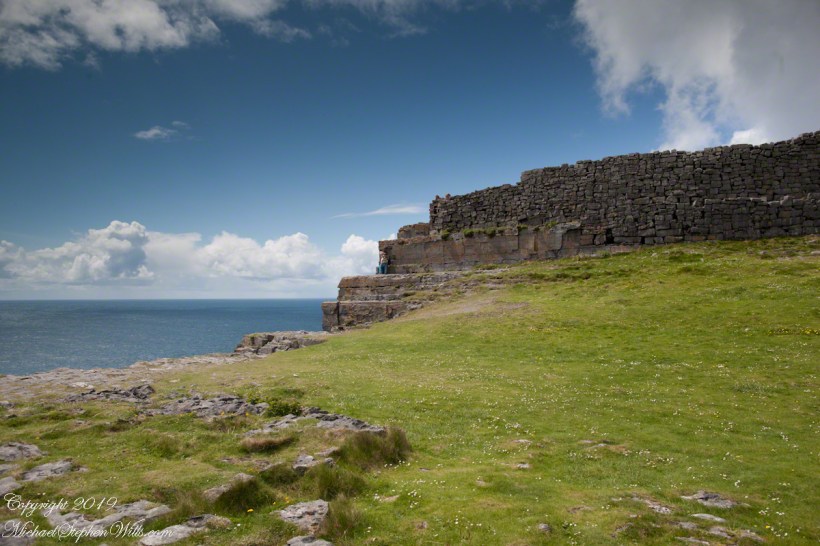
Here is the east side of the inner enclosure wall of Dun Aonghasa (Dun Aengus) where it ends at a cliff edge over the Atlantic ocean.
Visible are the last 60 feet or so of the limestone strata supporting the inner ring.
When first constructed, the inner ring was complete, the western side 1,000 feet from the cliff.. Today’s form of a semi-circle was created by nature when the force of Atlantic Ocean waves eroded the cliff, undercutting the strata.
Look close to see a fracture where the next block of limestone will fall into the waves.
Ancient fort wall with tourists and Cliff Edge of Dun Aonghasa (Dun Aengus)
Wishing a blessed All Saints Day (November 1st) for all my readers.
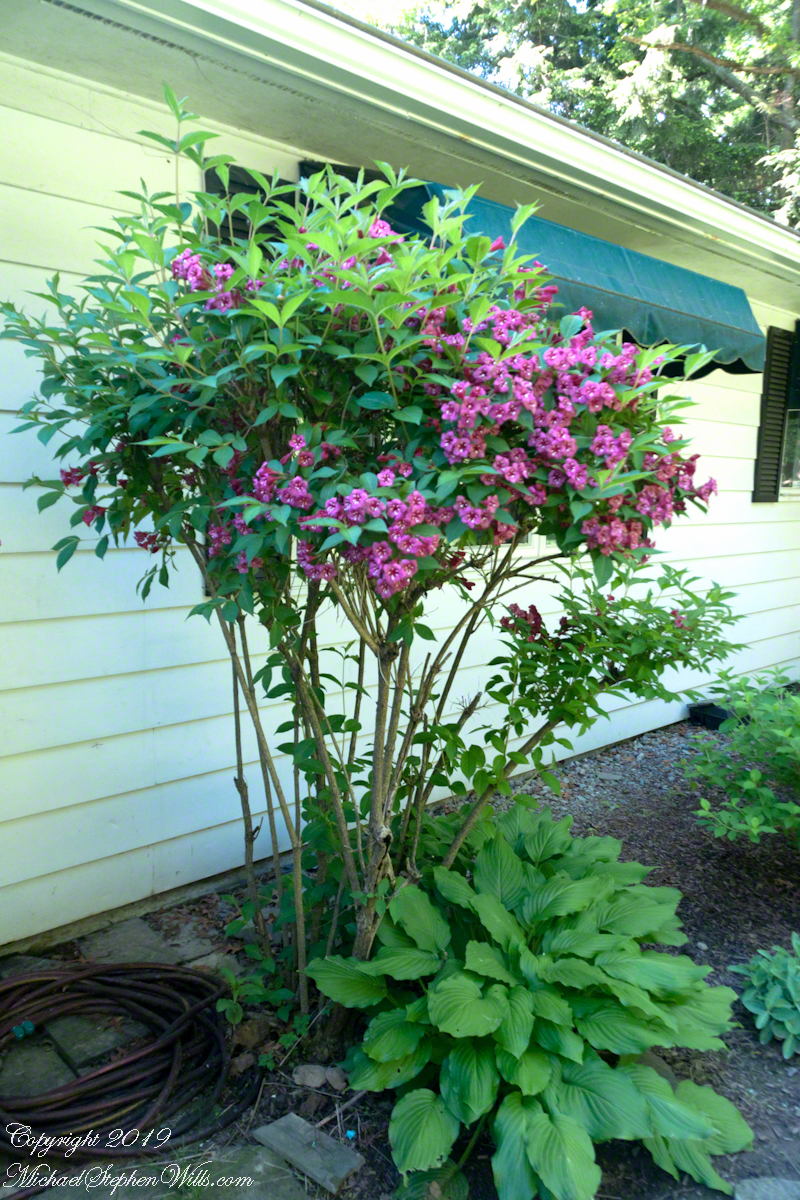
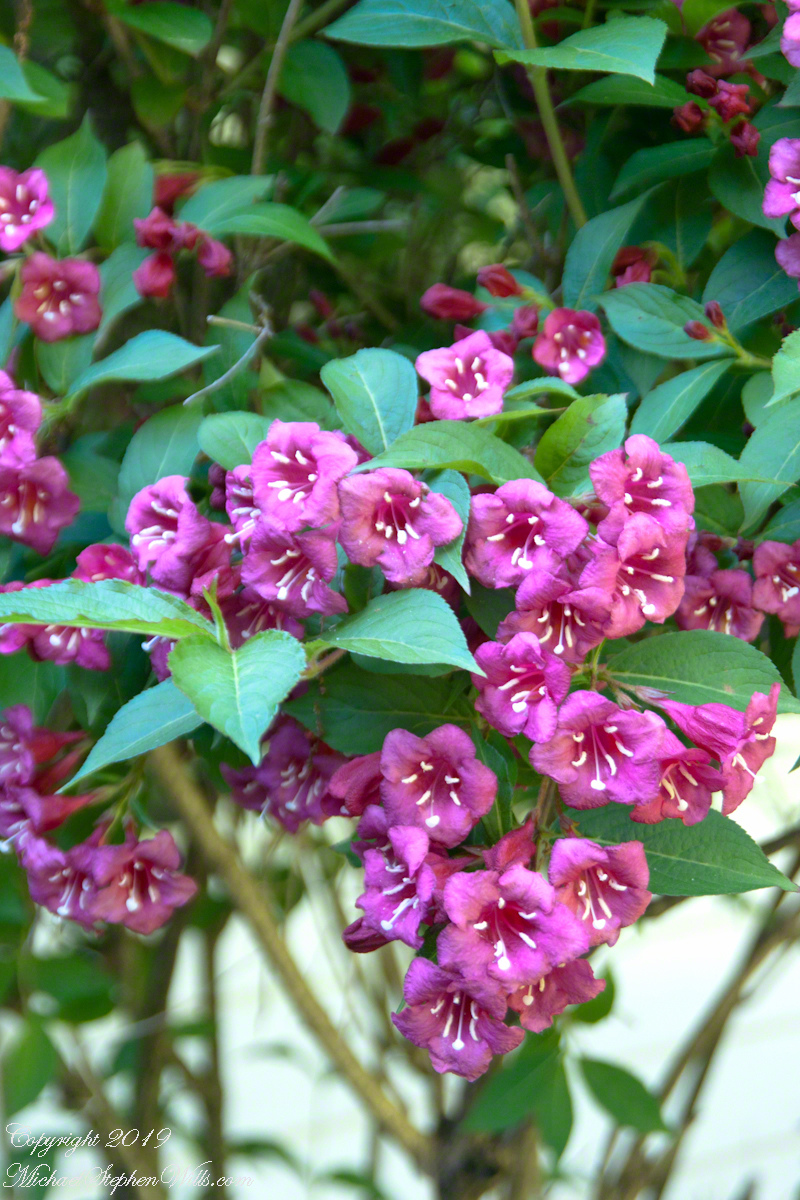
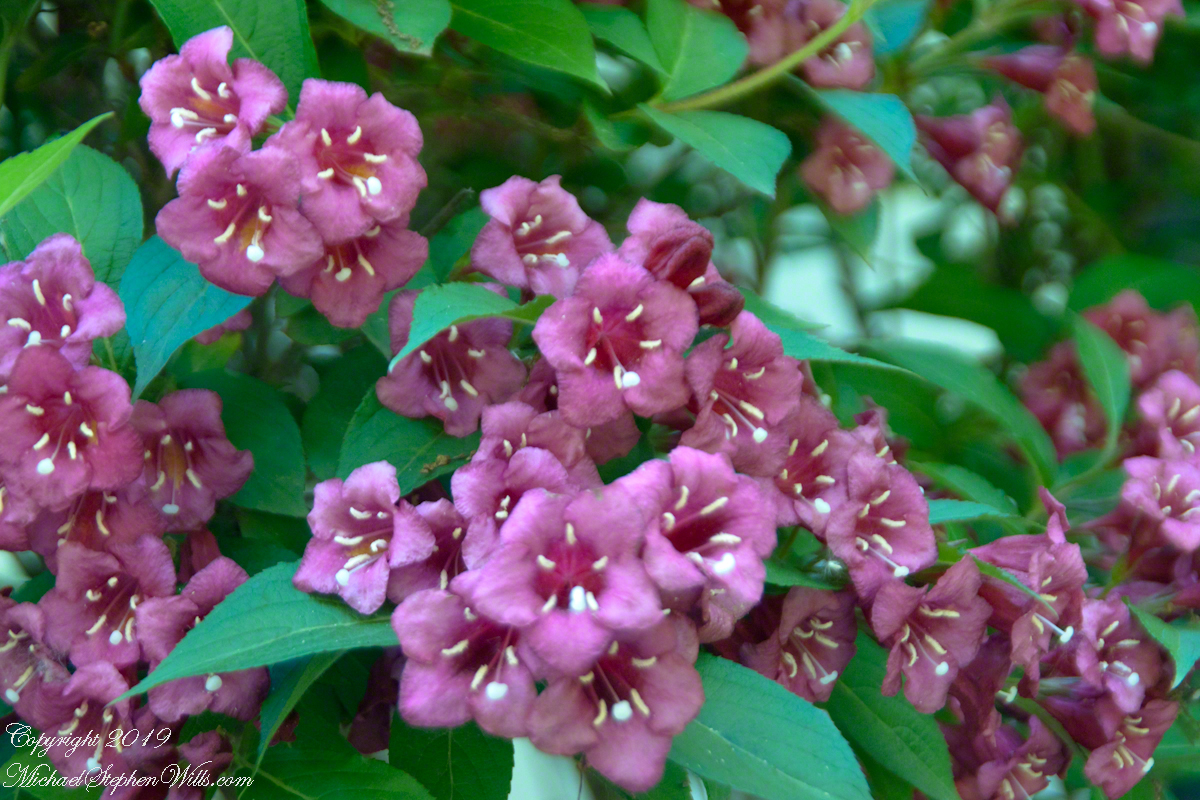
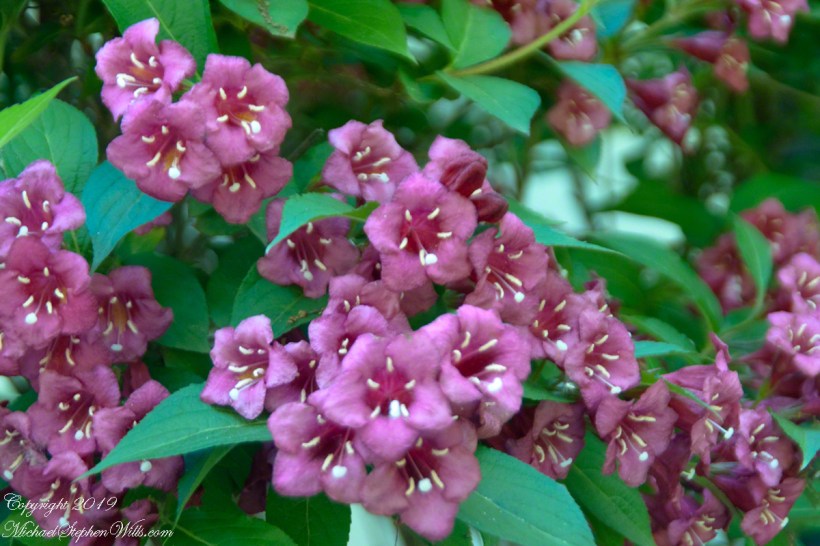
Thank you to the readers whose thoughtful responses appeared these past two days. Pam and I were caring for two grandchildren and, last evening after their Mom picked them up, I sat down with “The Botanical Garden” by Phillips and Rix, Volume I (2002, Firefly Books, Buffalo, New York and Willowdale, Ontario) and a sprig of the leaves and flowers and narrowed the choices to the genus Weigela of the family Caprifoliaceae.
Native to Asia (China, Korea, northeastern Siberia, and Japan), it was cultivated in France in the late 19th Century and is popular in cold climates, where it does well. These plants have been outside the kitchen window of our home for as long a Pam can remember (back to the 1960s).
I don’t know the exact species, it may be a hybrid of several. What identifies it is the overall growth pattern (tall, though we prune it down so the kitchen window view is not obstructed), the leaves (shape, come in pairs on opposite sides of the branch, tip is pointed and edges have teeth), the flower (tubular, 5 petals, 5 stamen shorter than the petals, 1 simple style with a capitate stigma). “Capitate” means it is round and on top of the style like a head. “Style” is an extension of the ovary though which fertilization by pollen happens. Ours is not fragrant, though some are.
SONY DSC
Weigela is the family name of a early professor of Botany (and Chemistry, Pharmacy, Mineralogy) for the university town of Greifswald on the Baltic Sea. There is a botanic garden and arboretum associated with the university and, I suppose, a specimen of the plant was collected for the garden where it is scientifically characterized by the professor.
Copyright 2019 All Rights Reserved Michael Stephen Wills
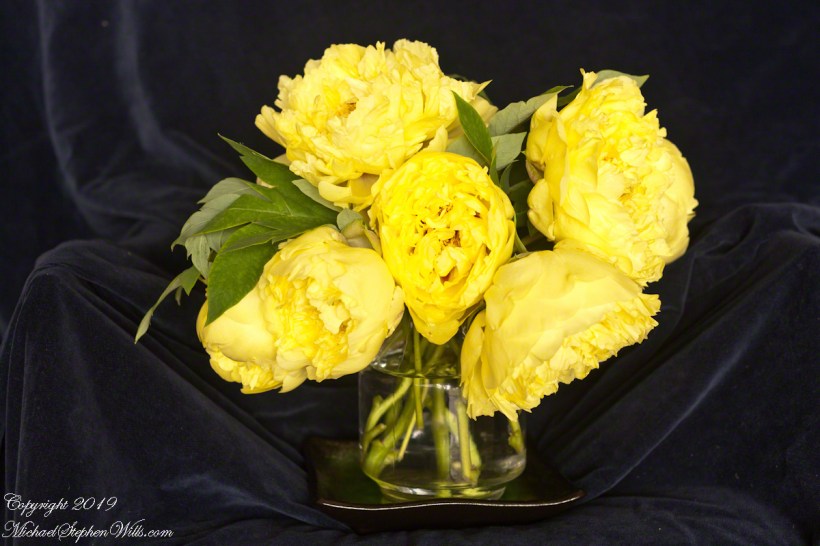
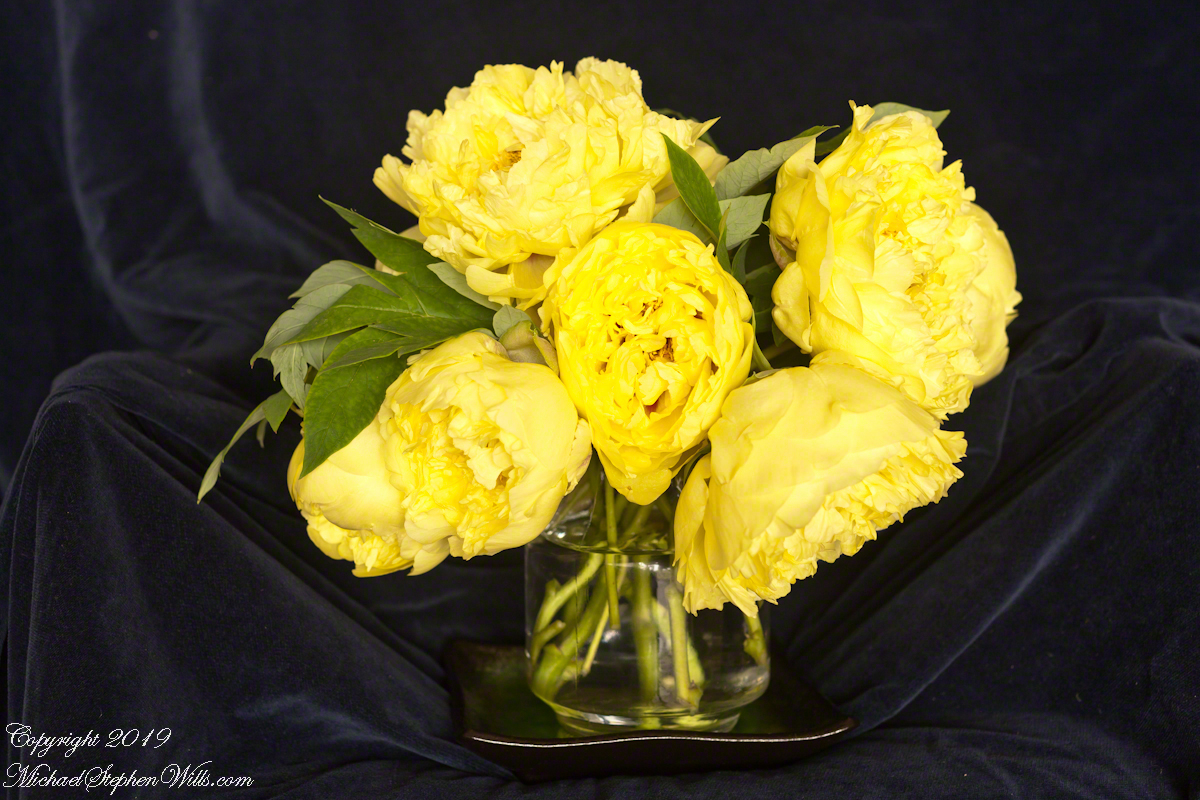
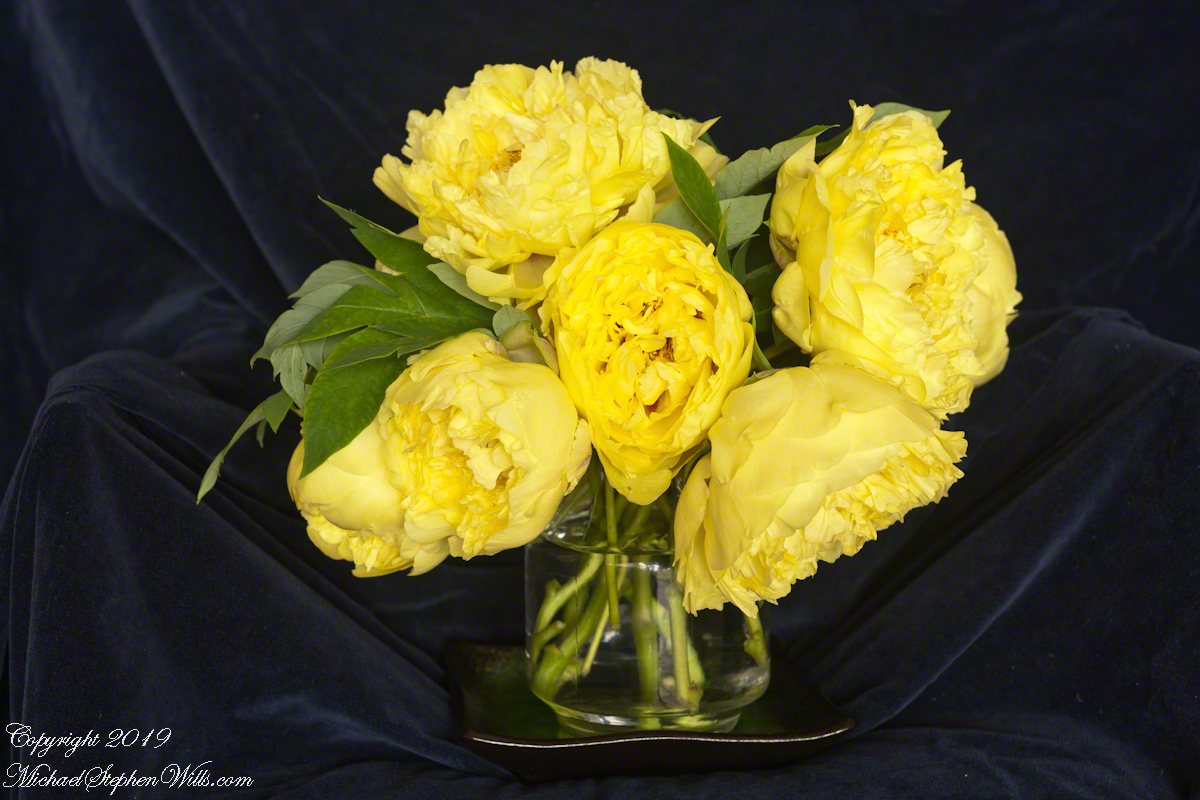
By way of personal inventory, our home has two types of woody peonies in different hues. Last posting I gave you red, au natural. Today, you get yellow in a studio setting, back-dropped by black velvet. There is a story behind that long sheet of fabric. Back in the day, a nephew of mine named Chris and I used to hang out together in the Catskills and Adirondacks. Later, I offered to photograph James, his first born. In preparation, I purchased this six foot length of fabric. It served well for that job and, since then, has done double duty as a wintertime cage cover for the parakeet.
This week, I told Pam our yellow wooden peony was in bloom. A largish bush of full leaves that tend to cover the drooping blooms, Pam harvested six blooms to created an arrangement. These “babies” look great against the black velvet.
Yesterday I used the Canon EF 100mm f/2.8 Macro USB lens and a tripod to capture the following two portraits of Pam’s Yellow Wooden Peony arrangement. In deference to the unanimous reader choice for crisp flower petals the following two versions differ in the crispness of the velvet backdrop.
My timing was fortuitous, last evening the petals started to drop. Pam reports 12 more blossoms are hidden in the bush, so we’ll have at least one more bouquet to enjoy.
Click either photograph for a larger version.
f 5.0 Black Velvet Backdropf 7.1 Black Velvet Backdrop
Copyright 2019 All Rights Reserved Michael Stephen Wills