Islands Zealous and Sombrero

Where the Andes Stride Into the Pacific

Want More?  Visit my OnLine Gallery.

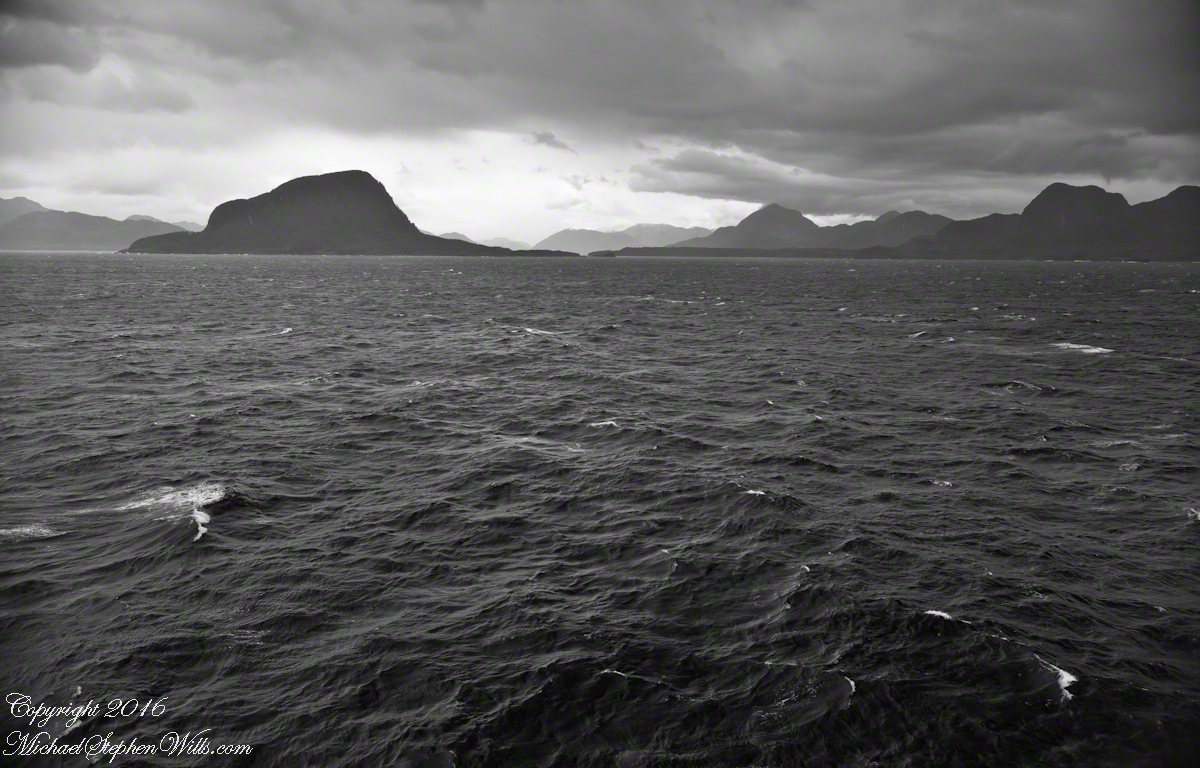
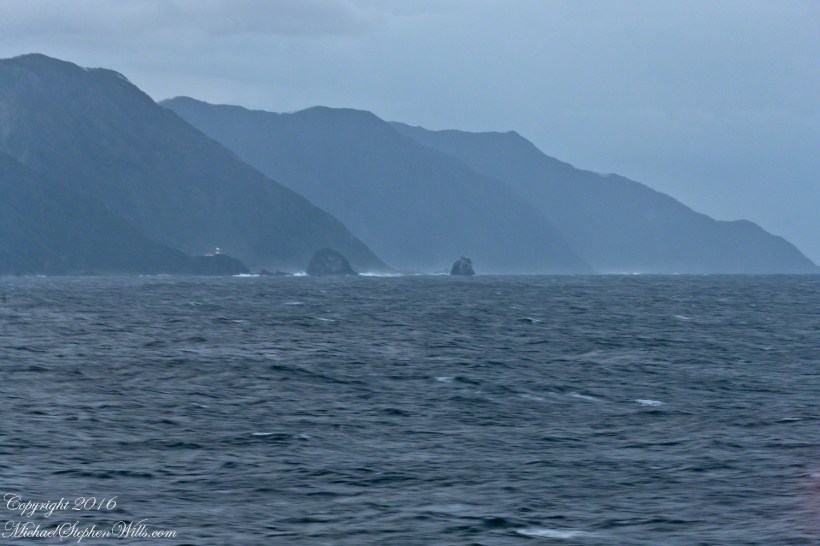
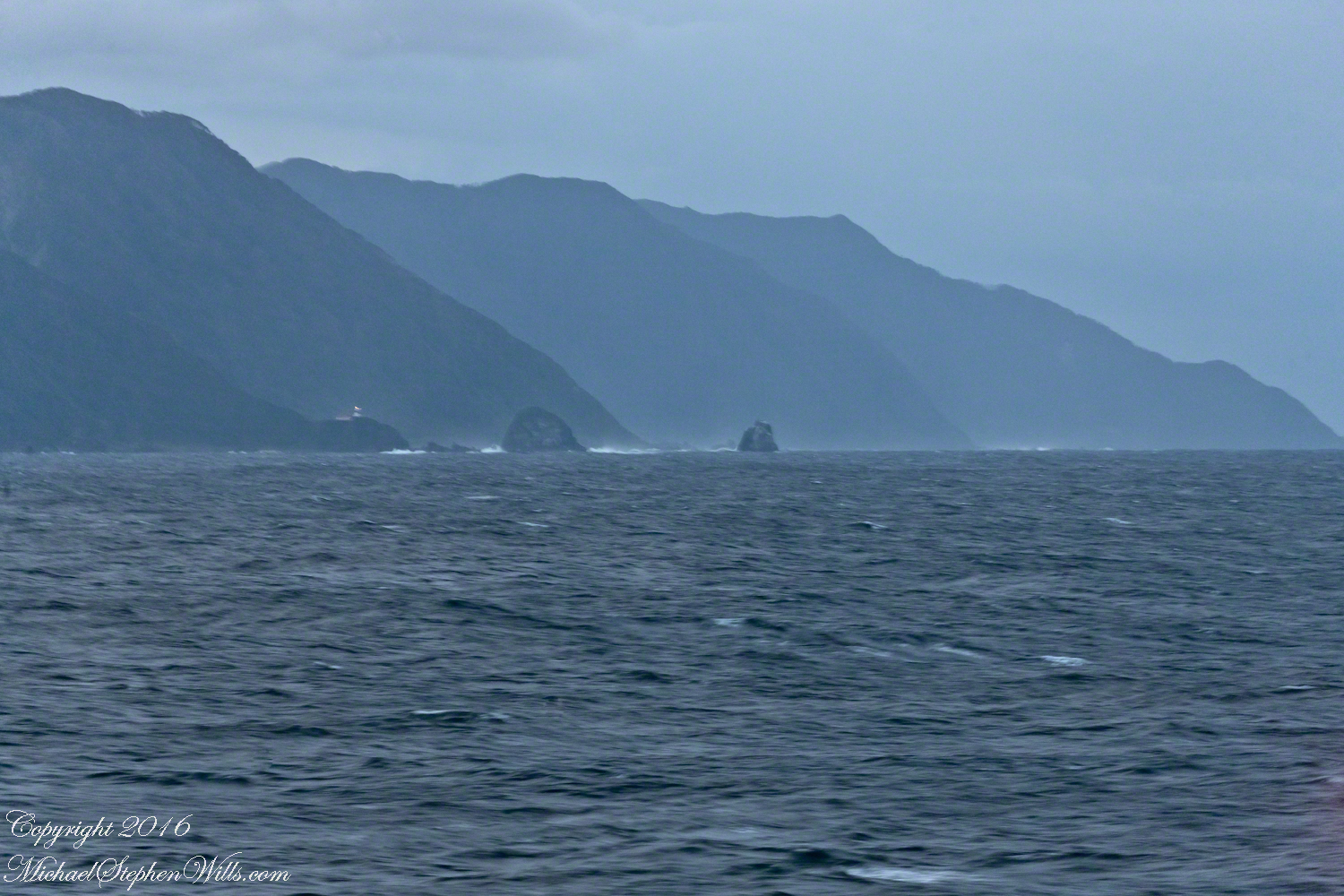
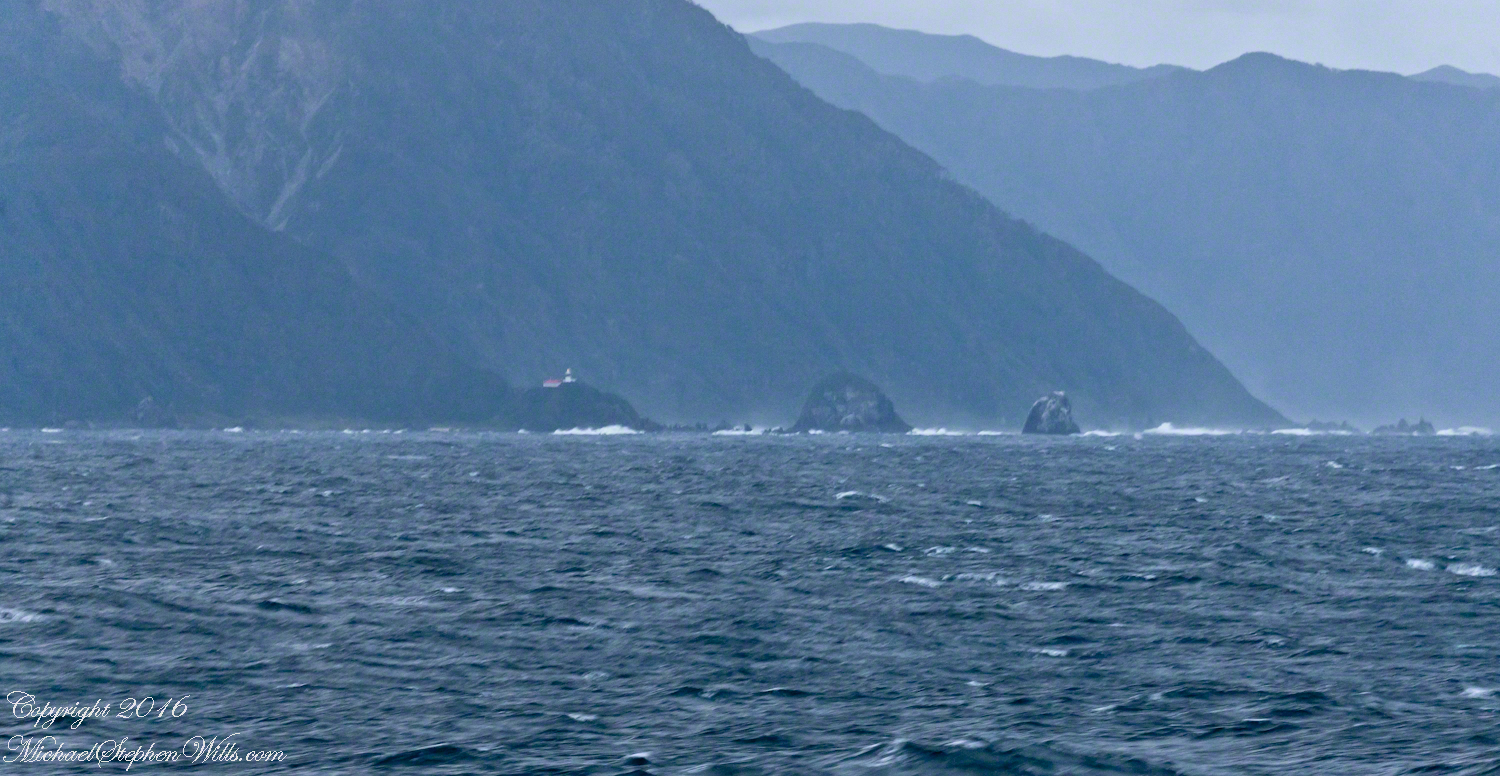
Islands Sombrero and Zealous
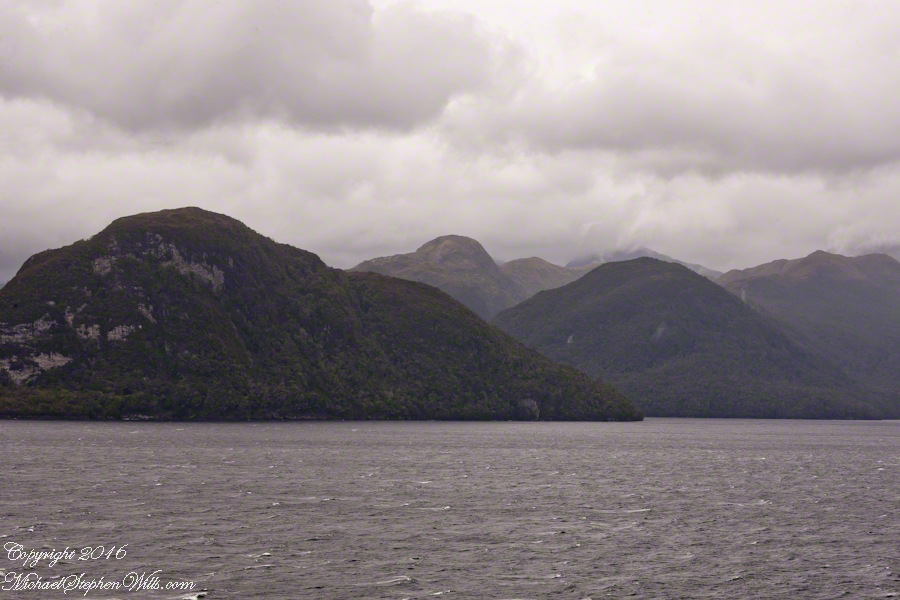
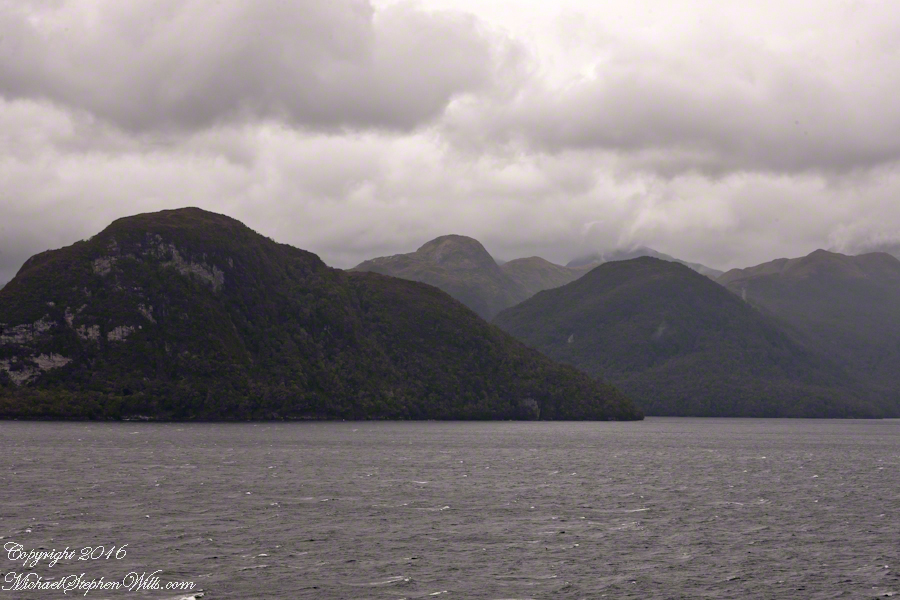
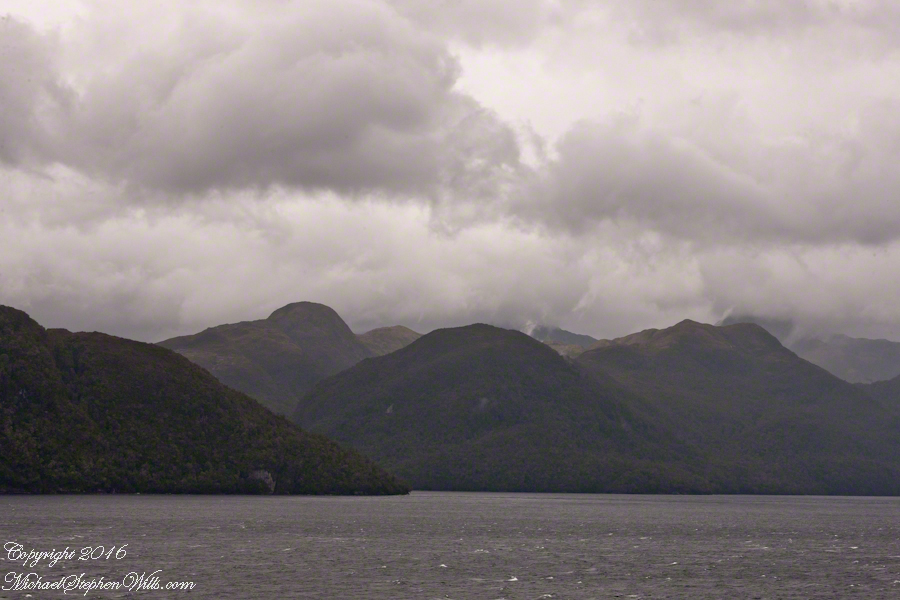
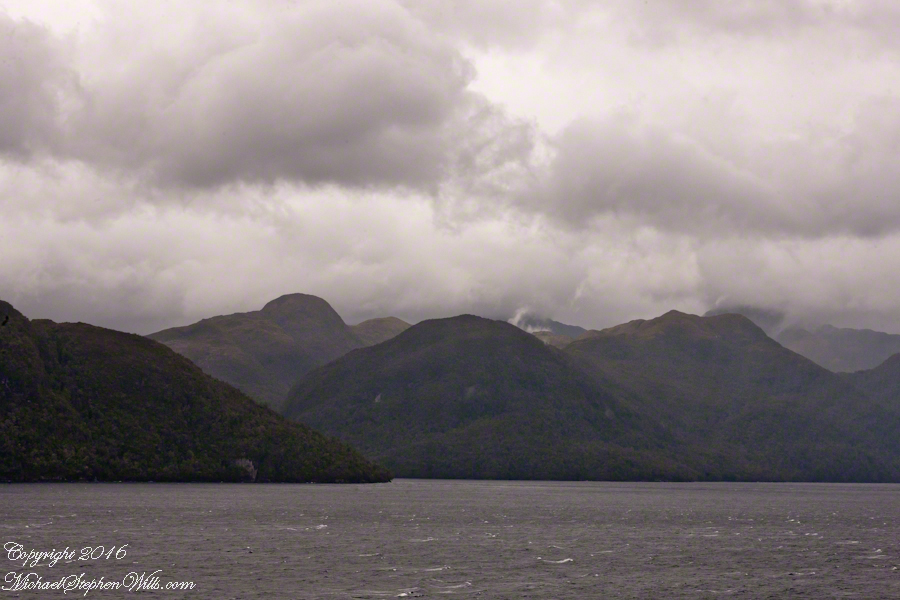
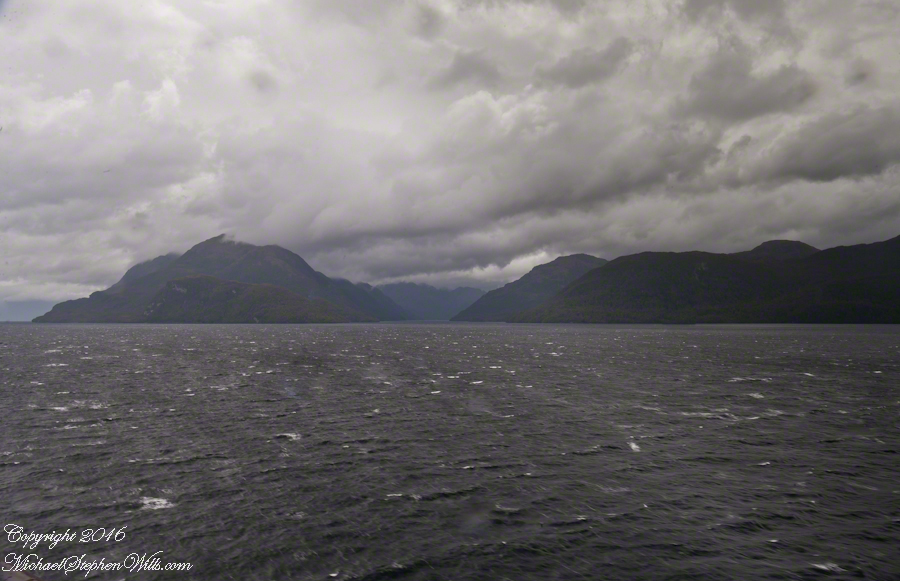
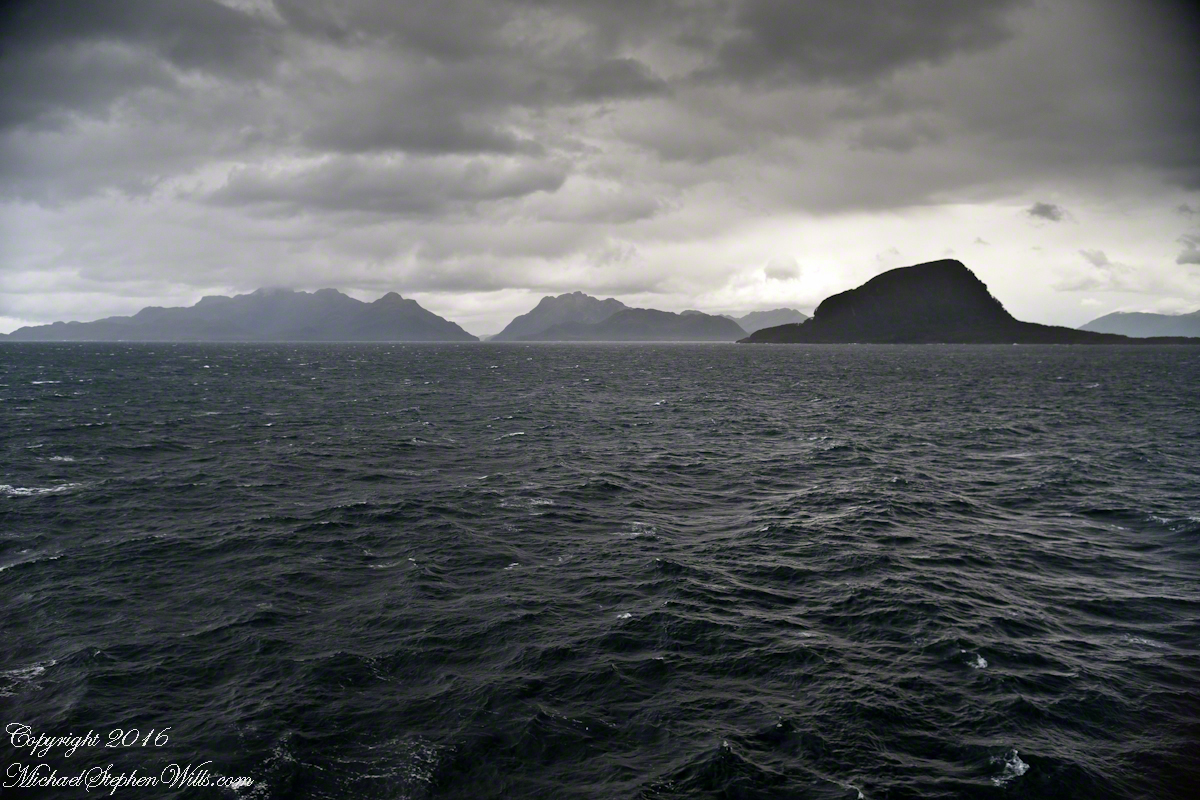
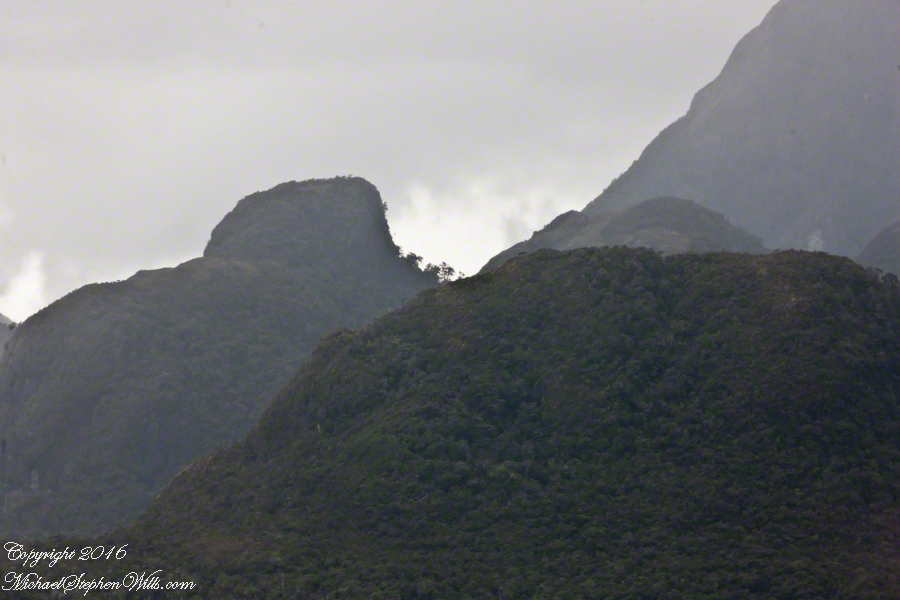
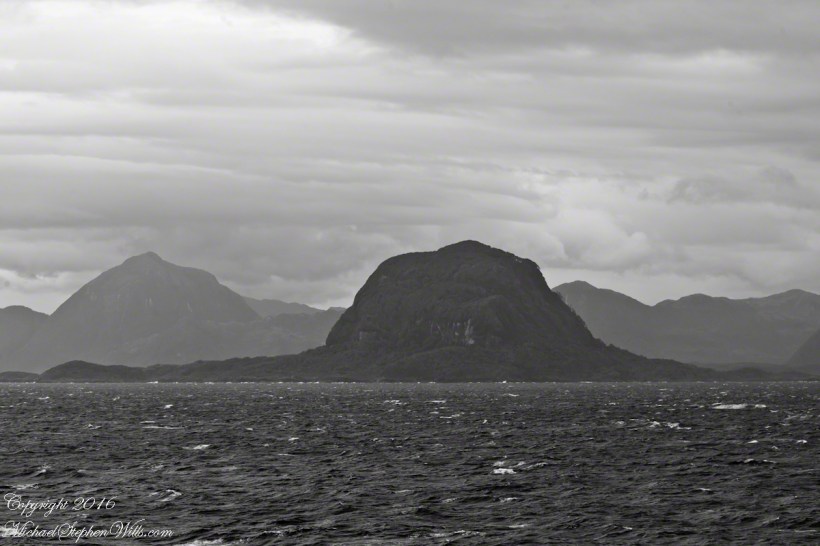
Islands Sombrero and Zealous In the distance are the crags of Porcia Island separated from Zealous Island, in the foreground, by Canal Cronjé (not visible). Sombrero Island is left, Zealous is the right.

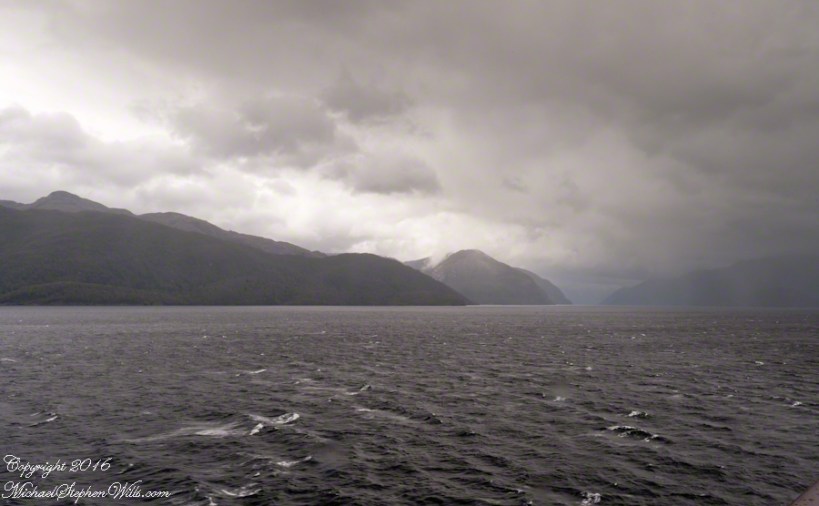
The Gulf of Penas is a sunken bowl of the western side of the southern Andes.  Instead of canyons and valleys, fjords surrounded by craggy peaks are the rule.  Sailing ships, driven by storms of the western Pacific, found ways through the fjords all the way to the straits of Magellan.  This was our route as we entered the Messier Channel, a route discovered in the earliest years of colonial exploration.

Looking back the way we came…..

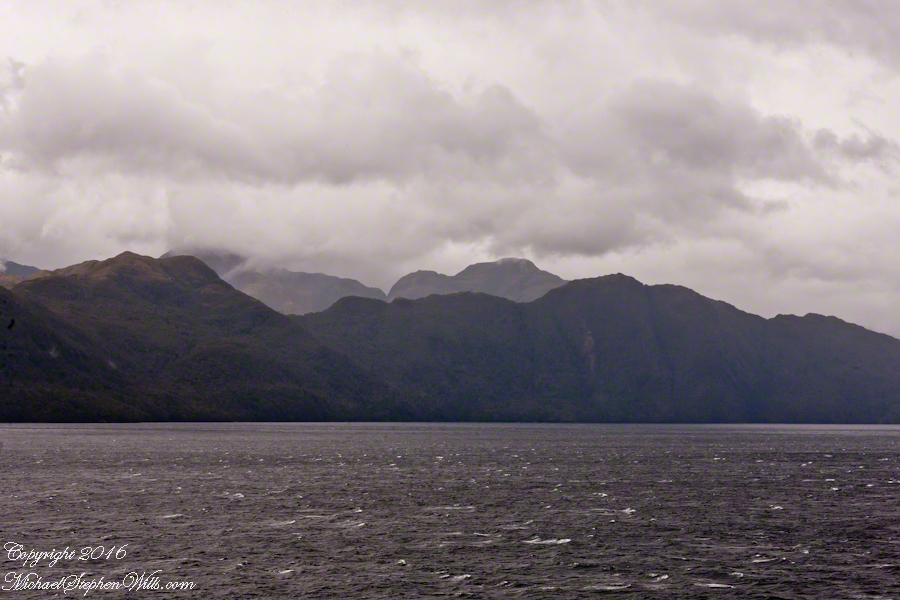
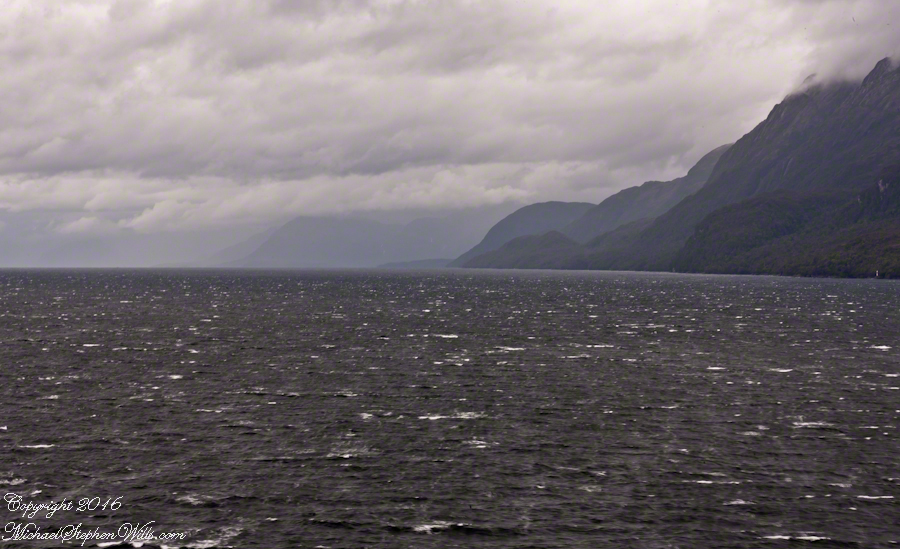
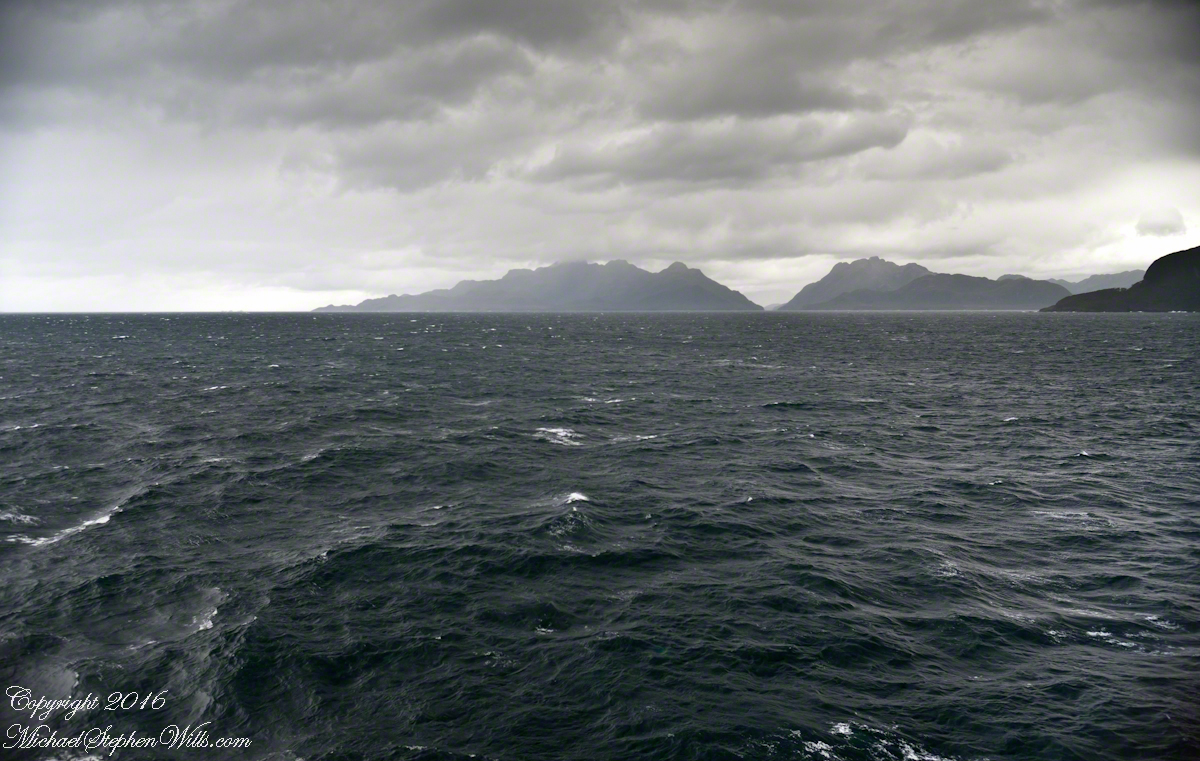
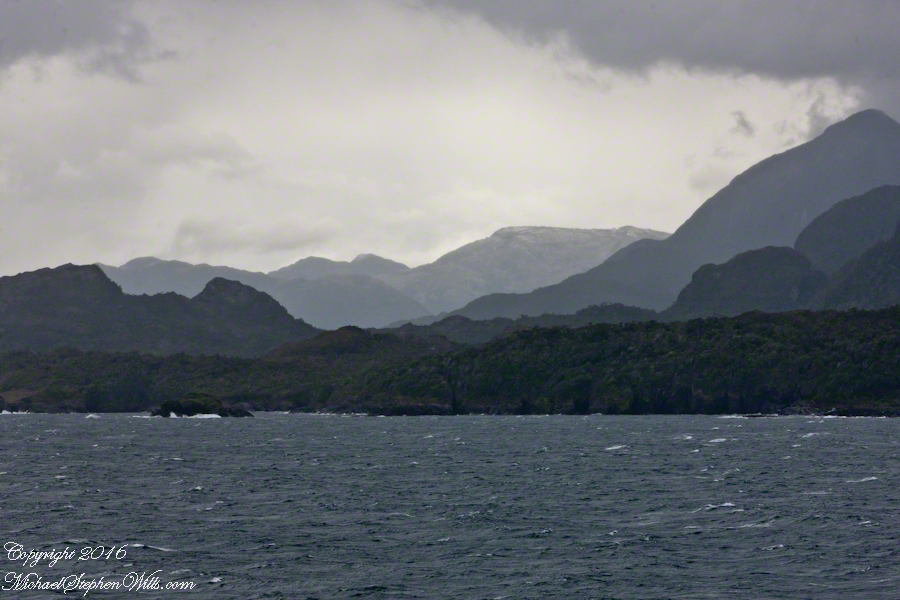
Peninsulas Larenas, Fresia, the Gulf of Penas
Peninsulas Larenas, Fresia, the Gulf of Penas The view is north-northeast from the entrance of the Messier Channel

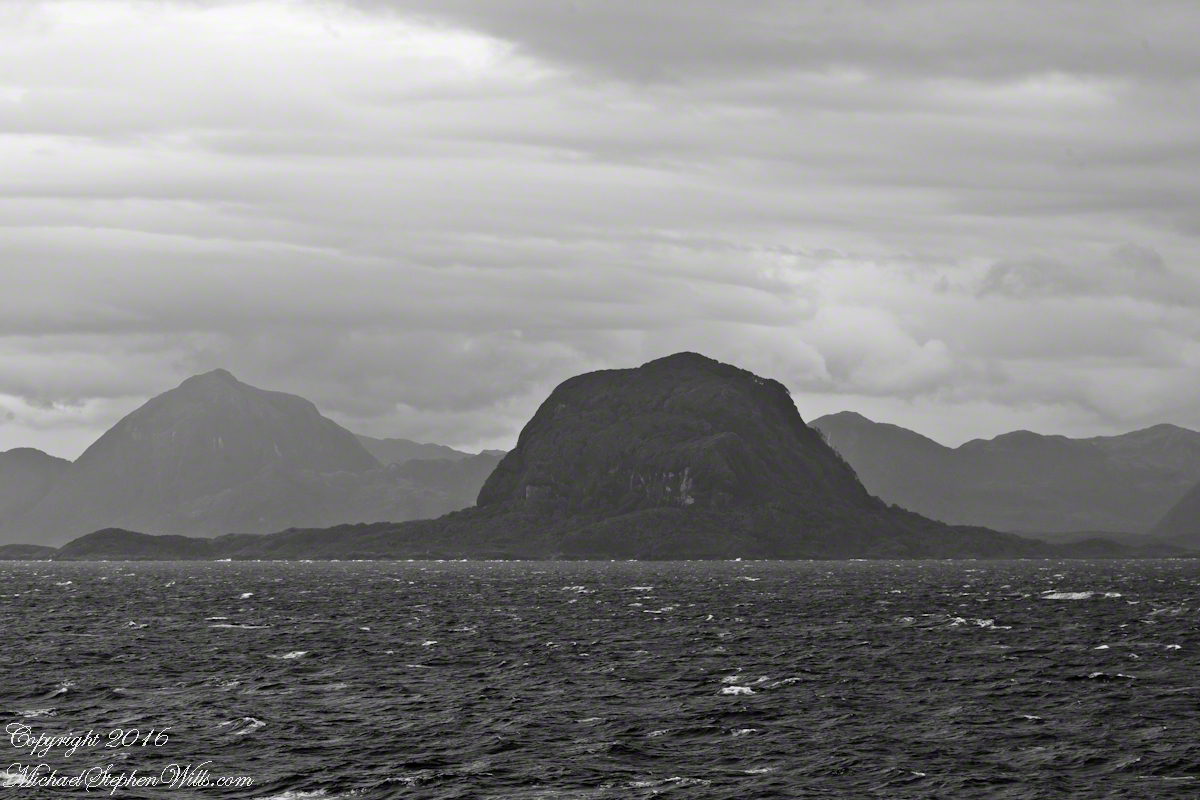
At the mouth of the channel, Zealous and Sombrero are neighboring, and isolated hills.  Surrounded by water, they are also islands.  Zealous is just under 2,000 feet.  Sombrero, at 200 feet, is prominent only for its position and shape.

Here we are crowded by headlands, points, islands all rising steeply from the water.

Here I have views of these islands with craggy peninsulas in the distance.  The view is to the northeast and east.

Sombrero Island
Sombrero Island, 200 feet tall, rounded by glacial erosion.
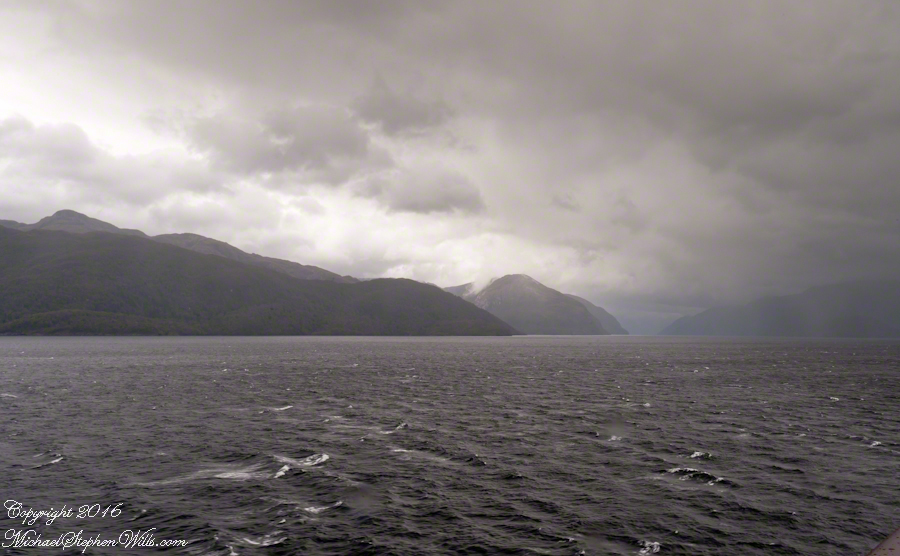
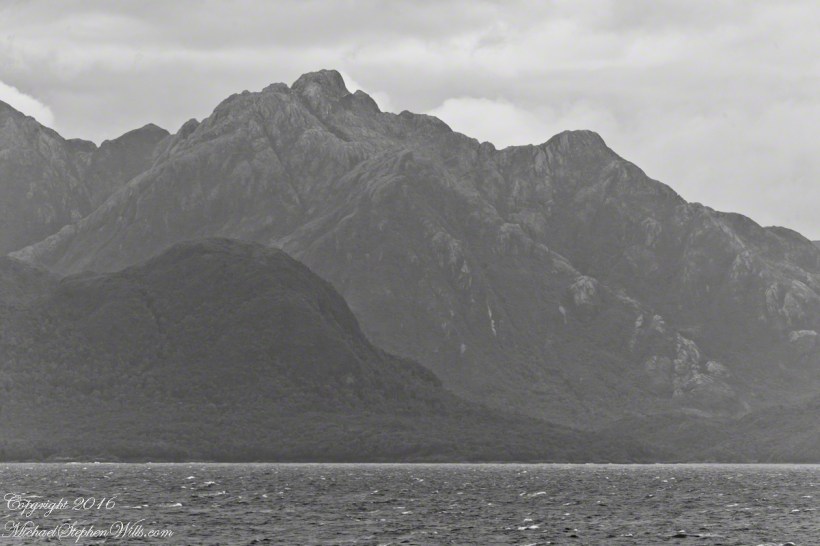
Sombrero Island, Peninsulas Larenas and Fresia
Sombrero Island, Peninsulas Larenas and Fresia The entrance to Fjord Eloise is in the distance where the two ridges separate. We are here sailing the Messier Channel.

Maritime Pilots, Scout Island, Scout Canal

About maritime pilots and the Chilean Fjords

Want More? Visit my Online Gallery

On our way to Fjord Tempanos and the Iceberg Glacier…..

Background: on a ship, facing the bow (front), starboard is right and port is left).

In the 8 miles from Tarn Bay and Sombrero Island lands press closer, higher, islands increase in number.  This is a listing of some of the islands we passed. These names reflect the history of Chile, the waves of immigrants touch the land with memories. After some of the names, below, I provide in parentheses the derivation.

On starboard was the northern Wellington Archipelago (English General): Pinochet (the Chilean dictator), Penguin, Juan Stuven (Spanish and German), Chang (the far east), Millar (German).

On port, the names have a military flavor: Zealous, Scout, Scylla (Sea Monster of Greek mythology), Alert, Orlebar (British Officer Augustus Orlebar).

These port side island names reflect what is on the minds of mariners as navigational options narrow with the channel.  Innumerable channels, points, mid-channel islets, all looking very much the same, a potentially confusing jumble.  Chilean maritime law demands ships have on board, working from the bridge, a certified Chilean maritime pilot to transverse the country’s dangerous channels and fjords.  The combination of stopping distance (multiple nautical miles) and the loss of steering when a ship moves slowly make it essential to know, exactly, the route ahead.  It was a Chilean maritime pilot who help keep us safe.

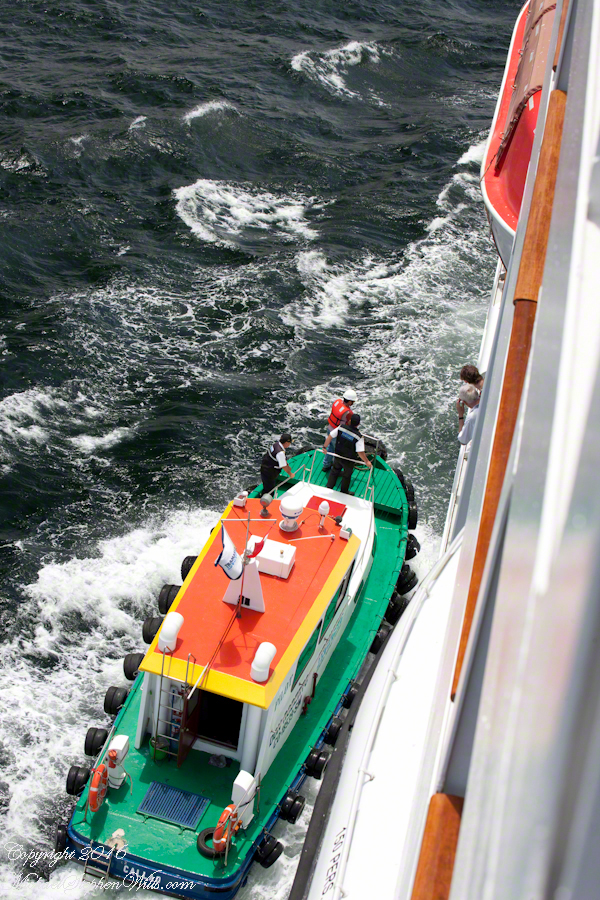
A great personal hazard for pilots is boarding the ship from the pilot boat.  From our stateroom terrace we observed fast pilot boats in all seas approach the Regatta miles from port, the pilot on the bow, pull up alongside.  Without a harness, the pilot transfers from boat to ship.  We observed this several times from our stateroom veranda.

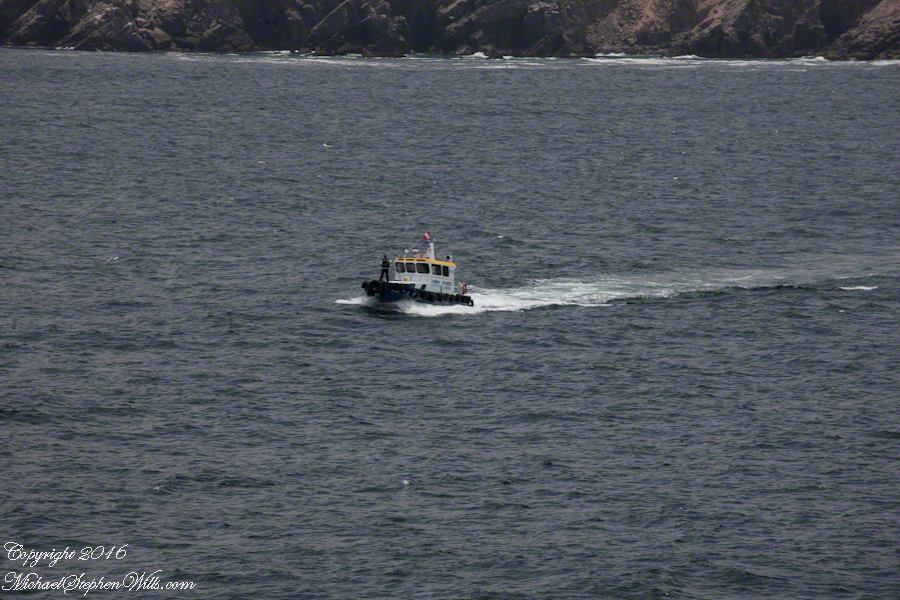
Here are shots of the pilot boat approaching the Regatta off the Peruvian port of Matarani. The boat was mirrored by the colorfully painted houses of Peru.

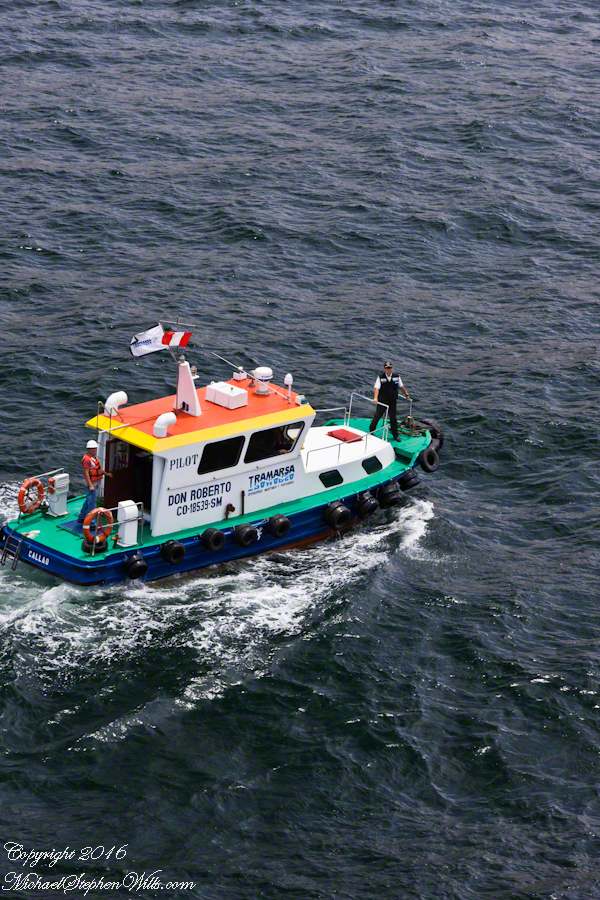
Don Roberto Approaches the Regatta
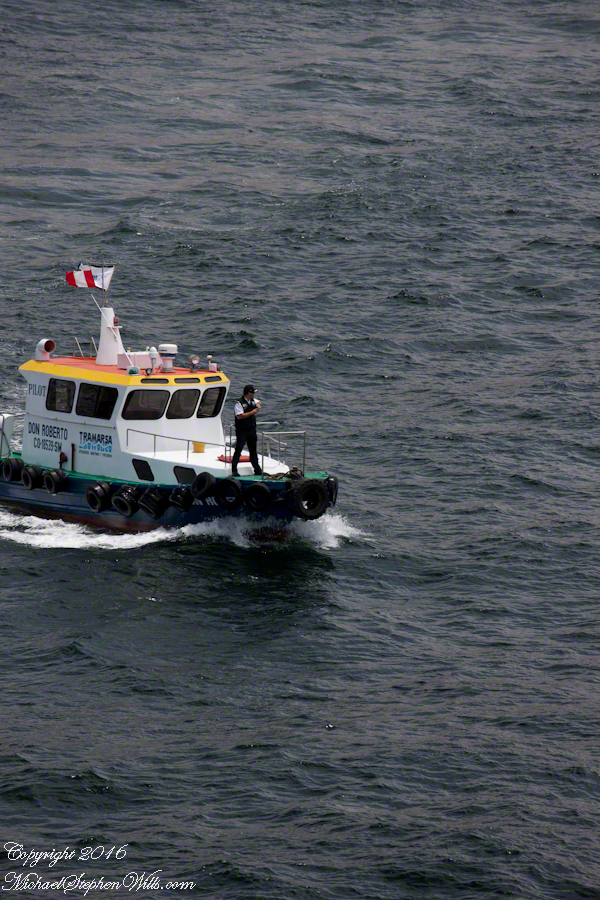
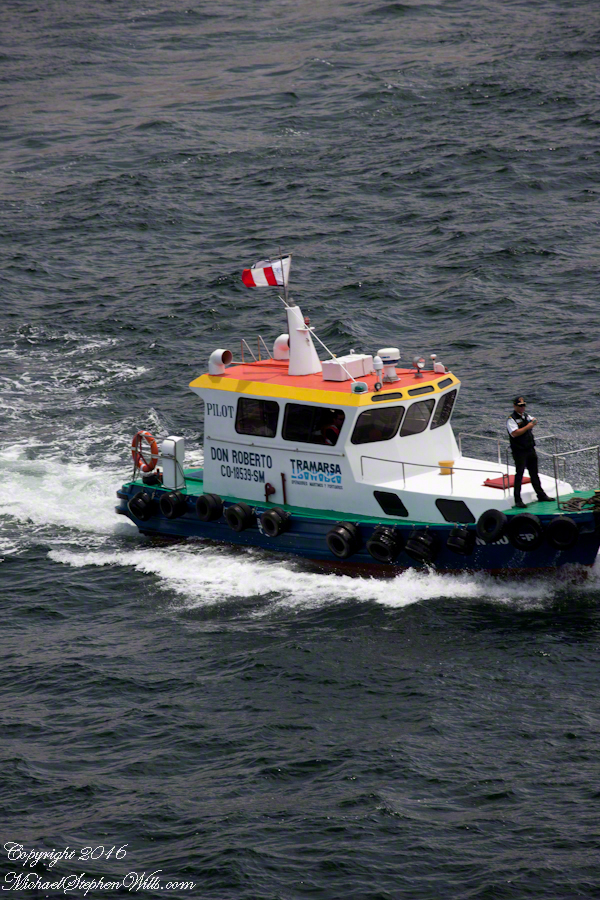
A fast pilot boat from Matarani approaches the Oceania Regatta. On the bow, the pilot will transfer from boat to ship. On board he will work with the Regatta crew to safely navigate the approach to the Matarani harbor and dock. The whiteness on the land is diatomaceous earth.
Don Roberto, Maritime pilot, approaches the Regatta
The whiteness on the land is diatomaceous earth.

A cautious approach. In the third shot the boat turns to slowly approach the Regatta.

Alongside, boat crewmembers joint Don Roberto on the bow to assist in the transfer. I am not sure which of the two blue uniformed persons was “our” pilot.

I did not capture the boarding of the pilot who served the Regatta through the Chilean Fjords.  Was is at Puerto Montt?  Puerto Chacobuco?  I am not sure.  I do know a maritime pilot was on board as the channel narrowed to 2 miles, named Scout Channel were we passed Scout Island.  I was facing generally east from our port side stateroom veranda while capturing these photographs as the Regatta headed south.

Scout Island and Canal
Scout Island. The water is Scout Channel

The peak on Scout Island is about 2,100 feet. The smaller peaks in front are about 1,200 and 1,500 feet. All rise straight up from Scout channel.

Scout Island
Scout Island lies on the Scout Canal
Scylla Island
Lying just south of Scout Island, Scylla Island is between our ship, in the Scout Canal, and the Kruger Canal. The Kruger is short, between Islands Scout, Orebar, Zealous, Porcia and Tito.
Islet Alert and Orebar Island
Islet Alert is between Canal Scout and Canal Kruger. On the far left there are waves breaking on Pilot Point of Orebar Island, marking the northern end of a small bay, named Hale. You can see the bay behind Islet Alert. On the far left there are waves breaking on Pilot Point

Want More? Visit my Online Gallery

Entering Messier Channel from the Gulf of Penas

Sailing a deep fjord

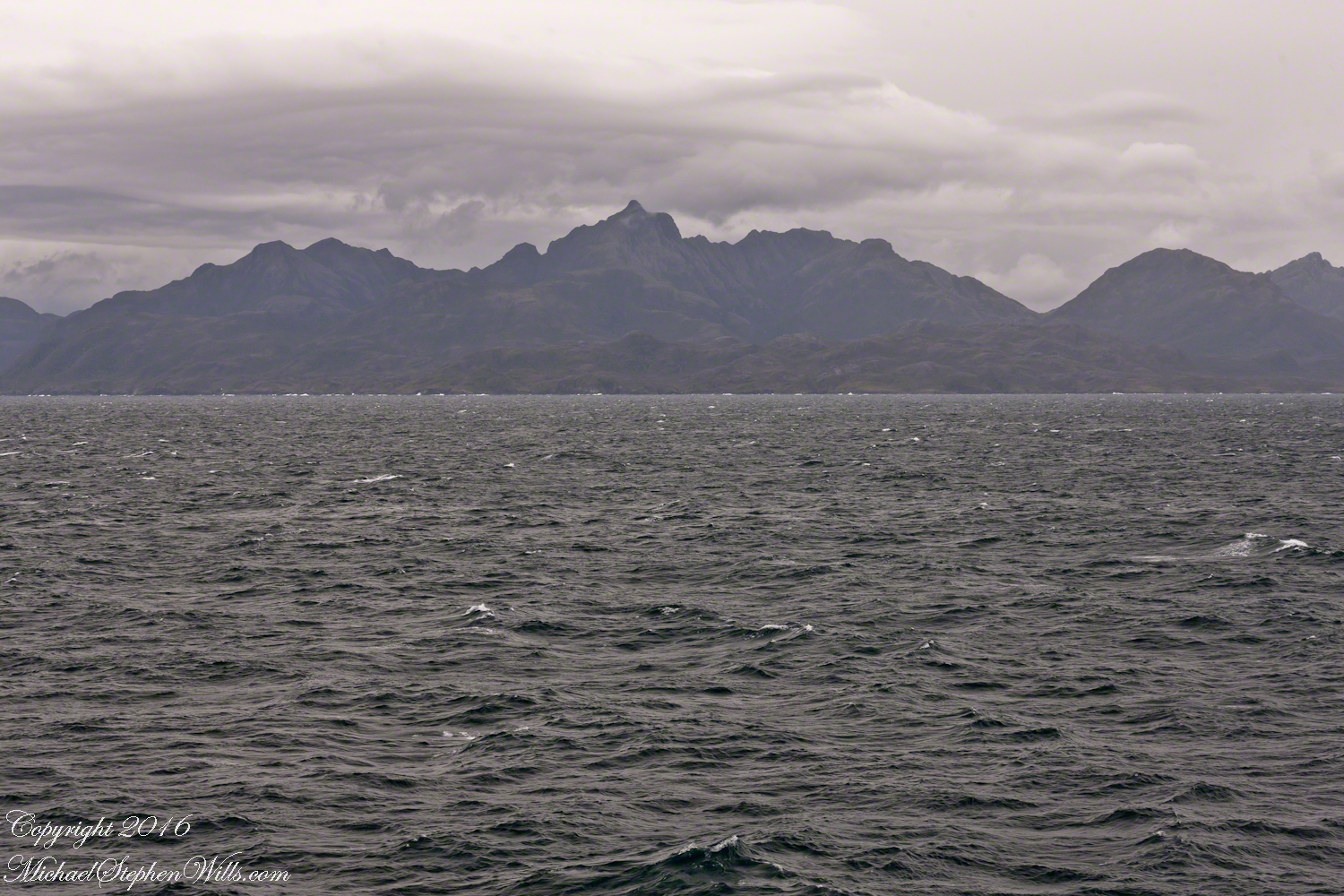
Gulf of Penas
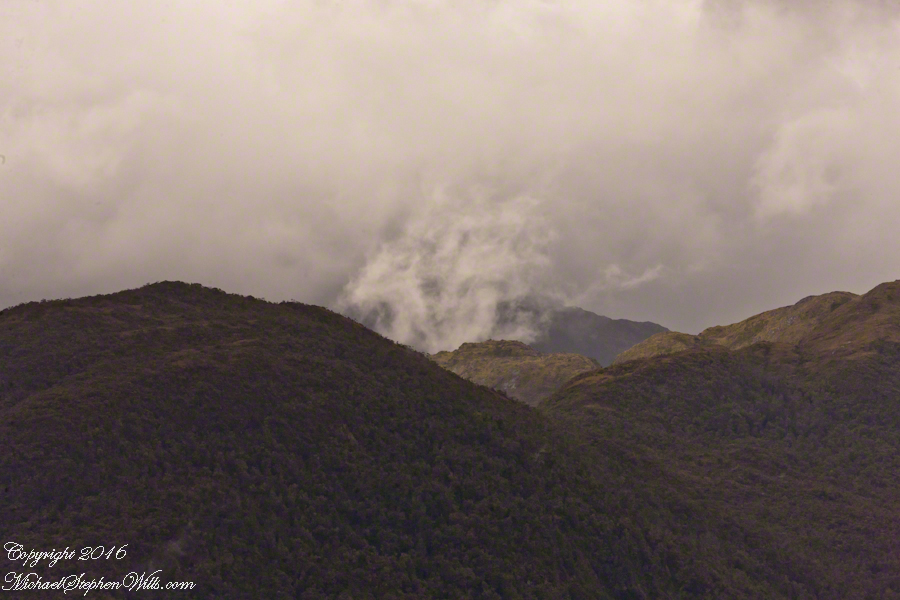
The Gulf of Penas is exposed to the storms of the western pacific. We are here moving from Aisen Region to the Magellan Region of Chile. Also known as Patagonia. This view is the Larenas Peninsula. The Northern Patagonian Ice Fields are on the other side of those mountains, the Southern Andes.

Get More from My Online Gallery

Taken with a Canon EOS 1Ds Mark3, the EF 70-300 f 4-5.6L IS USM lens, tripod mounted on a Manfrotto carbon fiber travel tripod.  UV filter  1/160 second at f 6.3 ISO 250.

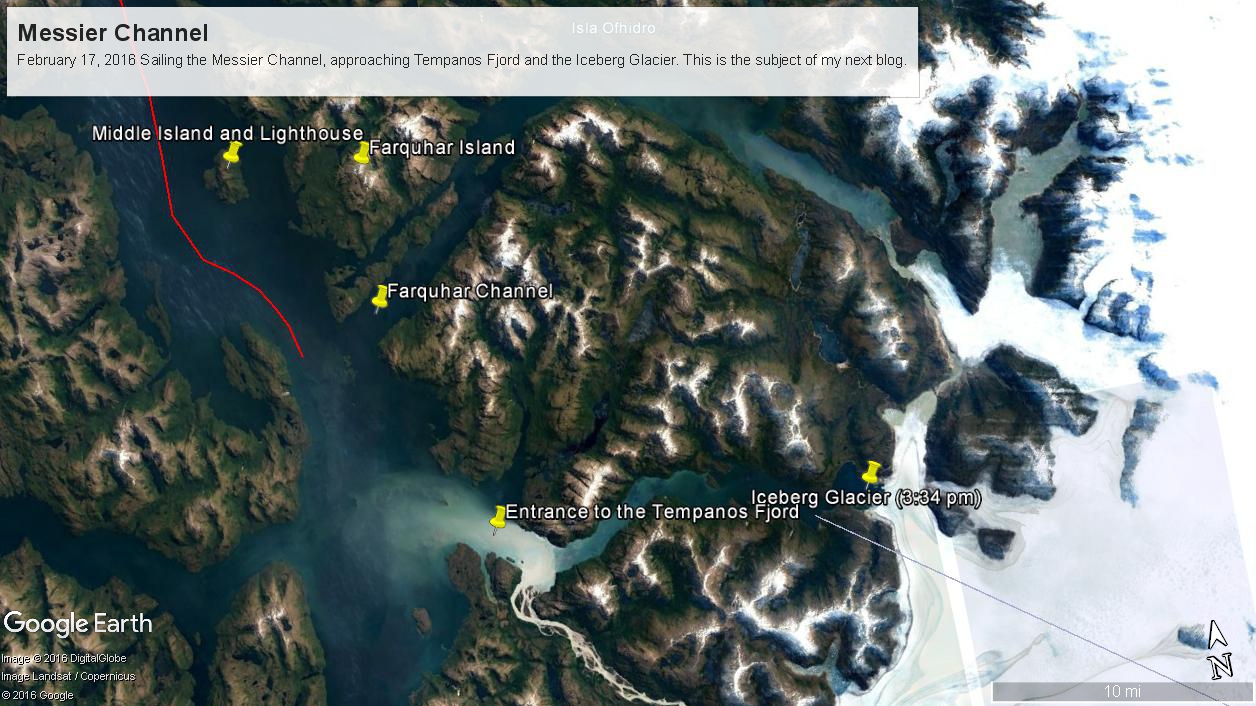
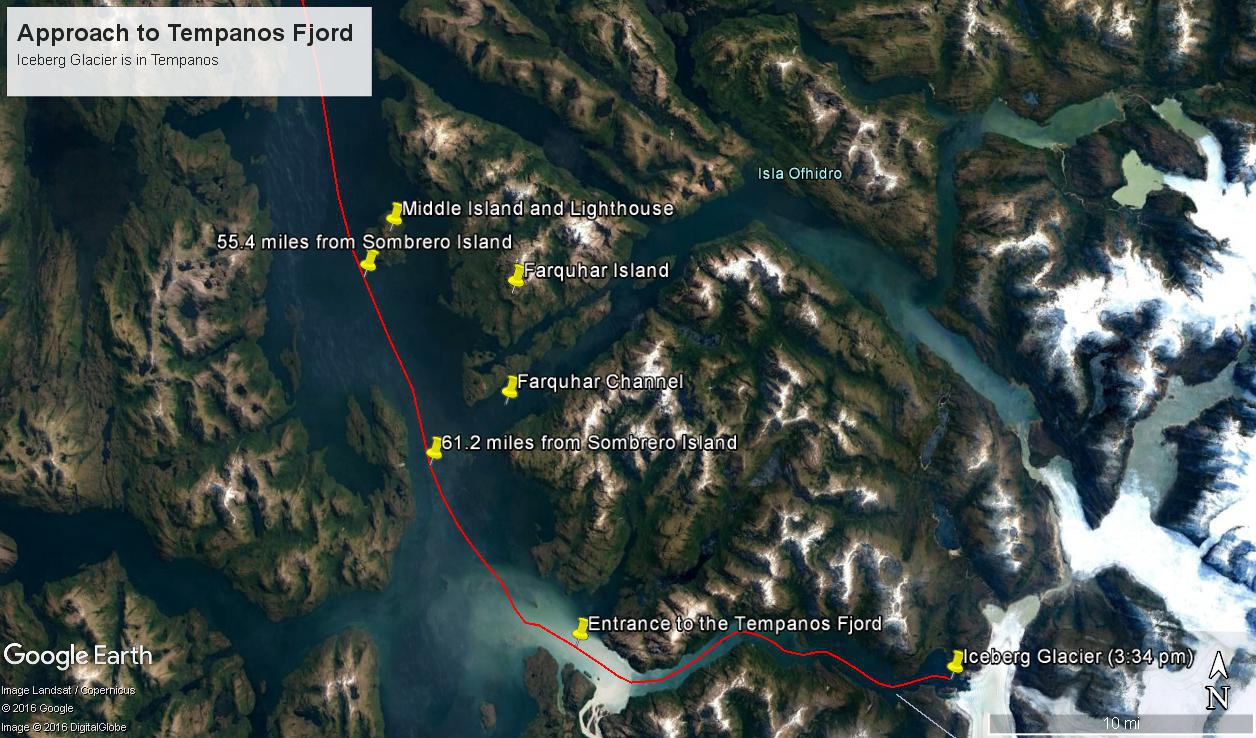
There is a steady wind of about 12 mph driving a few white caps.  A line of surf is seen breaking against the cliffs.  Shot midmorning from our stateroom terrace as the Regatta cruises south, February 17, 2016.  We are headed to an encounter with the Iceberg Glacier of the Southern Ice Fields of Patagonia.

Photography conditions were poor: shooting into the sun from an unstable platform gives poor contrast for the mountain crags.  The stabilization of the Canon lens was helpful and I balanced the need for a short exposure with the lowest ISO possible.  No time to experiment.

Copyright 2022 Michael Stephen Wills All Rights Reserved
Lighthouse on Cape Rapier

Skirting a dangerous cape of the western pacific ocean

While most of our fellow passengers were sleeping, as usual I woke at 5 am to pull the gear together, dress warmly, step out onto our magic window on the world.  Our decision to request a port side cabin continues to pay off.  The Cape Rapier lighthouse flashes every few seconds.  One of these shots caught the light.

Lighthouse on Cape Rapier
Since 1914 the lighthouse on Cape Rapier, Aysen Provence, Chile, has protected ships on the northern approach to the Gulf of Penas.

Click this link for a visit to my online gallery

Lighthouse Cape Rapier
Before dawn, February 17, 2016, the light protected us on the Oceania Regatta as we rounded Cape Rapier to enter the Gulf of Penas on route of the Messier Channel, the Fjords of Chile and an encounter with the Iceberg Glacier of Fjord Tempanos.

The Striking Colors of Petrohué Waterfalls

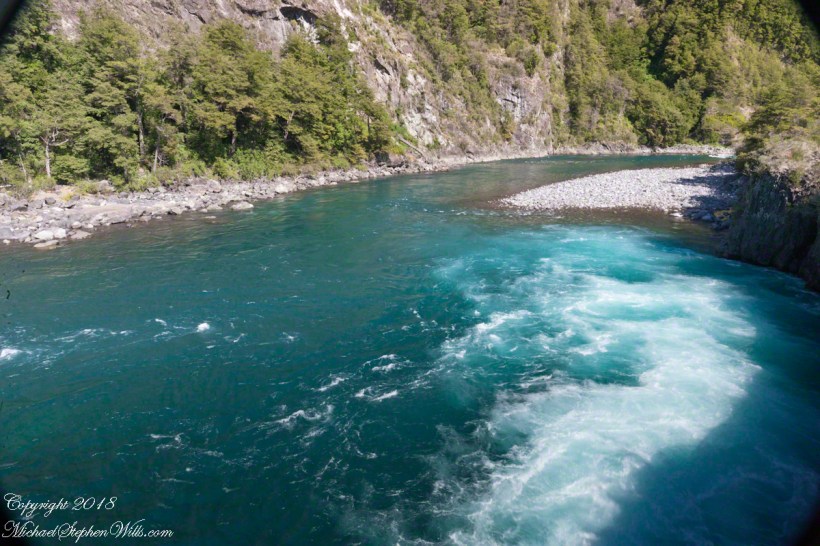
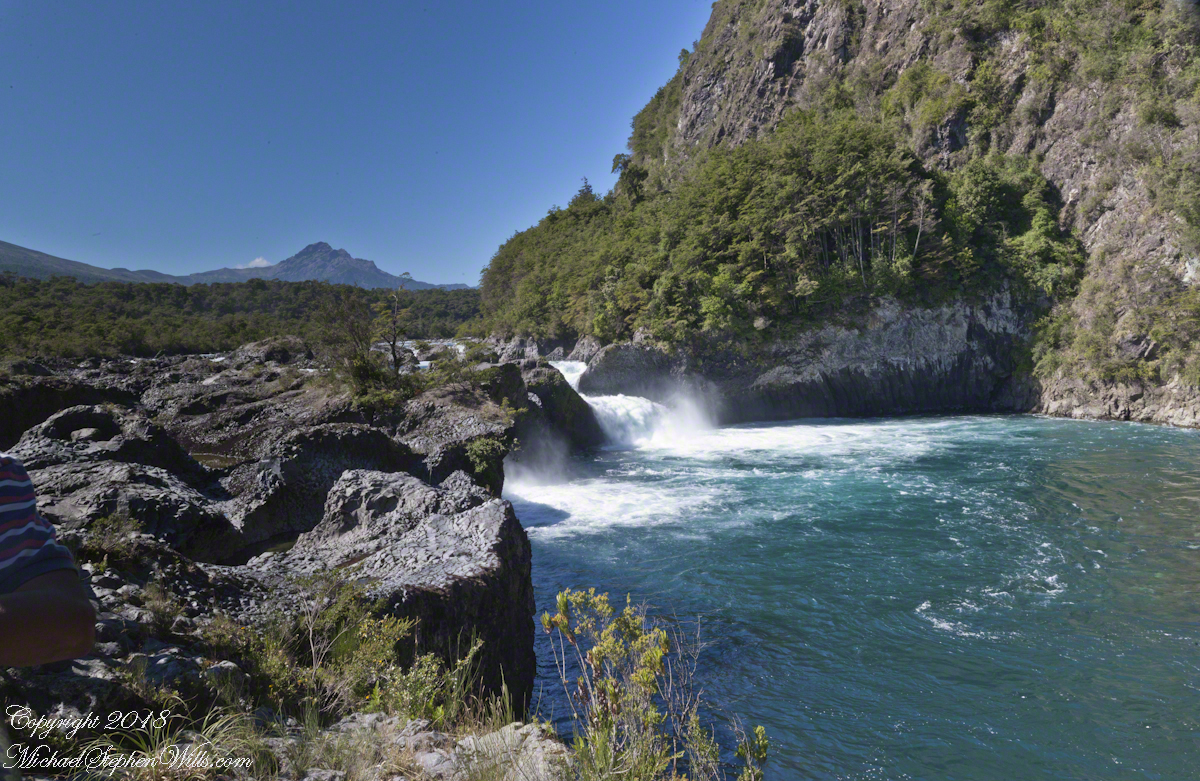
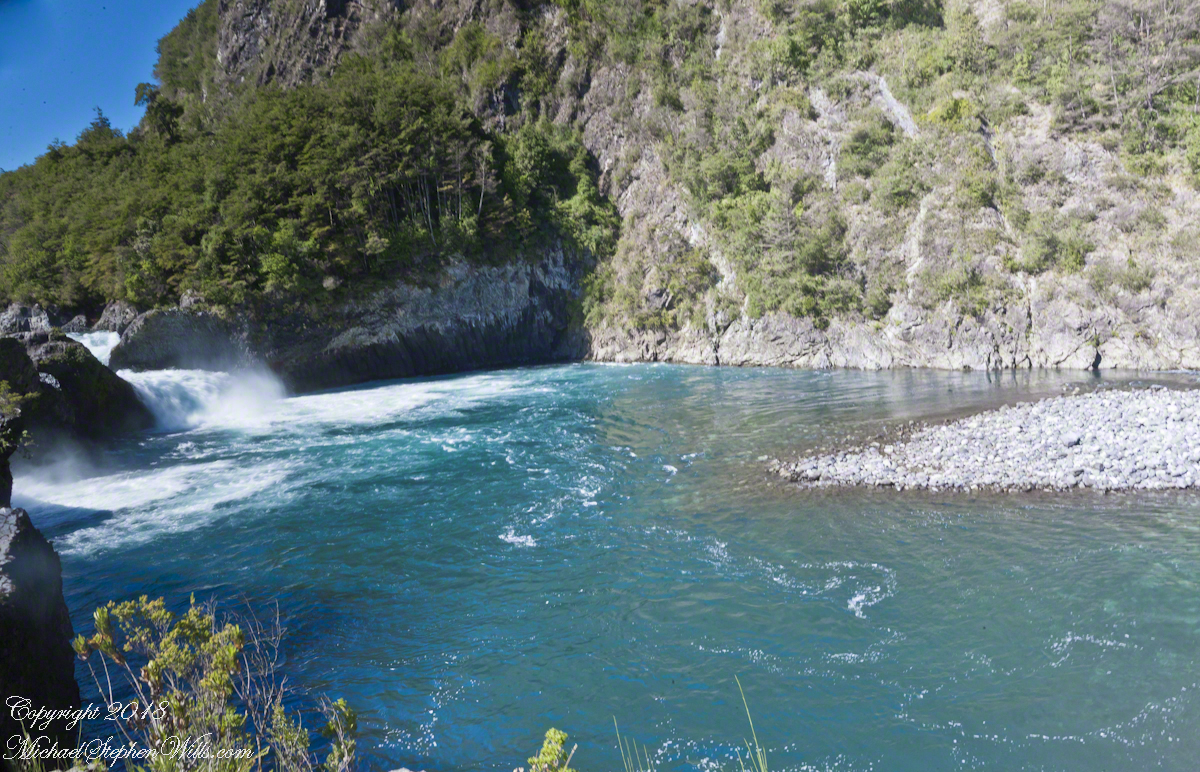
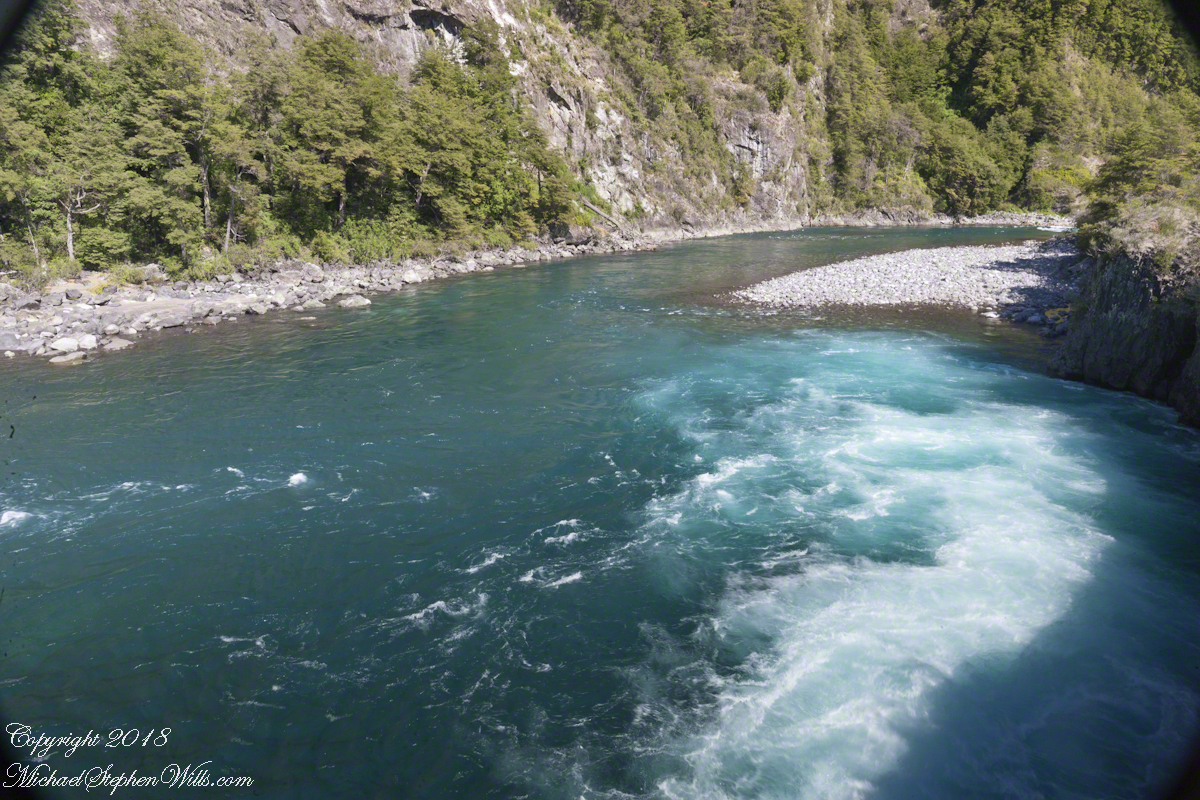
Emerald Water, colored by glacial minerals

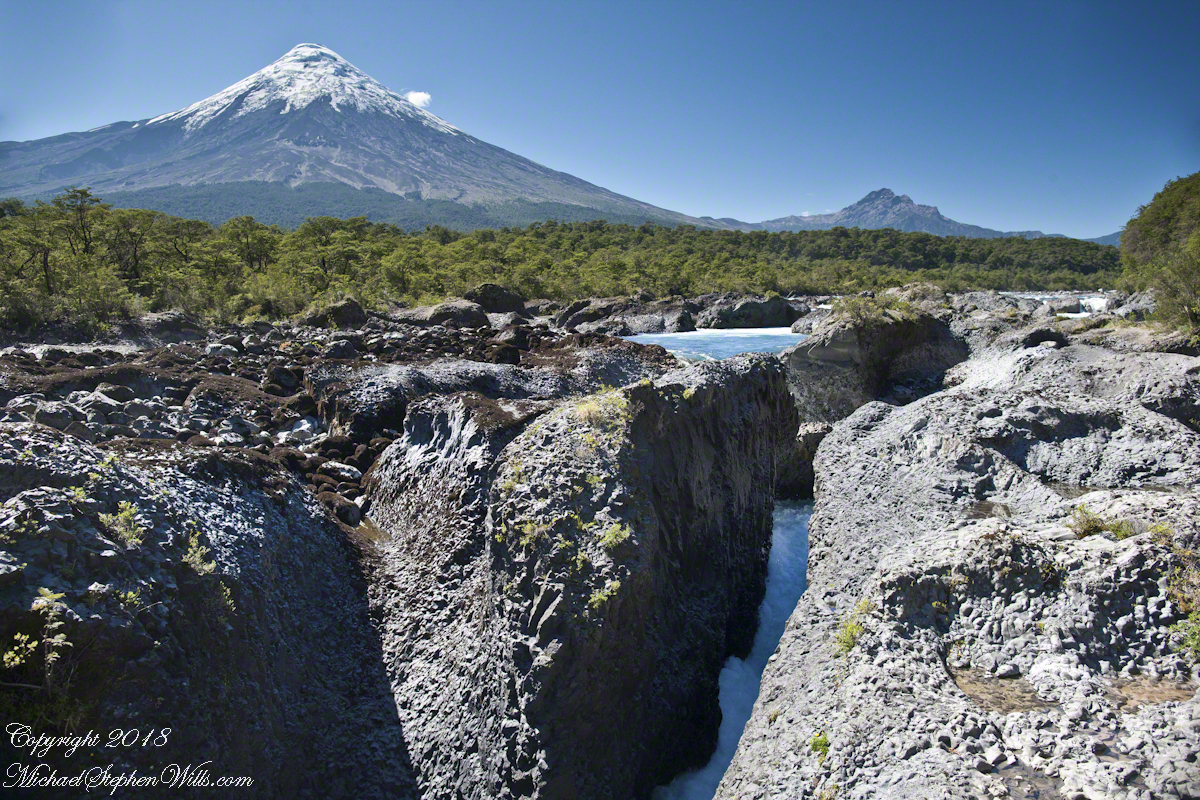
Glacial meltwater from Lake Todos los Santos (All Saints Lake) forms Petrohué River and, where the river flows over lava from the Orsorno Volcano, Petrohué Falls. This set of photographs features the emerald color the river originating from glacial minerals.

Click any photograph for a larger view.

A strangeness of these photographs is this is the middle of February, Chilean summertime.

Force of Nature

Another strangeness, not readily apparent, is the effect of the Coriolis force. Here in the Northern Hemisphere water (any moving mass, really) moving perpendicular to the rotating surface of the earth (a property of water is the surface follows the contour of the solid surface over which it flows) will tend to flow in a clockwise direction. Crossing the equator, in the Southern Hemisphere the tendency reverses, tending to flow to the left, counter-clockwise. With some imagination the effect of the Coriolis force can be seen in the following photograph.

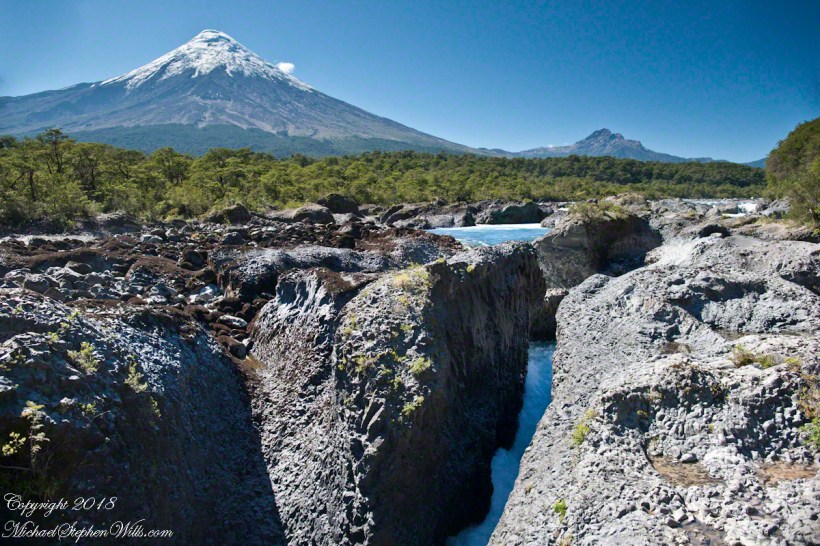
Orsorno Volcano and Petrohué Waterfalls

Petrohué Waterfalls (pronounced petro-WEH) is within Vicente Pérez Rosales National Park of Chile. For me, this view was one of the draws of our entire trip, that stratovolcano and its craggy children in the distance the same type as Mount Vesuvius, the volcano that wiped Pompeii off the map in 79 AD. Described by Pliny, the eruption type is named even today “plinian,” the most destructive and violent of all volcanic eruptions.

It was an irrational happiness I felt walking this place, I still smile to myself remembering it.

Click photograph for a larger view.
The mastery of water over volcanic rock deposited by ancient eruptions of the Orsorno Volcano.

Ice Bells

Noticing small miracles, taking the time and effort to capture them…..

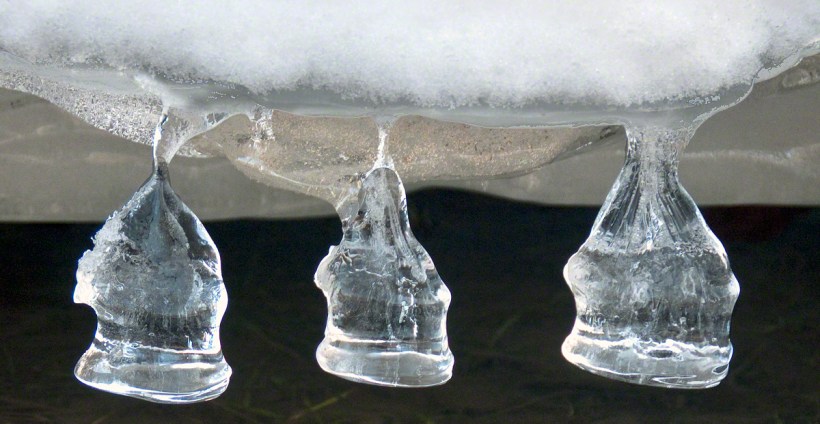
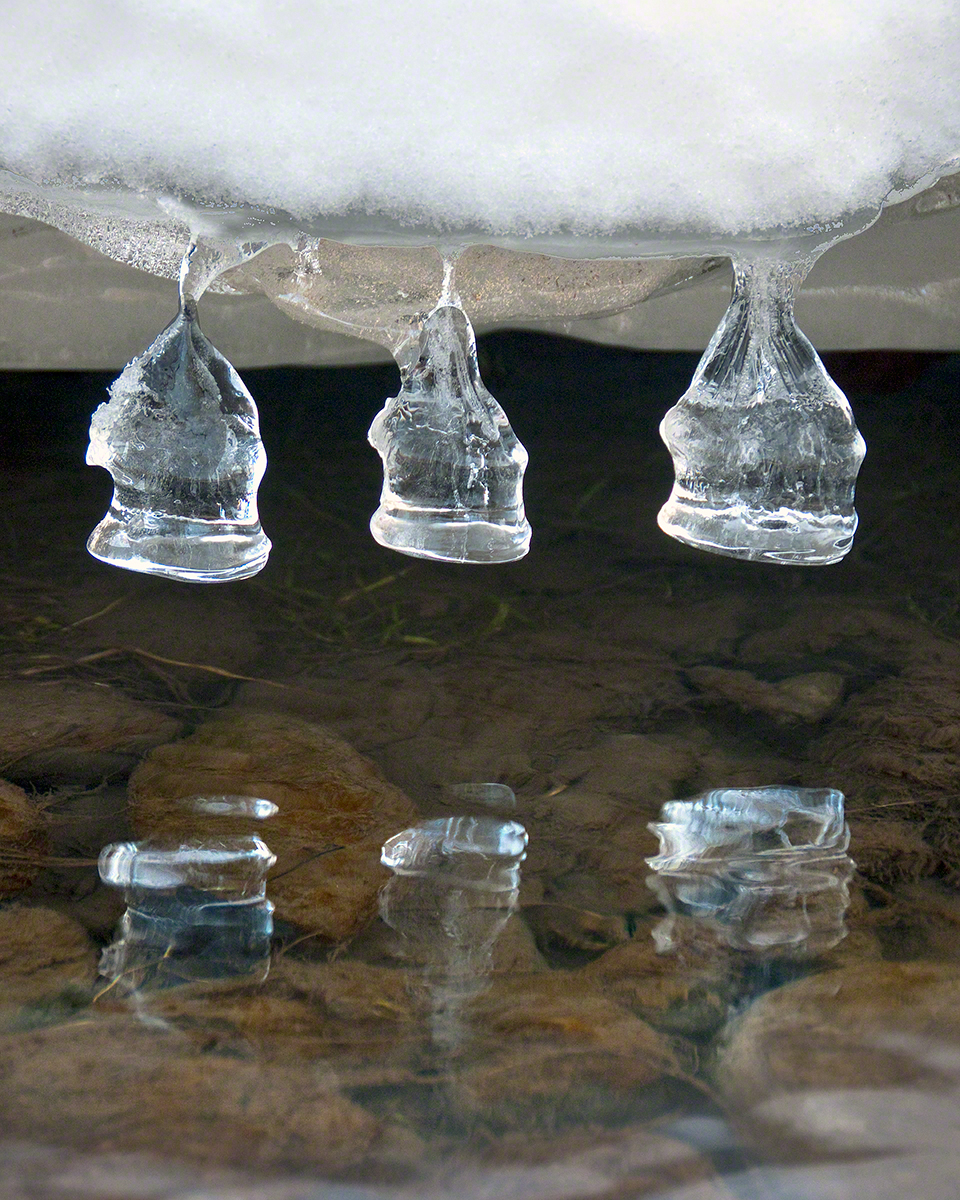
These icicles were formed along Fall Creek during the coldest months of February in the Finger Lakes Region of New York State.

The transient nature of these forms is suggested by the thinness of the pedicle joining each bell to the ice lobe of the ledge. Note the golden crystals in the ice lobe.

A visualization of the symbolic power of the numeral three, reflected on itself.  Question: what do “threes” mean to you?

Captured with the Sony DSLR-A700, DT 16-105mm F3.5-5.6 lens, hoya circular polarizing filter, mounted on the Manfrotto tripod with ball head.

Click the photograph for my online gallery Ice Bells listing.

Waterfall Textures

Unrestrained chaos at the foot of Arizona’s highest waterfall

I received notice of IStock acceptance of select photographs from my last posting, “Wilderness Textures”, was accepted.  Click to view my IStock Portfolio, including  photographs from today’s posting included in the acceptance notice.

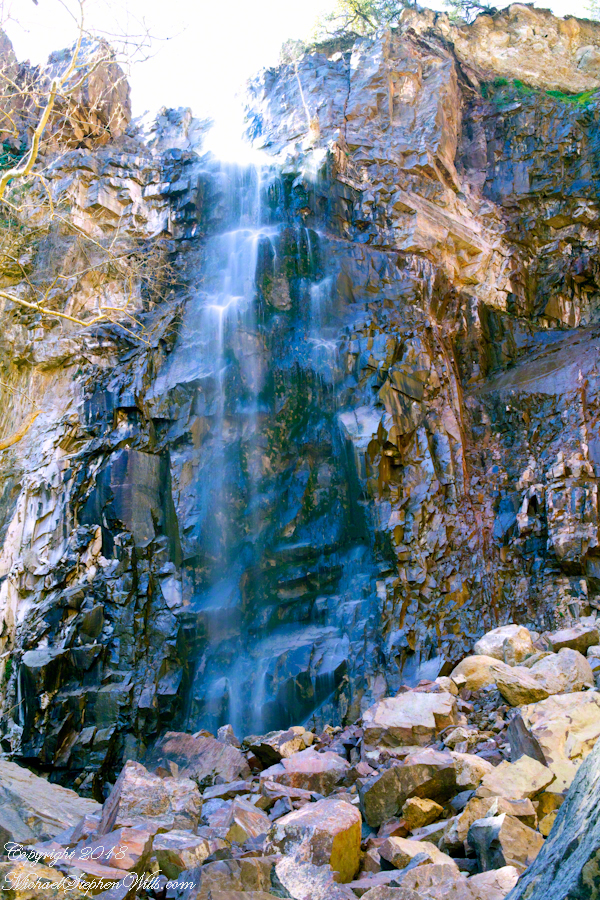
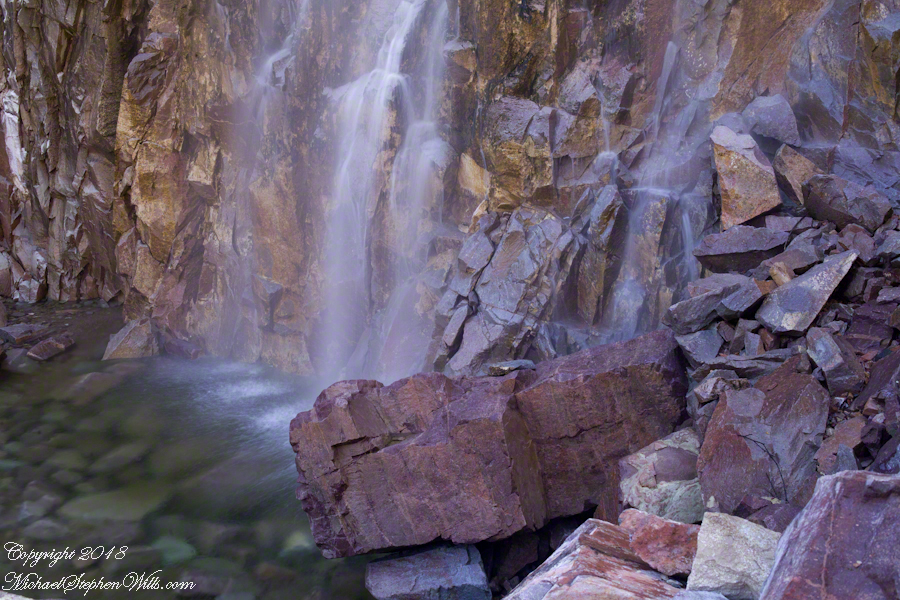
In this post I move up the Reavis Creek canyon from where the last posting, “Wilderness Textures”, was sited to the foot of Reavis Falls.  With the first photograph you look up at the falls from the head of the canyon carved by the creek over eons.  The rock wall, the canyon “head”, is thick with microorganisms, fungi, mosses.
Reavis Creek Water and Light – CLICK ME for more abstract photography.

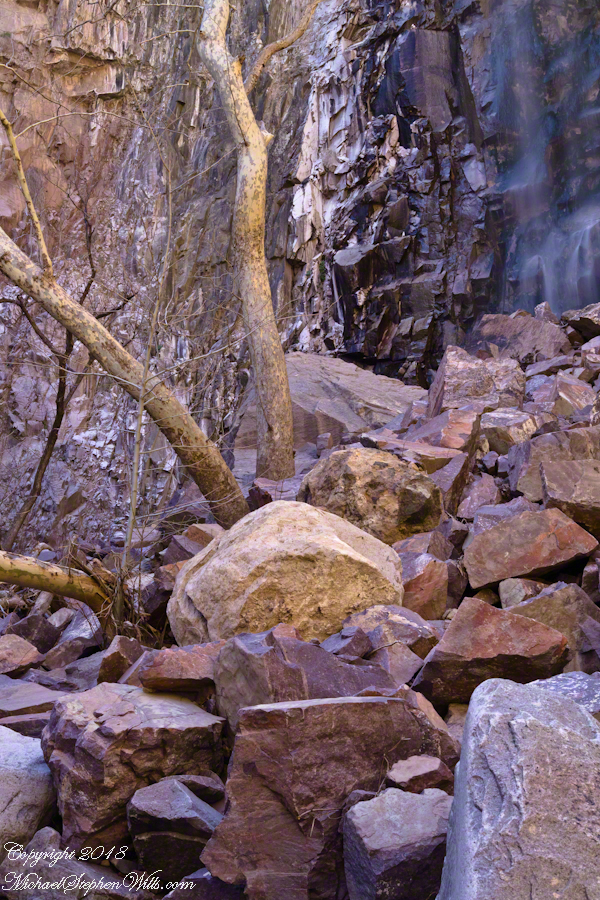
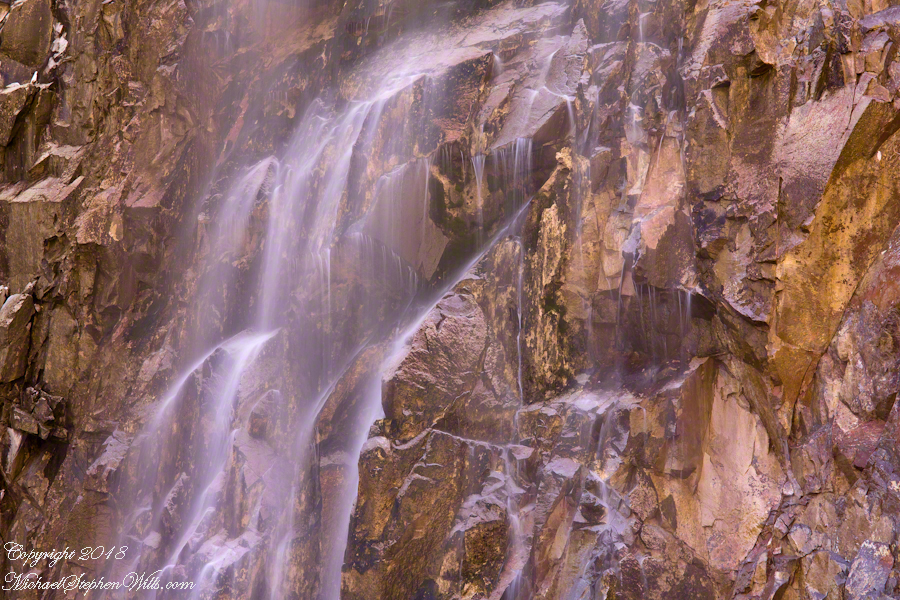
In the foreground is a jumble of boulders, some washed down at flood time, spread wide at the bottom of the falls, piled to a jumbled height of 15 feet. 

Talus is the geological term for this formation.  Derived from the Latin word for slope (talutum) the definition, from the Oxford English Dictionary, is “A sloping mass of detritus lying at the base of a cliff or the like consisting of material fallen from its face.” 
 

The ankle bone is also called talus, from the French word for heel, I bring it up because climbing this chaotic, unstable jumble is a way to break your ankle.  The route to Reavis Falls, a climb up one side of Lime Mountain then down the other on a non-existent (lightly marked) trail, is rated difficult and impossible with a broken leg or ankle.  I was alone and very careful to check each rock for stability before putting my weight on it.
A climb of the talus pile was necessary to view the pool at the waterfall base, for this photograph.

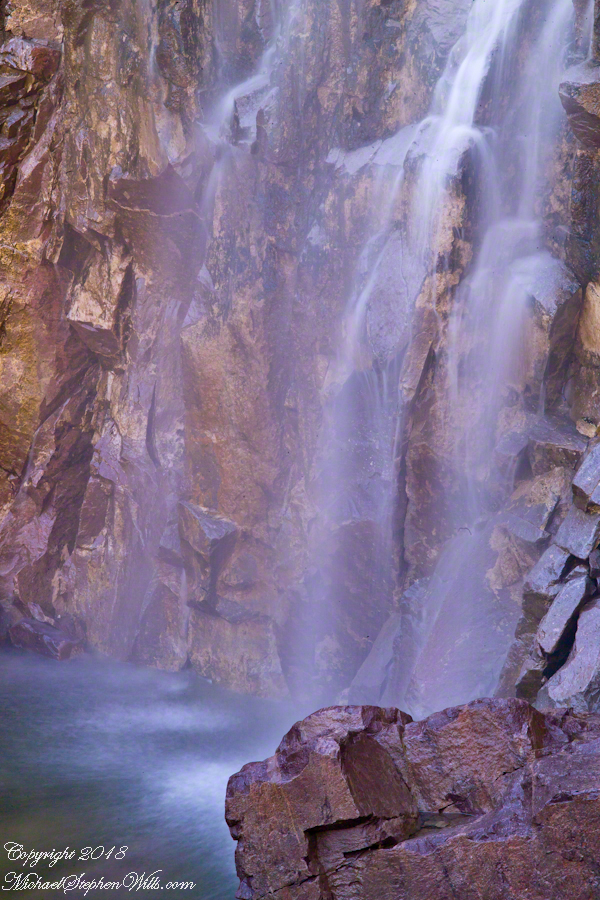
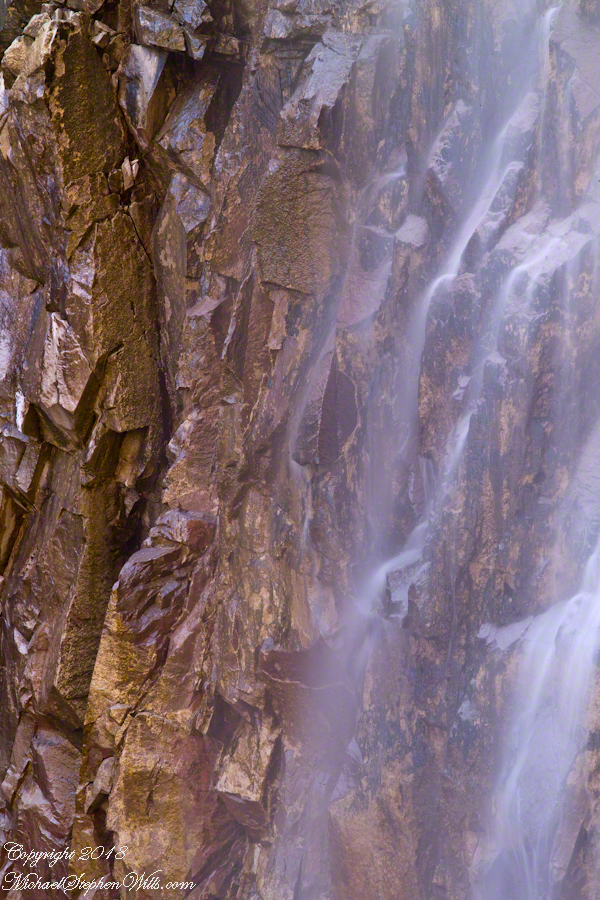
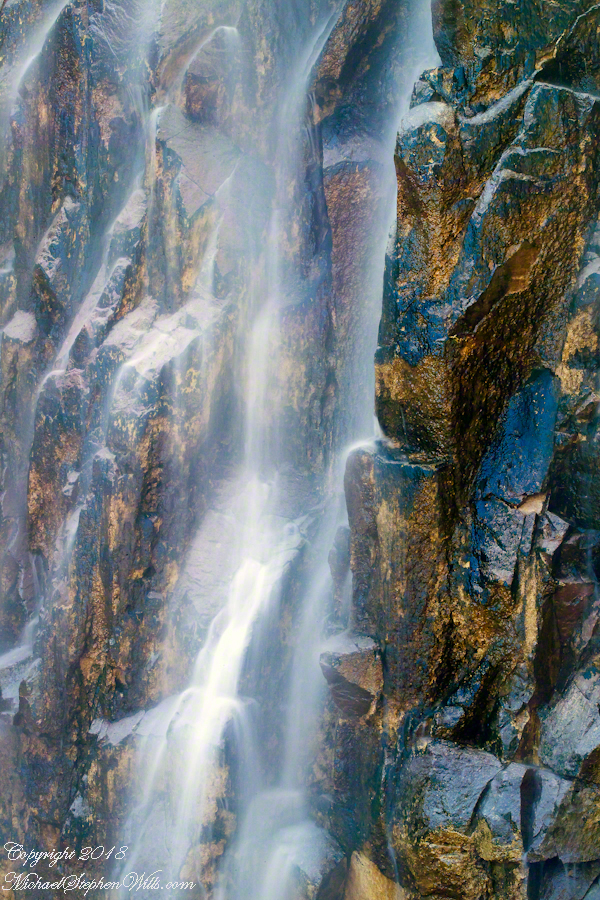
A more artistic vertical format version, below, captured with the Canon EF 100mm “macro” lens.  All shots are using the Kodak DCS pro SLR-c (the “c” designated Canon lens compatibility) and a Manfrotto studio tripod with a hydrostatic ball head.  The horizontal format shot was captured with a Canon EF 50mm f/1.4 USM lens.   I prefer the vertical version, artistically, because the talus jumble is all but cropped out while the upper corner of the angular basalt boulder is left as an interesting focal point.  The boulder, not being in the spray, is in focus to contrast with the basalt wall behind the water.

I captured a series of shots from this precarious vantage point, working up from the pool to the brim of the waterfall.

My goals was a composite photo of the falls.  I have yet to succeed with this project.  Maybe I will give it one more shot in spite of having learned the hard lesson the best photographs are a single moment captured in a single frame.

I find in this series the vertical aspect is more artistic.  The water volume, of the falls, at this time of year offers only the finest of sprays with most of the basalt rock wall only moist.  The 100mm “macro” lens allowed me to include only the falling water with a bit of the moist wall for contrast.

In the following version I experimented with color, moving from the narrow range of hues, to more contrast.

Please browse my reasonably priced stock photography. License a photograph, download and use it for your website or blog. Click this link to browse all my Getty IStock Photography offerings.

Or click this link or any photograph or this link to select a print with custom framing from my “Textures” Fine Art Gallery.

Here’s another of my Arizona wilderness adventures, “Racing the Sun.”

Wilderness Textures

Abstract Beauty of the Superstition Wilderness of Arizona

These abstracts are some of my photographic output from four days and nights spent alone in the remote eastern Superstition Wilderness.  For the first three days I met not a soul, all these images were captured on a single afternoon spent in the canyon below Reavis Falls, a jumble of landslides, flood debris and boulders.  There is no trail.  The few people who enter the canyon must negotiate around boulders, crossing Reavis Creek many times.

Reavis Creek Water and Light – CLICK ME for more abstract photography.

My backpack kit included a full sized Manfrotto studio tripod with hydrostatic ball head.  The benefits more than outweighed the effort (I was a lot younger in 2008) when the Canon EF 100mm (macro) lens is mounted on a  Kodak dSLR body, allowing me to take crisp shots.  The tripod legs can be adjusted to precise positions for stability.

Reavis Creek Water and Light – CLICK ME for more abstract photography.

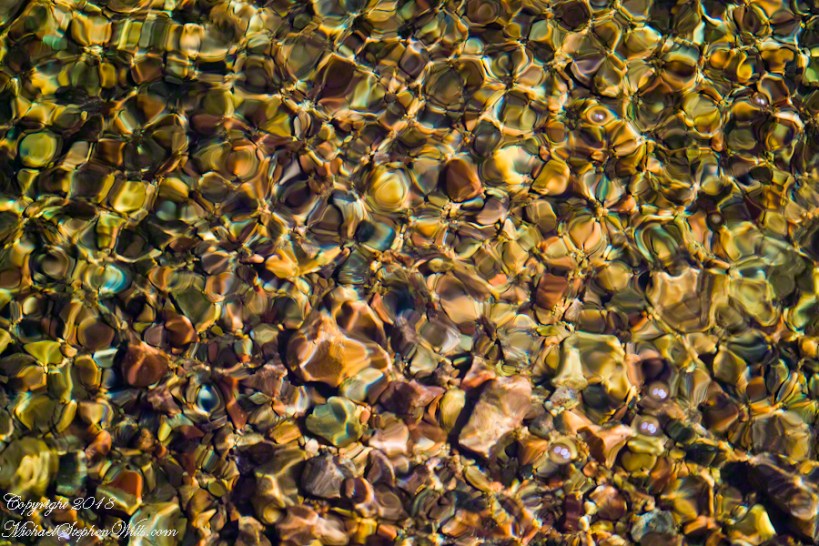
I can feel the bright afternoon desert spring sunshine in this photos.  It was after the spring floods, the flow of Reavis Creek and ample still but slow.  Gathering in pools over the rough stones of the creek bed, the water absolutely clear.

Reavis Creek Water and Light – CLICK ME for more abstract photography.

I held the shot over many minutes, capturing ever changing diffraction patterns.

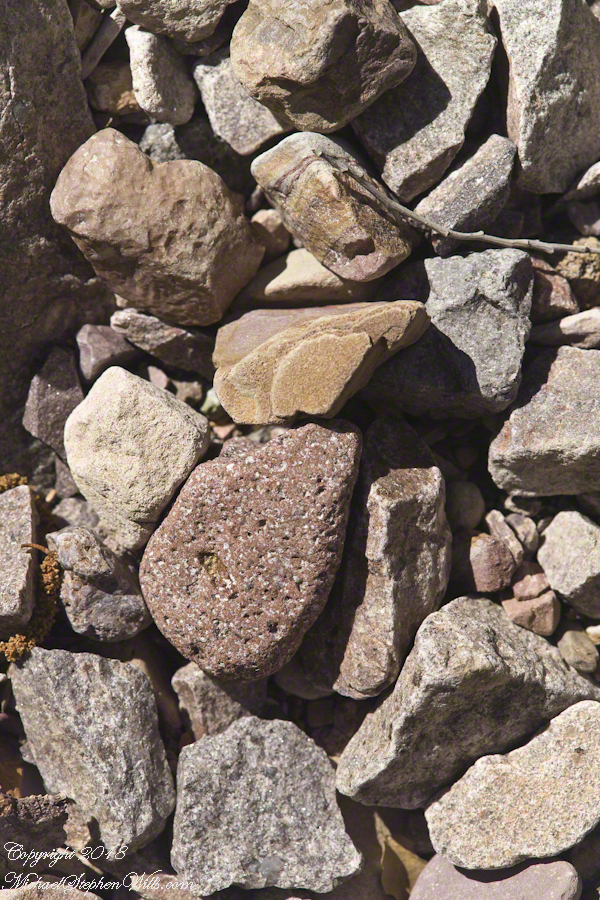
We see in all these photos, not a homogenous blend of stones from a shared geology.  Reavis Creek washes over diverse geologies: volcanic, ancient igneous extrusions, sedimentary and metamorphic are jumbled together.

Reavis Creek Water and Light – CLICK ME for more abstract photography.

This is a series of photographs of smooth, white igneous boulders with shadows of  still leafless sycamore and cottonwood trees.

Reavis Creek Water and Light – CLICK ME for more abstract photography.

Graceful shadows

Reavis Creek Water and Light – CLICK ME for more abstract photography.

Strong, demonstrative shadows.

Reavis Creek Water and Light – CLICK ME for more abstract photography.

A leaning cairn, not a trail marker….

Reavis Creek Water and Light – CLICK ME for more abstract photography.

A 15 foot high jumble of stones piled at the bottom of Reavis Falls, carried over by the floods.

Reavis Creek Water and Light – CLICK ME for more abstract photography.

A metamorphic conglomerate stone….

Reavis Creek Water and Light – CLICK ME for more abstract photography.

Another metamorphic conglomerate.

Reavis Creek Water and Light – CLICK ME for more abstract photography.

Please browse my reasonably priced stock photography. License a photograph, download and use it for your website or blog. Click this link to browse all my Getty IStock Photography offerings.

Or click this link or any photograph or this link to select a print with custom framing from my “Textures” Fine Art Gallery.

Here’s another of my Arizona wilderness adventures, “Racing the Sun.”