A new Cornell building settles into its hillside, glass and weathered metal catching sky and trees—less a declaration than an invitation to pause, wander, and think together.
Not in person—on my screen, late at night, when I should have been revising a draft and instead opened Google Earth the way some people open a window. There it was, just off Tower Road, close to Stocking Hall, pale and newly settled into the slope. From that height it looked careful rather than confident, as if it had arrived recently and was still deciding how much of itself to show.
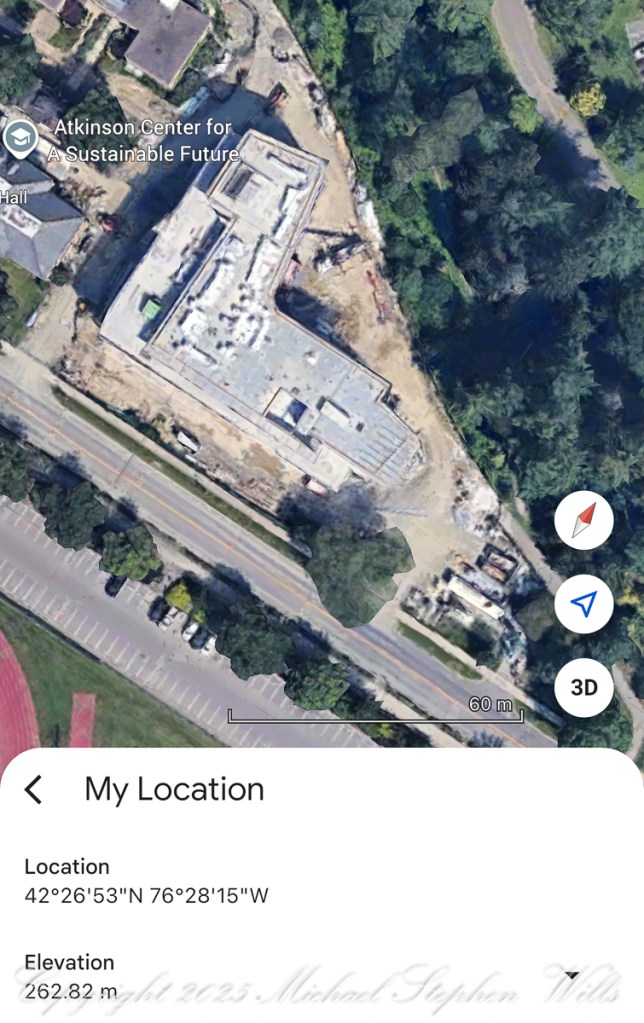
Atkinson Hall, Google Earth from August 2023, 350 Tower Rd, Ithaca, NY 14850
I remember thinking: good placement on a former triangular parking lot. Enough distance from the older buildings to breathe, close enough to feel included. The hill does most of the work. You can see that even from an overhead height.
The next morning I walked there.
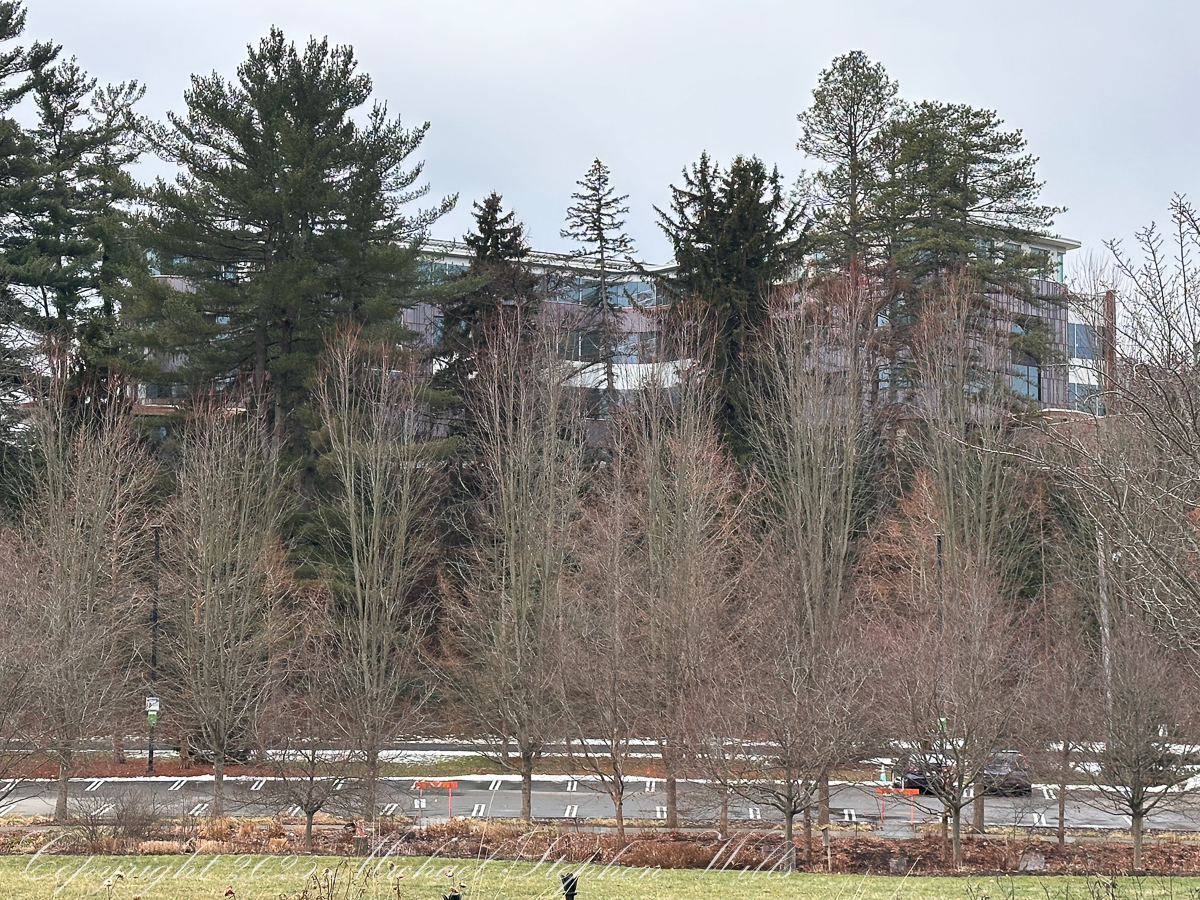
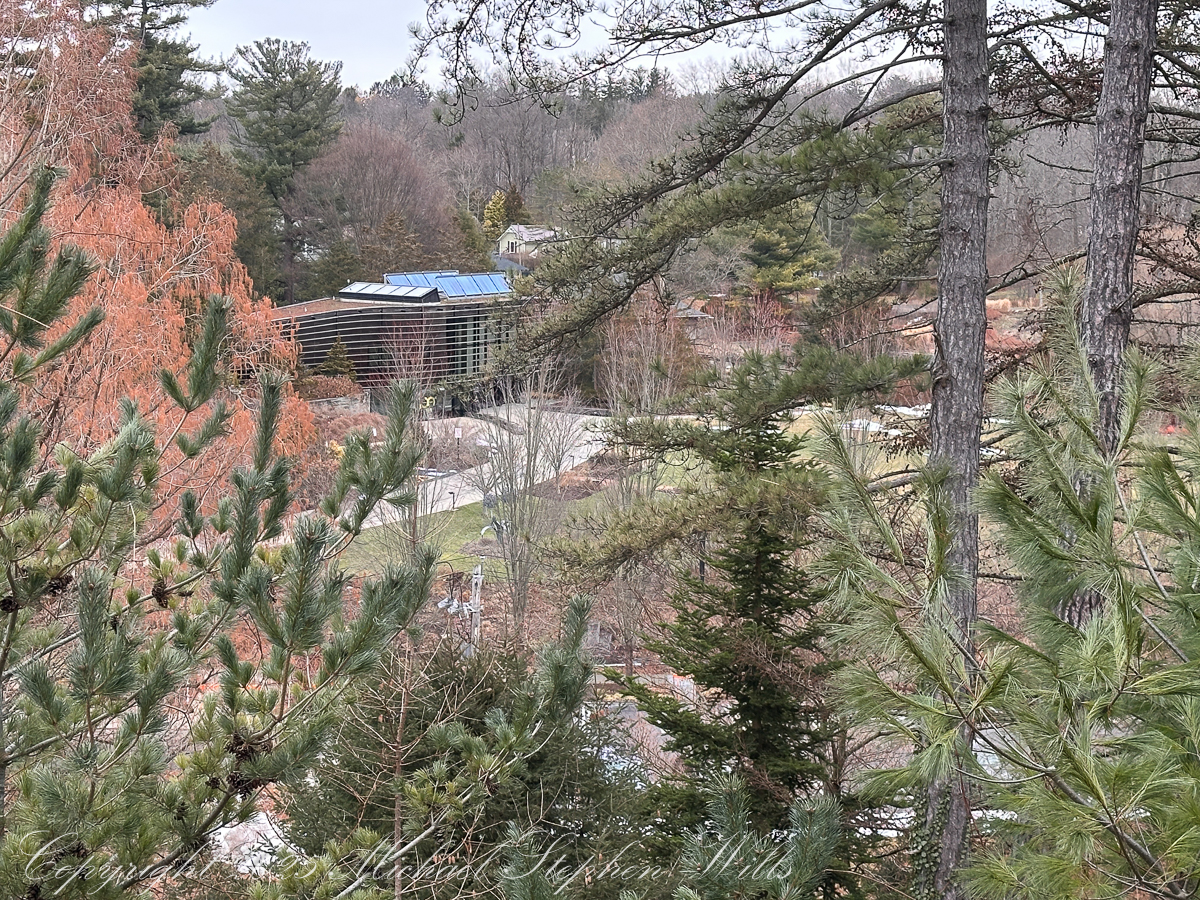
Atkinson Hall as viewed from the open field south of the Nevin Welcome Center of Cornell Botanic Gardens
Across the open field the building didn’t announce itself. Trees intervened—pines, bare hardwoods—so that it came into view in pieces: a curve of metal, a long line of glass, brick holding the ground. It felt less like approaching a destination than like gradually realizing you were already there. I liked that. Buildings that reveal themselves all at once tend to exhaust me.
The slope matters. You feel it in your legs as you walk, and the building seems to acknowledge it, stretching rather than standing tall. It does not pretend the land is flat. It follows the descent toward the creek, toward the older geological story underneath all of us.
Up close, the materials settle my attention.
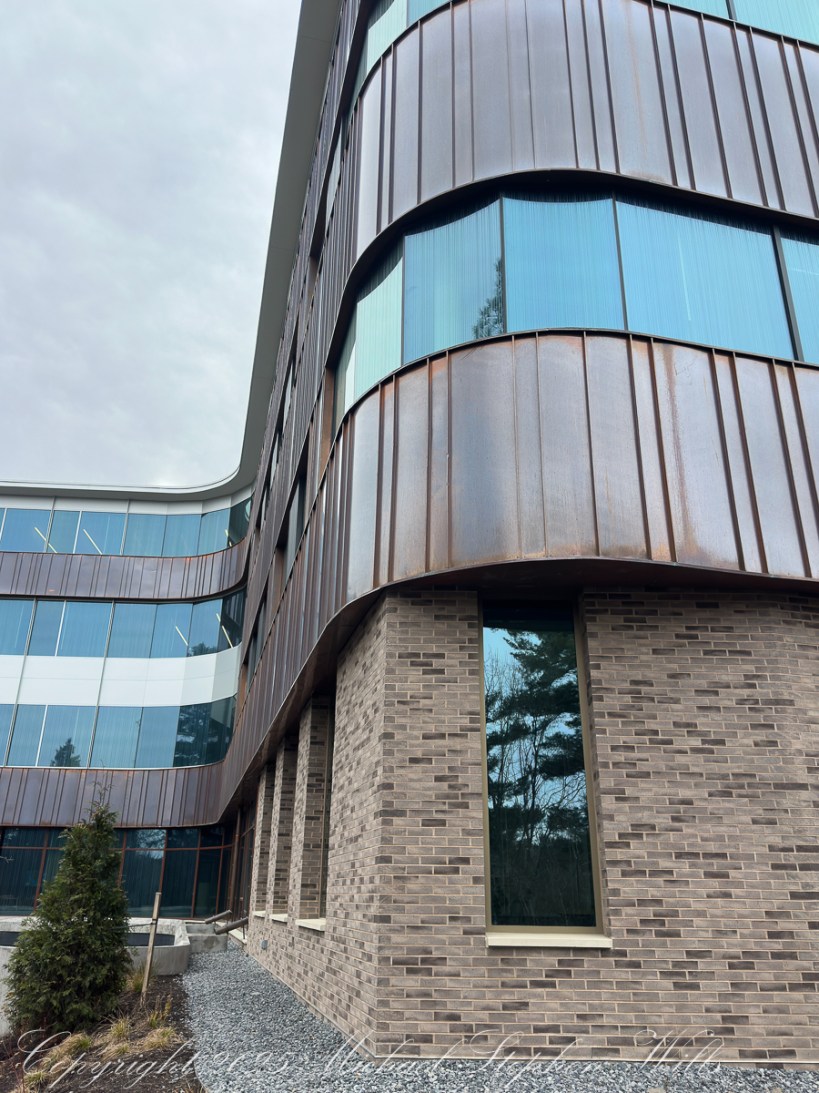
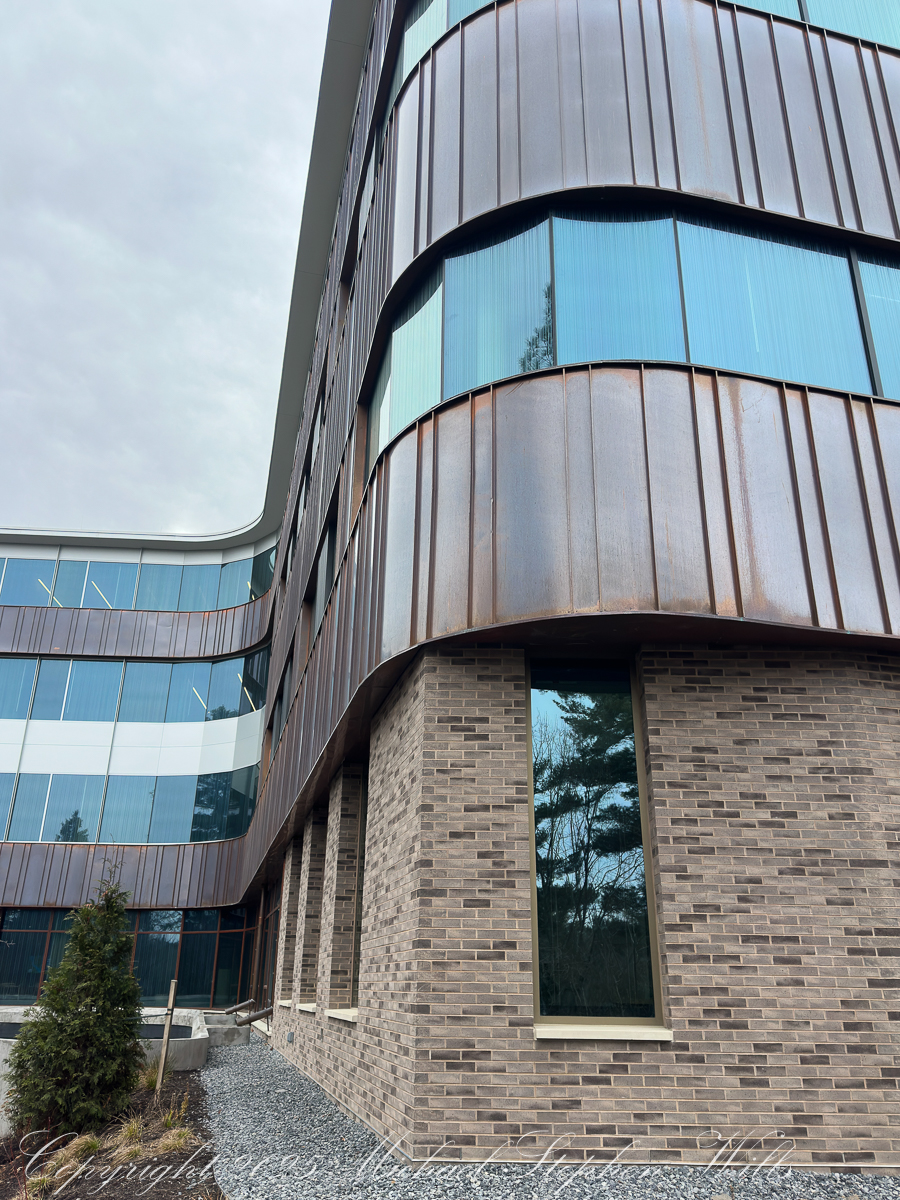
North Side of Atkinson Hall, 350 Tower Rd, Ithaca, NY 14850
Brick at the base—solid, Cornell-familiar, not trying to reinvent anything. Above it, bands of weathered metal curve gently, already carrying the muted browns of fallen leaves, old stone, and stream-worn shale—colors long familiar to the slopes and ravines that shape this campus. They look as though they have agreed to age, which feels like an underrated design choice. The glass holds the sky without insisting on transparency. Some days it reflects trees so clearly that the building nearly disappears into them.
Compare the facade brickwork of Warren Hall, one of the earliest buildings on the Cornell University campus, completed 1868. This is the southwest corner with facade signage, Cornell University, Ithaca, New York
I stop near the windows longer than I intend to. The view steadies me. The hillside, the trees, the quiet persistence of winter light. My notebook stays closed for a few minutes. No one seems to mind.
View near Atkinson, Nevin Welcome Center, Cornell Botanical Gardens, 124 Comstock Knoll Dr, Ithaca, NY 14850
Inside, the building does not behave like a department.
That is the first thing I notice once I begin using it regularly. No single discipline claims the space. Offices and meeting rooms feel provisional, lightly held. Conversations drift. Someone from engineering crosses paths with someone from policy. A food systems researcher borrows a chair from a planner. No one looks lost.
It helps to remember who gathers here. The building hosts people from many parts of the university, each arriving with partial expertise, incomplete questions.
Cornell College / Unit
Areas of Engagement
College of Agriculture and Life Sciences (CALS)
Food systems, agroecology, climate resilience
College of Engineering
Energy systems, materials, infrastructure
College of Arts and Sciences
Earth systems, ecology, human dimensions
SC Johnson College of Business
Sustainable enterprise, supply chains
College of Architecture, Art, and Planning (AAP)
Urban resilience, adaptive design
Cornell Law School
Environmental law and governance
Public & Global Affairs
Climate policy, diplomacy
I keep this list taped inside my notebook. It reminds me that no one here is meant to arrive fully formed. The building expects us to be unfinished.
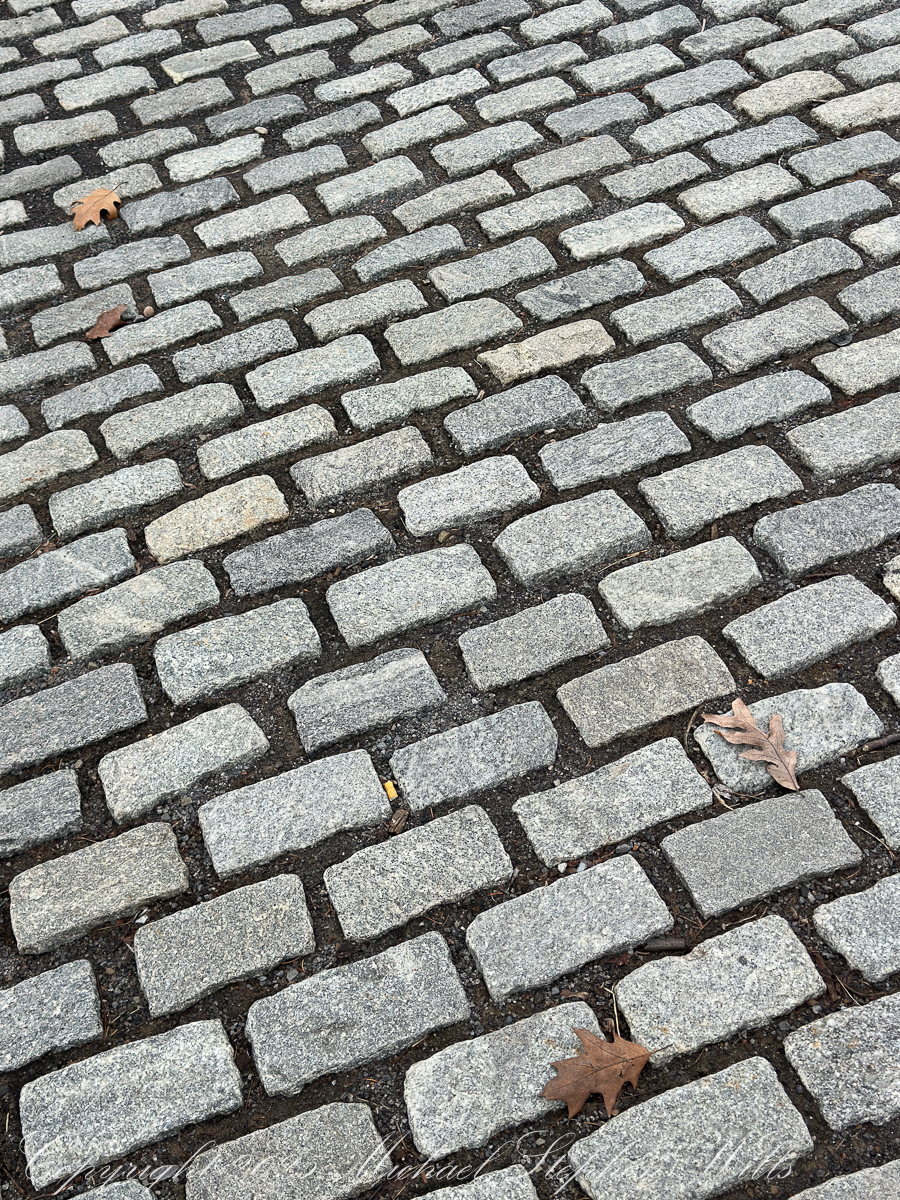
Cobblestones with fallen oak leaves along Feeny Way, Cornell University, Ithaca, New York
There is a quiet confidence in how the place is run. Systems hum discreetly. Heat holds steady even when the weather rips. Somewhere nearby, unseen, a generator waits, a reassurance. Work continues. Conversations do not end mid-sentence. I think about this more than I expected to. Stability has become a form of generosity.
On certain afternoons I walk the exterior again before heading home.
The curves soften what could have been institutional. Corners ease into one another. Nothing feels sharp. The building does not posture or instruct. It listens. It seems content to let weather, foot traffic, and time finish the job.
I have overheard visitors describe it as “restrained.” I think that is right. It does not wear sustainability as an emblem. It does not ask to be admired. It offers something quieter: space to think without being hurried, to talk without being territorial.
From some angles it nearly disappears into the hillside. From others it asserts itself just enough to be useful. That balance feels intentional, and also rare.
When I sit near the glass and look out, I sometimes imagine the building learning us in return—our habits, our pauses, the way we linger in doorways when a conversation matters. It seems designed for that kind of noticing.
If I were forced to describe it the way a realtor might, I would say it is well built in all the ways that matter. The structure is sound. The site is excellent. The materials will age well. But what I would mean is something less technical.
It is a building willing to wait.
Seen from above, it is still new. Seen from the field, it is already settled. Seen from inside, it feels patient.
That patience makes room—for uncertainty, for collaboration, for the long work that does not resolve quickly. I think that is why I keep returning, even on days when I do not strictly need to be there.
The building does not ask what I am producing. It asks only that I stay awhile.
And for now, that is enough.
Enter your email to receive notification of future postings. I will not sell or share your email address.
Copyright 2026 All Rights Reserved Michael Stephen Wills
A contemplative walk along Monkey Run where Fall Creek writes the valley’s history—sycamores, bridges, and Devonian stone speaking across seasons in Cornell’s living classroom.
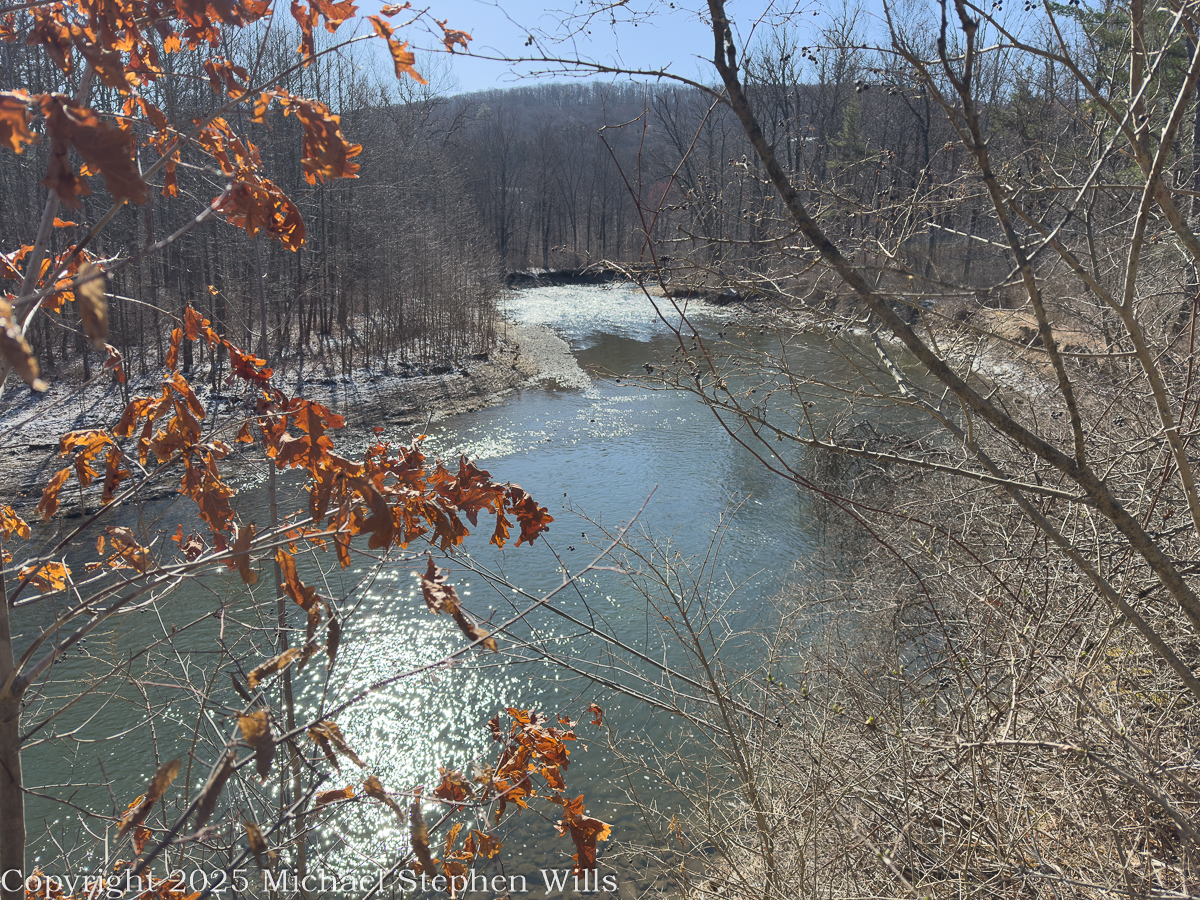
On a morning in late March, when the hills about Ithaca still hold the night’s frost in their shaded folds, I took the path called Monkey Run and went to see how Fall Creek spends its winter earnings. The air had the bright sting of thaw, a kind of vernal austerity that keeps a man honest in his steps. Along the high bank the sun spilled its coin onto the water, where it broke and flickered like a school of silver minnows. A rim of snow clung to the shale ledges, and the leaves of last year’s oaks—curled, fox-red, and faithful—whispered as if to keep the woods awake until spring fully claimed them.
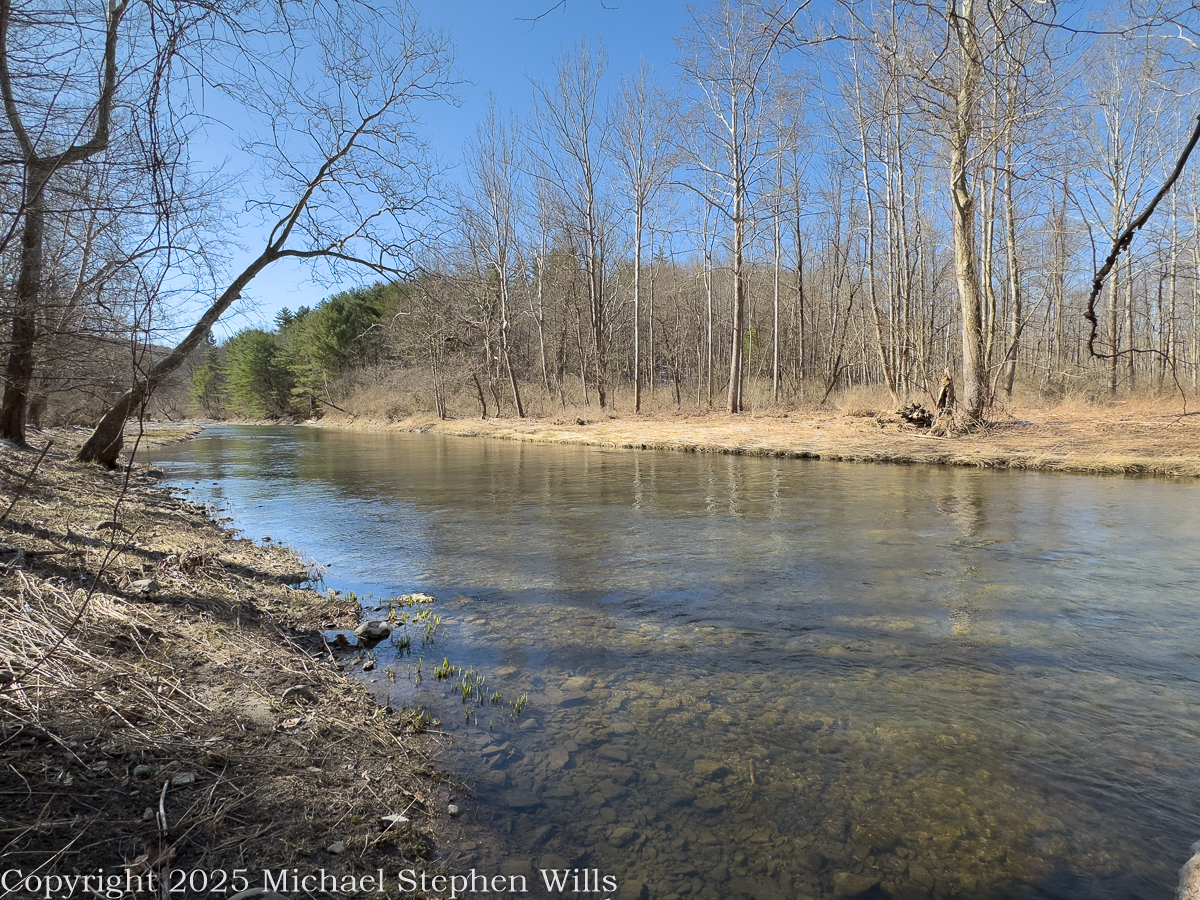
Sunlit bend of Fall Creek viewed from a high bank at Monkey Run in early spring.
Monkey Run is one of the outlying parcels tended by Cornell Botanic Gardens—once called the Plantations, and now, more fittingly, named for the living charge it keeps. These gardens do not end at beds and borders; they encompass the wilder rooms of the county, more than a thousand hectares of glens, pastures, and ravines where the university’s first and oldest teacher—nature herself—still holds class. Fall Creek is one of her principal lecturers. Rising beyond the high country of Cayuga Heights and slipping under stone and snow, it shoulders its way across the campus, idles a while in Beebe Lake, and turns turbines of memory at Triphammer Falls before shouldering on toward the lake that receives nearly everything here—Cayuga—long, deep, and glacial in its thinking.
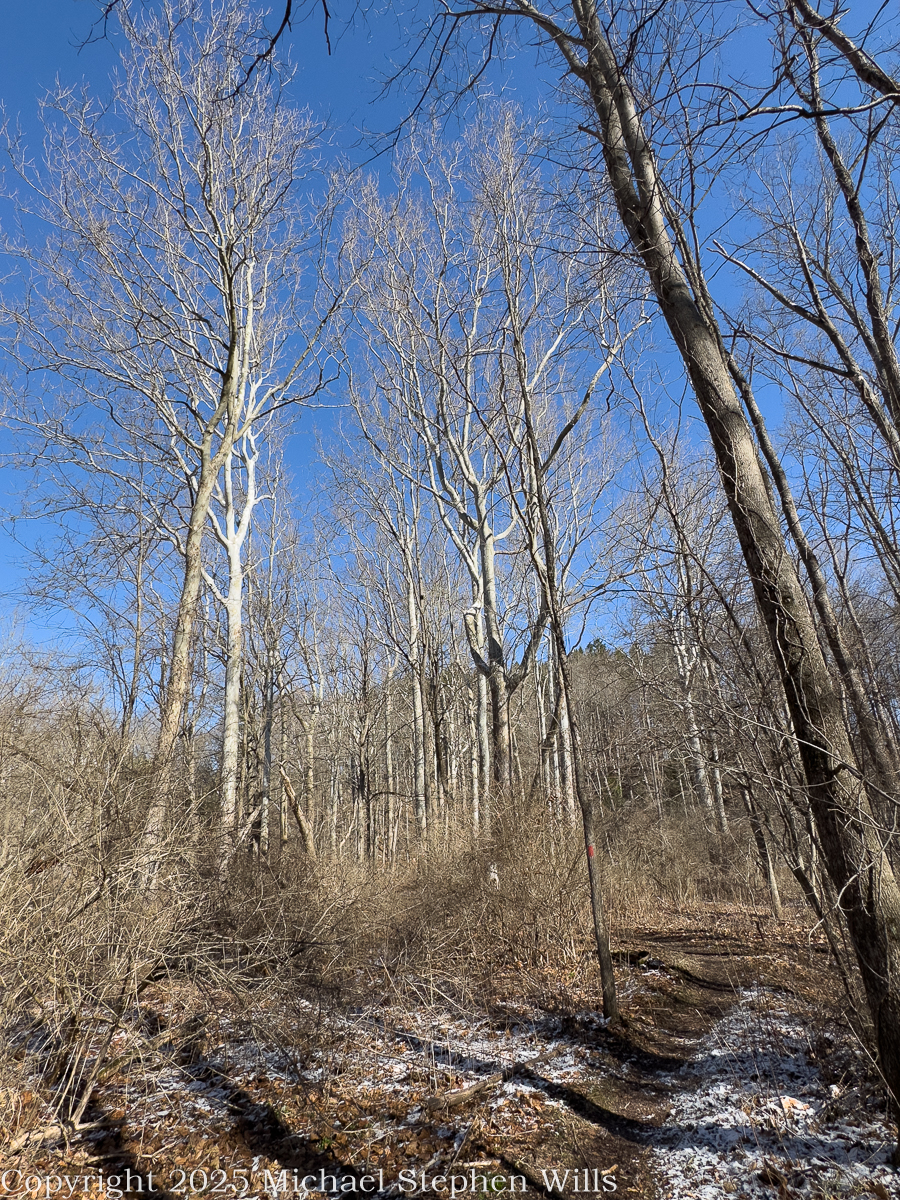
Tall white-barked sycamores leafless against a blue March sky at Monkey Run.
If you would learn a valley’s mind, walk a meander. The creek here composes with easy cursive, laying down a bar of gravel, nibbling at a bank of clay, then sweeping back to consider its work from the opposite shore. The geologist says the rock is Devonian, pages laid flat and damp with time, and the ice of ten thousand winters ago scoured them into the open. A creek is a patient mason, working without rest and never in anger. I admired these sycamores—their clean bones shining through the leafless canopy like the ribs of an old cathedral. Winter reveals their whiteness; summer grants them shade. A stand of white pines keeps a dark counsel in the background; on the muddy edge, green tongues of skunk cabbage push up, pledges made by the swamp to keep faith with the sun.
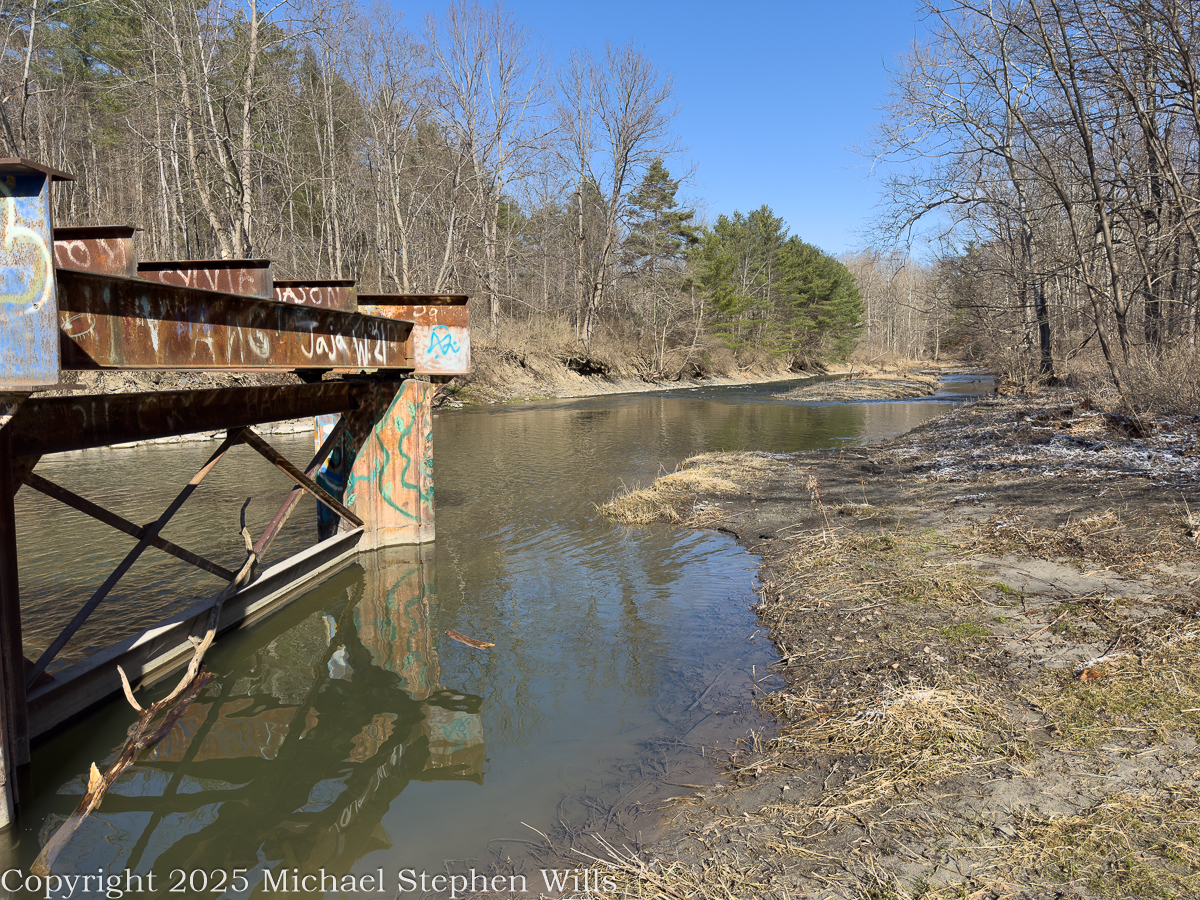
Rust-stained steel pier above calm water on Fall Creek along Monkey Run trail
I came down to the water near an old steel pier, a bridge remnant, hanging on each end without purpose. It wears graffiti the way a boulder wears lichen; human wishes, briefly rooted, coloring what they can. The river accepts it all, the pilings and the scribbles, the cast limb and the bottle’s glint, and continues its one unarguable gesture downstream. That is the old instruction of Fall Creek: use, refuse, endure. Before the university drew students from every quarter, the creek turned wheels and powered the small ambitions of a frontier town. Even the name Triphammer speaks of iron struck to purpose. Now the water powers something quieter: the studies of herons, the almanacs of kingfishers, the quick arithmetic of minnows over limestone.
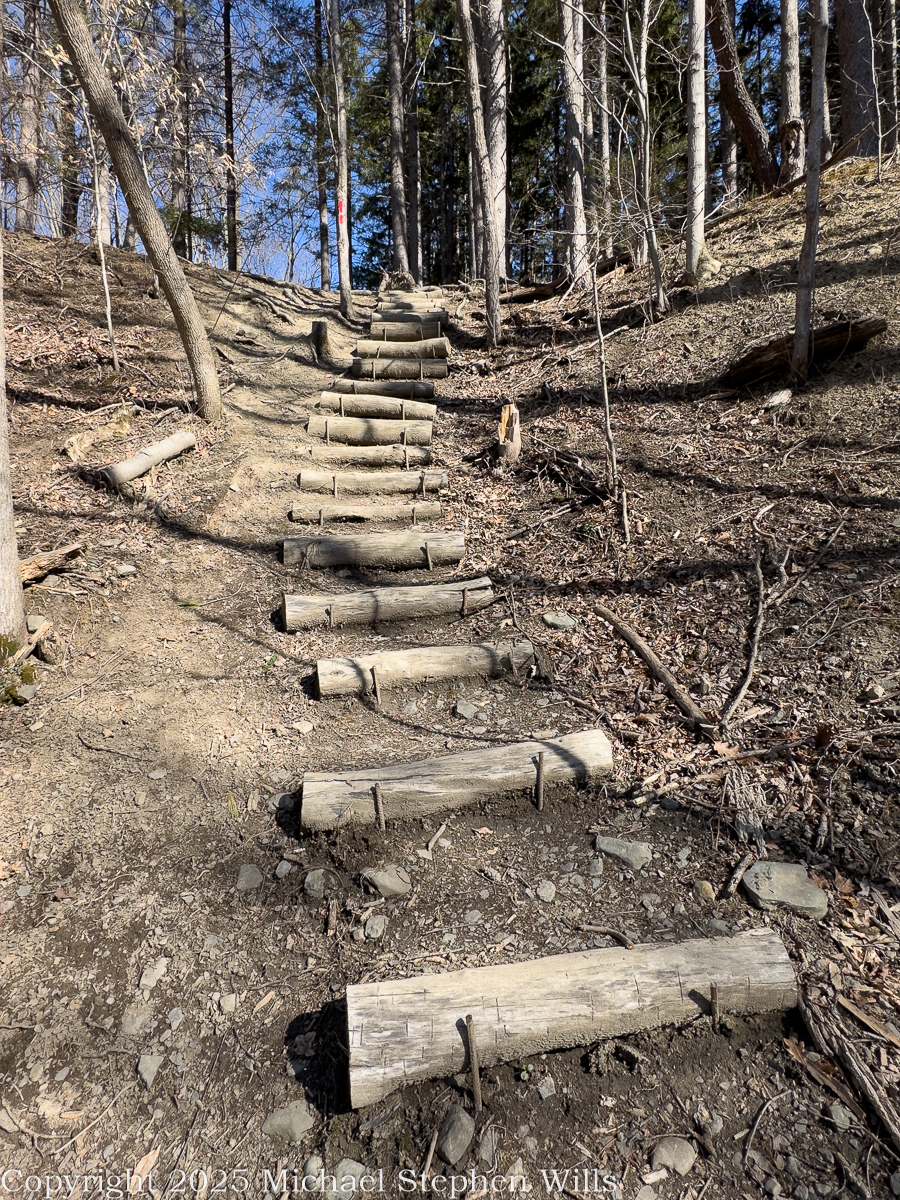
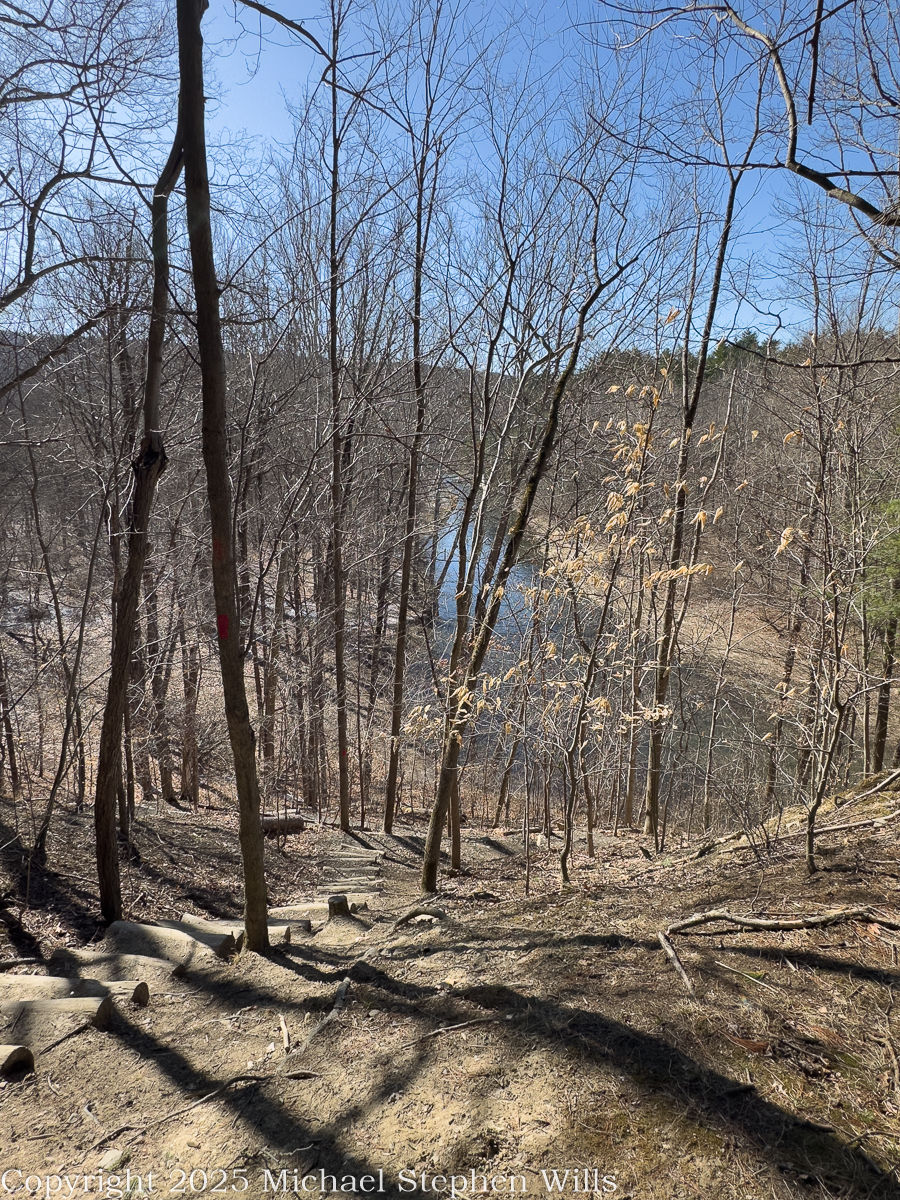
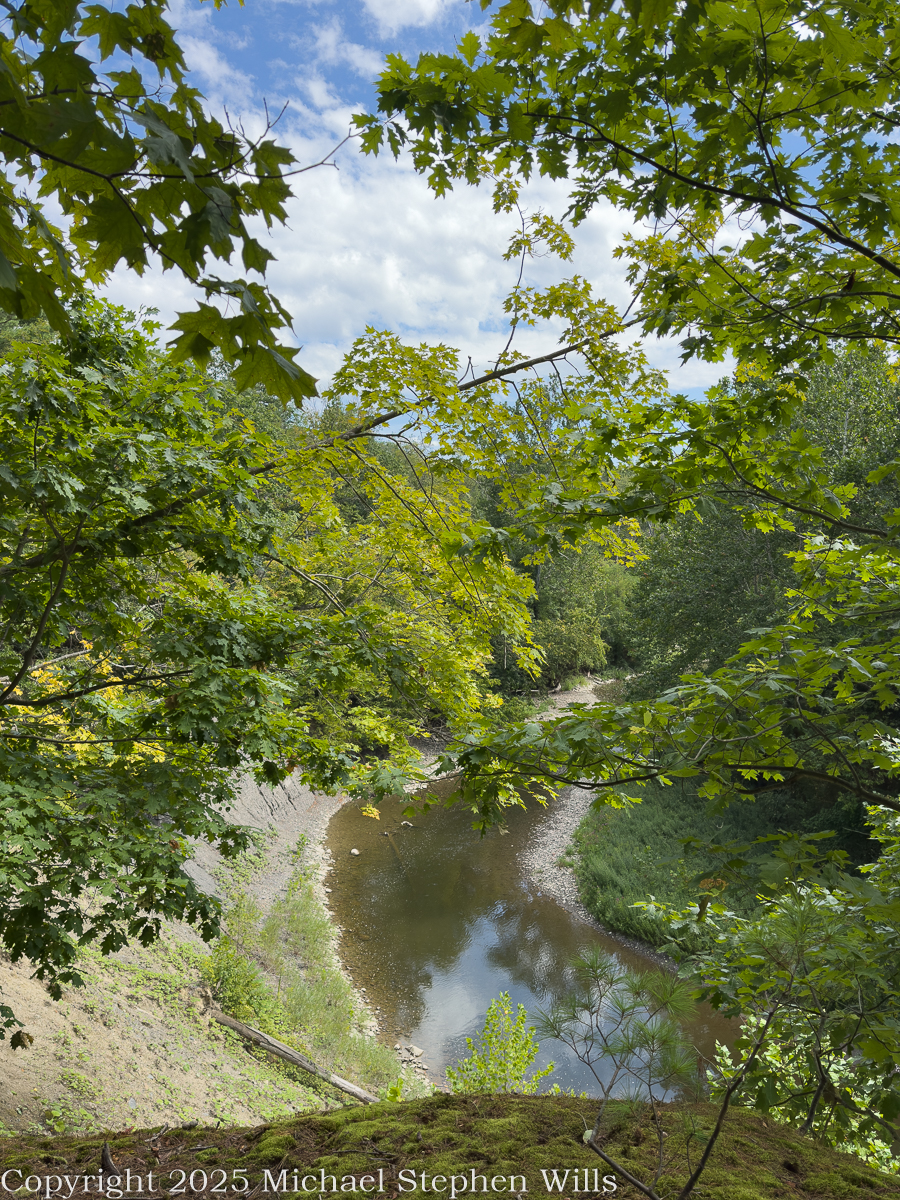
Looking back while climbing the steep bluff
Steps cut from logs ascend the bluff, each tread pegged with iron, each rise a short confession of breath. I climbed to the ridge, paused halfway, and through the gray lace of March branches saw the creek shining at a bend far below. A man cannot help but measure his own life against such a course. The path goes up and down in obedient red blazes, but the water keeps its own counsel. Where the bank slumps the river shoulders through; where the bottom rises it lays down a mirror. In my youth I wanted the straight run, the short work. Now the curve pleases me. To go with the current and not be carried away—that is a lesson suitable to the grey in my beard.
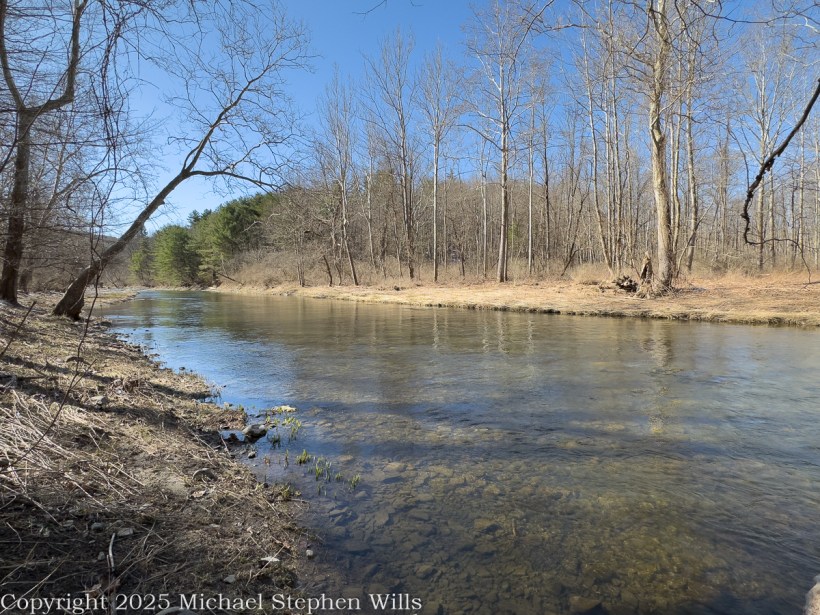
Clear, shallow run of Fall Creek with shale bottom and pine stand in distanceBluff overlooking Fall Creek in summer
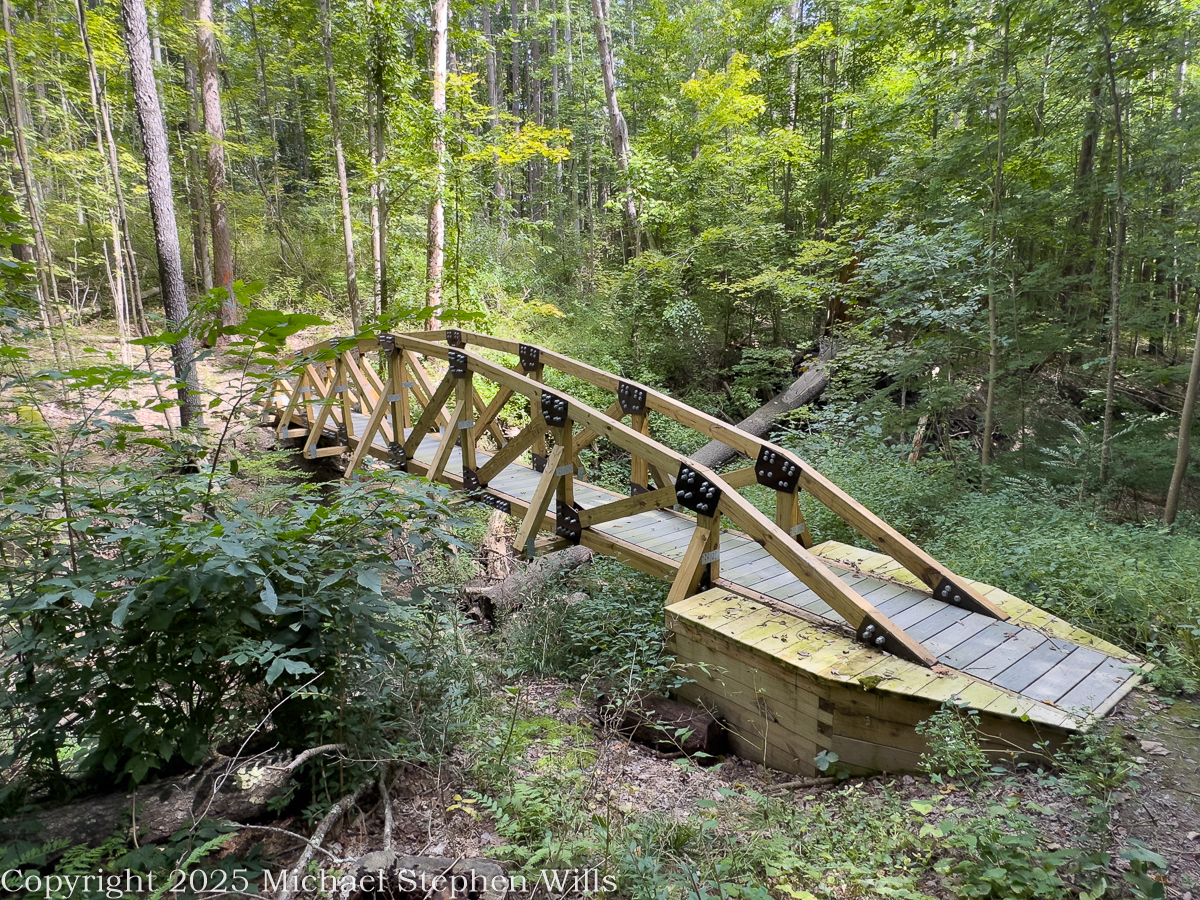
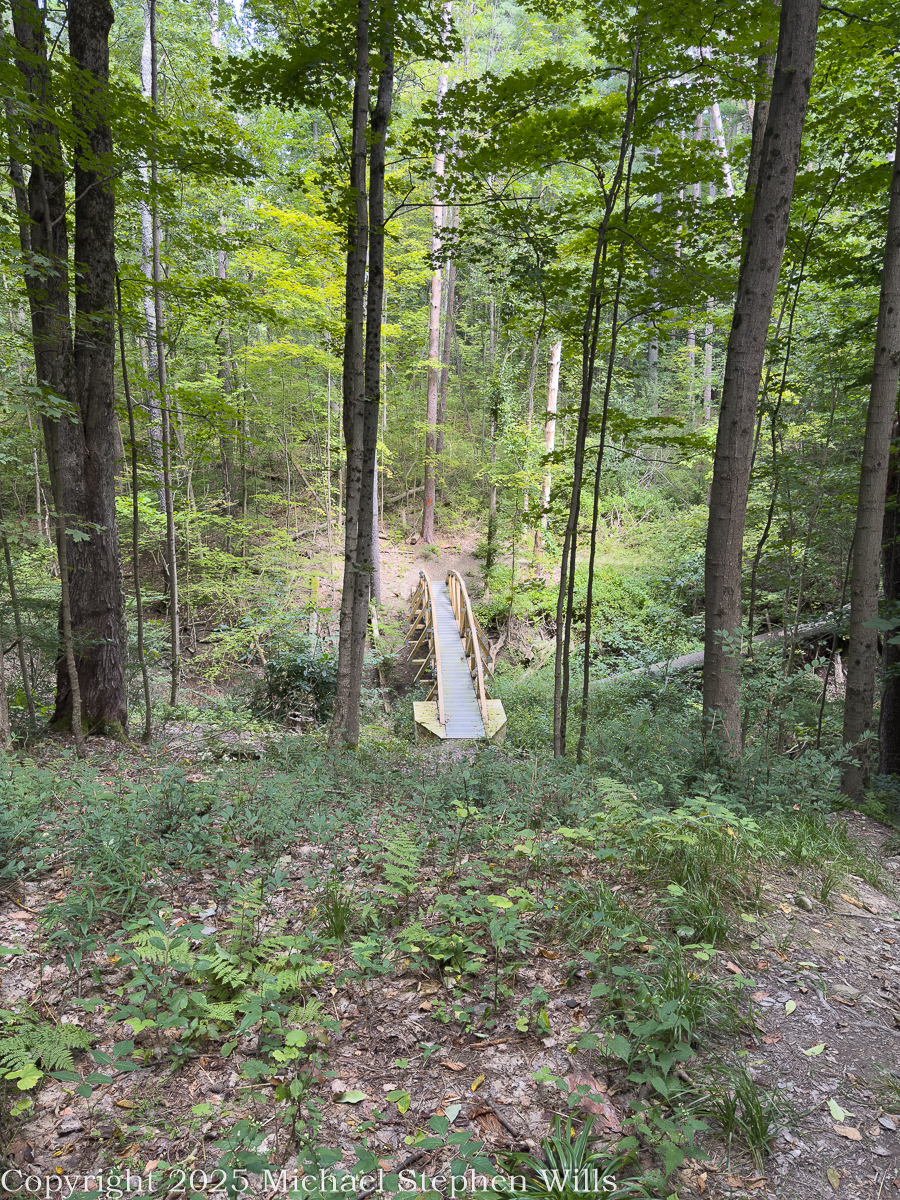
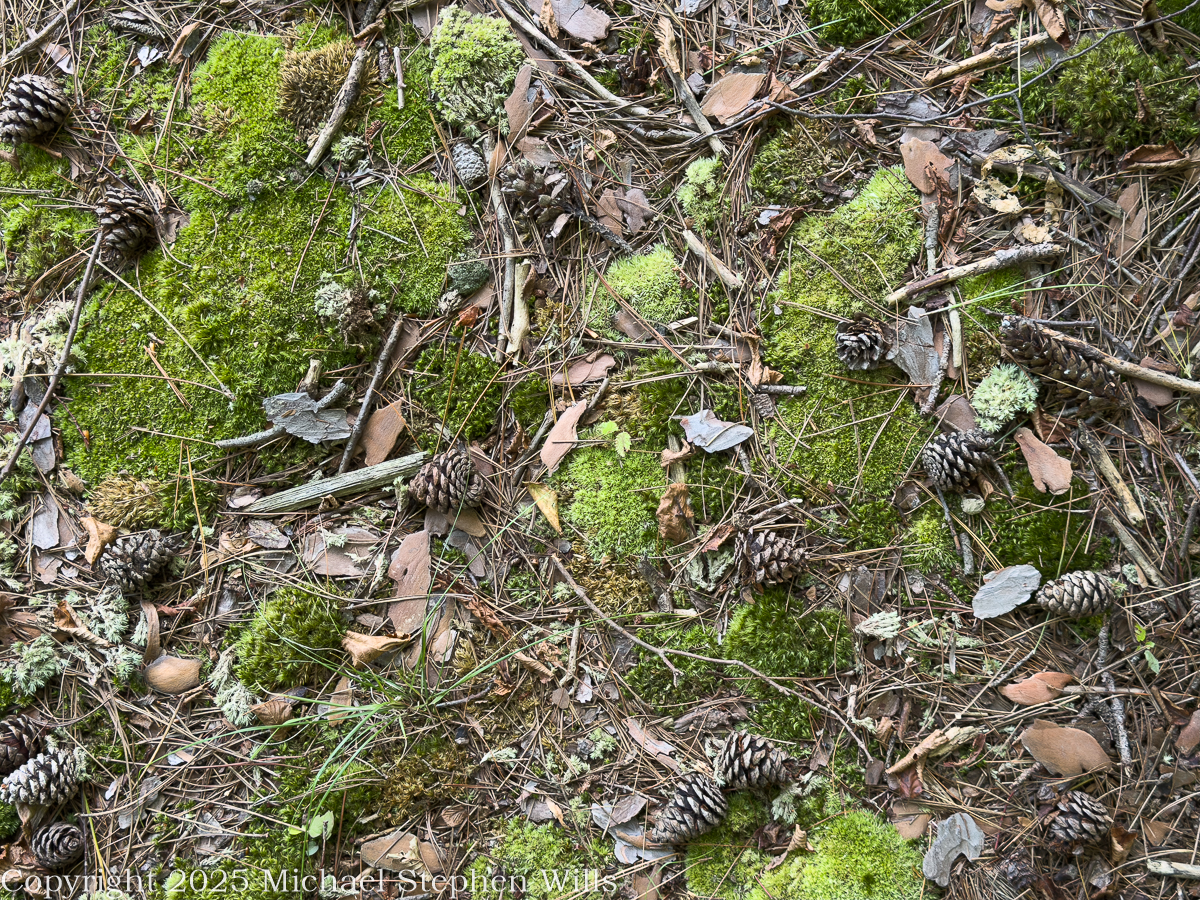
When I returned five months later, on August 23, the same path had forgotten the word austerity. The cathedral of sycamore was fully leafed, the white pillars now vanished behind a nave of shade. The pines perfumed the air without trying. A new footbridge—clean timber arching like a bent bow—spanned one of the wet flats. Its braces, black-bolted and handsome, looked as if they would hold the weight of an ox team or a file of schoolchildren. Such crossings are a kind of promise from the present to the future: we found a way through here; may you, too. Below, the floor was upholstered with moss, oak leaves, and a scatter of pinecones—the slow currency of the woods accumulating interest.
Arched wooden footbridge in summer forest on Cornell’s Monkey Run trail.
Summer makes a confidant of every plant. Ferns unrolled their scripture at the bridge abutment; jewelweed held its tiny lanterns along the seeps; a kingfisher rattled downstream, blue lightning with a bill. The creek, glassy over its shale pavement, showed every wrinkle of its stride. I waded a little, feeling with the sole what the eye could not—where the current took an extra thought around a stone, where it forgot itself in a warm eddy. Trout lingered in the dimmer reaches, quick as commas; a great blue heron lifted off with that surprising tidiness of wing, ungainly only in our imagination.
In all seasons the trail carries two histories: one written in rock and water, the other in the footfall of people. Cornell’s founders, Ezra and Andrew White, believed the university should place the hand near the thing studied; here that principle is plain. Botany students take their lectures in leaf and bark; geologists read the creek banks as if the pages might soon turn by themselves; children learn the oldest calculus—how long a stick will float before it catches in the weeds. The caretakers from the Botanic Gardens mark, mend, and interpret, but they do not overtalk. The woods speak enough.
Moss, grass and pinecones on an overlook of Fall Creek
As the afternoon eased toward evening, I climbed once more to the bluff. The light had gone honey-colored and the leaves of the maples, those careful accountants of September, were just beginning to weigh their green against gold. I looked down on the bend where I’d stood in March—cold, bright, expectant—and felt the year’s circle gently close. As John Burroughs wrote, “The power to see straight is the rarest of gifts… to be able to detach yourself and see the thing as it actually is, uncolored or unmodified by your own… prepossessions… that is to be an observer and to read the book of nature aright.” Monkey Run obliges that humility. The creek moves as it always has—glacially taught, mill-forged, campus-wise, and freedom-loving—and the trail, with its modest stairs and honest bridges, invites us to walk beside it, to match our breath to its turnings, and to leave, if we can, a lighter trace than we found.
References
Ways of Nature (1905), “Reading the Book of Nature,” pp. 275–276 (The Writings of John Burroughs, Riverside ed., vol. XIV, Houghton Mifflin)
Enter your email to receive notification of future postings. I will not sell or share your email address.
Copyright 2025 All Rights Reserved Michael Stephen Wills
On a serene autumn afternoon by Beebe Lake, a solitary red maple stood out against the backdrop, showcasing its vibrant colors and resilience, symbolizing autumn’s fleeting beauty.
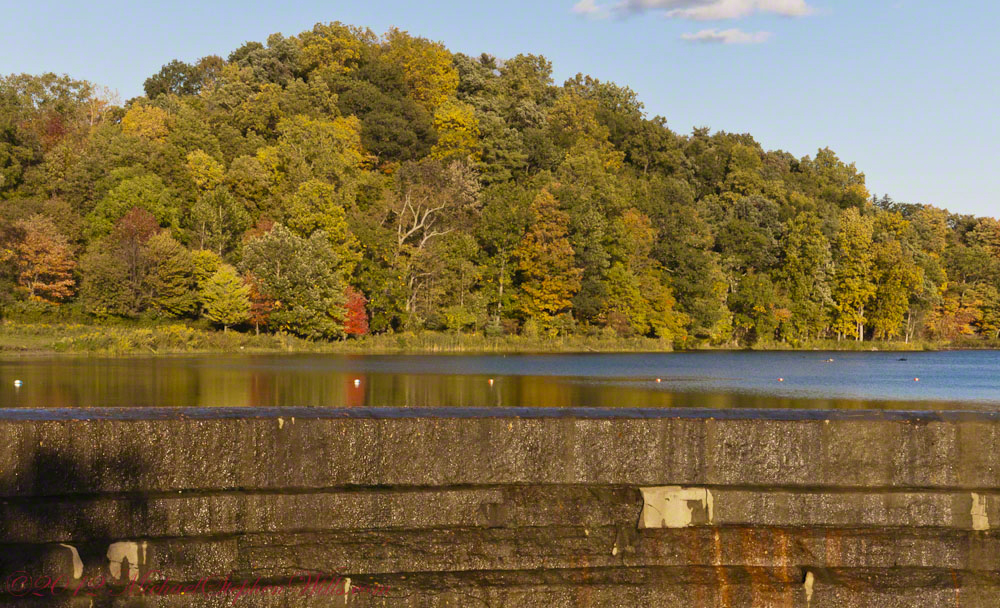
It was one of those serene autumn afternoons that linger in memory, the kind where the sky seems impossibly clear, the air crisp and gently scented with fallen leaves. I stood at the edge of Beebe Lake, my gaze first drawn to the textured concrete dam holding back the water, its weathered facade contrasting sharply with the soft reflections shimmering across the lake’s calm surface. Beyond, the wooded hillside rose gently, a tapestry woven with the warm hues of autumn—golds, greens, oranges, and reds mingling like brush strokes on a canvas.
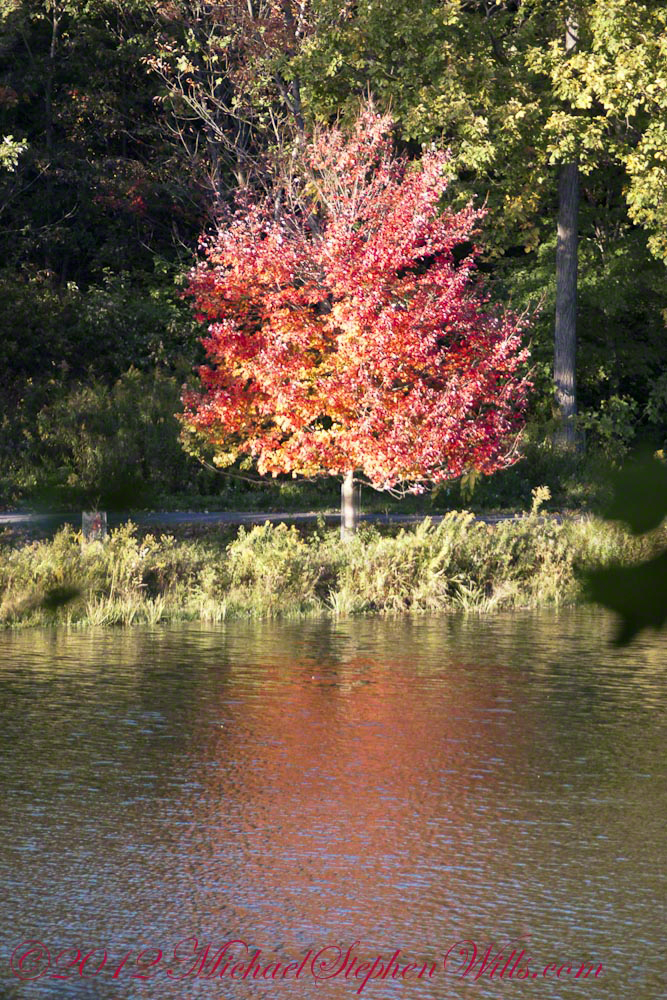
An October Glory, turning before all others
Yet amidst this collective beauty, one tree captured my attention, singular in its brilliance—a solitary red maple standing proudly on the lakeshore. Its leaves had turned a vivid crimson, blazing brightly as though defying the muted earth tones surrounding it. Even from a distance, framed and partially obscured by larger trees, its vibrant reflection cast a fiery echo on the water, rippling softly in the afternoon breeze.
The maple, Acer Rubrum, seemed perfectly at home here, thriving robustly at the water’s edge. I remembered reading how adaptable red maples are, able to flourish in conditions ranging from dry uplands to swampy shores. This spot, near the edge of the tranquil Beebe Lake, seemed to showcase its resilient character perfectly.
Up close, the maple’s glow was even more striking. Its leaves cascaded in fiery clusters, hues deepening from bright scarlet at the tips to a darker maroon closer to the branches. This dramatic gradient seemed symbolic of autumn itself—beautiful, fleeting, and subtly tinged with the melancholy reminder of winter’s approach.
The Red Maple (Acer Rubrum) to tolerant of diverse conditions, making it a perfect choice for this spot on the short of Beebe Lake.
A memory surfaced of early spring in the Finger Lakes region, a time when maples, including this red maple, generously share their sap. Though not traditionally tapped like its sweeter cousin, the sugar maple, this species’ sap can indeed be boiled down into syrup, a surprising sweetness hidden within its sturdy trunk. Standing in its shadow, imagining those early spring days, it seemed astonishing that the same tree could offer both the delicate sweetness of syrup and the fierce beauty now on display.
Curiously, the transformation of the tree appeared methodical yet whimsical—it changed colors from the top down, its upper branches already bare, exposing slender twigs pointing skyward. Like an artist carefully removing layers to reveal something deeper beneath, the maple unveiled its upper bare bones first, as though reminding observers of the quiet strength supporting its autumn splendor.
This Red Maple (Acer Rubrum) turns from the top down and has already bare for most top branches.
As I lingered, taking in this turning tree, joggers passed by along the path, their rhythmic footsteps a gentle percussion beneath the rustling leaves. Briefly, they glanced toward the vivid maple, perhaps drawn, like me, by its striking contrast to the surrounding foliage. It felt like we shared a secret admiration for this singular tree, recognizing in it a quiet assertion of individuality amidst conformity.
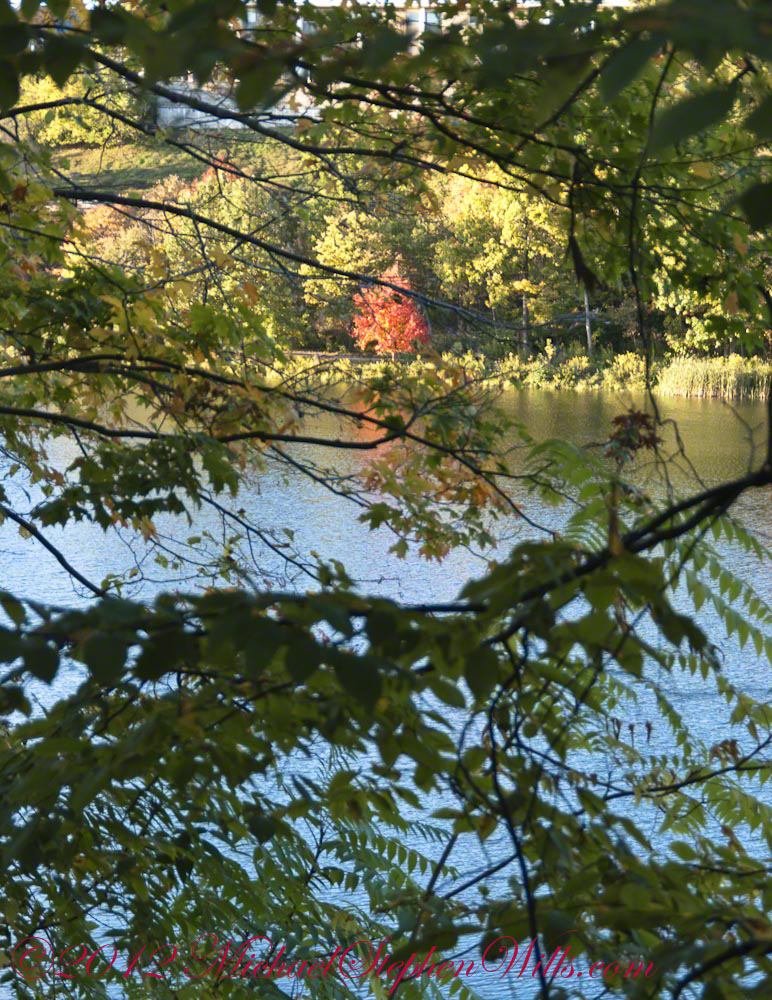
Eventually, I viewed the maple once more from afar, framed now by broader sweeps of branches and leaves, partially obscured but no less vivid. Through layers of leaves and dappled sunlight, it glowed like a distant flame, a beacon that seemed to encapsulate the entire mood of the season—warm yet cool, bright yet transient.
The Red Maple (Acer Rubrum) is the first to flower in spring and the first to turn in autumn.
Walking away, the image of that maple lingered, its reflection shimmering gently in the afternoon sun, a moment suspended between summer’s lush vitality and winter’s bare stillness. Beebe Lake had offered scenic beauty, a quiet meditation, a reflection mirrored not only on its tranquil surface but in the heart of an observer captivated by a single tree’s fleeting glory.
Enter your email to receive notification of future postings. I will not sell or share your email address.
Copyright 2025 All Rights Reserved Michael Stephen Wills
In the hush of the forest, Jack-in-the-Pulpit speaks—not with sound, but with form and patience, reminding us that some sermons rise quietly from the earth.
You could walk past it a hundred times and never notice. There, beneath the low canopy of midsummer, where light is sifted through green, Arisaema triphyllum stands with the discretion of a shadow. Jack-in-the-Pulpit, they call it—a name as strange and gentle as the plant itself. But neither common name nor scientific binomial quite captures the feeling that you are being addressed when you encounter one.
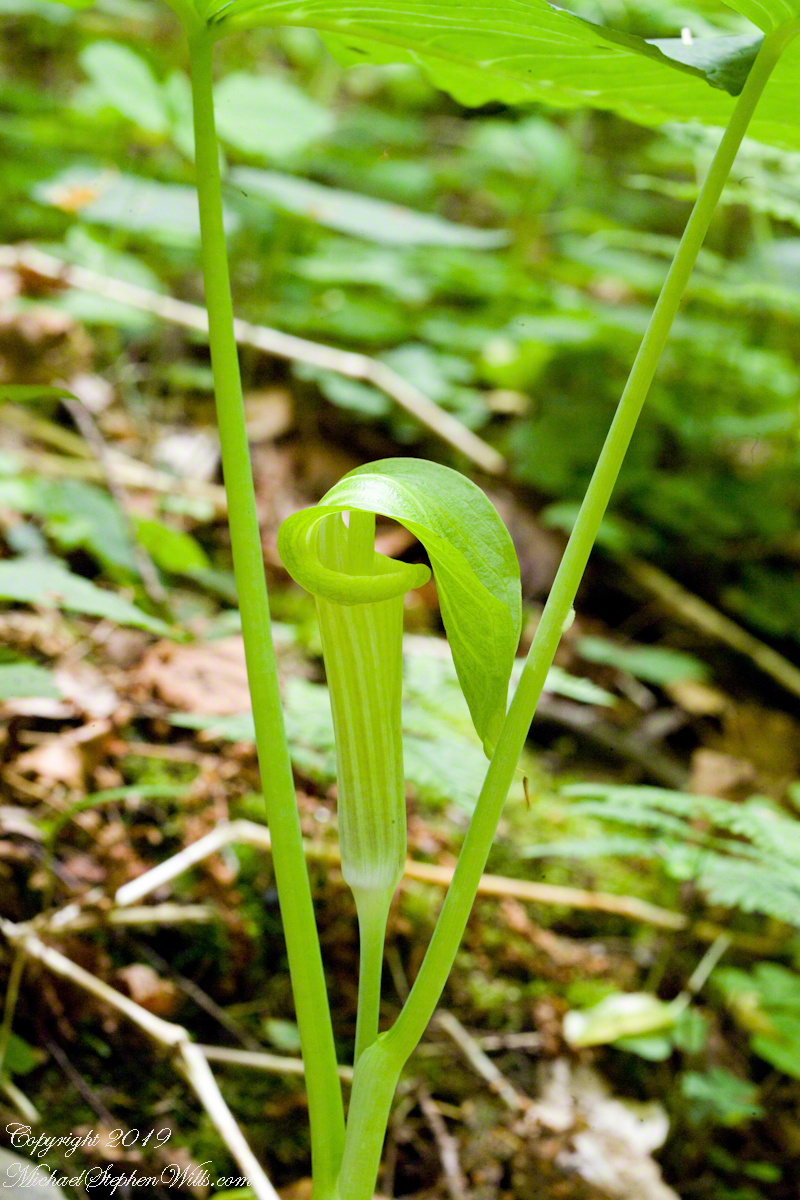
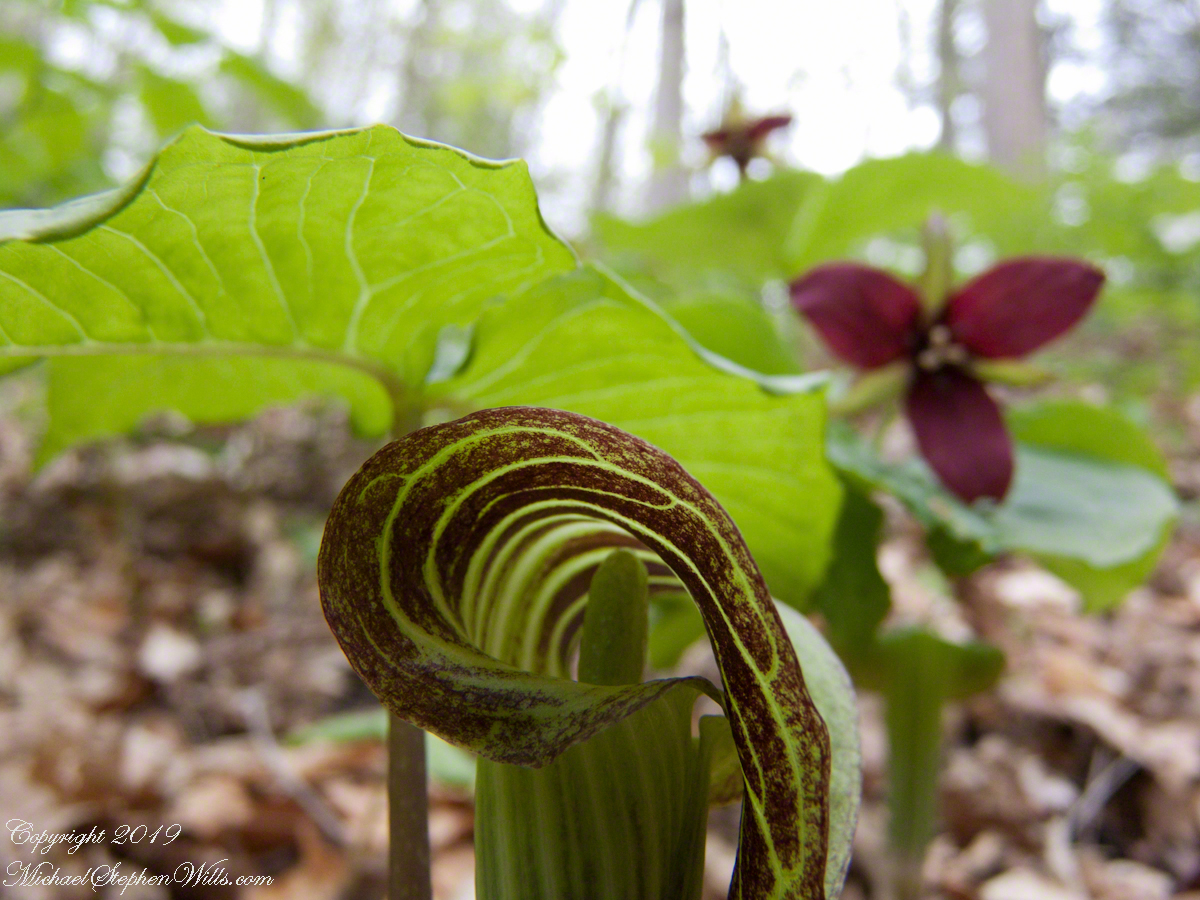
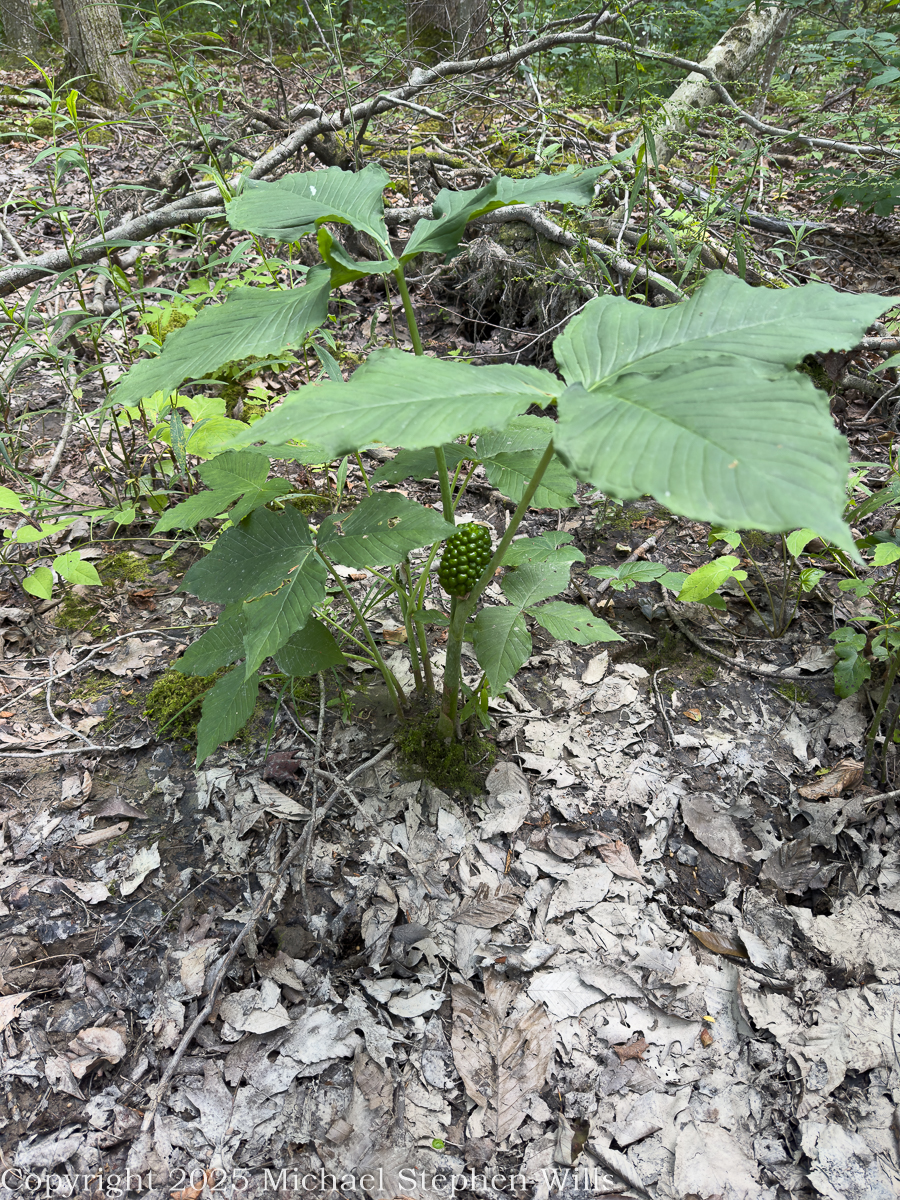
A young Jack-in-the-pulpit under its leaf canopy along the gorge trail of Filmore Glen.A mature Jack-in-the=pulpit flower with purple trillium, Fillmore Glen.
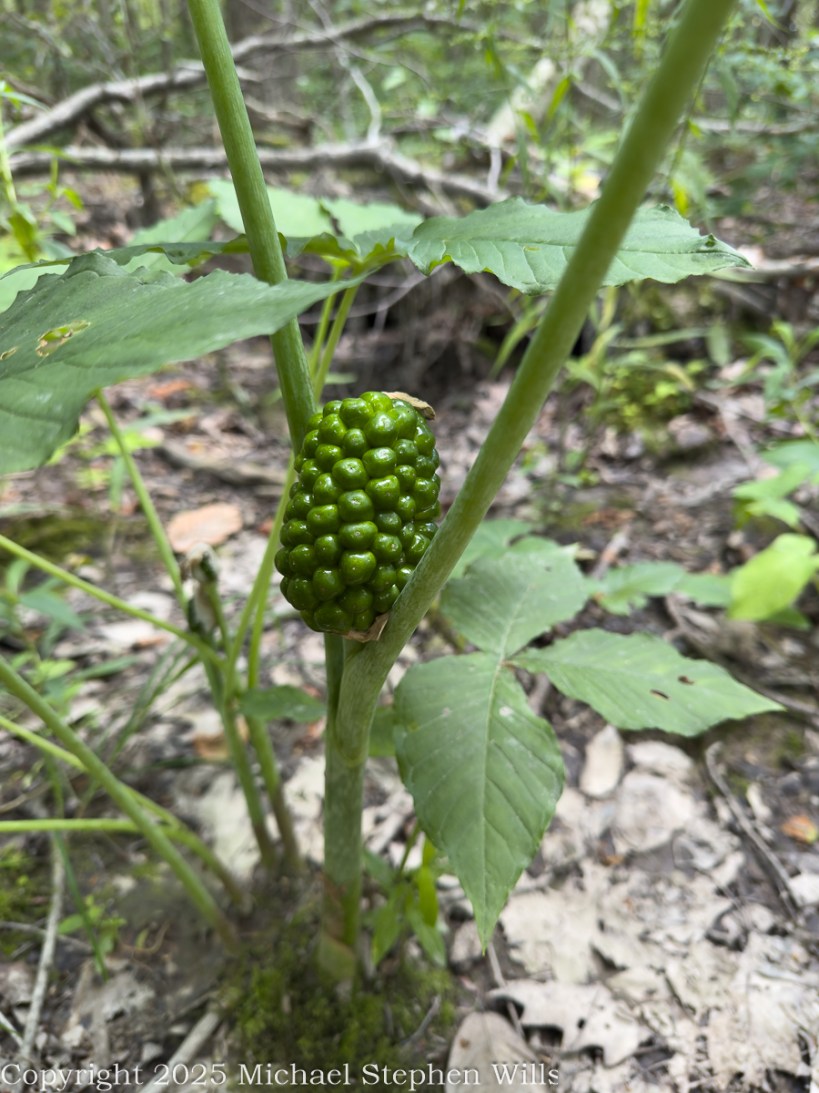
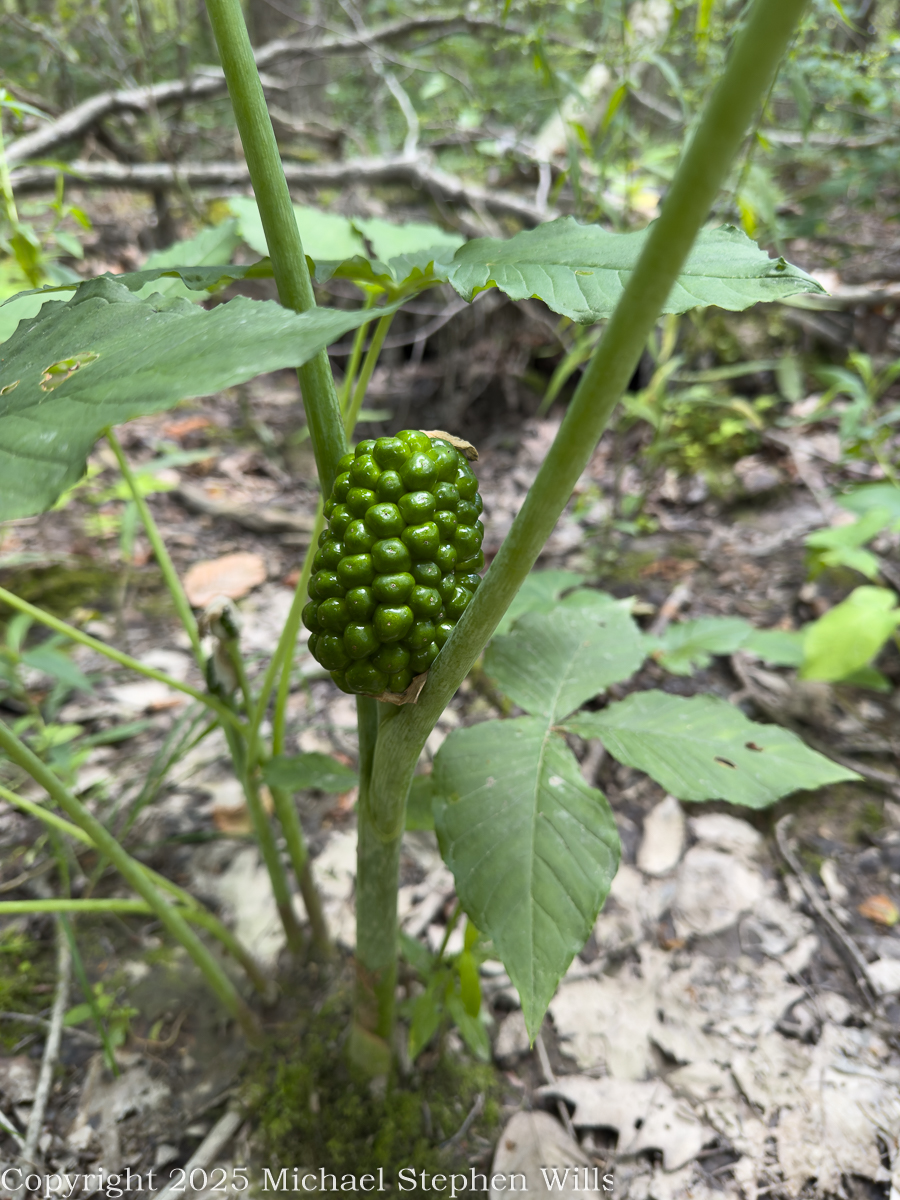
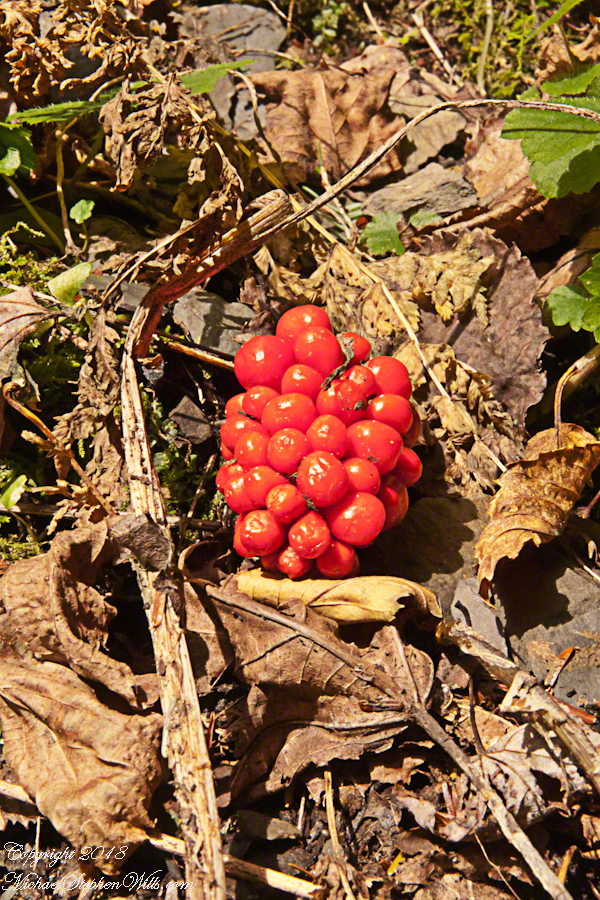
Earlier in the year, it raised a hooded spathe above the forest floor, curving protectively over a pale central spadix—the “Jack.” It looked like a figure delivering a sermon to the moss and littered leaves. Now, that sermon has passed, and the speaker has fallen silent. What remains is a column of tight green berries, glinting softly in the dappled light. They are not yet ripe, but the promise is there. In time, they will glow red like embers in the undergrowth.
Summertime, Sapsucker Woods. I might use a colloquialism and call this plant a “Jill”….and the real twist? Jack might’ve started out giving sermons but give them a good season and a strong root system, and Jack becomes Jill. It’s sequential hermaphroditism at its finest—Mother Nature’s version of career flexibility.
There is something ancient about this plant, as if it remembers a forest before our footsteps came. Its roots delve deep, not just into the soil, but into time. A corm, nestled beneath the leaf mold, waits out the harsh seasons, unseen but enduring. It is not a showy plant. It is a plant that trusts quiet. That survives on patience.
A closer look at the unripe berries.
The forest is full of these secret lives—beings that do not shout to be known. Jack-in-the-Pulpit speaks softly, in a dialect of leaf and shade and seasonal return. It is a plant you find when you have slowed down enough to belong again to the forest’s rhythm, when you’ve traded the voice in your head for the breath of leaf litter underfoot.
From Fillmore Glen
Some would call it just another spring ephemeral, a curiosity among many. But to walk away from it without feeling a kind of reverence would be to miss the point. It is not there to impress. It is there to remind.
That not all things are revealed at once. That sermons come in many forms. And that in the hush of the forest, something is always speaking—if only we remember how to listen.
Enter your email to receive notification of future postings. I will not sell or share your email address.
Copyright 2025 All Rights Reserved Michael Stephen Wills
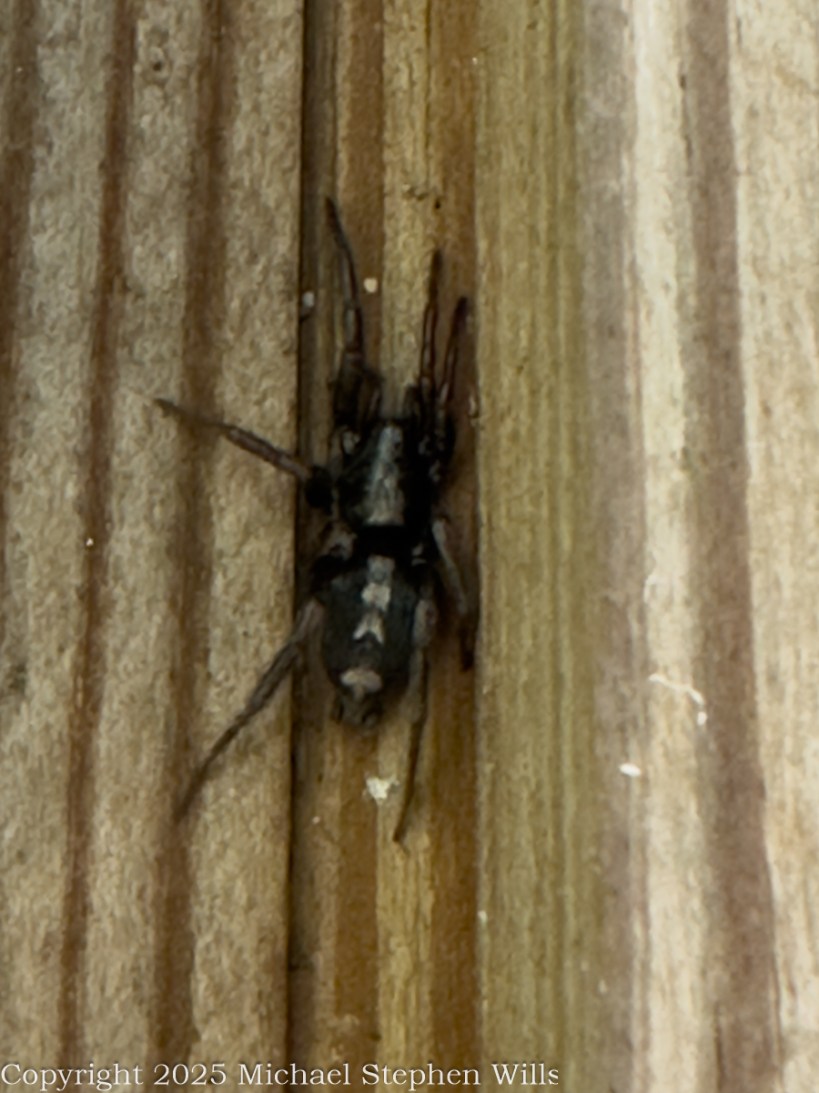
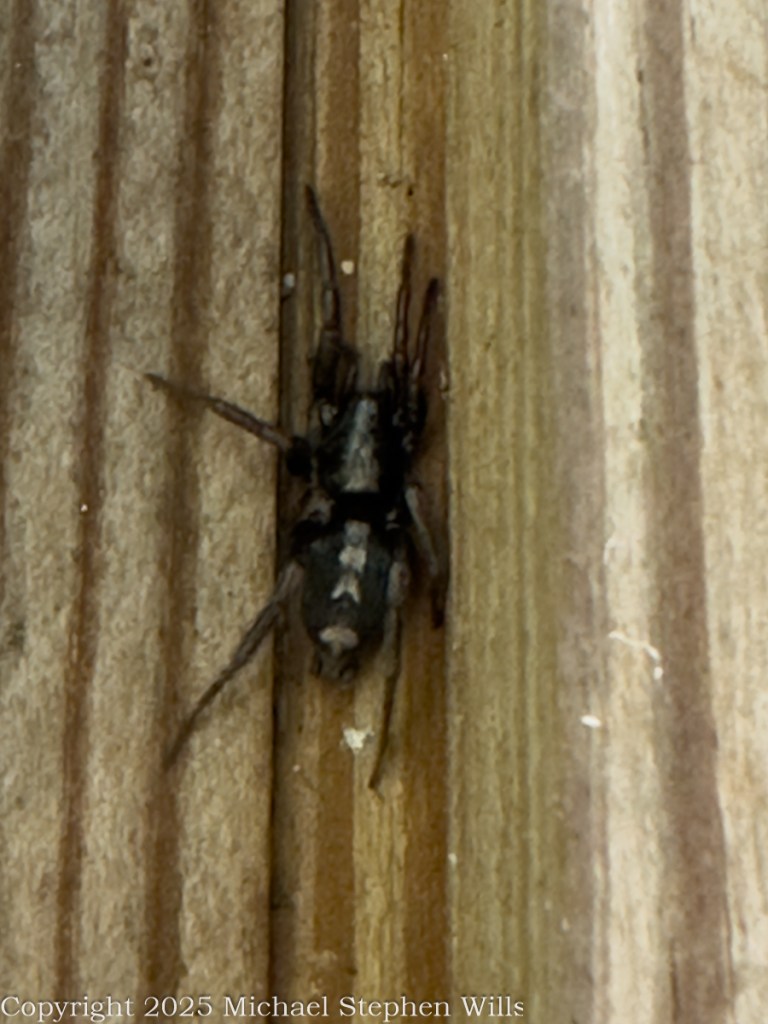
There, pressed into the grain of the boardwalk like a dark fleck of forest lint, the Bold Jumping Spider (Phidippus audax) waits—motionless, yet alert. To the untrained eye, it may seem insignificant, even nondescript. But a closer look reveals a creature of fine design and surprising charisma: a compact body cloaked in velvety black, adorned with pale markings like runes, and forward-facing eyes that gleam with eerie intelligence.
Unlike the orb weavers and net-spinners of spider lore, Phidippus audax does not rely on traps. It is a hunter in the truest sense—an animal that lives by leaping toward its future. With eight powerful legs and a muscular abdomen, it can launch itself many times its own body length, arcing through the air toward an unsuspecting moth or beetle. Yet it does not leap blindly. It trails a single silken thread behind it—a safety line, a commitment to survival. It is an act of courage tethered to caution.
Most remarkable are its eyes. A quartet of simple lateral eyes scan for motion, but the two large, front-facing principal eyes are something more—a rarity among arthropods. They grant it acute vision, with the ability to detect detail, movement, and even depth. When it turns its gaze toward you, you feel seen—not just registered, but regarded.
Found lurking in a joint of wood frame enclosing a trail map. Sapsucker Woods, Cornell Lab of Ornithology, on a summer afternoon\.
These spiders are active thinkers, decision-makers. They test their environment with movements that can almost be described as exploratory. They do not walk so much as prowl, stepping into shadow and light with an awareness that seems out of scale for their size.
And though they are often met with fear or disdain, Phidippus audax poses no threat to humans. It asks only for a few square inches of wood or leaf to stake its claim. In return, it offers a glimpse into a different kind of grace—an agile, silk-spinning daredevil, leaping with acute precision.
To observe one is to witness the meeting of design and instinct, form and function, in perfect miniature. In the vast, humming network of woodland life, the Bold Jumping Spider may be a small player, but it performs its role with flair. If the trees are the spires of the forest cathedral, and the ferns its leafy congregation, then Phidippus audax is a kind of sacred rogue—silent, swift, and utterly unconcerned by our towering presence.
Enter your email to receive notification of future postings. I will not sell or share your email address.
Copyright 2025 All Rights Reserved Michael Stephen Wills
On April 22, 2025, a wanderer discovers a trout lily, representing nature’s cycles, patience, and the interconnectedness of life through blooming, pollination, and nutrient cycling.
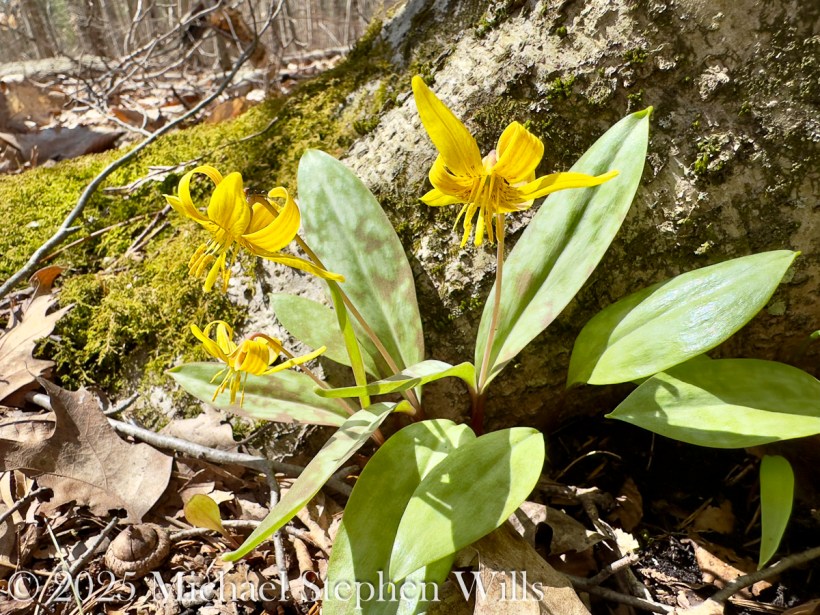
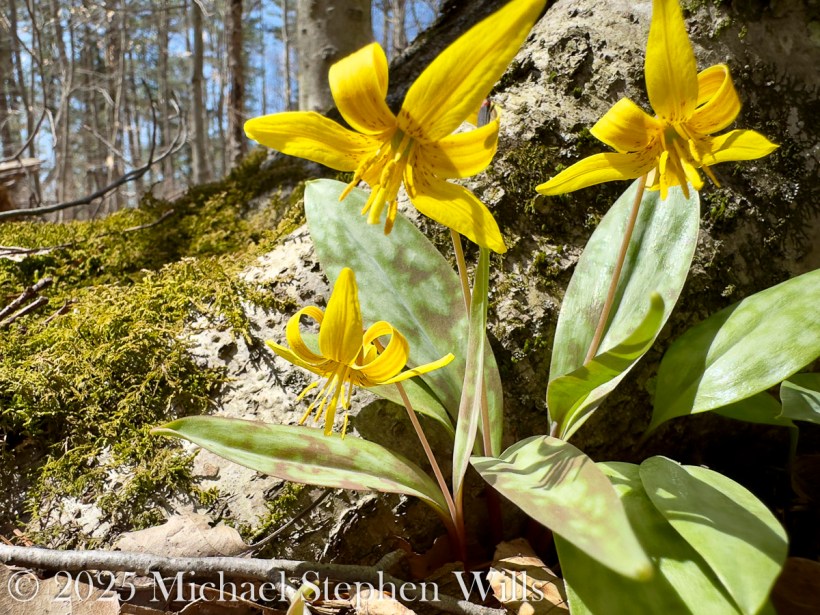
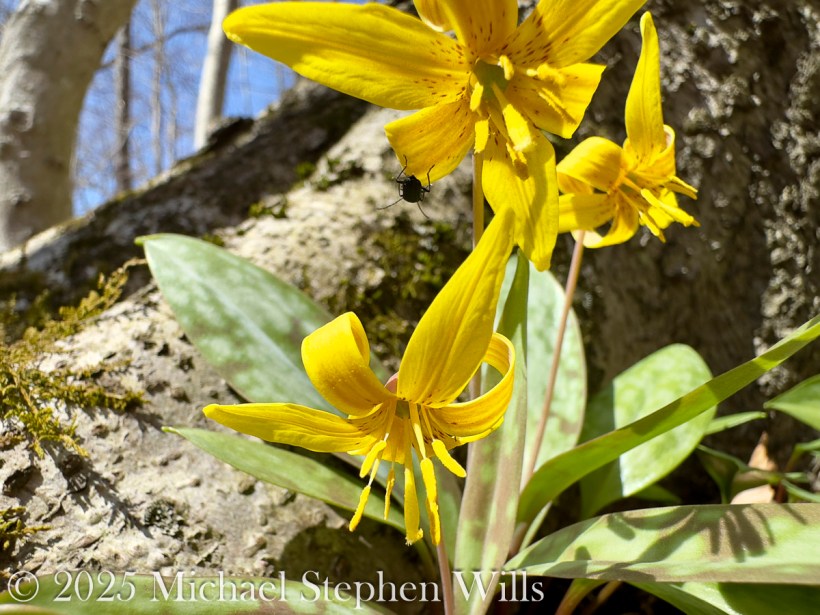
On the bright afternoon of April 22, 2025, I wander slowly through Sapsucker Woods, last year’s oak leaves soft underfoot and the smell of damp earth in the air. The trees stand bare, and somewhere a woodpecker drums as I search the ground for any sign of spring. A flash of gold catches my eye at the mossy base of a tree. Kneeling down, I find among the leaf litter a small wildflower glowing yellow. It is a trout lily – Erythronium americanum – a solitary, nodding bloom on a slender stem. Six delicate petals flare backward, golden with a few reddish freckles near the throat; long stamens dangle beneath. Two lance-shaped leaves hug the ground, green marbled with burgundy-brown. Their mottled pattern looks like a brook trout’s flank. This flower is known by many names: “trout lily” for its fish-like leaves, “dogtooth violet” for its pointed white bulb 1, and “adder’s tongue” for its tongue-shaped leaf tip.
Its formal name, Erythronium americanum, comes from the Greek for “red”2—odd for a yellow bloom until one remembers the purple dogtooth violets of Europe. Americanum simply marks it as native here. I soon realize these trout lilies are not alone – dozens of dappled leaves carpet the damp earth around me. Most show no blossom at all, only a single freckled leaf standing alone. Only the older plants with two leaves manage to lift a yellow flower. In fact, they often form extensive colonies on the forest floor. I’ve learned a trout lily may wait seven years to bloom its first time3. Seasons of patience pass unseen underground, and then one spring it earns the chance to unfurl a golden star. That slow, patient rhythm of growth fills me with wonder.
A tiny black bee—or maybe a fly—lands on the trout lily’s bloom, drawn by its promise of pollen. It disappears into the flower’s downturned bell, brushing against the dusting of pollen inside. In early spring, few other blossoms are open, so this little lily is a lifeline for hungry pollinators4. There is even a solitary “trout lily bee” that times its life to these flowers5. Flower and insect share an ancient pact: the lily feeds the visitor, and the visitor carries the lily’s pollen onward to another bloom.
Within a week, the trout lily’s golden star will wither. By the time the canopy closes overhead, the flower will have curled into a green seedpod that splits open by early summer, releasing its seeds6. Each seed carries a tiny parcel of food irresistible to ants7. Ants haul the seeds to their nest, eat the morsel, and abandon the seed in their tunnels—unwittingly planting the next generation. The name for this circular ecological dance is myrmecochory. Over time, the colony inches across the forest floor, guided by these tiny gardeners. During its short life above ground, this little lily helps the forest. Its roots soak up nutrients from the damp soil, keeping them from washing away in spring rains8. When the plant dies back, those nutrients return to the earth as the leaves decay, nourishing other life. In this way, a patch of trout lilies forms a quiet bridge between seasons—capturing nutrients in spring and returning them by summer’s end. I touch one cool leaf, feeling connected to this cycle.
I rise and take a final look at the little yellow lily. Its brief bloom reminds me that life’s most beautiful moments are fleeting yet return each year. This blossom will vanish in a few days, a blink of the season, but it will come back next spring as faithful as hope. In its patience and generosity, I sense kinship. Like the trout lily, we too have long periods of waiting and rare moments of blooming. We also rely on small kindnesses to help us thrive—like a friend in hard times or a community that carries our dreams to fertile ground. And we are part of a larger cycle, giving and receiving, leaving something of ourselves to nurture the future. As I continue down the trail, I carry the image of that humble flower with me—a gentle assurance that even the smallest life can leave a lasting impression, and that hope will always return with the spring.
Enter your email to receive notification of future postings. I will not sell or share your email address.
Copyright 2025 All Rights Reserved Michael Stephen Wills
Footnotes
wildadirondacks.org Trout lily’s common names: “Trout lily” refers to the trout-like mottling on its leaves, while “dogtooth violet” refers to the tooth-like shape of its underground bulb (despite not being a true violet). It is also sometimes called “adder’s tongue.” ↩
en.wikipedia.org The genus name Erythronium comes from the Greek erythros, meaning “red,” originally referring to the red-purple flowers of the European dogtooth violet (Erythronium dens-canis). The species name americanum denotes that it is native to America. ↩
peacevalleynaturecenter.org Trout lilies often grow in large colonies and most individuals in a colony are non-flowering. A plant typically needs about seven years of growth before it produces its first bloom. ↩
peacevalleynaturecenter.org Spring ephemeral wildflowers like the trout lily provide crucial early nectar and pollen for pollinators (bees, flies, butterflies) emerging in early spring. ↩
appalachianforestnha.org The trout lily miner bee (Andrena erythronii) is a solitary bee whose life cycle is closely tied to the trout lily; it forages primarily on trout lily flowers, making it a specialist pollinator of this species. ↩
wildadirondacks.org After pollination, trout lily flowers are replaced by seed capsules that ripen and split open to release the seeds in late spring. ↩
atozflowers.comErythronium americanum seeds have a small fleshy appendage called an elaiosome, which attracts ants. The ants carry the seeds to their nests, aiding in dispersal in exchange for the food reward, a mutualism known as myrmecochory. ↩
pubmed.ncbi.nlm.nih.gov By growing and taking up nutrients during the brief spring season, trout lily plants help retain important nutrients (like potassium and nitrogen) in the ecosystem. When the plants die back and decay, those nutrients return to the soil, contributing to the forest’s nutrient cycle. ↩
On a crisp October morning in 2017, I was on the cusp of retirement with leisure time to explored the Johnson Museum of Art at Cornell University, with my grandson Sam and his grandmother, Pam, my wife. We were attending a “Let’s Look Baby” event—a wonderful opportunity to introduce young children to art and the world around them. Sam was a toddler at the time, curious and full of energy, and I was eager to share this moment of discovery with him.
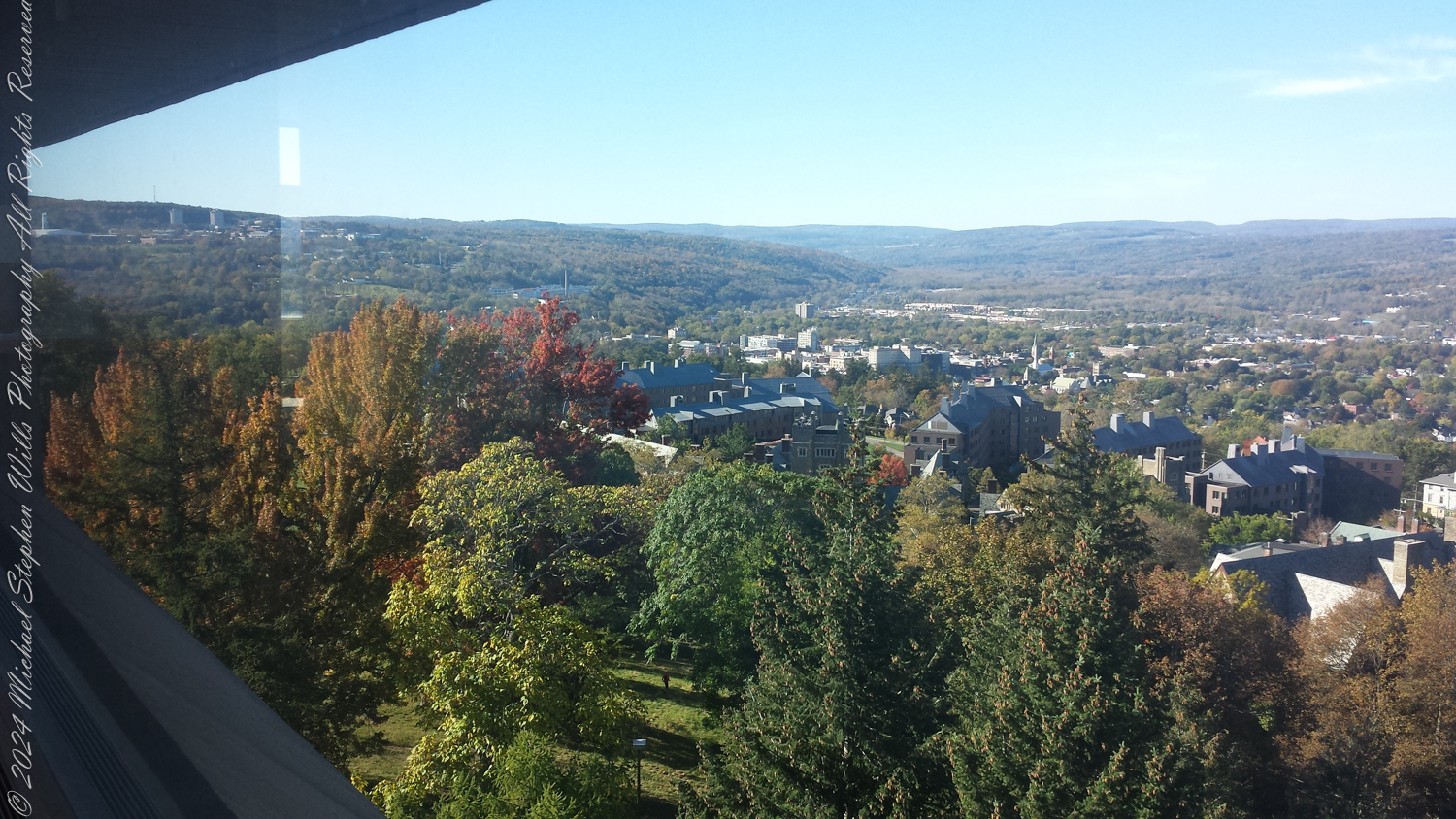
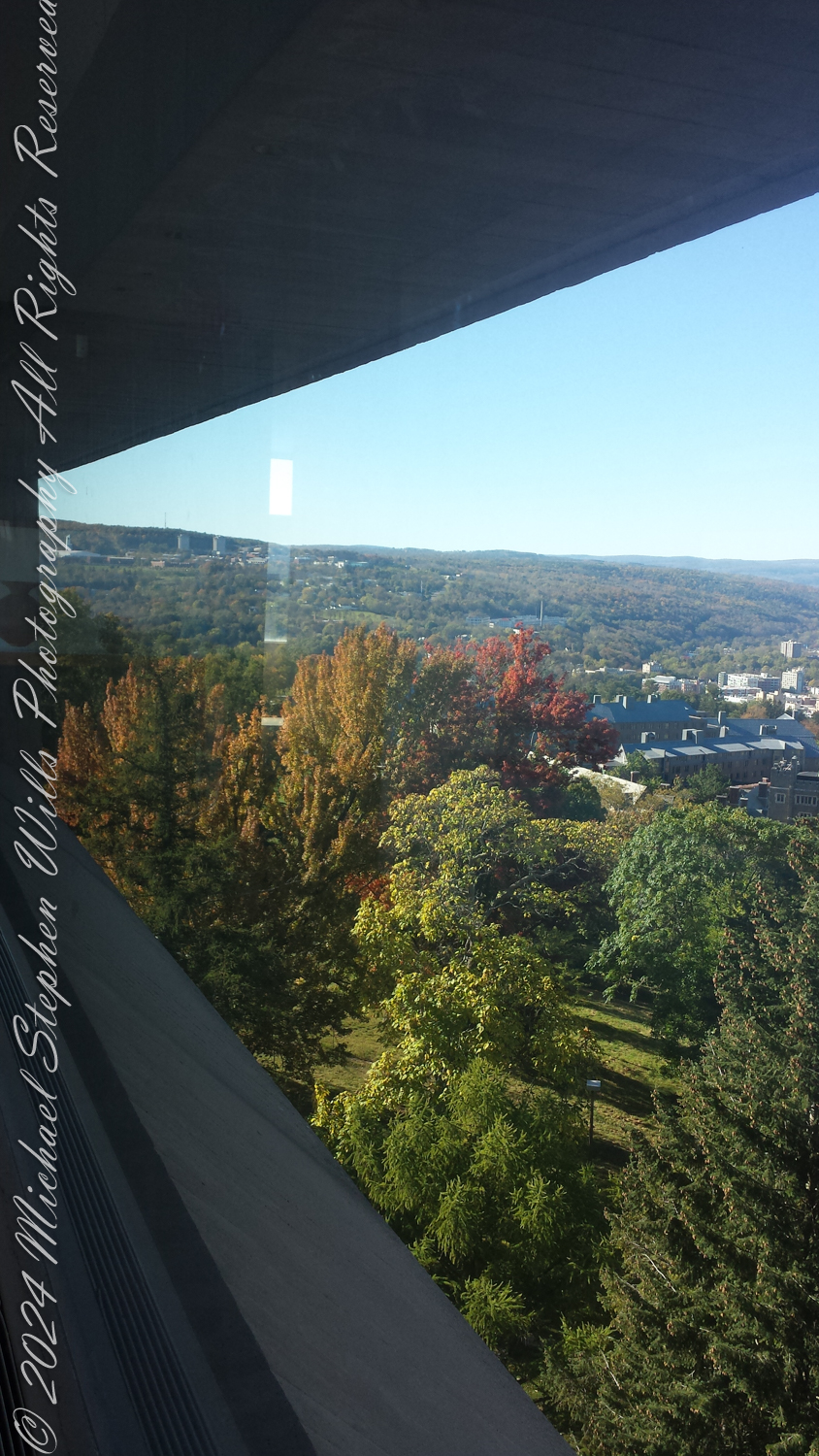
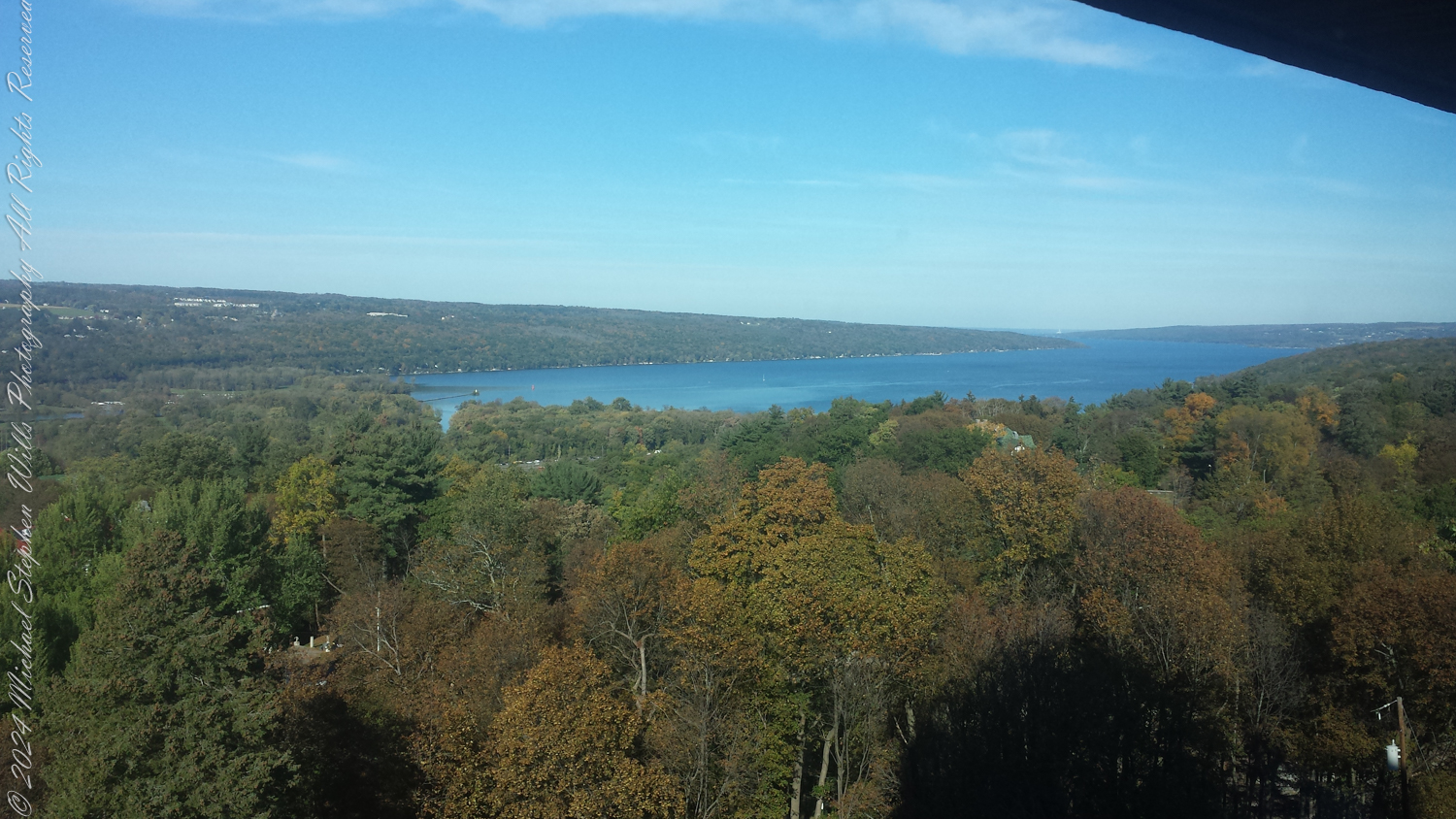
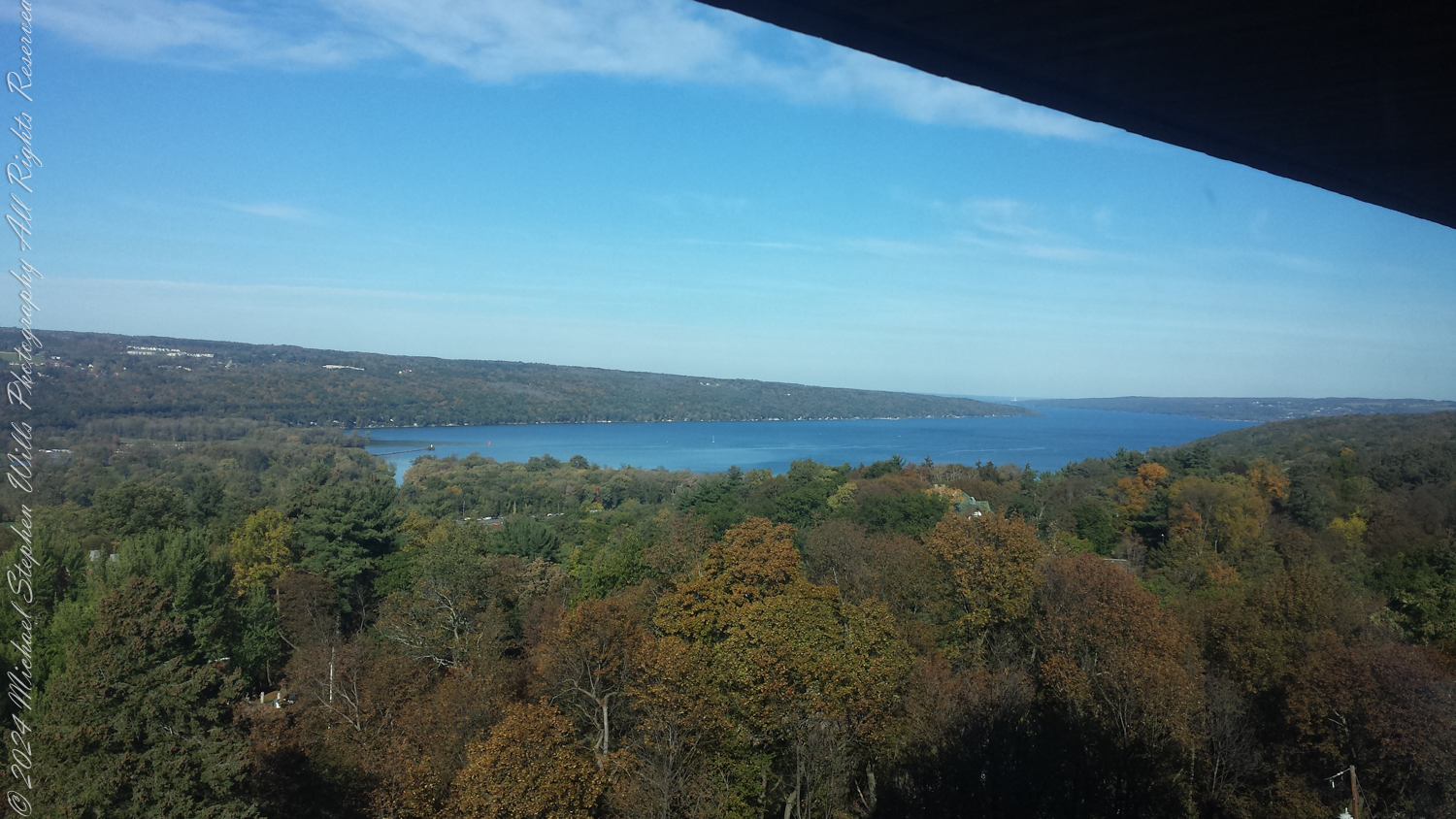
The day started on the museum’s upper level, where expansive windows offered breathtaking views of Ithaca, Cayuga Lake, and the surrounding hills. I lifted Sam so he could take it all in, his little hands gripping my arm as he gazed out at the vibrant autumn landscape while Pam captured the moment. The trees were in early stages of autumn—fiery reds, golden yellows, and rich browns—while Cayuga Lake shimmered in the distance, its deep blue surface reflecting the clear October sky. Sam pointed out toward the horizon; his eyes wide with curiosity. I told him about the lake, the hills, and the valley, trying to capture the beauty of it all in words simple enough for him to understand.
The architecture of the Johnson Museum itself framed the experience perfectly. Designed by I.M. Pei, the building’s clean, modern lines allowed the landscape to take center stage. Standing there with Sam, I felt a profound sense of gratitude—for the view, for the moment, and most of all, for the chance to share it with Sam.
Looking southwest over Cornell University and Ithaca, down the Cayuga Lake Valley. West Hill is to the right. Tompkins County, Finger Lakes Region of New York State
As part of the event, we explored the museum’s galleries, moving from one exhibit to the next. The “Let’s Look Baby” program was designed with young children in mind, blending art appreciation with sensory exploration. While Sam was too young to fully grasp the meaning behind the pieces, he was fascinated by the vibrant colors and the textures of the displays. At one point, we stopped by a ceramic vase. Its elegant curves caught Sam’s attention, and I used the moment to talk to him about shapes and forms, pointing out how it was similar to the roundness of a pumpkin or the arc of a rainbow.
Looking South / Southwest over Cornell University and Ithaca, down the Cayuga Lake Valley. Ithaca College is to the left on South Hill. Tompkins County, Finger Lakes Region of New York State
Throughout the visit, I found myself narrating the world to Sam, drawing connections between what we saw in the museum and the beauty of the natural world outside. It reminded me how much there is to learn and how much joy there is in teaching, even if the lessons are as simple as noticing the colors of leaves or the shape of a cloud.
Looking southwest over Cornell University’s Lib Hill and Ithaca, down the Cayuga Lake Valley. West Hill is to the right. Tompkins County, Finger Lakes Region of New York State
We returned to the large windows overlooking Ithaca more than once. From there, I pointed out the landmarks of the city—downtown Ithaca with its steeples, the rolling hills, and the peaceful expanse of Cayuga Lake stretching toward the horizon. Sam listened quietly, his small fingers pointing to whatever caught his attention. I wondered what he was thinking, but I knew this experience, even if he wouldn’t remember it fully, was shaping his view of the world.
Looking to the North / Northwest over Cornell University and Cayuga Heights to Cayuga Lake. West Hill is to the far left. Along the southern lake shore is Stewart Park, the lighthouse, New York State Marina and Cass Park. Tompkins County, Finger Lakes Region of New York State
The day wasn’t just about what we saw—it was about the connection we shared. Holding Sam in my arms, I felt the simple, deep joy of being present in the moment. This was a chance to see the world through his eyes, to notice the details I might otherwise overlook, and to marvel at the way something as simple as a vase or a view could spark his curiosity.
Looking to the North / Northwest over Cornell University and Cayuga Heights to Cayuga Lake. West Hill is to the far left. Along the southern lake shore is Stewart Park, the lighthouse, New York State Marina and Cass Park. Tompkins County, Finger Lakes Region of New York State
As the October sun swept over the landscape, casting warm golden light, we left the museum. Sam was getting sleepy, his little head resting on my shoulder Pam and I shared a quiet contentment. That day at the Johnson Museum is a memory to treasure, a reminder of the beauty in both art and the natural world, and most importantly, the joy of sharing it with someone you love.
Enter your email to receive notification of future postings. I will not sell or share your email address.
Copyright 2025 All Rights Reserved Michael Stephen Wills
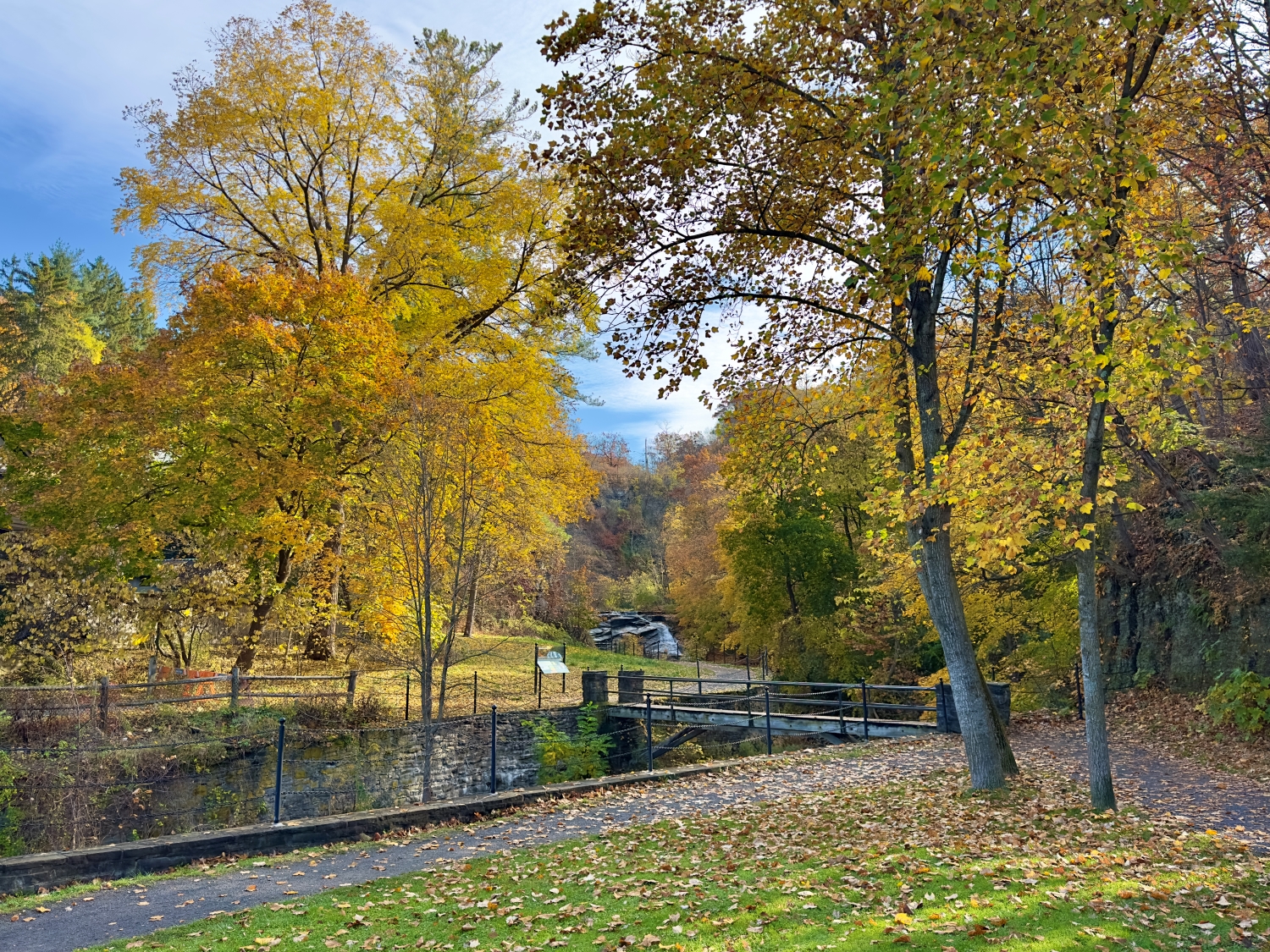
As I step into Cascadilla Gorge from the Linn Street entrance, I’m greeted by the soft rustling of leaves and the constant, soothing rush of water. The air this Halloween Day is warm, the autumn colors vibrant against the cool blue sky. I know Cascadilla Gorge is part of the Cornell Botanical Gardens, but the immediate beauty of this natural sanctuary makes it easy to forget I’m still within the city limits of Ithaca. The sounds of the gorge draw me in, as if whispering there’s more to see, more to explore. With a deep breath, I begin my journey up the trail, eager to discover what lies ahead.
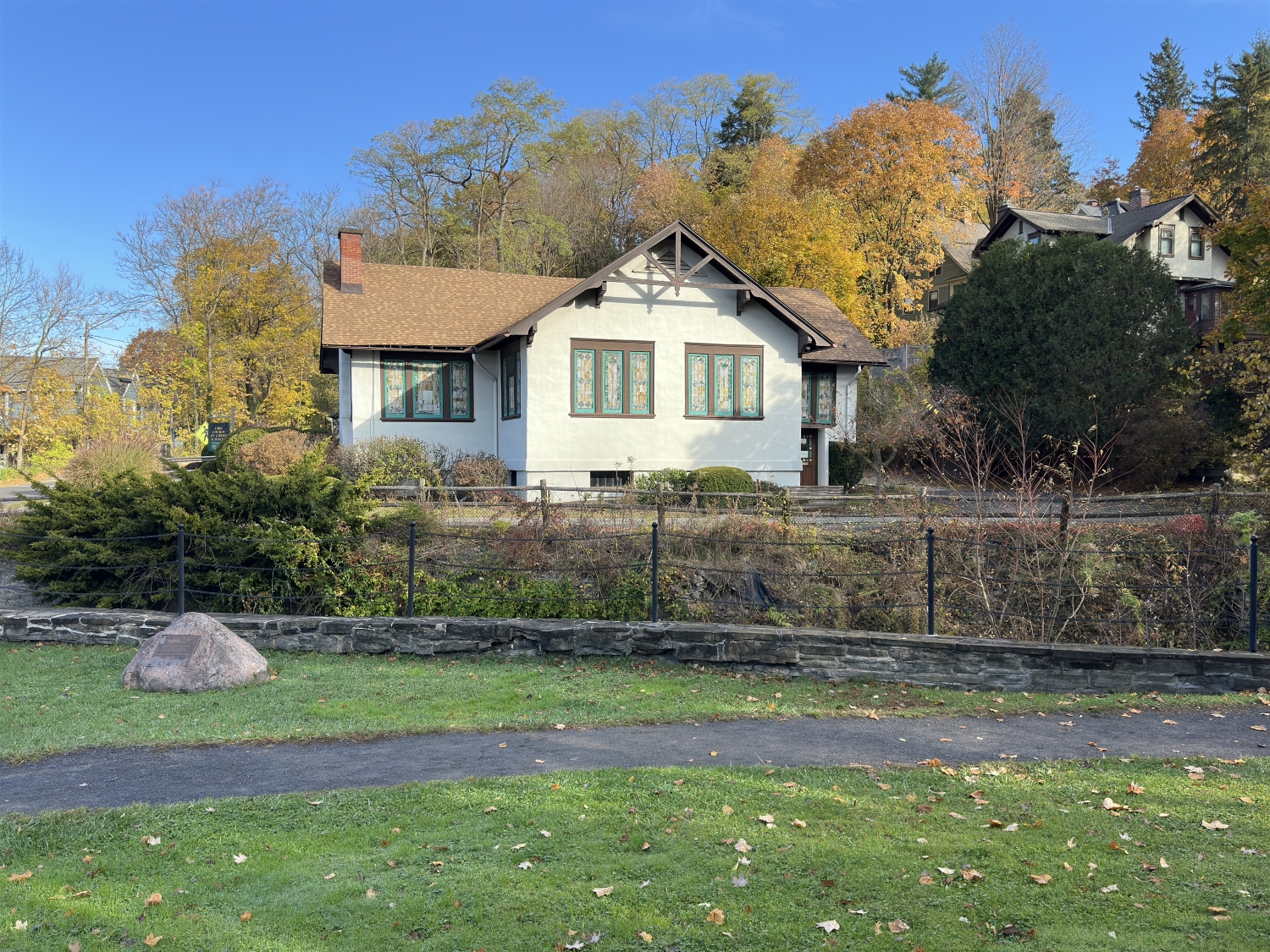
Just a short way in, I notice the First Church of Christ, Scientist perched on the corner of University Avenue and Cascadilla Park Road. The architecture of the church is both quaint and elegant, with its light-colored facade framed by dark trim and roof. Surrounded by foliage, it feels like the church belongs here, as much a part of the landscape as the trees and rocks. The sight of this historic building nestled so close to the gorge reminds me that this wild and ancient place is woven into the fabric of Ithaca’s community life.
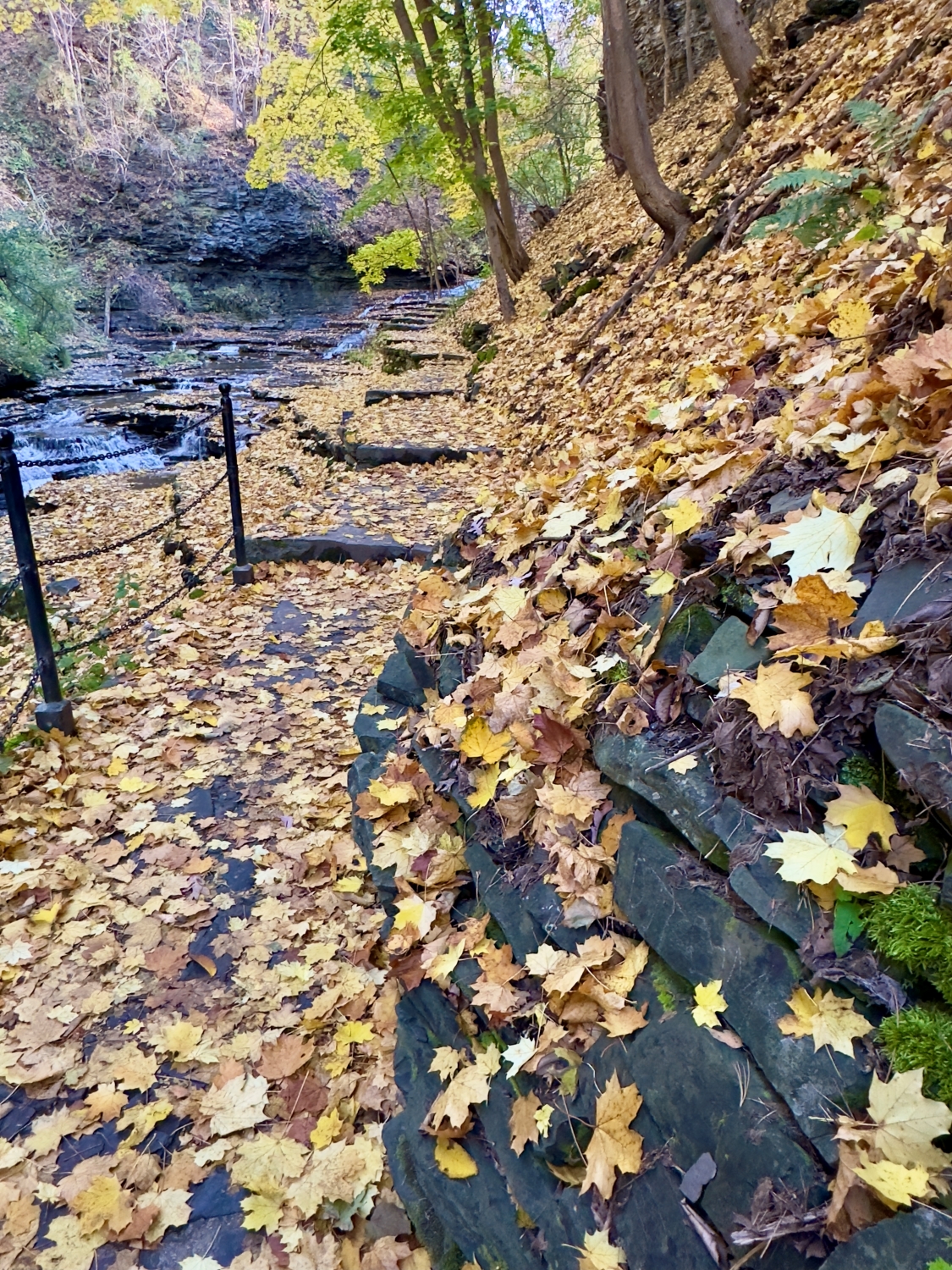
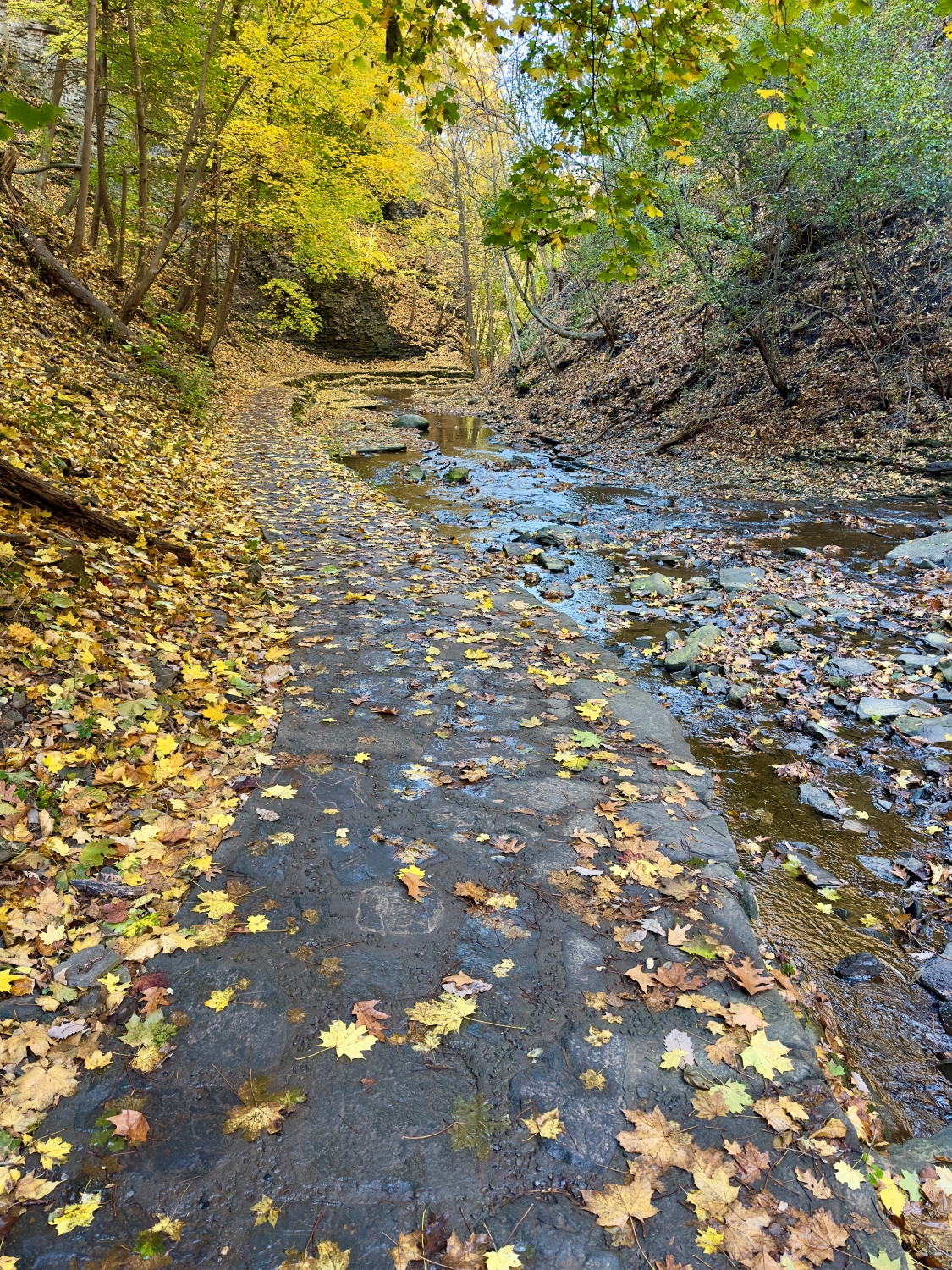
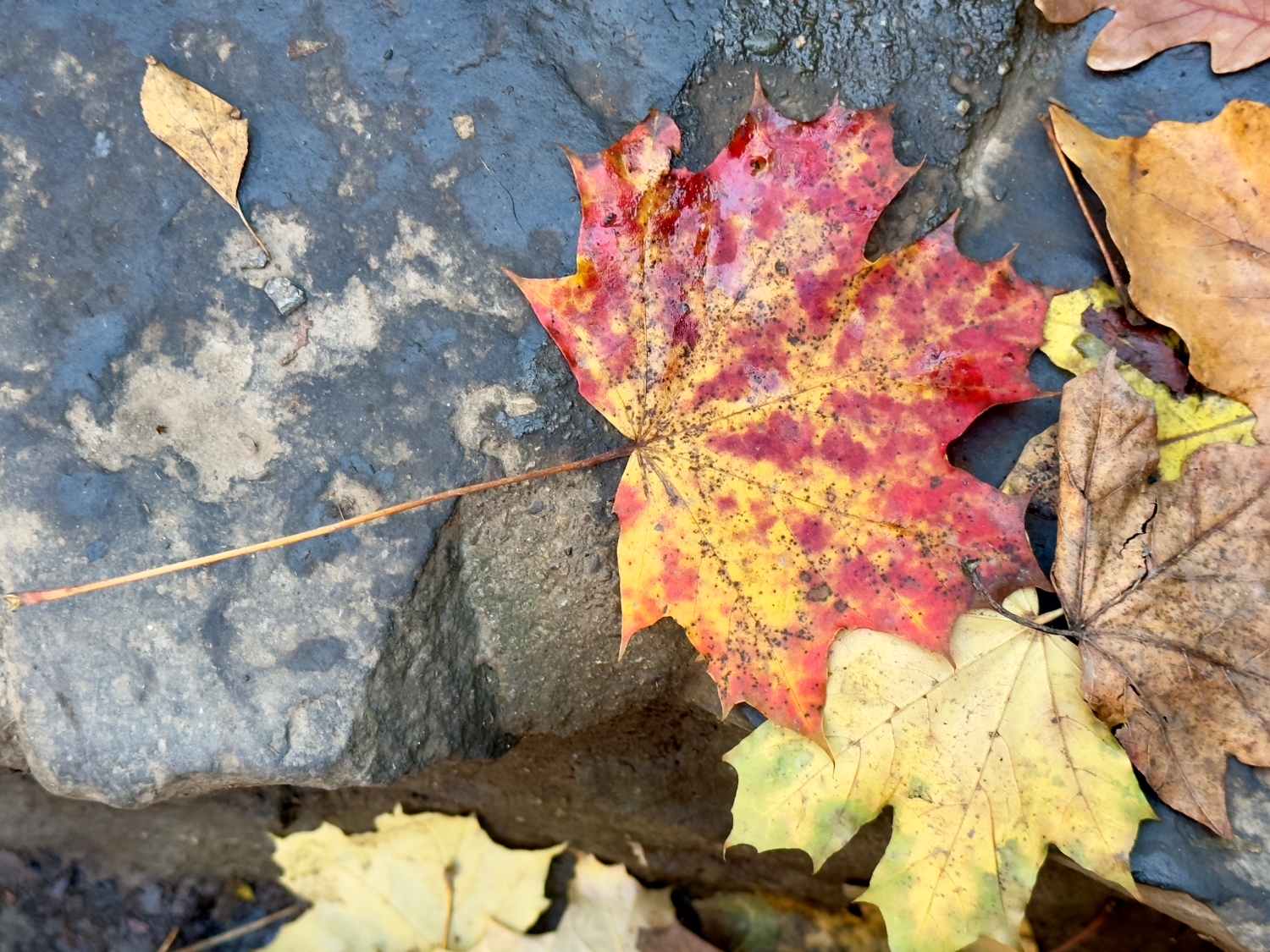
I move further along the trail, and the terrain begins to shift. Fallen leaves create a golden carpet along the path, their crisp shapes overlapping like nature’s confetti celebrating the season. Each step crunches underfoot, adding my own rhythm to the symphony of sounds. The trees overhead are a kaleidoscope of colors—deep golds, fiery oranges, and the occasional flash of red from Virginia Creeper vines (Parthenocissus quinquefolia). Together, the trees create a canopy that filters sunlight, casting dappled patterns on the gorge walls. It’s an ever-changing play of light and shadow, one moment bright and the next subdued, adding a layer of magic to the experience.
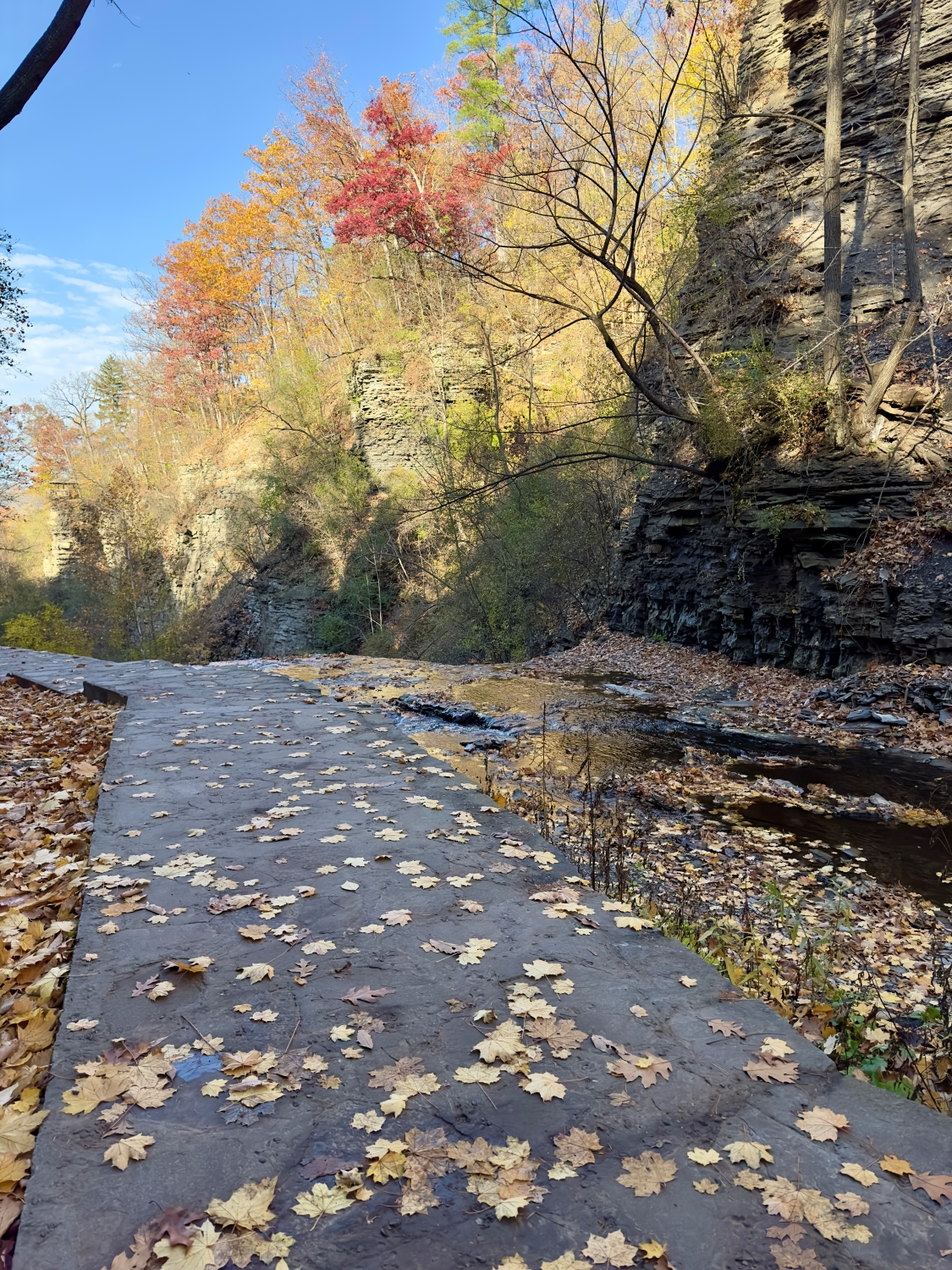
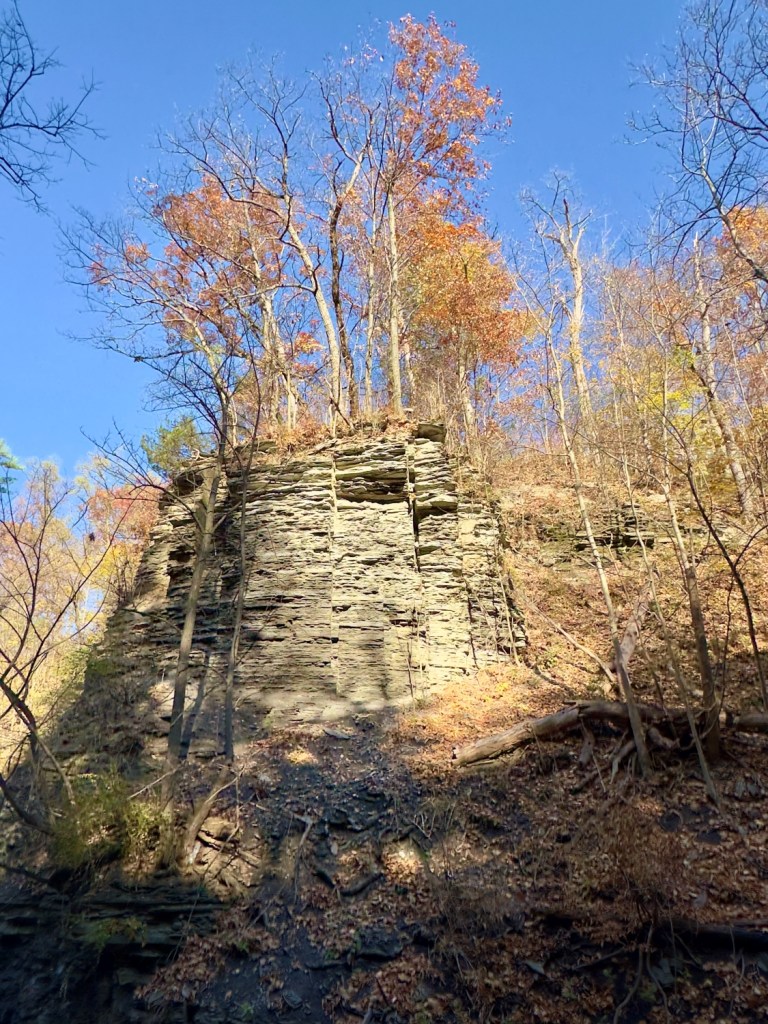
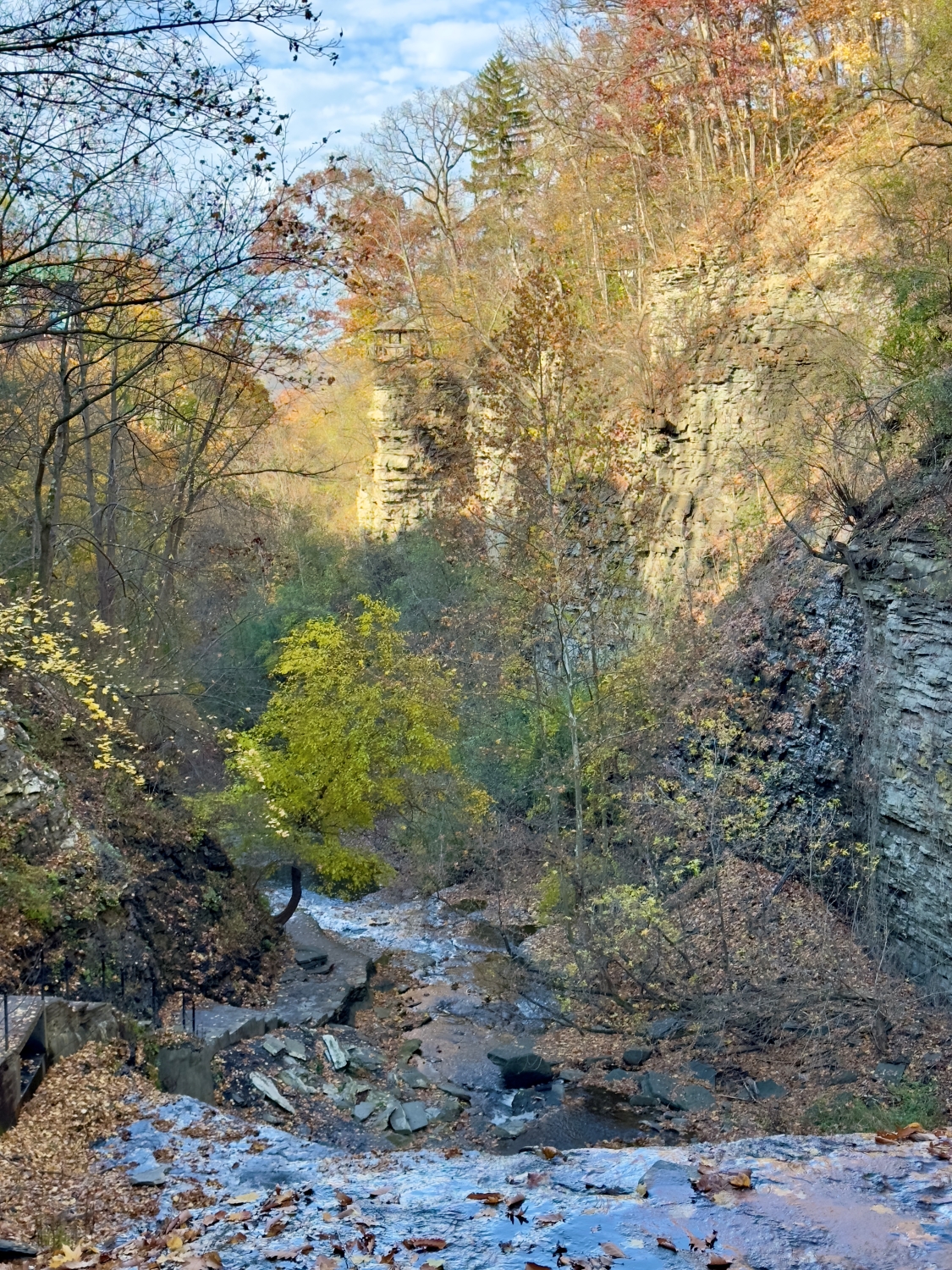
As I follow the trail upward, the gorge narrows, and I find myself surrounded by towering walls of rock. Here, layers of siltstone and shale formed more than 300 hundred million years ago are exposed, a testament to the forces of water and time that carved this place across mere millennia of recent geologic time. The rock formations are fascinating, with the water flowing over them in gentle cascades, finding every groove and crevice. There’s something humbling about standing in a place shaped by forces so much larger and older than myself. I pause, letting the rush of water and the stillness of stone fill my senses.
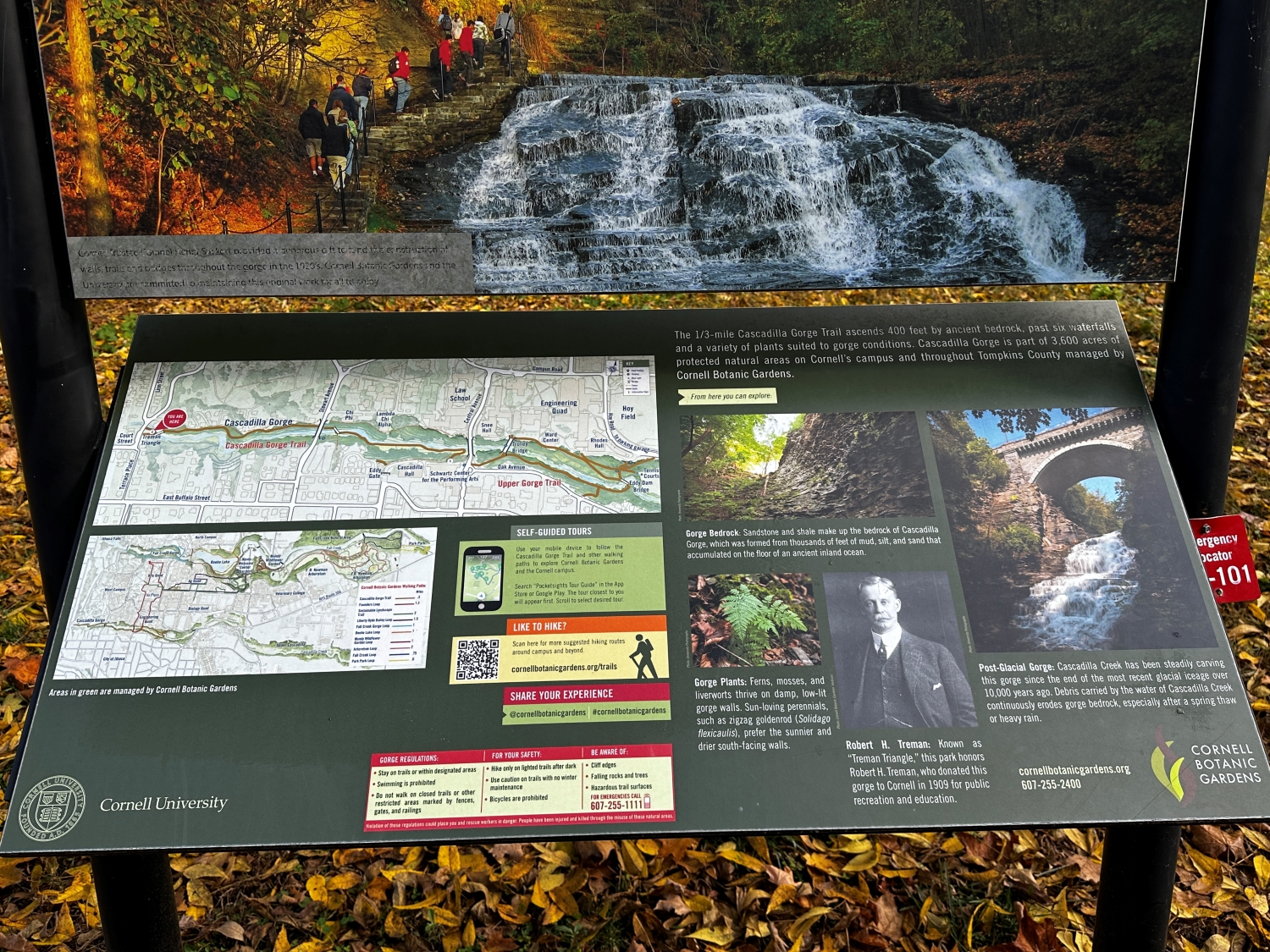
Along the way, I come across an interpretive sign provided by the Cornell Botanical Gardens. They tell the story of Cascadilla Gorge, how it was formed from the bedrock of sandstone and shale that eroded from mountains to the east, in the Devonian era when an ancient inland sea covered the region. The signs also introduce Robert H. Treman, a philanthropist who saw the beauty and educational value of the gorge. Thanks to him and the efforts of many, this natural wonder is preserved for all to experience. Knowing this adds depth to my walk; it’s a reminder that places like this exist not only by chance but because people cared enough to protect them.
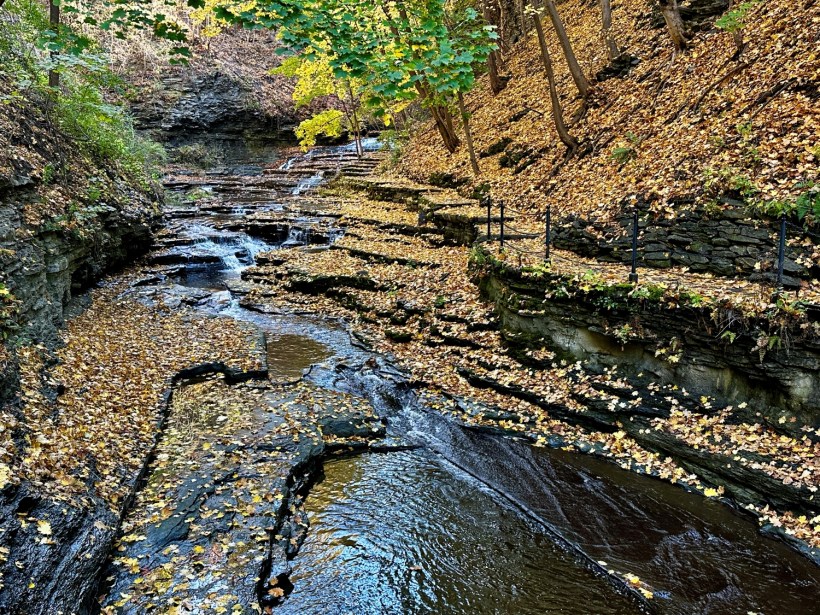
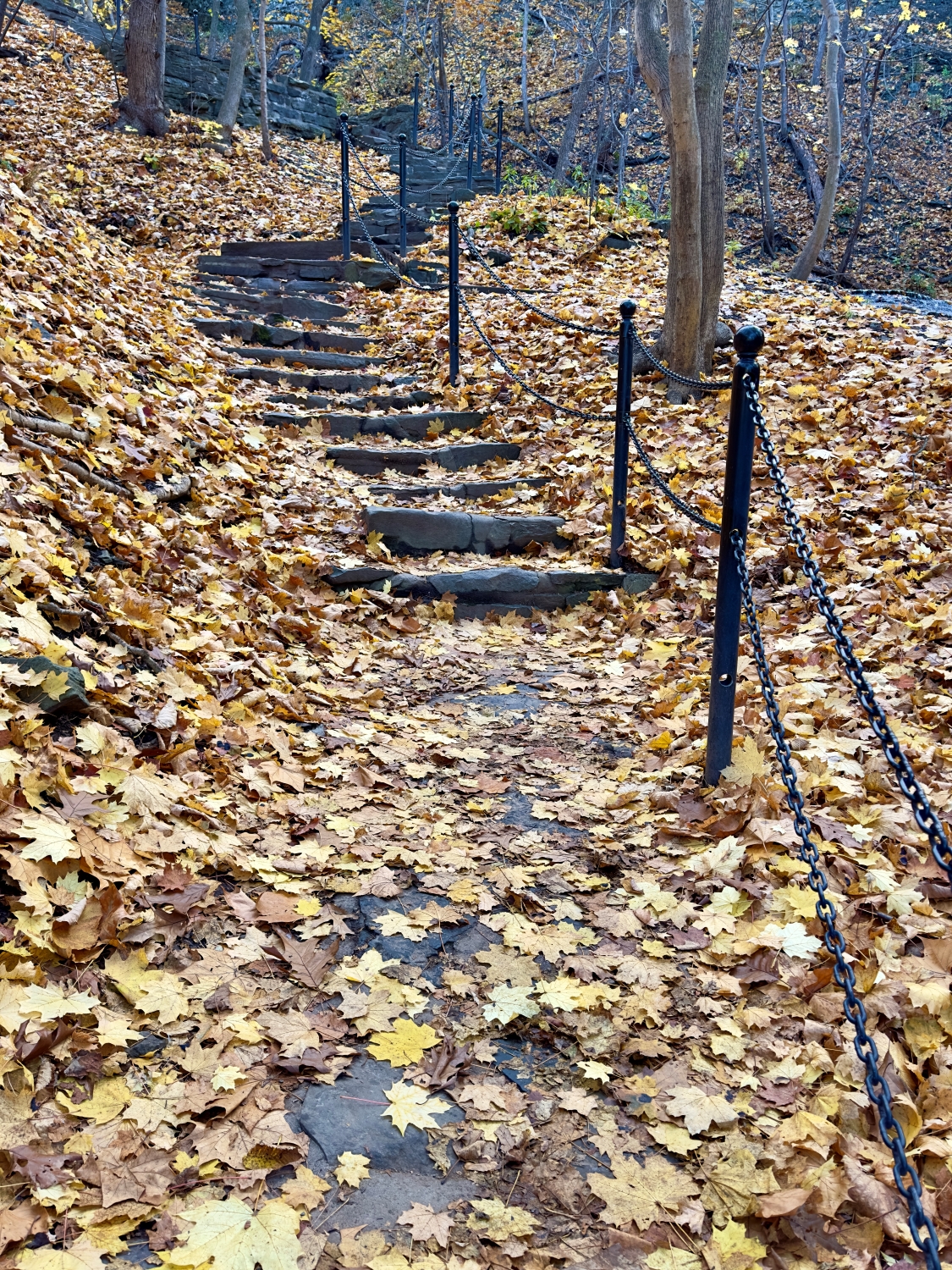
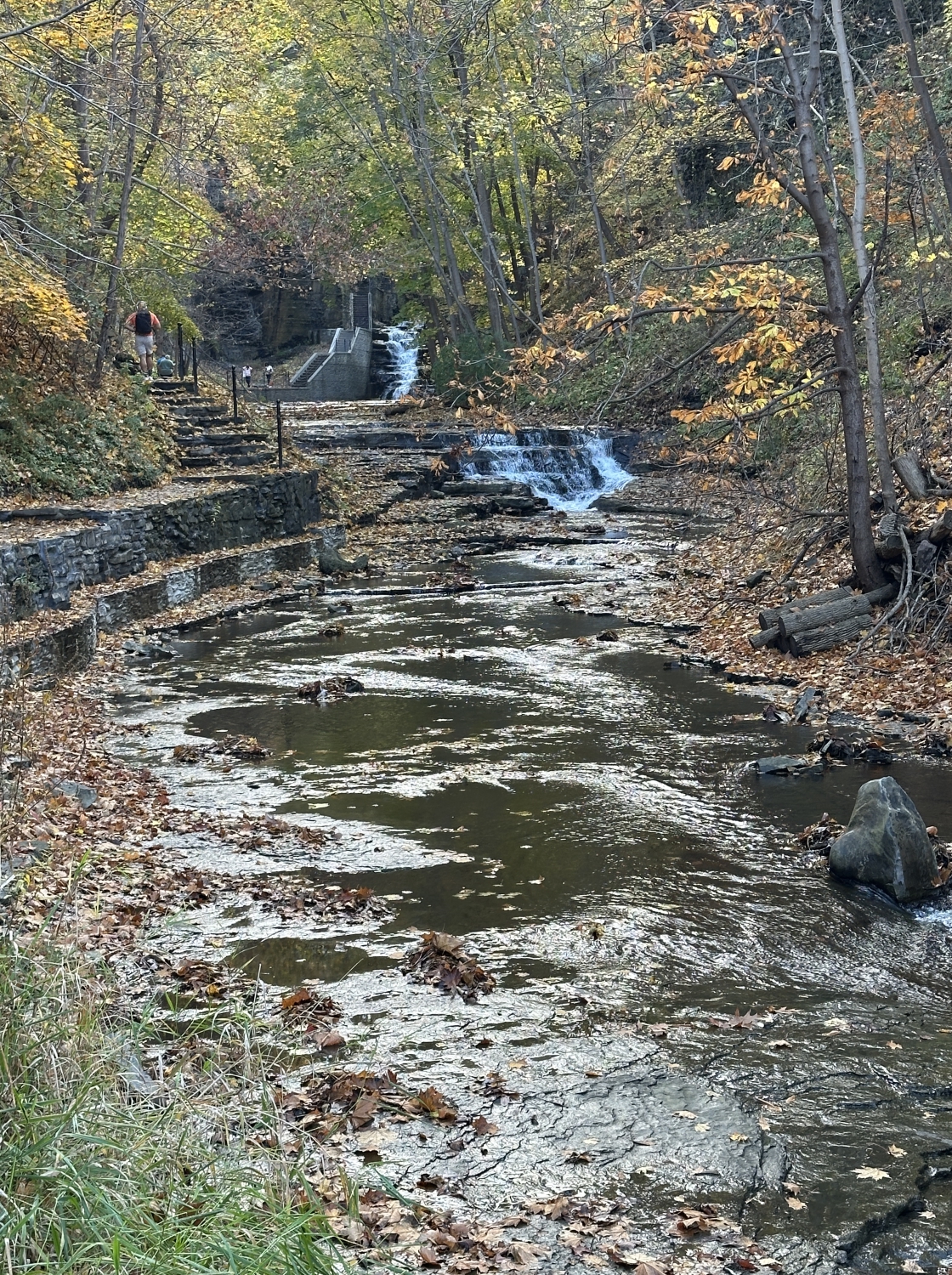
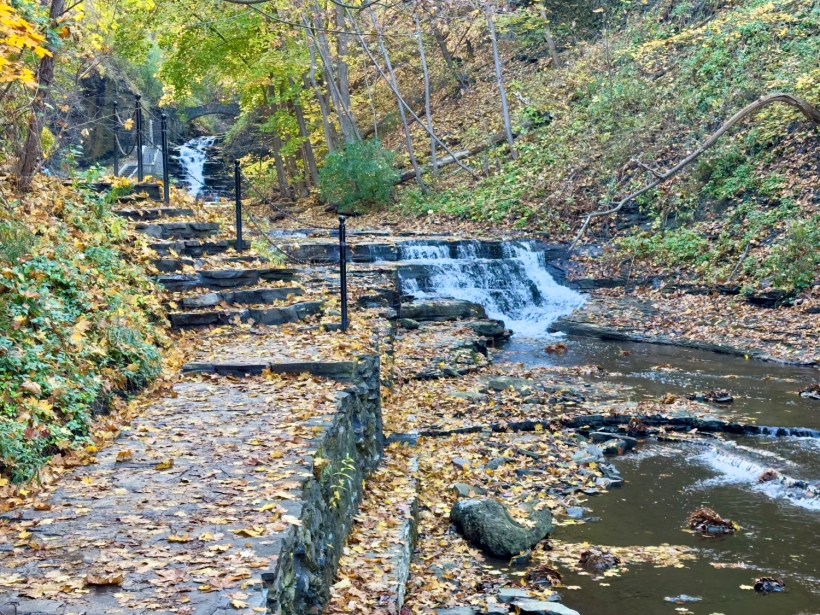
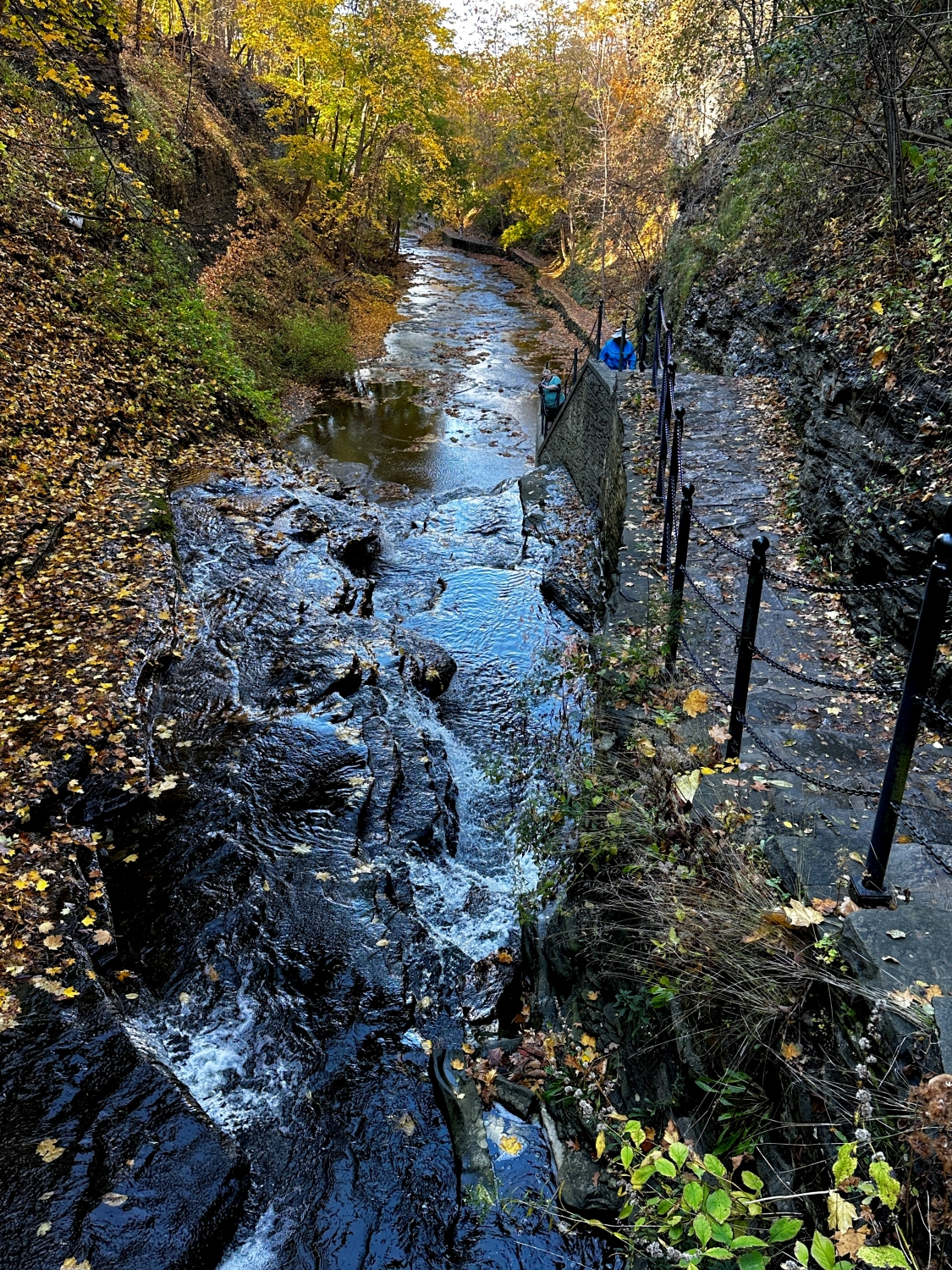
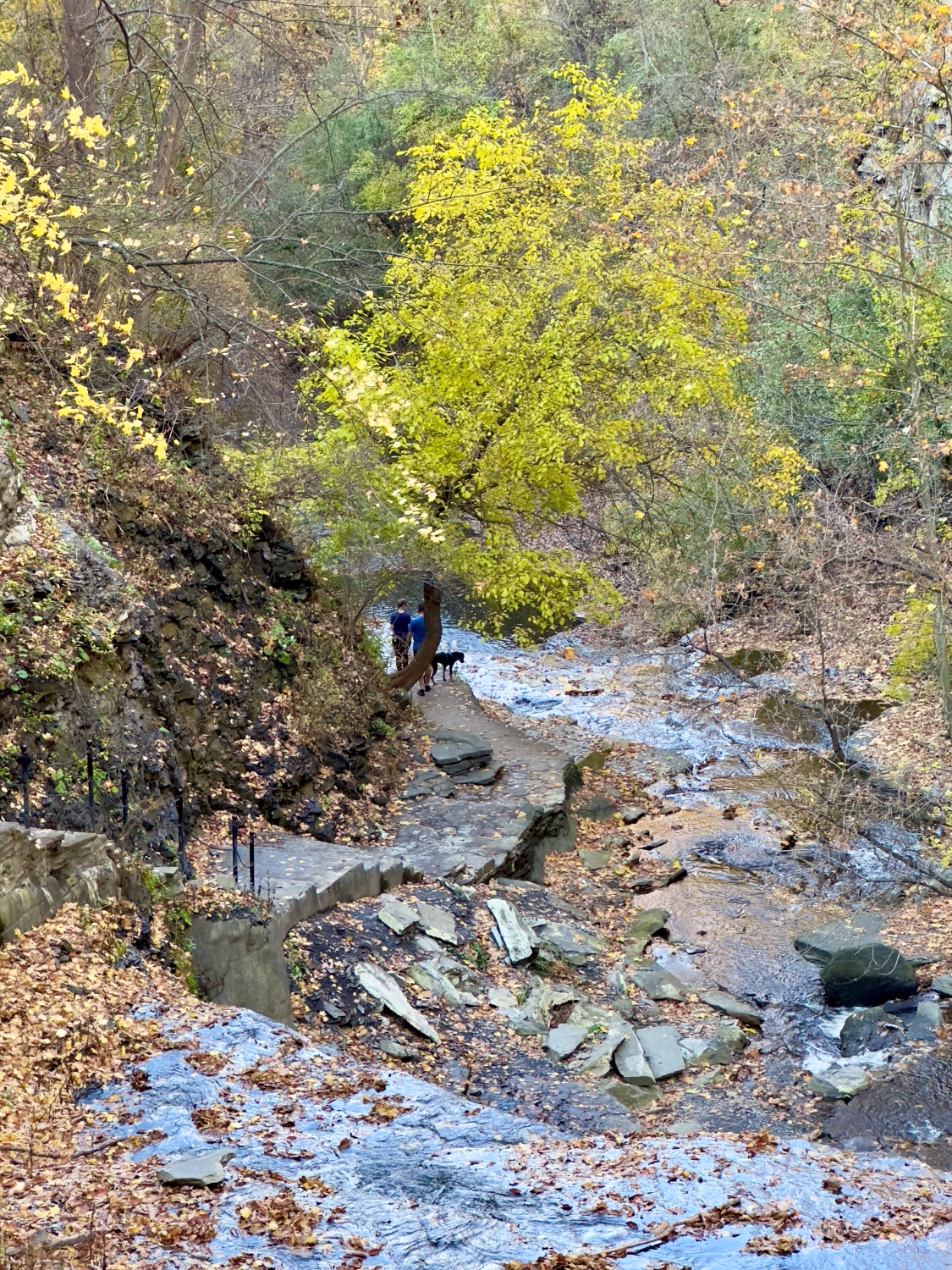
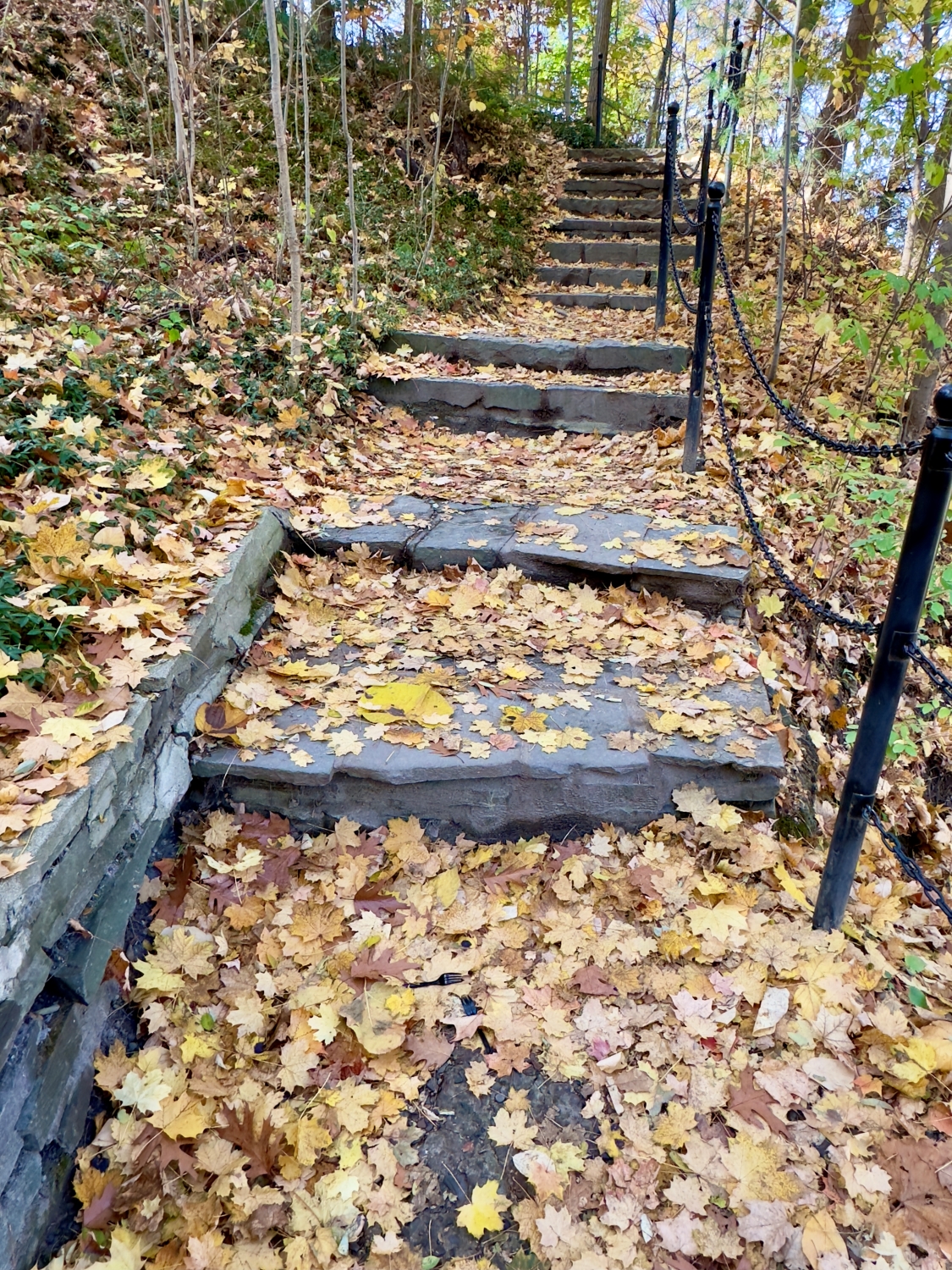
The sandstone staircases along the trail are a marvel in themselves. Some sections are steep, winding up the gorge in a series of steps that seem to have been placed with precision, blending seamlessly into the natural landscape. The steps are covered with leaves now, making each ascent feel a bit like climbing through a fairy-tale forest. The chains along the path provide a comforting grip, especially as I climb higher. I look back and see how far I’ve come, the creek below winding its way over rocks and around bends, each step a small journey of its own.
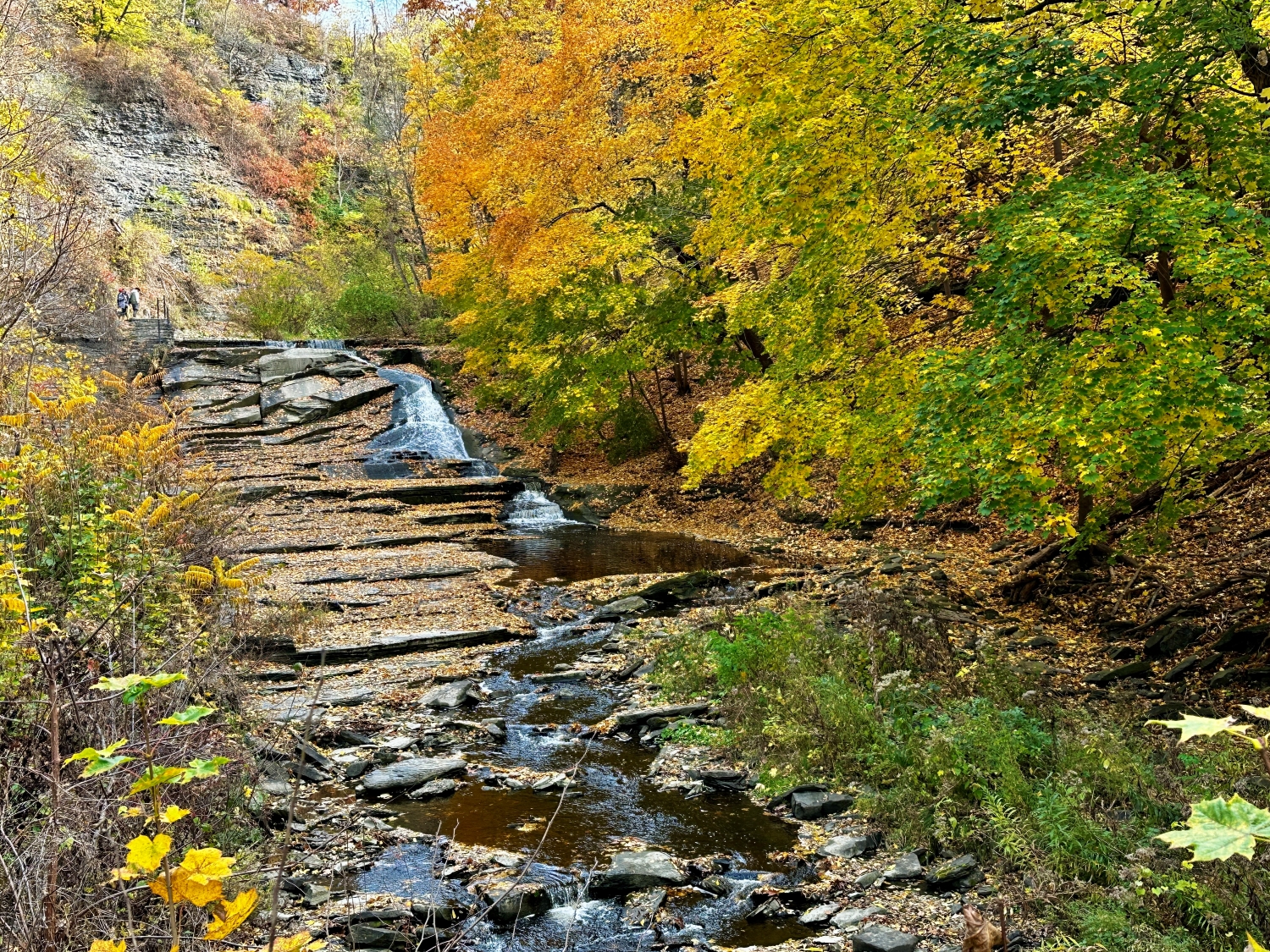
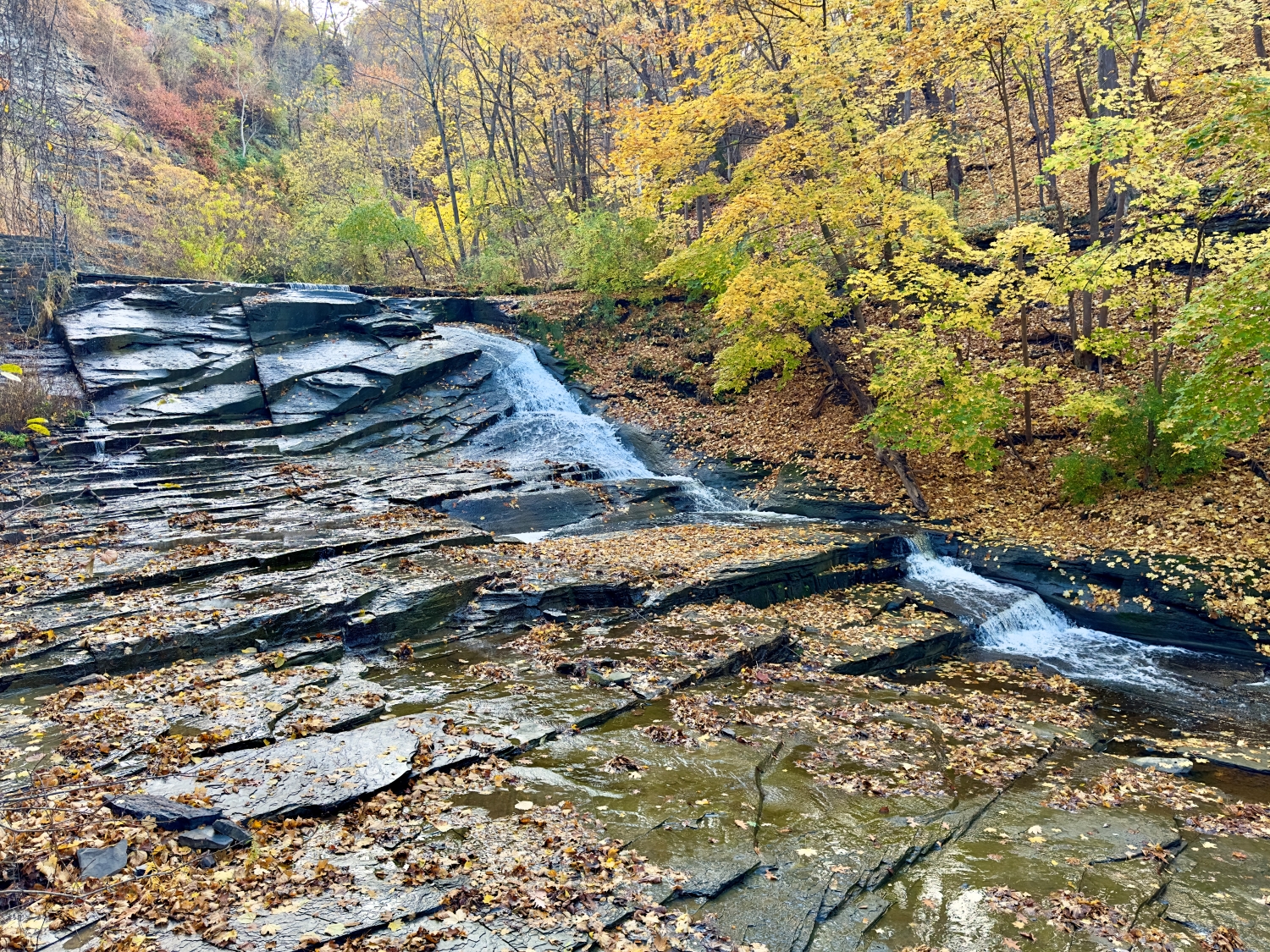
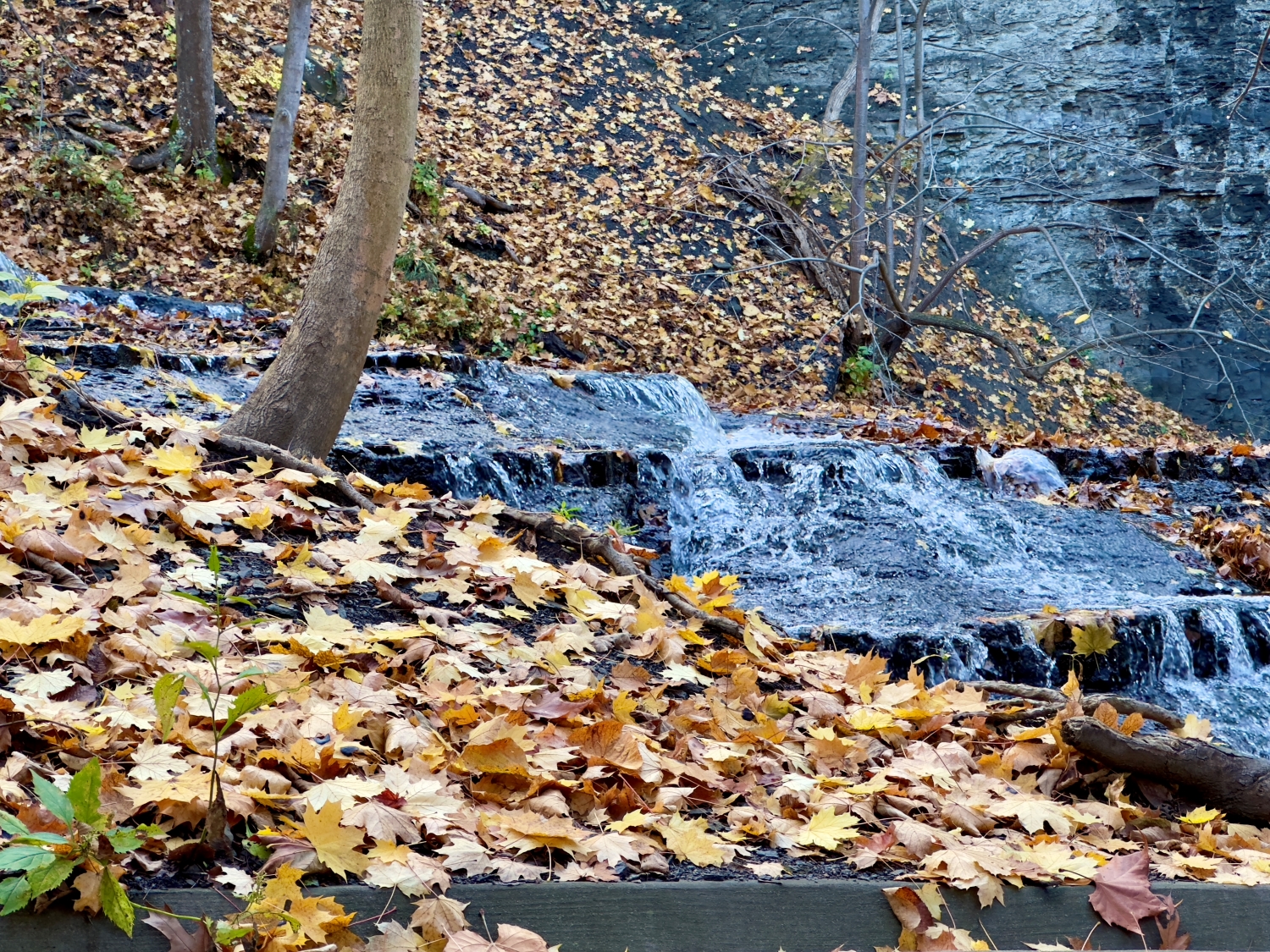
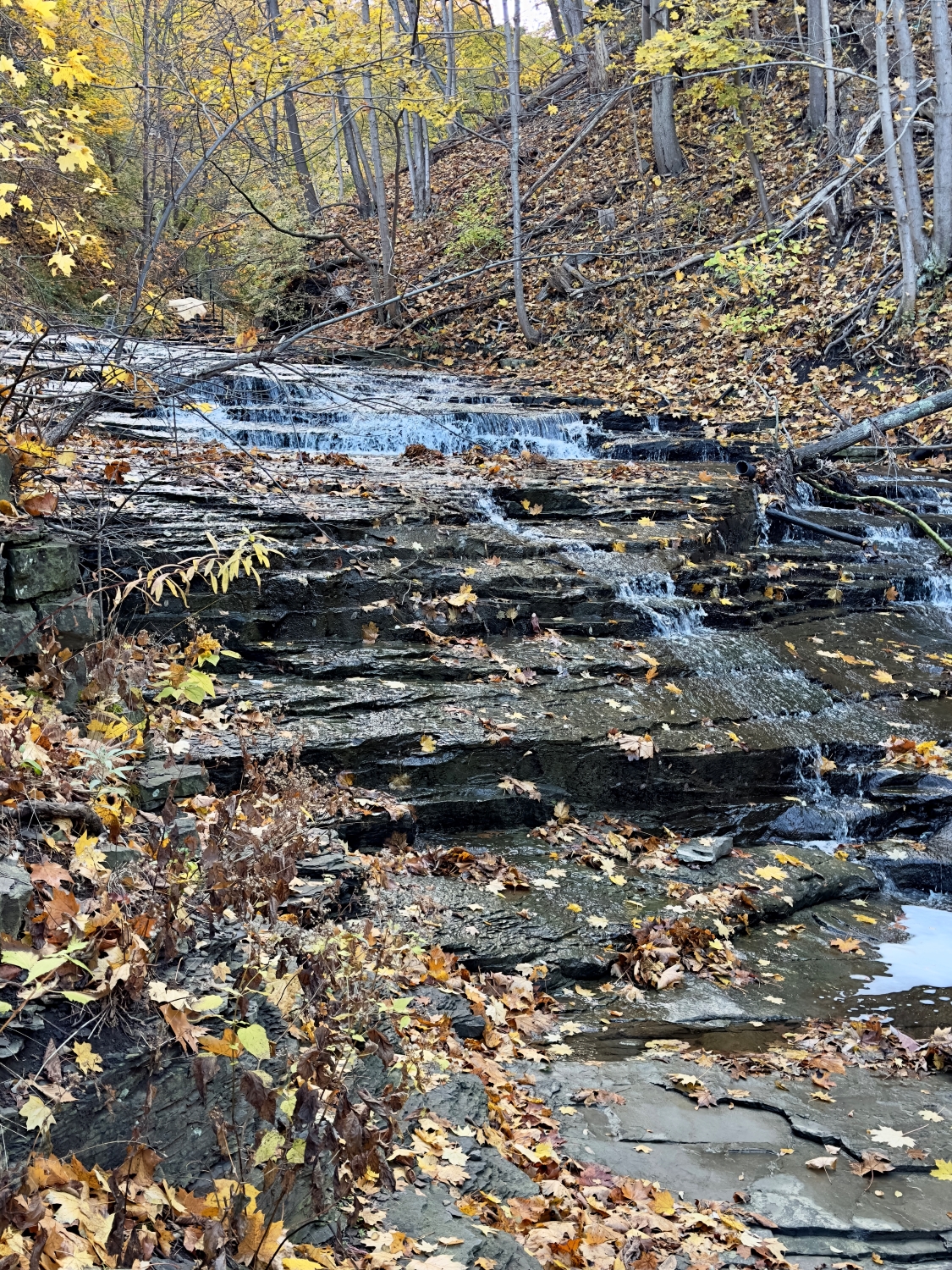
I pass several small waterfalls, each one unique in its character. Some are gentle trickles, while others pour over the rocks with more force, their sound reverberating off the gorge walls. I stop frequently, entranced by the way the water carves its path, eternally moving, adapting, wearing down even the hardest stone. Leaves float down from above, landing in the creek and swirling in miniature whirlpools before being carried downstream. It’s mesmerizing to watch nature at work in such a quiet, persistent way.
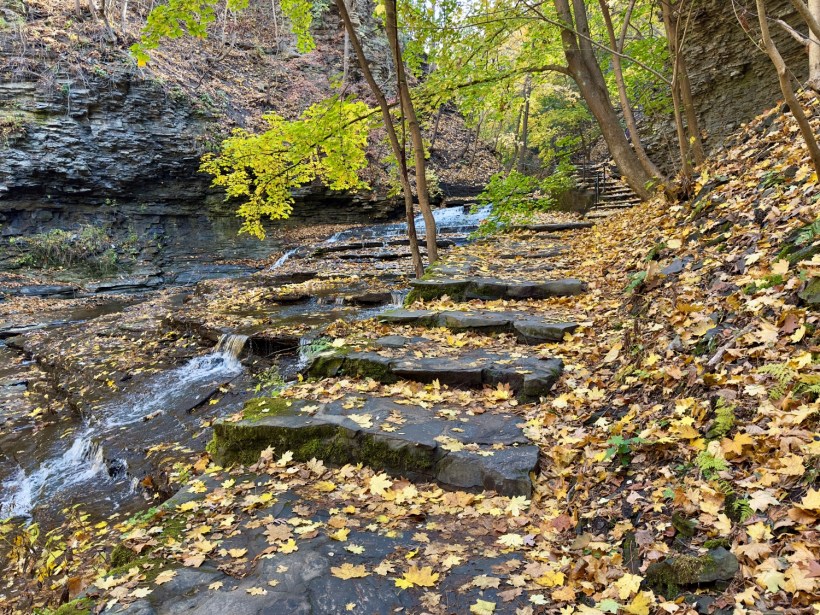
Further up the gorge, the views open up, and I can see the layers of rock descending in terraces, each level a little cascade of its own. I watch as the water flows across these steps, catching the light as it moves—a silvery ribbon winding through the golden autumn landscape. The tranquility of the scene is meditative. Around me, the trees stand as silent witnesses, their branches bare in places but still adorned with clusters of leaves clinging through the last days of fall.
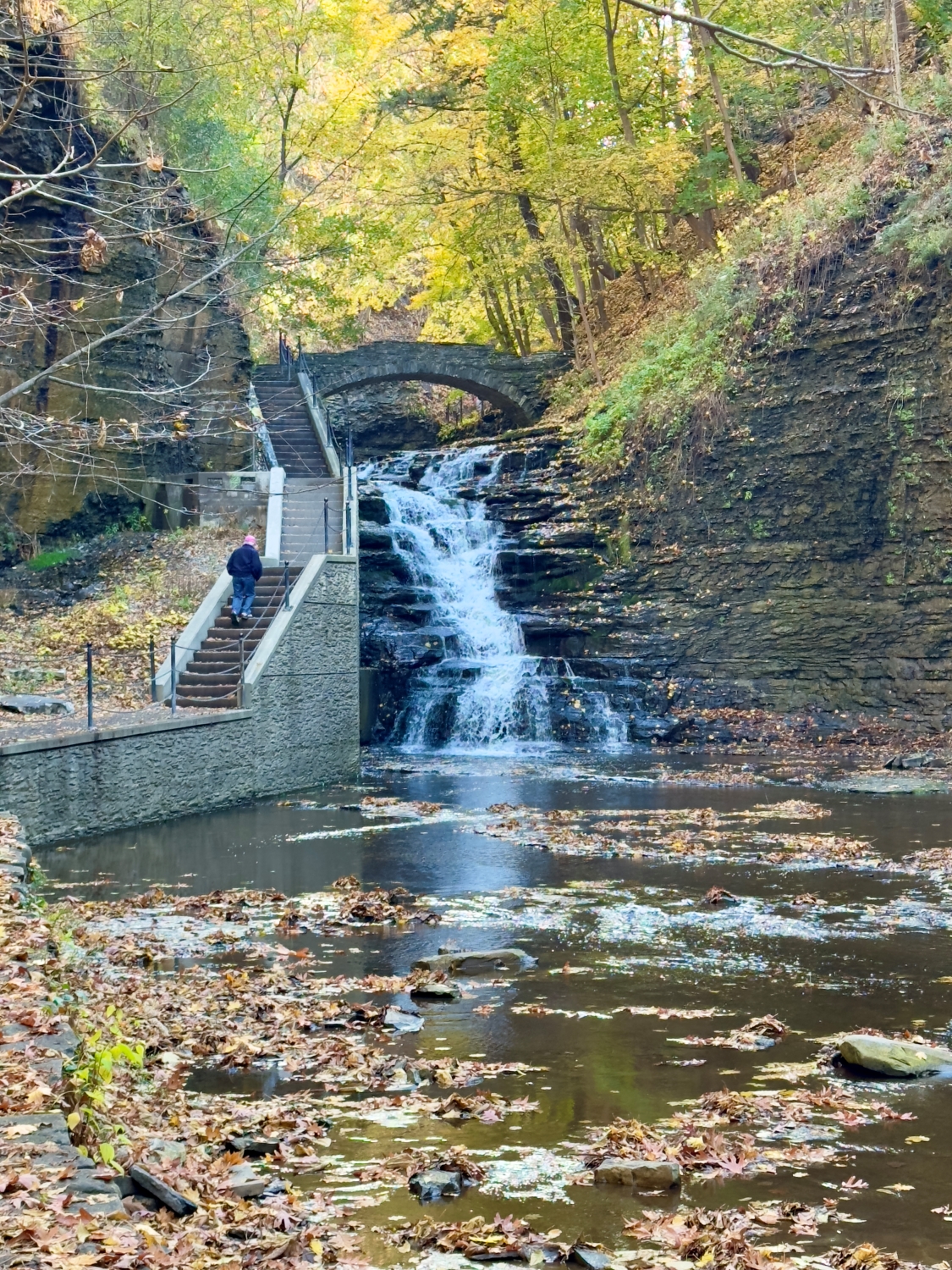
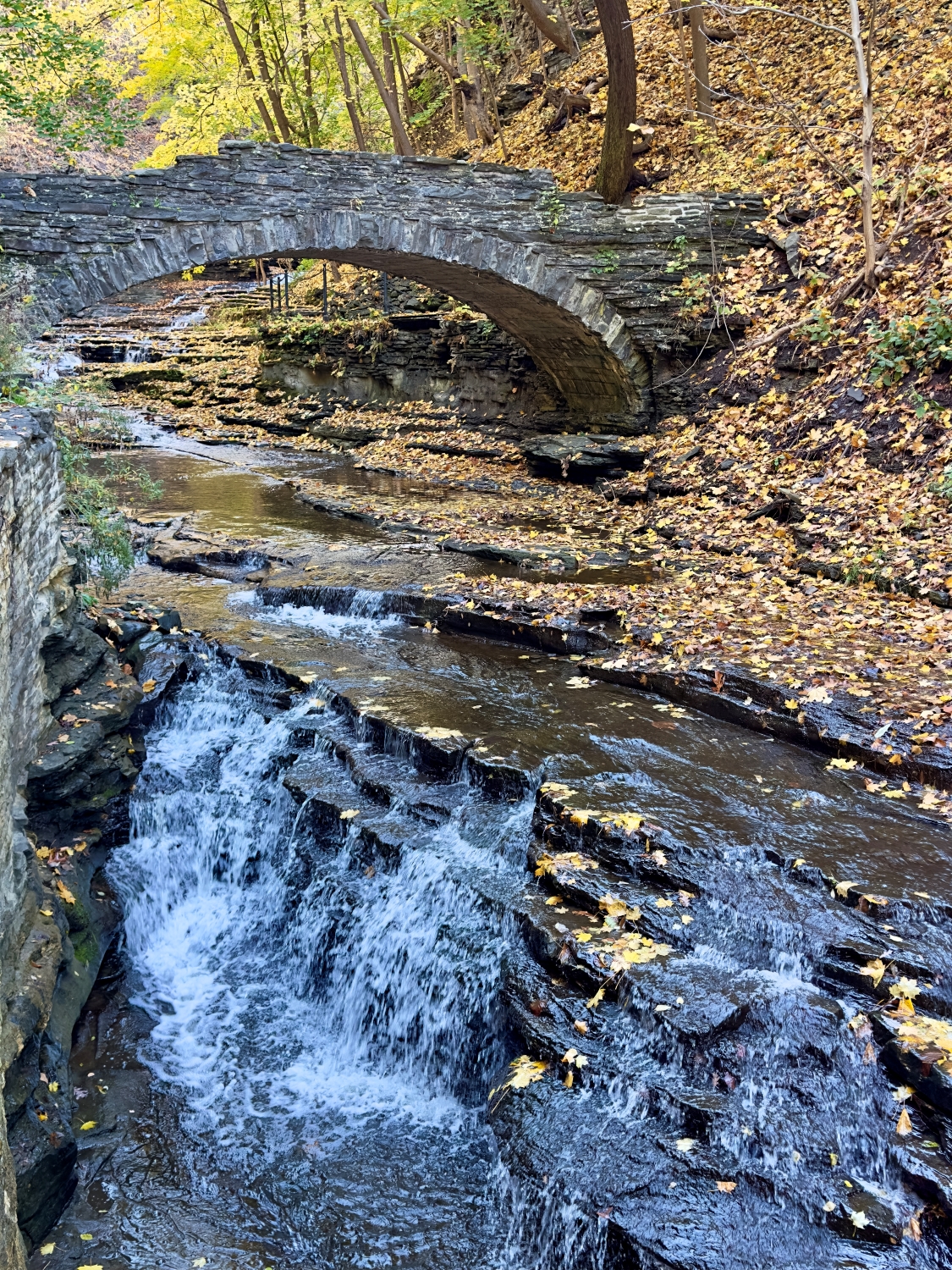
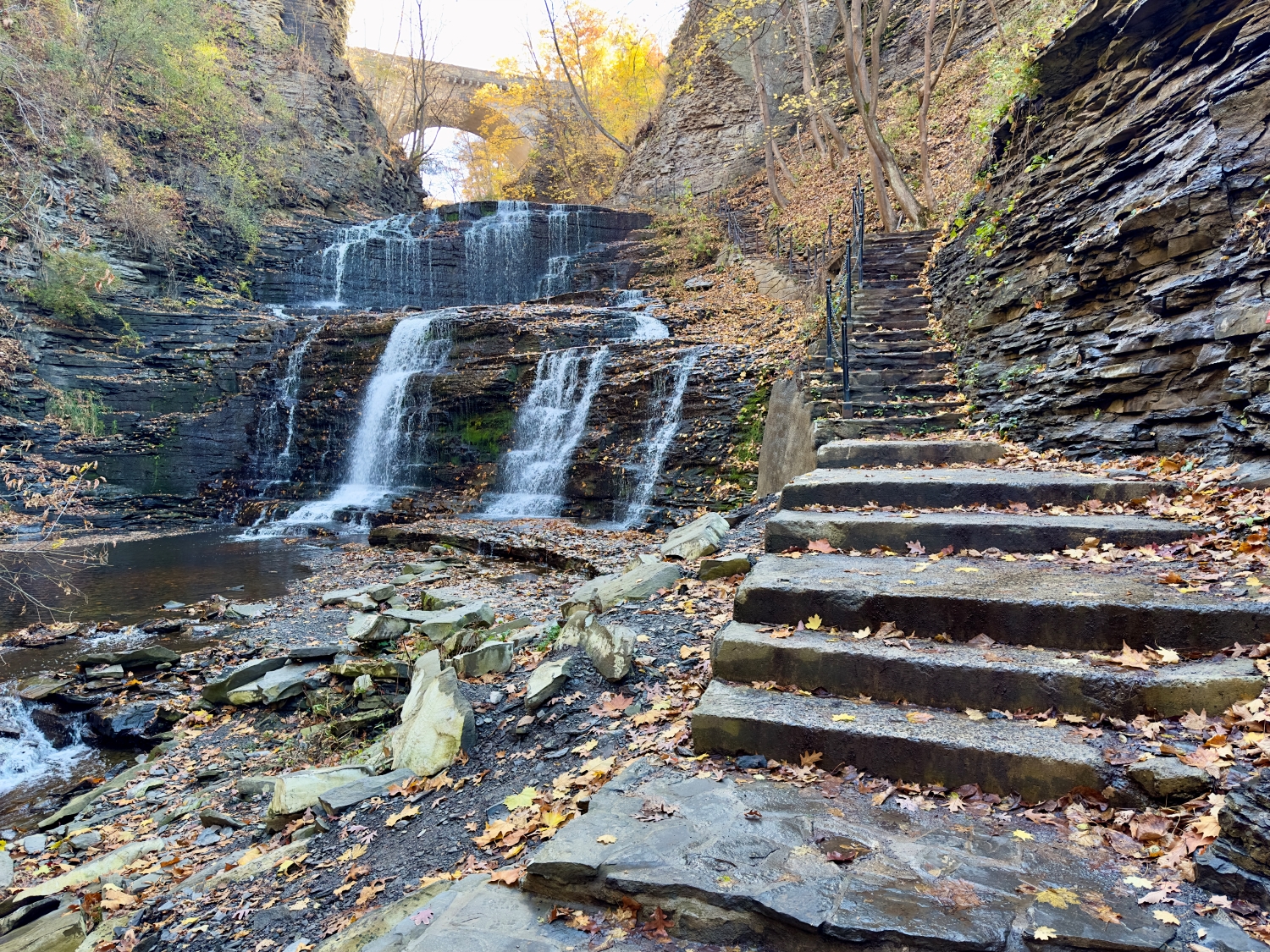
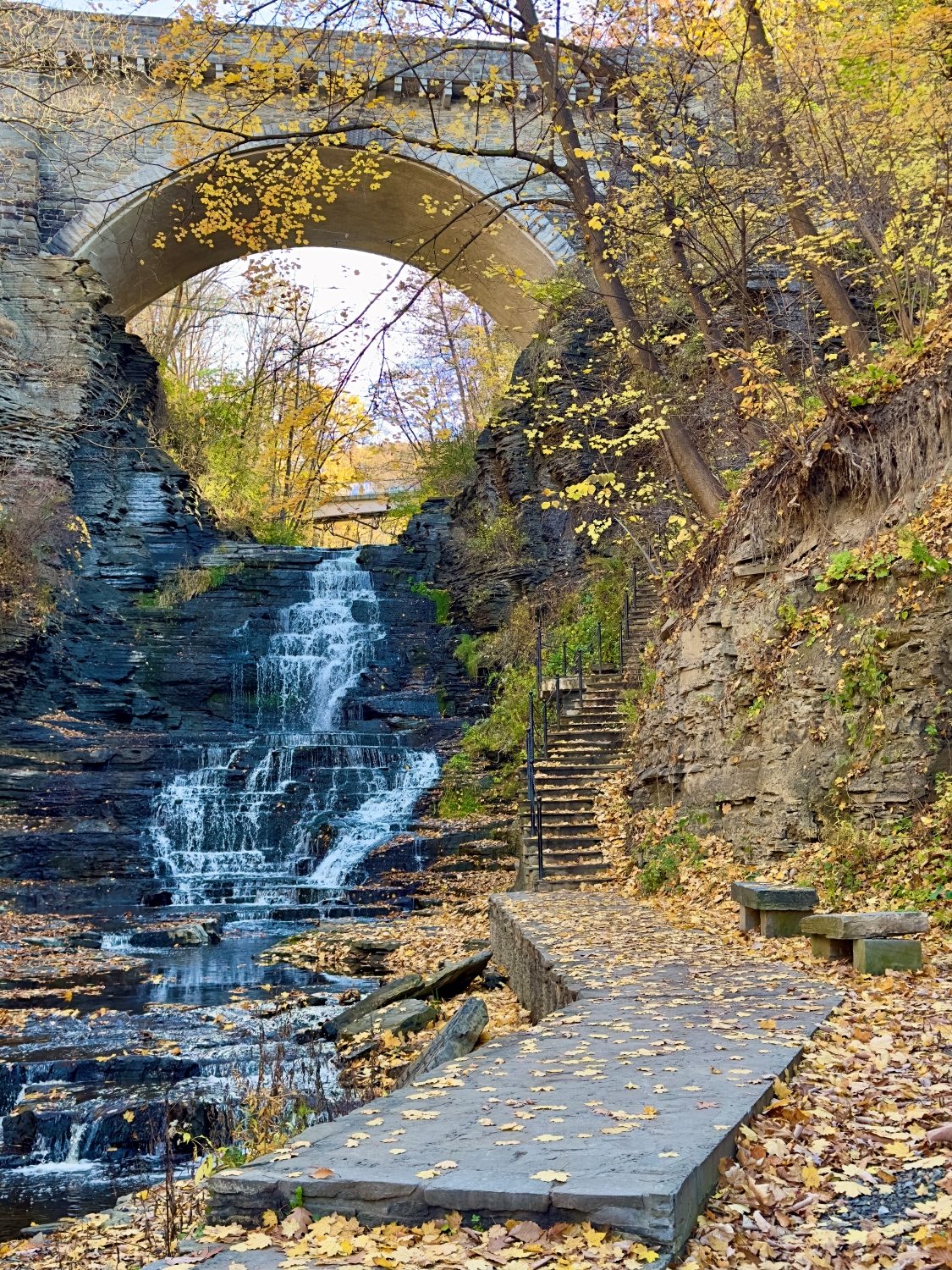
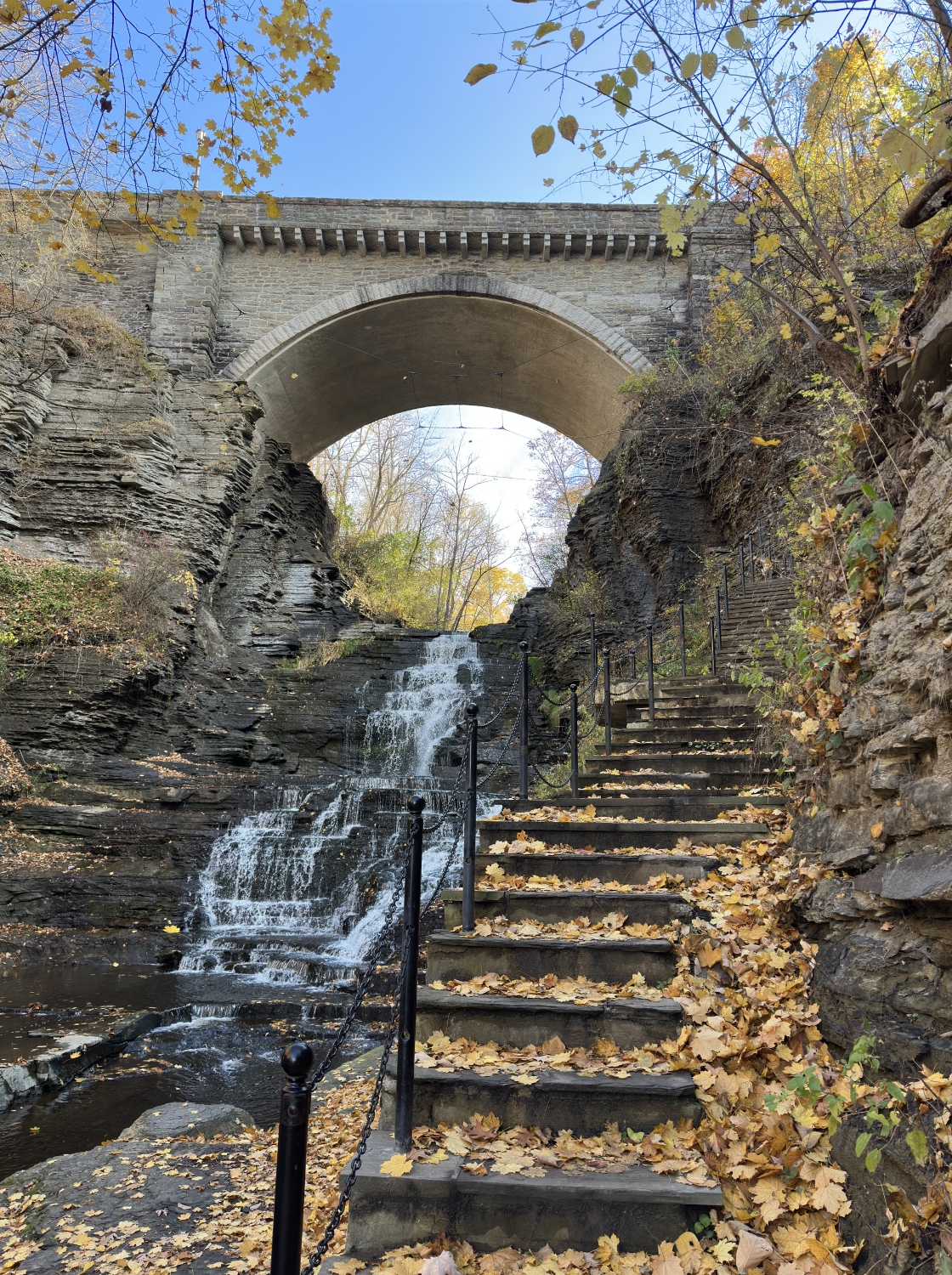
Finally, I reach one of the larger waterfalls, framed by a graceful stone arch bridge that crosses high above. The scene is something out of a painting. Water pours over the rocks, gathering in pools below before spilling onward. I pause on the bridge, looking down at the gorge below and the trail I’ve followed, grateful for the journey.
Along the way, artists are positioned along the path, each lost in the beauty of Cascadilla Gorge. They stand or sit in quiet reverie, brushes or pencils in hand, capturing the gorge’s unique character. Some focus on the play of light over the water’s surface, while others seem intent on the rugged details of the rock formations. Their presence adds a contemplative depth to the scene; it’s as if each artist has uncovered a hidden aspect of the gorge that I have overlooked in my journey upward.
I slow my pace to take it all in, appreciating how the artists interpret this natural wonder through their own eyes. Their canvases reveal layers of colors that shift as the sun filters through the leaves, casting vibrant golds and subtle greens on the cascading water. The scene feels almost collaborative—nature and human hand creating art together, each reflection of the gorge as unique as the individual capturing it. I’m tempted to pause beside them, to see how they choose to frame the towering walls, the stone bridge arching above the water, and the gentle curves of the creek as it meanders downstream. I can imagine each artist’s work holding a different piece of this place, like fragments of a memory.
Bridge View looking up Cascadilla CreekBridge View looking back the way I came
As I continue, the sound of rushing water grows louder, drawing me towards another cascade that tumbles in steps down the gorge. The rocks are layered in angular formations, giving the water a zigzagging path to follow. Leaves are scattered across the stones, their colors—yellows, browns, and the occasional splash of red—standing out against the dark, wet rock. There’s a timelessness here, a feeling that this scene has remained unchanged for centuries, save for the shifting leaves and the ever-present flow of the creek. The thought makes me feel like a small part of something much larger, a guest in an ancient place shaped by nature’s slow, steady hand.
The path narrows again, following the edge of the creek where the water has worn smooth channels into the stone.
Moving forward, the trail climbs steeply, and I find myself surrounded by tall rock faces on either side. The walls are layered and weathered, a geological history book open to the forces that shaped this land. It’s humbling to see how this place puts everything into perspective, how it reminds us of our place in the natural world.
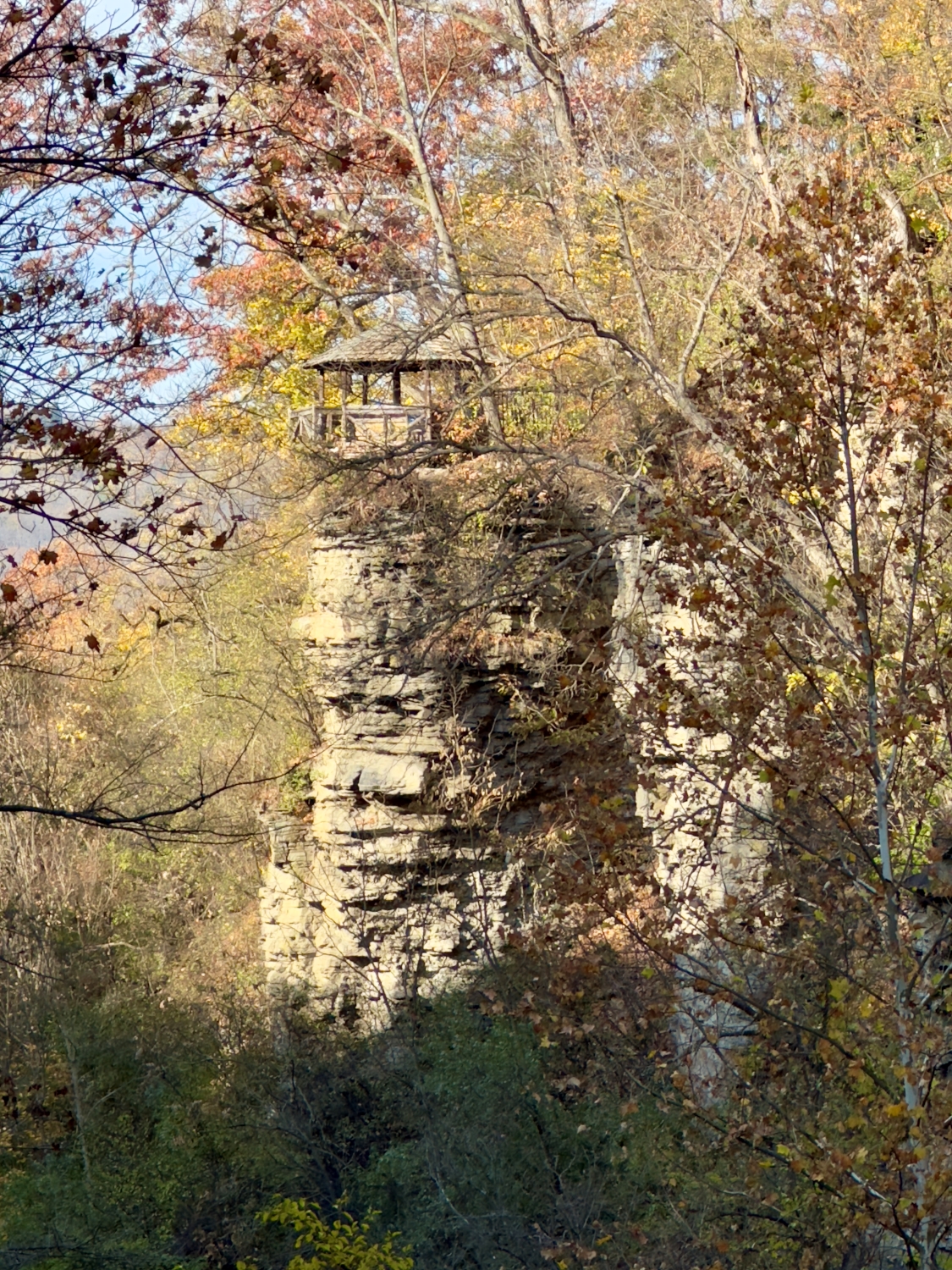
Columns of sedimentary rock
Ahead, the path becomes more rugged, the air feels cooler here, shaded by the gorge’s high walls, and the sounds of the city are long gone, replaced by the steady rhythm of water and the drift of leaves. The layers of ancient limestone that form these towering walls give shape to our landscape and ecosystem. As rainwater falls and seeps through the porous rock, the limestone raises the pH of the water, neutralizing its natural acidity. This subtle alchemy nurtures the flora and fauna, fostering a unique biome that thrives in the gorge. The artists fade from view as I move further into the solitude of the trail, but their presence lingers in my mind. Each turn of the path reveals another scene worthy of capturing, another moment that seems to call out for remembrance.
Looking back toward the way I came
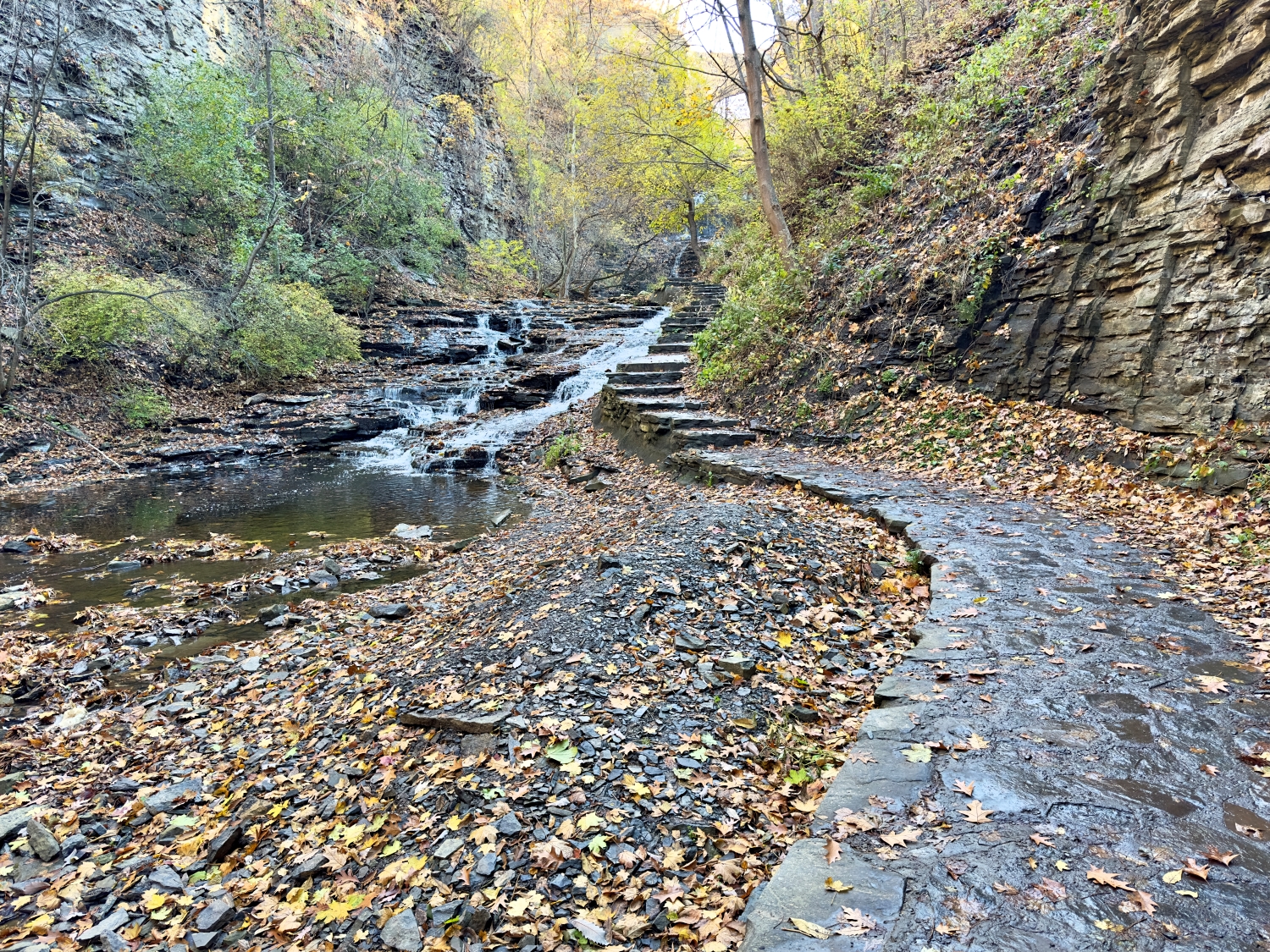
The trail steepens, and I press onward, the sound of the water intensifying as I near a grand waterfall framed by the impressive stone steps leading up to the College Avenue Stone Arch. Each step is littered with leaves, their colors vivid against the worn stone—golds, russets, and the occasional brilliant red, like embers scattered along my path. The waterfall beside me spills down in steady streams, each cascade creating rivulets that catch the light as they flow downward.
The gorge walls rise sharply on either side, embracing the path in rugged layers that tell stories of geological time. I feel as if I’m climbing a passage through history itself. These rocks, these trees, the very water carving its way through the stone—all have been here far longer than I can fathom, shaped by forces beyond my understanding. There’s a certain thrill in being among such enduring elements, a reminder of how small and fleeting we are in the face of nature’s grandeur.
Reaching the next tier of the trail, I pause to take in the sight of the massive stone arch spanning the gorge above. The bridge is a striking feature, its wide arch perfectly framing the sky and the last vibrant colors of autumn. It feels like a gateway, a fitting culmination to the journey. Standing beneath it, I’m struck by how well it harmonizes with the gorge, the careful craftsmanship of its stonework complementing the rough beauty of the surrounding cliffs.
The sunlight flows around the arch, illuminating the leaves that cling to the branches above, casting a warm glow over the scene. I feel a sense of reverence here, a quiet acknowledgment of both human artistry and the relentless beauty of nature.
I paused to capture this video of the moment.
Sights and Sounds of Autumn
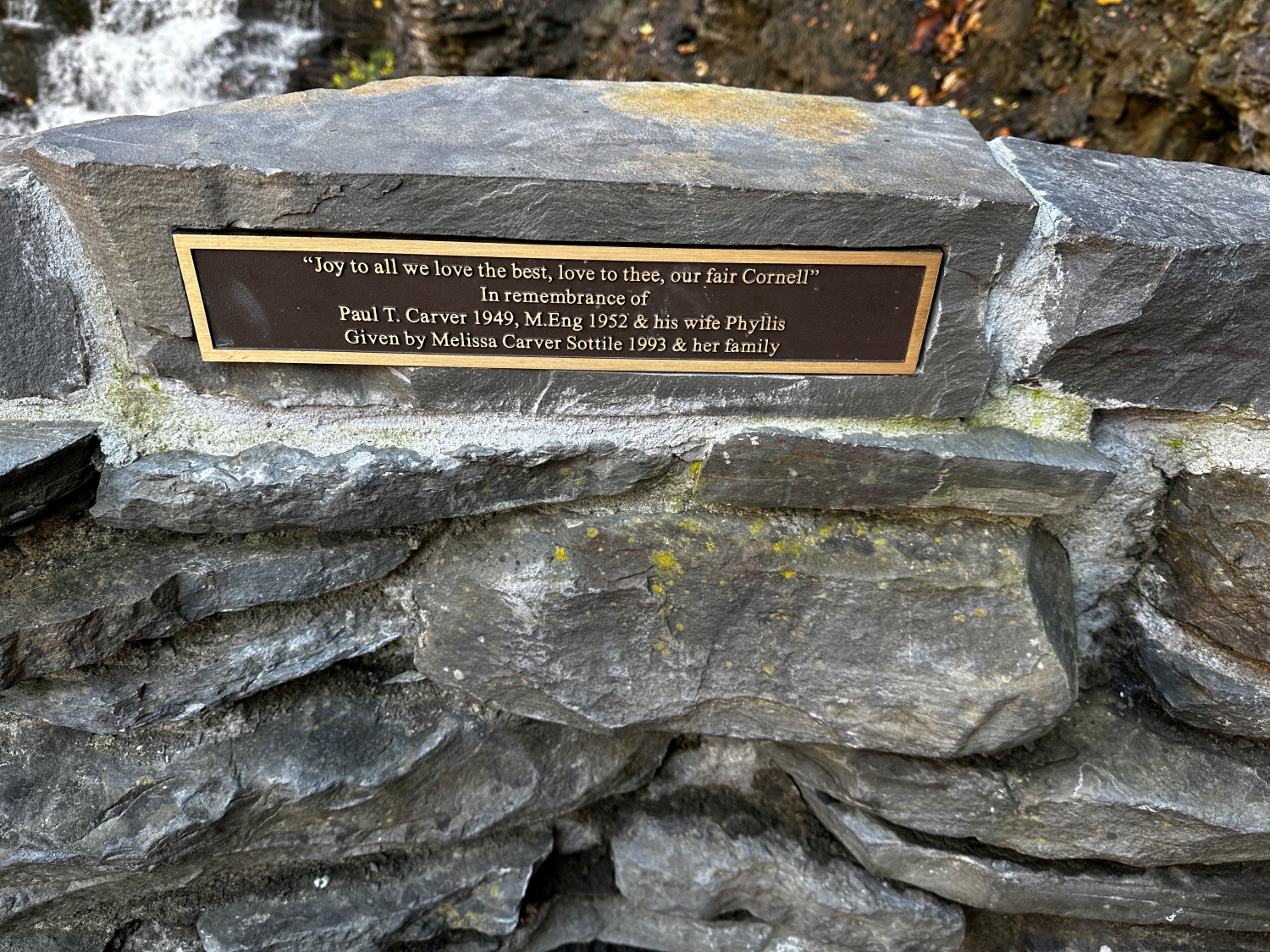
The final ascent is graced by a bench where a stone plaque catches my eye. It’s a tribute, etched with words that resonate in this place: “Joy to all we love the best, love to thee, our fair Cornell.” A gift from a family whose lives intertwined with Cornell, it serves as a reminder of the deep connections people have to this landscape, to the university, and to the memories rooted in these trails and gorges. I pause, reflecting on my own connection to this path, which has taken me through an ever-unfolding tapestry of nature and history.
The last stretch of steps is leaf blanketed, their shapes and colors a beautiful final mosaic before I emerge from the shaded coolness of the gorge. The sun filters down through the thinning trees, illuminating the stone buildings of the Cornell campus that peek through the branches ahead. With each step, I feel the transition, moving from the curated wildness of Cascadilla Gorge and its trail to the structured beauty of the university grounds.
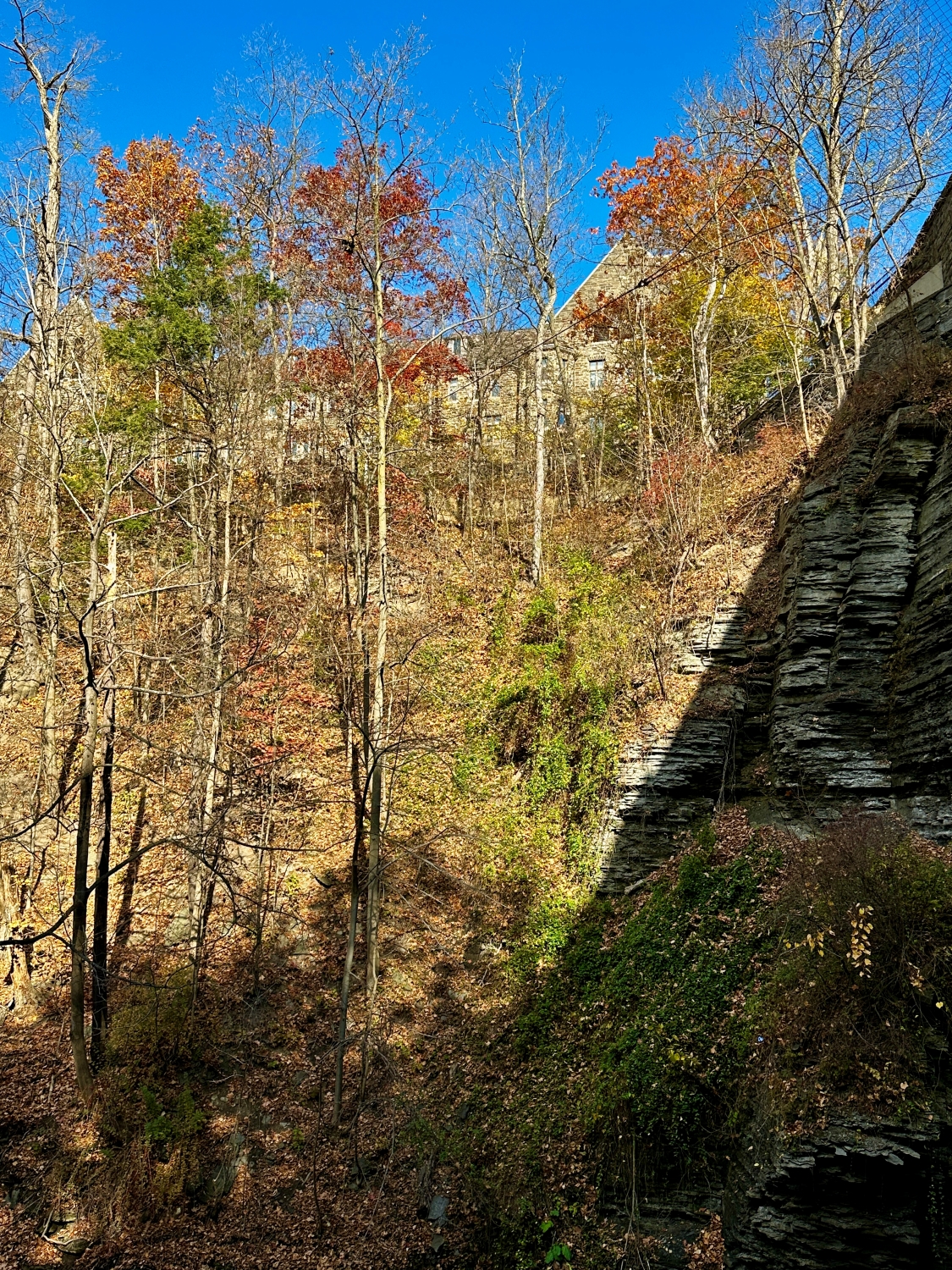
Myron Taylor Hall, Cornell Law School from the gorge.
As I reach the top, the Schwartz Center for the Performing Arts comes into view, its modern architecture a contrast to the ancient rocks I’ve left behind. Here, in this space where art, education, and nature converge, I take a last look back into the gorge and a journey, a gem in the heart of the Finger Lakes, a place that holds stories, both old and new, and invites every visitor to become a part of them.
Enter your email to receive notification of future postings. I will not sell or share your email address.
Copyright 2024 All Rights Reserved Michael Stephen Wills
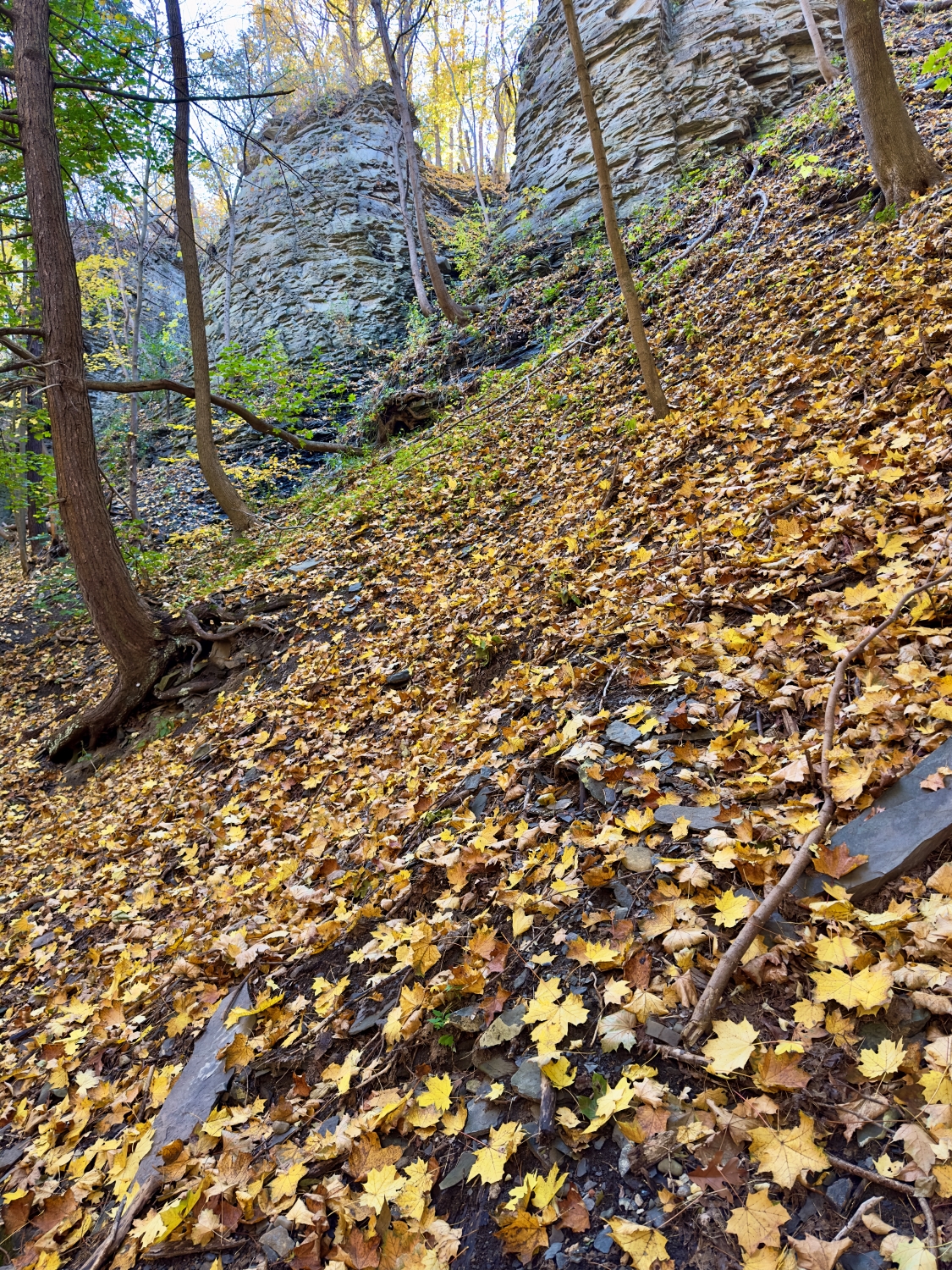
A few days before Halloween, I found myself on the rim of Cascadilla Gorge, Ithaca’s autumnal crown jewel. The air had that crisp October quality, each breath carrying a hint of the colder days to come yet still tempered by the lingering warmth of early fall. A breeze carried a scent of damp earth and decaying leaves, a rich, organic aroma that signaled the turning of the seasons. The path beneath my feet was a tapestry of fallen leaves—russet, gold, and burnt orange—a natural carpet leading me through a world suspended between vibrancy and rest.
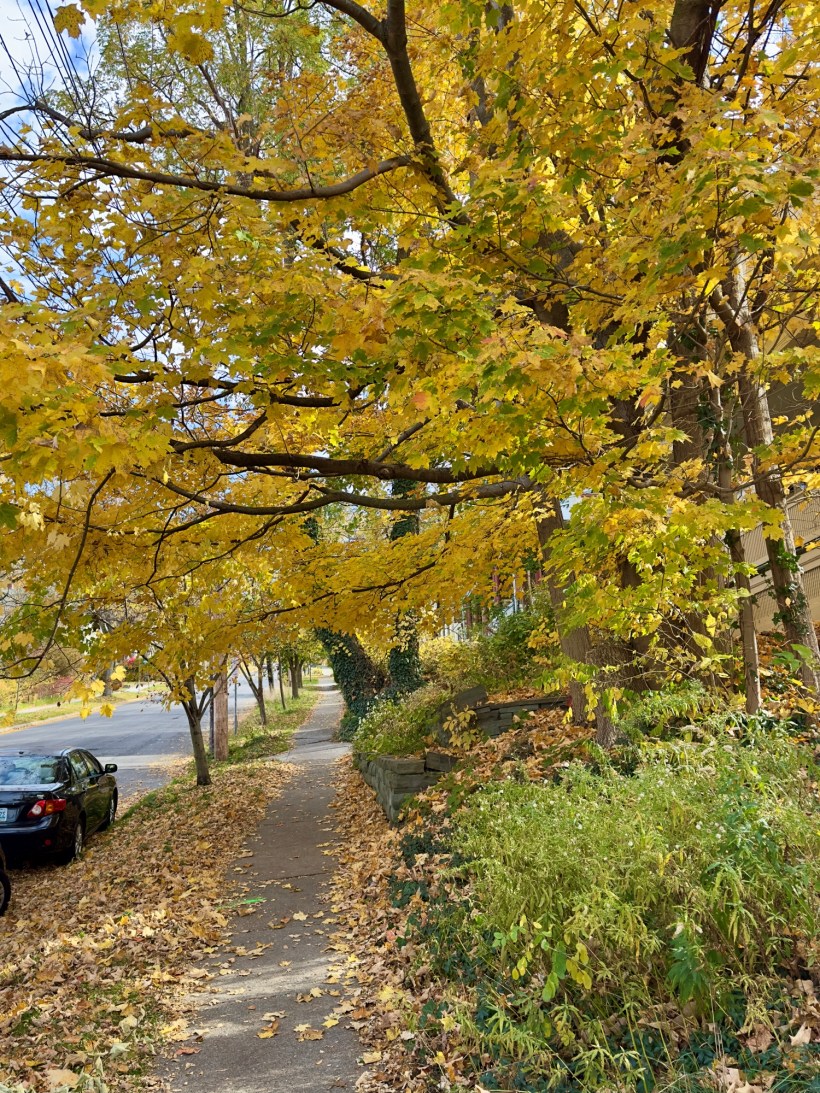
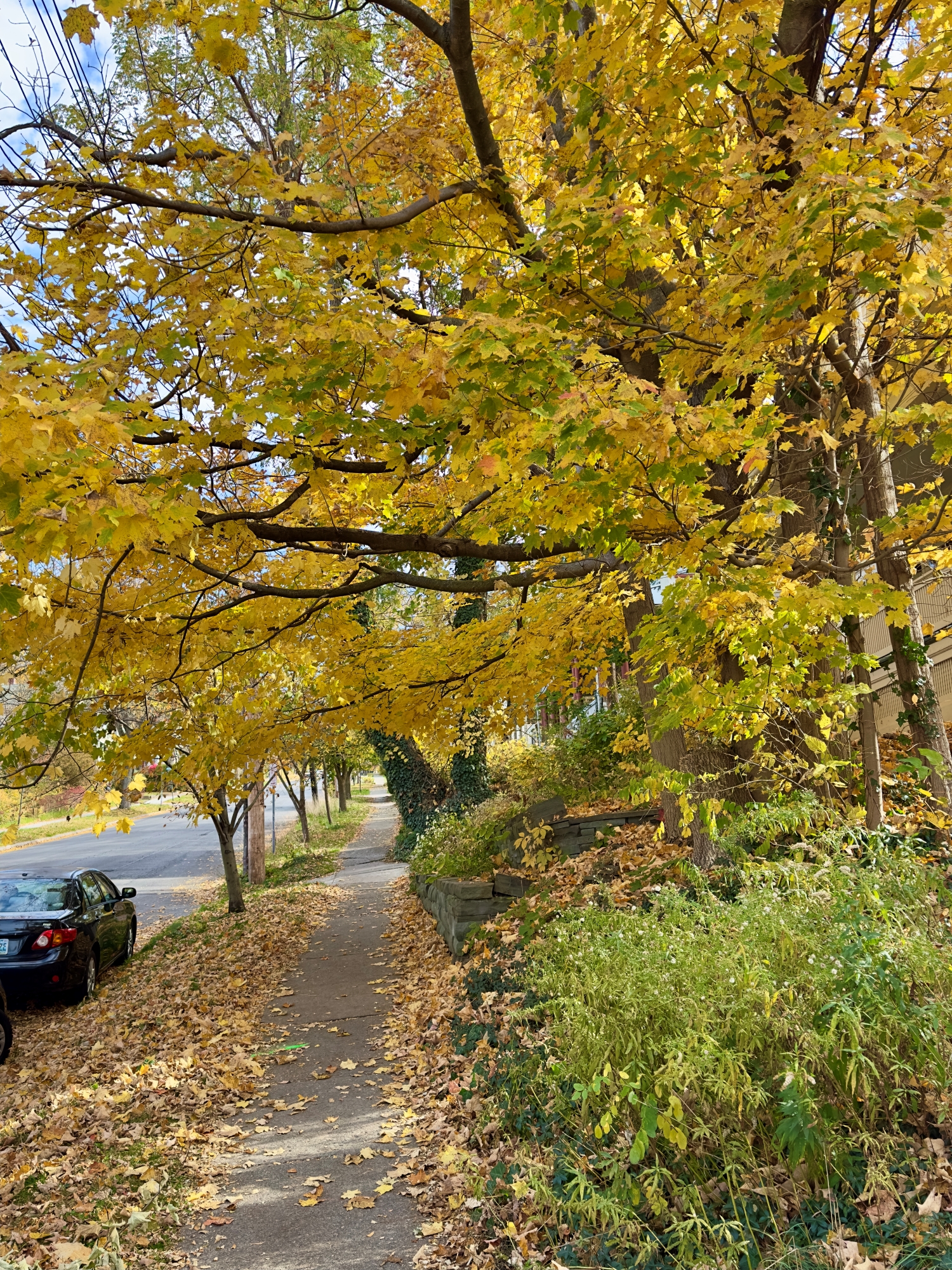
Golden Canopy over Buffalo Street Sidewalk
Continuing up Buffalo Street, I marveled at the trees, their branches thick with yellow and gold leaves, creating a canopy above. The leaves shivered with every gust, whispering the ancient secrets of the forest. The air was infused with the sweet, woody fragrance of maple and oak, mingling with the faint scent of chimney smoke from nearby houses. The sunlight filtered through, casting a dappled pattern on the sidewalk, a fleeting mosaic as the leaves danced in the wind. A sense of impermanence struck me; soon, these leaves would be gone, leaving bare branches silhouetted against a winter sky.
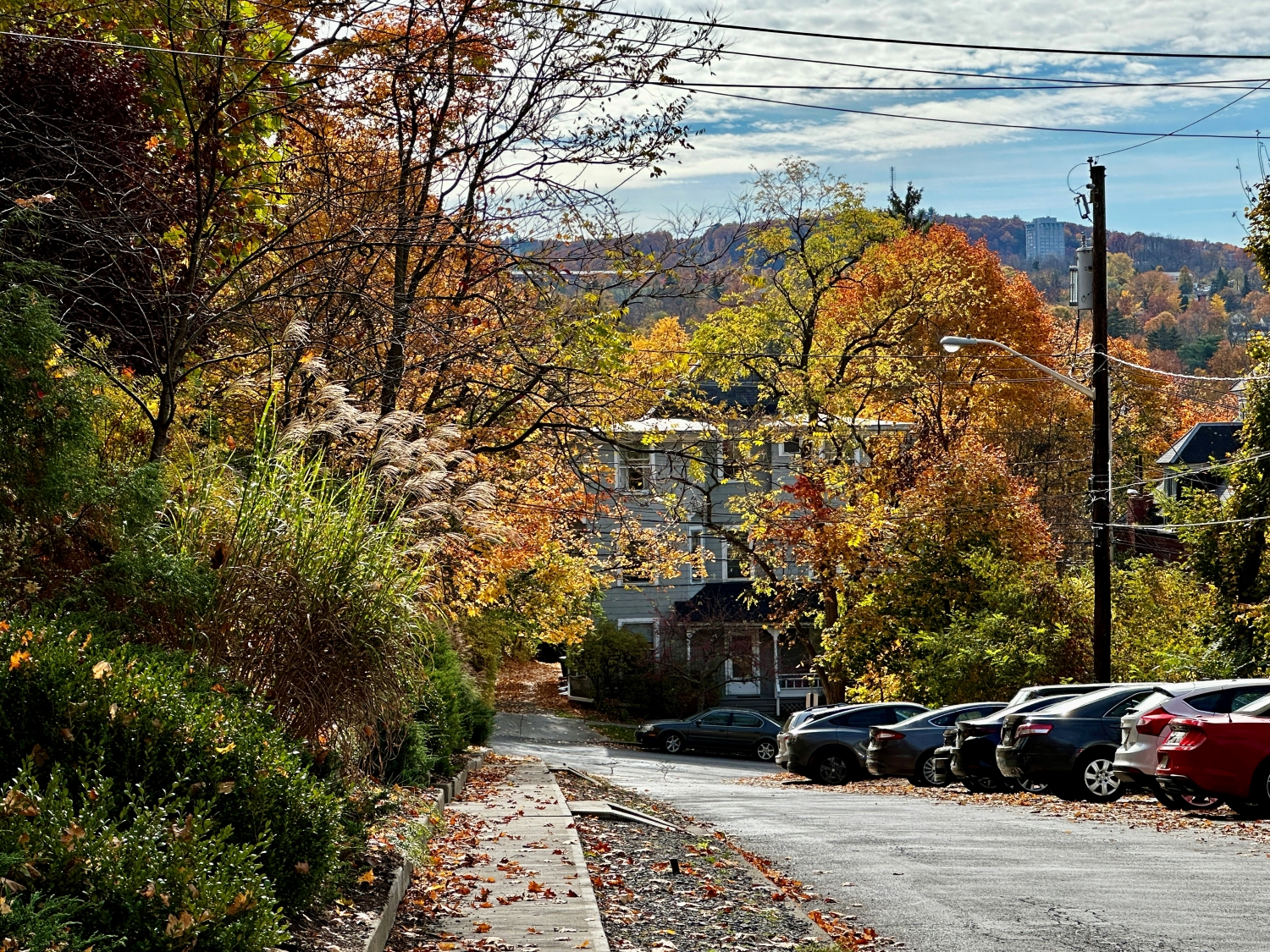
Scene from Dewitt Place toward South Hill and Ithaca College
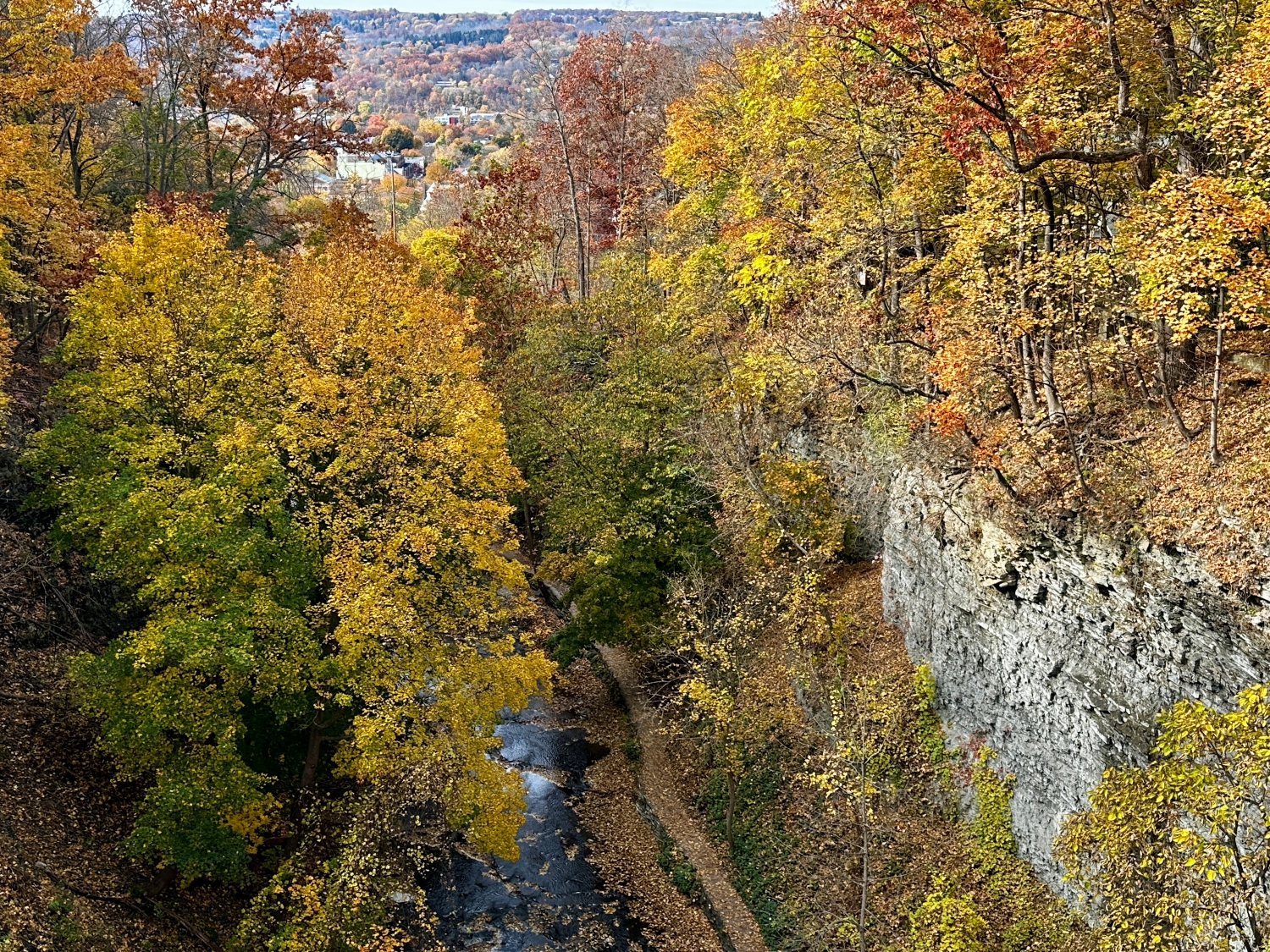
Crossing the Stewart Avenue bridge, the Cascadilla Gorge came into view, a steep wall of stratified rock layers standing guard over the gently flowing stream below. The contrast between stone and foliage was breathtaking—the hard, unyielding rock juxtaposed with the softness of leaves in full autumnal bloom. The earthy scent of wet stone mixed with the crisp aroma of the flowing water, creating a sensory tapestry unique to the gorge. The colors seemed to intensify against the gray and brown of the cliff, each leaf like a brushstroke on nature’s canvas, celebrating the season’s final flourish before surrendering to winter.
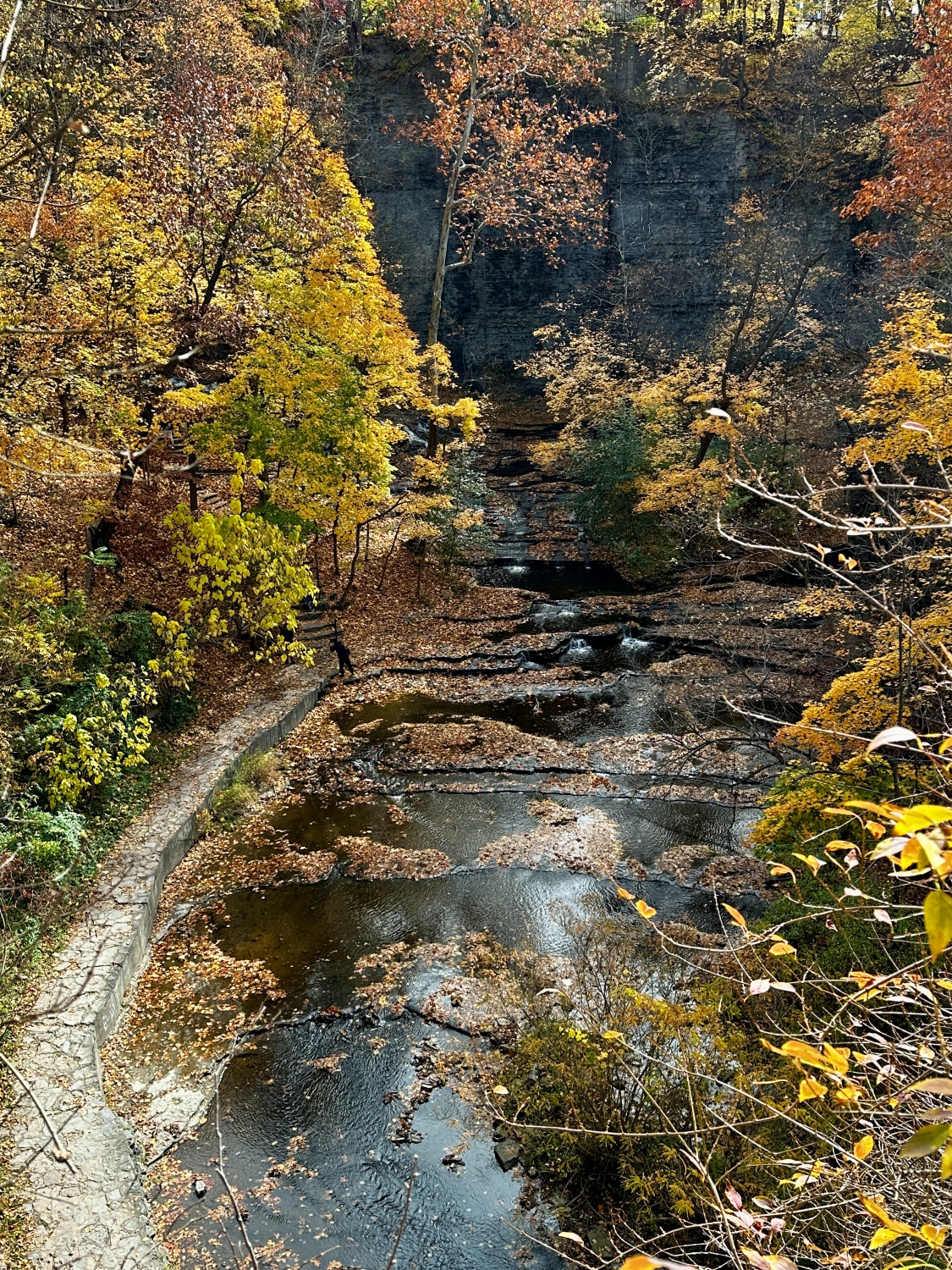
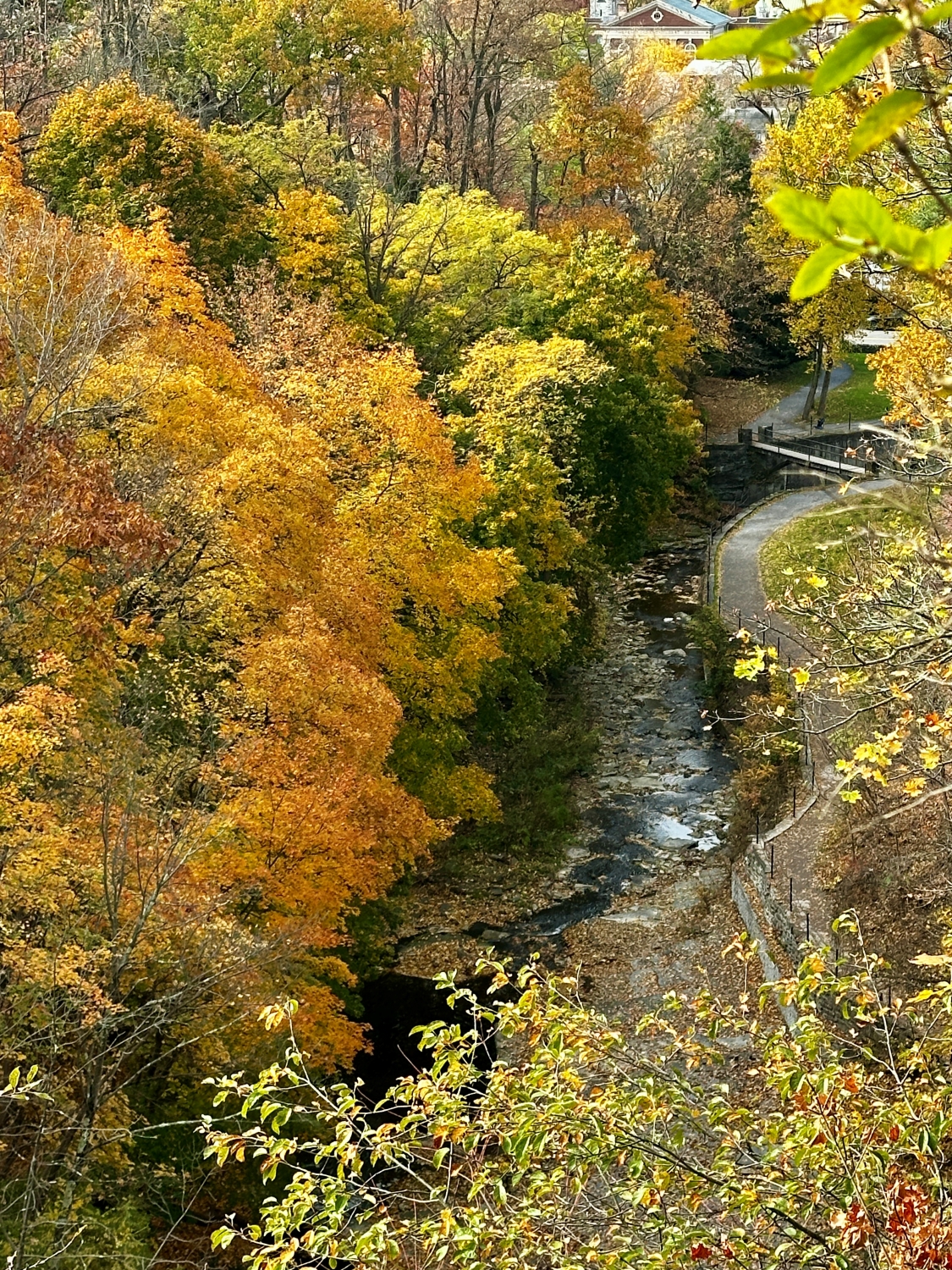
Below footpath along the gorge rim, the creek wound through, its banks littered with leaves that had completed their journey from branch to earth. They floated on the water’s surface, spinning gently in the current as though reluctant to leave this last dance. The sound of the water was a steady undercurrent, soothing and rhythmic, as it tumbled over stones and carved its way through the gorge. I paused to watch, entranced by the way water and rock, ephemeral and eternal, seemed to coexist in a kind of harmony.
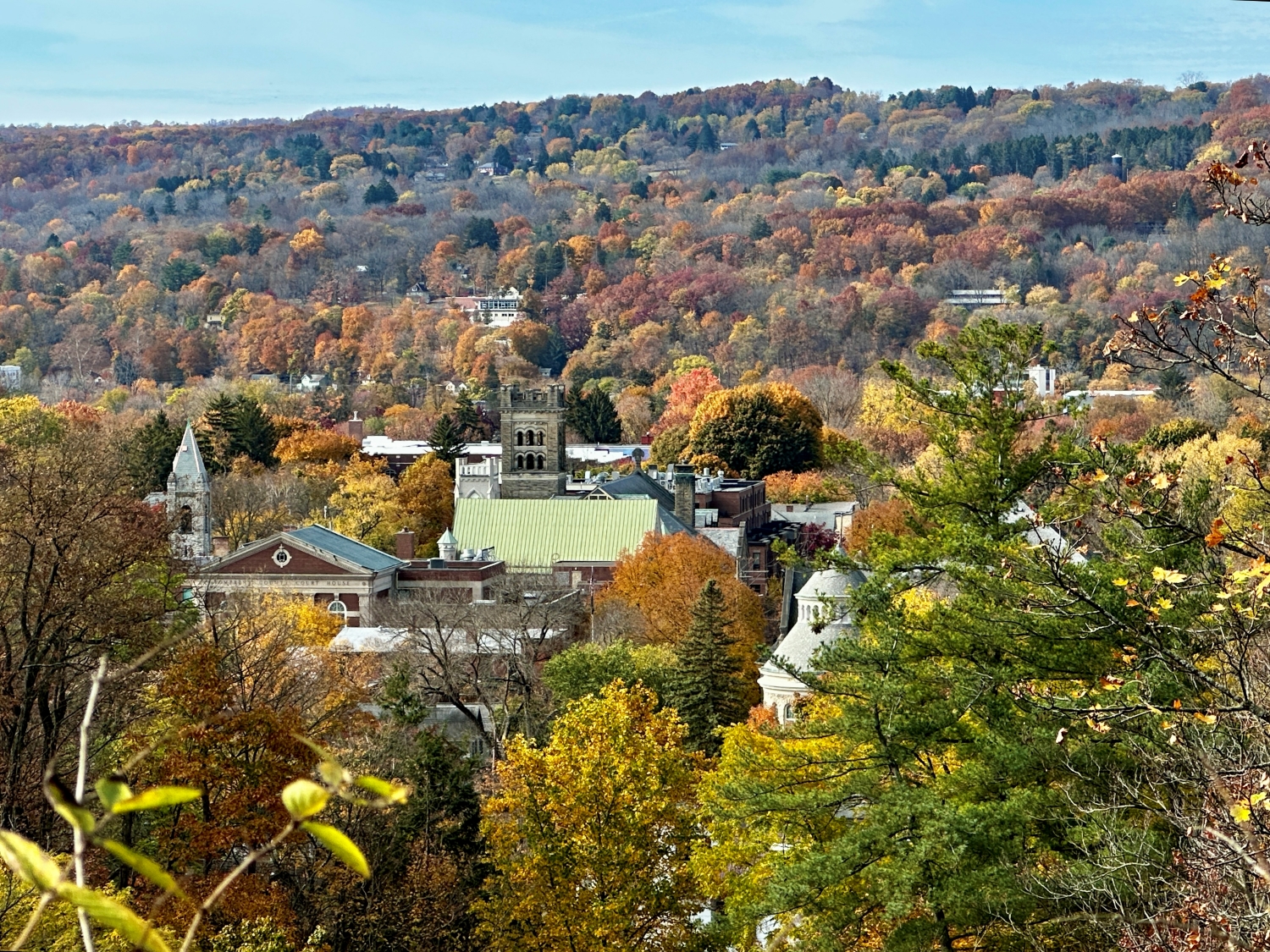
I stopped at a lookout point and surveyed the town sprawled out below, nestled amidst the fiery colors of the surrounding hills. The architecture of Ithaca’s buildings peeked through the trees, each roof and spire framed by the season’s palette. This was a town embraced by nature; its rhythm dictated as much by the seasons as by human hands. The sight stirred a sense of gratitude within me; here was a place that reminded you to slow down and observe, to notice the subtle shifts in light, in color, in the way a single gust of wind could change a landscape.
I continued along the rim, passing a small waterfall that spilled over the rocks with a quiet insistence. The water had carved smooth pathways in the stone, evidence of its long journey and persistent power. The sunlight hit the spray just right, casting a fleeting rainbow that shimmered and then disappeared as I moved. I felt a sense of companionship with the water—both of us moving forward, shaped by the paths we traverse, yet always adapting to whatever lay ahead.
The last part of the trail led me through a dense thicket of trees, their branches hanging low, forming a natural archway. The air was heavy with the musky scent of fallen leaves and the spicy aroma of pine needles underfoot. Here, the light was softer, muted by the thick canopy overhead. The quietness enveloped me, broken only by the occasional rustle of a squirrel in the leaves or the distant caw of a crow. It was the kind of silence that feels sacred, where each sound, no matter how small, becomes profound.
Entering Cascadilla Gorge from Linn Street
Emerging from the shaded path, I took one last look back at the gorge. The scene was both familiar and new—a blend of natural beauty and the nostalgia of seasons past. I felt a sense of peace, grounded by the cycles of the earth, by the ebb and flow of life around me. In this moment, on the brink of Halloween, the world felt both hauntingly beautiful and reassuringly steadfast, a reminder that even as the leaves fall and the days grow shorter, there is a promise of renewal in the quiet persistence of nature.
Enter your email to receive notification of future postings. I will not sell or share your email address.
Copyright 2024 All Rights Reserved Michael Stephen Wills
Join me on a heartwarming adventure at Comstock Creek with my grandchildren, Sam and Rory, as we explore the wonders of nature, create lasting memories, and celebrate the legacy of the Comstock family.
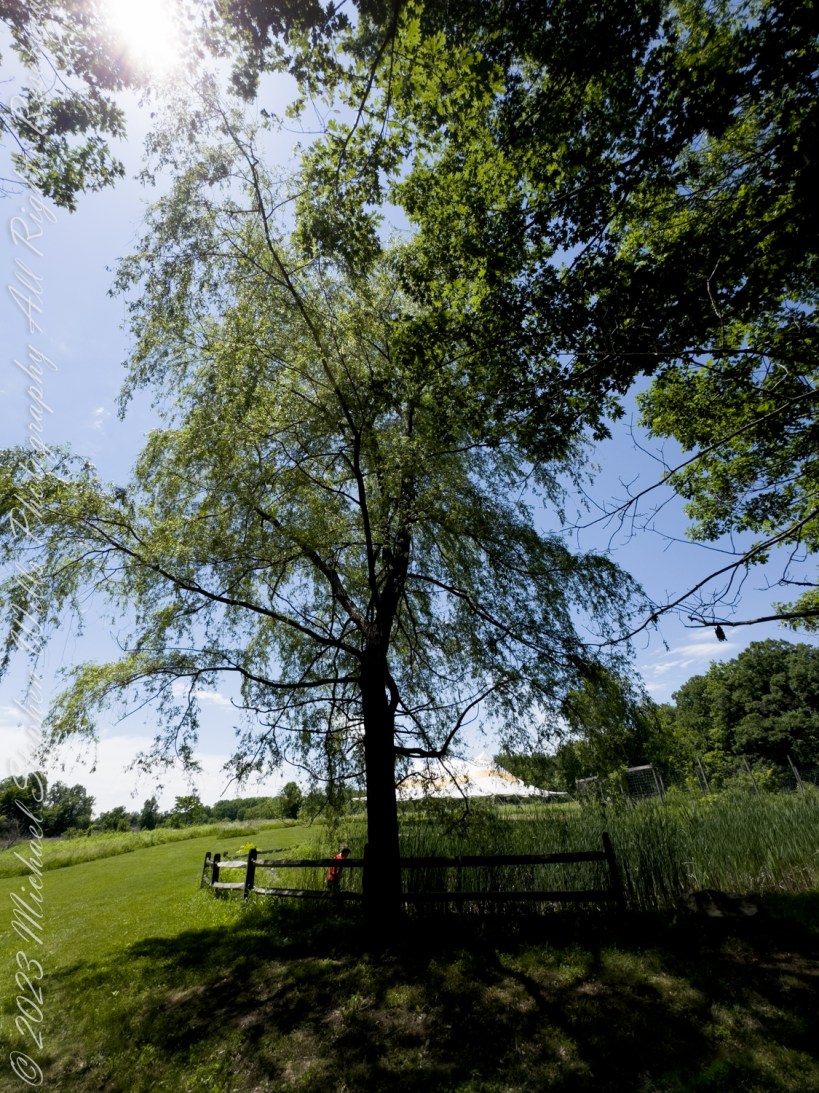
The morning sun filtered through the lush canopy of trees as I guided my grandchildren, down the familiar path towards Comstock Creek of the Cayuga Nature Center. The children were familiar with the creek from time spent in summer camp. This little haven of nature is a favorite spot of theirs. Comstock Creek, named after the Comstock family, stands as a testament to their significant contributions to entomology and nature education. John Henry Comstock, a renowned entomologist, and his wife, Anna Botsford Comstock, a pioneering figure in nature study, left an indelible mark on the Ithaca area and beyond. Their legacy lives on, not just in the academic world, but in these very waters where my grandchildren now play.
As we reached the creek, the children wasted no time kicking off their shoes and wading into the cool, shallow water. My grandson, in his red shirt, and granddaugter, in her green one, both radiated joy and curiosity. The sunlight danced on the water’s surface, casting shimmering reflections that seemed to animate the entire scene.
The youngest was the first to discover a small pool where the water had carved out a deeper spot. “Look, Grandpa!” he exclaimed, his voice full of excitement. He crouched down, peering intently at the tiny fish darting around his feet. His sister joined him, her initial apprehension giving way to a wide-eyed fascination as she watched the underwater ballet.
Their time was spent turning over rocks to find little aquatic creatures and marveling at the delicate balance of nature. The children’s laughter echoed through the woods, blending with the sounds of rustling leaves and the gentle babble of the creek. Their sense of wonder reminded me of the Comstocks’ passion for nature, a passion they had so fervently shared with the world.
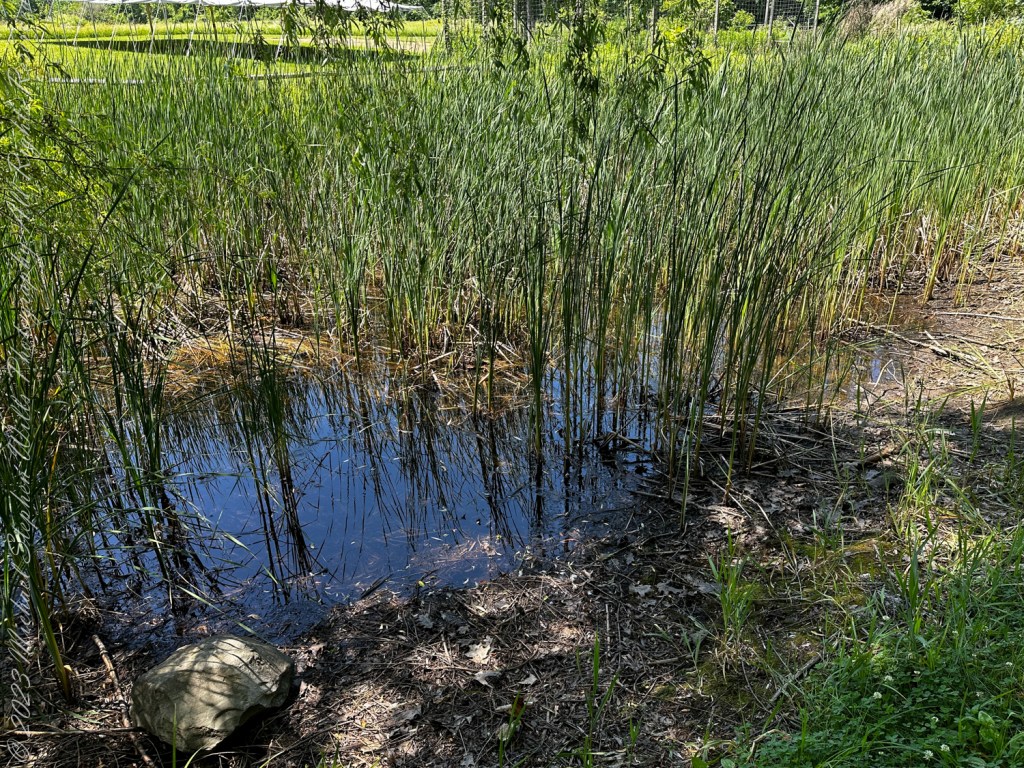
After a while, we decided to take a break and walked through the meadow past where tall reeds swayed gently in the breeze. He knew of a small, tranquil pond that reflected the sky like a mirror. He leaned the water’s edge,hoping to grab a frog. I stood back, capturing this peaceful moment with my camera, knowing that these images would become treasured memories.
As noon approached, we travelled back to Ithaca for an ice cream treat, promised them as a reward for their adventurous spirit. Their faces lit up with delight as they savored their treats, their expressions reflecting pure contentment.
The day wouldn’t have been complete without a splash in the pool. Back home, grandmother set up the inflatable volleyball net while the kids changed into their swimsuits. The pool became a hub of activity as they splashed around, their laughter blending with the sound of the water.
Reflecting on the day, I felt a deep sense of gratitude. The Comstock family’s dedication to nature education had inspired generations, including my own. Their legacy was evident not just in the academic institutions of Ithaca, but in the simple, joyous exploration of nature that I shared with my grandchildren. I hope this day at Comstock Creek will be remembered fondly, a chapter in our family’s ongoing story of discovery and connection with the natural world.
Copyright 2024 Michael Stephen Wills All Rights Reserved








 Michael Stephen Wills Photography