Climb the Hill of Tara

Explore the Hill of Tara with us! Discover the rich history of Saint Patrick’s statue, the legendary bonfire, and stunning panoramic views of County Meath. Join our journey through Ireland’s ancient and mystical landscapes in our blog post.

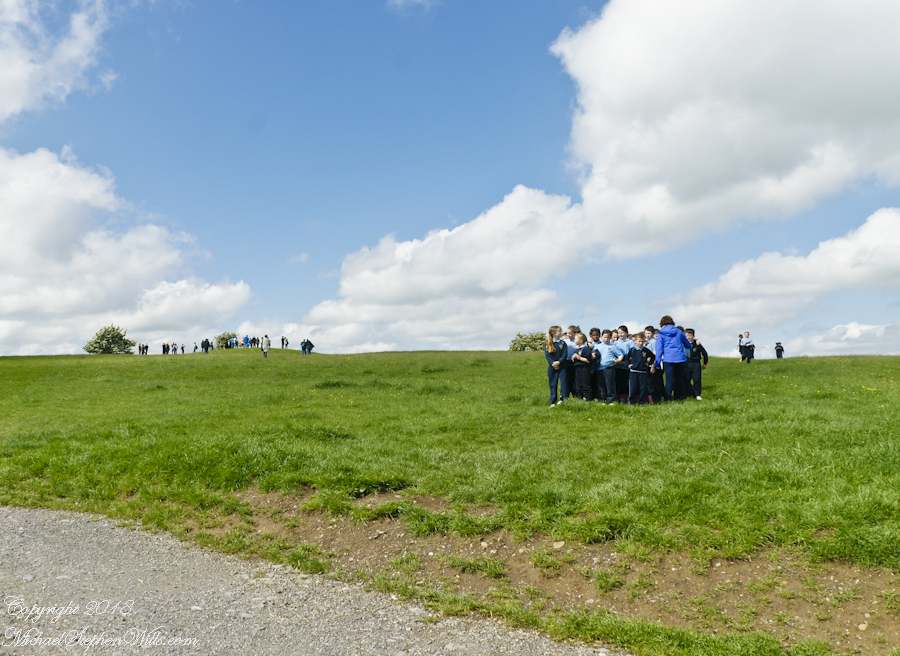
Arriving around noon on a Tuesday, Pam and I were greeted at the Hill of Tara by these children, headed to the school bus.
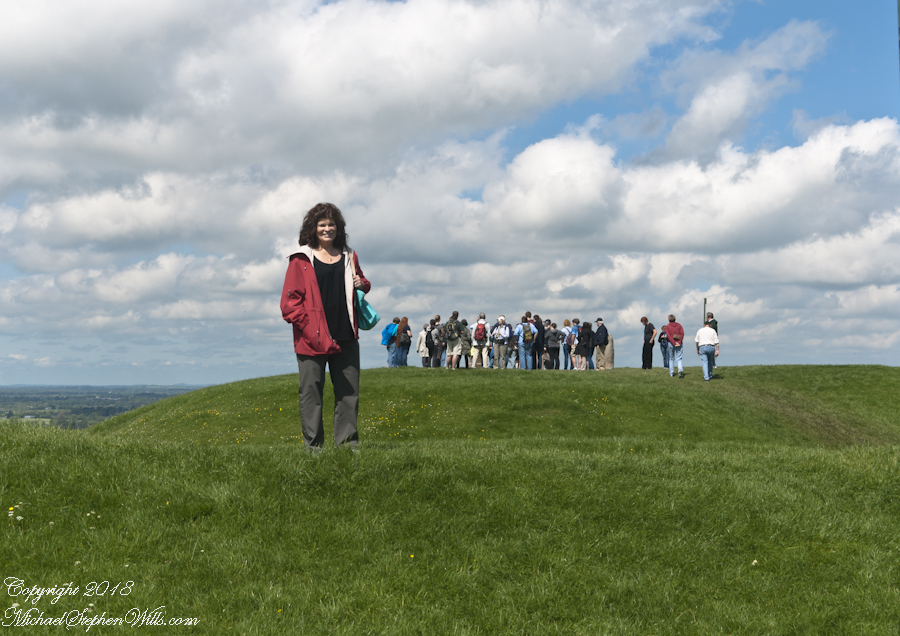
Schoolchildren on Hill of Tara – CLICK ME for more Ireland photography.

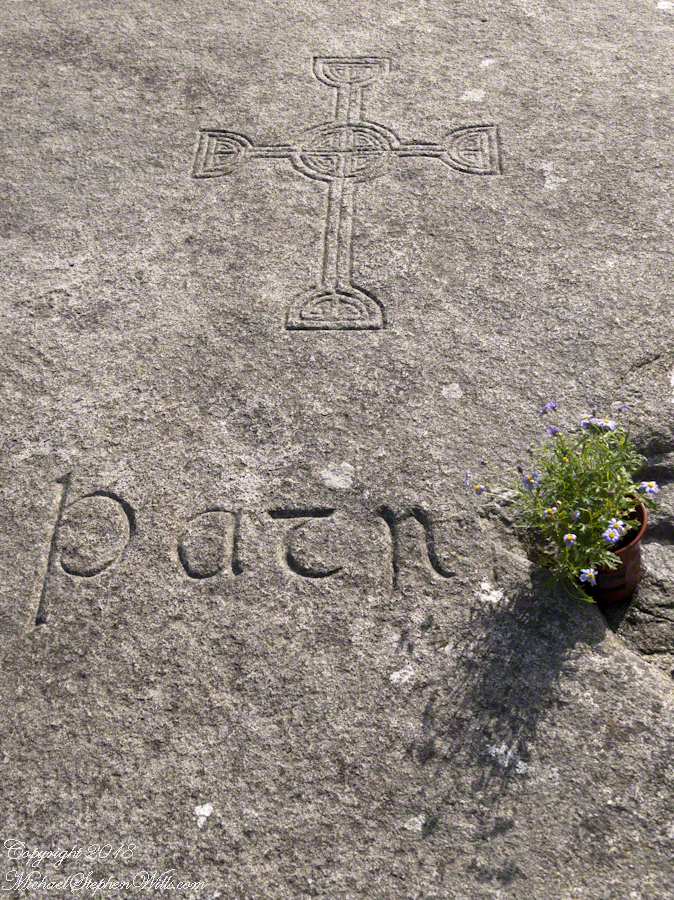
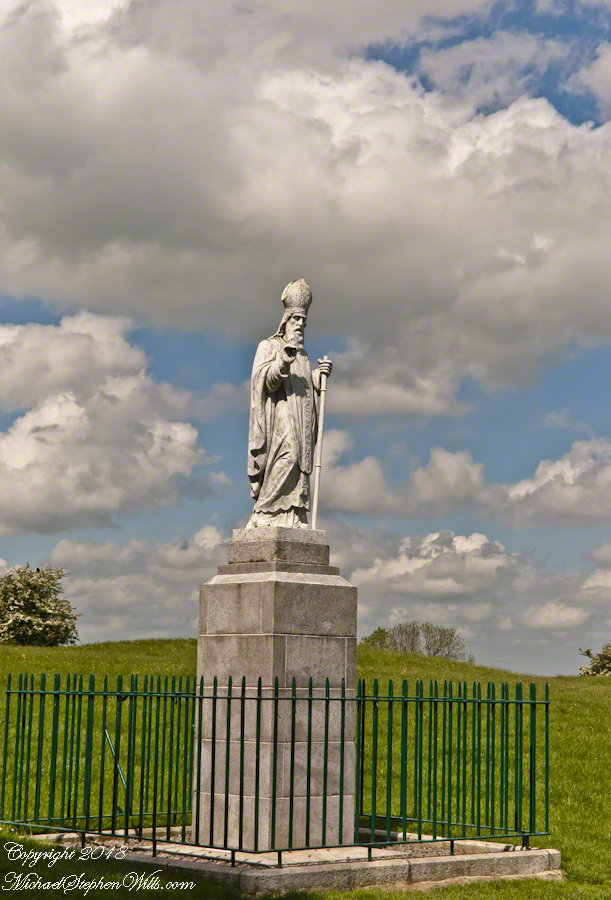
A statue of Saint Patrick fittingly welcomes visitors to the Hill of Tara, County Meath, Ireland. This statue of cast concrete was an existing statue donated by the Sisters of Charity, moved from an existing installation to the Hill of Tara in the year 2000 AD. The creator is anonymous, the is no plaque or other attribution on or around the statue.
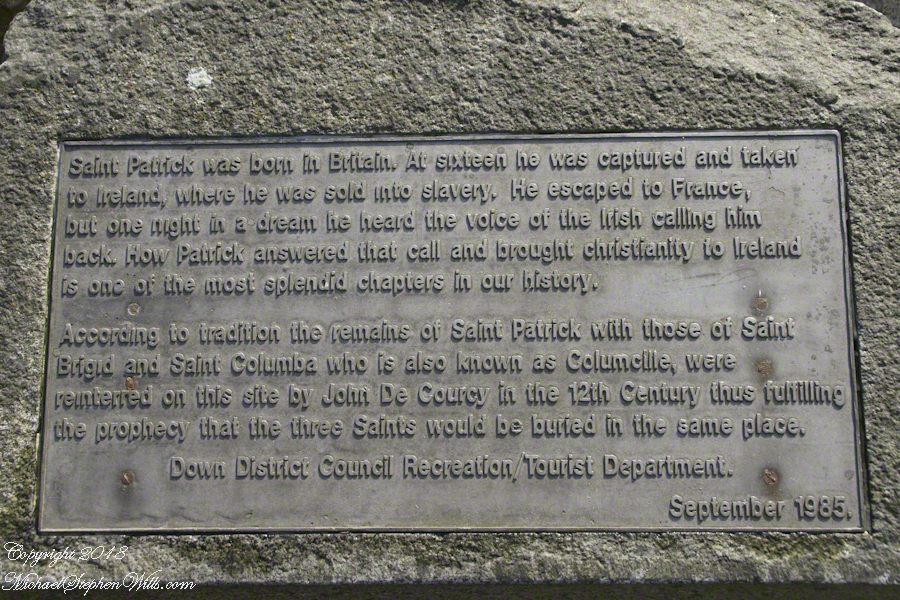
The original statue was erected on the summit of the Hill of Tara shortly after Catholic emancipation in 1829, commemorated the events of 433AD when St. Patrick lit a bonfire on the nearby hill of Slane on the eve of Easter Sunday. Slane was the second site we visited on our day of arrival, Saturday, May 24.

Lighting such a fire was contrary to the pagan laws of the time which dictated that the first fire lit that night be in Tara. Observing St. Patrick’s bonfire from afar, the chief druid of the ancient Gaelic capital predicted that if the flame were not extinguished that night, Christianity would never be extinguished in Ireland.
The saint’s bonfire continued burning and the next morning, Easter Sunday, St. Patrick entered Tara to convert the king and his followers to Christianity.

Here is more about the history of this statue.
Saint Patrick Hill of Tara – CLICK ME for more Ireland photography.

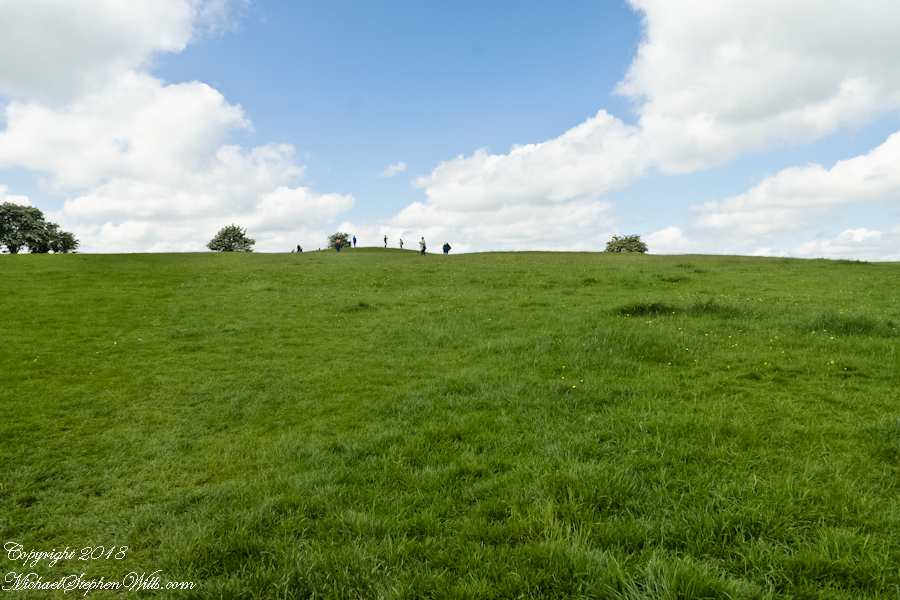
A series of mounds surmounts the hilltop, one is visible across the expanse of grass.

Hill of Tara View – CLICK ME for more Ireland photography.

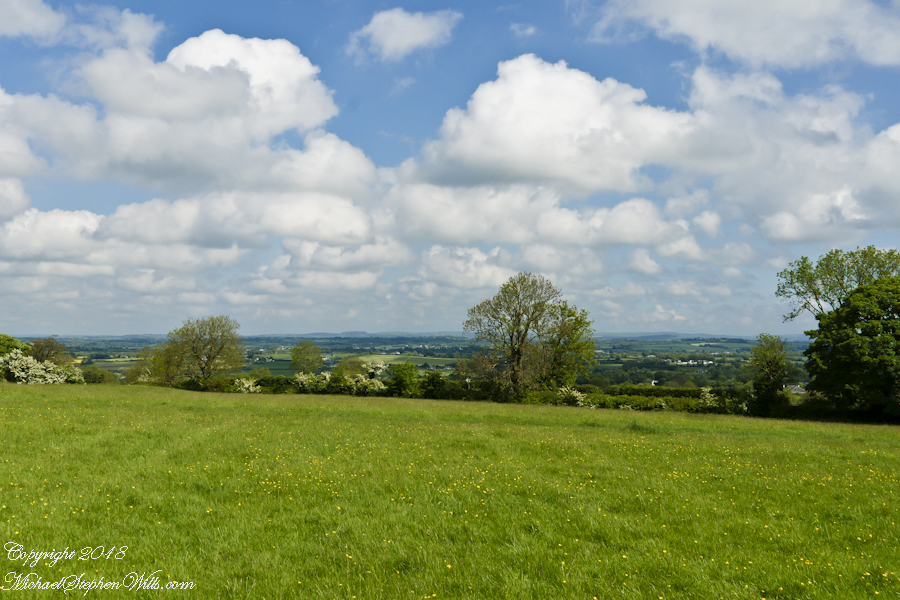
Climbing higher, the view opens.

Hill of Tara View – CLICK ME for more Ireland photography.

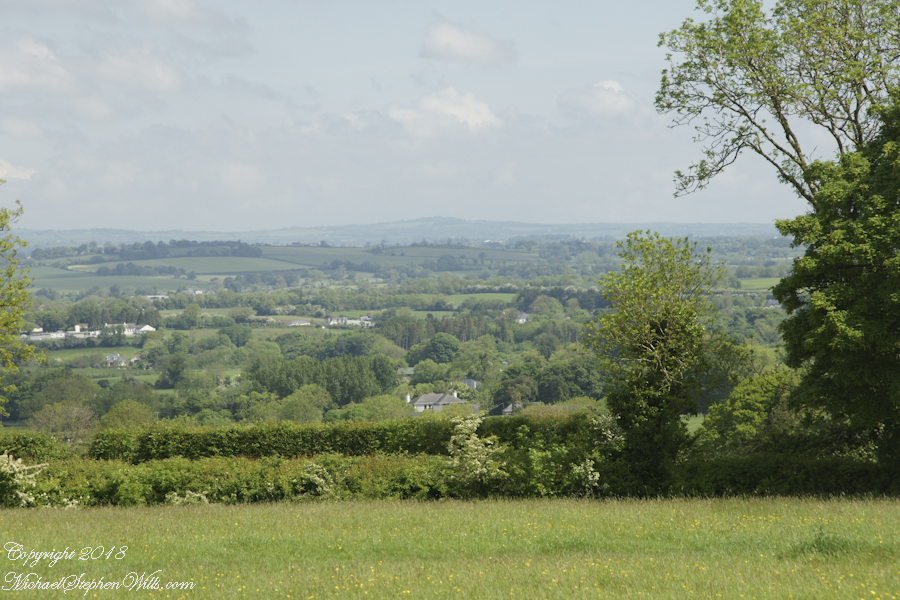
On the top, views from all cardinal directions, 360 degrees.

Hill of Tara View – CLICK ME for more Ireland photography.

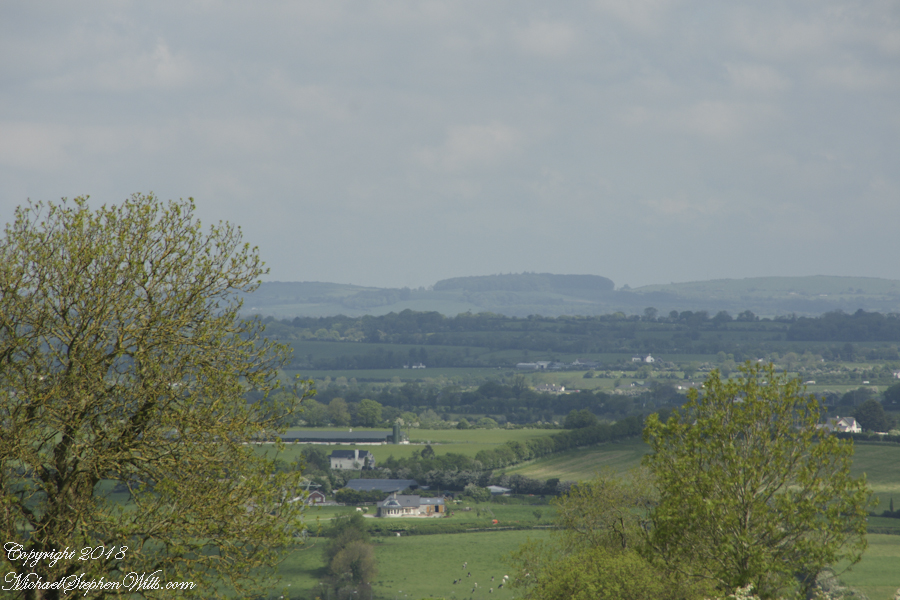
The Hill of Slane is visible in the east, the tall cathedral ruin though not visible in this view.

Hill of Tara View – CLICK ME for more Ireland photography.

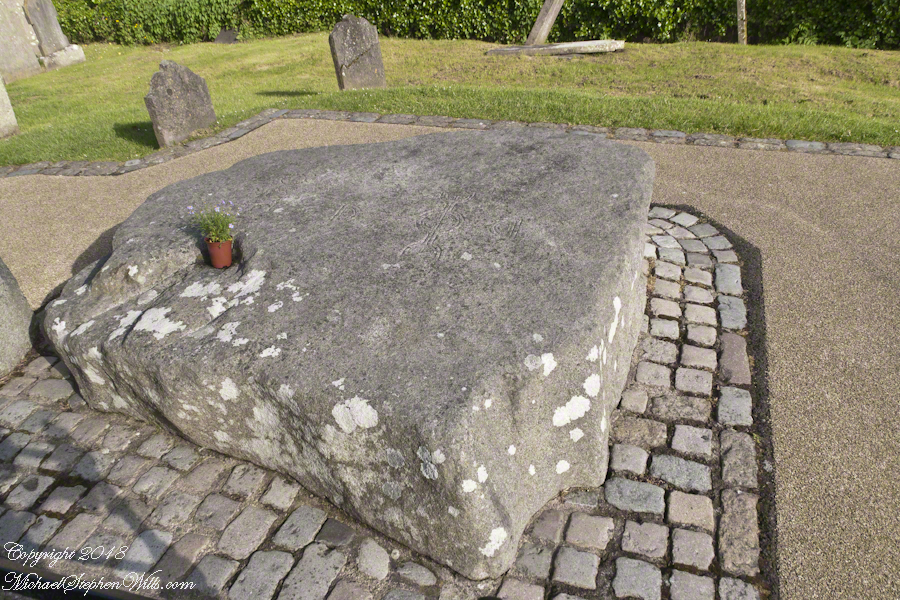
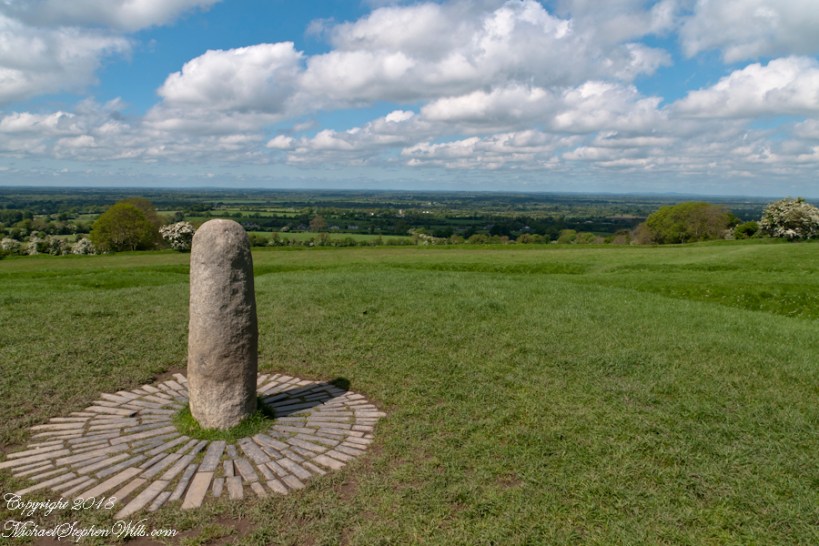
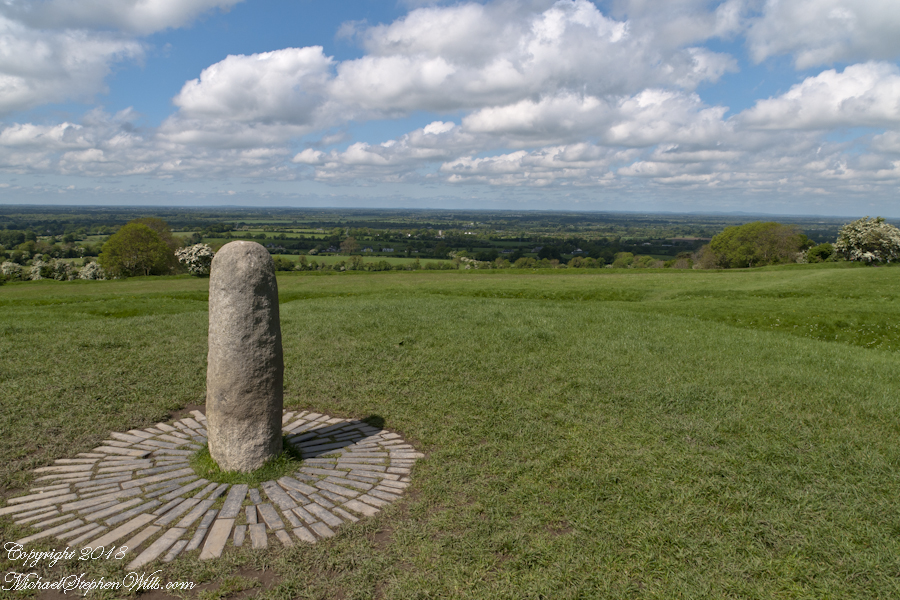
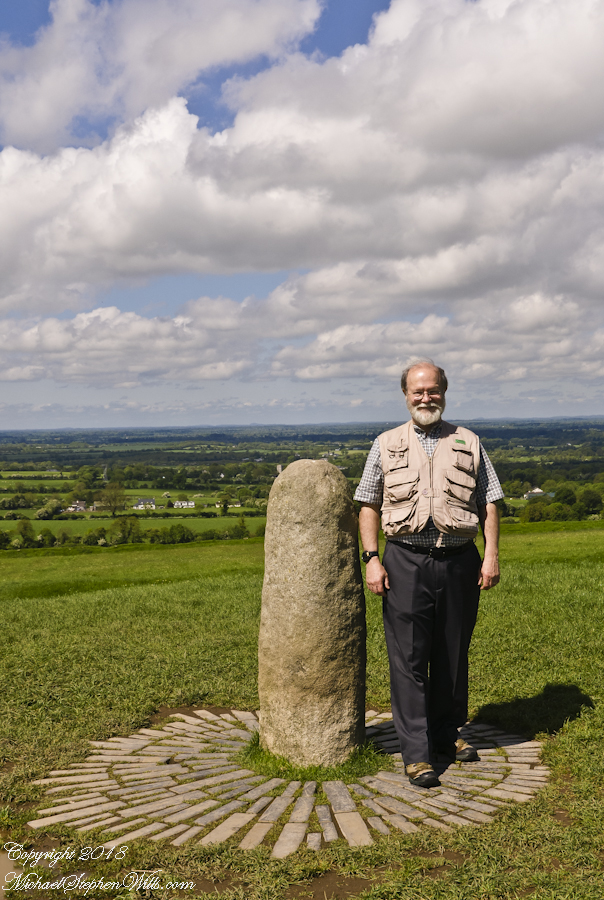
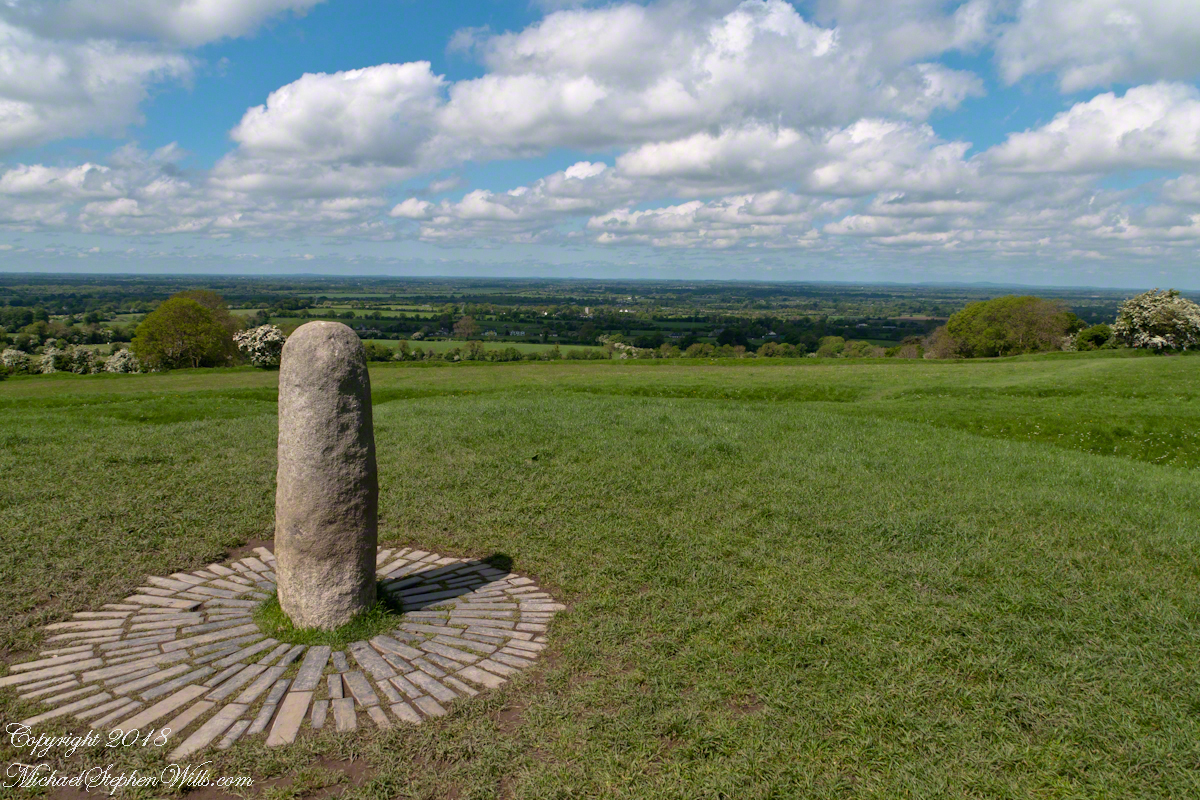
The first of the following panel is a view northwest from looking across County Meath with views of Counties Westmeath and Cavan. On the horizon, right, is Hag’s Mountain, (Irish: Sliabh na Caillí) , site of the Loughcrew Cairns. The standing stone is the “Stone of Destiny: (Irish: Lia Fáil), which served in coronation the coronation of the High Kings of Ireland. It stands on the Inauguration Mound (Irish: an Forrad) of Tara. This photograph was taken the morning of May 27, 2014 hours before the stone was vandalized, doused with green and red paint.

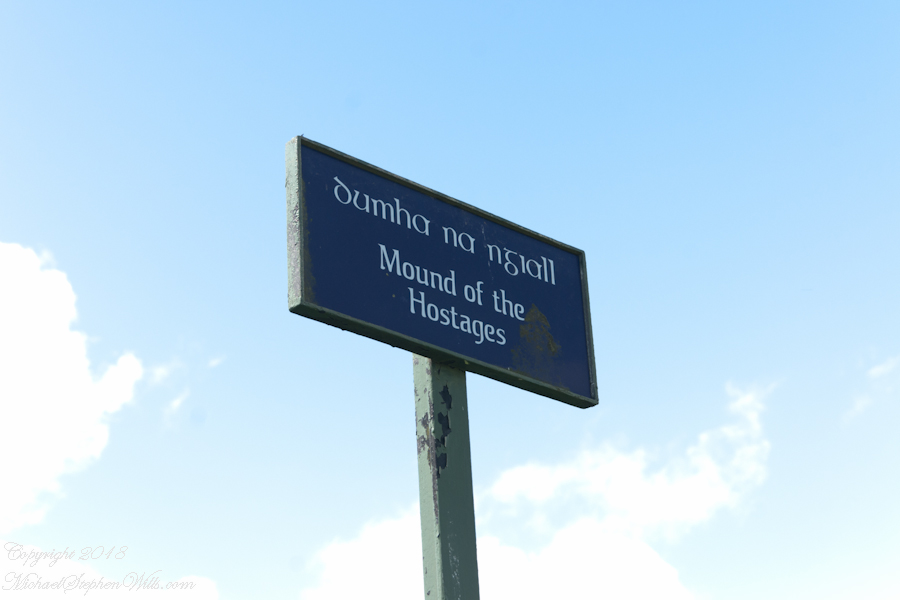
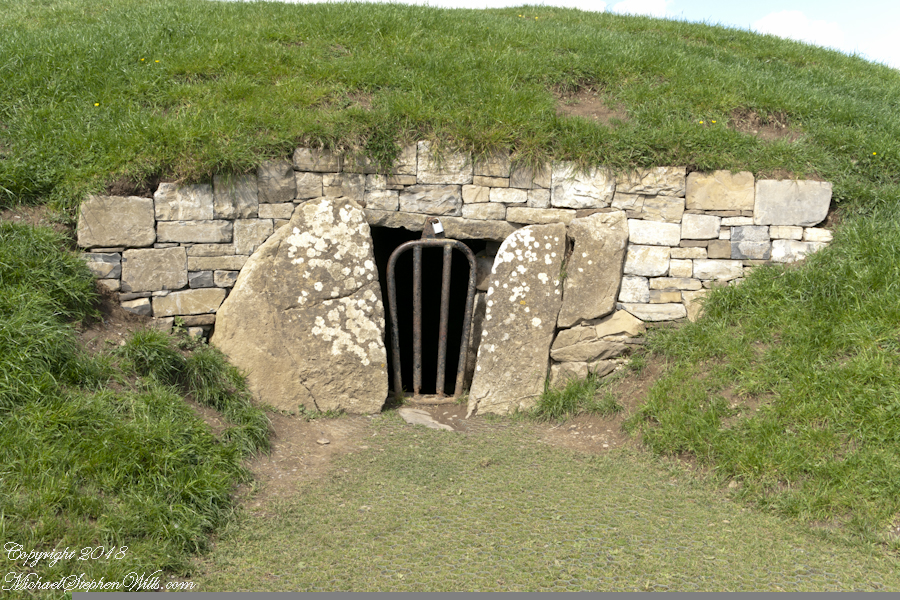
A bit to the east is the Mound of the Hostages, a passage tomb.

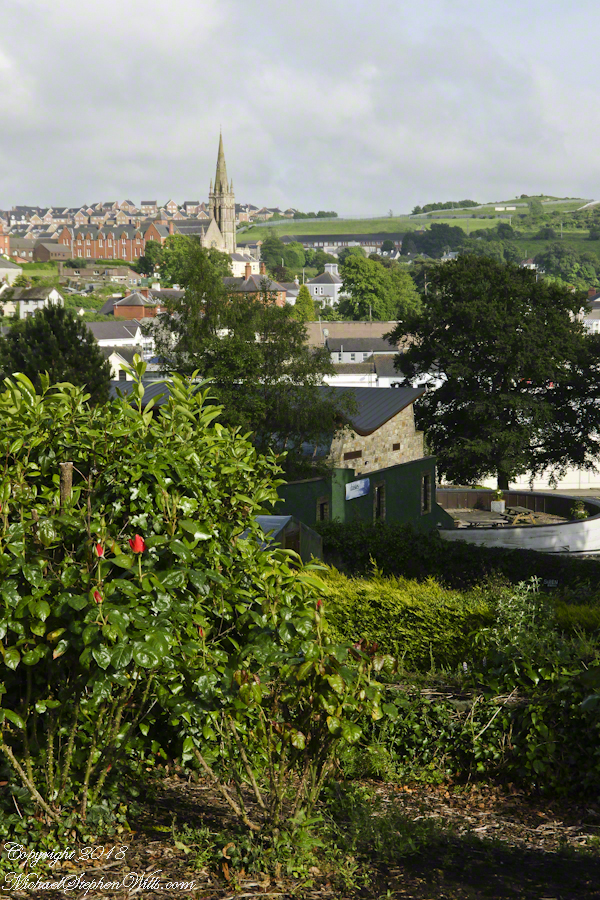
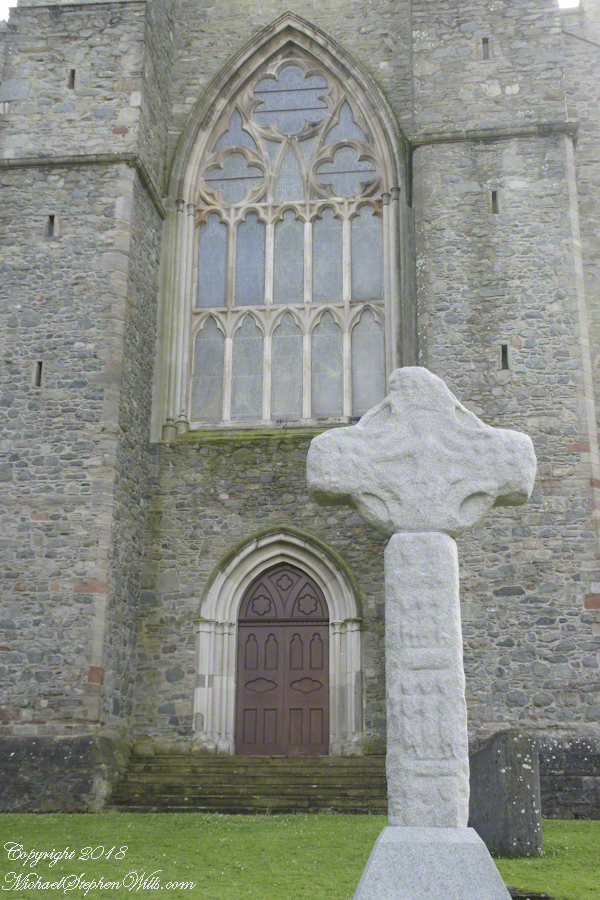
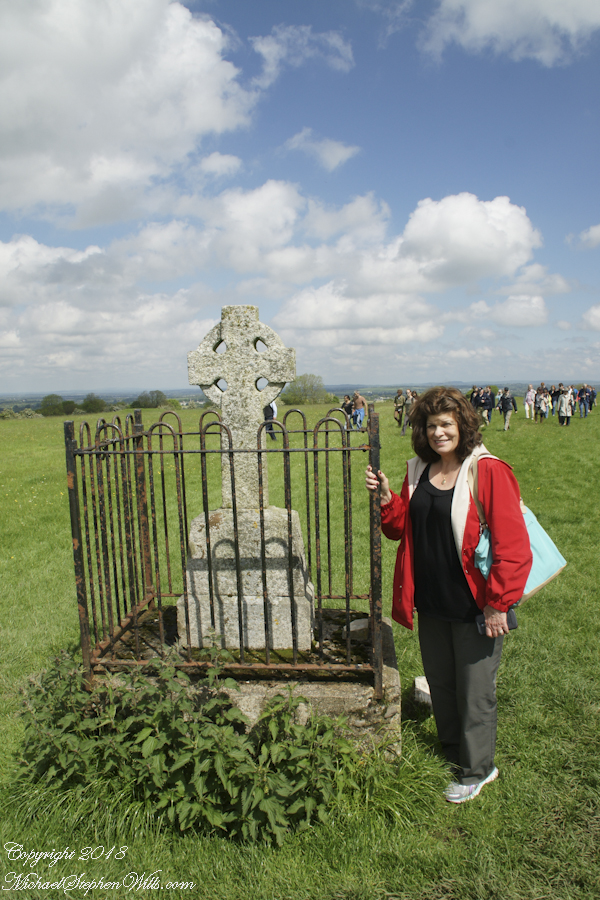
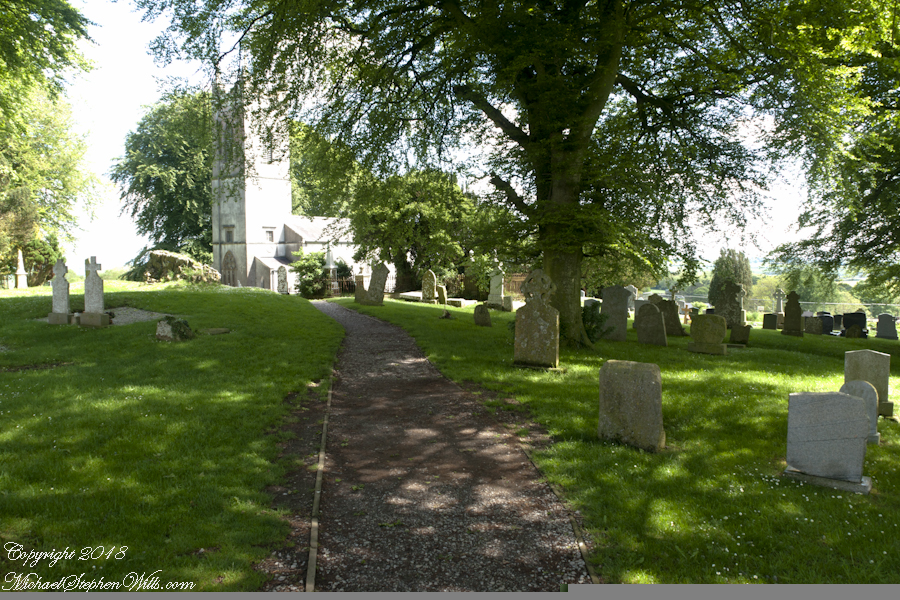
Walk into a glade, through the ancient graveyard to the visitors center in a deconsecrated church.

Browse my reasonably priced stock photography. This blog features three (3) photographs I published last week to Getty Istock and my Fine Art gallery.

License the photo, download and use it. Click this link to browse all my Getty IStock Photography offerings.

Or click this link or any photograph or this link to select a print with custom framing from my “Ireland” Fine Art Gallery.

Here’s another of my Ireland postings, “St. Patrick’s Return to the Hill of Tara.”

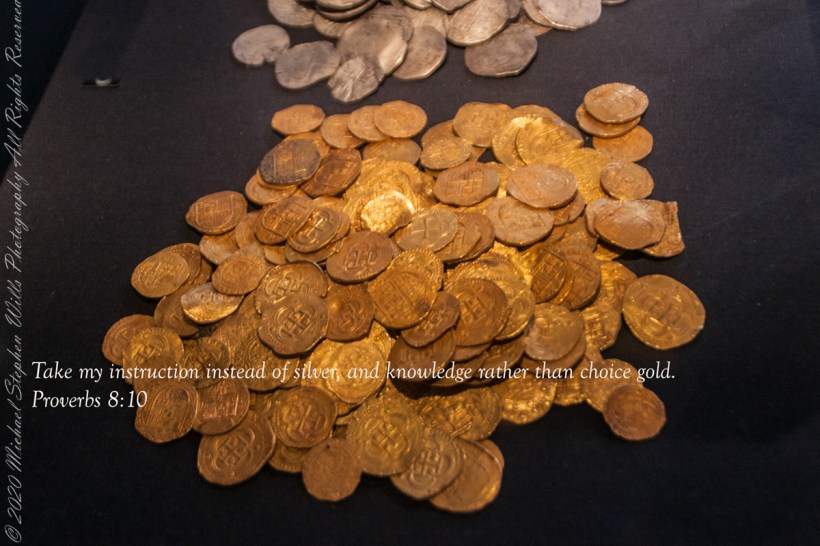
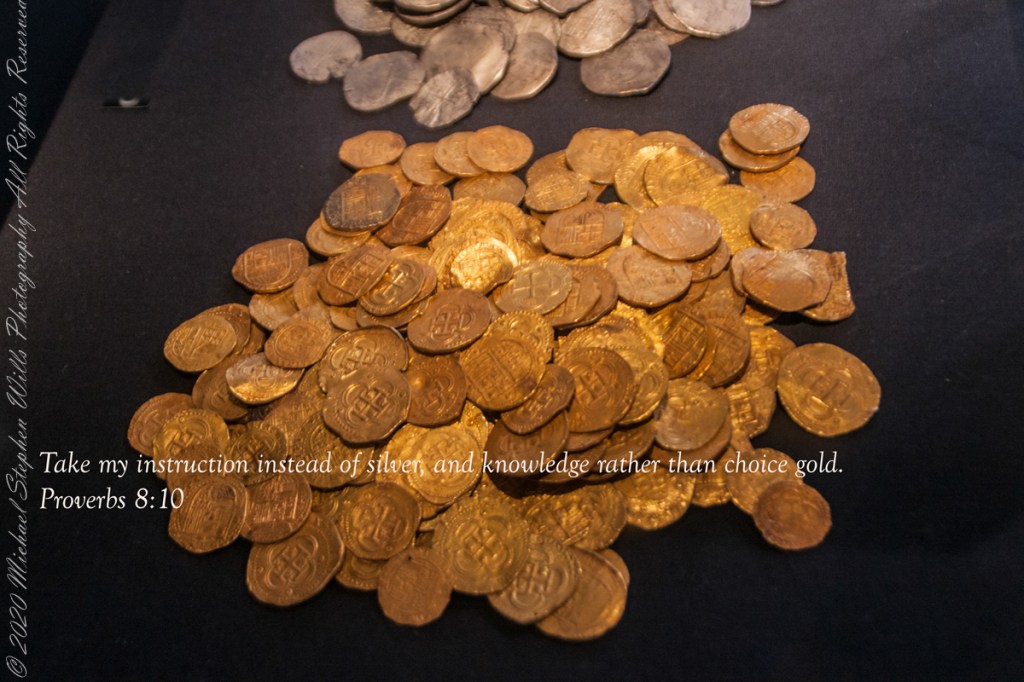
Treasure

Gold on display for the permanent exhibit “Treasures of the Girona,” Ulster Museum, Belfast. It is not Leprechaun gold, certainly.

“Lay not up for yourselves treasures upon earth, where moth and rust doth corrupt, and where thieves break through and steal: But lay up for yourselves treasures in heaven, where neither moth nor rust doth corrupt, and where thieves do not break through nor steal: For where your treasure is, there will your heart be also.” Matthew 6:19-24

The Haw in Hawthorn

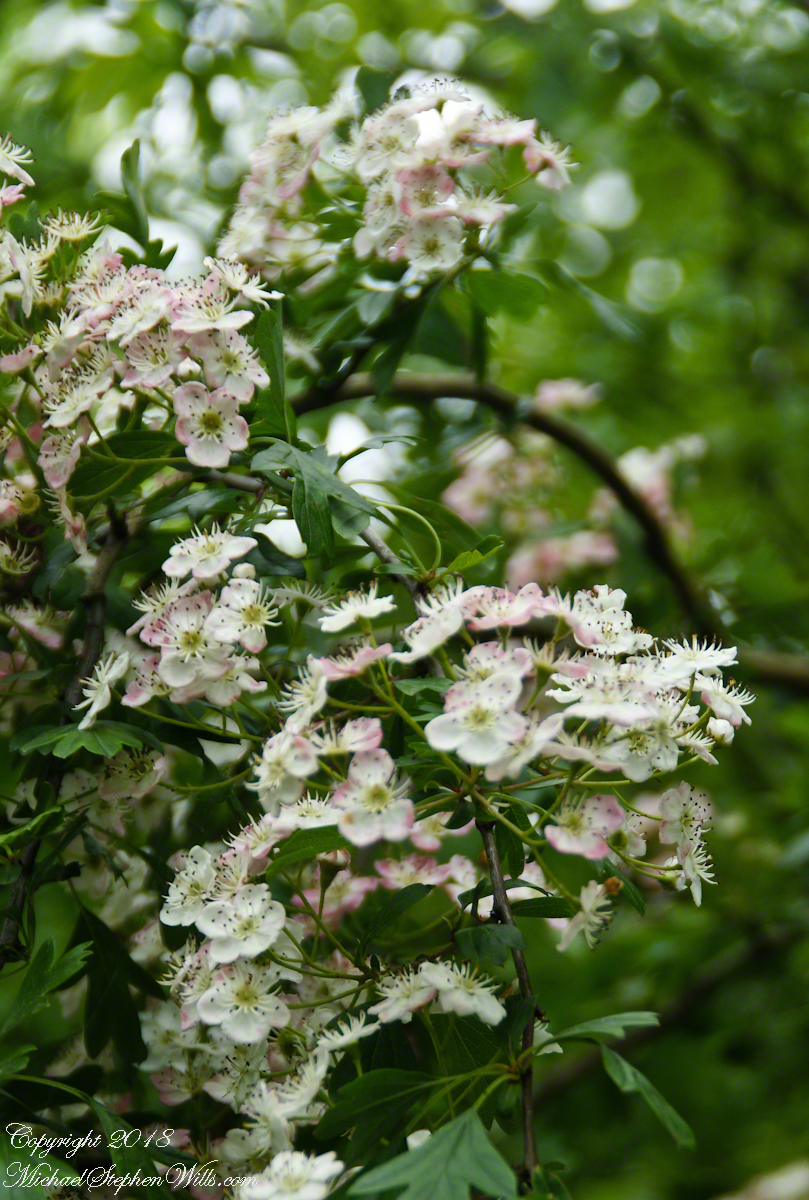
I originally published these blossoms as “wild  rose”.  It was my Facebook friends who pointed  out these are hawthorn flowers.  The key to identification was the shape of the leaves.

Hawthorne Blossoms on the former McArdle Home
Blossoms of Hawthorne taken on the site of the former McCardle Home, Proleek Townland, County Louth, Ireland.

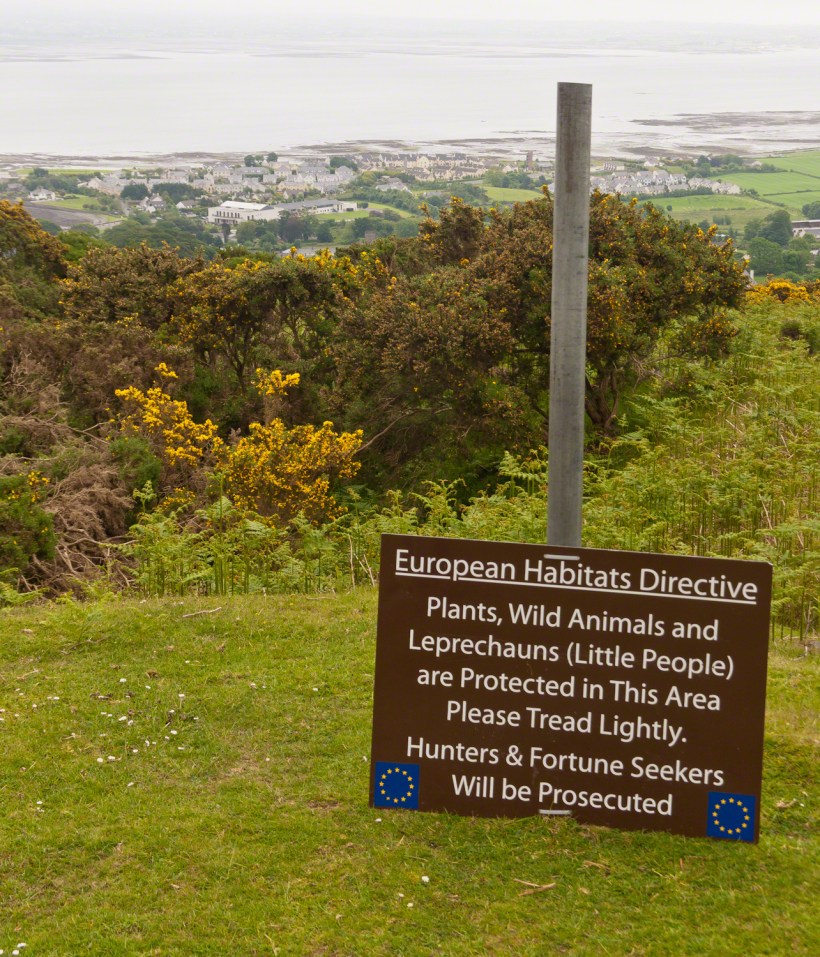
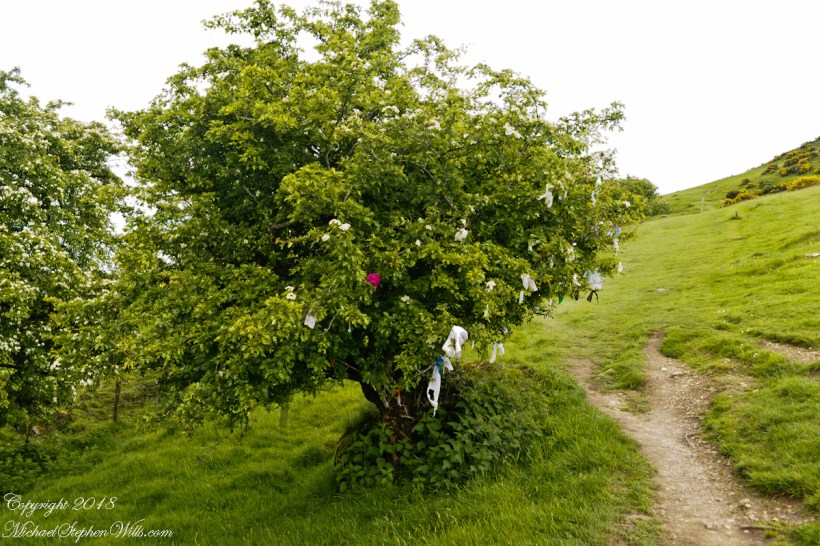
In correcting my mistake, I learned the young leaves of Hawthorn are excellent for salads.  Wonder how the fairy folk, associated with single hawthorns (as in the following photograph from the Hill of Tara), react to picking leaves from their trees?  I didn’t hear of the practice during our time in Ireland.

Speaking Stone Hill of Tara
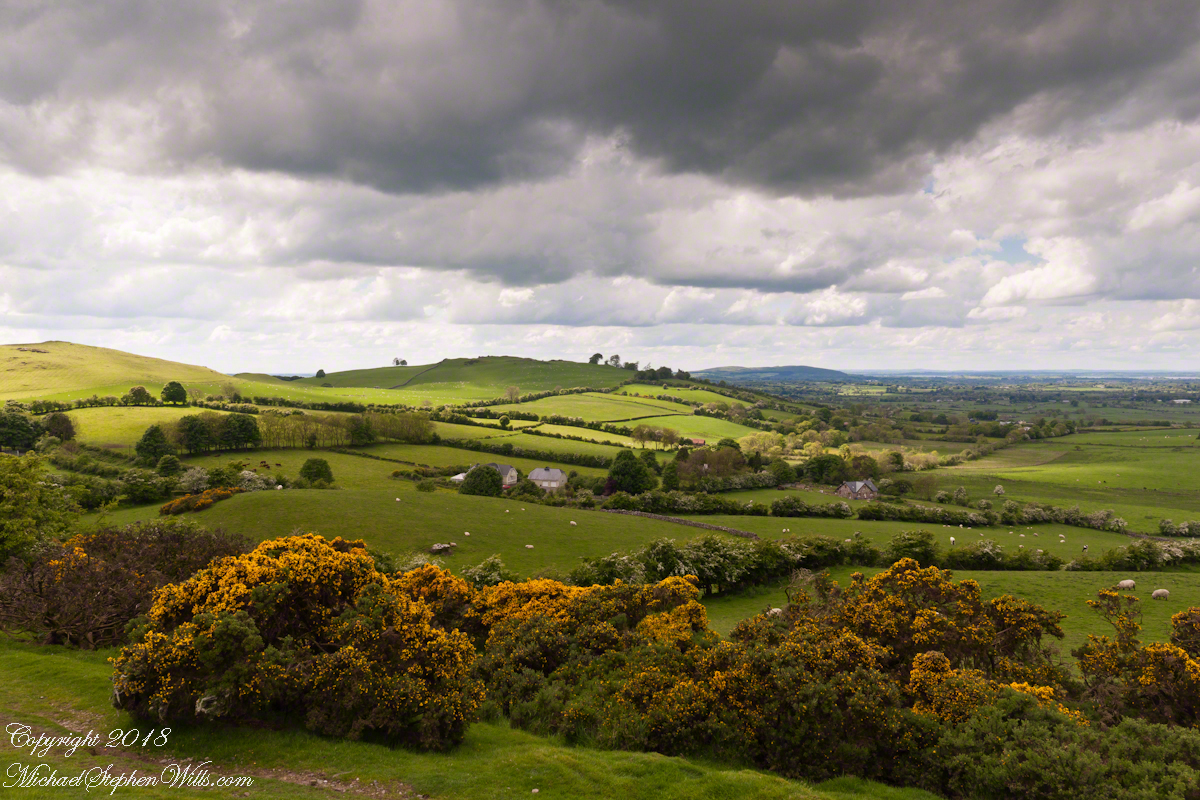
View northwest from Hill of Tara looking across County Meath with views of Counties Westmeath and Cavan. On the horizon, right, is Hag’s Mountain, (Irish: Sliabh na Caillí) , site of the Loughcrew Cairns. The standing stone is the “Stone of Destiny: (Irish: Lia Fáil), which served in coronation the coronation of the High Kings of Ireland. It stands on the Inauguration Mound (Irish: an Forrad) of Tara. This photograph was taken the morning of May 27, 2014 hours before the stone was vandalized, doused with green and red paint.

My mistake was understandable, in botany the hawthorn is in the same family as the rose.  The flowers are similar, having five petals.  The “haw” in hawthorn is from the Old English word for hedge, as is this linear standoff the tree lining the way up to the Loughcrew Cairns.

Path on Hag's Mountain, Loughcrew
Reaching highest point of County Meath, Ireland means a steep path, not too long, to glorious views on all points plus Lough Craobh (Lake of the Branches).

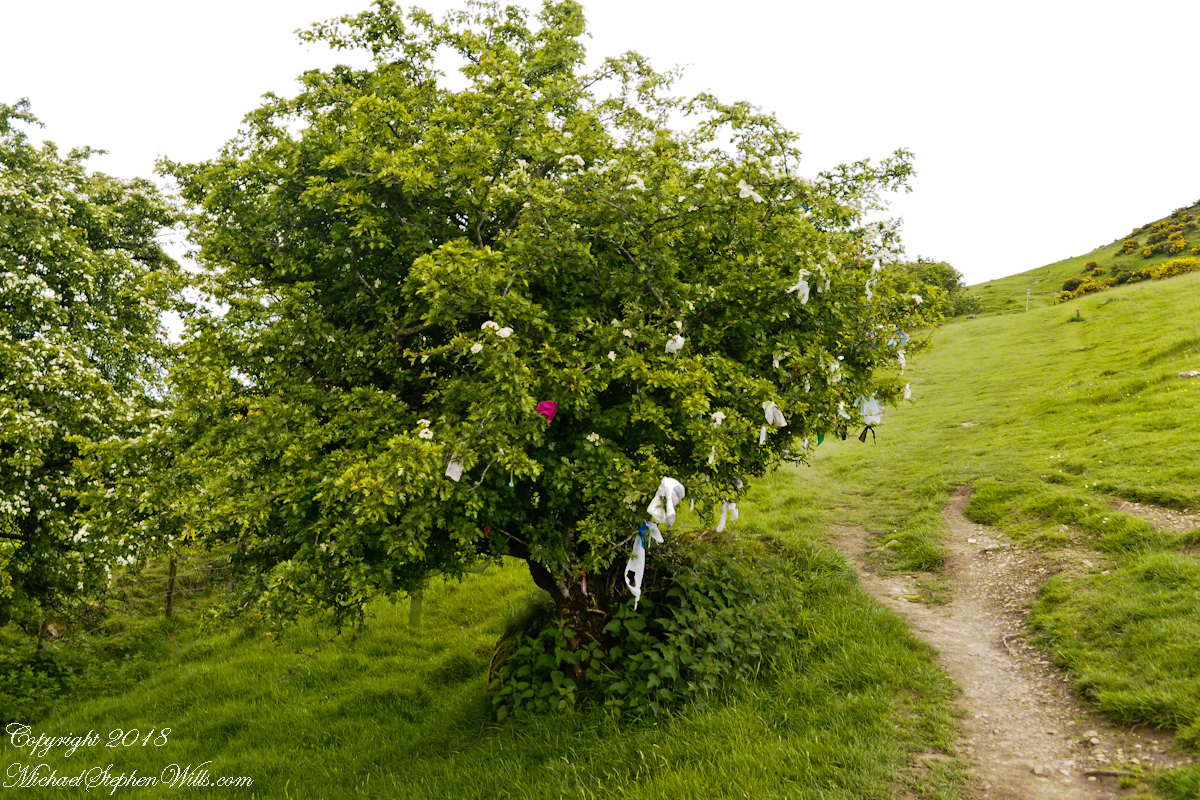
I read these votive offerings are made at Beltane, in which case these are fresh from placement May 1.

Hawthorn Tree with Offerings
A hawthorn tree in bloom on May 27, 2016. Growing on the slope of Hag’s Mountain

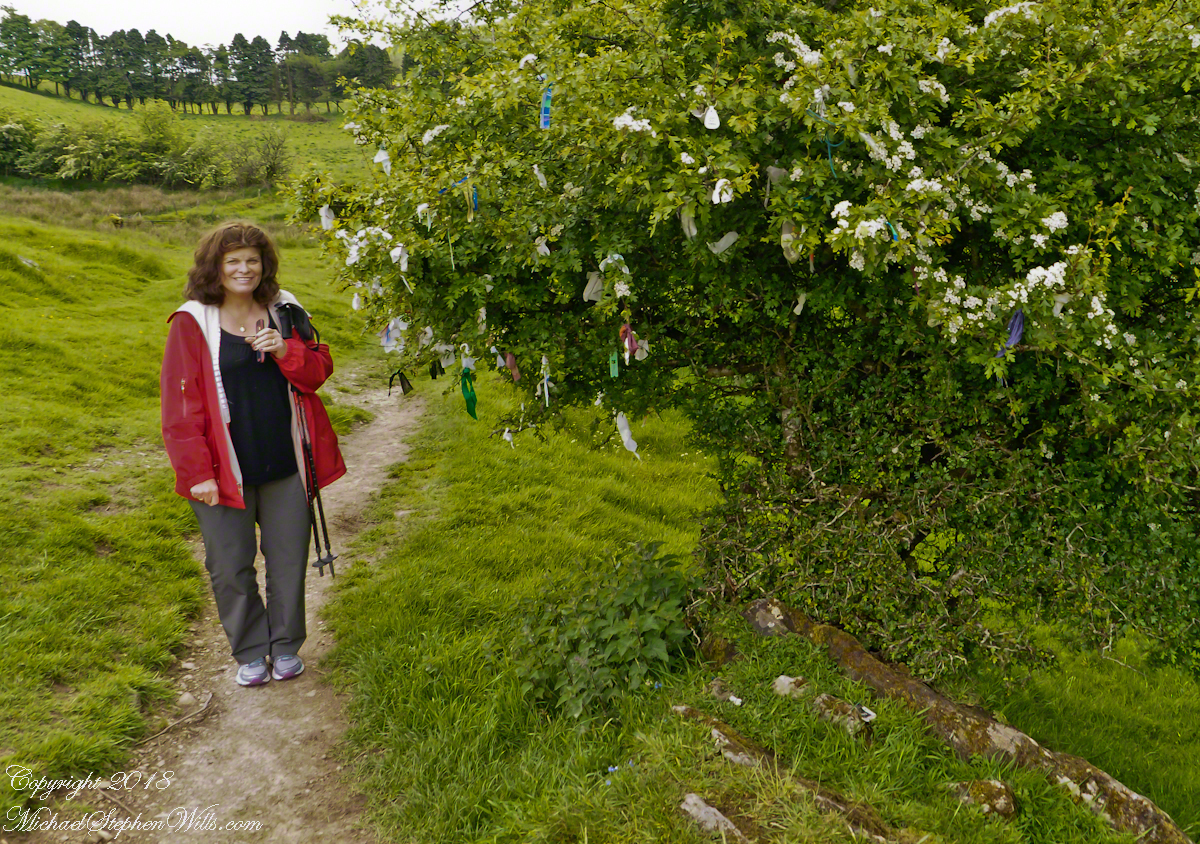
The following year Pam underwent double total knee replacements, never the less, she was great company for all our adventures on the island.  Even this steep climb.

Pam and the Offering Hawthorn
The steep path to Loughcrew passes a hawthorn covered with flowers and May offerings.

These views were our reward for reaching the top.

Loughcrew View, North by Northwest
View from Loughcrew Cairns, “Hags Mountain”

The Emerald Isle, we fully understood this name.

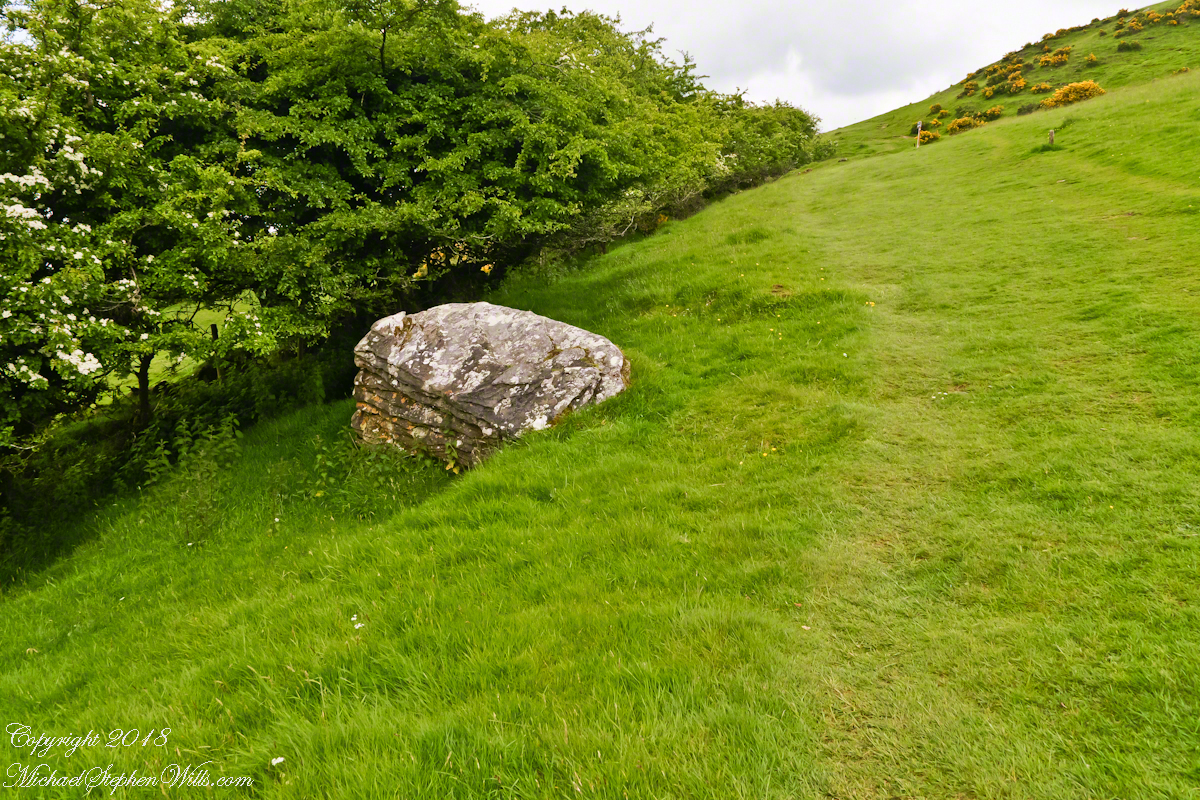
Standing Stone, Loughcrew
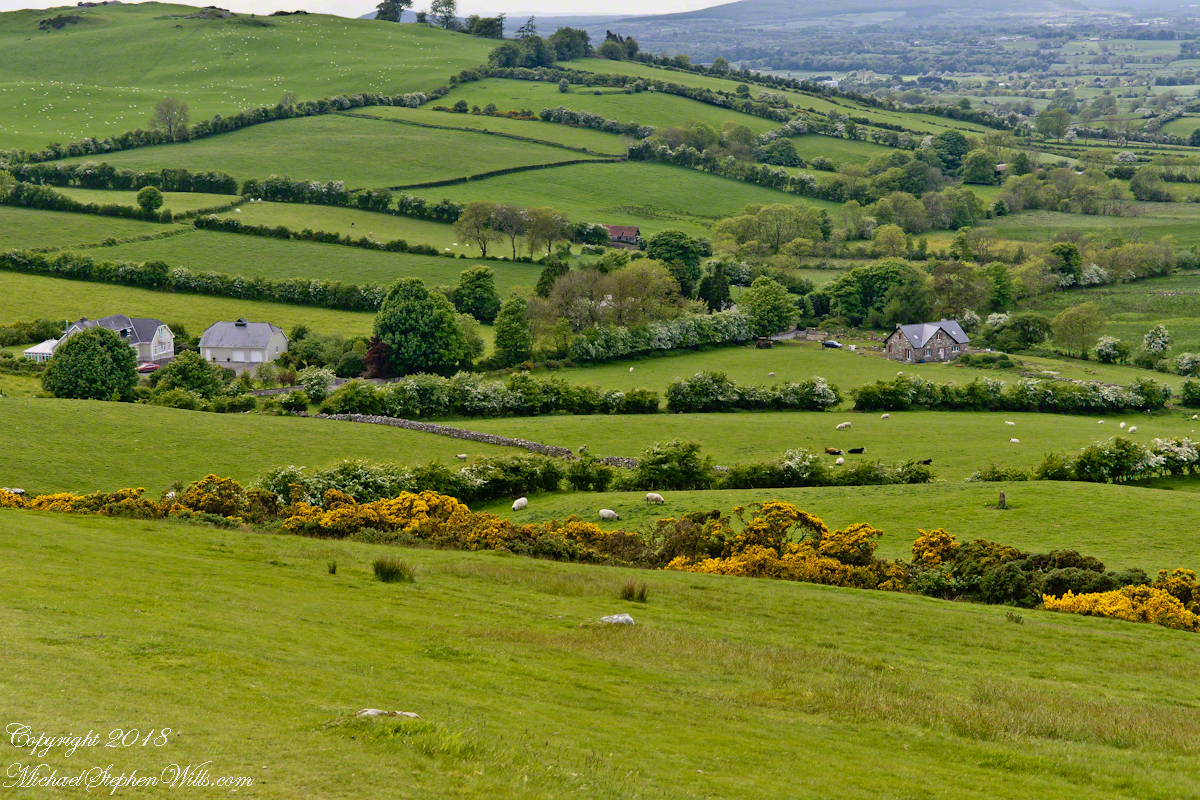
Loughcrew Megalithic Site, County Meath, Ireland. A solitary standing stone below the trail to the Loughcrew site surrounded by whin bush (gorse) and hawthorn hedge rows. A fieldstone fence, farmhouses, a patchwork quilt of fields completes the view.

The Greek name for the Hawthorn species is formed from two words meaning “strength” and “sharp”, referring to the thorny branches.

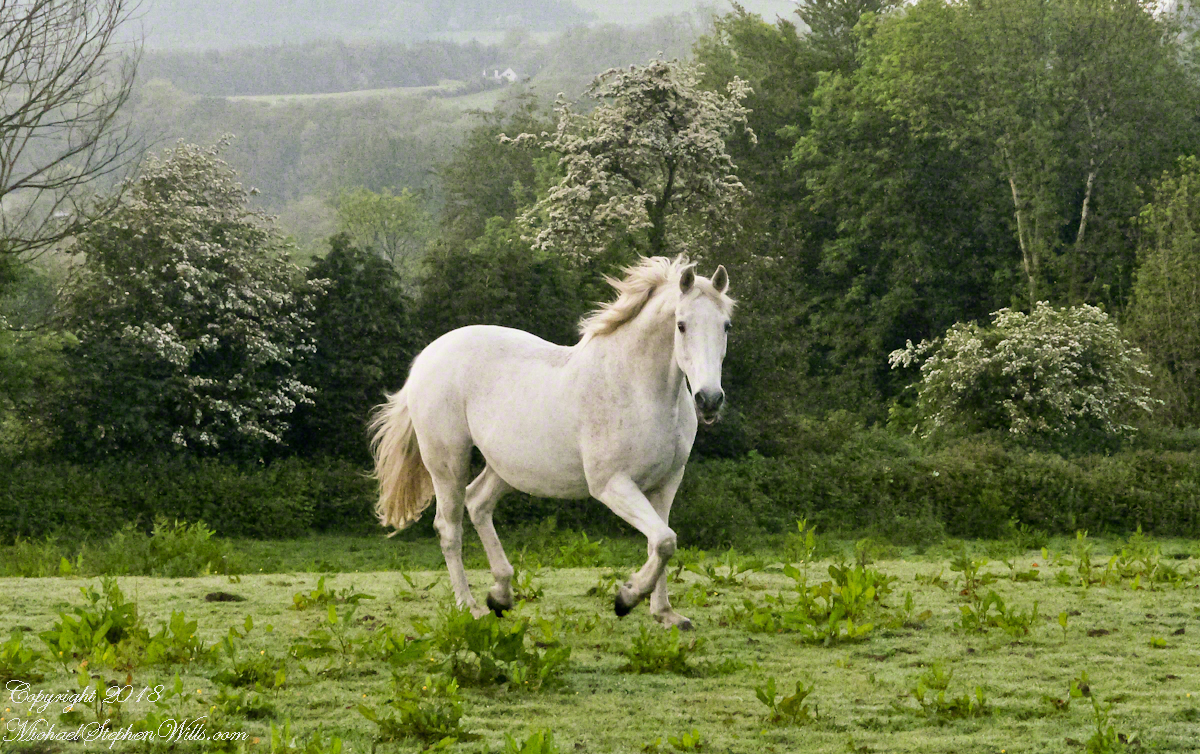
Charlemagne of County Cork
For County Cork we stayed with Marantha House B&B.   Our day of arrival, that evening, I visited Charlemagne and fed him an apple, saved from dinner. We learned from our hosts, Olwen and Douglas Venn, he is a retired show horse they rescued. The following morning I visited Charlemagne again with an apple and my camera. As I walked up, starting from the far end of his field, Charlemagne rewarded me with a series of astounding poses, trotting toward me in fine form. The morning mists, hawthorn in bloom, distant hills came together for this memory.

We marveled at the hawthorn hedges in field after field.  I first notice them from the World Heritage Site, Newgrange (Brú na Bóinne, “Palace of the Boyne”).  Here is one on the Dingle Peninsula, on the other side of the island.

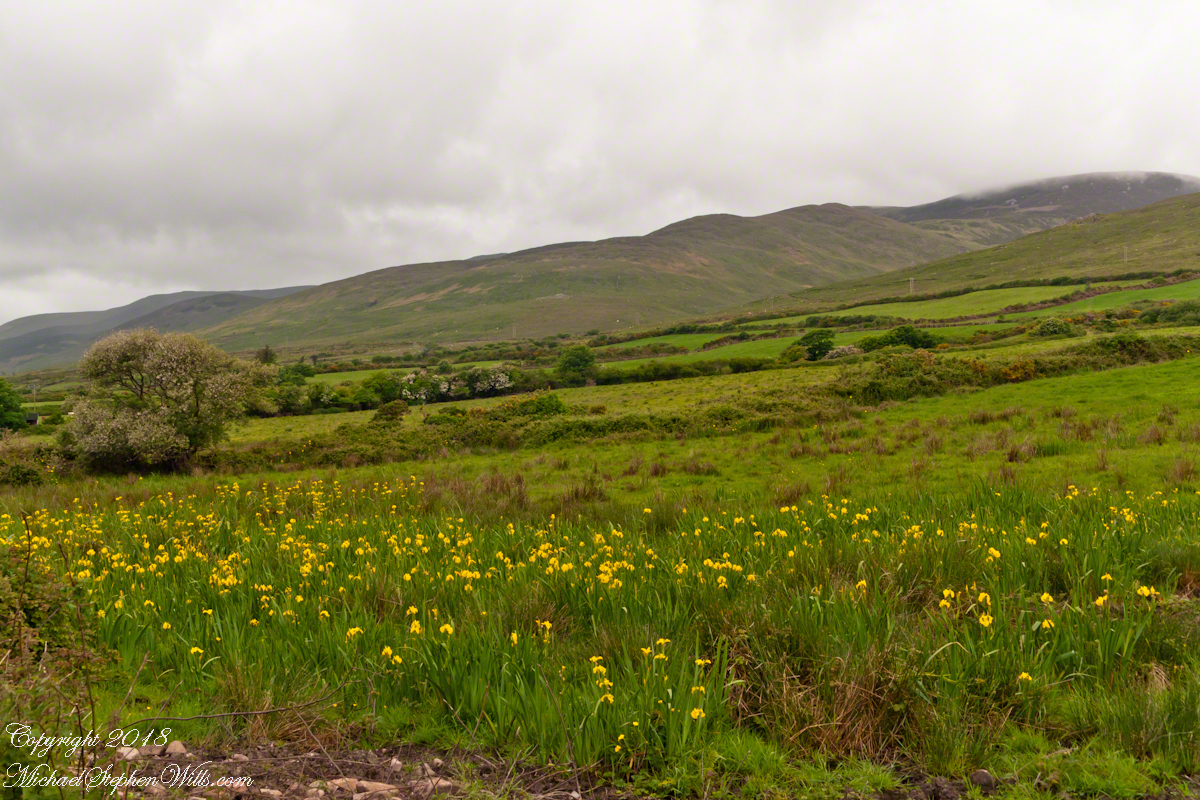
Field of Yellow Iris Flowers, Dingle Peninsula
A roadside field of yellow Iris flowers with flowering Hawthorn and Whin Bush in the windbreaks. Looking northwest toward Killeenagh and Caherpierce on the R561 between Lack West and Inch. Dingle Peninsula, County Kerry, Ireland.

Another Ireland post of interest, “Proleek, Grandfather McCardle’s home.”

Rosy Fingers of Dawn

Iliad and Odyssey reference for Monday

A portent of new beginnings in an ongoing journey for the last day of February, 2022

Above Muirthemne Plain

Romance of Ruins

This series of posts started with “Proleek, Grandfather McCardle’s home” where we explored the site of great grandfather James McCardle’s Proleek farm.  A kilometer from there, at Proleek Dolmen, the ancient portal stones line up to face the plain rising to Slieve Gullion, a name for the mountain taken from the Irish,  Sliabh gCuillinn, meaning “mountain of the steep slope” or Sliabh Cuilinn, “Culann’s mountain.”

There is an connection between Proleek and Slieve Gullion.  Cycles of Irish Myth place a boy named Sétanta living on Muirthemne Plain, of which what we call Proleek Townland was a part.  One day, the king Conchobar was passing his kingdom, Muirthemne, on the way to a feast on the slopes of Slieve Gullion hosted by the blacksmith Culann when he stopped to watch boys playing hurling, Sétanta among them (it is ironic the Proleek Dolmen is surrounded by a golf course in modern times).

Impressed by the Sétanta’s skill, the king invites him to the feast.  Having a game to finish Sétanta promises to follow.  As evening falls the boy approaches the smith’s house to find himself attacked by a huge, aggressive dog.  Acting in the moment, Sétanta dispatches the dog with the hurley and ball he had at hand, driving the ball down the hound’s throat.  (In another version he smashes the hound against a standing stone.)

Feeling Culann mourn the loss of his beloved animal, Sétanta promises to raise and train a guard dog equal to the one he slew.  Until that time he also pledged to guard Culann’s home.  From that time Sétanta was known as “the hound of Cullann”, Cú Chulainn in Irish.

References
Wikipedia articles “Slieve Gullion” “Cú Chulainn” and “Conaille Muirtheimne.”

Venus at dawn

Planet Thoughts

Since 1500 B.C. until today…..

The planet we call Venus has ancient associations with fertility goddesses. The link has persisted at least from the 1600 century B.C. inscribed on Sumerian cuneiform tablets. Three thousand years later the Italian artist Botticelli created in tempura paint on canvas the image of Venus rising from the sea, as the planet Venus does today.

Venus Rising

Here is Venus rising from the sea at dawn January 2022, at its brightest and most beautiful. Some mistake this new light in the east for airplane lights; the bright disk of Venus is 25 times brighter than Sirius, enough to cast shadows at night. As Venus proceeds in its orbit, the planet alternately sets after the sun and rises before it, seemingly appearing new each time.

This February I caught a newly risen Venus in this IPhone 7 video, reflected in the waves. It seemed to be a flashing headlight on the beach, the Venus reflection came and went with the passing waves. Venus is the upper, the reflection is beneath. Use the lower right control for the full view.

Looking from his window June 1889, Vincent VanGogh included Venus in his “Starry Night” painting, seen to the right of the Cypress tree.

Here is a closer view of Venus last January, the planet disk is apparent, unlike even the closest stars, Venus is seen as a whole object. Click on image for a full view.

Venus and Mars

Venus and Mars shared 2022’s pre-dawn winter sky. Click on the first image for a full-size view. Mars is seen above the palm tree stump, on the right. In this photograph, from early February, Venus and Mar apparently moved closer. The closeness is an illusion, the planets are millions of miles apart, on either side of Earth’s orbit. Click on the photograph for a full-size view, Mars can just be made out to the right and above Venus.

This crop clearly shows the brightness of Venus compared to Mars.

Growth and Beauty

a exploration of logarithmic spirals and symmetry

Growth

An early thought of mine, as a child, was to wonder, “How large does a person grow?” If growth was perpetual, there was no end to how large I will become; yet, tested against observed reality, “Why was it the case this was unlikely?” Years later, when recalling this, I understood my intuition touched upon the logarithmic spiral and mollusk shell.

Three Scallops and One Tallin

Sea Oat stalk, photographed above, after it dries slowly in the sun and wind, curls into a logarithmic spiral. One two dimensional spiral may be compared to another by measuring the rate and direction of opening, the increase in distance between the part closer to the source and the outer swirl. The growth of all shells follow a logarithmic spiral in three dimensions where the progression from a staring plane, as well as the direction, up or down from the plane, is an element.

Sea shells give evidence to my question of “how large can one grow.” The size of each of the millions encountered on a beach is an example of a life ended. Each of record of the length and character of the organism. For example, a close inspection of the bottom shell of the above photograph, a tellin of the family Tellinidae, reveals the spiral is growing toward the surface of the sand. Imagine wrapping your hand around the outer edge of the tellin with your thumb pointed down.

Each of the four shells of the above photograph had a mate, were one of a pair. Types of shells share characteristic pair symmetries. For example, a pair of tellins display a type of asymmetry called chirality, also called “handed-ness” after the same property of your right and left hands. One shell half (from the same individual) is the mirror image of the other, each unbalanced as the growth spirals toward opposite directions.

Asymmetry, halves from different individuals

When I started beachcombing, examining collected shells I did not have a pair from the same individual and incorrectly concluded direction of growth was unique to an individual. The ribbing of the above two shells illustrate three concepts: the logarithmic spiral growth pattern, chirality, as well as how I came to that wrong conclusion: that two individuals can grow in different directions. It was a logical hop to understand how, to make two shells hinged at the source of the growth spiral, each individual requires two halves, each a mirror image of the other. That every member of the species demonstrated the same asymmetry, each half grows in the opposite direction.

Asymmetry, attached matching halves

The above photograph shows attached matching halves. The attachment point was a surprise: the apparent source point is not attached to the ligament joining the halves? I have yet to understand this. Do you?

Beauty

The association of beauty with scallop shells bridges thousands of years. For example, a fresco of the Roman goddess Venus, born from the ocean riding a shell, was unearthed from Pompeii. The living organism is not part of the story, just the shell. Why the scallop? My answer is, “Each half is completely, in itself, symmetrical.”

The top three shells of the first photograph are scallops. The first and last, broken by the waves, are missing parts. The middle scallop, small and off-white, is complete. Place an imaginary line down the center and each side is identical. Applying the real world (i.e., physics) to myth, a scallop shell allows the goddess to move forward in a straight line. Sailing an asymmetrical shell, she moves in an eternal circle.

An object with symmetry is visually complete unto itself, self-contained; functionality aside, one scallop does not required a partner. The paired shells are interesting in they do not match, one is deeper, it encloses more volume. The deeper side rests under the surface, allowing the top halve to present a lower profile the better to hide from predators.

Calico Scallop Shell

The scallop echoes the beauty of Venus. Symmetry enhances human features (earch “Venus (mythology)” for images of her face through the ages), though it does not define beauty. An overly symmetrical face seems strange. I will close with an extreme example, the other day I came upon this beach crab wandering around in the daylight. Symmetry does NOT enhance the alien eyestalks, menacing claws, a pallid, tough exterior. Safe travels, little one.

Island Romance

Happy Valentine’s Day with the original Moby Dick

Thinking about the Aran Islands for my posts, “Killeany Bouy” and “Inisheer Welcomes the 2014 Gaeltacht Irish Football champions” brought me back to Isla Mocha.

Herman Melville’s thoughts were in and around this island off the central Chilean coast when he penned “Moby Dick” in the mid-nineteenth century while sitting in the city of Boston.  He was brought Moby Dick not only by his own experiences on a whaling ship, almost certainly Melville owned a copy of Jeremiah N. Reynolds’ “Mocha Dick: Or The White Whale of the Pacific: A Leaf from a Manuscript Journal,” an true-life account of adventures around Isla Mocha.  Sometime around 1810 Reynolds personally experienced encounters with Mocha Dick after the crew of an Antarctic expedition mutinied, stranding him at Valparaíso, Chile where he remained for two years.

Located  38°21’45.62″S,  73°55’6.91″W, around 8 miles in size north to south, 3.5 miles east to west Isla Mocha is surprisingly simple to find.  A ridge of mountains run the north south axis, just 20 miles off the coast, a ship following the coast will find it easily, as I did from the balcony of the Oceania Regatta during a “sea day” of travel between Valparaiso and Puerto Montt.

MochaIslandGoogleMpasNarrow

Since waking that day I was on the lookout for Isla Mocha.  In preparation for our month-long cruise around South America every mile of our itinerary was scoured for interesting sights, experiences and information.  When I first learned of Isla Mocha (Mocha Island in English) and the connection with Melville reading about it in Boston, just as I was in Ithaca, one of my goals for that day was to catch sight of Isla Mocha as it rose from the horizon.

My goal was made easier for the cloud formation from the island mountains.  Here is my first photograph, taken from our balcony on the port side.  I chose the port side just for the landward view as the ship progressed southward on the western coast of South America.  The Canon EOS-1Ds Mark III was tripod mounted with an EF 70-300 f4-5.6L variable lens set to 70 mm.  We are northwest of the island with the coast just visible.

Isla Mocha First Sighting

Another view with 188 mm focal length.  The ship must have turned eastward, as the view progressed the island came closer.  It was a fantastic thought to cruise above the subduction zone where the Nazca plate dives beneath the South American Plate.  In the distance, on a clear day, the volcanic cones Villarrea and Quertrupillan are visible.

RomanceOfIslandsMochaIsland2016-2

With the island due east, only a few miles away, the lens at 221 mm focal length.  A fisherman is having an easier day in a calm sea.  The indigenous people told stories of the souls of the dead travelling west to Isla Mocha.  Pirates used the island as a resupply base.  The fishing boat was the only sign of life.

RomanceOfIslandsMochaIsland2016-3

That was February 14th Valentine’s Day.  With Isla Mocha passing into the distance I changed for an evening with Pam.  Here we are headed to dinner, somewhere off the coast of Chile’s Lakes (and volcano) region.

Valentines Day 2016

Gettysburg Battlefield on Lincoln’s Birthday 2018

Our practice while taking a long trip in the car is to travel during the day, when possible, and to stop for a rest and some exercise every two hours. We were returning to Ithaca from a long trip down south when, at about the time for a rest stop we crossed the Mason-Dixon line to approach the city of Gettysburg, Pennsylvania on US Route 15.

The signed for the Gettysburg Battlefield pulled us in and we spent three hours looking around, longer than we planned for a rest stop.

The staff at the visitor center were very helpful with our off the cuff visit plan. With the auto tour in hand we made our way to the “High Water” of the 1863 Battle of Gettysburg, the Union battle line that marked the end of Lee’s second invasion of the north and the turning of the Civil War.

Pennsylvania Memorial Fact Display
The Pennsylvania Memorial near the Highwater Mark of the 1863 Battle of Gettysburg.

The expanse of the Gettysburg National Military Park warrants a stay of three days, at least.

These photographs from my cell phone, augmented with titles and description, will give you a taste of what this national historic site has to offer.

Fact board Soldiers' National Cemetery
Gettysburg National Military Park includes the graves of more than 6,000 United States Servicemen, including 3,580 Union soldiers killed in the Civil War.

Notably, the day of our visit, February 12, is Lincoln’s Birthday. February was a quiet time to visit and we were blessed with a sunny, mild day. In the warm weather the place is packed with visitors.

I have a feeling for the place because my 10th birthday in 1963 coincided with the hundredth anniversary of the Civil War. Also because a figure in the aftermath of the battle, David Wills, shares my surname. A lawyer who lived and practiced in Gettysburg, David Wills organized the burials and it was at his home that President stayed before the dedication of the cemetery and where the final touches of the Gettysburg Address were written. His home, a museum, is closed in the quiet season.

Most Americans alive today would not exist if this battle turned out differently.

One of the chilling realizations from the day is almost half the Union graves are for unknown soldiers.

Graves of Unknown Soldiers
Nearly half of the Union graves are unknown soldiers.

Old North Church Boston

light of freedom

A luminous white pulpit rising from an elegant beam, as of light, graces Old North Church altar. In 1775, the Tory church minister preached from this pulpit in support of the English King. The floor space is filled not with pews; but boxes, each was the property of the occupants to furnish and decorate to taste. Today, each box has a brass plate naming the former owners.

As with sports stadium box seats today, these boxes provided the owners access to church services. Just before the pulpit is he box awarded to wealthy merchants for essential contributions to Christ Church, the formal name of the church and congregation. Today, there is a more direct sports connection: lanterns were lit in the tower for the Boston Red Socks 2004 World Series win.

Old North Church Pulpit, Boston
Pulpit of Old North Church, Boston

A bit after 10 pm on April 17, 1775 two men entered the church from the front door, pictured here under the arch. The church sexton Robert John Newman and Captain John Pulling carried two simple lanterns of glass and iron coated with tin. A third man, Thomas Bernard, stood watch because Boston was occupied by British “Regular” troops who patrolled the streets.

Organ above the entrance to Old North Church, Boston
Organ above the Entrance to Old North Church, Boston

The lanterns beamed from the northwest side for but a minute, enough to serve the purpose of a backup signal to patriots across the Charles River in case Paul Revere and a second rider, William Dawes, were apprehended or killed before they could deliver the British attack plans.

The British patrols were alert and, in no time, they were breaking down this same front door. Robert Newman made his escape from this window. The frame was bricked over and only discovered in the twentieth century. It was celebrated during the USA bicentennial by President Ford, who presented the replica lantern that now hangs with the candle lit.

Newman Window and Lantern
Newman Window and Freedom Lantern

If you look closely, this bust of George Washington is visible in the Old North Pulpit photograph in a niche to the right rear. It is the oldest image of our first president. The Marquis de Lafayette is reported to have said this is the best likeness of Washington he had ever seen.

George Washington
George Washington