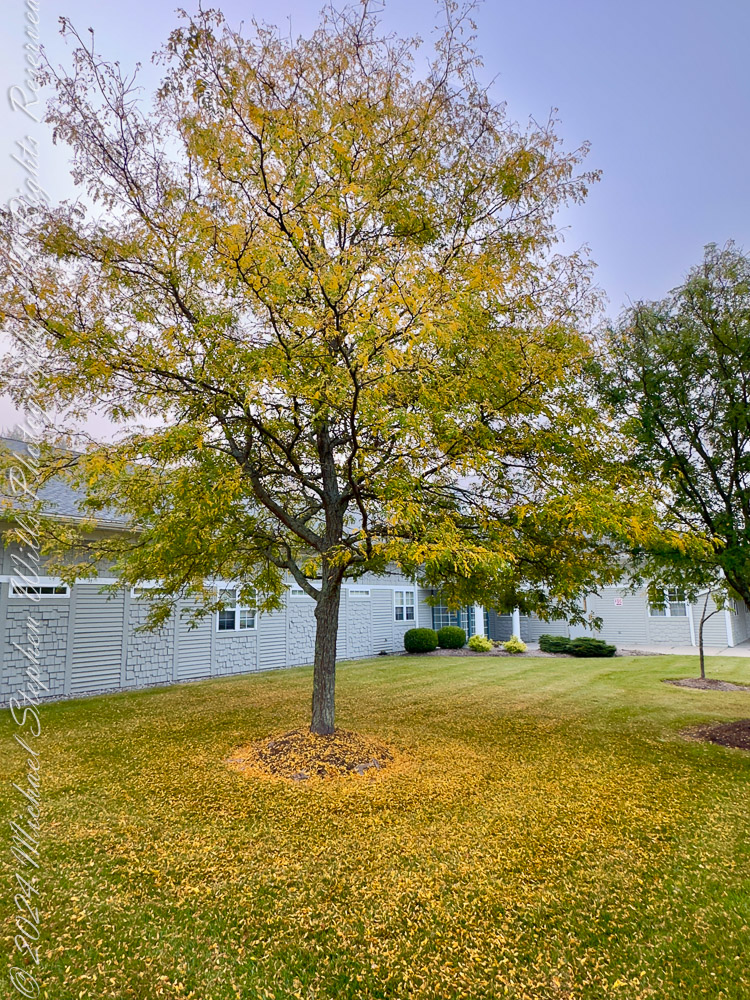
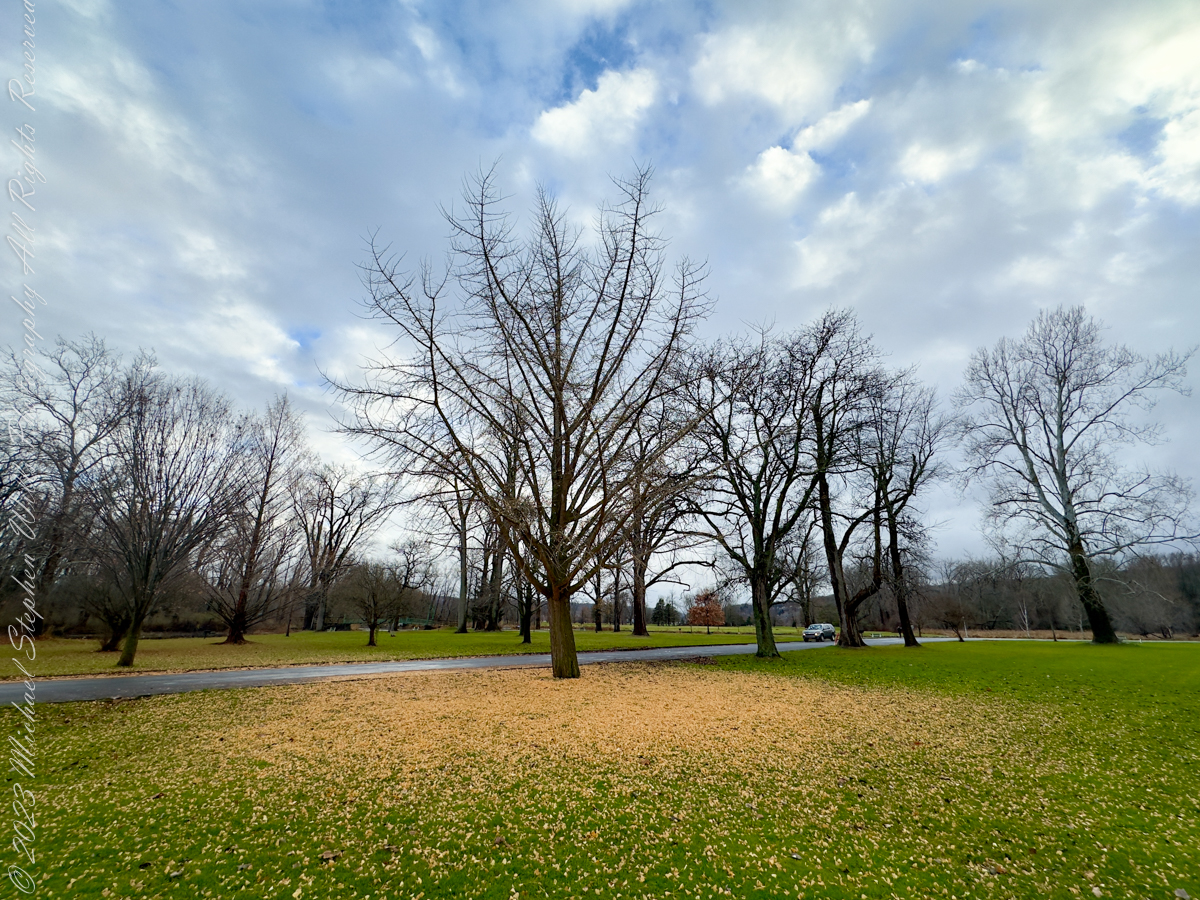
Standing before these two trees on a unseasonably warm autumn day, I am struck by the intricate patterns of their fallen leaves. Against the vibrant green of the grass, the golden leaves form halos around the trunks, as if nature herself were sketching mandalas. There’s something profoundly mathematical about these arrangements—a quiet order amidst what might initially seem like chaos.
The first tree, its barren branches reaching skyward, stands on a carpet of yellow that radiates outward in near-perfect symmetry. The leaves have fallen in such a way that their density decreases as the distance from the trunk increases. It reminds me of the inverse square law—a principle in physics that governs how light, gravity, and sound diminish with distance. Here, instead of energy dispersing, it’s the leaves thinning out, their graceful scatter dictated by the wind’s whims and gravity’s pull. There’s an undeniable harmony in this seemingly random process, a convergence of natural forces creating an elegant gradient.
Stewart Park, Ithaca, New York
The second tree presents a different story, yet one equally mesmerizing. Its leaves, still clinging in part to the branches, form a looser ring at the base. The distribution is uneven, hinting at prevailing winds or the sheltering influence of nearby buildings. But even in this asymmetry, I see fractals—the self-similar patterns that repeat at different scales throughout nature. Look closely, and you’ll notice clusters of leaves mimicking the broader structure of the canopy above. It’s as if the tree’s essence is echoed in the ground below, a reminder of how deeply interconnected every part of a system can be.
Robinia pseudoacacia, commonly known as the black locust
These patterns invite reflection on the mathematical principles governing our world. Fibonacci sequences, golden ratios, and fractals—abstract concepts are not confined to textbooks. They are etched into the fabric of existence, visible in the spiral of a sunflower’s seeds, the curve of a nautilus shell, and the fall of leaves beneath a tree. Even the chaos of autumn is underpinned by order, a dance choreographed by countless variables: the angle of the branches, the strength of the wind, the moisture in the air.
I find myself wondering about the unseen forces at play. How many leaves fell straight down, obeying only gravity? How many were carried aloft by a breeze before settling farther afield? Could we model these patterns with algorithms, tracing the arc of each leaf’s descent? Would the data reveal a perfect equation, or would it remind us that some mysteries resist full comprehension?
As I stand here, I feel a deep gratitude for these natural equations. They ground me in the present moment while also connecting me to the infinite. The pattern of leaf fall is a reminder of life’s balance: chaos and order, randomness and structure, fleeting moments and timeless principles. The trees, now shedding their golden crowns, invite me to pause, observe, and marvel at the beautiful mathematics of autumn.
Enter your email to receive notification of future postings. I will not sell or share your email address.
Copyright 2025 All Rights Reserved Michael Stephen Wills
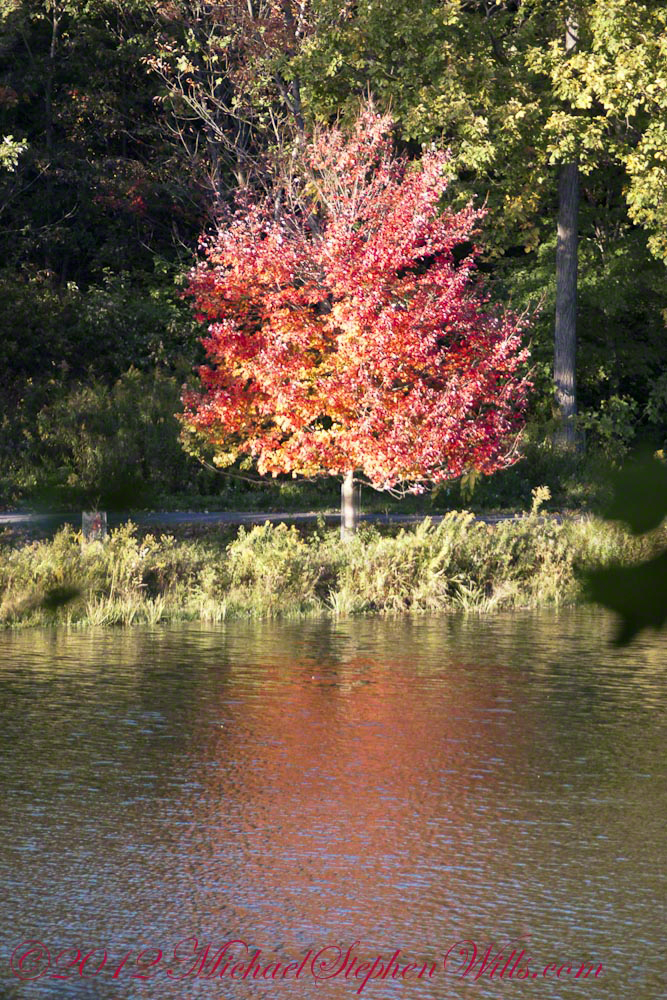
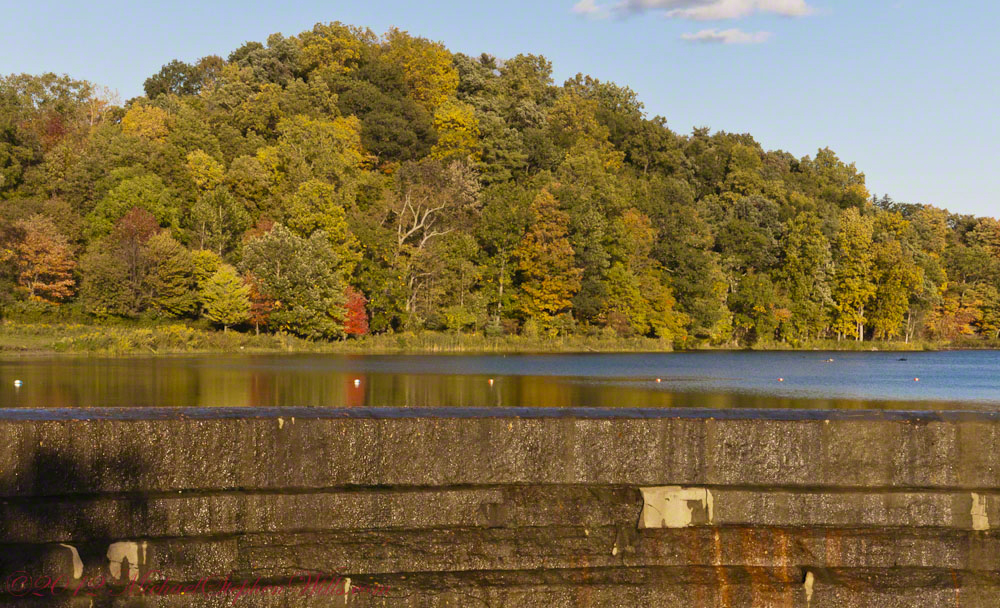
On a serene autumn afternoon by Beebe Lake, a solitary red maple stood out against the backdrop, showcasing its vibrant colors and resilience, symbolizing autumn’s fleeting beauty.
It was one of those serene autumn afternoons that linger in memory, the kind where the sky seems impossibly clear, the air crisp and gently scented with fallen leaves. I stood at the edge of Beebe Lake, my gaze first drawn to the textured concrete dam holding back the water, its weathered facade contrasting sharply with the soft reflections shimmering across the lake’s calm surface. Beyond, the wooded hillside rose gently, a tapestry woven with the warm hues of autumn—golds, greens, oranges, and reds mingling like brush strokes on a canvas.
An October Glory, turning before all others
Yet amidst this collective beauty, one tree captured my attention, singular in its brilliance—a solitary red maple standing proudly on the lakeshore. Its leaves had turned a vivid crimson, blazing brightly as though defying the muted earth tones surrounding it. Even from a distance, framed and partially obscured by larger trees, its vibrant reflection cast a fiery echo on the water, rippling softly in the afternoon breeze.
The maple, Acer Rubrum, seemed perfectly at home here, thriving robustly at the water’s edge. I remembered reading how adaptable red maples are, able to flourish in conditions ranging from dry uplands to swampy shores. This spot, near the edge of the tranquil Beebe Lake, seemed to showcase its resilient character perfectly.
Up close, the maple’s glow was even more striking. Its leaves cascaded in fiery clusters, hues deepening from bright scarlet at the tips to a darker maroon closer to the branches. This dramatic gradient seemed symbolic of autumn itself—beautiful, fleeting, and subtly tinged with the melancholy reminder of winter’s approach.
The Red Maple (Acer Rubrum) to tolerant of diverse conditions, making it a perfect choice for this spot on the short of Beebe Lake.
A memory surfaced of early spring in the Finger Lakes region, a time when maples, including this red maple, generously share their sap. Though not traditionally tapped like its sweeter cousin, the sugar maple, this species’ sap can indeed be boiled down into syrup, a surprising sweetness hidden within its sturdy trunk. Standing in its shadow, imagining those early spring days, it seemed astonishing that the same tree could offer both the delicate sweetness of syrup and the fierce beauty now on display.
Curiously, the transformation of the tree appeared methodical yet whimsical—it changed colors from the top down, its upper branches already bare, exposing slender twigs pointing skyward. Like an artist carefully removing layers to reveal something deeper beneath, the maple unveiled its upper bare bones first, as though reminding observers of the quiet strength supporting its autumn splendor.
This Red Maple (Acer Rubrum) turns from the top down and has already bare for most top branches.
As I lingered, taking in this turning tree, joggers passed by along the path, their rhythmic footsteps a gentle percussion beneath the rustling leaves. Briefly, they glanced toward the vivid maple, perhaps drawn, like me, by its striking contrast to the surrounding foliage. It felt like we shared a secret admiration for this singular tree, recognizing in it a quiet assertion of individuality amidst conformity.
Eventually, I viewed the maple once more from afar, framed now by broader sweeps of branches and leaves, partially obscured but no less vivid. Through layers of leaves and dappled sunlight, it glowed like a distant flame, a beacon that seemed to encapsulate the entire mood of the season—warm yet cool, bright yet transient.
The Red Maple (Acer Rubrum) is the first to flower in spring and the first to turn in autumn.
Walking away, the image of that maple lingered, its reflection shimmering gently in the afternoon sun, a moment suspended between summer’s lush vitality and winter’s bare stillness. Beebe Lake had offered scenic beauty, a quiet meditation, a reflection mirrored not only on its tranquil surface but in the heart of an observer captivated by a single tree’s fleeting glory.
Enter your email to receive notification of future postings. I will not sell or share your email address.
Copyright 2025 All Rights Reserved Michael Stephen Wills
Colored lights of our skies are lifelong triggers for the imagination. On any moonless, crystal night—far from the town-glow—three thousand or so stars and the wandering planets scatter across the dark. We read them instinctively, stitching patterns the way our ancestors did, turning a brilliant chaos into stories. Along the ecliptic, twelve of those patterns became the constellations, a starry calendar by which careful observers told the seasons. When Cancer, the Crab rides high, winter has the northern hemisphere in its grip
Click photograph for my OnLine Galleries. Clicking the other photographs in this post will yield a larger image.
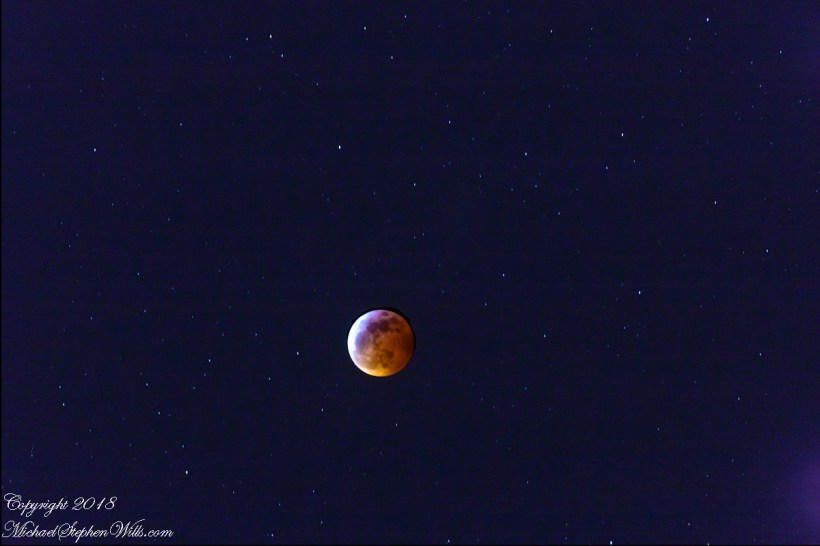
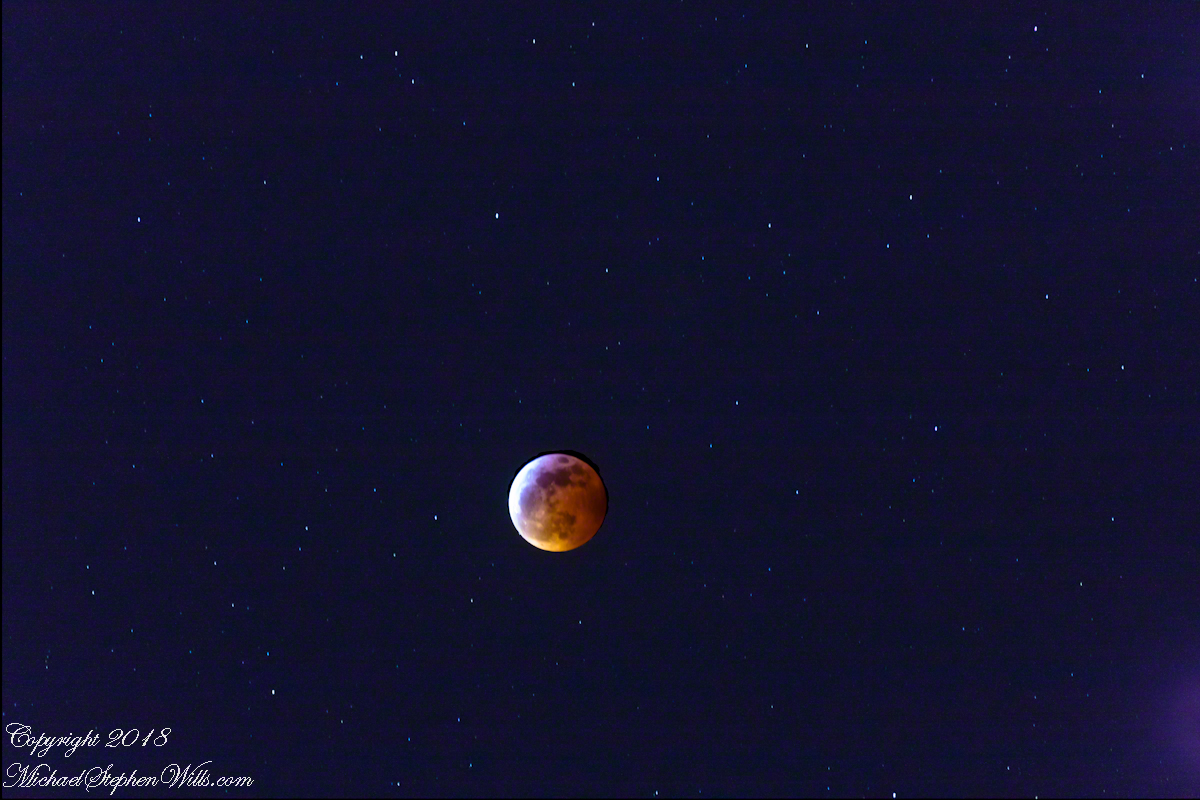
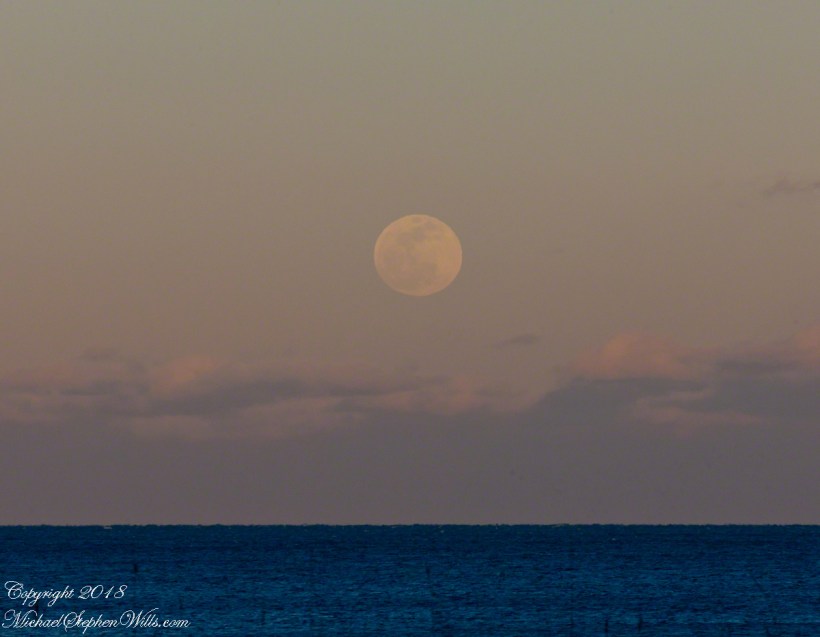
On the night of January 20–21, 2019, a full moon climbed from the horizon and slid into Earth’s shadow, transforming a familiar face into a copper coin. As it rose, that low-horizon “larger” moon—an illusion born of context—felt close enough to pocket. Hours later, the moon darkened to a dull copper color and appeared to float amid Cancer’s dim stars.
I set up a Canon DSLR on a tripod with a 24mm f/1.4 lens, pushed the ISO to 3200, and shortened the exposure to 1.3 seconds—a compromise between freezing star points and preserving the feel of the sky. The moon, of course, was overexposed in that wide frame; later, I overlaid a correctly exposed moon (from a telephoto shot later in the night) at its true apparent size to match the scene as the eye saw it. Is it the most “technical” astrophotograph of the eclipse? No. But it is faithful to the moment I witnessed and good enough to carry the story forward.
The Moon on the Crab’s back
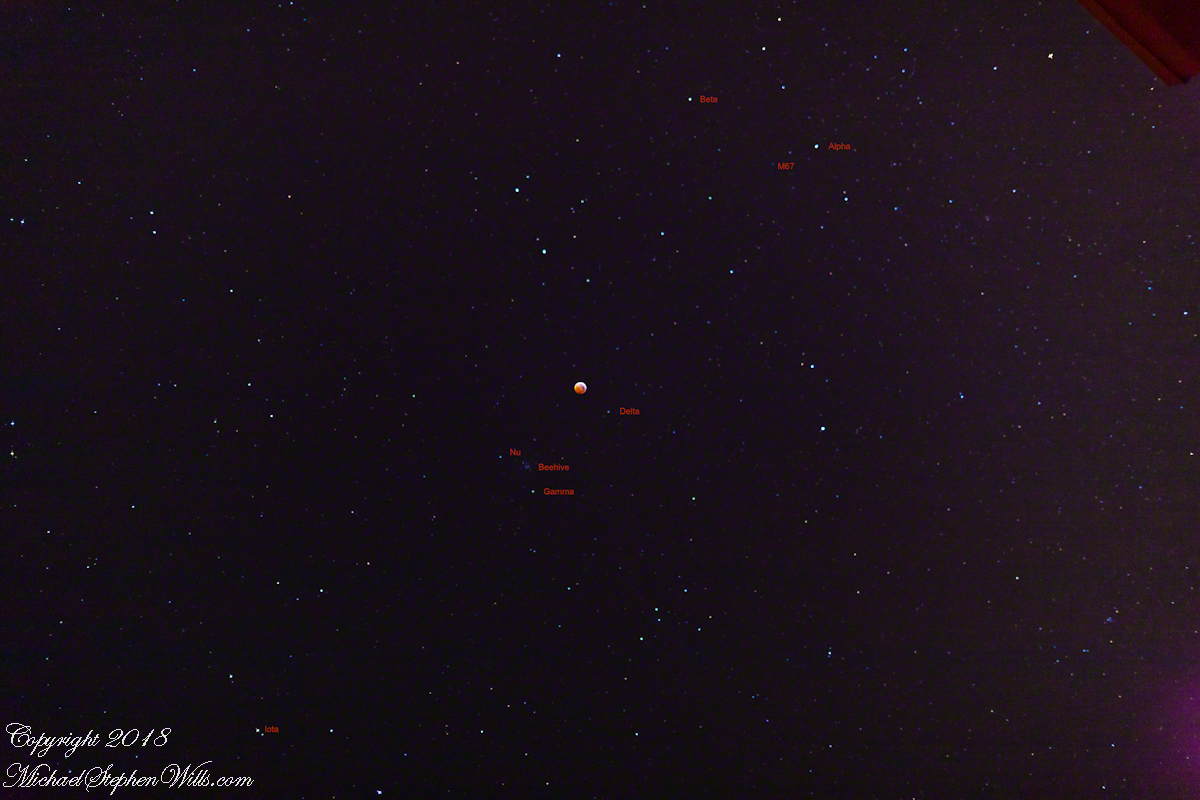
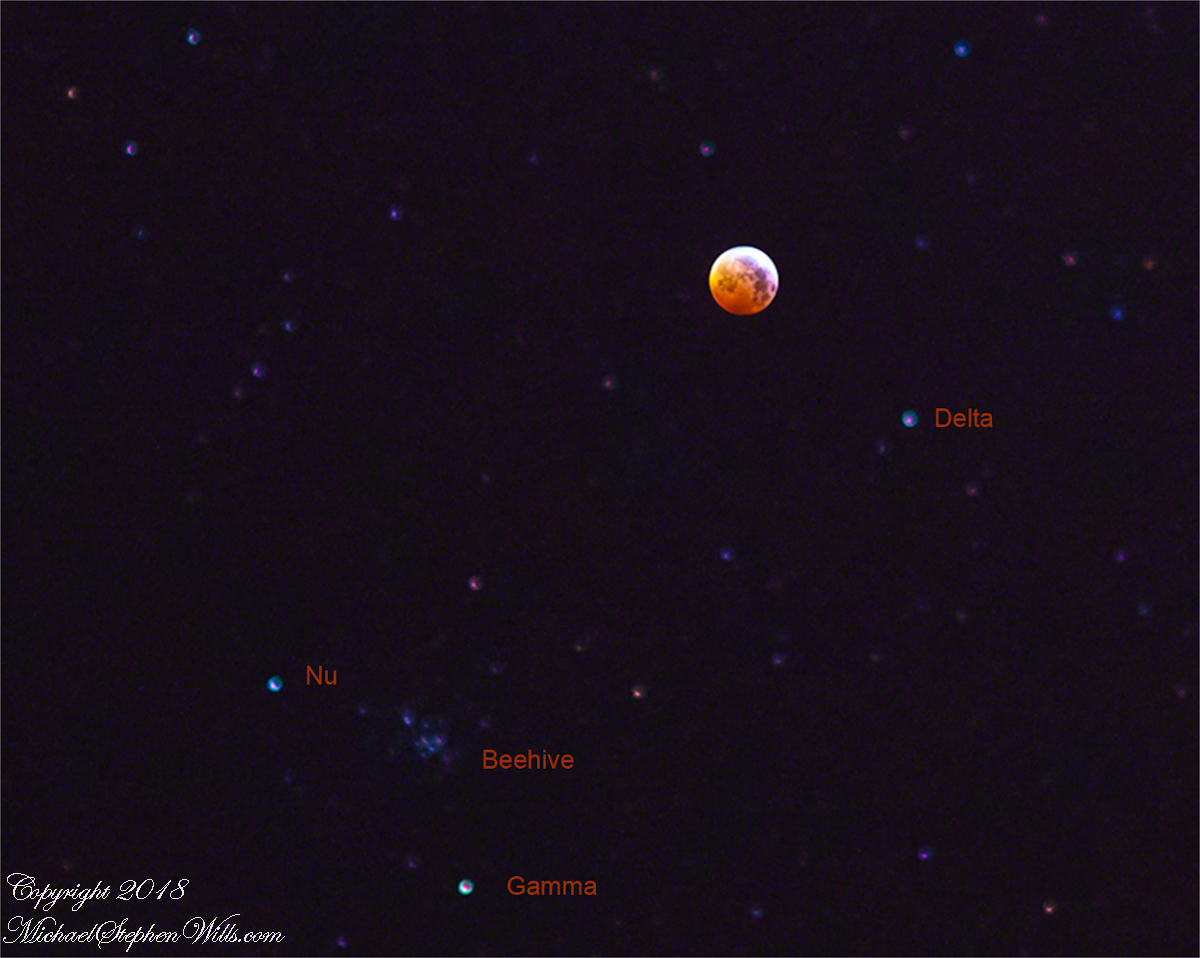
Cancer is never an easy connect-the-dots. Its stars are modest, more suggestion than signature. Look just to the side of the moon’s position that night and you come to Delta Cancri, the orange giant nicknamed the Southern Donkey. Draw a mental line down and slightly right to the faint pair Nu and Gamma Cancri—white stars that only masquerade as twins. They are not physically bound, merely near each other by line of sight: Nu about 390 light-years away, Gamma at 181. Scatter in Alpha and Beta off the Crab’s back and the outline becomes more plausible, the way a minimal sketch becomes a creature once the eye knows what to look for.
The Beehive
Between Nu and Gamma, edged closer to the moon, lies the real prize: the Beehive Cluster—also known as Praesepe or M44. Even with modest binoculars, Praesepe explodes into a field of delicate sparks, a thousand stars loosely wrapped into a hive. Galileo famously turned his early telescope on this cloud and teased forty separate points from the mist; modern optics reveal a populous neighborhood of stellar siblings in shades from ice-blue to ember-red. It is one of those sights that converts a casual sky-gazer into a repeat offender.
Total Lunar Eclipse and Surrounding Sky with labels for primary element of the Cancer constellation
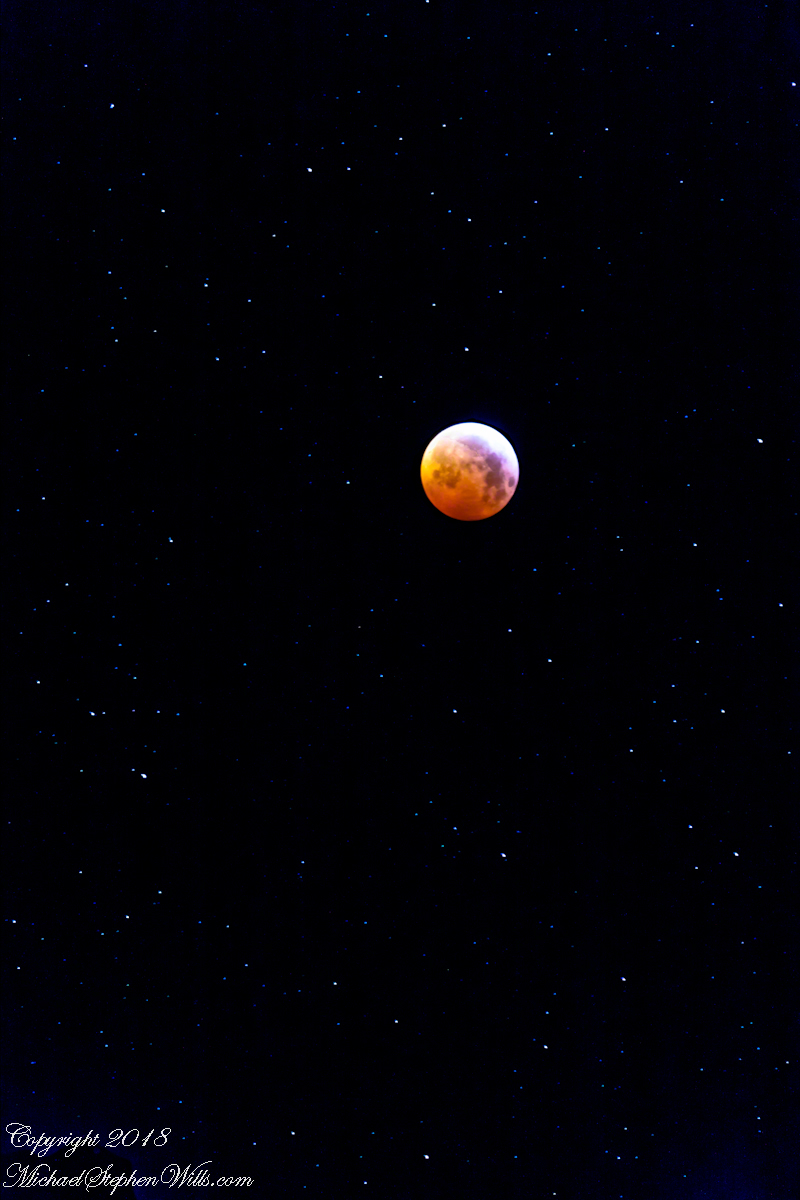
Later in the night I lifted the telephoto—70–300mm at 300mm, ISO 3200, 3.2 seconds—and let the moon fill more of the frame. At totality, the light thinned to a clay-jar red as Earth’s atmosphere bent sunlight around the planet and into its shadow. The effect is both simple and profound: every sunset on Earth happening at once, projected onto the moon’s face. Craters and maria softened into relief, and the globe stopped being a flat disk and became a round, ancient body again. Even without Delta, Gamma, Nu, and the Beehive in that tighter field, the sense of placement remained; I knew the Crab’s back was there in the dark, and that the moon had joined it—just for an hour—as a guest at the manger.
“Beehive” with Total Lunar Eclipse with labels for primary elements of Cancer Constellation
The Total Eclipse
What I love most about an eclipse is its pace. Nothing is impatient: the bite appears, the light drains, the color warms, and the world around you changes temperament. As the bright glare wanes, neighborhood sounds recalibrate—the hush between footfalls, the small click of a door, even the steadying breath you didn’t know you were holding. A total lunar eclipse is an astronomy lesson that behaves like a poem; it teaches by arranging time and light until awe and understanding meet.
And then, quietly, it returns what it borrowed. A thin wedge of white blooms at one edge, a rehearsal for dawn. Copper gives way to pearl, and the old moon looks new again, just higher and smaller against the deepening night. Cancer recedes into suggestion; Praesepe goes back to being a faint cloud to the unaided eye. The camera is packed away, the tripod shoulders its own shadow, and you keep the best exposure of the night where it can’t be corrupted: in memory.
If you have binoculars, mark Cancer on a winter chart and step outside when the sky is clear. Find Delta, sweep toward the dim pair of Nu and Gamma, and then rest your gaze on that hazy patch between them. Bring a friend into the circle and let the cluster resolve, star by star, into something alive with depth. It will not be the last time you look for it. And if you’re lucky enough, as we were that January, the moon will pass nearby, reminding you that even the most familiar companion can be made strange and beautiful by the turn of a shadow.
The sky is a storybook, yes—but also an instrument. Nights like this tune both.
Enter your email to receive notification of future postings. I will not sell or share your email address.
Copyright 2025 All Rights Reserved Michael Stephen Wills
On certain evenings we gather on our Cocoa Beach, Florida east-facing beach-side balcony simply to watch the day undo itself—sunset staining the western sky while, behind us, something quieter begins. On Sunday, January 20, 2019, the quiet had a name: a total lunar eclipse. I’d checked the online charts earlier—moonrise time, azimuth, the patient geometry of the heavens laid out in numbers—and set our chairs faced the anticipated spectacle.
The light went a little pewter, as it does when the sun slides offstage and the world inhales. Out on the water a cruise ship shouldered south, a floating city of windows that, under ordinary sunsets, catch fire pane by pane. I looked up too late for the blaze and felt that small pang one gets for the thing almost seen. Still, the ship kept gliding, a bright punctuation mark traveling our skyline.
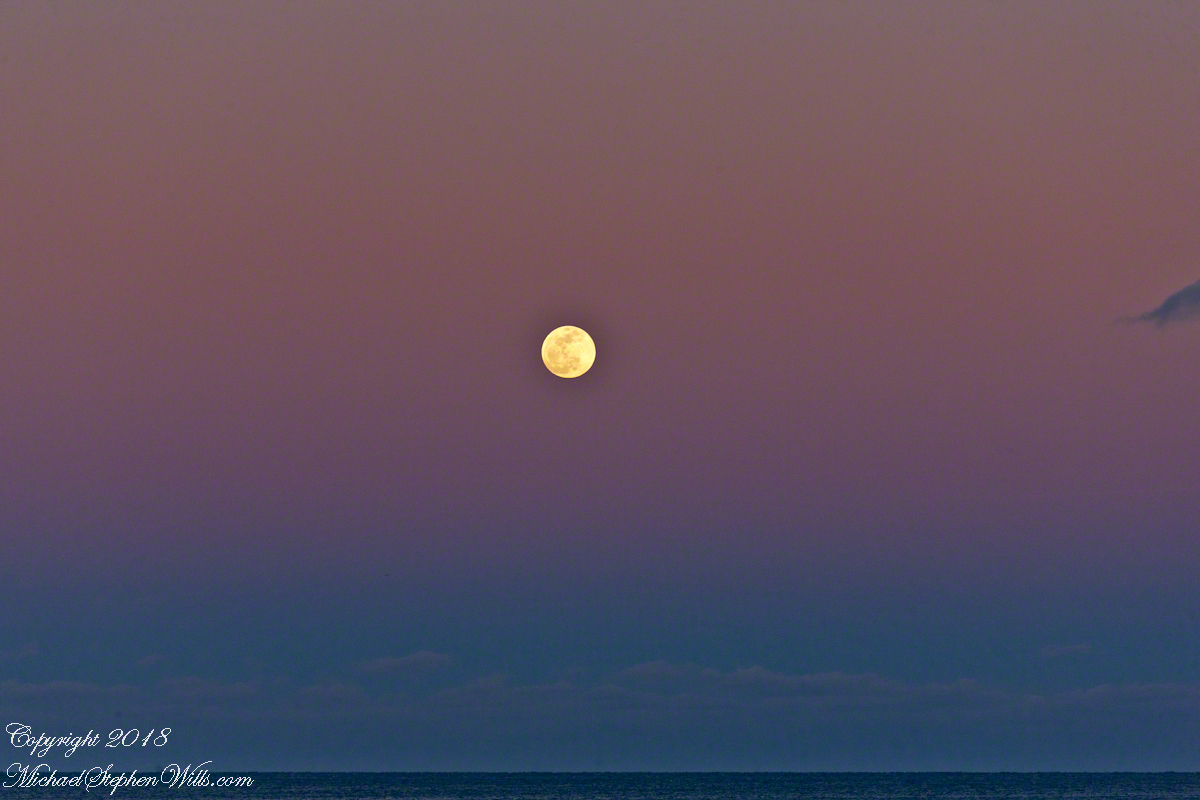
Then the moon appeared—first as a bruise-colored coin pressed against a bank of cloud, then as itself, pale and whole, rising as if pulled on a cord. Photographs can play a trick here: place a ship under a full moon and, with the right lens, the vessel swells to improbable grandeur while the moon looks like a modest ornament. Our eyes know better. The ship is huge but near; the moon is unimaginably larger, only far. Distance humbles everything.
It’s a fine parlor truth that every lunar eclipse requires a full moon. There’s a steadiness in that—that the earth, playing the rare importance of middle child, can only cast its shadow when the moon has come fully into its own. The reverse, of course, is not guaranteed. Most full moons rise and go about their business, silvering roofs and quieting dogs, without ever tasting the earth’s shadow. Tonight would be different.
The Riddle of Size
Before the darkness advanced, the old riddle of size made its entrance. Low on the horizon, the moon seemed suddenly intimate, big enough to pocket the ship and still have room for the lighthouse. We call it an illusion, but the word hardly captures the tenderness of it: how the mind, seeing that round face near our familiar trees and eaves, feels the moon to be part of our belongings. Angular diameter stays stubbornly constant; affection does not. The experiment is easy enough—choose a pebble that covers the low moon at arm’s length, then try again when the moon is high. The same pebble hides it perfectly. What changes is not the moon, but the story our senses tell.
Clouds raveled and the disk lifted, gathering brightness. As the earth’s umbra slid across that worn, luminous stone, the color shifted from pearl to rust, then to the old red of clay amphorae. People love the names—Super, Wolf, Blood—as if the moon had stepped onto a carnival midway. I prefer the quieter facts: sun, earth, moon aligned; light refracted through air; the planet itself briefly confessed in velvet shadow. It felt less like spectacle than like a family resemblance revealed by candlelight.
Eclipse
Much later, around us, the little neighborhood chorus noticed. A conversation stalled mid-sentence; the unspooled hush you hear at a concert just before the bow draws its first note came and settled on the patio. Even the ocean seemed to restrain itself, waves taking smaller breaths. The cruise ship had long since slid behind the curvature of our seeing.
We kept watching. A lunar eclipse is an exercise in patience: everything happens slowly enough to be felt, quickly enough to refuse boredom. Shadows are honest about their edges. When the moon wore its deepest copper, I thought of ancient nights and imaginations unlit by anything but fire, how dependable cycles must have seemed like messages and how—standing there, spine pricked by a familiar old awe—I could not entirely disagree. It was not fear, but kinship: the sense that we are included in the machinery, not merely spectators.
When the light returned, it did so from one margin, like dawn rehearsed on a smaller stage. The coin brightened by degrees, and the old face we know reappeared—craters and mares soft as thumbprints. The illusion of size faded as the moon climbed, and the experiment with the pebble proved itself yet again. Even so, I felt the tug of that earlier enchantment, the way a child misses a dream just after waking. The mind keeps two ledgers: one for what is measured, one for what is felt. Tonight both were full.
Eventually we retired. Chairs nested. Doors clicked. In the kitchen, glasses chimed in the sink. But the moon kept on, white and durable, its borrowed light restored. Somewhere out there the ship’s passengers drifted to their cabins, stories in their pockets about the night the world itself cast a shadow, and how the ocean looked briefly like copper under a patient star.
Later, when I wrote down the times and the few facts I could trust to memory, I realized the real record was not the measurements but the company: our leaning back, the shared breath, the soft astonishment that comes when something vast moves at a human pace. The eclipse ended; the evening did not. That, too, felt like a kind of alignment—ours with one another, our small chairs with a very large sky.
Enter your email to receive notification of future postings. I will not sell or share your email address.
Copyright 2025 All Rights Reserved Michael Stephen Wills
From milkweed egg to striped caterpillar, jade chrysalis, and fluttering monarch, witness metamorphosis, migration, and our role in protecting Danaus plexippus across North America today.
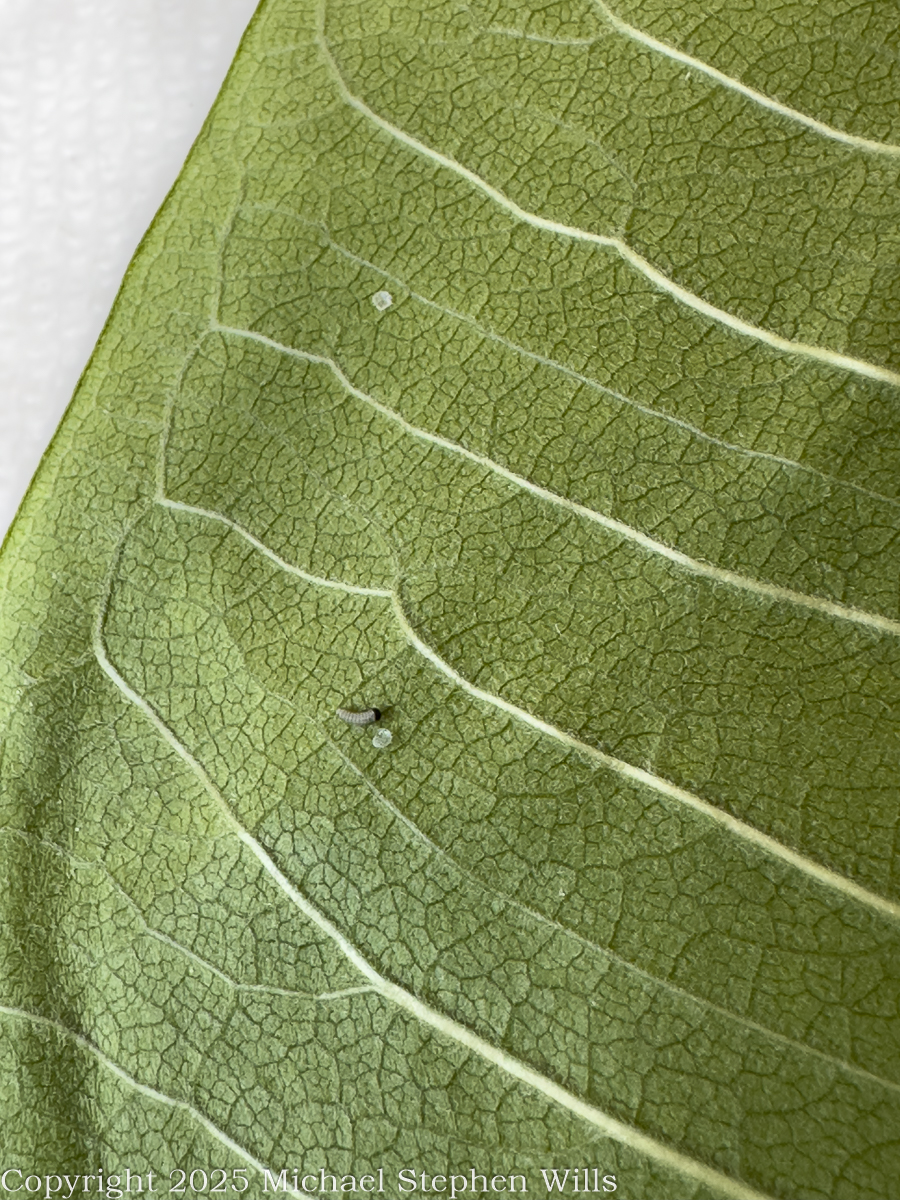
On the underside of a milkweed leaf, the world begins small enough to miss unless you kneel and look closely. In this first photograph the newborn is still a whisper of life, a pale pinhead egg collapsed into a glistening scrap, the tiny caterpillar beside it like a gray comma punctuating the green. It has just eaten the soft shell that cradled it—its first meal, its first thrift. The leaf’s pale roads of veins radiate around the hatchling; within that simple map lies all the geography it needs.
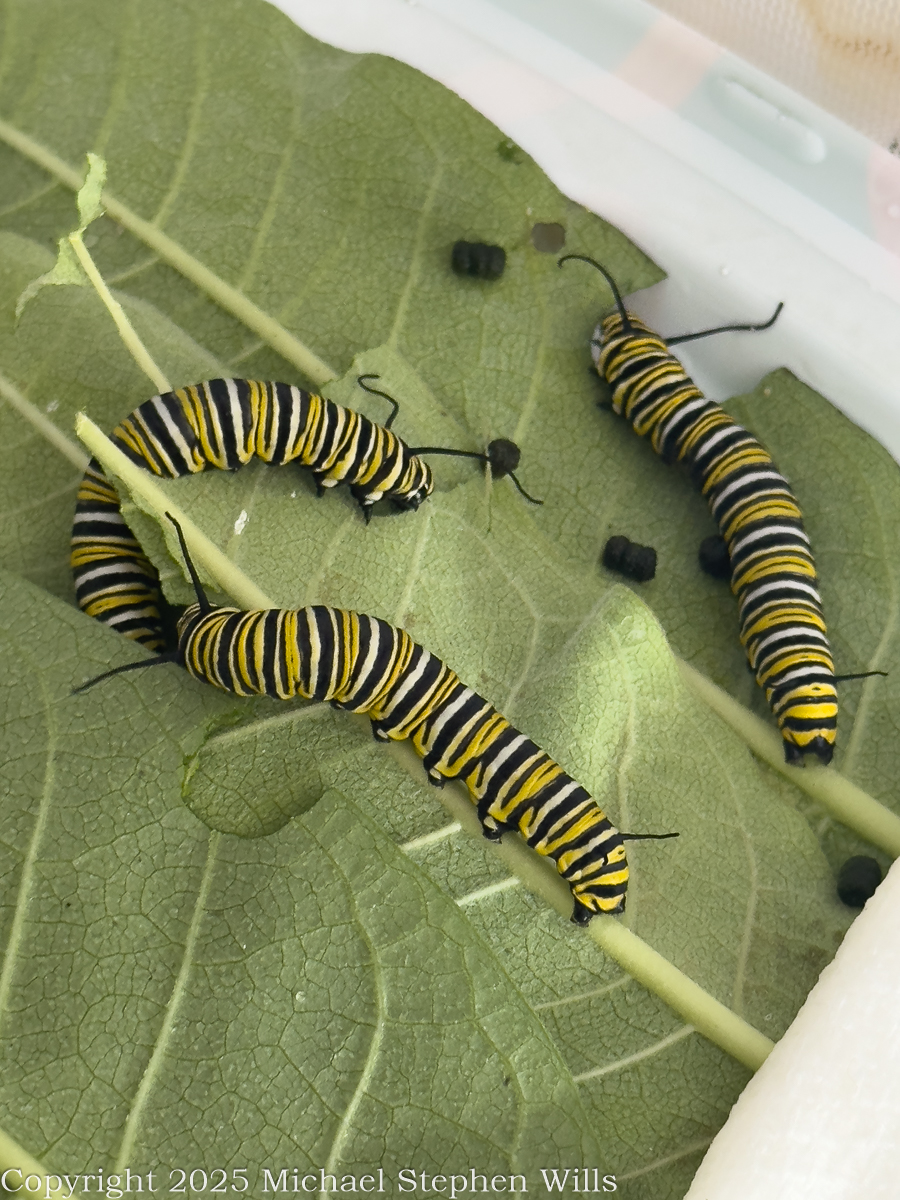
By the second photograph appetite has taken its proper throne. These pilgrims wear a uniform of warning: bands of yellow, black, and white—stripes as bright as hazard tape, a heraldic banner advertising the bitterness borrowed from milkweed. Each bite draws down defensive latex; yet the caterpillars feed undeterred, pausing to snip the leaf’s veins to quiet the flow. Their black, threadlike “tentacles” nod as they travel, and their peppery pellets—frass—collect like midnight hail. Five times they will outgrow themselves, shrugging off skins to reveal wider, hungrier versions within. The room is strewn with green rib and ragged edges; the air has the gentle smell of cut stems. All the while, milkweed’s poisons, the cardenolides, pass into growing bodies and become their bodyguard.
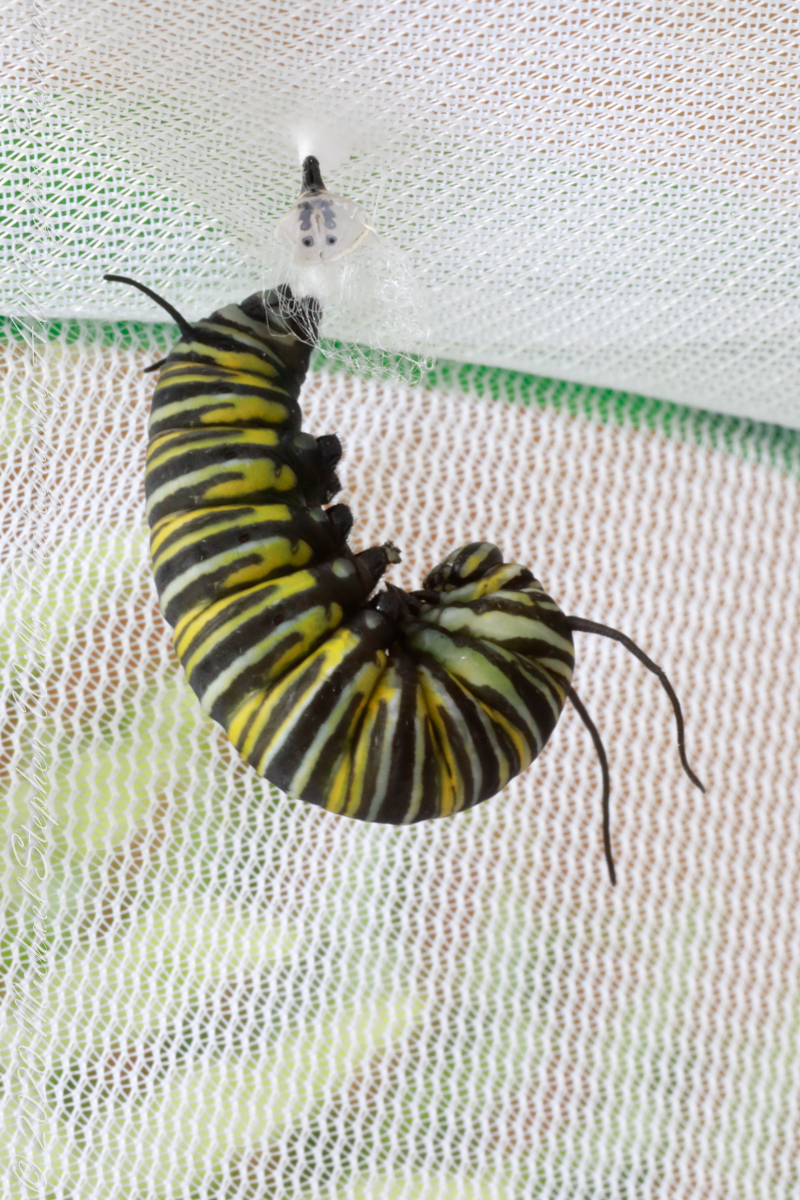
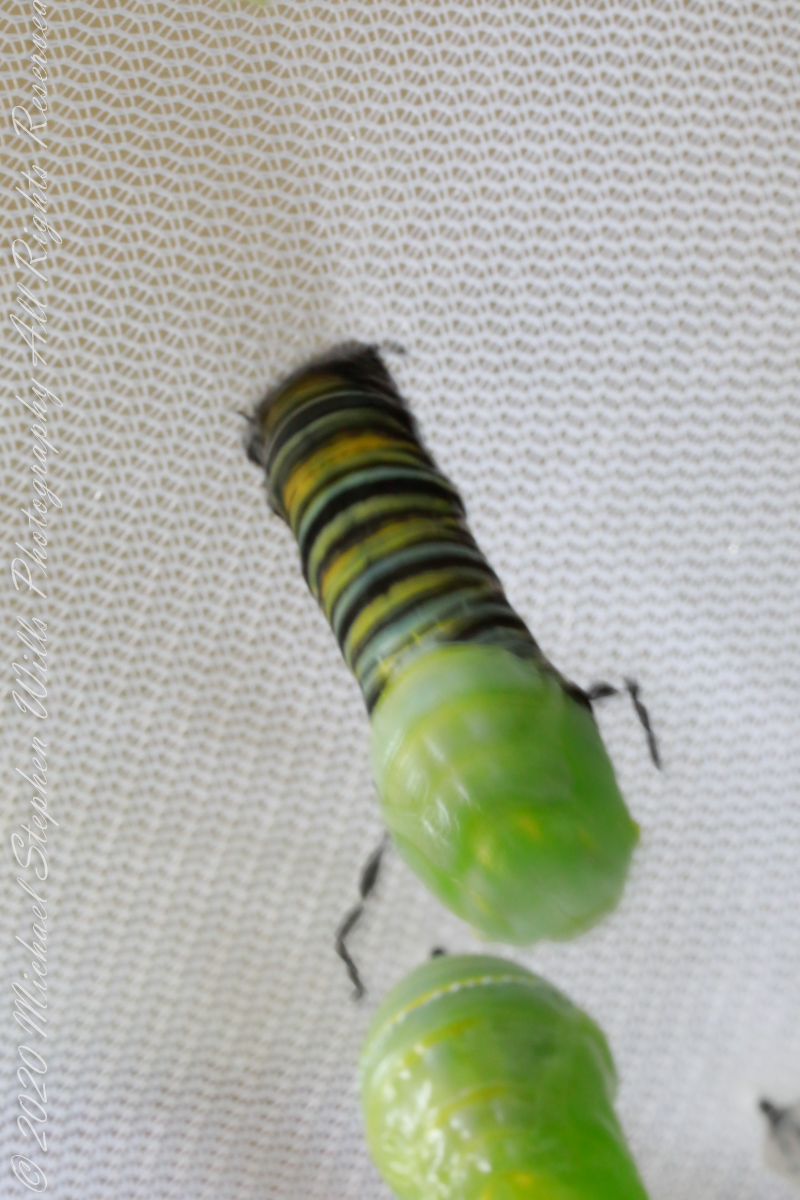
At last a hush. A final meal, a purposeful wander. The caterpillar chooses a high eave of the world—a stem, a stick, the corner of your rearing tent—and hooks itself into a downward J. Within hours the skin splits like a soft zipper; the striped creature pours itself out of itself and seals into a smooth chrysalis.
Here, the caterpillar has attached itself to a silk pad from which it hangs. Underneath the skin, the caterpillar is transforming to the chrysalis. In these photographs the silk pad and chrysalis attachment from a previous transformation are in the foreground.Macro of the Monarch butterfly chrysalis. The black stalk attached to the silk pad is call a cremaster.
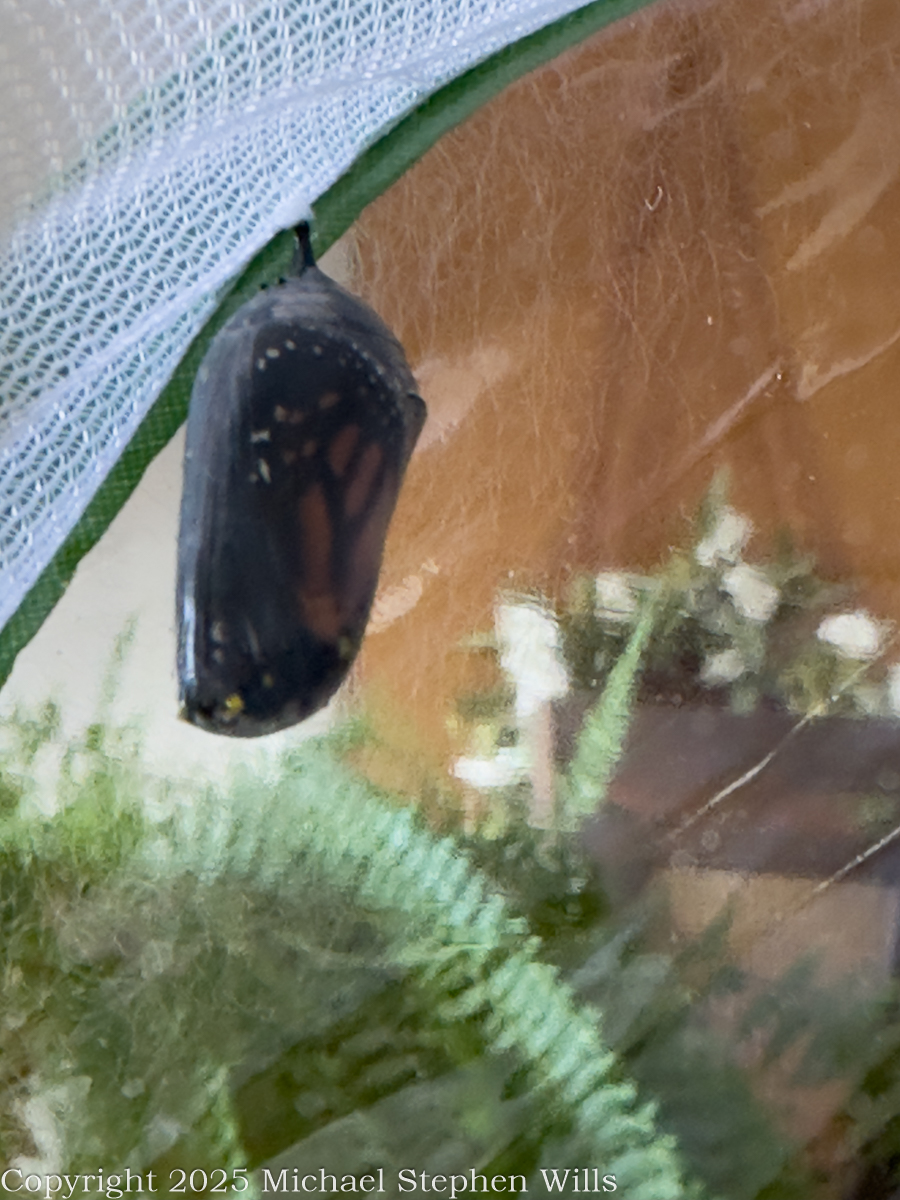
The following photograph and video catch the moments into becoming: the jade lantern has become transparent, darkening, its gold studs glinting like constellation points, and through the thinning walls the folded wings show, orange smoldering under smoke. Inside, old tissues have dissolved into a living broth; imaginal discs—tiny blueprints carried since the egg—have flowered into legs, eyes, and flight. To call it “metamorphosis” is correct; to call it mystery is truer.
Watch on YouTube for a better experience. Please “like” and “subscribe”
When the case opens the butterfly backs into the bright. It clings while the crumpled wings fill and flatten, hemolymph pumping life into every cell. In the next image the adult drinks from a petunia trumpet, a jeweled ember with white-spotted hems. The monarch—Danaus plexippus—tests the wind with new, purposeful wings. Its scientific name nods to ancient stories: Danaus after the Greek mythic king of Argos, a father who fled with his fifty daughters across the sea; plexippus for Plexippus, a figure of the same old tales—his name carried forward into this wanderer of the sky. The English name “monarch” is said to honor both its regal size and domain, and, some say, the orange-and-black of William of Orange. Kings and myths gathered like cloak and scepter around a creature that weighs less than a paperclip.
No butterfly has entered human life more completely. Schoolchildren cradle jars of milkweed sprigs and tape handwritten labels to chrysalides lined like seed pearls along a classroom window. Taggers kneel in September light, add a tiny disc to a wing, and write down time and place so the journey south can be traced. In the mountains of Mexico, where oyamel firs hold winter like a secret, people fold the monarch’s return into the Days of the Dead, believing that souls ride home on those wafers of flame. Gardeners tuck swamp milkweed into narrow beds and call their yards “waystations.” Photographers, such as myself, record the stories that happen leaf by leaf.
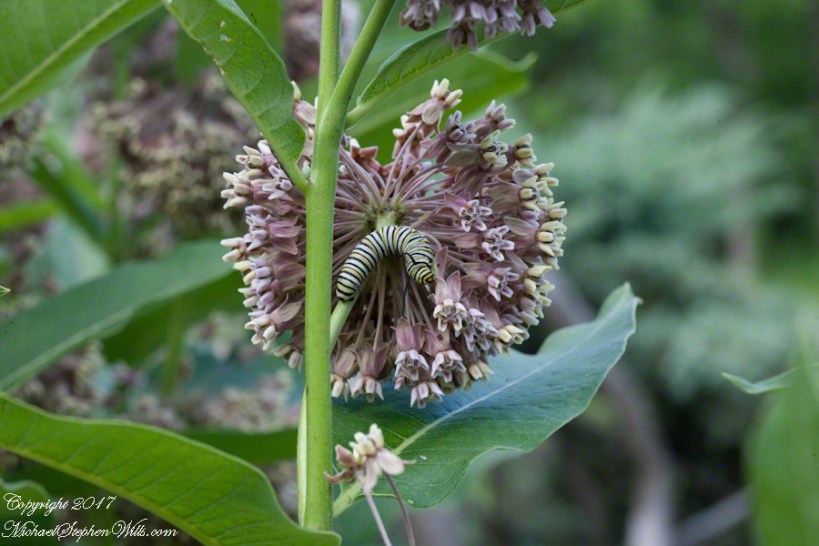
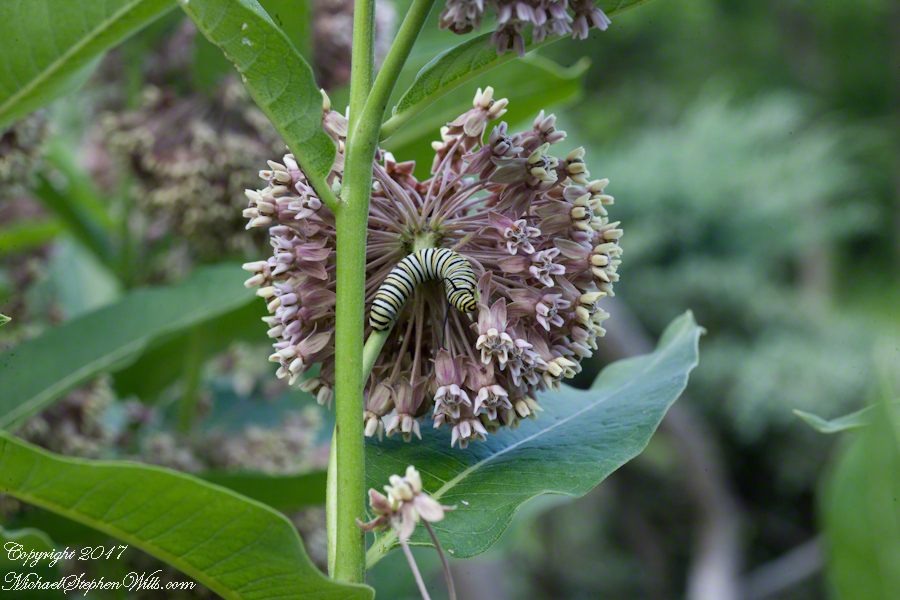
In early July a Monarch caterpillar revels in milkweed flowers.
Yet our touch is not simple. Fields simplified by herbicides have shaved milkweed from fencerows; tidy mowing removes nectar from roadsides in the tender weeks of migration; captive rearing in vast numbers, though done with reverence, may carry unintended risks of disease and weakened orientation. The monarch asks us to enlarge our sense of home beyond the fence: to let patches of milkweed lift their pale crowns in rough corners; to choose late-blooming asters and goldenrod; to keep a few ditches shaggy until the travelers pass. Conservation, like metamorphosis, is work that happens inside ordinary days.
Watch the cycle again in my images—egg to appetite, appetite to stillness, stillness to wing—and hear what it whispers in the steady voice of milkweed leaves and soft fall air. Rachel Carson wrote that “those who contemplate the beauty of the earth find reserves of strength that will endure as long as life lasts.” Here beauty wears stripes and beads of gold, sips from garden petals, and threads a continent with its frail insistence. The monarch’s life is a ribbon we can follow with our eyes and, if we are willing, with our hands—gentle hands that leave room for milkweed to rise, for caterpillars to feed, for a chrysalis to darken and a window to fill, one bright morning, with wings.
On a personal note, this season was a success. Monarchs visited our milkweed patch several times allowing me to save/harvest nineteen eggs/caterpillars and raise them until release.
Selected references
Carson, Rachel. The Sense of Wonder. New York: Harper & Row, 1965. (Reissued: HarperCollins, 1998; Open Road Media e-book, 2011.) The quoted passage (“Those who contemplate the beauty of the earth…”) appears early in the book; the Open Road edition places it on p. 41.
Wikipedia contributors. “Monarch butterfly — Etymology and taxonomy.” (useful overview with primary citations).
Oberhauser, K. S., and M. J. Solensky, eds. The Monarch Butterfly: Biology and Conservation. Cornell University Press, 2004.
Enter your email to receive notification of future postings. I will not sell or share your email address.
Copyright 2025 All Rights Reserved Michael Stephen Wills
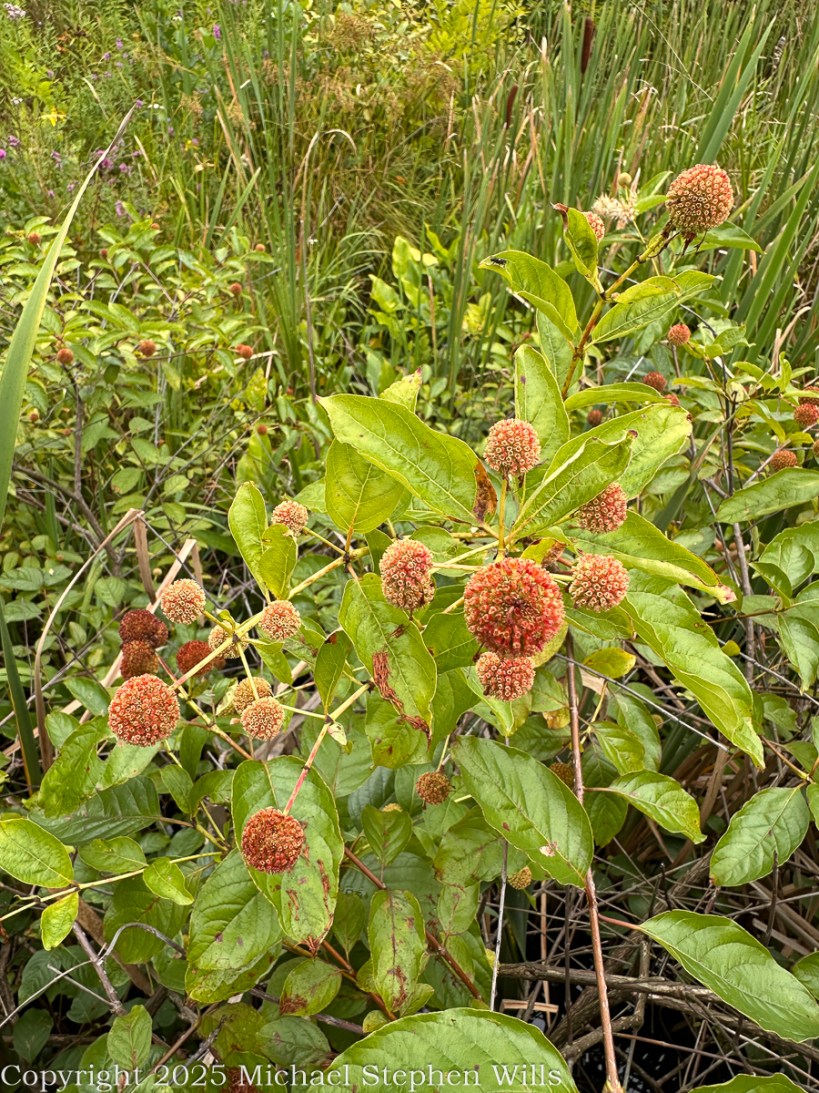
Discover the Buttonbush (Cephalanthus occidentalis), a wetland shrub of spherical blooms, sustaining pollinators, birds, and waterfowl while reminding us of life’s enduring cycles
In the quiet wetlands of late summer, when cattails lift their brown torches above the reeds and dragonflies skim the still water, there is a shrub that speaks in spheres. Its language is not the pointed spear of grass or the broad fan of lily pads, but the perfect symmetry of globes—round, intricate, and startling in their precision. This is the Buttonbush, Cephalanthus occidentalis, a native of swamps, pond margins, and the soft, yielding soils where water shapes the land.
At first glance, its clusters might be mistaken for something fashioned by human hands: spiky balls arrayed along slender stems, each one a small planet bristling with tiny cells. Only in memory can we recall their summer incarnation, when each ball was a constellation of snowy blossoms, white tubular flowers extending like delicate pins from a spherical center. Bees and butterflies crowded them then, drunk on nectar, wings glinting in the sun. Hummingbirds darted in as though drawn by an unseen magnet, their beaks fitting perfectly into the narrow blossoms, a partnership written long ago in the shared script of evolution.
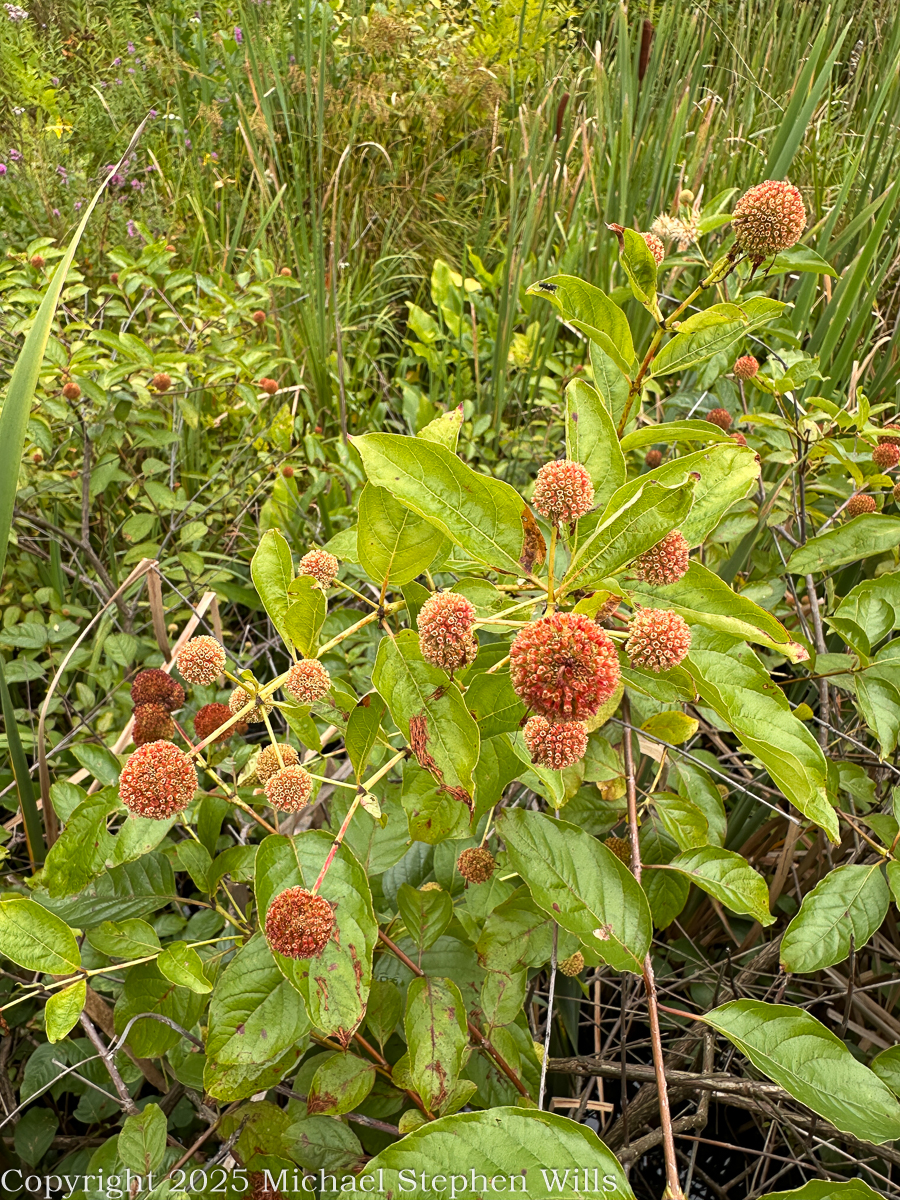
Buttonbush (Cephalanthus occidentalis) at Sapsucker Woods, Cornell Lab of Ornithology
Now, in August’s waning light, those blossoms have folded back into seed, transforming into the russet orbs captured in the photograph. What was once nectar is now promise—food for ducks, shorebirds, and the small lives that depend on wetlands for sustenance. In the hands of buttonbush, time itself is circular. Flower becomes fruit, fruit becomes seed, seed becomes shrub, and the cycle spins quietly on, just as the spheres themselves suggest: complete, unbroken, eternal.
A Wetland Companion
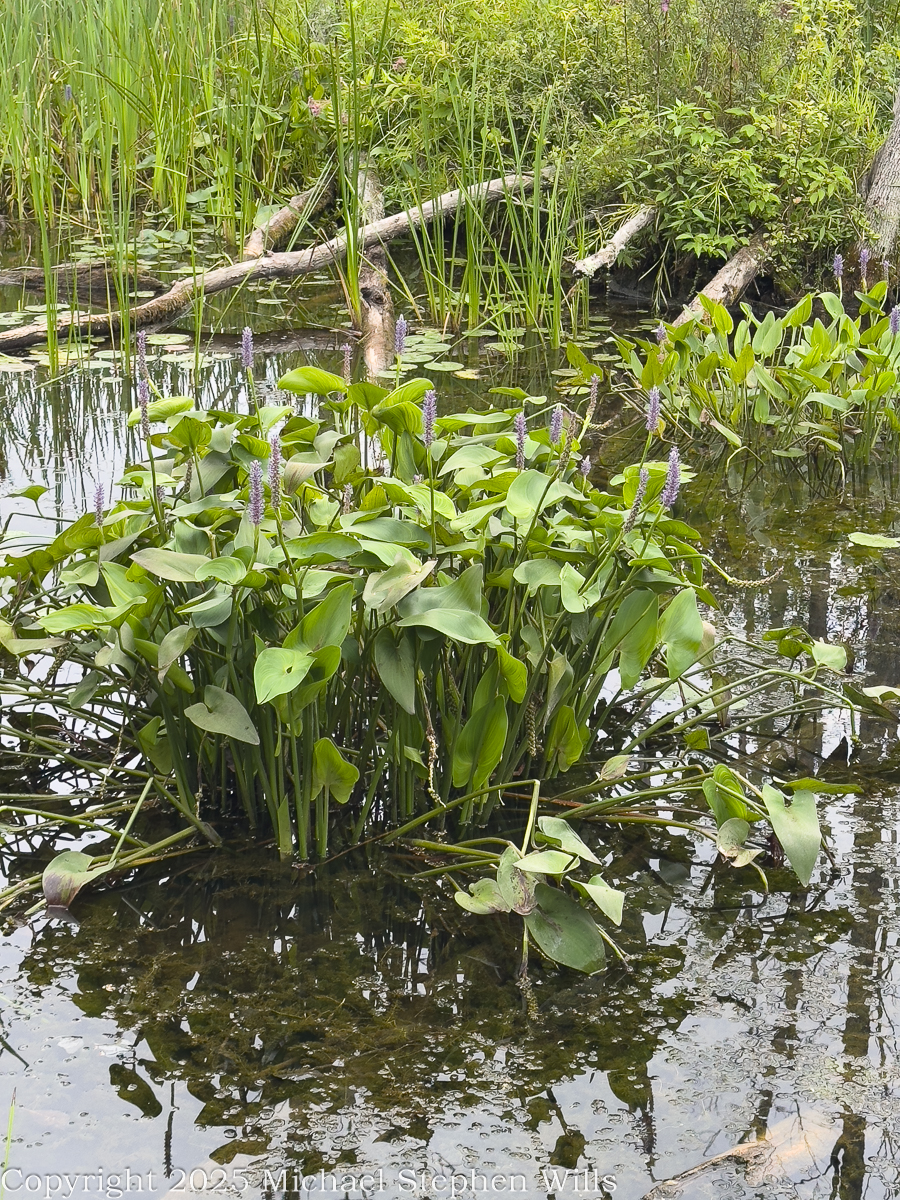
Buttonbush is rarely alone. It thrives where cattails whisper, where pickerelweed thrusts up spikes of purple bloom, where the air holds the scent of waterlogged earth. Its roots grip the muck at the edges of ponds and rivers, holding soil against the restless tug of currents. In doing so, it becomes part of the unseen architecture that holds wetlands together, slowing erosion, filtering water, providing shelter for fish in the shade of its stems.
Pickerelweed (Pontederia cordata) at Sapsucker Woods, Cornell Lab of Ornithology
This shrub, unassuming in stature, is an engineer of stability. It creates thickets where red-winged blackbirds perch, where frogs crouch in shade, where turtles bask on half-submerged branches. The wetlands of North America would be poorer without its presence, for it provides not just beauty but the scaffolding upon which entire communities of life depend.
The Human Thread
To the human eye, the buttonbush’s spherical blooms are so striking that they demand metaphor. Some have called them pincushions, others tiny planets, others fireworks arrested in mid-burst. Native American peoples, however, looked beyond metaphor to medicine. The bark and roots were used in remedies for ailments ranging from headaches to fevers, though with caution, for the plant holds mild toxicity when consumed raw. It is a reminder that many gifts of the natural world are edged with danger, and that wisdom lies in balance.
Today, gardeners and conservationists plant buttonbush intentionally. It is welcomed into rain gardens, where its thirst for moisture makes it a perfect ally for absorbing stormwater. It is used in wetland restoration projects, where its deep roots anchor new life. And it is cherished by those who walk the edges of ponds and discover in its round blossoms a geometry that feels both wild and deliberate, a gift of design from the living earth.
Fourth of July, 2019, Stewart Park
The Sphere as Symbol
Rachel Carson once wrote that in nature, “nothing exists alone.” The buttonbush embodies this truth with clarity. Its spheres are invitations, junctions where plant and pollinator meet, where flower and bird share a moment of mutual necessity. They are offerings to the eye as well, challenging us to see patterns where we might otherwise see only happenstance.
Standing before a buttonbush in bloom, one feels an almost childlike wonder: how could such symmetry arise unbidden from soil and sunlight? Yet this is the miracle of evolution, that order may spring from chance, that beauty may serve survival, that what pleases our senses also sustains life.
A Closing Reflection
In the wetlands, where water mirrors the sky, the buttonbush offers its own reflection of completeness. Its seed heads persist through autumn and winter, small orbs clinging even when leaves fall, reminders that the cycles of life turn steadily beneath the stillness.
To linger with buttonbush is to be reminded of nature’s quiet insistence on wholeness. It speaks in forms: round, repeating, enduring. To walk away from it is to carry a sense of connection, to know that in the pattern of its blooms we glimpse a truth both humble and profound—that life is not a line but a circle, and in every turning there is renewal.
For Further Reading
USDA NRCS. Plant Guide: Buttonbush (Cephalanthus occidentalis L.). United States Department of Agriculture, Natural Resources Conservation Service. Available online: https://plants.usda.gov – Provides detailed information on identification, habitat, and ecological role.
Lady Bird Johnson Wildflower Center. Cephalanthus occidentalis (Common Buttonbush). Native Plant Information Network. Available online: https://www.wildflower.org/plants/result.php?id_plant=ceoc2 – Covers botanical features, bloom time, wildlife value, and landscape use.
Dirr, Michael A. Manual of Woody Landscape Plants: Their Identification, Ornamental Characteristics, Culture, Propagation and Uses. 6th Edition. Stipes Publishing, 2009. – Authoritative horticultural reference on Buttonbush and other shrubs.
Peterson, Roger Tory, and Margaret McKenny. A Field Guide to Wildflowers: Northeastern and North-central North America. Houghton Mifflin, 1968. – Classic field guide covering buttonbush’s wetland habitat.
Carson, Rachel. Silent Spring. Houghton Mifflin, 1962. – Source of the quoted passage: “In nature nothing exists alone.” (Chapter 2, “The Obligation to Endure”).
Moerman, Daniel E. Native American Ethnobotany. Timber Press, 1998. – Comprehensive reference documenting traditional medicinal uses of Buttonbush among Native American peoples.
Enter your email to receive notification of future postings. I will not sell or share your email address.
Copyright 2025 All Rights Reserved Michael Stephen Wills
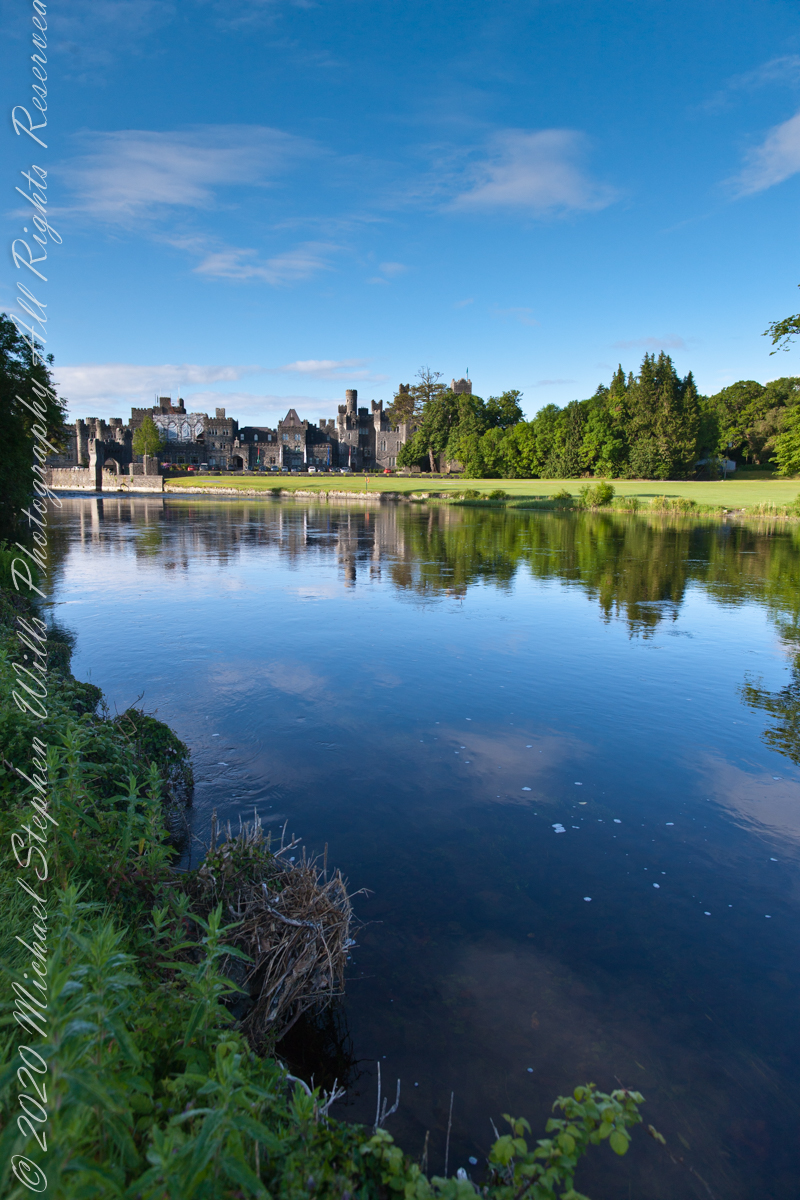
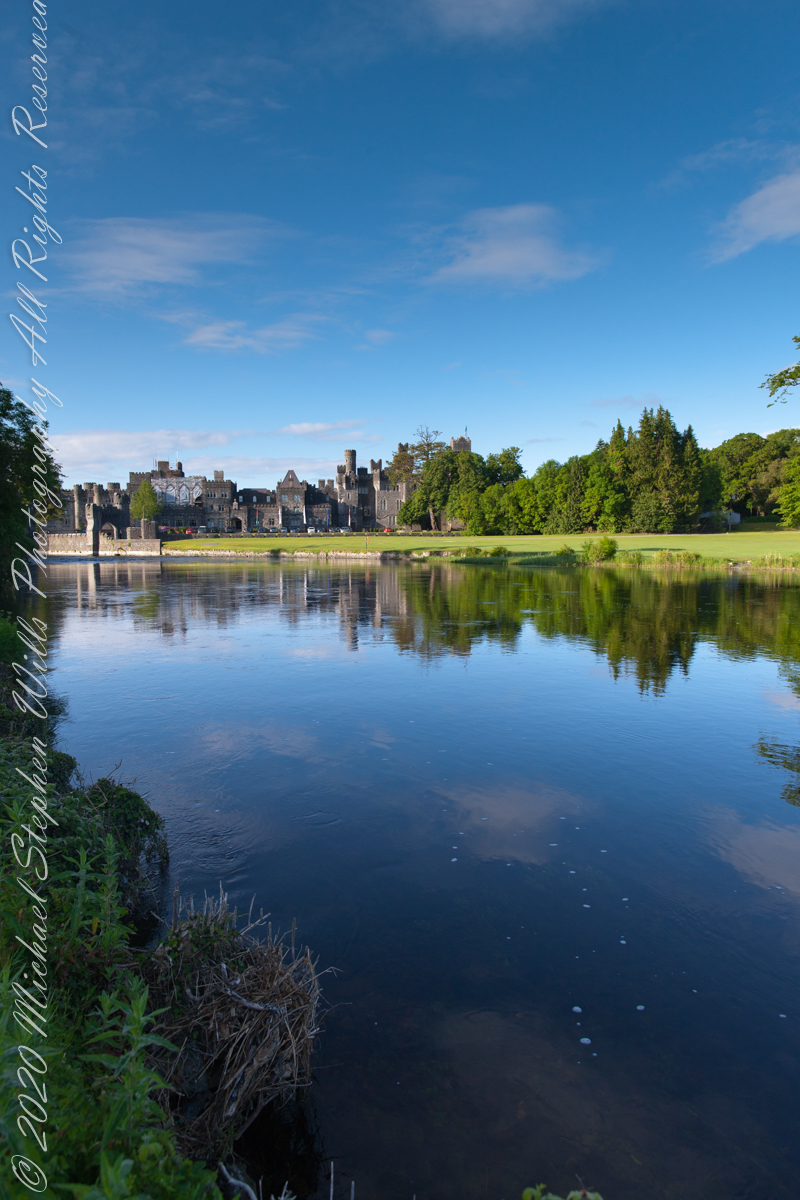
At Ashford Castle, swans glide on the Cong River’s glassy waters, weaving together myth, history, and cinema in a timeless reflection of Ireland’s enduring spirit.
Headed south from Cong Village, past the venerable Cong Abbey then Saint Mary’s Church of Ireland, the road bends into the Ashford Castle estate. Time seems to shift here. The stonework of the abbey lingers in memory, only to give way to manicured parkland, ancient trees, and the shimmer of water. The road itself, aptly named Ashford Castle, carries the traveler to a place where history, nature, and imagination meet.
I do not recall passing a guard box on my first visit, though one now stands firmly on the roadside, manned and proper, as though the estate were never meant to be entered without ceremony. In truth, Ashford Castle has always carried the air of a threshold—between village and wild, past and present, myth and reality.
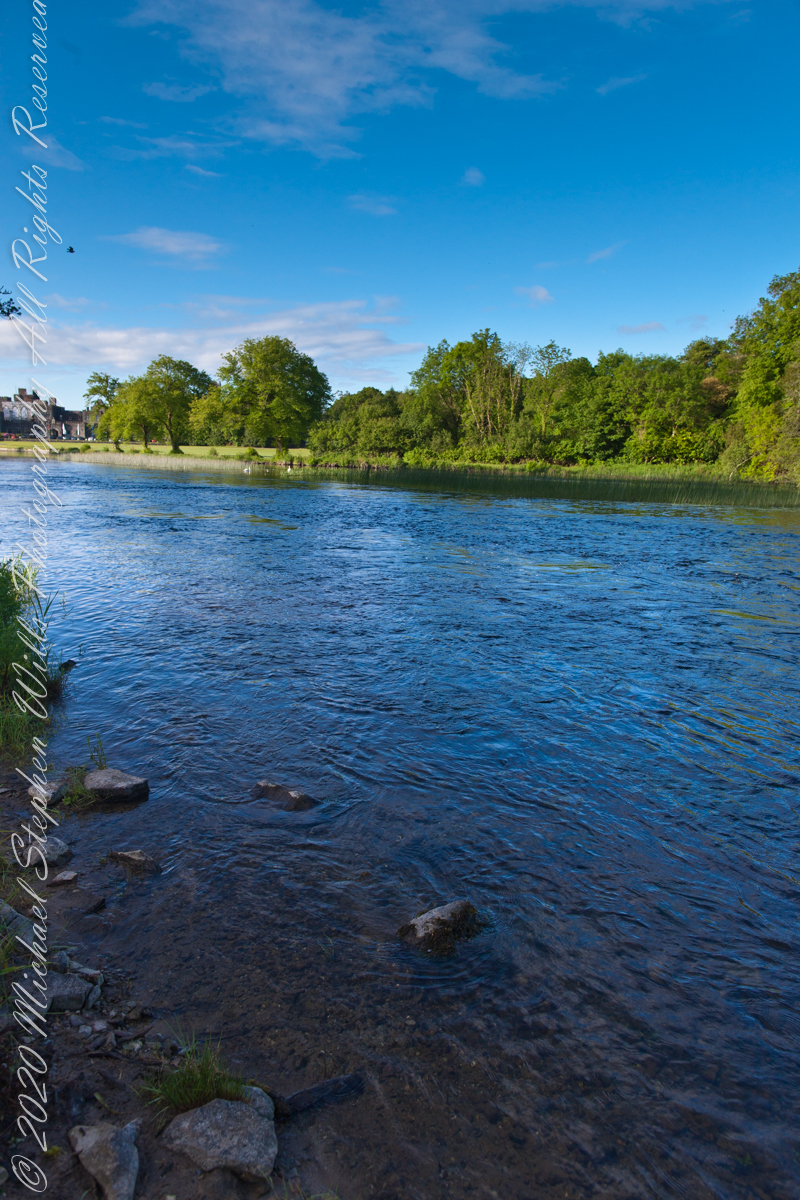
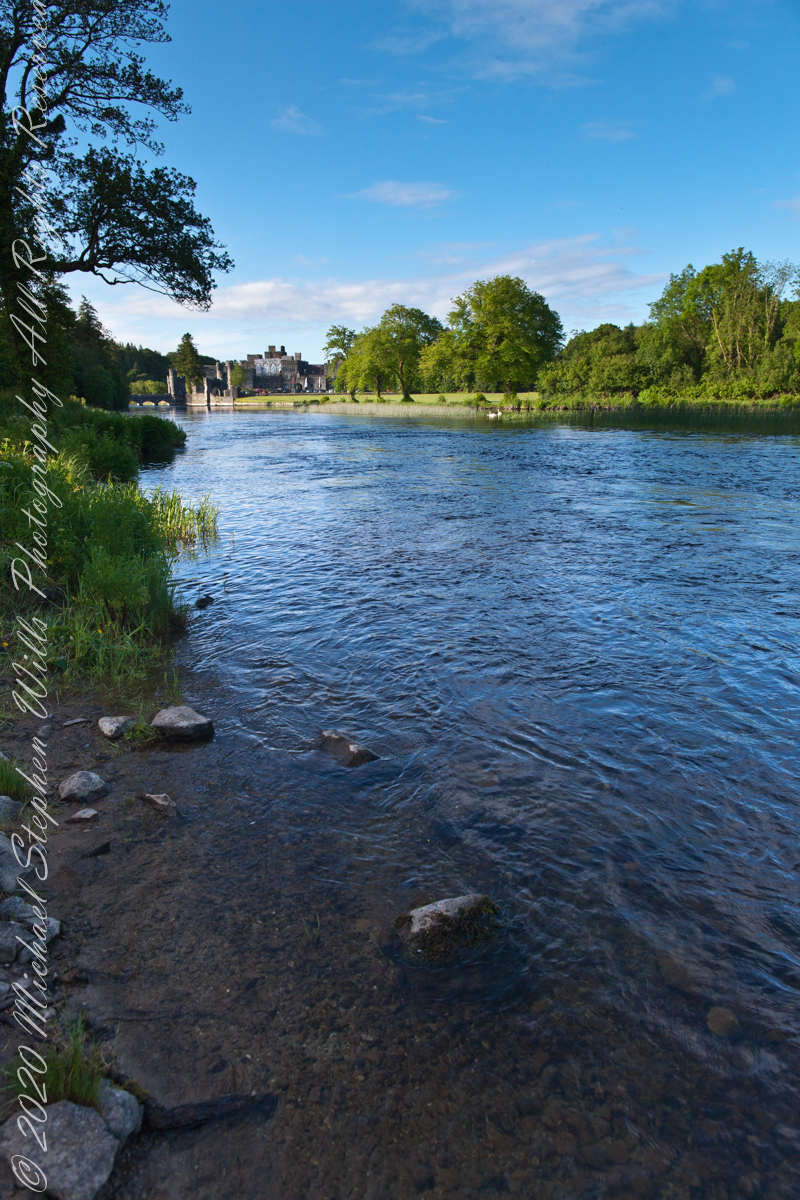
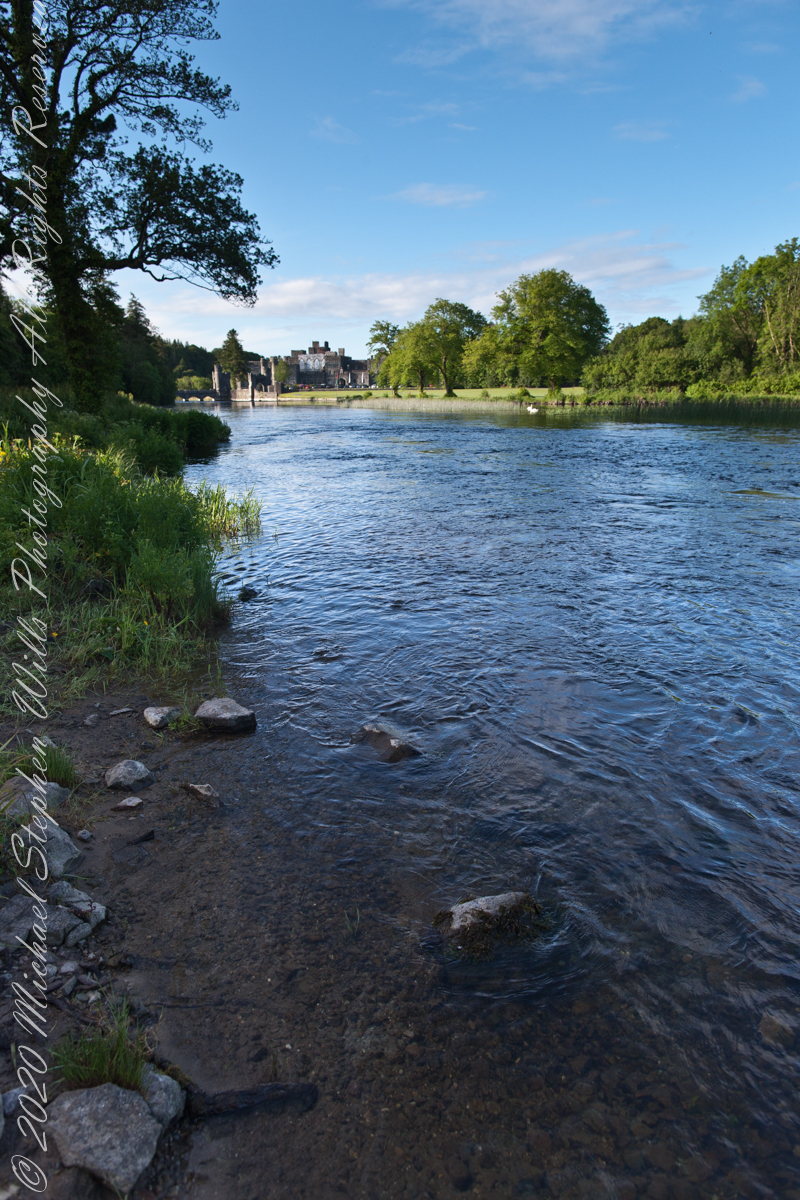
Soon the road brings one to the banks of the Cong River. Here the water widens, flowing calm and sure, and across it rises the battlemented silhouette of Ashford Castle itself. Its towers, turrets, and stony walls seem to grow from the riverbank like something inevitable, a fortress transformed into elegance. The castle’s mirrored reflection on the water doubles the grandeur, as though the real and imagined castle exist side by side.
It is no wonder filmmakers found inspiration here. Scenes from the classic 1952 film The Quiet Man—the tale of Sean Thornton, played by John Wayne, and the fiery Mary Kate Danaher, embodied by Maureen O’Hara—were shot on the far bank of this very river. To watch them walking by these waters is to see Ashford Castle woven into Hollywood’s Irish dreamscape, a backdrop both romantic and enduring.
Yet long before cinema, the river was already a stage. The Cong River is a natural marvel. It emerges from the same Carboniferous limestone that shapes the Burren of County Clare—an austere landscape of limestone pavements etched with fossils and caves, where rare alpine and Mediterranean plants thrive among ancient tombs. Through fissures in this ancient bedrock, the waters of Lough Mask find their way underground before rising again at Cong. This subterranean journey, through stone filters laid down some 350 million years ago, leaves the water clarified, luminous, and cold. By the time it slides past Ashford Castle, it has the purity of glass.
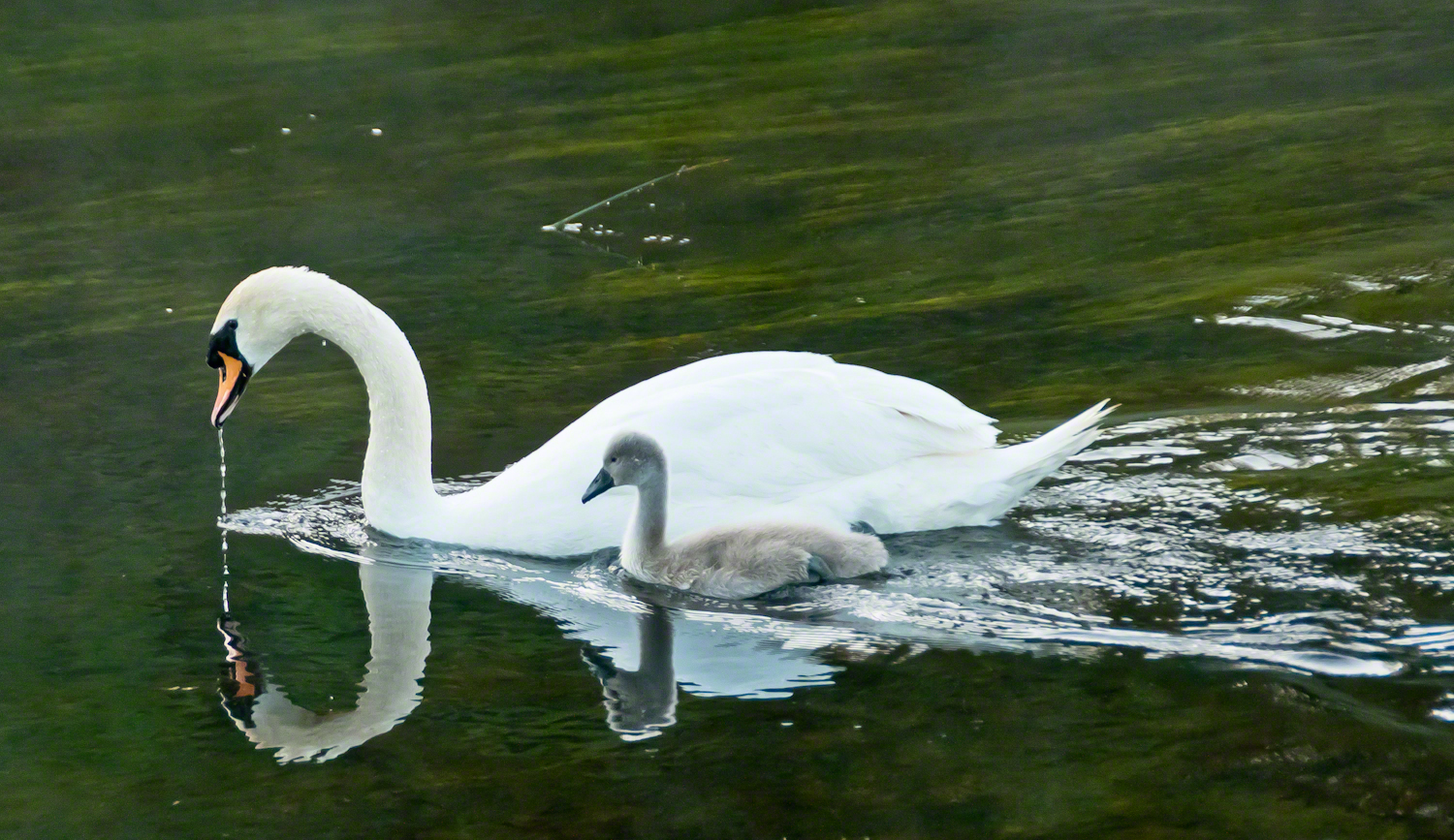
It is in this clarity while walking the opposite bank on a different morning I found a parent swan and its cygnet feeding. The adult glided, immaculate, its long neck bowed as drops of river fell from its beak. At its side, the cygnet paddled with earnest strokes, gray down still clinging, a fragile shadow of what it would one day become. Together they traced a quiet path across the water, ripples fanning behind them.
Few images so perfectly match their setting: a medieval castle, guardian of centuries, reflected in the same waters where these swans carried on their timeless rhythm of nurture and growth. It was as if the river itself composed the scene—a blending of stone, water, bird, and sky that belonged nowhere else but here.
The swan has long been a symbol in Irish lore. The Children of Lir, cursed to live as swans for nine hundred years, are among the most haunting figures of Celtic mythology. To see the white bird with its offspring before Ashford Castle was to glimpse that myth breathing still, alive on the Cong River.
Photographers know the difficulty of capturing water and stone without losing the life between them. On that morning, however, the river gave freely—its surface alternately smooth as glass and dappled with breeze. Stones at the water’s edge appeared like stepping-stones into history. Each frame revealed another face of the estate: the wide reach of the Cong, the castle framed by trees, the play of cloud shadows across the current.
The castle itself, though reshaped as a luxury retreat, still speaks of older times. Founded in the 13th century by the Anglo-Normans, Ashford passed through centuries of conquest and change before becoming, in the 19th century, a romantic Victorian pile. Today its battlements remain picturesque rather than defensive, but the sense of continuity—of lives unfolding along these banks—has not faded.
Standing there, camera in hand, I was struck by the layered meaning of this place. The Cong River flows from unseen caverns, purified by limestone older than memory. It nourishes swans, reeds, and trout alike. It reflects both a castle and a sky. Along its opposite bank, legends of cinema and Celtic lore alike find footing.
As the swan and cygnet drifted slowly downstream, I thought of them as part of the same enduring thread. Parent and child mirrored castle and village, past and future, permanence and change. The ripples they left widened until they touched both banks, an unbroken gesture across centuries.
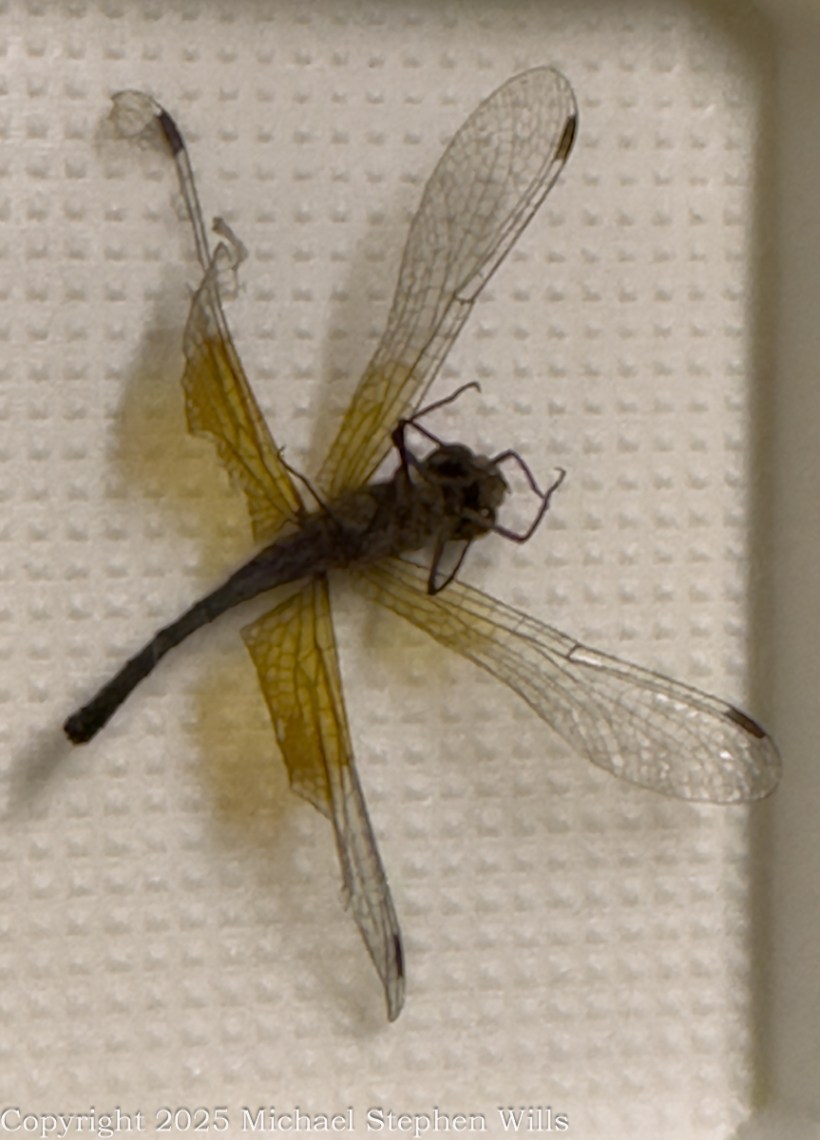
A sun-worn dragonfly rests at journey’s end, its amber wings whispering of distant winds, silent skies, and the untold grace of nature’s farthest travelers.
I found it trapped in the surface tension of standing water, motionless, its wings curled and clouded with the memory of flight. A dragonfly—worn, delicate, yet still resolute in form—lay before me like a token of the warm midsummer air that had lifted it through the fields and over the waters. July in Ithaca brings with it such winged travelers, borne on breezes scented with milkweed and bee balm, and this one, though grounded now, seemed still to carry the echo of great distances.
The dragonfly is not of the brooding sort; it lives neither in shadows nor secret places. It claims the sky as its own, ranging wide and far with a grace born of ceaseless motion. This particular specimen, its body some two inches in length and its wings veined like the bare branches of winter trees, bore the telltale marks of the Wandering Glider—Pantala flavescens. Each wing was tipped with a black bar, as though the artist who made it had laid down a final, definitive stroke to balance the creature in the air. Near the base, a wash of amber yellow glowed softly, like the last light of evening behind thin clouds.
There is something unquiet about the dragonfly. It does not hover long nor does it dawdle. It darts, it glides, it shimmers in and out of sight. It is a creature of action and of space. The glider, especially, seems to belong not to any one stream or meadow, but to the wind itself. Naturalists tell us this species is among the most traveled of all insects, crossing oceans, riding monsoons, appearing in lands where no memory of its departure remains. What must it see? What sunrises shimmer from its compound eyes, what shorelines flash beneath its outstretched wings?
In the dragonfly’s manner, I find no sign of labor, only the silent art of survival. It patrols its airspace like a hawk, yet it bears no menace, only the precise and relentless hunger of a born predator. With each dart and glide it performs a service to the air—clearing it of gnats and mosquitoes, feeding itself without waste. Nature, in her economy, grants no idle beauty, and the dragonfly is both elegant and essential.
As I gazed at the delicate carcass, I thought of the old philosophy that linked the soul’s journey to the flight of birds. But here, perhaps, is a more fitting image: this dragonfly, which lives but a brief summer, yet might travel farther in its span than many creatures do in a lifetime. We are apt to call it “wandering,” as though it lacked aim or anchor. But I think it follows a thread of purpose invisible to us—something stitched into the weave of wind and weather, of season and sun.
It had come far, and its journey was complete. My wife provided an empty saffron spice box to preserve and display it—for the grandchildren to marvel over.
Enter your email to receive notification of future postings. I will not sell or share your email address.
Copyright 2025 All Rights Reserved Michael Stephen Wills
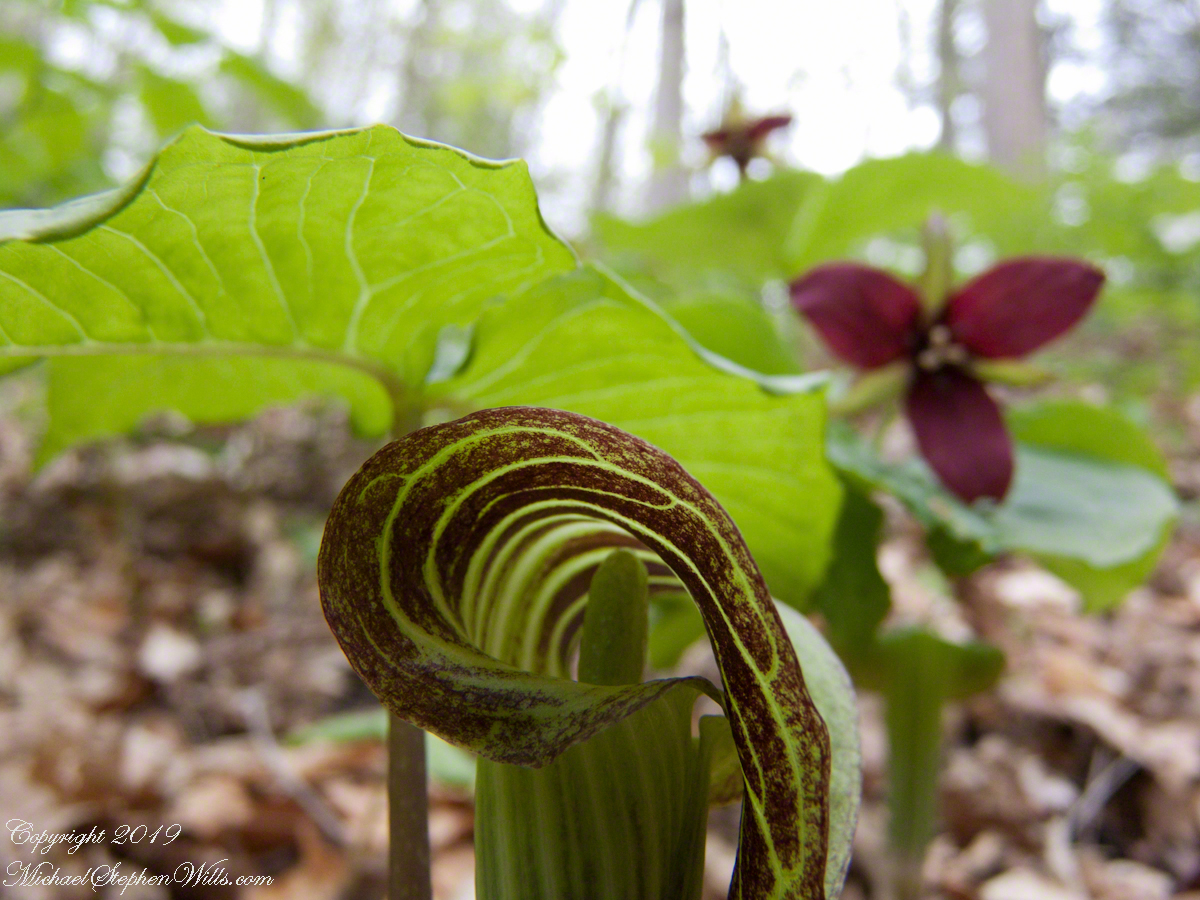
In the hush of the forest, Jack-in-the-Pulpit speaks—not with sound, but with form and patience, reminding us that some sermons rise quietly from the earth.
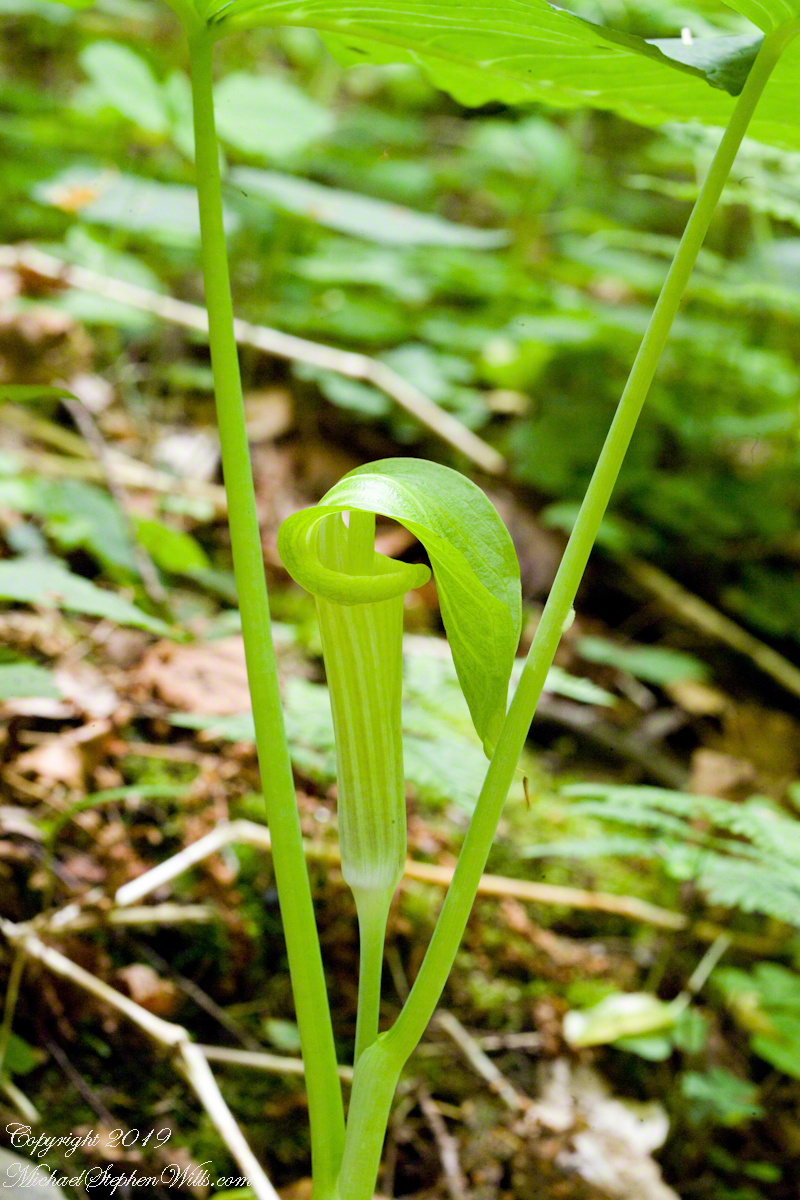
You could walk past it a hundred times and never notice. There, beneath the low canopy of midsummer, where light is sifted through green, Arisaema triphyllum stands with the discretion of a shadow. Jack-in-the-Pulpit, they call it—a name as strange and gentle as the plant itself. But neither common name nor scientific binomial quite captures the feeling that you are being addressed when you encounter one.
A young Jack-in-the-pulpit under its leaf canopy along the gorge trail of Filmore Glen.A mature Jack-in-the=pulpit flower with purple trillium, Fillmore Glen.
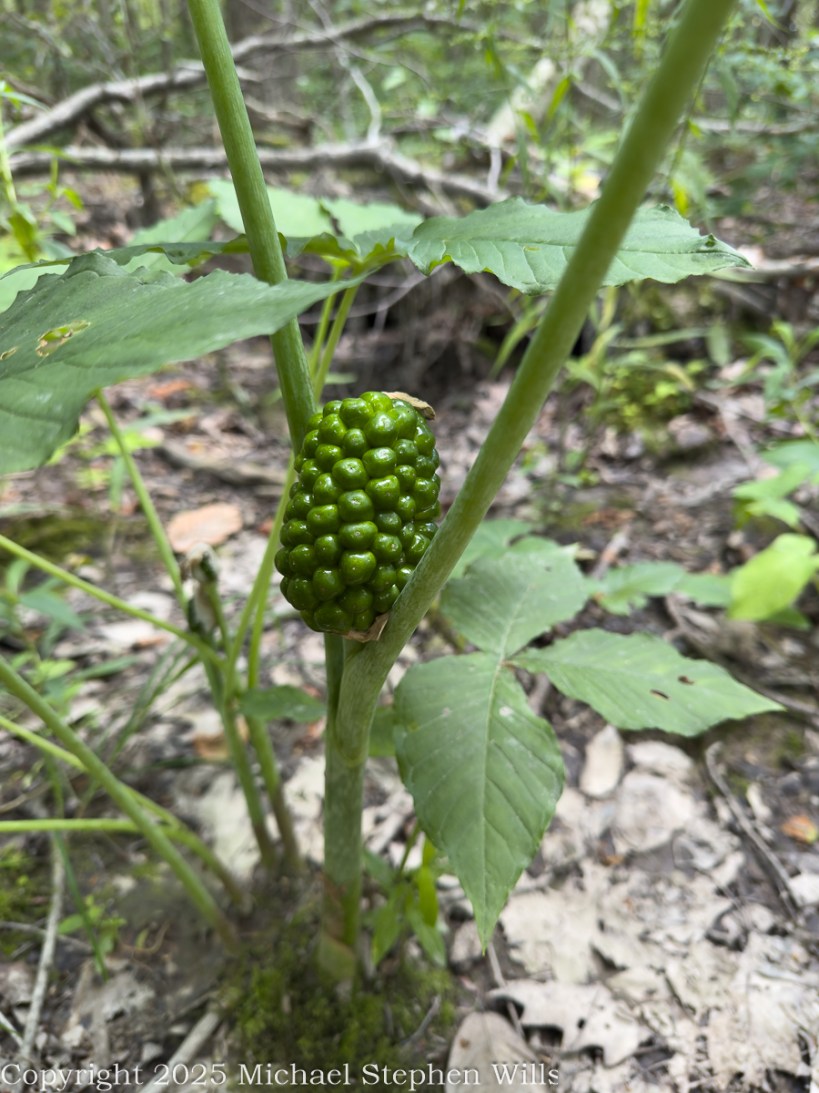
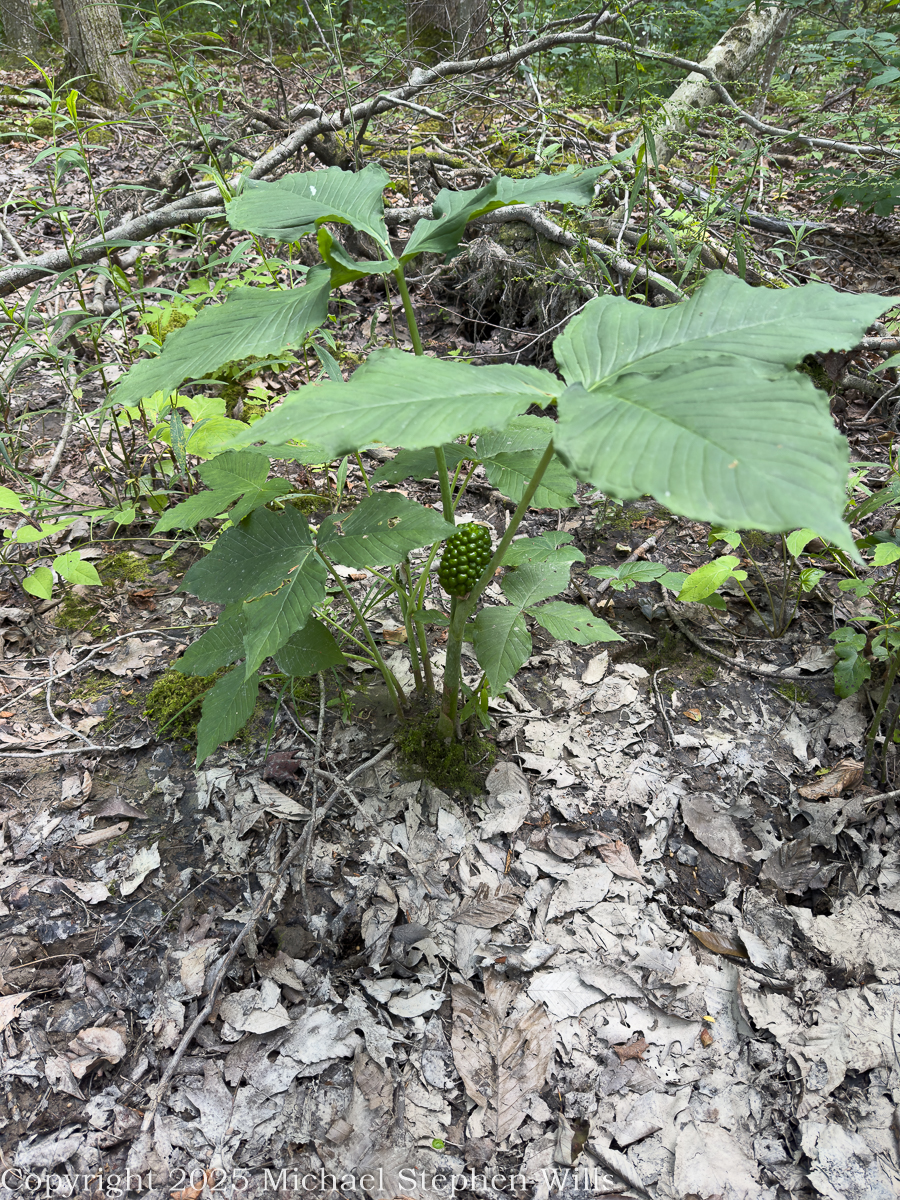
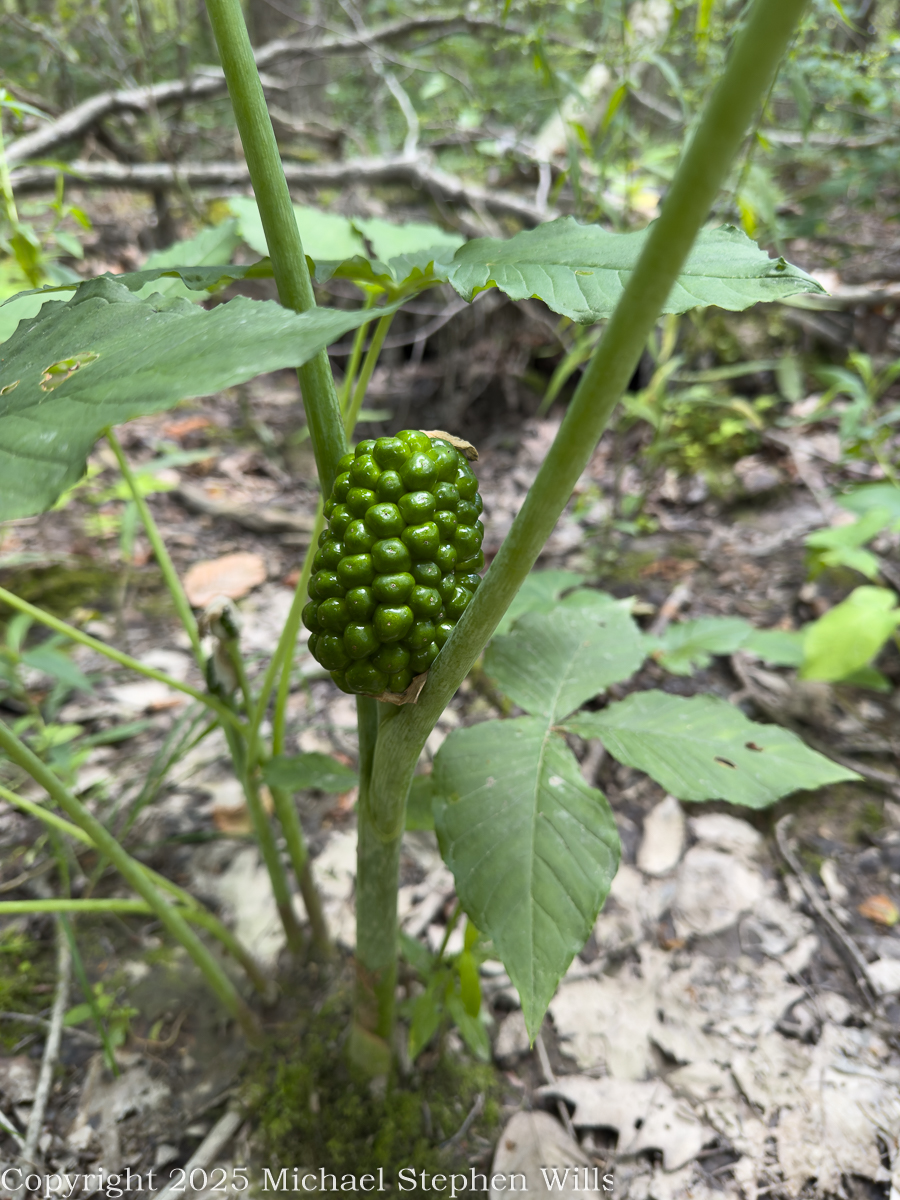
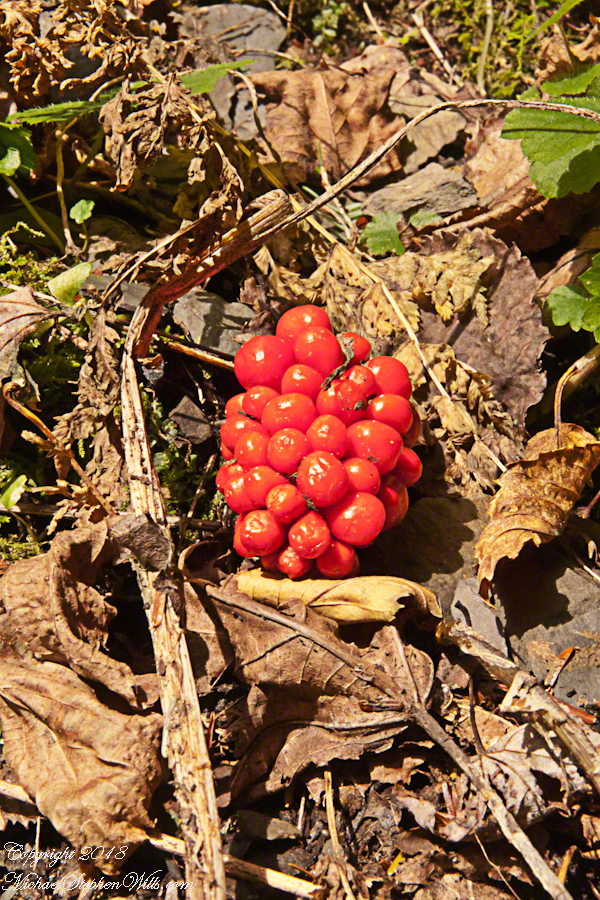
Earlier in the year, it raised a hooded spathe above the forest floor, curving protectively over a pale central spadix—the “Jack.” It looked like a figure delivering a sermon to the moss and littered leaves. Now, that sermon has passed, and the speaker has fallen silent. What remains is a column of tight green berries, glinting softly in the dappled light. They are not yet ripe, but the promise is there. In time, they will glow red like embers in the undergrowth.
Summertime, Sapsucker Woods. I might use a colloquialism and call this plant a “Jill”….and the real twist? Jack might’ve started out giving sermons but give them a good season and a strong root system, and Jack becomes Jill. It’s sequential hermaphroditism at its finest—Mother Nature’s version of career flexibility.
There is something ancient about this plant, as if it remembers a forest before our footsteps came. Its roots delve deep, not just into the soil, but into time. A corm, nestled beneath the leaf mold, waits out the harsh seasons, unseen but enduring. It is not a showy plant. It is a plant that trusts quiet. That survives on patience.
A closer look at the unripe berries.
The forest is full of these secret lives—beings that do not shout to be known. Jack-in-the-Pulpit speaks softly, in a dialect of leaf and shade and seasonal return. It is a plant you find when you have slowed down enough to belong again to the forest’s rhythm, when you’ve traded the voice in your head for the breath of leaf litter underfoot.
From Fillmore Glen
Some would call it just another spring ephemeral, a curiosity among many. But to walk away from it without feeling a kind of reverence would be to miss the point. It is not there to impress. It is there to remind.
That not all things are revealed at once. That sermons come in many forms. And that in the hush of the forest, something is always speaking—if only we remember how to listen.
Enter your email to receive notification of future postings. I will not sell or share your email address.
Copyright 2025 All Rights Reserved Michael Stephen Wills
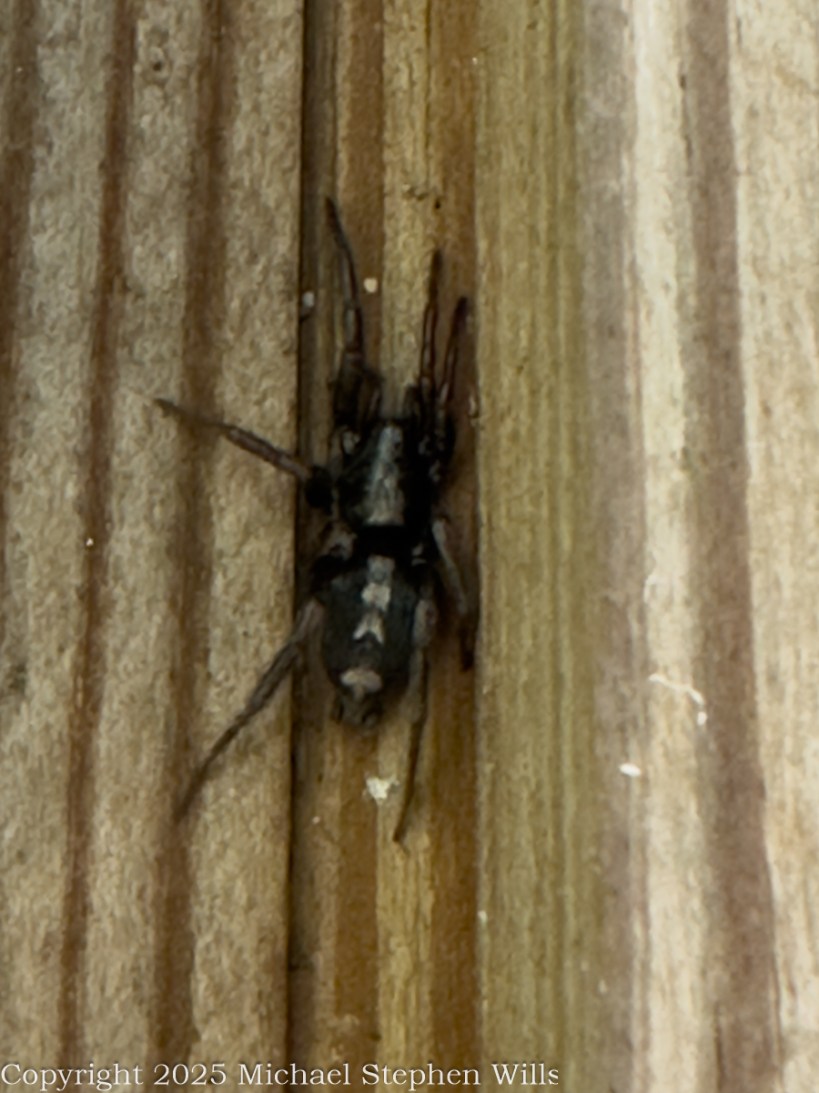
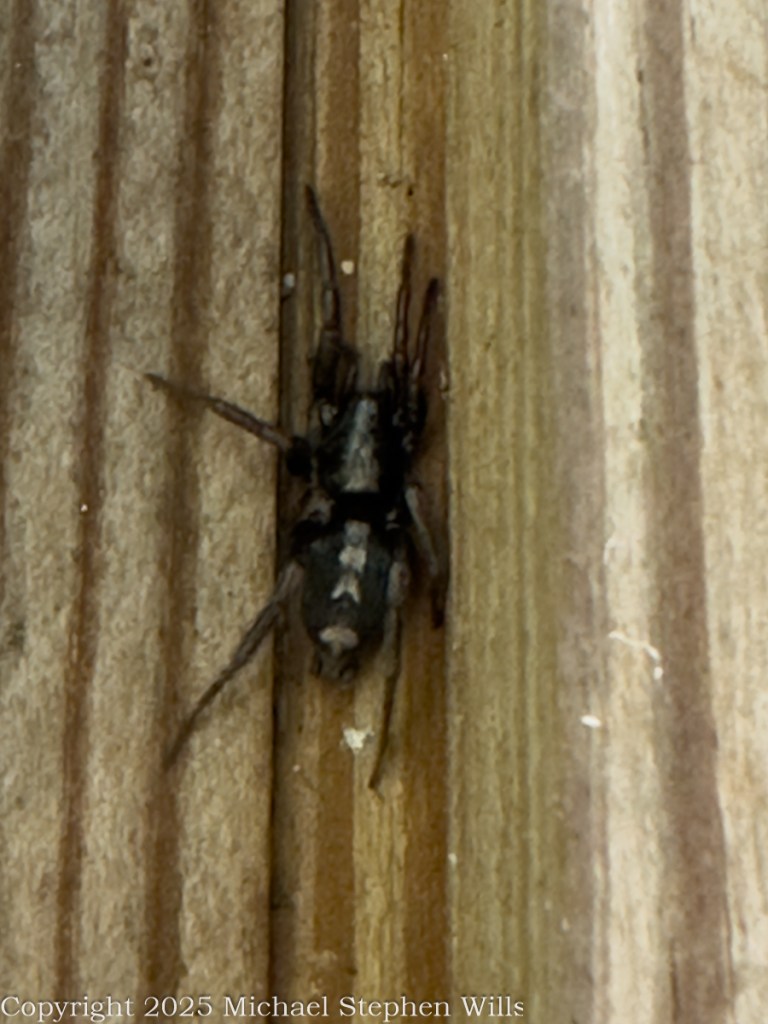
There, pressed into the grain of the boardwalk like a dark fleck of forest lint, the Bold Jumping Spider (Phidippus audax) waits—motionless, yet alert. To the untrained eye, it may seem insignificant, even nondescript. But a closer look reveals a creature of fine design and surprising charisma: a compact body cloaked in velvety black, adorned with pale markings like runes, and forward-facing eyes that gleam with eerie intelligence.
Unlike the orb weavers and net-spinners of spider lore, Phidippus audax does not rely on traps. It is a hunter in the truest sense—an animal that lives by leaping toward its future. With eight powerful legs and a muscular abdomen, it can launch itself many times its own body length, arcing through the air toward an unsuspecting moth or beetle. Yet it does not leap blindly. It trails a single silken thread behind it—a safety line, a commitment to survival. It is an act of courage tethered to caution.
Most remarkable are its eyes. A quartet of simple lateral eyes scan for motion, but the two large, front-facing principal eyes are something more—a rarity among arthropods. They grant it acute vision, with the ability to detect detail, movement, and even depth. When it turns its gaze toward you, you feel seen—not just registered, but regarded.
Found lurking in a joint of wood frame enclosing a trail map. Sapsucker Woods, Cornell Lab of Ornithology, on a summer afternoon\.
These spiders are active thinkers, decision-makers. They test their environment with movements that can almost be described as exploratory. They do not walk so much as prowl, stepping into shadow and light with an awareness that seems out of scale for their size.
And though they are often met with fear or disdain, Phidippus audax poses no threat to humans. It asks only for a few square inches of wood or leaf to stake its claim. In return, it offers a glimpse into a different kind of grace—an agile, silk-spinning daredevil, leaping with acute precision.
To observe one is to witness the meeting of design and instinct, form and function, in perfect miniature. In the vast, humming network of woodland life, the Bold Jumping Spider may be a small player, but it performs its role with flair. If the trees are the spires of the forest cathedral, and the ferns its leafy congregation, then Phidippus audax is a kind of sacred rogue—silent, swift, and utterly unconcerned by our towering presence.
Enter your email to receive notification of future postings. I will not sell or share your email address.
Copyright 2025 All Rights Reserved Michael Stephen Wills








 Michael Stephen Wills Photography