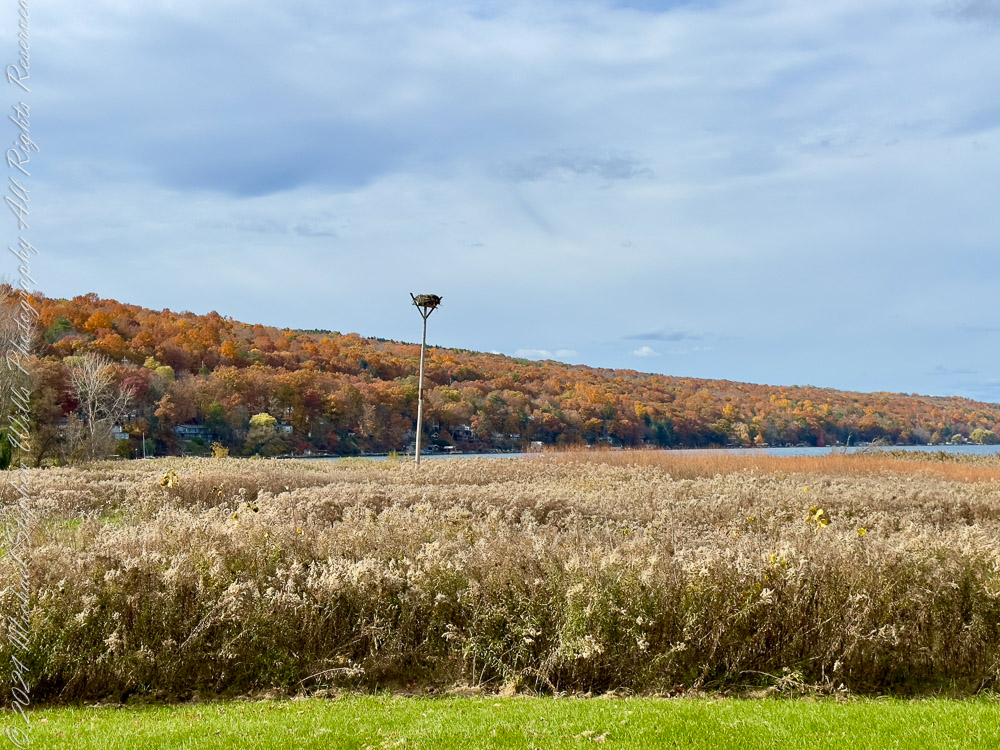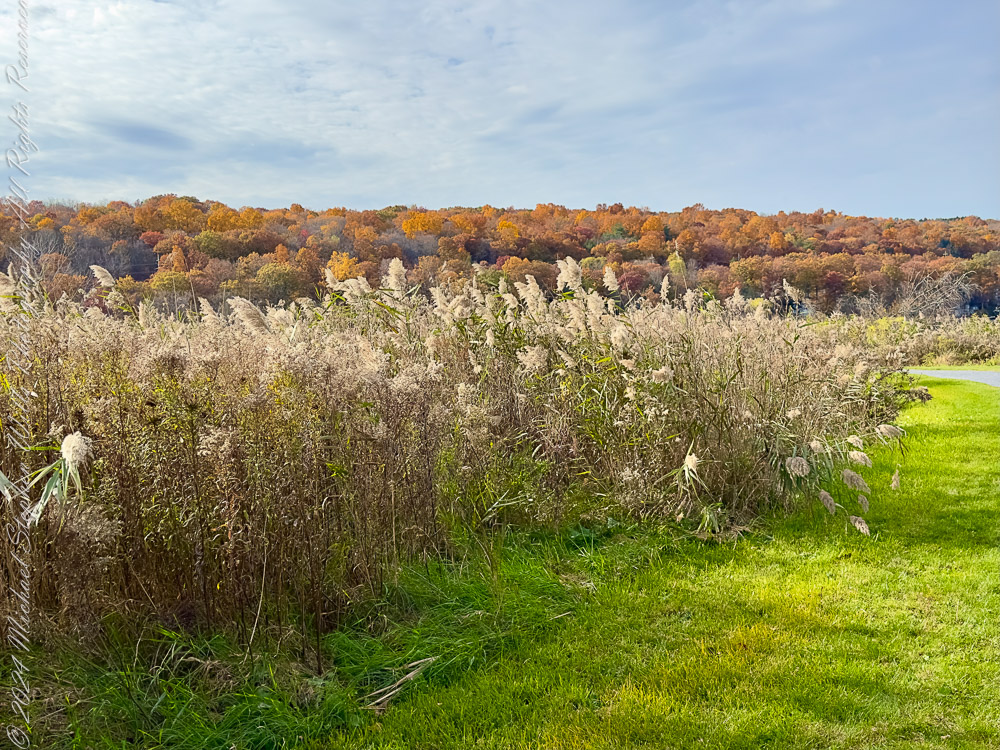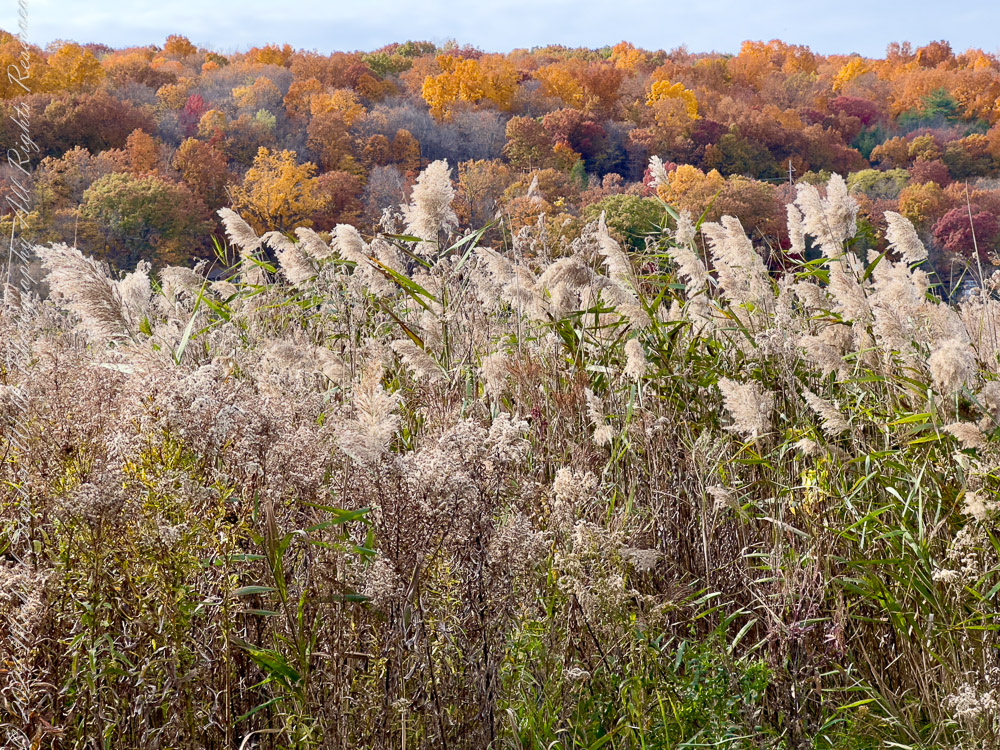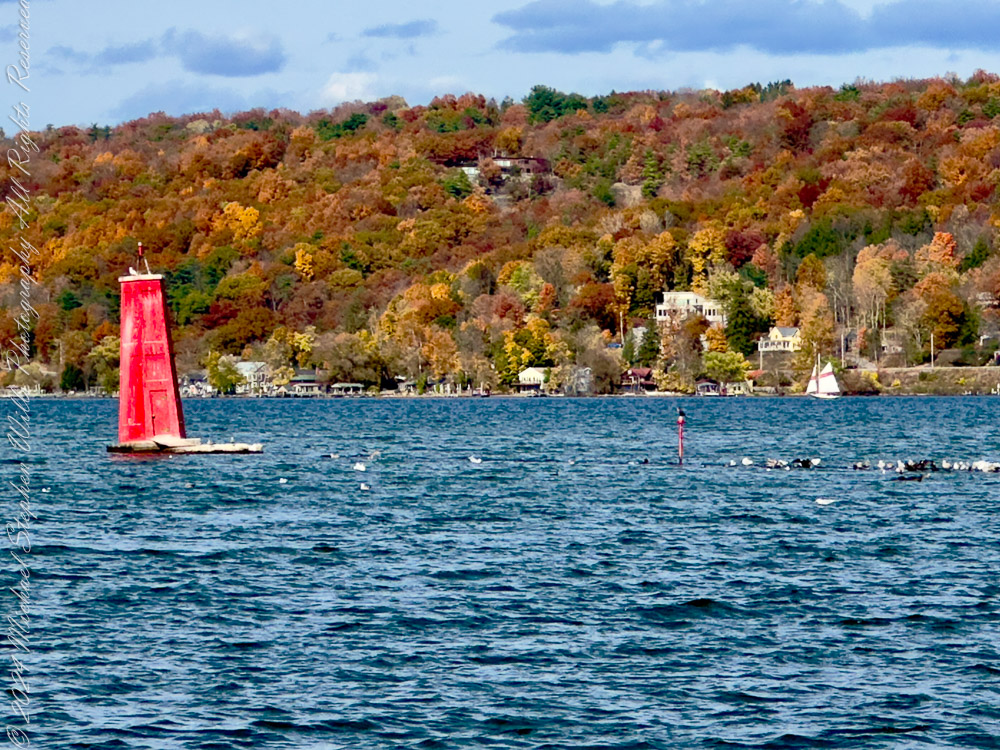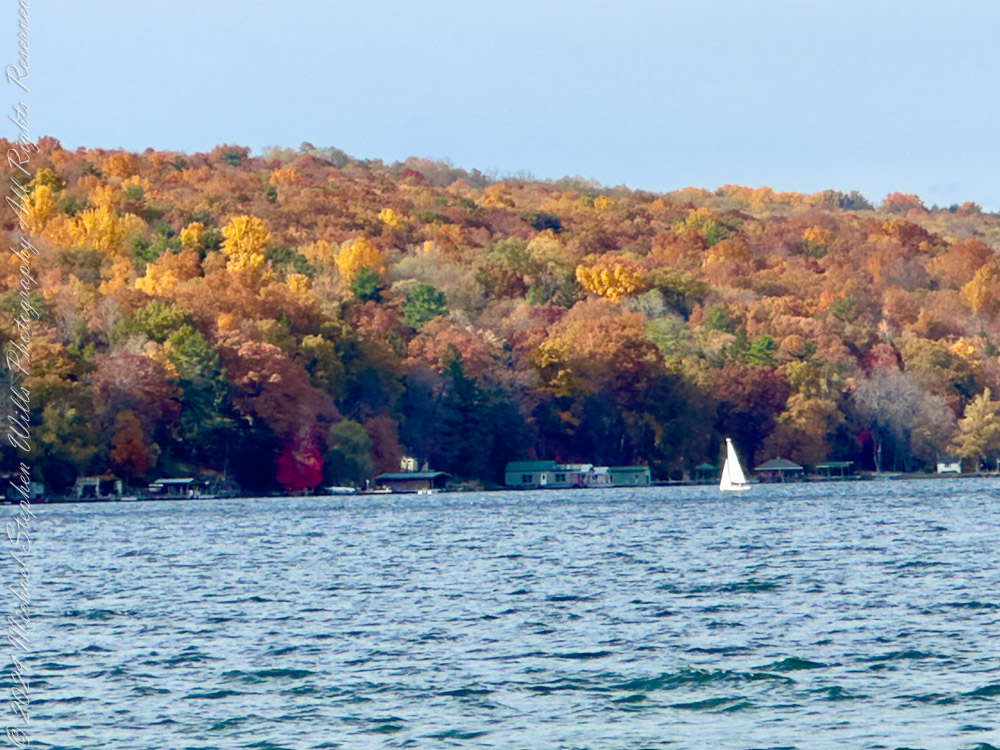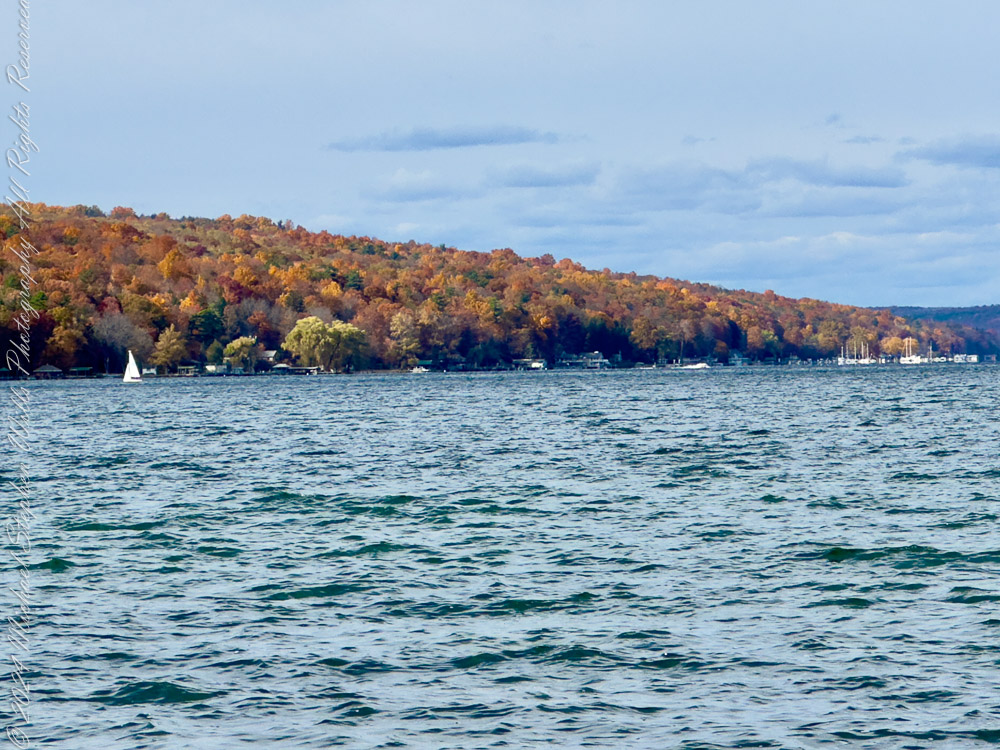
The Cayuga Waterfront Trail beautifully showcases autumn’s colors, history, and ecological significance through its landscapes and trees like Sugar Maples.
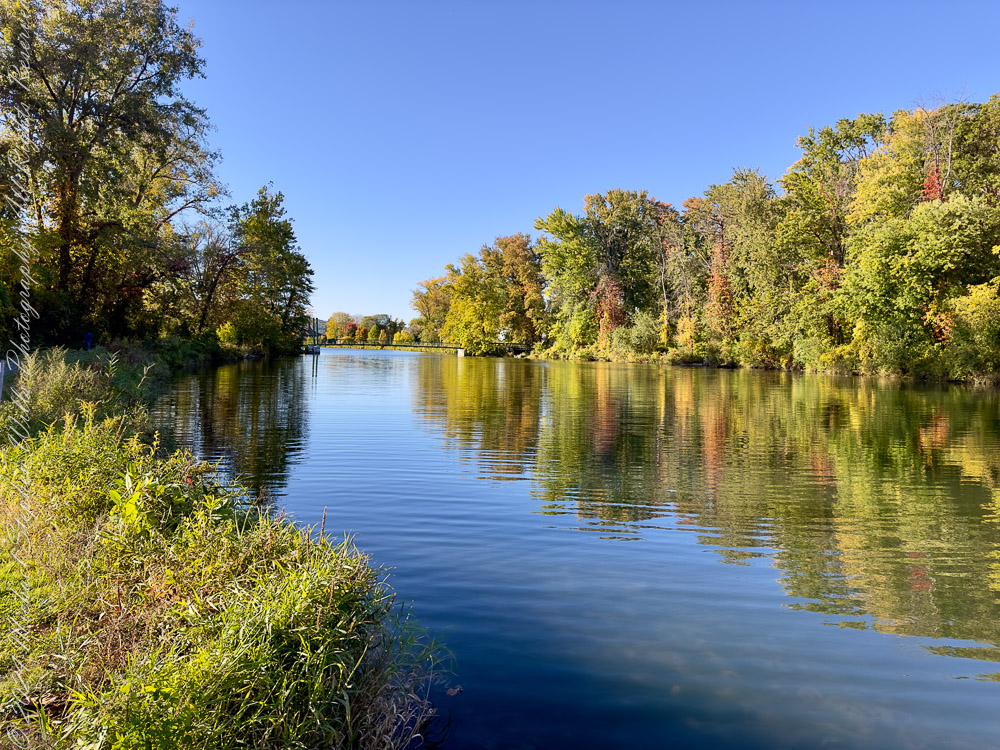
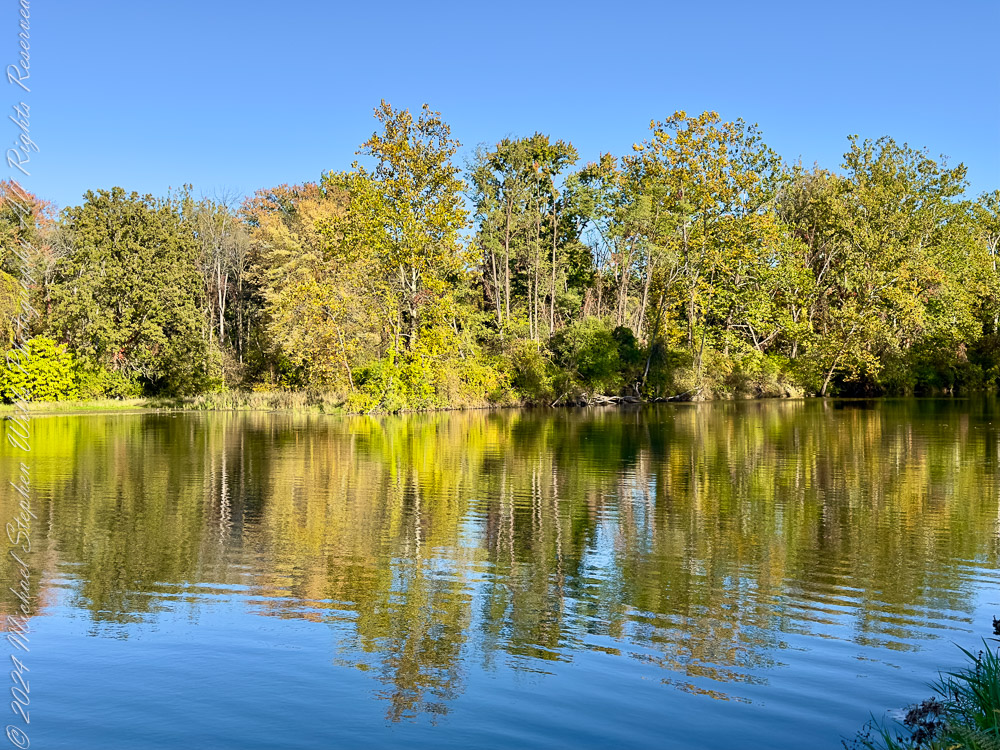
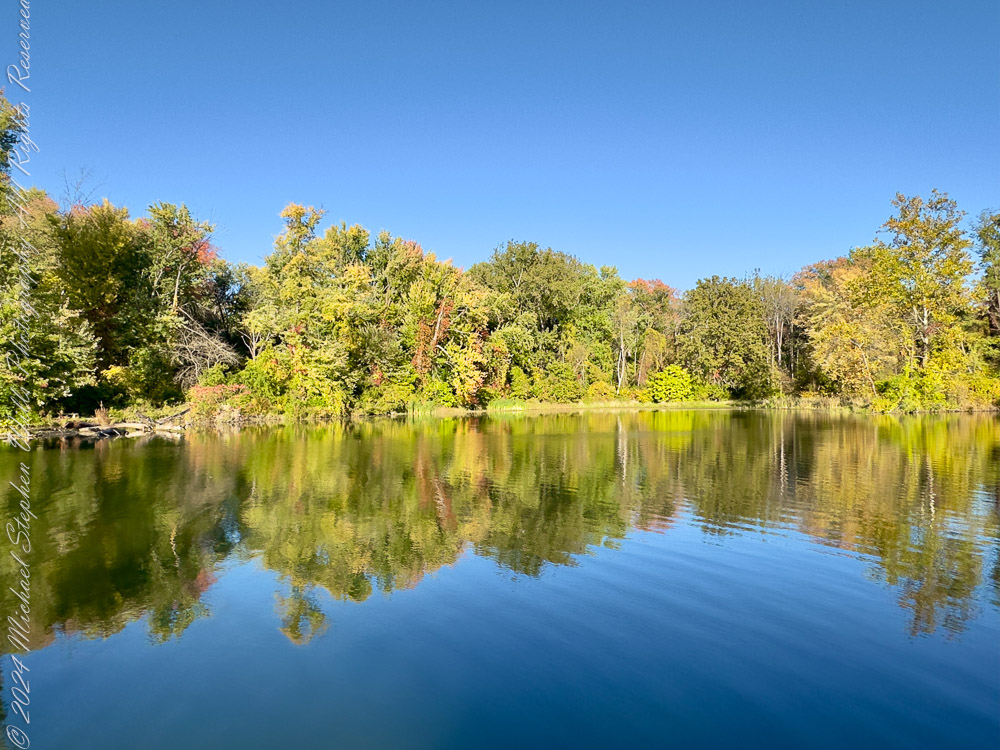
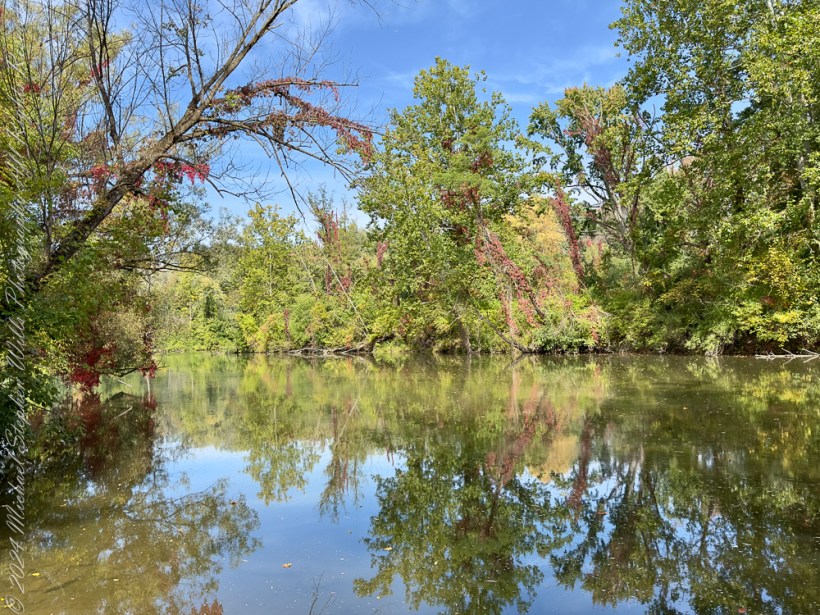
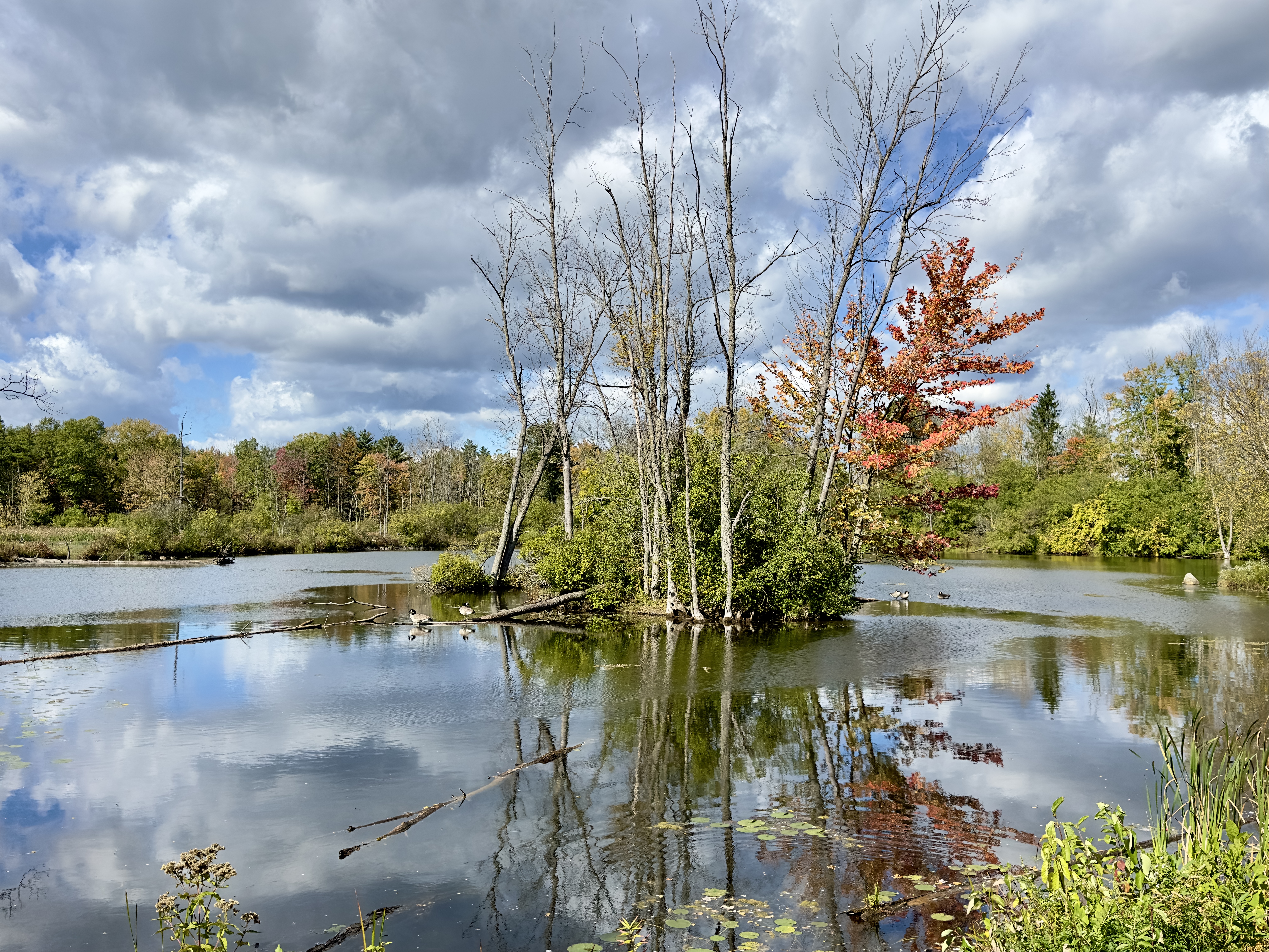
Where Fall Creek Meets Cayuga Lake Here, where Fall Creek flows gently into Cayuga Lake, the merging waters reflect the season’s colors like a painter’s palette. Across the shimmering surface, Renwick Woods of Stewart Park stands as a quiet sanctuary of mixed hardwoods and wetlands. The reflections capture our trees together with the essence of autumn’s stillness.
Dominating the shoreline, you can spot Silver Maple (Acer saccharinum) and Cottonwood (Populus deltoides), trees that thrive in damp soils. Silver Maples, with their elegant, deeply lobed leaves, are perfectly suited for this riparian environment. The cottonwood, recognizable by its broad, triangular leaves, plays a vital role in stabilizing streambanks.
Quick Fact: Cottonwoods are among the fastest-growing trees in North America, capable of sprouting leaves within weeks of being washed ashore as driftwood.
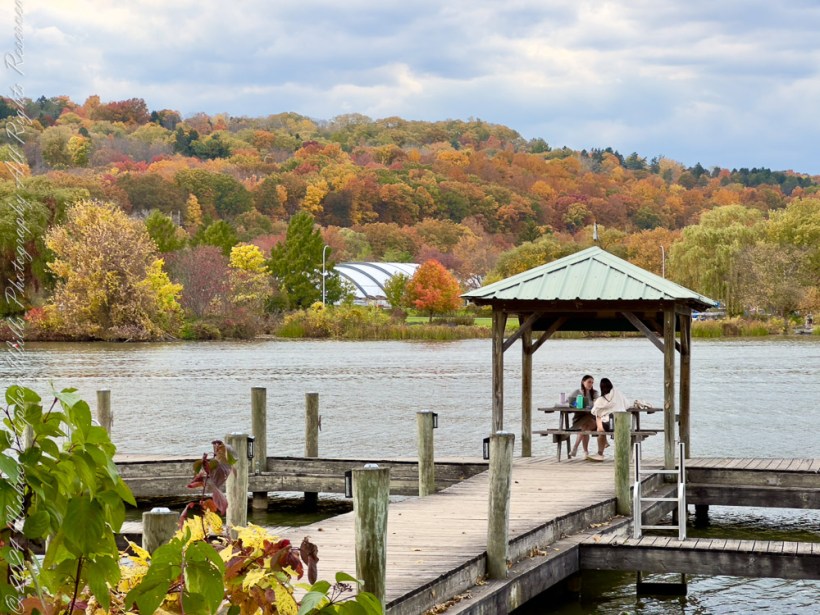
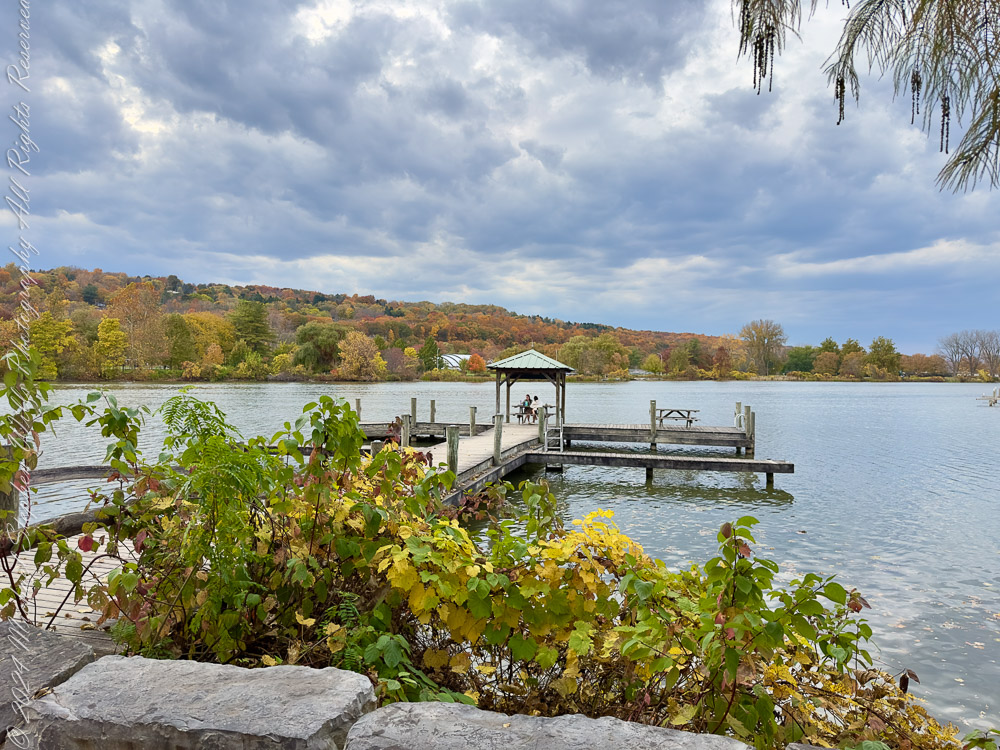
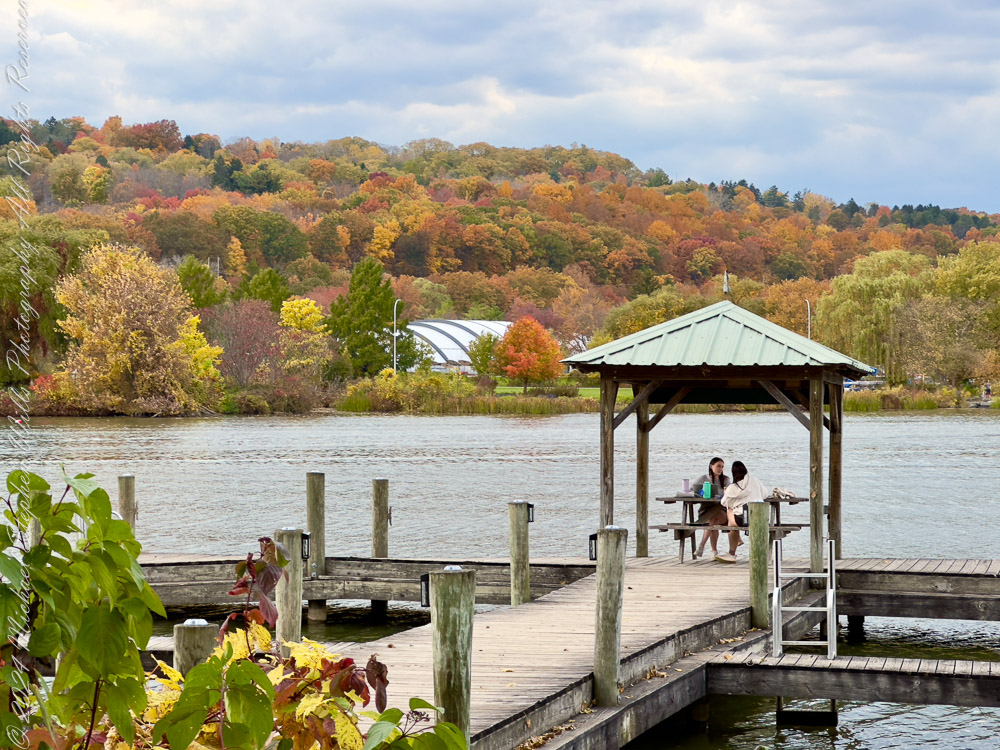
Steamboat Landing: A Glimpse of History The wooden docks at Steamboat Landing, now home to the bustling Ithaca Farmer’s Market, speak of bygone eras when steamboats ferried goods and people across Cayuga Lake. Today, as golden foliage cloaks the hills in the distance, this spot remains an anchor for community and connection.
A meeting place for friends and conversation
Foregrounded in the photos are plants like Grape Vine (Vitis spp.), with their sprawling, hardy stems turning yellow as temperatures drop. Grapevines, both wild and cultivated, thrive along the lakeshore and remind us of their agricultural importance in the Finger Lakes.
Also visible are some shrubs of Virginia Creeper (Parthenocissus quinquefolia) turning crimson, their vibrant hues climbing posts and fences as they embrace autumn’s spotlight.
Did You Know? Steamboat Landing was part of Ithaca’s rich lake commerce history during the 19th and early 20th centuries, connecting travelers to destinations far and wide.
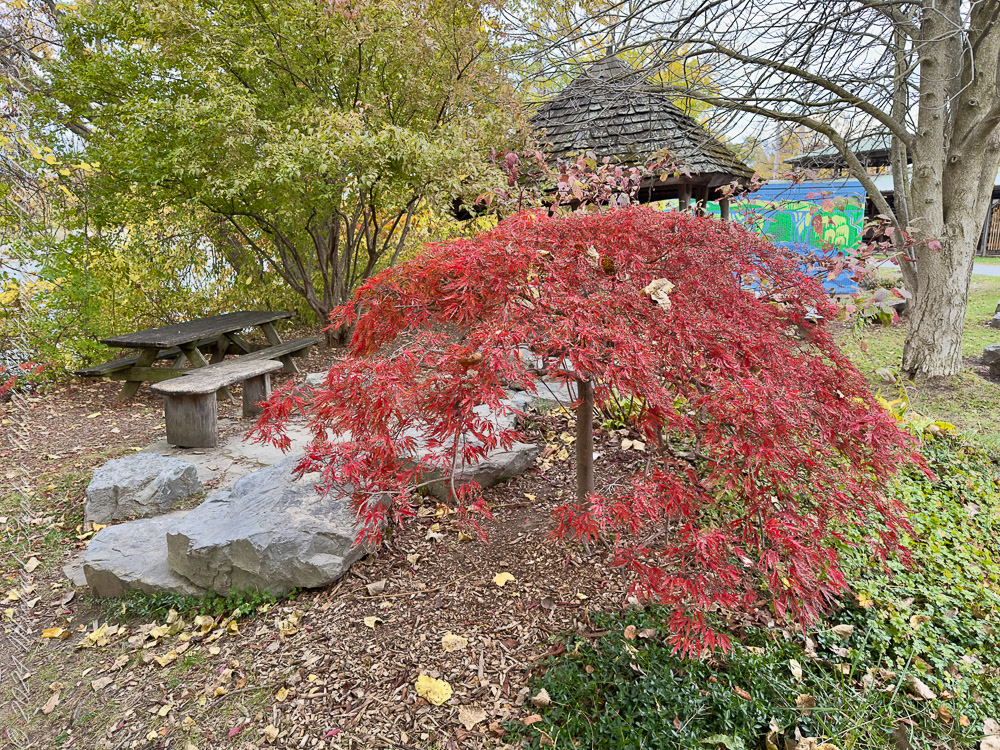
The Crimson Canopy: Japanese Maple This photo highlights a stunning Japanese Maple (Acer palmatum), its feathery, scarlet foliage cascading delicately in front of the pavilion. Native to East Asia, Japanese Maples have found a beloved place in landscapes across the world for their graceful form and brilliant seasonal displays.
Alongside its boughs, weathered benches and stone pathways invite rest and reflection — a beautiful marriage of human craftsmanship and nature’s artistry.
Fun Fact: Japanese Maples are often pruned meticulously in Japanese gardens to emphasize their architectural shape, turning them into living sculptures.
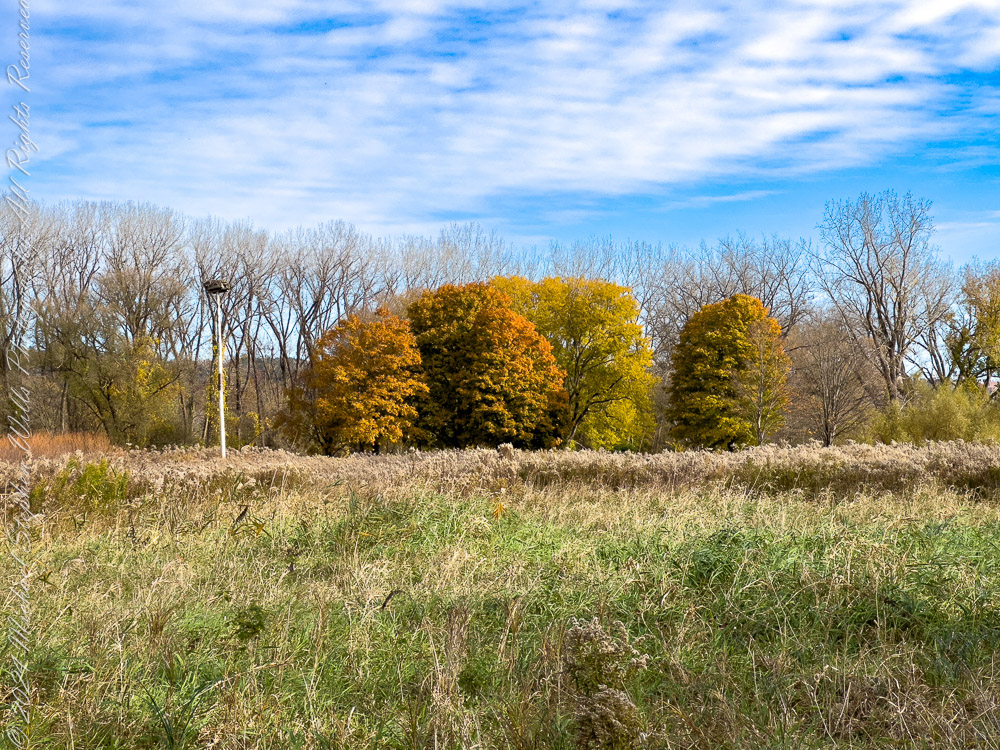
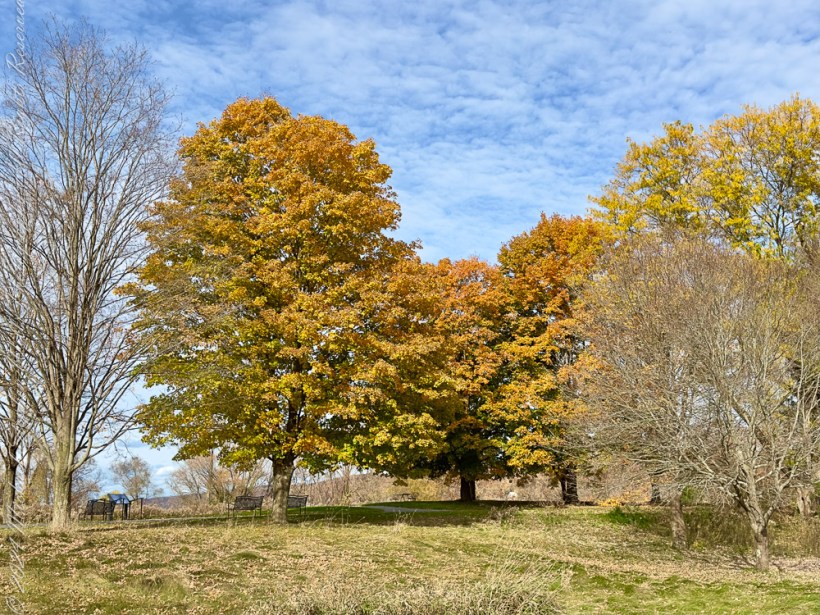
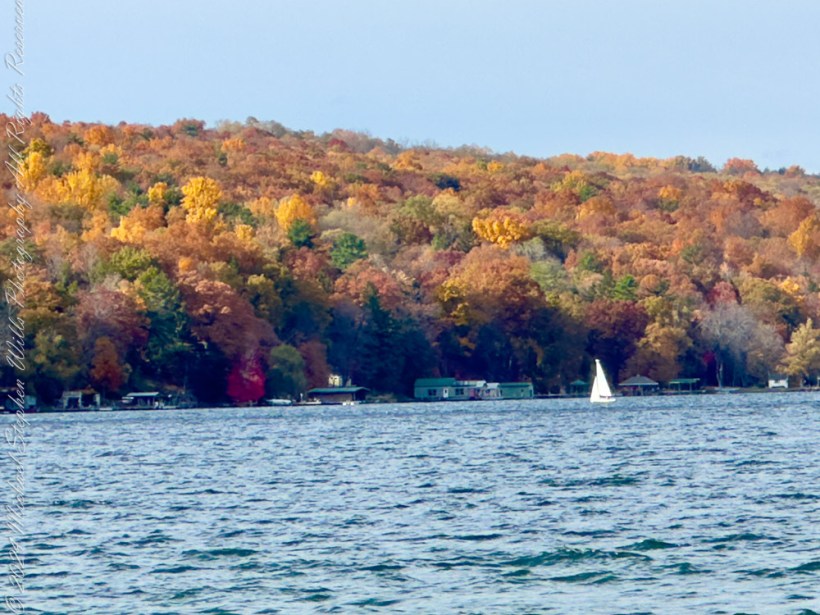
The Treman Park Lake Loop: Autumn’s Golden Finale Our journey concludes with this sweeping landscape from the Treman Park Lake Loop. The towering Sugar Maples (Acer saccharum) dominate the view, their crowns now a rich, golden orange — a signature of northeastern forests. Known as the tree that gives us maple syrup, Sugar Maples are quintessential symbols of autumn in the Finger Lakes.
To the right, bare branches of earlier-shedding trees stand in contrast, whispering the arrival of winter. The sky above, painted with soft clouds, completes the scene of a serene seasonal transition.
Interesting Note: Sugar Maples can live for over 300 years, their wood prized for furniture and instruments, and their sap a sweet gift of the forest.
Closing Thoughts From the quiet confluence of Fall Creek and Cayuga Lake to the historic docks of Steamboat Landing and the golden maples of Treman Park, autumn on the Cayuga Waterfront Trail is a symphony of color, history, and ecological wonder. Whether you’re strolling, photographing, or simply pausing to take it all in, these moments capture both the grandeur and subtlety of the season.
Enter your email to receive notification of future postings. I will not sell or share your email address.
Copyright 2024 All Rights Reserved Michael Stephen Wills
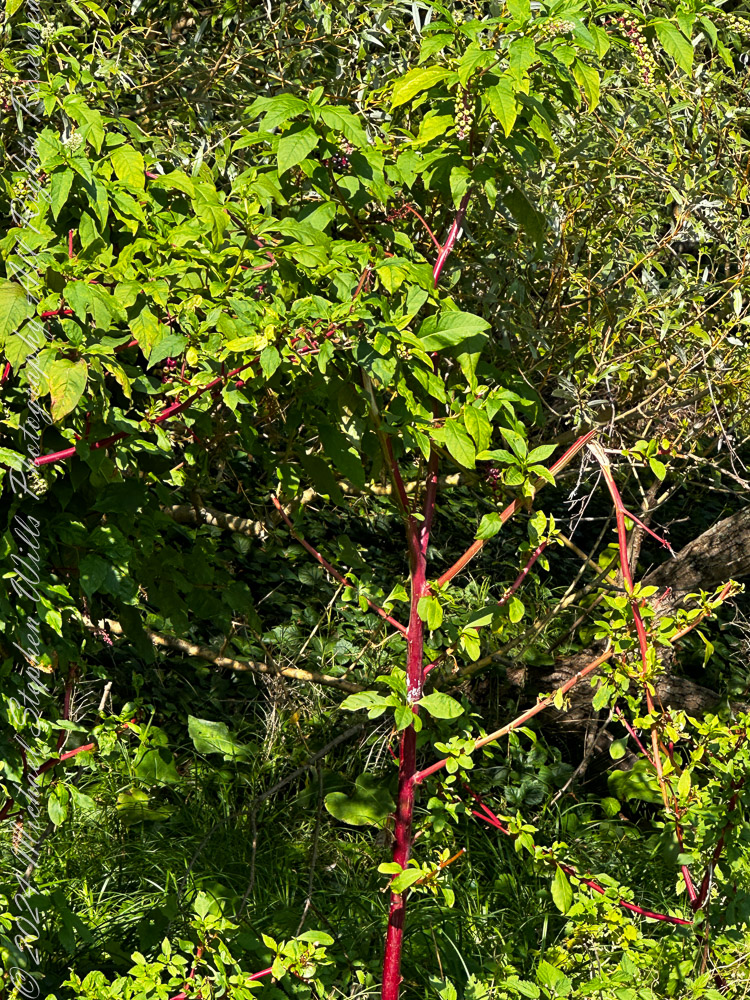
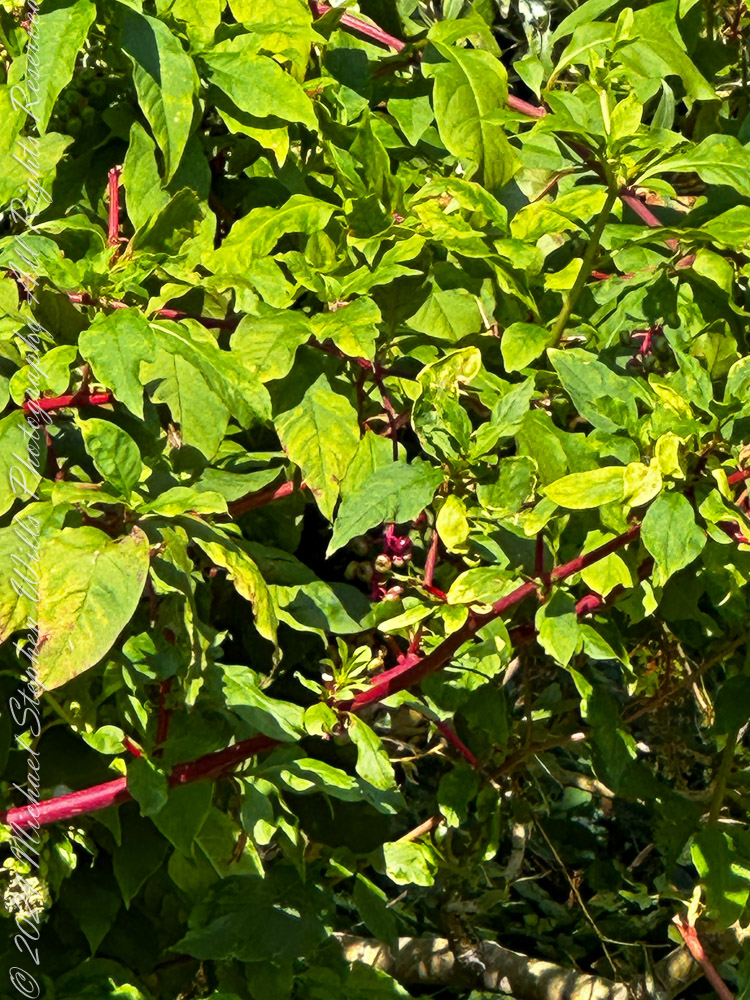
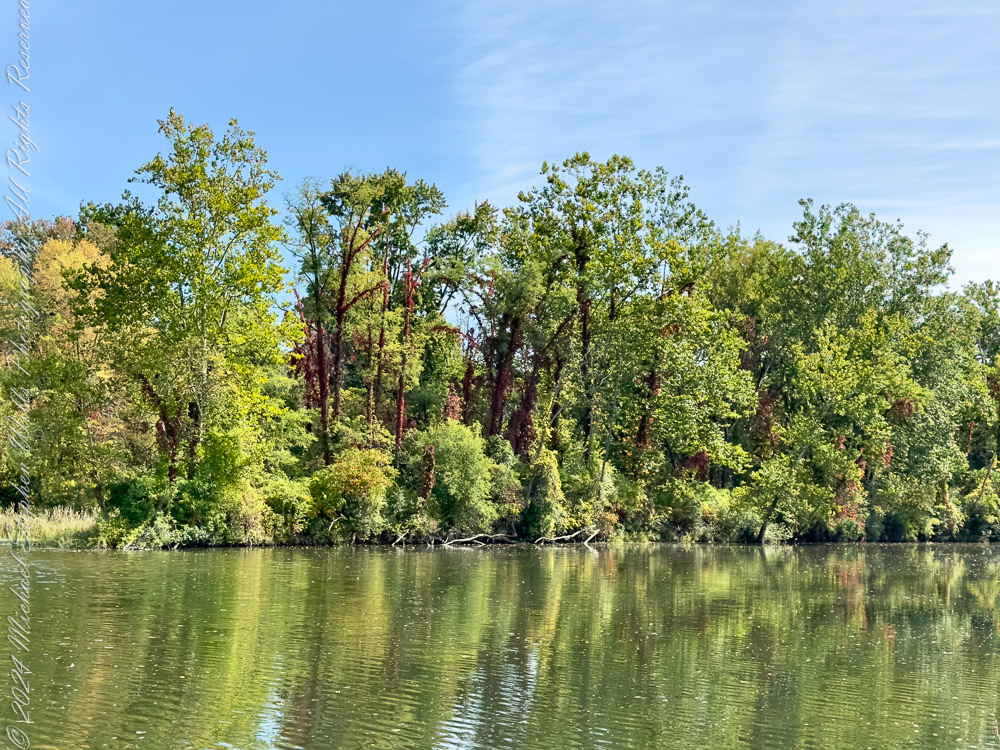
Our explorations along Ithaca’s Cayuga Waterfront Trail begins with the striking Pokeweed (Phytolacca americana), its ruby-red stems rising like sentinels against a sea of green leaves. At a glance, it’s bold, almost tropical, yet this native plant is a quintessential autumn feature in the Northeast. Those drooping clusters of berries (not yet ripe here) are food for birds like robins and mourning doves — though toxic to us, pokeweed adds a bit of danger to its beauty.
Nature’s Note: While visually stunning, pokeweed’s ripe purple berries were historically used as dye. Early settlers and Native Americans knew its power, though caution is always the rule here!
The Mighty Oak: Sentinel of the Trail
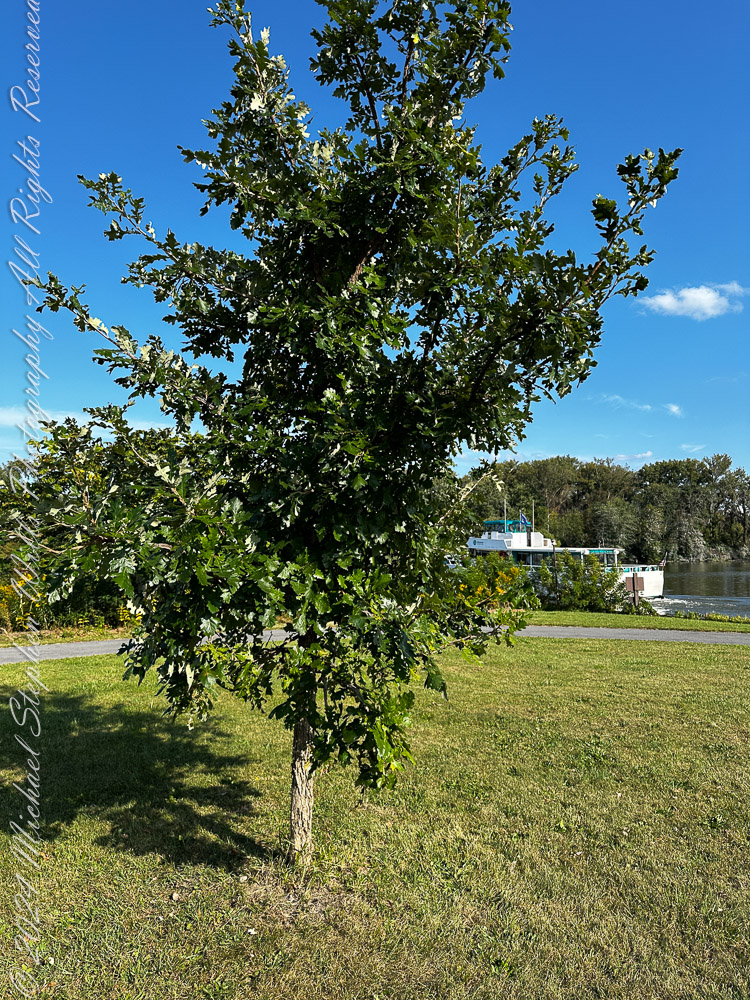
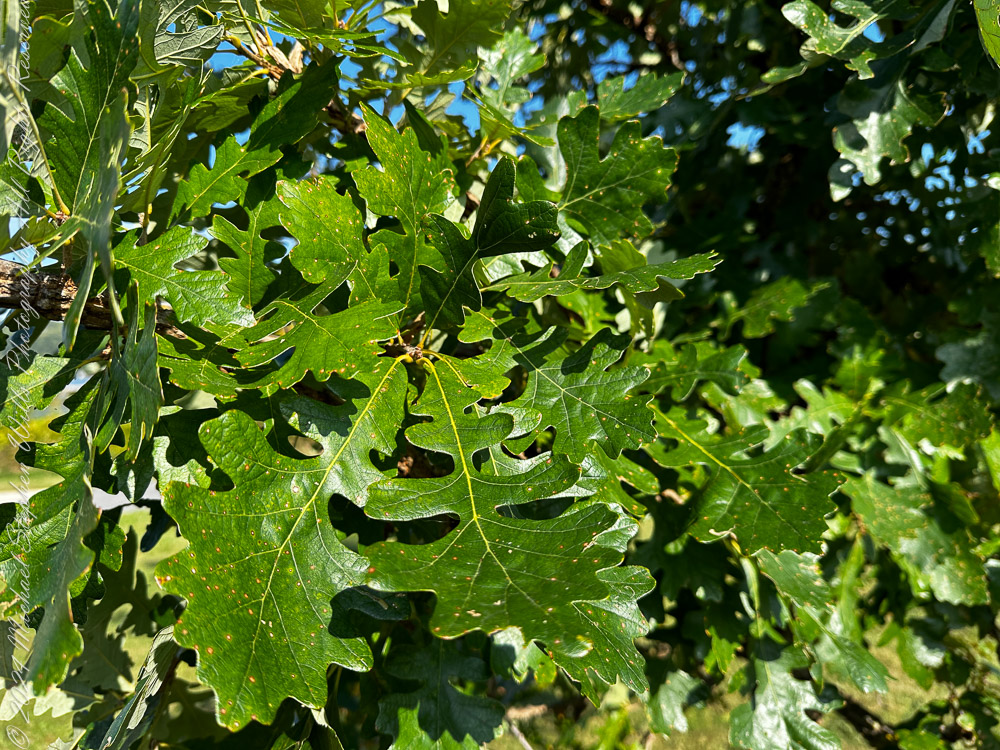
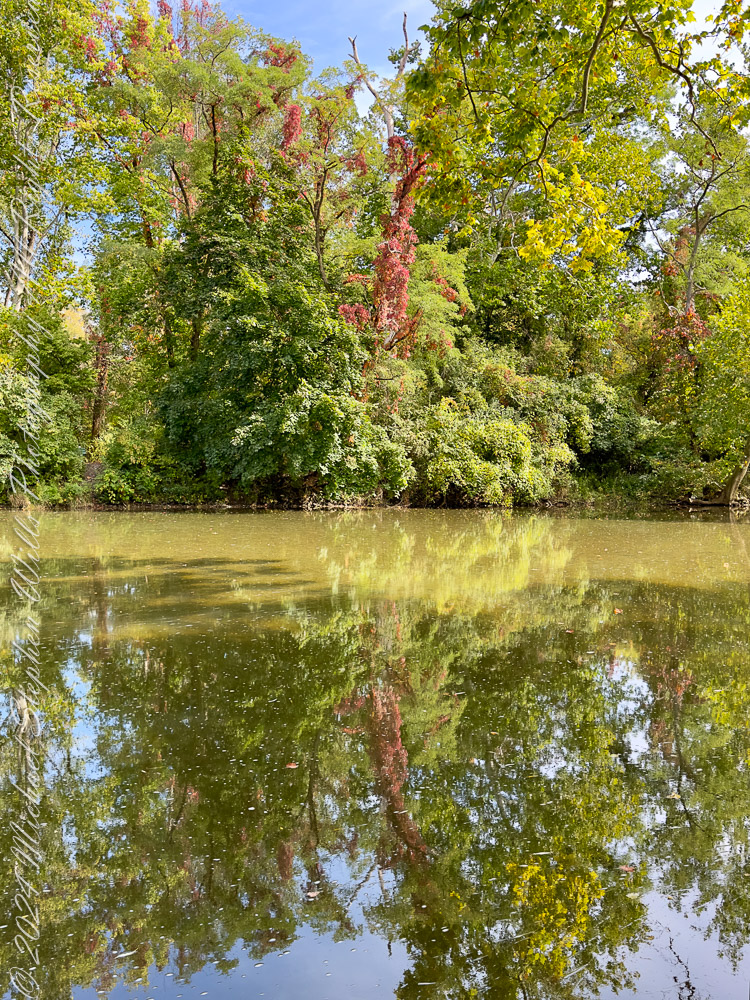
Next, we imnagine the cool shade of an oak tree, its lobed leaves silhouetted like green lacework against the clear blue sky. The photogenic Oaks are ecosystem powerhouses. Supporting hundreds of species of moths, butterflies, and birds, oaks quietly hold the fabric of nature together.
In autumn, these leaves will transform, dropping gently to create warm beds for overwintering insects. Stand beneath its branches long enough, and you’ll swear it whispers stories of the seasons gone by.
Quick Fact: Oaks produce acorns that are a favorite food of squirrels. Ever notice a squirrel “planting” them? That’s nature’s accidental reforestation plan in action.
Reflections of Autumn’s Palette
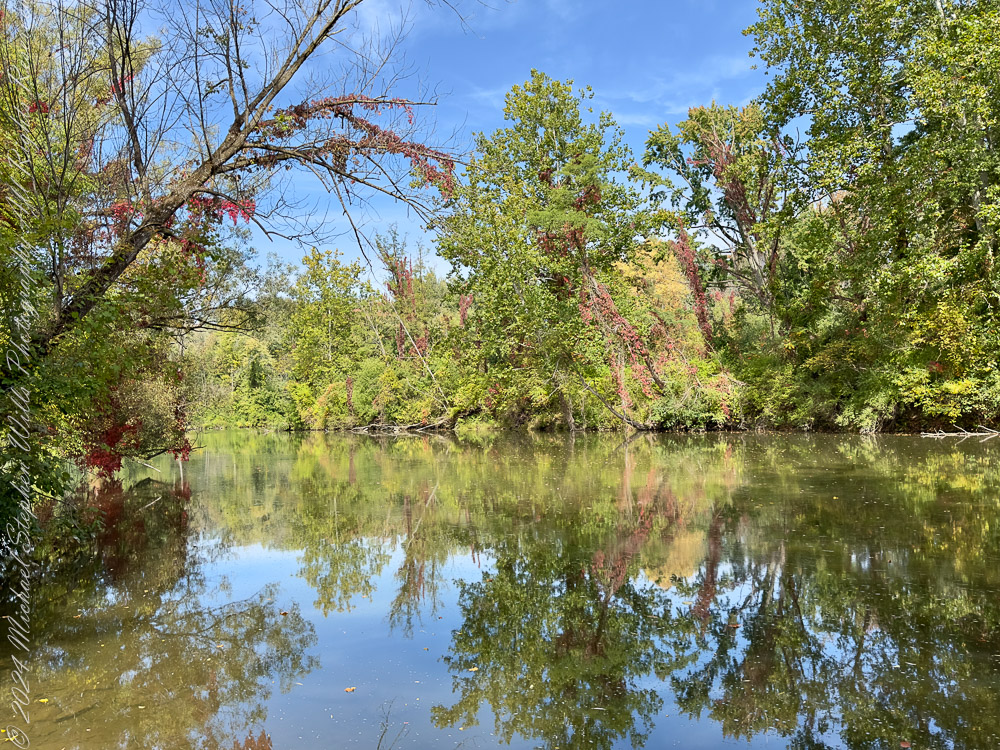
We reach the water’s edge, where the serene surface where Fall Creek joins Cayuga Lake mirrors the fiery splashes of red Virginia Creeper (Parthenocissus quinquefolia) winding through the trees. This climbing vine, with its scarlet fall foliage, is like nature’s ribbon tying the forest together.
The reflection — a perfect painting — blurs the boundary between land and water. Here, quiet reigns, save for the soft ripple of a fish or the rustle of leaves overhead.
Curious Note: Virginia Creeper is often mistaken for poison ivy. The secret? Virginia Creeper has five leaflets, while poison ivy wears three — nature’s rhyme: “Leaves of three, let it be.”
Aster Alley: A Burst of Purple Beauty
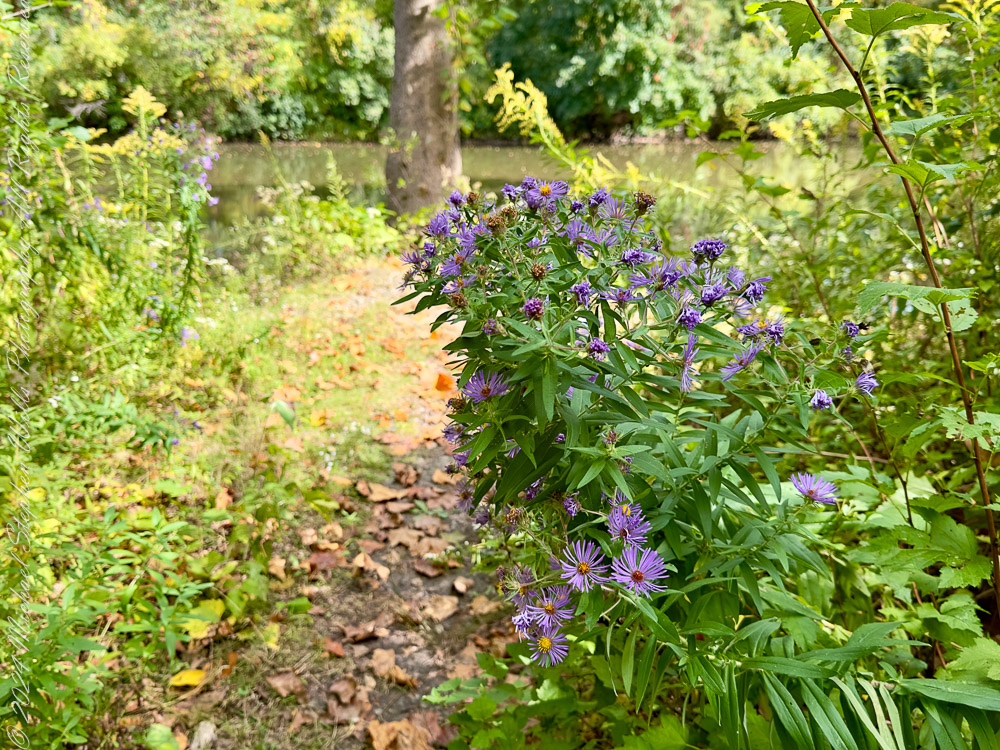
On the trail’s side, a cheerful gathering of New England Asters (Symphyotrichum novae-angliae) steals the spotlight. These vibrant purple flowers, with their golden centers, are late-season treasures. As most blooms fade, asters feed pollinators like bees and butterflies in their final push before winter.
Walk by slowly, and you might catch a bumblebee lazily humming its thanks — a last sip of nectar before the chill sets in.
Did You Know? Asters get their name from the Greek word for star. Fitting, don’t you think?
Nature’s Quilt: Pine Needle Carpet
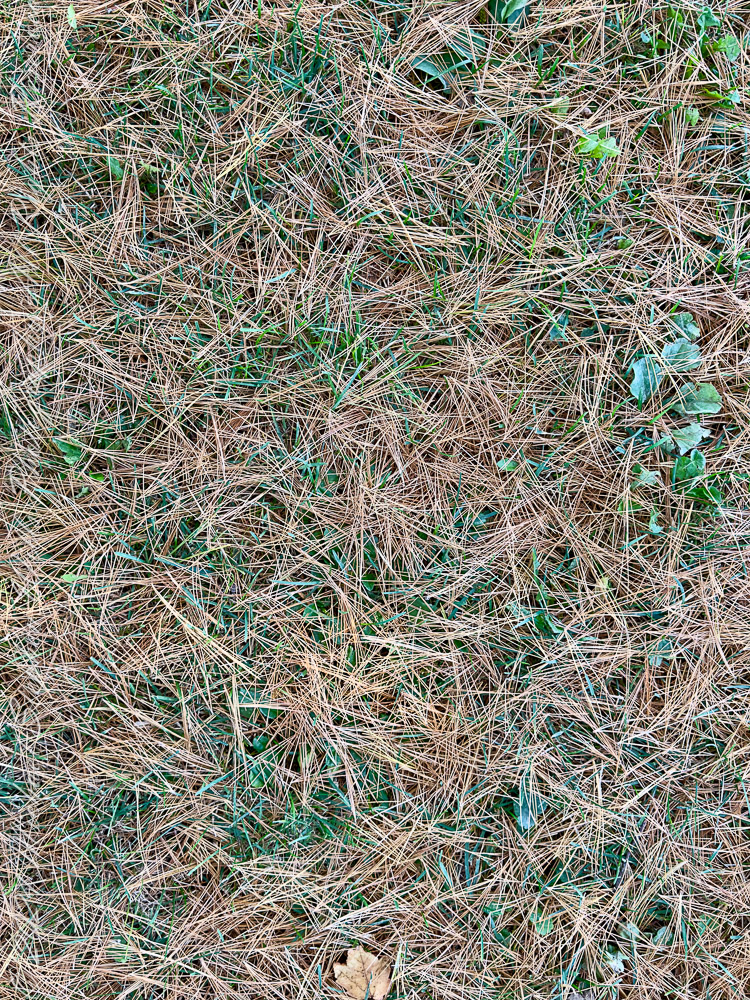
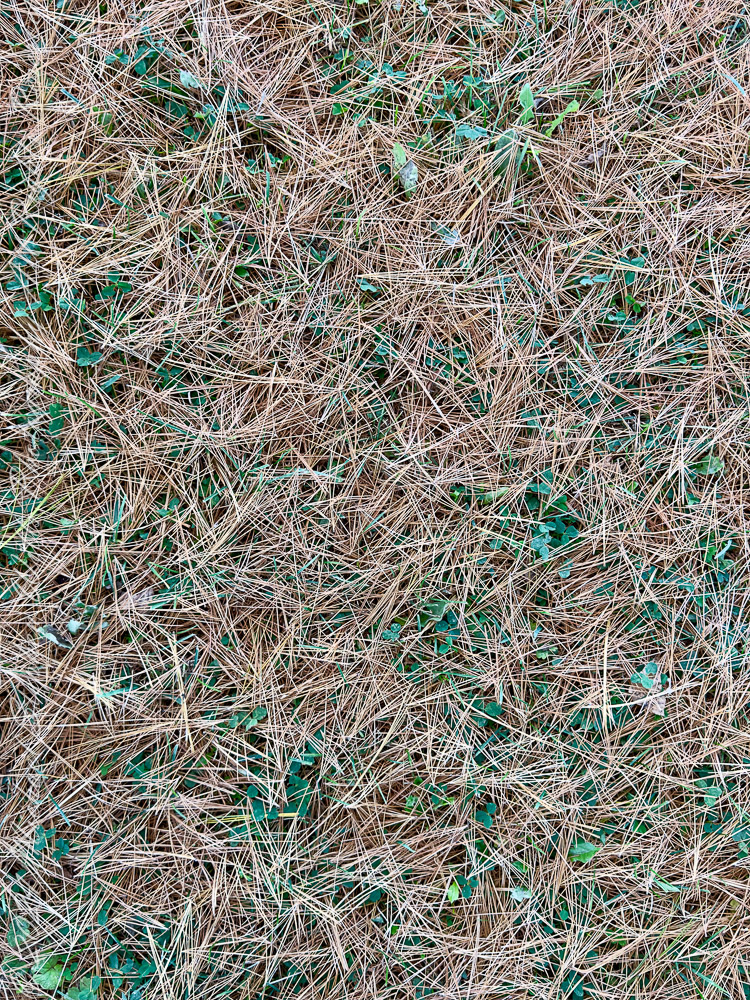
Finally, we tread across a textured carpet of pine needles, blanketing the ground in warm, earthy hues. Beneath this seemingly simple scene lies a story of renewal. As pines shed their needles, they enrich the soil with organic matter, providing a soft bed for new life to sprout in the spring.
The crunch underfoot feels both nostalgic and meditative — a gentle reminder that every fallen needle is part of nature’s endless cycle.
Fun Observation: Pine needles, often called “nature’s mulch,” are slightly acidic, which helps pine trees thrive while keeping competition at bay.
Closing Thoughts
From the bold reds of pokeweed to the mirrored waters adorned with Virginia Creeper, and the twinkle of asters amid the foliage, autumn along the Cayuga Waterfront Trail is a celebration of nature’s resilience and beauty. It’s a quiet reminder that even as the seasons shift, the world remains vibrant — a living, breathing tapestry stitched together by trees, plants, and reflections.
So, walk slowly, listen closely, and let the stories of leaves, stems, and waters guide your journey.
Enter your email to receive notification of future postings. I will not sell or share your email address.
Copyright 2024 All Rights Reserved Michael Stephen Wills
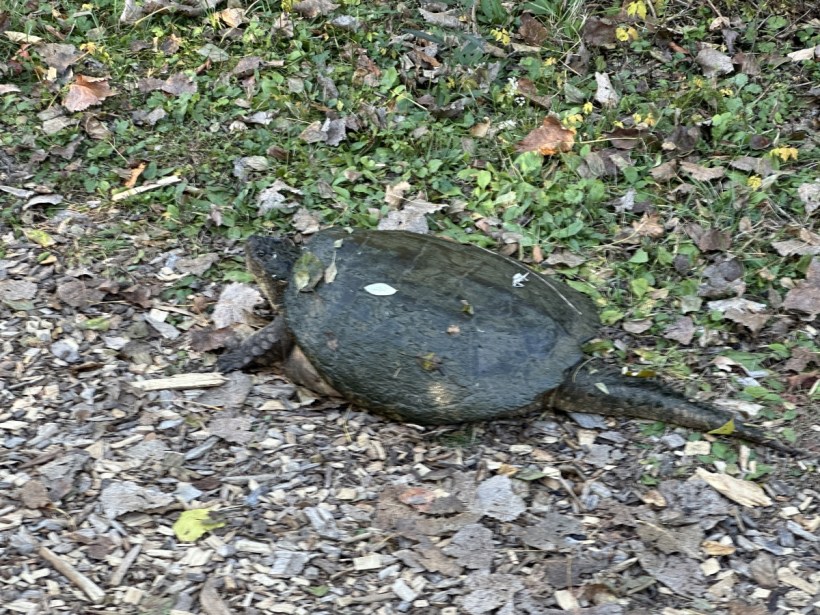
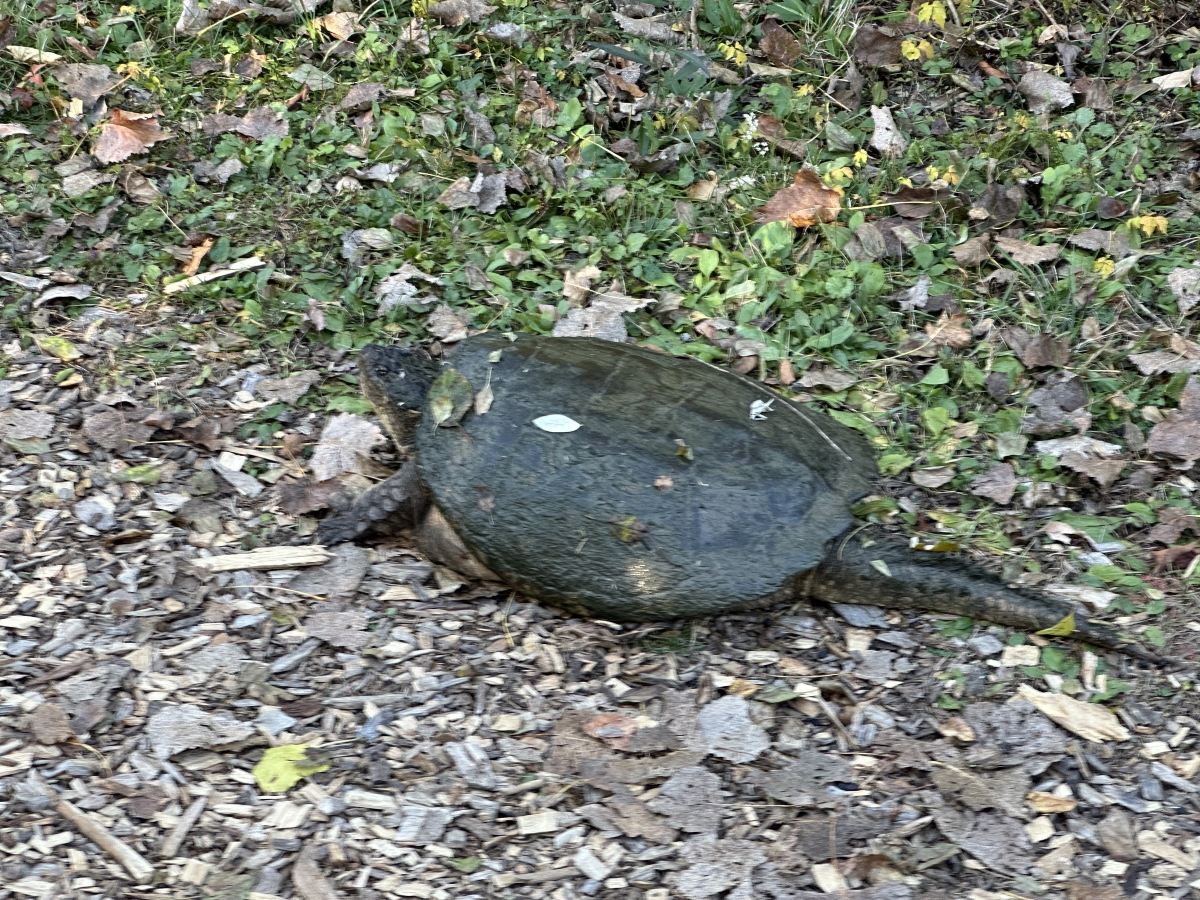
O ancient wanderer of Sapsucker Woods, armor-clad and quiet, you lumber forth, carved from the earth itself, sculpted from mud and pondweed dreams.
October’s afternoon light paints you with golden shadows, each leaf fallen, each branch broken a whispered testament to the slowness of your path, steady as a heartbeat unmoved by haste.
You bear the centuries in the lines of your shell, grooves and valleys where stories settle, tales of reeds and minnows, and the deep-rooted knowing that life is best met with patience, with pause.
O creature of edges and silence, you bridge water and wood, the line between stillness and stride. What weight you carry, not of burden, but of presence— a shell that holds the weight of stars, the bones of ancient rivers, and the soft clay of Sapsucker’s floor.
In your slow, silent passing, the trail bows to you. Leaves make way, and the earth beneath you settles a little deeper, reminded of the strength that moves without noise, the wisdom that crawls in the path of shadows.
Turtle, you who wear the world’s patience, I watch you disappear, an ambassador of ponds and pools, a silent architect of marsh and moss. May your journey be long, your pauses endless, and your shell a testament to the beauty of age, carved by time, blessed by the sun.
Enter your email to receive notification of future postings. I will not sell or share your email address.
Copyright 2025 All Rights Reserved Michael Stephen Wills
On this autumn Sapsucker Woods afternoon, the world seems crafted to soothe. Sunlight filters through the canopy, setting leaves ablaze in rich reds, golden yellows, and softened greens, the seasonal palette reflecting nature’s grand finale. Today, the woods are a sanctuary for healing, a space where steps are measured not by speed but by strength, each one a testament to resilience.
Pam stands before the wide, outstretched wings painted on the wall at the Cornell Lab of Ornithology, wings so vast that they dwarf her. She smiles, resting against her hiking poles, the Condor wings an emblem of a journey toward reclaiming freedom. Her recent hip replacement surgery has given her back this independence, a reminder that recovery is not just about physical mending, but about lifting the spirit to soar once again.
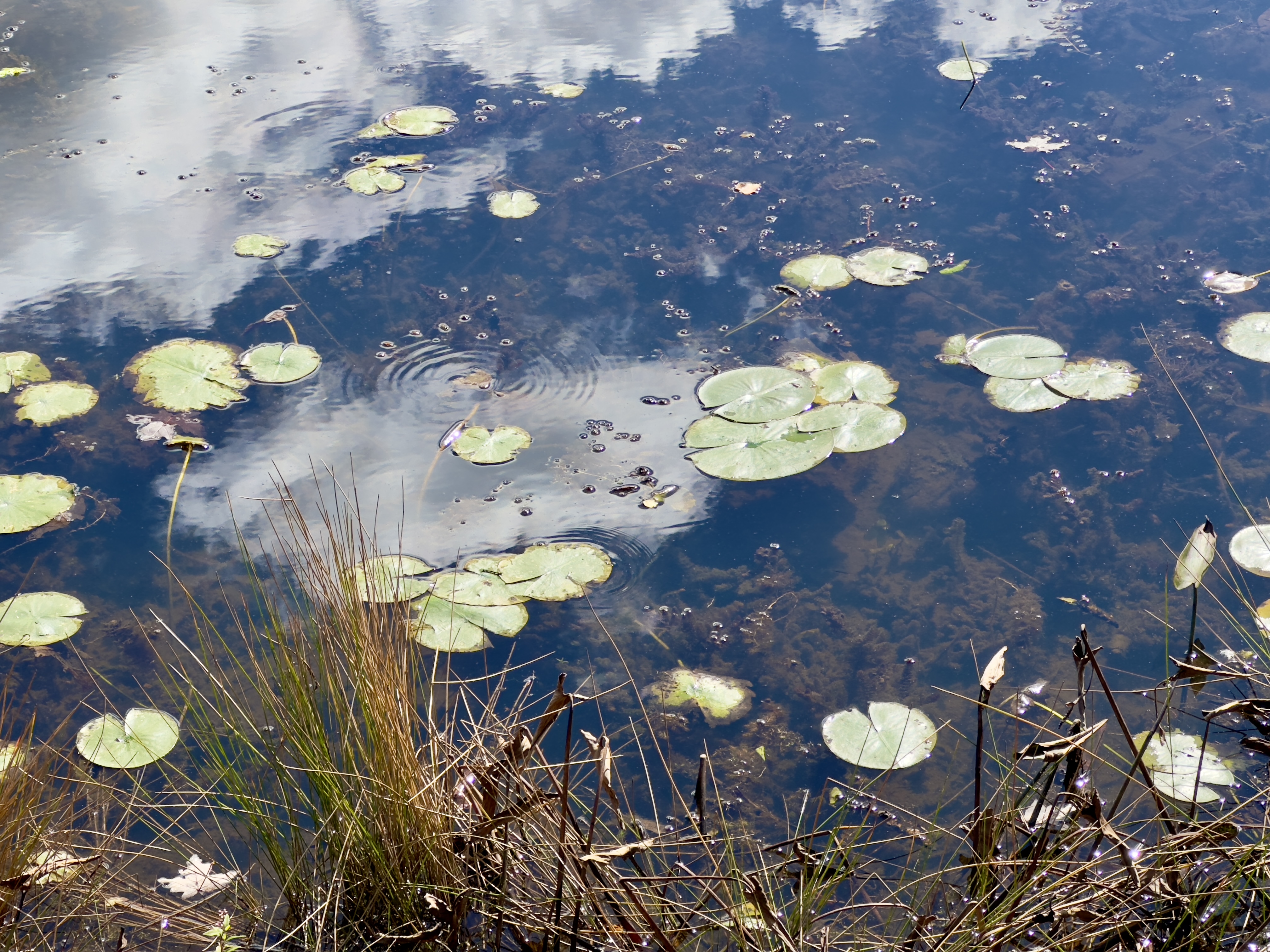
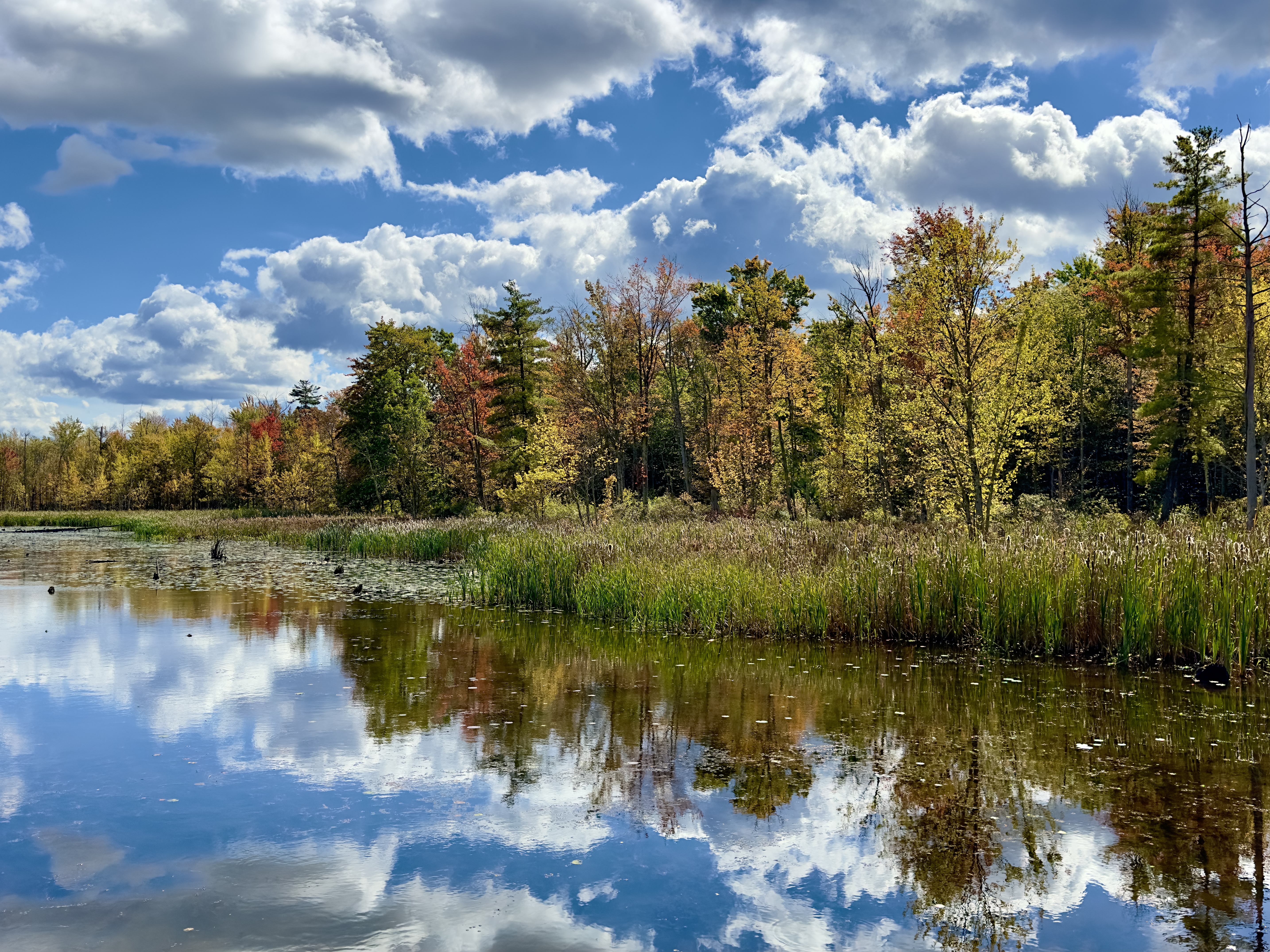
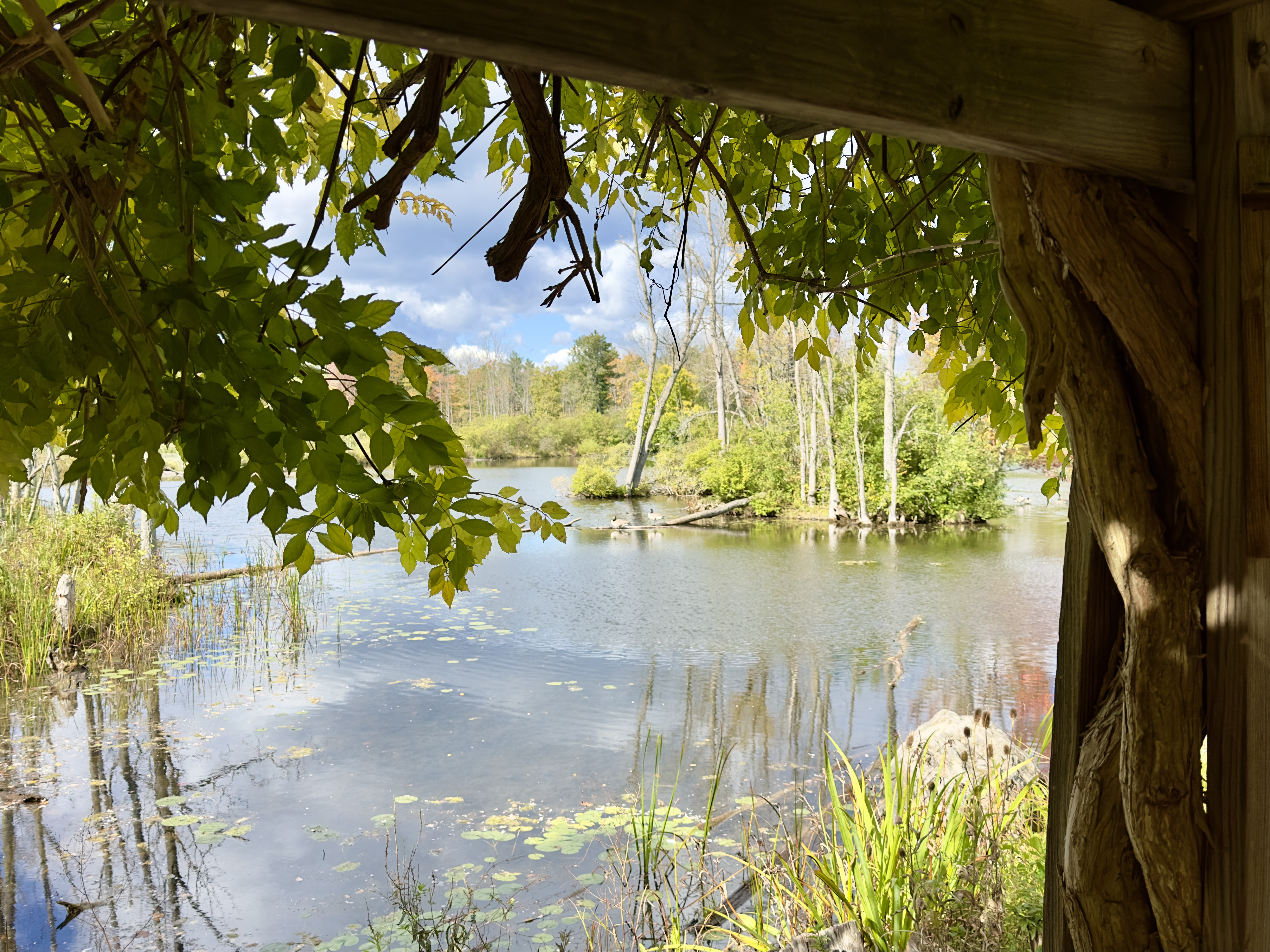
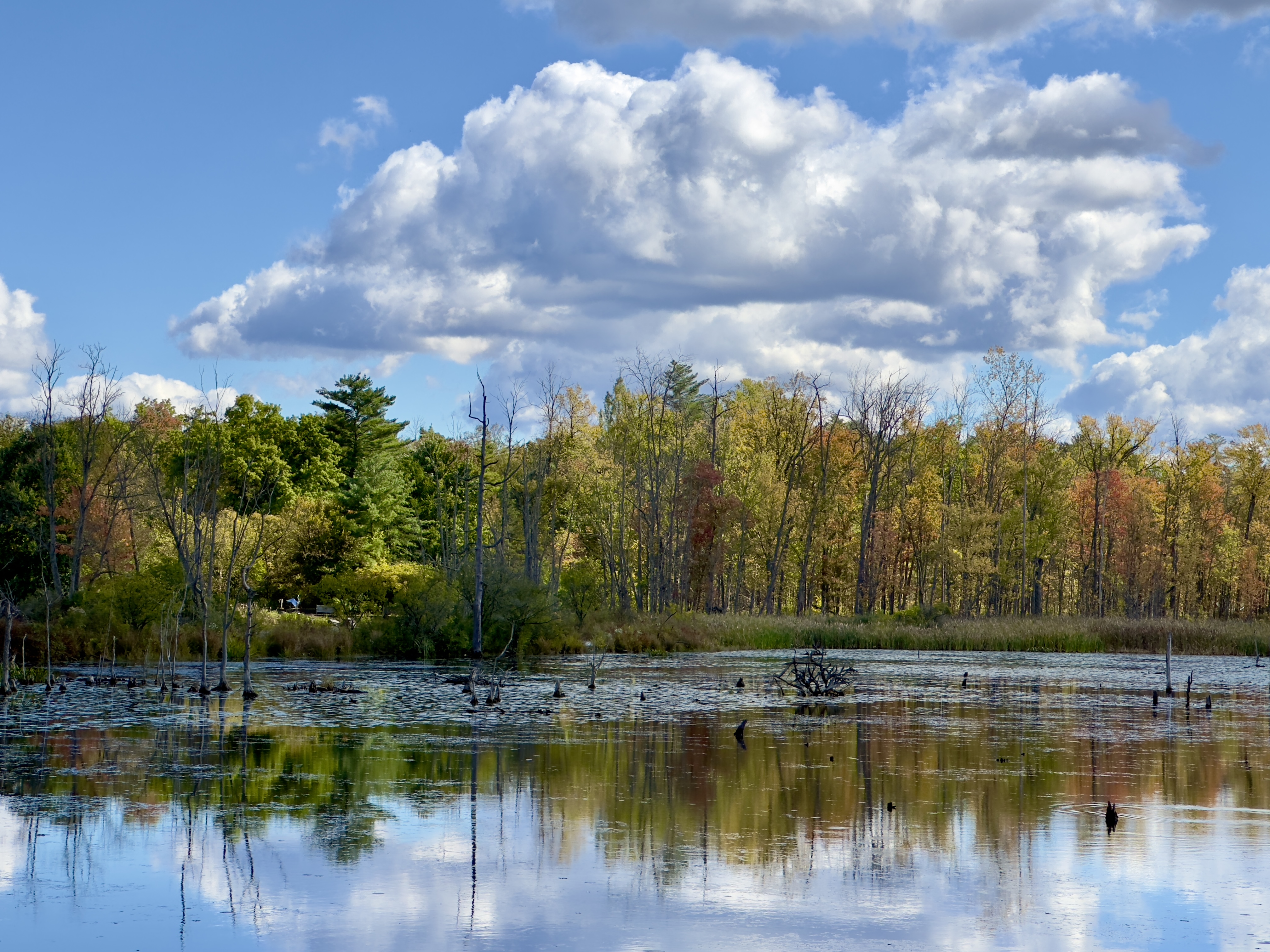
The trail unfolds gently, bordered by cattails and still waters that mirror the sky—a bright blue canvas mottled with soft clouds drifting in and out of the reflections. Fallen leaves float upon the pond’s surface, creating patches of color that seem suspended between water and sky. Nearby, lily pads, green stepping stones over shadowed depths, their edges lit by glittering sunlight. Geese glide by, unbothered, embodying a calm flowing outward, wrapping the whole scene in peace.
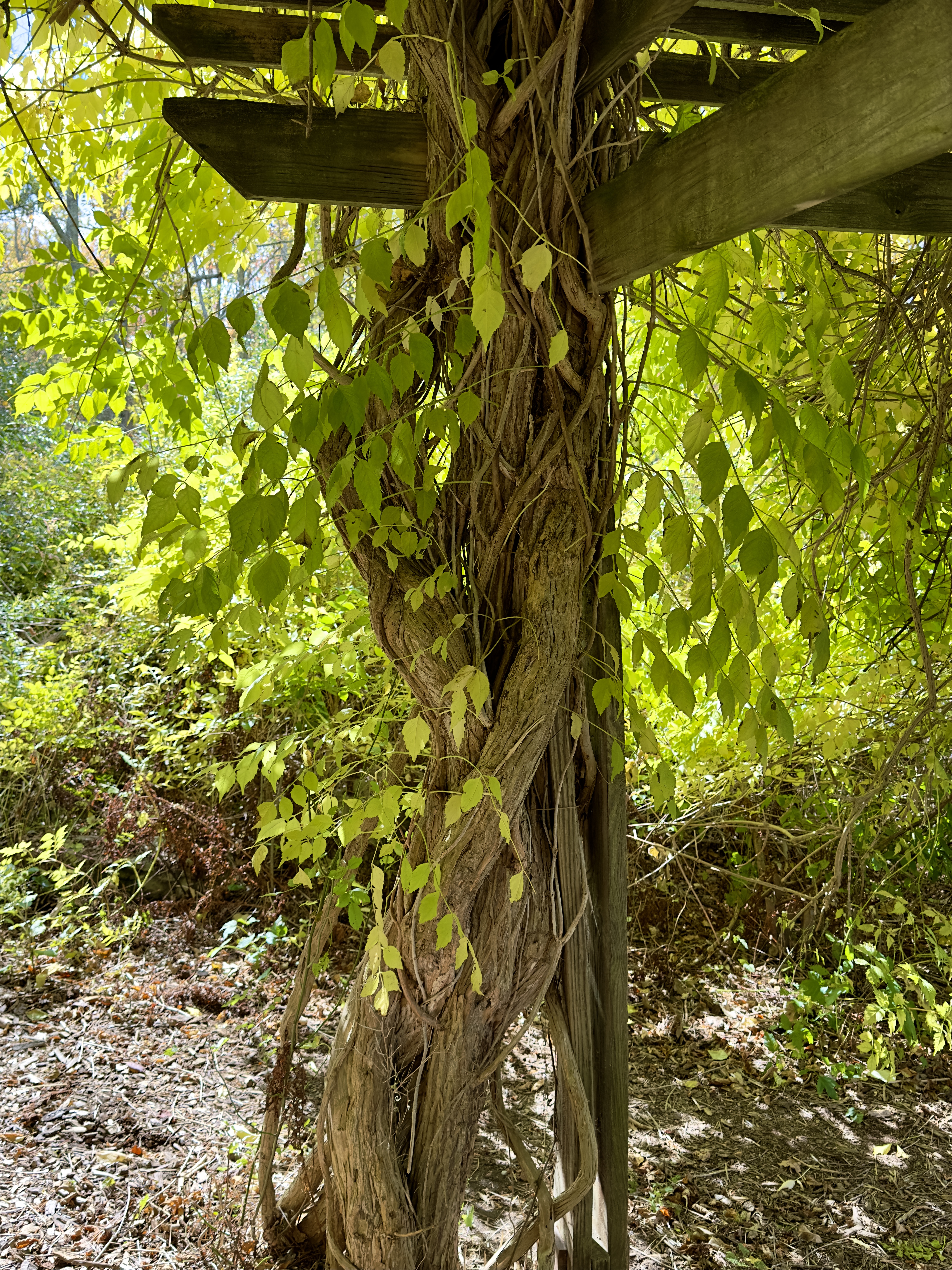
Each step Pam takes is deliberate, accompanied by the steady rhythm of her poles striking the ground. It is the kind of walk that invites contemplation, where time slows, and even the smallest detail—a single yellow leaf spiraling down, a ripple breaking the pond’s surface—feels like an invitation to pause and breathe. She moves from the open path toward a shaded arbor, draped with twisting vines. The vines climb upward, winding around the wooden beams, their leaves creating a soft veil that frames her view of the water beyond. Through this leafy curtain, she gazes upon the pond, where autumn’s reflection glows, offering a quiet moment of solitude, of healing drawn from nature’s persistence.
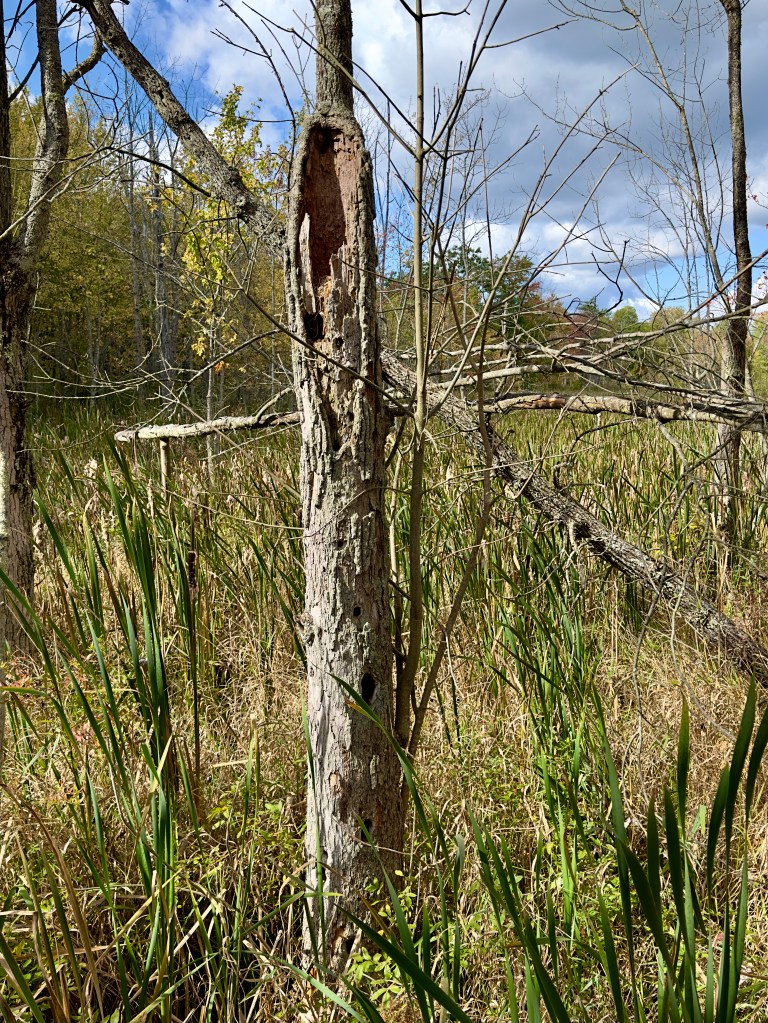
Just beyond, a bare tree stands, its trunk hollowed by years, its exposed wood testament to the life that has passed through it. In its decay, it offers a home to the creatures of the marsh, a structure among reeds and grasses that sway with the wind. The tree reminds Pam of her own journey, how resilience is often found in adapting, in letting time and life shape you.
At last, we reach a bench overlooking the pond, a perfect place to rest and reflect. She settles in, feeling the quiet thrill of accomplishment. The woods are still, save for the sound of a breeze rustling the reeds and the occasional bird song piercing the silence. In this moment, with the vast sky overhead and the world reflected below, she feels a profound sense of gratitude—not only for the beauty around her but for the strength within her. Sapsucker Woods are a personal cathedral, a space where nature and recovery intertwine, offering peace in every step, in every breath.
Enter your email to receive notification of future postings. I will not sell or share your email address.
Copyright 2024 All Rights Reserved Michael Stephen Wills
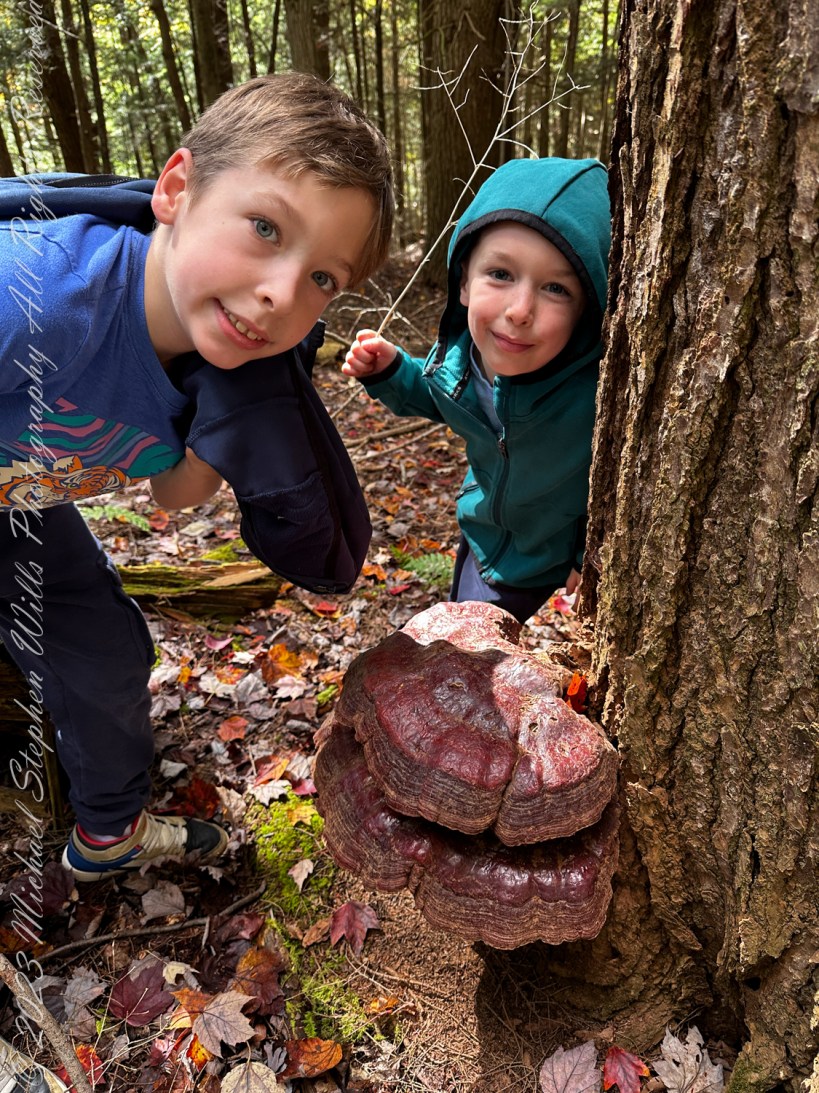
Enjoy a memorable visit to Lime Hollow Nature Preserve by a grandfather and his grandsons, exploring nature, observing wildlife, and connecting through shared experiences, fostering curiosity and appreciation for the environment.
The October sunlight was gentle as we entered Lime Hollow Nature Preserve from Gracie Road, my grandsons, Sam and Rory, bursting with excitement beside me. Sam, the eldest, took the lead, confidently striding ahead along the Sunset Trail while Rory, his younger brother, stayed close to my side, his eyes wide with wonder at the forest around us.
Descent to the Pond
The trail wound through the woods, dappled with the golds and reds of early autumn. Sam spotted a squirrel darting between trees, and Rory pointed to the sky, “Look, Grandpa, a woodpecker!” I smiled at their enthusiasm, feeling grateful for these moments of connection to nature and family.
We descended toward the pond via the Pond View Trail, the sound of trickling water drawing us closer. As we approached, the landscape opened up, revealing the calm, reflective surface of the water, bordered by reeds swaying in the light breeze. I remembered bringing the boys here last spring, how different the pond looked then—brimming with life as frogs leapt from the banks and dragonflies zipped across the water’s surface. Today, the scene was quieter, but no less magical.
Rory, ever the adventurer, crouched by the pond’s edge, watching for frogs. Sam, too, paused to observe but soon grew restless, his curiosity pushing him onward. “Come on, Grandpa! Let’s see what’s next!” His voice echoed through the trees as he darted back onto the trail, Rory quick to follow.
Encounter with the Giant Fungus
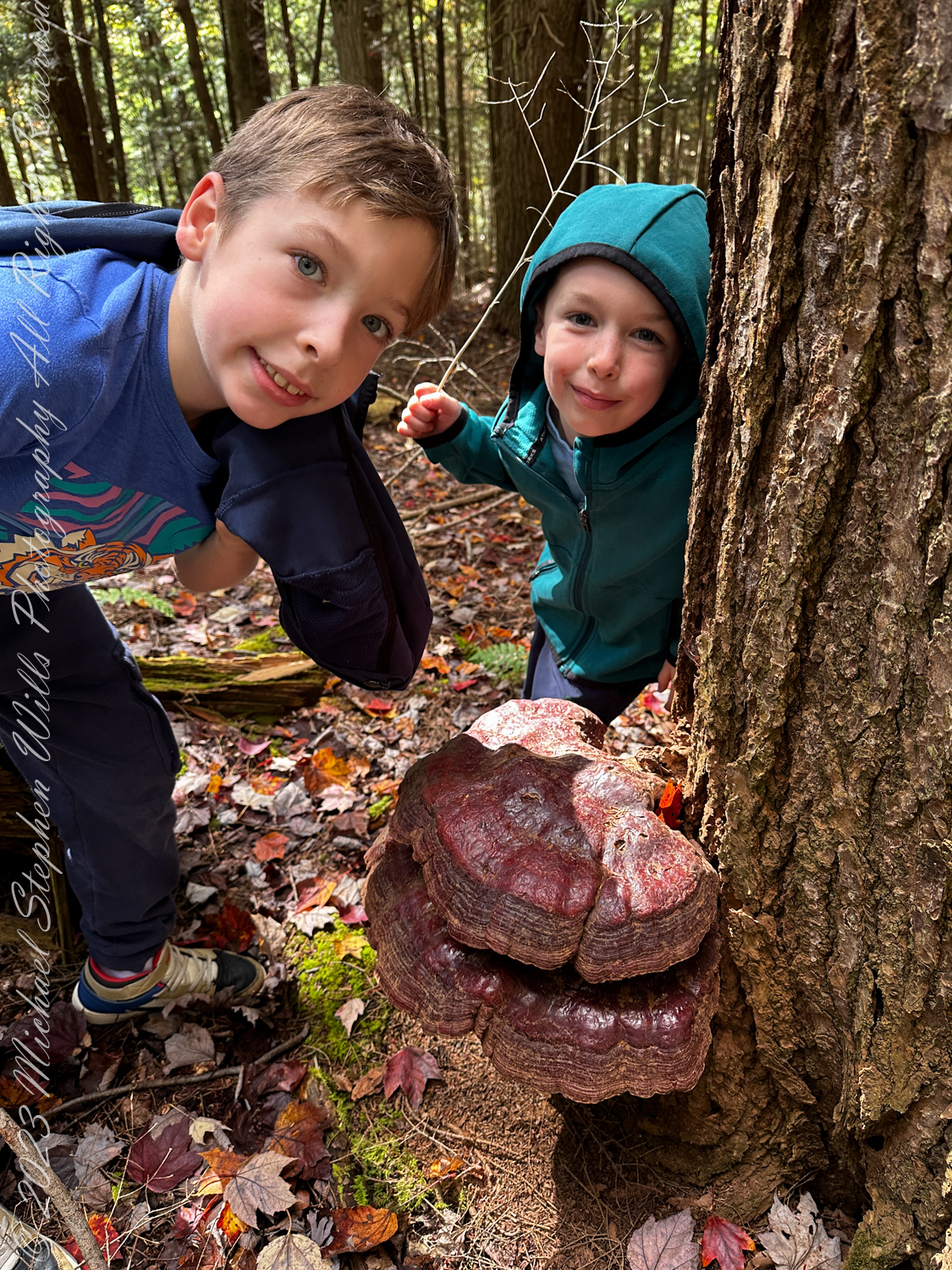
The path led us deeper into the forest, and soon we turned onto the Brookside Trail, which merged with the High Ridge Trail. Here, the air grew cooler under the dense canopy of trees, and the forest floor softened beneath our feet with layers of leaves. It was then that we stumbled upon the most magnificent sight of the day: an enormous bracket fungus, its wide, layered shelves clinging to the trunk a hoary snag.
Rory gasped in delight, running over to inspect it more closely. “Look how big it is!” he exclaimed, his small hands hovering just above its ridged surface. Sam, never one to be outdone, knelt beside it, carefully touching the spongy layers. “It’s a staircase for squirrels,” he said, grinning up at me.
Turkey Tail bracket fungus (Trametes versicolor) is a common wood decay fungus found on dead and decaying hardwoods. Named for its concentric, colorful bands resembling a turkey’s tail, it plays a vital role in forest ecosystems by breaking down lignin, facilitating nutrient recycling. It’s also valued for its medicinal properties. Lime Hollow Nature Center, Cortland, Cortland County, New York State. Finger Lakes Regions
As I watched them, I couldn’t help but think back to all the times I had wandered these trails alone before they were born. Now, these woods had become a classroom for them—full of discoveries that sparked their curiosity and wonder. It was a beautiful moment of generational connection, this passing on of my love for the natural world to Sam and Rory.
Fascinating Beech Tree Roots
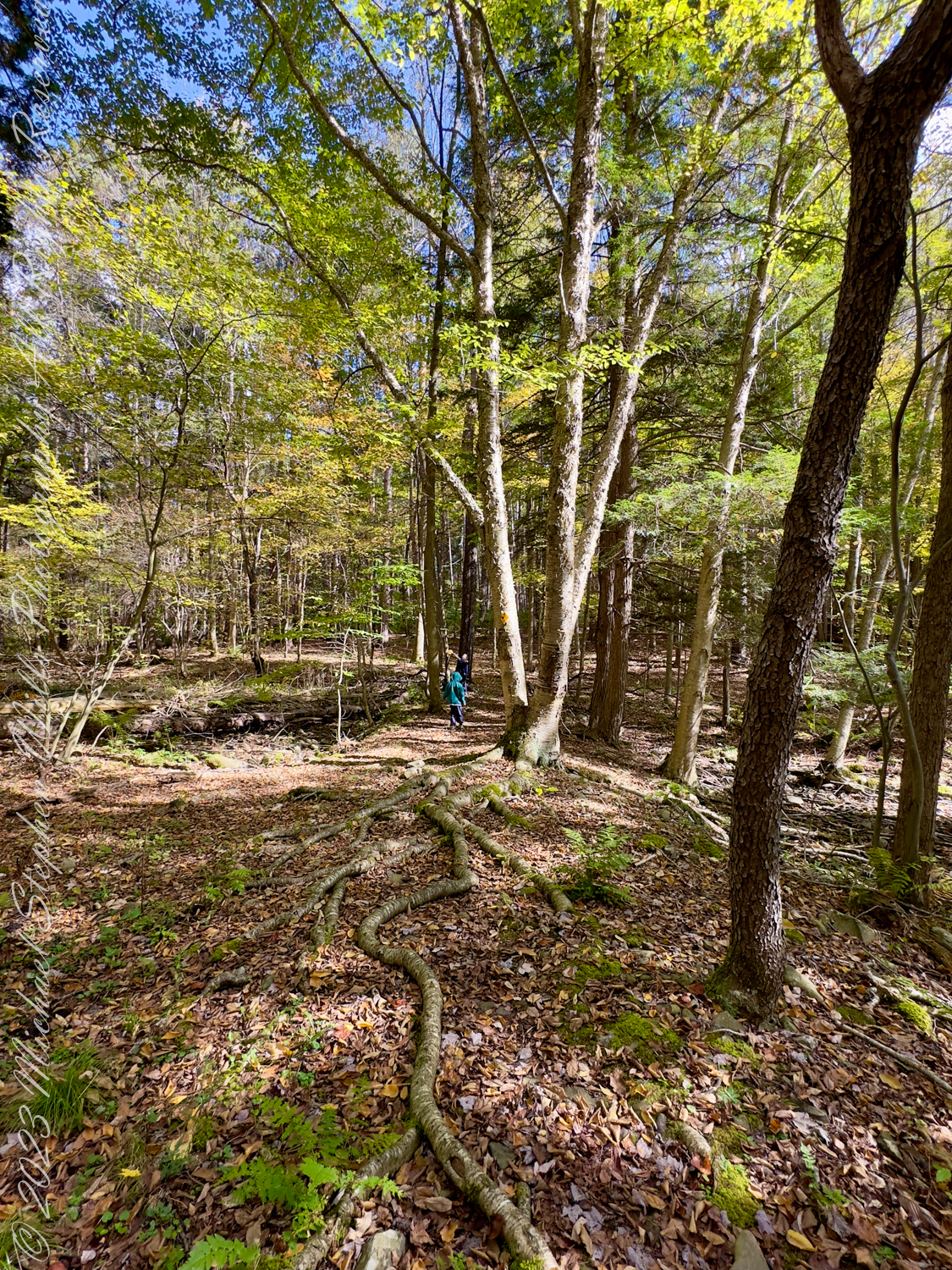
On the way out, we took the Brookside / Pond View / Sunset trails once again, but this time, this intricate network of roots from a massive beech tree fascinated us. The roots twisted and coiled across the path like veins, in our imaginations the gnarled shapes snagged our feet. Sam, ever the explorer, stepped cautiously along the roots, balancing himself as if walking a tightrope. Rory followed suit, his giggles filling the air.
An American beech (Fagus grandifolia). These trees are quite common in northeastern forests. The beech tree is known for its smooth smooth, gray bark, which can become marked with scars or etchings as the tree ages. Additionally, its leaves are typically dark green, with serrated edges, and turn yellow to bronze in the fall, often staying on the tree through winter. Lime Hollow Nature Center, Cortland, New York State
“These roots are older than us,” I told them. “Beech trees can live for hundreds of years. Just think, this tree has seen many more seasons than we ever will.”
Sam’s eyes widened at the thought, while Rory gave the tree a gentle pat, as if to thank it for its wisdom. I marveled at how something as simple as a root system could captivate their imaginations and bring the lesson of time and growth to life.
Reminiscing on the Chicago Bog
In the 1830’s there was a village named Chicago along Gracie Road, which gives it the name we have today. The Chicago Bog is home to many carnivorous plants, including sundew, the pitcher plant, and more. The deepest depth of the bog is about 7.2 ft. The bog is along the Phillips Memorial Trail, which can be found on Gracie Road. Lime Hollow Nature Center, Cortland, New York
As we walked, my mind wandered back to a visit we had made to the Chicago Bog just a year before. I remembered the day clearly—how we had trekked through the wetland on a warm June afternoon, the ground soft beneath our feet, alive with the buzzing of insects and the vibrant green of new growth.
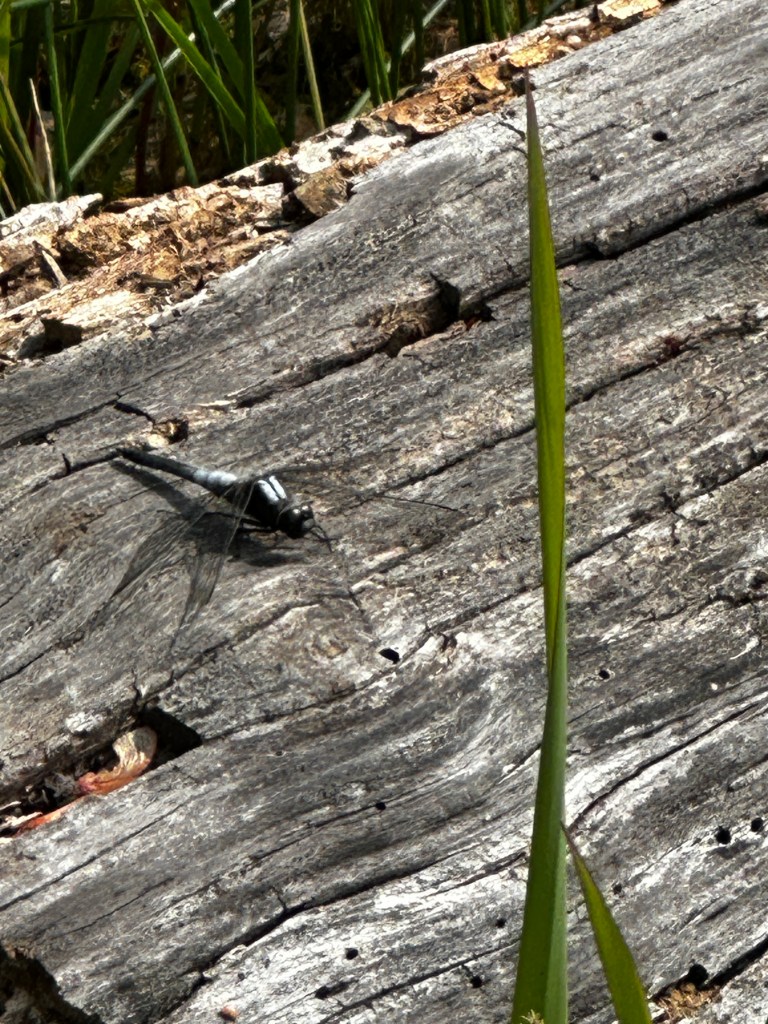
The chalk-fronted corporal (Ladona julia) is a skimmer dragonfly found in the northern United States and southern Canada. Juveniles of both sexes are light reddish brown, with white shoulder stripes and a black stripe down the middle of the abdomen. As they mature, males develop a white pruinescence on the top of the thorax and at the base of the abdomen, while the rest of the abdomen turns black. Females become almost uniformly dark brown, with a dusting of gray pruinescence near the base of the abdomen; a few develop the same color pattern as the males. Chalk-fronted corporals often perch horizontally on the ground or on floating objects in the water, flying up to take prey from the air. They are gregarious for dragonflies, and are commonly seen perching in groups. They readily approach humans to feed on the mosquitoes and biting flies that humans attract.
It was there, by the edge of the bog, that we had encountered a dragonfly, a Chalk-fronted Corporal, resting on a fallen log. Its dark, iridescent wings shimmered in the sunlight, and Sam had been mesmerized by its delicate beauty. He had asked so many questions that day—about how dragonflies flew, what they ate, and where they lived. I had done my best to answer, but truth be told, I learned as much as he did in that moment.
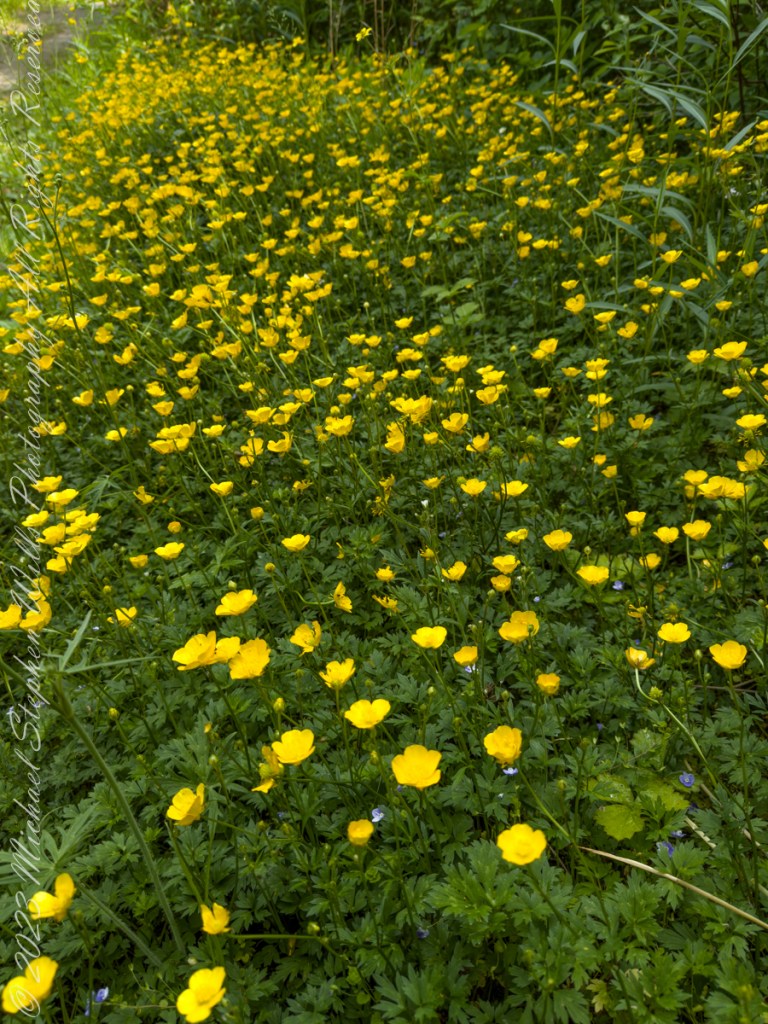
Nearby, a meadow of buttercups had stretched out before us, their yellow blooms dancing in the breeze. Rory had run through them, his laughter ringing out as he tried to catch a butterfly that flitted between the flowers. The memory of that field of gold still brought a smile to my face as we made our way through Lime Hollow today.
A Day to Remember
As we neared the end of our hike, the afternoon light filtering through the trees, I couldn’t help but feel a sense of contentment. These outings with Sam and Rory had become more than just walks in the woods—they were opportunities to share, to learn, and to make memories that I knew would last a lifetime.
“Grandpa, can we come back?” Rory asked, his face flushed with excitement.
“Of course,” I said, smiling. “We’ll always have time for another adventure.”
Crossing the footbridge in Stewart Park, I encountered the graceful yet invasive Flowering Rush. Its delicate beauty hides a deeper story about nature’s resilience, human impact, and the fragile balance of our ecosystems.
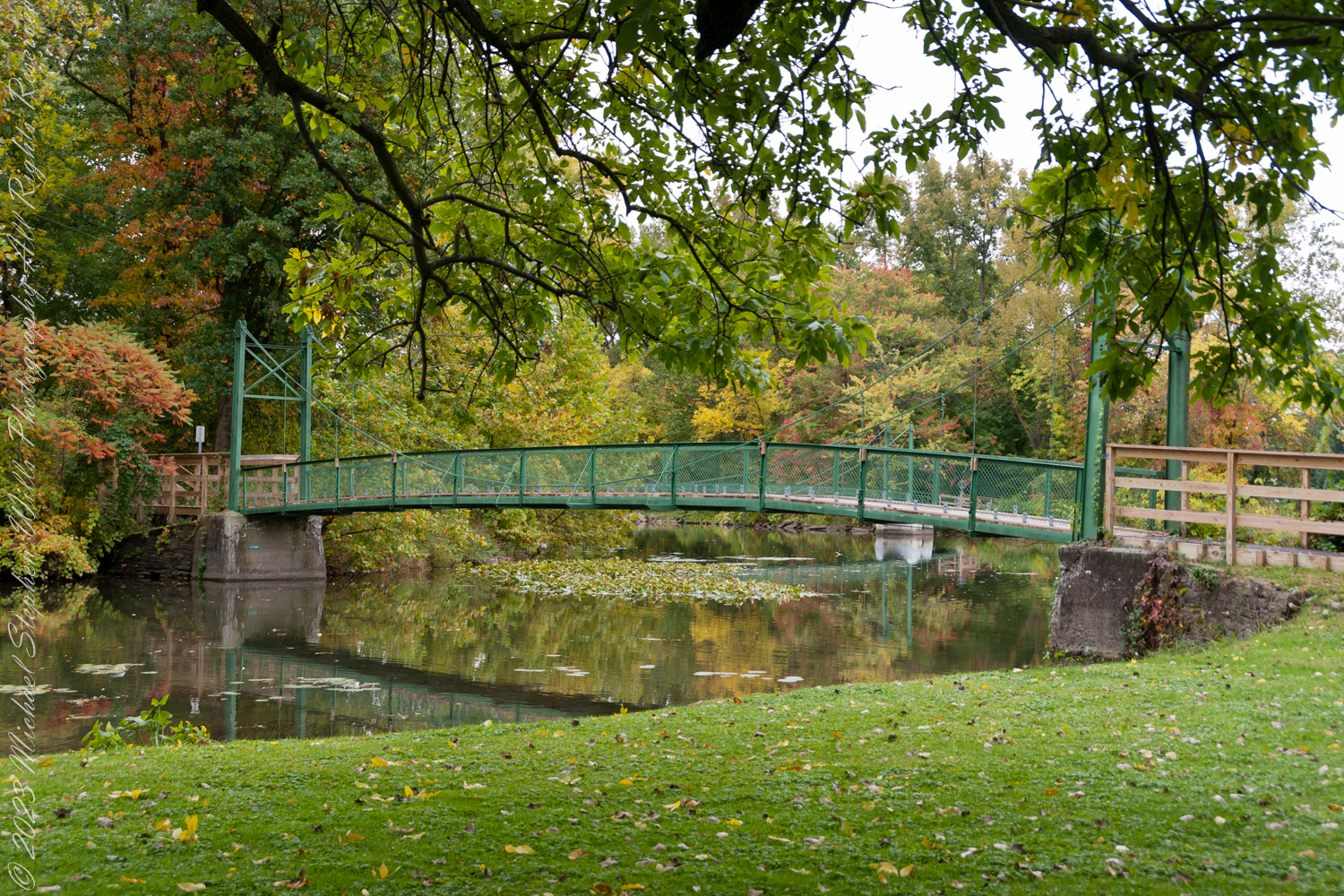
While crossing the suspension footbridge over Fall Creek in Stewart Park, there’s a sense of stepping into a world that’s more peaceful and attuned to nature. The bridge is familiar to me—a steady, quiet companion—but each visit feels new, as though the park has secrets it only reveals in small whispers. In this photograph the green steel beams rise like sentinels, standing tall against the backdrop of shifting autumn colors. Below, the water reflects the vibrant reds, golds, and greens of the trees, creating an illusion of depth that draws me in.
Footbridge to the Fuertes Bird Sanctuary, Stewart Park, Ithaca, New York, October 2012
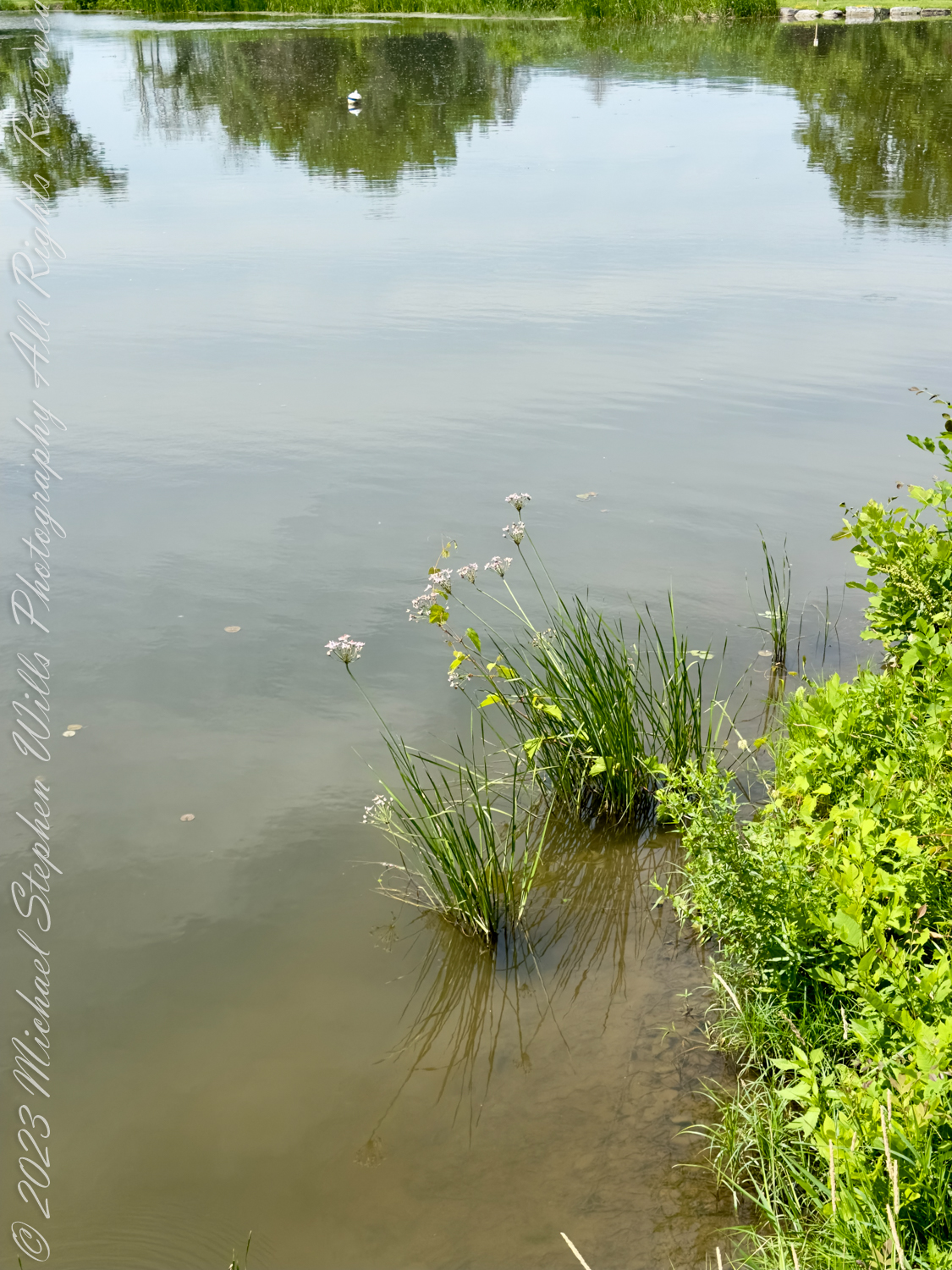
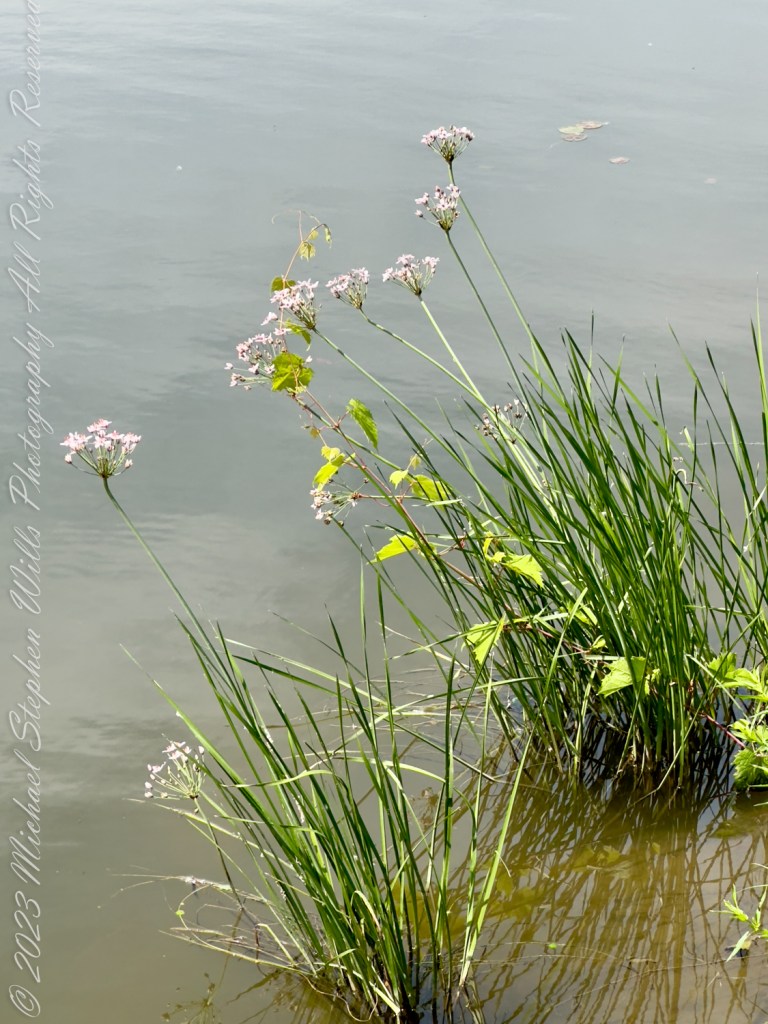
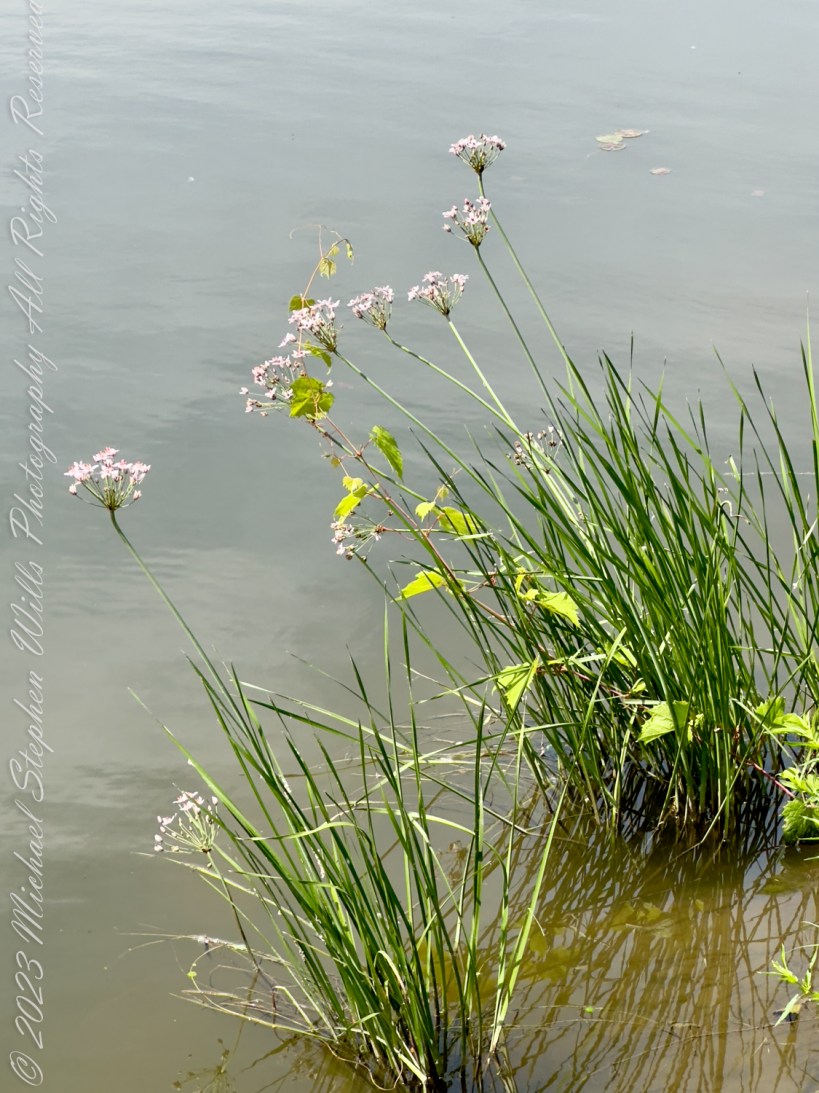
This past summer I stopped midway across, leaned against the railing, just listening. The creek moved slowly, like time itself decided to pause here for a while. That’s when I saw them: delicate pink blooms rising up from the water’s edge, their petals small and star-shaped, catching the light as they sway in the gentle breeze. There’s something striking about these plants—graceful, elegant, almost otherworldly in their simplicity. They reach up, as though trying to escape the confines of the water and the muddy banks.
My subsequent research revealed these to be Flowering Rush, or Butomus umbellatus. I often see them now, their soft pinks and slender leaves creating a quiet beauty that’s hard to ignore. They’re beautiful, but I have come to know they don’t belong here. This is one of those moments in nature that gives me pause—a reminder that not everything lovely is innocent.
Flowering Rush Growing in Fall Creek, Stewart Park, June 2024
Flowering Rush, a European import from centuries ago, was not meant to take root here. Brought to North America for ornamental ponds, its allure quickly became its danger. It spread, silently, like a secret carried on the wind, slowly overtaking the native species that have long called these waters home. And yet, standing here now, I cannot help but admire its tenacity, its quiet determination to thrive. Nature, in all its forms, has this incredible will to survive, even if that survival sometimes comes at a cost.
My mind drifts to the plant’s history. In its native lands Flowering Rush, or Grass Rush, was useful—its roots, though bitter, were harvested for food, and its fibrous stems woven into mats and ropes. How interesting that something as delicate as this has a rugged, practical side. This contradiction makes perfect sense when I think of the plant’s journey across continents, carried over oceans by human hands and curiosity. We are responsible for its presence here, and now, like so many other invasive species, it’s become a fixture of this landscape.
I think about the dual nature of this invasion. Flowering Rush is beautiful—there is no denying that. Its soft, pink flowers contrast sharply with the darker tones of the water and the dense green of the grasses that surround it. But its beauty masks a quiet destruction. It chokes out the native plants that once thrived here, altering the ecosystem in ways we cannot always see. I wonder what fish and aquatic life struggles beneath the surface, their food sources slowly disappearing. What birds find fewer insects and fewer safe places to nest?
And yet, is this plant a villain? Flowering rush is doing what it was meant to do—grow, spread, survive. That is what everything in nature does, after all. It does not have malice or intent; it just is. It is humans who have changed the balance, who introduced this species to a place where it didn’t belong, setting off a chain reaction we’re still trying to fully understand.
Today, as I walk across the bridge, heading toward the Fuertes Bird Sanctuary, path ahead invites quiet reflection, the chirping of birds and the rustle of leaves providing a peaceful soundtrack. But the Flowering Rush lingers in my mind. It reminds me of how interconnected everything is, how one small action—a plant brought from a distant land—can ripple out and affect entire ecosystems. It’s a lesson in responsibility for those willing to listen.
As I step into the sanctuary, the air feels lighter, filled with the sound of birds that dart between the trees. I think of the delicate balance of life here, and how easily it can be disrupted by the presence of something foreign, something invasive. Yet, there is a strange comfort in knowing that nature, for all its fragility, has its own resilience.
The Flowering Rush, with its roots deep in the muddy banks of Fall Creek, is a testament to that resilience. It may not belong here, but it has found a way to adapt, to make this place its home. And in that, I find both a warning and a kind of hope—hope that we, too, can learn to live more thoughtfully, more in tune with the world around us, before we upset the balance any further.
For now, though, I simply walk, grateful for the beauty around me, even if it comes with complications. Each step takes me deeper into this world, and I am reminded once again of the profound connection we have to the land, the water, the plants, and the creatures that share this space.
Copyright 2024 Michael Stephen Wills All Rights Reserved
To receive email notification of new blog posts enter your email and click the subscribe button.
Join me on a heartwarming adventure at Comstock Creek with my grandchildren, Sam and Rory, as we explore the wonders of nature, create lasting memories, and celebrate the legacy of the Comstock family.
The morning sun filtered through the lush canopy of trees as I guided my grandchildren, down the familiar path towards Comstock Creek of the Cayuga Nature Center. The children were familiar with the creek from time spent in summer camp. This little haven of nature is a favorite spot of theirs. Comstock Creek, named after the Comstock family, stands as a testament to their significant contributions to entomology and nature education. John Henry Comstock, a renowned entomologist, and his wife, Anna Botsford Comstock, a pioneering figure in nature study, left an indelible mark on the Ithaca area and beyond. Their legacy lives on, not just in the academic world, but in these very waters where my grandchildren now play.
As we reached the creek, the children wasted no time kicking off their shoes and wading into the cool, shallow water. My grandson, in his red shirt, and granddaugter, in her green one, both radiated joy and curiosity. The sunlight danced on the water’s surface, casting shimmering reflections that seemed to animate the entire scene.
The youngest was the first to discover a small pool where the water had carved out a deeper spot. “Look, Grandpa!” he exclaimed, his voice full of excitement. He crouched down, peering intently at the tiny fish darting around his feet. His sister joined him, her initial apprehension giving way to a wide-eyed fascination as she watched the underwater ballet.
Their time was spent turning over rocks to find little aquatic creatures and marveling at the delicate balance of nature. The children’s laughter echoed through the woods, blending with the sounds of rustling leaves and the gentle babble of the creek. Their sense of wonder reminded me of the Comstocks’ passion for nature, a passion they had so fervently shared with the world.
After a while, we decided to take a break and walked through the meadow past where tall reeds swayed gently in the breeze. He knew of a small, tranquil pond that reflected the sky like a mirror. He leaned the water’s edge,hoping to grab a frog. I stood back, capturing this peaceful moment with my camera, knowing that these images would become treasured memories.
As noon approached, we travelled back to Ithaca for an ice cream treat, promised them as a reward for their adventurous spirit. Their faces lit up with delight as they savored their treats, their expressions reflecting pure contentment.
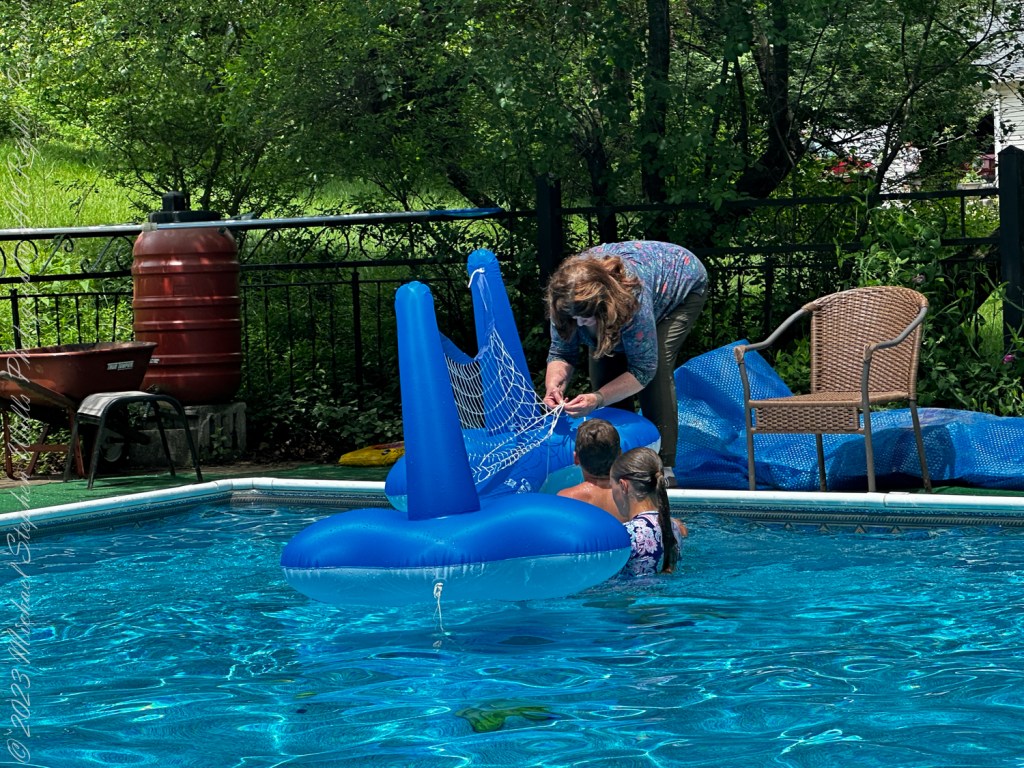
The day wouldn’t have been complete without a splash in the pool. Back home, grandmother set up the inflatable volleyball net while the kids changed into their swimsuits. The pool became a hub of activity as they splashed around, their laughter blending with the sound of the water.
Reflecting on the day, I felt a deep sense of gratitude. The Comstock family’s dedication to nature education had inspired generations, including my own. Their legacy was evident not just in the academic institutions of Ithaca, but in the simple, joyous exploration of nature that I shared with my grandchildren. I hope this day at Comstock Creek will be remembered fondly, a chapter in our family’s ongoing story of discovery and connection with the natural world.
Copyright 2024 Michael Stephen Wills All Rights Reserved
Discover the secret world of mallards in Ithaca’s Cass Park: a drake and hen dance upon the water’s surface, inviting you into the fleeting magic of a vernal pool. Join their springtime sojourn.
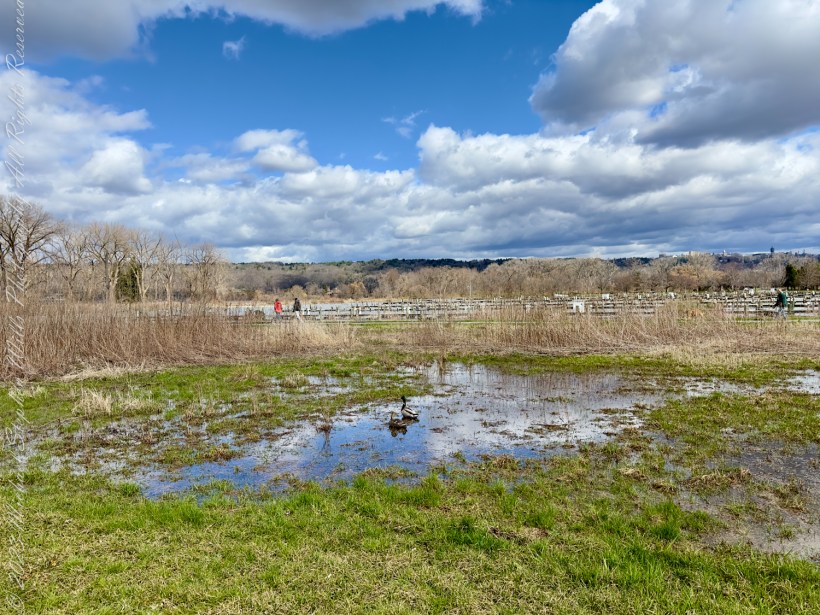
The image provided offers a tranquil glimpse into the natural world, capturing two mallard ducks—a drake and a hen—as they forage for food in a vernal pool. Vernal pools are temporary bodies of water that provide critical habitat for a variety of wildlife during the early spring. Mallards (Anas platyrhynchos), with their iconic coloration and widespread presence across the globe, are among the most recognizable and adaptable of waterfowl, making use of these ephemeral waterscapes.
Birding Trail near Cass Park, a pair of Mallard ducks in breeding plumage feed in a vernal pool the inlet of Cayuga Lake in the background.
Significance of Vernal Pools
Vernal pools are unique wetlands that usually form in the spring from melting snow and spring rainfall. These pools are crucial for the breeding of certain species of amphibians, insects, and provide essential resources for birds like mallards. In the image, the ducks take advantage of the abundance of food such as aquatic invertebrates that thrive in these undisturbed waters, showcasing the importance of these habitats in supporting biodiversity.
A Closer Look at the Mallards’ Habitat
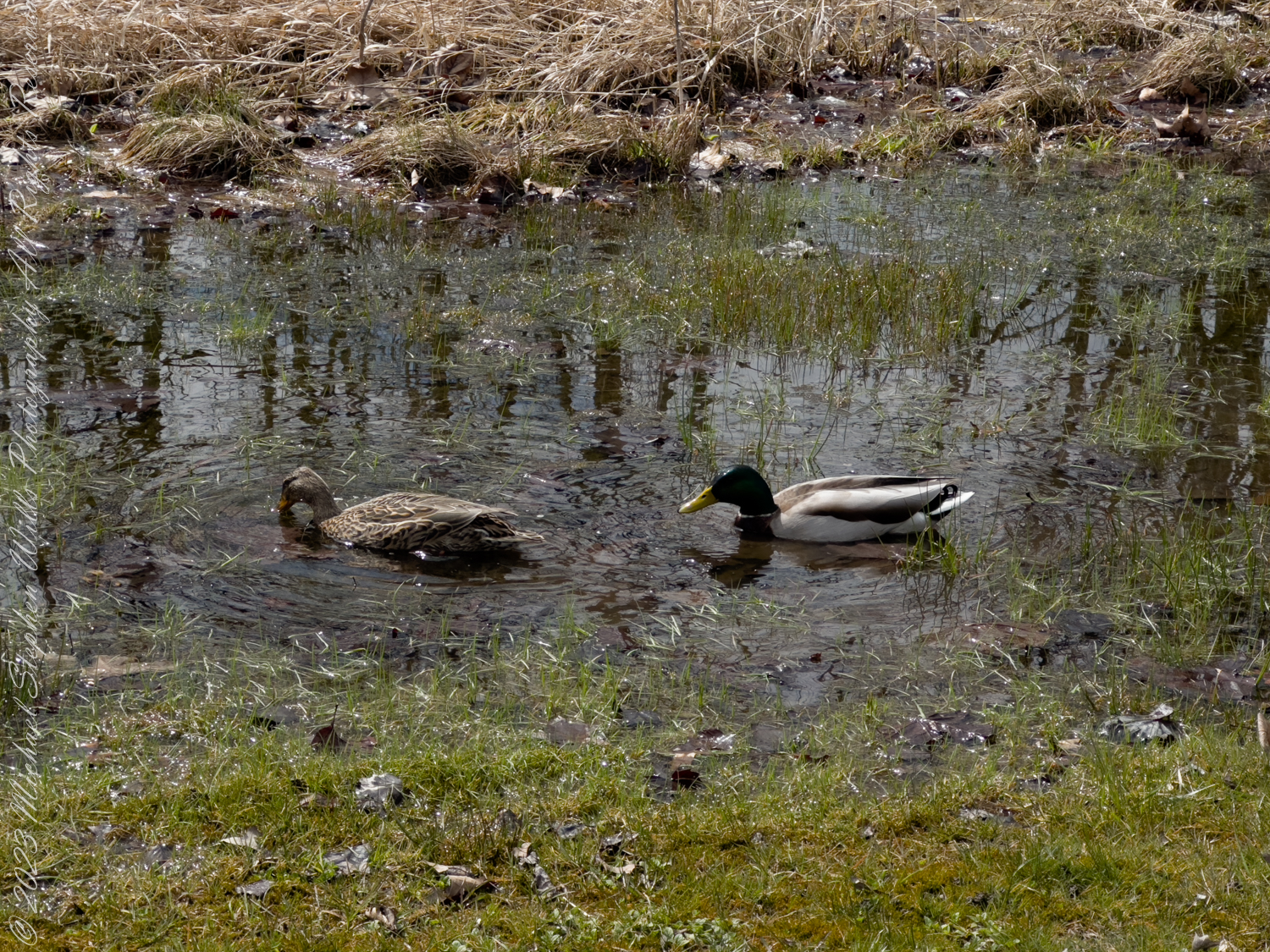
A male and female mallard (Anas platyrhynchos) feeding in a vernal pool along the Cayuga Waterfront Trail near Union Fields.
The photo depicts the ducks in a natural setting that speaks volumes about their environment. The surrounding dry grasses indicate a transition from the dormancy of winter to the burgeoning life of spring. The reflection of leafless trees in the water hints at an ecosystem on the cusp of renewal. This setting is not only a feeding ground for the ducks but also a haven that provides shelter and protection from predators.
The Mallards’ Spring Behavior
Mallards are known for their migratory patterns, often traveling to warmer climates during the winter and returning to their breeding grounds in the spring. The ducks in the photo are likely partaking in a crucial phase of their life cycle—feeding and preparing for the breeding season ahead. Their presence in the vernal pool is a testament to their resilience and adaptability as they utilize a wide range of habitats to meet their needs.
Conservation and the Future
While mallard ducks are not currently endangered, the conservation of their habitats, like vernal pools, is vital for the continued health of their populations and the greater ecosystem. Such habitats are under threat from urban development, pollution, and climate change. It’s imperative that we recognize the importance of preserving these natural resources, not only for mallards but for all species that depend on them.
Conclusion: Reflections on Nature’s Cycles
The photo invites reflection on the cycles of nature and the interconnectedness of species and their environments. It serves as a reminder that the arrival of mallards at a vernal pool is not just a sign of spring, but a marker of the health of our natural world. As the seasons change, so too do the opportunities for life to thrive, guided by the rhythms of the Earth and the behaviors of its inhabitants. The mallards, in their simple act of feeding, become symbols of continuity and the delicate balance of ecosystems.
Copyright 2024 Michael Stephen Wills All Rights Reserved
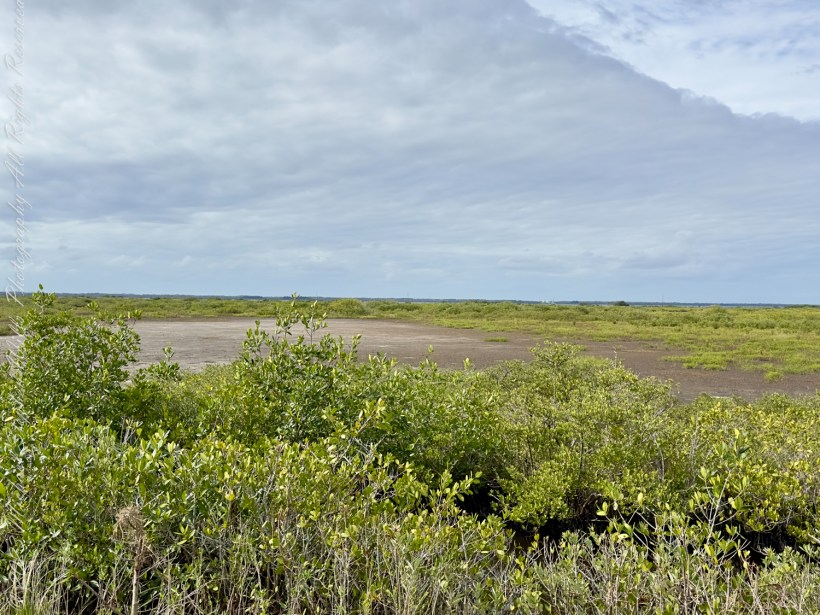
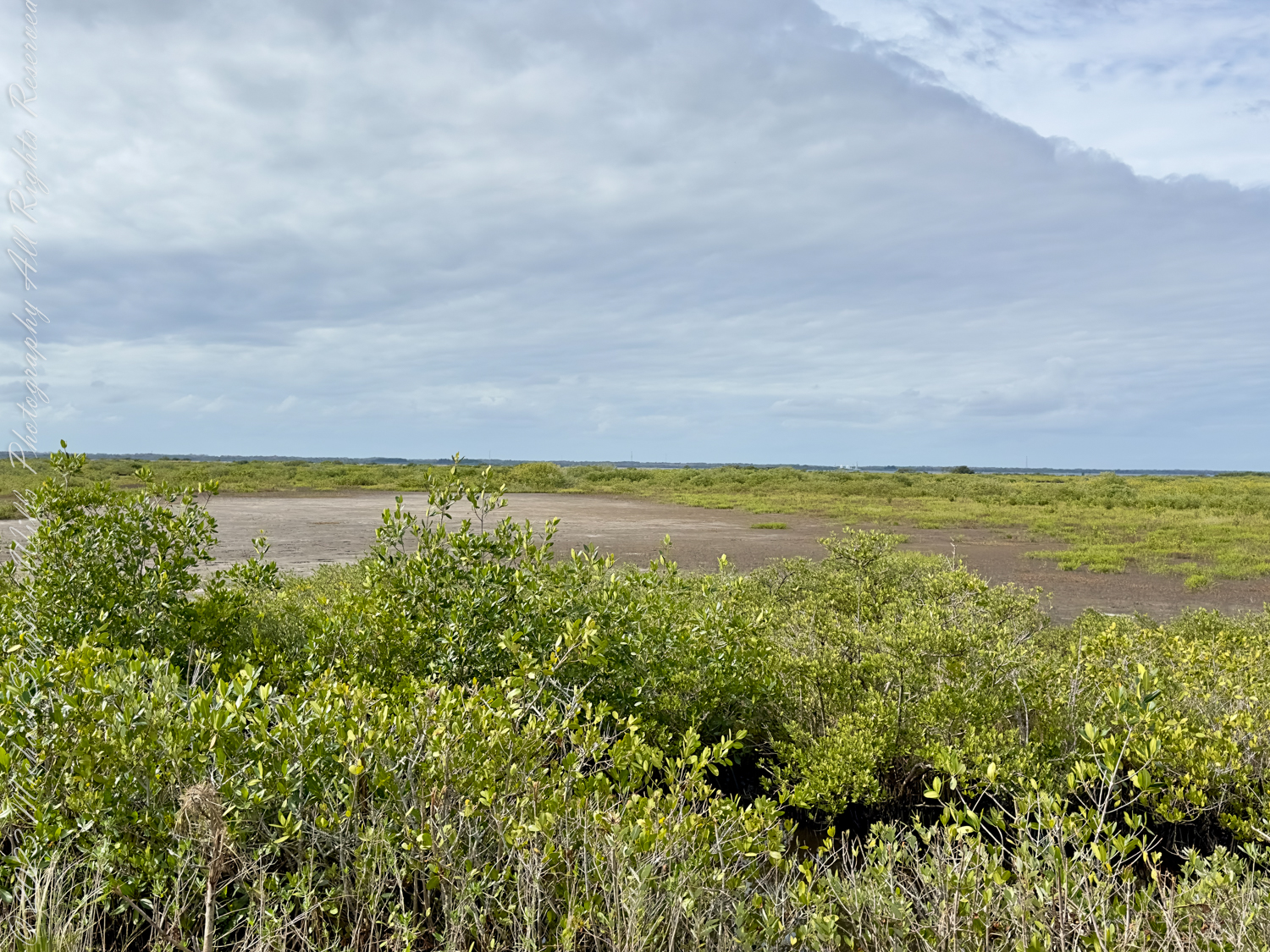
The exposed mudflats on tidal wetlands attract a variety of shorebirds. Shorebirds are seasonal residents that make long migratory journeys between their breeding grounds in the Arctic and their wintering areas in South America. Merritt Island NWR provides an important resting and feeding area for this group of birds. Some stay for the winter, and others use the refuge as a fuel stop before continuing on their journey.
In tidal areas, shorebird feeding schedules are influenced by the cycle of the tides. Changes in tidal cycles expose foraging areas in mudflats for a period during the day. At other points during the cycle, the water in these same areas becomes too deep or the ground too dry for shorebirds to feed effectively.
Shorebirds of different species can and do forage together. Because bill length and shape varies from species to species, birds can pursue different prey in the same area at the same time without competing with each other. Because of varying bill lengths, the different bird species find their food at different depths in the substrate. Mixed species of shorebirds are a common sight.
Reference: the text of this blog was transcribed from signage along the Blackpoint Wildlife Drive of Merritt Island National Wildlife Refuge, Brevard County, Florida
Copyright 2024 Michael Stephen Wills All Rights Reserved.
As my wife, Pam, and I entered the breezy expanse of the Merritt Island National Wildlife Refuge, the world seemed to slow down, allowing us to savor every moment of my journey along Blackpoint Drive. The sky, a sprawling canvas of muted greys, reflected in the wind ruffled waters, enhancing the tranquility of this haven.
Our first encounter was with the elegant Roseate Spoonbills (Platalea ajaja), their vibrant pink feathers a stark contrast against the earthy tones of the marsh. They waded with purpose, their spoon-shaped bills sifting through the water, a dance of survival that was both methodical and beautiful.
In the company of the spoonbills were the stoic Great Egrets (Ardea alba), statuesque in their white plumage. They stood motionless, like sentinels guarding the water’s edge, only to strike with lightning speed when prey ventured too close.
We watched as the Glossy Ibises (Plegadis falcinellus) dipped their curved bills into the water, each movement a study of precision, their dark feathers glistening with an iridescent sheen when caught by the light.
Amongst these avian aristocrats, the unassuming American White Ibises (Eudocimus albus) went about their business. Their red beaks probed the shallows, unperturbed by the presence of their more colorful neighbors or by my watchful eyes.
As we ventured further, the landscape shifted, the water opening up to reveal a gathering of Spoonbills and White Ibises, a community united by the need to feed and the safety of numbers. The occasional flap of wings and contented calls created a symphony that celebrated life in these wetlands.
Isolation took on a new meaning when I spotted a solitary Roseate Spoonbill, its reflection a perfect mirror image on the water’s surface. It was a moment of quiet introspection, the bird and I alone in our thoughts.
Another scene captured my attention as a single spoonbill foraged alongside a Glossy Ibis. The two species, different in appearance and yet similar in their quest for sustenance, shared the space in harmonious coexistence.
Further along, the vista opened up, and we were greeted by a panoramic view of spoonbills dotted along the distant shoreline, the greenery forming a lush backdrop to their pink hues. The expanse of the refuge unfolded before me, a reminder of the vastness and the wild beauty that had drawn us here.
On another stretch, the spoonbills perched in the green embrace of the mangroves, their pink feathers a burst of color among the leaves. It was a scene of natural artistry, the birds blending yet standing out against their verdant stage.
In the final leg of our journey, I found spoonbills perched high in the shrubbery, a testament to the refuge’s diversity. Even in the dense foliage, life thrived, and these birds, usually seen wading, now adorned the treetops like living ornaments.
This drive along Blackpoint was more than a mere observation; it was a passage through a world where time held little sway, and nature was the sole architect. Each bird, each ripple on the water, and each whisper of the grass told a story of existence, resilience, and the intricate web of life. Here, in this secluded corner of the world, we found a connection to the earth and its inhabitants that would stay with us long after.
Copyright 2024 Michael Stephen Wills All Rights Reserved