This afternoon’s sky was overcast, perfect for photographing wildflowers: clouds thin enough for light to pour through. In the clouds’ shadow there is not enough light for the plant to cast its own distracting shadows. Compare an earlier trillium photograph (click me to go there).
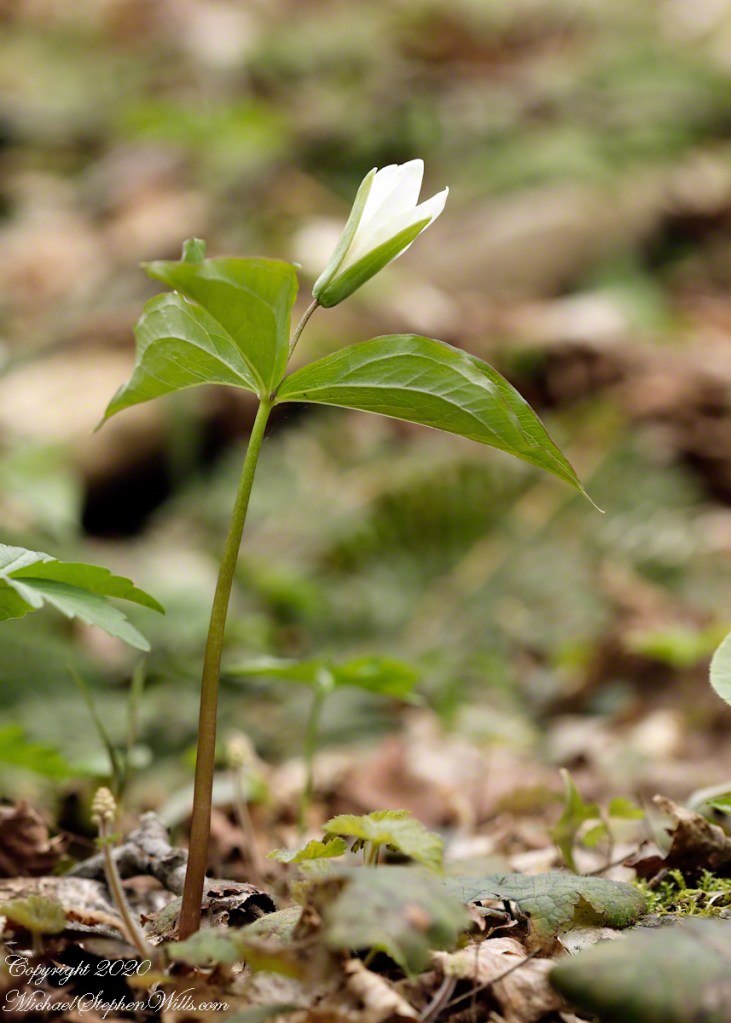
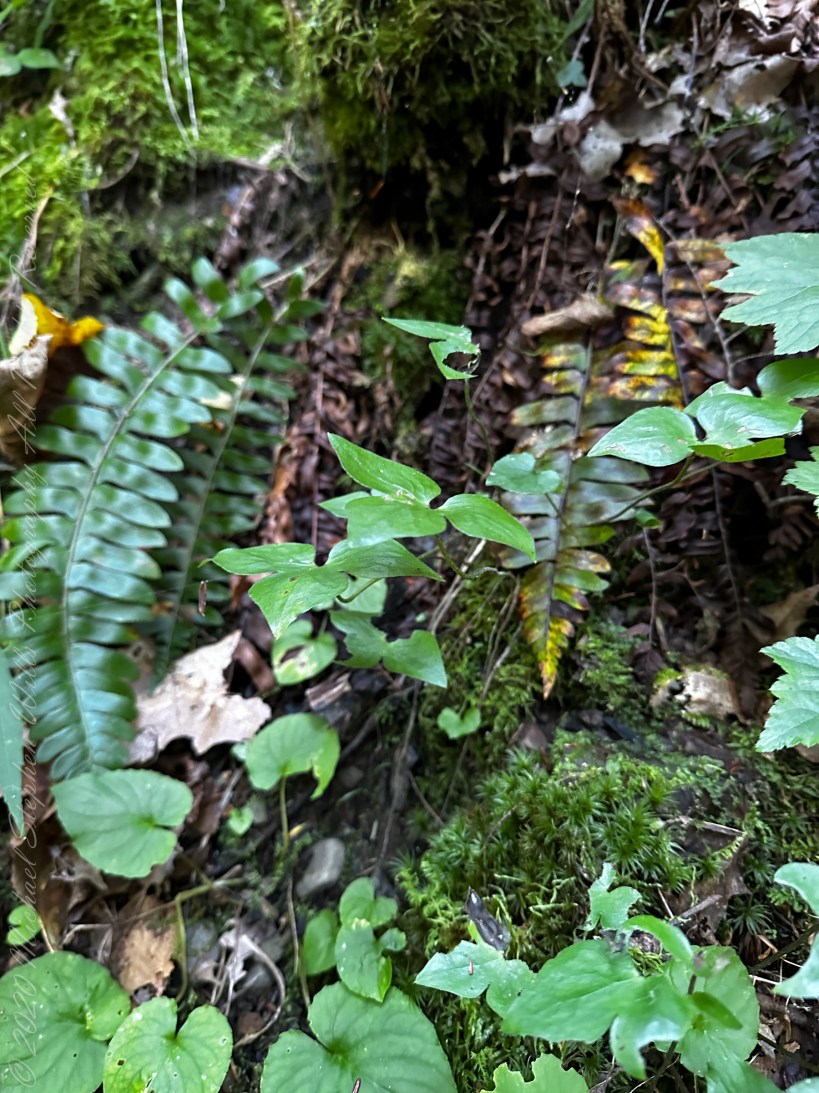
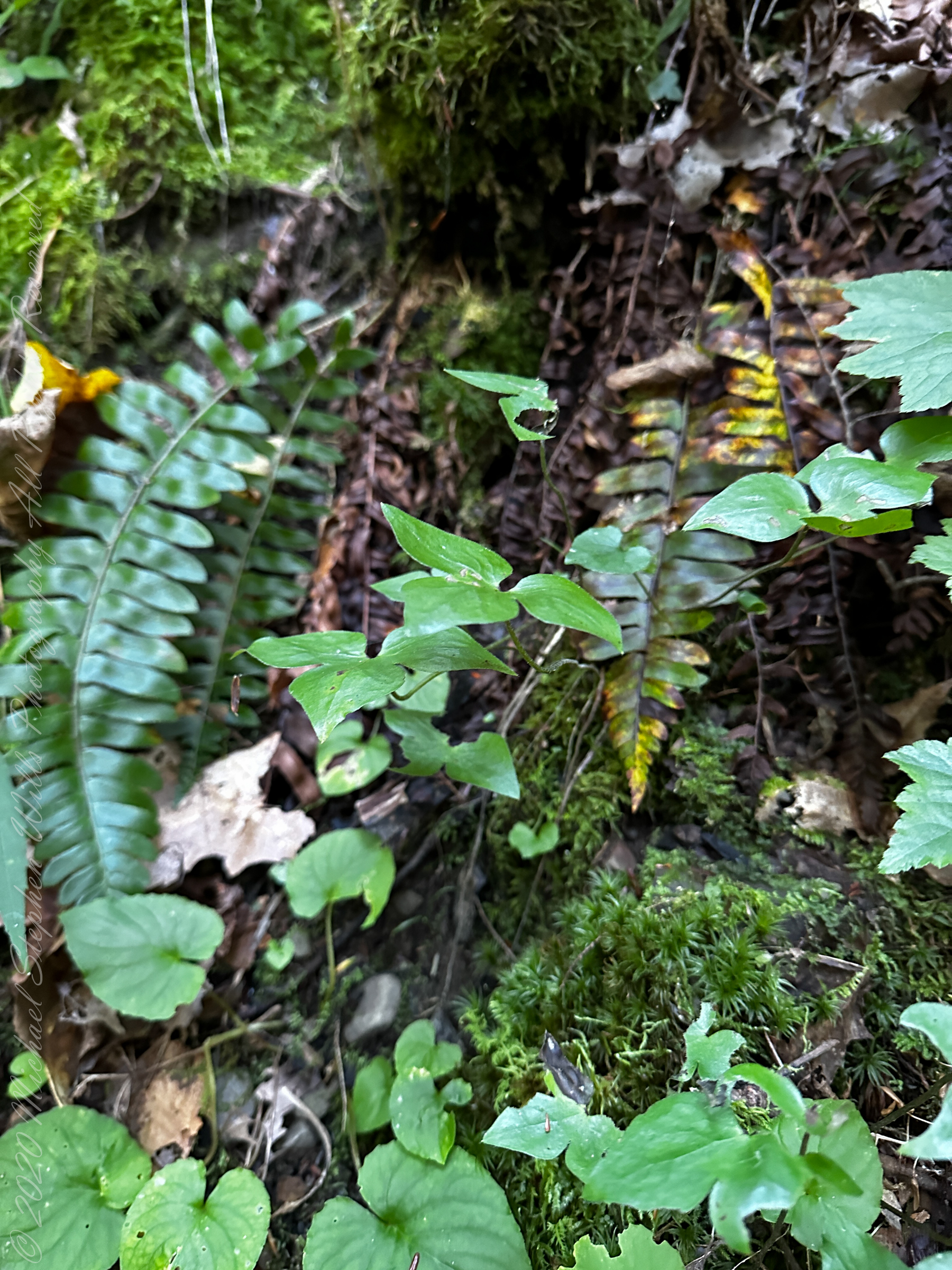
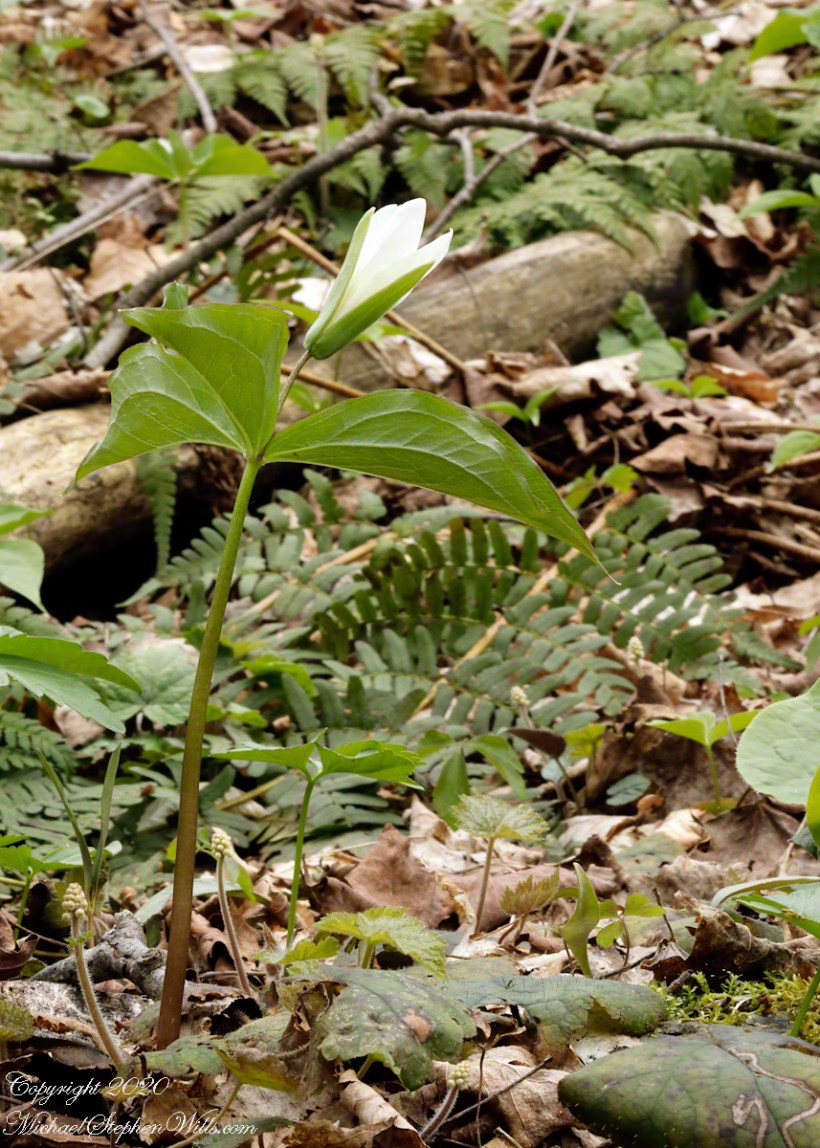
For the following photograph is a study in habitat. At f32, focusing on the trillium, the surroundings are clearly identifiable: several budding Foam Flower heads (Scientific Name: Tiarella), fern, rotting wood, the forest floor hidden by leaf clutter.
I released the shutter (with a 2 second delay) during a break in spring breezes, the overcast lighting bright enough for a speedy 1/8 second exposure. The focus on the opening trillium bloom is just as crisp in this exposure as the next.
Click photograph for larger image. To do this from WordPress Reader, you need to first click the title of this post to open a new page.
f32 / 1/8 second
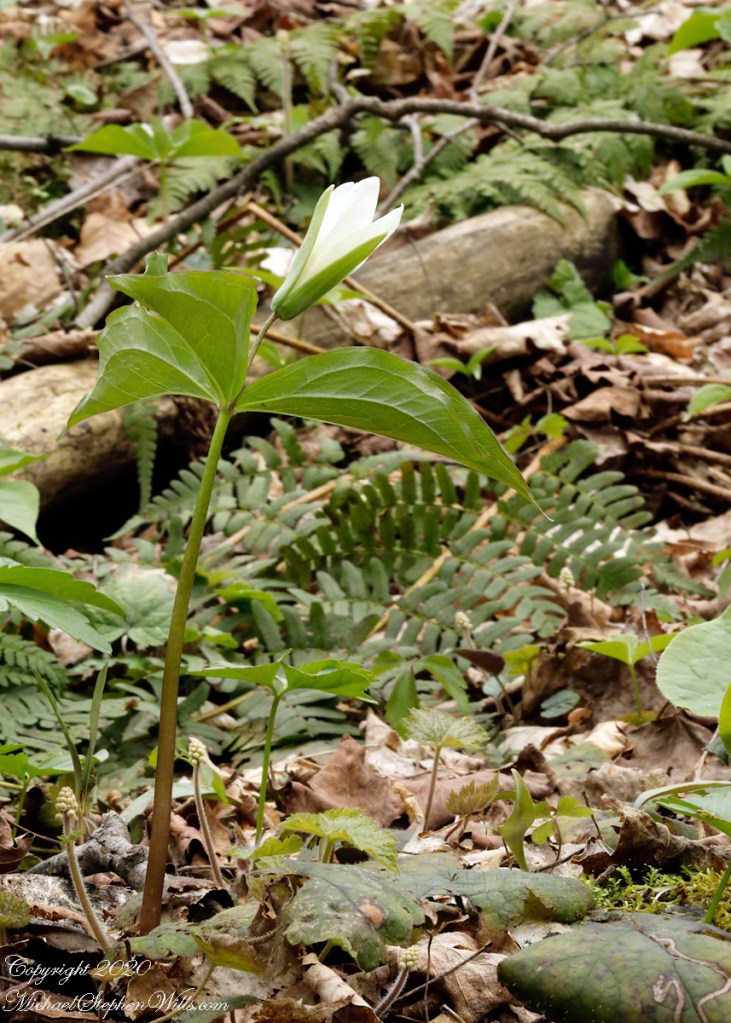
At 4 f-stop, the entire plant is in focus while many habitat elements are a soft blur. An interesting point is the leaf on the left. It is in focus somewhat and is a distraction. This was an issue, in my opinion, for the first photograph.
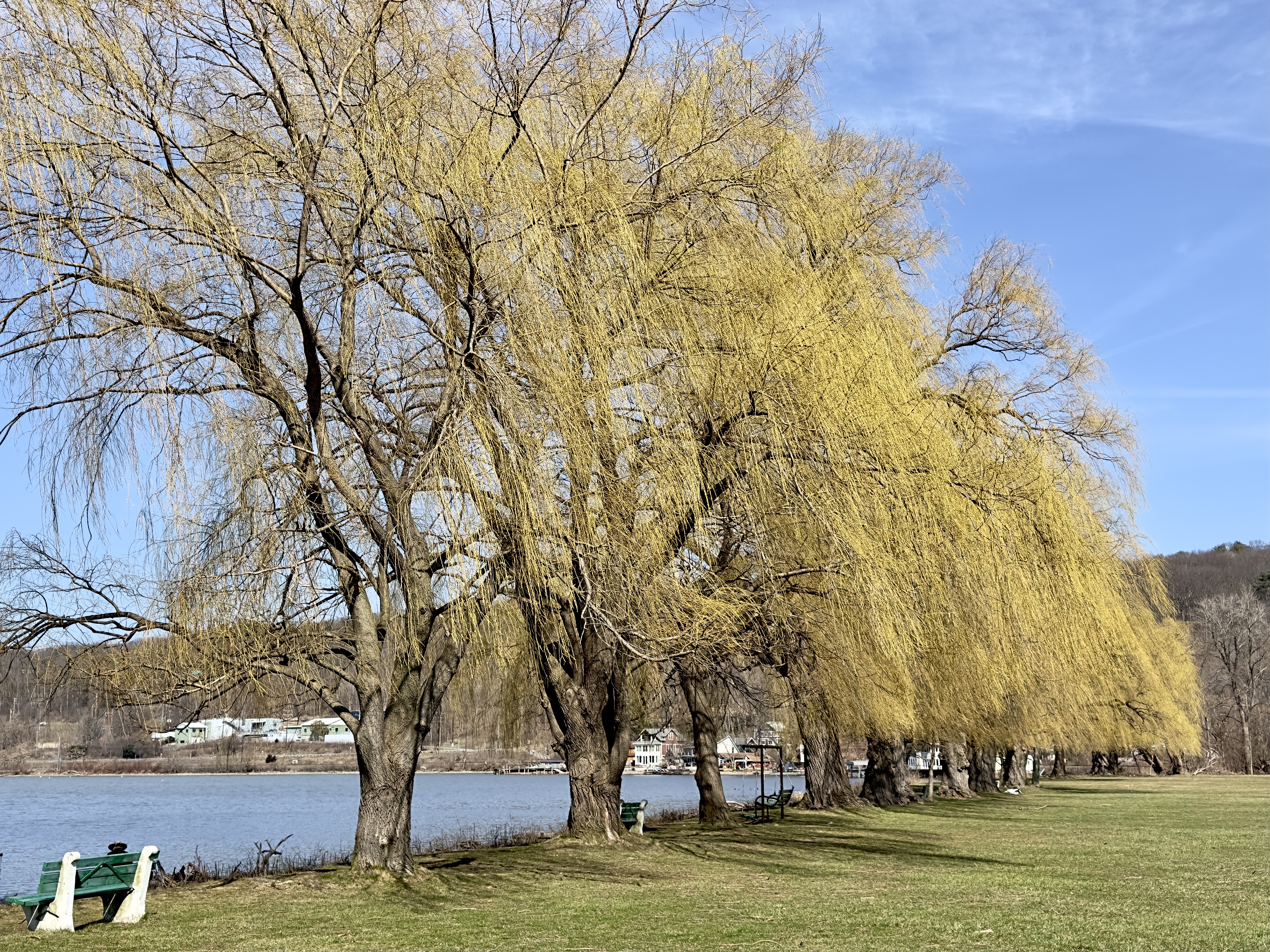
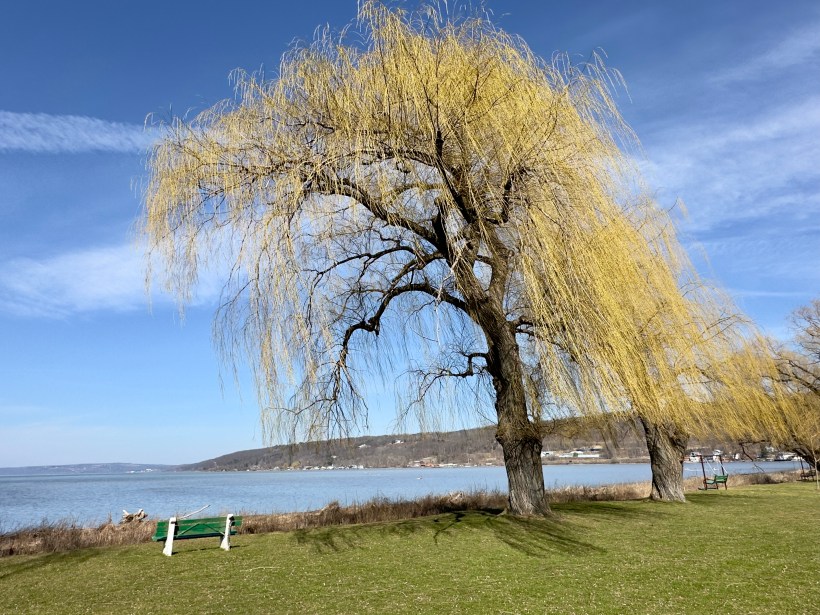
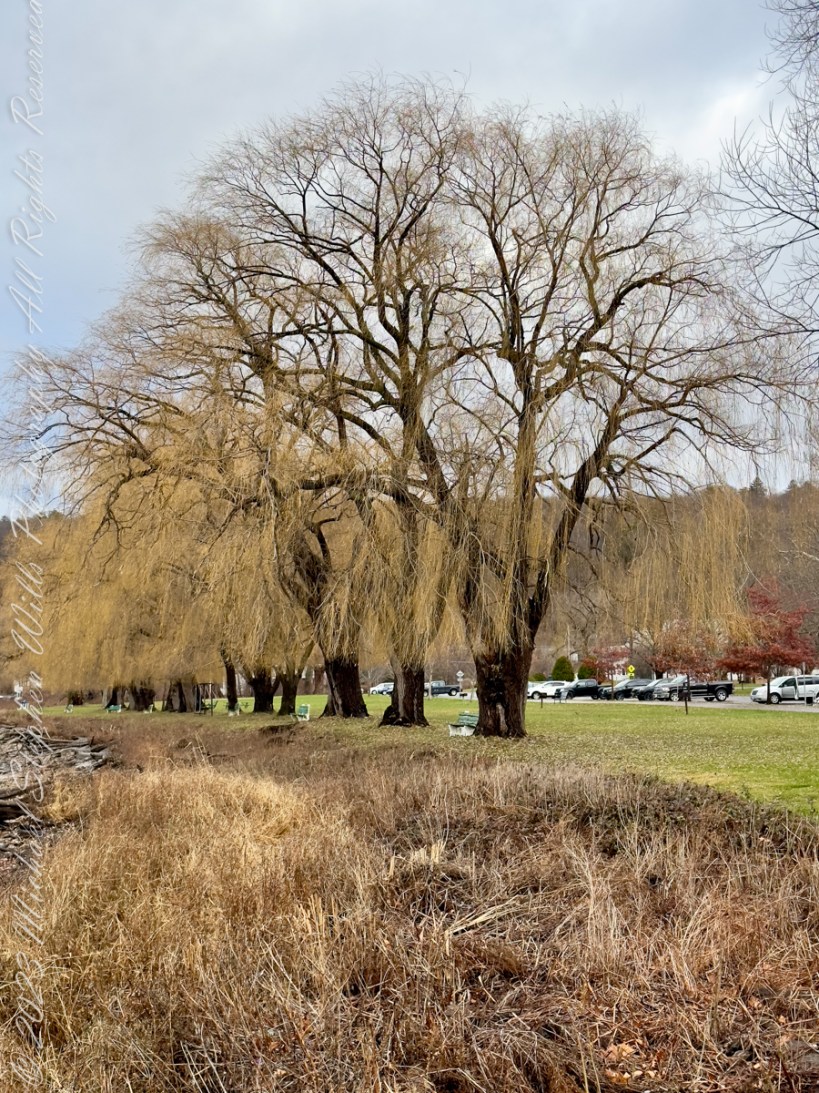
You walk alone by the waters of Cayuga Lake in Stewart Park, nestled in the heart of Ithaca’s Finger Lakes, where Salix alba, the white willow, stands proudly along the shoreline. You’re immediately drawn to the flurry of yellow flowers, a stark contrast to the still chilly early March air.
The white willow (Salix alba), with its rough, gray bark, is beginning to dress in its spring finery, its branches teeming with tiny, starburst-like flowers. Each one is a miniature sun, casting a glow against the intricate lattice of branches. These aren’t the soft catkins of the pussy willow but the yellow inflorescences that are characteristic of the white willow’s early bloom, a signpost that winter’s grip is loosening.
These trees, you learn, are dioecious, with separate male and female trees. The blossoms you see are likely the male flowers, their stamens dusting your fingers with pollen as you brush against them. It’s this pollen that will soon beckon the bees, urging them to emerge from their hives and begin the work that sustains the ecosystem. You can almost hear the faint buzz, a prelude to the symphony of life that summer will bring. Return in midsummer to find the female catkins comprise numerous small (4 mm) capsules, each containing numerous minute seeds embedded in silky white hairs, which aids wind dispersal.
As you wander further, you note the presence of the white willow’s kin, other deciduous companions some still bare and stretching into the sky and others leafing out. You stand there, at the cusp of seasonal change, where the slumbering trees are on the verge of awakening, and you feel a kinship with them. Like these trees, you have weathered the cold, dark months, and now you stand poised to greet the renewal that comes with spring.
The stark, knotted forms of the white willow branches against the clear sky speak to you of endurance and resilience. These trees have weathered storms and droughts; they have been companions to the lake, mirrors to its moods, and now they are beginning to celebrate the cycle of rebirth and growth.
You take a seat on a bench, the cool wood through your clothes a reminder of the lingering winter. You gaze out across the lake, the water reflecting the brilliance of the sun like a vast, rippling mirror, framed by the elegant silhouettes of the white willows. You feel the peace of the park seep into you, the slow, rhythmic lapping of the water syncing with your breath.
This is a moment of transition, from the sleeping to the awakening world. You think about the Salix alba, how its presence here is a testament to nature’s adaptability, thriving in the moist soil by the lake, offering shade in summer and shelter in winter, its branches a playground for the winds.
As you leave Stewart Park, you take with you the memory of the white willows in early March, the quiet guardians of Cayuga Lake. They remind you of the enduring beauty of nature, the seamless flow from one season to the next, and the quiet joy of standing witness to the first whispers of spring on the shores of the Finger Lakes.
Copyright 2024 Michael Stephen Wills All Rights Reserved
Witness a duel not of might, but of vibrant melodies between the cardinal and song sparrow. This 14-second video captures a fleeting yet profound moment in the Finger Lakes’ springtime chorus. Join us in unraveling the significance behind this avian serenade.
In the serene backdrop of the Finger Lakes in upstate New York, an enchanting encounter unfolds as the first whispers of spring touch the air. It’s March 14th, a day that marks the gentle shift from the silent, introspective winter to the lively, expressive season of spring. On this day, a captivating spectacle takes place — a duel not of might, but of melody. Two distinguished songbirds, a male cardinal (Cardinalis cardinalis) with its vibrant red plumage that seems to capture the very essence of life itself, and a male song sparrow (Melospiza melodia), modest in color yet profound in voice, engage in an early springtime symphony.
This 14-second video, garnished with brevity, captures a fleeting moment in nature’s grand concert, where these feathered musicians compete, not for supremacy, but for the sheer joy of song and the chance to herald the new season. The cardinal, with its rich, whistling tunes, fills the air with a repertoire of songs that resonate with the promise of new beginnings. Meanwhile, the song sparrow, with its intricate melodies that vary dramatically from bird to bird, offers a counterpoint that is both complex and captivating.
This auditory duel, set against the tranquil beauty of the Finger Lakes, is more than just a display of vocal prowess. It’s a ritual that speaks to the heart of nature’s cycle, a testament to the resilience and adaptability of these species. As these songbirds vie for the attention of mates and assert their presence in the spring landscape, they also remind us of the enduring beauty and mystery of the natural world. You’ll also catch the call of a crow and, in the distance, another Cardinal.
This moment, brief yet infinitely rich, invites us to pause and listen, to lose ourselves in the simple yet profound joy of birdsong. It’s a reminder that, even in the quietest corners of the world, life thrums with vibrancy and the promise of renewal. Join us as we delve into the story behind this melodic encounter, exploring the significance of song in the lives of these birds and the heralding of spring in the Finger Lakes.
Copyright 2024 Michael Stephen Wills All Rights Reserved
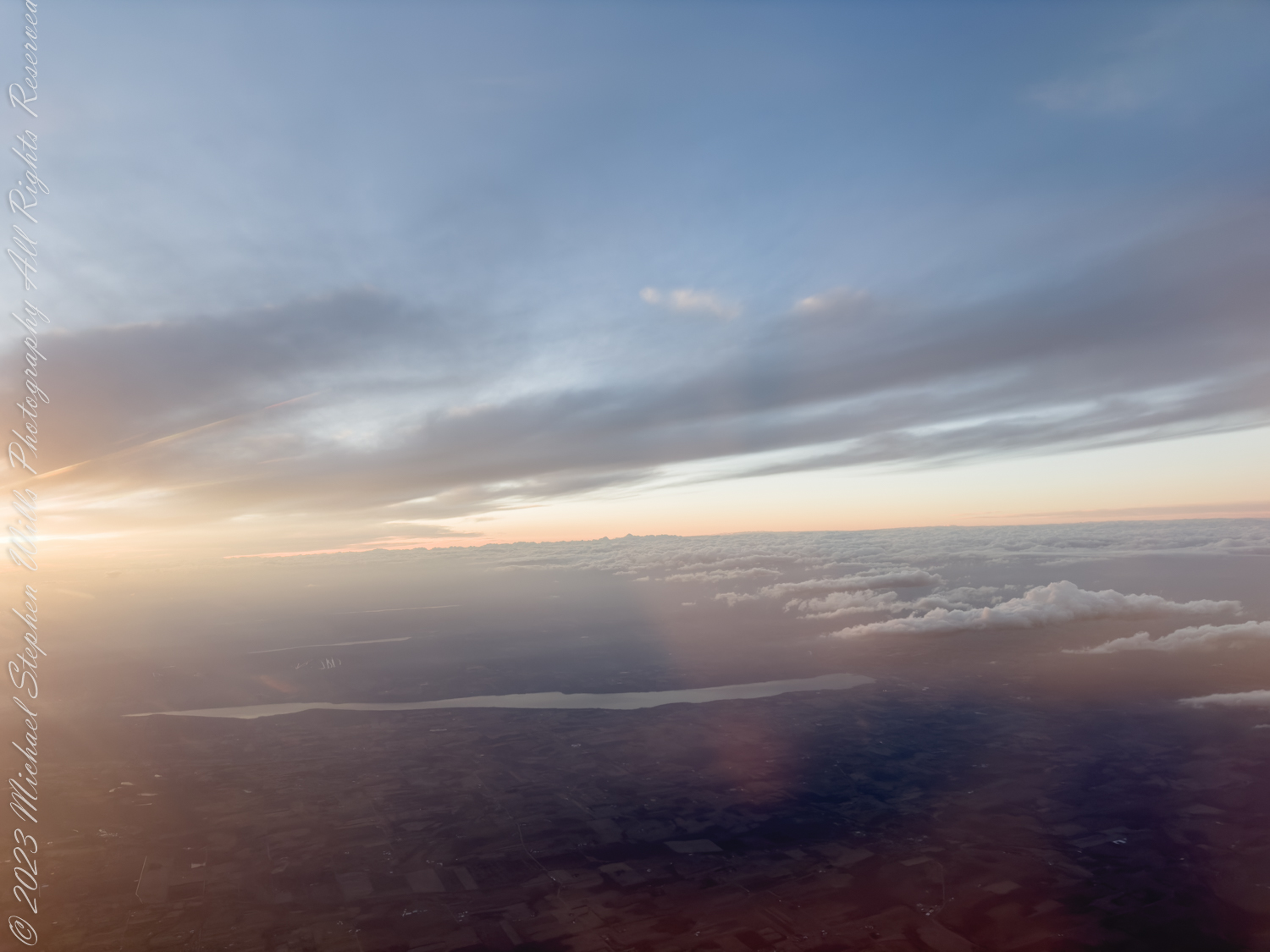
Joint me to gaze out upon a mesmerizing view of winter’s embrace over the Finger Lakes, where the setting sun paints an ephemeral masterpiece of ice, water, and twiligh
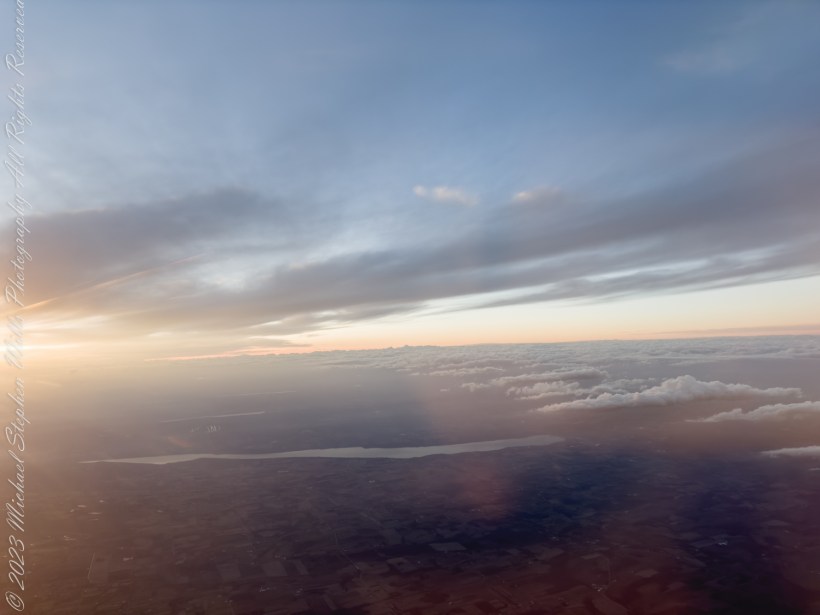
As I soared into the heavens, bound for Syracuse on the 9th of February in the year 2024, I found myself cradled in the gentle embrace of the port side of our metal chariot. The world unfolded beneath me; a tapestry of natural splendor painted in the golden hues of the setting sun. The view to the west, a grand panorama, beckoned my gaze, luring my senses into the wild embrace of Upstate New York’s finest landscapes.
Flying into Syracuse, February 9, 2024 we sat on the left (port) side of plane, this view to the west took in Canandaigua Lake, Bristol Mountain Ski Area, Honeoye Lake, Hemlock Lake (Canadice Lake is not visible).
Below, Canandaigua Lake lay stretched out like a slumbering giant, its waters glistening with the last kisses of daylight, a mirror to the sky’s fiery canvas. How wondrous it was to perceive the world from such heights, to witness the lake’s serenity from the abode of the gods. It seemed as if Canandaigua herself was remembering whispered tales of ice fishermen and quiet boathouses locked in the winter’s frosty grasp.
Off to the south, the proud shoulders of Bristol Mountain Ski Area rose in defiance against the winter’s chill. The mountain’s snow-laden slopes, carved with the meticulous precision of skiers and snowboarders, reflected the sun’s dying light, a beacon of winter’s joy amidst the sprawling lands. I could almost hear the muffled laughter of families and the swish of skis carving their ephemeral signature upon the mountain’s white canvas.
Nestled in the mountain’s shadow, Honeoye Lake revealed itself, a slender and unassuming sliver of tranquility. Its presence was like that of a quiet companion amidst the grandeur, a reminder of the simpler pleasures—frozen waters awaiting the spring thaw, the promise of lush greenery peering from beneath the white shroud of winter.
Beyond, where the earth kissed the sky, Hemlock Lake offered its secluded beauty, a hidden gem amongst its more renowned siblings. Though Canadice Lake remained shyly concealed from view, I knew it too slumbered there, a silent sentinel guarding the land’s secrets. Together, these lakes stood as custodians of a silent world, the guardians of a tranquility that seemed untouched by the passage of time.
As the plane banked gently, the clouds above me caught fire, ablaze with the colors of the dying day. Wisps of vapor painted streaks of orange, purple, and pink across the expansive canvas, a celestial masterpiece unfolding before my very eyes. The clouds seemed to dance with the joy of existence, a choreographed performance to the symphony of the setting sun.
I found myself lost in the moment, a solitary figure suspended between heaven and earth, caught in the embrace of an ephemeral beauty. The world below whispered of untold stories, of winters past and springs to come, of the endless cycle of life that pulsed beneath the frost. It was a moment of profound connection, a fleeting communion with the heartbeat of the planet.
On a brisk day at Stewart Park, I stroll alongside Cayuga Lake, observing Canadian Geese and white willows. The tranquil, interconnected scene proves an enduring memory despite everyday worries.
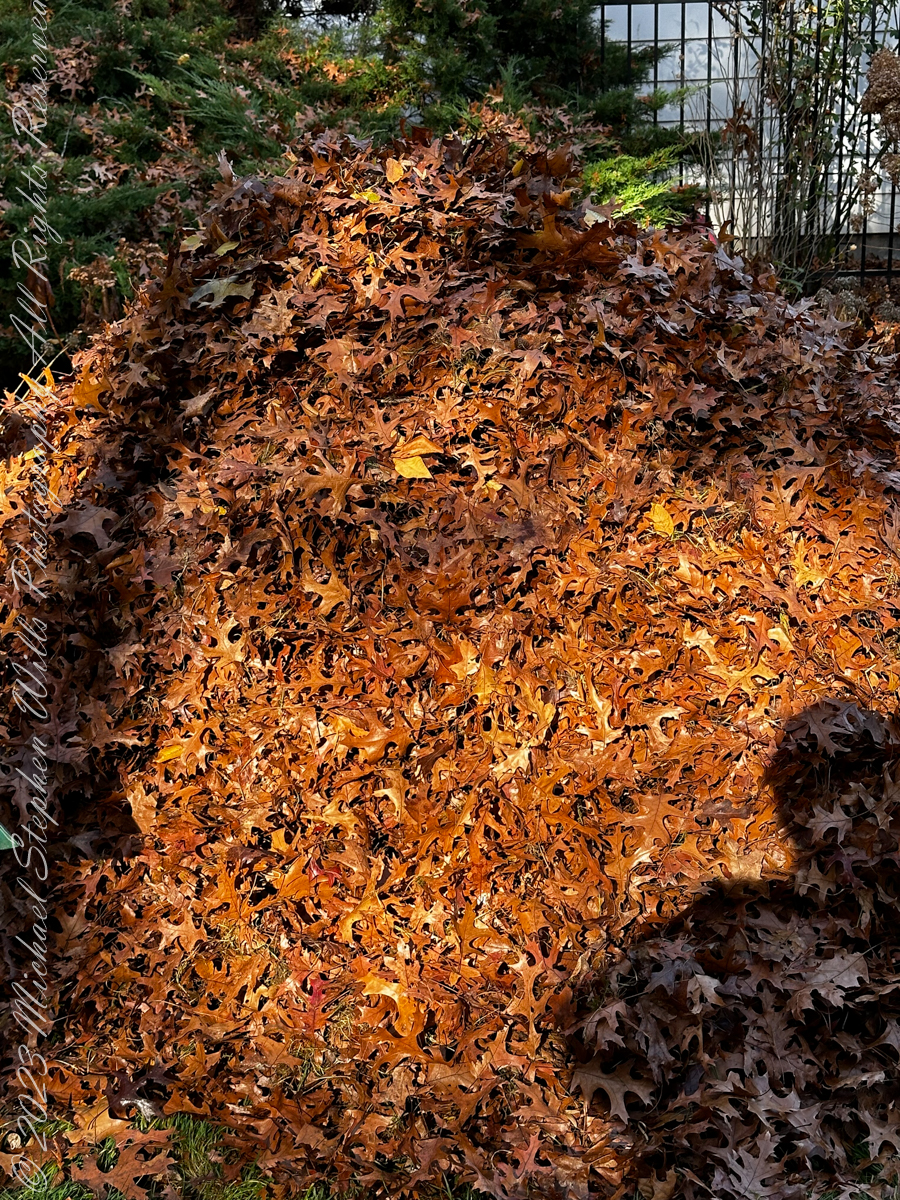
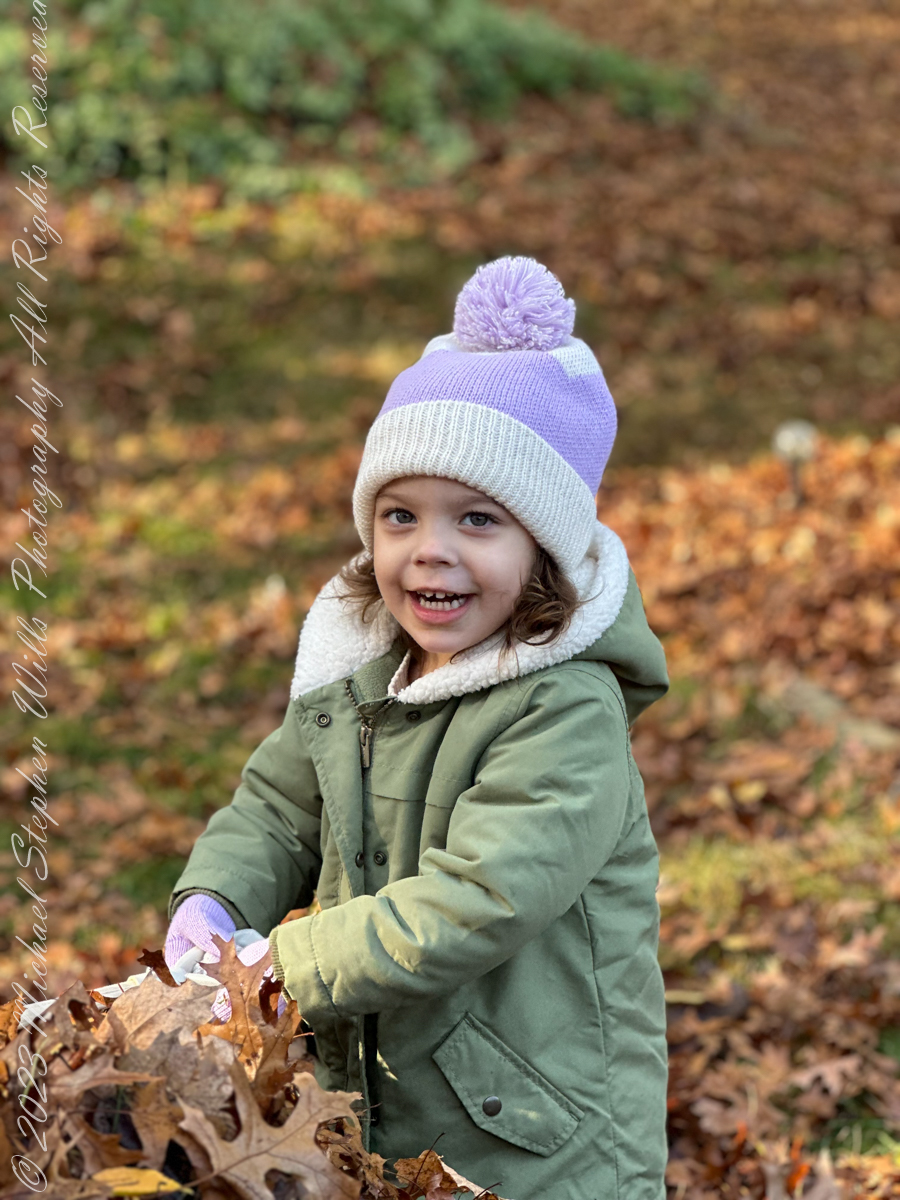
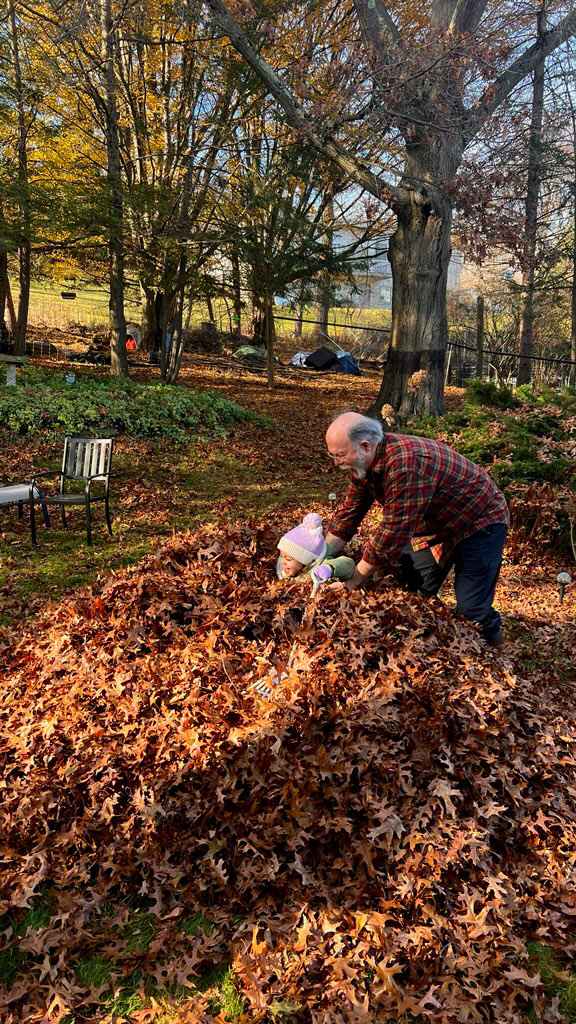
In the gentle embrace of the Finger Lakes region of New York State, the crisp post-Thanksgiving air is a mix of woodsmoke and the faint whisper of winter on the horizon. The earthy scent of fallen leaves, damp from the morning dew, begins to permeate the atmosphere, beckoning families outdoors to partake in the timeless ritual of leaf gathering.
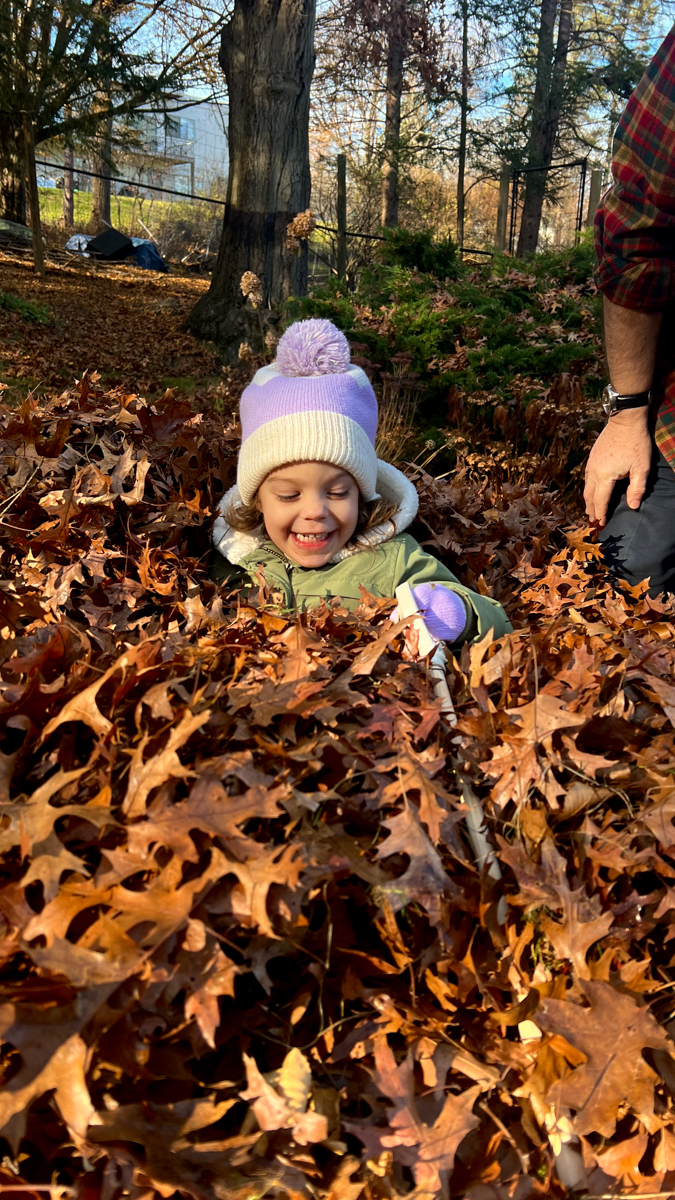
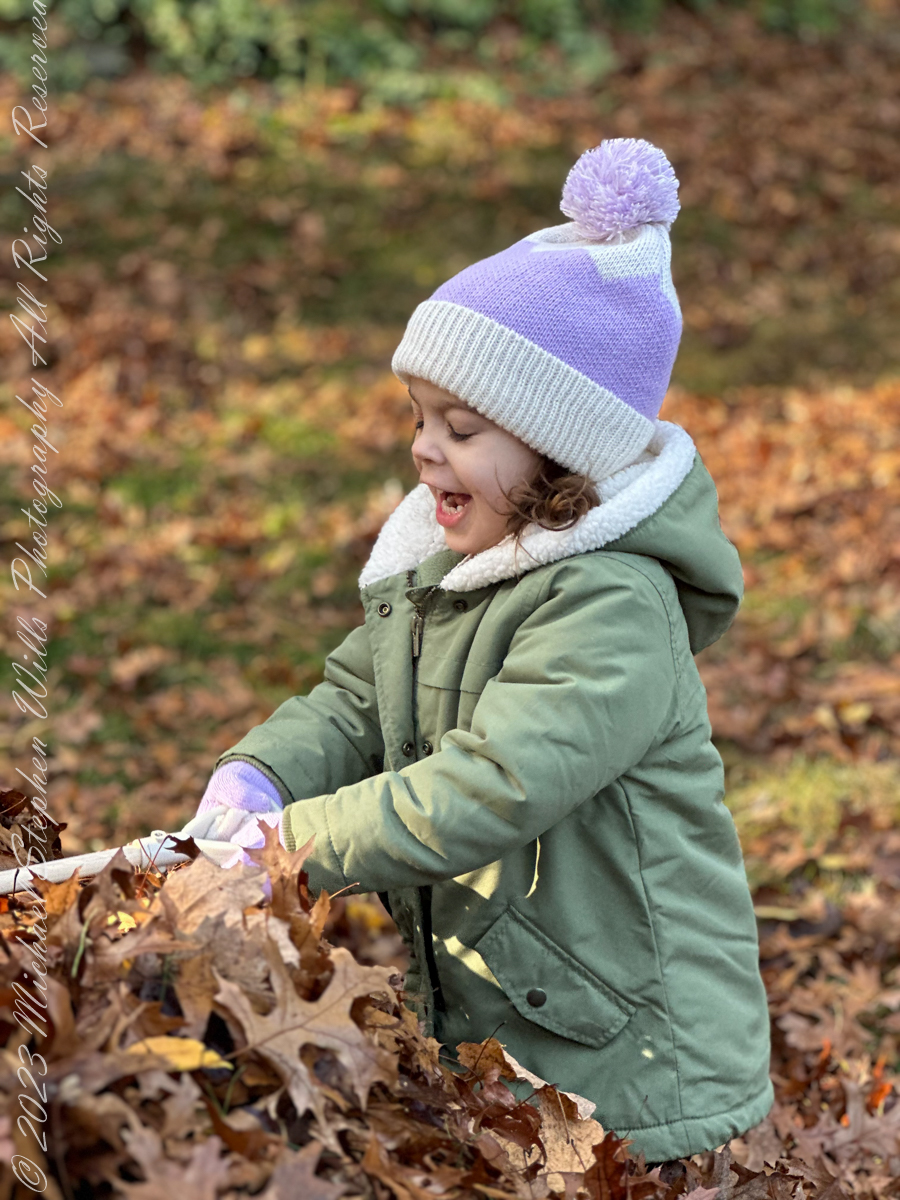
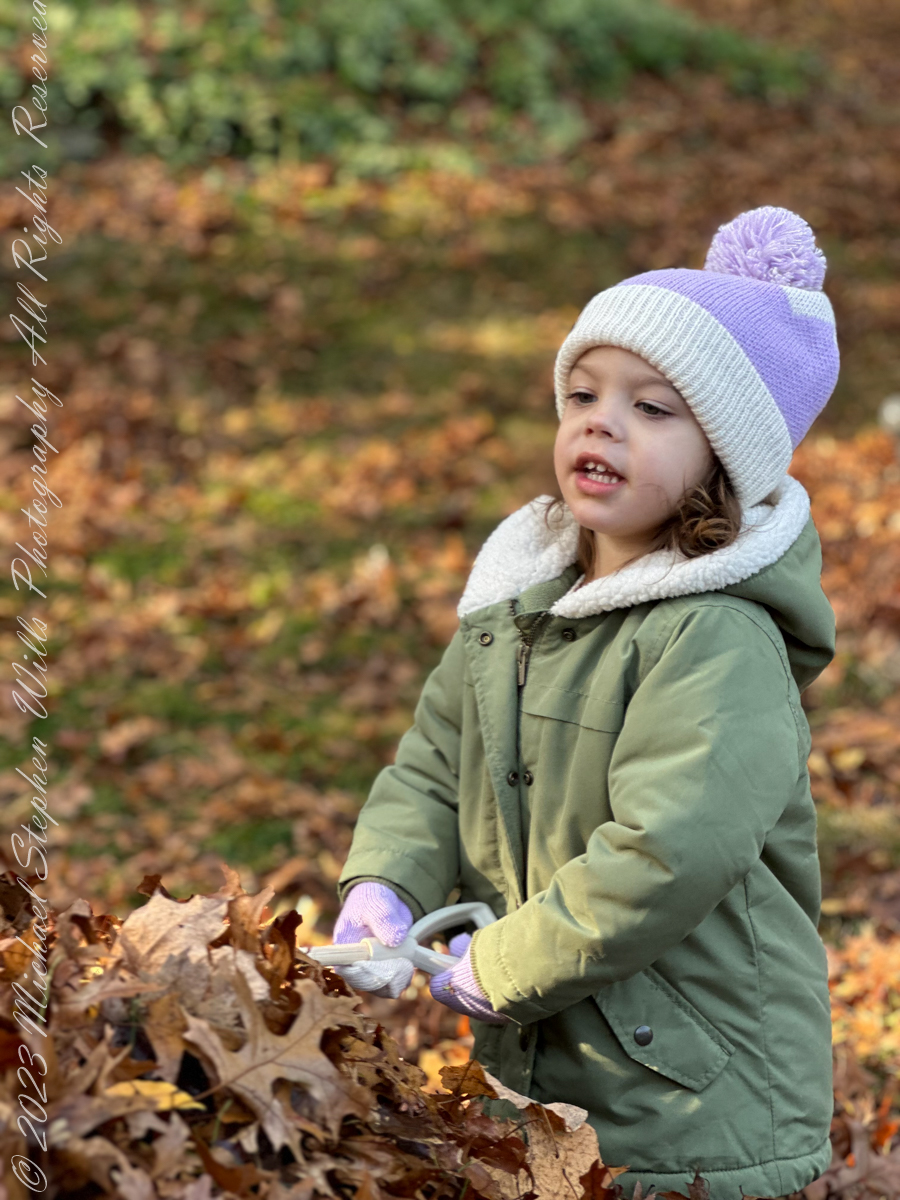
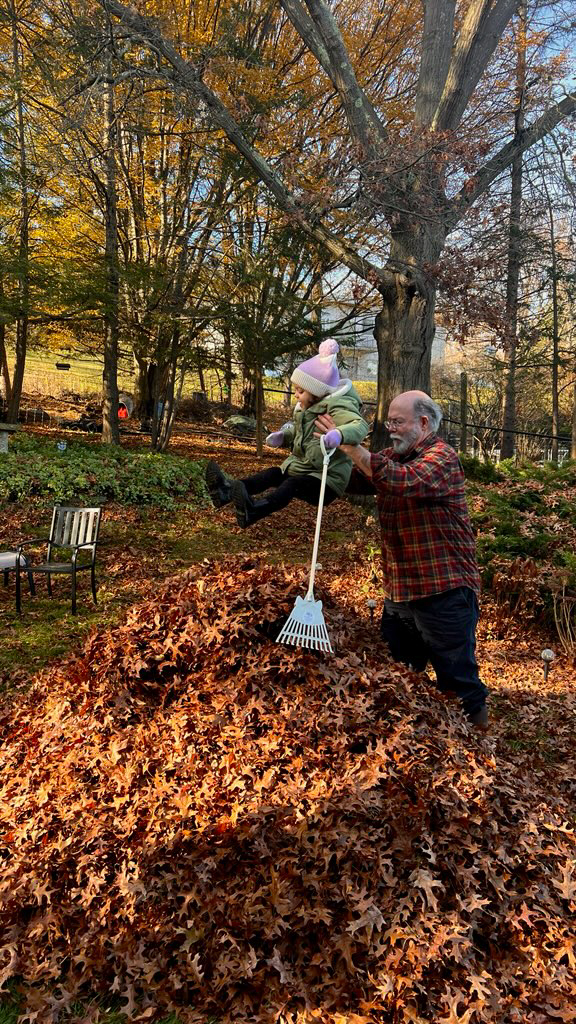
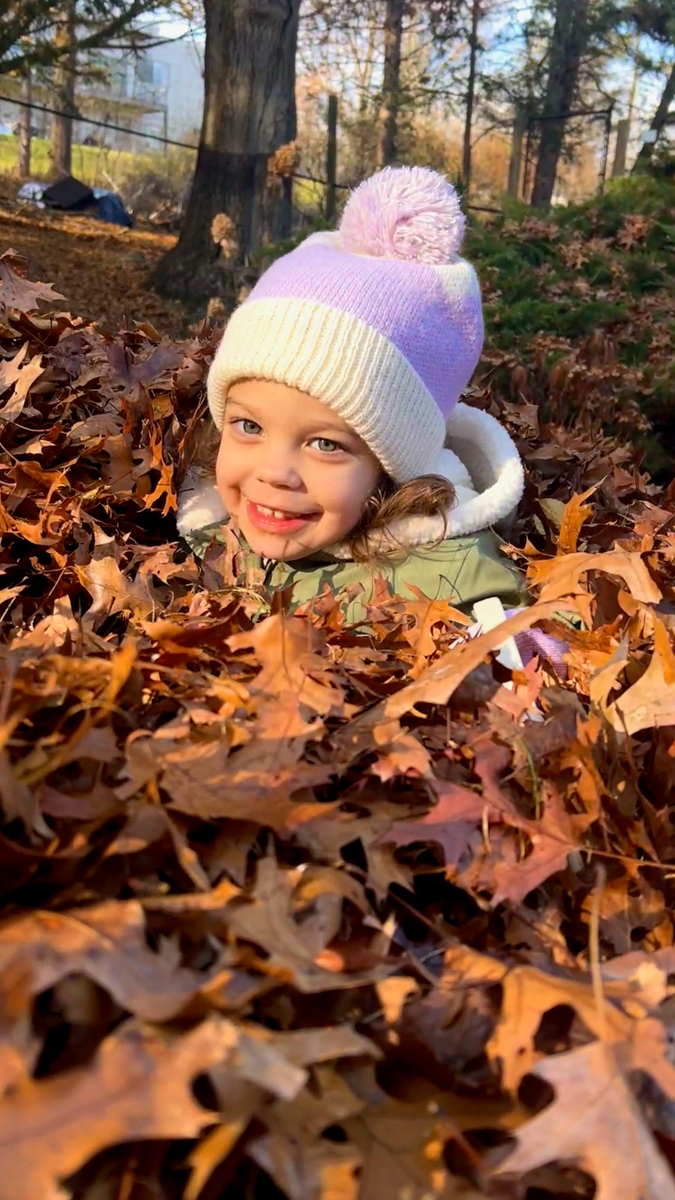
The landscape is a canvas of russet and gold, painted by the hands of autumn. In one of the many serene backyards, framed by the skeletal silhouettes of trees now slumbering after their fiery display, a mound of leaves becomes the center of joyous activity. Here, a child, bundled in the cozy layers necessary to fend off the chill, is immersed in the simple, yet profound act of play. The leaves, a tapestry of oaks and maples, become her castle, her sea, her world to explore.
Her laughter rings clear, a melodic counterpoint to the rustling leaves as she is lifted high by loving hands only to descend into the crunchy embrace of her leafy playpen. A grandfather, his face etched with the smile lines of countless summers and autumns past, becomes the orchestrator of this joy. His flannel shirt, a patchwork of reds and greens, reflects the colors of the season, and his hands, weathered from years of tending to the earth and its cycles, now tenderly guide the child in her play.
The rake, usually a tool of labor, becomes a wand of magic, directing the leaves into heaps that rise and fall with each jump and dive. The child’s mittened hands grasp at the leaves, each one a different hue, a different shape, a different story. They fly up around her like a flock of birds taking flight, then settle back into their collective, creating a soft rustling symphony that speaks of the changing season.
The photographs of this gallery are by Soraya Leathers
As the sun begins to dip lower, casting elongated shadows across the yard, the child’s energy wanes. The vibrant activity gives way to tranquil moments of rest, with the child now lying still among the leaves, her eyes reflecting the vastness of the sky above, clear and blue, a window between the earthly and the infinite.
The day wanes, and the leaf-gathering winds down. A final tableau shows the child, now indoors, cocooned in the warmth of a blanket that mirrors the plaid of her grandfather’s shirt, the same colors now muted and soft. Her eyes are heavy with the weight of a day well spent, her dreams surely filled with the laughter and the leaves and the boundless love that turns even the simplest act into a treasure of memories.
This is the essence of leaf gathering in the Finger Lakes after Thanksgiving – not just the collection of what has fallen, but the gathering of family, of joy, and of moments that will be cherished and recalled long after the last leaf has been tucked into the earth’s winter bed. It’s a time when the harvest is not just of the land’s bounty but of the heart’s. Each leaf, a reminder that even as the world prepares to sleep beneath the snow, life is rich, full, and evergreen in the hearts of those who share it.
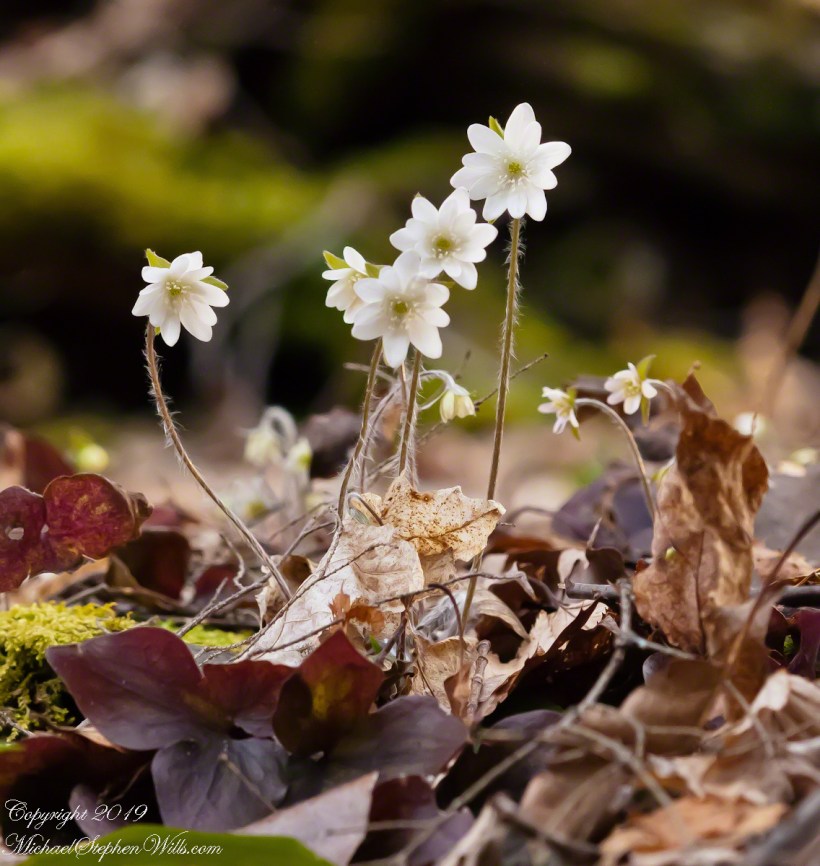
The post discusses the Hepatica acutiloba plant, highlighting its characteristics, growth, historical medicinal use, and its natural habitat in central eastern North America. It also includes an observation made in Robert H. Treman Park.
These characteristic leaves are Hepatica plants growing on the sun dappled southern rim of Robert H. Treman Park captured on a bright late September morning.
“Hepatica acutiloba, the sharp-lobed hepatica, is a herbaceous flowering plant in the buttercup family Ranunculaceae. It is sometimes considered part of the genus Anemone, as Anemone acutiloba, A. hepatica, or A. nobilis. Also generally known as Liverleaf and Liverwort.”
“The word hepatica derives from the Greek ἡπατικός hēpatikós, from ἧπαρ hêpar ‘liver’, because its three-lobed leaf was thought to resemble the human liver.”
“Each clump-forming plant grows 5 to 19 cm (2.0 to 7.5 in) tall, flowering in the early to mid spring. The flowers are greenish-white, white, purple or pinkish in color, with a rounded shape. After flowering the fruits are produced in small, rounded columned heads, on pedicels 1 to 4 mm long. When the fruits, called achenes, are ripe they are ovoid in shape, 3.5–4.7 mm long and 1.3–1.9 mm wide, slightly winged and tend to lack a beak.”
Hepatica Flowers in early spring on the Rim Trail
“Hepatica acutiloba is native to central eastern North America where it can be found growing in deciduous open woods, most often in calcareous soils. Butterflies, moths, bees, flies and beetles are known pollinators. The leaves are basal, leathery, and usually three-lobed, remaining over winter.”
“Hepatica was once used as a medicinal herb. Owing to the doctrine of signatures, the plant was once thought to be an effective treatment for liver disorders. Although poisonous in large doses, the leaves and flowers may be used as an astringent, as a demulcent for slow-healing injuries, and as a diuretic.”
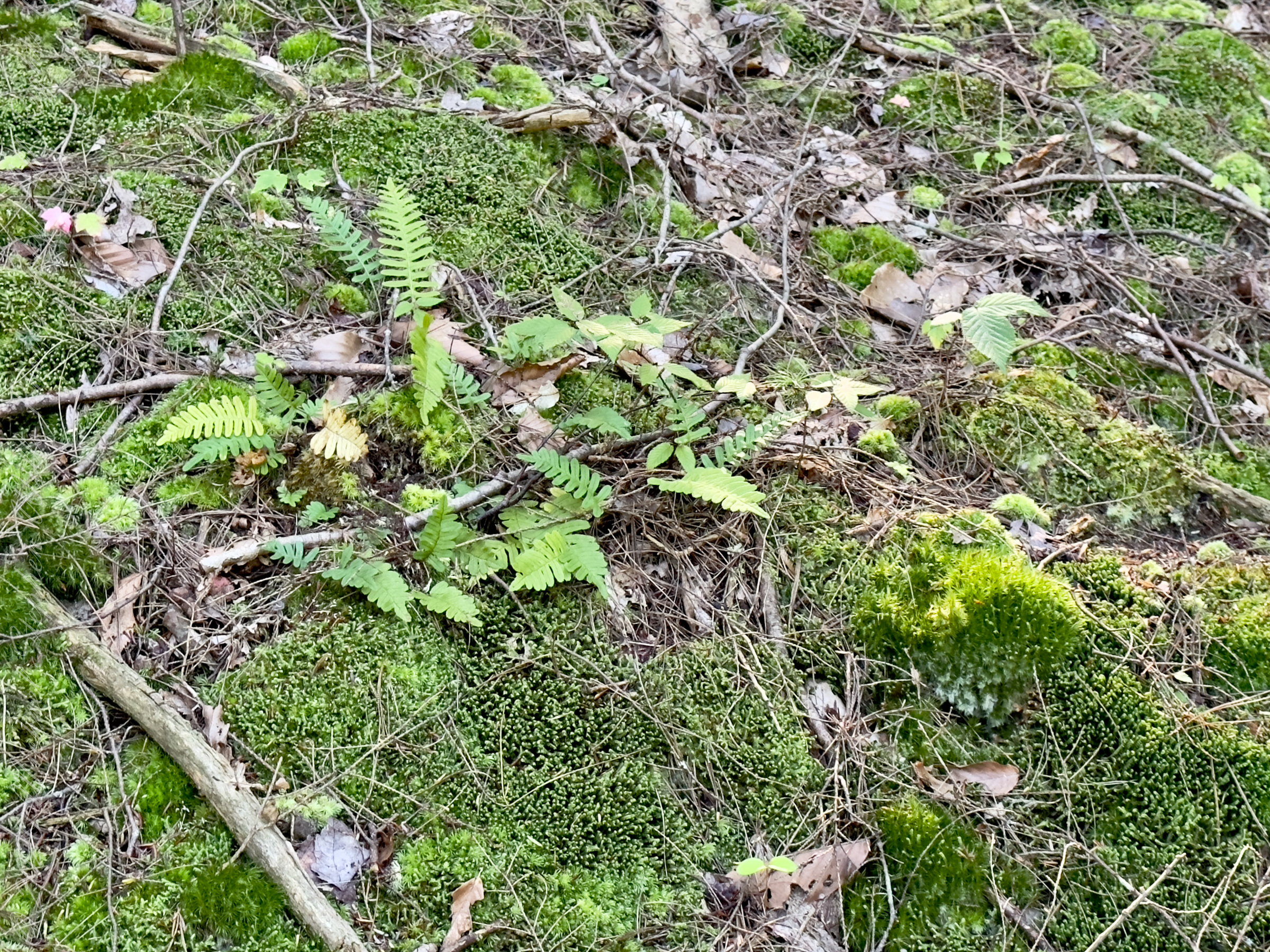
Ferns and Mosses growing beneath Red Pines
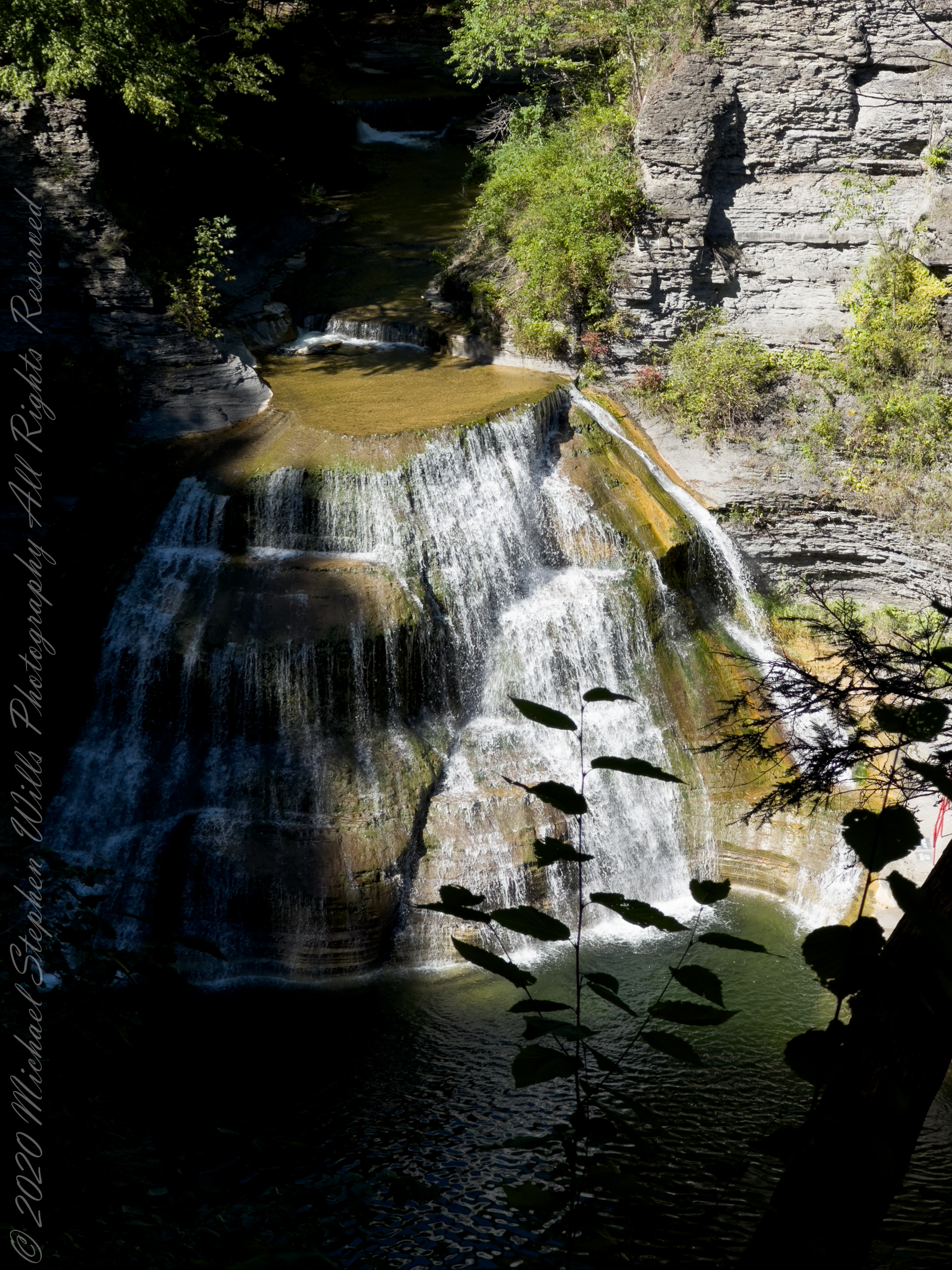
View of the lower falls and swimming hole from the Rim Trail
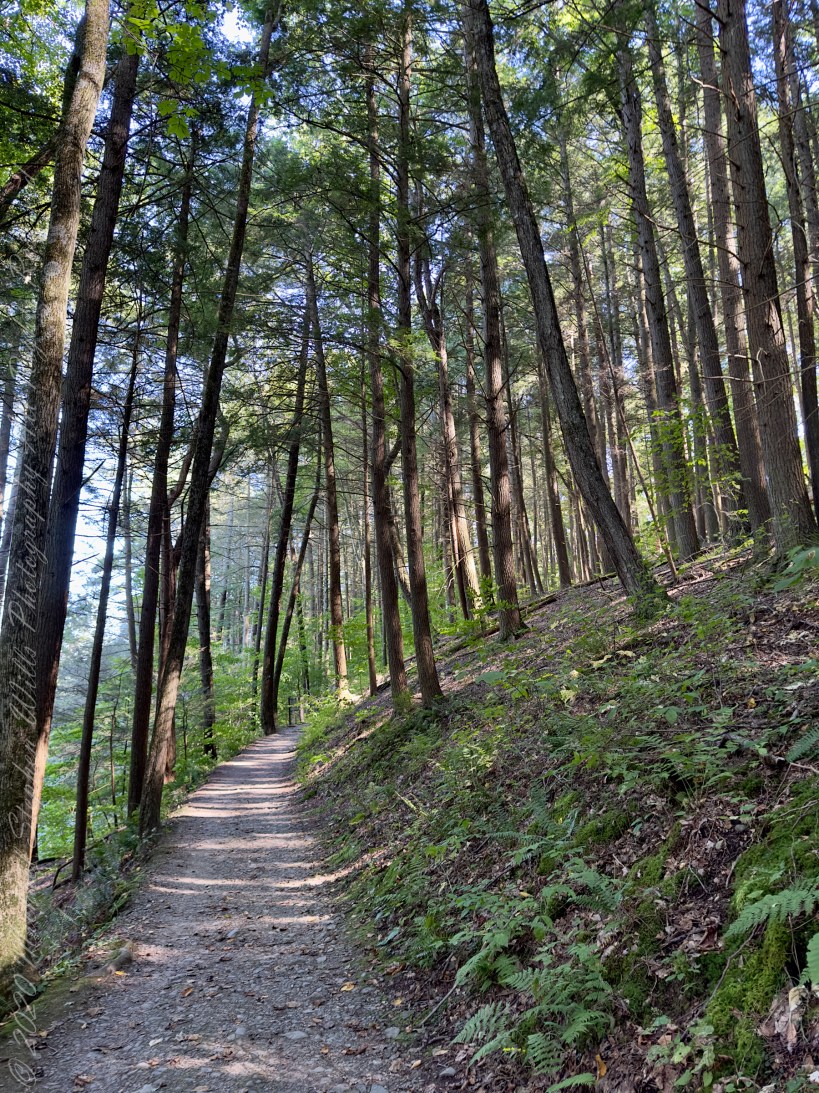
Returning from a Rim Trail walk one April my boots were yellow from a prolific release of pollen from flowers of these tall trees that develop into the woody cones.
Pinus, the pine, is the largest genus in the family Pinaceae, with around 100 species throughout the northern hemisphere.
Red Pine (Pinus resinosa) is Minnesota’s state tree, known there as the Norway Pine. The use of the name “Norway” may stem from early Scandinavian immigrants who likened the American red pines to the Scots pines back home.
“Red pine is a coniferous evergreen tree characterized by tall, straight growth. It usually ranges from 20–35 meters (66–115 feet) in height and 1 m (3 ft 3 in) in trunk diameter, exceptionally reaching 43.77 m (143+1⁄2 ft) tall. The crown is conical, becoming a narrow, rounded dome with age. The bark is thick and gray brown at the base of the tree, but thin, flaky and bright orange red in the upper crown; the tree’s name derives from this distinctive character. Some red color may be seen in the fissures of the bark. The species is self-pruning; there tend not to be dead branches on the trees, and older trees may have very long lengths of branchless trunk below the canopy.”
“It is a long-lived tree, reaching a maximum age of about 500 years. Another member of Pinus, Pinus longaeva D.K. Bailey, the intermountain bristlecone pine, is the longest-lived tree in the world; one in the White Mountains of Nevada is estimated to be 5,000 years old, and by matching rhe rings with even older dead trees, a sequence going back 8,500 years has been established.”
“Red pine is notable for its very constant morphology and low genetic variation throughout its range, suggesting it has been through a near extinction in its recent evolutionary history. A genetic study of nuclear microsatellite polymorphisms among populations distributed throughout its natural range found that red pine populations from Newfoundland are genetically distinct from most mainland populations, consistent with dispersal from different glacial refugia in this highly self-pollinating species.”
Solidago flexicaulis, AKA Broadleaf Goldenrod and Ziazag Goldenrod
“Inventor Thomas Edison experimented with goldenrod to produce rubber, which it contains naturally. Edison created a fertilization and cultivation process to maximize the rubber content in each plant. His experiments produced a 12 ft-tall (3.7 m) plant that yielded as much as 12% rubber. The tires on the Model T given to him by his friend Henry Ford were made from goldenrod. Like George Washington Carver, Henry Ford was deeply interested in the regenerative properties of soil and the potential of alternative crops such as peanuts and soybeans to produce plastics, paint, fuel and other products. Ford had long believed that the world would eventually need a substitute for gasoline and supported the production of ethanol (or grain alcohol) as an alternative fuel. In 1942, he would showcase a car with a lightweight plastic body made from soybeans. Ford and Carver began corresponding via letter in 1934, and their mutual admiration deepened after George Washington Carver made a visit to Michigan in 1937.”
“By the time World War II began, Ford had made repeated journeys to Tuskegee to convince George Washington Carver to come to Dearborn and help him develop a synthetic rubber to help compensate for wartime rubber shortages. Carver arrived on July 19, 1942, and set up a laboratory in an old water works building in Dearborn. He and Ford experimented with different crops, including sweet potatoes and dandelions, eventually devising a way to make the rubber substitute from goldenrod, a plant weed commercially viable. Carver died in January 1943, Ford in April 1947, but the relationship between their two institutions continued to flourish: As recently as the late 1990s, Ford awarded grants of $4 million over two years to the George Washington Carver School at Tuskegee.”
“Extensive process development was conducted during World War II to commercialize goldenrod as a source of rubber. The rubber is only contained in the leaves, not the stems or blooms. Typical rubber content of the leaves is 7%. The resulting rubber is of low molecular weight, resulting in an excessively tacky compound with poor tensile properties.”
References: text in italics and quotes is from the Wikipedia,“Solidago.”
Copyright 2023 All Rights Reserved Michael Stephen Wills