On The Edge of Time Above Taughannock Gorge

Perched above Taughannock Gorge, a moss-covered ledge and cascading falls reveal ancient stories—where Devonian seas once flowed and time’s layers whisper through stone and water.

The morning sun had only just breached the rim of the gorge, sending long slants of golden light across the forest floor. Walking the South Rim Trail of Taughannock Falls State Park, I came upon a quiet, unassuming spot—just a few paces off the path—where the forest seemed to pause in reverence. What greeted me was a small marvel of persistence and time.

There, rooted precariously atop a slab of brittle shale, was a tenacious shrub rising from a bed of moss, its spindly frame etched in sharp contrast to the soft, green sprawl beneath it. The moss had taken hold on a shelf of rock cantilevered over the gorge like a green tongue of earth defying gravity. Cracks traced the shale’s surface like veins, silent records of the forces that shaped this place—heat, ice, pressure, time. Together, the moss and the bush formed an improbable community, surviving against odds, bound together by the thin soil cradled in stone.
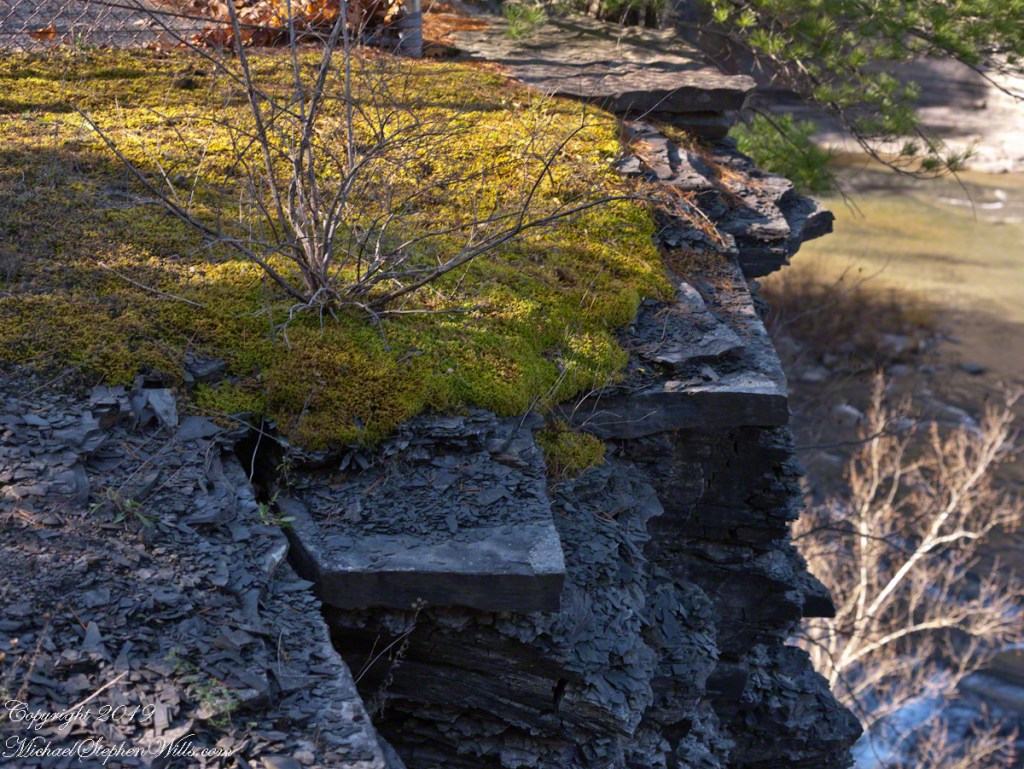
This ledge, suspended over the abyss, seemed less a part of the earth than a question it asked—how much life can cling to the edge before the edge itself gives way?

Beneath this living fragment, the gorge dropped away. Layers upon layers of shale revealed themselves, stacked like a collapsed library of time. Here, the Devonian Period lies exposed to wind and rain, and to those willing to pause and wonder. Each stratum holds the fossil whisper of ancient seas, where trilobites scuttled and coral reefs once stood. This gorge was not carved quickly. It was not born of a moment, but of many—countless raindrops, millennia of ice melt, the slow, sure work of water over stone.

From this natural balcony, I looked out and down to the gorge floor where the creek shaped the land with an artist’s patient hand. The falls, seen from above, no longer thundered—they danced. Spread like the folds of a fan, water curled over smooth stone in steps of white silk. From here, the cascade looked deliberate, choreographed—an elemental performance halfway between gravity and grace.
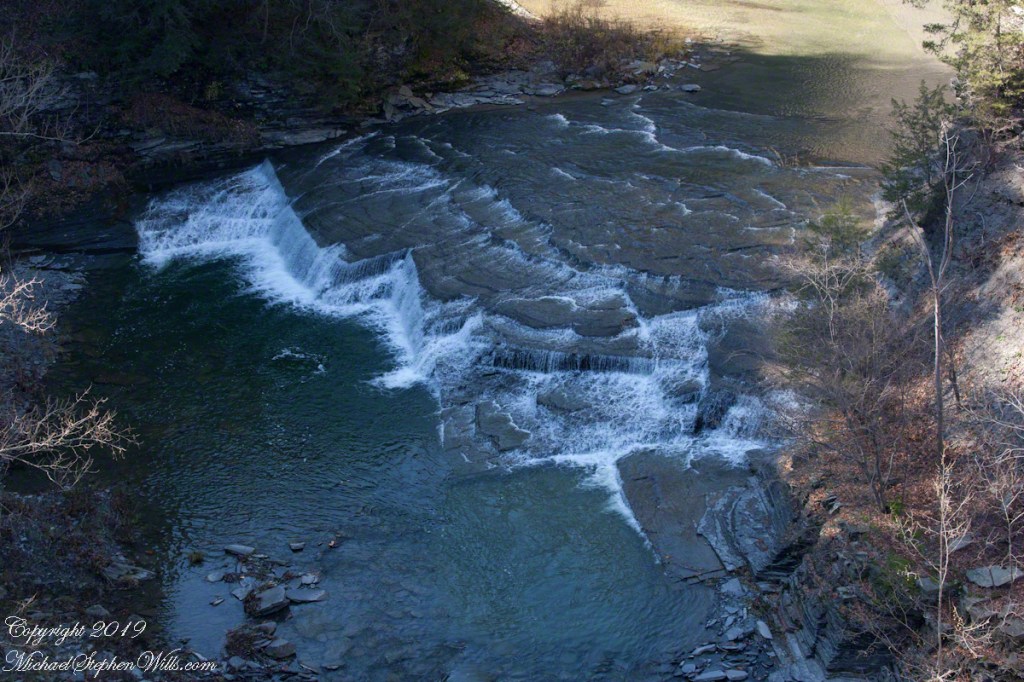
How many times had this water flowed, reshaped, receded? How often had it carved these grooves, smoothed those ridges, erased the footprints of what came before? Looking at the exposed rock, one could trace the signature of ancient glaciers, feel the memory of long-gone floods. It was humbling—this intersection of change and continuity.

Above it all, the trees stood still. Pine and oak, rooted well back from the edge, offered a kind of sentinel presence. Their shadows stretched long and angled, tracing the contours of both earth and memory. For a moment, I let go of all thought and simply listened—to the murmur of wind through leaves, the faint rush of water far below, and the silence that presses in when the land itself seems to be remembering.

This spot—so easily missed by a hurried hiker—offered a parable of resilience and impermanence. The moss did not grow with certainty, nor the shrub reach with confidence. They survived on the edge because they adapted. They made do with less. They took root where others could not. There was no security in that place, only presence. Only the now.

And isn’t that a lesson worth carrying?

We so often seek stability, firm ground, a clear path. Yet, some of the most beautiful things live just beyond comfort—on ledges, in cracks, in the margins of the known. To pause here was to acknowledge that life thrives not only in sheltered valleys but also at the edge of what seems possible.

As I stepped back onto the trail and continued along the South Rim, the image of that mossy outcrop stayed with me. I carried it in my thoughts like a talisman—proof that even on the brink, life finds a way. And that from above, the most chaotic falls can appear as ordered motion, as a flow toward something larger.

Later, when the sun climbed higher and the light lost its slant, I would look back on this moment not as a spectacular highlight but as something more intimate: a quiet encounter with nature’s subtle artistry, its layered truths, and its enduring invitation to look closely, feel deeply, and walk softly.

For here, above the gorge, at the edge of earth and time, even a whisper leaves a mark.

Enter your email to receive notification of future postings. I will not sell or share your email address.

The Living Tapestry of Treman Gorge

Discover the enchanting world of Treman Gorge through its ancient ferns. Step into a living tapestry where nature’s resilience paints a story of survival and beauty. Dive deeper into this magical realm by reading our latest blog post.

Entering Treman Gorge


As I step into the lush expanse of Treman Gorge, I am enveloped by a verdant cathedral of nature. The gentle murmur of flowing water blends with the chorus of birds, creating a symphony that resonates deep within me. The air is fresh, filled with the earthy aroma of damp foliage, inviting me deeper into its serene embrace.

“The Gallery” entrance to Tremen Gorge from the upper park.

Among Ancient Rocks

The gorge is a geological marvel, sculpted from layers of Devonian shale and sandstone. These sedimentary rocks, formed over 400 million years ago, tower around me, formidable and steeped in history. The stratified patterns on their surfaces tell tales of ancient rivers and seas that once dominated this landscape, leaving behind sediments that would compact into the shale and sandstone seen today.

The Flourish of Life on Stone

Along the damp trails, vibrant mosses and ferns adorn the rock walls, thriving in the moist, shaded nooks. The mosses, lush and green, form thick carpets that breathe life into the stone. Among them, patches of Dicranum moss are notable for their robust, upright growth. Ferns, too, make their home here, with Polystichum acrostichoides, or Christmas fern, prevalent for its evergreen fronds that add year-round color to the grey stone backdrop.

Ephemeral Pools and Nature’s Adaptation

Small pools of water collected in the rock crevices create microhabitats buzzing with life, from aquatic insects to amphibians seeking refuge. These clear, cool pools mirror the verdant foliage and blue skies above, creating tranquil tableaus of the gorge’s hidden depths.

The Role of Ferns and Mosses in Human History

Ferns and mosses, beyond their beauty and ecological roles, have practical applications that have been recognized since ancient times. Ferns have been used in traditional medicines for their anti-inflammatory and pain-relieving properties. Certain species, like the bracken fern, were used by Native Americans for food, medicine, and even bedding during travel.

Mosses also hold significance in human history. Their excellent insulation properties made them a popular choice for lining chinking in log cabins or as a packing material to keep food fresh. In modern times, the absorptive properties of moss are harnessed in ecological projects such as biofiltration, to clean contaminants from water.

Native American Heritage in Treman Gorge

The history of Native Americans in areas like Treman Gorge is rich with culture and deep respect for the natural world. They utilized the gorge’s resources sustainably, understanding the intrinsic value of each plant and animal. For example, the gorge’s abundant moss and fern-covered landscapes provided not only material resources but also spiritual significance. These plants were often used in ceremonial practices, symbolizing life and fertility, and were integral in storytelling and oral traditions that passed vital knowledge through generations.

Enfield Creek in Treman Gorge

Reflections on Resilience and Beauty

With each step through Treman Gorge, I feel a deep connection to the past—each rock, moss patch, and fern frond speaks of endurance and adaptability. In the grand timeline of Earth, my presence is but a fleeting moment, yet it is intertwined with the eons of history embedded in this place.

Devil’s Kitchen Waterfall above Lucifer Falls

Treman Gorge, with its ancient rocks and thriving plant life, stands as a testament to the resilience and beauty of nature. It reminds us of the world’s perpetual motion, of life’s ability to adapt and thrive in the face of time’s relentless passage. Here, amidst the moss-covered rocks and fern-laden paths, I find a sense of peace and continuity, a connection to the Earth that is both humbling and uplifting.

Concluding Thoughts

As I leave Treman Gorge, the echo of the water and the rustle of leaves linger in my mind, a reminder of the timeless dance between nature and those who walk its paths. This place is a living library, holding the secrets of millennia, reminding us of our place in nature’s vast narrative and the enduring legacy of those who walked these paths before us.

Copyright 2024 Michael Stephen Wills All Rights Reserved

Thayer Preserve: Autumn Still Life 5

Ithaca’s bedrock, formed 370 million years ago, deeply influences its landscape, neutralizes rainwater’s acidity, and carries a story of Earth’s resilience and transformation.

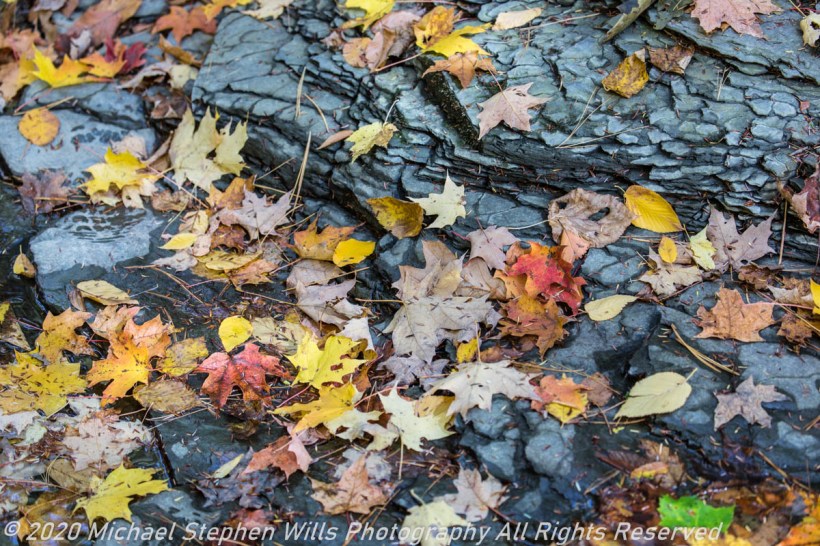
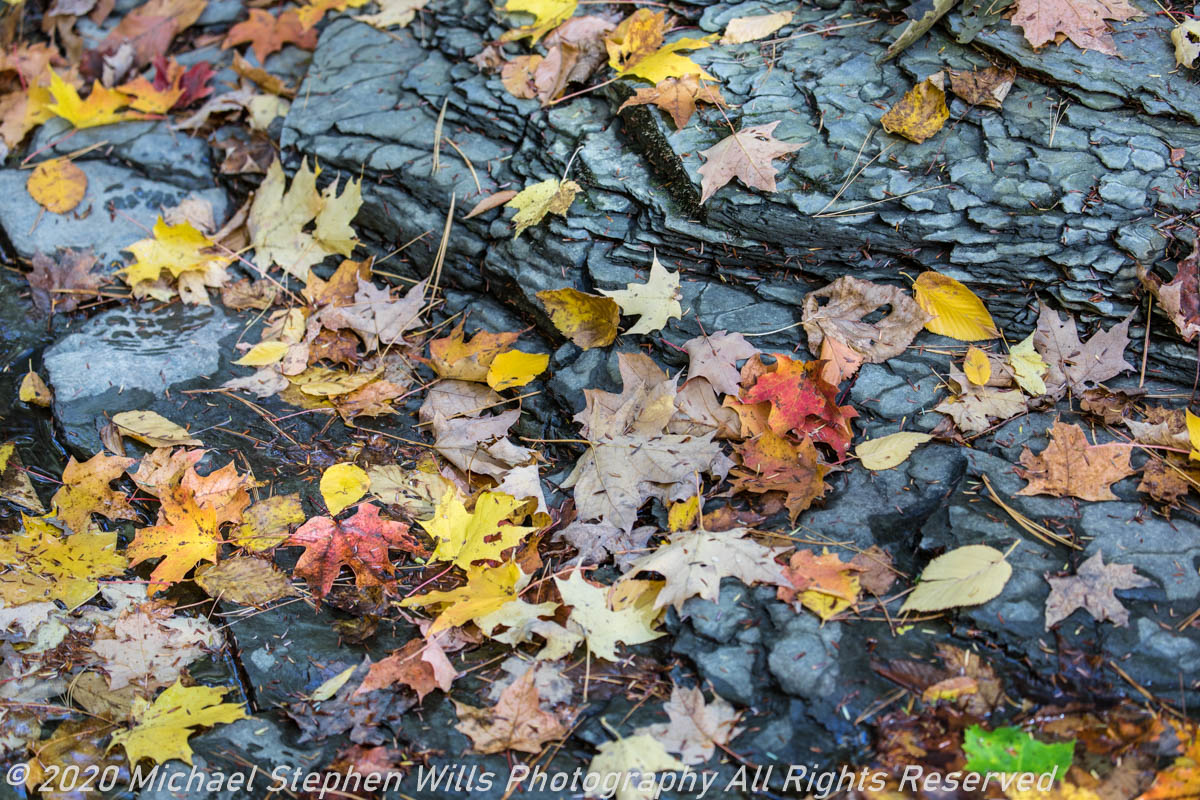
In Ithaca, New York, the story of the land is deeply rooted in its geology. Beneath the vibrant autumn leaves and along the path of Lick Creek lies a bedrock formed 370 million years ago. This ancient foundation, once the sediment of a vast inland sea, now forms the solid base upon which the city stands.

The bedrock here is a silent witness to Earth’s long history. Originating in the Devonian period, it marks a time when vast seas covered much of the Earth’s surface. Within these ancient waters, life flourished, leaving behind sediments that, over eons, transformed into the layered rock beneath Ithaca.

These layers are more than just historical records; they actively shape the landscape. The bedrock influences soil composition, affects plant growth, and directs the flow of streams. Lick Creek, with its clear waters, is one such stream that interacts intimately with this bedrock.

In autumn, the beauty of this interaction is vividly displayed. The red and yellow maple leaves create a striking contrast against the grey-blue backdrop of the bedrock, a blend of the vibrant present with the ancient past. These fallen leaves, over time, decompose and enrich the soil, continuing a cycle of life that this bedrock has supported for millions of years.

This bedrock also plays a crucial role in water chemistry. As acidic rainwater percolates through it, a remarkable transformation occurs. The bedrock naturally neutralizes the acidity of the rainwater. By the time the water emerges as streams, it is buffered to a neutral pH. This process is vital for maintaining the ecological balance of the area. The streams that flow out, including Lick Creek, support diverse ecosystems thanks to this natural filtration process.

Click photograph for larger view. Use combination keys to enlarge/reduce: Ctrl+ (Control / Plus) and Ctrl- (Control / Minus)

The neutral pH water is crucial for the flora and fauna of Ithaca. It sustains the forests, the wildlife, and the natural beauty that defines the region. This water, once acid rain, purified by the ancient bedrock, now nurtures life in its journey.

In Ithaca, the bedrock is a testament to the enduring nature of our planet. It reminds us of the continuous cycle of transformation that defines the Earth. The contrast of the autumn leaves against the bedrock is not just a scene of ephemeral beauty; it symbolizes the dynamic interplay between the living and the geological, between the present and the deep past.

The bedrock of Ithaca, with its ability to neutralize acidic water, highlights the interconnectedness of natural processes. It shows how the Earth self-regulates and sustains life in intricate ways. As the buffered, neutral pH water of Lick Creek flows over this bedrock, it carries with it the story of a planet that is constantly renewing and sustaining itself.

In this landscape, the past is not just a memory; it is an active participant in the present. The bedrock, the autumn leaves, and the flowing streams tell a story of resilience, continuity, and the beauty of nature’s balance. This is the legacy of Ithaca’s bedrock, a legacy of endurance, transformation, and life.

Click Me to view my photographs on Getty.

Copyright 2023 Michael Stephen Wills All Rights Reserved http://www.MichaelStephenWills.com