Delicate Brushwork

Whispering ice threads,
Sunset paints the silent sky—
Autumn’s breath grows cold.

As the sun dipped lower, casting its farewell in hues of amber and soft gold, Pam and I stood beside the serene Cayuga Lake Inlet, gazing westward. The stillness of the evening was a quiet symphony, punctuated only by the gentle lapping of water against the shore. It was November 5th, and the world seemed to hold its breath in the golden hour, that perfect moment minutes before the sun would bid its final adieu for the day.

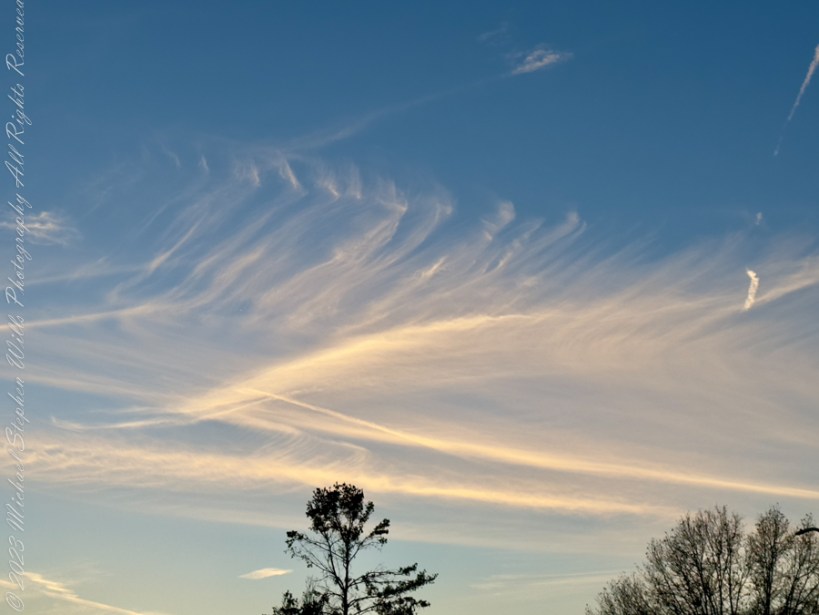
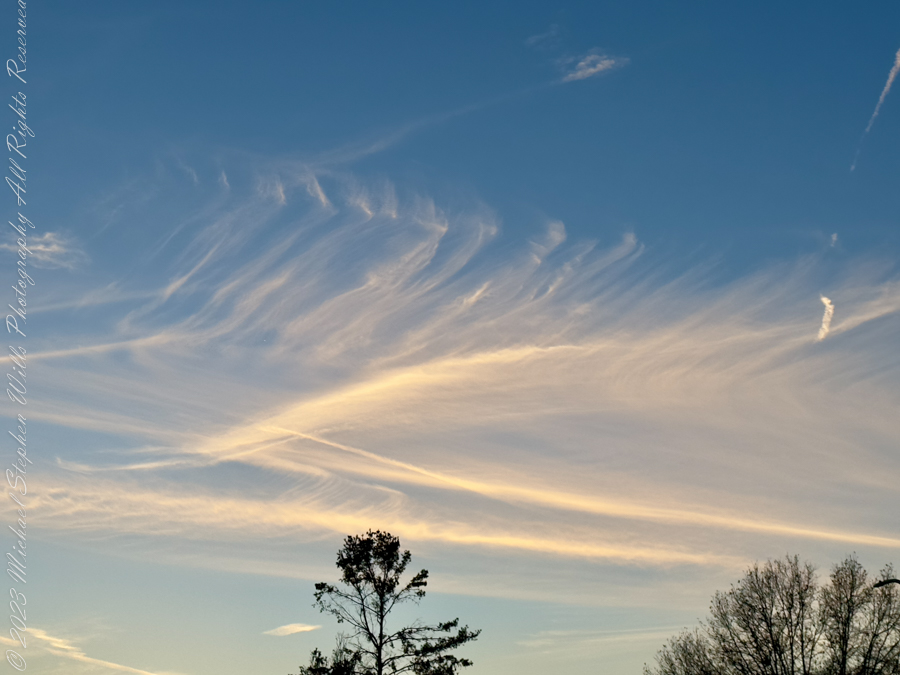
Above us, the sky was a canvas of nature’s delicate brushwork – the Cirrus fibratus. These high-altitude clouds, ethereal and wispy, stretched across the sky like strands of silken thread. The cirrus clouds, the feathery remnants of far-travelled storms, are the poets of the atmosphere, telling tales of weather yet to come. Their presence was both a testament to the day’s tranquility and a harbinger of change looming on the horizon.

Cloud Lore

Cirrus fibratus clouds, in their striated splendor, often signal the approach of a warm front and are associated with the shifts in weather patterns. As we stood there, the clouds seemed to be etching the sky with messages in a cryptic script, hints of the coming days. These clouds, so high in the sky, are formed from ice crystals, and their very existence speaks of the coldness of the upper atmosphere, as the days down here by the lake inlet lengthen towards the winter solstice.

The days of early November, with their crisp air and the promise of winter, bring a change in the light, a deepening of colors, and a certain clarity to the world. The skies seem grander, a vast dome of ever-changing artistry, and the Cirrus fibratus are our guides to the imminent transformation. They remind us that the earth is tilting away from the sun in our hemisphere, pulling us into the cooler seasons.

Eternal Change

These cirrus formations, while signaling the shifts in weather, also play with the light of the lengthening days. The sun’s rays, ever lower on the horizon, catch the ice crystals, creating a prism effect that can result in sundogs, those bright spots of light that occasionally grace the sky at solar dawn or dusk. They add a mystical quality to the already enchanted time of day.

As the twilight deepened, the Cirrus fibratus began to glow with the sun’s final touch, turning from white to shades of pink and fiery orange. This spectacle was a gentle reminder of the passage of time, the cycles of nature, and the endless dance between the earth and the sun. The clouds foretold of cooler weather, perhaps a sign that we should cherish these last vestiges of autumnal warmth.

As night began to embrace the sky, the clouds slowly faded from our sight, but the memory of their beauty and the secrets they carried lingered. They are not just ice and air; they are messengers, carrying the stories of the atmosphere from one part of the world to another, connecting us with the rhythms of the earth in their ceaseless journey.

Signs and Wonders

In the coming days, we would watch the sky, taking note of the cirrus and the subtle cues they offered. Would there be rain, a storm, or perhaps a clear day that belies the cold snap in the air? Only time would tell, but for now, we stood in silent appreciation of nature’s grace, feeling the profound connection to the world around us that only a sunset watched together can bring.

Click Me to view my photographs on Getty.

Copyright 2023 Michael Stephen Wills All Rights Reserved http://www.MichaelStephenWills.com

Thayer Preserve Suite

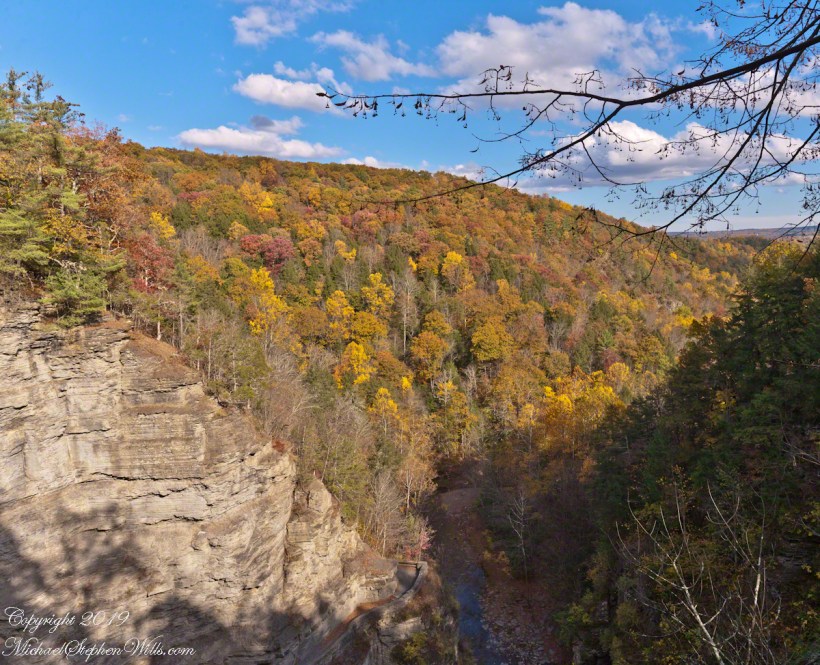
Michael Stephen Wills’ photos depict the vibrant nature of the Finger Lakes.

Continue reading “Thayer Preserve Suite”

Autumn Evening Hike, turning home

through Devil’s Kitchen to Lucifer Falls

In this third part, we continue hiking Treman gorge, approaching Lucifer Falls, viewing another waterfall further downstream and returning to the trailhead.

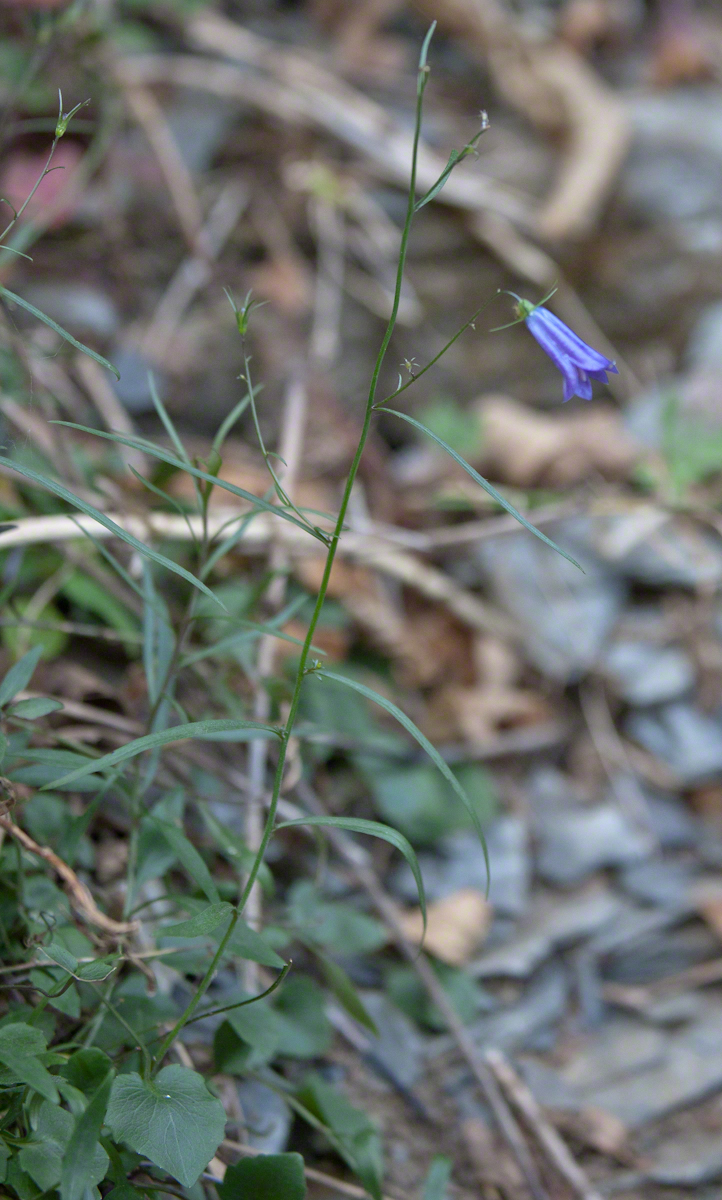
 Tiny Trumpet, unknown

I have never achieved a satisfactory capture of the waterfall in the Devil’s Kitchen, a place where the creek flow is diverted south by a projecting ridge. Less than 100 feet later the easterly direction is regained where the water plummets over Lucifer Falls.

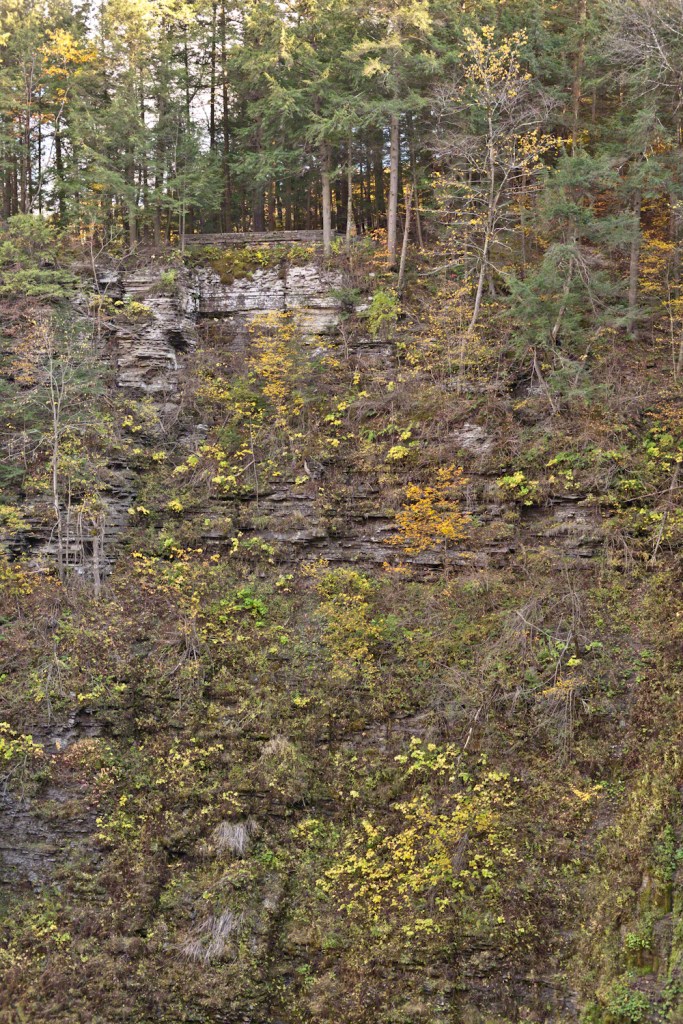
The annual in fall of rock in Devil’s Kitchen uproots and crushes plants growing there. There is scant soil, the roots of this shiny purple trumpet bloom took hold in a microscopic crack. The plant is so thin, the flower so tiny it is lucky my gaze found it.

Click link for my fine art print “After the Rain: Showy Lady Slippers.”

After searching all my plant identification references, this plan is unknown to me.  Please help with identification. The bloom is 1/4 inch long.

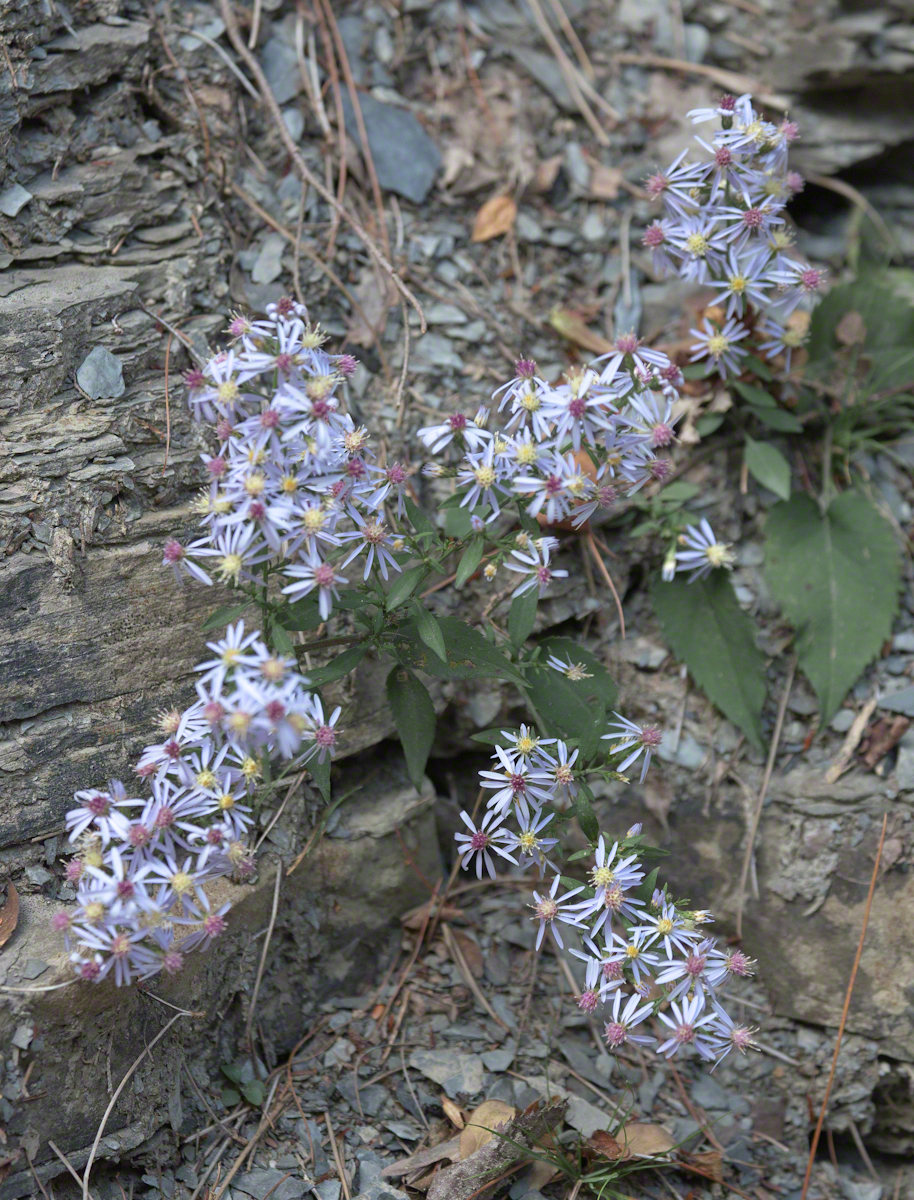
Not far away, these asters grow from a slightly wider crack.  Pam pointed them out to me. I was drawn by the striking color difference of the heads growing from a single stalk.

Click link for my fine art print “Purple Asters.”

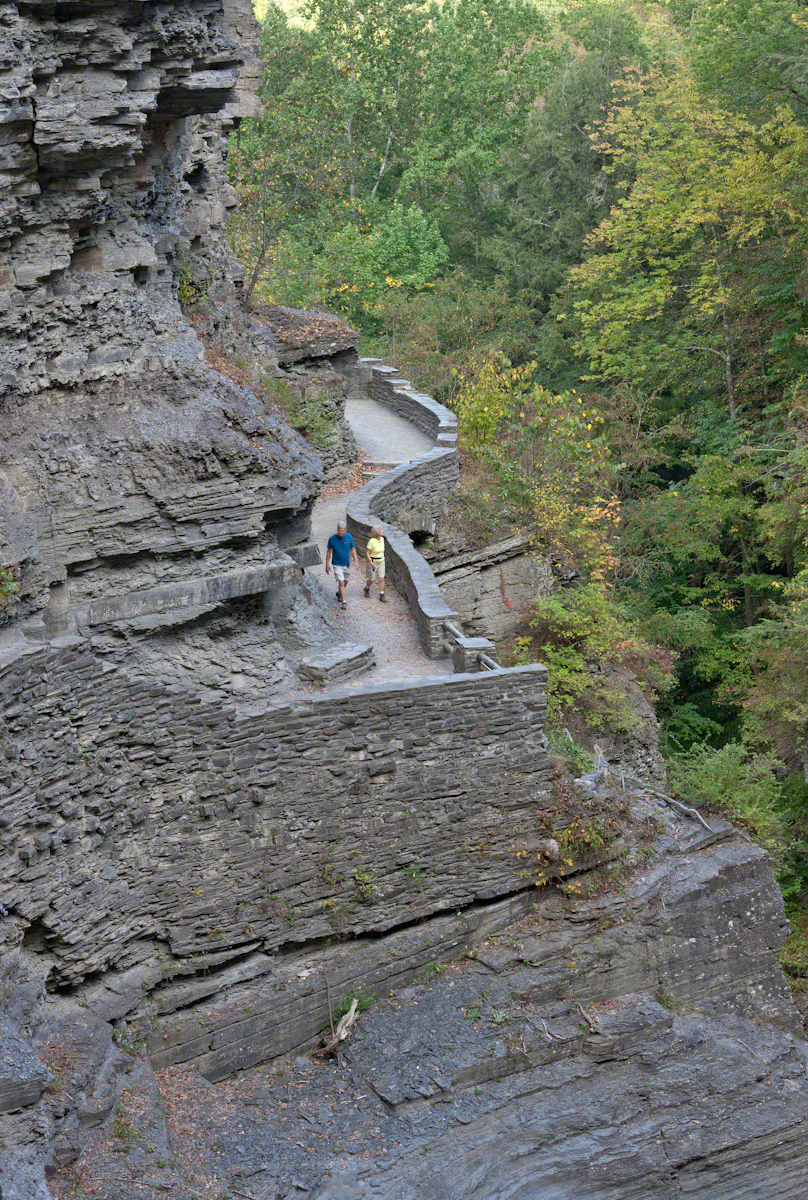
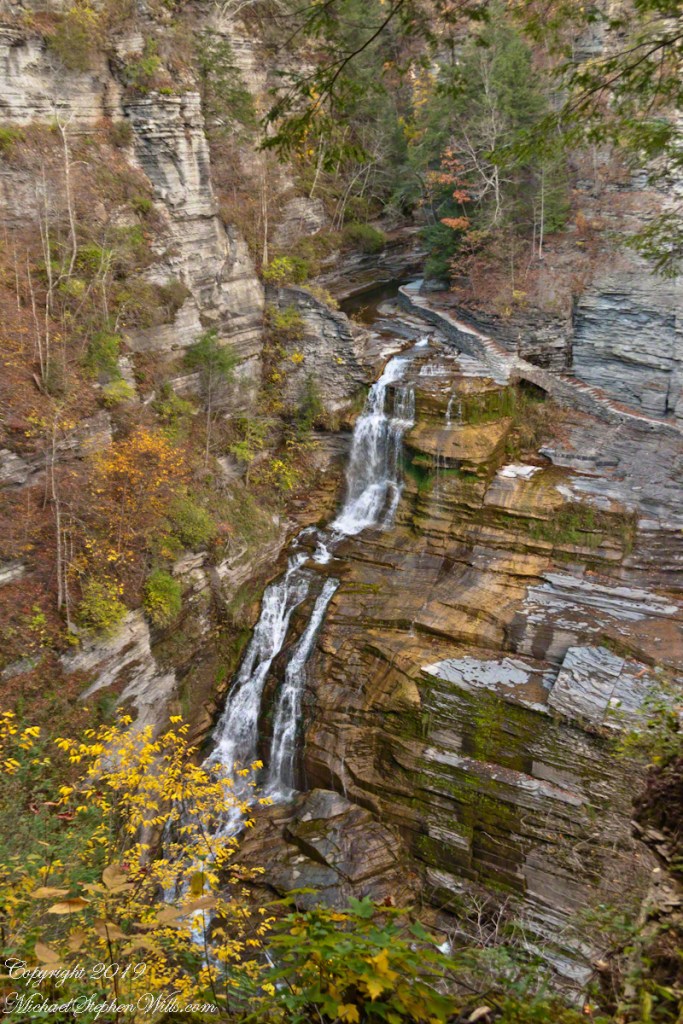
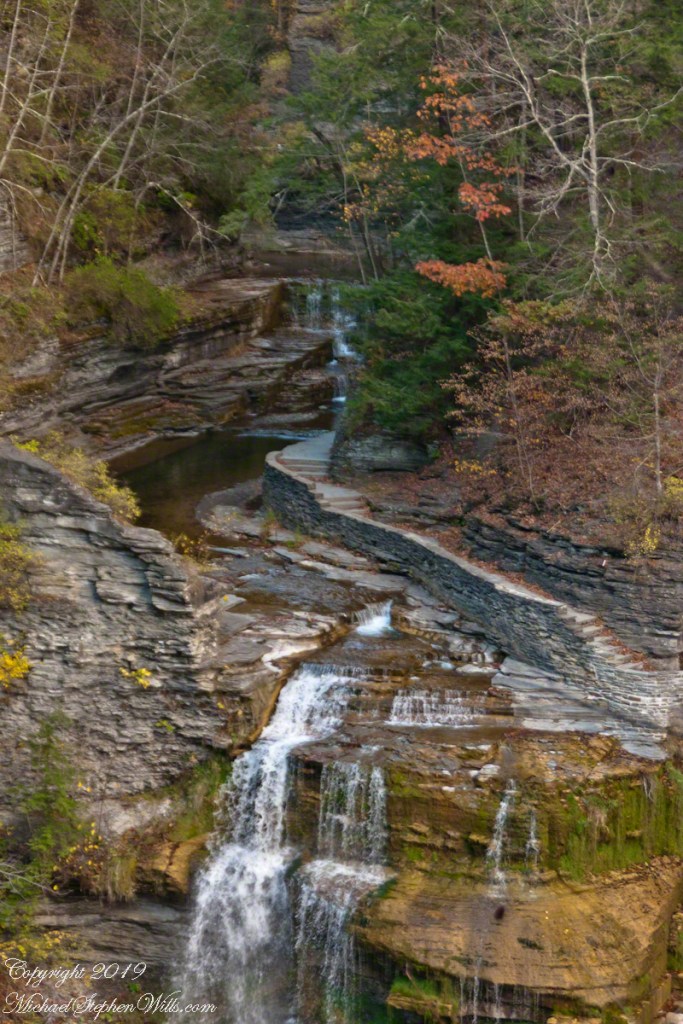
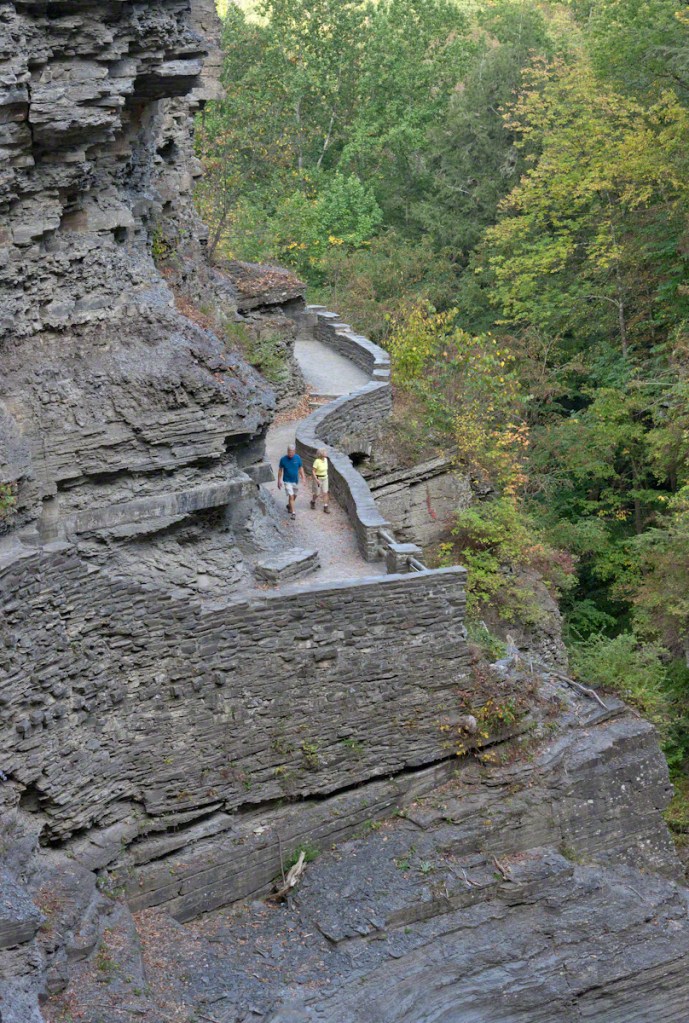
As trail winds around the ridge a stone wall rises on the right and for good reason.  The stream shortly reaches the brink of Lucifer Falls, 115 feet high.  Gorge walls fall away, the trail steepens.  Here is the view from the trail next to the brink.

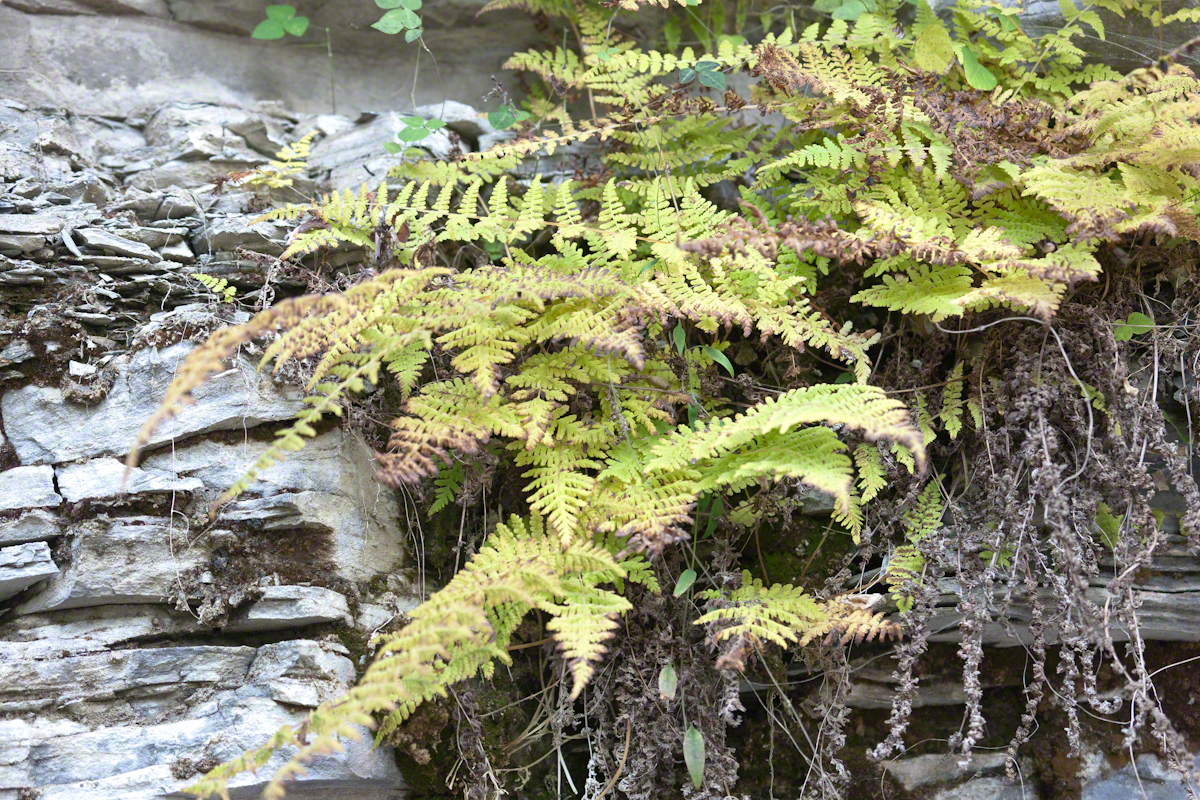
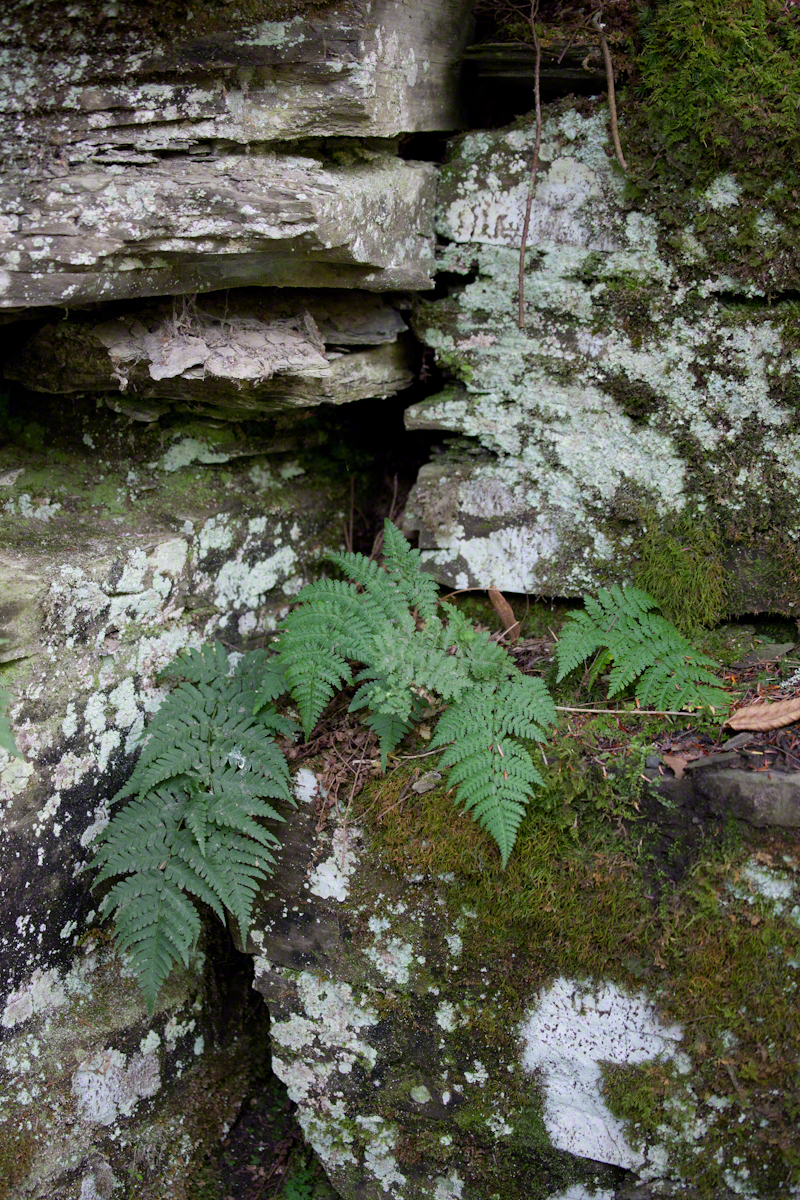
At hand, on the right, a growth of ferns has survived many seasons.  Flowering plants are, in geological time (across billions of years), a relatively recent development compared to these non-flowering ferns.  The first flowering plants appears 120 million years ago compared to the first ferns, 360 million years ago.  Oddly enough, the spread of flowering plants affected evolution of ferns, an increase of fern speciation in parallel to the rise of flower plants.

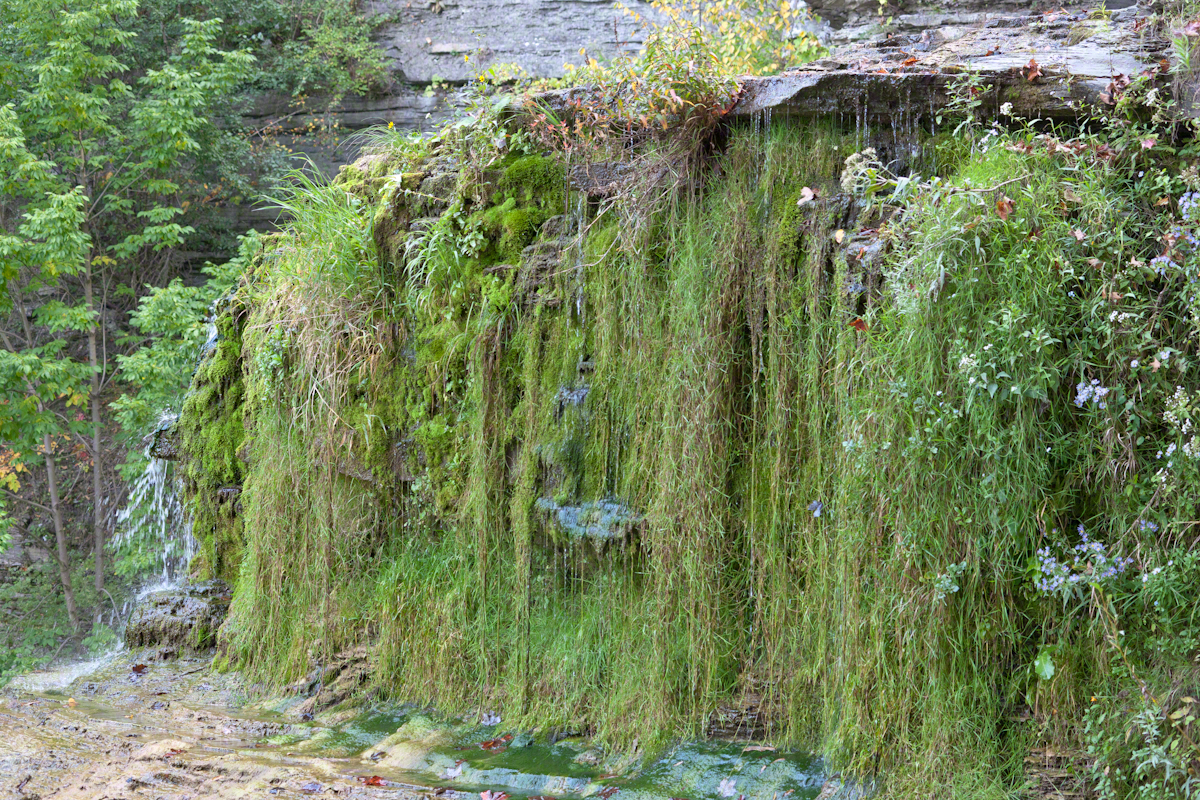
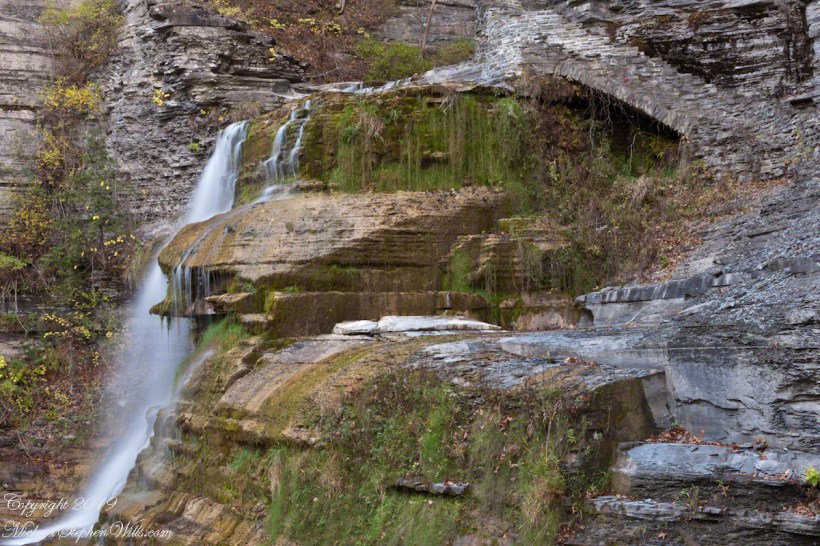
While descending the stairs next to the falls brink, look to the right to see this ecosystem, a result of water seeping from the sedimentary rock stratification.

Here you can see how, at lower flow levels, the inactive sections of the fall lip become a garden.  In our climate, the entire brink is active for rare and brief intervals during spring thaws.  Note how, closer to the active brink, the grasses give way to mosses.  Where grasses grow the brink is almost never active.

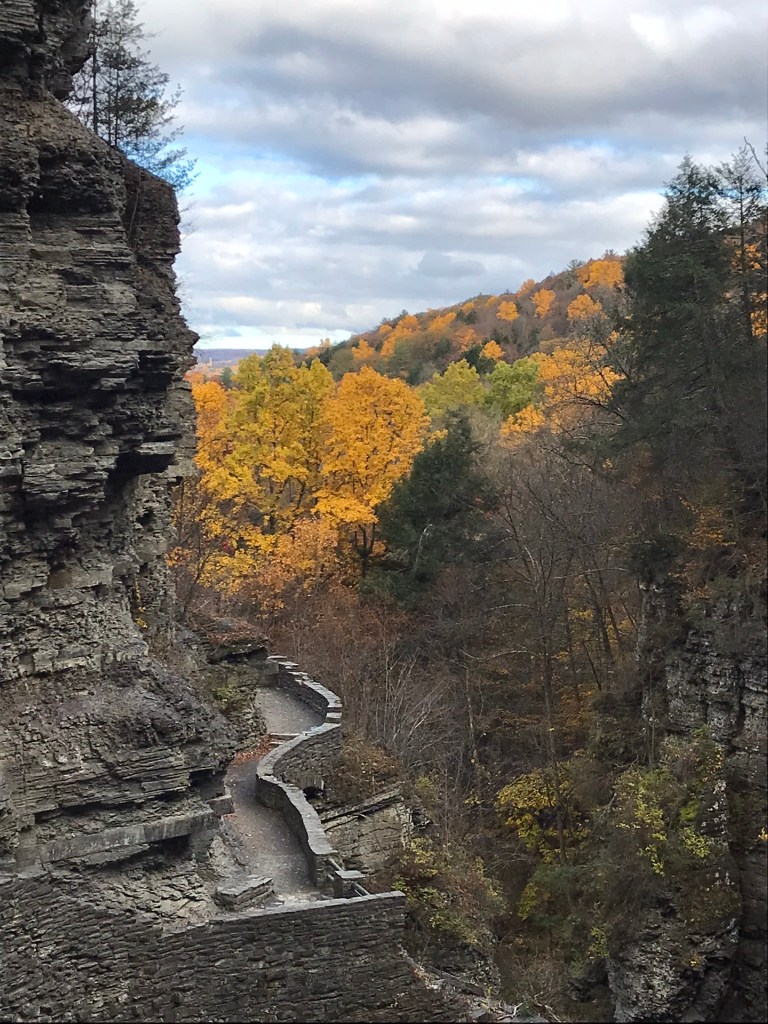
The trail wall is a lighter color than the cliff, this is how you can see, on the right, the steep trail descent.

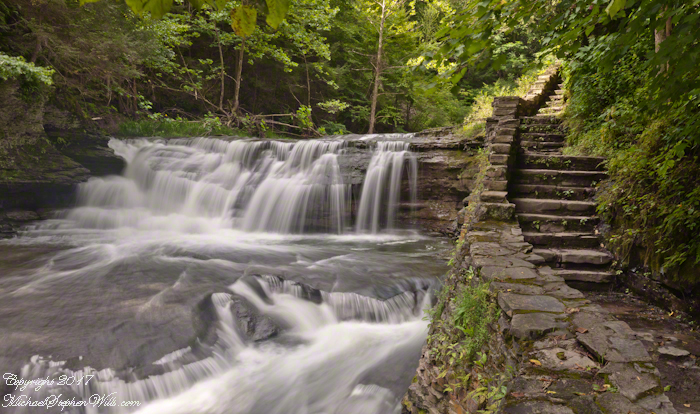
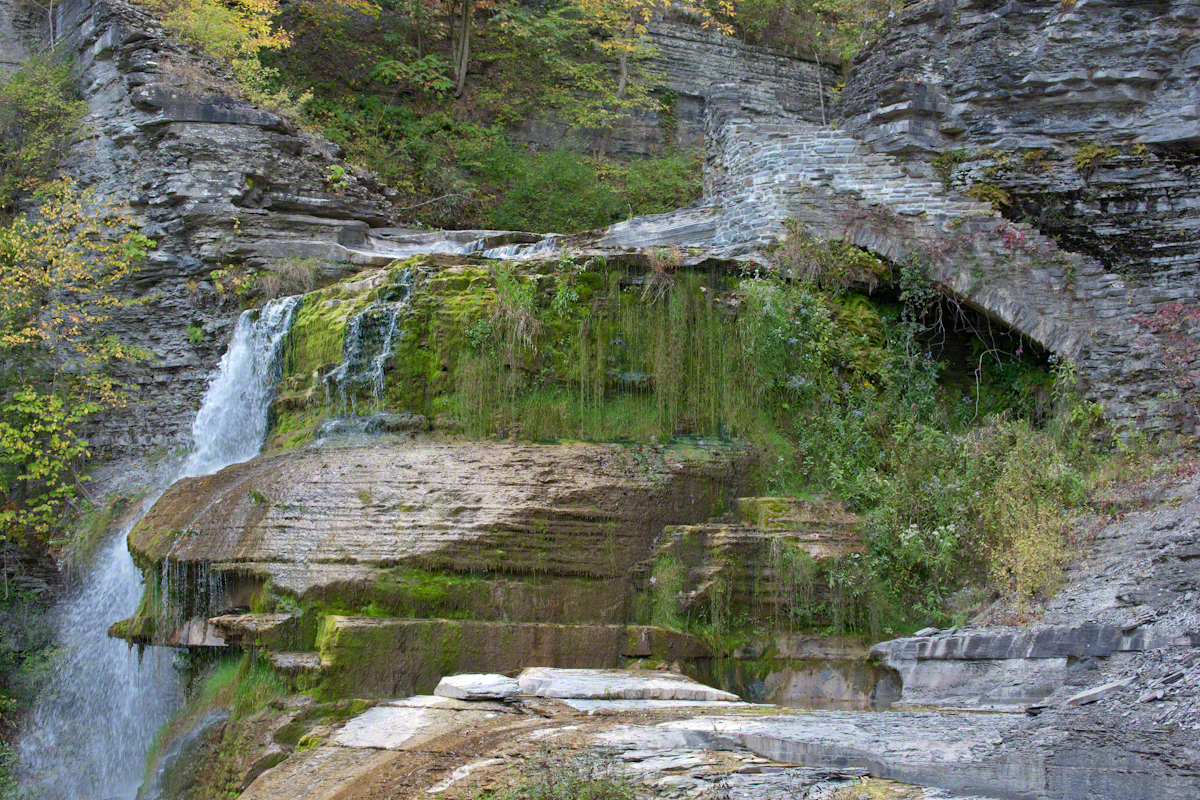
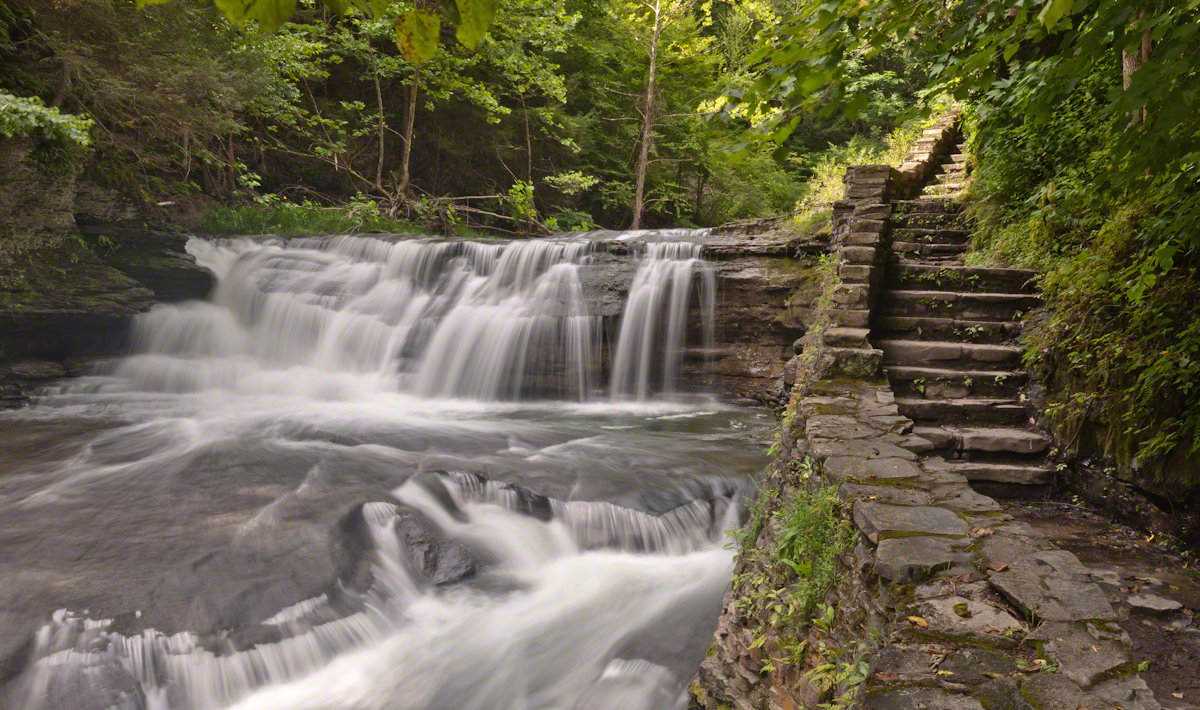
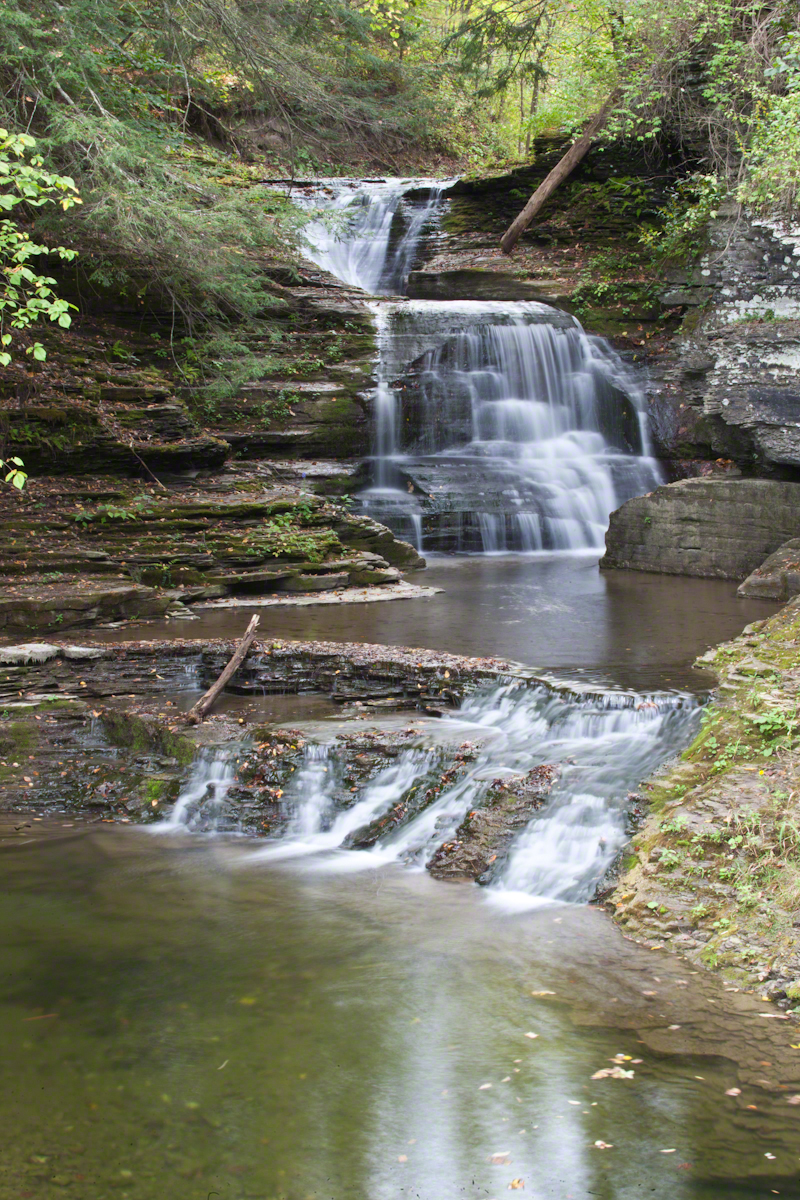
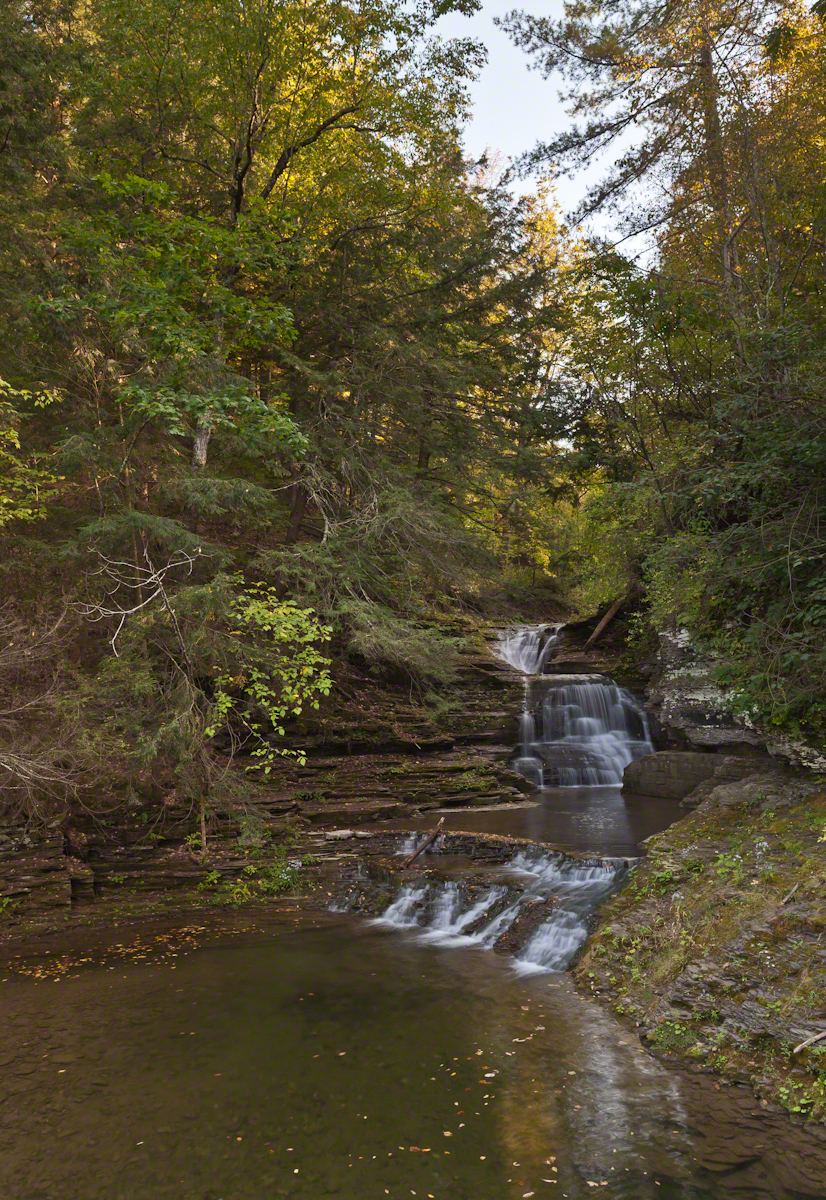
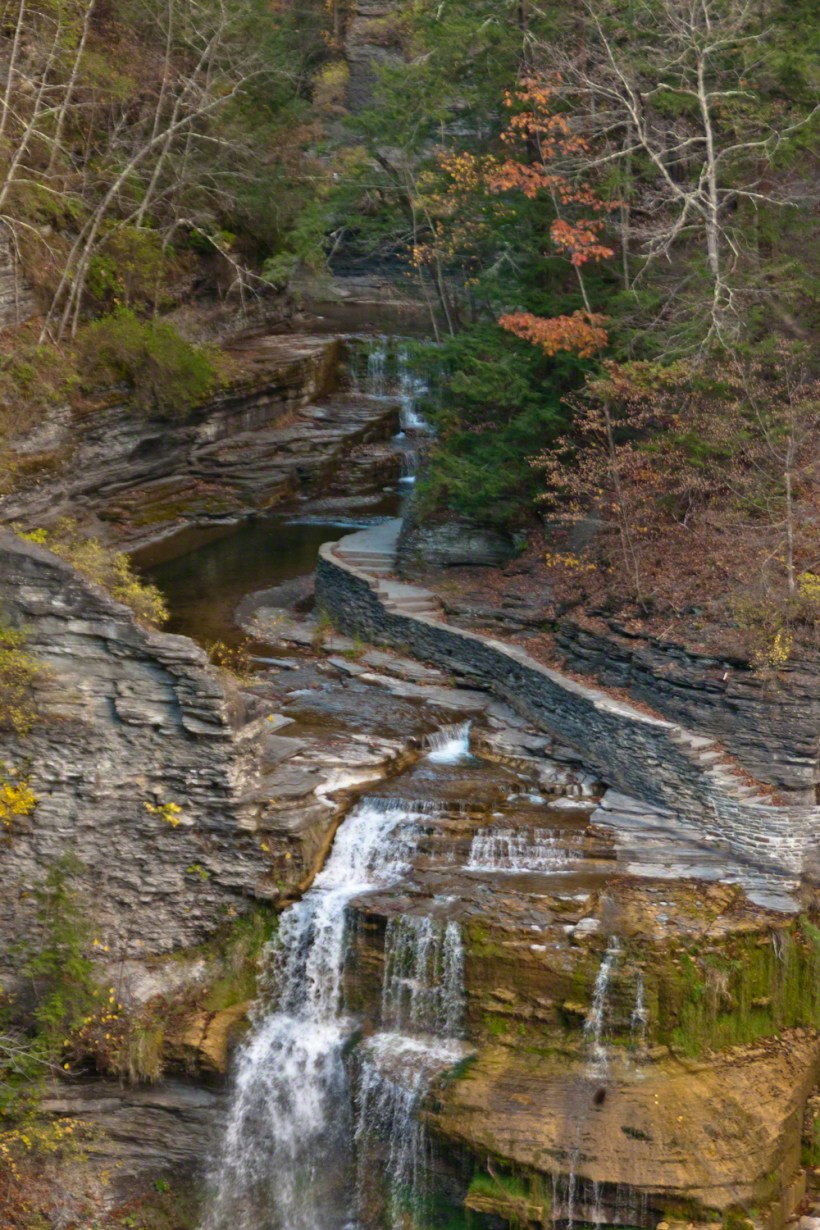
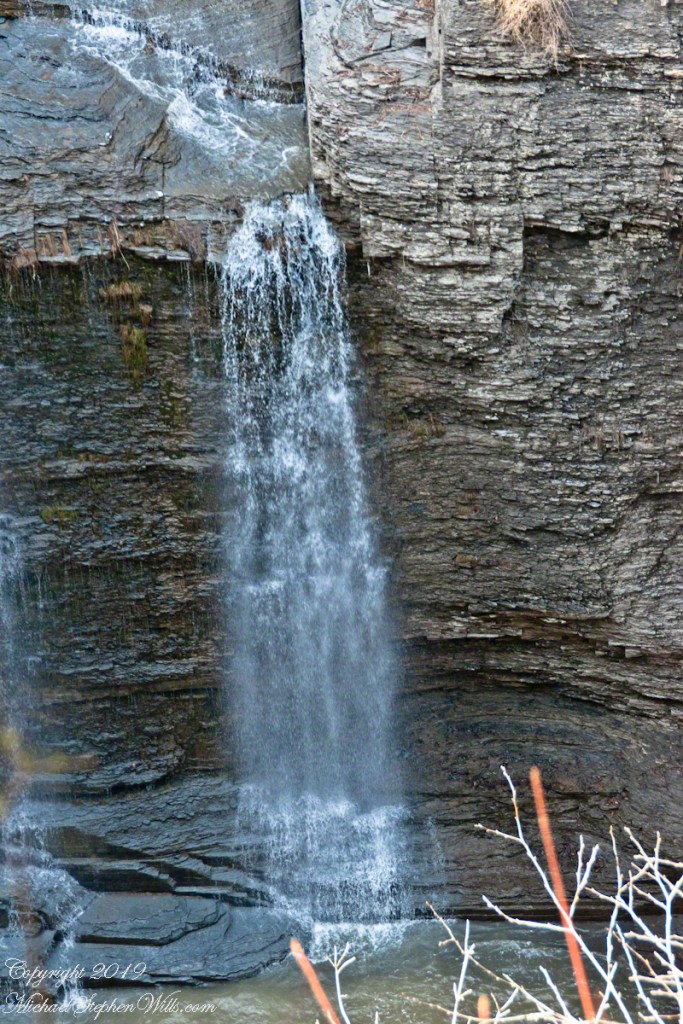
Pam and I turned around here.  This is some work I did August 2014 of a notable fall downstream from Lucifer.  I used the 24 mm Canon lens here, cropping the image.  My goal was to include the stair, for interest, with sunlight on the upper stairs; the water in shade.

Click link for my fine art print “Woodland Falls.”

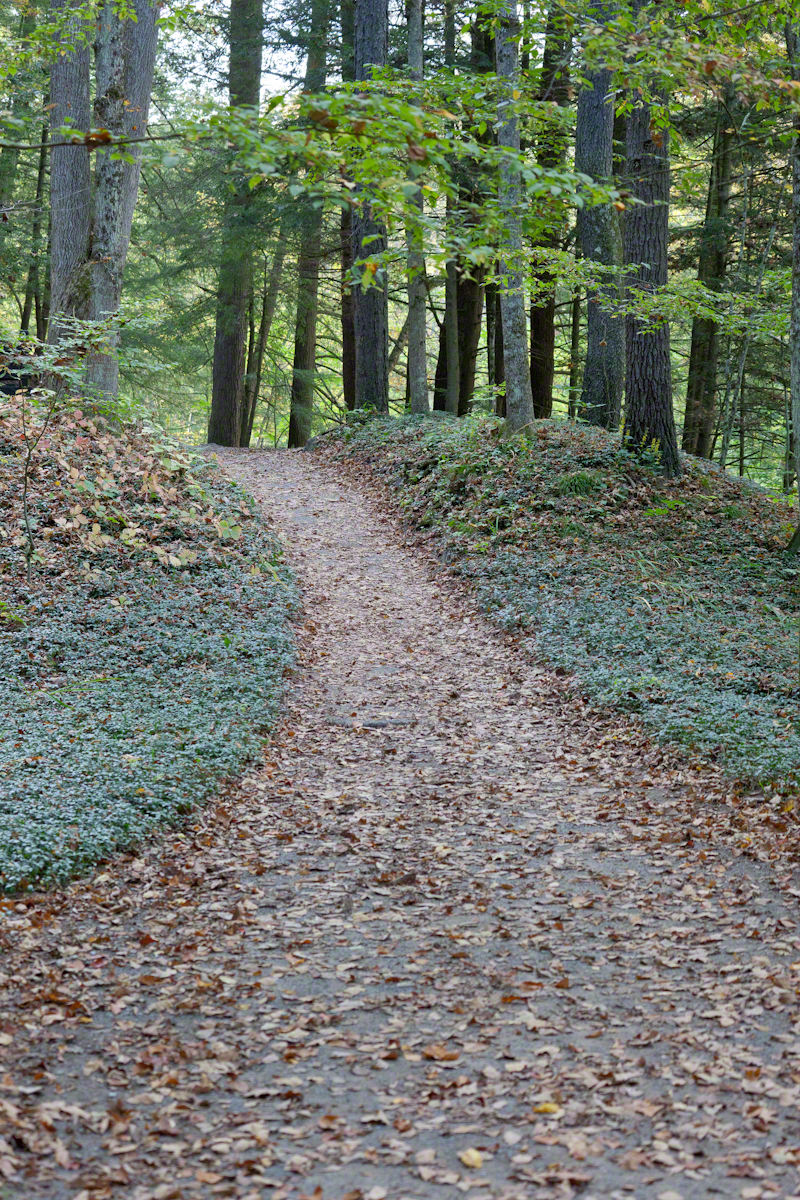
Myrtle borders the trail as it rises from the gorge entrance.

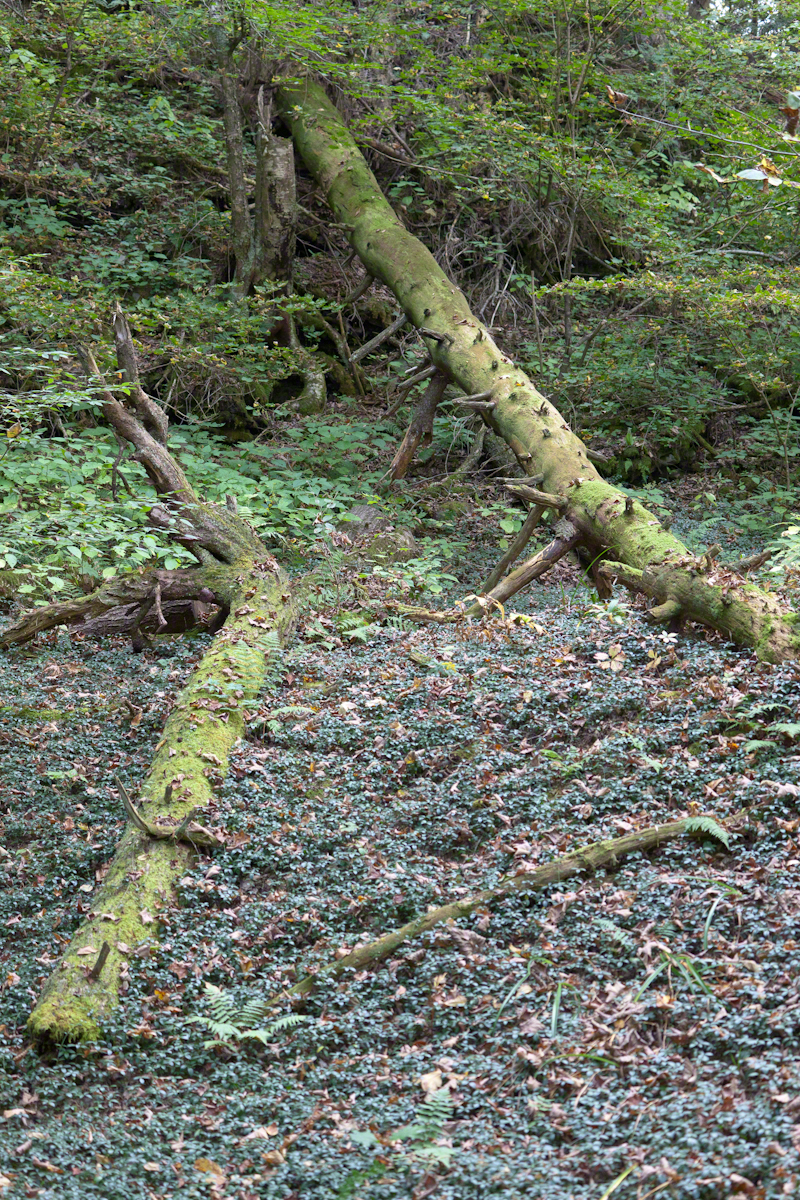
Tree trunks fallen from the gorge walls are left to decay, restoring the soil.  The trunks are covered by moss among a thick growth of myrtle and a few ferns.

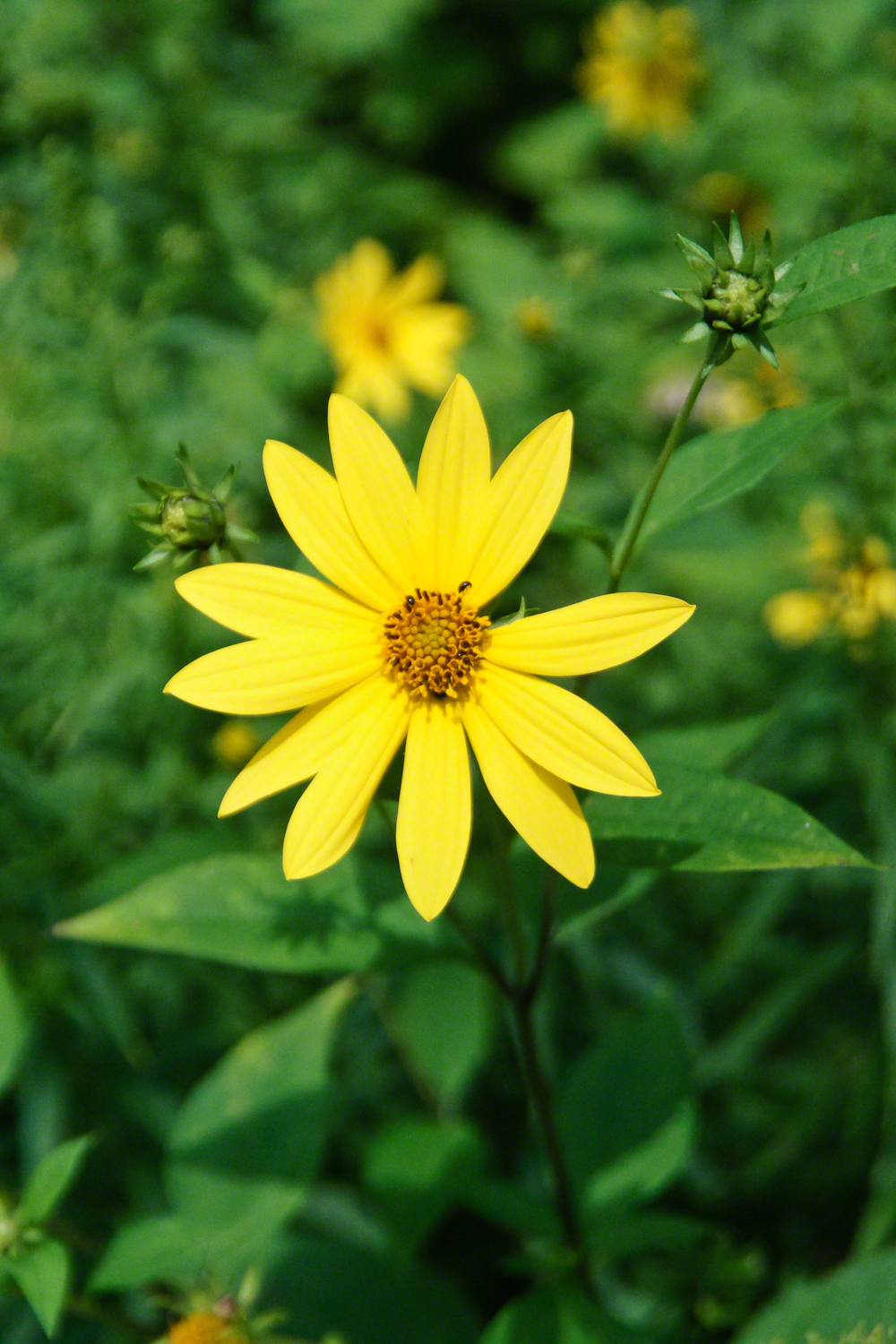
To finish, here is an image that may broaden your understanding of sunflowers. These smaller, ornamental sunflowers are, at first, difficult to place. Look carefully at the center, composed of many tiny flowers (florets). In crop sunflowers each of these becomes a seed. In this image, shiny beetles are feasting.

The End of this Evening Hike in Treman Gorge

Click me for more postings of Autumnal Beauty
Click Me to view my photographs on Getty.

Copyright 2023 Michael Stephen Wills All Rights Reserved http://www.MichaelStephenWills.com

Life and Death

Among the 7,000 year old remains found in Windover Bog was the skeleton of a boy crippled from spina bifida who had to be carried around and treated for the 16 years of his life.

I was born into a world that danced around me, a world I could only witness but never fully join. My legs, unlike those of the other children in our tribe, refused to carry me. I spent my days close to our hut, watching the life of our village unfold from my corner, shaded by the leafy arms of the great trees.

My mother was my bridge to the world. She carried me to the edge of the waters, where I would watch my friends play, their laughter a melody I cherished. She showed me the way the water held stories, the way the reeds whispered in the wind. She taught me to weave, my fingers nimble and quick, making up for my still legs.

As I grew, I found my place among my people. I became a keeper of stories, a weaver of tales, just as I wove reeds into baskets. My voice became my movement, my words a dance.

Then, illness found me. It crept into our hut, a shadow that no fire could dispel. My mother’s eyes, always so full of warmth, grew clouded with fear. She fought for me, her hands constantly working – crushing herbs, whispering prayers.

I saw her struggle; saw the toll it took. I wanted to ease her burden, tell her it would be alright, but my voice had begun to fail me. All I could do was squeeze her hand, a silent message of love and gratitude.

As my breaths grew shallower, I watched her. She was my world, her face the last thing I saw as I drifted away, her lullabies carrying me to a place of peace.

I am his mother, heartbroken and weary. My son, my joy, lies motionless, his chest barely rising. I had always carried him, but now, there’s a journey I cannot make with him.

I remember his laughter, bright and clear, despite his bound body. His spirit had wings, even if his legs did not. He was the light of our tribe, a storyteller, a dreamer.

When he leaves me, my heart shatters. The tribe gathers, offering comfort, but the void he leaves is too vast. We prepare him for his final journey, wrapping his body, laying beside him his favorite weaving tools, the small toys he cherished.

We take him to the bog, our sacred place. Gently, we lay him in the water, his final cradle. The waters close over him, holding him in an eternal embrace.

Years pass, but his memory remains, alive in the stories I tell by the fire.

Copyright 2023 Michael Stephen Wills All Rights Reserved http://www.MichaelStephenWills.com

Autumn Evening Hike Part 2 of 3

Water runs through it

Portrait of Mill Falls

In part 2 of this series, we return to the starting point. Siting of a water mill requires immediate access to the potential energy of falling water, something called “head.” Upper Treman Park was once a prosperous hamlet with the mill as the kernel. Today, the head that drove the mill is a lovely cascade behind the substantial and intact mill building. Easy walking distance from parking, this is a well-known park feature.

Here are three versions of a portrait of Mill Falls using different lenses for varying effects. All were taken in the same season and approximate time of day, being early evening.

Click Me for “Mill Waterfall at low flow”, a fine art print from my gallery.

This is the uncropped image used in part 1 of this series. I found the secondary cascade a distraction. Exposure of the secondary is difficult to balance against the primary and more shaded primary.

Click link for “Mill Waterfall Primary Low Flow” fine art print.

Stone Span

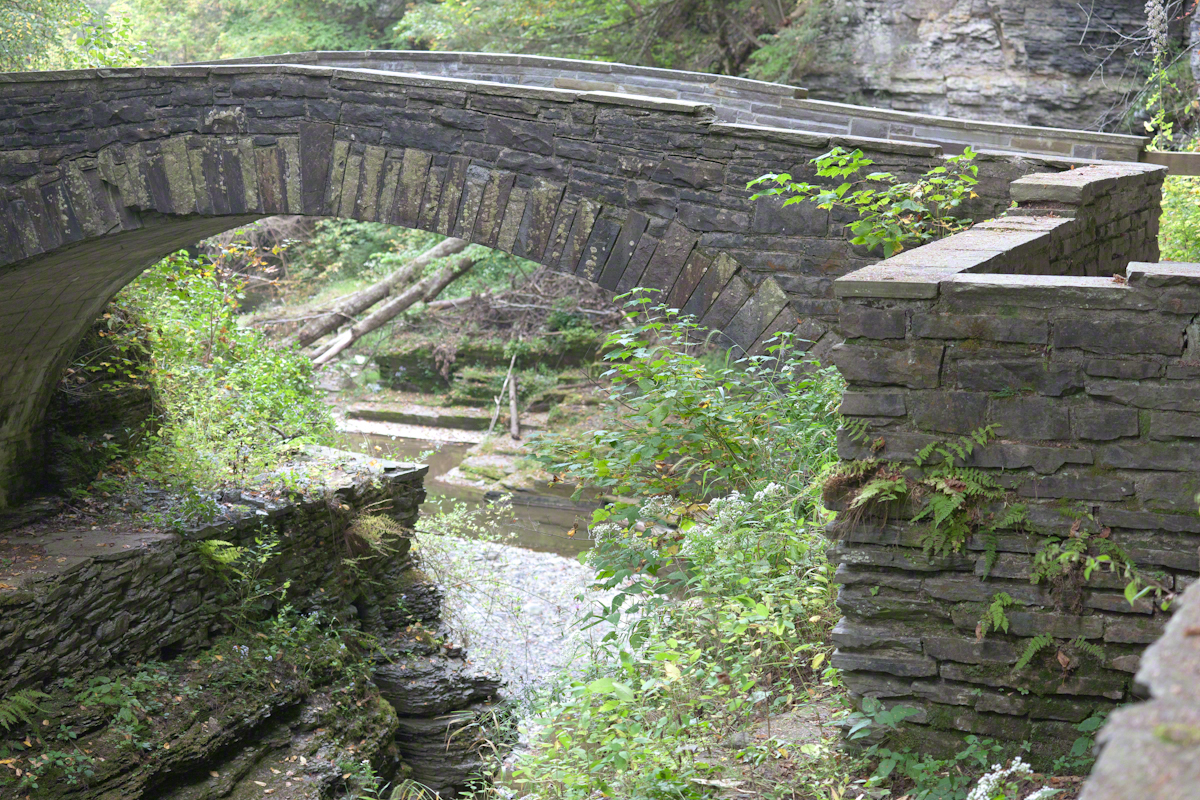
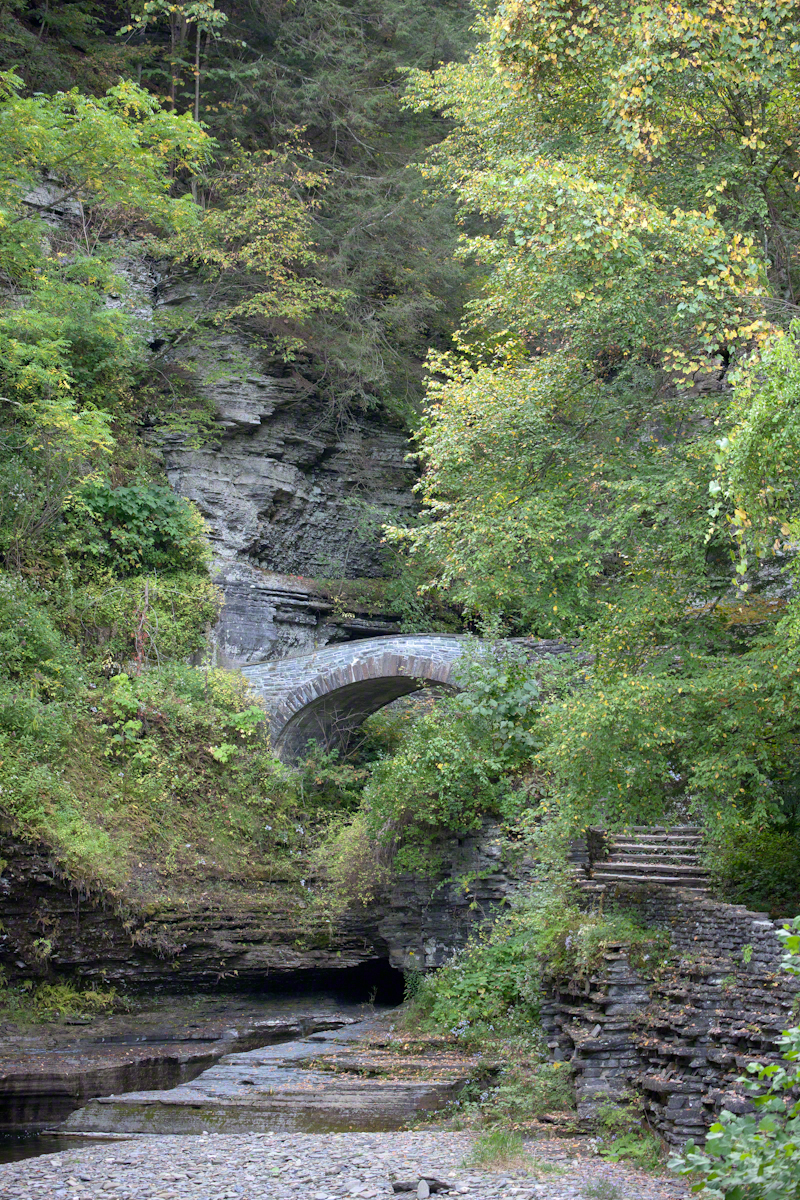
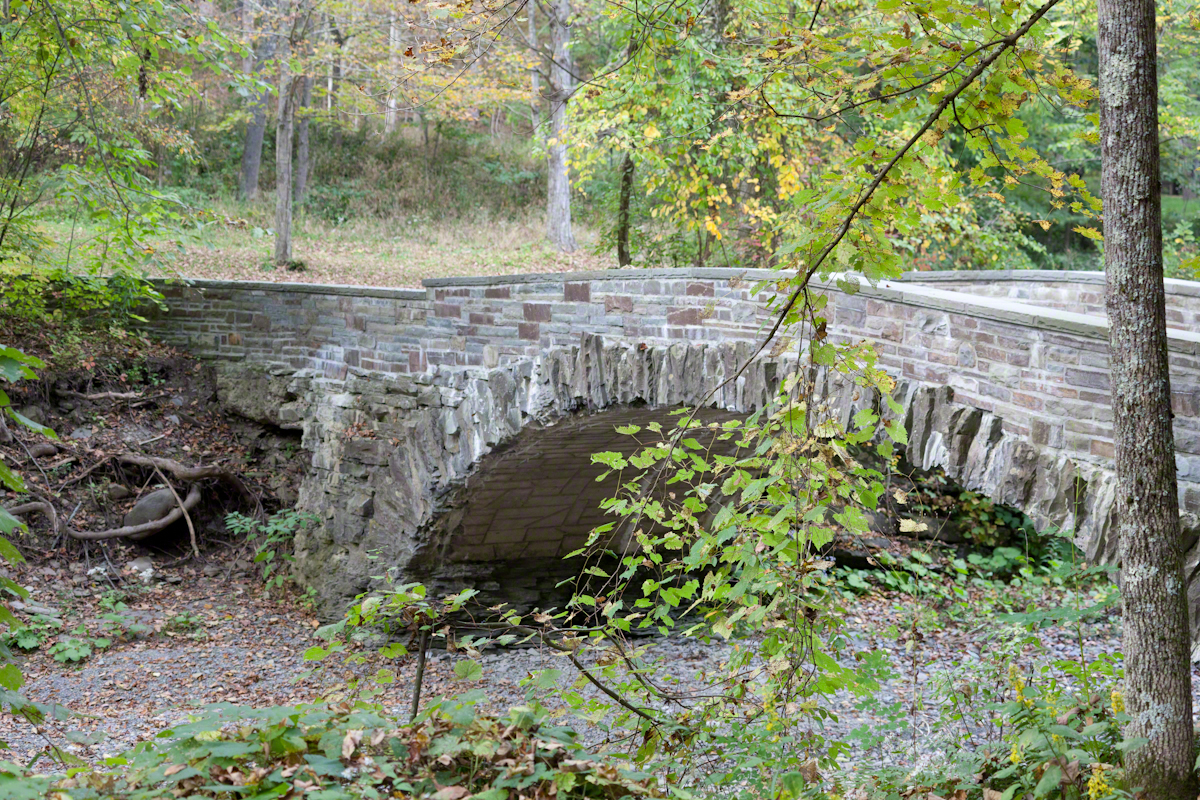
Let’s return to where part 1 left off, the stone bridge across the eastern side of the gorge entrance gallery.

This segmental arch is an illusion, the beautiful stone work is the facing of the concrete structure that carries to load of the stone, itself and visitors.

Want more? Click Me

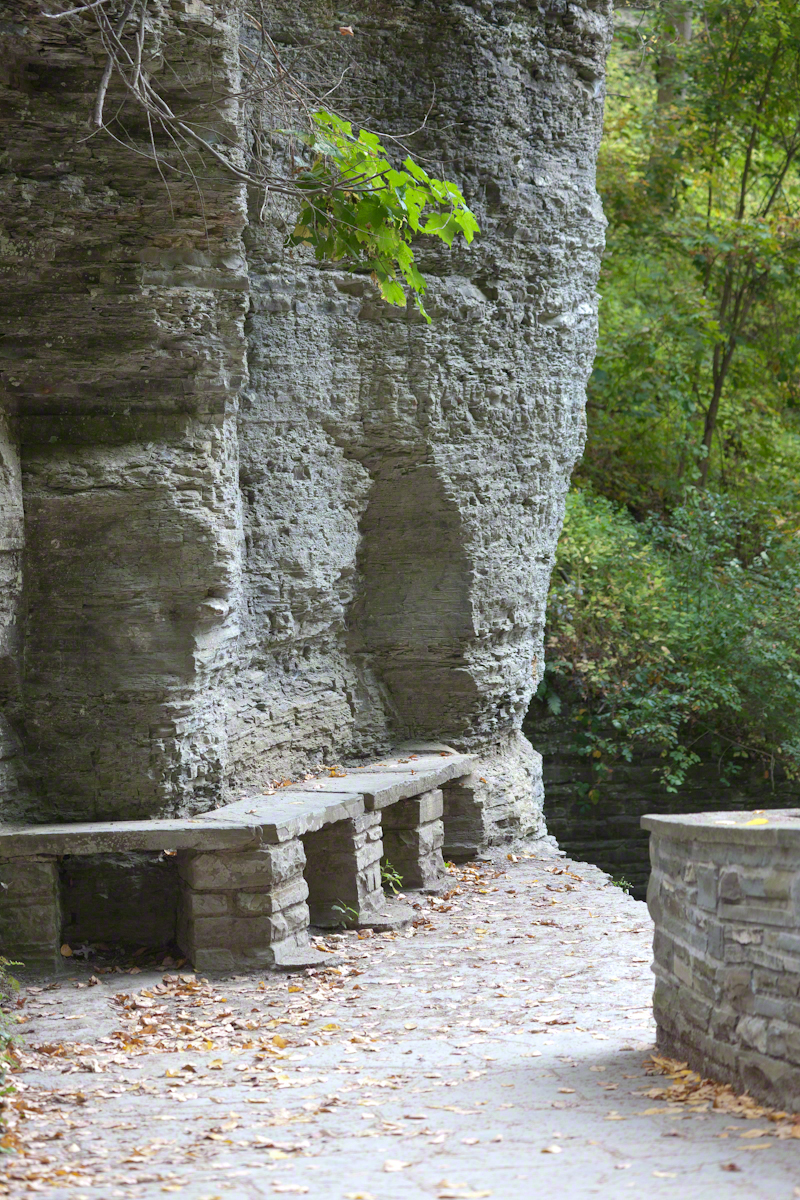
My composition emphasizes the mass of rock wall above the bench and into which it is placed.  The limestone slabs are from a different source, they are not built from the material removed from the cliff.

Seeds and Flowers

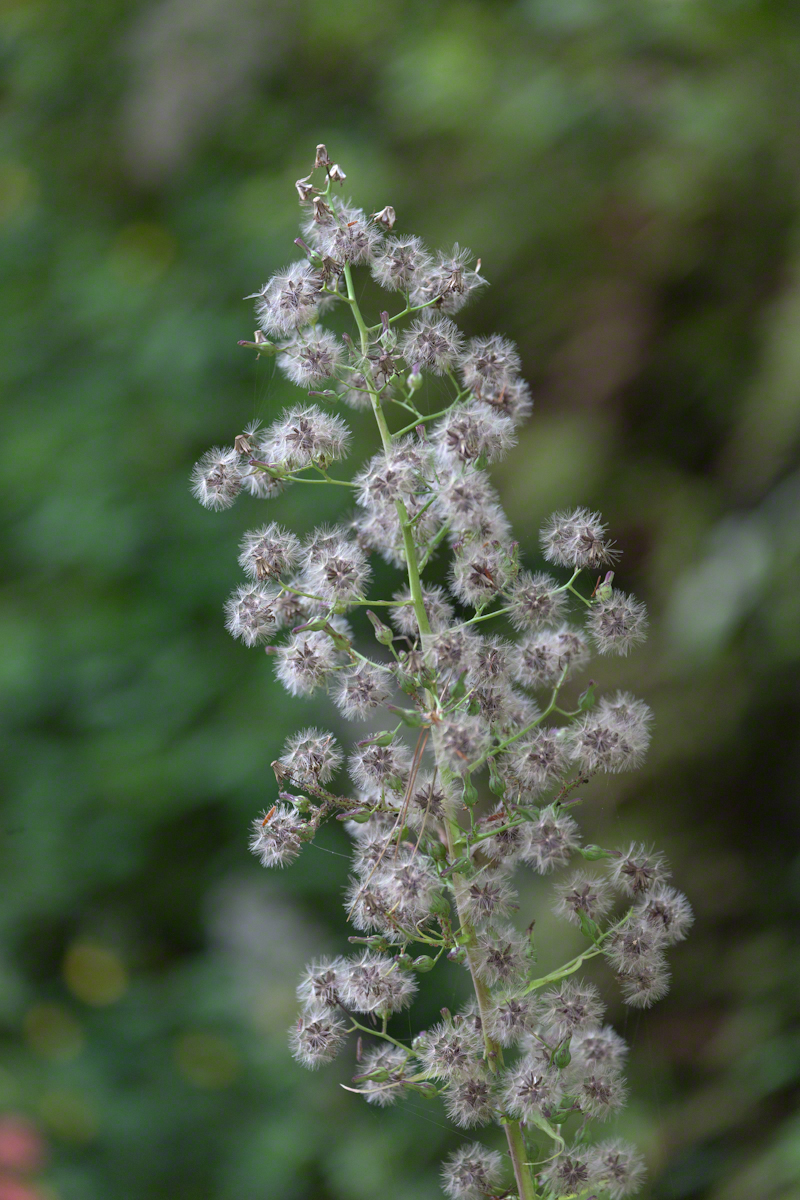
A dandelion on steroids.  If you can help with identification of this plant, please post a comment.

Click Me for “Ad Astra” a fine art print, in my gallery.

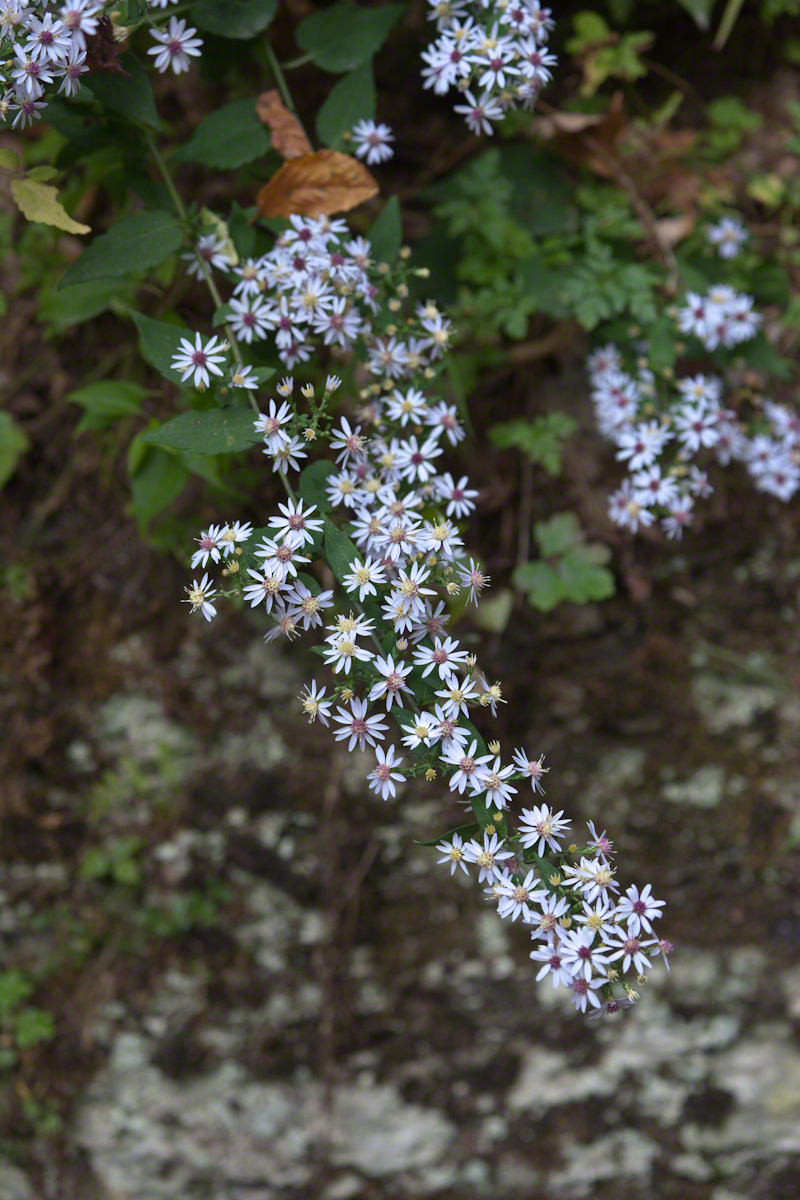
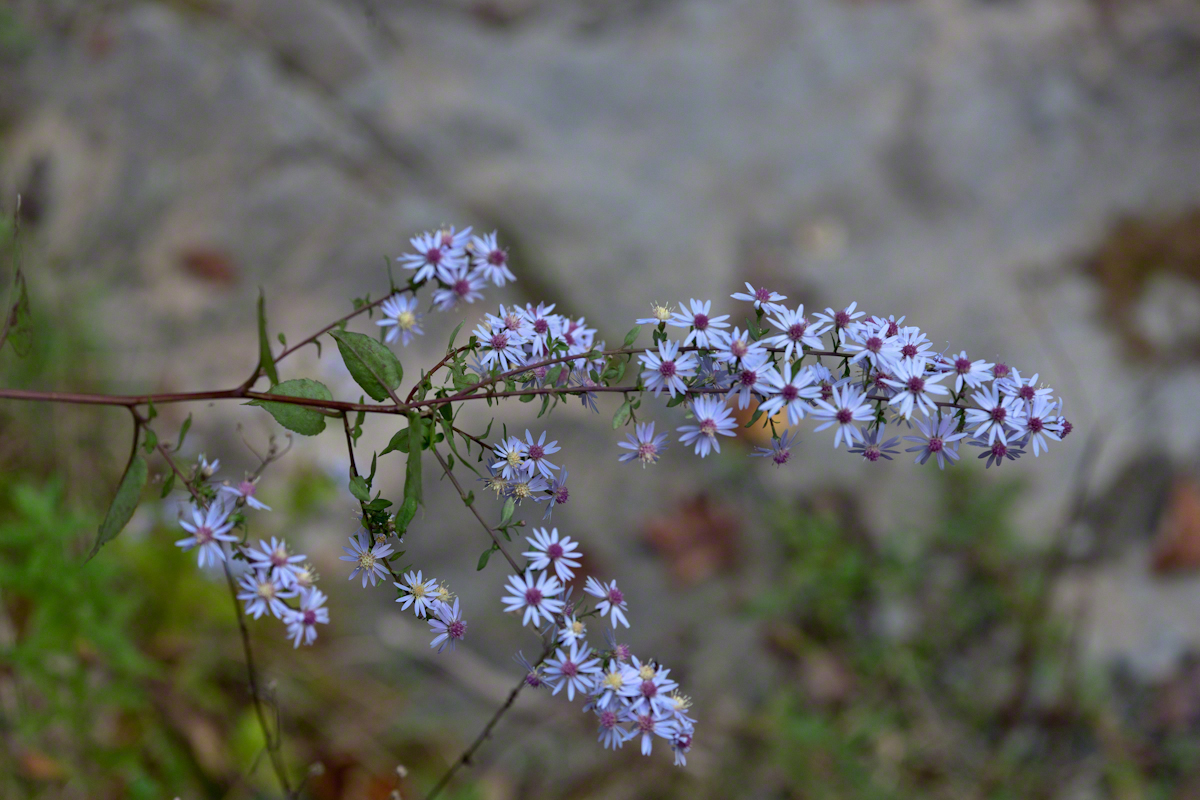
Click Me for “Purple Asters” a fine art print, in my gallery.

Look Back!!

Many first time visitors do not look back to appreciate these scene.  When we give advice, our recommendation is to return on the same gorge trail.  The different viewpoints make for a fresh experience.

Mr. Toad

Want more? Click Me!!!

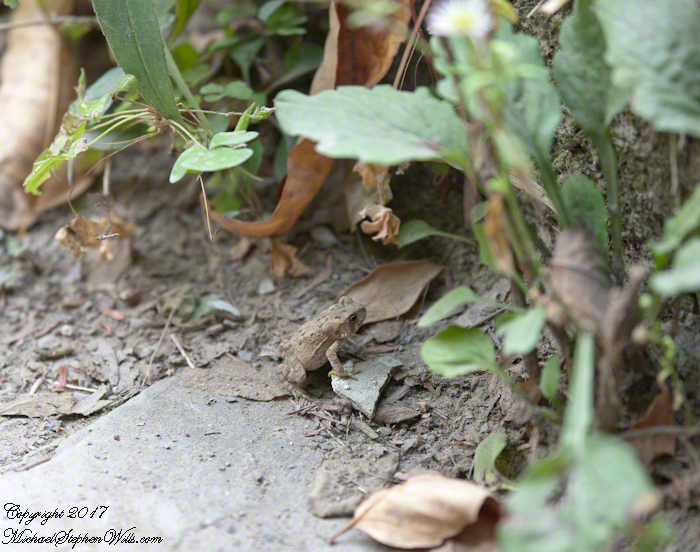
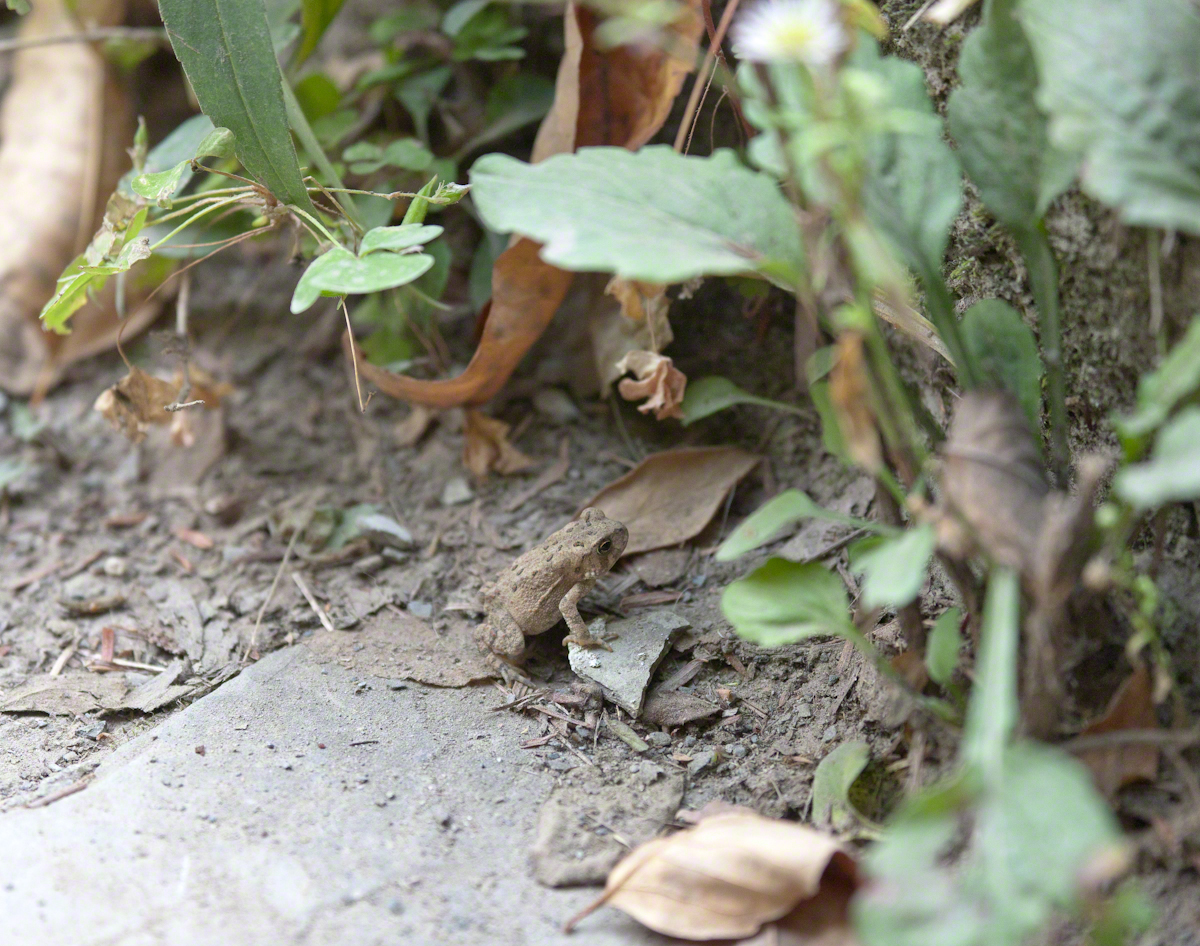
They are like people, sitting there.  Kenneth Graham’s genius, in writing “Wind in the Willows”, was to recognize the likable characteristics of the toad.  I find myself concerned about their survival, although they must survive.  Earlier in the season they are pea sized.  I resist an inclination to move them to what may be a more promising location, preferably with a stone house and chrome brilliant motor car.

Copyright 2023 Michael Stephen Wills All Rights Reserved http://www.MichaelStephenWills.com

Autumn Evening Hike Part 1 of 3

It started with running water…..

Over the weekend the handle of our 60 year old Delta brand kitchen faucet broke off, since we moved here I rebuilt it once and replaced the stainless steel sphere, the central control of the mechanism.  The stem of the sphere must have been faulty because it snapped. Monday, I visited Lowes and the sphere was not in stock.  Just wanting to fix the faucet, I skipped the usual vetting of a new product and grabbed the exact same Delta faucet which was, just like the sphere that broke, made in China.  The next step up in (questionable) quality was three times the price.

Running Water

Yesterday I installed a new faucet in the kitchen sink, a straightforward and unpleasant task that took most of the day.  Late afternoon, while resting up, I brought up the idea of a hike and Pam reminded me we had another clear September day.  Last week, I headed out to capture the Mill Creek waterfall of upper Treman Park at the perfect time of day.  It was a day such as this, warm, a cloudless sky, minimal breeze.

Mill Falls
Pam reminded me this evening I was trying to capture the Mill Waterfall of Upper Treman Park at the perfect moment when the sunlight glazes the pools.

I need to get in place a bit earlier.  Previously, I used a 24 mm wide angle lens and, today, mounted the EF 70-300mm f/4 – 5.6L USM lens on the Canon EOS 1DS MarkIII.  Did not have time to sort through the ND filters, so left the UV on.  The waterfall is in a glen, shaded from direct light at this time of day, sun low in the west.  Given the low light, to save time, I decided to set ISO to a low value (125), set lens to the widest angle (70 mm), and frame the shot using the heavy Manfrotto tripod with ball head.

Needed to crop the image for the above result, still not perfect.  I am seeking to full the entire pool in that glow.

Want more? Click the link for my Online Gallery

Mo's Bench
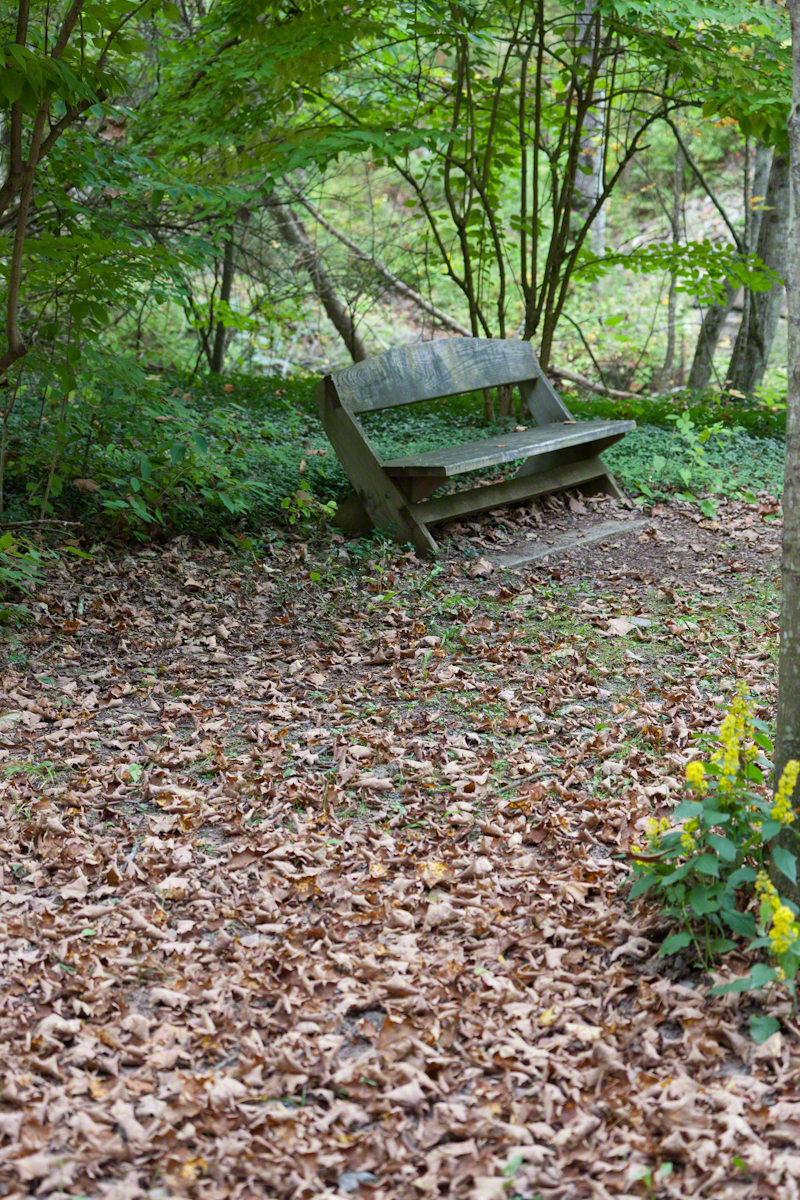
Towards the end of her life, my Mom waited for us on this bench while we walked. She enjoyed the sound of the creek, watching and chatting with passerbys. There some out of focus goldenrod right foreground. I frames the shot to catch the flowers and crop out a tree trunk.

Hiking the Gorge Trail

Instead of putting the gear away, I carried that heavy setup on the hike.  The strap around the neck is a lot of stress if it hangs.  With the gear cradled in the crook of my arm it is bearable.

Foot Bridge
The creek is spanned at several points by these stone footbridges, the work of the Civilian Conservation Corps, as are all the gorge trails. This bridge was restored last year. It leads to a marvelous grove of Sycamores.

Needless to say, the pace was sedate.  Pam spent most of the time walking ahead and refusing to be in any shots.  These past weeks, rainfall was light, so the creek is low.  This low flow is a necessary element to a perfect waterfall image.

Golden Rod
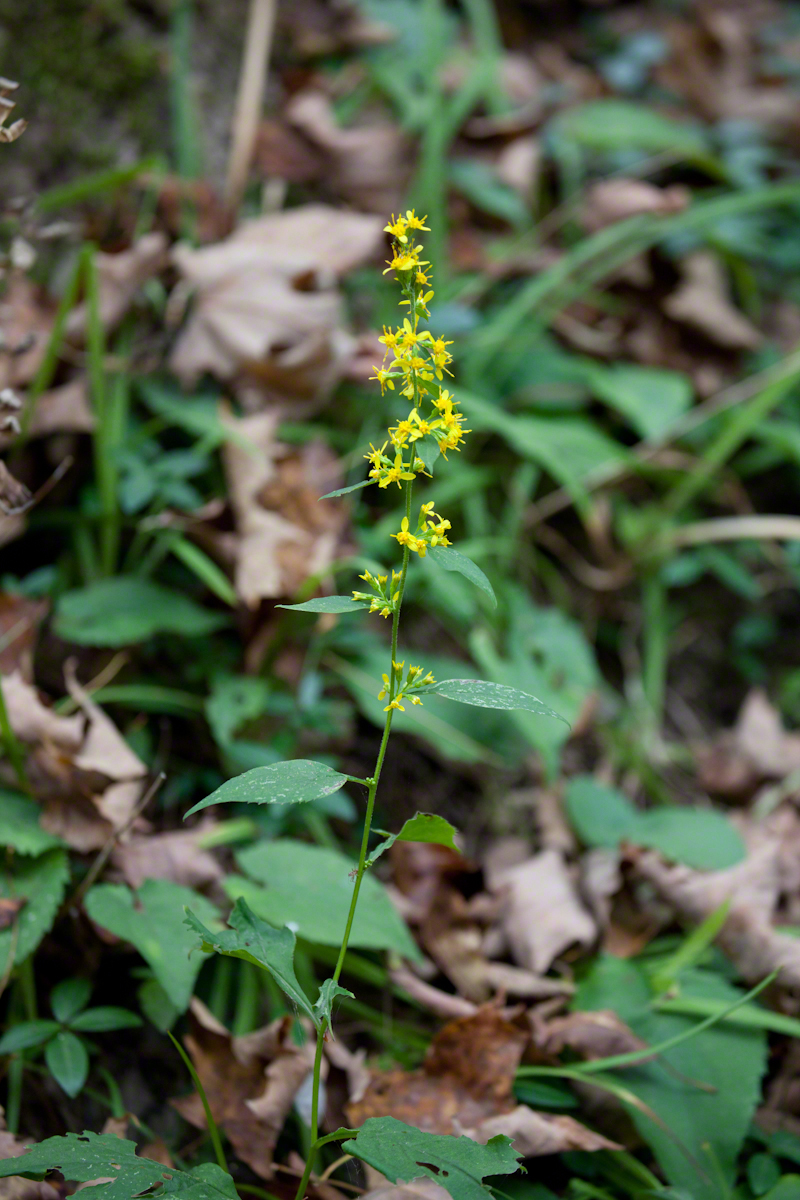
A single stem of goldenrod, ther are hundreds of species of this relative of the aster.
Want more? Click the link for my Online Gallery

I get some great macro shots with that lens.  With just the UV filter, it is quite fast.

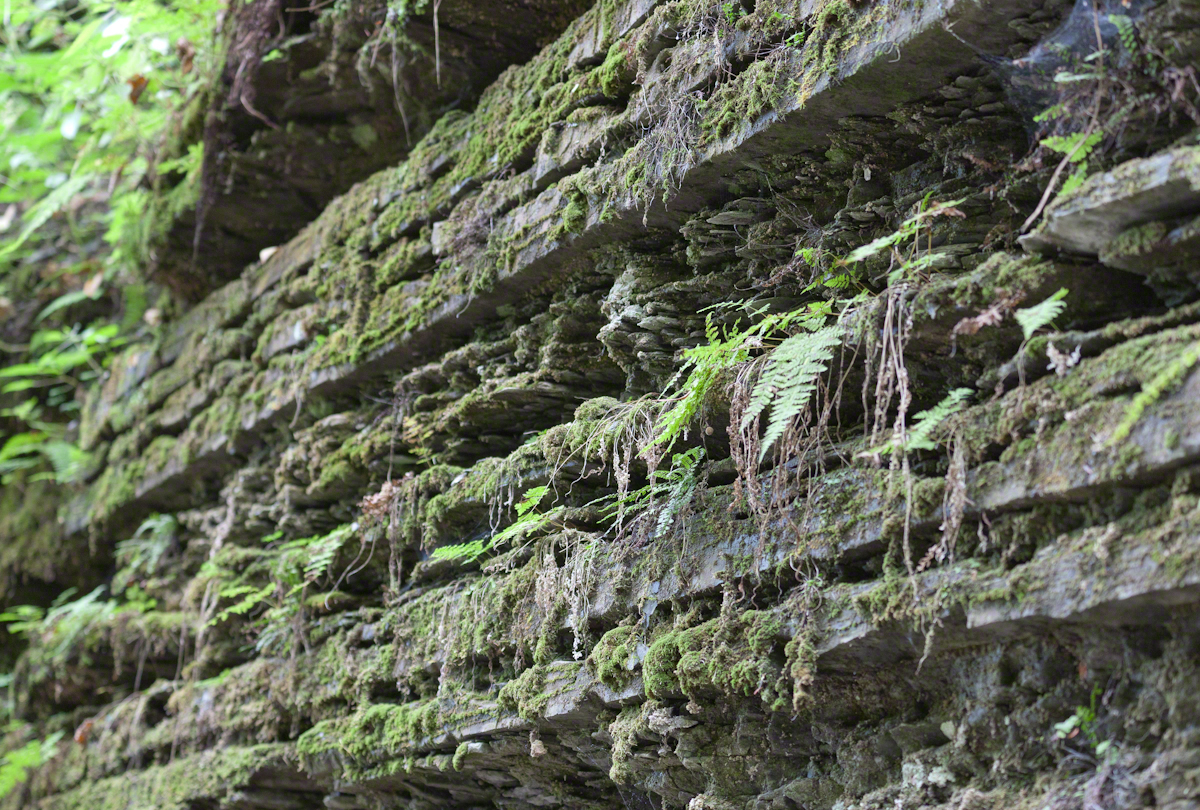
Ferns, Lichen, Gorge Wall
The gorge wall rises to the right of the path.
Foot of the Gorge Wall
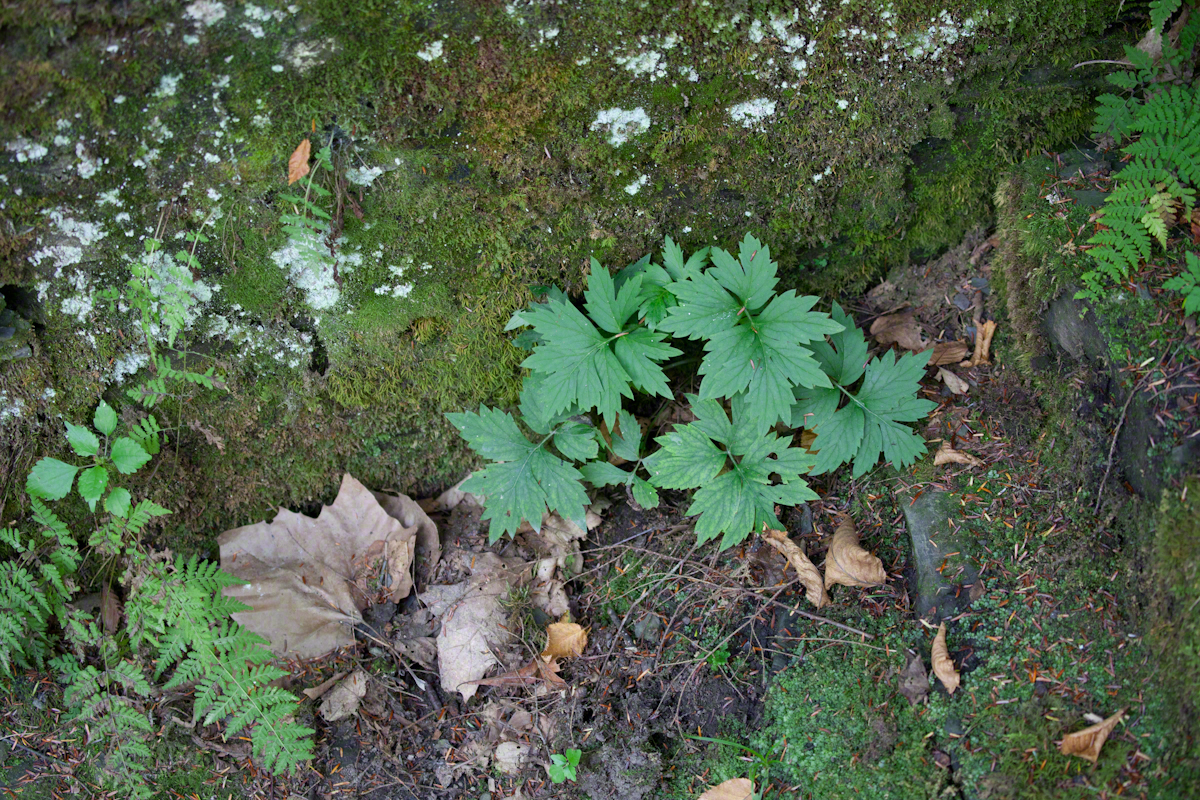
Very little of the gorge walls do not support thick growth of mosses, lichen, ferns, flowering plants of all kinds. I don’t know offhand the name of the cnetral plant growing from the base of the wall.

In the Gallery

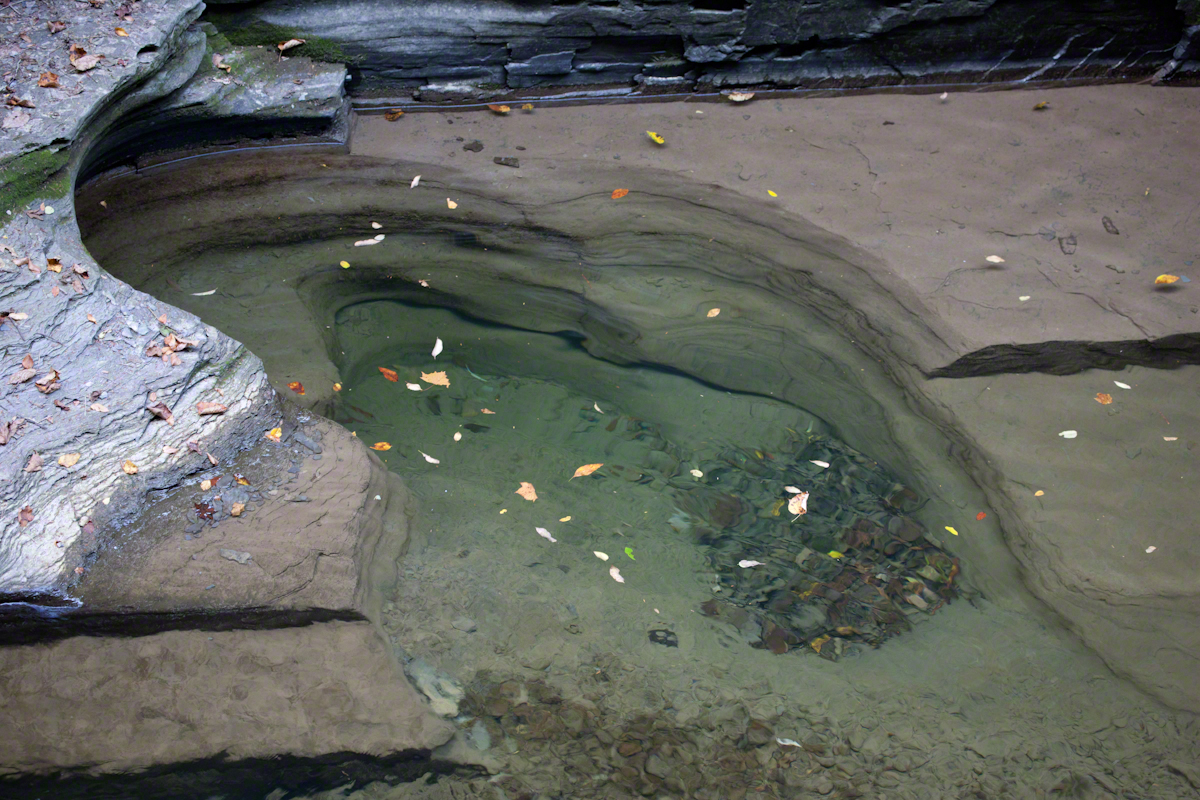
Creek Pool
Shaped by whirlpools during high flow, the curves recall flowing water.

A memorable feature of upper Treman Park is the dramatic gorge entrance.  When the glaciers melted, 10,000+ years ago, enough water flowed through this watercourse to wear away several hundred feed of sedimentary rock to form a gallery, or hall, with towering, crumbling, walls on either side.

This evening the light was low, the water seemed dead in that it was clear and did not glisten or ripple.  I used these conditions in the above shot to emphasize the structure this pool.  Located at the foot of a waterfall, at high water, the falls fill channel and this pool is carved by river stones carried in the current.  At lower water, the pool is exposed.

Eons of Layers
Millions of years in rock strata.
Want more? Click the link for my Online Gallery
Foot Bridge
Spanning the eastern side of the gallery entrance of the gorge.

The footbridge, above, is most often photographed from the western side of a long gallery formed by the gorge carved by the creek.  This is a shot that explores the fine stonework.

Continued……..

Copyright 2023 Michael Stephen Wills All Rights Reserved http://www.MichaelStephenWills.com

Lucifer Falls on an Autumn Evening

The post explores the symbolism of Lucifer and the Tiger Lily, suggesting that beauty and pride can lead to downfall, reminiscent of Lucifer’s narrative.
A reader’s comment to this blog, thank you “Urban Liaisons,” prompted me to explore the word, Lucifer. “Lucifer”, in Christian tradition, refers to the devil as it was in a time of glory before the fall from grace. The original, ancient meaning of Lucifer is the planet Venus as it rises just before the sun at dawn.  In this sense, the name refers to the bright beauty of the spot.  The effect is heightened at midday when the hiker passes from the relative gloom of Devils Kitchen to the full light and sweep of the waterfall chasm.
Standing next to the falls on the Gorge Trail, the stone wall of the Rim Trail Overlook is overpowered by the grandeur of the 300+ foot cliff. The falls photographs were taken from behind the wall.

Occasionally, we have experienced individuals climbing over the wall to stand on the other side. “Why?”

Summertime thick stands of tiger lilies flourish on the cliff face. Can you find the withered leaves?

I must delve into symbolic interpretations to explore the connection between Lucifer and the Tiger Lily. Lucifer, traditionally associated with rebellion and the fallen angel in Christian theology, symbolizes a break from divine order and beauty tainted by pride. On the other hand, the Tiger Lily is often seen as a symbol of wealth, pride, and prosperity in various cultures. The connection lies in the shared symbolism of pride and beauty. Just as Lucifer was a beautiful angel before his fall, the Tiger Lily is a strikingly beautiful flower, often associated with pride. This juxtaposition creates a metaphorical link, suggesting that beauty and pride, while alluring, can lead to downfall, mirroring Lucifer’s story.
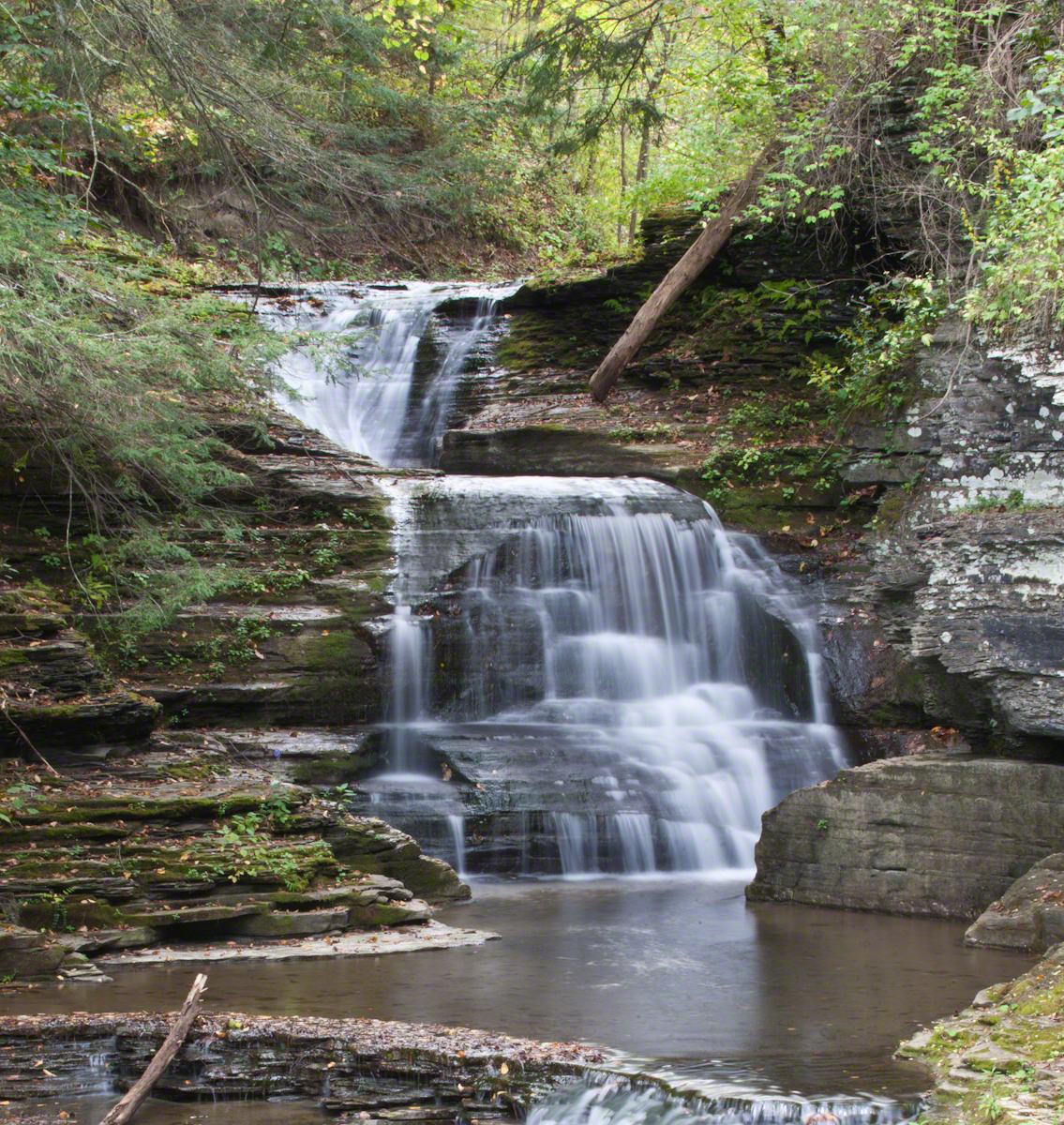
This session I finally “cracked” the puzzle of the Devil’s Kitchen Waterfall. I posted the results to the online gallery yesterday, for your enjoyment. Click the link to go there.

Click link for my fine art print “Devils Kitchen.”

Click Me to view my photographs on Getty.

Copyright 2023 Michael Stephen Wills All Rights Reserved http://www.MichaelStephenWills.com

Grandson Sam is Eight!!

In a heartwarming YouTube video, Samuel Jack Wills and his grandmother Pam turn cake-making into an adventure in celebration of his Batman-themed birthday. The video captures endearing family traditions, from a talking doorbell to playful gift unwrapping, and culminates in the creation of a Bat-Signal adorned cake and joyous birthday song.

Grab your capes, click on our video, and be a part of our delightful celebration that’s sure to lift your spirits sky-high!

🎉 Get ready for an extraordinary adventure into the world of cake-making with our superstar, Samuel Jack Wills, and his magical sidekick, Grandma Pam! 🍰✨ It’s a special day just before Halloween, and the excitement is as palpable as the crisp autumn air. 🍂

🦇 In our latest heartwarming YouTube video, witness the grand entrance of our birthday hero, Sam, as he strides through the gate with his dad, Sean Wills, to a chorus of giggles and gasps, thanks to our quirky, talking doorbell that’s become an outrageous family tradition. 🎈

Join us in the celebration as Sam unwraps wonders from Grandma Pam and Grandpa Michael: from a thrilling Batman-themed birthday card that lights up the room with a Bat-Signal magnetic sticker, to a fleet of Gotham-inspired toys including an aircraft, the Batcave, and even miniature treasures like a suitcase brimming with play 100 dollar bills. 🏰💰

Sam and Grandma Pam put on their chef hats, discussing and designing a cake that’s not just a treat but a superhero saga! 🎂 With buttercream as smooth as velvet and chocolate layers that whisper ‘indulge’, they create a masterpiece adorned with blue and yellow frosting, featuring the iconic Bat-Signal.

And what’s a Batcave without boulders? Watch them skillfully make Rice Krispy treat boulders to scatter around their edible Batcave — a feast for the eyes as much as the taste buds. 🍫

The grand finale is a chorus of joy as Sam, surrounded by his loving family, basks in the glow of birthday candles and the warmth of the Birthday Song. 🎶 It’s a day where memories are made, laughter is shared, and love is multiplied.

So grab your capes, click on our video, and be a part of our delightful celebration that’s sure to lift your spirits sky-high! 🚀 Don’t forget to like, share, and subscribe for more family fun with the Wills clan! #SuperSamCakeAdventure 🥳👨‍🍳

Copyright 2023 Michael Stephen Wills All Right Reserved http://www.MichaelStephenWills.com

Backlit

Ferns, ancient plants with unique reproduction strategies and ecological significance, adapt to diverse environments while contributing to overall biodiversity and human culture.

In the vast tapestry of the plant kingdom, ferns occupy a unique and enduring place. These ancient plants, often overlooked in favor of their flowering counterparts, have a fascinating and seemingly eternal existence that spans millions of years. Ferns, with their lush green fronds and distinctive reproductive mechanisms, offer us a glimpse into the enduring legacy of life on Earth and the remarkable adaptations that have allowed them to persist through the ages.

Ferns belong to the group of plants known as Pteridophytes, which evolved more than 360 million years ago during the late Devonian period. Their evolutionary history predates the appearance of flowering plants, making ferns some of the oldest living organisms on our planet. This remarkable longevity raises the question: how have ferns managed to survive and thrive for so long?

One key to the success of ferns lies in their unique reproductive strategy. Unlike flowering plants that produce seeds, ferns reproduce via spores. These small, dust-like structures contain the genetic material necessary for ferns to reproduce. When mature, ferns release spores into the environment, where they can be carried by the wind or water to new locations. Once a spore finds a suitable environment, it can germinate and develop into a new fern plant.

The spore-based reproduction of ferns is not only ancient but also highly efficient. It allows ferns to colonize diverse habitats, from moist, shaded forests to arid deserts. Additionally, ferns can form extensive networks of underground rhizomes, which are creeping stems that give rise to new fronds. This vegetative propagation further contributes to their resilience and adaptability.

Ferns have also developed a range of adaptations that enable them to thrive in various environmental conditions. Some fern species, such as the resurrection fern (Pleopeltis polypodioides), can endure extreme desiccation. When conditions are dry, these ferns curl up and appear dead, but they can quickly revive and unfurl their fronds when moisture returns. Backpacking through mountainous Arizona wilderness I encountered small ferns growing in the shade of rock ledges, maybe this was Phillips Cliff Fern (Woodsia phillipsii). My guide called it “Ridgeline Fern” and claimed it was important for desert survival, could be eaten in extremis situations. This remarkable ability to withstand drought and promote human survival is a testament to the tenacity and usefulness of ferns.

Another intriguing aspect of ferns is their mutualistic relationship with mycorrhizal fungi. These fungi form symbiotic associations with fern roots, aiding in nutrient absorption and enhancing the fern’s ability to thrive in nutrient-poor soils. This partnership has likely contributed to the fern’s ability to colonize a wide range of habitats and compete with other plant species.

While ferns have proven to be resilient survivors, they have also played a crucial role in shaping Earth’s ecosystems. Ferns are often early colonizers in disturbed or newly formed habitats, and their presence can help stabilize soils and create conditions suitable for the establishment of other plant species. In this way, ferns contribute to the ecological succession and overall biodiversity of ecosystems.

Beyond their ecological significance, ferns have captured the human imagination for centuries. Their delicate and intricate fronds have inspired art, literature, and even garden design. Many garden enthusiasts cultivate ferns for their ornamental beauty and unique charm.

In conclusion, the eternal life of ferns is a testament to the remarkable adaptability and resilience of these ancient plants. Their longevity, dating back millions of years, serves as a reminder of the enduring nature of life on Earth. Ferns have evolved unique reproductive strategies, adaptations to various environments, and mutualistic relationships that have allowed them to persist and thrive. Whether they are serving as pioneers in newly formed habitats or gracing our gardens with their elegance, ferns continue to capture our fascination and enrich the natural world. Their legacy reminds us of the intricate and interconnected web of life that has persisted on our planet through the ages.

Copyright 2023 Michael Stephen Wills All Right Reserved MichaelStephenWills.com

Baker Lab with Autumn Trees

Double Irony

Baker Lab

Baker Laboratory dates back to World War I.  With 200,000 square feet of space, the lab is home to Cornell’s Chemistry and Chemical Biology Department, the Chemistry Research Computing Facility, the Nuclear Magnetic Resonance Facility, and the Advanced ESR Technology Research Center (whew!!).

Trees on a Knoll

On the right, on a knoll, is a European beech tree (Fagus sylvatica).  The Latin name holds a double irony. Standing, alone, high above East Avenue on the Cornell campus  (sylvatica means “of forests”) as a memory of the forests growing above Cayuga Lake is a being once worshiped as a god.   In Celtic mythology, Fagus is the god of beeches.

A maple is on the left, genus Acer of unknown species.  I recognize it from the shape.

Copyright 2023 Michael Stephen Wills All Rights Reserved