Taughannock Falls, a majestic 215-foot waterfall, showcases nature’s beauty and power, intertwining geological history with vibrant ecosystems in New York.
Introduction Nestled in the heart of the Finger Lakes region of New York, Taughannock Falls stands as a testament to the delicate balance of power and beauty in nature. This iconic waterfall plunges 215 feet—one of the tallest single-drop waterfalls east of the Rocky Mountains—into a gorge whose story is written in stone. The park surrounding this natural wonder offers a symphony of sights, from towering cliffs to lush greenery, inviting visitors to explore its ancient secrets and vibrant life.
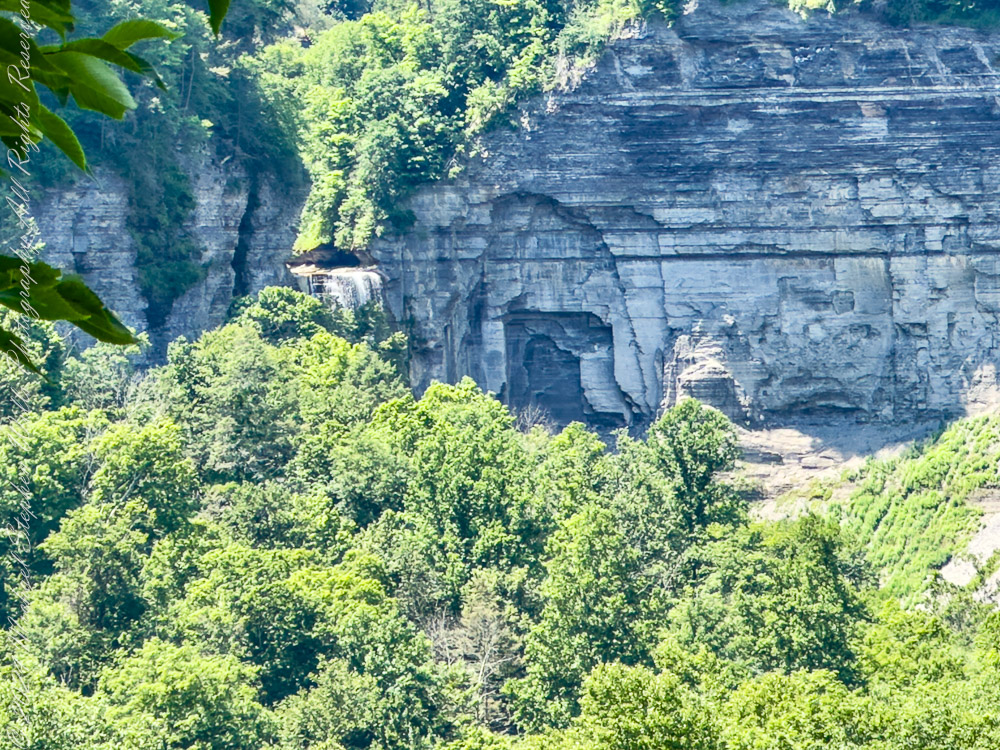
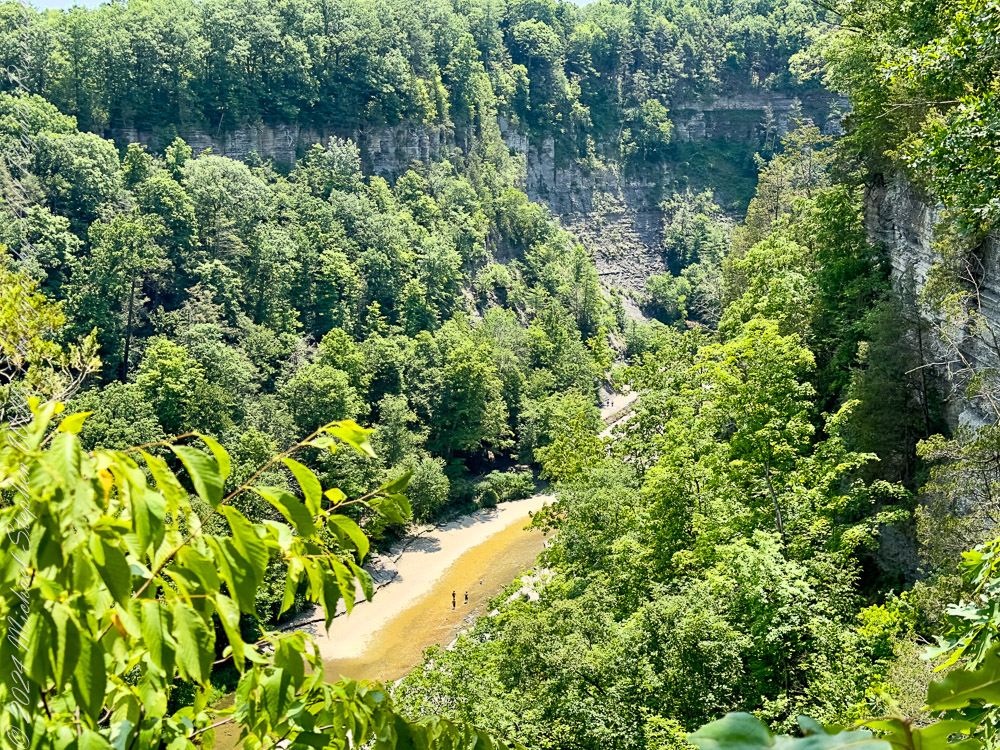
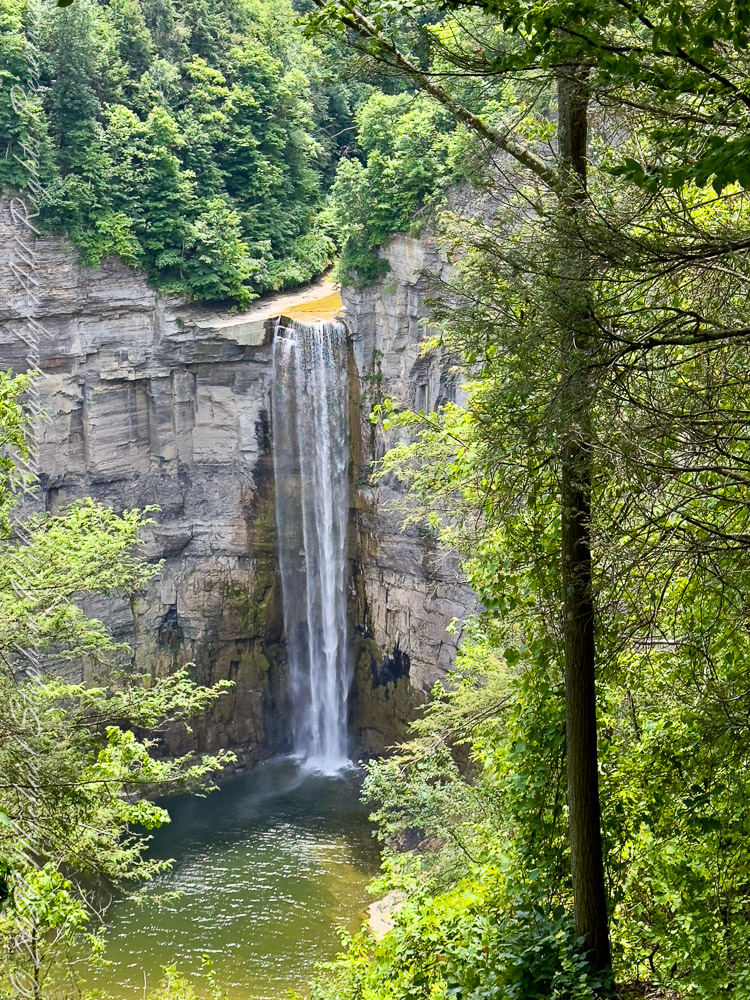
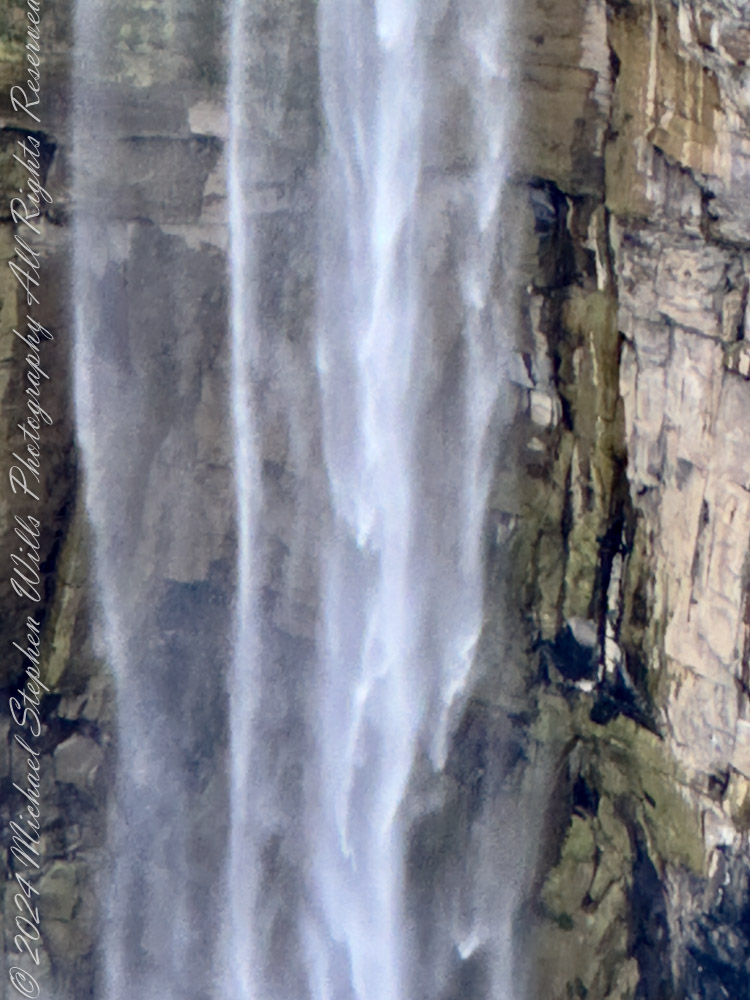
View of taughannock Falls from the South Rim Trail. Taughannock Falls New York State Park, Trumansburg, Tompkins County, Finger Lakes Region
A Story Written in Stone The rocks of Taughannock Falls tell a story that stretches back 380 million years to the Devonian Period, a time when the region was submerged beneath a shallow inland sea. Layer upon layer of shale, sandstone, and limestone formed as sediment settled to the ocean floor, preserving the fossils of marine life that once thrived here. These rocks have endured the passage of eons, but the gorge itself is a far more recent creation.
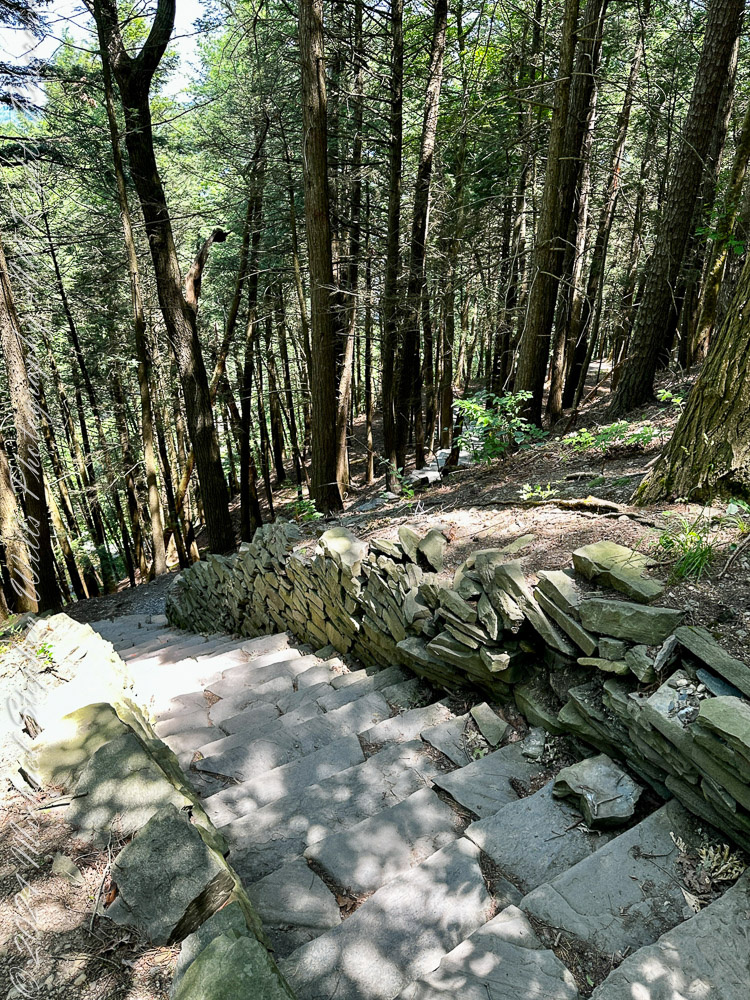
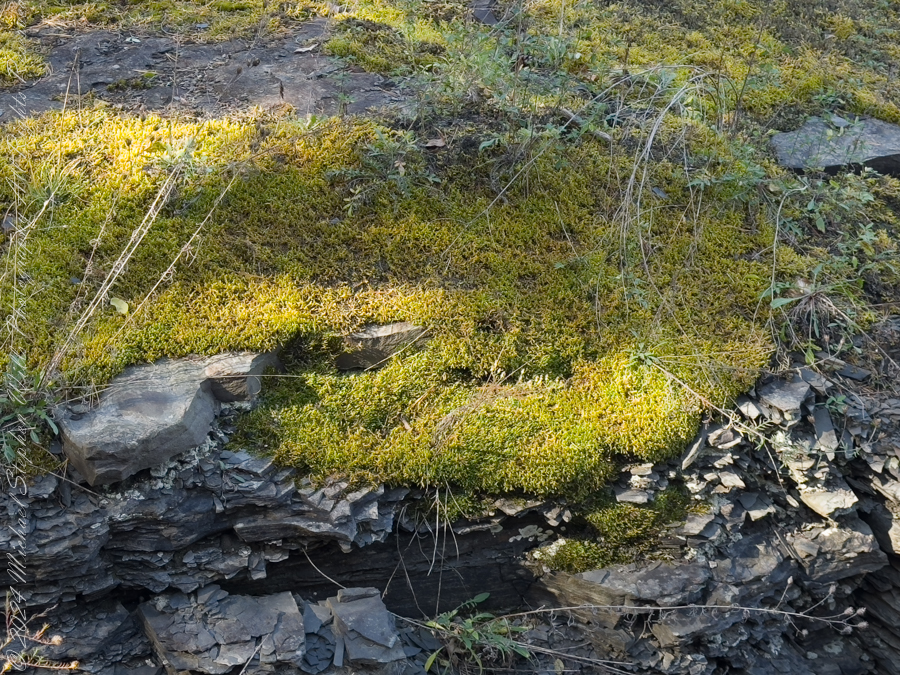
Limestone Steps on the South Rim Trail descend to the gorge floor.
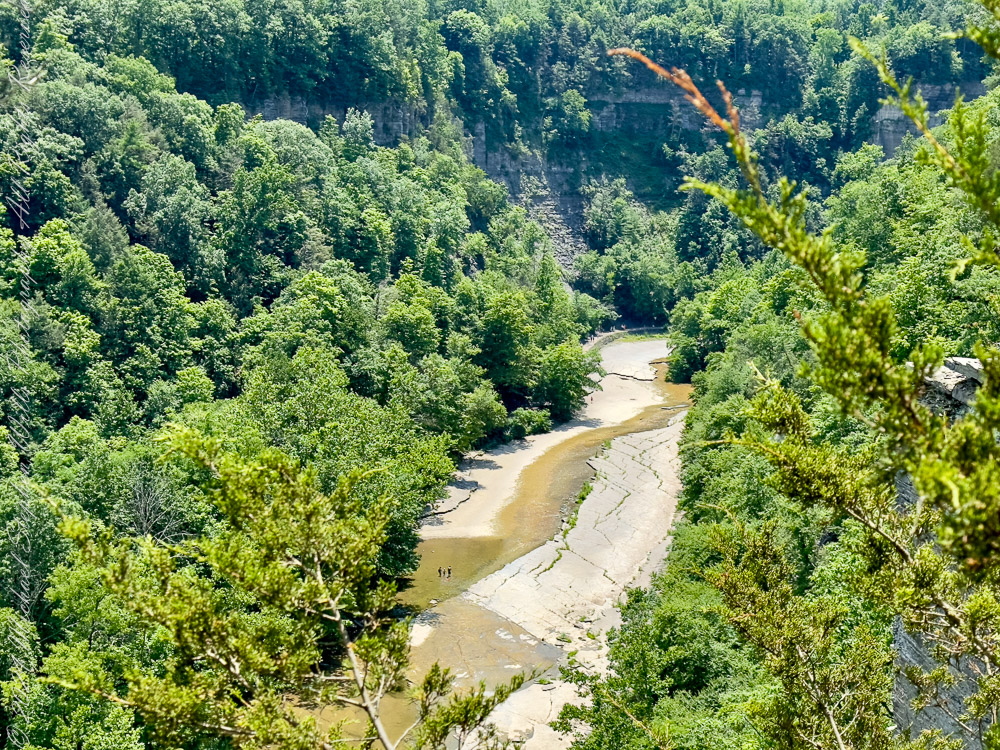
It was the retreat of the mighty Laurentide Ice Sheet, approximately 10,000 years ago, that set the stage for Taughannock’s grandeur. As glaciers melted, torrents of water carved the U-shaped valleys that now cradle the Finger Lakes. Taughannock Creek, a tributary of Cayuga Lake, began its work, etching its path through ancient rock, sculpting the gorge we see today. In just 10,000 years—a fleeting moment in geological time—the relentless force of water carved its way 3/4 of a mile upstream, creating the awe-inspiring chasm and waterfall that continue to evolve even now.
Taughannock Creek carved this landscape over thousands of years.
The Gorge’s Living Tapestry Beyond its geological wonders, Taughannock Falls State Park bursts with life. Along the North and South Rim Trails, Eastern Hemlocks (Tsuga canadensis) stand tall, their evergreen branches weaving shadows that dance across stone stairways and forest floors. These silent sentinels are habitats for myriad creatures and protectors of the delicate ecosystem.
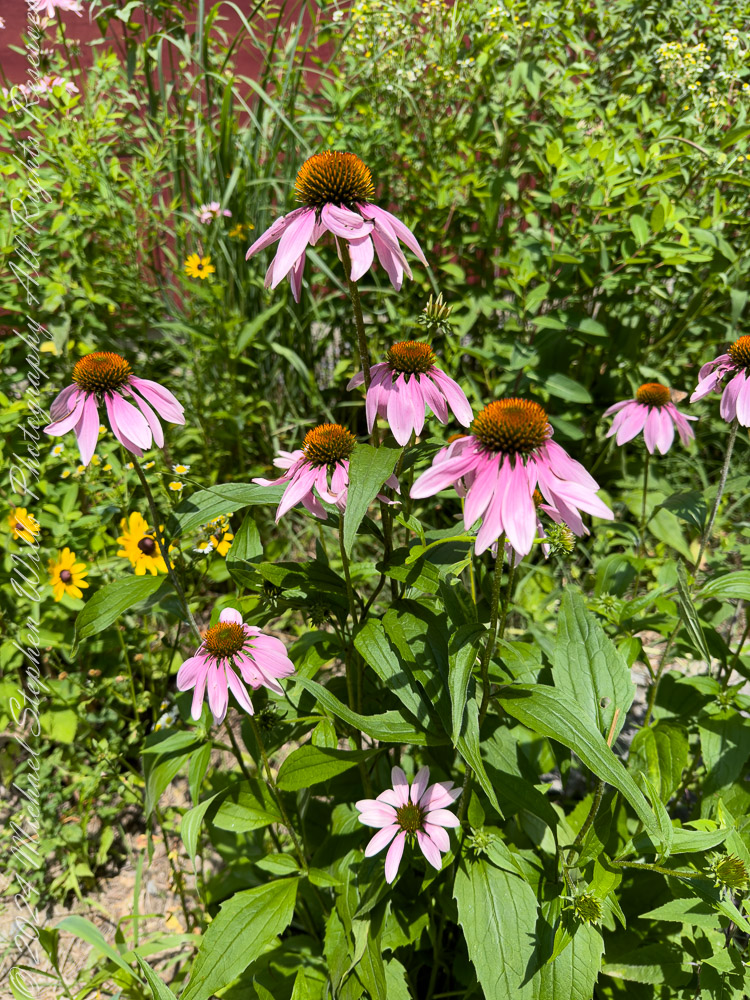
Wildflowers were planted by park staff at the Falls Overlook. The bright yellow of Black-eyed Susans (Rudbeckia hirta) and the vibrant purple of Coneflowers (Echinacea purpurea) attract bees and butterflies, their nectar fueling the intricate web of life that thrives here. Along the trail, on the forest floor, mosses and ferns cling to rocks, softening the edges of the gorge with their verdant touch.
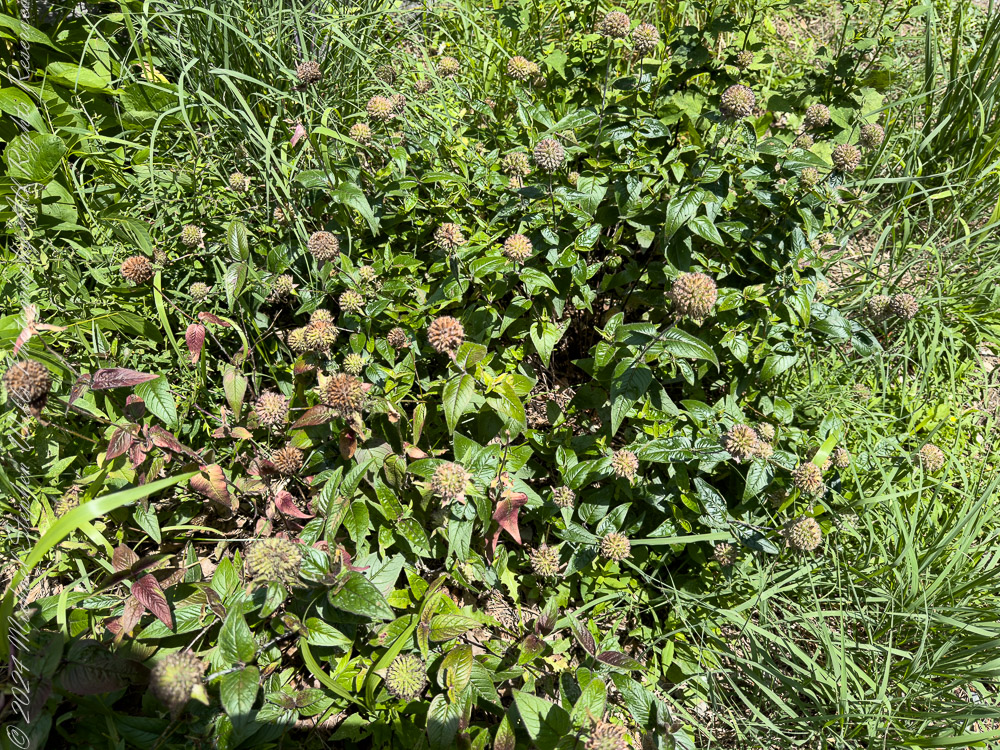
Cone FlowersCone Flowers gone to seedFrom a walk around Taughannock Falls State Park “Rim Trails” October 22nd, 2024. Trumansburg, Tompkins County, Finger Lakes Region, New York State.
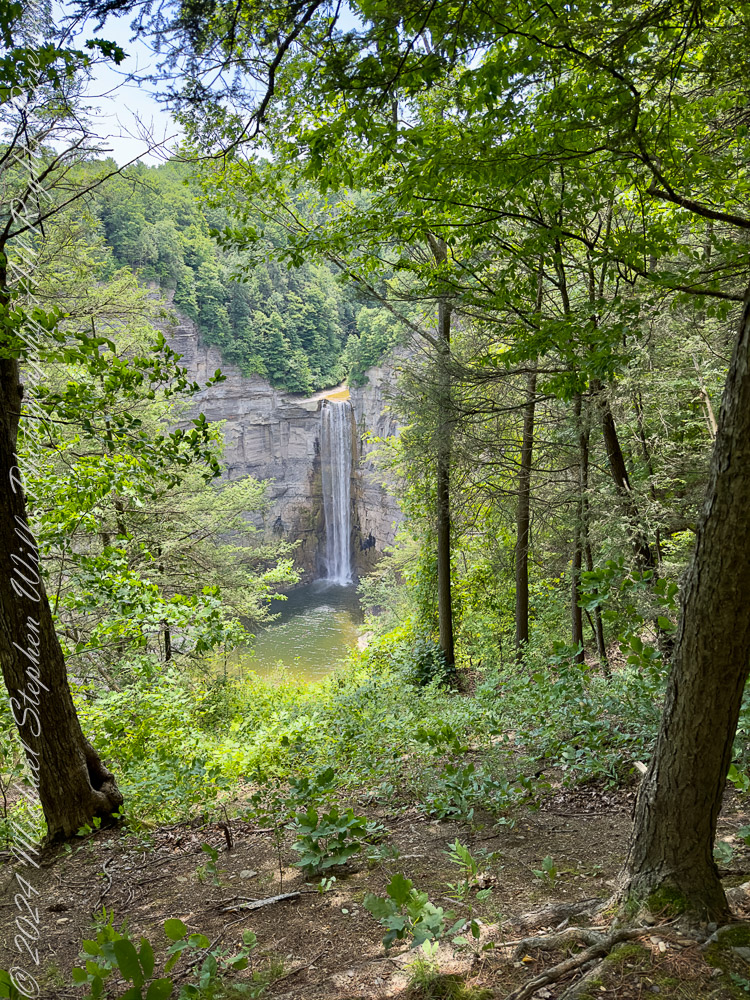
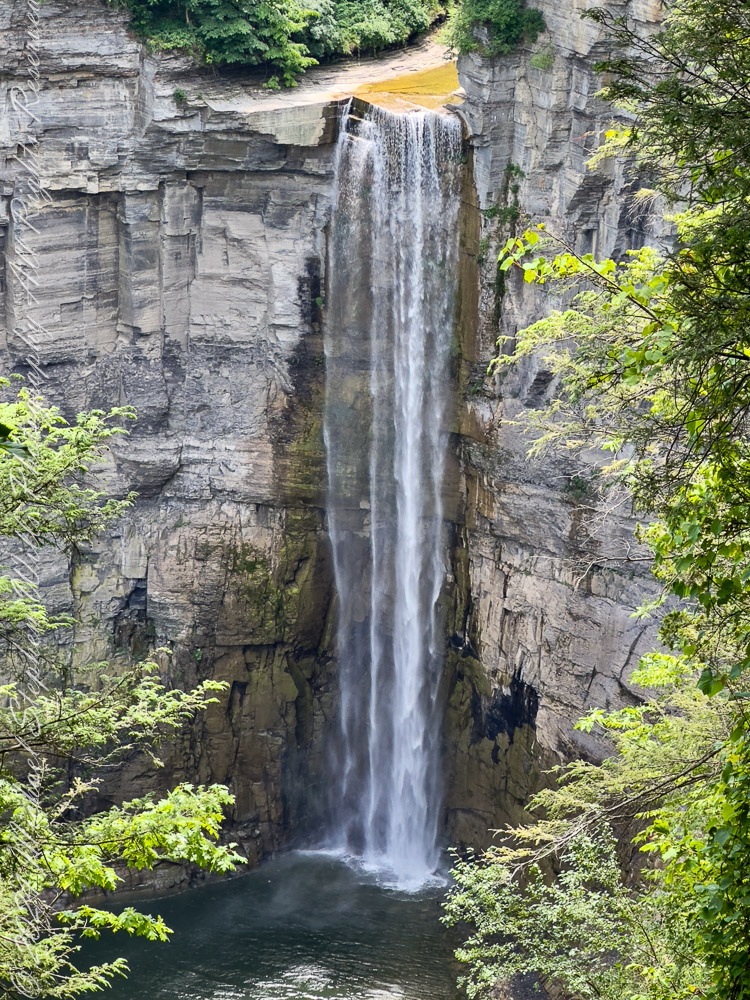
The Fall’s Eternal Dance At the heart of the park is the waterfall itself, its roar both a hymn and a whisper of time’s passage. The view from the North Rim Trail reveals the waterfall framed by steep cliffs, their striations like pages in a book written by water, wind, and time. The plunge pool below, shimmering in sunlight, seems almost sacred—a place where the forces of nature meet in harmony.
Viewed from the North Rim Trail on a summer morning. Taughannock Falls New York State Park, Trumansburg, Tompkins County, Finger Lakes Region
Even as we marvel at its beauty, the falls are a reminder of the earth’s constant transformation. Each drop of water that cascades down the cliff face carries away tiny fragments of rock, continuing the slow, deliberate work of reshaping the land. What we witness today is but one moment in an ongoing process—a fleeting glimpse of a masterpiece in progress.
A Place of Wonder To stand at the edge of Taughannock Falls is to feel both small and connected. The cliffs, formed over hundreds of millions of years, whisper of ancient seas and forgotten worlds. The gorge, carved in the blink of an eye by geological standards, speaks to the power of water and time. And the vibrant life that fills the park reminds us of nature’s resilience and beauty.
As the sun filters through the trees, illuminating the mist that rises from the falls, it’s easy to believe that this place holds magic. Perhaps it’s in the way the water sparkles like diamonds in the sunlight or the way the breeze carries the scent of pine and earth. Or maybe it’s in the knowledge that here, in this park, we are witnesses to a story billions of years in the making.
Conclusion Taughannock Falls State Park is a place of wonder where geology, ecology, and history converge. It invites us to reflect on the immense forces that shape our world and to cherish the fleeting beauty of each moment. Whether you come to marvel at the towering waterfall, walk among the hemlocks, or simply stand in awe of the gorge, Taughannock Falls leaves an indelible mark on the heart—a reminder of nature’s power, resilience, and enduring grace.
Enter your email to receive notification of future postings. I will not sell or share your email address.
Copyright 2024 All Rights Reserved Michael Stephen Wills
As I step into Cascadilla Gorge from the Linn Street entrance, I’m greeted by the soft rustling of leaves and the constant, soothing rush of water. The air this Halloween Day is warm, the autumn colors vibrant against the cool blue sky. I know Cascadilla Gorge is part of the Cornell Botanical Gardens, but the immediate beauty of this natural sanctuary makes it easy to forget I’m still within the city limits of Ithaca. The sounds of the gorge draw me in, as if whispering there’s more to see, more to explore. With a deep breath, I begin my journey up the trail, eager to discover what lies ahead.
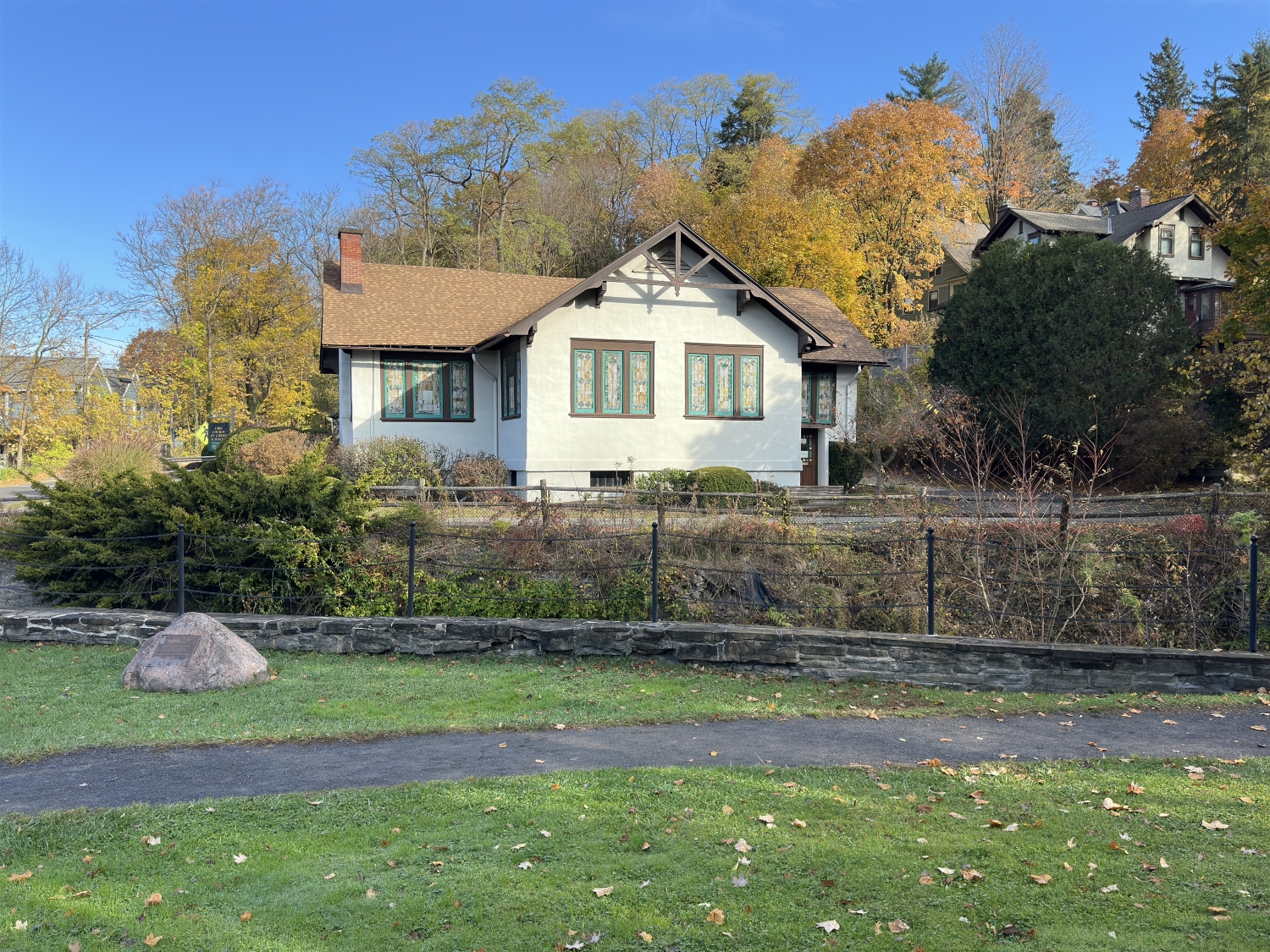
Just a short way in, I notice the First Church of Christ, Scientist perched on the corner of University Avenue and Cascadilla Park Road. The architecture of the church is both quaint and elegant, with its light-colored facade framed by dark trim and roof. Surrounded by foliage, it feels like the church belongs here, as much a part of the landscape as the trees and rocks. The sight of this historic building nestled so close to the gorge reminds me that this wild and ancient place is woven into the fabric of Ithaca’s community life.
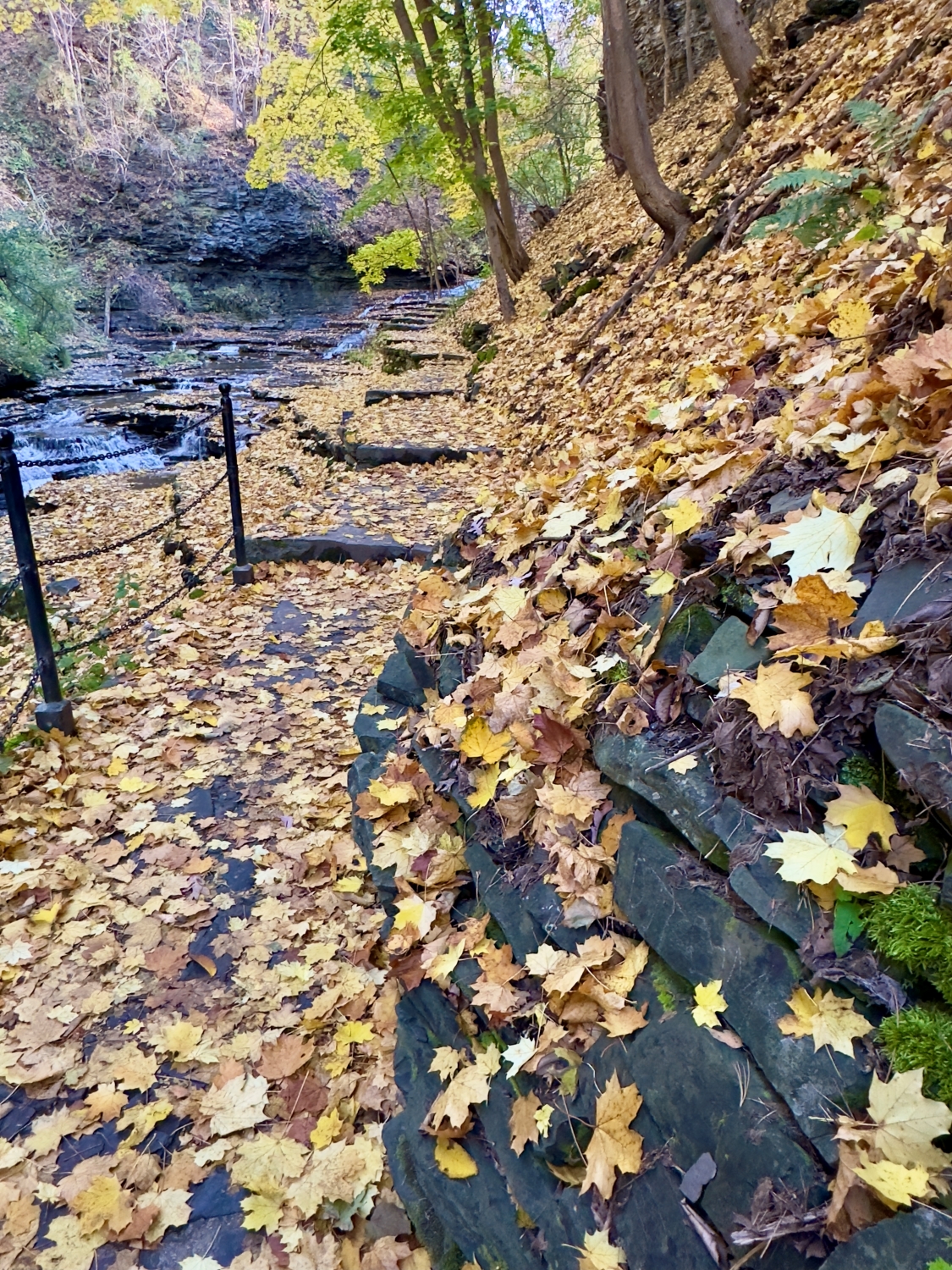
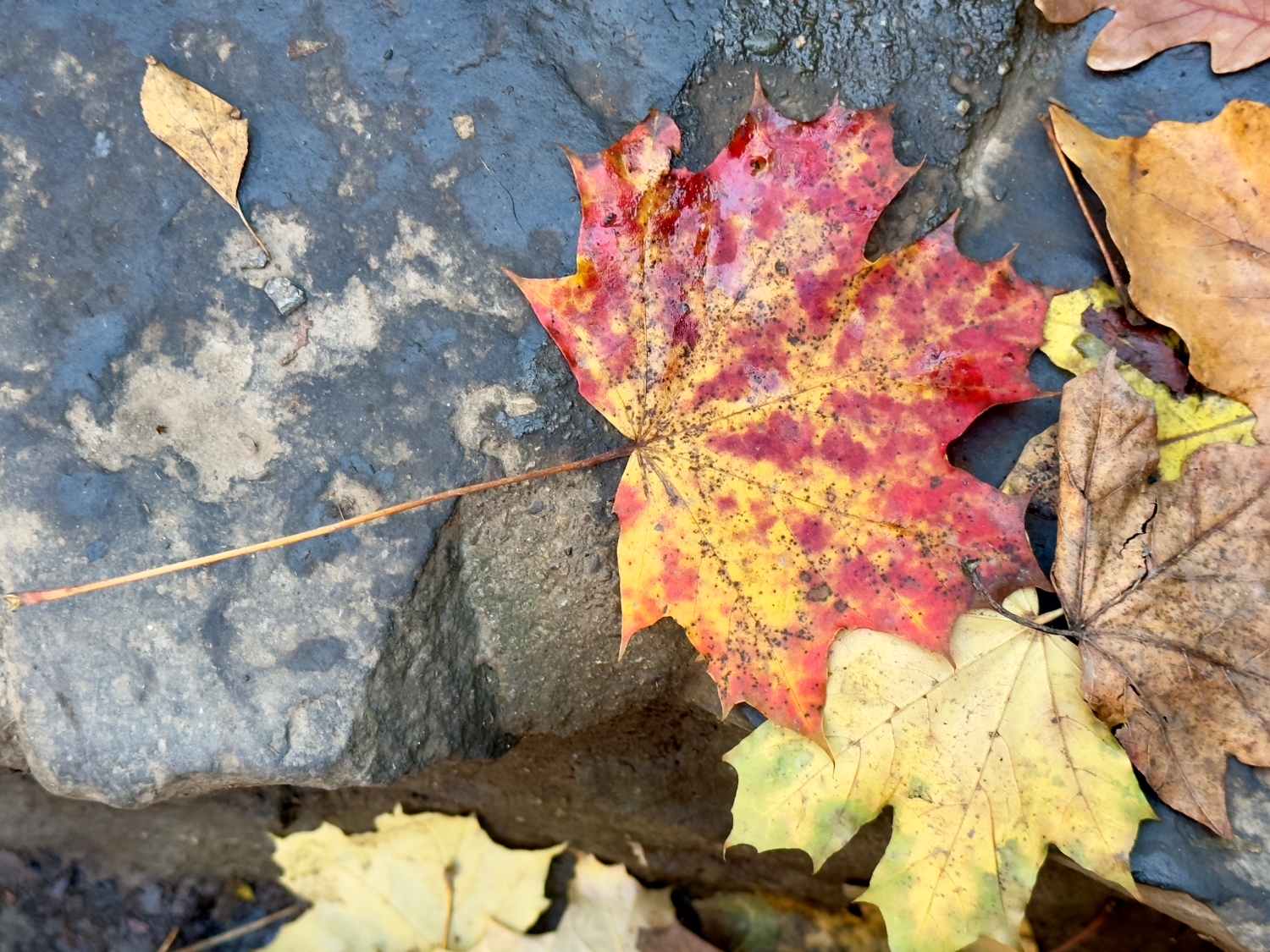
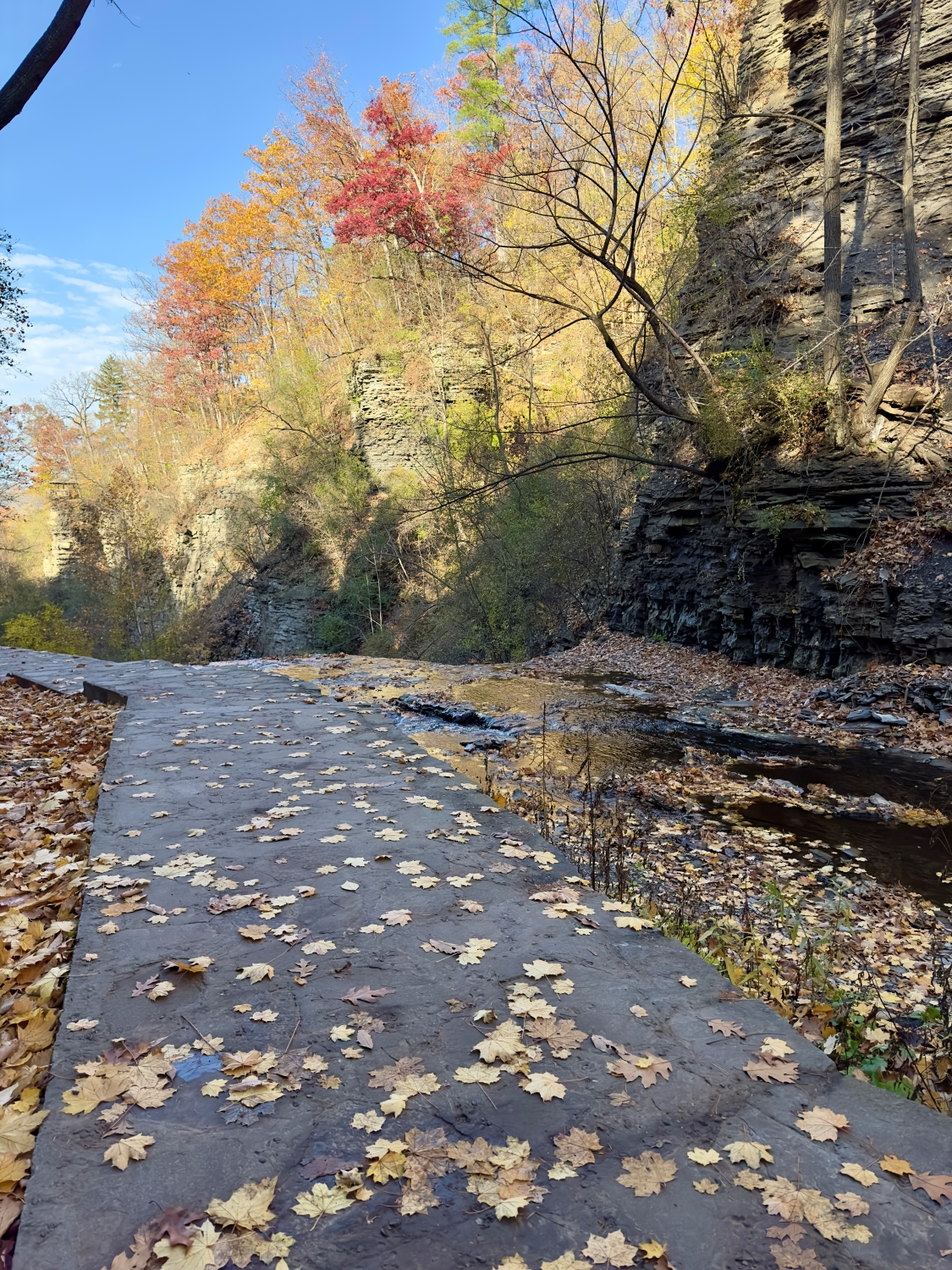
I move further along the trail, and the terrain begins to shift. Fallen leaves create a golden carpet along the path, their crisp shapes overlapping like nature’s confetti celebrating the season. Each step crunches underfoot, adding my own rhythm to the symphony of sounds. The trees overhead are a kaleidoscope of colors—deep golds, fiery oranges, and the occasional flash of red from Virginia Creeper vines (Parthenocissus quinquefolia). Together, the trees create a canopy that filters sunlight, casting dappled patterns on the gorge walls. It’s an ever-changing play of light and shadow, one moment bright and the next subdued, adding a layer of magic to the experience.
As I follow the trail upward, the gorge narrows, and I find myself surrounded by towering walls of rock. Here, layers of siltstone and shale formed more than 300 hundred million years ago are exposed, a testament to the forces of water and time that carved this place across mere millennia of recent geologic time. The rock formations are fascinating, with the water flowing over them in gentle cascades, finding every groove and crevice. There’s something humbling about standing in a place shaped by forces so much larger and older than myself. I pause, letting the rush of water and the stillness of stone fill my senses.
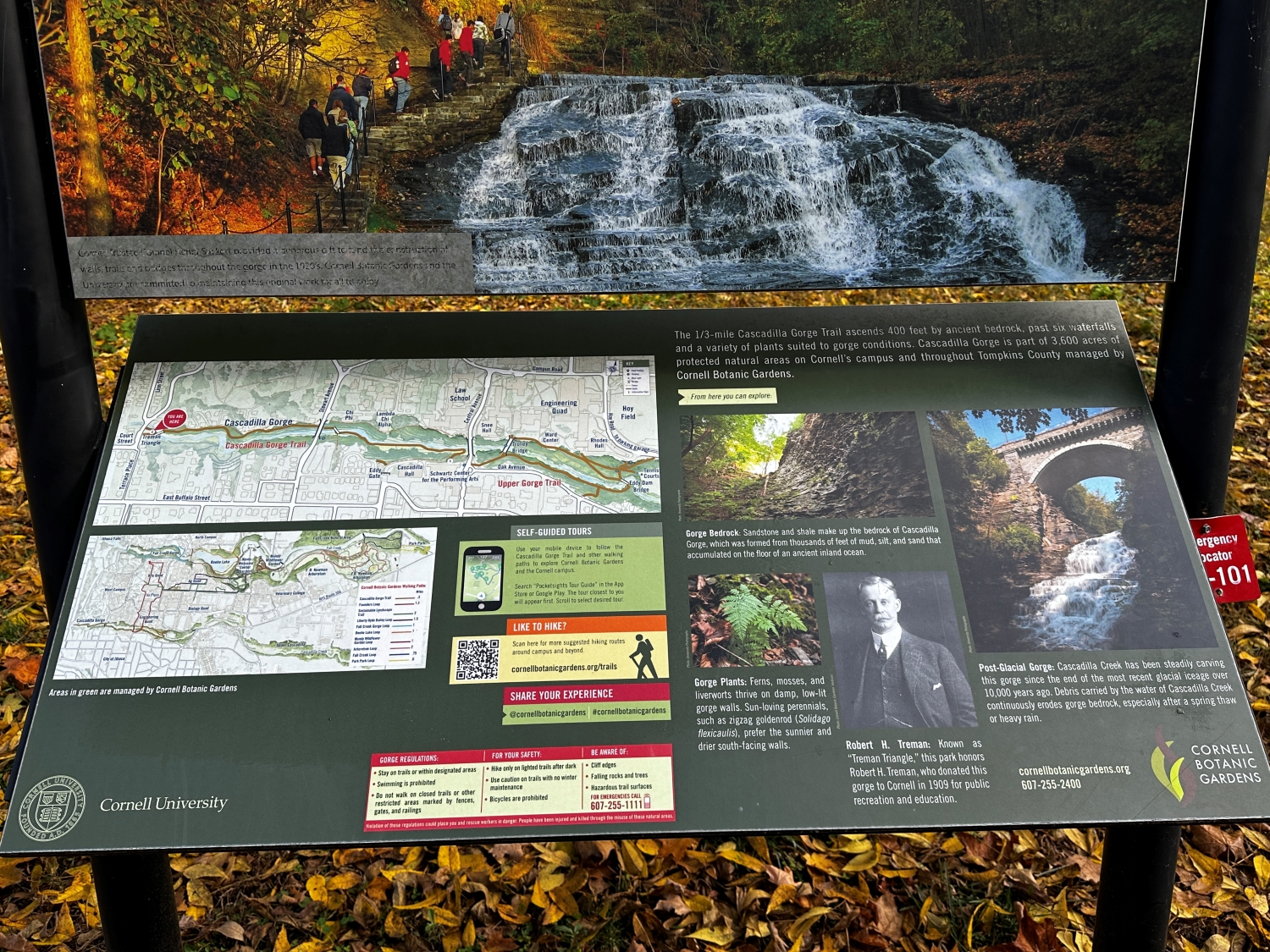
Along the way, I come across an interpretive sign provided by the Cornell Botanical Gardens. They tell the story of Cascadilla Gorge, how it was formed from the bedrock of sandstone and shale that eroded from mountains to the east, in the Devonian era when an ancient inland sea covered the region. The signs also introduce Robert H. Treman, a philanthropist who saw the beauty and educational value of the gorge. Thanks to him and the efforts of many, this natural wonder is preserved for all to experience. Knowing this adds depth to my walk; it’s a reminder that places like this exist not only by chance but because people cared enough to protect them.
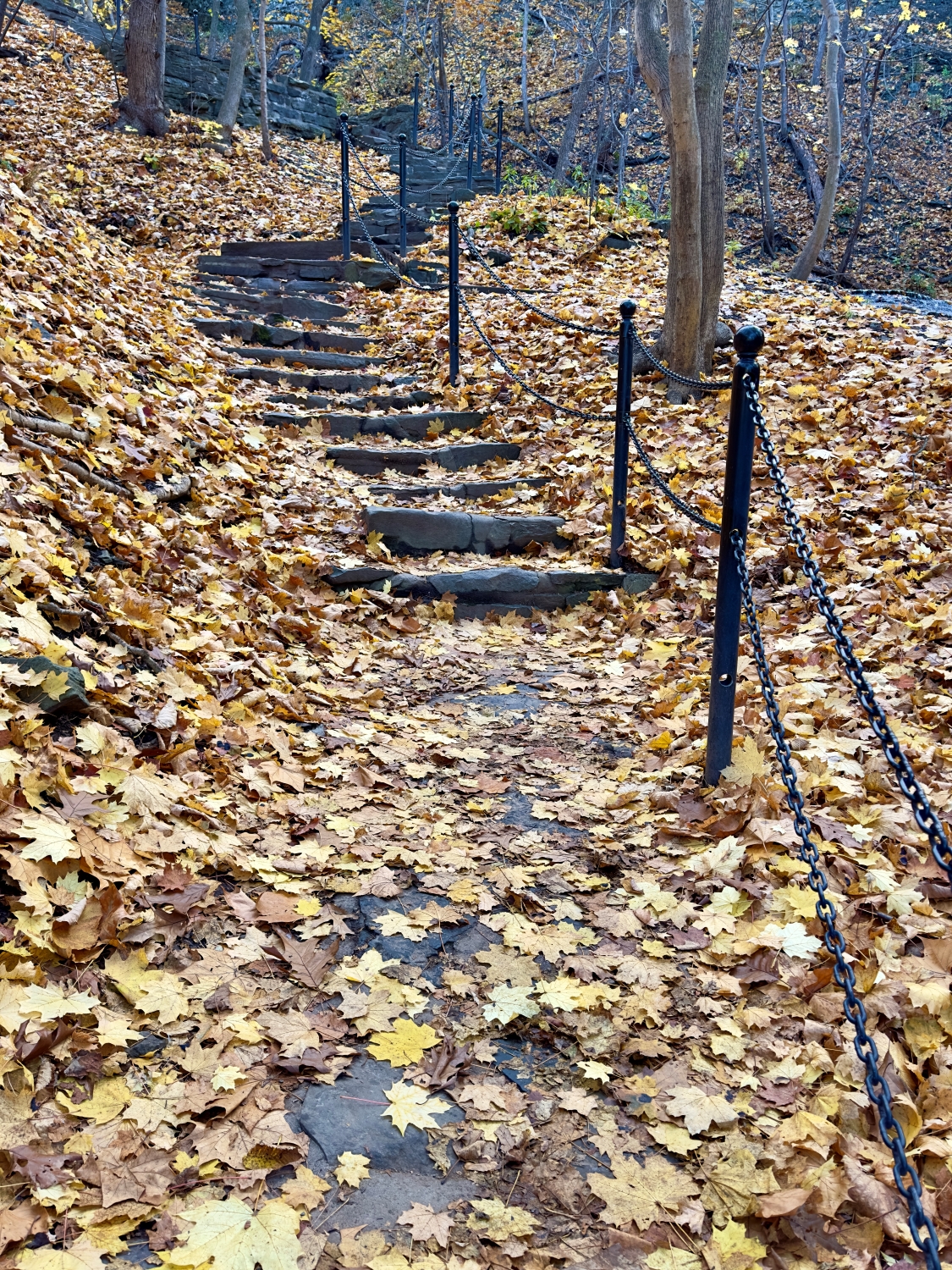
The sandstone staircases along the trail are a marvel in themselves. Some sections are steep, winding up the gorge in a series of steps that seem to have been placed with precision, blending seamlessly into the natural landscape. The steps are covered with leaves now, making each ascent feel a bit like climbing through a fairy-tale forest. The chains along the path provide a comforting grip, especially as I climb higher. I look back and see how far I’ve come, the creek below winding its way over rocks and around bends, each step a small journey of its own.
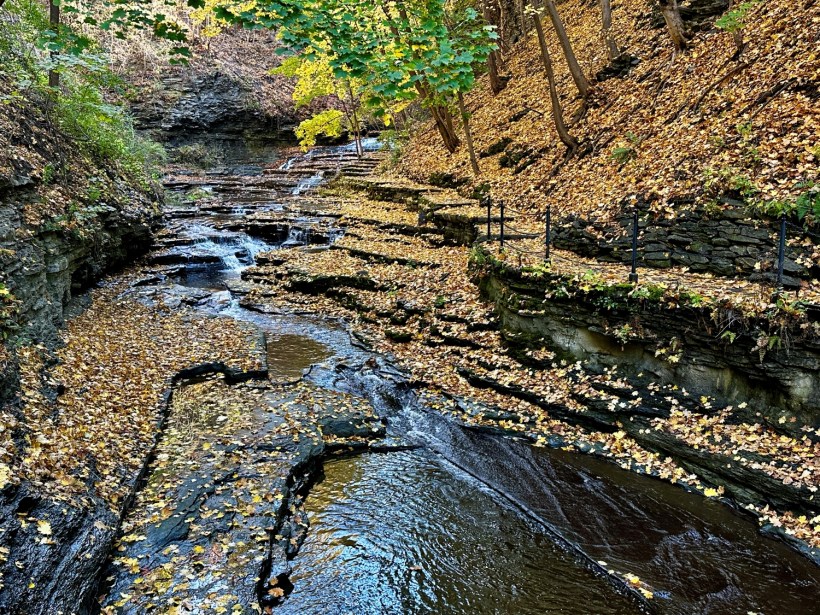
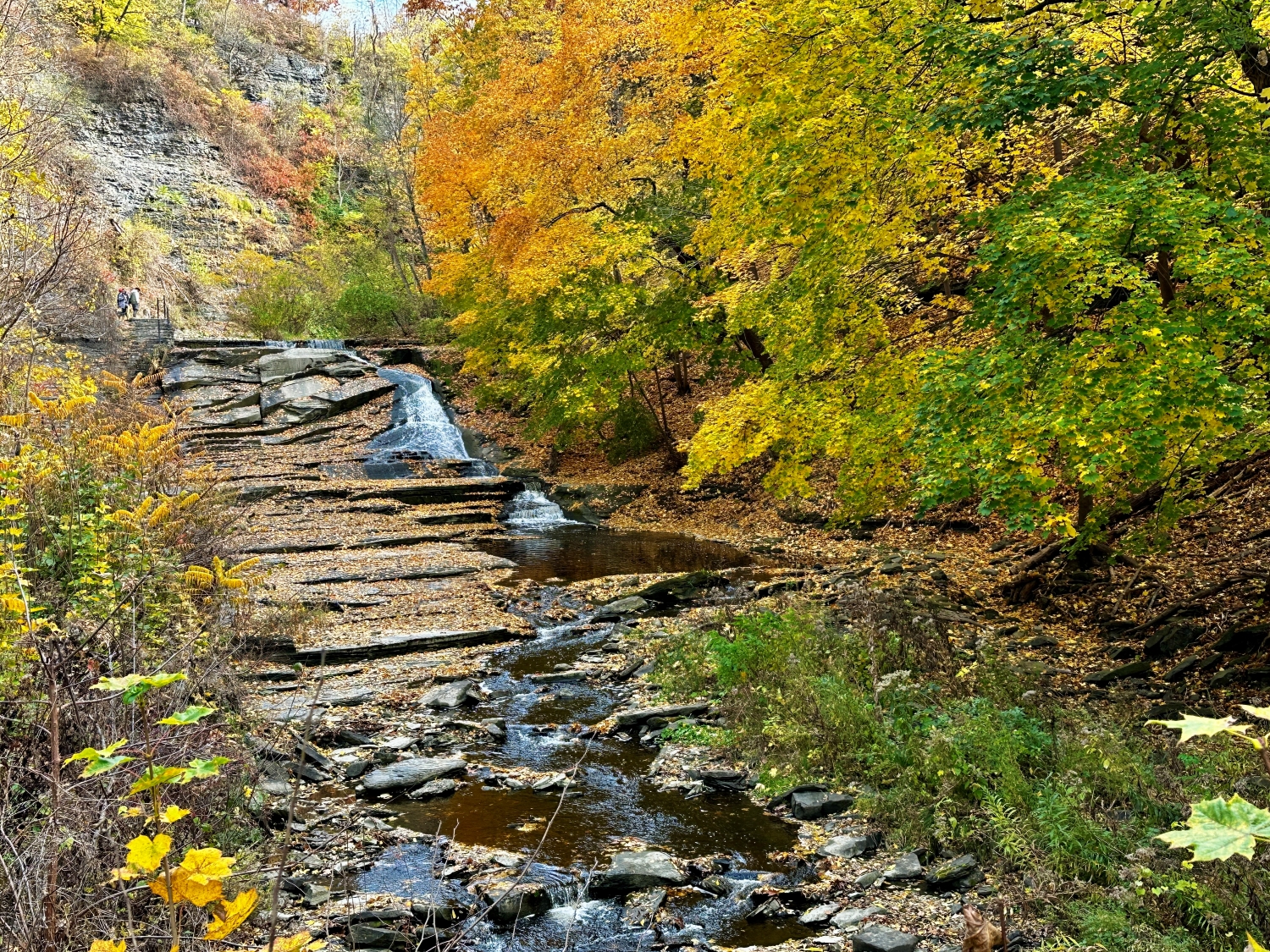
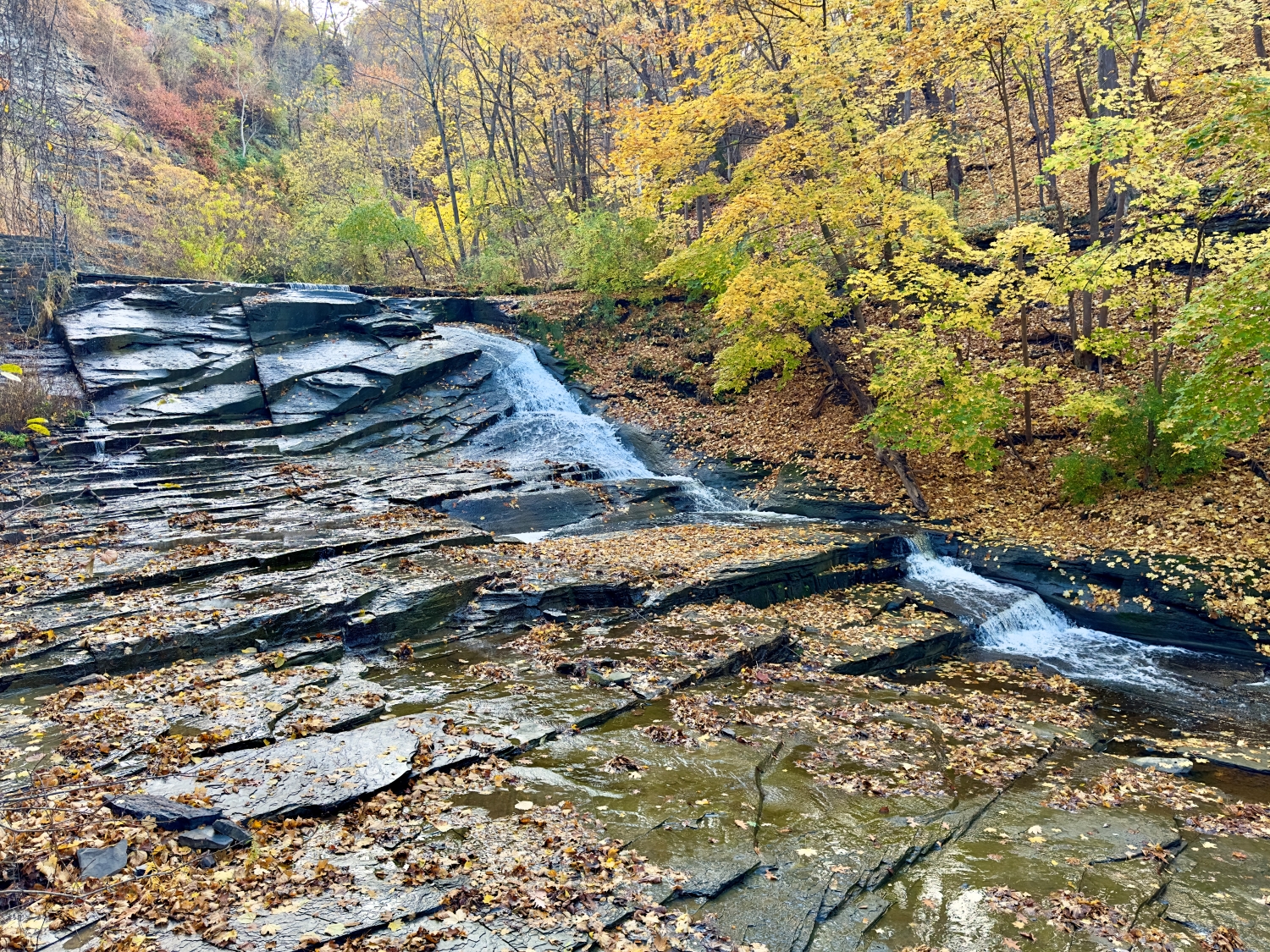
I pass several small waterfalls, each one unique in its character. Some are gentle trickles, while others pour over the rocks with more force, their sound reverberating off the gorge walls. I stop frequently, entranced by the way the water carves its path, eternally moving, adapting, wearing down even the hardest stone. Leaves float down from above, landing in the creek and swirling in miniature whirlpools before being carried downstream. It’s mesmerizing to watch nature at work in such a quiet, persistent way.
Further up the gorge, the views open up, and I can see the layers of rock descending in terraces, each level a little cascade of its own. I watch as the water flows across these steps, catching the light as it moves—a silvery ribbon winding through the golden autumn landscape. The tranquility of the scene is meditative. Around me, the trees stand as silent witnesses, their branches bare in places but still adorned with clusters of leaves clinging through the last days of fall.
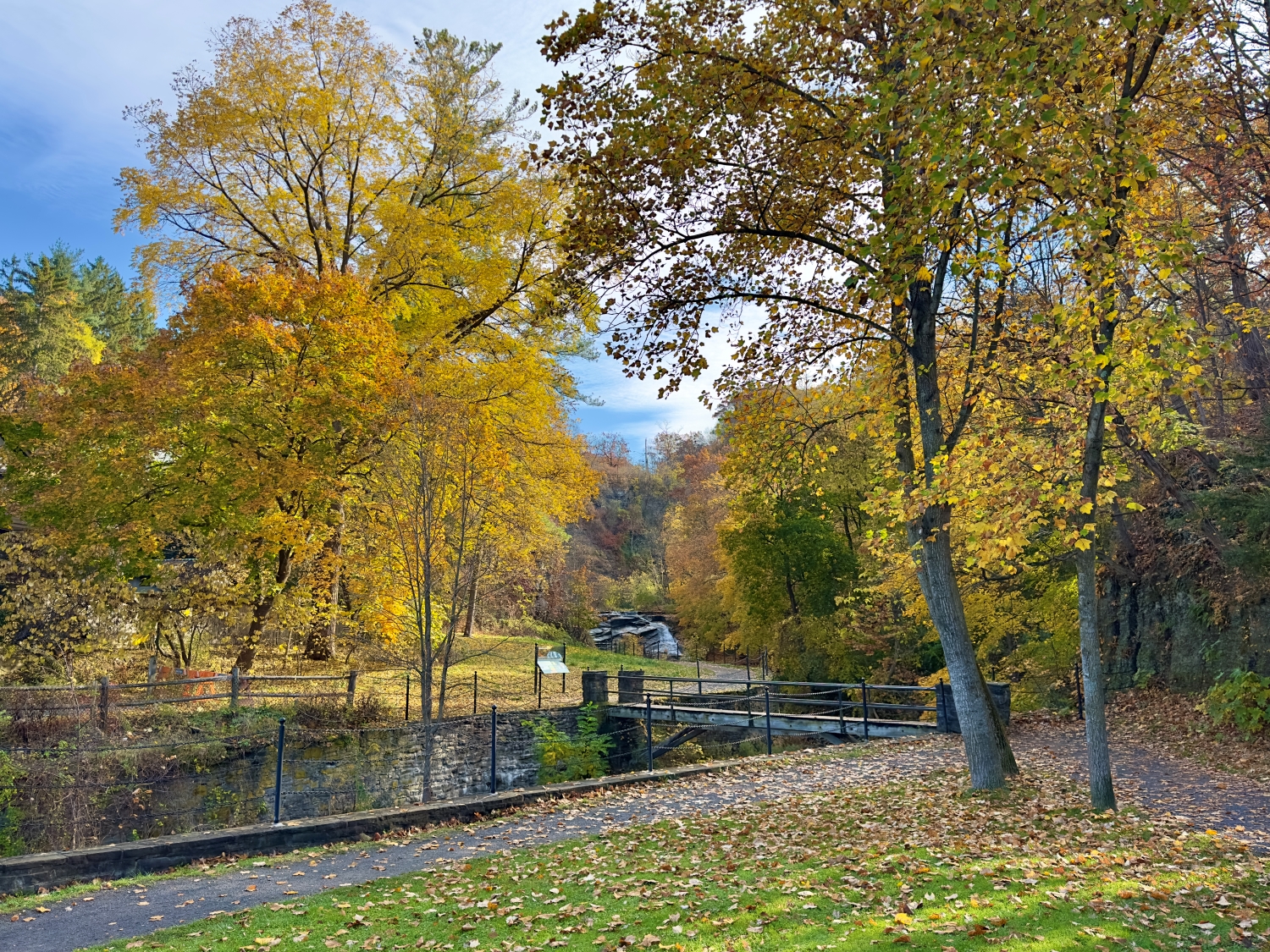
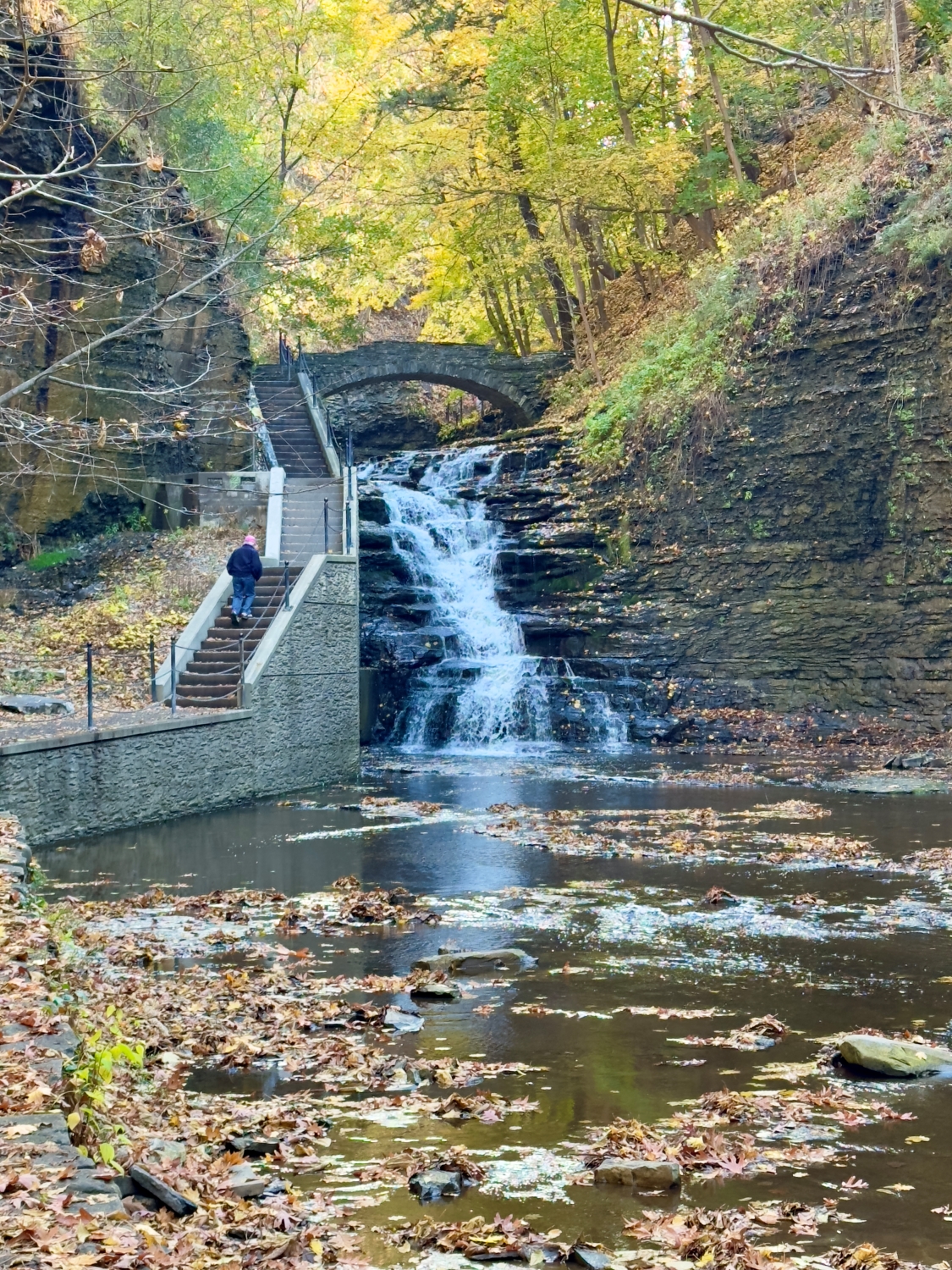
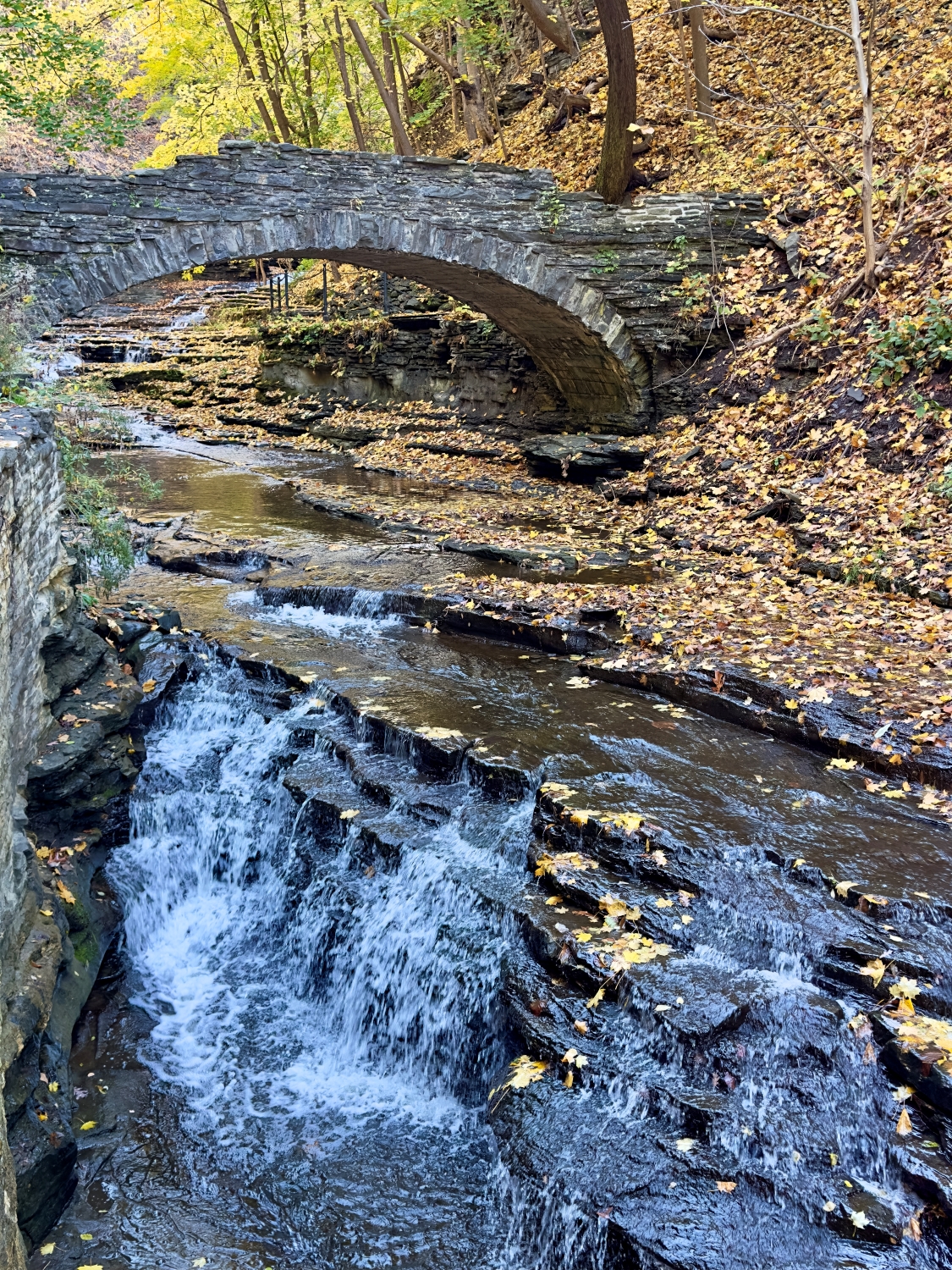
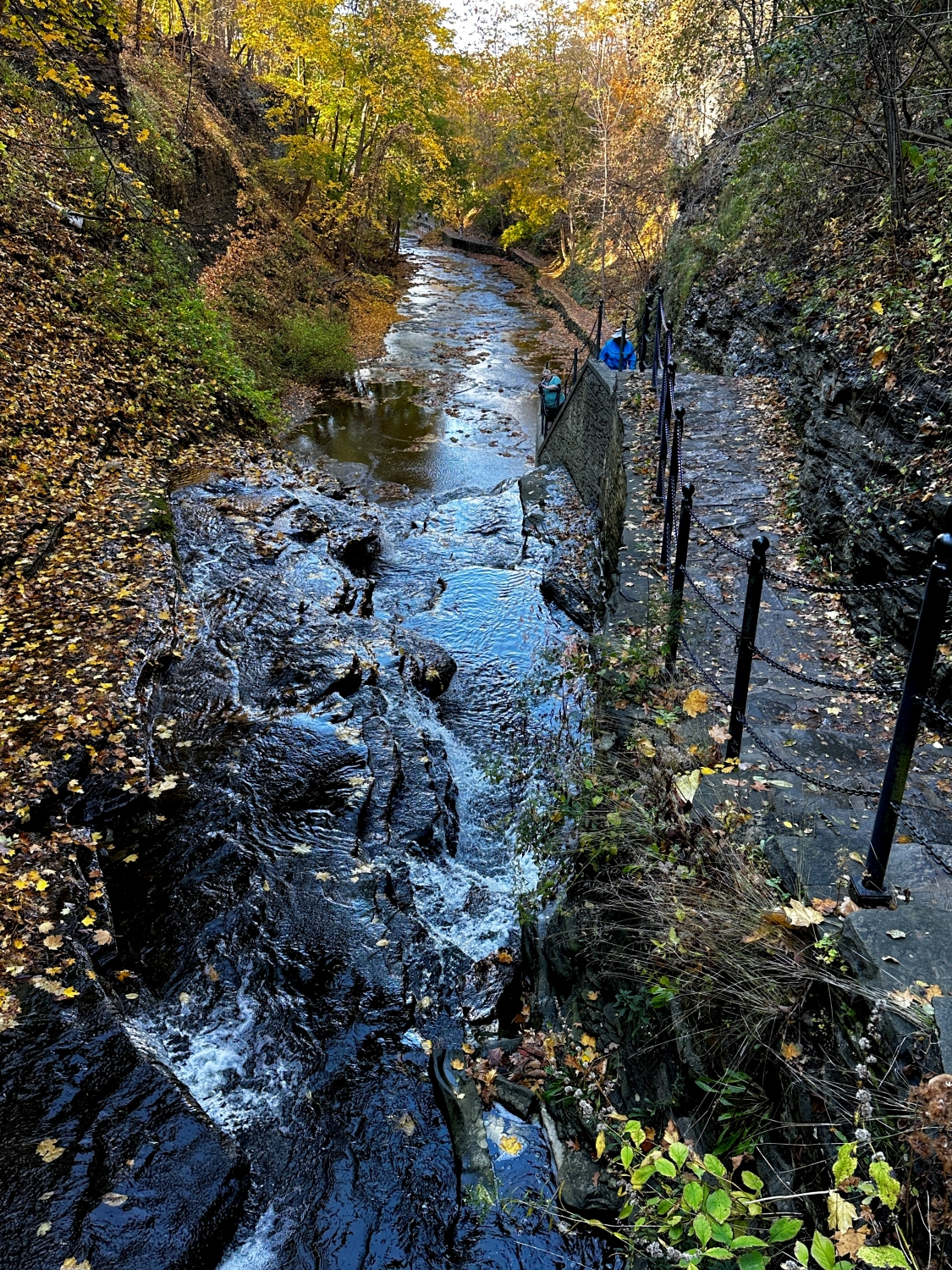
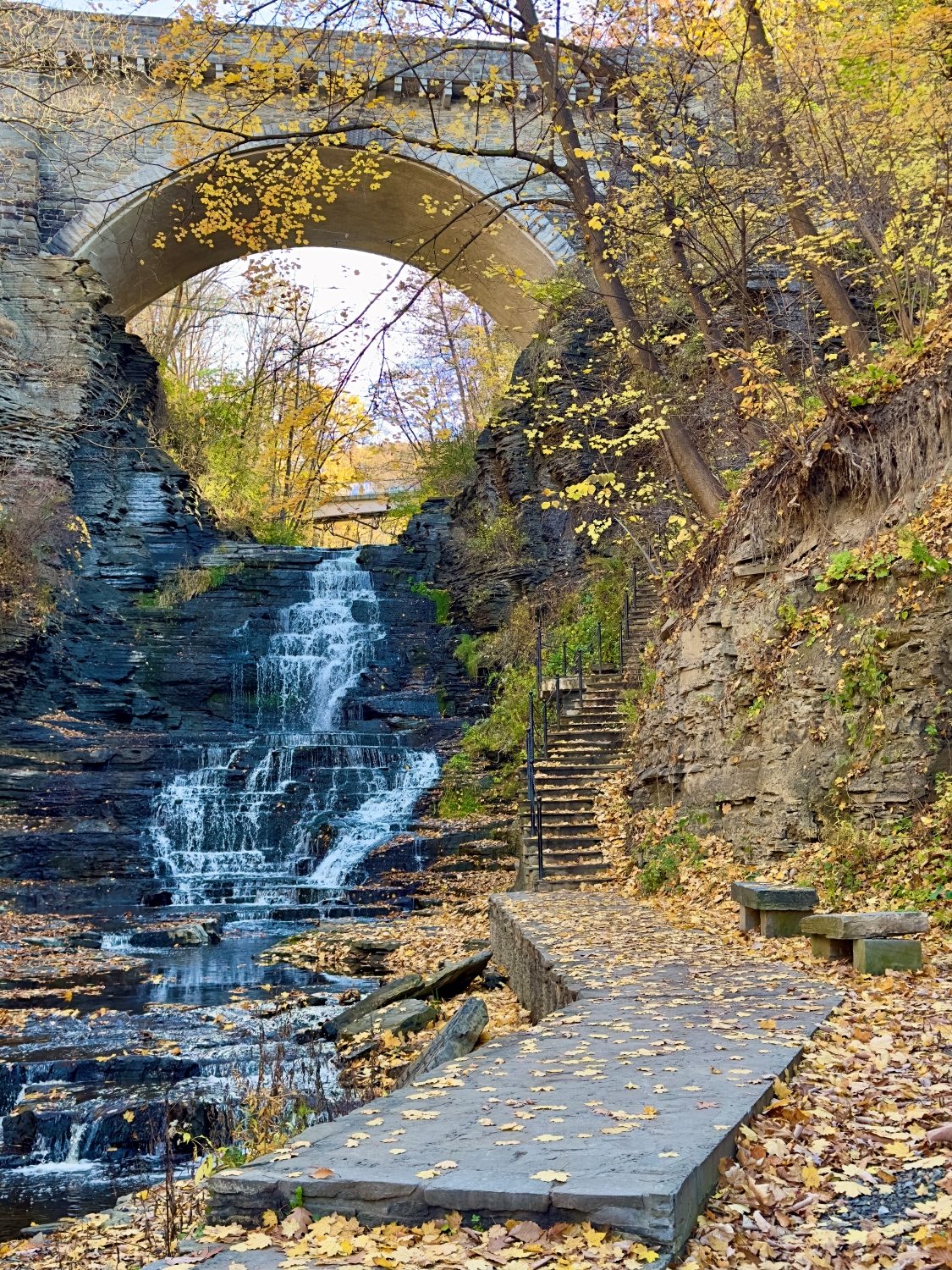
Finally, I reach one of the larger waterfalls, framed by a graceful stone arch bridge that crosses high above. The scene is something out of a painting. Water pours over the rocks, gathering in pools below before spilling onward. I pause on the bridge, looking down at the gorge below and the trail I’ve followed, grateful for the journey.
Along the way, artists are positioned along the path, each lost in the beauty of Cascadilla Gorge. They stand or sit in quiet reverie, brushes or pencils in hand, capturing the gorge’s unique character. Some focus on the play of light over the water’s surface, while others seem intent on the rugged details of the rock formations. Their presence adds a contemplative depth to the scene; it’s as if each artist has uncovered a hidden aspect of the gorge that I have overlooked in my journey upward.
I slow my pace to take it all in, appreciating how the artists interpret this natural wonder through their own eyes. Their canvases reveal layers of colors that shift as the sun filters through the leaves, casting vibrant golds and subtle greens on the cascading water. The scene feels almost collaborative—nature and human hand creating art together, each reflection of the gorge as unique as the individual capturing it. I’m tempted to pause beside them, to see how they choose to frame the towering walls, the stone bridge arching above the water, and the gentle curves of the creek as it meanders downstream. I can imagine each artist’s work holding a different piece of this place, like fragments of a memory.
Bridge View looking up Cascadilla CreekBridge View looking back the way I came
As I continue, the sound of rushing water grows louder, drawing me towards another cascade that tumbles in steps down the gorge. The rocks are layered in angular formations, giving the water a zigzagging path to follow. Leaves are scattered across the stones, their colors—yellows, browns, and the occasional splash of red—standing out against the dark, wet rock. There’s a timelessness here, a feeling that this scene has remained unchanged for centuries, save for the shifting leaves and the ever-present flow of the creek. The thought makes me feel like a small part of something much larger, a guest in an ancient place shaped by nature’s slow, steady hand.
The path narrows again, following the edge of the creek where the water has worn smooth channels into the stone.
Moving forward, the trail climbs steeply, and I find myself surrounded by tall rock faces on either side. The walls are layered and weathered, a geological history book open to the forces that shaped this land. It’s humbling to see how this place puts everything into perspective, how it reminds us of our place in the natural world.
Columns of sedimentary rock
Ahead, the path becomes more rugged, the air feels cooler here, shaded by the gorge’s high walls, and the sounds of the city are long gone, replaced by the steady rhythm of water and the drift of leaves. The layers of ancient limestone that form these towering walls give shape to our landscape and ecosystem. As rainwater falls and seeps through the porous rock, the limestone raises the pH of the water, neutralizing its natural acidity. This subtle alchemy nurtures the flora and fauna, fostering a unique biome that thrives in the gorge. The artists fade from view as I move further into the solitude of the trail, but their presence lingers in my mind. Each turn of the path reveals another scene worthy of capturing, another moment that seems to call out for remembrance.
Looking back toward the way I came
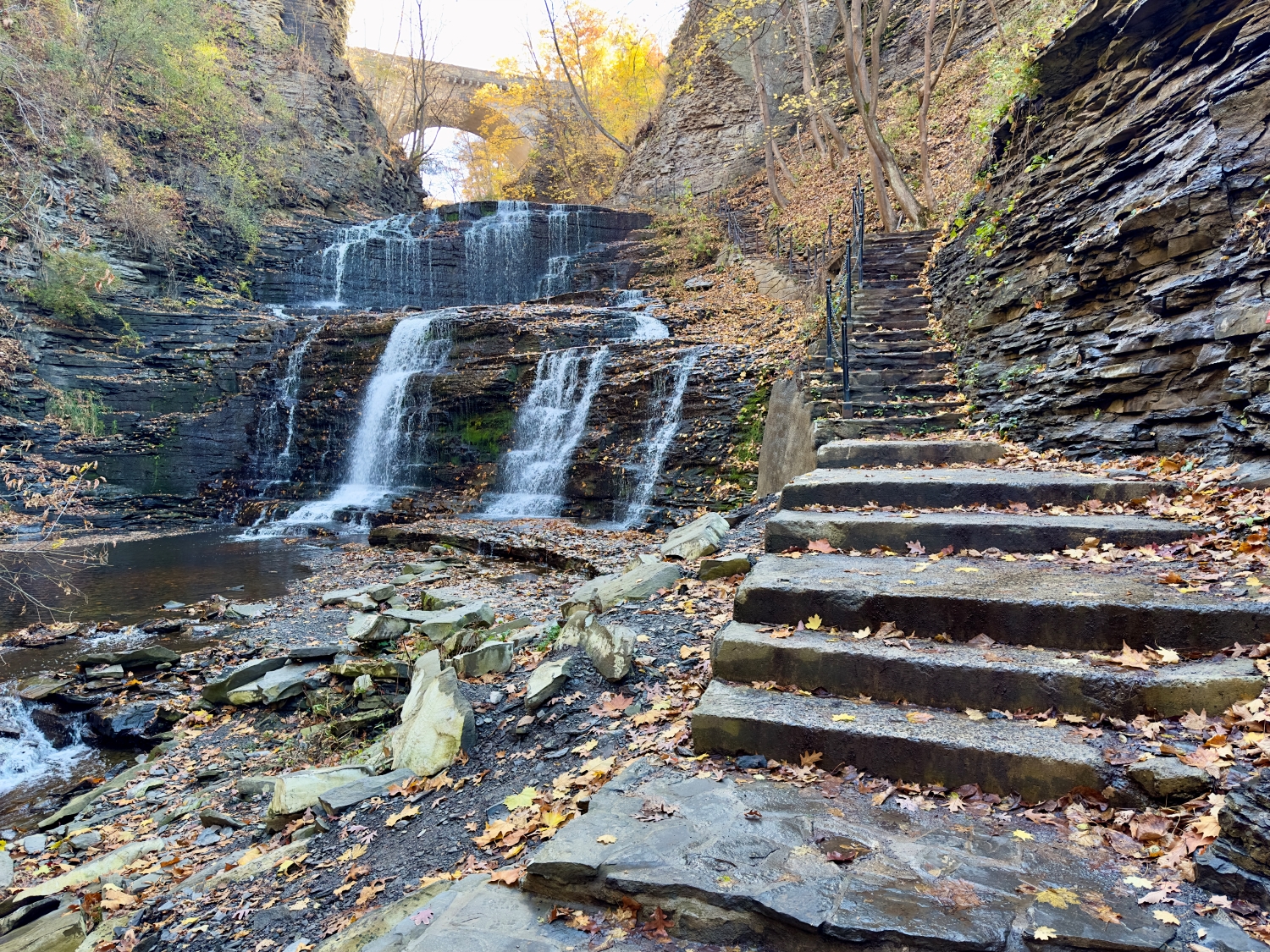
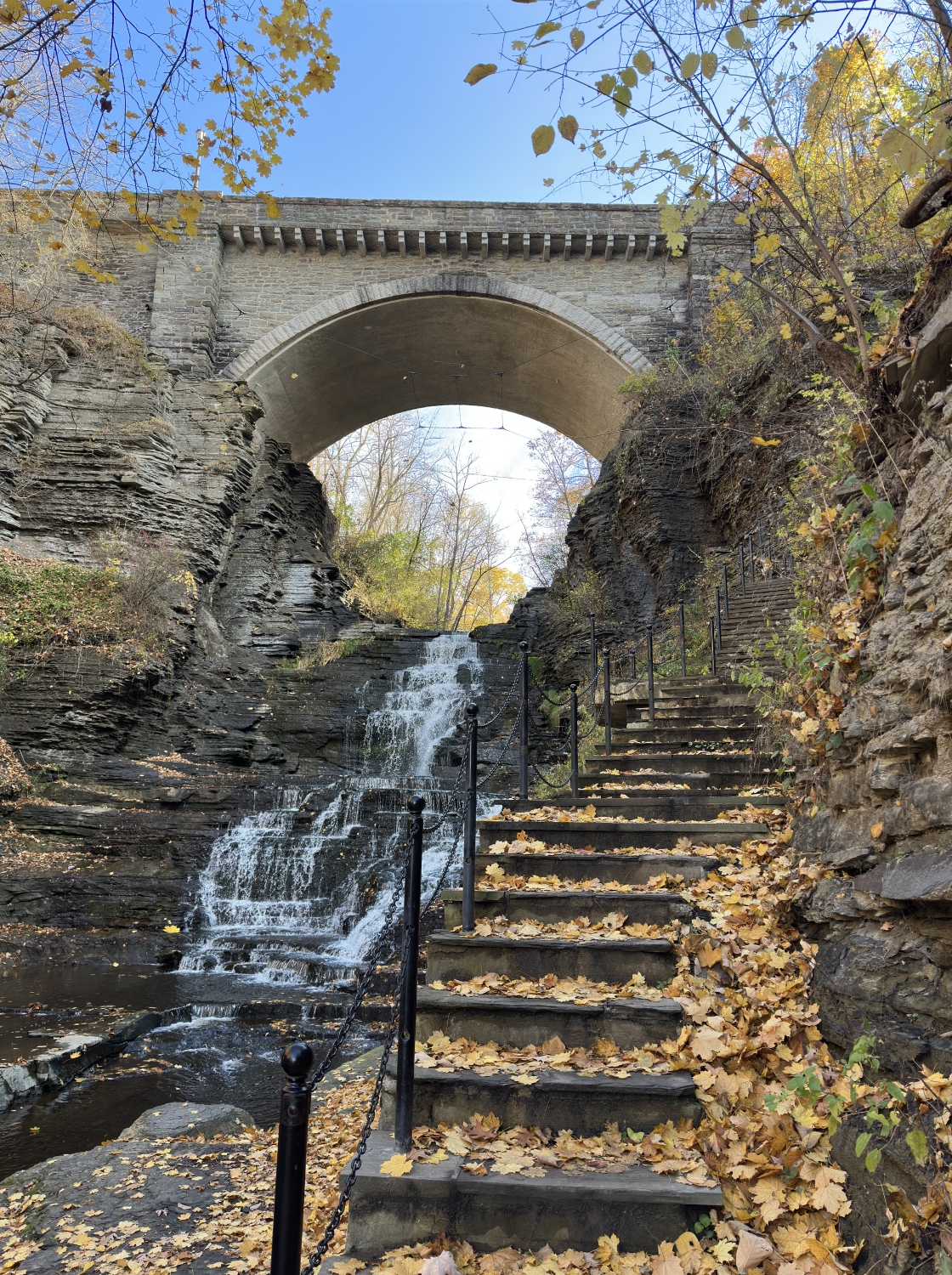
The trail steepens, and I press onward, the sound of the water intensifying as I near a grand waterfall framed by the impressive stone steps leading up to the College Avenue Stone Arch. Each step is littered with leaves, their colors vivid against the worn stone—golds, russets, and the occasional brilliant red, like embers scattered along my path. The waterfall beside me spills down in steady streams, each cascade creating rivulets that catch the light as they flow downward.
The gorge walls rise sharply on either side, embracing the path in rugged layers that tell stories of geological time. I feel as if I’m climbing a passage through history itself. These rocks, these trees, the very water carving its way through the stone—all have been here far longer than I can fathom, shaped by forces beyond my understanding. There’s a certain thrill in being among such enduring elements, a reminder of how small and fleeting we are in the face of nature’s grandeur.
Reaching the next tier of the trail, I pause to take in the sight of the massive stone arch spanning the gorge above. The bridge is a striking feature, its wide arch perfectly framing the sky and the last vibrant colors of autumn. It feels like a gateway, a fitting culmination to the journey. Standing beneath it, I’m struck by how well it harmonizes with the gorge, the careful craftsmanship of its stonework complementing the rough beauty of the surrounding cliffs.
The sunlight flows around the arch, illuminating the leaves that cling to the branches above, casting a warm glow over the scene. I feel a sense of reverence here, a quiet acknowledgment of both human artistry and the relentless beauty of nature.
I paused to capture this video of the moment.
Sights and Sounds of Autumn
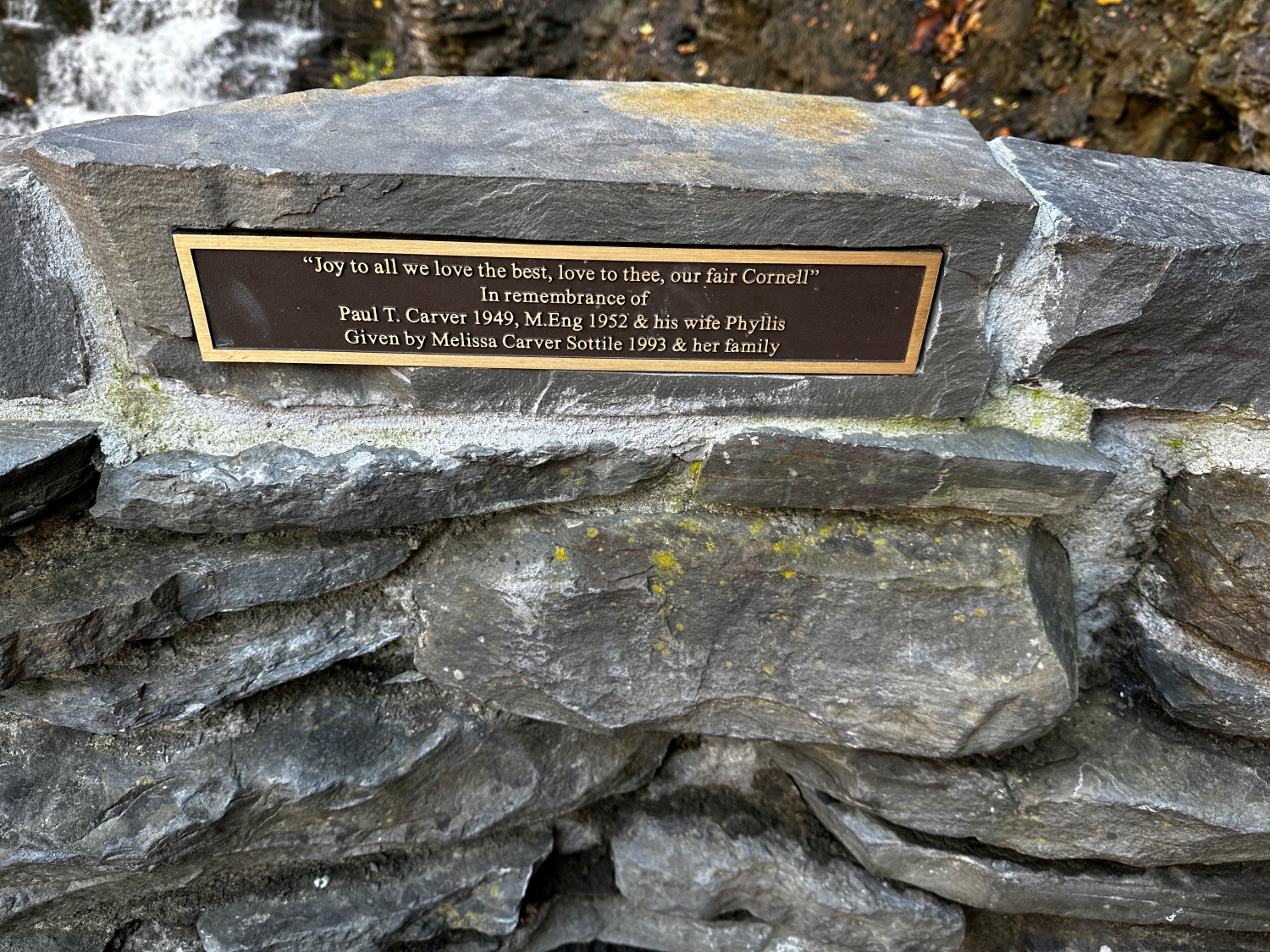
The final ascent is graced by a bench where a stone plaque catches my eye. It’s a tribute, etched with words that resonate in this place: “Joy to all we love the best, love to thee, our fair Cornell.” A gift from a family whose lives intertwined with Cornell, it serves as a reminder of the deep connections people have to this landscape, to the university, and to the memories rooted in these trails and gorges. I pause, reflecting on my own connection to this path, which has taken me through an ever-unfolding tapestry of nature and history.
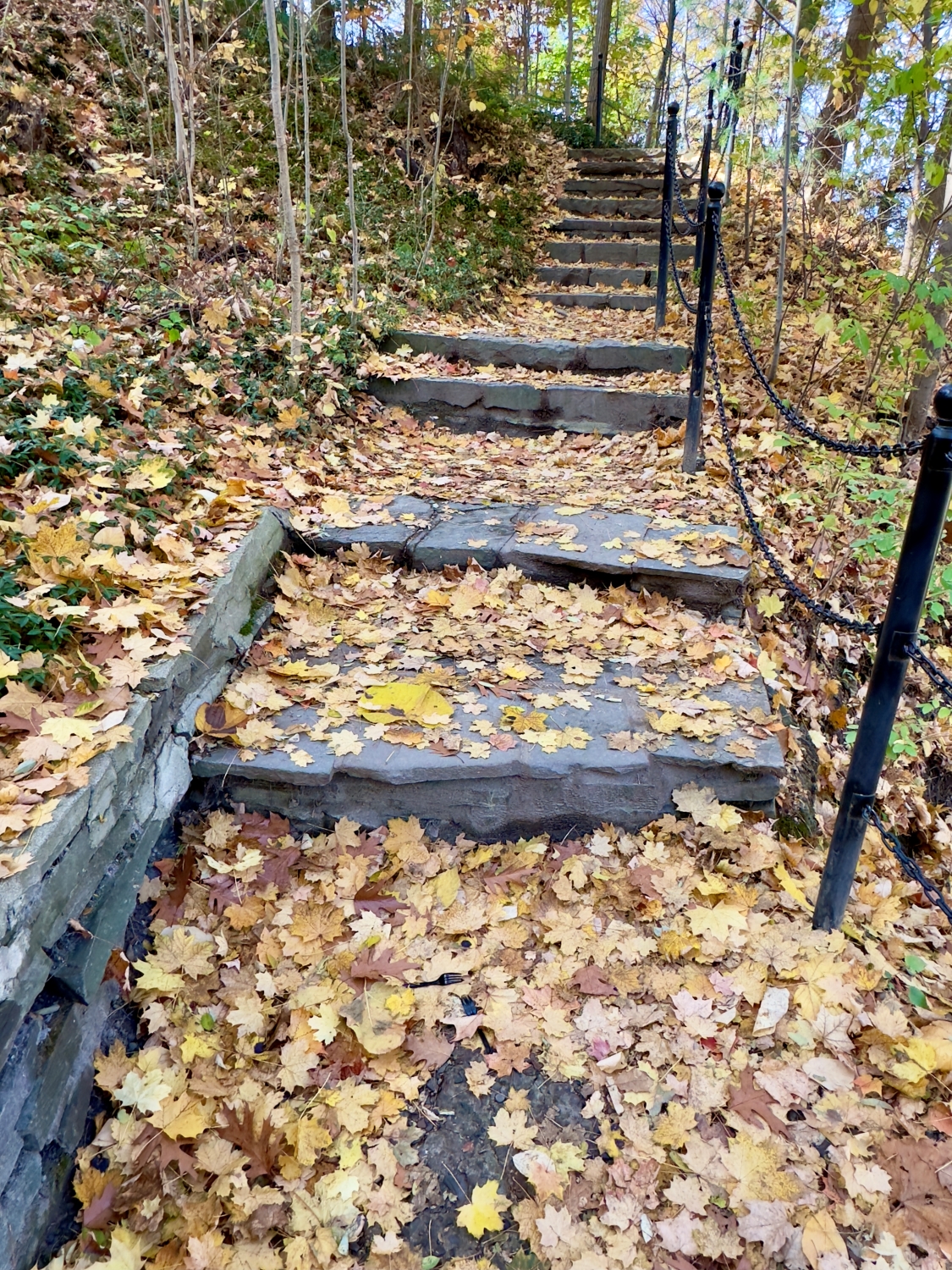
The last stretch of steps is leaf blanketed, their shapes and colors a beautiful final mosaic before I emerge from the shaded coolness of the gorge. The sun filters down through the thinning trees, illuminating the stone buildings of the Cornell campus that peek through the branches ahead. With each step, I feel the transition, moving from the curated wildness of Cascadilla Gorge and its trail to the structured beauty of the university grounds.
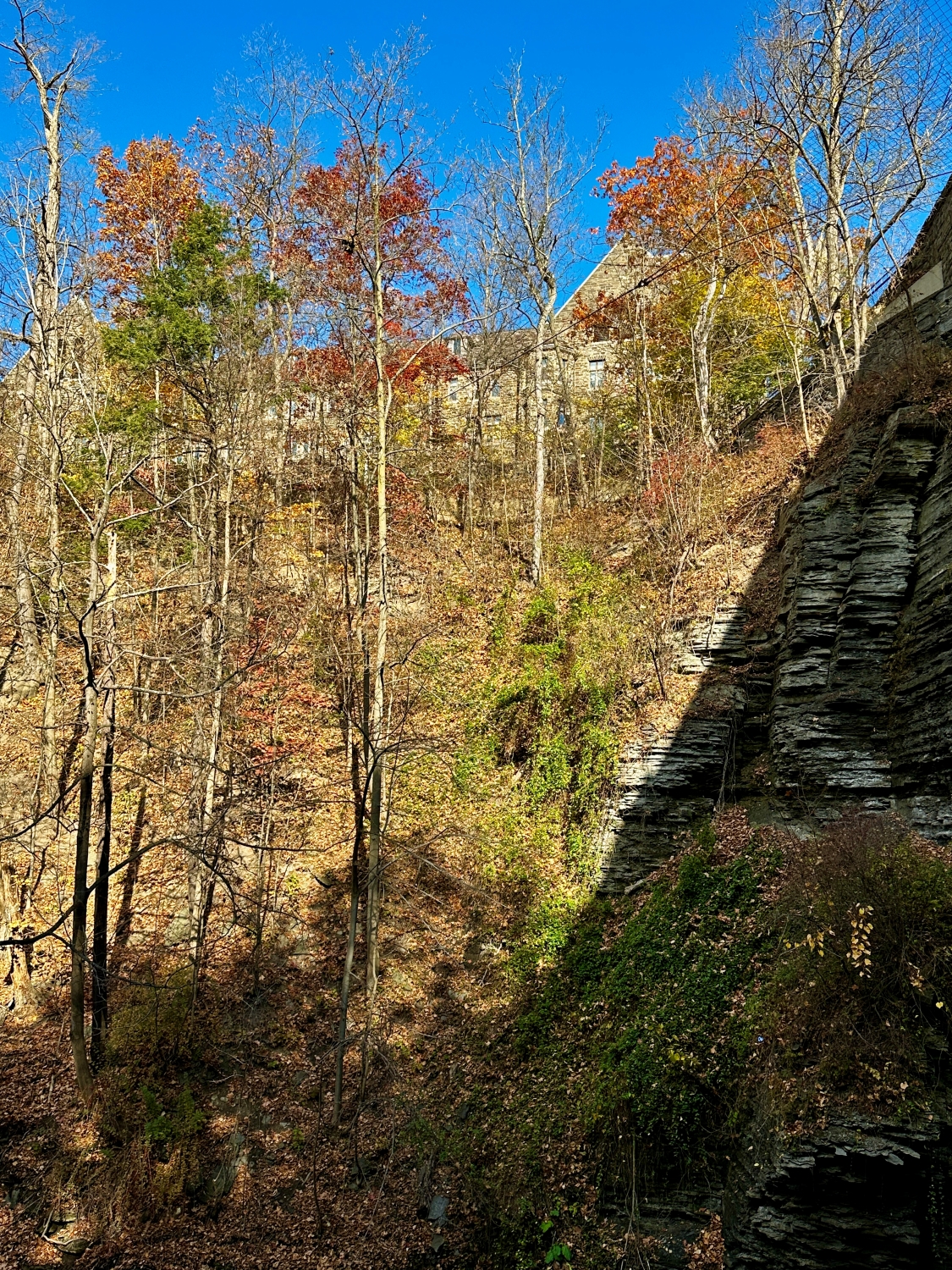
Myron Taylor Hall, Cornell Law School from the gorge.
As I reach the top, the Schwartz Center for the Performing Arts comes into view, its modern architecture a contrast to the ancient rocks I’ve left behind. Here, in this space where art, education, and nature converge, I take a last look back into the gorge and a journey, a gem in the heart of the Finger Lakes, a place that holds stories, both old and new, and invites every visitor to become a part of them.
Enter your email to receive notification of future postings. I will not sell or share your email address.
Copyright 2024 All Rights Reserved Michael Stephen Wills
As my wife, Pam, and I entered the breezy expanse of the Merritt Island National Wildlife Refuge, the world seemed to slow down, allowing us to savor every moment of my journey along Blackpoint Drive. The sky, a sprawling canvas of muted greys, reflected in the wind ruffled waters, enhancing the tranquility of this haven.
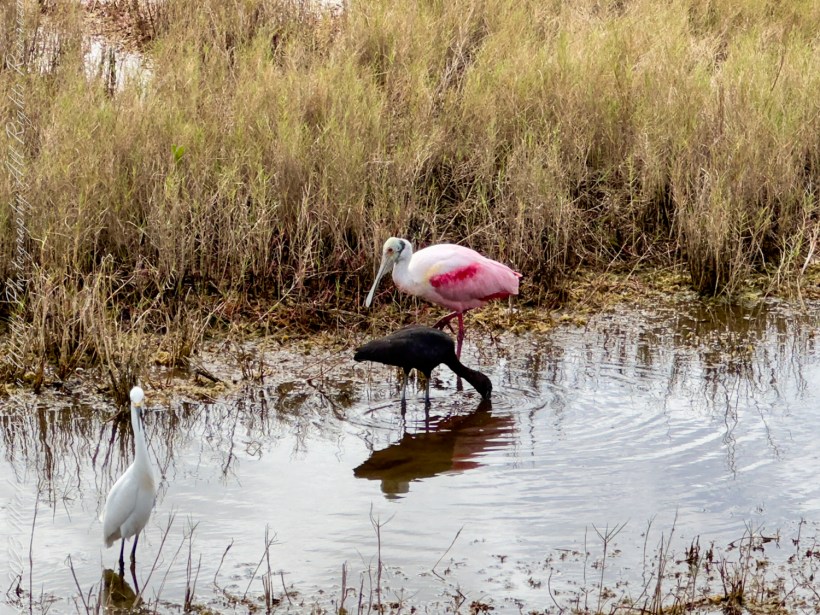
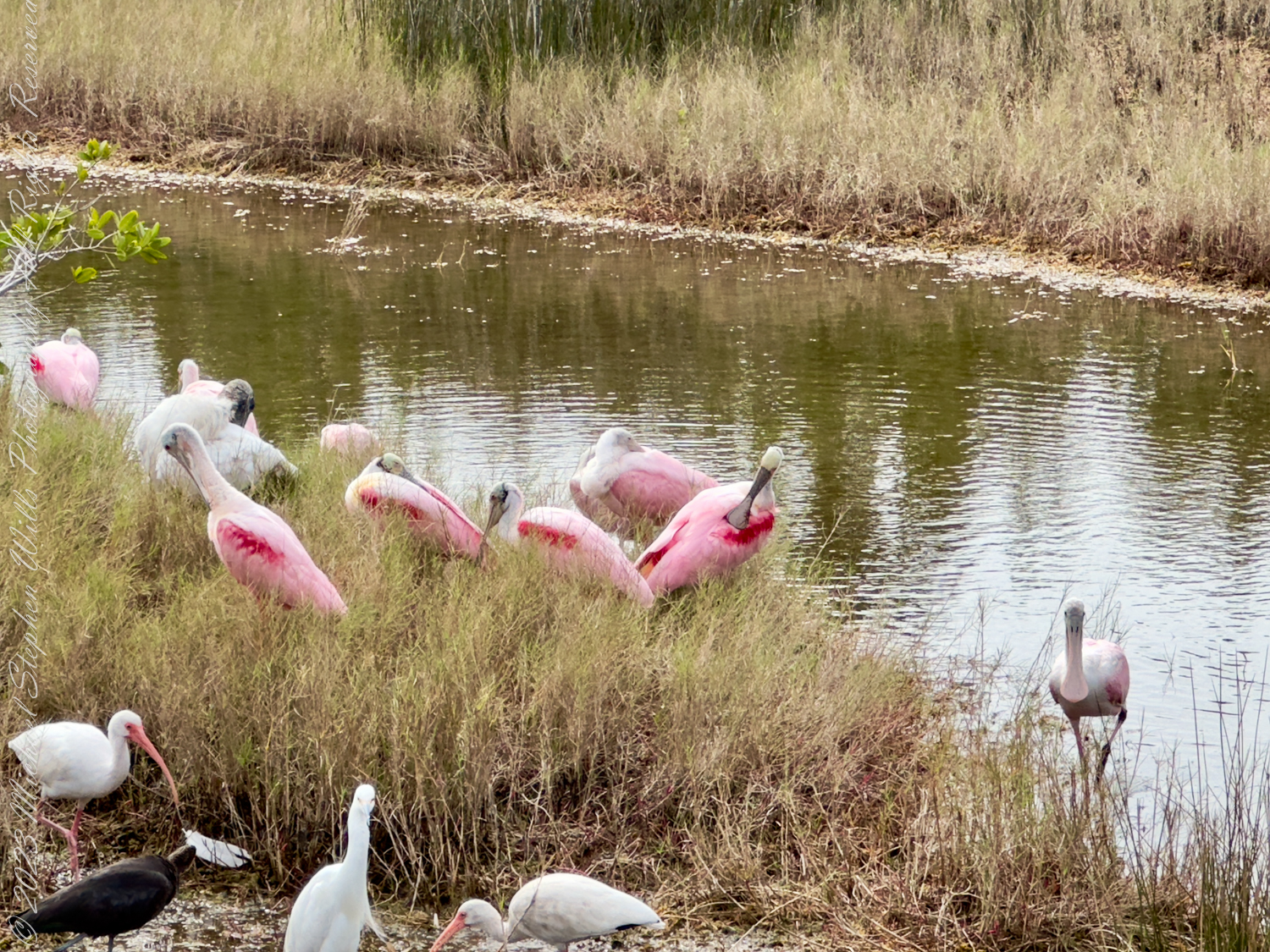
Our first encounter was with the elegant Roseate Spoonbills (Platalea ajaja), their vibrant pink feathers a stark contrast against the earthy tones of the marsh. They waded with purpose, their spoon-shaped bills sifting through the water, a dance of survival that was both methodical and beautiful.
In the company of the spoonbills were the stoic Great Egrets (Ardea alba), statuesque in their white plumage. They stood motionless, like sentinels guarding the water’s edge, only to strike with lightning speed when prey ventured too close.
We watched as the Glossy Ibises (Plegadis falcinellus) dipped their curved bills into the water, each movement a study of precision, their dark feathers glistening with an iridescent sheen when caught by the light.
Amongst these avian aristocrats, the unassuming American White Ibises (Eudocimus albus) went about their business. Their red beaks probed the shallows, unperturbed by the presence of their more colorful neighbors or by my watchful eyes.
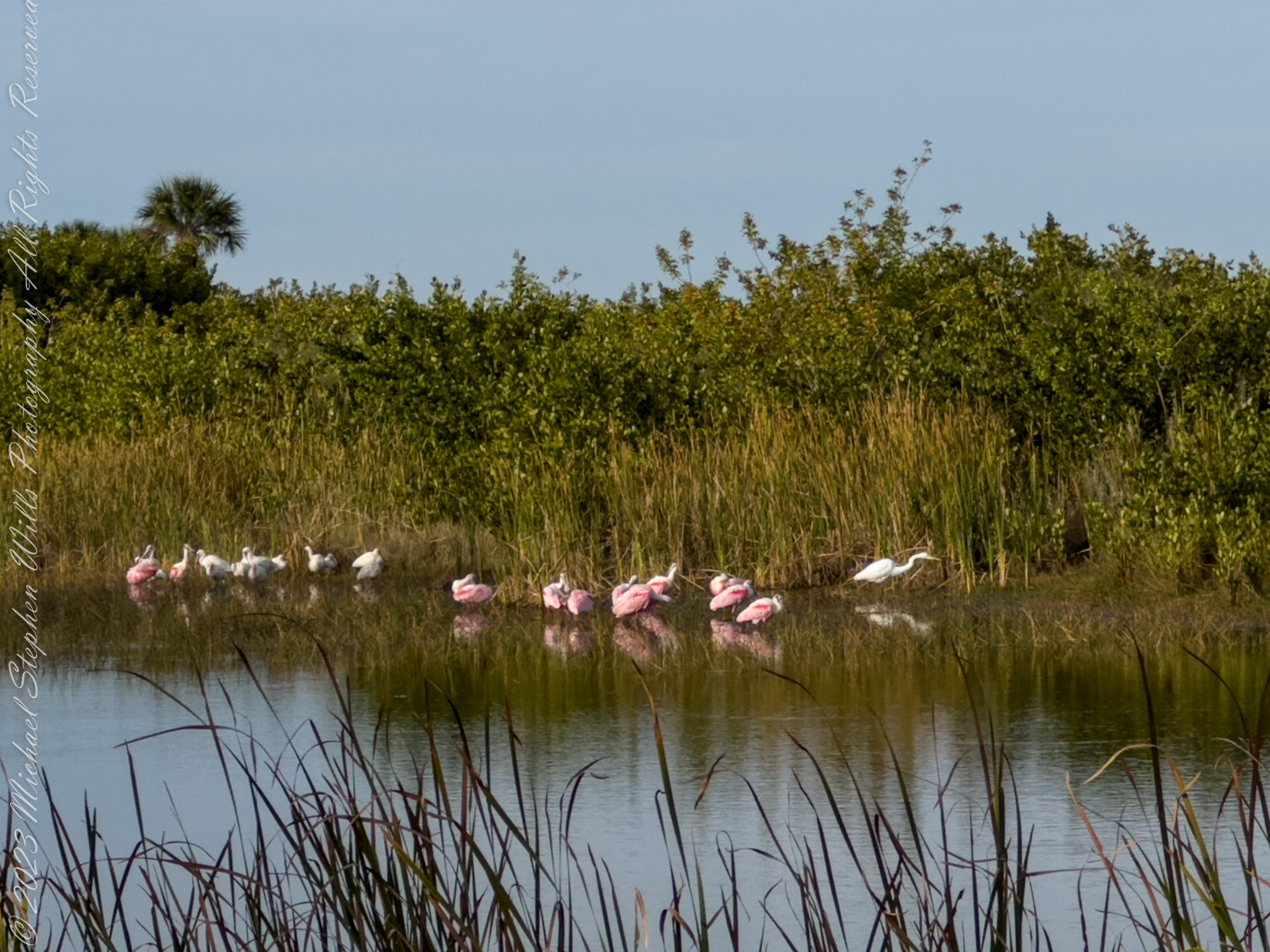
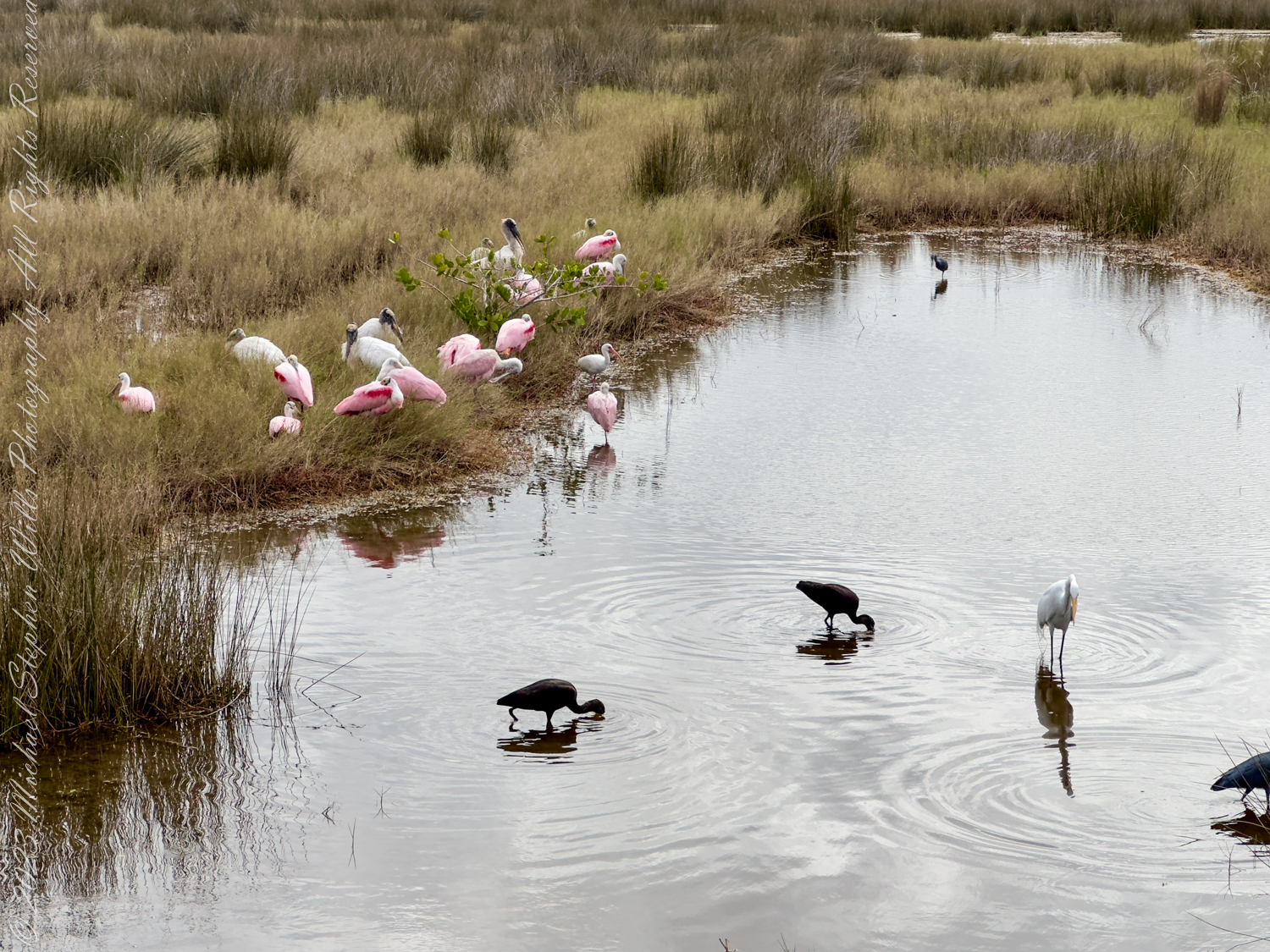
As we ventured further, the landscape shifted, the water opening up to reveal a gathering of Spoonbills and White Ibises, a community united by the need to feed and the safety of numbers. The occasional flap of wings and contented calls created a symphony that celebrated life in these wetlands.
Isolation took on a new meaning when I spotted a solitary Roseate Spoonbill, its reflection a perfect mirror image on the water’s surface. It was a moment of quiet introspection, the bird and I alone in our thoughts.
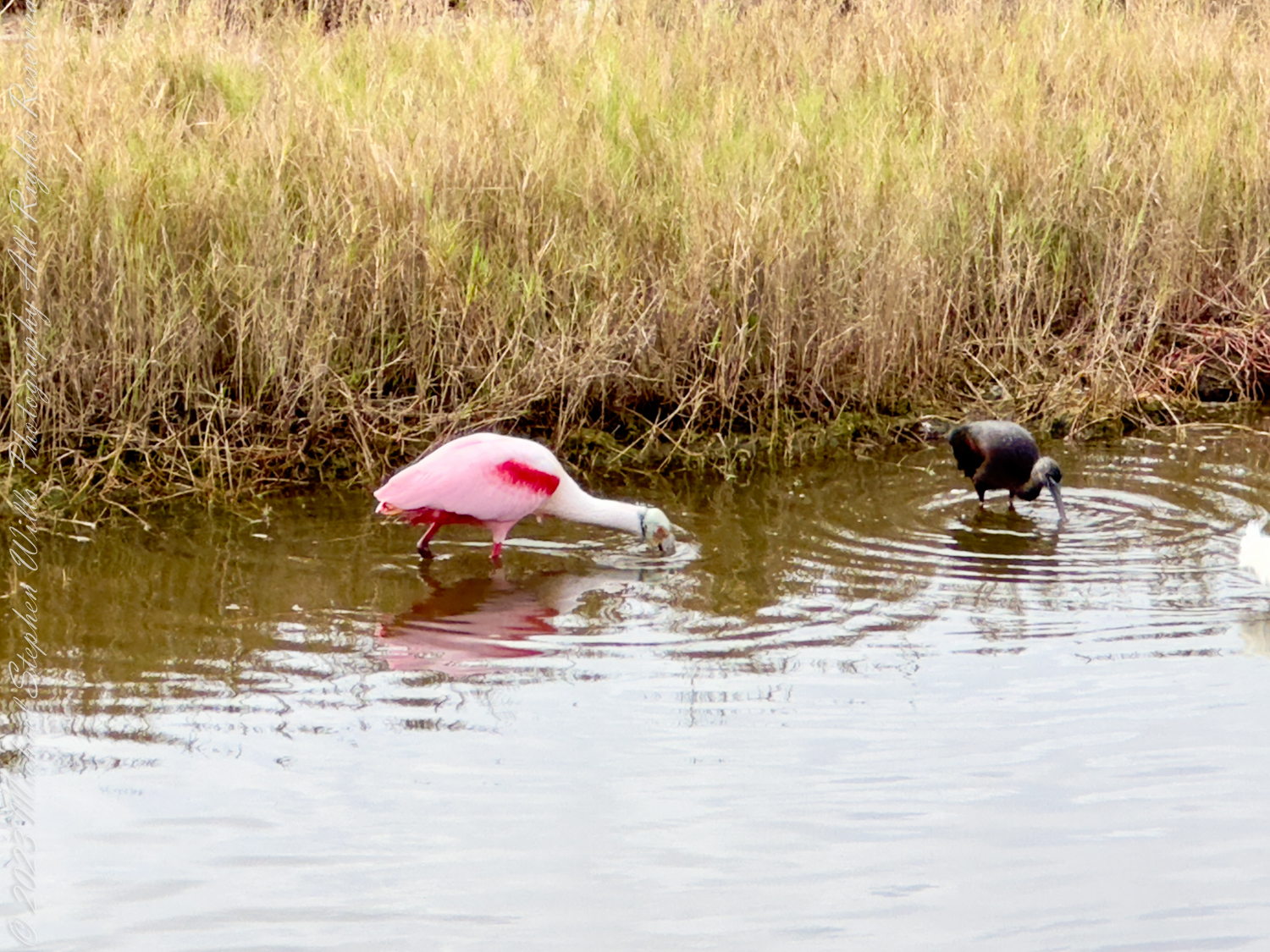
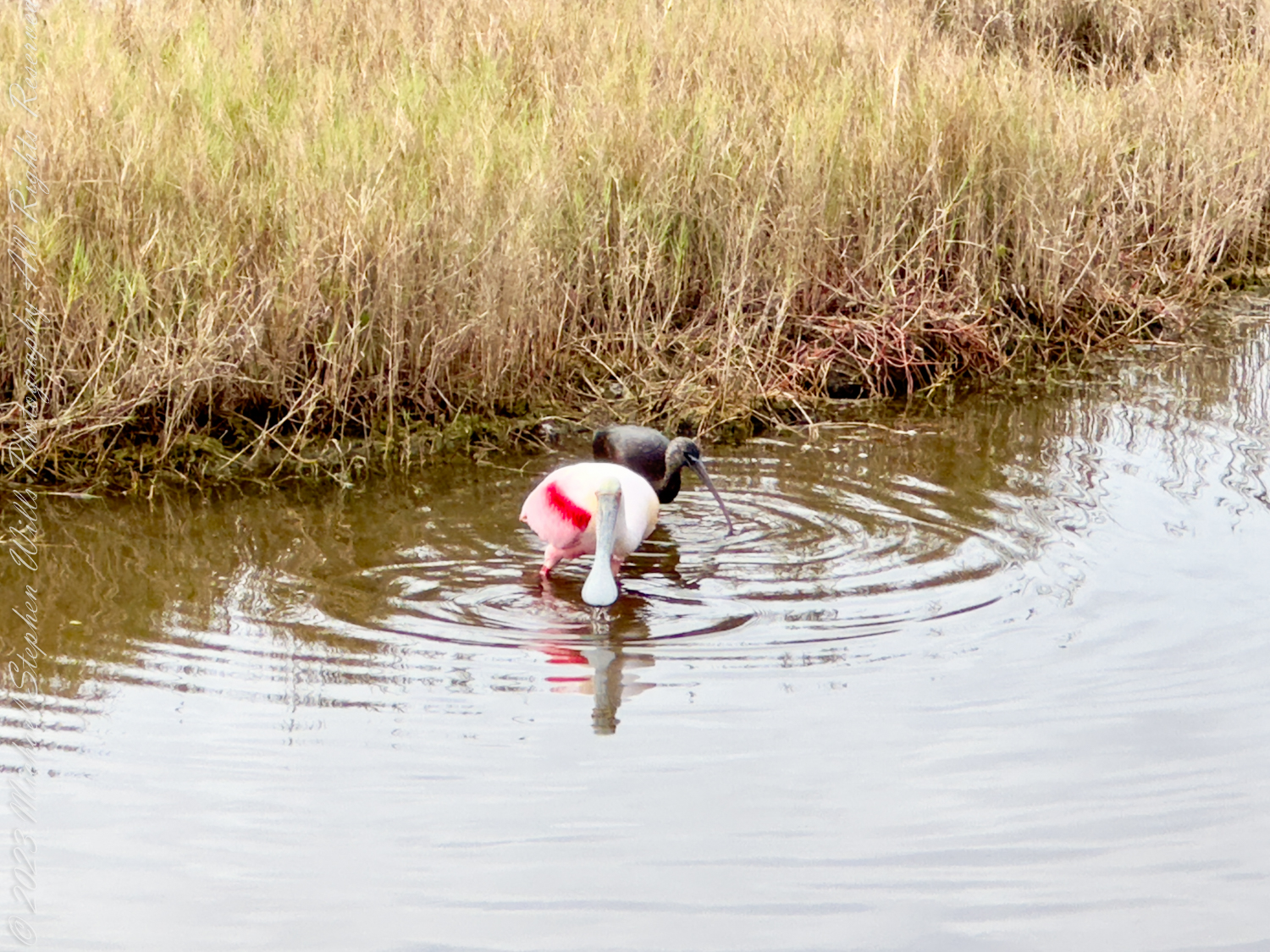
Another scene captured my attention as a single spoonbill foraged alongside a Glossy Ibis. The two species, different in appearance and yet similar in their quest for sustenance, shared the space in harmonious coexistence.
Further along, the vista opened up, and we were greeted by a panoramic view of spoonbills dotted along the distant shoreline, the greenery forming a lush backdrop to their pink hues. The expanse of the refuge unfolded before me, a reminder of the vastness and the wild beauty that had drawn us here.
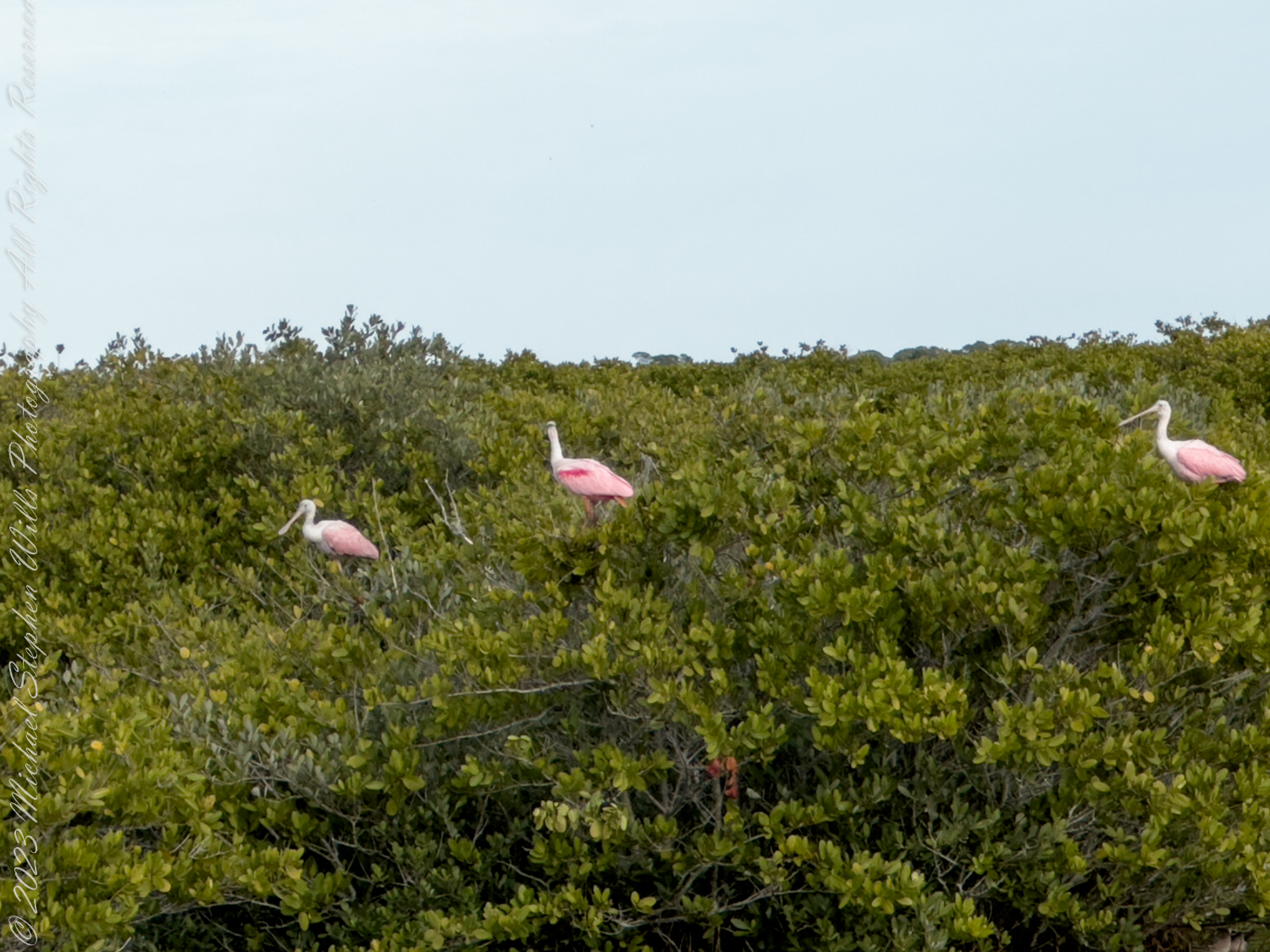
On another stretch, the spoonbills perched in the green embrace of the mangroves, their pink feathers a burst of color among the leaves. It was a scene of natural artistry, the birds blending yet standing out against their verdant stage.
In the final leg of our journey, I found spoonbills perched high in the shrubbery, a testament to the refuge’s diversity. Even in the dense foliage, life thrived, and these birds, usually seen wading, now adorned the treetops like living ornaments.
This drive along Blackpoint was more than a mere observation; it was a passage through a world where time held little sway, and nature was the sole architect. Each bird, each ripple on the water, and each whisper of the grass told a story of existence, resilience, and the intricate web of life. Here, in this secluded corner of the world, we found a connection to the earth and its inhabitants that would stay with us long after.
Copyright 2024 Michael Stephen Wills All Rights Reserved
Explore Cape Canaveral National Seashore and Kennedy Space Center with us, where pristine beaches meet the legacy of human space exploration, and feel the awe of standing where history was made.
A Journey Through Time and Space: Our Visit to Cape Canaveral National Seashore and Kennedy Space Center
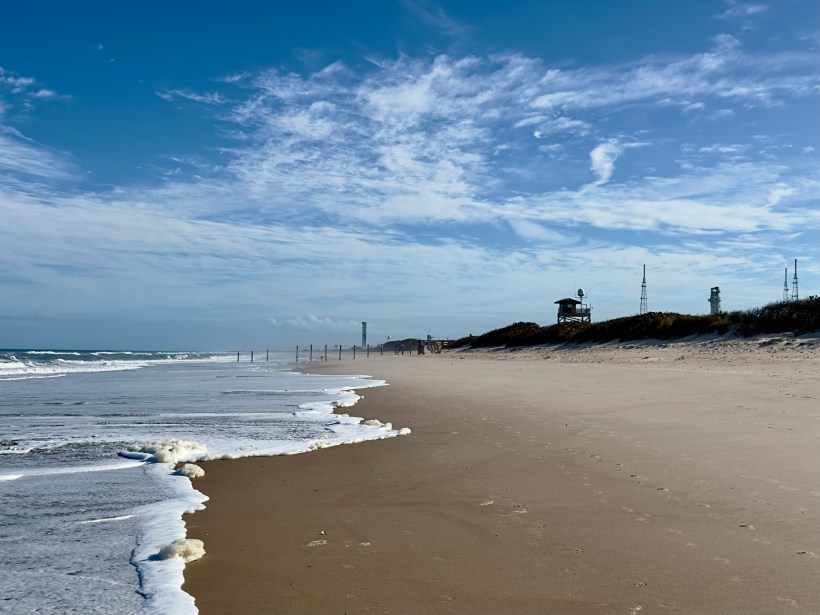
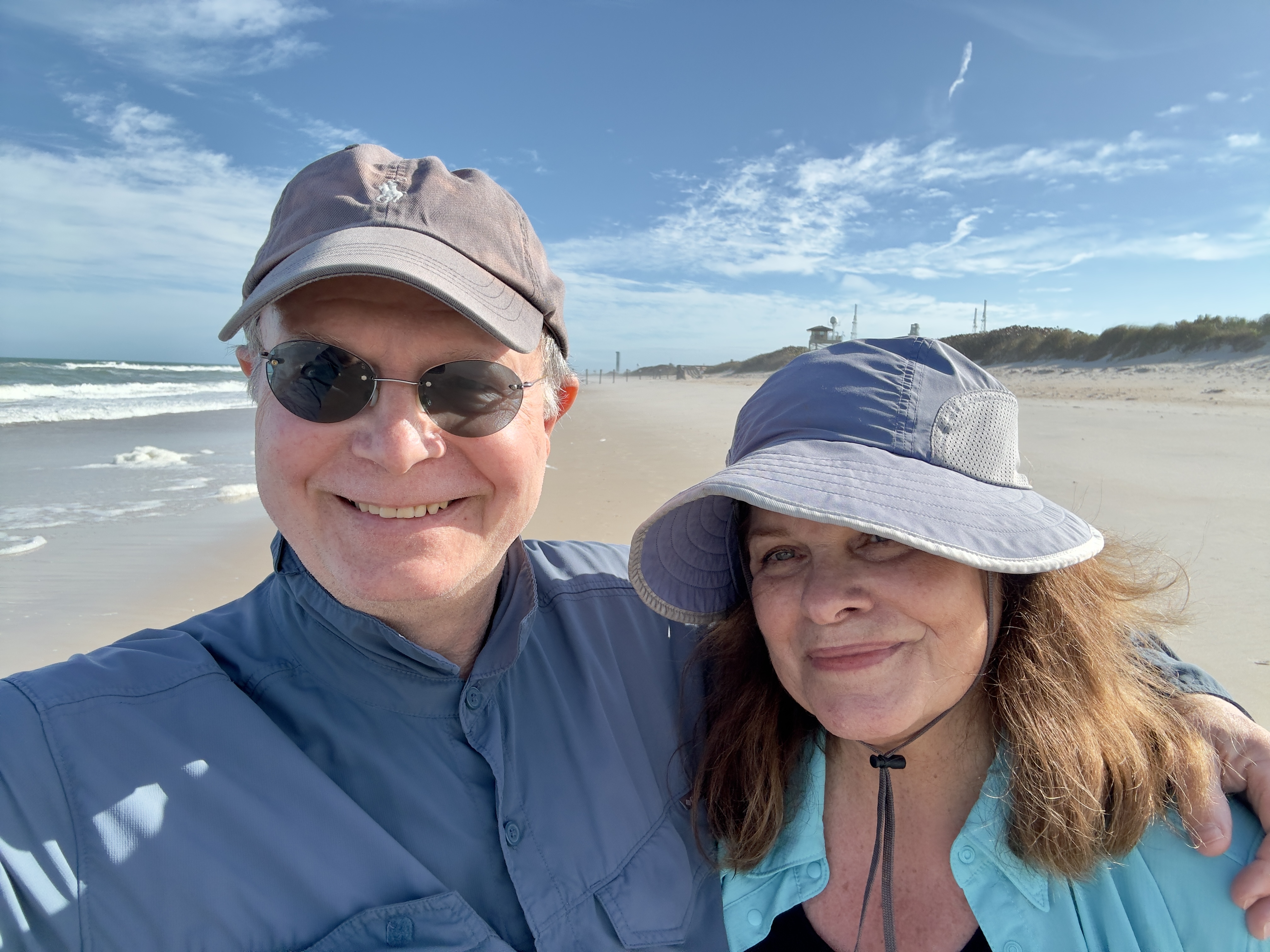
As we arrived at the pristine shores of Playalinda Beach within the Canaveral National Seashore, the gentle whisper of waves against the shoreline beckoned us. The sun kissed the horizon, casting a warm glow across the 24 miles of untouched, protected coastline that lay before us. Here, on the east coast of Florida, where crystal-blue waters embrace the shell-laden sands, we found ourselves at the intersection of natural beauty and human achievement.
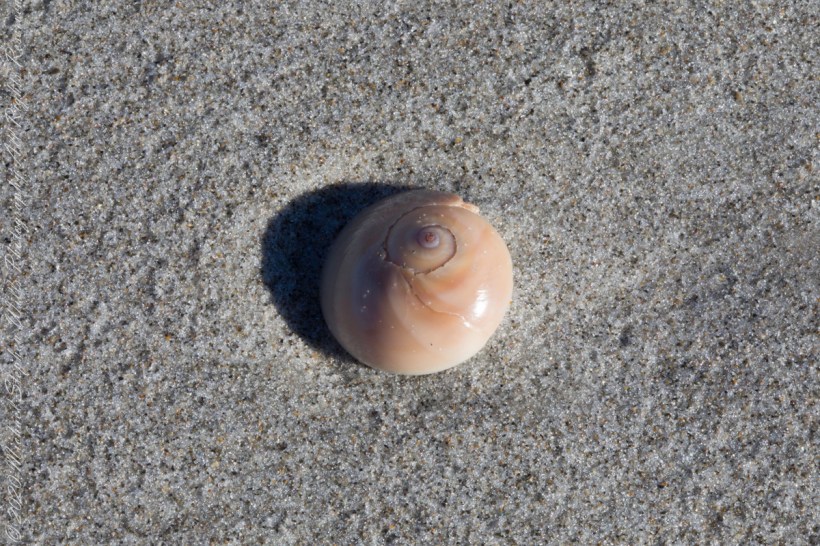
Shell of the Moon Snail (Naticidae) found in the surf wash.
The Serenity of Playalinda
We strode along the boardwalk, passing through dunes adorned with sea oats, to find our spot upon the soft sands of Playalinda. The beach, known for its tranquility and the chance to observe a vibrant array of wildlife, offered us a moment of peace. With no distractions—no concessions, no showers, just nature—we were able to disconnect from the world and reconnect with the earth. From our vantage point, the Merritt Island Wildlife Refuge across the water was a haven for migrating birds, dolphins, and, with some luck and the right season, sea turtles nest on the beach itself.
Witness to History: The Apollo 11 Legacy
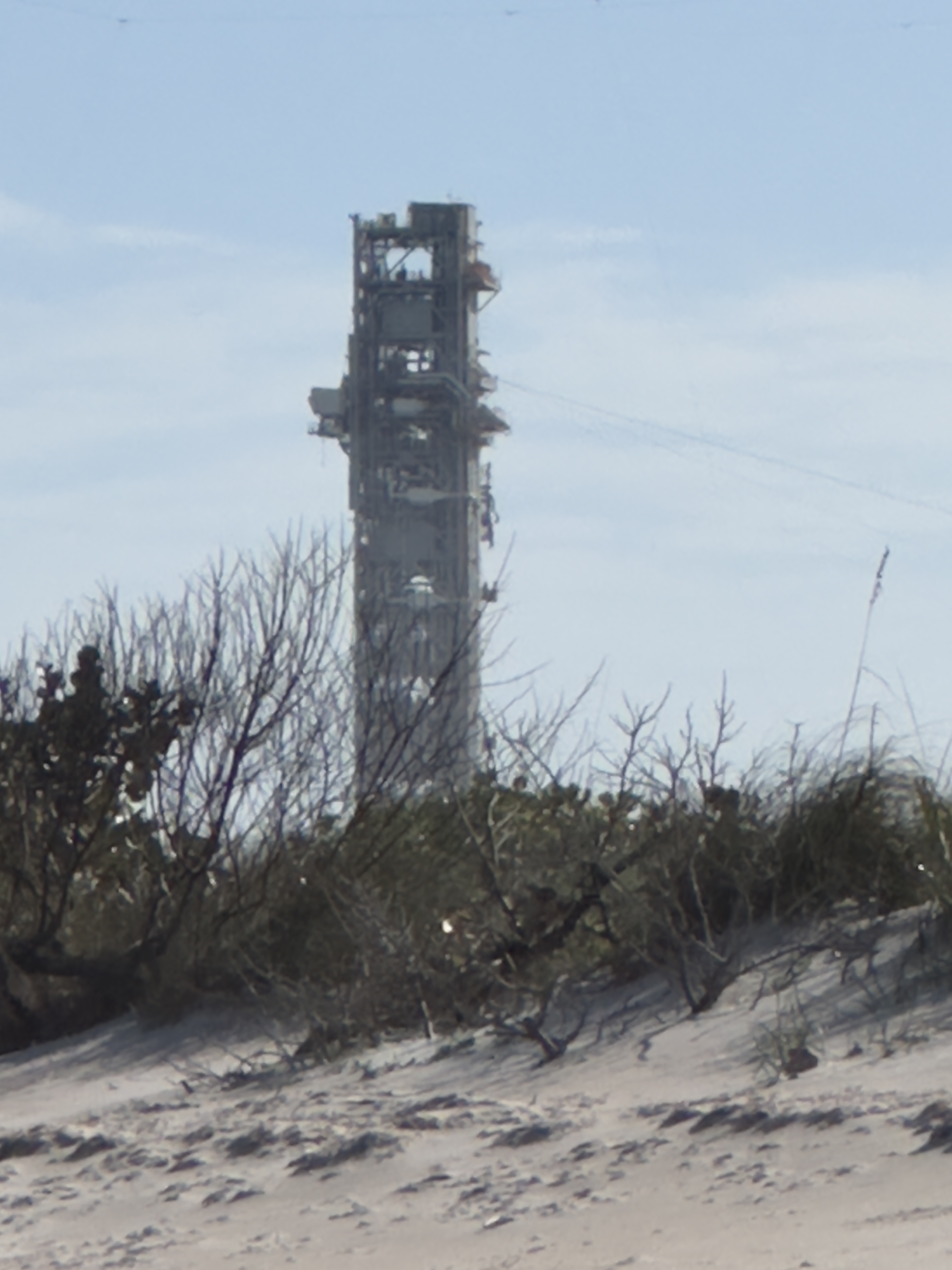
But it wasn’t just the natural allure that drew us here. Playalinda holds a unique position, offering an unobstructed view of the historic launch pads of Kennedy Space Center, where Apollo 11 began its monumental journey to the Moon. As we walked south towards the fence bordering the Space Center, the anticipation built within us. Here, we were tracing the footsteps of giants, those brave astronauts who dared to venture into the unknown.
The Vistas of Exploration
Each step brought us closer to the site where humanity took one of its most significant leaps. Gazing upon the launch complex from the fence, we were reminded of the powerful forces harnessed to break the bonds of gravity. Imagining the roar of the engines, the earth-shaking vibrations, and the fiery ascent of the Saturn V rocket, we felt a deep connection to the past and a sense of awe for the pioneering spirit that propelled us into a new era of exploration.
Reflections Amidst the Dunes
As we wandered back along the beach, the foam of the ocean’s edge lapping at our feet, we reflected on the duality of our surroundings. Here, in this place of quiet solitude, we also stood at the forefront of human innovation and ambition. The juxtaposition of the peaceful beach with the technological marvels just a stone’s throw away was not lost on us.
Our journey to the Cape Canaveral National Seashore and the Kennedy Space Center fence was more than just a visit to a beach or a historic site; it was a pilgrimage to a place where dreams materialize and reach for the stars. It was here that we came to understand the full spectrum of emotions that accompany great achievements—the hope, the fear, the triumph.
Conclusion
Our visit to the Cape Canaveral National Seashore and the Kennedy Space Center was an experience that will linger in our memories for years to come. It was a reminder of what we can achieve when we are united by a common goal, and it filled us with pride and optimism for the future. As we looked back one last time, the setting sun seemed to whisper a promise of the wonders yet to come, both here on the shores of Playalinda and in the vast expanse of space that awaits us.
Copyright 2024 Michael Stephen Wills All Rights Reserved
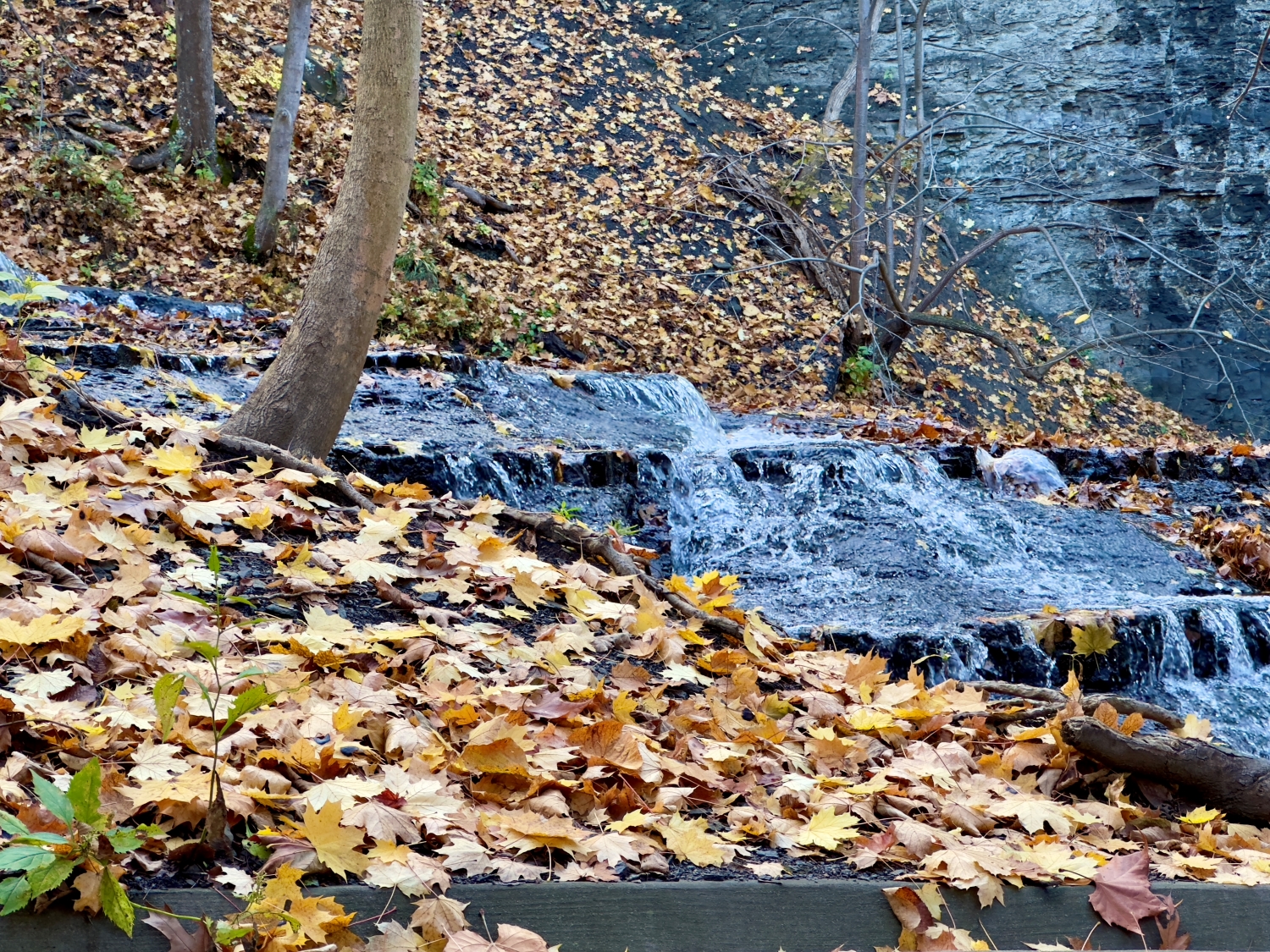
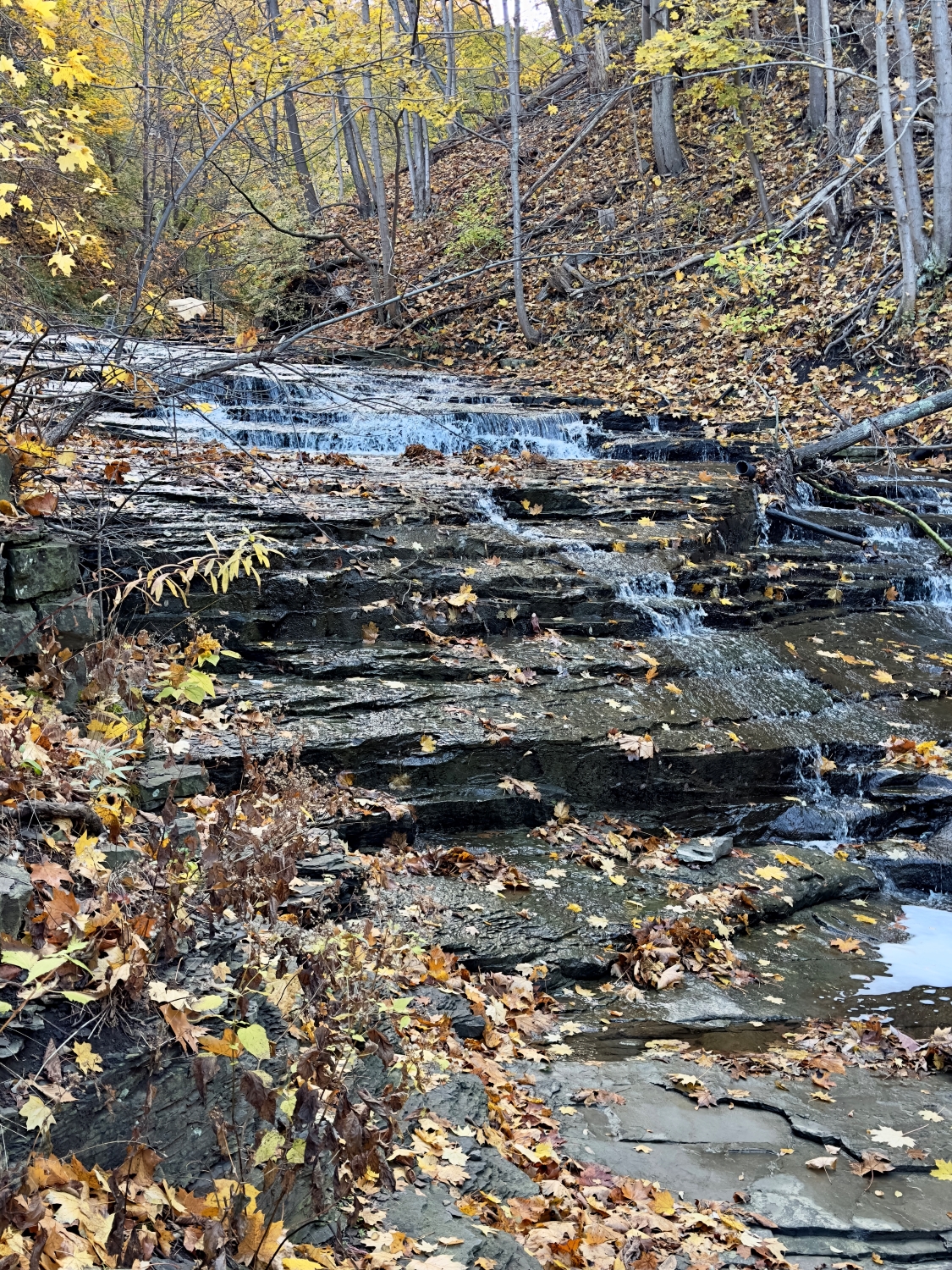
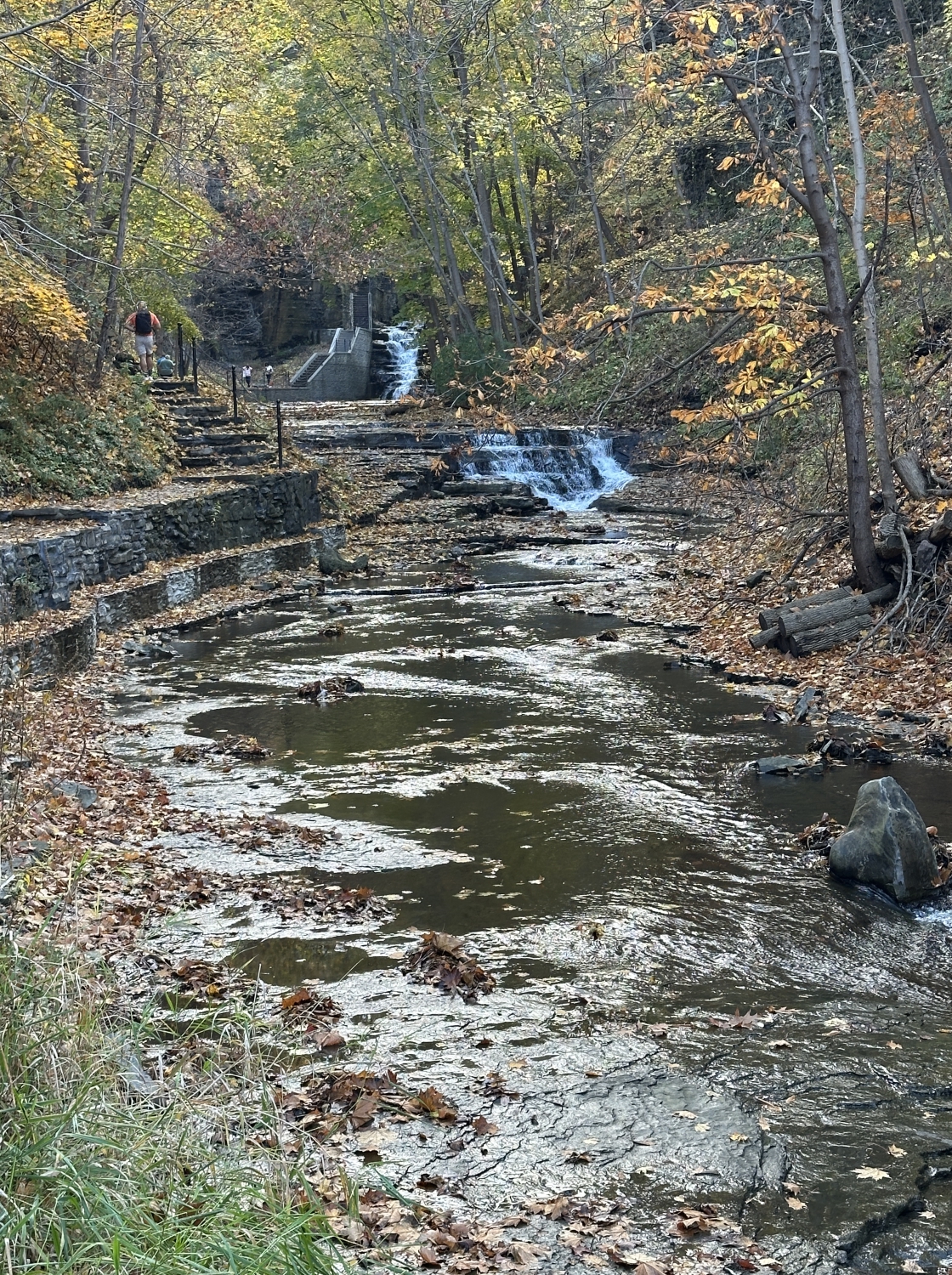
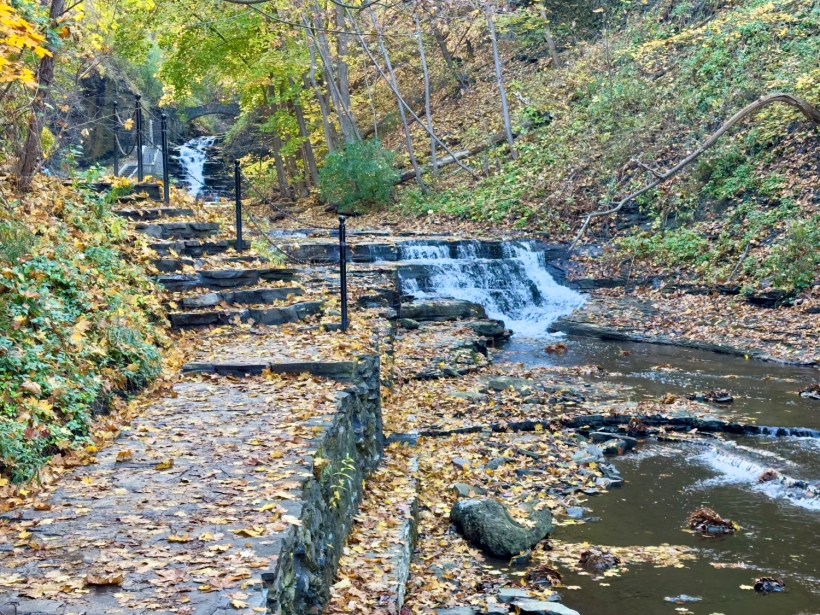
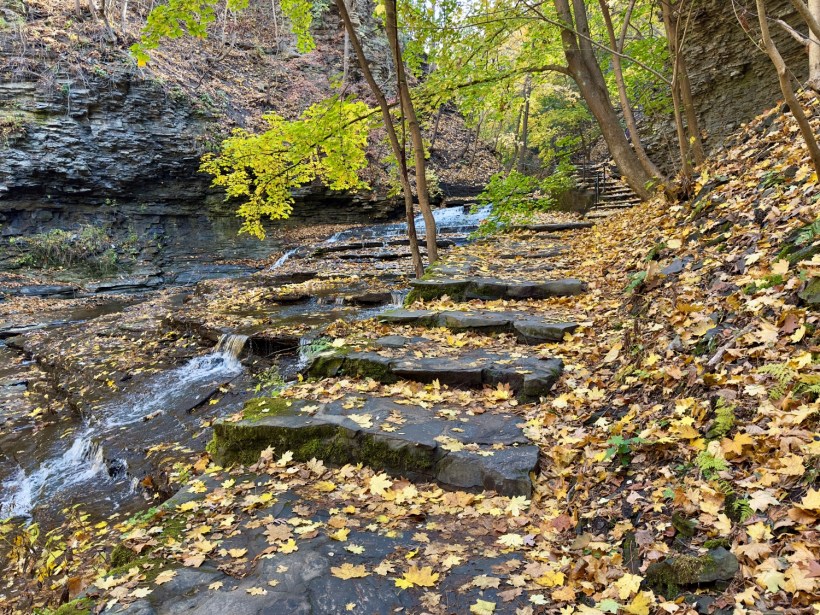
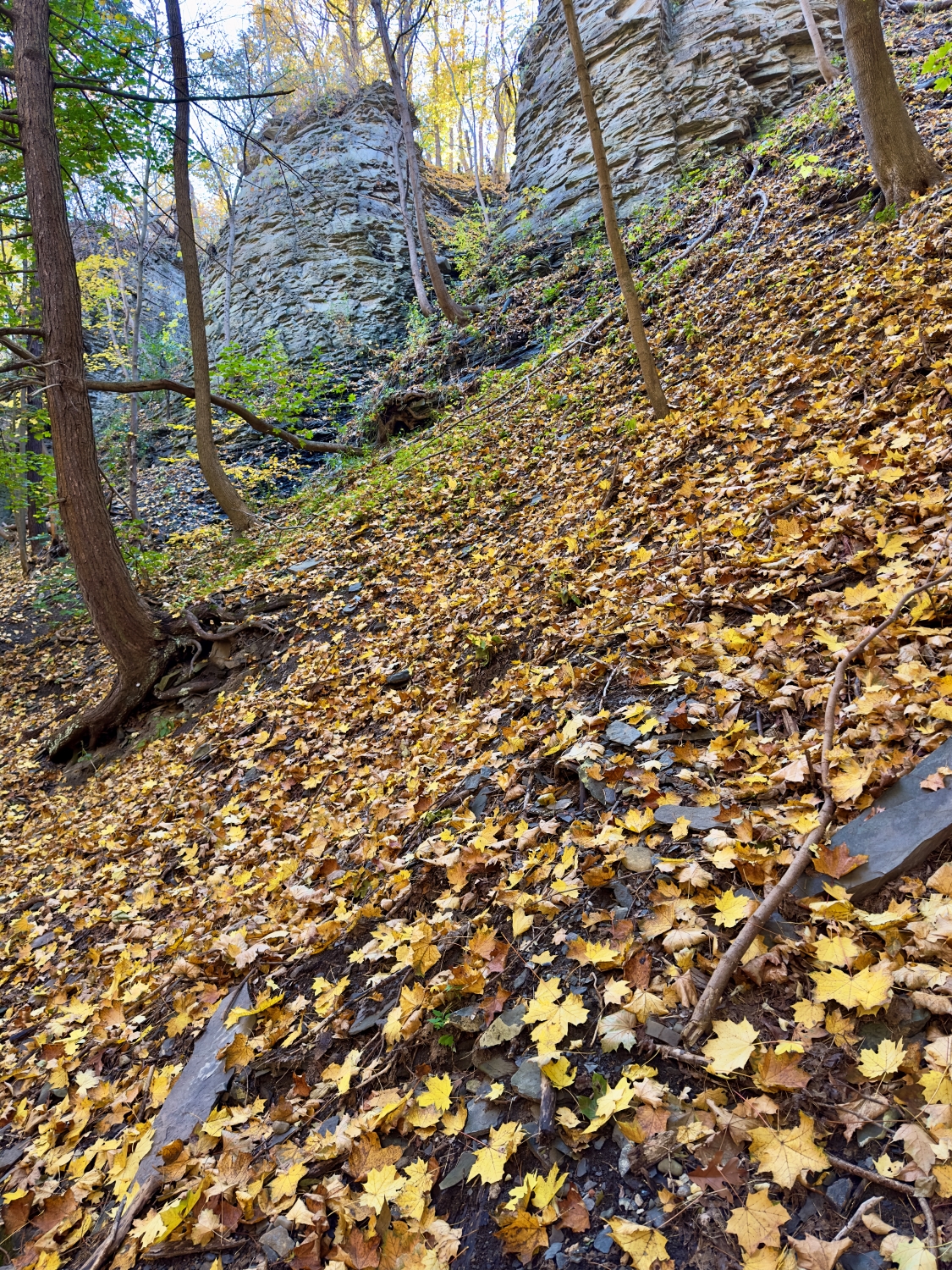
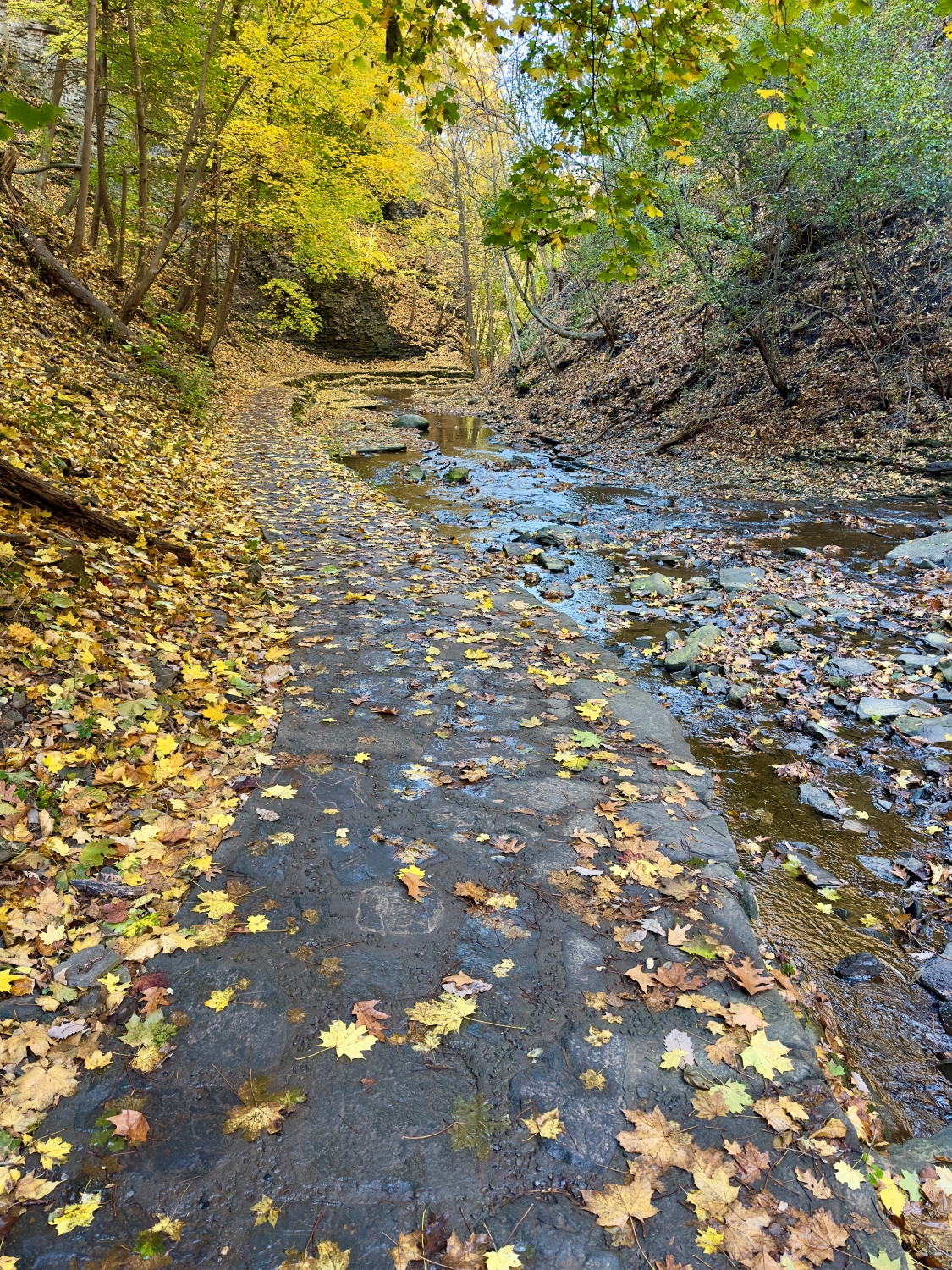
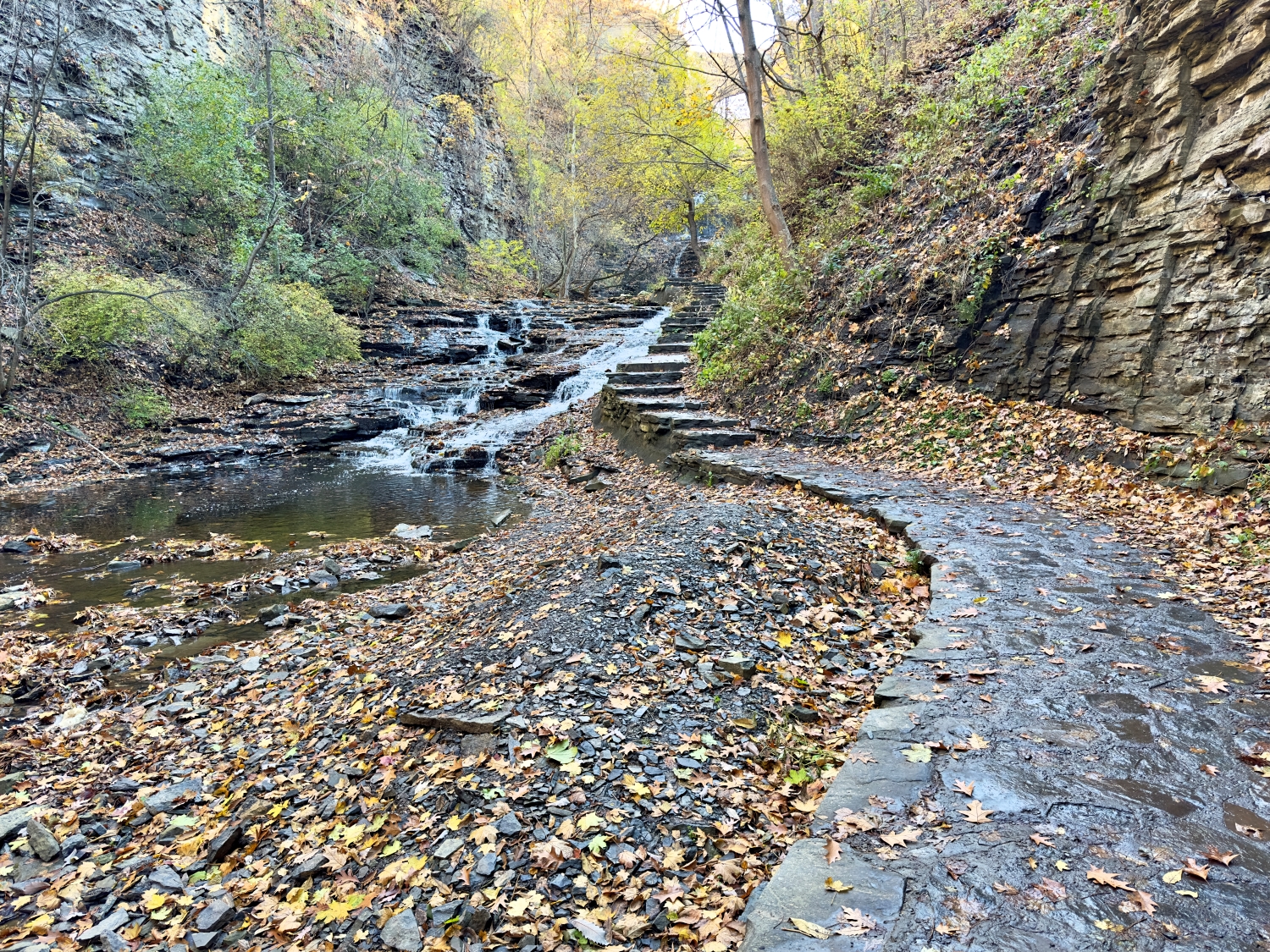
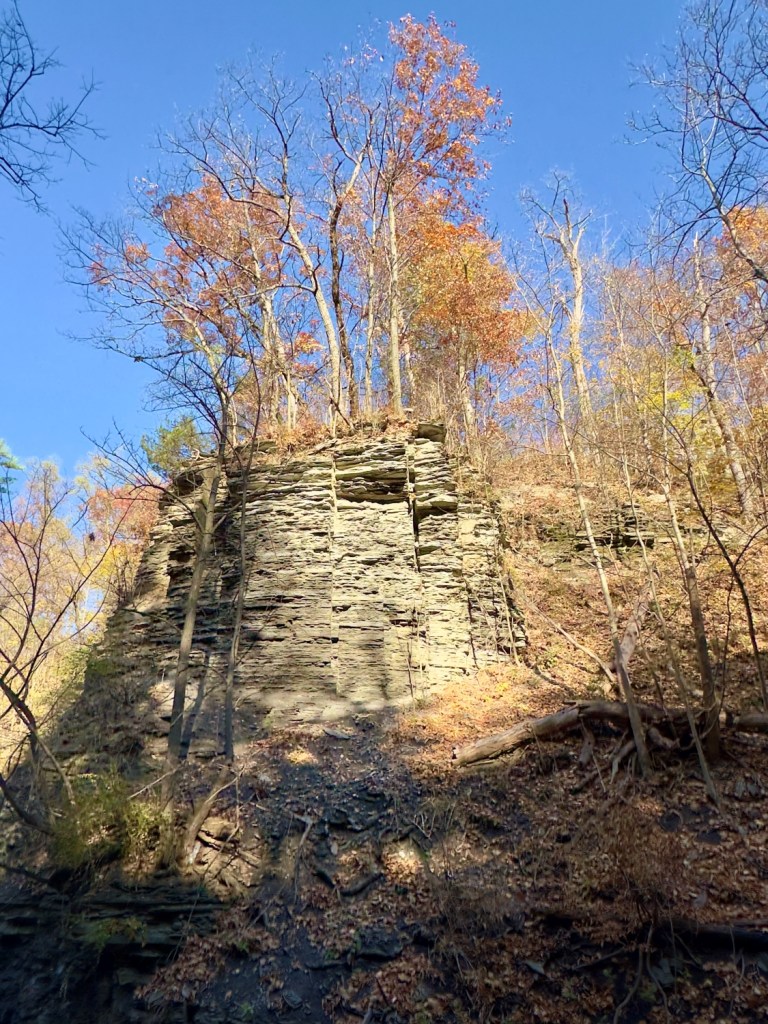
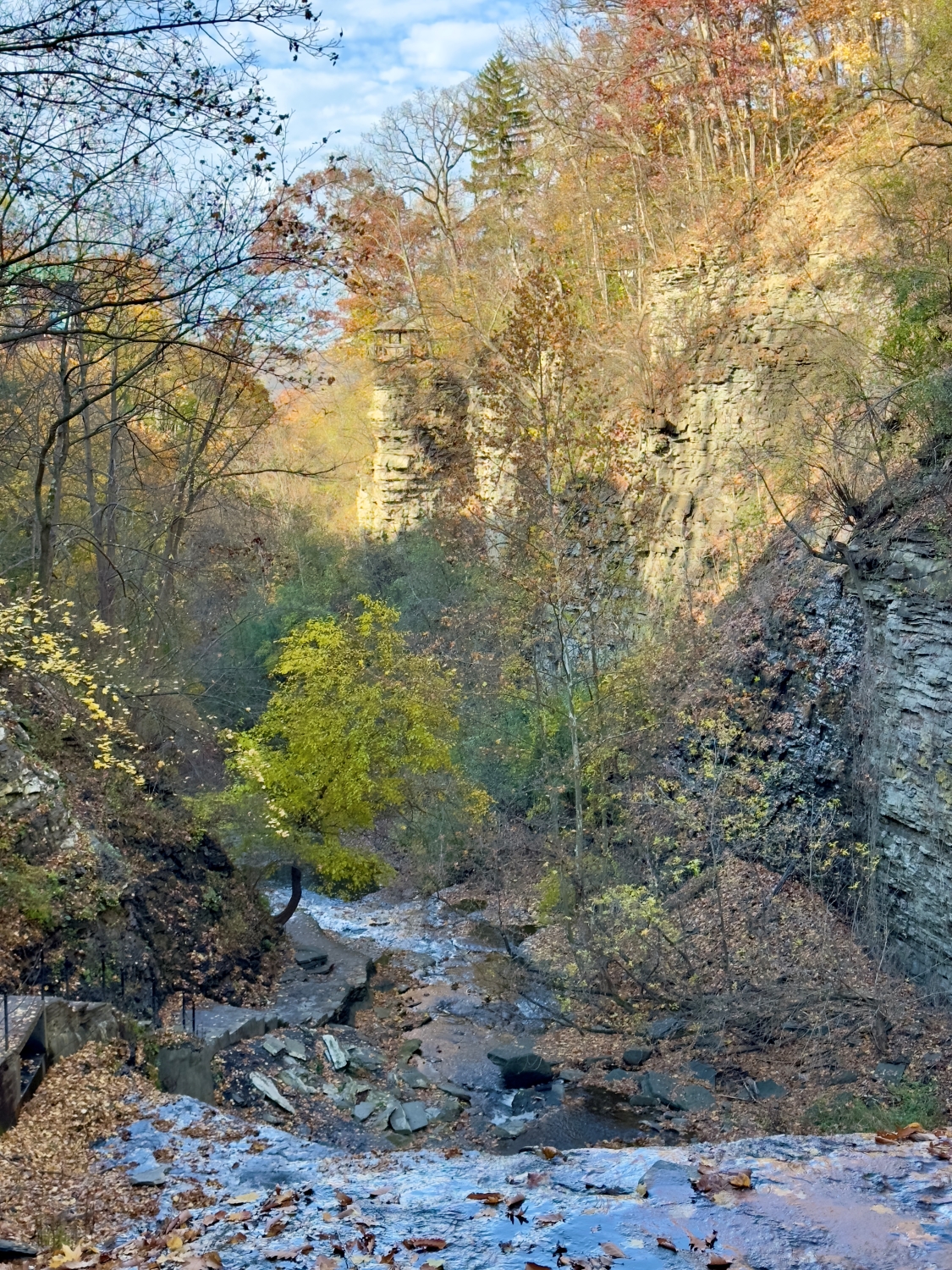
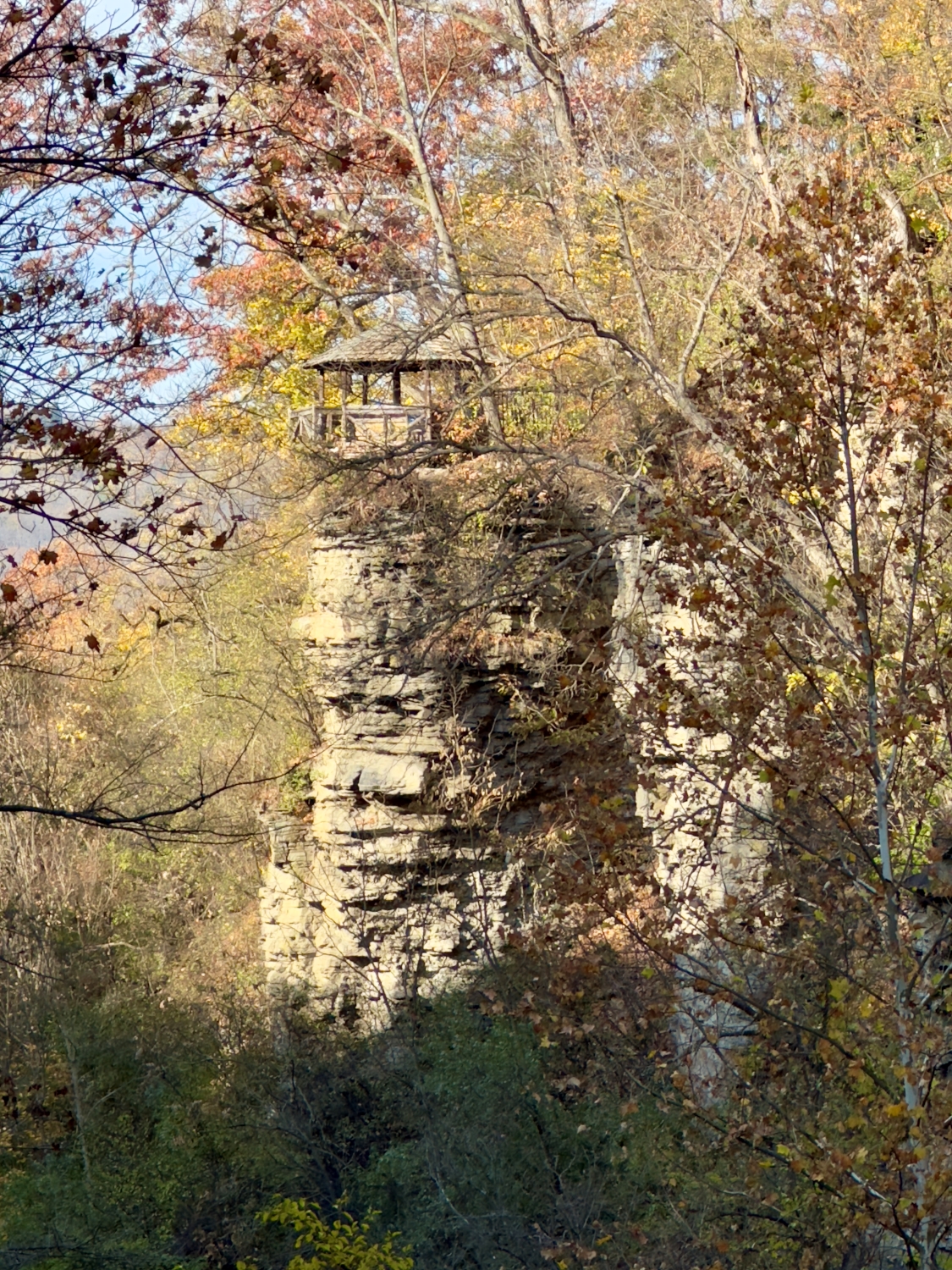
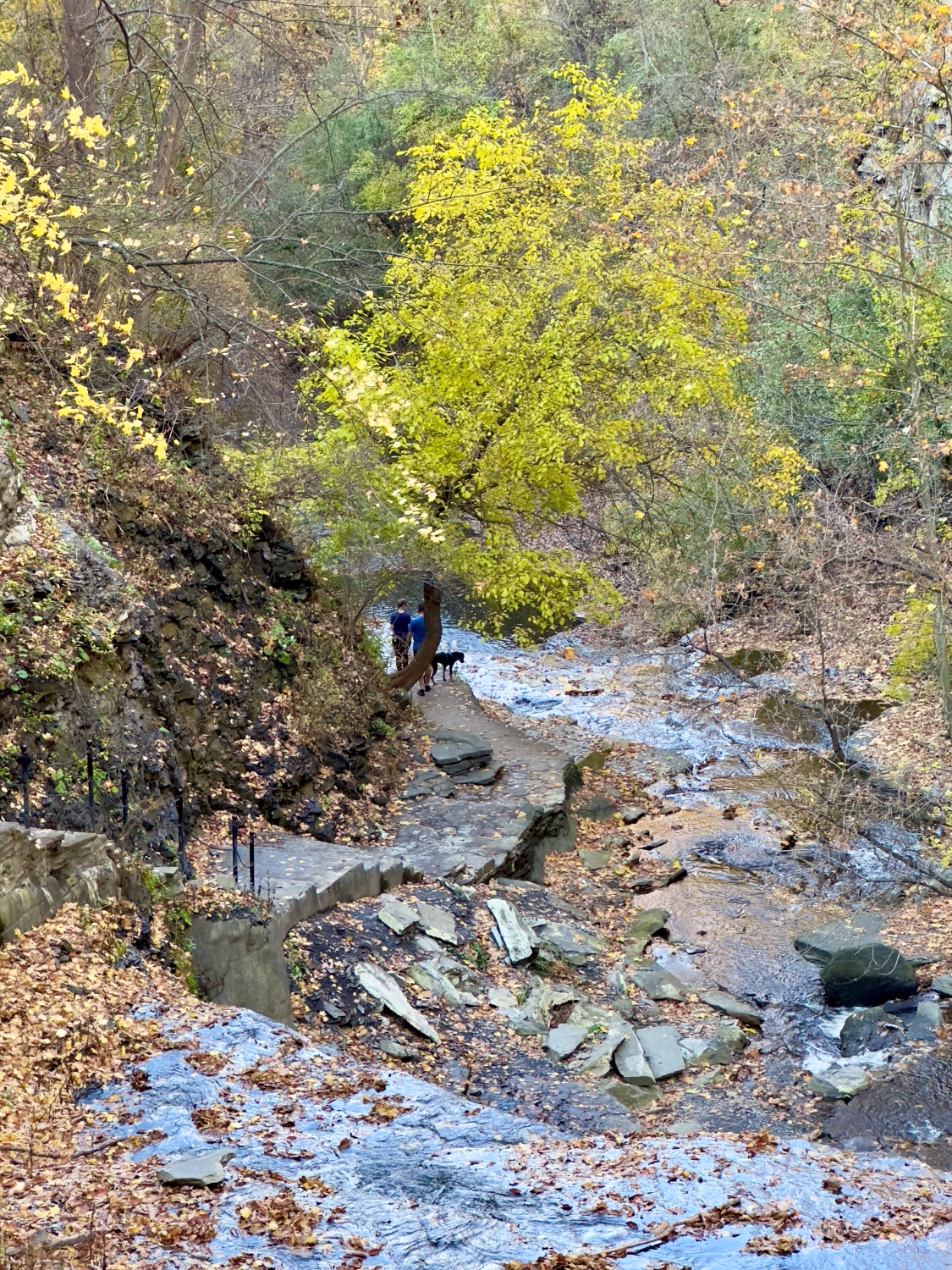
Crisp maple leaves among hemlock roots on the bank of Lick Brook, Thayer Preserve. Nestled within the breathtaking expanse of Tompkins County in New York’s Finger Lakes Region, is a canvas where nature paints its most exquisite scenes. This preserve is a symphony of serene landscapes, a place where the tranquility of nature is preserved and cherished.
In this haven, the chorus of birdsong greets the day, echoing through the lush canopy of trees that stand as ancient guardians of the land. Oaks, maples, and hemlocks, some as old as time, stretch their boughs towards the sky, creating a verdant cathedral that shelters a diverse array of flora and fauna. The sunlight filters through these leafy domes, casting dappled shadows on the forest floor, a mosaic of light and life.
Click photograph for larger view. Use combination keys to enlarge/reduce: Ctrl+ (Control / Plus) and Ctrl- (Control / Minus)
The trails of Thayer Preserve meander through this natural paradise, inviting visitors to embark on a journey of discovery. Each path is a narrative, telling the story of the land, from the delicate wildflowers that peek shyly from the underbrush to the stately deer that roam with a quiet dignity.
The preserve is not just a place of beauty; it’s a testament to the delicate balance of ecosystems. Here, conservation efforts intertwine with recreation, ensuring that the splendor of the environment is preserved for future generations. It’s a sanctuary where the hustle of modern life fades, and one can reconnect with the earth’s gentle rhythms.
As the seasons change, Thayer Preserve transforms. Spring brings a burst of color, with wildflowers carpeting the ground. Summer deepens the greens of the forest, while autumn sets the woods ablaze with fiery hues. In winter, a serene blanket of snow envelopes the landscape, turning it into a quiet wonderland.
In the heart of the Finger Lakes Region, Thayer Preserve stands as a beacon of natural beauty and tranquility. It’s a place where the soul can find peace, the mind can wander freely, and the heart can revel in the simple joy of nature’s embrace. This preserve is not just a location on a map; it’s a journey, an experience, a love letter to the natural world.







 Michael Stephen Wills Photography