Autumn Reflections: The Majesty of Acer Rubrum

On a serene autumn afternoon by Beebe Lake, a solitary red maple stood out against the backdrop, showcasing its vibrant colors and resilience, symbolizing autumn’s fleeting beauty.

It was one of those serene autumn afternoons that linger in memory, the kind where the sky seems impossibly clear, the air crisp and gently scented with fallen leaves. I stood at the edge of Beebe Lake, my gaze first drawn to the textured concrete dam holding back the water, its weathered facade contrasting sharply with the soft reflections shimmering across the lake’s calm surface. Beyond, the wooded hillside rose gently, a tapestry woven with the warm hues of autumn—golds, greens, oranges, and reds mingling like brush strokes on a canvas.
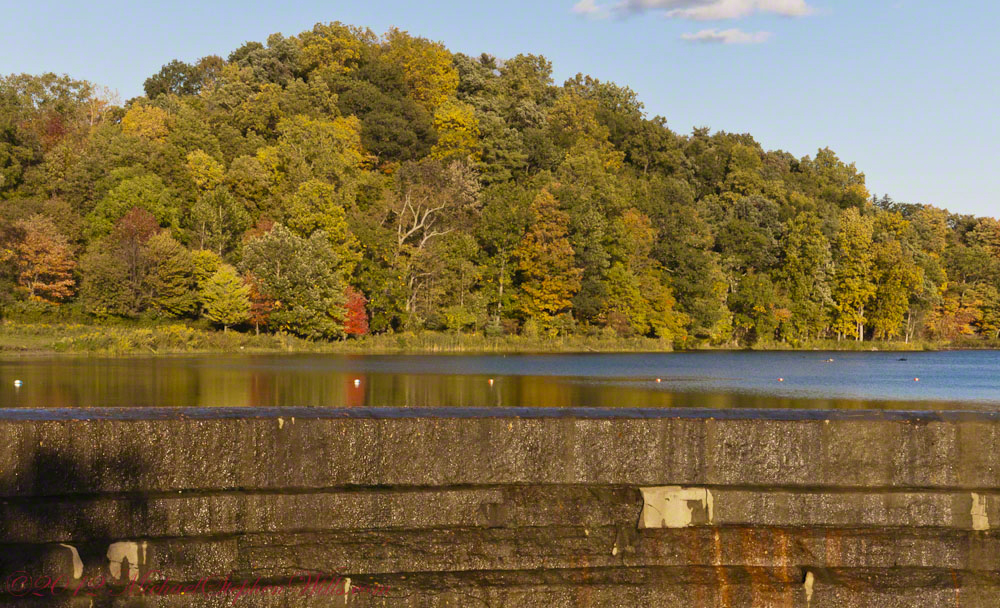

An October Glory, turning before all others

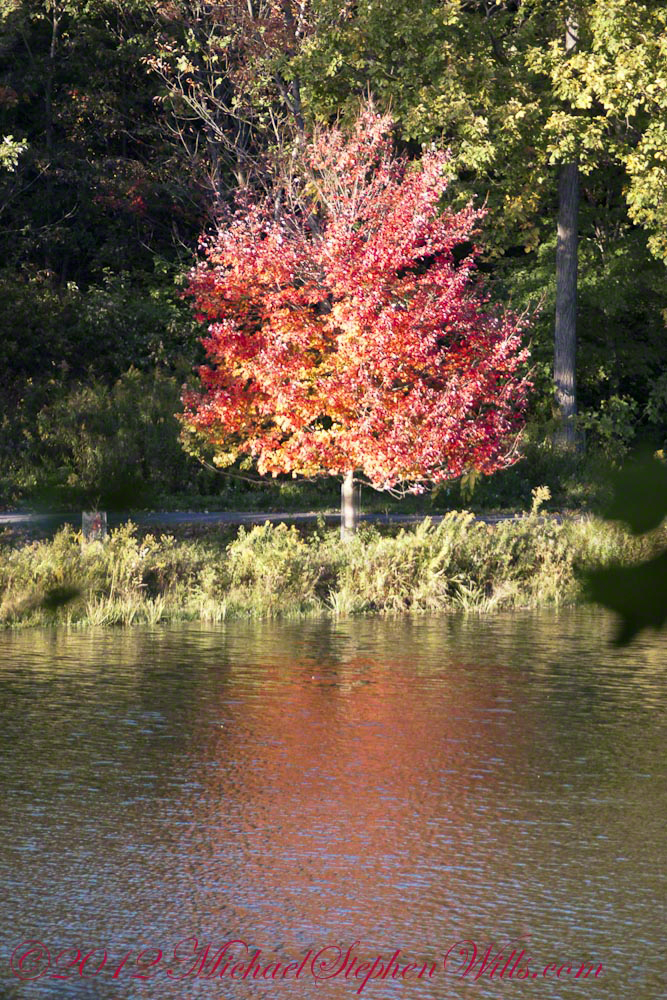
Yet amidst this collective beauty, one tree captured my attention, singular in its brilliance—a solitary red maple standing proudly on the lakeshore. Its leaves had turned a vivid crimson, blazing brightly as though defying the muted earth tones surrounding it. Even from a distance, framed and partially obscured by larger trees, its vibrant reflection cast a fiery echo on the water, rippling softly in the afternoon breeze.

The maple, Acer Rubrum, seemed perfectly at home here, thriving robustly at the water’s edge. I remembered reading how adaptable red maples are, able to flourish in conditions ranging from dry uplands to swampy shores. This spot, near the edge of the tranquil Beebe Lake, seemed to showcase its resilient character perfectly.

Up close, the maple’s glow was even more striking. Its leaves cascaded in fiery clusters, hues deepening from bright scarlet at the tips to a darker maroon closer to the branches. This dramatic gradient seemed symbolic of autumn itself—beautiful, fleeting, and subtly tinged with the melancholy reminder of winter’s approach.

The Red Maple (Acer Rubrum) to tolerant of diverse conditions, making it a perfect choice for this spot on the short of Beebe Lake.

A memory surfaced of early spring in the Finger Lakes region, a time when maples, including this red maple, generously share their sap. Though not traditionally tapped like its sweeter cousin, the sugar maple, this species’ sap can indeed be boiled down into syrup, a surprising sweetness hidden within its sturdy trunk. Standing in its shadow, imagining those early spring days, it seemed astonishing that the same tree could offer both the delicate sweetness of syrup and the fierce beauty now on display.

Curiously, the transformation of the tree appeared methodical yet whimsical—it changed colors from the top down, its upper branches already bare, exposing slender twigs pointing skyward. Like an artist carefully removing layers to reveal something deeper beneath, the maple unveiled its upper bare bones first, as though reminding observers of the quiet strength supporting its autumn splendor.
This Red Maple (Acer Rubrum) turns from the top down and has already bare for most top branches.

As I lingered, taking in this turning tree, joggers passed by along the path, their rhythmic footsteps a gentle percussion beneath the rustling leaves. Briefly, they glanced toward the vivid maple, perhaps drawn, like me, by its striking contrast to the surrounding foliage. It felt like we shared a secret admiration for this singular tree, recognizing in it a quiet assertion of individuality amidst conformity.

Eventually, I viewed the maple once more from afar, framed now by broader sweeps of branches and leaves, partially obscured but no less vivid. Through layers of leaves and dappled sunlight, it glowed like a distant flame, a beacon that seemed to encapsulate the entire mood of the season—warm yet cool, bright yet transient.
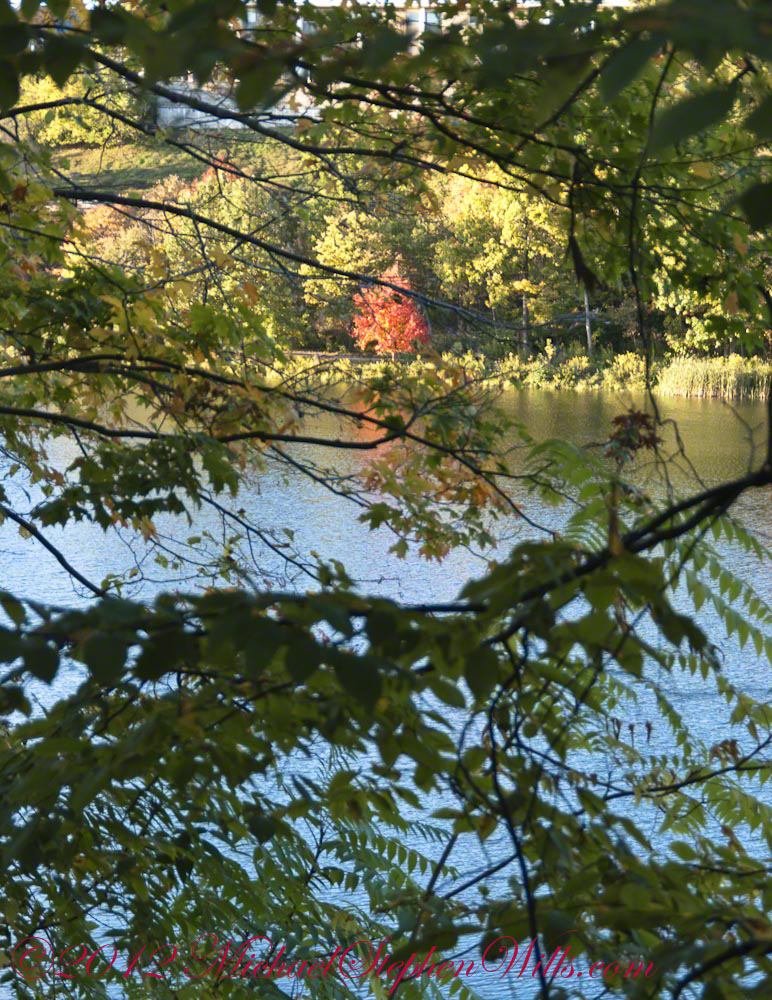
The Red Maple (Acer Rubrum) is the first to flower in spring and the first to turn in autumn.

Walking away, the image of that maple lingered, its reflection shimmering gently in the afternoon sun, a moment suspended between summer’s lush vitality and winter’s bare stillness. Beebe Lake had offered scenic beauty, a quiet meditation, a reflection mirrored not only on its tranquil surface but in the heart of an observer captivated by a single tree’s fleeting glory.
Enter your email to receive notification of future postings. I will not sell or share your email address.

The Enchantment of Autumn Over Cascadilla Gorge

Join me for a serene autumn walk in Ithaca, appreciating nature’s beauty, impermanence, and the calming rhythms of life.

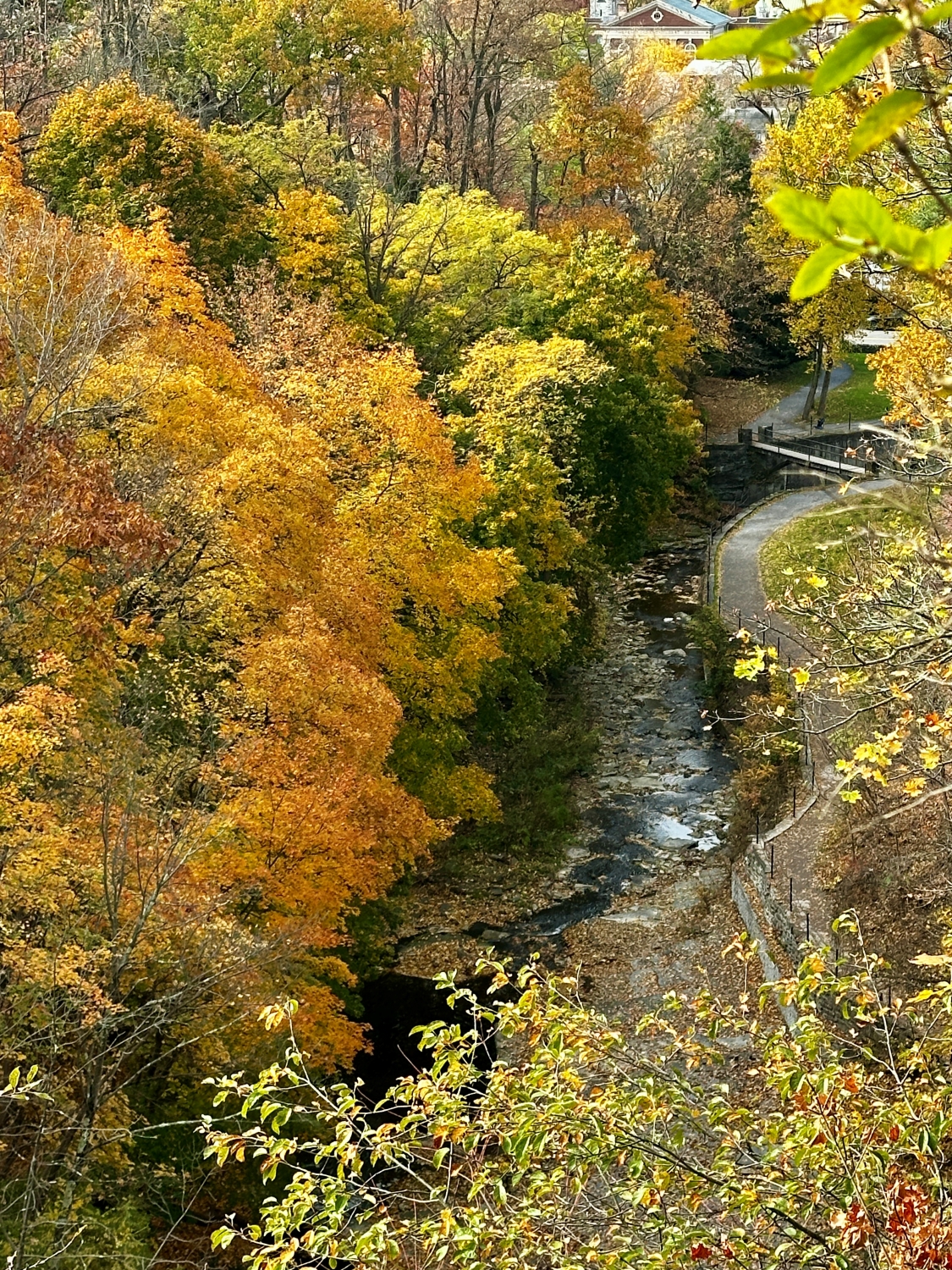
A few days before Halloween, I found myself on the rim of Cascadilla Gorge, Ithaca’s autumnal crown jewel. The air had that crisp October quality, each breath carrying a hint of the colder days to come yet still tempered by the lingering warmth of early fall. A breeze carried a scent of damp earth and decaying leaves, a rich, organic aroma that signaled the turning of the seasons. The path beneath my feet was a tapestry of fallen leaves—russet, gold, and burnt orange—a natural carpet leading me through a world suspended between vibrancy and rest.

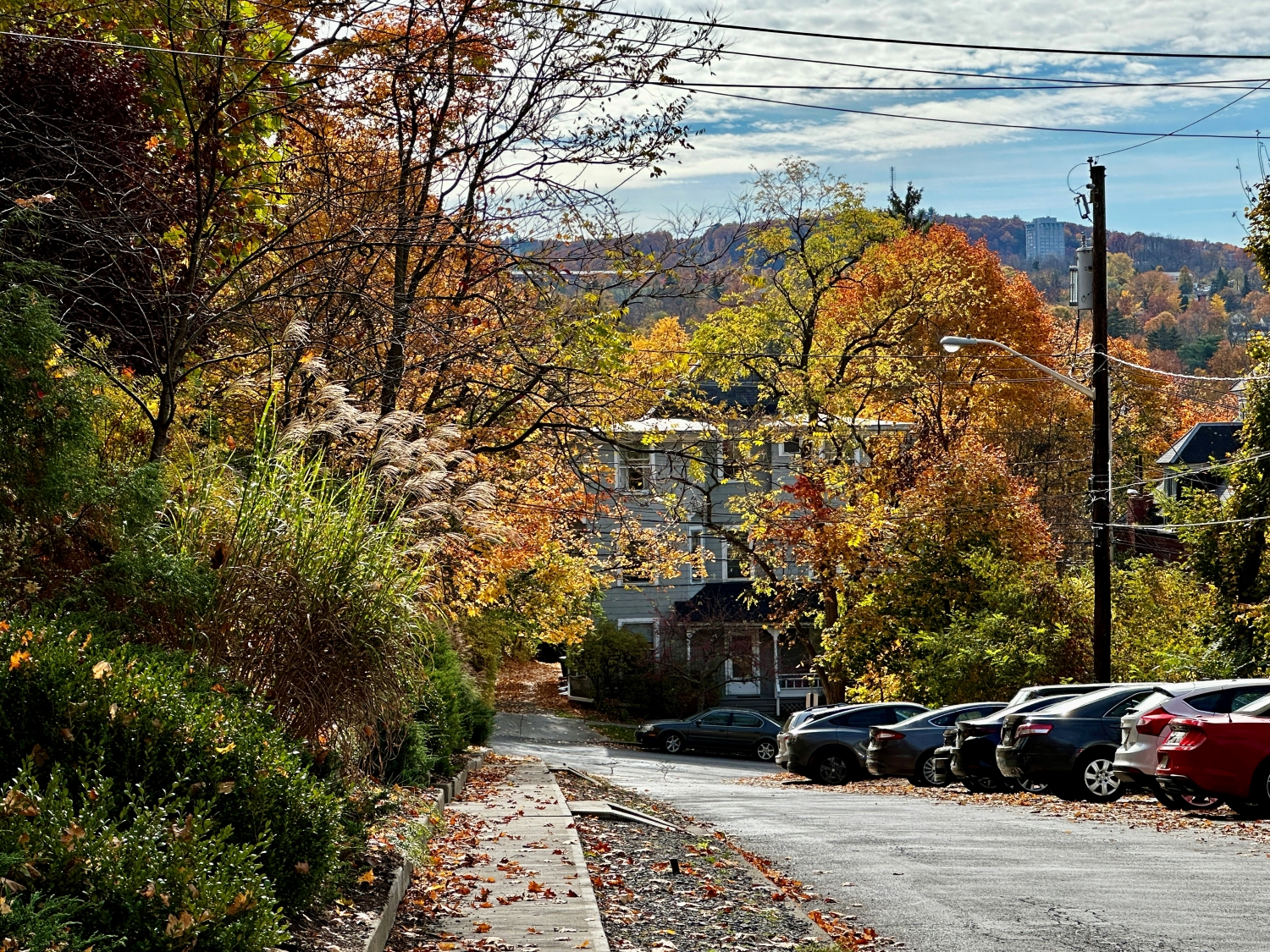
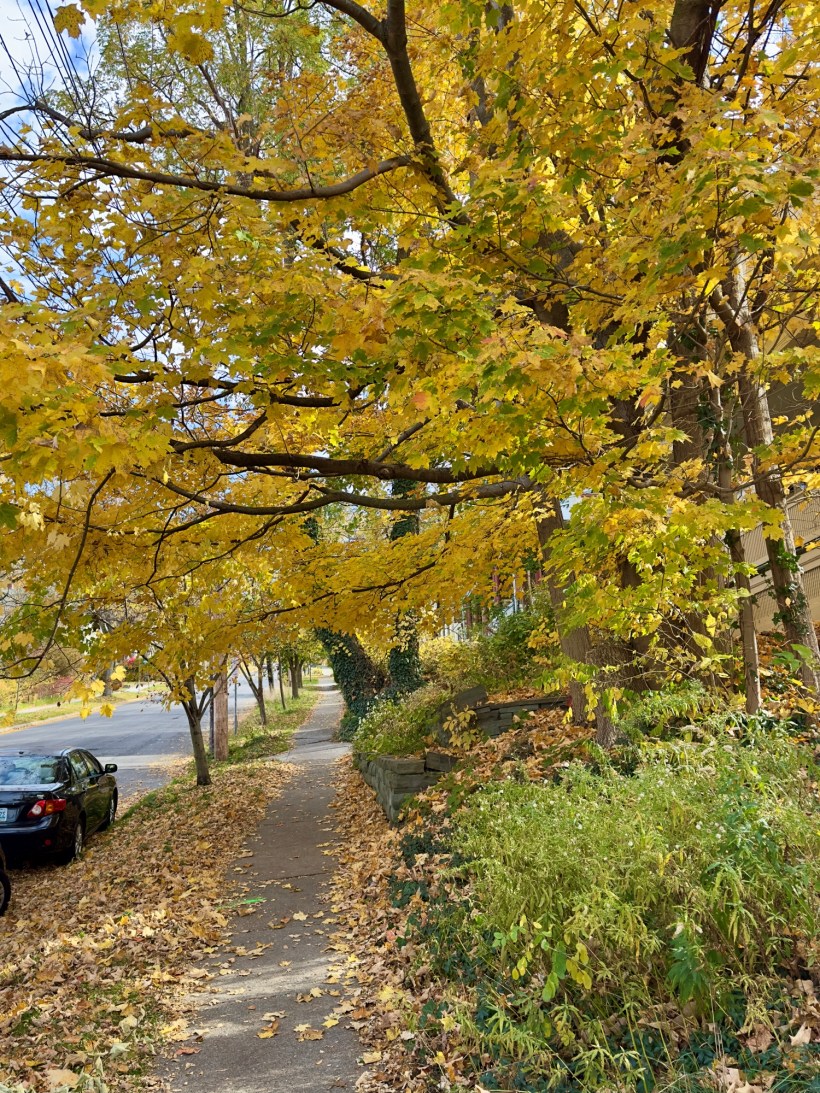
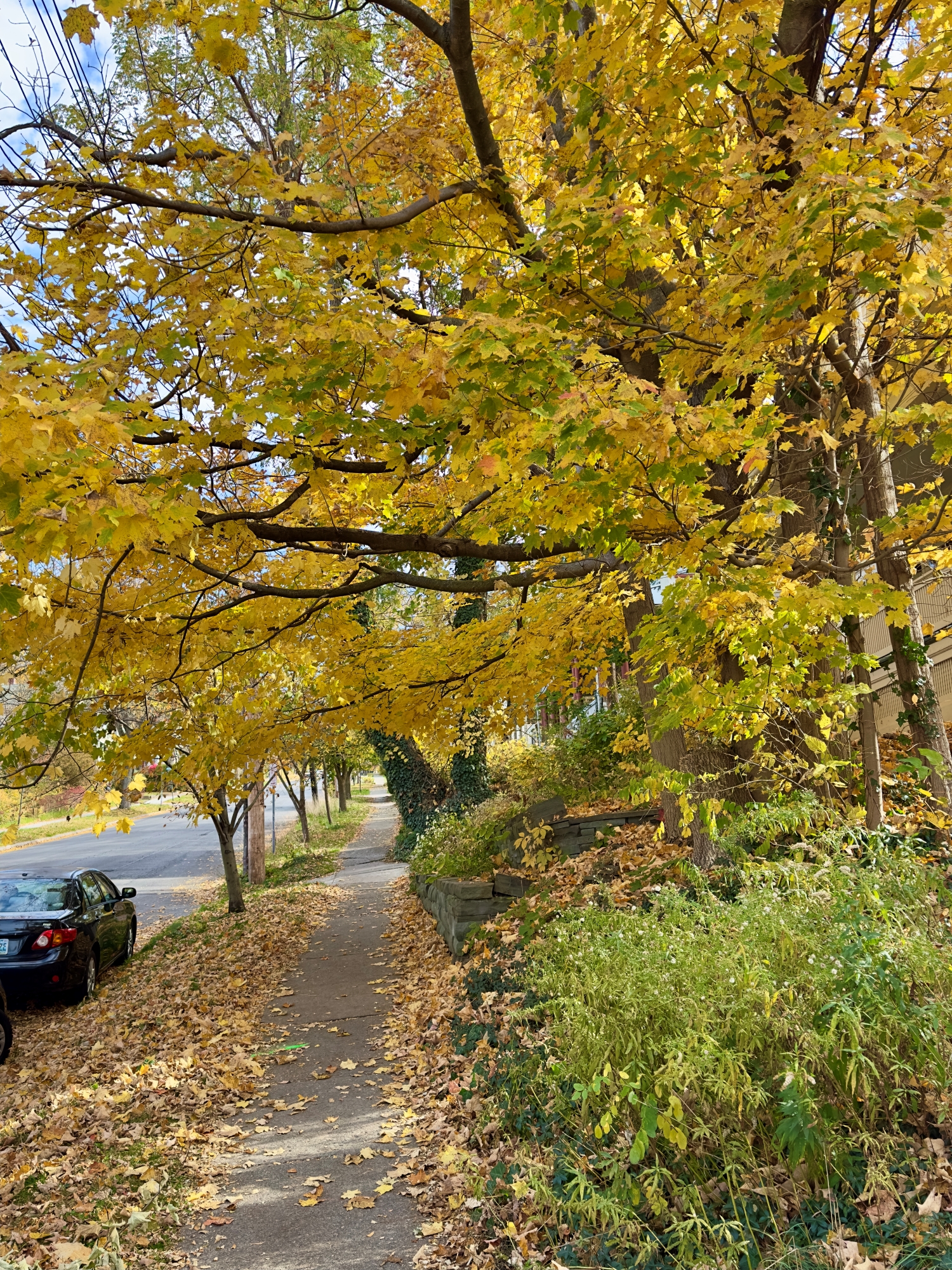
Golden Canopy over Buffalo Street Sidewalk

Continuing up Buffalo Street, I marveled at the trees, their branches thick with yellow and gold leaves, creating a canopy above. The leaves shivered with every gust, whispering the ancient secrets of the forest. The air was infused with the sweet, woody fragrance of maple and oak, mingling with the faint scent of chimney smoke from nearby houses. The sunlight filtered through, casting a dappled pattern on the sidewalk, a fleeting mosaic as the leaves danced in the wind. A sense of impermanence struck me; soon, these leaves would be gone, leaving bare branches silhouetted against a winter sky.

Scene from Dewitt Place toward South Hill and Ithaca College

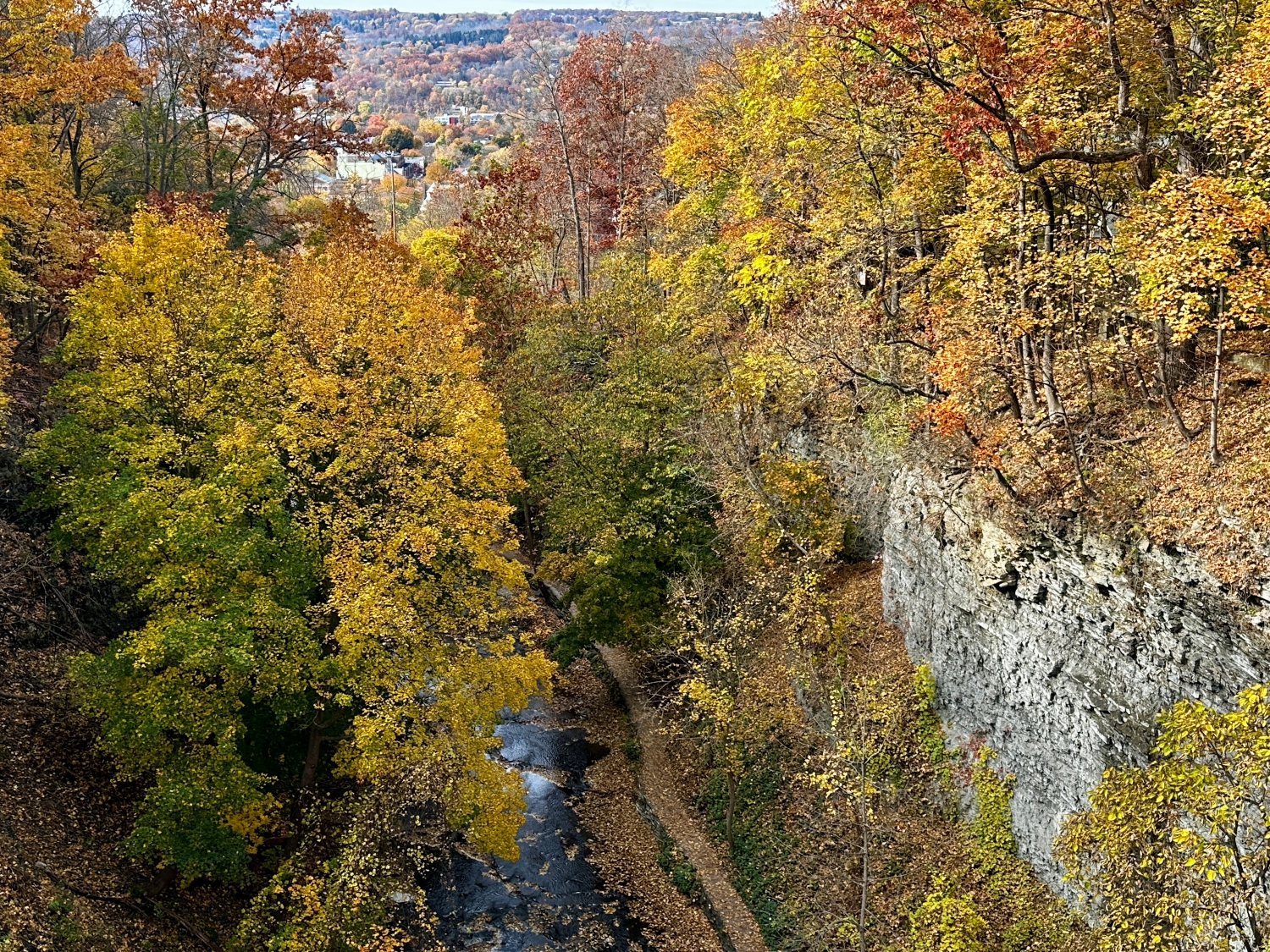
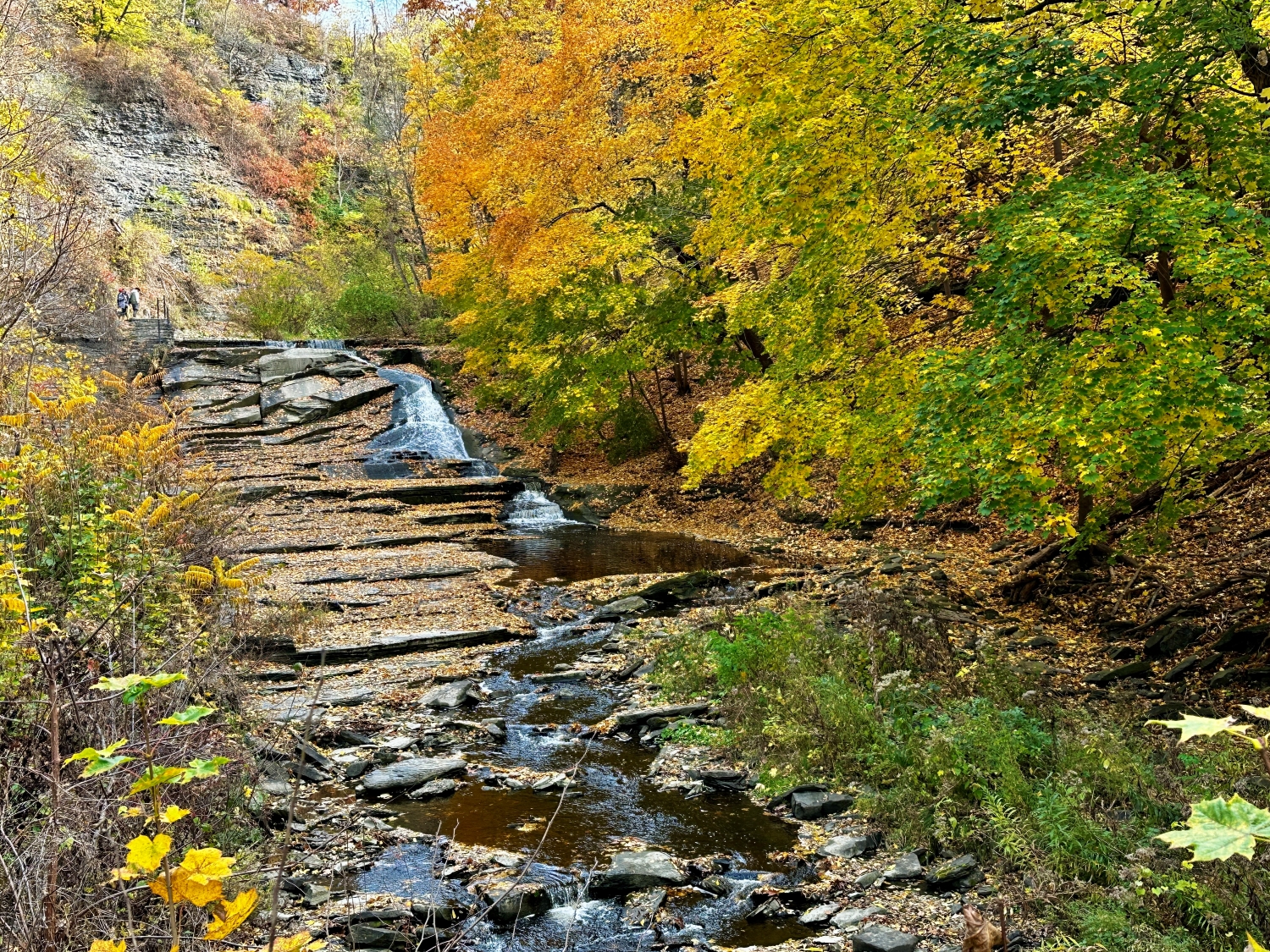
Crossing the Stewart Avenue bridge, the Cascadilla Gorge came into view, a steep wall of stratified rock layers standing guard over the gently flowing stream below. The contrast between stone and foliage was breathtaking—the hard, unyielding rock juxtaposed with the softness of leaves in full autumnal bloom. The earthy scent of wet stone mixed with the crisp aroma of the flowing water, creating a sensory tapestry unique to the gorge. The colors seemed to intensify against the gray and brown of the cliff, each leaf like a brushstroke on nature’s canvas, celebrating the season’s final flourish before surrendering to winter.

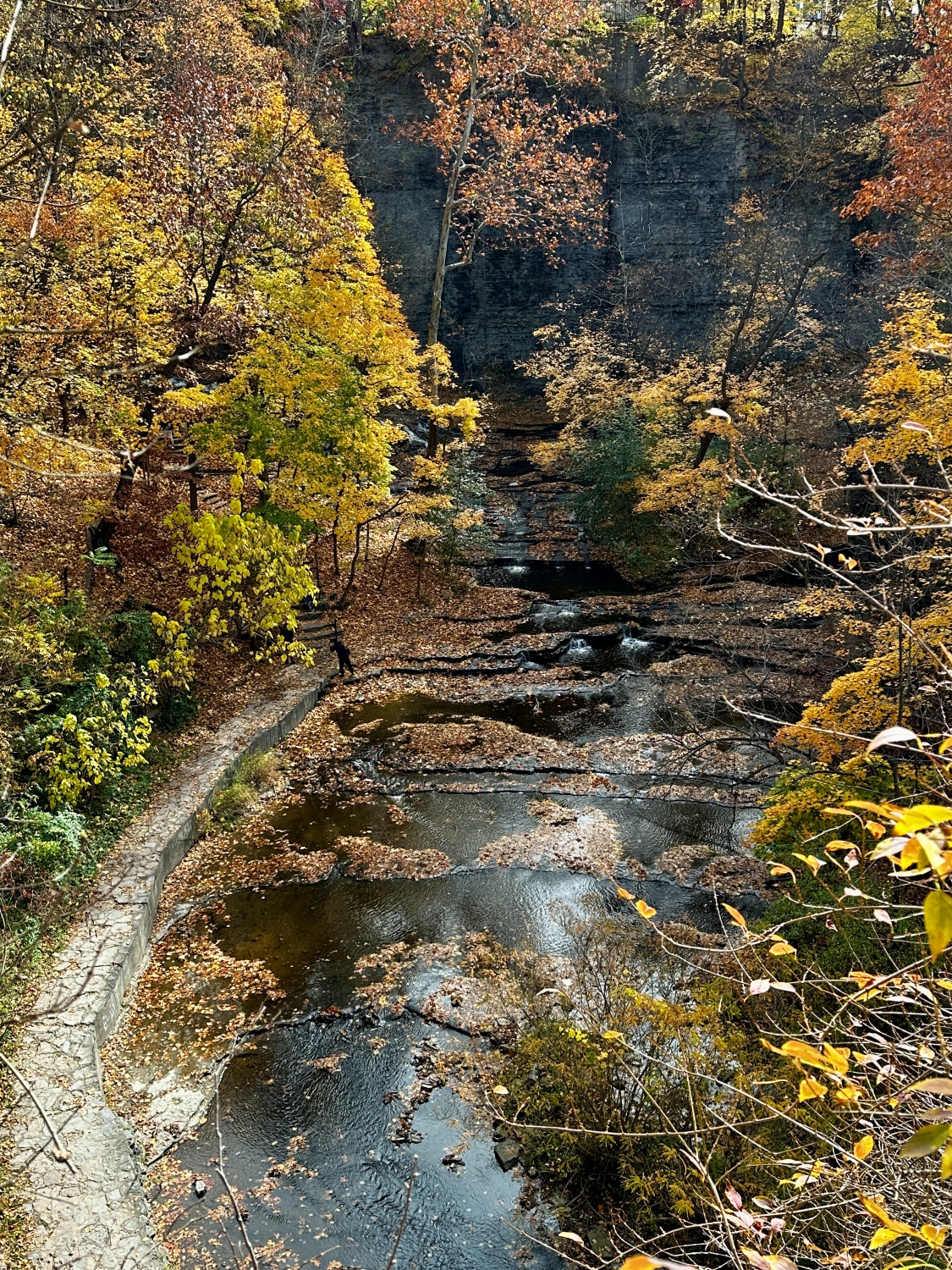
Below footpath along the gorge rim, the creek wound through, its banks littered with leaves that had completed their journey from branch to earth. They floated on the water’s surface, spinning gently in the current as though reluctant to leave this last dance. The sound of the water was a steady undercurrent, soothing and rhythmic, as it tumbled over stones and carved its way through the gorge. I paused to watch, entranced by the way water and rock, ephemeral and eternal, seemed to coexist in a kind of harmony.

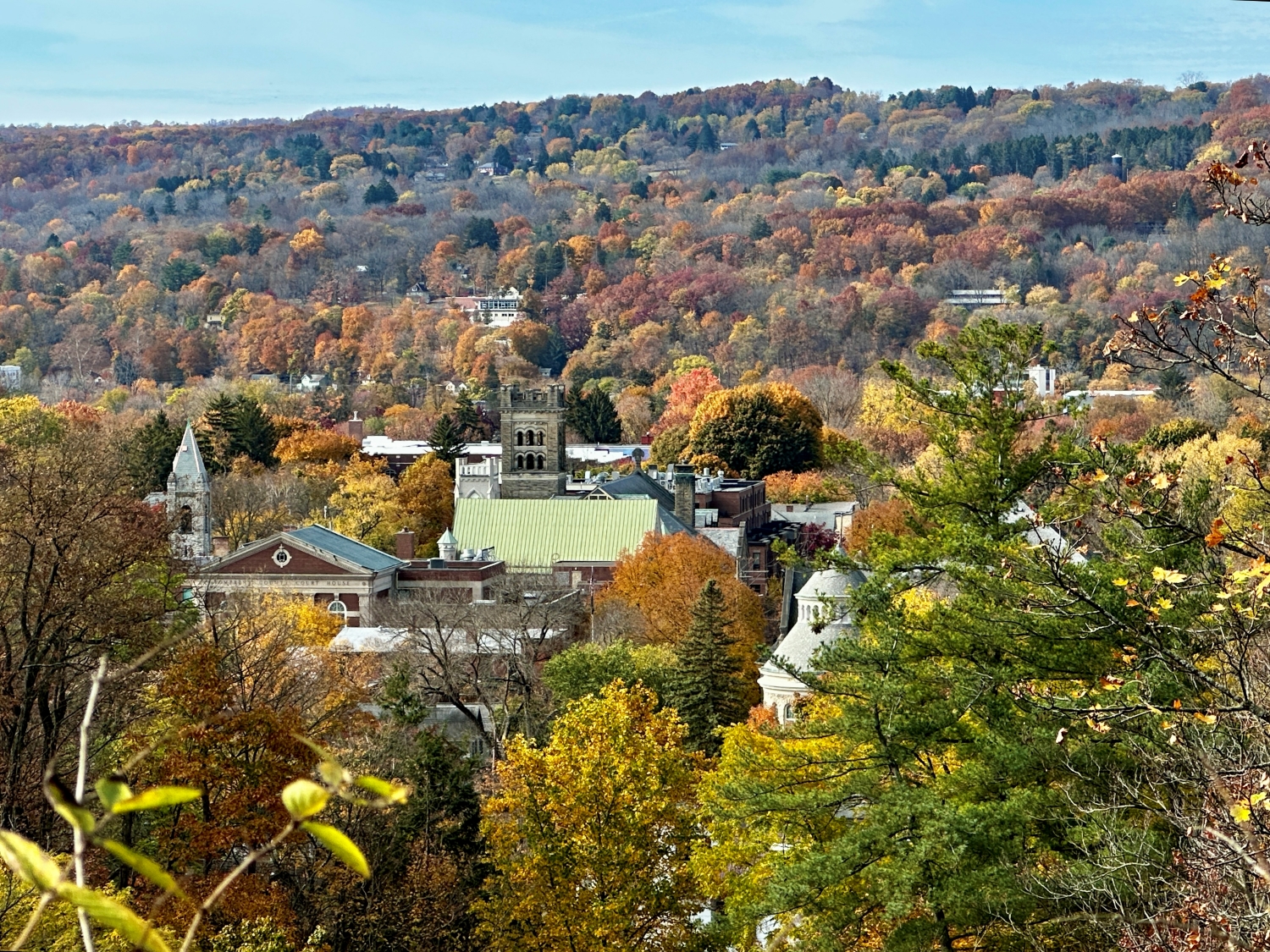
I stopped at a lookout point and surveyed the town sprawled out below, nestled amidst the fiery colors of the surrounding hills. The architecture of Ithaca’s buildings peeked through the trees, each roof and spire framed by the season’s palette. This was a town embraced by nature; its rhythm dictated as much by the seasons as by human hands. The sight stirred a sense of gratitude within me; here was a place that reminded you to slow down and observe, to notice the subtle shifts in light, in color, in the way a single gust of wind could change a landscape.

I continued along the rim, passing a small waterfall that spilled over the rocks with a quiet insistence. The water had carved smooth pathways in the stone, evidence of its long journey and persistent power. The sunlight hit the spray just right, casting a fleeting rainbow that shimmered and then disappeared as I moved. I felt a sense of companionship with the water—both of us moving forward, shaped by the paths we traverse, yet always adapting to whatever lay ahead.

The last part of the trail led me through a dense thicket of trees, their branches hanging low, forming a natural archway. The air was heavy with the musky scent of fallen leaves and the spicy aroma of pine needles underfoot. Here, the light was softer, muted by the thick canopy overhead. The quietness enveloped me, broken only by the occasional rustle of a squirrel in the leaves or the distant caw of a crow. It was the kind of silence that feels sacred, where each sound, no matter how small, becomes profound.

Entering Cascadilla Gorge from Linn Street

Emerging from the shaded path, I took one last look back at the gorge. The scene was both familiar and new—a blend of natural beauty and the nostalgia of seasons past. I felt a sense of peace, grounded by the cycles of the earth, by the ebb and flow of life around me. In this moment, on the brink of Halloween, the world felt both hauntingly beautiful and reassuringly steadfast, a reminder that even as the leaves fall and the days grow shorter, there is a promise of renewal in the quiet persistence of nature.

Enter your email to receive notification of future postings. I will not sell or share your email address.

Exploring Lime Hollow: Nature Walks with My Grandsons

Enjoy a memorable visit to Lime Hollow Nature Preserve by a grandfather and his grandsons, exploring nature, observing wildlife, and connecting through shared experiences, fostering curiosity and appreciation for the environment.

The October sunlight was gentle as we entered Lime Hollow Nature Preserve from Gracie Road, my grandsons, Sam and Rory, bursting with excitement beside me. Sam, the eldest, took the lead, confidently striding ahead along the Sunset Trail while Rory, his younger brother, stayed close to my side, his eyes wide with wonder at the forest around us.

Descent to the Pond


The trail wound through the woods, dappled with the golds and reds of early autumn. Sam spotted a squirrel darting between trees, and Rory pointed to the sky, “Look, Grandpa, a woodpecker!” I smiled at their enthusiasm, feeling grateful for these moments of connection to nature and family.

We descended toward the pond via the Pond View Trail, the sound of trickling water drawing us closer. As we approached, the landscape opened up, revealing the calm, reflective surface of the water, bordered by reeds swaying in the light breeze. I remembered bringing the boys here last spring, how different the pond looked then—brimming with life as frogs leapt from the banks and dragonflies zipped across the water’s surface. Today, the scene was quieter, but no less magical.

Rory, ever the adventurer, crouched by the pond’s edge, watching for frogs. Sam, too, paused to observe but soon grew restless, his curiosity pushing him onward. “Come on, Grandpa! Let’s see what’s next!” His voice echoed through the trees as he darted back onto the trail, Rory quick to follow.

Encounter with the Giant Fungus


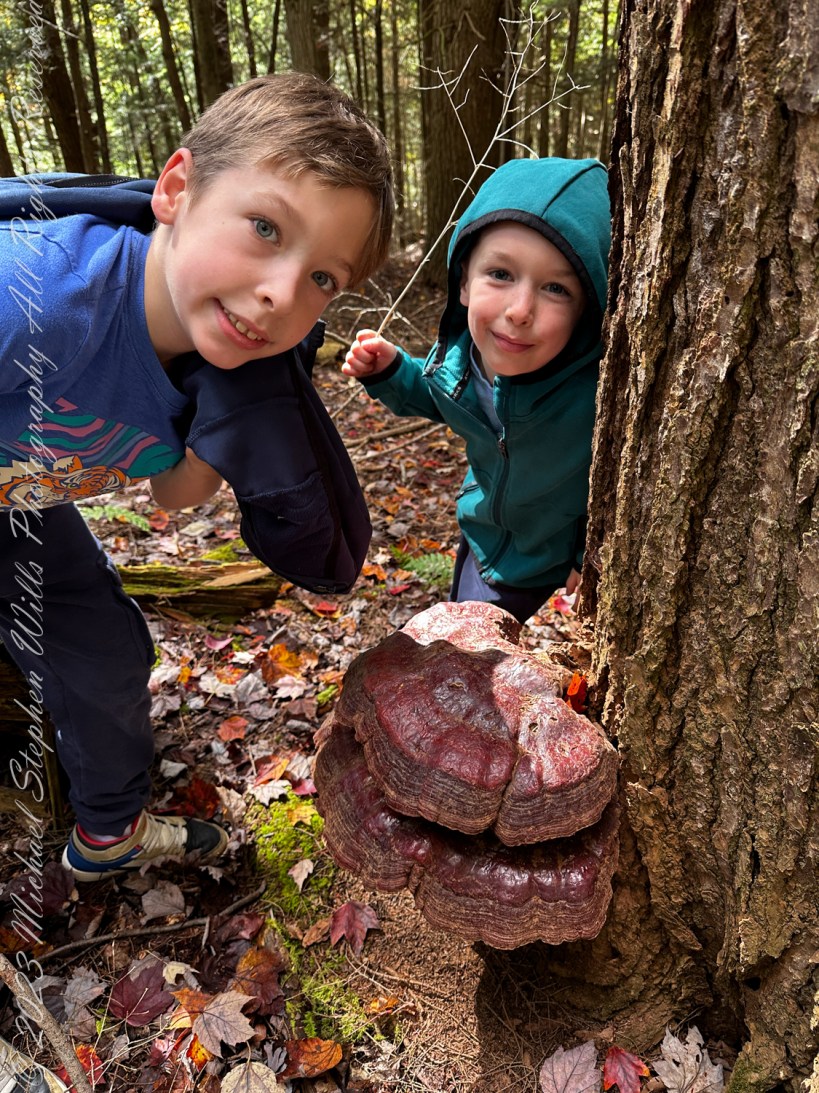
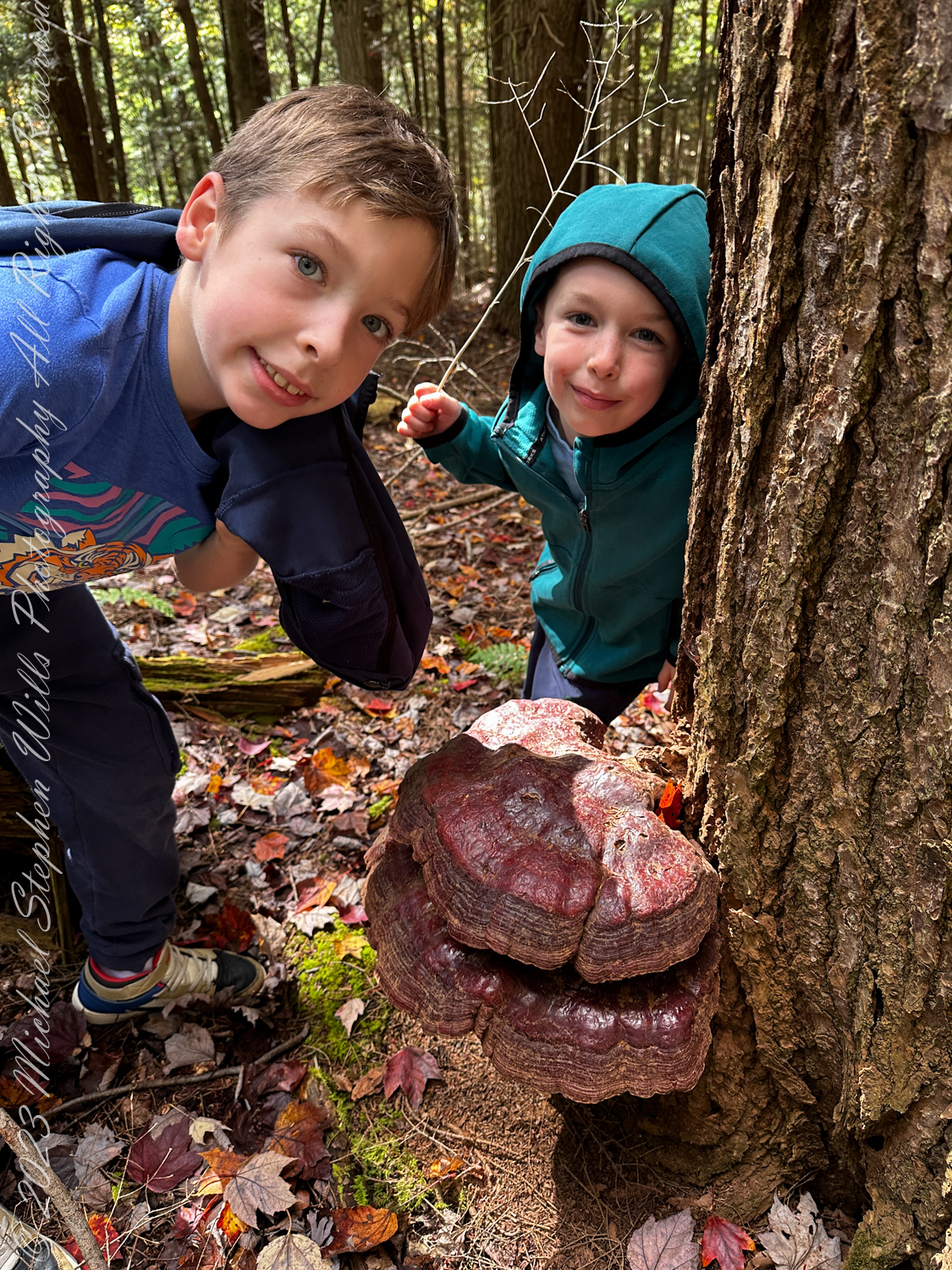
The path led us deeper into the forest, and soon we turned onto the Brookside Trail, which merged with the High Ridge Trail. Here, the air grew cooler under the dense canopy of trees, and the forest floor softened beneath our feet with layers of leaves. It was then that we stumbled upon the most magnificent sight of the day: an enormous bracket fungus, its wide, layered shelves clinging to the trunk a hoary snag.

Rory gasped in delight, running over to inspect it more closely. “Look how big it is!” he exclaimed, his small hands hovering just above its ridged surface. Sam, never one to be outdone, knelt beside it, carefully touching the spongy layers. “It’s a staircase for squirrels,” he said, grinning up at me.

Turkey Tail bracket fungus (Trametes versicolor) is a common wood decay fungus found on dead and decaying hardwoods. Named for its concentric, colorful bands resembling a turkey’s tail, it plays a vital role in forest ecosystems by breaking down lignin, facilitating nutrient recycling. It’s also valued for its medicinal properties. Lime Hollow Nature Center, Cortland, Cortland County, New York State. Finger Lakes Regions

As I watched them, I couldn’t help but think back to all the times I had wandered these trails alone before they were born. Now, these woods had become a classroom for them—full of discoveries that sparked their curiosity and wonder. It was a beautiful moment of generational connection, this passing on of my love for the natural world to Sam and Rory.

Fascinating Beech Tree Roots


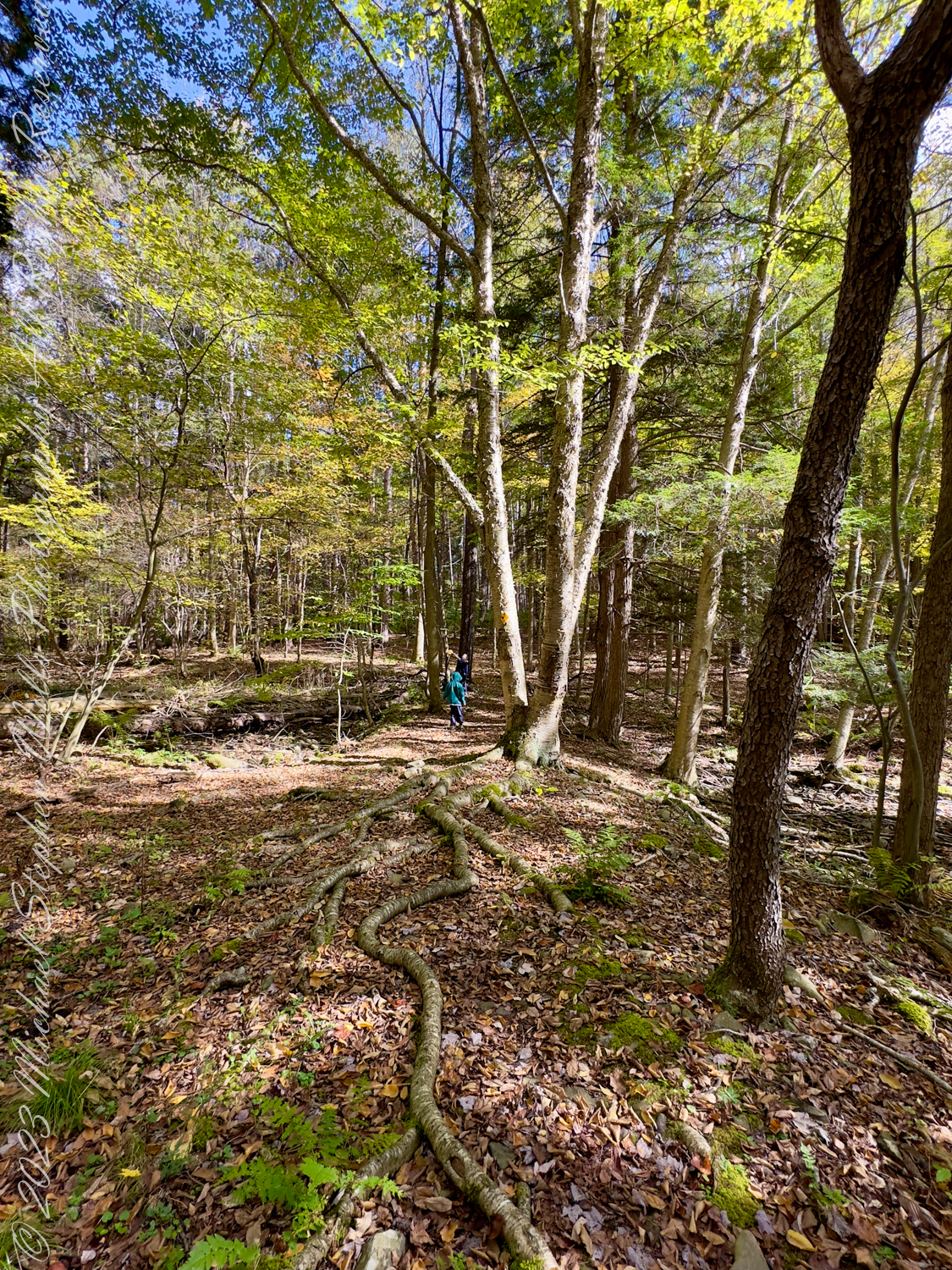
On the way out, we took the Brookside / Pond View / Sunset trails once again, but this time, this intricate network of roots from a massive beech tree fascinated us. The roots twisted and coiled across the path like veins, in our imaginations the gnarled shapes snagged our feet. Sam, ever the explorer, stepped cautiously along the roots, balancing himself as if walking a tightrope. Rory followed suit, his giggles filling the air.

An American beech (Fagus grandifolia). These trees are quite common in northeastern forests.
The beech tree is known for its smooth smooth, gray bark, which can become marked with scars or etchings as the tree ages. Additionally, its leaves are typically dark green, with serrated edges, and turn yellow to bronze in the fall, often staying on the tree through winter. Lime Hollow Nature Center, Cortland, New York State

“These roots are older than us,” I told them. “Beech trees can live for hundreds of years. Just think, this tree has seen many more seasons than we ever will.”

Sam’s eyes widened at the thought, while Rory gave the tree a gentle pat, as if to thank it for its wisdom. I marveled at how something as simple as a root system could captivate their imaginations and bring the lesson of time and growth to life.

Reminiscing on the Chicago Bog

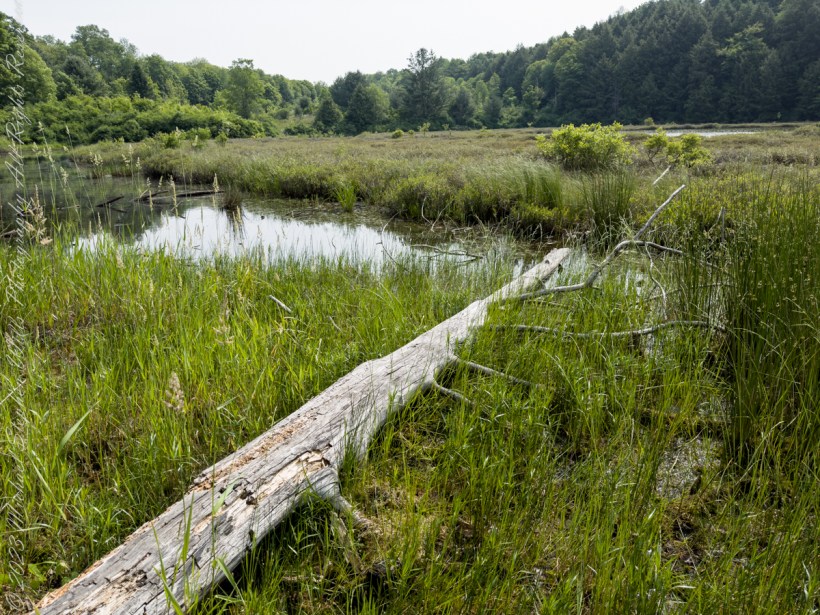
In the 1830’s there was a village named Chicago along Gracie Road, which gives it the name we have today. The Chicago Bog is home to many carnivorous plants, including sundew, the pitcher plant, and more. The deepest depth of the bog is about 7.2 ft. The bog is along the Phillips Memorial Trail, which can be found on Gracie Road. Lime Hollow Nature Center, Cortland, New York


As we walked, my mind wandered back to a visit we had made to the Chicago Bog just a year before. I remembered the day clearly—how we had trekked through the wetland on a warm June afternoon, the ground soft beneath our feet, alive with the buzzing of insects and the vibrant green of new growth.

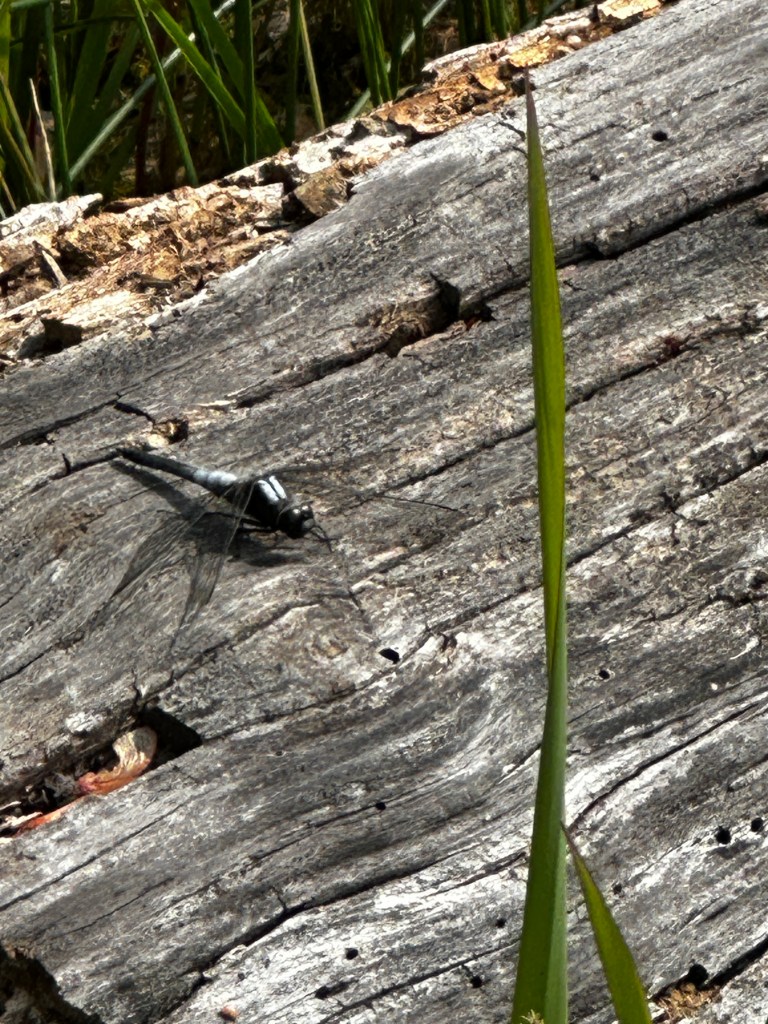
The chalk-fronted corporal (Ladona julia) is a skimmer dragonfly found in the northern United States and southern Canada.
Juveniles of both sexes are light reddish brown, with white shoulder stripes and a black stripe down the middle of the abdomen. As they mature, males develop a white pruinescence on the top of the thorax and at the base of the abdomen, while the rest of the abdomen turns black. Females become almost uniformly dark brown, with a dusting of gray pruinescence near the base of the abdomen; a few develop the same color pattern as the males.
Chalk-fronted corporals often perch horizontally on the ground or on floating objects in the water, flying up to take prey from the air. They are gregarious for dragonflies, and are commonly seen perching in groups. They readily approach humans to feed on the mosquitoes and biting flies that humans attract.

It was there, by the edge of the bog, that we had encountered a dragonfly, a Chalk-fronted Corporal, resting on a fallen log. Its dark, iridescent wings shimmered in the sunlight, and Sam had been mesmerized by its delicate beauty. He had asked so many questions that day—about how dragonflies flew, what they ate, and where they lived. I had done my best to answer, but truth be told, I learned as much as he did in that moment.

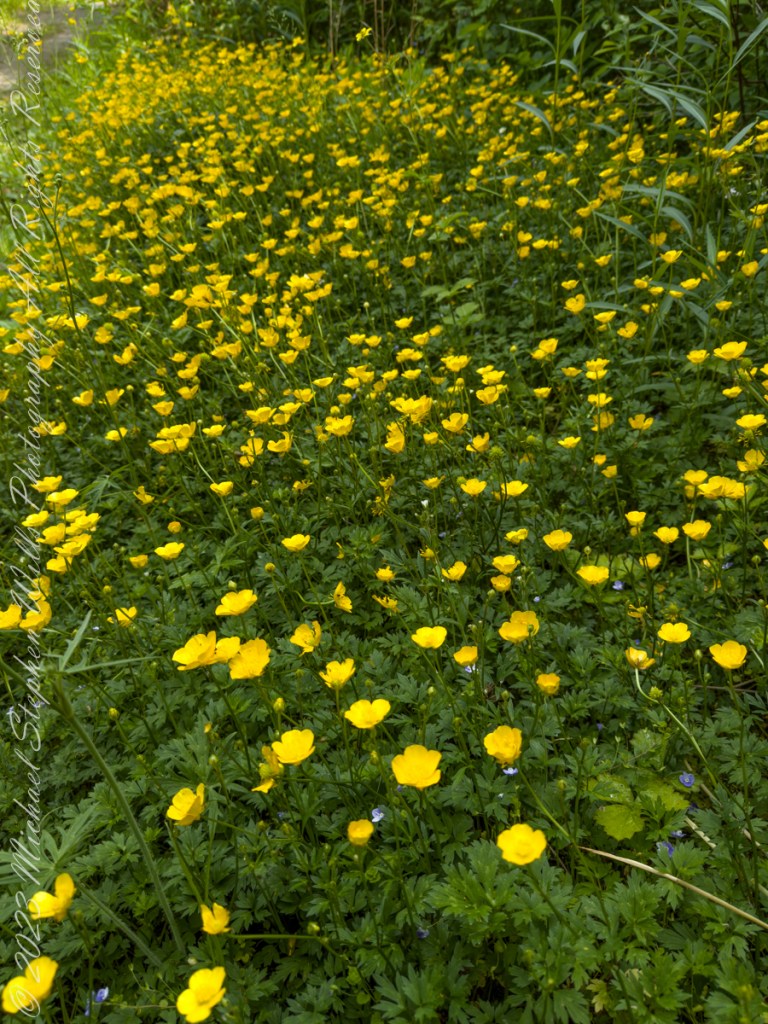
Nearby, a meadow of buttercups had stretched out before us, their yellow blooms dancing in the breeze. Rory had run through them, his laughter ringing out as he tried to catch a butterfly that flitted between the flowers. The memory of that field of gold still brought a smile to my face as we made our way through Lime Hollow today.

A Day to Remember


As we neared the end of our hike, the afternoon light filtering through the trees, I couldn’t help but feel a sense of contentment. These outings with Sam and Rory had become more than just walks in the woods—they were opportunities to share, to learn, and to make memories that I knew would last a lifetime.

“Grandpa, can we come back?” Rory asked, his face flushed with excitement.

“Of course,” I said, smiling. “We’ll always have time for another adventure.”

The Majestic Cottonwoods of Stewart Park

Discover the timeless beauty of two towering Cottonwood trees along the shores of Cayuga Lake. Explore their natural history, cultural significance, and how they’ve shaped the landscape of Stewart Park for generations.

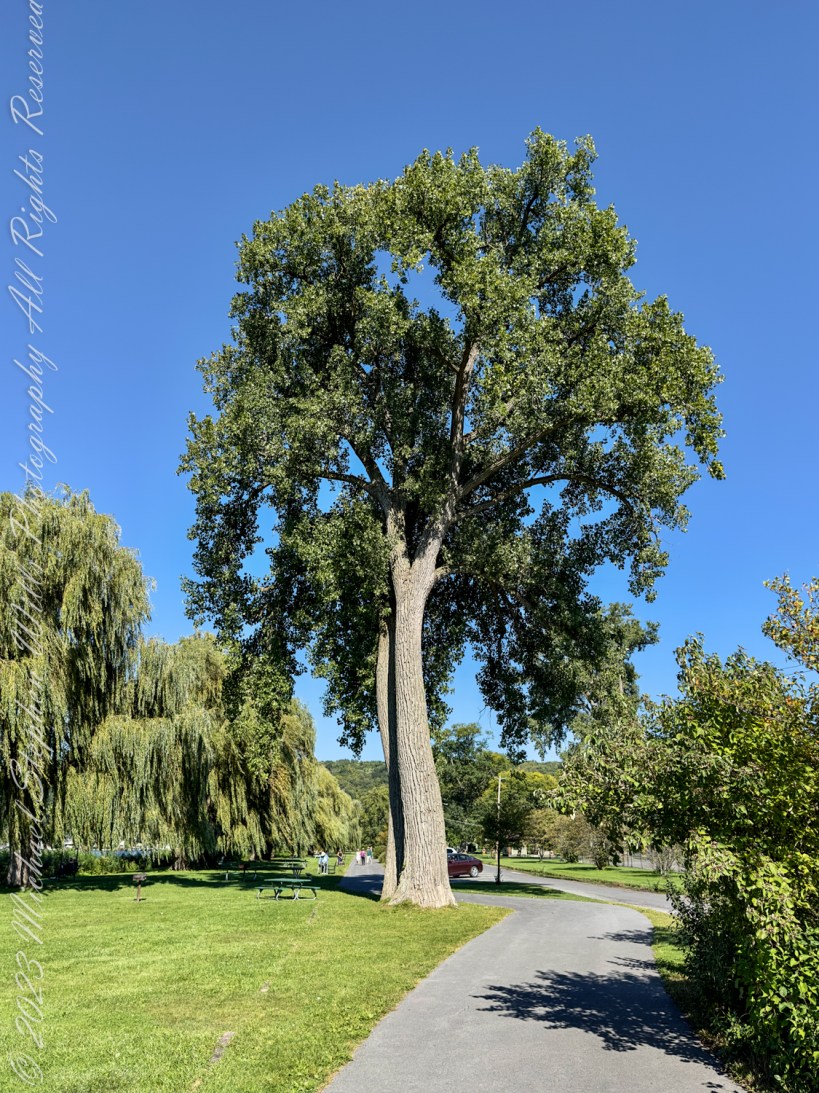
Walking with Pam in Stewart Park, the shores of Cayuga Lake shimmer under the bright September sun, offering a serene setting for reflection. Ahead, two towering Cottonwood trees stand in quiet majesty, their branches spreading wide, casting long shadows over the grass and walkway. Drawn toward them, I find myself in awe of their presence—these two trees, ancient sentinels by the water, who have silently borne witness to the changing world around them.

View Facing East/Southeast, September 10, 2024

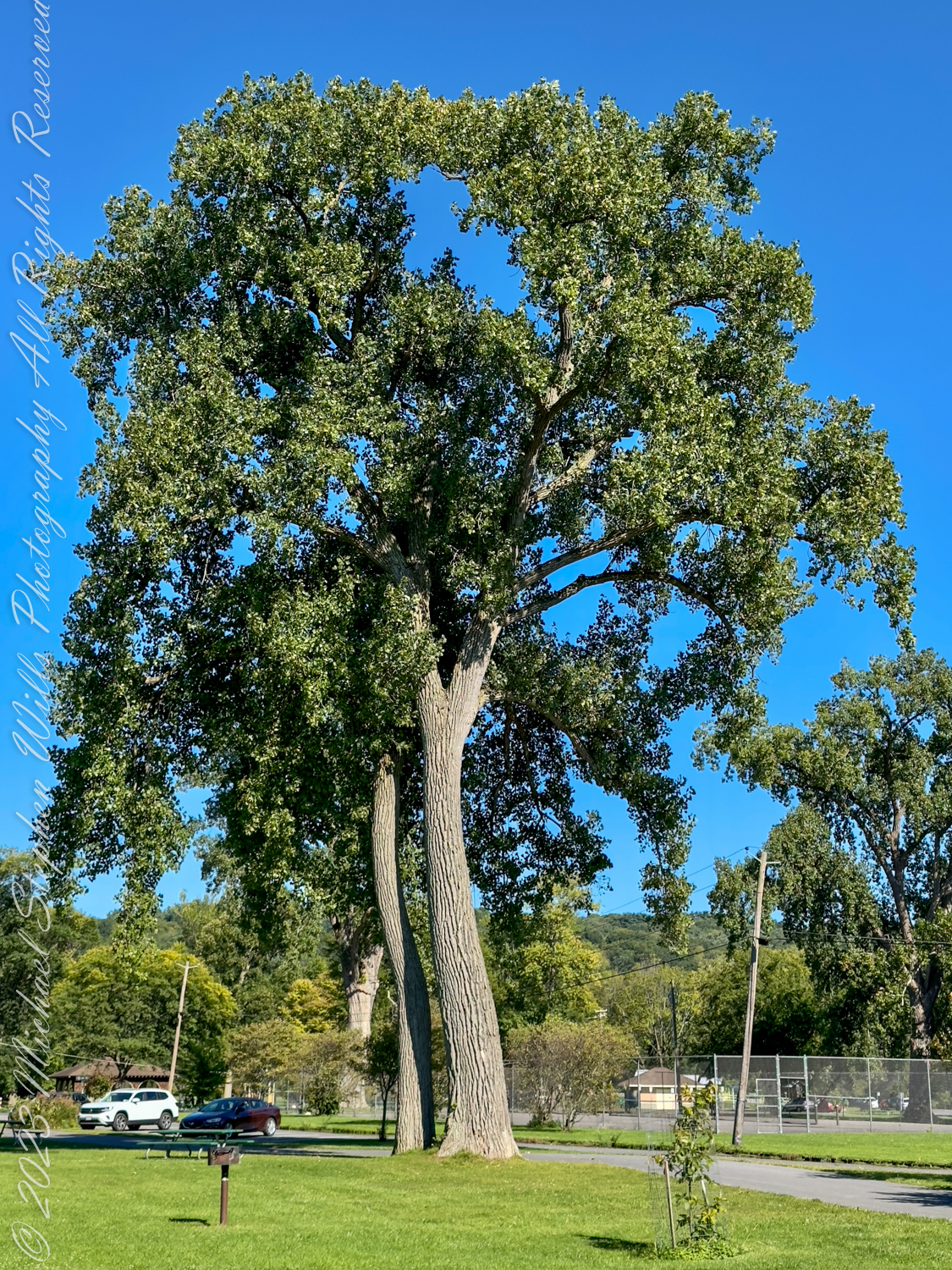
Cottonwoods, scientifically known as Populus deltoides, are members of the poplar family and are among the tallest trees in North America. The ones before me have thrived for decades, their thick, furrowed trunks a testament to the endurance of life on the edge of the lake. It’s remarkable to think of all the storms and seasons they’ve weathered—their roots digging deep into the moist earth, nourished by the lake’s constant ebb and flow. I feel as though these trees, standing side by side, companions, connected through the unseen networks of roots beneath the soil. Their relationship to one another seems profound, they have grown up together, providing support and strength as they aged. Their canopies overlapping as though embracing one another.

There’s an undeniable symmetry to their relationship, both in form and function. One can imagine them as silent witnesses to the changing landscape around them—the gradual expansion of the park, the families that come and go, the laughter of children playing nearby, and the quiet conversations of couples walking hand in hand. These trees have become part of the fabric of Stewart Park, deeply entwined with the human history that unfolds here every day.

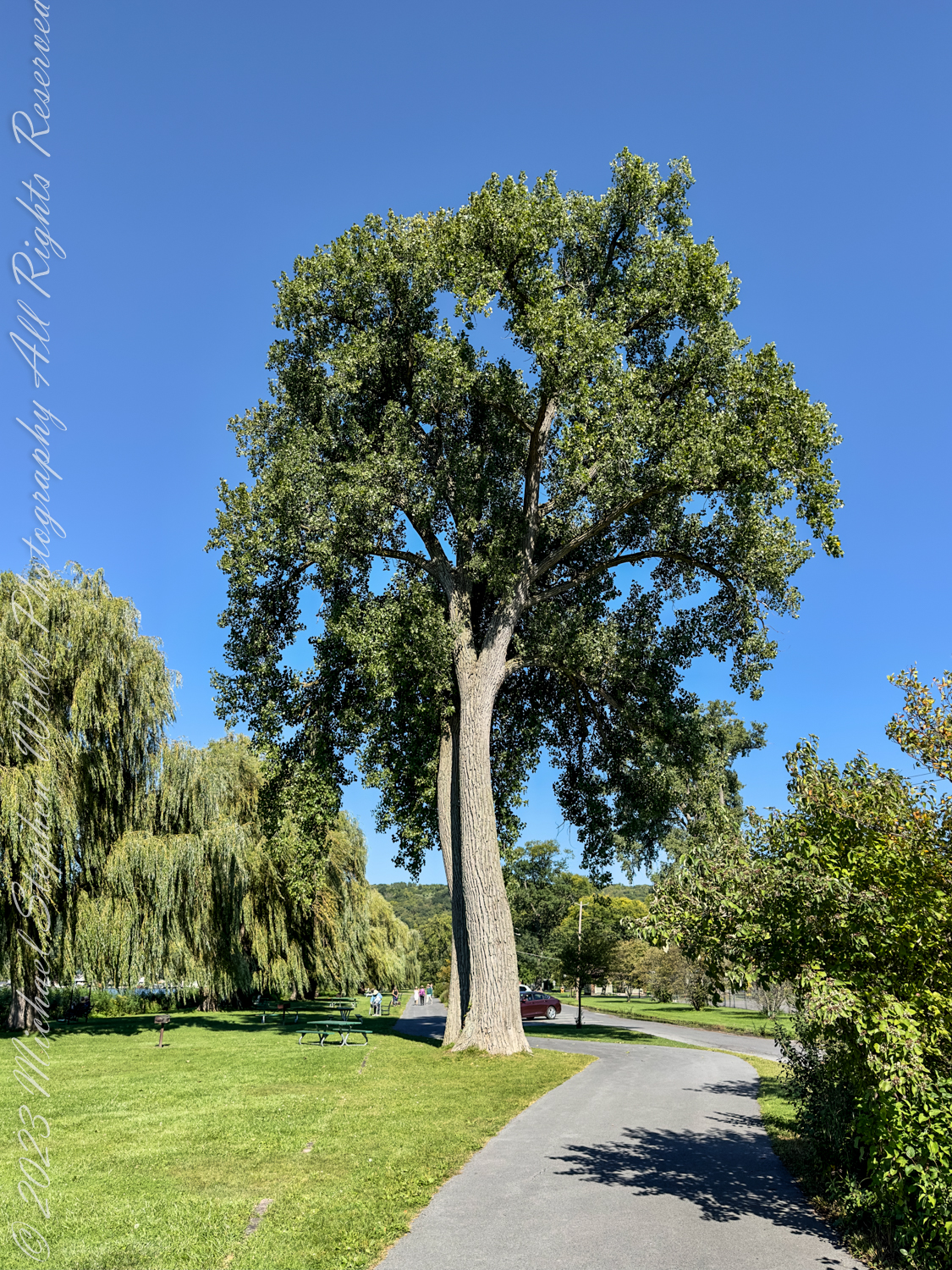
View Facing East, September 10, 2024

The branches reach skyward, their leaves shimmering in the breeze, producing the characteristic fluttering sound of Cottonwoods. There’s something deeply soothing about this rustling—the way the wind seems to dance through the leaves, creating a rhythm that feels eternal. It reminds me that these trees have long been part of human experience, a backdrop to countless strolls, picnics, and quiet moments of contemplation here at Stewart Park.

Cottonwoods are fast-growing, often found near bodies of water where their shallow roots can tap into consistent moisture. And yet, their rapid growth comes with a trade-off; their wood is soft and brittle, prone to breaking in high winds. But in Stewart Park, these two trees have found a perfect balance, their large, sweeping canopies offering shade and shelter without suffering too much damage from the storms that blow through the Finger Lakes. Their resilience is remarkable—a reminder of nature’s ability to thrive in challenging conditions.

Historically, Cottonwoods have played a significant role in the lives of the people who encountered them. Native Americans once used the bark for medicinal purposes and fashioned the wood into canoes. Early settlers appreciated the trees for their rapid growth and ability to provide shade and timber in otherwise open expanses of the Midwest and Northeast. Even today, their legacy endures as they continue to offer shade and shelter, albeit more for leisure than for survival.

I notice how the pathway itself bends gently to accommodate the Cottonwoods. The paved trail, so clearly designed with these majestic trees in mind, arcs around their broad bases as if to honor their presence. In a world where nature is so often bent to human will, it’s refreshing to see this small, quiet gesture of deference—a reminder that in our modern parks, nature can sometimes lead the way.

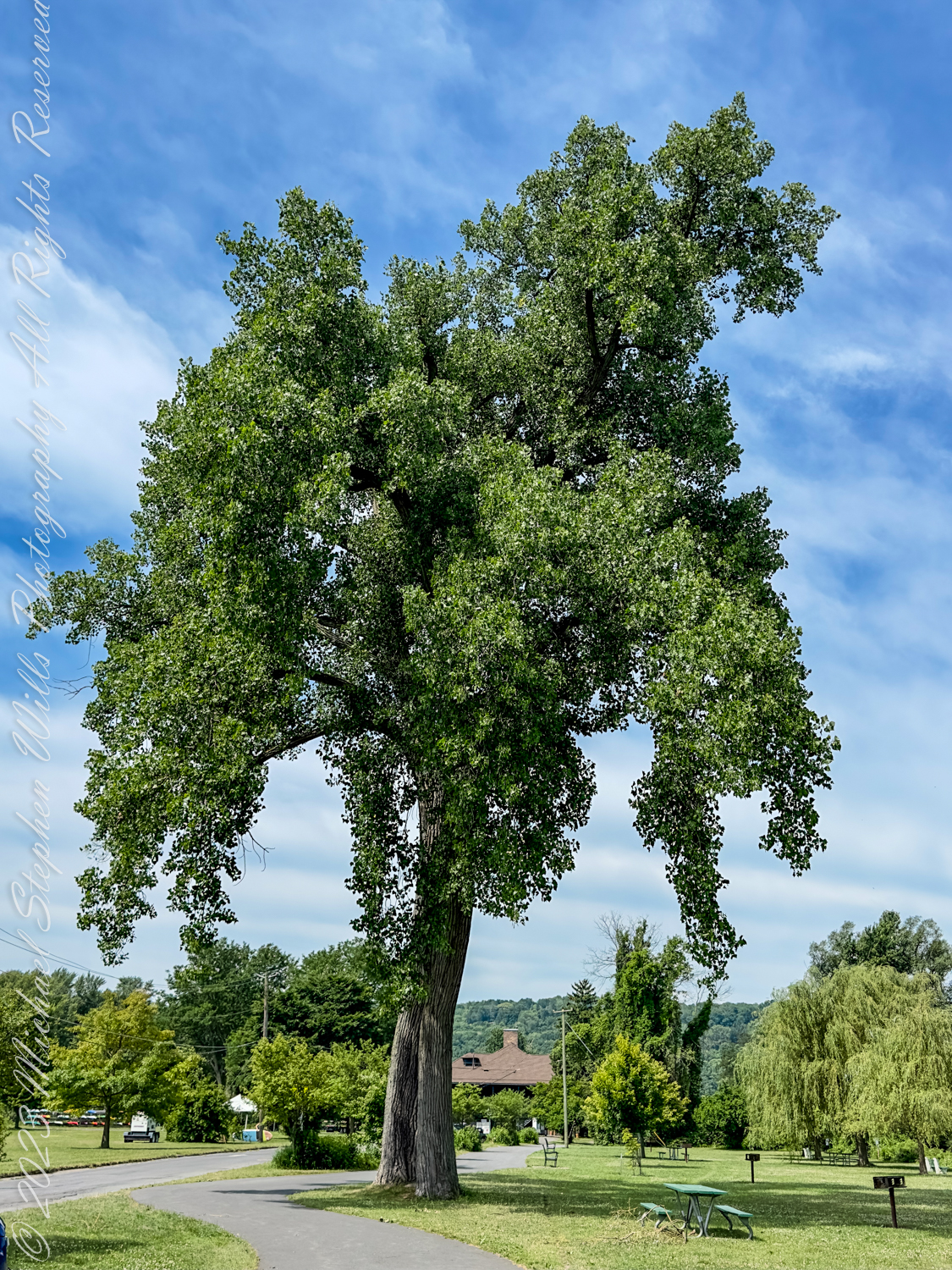
View Facing West, June 25, 2024

The path doesn’t cut through or impose upon these trees. Instead, it respects their claim to the land, curving around them in a way that feels organic, almost reverent. The roots of these Cottonwoods must reach far beyond what I can see, extending outward in all directions beneath the soil, beneath the path itself. It’s as though the trees and the human-made elements of the park have reached a compromise—a harmonious balance where both can coexist without either having to sacrifice too much.

In their wisdom, the planners of this park understood that these trees had already laid their claim long before the park’s paths were laid out. It’s a small but profound testament to the enduring power of nature and the foresight of those who designed this space. As I walk along the path, I feel the subtle shift in the landscape—the way the curve of the trail encourages a more leisurely pace, inviting visitors to pause for a moment and take in the grandeur of these ancient trees.

The curve itself creates a sense of flow, as if the path is gently nudging us toward a deeper appreciation of the Cottonwoods. There’s no rush here. The trees stand in their place, rooted and steadfast, while we are invited to move around them, to change our course slightly in order to make space for something larger than ourselves. The path becomes a metaphor for our relationship with nature—we must sometimes bend and yield to its greater forces, rather than insist on our own straight and rigid lines.

This curved path speaks to the broader theme of adaptability—how both nature and humanity have learned to accommodate one another. The Cottonwoods have withstood the test of time, their roots dug deep into the soil, while we have found ways to move alongside them, adjusting our course to allow for their growth. It’s a quiet but powerful reminder of the importance of coexistence and respect, of making space for the natural world rather than always seeking to dominate it.

As we pass by, I notice the texture of their bark—deeply furrowed and rough, a tactile reminder of the passage of time. Each ridge and crevice holds the story of countless seasons—of dry summers, harsh winters, and everything in between. I reach out and touch one of the trunks, feeling the coolness of the bark under my hand. There’s a vitality here that can only be sensed up close, a quiet hum of life that pulses just beneath the surface.

Yet, despite their imposing size and age, the Cottonwoods remain humble in their role. They do not demand attention like a flowering dogwood or a brightly colored maple. Instead, they offer something more enduring—a quiet, steady presence that provides shelter and shade without fanfare. Their leaves turn a brilliant yellow in autumn, adding to the kaleidoscope of colors that make up the Finger Lakes’ fall landscape. But even in winter, when the leaves are gone, their bare branches stand against the cold sky, offering a stark beauty all their own.

As I step back to take in the full view of these two Cottonwoods, I am filled with a sense of gratitude. Their lives, so intimately tied to this place, remind me of the interconnectedness of all living things—the way nature, time, and humanity overlap in ways both seen and unseen. These trees, growing together on the shores of Cayuga Lake, are not just part of the landscape—they are part of the story of Stewart Park and, in a broader sense, the story of this region. They remind me that, like them, we are all shaped by our surroundings, by the people and places that stand beside us as we grow. And in that way, we are never truly alone.

Copyright 2024 Michael Stephen Wills All Rights Reserved

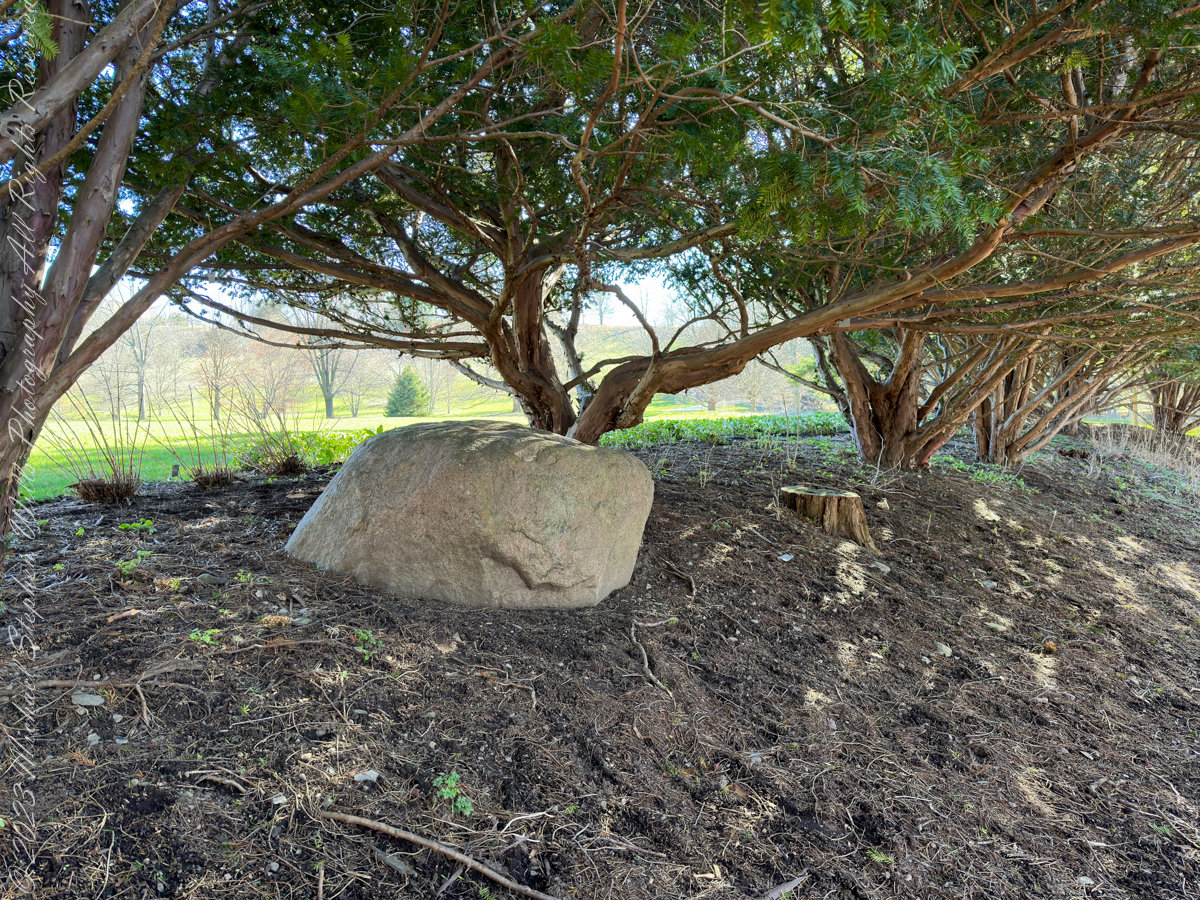
Glacial Erratic, unremarked

This maple tree is one of the first plants to flower in spring.

Pam and I ambled around the Arboretum for our Easter 2023 outing.

Click Me for “Finger Lakes Memories” my online gallery.
All photography using the IPhone 14 ProMax triple camera, raw format, edited on the phone.

We find boulders of crystalline rock, commonly derived from Adirondack sources, left behind on the surface of ablation moraine, in the Finger Lakes Region.

Cornell finds some and move them, maybe the case for this unremarked erratic found along the Allen Trail of FR Newman Arboretum.

Another enormous erratic, brought in from the Sixmile Creek valley, was carved into a seat as a memorial to Professor R.S. Tarr who deciphered much of the glacial history of the Finger Lakes Region. Find it at the southwest corner of McCraw Hall on the Cornell University Campus.

History (from wikipedia)

During the 18th century, erratics were deemed a major geological paradox. Geologists identify erratics by studying the rocks surrounding the position of the erratic and the rock of the erratic itself. Erratics were once considered evidence of a biblical flood, but in the 19th century scientists gradually came to accept that erratics pointed to an ice age in Earth’s past. Among others, the Swiss politician, jurist, theologian Bernhard Friedrich Kuhn [de] saw glaciers as a possible solution as early as 1788. However, the idea of ice ages and glaciation as a geological force took a while to be accepted. Ignaz Venetz (1788–1859), a Swiss engineer, naturalist and glaciologist was one of the first scientists to recognize glaciers as a major force in shaping the earth.

In the 19th century, many scientists came to favor erratics as evidence for the end of the Last Glacial Maximum (ice age) 10,000 years ago, rather than a flood. Geologists have suggested that landslides or rockfalls initially dropped the rocks on top of glacial ice. The glaciers continued to move, carrying the rocks with them. When the ice melted, the erratics were left in their present locations.

Charles Lyell’s Principles of Geology (v. 1, 1830) provided an early description of the erratic which is consistent with the modern understanding. Louis Agassiz was the first to scientifically propose that the Earth had been subject to a past ice age. In the same year, he was elected a foreign member of the Royal Swedish Academy of Sciences. Prior to this proposal, Goethe, de Saussure, Venetz, Jean de Charpentier, Karl Friedrich Schimper and others had made the glaciers of the Alps the subjects of special study, and Goethe,[15] Charpentier as well as Schimper had even arrived at the conclusion that the erratic blocks of alpine rocks scattered over the slopes and summits of the Jura Mountains had been moved there by glaciers.

Charles Darwin published extensively on geologic phenomena including the distribution of erratic boulders. In his accounts written during the voyage of HMS Beagle, Darwin observed several large erratic boulders of notable size south of the Strait of Magellan, Tierra del Fuego and attributed them to ice rafting from Antarctica. Recent research suggests that they are more likely the result of glacial ice flows carrying the boulders to their current locations.

References:
The Finger Lakes Region: Its Origin and Nature,” O.D. von Engeln, Cornell University Press, 1961 page 106.
Wikipedia, “Glacial Erratics”
Copyright 2023 Michael Stephen Wills All Rights Reserved

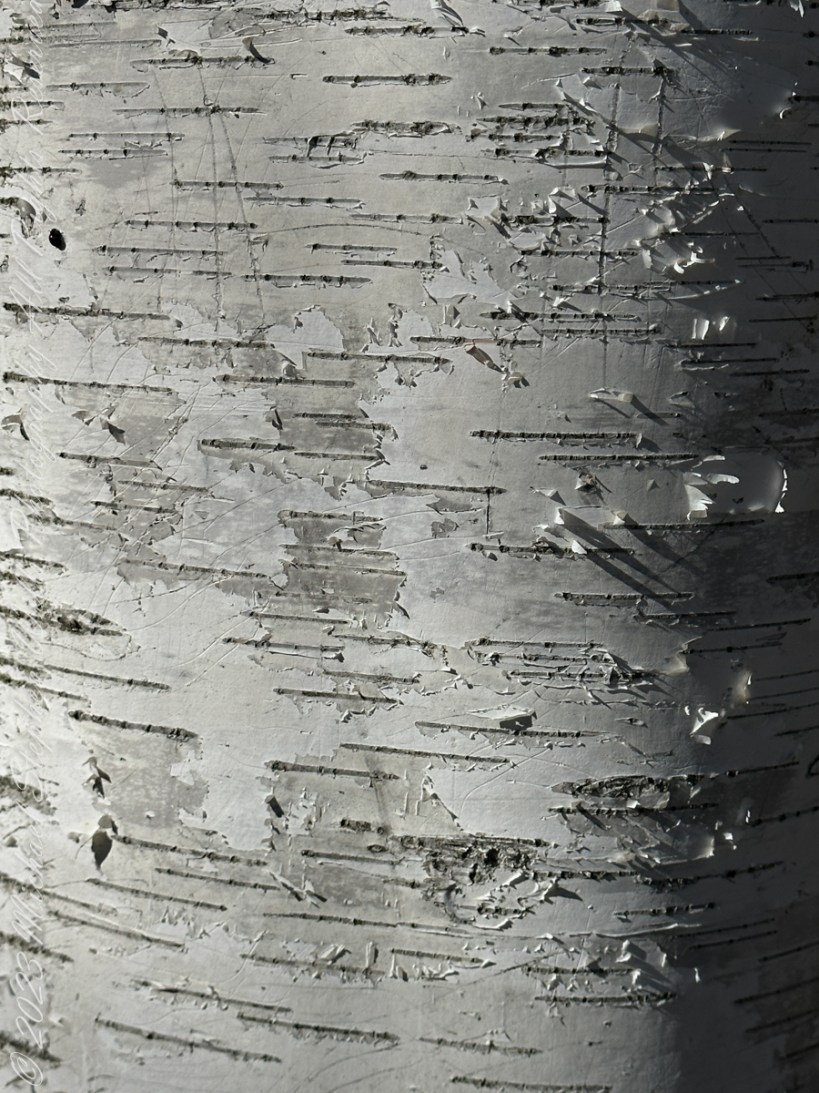
White Birch Bark

Also known as Canoe Birch

Pam and I ambled around the Arboretum for our Easter 2023 outing.

Click Me for “Finger Lakes Memories” my online gallery.
All photography using the IPhone 14 ProMax triple camera, raw format, edited on the phone.

Betula papyrifera, common names Paper Birch, (American) White Birch, Canoe Birch, is a short-lived species of birch native to northern North America. Paper birch is named for the tree’s thin white bark, which often peels in paper like layers from the trunk. Paper birch is often one of the first species to colonize a burned area within the northern latitudes and is an important species for moose browsing. The primary commercial uses for paper birch wood are boltwood and sawlogs, while secondary products include firewood and pulpwood. It is the provincial tree of Saskatchewan and the state tree of New Hampshire.

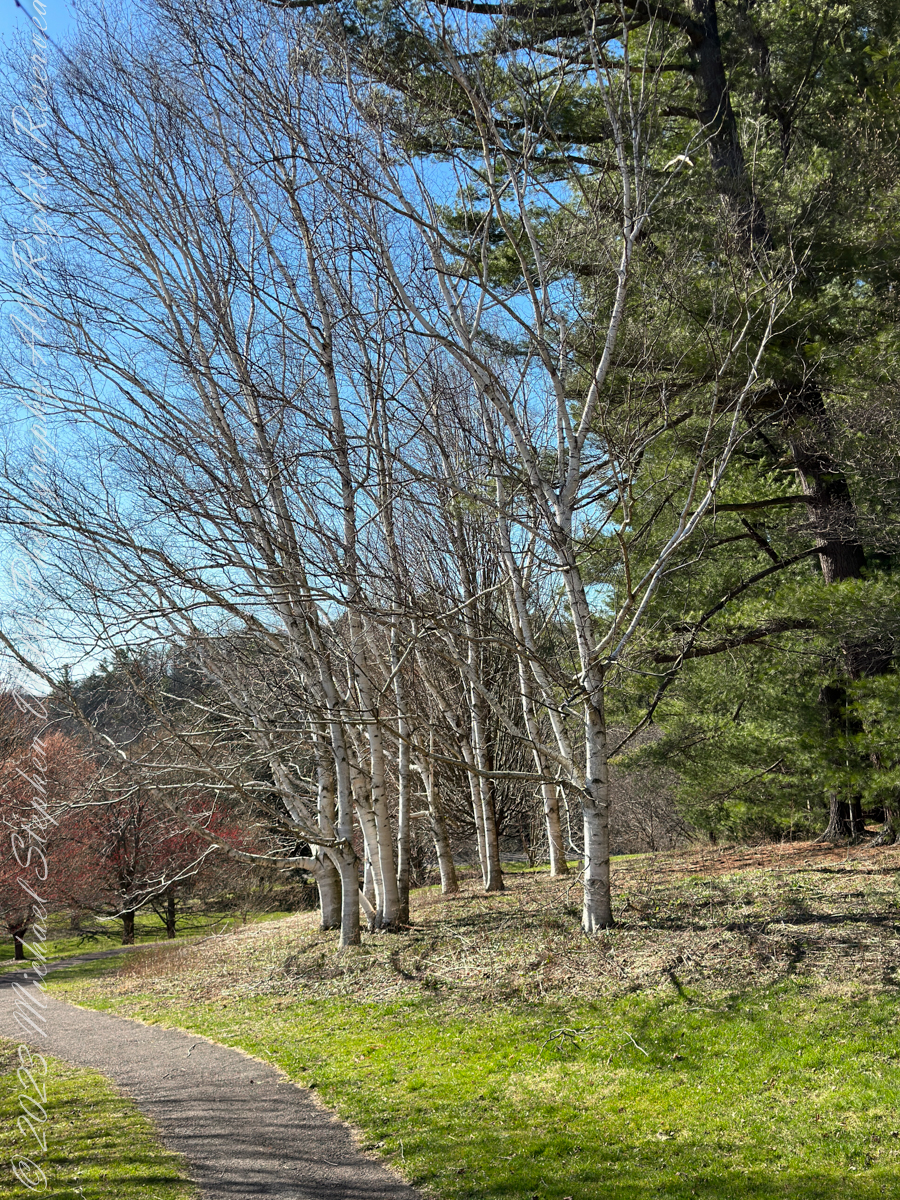
As you can see in the following photoghraph, Betula papyrifera is a medium-sized deciduous tree typically reaching 20 meters (66 feet) tall, and exceptionally to 40 m (130 ft) with a trunk up to 75 centimeters (30 inches) in diameter. Within forests, it often grows with a single trunk but when grown as a landscape tree it may develop multiple trunks or branch close to the ground.

Paper birch is a typically short-lived species. It handles heat and humidity poorly and may live only 30 years in zones six and up, while trees in colder-climate regions can grow for more than 100 years. Betula papyrifera will grow in many soil types, from steep rocky outcrops to flat muskegs of the boreal forest. Best growth occurs in deeper, well drained to dry soils, depending on the location.

White Birch is a pioneer species, meaning it is often one of the first trees to grow in an area after other trees are removed by some sort of disturbance. Typical disturbances colonized by paper birch are wildfire, avalanche, or windthrow areas where the wind has blown down all trees. When it grows in these pioneer, or early successional, woodlands, it often forms stands of trees where it is the only species, a feature emulated in this Cornell Botanical Garden planting. Paper Birch is considered well adapted to fires because it recovers quickly by means of reseeding the area or regrowth from the burned tree. The lightweight seeds are easily carried by the wind to burned areas, where they quickly germinate and grow into new trees. Paper birch is adapted to ecosystems where fires occur every 50 to 150 years for example, it is frequently an early invader after fire in black spruce boreal forests. As paper birch is a pioneer species, finding it within mature or climax forests is rare because it will be overcome by trees that are more shade tolerant as secondary succession progresses.

For example, in Alaskan boreal forests, a paper birch stand 20 years after a fire may have 3,000–6,000 trees per acre (7,400–14,800/ha), but after 60 to 90 years, the number of trees will decrease to 500–800 trees per acre (1,200–2,000/ha) as spruce replaces the birch. After approximately 75 years, the birch will start dying and by 125 years, most paper birch will have disappeared unless another fire burns the area.

Paper birch trees themselves have varied reactions to wildfire. A group, or stand, of paper birch is not particularly flammable. The canopy often has a high moisture content, the understory is often lush green. As such, conifer crown fires often stop once they reach a stand of paper birch or become slower-moving ground fires. Since these stands are fire-resistant, they may become seed trees to reseed the area around them that was burned. However, in dry periods, paper birch is flammable and will burn rapidly. As the bark is flammable, it often will burn and may girdle the tree.

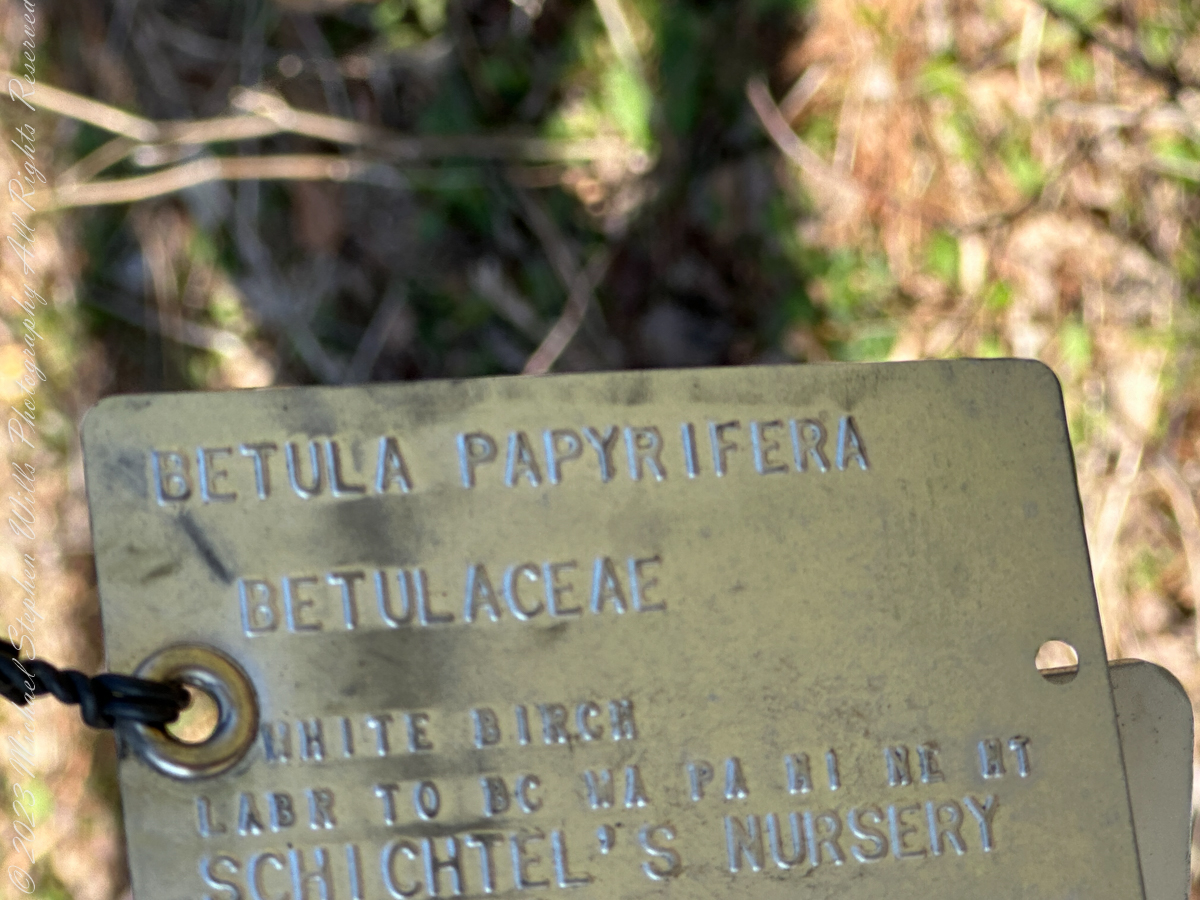
These metal tags are excellent signposts hanging from the branches on coated wire. Paper birch is a typically short-lived species. It handles heat and humidity poorly and may live only 30 years in zones six and up, while trees in colder-climate regions can grow for more than 100 years. Betula papyrifera will grow in many soil types, from steep rocky outcrops to flat muskegs of the boreal forest. Best growth occurs in deeper, well drained to dry soils, depending on the location.

In older trees, the bark is white, commonly brightly so, flaking in fine horizontal strips to reveal a pinkish or salmon-colored inner bark. It often has small black marks and scars. In individuals younger than five years, the bark appears a brown-red color with white lenticels, making the tree much harder to distinguish from other birches. The bark is highly weather-resistant. It has a high oil content; this gives it its waterproof and weather-resistant characteristics. Often, the wood of a downed paper birch will rot away, leaving the hollow bark intact.

Birch bark is a winter staple food for moose. The nutritional quality is poor because of the large quantities of lignin, which makes digestion difficult, but is important to wintering moose because of its sheer abundance. Moose prefer paper birch over aspen, alder, and balsam poplar, but they prefer willow (Salix spp.) over birch and the other species listed. Although moose consume large amounts of paper birch in the winter, if they were to eat only paper birch, they may starve.

Although white-tailed deer consider birch a “secondary-choice food,” it is an important dietary component. In Minnesota, white-tailed deer eat considerable amounts of paper birch leaves in the fall. Snowshoe hares browse paper birch seedlings, and grouse eat the buds.

Porcupines and beavers feed on the inner bark. The seeds of paper birch are an important part of the diet of many birds and small mammals, including chickadees, redpolls, voles, and ruffed grouse. Yellow bellied sapsuckers drill holes in the bark of paper birch to get at the sap; this is one of their favorite trees for feeding on.
As a species, Birches are commonly cultivated as fast-growing, graceful trees with ornamental bark.

The wood of Betula pendulas Roth. Is light and an excellent thermal insulator, so is used for the inside of saunas in Finland. The wood of Betula alleghaniensis is use for furniture, paneling, and plywood in North America.

Birch sap, collected in spring when it pours from the tree, can be used to make beer. Various species have been used medicinally, and Betula lenta was used as a source of oil of wintergreen, or methyl salicylate; American Indians used it to treat many ailments. Betulinic acid from the bark is reported to trigger cell death in melanomas in culture.

The bark of B papyrifera Marsh. Is waterproof and used for birch-bark canoes by American Indians, as well as for roofing in some parts of the world. Several species were used as paper, including Betula utilis, which has been found in the form of 1800-year-old Buddhist manuscripts in Afghanistan.

References:
“White Birch” Wikipedia
“Betula” from “The Botanical Garden I: Trees and Shrubs,” By Roger Phillips and Martyn Rix, Firefly Books, 2002 p123

Copyright 2023 Michael Stephen Wills All Rights Reserved

Red Maple Flowers

This maple tree is one of the first plants to flower in spring.

Pam and I ambled around the Arboretum for our Easter 2023 outing.

Click Me for “Finger Lakes Memories” my online gallery.

All photography using the IPhone 14 ProMax triple camera, raw format, edited on the phone.

Acer rubrum is one of the most abundant and widespread trees in eastern North America. It can be found from the south of Newfoundland, through Nova Scotia, New Brunswick, and southern Quebec to the southwest west of Ontario, extreme southeastern Manitoba and northern Minnesota; southward through Wisconsin, Illinois, Missouri, eastern Oklahoma, and eastern Texas in its western range; and east to Florida. It has the largest continuous range along the North American Atlantic Coast of any tree that occurs in Florida. In total it ranges 2,600 km (1,600 mi) from north to south. The species is native to all regions of the United States east of the 95th meridian. The tree’s range ends where the −40 °C (−40 °F) mean minimum isotherm begins, namely in southeastern Canada. A. rubrum is not present in most of the Prairie Peninsula of the northern Midwest (although it is found in Ohio), the coastal prairie in southern Louisiana and southeastern Texas and the swamp prairie of the Florida Everglades. Red maple’s western range stops with the Great Plains where conditions become too dry for it. The absence of red maple from the Prairie Peninsula is most likely due to the tree’s poor tolerance of wildfires. Red maple is most abundant in the Northeastern US, the Upper Peninsula of Michigan, and northeastern Wisconsin, and is rare in the extreme west of its range and in the Southeastern US.

On the arboretum northeast side is a collection of native maples, this Red Maple is represented caught our eye.

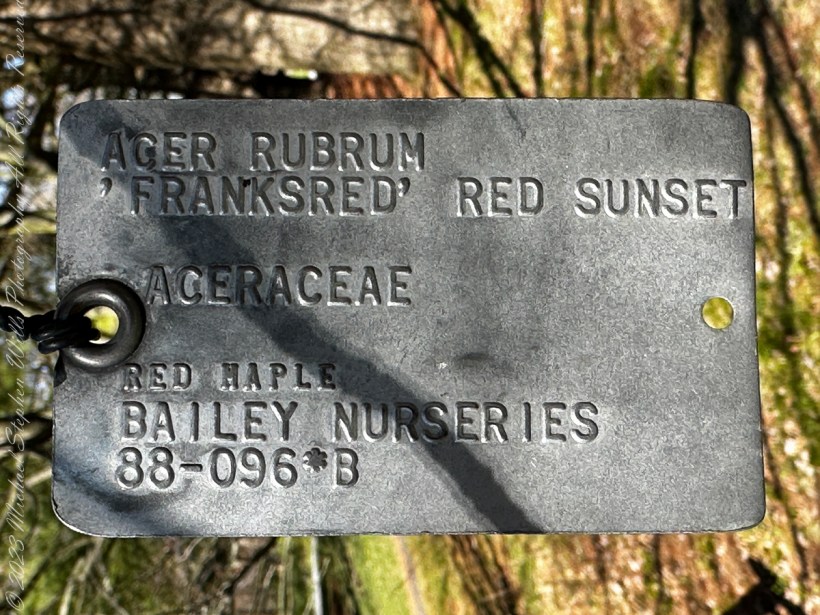
These metal tags are excellent signposts hanging from the branches on coated wire. Red maple’s maximum lifespan is 150 years, but most live less than 100 years. The tree’s thin bark is easily damaged from ice and storms, animals, and when used in landscaping, being struck by flying debris from lawn mowers, allowing fungi to penetrate and cause heart rot.[8] Its ability to thrive in many habitats is largely due to its ability to produce roots to suit its site from a young age. In wet locations, red maple seedlings produce short taproots with long, well-developed lateral roots; while on dry sites, they develop long taproots with significantly shorter laterals. The roots are primarily horizontal, however, forming in the upper 25 cm (9.8 in) of the ground. Mature trees have woody roots up to 25 m (82 ft) long. They are very tolerant of flooding, with one study showing that 60 days of flooding caused no leaf damage. At the same time, they are tolerant of drought due to their ability to stop growing under dry conditions by then producing a second-growth flush when conditions later improve, even if growth has stopped for 2 weeks.

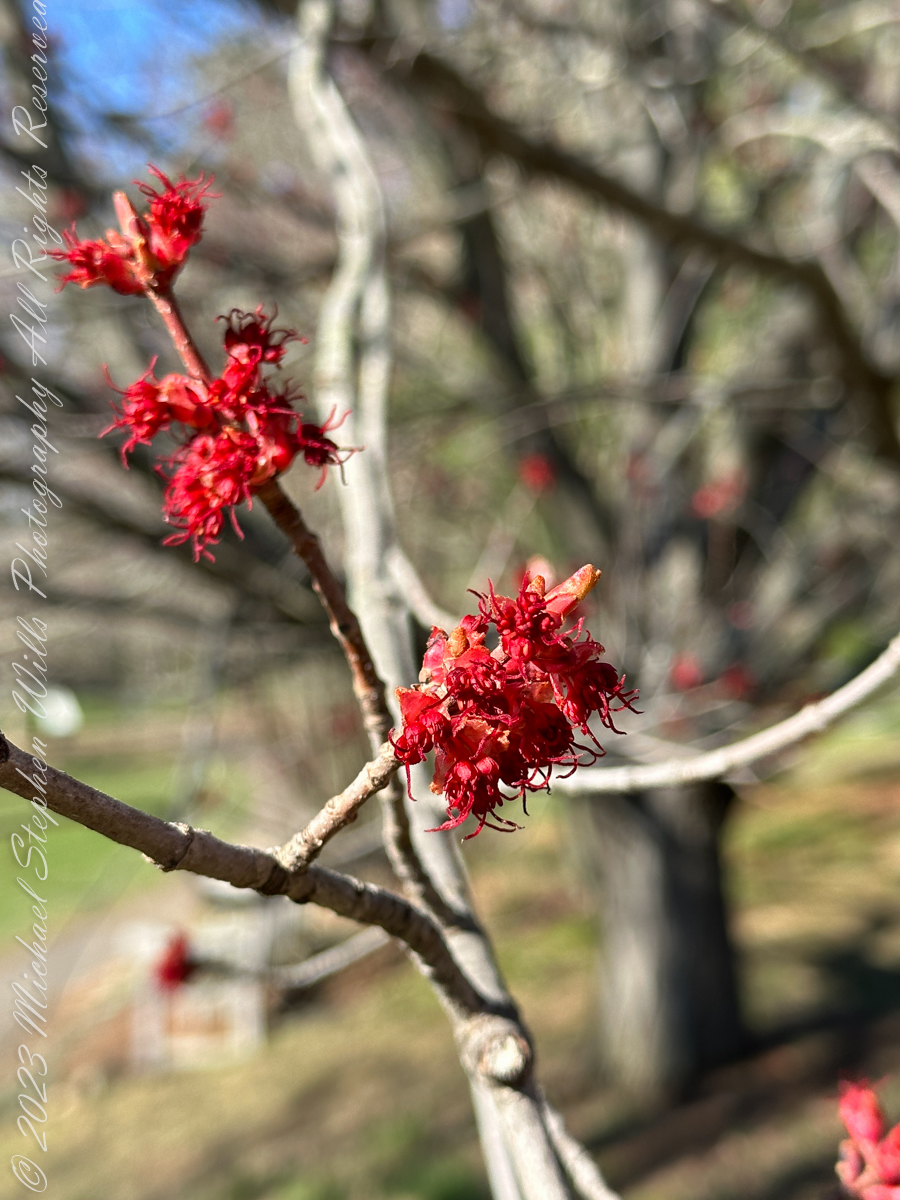
Acer rubrum is one of the first plants to flower in spring. A crop of seeds is generally produced every year with a bumper crop often occurring every second year. A single tree between 5 and 20 cm (2.0 and 7.9 in) in diameter can produce between 12,000 and 91,000 seeds in a season. A tree 30 cm (0.98 ft) in diameter was shown to produce nearly a million seeds. Red maple produces one of the smallest seeds of any of the maples. Fertilization has also been shown to significantly increase the seed yield for up to two years after application. The flowers are generally unisexual, with male and female flowers appearing in separate sessile clusters, though they are sometimes also bisexual. These pistillate (female) flowers have one pistil formed from two fused carpels with a glabrous superior ovary and two long styles that protrude beyond the perianth. These flowers were formed on the tree labeled “Frank’s Red.”

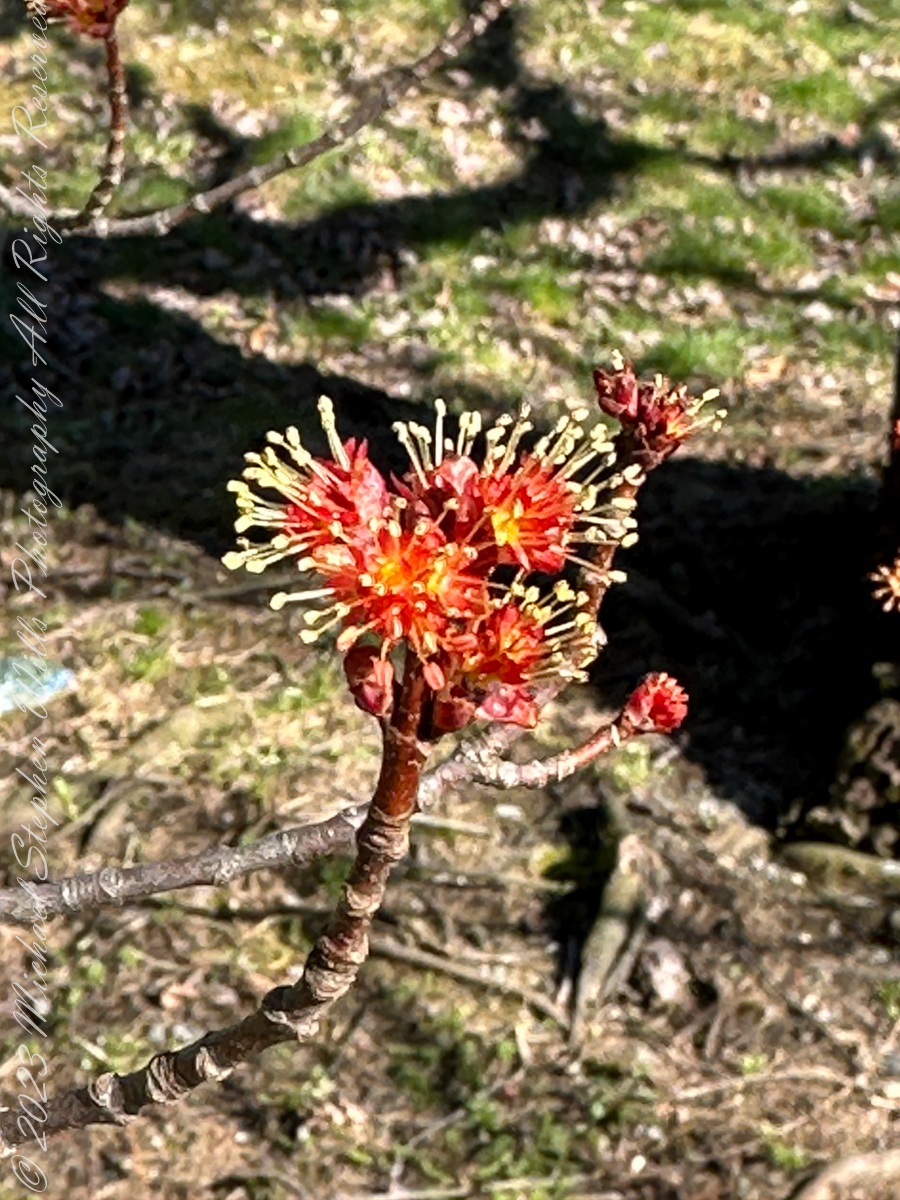
These staminate (male) flowers are sessile (grow direct from tip of branch without a stalk) containing between 4 and 12 stamens, often with 8. These seem to have 12 stamens.

The above flowers were formed on a “Schlesinger I” Red Maple Tree (see following lable).

Reference: “Red Maple” Wikipedia
Copyright 2023 Michael Stephen Wills All Rights Reserved

A large and varied genus

“Water Banana”

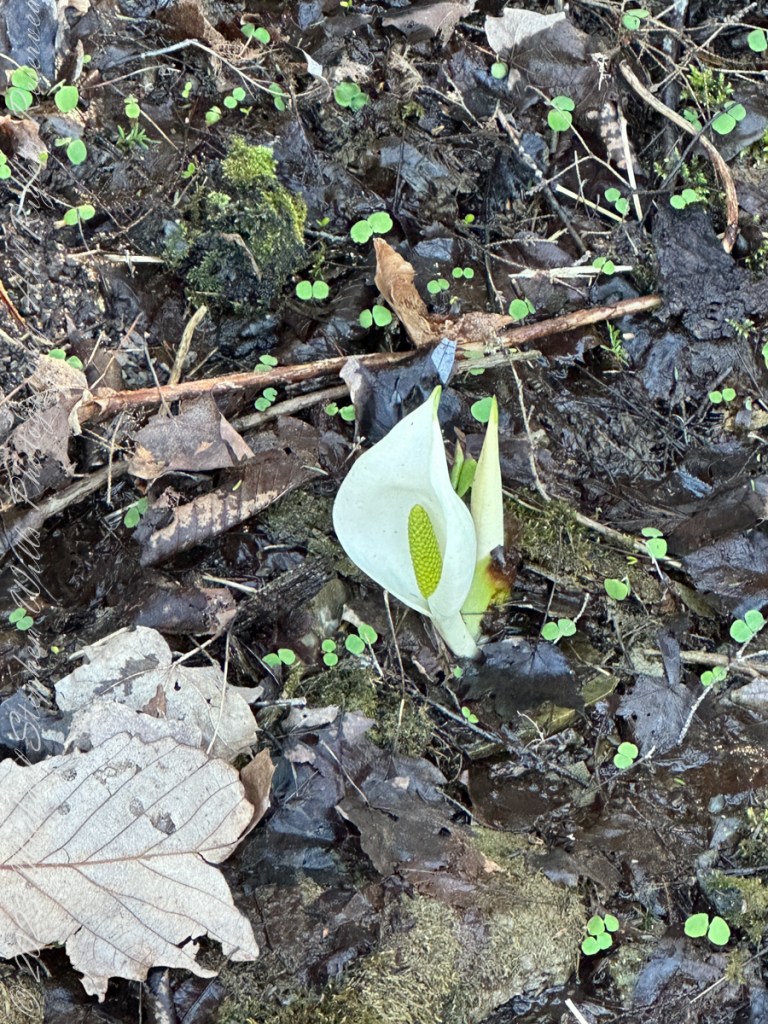
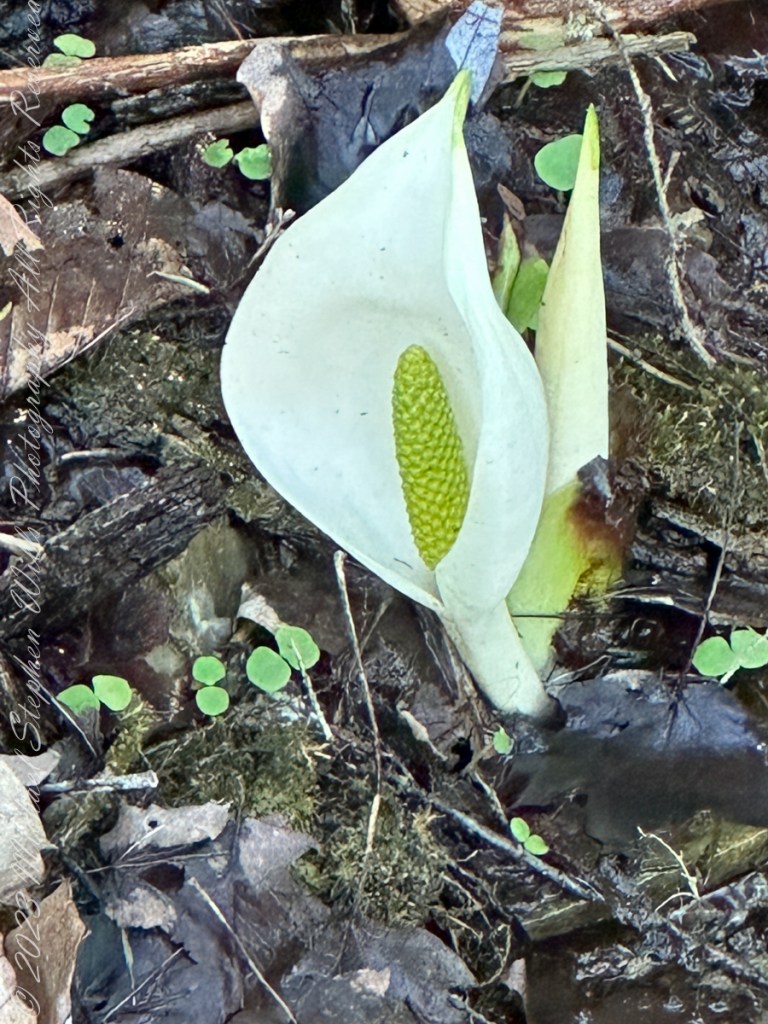
Pam and I ambled around the Arboretum for our Easter 2023 outing. We discovered this seeming lily growing from the muck along the Treman Woodland Walk. Scientific Name: Lysichiton camtschatcensis. Common names: Asian skunk cabbage, white skunk cabbage, Far Eastern swamp lantern or Japanese swamp lantern.

This is a plant found in swamps and wet woods, along streams and in other wet areas of the Kamchatka Peninsula, the Kuril Islands, Sakhalin and northern Japan. The common name “skunk cabbage” is used for the genus Lysichiton, which includes Lysichiton americanus, the western skunk cabbage, noted for its unpleasant smell. The Asian skunk cabbage is more variable: plants have been reported in different cases to smell disgusting, not at all, and sweet.

Click Me for “Finger Lakes Memories” my online gallery.

All photography using the IPhone 14 ProMax triple camera, raw format, edited on the phone.

In Japanese it is known as mizubashō (lit. “water-banana”) from a supposed similarity to the Japanese banana, a name with poetic rather than malodorous associations. It is not closely related to the true cabbage.

Copyright 2023 Michael Stephen Wills All Rights Reserved

Stone Bench Memorial

Old Testament

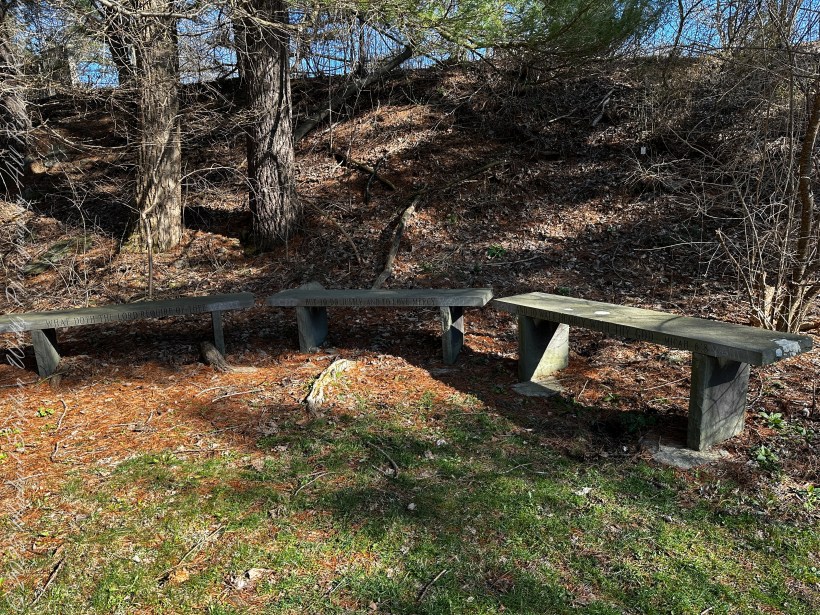
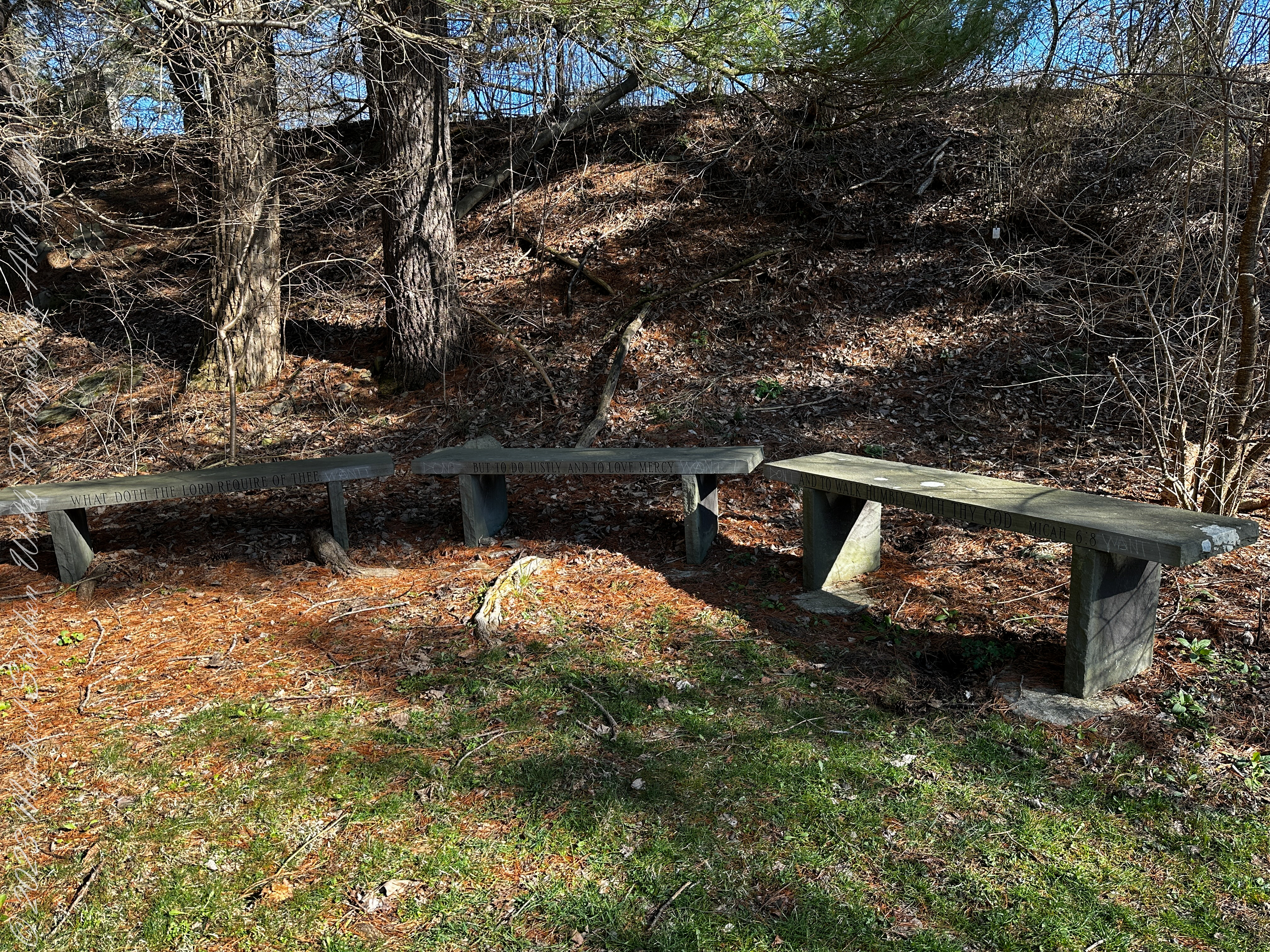
Pam and I ambled around the Arboretum for our Easter 2023 outing. We found a path new to us, with this memorial stone bench, a biblical quote engraved on the seats. Biblical Quote on bench: “What doth the lord require of thee / but to do justly and to love mercy / and to walk with thy god.” Micah 6:8

The Book of Micah is the sixth of the twelve minor prophets in the Hebrew Bible. Ostensibly, it records the sayings of Micah, whose name is Mikayahu (Hebrew: מִיכָיָ֫הוּ), meaning “Who is like Yahweh?”, an 8th-century BCE prophet from the village of Moresheth in Judah (Hebrew name from the opening verse: מיכה המרשתי). The book has three major divisions, chapters 1–2, 3–5 and 6–7, each introduced by the word “Hear,” with a pattern of alternating announcements of doom and expressions of hope within each division. Micah reproaches unjust leaders, defends the rights of the poor against the rich and powerful;[ while looking forward to a world at peace centered on Zion under the leadership of a new Davidic monarch. While the book is relatively short, it includes lament (1.8–16; 7.8–10), theophany (1.3–4), hymnic prayer of petition and confidence (7.14–20), and the “covenant lawsuit” (6.1–8), a distinct genre in which Yahweh (God) sues Israel for breach of contract of the Mosaic covenant.

Click Me for “Finger Lakes Memories” my online gallery.

All photography using the IPhone 14 ProMax triple camera, raw format, edited on the phone.

In the quote tract, (6:6–8), Micah speaks on behalf of the community asking what they should do in order to get back on God’s good side. Micah then responds by saying that God requires only “to do justice, and to love mercy, and to walk humbly with your God.” Thus declaring that the burnt offering of both animals and humans (which may have been practiced in Judah under Kings Ahaz and Manasseh) is not necessary for God.

Reference: “Micah” Wikipedia

Copyright 2023 Michael Stephen Wills All Rights Reserved

A Personable Tree

Gifts from the past

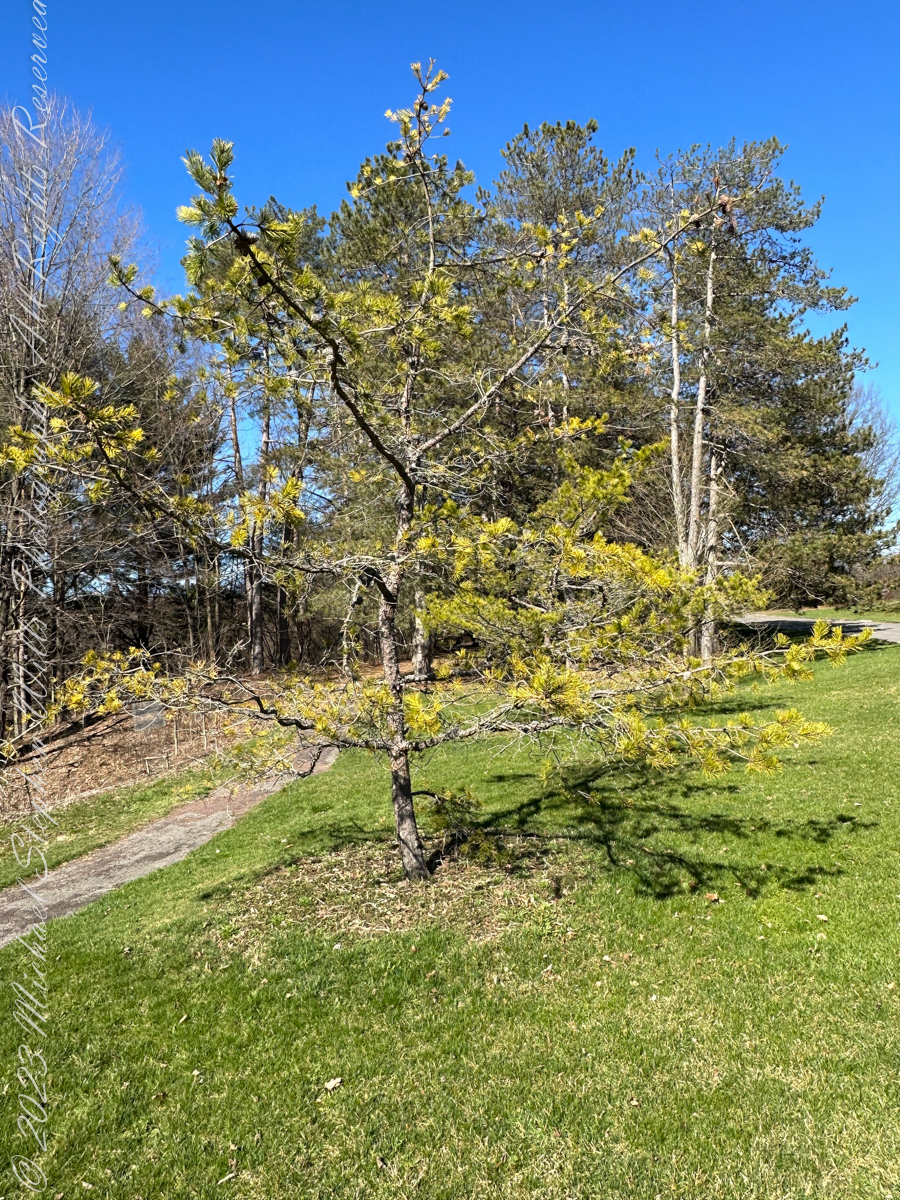
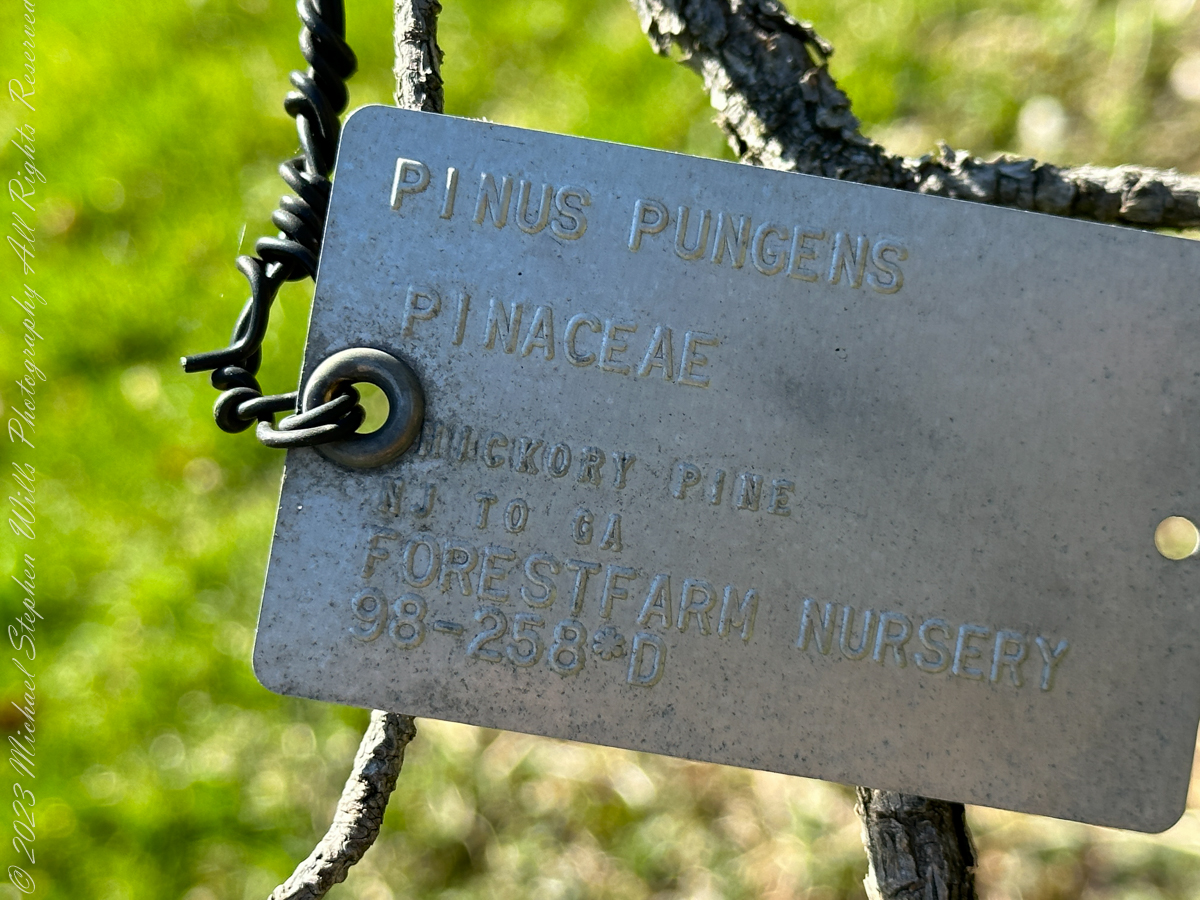
Pam and I ambled around the Arboretum for our Easter 2023 outing. Found here growing outside native range, being the Appalachian Mountains from Georgia to southern Pennsylvania, the Table Mountain Pine is named after the landform, not a particular mountain.

Click Me for “Finger Lakes Memories” my online gallery.

All photography using the IPhone 14 ProMax triple camera, raw format, edited on the phone.

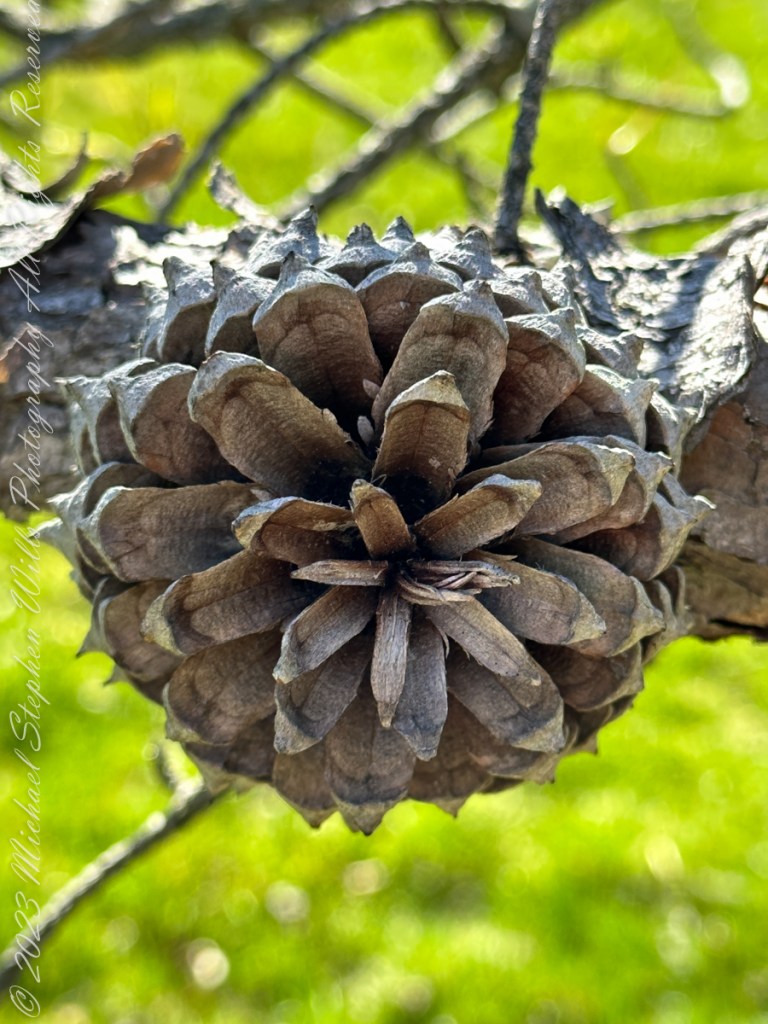
Its pinecones drew me to this scraggly, ungainly, poorly formed tree. All general mankind finds useful in the, scientific name, Pinus pungens, otherwise known as Hickory Pine, Prickly Pine and Mountain Pine, is to grind it up for pulp or chop it for tinder.

Last of the Mohicans

That said, the final scene of the 1992 film The Last of the Mohicans takes place in a nice Pinus pungens stand on a rocky mountaintop in North Carolina.

Personality

The tree has personality. Pinus pungens is the Lonesome Pine of the 1908 novel The Trail of the Lonesome Pine by John Fox, and popularized in the Laurel and Hardy film Way out West: “On the Blue Ridge Mountains of Virginia On the Trail of the Lonesome Pine” Several “Lonesome Pine” hiking trails have been waymarked in the Blue Ridge Mountains and elsewhere in the Appalachians.

Pinecone Bud

Pinus pungens prefers dry conditions and is mostly found on rocky slopes, favoring higher elevations, from 300–1,760 meters (980–5,770 ft) altitude. It commonly grows as single scattered trees or small groves, not in large forests like most other pines, and needs periodic disturbances for seedling establishment. The three tallest known ones are in Paris Mountain State Park, South Carolina; they are 26.85 to 29.96 meters (88 ft 1 in to 98 ft 4 in) tall.

Reference: “Pinus pungens” Wikipedia.

Copyright 2023 Michael Stephen Wills All Rights Reserved