Frabel’s Tower of Babel: A Modern Artistic Interpretation

At McKee Botanical Garden, the glass sculpture Tower captivates with its beauty, symbolizing unity amidst nature, blending art and environment.

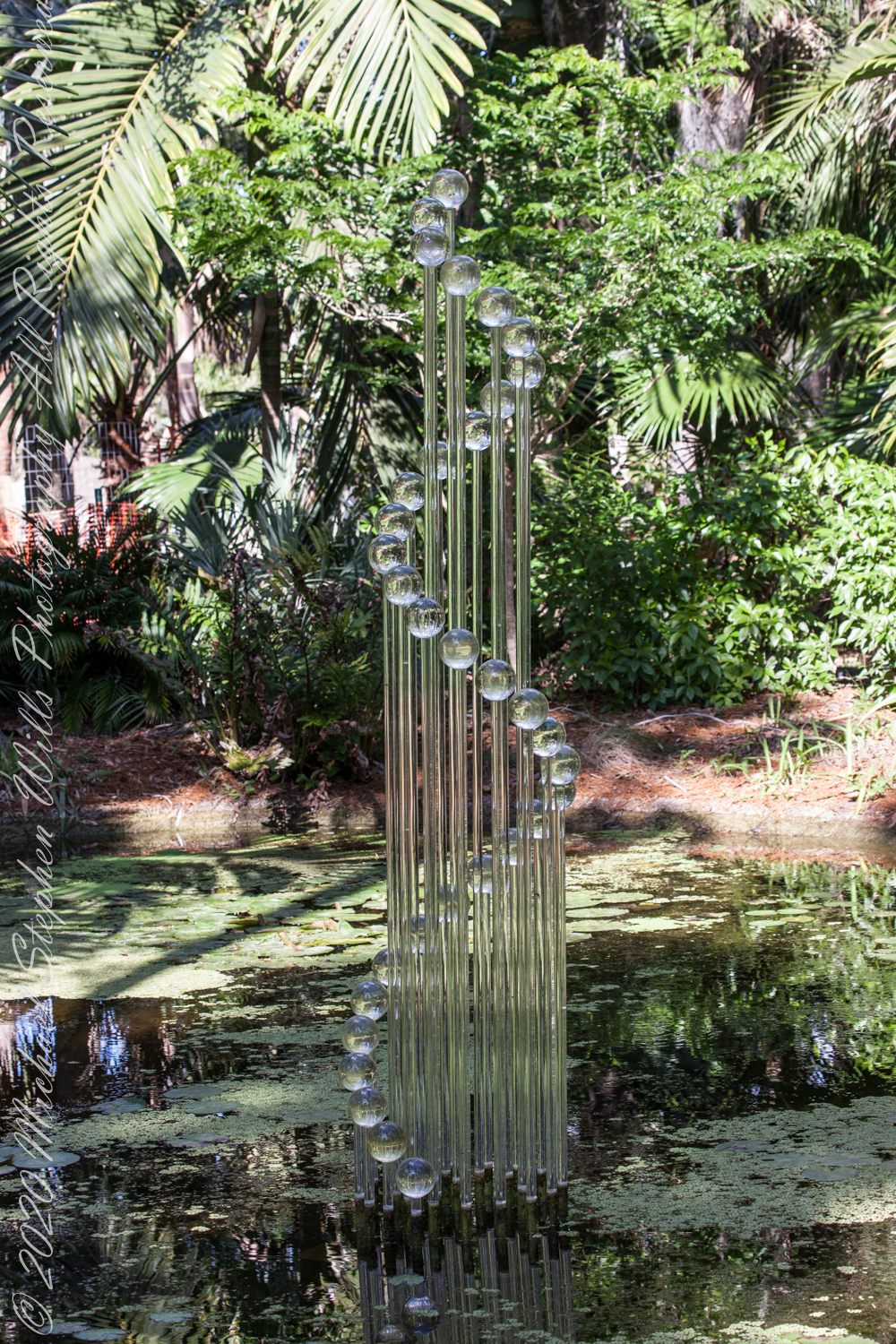
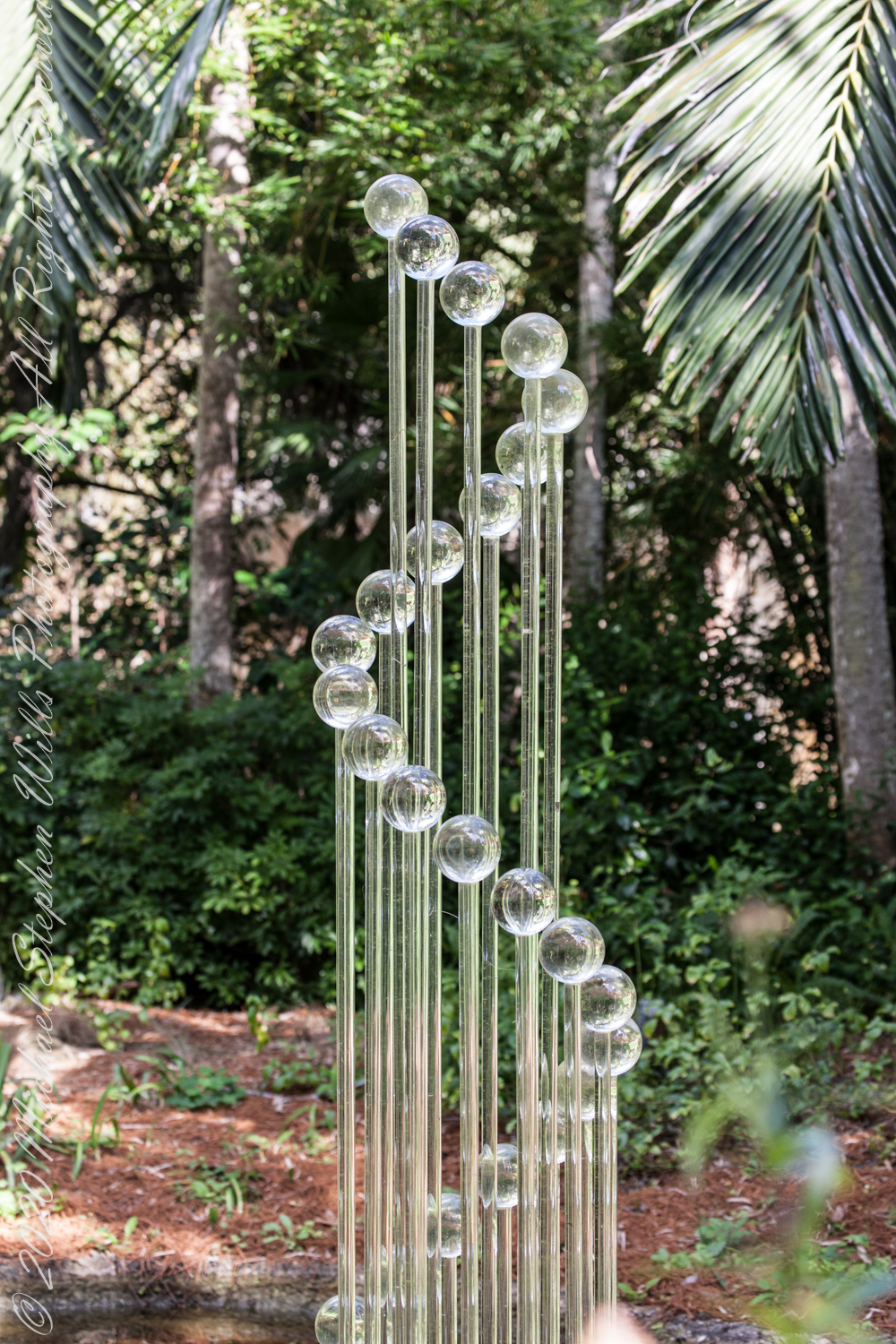
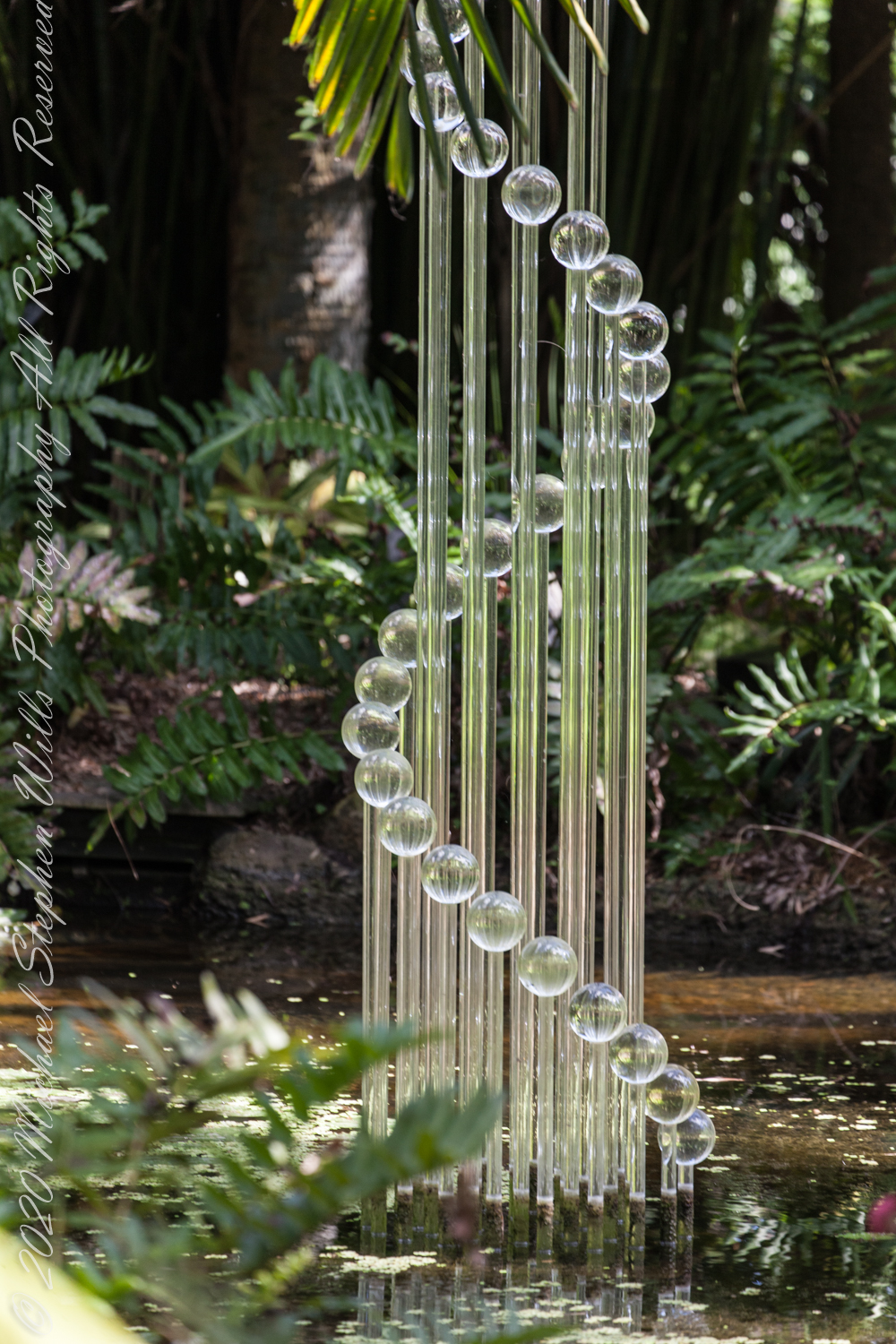
The air was crisp yet warmed by the steady rays of the January sun as I wandered through McKee Botanical Garden. The interplay of light and shadow danced across the palm fronds, creating an enchanting ambiance that whispered serenity. My pace slowed as I approached a reflective pond tucked away within this verdant sanctuary. There, shimmering like a fragment of the heavens brought to Earth, stood a glass sculpture titled Tower.

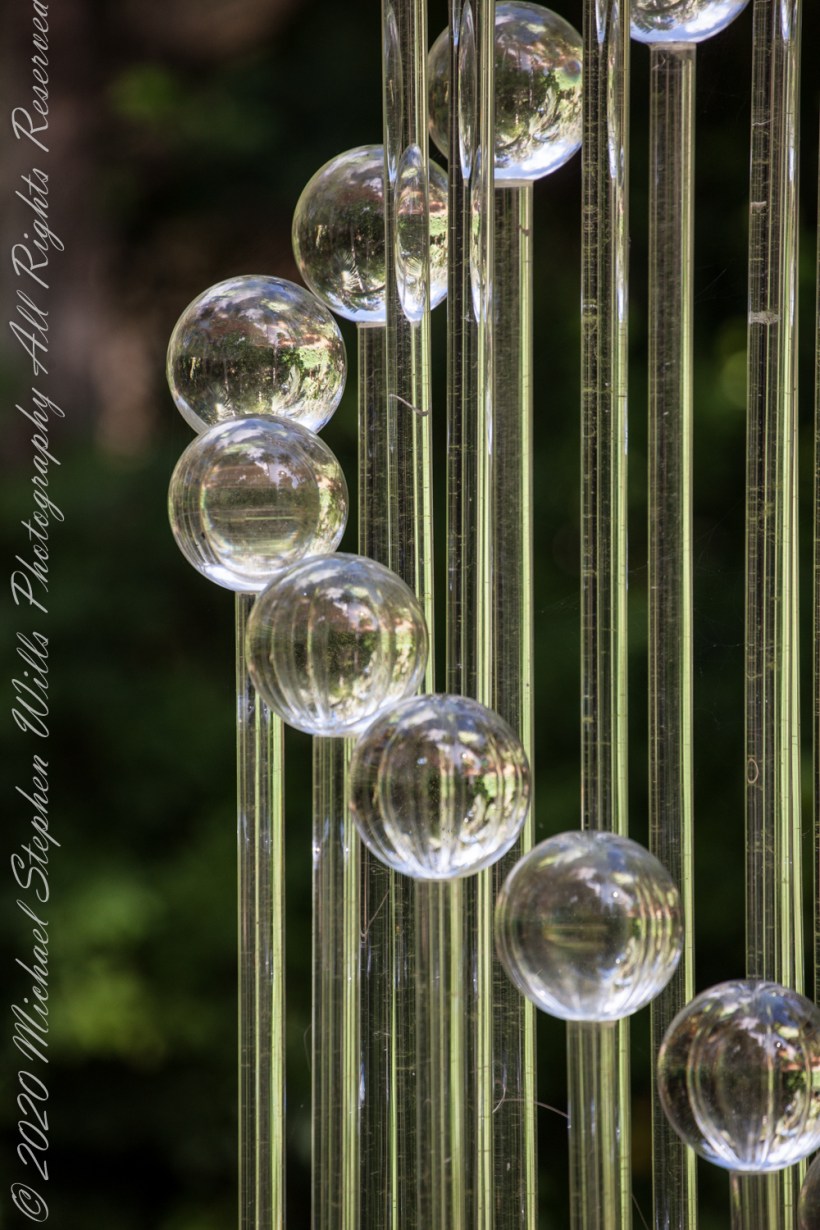
At first glance, the sculpture seemed ethereal, almost unreal—a spiral staircase to the skies crafted of crystalline spheres and slender rods. Its reflection on the water below doubled the dreamlike quality, as if the sculpture extended into an unseen realm. Upon closer inspection, I noticed the intricate craftsmanship of Hans Godo Fräbel, the sculptor whose genius birthed this luminous creation.

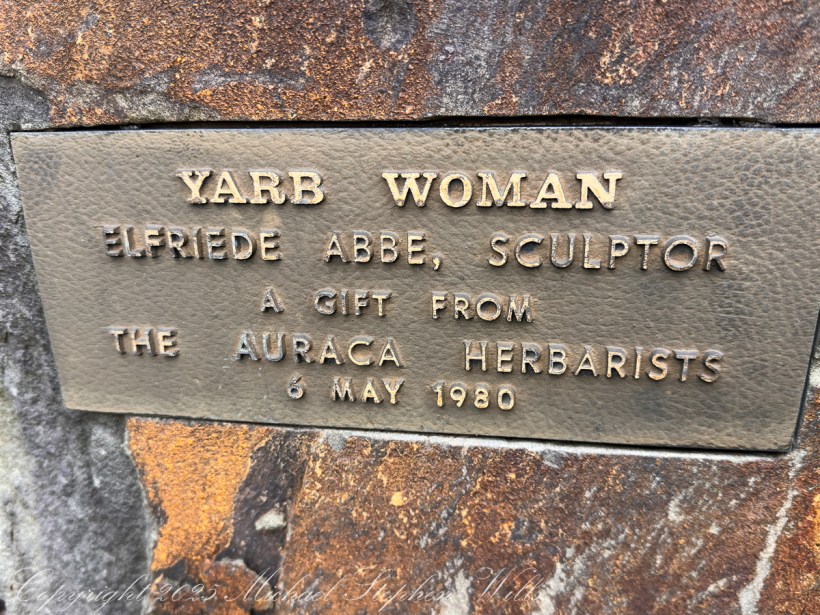
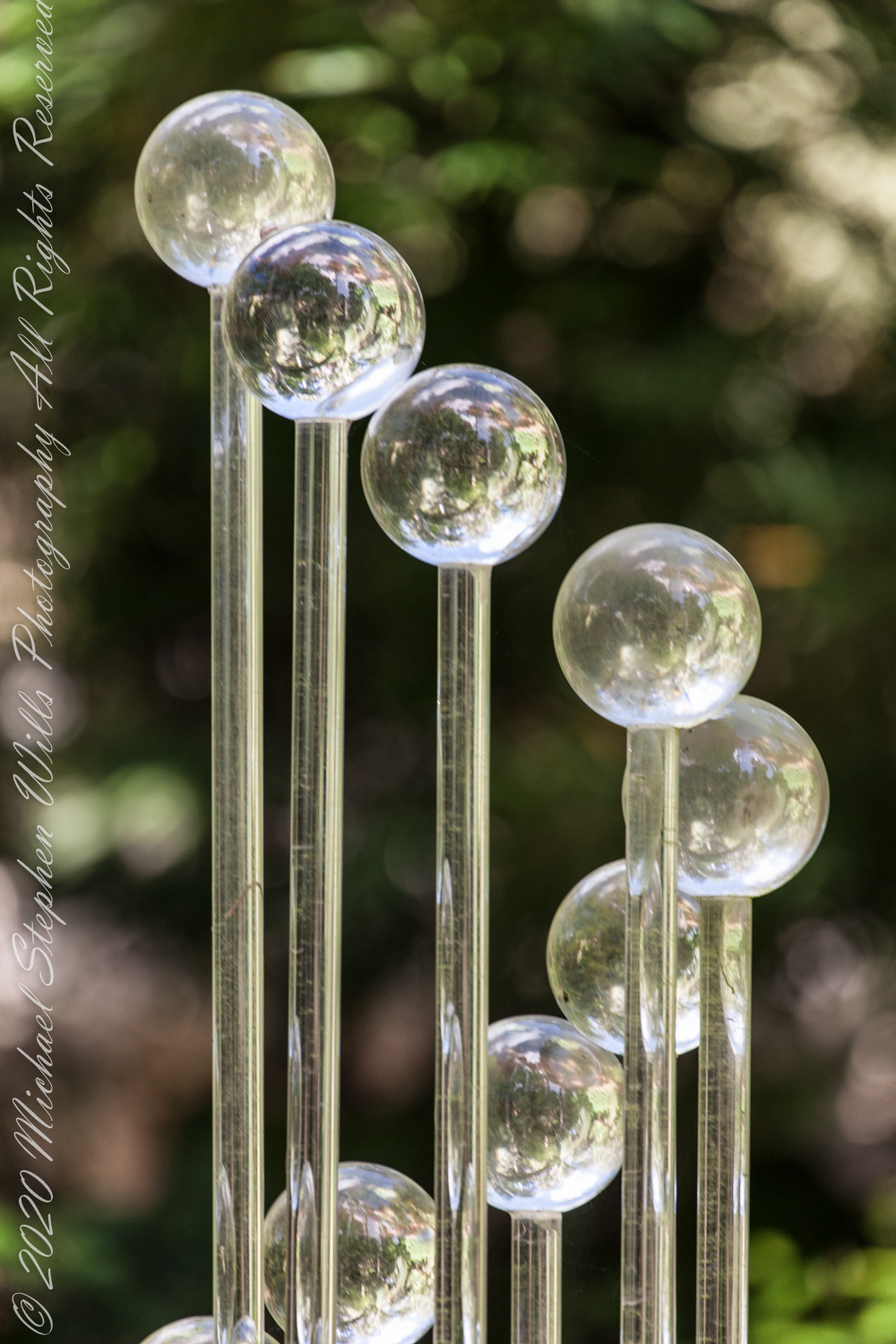
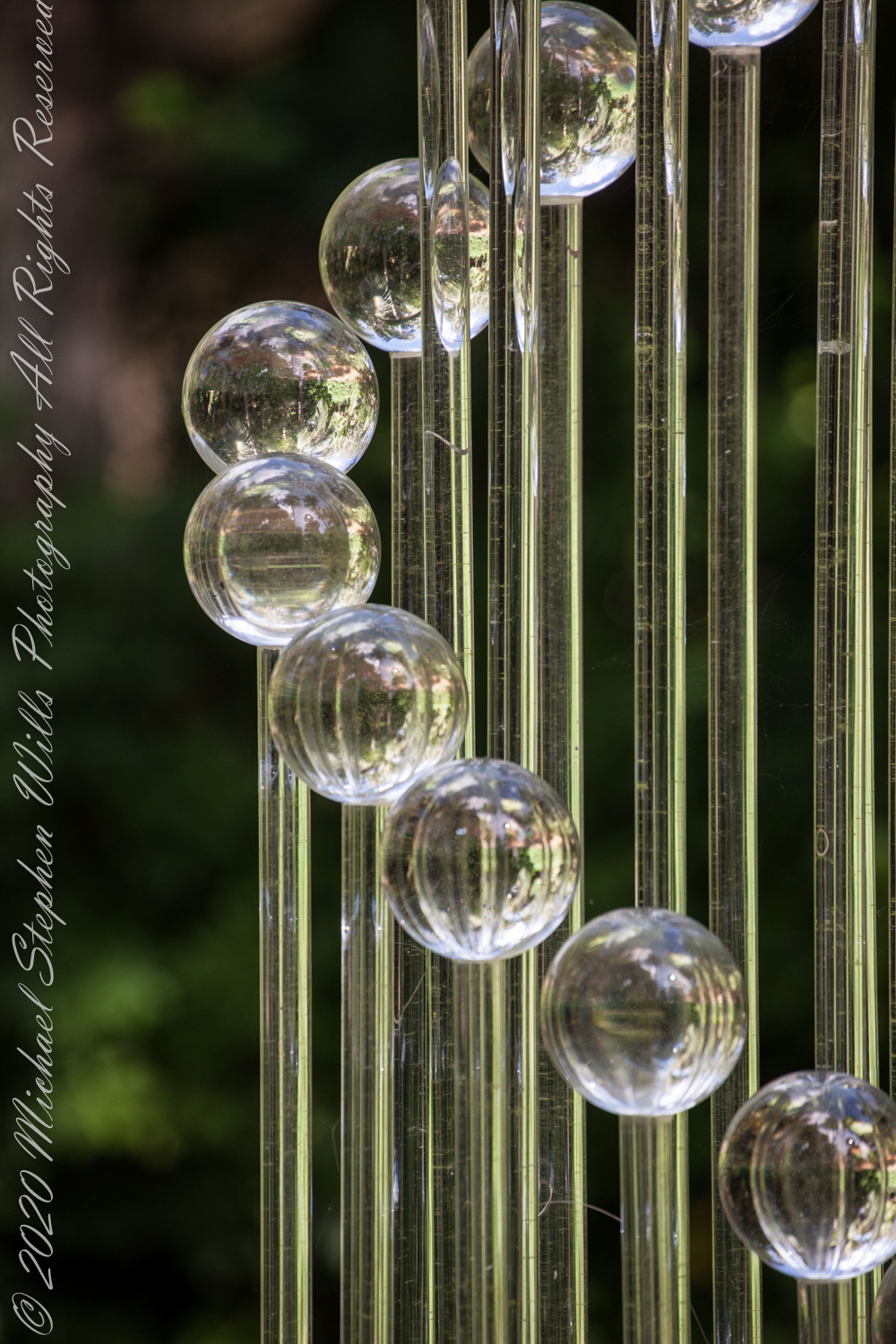
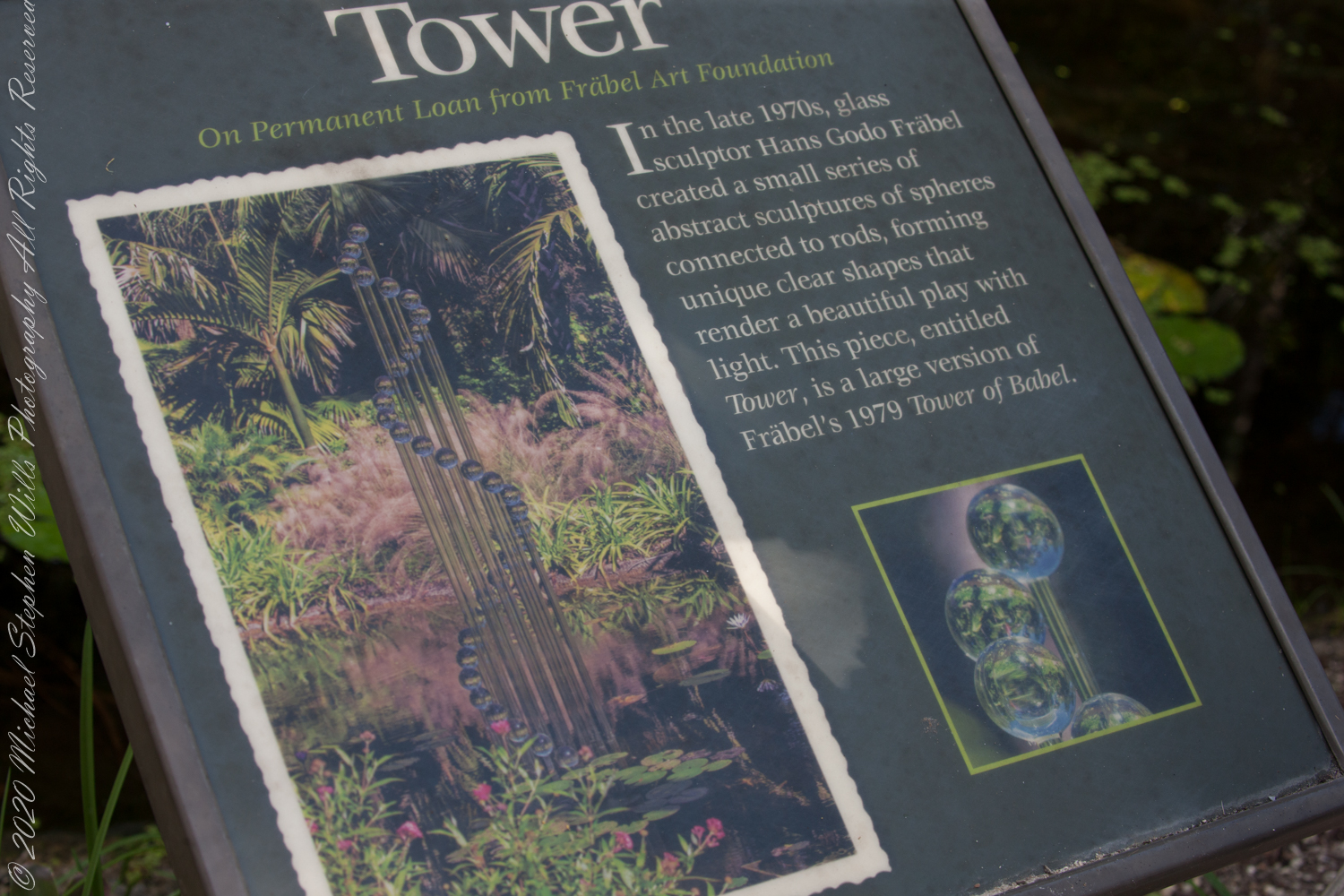
A nearby sign informed me that Tower is a larger version of Fräbel’s 1979 work Tower of Babel. It described how the sculpture’s glass rods and spheres were meticulously arranged to create abstract, clear shapes that play with light. Indeed, as the sun shifted overhead, the sculpture sparkled, refracting sunlight into tiny rainbows and revealing textures hidden within its transparent façade.

The setting amplified its majesty. Towering palm trees framed the sculpture, their dark green leaves offering a contrasting backdrop to the glass’s brilliance. Water lilies floated lazily on the pond’s surface, and an occasional ripple sent the reflection dancing. The combination of nature and art created an environment that felt both grounding and transcendent.

Standing before this masterpiece, I felt a profound connection to its narrative. The reference to the Tower of Babel resonated deeply. Here was a modern interpretation of an ancient story, one of human ambition and divine mystery, yet here it existed harmoniously in nature, not in defiance of it. The clear glass, fragile yet resilient, seemed to symbolize transparency and unity—a stark contrast to the biblical tale’s discord.

I lingered, watching how the sunlight flirted with the sculpture, how it cast prismatic shadows onto the surrounding foliage. Each sphere held reflections of the garden, tiny worlds encapsulated in glass, reminding me of the interconnectedness of all things. This moment, this meeting of human ingenuity and the natural world, felt timeless.

As I turned to leave, I glanced back one last time. The Tower stood resolute, a testament to creativity and a gentle reminder of the beauty that arises when humanity and nature coexist in harmony. It was an encounter that left me both inspired and at peace, grateful for the opportunity to witness such a sublime union of art and environment.

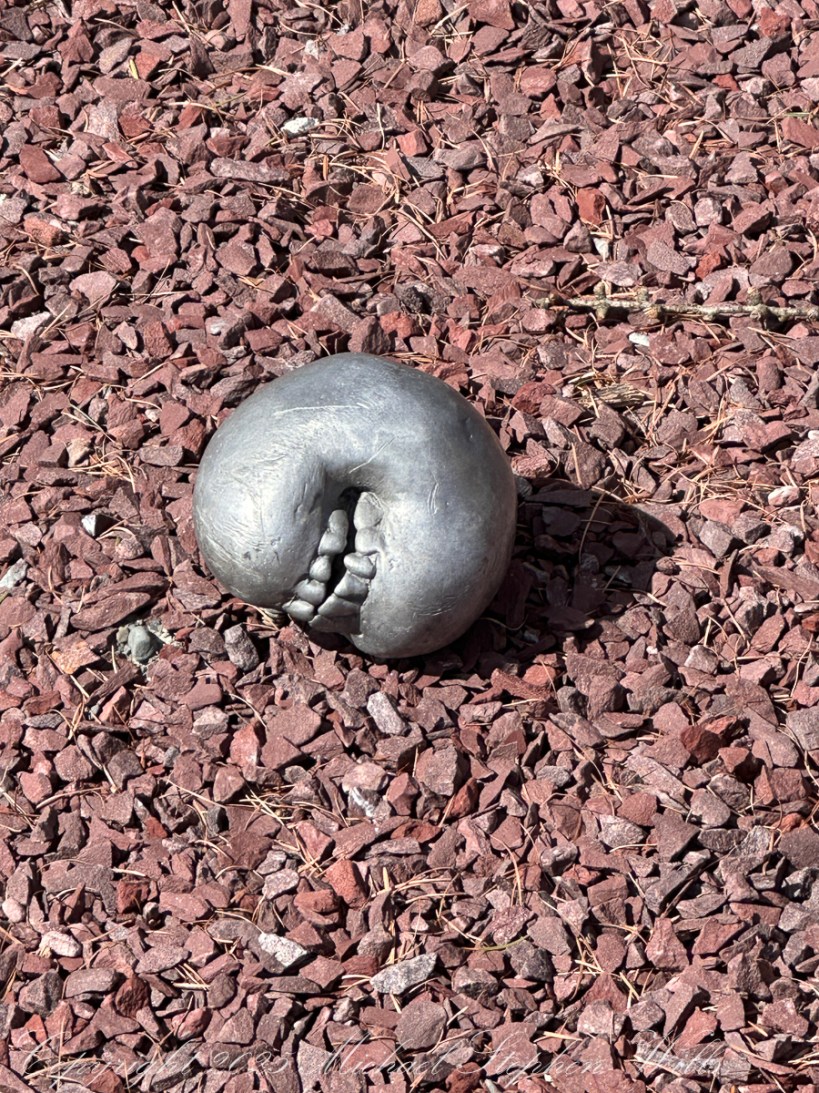
Click me for a dinosaur at McKee Gardens, Neovenator, teeth like steak knives

References: text is from the park placard with minor edits.

Enter your email to receive notification of future postings. I will not sell or share your email address.

Myth and Art: The Sirens of Punta de las Salinas

At Punta de las Salinas, Lily Perkins’ sculptures embody siren mythology, merging art with the rugged beauty of nature’s edge.

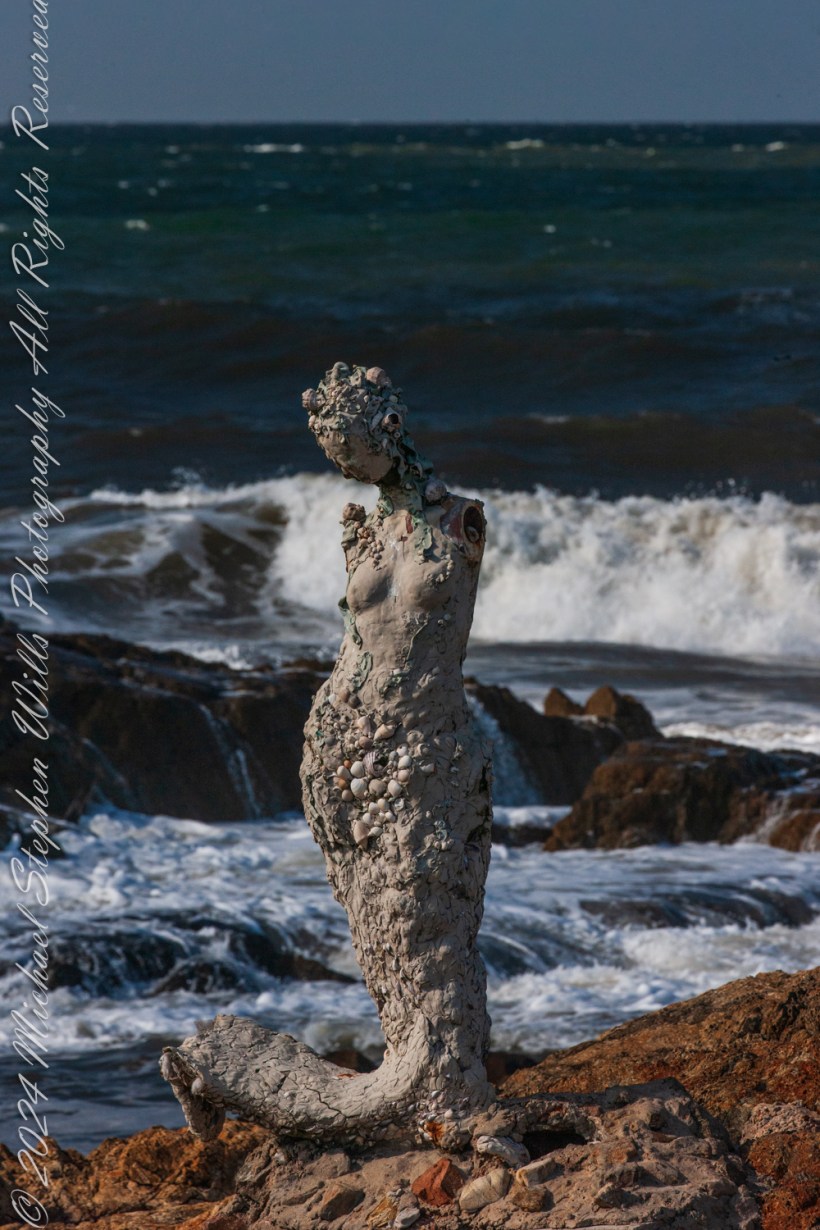
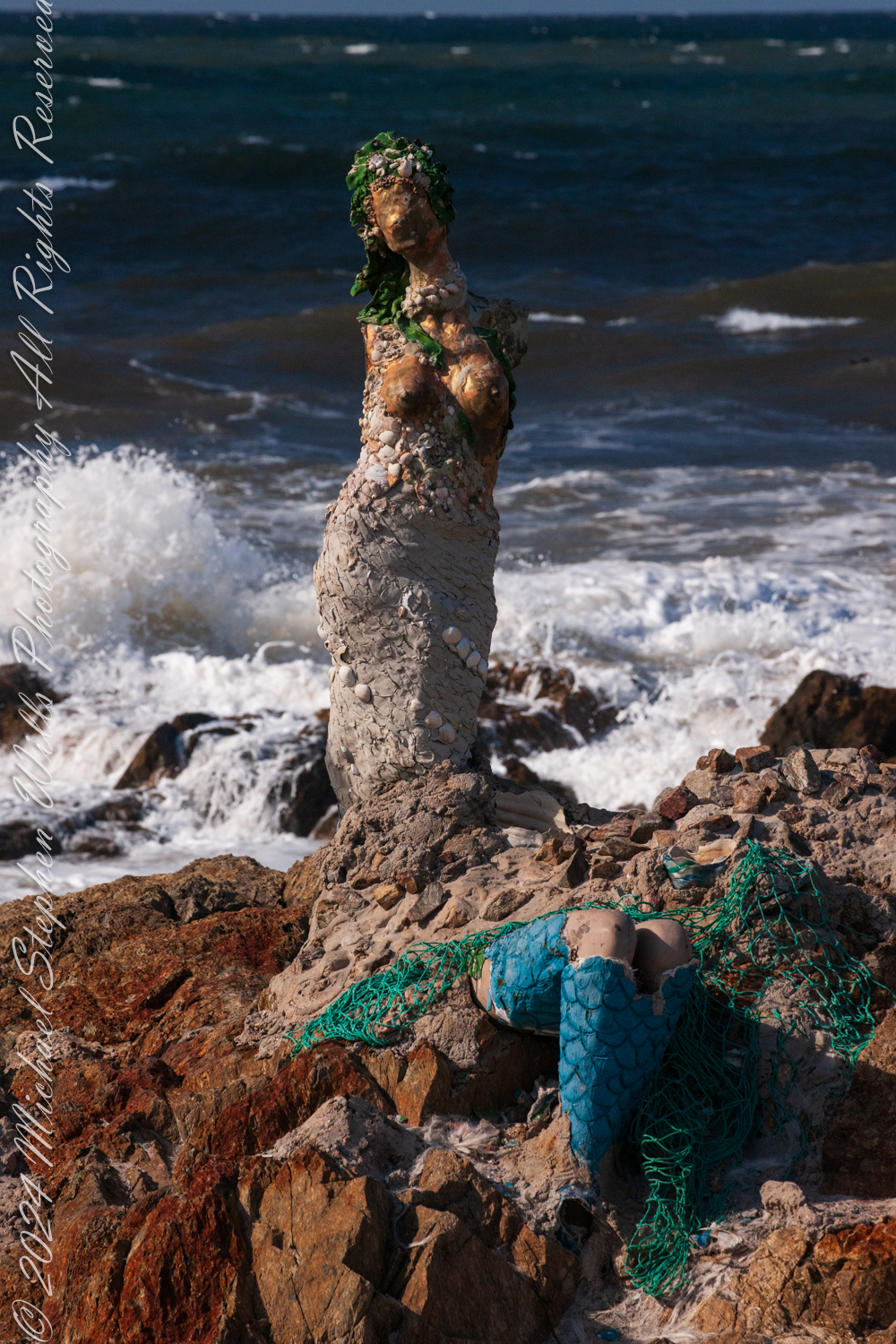
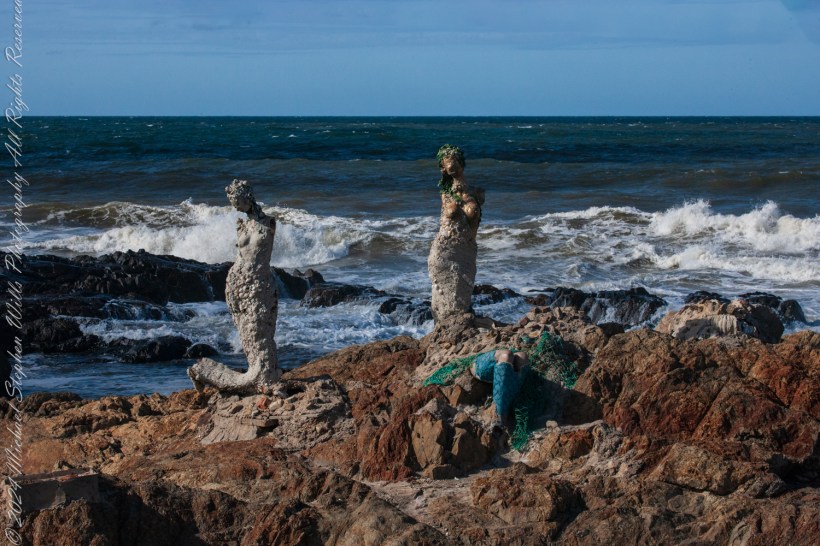
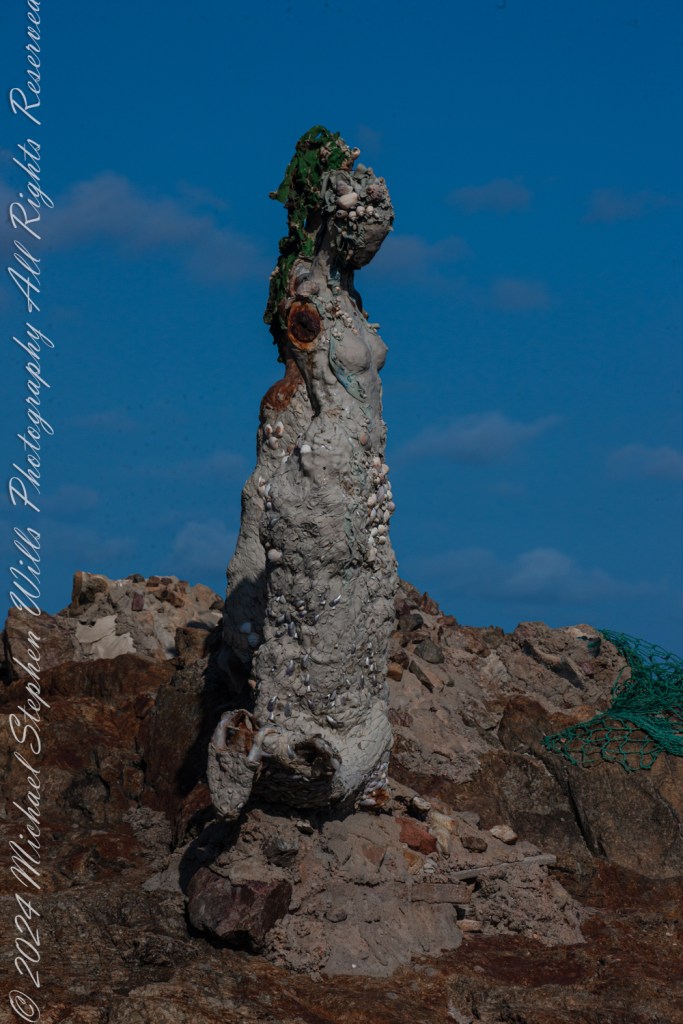
The wind carried the scent of the sea as we stood at Punta de las Salinas, the furthest tip of Punta del Este, Uruguay. This was a place of myth and mystery for us, where the Atlantic Ocean merged with the Río de la Plata, and where the rocks bore witness to the timeless interplay of water and stone. Here stood “El Canto de las Sirenas” (The Song of the Mermaids), an evocative art installation by Lily Perkins, first completed in 2012. The sculptures seemed perfectly at home here, their placement deeply intertwined with the mythology they evoked.

This is at Great Britain Square, Punta de las Salinas of Punta del Este. We are at the tip of the peninsula, the easternmost point of Uruguay. This is the art installation El Canto de las Sirenas” (The Song of the Mermaids) (2012) by the artist Lily Perkins. Punta del Este, Departamento de Maldonado, Uruguay

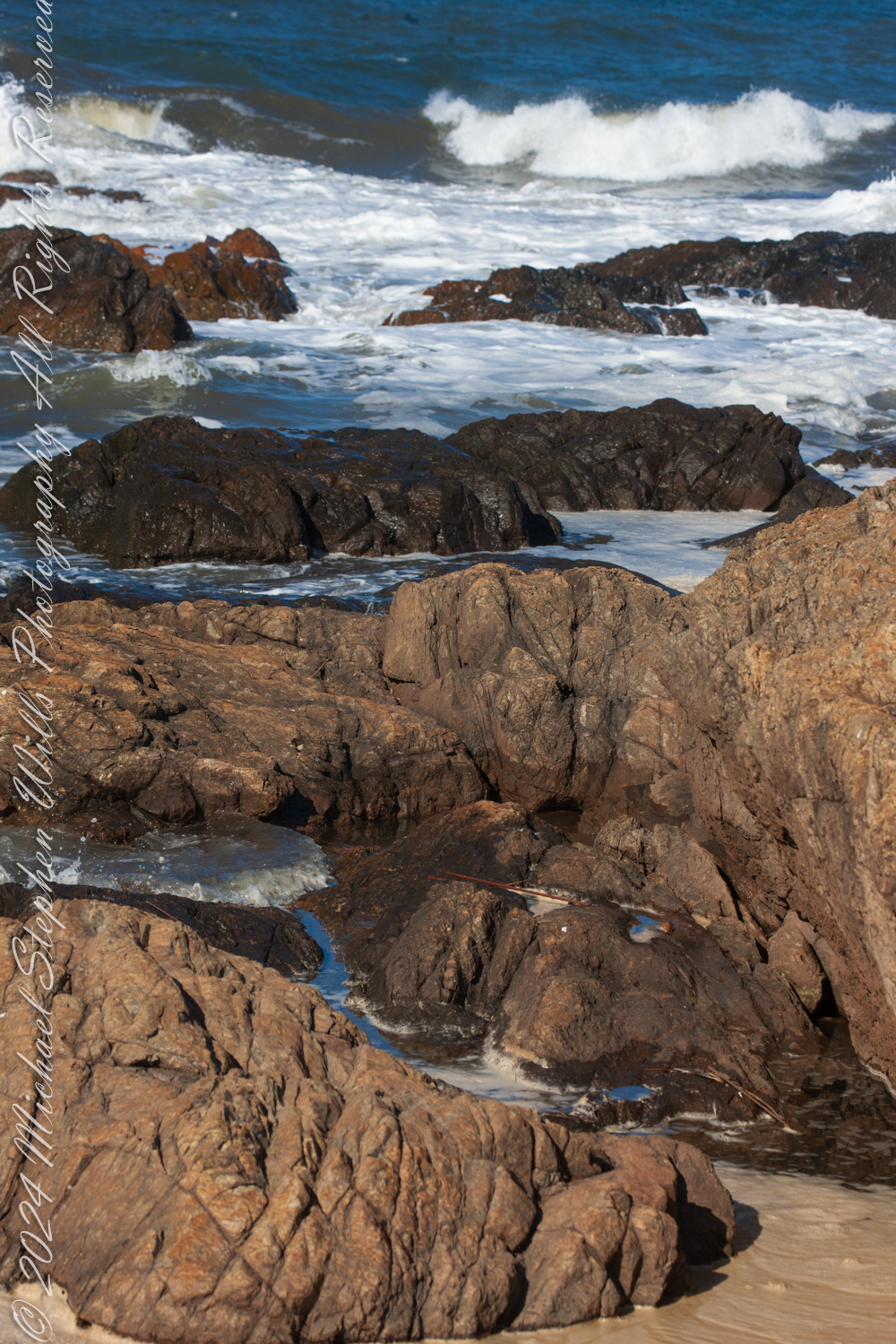
The sirens of ancient lore were said to dwell at perilous points where land met the untamed sea, luring sailors to their doom with haunting songs. These rocky outcrops, both a boundary and a threshold, have long held symbolic power as places where the natural world is at its most raw and elemental. Punta de las Salinas is such a place. Its jagged rocks and churning waves create an environment as beautiful as it is treacherous. It is easy to imagine mythical sirens choosing this very spot to weave their spellbinding melodies.

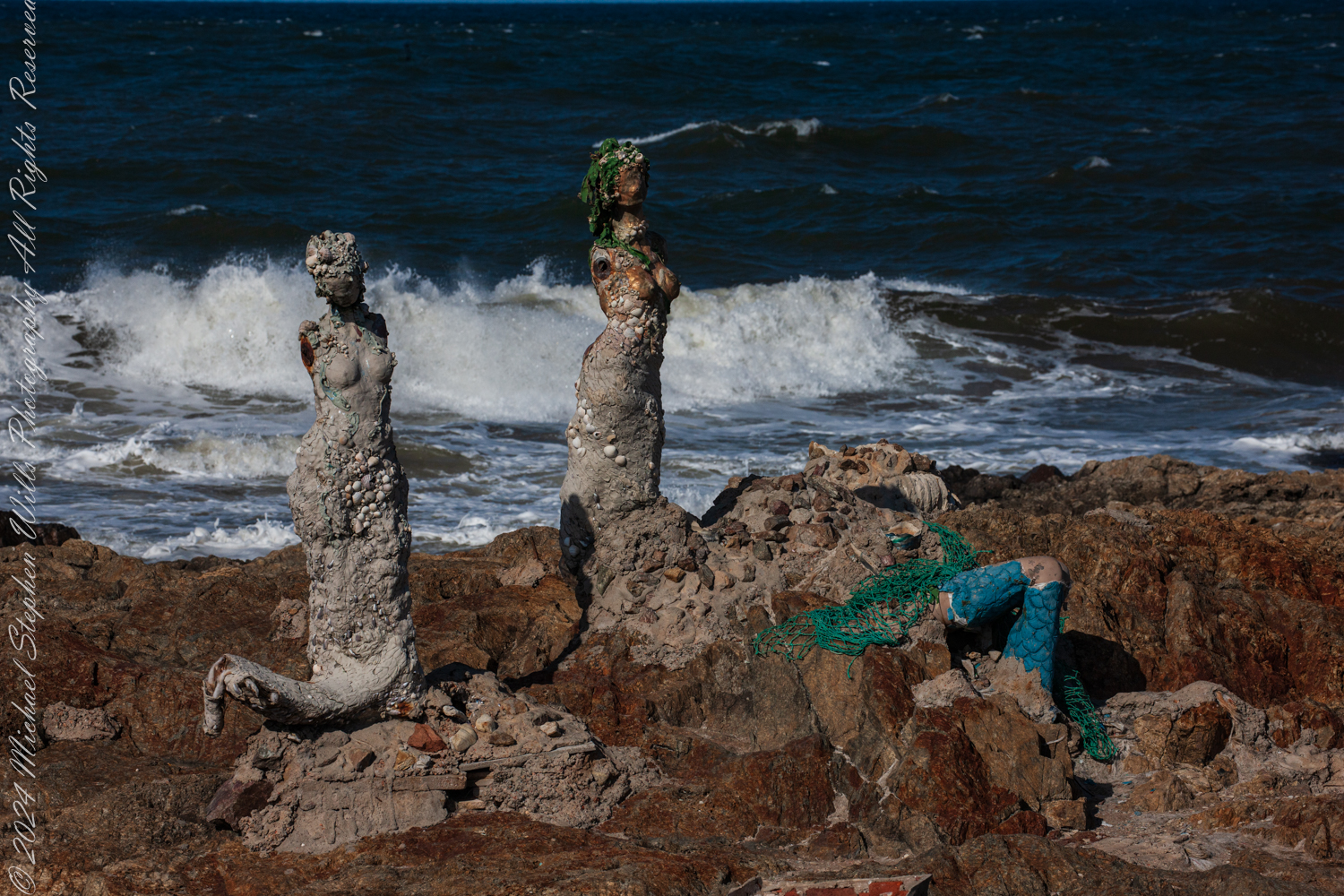
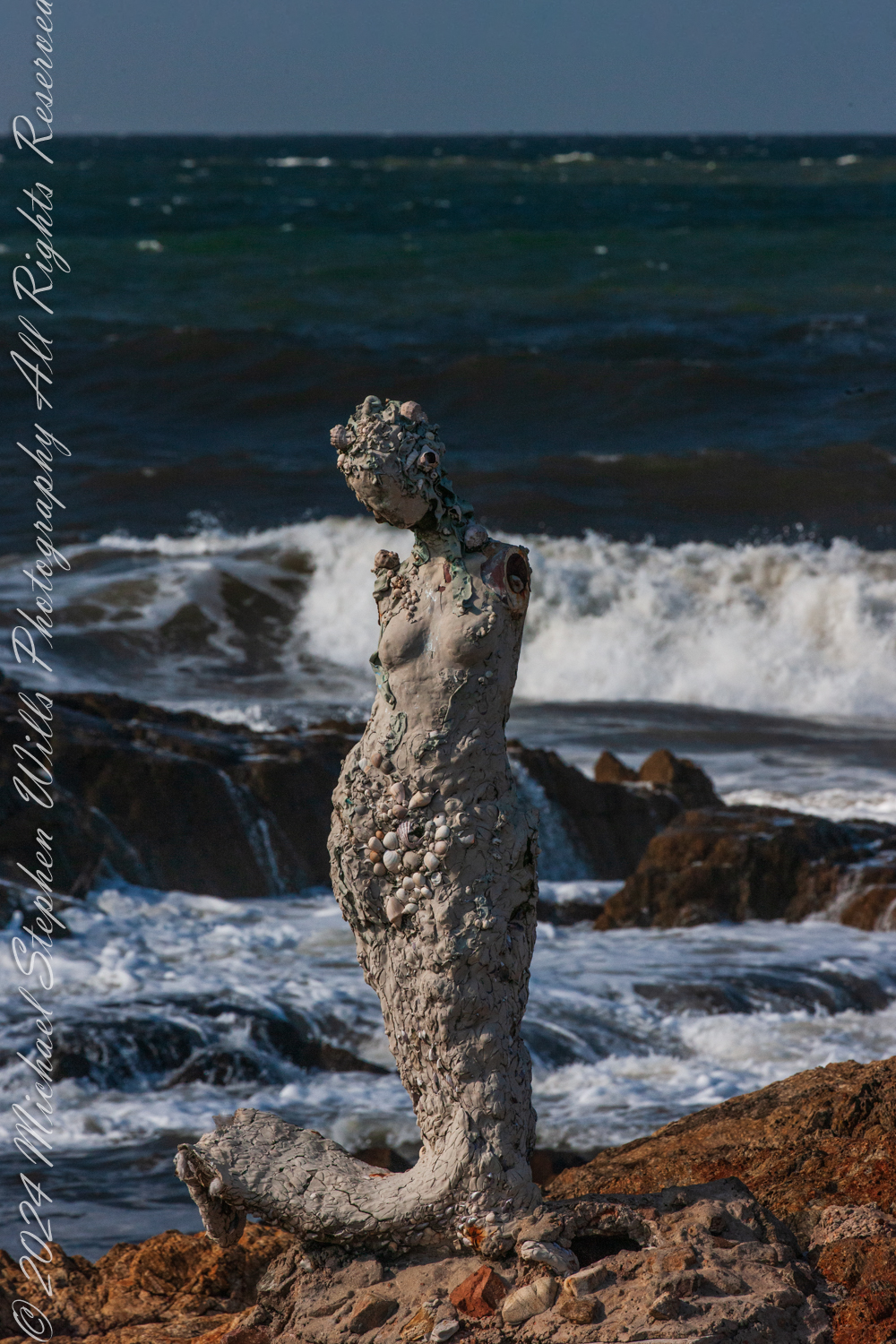
This is at Great Britain Square, Punta de las Salinas of Punta del Este. We are at the tip of the peninsula, the easternmost point of Uruguay. This is the art installation El Canto de las Sirenas” (The Song of the Mermaids) (2012) by the artist Lily Perkins. Punta del Este, Departamento de Maldonado, Uruguay

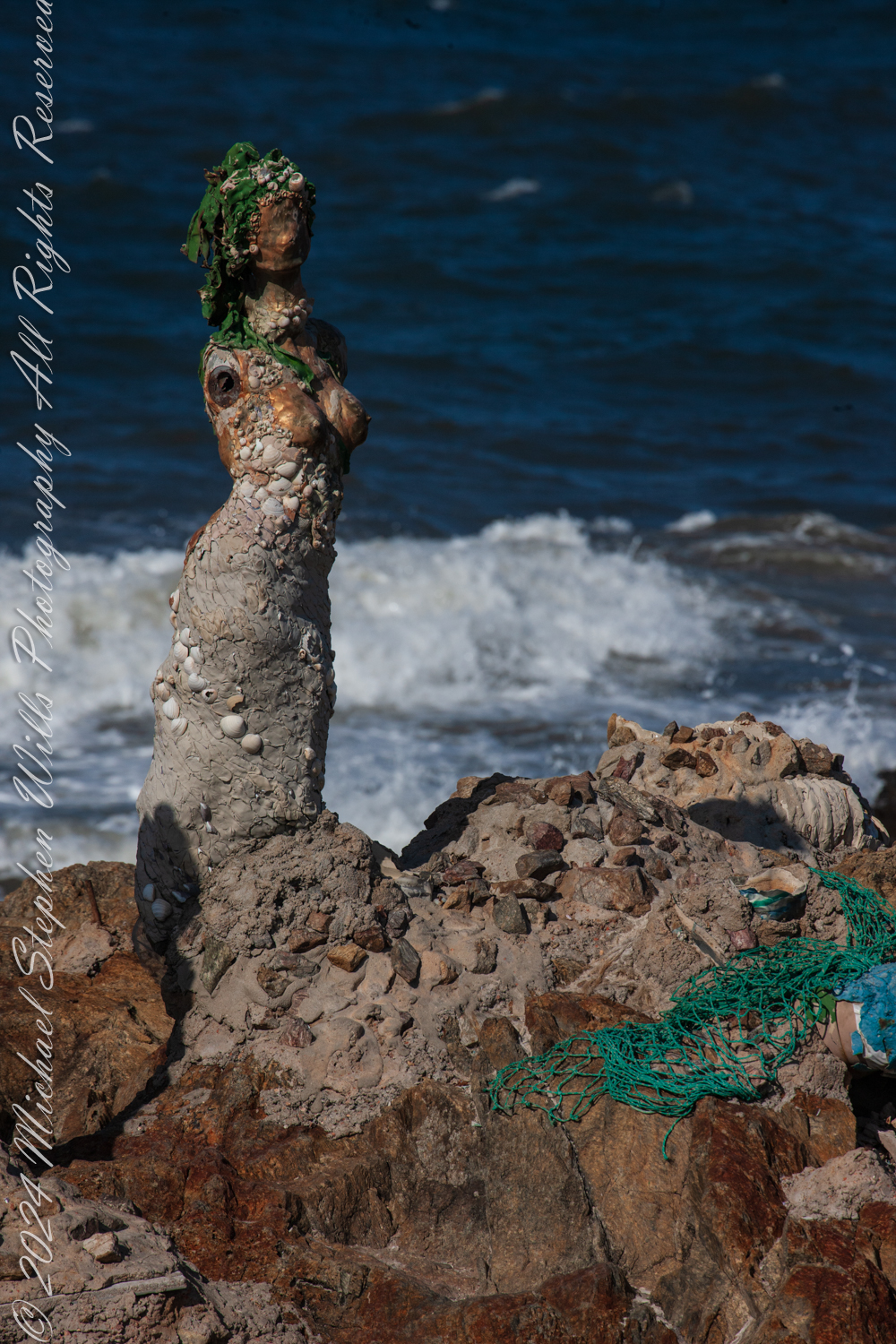
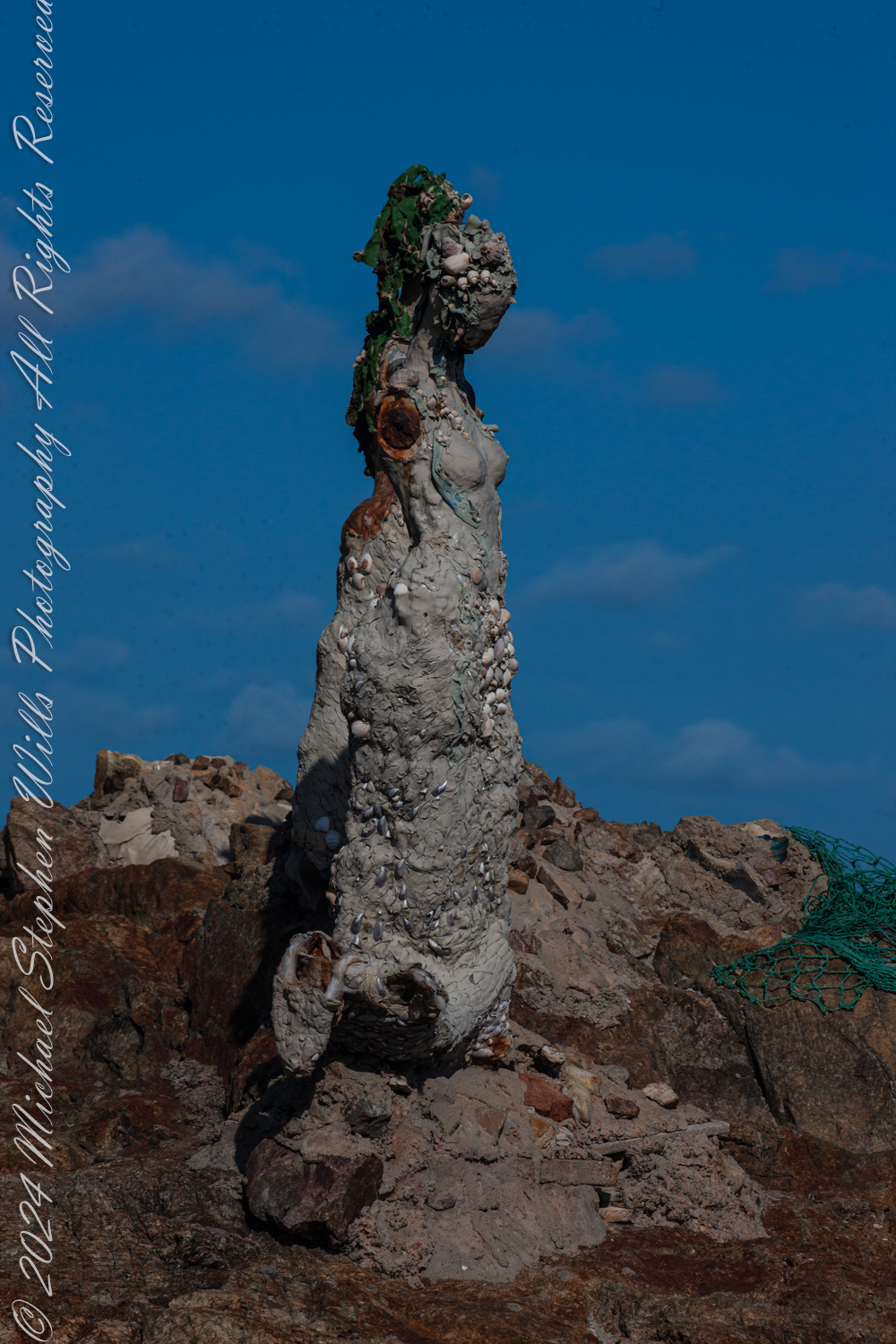
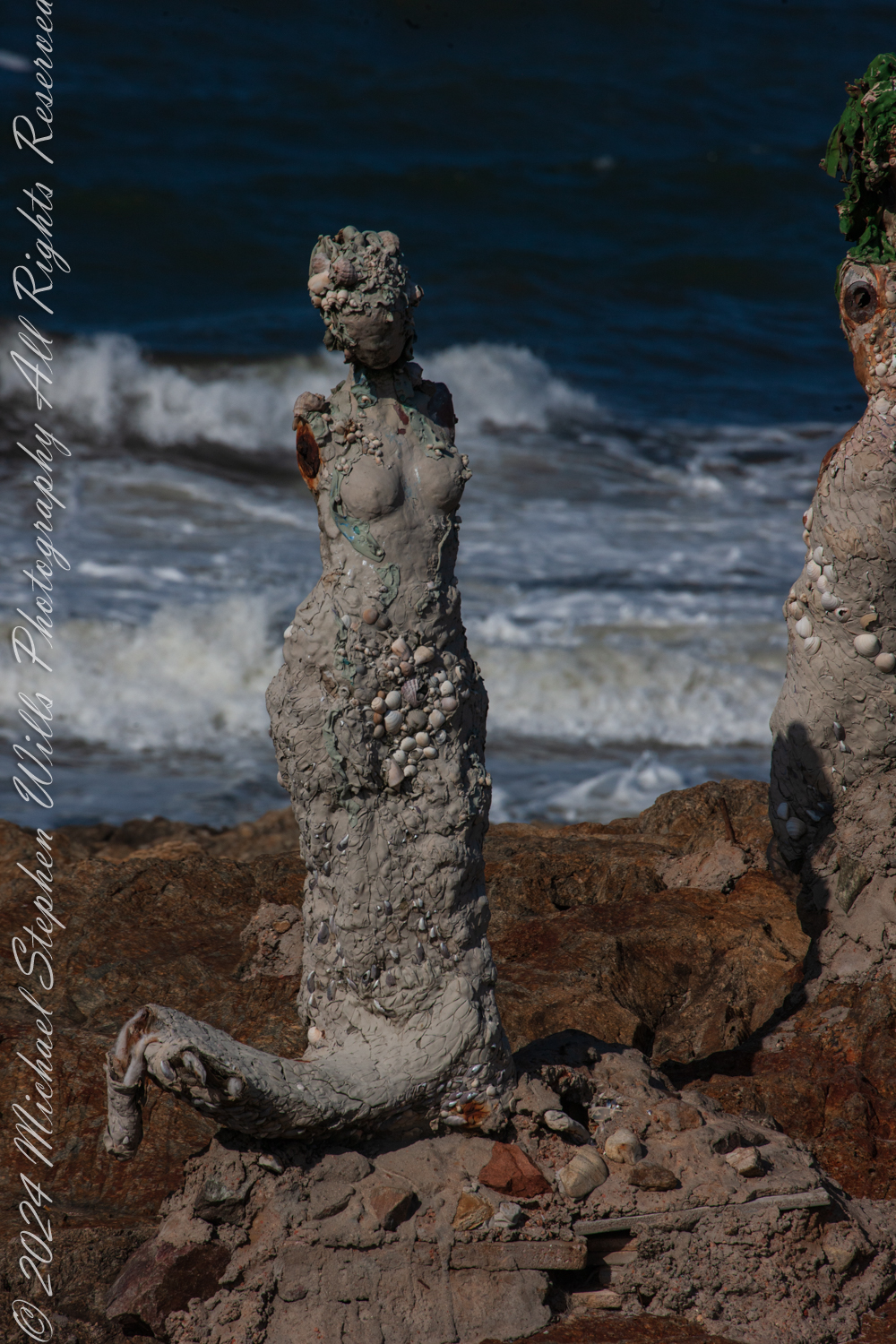
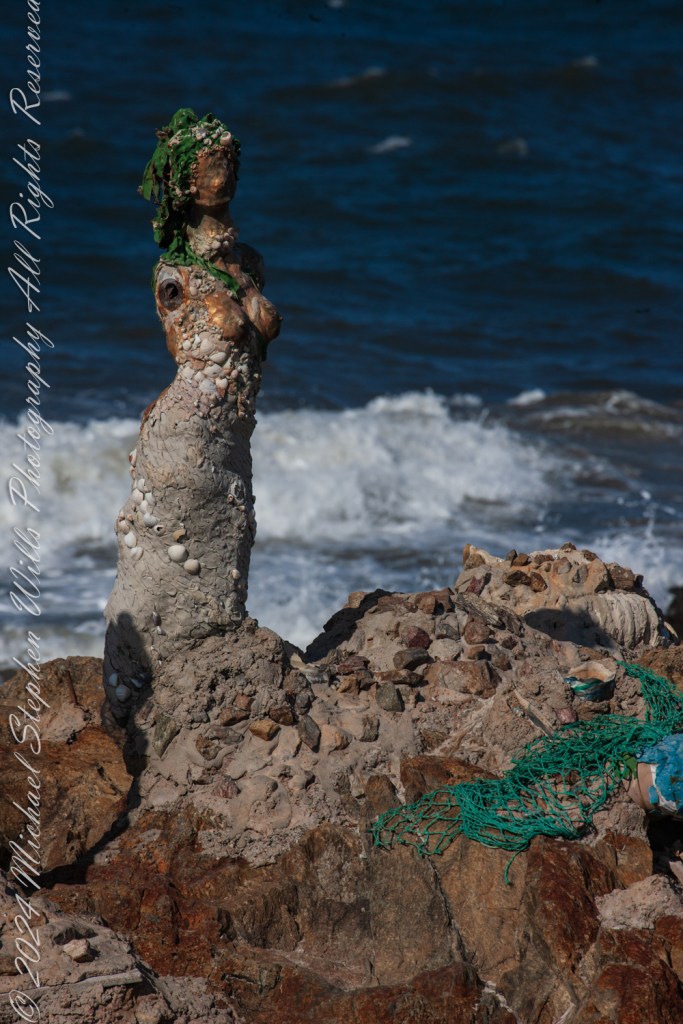
Lily Perkins’ installation captures this essence. The sculptures are not idealized depictions of mermaids; they are rugged and raw, encrusted with shells, stones, and marine debris. Their weathered forms mirror the harsh, untamed beauty of their surroundings. It is as if they have emerged from the ocean itself, born of the waves and the salt-laden air, to stand as sentinels at the edge of the world.

The central figure, with her face turned skyward, evokes the myth of the siren’s song—a melody so enchanting that it drove sailors to risk their lives against the rocks. Her posture suggests longing, perhaps for a connection beyond the horizon, or perhaps for the very mortals she is fated to ensnare. Nearby, a broken figure reclines against the rocks, her form partially encased in green netting and mosaic-like tiles. She seems more grounded, her siren’s call muted, as if weighed down by the realities of the modern world. The use of marine materials in her construction—a blend of natural and human-made debris—suggests an awareness of humanity’s impact on the seas.
The third figure, slightly apart, is the most enigmatic. Encrusted with barnacles and weathered by the elements, she seems lost in thought. Her gaze is directed not toward the sea but toward the land, as if contemplating her place at this meeting of worlds. In mythology, sirens were liminal creatures, existing between realms—the sea and the shore, the mortal and the divine. This figure embodies that in-between state, rooted in the rocks yet shaped by the sea.
The placement of these sculptures at Punta de las Salinas is no accident. This headland is the easternmost point of Uruguay, a natural boundary and a crossroads where two vast bodies of water meet. For centuries, sailors navigated these waters, their journeys fraught with danger. The rocks here are unforgiving, and the waves crash with relentless power. To stand at this point is to feel the raw energy of the ocean and to understand why myths of sirens arose in such places. The sirens symbolize both allure and peril, a reminder of the ocean’s capacity to inspire and to destroy.

As I walked among the sculptures, the mythology seemed to come alive. The sound of the waves crashing against the rocks could easily be imagined as the sirens’ song—a hypnotic rhythm that draws you in and holds you spellbound. The figures, though silent, seemed to hum with an energy that echoed the sea’s eternal motion.

I feld these sculptures were not merely placed at Punta de las Salinas; but had emerged from it, their forms shaped by the same forces that shaped the rocks beneath our feet. The shells and stones embedded in their surfaces tied them physically to the sea, while their mythical resonance tied them spiritually to the place.

The mythology of the sirens speaks to the duality of the sea—its beauty and its danger, its capacity to give and to take away. Standing at Punta de las Salinas, surrounded by Perkins’ sculptures, I felt that duality in a profound way. The ocean stretched endlessly before us, a vast, unknowable expanse, while behind us lay the solid ground of the peninsula—a place of safety, but also a place that ended here, at this edge.

Lily Perkins sculptures are restored…..

As we left, the figures seemed to watch us go, their silent song lingering in my mind. The sirens of Punta del Este are more than art; they are a dialogue between myth and reality, between the natural world and the human imagination. In their weathered beauty, they remind us of the stories the sea has always told, and of the enduring power of those who give those stories form.

Enter your email to receive notification of future postings. I will not sell or share your email address.

The Symbolism of San Xavier del Bac: Faith Through Art

San Xavier del Bac in the Sonoran desert embodies a fusion of indigenous and Spanish symbolism, showcasing devotion through art and imagery that evokes faith, beauty, and spiritual connection.

In the Sonoran Desert near Tucson, Arizona, San Xavier del Bac rises like a vision out of time. Within its adobe walls and domed ceilings lie layers of symbolism—an indigenous inheritance and Spanish colonial fervor merged into a singular living devotion. The photographs presented here, saturated with morning light, guide us through a meditative journey into this mission’s spiritual and aesthetic soul.

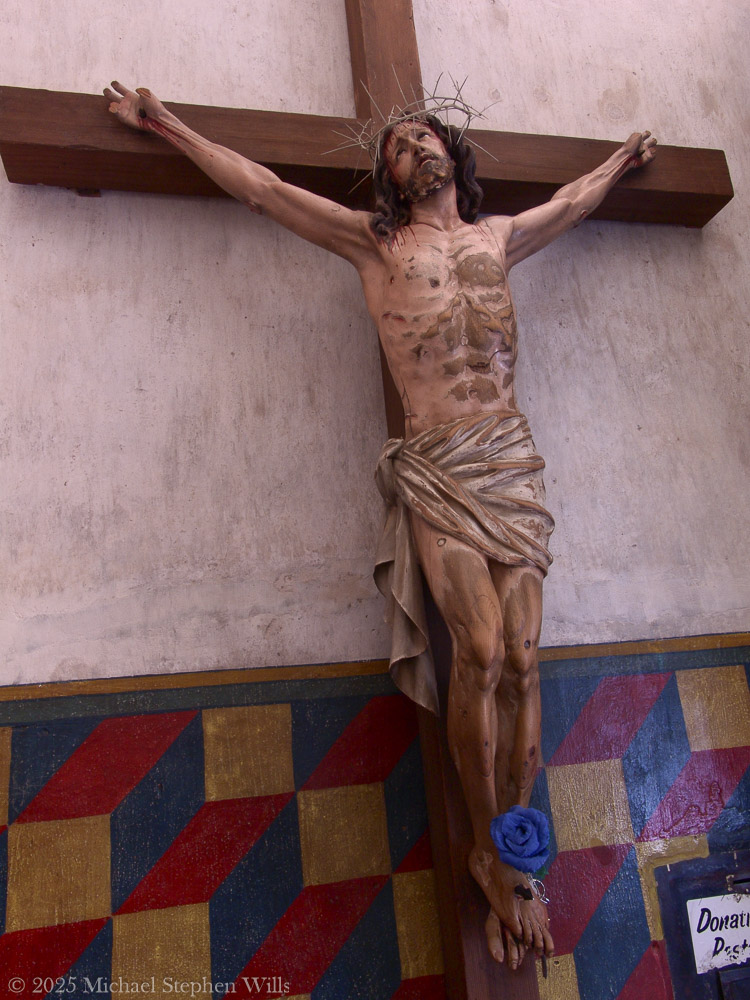
The crucifix dominates the first image—the depiction of Christ crucified, emaciated, bruised, crowned with thorns. His suffering is not abstract but visceral, carved in every wound and strained muscle. This figure of Christ, so brutally human, is draped in a tattered loincloth, a humble covering amid divine sacrifice. At his feet rests an offering: a blue artificial flower, incongruent in its brightness yet perfectly placed, a modern votive that expresses both reverence and continuity. It reminds us that humble devotion endures.

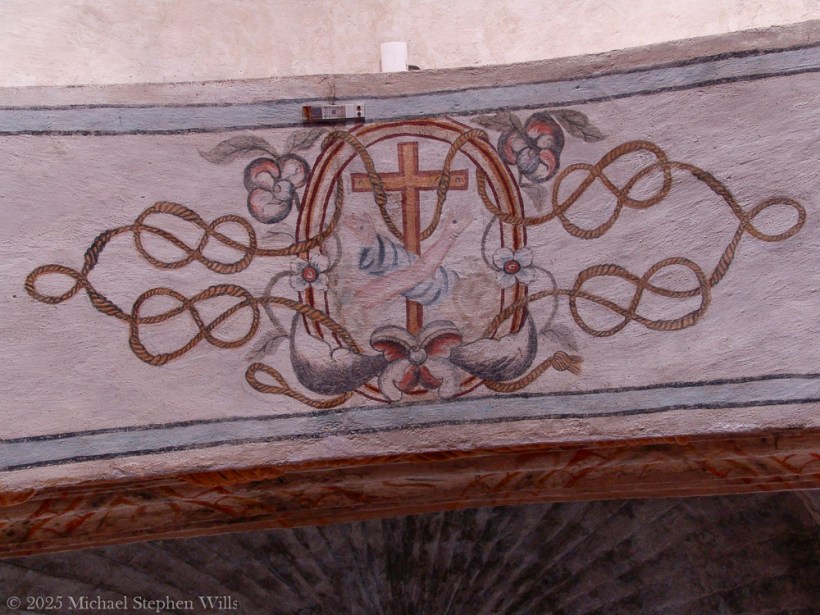
The fresco, with its cross flanked by stylized doves and roses, extends the Passion’s symbolism into sacred geometry. Doves—universal emblems of peace and the Holy Spirit—face one another in symmetrical grace, drawing the eye into the cross they flank. The single length of curling, intertwined golden ropes bind all elements in unity, perhaps reflecting divine infinity. The floral elements speak to rebirth and resurrection, a soft counterpoint to the harshness of the Crucifixion. Here, pain and peace coexist in a visual hymn.

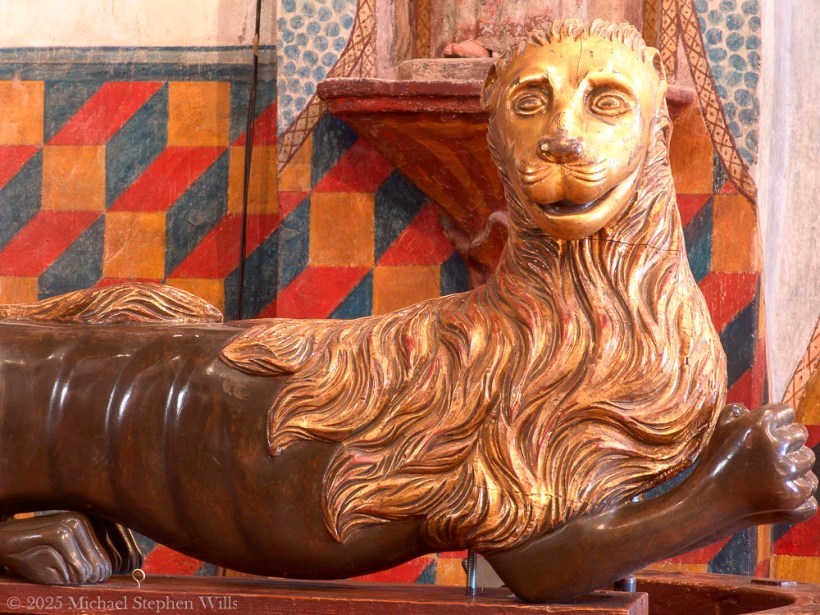
The lion sculpture, oddly cheerful in its golden face, seems at first a puzzle. Yet within Christian iconography, the lion often represents Saint Mark, the Evangelist, or the power and vigilance of God. This lion, rendered with stylized curls and a strong, reclining pose, guards the sanctuary. Its gilded mane mirrors the opulence of heaven, even in this humble desert mission. The lion’s curious gaze invites us to move past fear, toward the mysteries within.

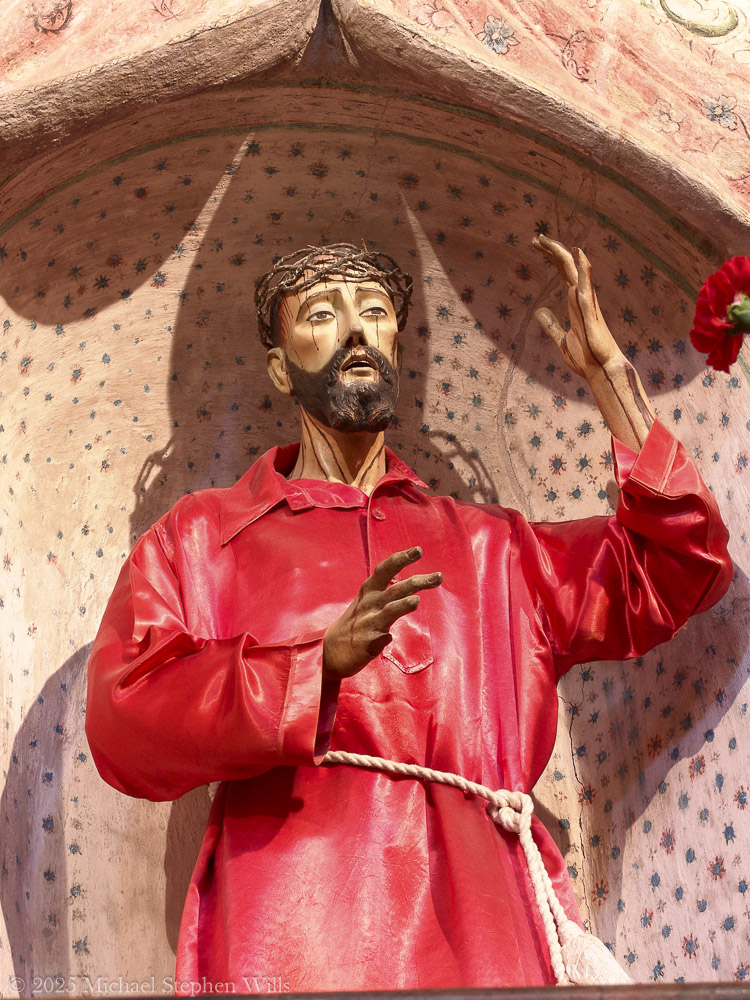
We then meet a robed figure in red—another portrayal of Christ, this time during the Passion, perhaps as the Ecce Homo (“Behold the Man”). His upraised hands and expressive face embody pathos and divine forbearance. The red robe evokes both martyrdom and kingship. He does not plead; he offers. The backdrop is simple but speckled with blue floral motifs, creating a visual bridge to the Virgin’s image nearby.

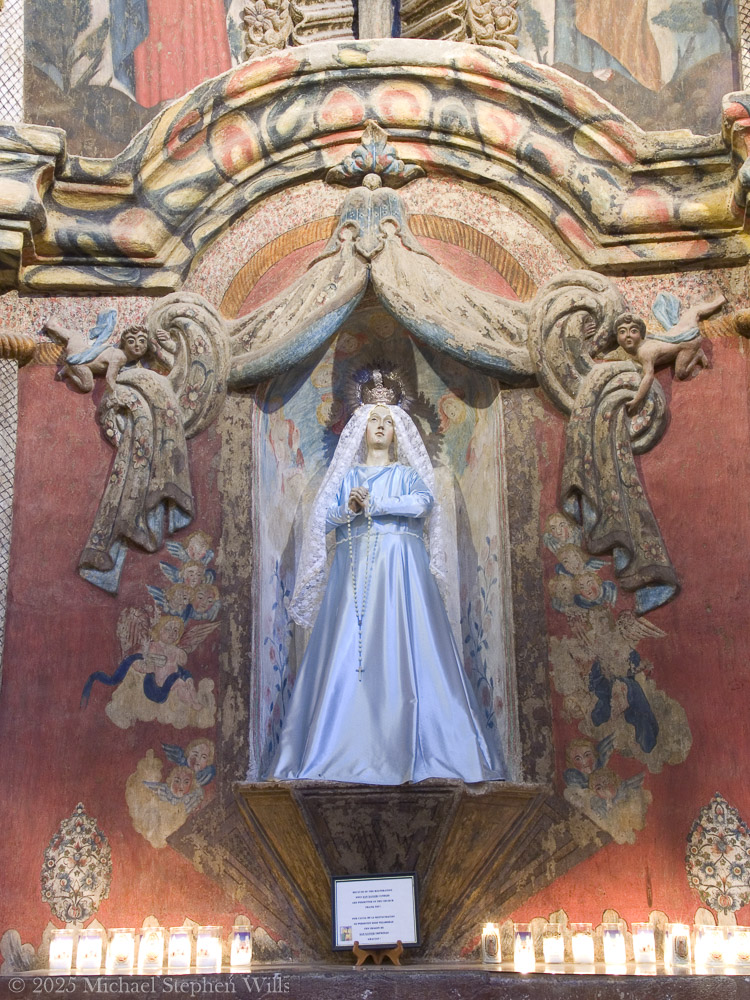
The Virgin Mary appears in blue and white—colors of purity, serenity, and devotion. She stands among votive candles and gazes gently ahead, hands joined in prayer. Her dress flows around her, anchored by a rosary that loops downward like an anchor to the earth. Angels and cherubs flank her in painted stucco, echoing heaven’s embrace. This is not the triumphal Mary of high cathedrals but a deeply human one, a mother, accessible and protective. The candles flickering below affirm that faith is alive here, not simply preserved.

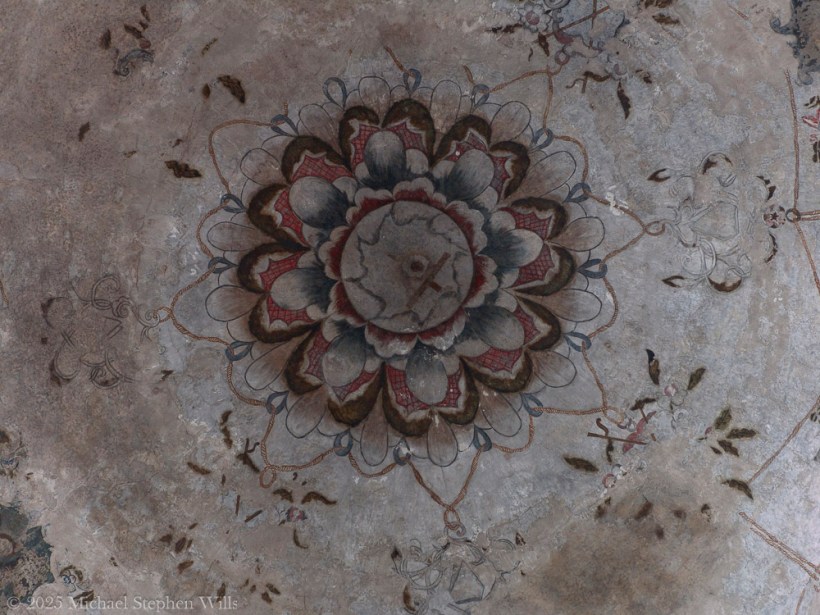
A ceiling medallion next draws us into a more abstract vision. A floral rosette centers on the cross and tools of Christ’s Passion—the nails, spear, and ladder arranged in contemplative symmetry. These instruments of torture are enclosed in beauty, as if the heavens themselves have sanctified the suffering. It is a paradox of faith, this transformation of pain into purpose, death into eternal life.

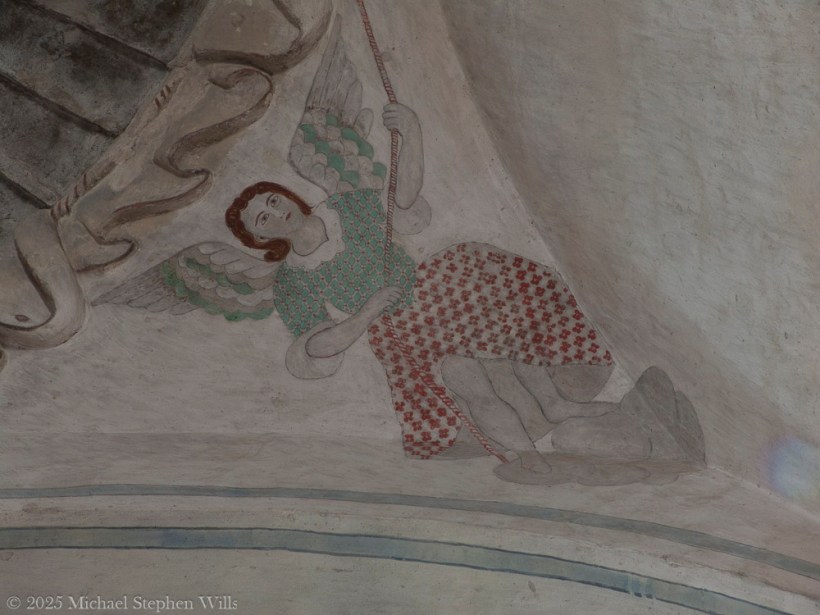
And in the arch’s corner, an angel descends—painted simply, yet with care. The figure pulls at a rope, perhaps to ring a bell or lift a curtain, a symbolic act of revelation or invitation. With wings green and soft, a skirt patterned in red flowers, suggesting femininity, grounding the divine in local textile tradition. The angel bridges the earthly with the divine, echoing the mission’s purpose: to guide and accompany.

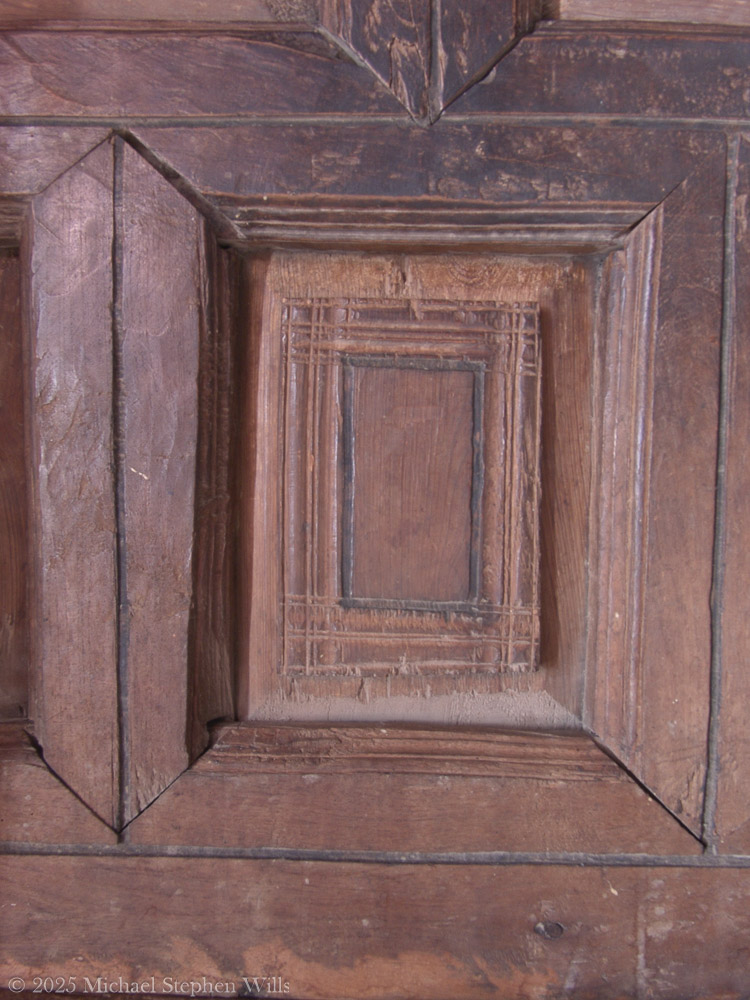
Finally, a carved wood panel—plain, aged, and sacred in its wear. The texture of centuries rests in its grain, the indentations of faithful hands passing by. This is the tactile memory of San Xavier: not only what is seen, but what has been touched, prayed over, believed.

Taken together, these images form a tapestry of devotion, colonial artistry, indigenous fusion, and enduring reverence. San Xavier del Bac is a place where symbols still speak, where color and form do more than please the eye—they lift the spirit. In this space, belief is remembered to be continually reborn.

Enter your email to receive notification of future postings. I will not sell or share your email address.

Discovering La Sirena de la Garza at Punta de las Salinas

At Punta del Este, Uruguay, the beauty of the ocean and sculptures creates a profound connection between nature, art, and mythology.

As I stood at the edge of Punta del Este, Uruguay, I marveled at the wild beauty of the place. We were at Punta de las Salinas, the very tip of the peninsula, the edge of where the Atlantic Ocean meets the Río de la Plata. This easternmost point of Uruguay, where time feels suspended as restless waves crash against rocky shores. A sea breeze carries a distinct salty tang.

This is at Great Britain Square, Punta de las Salinas of Punta del Este. We are at the tip of the peninsula, the easternmost point of Uruguay. Punta del Este, Departamento de Maldonado, Uruguay

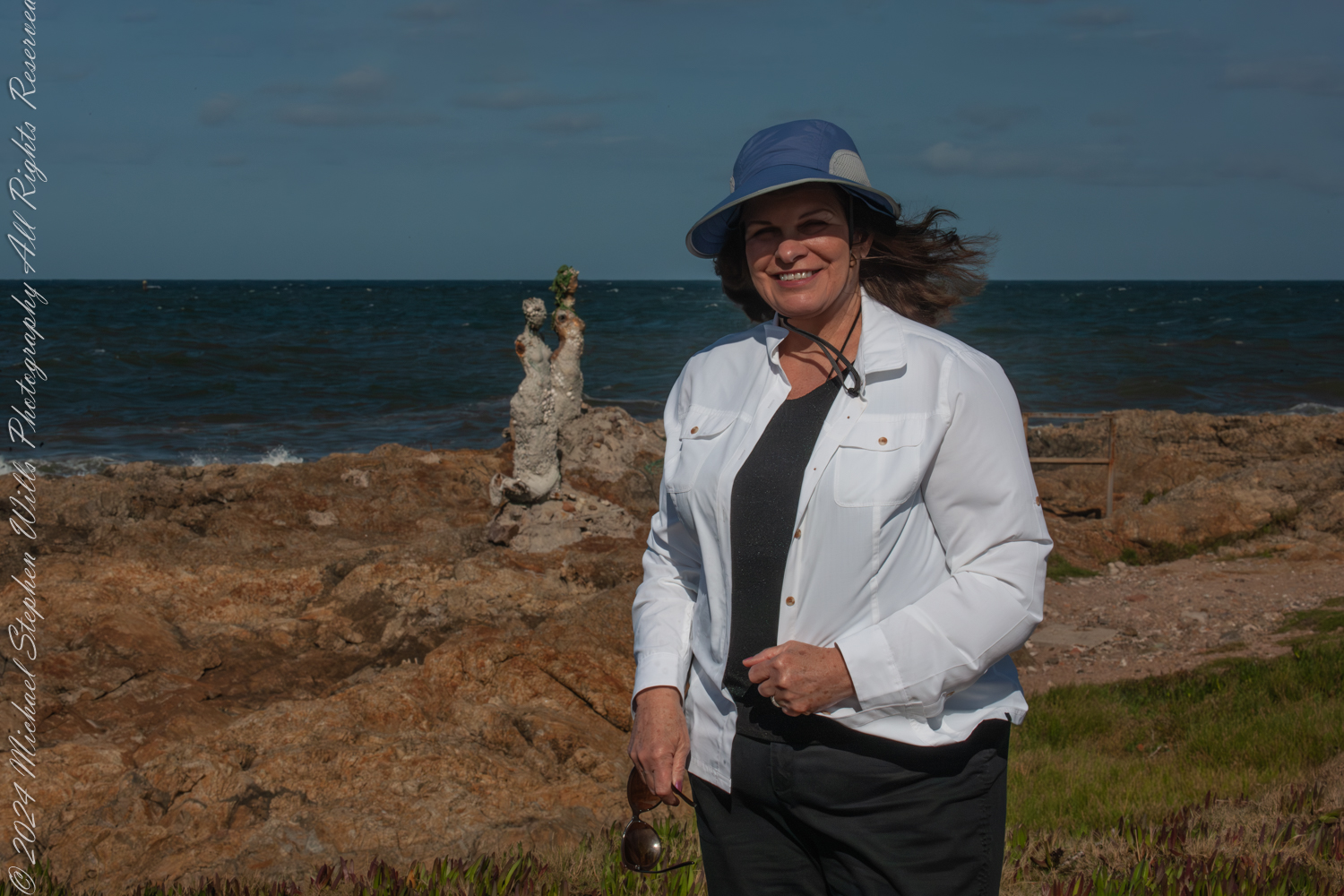
Pam, my wife, stood beside me, a bright smile on her face as the ocean wind tugged at her sunhat. Behind her, rising among the rocks, was an art installation that seemed to embody the spirit of the place “El Canto de las Sirenas” (The Song of the Mermaids). These sculptures by the artist Lily Perkins, their forms shaped and worn by the elements, appeared almost as though they were natural extensions of the rocky coastline. They gazed out to sea, their haunting beauty a poignant reminder of myth and humanity’s eternal connection with the ocean.

The sirens, crafted with an earthy texture and adorned with bits of marine debris, seemed to tell a story of resilience and adaptation. They stood stoically against the backdrop of the churning waves, their barnacle-like surfaces merging seamlessly with their rugged surroundings. I felt a strange connection to them, as if they were silent witnesses to the ever-changing dance of the sea and sky.

Pam during our 2016 South American tour. This is at Great Britain Square, Punta de las Salinas of Punta del Este. We are at the tip of the peninsula, the easternmost point of Uruguay. Over her shoulder is the art installation “El Canto de las Sirenas” (The Song of the Mermaids) (2012) by the artist Lily Perkins. Punta del Este, Departamento de Maldonado, Uruguay

The morning was perfect for photography. I adjusted my Canon camera, capturing the interplay of light and shadow across the jagged rocks, the turquoise waves, and the statues. The textures of the sirens came alive through the lens, each detail hinting at the passage of time and the endless conversations between water and stone. Pam posed in front of one of the sculptures, her presence adding a touch of humanity to the scene, as though she were part of this mythological tableau.

I took a moment to step back and absorb the scene. The coastline stretched out before me, rugged and raw, with the waves crashing in an eternal rhythm. The sirens belonged here, their forms shaped artist hands, then also by the elements. They merged into this unique place, much like the wind, the rocks, and the ocean.

As we walked along the rocky outcrop, the sound of the waves filled the air, drowning out any other noise. It was easy to lose oneself in the hypnotic patterns of the water, the spray catching the sunlight like tiny jewels. I found myself reflecting on the history of this place—Punta del Este, a meeting point of cultures and stories, a place where the natural world and human creativity converge.

Great Britain Square, where we started this journey, seemed an apt setting for such an installation. The name itself evokes a sense of exploration and connection across vast distances, much like the sirens that seem to call out across the waves. The symbolism was not lost on me as I thought about how we, too, were travelers, drawn to the edges of the earth by a desire to explore and understand.

Plaza Gran Bretana (Great Britain Square) is named for the World War II naval battle near here between the German battleship Graf Spee and the English ships Ajax, Achilles and Exeter. The plaza also has an anchor marking the boundary between Rio de la Plata and the Atlantic Ocean.

Pam and I lingered for a while longer, taking in the scenery and enjoying the peacefulness of the moment. The sculptures seemed almost alive, their forms shifting subtly as the light changed. They reminded me of the stories of sirens from ancient mythology—creatures that lured sailors to their doom with their enchanting voices. But here, they seemed more like guardians, watching over the waters and the land, their presence a testament to the enduring power of art and nature.

As the morning wore on, we made our way back, leaving the sirens behind to their eternal vigil. The experience stayed with me, though, a vivid memory of a place where myth and reality intertwine. Punta de las Salinas, with its rugged beauty and its mysterious sirens, had left an indelible mark on my heart.

Enter your email to receive notification of future postings. I will not sell or share your email address.

Saint Fin Barre’s Cathedral: Resilience and Devotion in Cork

Saint Fin Barre’s Cathedral embodies faith and history through intricate artistry and significant apostolic representations.

As I stood within the hallowed confines of Saint Fin Barre’s Cathedral in Cork City, Ireland, I found myself drawn to the intricate artistry that tells the story of faith, resilience, and devotion. The figures and symbols within this magnificent edifice bring to life the history of Saint Fin Barre as well as the broader narrative of Christian tradition and its enduring influence on the region.

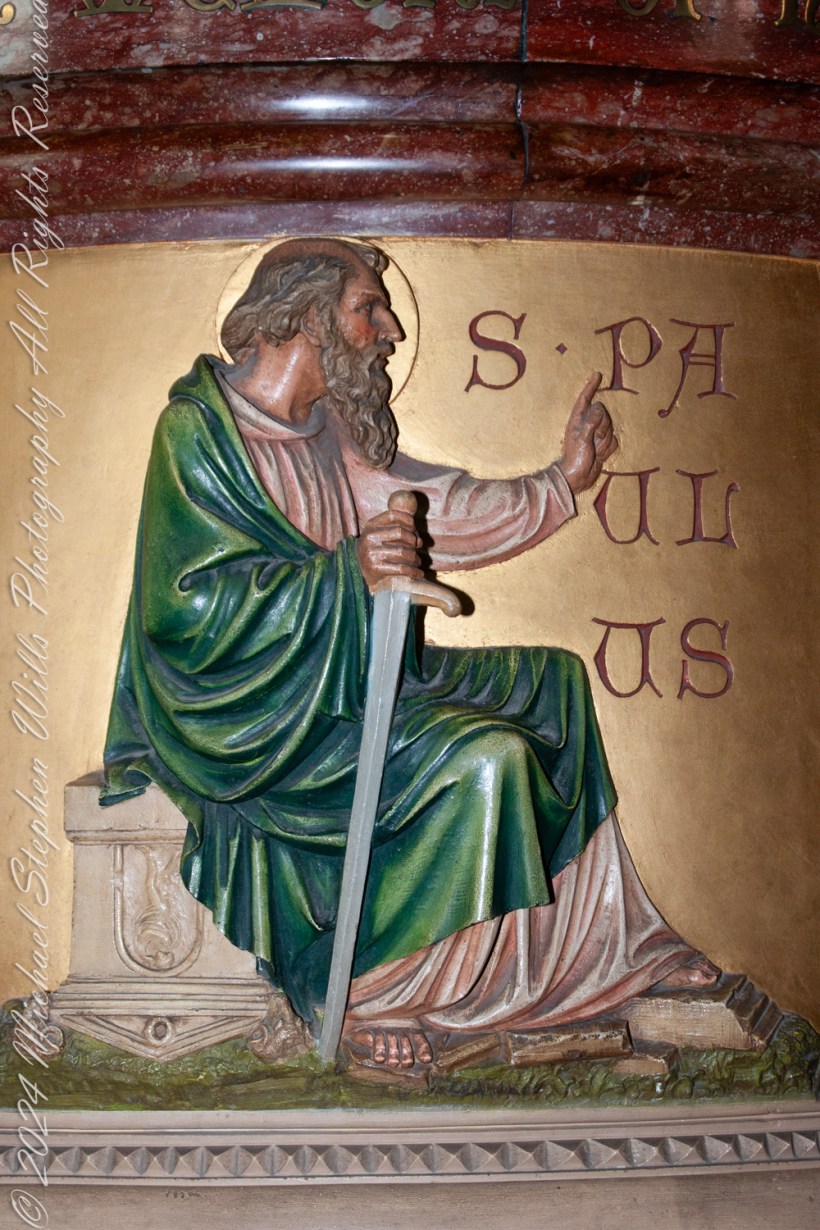
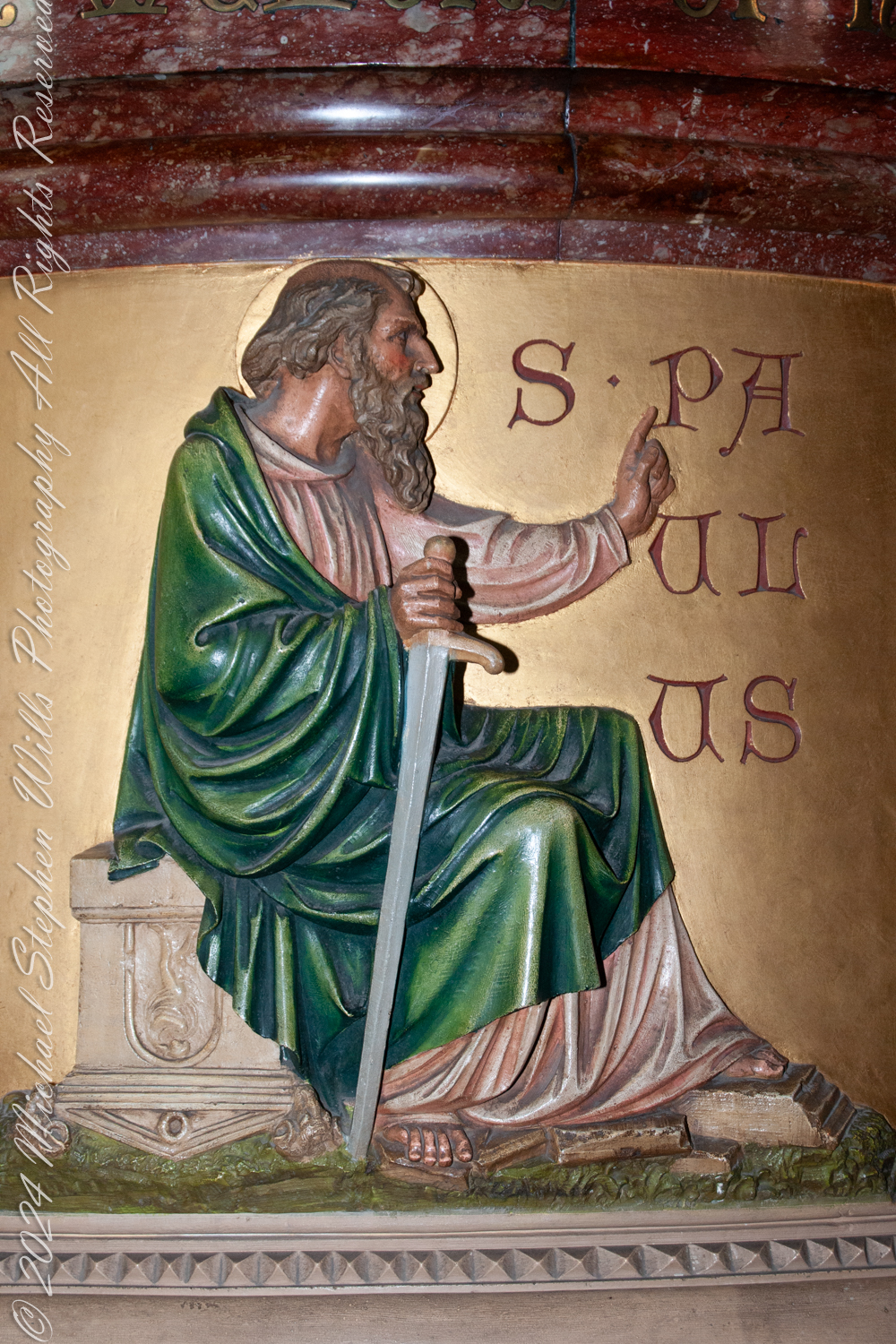
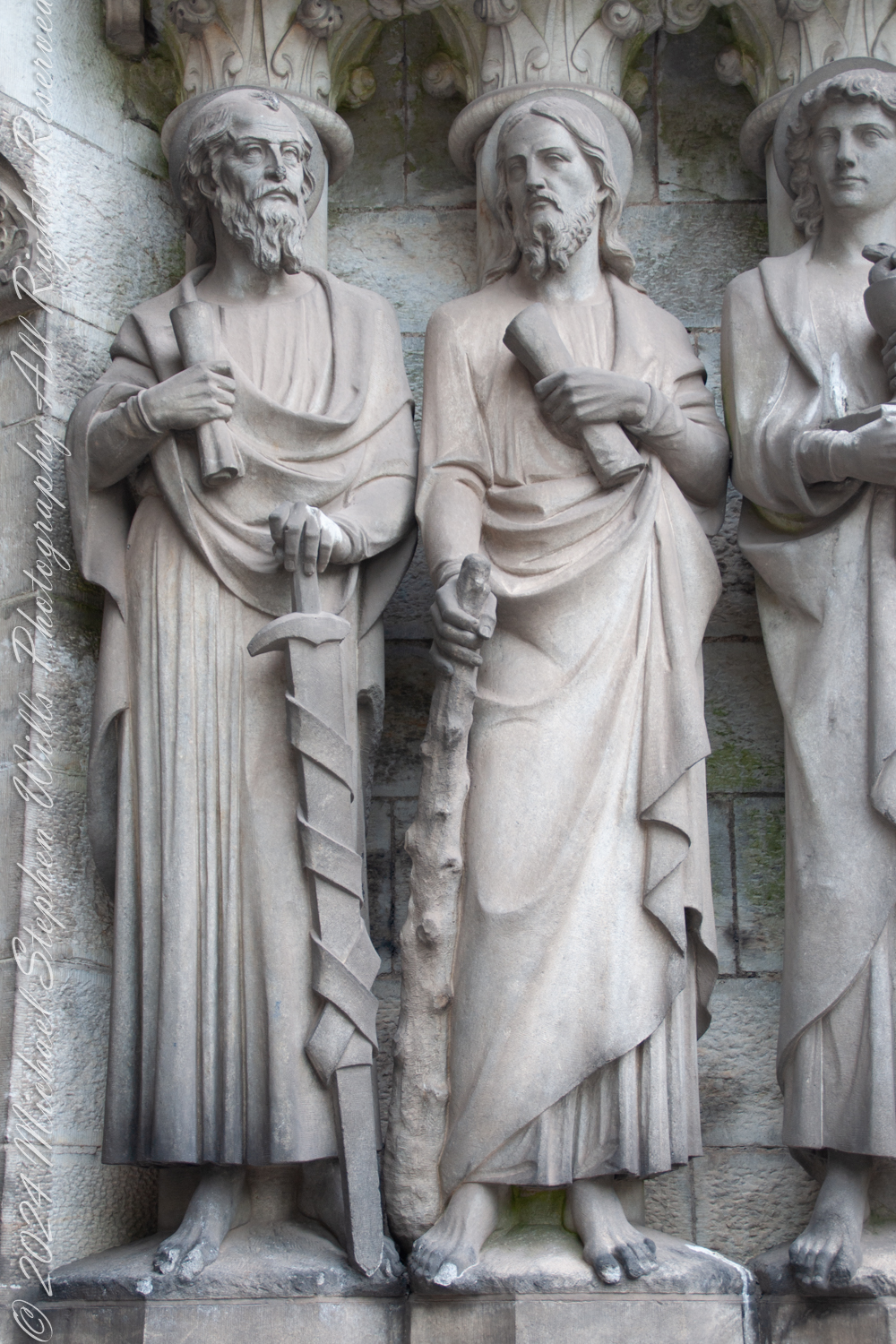
Near the entrance, the cylindrical pulpit’s relief figures of five evangelists captured my imagination. Here was the relief of Saint Paul seated with his characteristic sword, a symbol of both his martyrdom and the “sword of the Spirit” from chapter 6, verse 17 of the New Testiment Epistle to the Ephesians. His hand gestures toward the heavens, as if calling upon divine guidance to symbolize his role as an intermediary or messenger of God’s revelation. The rich green of his robes, juxtaposed against the golden background, speaks of hope, growth, and the everlasting promise of salvation. Here I found Saint Paul embodying the courage and conviction needed to preach and defend the faith—a sentiment that resonates deeply in the cathedral’s design and purpose.

Saint Paul

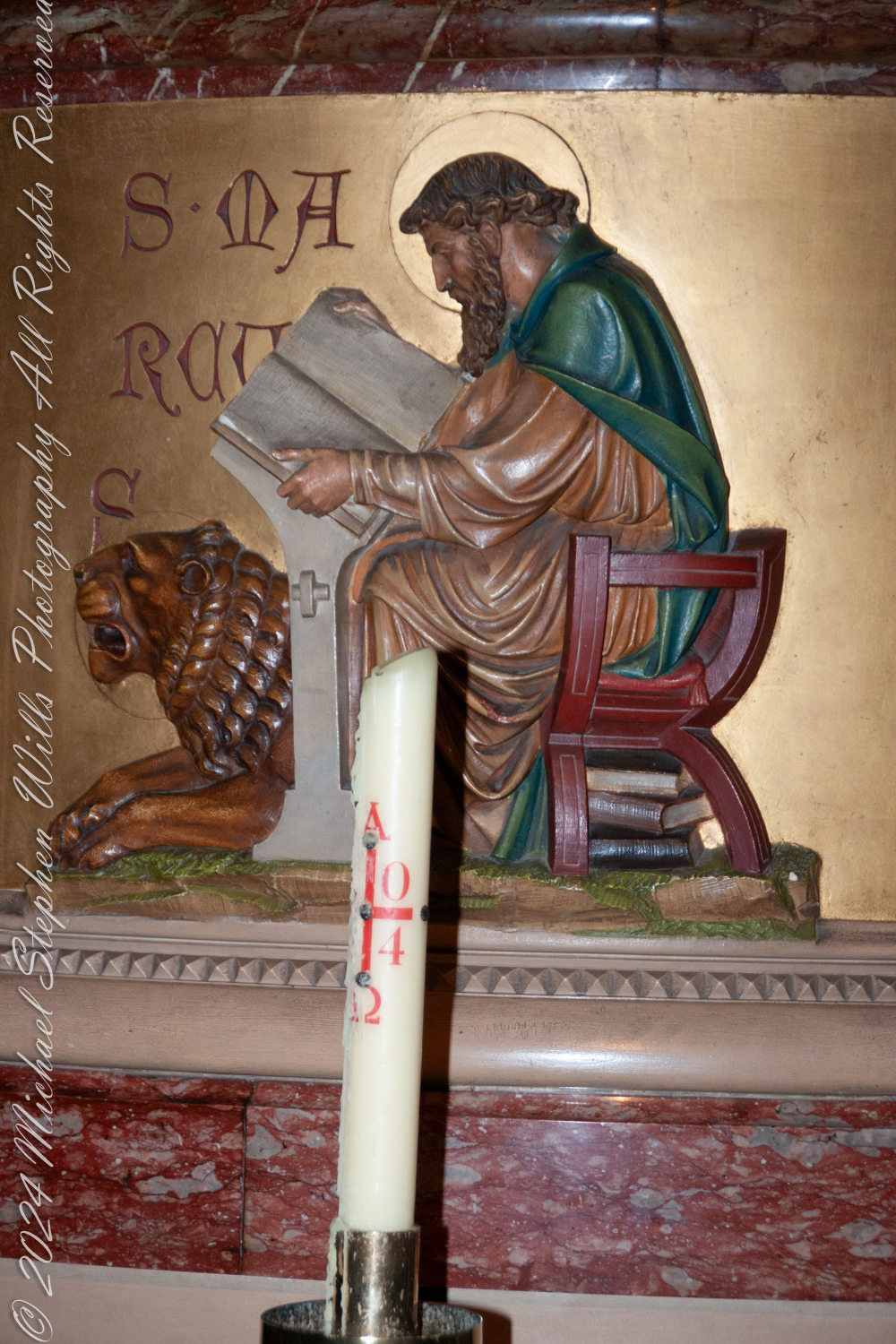
Rounding the circle, another relief brought Saint Mark to life. With the lion at his side, Saint Mark writes intently, reminding us of his contributions to the Gospels. The warm, earthy tones of his attire and the contemplative tilt of his head evoke the diligence and introspection of a writer who draws inspiration from divine revelation. The lion, its expression both fierce and loyal, represents courage and the Gospel’s enduring power.

Saint Mark

The cathedral’s external sculptures echo these individual representations of the apostles, where stone figures silently stand guard at the west entrance. The central figure of my photograph, holding a scroll in his left hand and a long cudgel (club) in his right, is Saint James the Less (also known as James the Minor). The scroll symbolizes his role spreading the word of God. The cudgel alludes to his martyrdom, as tradition holds that his executioners brutally beat him to death with such a club. His serene expression contrasts with Saint Paul, on the left, who holds the traditional “sword of the spirit” of his Epistle to the Ephesians. These carvings are spiritual sentinels, inviting visitors to contemplate the legacy of those who laid the foundations of the Church.

As the patron saint of the city, Saint Fin Barre’s enduring legacy profoundly impacts Cork’s spiritual and cultural history. His legacy dates back to the 7th century when he established a monastic settlement on the site where the cathedral now stands. This sacred location has witnessed centuries of devotion, destruction, and renewal. The visionary architect William Burges designed the cathedral in the 19th century as both a tribute to Saint Fin Barre’s enduring influence and a testament to William Burges’s own artistic genius.

Walking through the cathedral, I felt the interplay of past and present, earth and heaven. These saints and apostles are figures from history, embodiments of virtues and struggles that are timeless. Their stories invite us to reflect on our own faith, perseverance, and the ways we leave our mark on the world.

Saint Fin Barre’s Cathedral is a place of worship and a narrative in stone, wood, and glass. The intricate carvings and the evocative sculptures, among much else, create a space that transcends the ordinary. Here, the saints and apostles stand as eternal witnesses to the human journey toward the divine. As I left the cathedral, the image of Saint Paul, resolute and unyielding, stayed with me—a reminder that we must build faith, much like the cathedral itself, stone by stone, moment by moment, to endure the test of time.

Enter your email to receive notification of future postings. I will not sell or share your email address.

The Architectural Symbolism of Saint Fin Barre’s Cathedral

The Western Portico of Saint Fin Barre’s Cathedral illustrates the parable of the ten virgins, emphasizing spiritual preparedness and divine judgment.

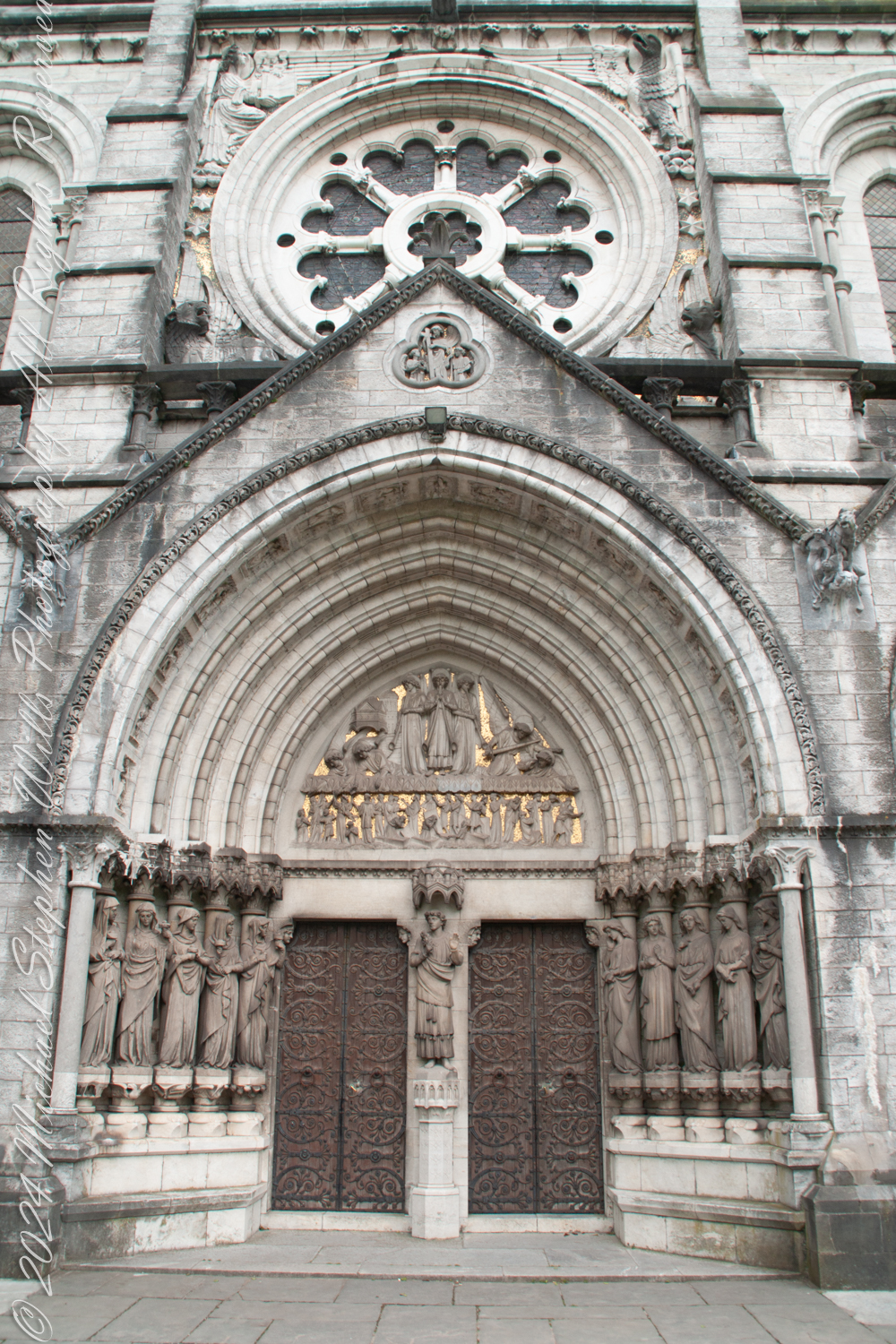
The towering Western Portico of Saint Fin Barre’s Cathedral leads into the sacred space of the church while serving as a canvas for a profound narrative of divine judgment and grace. Standing before it, I am drawn into its intricate details, particularly the central set of doors flanked by the ten virgins—five wise and five foolish—embodied in stunning columnar statues. Their story is drawn from the Gospel of Matthew (25:1–13), a parable of spiritual preparedness that echoes throughout the cathedral’s architecture.

The parable tells of ten virgins who go out to meet the bridegroom, each carrying a lamp. The wise virgins take oil with their lamps, while the foolish take none. When the bridegroom is delayed, all ten fall asleep. At midnight, the cry rings out, “Here is the bridegroom! Come out to meet him!” The virgins awaken and trim their lamps. The foolish ones, realizing their lamps are going out, plead with the wise to share their oil, but the wise refuse, saying, “There may not be enough for both us and you. Instead, go to those who sell oil and buy some for yourselves.” While the foolish virgins are away buying oil, the bridegroom arrives, and the wise virgins go with him into the wedding banquet. The door is shut. Later, the foolish virgins return, crying, “Lord, Lord, open the door for us!” But he replies, “Truly I tell you, I do not know you.” The parable concludes with the warning: “Therefore, keep watch, because you do not know the day or the hour.”

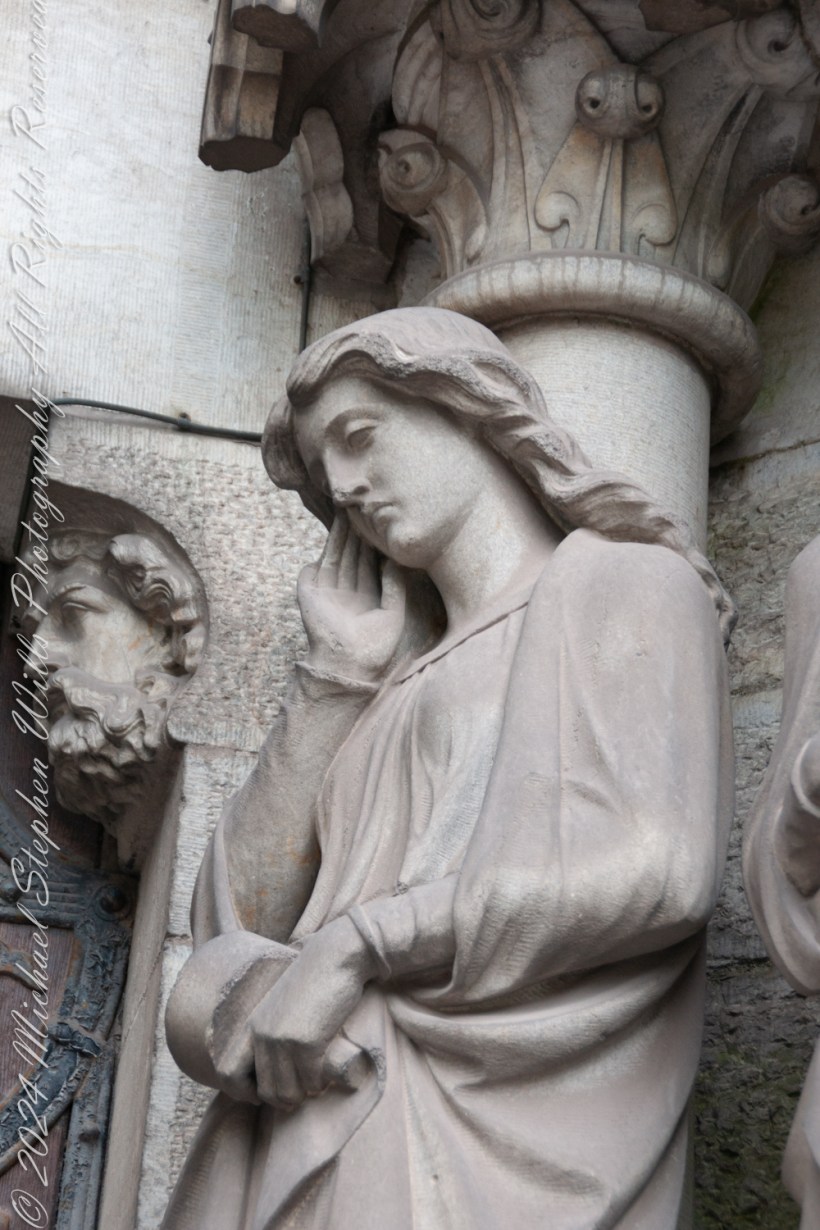
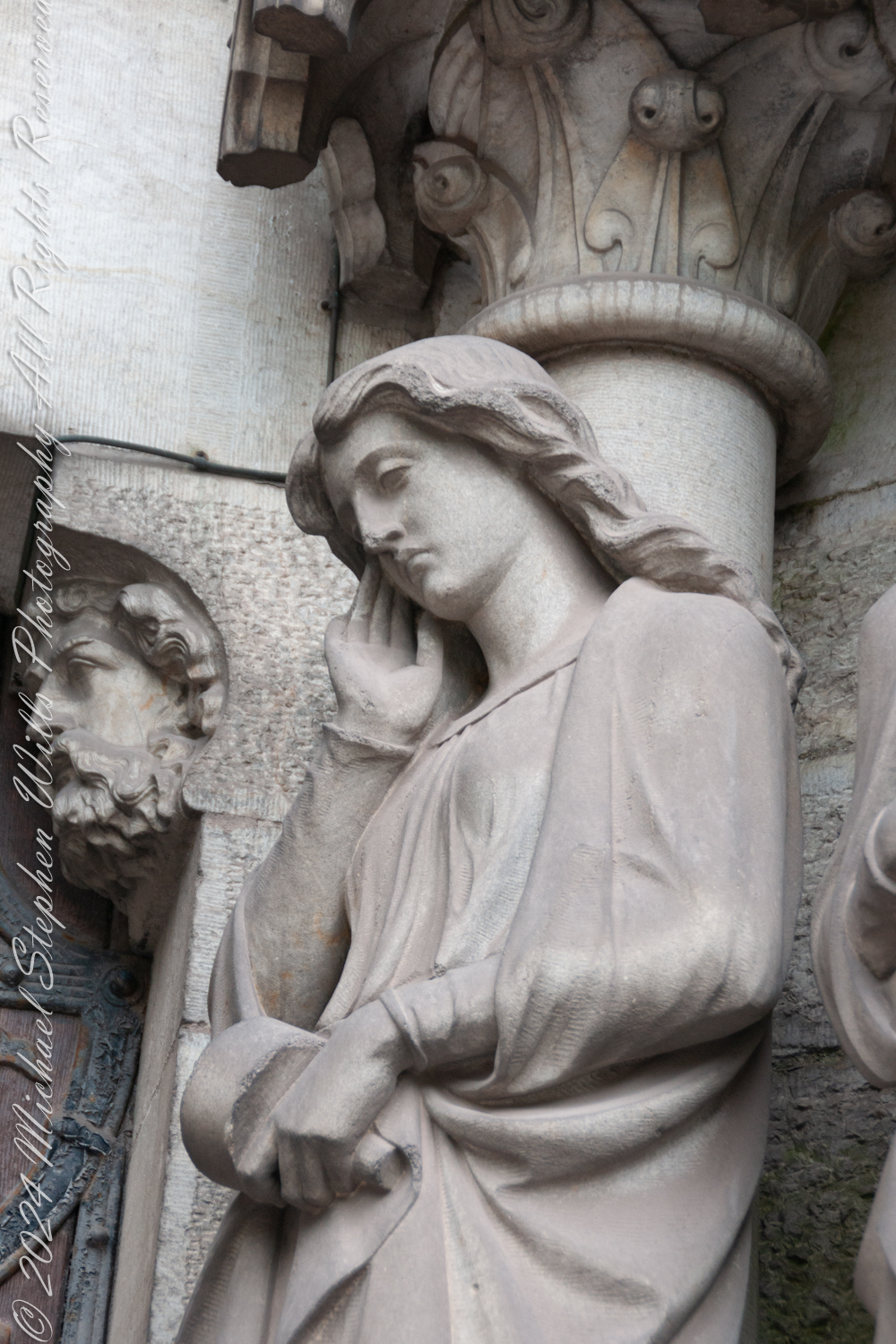
On either side of the central door, the virgins stand as sentinels, embodying this story. The wise virgins, to the right of Christ, hold their lamps aloft, flames burning brightly, symbols of readiness and spiritual vigilance. Their faces are serene, reflecting a sense of fulfillment in their preparedness to meet the bridegroom. To the left, the foolish virgins clutch their unlit lamps, their postures and expressions marked by despair and regret. The detail in their sculpting is exquisite—draped garments, forlorn gazes, and, in the case of the leftmost virgin, a subtle gesture of mourning, her hand resting thoughtfully against her cheek as though lamenting her unpreparedness.

Beneath each figure lies a pedestal adorned with imagery that amplifies their symbolic meaning. The wise virgins stand upon a foundation of flourishing life: vines, flowers, and fruits, evoking the vitality and promise of spiritual readiness. In contrast, the pedestals of the foolish virgins are carved with desolation—withered branches, skeletal forms, and motifs of death, stark reminders of the spiritual decay brought by neglect and complacency.

At the heart of the narrative stands Christ, the Bridegroom. His figure, commanding yet compassionate, turns toward the wise virgins, his gesture one of welcome and blessing. The flowing robes and the serene expression of the Christ figure emphasize his dual roles as judge and redeemer. It is a moment of movement captured in stone—Christ leaning into the wise while his back turns on the foolish, a subtle yet striking commentary on divine justice.

Above the door, the tympanum deepens this narrative, depicting the ultimate moment of judgment. Surmounted by three angels announcing the resurrection, their imagery and gold background harking to the Resurrection Angel of the east cathedral side with gold a symbol of purity and divine light; the dead rise from their graves, their fates determined by their spiritual choices. On the right, angels extend their hands to the faithful, pulling them upward toward eternal life. Their forms radiate lightness, their wings creating a sense of ascension and joy. On the left, the scene is markedly darker: angels, stern and unyielding, drive the condemned downward, their bodies twisted in expressions of agony. Flames lick at the edges of the scene, signaling the fires of damnation.

The weight of this imagery is palpable. The parable of the ten virgins, brought to life in stone, underscores the centrality of vigilance and readiness in the Christian faith. The Western Portico is a story carved in stone, a vivid testament to the choices each person must make. Standing before it, I am not merely a viewer but a participant, invited to reflect on my own readiness and my place in this cosmic drama. The intricacy and theological depth of this space leave an indelible impression, a reminder of the eternal truths that the cathedral seeks to communicate through its art.

Enter your email to receive notification of future postings. I will not sell or share your email address.

What the Resurrection Angel Symbolizes for Cork City

The Resurrection Angel at Saint Fin Barre’s Cathedral symbolizes hope and vigilance, reminding Cork’s citizens of life’s transience and resilience.

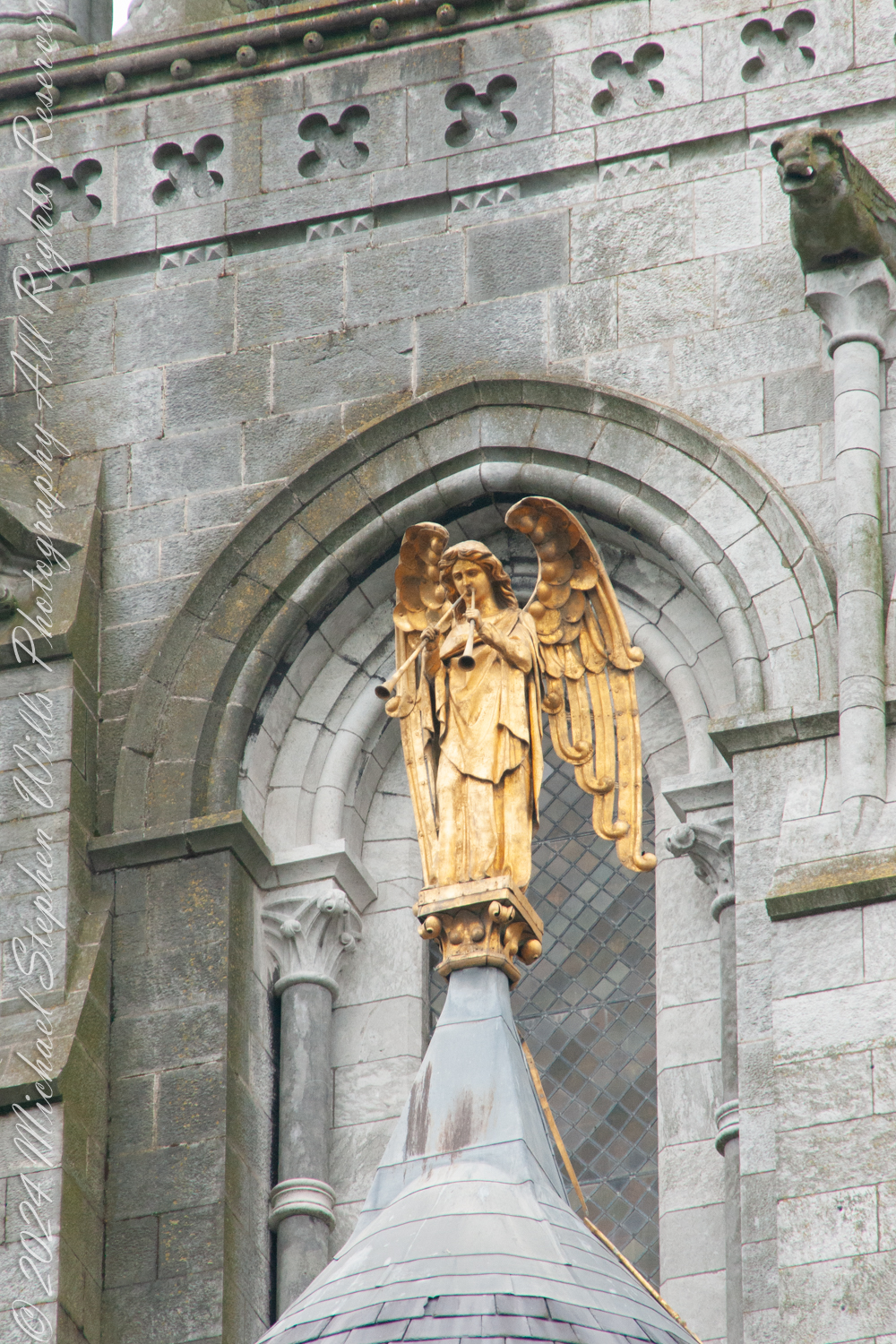
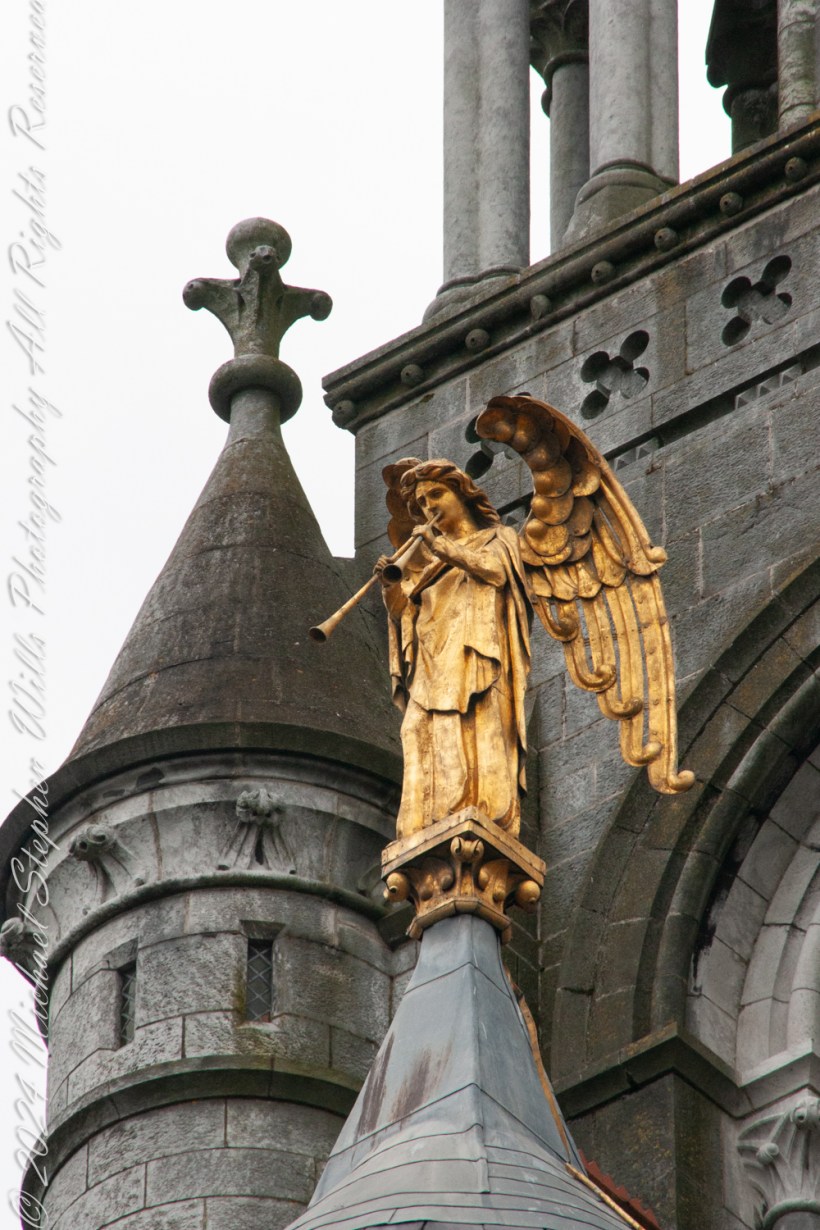
Standing on the east side of Saint Fin Barre’s Cathedral, I lift my gaze to the gilded angel high above the polygonal apse. Known as “The Resurrection Angel,” this radiant figure with its trumpet held aloft commands both awe and contemplation. As an enduring symbol of hope, renewal, and spiritual vigilance this angel carries a profound and dramatic promise: the sound of its trumpet will one day warn the people of Cork of the world’s imminent end, giving them the opportunity to be among the first to ascend to heaven.

The Resurrection Angel’s trumpet echoes the apocalyptic imagery of the Book of Revelation, particularly Revelation 11:15, where the seventh trumpet announces, “The kingdoms of this world have become the kingdoms of our Lord.” Yet in Cork, this celestial figure is imbued with a uniquely local significance. It stands as both guardian and guide, poised to fulfill its divine purpose when the end of days draws near. The legend elevates the angel’s presence beyond theology or art—it becomes a tangible connection between the celestial and the earthly, rooted in the lives of Cork’s citizens.

From an epistemological perspective, the Resurrection Angel poses fascinating questions about how we prepare for the unknown. What does it mean to live in the shadow of an angelic trumpet, one that might sound at any moment? Its silence is a paradox, a quiet yet profound proclamation of life’s transience. The legend suggests that the people of Cork, by virtue of the angel’s warning, are uniquely favored—a notion that intertwines faith with identity and imbues the city with a sense of divine guardianship.

The angel’s golden form shines brightly against the gray stone of the cathedral, a deliberate contrast that speaks to its otherworldly purpose. Gold, a symbol of purity and divine light, captures the eternal amid the temporal. The Resurrection Angel reflects the ambitions of the cathedral’s architect, William Burges, who intended every detail of Saint Fin Barre’s to serve as a testament to faith and artistry. This angel was the final piece installed, marking the cathedral’s completion and fulfilling Burges’ vision of a “perfect work.” According to lore, Burges himself declared that if the angel were ever to fall, it would signal the end of the world—a statement that deepens the mystique surrounding this celestial figure.

For Cork, the angel embodies the city’s resilience and collective spirit. Over centuries, Cork has weathered fires, floods, and rebellion, yet it has always risen anew. The angel, with its legend of warning and redemption, mirrors this cyclical journey of challenge and renewal. Its trumpet, silent but ever-present, reminds the people of Cork to stay vigilant, to hope, and to strive for goodness in the time they have.

As I stand beneath its watchful gaze, I feel the weight of the legend and its implications. If the angel’s trumpet were to sound today, would we be ready? It invites not fear but reflection—a challenge to live with purpose and awareness of the sacred in the everyday. And as I step away, the angel remains, steadfast and golden, a silent guardian over Cork, holding its promise and its warning aloft for generations to come.

Enter your email to receive notification of future postings. I will not sell or share your email address.

Jenny Pickford’s Double Allium: A Tribute to Nature’s Wonders

The Double Allium sculpture symbolizes nature’s beauty and personal connection, reflecting the artist’s homage to alliums and cherished memories.

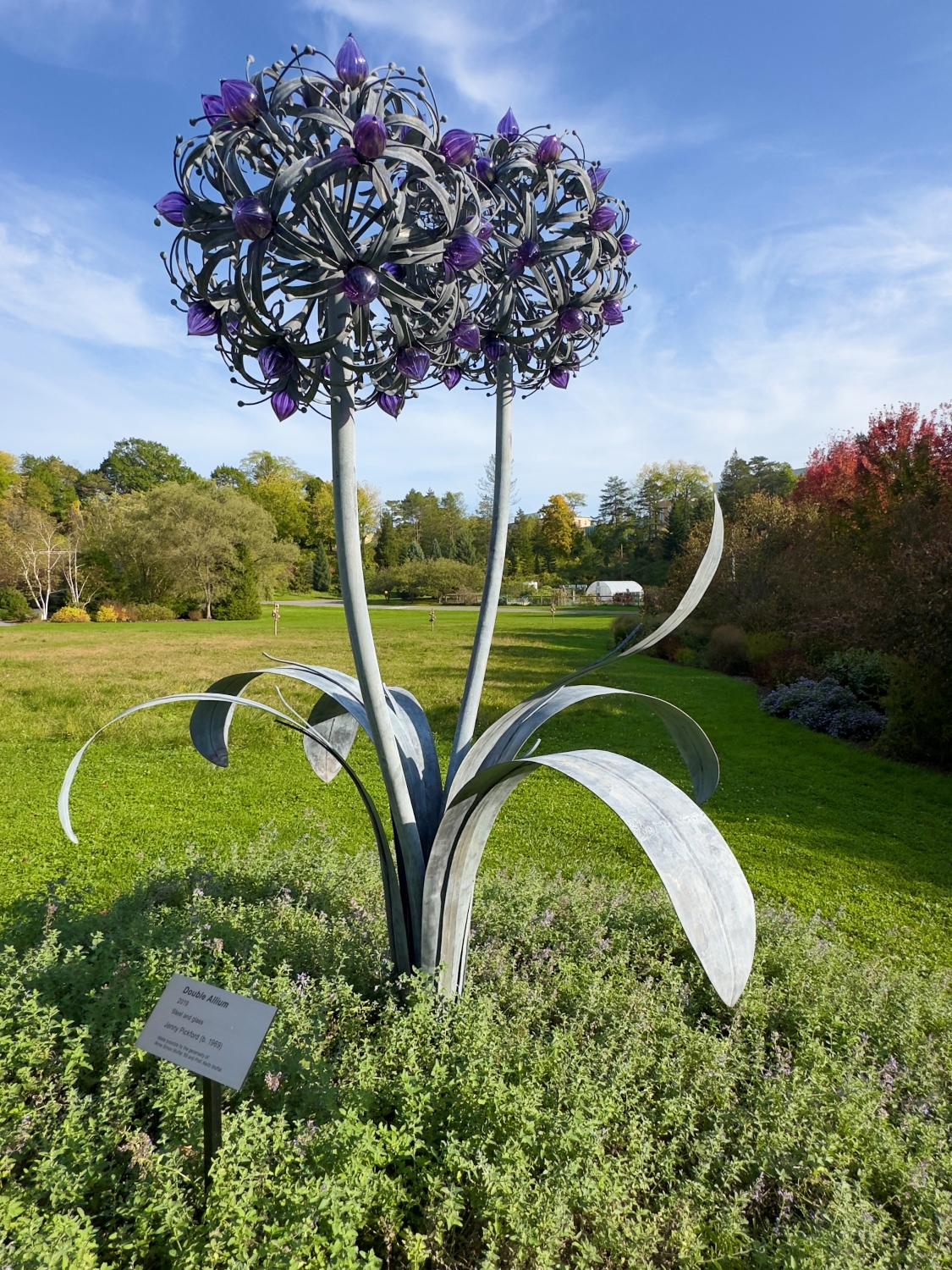
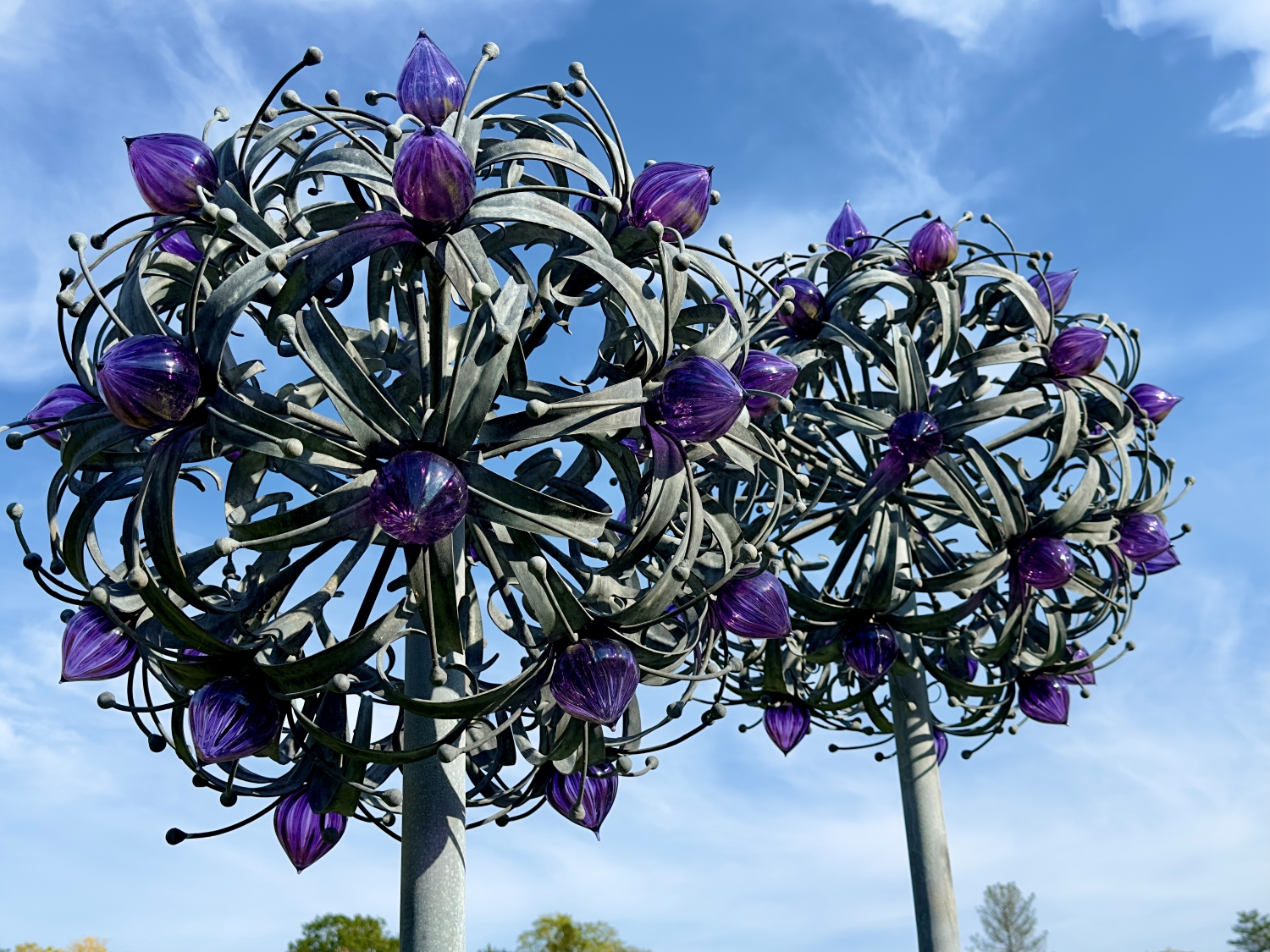
As I wander the paths of the Cornell Botanical Gardens near the Nevin Welcome Center, a towering sculpture arrests my attention, rising well over ten feet into the bright autumn sky. At first glance, it’s unmistakable—a pair of massive allium blooms crafted from steel and glass, an artistic tribute to the very flowers my wife, Pam, has come to love. This creation, titled Double Allium, is the work of British artist Jenny Pickford, completed in 2019. Made of robust steel and translucent purple glass, it stands proudly among the greenery, capturing both the delicacy and boldness of allium flowers.

A few summers ago Pam planted several allium in sunny locations, which exploded into violet firework-like blooms, each sphere teeming with tiny star-shaped flowers that clustered together into one massive, round bloom. When the alliums blossomed, they attracted a small frenzy of bees, and it became a shared delight for us to watch our garden transform into a pollinator’s paradise. Pam was captivated by the plants’ structure and beauty, as well as their ecological role in supporting bees—a small, vibrant ecosystem within our yard. Standing before Double Allium, I’m reminded of those summer days and the quiet joy we both found in observing our garden.

Bees and Allium in our summer garden, 2024

The scientific name for alliums, Allium giganteum (for the larger ornamental varieties), links them to a vast genus that includes onions, garlic, and leeks. These plants have been cultivated and revered by humans for thousands of years, not only for their culinary value but also for their symbolism in various cultures. In ancient Egypt, alliums were believed to represent eternity; their spherical form and concentric layers were thought to mirror the eternal nature of life. Even today, they bring a sense of timelessness to gardens worldwide, their tall stalks and spherical blooms defying gravity, standing tall against the changing seasons.

As I study Pickford’s sculpture, I’m struck by how faithfully it captures this essence of alliums—strength paired with grace, structure married to elegance. The steel stems curve gently yet rise powerfully from the ground, while the glass petals shimmer in the light, giving an almost ethereal quality to the blooms. Pickford, born in 1969, is known for her botanical-inspired sculptures that explore the intersection of nature and art. With Double Allium, she’s created a piece that feels alive, as if the blooms might sway in the wind or burst into real flowers at any moment.

For Pam and me, this sculpture pays homage to a beautiful plant; it’s a connection to our own experience with nature, a reminder of those summer mornings watching bees dance among our alliums. Standing beneath Double Allium, I feel a sense of continuity—a link between the art and our own small garden, between our life and the ancient cultures that cherished these plants, between the permanence of steel and the fleeting beauty of each summer bloom.

In this towering sculpture, Pickford has given us a mirror that reflects nature as well as our personal connection to it. “Double Allium” is a celebration of growth, strength, and beauty, qualities that Pam and I cherish in the alliums we tend and that we find echoed in this remarkable work of art.

Enter your email to receive notification of future postings. I will not sell or share your email address.

From Ground to Sky: A Reflective Climb

Experiencing joy and memory.

Here, on the playground,
the morning stretches wide—
a sky so blue it swallows you whole.
And you, a small figure, climbing
the red pillar, moving hand over hand
up the ropes that knot and twist
like veins, like lifelines.

I watch from below,
the ground a familiar place
where footsteps fall and scatter—
but you, you are ascending,
breath held in the still air.
Nothing is simple in this moment,
yet everything is—

the cord that bends beneath you,
the thrill in your chest,
the boots pressed firm against braided paths.

If I could speak, if words were clear as the day,
I’d tell you how these small victories—
climbing high, standing above—
are etched into the bones of memory.
Someday, you’ll look back and wonder
at the web of ropes,
the pillar red against autumn’s burn,
and the vastness that carried you up,
into light, into air,

where fear gave way to joy,
and the sky leaned close,
just to watch you rise.

Enter your email to receive notification of future postings. I will not sell or share your email address.

A Saint’s Origins: How Famine and Faith Shaped Marianne Cope

While exploring Saint Marianne Cope’s early life, I uncovered the hardships her family faced during Germany’s devastating 1816 famine. Their struggles and eventual emigration shaped the resilient spirit of this future saint. Read more about their journey in my blog.

While my wife was recovering from major surgery at Saint Francis Hospital in Syracuse, New York, I spent a morning at the nearby Shrine and Museum of Saint Marianne Cope. There, I delved into the early life of this remarkable saint, born Barbara Koob. As I explored her story, I found myself drawn to the experiences of her parents, Peter and Barbara Wirzenbacher Koob, who endured some of the most challenging times in early 19th-century Germany. Their struggles, shaped by the economic and social crises of the time, played a pivotal role in the Koob family’s eventual emigration to the United States, setting the stage for their daughter’s life of service.

Saint Marianne Cope Shrine and Museum, adjacent to Saint Joseph’s Hospital, Syracuse, New York. Captured from a street view of Google Maps.

The story begins in Heppenheim, a small town nestled in the southern part of Hesse, Germany. Like many other towns in the region, Heppenheim was reliant on agriculture for survival. However, the year 1816 brought unprecedented hardship. Known as the “Year Without a Summer,” this period was marked by extreme cold and wet conditions, caused by the catastrophic eruption of Mount Tambora in Indonesia. The volcanic ash released into the atmosphere blocked sunlight and disrupted weather patterns across the globe.

Heppenheim is the seat of Bergstraße district in Hesse, Germany, lying on the Bergstraße on the edge of the Odenwald. This photograph is from Google Maps.

For the people of Heppenheim, this meant crop failures on an unimaginable scale. Rye and wheat, staples of their diet, rotted in the fields. Food became scarce, and prices soared. The ensuing famine left families, including the Koobs and their ancestors, struggling to survive. As hunger gnawed at them, they faced a bleak future. This economic strain was compounded by broader challenges: industrialization was beginning to transform the German economy, leaving traditional agrarian lifestyles in its wake, while political unrest simmered as the fragmented German states wrestled with issues of governance and unity.

These hardships were not unique to Heppenheim. Across Germany, the “Hunger Years” of 1816-1817 prompted widespread despair. For many, including the Koob family, the promise of a better life beckoned from across the Atlantic. The United States, with its vast expanses of fertile land and burgeoning economy, seemed to offer a way out of the grinding poverty and instability that had taken hold in their homeland.

A home in Heppenheim. Photograph from Google Maps and taken around 2022.

Barbara Koob was born on January 23, 1838, into a family deeply rooted in their community. Peter Koob was identified as a “Citizen and Farmer,” and shortly after her birth, Barbara was baptized at St. Peter’s Church, marking the beginning of her journey in a devout Catholic family.

Heppenheim, where Barbara Koop (Saint Marianne Cope) was born here January 23, 1838 and baptized as a Catholic shortly after this church, Saint Peter’s. Google Maps Photograph taken around 2022

By 1839, Peter and Barbara Koob, like many others from their region, made the difficult decision to leave Heppenheim behind. With their young daughter Barbara, they embarked on a journey to the United States. They settled in Utica, New York, where the opportunities for a new beginning were more promising, even though the bustling industrial town was a far cry from the rural life they had known. In 1862, Barbara committed herself to the Sisters of the Third Order of St. Francis in Syracuse, New York, taking the name “Marianne Cope.”

Mother Marianne Cope statue dedicated January 23, 2010, in Honolulu.
Attribution: billsoPHOTO, CC BY-SA 2.0 , via Wikimedia Commons

Reflecting on these events, it becomes clear how deeply the early experiences of famine and economic hardship must have influenced the Koob family’s decisions and, ultimately, the life of their daughter. The struggles of her parents during those hard years in Germany laid the foundation for Marianne Cope’s own resilience and dedication to serving those in need. Their story is a testament to the strength of the human spirit in the face of adversity and the powerful role that faith and hope can play in guiding one’s path.

Copyright 2024 Michael Stephen Wills All Rights Reserved