A careful winter walk along the South Rim reveals Lucifer Falls transformed—ice chutes, frozen veils, and flowing water beneath stone, inviting patience, attention, and quiet awe.
January pares the gorge to essentials. Color withdraws, sound sharpens, and the land reveals its underlying grammar—stone, water, cold, and time. Reaching Lucifer Falls by the South Rim Trail on a winter morning feels less like an initiation, a careful passage through ice-chutes and shadowed ledges where the creek rehearses its ancient work in a new key.
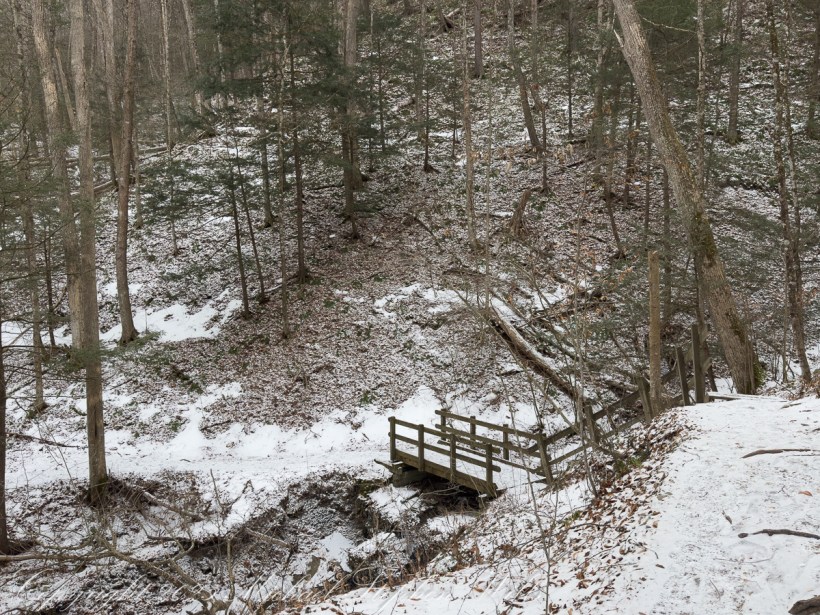
Wintertime scene along the South Rim Trail of Robert H. Treman State park. The trail is solid ice. Ithaca, Tompkins County New York State
The trail begins quietly, a soft crunch underfoot where snow thins to leaf litter. Hemlocks hold their breath. The gorge opens in increments, not all at once, and the creek’s voice arrives in fragments—first a whisper, then a steady insistence. Winter edits the landscape with a clean hand. The clutter of summer understory is gone; what remains is structure: stratified shale stacked like a book left open to a single, patient chapter. Every footfall demands attention. Ice slicks the stone where seeps cross the path, and the trail teaches a winter gait—short steps, weight centered, the quiet confidence of traction earned rather than assumed.
As the rim narrows, the air cools perceptibly. The gorge walls rise higher, their layered faces stippled with frost and snow. Icicles form a punctuation along ledges, commas and exclamation points caught mid-sentence. In places, the trail descends into ice chutes—steep, polished corridors where meltwater has glazed the rock. Here, the body listens more closely. Boots test, then commit. Hands brush the cold bark of a leaning tree, a borrowed handrail. There is pleasure in this concentration, the way winter insists on presence. You cannot hurry. You cannot drift.
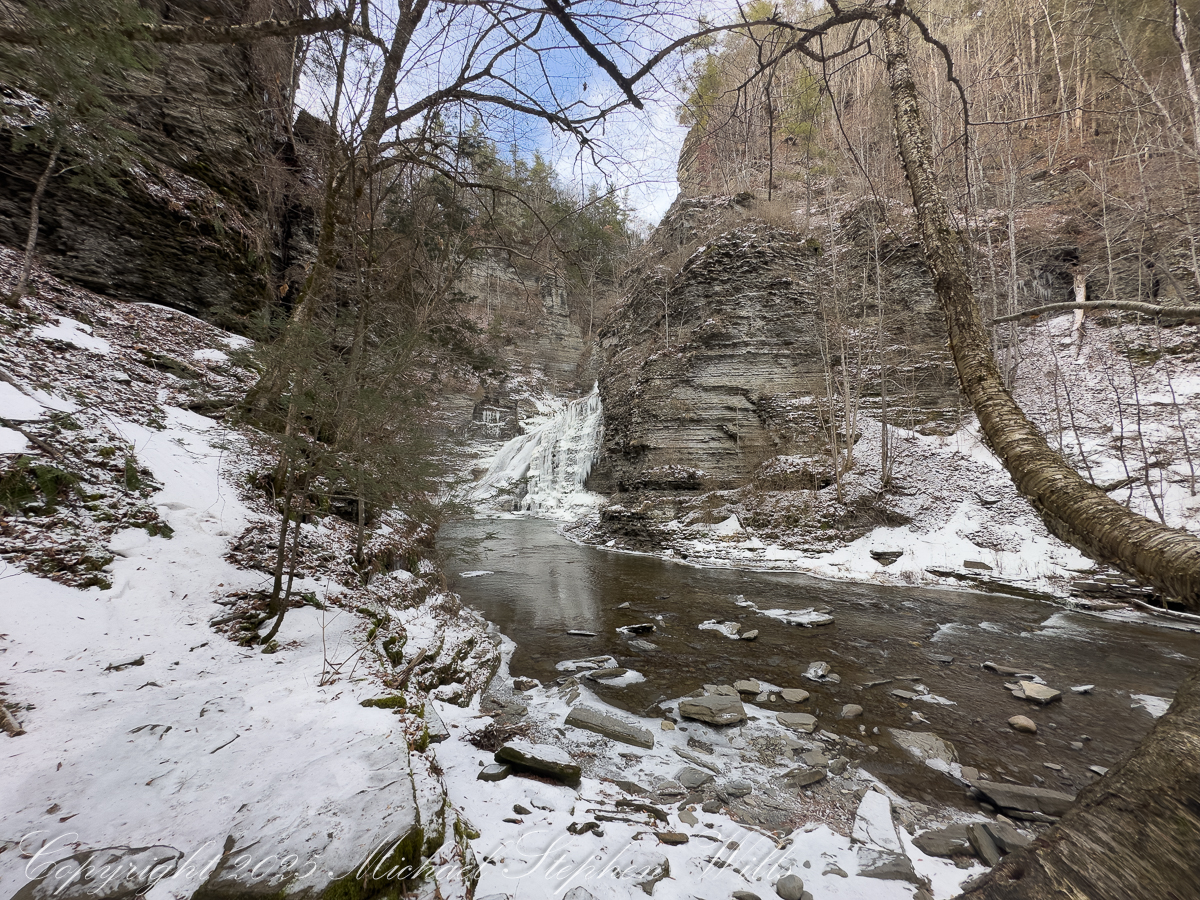
Below, the creek widens into a quiet pool, its surface a muted mirror. Thin plates of ice drift and collide, sounding a faint porcelain clink. The sound carries upward, amplified by the gorge’s acoustics, a delicate counterpoint to the deeper hush of falling water. The trail curves, and suddenly the falls announce themselves—not in full view, but as a white presence beyond the bend, a brightness lodged between walls of stone.
The trails this day were solid ice. I arrived via the South Rim Trail, the only way to access this site. Robert H. Treman State Park, Ithaca, Tompkins County, New York State
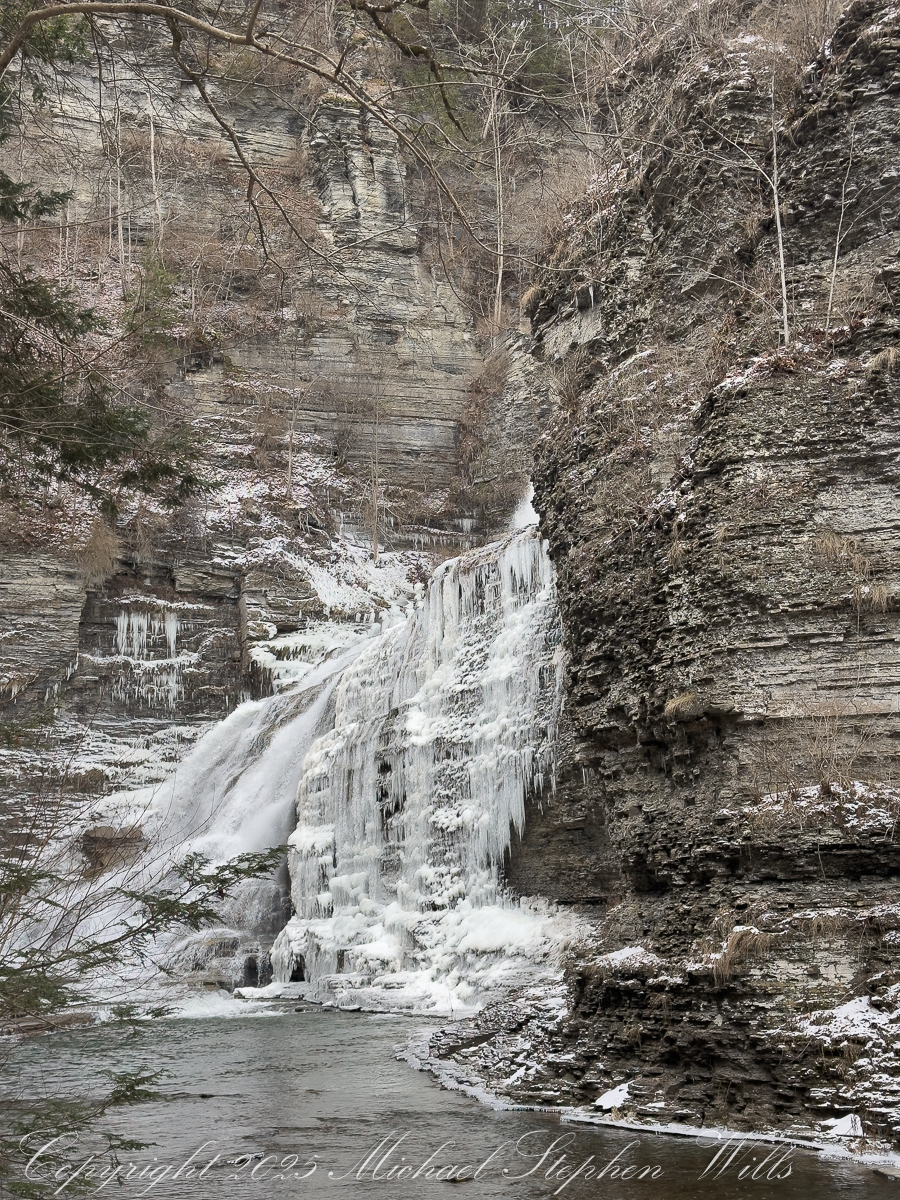
Approaching from the South Rim offers a measured reveal. First the upper cascades appear, water fanning across rock that has become a winter canvas. Ice has claimed the margins, building ribs and curtains that thicken day by day. The falls do not stop in January; they change. Water threads through ice, slips behind it, emerges again in translucent veils. Gravity persists, but its expression is altered—slower, more deliberate, sculptural.
At the base,Lucifer Falls stands transformed. The familiar plunge has become a tiered architecture of frozen flow, a stepped amphitheater where icicles hang like organ pipes and snow pillows settle into hollows. The water still moves, a silver ribbon finding its way down the left flank, while the right side has grown into a cathedral of ice. The gorge walls close in, amplifying the sound—a low, resonant murmur that feels as much felt as heard.
The cold sharpens every sense. Breath fogs, then clears. Fingers tingle through gloves as the camera comes out, metal biting through insulation. Framing becomes an act of translation: how to honor motion when much of it has paused; how to suggest the hidden currents beneath the frozen skin. A short video will later catch what stillness cannot—the soft shiver of water behind ice, the way the falls breathe even in winter—but for now, the eye lingers on texture and line. Shale layers echo the ice’s striations. Time repeats itself in different materials.
Standing there, it’s impossible not to feel the weight of deep history. These rocks remember glaciers and warmer seas; this creek has been at work since before memory had a word. January merely adds a chapter. Snow feathers the ledges. A stray sunbeam slips into the gorge, briefly igniting the ice, and then is gone. The falls return to their monochrome palette, as dignified as an old photograph.
The return along the rim is lighter, the path now familiar, confidence earned. The ice chutes yield more easily on the way back, as if acknowledging the careful passage. Above the gorge, the forest resumes its quiet, and the trail leads out into the open day. What lingers is the sense of having witnessed something intimate and exacting—a winter conversation between stone and water, conducted without haste, inviting those willing to slow down and listen.
January asks little and gives much. Reaching Lucifer Falls by the South Rim is a reminder that beauty is not diminished by cold; it is clarified.
Enter your email to receive notification of future postings. I will not sell or share your email address.
Copyright 2026 All Rights Reserved Michael Stephen Wills
A reflective springtime journey through Robert H. Treman and Fillmore Glen State Parks reveals the quiet beauty and botanical mysteries of red and white trilliums—exploring their species differences, color shifts, and the wonder of their ephemeral blooms.
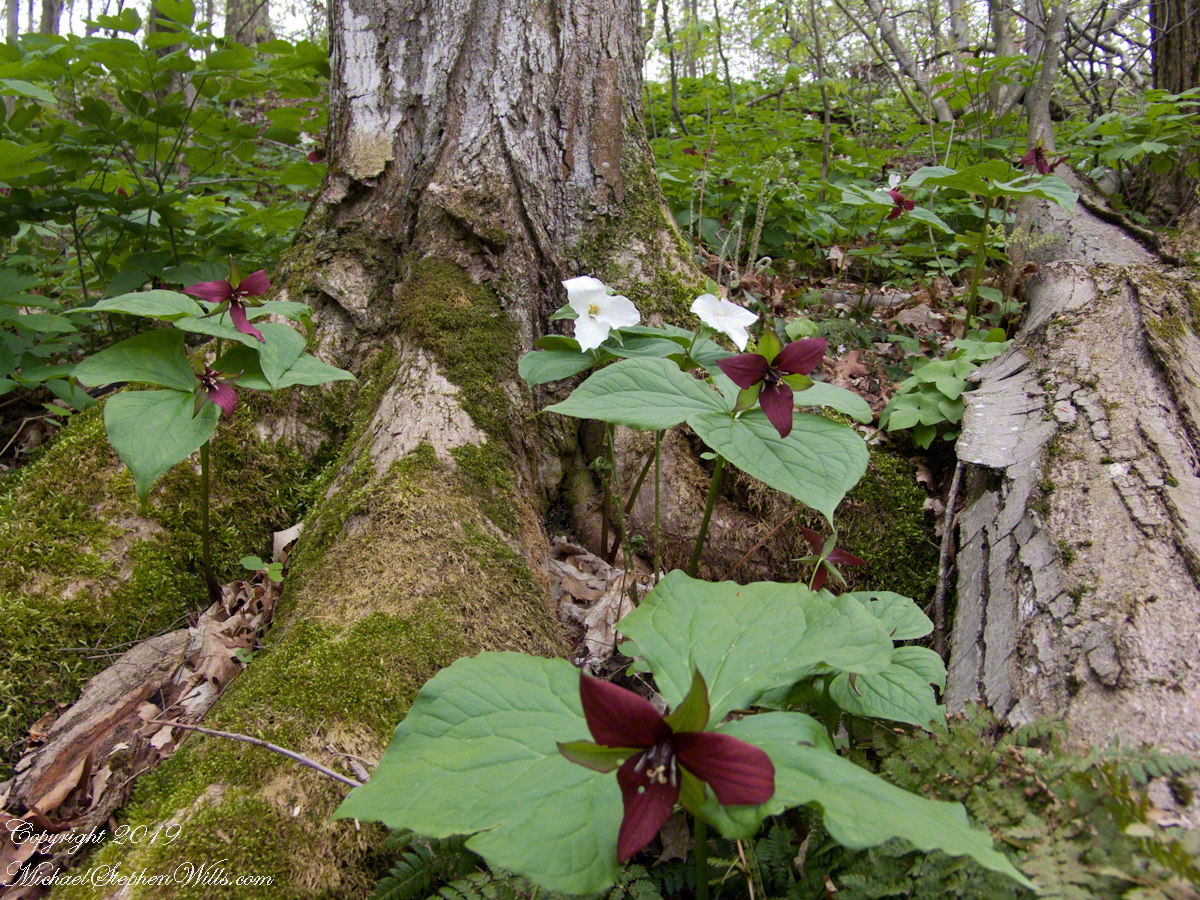
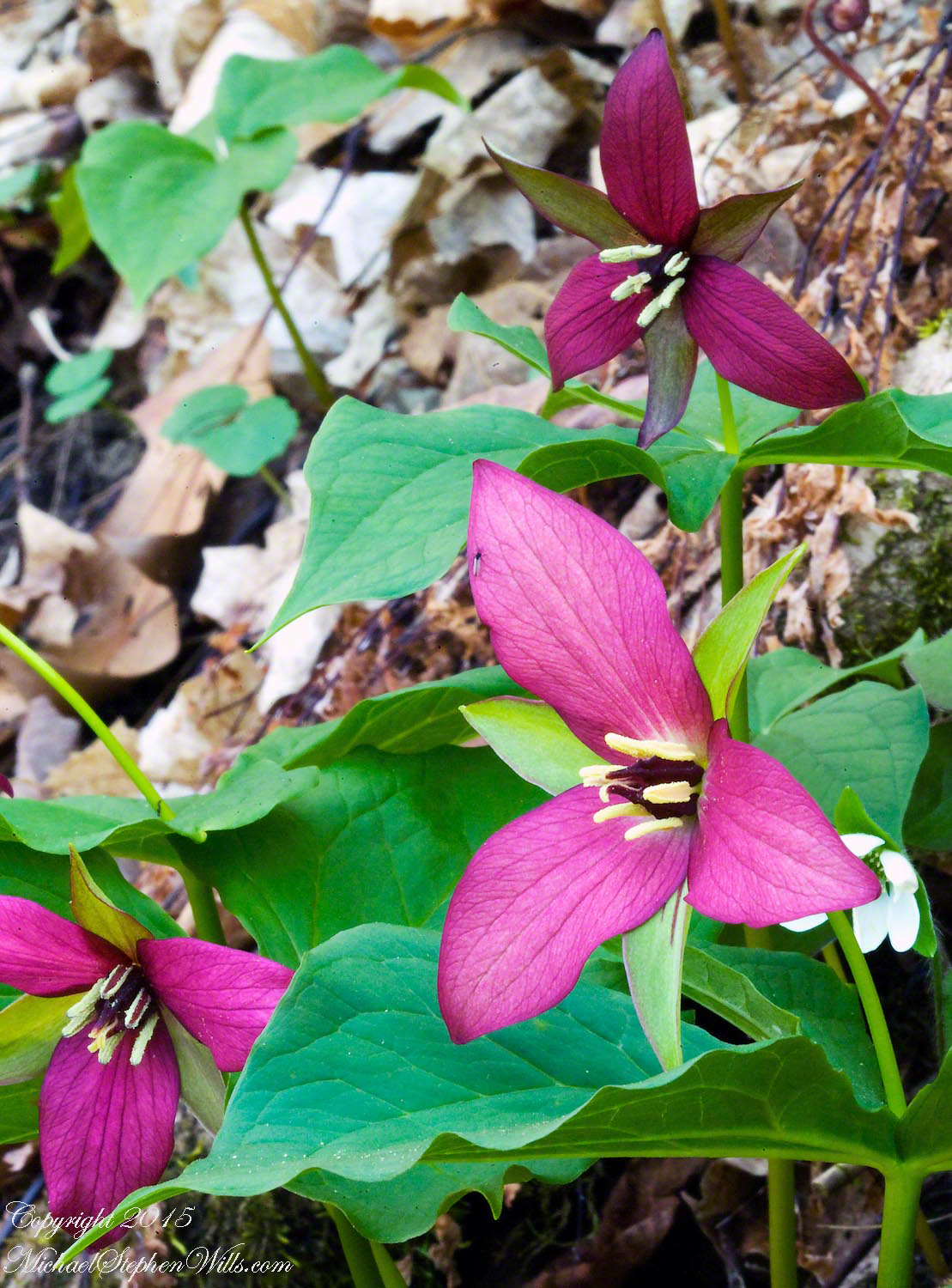
I follow a winding trail through hemlock and maple woods, the air cool and earthy after a spring rain. Under the canopy of budding leaves, I spot a flash of deep burgundy among the moss. Kneeling, I find a red trillium blooming at the base of an old oak. Its three velvety petals are a rich wine color against the green moss and damp leaf litter. A faint musky scent wafts from the flower – no wonder some call it “Stinking Benjamin.” Nearby stands another trillium, but this one is a pristine white star facing upward toward the light. Its broad petals have a gentle wavy edge and no noticeable odor. The red flower droops modestly while the white one opens itself to the sky. Different in color and posture, I realize these are two distinct species1 sharing the same springtime stage.
Red trilliums (Trillium erectum) and white trilliums (Trillium grandiflorum) thrive side by side on the mossy roots of a tree. The maroon “wake robin” flowers nod toward the earth, while the white blooms stand upright to catch the light.
Seeing the red and white blooms side by side feels like meeting two woodland siblings – each unique yet part of the same family. The white trillium is almost luminous in the forest gloom, while the red trillium blends into the shadows with its dark hues. Both emerge from the soil after long, cold months, timing their bloom for the brief sunny window before the trees fully leaf out. Knowing how slowly these perennials grow and how long they live makes their yearly return even more special to witness. Their resilience in coming back each spring fills me with quiet awe.
Early May – Fillmore Glen State Park
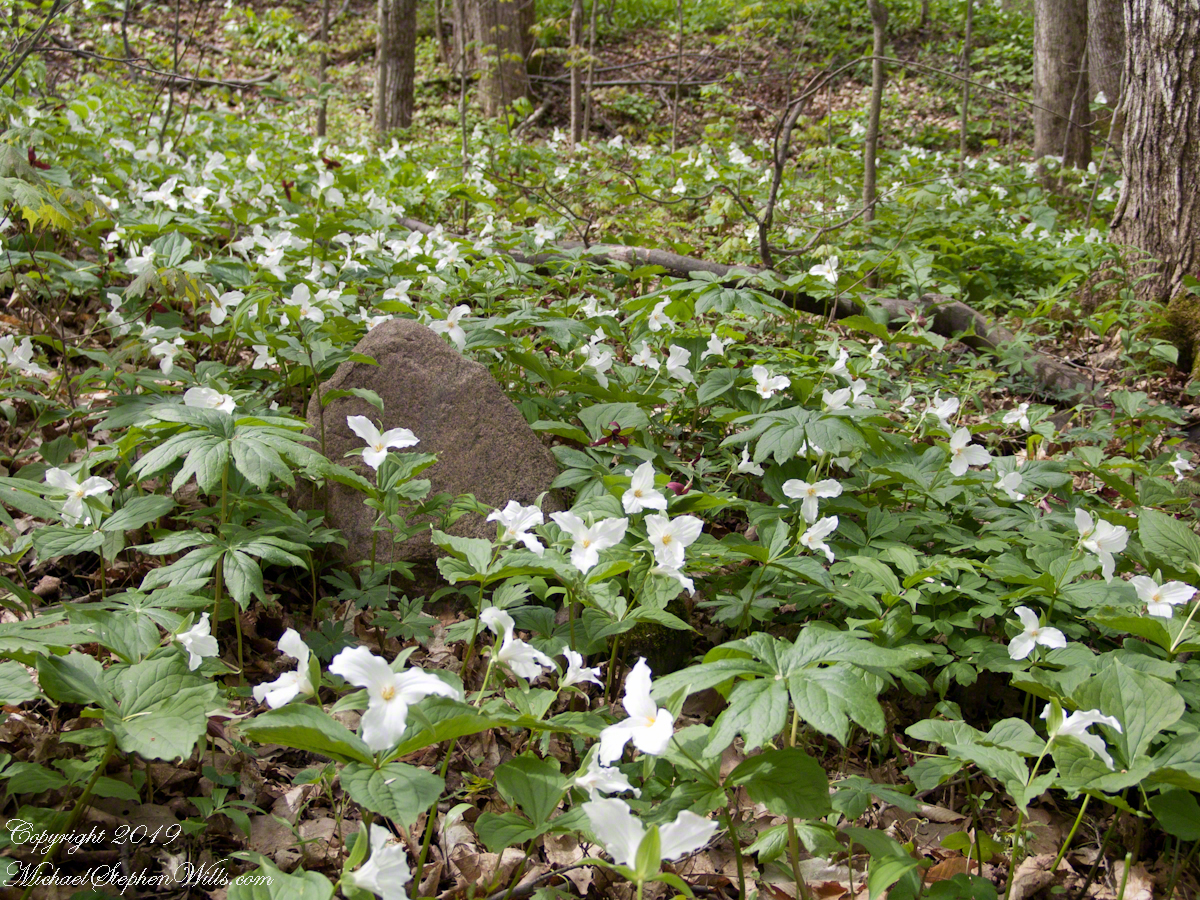
A week later, I wander the lush gorge of Fillmore Glen. The trail is alive with birdsong and the rush of a creek. Dappled sunlight slips through the greening canopy, illuminating patches of the forest floor. Rounding a bend, I catch my breath — the hillside ahead is blanketed with hundreds of white trilliums, a breathtaking constellation of blooms across the ground that feels almost sacred. Careful not to tread on any, I step closer to admire them at eye level.
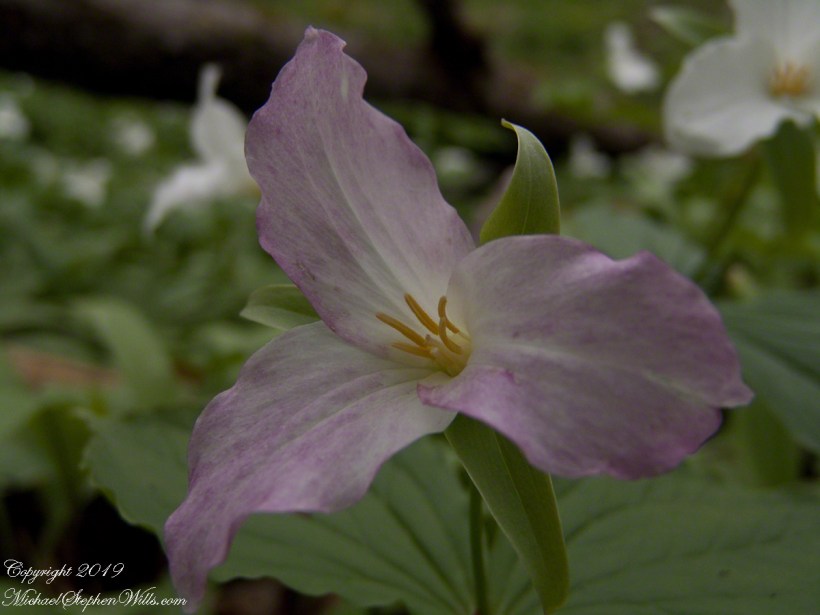
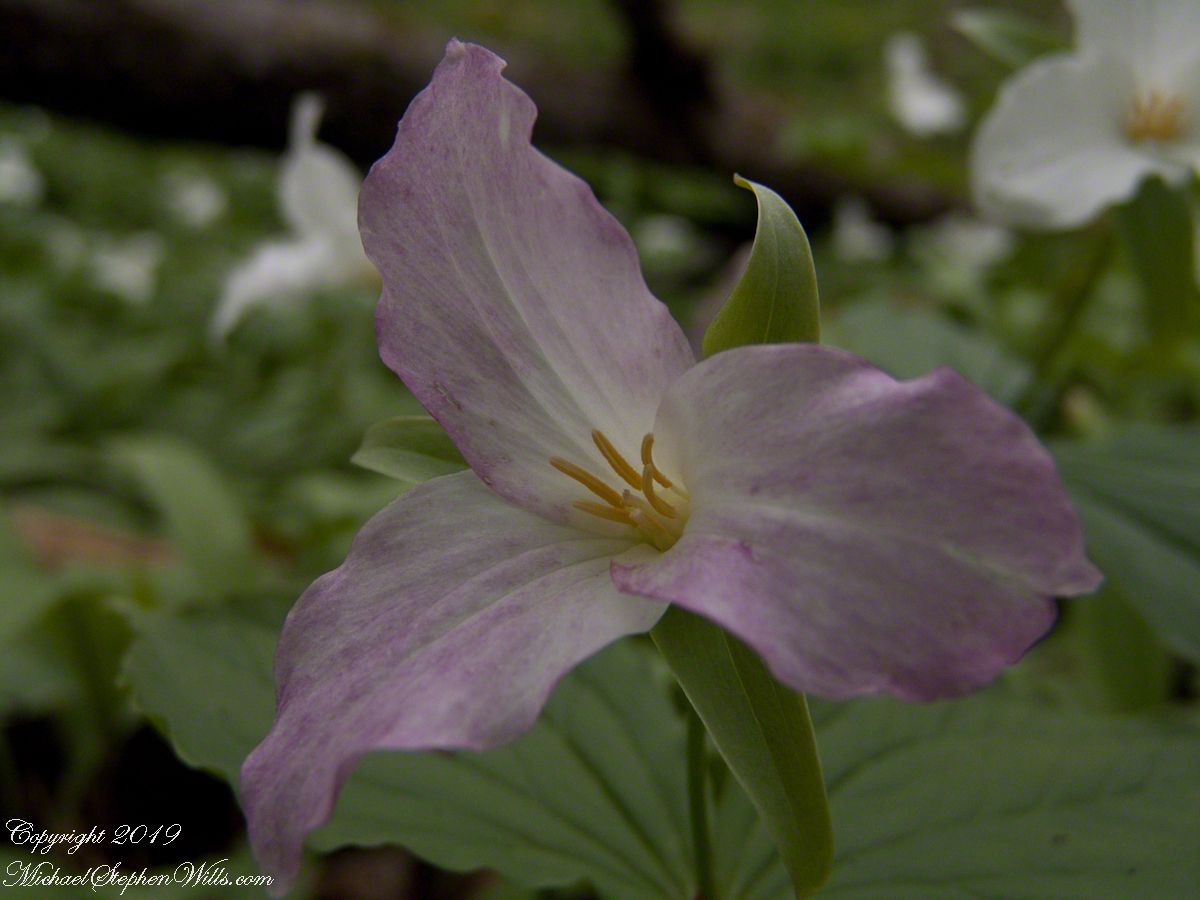
Up close, one large white trillium reveals a surprise: a delicate wash of pink across its aging petals, as if it were blushing. It’s known that after pollination the snow-white petals of Trillium grandiflorum often turn rose-pink with age2. Indeed, many blossoms here wear a faint pink tint, especially those that have been open for a while. This blush of maturity gives the colony a quietly celebratory air – fresh ivory blooms mingling with older siblings tinted softly rose.
The petals of a white trillium take on a soft pink blush as the flower ages, adding a new hue to the spring palette. Fresh white trilliums bloom in the background while older ones show a rosy tint.
In a shaded nook at the edge of the colony, a lone red trillium blooms among the white. I wonder if the red and white trilliums ever hybridize. I see no intermediate colors and recall that the white trillium rarely hybridizes with other species3. The red trillium, by contrast, can swap pollen with certain close relatives, yielding various forms elsewhere. But a true red–white cross never occurs here – each species keeps to its own.
Trillium bloom April through May in central New York State. I found these blooming on the rim of Fillmore Glen near Owasco Lake and the town of Moravia.
The red trillium even has a rare white-petaled form4 easily mistaken for its white-flowered cousin. I linger a bit longer among these graceful “trinity flowers,” my questions answered and my appreciation deepened. As I turn to go, a sunbeam breaks through and illuminates one last trillium by the trail, its white petals touched with pink. I smile, grateful for the chance to witness this woodland wonder.
Enter your email to receive notification of future postings. I will not sell or share your email address.
Copyright 2025 All Rights Reserved Michael Stephen Wills
Footnotes
Different species: Red trillium and white trillium are separate species (Trillium erectum and Trillium grandiflorum, respectively), distinguished by traits like flower orientation and petal shapeidentifythatplant.com.
White petals turn pink: The large white trillium’s petals are pure white upon opening but gradually develop a rose-pink or purple tint as the flower agesnj.gov.
Rare hybridization: Unlike some trilliums that hybridize readily, Trillium grandiflorum (white trillium) is not known to form hybrids with other speciesen.wikipedia.org. Trillium erectum can hybridize with its close relatives, but a red–white trillium cross is not observed in nature.
White form of red trillium:Trillium erectum (normally red) has a variety with white petals, classified as T. erectum var. album, which can be mistaken for a white trillium at a glancemidatlanticnature.blogspot.com.
Discover the delicate beauty of early meadow-rue (Thalictrum dioicum) along the Gorge Trail at Robert H. Treman State Park. Explore its unique spring blooms, cultural significance in Native American traditions, and the poetry of its quiet role in the woodland ecosystem.
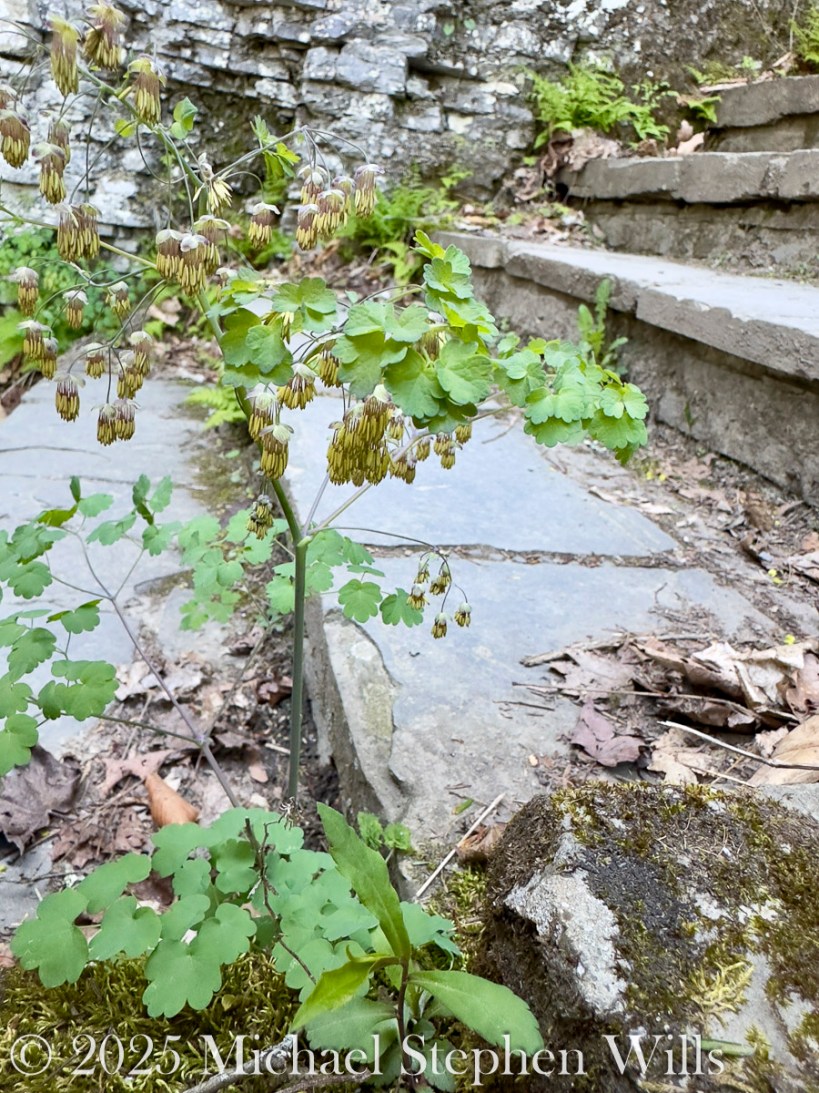
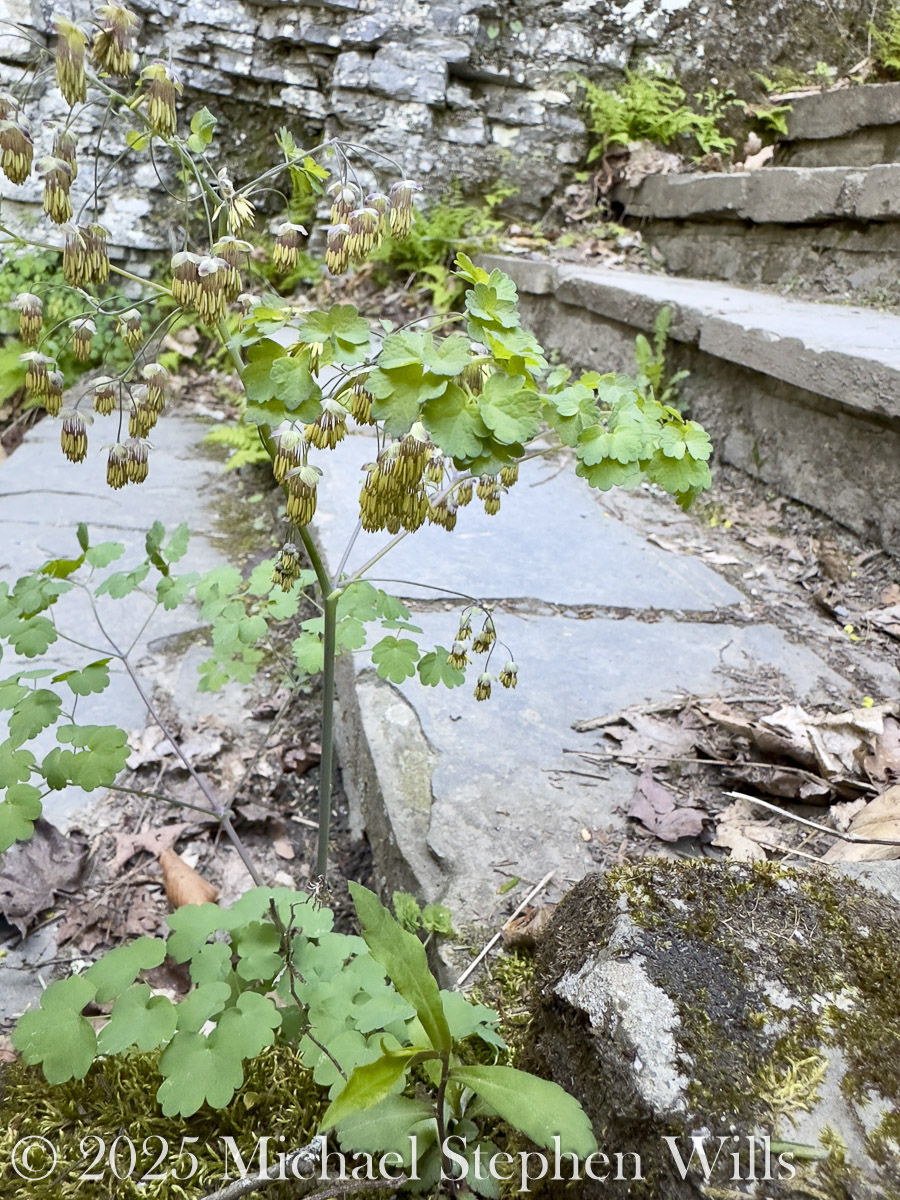
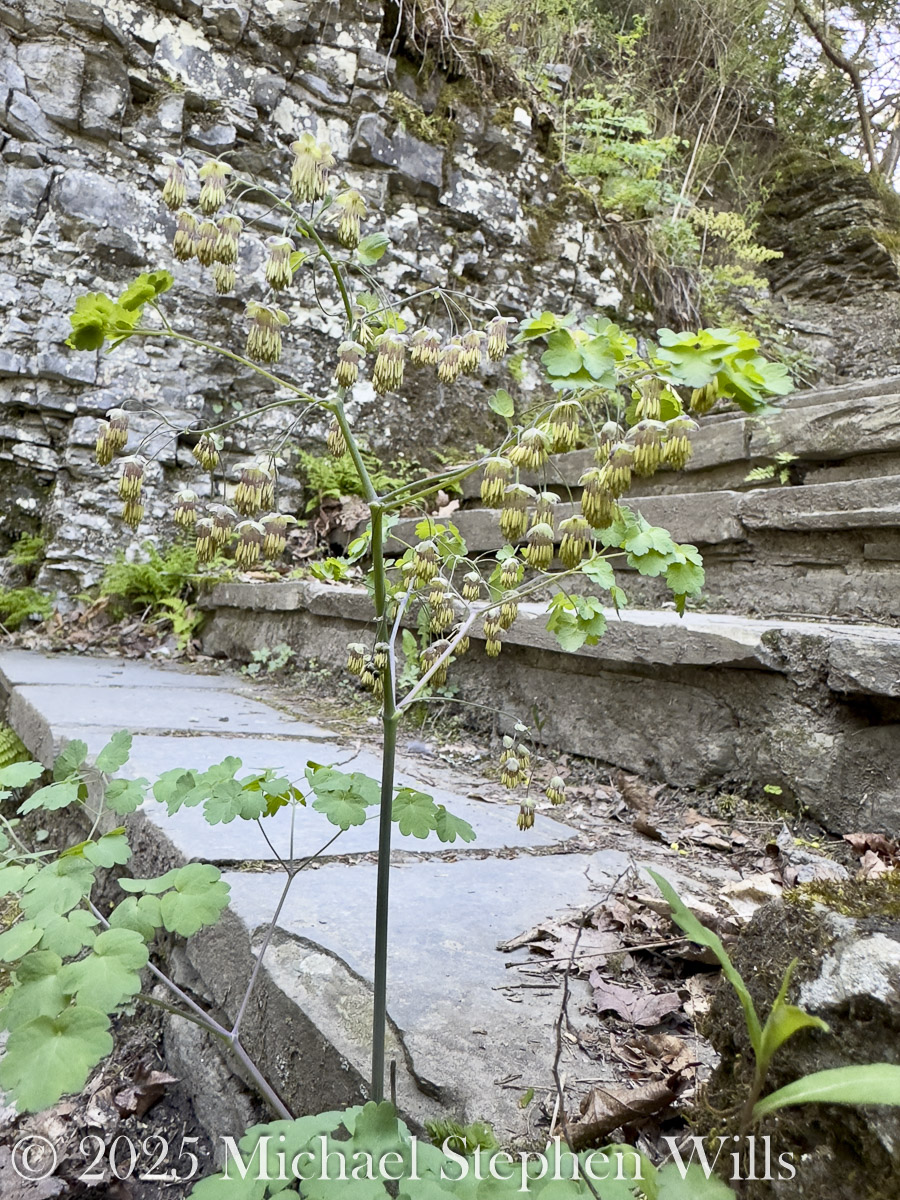
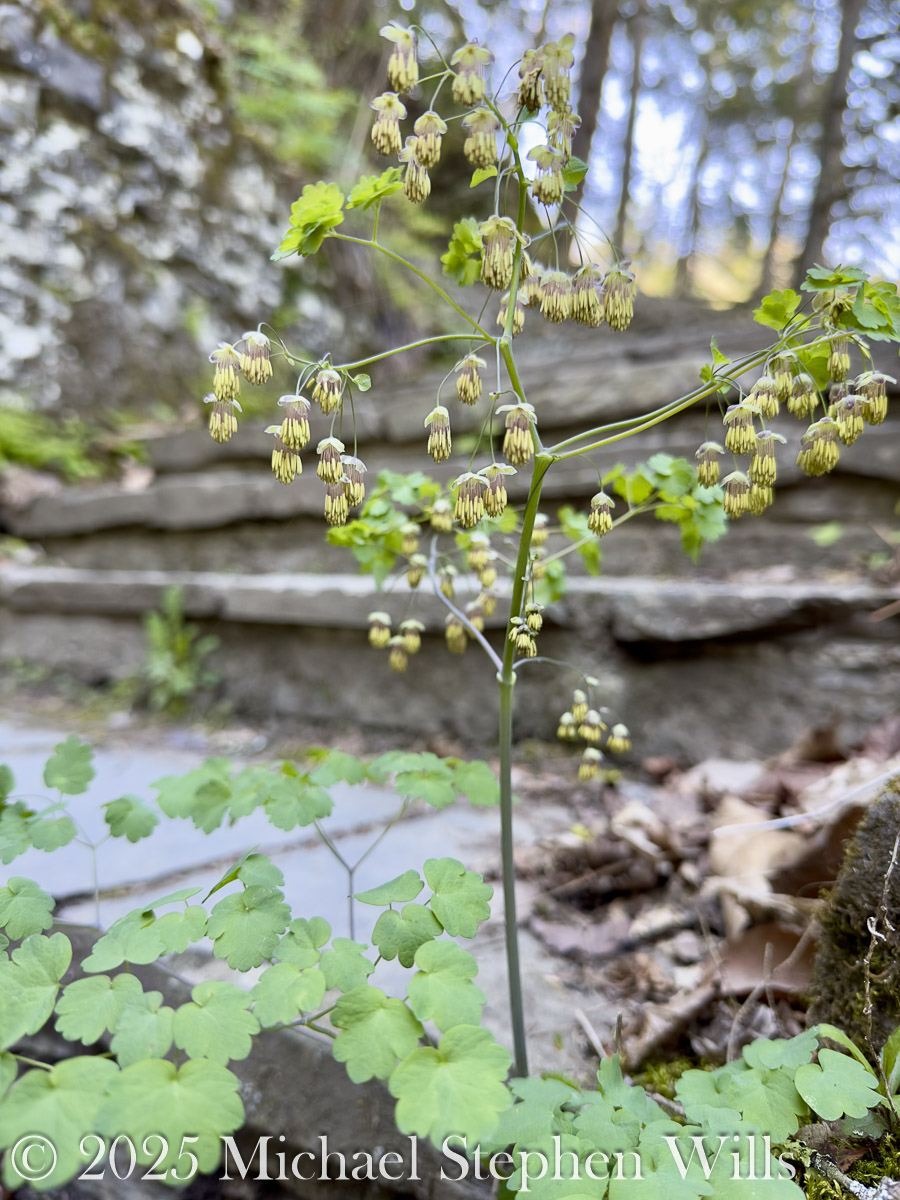
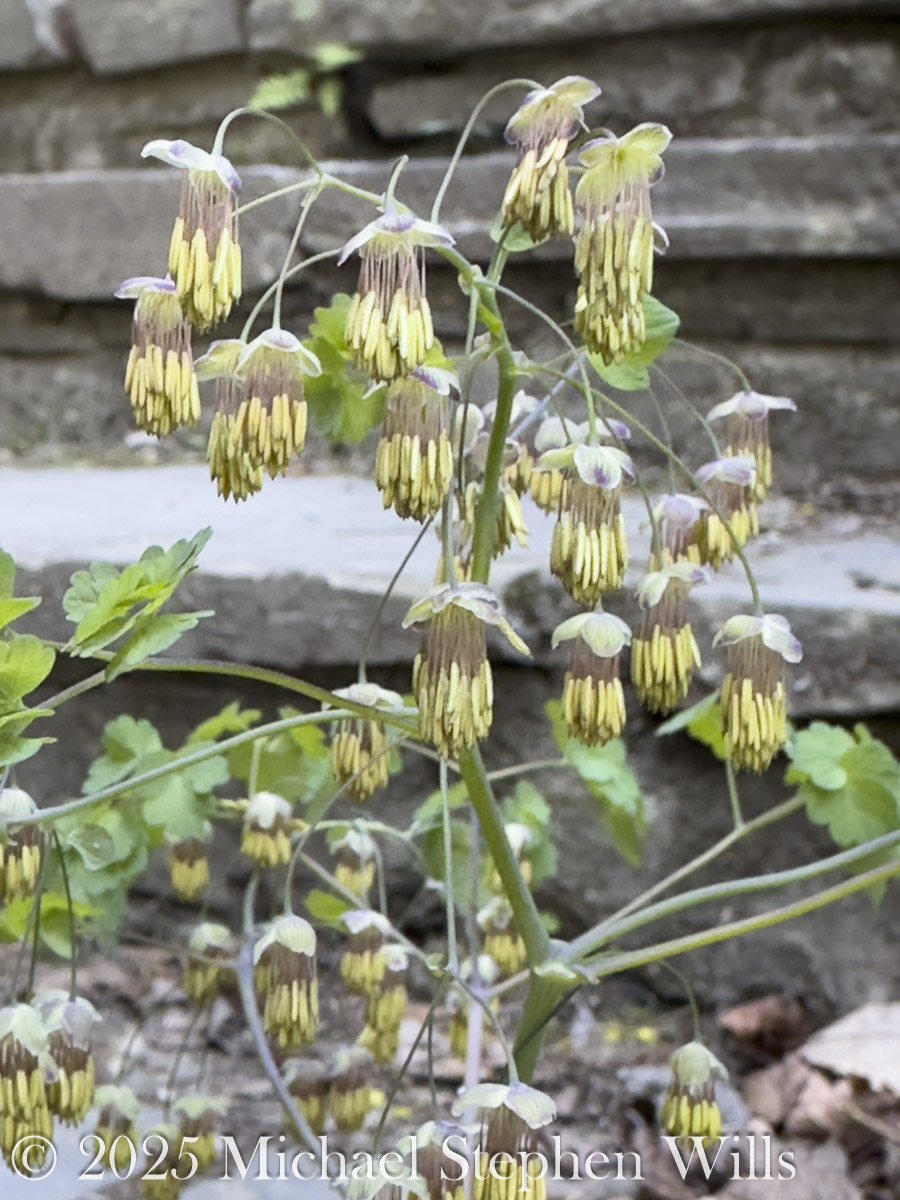
April 28, 2025 – Robert H. Treman State Park, Ithaca, NY. I step lightly along the damp stone stairs of the Gorge Trail, hemmed in by towering rock walls and the whisper of waterfalls. There, at a turn in the path, I encounter an unassuming woodland plant waving in the breeze. Its delicate green foliage could be mistaken for a young fern or columbine, but from its arching stems hang dozens of tiny yellow tassels, swaying like fairy lanterns. This is a male Thalictrum dioicum – commonly known as early meadow-rue, or more whimsically, quicksilver-weed. One of the earliest wildflowers to emerge in spring forests of the Northeast, it offers a subtle spectacle: golden anthers dangling in the cool April breeze, each tiny stamen a pendulum of pollen.
Delicate Botany of a Woodland Rue
At a glance, Thalictrum dioicum might not shout for attention – standing barely one to two feet tall – yet a closer look reveals intricate beauty. Each male plant is a miniature chandelier of blossoms, the flowers having no petals at all but instead a simple fringe of sepals and a flurry of stamens. In fact, the male flowers are the showiest part of this species, with numerous slender, dangling yellow stamens that earn meadow-rue a second look. These dangles are the anthers – pollen-bearing organs – swinging freely to release golden dust on the wind. Female plants, on separate nearby stalks, are more reserved: their flowers hold up clusters of pale pistils like tiny green stars, which, if wind-blessed with pollen, will swell into achenes (dry fruits) later in the season. The separation of sexes in different “houses” is the trait that gives the species its name dioicum, meaning “of two households” in Greek. Early meadow-rue’s foliage is equally enchanting. The leaves are twice or thrice divided into lobed leaflets that resemble the herb rue (Ruta) – hence the common name “meadow-rue”. A misty green above and silvery underside, the leaflets have a rounded, almost columbine-like form with soft scalloped edges. As botanist Eloise Butler once noted, casual hikers often exclaim “what a pretty fern!” upon seeing the airy foliage before noticing any flowers. Indeed, the plant’s fern-like grace and early spring timing give the forest understory a verdant, lacy trim well before the summer plants take over.
What’s in a Name (Etymology and Lore)
Even the name of this humble wildflower carries poetry. The genus Thalictrum harkens back to the Greek word thaliktron, a term used by the ancient physician Dioscorides to describe plants with finely divided leaves. It’s a fitting nod to the meadow-rue’s delicate foliage. The species name dioicum, as mentioned, translates to “two houses,” nodding to its dioecious nature – male and female flowers on separate plants. As for “quicksilver-weed,” an old folk name, one can only imagine it arose from the plant’s ephemeral shimmer: appearing quickly in spring and perhaps glinting with dew like liquid silver. Early meadow-rue also earns its “early” title by being among the first woodland perennials to bloom as the snow melts – a true harbinger of spring in the eastern North American woods. The “rue” in meadow-rue is a bit of a misnomer botanically (meadow-rue is in the buttercup family, not related to true rue). However, the moniker stuck because of a shared appearance – those divided leaves echo the shape of true rue’s foliage. There’s no strong odor or bitterness here, though. Instead, Thalictrum dioicum is gentle in aspect and entirely non-toxic, making it a welcome companion in shady gardens and wild places alike. Gardeners sometimes cultivate it for its graceful foliage and dangling blooms, a little wild treasure in cultivated shade gardens.
A Quiet Role in the Forest Understory
In its native habitat, early meadow-rue lives a low-key life in the understory. It thrives on dappled woodland slopes, often on rich, rocky soils near streams – exactly the sort of place the Gorge Trail winds through. Preferring partial shade, it is comfortable in both moist and well-drained sites. As a spring ephemeral, it takes advantage of the window before the canopy fully leafs out, unfurling its leaves and flowers in April and May, then quietly dying back by midsummer to wait out the year’s end. This strategy allows it to catch the sunlight of early spring and avoid competition later on. Unlike showy wildflowers that beckon bees and butterflies, meadow-rue’s pollinator is the breeze. Being wind-pollinated (anemophilous), it has no need for bright petals or nectar rewards. Instead, those dangling stamens tremble with each gust, shedding pollen into the air – a dance of chance that some of it will drift over to a waiting female flower nearby. The light, swinging tassels are perfectly adapted to this purpose, increasing the odds of pollen dispersal with every sway. Even without offering nectar, early meadow-rue still contributes to its ecosystem. Its tender leaves provide an early snack for rabbits and deer venturing out after winter. A few specialized moth species also use it as a host plant in their caterpillar stage, nibbling on the foliage. By going dormant in summer, meadow-rue returns nutrients to the soil and opens space for later-emerging plants, maintaining the ebb and flow of diversity in the forest floor community. In autumn and winter, only its fibrous roots and a small caudex (rootstock) persist under the leaf litter, ready to send up new growth when spring returns.
Roots in Culture and Folklore
This demure wildflower has also found its way into human stories and herbal traditions. Native American communities, especially in the Northeast, knew and used early meadow-rue in subtle ways. Though not a superstar of indigenous medicine, it had its roles. Cherokee healers brewed tea from the roots to treat diarrhea and stomach troubles, and to ease vomiting. In Haudenosaunee (Iroquois) lore, a decoction of meadow-rue roots was used as a wash for sore, tired eyes, and even taken to steady a palpitating heart – perhaps the gentle plant lending calm through belief or mild effect. Beyond medicine, Thalictrum dioicum tiptoes into the realm of romance and harmony.
According to ethnobotanical notes, young Blackfoot women in the northern Plains would weave the pretty tassels or seed clusters into their hair, believing it would help them attract the attention of a desired young man – a bit of springtime love charm from the wilds. Among some eastern Woodlands tribes, such as the Ojibwa and Potawatomi, the seeds of meadow-rue were a secret tool for domestic peace: slipping a pinch of seeds into the food of a quarreling couple was thought to help dispel discord and restore harmony to the relationship. Whether through mild pharmacological effect or sheer faith, one imagines it brought a hopeful smile to those administering this folk remedy.
Early meadow-rue even made a brief appearance in early colonial folklore. In Canada, it’s said that some of the First Peoples used the crushed roots to treat venomous snake bites, likely as a poultice. The plant’s leaves were also dropped into spruce beer – the fermented drink made by settlers and Natives alike – perhaps as a flavoring or tonic ingredient. Interestingly, despite these uses, meadow-rue never became a staple in European-American herbal medicine. 19th-century herbal texts noted that American Thalictrums were largely ignored by formal medicine, overshadowed by their European cousins. This lends our Thalictrum dioicum an aura of a plant mostly known by those who dwell close to the land – a quiet ally in the forest, employed in pinch when needed and otherwise simply appreciated for its beauty and symbolism.
Reflections on a Spring Encounter
A close-up of Thalictrum dioicum male flowers, often called “quick-silver weed” for the way these golden tassels catch the light. The plant’s lack of petals is evident – instead, dozens of pollen-laden stamens dangle, ready for the wind’s call.
Encountering this early meadow-rue along the gorge felt like stumbling upon a small secret of the woods. In the waterfall haunted gorge, with slate-gray cliffs towering overhead, these frail yellow tassels swayed and twirled as if performing for an unseen audience. There was a breezy playfulness in that moment – the plant nodding in the wind, pollinating by dancing rather than by the busy work of bees.
I was struck by how ancient and new it all felt: this same species blooming every April for thousands of years, used by generations of indigenous peoples for healing and hope, yet to me on that day it was a delightful surprise, as fresh as the spring itself. As I crouched to take a closer look, I imagined the threads of history and myth that early meadow-rue carries. Its presence here is a sign of a healthy, layered woodland. It whispered of resilience – how something so delicate survives the torrents of spring rain and the deep freezes of winter underground, year after year. In the golden afternoon light of the gorge, those dangling blossoms were like drops of quicksilver sunlight, fleeting and brilliant.
I felt grateful to have noticed this little plant, to share a moment of connection across time and cultures. The next bend of the trail would lead me on, but the image of quicksilver weed in bloom stayed with me – a reminder that even the quietest corners of nature are filled with stories waiting to be noticed.
Enter your email to receive notification of future postings. I will not sell or share your email address.
Copyright 2025 All Rights Reserved Michael Stephen Wills
References
Thalictrum dioicum (Early Meadow-rue) – Wikipedia Friends of the Wild Flower Garden – Early Meadow-rue (Thalictrum dioicum) plant description and naming henriettes-herb.com Institute for American Indian Studies – Medicinal Monday: Early Meadow Rue, blog post (Jan 22, 2024) Henriette’s Herbal – Thalictrum dioicum excerpt from Drugs and Medicines of North America (1884-1887) henriettes-herb.com Friends of the Wild Flower Garden – Eloise Butler’s note on Early Meadow-rue (1911)
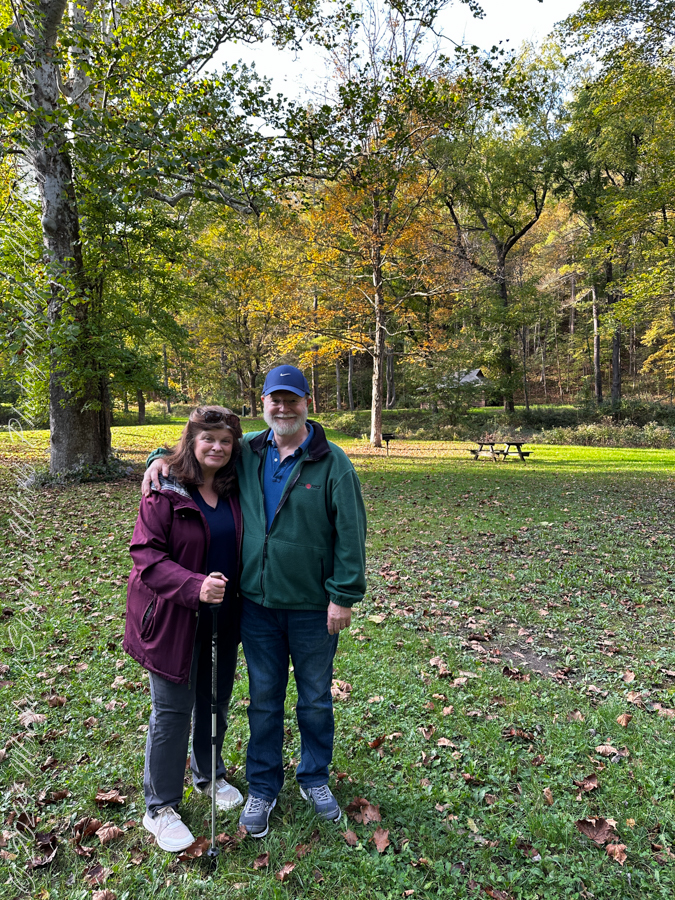
On a crisp October afternoon, October 3, 2024, Pam and I reveled in Upper Robert H. Treman State Park, a serene oasis nestled in Tompkins County. This visit was particularly special for us, a step in Pam’s recovery from her August hip replacement. I remember the sound of her hiking pole tapping the ground as we walked together, feeling grateful for her progress since surgery. The air was cool, and the leaves, turning gold and orange, whispered in the breeze, providing the perfect backdrop for our outing that day.
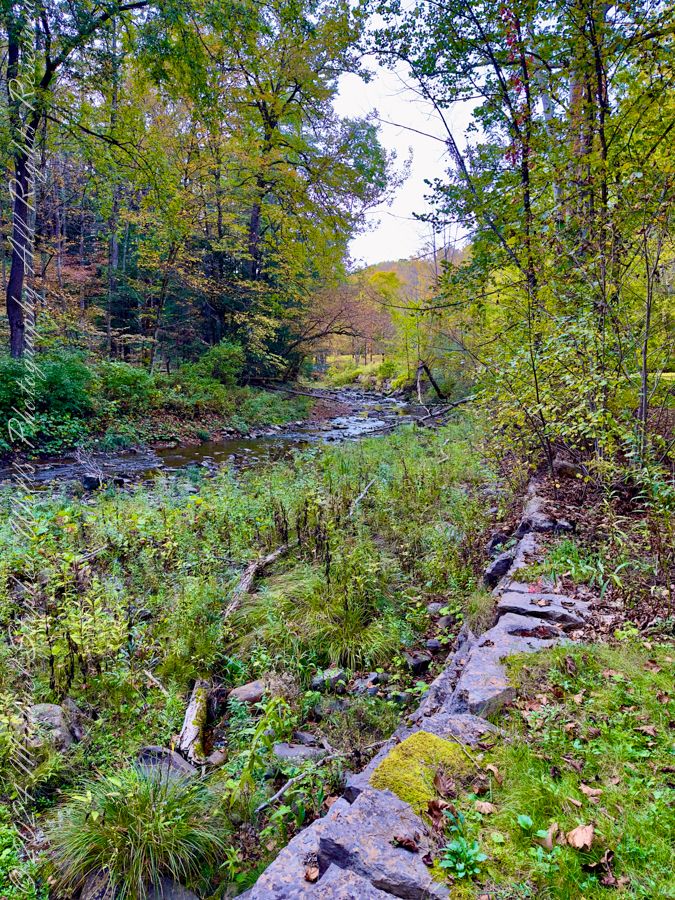
Our path followed the creek, the same creek that winds through the heart of the park, framed by layers of stone and lush vegetation. In one of the first photos I took that day, you can see the creek reflecting the soft autumn light, its bed dotted with rocks and fallen branches. The vibrant greens of the undergrowth juxtaposed with the golden leaves made the scene feel timeless, as though nature itself was participating in Pam’s recovery, offering healing in its quiet, enduring beauty.
The view upstream just before the creek enters The Gallery. Robert H. Treman State Park, Enfield, Tompkins County, Finger Lakes Region, New York State.
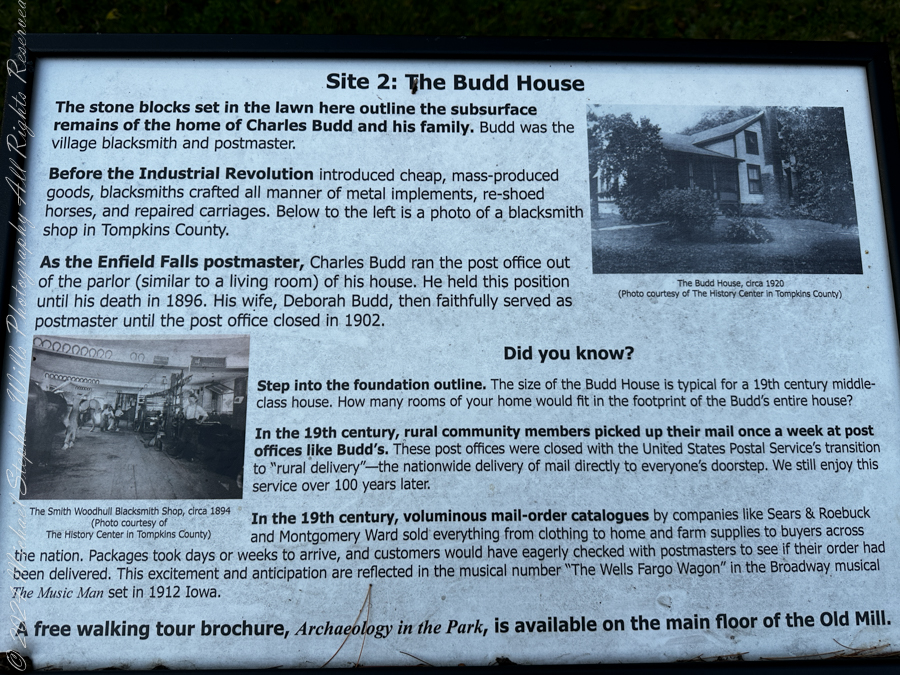
We paused to take in the quiet hum of life around us. There was a sense of history in the park that seemed to blend with our personal story. As we wandered deeper, we reached the foundation of the old Budd House, its stone blocks now barely a shadow of the past but still carrying echoes of life lived long ago. The placard described Charles Budd, a village blacksmith and postmaster, and his wife, Deborah, who continued to serve the community after his passing. Standing there, I reflected on how these stones, much like Pam’s journey, represented resilience and the passage of time.
Site 2: The Budd House
The stone blocks set in the lawn here outline the subsurface remains of the home of Charles Budd and his family. Budd was the village blacksmith and postmaster.
Before the Industrial Revolution introduced cheap, mass-produced goods, blacksmiths crafted all manner of metal implements, re-shoed horses, and repaired carriages. Below to the left is a photo of a blacksmith shop in Tompkins County.
As the Enfield Falls postmaster, Charles Budd ran the post office out of the parlor (similar to a living room) of his house. He held this position until his death in 1896. His wife, Deborah Budd, then faithfully served as postmaster until the post office closed in 1902.
Did you know?
Step into the foundation outline. The size of the Budd House is typical for a 19th century middle-class house. How many rooms of your home would fit in the footprint of the Budd’s entire house?
In the 19th century, rural community members picked up their mail once a week at post offices like Budd’s. These post offices were closed with the United States Postal Service’s transition to “rural delivery”—the nationwide delivery of mail directly to everyone’s doorstep. We still enjoy this service over 100 years later.
In the 19th century, voluminous mail-order catalogues by companies like Sears & Roebuck and Montgomery Ward sold everything from clothing to home and farm supplies to buyers across the nation. Packages took days or weeks to arrive, and customers would have eagerly checked with postmasters to see if their order had been delivered. This excitement and anticipation are reflected in the musical number “The Wells Fargo Wagon” in the Broadway musical The Music Man set in 1912 Iowa.
A free walking tour brochure, Archaeology in the Park, is available on the main floor of the Old Mill. Upper Treman. Robert H. Treman State Park, Enfield, Tompkins County, Finger Lakes Region, New York State.
As we stood by the foundation, we met another couple. The woman shared her own story of recovery, a tale of resilience that resonated deeply with us. She had fallen and suffered a spinal injury, becoming paralyzed from the neck down, while traveling. Thanks to surgery and rehabilitation, she regained full mobility. There was a moment of understanding and connection between us. We offered to take a photo of them, and they returned the favor, capturing the two of us—Pam leaning lightly on her cane, smiling, surrounded by trees whose leaves were beginning to fall. That picture, one of my favorites from the day, symbolizes not just Pam’s strength but also the support and shared experiences that come with recovery.
We are taking a walk through upper Treman Park during Pam’s recovery from hip replacement. This was taken by a couple we met.
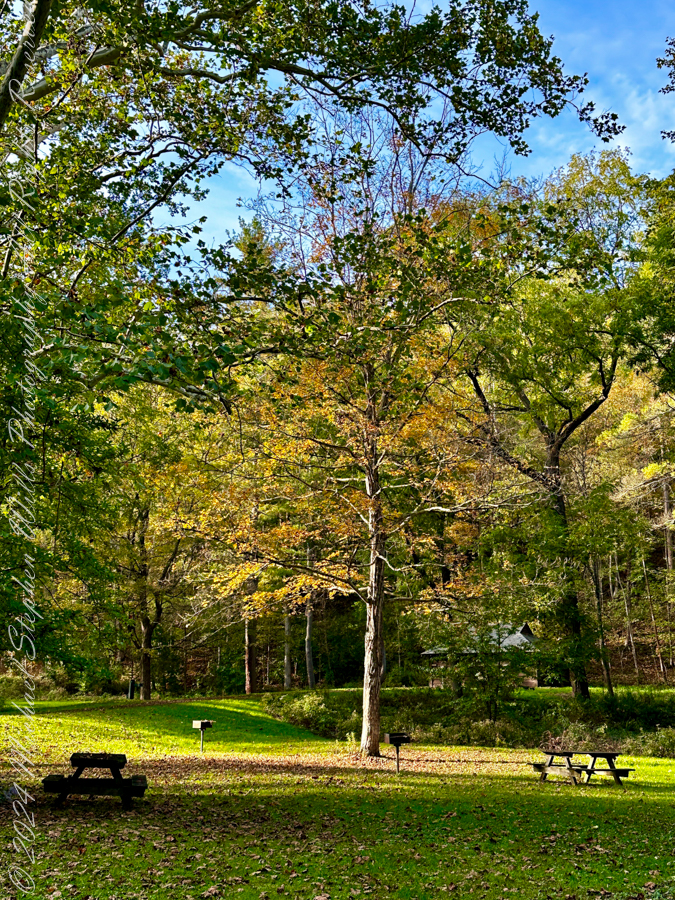
The park offered us a space for reflection and a sense of continuity. The trees, some towering over us with roots gripping the earth, had seen many seasons of change, and now they watched over us as we walked beneath them. In the clearing where picnic tables stood, we sat for a while, simply absorbing the moment. The afternoon light filtered through the branches, casting long shadows on the grass.
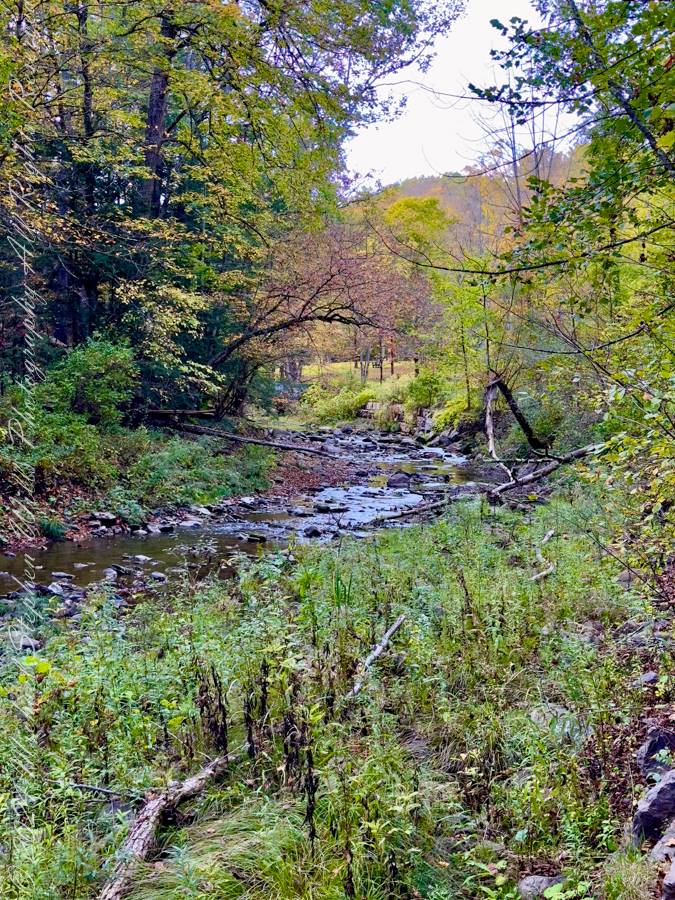
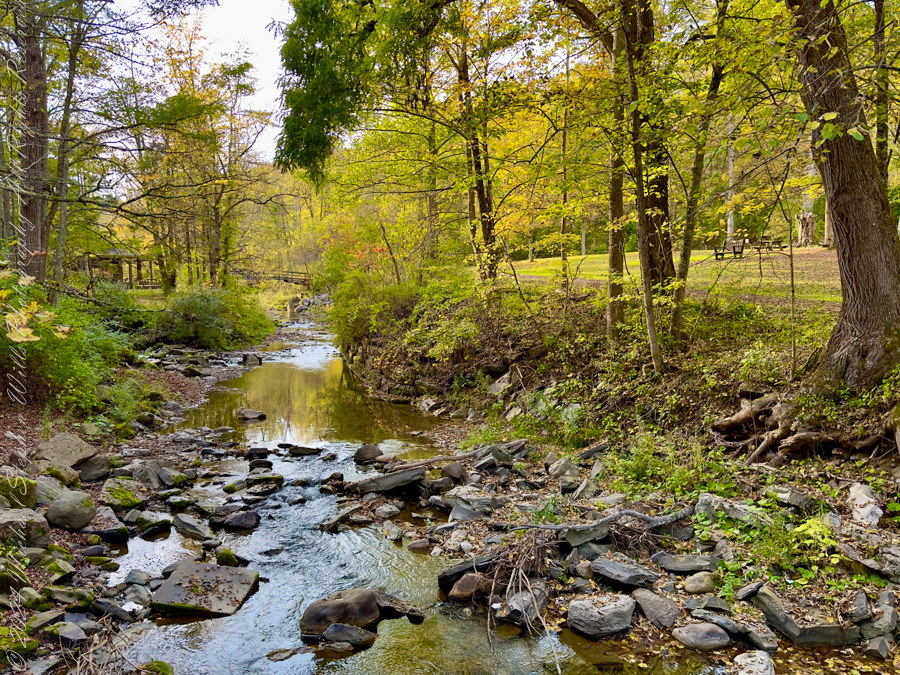
One of the final photos I took that day captures the creek from another angle. The water, calm and clear, reflects the yellow hues of the trees, while the rocks and roots along the bank seem frozen in time. It’s a peaceful image, one that reminds me of the quiet strength that Pam has shown throughout her recovery.
Here Fish Creek, a tributary of Enfield Creek joins the flow just below the pavilion of Upper Treman.
We left the park that day feeling both uplifted and grounded, the layers of history and personal resilience blending seamlessly into the natural landscape. Upper Robert H. Treman had become had become a part of Pam’s recovery story, a testament to the healing power of both nature and community.
Enter your email to receive notification of future postings. I will not sell or share your email address.
Copyright 2024 All Rights Reserved Michael Stephen Wills
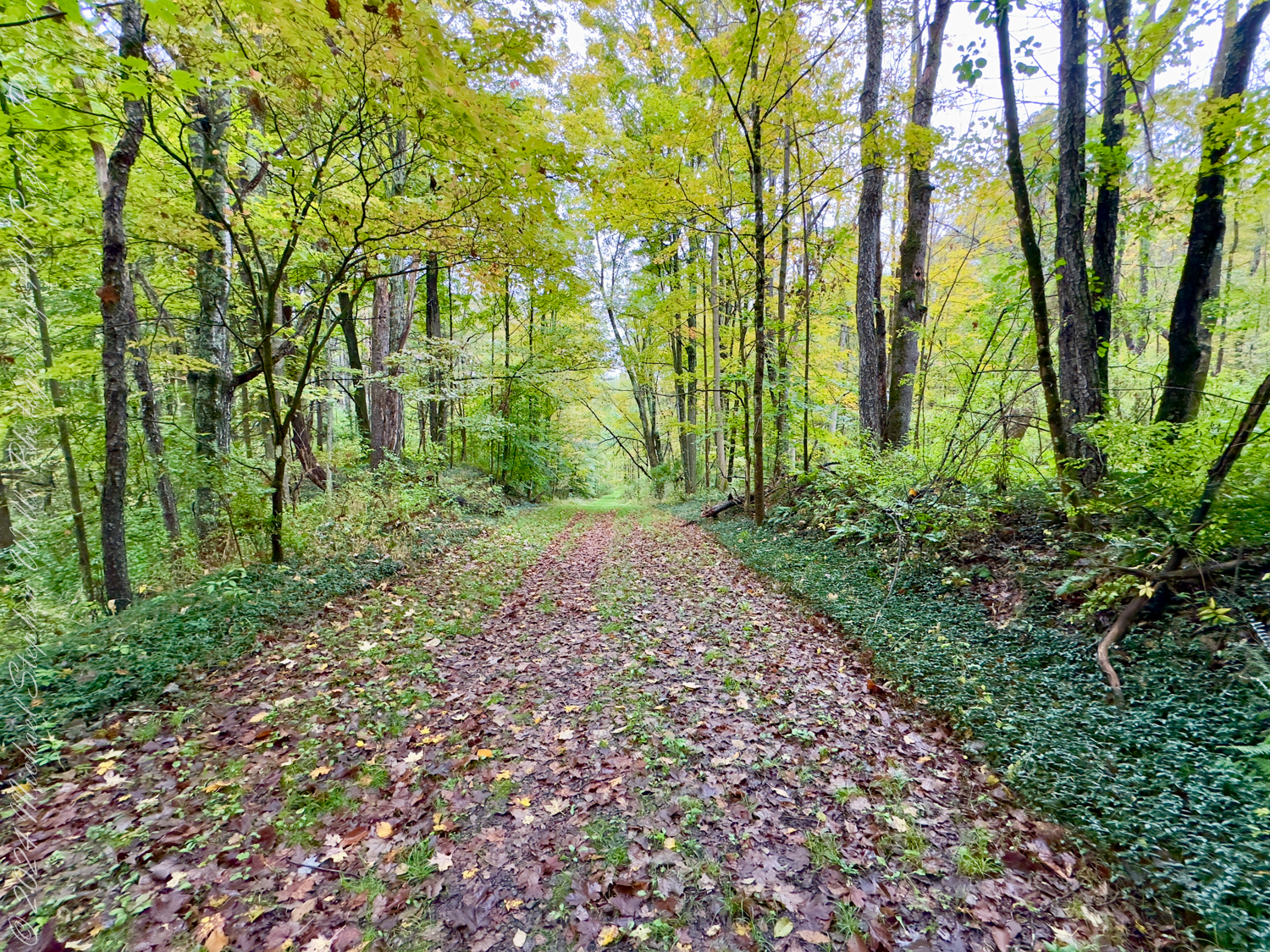
The wind is cool, carrying the first real bite of autumn as I step onto the Finger Lakes Trail from Woodard Road, entering Robert H. Treman State Park. The sounds of rustling leaves underfoot remind me that the season is in full swing, and soon, this vibrant foliage will be a memory. But today, the trees still hold their colors—greens tinged with yellow, brown, and red—forming a canopy that seems to glow in the soft morning light.
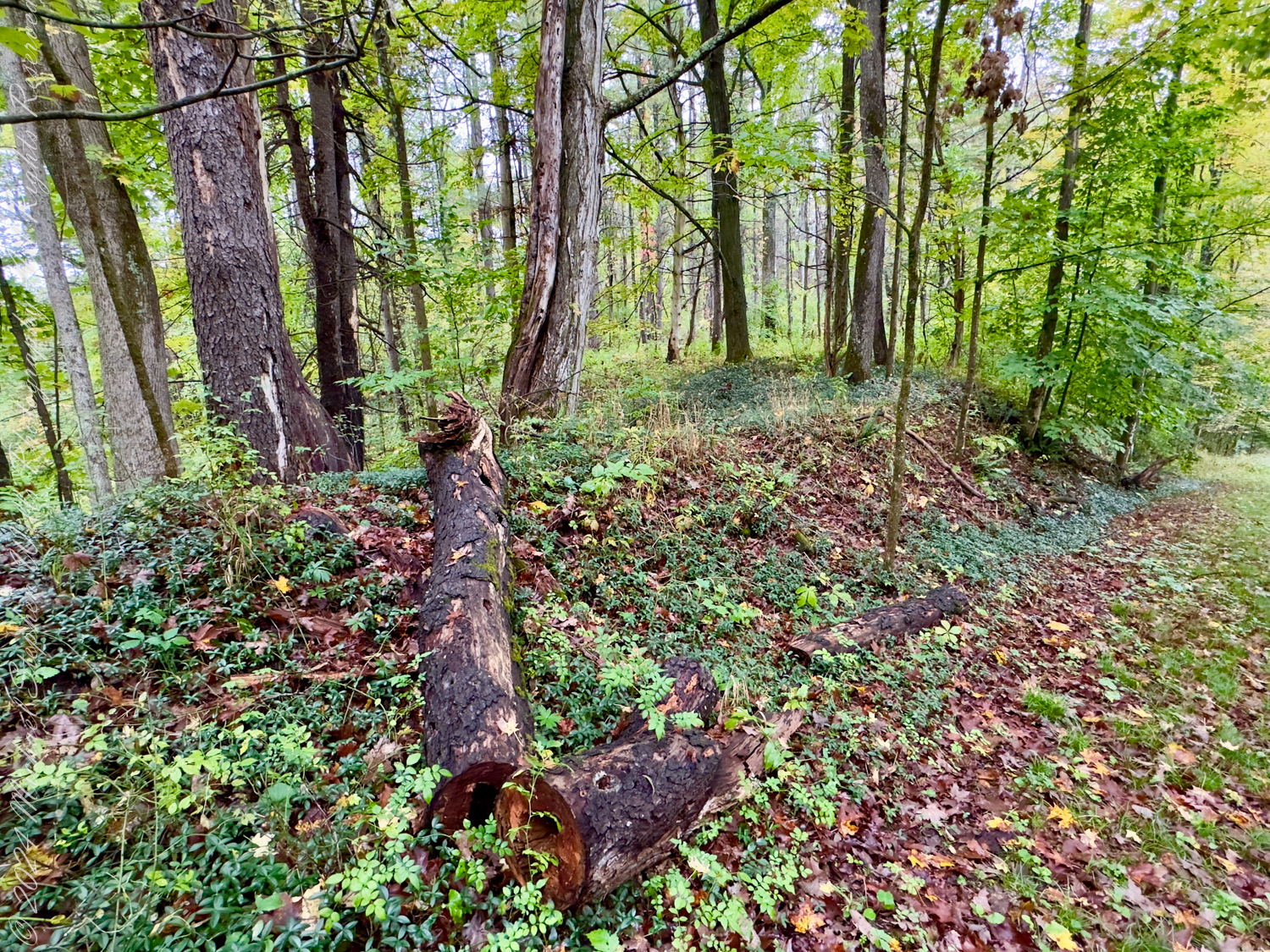
The trail is quiet, save for the occasional chirping of birds and the subtle creaking of the trees as they sway in the wind. It’s a perfect time for reflection, and with each step, I feel myself sinking deeper into the peace of this place. Ahead of me, a fallen tree lies on the slope, now part of the earth, slowly being reclaimed by the forest. The log, dotted with moss and fungi, seems like a work of art created by time and nature. I stop to admire it, my fingers grazing the rough bark, now softened with age and decay. It’s a reminder that everything in nature moves in cycles—growth, death, and rebirth.
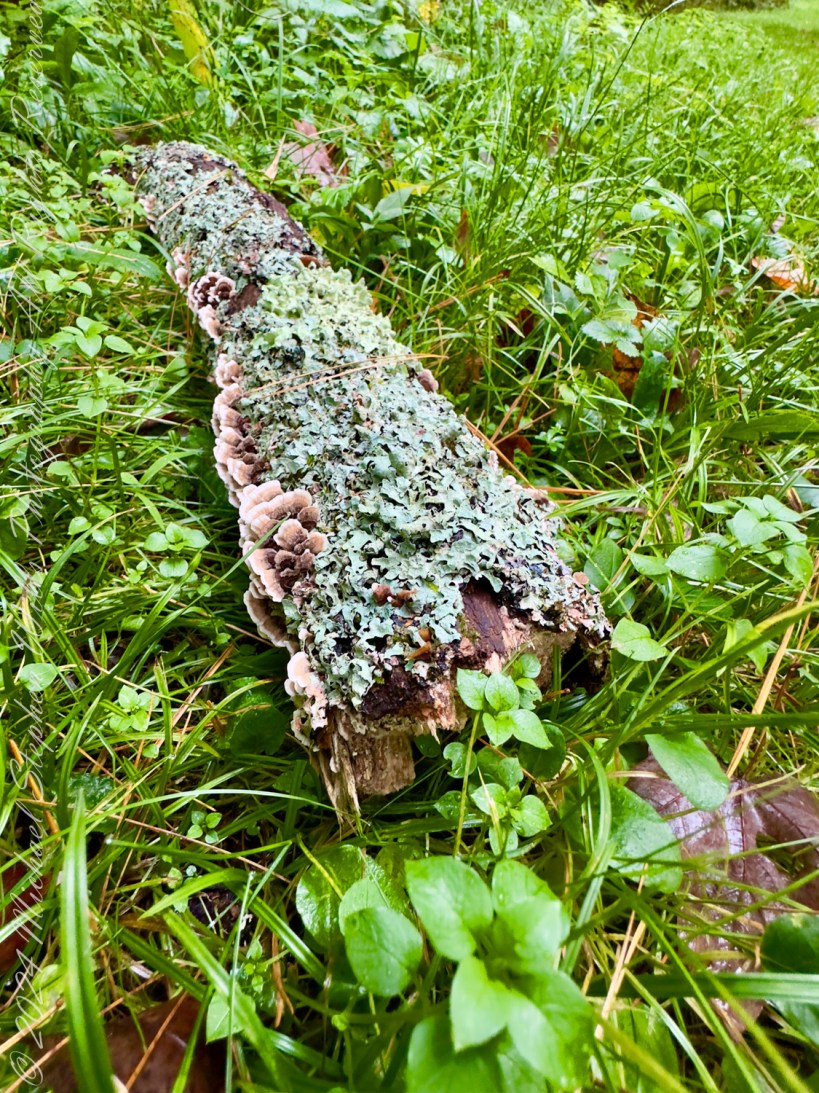
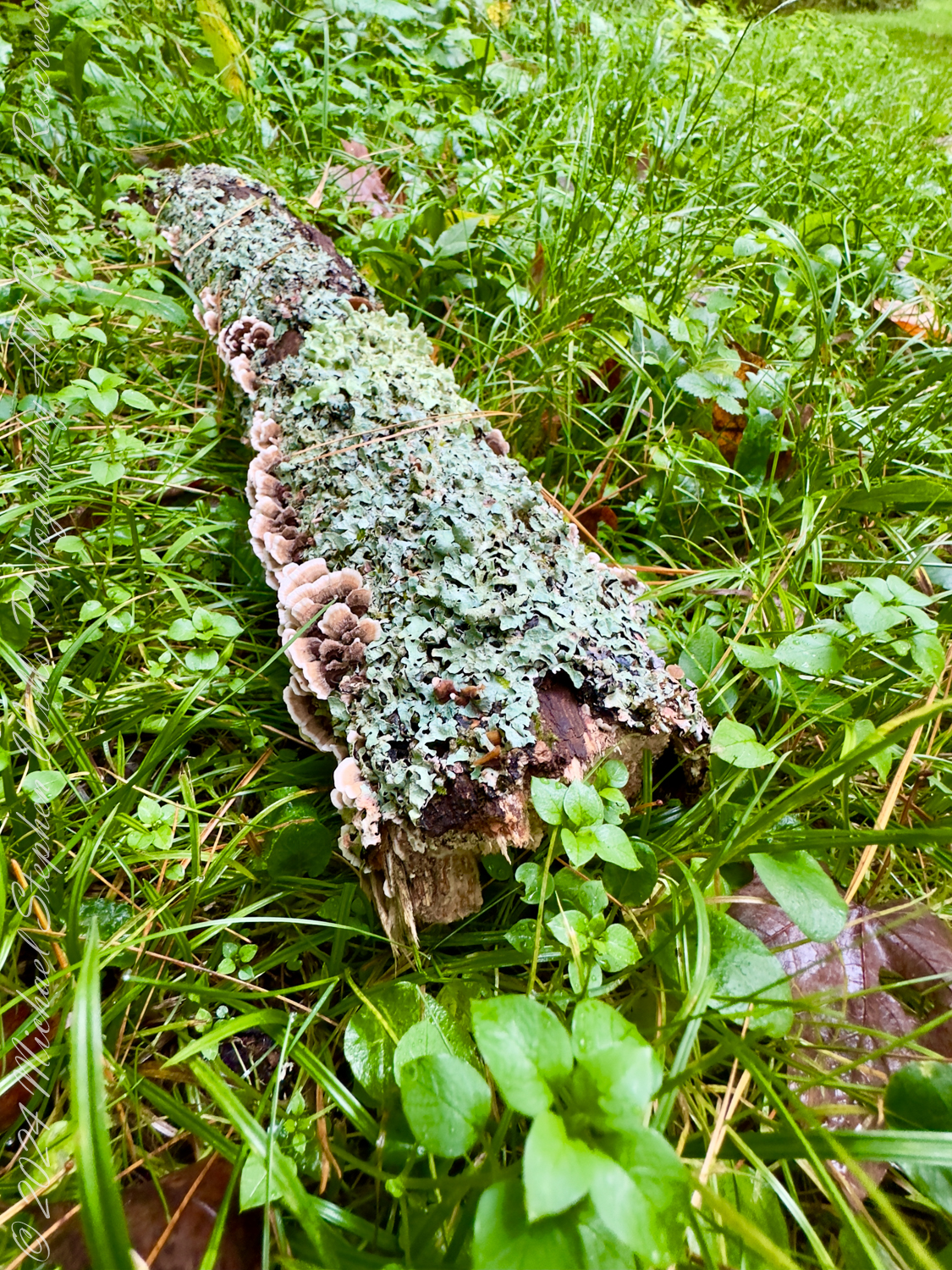
A few steps further and I find something even more intricate—another log, this one completely overtaken by a delicate layering of lichens and shelf fungi. The growth covers the bark like an elaborate tapestry of greens, grays, and soft whites. It’s beautiful in its own quiet way, and I take a moment to kneel beside it, studying the intricate patterns. Nature has a way of turning even decay into something stunning. I wonder how long it took for these fungi to establish their hold, slowly breaking down the wood, contributing to the endless cycle of life in the forest.
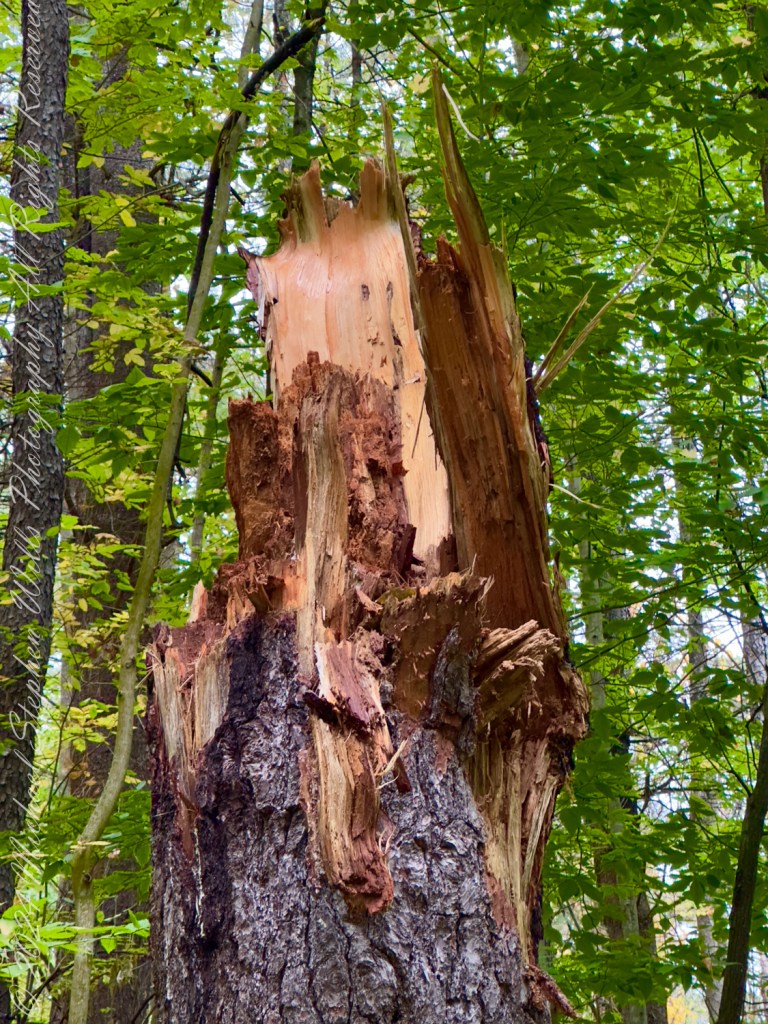
Moving onward, I come across a tall stump—remnants of a once-majestic tree, now shattered. The splintered wood reaches upward like jagged teeth, still sturdy despite the obvious trauma it endured. The raw power of nature is always humbling; trees like this seem so strong and permanent, yet even they can be brought down in an instant. It’s a reminder of life’s fragility, and I feel a sense of reverence standing in its presence, imagining the forces that felled it.
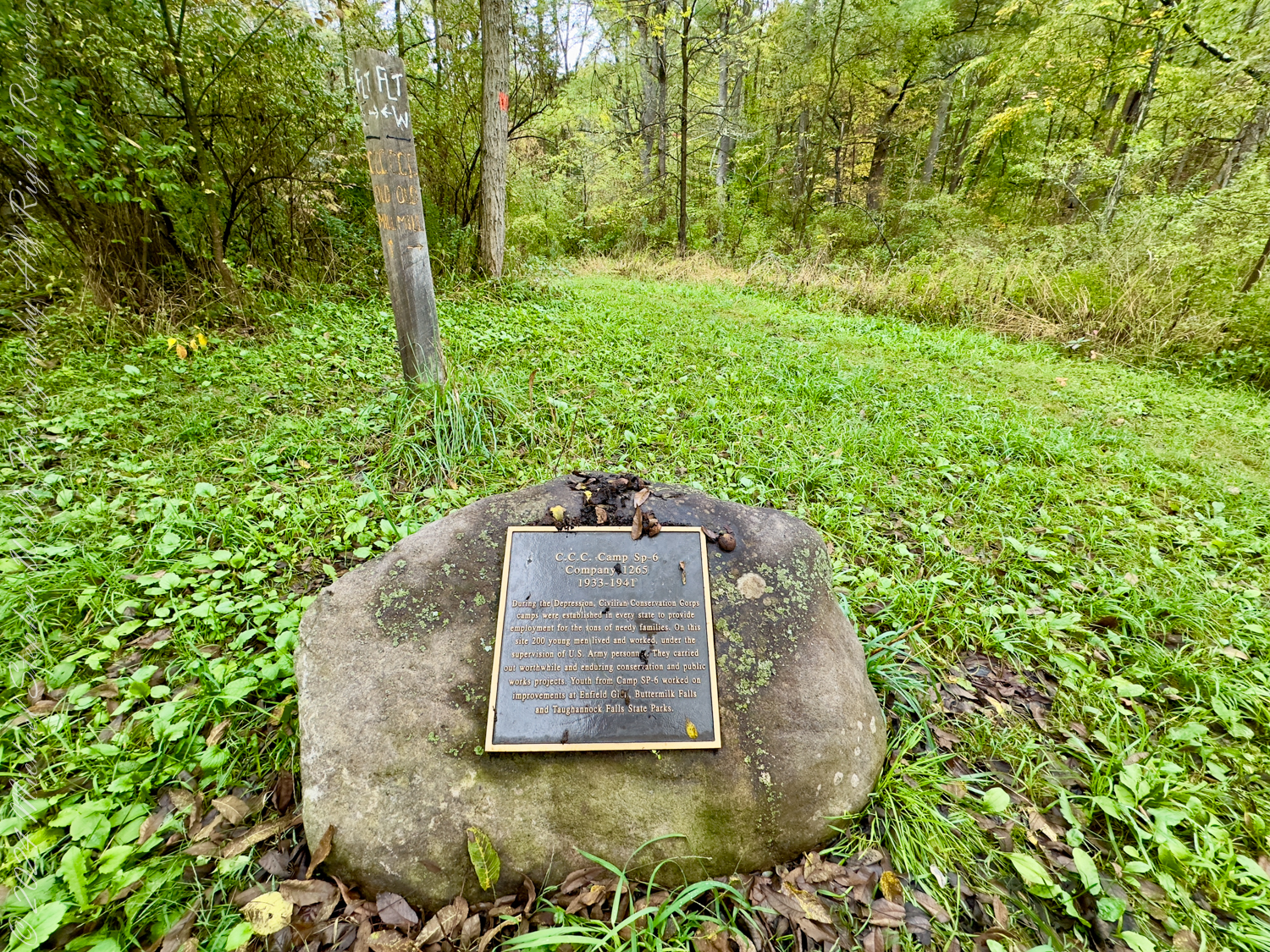
Continuing along the trail, I soon reach a clearing. There, nestled in the grass, is a plaque mounted on a large stone. It marks the site of the Civilian Conservation Corps (C.C.C.) Camp SP-6, Company 1253, which operated here from 1933 to 1935. I pause to read the inscription, which commemorates the young men who lived and worked in this camp during the Great Depression. They carried out public works projects, including improvements to Enfield Glen, Buttermilk Falls, and Taughannock Falls. I imagine the sense of purpose and camaraderie these workers must have felt, building something that would outlast them, even in the midst of hardship.
C.C.C. Camp SP-6, Company 1253, 1933-1935
During the Depression, Civilian Conservation Corps camps were established across America to provide employment for the relief of needy families. On this site, 200 young men lived and worked under the supervision of U.S. Army personnel. They carried out camp-wide and nearby construction and public works projects. Youth from Camp SP-6 worked on improvements in Enfield Glen, Buttermilk Falls, and Taughannock Falls State Park.
The plaque is a poignant reminder of the connection between humans and nature. Just as the trees here are part of a larger cycle, so too were the men of the C.C.C. They left their mark on this land, shaping the trails and structures we now take for granted. And yet, like everything in nature, their work is being slowly reclaimed by the forest. The wooden signs marking distances and directions are weathered, moss creeping up their bases, as if the forest itself is gently pulling them back into the earth.
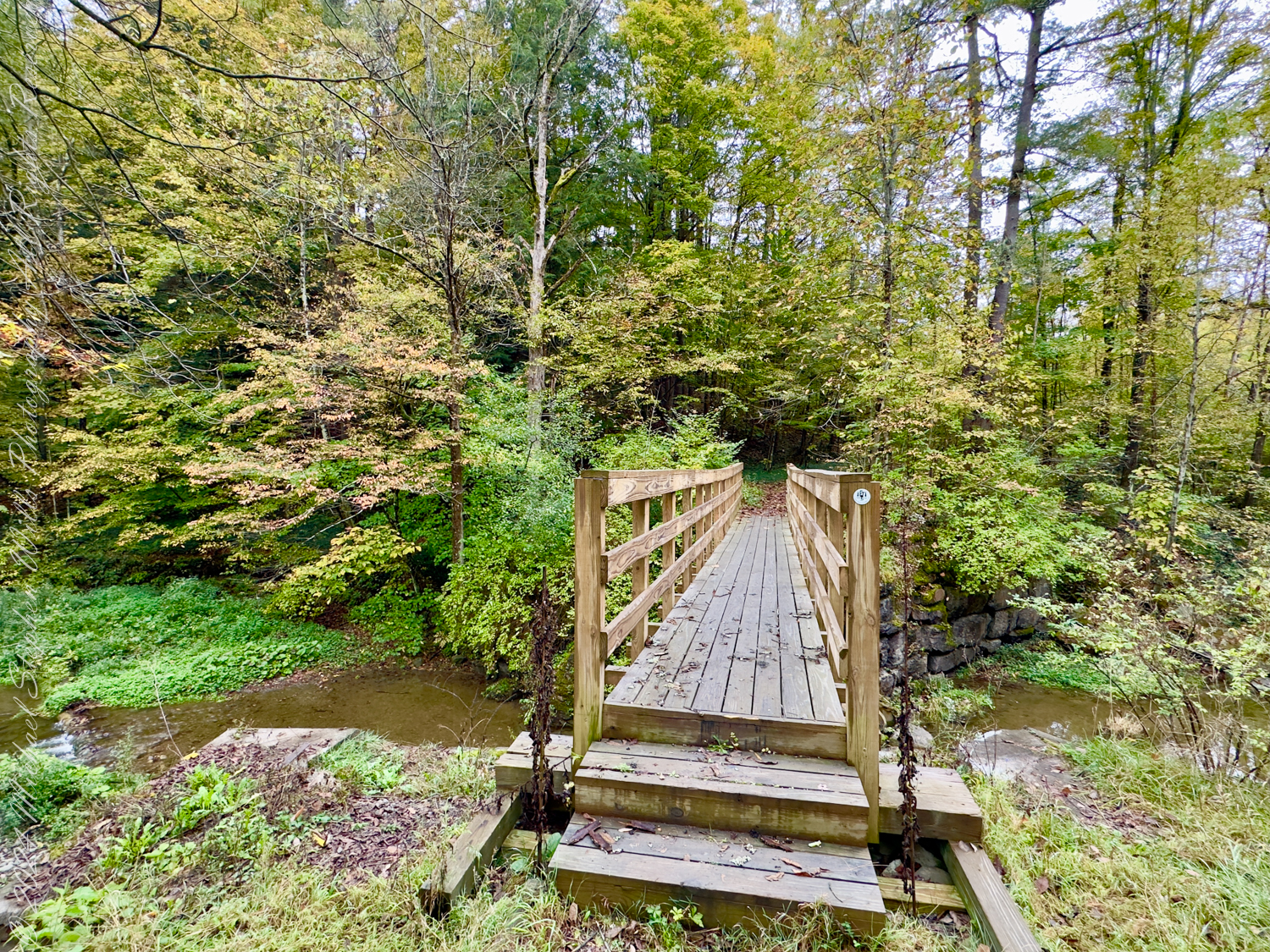
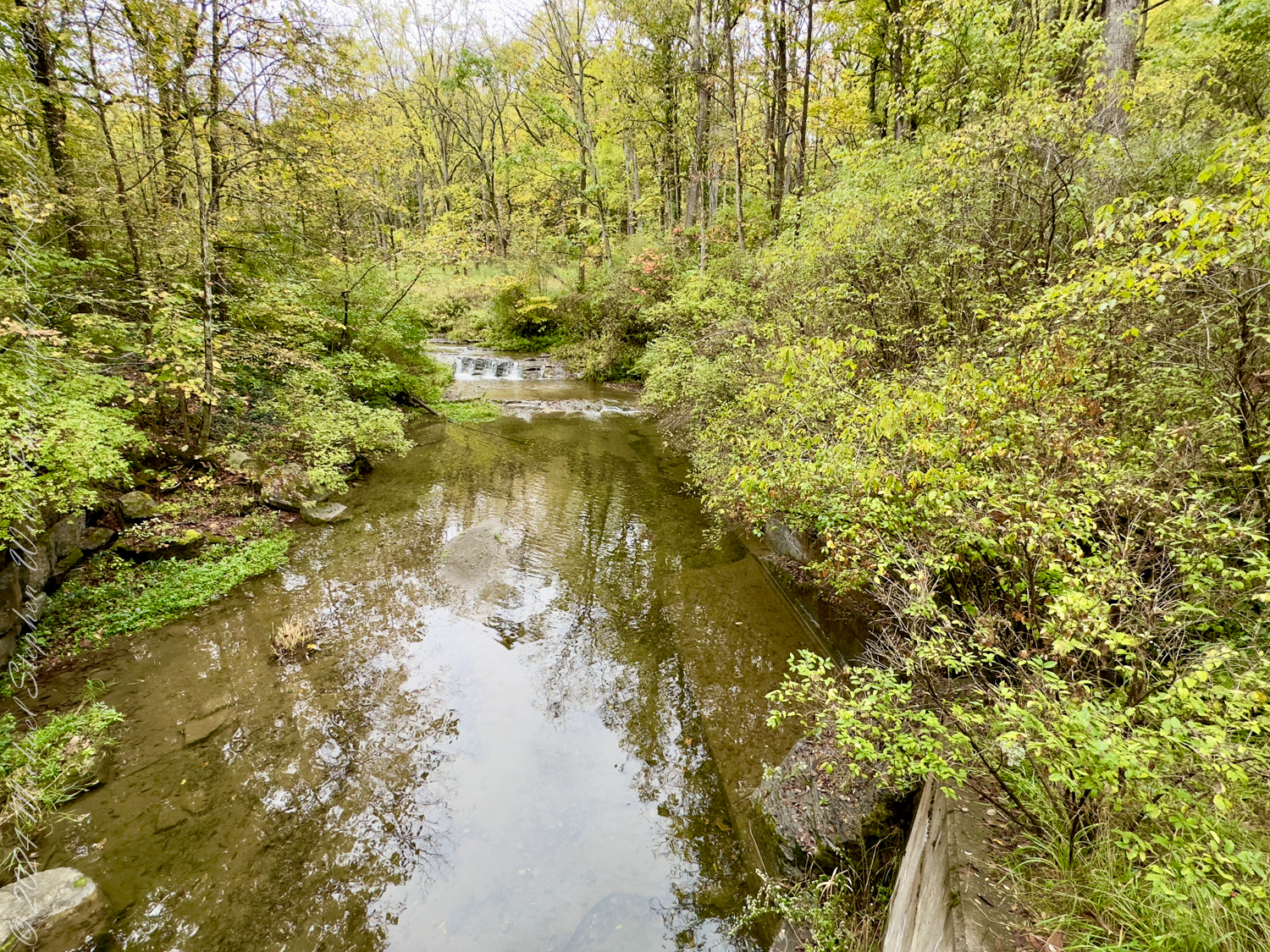
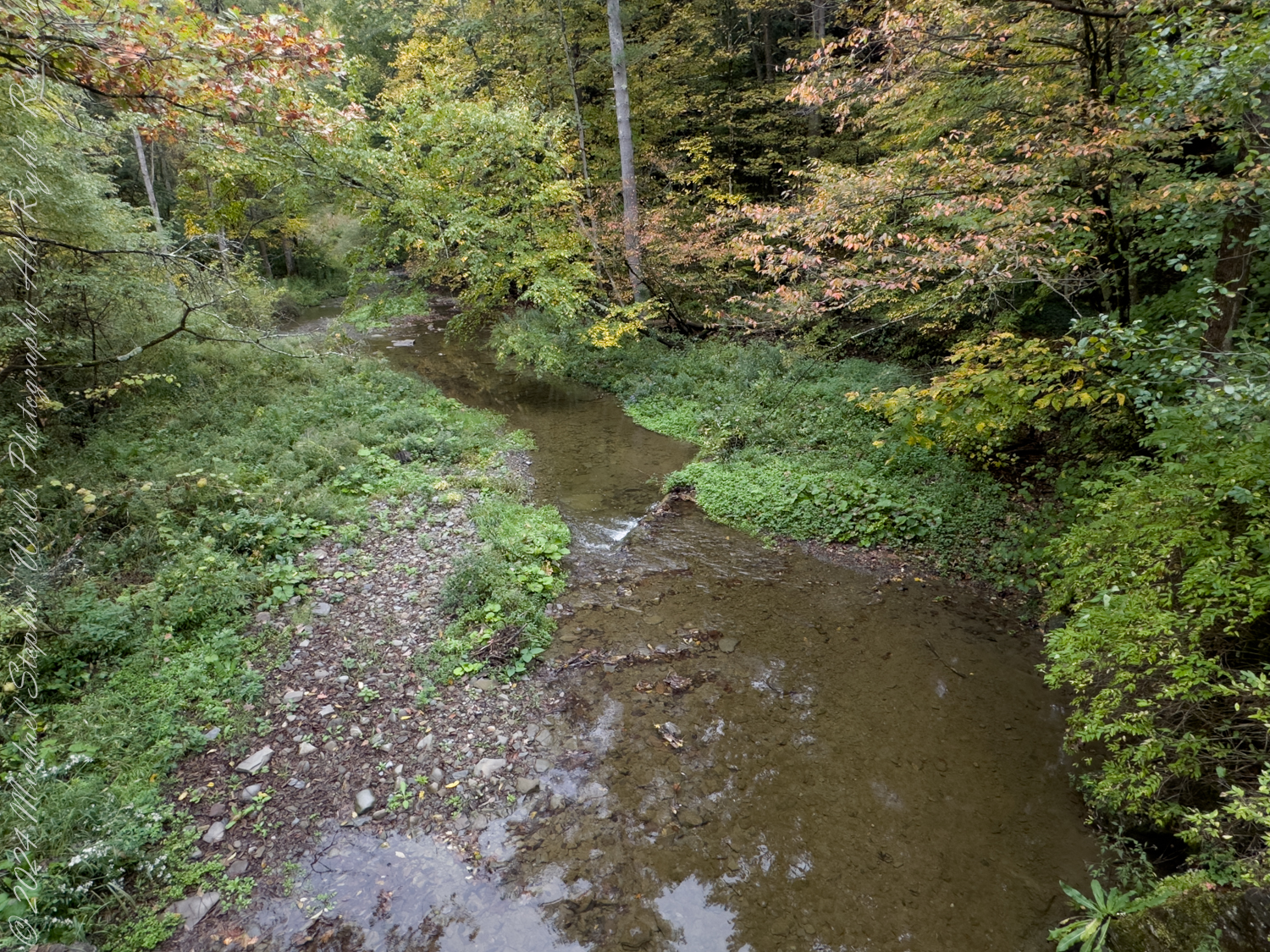
As I cross a small wooden footbridge, recently replaced on the Finger Lakes Trail, I stop to look down at the creek below. The water moves steadily, reflecting the gold and green hues of the trees above. Small waterfalls tumble over rocks, their gentle rush filling the air with a peaceful sound. I watch the water for a while, feeling the pull of time and nature’s persistence.
View from the bridge, upstream Fish Creek
Standing there, I’m struck by how everything I’ve encountered today, from the fallen trees to the CCC plaque, tells the same story—nature’s quiet persistence, its ability to adapt, reclaim, and renew. I breathe deeply, knowing that while time moves forward and everything changes, the beauty and wisdom of places like this will always remain, if we just take the time to notice.
View from the bridge, downstream Fish Creek
Enter your email to receive notification of future postings. I will not sell or share your email address.
Copyright 2024 All Rights Reserved Michael Stephen Wills
Walking along the Finger Lakes Trail in Robert H. Treman State Park, I come across something that makes me stop—maple leaves, caught mid-fall, suspended in a delicate spider web. Time itself seems to pause with them, as if the leaves, in their slow descent, had found a way to defy gravity. Yellow, brown, and green, they hang like fragile ornaments, arrested in motion. For a moment, it feels like the world is holding its breath.
Maple leaves caught in freefall by spider web. Finger Lakes Trail, Robert H Treman State Park, Ithaca, Tompkins County, New York State
This brief suspension of nature’s inevitable course is uncanny, a moment frozen between one season and the next. These leaves, so close to their final rest on the forest floor, now seem to defy their fate, held up by threads too fine to see. I’m tempted to reach out and free them, to let them continue their journey down to the earth, but something stops me. It’s as if the web, like a clock halted mid-tick, has granted me the rarest gift—a chance to stop the flow of time.
In this moment, I reflect on how life itself is always in motion, how we are carried forward whether we like it or not. But here, in this quiet pocket of the forest, these leaves offer a small rebellion against that forward push. They hang, caught between what was and what will be, suspended between summer and winter, life and decay.
I snap a photo, knowing it’s just an echo of the real thing, a poor attempt to capture a miracle of nature. The leaves will eventually fall, the web will loosen, and time will move on. But for now, in this moment, they remain suspended, as do I—caught in the beauty of a moment where time, for once, seems to stand still.
Enter your email to receive notification of future postings. I will not sell or share your email address.
Copyright 2024 All Rights Reserved Michael Stephen Wills
Discover the rich history and ecological significance of the American Basswood, a majestic tree that intertwines nature, culture, and human history. Uncover its beauty, versatility, and the fascinating pollinators that bring it to life.
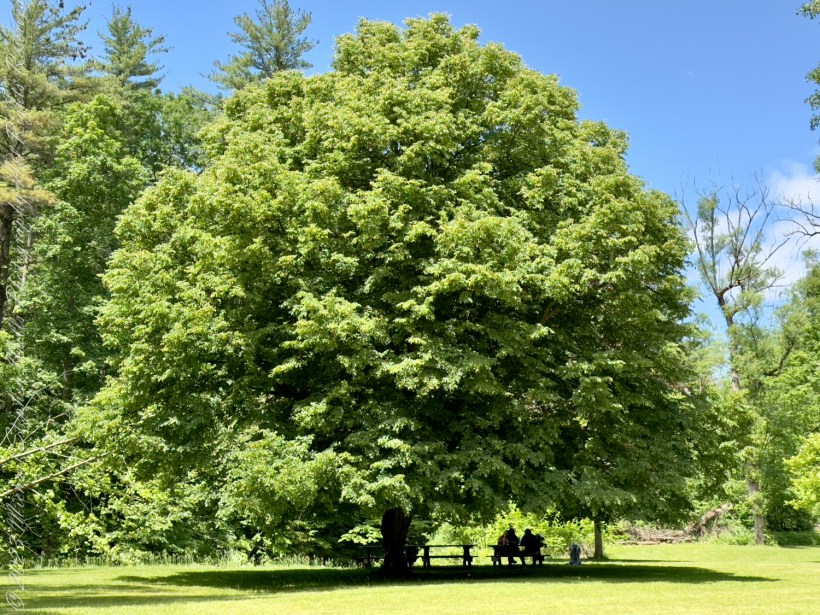
As I strolled through the sun-dappled glade, my eyes were drawn to a magnificent tree standing sentinel at the edge of the clearing. Its broad canopy spread like a green umbrella, casting a generous shade over the picnic bench below. Intrigued by its commanding presence, I approached, eager to unravel the secrets of this arboreal giant. Little did I know that this encounter would lead me on a journey through history, etymology, and the myriad uses of the American Basswood.
This photograph features the growth pattern for which the Basswood is known. Buttermilk Falls State Park, Ithaca, Tompkins County, New York State. The Finger Lakes Region.
The American Basswood, or Tilia americana, is a tree steeped in history and lore. Its name, “Basswood,” is derived from the word “bast,” referring to the inner bark of the tree, which is known for its fibrous and pliable nature. This etymology hints at the tree’s historical uses, which I would soon discover are as rich and varied as the foliage above me.
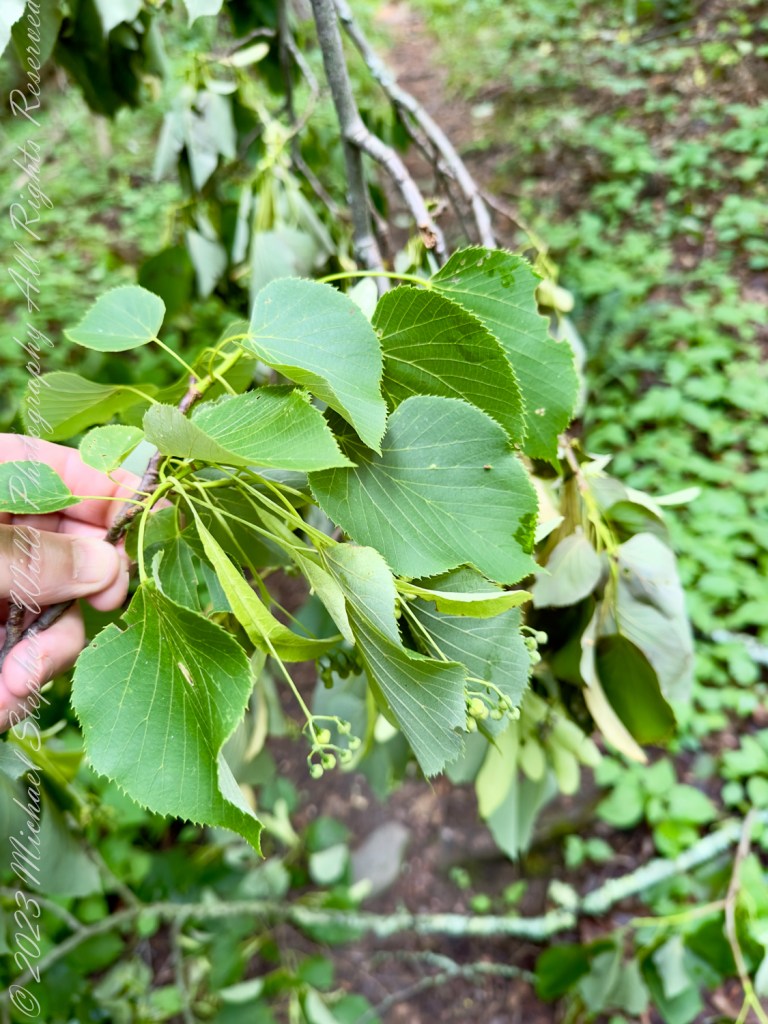
As I examined the leaves, I was struck by their heart-shaped form, a feature that has made the Basswood a symbol of love and romance in various cultures. The leaves were smooth and slightly serrated at the edges, with a deep green hue that seemed to capture the essence of summer. Hanging delicately from the branches were clusters of small, round buds, hinting at the tree’s flowering potential. These flowers, I would later learn, are not just beautiful but also aromatic, attracting bees and other pollinators with their sweet fragrance.
These are leaves from a branch broken by spring storms and fallen across the Finger Lakes Trail that follows the southern side of Treman Park above the South Rim Trail. Robert H. Treman New York State Park, Tompkins County, Ithaca. June 27, 2024
The history of the American Basswood in America is intertwined with the lives of indigenous peoples and early settlers. Native Americans valued the Basswood for its soft, easily worked wood and its inner bark, which they used to make ropes, mats, and other essential items. The tree’s wood, known for being lightweight and finely grained, was perfect for carving and crafting tools, utensils, and even ceremonial masks. This versatility made the Basswood an integral part of daily life and cultural practices.
With the arrival of European settlers, the uses of Basswood expanded. Settlers quickly recognized the tree’s potential, using its wood for a variety of applications. The soft, yet sturdy wood was ideal for making furniture, musical instruments, and even crates and boxes. Its workability and smooth finish made it a favorite among craftsmen and artisans. I imagined the hands of these early Americans, shaping and molding the wood, breathing life into their creations.
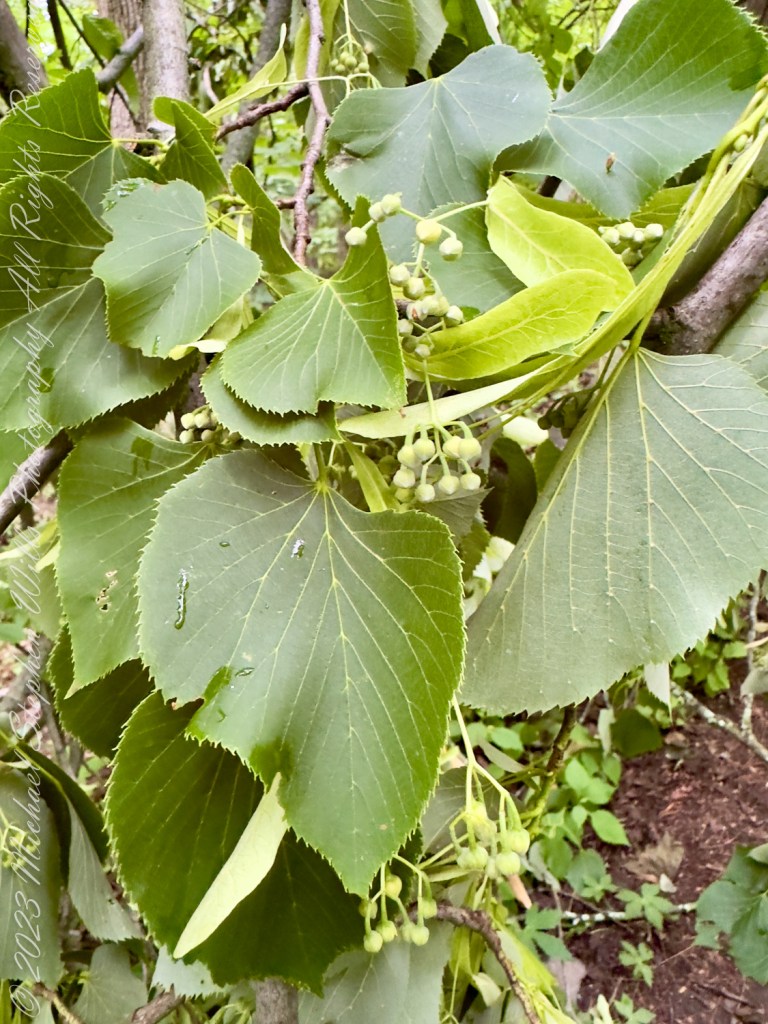
As I continued to explore the tree, I was drawn to the small, green fruits hanging from slender stems. These fruits, known as nutlets, are encased in a leafy bract that aids in their dispersal by wind. This ingenious natural design ensures the propagation of the species, allowing new generations of Basswoods to take root and flourish.
Curious about the tree’s name, I delved into its etymology and discovered an interesting linguistic journey. In England and Ireland, the Basswood is commonly referred to as the “Lime Tree.” This name does not relate to the citrus fruit tree but instead comes from the Old English word “Lind,” related to the German word “Linde.” Both terms historically referred to trees of the Tilia genus. Over time, “Lind” evolved into “Lime,” influenced by phonetic changes and regional dialects, solidifying the term “Lime Tree” for Tilia species in these regions. Despite sharing the same common name, the Tilia “Lime Tree” and the citrus “Lime Tree” belong to entirely different plant families.
The American Basswood’s significance extends beyond its practical uses. The tree has found a place in American culture and literature, often symbolizing strength, resilience, and longevity. Its towering presence and expansive canopy make it a popular choice for parks and public spaces, where it provides shade and beauty. I thought of the many people who must have sought refuge under its branches, finding solace and inspiration in its quiet strength.
In addition to its cultural and historical significance, the Basswood also plays a crucial ecological role. Its flowers are a vital source of nectar for bees, making it an essential component of local ecosystems. Beekeepers, in particular, value the Basswood for the high-quality honey produced from its nectar, known for its delicate flavor and aroma. The tree’s leaves and bark also provide habitat and food for various wildlife, contributing to the biodiversity of the area.
Pollination is a critical aspect of the American Basswood’s lifecycle, and a variety of insects are drawn to its fragrant, nectar-rich flowers. Honeybees (Apis mellifera) are among the most significant pollinators, their presence around the Basswood a testament to the tree’s importance in the ecosystem. These industrious bees not only gather nectar but also facilitate the pollination process, ensuring the production of seeds. Bumblebees (Bombus spp.) also play a crucial role, utilizing their unique buzz-pollination technique to effectively transfer pollen within the flowers.
These are leaves from a branch broken by spring storms and fallen across the Finger Lakes Trail that follows the southern side of Treman Park above the South Rim Trail. Robert H. Treman New York State Park, Tompkins County, Ithaca. June 27, 2024
Additionally, native bees such as sweat bees (Halictidae), mining bees (Andrenidae), and leafcutter bees (Megachilidae) are frequent visitors, drawn by the abundant nectar and pollen. Butterflies, while not as significant as bees, contribute to the pollination process, adding a touch of grace as they flutter from flower to flower. Moths, particularly those active in the evening, are another group of pollinators, their nocturnal activity complementing the daytime efforts of bees and butterflies. Hoverflies (Syrphidae), also known as flower flies, are attracted to the nectar and aid in the pollination, showcasing the diverse array of insects that rely on the Basswood.
Reflecting on my discovery, I realized the American Basswood is a living testament to the interconnectedness of nature and human history. Its presence in the landscape is a reminder of the many ways in which plants and trees shape our lives, providing resources, inspiration, and a connection to the natural world.
As I left the shade of the Basswood and continued my walk, I felt a deep sense of gratitude for the opportunity to learn and connect with this remarkable tree. Its story is a reminder of the importance of preserving and cherishing the natural world, ensuring that future generations can continue to discover and appreciate the wonders of the American Basswood.
Copyright 2024 Michael Stephen Wills All Rights Reserved
Discover the enchanting white bluebells blooming around our home! Explore their natural history, ethereal beauty, and fascinating folklore. Uncover the wonders of Hyacinthoides non-scripta (alba) in our latest blog post.
The surprise of finding white bluebells blooming around our home this spring was nothing short of magical. Known scientifically as Hyacinthoides non-scripta (alba), these delicate flowers add a touch of elegance and tranquility to our garden. As I delved into the history, etymology, and folklore of these enchanting blooms, I discovered a world rich in cultural significance and natural wonder.
Bluebell Natural History
White bluebells, a variant of the common bluebell, belong to the Asparagaceae family. Native to the woodlands of Western Europe, these perennials are renowned for their striking appearance and pleasant fragrance. The white bluebell, though less common than its blue counterpart, is equally captivating with its pure white, bell-shaped flowers that hang gracefully from slender stems.
Hyacinthoides non-scripta thrives in shady, moist environments, often forming dense carpets that transform forest floors into a sea of blossoms in spring. These plants are well-adapted to their woodland habitats, where they bloom before the canopy closes, taking advantage of the early spring light.
White Bluebell (Hyacinthoides non-scripta (alba)) growing around our home, May 2024
Etymology of the Scientific and Common Names
The scientific name “Hyacinthoides” is derived from the Greek word “hyakinthos,” referring to the mythological youth Hyacinthus, who was transformed into a flower. “Non-scripta” means “unmarked” or “not written,” distinguishing it from the classical hyacinth described by ancient authors. This epithet underscores the plant’s unique identity in the botanical world.
The common name “bluebell” comes from the flower’s resemblance to small bells and its predominant blue color. The “white” prefix simply describes this particular variety’s color, adding to its distinction.
White Bluebells in Folklore and History
Bluebells, including their white variants, are steeped in folklore and myth. In England, bluebells are often associated with fairy enchantments and woodland magic. Folklore suggests that bluebells ring to summon fairies, and to disturb a bluebell patch was to risk falling under a fairy spell. The white bluebells, with their ethereal appearance, add an extra layer of mystique to these tales.
Historically, bluebells were used for practical purposes as well. The sticky sap from the bulbs was employed to bind pages in books and to glue feathers onto arrows. However, it’s important to note that all parts of the plant are toxic if ingested, a fact that has also contributed to its aura of cautionary folklore.
The Surprise and Wonder of White Bluebells
Discovering white bluebells around our home has been a source of immense joy. These flowers, with their serene beauty and historical significance, connect us to the past and the natural world in a profound way. The surprise of seeing them bloom each spring reminds us of nature’s unpredictability and generosity.
Their presence in our garden brings a sense of peace and wonder, inviting us to pause and appreciate the small miracles that surround us. The delicate white bells, swaying gently in the breeze, create a visual symphony that enchants the senses and uplifts the spirit.
White bluebells serve as a testament to the rich tapestry of life that thrives in our gardens, often unnoticed. They remind us to look closely, to explore, and to cherish the natural beauty that graces our lives. As we continue to nurture our garden, the white bluebells stand as a symbol of purity, resilience, and the timeless charm of nature’s wonders.
Copyright 2024 Michael Stephen Wills All Rights Reserved
Discover the enchanting Hairy Beardtongue nestled in Treman Gorge. Learn about its striking lavender blooms, unique adaptations, and fascinating history in our latest nature exploration. Dive into the beauty of Penstemon hirsutus!
On a sunny day at the end of May 2024, I embarked on one of my cherished walks through Robert H. Treman Park, located in the heart of Ithaca, New York. The park, with its stunning gorges and waterfalls, never ceases to amaze me with its natural beauty and diverse plant life. This time, my exploration led me to a delightful discovery along the south-facing walls of Treman Gorge: Penstemon hirsutus, commonly known as the Hairy Beardtongue.
As I navigated the rocky terrain, my attention was caught by a cluster of delicate, tubular flowers emerging from the crevices of the gorge walls. Their soft lavender hues stood out against the rugged backdrop of moss-covered rocks and shale. Upon closer inspection, I noticed the characteristic hairy stems and leaves, confirming that I had indeed found Penstemon hirsutus.
Penstemon hirsutus is a perennial herbaceous plant native to eastern North America. It typically reaches a height of 1 to 3 feet, with erect stems covered in fine hairs. The leaves are lanceolate, arranged oppositely along the stem, and also bear a slight fuzziness. The flowers, which bloom from late spring to early summer, are tubular and two-lipped, resembling a small beard—a feature that likely inspired the common name “Beardtongue.” Each flower is about 1 to 1.5 inches long, with a delicate lavender color that fades to white at the throat.
The genus name “Penstemon” is derived from the Greek words “pente,” meaning five, and “stemon,” meaning stamen, referring to the plant’s five stamens—four fertile and one sterile, the latter often appearing as a small, hairy tongue within the flower. The species name “hirsutus” comes from Latin, meaning hairy, a nod to the plant’s hirsute stems and leaves.
The Hairy Beardtongue thrives in well-drained soils and can often be found in rocky, open woodlands, meadows, and along cliffs—exactly the kind of environment provided by Treman Gorge. This plant is well-adapted to the microhabitats created by the gorge’s south-facing walls, where sunlight and moisture create ideal growing conditions. The rock walls not only offer physical support but also help retain heat and moisture, creating a microclimate that supports a variety of plant species.
Historically, Penstemon hirsutus and its relatives have been valued for their ornamental beauty and ecological benefits. The flowers attract a variety of pollinators, including bees, butterflies, and hummingbirds, making them an important component of the local ecosystem. Native Americans also recognized the medicinal properties of some Penstemon species, using them to treat ailments such as toothaches, sore throats, and respiratory issues.
In recent times, gardeners and horticulturists have come to appreciate Penstemon hirsutus for its hardiness and low maintenance requirements. It is often used in native plant gardens, rock gardens, and naturalized areas to add a touch of wild beauty. The plant’s ability to thrive in poor soils and its resistance to deer browsing make it a valuable addition to any garden aiming to support local wildlife and biodiversity.
Finding the Hairy Beardtongue in Treman Gorge was a moment of pure joy and wonder. It reminded me of the resilience and adaptability of nature, as this delicate yet sturdy plant has carved out a niche for itself in the rocky walls of the gorge. The sight of its soft lavender blooms swaying gently in the breeze was a testament to the beauty and tenacity of life in even the most rugged environments.
As I continued my hike, I felt a renewed sense of connection to the natural world. The discovery of Penstemon hirsutus was not just a botanical find but a reminder of the intricate and interconnected web of life that thrives in Treman Gorge. Each plant, each flower, has a story to tell—a story of survival, adaptation, and beauty that enriches our understanding of the natural world and our place within it.
Copyright 2024 Michael Stephen Wills All Rights Reserved
Discover the enchanting woodruff growing around our home! Explore its natural history, delightful fragrance, and fascinating role in folklore and history. Uncover the wonders of this perennial plant in our latest blog post.
As spring breathes new life into our surroundings, the delight of identifying the plants that grow around our home is a joy like no other. This year, I was thrilled to discover that the delicate and fragrant woodruff (Galium odoratum) has been gracing our garden. Known for its charming clusters of white flowers and vibrant green leaves, woodruff brings both aesthetic beauty and a rich historical tapestry to our home.
Natural History of Woodruff
Woodruff, scientifically known as Galium odoratum, is a perennial plant native to Europe, North Africa, and parts of Asia. It thrives in shady, woodland environments, often forming dense mats that carpet the forest floor. The plant typically blooms in late spring to early summer, producing tiny white flowers that contrast beautifully with its whorls of bright green leaves.
Galium odoratum is a member of the Rubiaceae family, which also includes coffee and gardenias. Its ability to spread quickly through its creeping rhizomes makes it an excellent ground cover. In addition to its visual appeal, woodruff is known for its sweet scent, which intensifies when the plant is dried. This fragrance is due to the presence of coumarin, a natural compound that also contributes to its medicinal properties.
This woodruff (Galium odoratum) grows around our home.
Etymology of the Scientific and Common Names
The scientific name Galium odoratum provides insights into the plant’s characteristics. “Galium” is derived from the Greek word “gala,” meaning milk. This refers to the plant’s historical use in curdling milk. “Odoratum,” on the other hand, highlights the plant’s pleasant aroma.
The common name “woodruff” has an interesting origin as well. The word “wood” refers to the plant’s typical habitat in wooded areas, while “ruff” is thought to be derived from the Old English “rūwe,” meaning rough or hairy, describing the texture of the plant’s leaves and stems.
Woodruff in Folklore and History
Woodruff has a storied past, steeped in folklore and history. In medieval Europe, it was used for its aromatic properties to freshen up linens and as a strewing herb to mask odors in homes and churches. Its sweet scent was believed to ward off evil spirits and bring good fortune, making it a popular choice for wreaths and garlands during festivals and celebrations.
The plant also played a role in traditional medicine. Woodruff was used to treat various ailments, including liver and gallbladder issues, and as a mild sedative. Its medicinal use is attributed to the coumarin content, which has anticoagulant and anti-inflammatory properties. However, it’s worth noting that high doses of coumarin can be toxic, so its medicinal use has largely fallen out of favor in modern times.
In Germany, woodruff is famously associated with May Wine, a traditional beverage enjoyed during spring festivals. The plant is infused into white wine, imparting its unique flavor and aroma. This custom dates back centuries and is still practiced today, symbolizing the arrival of spring and the renewal of life.
This woodruff (Galium odoratum) grows around our home.
The Surprise and Wonder of Woodruff
Discovering woodruff around our home has been a source of wonder and delight. Its presence connects us to the rich tapestry of nature and history, reminding us of the timeless beauty and utility of the plants that surround us. As I watch the delicate flowers sway gently in the breeze, I am filled with a sense of gratitude for the surprises that nature continually offers.
Woodruff’s modest appearance belies its profound impact on the landscape and our lives. It serves as a reminder that even the smallest plants can hold significant historical, cultural, and medicinal value. As we continue to explore and appreciate the natural world around us, the humble woodruff stands as a testament to the enduring connection between humanity and nature.
Copyright 2024 Michael Stephen Wills All Rights Reserved






 Michael Stephen Wills Photography